Stephenson, Robert
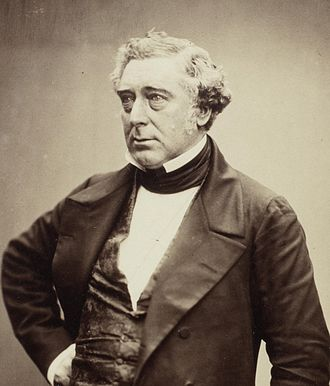
NAME: Stephenson, Robert
ACHIEVEMENTS:
Major contribution to the development of the railways
NICKNAME/ALIAS:
None
DATE AND PLACE OF BIRTH:
16 October 1803, Willington Quay, near Newcastle, England
DATE AND PLACE OF DEATH AND AGE AT DEATH:
12 October 1859, London, England. Aged 56
DISCIPLINE:
Civil Engineer
FIELD:
Civil engineering/Railways
LANGUAGE:
English
PARENTS:
Father: George Stephenson
Mother: Frances Henderson
SIBLINGS:
None
SPOUSE:
Fanny Sanderson
CHILDREN:
None
EDUCATION:
Village school, Long Benton
Private school, Newcastle
MAJOR WORK:
None
LIFE AND TIMES:
Stephenson’s father was <father was> George Stephenson*, a self-taught mechanic and successful engine-wright who was determined that his son should have the advantage of a good education that had been denied to him.
After leaving school, Stephenson was apprenticed to a mining engineer but in 1821 his father obtained his release so he could help with him with his survey for the Stockton and Darlington railway line.
The promoters of the line had originally asked the eminent engineer <collaborated with> Rennie* to undertake a survey in association with him. Rennie was outraged at the idea of collaborating with Stevenson, with whom he had fallen out over credit for the Bell Rock lighthouse in Scotland. When Rennie declined the job, it went to George Stephenson.
In between assisting his father, Stephenson attended Edinburgh University for six months in 1822 and the following year father and son established a locomotive-building firm at Newcastle. Robert Stephenson acted as the managing partner and although he was fascinated by the locomotive business and the firm was doing well he left in 1824 and took a job supervising works in the Columbia gold and silver mines. It was here he probably met the French chemist JBJD <likely met> Boussingault*
It is generally accepted that his father’s rather over-bearing character and unwillingness to accept new ideas drove Stephenson to assert his independence. He was frustrated by poor conditions and communications in Columbia and unable even to get hold of the steam machinery he had sent out for the mines, and at the end of his contract in 1827 he returned to England.
On his way back, he came across the pioneer locomotive-builder <met> Trevithick*, who was stranded in a South American port, and Stephenson paid his fare to England.
Stephenson found on his return that the locomotive works were in a poor state and that the errors in his father’s survey for the Liverpool and Manchester line had damaged their reputation. The engines turned out at the Newcastle works were for slow coal trains and did not meet the growing need for fast passenger trains.
Stephenson took charge and in 1828 the firm produced the “Lancashire Witch” for the Bolton and Leigh line. It was the first engine to have a cut-off regulating the entry of steam to the cylinders, a modification which increased the reliability and efficiency of the engine.
There was debate among the promoters about the type of vehicle to be used on the Manchester line and to settle the matter, a trial was announced to see if the line should be worked by locomotives or by stationary vehicles hauled by cables. Locomotives had to be spring-mounted to avoid track damage, they had to consume their own smoke and to draw three times their own weight.
The distances involved in the trial involved ten continuous return journeys over two separate stages in order to test the staying power of the locomotive. The Stephenson’s built the famous Stephenson “Rocket” which convincingly won the trial. The “Rocket” was a developed form of the “Lancashire Witch” with front wheels larger than the rear and a boiler in which the heat went through twenty-five copper tubes, which gave a much larger heating surface than usual and enabled the engine to cope with long runs. The “Rocket” was also the first engine to be fitted with reversing gear.
The Stephensons’ Newcastle works received a large number of orders and for next 30 year played a major role in the development of locomotives. The Stephenson's then won a contract for a railroad between London and Birmingham. Stephenson moved to London and began to plan the route.
The line was 180 kilometres long and ran over some extremely difficult stretches. The most difficult stretch of the line was making the Kilsby Tunnel which ran through rock and quicksand was the longest proposed railway tunnel. To cope with ventilation needs, Stephenson designed two 20-metre diameter shafts and eventually installed twenty-three air shafts. The line was completed in 1838.
Among his other major works was the railroad line between Newcastle and Edinburgh. His father had quarrelled with <a pal of> Isambard Kingdom Brunel* but. Stephenson made lasting friends with Brunel.
The Newcastle/Edinburgh line involved Stephenson in two major bridge-building projects: the High Level bridge over the Tyne at Newcastle and the Border Bridge over the Tweed at Berwick - a viaduct with 26 masonry arches with two levels, for road and rail traffic. He was also working on an Irish mail route from Chester to Holyhead and this project involved bridging the river Conway and the Menai Straits.
The Board of Admiralty, wanting to protect shipping, insisted on clearance at least 100 ft high throughout the length of the bridge so that tall sailing ships could be accommodated. This meant that the bridge could not be arched and he had to find a way of building long spans that were secure enough to take the weight and the vibration of trains.
Stephenson decided to build a new type of suspension bridge in which the suspension chains would support a huge wrought-iron tube that the trains would run through. He had decided this when the launch of <influenced by> Robert Napier’s*, new iron steamship, the “Prince of Wales”, at Blackwall on the river Thames went wrong due to failure of the launching tackle. Although the ship was stuck with its hull left unsupported over a length of 110 ft it did not break up.
Stephenson was encouraged by this to eliminate suspension chains from his bridge design.
He was supported in this by <consultant was> Fairbairn* who acted as consultant on the construction of the bridge. Other scientific opinion went against Stephenson but in 1845 he obtained parliamentary consent for his design. Edwin Clark of <engineer was> E & L Clark* was appointed resident engineer for both bridges.
The tubular section of the bridge had to be built on land in separate lengths of 230 ft and floated by pontoons into a position between the piers at water level, from where they was gradually jacked up with hydraulic power (a version of the <used a version of> hydraulic ram*). . The bridge was successfully completed in 1850.
At the same time, <corresponded with> Roebling* in America was considering building a suspension bridge over Niagara that would take the weight of a moving train. He corresponded with Stephenson who advised against the project. He also advised against the Suez Canal, saying it would fill up with sand.
Stephenson went on to build similar bridges for the Egyptian railways and over the St Lawrence at Montreal in Canada.
In 1857 he repaid Brunel’s loyalty by answering his appeal for support when Brunel was launching his steamship the <attended launch of> “Great Eastern”*. Stephenson received Brunel’s message late at night in winter and in spite of being unwell was on the foggy riverbank early next morning. His only recreation was his yacht, which he lent to the astronomer <a pal of> Smyth* in 1856.
ASSESSMENT: Stephenson built the first viable passenger locomotive and introduced new methods into bridge building.
EXTRA CONNECTIONS: He hired <hired> Charles Fox*
His grandson was <grandson was> Robert Louis Stevenson*
His biography was written by <bio written by> Smiles*
He knew <knew> Clapeyron*
His godson was <godson was> Sir Robert SS Baden-Powell*
Duke of Wellington was present at a demonstration of the Rocket in which an MP was killed.
ONELINER: Robert Stephenson, builder of the Rocket locomotive
BIBLIOGRAPHY:
Holt, L.T.C., George and Robert Stephenson, The Railway Revolution, Penguin Books, Harmondsworth, Middlesex, 1978
Robbins, Michael, George and Robert Stephenson, Oxford University Press, London, 1966
Sellman, R.R., George and Robert Stephenson. Methuen Education Ltd., London, 1971.