occupy 2 bak
capt bak 917
red taken out w/ marking
-=-=
-=-=
8 26
June 15, 2026. Yotam Marom, co-founder of the Wildfire Project, joins for a conversation about his new book: “For Louder Days: Beyond the Politics of Powerlessness“.
END OF OCC UNION TRAINING? FORECLOSURE DIRECT ACTION
=-=-
-=-=
2022
OCCUPY 1OTH ANNIV UCB 2011 ROBT SPCH KARA SEGAL IN NY
NOT INSTITUTIONALIZED; SUNRISE, MUTUAL AID BERNIE AOC
---
https://www.alternet.org/2021/09/occupy-wall-street/
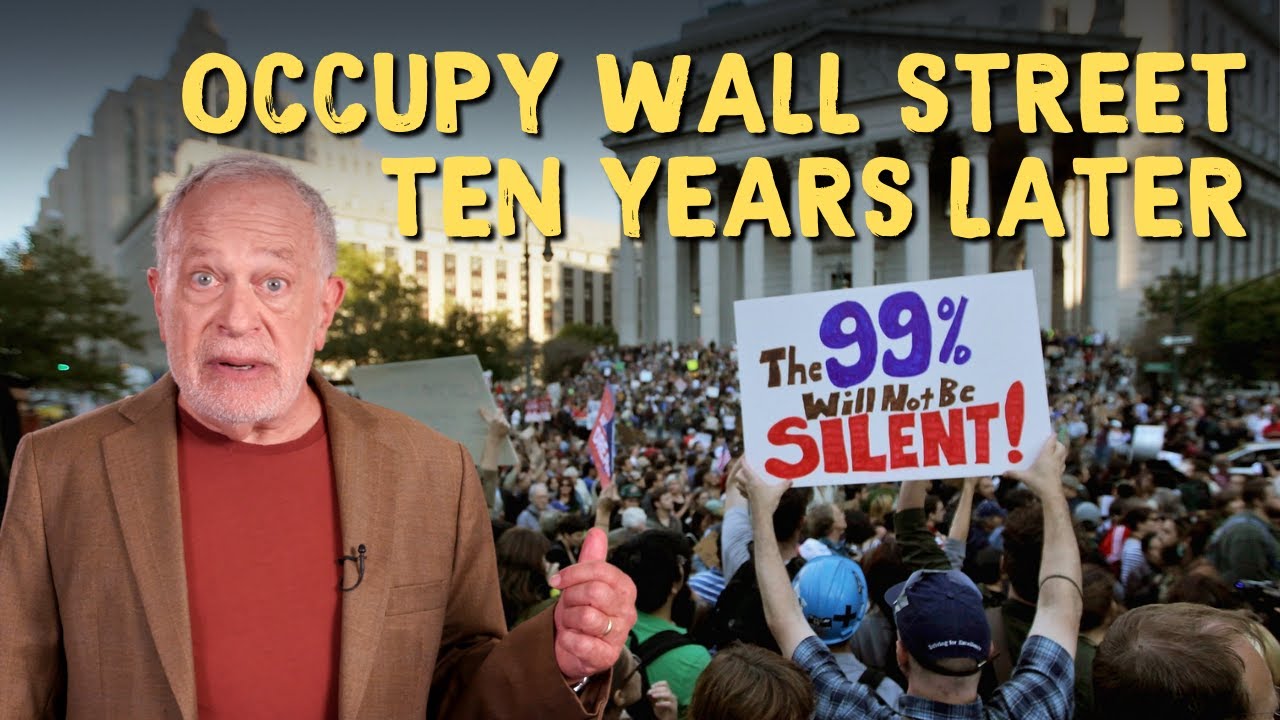
On the 10th anniversary of Occupy Wall Street, we examine the legacy of the historic protests with three veterans of the movement: Nelini Stamp, now the director of strategy and partnerships at the Working Families Party; Jillian Johnson, a key organizer in Occupy Durham who now serves on the Durham City Council and is the city's mayor pro tempore; andwriter and filmmaker Astra Tayor, an organizer with the Debt Collective.Occupy Wall Street "broke the spell" protecting the economic status quo and marked a major shift in protests against capitalism, Taylor says. "Occupy kind of inaugurated this social movement renaissance," she tells Democracy Now! "We've been in an age of defiant protest ever since Occupy Wall Street."
...AMY GOODMAN: This is Democracy Now!, democracynow.org, The War and Peace Report. I'm Amy Goodman.
As Congress debates a $3.5 trillion bill to expand the nation's social safety net and to increase taxes on the rich, we look back at Occupy Wall Street, the movement, how it reshaped the national debate on economics and inequality. Yes, it was 10 years ago today, September 17th, 2011, when Occupy began. Democracy Now! was one of the only national outlets to report on the first day of the action. Our producer Sam Alcoff filed this report.
SAM ALCOFF: On Saturday, thousands of protesters took to the streets of downtown Manhattan for what was described as an action to "Occupy Wall Street." Inspired by the popular uprisings of the Arab Spring and the European anti-austerity movements, Adbusters, a Vancouver-based culture-jamming magazine, put out a call for Saturday's protest on Wall Street in July. The goals were various, from limiting corporate contributions to political campaigns, to auditing the Federal Reserve, to challenging all of global capitalism. Protesters included 71-year-old Mary Ellen Marino of Princeton, New Jersey.
MARY ELLEN MARINO: I came because I'm upset with the fact that the bailout of Wall Street didn't help any of the people holding mortgages. All of the money went to Wall Street, and none of it went to Main Street. Now, we've just learned that Geithner was actually asked to split up the Citibank, and he didn't do it. And Obama didn't do anything about it.
SAM ALCOFF: The plan wasn't simply for a one-day protest, but an ongoing and creative occupation of the Financial District itself. Organizer Lorenzo Serna.
LORENZO SERNA: The idea is to have an encampment. Like, this isn't a one-day event. Like, we're hoping that people come prepared to stay as long as they can and that we're there to support each other.
SAM ALCOFF: But on Saturday, after hundreds arrived, the NYPD shut Wall Street down itself, barricading activists off of Wall Street and forcing a move to the nearby Zuccotti Park. Despite sometimes tense standoffs with the police, hundreds slept in the park and have maintained that they will stay until their demands are met.
AMY GOODMAN: Two days later, Democracy Now the activist and anthropologist David Graeber, who's been credited with helping to coin Occupy's defining rallying call, "We are the 99%." He talked about how Occupy had been inspired by earlier protests in Europe.
DAVID GRAEBER: Well, what people are doing in Europe is essentially trying to reinvent democracy. The idea is that, you know, all of the political parties have basically bankrupted themselves. They're all essentially bought and sold by the financial elite that's created this crisis. There's no possibility of their actually coming up with a solution. And sometimes you have to start over. People have to, like, go into their public squares, meet each other, start talking to each other, and start brainstorming of ideas. I mean, essentially, the idea is the system is not going to save us; we're going to have to save ourselves. So, we're going to try to get as many people as possible to camp in some public place and start rebuilding society as we'd like to see it.
AMY GOODMAN: How many people turned out?
DAVID GRAEBER: Well, at first, we were a little worried at Bowling Green, but more and more people kept showing up. So I ended up helping to facilitate a meeting which was at least 2,000 people. … It was mostly young people, and most of them were people who had gone through the educational system, who were deeply in debt, and who found it completely impossible to get jobs. I mean, these people have felt — really feel very strongly that they did the right thing. They did exactly what they were supposed to. The system has completely failed them. And they're not going to be saved by the people in charge. You're just going to have — if there's going to be any kind of society like we — worth living in, we're going to have to create it ourselves.
AMY GOODMAN: That's David Graeber speaking on Democracy Now! September 19, 2011, two days after the start of Occupy Wall Street encampment. David died last year in Venice, Italy, at the age of 59.
Protesters would go on to sleep in Zuccotti Park for nearly two months before the New York police raided the encampment. The Occupy movement spread across the nation and the globe. And the impact of Occupy is still being felt in countless ways.
We spend the rest of the hour hosting a roundtable looking at the legacy of Occupy. Joining us from Philadelphia is Nelini Stamp, the director of strategy and partnership at the Working Families Party. Ten years ago, she was part of Outreach, Labor and Facilitation Working Groups during Occupy Wall Street. She later helped start the Dream Defenders.
In Durham, North Carolina, we're joined by Jillian Johnson. Ten years ago, she was a key organizer in Occupy Durham. Today she serves on the Durham City Council and is the Durham's mayor pro tem.
And in Asheville, North Carolina, we are joined by writer and filmmaker Astra Taylor, who was involved in Occupy Wall Street and co-edited the Occupy Gazette,which featured reports from Occupies around the world. She's also an organizer with the Debt Collective, an organization with its roots in the Occupy Wall Street movement. She has just co-authored a piece in New York magazine headlined "Occupy Wall Street Changed Everything: Ten years later, the legacy of Zuccotti Park has never been clearer."
So, Astra, let's begin with you. Talk about how it changed everything, and where — how you see it has affected everything today.
ASTRA TAYLOR: Well, to understand how Occupy changed everything, I think we have to remember what it was like before. Occupy sort of broke the spell. It was really hard to talk about class, talk about capitalism, talk about inequality. We were in the world of Reagan and Margaret Thatcher, where there was no alternative to the status quo. It was a kind of bipartisan consensus around neoliberal capitalism. So, part of what created the conditions for the banking crisis was the repeal of Glass-Steagall, which was a Depression-era law. And that was repealed under the Clinton administration. Also, there was the period after September 11, 2001. It was very difficult to protest in New York City. Part of what made Occupy seem so improbable was that it was actually illegal to have unpermitted gatherings of more than 20 people. So, there was just this — you know, the left was very demoralized. The left was really fragmented and beaten down.
And something changed in that year. And, you know, your reporter touched on this. People were watching these movements around the world, from the Arab Spring to the movement of the squares, the movement of the indignados in Spain,and elsewhere. And people started to think, you know, "We've got to do something. Maybe we can actually protest and make a difference."
And so, that first day, 10 years ago today, you know, I have to say it was — I went. I went to Zuccotti Park, marched from Bowling Green up to Zuccotti Park. And, you know, it was powerful, but not because there were so many people, not because there were thousands and thousands of people, but because it was a space where those of us who felt that things were wrong could come together and meet each other and talk and decide we had to express our discontent, had to express our outrage. And so it was a major shift.
And so, 10 years later, I think we can see that Occupy kind of inaugurated this social movement renaissance. We've been in an age of defiant protest ever since Occupy Wall Street. The political landscape has really changed. People are now — you know, we have not stopped talking about capitalism. We haven't stopped talking about class. We haven't stopped talking about debt. And, you know, people have figured out how to challenge the political establishment. So I think it's had a tremendous legacy. And its offshoots actually — you know, we've never tallied them up. All over the country, Occupy sprouted different efforts, different initiatives, and changed lives.
AMY GOODMAN: Let's go to Nelini Stamp in Philadelphia. You were part — you're now with Working Families Party, but, then, you were part of the Outreach, Labor and Facilitation Working Groups during Occupy Wall Street. Much of the power was the community that was created there. Can you talk about the decision-making and why you even chose to go to Occupy Wall Street, and how it has shaped you and this country today?...
big basis for occupy, esp student?
We moved quickly into starting to have general assemblies, having more and more people come out, trying to figure out what this looks like in the context of a midsize Southern town. Durham at the time had, you know, just over 200,000 people. But it was also beginning to go through some serious economic struggles, gentrification, housing displacement. There were a lot of people in Durham who were really struggling. And so, we really resonated with the message that was coming out of New York and with the same conversations that people were having about income inequality, about housing inequality.
I ran for office just four years after Occupy, in 2015. And I think at first it was kind of a leap of faith. I didn't really have a sense that I was going to be able to change things from an elected position. I was hoping that there was an opportunity there. And I think our movement was started to turn more and more toward the idea that electoral politics could provide some opportunities for us to make change and to leverage resources for the benefit of working-class and communities of color.
And I've been able to do that in ways that I didn't expect. I think the transition has been — it's been difficult in ways, but it's also been very empowering and exciting to be able to put my organizing skills and movement skills to work in a different context. And I think bringing more people into the electoral world, through some of the work I'm doing with a national organization called Local Progress and just folks in my community talking to other movement people, younger people who might be interested in moving into the electoral realm someday, I've felt like I've been able to gain skills and knowledge and then pass those skills and knowledge on to other people within the movement. So, it feels — it's felt really rewarding — difficult, of course, at times, but ultimately I feel like I've been able to do something good in this position, and I'm excited about passing the torch on to somebody else.
AMY GOODMAN: I want to go to a few months later, November 2011, during the Occupy protests, about a thousand students marching in New York City outside a meeting where CUNY trustees — that's City University of New York trustees — voted to authorize annual tuition increases. This is Julian Guerrero of Students United for a Free CUNY.
JULIAN GUERRERO: [echoed by the People's Mic] Me, myself, I'm in debt $70,000. I actually got a letter from Sallie Mae saying that if I don't start paying today $900 a month, they're going to have more aggressive attempts at collecting my debt. And so, I'm going to burn this right here and now.
AMY GOODMAN: So, that's Julian Guerrero of Students United for a Free CUNY, using the whole idea of the mic check and the open mic and the mic repeats that we've come to see that are so familiar. Astra Taylor, you are a key member of the Debt Collective. Talk about how that movement has evolved to today.
ASTRA TAYLOR: Now, the Debt Collective is an organization for debtors that fights for the cancellation of all kinds of debt and the provision of the services, the public goods we all need to survive and thrive. It has its roots directly at Occupy Wall Street.
So, just like Nelini felt that space to talk about her condition honestly, you know, for many of us who were in debt, Occupy was a similar space, where we could see that we were not alone — and that is actually the Debt Collective's slogan: "You are not a loan" — A space L-O-A-N, right? — a space where we could come together. And debt was actually part of the protests around the world at the time. Tuition hikes sparked protests in Latin America. And later, in Quebec, there was a wave of protests.
And so, you know, we followed the threads of debt, once the parks were cleared, because how we were thinking about it at the time was, you know, "Yes, we're occupying Wall Street, but Wall Street occupies our lives. And how does it do that? Often in the form of debt. We're forced to debt finance things that should be publicly provided." And it was at Occupy Wall Street that we had the collective epiphany. We started to recognize that our debts, which were so burdensome, could actually be a potential source of power, a source of leverage.
And by consistently organizing, we've moved the needle on that issue. I think, you know, we now are in a world where leading politicians talk about student debt cancellation. The Debt Collective has won billions of dollars of student loan cancellation for debtors. And that demand started at Occupy Wall Street. And the media was very skeptical. They mocked the demand. They said, "It's never going to happen. Isn't Occupy so naive?" Well, look where we are today. We've really moved the debate. And so, I think that's a really concrete, concrete result of this movement.
AMY GOODMAN: I want to go to the issue ofpolice repression of Occupy protests across the country. On November 18th, 2011, campus police officers at the University of California, Davis pepper-sprayed peaceful student protesters. Video of the police attack went viral.
PROTESTERS: Don't shoot students! Don't shoot students!
The whole world is watching! The whole world is watching! The whole world is watching! The whole world is watching! The whole world is watching! The whole world is watching!
Shame on you! Shame on you! Shame on you! Shame on you! Shame on you! Shame on you!
ELLI PEARSON: I wasn't aware I was going to be pepper-sprayed until people told me to protect myself. And then I have friends who were pepper-sprayed who said they did not know that that was happening and that that was coming. And we were actually expected — we were expecting to be shot in the back with something, because they were behind us. And we really had no idea what was going to happen.
AMY GOODMAN: That's UC Davis student Elli Pearson speaking on Democracy Now! after she was pepper-sprayed. And you have the whole coordination. It later came out — I remember that piece in The Guardian by Naomi Wolf, "Revealed: how the FBI coordinated the crackdown on Occupy," the destruction of Occupy Wall Street and other places all over the country, well over a dozen cities. Nelini Stamp, if you can talk about what you understand took place, and how the police dealt with you?
NELINI STAMP: Yeah. I mean, you know, it was interesting, because the first — very early on, that first weekend, I remember going to an officer and saying, "Can my friend's car be there?" And they were like, "Yeah. Y'all will be gone by Monday."
And increasingly, as soon as we started — one of the first direct actions, regular direct actions, we did at Occupy Wall Street was the opening and closing bell. We would march for the opening bell and closing bell of the Stock Exchange and Wall Street. And that first Monday, we started getting shoved and pushed. And every single day that we were out there, things escalated to then a few arrests, to then a few more arrests. And I think things really changed on the Saturday.
There was a few things that I feel like people don't understand, what happened those first two weeks, also in the nation. Troy Davis was executed by the state of Georgia — a huge case of misjustice and racial reckoning again. There was a huge debate in the city of New York around stop-and-frisk. And so, all of these tensions were underlying. But there was also this idea and original, you know, sentiment to say that the cops are the 99%, too, because most of them were not making — if we were really a uniting movement. So, it was this really interesting juxtaposition that was happening those first two weeks.
And that Saturday — we did weekly actions on Saturday, and I don't remember if it was the 24th or the — I usually used to remember all of the dates in my mind. We took the streets. And it was civil disobedience like New York hasn't seen in a really long time. And I remember getting to Union Square, and all of a sudden they had this orange netting all around us, which I think is now illegal in the city of New York for cops to do. But they had orange netting, and pepper spray was just going everywhere.
And that was kind of the — I think that was a radicalizing moment for a lot of our white comrades at Occupy Wall Street, who never had to deal with the police as those of us who come from communities of color in New York had to, or those of us who have a history of — when I was younger, I remember seeing Amadou Diallo's murder on every single thing, and people marching on the Brooklyn Bridge. And so, for those who didn't have that background or that personal experience, they finally did have that. And that's when I think there was this awakening of a lot of young white folks or more affluent folks who didn't come from overpoliced communities actually saying and trying to hold the police accountable.
So, what you see is, right after Occupy Wall Street, you see Ramarley Graham gets killed in the city of New York, and then Trayvon Martin gets killed in Florida, and people start to act up, you know? I flew down to Florida, because they wanted somebody to train them in direct action, and helped co-found the Dream Defenders. We marched for miles to Sanford. And then you see a big march in June of 2012 with 50,000 people that said, "End stop-and-frisk." And I don't think that would have been — that would have had the new people involved as it did, if we didn't have so much, like, repression from the state. And I think part of it was to make people not come out, to make — people were really threatened by Occupy at that time. And I think that that's what ended up happening, and it was really beautiful to see people get involved and actually call out police brutality after that.
AMY GOODMAN: Nelini Stamp, I want to thank you for being with us. This has to end this discussion today. Nelini Stamp of Working Families Party in Philadelphia; Astra Taylor of the Debt Collective, speaking to us from Asheville; and Jillian Johnson, mayor pro tem of Durham, North Carolina — all three involved in the Occupy movement 10 years ago. And we continue to cover it when we look at the bills that are in Congress right now and so much more. I'm Amy Goodman. Thanks so much for joining us
how to organize, theory, hist
https://kpfa.org/episode/against-the-grain-may-2-2018/
michael hart duke u empire trilogy Assembly
Political theorist Michael Hardt discusses his and Antonio Negri’s latest book “Assembly.”
:{
}:
https://www.artforum.com/print/201708/managing-up-assembly-and-the-new-activism-71249
==
guard UK
https://www.XXXguardian.com/cities/2014/jun/17/where-occupy-protesters-now-social-media
Where are the Occupy protesters now?
Social media makes it easier and cheaper to build movements quickly – but bypassing the business of creating decision-making infrastructure means they can disappear just as fast
Todd Gitlin
Tue 17 Jun 2014 04.55 EDT Last modified on Fri 15 Sep 2017 15.53 EDT
A businessman tries to break through a line of Occupy Wall Street protesters in November 2011. Photograph: Don Emmert/AFP/Getty Images
Where have all the chanters gone; the gospel-minded Christians and the denouncers of ‘banksters’ and tyrants; the homeless and the indebted and unemployed who filled our urban squares in 2011-12, crying out such slogans as "We are the 99 percent" and "The people want the end of the regime"? Where are the leaderless revolutionaries who turned cities around the world upside down?
The simple answer is: they were dispersed. When the sometimes public parks were swept clear of troublemakers, many dispersed into a scatter of left-wing campaigns. Other activists now escort visitors around bare, fenced-off Zuccotti Park near Wall Street. In London, free bus tours with guides in top hats carry the curious around the City and Canary Wharf (“Make your very own ‘credit default swap’ and find out how to create money out of thin air!”).
One Occupy London stalwart, a sermon-on-the-mount Christian who negotiated with the Bishop of London at St Paul’s in 2011, emails me to say: “Many of us from Occupy London have ended up going all over the world. Our decisions to travel to the far-reaches were probably inspired by Occupy in many cases, although not all of us are working as activists in other countries. We remain in touch with each other, and support the hardcore group that are fighting fracking in the UK now … B returned to the USA, C is in Pakistan, D in Spain, E in Tunisia, F in Greece, others are in India, Africa, Thailand … I am currently living in Kuwait, teaching the young to be critical thinkers.”
After the dispersals, game efforts were made to rally Occupy spirit, not only on streets and in public parks that were being privatised, but also in bookshops and on news stands, in parliaments and city halls. It’s a cliche, a true one, that the Occupy movements of 2011-12 changed the conversation. Reform mayors like New York City’s Bill De Blasio (theme: "a tale of two cities") were elected.
On talk shows, best-seller lists and the business sections of newspapers – even, yes, in university economics departments – inequality is all the rage. At the time of writing, Thomas Piketty’s Capital in the 21st Century ranks #4 among all books on US Amazon, and #15 in Britain. In the US, this subversive little theme has infiltrated the rhetoric of the Democratic Party and even right-wing populists among the Republicans, including the libertarian David Brat, who up-ended House majority leader Eric Cantor in a Virginia primary on 10 June, declaring: “All the investment banks in the New York and [Washington] DC – those guys should have gone to jail. Instead of going to jail, they went on Eric’s Rolodex, and they are sending him big cheques.”
Thirty-three months ago, Occupiers easily outnumbered investment bankers, filling public places with mostly young, urban, multiracial, anarchist, libertarian and sometimes reformist folk, mostly in the more prosperous (though reeling) countries. But after weeks or months, city governments, coordinated nationally, dispersed them – irrespective of the formal guarantees of ‘the right of the people peaceably to assemble, to petition the government for redress of grievances’, to quote a little-noted passage in the First Amendment to the American Constitution.
Republican protesters in Madrid this month. Photograph: Daniel Ochoa de Olza/AP
Even more resounding were the political uprisings that either overthrew governments or restored some hope that, against rightward and neoliberal turns throughout the world, popular movements of the left had a future. If 2001 was the Year of the Towers, as Anthony Barnett wrote, 2011 was the Year of the Squares. Now, for the most part, the squares are emptied. In Cairo’s Tahrir and Istanbul’s Taksim, the police still fire tear gas, rough up reporters, and fire water cannon to ‘cleanse’ these scenes of uprising potential, while kept media in Russia, Turkey and Egypt, in the time-honoured way of authoritarian regimes, blame outsiders and their alien ‘agendas’.
Squares still fill — namely Kiev’s Maidan and the occasional crowd at Madrid’s Puerta del Sol, where signs recently appeared bearing slogans like ‘Ni generales ni reyes. ¡Elijimos nuestros jefes!’ (‘Neither generals nor kings. Let’s elect our leaders!’) But overall, the rage is diffuse and the issues are (as almost always they must be) local. Political focus goes fuzzy. The clamour is like tear gas that escapes its container: everywhere but nowhere.
The new movements, as Cambridge sociologist Gören Therborn has pointed out, are city movements, not national ones, yet most of the changes they want, either explicitly or implicitly, require action by nation-states. Implicitly, many of Spain’s indignados recognised this when they supported a new party of ‘decent ordinary citizens’, Podemos, which captured 1.25 million votes in the Euro-parliamentary elections, catapulting it overnight into position as the country’s fourth largest party. Not surprisingly, this disjunction between turf and at least short-term political outcome poses special problems for how to continue and what to accomplish.
What happened to the occupations? Well, what made them mushroom so spectacularly was what also made them collapse once the police stepped in — their dependence on social media. The Turkish-American sociologist Zeynep Tufekci has rightly noted that “these huge mobilisations of citizens inexplicably wither away without the impact on policy you might expect from their scale”. She explains the paradox well: it’s much easier to pull off spectacular events with digital technologies than to knit together lasting organisations. And it’s also easy to mistake the former for the latter.
The problem arises, Tufekci adds, “not because social media isn’t good at what it does but, in a way, because it’s very good at what it does. Digital tools make it much easier to build up movements quickly, and they greatly lower coordination costs. This seems like a good thing at first, but it often results in an unanticipated weakness: before the internet, the tedious work of organising that was required to circumvent censorship or to achieve a satisfactory-sized protest also helped build infrastructure for decision-making and strategies for sustaining momentum. Now movements can rush past that step, often to their own detriment.”
Waves of uprisings like those of 2011-12 are rare. In 1848, most of the liberal-nationalist insurgencies of Europe and Latin America were crushed. Many defeated Germans ended up in America, where they supported the anti-slavery cause. Some defeated rebels, like Richard Wagner, veered hard right. Gustave Flaubert withdrew from politics. Britain’s Chartist movement peaked, but most of its programme was subsequently passed. Some of the 2011-12 activists of Tahrir and Gezi have been murdered, jailed, hospitalised, or exiled. Others scramble to find continuations. While appreciating what the movements accomplished, many realise how isolated they were (“Cairo is not Egypt”, as the astute Egyptian blogger Sandmonkey warned in March 2011). No grail to compensate for the isolation of passionate democrats has been found.
A protester carried away after being arrested by police during an Occupy Wall Street march from Zuccotti Park to Union Square. Photograph: Julie Dermansky/Corbis
Above I mentioned tours of Zuccotti Park. An Occupy activist named Cecily McMillan was one guide there this year, showing the site to relatives and friends who, in early May, had gathered to hear the jury’s verdict after her trial for felonious assault on a police officer during the forcible clearance of the park on 17 March 2012. The officer testified the attack had been unprovoked. According to McMillan’s testimony, he had grabbed and groped her, then hurled her to the ground, bruising her badly and causing her seizures.
Forty-eight hours later, after a trial where the jury was prevented from seeing and hearing much exculpatory evidence, McMillan was on her way to Rikers Island, the city’s decrepit, immense jail complex, awaiting sentence, which turned out to be 90 days (she could have been sent away for up to seven years) despite a letter to the judge from a majority of the jury asking that she not be sent back to jail at all. At Rikers, where she is one of more than 12,000 prisoners, McMillan has been denied medication. She has also been denied bail (her lawyers are appealing). She’s had enough of New York, though, and plans to move back to her hometown of Atlanta – a kinder, gentler city.
As to bigger pictures: what imprint have the Occupy moments and movements left on our cities? Cascades of activism, for one thing. Inspiration wafts through the culture, bubbles of energy and precedents for other struggles and tactics. It’s easiest to see around universities, where campaigns for divestment from fossil fuel corporations are picking up, spurred in part by Occupy ‘graduates’. Campaigns against massive student debt (currently estimated at about $1 trillion in the US) that will saddle graduates for decades have gotten off to a ragged start but probably have a future. While many Occupiers returned to regular, out-of-park life, some unknowable number of these debt-saddled young people – who felt, for a moment, they could get their hands on the levers that move the world – got a whiff of a feeling some of them want to get more of.
In New York City, energy flowed into campaigns against police stop-and-frisk practices and to help victims of 2012’s Hurricane Sandy. Occupy experience put organisers in touch with community members normally scornful of ‘weirdos’ but resolved to fight corporate power. One experienced organizer, fresh from Occupy in Missouri, went on to help launch the Take Back St Louis initiative, subtitled Reclaiming our Tax Dollars for a Sustainable Future. The group gathered more than 22,000 signatures of registered voters, more than enough to put on to an April 2014 ballot a measure to "stop the city from giving tax breaks and other incentives to corporations that mine coal, gas and oil, and any corporation doing $1m of business with a mining company"; to "create a sustainable energy plan in the city that would invest public money in and open up land for renewable energy and sustainability initiatives like weatherisation programmes, urban farms and solar arrays". In other words, to create sustainable jobs – against the retrograde claim that measures to halt global warming are ‘job-killers’.
There is, it happens, one mining company headquartered in St Louis, and it’s a giant: Peabody Coal, the world’s largest company that mines the dirtiest fuel. Working together, the mayor and Peabody Coal lawyers convinced a judge to grant an injunction, declaring that coal companies share equal rights with people (citing the recent ‘Citizens United’ Supreme Court decision), but the coalition is appealing to a higher court. Meanwhile, the cascade rolled on: students at Washington University in St Louis, never before a hotbed of activism, sat-in for more than two weeks at the university president’s office to protest the membership of Peabody’s president on the university’s board of trustees. The anti-corporate spirit rides high among them. Occupy fanned such flames.
As for the executives in corner offices and boardrooms around Wall Street and Canary Wharf, in state houses and Washington, are they relieved that the rabble were swept away? Do they believe that partial financial reforms will insulate them against risings to come? Beyond growing attention to public relations (probably a growth centre for future employment), are they mindful, as they make policy, that those who once awoke to fill the streets and parks may awaken again? Do they suspect, late at night, that youngsters in sleeping bags might turn out to be the modern equivalent of peasants with pitchforks?
Political rationality, if not fear, may well make elites more responsive. Rumblings on the Right are not the only noises emanating from Europe. The sparks that set Occupy on fire fell on inflammable tinder, and this is how history goes: one spark, then another, ignites a whole landscape. The Occupy ‘graduates’ hope that their time will come again. They might turn out to be wrong – until, one day, they’re right.
Todd Gitlin
new
http://www.sourcewatch.org/index.php/Government_Surveillance_of_Occupy_Movement
beau h
On May 20, 2013, DBA Press and the Center for Media and Democracy released the results of a year-long investigation: "Dissent or Terror: How the Nation's Counter Terrorism Apparatus, In Partnership With Corporate America, Turned on Occupy Wall Street.” The report, a distillation of thousands of pages of records obtained from counter terrorism/law enforcement agencies, details how state/regional "fusion center" personnel monitored the Occupy Wall Street movement over the course of 2011 and 2012.
The report also examines how fusion centers and other counter terrorism entities that have emerged since the terrorist attacks of September 11, 2001 have worked to benefit numerous corporations engaged in public-private intelligence sharing partnerships. While the report examines many instances of fusion center monitoring of Occupy activists nationwide, the bulk of the report details how counter terrorism personnel engaged in the Arizona Counter Terrorism Information Center (ACTIC, commonly known as the "Arizona fusion center") monitored and otherwise surveilled citizens active in Occupy Phoenix, and how this surveillance benefited a number of corporations and banks that were subjects of Occupy Phoenix protest activity.
While small glimpses into the governmental monitoring of the Occupy Wall Street movement have emerged in the past, there has not been any reporting -- until now -- that details the breadth and depth with which the nation's post-September 11, 2001 counter terrorism apparatus has been applied to politically engaged citizens exercising their Constitutionally-protected First Amendment rights.
REPORT Dissent or Terror: How the Nation's 'Counter Terrorism' Apparatus, in Partnership with Corporate America, Turned on Occupy Wall Street
REPORT APPENDIX open records materials cited in report.
PRESS RELEASE "New Report Details How Counter Terrorism Apparatus Was Used to Monitor Occupy Movement Nationwide"(PDF)
SOURCE MATERIALS almost 10,000 pages of open records materials are archived on DBA Press.
PRWATCH ARTICLES:
- Part one: Dissent or Terror: How Arizona's Counter Terrorism Apparatus, in Partnership with Corporate Interests, Turned on Occupy Phoenix
- Part two: The Homeland Security Apparatus: Fusion Centers, Data Mining and Private Sector Partners
- Part three: Fusion Center Obsession With OWS: Monitoring Jesse Jackson, NDAA Protestors and Anything Else Deemed To Be a Threat
- First printed on December 31, 2012: "Operation Tripwire" -- the FBI, the Private Sector, and the Monitoring of Occupy Wall Street
Key Findings
Key findings of this report include:
- How law enforcement agencies active in the Arizona fusion center dispatched an undercover officer to infiltrate activist groups organizing both protests of the American Legislative Exchange Council (ALEC) and the launch of Occupy Phoenix and how the work of this undercover officer benefited ALEC and the private corporations that were the subjects of these demonstrations.
- How fusion centers, funded in large part by the U.S. Department of Homeland Security, expended countless hours and tax dollars in the monitoring of Occupy Wall Street and other activist groups.
- How the U.S. Department of Homeland Security has financed social media "data mining" programs at local law enforcement agencies engaged in fusion centers.
- How counter terrorism government employees applied facial recognition technology, drawing from a state database of driver's license photos, to photographs found on Facebook in the effort to profile citizens believed to be associated with activist groups.
- How corporations have become part of the homeland security “information sharing environment” with law enforcement/intelligence agencies through various public-private intelligence sharing partnerships. The report examines multiple instances in which the counter terrorism/homeland security apparatus was used to gather intelligence relating to activists for the benefit of corporate interests that were the subject of protests.
- How private groups and individuals, such as Charles Koch, Chase Koch (Charles' son and a Koch Industries executive), Koch Industries, and the Koch-funded American Legislative Exchange Council have hired off-duty police officers -- sometimes still armed and in police uniforms -- to perform the private security functions of keeping undesirables (reporters and activists) at bay.
- How counter terrorism personnel monitored the protest activities of citizens opposed to the indefinite detention language contained in National Defense Authorization Act of 2012.
- How the FBI applied "Operation Tripwire," an initiative originally intended to apprehend domestic terrorists through the use of private sector informants, in their monitoring of Occupy Wall Street groups. [Note: this issue was reported on exclusively by DBA/CMD in December, 2012.]
Press
- The Progressive, "Spying on Occupy Activists", Matthew Rothschild
- AlterNet, "How America's National Security Apparatus--in Partnership With Big Corporations--Cracked Down on Dissent, Alex Kane
- In These Times, "How the Government Targeted Occupy", Lisa Graves (also reprinted at PRWatch.org)
- The Big Picture,
 , Thom Hartmann
- Democracy Now!, "Editor of The Progressive, Matt Rothschild, Calls For Eric Holder to Resign Over Spying on Press, Occupy Protesters", Amy Goodman and Nermeen Shaikh
- Modern Times Magazine, "Phoenix Metro Police, Feds Working Together To Blunt Activists", Wayne Schutsky
- The Investigative Fund, Is Homeland Security Spying on You?, Adam Federman
- Occupy Radio, Dissent and Terror: Homeland Security and Corporate America Target Occupy,
==
ref eg
...In October of 2011, Jamie Dimon, president and CEO of J.P. Morgan Chase, had plans to travel to Phoenix for a "town hall" event with 2,000 of his employees at Chase Field (home of the Arizona Diamondbacks, located in downtown Phoenix). As Dimon is one of the most powerful men on Wall Street and the head of the largest bank in the country -- a bank that played a key role in the collapse of the U.S. economy in 2008 -- JP Morgan Chase Regional Security Manager Dan Grady contacted Arizona Counter Terrorism Information Center personnel on October 17 (the day before Dimon's scheduled visit), to ensure a smooth landing for Dimon in Phoenix.
The Arizona Counter Terrorism Information Center (ACTIC), commonly known as the "Arizona Fusion Center," is comprised of personnel from such entities as the Arizona Department of Public Safety Intelligence Bureau, the Phoenix Police Department Homeland Defense Bureau, the Tempe Police Department Homeland Defense Unit, the Mesa Police Department Intelligence and Counter Terrorism Unit, theMaricopa County Sheriff's Office, the FBI Phoenix Joint Terrorism Task Force, the Transportation Security Administration, and the U.S. DHS offices of Infrastructure Protection and Intelligence and Analysis.
Records indicate that Grady's chief point of law enforcement/"counter terrorism" personnel contact in Phoenix -- with whom he discussed the particulars of Dimon's visit and shared a detailed itinerary -- was Phoenix Police Department Homeland Defense Bureau (PPDHDB) Detective, and ACTIC Community Liaison Program Coordinator, Jennifer O'Neill. As records indicate, the chief area of discussion between Grady and O'Neill were concerns that citizens engaged in Occupy Phoenix, an Occupy Wall Street-inspired group that had launched only days prior, on October 14 and 15, might try to disrupt the event -- or otherwise inconvenience Dimon.
According to records obtained by DBA/CMD, in response to Grady's concerns, O'Neill stated that she and a PPDHDB "CI/KR security specialist" colleague had engaged in the monitoring of known online "social networking" outlets used by Occupy Phoenix for discussion relating to the Dimon visit. As such O'Neill stated: "we have not seen anything on social networking that leads us to believe protestors are aware of this event."
By no stretch of the imagination was this monitoring of social media (known in the world of "counter terrorism" agencies as the acquisition of "open source intelligence") for the benefit of JP Morgan Chase President and CEO Dimon the full extent of such activity conducted by ACTIC personnel. Records indicate that ACTIC personnel consistently gathered "open source," and other, intelligence relating to Occupy Phoenix protests of corporate entities throughout 2011 and 2012. According to these records, in many instances ACTIC personnel would share this intelligence with personnel employed by corporations who were subject to these protests.
Another example of Occupy Phoenix-related ACTIC CLP work for the benefit of banks would be intelligence gathering and other monitoring conducted in preparation for "Bank Transfer Day," November 5, 2011 -- a day on which Occupy Wall Street groups nationwide, along with other mainstream activist/consumer advocate groups, encouraged citizens to discontinue business with the nation's leading banks (such as J.P. Morgan Chase banks, Bank of America and Wells Fargo), in favor of credit unions and smaller community-based banks.
Records obtained by DBA/CMD show that, on November 3, Mesa Police Department (Mesa is a Phoenix suburb) Intelligence and Counter Terrorism Unit Detective/ACTIC Terrorism Liaison Officer (TLO) Christopher Adamczyk, issued an OWS-related bulletin to a number of ACTIC TLOs/analysts. While the actual Adamczyk bulletin is absent from records delivered to DBA/CMD by PPDHDB, records indicate that the subject of this Adamczyk bulletin was the impending November 5 "Bank Transfer Day." It is important to note, however, that available records indicate that the Mesa TLO did not address "Bank Transfer Day" events set to take place in the Phoenix area.
Records show that, after receiving this bulletin, O'Neill contacted PPDHDB/ACTIC "Terrorism Liaison All-Hazards Analyst" Brenda Dowhan and asked if there was any specific information she could pass on to downtown Phoenix banks.
In response to O'Neill's request, Dowhan indicated that she would try to find "FOUO" ("For Official Use Only") information that could be released to downtown Phoenix banks. In addition, she offered:
"Occupy Phoenix just updated their [Facebook] page saying that they will be marching to Wells Fargo, B of A [Bank of America], and Chase Tower. They are supposed to do a 'credit card shredding ceremony' , but eh haven't identified which bank they will be doing that at [sic]. We will have to monitor their FB [Facebook]."
As previously stated, O'Neill is the coordinator of the ACTIC Community Liaison Program (CLP). ACTIC CLP was created in 2006, in response to federal mandates calling for greater involvement of private sector corporations in the national "counter terrorism" "information sharing environment" (ISE, as created by the Intelligence Reform and Terrorism Prevention Act of 2004. This piece of federal legislation also created ODNI, NCTC and set the groundwork for the national spread of "fusion centers," per the implementation of ISE).
ACTIC CLP is intended to facilitate the flow of "counter terrorism" information/intelligence between private sector corporate partners and the Arizona "fusion center." While the stated purpose of ACTIC CLP is to prevent terrorist activity, to identify terrorist threats, protect CI/KR, and "create an awareness of localized security issues, challenges, and business interdependencies," records indicate that, during the course of 2011 and 2012, ACTIC CLP was used as an advance warning system to alert member corporations and banks of impending Occupy Phoenix protests.
ACTIC CLP is one of two primary vehicles through which corporate interests partner with ACTIC, the other vehicle being Arizona Infragard. Arizona Infragard is the Arizona chapter of Infragard, a public-private intelligence sharing partnership administered by the FBI and supported (both financially and through the delivery of intelligence) by U.S. DHS.
The Creepy Guy Cometh: Undercover Cop Goes to the Vegan Coffee Shop
...
==
yay
And yesterday, these 10 were found “not guilty” by New York City Criminal Court Judge Robert Mandelbaum. According to Flood Wall Street, Judge Mandelbaum ruled that the New York Police Department’s (NYPD) order to disperse violated the First Amendment. In his ruling, the judge also found “that by ordering protesters to leave the entire Wall Street area, police violated protesters’ First Amendment right to carry their message directly to its intended recipients: the Wall Street bankers who bankroll climate change.”
Defense Attorney Jonathan Wallace successfully argued that the Constitution protects Americans’ rights to “express political speech within proximity to the target of the protest. In this case, the NYPD first prevented protesters from entering Wall Street before later orderingthem to leave the area altogether.” This method of policing proved to be unlawful.
That is a victory in and of itself for the 10 individuals, as well as, the general American public and its right to protest.But the judge went even further “by taking judicial notice thatclimate change is happening, is a serious problem, requires immediate action and is caused by human activity,”said Flood Wall Street.
“The importance of judicial notice is that the judge accepted climate change and the need to do something about it as a fact without the necessity of any evidentiary support or proof at trial,” said Defense Attorney Martin Stolar. “To the best of my knowledge, this is unprecedented and has significance for future litigation involving climate change.”
The ruling sets an important legal precedent in recognizing the constitutional legitimacy of mass civil disobedience actions protesting climate change, according to Flood Wall Street. The 10 defendants gave passionate testimony to the court, “affirming that their actions were justified.”...
http://ecowatch.com/2015/03/06/found-not-guilty-flood-wall-street
==
http://www.alternet.org/environment/red-cross-feared-occupy-wall-street-after-hurricane-sandy
==
As Trende observed, the Democratic political coalition “has become geographically narrow in the past decade, heavily concentrated among urban liberals and minorities who live in densely populated cities or are placed into minority-majority districts under interpretations of the Voting Rights Act that many minority groups pressed for in the 1980s and 1990s.” This concentration helps win some state-wide races and national electoral votes, but means that Democrats lose a lot of close races for the House. When Democrats do manage to win in the House, they often win by larger margins than Republicans do, which helps account for their national popular vote majority. Gerrymandering is part of the problem faced by the Democrats, but the other part is that, like the Republicans, they too are less inclined to appeal to those outside of their coalition. Democrats may not be as extreme as Republicans, but they are also less interested in compromise and consensus building than they used to be.
When we look at American politics we need to understand that our legislative branches represent places (districts and states) as well as people. The U.S. is a representative democracy yet by design is far from a pure democracy. Our constitution is designed to facilitate continuity and the translation of economic power to political power, but it is also designed to permit change when absolutely needed. In the past, dramatic change has taken place when the stability of the political system was threatened by the absence of change. These changes took place when the political center accepted them: the reforms of the progressive era, the economic policies of the New Deal, the changes brought about by LBJ’s Great Society. Typically, agents of change convince moderates to accept some part of their view. The exception that proved the rule was our Civil War.
In the past, the geographic orientation of our political system has led to moderate politics. In the U.S. system, an extreme party receiving 20 percent of the votes in every congressional district would send no one to Congress. Therefore, the political dynamic pushed candidates to the center where they build the largest coalitions generating pluralities or majorities. The growing presence of moderate independent voters continues that trend in general elections. But the growing importance of low-turnout primary elections has driven candidates further to the extremes. It is hard to believe that Eric Cantor was too moderate for the Republican base—but he was. The Tea Party has less than 20 percent of the national vote, but they have managed to skillfully work the seams of the political and media system to dominate the Republican-controlled House of Representatives. If the Occupy movement had been less politically pure they might have done the same thing on the left.
http://ecowatch.com/2014/08/05/fed-government-incapable-transition-to-renewable-economy/2/
==
==
FBI ID sniper at Occupy Houston but did not inform
http://www.democracynow.org/2014/3/25/why_did_fbi_monitor_occupy_houston Jason Leopold
http://crooksandliars.com/2014/03/iraq-war-vet-whose-skull-was-fractured
After he was struck with a lead-filled bean bag fired by a police officer from 20 feet away on Oct. 25, 2011, Scott Olsen, who was 24 at the time, suffered a skull fracture and permanent brain damage.
An Iraq war veteran whose skull was fractured by a police bean bag during the Occupy Oakland protest has settled with the city for $4.5 million, his attorneys announced Friday, as part of a federal civil lawsuit.
After he was struck with a lead-filled bean bag fire by a police officer from 20 feet away on Oct. 25, 2011, Scott Olsen, who was 24 at the time, suffered a skull fracture and permanent brain damage.
Today, Olsen can speak and do basic tasks. But, according to a recent interview with the East Bay Express, his memory, concentration and speech are still impaired, and he still owes $200,000 in medical expenses.
According to his suit, Olsen is unable to work as he once did as a computer systems administrator at Opswat in San Francisco.
==
kpfa 6/3/13 anarchist 7 am; cops sent infiltrators to disrupt OWS with a script eg facilitator is racist reaction was learned who they were and shunned
: David Graber [spanish civil war; socialist wanted more $ and goods, anarchists wanted fewer hours)
cointelpro successfully created paranoia in left in 60's
kpfa 6/7/13 8 am hodia dsag Security Alliance Council corps
fbi corps CMD warned that port shut cd ~ supply chain (esp if San Diego closes)
Courthouse News [1] / By Lorraine Bailey [2]
Ex-Marine Arrested for Wearing Wrong T-Shirt at Supreme Court!
July 4, 2013 |
Police had probable cause to arrest a Marine Corps veteran in the Supreme Court building for wearing a jacket that said "Occupy Everywhere," a federal judge ruled.
Fitzgerald Scott, a Marine Corps veteran, entered the Supreme Court building on Jan. 20, 2012, wearing a jacket painted with the words, "Occupy Everywhere." The Occupy movement had scheduled that day for an organized protest outside of the courthouse.
While Scott was looking at the exhibits on display, Deputy Chief Timothy Dolan approached him and told Scott that he could not wear the jacket in the building because it was comparable to a sign or demonstration.
Dolan told Scott he must either take off the jacket or leave the building. When Scott refused to do either, Dolan instructed another officer to place Scott under arrest for unlawful entry. Scott was released the same day, and charges against him were later dropped.
Scott then filed suit [3], arguing that the "United States is liable for the false arrest and imprisonment of Mr. Scott because Pfc. Freeman arrested Mr. Scott without probable cause."
U.S. District Judge Amy Jackson dismissed the action Tuesday, finding that the "Supreme Court Police had probable cause to arrest Scott for violating section 6135 because Scott's actions fell squarely within the plain language of the display clause: he was displaying a device (his jacket) in the building which had been adapted to bring public attention to the 'Occupy' movement." (Parentheses in original.)
Jackson noted that her ruling in this case is not based on "whether a court could ultimately find that the application of the display clause in this instance violated Scott's First Amendment rights, but whether the officers knowingly ignored settled, indisputable law when they made the determination on the scene to effect the arrest."
Scott has no First Amendment ground for his claims because "at the time of Scott's arrest, the application of section 6135 - and its predecessor 40 U.S.C. § 13k8 - to individuals in the Supreme Court building and plaza had been upheld as constitutional," the 14-page opinion states.
"The fact that long after Cohen [v. California], this statute had been upheld as constitutional on its face and as applied to individuals in similar situations defeats Scott's assertion that his arrest violated clear constitutional law," Jackson added.
See more stories tagged with:
supreme court [4],
occupy movement [5],
Marine Corp Vet [6],
Source URL: http://www.alternet.org/news-amp-politics/vet-arrested-wearing-wrong-t-shirt
==
Washington Lobbyists Crafted $850,000 Secret Plan For Bank Lobbyists To Undermine Occupy Wall Street
By Zaid Jilani on Nov 21, 2011 at 9:45 am
This weekend, the MSNBC show Up! With Chris Hayes broke a stunning story about howWashington lobbyists are scrambling to undermine the protesters on Wall Street and across the country.
Hayes’ report, which can be viewed here, details how the Washington, D.C.-based lobbying firm Clark Lytle Geduldig & Cranford (CLGC) compiled a secret plan to undermine Occupy Wall Street for the American Bankers Association (ABA).
The plan, which CLGC was demanding $850,000 to implement, was presented in a secret memo that was leaked to Hayes’ staff. The memo warns that Occupy Wall Street, particularly if it is embraced by the Democratic Party, threatens to “have very long-lasting political, policy, and financial impacts on the companies in the center of the bullseye.”
Interestingly, the memo also cautioned that Tea Party protesters may join forces with Occupy Wall Street because “well-known Wall Street companies stand at the nexus of where [Occupy Wall Street] protesters and the Tea Party overlap on angered populism. [...] This combination has the potential to be explosive later in the year when media reports cover the next round of bonuses and contrast it with stories of millions of Americans making do with less this holiday season.”
In order to combat Occupy Wall Street’s growing movement, the firm offered to engage inresearch and advocacy to “undermine their credibility in a profound way.” This included researching activists’ financial histories and civil and criminal information, and monitoring social media. The goal of this research was to “create negative narratives of the [Occupy Wall Street] for high impact media placement to expose the backers of this movement”:

“Our Government Relations staff did receive the proposal – it was unsolicited and we chose not to act on it in any way,” said ABA spokesperson Jeff Sigmund to Hayes’ show. However, CLGCadmits on its website that it has had ABA as a client before in the past, in addition to the Financial Services Roundtable, U.S. Chamber of Commerce, Fidelity Investments, and other financial players.
Tags:
http://thinkprogress.org/special/2011/11/21/373143/washington-lobbyists-occupy-wall-street/?mobile=nc
salon:
An Anonymous group, identifying itself as Par:AnoIA (aka Anonymous Intelligence Agency) has released 14 Gigabytes of data, code and software that it claims shows how Bank of America employed security firms to monitor hackers and activists.
In a Wednesday press release, Par:AnoIA stated that the data “shows that Bank of America and others are contracting other companies to spy and collect information on private citizens.” The release also notes, however, that the “overall quality of the research is poor and potentially false.”
The data was not obtained through any hack, but was “stored on a misconfigured server and basically open for grabs.”
Leaked documents reveal thatTEKSystems assembled reports on both:{Occupy Wall Street :(style="background-color:#fff200;"):}:online activityand hackers throughout 2012. But the hackers group called such “intelligence” “sloppy, random and valueless”:
Apparently a key word list was used to match for items of interest on IRC, Twitter and other social media. While the list has over 10.000 entries only 1125 keywords seem to be genuine, the rest are simply Wikipedia references.
This aspect of leaked information is reminiscent of internal DHS reports obtained revealing the agency’s monitoring of Occupy in late 2011. At the time I noted “my shock… at the cursory and complacent nature of the document. This is spying? The sources cited for Occupy information are almost entirely mainstream media reports (from the AP, CNN, MSNBC, the New York Times, Reuters and others).”
FBI documents obtained earlier this year through FOIA by the Partnership for Civil Justice Fund revealed that an FBI program specifically dedicated to the partnership between the FBI, DHS and the private sector monitored the Occupy protests, providing information and tips to corporate partners on interacting with and combating Occupy groups.
DBA Press and the Center for Media and Democracy today released the results of a year-long investigation: "Dissent or Terror: How the Nation's Counter Terrorism Apparatus, In Partnership With Corporate America, Turned on Occupy Wall Street.”
The report, a distillation of thousands of pages of records obtained from counter terrorism/law enforcement agencies, details how state/regional "fusion center" personnel monitored the Occupy Wall Street movement over the course of 2011 and 2012. Personnel engaged in this activity at fusion centers include employees of municipal, county and federal counter terrorism/homeland security entities. Such entities include local police departments, the FBI and the U.S. Department of Homeland Security (including U.S. DHS components such as the Transportation Security Administration).
The report also examines howfusion centers and other counter terrorism entities that have emerged since the terrorist attacks of September 11, 2001 have worked to benefit numerous corporations engaged in public-private intelligence sharing partnerships.
While the report examines many instances of fusion center monitoring of Occupy Wall Street activists nationwide, the bulk of the report details how counter terrorism personnel engaged in the Arizona Counter Terrorism Information Center (ACTIC, commonly known as the "Arizona fusion center") monitored and otherwise surveilled citizens active in Occupy Phoenix, and how this surveillance benefited a number of corporations and banks that were subjects of Occupy Phoenix protest activity.
While small glimpses into the governmental monitoring of the Occupy Wall Street movement have emerged in the past, there has not been any reporting-- until now-- that details the breadth and depth of the degree to which the nation's post-September 11, 2001 counter terrorism apparatus has been applied to politically engaged citizens exercising their Constitutionally-protected First Amendment rights.
The report reveals for the first time:
- How law enforcement agencies active in the Arizona fusion center dispatched an undercover officer to infiltrate activist groups organizing both protests of the American Legislative Exchange Council (ALEC) and the launch of Occupy Phoenix-- and how the work of this undercover officer benefited ALEC and the private corporations that were the subjects of these demonstrations.
- How fusion centers, funded in large part by the U.S. Department of Homeland Security, expended countless hours and tax dollars in the monitoring of Occupy Wall Street and other activist groups.
- How the U.S. Department of Homeland Security has financed social media "data mining" programs at local law enforcement agencies engaged in fusion centers.
- How counter terrorism government employees applied facial recognition technology, drawing from a state database of driver's license photos, to photographs found on Facebook in an effort to profile citizens believed to be associated with activist groups.
- How corporations have become part of the homeland security “information sharing environment” with law enforcement/intelligence agencies through various public-private intelligence sharing partnerships. The report examines multiple instances in which the counter terrorism/homeland security apparatus was used to gather intelligence relating to activists for the benefit of corporate interests that were the subject of protests.
- How private groups and individuals, such as Charles Koch, Chase Koch (Charles' son and a Koch Industries executive), Koch Industries, and the Koch-funded American Legislative Exchange Council have hired off-duty police officers--sometimes still armed and in police uniforms-- to perform the private security functions of keeping undesirables (reporters and activists) at bay.
- How counter terrorism personnel monitored the protest activities of citizens opposed to the indefinite detention language contained in National Defense Authorization Act of 2012.
- How theFBI applied "Operation Tripwire," an initiative originally intended to apprehend domestic terrorists through the use of private sector informants, in their monitoring of Occupy Wall Street groups. [Note: this issue was reported on exclusively by DBA/CMD in December, 2012.]
The report is authored by Beau Hodai, DBA Press publisher and Center for Media and Democracy contributor.
Little evidence has emerged, in the years since the horrific violence of 9/11, of any widespread threat from al-Qaeda within the United States. Nevertheless, politicians have used that potent memory to fund an enormous domestic surveillance infrastructure. The result of this trough of money and excess capacity -- the turning of "counterterrorism" resources against law-abiding American citizens -- was utterly predictable.
It has been more than 30 years since Congress acted with deep skepticism regarding government agents deployed to spy on Americans. The last thorough and truly independent investigation was after Watergate, when the Church and Pike Committees spent months intensively investigating the ways in which prior administrations had violated Americans' privacy and trampled civil liberties under the guise of national security.
In 1976, then-Attorney General Edward Levi promulgated the "Levi Guidelines," investigative guidelines developed in response to domestic surveillance abuses, such as COINTELPRO, perpetrated by J. Edgar Hoover's FBI. Since the Carter administration, however, there has been an accelerating erosion of protections from domestic surveillance. The "Levi Guidelines" were later largely countermanded through changes by John Ashcroft and his successors at the Justice Department.
With the post-9/11 shift from enforcing the law to "intelligence gathering," numerous public rules as well as secret guidelines were altered to maximize the gathering of information about Americans without requiring any criminal predicate. The new ruleappears to be that almost everything is fair game without probable cause, except for home searches and phone taps (but even the rules for electronic surveillance and the acquisition of intelligence information are now subject to enormous loopholes due to changes pushed into law in 2008 by Director of National Intelligence-turned-B:{ooz Allen Hamilton:(style="background-color:#ffff66;"):}: Vice Chairman Mike McConnell, with help from AT&T, Verizon, and others).
It was a stroke of misfortune that, on 9/11, then-Vice President Dick Cheney served as the de facto head of the national security hierarchy. Cheney's "dark side" approach created a climate in which longstanding rules intended to protect basic rights were replaced with an array of questionable, if not absurd, interpretations of domestic and international law.
As President Ford's chief of staff, Cheney, with the aid of then-Deputy Attorney General Laurence H. Silberman, tried to thwart essential reforms of surveillance agencies. Silberman was later appointed to the Foreign Intelligence Surveillance Court and, at the urging of his former law clerk, then-Assistant Attorney General John Yoo, helped facilitate legal opinions instrumental to the George W. Bush administration's expansion of domestic surveillance activities by redefining Americans' Fourth Amendment rights. Unfortunately, much of this backsliding has been embraced and further entrenched by the Obama administration.
Following the terrorist attacks of September 11, 2001, a nationwide "counter terrorism" apparatus emerged. Components of this apparatus include the U.S. Department of Homeland Security (U.S. DHS), the Office of the Director of National Intelligence (ODNI), ODNI's "National Counterterrorism Center" (NCTC), and state/regional "fusion centers."
"Fusion centers," by and large, are staffed with personnel working in "counter terrorism"/ "homeland security" units of municipal, county, state, tribal and federal law enforcement/"public safety"/"counter terrorism" agencies. To a large degree, the "counter terrorism" operations of municipal, county, state and tribal agencies engaged in "fusion centers" are financed through a number of U.S. DHS grant programs.
Initially, "fusion centers" were intended to be intelligence sharing partnerships between municipal, county, state, tribal and federal law enforcement/"counter terrorism" agencies, dedicated solely to the dissemination/sharing of "terrorism"-related intelligence. However, shortly following the creation of "fusion centers," their focus shifted from this exclusive interest in "terrorism," to one of "all hazards" -- an umbrella term used to describe virtually anything (including "terrorism") that may be deemed a "hazard" to the public, or to certain private sector interests. And, as has been mandated through a series of federal legislative actions and presidential executive orders, "fusion centers" (and the "counter terrorism" entities that they are comprised of) work -- in ever closer proximity -- with private corporations, with the stated aim of protecting items deemed to be "critical infrastructure/key resources" (CI/KR, typically thought of as items such as power plants, dams or weapons manufacturing plants).
As detailed in a report from DBA Press and the Center for Media and Democracy (DBA/CMD), "Dissent or Terror: How the Nation's Counter Terrorism Apparatus, in Partnership with Corporate America, Turned on Occupy Wall Street," through 2011 and 2012, "fusion centers" and other "counter terrorism" agencies engaged in widespread monitoring of Occupy Wall Street activists.
Records obtained by DBA/CMD indicate that, in some instances, these "counter terrorism" agencies worked in partnership with corporate interests to gather and disseminate intelligence relating to the activities of citizens engaged in the Occupy Wall Street movement. Ironically, records indicate that corporate entities engaged in such public-private intelligence sharing partnerships were often the very same corporate entities criticized, and protested against, by the Occupy Wall Street movement as having undue influence in the functions of public government.
"Operation Tripwire" -- the FBI, the Private Sector, and the Monitoring of Occupy Wall Street
by Beau Hodai [1] — December 31, 2012 - 1:15am
- Topics: Activism [2], Banking [3], Terrorism [4], Corporations [5], Democracy [6], Human Rights [7], U.S. Government [8]
Part One. Records obtained from the Federal Bureau of Investigation (FBI) by DBA Press and the Center for Media and Democracy (DBA/CMD) through a Freedom of Information Act (FOIA) request indicate that theFBI employed tactics under a "counter terrorism" initiative called "Operation Tripwire" in the monitoring of Occupy Wall Street (OWS) activists.
[Note: records referenced in this article were obtained by DBA/CMD on November 8, 2012, as a partial response to a FOIA request submitted by DBA/CMD to the FBI on June 7, 2012. DBA/CMD have been analyzing these incomplete materials along with other public records to tell a more complete story of the pattern of domestic surveillance that has been underway.]
"Tripwires," Mall Cops, and "Radical Cheerleaders"
On October 19, 2011, an FBI agent filed a report, titled "Domain Program Management [,] Domestic Terrorism," detailing an October 11 briefing given to "Jacksonville Executive Management" (EM) and a supervisory special agent (SSA) "Counter Terrorism Program Coordinator." The subject of the October 11 briefing had been the potential growth of the OWS movement throughout north/central Florida. (All agent names were redacted from this, and other, FBI reports.)
"During the 11 October intelligence meeting, writer advised EM of the Occupy venues and further advised that they may provide an outlet for a lone offender exploiting the movement for reasons associated with general government dissatisfaction," wrote the agent, who went on to say that special areas of concern were Daytona, Gainesville, and Ocala, where "some of the highest unemployment rates in Florida continue to exist."
As such, the report's author recommended that theCounter Terrorism Program Coordinator, "consider establishing tripwires with the Occupy event coordinators regarding their observance of actions or comments indicating violent tendencies by attendees" (emphasis added).
Interestingly, the report went on to discuss the author's sharing of information obtained from the FBI Houston field office -- as an example of such potential "exploitation" -- with the Jacksonville Counter Terrorism Program Coordinator. The FBI Houston information related to the "exploitation" of Occupy Houston by an individual (name redacted) who had allegedly plotted to "kill local Occupy leaders via sniper fire." (It is worth noting here that one of the few other instances of a credible threat identified by the FBI in relation to OWS contained in the DBA/CMD FOIA records relates to an October 2011 instance in which a person reportedly threw a "chemical bomb" made from tinfoil and Drano at "Occupy Maine" protestors after shouting "get a job!")
What the FBI Has Said Operation Tripwire Is ...According to the FBI, "Operation Tripwire," established in 2003, focuses on "information and intelligence-sharing operations from the NJTTF's [National Joint Terrorism Task Force] participating agencies to help identify terrorist sleeper cells in the U.S." Such information is obtained through intelligence provided by various private sector "critical infrastructure stakeholders," along with apparent networks of informants established through regional JTTF "community outreach" activities.
An example of Tripwire's intended use at the time of its inception is as follows: a suspicious pattern of chemical purchases might be provided to the FBI by a merchant.
This information would be relayed from a regional JTTF to NJTTF. The NJTTF, originally situated within the FBI Strategic Information and Operations Center ((SIOC), the same FBI office that issued a request for information to :{vendors:(style="background-color:#ffff66;"):}: [10] in January 2012 for the development of a social media application capable of trolling Facebook, Twitter, and other social media for certain keywords and other information), is currently situated within the National Counter Terrorism Center (NCTC). NCTC, an entity of the Office of the Director of National Intelligence (ODNI), is the lead agency on "counter terrorism" intelligence information sharing. NCTC is comprised of staff from partner intelligence agencies. Such agencies include: the Central Intelligence Agency (CIA), FBI, Department of Defense (DoD) and the Department of Homeland Security.
"Tripwire" information provided to NJTTF by the merchant informant would then be evaluated, possibly investigated, and shared with other NJTTF/"counter-terrorism" personnel.
According to the FBI, NJTTF is comprised of representatives from at least 35 law enforcement/"public safety" agencies. This counter-terrorism intelligence cooperative is fed information through the nation's 104 JTTFs (which work, in turn, with regional law enforcement agencies through state "fusion centers"), each of which may gather intelligence through tactics employed under Operation Tripwire. In practice, this equates to the cultivation of informants, the sharing of FBI intelligence with commercial informants, and the gathering of information about people without any predicate of wrongdoing by them. FBI investigatory thresholds were lowered by the executive branch during the George W. Bush administration; however, it is not entirely clear what investigative guidelines/thresholds Operation Tripwire is operating under.
Although the October 19 FBI briefing report seems to describe the potential application of Operation Tripwire in the cultivation of informants within the north/central Florida OWS community, another Florida FBI report relating to OWS activities shows thatbusiness sector "tripwire" informantswere utilized in the Gainesville area for the purpose of monitoring local OWS activity. The report shows that advance intelligence relating to OWS protests was provided to this business sector tripwire informant, who was expected to reciprocally supply independently gathered information.
In the December 5, 2011 FBI Jacksonville report, titled "Trip Wire Initiative [,] Intel Briefing/Squad 7 [,] Gainesville Resident Agency," the report's author documents contact with a security employee at Gainesville's The Oaks Mall, in reference to an upcoming OWS protest event.
"On 11/10/2011, the writer telephonically contacted [redacted] The Oaks Mall, at telephone number [redacted]. The purpose of the contact was to advise her of the pending 'Occupy Wall Street' protest which was scheduled to shut-down various banks on 1/17/2011 [sic]," wrote the report's author.
"[Redacted name of mall security employee] advised that the initial Occupy Gainesville protest was a minor distraction for the mall and she would be ready for the pending protest. [Redacted] advised that she would contact writer if there were any anomalies.
The following month, as reported [11] by the Gainesville Sun, a group of about a dozen individuals, identified as being members of Occupy Gainesville, entered The Oaks Mall on the morning of November 25, 2011 ("Black Friday") and began chanting slogans. Mall security asked the group to leave. The group promptly left.
[ On October 30, 2011, nine members of Occupy Gainesville (the "Occupy Gainesville Radical Cheerleaders") appeared in the cafeteria of The Oaks Mall and performed a corporate greed-themed dance/cheer routine (a popular form of entertainment and/or protest known as a "flash mob"). The dance group, which consisted of college-aged adults, was asked to leave by mall security following the completion of the routine. During this interaction, mall security personnel tried to ascertain thenamesof the cheerleaders.The group declined, politely, to provide their names, thanked the security officer, and promptly left]
It is not clear if Occupy Gainesville ever returned to The Oaks Mall.
It is not clear how this application of federal law enforcement time and resources through Operation Tripwire benefits non-commercial interests within the United States in any way, let alone efforts to protect the nation from a terrorist attack.
FBI records obtained by DBA/CMD go on to discuss the JTTF monitoring of OWS groups in northern and central Florida. The primary objects of this surveillance appear to have been Occupy Gainesville and Occupy Tampa. The two groups had coordinated with each other in a number of events -- including dance events staged by the Occupy Gainesville "Radical Cheerleaders."
As such, a November 4, 2011, FBI report entitled "Domestic Terrorism Control File [,] Liaison [,] Field Intelligence Group [,] Liaison Matter" states that, during a November 3 "Tampa Bay Area Intelligence Unit" briefing, various representatives from area law enforcement agencies discussed numbers of attending OWS protestors at peaceful bank protests that had occurred on October 29.
Also discussed during the briefing, wrote the report's author (a member of the Tampa JTTF, name redacted), were suspected firearms purchases by members of the Pagan Motorcycle Club, the burglary of 50 storage units, and a string of robberies in the Tampa area. Those issues, however, were only peripheral subjects of interest to the JTTF, as is evidenced by the amount of evident discussion dedicated to the subject of area OWS activists.
The Tampa JTTF report went on to state that the Hillsborough County Sheriff's Office had determined certain individuals (names redacted) to be the leaders of Occupy Tampa, and that these individuals would be traveling to Gainesville for an "anarchist planning meeting at the Civic Media Center" on November 5.
The report went on to indicate that the JTTF/Tampa Bay Area Intelligence meeting had closed with a briefing from Air Force Office of Special Investigations (AFOSI) personnel. According to AFOSI, Veterans for Peace had invited Occupy Tampa and Occupy St. Petersburg to join them in an anti-war demonstration outside of one of the MacDill Air Force Base gates during "Air Fest," to be held on November 5 and 6.
The Occupy Threat? "Disrupt" and "Dox"
The FBI was briefing Wall Street about OWS at least a month before it launched. (The image is from the film poster for George Orwell's dystopian masterpiece '1984')But, what was the perceived threat that may have prompted the application of Operation Tripwire to OWS activists? Records cite two themes of perceived OWS threats: the possible disruption of "normal business operations of financial districts," and the possible embarrassment of bankers.A critical mind might wonder what either of these two perceived threats has to do with "terrorism."
Speaking to the perceived threat of disruption, FOIA records obtained from the FBI by DBA/CMD indicate that the bureau had been in the business of alerting financial institutions to the planned protest activity of OWS groups as early as August 2011 -- nearly a month prior to the launch of the OWS movement on September 17, 2011.
Records indicate that on August 19, 2011, an FBI task force officer (TFO) met with a representative of the New York Stock Exchange (described as "NYSE/Euronext," located at 11 Wall Street, New York City) to discuss the "planned Anarchist protest titled 'Occupy Wall Street', [sic] scheduled for September 17, 2011." (Which task force the agent represented is unknown due to redactions.)
"The protest appears on Anarchist website's and social networking pages on the internet [sic]," wrote the TFO.
"Numerous incidents have occurred in the past which show attempts by Anarchist groups to disrupt, influence, and or shut down normal business operations of financial districts," claimed the TFO.
And, speaking to the looming specter of banker embarrassment: FBI records obtained by DBA/CMD, show that, on October 6, 2011, an FBI intelligence analyst (IA) contacted security personnel with Zions Bank, based in Salt Lake City, to warn of an alleged "possible threat posed by hacktivist Anonymous" posed to Zions Bank executives. Occupy Salt Lake City had been formed the very day the FBI delivered this warning to Zions Bank.
"Anonymous" is the name of a collective of internet-based activists, some of whom are said to be hackers, who have largely aligned themselves with the OWS movement.
"IA [name redacted] informed [redacted name of Zions Bank security personnel] that the FBI had no specific intelligence indicating a specific threat to Zions Bank; however, the FBI wanted to make surein [sic] light of the upcoming Salt Lake City protestthat [sic] Zions Bank information security personnel were aware of recent hacking incidents perpetrated by Anonymous hacktivists in support of the Occupy Wall Street protest" (emphasis added).
"IA [redacted] informed [redacted name of Zions Bank security personnel] that the CEOs of Goldman Sachs and JP Morgan Chase had been 'doxed' by an actor claiming Anonymous affiliation. IA [redacted] explained that doxing is Internet slang for maliciously releasing public [sic] information regarding an individual on the Internet."
The use of the word "public" before the word "information" in this report's description of the so-called "doxing" of JP Morgan Chase President/CEO Jamie Dimon and Goldman Sachs CEO Lloyd Blankfein is not a typo. The "actor claiming Anonymous affiliation" referenced in this report posted data sheets listing nothing but publicly-available information about Dimon [12] and Blankfein [13] to Pastebin.com on September 27 and 29, 2011 (respectively). Such information contained in the short Dimon and Blankfein documents included the names of family members, some of the executives' known addresses, some details from corporate filings, some records of campaign finance contributions, and some court records.
All of this material is available to anyone as a matter of public record. Information relating to an individual's family members can be obtained through a number of public records (including birth records, property records, court records and Google searches); addresses can be obtained through a number of public records (including campaign finance records, property records, court records and corporate records); corporate filings can be obtained through a number of public sources (primarily through the offices of secretaries of state/corporation commissions and the U.S. Securities and Exchange Commission); public records relating to campaign finance spending can be obtained through either state elections offices/secretaries of state, or the Federal Election Commission; and court records are typically obtained from publicly-funded courts of public (civil and criminal) law -- whose records are generally a matter of public record.
Given the fact that neither the alleged "hacktivist" postings, or available FBI records, indicate any criminal activity related to the collating and posting of public information, it is likely that no "hacking incidents" took place -- as is claimed in the Zions Bank FBI report.
As demonstrated by this report, FBI "intelligence analysts" apparently made it their business to notify bank executives that "actors" sympathetic with entities sympathetic to OWS might post public records relating to executives online. This is not a criminal offense. As a matter of course, journalists (journalists who are worth a damn, at least) utilize all of the aforementioned public records in research and reporting on a daily basis.
Given this fact, it is interesting to note that the portion of the report that details how such "actors" gather their data is entirely redacted.
Part Two in this series is forthcoming.
(Material from the DBA/CMD FOIA requests referenced herein is available for download below.)
| Attachment | Size |
|---|---|
| FBI-OWS-2-1175251-001-Occupy-Wall-Street-Section-2-1056413.pdf [14] | 299.53 KB |
| FBI-OWS-3-1175251-001-Occupy-Wall-Street-Section-3-1056423.pdf [15] | 330.32 KB |
| FBI-OWS-4-1175251-001-Occupy-Wall-Street-Section-4-1056395.pdf [16] | 191.08 KB |
| FBI-OWS-5-1175251-001-Occupy-Wall-Street-Section-5-1056426.pdf [17] | 84.76 KB |
| FBI-OWS-6-1175251-001-Occupy-Wall-Street-Section-6-1056555.pdf [18] | 128.15 KB |
| FBI-OWS-7-1175251-001-Occupy-Wall-Street-Section-7-1056580.pdf [19] | 1.91 MB |
| FBI-OWS-1-1175251-001-319X-HQ-A1487718-MWOfficer-Safety-Bulletin-Section-1-1096521.pdf [20] | 299.53 KB |
Center for Media and Democracy • 520 University Avenue, Suite 260 • Madison, Wisconsin 53703
Phone: 608-260-9713 • Fax: 608-260-9714
Source URL: http://www.prwatch.org/news/2012/12/11924/operation-tripwire-fbi-private-sector-and-monitoring-occupy-wall-street
Links:
[1] http://www.prwatch.org/users/35302/beau-hodai
[2] http://www.prwatch.org/topics/activism
[3] http://www.prwatch.org/topics/banking
[4] http://www.prwatch.org/topics/war-peace/terrorism
[5] http://www.prwatch.org/topics/corporations
[6] http://www.prwatch.org/topics/democracy
[7] http://www.prwatch.org/topics/human-rights
[8] http://www.prwatch.org/topics/us-government
[9] http://www.addtoany.com/share_save?linkurl=http%3A%2F%2Fwww.prwatch.org%2Fnews%2F2012%2F12%2F11924%2Foperation-tripwire-fbi-private-sector-and-monitoring-occupy-wall-street&linkname=%22Operation%20Tripwire%22%20--%20the%20FBI%2C%20the%20Private%20Sector%2C%20and%20the%20Monitoring%20of%20Occupy%20Wall%20Street
[10] https://www.fbo.gov/index?s=opportunity&mode=form&tab=core&id=c65777356334dab8685984fa74bfd636&_cview=1
[11] http://www.gainesville.com/article/20111128/articles/111129567
[12] http://pastebin.com/k82dLgj4
[13] http://pastebin.com/NVWbxk9f
[14] http://www.prwatch.org/files/FBI-OWS-2-1175251-001-Occupy-Wall-Street-Section-2-1056413.pdf
[15] http://www.prwatch.org/files/FBI-OWS-3-1175251-001-Occupy-Wall-Street-Section-3-1056423.pdf
[16] http://www.prwatch.org/files/FBI-OWS-4-1175251-001-Occupy-Wall-Street-Section-4-1056395.pdf
[17] http://www.prwatch.org/files/FBI-OWS-5-1175251-001-Occupy-Wall-Street-Section-5-1056426.pdf
[18] http://www.prwatch.org/files/FBI-OWS-6-1175251-001-Occupy-Wall-Street-Section-6-1056555.pdf
[19] http://www.prwatch.org/files/FBI-OWS-7-1175251-001-Occupy-Wall-Street-Section-7-1056580.pdf
[20] http://www.prwatch.org/files/FBI-OWS-1-1175251-001-319X-HQ-A1487718-MWOfficer-Safety-Bulletin-Section-1-1096521.pdf
ALEC is like a speed-dating service for lonely legislators and corporate executives," says Mark Pocan, a Democratic state assemblyman in Wisconsin, where ALEC played a role in last year's efforts to cripple public-sector unions. "The corporations write the bills and the legislators sign their names to the bills. In the end, we're stuck with bad laws and nobody knows where they came from."
Prominent bills drafted by ALEC include Arizona's SB 1070 (the nation's strictest anti-immigration legislation) and proposals introduced in 38 states to undermine Obama's health care law by making it illegal to penalize residents for failing to obtain health insurance. A recent study of ALEC's impact in Virginia found that it was responsible for 50 bills introduced there, including legislation to require people to show identification before voting, encourage schools to contract with private education companies, and legalize the use of deadly force in defending one's home.
Democratic lawmakers in Arizona and Wisconsin are fighting back. Their proposed ALEC Accountability Act would require the group to register as a lobbying organization, thereby forcing it to disclose its financiers. Pocan, the Wisconsin assemblyman, went so far as to crash an ALEC convention in New Orleans and .
In the works since January, today's protests are just as much about the broader issue of corporate control of politics. "We are rejecting a society that does not allow us to control our future," says a call to action on Shut Down the Corporations, the umbrella website for the protests. Here is a rundown of some of the planned actions:
...
http://motherjones.com/mojo/2012/02/alec-occupy-wall-street-protest-f29
luntz: http://www.huffingtonpost.com/george-lakoff/occupy-rhetoric_b_1133114.html?view=print&comm_ref=false
hightower
gop attacks:
- The corporate hirelings on CNBC's "Kudlow Report" reached all the way back to the dark days of McCarthyism for a red scare bomb, declaring that the 20-and-30-somethings in New York's streets are "aligned with Lenin."
- Eric Cantor, the extremely extreme House Majority Leader who keeps rousing the tea party mob in Congress to shut down our government, warned ominously about "the growing mob occupying Wall Street."
- As usual, the "Fox & Friends" TV yak show offered a keen analysis of the situation, reporting that those protest-ing are "convicted criminals, methadone felons, and professional handcuff-lock-pickers."
- Mitt Romney--whose own Wall Street investment fund made huge profits in the 1990s by taking over various companies, plundering their assets, and firing thousands of workers--sounded this alarm about the rising rabble who dare to confront the financial order: "I think it's dangerous, this class warfare."
- Rush Limbaugh spewed a gusher of vitriol against "anarchists" and "union thugs" before coming to a Sherlockian conclusion about the purpose of the protests: "There's no doubt in my mind that the White House is behind this. Obama is setting up riots."
- Tea party fave Rand Paul expressed the odd concern that the peaceful occupiers would become a "Parisian mob" and start looting iPads from Wall Street executives on the grounds that "rich people don't deserve them."
- And what's a clown show without Glenn Beck? He warned all capitalists that "These guys are worse than Robespierre," and he described the coming horror of protesters who "will come for you and drag you into the streets and kill you... They are Marxist radicals... They'll kill everybody."
- Herman Cain has been the goosiest of all. Currently a GOP presidential front-runner, the former CEO of the Godfather's Pizza chain lectured the protesters: "Don't blame Wall Street. If you don't have a job and you're not rich, blame yourself." Then he doubled down on plutocratic goosiness by proclaiming that, "To protest Wall Street and the bankers is basically saying you're anti-capitalism." Worse, he exclaimed, protesting is "anti-American." Finally, the millionaire pizza mogul pleaded sheer ignorance: "These demonstrations--I honestly don't understand--what are they looking for?"
http://www.hightowerlowdown.org/node/2822
At some point we're going to have to consider Texas a failed state. There should be a limit to just how dumb your representatives can be before it runs afoul of some trigger mechanism, somewhere, after which all the people who voted for that particular moron are stripped from voting again until they satisfactorily re-complete the fourth grade—but one problem with that, I suppose, is that we'd end up with the most unstable, heavily armed group of mustachioed fourth graders to ever grace our poorly funded public schools, and nobody wants to see that.
Rep. Steve Stockman is one of those representatives. Put more simply, his reelection should be taken as a sign that certain areas of Texas are still bitter at Somalia's success, and even more bitter that they can't just elect outright crooks like Tom DeLay anymore. Mostly known for being a nutcase one-term Congressman back in the nineties, Stockman made a brief name for himself with Waco conspiracy theories, gun fetishism, gun fetishism about Waco conspiracy theories, and a relationship with the NRA and anti-government militias that even for the 1990's was fairly goddamn nuts.
How nuts? Oh, pretty nuts:
A Republican member of Congress from Texas has suggested that the Clinton Administration staged the 1993 raid on the Branch Davidian compound near Waco, Tex., to convince Congress that it should ban assault weapons.
"Waco was supposed to be a way for the Bureau of Alcohol, Tobacco and Firearms (BATF) and the Clinton Administration to prove the need for a ban on so-called 'assault weapons,' " the Representative, Steve Stockman, who is a strong opponent of gun control, wrote in the June issue of Guns & Ammo magazine.
And here's a post-Oklahoma-City-bombing Los Angeles Times article on his behavior after receiving a note thought to be linked to that bombing:
Stockman and his staff denied that they had delayed passing the note--which seemed to convey information about the Oklahoma blast--to the FBI. But they faced troublesome questions about why Stockman's staff also gave the note to the National Rifle Assn. and why Stockman in March wrote to the Justice Department objecting to what he said was an impending federal raid on "citizen militia" groups, apparently akin to the kinds of anti-government groups that seem to figure in the background of at least one suspect in the Oklahoma bombing.
Before and after that short and entirely unhinged shift in Congress, Stockman hasn't had a political career so much as an ambitious, decades-long string of political failures punctuated by a few lucky breaks and more than a little friendly wingnut welfare (with an emphasis on molding young conservative minds via things like the Campus Leadership Program, and no, I do not know why that creeps me out as much as it does.) Still, for some reason a passel of ultraconservatives in Texas felt that it was finally time to give the obvious crazy person another shot in the big boy office, and Stockman is quickly making those Texans proud by being, well, as big a goddamn crackpot as he can manage without being hauled off for professional supervision.
Below the fold, let's consider his absolutely insane one-month record so far:
He was only one of a handful of House Republicans to vote against John Boehner, boldly managing a "present" vote as the most spectacularly incompetent congressional coup of all time collapsed around its supposed planners.
In the wake of the Sandy Hook Elementary School murders, his response was to introduce legislation repealing the gun free zones around schools, and for the same reason as the similar NRA blustering—because what we needed, according to both, was to have many more people wandering around school zones with guns, and that would probably work out just fine.
He was abruptly cut off in a Fox News interview after comparing Barack Obama to Saddam Hussein, thus managing to rank as one of the few crackpot Republicans too nuts even for Fox News to stomach.
When Obama introduced a set of executive actions that included things like "finally appoint a permanent head of the ATF, even if that makes Republicans sad" and "government scientists should be allowed to research gun violence", Steve Stockman threatened in an exceptionally frothing statement to impeach Obama, if necessary, in order to stop such obviously scandalous things. This may have been the first, biggest sign that Steve Stockman is in fact a bona fide moron, but he quickly surpassed even that.
That brings us to Stockman's latest episode of Congressional Moron Theater. In response to other politicians inviting Sandy Hook first responders, children, and other figures to the State of the Union, decided to rebut the presence of those people by inviting Ted Nugent, a man whose unhinged, violent rhetoric even managed to garner a visit by the Secret Service:
Nugent in the past has threatened to kill President Obama, Secretary of State Hillary Clinton and California Senators Dianne Feinstein and Barbara Boxer.
“I was in Chicago and I said hey Obama, you might want to suck on one of these you punk; Obama, he’s a piece of shit, and I told him to suck on my machine gun,” Nugent screamed during a concert while brandishing two machine guns, “Then I was in New York and I said, ‘Hey Hillary you might want to ride one of these into the sunset you worthless bitch…. Then I was out in California and I thought, Barbara Boxer, she might want to suck on my machine gun, hey Dianne Feinstein ride one of these you worthless whore.”
You might ask which parts of that cause Steve Stockman, in his official press release about the stunt, to refer to Ted Nugent as "a patriot". I imagine it's those very threats, because nobody, anywhere, has any idea what the vigorously self-emasculated Nugent actually does these days aside from drunkenly threatening members of the opposition while waving guns around. My own opinion is that Steve Stockman referring to the gun fetishist and possibly-drug-addled Nugent as a "patriot" in a press release is quite possibly a worse sin than inviting him to a government function at all, but that is because my idea of "patriot", especially in the wake of the latest in a long string of horrific mass murders, does not revolve around telling the nation's president to "suck on my machine gun." For Congressman Stockman, it does. (And can you imagine any other actual member of Congress, in the past, so closely aligning himself with someone who wished violence against the government? Forget rebranding the party, Karl Rove, you may have your work cut out for you convincing Americans that Republicans aren't for outright treason, given a few more years of this. Even secession talk is considered tame, now that "Obama, he's a piece of shit, and I told him to suck on my machine gun" is considered the high point of Republican "patriotism.")
There is another part of Stockman's press release regarding Nugent that I think even more perfectly encapsulates the man. It's unrelated, but that's all right: the spurious addition merely adds to the Stockmanesque mood of being absolutely batshit crazy all the time, about every subject:
Stockman will also be unveiling this week The Obama Failometer, a ten-foot-long billboard that will objectively measure the failure of Obama’s economic policies. The Obama Failometer tracks four monthly economic indicators from the Bureau of Labor Statistics; jobs created, civilian labor force participation rate and black and Hispanic unemployment. The figures are mathematically weighted to provide a measurement, on a scale from 1 to 1000, of just how badly Obama’s economic policies are failing. The inaugural Monthly Obama Failometer Score is an off-the-charts 1,179.
That's right. Steve Stockman's new 1-to-1000 metric of how badly he thinks Obama is failing starts off at the Spinal Tappish 1,179, thus proving the Texas Republican innumerate as well as nuts. I would not be overly surprised if Texas schools are now teaching that 1,179 is between 1 and 1000, possibly because to believe otherwise marks you as an evolution supporter, but to have Steve Stockman come up with his own chart that says so really just encapsulates the man. Texas Republican Steve Stockman, once drummed from the party for being nuts, now the future of the party again.
Given material like this to work with, there's nothing Rove or anyone else can do to paint the new Republican Party as anything more than a collection of humiliating hucksters, dullards and outright morons, and the only thing left now (while waiting the possible downfall of the republic, of course, possibly because entire vast swaths of the population forget how to dress themselves or that gasoline should not be used as a dessert topping) is to grab the popcorn and watch them try.
Spying on Occupy Activists
By Matthew Rothschild, June 2013 issue
(Editor’s Note: This article is derived from research and writing conducted by Beau Hodai, published by DBA Press and the Center for Media and Democracy in the report “Dissent or Terror: How the Nation’s Counter Terrorism Apparatus, in Partnership with Corporate America, Turned on Occupy Wall Street.”)
OVER THE LAST FEW YEARS, the Department of Homeland Security and local law enforcement officers have engaged in widespread domestic spying on Occupy Wall Street activists, among others, on the shaky premise that these activists pose a terrorist threat. Often, Homeland Security and other law enforcement agencies have coordinated with the private sector, working on behalf of, or in cooperation with, Wall Street firms and other companies the protesters have criticized.
Thousands of public documents recently obtained by DBA Press and the Center for Media and Democracy add new evidence to an increasingly powerful case that law enforcement has been overstepping its bounds. The documents, obtained through state and federal open records searches and Freedom of Information Act requests, demonstrate that law enforcement agencies may be attempting to criminalize thousands of American citizens for simply voicing their disapproval of corporate dominance over our economic and political system.
The anti-terrorist apparatus that the U.S. government established after 9/11 has now been turned against law-abiding citizens exercising their First Amendment rights. This apparatus consists not only of advanced surveillance technologies but also of “fusion centers” in state after state that coordinate the efforts of law enforcement up and down the line and collaborate with leading members of the private sector. Often, the work they do in the name of national security advances the interests of some of the largest corporations in America rather than focusing on protecting the United States from actual threats or attacks, such as the one at the Boston Marathon on April 15.
“The government has built a giant domestic surveillance apparatus in the name of homeland security that has been unleashed on ordinary Americans expressing concern about the undue influence of corporations on our democracy,” says Lisa Graves, the executive director of the Center for Media and Democracy and the former senior legislative strategist on national security for the ACLU. “Millions and millions of our tax dollars are being squandered violating the rights of innocent Americans who dare to dissent about legal policies and who have zero connection to any violent crime intended to cause terror.”
The documents reveal many instances of such misdirected work by law enforcement around the country. The picture they paint of law enforcement in the Phoenix area is a case in point. The police departments there, working with a statewide fusion center and heavily financed by the Department of Homeland Security, devoted tremendous resources to tracking and infiltrating Occupy Phoenix and other activist groups.
In October 2011, Jamie Dimon, the president and CEO of JPMorgan Chase, was coming to town. A giant on Wall Street, Dimon heads the largest bank in the country, which played a pivotal and disreputable role in the collapse of the U.S. economy in 2008. Dimon was holding an event with thousands of his employees at Chase Field, home of the Arizona Diamondbacks, in downtown Phoenix. Four days before the meeting, JPMorgan Chase’s regional security manager, Dan Grady, calleddetective Jennifer O’Neill of the Homeland Defense Bureau of the Phoenix Police Department and told her of the impending event. The two of them were primarily concerned that activists who had recently formed the group Occupy Phoenix might try to disrupt the event—or otherwise inconvenience Dimon.
O’Neill made it her job to monitor possible “terrorist” activity by Occupy Phoenix connected with Dimon’s visit.
The monitoring of social media for JPMorgan Chase is just a glimpse into the widespread snooping on Occupy activists that Arizona law enforcement engaged in, often on behalf of the private sector.
O’Neill serves as the coordinator of the “Community Liaison Program” of the Arizona Counter Terrorism Information Center, which is the state’s fusion center. That center consists of representatives from the Phoenix, Mesa, and Tempe police departments’ homeland defense units; the Maricopa County Sheriff’s Office; the Arizona Department of Public Safety Intelligence Unit; theFBI Arizona Joint Terrorism Task Force; ArizonaInfragard, an FBI-business alliance; andHomeland Security. The fusion center received $30,000 in funding from Homeland Security in 2012 for “advertising” its work, and expanding private sector participation in it.
O’Neill often shares intelligence from this center with the security chiefs at banks and other corporations. The stated purpose of the liaison program is to prevent terrorist activity, to identify terrorist threats, protect critical infrastructure, and “create an awareness of localized security issues, challenges, and business interdependencies.” But records indicate that it was often used as an advance warning system to alert corporations and banks of impending Occupy Phoenix protests.
O’Neill had good intelligence on Occupy Phoenix, since the police department had sent an undercover cop to attend some of the earliest meetings of the group.The impostor presented himself as a homeless Mexican national named Saul DeLara, and he attended the Occupy Phoenix planning meeting held on October 2 at a local coffee shop. He delivered a detailed report on the activists’ plans to Sergeant Tom Van Dorn of the Phoenix Police Department’s Major Offender Bureau Career Criminal Squad. Meanwhile, the Phoenix Police Department was continually monitoring the group’s Facebook page at the urging of Van Dorn.
The Phoenix Police Department held an “Occupy Arizona Event Planning Meeting” in early October 2011, which was attended by two detectives from the department who also worked as Terrorism Liaison Officers for the Arizona Counter Terrorism Information Center. The Phoenix Convention Center’s head of security was also invited to the meeting. The department came up with an “incident action plan” to handle protests, which included “mass arrest” teams and the possible formation of a “mobile field force” or “tactical response unit” empowered to use pepper spray and chemical agents.
Detective Christopher “CJ” Wren, one of the Terrorism Liaison Officers, was designated as the “group supervisor” of the incident action plan. He worked with the Phoenix Fire Department as well as the Phoenix Drug Enforcement Bureau, which assigned thirteen undercover vice unit officers to the Occupy Phoenix events.
The Phoenix Police Department was also working closely with the Downtown Phoenix Partnership. That group “exists to strengthen Downtown Phoenix development and to encourage an environment of activity, energy, and vitality,” says its website. Among its board members are executives from such financial institutions as theAlliance Bank of Arizona, the consulting firm Ernst & Young, the huge mining company Freeport-McMoRan, and Republic Media, which owns the state’s largest newspaper, The Arizona Republic, as well as the Phoenix NBC affiliate.
The Phoenix Police Department called this downtown group a “strategic partner” in preparation for Occupy Phoenix events. The police department briefed downtown banks about planned protests and, according to one document, vowed that it would continue to work with them on this issue.
On October 14, about 300 protesters assembled at Civic Space Park in downtown Phoenix and marched peacefully to Chase Tower, Bank of America, and Wells Fargo Plaza. The police made no arrests that day.
On October 15, some 1,000 protesters gathered in Cesar Chavez Plaza, and several hundred of them marched to a nearby park, where police officers began issuing warnings to protesters to disperse at 11 p.m. The police arrested forty-five protesters for refusing to leave the park,and three more at Cesar Chavez Plaza—one for trespassing and two for “creating an unsafe hazard in the street.”
The Phoenix Police Department spent $245,200.08 in taxpayer funds on the policing of Occupy Phoenix between October 14 and October 16, 2011, according to the documents obtained by DBA Press and the Center for Media and Democracy.
But that wasn’t the end of the surveillance. In an October 17 e-mail, the Phoenix Police Department assistant chief in charge of the Homeland Security Division, Tracy Montgomery, asked another officer to “gather intel” from “folks monitoring social media, and any other intel streams and give an update on our potential for ongoing ‘Occupy’ protests this week” and insisted on figuring out a “plan for monitoring these individuals long term.”
The long-term monitoring meant police were watching Occupy Phoenix members’ Facebook conversations and personal social media use well into 2012.
One member of the Phoenix Police Department seemed to do little else during the fall of 2011 and much of 2012 besides keeping tabs on Occupy Phoenix. Brenda Dowhan is with the department’s Homeland Defense Bureau and serves as a Terrorism Liaison All-Hazards intelligence analyst with the Arizona Counter Terrorism Information Center. Much of her work involved the monitoring of social media sites such as Facebook to track individuals connected to Occupy Phoenix. She distributed the information she gathered to other law enforcement agencies, including the FBI.
“Tracking the activities of Occupy Phoenix is one of my daily responsibilities,” Dowhan wrote in one e-mail to FBI agent Alan McHugh. “My primary role is to look at the social media, websites, and blogs. I just wanted to put it out there so that if you would like me to share with you or you have something to share, we can collaborate.”
During the October 2011 events, she drafted alerts to Downtown Phoenix Partnership Members and advised other business members to contact police if they experienced “problems with demonstrators.”
When a Mesa detective told her that a Mesa city councilmember had said that he had been invited to join a Bank of America protest by members of Occupy Phoenix, Dowhan alerted other officers at the Phoenix Police Department and at the Arizona Counter Terrorism Information Center.
On November 3, 2011, the Mesa Police Department’s Intelligence and Counter Terrorism Unit issued a bulletin on “Bank Transfer Day,” the nationwide effort by the Occupy movement to get people to withdraw funds from the giant banks. O’Neill contacted Dowhan and asked whether there was “anything downtown banks need to know that would be more beneficial.” Dowhan responded: “Occupy Phoenix just updated their page saying that they will be marching to Wells Fargo, B of A [Bank of America], and Chase Tower. They are supposed to hold a ‘credit card shredding ceremony,’ but we haven’t identified which bank they will be doing that at. We will have to monitor their FB [Facebook].”
To facilitate Dowhan’s work, other Phoenix police officers regularly fed her logs containing the names, addresses, Social Security numbers, physical descriptions, driver’s licenses, and home addresses of citizens arrested, issued citations, or even given warnings by police in connection with Occupy Phoenix.
Dowhan also used facial recognition technology to try to identify individuals believed to be involved with the Occupy group. Dowhan grabbed photographs of activists on Facebook and then ran them through their facial recognition system.
Here is one example of the use of facial recognition. On November 18, 2011, the Arizona Counter Terrorism Information Center got an anonymous tip about an “Occupy nut” who was allegedly making vague violent threats. “Since I’m aware no crime has technically been committed,” the tipster wrote, “I’ve got an actual crime for you as well: illegal possession/use of marijuana. I’ve seen her smoking it on camera. I will attempt to get a picture in the future.” The tipster proceeded to get a photograph of the activist at her computer.
Dowhan tried to take it from there. “We have a Facebook photo and tried to do facial recognition, but she was wearing glasses,” wrote Dowhan in a December 23 e-mail.
Dowhan didn’t confine herself to Arizona. She compiled a spreadsheet from data supplied by thirty-one fusion centers from around the country of the emerging Occupy movement in fifty cities and twenty-six states. Whatever the excitement this work might generate for a busybody like Dowhan, a summary of that report noted that “the vast majority of the participants have been peaceful, cooperative, and law abiding.”
One citizen who complained about the Phoenix Police Department’s crackdown on Occupy immediately became a subject of inquiry by the department. On December 14, 2011, a concerned citizen by the name of David Mullin wrote an e-mail to the department.
“Dear Sir or Madam,” the e-mail began. “Please consider leaving the Occupy movement alone. They speak for me and I suspect a large portion of America who are upset with corporate greed and the ability to purchase politicians and their votes. We are going to take America back for its citizens, and it would probably be better for your careers not to get in the way. Thanks, David Mullin.”
Mullin was apparently reacting to a police raid on Occupy Phoenix’s small camp in Cesar Chavez Plaza on December 8, when police arrested six activists on charges of violating the city’s “urban camping” ordinance.
Within minutes of sending his e-mail, Mullin caught the attention of the Phoenix Police Department’s assistant chief in charge of the Homeland Security Division, Tracy Montgomery, who wrote in an e-mail: “Interesting e-mail threatening our careers. Anyone know the name?”
That very evening, the department’s Homeland Defense Bureau commander, Geary Brase, told Lieutenant Lawrence Hein to have someone check out the e-mail. That someone was Dowhan.
At 6:51 the next morning, Dowhan e-mailed a link to Mullin’s Facebook page to Hein. One fellow officer sent Dowhan a note of congratulation: “Great work Brenda!”
As she continued her spy work, Dowhan became concerned that she might be detected online and asked her superiors if they could get her a “clean computer,” possibly one with an “anonymizer.”
Meanwhile, Dowhan’s undercover colleague, Saul DeLara, was having a harder time remaining anonymous.
In July 2011, a Phoenix-area activist, Ian Fecke-Stoudt, mentioned that “a creepy guy who looked like he was probably a cop” had been hanging around Conspire, a coffeehouse in downtown Phoenix. (In 2010, it won the title of “Best Hangout for Anarchists, Revolutionaries, and Dreamers” by the Phoenix New Times but has since gone out of business.)
According to Fecke-Stoudt, the man was clean-cut and middle-aged. He introduced himself as “Saul DeLara.” Despite a fit appearance, he claimed to be homeless—and commented frequently on trouble he had had with police during his life on the street. He said he was a native of Juarez, Mexico, but seldom disclosed any other details of his personal life other than to mention that he had ties to anarchists there.
In an October 3 e-mail, Sergeant Van Dorn of the department’s Major Offender Program wrote that “Saul attended the ‘#OccupyPhoenix’ meeting at Conspire on 10/2.” Van Dorn circulated DeLara’s notes of items from the meeting. One item the activists mentioned was “working with police.” They even discussed making “You are one of us signs.” In a November 3 e-mail, Van Dorn wrote: “Saul will be spending today and tomorrow hanging out in the Plaza and with the Anarchists to try and gather additional information.”
DeLara continued to inform on Phoenix activists until November 9, 2011. In his final month, much of his attention was centered on a pending protest against the American Legislative Exchange Council (ALEC). That protest, which occurred on November 30, took place outside the gates of the Westin Kierland Resort and Spa in Scottsdale, where ALEC was holding its States and Nation Policy Summit.
ALEC claims to have 2,000 state lawmakers as members, who meet with representatives from the nation’s leading corporations and conservative think tanks to come up with “model” legislation. It has sparked criticism in recent years for disseminating voter ID bills and especially “Stand Your Ground” legislation, which created a controversy following the 2012 shooting death of Florida teenager Trayvon Martin.
In Arizona, activists denounced ALEC for promoting the “No More Sanctuary Cities for Illegal Immigrants Act.” The nation’s leading operator of for-profit prisons and immigrant detention facilities—Corrections Corporation of America—was a longstanding member and underwriter of the ALEC Public Safety and Elections Task Force. The second and third largest private prison and detention center operators—the Geo Group and the Management and Training Corporation—also have had ALEC ties.
And so, when law enforcement got wind of the ALEC protest, it sent Saul on a mission.
An e-mail to police higher ups about that meeting stated: “Bosses: Saul attended an organizational meeting for the disrupt ALEC movement last night at [redacted]. The flyers they handed out for upcoming meetings, locations, and planned events can all be found on their website. . . . Members of the Occupy movement are joining in the effort to protest and disrupt at the ALEC conference as well. Information to follow on their FB [Facebook] page soon. . . . Because ALEC helped write/sponsor SB1070, the Hispanic community is joining in on the efforts as well. . . . In addition to the Kierland Resort several other locations are being targeted for disruption and are listed on the above website.”
Members of the Phoenix Police Department met with the head of security for the Westin Kierland at the Arizona fusion center to go over the upcoming ALEC protest. And the Phoenix Police Department came up with a “Face Sheet” about activists involved in the planning for the ALEC protest. Fecke-Stoudt was on it, with his driver’s license photo. So too was Jason Ohdner, a Quaker street medic who was present at the November 9 ALEC protest meeting.
But DeLara’s time as an infiltrator was up. After the meeting, an immigrants’ rights activist approached him and confronted him about his life as a cop. According to the activist, she had worked as a barista at a Phoenix Starbucks years ago that DeLara often patronized. When she confronted him, DeLara denied having ever seen her before and angrily denied being a cop. Nevertheless, word of DeLara’s law enforcement background spread, blowing his cover. While he was at it, though, he rubbed elbows not only with members of Occupy Phoenix and the ALEC protesters but also with faith-based organizations and immigrant and indigenous rights groups.
Here is the response the Phoenix Police Department gave me to questions I asked about DeLara and its tracking of the Occupy movement.
“Occupy presented itself with a great deal of civil unrest over a long period of time," wrote Sergeant Trent Crump in an e-mail to me. “We monitored available Intel during that time, as it is used for Intel-driven policing. Intel dictated resources and response tactics to address, mitigate, and manage the ongoing activity, which was fluid and changing day to day. This approach ensured that citizens could exercise their rights, but with our efforts of protecting the community and their property at the same time. I will not confirm any information about a possible plainclothes or undercover officer of this department.”
The Arizona fusion center’s and the Phoenix Police Department’s obsession with the Occupy movement and the ALEC protest led them to monitor a visit by civil rights leader Jesse Jackson. He was scheduled to be the keynote speaker at the “We Are One” conference on December 2, 2011. It was sponsored by the Coalition of Black Trade Unionists, the NAACP, the National Council of La Raza, and numerous other labor and civil rights groups.
Phoenix police officers working with the fusion center noted that Jackson got to town early and met with members of Occupy Phoenix on November 30.
“At approximately 2100 hour, Jessie [sic] Jackson and a few staff members arrived at the protest and spoke with demonstrators,” an internal police department e-mail states. “He stayed for a little more than an hour, and a couple of media outlets arrived and filmed the visit.”
The police department’s counter-terrorism officers were concerned that Jackson was also going to join the ALEC protests and participate in an Occupy Phoenix march to the offices of Freeport-McMoRan. (Freeport-McMoRan served as a sponsor for the ALEC State and Nation Policy Summit.)
Jackson did go to those events. When the crowd got to the Freeport-McMoRan building, Jackson said, “We are the people who care about and love this country,” according to the Downtown Devil, a student newspaper of Arizona State University’s Phoenix campus.“March on day after day until there is justice and love and healing in the land.” The march headed to Cesar Chavez Plaza, where Jackson added: “Occupy is a spirit—a spirit of patriotism and democracy. That spirit cannot be jailed or pepper-sprayed.”
The intrusive and ridiculously wasteful anti-terrorism effort in Phoenix is just one snapshot in a huge album of information that DBA Press and the Center for Media and Democracy have uncovered about law enforcement and counterterrorism resources being used to track peaceful protesters.According to the documents, police departments around the country, along with the FBI, were monitoring the Occupy movement.
They also were coordinating their responses. On October 11, 2011, “representatives from thirteen police agencies took part in a telephone conference to address shared concerns” about “the growing protests,” said one e-mail circulating in the Phoenix Police Department. “The conference call ended with the understanding of continued efforts by all agencies involved to work together to come up with effective strategies to address issues that arise from the Occupy Wall Street protests in future days and weeks.”
And the documents reveal that law enforcement, from Homeland Security and the U.S. Capitol Police Office of Intelligence Analysis down to the Phoenix Police Department, monitored activists who opposed the National Defense Authorization Act, which gives the President the right to toss any person into jail and deprive that person of due process.
The documents obtained by DBA Press and the Center for Media and Democracy jibe with other evidence about the role of Homeland Security, the FBI, and local law enforcement in tracking the Occupy movement and other leftwing activism.
An early April release of government documents obtained through the Freedom of Information Act by the Partnership for Civil Justice Fund shows that Homeland Security included in its daily intelligence briefing a report on “Peaceful Activist Demonstrations.” Their documents note that the FBI treated the Occupy movement as a potential terrorist threat. They show Homeland Security surveillance of protests in Asheville, Boston, Chicago, Dallas, Detroit, Fort Lauderdale, Houston, Jacksonville, Jersey City, Lincoln, Miami, Minneapolis, Phoenix, and Salt Lake City.
What emerges is a “disturbing picture of federal law enforcement agencies using their vast power in a systematic effort to surveil and disrupt peaceful demonstrations,” said Mara Verheyden-Hilliard, executive director of the Partnership for Civil Justice Fund.
Other bits of the story have come from various news organizations, including WikiLeaks. In February of 2012, it released a Department of Homeland Security document, dated October 2011, that was entitled “Special Coverage: Occupy Wall Street.” The first sentence, in bold, reads: “Mass gatherings associated with public protest movements can have disruptive effects on transportation, commercial, and government services, especially when staged in major metropolitan areas. Large scale demonstrations also carry the potential for violence, presenting a significant challenge for law enforcement.”
It noted “the peaceful nature of the protests,” but warned that “the growing support for the OWS movement has . . . increased the potential for violence.” The document, first reported on by Rolling Stone, concluded that “heightened and continuous situational awareness” was required.
The surveillance of the Occupy movement is part of an alarming pattern of infringement of Americans’ civil liberties since 9/11. Law enforcement agents from campus police all the way up to the National Guard and the Pentagon have gotten into the act, treating lawful political protest as tantamount to terrorism. The creation of Joint Terrorism Task Forces and fusion centers has spawned the widespread sharing of personal information on perfectly innocent demonstrators. The close relationship between these law enforcement groups and the private sector (as well as the FBI-business association Infragard) has blurred their allegiances.
Fusion centers, in particular, have become founts of faulty information. An October 2012 report by the Senate Committee on Homeland Security and Governmental Affairs concluded that “fusion centers forwarded ‘intelligence’ of uneven quality—oftentimes shoddy, rarely timely, sometimes endangering citizens’ civil liberties and Privacy Act protections, occasionally taken from already published public sources, and more often than not unrelated to terrorism.” In fact, in the thirteen-month period that the committee studied fusion centers, it concluded that it “could identify no reporting which uncovered a terrorist threat.
Matthew Rothschild is editor of The Progressive. Read the full DBA Press/Center for Media and Democracy report on Sourcewatch: http://ows.sourcewatch.org. And read the full report and view the document archive on DBA Press: http://dbapress.com/dissent-or-terror.