Permian Proud Chev Frak
---
Chevron’s faux news site exploits local journalism’s decline, epitomizing the fossil fuel industry’s insidious greenwashing strategies
Special ProgramsClimate & Energy
Written by Evlondo Cooper
:{Published 08/28/24
Chevron-sponsored “news” site Permian Proud represents one of the fossil fuel industry's latest and most insidious greenwashing strategies, exploiting the decline of local journalism to shape public opinion in oil-rich regions. This tactic epitomizes a broader trend of deceptive practices by Big Oil, which — combined with national TV news’ failure to scrutinize the industry amid the escalating climate crisis — highlights an urgent need for robust accountability reporting.
Chevron's PR firm published a local “news” site without journalists
Felicia Alvarez's investigation for Floodlight, published in the Louisiana Illuminator, exposed Chevron's Permian Proud as a calculated ploy to manipulate public opinion under the guise of local journalism. The site, devoid of actual reporters or editors, is crafted by a San Francisco PR firm and a Chevron public affairs adviser, eliminating any pretense of editorial independence or journalistic integrity.
A search of the Permian Proud’s two-year-old website shows just a smattering of stories about climate change or greenhouse gas emissions — despite the oil and gas industry’s leading role in causing the climate crisis. As of Aug. 12, there were two stories mentioning climate change; one is a recap of a Texas Tribune series about training oil and gas workers and the other quotes a Chevron official about new techniques for measuring methane emissions.
The site has plenty of articles boasting of the importance of the Permian Basin and Chevron, sprinkled in with coverage of events, sports and awards given to local residents.
One story reported on Chevron receiving the highest environmental rating in the Permian Basin. Another announced that Chevron plans to boost its production to meet U.S. energy needs.
And the site reported on a $145,000 company donation to help students in Carlsbad, New Mexico — to pursue careers in energy and natural resources.
Notably absent is any critical coverage of the oil industry's environmental impact or role in the escalating climate crisis — and an eroding local media landscape leaves local residents vulnerable to a distorted view of the oil industry's true impact on their communities and the planet.
“Many of the counties within the Permian Basin are considered ‘news deserts,’ or areas with limited access to local, credible news sources,” Alvarez writes. “Of the 61 counties considered part of the Permian Basin region in Texas, 13 counties had no local newspapers, and the majority had only one newspaper, according to the news desert map maintained by the University of North Carolina.”
Alvarez reveals that Permian Proud isn't an isolated experiment:
It is also part of a network of Chevron-owned news outlets amplifying the company's viewpoint while publishing feel-good stories about local events and people. The same San Francisco public relations firm that provides content for Permian Proud runs the Richmond Standard news site in Richmond, California. It also operates an English-language website in Ecuador, where the energy giant has fought back decades of litigation.
This model, replicated across Chevron's operational areas, forms part of a broader strategy to control the narrative as the fossil fuel industry faces mounting scrutiny.
Permian Proud ignores climate crisis as Texas faces escalating climate disasters and environmental injustice
Texas recently endured a record-breaking heat wave, with temperatures soaring above 110 F in multiple cities. The Washington Post reported that Abilene shattered its all-time high at 113 F, while other cities set new August records. This extreme heat isn't just uncomfortable, it's potentially deadly — and it’s straining the state's power grid to its limits.
This recent crisis is just the latest example of Texas’ extreme vulnerability to climate change. A stark analysis from Public Citizen reveals that between 1980 and 2022, a staggering 44% of all billion-dollar climate and weather disasters in the country affected Texas. The state faces an onslaught of heat waves, hurricanes, floods, droughts, and wildfires that are increasing in both frequency and intensity.
The climate crisis is also creating significant financial impacts for Texas residents. Erin Douglas of The Texas Tribune reported that insurance rates in Texas have skyrocketed by 22% in 2023, twice the average national increase. Even more troubling, “many areas of the state are likely underpriced relative to their climate risk, according to a model created by the First Street Foundation, a nonprofit group of academics and experts that quantifies climate risks,” suggesting that the financial strain on homeowners is only set to worsen.
Notably, the fossil fuel industry operating in Texas bears outsized responsibility for climate change, amplifying the risks facing communities across the state:
Texas emits more greenhouse gas emissions than any other state, according to the Environmental Protection Agency. It accounts for 14% of the nation’s climate-warming emissions, and produces more than twice the total emissions of California, the next largest greenhouse gas emitter. Texas is also the nation’s largest oil and gas producing state, accounting for more than 40% of the nation’s oil production.
Beyond the climate impacts of the fossil fuel industry, Texas also faces severe environmental justice challenges. Low-income communities and communities of color bear a disproportionate burden of industrial pollution — in Port Arthur and Houston, the concentration of petrochemical facilities and other polluting industries near residential areas is a direct result of historical segregation and discriminatory land-use practices. The Texas Commission on Environmental Quality's permitting decisions, particularly for facilities like concrete batch plants in Harris County, have further entrenched these disparities, leading to ongoing health risks for vulnerable populations.
The fossil fuel industry deploys multifaceted deception campaigns like Permian Proud to delay climate action
As the climate crisis intensifies, the fossil fuel industry has shifted from outright denial to a broader PR campaign employing more insidious forms of deception. This multifaceted approach, exemplified by Chevron's Permian Proud, aims to manipulate public opinion and delay climate action.
Recent investigations reveal oil giants are targeting youth via gaming platforms, exploiting inconsistent social media ad labeling, and rebranding as “clean energy providers” while promoting false solutions. In addition, The Guardian exposed the industry's funding of legal efforts to block climate action, with the Republican Attorneys General Association receiving $5.8 million from oil and gas interests since 2020.
These coordinated efforts — from exploiting declining local journalism to influencing younger generations and funding legal challenges — demonstrate the fossil fuel industry’s determination to shape public opinion and policy in its favor. As climate change impacts worsen, the industry's tactics aim to preserve its dominance in a decarbonizing world despite scientific evidence demanding a rapid transition away from fossil fuels. Outlets like Permian Proud are just one facet of this larger industry campaign, underscoring the urgency of recognizing and counteracting these corporate greenwashing strategies.
Local news vacuum enables corporate narrative control
The erosion of local journalism in the United States has reached crisis levels, creating dangerous information vacuums. A Media Matters analysis in May starkly illustrated this problem: Donald Trump's recent corrupt offer to Big Oil executives, asking them to raise $1 billion for his presidential campaign while assuring that they'd be getting a “deal” due to the taxation and regulation they would avoid if he is reelected, was almost entirely ignored by top local newspapers and TV markets in key battleground states.
The 2023 Medill Local News Initiative report quantifies this crisis: Over 50% of U.S. counties now have just one local news source, or none at all. The rate of newspaper closures averages more than two per week, with 2,900 papers having shuttered since 2005 — and “all but about 100 were weeklies, which are often the sole provider of local news in small and mid-sized communities.” Most significantly, 43,000 newspaper journalists representing two-thirds of the industry's workforce have lost their jobs.
This systemic erosion of local news coverage is creating information vacuums across the country, leaving communities vulnerable to misinformation and unchecked corporate narratives — with far-reaching implications for public information and democracy. The absence of robust local journalism directly impacts civic engagement, political accountability, and public understanding of critical issues like climate change and climate solutions.
National TV news fails to consistently connect climate dots, enabling industry narratives
As local journalism crumbles, the responsibility of national media to provide comprehensive reporting about critical issues such as global warming becomes even more crucial.
However, recent Media Matters studies reveal that national outlets are falling short, particularly in their coverage of climate-related extreme weather events in places such as Texas. This failure at both the local and national level creates a dangerous information vacuum that fossil fuel companies like Chevron are eager to exploit.
In February, only 2% of cable and corporate broadcast news segments about the Texas wildfires mentioned climate change. Similarly, just 3 out of 21 broadcast news segments connected January’s Texas flooding to climate issues, while 5% of national TV news segments about the June 2023 Texas heat wave mentioned climate change.
This pattern of omission extends far beyond extreme weather coverage, undermining public understanding of the broader climate crisis. In 2023, for example, a mere 12% of climate segments on corporate broadcast networks mentioned fossil fuels. This persistent failure to connect the dots between fossil fuel consumption, global warming, and their cascading harms leaves viewers uninformed about the true drivers of climate change.
The information vacuum created by this lack of context in extreme weather reporting enables misleading narratives from the fossil fuel industry to flourish unchallenged. Chevron's Permian Proud, for instance, exploits this gap to further its Big Oil agenda, shaping public opinion in oil-rich regions without meaningful counterbalance from mainstream media. This vacuum also allows broader industry greenwashing campaigns to go largely unexamined.
Better news reporting on climate change and corporate accountability is crucial to combating industry narratives
Amid declining local journalism and inadequate national coverage, Chevron’s Permian Proud demonstrates that fossil fuel companies are increasingly willing to fill the void left by traditional journalism with their own content.
In the face of these corporate-sponsored narratives, real news outlets must be pressured to provide coverage that consistently connects extreme weather events and fossil fuels to climate change and potential solutions. This comprehensive approach is essential for public understanding of the climate crisis and for holding the fossil fuel industry accountable, empowering news audiences to cut through Big Oil's propaganda and understand the true scale of the challenge we face.
------
ref
---
ref 2
Oil and ink mix as Chevron reports the ‘news’ in Texas, New Mexico
In the fossil fuel-rich Permian Basin, a major producer runs a regional website that combines industry perspective with feel-good local stories.
Felicia Alvarez/Floodlight
Aug 19, 2024 — 8 min read
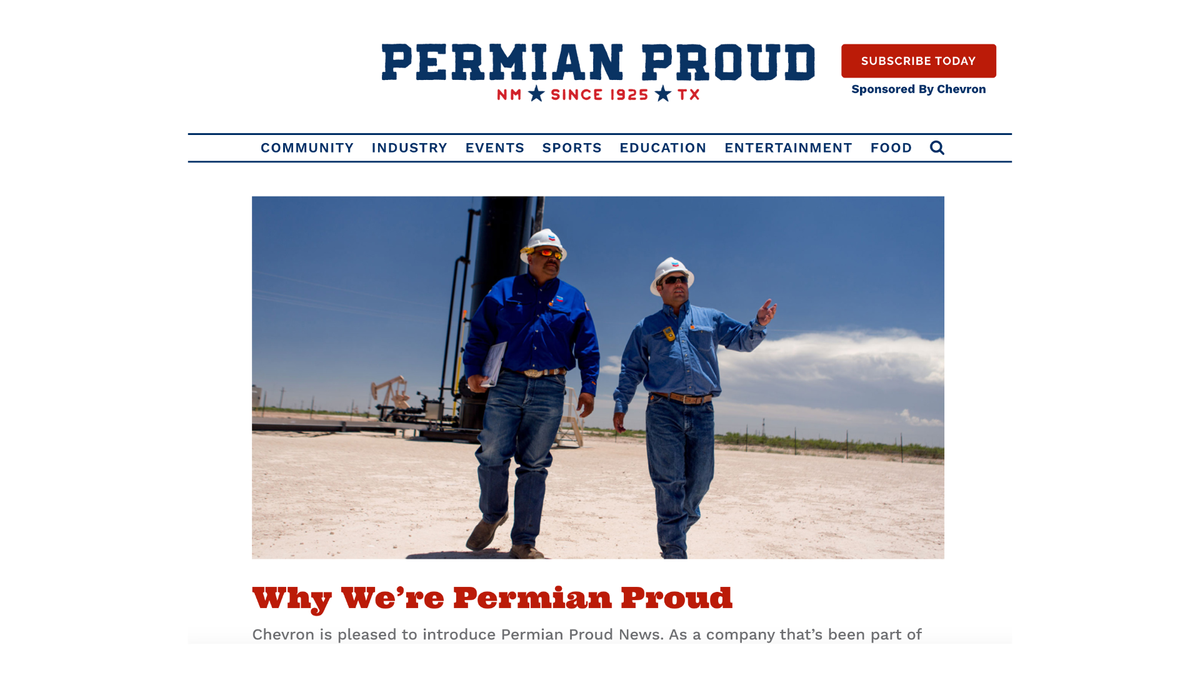 Chevron launched the Permian Proud website in 2022 to provide positive news to the residents of West Texas and southeastern New Mexico — and a positive spin on the company. The oil and gas giant runs similar “news” websites in California and Ecuador where it operates.
Published by the*Louisiana Illuminator*,*Texas Climate News*,*Santa Fe New Mexican*
Across West Texas’ Permian Basin, the oil industry’s presence seeps into many facets of life. Businesses from hotels to veterinary clinics display oil pump jacks on their signs. An oil derrick is part of the logo for the city of Midland.
And there’s another way the industry influences local communities: Since 2022, one of the largest oil producers in the Permian Basin has run its own local news website. The Chevron-operated site, Permian Proud, provides local news coverage for a region with a dwindling number of local news outlets, while inserting articles with a positive spin about the company.
The news site doesn’t have staff reporters or editors like traditional news media, and instead is written by a San Francisco public relations firm and a Chevron public and government affairs adviser.
The Permian Basin covers a 250-mile by 300-mile swath of eastern New Mexico and West Texas. It is one of the most oil-rich areas in the world, producing more than 10 million barrels per day of oil and natural gas, the latter composed primarily of methane.
The founding of Permian Proud comes at a time when the oil and gas industry is under increasing fire for its dominant role in creating the climate crisis, and states and the federal government seek to replace fossil fuels with low- or no-emission sources of energy.
Subscribe to Floodlight
Floodlight is a nonprofit newsroom that investigates the powers stalling climate action.
Subscribe
It is also part of a network of Chevron-owned news outlets amplifying the company’s viewpoint while publishing feel-good stories about local events and people. The same San Francisco public relations firm that provides content for Permian Proud runs the Richmond Standard news site in Richmond, California. It also operates an English-language website in Ecuador, where the energy giant has fought back decades of litigation.
Chevron created the site to highlight the activities “in a region that plays an important role in providing the energy that makes modern life possible,” Chevron spokesperson Ross Allen said in a written statement. Allen added that the site is a “community benefit” to the residents, businesses and employees in the region.
In a 2023 email interview, Greg Connell, an Odessa City Council member, said he wasn’t familiar with Permian Proud. Today, he is now familiar with the site — and unsurprised by Chevron's entrance into local news.
“Chevron showing interest in the communities and not just the oil, that is nothing new. Always a positive for the Permian Basin,” Connell said.
During his time living in the Permian Basin, he said he often sees Chevron and other oil businesses donate money for local community programs, a practice that he welcomed. After reviewing the site, Connell said Permian Proud seems to diversify the media in the region.
“As you know there are always two sides or perspectives to any story. This publication appears, simply, just the news, supporting the Permian Basin,” Connell said.
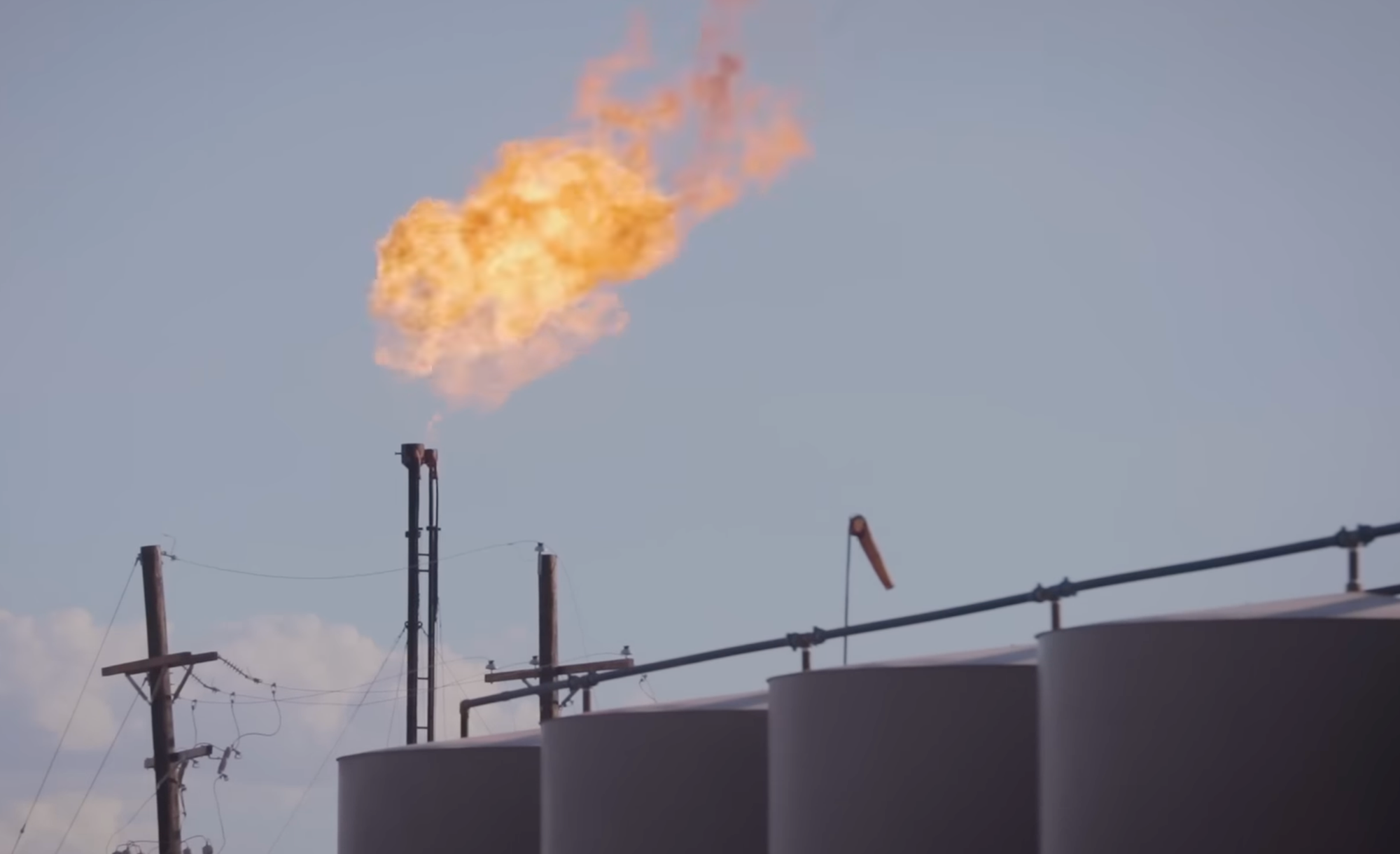 The oil and gas industry dominates West Texas and southeastern New Mexico. It is also where Chevron runs a “news” website that amplifies the company’s viewpoint while publishing feel-good stories about local events and people. (Courtesy of Miguel Escoto)
Countering the oil and gas narrative
Miguel Escoto, an environmental advocate from El Paso, is familiar with the narratives spun by the oil and gas industry in West Texas. Escoto previously ran his own platform, Mesquite Media, to counter the heavy oil and gas industry influence he sees in the Permian Basin.
Escoto said the purpose of Mesquite Media, which largely hosted podcasts, was to “amplify voices of resistance to fossil fuel corporate power” and to show how connected the people of the Permian Basin are — culturally, socially and economically — despite their differences.
Escoto now works with Oilfield Witness, a citizen journalism website and documentary producer that investigates fracking and air emissions in the Permian Basin.
Miguel Escoto is an environmental advocate from El Paso. He works for Oilfield Witness, a citizen journalism website and documentary producer that investigates fracking and air emissions in the Permian Basin. (Courtesy of Miguel Escoto)
“Permian Proud is a blatant, naked attempt by industry to have their side of the story be told,” Escoto said.
At the same time, the website “is not that much different than how oil and gas is covered by local channels,” across West Texas, Escoto said.
He cited the example of an Odessa oil field worker and his wife who died in 2019 from a poisonous gas leak while inspecting a work site. Local news outlets covered the incident, but framed it as “an inevitable tragedy” like a car crash or lightning strike, rather than investigating “why we have to live in this situation to begin with,” Escoto said.
Miguel Escoto films a documentary about the oil and gas industry in West Texas. Escoto says it’s frustrating pushing for climate action in a place where the industry that helped cause the climate crisis is so dominant. “The attitude is often that it’s inevitable. It’s too big to move so why even try?” he says. “A lot of people have given up on the idea that the Permian Basin can exist without the oil and gas industry.” (Courtesy of Miguel Escoto)
The oil field worker’s employer, Aghorn Operating Inc., and a company executive were later indicted by the U.S. Department of Justice.
“The attitude is often that it’s inevitable. It’s too big to move so why even try?” Escoto said. “A lot of people have given up on the idea that the Permian Basin can exist without the oil and gas industry.”
Local officials defend industry influence
Mayor Sam Cobb of Hobbs, New Mexico, is very open about his support for the oil and gas industry.
“I’m very glad that Chevron is part of our community,” Cobb said.
Cobb remembers the 1980s when oil and gas companies largely left the Permian Basin in pursuit of oil extraction abroad. Over the last decade, production in the region boomed due to fracking, which unlocks previously inaccessible fossil fuel deposits. Cobb said he welcomes the resurgence — and the dollars that those corporations put towards local communities.
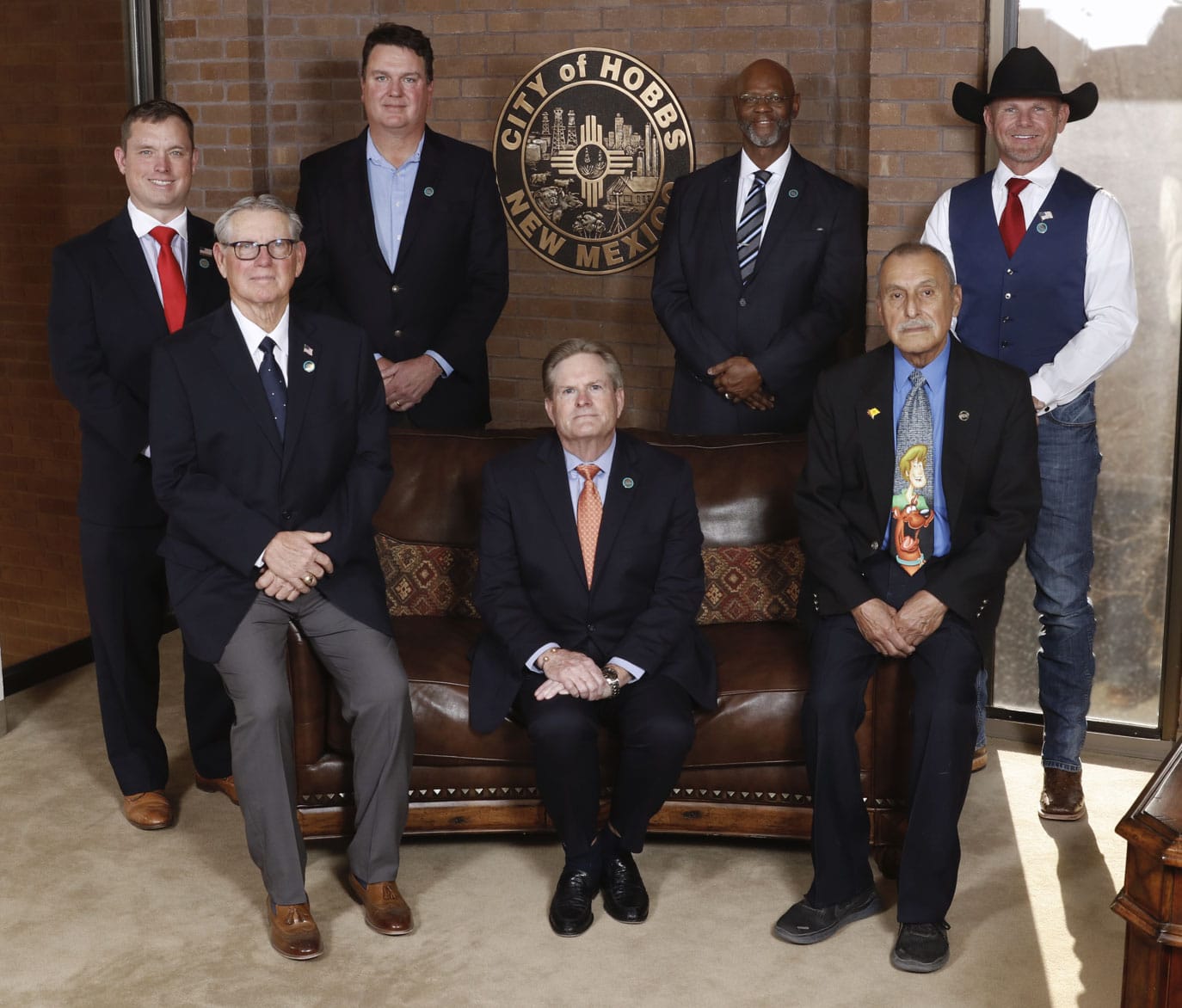 Mayor Sam Cobb of Hobbs, New Mexico, center, is very open about his support for the oil and gas industry, which dominates his community and the region. He says Chevron’s website, Permian Proud, is just another example of how the company gives backs to the communities where it operates. (City of Hobbs, New Mexico website)
In recent years, Lea County, where Hobbs is located, has been regularly ranked among the highest producing oil counties in the nation. The oil industry and companies that provide services for the industry are the largest employers in his city, Cobb said.
He acknowledged that some of those dollars arrived amid larger statewide pushes for New Mexico to go green. Cobb said he prefers that these multinational oil companies have a community presence rather than come in only to extract.
“We encourage the investment and continue to be partners with them,” Cobb said.
On Permian Proud, Cobb said the site seems to promote “positive things” in the places where Chevron has business activities.
“This website is new to me, but their activity in the community is not,” Cobb said.
‘We’re impartial … they’re obviously not’
Permian Proud headlines include celebrating the lunches that Chevron sponsored for a Martin Luther King Day event — which Cobb helped deliver alongside Chevron employees. The Hobbs News-Sun also regularly covers the oil giant’s donations to local schools and nonprofits.
Blake Ovard, editor of the Hobbs News-Sun, said he isn’t worried about potential competition with Permian Proud’s entrance into the local news market.
“I look at it as being more of a way of getting information that they wouldn’t have normally given out,” Ovard said. “As journalists we’re impartial, and they’re obviously not.”
Oil and gas news is among the top coverage in the News-Sun. Ovard said the newspaper does not shy away from the negatives — or the benefits — of the industry in the region.
That includes coverage that ranges from environmental impacts to the $10 million that the Permian Strategic Partnership donated to found a new vocational high school in Hobbs, Ovard said. Chevron is one of 31 members of the partnership, which funds philanthropic projects across the Permian Basin. The oil and gas industry also advertises in the News-Sun.
“I never operate my newsroom out of fear of advertising doing anything,” Ovard said. “Our whole thing is that we’re a news organization that will tell the real story. We cover just about anything that touches or has benefited from oil and gas.”
Permian Proud planted in a news desert
Many of the counties within the Permian Basin are considered “news deserts,” or areas with limited access to local, credible news sources.
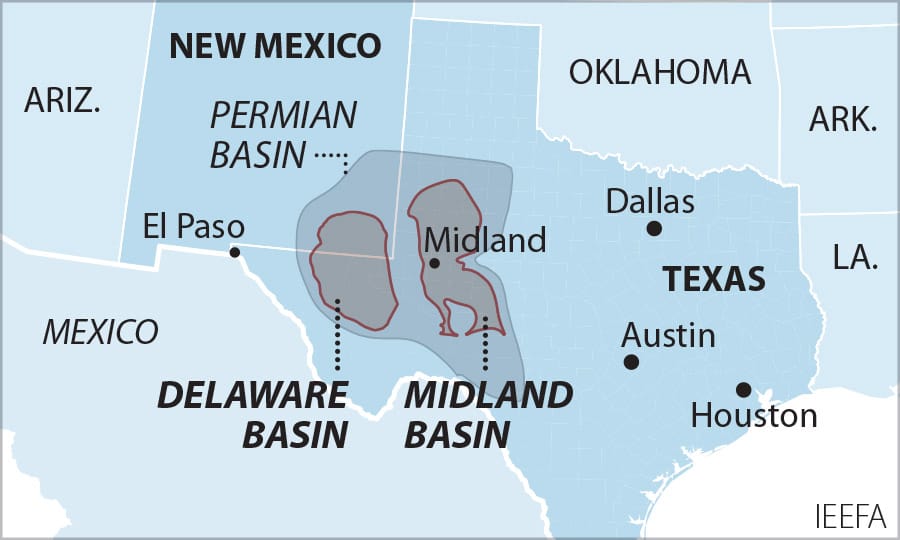
Of the 61 counties considered part of the Permian Basin region in Texas, 13 counties had no local newspapers, and the majority had only one newspaper, according to the news desert map maintained by the University of North Carolina. The map only denotes newspapers and does not include TV or radio coverage in these areas.
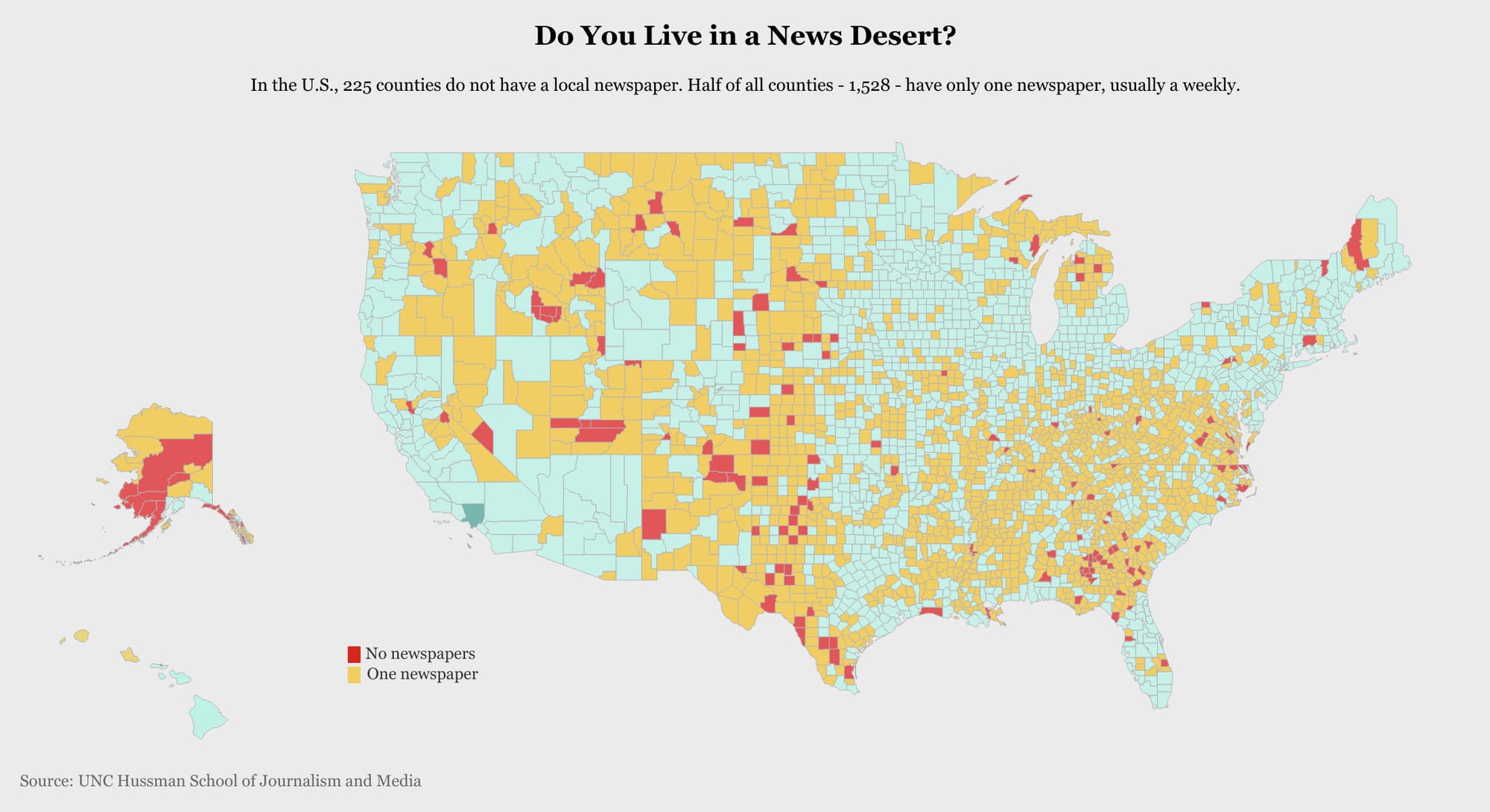 This map from the University of North Carolina shows the Permian Basin in West Texas and southeastern New Mexico is among many “news deserts” in the United States lacking local newspapers. Corporations and special interests in recent years have filled these news vacuums with websites that push their own messages while providing “news” about local communities.
Among Texas’ larger media players — Dallas Morning News, Texas Monthly, Houston Chronicle, Texas Tribune — the coverage of the Permian Basin includes stories about climate change, air quality concerns, the environmental damage caused by abandoned oil wells and the complicated economic relationship between these communities and the oil industry.
A search of the Permian Proud’s two-year-old website shows just a smattering of stories about climate change or greenhouse gas emissions — despite the oil and gas industry’s leading role in causing the climate crisis. As of Aug. 12, there were two stories mentioning climate change; one is a recap of a Texas Tribune series about training oil and gas workers and the other quotes a Chevron official about new techniques for measuring methane emissions.
The site has plenty of articles boasting of the importance of the Permian Basin and Chevron, sprinkled in with coverage of events, sports and awards given to local residents.
One story reported on Chevron receiving the highest environmental rating in the Permian Basin. Another announced that Chevron plans to boost its production to meet U.S. energy needs.
And the site reported on a $145,000 company donation to help students in Carlsbad, New Mexico — to pursue careers in energy and natural resources.
Cobb, the mayor of Hobbs, acknowledged it’s rare to find any criticism of the region’s dominant industry in the local media — even outside Permian Proud.
“The oil and gas industry,” he said, “doesn’t get much negative coverage out here.”
Felicia Alvarez's initial reporting on this story came through the Investigative Reporting Program at the University of California-Berkeley.
WE NEED YOUR SUPPORT
Before you go, would you consider supporting Floodlight’s climate accountability investigations?
The United States — and the world — are at a critical juncture for the climate crisis. Watchdog journalism from Floodlight illuminates who is fighting climate progress and helps the public and professionals understand what is at stake.
That's why we need your help.
Your support enables us to produce unique investigative and public-service reporting that demands accountability and strengthens democracy. Quality reporting is a public good. That's why we share it — at no cost — with partner newsrooms across the country.
Our readers keep us independent, beholden to no outside influence and accessible to all. Consider making a tax-deductible contribution now to enable this work to continue, or better yet, support us with a sustaining monthly gift.
With gratitude,
Emily Holden
Founder & Executive Director
Floodlight
{------}:
Chevron owns this city's news site. Many stories aren't told
March 28, 2024
Heard on All Things Considered
Miranda Green
Chevron operates a major refinery in Richmond, Calif., a community with high childhood asthma rates. It also owns the city's dominant news site, putting its own spin on events, and runs similar websites in Texas and Ecuador.
Tracy J. Lee for NPR
NPR's David Folkenflik reported this story with Miranda Green ofFloodlight, a nonprofit newsroom that investigates the powerful interests stalling climate action.
RICHMOND, Calif. — Open flames shot upward from four smokestacks at the Chevron refinery on the western edge of Richmond, Calif. Soon, black smoke blanketed the sky.
News spread quickly that day last November, but by word of mouth, says Denny Khamphanthong, a 29-year-old Richmond resident. "We don't know the full story, but we know that you shouldn't breathe in the air or be outside for that matter," Khamphanthong says now. "It would be nice to have an actual news outlet that would actually go out there and figure it out themselves."
The city's primary local news source, The Richmond Standard, didn't cover the flare. Nor had it reported on a 2021 Chevron refinery pipeline rupture that dumped nearly 800 gallons of diesel fuel into San Francisco Bay.
Chevron is the city's largest employer, largest taxpayer and largest polluter. Yet when it comes to writing about Chevron, The Richmond Standard consistently toes the company line.
And there's a reason for that: Chevron owns The Richmond Standard.
"If you look at Chevron's website and you look at The Richmond Standard, a lot of the information is copy and paste," says Katt Ramos, a local climate activist. "They present a very skewed viewpoint that is bought and paid for by Chevron."
The site's very name evokes the history of Chevron, created when John D. Rockefeller's Standard Oil was broken up by federal trust-busters more than a century ago. The Richmond Standard prides itself on being the "number one source for local, community-driven news" about the city.
The city of Richmond exists in the shadow of the nearby Chevron refinery, which has been connected to poor air quality and health issues in the nearby community.
Brian L. Frank for NPR
Around town, in coffee shops, an architect's office, at a Mexican restaurant, even at a waterside National Park Service site, the Standard is recognized as the main source of news about the city. It carries stories about charity drives and street closings. New bars and art exhibits. Youth soccer events and local concerts and safety initiatives.
Decades ago, the city relied on the Richmond Independentand the San Francisco Chronicle to report on the community. And then a pattern familiar across the U.S. unfolded. The Chronicle pulled back. The Independent got folded into a newspaper in nearby Berkeley, which itself shut down in 1984. Papers in other East Bay cities shriveled up. Now the city's news landscape is dominated by its major corporate force.
Markets where news outlets shut down are often called news deserts. The Standard has created something of a news mirage: Stories are told — but with an agenda. Facts displeasing to Chevron are omitted; hard truths softened. The company is seeking to get its point of view across and to convey that it can be trusted.
On a recent February night, a city council meeting focused repeatedly on developments involving Chevron. Not a single journalist attended in person — other than those for NPR and Floodlight.
The same San Francisco public relations firm that operates the Standard for Chevron runs a similar site about developments in the Permian Basin in West Texas and New Mexico, where Chevron has major business interests. It also runs one of the company's sites in Ecuador, where the energy giant has fought back decades of litigation.
The Richmond Standard is a local news site funded by Chevron, which runs the large refinery in town.
Brian L. Frank for NPR
Chevron's bid to control the public discourse comes as efforts to combat climate change threaten the fossil fuel industry, especially in California. State regulators would effectively ban the sales of gas-powered cars by 2035. They released the world's first plan to achieve net-zero carbon pollution. Other states and countries have adopted similar goals.
In February, Chevron revealed that it was taking a loss of about $1.8 billion on assets mainly in California, because of a tougher regulatory climate in the state. Chevron's corporate headquarters is in San Ramon, about a 35-mile drive southeast of Richmond, though the company has moved the bulk of its workforce to Texas.
"The company saw a need to offer the community more news coverage of Richmond, which had been largely ignored by traditional media with the exception of crime stories," said Braden Reddall, a manager of external affairs at Chevron. "Most people in Richmond will tell you there is a lot more to the community than what is known and reported by traditional media outlets. It's a proud community, filled with interesting people who are doing interesting things."
Other outlets more than adequately cover Chevron, added Reddall, who earlier covered the company for the international news service Reuters.
Former schoolteacher Patricia Dornan says she reads The Richmond Standard but skips the stories about Chevron. "I don't read any of the articles about how wonderful their company is," she says.
Brian L. Frank for NPR
Lifelong Richmond resident Patricia Dornan says she cherry-picks which stories she reads in the Standard.
"If you understand that it's going to have a Chevron-Standard Oil point of view, it's fine because most of the stuff that they're putting out has nothing to do with them," says Dornan, a retired middle school teacher. "And so long as it doesn't have to do with Chevron, it's fine. I don't read any of the articles about how wonderful their company is."
Dornan volunteers at the Rosie the Riveter World War II Home Front National Historical Park. She tells visitors about the marvels of American manufacturing in a time of war and about the women welders of Richmond who were able to turn out warships in 51 days rather than two years.
Her grandmother moved to town in 1905 — just three years after the refinery first opened — and her family has been there ever since. One of the streets in town is named after her father. She says Richmond can't function without Chevron, but a true local news outlet would help hold it accountable to the community.
When she wants to know what Chevron is up to, Dornan says, "I usually ask my friends who are retirees from the refinery — what's going on?"
"Richmond deserves more news coverage"
When the Standard launched in 2014, it proclaimed: "Richmond deserves more news coverage."
"For the first time in more than 30 years, Richmond will have a community-driven daily news source dedicated to shining a light on the positive things that are going on in the community," the site announced.
Chevron presents the Standard as an investment in the Richmond community. The public relations firm operating the Standard wrote, "This site would tell the stories other outlets had lost the resources to tell."
But not all of the stories.
In the Southeast, power company money flows to news sites that attack their critics
She was an ABC News producer. She also was a corporate operative
A recent review found The Richmond Standard had published 434 stories that touch on its owner, Chevron, since the site's inception. Eight articles refer to flaring incidents. None cite oil spills. The majority of the stories that mention Chevron focus on profiles, awards ceremonies, community projects and celebrations it throws on such occasions as Black History and Hispanic Heritage months.
When Bay Area air pollution regulators secured landmark concessions from Chevron in February to settle a lawsuit, they called it a "decisive victory." The San Jose Mercury News headline cited "$20 million in fines for hundreds of air-quality violations."
The Richmond Standard was more reserved: "Chevron agreement with Air District called win for environment and energy."
The article did not clearly lay out the core of the litigation. The words "fine" and "penalty" did not appear. Careful readers might have been able to piece together what transpired: The news outlet described an agreement involving $20 million that "solidifies the future of energy production at the Richmond Refinery."
"There are a whole host of news outlets around the Bay Area that cover the refinery," said Reddall, the Chevron spokesperson. "The Standard seeks to fill in the gaps. From where I'm sitting, I don't think that it's a refinery that's not written about."
Richmond is a working-class city of 115,000 — nearly half of whom are Latino. Most of the people who work at the Chevron refinery live outside the city.
Brian L. Frank for NPR
A news mirage
Boundaries blur between city and corporation in this largely working-class city of 115,000 people, almost half of whom are Latino. The tech boom of nearby Silicon Valley and the opulence of neighboring Marin County feel like universes away.
The public high school's mascot is the Oilers. Streets are named Ammonia and Petrolite and Xylene. Chevron's network of pipes, low-lying cooling ponds and even sulfuric stench have become defining parts of the town's character. A nature park where tufted egrets and hummingbirds frolic abuts the nearly 3,000-acre refinery itself — an expansive preserve of smokestacks, pipelines and tanks.
Chevron, which recorded $21.3 billion in profits last year, has played an outsized role in Richmond for decades. It supplies the city with jobs — yet most Chevron employees live elsewhere. It pays roughly $50 million a year to Richmond — more than a sixth of the town's annual revenue.
The company's relationship with Richmond turned sour rather abruptly in 2012. An explosion at the refinery engulfed 19 employees in a cloud of light gas oil that had been partially vaporized, according to a federal investigation. The air pollution from the resulting industrial fire could be seen from miles away. In the ensuing days, 15,000 Bay Area residents went to medical centers for respiratory complications.
The Richmond High School mascot is the Oilers.
Brian L. Frank for NPR
State and local prosecutors charged Chevron with criminal negligence and other crimes;the company settled by pleading no contest to six charges, paying out roughly $10 million to affected local residents, agencies and hospitals. Chevron also paid $5 million directly to the city of Richmond to settle a separate civil lawsuit.
By the time of the incident, political sentiment in Richmond started to swing away from the company. As the months passed, progressives were threatening to take control of the city government. They promoted a future without the refinery — just as Chevron was seeking approval from city officials for a sweeping project to overhaul and modernize it.
As the 2014 election cycle dawned, Chevron took action to make sure its voice was heard. It promised a huge investment in scholarships and public health programs.
Chevron also spent $3 million to help propel pro-industry candidates. They all lost. "The election became a referendum on Chevron," said Tom Butt, at the time a city council member who won election as mayor.
Chevron also launched The Richmond Standard that year.
From the outset, the company disclosed its involvement. In small letters at the top of its homepage, the site reads "Funded by Chevron."
Tom Butt was elected mayor of Richmond in 2014. He says that election was a referendum on Chevron.
Brian L. Frank for NPR
In the aftermath of the election, the Standard published a 428-word statement from Chevron in its entirety that defended the company's actions and criticized the city's new leaders. "The question for Richmond is: Will local leaders recognize that business is integral to the city's success?" the Chevron statement read. "Or, will city leaders continue to oppose efforts to create growth, preferring instead to watch the business climate — and the prosperity that business helps generate — decline?"
"We should be outraged"
Katt Ramos, who helps lead Communities for a Better Environment's Richmond chapter, stages tours to demonstrate what she says is Chevron's destructive legacy. It also illustrates what happens when independent local news disappears.
She stops by Peres K-8 School in the Iron Triangle, a nickname derived from the three train tracks that intersect here. Older kids play soccer on a field with a coach while younger ones cavort on a playground. Beyond the school fence, the Chevron plant stands less than a mile away. A sign next to the school's entrance warns of a shallow hazardous liquid pipeline from another petroleum company, Phillips 66, a warning to not dig there.
"Nothing that is normalized about childhood is normalized in Richmond," Ramos says. Adults have to tell kids they can't play outdoors due to a high number of bad air days, she says.
"Nothing that is normalized about childhood is normalized in Richmond," says Katt Ramos, a local climate activist. She says the city's air pollution problems and residents' health issues are rarely covered in the news.
Brian L. Frank for NPR
Perhaps the best way of gauging the seriousness of such concerns is to look at child admissions to emergency rooms for asthma, says Anne Kelsey Lamb, who oversees asthma research for the Oakland-based Public Health Institute. Children in the ZIP code of the Iron Triangle — which includes the refinery as well as the neighborhoods surrounding the Peres school — are admitted for emergency care for asthma at triple the rate for California at large. (The institute provided an analysis of the most recent available state statistics at the request of NPR and Floodlight.)
Parceling out responsibility for air pollution is complicated, given Richmond's many highways and railroads, along with the refinery. The regional board that regulates air quality found that Chevron accounts for 63% of all particle pollution in Richmond and two neighboring towns.
These issues rarely get covered, Ramos says. She starts to weep gently when talking about the city's future.
"I think at best we should be outraged, you know?" she says. "Everyone should be concerned about the conditions that our community has to face."
The PR firm running the Standard
While Chevron owns the Standard, San Francisco-based Singer Associates runs it from across the bay. The consulting firm is known for handling PR crises. Founder Sam Singer is no stranger to Richmond; he grew up in Berkeley and briefly worked at the Richmond Independent and a sister paper before moving on.
Singer Associates has written that the news outlet came about after Chevron developed a "fractured relationship with many stakeholders including city government leaders." The site was part of an effort "to provide the company with greater freedom to operate by increasing awareness for the positive role it plays in Richmond," according to Singer's application for an industry award, as cited in a U.S. House Natural Resources Committee staff report.
A man fishes for leopard sharks in the waterways along Point Richmond that are a thoroughfare for petroleum and have been the site of several oil and chemical spills.
Brian L. Frank for NPR
Most Standard articles are written by Singer Associates employee Mike Aldax, a former reporter for the San Francisco Examiner and the Bay City News Service. (Aldax did not return messages seeking comment.) The site also hired two journalists who live in Richmond to write for the site.
"Our team has worked hard to build relationships with the community, which is why people trust us, and turn to us, to cover community stories," Singer wrote in an email for this story.
The pace of reporting ebbs and flows. Some featured videos on the Standard's homepage are several years old. The metabolism of fresh posts stepped up in early March, shortly after NPR and Floodlight first sent a series of queries about the Standard to Chevron and Singer for this story.
Chevron newsrooms begin in South America
In launching the Standard, Chevron followed a path the fossil fuel giant had first forged thousands of miles to the south.
Since 2009, Singer has run The Amazon Post in Ecuador at Chevron's direction. The English-language site emerged as Chevron confronted lengthy multibillion-dollar litigation seeking to hold it liable for the pollution from oil drilling there. (Chevron had acquired Texaco in 2001, which was responsible for the oil extraction.) Chevron's legal battle spread to other nations, including the U.S. and Brazil. The American attorney who led the suits against Chevron for Ecuadorian farmers and Indigenous peoples was a frequent target of the site. He was ultimately disbarred in New York for his actions in the case.
Flames flicker through the thick green trees of the Ecuadorian Amazon rainforest — where gas flares, oil wells and refineries darken the landscape and poison the environment — shown in Shushufindi, Ecuador, in 2023. The legacy there of Texaco, which Chevron acquired, has inspired lengthy legal battles in several countries.
Pedro Pardo/AFP via Getty Images
A subsequent Spanish-language site called Juicio Crudo (an allusion to crude oil) focusessquarely on a damning legal judgment against Chevron that a U.S. court later found to be fraudulent. It reprints text directly from Chevron's Spanish-language press releases.
By contrast, El Oriente, a Spanish-language digital outlet launched in 2019, presents itself as a news site aimed at audiences who reside in the Ecuadorian Amazon.
Until recently, it noted at the bottom of its page that it is "sponsored by Chevron." Days after NPR and Floodlight started posing questions about Chevron's sites, the affiliation was moved to the top, just beneath the site's name.
The sites link to one another. Chevron says those sites are managed separately, not by Singer.
In at least one instance, the controversies surrounding Chevron in Ecuador inspired fodder for the Standard back in Richmond.
In 2014, Richmond's then-mayor, Gayle McLaughlin, traveled to see Ecuador's environmental degradation at a time when her party was seeking to force Chevron to pay more to the city.
Shortly after she returned home, the Standard's Aldax reported: "The mayor's six-day trip to Ecuador was in support [of] the South American nation in its ongoing battle against Chevron, which it falsely blames for polluting the rain forest."
Aldax wrote that McLaughlin was late in filing $4,499 in expenses for the trip, which had been paid for by the Ecuadorian government. The article embedded a produced by The Amazon Post.
Gayle McLaughlin, then Richmond's mayor, speaks onstage during a 2014 event in Los Angeles.
Mike Windle/Getty Images
It was a rare instance of the Standard producing anything other than benign community news. She had to pay a $200 fine.
Today, McLaughlin calls her misstep minor. She tells NPR and Floodlight she believes the story was intended as a warning to Chevron's critics that it could embarrass them or just ignore them altogether.
Politicians say this Florida news site lets them buy coverage. Is your state next?
"The Richmond Standard will never, ever print anything that is critical of Chevron," McLaughlin says, "and it will never print anything that upholds the community's victories against Chevron. And we need to spread the word about those victories."
Expanding to Texas
Chevron launched its latest newsroom, called Permian Proud, in the Permian Basin in August 2022.
The site posts stories about West Texas and New Mexico. They are home to the nation's highest-producing oil fields, where Chevron has substantial drilling interests — and where local news has been hard hit. Permian Proud explained its mission this way: "We aim to complement the important work of existing local media by providing hyper-local news you won't find anywhere else."
Unlike California, Texas is a deeply red state with a broader base of support for the oil and gas industry. Even so, Chevron's future there is similarly deeply reliant on the goodwill of residents and regulators.
"Over the past year and a half, Permian Proud has put a spotlight on national spelling bee contestants, the local arts community, nonprofit organizations, community events, high school sports, industry accomplishments, and much more," Chevron spokesperson Catie Matthews wrote in a statement for this story. "Additionally, the platform has amplified coverage of local stories by other news outlets, and provided a digital arm to some of our rural communities and smaller nonprofit organizations who would otherwise not have one."
Permian Proud also promotes Chevron's perspective.
Many of the articles on the site are rewritten press releases. For example, Permian Proud's article "Chevron's Permian Basin operations to tap into more recycled water," is almost identical to Chevron's press release. The original text read, "By using recycled water in our fracking operations, we help preserve fresh water and groundwater in drought-prone areas." Permian Proud swapped "Chevron helps" for "we help."
Among the few listed bylines: Mike Aldax of Singer and The Richmond Standard.
Ramos says locals share news about Chevron by word of mouth because The Richmond Standard is "giving us the opposite of the truth."
Brian L. Frank for NPR
Relying on word of mouth
In the absence of independent local news sources, Richmond residents say they rely on each other for accurate information.
A husband-and-wife team started a small news site last year. A former mayor shares his thoughts about local politics in a newsletter. When school is in session, journalism students at the nearby University of California, Berkeley cover Richmond as part of their studies. A nonprofit group has held listening sessions about plans to extend a hyperlocal site to the area. And sometimes — when the news is big enough — San Francisco TV stations cross the bay to cover it.
But mostly, there's word of mouth. Activist Katt Ramos points to the February 2021 pipeline rupture. As Chevron publicly conceded, a resident spotted the tainted water long before Chevron or any news outlet alerted the community.
"A lot of our news is really from me, gathered by our local kind of independent folks that go around covering things for us," Ramos said. "Because we have to deal with publications like The Richmond Standard that are giving us the opposite of the truth."
*Felicia Alvarez, Maria Fernanda Bernal and Richard Tzul of the University of California at Berkeley's Graduate School of Journalism contributed to this report.
===