fake newspaper native advert
==
see brand studio
see wapo WP BrandStudio,
NYT has T brand studio
1020 may need to distinguish:
1) fake direct mail montana statesman ginned up for an election/ hit pieces
2) wa examiner (times) online rags with conservative slant SEE FREDERICKS STAR
3) algorithm generator
4) chevron fake paper richmond std
1219 omg did not know there was a word for it; see brand studio
---
no lnx vid ymail 10 24
Southern Company is promoting “propaganda” disguised as research — with help from a major media company
The utility is laundering strategic messaging about the energy transition through a partnership with The Atlantic's marketing team.
Emily Sanders
Oct 28
As I was writing about the first local government to sue a gas utility for climate deception, I received a message in my LinkedIn inbox from another major power provider — Southern Company, a utility holding company heavily invested in gas throughout the South.
The message promised “exclusive insights” about the clean energy transition, and it took me to a page titled “Why Net Zero isn’t Zero-Sum” on the website of The Atlantic, the Pulitzer Prize-winning magazine. Southern Company partnered with Atlantic Insights, the marketing research team at The Atlantic, for a downloadable “white paper” that quotes anonymous corporate executives, board members, and public sector leaders on their views about the energy transition. The paper argues that the lack of progress in addressing climate change can be attributed to “misalignment” between the public and private sectors, who “often point fingers at each other.” It promotes collaboration between governments and companies, who can work together to develop clean energy sources.
“It’s our responsibility, as individuals and organizations, to harness our own energy and map an actionable path forward, with an awareness that pointing fingers is an inexcusable form of inaction, and that net zero is a promise we must keep for the well-being of the planet’s citizens, communities, businesses, and economies,” the paper concludes.
The message behind the sponsored content is a common refrain among fossil fuel companies: don’t blame private industry for a lack of climate progress, because we are all responsible. It does not mention the swell of lawsuits that accuse fossil fuel companies, and most recently, a utility company, of deceiving the public and policymakers and obstructing climate action for decades, and of making false promises about their role in solutions today.
Instead, the partnership combines two tactics fossil fuel companies have long used to launder their image and promote their vision for the future: sponsoring research to redirect conversations about the energy transition (i.e. who should be involved, and what counts as clean energy), and sponsoring content in mainstream media outlets to disguise their messaging as journalistic and credible.
For decades, mainstream media outlets like The Washington Post and The New York Times ran fossil fuel industry “advertorials” — ads disguised as opinion pieces — that undercut and downplayed climate science. Today, leading outlets are creating branded content for fossil fuel companies that mislead readers about the companies’ commitments to the energy transition and industry-backed “solutions.” A report from DeSmog and Drilled, which analyzed sponsored content in major outlets between 2020 and 2023, found “a media industry that repeatedly helps fossil fuel companies contradict the information climate reporters are sharing with the public.”
Southern Company’s white paper is a “native advertisement that The Atlantic's in-house content studio has created on behalf of their client, Southern Company,” and “nothing more than a propaganda effort that The Atlantic name confers legitimacy to,” said Michelle Amazeen, an associate professor of journalism studies and advertising at Boston University who specializes in researching misinformation. “It is not independent, peer-reviewed research. It is marketing research which, fundamentally, is used to market products,” Amazeen said. The partnership “is in the best interest of Southern Company rather than the public interest.”
For its part, The Atlantic acknowledged that the collaboration with Southern Company was a marketing effort. Anna Bross, a senior vice president of communications at The Atlantic, told me that “Atlantic Insights is the marketing research division of The Atlantic. To be sure there is no confusion, Insights is part of our sales and marketing team, separate and independent from our editorial division.”
The Atlantic has partnered with Southern Company on marketing before, including through The Atlantic Ideas Festival, which is billed as “addressing the most significant issues of our time with today’s boldest thinkers as we bring The Atlantic’s journalism to life onstage.” This year, Southern Company is an underwriter of the festival; in 2022 and 2023, The Atlantic’s CEO, Nicholas Thompson, interviewed the company’s CEOs about the transition to clean energy. Those interviews were “distinct and separate from the editorial interviews at the Festival, and clearly delineated, introduced, and labeled as such,” said Bross.
Bross also pointed me to guidelines that cover the outlet’s advertising, “including very clear labeling, fonts, and branding — so as to distinguish advertising from our journalism.” But while Amazeen said guidelines are an important first step, her research shows that such distinctions aren’t often appreciated — or even noticed — by the readers that sponsored content is intended to reach. “Publishers can (and do) say whatever they want about clear labeling,” she said. “What really matters is whether audiences can make this distinction.”
(When I asked Bross if blurred lines were a concern for The Atlantic, she responded that the outlet “fundamentally rejects” that characterization due to its labeling and that its audience is “incredibly sophisticated” and able to distinguish between the two.)
Southern Company’s “denial and delay”
Utilities like Southern Company — and the outlets that partner with them — have largely escaped criticism for greenwashing their role in the climate crisis. “What Southern Company is doing in terms of lobbying to fight this transition really deserves a lot more of a spotlight,” said Neil Sardana, an organizer at Georgia Conservation Voters.
For many advocates and researchers working in the states where it operates, Southern Company is one of the last entities you’d want to trust to deliver guidance on the clean energy transition. The company has a “long history in climate denial and delay,” said Daniel Tait, a research director at the Energy and Policy Institute, which published a report in 2022 documenting Southern Company’s early knowledge about the dangers of burning fossil fuels and decades-long disinformation campaigns to curb climate action. Tait, who is also the executive of Energy Alabama, a nonprofit that advocates for clean energy in the state, says Southern Company is still undermining the energy transition today.
They are building new gas-burning units, still rely on coal for power, and are actively blocking clean energy solutions like solar, he said.
Southern Company’s Alabama subsidiary, Alabama Power, has imposed a charge on rooftop solar panel owners, which is being challenged in court, as well as a tax on large-scale producers of solar energy. The company is also known by local advocates for its prolific dumping of toxic coal ash and for operating the most greenhouse gas-intensive power plant in the nation, located in West Jefferson, Alabama. Southern Company uses hundreds of millions in taxpayer dollars to run a carbon capture testing and research center in Wilsonville, Alabama, even after the company was investigated for fraud, sued, and forced to refund $377 million to ratepayers for its failed carbon capture project at a coal plant in Kemper County, Mississippi.
Ramsey Sprague, President of the Alabama-based Mobile Environmental Justice Action Coalition, described Alabama Power as “vampiric,” and said it suppresses renewable energy generation in the state, pledges to mitigate its pollution via “unproven” carbon capture technologies, and “fleeces its customers” for the benefit of investors on Wall Street. A 2023 study found that Alabamians have the highest electricity bills in the United States.
Jilisa Milton, a co-director at the Greater-Birmingham Alliance to Stop Pollution, found Southern Company’s promotion of public-private partnerships around the energy transition ironic. “I don’t think they’ve ever invited us to have that conversation,” she said about Alabama Power. “We’ve tried to engage executives — there’s not really a channel for that.”
Southern Company has a very different version of its role in climate change, maintaining that gas is essential for a clean energy transition. “Natural gas and the infrastructure that transports it are foundational to achieving a sustainable future where energy is clean, safe, reliable and affordable,” reads its website. (Methane, the primary component of gas, is an even more potent greenhouse gas pollutant than carbon dioxide.)
Alabama Power says it gets nearly a third of its power from clean energy. But the Sierra Club gave Southern Company an “F” grade — zero out of 100 — in a report that scores utilities on their energy transition plans.
“The reality from their operating companies in Mississippi, Alabama, and Georgia just does not match the rhetoric whatsoever,” said Sardana, who noted that Georgia Power is expanding fossil fuel generation in the state. “We see how much influence Southern Company has gained within our state and federally in terms of pushing back against climate regulations and protecting fossil fuels.”
After Hurricane Helene struck in September, thousands of Georgia residents went without power or running water for nearly three weeks. Southern Company has touted its recovery efforts in the area — but by keeping Georgia’s grid reliant on coal and gas infrastructure, Sardana said, the utility left residents more vulnerable to outages, not to mention that burning fossil fuels increases the damage caused by hurricanes like Helene.
“To me, you can’t completely divorce the issue of fueling climate change and then having to recover from the damage when climate devastation takes place,” Sardana said.
Media’s role
Its partnership with The Atlantic isn’t the first time Southern Company has used media funding to bolster its image. Floodlight News found that Southern Company subsidiary Alabama Power finances two news outlets in the state — a digital news service founded by the utility, and a Black newspaper bought by its philanthropic foundation. According to Floodlight’s analysis, the news center “publishes overwhelmingly positive stories about the power company,” while the newspaper's coverage of Alabama Power consists of reprinted stories from the news center and the utility’s own press releases.
Various fossil fuel and utility interests across the country are now funding struggling local news outlets to sway public opinion about their operations.
Sponsored content and advertising partnerships offer corporate interests a similar opportunity. According to Amazeen’s research, not only are readers often deceived by the advertisements news outlets create for brands, thinking they are legitimate news, but news outlets are also less likely to report on companies that paid them to create branded content.
In response to my questions about their partnership with Southern Company, The Atlantic’s Bross said their editorial team was fully independent from sponsored content — a standard practice in newsrooms — and that “advertising relationships do not affect how we cover any company.” But when I asked whether The Atlantic has ever reported on Southern Company outside of those partnerships, Bross did not provide any examples.
“It's difficult to hold powerful interests to account if news organizations won't report on them out of fear of losing an advertiser,” Amazeen told me. “At a time when facts are under siege, disinformation is ascendent, and when the public should be turning to traditional news sources for accurate, vetted information, I am concerned that news publishers are adding to the confusion and eroding their own legitimacy by blurring commercial and journalistic content.”
---
---
Chevron’s faux news site exploits local journalism’s decline, epitomizing the fossil fuel industry’s insidious greenwashing strategies
Special ProgramsClimate & Energy
Written by Evlondo Cooper
:{Published 08/28/24
Chevron-sponsored “news” site Permian Proud represents one of the fossil fuel industry's latest and most insidious greenwashing strategies, exploiting the decline of local journalism to shape public opinion in oil-rich regions. This tactic epitomizes a broader trend of deceptive practices by Big Oil, which — combined with national TV news’ failure to scrutinize the industry amid the escalating climate crisis — highlights an urgent need for robust accountability reporting.
Chevron's PR firm published a local “news” site without journalists
Felicia Alvarez's investigation for Floodlight, published in the Louisiana Illuminator, exposed Chevron's Permian Proud as a calculated ploy to manipulate public opinion under the guise of local journalism. The site, devoid of actual reporters or editors, is crafted by a San Francisco PR firm and a Chevron public affairs adviser, eliminating any pretense of editorial independence or journalistic integrity.
A search of the Permian Proud’s two-year-old website shows just a smattering of stories about climate change or greenhouse gas emissions — despite the oil and gas industry’s leading role in causing the climate crisis. As of Aug. 12, there were two stories mentioning climate change; one is a recap of a Texas Tribune series about training oil and gas workers and the other quotes a Chevron official about new techniques for measuring methane emissions.
The site has plenty of articles boasting of the importance of the Permian Basin and Chevron, sprinkled in with coverage of events, sports and awards given to local residents.
One story reported on Chevron receiving the highest environmental rating in the Permian Basin. Another announced that Chevron plans to boost its production to meet U.S. energy needs.
And the site reported on a $145,000 company donation to help students in Carlsbad, New Mexico — to pursue careers in energy and natural resources.
Notably absent is any critical coverage of the oil industry's environmental impact or role in the escalating climate crisis — and an eroding local media landscape leaves local residents vulnerable to a distorted view of the oil industry's true impact on their communities and the planet.
“Many of the counties within the Permian Basin are considered ‘news deserts,’ or areas with limited access to local, credible news sources,” Alvarez writes. “Of the 61 counties considered part of the Permian Basin region in Texas, 13 counties had no local newspapers, and the majority had only one newspaper, according to the news desert map maintained by the University of North Carolina.”
Alvarez reveals that Permian Proud isn't an isolated experiment:
It is also part of a network of Chevron-owned news outlets amplifying the company's viewpoint while publishing feel-good stories about local events and people. The same San Francisco public relations firm that provides content for Permian Proud runs the Richmond Standard news site in Richmond, California. It also operates an English-language website in Ecuador, where the energy giant has fought back decades of litigation.
This model, replicated across Chevron's operational areas, forms part of a broader strategy to control the narrative as the fossil fuel industry faces mounting scrutiny.
Permian Proud ignores climate crisis as Texas faces escalating climate disasters and environmental injustice
Texas recently endured a record-breaking heat wave, with temperatures soaring above 110 F in multiple cities. The Washington Post reported that Abilene shattered its all-time high at 113 F, while other cities set new August records. This extreme heat isn't just uncomfortable, it's potentially deadly — and it’s straining the state's power grid to its limits.
This recent crisis is just the latest example of Texas’ extreme vulnerability to climate change. A stark analysis from Public Citizen reveals that between 1980 and 2022, a staggering 44% of all billion-dollar climate and weather disasters in the country affected Texas. The state faces an onslaught of heat waves, hurricanes, floods, droughts, and wildfires that are increasing in both frequency and intensity.
The climate crisis is also creating significant financial impacts for Texas residents. Erin Douglas of The Texas Tribune reported that insurance rates in Texas have skyrocketed by 22% in 2023, twice the average national increase. Even more troubling, “many areas of the state are likely underpriced relative to their climate risk, according to a model created by the First Street Foundation, a nonprofit group of academics and experts that quantifies climate risks,” suggesting that the financial strain on homeowners is only set to worsen.
Notably, the fossil fuel industry operating in Texas bears outsized responsibility for climate change, amplifying the risks facing communities across the state:
Texas emits more greenhouse gas emissions than any other state, according to the Environmental Protection Agency. It accounts for 14% of the nation’s climate-warming emissions, and produces more than twice the total emissions of California, the next largest greenhouse gas emitter. Texas is also the nation’s largest oil and gas producing state, accounting for more than 40% of the nation’s oil production.
Beyond the climate impacts of the fossil fuel industry, Texas also faces severe environmental justice challenges. Low-income communities and communities of color bear a disproportionate burden of industrial pollution — in Port Arthur and Houston, the concentration of petrochemical facilities and other polluting industries near residential areas is a direct result of historical segregation and discriminatory land-use practices. The Texas Commission on Environmental Quality's permitting decisions, particularly for facilities like concrete batch plants in Harris County, have further entrenched these disparities, leading to ongoing health risks for vulnerable populations.
The fossil fuel industry deploys multifaceted deception campaigns like Permian Proud to delay climate action
As the climate crisis intensifies, the fossil fuel industry has shifted from outright denial to a broader PR campaign employing more insidious forms of deception. This multifaceted approach, exemplified by Chevron's Permian Proud, aims to manipulate public opinion and delay climate action.
Recent investigations reveal oil giants are targeting youth via gaming platforms, exploiting inconsistent social media ad labeling, and rebranding as “clean energy providers” while promoting false solutions. In addition, The Guardian exposed the industry's funding of legal efforts to block climate action, with the Republican Attorneys General Association receiving $5.8 million from oil and gas interests since 2020.
These coordinated efforts — from exploiting declining local journalism to influencing younger generations and funding legal challenges — demonstrate the fossil fuel industry’s determination to shape public opinion and policy in its favor. As climate change impacts worsen, the industry's tactics aim to preserve its dominance in a decarbonizing world despite scientific evidence demanding a rapid transition away from fossil fuels. Outlets like Permian Proud are just one facet of this larger industry campaign, underscoring the urgency of recognizing and counteracting these corporate greenwashing strategies.
Local news vacuum enables corporate narrative control
The erosion of local journalism in the United States has reached crisis levels, creating dangerous information vacuums. A Media Matters analysis in May starkly illustrated this problem: Donald Trump's recent corrupt offer to Big Oil executives, asking them to raise $1 billion for his presidential campaign while assuring that they'd be getting a “deal” due to the taxation and regulation they would avoid if he is reelected, was almost entirely ignored by top local newspapers and TV markets in key battleground states.
The 2023 Medill Local News Initiative report quantifies this crisis: Over 50% of U.S. counties now have just one local news source, or none at all. The rate of newspaper closures averages more than two per week, with 2,900 papers having shuttered since 2005 — and “all but about 100 were weeklies, which are often the sole provider of local news in small and mid-sized communities.” Most significantly, 43,000 newspaper journalists representing two-thirds of the industry's workforce have lost their jobs.
This systemic erosion of local news coverage is creating information vacuums across the country, leaving communities vulnerable to misinformation and unchecked corporate narratives — with far-reaching implications for public information and democracy. The absence of robust local journalism directly impacts civic engagement, political accountability, and public understanding of critical issues like climate change and climate solutions.
National TV news fails to consistently connect climate dots, enabling industry narratives
As local journalism crumbles, the responsibility of national media to provide comprehensive reporting about critical issues such as global warming becomes even more crucial.
However, recent Media Matters studies reveal that national outlets are falling short, particularly in their coverage of climate-related extreme weather events in places such as Texas. This failure at both the local and national level creates a dangerous information vacuum that fossil fuel companies like Chevron are eager to exploit.
In February, only 2% of cable and corporate broadcast news segments about the Texas wildfires mentioned climate change. Similarly, just 3 out of 21 broadcast news segments connected January’s Texas flooding to climate issues, while 5% of national TV news segments about the June 2023 Texas heat wave mentioned climate change.
This pattern of omission extends far beyond extreme weather coverage, undermining public understanding of the broader climate crisis. In 2023, for example, a mere 12% of climate segments on corporate broadcast networks mentioned fossil fuels. This persistent failure to connect the dots between fossil fuel consumption, global warming, and their cascading harms leaves viewers uninformed about the true drivers of climate change.
The information vacuum created by this lack of context in extreme weather reporting enables misleading narratives from the fossil fuel industry to flourish unchallenged. Chevron's Permian Proud, for instance, exploits this gap to further its Big Oil agenda, shaping public opinion in oil-rich regions without meaningful counterbalance from mainstream media. This vacuum also allows broader industry greenwashing campaigns to go largely unexamined.
Better news reporting on climate change and corporate accountability is crucial to combating industry narratives
Amid declining local journalism and inadequate national coverage, Chevron’s Permian Proud demonstrates that fossil fuel companies are increasingly willing to fill the void left by traditional journalism with their own content.
In the face of these corporate-sponsored narratives, real news outlets must be pressured to provide coverage that consistently connects extreme weather events and fossil fuels to climate change and potential solutions. This comprehensive approach is essential for public understanding of the climate crisis and for holding the fossil fuel industry accountable, empowering news audiences to cut through Big Oil's propaganda and understand the true scale of the challenge we face.
------
ref 1
How Oil Companies Manipulate Journalists | The Nation
drilled may
“kill the story.”
That’s what Alan Jeffers, a media relations manager at ExxonMobil, told the Houston bureau chief of Reuters in October 2016, about a year after InsideClimate News, the Los Angeles Times, and Columbia Journalism School began publishing reports revealing ExxonMobil’s decades-long campaign to deny climate science.
https://www.thenation.com/
The Reuters bureau chief had forwarded Jeffers a press release from the Center for Media and Democracy about a filing the group made to the IRS alleging that the American Legislative Exchange Council was abusing its nonprofit status by lobbying for Exxon’s climate-denial policies. (The Reuters journalist did not respond to requests for comment.)
“It’s inaccurate and misleading to your readers and part of the activists’ stated objective to delegitimize a company that obeys the law, provides a product we couldn’t live without and generates significant jobs and economic activity for the country and the world,” Jeffers wrote.
“Hey man, I just said somebody asked me to file on it,” the Reuters bureau chief responded. “I didn’t say a story was going to run.”
Jeffers apologized (“clearly need more coffee… sorry again for the rant”) and forwarded the exchange to Cynthia White, Exxon’s then–government affairs manager.
“This is so great,” White wrote back. She joked that all Exxon employees should change their e-mail signatures to include Jeffers’s claims about activists trying to delegitimize the oil giant.
**This exchange is part of a trove of 4,700 internal oil-and-gas-industry documents released by House Oversight Committee Democrats in late April in advance of its bicameral hearing with the Senate Budget Committee, “Denial, Disinformation, and Doublespeak: Big Oil’s Evolving Efforts to Avoid Accountability for Climate Change.” The documents are the second cache of materials obtained from a House Oversight investigation into the industry’s campaign to deceive the public on how its products drive the climate crisis.
As a reporter, it’s satisfying to see how the companies we cover talk about journalists in private. The documents range from company materials discussing marketing strategy to moments of internal strife as execs clash with colleagues and reporters. I have to confess to loving some of the mess, from higher-ups at Shell expressing frustrations about the company’s president to Exxon CEO Darren Woods taking issue with the use of spacing in a document.
Stepping back, these documents also reveal what coverage these fossil-fuel companies are pleased to receive, the kinds of reporters they try to curry favor with, and the ways they try to manipulate journalists. They also show how Big Oil could actually get a more pliant media it so desperately wants.
In September 2015, InsideClimate News and the Los Angeles Times, in collaboration with Columbia University, published their first reports on how ExxonMobil conducted its own climate-science research and yet for decades continued to fund climate denial and lobby for inaction on climate change. In an internal e-mail sent in early December of that year, Pamela Kevelson, then a corporate communications writer at Exxon, discussed how the company could continue to push back on the stories.
“We don’t actually dispute much of what these stories report…but it’s how you interpret the facts,” Kevelson wrote (emphasis in the original).
The question is why did THEY interpret the facts so negatively?
It helps to really hammer home the difference between these advocacy-funded journalists and traditional journalists. If I am an energy reporter at the New York Times…am I looking at these stories and thinking, “Wow. That’s a great scoop. Wish I got that.” Or am I thinking, “The story seems pretty thin, and it sucks that these guys are getting attention for that article.” My guess is it’s the latter.
(InsideClimate News was nominated for a Pulitzer Prize for its reporting on Exxon.)
For nearly a century, the oil and gas industry has been obsessed with controlling its image in the media, especially in outlets that cater to elite audiences. Beginning in 1970, Mobil Oil Corporation ran advertisements promoting its product and views in the New York Times opinion section that were designed to look like columns—material that later became known as “advertorials”—and also sponsored PBS’s Masterpiece programs. The partnership, the company’s vice president for public affairs, Herb Schmertz, later said, helped establish Mobil, which merged with Exxon in the 1990s, in the public’s eye as “the thinking man’s oil company.”
But in the middle of the last decade, that carefully constructed image began to crumble. Kevelson was both correct and off the mark in her predictions of how journalistic powerhouses would react to the story that Exxon lied to the public. Though outlets like The Washington Post, The New York Times, and the television networks were slow to cover the Exxon revelations, a number of outlets began to examine what Big Oil knew about how its product was driving climate change and when the industry knew it.
A slew of legal action followed. First, investigations from attorneys general in New York, Massachusetts, and the US Virgin Islands, and then, beginning in 2017, a cascade of lawsuits from cities, states, tribes, and municipalities. There were nearly 30 ongoing cases as of the start of this year, according to the Center for Climate Integrity. Meanwhile, the 2015 Paris Agreement, for the first time, got the world to promise to bring down emissions. Many major oil companies, sensing a PR opportunity, put out statements in support of the accords.
The documents released by the Senate Budget Committee, which range from 2015 to early 2022, portray an industry searching for a foothold in a changing world. While publicly declaring support for the Paris Agreement and touting “green” initiatives and projects, executives strategized how to spin narratives with journalists that would help protect their bottom lines and insulate them from further climate criticism.
One BP strategy document set a goal for the company to “get more stories placed,” including ones around “our climate position,” and to “focus on engaging non-traditional, specialty publications and outlets, while getting stories placed in national news outlets, ideally on the front page.”
Controlling the narrative—particularly in business publications—took top priority for executives. In early 2021, BP produced a five-page memo for an unnamed executive to prepare for an “on-the-record, exclusive to [The Wall Street Journal] about bp’s journey to net zero and how we are reducing methane at our Permian Basin assets”—a favorite topic of oil majors eager to demonstrate good behavior in order to head off government methane regulations. That same year, a lengthy internal e-mail chain prepared BP executives for an upcoming Bloomberg Businessweek story on gas flaring. “We expect this to be neutral/fair coverage but could be negative,” BP’s head of corporate communications warned.
Collecting information about reporters has also been part of oil companies’ media strategies. The five-page BP memo defines the Journal as a “highly regarded global outlet,” and says the reporter “has always been a fair and balanced reporter when working with bp.” In 2018, Shell executives compared similar notes on a Seattle Times reporter writing on a carbon price who had asked a question of the company. The reporter “is not a media activist,” one media manager wrote, but “he’s shown a personal enthusiasm for some form of a carbon tax in Washington (and California).” The e-mail notes Shell’s efforts to have an off-the-record call with the reporter “in an attempt to reason with him.”
One particularly clarifying exchange came in June 2019, as BP executives wrestled with how to respond to a question from The Guardian—a left-of-center publication in the United Kingdom, BP’s home country—regarding calls for the European Union to more ambitiously cut its emissions. (Later that year, the EU introduced a proposal to become “carbon-neutral” by 2050.).
“I think how we answer this question, to the Guardian in particular, is important, and not straightforward,” one executive wrote. “Whereas our comments on ambitious targets in the past might have been that they are costly, damaging and difficult to achieve, comments that might have been perceived as opposition, I don’t think we can make such comments any longer on targets that are intended to deliver the Paris goals.”
Sometimes, oil companies misjudged the types of reporters they were dealing with—with disastrous results. In 2019, Shell invited journalist Malcom Harris, author of a book on millennials and a*Nation* contributor, to speak at an internal company workshop. Harris did what any good journalist would do: He checked to see if there was an NDA, then attended the meeting and took notes. The resulting report in New York magazine, “Shell Has a Plan to Profit From Climate Change,” is a PR person’s nightmare: an on-the-ground account of how Shell is “hoping to leverage their incumbency, and fossil-fuel wealth, to lay claim to the world’s clean-energy future as well.”
In internal e-mails after Harris’s article was released, Shell PR executives were appropriately apologetic. “I am really sorry that there was nothing we could do in this instance,” a senior spokesperson wrote.
Other executives, however, were more blasé. “I don’t know this publication,” one wrote. “Does anyone read it? I hope not…”
“New York mag is a local rag,” another replied. “It’s often confused with the prestigious New Yorker magazine—but there is really no comparison.”
This year has already been one of the worst for working journalists: More than 500 jobs have been slashed in 2024 alone. Award-winning outlets that made their names fearlessly challenging big businesses, like Vice and BuzzFeed News, no longer exist, while others, like *The Intercept* and the Center for Public Integrity, are teetering on the edge. Even more worrying, more than half of US counties are no longer covered by a local news outlet.
The very nature of how media is supported and paid for is also changing. Many outlets that have managed to survive—and even thrive—in this media hellscape have a blatantly corporate bent, relying on pricey company subscriptions: Start-ups like Punchbowl, Axios, The Information, and Politico offer premium access for hundreds or thousands of dollars a year. Media reporter Max Tani wrote for Semafor last month about how outlets are increasingly shying away from tough investigative stories, as a worsening legal climate and a greater emphasis on the bottom line make editors less eager to take on stories that could have costly legal fees down the line.
Big Oil, meanwhile, is supporting the business model of the remaining major US outlets. A recent investigation by *Drilled* and *The Nation* found that Bloomberg, Reuters, Politico, The Washington Post, and The New York Times all count major fossil fuel producers as clients for their in-house production studios, events businesses, and other branded content. The New York Times alone took in more than $20 million from fossil fuel companies over a three-year period. (Climate reporters that Drilled and The Nation spoke to for the piece on paid content panned the practice, saying running ads from oil and gas companies undermined the work they were doing to report accurately on climate.)
I can easily see how the crumbling journalism ecosystem could give Big Oil the media environment of its dreams: one that is increasingly favorable to executives who pay for subscriptions, staffed with journalists under pressure from owners to stick to corporate-friendly coverage rather than investigative work that could undercut their funding.
At the very least, these documents released by the Senate Budget Committee provide lessons for journalists dealing with oil companies—to know that they’re keeping notes on you, your outlet, your potential opinions on climate action, and whether or not you can come around to their narrative. Journalists now know that Big Oil has a playbook, and it’s our responsibility to study it and factor that into our coverage.
I hope reporters on all beats get savvier about how they cover business, especially oil and gas. But it’s tough just to keep any kind of job in journalism these days, especially when you’re sticking your neck out there. The Reuters bureau chief, for what it’s worth, after 12 years with Reuters, now works in corporate communications for Aramco Americas, a subsidiary of Saudi Aramco, the world’s largest oil-and-gas company.
---
ref 2
Oil and ink mix as Chevron reports the ‘news’ in Texas, New Mexico
In the fossil fuel-rich Permian Basin, a major producer runs a regional website that combines industry perspective with feel-good local stories.
Felicia Alvarez/Floodlight
Aug 19, 2024 — 8 min read
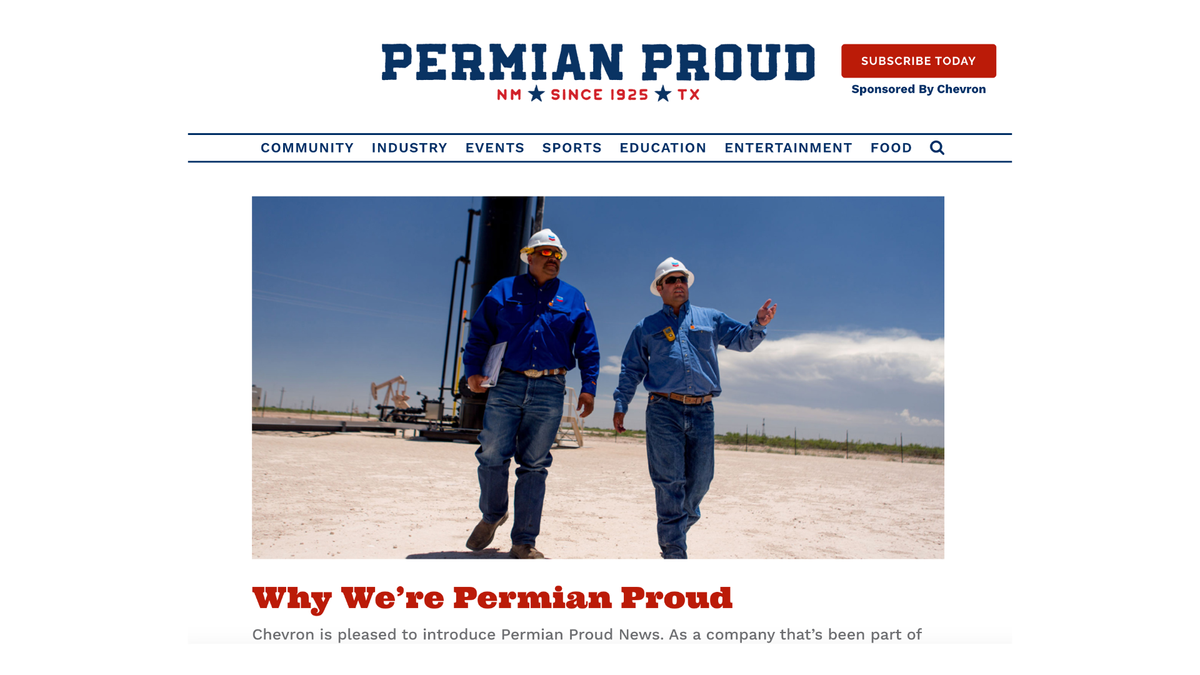 Chevron launched the Permian Proud website in 2022 to provide positive news to the residents of West Texas and southeastern New Mexico — and a positive spin on the company. The oil and gas giant runs similar “news” websites in California and Ecuador where it operates.
Published by the*Louisiana Illuminator*,*Texas Climate News*,*Santa Fe New Mexican*
Across West Texas’ Permian Basin, the oil industry’s presence seeps into many facets of life. Businesses from hotels to veterinary clinics display oil pump jacks on their signs. An oil derrick is part of the logo for the city of Midland.
And there’s another way the industry influences local communities: Since 2022, one of the largest oil producers in the Permian Basin has run its own local news website. The Chevron-operated site, Permian Proud, provides local news coverage for a region with a dwindling number of local news outlets, while inserting articles with a positive spin about the company.
The news site doesn’t have staff reporters or editors like traditional news media, and instead is written by a San Francisco public relations firm and a Chevron public and government affairs adviser.
The Permian Basin covers a 250-mile by 300-mile swath of eastern New Mexico and West Texas. It is one of the most oil-rich areas in the world, producing more than 10 million barrels per day of oil and natural gas, the latter composed primarily of methane.
The founding of Permian Proud comes at a time when the oil and gas industry is under increasing fire for its dominant role in creating the climate crisis, and states and the federal government seek to replace fossil fuels with low- or no-emission sources of energy.
Subscribe to Floodlight
Floodlight is a nonprofit newsroom that investigates the powers stalling climate action.
Subscribe
It is also part of a network of Chevron-owned news outlets amplifying the company’s viewpoint while publishing feel-good stories about local events and people. The same San Francisco public relations firm that provides content for Permian Proud runs the Richmond Standard news site in Richmond, California. It also operates an English-language website in Ecuador, where the energy giant has fought back decades of litigation.
Chevron created the site to highlight the activities “in a region that plays an important role in providing the energy that makes modern life possible,” Chevron spokesperson Ross Allen said in a written statement. Allen added that the site is a “community benefit” to the residents, businesses and employees in the region.
In a 2023 email interview, Greg Connell, an Odessa City Council member, said he wasn’t familiar with Permian Proud. Today, he is now familiar with the site — and unsurprised by Chevron's entrance into local news.
“Chevron showing interest in the communities and not just the oil, that is nothing new. Always a positive for the Permian Basin,” Connell said.
During his time living in the Permian Basin, he said he often sees Chevron and other oil businesses donate money for local community programs, a practice that he welcomed. After reviewing the site, Connell said Permian Proud seems to diversify the media in the region.
“As you know there are always two sides or perspectives to any story. This publication appears, simply, just the news, supporting the Permian Basin,” Connell said.
 The oil and gas industry dominates West Texas and southeastern New Mexico. It is also where Chevron runs a “news” website that amplifies the company’s viewpoint while publishing feel-good stories about local events and people. (Courtesy of Miguel Escoto)
Countering the oil and gas narrative
Miguel Escoto, an environmental advocate from El Paso, is familiar with the narratives spun by the oil and gas industry in West Texas. Escoto previously ran his own platform, Mesquite Media, to counter the heavy oil and gas industry influence he sees in the Permian Basin.
Escoto said the purpose of Mesquite Media, which largely hosted podcasts, was to “amplify voices of resistance to fossil fuel corporate power” and to show how connected the people of the Permian Basin are — culturally, socially and economically — despite their differences.
Escoto now works with Oilfield Witness, a citizen journalism website and documentary producer that investigates fracking and air emissions in the Permian Basin.
Miguel Escoto is an environmental advocate from El Paso. He works for Oilfield Witness, a citizen journalism website and documentary producer that investigates fracking and air emissions in the Permian Basin. (Courtesy of Miguel Escoto)
“Permian Proud is a blatant, naked attempt by industry to have their side of the story be told,” Escoto said.
At the same time, the website “is not that much different than how oil and gas is covered by local channels,” across West Texas, Escoto said.
He cited the example of an Odessa oil field worker and his wife who died in 2019 from a poisonous gas leak while inspecting a work site. Local news outlets covered the incident, but framed it as “an inevitable tragedy” like a car crash or lightning strike, rather than investigating “why we have to live in this situation to begin with,” Escoto said.
Miguel Escoto films a documentary about the oil and gas industry in West Texas. Escoto says it’s frustrating pushing for climate action in a place where the industry that helped cause the climate crisis is so dominant. “The attitude is often that it’s inevitable. It’s too big to move so why even try?” he says. “A lot of people have given up on the idea that the Permian Basin can exist without the oil and gas industry.” (Courtesy of Miguel Escoto)
The oil field worker’s employer, Aghorn Operating Inc., and a company executive were later indicted by the U.S. Department of Justice.
“The attitude is often that it’s inevitable. It’s too big to move so why even try?” Escoto said. “A lot of people have given up on the idea that the Permian Basin can exist without the oil and gas industry.”
Local officials defend industry influence
Mayor Sam Cobb of Hobbs, New Mexico, is very open about his support for the oil and gas industry.
“I’m very glad that Chevron is part of our community,” Cobb said.
Cobb remembers the 1980s when oil and gas companies largely left the Permian Basin in pursuit of oil extraction abroad. Over the last decade, production in the region boomed due to fracking, which unlocks previously inaccessible fossil fuel deposits. Cobb said he welcomes the resurgence — and the dollars that those corporations put towards local communities.
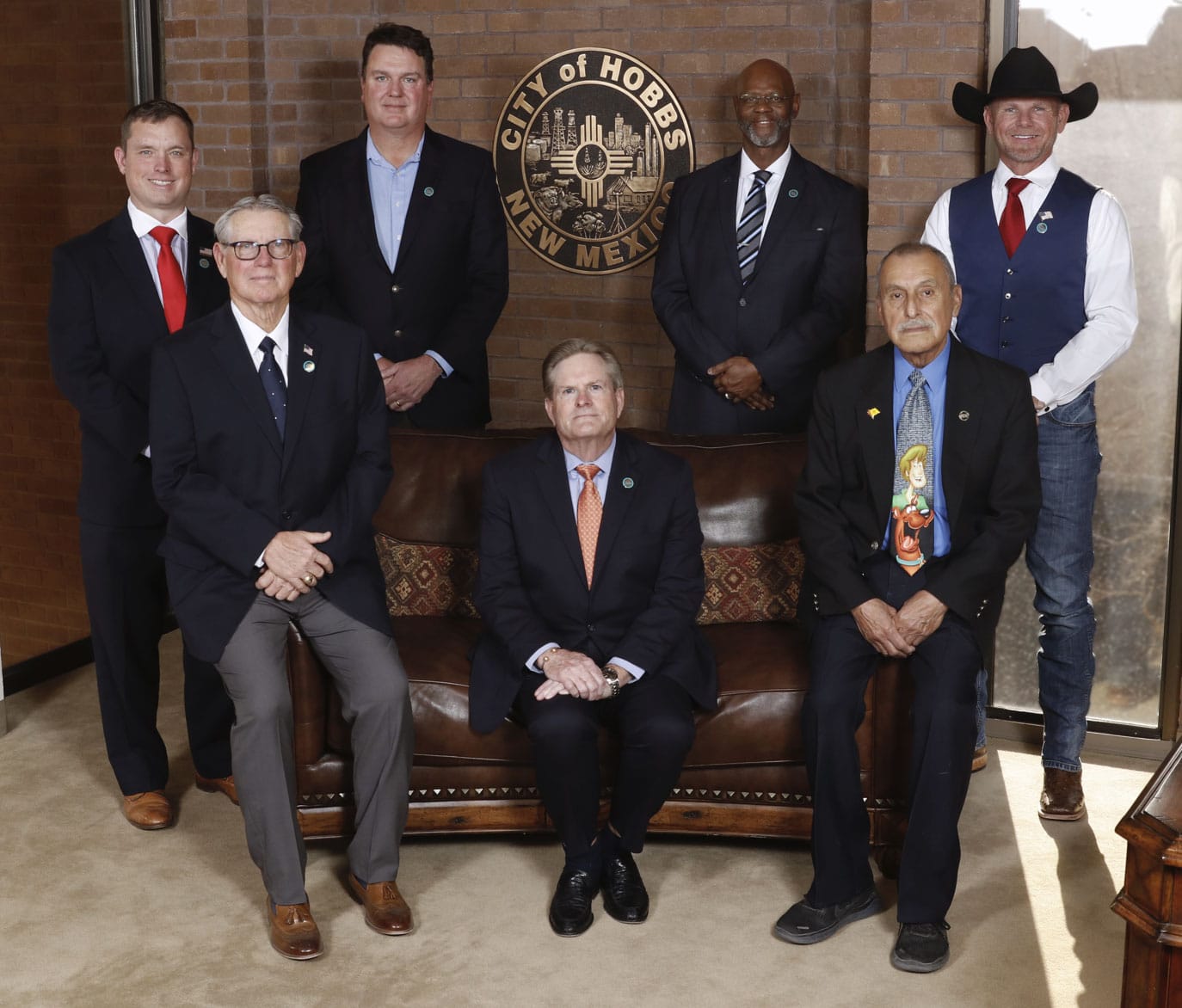 Mayor Sam Cobb of Hobbs, New Mexico, center, is very open about his support for the oil and gas industry, which dominates his community and the region. He says Chevron’s website, Permian Proud, is just another example of how the company gives backs to the communities where it operates. (City of Hobbs, New Mexico website)
In recent years, Lea County, where Hobbs is located, has been regularly ranked among the highest producing oil counties in the nation. The oil industry and companies that provide services for the industry are the largest employers in his city, Cobb said.
He acknowledged that some of those dollars arrived amid larger statewide pushes for New Mexico to go green. Cobb said he prefers that these multinational oil companies have a community presence rather than come in only to extract.
“We encourage the investment and continue to be partners with them,” Cobb said.
On Permian Proud, Cobb said the site seems to promote “positive things” in the places where Chevron has business activities.
“This website is new to me, but their activity in the community is not,” Cobb said.
‘We’re impartial … they’re obviously not’
Permian Proud headlines include celebrating the lunches that Chevron sponsored for a Martin Luther King Day event — which Cobb helped deliver alongside Chevron employees. The Hobbs News-Sun also regularly covers the oil giant’s donations to local schools and nonprofits.
Blake Ovard, editor of the Hobbs News-Sun, said he isn’t worried about potential competition with Permian Proud’s entrance into the local news market.
“I look at it as being more of a way of getting information that they wouldn’t have normally given out,” Ovard said. “As journalists we’re impartial, and they’re obviously not.”
Oil and gas news is among the top coverage in the News-Sun. Ovard said the newspaper does not shy away from the negatives — or the benefits — of the industry in the region.
That includes coverage that ranges from environmental impacts to the $10 million that the Permian Strategic Partnership donated to found a new vocational high school in Hobbs, Ovard said. Chevron is one of 31 members of the partnership, which funds philanthropic projects across the Permian Basin. The oil and gas industry also advertises in the News-Sun.
“I never operate my newsroom out of fear of advertising doing anything,” Ovard said. “Our whole thing is that we’re a news organization that will tell the real story. We cover just about anything that touches or has benefited from oil and gas.”
Permian Proud planted in a news desert
Many of the counties within the Permian Basin are considered “news deserts,” or areas with limited access to local, credible news sources.
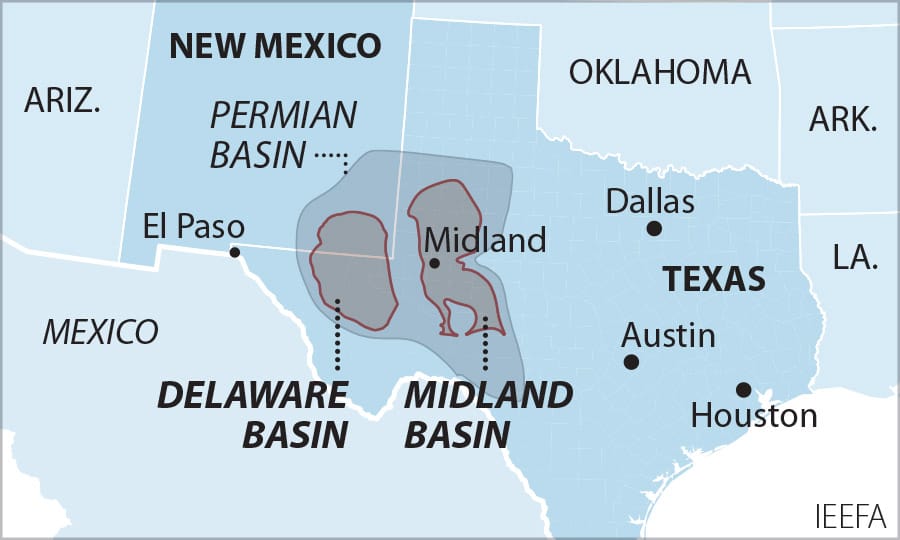
Of the 61 counties considered part of the Permian Basin region in Texas, 13 counties had no local newspapers, and the majority had only one newspaper, according to the news desert map maintained by the University of North Carolina. The map only denotes newspapers and does not include TV or radio coverage in these areas.
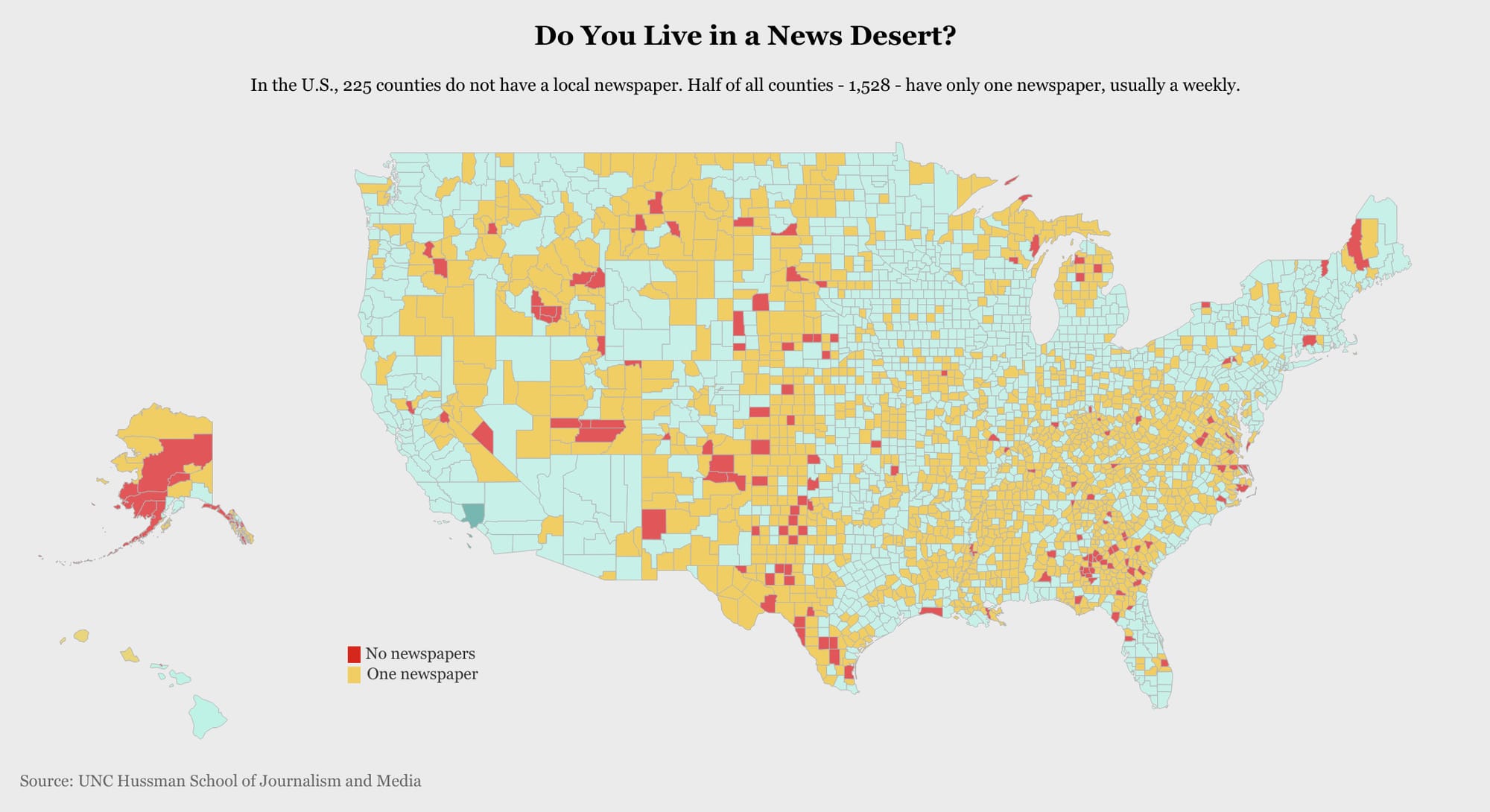 This map from the University of North Carolina shows the Permian Basin in West Texas and southeastern New Mexico is among many “news deserts” in the United States lacking local newspapers. Corporations and special interests in recent years have filled these news vacuums with websites that push their own messages while providing “news” about local communities.
Among Texas’ larger media players — Dallas Morning News, Texas Monthly, Houston Chronicle, Texas Tribune — the coverage of the Permian Basin includes stories about climate change, air quality concerns, the environmental damage caused by abandoned oil wells and the complicated economic relationship between these communities and the oil industry.
A search of the Permian Proud’s two-year-old website shows just a smattering of stories about climate change or greenhouse gas emissions — despite the oil and gas industry’s leading role in causing the climate crisis. As of Aug. 12, there were two stories mentioning climate change; one is a recap of a Texas Tribune series about training oil and gas workers and the other quotes a Chevron official about new techniques for measuring methane emissions.
The site has plenty of articles boasting of the importance of the Permian Basin and Chevron, sprinkled in with coverage of events, sports and awards given to local residents.
One story reported on Chevron receiving the highest environmental rating in the Permian Basin. Another announced that Chevron plans to boost its production to meet U.S. energy needs.
And the site reported on a $145,000 company donation to help students in Carlsbad, New Mexico — to pursue careers in energy and natural resources.
Cobb, the mayor of Hobbs, acknowledged it’s rare to find any criticism of the region’s dominant industry in the local media — even outside Permian Proud.
“The oil and gas industry,” he said, “doesn’t get much negative coverage out here.”
Felicia Alvarez's initial reporting on this story came through the Investigative Reporting Program at the University of California-Berkeley.
WE NEED YOUR SUPPORT
Before you go, would you consider supporting Floodlight’s climate accountability investigations?
The United States — and the world — are at a critical juncture for the climate crisis. Watchdog journalism from Floodlight illuminates who is fighting climate progress and helps the public and professionals understand what is at stake.
That's why we need your help.
Your support enables us to produce unique investigative and public-service reporting that demands accountability and strengthens democracy. Quality reporting is a public good. That's why we share it — at no cost — with partner newsrooms across the country.
Our readers keep us independent, beholden to no outside influence and accessible to all. Consider making a tax-deductible contribution now to enable this work to continue, or better yet, support us with a sustaining monthly gift.
With gratitude,
Emily Holden
Founder & Executive Director
Floodlight
===
Fossil fuel interests are working to kill solar in one Ohio county. The hometown newspaper is helping.
A retired gas industry executive, a shadowy 'grassroots' group and a controversial media company are spreading misinformation while turning residents against a proposed solar farm — and each other
Miranda Green/Floodlight, Jennifer Smith Richards/ProPublica, Priyanjana Bengani/Tow Center for Digital Journalism
Oct 8, 2024 — 17 min read
Rich Piar farms soybeans in Knox County, Ohio. “We try to be good stewards of the ground,” he said. The solar project he hopes will be built on his land, “from my research, is a decent thing. We have electric power plants shutting down, coal fire plants. We need energy.” (Sarahbeth Maney / ProPublica)
Co-published with*ProPublica*, a nonprofit newsroom that investigates abuses of power.*Sign up for Dispatches*, a newsletter that spotlights wrongdoing around the country, to receive our stories in your inbox every week.
Word tends to spread fast in rural Knox County, Ohio. But misinformation has spread faster.
The first article in the Mount Vernon News last fall about a planned solar farm simply noted that residents were “expressing their concern.” But soon the county’s only newspaper was packed with stories about solar energy that almost uniformly criticized the project and quoted its opponents.
Then a new “grassroots” organization materialized and invited locals to an elaborate event billed as a town hall, with a keynote speaker who denied that humans cause climate change.
Someone sent text messages to residents urging them to “stop the solar invasion” and elect two county commission candidates who opposed the solar farm. And one day this past March, residents received an unfamiliar newspaper that contained only articles attacking Frasier Solar, a large project that would replace hundreds of acres of corn and soybeans with the equivalent of 630 football fields of solar panels.
 An anti-solar group sent text messages to residents of Knox County, Ohio urging them to “stop the solar invasion.”
To many in the deep-red central Ohio community, it seemed that solar had become the focus of news and politics. They were right. Fossil fuel interests were secretly working to shape the conversation in Knox County.
Floodlight is a nonprofit newsroom that investigates the powers stalling climate action.
Subscribe
Each cog in the anti-solar machine — the opposition group, the texts, the newspaper, the energy publication — was linked to the others through finances and overlapping agendas, an investigation by Floodlight, ProPublica and The Tow Center for Digital Journalism found.
The campaign against solar power benefited from a confluence of two powerful forces funded by oil and gas interests. A former executive at Ariel Corporation, the county’s largest employer and one of the world’s biggest manufacturers of methane gas compressors, was working behind the scenes. And helping in a more public way is the Mount Vernon News, a newspaper now in the hands of Metric Media, which operates websites that reportedly engage in pay-to-play coverage.
Rural Knox County, Ohio, is home to extensive farmland and has deep ties to the gas industry. (Sarahbeth Maney / ProPublica).
Ariel and the former executive did not respond to requests for comment. Metric Media’s leader did not answer questions for this story; he has previously denied that his news outlets are partisan.
Across the country, the oil and gas industry and power companies have exploited a struggling news industry and a fraught political process to fight the transition to clean energy and maximize profits, Floodlight and its partners have reported. In Florida, two power companies paid a consulting firm to hire newspapers to attack a pro-solar politician. In Alabama, the state’s largest monopoly electric company purchased a historic Black newspaper, then didn’t write about soaring power bills. In California, Chevron launched its own newsroom when other papers shuttered; it doesn’t cover itself critically.
In Mount Vernon, a city of 17,000 where the local university named its new sports complex CH4 after the chemical formula for methane, a variety of tactics have been deployed simultaneously, creating an anti-solar echo chamber.
Mount Vernon Nazarene University’s CH4 Stadium was partially funded by Ariel Foundation, the philanthropic arm of Ariel Corporation, one of the world’s biggest manufacturers of methane gas compressors.(Sarahbeth Maney / ProPublica).
Residents are bombarded with dubious claims: Solar panels are toxic. Their construction depletes the soil and floods fields and depresses home values. China is using them to invade. The campaign has stoked their skepticism and ignited their passions. It intensified the debate in a conservative county that prizes its roots in the gas industry.
Bright yellow “No Industrial Solar” yard signs have sprung up everywhere, competing with a smattering of green “Yes Solar” ones. Citizens packed local government meetings. More than 4,000 public comments, both for and against, were filed with the state regulator that will decide if the solar project can be built — triple the number for any previous solar project in Ohio. And all those opinions have drowned out the voices of the nine landowners, mostly farmers, who’ve signed leases with Frasier’s developer and for whom a total of about $60 million is at stake.
“People are so radicalized and they’re not thinking clearly,” said Rich Piar, a third-generation farmer who hopes to secure his financial future by leasing a portion of his 1,650 acres to Open Road Renewables, the Texas-based company developing the Frasier Solar project.
A plaque on the Mount Vernon Nazarene University’s CH4 Stadium explains that, like the chemical bonds in methane, the bond between the university and Ariel is strong. (Sarahbeth Maney / ProPublica).
Politicians who didn’t forcefully denounce the solar project were attacked in Mount Vernon News stories. Thom Collier, a long-serving Republican on the county commission who thinks landowners should be able to choose whether to use their property for solar infrastructure, ultimately lost his reelection bid after a barrage of misleading coverage about his stance on solar.
“I pin this on one or two people from Ariel and some close friends that they have,” Collier said of the anti-solar offensive. “They determined it didn’t matter how much money it would take, they were going to fight this and make it ugly, and they have.”
The Yellowbud Solar project in Pickaway County, Ohio, shown in 2022, became operational last year. It is about 90 miles southwest of Knox County. (Dan Gearino / Inside Climate News)
‘They want everybody to buy gas’
Just 20 days after Knox Smart Development was registered as an LLC in Ohio, the anti-solar group hosted a town hall at a historic Georgian revival theater in Mount Vernon with 1,000 red velvet seats. Attendees were offered free food and alcohol.
The November 2023 event centered on a presentation from Steve Goreham, who argues global warming is natural and who is the author of several books, including “The Mad, Mad, Mad World of Climatism: Mankind and Climate Change Mania.”
The Mount Vernon News’ new owners opened an office in the Woodward Opera House, a historic downtown building that the Ariel Foundation helped renovate. (Sarahbeth Maney / ProPublica)
“When I think of a town hall meeting, I think of a meeting where everybody from the community can go, everybody has their say. That’s not how their meeting was,” said Kathy Gamble, who said organizers only reluctantly agreed to let her in. She’s pro-solar and not quiet about it.
The town hall established Knox Smart Development as a leading voice against the Frasier Solar project. The group calls itself a simple grassroots defender of Knox County.
It isn’t.
The man who registered the group as a business — and who is its sole member and spokesperson — was an Ariel Corporation employee two decades ago and remained an acquaintance of a top executive there, Tom Rastin. The group’s website was owned for a time by a woman working as an executive assistant at Ariel.
And one of Knox Smart Development’s larger funders is Rastin, a Republican megadonor and a retired executive vice president at Ariel, according to records and sworn testimony. Rastin’s father-in-law founded Ariel and, until recently, Rastin and his wife, Karen Buchwald Wright, led the company. Wright is still the chairman, and her son operates it now. Rastin and Wright did not respond to questions for this story.
Ariel Corporation expanded in 2017, adding a training center for employees and customers near its headquarters in Mount Vernon, Ohio. (Sarahbeth Maney / ProPublica).
The group’s founder, Jared Yost, said in an email that Rastin has not tried to steer its activism. “As a local resident, I believe he should be allowed to donate to whatever cause he aligns with, regardless of his former employment, and to state otherwise is to suggest Mr. Rastin should be censored,” Yost wrote in an email. He said the group relies on volunteers and “our intentions are genuine.”
He added: “The oil and gas industry is not involved in our fight.”
Jared Yost, founder of Knox Smart Development, testifies in August during an Ohio Power Siting Board hearing about his group’s opposition to the Frasier Solar project.(Sarahbeth Maney / ProPublica).
The town hall event headliner, Goreham, said he appeared as a favor to Rastin and Wright. In 2019, he had dinner with the couple when Goreham and his wife were passing through town from Illinois on a road trip to their second home in Virginia Beach. Goreham said that he and Rastin connected over their mutual feelings on the benefits of gas. He said he was glad to accept the invitation to speak at the anti-Frasier Solar event.
“First off, it’s in his county there. Mount Vernon is his city where he lives and where they are based,” said Goreham. “They’re pretty much opposed to renewables and they want everybody to buy gas. That’s their business.”
Goreham says he wasn’t paid to speak, but Wright bought 200 copies of his latest book, “Green Breakdown: The Coming Renewable Energy Failure,” which warns about a net-zero-emissions agenda that will cause energy grids to fail. Local officials were given copies of the book that included a personal note from Wright: “Hello! Given the significant misinformation surrounding solar and wind arrays, I bought you this book that really lays out the facts.” She signed the note “Karen Wright, Chairman — Ariel Corporation.”
Shortly after the group was formed, Knox Smart Development’s “No Solar” ads became a fixture on the Mount Vernon News website and in the paper.
‘You believe people’
The Mount Vernon News had been owned by the same family since 1939, and for decades it chronicled local doings from city council meetings to the county fair.
At its height in the early 2000s, before newspapers started hemorrhaging advertising revenue and readers, the News employed about 15 full-time local reporters. An orange Maine coon cat named Scoop roamed the newsroom.
But by 2020, the News was barely hanging on. Its reporters were still using clunky 20-year-old computers. The back wall of the building was falling down and needed $250,000 in repairs. Kay Culbertson, who owned both the paper and the building, said that she knew it was time to sell. Paying for the repairs would be impossible; even making payroll was a stretch.
The former Mount Vernon News building, home to the paper since 1939, sits empty. (Sarahbeth Maney / ProPublica)
An acquaintance of Culberston’s connected her with Metric Media, part of an eight-company network operating more than 1,100 online local news sites. These sites have been described by media researchers and journalists as “pink slime,” named for a filler in processed meat. The final product looks natural, but it’s been tampered with.
A Syracuse University researcher concluded in a journal article published in February that :{sites like Metric’s “that seem like original news outlets and that appeal to local identity are filling the void” left by the decline of local news. And The Washington Post reported last year that Republican campaigns requested customized news stories that appeared on Metric-owned sites.}:
Both conservative and liberal pink slime sites exist. But Metric is run by Brian Timpone, an Illinois-based former broadcast reporter who has contributed tens of thousands of dollars to conservative campaigns and causes. Timpone’s ventures have been criticized for using foreign-based writers to produce material. Some also have been accused of plagiarism and fabricating quotes. Timpone has blamed the problems on foreign writers providing content, and he apologized to readers.
Metric Media’s nonprofit arm has received $1.4 million “for general operations” from DonorsTrust, a dark-money group that has received significant funding from Charles and David Koch, who made their billions in oil pipelines and refineries. The eight-company network that Metric is part of also has ties to conservative billionaires, including oil-and-gas-industry titan Tim Dunn, shipping magnate Richard Uihlein and PayPal co-founder Peter Thiel. (Political groups that organize as nonprofits do not have to disclose donors, which is why they’re called “dark money.”)
DonorsTrust CEO and President Lawson R. Bader said in an email that the organization makes about 4,000 grants a year and that it does not dictate how those donations are spent.
Timpone responded to a request for an interview by writing, “We at the Mount Vernon News are now also working on a story — about Pro Publica and Floodlight’s efforts to promote taxpayer-funded ‘solar energy’ businesses in Central Ohio.” He did not respond to detailed questions.
But in interviews, he has said his business keeps local news alive when many outlets are scaling back or shutting down. Timpone told the Deseret News in Utah that his sites have no political leaning and are “data-driven and fact-centric.”
Research and news investigations have found that Timpone’s publications tend to champion conservative causes and politicians; they often are linked to mysterious newspapers distributed during key elections.
Culbertson and assistant publisher Liz Lutwick said in an interview that they knew little about Metric Media before the sale. But the company’s promises sounded good and, Lutwick said, “You believe people.”
“They were going to keep everything the same for a while. Lo and behold, they didn’t,” Culbertson said.
Metric paid at least $1 million for the Mount Vernon News, the first time it had purchased an established news organization printing a local paper. When the new owners visited the paper after the sale, they told the staff they’d stop printing every day and would no longer provide benefits; instead, employees would become contractors. Half the staff quit on the spot.
“It was awful. You feel like you’ve betrayed people,” Culbertson said.
‘We call it the Solar Times’
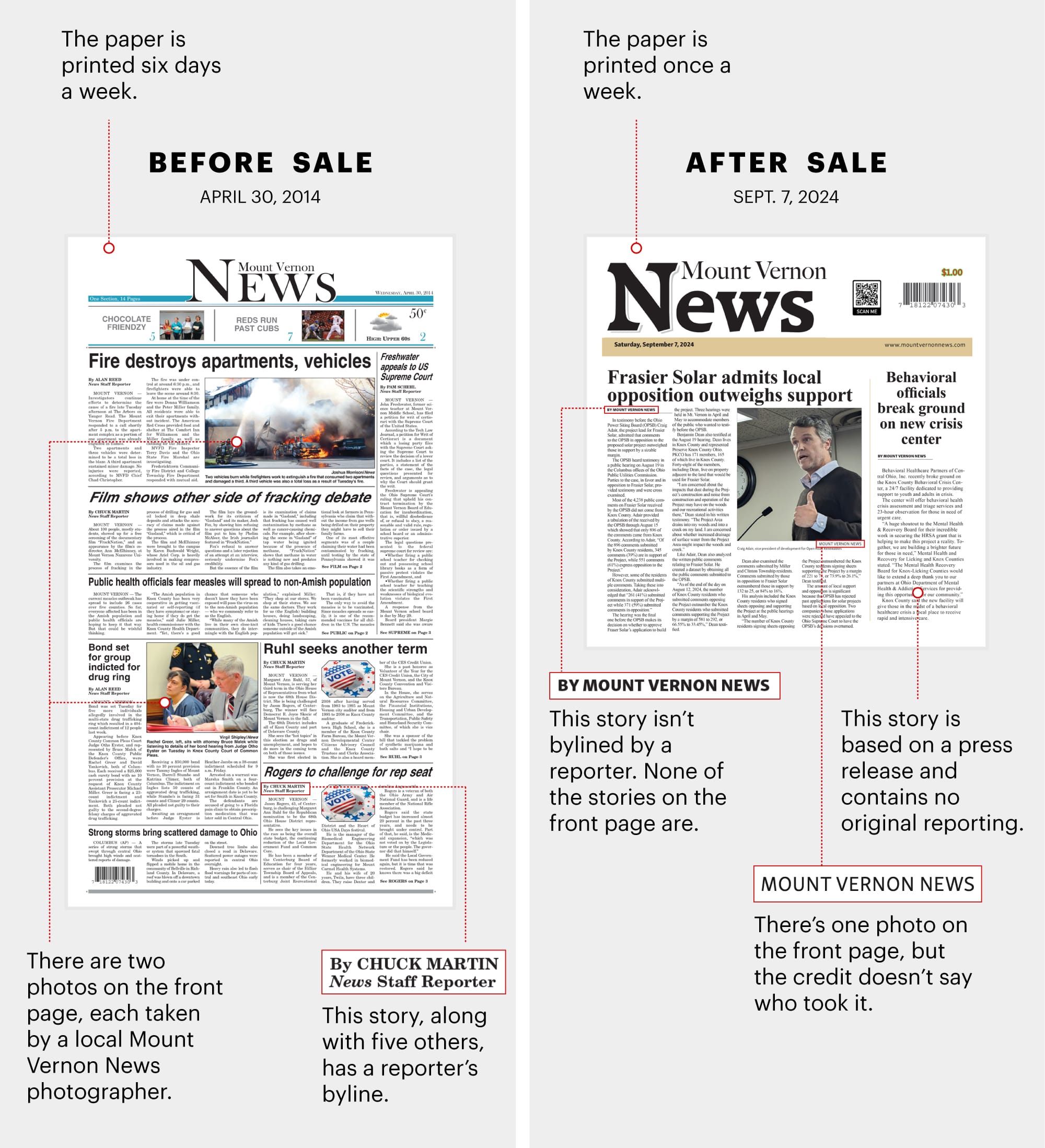
Today, the Mount Vernon News only publishes once a week and has no local reporters or photographers.
“It’s obvious when you read the stories, either they’re AI-generated or they’re written by somebody who’s sitting in an office in Chicago who has never been here,” said Bill Davis, a sports editor who said he worked at the paper from 2010 to 2019.
Since Metric took over, only 11% of stories credited the work to authors working for Metric or its sister companies. Most of what it publishes are press releases or content submitted by companies and community groups, according to an analysis by the Tow Center, ProPublica and Floodlight.
After the sale, residents said they could no longer get timely obituaries — people were buried by the time funeral announcements were published — but they could read a lot about endangered farmland and concerns that the sun’s reflection off solar panels could blind nearby pilots.
Even Mount Vernon’s mayor, who was once a sports reporter at the paper, said he stopped reading it. Tanner Salyers, a former Mount Vernon city council member who now oversees public safety for the city, said quality dropped after the sale. “Then Frasier kicked up and they were like, ‘No more news.’ We call it the Solar Times.”
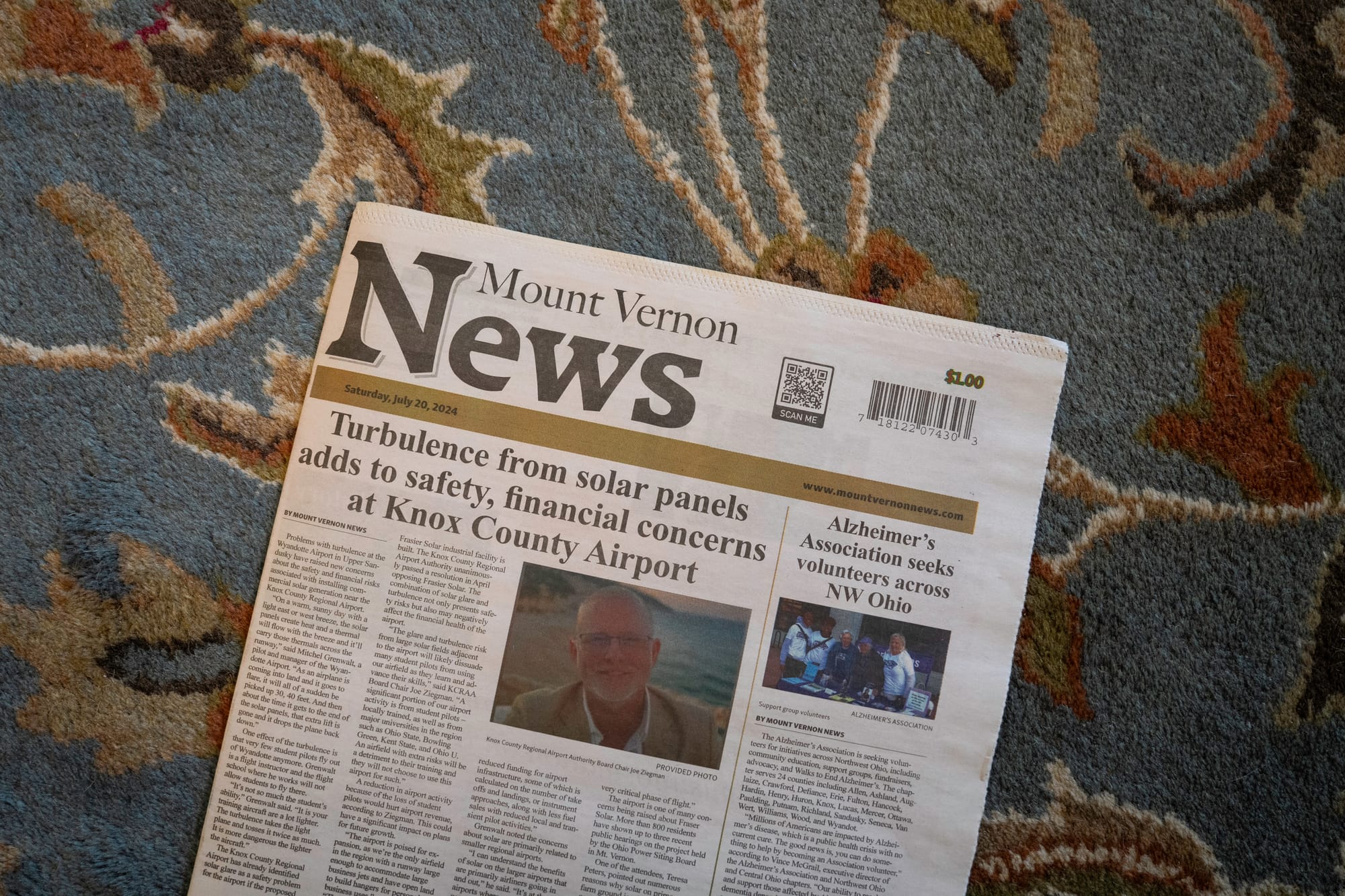 A summer issue of the Mount Vernon News on the floor of the paper’s business office, where one local employee now works. There are no local reporters or photographers. (Sarahbeth Maney / ProPublica).
Over the last 12 months, the paper has published at least 52 online news stories on solar energy — 42 of them about the Frasier proposal, the analysis found. Of the 40 print editions published this year, 17 have featured front-page stories about solar. And though the paper has occasionally run a pro-solar letter to the editor, nearly all of the stories slanted anti-solar, according to an analysis of coverage by Floodlight, ProPublica and the Tow Center.
The paper began publishing a weekly opinion column called “Afternoon TEA” — TEA being an acronym for The Empowerment Alliance, a dark-money gas advocacy group Rastin leads.
The columns extolled the superiority of gas as a fuel source.
It isn’t clear if The Empowerment Alliance paid the Mount Vernon News to run the “Afternoon TEA” columns.
But tax filings show that since 2020 The Empowerment Alliance has spent at least $6.3 million on a “public education campaign,” which included publishing “Afternoon TEA.” The goal was to promote “the importance of natural gas to the economy and national energy independence.”
One of The Empowerment Alliance’s stated goals is “fighting the nonsense of turning corn fields into solar fields.” It has financed online advertisements attacking President Joe Biden’s energy policies and spearheaded an Ohio bill that defined gas as a “green” fuel source.
Half of the Frasier stories published in the Mount Vernon News over the past year have mentioned Knox Smart Development, the anti-solar group linked to Rastin. Articles often quoted people or cited work from a Koch-backed think tank, The Buckeye Institute, but did not interview Frasier or farmers willing to lease land to it.
The Buckeye Institute is part of the State Policy Network, a group of think tanks that has received millions in funding from organizations connected to the Koch family. Rastin’s wife has served as a director on the State Policy Network board, and in 2019 she gave it $700,000, according to a tax record that typically would’ve been redacted but was posted to a government site.
The Mount Vernon News and pro-gas political groups also were working to influence local elections. The text messages that boosted anti-solar candidates were from a conservative Ohio PAC tied to a group that ran a pro-gas campaign.
And, leading up to the primary, a newspaper called the Ohio Energy Reporter was mailed to Knox County homes. The 8-page paper reprinted several Mount Vernon News stories on solar and featured other articles with headlines including “Ohio’s coming ‘solar trash wave’ ” and “Could the Texas Power Crisis happen in Ohio?”
The publication did not disclose its owners. The Floodlight, ProPublica and Tow Center investigation used source code from the website, its IP address and business mailing addresses to confirm that it is a product of the wider Metric Media network.
The stories the Mount Vernon News published began undermining politicians who were seen as insufficiently anti-solar and boosting the profiles of solar power’s outspoken critics.
In one article, the News accused Mount Vernon Mayor Matthew Starr of bowing to “energy activists” and pledging to try to remove natural gas from the city. It was not true. Starr was furious and asked the editors to take down the article, but they would not.
And in nearly a dozen stories that mentioned Collier, the county commissioner who was later ousted, the paper consistently misused a comment he’d given about newly placed solar panels at the county jail to falsely insinuate he supported the Frasier project.
Collier was never interviewed for those stories. Yet the paper ran a story devoted entirely to anti-solar commissioner candidate Drenda Keesee, a megachurch pastor who’d never run for office before; the article said she had “emerged as a vocal opponent of solar projects encroaching on the community.” Keesee, whose property would border a portion of the solar site, was the only source in the story.
She won the primary against Collier and is unopposed in the November general election.
Drenda Keesee, right, is a pastor at Faith Life Church and a candidate for a seat on the Knox County Commission. Keesee, who’s running on an anti-solar platform, attended a Ohio Power Siting Board hearing in Columbus in August. (Sarahbeth Maney / ProPublica)
‘You can’t eat solar panels’
For the community, the debate over solar has been passionate and persistent. What it hasn’t always been is civil. Yard signs have been stolen. Insults hurled. Middle fingers extended. Friendships frayed.
“Other than solar, we don’t have any problems with each other,” said Kathy Gamble, who runs the pro-solar group Knox County For Responsible Solar.
Many people in the community say they don’t view the debate through the lens of climate science or fossil fuels; they care about land rights and preserving rural life. Members of Preserve Knox County, an anti-solar group with several members whose land borders the proposed solar arrays, said they worry the solar project will scare off the sandhill cranes and bald eagles that visit their backyards.
Many members are distrustful of Biden’s renewable energy initiatives; they are staunch supporters of former President Donald Trump, who questions the scientific consensus that the climate is undergoing dangerous changes. They also don’t trust the solar developer’s promises to plant enough trees to block the panels from view. And they don’t want to lose the farmland that gives the area its agricultural identity.
Knox County residents Connie and Jim Boeshart, who live next to property where solar panels would be built if the Frasier Solar project is approved, attend an Ohio Power Siting Board hearing in August. (Sarahbeth Maney / ProPublica)
“You can’t eat solar panels,” said Jim Boeshart, whose home would be adjacent to solar arrays.
Keith Strait, a farmer who lives not far from Boeshart, agreed: “Let’s face it,” he said, pointing at the ground, “They’re not making any more of this. There will be a time when there won’t be any farm left. Where’re you going to get your food from?”
Keith Strait, a farmer in Knox County, said, “I don’t like it,” of the solar proposal. “They’re taking away a lot of farm ground.” (Sarahbeth Maney / ProPublica)
The farmers who want to lease their land feel their voices have been lost in the debate. For them, a 40-year land contract with Frasier Solar would be steady income. One farmer said he could make four times as much money per acre leasing to the solar project as he’d make renting to another farmer.
Rich Piar, the third-generation farmer, is looking to the solar panels as a retirement plan. He said he has no one to take over the operation when he retires, and he doesn’t think anyone should dictate what he does with his land or when he stops farming.
“Most farmers’ exit strategy is their health,” Piar said. “I don’t want to have that kind of predetermined exit strategy.” He went to one of the public meetings about Frasier but said it was so packed he didn’t get to speak until almost midnight.
Rich Piar stands near his cornfield in Knox County, Ohio. He is one of the local farmers who plans to lease his land for the Frasier Solar project. (Sarahbeth Maney / ProPublica)
In August, the Ohio Power Siting Board, which will rule on whether the project can be built, held a final hearing to accept evidence from both sides. One of the attorneys who spoke on behalf of a farmer who is leasing land for the project was from the Sabin Center for Climate Change Law at Columbia University. (The Tow Center also is based at Columbia, but its work is separate.)
Frasier lawyers cross-examined Knox Smart Development spokesperson Jared Yost at the hearing, where he testified that Rastin, the retired Ariel executive, was one of the group’s biggest donors. To Open Road Renewables’ vice president of development, Craig Adair, the confirmation pierced the veil.
Everything changed, Adair said in an interview, “when The Empowerment Alliance decided to use its vast financial resources” to shape the debate in Knox County and in the Mount Vernon News.
Craig Adair, vice president of development at Open Road Renewables, the company developing the Frasier Solar project, testifies at the Ohio Power Siting Board hearing on the project in August. (Sarahbeth Maney / ProPublica),
The News published two stories on the hearing but did not mention the public admission of Knox Smart Development’s ties to Rastin, the Ariel Corporation and The Empowerment Alliance.
The board’s decision is likely to take months.
In the meantime, construction has started at the old Mount Vernon News building, which is being turned into an academic hub for a local university. The building will be named after Rastin’s stepson, a former president of Ariel Corporation.
*Floodlight**is a nonprofit newsroom that investigates the powerful interests stalling climate action.
===
---
exxonknewS 12 23
...“Oil and gas companies are under pressure, desperately trying to preserve their social license through recycled pledges,” said David Tong, Global Industry Campaign Manager at Oil Change International, which last year published a report finding that Exxon’s climate commitments are “grossly insufficient” to meet the goals of the Paris Agreement.
Woods and his fellow oil company representatives are also using COP to push for unproven technologies that will prolong the lifespan of climate-wrecking fossil fuels. In an interview with Bloomberg at COP, Woods said the energy transition would require an assortment of “solutions” — including hydrogen and carbon capture — and “we need big companies to help with that.”
Woods rejected the IEA’s recent assessment of carbon capture as an “illusion,” telling Reuters that “you could say that about electric vehicles, about wind, about solar.” But according to the IEA, “The key actions required to bend the emissions curve sharply downwards by 2030 are well understood, most often cost effective and are taking place at an accelerating rate. The scaling up of clean energy is the main factor behind a decline of fossil fuel demand of over 25% this decade.”
Yet unlike the billions it invests in carbon capture, Exxon is spending almost nothing on renewable sources of energy, while lobbying against the transition away from its core products.
“It’s no surprise that Exxon is pushing for the continued use of fossil fuels,” said Jessica Green, Professor of Political Science at the University of Toronto. “Exxon is in a fight for its life. Real progress on climate change isn’t about more carbon markets or net zero pledges, it’s about putting the oil and gas industry out of business.”
A larger strategy
Woods’ deflections at COP are part of a larger strategy of “corporate issues management,” said Supran, which “the fossil fuel industry has been pioneering for decades.”
“It means having your fingers in all the pies, anticipating future threats to your business and neutralizing them through decades of 360-degree public affairs strategies,” he said.
Exxon has been working to shift the narrative outside of COP, too. “On November 30, the first day of COP 28, The New York Times included a full-page greenwashing ad from ExxonMobil,” Brad Johnson documented in Hill Heat on Monday. “Reuters coverage of Al Gore’s criticism of ExxonMobil’s presence at COP 28 was smothered by greenwashing ads from ExxonMobil. The Punchbowl News political newsletter today is Presented by ExxonMobil.” Yesterday’s Power Switch newsletter from Politico was Presented by ExxonMobil, too.
While the oil giant’s greenwashing may have ramped up around COP, it’s also a years-long affair — aided in large part by many of the same media outlets interviewing Woods at the conference. A major analysis of Big Oil’s advertising between October 2020 and October 2023 found that “many of the world’s most trusted English-language news publications help fossil fuel companies mislead readers about topics like the promise of carbon capture, the potential of ‘renewable biogas,’ and how much the industry contributes to the energy transition,” according to Amy Westervelt and Matthew Green.
The analysis, published by Drilled and DeSmog this week, found that Bloomberg Media Studios last year created a video for Exxon promoting carbon capture and hydrogen; Politico organized 37 e-mail campaigns for Exxon; and Exxon sponsored more than 100 editions of Washington Post newsletters in 2022 alone, as just a few examples.:}:
Ultimately, it’s up to the media, policymakers, and other major institutions to determine whether the oil companies still responsible for fueling climate catastrophe are allowed to have a platform to stand on — or whether, like Big Tobacco, their time to influence the debate about their products’ harm is finally up.
---
an 10 22
no lnx
Inside the Peter Thiel-backed 'opaque media organization' that’s funding conservative propaganda: report
Alex Henderson October 11, 2022
In the past, billionaire venture capitalist and PayPal co-founder Peter Thiel was described by many pundits as a libertarian. But in the 2022 midterms, the far-right U.S. Senate candidates he has been promoting — from “Hillbilly Elegy” author J.D. Vance in Ohio to Blake Masters in Arizona — are decidedly MAGA, pushing a severe social conservatism that is far removed from libertarianism.
:{:{}:
}:
Steve Bannon, host of the “War Room” podcast and former White House chief strategist in the Trump Administration, has praised the 54-year-old Thiel for trying to make Congress as MAGA as possible.
One of the tricks that Thiel and his Republican allies are using in the midterms, according to Daily Beast reporter Kelly Weill, is sending out “newspapers” that are meant to look like regular publications but are pushing MAGA candidates. In Arizona, Weill reports in an article published on October 11, such a publication is the Grand Canyon Times — which is promoting Masters, the MAGA Republican trying to unseat incumbent Democratic Sen. Mark Kelly.
:{:{}:
}:
“It was as if the Grand Canyon Times’ sports section had put a list of local football stars in a blender and printed the results,” Weill explains. “A brief profile on star running back Bijan Robinson was topped with a picture of tight end Aaron Greene, whose own biography showed a professional headshot of long snapper Ethan Nguyen. Other athletes’ profile pictures and biographical details also appeared randomized in the full-page spread on ‘former area high school football players.’ The rest of the paper—which was shared online by bemused Arizona sports fans — was chock-full of conservative political content, particularly articles championing Republican Senate candidate Blake Masters.”
READ MORE: Peter Thiel invested $1.5m in right-wing dating app 'The Right Stuff']
The Grand Canyon Times, Weill emphasizes, “isn’t a traditional newspaper,” but rather, is “part of an opaque media organization that recycles right-wing news articles across a network of hyperlocal-sounding news websites, which are padded out with press releases.”
“As the 2022 midterm elections approach, conservative campaigns have tapped the network to send realistic-looking, and unsolicited, newspapers to voters in critical districts,” Weill reports. “In publications like the Grand Canyon Times, the line between newspaper and political advertisement can be porous. At least two print editions of the paper, reviewed by The Daily Beast, contained disclaimers that described thecontents as ‘paid for by the Saving Arizona PAC.’ The PAC, which supports Masters’ Senate campaign, has received more than $13 million from conservative billionaire Peter Thiel.”
The Grand Canyon Times, according to Weill, is “an affiliate of Metric Media, a network of conservative websites tailored to look like local news outlets.” Metric, Weill reports, is “run by Brian Timpone, a former news anchor turned political spokesman.”
---
richmond st'd chev newspaper
---
---
The Intercept
…companies are “using stories that appear to be part of a journalistic publication, but are actually paid for by advertisers in attempt to improve an image…”
In early April 2019, the Intercept published an article by Sharon Lerner titled, How the Media Launders Fossil Fuel Industry Propaganda Through Branded Content. The Intercept article warns against the rise of ”native advertising”, which is a form of advertising where an ad is written in article form and published on credible news sites to look like an article.
Lerner explains that fossil fuel and other companies are “using stories that appear to be part of a journalistic publication, but are actually paid for by advertisers in attempt to improve an image suffering in the coverage done by actual journalists.” Lerner cites CIC’s research, saying, “Industry trade groups spent almost $1.4 billion on PR, advertising and communications contractors over the past decade, according to the Climate Investigations Center, almost half of which came from the American Petroleum Institute.”
---
BS big lie GA amplified by trump and bannon
no lnx twt wonkette
It is September 17, 2021, and former President Babyshits is still whining that he wants back in the White House right now. Just look at this pathetic nonsense.
[trump ltr]
"Large scale Voter Fraud continues to be reported in Georgia. Enclosed is a report of 43,000 Absentee Ballot Votes Counted in DeKalb County that violated the Chain of Custody rules, making them invalid," begins the letter to Georgia Secretary of State Brad Raffensperger under a lightly modified presidential seal.
The "report" is an article from the astroturf news site "Georgia Star News." As multiple legitimate news sites have reported, Georgia Star is part of the Star News Network, a group of pro-Trump websites set up to look like local news outlets in 11 swing states. And while Rupert Murdoch's media empire is (at least theoretically) made up of actual journalists, the Star sites are run by political activists with an avowed MAGA agenda.
:{:{}:
}:
Naturally Steve Bannon, everyone's favorite chaos monkey, loves this Star Chamber propaganda shit. NPR reports:
Steve Bannon, a former strategist for former President Donald Trump, described The Georgia Star News in a radio interview as content "you can't get anywhere else."
"We're not Conservative Inc.," he said. "It's very populist, it's very nationalist, it's very MAGA, it's very American First."
Laura Baigert, the author of the piece referenced by the former leader of the free world, describes herself as "a senior reporter at The Star News Network, where she covers stories for The Georgia Star News, The Tennessee Star, The Ohio Star and The Arizona Sun Times."
Here's how Snopesdescribed Baigert, who was a 2016 RNC delegate for Ted Cruz:
Laura Baigert, listed as a Tennessee Star "senior reporter," also serves as the treasurer for a group called the Roving Patriots PAC. Her husband, Kevin Baigert, who was at one point also a writer for the Star, is that PAC's director. On their PAC's website, the couple say they "are a couple of Roving Patriots, and when you get one, you get both of us!" No firewall is apparent between the work of the PAC and the Tennessee Star. For example, on 7 July 2017 the PAC shared an article on their Facebook page written in the Tennessee Star about the PAC's launch. "We are grateful for the work they are doing at The Tennessee Star," the PAC said of the media outlet that both members of the PAC currently or previously worked for.
According to their website, Roving Patriots PAC is "focused on achieving, supporting and maintaining a true conservative majority within the Tennessee House of Representatives."
And if that's not the bio of a trustworthy authority on election law, then what is, right? So when this person tells you that there were chain of custody issues with 46,000 drop box ballots, and the law demands that Georgia simply toss out those votes, you can just take her word for it. Never mind that this is an entirely invented remedy that some blogger from Tennessee just pulled out of her ass. And while we're disregarding objective reality, there's no mechanism to determine who those votes were for, even if we did invalidate ballots 10 months after an election — which we do not.
But back to Trump's lazyass letter!
"I would respectfully request that your department check this and, if true, along with many other claims of voter fraud and voter irregularities, start the process of decertifying the Election, or whatever the correct legal remedy is, and announce the true winner," he whined from the golf course.
He doesn't know if it's true, but, like, if it is, he wants Raffy to do something. He's not sure what, but it will totally involve him winning. And if it's not true, well, whatever because, "As stated to you previously, the number of false and/or irregular votes is far greater than needed to change the Georgia election result."
He stated it previously, you blockhead! Why didn't you overturn the election already?
The letter ends with some more abuse of Raffensperger and Georgia Gov. Brian Kemp, who "are doing a tremendous disservice to the Great State of Georgia, and to our Nation — which is systematically being destroyed by an illegitimate president and his administration," before signing off with "Thank you for your attention to this matter."
Because he is one polite motherfucker.
Well! No doubt Secretary Raffensperger will get right on that.
:{:{}:
}:
Meanwhile, Fulton County District Attorney Fani Willis is still investigating whether Trump and his cronies broke the law with their pressure campaign and the infamous phone call where they tried to get Raffensperger to "find 11,780 votes, which is one more than we have" and warned that he was "taking a big risk" by not prosecuting the "criminal offense" which caused him to lose the election.
"What I can tell you is that the Trump investigation is ongoing. As a district attorney, I do not have the right to look the other way on any crime that may have happened in my jurisdiction," Willis told CNN this week. "We have a team of lawyers that is dedicated to that, but my No. 1 priority is to make sure that we keep violent offenders off the street."
And that is not fake news.
---
---
https://www.alternet.org/2021/07/trump-election-claims/
ME
Since the 2020 presidential election, conservative news outlets have been popping up in droves to continue circulating former President Donald Trump's big lie about the election.
So how are outlets continuing to do this? According to NPR, it is more of a trick of the eye. The publication https://www.npr.org/2021/07/02/1011916687/how-pro-trump-local-news-sites-keep-pushing-2020-election-misinformation.
While the publication appears to be just a local news outlet, NPR reports that it is actually flagship of a news syndicate, known as The Star News Network, which consists of several pro-Trump sites. Like The Georgia Star News, the network has created similar sites for states like Arizona, Ohio, and Florida.
Per NPR:
"Its part of the Star News Network - an expanding network of pro-Trump sites seeking to influence local politics with conservative opinion by mimicking the look and feel of local newspaper sites. The group operates eight state-focused news sites, including in key Electoral College states such as Michigan, Arizona, Ohio and Florida."
By focusing on states where Trump is still heavily favored among voters, the network can continue to circulate misinformation since the audience is still focused on what transpired during and after the election.
During a rally in Ohio Las weekend, Trump also added more fuel to the fire with more dangerous claims of voter fraud.
"The biggest tragedy of all is millions of Americans have lost confidence in their vote," Trump said." We can't let that happen. And that's why I say you have to know what took place in 2020 before you can vote in 2022 or 2024."
To name mafter worse, conservative publisher John Fredericksdefended defended sites and the information they share.
"We work very hard to fund our operation through legitimate advertising of all kinds, people that want to reach our expanding audience," he said. "And if somebody needs to reach informed, motivated readers that want the truth, advertising is a great opportunity for them, is a great [return on investment] potential."
FROM YOUR SITE ARTICLES
- Ivanka Trump distances self from dad's election fraud claims as her ... ›
- Trump rants about 2020 election as MAGA cultist claims the former ... ›
- Revealed: Mitch McConnell begged Bill Barr to 'inject some reality ... ›
RELATED ARTICLES AROUND THE WEB
- AP FACT CHECK: Yes, Trump lost election despite what he says ›
- Giuliani's law license suspended over false Trump election claims ... ›
- Trump Pressed Rosen to Wield Justice Dept. to Back 2020 Election ... ›
--
AHA: correction is a journalistic norm, not a law thus no real penalty for lying or just sloppiness (recall jrnl biz values the scoop 1st, thus speed vs accuracy, and clickbait values hype/eyeballs/ fear hate algo boost]
https://www.npr.org/2021/07/02/1011916687/how-pro-trump-local-news-sites-keep-pushing-2020-election-misinformation.
no lnx
How Pro-Trump Local News Sites Keep Pushing 2020 Election Misinformation
July 2, 20215:00 AM ET
STEPHEN FOWLER
FROM
Georgia Public Broadcasting
Georgia election workers begin their recount of ballots after the November election. Despite three recounts of the tally, former President Donald Trump and his allies falsely claim electoral fraud cost him the state.
If you don't follow politics in Georgia closely — or even if you do — you might be forgiven for not knowing much about The Georgia Star News.
Founded just after the November election when President Biden narrowly flipped the state by about 12,000 votes, it looks like a regular news website with a lifestyle section, a widget for the weather and stories about local and national goings-on.
But the site is more than just a local news outlet. It's part of the Star News Network — an expanding network of pro-Trump sites seeking to influence local politics with conservative opinion by mimicking the look and feel of local newspaper sites. The group operates eight state-focused news sites, including in key Electoral College states such as Michigan, Arizona, Ohio and Florida.
Steve Bannon, a former strategist for former President Donald Trump, described The Georgia Star News in a radio interview as content "you can't get anywhere else."
"We're not Conservative Inc.," he said. "It's very populist, it's very nationalist, it's very MAGA, it's very American First."
Pro-Trump media ecosystem
The Star News sites are part of a larger pro-Trump media ecosystem that emerged over the course of his four years in office. Since last year's election, some of those sites have spent months churning out false content suggesting Trump won the election and claiming that massive electoral fraud will be uncovered.
Many of the Star News sites have been around for a while, but the 2020 election — and an intense focus on swing states like Georgia — has helped the sites' stories reach a much a larger audience.
Georgia's fledgling website gets a boost from publisher John Fredericks' talk radio show that has featured numerous figures from Trump's orbit, including Bannon and former campaign manager Corey Lewandowski. His show also regularly features Georgia Republican politicians who have pushed false claims of election fraud or are challenging those who did not work to overturn the election.
Fredericks, who most recently hosted his talk show from Virginia, came to Georgia ahead of last January's dual Senate runoffs as part of an effort by conservatives (and conservative media) to support then-Sens.Kelly Loeffler and David Perdue's reelection campaign. He alsohosts a TV show on the Real America's Voice networkthat also features Bannon's "War Room: Pandemic" podcast popular with many election skeptics.
So there was a ready-made audience when the Georgia Star published a misleading story mid-June questioning the legitimacy of nearly 20,000 absentee ballots placed in Georgia drop boxes — slightly more than the margin of Biden's victory there.
The story said that Fulton County, which includes Atlanta, could not produce crucial chain of custody documentation for ballots returned in drop boxes, suggesting that the ballots may not have been legitimate.
Days later, county officials were able to find all but eight of those forms, said all the ballots were accounted for — and noted that Georgia's votes were counted three different times in November.
"The most explosive thing" ESCA ECHO
But in the conservative alternate media sphere, the story began to pick up steam. On Fredericks' radio show, Bannon called it "the most explosive thing that I think has happened in the entire process."
From there it ricocheted across the pro-Trump mediasphere to TV networks like One America News and conspiracy sites such as The Gateway Pundit.
But the story was not limited to the fringe of Republican politics: several pro-Trump lawmakers and primary challengers in Georgia demanded an investigation. Republican Secretary of State Brad Raffensperger — himself a frequent target of misinformation, attacks and death threats because of these sites — did too. That led mainstream outlets to run with Raffensperger's response, pushing the story further into the spotlight.
Just a few days after the original Georgia Star story, Trump issued several statements linking to a One America News segment about the misleading story and praising the Georgia Star writer by name for "the incredible reporting you have done."
The Georgia Star hasn't updated its original story, or several follow-up pieces, with Fulton County's release of the data.
In an interview, the story's author, Laura Baigert, blamed the county for providing incomplete documents and information.
"Not our problem to solve" ~ CORRECTION
"If they can't tell us how many forms they have and how many ballots they have, that's an issue for people who are administering an election," she said. "That's not our problem to solve that for them."
At the time, a Fulton County spokeswoman said that the county followed proper procedures in collecting the drop box ballots and the county was continuing to research the few remaining missing chain of custody forms. The county elections director said that staff spent more than 200 hours that week locating the "missing" forms before they were provided to Georgia Public Broadcasting.
But the story breathed new life into Trump's false claims, which he repeated at length during a rally last Saturday in Ohio.
"The biggest tragedy of all is millions of Americans have lost confidence in their vote," he said. "We can't let that happen. And that's why I say you have to know what took place in 2020 before you can vote in 2022 or 2024."
After the rally, Baigert snagged an exclusive half-hour interview with the former president as he rode back to the airport. The next day, an all-caps headline appeared on The Ohio Star, Georgia Star and sister sites in battlegrounds like Michigan and Arizona, touting the conversation and its key takeaway.
"There's no more important issue than the 2020 election," Trump said.
Fredericks defended the outlet's coverage in an interview and said that the Georgia Star is a credible news service for Georgians that acts as an alternative to "fake news" mainstream media."Our goal is to speak truth to power in the world of fake news, and that's really what we're dealing with, that's why we're here," he said. "That's why we have an audience."
Less than seven months into existence, Fredericks said that the website was profitable, thanks to a crush of advertising from local Republican candidates and conservative groups.
"We work very hard to fund our operation through legitimate advertising of all kinds, people that want to reach our expanding audience," he said. "And if somebody needs to reach informed, motivated readers that want the truth, advertising is a great opportunity for them, is a great [return on investment] potential."
---
https://www.mediamatters.org/john-fredericks/pop-disinformation-pro-trump-radio-host-launch-hyperpartisan-news-site-georgia
In case Americans need any more evidence that Georgia is quickly becoming one of the nation’s preeminent political battlegrounds, a talk radio host with close ties to President Donald Trump has announced that he’s launching a hyperpartisan news site to flood the Peach State with right-wing talking points -- just in time for its upcoming runoff elections to decide control of the Senate.
John Fredericks, who is also the editor-in-chief of the Virginia Star and owner of three conservative talk radio stations, announced on Monday that he’s launching theGeorgia Star as the newest addition to Star News Digital Media, a network of websites that launder right-wing media content and talking points through pages designed to look like local news sites. The announcement comes ahead of runoff elections for the state’s two Senate seats that will determine control of the chamber in 2021 and beyond. (The site, which Fredericks said aims to unseat TheAtlanta Journal-Constitution, also appears to be co-opting the name of one of the South’s oldest Black newspapers.)
“We're launching that so we can combat the fake-news,corporate AJC and the other crap here in Georgia you have to deal with, all of the corporate media,” Fredericks told his audience from Atlanta, where he claimed to be recruiting local writers to help launch his site and partner with a local radio station. “This is ground zero.”
In addition to discussing on his own show, Fredericks also announced the news during Steve Bannon’s War Room podcast -- which was recently deplatformed after the former Trump adviser called for the beheading of two public officials.
Fredericks launched the Virginia Star in the summer, ahead of the 2020 general election. The site’s umbrella company, Star News Digital Media, was founded in 2017 by “three Tea Party-connected conservative activists: Michael Patrick Leahy, Steve Gill, and Christina Botteri.” The company runs similar pages in Tennessee, Michigan, Ohio, and Minnesota.
If the Georgia Star turns out to be anything like its Star Network peers, the publication will rely on recycled content from pro-Trump media outlets likeThe Daily Caller and American Greatness, float fictive conspiracy theories from dubious "local news" sources, and criticize local politicians for attempting to remove Confederate monuments from public spaces.
===
---
https://www.mediamatters.org/fake-news/right-wing-disinformation-about-electoral-fraud-wisconsin-got-its-start-site-disguised
parker m
The march of election-related disinformation continues unabated. On Wednesday, an article published at a website called Milwaukee City Wire falsely claimed that a number of Milwaukee, Wisconsin, wards were reporting more votes than registered voters. Though untrue, the article spread widely across social media among supporters of President Donald Trump in search of evidence to back up baseless claims of widespread voter fraud.
Nothing about the numbers in the article added up. For example, the article claimed that voting ward 274 in Milwaukee was home to 640 registered voters, but received 1,290 votes, a turnout of an impossible 202%. The actual numbers, according to the Milwaukee County Clerk’s office, showed 611 out of 702 registered voters cast ballots.
On Thursday, Wisconsin Elections Commission Administrator Meagan Wolfe addressed this claim during a public briefing:
Every ballot cast in the state of Wisconsin has a paper audit trail. Every voter registration and absentee request is maintained and available during that public process. And to address some of the questions head-on, Wisconsin does not have more votes cast than registered voters. There were no absentee ballots found in the middle of the night. There were lawyers and observers from both parties on site and involved the entire time.
Wisconsin ABC affiliate WISN investigated the claims made in the City Wire article. When reporter Hillary Mintz reached City Wire publisher Brian Timpone, he tried to play it off as an honest mistake. When confronted with the fact that his numbers appeared to be completely invented, he defended the post and said, “The change in the records doesn't change the story's point materially at all.”
Milwaukee City Wire is part of a growing trend in which right-wing propaganda is packaged to look like it’s coming from a legitimate local news source.
The site is one of dozens of locally branded conservative content farm sites run by Timpone’s Metric Media. In October 2019, The New York Times reported on the sudden emergence of a number of Metric Media sites in Michigan in June of that year. Metric Media’s outlets often have anodyne-sounding names like The Kalamazoo Times, Waterford Today, and The Grand Rapids Reporter. If you didn’t know better, you would assume that these were the names of local newspapers -- this is by design.
The Columbia Journalism Review published its own profile of Metric Media and similar companies that December. CJR called these “pink slime” outlets, a reference to the meat byproduct often found in fast food-quality ground beef. The article criticized these entities as “partisan outlets masquerading as local news organizations” and a source of electoral disinformation.
Though the Milwaukee City Wire article was updated with more accurate information after WISN’s investigation, it had already served its purpose as a catalyst for right-wing conspiracy-mongering.
Josh Hammer, the editor of Newsweek’s increasingly right-wing opinion section and co-author of a note defending the once-respectable news outlet’s racist “birther” smear aimed at Democratic vice presidential nominee Kamala Harris, was one of the fairly prominent Twitter users to share the article. Hammer has previously praised Trump’s attacks on institutions like legitimate news organizations, and shared articles making unsubstantiated claims of voter fraud.
Washington Examiner reporter Mike Brest shared the story on his Twitter account. Wall Street Journal columnist Kimberley Strassel shared the story on Twitter, though she would later delete it, explaining that there were “discrepancies” between the fake story she shared and actual data. Unfortunately, other right-wing opportunists regurgitated the fictitious report in their own work, spreading it even further.
Pro-Trump former CNN commentator Jeffrey Lord posted a blog to his personal websitecentered around the story, incorrectly calling the false City Wire numbers “a data graph from the Milwaukee County Clerk,” which it assuredly was not. Fox News host Sean Hannity tweeted multiple links to Lord’s blog.
Another story that cited the City Wire story, written by Michael Anton at American Greatness, was tweeted out by Republican Party national spokesperson Elizabeth Harrington. Marjorie Dannenfelser, the president of the anti-abortion Susan B. Anthony List, tweeted out another version of Anton’s blog post published by the conservative Claremont Institute as well as the original City Wire story.
Predictably, dumbest man on the internet Jim Hoft cited the invented data in a post at his Gateway Pundit blog.
This surely won’t be the last time a “pink slime” news outlet is used to launder a narrative into the conservative media ecosystem, but it serves as a case study about how freely disinformation spreads online, leaving readers and reputable journalists to fight it.
---
https://www.alternet.org/2020/10/liberal-journalism-faces-an-uphill-visibility-battle-as-gop-backs-more-propaganda-outlets/
A new report highlights the decline in liberal journalism outlets over the last 15 years with more than 25% of America's newspaper publications and news communities slowly becoming "news deserts" amid the rise of right-wing publications.
A report titled, "The Expanding News Desert," released by the University of North Carolina's Hussman School of Journalism and Media which revealed statistics about the decline in publications and the disappearance of nearly half of the journalists in the United States. According to the report, thousands of communities are now being described as "news deserts" as paid politically-charged journalism attempts to take centerstage.
Another issue that contributes to the war on journalism is the fast-paced production of algorithmically generated content. In 2019, the Lansing State Journal became aware of a website called, The Lansing Sun. At first glance, the website looked like a typical news outlet, but a closer look revealed that the site was, in fact, part of a network of sites baring only the appearance of an actual community news outlet.
Additional reports expounded on Columbia University's Tow Center's reporting of "at least 450 websites in a network of local and business news organizations, each distributing thousands of algorithmically generated articles and a smaller number of reported stories."
By August of 2019, the network of pseudo news outlets had expanded to more than 1,200 websites. In fact, The New York Times recently revealed a former journalist by the name of Brian Timpone was behind the rise of the "pay-for-play" network which fuels the spread of right-wing propaganda.
"Employees at the Illinois Opportunity Project, a conservative advocacy group, requested dozens of articles about specific Republican politicians in Illinois. The group has paid $441,000 to Mr. Timpone's companies, according to the nonprofit's tax records." - The New York Times
According to one report, the ongoing scheme further perpetuates the war on "the entire concept of media literacy."
"The scheme takes advantage of how profit-chasing has blown up the entire concept of 'media literacy.' When your local paper's website is as larded up with spammy-looking ad crud as an illegal Monday Night Football stream, these spare sites cannot possibly look any less 'real.' And as newspapers die and people get more and more of their news from social media, fewer people recognize which news 'brands' are supposed to be 'trustworthy.'
As these types of platforms continue to rise, American journalism is at stake.
see below for local news relevance :
in recent weeks, a number of political campaigns and committees have received letters from the Federal Election Commission notifying them that they may have violated federal rules and regulations governing campaign finance, such as inaccurately reporting expenditures or accepting campaign donations in excess of the legal limit from dozens of people.
These letters are not uncommon, and not necessarily indicative of wrongdoing — the assumption is that campaigns want to follow the rules but may have made mistakes in the heat of the contest. When the FEC notifies a campaign that it has taken too much money from donors, for instance, the letter lists the names and donation histories of the supporters who gave too much, so the campaign can isolate the over-limit amounts and refund, reattribute or redesignate that money. They have 60 days to do this before they must report back to the FEC.
Some of those lists this year, however, have been exceptionally long — a phenomenon that election experts attribute to automated recurring donations over a long and particularly intense campaign season.
For instance, Sen. Martha McSally, R-Ariz., received two separate notices last week, one of them 38 pages long and the other 41 pages. Each flagged excessive contributions from around 60 donors, for adjacent reporting periods. Her colleague, Sen. Lindsey Graham of South Carolina, received a nine-page list that alone flags a total well above $150,000 in excessive donations that the campaign must explain to the FEC.
In a similar letter to President Trump's re-election campaign last month, the FEC flagged more than 35,000 contributions from 1,045 donors, totaling more than $4.5 million in donations that the campaign needs to explain and reconcile. That list was 855 pages long. On Oct. 1, the FEC sent the campaign another letter flagging excessive donations, this one 814 pages long.
"You have to consider the possibility that some of these serial donors may not have fully appreciated what they were doing when they signed up for recurring contributions," Kappel said.
The McSally notices illustrate this point. The contribution history of one single recurring donor, Bruce P. Bengtson, accounts for more than 10 full pages, or 25% of the list. Other donors take up multiple pages, such as Bill Deaton, whose name appears on 215 line items in one letter.
Deaton, founder of a Kentucky-based data-processing company, was fined $1 million and sentenced to a year of home detention in a federal fraud case in 2010. FEC records show he has contributed $6,706 to McSally this year. The individual limit for a full election cycle is $5,600.
The Graham campaign also appears to have erred in some of its bookkeeping, according to the FEC, and the Harrison campaign needs to explain several donors with foreign addresses and three sources identified as "possible prohibited entities." (While the letter does not elaborate on the latter, one of the names — PCCC, LLC — appears to have been identified as a difficult-to-trace entity in a Center for Public Integrity analysis of 2016 donations to Hillary Clinton.)
One of the over-limit donors to Graham, who has taken to begging for campaign cash in recent Fox News appearances, was Washington attorney Ty Cobb,formerly a lawyer for Trump during the Russia investigations. Cobb has given Graham $1,000 above the $2,800 general election maximum.
A handful of names, however, are on the lists for both Graham and McSally. All those people, according to FEC searches, appear to be retirees. A closed-quote Google search of these donors brings up something unusual: Their names also appear in the headlines of what look like online news articles announcing their donations.
For instance, a man named Henry L. Collins III gave $4,350 to Graham's campaign between April 30 and June 30, in a series of dozens of donations between $50 and $500. During that same period, he gave $4,425 to McSally. FEC records show that as of July 15, Collins had contributed a total $14,745 to McSally, nearly $10,000 above the individual limit, and as of June 30 had given about $8,400 to Graham, an excess of $2,800.
On July 1, Collins' name was featured in a headline for an article in something calling itself PHX Reporter that read: "Martha McSally's campaign committee receives $2,705 from Henry L. Collins III."
But PHX Reporter is identical to another site called Western South Dakota News, which on July 14 announced Collins' $500 contribution to Liz Marty May, a Republican congressional candidate. (Collins did not reply to Salon's request for comment.)
For that matter, Western South Dakota News looks exactly like the Treasure Coast Sun, which looks like the Columbia Standard — a site that published stories about individual contributions to both Graham and Harrison. Collins' name appears in a list of top donors for the month of May on a Columbia Standard article — and three other donors on the list appear to have exceeded the legal limit with contributions from that month alone.
These sites are part of a larger network of what could fairly be described as fake news sites — webpages that publish algorithm-driven content, much of it anonymous and automated, targeted at hyper-local audiences. Those networks of sites — dubbed "pink slime," a play on "yellow journalism" — have tripled in size as Election Day approaches. And they're part of an even larger network, connected to a conservative PAC.
That network, however, also appears to publish campaign refunds at times. One repeat McSally donor who spoke with Salon said that he had been refunded money multiple times over the last year, most recently last week, after the McSally campaign's most recent FEC letter. Earlier refunds made it into the pink slime headlines. The latest news apparently has yet to break.
The McSally, Graham and Harrison campaigns declined to comment for this article.
---
ref1
https://www.cjr.org/analysis/as-election-looms-a-network-of-mysterious-pink-slime-local-news-outlets-nearly-triples-in-size.php
tHE RUN-UP TO THE 2020 November elections in the US has produced new networks of shadowy, politically backed “local news websites” designed to promote partisan talking points and collect user data. In December 2019, the Tow Center for Digital Journalismreported on an intricately linked network of 450 sites purporting to be local or business news publications. New research from the Tow Center shows the size of that network has increased almost threefold over the course of 2020, to over 1,200 sites.
Identifying these new sites is a result of further analysis of the closely linked entities with conservative ties illustrated in Figure 1 (below). The Tow Center focused predominantly onMetric Media, Franklin Archer, Local Government Information Services (LGIS), and Locality Labs. Both Metric Media and Franklin Archer claim to be the largest local news provider in the US, though many of their sites have low visibility in both search and social media. Over 90 percent of their stories are algorithmically generated using publicly available data sets or by repurposing stories from legitimate sources.
In the remaining stories that have an authentic byline there is often a conservative bent. As reported by the Lansing State Journal and The Guardian, [guk] this includes articles about voter fraud using data from the Heritage Foundation, negative pieces about elected Democratic representatives, and stories supporting conservative candidates. This low-cost automated story generation has come to be known aspink slime journalism. In addition to the hundreds of titles that ape the look and feel of local news, our research has detected new sites in this network that address single subjects, appeal to religious orientation, and focus on business news.
no pix ]Figure 1: The organizational structure of the network]
The recent increase in activity is in line with the election cycle. It is becoming an increasingly common campaign strategy for pacs and single-interest lobbyists to fund websites that borrow credibility from news designto help advance particular agendas. The proliferation of politically funded local news sites across the political spectrum raises questions about how these entities represent themselves to the public, and how they are categorized by search engines and social platforms.
The number of news media properties funded by often obscure political interests has been growing for a number of years and will reach a new peak in the 2020 election cycle. A recent report from Open Secrets highlighted “dark money” networks funded by liberal-leaning donors. Academics Jessica Mahone and Phil Napoli recently plotted some of these known entitieson a mapto show the geographic concentration of the networks. But the definitions of what constitutes a politically funded network are hard to establish, particularly if the financial and ownership structures are not clear.
A recent report from Politico outlined how Courier Newsroom, a group of politically affiliated local news sites, was spending large amounts of advertising money on Facebook on articles promoting Democratic candidates. Establishing how politically funded networks are intrinsically different from news organizations with strong political affiliations such as Breitbart or Fox News is often difficult.Politically funded networks can appear on Facebook pages classified as “Media/News company,” and articles from partisan sites are indexed by Google News.
Today, along with further analysis of this network, we are publishing the full list of websites, the geographic focus of each publication where one exists, and the corresponding organizational entity each site belongs to. However, due to the convoluted connections between these organizations, precise ownership is difficult to establish. Often a site will carry different information about its provenance on its “About” page, its Facebook page, and in the terms and conditions it publishes on its own site.
The overlapping networks seem designed to confuse casual observers as to their provenance and ownership, and delineations between them are fuzzy.The publishers involved are incorporated in different states, have different business models, and provide different services. However, they all share certain distinguishing traits that suggest close overlapping relationships, such as the same authors, story templates, analytics identifiers, and other technological resources.
to identify these new sites and the evolution of the networks, we adopted the same techniques we used for our investigation in December, relying heavily on third-party tools like RiskIQ and Farsight DNSDB.
In our latest research, we found the vast majority of the domains were under the umbrella of Metric Media, a Delaware limited-liability company that is a division of Situation Management Group. Metric Media properties now account for over 960 sites, or 80 percent of all the domains we’ve identified that belong to this network. All publishing is done “under a licensing agreement with the Metric Media Foundation, a 501(c)(3) non-profit news content provider.”
Over seven hundred of these local sites have been activated in 2020, pointing to a sharp acceleration in activity in the lead-up to the November elections. The new activity has seen a host of titles such as the Philly Leader and San Francisco Sun added to the network, with the number of states expanding from ten to all but one. (While Metric Media doesn’t have any titles for Illinois, LGIS does.)
Beyond Metric Media’s rapid expansion, our research showed that Franklin Archer had also expanded the number of networks under its umbrella. The organization boasts that it is “the largest producer of local news in the United States,” with 200-plus active websites and two networks: Metro Business Network and Local News Network. A third network, American Catholic Tribune Media Network, was created in March 2020. There are currently six sites in the network, including the American Catholic Tribune. Further, Franklin Archer products now also include a handful of stand-alone titles that are either single-subject (e.g., Current Science Daily) or geographically focused on specific towns or neighborhoods (e.g., West Loop Today), as well as two podcasts hosted by the Freedom Media Network. Franklin Archer also lists public relations activities on its website, where user testimonials boast about the effectiveness of sponsored content as a marketing tool. [pix]
Evolution and Sprawl of the Network in 2020
The bulk of sites that went live in 2020 are under the Metric Media banner. In 2019, when we were first looking at Metric Media, itsstated goal was to launch “hundreds [of sites] nationwide to inform citizens about news in their local communities.” Today, the language on the same page indicates it has reached the goal of creating “hundreds” of sites. Awebsite lists its publications by state, along with a one-line explanation of what the company is: “a digital firm managing the online presence of the portfolio of local news sites known as Metric Media.” Based on passive DNS data (RiskIQ and DNSDB Scout),by the end of January 2020, Metric Media had publications devoted to all but one of the forty states that weren’t already covered in 2019; the domains for these were registered in the second half of 2019. The one exception was Illinois, which we cover in more detail further down.
Some sites cover entire states, whereas others are devoted to specific cities and metropolitan areas. The nomenclature is often formulaic, combining compass directions with the names of the states or cities and then generic terms for news publications. Site names include SW Oklahoma News, NE Ohio Times, and West SFV Today (in California’s San Fernando Valley). Many major cities get their own “wire” publication: Detroit City Wire, Dallas City Wire, Seattle City Wire.

Figure 3: Metric Media and LGIS# sites per state
Figure 3 illustrates the number of publications present in each state. Rhode Island has the fewest devoted to it (four), California the most (seventy-four). We didn’t find any publications for either of these two states in 2019; in fact, we only found Metric Media properties in ten states then. Now there are sites covering forty-nine states; only Illinois and Washington, DC, are absent from the Metric Media network.
The absence of Illinois publications may have a relatively simple explanation: LGIS, a stand-alone corporation devoted to covering Illinois since 2015, is part of the extended network, with connections to Metric Media. LGIS hasties to conservative figures in the state, including Dan Proft and Brian Timpone. Proft, who through his pacshas raised millions to back conservative candidates in Illinois,shut down two pacs earlier this year. Timpone has a long history creating businesses focusing on automated low-cost journalism (or “pink slime” journalism), including thecontroversial Journatic and its successorLocality Labs. Locality Labs appears to be the organization creating the technology that allows for the automation of news stories using publicly available data sets across this entire ecosystem of 1,200 websites. One of Proft’s now-shuttered pacs has paid one of Timpone’s other companies, Newsinator, for “Advertising – newspaper,” according to campaign finance records.
Until December, theAbout Us page of the Illinois sites stated they were a “product of LGIS—Local Government Information Services,” while theTerms of Service andPrivacy pages indicated they were properties of Locality Labs LLC. As of March, however, theTerms of Service andPrivacy pages are blank. The language on theirAbout Us pages hasn’t changed, maintaining that the sites are part of LGIS and funded in part “by advocacy groups who share our beliefs in limited government.” (Most of the Illinois websites have similar language in their About Us pages, where they mention details specific to the publication, and then details about the objectives of LGIS and its funding. However, for some sites, like theGrundy Reporter andSouthern Illinois News, the About Us pages have been blank since at least last year, based on snapshots in the Internet Archive.)
In March, these Illinois sites adopted the same website theme (and thus the same look and feel) as the sites that Metric Media explicitly states it runs.
Additionally, Metric Media has at least two single-subject sites: Insurance Rate Reporter and Education Daily Wire. The About Us page for the former is blank, but its Privacy Policy and Terms of Service pages say the site is operated by Metric Media LLC. Education Daily Wire’s Privacy and Terms of Service pages are blank, but its About Us page says it’s funded by the Metric Media Foundation. These publications are not mentioned on either Metric Media website: the LLC or the foundation.
Also absent from any Metric Media website are the fifty-one Metro Business Network publications operated by Metric Media LLC, per their privacy policies and terms of service. According to theMetro Business Network site, these publications “aim to cover news from Fortune 500’s to SMB’s on Main Street [sic].” While the site does not mention anything about the ownership or funding of these publications, the Privacy Policy and Terms pages state that the network is operated by Locality Labs.
Tracing the ownership of sites within the network is made more complicated by how the sites label themselves on Facebook. The Facebook pages for the business news sites include information about the page owner, which is where information about news and media properties on the platform can be found. However, sites within the same subnetwork (Metro Business Network, in this case) have different confirmed page owners, and in a handful of cases, no confirmed owner at all. Those with confirmed page ownership are split between Franklin Archer and Metric Media, and while the addresses for the two owners are different, their phone number is the same. The social presence of the network is very small, with negligible interactions (followers, likes, and shares) on each page.
Franklin Archer, a fictitious name for Iowa-incorporated DirecTech LLC, “brings coverage to underreported areas of American life,” according to its website. It has two networks: the “Metro Business Daily Network” and the “Local News Network.” As reported byThe Guardian, the CEO of Franklin Archer is Timpone’s brother, Michael Timpone. On the corporate front, the relationship between Metric Media LLC and Franklin Archer remains unclear, but they appear to share not only technology resources and authors, but also the publications themselves. To wit, as can be seen below in Figure 4: at the time of writing, the Arizona Business Daily is owned by Franklin Archer, according to Facebook, and the Michigan Business Daily by Metric Media LLC. The New Jersey Business Daily has no confirmed page owner.
[pix]
2020, a third network was added to the Franklin Archer portfolio, although it is not mentioned on its website: the American Catholic Tribune Media Network, which includes five state-specific publications (in Wisconsin, Minnesota, Michigan, Florida, and Arizona) and one national one (the American Catholic Tribune). These sites relay information about parishes and churches, including updates on how various churches intend to conduct Mass every week. Earlier this year, the sites mentioned they are “a product of Franklin Archer,” but that disclaimer no longer exists. Their Facebook pages, however, state they are owned by Franklin Archer.
These sites follow the exact same model as all the other sites in the extended network: rewrite original reporting from existing sources, including diocesan newspapers, repurpose announcements (including Mass timings and homilies) published by various churches under the guise of “press release submissions,” and sprinkle on some original reporting.
:{Yet another new product of Franklin Archer is the Freedom Media Network, which hosts podcasts and a YouTube channel with just under a thousand subscribers. The channel is described as “your source for positive news and content aimed at helping you become more purposeful, productive, and prosperous.” One of the podcasts, Freedom Mindset Radio, is rife with anti-science positions,} :{the suggestion that getting a diagnosis is dangerous, as “they’re labeling a bag of symptoms.” The YouTube videos started being uploaded in January, and the website went live in March. }:
One-off sites continue to be created alongside these dedicated networks and channels. Sites created since our last investigation include the Neighbourhood Guardian, West Loop Today, the Midland Times, and Current Science Daily.
If you have examples of similar networks operating in your area or would like access to more granular data, please get in touch with us here.
---
ref 2
https://mainebeacon.com/anonymous-maine-news-site-tied-to-conservative-pac-funded-network/
at first glance, Maine Business Daily seems like some kind of local corporate newsletter, combining niche industry reports, localized data summaries, and press releases from regional Maine Chambers of Commerce. The earliest articles on the site date back to spring 2018 and the vast majority of the articles are attributed to anonymous bylines “Maine Business Daily reports” or “Local Labs News Service.”
However, nestled amid the banal business reporting are two recent stories on the allegations that Democratic Maine House Speaker Sara Gideon, who is mounting a challenge to U.S. Senator Susan Collins, violated campaign finance rules. Jason Savage, executive director of the Maine GOP, is quoted heavily in the posts, which are attributed to West Virginia-based freelance journalist Kyla Asbury (and are the only stories on Maine Business Daily that have an actual name as a byline).
The publication and promotion of these pieces raised some flags for Maine readers, with one Reddit user writing “I’ve never heard of Maine Business Daily, but two of the top three articles in their ‘public policy’ section right now are political articles about Sara Gideon that have nothing to do with policy.”
Screenshot of a portion of the Maine Business Daily website featuring stories on House Speaker Sara Gideon.
Maine Business Daily’s “About” section also provides scant information about who is operating the site, though it does note that part of its mission is to “inspire productive discussion among policy makers, business leaders and the public.”
The Maine State Chamber of Commerce told Beacon that, despite the reposting of local chamber releases, it is not affiliated with the website.
The homepage of Maine Business Daily includes a link to theMetro Business Network, which lists 30 other state-based sites as part of its organization. According to its website, the Metro Business Network “provides a fresh take on business news. Launching in all 50 states plus DC, we aim to cover news from Fortune 500’s to SMB’s on Main Steet [sic].”
Matt Gertz, a senior fellow with Media Matters for America who specializes in conservative media infrastructure, says that these kinds of networks have flourished amid the decline of local news.
“As local newspapers get wiped out or bought out by big chains and reporters get laid off and chains try to seek efficiencies, you see a void around local news and these news networks try to fill that void,” Gertz said. “A lot of sites are providing information about local events that previously you would get from local newspaper, so you come for information about a local event and if you end up with some sort of ideological screed about the terrors of government, it’s a win for them.”
The Metro Business web
The Metro Business Network sites are uniform in appearance and content. The same stories appear across the entire network, with each “Education” page filled with versions of this story: “Graduates earn 91 degrees, certificates from the University of Maine at Machias” and each “Public Policy” section has a regional version of this one: “Maine ranks 3rd for rental car tax rates, study finds.”
Gertz said the content is likely being generated by an algorithm, which provides “a way to mass produce seemingly local content almost with no overhead, because you are paying no reporters to write stories but you can pump out a huge amount of stuff.”
Buried amid the posts, however, are partisan landmines such as this op-ed that appeared on numerous publications in the network, “Next Step in Dismantling Obamacare: Independent Payment Advisory Board (IPAB),” that concludes: “This is America. Rationing is for commies. Repeal IPAB now!” The column is written by notorious fake pollster and right wing conspiracy theorist Dean Chambers.
Other articles are more subtle, such as this Illinois news story arguing against the local minimum wage increase.
Anonymous news with a worldview
The website’s privacy policy states that Maine Business Daily and these other business news sites are operated by theDelaware-based Locality Labs, LLC, which, according to an April 2018 investigation by the Chicago Tribune, is owned by the conservative Chicago-based media entrepreneur Brian Timpone.
“A firm of Timpone’s called Journatic once used database mining and low-cost freelance writers to create hyperlocal news stories for the Tribune until complaints emergedof plagiarism and faked bylines,” the Tribune reported. That firm is “now known as Locality Labs.”
An earlier piece published in the Columbia Journalism Review in 2016 revealed that Locality Labs, or Local Labs as it is often called, is part of a web of content creators, online and print publications run by Timpone and his cohorts that were accused of electioneering due to their coverage of and connection to candidates and political action committees. Some of Timpone’s news ventures received hundreds of thousands of dollars in funding from theLiberty Principles PAC, whose objective is to “support candidates for state and local offices who are committed to the economic liberty policy agenda.”
Ashbury, who authored the two stories on Gideon, has bylines published on other Locality Labs-owned sites, including the Cook County Record, West Virginia Record, and Legal Newsline — the website of which explains that its coverage is focused on how state court rulings impact the “legal landscape for corporate executives.”
Asbury’s LinkedIn profile says that for the past year she has worked as a freelance writer for a company called Interactive Content Services. The 2018 Tribune article said that another Trimpone-owned firm Newsinator “has a history of doing paid political work and offers marketing services to companies under the name Interactive Content Services.”
It’s not clear if the Liberty Principles PAC has a stake in Maine’s U.S. Senate race, or if it or another entity are funding the specific, anti-Gideon coverage. The articles feature no campaign finance disclosures.
This is not the first time an anonymous, conservative news site has been launched in Maine. In January 2018, evidence was released connecting Savage and the Maine Republican Party to the Maine Examiner, a then-anonymous publication which often published false and misleading attacks against Democratic candidates.
---
==
https://theintercept.com/2019/10/31/exxon-mobil-massachusetts-climate-change-lawsuit-greenwashing/
eXXON MOBIL’S RELATIONSHIP with the New York Times is a case study in how the fossil fuel industry’s climate denialism has evolved over the past 20 years. Beginning in the 1970s, Exxon Mobil published an “advertorial” every Thursday on the New York Times editorial page. The quarter-page, essay-style ads were designed to mimic a Times op-ed. Starting in the 1980s, doubt about the seriousness of human-driven climate change was a repeated theme. The ads came with titles including “Apocalypse no,” “Reset the alarm,” “Less heat, more light on climate change,” and “Climate change: a degree of uncertainty.”
According to a lawsuit Massachusetts Attorney General Maura Healey filed against Exxon Mobil last week, the oil company’s use of the New York Times editorial section “to shift public perception was among the most significant and longest regular — in this case, weekly — uses of media to influence public and stakeholder opinion in modern U.S. history.”
The ads failed to mention that Exxon’s products’ emissions risked effects that would be “catastrophic (at least for a substantial proportion of the earth’s population),” as an Exxon scientist advised in 1981.
Related
How the Media Launders Fossil Fuel Industry Propaganda Through Branded Content
Today, the message has changed, but the method is the same. Exxon Mobil’s contemporary equivalent is native ads produced by T Brand Studio, which sells “the New York Times’s proven recipe for storytelling” created by “talent that’s drawn from media, marketing and journalistic backgrounds.”
A recent Exxon ad published on the New York Times website was titled “The Future of Energy? It May Come From Where You Least Expect.” The heavily designed, article-style ad focused on Exxon’s biofuels research. “We’re aiming to have the technical ability to produce 10,000 barrels of algae-based biofuel a day by 2025,” Rob Brown, an algae researcher, is quoted as saying.
The ad does not mention that the goal only equates to 0.2 percent of the corporation’s current refinery capacity, nor does it note Exxon’s plans for fossil fuel production in the years to come. Last March, the company estimated that by 2024, it would produce 1 million barrels per day of oil and gas in the Permian Basin of West Texas and New Mexico — five times more than what it produces today. And it certainly doesn’t mention scientists’ assertion that governments and corporations need to cut carbon emissions by 45 percent before 2030 to have a shot at avoiding catastrophic climate impacts.
According to Healey, Exxon ads like the one by T Brand Studios are “false and misleading” and violate the Massachusetts Consumer Protection Act.
[A native advertisement for Exxon on the New York Times website, which focuses on Exxon’s biofuels research.
Screenshot: The Intercept
Exxon’s Evolving Denialism
On October 24, Healey became the second state attorney general to file a climate liability lawsuit against Exxon Mobil. The suit is broader than similar litigation in New York, where a trial began last week, centered on alleged Exxon securities fraud. Healey alleges that, in addition to the Times ads, the corporation’s marketing of “green” petroleum products under brands like Mobil 1 and Synergy illegally deceives consumers into believing that Exxon’s products can protect the world against the ravages of carbon emissions, without disclosing that the corporations’ products are an existential threat to humanity.
Like the New York case, the Massachusetts case highlights the way the corporation has deceived investors by using a misleading proxy cost of carbon. The cost of carbon is a price meant to account for the regulatory expense of carbon emissions. Exxon told investors it was deciding which projects to invest in according to one carbon price, while it actually used a different, lower price. In effect, investors believed that Exxon was taking climate change more seriously than it actually was, as it invested in some of the most carbon-emitting projects in the world.
Exxon’s history of denialism is key to the two climate liability cases. The corporation’s predecessor conducted serious climate research as early as the 1950s, and by the late 1970s, Exxon was well aware of coming crisis and its cause. In fact, in 1982, the corporation predicted with incredible accuracy 2019’s disturbingly high atmospheric carbon dioxide concentration and the 1 degree Celsius temperature rise we’ve already met. Yet by the 1990s, its CEO was making statements that flew in the face of that research, sowing doubt about whether climate change was real and funding a wide network of politicians and institutions meant to challenge regulatory regimes that might have prevented extinctions, cultural collapses, hydrological crises, and generations of death and suffering.
The suits center on a more insidious form of modern-day denialism, though. Today, corporations like Exxon spend vast amounts of resources dressing up as climate realists, while at the same time obstructing climate policy behind the scenes and accelerating the crisis by continuing to pull oil out of the tar sands of Canada, the shale formations of Texas, and the deep-water oil deposits of the Gulf of Mexico. The Massachusetts complaint describes Exxon Mobil’s evolving deception playbook.
The “green” Mobil 1 brand — a motor oil dyed a garish green — is a case in point. In 2018, Exxon Mobil was part of a coalition that fought and killed federal policy that would have increased car fuel efficiency and significantly cut down on fossil fuel emissions from the transportation sector. Meanwhile, the corporation has promoted its Mobil 1 product as key to increasing fuel efficiency, by using a new low-viscosity formula. Exxon says another brand, Synergy, which includes an additive to all gasoline in Massachusetts, can “help customers reduce their emissions and improve their energy efficiency” in part by reducing engine deposits.
According to Sharon Eubanks, who led the Justice Department’s racketeering litigation against Big Tobacco, the moment is reflective of Tobacco’s turn to “light” or “mild” cigarettes. “After they realized there was this huge scare, they thought their product was going to become extinct,” Eubanks said. “They were afraid people would quit.”
Greenwashing Petroleum Products
The five largest publicly traded oil majors — Exxon Mobil, Shell, BP, Total, and Chevron — together invested more than $1 billion in climate branding and lobbying in the three years after the landmark Paris climate agreement was signed, according to a study by the British nonprofit InfluenceMap. Exxon spent at least $56 million on climate messaging.
“The Paris Climate Accord was a watershed in terms of corporate engagement and investor engagement,” said Ed Collins, the report’s author. Many shareholders began pressuring the corporations to account for their climate impact, and it became increasingly unviable to explicitly advertise climate doubt.
Exxon Mobil began touting its support for a carbon tax (but only under a very specific set of circumstances), and in 2018, it joined the Oil and Gas Climate Initiative, a coalition of oil and gas CEOs who promote climate solutions like voluntary methane reductions, carbon capture and storage, and energy efficiency — all approaches that would allow them to continue producing oil and gas.
Ultimately, behind the new branding is the same deadly advocacy for deregulation that the corporations have always carried out. In a new InfluenceMap report on advertising by the oil majors on Facebook, Exxon Mobil was far and away the biggest spender, investing $9.6 million, 10 times more than any other oil company, in political ads. A large proportion was spent to defeat state ballot initiatives in the 2018 midterm elections, including a carbon tax in Washington and limits to oil and gas development in Colorado.
Collins argues that deceptive climate messaging matters. “It mixes up the public knowledge and conversation enough to have a detrimental impact on the overall efforts to try to tackle climate change,” he said.
In the federal racketeering case against Big Tobacco, Justice Department lawyers were able to prove that the corporations knew that light cigarettes offered no clear health benefit compared to regular cigarettes. A judge agreed in 2006 that they were designed to “keep smokers smoking; to stop smokers from quitting; to encourage people, especially young people, to start smoking; and to maintain or increase corporate profits.” She forced tobacco companies to publish corrective statements in newspapers and on TV stating that “there is no safe cigarette” and the corporations had “deliberately deceived the American public.” She also ordered companies to stop branding their products as light, mild, or low tar. Corresponding legislation finally went into effect in 2010, banning the labels.
Prior to the federal lawsuit, the four largest tobacco companies signed a massive settlement agreement with state attorneys general. Eubanks is optimistic about the Exxon cases. “If they’re not prepared to come to the table at all, this will go on for quite some time, and I think you’re going to see success in some of these state cases,” she said. “We’re not going to have to wait 50 years to see one of these companies lose.”
Of course, Big Tobacco ultimately survived the litigation. There’s far less room for the oil industry to do the same. Tobacco companies may have continued to cause users to develop cancer, but continued oil production at anywhere near today’s rates will mean, as the lawsuit puts it, “a substantial increase in deadly extreme weather events, coastal property damage, disruptions of fisheries, the spread of vector-borne diseases, large-scale ecosystem disruption, and other unprecedented threats to human populations.”
==
ref
https://theintercept.com/2019/04/03/branded-content-fossil-fuel-companies/
2x?
==
==
Native advertising is a type of advertising that matches the form and function of the platform upon which it appears. In many cases it functions like an advertorial, and manifests as a video, article or editorial. The word "native" refers to this coherence of the content with the other media that appear on the platform.
These ads reduce a consumers' ad recognition by blending the ad into the native content of the platform, using somewhat ambiguous language such as like "sponsored" or "branded" content.[1] They can be difficult to properly identify due to their ambiguous nature.[2]
Product placement (embedded marketing) is a precursor to native advertising. The former places the product within the content, whereas in native marketing, which is legally permissible in the US to the extent that there is sufficient disclosure,[3] the product and content are merged.
- 1Forms
- 2Sponsored Content (Content marketing)
- 3Social Media Platforms with Sponsored Content
- 4Advertising disclosure
- 5Categories of online ads
- 6Digital platforms
- 7See also
- 8References
- 9External links
Forms
Despite the ambiguity surrounding native advertising's invention, many experts do consider the Hallmark Hall of Fame, a series which first aired in 1951 and still runs today, as among the earliest instances of the technique. According to Lin Grensing-Pophal, "The award-winning series is arguably one of the earliest examples of 'native' advertising—advertising that is secondary to the message being delivered, but impactful through its association with valued content."[4]
[ ](https://en.wikipedia.org/wiki/File:What_Will_Become_Of_China%3F_%281901_ad%29.jpg)
This 1901 advertisement forpatent medicine begins by looking like an editorial on political developments in China.

Contemporary formats for native advertising now include promoted videos, images, articles, commentary, music, and other various forms of media. A majority of these methods for delivering the native strategy have been relegated to an online presence, where it is most commonly employed as publisher-produced brand content, a similar concept to the traditional advertorial. Alternative examples of modern technique include search advertising, when ads appear alongside search results that qualify as native to the search experience. Popular examples include, Twitter's promoted Tweets, Facebook's promoted stories, and Tumblr's promoted posts. The most traditionally influenced form of native marketing manifests as the placement of sponsor-funded content alongside editorial content,[5] or showing "other content you might be interested in" which is sponsored by a marketer alongside editorial recommendations.[6]
Most recently, controversy has arisen as to whether Content marketing is a form of native marketing, or if they are inherently separate ideologies and styles, with native market strategists claiming that they utilize content marketing techniques, and some content market strategists claiming to not be a form of native marketing.
Sponsored Content (Content marketing)
In most recent years of the millennium, the most notable form of native advertising has been sponsored content. The production of sponsored content involves inclusion of a third party along with a management company or a brand company's personal relations and promotional activities team in reaching out to aforementioned considerably popular third party content producers on social media, often independent, deemed "influencers" in an attempt to promote a product. Often quoted as the predecessor to traditional endorsed and/or contract advertising; which would instead be featuring celebrities, sponsored content has indubitably become more and more popular on social media platforms in recent years likely due to their cost-effectiveness, time efficiency, as well as the ability to receive instant feedback on the marketability of a product or service.
A technique often used in traditional sponsored advertising is direct and indirect product placement (embedded marketing). Instead of embedded marketing's technique of placing the product within the content, in native marketing, the product and content are merged, and in sponsored content the product, content and active promotion occurs simultaneously across a number of platforms.
Unlike traditional forms of Native Advertising, Sponsored content alludes to requirement of and desire for transparency and thrives on the concept of preexisting and/or built up trust between consumer and content producer rather than creating a masked net impression, which is a reasonable consumer’s understanding of an advertisement. The underlying motives of sponsored content, however, is similar to that of native advertising- which is to inhibit a consumers' ad recognition by blending the ad into the native content of the platform, making many consumers unaware they are looking at an ad to begin with. The sponsored content on social media, like any other type of native advertising, can be difficult to be properly identified by the Federal Trade Commission because of their rather ambiguous nature. Native advertising frequently bypasses this net impression standard, which makes them problematic.[7]
Categories of Sponsored content
Sponsored Videos
Sponsored videos involve the content producer/influencer including or mentioning the service/product for a particular amount of time within their video. This type of sponsorship is evident across all genres and levels of production regarding video content. There is a history of trouble between content producers and their transparency of sponsors regarding endorsement guidelines set by the Federal Trades Commission.[8] Most sponsored videos include a brief or a contract and can vary from client to client and affects the nature of promotion of the product as well as specific requirements such as length of the promotion period. Notable companies involved in this trade include audible, squarespace, Crunchyroll and vanity planet.[9][10]
Sponsored Social Media Posts
Sponsored social media posts usually consist of the content producer/influencer including or mentioning the service/product for a particular amount of time within a single or series of social media posts. Most sponsored posts include a brief or a contract and can vary from client to client. Notable companies involved in this trade include fit-tea, sugar bear hair and various diet meal planning services and watch brands.[11]
Collaborative Content
Collaborative content has become more prominent on video platforms and social media in recent years. Content producers/influencers are usually contacted by companies for their creative input and voice in the makings of a product or provided with a discount code to gain a percentage of the profits after consumers incorporate the code as a part their purchase. Collaborative content may also include a brief or a contract and can vary from client to client- however, there is a degree of flexibility as the finished product is supposedly a representation of the content producer. Notable companies involved in this trade include pixi, colourpop and MAC cosmetics.[12]
Social Media Platforms with Sponsored Content
Sponsored content can be found on several platforms with varying levels in production value of the finished product.
Advertising disclosure
As it is the nature of disguised advertising to blend with its surroundings, a clear disclosure is deemed necessary when employing native marketing strategy in order to protect the consumer from being deceived, and to assist audiences in distinguishing between sponsored and regular content. According to the Federal Trade Commission, means of disclosure include visual cues, labels, and other techniques.[13] The most common practices of these are recognizable by understated labels, such as “Advertisement”, “Ad”, “Promoted”, “Sponsored”, “Featured Partner”, or “Suggested Post” in subtitles, corners, or the bottoms of ads. A widespread tendency in such measures is to mention the brand name of the sponsor, as in “Promoted by [brand]”, “Sponsored by [brand]”, or “Presented by [brand]”.[14] These can vary drastically due to the publisher's choice of disclosure language (i.e. wording used to identify native advertising placement).
In 2009, the Federal Trade Commission released their Endorsement Guideline specifically to increase consumer awareness of endorsements and testimonials in advertising given the rise in popularity of social media and blogging.[15]
The American Society of Magazine Editors (ASME) released updated guidelines in 2015 reaffirming the need of publishers to distinguish editorial and advertising content. The ASME approach recommends both labels to disclose commercial sponsorship and in-content visual evidence to help the user distinguish native advertising from editorial.[16]
A study published by University of California researchers found that even labeled native advertising deceived about a quarter of survey research subjects. In the study, 27% of respondents thought that journalists or editors wrote an advertorial for diet pills, despite the presence of the "Sponsored Content" label. Because the Federal Trade Commission can bring cases concerning practices that mislead a substantial minority of consumers, the authors conclude that many native advertising campaigns are probably deceptive under federal law. The authors also explain two theories of why native advertising is deceptive. First, the schema theory suggests that advertorials mislead by causing consumers not to trigger their innate skepticism to advertising. Second, advertorials also cause source-based misleadingness problems by imbuing advertising material with the authority normally assigned to editorial content.[17] Recognition percentages remain low even as native advertising has expanded in pervasiveness. An academic article published in 2017 has shown that only 17% of participants could identify native advertising and even if readers were primed, that number only increased to 27%. Moreover, when readers learned about covert advertising, their perceptions of the publications declined.[18]
Categories of online ads
The Interactive Advertising Bureau (IAB), the primary organization responsible for developing ad industry standards and conducting business research, published a report in 2013[14] detailing six different categories for differentiating types of native advertisements.
- In-Feed Ad Units: As the name denotes, In-Feed ads are units located within the website's normal content feed, meaning they appear as if the content may have been written by or in partnership with the publisher's team to match the surrounding stories. A category that rose to popularity through sites like Upworthy and Buzzfeed's sponsored articles due to its effectiveness, In-Feed has also been the source of controversy for native marketing, as it is here the distinction between native and content marketing is typically asserted.
- Search Ads: Appearing in the list of search results, these are generally found above or below the organic search results or in favorable position, having been sold to advertisers with a guarantee for optimal placement on the search engine page. They usually possess an identical appearance as other results on the page with the exception of disclosure aspects.
- Recommendation Widgets: Although these ads are part of the content of the site, these do not tend to appear in like manner to the content of the editorial feed. Typically delivered through a widget, recommendation ads are generally recognizable by words which imply external reference, suggestions, and tangentially related topics. "You might also like"; "You might like"; “Elsewhere from around the web"; "From around the web"; "You may have missed", or "Recommended for you" typically characterize these units.
- Promoted Listings: Usually featured on websites that are not content based, such as e-commerce sites, promoted listings are presented in identical fashion with the products or services offered on the given site. Similarly justified as search ads, sponsored products are considered native to the experience in much the same way as search ads.
- In-Ad (IAB Standard): An In-Ad fits in a standard IAB container found outside the feed, containing "...contextually relevant content within the ad, links to an offsite page, has been sold with a guaranteed placement, and is measured on brand metrics such as interaction and brand lift."
- Custom / Can't be Contained: This category is left for the odd ends and ads that do not conform to any of the other content categories.
Digital platforms
Native advertising platforms are classified into two categories, commonly referred to as "open" and "closed" platforms, but hybrid options are also utilized with some frequency.[19][20][21]
Closed platforms are formats created by brands for the purpose of promoting their own content intrinsically on their websites. Advertisements seen on these platforms will not be seen on others, as these ad types are generated for its sole use, and structured around exhibiting ad units within the confines of the website's specific agendas. Namely, advertisements distributed on closed platforms originate from the platform's brand itself. Popular examples include Promoted Tweets on Twitter, Sponsored Stories on Facebook, and TrueView Video Ads on YouTube.
Open platforms are defined by the promotion of the same piece of branded content across multiple platforms ubiquitously, but through some variation of native ad formats. Unlike closed platforms, the content itself lives outside any given website that it appears on, and is usually distributed across multiple sites by a third party company, meaning that the advertisements appearing on open platforms namely are placed there by an advertiser.
Hybrid platforms allow the content publishing platforms to install a private marketplace where advertisers have the option to bid on the inventory of ad space either through direct sales or programmatic auction through what is known as Real-Time Bidding (RTB). Therefore, advertisements distributed on hybrid platforms are placed there by the platform itself, the space having been sold to an open platform advertiser.
See also
- Advertising management
- Branded content
- Content marketing
- Contextual advertising
- Digital marketing
- Digital promotion
- Integrated marketing communications
- Listicle
- Marketing communications
- Online advertising
- Embedded marketing
References
---
see montana statesman
==
punked by api
https://theintercept.com/2019/04/03/branded-content-fossil-fuel-companies/
lerner
there IT WAS in black and white — or black, white, and a palette of gentle greens and blues. With a headline predicting that natural gas “will thrive in the age of renewables,” the article made the case that there are limitations on solar and wind power and that — as a subhead spelled out in aquamarine type — natural gas “is part of the solution.” Why was the Washington Post weighing in on the need for continued production of this fossil fuel in the face of climate change?
:{:{}:
}:
Or was it? On closer inspection, the report wasn’t coming from the D.C. paper’s newsroom. Though the link takes you to a page published by WashingtonPost.com, the story is actually a publication of WP BrandStudio, the paper’s branded content platform. In other words, the article is really an advertisement, and the copy was paid for by the American Petroleum Institute. The tagline — “Content from American Petroleum Institute” — is plain to see if you’re looking for it, though easy to miss if you’re not.
It’s not surprising that the trade group representing the oil and gas industry would want to leap to the defense of natural gas now. The notion that the energy source is a “bridge fuel” that will somehow safely deliver us to wind and solar — and past the threat of climate change — has been vaporized by recent science.
The combustion of natural gas does in fact create less carbon dioxide than the burning of coal, as the API “article” notes, pointing out that “new natural gas plants emit 50 to 60 percent less carbon into the atmosphere than new coal facilities.”
But what the piece doesn’t mention is that the drilling, extraction, and transport of natural gas also releases methane. And though carbon dioxide is the best-known greenhouse gas and stays in the atmosphere longer than methane, methane traps at least 86 times more heat than carbon dioxide before it degrades.
Nor does it reference the fact that the amount of methane in the atmosphere has increased sharply in the past few years and, scientists warn, threatens to derail efforts to limit warming. While there are questions as to which of several global sources of methane — including cows, wetlands, and coal mines — is driving the recent spike in emissions, evidence has tied it to the boom of natural gas production. And that in turn has led many scientists to assail the idea that natural gas is a “greener” fuel. In fact, depending on the leakage rate during production, natural gas may be even worse for the climate than coal.
“This idea that natural gas is better than coal is just a distraction,” said Robert Howarth, a biogeochemist at Cornell whose has tied the particular type of methane newly found in the atmosphere to shale gas production. “If you’re serious about keeping the planet below 2 degrees of warming, you can’t do that without cutting down on methane. We need to move away from all fossil fuels as quickly as we can.”
Not surprisingly, the Washington Post piece — or rather, the American Petroleum Institute piece in the Washington Post — doesn’t include any comments from independent scientists like Howarth. Instead, it quotes Wayne Winegarden, a businessperson affiliated with climate-denying organizations such as the Heartland Institute and the Pacific Research Institute.
Fossil fuel companies aren’t the only ones using stories that appear to be part of a journalistic publication, but are actually paid for by advertisers in attempt to improve an image suffering in the coverage done by actual journalists. Native advertising, as it’s called, has spread misinformation on everything from the “superfood” moringa to Thai seafood slavery, and has raised serious questions about journalistic ethics.
And WP BrandStudio, which has also produced spots for BP and Lockheed Martin, is hardly the only example of a branded content shop associated with a mainstream newspaper helping fossil fuel companies spin their message. T Brand Studio, a brand marketing unit within the New York Times, has produced pieces for Chevron, , and
 .
[pix
sponsored content by the American Petroleum Institute, published on the Washington Post’s website.
Screenshot: The Intercept]
At a time when many publications are struggling to stay afloat — and cover the costs of environmental reporting — native advertising is an increasingly important piece of the financial puzzle. The paid features that mimic actual reporting brought in 20 percent of all advertising income for news media organizations in 2017, according to the World Association of Newspapers and News Publishers and the Native Advertising Institute.
But the issue of fossil fuel companies’ massive spending to greenwashtheir image is quickly heating up as scientific evidence — and unbiased reporting on it — is pointing to the need to phase out fossil fuels as soon as possible. Industry trade groups spent almost $1.4 billion on PR, advertising and communications contractors over the past decade, according to the Climate Investigations Center, almost half of which came from the American Petroleum Institute.
The five largest publicly traded oil and gas companies have spent some $1 billion on “narrative capture” and lobbying since the Paris Agreement was struck in 2016, according to a report published this month by Influence Map. That spending includes $195 million on “often misleading branding campaigns.”
Even before they kicked into high gear to counter the growing public awareness of climate change, some oil and gas companies were engaged in sly, aggressive, and destructive media efforts to counter their opponents.
In 2014, Chevron launched a publication that appears to exist for the sole purpose of defending its refinery in Richmond, California. The refinery had a long history of chemical leaks, fires, dangerous emissions, and unsafe conditions before a leak led to a massive explosion in 2012. The incident sent a “toxic fireball of smoke” over Richmond and prompted 15,000 residents to seek medical help, as the East Bay Express reported after the federal Chemical Safety and Hazard Investigation Board issued its final report on the incident in 2015.
But the Richmond Standard, a local publication Chevron launched in 2013, didn’t cover the report that way — and doesn’t appear to have covered it at all. The Standard “produces news about what is going on in the surrounding community,” according to Braden Reddall, an external affairs advisor for Chevron. And a recent edition of the site, which included an article on the announcement of a date for the coming Little League parade and a review of the local hot dog joint, bears that out.
Despite appearing to be an unbiased news source, the Standard also includes a section of feel-good news about the refinery that includes no mention of the health and safety issues other publications have reported as linked to the refinery. Chevron’s Reddall pointed out in an email that the section on the refinery is “clearly marked as editorial under the ‘Chevron Speaks’ heading.” His email also noted that “The West Contra Costa County region has embraced the publication.”
But not all locals have a positive view of the Standard. “They created it so they could control the narrative,” said Greg Karras, senior scientist at Communities for a Better Environment, a group that has been calling attention to health impacts of the refinery for decades. “When there’s something they want or don’t want and is really important to the business, they want their story about it to get out, rather than rely on independent reporting.”
Chevron seems to have had an even darker purpose in mind when it created the Amazon Post. The website, which has a “breaking news” column and “most read” section, identifies itself in small type as “Chevron’s Views and Opinions on the Ecuador Lawsuit.” But the Post’s real purpose appears to be the targeting of Steven Donziger — an attorney with whom the company has been engaged in a pitched legal battle over massive pollution in the Amazon rainforest in Ecuador for more than two decades.
Chevron’s Reddall says that the company maintains the Amazon Post “to express the company’s views and opinions on afraudulent lawsuit against the company in Ecuador” and that “the information about Steven Donziger chronicles his long history of illegal activity.”
For his part, Donziger, who was part of a legal team that won a $9.5 billion judgment in the Ecuadorian courts against Chevron over the pollution, says that the Post is just one of the tools the giant energy company hasused to personally and professionally destroy him. While three Ecuadorian courts, including the highest court in the land, upheld the judgment, U.S. District Court Judge Lewis A. Kaplan ruled that it should not be enforced because parts of it were “corruptly ghostwritten” in return for the promise of a bribe.
Chevron, which has employed at least 2,000 lawyers and legal personnel from more than 60 firms to work on litigation around the pollution in Ecuador, also filed a lawsuit against Donziger in 2011 alleging that he won the judgment in Ecuador through fraud and racketeering. Kaplan decided the case in Chevron’s favor in a trial held without a jury. And recently that decision was the basis for Donziger having his legal license suspended without a hearing and his bank account frozen.While Donziger has denied that he committed misconduct and contested his suspension in court, the company has delighted over his suffering in the Amazon Post.
There may soon be more fossil fuel company publications entirely devoted to smearing the reputation of individuals, according to Robert Brulle. “They’re likely going to attack Alexandria Ocasio Cortez personally and demonize her. They’ve already begun that,” said Brulle, a sociologist and visiting professor of environment and society at Brown University. “It’s an old strategy — to delegitimize your opponents.”
Brulle also thinks that there will soon be more native advertising from oil and gas companies, which he classifies as “classic propaganda.” “We’re going to see a lot more from API, Exxon Mobil, and other companies,” said Brulle, who notes that the share of oil and gas industry spending on think tanks, such as Heartland, is about a tenth of its expenditures on communications. “As the threat of possible change to the fossil fuel industry increases, they ramp up their resources.”
And of course, change to our energy system is not just possible — it’s necessary.
“Nations have barely a decade to take ‘unprecedented’ actions and cut their emissions in half by 2030 to prevent the worst consequences of climate change,” as a December article about the climate talks in Poland explained. That article appeared in the Washington Post — the real one.
---
not a pepr per se, but pretends to be news
---
https://movetoamend.org/corporate-rule-examples-19
Chevron Corporation Takes on First Amendment Powers in Richmond, CA
Evan Aczon
January 2018
Earlier this year, a Move To Amend story about corporate abuse of power addressed the looming physical and financial presence of oil giant Chevron Corporation over the town of Richmond, California.1^ The refinery is the biggest employer in the city, providing work for roughly 1200 employees and taking up nearly 3000 acres, sprawling across the landscape as you look out from the Richmond Hills to the San Francisco Bay and Golden Gate Bridge just beyond.
Yet there is a dark duality of the Chevron plant, where the daily output of smoke and exhaust is matched by the corporatism seeping into the very fabric of Richmond’s governance and its municipal and regional politics. Physical explosions and fires sent residents scrambling for shelter in 1989, 1999, 2012, and 2016, resulting in thousands of hospitalizations and millions of dollars in settlements. Unpaid taxes and lawsuits kept money out of the local coffers while taking huge tax cuts from the federal government.
The most toxic output from the Chevron refinery, however, may not be coming from the smokestacks, but from the printing presses. In a truly blatant exercise of illegitimate corporate power under the First Amendment (these rights belong to natural persons, not corporate entities), Chevron Corporation has bankrolled an entire public relations operation posing as a local news website,The Richmond Standard, which states the following:
This news website is brought to you by Chevron Richmond. We aim to provide Richmond residents with important information about what's going on in the community, and to provide a voice for Chevron Richmond on civic issues.
Whether or not that disclaimer is present is not what is at issue here. What matters is that Chevron is openly publishing its own opinions in the form of a community news website, posting updates on local events like marathons and holiday parades, while also sprinkling in subtly anti-activist, stories about climate change marchers and Chevron-supporting stories about its “community work.” ^2 3
As noted in a 2014 piece from the Los Angeles Times, the Chevron Corporation even stated that there would be nothing critical of the oil giant in The Richmond Standard,saying, “We came out in the beginning and said, if you're looking for a story that's critical of Chevron, you're not going to find it in The Richmond Standard."4
The outlet has also become a primary outlet for Richmond Mayor Tom Butt, who frequently pens letters to the community through The Richmond Standard. Butt’s policies and positions also appear frequently and with marked support from Chevron.
The corporatization of a “news source” is something that should frighten all residents, especially when that outlet is being bankrolled by one of the biggest corporate welfare recipients in the country. In an age of “fake news” and growing media consolidation, the sourcing of journalism and the integrity of the content we’re reading online should always face strict scrutiny.
When corporations assume First Amendment press freedoms to enter the journalistic marketplace with their own biased coverage, endorsing candidates, ballot measures, and policies, they are implementing a right never intended for the corporate form in a democracy.
“Corporate news” can be unbridled pay-to-play, promotion of company positions at low cost and it should be sought out and stopped at the source. Most importantly, the right of corporations to constitutional First Amendment freedoms of the press must be withdrawn by the people and their legislative bodies.
Join Move to Amend and work to make it clear that corporations should not have constitutional rights and that money is not a form of protected speech! To join the movement, please visit: www.movetoamend.org/amendment.
Read more:
- Chevron Refinery Harms Local Communities in California |Move To Amend
- 170 activists, some from Richmond, rankle Amtrak passengers and conductors on cross country trip |Richmond Standard
- Over 450 community members tour Chevron Richmond Refinery |Richmond Standard
- A Chevron PR website pretends to be an objective news source |Michael Hiltzik
==
---
attempt to ctr?
influencewatch BS:
Controversies
“DARK MONEY” CRITICISM FROM THE LEFT AND RIGHT
Arabella and its nonprofit network have been criticized as “dark money” funders both for channeling hundreds of millions of dollars to left-wing organizations and for hosting hundreds of “pop-up groups”—websites designed to look like standalone nonprofits that are really projects of an Arabella-run nonprofit. [59]
In April 2021, the New York Timescriticized Arabella’s “system of political financing, which often obscures the identities of donors,” as “dark money,” calling the network “a leading vehicle for it on the Left.” [60] In May 2021, the New York Times identified Sixteen Thirty Fund as one of the “leading dark money spenders on the Left” for quietly supporting Democrats with more than $63 million in super PAC donations that hurt Republicans in the 2020 election, as well for “help[ing] create and fund dozens of groups, including some that worked to block Mr. Trump’s nominees and push progressive appointments by Mr. Biden.” [61]
Robert Maguire, research director for the far-left Citizens for Responsibility and Ethics in Washington (CREW), said of Sixteen Thirty Fund in 2021: [62]
“Altogether this is absolutely one of the largest fundraising machines I have ever come across . . . I am really struggling to think of any other group, especially recently, that could rival it,” he added, comparing the amount of money flowing through Sixteen Thirty Fund to the Koch brothers’ network at the height of its influence earlier this decade.
In November 2019, Politico criticized the Sixteen Thirty Fund, the 501(c)(4) advocacy wing of Arabella’s nonprofit network, as a “little-known,” “massive ‘dark money’ group [that] boosted Democrats” in the 2018 midterm elections with $140 million. “The money contributed to efforts ranging from fighting Supreme Court Justice Brett Kavanaugh and other Trump judicial nominees to boosting ballot measures raising the minimum wage and changing laws on voting and redistricting in numerous states,” the left-leaning website reported. Politico also noted that Sixteen Thirty Fund’s biggest single donation (made anonymously) was for $51.7 million, “more than the group had ever raised before in an entire year before President Donald Trump was elected,” adding that “the group’s 2018 fundraising surpassed any amount ever raised by a left-leaning political nonprofit.” [63] However, Politico failed to tie the Sixteen Thirty Fund to Arabella Advisors’ nonprofit network.
The left-leaning Washington Postfurther criticized Arabella’s Sixteen Thirty Fund as a “big campaign donor” in a November 21, 2019 opinion by the editorial board, which called on Congress to change nonprofit disclosure laws, noting in particular a $26.7 million anonymous donation to the Fund. [64] However, the Postalso failed to connect the Sixteen Thirty Fund to Arabella Advisors and its other three nonprofits.
In a November 24, 2019 letter to the editor published by the Washington Post, Capital Research Center president Scott Walter identified the $26.7 million donation as originating with the New Venture Fund, the largest of Arabella’s in-house nonprofits, and confirmed Politico’s suspicion that the Sixteen Thirty Fund is “part of a larger network of dark money.” [65]
In November 2020 Politicocalled the Sixteen Thirty Fund a “liberal dark-money behemoth” and “one of the Left’s biggest financial hubs” for raising $137 million in 2019, much of which was spent on an “eight-figure ad campaign attacking Republican senators.” Politicoalso noted that “more than half of the Sixteen Thirty Fund’s money came from just three anonymous sources in 2019” and it made grants to over “100 different liberal organizations” that year. [66]
ILLEGAL ELECTION INTERVENTION COMPLAINT (2021)
On May 15, 2021, the right-leaning watchdog Americans for Public Trust (APT) filed a complaint (archived here) with the Federal Election Commission (FEC), which oversees political groups’ spending, alleging violations of the Federal Election Campaign Act by Hansjorg Wyss, the Wyss Foundation, the Berger Action Fund, the New Venture Fund (in its capacity as the parent of the Hub Project), and Sixteen Thirty Fund. [67] According to APT, “Mr. Wyss indirectly funded federal electoral advocacy through his nonprofit organizations,” failing to set them up as political action committees (PACs), and “the intended recipient of these funds was ultimately a variety of organizations whose primary purpose is to engage in electoral advocacy.”
Organizations which receive contributions in excess of $1,000 or makes contributions in excess of $1,000 in a calendar year is considered a PAC for the major purpose of influencing elections. PACs are subject to strict financial reporting requirements that 501(c)(3) and (c)(4) nonprofits are not. [68] The complaint points out that the Wyss Foundation, Berger:{Action Fund, and New Venture**Fund, which are all 501(c) nonprofits, have failed to file a statement of organization with the FEC, despite Wyss contributing at least $56.5 million from the Wyss Foundation to the New Venture Fund and another $135 from the Berger Action Fund to the Sixteen Thirty Fund. The 501(c)(4) Sixteen Thirty Fund spent $30 million influencing the 2018 midterm elections in order to favor Democratic candidates, “thereby triggering classification as a political committee,” according to APT.}:
U.S. law strictly prohibits foreign nationals from making direct or indirect contributions to political action committees. [69] Wyss, who was born in Switzerland, resides in the U.S. under an “E-2 VISA” (which is intended for foreign investors who live and work in the country) and “is not a permanent resident of the U.S. under a ‘green card,'” according to his attorney. [70] The complaint cites $41,000 in illegal federal campaign contributions Wyss paid between 1998 and 2003, claiming that, “Since that time, [Wyss] has made indirect contributions and expenditures by means of an intricate network of organizations in a scheme to obscure his role as the source of these funds.” [71]
APT alleges that Wyss established the Hub Project, a front for the “dark money” funder New Venture Fund and the recipient of significant funding from the Wyss Foundation, in order “to avoid any connection with the sizeable election activities carried out by the Hub Project and Change Now,” a super PAC associated with the Hub Project. “Operating since 2015
without the requisite FEC filing,” APT writes, “the Hub Project has been immune to any oversight and accountability despite significant spending in federal election.” It adds:
The Hub Project has served as a vehicle for the political spending of Mr. Wyss. This is demonstrated by the fact that Mr. Wyss has not publicly disclosed his role in founding the Hub Project. Neither his influence nor his financial support can be found anywhere on the group’s website. Rather, information regarding his involvement with the Hub Project was the result of “interviews with five people with knowledge of The Hub Project, an internal memo from another liberal group that was obtained by The New York Times.”
HIDING POLITICAL AGENDA BEHIND “FAKE NEWS SITES”
The nonprofit watchdog OpenSecrets (published by the Center for Responsive Politics) reported in May 2020 on Arabella’s involvement in numerous “fake news sites,” pouring millions of untraceable dollars into advertisements and other digital content “masquerading as news coverage to influence the 2020 election.” [72]
OpenSecrets identified five Facebook pages (Colorado Chronicle, Daily CO, Nevada News Now, Silver State Sentinel, Verified Virginia) that “gave the impression of multiple free-standing local news outlets,” but are in fact “merely fictitious names used by the Sixteen Thirty Fund,”Arabella’s 501(c)(4) lobbying nonprofit. [73] These pages published Facebook political advertisements that favored Democrats and left-wing causes during the 2020 election. After the report was published a number of these pages were deleted.
States Newsroom, which runs another network of left-wing “fake news” websites, was originally created as “Newsroom Network,” a project of the Arabella-run 501(c)(3) Hopewell Fund. In June 2019, States Newsroom was spun off as an independent nonprofit with its own 501(c)(3) tax-exempt status, but a number of its local affiliates are used by the Hopewell Fund as its own legal aliases. [74]
While States Newsroom does not disclose its donors (and is not required to by the IRS), [75]
IRS application records obtained by OpenSecrets show the States Newsroom was offered a $1 million donation from the Wyss Foundation, a private foundation primarily funded by Swiss billionaire Hansjorg Wyss, who made his fortune as CEO of a controversial medical device manufacturer called Synthes.
A financial statement in the IRS records obtained by OpenSecrets shows that the States Newsroom plans to bring in more than $27 million in contributions before the end of 2021.
And in 2018 theHopewell Fund gave $1.72 million to News for Democracy, which OpenSecrets points out “was at the crux of a network of seemingly independent Facebook pages disguised as news outlets that started spending on digital ads in 2018,” with backing from the Sixteen Thirty Fund and Investing in US, an investment vehicle funded by LinkedIn founder and liberal billionaire Reid Hoffman. [76]
Also among these “dark money” groups was ACRONYM, which raised $9.4 million from “secret donors” through April 2019, including $250,000 from Arabella’s 501(c)(3) New Venture Fund. ACRONYM is affiliated with a super PAC, PACRONYM, which spent close to $18 million aiding Democrats and hurting Republicans through independent expenditures in the 2020 election. [77] ACRONYM also owns and operates Courier Newsroom, which in turn manages a network of left-wing websites that present themselves as local news outlets while spreading “hyperlocal partisan propaganda,” according to the centrist watchdog Newsguard. [78] Courier Newsroom spent at least $20,000 in digital advertising campaigns on Facebook between March 2019 and May 2020; its total spending in Facebook ads as of June 2021 is nearly $1.4 million. [79] [80]...
---
==