WhatsApp f b
see facebook, social networks2 9/18
---
What this series reveals
Part 1: Narendra Modi’s Bharatiya Janata Party and its Hindu nationalist allies have built a massive propaganda machine, with tens of thousands of activists spreading disinformation and religiously divisive posts via WhatsApp. Parent company Meta says WhatsApp cannot monitor content, no matter how inflammatory.
Inside the vast digital campaign by Hindu nationalists to inflame India
Part 2: Social media giants have been reluctant to police Indian content that violates their terms of service. After Facebook discovered a vast influence operation using fake accounts secretly operated by the Indian army, some company employees moved to shut it down, but executives in the New Delhi office stalled the action.
Under India’s pressure, Facebook let propaganda and hate speech thrive
Part 3: A new generation of Hindu vigilantes frequently stream their armed attacks against Muslims on platforms like YouTube and Facebook, amassing large followings and winning BJP protection. While rights activists have repeatedly flagged hateful influencers to social media companies, the accounts are rarely removed.
The Indian government has become increasingly aggressive in restricting online criticism and dissent, frequently ordering social media companies to take down posts and blocking the internet altogether in areas with significant dissension. More stories to come.
---
==
https://www.alternet.org/2020/08/facebook-thrives-on-the-virality-of-hate/
a recent Wall Street Journal (WSJ) article, “Facebook’s Hate-Speech Rules Collide With Indian Politics,” has blown the lid offFacebook’s unholy alliance with the Bharatiya Janata Party (BJP), the right-wing ruling party in India.
In the August 14 article, WSJ reporters Newley Purnell and Jeff Horwitz detail how Ankhi Das, Facebook’s high-flying public policy director for India and South and Central Asia, blocked action against the ruling BJP party leaders. Facebook had tagged these leaders internally as promoting “hate speech” and “dangerous” and with the potential to cause, as Purnell and Horwitz write, “real-world violence.” The reason Das reportedly gave for letting these violations of Facebook’s policy go unpunished was that such action would harm Facebook’s business in India.
Facebook also has recently invested $5.7 billion in leading Indian telecom company Reliance Jio for 9.99 percent of its shares—one of the largest investments ever by any tech company for a minority stake. The largest number of Facebook and WhatsApp users in the world are from India, with Facebook having more than 300 million and WhatsApp in excess of 400 million users. Facebook bought WhatsApp for $19 billion in 2014 and has business offerings on this platform, whose rules of engagement are completely opaque. Even more than Facebook, WhatsApp has been the major social media platform for the BJP and its troll army to spread disinformation, as it was for President Jair Bolsonaro in Brazil.
On August 21, Horwitz and Purnell wrote that Facebook has subsequently come under attack internally for its failure to address violations of its hate speech policy in India: “Facebook employees are pressing the company’s leadership to review its handling of hate speech in India, saying [in a letter addressed to ‘FB Leadership’ that] the company has tolerated toxic content by prominent political figures."
this is not the first time Facebook’s sheltering of hate speech and divisive right-wing figures has been exposed. In a 2017 article for Bloomberg, Lauren Etter, Vernon Silver, and Sarah Frier wrote that Facebook “actively works with political parties and leaders including those who use the platform to stifle opposition—sometimes with the aid of ‘troll armies’ that spread misinformation and extremist ideologies.” They also wrote that “a little-known Facebook global government and politics team… led from Washington by Katie Harbath, a former Republican digital strategist who worked on former New York Mayor Rudy Giuliani’s 2008 presidential campaign,” has helped specific political parties “from India and Brazil to Germany and the U.K.—the unit’s employees have become de facto campaign workers.” In 2018, a five-article series for Newsclick by Cyril Sam and Paranjoy Guha Thakurta ahead of India’s 2019 general elections investigated the close ties between Facebook executives and the BJP, particularly Prime Minister Narendra Modi’s team, and found that the ties went far beyond Facebook’s relationships with other political parties in India.
The August 14 WSJ article identified three prominent BJP figures whose Facebook posts included hate speech: T. Raja Singh, a state legislator from Telangana, had threatened to kill Muslims who ate cows and toshoot Rohingyas,Muslim refugees fleeing Myanmar; Anantkumar Hegde, a member of Parliament from Karnataka, posted cartoons and essays on Muslims spreading “Corona Jihad.” (The WSJ reported that after it asked Facebook about some of Singh’s and Hegde’s posts, “Facebook deleted some of… them” and “said Mr. Singh no longer is permitted to have an official, verified account, designated with a blue check mark badge.” Similarly, “Facebook took no action until the Journal sought comment from the company about… [Hegde’s] ‘Corona Jihad’ posts.”) Kapil Mishra, a former Delhi legislator, played an active role in inciting violent riots earlier this year in New Delhi, for which he has been widely condemned by opposition parties, independent groups, the press, and even (though not by name) Facebook CEO Mark Zuckerberg. These three were among BJP figures flagged internally by Facebook’s team implementing its policy on “Dangerous Individuals and Organizations” as worthy of a permanent ban, as was done in other countries including the United States.
The WSJ coverage may make us believe that the problem in Facebook is an individual’s fault, that of Ankhi Das, its policy head for India. The real issue goes far deeper. The power of digital monopolies—Google, Facebook, Amazon, Apple, and Microsoft—is not merely determined by their wealth. The social media platforms—Google and Facebook—have taken over the media space, not only in terms of advertising revenue, the lifeblood of the media under capitalism, but also in terms of influence. The greater the engagement that you can generate, the greater the likelihood of gaining a significant viewership and following. Purnell and Horwitz reported that “within two months of the video of the speech” by Kapil Mishra—in which he incited physical violence in clearing protesters—“being posted, the engagement for Mr. Mishra’s Facebook page grew from a couple hundred thousand interactions a month to more than 2.5 million.”
Earlier, it was widely accepted that the press—what Thomas Carlyle had called the Fourth Estate in a democracy—has a social role and therefore needs to be regulated for public good.The Press Council of India, however weak it might be in actual practice, has a code that the press is expected to follow. In the U.S., cross-holdings between different kinds of media are regulated.
There are two issues we need to recognize. The first is that the media is not just any other business but is important for democracy. And the second is that monopoly by itself is also a danger to democracy. U.S. Supreme Court Judge Louis Brandeis is widely quoted to have said, “We may have democracy, or we may have wealth concentrated in the hands of a few, but we can’t have both.”
More than 75 years after Brandeis lived, his words on monopoly were cited in the congressional hearing in July with the CEOs of Google, Amazon, Facebook, and Apple. The combined market value of the four companies is nearly $5 trillion. If we compare this to the GDPs of entire countries, they come out above Germany, and behind only the U.S., China and Japan. It is this market power that gives them the ability to bend, or in the case of weaker economies, twist out of shape, their legal and regulatory structures.
Unfortunately, the interests of tech companies with this much capital are less and less often aligning with the interests of society. This is becoming clearest with the case of Facebook, as 98.5percentof its income is from advertisements. Advertisements depend on the number of views, and the virality of posts and engagement are the main drivers of Facebook’s revenue model. Facebook has discovered, as MIT researchers did, that hate and fake news posts drive virality, and therefore it has no incentive to curb such posts. While it has professed lip service for community standards and healthy discourse, the driving force of its business empire comes from its need to have more eyeballs, and therefore it feeds off hate and fake news. An internal study had found that64percentof members who had joined extremist groups did so thanks to Facebook’s recommendation tools.
This pathology of social media is not limited to Facebook. Google’s search engine has shown similar problems, as has its image recognition algorithms. But undoubtedly, Facebook has been the leader in spreading hate politics and fake news in the world.
What Trump, Bolsonaro and Modi have in common, apart from their right-wing politics, is their reliance on Facebook and WhatsApp in their campaigns. Though we have seen the phenomena of troll TV—Fox News in the U.S. and Republic TV in India—penetrating the traditional media space, WhatsApp and Facebook have been the primary playground of trolls, aided by Facebook’s algorithms. While it may seem that the right understands digital platforms better than others, and that is why it has had so much success with them, there is increasing evidence that the support that Facebook provides to various right-wing figures and hate speech is not an accident but a part of its strategy.
In the language of new tech, hate speech is not a bug in the systems of social media but a basic feature. The problem of hate speech cannot be solved by politely petitioning the Zuckerbergs of digital monopoly platforms to behave more responsibly. It needs, at the very least, breaking up their monopolies and regulating them as public utilities.
Prabir Purkayastha is the founding editor of Newsclick.in, a digital media platform. He is an activist for science and the free software movement.
This article was produced in partnership by Newsclick and Globetrotter, a project of the Independent Media Institute.
==
==
Facebook has chosen London as the center to expand the operations of its WhatsApp messaging service, as the company seeks to establish new methods of monetizing its operations, especially as existing revenue sources increasingly come under political and regulatory attack. The timing of the announcement is as interesting as the choice of venue. Perhaps Facebook is taking a view on the likely outcome of the longstanding Brexit divorce between the UK and European Union, as well as pointing to the kind of economy to which Britain will evolve once the separation is finalized. If the latter points to a country that may become known as a “European Singapore,” effectively embracing a widespread form of regulatory arbitrage, what does that mean for other sectors, notably financial services?
Since the Cambridge Analytica scandal broke, Facebook has been under sustained attack. That the company has not yet encountered a direct legislative/regulatory threat to its overall business model stems largely from the fact that there has been no overriding consensus as to how best to deal with it. Certainly, in hearings with the Facebook CEO last year, Congress displayed complete cluelessness in terms of understanding the main business, let alone having any concept of constructing adequate regulation for the company.[co fdr calls for breakup // Liz W, sez zuck has yes men]
As viscerally appealing as “break it up” might be, how does Facebook co-founder Chris Hughes’ proposal to break up Facebook into smaller entities help deal with the company’s abuse of private data, given Hughes’ point that Mark Zuckerberg alone “can decide how to configure Facebook’s algorithms to determine what people see in their News Feeds, what privacy settings they can use and even which messages get delivered”? And do early 20th-century regulatory structures truly address the issues raised by a 21st-century business unlike anything ever contemplated by John Sherman and his fellow trust-busters? Hughes himself concedes that “[c]ompetition alone wouldn’t necessarily spur privacy protection” because even if Facebook were broken up and consumers had the option of moving to alternative platforms, the underlying problem of potential privacy abuse remains.
Equally interesting is to probe Facebook’s decision to expand its UK operations for WhatsAppat a time when the flow of business is going in the opposite direction as Brexit has gone from idle concept to a realistic probability. Of particular interest from Facebook’s perspective is the European Union’s General Data Protection Regulation, a law specifically designed to prevent the unauthorized dissemination and sale of individuals’ private data. The legislation “requires a higher standard of consent for using some types of data, and broadens the rights individuals have for accessing and transferring their data.”
How “Brexit-y” will the United Kingdom become if and when the divorce from the EU is finalized? Certainly, a significant proportion of the governing Conservative Party in Britain is viscerally opposed to the establishment of a permanent Customs Union with the EU, as it would effectively lock the UK into the EU’s regulatory ambit (in order to comply with the rules governing the Customs Union), without giving the UK any inputs into rule formulation. “A rule-taker, not a rule-maker” is the common criticism leveled against this form of “soft Brexit.” Many leading Brexiters, notably perpetual Conservative Party leadership aspirant, Boris Johnson, argue that Britain should aim to become “the Singapore of Europe,” a low tax regime, shorn of many of the so-called “burdensome regulations” that allegedly characterize the sclerotic EU, goes the argument.
However much Mark Zuckerberg appears to have become a born-again privacy advocate, it would certainly be convenient from his company’s perspective if one byproduct of Facebook’s expansion into the UK was to help aspects of its growing business empire avoid being subject to onerous fines in the event of non-compliance with the EU’s newly promulgated privacy laws. Those fines could be quite significant, as Facebook itself already recognizes: “up to 4% of global annual revenue for certain violations.”
Facebook innocently states that the rationale for the selection of London is that the city “attracts a multicultural workforce from many of the countries where the app is widely used, such as India.” But if the EU’s efforts to devise a robust regulatory response to the abuse of privacy data are effectively circumvented by expansion into a post-Brexit UK (which in turn becomes an economy with a much lower regulatory threshold), how convenient that would be for the company.
The issue certainly extends well beyond Facebook and privacy concerns. There are already ample signs that the UK’s huge financial services industry is securing carve outs from the general provisions of any future EU-UK trade deal. UK financial services companies have already secured continued access to European markets after Brexit, the rationale being that the financial companies will be governed by provisions featuring “regulatory equivalence,” a happily vague term giving ample scope for regulatory discretion. This ambiguity stands in stark contrast to the hard line that the EU is embracing when it comes to enforcing the existing rules of its trading club in regard to other facets of the Brexit negotiations. That big finance has been able to secure these carve outs is a testament to its ongoing power to ride roughshod over any serious attempts to regulate it, which is sadly ironic, considering the extent of its socially polluting activities (which became vividly clear post-2008).
So a seemingly innocuous expansion announcement might actually tell us much more, in terms of both signaling Facebook’s future plans, and also the future of the UK itself in a post-Brexit world. It is indeed ironic for a once great imperial power that the highest aspiration for many of its leading political figures today seems to be to replicate a small city-state, embracing the lowest common regulatory denominator as a potential future growth strategy, all the while ignoring all of the attendant risks in the process.
Marshall Auerback is a market analyst and commentator.
This article was produced by Economy for All, a project of the Independent Media Institute.
==
---
In India, WhatsApp is a weapon of antisocial hatred
Rohit Chopra, Santa Clara University
India's parliamentary elections, now underway, will show how social media is affecting Indian society and government.
---
https://www.alternet.org/world/theres-growing-international-alliance-right-wing-demagogues
no lnx few
There’s a Growing International Alliance of Right-Wing Demagogues
From Brazil’s Bolsonaro to the Philippines’ Duterte to the leader of them all, Trump.
By Vijay Prashad / Independent Media Institute October 23, 2018, 12:06 PM GMT
Lula in His Cell
Lula da Silva—Brazil’s former president—is sitting in his prison in Curitiba, a small town southwest of São Paulo. He should not be there. Evidence of corruption against him hangs on the words of a felon. Lula should have been on the ballot. But the oligarchy refused to allow this most popular man to run for the presidency. Lula is visited by Pastor Anete Roese of the Evangelical Lutheran Confessional Church of Brazil. The pastor steps outside the prison and makes a statement. She says that Lula is concerned about the escalation of violence in Brazil. People are being murdered when they express their political support for the Workers’ Party candidate for president—Fernando Haddad. “The gates of violence are opening,” said Pastor Roese. The election—on October 28—will signal an “unprecedented avalanche of violence,” warned the pastor. Lula, sitting in his cell, unjustly incarcerated, worried with her. It is the poor who will suffer. It is always the poor who suffer.
Bolsonaro’s Fraud
Jair Bolsonaro, the candidate of the far-right who is now the candidate of the oligarchy, leads in the polls. He is nostalgic for Brazil’s military dictatorship(1964-1985) and wants to use unconstitutional force against those whom he sees are a problem for Brazil. His targets are the poor and the social minorities—Afro-Brazilians, Gays, Leftists. The oligarchy flooded the Bolsonaro camp with money. Democracy needs lubrication, and money does the trick. Some corporations used their money to create WhatsApp groups that carried fraudulent messages about Haddad, who is running against Bolsonaro.This is illegal. The hashtag #Caixa2doBolsonaro zipped across the internet. The whiff of fraud should have triggered an immediate investigation. It did not happen. It is Lula in prison. Bolsonaro hides his fangs behind his smile.
Bannon’s Fascist International
Steve Bannon said as he left the White House that the shackles were off his hands. He was no longer imprisoned by propriety. He wanted to be in the trenches, building his white supremacist, fascist international. Bannon calls his group The Movement. One of Bolsonaro’s sons said that Bannon has advised his father’s campaign, that Bannon—in sum—has drawn Bolsonaro into The Movement. Bolsonaro hastily denied this claim. To be linked to Bannon is not an advantage. Nor to Bannon’s fascist international directly. Nothing Bolsonaro says is varnished. He called people from the African continent, from Haiti and from the Arab-speaking world the “scum of humanity.” Bolsonaro’s moral geography mirrors that of Donald Trump, who called many of these places “shithole countries.” Of Afro-Brazilians, Bolsonaro called them lazy and obese, saying, “I don’t think they’re even good for procreation anymore.” Another member of the fascist international—Marine Le Pen of France—said that Bolsonaro’s comments are “extremely unpleasant.” Bolsonaro distressed her. This is Bannon country. Precise and clearly articulated hatred and venom.
Gunmen
Bolsonaro has been proud to say that he is “Brazil’s Trump.” But this is not a good comparison. It is clearer to say that Bolsonaro is Brazil’s Duterte.Rodrigo Duterte is the president of the Philippines. He came to office with a gun in his hand.Duterte was the mayor of Davao, where he empowered death squads to kill anyone deemed to be a criminal. “Kill them all,” he said in 2015 in reference to criminals. “Kill a drug dealer and I’ll give you a medal,” he said. He likes to be photographed with a gun in his hand, preferably a machine gun. Duterte would like to give out 42,000 guns to deepen the civil war in his society. Violence is the antidote to social problems. No policy of economic and social reform is sufficient. Gunfire is Duterte’s solvent. It is the glue of the Bolsonaro family. Jair Bolsonaro’s son—Eduardo—won re-election to the Federal Assembly on October 7 with a massive margin. In a video from last year, Eduardo holds a 50-caliber Barrett sniper rifle and says of the school shootings in the United States, “Thanks to you who support gun-free zones and this initiative to disarm people—you are responsible for these massacres.” Duterte also likes high-caliber sniper rifles, the M-4 Armalite being a favorite. These are men with guns, men who believe that guns make good policy.
Money and Monsters
In August, Steve Bannon told New York magazine that the rise of Trump—and the other neo-fascists (or monsters)—can be directly linked to the financial crisis of 2008. “The legacy of the financial crisis is Donald J. Trump,” Bannon said. “You know why the deplorables are angry? They’re rational human beings. We took away the risk for the wealthy.” Wall Street dislikes this analysis. They would like to maintain a firewall between their shenanigans and the rise of what they like to call “populists.” Bannon is both right and wrong. He is right that the neoliberal “moderates” drove a policy from the 1980s onward that allowed the rich to avoid paying taxes and to avoid investment, while the working people failed to earn their share from the gains of productivity and technology. High inequality rates around the world drained the legitimacy of the neoliberal “moderates.”
The neo-fascists that emerged with acid on their lips did speak clearly about the fraud of the system, the theft from ordinary people by the oligarchy. But they did not point their fingers at the oligarchy or at high finance. Instead, true to form, the neo-fascists pointed their guns at migrants and refugees, at the urban poor and the rural distressed. For them, social marginality is the crime. Under cover of the monsters’ corrosive rhetoric, the oligarchy and the bankers have continued their plunder. None of these neo-fascists wants to implement Basel-III, a framework to regulate banking by increasing capital holdings. Nor do they want to make sure that corporations bear the downside of risks, rather than take the profits and burden taxpayers with losses. None of these elementary reforms are on the lips of the neo-fascists. They are too busy oiling their guns.
Hunger and Illiteracy
Hunger hangs heavily over the Brazilian poor. In 1960, the Afro-Brazilian writer Carolina Maria de Jesus wrote in her diary, “What a surprising effect food has on our organisms. Before I ate, I saw the sky, the trees, the birds—all as yellow. But after I ate, everything became normal to my eyes.” Hunger is blistering. It is what Lula’s government focused upon with its Fome Zero (Zero Hunger) program. According to the UN, hunger was almost eradicated by Lula’s government. Haddad was Lula’s education minister. They used public funds to expand Brazil’s public university system. Food and reading were at the heart of the Workers’ Party agenda. Poverty was reduced by 55 percent, while extreme poverty was reduced by 65 percent. No guns were needed. Lula’s agenda was to expand democracy. Bolsonaro’s agenda is to deepen neo-fascism.
No Neutrality
Five hundred people of good sense—from Bernie Sanders to Angela Davis, from Noam Chomsky to Pablo Iglesias—signed a short document, an international declaration against fascism in Brazil. The document calls upon the Brazilian population to reject Bolsonaro, whose presidency would be a “threat to any free, tolerant and just society.” Brazilians will have to choose between “liberty and pluralism” on one side and “retrograde authoritarianism” on the other. “There can be no neutrality,” the signatories write, “in the choice between democracy and fascism.” This is a document. It might have a small impact. But it will not be able to compete with fake news and with hatred. Hatred is a more powerful emotion than love. It is what so easily undermines democracy. If Bolsonaro wins, asks the Portuguese political theorist Boaventura de Sousa Santos, will Brazil still be a democracy?
This article was produced by Globetrotter, a project of the Independent Media Institute.
==
==
https://www.mediamatters.org/blog/2018/09/04/facebook-fueling-far-right-extremism-and-profiting-it/221187
no lnx
Facebook is fueling far-right extremism -- and profiting off of it
Blog ››› September 4, 2018 5:13 PM EDT ››› NATALIE MARTINEZ
Melissa Joskow / Media Matters
Over the past month, Facebook has drawn international attention for its slow response to hate speech and fake news that helped fuel the genocide of the ethno-religious Rohingya minority in Myanmar; for the correlation found in Germany between Facebook usage and hate crimes against refugees; and for the fake news that has gone viral on the Facebook subsidiary WhatsApp and led to deadly attacks in India.
But, in the U.S., the criticisms of the social media giant that have dominated media coverage have dealt with baseless claims of censorship targeting conservatives. In a July study, Media Matters showed that the highest performing political content actually comes from right-leaning pages. And a sample of pages we identified as regularly pushing right-wing memes had the highest engagement numbers overall, boasting more than twice the weekly interactions of nonpartisan political news pages.
In another recent study, Media Matters tracked narratives pushed by these right-wing meme pages and found that they often use false news and extremist rhetoric to push smears against immigrants and advocate for laws that negatively affect minorities.Facebook users who subscribe to these pages are being fed recycled -- and bigoted-- talking points, including that immigrants are taking government dollars from children and veterans; President Donald Trump’s inhumane immigration policies are part of an anti-Trump conspiracy; and racist voter ID laws are the solution to supposed mass voter fraud. The collective followership of these pages is in the hundreds of millions, and based on top comments to their right-wing meme posts, there appears to be a feedback loop in which commenters echo the language they see in the posts.
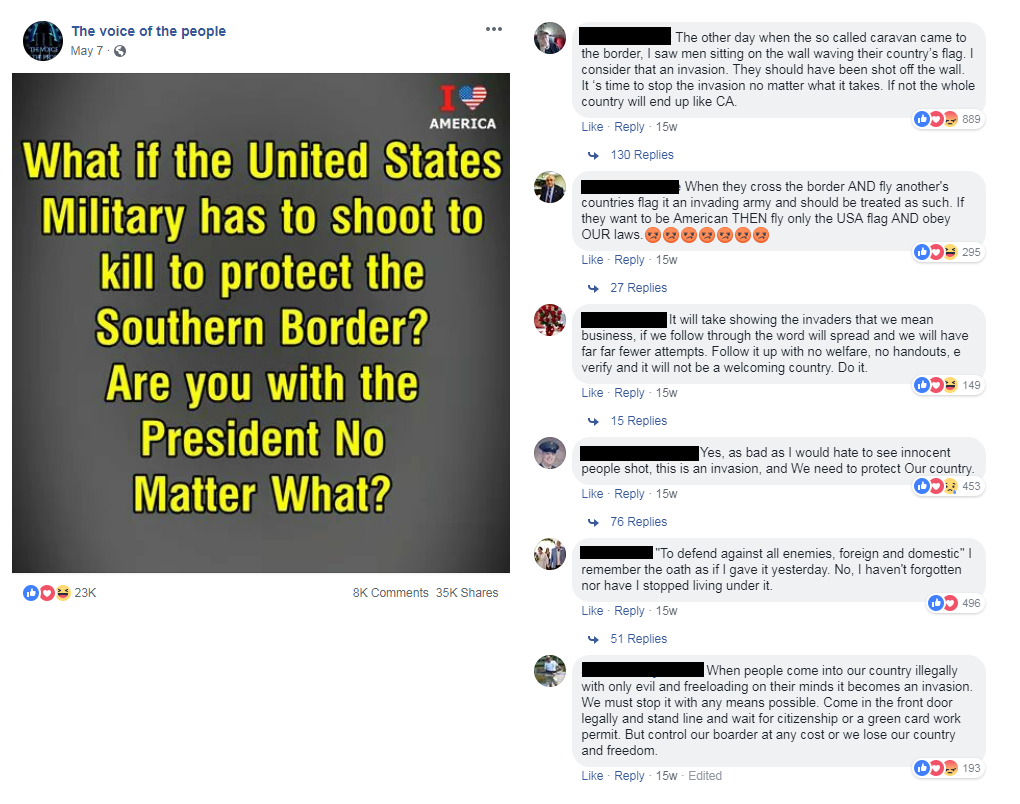
Every now and then, Facebook will take down a particularly detestable piece of right-wing content, like a meme that says Muslims shouldn’t be allowed in Congress, or one with a no symbol over the word “Islam.” But Facebook’s content policies fail to address the way individual posts contribute to a larger, violent narrative. In a study tackling content posted by right-wing meme pages, Media Matters found a subset of anti-immigrant memes that were especially vicious. These memes go viral about once a month on some of the most popular right-wing meme pages; they ask their followers if they support militarizing the border and shooting unarmed undocumented immigrants who are trying to cross. The top reponses on these types of anti-immigrant posts supported shooting undocumented immigrants, and most referenced a cultural “invasion” and tied undocumented people to “welfare” programs. These commenters were borrowing language frequently used by right-wing meme pages and using that wording to justify the cold-blooded murder of undocumented immigrants out of fear they would use government benefits.
Facebook sometimes removes bad actors following specific backlash over a specific page or individual. But the tech platform does nothing to address extremist pages operating as coordinated networks, acting in tandem to amplify their reach. In our recent meme page study, Media Matters mapped out some networks of meme pages and groups run by fake news outlets and far-right clickbait sites. These sites depend on Facebook for online traffic, and they rely on viral meme content to boost their page visibility. Back in January,Facebook took down the official page of the racist fake news site Freedom Daily but left all the other pages in Freedom Daily’s network untouched. The people behind Freedom Daily (freedomdaily.com) seemingly made two clone sites, freedom-daily.com (which is no longer active) and mpolitical.com, which they continued linking to on the Facebook pages they used to promote Freedom Daily before. By April, the Facebook pages that were channeling traffic to freedomdaily.com by linking to it in 2017 were now linking to a new racist fake news site, rwnoffcial.com. What this example shows is that even when a page was banned from Facebook, its allied network of pages was able to direct traffic to an entirely new website in a matter of months.
It isn’t a coincidence that Facebook’s content moderation process is ineffective when it comes to moderating these extremist narratives. Most of Facebook’s responses to the spread of hate and violent fake news focus on individual posts encouraging violence, rather than on coordinated networks of bad actors driving long-term propaganda narratives. Even when Facebook takes down an individual post, the removal usually doesn’t affect the status or visibility of the page that posted it. Facebook doesn’t have a financial incentive to take down popular extremist networks pushing anti-immigrant, racist content. These pages aren’t a problem for Facebook; they’re a revenue stream. These pages and groups keep a large online community of President Donald Trump supporters engaged on the tech platform, where they consume and spread extremist content on their timelines (while clicking on ads and viewing content that Facebook gets paid to show). Simultaneously, Facebook is crucial to the business models of right-wing meme pages, as they push monetized content via racist clickbait, fake news sites, and online stores. Facebook isn’t just giving the far-right a soapbox to reach conservative communities; it’s also directly profiting from hate speech and extremist conspiracies.
---
links
ver the past month, Facebook has drawn international attention for its slow response to hate speech and fake news that helped fuel the genocide of the ethno-religious Rohingya minority in Myanmar; for the correlation found in Germany between Facebook usage and hate crimes against refugees; and for the fake news that has gone viral on the Facebook subsidiary WhatsApp and led todeadly attacks in India.
But, in the U.S., the criticisms of the social media giant that have dominated media coverage have dealt with baseless claims of censorship targeting conservatives. In a July study, Media Mattersshowed that the highest performing political content actually comes from right-leaning pages. And a sample of pages we identified as regularly pushing right-wing memes had the highest engagement numbers overall, boasting more than twice the weekly interactions of nonpartisan political news pages.
In anotherrecent study, Media Matters tracked narratives pushed by these right-wing meme pages and found that they often use false news and extremist rhetoric to push smears against immigrants and advocate for laws that negatively affect minorities. Facebook users who subscribe to these pages are being fed recycled -- and bigoted-- talking points, including that immigrants are taking government dollars from children and veterans; President Donald Trump’s inhumane immigration policies are part of an anti-Trump conspiracy; and racist voter ID laws are the solution to supposed mass voter fraud. The collective followership of these pages is in the hundreds of millions, and based on top comments to their right-wing meme posts, there appears to be a feedback loop in which commenters echo the language they see in the posts.
Every now and then, Facebook will take down a particularly detestable piece of right-wing content, like a meme that says Muslims shouldn’t be allowed in Congress, or one with a no symbol over the word “Islam.” But Facebook’s content policies fail to address the way individual posts contribute to a larger, violent narrative. In a study tackling content posted by right-wing meme pages, Media Matters found a subset of anti-immigrant memes that were especially vicious. These memes go viral about once a month on some of the most popular right-wing meme pages; they ask their followers if they support militarizing the border and shooting unarmed undocumented immigrants who are trying to cross. The top reponses on these types of anti-immigrant posts supported shooting undocumented immigrants, and most referenced a cultural “invasion” and tied undocumented people to “welfare” programs. These commenters were borrowing language frequently used by right-wing meme pages and using that wording to justify the cold-blooded murder of undocumented immigrants out of fear they would use government benefits.


...
==
ref
http://time.com/5352516/india-whatsapp-fake-news/
On the evening of June 8, a 29 year-old sound engineer and a 30-year-old business man were on their way to a picnic spot in India’s northeastern Assam state when they stopped at a village to ask for directions. The villagers had been told, in a video circulating on the messaging app WhatsApp, that child kidnappers were roaming the country. Believing these strangers were the ones they’d been warned about, the villagers formed a large mob, and, before the men could convince them otherwise, beat them to death.
The video they had seen was actually an instructional safety video made in Pakistan, but was shared with some text warning about kidnappers in the local area, causing fear and anger among the community. After the killings, police arrested 16 people and demonstrations took place in the victims’ hometown of Guwahati, the largest city in Assam. Similar incidents involving false news stories circulated on WhatsApp have reportedly led to the deaths of two dozen people in India since April. Now, both the app and the government are scrambling to prevent more mob lynchings.
“This is really happening at the frontier of technology,” says Nandagopal Rajan, new media editor at The Indian Express newspaper. “India has had a 4G revolution in the past 18 months and we’ve seen around 200 million new people start using the internet, mostly on phones. That means WhatsApp has suddenly ended up in the hands of a lot of first time internet users.”
India is WhatsApp’s largest market, with more than 200 million users at last count, in February 2017. The number today is likely much higher. While the app was designed as a messaging platform for one-on-one exchanges or small groups, in India it has taken on a life of its own. “Many Indians use Whatsapp not as a messaging platform,” Rajan says, “but as a consumption platform—people join lots of groups so they receive an endless flurry of video messages, memes and random jokes and stories, directly to their inbox.”
When those messages and stories contain false information, WhatsApp’s content-sharing function can have a more sinister effect. End-to-end encryption, which effectively locks messages and gives only senders and receiver the key to open them, makes it impossible for the company to see inside chats and regulate content on their platform in the same way Twitter or Facebook can. Groups are closed and limited to 256 people, making it impossible for journalists or police to get in and track where a rumor originated.
A 2018 reportfrom the Reuters Institute at the University of Oxford shows WhatsApp is becoming an increasingly dominant news-sharing platform across Latin America and Asia. That means the problem is only growing. India’s technology ministry said in a statement onJuly 19 that the company would face legal action if it remained a “mute spectator” to the violent consequences of false stories circulating. “When rumors and fake news get propagated,” it said, “the medium used for such propagation cannot evade responsibility.' Since late June WhatsApp has been responding with a series of unprecedented interventions to curb sharing on the app. It added a setting that would allow only admins to send messages in a group. It reduced the number of people a message can be forwarded to from 100 to 5 in India (and to 20 in the rest of the world) and removed the “quick forward” button that appears next to messages containing photos, video or audio. It also introduced a “suspicious link” label, which will appear alongside links where WhatsApp detects an obvious problem, such as a strange combination of characters. Earlier in July the company took outnewspaper ads in nine states warning people to “question information that upsets you.”
“WhatsApp is making an effort to understand [how people use its platform in India] but we’re in uncharted territory,” Rajan says. “Nobody has ever fathomed what happens when this kind of a platform, which is in encrypted code, starts working at scale—the kind of scale you have in India.”
While the forwarding limit has been reduced, Rajan points out that content can still spread very fast between groups. “Often, all the members of a group are admins, and they’ll all be admins of ten more groups too. All the groups are interconnected, so it’s really easy for content to go viral.” WhatsApp did not respond to TIME’s request for further comment on the situation in India.
“WhatsApp’s new measures are a band-aid, not a solution,” says Bal Krishn Birla, a tech entrepreneur from Bangalore. Two years ago, Birla and software engineer Mohammed Shammas launched volunteer service Check4Spam, in the hopes of curing their country’s burgeoning fake news epidemic. Now with a team of 15 volunteers, the pair painstakingly fact check false stories of all kinds, using lunch breaks, evenings and weekends to balance the task with their day jobs.
They receive between 100 and 250 messages a day from people asking whether or not a story is true. “We can’t respond to all of them, but we try to get most,” Birla says. The team will take a typical news story, such as a report of a young child being kidnapped, research the facts online and use tools like reverse image search to check if photos or videos included in the story come from the region or time that they claim to. “It’s pretty simple,” he says, “We’re not reinventing the wheel.” They then upload the fact-check to their website and encourage the sender to share it too, reversing the flow of fake news.
Check4Spam isn’t the only grassroots organization taking notice of the risks posed by news on WhatsApp. In Mexico, where 35% of people use WhatsApp as a primary news source according to the Reuters Institute, a group of journalists made the app the focus of their fact-checking site,Verificado 2018. In the run up to the country’s largest ever elections in July, they responded to thousands of requests from people wanting to check political stories.
Alongside volunteer groups like these, Birla believes the lasting solution lies in media literacy education, something Check4Spam is keen to get involved in. On May 30, Facebook announced the company would team up with India’s National Commission for Women and the Cyber Peace Foundation, an NGO, to run digital literacy courses at universities in several major Indian cities. They will teach 60,000 women who are new to the internet to recognize false information online, helping to avoid both fake news and scams. But similar programs could take years to roll out across a country of 1.3 billion. “These killings are very likely to continue, unfortunately,” Birla says. “To me it seems like it’s just the beginning.”
Birla questions whether social media companies are truly committed to stopping the spread of fake news. “It amounts to getting people to share less, and that directly conflicts with their business model,” he says. He believes Facebook, which owns WhatsApp, already has the technology to deal with much of the false information circulating on its platforms. “They understand how to flag content that seems inappropriate or like it violates copyright—they just haven’t done it yet for things that may seem suspicious.” While the difference between truth and lie may be more difficult for technology to spot than an unlicensed music clip, tools like reverse image search, which can reveal if an image comes from where it claims to, are currently under-used by social media companies, he says.
“When people start leaving their platform, then I think they’ll figure out the solution,” says Birla, pointing to a trend in young people abandoning Facebookfor Instagram and Snapchat where the lack of sharing function means there’s less undesired spam content. Government pressure can only go so far, Birla says. “The will to fight fake news has to come from consumers. It has to be a people’s movement.”
---