Surveillance Capitalism
3/19 a sort of new uber [sic] category for cumulative combined effects of digital revolution
new biz model, extractive
1/20 may be losing distinction
REBOOT 6 25 PALANTIR MASTER FILE
SEE MALWARE ZERO CLICK SPYWARE ISRAEL PRESS SUPPR
note previous waves of dislocation:
// DISASTER CAPL PVT INTEL SEC
FLOCK CAM
SEE CORY D ON ENSHITIFICATION
industrial revolution / enclosure, PC ATM bank teller, grocery scanner, tax prep
see privacy
AI
Big data
---
mar a lago VA permutter sell vet data
---
APPLE RFK AI CONF MEDICAL DATA 10 26
-=-=-
10 26
NO LNX GFX
Federica Marsi
Published On 16 Oct 2026
16 Oct 2026
Just visiting a page or refreshing an app can be enough to fall victim to a malware attack in which your personal data is stolen from a laptop or phone, researchers have found. You are not even required to “click” on anything.
An Israeli spyware firm has been found to be behind the first-known instance of “zero-click” targeted advertising in which fraudsters or spies can steal private data and send it to external servers, with Al Jazeera journalists among the victims.
Recommended Stories
list 1 of 3A world on trial: How lawyers documenting Israeli abuse pay a price
list 2 of 3EU lawmaker investigating surveillance hacked by Israeli spyware, report says
list 3 of 3UK, US, Netherlands warn of Iran-linked spyware
end of list
In June 2025, 45 devices used by Al Jazeera staff – including several who reported on sensitive subjects – were targeted with spyware which installed itself without the need to open or download any files.
An investigation by the Canada-based academic research unit Citizen Lab, prompted by Al Jazeera’s initial internal probe into the issue, discovered that the Israeli company Candiru was behind the attacks.
Analysts say the findings are “incredibly concerning”, as they confirm the existence of a new global security threat. “We knew we were headed in this direction and now it is out in the public,” Remesh Srinivasan, professor of information studies at the University of California in Los Angeles, US, told Al Jazeera.
“This is the next level, because people are being microtargeted,” he said. “This is the point we’ve come to when it comes to surveillance.”
How ‘zero-click’ malware works
Al Jazeera’s in-house technology team first discovered unusual patterns on devices used by some journalists in 2024. Analysis of network logs provided to the Citizen Lab by Al Jazeera in 2025 provided a clear temporal signature of how the attack was executed.
Malicious advertisements were bought by Discover-Tech, an Israeli company presenting itself as a legitimate advertising firm, but which actually operates as a facilitator for mercenary spyware partners.
Its advertisement network identified Al Jazeera staff, then quietly redirected them to an infected server belonging to Candiru. The spyware firm was blacklisted by the US government in 2021, when Citizen Lab found it was responsible for the illegal hacking and surveillance of at least 100 activists, journalists and political activists across 10 countries.
Al Jazeera Media Network has condemned the targeting of its staff members’ devices and called for those responsible to be held accountable.
Cybersecurity analyst and author Eddy Willems said the advertisements used automatically infect devices the moment they pop up on the screen, but there is an important technical nuance. “Executing code inside the browser does not automatically give an attacker full control over the computer,” Willems told Al Jazeera.
“To escape the browser’s isolated environment – the ‘sandbox’ – the attacker may need a second vulnerability,” Willems said, adding that an advanced spyware operation can combine several vulnerabilities.
“The attacker attempts to exploit vulnerabilities to bypass security boundaries. This is precisely what makes this type of attack so dangerous,” the analyst said.
Once the device is infected, the malicious software is designed to collect a wide range of sensitive data, including files, documents, and browser data such as cookies, bookmarks, and saved credentials.
It can also capture keystrokes, take screenshots, record microphone and webcam input, and extract emails and messages from popular communication platforms. To avoid triggering security mechanisms, the spyware often uses encrypted communication channels and breaks up stolen data into smaller chunks sent over time.
Advertising: A new global security threat?
Analysts say Citizen Lab’s findings point to the escalation of an existing threat, which expands the scale and reach of traditional cyberattacks and makes them much harder to detect.
While “zero-click” attacks are not completely new, the findings outline a new technique through which online advertisements are used as a route to infection.
Stephen O’Shaughnessy, a lecturer in cybersecurity at the TU Dublin Blanchardstown campus in Ireland, explained that when a user opens a website or app, an automated auction sells the advertisement space in a fraction of a second. That auction shares data about the victim, including the device ID, IP address, rough location and the app or site they are on.
“Discover-Tech posed as an ordinary advertiser, used that data to find their target and win the auction for that person’s screen,” O’Shaughnessy told Al Jazeera. “Anyone with a phone or browser that shows ads can be reached, without the attacker needing their phone number or email.”
“Because no message or link is involved, there is almost nothing for the victim to notice,” he added.
Discover-Tech appeared on lists of “certified” and “approved” vendors maintained by Google and advertising industry association IAB Europe, and has served advertisements via major networks such as Google, Yandex and Beeswax.
In its report, Citizen Lab said this illustrates the structural flaws in the online advertising system, which essentially failed to detect or prevent the abuse.
Discover-Tech advertisements have popped up on devices used by personnel in national-security-sensitive networks around the world, including those of various ministries of defence, armed forces, national cyber agencies, intergovernmental organisations and media outlets, Citizen Lab found.
The research unit said these advertisements have also appeared on networks used by the United Nations, NATO, the European Parliament, the European Commission and the Council of the European Union’s General Secretariat.
‘Almost nobody was watching’
Government networks have also been targeted in at least 24 countries, including the United States, Italy, Denmark, Norway, Australia, Russia, Mexico and Israel itself. Networks of media organisations have also been targeted, mainly in Australia, Denmark and Sweden, according to Citizen Lab.
In a separate report, New York-based advertising security firm Confiant said its own investigations had found that some of Discover-Tech’s advertisements also appeared in critical networks used by the Pentagon, the United Nations International Atomic Energy Agency and the International Criminal Court.
O’Shaughnessy said infection has not been confirmed there – only profiling of users. “But that alone is concerning, he said. “The ad system was built to send code from strangers to billions of screens with pinpoint targeting. Almost nobody was watching it from a security angle.”
The analyst said the risk remains low for most people as these attacks are expensive and aimed at specific targets. “For individuals at high risk, like journalists and officials, the best first defence is to install an ad blocker, switch off their advertising ID through their phone’s privacy settings, keep everything updated, and turn on Lockdown Mode or Android’s Advanced Protection,” he said.
Precautions also need to be taken within the industry and at government level. “To combat this, the ad industry needs to properly vet who’s buying ads,” O’Shaughnessy said, while “regulators need to stop personal data being sprayed out to thousands of unknown bidders in every auction.”
//
Israeli ad-tech firm helped place spyware on Al Jazeera devices
Citizen Lab investigation says dozens of Al Jazeera devices were infected by malware planted through advertisements.
Published On 15 Oct 2026
15 Oct 2026
A general view shows the Al-Jazeera headquarter building in Doha, Qatar, May 11, 2022. REUTERS/Imad Creidi
From: NewsFeed
Israeli ‘ad’ firm helped infect spyware into Al Jazeera devices
An Israeli spyware disguised as a digital advertisement firm has targeted journalists’ devices at Al Jazeera.
Published On 15 Oct 2026
15 Oct 2026
00:56
Moroccan journalists recount years of surveillance amid new Amnesty claim
Amnesty cites a whistleblower’s account of how Morocco allegedly uses surveillance to silence journalists.
Published On 6 Oct 2026
6 Oct 2026
Moroccan journalist Omar Radi
-=-=
---
Why The Internet Is Becoming A Surveillance Machine | Whitney Webb
7 26 PALANTIR POINDEXTER SURVEILL TOTAL INFO AWARENESS --> TERROR
ARPA-h
IN Q TEL
CIA ONLY CLIENT OF PALANTIR 1ST 6 YRS RICHARD PEARL --> POIN PVTIZE TO QUELLE OUTRAGE; OROG PUBLIC-PVT WITHIN DARPA
EHUD BARACK
PAYPAL ORIG CODE ALAN WADE TIA
REAGAN DISSIDENT DB
Jul 15, 2026 #WhitneyWebb #Palantir #AISurveillance
Every search, click, location, and online habit leaves behind a digital trail. Whitney Webb explains how AI, Palantir, and modern surveillance systems are reshaping privacy—and why she believes the internet is becoming a powerful tool for large-scale data collection. In this documentary-style breakdown, Whitney Webb traces the evolution of surveillance from DARPA's Total Information Awareness program to predictive policing, AI-driven profiling, Palantir, and the expanding role of Silicon Valley in government technology. Rather than focusing on isolated events, this conversation explores how data, algorithms, and digital infrastructure increasingly influence modern society.
Topics Covered
• Whitney Webb interview • Palantir explained • Peter Thiel • AI surveillance • Total Information Awareness (TIA) • DARPA history • Predictive policing • Facial recognition technology • Digital identity • AI risk scoring • Government surveillance • Silicon Valley and national security • Privacy and civil liberties
PREDPOL UCLA? LAPD ERRORS
0:35
35 seconds
dictates of the Trump White House. What is being targeted is not the deep state, but the laws, resolutions, regulations,
0:42
42 seconds
protocols, and rules, and the government, civil servants who enforce them, which hinder absolute dictatorial control.
0:55
55 seconds
Yeah, it's definitely I would argue one of the best starting points and also thanks so much for having me on Chris.
1:00
1 minute
Um so John Po Dexter uh as of course you know was one of um the national security adviserss to Reagan and was the highest
1:08
1 minute, 8 seconds
ranking member of his administration that was indicted as part of Iran Contra. But he is also uh remembered as
1:15
1 minute, 15 seconds
the quote unquote godfather of modern surveillance. Um and this is in part because of his efforts in the immediate
1:23
1 minute, 23 seconds
post 911 era um pioneering the off uh in office within DARPA that housed a program called total information
1:30
1 minute, 30 seconds
awareness. Um so right after uh the Reagan administration um Po Dexter was sort of um in various roles throughout
1:39
1 minute, 39 seconds
these tech companies that were sort of a a prototype to what Palunteer and total information awareness would later do uh
1:47
1 minute, 47 seconds
like Saffron Technology, Cintech Technologies that were defense contractors and trying to basically create uh use uh sort of um you know
1:56
1 minute, 56 seconds
predictive analytics um to determine uh what terrorists would do next all before 9/11 even happened and of course there
2:04
2 minutes, 4 seconds
was a renewed demand for that type of technology and these sort of innovative solutions in the immediate post 911 era
2:12
2 minutes, 12 seconds
um and uh when this information you know uh was reported on total information awareness there was a huge outcry um
2:20
2 minutes, 20 seconds
throughout uh you know US mainstream media um a lot of organizations including the ACLU and organizations like that uh rightly noted that it would
2:29
2 minutes, 29 seconds
eliminate uh the constitutional right to privacy uh and create this uh very disturbing era um of of mass
2:37
2 minutes, 37 seconds
surveillance uh by you know it b I think one of the mainstream media reports on it said that it would uh fight terrorism
2:44
2 minutes, 44 seconds
by terrifying US citizens basically and making everyone a suspect um in under this this type of um this paradigm he
2:53
2 minutes, 53 seconds
was seeking to usher in. And so it was eventually you know under pressure. It was I think first announced in February 2003 and by May they attempted to change
3:02
3 minutes, 2 seconds
the name to terrorism information awareness uh trying to move away from uh the idea that it would uh be total it
3:10
3 minutes, 10 seconds
would surveil absolutely everyone uh through a name change but obviously it didn't change how the program actually worked. It would still uh be focused on
3:18
3 minutes, 18 seconds
everyday Americans um you know a total drag net really. Um and in that same month where that name change happened uh
3:25
3 minutes, 25 seconds
Peter Teal incorporated uh Palunteer and as Palunteer uh was developing as a company uh they you uh Peter Teal and
3:34
3 minutes, 34 seconds
Alex Karp the Palunteer co-founders uh reached out to Point Dexter directly through Richard Pearl who's a well-known neoconservative figure and was also one
3:43
3 minutes, 43 seconds
of the architects of the Iraq war at the uh Bush era Pentagon.
3:48
3 minutes, 48 seconds
And uh you know basically they hatched this plan to privata to privatize this program rightly calculating that if they
3:56
3 minutes, 56 seconds
turned it into a entirely private sector enterprise uh the outrage uh would uh
4:03
4 minutes, 3 seconds
you know essentially dissipate which it uh remarkably did because um you know originally it was a public private partnership housed within DARPA and then
4:12
4 minutes, 12 seconds
by making it this private sector uh enterprise um you know a lot of the concerns about it uh disappeared. And
4:20
4 minutes, 20 seconds
bec and this is arguably because by moving into the private sector uh they were able to accomplish a lot more than they than they could have uh by being
4:28
4 minutes, 28 seconds
affiliated directly with the public sector even though they contract uh with the public sector. And so Palunteer uh
4:36
4 minutes, 36 seconds
funding wise was set up with money from Peter Teal um himself and that the algorithm for it had originally been
4:43
4 minutes, 43 seconds
developed at PayPal and um uh the other funding source was the CIA's Inqell. Um
4:50
4 minutes, 50 seconds
and one of the figures that helped create uh that helped made that funding decision uh was the CIA's chief information officer at the time named
4:58
4 minutes, 58 seconds
Alan Wade. and Allan Wade had been one of the top allies of the total information awareness with Po Dexter um
5:06
5 minutes, 6 seconds
you know in the immediate post 911 um era and so um the CIA was the was Palanteer's exclusive company sorry
5:15
5 minutes, 15 seconds
exclusive client for I believe the first six years of its existence as a company um and its its engineers went to Langley uh you know CIA headquarters in Virginia
5:24
5 minutes, 24 seconds
every two weeks for several years as well where the CIA was um developing their algorithm with them, you know, in
5:31
5 minutes, 31 seconds
a very direct partnership. And Alex Karp has even said that the CIA was always the intended client um of Palunteer. So,
5 minutes, 39 seconds
I guess I'll I'll pause there and I'm happy to go in other any other direction.
5:43
5 minutes, 43 seconds
Explain what it does, what what the what the goal, what PO Dexter's goal was and and what they were able to establish. I
5:51
5 minutes, 51 seconds
mean the mechanics of it, the way it was initially sold to the public was this is a way to stop terrorism attacks before they happen um
5:59
5 minutes, 59 seconds
by coalating so much um data um from all different sources and then using an in
6:06
6 minutes, 6 seconds
some sort of analytic or AI to determine um you know if u certain data points are flagging that a terrorist attack will take place here um here or there.
6:17
6 minutes, 17 seconds
There's various different aspects of this program that didn't really get enough coverage at the time. Uh so one is that they attempted to use uh free
6:25
6 minutes, 25 seconds
market forces to determine if a terrorism attack would happen. Before it happened, they created basically what's referred to as a terrorism futures
6:34
6 minutes, 34 seconds
market. It was really like a forerunner to poly market and some of these predictive markets uh where people bet on things online. And it was basically
6:42
6 minutes, 42 seconds
that but about whether a terrorist attack uh will happen in the Middle East or if there will be turmoil in the Middle East if someone like Yaser Arafat
6:50
6 minutes, 50 seconds
would be overthrown. You know, these were the kinds of things they were going to have these unnamed uh investors bet on. Um another one was focused entirely
6:58
6 minutes, 58 seconds
on health um under this program called bioveurveillance um which actually a lot of it Palunteer
7:05
7 minutes, 5 seconds
uh helped launch with HHS during the COVID era. uh things like um analyzing American wastewater to determine if
7:13
7 minutes, 13 seconds
there is going to be an outbreak of a disease before it happens uh with um again with an algorithm or basically you
7:21
7 minutes, 21 seconds
know surveilling Americans uh health data uh and uh to determine if there will be a pandemic before it happens or
7:29
7 minutes, 29 seconds
if there will be a bioteterror attack because remember this was also in the aftermath um of the of the anthrax attacks. Um and so a lot of that
....
TESTED IN LOW INCOME POC HOODS
CARBINE PRED POL
---
CONTEXT
AN 4 26
Trump once opposed government surveillance — at least the kind he claimed was directed against him.
“KILL FISA," Trump wrote on Truth Social in 2024. "IT WAS ILLEGALLY USED AGAINST ME, AND MANY OTHERS."
But now that Trump can surveil rather than be surveilled, a conservative is calling him out over his surveillance state.
“It's been two years and five days since Trump wrote that, but it might as well have been another lifetime,” said Eric Boehm, a reporter at Reason who covers economic policy, trade policy and elections. “On Wednesday, Trump again took to Truth Social as Congress was debating a possible extension to Section 702 of FISA, which allows intelligence services to scoop up electronic communications between Americans and individuals overseas.”
Trump is now looking to extend FISA surveillance powers, even as other privacy-minded members of the Republican Party oppose that effort. The extension would permit the CIA, National Security Agency, FBI and other agencies to collect and analyze huge swathes of overseas communications without a warrant. It also sweeps up the conversations of any Americans who interact with international targets for surveillance.
"I am willing to risk the giving up of my Rights and Privileges as a Citizen for our Great Military and Country!" Trump wrote. "We need to stick together when this Bill comes before the House Rules Committee today to keep it CLEAN!"
Boehm has written for conservative publications like The Wall Street Journal, The Daily Signal and The Washington Examiner and is the a featured speaker at seminars hosted by The Libertarian Institute and the American Legislative Exchange Council (ALEC). And he vehemently opposes what he calls Trump’s overreaches in government power.
“It sure would be nice if Trump, who was once a prominent target of these surveillance powers, were willing to advocate for changes,” said Boehm. “Alas, now that those powers are ones he gets to wield, there is no need for consistency or principles.”
Last year The Conversation raised alarms over Trump potentially abusing civil liberties when staffers from the Department of Government Efficiency gained access to the agency’s databases — and then shortly thereafter the Department of Homeland Security obtained access to the same Internal Revenue Service tax data.
"Once confined to separate bureaucracies, data now flows freely through a network of interagency agreements, outsourcing contracts and commercial partnerships built up in recent decades," said Nicole M. Bennett, a Ph.D. Candidate in Geography and Assistant Director at Indiana University's Center for Refugee Studies.
---
The Trump administration is using secretive orders to crackdown on dissent
SARAH MCL
Imagine finding out that the government is issuing secretive orders to unearth your personal information and then sending federal agents to question you — all because you sent an email criticizing the life-or-death decisions the government makes.
That sounds like something out of China, Russia or the increasingly dystopian United Kingdom, right? Well this time, it’s happening here.
The Trump administration is reportedly abusing oversight-free administrative subpoenas to chill protected speech. Recent targets include a man who sent an email criticizing efforts to deport an Afghan man on humanitarian parole seeking asylum.
Our right to express ourselves, particularly in ways that displease the government, is under attack — sometimes echoing authoritarian censorship efforts abroad.
While subpoenas have been used to chill speech across numerous presidencies, the way this administration is using them, and the broader repressive pattern they are part of, should disturb all Americans. As The Washington Post reported this week, a Philadelphia-area retiree wrote an email to a federal prosecutor last year asking him to “[a]pply principles of common sense and decency” to the deportation case of an Afghan man, who feared death at the hands of the Taliban. Only the retiree’s first name, Jon, is given, as he fears for his safety.
Only hours later, to Jon’s shock, he received a notice from Google that the company had received a subpoena compelling the release of identifying information, including older account activity and his physical address. The Department of Homeland Security issued an administrative subpoena, which doesn’t require the oversight of a judge or grand jury, to get Jon’s information. DHS attempted a similar stunt to target internet commenters who posted about Immigration and Customs Enforcement.
That was not Jon’s only brush with DHS. Agents would also soon show up at his door with a copy of the email he’d sent and ask him to explain himself.
There is no better guarantee of the right to speak and criticize our government than the First Amendment, which stands as guard between us and the power of the state. But our right to express ourselves, particularly in ways that displease the government, is under attack — sometimes echoing authoritarian censorship efforts abroad. Americans must understand that with enough time and pressure, even the strongest of foundations can weather down to dust.
These administrative subpoenas intended to unmask critics of government action are just the tip of the speech-chilling iceberg.
Between these disturbing allegations, recent alarming on-camera encounters between civilians and law enforcement and the ceaseless incursions from the Trump administration against our First Amendment rights, Americans must recognize that the United States is failing as a bulwark for liberty in a world increasingly bereft of it.
Alex Pretti’s death at the hands of federal agents in Minneapolis last month was deeply alarming. Rather than immediately commit to an intensive investigation of what took place, officials such as Secretary of Homeland Security Kristi Noem spread the unfounded claim that Pretti tried to “kill” law enforcement. Senior adviser Stephen Miller called Pretti an “assassin” who “tried to murder federal agents.” The administration has since started to shy away from these fantastical claims after Americans could watch the video for themselves.
Their narrative might still stand, however, had protesters nearby not caught the shooting on camera from multiple angles. But that First Amendment right to film law enforcement is increasingly under attack. DHS spokeswoman Tricia McLaughlin said filming and posting videos of ICE is “doxing our agents” and the government “will prosecute those who illegally harass ICE agents to the fullest extent of the law.” Pretti himself had been recording agents with his cell phone moments before he was killed.
U.S. federal agents also appear to be creating a database to track protesters and observers who are legally and peacefully exercising their First Amendment rights. In an encounter a woman filmed in Maine, an ICE agent told her he’s recording her information for a “nice little database” for “domestic terrorists” like her. A CNN report confirms a DHS memo informing agents to “capture all images, license plates, identifications, and general information on hotels, agitators, protestors, etc., so we can capture it all in one consolidated form.” News of this database follows in the footsteps of Attorney General Pam Bondi’s plan to crack down on “domestic terror organizations,” using a framework that targets broad ideologies such as “anti-Americanism, anti-capitalism, and anti-Christianity” as markers of political violence rather than constitutionally protected beliefs.
You may be familiar with lists of alleged anti-government activists from their other iterations in Belarus, Russia and China. The lists are frightening. What governments do with them is usually even worse.
The distance between freedom and tyranny is shrinking fast — and so is our window to combat it.
And many Americans were rightfully shocked by a “60 Minutes” exposé of German censorship last year, which included raids on the homes of social media users who had insulted politicians, and by regular reports from other nations such as the U.K., where a late-night knock at the door from police has become disturbingly commonplace. In Germany, the government treats insults to politicians more, not less, harshly than other forms of insult, essentially exempting the powerful from upsetting speech.
That’s the opposite of how we view political speech in the U.S. — with great power must come a thick skin.
But the Trump administration doesn’t see it that way. In fact, ICE and DHS leadership have undertaken a concerted effort in recent months to pervert the concept of “doxing,” the sharing of identifying information about an individual, into one so broad it includes simply saying the name of the men and women who serve as armed agents of the state. Administration officials have repeatedly — and wrongly — suggested this “doxing” is illegal.
Imagine a United States in which federal agents have the authority to fire their weapons as representatives of the government, and yet everyday Americans aren’t even free to state clearly who or where those agents are. Even worse, those same Americans may find themselves on a clandestine government database for engaging in protected speech. Or, like Jon, they could even face a secretive administrative subpoena followed by a knock at the door from DHS agents.
“Secret police” cannot be a necessary term in the American vernacular, but if we do not stem the tide of these First Amendment violations and transgressions, it may become one. The distance between freedom and tyranny is shrinking fast — and so is our window to combat it.
The post The Trump administration is using secretive orders to crackdown on dissent appeared first on MS NOW.
This article was originally published on ms.now
---

Investigation
Rotten Apple: Dozens of Former Israeli Spies Hired by Silicon Valley Giant
Apple has made headlines in recent weeks for touting its commitment to privacy and human rights, rolling out tools to limit surveillance and spyware. But behind the corporate messaging lies a much darker reality.
The company has quietly brought in dozens of veterans from Unit 8200, Israel’s shadowy military intelligence unit known for blackmail, mass surveillance, and targeted killings.
Many of these hires took place as Israel escalated its war on Gaza, and as CEO Tim Cook publicly expressed support for Israel while disciplining employees for pro-Palestinian expressions. Apple’s deepening ties to Israel’s most controversial intelligence raise uncomfortable questions, not only about the company’s political loyalties, but also about how it handles vast troves of personal user data.
A MintPress News investigation has identified dozens of Unit 8200 operatives now working at Apple. The company’s hiring spree coincides with growing scrutiny of its ties to the Israeli government, including its policy of matching employee donations to groups such as Friends of the IDF and the Jewish National Fund, both of which play a role in the displacement of the Palestinian people. The intense pro-Israel bias at the corporation has led many former and current employees to speak out.
This investigation is part of a series examining the close collaboration between Unit 8200 and Western tech and media companies. Previous investigations examined the links between Unit 8200 and social media giants like TikTok, Facebook and:(style="background-color:#ffbb16ff"):}: :{Google, and how former Unit 8200 spies are now responsible for writing much of America’s news about Israel/Palestine, holding top jobs at outlets like CNN and Axios.
Revealed: The Former Israeli Spies Working in Top Jobs at Google, Facebook and Microsoft
Hundreds of agents from Israeli spying organization Unit 8200 are now employed in top roles at Google, Facebook, Microsoft, and Amazon.

MintPress News·Alan Macleod·Nov 16, 2022
A Few (Dozen) Bad Apples
Israel’s international reputation has taken a severe hit amid multiple spying scandals and ongoing attacks against its neighbors. During this same period, Apple has ramped up its recruitment of former Israeli intelligence personnel.
The Silicon Valley giant has hired dozens of former agents from the controversial Israeli intelligence outfit, Unit 8200, raising questions about the corporation’s political direction.
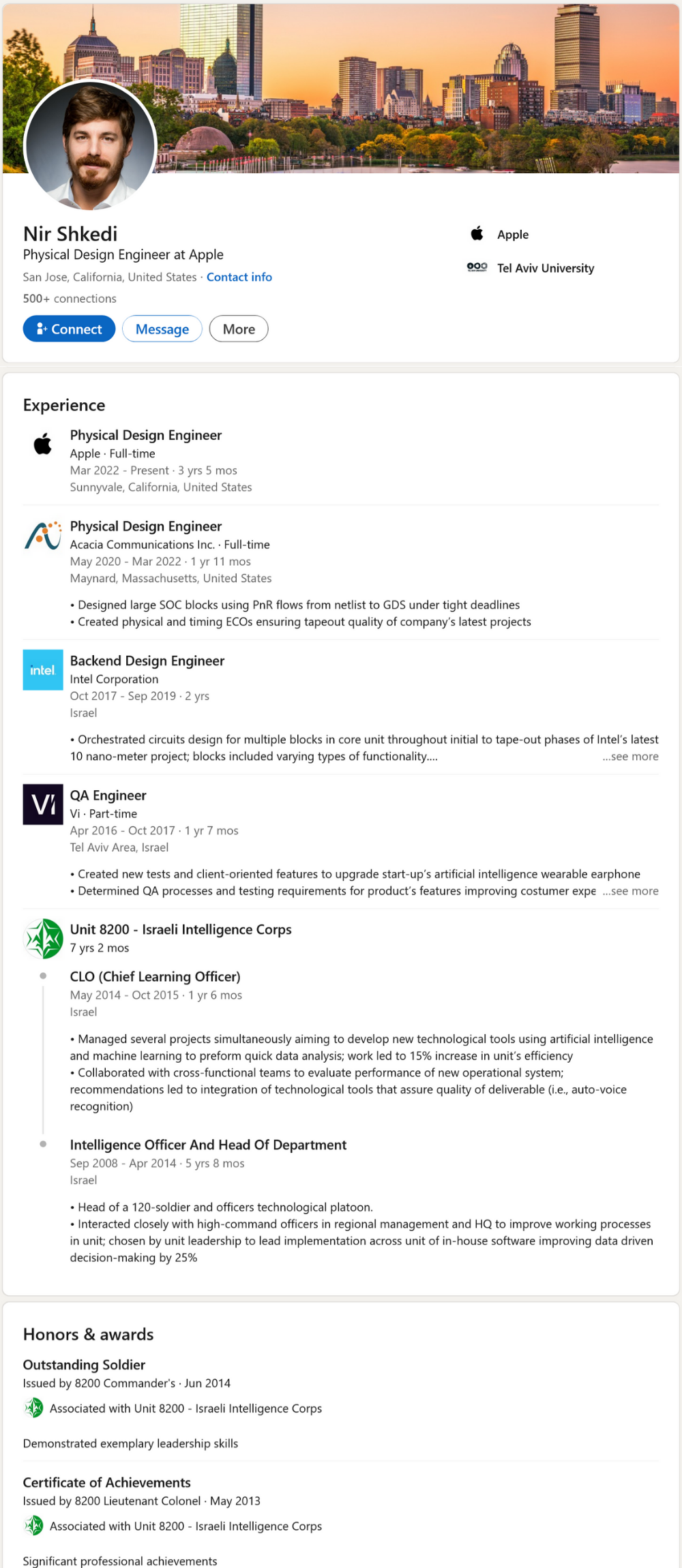
Nir Shkedi is among the most prominent examples. From 2008 to 2015, he served as a commander and Chief of Learning at Unit 8200, leading a team of approximately 120 operatives who developed new artificial intelligence tools to perform rapid data analysis.
Unit 8200 is at the forefront of this technology, and is known to have used AI to auto-generate kill lists of tens of thousands of Gazans, including children. These tools helped the Israeli Defense Forces (IDF) bypass what it called human targeting, “bottlenecks,” and strike huge numbers of Palestinians.
Shkedi has been a physical design engineer at Apple’s Bay Area campus since 2022.
Noa Goor is another senior Unit 8200 figure turned Apple employee. From 2015 to 2020, Goor rose to become a project manager and head of cybersecurity and big data development team at Unit 8200, where she, in her own words, “invent[ed] creative technological solutions for high priority intelligence goals” and “manag[ed] two strategically important cyber projects” for the IDF.
One of the most important cyber projects Unit 8200 has launched in recent times is the September pager attack on Lebanon, an act that injured thousands of civilians and was widely condemned as an act of international terrorism, including by former CIA Director Leon Panetta. While Goor was not personally involved in that operation, Unit 8200 has spearheaded similarly nefarious actions for decades.
In 2022, Goor was hired by Apple as a system-on-chip design engineer.
 Eli Yazovitsky, meanwhile, was directly recruited from Unit 8200. In 2015, he left a high-powered nine-year career as a manager in the military unit to join Apple, where he rose to become an engineering manager. He has since moved on to tech giant Qualcomm.
Unit 8200 is Israel’s most elite—and most controversial—military intelligence unit. It serves as the backbone of both Israel’s burgeoning tech sector and its repressive surveillance apparatus. The unit has developed cutting-edge technology like facial recognition and voice-to-text software to surveil, repress, and target Palestinians.
The vast amounts of data gathered on the Palestinian population, including their medical history, sex lives, and search histories, have been used for coercion and extortion. If a certain individual needed to travel across checkpoints for crucial medical treatment, permission could be suspended until they complied. Information about extramarital affairs or sexual orientation, especially homosexuality, is exploited as blackmail material. One former Unit 8200 agent recalled that he was instructed during his training to memorize different Arabic words for “gay” so that he could listen out for them in intercepted conversations.
Internationally, Unit 8200 may be best known for its “former” agents who created the notorious Pegasus software, used by repressive governments around the world to spy on tens of thousands of prominent figures, including royals, heads of state, activists, and journalists.
Among them was Washington Post columnist Jamal Khashoggi, who was assassinated by Saudi operatives in Türkiye in 2018.
While military service is mandatory for Jewish Israelis, few end up in Unit 8200 by accident. Described as “Israel’s Harvard,” parents spend fortunes on STEM-based extracurricular lessons for their children in the hopes that they will be selected to join the IDF’s most elite and selective unit. Those chosen are rewarded with lucrative careers in the tech industry upon completion of their service.
Given Unit 8200’s documented history of violence, espionage, and surveillance, both domestically and internationally, it is worth asking whether tech giants should be hiring its alumni in such large numbers.
Shkedi, Goor, and Yazovitsky are the most high-profile examples, but they are from alone. A closer look reveals that dozens of other Unit 8200 veterans have also secured key roles at Apple.
Engineering and Hardware Design:
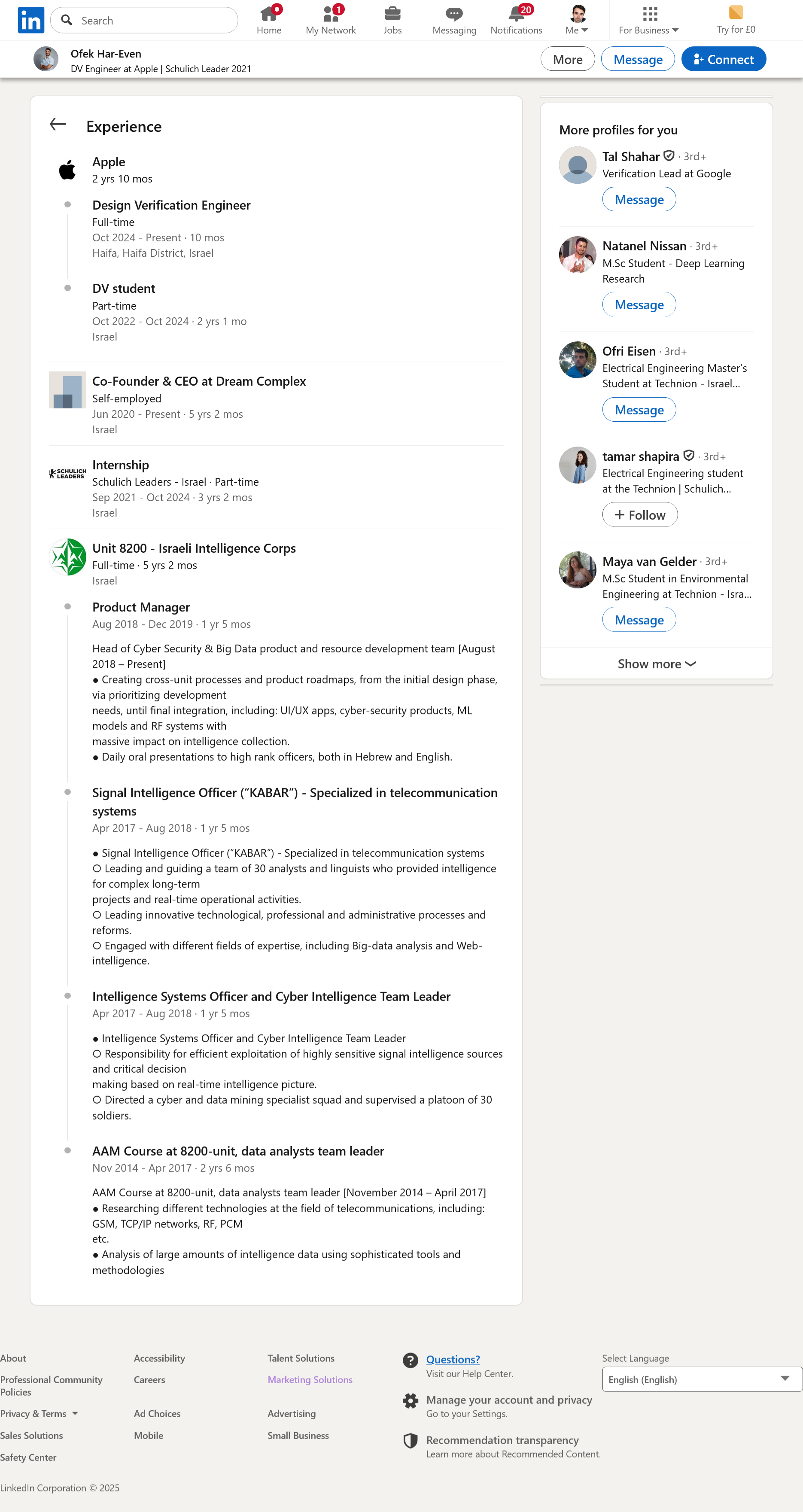
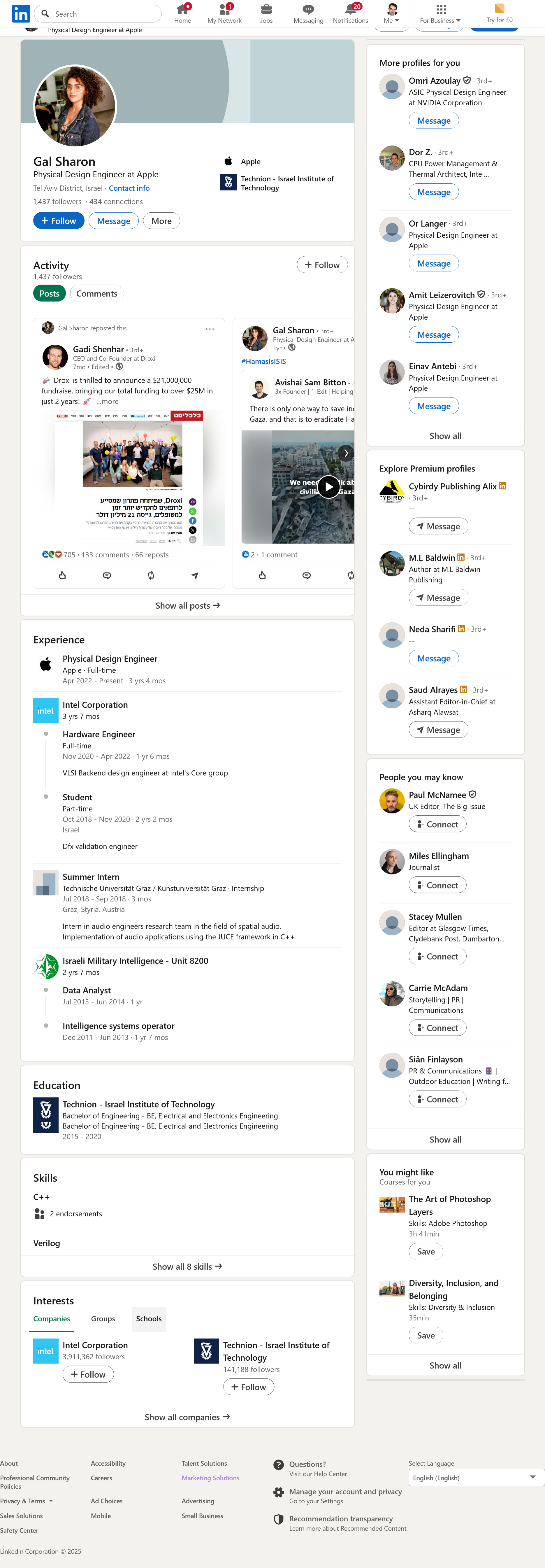
Natanel Nissan, formerly head of data analysis at Unit 8200, joined Apple’s Tel Aviv office in 2022. Ofek Har-Even, a longtime officer and manager in the unit, has been a design verification engineer at Apple since 2022. Gal Sharon, a former intelligence systems operator and data analyst, has also worked as a physical design engineer since that same year.
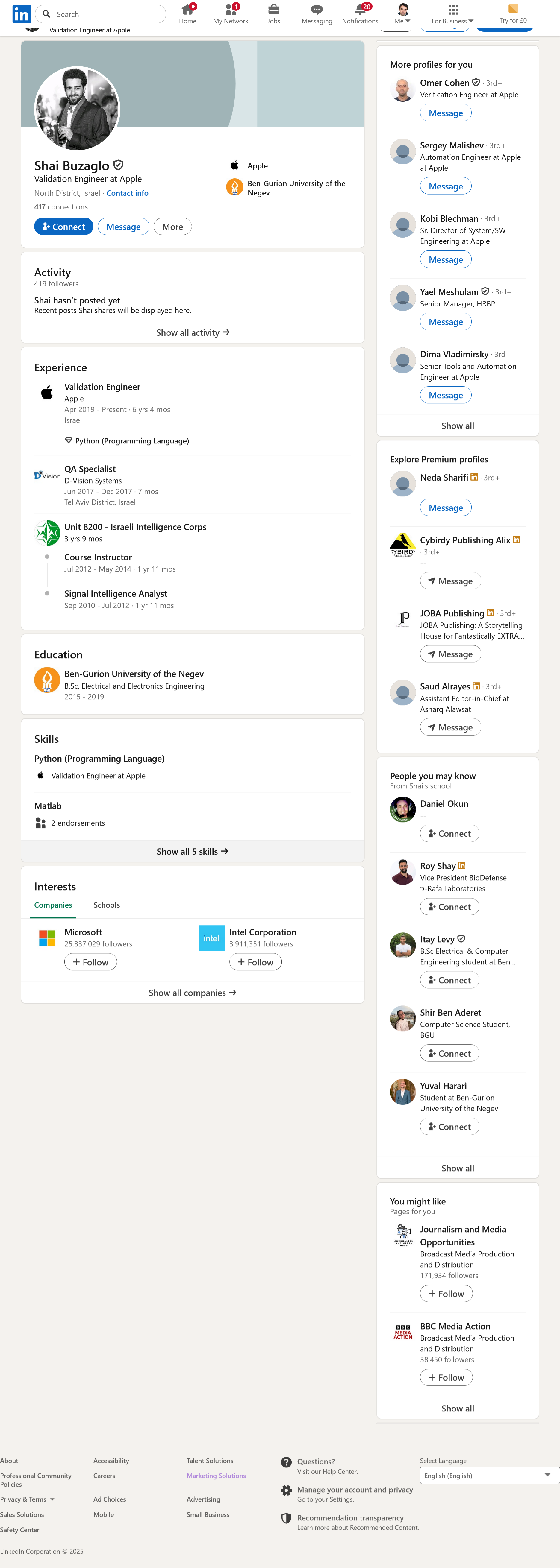
Mayan Hochler and Shai Buzgalo, both former Unit 8200 analysts and instructors, hold roles in physical design and validation engineering, respectively.
Software and Cybersecurity:
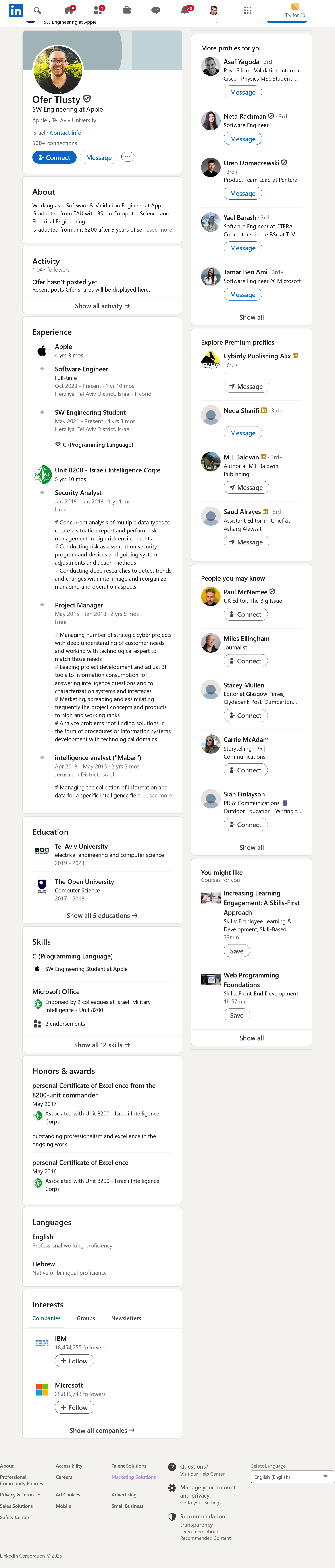
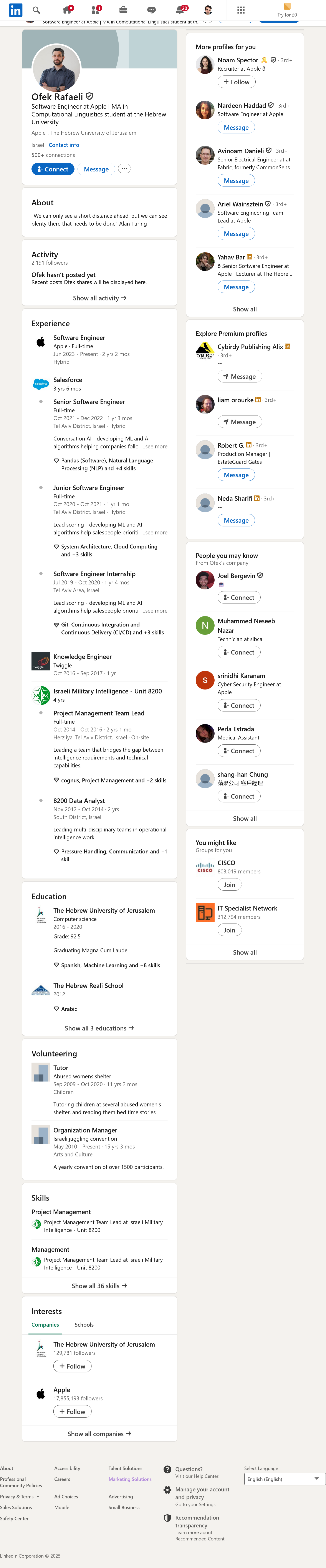
Ofer Tlusty, who served nearly six years in Unit 8200 as a security and intelligence analyst, has worked as a software engineer at Apple since 2021. Ofek Rafaeli, who served between 2012 and 2016 and rose to project manager during Israel’s 2016 assault on Gaza, became a software engineer at Apple in 2023.
Guy Levy, a former intelligence analyst, now also works as a software engineer.
AI, Machine Learning, and Validation:
Avital Kleiman, a six-year veteran of Unit 8200, is now a machine learning algorithm engineer at Apple. Niv Lev Ari, currently a validation engineer, notes in his LinkedIn profile that he received a letter of commendation from Unit 8200 commander Aviv Kochavi for his work in the unit.
Other Technical Roles:
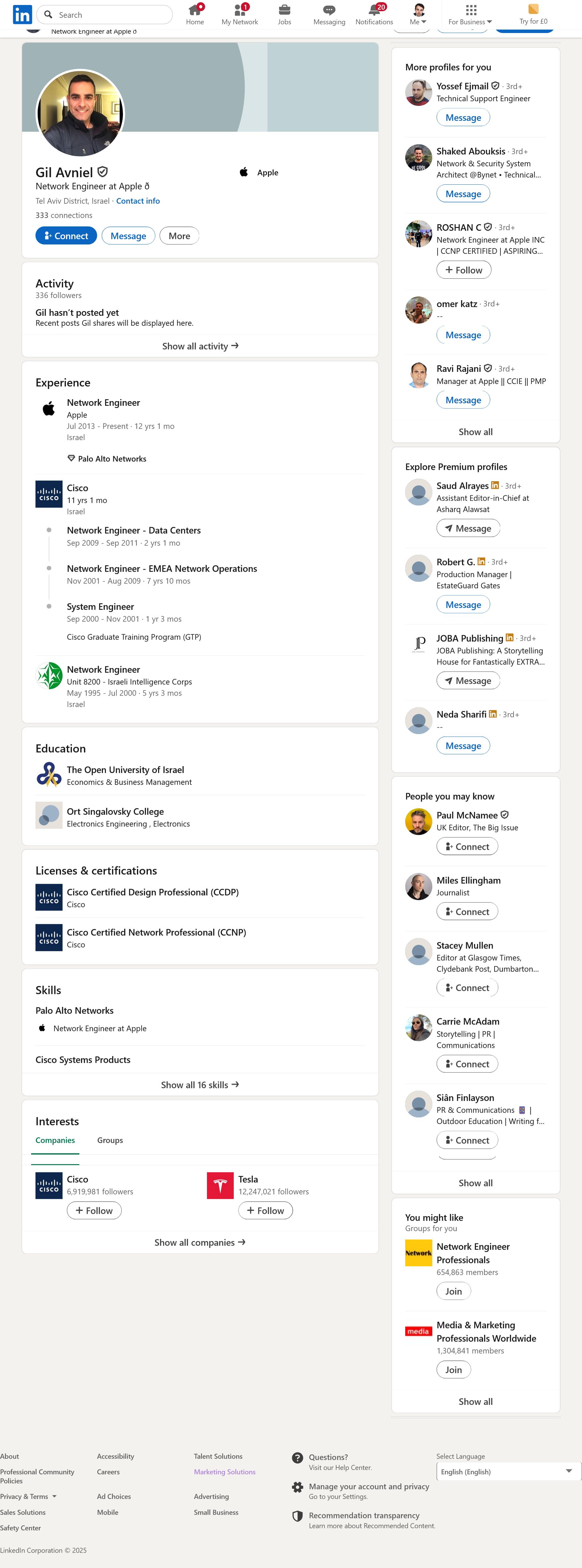
Shahar Moshe, who worked as an intelligence specialist at Unit 8200 from 2012 to 2015, is now a design verification engineer. Gil Avniel, who spent over five years in the unit, currently serves as a network engineer.
An Apple Rots From the Core
The growing number of former Israeli intelligence operatives working at Apple does not seem to concern the company’s senior management. CEO Tim Cook is known to hold strongly pro-Israel views and has spearheaded the Silicon Valley giant’s collaboration with the Israeli state.
Apple has acquired several Israeli tech firms and now operates three centers in the country, employing around 2,000 people. In 2014, Cook invited Israeli Prime Minister Benjamin Netanyahu to the company headquarters in Cupertino, CA, where, in front of the cameras, the two openly embraced. The following year, Cook accepted an invitation from President Reuven Rivlin to visit Israel. “It is a great privilege to host you and your team here,” Rivlin said, “Even for me, as one who prefers to write with a pen and paper, it is clear what a great miracle you have created when I look at my staff, and my grandchildren.”
Effusive praise for the Apple CEO has also come in the form of honors from pro-Israel organizations. In 2018, the Anti-Defamation League presented Cook with its inaugural Courage Against Hate Award at its Never Is Now Summit on anti-Semitism and Hate, where the organization described him as a “visionary leader in the business community.”
 Netanyahu meets Apple CEO Tim Cook during a visit to Apple in 2014. Photo | Israeli GPO
In the wake of the October 7, 2023, attacks, Cook sent out a company-wide email expressing his solidarity with Israel. “Like so many of you, I am devastated by the horrific attacks in Israel and the tragic reports coming out of the region,” he wrote, My heart goes out to the victims, those who have lost loved ones, and all of the innocent people who are suffering as a result of this violence.”
Yet, according to Apples4Ceasefire—a group of former and current employees opposing Israeli actions in Gaza—he has yet to say anything publicly about the mass devastation caused by the Israeli response to October 7.
Indeed, the Silicon Valley corporation has a policy of matching employee donations to groups such as Friends of the IDF, which raises money to buy equipment for IDF soldiers, and the Jewish National Fund, an organization that participates in the theft and destruction of Palestinian land.
Under Cook’s leadership, Apple employees have been disciplined or even fired for wearing pins, bracelets, or keffiyehs in support of the Palestinian people. Nevertheless, groups such as Apples4Ceasefire continue to speak out about what they describe as Apple’s complicity in genocide.
The Unit 8200 Tech Takeover
To be fair, Apple is far from the only tech or media company to hire large numbers of former Unit 8200 operatives. A 2022 MintPress exposé revealed hundreds of Israeli intelligence veterans working at Google, Facebook, Microsoft, and Amazon.
Perhaps the most notable of these is Emi Palmor, a former Israeli justice ministry official who sits on Facebook’s 21-person Oversight Board. Described by Mark Zuckerberg as his platform’s “supreme court,” the board ultimately decides what content is allowed or removed from the world’s largest social network. Facebook has worked closely with the Israeli government to censor or deplatform Palestinian content and accounts.
Even TikTok, often seen as a more open platform, has been hiring former Israeli spies to help manage its operations, according to a November investigation by MintPress. Reut Medalion, for example, served as a Unit 8200 intelligence commander and led its cybersecurity operations team.
TikTok isn’t anti-Israel: It’s Hired Unit 8200 Agents to Run its Affairs
A MintPress News study has unearthed a network of former agents of Israeli spying agency Unit 8200 working at TikTok, a company charged with supposedly being a Chinese-owned hub of anti-Semitic content., Chinese influence TikTok, Israeli spying influence TikTok, Project Texas TikTok, TikTok anti-Palestine bias, TikTok former CIA hires, TikTok Israel content moderation, TikTok Israeli intelligence hires, TikTok pro-Palestine suppression, TikTok U.S.

MintPress News·Alan Macleod·Dec 30, 2024
In December 2023, during the peak of Israel’s attack on Gaza, Medalion moved to New York City to accept a job as global incident manager for TikTok’s trust and safety division. Considering the events going on in the world at the time, it’s worth asking what sorts of “global incidents” she was brought in to manage.
After MintPress exposed Medalion’s past to a worldwide audience, she deleted her entire digital footprint from the internet.
Former Israeli intelligence operatives have also found their way into American newsrooms, shaping coverage of the Middle East. A recent MintPress investigation uncovered a network of former Unit 8200 operatives working in some of the most influential newsrooms in the United States.
Revealed: The Israeli Spies Writing America's News
Media personalities like Barak Ravid, an ex-Israeli spy turned Washington journalist, play a key role in shaping media coverage that protects Israeli military actions and influences unwitting American audiences., Barak Ravid, Barak Ravid spy, Biden administration, Israel-Palestine conflict, Israeli intelligence, Israeli media influence, Media Manipulation, media whitewashing, pro-Israel bias, U.S.

MintPress News·Alan Macleod·Dec 8, 2024
Among them is Axios correspondent Barak Ravid, whose Middle Eastern coverage won him the prestigious White House Press Correspondents’ Award. Until at least 2023, Ravid was a member of Unit 8200. CNN has also hired at least two former agents to produce their news coverage, one of whom, Tal Heinrich, now serves as the official spokesperson for Prime Minister Netanyahu.
Given this pattern, Silicon Valley’s partiality towards Israel should not come as no surprise. From tech giants like Google and Amazon to social media powerhouses like TikTok and Facebook, the field is filled with former Israeli spies. Apple is no exception, having hired dozens, if not more, Unit 8200 operatives to run its platforms and shape the company.
This investigation does not claim that the Israeli state is deliberately infiltrating Silicon Valley. However, what it does unquestionably suggest is that the outlook and general biases of these entities are strongly pro-Israel. What does it say about Silicon Valley’s culture that individuals with well-documented ties to a controversial foreign spy agency are considered ideal hires?
It is unthinkable that former intelligence agents of Hezbollah, Iran’s Ministry of Intelligence, or Russia’s FSB or GRU would be hired en masse, and trusted with our most sensitive data. Yet, when it comes to Israel (or U.S. surveillance agencies), the answer is different. Many of these employees are not even “former” agents, and are directly recruited from Unit 8200 while still in active service, despite Israeli law explicitly prohibiting the group’s members from identifying themselves or divulging their alliances.
Thus, in this light, it appears that those like Apples4Ceasefire struggling to end the company’s double standards are fighting an uphill battle.
Feature photo | Illustration by MintPress News
Alan MacLeod is Senior Staff Writer for MintPress News. He completed his PhD in 2017 and has since authored two acclaimed books: Bad News From Venezuela: Twenty Years of Fake News and Misreporting and Propaganda in the Information Age: Still Manufacturing Consent, as well as a number of academic articles. He has also contributed to FAIR.org, The Guardian, Salon, The Grayzone, Jacobin Magazine, and Common Dreams. Follow Alan on Twitter for more of his work and commentary: @AlanRMacLeod.*
---










MintPress News
https://www.mintpressnews.com › apple-israel-unit-8200-hiring › 290226
Rotten Apple: Apple Hires Dozens of Israeli Spies From Unit 8200
---
https://www.alternet.org/2022/02/cia/
surveil US
---
AN 2 26
President Donald Trump's Department of Homeland Security is employing a "secretive legal weapon" to target and surveil Americans, according to a new report.
The Washington Post on Tuesday relaying the story of a retiree who found himself on the receiving end of it after speaking out against the deportation case against an Afghan asylum seeker.
"He had decided that the America he believed in would not make it if people like him didn’t speak up, so on a cool, rainy morning in the suburbs of Philadelphia, Jon, 67 and recently retired, marched up to his study and began to type," the Post's report detailed. "He had just read about the U.S. Department of Homeland Security’s case against an Afghan it was trying to deport. The immigrant, identified in The Washington Post’s Oct. 30 investigation as H, had begged federal officials to reconsider, telling them the Taliban would kill him if he was returned to Afghanistan."
The retiree told the Post that he found the story "unconscionable," and after a quick Google search, he was able to find the email address of Joseph Dernbach, the lead prosecutor in H's case, named in the original story.
“Mr. Dernbach, don’t play Russian roulette with H’s life,” he wrote in an email. “Err on the side of caution. There’s a reason the US government along with many other governments don’t recognise the Taliban. Apply principles of common sense and decency.”
A little over five hours later, he received an email alert from Google notifying him that it had "received legal process from a Law Enforcement authority compelling the release of information related to your Google Account," listing the process as a subpoena and the authority as DHS. Not long after that alert, "men with badges" were at his door.
This was an example of an administrative subpoena – a tool that the federal government under Trump is increasingly leaning on — as they do not require authorizations from a judge or grand jury. "Tech experts and former agency staff" told the Post that thousands of these subpoenas are issued each year, potentially tens of thousands. They are "not subject to independent review, they can take just minutes to write up and, former staff say, officials throughout the agency, even in mid-level roles, have been given the authority to approve them."
"Though the U.S. government had been accused under previous administrations of overstepping laws and guidelines that restrict the subpoenas’ use, privacy and civil rights groups say that, under President Donald Trump, Homeland Security has weaponized the tool to strangle free speech," the report explained. "For many Americans, the anonymous ICE officer, masked and armed, represents Homeland Security’s most intimidating instrument, but the agency often targets people in a far more secretive way."
“There’s no oversight ahead of time, and there’s no ramifications for having abused it after the fact,” Jennifer Granick, an attorney for the American Civil Liberties Union, told the outlet. “As we are increasingly in a world where unmasking critics is important to the administration, this type of legal process is ripe for that kind of abuse.”
In a post to X, Drew Harwell, a technology reporter for the Post, decried these subpoenas as "a Kafkaesque form of domestic surveillance, intimidating Americans for lawful speech."
---
---
1 26 404 MEDIA?
Palantir is working on a tool for ICE that populates a map with potential deportation targets, brings up a dossier on each person, and provides a “confidence score” on the person’s current address, 404 Media has learned. ICE is using it to find locations where lots of people it might detain could be based. The findings, based on internal ICE material obtained by 404 Media, public procurement records, and recent sworn testimony from an ICE official, show the clearest link yet between the technological infrastructure Palantir is building for ICE and the agency’s activities on the ground. The tool receives peoples’ addresses from the Department of Health and Human Services among a range of other sources, according to the material.
---
aha cf moral aspects of debt in graeber ilan ziv caplism
prison is state of exception, pioneeer loss of privacy/surveillance
random intercept grab 921
FEDERAL PRISONS’ SWITCH TO SCANNING MAIL IS A SURVEILLANCENIGHTMARE
Lauren Gill
---
---
ppl lose amend rights
https://www.alternet.org/2021/07/central-florida-sheriffs-department-draws-sharp-criticism-for-advanced-surveillance-program-report/
---
---
an 6 25
"What could possibly go wrong?"
That's a questionNew York Times readers sarcastically asked on social media last Wednesday, after the newspaper reported that Erik Prince, founder of the notorious mercenary firm Blackwater and a key ally of U.S. President Donald Trump, is working with Haiti's interim government "to conduct lethal operations against gangs that are terrorizing the nation and threatening to take over its capital."
The newspaper noted that Prince declined to comment, and while Blackwater is now defunct, the former Navy SEAL "owns other private military entities." The reporting is based on unnamed American and Haitian officials and other security experts.
"Haiti's government has hired American contractors, including Mr. Prince, in recent months to work on a secret task force to deploy drones meant to kill gang members," who "have been killing civilians and seizing control of vast areas of territory" in the Caribbean country, the Times detailed.
"Mr. Prince's team has been operating the drones since March, but the authorities have yet to announce the death or capture of a single high-value target," according to the paper. Pierre Espérance, executive director of the National Human Rights Defense Network in Haiti, said the drone attacks have killed more than 200 people.
American journalist Michael Deibert said on social media, "If this story is accurate, on what authority does Haiti's unelected, temporary interim [government] invite foreign forces into the country and by what means—with whose money—do they intend to pay them for their work there?"
The U.S. State Department has poured millions into Haiti's National Police but told the Times it is not paying Prince.
Deibert said that "as someone who has reported on Haiti's armed groups for 25 years, it's hard to overstate how badly wrong bringing in foreign mercenaries, such as those allied with Erik Prince, will likely go given the current security, social, and political dynamics in the country."
Also weighing in on social media, Keanu Heydari, a history Ph.D. candidate at the University of Michigan, said: "A lot's going on here! A majority-Black nation, hollowed out by decades of foreign intervention, 'turning to' a white war profiteer to restore 'order.' That is not about logistics, this is about coloniality."
Heydari continued:
This isn't a story about drones and gangs. It's about how the world has made it structurally impossible for Haiti to govern itself—then offers mercenaries as a "solution." Haiti's sovereignty has been chipped away by debt, coups, U.N. missions, and now private warlords.Why does Erik Prince show up where Black and Brown countries are in crisis? Because the global market rewards violence disguised as security, especially when it's sold by Westerners to postcolonial states. It's racial capitalism in full view.}:
The NYT missed the story: This isn't a desperate government making tough choices. It's a story of empire outsourcing control, where mercenaries profit from the very chaos empire helped produce. Haiti deserves justice, not occupation by other means. DISASTER CAPL?
The Times article follows The Economist's reporting earlier this month that Haiti's interim government, the Transitional Presidential Council, "is so desperate that it is exploring deals with private military contractors. It has been talking to Osprey Global Solutions, a firm based in North Carolina. The founder of Blackwater, Erik Prince, visited Haiti in April to negotiate contracts to provide attack drones and training for an anti-gang task force. The council declined to comment."
In response to that paragraph in the May 7 article, Jake Johnston, director of international research at the Center for Economic and Policy Research and author of Aid State: Elite Panic, Disaster Capitalism, and the Battle to Control Haiti*, also asked, "What could possibly go wrong?"
---
---
intercept 921 eileen brn?
POLICE RESPONSIBLE FOR public safety surrounding the construction of an oil pipeline in Minnesota have repeatedly denied having a close relationship with Enbridge, the company behind the controversial energy project. According to records obtained by The Intercept through public information requests, however, Enbridge has provided repeated trainings for officers designed to cultivate a coordinated response to protests.
By the time construction on Line 3, a tar sands oil pipeline, began last December, a working relationship had been established between Enbridge and police officers. A public safety official even invited the company’s Line 3 security chief to regular intelligence sharing meetings. In one case, the official passed along intelligence to Enbridge’s security chief for Line 3: a list of people who attended an anti-pipeline organizing meeting.
Line 3 opponents have long raised concerns about payments made to law enforcement by Enbridge to cover pipeline-related policing. A special account set up by the state of Minnesota has distributed $2.3 million in Enbridge funds to public safety agencies so far.The records shed new light on the level of close coordination between law enforcement agencies and the Canadian oil company to police the Indigenous-led movement to stop Line 3.
“Local law enforcement has become the brutal arm of a Canadian corporation.”
}:
“Local law enforcement has become the brutal arm of a Canadian corporation,” said Mara Verheyden-Hilliard, director of the Partnership for Civil Justice Fund’s Center for Protest Law and Litigation and an attorney representing opponents of the pipeline. “It’s highly inappropriate for law enforcement to target people based on First Amendment activity, collect identity information and then deliver that information to their political opponents.”
The effort to halt the Line 3 pipeline is the latest flashpoint in the movement to end development of new fossil fuel infrastructure amid a growing climate crisis. In Minnesota, members of the Indigenous-led resistance, known as water protectors, have turned to tactics that directly disrupt construction, sometimes trespassing on private property, blocking roads, or locking down to pipeline company equipment.
"Community police and sheriff deputies are responsible for public safety,” Enbridge spokesperson Juli Kellner told The Intercept. “Our security call the police when a disturbance occurs. Officers decide when an individual is breaking the law — or putting themselves or others in danger.”
How law enforcement responds to the protest movement is a matter of training and discretion.The documents obtained by The Intercept suggest that Enbridge has stepped in to influence officers’ choices.
Water protectors point to the close working relationship between Enbridge and law enforcement to explain escalating police tactics, with rubber bullets and other “less-lethal” weapons deployed in recent weeks.
Plans to Coordinate
Emails between Enbridge and members of the Northern Lights Task Force — a group consisting of sheriffs and public safety officials coordinating plans for expected protests against Line 3 — describe several joint training exercises and other coordination meetings set up by the energy firm. The largest of the trainings was in Bemidji, Minnesota.
In October 2020, according to emails, Enbridge organized an all-day training at the company’s Bemidji Emergency Operations Center. According to an email sent a day before the event, dozens of Enbridge employees, public safety officials, including local sheriffs along the pipeline route, and an FBI agent were invited to attend. A primary goal for the event: “Coordination between Line 3 project team and L.P.” — an acronym that typically refers to “local police.”
Related
Indigenous Water Protectors Face Off With an Oil Company and Police Over a Minnesota Pipeline
The email sent out ahead of the training included a series of “Incident Briefing Maps” laying out scenarios where Enbridge and law enforcement might need to coordinate a response. The various scenarios had something in common: They all involved protests.
The list of scenarios — which were drawn up by the Response Group, a controversial crisis management firm that works for the energy industry — laid out four possible events: demonstrators blocking traffic, the breach of a construction site, “swarming” of a pipeline hub while streaming on social media, and project opponents locking themselves to the gate of an Enbridge office.
Training participants would be asked to come up with a plan to respond to each of the scenarios, as well as to develop an “Information and Communication Strategy” to keep government agencies, the public, and the media informed of what was happening, according to a list of exercise objectives. Enbridge planned to discuss providing local law enforcement with a project radio, according to an email describing the exercise.
It wasn’t the first conversation of its kind. Inadvance of a smaller version of the exercise, back in April, members of the Northern Lights Task Force filled out a questionnaire for Enbridge. The public safety officials noted that it was a “priority” for law enforcement to obtain access to Enbridge security camera feeds. It also referenced the possibility of placing an Enbridge liaison inside the two law enforcement emergency operations centers, as well as a law enforcement liaison in Enbridge’s emergency operations center.
The Northern Lights Task Force’s communications team did not answer a detailed list of questions. Aitkin County Sheriff Dan Guida, a member of the task force, said his office never received a project radio nor saw other agencies with one. Guida said that the scenarios served to show law enforcement how Enbridge runs its emergency operations center. “It was for Enbridge to learn. We didn’t get trained by Enbridge,” he said, adding that law enforcement might carry out a similar exercise with a bank. “We assisted them and told them this is how we do it, you do your own thing.”
It’s not clear how many officers attended the trainings offered by Enbridge. Clearwater County Sheriff Darin Halverson was copied on the invite and RSVP’d that he would attend an additional Enbridge security exercise as well as a “sensitive security information” meeting. He told The Intercept that he did not attend any of the gatherings.
Sharing Intelligence
By the time construction on Line 3 began, a comfortable working relationship appeared to have been established between Enbridge and some of the public safety agencies invited to the company’s meetings. Public officials repeatedly expressed interest in exchanging information on pipeline opposition with Enbridge.
In December 2020, a St. Louis County sheriff’s deputy distributed language to be used by officers issuing dispersal orders during protests against Line 3 and also sent a list of potential charges that could be applied to pipeline protesters. Another officer responded, noting that it would be legal to arrest water protectors even if they trespassed without a law enforcement officer present. “Hopefully Enbridge security would be videotaping when able,” the officer said. Other documents affirmed that Enbridge security would be wearing body cameras.
The Northern Lights Task Force, the group of public safety officials, occasionally suggested that Enbridge should be excluded from planning, the documents show. In November 2020, Guida, the Aitkin County sheriff, copied Enbridge public information officers on an email about the task force’s public messaging strategy. Another sheriff advised that the corporate representatives did not belong in the group: “It is not a good idea to have Enbridge employees in our group, but they would certainly be good contacts to have to know what info is being put out,” wrote Carlton County Sheriff Kelly Lake. (Guida told The Intercept he copied Enbridge on the email so that law enforcement and the company could avoid mixed or duplicate messages.)
In other cases, public safety officials actively sought out Enbridge security to assist with law enforcement officers’ efforts, inviting an Enbridge representative to share space and attend meetings. St. Louis County Emergency Management Coordinator Duane Johnson copied Enbridge’s security lead for the Line 3 project on an email inviting first responders to work out of the law enforcement emergency operations center as they monitored intelligence on a potential direct action the next day. “There is considerable intel on something brewing tomorrow. Let me know if you’d like to come over and work out of the EOC tomorrow just in case something pops,” the official wrote, referring to the emergency operations center.
In another email, Johnson requested that Enbridge’s Line 3 security lead attend regular intelligence meetings. “We have missed you on our 0900 intel meetings. Is there another time that would work better for you?” asked the emergency management coordinator in a January 2021 email. “It would be nice to have someone from your company on.”
The Enbridge security officer was kept in the loop. The next day, Johnson copied him on another email, forwarding a list of names of water protectors who had attended a “Line 3 Organizing Meeting” the night before.
“It was all I really got from last night,” Bruce Blacketter, emergency management director for the Fond du Lac Band of Lake Superior Chippewa, wrote to Johnson in the forwarded email. “Well, this and a slight ‘back of the head’ headache from the musical performances and guided breathing/stretching exercises.”
St. Louis County did not respond to a request for comment, and the Fond du Lac Band declined to comment.
---
---
ppl lose, started w. phrama RX data?
alfonso saldana
For decades, the U.S. government has been blatantly violating our Fourth Amendment rights by engaging in warrantless mass surveillance of our activities -- aided by corporations who have created an entire industry of mining and selling that data to them!
A new bill aims to put an end to this wildly unconstitutional practice -- the Fourth Amendment Is Not For Sale Act would close the huge loopholes in our federal privacy laws that the government has been exploiting to spy on our internet activity, emails, phone calls, geolocation, etc.
Contact your Rep today and urge them to support both this important legislation, as well as the #WeThePeopleAmendment:{ :(style="box-sizing:border-box"):}:(by clicking on our Action Page and and filling out your information in a form, you'll be provided with your Rep's contact information and scripts to make it super easy -- and you can be assured we will NEVER share your data)!
Free Press Action Government Relations Director Sandra Fulton made the following statement:
“Every time federal agents buy data from unregulated and exploitative data brokers they’re violating the spirit of the Fourth Amendment. The intelligence community has manipulated legal loopholes to create a sweeping public-private surveillance mechanism that targets immigrants, people of color and other vulnerable communities. The bill is a much needed response to repeated abuses by federal agencies. These abuses include reports about ICE purchasing massive amounts of data from mobile applications, and the military purchasing data from a Muslim prayer application."
Corporations should NOT be profiting off of our government's unconstitutional activities -- and the fact that they are allowed to enjoy these rights they were never intended to have (and exclusively exercise at the expense of the rights of actual human beings) is absolutely outrageous!
Thank you for doing your part to hold our Congress accountable to representing the rights of We The (Real) People.
https://www.movetoamend.org/4th_amendment_act
==
GG
https://theintercept.com/2020/10/10/new-documents-reveal-how-the-animal-agriculture-industry-surveils-and-punishes-critics/
ANIMAL AGRICULTURE INDUSTRY GROUPS defending factory farms engage incampaigns of surveillance, reputation destruction, and other forms of retaliation against industry critics and animal rights activists, documents obtained through aFOIA request from the U.S. Department of Agriculture reveal. That the USDA possesses these emails and other documents demonstrates the federal government’s knowledge of, if not participation in, these industry campaigns.
These documents detail ongoing monitoring of the social media of news outlets, including The Intercept,which report critically on factory farms. They reveal private surveillance activities aimed at animal rights groups and their members. They include discussions of how to create a climate of intimidation for activists who work against industry abuses, including by photographing the activists and publishing the photos online. And they describe a coordinated ostracization campaign that specifically targets veterinarians who criticize industry practices, out of concern that veterinarians are uniquely well-positioned to persuasively and powerfully denounce industry abuses.
One of the industry groups central to these activities is the Animal Agriculture Alliance, which represents factory farms and other animal agriculture companies — or, as they playfully put it, they work for corporations “involved in getting food from the farm to our forks!” The groupboasts that one of its prime functions is “Monitoring Activism,” by which they mean: “We identify emerging threats and provide insightful resources on animal rights and other activist groups by attending their events, monitoring traditional and social media and engaging our national network."
[ Agriculture Alliance website]
- Indeed, the Alliance frequently monitors and infiltrates conferences of industry critics and activists, then provides reports to their corporate members on what was discussed. As The Intercept previously noted when reporting on**felony charges**brought against animal rights activists with Direct Action Everywhere, or DxE, for peaceful filming and symbolic animal rescues inside one Utah farm that supplies Whole Foods and another owned by Smithfield — an action that showed how wildly at odds with reality is the bucolic branding of those farms — the Animal Agriculture Alliance issued a statement denouncing the activists for (ironically) harming their animals and urging law enforcement and “policymakers” to intervene on behalf of the industry against the activists.
In the emails obtained by the FOIA request, the Alliance and its allies frequently encourage their members to alert the FBI and Department of Homeland Security regarding actions by activists. In response to a project by DxE to create a map tracking factory farms, Lyle Orwig — chair of the agricultural company Charleston/Orwig, Inc. and a member of the Alliance board — proposed the retaliatory step of “taking photos of every DXE [sic] member” and posting them to the internet while accusing them of being “opposed to feeding the hungry.”...
[pigs suffocate covid surplus, she objected]
What alarmed Dr. Heath most was the emergence online of anonymous flyers which contained a “BEWARE” warning at the top, along with her photo and a string of accusations, some of which were false, that claimedshe harbors “an agenda that doesn’t include anything positive for our profession” and “expresses fondness” for “domestic terrorist organizations.” It warned that even allowing her access to the social media pages of veterinarians could be dangerous, and thus urged that she be blocked from all online forums, personal profiles, and social media groups....
==
https://www.alternet.org/2020/10/policing-the-digital-frontiers-is-india-weaponizing-technology-to-silence-civil-society/
on June 15, 2020, Amnesty International andCitizen Lab, an interdisciplinary laboratory based at the Munk School of Global Affairs at the University of Toronto, uncovered a coordinated spyware campaign that targetednine Indian human rights defenders between January to October 2019.
In the world’s largest democracy, these types of incidents are a concern especially when viewed alongside the government’s broader crackdown on dissent. Under the Bharatiya Janata Party (BJP) led government, India has gained global notoriety forsilencing critical voices throughfrivolous defamation suits,arrests and detentions of citizens engaging in peaceful protests, and theimprisonment of journalists.
The activists were sent multiple emails, containing links to malicious software, disguised as important communications. If downloaded, the software would infect a user’s phone or computer withNetWire, a piece of commoditymalware designed to cause extensive damage to data and systems or to gain unauthorized access to a network.
Eight of the individuals targeted had been calling for the release of those indicted in the Bhima Koregaon case dating back to 2018 when, in the wake of violent attacks against Dalit communities in Maharashtra, police arrested several activists known for their advocacy work on behalf of these communities.
Unanswered questions about Pegasus in India
Three of the individuals targeted with Netwire were also targeted earlier in 2019 in the now infamous NSO WhatsApp hack, a spyware attack in which at least two dozen academics, lawyers, Dalit activists and journalists in India were targeted with Pegasus), a spyware that canextract a user’s private data, including passwords, contact lists, calendar events, text messages, and even voice calls. Some variants of it can even turn on a phone’s camera and microphone to capture activity in the phone’s vicinity.
The individuals were informed about this attack by Whatsapp, who contacted and alerted them that their phones had been under state-of-the-art surveillance for a two-week period in May 2019. This hack was part of a wider attack that targeted at least 100 members of civil society around the world and led to Whatsapp suing the NSO group in a US court.
Following the revelation of the Pegasus attacks in November 2019, NSO defended itself saying that it only sells its technology to “licensed government intelligence and law enforcement agencies. Consequently, several of those targeted in India wrote to the Parliamentary Standing Committee on Information Technology asking whether the government had authorized the use of this spyware. Unfortunately, the Indian government’s Ministry of Home Affairs and the Ministry of Information Technology refused to give a straight answer to this question, only claiming that “no unauthorized interception” had taken place. Subsequently, the government sought to shift the blame on Whatsapp, insinuating that the tech platform had allowed the breach to take place and had not informed it about it. Embarrassingly, Whatsapp responded stating that it actually had informed the country’s nodal cyber response agency when the attacks had first taken place.
Illegally intercepting or accessing computer devices is recognized as a criminal act under international law and India’s Information Technology Act. If the hackers were private actors, it is concerning as to why the Indian government has not yet released details of any criminal investigations against them, despite sufficient evidence of a crime having been committed against its own citizens. The alternative scenario, if it happens to be true, is doubly concerning. State surveillance through the use of spyware not only violates India’s own laws around the interception of private communications but also poses a huge threat to free expression, privacy and freedom of thought.
BJP surveillance measures
While less invasive forms of surveillance have been used by different ruling powers through the decades in India, the BJP’s measures are excessive, to say the least. In December 2018, the Ministry of Home Affairsgave ten agencies blanket legal authority “to intercept, monitor or decrypt information generated, transmitted, received or stored in any computer.” This order was challenged in the Supreme Court to which the governmentresponded with a statement that “the veil of privacy can be lifted for legitimate state interest.” The order continues to be enforced, pending a final judgement by the apex court.
In May 2020, the Ministry of Information and Broadcasting floated and closed a bid for a tool to provide “fact verification and disinformation detection on social media platforms.” According tomedia reports, this was the eighth attempt by this government, since it came into power in 2014, to “explicitly and directly monitor social media”. This latest attempt at mass surveillance is currently being**challenged**in court by the Internet Freedom Foundation. Given the Supreme Court’s 2017 ruling on privacy being a fundamental right, there is hope that this attempt too will be thwarted.
It is important to note that these attempts to monitor citizens’ lives are being made in the absence of a personal data protection law, which if enacted in line with international human rights standards, could offer some protection against these repeated attempts at surveillance. Unfortunately, the data protection bill introduced by the BJP-led government in 2019, which is currently undergoing joint parliamentary review, fails to meet such standards. It seeks to give the government unrestricted access to personal data on vaguely worded grounds of sovereignty, violating key legal safeguards around necessity and proportionality, as enshrined in international law and recognized by the Indian Supreme Court as intrinsic to safeguarding the right to privacy. There are further concerns that this is a backdoor attempt to provide legislative backing to the State’s passive surveillance activities online, which are currently conducted outside the remit of the law, merely through executive action, and thus escape meaningful oversight. Understandably, the bill has faced massive pushback from civil society, and even the United Nations Special Rapporteur on Privacy has expressed concern.
A global trend
These attempts to monitor and police digital spaces are not unique to India alone –digital authoritarianism is on the rise around the world, especially in countries where rising nationalism, combined with weaker rule of law has emboldened governments to crackdown on dissent, increasingly with the aid of technology supplied by dubious corporations eager to make a quick buck.
Spyware, one of the most invasive surveillance tools, has managed to evade regulation at the international level so far, largely because surveillance is a topic that governments are not keen to discuss, mostly due to diplomatic, political and national security reasons. Consequently, the lack of an international framework to regulate its production, sale and use coupled with an increasing interest by repressive regimes in the private lives of their critics, has led to an uptick in the use of spyware, as tracked by Citizen Lab. Concerned by this troubling trend, the UN’s Special Rapporteur on Freedom of Expression released a report, calling on governments to “establish an immediate moratorium on the global sale and transfer of private surveillance technology until rigorous human rights safeguards are put in place to regulate such practices and guarantee that governments and non-State actors use the tools in legitimate ways”. The US State Department has also released guidance to “assist U.S. companies seeking to prevent their products or services with surveillance capabilities from being misused by foreign government end-users to commit human rights abuses.”
These are steps in the right direction, which have taken effect largely due to the tireless advocacy done by civil society organizations who are bravely calling out human rights abuses, pushing for rights-respecting legislation and engaging in strategic litigation. Countries seeking to prevent the decline of democracy must support these groups, in India and elsewhere, by engaging them as trusted partners in the fight to keep the internet equal, open and free.
Written by Ayesha Khan
This postoriginally appeared on Global Voices
oct 3 3, 2020
What you need to know about the “Google for spies”
If you know the name Palantir, you probably know that it’s associated with Peter Thiel, that it contracts with defense and law enforcement agencies, and that it works with data somehow, including data from surveillance systems. You might get that it’s named, creepily enough, after the magical “seeing-stones” in *Lord of the Rings*.
But what exactly it is that Palantir doeshas not always been clear from media coverage. That’s partly because the company has intentionally cultivated an air of secrecy and mystery around its work. But it’s also partly because the actual nature of its work is somewhat murky and hard to pin down, even once you know what it is.
On Thursday, Palantir went public in a direct listing, completing a transition from a shadowy Silicon Valley unicorn to one that must answer quarterly to investors and regulators. Its shares dipped just a bit from their initial price but left the company with a hefty valuation on the order of $20 billion, per the Wall Street Journal. That’s remarkable for a company that has just 125 customers.
Enterprise software companies tend to stay out of the spotlight; their products are not used, let alone beloved, by the masses, as are those of consumer software giants such as Google. But Palantir in particular is worth knowing about, because it embodies a vision of technology’s role in society that carries profound implications for all of us. And the Google comparison is more instructive than it might seem: Palantir is, in some ways, the yin to Google’s yang.
The Pattern
Palantir is a tech company built for our emerging dystopia.
- To understand what Palantir does, there’s no better starting point than :{this *New York*magazine profile:(style="font-weight:700"):}: by Sharon Weinberger, published on the day the company went public. Palantir’s promise, she notes, is “to ingest the mountains of data collected by soldiers and spies and police — fingerprints, signals intelligence, bank records, tips from confidential informants — and enable users to spot hidden relationships, uncover criminal and terrorist networks, and even anticipate future attacks.”
- In short, Palantir is “a sort of Google for spies,” although it now serves corporate and public health clients as well as soldiers and spooks. This is consistent with Palantir’s self-description, in its public filing, as a purveyor of software that “enables our customers to transform massive amounts of information into knowledge that reflects their world.”
- What makes Weinberger’s piece so valuable, however, is how it interrogates the margins between what Palantir promises and what it delivers. For Palantir to realize its vision at scale, it would have to largely automate the process of combining and converting vast, messy data sets into actionable insights about the world. That’s a very high bar for artificial intelligence, and Weinberger’s reporting suggests that Palantir isn’t particularly close to meeting it. Instead, like many of today’s ambitious automation tools, its platform requires what one intelligence-community source called “RFOP,” or “rooms full of people” working behind the curtain to clean, label, and interpret the data. Palantir also sends employees that it calls **“forward-deployed**engineers” to work permanently onsite with clients, helping them tailor the platform to their needs. (You can learn more about the quotidian mechanics of the work by reading Quora posts from current and former Palantir employees.)
- More than any crystal-ball wizardry, Palantir has won over big clients such as the U.S. Army through white-glove customer service and consulting, plus a user interface much slicker and friendlier than the often-outdated systems it seeks to replace. It has been helped along the way by clever sales tactics, Thiel’s relationship with the Trump administration, and a willingness to lose piles of money in pursuit of future growth. (Palantir has never turned a profit.)
- As a business, then, Palantir is very different from Google. One provides free, heavily automated tools to the masses in exchange for data to power targeted ads. The other provides expensive, labor-intensive data modeling tools and data consulting services on an exclusive basis to a limited number of huge organizations, whose data it promises to keep private. (Palantir has struggled to tap the local law enforcement market, with a few notable exceptions, because it’s simply too expensive.) Palantir’s rift with Silicon Valley is not merely abstract; it’s actually relocating to Denver from Palo Alto.
- Palantir CEO Alex Karp defines his company’s values in opposition to Google’s. In Palantir’s S-1 filing, he took an implicit shot at Google for walking away from its Project Maven military contract in response to employee backlash, while continuing to invade its own users’ privacy. “Our software is used to target terrorists and to keep soldiers safe,” Karp wrote. “We have chosen sides.” At Davos in January, he acknowledged that Palantir has helped ICE find and deport immigrants (as Motherboard had previously uncovered), and defended the company’s government contracts. “The core mission of our company always was tomake the West, especially America, the strongest in the world, the strongest it’s ever been, for the sake of global peace and prosperity,” he said in an interview there.
- That sort of muscular rhetoric, along with Thiel’s Trump ties and Palantir’s business model, would seem to belie Karp’s own claim to be politically progressive. (To the extent these men’s ideologies matter, by the way, it’s because Palantir’s governance structure as a public company :{keeps almost all the power in its founders’ hands:(style="font-weight:700"):}:.) In fact, Karp identified as neo-Marxist in his grad school days, when he earned a doctorate in “neoclassical social theory” at Germany’s Goethe University, home to the famous philosopher Jurgen Habermas.
- For a deeper dive into Karp’s philosophy, and an attempt to reconcile it with the politics of both Thiel and Palantir itself, you can read this fascinating critique of his dissertation by the historian and media theorist Moira Weigel, published in July in the journal boundary 2. (You could also try reading the dissertation itself, I suppose, provided you can read German and have a lot of time on your hands.) In Weigel’s reading, despite their ideological differences, both Karp and Thiel “regard the desire to commit violence as a constant, founding fact of human life.” And while Karp engages with critical theory, his account of aggression’s primary role in language, culture, and socialization is fundamentally analytical rather than normative. That is, he takes it as a given rather than a problem to be overcome.
- In a phone interview for this newsletter Friday, Weigel expanded on how Karp’s philosophy relates to his work with Palantir. “When you take up the tradition of what he calls neo-Marxism and take away the emancipatory impulse that animated it — that the point is to make society less violent— what you get is a very pessimistic view of modernity and society,” she said. That dark worldview helps to explain why Karp might regard the appropriate response as being to simply “choose a side,” as he put it in Palantir’s S-1 — and keep a vigilant watch on what the other side is up to.
- Here again, the contrasts with Google are striking. Google’s aesthetic is sunny and whimsical — think of its colorful logo, its doodles, its dessert-themed Android operating systems — and its products often reflect a worldview that is optimistic to a fault. Its tools promise to put the world’s information in everyone’s hands, for free; it speaks of information as empowering and democratizing, and implicitly assumes that people will use it for good. That’s a convenient assumption for Google’s business model, because a world in which information is unlikely to be abused is one in which people freely share their data, which can in turn be leveraged to show them relevant ads. If Palantir’s world is zero-sum, Google’s is win-win; Palantir runs on suspicion, Google on trust.
- Zoom out far enough, though, and Palantir and Google start to look like flipsides of the same coin. Ultimately, both promise to harness machine learning and computing power to bring together and organize disparate sources of information and make it searchable. The customers and revenue models are different, but the value proposition is the same — to allow people to quickly surface and synthesize information that would otherwise remain disjunct and obscure. (That’s one reason they so often compete for the same engineering talent; according to the New Yorkprofile, early Palantir employees wore t-shirts that said “Google is our backup job.”) And while each might point fingers at the other, surveillance is integral to both models. In one, the customers are doing the surveilling; in the other, the customers are the ones surveilled.
- Privacy theorists sometimes talk about “privacy through obscurity” — the idea that the average person’s everyday privacy resides not in a lack of available information about them, but in the difficulty of tracking it down. Your ISP might know what websites you visit; the DMV knows your license plate number; your next-door neighbor knows what time you leave the house each day; the local newspaper may have an old article about you somewhere in its archives. But as long as no single entity has ready access to all of that information, a semblance of privacy remains intact.
- To see how Palantir explodes that obscurity, consider its partnership with the Los Angeles Police Department. In a *BuzzFeed News*investigation this week, Caroline Haskins detailed how the company trained officers to use its tools to stitch together every piece of data they can get their hands on. “At great taxpayer expense, and without public oversight or regulation, Palantir helped the LAPD construct a vast database that indiscriminately lists the names, addresses, phone numbers, license plates, friendships, romances, jobs of Angelenos — the guilty, innocent, and those in between.”
- There are, of course, benefits and downsides to obscurity: It can empower activists to challenge governments, protect stalking victims from their stalkers — or enable criminals to evade detection. Google and Palantir think about those risks and tradeoffs very differently, with one insisting your data is safe in its hands, the other pledging to only track the bad guys on behalf of reputable clients. Yet by building tools to automate the integration of disparate data sources about people, both Google and Palantir are fundamentally anti-obscurity — and, by extension, anti-privacy. If neither has yet built anything quite like the all-seeing stone from Lord of the Rings, it isn’t for lack of trying.
- Google and Palantir aren’t the only companies automating the connection of informational dots, of course. The Softbank-backed startup Banjo AI — whose now-ousted founder was a former neo-Nazi — seeks to combine real-time data from various feeds, including surveillance video, to detect events such as emergencies as they happen. I wrote last week about how the surveillance tech built by Ring, Amazon’s home security subsidiary, empowers people to spy on each other. There’s a way of looking at today’s tech industry in which its business is essentially to eliminate society’s frictions: the obstacles to interaction, to information, to instantaneous fulfilment of desires. But the friction involved in tracking anyone you find suspicious, for any reason, is one we might be better off holding onto.
==
https://onezero.medium.com/how-to-destroy-surveillance-capitalism-8135e6744d59?
...The arguments for ridiculous beliefs in odious conspiracies like anti-vaccination, climate denial, a flat Earth, and eugenics are no better than they were a generation ago. Indeed, they’re worse because they are being pitched to people who have at least a background awareness of the refuting facts.
Anti-vax has been around since the first vaccines, but the early anti-vaxxers were pitching people who were less equipped to understand even the most basic ideas from microbiology, and moreover, those people had not witnessed the extermination of mass-murdering diseases like polio, smallpox, and measles. Today’s anti-vaxxers are no more eloquent than their forebears, and they have a much harder job.
So can these far-fetched conspiracy theorists really be succeeding on the basis of superior arguments?
Some people think so. Today, there is a widespread belief that machine learning and commercial surveillance can turn even the most fumble-tongued conspiracy theorist into a svengali who can warp your perceptions and win your belief by locating vulnerable people and then pitching them with A.I.-refined arguments that bypass their rational faculties and turn everyday people into flat Earthers, anti-vaxxers, or even Nazis. When the RAND Corporation blames Facebook for “radicalization” and when Facebook’s role in spreading coronavirus misinformation is blamed on its algorithm, the implicit message is that machine learning and surveillance are causing the changes in our consensus about what’s true.
After all, in a world where sprawling and incoherent conspiracy theories like Pizzagate and its successor, QAnon, have widespread followings, something must be afoot.
But what if there’s another explanation? What if it’s the material circumstances, and not the arguments, that are making the difference for these conspiracy pitchmen? What if the trauma of living through real conspiracies all around us — conspiracies among wealthy people, their lobbyists, and lawmakers to bury inconvenient facts and evidence of wrongdoing (these conspiracies are commonly known as “corruption”) — is making people vulnerable to conspiracy theories?
If it’s trauma and not contagion — material conditions and not ideology — that is making the difference today and enabling a rise of repulsive misinformation in the face of easily observed facts, that doesn’t mean our computer networks are blameless. They’re still doing the heavy work of locating vulnerable people and guiding them through a series of ever-more-extreme ideas and communities.
Belief in conspiracy is a raging fire that has done real damage and poses real danger to our planet and species, from epidemics kicked off by vaccine denial to genocides kicked off by racist conspiracies to planetary meltdown caused by denial-inspired climate inaction. Our world is on fire, and so we have to put the fires out — to figure out how to help people see the truth of the world through the conspiracies they’ve been confused by.
But firefighting is reactive. We need fire prevention. We need to strike at the traumatic material conditions that make people vulnerable to the contagion of conspiracy. Here, too, tech has a role to play.
There’s no shortage of proposals to address this. From the EU’s Terrorist Content Regulation, which requires platforms to police and remove “extremist” content, to the U.S. proposals to force tech companies to spy on their users and hold them liable for their users’ bad speech, there’s a lot of energy to force tech companies to solve the problems they created.
There’s a critical piece missing from the debate, though. All these solutions assume that tech companies are a fixture, that their dominance over the internet is a permanent fact. Proposals to replace Big Tech with a more diffused, pluralistic internet are nowhere to be found. Worse: The “solutions” on the table today require Big Tech to stay big because only the very largest companies can afford to implement the systems these laws demand.
...
Being watched changes your behavior, and not for the better. It creates risks for our social progress. Zuboff’s book features beautifully wrought explanations of these phenomena. But Zuboff also claims that surveillance literally robs us of our free will — that when our personal data is mixed with machine learning, it creates a system of persuasion so devastating that we are helpless before it. That is, Facebook uses an algorithm to analyze the data it nonconsensually extracts from your daily life and uses it to customize your feed in ways that get you to buy stuff. It is a mind-control ray out of a 1950s comic book, wielded by mad scientists whose supercomputers guarantee them perpetual and total world domination.
What is persuasion?...
==
disaster and surveil capitalism together at last:
https://crooksandliars.com/2020/04/meet-palantir-surveillance-company-founded
crooks no lnx
no vid
Politics 4/25/20
Meet Palantir: A Surveillance Company Founded By Trump Crony Thiel To Track COVID-19
As if we don’t have enough to worry about from Trump and the coronavirus already, there’s a data-mining company called Palantir, founded by gazillionaire crony Peter Thiel, digging up and providing information about us and COVID-19 to the federal government.
By NewsHound Ellen
Reporter Spencer Ackerman appeared on AM Joy today to expand on a frightening article in The Daily Beast about Thiel and Palantir’s involvement in the creation of a government coronavirus data platform.
A top donor to conservative causes and the first outside investor in Facebook, Thiel was, according to The Wall Street Journal, instrumental in pushing the social networking giant to allow politicians to lie in advertisements on the platform. It’s a policy that many outside observers believe will help the Trump campaign—which Thiel has again pledged to support.
Palantir, which Thiel helped found—and still retains a sizeable stake in — has watched its already-lucrative government business skyrocket in the Trump era.
Now, as Ackerman explained to host Joy Reid, Palantir is integrating data for the Department of Health and Human Services “from a staggering amount of data sets from around the country.”
ACKERMAN: Palantir isn’t saying anything on the record about this contract, Joy. What we’ve found is that Palantir is building the Department of Health and Human Services a platform to integrate data from a staggering amount of data sets from around the country. HHS says 187 data sets, basically things like supply chain management for hospitals, bed space in hospitals dealing with coronavirus, information as well on where new instances of the outbreak may be and their intensity. What we don't have a clear picture on is what access Palantir itself will have to that information.
Reid noted that Palantir has previously worked for HHS to detect Medicare fraud, for the FBI in criminal probes, the Department of Homeland Security to screen air travelers and to keep tabs on immigrants. Given Thiel’s stance against truth on Facebook, Reid pointed out, “This is not a guy who's on the side of the public.”
Ackerman agreed.
All of the data that we generate from nearly everything we do, particularly in an economic sphere these days, all of it being digital,
...ACKERMAN: Palantir is basically the weaponization of what Shoshana Zuboff at Harvard Business School calls surveillance capitalism
has a huge amount of implication for our privacy. And what that really means, it has a huge implication for our freedom.
Palantir has built, with CIA start-up money from its In-Q-Tel investment arm, a really incredible suite of tools that a variety of both law enforcement, intelligence, military, commercial and civilian government sector entities use to monitor a tremendous amount of what we do. The implications of this are really profound and they're only going to grow the more data we all generate.
…
Under Donald Trump, it's really been super-sized. They've gotten something like upwards of $800 million already in federal contracting money, and this one particular tool they're sending to HHS, this thing called Foundry, we found a contract for that basically a drop in the bucket for Palantir, $7.5 million, but now what we all have to find out is where that data actually goes and what happens to that data when they no longer need it. The history of surveillance over the past generation is that once you build these tools and the government has them, they don't want to give them up, and they migrate into being a permanent fixture of government life and activity.
That’s the same HHS, by the way, where the coronavirus response team is led by a former dog breeder and the spokesman is a racist conspiracy theorist.
What could go wrong?
==
https://www.alternet.org/2020/07/1151617/
The Department of Homeland Security (DHS) authorized domestic surveillance to identify threats against monuments and statues in response to President Donald Trump’s executive order targeting vandalism against federal memorials, according to a department memo obtained by Lawfare.
The document, issued by the DHS Office of Intelligence & Analysis, described “Activities in Furtherance of Protecting American Monuments, Memorials, Statues and Combatting Recent Criminal Violence.”
The document says DHS personnel are “collecting and reporting on various activities in the context of elevated threats targeting monuments, memorials and statues.” It also provides legal guidance on the “expanded intelligence activities necessary to mitigate the significant threat to homeland security” posed by threats to statues.
Senior DHS official Ken Cuccinelli appeared to refer to intelligence gathering on protests during a Monday interview with CNN.
“We got intelligence about planned attacks on federal facilities,” he said in response to questions about the administration’s controversial deployment of federal authorities to Portland. “If we get the same kind of intelligence in other places about threats to other facilities or officers, we would respond the same way.”
But the memo “makes clear that the authorized intelligence activity covers significantly more than just planned attacks on federal personnel or facilities,” wrote Benjamin Wittes, a Lawfare editor, and Steve Vladeck, a national security law expert at the University of Texas School of Law. “It appears to also include planned vandalism of Confederate (and other historical) monuments and statues, whether federally owned or not.”
The document provides legal guidance to personnel detailing what kind of intelligence collection is appropriate. The document was issued after Trump signed an executive order on June 26 reasserting that the federal government would prosecute “any person or any entity that destroys, damages, vandalizes or desecrates a monument, memorial or statue within the United States or otherwise vandalizes government property.”
The order directed Attorney General William Barr to work with local law enforcement to pursue investigations and prosecutions of alleged monument and statue vandals “regardless of whether such structures are situated on federal property.”
Though the order was “widely mocked for not doing anything” since a 2003 statute already made it a crime punishable by up to 10 years in prison to damage any “any structure, plaque, statue or other monument on public property commemorating the service of any person or persons in the armed forces of the United States,”Wittes and Vladeck wrote, the DHS appears to be “interpreting the June executive order as defining a new homeland security priority — one that actually justifies intelligence collection.”
The document says the legal guidance is “specific to expanded intelligence activities necessary to mitigate the significant threat to homeland security articulated in the president’s executive order of June 26, 2020.”
It specifically authorizes personnel to “engage in physical surveillance, the use of mail covers and the use of monitoring devices only to the extent permitted by and consistent with [rules limiting their use to counterintelligence investigations].”
“I&A personnel are not permitted to engage in electronic surveillance or unconsented physical searches,” it adds. “Use of these techniques within the United States will be coordinated with the Federal Bureau of Investigation.”
This means, Wittes and Vladeck wrote, that protesters can “reasonably expect that there will be ongoing DHS collection and analysis of public source information” and likely the social media posts of demonstrators.
The document states that this intelligence collection is authorized in response to threats of violence and threats to damage government facilities. But it also adds that it can be used in response to “threats to damage or destroy any public monument, memorial or statue (MMS).”
The memo clarifies that the surveillance cannot be used “for the sole purpose of monitoring activities protected by the First Amendment or the lawful exercise of other constitutional or legal rights, or for the purpose of suppressing or burdening criticism or dissent.” Officials must “establish reasonable belief” that the intelligence collection supports one of the stated missions.
“You may collect information about (i) threats to MMS; (ii) individuals or groups that pose such threats, or their tactics, techniques or procedures (TTPs); and (iii) information that otherwise informs an overall assessment that threats to MMS will materialize,” the memo says, adding that “persons merely engaging in non-violent protest activities near MMS or making hyperbolic statements about MMS likely do not constitute a threat to MMS.”
A “‘threat to MMS’ means the infliction of any damage sufficient to impede the purpose or function of the MMS,” the memo continues.
The document goes on to add that any information collected which does not relate to one of the stated missions must be purged within 180 days. Information retained by the agency can be disseminated to other federal, state and local law enforcement in advance of any of the stated missions.
The memo drew concerns from legal experts.
“It is unpersuasive, because it should be obvious that vandalism and other damage to monuments, even federal monuments, does not threaten the security of the homeland to any greater extent than most property crimes,” Wittes and Vladeck wrote. “The premise is alarming, because it uses the cover of minor property damage, whether to federal property or otherwise, to justify intelligence gathering against ordinary Americans — most of whom have nothing to do with the underlying property damage, and many of whom are engaged in the most American of activities: peacefully protesting their government.”
https://theintercept.com/2020/07/09/twitter-dataminr-police-spy-surveillance-black-lives-matter-protests
no lnx
POLICE SURVEILLED GEORGE FLOYD PROTESTS WITH HELP FROM TWITTER-AFFILIATED STARTUP DATAMINR
Sam Biddle
July 9 2020,
LEVERAGING CLOSE TIES to Twitter, controversial artificial intelligence startup Dataminr helped law enforcement digitally monitor the protests that swept the country following the killing of George Floyd, tipping off police to social media posts with the latest whereabouts and actions of demonstrators, according to documents reviewed by The Intercept and a source with direct knowledge of the matter.
The monitoring seems at odds with claims from both Twitter and Dataminr that neither company would engage in or facilitate domestic surveillance following a string of 2016 controversies.Twitter, up until recently a longtime investor in Dataminr alongside the CIA, provides the company with full access to a content stream known as the “firehose” — a rare privilege among tech firms and one that lets Dataminr, recently valued at over $1.8 billion, scan every public tweet as soon as its author hits send. Both companies denied that the protest monitoring meets the definition of surveillance.
A History of Police Work
Dataminr helps newsrooms, corporations, and governments around the world track crises with superhuman speed as they unfold across social media and the wider web. Through a combination of people and software, the company alerts organizations to chatter around global crises — wars, shootings, riots, disasters, and so forth — so that they’ll have a competitive edge as news is breaking. But the meaning of that competitive edge, the supercharged ability to filter out important events from the noise of hundreds of millions of tweets and posts across social media, will vary drastically based on the customer; the agenda of a newspaper using Dataminr to inform its breaking news coverage won’t be the same as the agendas of a bank or the FBI. It’s this latter category of Dataminr’s business, lucrative government work, that’s had the firm on the defensive in recent years.
In 2016, Twitter was forced to reckon with multiple reports that its platform was being used to enable domestic surveillance, including a Wall Street Journal report on Dataminr’s collaboration with American spy agencies in May; an American Civil Liberties Union reporton Geofeedia, a Dataminr competitor, in October; and another ACLU investigation into Dataminr’s federal police surveillance work in December. The company sought to assure the public that attempts to monitor its users for purposes of surveillance were strictly forbidden under its rules, and that any violators would be kicked off the platform. For example, then-VP Chris Moody wrote in a company blog post that “using Twitter’s Public APIs or data products to track or profile protesters and activists is absolutely unacceptable and prohibited.” In a letter to the ACLU, Twitter public policy chief Colin Crowell similarly wrote that “the use of Twitter data for surveillance is strictly prohibited” and that “Datatminr’s product does not provide any government customers with … any form of surveillance.”
Twitter also said that Dataminr, one of its “official partners,” would “no longer support direct access by fusion centers” to information such as tweet locations; fusion centers are controversial facilities dedicated to sharing intelligence between the federal government and local police. Dataminr at the same time announced it would no longer provide a product for conducting geospatial analysis “to those supporting first reponse” and added that such clients did not have “direct firehose access.”
But based on interviews, public records requests, and company documents reviewed by The Intercept, Dataminr continues to enable what is essentially surveillance by U.S. law enforcement entities, contradicting its earlier assurances to the contrary, even if it remains within some of the narrow technical boundaries it outlined four years ago, like not providing direct firehose access, tweet geolocations, or certain access to fusion centers.
Dataminr relayed tweets and other social media content about the George Floyd and Black Lives Matter protests directly to police, apparently across the country. In so doing, it used to great effect its privileged access to Twitter data — despite current terms of service that explicitly bar software developers “from tracking, alerting, or monitoring sensitive events (such as protests, rallies, or community organizing meetings)” via Twitter.
[Related
FBI Expands Ability to Collect Cellphone Location Data, Monitor Social Media, Recent Contracts Show]
And despite Dataminr’s claims that its law enforcement service merely “delivers breaking news alerts on emergency events, such as natural disasters, fires, explosions and shootings,” as a company spokesperson told The Intercept for a previous report, thecompany has facilitated the surveillance of recent protests, including nonviolent activity, siphoning vast amounts of social media data from across the web and converting it into tidy police intelligence packages.
Keeping an Eye on Peaceful Protests
Dataminr’s Black Lives Matter protest surveillance included persistent monitoring of social media to tip off police to the locations and activities of protests, developments within specific rallies, as well as instances of alleged “looting” and other property damage. According to the source with direct knowledge of Dataminr’s protest monitoring, the company and Twitter’s past claims that they don’t condone or enable surveillance are “bullshit,” relying on a deliberately narrowed definition. “It’s true Dataminr doesn’t specifically track protesters and activists individually, but at the request of the police they are tracking protests, and therefore protesters,” this source explained.
“At the request of the police they are tracking protests, and therefore protesters.”
According to internal materials reviewed by The Intercept, Dataminr meticulously tracked not only ongoing protests, but kept comprehensive records of upcoming anti-police violence rallies in cities across the country to help its staff organize their monitoring efforts, including events’ expected time and starting location within those cities. A protest schedule seen by The Intercept shows Dataminr was explicitly surveilling dozens of protests big and small, from Detroit and Brooklyn to York, Pennsylvania, and Hampton Roads, Virginia.
Company documents also show the firm instructed members of its staff to look for instances of “lethal force used against protesters by police or vice-versa,” “property damage,” “widespread arson or looting against government or commercial infrastructure,” “new instances of officer-involved shootings or death with potential interpretation of racial bias,” and occasions when a “violent protests spreads to new major American city.” Staff were also specifically monitoring social media for posts about “Officers involved in Floyd’s death” — all of which would be forwarded to Dataminr’s governmental customers through a service named “First Alert.”
The Dataminr documents on protest monitoring seen by The Intercept do not specify if they are used for news clients, police clients, or both. But a Dataminr document from October 2019 listed within the company’s “law enforcement footprint” the New York Police Department, Los Angeles Police Department, Chicago Police Department, and Louisiana State Police. The LAPD told The Intercept it conducted a trial of Dataminr but chose not to enter a contract and did not use the system in connection with BLM protests. The Louisiana State Police declined to comment, citing a state secrecy law. NYPD did not comment and CPD could not be reached for comment. In January 2019, a New York court ordered the NYPD to turn over records about its use of Dataminr resulting from a New York Civil Liberties Union lawsuit over alleged surveillance of Black Lives Matter activists.
“Dataminr is providing information for local police, including [many] metropolitan police departments in cities facing protests,” the source said. “They are some of Dataminr’s biggest clients and they set the agenda.” Dataminr spokesperson Kerry McGee declined to comment on the company’s clientele.
And Dataminr alert emails sent to the Minneapolis Police Department, obtained via a public records request, show the company collected, bundled, and captioned Twitter content relevant to the anti-police brutality protests and forwarded it directly to police as these events unfolded, including information on apparently nonviolent protests. The emails show Dataminr relaying the locations and images of Black Lives Matter protesters in the city where George Floyd lived and was killed, and where the nationwide wave of outrage against police abuse was launched, a fact difficult to square with the company’s claim that it doesn’t provide its governmental customers with “any form of surveillance.” The location information in the alerts underline that while Dataminr may not technically have direct access to the geolocational data attached to many tweets by Twitter, the texts and images of the tweets relayed to the police often contain overt geographical references, or have such references added manually by Dataminr staff.
While some of the alerts are sourced from the tweets of local and national news reporters, many are attributed to the accounts of ordinary bystanders — what the system calls “eyewitnesses” — who were either watching or attending the rallies and tweeting in a completely personal capacity. In one First Alert message relayed to the MPD on May 31, six days after Floyd’s murder, Dataminr alerted police to a tweet reading “peaceful protest outside US Bank Stadium in downtown Minneapolis. End racism. End police brutality. End inequality and inequities. #JusticeForFloyd #Minneapolisprotest #BlackLivesMatters,” along with a photo snapped by the tweeter. The accompanying caption, provided by Dataminr’s human staff, specified that this group of protesters had been “seen at US Bank Stadium on 400 block of Chicago Avenue.” Another First Alert notification sent to the MPD three days prior tipped off police to this supposed public safety threat: “Protesters seen sitting on street in front of security officers in Oakdale, MN.” Another monitored tweet and accompanying photo relayed to MPD by Dataminr reads, simply, “Peaceful protest at Lake & Lyndale.”
A tweet and photo relayed to Minneapolis police reads, simply, “Peaceful protest at Lake & Lyndale.”
First Alert also scans other popular platforms like Snapchat and Facebook, the latter being particularly useful for protest organizers trying to rapidly mobilize their communities. On at least one occasion, according to MPD records, Dataminr was able to point police to a protest’s Facebook event page before it had begun.
Some of Dataminr’s alerts passed along dubious information. For example, on May 28, the company passed along a discredited claim about billionaire philanthropist George Soros, informing the MPD that “Commentator Candace Owens claims Minneapolis, MN chief of police says many protesters are not from the city and claims investor George Soros is funding protesters through Open Society Foundation.”
Surveillance as a Public Service
This apparently glaring contradiction by Dataminr, still publicly claiming it would never engage in surveillance while simultaneously facilitating the surveillance of protests, hasn’t been lost on the company’s staff. At a virtual staff meeting in June, a recording of which was obtained by The Intercept, a Dataminr manager attempted to explain why the company’s persistent monitoring of First Amendment activity on behalf of the police was not, in fact, surveillance.
The manager, identified by the source as executive vice president Jason Wilcox, granted that there were likely Dataminr staff pondering some difficult questions: “How does our technology, how does our company, how does our platform, play in these types of unfolding events that are out there?” — an allusion to the nationwide protests that were by then in their heady first week. “We sell to law enforcement. What does that mean?” Wilcox’s defense of Dataminr was based mostly on a sort of linguistic distinction: that relaying data to the police isn’t a form of surveillance, but a form of ideologically neutral newsgathering. In an alternate euphemism, Wilcox described the surveillance alerts forwarded to police as “situational awareness through real time events, [in] many of which people’s lives are at stake, and they can respond more quickly and save lives.”
This is generally the same reason Twitter and Dataminr’s PR teams describe this governmental product as a source of “news alerts,” not intelligence — a rationale that largely obscures the major differences between what, say, a newspaper might do with rapidly updated information about a protest against policing versus what the police might want to do with that same data.
Do you have a story about social media monitoring you’d like to share? Contact the author on Signal at +1 978 261 7389, via email at sam.biddle@theintercept.com, or through one of these secure channels.
Wilcox added that Dataminr’s protest surveillance, far from presenting any chilling effect on political expression or free assembly, was a force of progressivism and reform: “We alert on events where members of law enforcement overstep their bounds,” Wilcox claimed. “We found abuse of power.… Ultimately what we’re doing is we’re providing a check and balance for [police]. … Those alerts provide context to the world keeping people safe, and enabling people to do so in a way that isn’t about trying to invade user privacy, but quite the opposite. It helps magnify their voice.”
Asked about the comments, Dataminr’s McGee wrote, “Dataminr does not comment on internal company meetings.” Wilcox did not respond to a request for comment.
Wilcox also defended Dataminr’s work with police by emphasizing the firm’s close ties to Twitter, the great firehose benefactor, which, according to Wilcox, “is often one of the first social media platforms to reach out and protect privacy, they seem to be most attuned to it, they’re very concerned with ensuring that their platform is not misused.”
“Those alerts provide context to the world, keeping people safe.”
Dataminr’s internal justification of its work for police also rested in part on the argument that it’s not as nefarious as it could be: “We look at lots of different companies leveraging social media, and they have often, not everyone, but often, a very different set of goals,” Wilcox explained. “Their goal is to help with surveillance. They build users graphs, they track users as they go across different social media platforms, they follow what a person says over time. And we do not do that.” Wilcox named a few other mechanisms he said showed how he’d “worked hard to ensure that our technology cannot be casually misused here,” namely built-in limits on what keywords police can use to tailor their “news alerts.”
But according to the source with direct knowledge of Dataminr’s protest monitoring, this is misleading: There’s nothing built into First Alert that would prevent police from filtering or manually searching the intelligence they receive from Dataminr for specific terms, such as “#BLM” or “antifa.” Once a protest tweet is run through Dataminr’s system and spit out the other end into a police department’s inboxes, in other words, Dataminr loses control over how the information is used. This image of technological restraint also differs considerably from the pitch Dataminr gives police. An apparent 2019 Dataminr slide deck from a company presentation to the FBI, included in a recent online data dump known as “BlueLeaks,” stated that “Dataminr’s mission is to integrate all publicly available data signals to create the dominant information discovery platform,” and touted a client’s ability to customize “user-defined criteria” for alerts like “topic selection” and “geographic filters.” The end goal: “Reduce the time between an event and client action.”
Surveillance or “News Alerts”?
When asked about Dataminr’s work with law enforcement as outlined above, both Twitter and Dataminr adopted a similar defense: This isn’t surveillance because we have a policy against surveillance, which therefore means we don’t engage in surveillance. Neither firm would comment or discuss how exactly the above does not meet the definition of surveillance, nor would they provide the institutional definitions of such as defined by either company.
“We see a societal benefit in public Twitter data being used for news alerting, first responder support, and disaster relief,” said Twitter spokesperson Lindsay McCallum, who added that Dataminr’s First Alert tool “is in compliance with our developer policy” banning surveillance. “First Alert is not permitted to be used for surveillance of any kind by First Alert users,” Dataminr’s McGee told The Intercept. In response to a screenshot copy of the tweet Dataminr forwarded to Minneapolis police regarding the exact location of a group of protesters, McGee claimed that this was flagged for the department because it showed traffic problems, not protesters. “Alerts on an intersection being blocked are news alerts, not monitoring protests or surveillance,” said McGee. “A local news organization would also cover major intersections being blocked as a news story — this is not surveillance.”
But to some surveillance scholars, legal experts, and activists, there’s little doubt about what Dataminr is up to, and what Twitter is enabling, no matter what careful terminology they use. According to Brandi Collins-Dexter, a campaign director with the civil rights group Color of Change, Dataminr’s practices are an example of “if it walks like a duck and talks like a duck,” with regards to surveillance. “We know that law enforcement agencies spend a breathtaking amount of money to aggressively track, target, and surveil Black communities,” said Collins-Dexter. “Twitter can’t have it both ways, courting Black activists and marketing themselves as the pre-eminent tool for organizing against injustice, while turning a blind eye to the number of companies that are contracting with them for the clear intent of surveillance.”
“Twitter can’t have it both ways, courting Black activists and marketing themselves as the pre-eminent tool for organizing against injustice, while turning a blind eye to companies that are contracting with them for the clear intent of surveillance.”
Steven Renderos, the executive director of civil rights group MediaJustice, echoed this sentiment. “It’s troubling that that Dataminr is providing services to police and it’s flawed logic to think there’s no harm in turning over Twitter posts to cops,” said Renderos. “The police have a history of using social media to track Black activists. Dataminr’s practices is just the latest example of how tech companies are fueling racist policing in the United States.”
“If Dataminr is sharing posts about demonstrations and protesters with police, that would be incredibly concerning and it would be difficult to understand how that practice doesn’t facilitate police surveillance in violation of Twitter’s own policies,” said Matt Cagle, an attorney with the ACLU of Northern California. “Social networks like Twitter need to protect users and ensure that developers are not sharing their First Amendment expression with law enforcement agencies, a practice that potentially exposes people — particularly Black, Indigenous, and people of color — to further surveillance and state violence.”
Andrew Ferguson, a visiting law professor at American University, rejected the companies’ contention that because Dataminr only ingests public tweets, the system is only capable of news gathering — as if police snapping pictures of demonstrators would be better understood as photojournalism, not photo surveillance. “Monitoring activities and forwarding information to police is clearly surveillance,” explained Ferguson, author of “The Rise of Big Data Policing: Surveillance, Race, and the Future of Law Enforcement.” “If the police were a data-based advertising company we would say this was consumer surveillance. If the police were tracking protestors directly we would call it government surveillance. A forwarding of the same information and calling it ‘news’ is still surveillance.”
Whether Twitter’s hundreds of millions of users will buy the argument that automatically relaying tweets to the police is mere innocent newsgathering remains an open question, but for most of them a moot one: Outside of laborious public records requests, it’s hard to imagine how someone could learn if their protest tweets were swallowed into the algorithms by a government contractor. Or, one could think of it the way Jason Wilcox urged his staff: “All those voices, where we get to amplify that for everybody. … It’s pretty impressive. It’s an amazing event.”
==
==
several videos
2/19
Shoshana Zuboff: Surveillance Capitalism and Our Democracy
https://www.youtube.com/watch?v=uJwf6oLvc2Q
Surveillance capitalism is the foundation of a new economic order. Firms compete on the manufacture of "prediction products" traded in lucrative new "behavioral futures markets." Surveillance capitalism's proprietary digital architectures -- what Shoshana Zuboff calls "Big Other" -- are designed to capture and control human behavior for competitive advantage in these new markets, as the production of goods and services is subordinated to a new "means of behavioral modification" that favors private market outcomes free of democratic oversight or control. Acclaimed scholar and author Shoshana Zuboff, Ph.D., Harvard Business School professor emerita speaks on the publication of her new book, The Age of Surveillance Capitalism: The Fight For a Human Future at the New Frontier of Power. The event is moderated by Christopher Lydon, radio host of Open Source. WGBH Forum Network ~ Free online lectures: Explore a world of ideas
==
:{ Coronavirus Crisis:(style="box-sizing:border-box;margin:0px;display:block"):}::{Surveillance Capitalism Meets the Coronavirus Shock Doctrine:(style="box-sizing:border-box"):}:
The Intercept – May. 20
How can we emerge from the pandemic without handing our lives over to big tech? A live chat with Naomi Klein and Shoshana Zuboff, hosted by Mehdi Hasan.
==
https://www.alternet.org/2019/03/surveillance-capitalism-is-the-newest-threat-to-democracy/
The rule of Big Brother has begun, and we are all enabling this new authoritative regime, critics charge.
We are empowering “surveillance capitalists” by revealing our every thought, word, and deed through our networked devices — our cars, cell phones, laptops, notepads, sensors, andvoice-activated speakers (which do as much listening as speaking) such as Google’s Alexa and Amazon’s Echo.
This story originally appeared at WhoWhatWhy.org]
So say certain politicians including Canadian Member of ParliamentCharlie Angus and academics such as Harvard Business School professorShoshana Zuboff. They foresee a new type of business model,referred to as surveillance capitalism. They claim it is currently practiced by tech giants Amazon, Google, and Facebook, and that it is threatening the social compact that underlies democratic capitalism.
But their concerns go far beyond data privacy and identity theft.
Mass Manipulation
In this brave new world, where theInternet of Everything enables the capture of vast amounts of behavioral data, a new breed of competitors has realized that the intelligence they can capture on their customers may be more valuable than the products and services they offer.
When combined with other sources of information, these troves of data can be manipulated by AI and machine learning platforms, creating descriptions of who we are, and predictions of what we will buy, what we will do, and whom we will vote for.
Of course, using psychological profiling to predict and manipulate behaviors is not new — think of Cambridge Analytica and the spread of fake news.
What alarms Angus, Zuboff, and others is the growing scale and sophistication of this type of control. The most successful players are a small number of corporate giants, such as Google, Amazon, and Facebook.
These “surveillance capitalists” run massive amounts of behavioral data through complex mathematical models. Using multiple sources of data on each individual, algorithms create detailed personality profiles that can reliably predict specific responses, such as voting patterns, based on given stimuli, such as targeted ads and fake news items.
The success of these enormously profitable companies is inspiring other firms to adopt this new business model.
New Social and Economic Order
In her new book, The Age of Surveillance Capitalism: The Fight for a Human Future at the New Frontier of Power, Zuboff defines surveillance capitalism as “a new economic order that claims human experience as a free source of raw material” to be mined and exploited to expand power and control.
As Angus frames it: “The problem is the unprecedented economic control of every form of social discourse and communication.”...
https://www.c-span.org/video/?456637-1/after-words-shoshana-zuboff
JANUARY 16, 2019
After Words with Shoshana Zuboff
Shoshana Zuboff, author of The Age of Surveillance Capitalism, talked about the growing business of collecting and selling consumer data. She was interviewed by Nilay Patel, editor-in-chief of The Verge.
https://webbrain.com/brainpage/brain/E212D5AA-EEF5-535C-9D0D-27920B094E45#-11545

==
CEO of Surveillance Firm Banjo Once Helped KKK Leader Shoot Up a Synagogue Documents reveal Damien Patton, CEO of SoftBank-backed Banjo, admitted to being a Neo-Nazi skinhead in his… |
https://www.youtube.com/watch?v=hIXhnWUmMvw
==
https://theintercept.com/2020/04/09/coronavirus-trump-smartphone-tracking/
a SMARTPHONE TRACKING firm helping Donald Trump clinch his 2020 presidential reelection recently told investors it’s identified a promising new profit opportunity: the global coronavirus pandemic.
Phunware is part of a vast galaxy of obscure advertising technology companies that help clients follow and target their customers — to “capitalize on users’ daily digital trail,” as Phunware’s site puts it. By embedding Phunware code in their app, a developer can easily glean detailed records of where a user goes and what they do, creating a rich behavioral history to sell on to others...
https://theintercept.com/2019/12/11/the-donald-trump-campaign-is-deploying-phone-location-tracking-technology/
==
==
https://www.alternet.org/2020/05/instead-of-investing-in-public-health-infrastructure-america-is-doubling-down-on-the-surveillance-state/
salon
as governments across the globe expand mass surveillance programs in the name of public health, activist and whistleblower Edward Snowden warns that we are watching them build “the architecture of oppression.” Perhaps more insidious are new measures that simply expand the power and discretion of the police to “enforce social distancing” in the name of flattening the curve — many of which were passed swiftly in just the past few weeks.
The UK Parliament passed a billthat gives the government “the power to detain and isolate people indefinitely, ban public gatherings including protests, and shut down ports and airports . . . with little oversight,” the New York Times reports. Australia introduced sweeping new legislation that gives police “the power to fine or arrest people caught gathering in groups of more than two or for being outside of their homes without a “reasonable excuse.” France put 100,000 additional police officerson the streets to enforce their 15-day lockdown. In Peru, military troops patrolled a key portion of the city center, stopping vehicles and allowing only emergency and medical vehicles through. Vietnamhas been sending citizens to military-run quarantine camps. Police in the Philippines have reportedly been “subjecting people who violate the national lockdown to violent punishment, including locking them in crowded dog cages.” All over the world, countries are treating police as troops in a so-called “war” against the coronavirus, giving them new powers to impose social order.
Americans may be tempted to view these measures as foreign authoritarianism. But the U.S. itself has a history of curtailing individual rights and civil liberties in the name of public health and safety. Some of the most notorious examples in the two decades since 9/11 have involved the expansion ofintelligence agencies’ surveillance powers and capabilities, with scant evidencethat Americans are living safer lives as a result.
Privacy advocates like Snowden are right to fear that the coronavirus will provide new grounds for this extension of the security state’s reach into all Americans’ lives. Yet we should be equally concerned about relying on police in the streets to enforce public safety measures. Long before this pandemic, immigrant communities and poor people of color in the U.S. had been living under the yoke of an aggressive police state. The expanded empowerment of police forces on the ground in the “war” against the coronavirus will further trap many vulnerable Americans in existing structures of oppression.
social distancing through force
We have little reason to believe police will equitably enforce social distancing measures without racial and class biases. Police already disproportionately focus their attentionon marginalized people in the United States; indeed, police have outsized presences in lower income neighborhoods. While numerous states are implementing fines of up to $10,000 for violating physical distancing rules, these huge sums for the poor are mere entry fees for the rich to continue living normally. But working-class people are the most likely to be out in public spaces during the pandemic and are less likely to have the kinds of jobs that allow them to work from home.
Further, public housing is overcrowded, housing insecurity is rife and over 500,000 people in the U.S. are without a home at all. Early data already shows that COVID-19 is hitting Black communities disproportionately harder than others. Enduring racial and class hierarchies are compounding the crisis as workers in low-paid yet “essential” jobs are more likely to be poor people of color. Meanwhile, the police have madefew arrests and are apparentlyreluctant to issue fines to the right-wing protesters gathering in state capitals for “freedom rallies.” The often heavily-armed, mainly white participants have displayed a near-total lack of social distancing at these rallies.
We continue to see videos of police violently “enforcing” social distancing by physically forcing individuals off of train platforms and public busses. In Philadelphia, after the public transit agency SEPTA issued unclear orders about wearing masks on public busses, one man was brutally pulledoff a bus for not wearing one. The woeful lack of personal protective equipment (PPE) forecloses better solutions — like the police simply handing masks to the unmasked. NYPD officers were shownviolently arrestinga man for not “spreading out” on a crowded train platform after he told them there wasn’t anywhere for him to go. There’s a grim irony in the police officers flouting social distancing directives in order to grab and detain the man.
Moreover, the state of Florida said it would deploy National Guard troops to intercept travelers from the New York City area at airports. Milwaukee’s Common Council president warned that ignoring social distancing would result in arrests. In New York City, where police have been particularly aggressive, The Intercept reported “officers have a lot of discretion in their encounters with the public and can arrest people under vague charges like disorderly conduct, obstructing government administration, or resisting arrest.” Across America, it appears the only option people have if they want to report noncompliance is to call the police. But the police are far less equipped (and motivated) to keep the public safe than we may like to believe.
Aggressive policing during a pandemic harms the public
Rather than centering public safety, police are actively endangering people who must continue to live their lives during the pandemic — and blaming them for the danger. One former police officer apparently let the truth slip: going forward, he said, “people are going to be charged with more charges or more serious charges than they otherwise would because they put the officers in more danger.” This attitude, that police lives are more valuable than others by virtue of their occupation, simply cannot be conducive to public safety.
Meanwhile, police forces across the board appear to exempt themselves from following social distancing measures and best safety practices. Six to ten officers can physically team up on one person in the name of protecting the surrounding bystanders. Often the police do not wear masks or gloves. The consequences of such nonsensical practices are swift and obvious: in New York City, the police department’s infection rate was at least 3.8 percent at the end of March, “far higher than the city’s overall 0.5 percent.”Enforcing social distancing in the highly physical ways that police have been using endangers themselves, too.
The consequences for people targeted by the police are all the more dire, especially when police interventions lead to arrests. Coronavirus cases are swelling among jail and prison populationsall over the country. Immigrations and Custom Enforcement (ICE), too, is contributing to the spread of coronavirus by continuing raids on undocumented people during the pandemic. The concentration camps at the U.S.-Mexico border are cesspools of health hazards where social distancing is impossible. Robyn Maynard and Andrea Ritche said it best: “It’s hard to imagine a more counterintuitive and twisted approach to reducing transmission” of the virus.
Police have historically protected property over people
Activist groups have warned that we risk sleepwalking “into a permanent expanded surveillance state” as governments implement heightened mass surveillance during the pandemic. But perhaps what’s less apparent is that many Americans have already been living in a coercive police state. These structures of oppression have been nearly invisible to many of us. The people who responded to stay-at-home orders with outrage and talk of government overreach are barely getting a taste of how immigrants, the working class and people of color have been treated by the police for much longer.
Police forces in the U.S. were designed to protect private property, not public safety. Indeed, they are not even legally obligated to protect the public. In December 2018, a federal court upheld that the police “have no duty to provide protection to citizens in general.” That the police are actually endangering the public during the pandemic should then come as no surprise. Police originated as slave patrols in the 1700s and evolved into essentially security for the rich, paid for by the public. Police regularly escalate tense situations into explosive violence that harms more than it prevents or protects, and their current social distancing “enforcement” measures bear out this historic truth.
What’s clear is that police enforcement is not about public health. It’s about social control. Consider how officers are physically manhandling people, and many cities’ refusals to release nonviolent prisoners during a pandemic in which the virus is spread by close physical contact. It’s about whose lives we value more—so-called “essential” workers are being treated as disposable. They’re disproportionately exposed to danger, both from the virus and the police, for the privilege and profits of a few.
An alternative path to public safety: mutual aid
A common justification for authoritarian actions during times of crisis is that the public is prone to panicking and losing control, but social scientists agree that in emergency situations,people actually “tend to be more cooperative and more generous toward others than they may normally be.” In the wake of Hurricane Katrina, for example, it wasn’t the police who protected people from roving white militias. It wasn’t FEMA or NGOs who provided food and medical care after Harvey and Sandy. It was networks of neighbors and volunteers who calmly took matters into their own hands. People cooperated, not competed. They made decisions democratically, not unilaterally. They provided mutual aid, not policing.
Mutual aid is a foundational concept of anarchist political philosophy. It’s the idea that helping each other is crucial to our survival and intrinsic to our humanity. It’s understanding that an individual’s happiness and wellbeing is linked to the happiness and wellbeing of others. In the midst of the pandemic, people all over America are proving it true.
An antifascist group in Portland has made 225 gallons of hand sanitizer for frontline workers and people without homes. An antiracist group in New York City has made and delivered over 3,000 meals to families in the Bronx and East Harlem. Food Not Bombs in Philadelphia is delivering thousands of masks to essential workers. Professionals across the country areoffering legal aidfor rent strikers. This isn’t charity meted out from above, but ordinary people helping their neighbors and peers in need.
As the pandemic continues to break down social, economic and political norms, it also lays bare how much of the pre-pandemic world was unjust and unnecessary. Very little of it was objective or inevitable. It’s hard to remember a time before militarized police forces or before data surveillance. But if there were ever a time to imagine alternative paths to public safety and new ways of relating to each other, it’s now.
==
https://www.huffpost.com/entry/clearview-ai-facial-recognition-alt-right_n_5e7d028bc5b6cb08a92a5c48
long many lnx pix docs?
Far-Right Helped Create The World’s Most Powerful Facial Recognition Technology
Clearview AI, which has alarmed privacy experts, hired several far-right employees, a HuffPost investigation found.
By Luke O’Brien
04/07/2020
Advanced facial recognition technology poses a mortal threat to privacy. It could grant the government, corporations and even average citizens the ability to capture a photo of anybody and, with a few keystrokes, uncover all kinds of personal details. So when The New York Times published an exposé about a shadowy facial recognition firm called Clearview AI in January, it seemed like the worst nightmare of privacy advocates had arrived.
Clearview is the most powerful form of facial recognition technology ever created, according to the Times.With more than 3 billion photos scraped surreptitiously from social media profiles and websites, its image database is almost seven times the size of the FBI’s. Its mobile app can match names to faces with a tap of a touchscreen. The technology is already being integrated into augmented reality glasses so people can identify almost anyone they look at.
Clearview has contracts with Immigration and Customs Enforcement and the U.S. Attorney’s Office for the Southern District of New York, BuzzFeed reported earlier this year, and FBI agents, members of Customs and Border Protection, and hundreds of police officers at departments nationwide are among its users.
With the coronavirus pandemic increasingly throwing the country into chaos and President Donald Trump moving to expand domestic surveillance powers ? in theory, to better map disease spread ? Clearview has sought deeper inroads into government infrastructure and is now in discussions with state agencies to use its technology to track infected people, according to The Wall Street Journal.
Even if you’ve never heard of Clearview, you likely have an online presence — maybe a friend or a relative has posted a photo of you to Facebook — which means you’re probably in its database. Clearview’s CEO and co-founder, Cam-Hoan Ton-That, and his associates chose to mass-violate social media policies against scraping accounts to build an image warehouse of unprecedented size, as several outlets have noted recently.
What hasn’t been reported, however, is even scarier: Exclusive documents obtained by HuffPost reveal that Ton-That, as well as several people who have done work for the company, have deep, longstanding ties to far-right extremists. Some members of this alt-right cabal went on to work for Ton-That.
Clearview stated that it had immediately parted ways with some of these people when HuffPost reached out for comment for this story, but the pervasive links between the company and the alt-right can’t be simply dismissed as a few bad apples.
Big Brother, it turned out, was wearing a MAGA cap.
A Mysterious Hacker
Little is known about Ton-That, a 31-year-old Australian hacker who moved to San Francisco in 2007. He made a name for himself two years later by unleashing a computer worm that phished the login credentials of Gmail users. Ton-That showed no remorse after journalists traced the worm to him— he simply set up another phishing site.
By 2015, he had joined forces with far-right subversives working to install Trump as president. They included Mike Cernovich, a Trump-affiliated propagandist who spearheaded the near-deadly Pizzagate disinformation campaign; Andrew “weev” Auernheimer, a neo-Nazi hacker and the webmaster for The Daily Stormer; and Pax Dickinson, the racist former chief technology officer of Business Insider who went on to march with neo-Nazis in Charlottesville, Virginia.
In this far-right clique, two of Ton-That’s associates loomed larger than most thanks to their close connection to billionaire Peter Thiel, a Facebook board member and Trump adviser: Jeff Giesea, a Thiel protégé and secret funder of alt-right causes, and Charles “Chuck” Johnson, a former Breitbart writer and far-right extremist who reportedly coordinated lawfare against media organizations with Thiel. And according to new documents obtained by HuffPost, Johnson appears to have received funding from Thiel for a startup that the Southern Poverty Law Center would label a “white nationalist hate group.” (Johnson has filed suit against HuffPost in Texas over a January 2019 article about his visits to members of Congress to discuss “DNA sequencing.”)
People involved with Clearview appear to have gone to great lengths to conceal their links to the company and each other. Johnson, for instance, does not appear on any of the incorporation documents and has left little public trace of his association with Ton-That beyond a Facebook post. But multiple far-right sources who know Johnson told HuffPost that he and Ton-That were in close contact at least as early as 2016, and that Johnson told them he was working with Ton-That on facial recognition.
Johnson told one source late that year that he viewed the technology as a way to potentially “identify every illegal alien in the country.” In early 2017, Johnson introduced Ton-That to another source, saying he was a gifted coder he’d hired to build the facial recognition tool. Around the same time, Johnson stated on Facebook that he was “building algorithms to ID all the illegal immigrants for the deportation squads.”
Video and private messages obtained by HuffPost confirm that Johnson and Ton-That were collaborating on far-right schemes in 2016; by early 2017 at the latest, they were in contact about scraping social media platforms for the facial recognition business. At least two people who worked for Johnson took jobs with and worked for Clearview until late March, when the company claims to have severed ties with them after HuffPost reached out with questions.
Thiel himself has an obvious interest in mass surveillance: Palantir, his data-mining behemoth, aggregates enormous amounts of personal information about immigrants and undocumented workers, and it provides the analytical tools for ICE raids. In 2017, Thiel became one of Clearview’s earliest investors. He did not respond to questions sent to him and his spokesperson.
Like other tech products scaled in dodgy ways, Clearview may have grown too big to rein in. Every time police use Clearview, they upload images of people they’re trying to identify ? even child sex abuse victims ? to Ton-That’s unregulated and ever-expanding database, where they are stored indefinitely.
No federal laws exist to govern the use of facial recognition. “The weaponization possibilities of this are endless,” Eric Goldman, co-director of the High Tech Law Institute at Santa Clara University, told the Times.
Clearview also appears to spy on law enforcement searches. After a Times reporter had police officers run her photo through the app, the officers received calls from Clearview representatives asking if they were speaking to a journalist. The potential for abuse is vast.
“The fear is that the kind of authoritarian control this [tool] will grant will wind up in the hands of the wrong people,” said Liz O’Sullivan, the technology director at the nonprofit Surveillance Technology Oversight Project.
Like, for instance, a Clearview contractor who is fond of disseminating Third Reich propaganda about Jews. The same extremist, with whom Ton-That now claims to have parted ways, was instrumental in helping sow disinformation from Kremlin operatives in 2016 to assist the Trump campaign. A Clearview “investigator” who appeared to work for the company until late March is part of a D.C.-based white nationalist crew that gathers in secret.
Yet another Clearview employee who left the company after an inquiry from HuffPost is a Croatian-born extremist who wrote in 2015 that he “wholeheartedly endorse[s] racism, racialism, ethnocentrism, Islamophobia, Eurocentrism and anti-Semitism.” Writing under a pseudonym on various blogs, he had embraced the possibility of balkanizing America, which could allow authoritarian states such as Russia or China to fill the power vacuum.
“For a stable and sustainable global order to exist,” he wrote, “the United States Government as we know it must be destroyed.”
A White National Convention
In July 2016, far-right extremists descended on Cleveland for the Republican National Convention. The alt-right’s intellectual figurehead, Richard Spencer, was there, as was Cernovich. So was Johnson, who at the time was running GotNews, a site that employed white nationalists to crank out race-baiting content for Trump supporters. Peter Brimelow, the publisher of the white nationalist VDARE, showed up. British political saboteur Milo Yiannopolous attended a “twinks for Trump” party that featured anti-Muslim speakers such as Pamela Geller and Geert Wilders.
One night, Spencer attended a dinner with Johnson and other members of the far-right at an upscale Italian restaurant. He found himself sitting at a table with Ton-That, a striking figure with long black hair. The hacker arrived at the dinner with Johnson after they’d caused a minor fracas. They’d harassed Michelle Fields, a former Breitbart reporter who’d had her arm roughly grabbed at a Trump rally a few months earlier by the candidate’s then-campaign manager, Corey Lewandowski. At the RNC, Johnson chased after Fields in the street until her fiancé shoved him away. The incident was captured in a video uploaded to Johnson’s GotNews YouTube channel. In the background, you can see Ton-That with Johnson, laughing as Fields scrambles away. (Fields worked for HuffPost at the time.) Over dinner that night, the hacker was more subdued.
“He was smart,” Spencer told HuffPost of Ton-That. “He was into this esoteric reactionary sphere stuff. I remember he was talking about celibacy and the priestly order being celibate and thinking for the group and not having mundane concerns.He was into quasi-Catholic neo-trad[itional] reactionary type stuff.”
The neoreactionary movement, also known as “NRx” or “Dark Enlightenment,” is a geeky subset of the racist, misogynistic far-right that has festered in Silicon Valley’s libertarian circles for over a decade, especially within the cryptocurrency community. Its members revere Thiel, microdose LSD and gussy up totalitarian ideas with a pseudo-intellectualism that creates a moral pretext for them to undermine ? “engineer,” they might say ? democracy. With tech skills and access to vast wealth, they have an influence that has eluded the bookish young men in Spencer’s orbit. Ton-That had been affiliated with this neoreactionary confederacy since before the 2016 RNC.
The movement’s high priest, Curtis Yarvin, is a programmer who goes by “Mencius Moldbug” and has a cryptocurrency startup funded by Thiel. Yarvin, who seemingly endorses slavery and has written approvingly of apartheid, has argued the U.S. would be better off if ruled by a CEO-king. To make this happen, he advocates for a soft coup. Among neoreactionaries, Trump is often referred to as the “God-Emperor” who will restore order to an immigrant-flooded nation under the thumb of a progressive media-academic complex ? “global Jewry,” in neo-Nazi-speak.
Giesea, whose ties to Thiel go back decades, organized the dinner in Cleveland. As a student, he edited Thiel’s libertarian newspaper, The Stanford Review. He later worked for Thiel’s first hedge fund, and then for Koch Industries’ public affairs office. Thiel put up seed money when Giesea started his own company.
Ahead of the 2016 election, Giesea worked closely with Cernovich to help organize a social media insurgency that could direct the far-right’s energy toward a singular purpose: getting Trump elected. Their network amplified extremists, besmirched opponents and disseminated Kremlin-boosted disinformation.
Jeff Giesea talks politics in a Periscope video.]
In a “How to Fund the Alt-Right” guide posted online in 2016 under an alias Giesea used, donors were encouraged to give money to white nationalist and neo-Nazi organizations. (“Not me at all,” Giesea said. “I don’t know who did that.”) The guide stressed the importance of anonymity and recommended donors use Bitcoin and PayPal, the online money transfer company founded by Thiel.
Spencer said Giesea donated $5,000 ? the maximum amount that didn’t require donor disclosure to the IRS ? to his white nationalist organization, the National Policy Institute, in 2016. (“No comment,” Giesea said.) Spencer told HuffPost that he later came to feel as if Giesea was trying to use the energy of the alt-right for political subversion and profit.
Auernheimer, the neo-Nazi hacker, described Giesea in a private Discord chat as a “major investor providing help to racists … a hugely connected dude … with lots of business interests who was supporting [T]rump stuff.” (“That’s not true,” Giesea said.)
At Giesea’s dinner in Cleveland, conversation turned, inevitably, to building the ethnostate, according to Katie McHugh, a former Breitbart editor who attended the event and has since renounced far-right extremism. A group of Hispanic waiters in earshot looked on warily. Someone at the table apologized to them. The waiters laughed nervously. Then the extremists, Ton-That among them, set out into the night to put their plans into motion.
Chuck Johnson’s Online Hatefest
If you were a hip far-right elitist in 2016, the online place to be was a Slack channel Johnson set up for WeSearchr, a now-shuttered crowdfunding platform he had launched. In private messages between Johnson and McHugh from 2015, Johnson described a meeting with Thiel that year to pitch his crowdfunding idea.
“Thiel gave me all the money I need,” Johnson said. “[W]rote me a check on the spot.”
Thiel declined to comment.
WeSearchr raised bounties for alt-right causes and would soon earn the designation of “white nationalist hate group” from the SPLC.
Johnson had a well-deserved reputation as a troll, but he was also a central node in a web of extremists. And he had many enemies ? the social media companies that took away his platforms, the news outlets that exposed him, the liberal society that he was convinced had allowed minorities to get into Harvard at his expense.
“When I met Chuck, I wondered why we weren’t weaponizing people like him,” Giesea told BuzzFeed.
Giesea belonged to Johnson’s WeSearchr Slack. So did Cernovich. And so did Ton-That.
Altogether, there were about 400 people in the channel, according to McHugh, who was a member and provided HuffPost with several dozen messages from the channel. The group was a who’s who of racist political saboteurs and moneyed terraformers of society, with a sprinkling of alt-right celebrities like George Zimmerman, who joined the channel in June 2016 and was auctioning off the weapon he used to kill Trayvon Martin. Johnson, who had deemed Zimmerman a “great man,” published a GotNews post to drive up the price of “the mighty gun that slain the dindu.”
Far-right politics brought George Zimmerman and Chuck Johnson together, as illustrated by this social media post of the two discovered by Little Green Footballs, a blog that has been tracking Johnson for years.]
Ton-That shared his far-right views in the WeSearchr Slack, as well as online more broadly. He has since deleted his social media accounts, but archives of his Twitter exchanges from 2015 and 2016 show him spreading anti-liberal talking points and Islamophobia, as well as amplifying figures like Yiannopolous.
He was clearly reading/listening to pretty trashy conservative media, and/or pretty trashy conservative people.
Ben Wheeler, a coder in New York, about Clearview co-founder Cam-Hoan Ton-That
Ben Wheeler, a coder in New York who met Ton-That in 2015 through programmer pals, called out the Australian for tweeting far-right conspiracies in the run-up to the 2016 election.
“He had some very inaccurate takes on [Hillary] Clinton, he was clearly reading and talking to people in the Breitbart vein,” Wheeler wrote in a message to HuffPost. “[A]s an example of her corruption, he pointed to the ways he said the Clintons used Chelsea Clinton’s wedding to embezzle money. I looked that up and it was one of those almost certainly false claims from one untrustworthy source. He was clearly reading/listening to pretty trashy conservative media, and/or pretty trashy conservative people.”
One of these people was likely Andrew Auernheimer, the webmaster for The Daily Stormer, the most popular neo-Nazi website. Another member of the WeSearchr Slack channel and a close collaborator with Johnson, Auernheimer devoted ample time to boosting both Johnson’s crowdfunding platform and his extremist friends.
Aurenheimer told HuffPost that he had “never heard of” Ton-That.But in 2015, he appeared to interact publicly with him on Twitter to bemoan the number of liberals in academia, a conversation HuffPost was able to piece together by looking at replies to the two alt-right members that remain online.
Auernheimer spoke often of his desire to slaughter Jewish children, start a race war and destroy the United States. He landed in federal prison in 2013 on identity fraud and hacking charges. After his conviction was vacated on a jurisdictional technicality, he reentered society with a giant swastika on his chest. He declared himself a neo-Nazi on The Daily Stormer and called for government agents and their families to be assassinated. He left the country and vowed revenge on America. “I plan on coming back with an army, be it human or automaton,” he wrote. He now claims to be based in Transnistria, a breakaway region of Moldova aligned with Moscow and beyond the reach of U.S. extradition treaties.
Andrew “weev” Auernheimer publicly declared himself a neo-Nazi in 2014 in a post on The Daily Stormer, which included this picture.]
Like Ton-That, Auernheimer also had an interest in biometrics. Around the time of the 2016 RNC, he told a friend that he was “working on facial recognition, specifically about black people.” When contacted by HuffPost, Auernheimer clarified that he’d been “building a racial, not facial, recognition project [that] took characteristics from the entire body, not just the face.” At the time, the system had been too costly to mount on drones, he said, but he planned to revisit the idea soon. Auernhemier could not provide any proof to support his statements. Ton-That told HuffPost that Clearview had nothing to do with the neo-Nazi.
“I never met him and he did no work for the company,” Ton-That said.
But Auernheimer had worked closely with Johnson for years, and he, too, claimed a connection to Thiel. A month after being released from prison in 2014, Auernhemier told a hacker friend in direct messages that he was “meeting with Peter Thiel’s right hand.” (Auernheimer denied making this claim, but HuffPost authenticated the messages with their recipient. Thiel didn’t respond to questions for this story.)
That same year, Auernheimer teamed up with Johnson to mine the leaked database of the Ashley Madison infidelity website for kompromat. They partnered again in 2015 to publish covertly recorded smear videos of Planned Parenthood officials. (Auernheimer told HuffPost he and Johnson “have nothing to do with each other” and are “radically opposed politically and socially.” HuffPost obtained numerous friendly emails they had exchanged.)
Johnson frequently collaborated with Giesea as well. In one especially inglorious caper, they arranged for Bill Clinton’s sexual assault accusers and Barack Obama’s Trump-supporting half-brother Malik to appear at the 2016 general election debates. “Malik Obama, getting him to endorse Trump, they brought him to Giesea’s apartment and just gave him cash,” Spencer said. “At least, that’s what Giesea told me.” (“I don’t recall any of that,” Giesea told HuffPost.)
When HuffPost reached Malik Obama in Kenya to ask if he’d taken money from Johnson and his associates to promote Trump, Obama responded by saying, “Donald Trump is the best president America ever had and Charles Johnson is my friend.”
But Johnson always had bigger plans than Malik Obama. He’d filled his black book with the names of far more important people whose coattails he could ride: Republican Sen. Ted Cruz of Texas; xenophobic commentator Ann Coulter; Blackwater founder Erik Prince; high-profile attorney Alan Dershowitz — and Ton-That, whose technical ability offered Johnson a different pathway to power. They were the same age, with the same focus, fighting the same internet culture war.
In one WeSearchr Slack exchange, Johnson linked to an article about the aggressive stock trading habits of Rep. Judy Chu (D-Calif.), calling her “one of the best day traders ever.”
“Of course,” Ton-That replied, “it’s a chink.”
They also agreed on target selection.The WeSearchr Slack members reserved a good portion of their animus for Gawker, a publication that had aggressively covered Thiel and his business interests. Thiel had furtively bankrolled numerous lawsuits against the blog ? the most notable being an invasion of privacy case filed by former professional wrestler Terry “Hulk Hogan” Bollea after Gawker published a portion of sex tape he was in.
The alt-right backed Thiel to the hilt. WeSearchr co-founder Pax Dickinson urged members of Johnson’s Slack channel to compile a list of Gawker employees and feed it to neo-Nazi trolls on far-right websites such as 4chan. “Let them do the contacting,” Dickinson wrote of the trolls, seemingly aware that his plan could lead to harassment.
Johnson had his own vendetta against Gawker, which had covered him critically and in one instance mocked him over a rumor that he defecated on a floor in college. Johnson had sued Gawker for defamation and later reached a confidential settlement with the blog. “In a just world, I’d have them killed,” Johnson said of Gawker and its CEO, Nick Denton. “But we are not there yet.”
Johnson, however, was in a position to crowdfund a WeSearchr bounty to sniff out plagiarism at Gawker, an ultimately fruitless quest. Ton-That, whom Gawker had also covered critically after his phishing scams seven years earlier, jumped at the chance.
“[W]ho else is working on gawker plagiarism & wants to collaborate?” he messaged the channel at the beginning of June 2016. “[I]’m scraping all their articles right now.”
On June 10, 2016, Gawker filed for Chapter 11 bankruptcy and put up its assets for sale. A few days later, Cernovich posted a photo of Ton-That and Johnson having a meal, both of them flashing the “OK” sign that has become a popular hand gesture for white nationalists in the Trump era.
Chuck Johnson and Hoan Ton-That flash the “OK” sign over a meal in 2016.]
When BuzzFeed confronted Ton-That about the photo, he claimed he was “only making the Okay sign in the photo as in ‘all okay.’” That August, Ton-That messaged the WeSearchr channel with an idea to crash a “funeral” party Gawker employees were throwing to mourn the demolition of their publication. “Wish I had a hulkomania shirt,” he wrote.
It was during this period of his life, ensconced among extremists online and off, that Ton-That began building the company that would become Clearview.
In 2016, the Australian hacker brought on two unnamed engineers to help him on the project, according to The New York Times. Ton-That refused to give HuffPost their names. One helped design a program to scrape images of faces from a range of sites and social media platforms, often in violation of their policies. The other created a facial recognition algorithm.
The Birth Of ‘Smartcheckr’
On election night, Ton-That partied with Johnson and Dickinson in New York amid a sea of red MAGA caps. Two days later, Johnson posted a news story from The Sun to his Facebook. It included a photo of Dickinson and Ton-That celebrating bawdily. “My business partners are in the Sun and I feel left out,” Johnson wrote.
Far-right extremist Pax Dickinson celebrates Donald Trump’s election in 2016 with Hoan Ton-That in New York City.]
Johnson was very likely referring to a business that was registered in New York a few months later and followed the same naming convention as WeSearchr: Smartcheckr. The company would eventually rebrand as Clearview, as Ton-That later told the Times.
In January 2017, Johnson indicated on Facebook that he was “building algorithms to ID all the illegal immigrants for the deportation squads.” Soon, he was boasting to friends and acquaintances that he was working on a powerful facial recognition tool.
Chuck Johnson dropped hints on Facebook in January 2017 that he was working on a facial recognition project.
A person who used to be close to Johnson and requested anonymity out of concern for their safety told HuffPost that they saw him “with a whole bunch of really important people” at Trump Hotel in spring 2017, “and he was going on and on about this facial recognition software he had hired people to build.” Johnson, they added, was with one of these hires ? “some coding wizard” with long hair in a ponytail. “He kept introducing him as a prodigy who was building the software,” the source recalled. When HuffPost showed the source photos of Ton-That, they confirmed he was the man with Johnson. “If it’s not him, that’s his twin.”
Not long after the election, McHughgot a call from Johnson. “He told me they had a way to identify every illegal alien in the country,” she said. “He brought up facial recognition technology and demanded I call Stephen Miller because he knew Stephen Miller was a true believer.”
It’s unclear if Johnson ever spoke to Miller, the architect of Trump’s brutal immigration policy. But around the same time, Johnson was working behind the scenes with Giesea and Thiel ? a member of the transition executive committee ? to recommend alt-right candidates for science and technology appointments with the incoming administration, according to Forbes. A person close to Trump’s transition confirmed to Politico that Johnson participated in transition-related meetings.
By this point, Johnson had a well-documented track record of bigotry and dirty tricks. In 2015, he’d been permanently ? and noticeably ? suspended from Twitter after requesting funds to “take out” a Black civil rights activist. In 2016, he’d gone on an alt-right podcast called “Fash the Nation” to talk at length about the evolutionary traits of “Jews” and “Blacks.” (“They’re dumber,” Johnson said of African Americans.)
In January 2017, Johnson hosted a Reddit “Ask Me Anything” session during which he was asked for his thoughts on “the Holocaust, WW2, and the JQ in general.” (The “JQ,” or “Jewish Question,” is a term anti-Semites, including Hitler, have used for over a century as shorthand for their conspiracy theory that Jews have too much control over society.) “I do not and never have believed the six million figure,” Johnson wrote. “I think the Red Cross numbers of 250,000 dead in the camps from typhus are more realistic but I confess to having complicated views on the subject. I think the Allied bombings of Germany were a war crime. I agree with [Holocaust revisionist] David Cole about Auschwitz and the gas chambers not being real. Why were their [sic] swimming pools there if it was a death camp?”
Two weeks after Johnson’s Holocaust denial on Reddit, SMARTCHECKR, LLC was registered in New York. The address associated with it belonged to Richard Schwartz, who had been a top aide to Rudy Giuliani when he was mayor of New York City. Schwartz would later admit to being one of the founders of Smartcheckr.
Thiel was one of the company’s earliest investors. “In 2017, Peter gave a talented young founder $200,000, which two years later converted to equity in Clearview AI,” Thiel’s spokesman, Jeremiah Hall, said in a statement. Hall didn’t specify which founder he meant and did not respond to questions for this story.
Emails and messages obtained by HuffPost show that Ton-That and Johnson were in touch about Smartcheckr in 2017. In one email thread, Johnson and his associates at GotNews discussed a dogwhistle post they were putting together about a racially motivated mass shooting in Fresno, California, that had been committed by a Black man who was Muslim. Tyler Bass, a GotNews writer, wondered if there was an easy way to scrape “an entire Facebook page quickly ... the next time another American goes apeshit and before Facebook pulls it down out of shame.” He added Ton-That to the conversation, who replied quickly. “I’m working on this for smartcheckr,” the hacker wrote. “Plan to make these tools available for our guys.”...
https://theintercept.com/2019/12/27/the-intercept-2019-technology/
bunch of stories
thiel on border
==
==
new node state of exception margin
1/20
aha-ish: 1st they came for...
at the border, on the margins authoritarian power, violence, violation of civil/human rights can be test, done w/o much scrutiny
==
https://www.alternet.org/2020/01/how-police-surveillance-technologies-act-as-tools-of-white-supremacy/
An act of mass surveillance’: India’s use of facial recognition tech against protesters angers privacy advocatesEoin Higgins / Common Dreams
==
https://www.alternet.org/2019/09/here-are-4-steps-to-defend-yourself-from-big-techs-greed-driven-behavioral-manipulation/
Here are 4 steps to defend yourself from Big Tech’s greed-driven behavioral manipulation
Written by Justin Podur / Independent Media Institute September 24, 2019
Human nature—how we exist, how we live our lives—is at risk. That’s the premise of Shoshana Zuboff’s book The Age of Surveillance Capitalism.
Zuboff believes the tech giants have created a new form of capitalism. The surveillance capitalist “wants your bloodstream and your bed, your breakfast conversation, your commute, your run, your refrigerator, your parking space, your living room.”
In the old propaganda system, media audiences were not the consumers but the products, sold to the real consumers, the advertisers. In surveillance capitalism, you are neither the consumer nor the product, simply raw material. The tech giants don’t need your consumption, or even your attention: they make their money by selling products that predict your behavior based on the trails of data that you throw off as you go about your daily business online (and, increasingly—with ubiquitous surveillance devices in the environment—offline as well).
And once your behavior can be predicted, it can be changed. You are being hacked, Zuboff says, as the surveillance capitalists “nudge, tune, herd, manipulate, and modify behavior in specific directions by executing actions as subtle as inserting a specific phrase into your Facebook news feed, timing the appearance of a BUY button on your phone, or shutting down your car engine when an insurance payment is late.”
Each new nudge-able behavior becomes a free asset for the taking, as opportunities are found to make money by controlling you. For example, insurance companies offer discounted premiums if you install a surveillance device in your car to monitor your good driving behavior. Once it’s in there, in Zuboff’s words, “the insurance company can set specific parameters for driving behavior. These can include anything from fastening the seat belt to rate of speed, idling times, braking and cornering, aggressive acceleration, harsh braking, excessive hours on the road, driving out of state, and entering a restricted area.” Amazon’s employees, called “athletes,” wear monitored devices to push them to higher levels of productivity. We fear being replaced by robots: surveillance capitalists make us into the robots.
The stakes are as high as the level of control is microscopic. A new form of power, which Zuboff calls “instrumentarian,” has arisen. Instrumentarian power would have you cede your privacy, your behavior, your free will, all to the profit imperatives of the tech giants. To maintain your individuality, Zuboff suggests, you are forced to “hide in your own life,” trying to use encryption and privacy technology to get around the surveillance. But the story of WhatsApp suggests that they can find you if you try to use technology to hide: intended as an encrypted and secure platform for people to chat with one another in privacy, WhatsApp is now one of Facebook’s flagship products. It’s also the platform on which lynchings are organized in India and on which the fascist Jair Bolsonaro’s election was coordinated in Brazil.
As you consciously try to minimize surveillance capitalism’s control on your individual mind and life, a philosophical framework would come in handy. Computer scientist Cal Newport has set out such a framework in his book Digital Minimalism. Newport argues that social media tools delivered through smartphones can add value to a person’s life, but not if used as directed. He asks readers to think carefully about exactly what value they are getting from engagement with these tools, and how we can get that value without the huge costs in time, energy, and emotion that we are currently paying. You can probably get the full value of Facebook from 20-40 minutes per week, he writes. All the other hours per day that you are spending are a voluntary gift of your attention and eyeballs to Facebook, which has figured out how to turn that attention into profit.
How to Defend Yourself Against Big Tech Manipulation
In the face of the old propaganda system, Noam Chomsky advocated a course of “intellectual self-defense.” In the face of the new, supercharged, surveillance capitalist version, I’m advocating a course of “social self-defense.” With help from Zuboff and Newport, here are four steps you can take to defend yourself against social media manipulation.
Join the Attention Resistance. If you are using social media tools like Twitter, Facebook, and Instagram, and hoping to retain your autonomy, Newport writes, “it’s crucial to understand that this is not a casual decision. You’re instead waging a David and Goliath battle against institutions that are both impossibly rich and intent on using this wealth to stop you from winning.” You will have to become a member of what Newport calls the attention resistance, “who combine high-tech tools with disciplined operating procedures to conduct surgical strikes on popular attention economy services—dropping in to extract value, and then slipping away before the attention traps set by these companies can spring shut.” Long live the resistance!
Minimize the Role of Devices in Your Life. Newport’s tactical advice in this section is sound, and I won’t rehash it all, but here are a few key points: remove social media from your phone and access it on a computer; “dumb down” your smartphone; try embracing “slow” media; turn watching Netflix into a social, not an individual activity.
Get Into Real Life. One way to “hide in your own life,” as Zuboff suggests, is to embrace Newport’s suggestions to take up “high-quality” leisure activities to crowd out the “low-quality” leisure that swiping and clicking on your phone represents. Don’t use your phone until you’ve lost the dexterity to use your hands, like the medical students who now lack the dexterity to stitch patients. Do things that involve your hands. Go for walks; embrace conversation, which is a “high-bandwidth” activity and the only real way to maintain friendships (and yes, phone and video calling do count as conversations, though in-person is better).
Fight for a Better Digital World. Using your new practice interacting with real human beings in real life, join groups who are trying to get surveillance capitalism under control. The struggle to assert collective rights to privacy, to communication and information, will have to take a collective form. Perhaps it will be a struggle for regulation, to break up the tech monopolies and assert legal and democratic controls. Perhaps the communications infrastructure of societies shouldn’t be in private hands at all, but should be nationalized (there was a time when economists believed that certain infrastructures were “natural monopolies” that should be government-owned and run).
Newport emphasizes social and civic activity in crowding out mindless phone use, and warns not to be turned off by normal group dynamics: “It’s easy to get caught up in the annoyances or difficulties inherent in any gathering of individuals struggling to work toward a common goal. These obstacles provide a convenient excuse to avoid leaving the comfort of family and close friends, but… it’s worth pushing past these concerns.” I know that I’m not the only activist who has gotten caught up in the “inherent annoyances and difficulties” of offline activism (i.e., endless meetings, dysfunctional group dynamics). And in those dark moments when we think of isolation as an alternative, our phones are there to offer us the lowest forms of socializing and the lowest simulations of activism, clicking “like” (which Newport advises us to never do) and retweeting, or “desperately checking for retweets of a clever quip.” Don’t do that stuff—instead, join a real group and interact with people in real life.
There was a time decades ago when I was frustrated as an activist with groups who spent a lot of time talking and not enough time doing things (action being defined then mainly as street protests, or sometimes occupying things). I’m old enough to remember the criticism of “preaching to the choir,” back when there was apparently a metaphorical equivalent of a choir who would sing together every week. These days, getting together and talking about politics in person, even just with like-minded people, would already be subversive. Let’s talk. Because to work, the new tools of social self-defense must still be complemented by the old intellectual self-defense methods: talking and thinking with others, wide and critical reading, and taking conscious social action according to your principles.
Justin Podur is a Toronto-based writer and a writing fellow at Globetrotter, a project of the Independent Media Institute. You can find him on his website at podur.org and on Twitter @justinpodur. He teaches at York University in the Faculty of Environmental Studies. He is the author of the novel Siegebreakers.
This article was produced by Globetrotter, a project of the Independent Media Institute.
==
no lnx
‘Scariest thing you’ll read all day’: New report sounds alarm over brain-reading tech and ‘neurocapitalism’
Written by Jessica Corbett / Common Dreams August 30, 2019
A Vox report that swiftly sparked alarm across the internet Friday outlined how, “in the era of neurocapitalism, your brain needs new rights,” following recent revelations that Facebook and Elon Musk’s Neuralink are developing technologies to read people’s minds.
As Vox‘s Sigal Samuel reported:
Mark Zuckerberg’scompany is funding research on brain-computer interfaces (BCIs) that can pick up thoughts directly from your neurons and translate them into words. The researchers say they’ve already built an algorithm that can decode words from brain activity in real time.
And Musk’s company has created flexible “threads” that can be implanted into a brain and could one day allow you to control your smartphone or computer with just your thoughts. Musk wants to start testing in humans by the end of next year.
Considering those and other companies’ advances and ambitions, Samuel warned that “your brain, the final privacy frontier, may not be private much longer” and laid out how existing laws are not equipped to handle how these emerging technologies could “interfere with rights that are so basic that we may not even think of them as rights, like our ability to determine where our selves end and machines begin.”
My god.
“The technologies have the potential to interfere with rights that are so basic that we may not even think of them as rights, like our ability to determine where our selves end and machines begin. Our current laws are not equipped to address this.”https://t.co/H8EeBijuco
— Public Citizen (@Public_Citizen) August 30, 2019
Samuel interviewed neuroethicist Marcello Ienca, a researcher at ETH Zurich who published a paper in 2017 detailing four human rights for the neurotechnology age that he believes need to be protected by law. Ienca told Samuel, “I’m very concerned about the commercialization of brain data in the consumer market.”
“And I’m not talking about a farfetched future. We already have consumer neurotech, with people trading their brain data for services from private companies,” he said, pointing to video games that use brain activity and wearable devices that monitor human activities such as sleep. “I’m tempted to call it neurocapitalism.”
The Vox report broke down the four rights that, according to Ienca, policymakers need to urgently safeguard with new legislation:
The right to cognitive liberty: You should have the right to freely decide you want to use a given neurotechnology or to refuse it.
The right to mental privacy: You should have the right to seclude your brain data or to publicly share it.
The right to mental integrity: You should have the right not to be harmed physically or psychologically by neurotechnology.
The right to psychological continuity: You should have the right to be protected from alterations to your sense of self that you did not authorize.
“Brain data is the ultimate refuge of privacy. When that goes, everything goes,” Ienca said. “And once brain data is collected on a large scale, it’s going to be very hard to reverse the process.”
Samuel’s report generated concerned commentary on Twitter, with readers calling the piece “the scariest thing you’ll read all day” and declaring, “I do not want to live in this future.”
In case you were sleeping too well lately https://t.co/KIPtFSXUpv
— Joe Stewart-Sicking (@revjoess) August 30, 2019
Tech reporter Benjamin Powers tweeted, “So how long until this is co-opted for national security purposes?”
Ienca, in his interview with Samuel, noted that the Defense Department’s advanced research agency is assessing how neurotechnologies could be used on soldiers.As he explained, “there is already military-funded research to see if we can monitor decreases in attention levels and concentration, with hybrid BCIs that can ‘read’ deficits in attention levels and ‘write’ to the brain to increase alertness through neuromodulation. There are DARPA-funded projects that attempt to do so.”
“The researchers say they’ve already built an algorithm that can decode words from brain activity in real time.” So how long until this is co-opted for national security purposes? https://t.co/Uoo5XQ09Fh
— Benjamin Powers (@benjaminopowers) August 30, 2019
Such technologies raise concerns about abuse not only by governments but also by corporations.
Journalist Noah Kulwin compared brain-reading tech to self-driving cars, suggesting that the former “can’t possibly work as presently marketed,” and given that governments aren’t prepared with human rights protections, companies will be empowered to “do a bunch of unregulated experimentation.”
This sounds like self-driving cars. The technology can’t possibly work as presently marketed, and the government not being prepared=it’s just going to let companies do a bunch of unregulated experimentation https://t.co/QmCWG4Ydh1
— noah kulwin (@nkulw) August 30, 2019
https://theintercept.com/2019/08/18/google-egypt-office-sisi/
also twt uigurs china
==
https://theintercept.com/2019/07/11/china-surveillance-google-ibm-semptian/
An AMERICAN ORGANIZATION founded by tech giants Google and IBM is working with a company that is helping China’s authoritarian government conduct mass surveillance against its citizens, The Intercept can reveal.
The OpenPower Foundation — a nonprofit led by Google and IBM executives with the aim of trying to “drive innovation” — has set up a collaboration between IBM, Chinese company Semptian, and U.S. chip manufacturer Xilinx. Together, they have worked to advance a breed of microprocessors that enable computers to analyze vast amounts of data more efficiently.
Shenzhen-based Semptian is using the devices to enhance the capabilities of internet surveillance and censorship technology it provides to human rights-abusing security agencies in China, according to sources and documents. A company employee said that its technology is being used to covertly monitor the internet activity of 200 million people.
Semptian, Google, and Xilinx did not respond to requests for comment. The OpenPower Foundation said in a statement that it “does not become involved, or seek to be informed, about the individual business strategies, goals or activities of its members,” due to antitrust and competition laws. An IBM spokesperson said that his company “has not worked with Semptian on joint technology development,” but declined to answer further questions. A source familiar with Semptian’s operations said that Semptian had worked with IBM through a collaborative cloud platform called SuperVessel, which is maintained by an IBM research unit in China.
Sen. Mark Warner, D-Va., vice chair of the Senate Intelligence Committee, told The Intercept that he was alarmed by the revelations. “It’s disturbing to see that China has successfully recruited Western companies and researchers to assist them in their information control efforts,” Warner said.
Anna Bacciarelli, a researcher at Amnesty International, said that the OpenPower Foundation’s decision to work with Semptian raises questions about its adherence to international human rights standards. “All companies have a responsibility to conduct human rights due diligence throughout their operations and supply chains,” Bacciarelli said, “including through partnerships and collaborations.”
Semptian presents itself publicly as a “big data” analysis company that works with internet providers and educational institutes. However, a substantial portion of the Chinese firm’s business is in fact generated through a front company named iNext, which sells the internet surveillance and censorship tools to governments.
iNext operates out of the same offices in China as Semptian, with both companies on the eighth floor of a tower in Shenzhen’s busy Nanshan District. Semptian and iNext also share the same 200 employees and the same founder, Chen Longsen.
After receiving tips from confidential sources about Semptian’s role in mass surveillance, a reporter contacted the company using an assumed name and posing as a potential customer. In response, a Semptian employee sent documents showing that the company — under the guise of iNext — has developed a mass surveillance system named Aegis, which it says can “store and analyze unlimited data.”
Aegis can provide “a full view to the virtual world,” the company claims in the documents, allowing government spies to see “the connections of everyone,” including “location information for everyone in the country.”
The system can also “block certain information [on the] internet from being visited,” censoring content that the government does not want citizens to see, the documents show.
...
==
==
tesla will use user data for insurance
NSA whistleblower Edward Snowden said Thursday that people in systems…
https://www.alternet.org/2019/04/how-artificial-intelligence-systems-could-threaten-democracy/
U.S. technology giant Microsoft has teamed up with a Chinese military university to develop artificial intelligence systems that could potentially enhance government surveillance and censorship capabilities. Two U.S. senators publicly condemned the partnership, but what the National Defense Technology University of China wants from Microsoft isn’t the only concern.
As my research shows, the advent of digital repression is profoundly affecting the relationship between citizen and state. New technologies are arming governments with unprecedented capabilities to monitor, track and surveil individual people. Even governments in democracies with strong traditions of rule of law find themselves tempted to abuse these new abilities.
In states with unaccountable institutions and frequent human rights abuses, AI systems will most likely cause greater damage. China is a prominent example. Its leadership has enthusiastically embraced AI technologies, and has set up the world’s most sophisticated surveillance state in Xinjiang province, tracking citizens’ daily movements and smartphone use.
Its exploitation of these technologies presents a chilling model for fellow autocrats and poses a direct threat to open democratic societies. Although there’s no evidence that other governments have replicated this level of AI surveillance, Chinese companies are actively exporting the same underlying technologies across the world.
Increasing reliance on AI tools in the US
Artificial intelligence systems are everywhere in the modern world, helping run smartphones, internet search engines, digital voice assistants and Netflix movie queues. Many people fail to realize how quickly AI is expanding, thanks to ever-increasing amounts of data to be analyzed, improving algorithms and advanced computer chips.
Any time more information becomes available and analysis gets easier, governments are interested – and not just authoritarian ones. In the U.S., for instance, the 1970s saw revelations that government agencies – such as the FBI, CIA and NSA – had set up expansive domestic surveillance networks to monitor and harass civil rights protesters, political activists and Native American groups. These issues haven’t gone away: Digital technology today has deepened the ability of even more agencies to conduct even more intrusive surveillance.
For example, U.S. police have eagerly embraced AI technologies. They have begun using software that is meant to predict where crimes will happen to decide where to send officers on patrol. They’re also using facial recognition and DNA analysis in criminal investigations. But analyses of these systems show the data on which those systems are trained are often biased, leading to unfair outcomes, such as falsely determining that African Americans are more likely to commit crimes than other groups.
AI surveillance around the world
In authoritarian countries, AI systems can directly abet domestic control and surveillance, helping internal security forces process massive amounts of information – including social media posts, text messages, emails and phone calls – more quickly and efficiently. The police can identify social trends and specific people who might threaten the regime based on the information uncovered by these systems.
For instance, the Chinese government has used AI in wide-scale crackdowns in regions that are home to ethnic minorities within China. Surveillance systems in Xinjiang and Tibet have been described as “Orwellian.” These efforts have included mandatory DNA samples, Wi-Fi network monitoring and widespread facial recognition cameras, all connected to integrated data analysis platforms. With the aid of these systems, Chinese authorities have, according to the U.S. State Department, “arbitrarily detained” between 1 and 2 million people.
My research looks at 90 countries around the world with government types ranging from closed authoritarian to flawed democracies, including Thailand, Turkey, Bangladesh and Kenya. I have found that Chinese companies are exporting AI surveillance technology to at least 54 of these countries. Frequently, this technology is packaged as part of China’s flagship Belt and Road Initiative, which is funding an extensive network of roads, railways, energy pipelines and telecommunications networks serving 60% of the world’s population and economies that generate 40% of global GDP.
For instance, Chinese companies like Huawei and ZTE are constructing “smart cities” in Pakistan, the Philippines and Kenya, featuring extensive built-in surveillance technology. For example, Huawei has outfitted Bonifacio Global City in the Philippines with high-definition internet-connected cameras that provide “24/7 intelligent security surveillance with data analytics to detect crime and help manage traffic.”
Hikvision, Yitu and SenseTime are supplying state-of-the-art facial recognition cameras for use in places like Singapore – which announced the establishment of a surveillance program with 110,000 cameras mounted on lamp posts around the city-state. Zimbabwe is creating a national image database that can be used for facial recognition.
However, selling advanced equipment for profit is different than sharing technology with an express geopolitical purpose. These new capabilities may plant the seeds for global surveillance: As governments become increasingly dependent upon Chinese technology to manage their populations and maintain power, they will face greater pressure to align with China’s agenda. But for now it appears that China’s primary motive is to dominate the market for new technologies and make lots of money in the process.
AI and disinformation
In addition to providing surveillance capabilities that are both sweeping and fine-grained, AI can help repressive governments manipulate available information and spread disinformation. These campaigns can be automated or automation-assisted, and deploy hyper-personalized messages directed at – or against – specific people or groups.
AI also underpins the technology commonly called “deepfake,” in which algorithms create realistic video and audio forgeries. Muddying the waters between truth and fiction may become useful in a tight election, when one candidate could create fake videos showing an opponent doing and saying things that never actually happened.
In my view, policymakers in democracies should think carefully about the risks of AI systems to their own societies and to people living under authoritarian regimes around the world. A critical question is how many countries will adopt China’s model of digital surveillance. But it’s not just authoritarian countries feeling the pull. And it’s also not just Chinese companies spreading the technology: Many U.S. companies, Microsoft included, but IBM, Cisco and Thermo Fisher too, have provided sophisticated capabilities to nasty governments. The misuse of AI is not limited to autocratic states.
==
also soc media:
Even in the wake of a recent mixed earning report and volatile stock prices, Netflix remains the media success story of the decade. The company, whose user base has grown rapidly, now boasts almost 150 million global subscribers.

But as someone who studies the television industry, I’ve always wondered how Netflix can provide so much unlimited ad-free content for such a low monthly rate, which currently averages around US$14.
After all, didn’t MoviePass just fall apart using a similar model of offering ad-free content for a monthly subscription fee? And Netflix is burning through cash, with negative cash flow of $3 billion in 2018 alone.
What if we’re looking at Netflix through the wrong lens? What if its primary long-term business model is not as a media content or distribution company, but as a data aggregation company?
Seeing Netflix this way might better explain its current strategy and clue us into the company’s future plans, while raising red flags about ethics and privacy.
Spending more and charging less
For a century of screen entertainment, there were only a few ways for Americans to pay for media:
- You could purchase a book, album or DVD, “lease” a movie theater seat or rent a tape at a video store;
- You could pay with your attention by consuming ads alongside “free” radio or television programming;
- Or you could subscribe to cable TV, and pay a large monthly fee to access an array of scheduled programming.
Netflix doesn’t follow any of these three models. Instead it most resembles HBO’s subscription service, which similarly provides ad-free original programming alongside a library of older content for a monthly fee.
While they may seem analogous, there are key differences. HBO is part of a larger media company, which gives it access to vast content libraries. And even though HBO charges more than Netflix, it spends far less for original content. In 2017, HBO spent $2.5 billion to Netflix’s $8 billion. The latter’s spending grew to $13 billion in 2018.
Relying on subscribers, not ads
Pouring money into content might generate hits, but not direct profits: Netflix’s sole revenue stream is subscriptions, so its primary goal is to gain and retain subscribers. Having popular content generates buzz, and Netflix hypes its brand by using self-reported numbers to claim that its original films and series like “Bird Box” and “Sex Education” attract millions of viewers. Yet Netflix only yields the same monthly fee per household, regardless of how much subscribers watch.
This makes Netflix distinct from other media companies that use highly profitable hits to generate revenue. This will then subsidize the production of new films, television shows, albums and video games.
Meanwhile, competing streaming platforms Hulu and Amazon Prime Video have other revenue sources – advertising and retail, respectively – and their larger diversified companies can better leverage hits.
Netflix needs to produce and acquire desirable content to make the service indispensable. But making original content is expensive. Hiring talent and producing movies and television series costs the company more than $15 billion annually. Netflix spends much more cash than it brings in, leading to consistent negative cash flow and a mountain of debt that amounts to more than $10 billion.
Even though it reported a record $1.2 billion in profit in 2018, those profits are based on an accounting model that ignores many costs and debts. This has led some financial analysts, like NYU professor Aswath Damodaran, to believe that Netflix’s business model is unsustainable.
“The more Netflix grows,” he wrote last fall, “the more its costs grow and the more money it burns. I’m not sure how it’s ever going to turn that around.”
So with only one stable, inflexible revenue source, how might Netflix’s business model become more sustainable?
More analogous to Facebook?
One theory is that Netflix is playing the long game, pitting itself against social media companies like Facebook and YouTube, rather than just film studios or TV networks.
Media commentator Matthew Ball argues that Netflix is in a race with the social media giants to occupy “every minute of leisure time available.”
Yet Netflix’s financial model is the inverse of Facebook’s and YouTube’s. The social media giants generate huge advertising revenues from free, user-generated content. Perhaps Netflix could balance content costs with higher subscription fees and its growing global user base. It seems unlikely, however, that this model could lead to anything beyond small profit margins.
But what if the parallel between Netflix and Facebook runs deeper than cost and revenue?
From its inception as a DVD rental service, Netflix has touted its competitive advantage through its algorithm – the predictive engine that claims to deliver the most user-specific content from its vast library. Netflix has always been a technology firm first and foremost, invested in mining its library of vast user data to deliver what viewers want to watch.
For instance, the Netflix engineering team strives “to have customers click on a show in the first 10 seconds.” Such obsessive interface tweaking helps promote programming – as Ball notes, “the most valuable real estate in the world is the top fold of Netflix home page.” But it doesn’t generate revenue.
This emphasis on viewing optimization, internal promotion and maximizing engagement resonates with another recent Netflix offering: the “Black Mirror” episode “Bandersnatch.” Netflix’s highest-profile experiment in interactive narrative, “Bandersnatch” allows viewers to choose how the story unfolds from dozens of options.
Netflix collects data from viewers of “Bandersnatch,” charting the narrative choices they made during the episode. Such viewer activity feeds into Netflix’s tracking efforts that it uses to make programming decisions and customize promotion to each subscriber.
A logical next step would be product integration. Based on your choices within the narrative around specific brand names, Netflix could then sell customized micro-targeted product placements within programs – a strategy that could actually lead to increased revenue.
A data gold mine?
Based on all we know about Silicon Valley’s aggressive monetization of user data, what else could Netflix do, beyond product integration, with this valuable information?
Netflix logs everything you have ever watched and how you watch – every time you pause, what programs you consider watching but choose not to and when you’re most likely to binge on “Friends” reruns.
When linked to website trackers, Netflix could, for example, cross-reference that viewing data with your social media accounts, your purchasing habits, your search history and even your emails.
In the age of surveillance capitalism, such data could be worth a fortune to marketers, political campaigns and advertisers.
As far as we know, Netflix has not started using its data to track us online, package us to marketers or cross-reference our private messages (even though Facebook has provided Netflix access to this information). And I doubt Netflix will violate its core brand by incorporating ads into its interface. Partnering with or acquiring a marketing firm to suffuse every subscriber’s online experiences with micro-targeted ads seems more likely.
All of these potential uses of viewing data are still speculative. But since profits regularly eclipse tech companies’ ethical standards, it’s important to be asking these questions before, rather than after, the damage is done.
the conv 419
==
https://www.c-span.org/video/?456637-1/after-words-shoshana-zuboff
JANUARY 16, 2019
After Words with Shoshana Zuboff
Shoshana Zuboff, author of The Age of Surveillance Capitalism, talked about the growing business of collecting and selling consumer data. She was interviewed by Nilay Patel, editor-in-chief of The Verge.
==
https://www.alternet.org/2019/03/surveillance-capitalism-is-the-newest-threat-to-democracy/
The rule of Big Brother has begun, and we are all enabling this new authoritative regime, critics charge.
We are empowering “surveillance capitalists” by revealing our every thought, word, and deed through our networked devices — our cars, cell phones, laptops, notepads, sensors, andvoice-activated speakers (which do as much listening as speaking) such as Google’s Alexa and Amazon’s Echo.
This story originally appeared at WhoWhatWhy.org]
So say certain politicians including Canadian Member of ParliamentCharlie Angus and academics such as Harvard Business School professorShoshana Zuboff. They foresee a new type of business model,referred to as surveillance capitalism. They claim it is currently practiced by tech giants Amazon, Google, and Facebook, and that it is threatening the social compact that underlies democratic capitalism.
But their concerns go far beyond data privacy and identity theft.
Mass Manipulation
In this brave new world, where theInternet of Everything enables the capture of vast amounts of behavioral data, a new breed of competitors has realized that the intelligence they can capture on their customers may be more valuable than the products and services they offer.
When combined with other sources of information, these troves of data can be manipulated by AI and machine learning platforms, creating descriptions of who we are, and predictions of what we will buy, what we will do, and whom we will vote for.
Of course, using psychological profiling to predict and manipulate behaviors is not new — think of Cambridge Analytica and the spread of fake news.
What alarms Angus, Zuboff, and others is the growing scale and sophistication of this type of control. The most successful players are a small number of corporate giants, such as Google, Amazon, and Facebook.
These “surveillance capitalists” run massive amounts of behavioral data through complex mathematical models. Using multiple sources of data on each individual, algorithms create detailed personality profiles that can reliably predict specific responses, such as voting patterns, based on given stimuli, such as targeted ads and fake news items.
The success of these enormously profitable companies is inspiring other firms to adopt this new business model.
New Social and Economic Order
In her new book, The Age of Surveillance Capitalism: The Fight for a Human Future at the New Frontier of Power, Zuboff defines surveillance capitalism as “a new economic order that claims human experience as a free source of raw material” to be mined and exploited to expand power and control.
As Angus frames it: “The problem is the unprecedented economic control of every form of social discourse and communication.”
In the classic“Invisible Hand” theory of free-market capitalism, individuals’ pursuit of their own self-interest ends up producing tangible benefits for the society as a whole. In surveillance capitalism, cold, calculated manipulation replaces the aggregated choices of a large number of freely acting individuals.
As a result, Zuboff argues, this new, aberrant form of capitalism portends a society in which capitalism no longer nurtures “inclusive economic or political institutions.”