POLARIZ 3
see earlier polarization2 am and polarysis
see tribalism
see wedge culture war
see trump and desantis mini-me
echo
large # tags here 520
see wedge issue, take knee, (wear mask?)
new tag 620 polrz
see 2nd civil war/ secede
see violence "when do we get to use the guns?"
see radicalization // demonization?
see other enemy them
see soc media, hype fear
see claim no evid
html Judis bak 521
---
see claim no evid
he gets away b/c of 1 demonization 2 tammany daly machine holdover BS 3 everybody does it, all politics is corrupt/crooks 4 endless rep of lie Big Lie is tribal signifier
// sure we use dirty tricks but they did it 1st so we had to defend ourselves/ make level playing field [plus they are so evil any ends justify the means)
an 12 23
Wisconsin Secretary of State Sarah Godlewski is calling for Republican Bob Spindell to be removed from the Wisconsin Election Commission for being one of the fake electors who, in 2020, tried to help former President Donald Trump overturn the election results in that state. When Sen. Ron Johnson (R-Wisconsin) appeared on CNN on Monday night, December 11, host Kaitlan Collins asked if he favored removing Spindell from the Commission in light of his role in the "fake electors scheme."
Johnson, in response, accused Democrats of using fake electors and told Collins, "These folks did nothing different than what many Democrats have done in many states. It has happened repeatedly."
Collins asked Johnson to back up his claim, and The New Republic's Ella Sherman notes that he was "left flabbergasted" when he couldn't offer any evidence.
POLL:Should Trump be allowed to hold office again?
Johnson told Collins to "just check the books" for examples of Democratic fake electors, but when she asked, "Which books?," the Wisconsin senator had no specific examples to offer.
Sherman notes, "Johnson is right that fake elector schemes have been found across the country — but they were all backing Trump. In addition to Wisconsin, Nevada, Michigan, and Georgia have all charged fake electors in their states. There is yet another investigation into a similar scheme in Arizona. Meanwhile, Trump faces separate charges in Georgia for the whole plot."
READ MORE:Wisconsin secretary of state calls for 2020 fake elector to be removed from election board
*Watch the video below or at this link.
as Rupert Murdoch steps down as the head of Fox, his destructive legacy remains
Murdoch’s efforts to inject American homes with right-wing misinformation have torn families apart
WRITTEN BY AUDREY MCCABE
PUBLISHED 11/17/23
During Rupert Murdoch’s 25-year tenure as the head of Fox, he created a right-wing misinformation machine, subsidized by cable customers, that played an essential role in former President Donald Trump’s rise to power and subsequent attempts to stay in power by stealing the 2020 election. The network has divided not just Americans, but also families, with the anger and bigotry stoked by Fox destroying relationships among loved ones.
- ## Rupert Murdoch announced he was stepping down after over 25 years at the helm of Fox Corp.
- Rupert Murdoch announced in September that he would step down as the chairman of Fox Corp. and News Corp. in November, leaving his son Lachlan Murdoch as chairman and CEO. Rupert Murdoch launched the Fox News cable channel with political strategist Roger Ailes in 1996, creating a hallmark for conservative TV commentary. The Associated Press, [9/21/23; The New York Times, 9/21/23]
- ## During his tenure, Murdoch created a right-wing misinformation machine that helped bring Trump to power and supported his lies
- Rupert Murdoch amassed a fortune by building Fox News into a right-wing misinformation machine that played an essential role in the rise of former President Donald Trump and his deadly attempts to steal the 2020 election. As Media Matters senior fellow Matt Gertz wrote, “The network’s noxious mix of right-wing propaganda, bigotry, lies and demagoguery attracted the largest audience in cable news while shaping the Republican Party’s base in its image.” Media Matters, [1/6/21; MSNBC, 9/21/23]
- Murdoch admitted that he let Fox News personalities push election conspiracy theories, despite knowing that they were bogus. Dominion Voting Systems’ lawsuit against the network revealed that even though Rupert Murdoch thought Fox was “uniquely positioned to state the message that the election was not stolen,” he agreed the profit motive was the deciding factor: “It is not red or blue, it is green.” Media Matters, [2/27/23]
- The network also pumped coronavirus conspiracy theories out of its airwaves as the country struggled to respond to a deadly pandemic. In just 2020, the first year of the pandemic, the network promoted COVID-19 misinformation over 13,000 times on its weekday programs. Media Matters, [12/30/20, 12/30/20]
- ## Fox has divided the country, including many family relationships
- Writer Megan Garber explained in The Atlantic in 2020 that Fox had developed its own language, and that “at this point, some Americans speak English; others speak Fox.” She added: “The result is disorientation. The result is mass suspicion. … Fox has helped to create a nation of people who share everything but the ability to talk with one another.” The Atlantic, [9/16/20]
- Journalist Luke O’Neil collected stories, including his own, of “families torn apart by toxic cable news” and published them in The Guardian and New York magazine. The Guardian, [4/12/19; New York magazine, 4/9/19]
- One person told O’Neil: “I hate what Fox News has done to almost everyone in my family.It’s absolute poison and the only thing I think is worse is that there are people who think that destroying the morals and conscience of multiple generations is worth a few more bucks. I absolutely refuse to believe that people like [Fox host Sean] Hannity don’t know what they are doing.”
- Another person told O’Neil: “I called at Thanksgiving to say hi, which was when my dad called Obama the N-word during the call, apropos of nothing.” They lamented that they “pretty much don’t go home any more” because their “family and friends all have broken Fox brain,” adding, “I’m not totally sure when it started since I haven’t lived at home since 2002. It slowly built, but the rift probably started around 2008, when I was volunteering for Obama. It got the most heated when my mom went to a Trump rally in Phoenix ahead of the 2016 election.”
- O’Neil: “Dozens … talked about the sad lonely twilight of their parents’ or grandparents’ lives, having been spurned by, or having disowned much of their families over political disagreements.” O’Neil wrote: “Whatever the actual direction of causality, there are many, many Americans who blame Fox News for changes in their loved ones, and many people out there who feel as though their friends and family members have been lost to a 24/7 stream of right-wing propaganda.”
- Edward Lyngar in Salon: “We’re losing people like my father to the despair of Fox News, and it’s all by design.”Lyngar wrote that his father “is a kind and generous man and a good father, but over the past five or 10 years, he’s become so conservative that I can’t even find a label for it. What has changed? He consumes a daily diet of nothing except Fox News.” Salon, [2/27/14]
- A Boston globe article recounted documentary filmmaker Jen Senko’s story of her dad’s Fox-induced “descent into anger.”Senko told the Globe: “He became a person we hated being around and we didn’t know. … It was a really horrible period of time for us. … It was a nightmare, both my brothers blocked him, I blocked him.” According to the report, “Senko’s stomach clenched every time she thought of visiting. Her dad was angry all the time. And Senko knew exactly what was to blame: The steady drip-feed of outrage he listened to every day.” The Boston Globe, [5/1/19]
- ## Cable customers are subsidizing Fox’s misinformation, with some objecting because of how it has harmed their families
- Cable companies' customers are being forced to subsidize Fox’s lies.Cable companies pay channels' “carriage fees” to carry their channel, and Fox charges a higher amount than all other networks aside from EPSN, which is then passed on to customers. “These carriage fees are now so valuable to Fox that reporting from Media Matters has found that Fox would still have a profit margin of more than 35% even if it sold no advertising,” The Guardian wrote. The Guardian, [8/15/23]
- Over 165,000 individuals have signed the #NoFoxFee campaign, demanding that their cable providers stop forcing consumers to subsidize Fox News’ lies. Some of them have also left public notes on how consuming Fox News has changed their families. Common Cause, [accessed 11/16/23]
- A #NoFoxFee petition signer wrote that her brother and sister-in-law have “totally bought into the lies and misinformation” they see on Fox. The signer added: “We can no longer talk about current events” and that their relatives think “all other news sources were lying to them” as a result of watching Fox News, saying that makes them feel “very estranged from them.”
- Another signer wrote: “I no longer have relationships with my mother or sisters because they have become radicalized to become fascist sympathizers by their viewing of cable Fox ‘News.’”
---
// putin use of nazi
2022 is ABOUT trumpier than thou, clickbait, pwning the libs; GOP civil war?
https://www.alternet.org/2022/04/groomer-speech/
edit bd
Something I’ve been meaning to tell you. My dad is a pedophile. I’m not the victim. As always, though, there’s never just one. The ties that bound my family have largely come undone. Pain is now a feature, not a bug, of our lives. It’s a story without ending, nevermind a happy one.
So you can imagine what it felt like to see Republicans in the United States Senate using the word “pedophile” (as well as “child-predator”) during the confirmation hearings of Judge Ketanji Brown Jackson.
Their use of it was loose, irrelevant, warped and worse. The purpose was advancing conspiracy theories already spreading. The goal was smearing the new Supreme Court justice with the smell of evil.
Worst of all, by overusing it, they watered down the word. They hollowed out its primary moral essence. They created conditions in which my dad and other pedophiles can now plausible say their crimes aren’t as bad as they say. Just look at what the Democrats are doing.
Child abuse, predation, child molestation and rape – these are real problems responsible citizens much find humane ways of addressing while serving the often conflicting needs for rehabilitaton and justice.
These are real social, political and criminal problems.
By belittling them, the Republicans insult us.
They piss into the wounds of real victims, too.
That’s what you’d expect from a political party operating on the edge of political violence. Justice Jackson’s confirmation hearings were a case in point, according to Gabriel Rosenberg, a professor of gender, sexuality and feminist studies at Duke. During our interview, Professor Rosenberg walked me through the four stages of “groomer speech.”
“You're seeing a way in which partisan interests are pursued through the figure of the pedophile, not because any of these people give a damn about the sexual well-being of children, but because it's an incredibly charged and politically potent thing they can hurl.”
On Twitter, you offered an analysis of the rhetoric surrounding Florida’s new Don’t Say Gay legislation. That rhetoric seems to weaponize words like “pedophile” and “child predator” and other things beyond the pale. You outlined four items. Can you explain?
The basic thesis of what I'm calling the “groomer panic,” which I think is coherently understood as a moral panic, or sex panic, is that has the capacity to be significantly more dangerous than comparable sex panics in the past in which similar sorts of rhetorical weaponization of the terms “pedophile” or “child predator” had been deployed.
It has the possibility of spilling into actual political violence.
I made four points.
First, “groomer speech” is using the metaphor of child sexual abuse to describe educational content that rightwing forces disapprove of.
This metaphor of violent physical harm is being used to describe a disagreement over educational content and the underlying speech acts constituting that content. There is a confusion about different kinds of harm and a confusion about the difference between speech and act.
Second, this confusion means concrete evidence of child sex abuse is no longer necessary. Instead, the evidence is the speech act itself.
It becomes the case then that anyone can be credibly accused of being a “groomer,” not because there's evidence of grooming, but because such person has dissented from a preferred framework among conservatives for the understanding of Florida’s Don’t Say Gay law.
“Groomer” describes dissent from conservatism writ large.
There is specificity to the claim about “pedophile” that is itself unique and dramatic. I describe it as having an eliminationist intention.
Third, “groomer speech” is distinguishable from “subjugating speech.”
“Subjugating speech” might incite violence. It's possible. It has before. But broadly, it’s intended to justify social and political inequalities.
“Pedophile” is a specific term, however. It carries, at least in rightwing communities, a claim that the individual in question is pathologically invested in harming the most vulnerable members of society.
There's no interest in governing such individuals.
It's not about establishing them as second-class citizens.
It's about putting them to death.
That separates it from a general class of what I’m calling “subjugating speech” intended to degrade or lessen a person but isn't necessarily a suggestion that they and all people like them ought to be eliminated.
Fourth, “groomer speech” is not being directed at minorities.
At various points in American history, conservatives have accused gay people and other sexual (and sometimes racial) minorities of intending to prey on kids – they behave in a predatory fashion toward children.
What's interesting about “groomer speech” and what's most alarming about its use by the right is the charge being directed at powerful people who cannot by any measure be identified with a minority.
When Marjorie Taylor Greene said Mitt Romney is “pro-pedophile,” she's talking about the Republican Party’s 2012 presidential nominee.
When James Lindsay called Nate Hochman, a writer for National Review, a “groomer,” he's talking about a conservative in good standing, or was. He's saying this individual also wants to abuse children.
This is radically different.
It's now about disciplining ingroup versus outgroup identity within conservatism writ large. It’s about reformatting and hardening the line between people who are conservative and people who are not.
In the end, conservatives are the good ones. They're anti-pedophile. Anyone who dissents from the conservative framework is therefore pro-pedophile. They constitute individuals who must be eliminated.
Ted Cruz used to talk about “San Francisco values.” Others talked about “the gay agenda.” Those are more abstract than “pedophile.” You’re saying we’ve arrived at a new and more explicit point in the evolution of conservative rhetoric. Is that accurate?
That's generally correct.
I would add that on the right, they're open to the idea of people who prey on children deserving the most extreme forms of violence.
I don't think anybody on the far right is trying to hide that.
That’s fundamentally important.
“Groomer speech” is deployed to advance virtually anything that fits within the broader political program of the conservative movement.
Right now, it's about targeting people who dissent from a particular kind of orthodoxy around interpretation of educational content.
But then we saw it coming into play in specious arguments about Judge Ketanji Brown Jackson's sentencing record – that she was “pro-pedophile.” Therefore Mitt Romney, Susan Collins and Lisa Murkowski [“moderate” Republican senators who voted for her confirmation to the Supreme Court] were also “pro-pedophile.”
It's spilling into confirmations of Supreme Court nominees.
That's a break from the past.
That speaks to the flexibility and centrality of the charge eventually becoming the basis of things like criminal policy, militarization, policing, tax policy and labor policy. It can become a basic rhetorical strategy the far right uses to justify whatever they want to justify.
You're with us and the children.
Or you're on the other side with the pedophiles.
I’m thinking of eugenics. The antipathy toward LGBTQ people comes from the idea that LGBTQ-ness infects white people. As a result, they don't have enough babies. With too few white babies, white people risk becoming a minority. How would you understand that?
During the early human eugenics movement, there was a great deal of enthusiasm in the United States for coercive sterilization of anyone who exhibited homosexual tendencies or who desired sex with men.
There was this idea that homosexuality constituted a dangerous social contagion that needed to be eliminated from society regardless of whether it could be passed on as a congenital defect. It was that grave.
Immediately after World War II, there was something the Lavender Scare period in which heightened concern about male homosexuality resulted in the creation of a lot of criminal psychopathology laws.
These law created legal justification for jailing and sterilizing gay people under the auspices of gay people preying on innocent children.
So the far right isn’t punching down. It's punching sideways – or even up in the case of senators. Is there a link historically between that and a leap into political violence? Do they go hand in hand?
I think Judge Jackson's confirmation hearings clearly illustrate how this works. The Republican Party did not want to see anyone vote for her. Various Republican senators fixated on a specious charge that she'd been light on sentencing people who possessed child pornography.
It was so specious that Andrew McCarthy, who is a notable and extremely right wing figure with National Review, basically labeled it “demagoguery.” He said there were better reasons to oppose her.
The right mobilized after labeling her “pro-pedophile.” From there, they disciplined GOP apostates by labeling them “pro-pedophile,” too. They wanted to show as much opposition as they could.
Actual sexual harm to children had nothing to do with it.
But once it got invoked, it became a disciplinary tool.
You're seeing a way in which partisan interests are pursued through the figure of the pedophile, not because any of these people give a damn about the sexual well-being of children, but because it's an incredibly charged and politically potent thing they can hurl.
That kind of irresponsibility, with no bottom, carries with it its own momentum. It can become more and more difficult to control.
an 2 22
As the 2022 midterm elections approach, Republican lawmakers across the country are scrambling to redraw congressional district maps in hopes of making them more uncompetitive and, subsequently, safer for the party's candidates. So, how can they achieve this goal?
According to HuffPost's Travis Waldron, veering further to the right will likely do the trick. Waldron pointed to Rep. Dan Crenshaw (R-Texas) and the political battle unfolding in Texas as a prime example of what is transpiring in many areas of the United States. While the Republican lawmaker appeared to seamlessly breeze through his first campaign two years ago, Waldron notes that things aren't as simple this time around.
Although Crenshaw is widely considered to be one of the most conservative lawmakers in the House, the Republican candidates looking to unseat him have more radicalized far-right belief systems. In short, Crenshaw is being depicted as the type of Republican lawmaker to straddle the fence; a moderate-centrist perspective the radicalized far-right has no tolerance for.
Waldron wrote:
"To hear his opponents tell it, Crenshaw is the personification of Republican heresy: Although he supported a Texas lawsuit that sought to overturn the election in late 2020, Crenshaw has since denounced conspiracy theorists who said that the election was 'stolen' from Trump. He’s also criticized the idea that sham audits, like those the Arizona GOP and Republicans elsewhere have conducted, will lead to Trump’s imminent return to the White House. 'Republicans like Dan Crenshaw,' one of his right-wing challengers told The Texas Tribune recently, are 'why we allowed ... the election to be stolen.'"
So, how are far-right radicals tapping in to steer elections in their favor? By incorporating what Waldron describes as "suburban gerrymandering." Waldron explained how this works:
"Throughout the current redistricting cycle, Republicans have largely sought to shore up seats they already hold, by increasing the proportion of Republican voters in those districts, instead of creating new ones. And in Texas and elsewhere, their main targets have been seats like Crenshaw’s — districts that include substantial suburban areas that have trended, both demographically and politically, in favor of Democrats over the last decade. As in past rounds of redistricting, that approach is almost certain to dilute the votes of Black, Hispanic and other minority voters who have driven suburban population booms in Texas and other states."
Michael Li, an expert on gerrymandering and congressional redistricting at Brennan Center for Justice, shed light on the Republican perspective and the goal they are trying to reach.
“In places like Texas, Republicans drew maps like they felt they had to neutralize the suburbs,” said Li. “That’s what Republicans did across the country: They created a lot of rural-suburban districts. They broke up the suburbs, and that’s going to affect the kinds of people that are elected."
While these types of practices raise ethical questions and concerns, the problem, according to Alex Keena, —a Virginia Commonwealth University professor who researches the impact of gerrymandering— is that they are legal.
“This is just the obvious consequence,” said Keena. “It’s basically legal now."
As the political population of suburban Republicans continues to diminish, Republican lawmakers like Crenshaw will be left with limited platform options. The obvious alternative: lean further to the far right or jeopardize the possibility of re-election.
“You can see a world in which they become a little bit more conservative,” Li said. “Because they have to win the primary, and the primary electorates in these newly drawn districts are much more conservative."
aha: echo is isolation from Earth1, legit press info (ie ideas/info you do not want b/c does not fit your POV) and escalator= AMPLIFY/ BOOST/ PROPAGATE TO MORE PPL AND MORE INFLUENTIAL/INFECTIOUS PPL/ SOURCES; boost is boosted by algorithm and hype hate anger fear is monetized which is both an incentive and an extra further boost --> runaway mode
an 2 22 edit bd
On February 15, Bloomberg ran a story about the “freedom convoy” that seemed to illustrate Dietrich Bonhoeffer’s theory of stupidity.
Bonhoeffer was a Lutheran minister who was part of the German resistance to the Nazi Party and to Adolf Hitler’s rise. His book, The Cost of Discipleship, is a meditation on “The Sermon on the Mount” in which Bonhoeffer splits the Christian concept of grace in two.
On the one hand is “cheap grace,” which is “without discipleship, grace without the cross, grace without Jesus Christ, living and incarnate.”
On the other hand, Bonhoeffer said, is “costly grace.” It “confronts us as a gracious call to follow Jesus, it comes as a word of forgiveness to the broken spirit and the contrite heart. It is costly because it compels a man to submit to the yoke of Christ and follow him.”
Indeed, resisting fascism by submitting “to the yoke of Christ” and following him cost him dearly. At age 39, the Nazis hanged him.
His theory of stupidity is featured in a letter written to friends a few years earlier. The letter, which is now known as “After Ten Years,” argues that evil like the Nazis isn’t the worst thing. Stupidity is.
“One may protest against evil; it can be exposed and, if need be, prevented by use of force,” he wrote. “Evil always carries within itself the germ of its own subversion in that it leaves behind in human beings at least a sense of unease. Against stupidity we are defenseless.”
Neither protests nor the use of force accomplish anything here; reasons fall on deaf ears; facts that contradict one’s prejudgment simply need not be believed – in such moments the stupid person even becomes critical – and when facts are irrefutable they are just pushed aside as inconsequential, as incidental. In all this the stupid person, in contrast to the malicious one, is utterly self satisfied and, being easily irritated, becomes dangerous by going on the attack.
Bloomberg reporters Jen Skerritt and Robert Tuttle were covering protests of the Canadian government’s requirement that truck drivers delivering freight across the US-Canadian border must be vaccinated.
Protests in Alberta and Manitoba, dubbed the “freedom convoy,” took the form of blockades of bridges and trucking routes, at odds with Prime Minister Justin Trudeau’s declaration of emergency powers.
Skerritt and Tuttle interviewed one trucker. His name is Jake Klassen. His two campers and semi were in the blockade. He said Trudeau’s emergency powers were an attempt to “take everything from us.”
Then there is this part:
Klassen said he hasn’t been able to visit his nine-year-old daughter in months. She is receiving palliative care at St. Amant, a care residence in Winnipeg, but due to restrictions that require visitors to be fully vaccinated, Klassen and his wife can’t see her.
“Yes, that's absolutely stunning and sad,” said Victoria Barnett.
Barnett was director of programs on ethics, religion and the Holocaust at the National Holocaust Museum. She’s the author of many books on interfaith history. She edited a 2017 translation of “After Ten Years.” I asked if Jake Klassen exemplifies Bonhoeffer’s theory of stupidity.
Maybe, but as part of a bigger phenomenon. “After Ten Years” was his attempt to understand the first 10 years of National Socialism and what had happened to his compatriots, his church, his country.
He's trying to figure out why most Germans caved to Nazi ideology and why they became integral to what happened. The historian Klemens von Klemperer (himself a refugee) called the Third Reich a "consensual dictatorship" -- which is a pretty good description.
Go into that a bit more please. How was it consensual?
His main point is that stupidity is a moral failure, not an intellectual one. He's reflecting on the process by which people willfully become part of a larger movement or political group, etc. As they become increasingly involved, two things tend to happen:
- They become isolated(or they isolate themselves) from those who disagree with them or challenge them (and I would say also from news sources that would challenge their worldview) and
- They get a lot of reinforcement. One of the things that happened in 1933 after Hitler came to power was that Nazi Party organizations were founded for every demographic group – teachers, housewives, kids, etc. Everyone suddenly had a badge, a uniform, meetings to go to, new friends to meet etc. — and that was a big factor in creating a new sense of a larger German community serving a "grander" purpose (in the Nazi mindset).
A big part of that, of course, was identifying enemies and those who needed to be excluded -- Jewish citizens, political opponents, critical journalists, etc. But that early formation of consensus made life much harder, even by the end of 1933, for people who didn't agree with it.
What you're describing is collectivism, no?
The self-understanding of the German Volk was a collective concept personified by the "Fuhrer.” That's a big part of authoritarian or fascist regimes. Authoritarian leaders can do things without parliamentary approval, because they represent the "true" will of "the people."
But that also created a dynamic in Nazi Germany in which there was this mass adoration – almost a mass hysteria – for the person of Adolf Hitler. There are paintings portraying him as a messianic figure.
Bonhoeffer said there is no defense against stupidity. But if it's a moral failing, wouldn't a defense be private and public morality?
Ideally, yes.
Bonhoeffer's essay is an exploration of why that didn't happen. (Elsewhere, he explores the lack of civil courage) But Nazi Germany is a disturbing case study in the failure of leaders, institutions (such as the church), etc., to stand up in an effective way to National Socialism.
The best and bravest people were either arrested early on or got out. But he's pondering (and I think this is autobiographical) the failure of good decent people critical of the regime to be more effective.
That didn't happen. (Along the way, one must acknowledge that many of them became complicit). But by staying in and working from inside the regime, they also failed to offer a clearer example of resistance.
That's why by 1942 Bonhoeffer believes (as he writes here) that "only an act of liberation, not instruction, can overcome stupidity."
The trucker above says he's seeking liberation, too. Liberation from responsibility. How would Bonhoeffer persuade a man that he has agency and can visit his dying daughter by making the right choice?
One thing DB ignores is the psychology of all this. (He describes stupidity as a sociological problem). In Nazi Germany, we're also looking at the pressures and dynamics within a fascist police state.
In other circumstances, however (eg, the truckers' protests), this gets back to the peer pressures within a group that’s getting its information only from certain sources, in which there is a lot of pressure to conform to the will of the group (and a reward for doing so).
I've studied this in terms of the psychology of group behavior in Nazi Germany, but the literature on personality cults, mob behavior, etc., shows that the longer and more deeply a person gets involved in something like this, the less individual agency they perceive they have.
For Bonhoeffer personally -- he wrote as a theologian and person of deep faith -- that faith has the capacity to make someone see more clearly. But “After Ten Years” is a rather bleak assessment.
I'm reminded of something Michael Josephson said in 1989:
Success can be defined so many different ways but right now it is defined in a kind of how high is your position, how many people work for you, how high is your salary. When you get into that kind of yuppie version of success,you’re going to sacrifice things along the way.There’s not enough commitment to the ground rules of civil virtue.
A society focused on "success" (greed, selfishness) is a society in which a man won't do the right thing to see his dying daughter and as a consequence, will make sacrifices he can’t reverse along the way.
He's making an important point about what we value publicly and how that affects the individual's ethics and sense of responsibility.
I've been very disturbed by some of the very callous reactions during the pandemic – eg, the minimization of the deaths in nursing homes, the rush to get back to normal when thousands of people are still getting sick and dying (and when large sectors of the population -- children under the age of 6 -- can't yet be vaccinated).
But as I saw somewhere, the scale of the callousness has been on display for some time now in how we've dealt with school shootings, the high level of violence in our society and the much higher levels of violence experienced by people of color and the poor.
A society is measured in part by what we are willing to live with and by whether we are willing to change to make life better. Bonhoeffer, in his text, addresses this when he writes about the responsibility we are willing to take upon ourselves for the sake of a different future.
Prime Minister Justin Trudeau seems to be doing what Bonhoeffer wished more Germans had done. He called out conservatives in the Parliament for standing with the Swastika and the Confederate flag.
I interviewed a number of Germans back in the 1980s when I was working on my first book (a collection of oral histories from people who had been in the Confessing Church) and I recall Kurt Scharf (a very brave pastor, who would later became a bishop) saying thatif Germans had held mass demonstrations and marched in 1933 in solidarity with German Jews, they might have changed things.
Impossible to know in retrospect, that’s what’s important here (and for understanding Bonhoeffer as well) -- taking a public position not only draws a line for what can be tolerated, but it also serves as a model to others that it is possible to speak out. That's what he was writing about in the section on the lack of civil courage among Germans.
https://www.alternet.org/2022/02/facebook-investors/
Facebook misled investors about battling climate and COVID lies: SEC filings
Jessica Corbett and Common Dreams February 20, 2022
In complaints to the U.S. government, Facebook whistleblower Frances Haugen accused the tech giant of misleading investors about combating climate and Covid-19 misinformation, The Washington Post revealed Friday.
Haugen has gained international attention for speaking out in the press and testifying to Congress. The former Facebook employee is represented by Whistleblower Aid, which filed the Securities and Exchange Commission (SEC) complaints earlier this month.
The newspaper's reporting on redacted copies of the documents sparked demands for reforms at the social media network and its parent company, which rebranded as Meta last year in the face of widespread criticism.
"Frances Haugen's SEC filing shows yet again that Facebook cannot be trusted and needs Congress to step in to stop the spread of disinformation," said Michael Khoo, co-chair of the Climate Disinformation Coalition at Friends of the Earth.
As the Post's Cat Zakrzewski reported:
One complaint alleges that climate change misinformation was prominently available on Facebook and that the company lacked a clear policy on the issue as recently as last year, despite Facebook executives' committing to fight the "global crisis" during earnings calls. A second, companion complaint argues that while Facebook executives were publicly touting their efforts to remove harmful Covid misinformation, internal documents "paint a different story."
The complaint cites internal company communications about the spread of vaccine hesitancy in comments and internal surveys that showed the proliferation of Covid misinformation on the service.
"Facebook appears now to be spreading disinformation about its disinformation,"declared Khoo, noting that in an October 2021 letter, Nick Clegg, then-vice president of global affairs and communications at Facebook, "told the Climate Disinformation Coalition that there is only a 'small amount' of climate change disinformation on the platform."
Clegg, who was previously the U.K.'s deputy prime minister and led the Liberal Democrats party, was promoted this week to head of global affairs at Meta—a role that will put him "at the level" of CEO Mark Zuckerberg and chief operating officer Sheryl Sandberg.
Similar to Clegg's letter, Meta spokesperson Drew Pusateri "said that misinformation makes up a small amount of climate change content in the company's apps, and that it spikes periodically, such as during extreme weather events," the Post reported Friday. "He said the company has taken steps to make it easier for fact-checkers to find climate content."
Pusateri also highlighted the company's efforts to remove vaccine misinformation and elevate "authoritative information" on public health and climate, adding that "there are no one-size-fits-all solutions to stopping the spread of misinformation, but we're committed to building new tools and policies to combat it."
However, activists and experts are not impressed. The Post explained that "the company adds information labels to some posts about climate change, and it reduces distribution of posts that its fact-checking partners rate as false. But it generally does not remove those posts, as it does with certain false claims about vaccines and the coronavirus."
Michael Mann, director of the Earth System Science Center at Pennsylvania State University, told the newspaper that the company's approach is "disturbing."
"Unmitigated climate change is projected to lead to far greater numbers of human fatalities than Covid-19," said Mann, known for debunking climate lies, including in recent testimony to Congress. "The fact that they're treating greater threat with so much less urgency and care is problematic."
Fossil Free Media director Jamie Henn tweeted Friday that "Facebook hasn't even taken the most obvious step to combatting climate disinformation: banning fossil fuel advertising. They don't allow tobacco or firearms ads—so why allow fossil fuels?"
According to Khoo at Friends of the Earth:
Whether it's fueling the insurrection, trans-youth bullying, teen body image issues, or climate denial, Facebook's algorithm enables the small fringe to tear apart our communities and our values. When last year's winter storm decimated Texas residents, a few fossil fuel-backed voices falsely blamed frozen windmills, and we documented how that narrative exploded on Facebook.
Congress must now step in and require the type of safety reporting that is found in industries from car manufacturers to agriculture. It must force Facebook to disclose its data on platform safety and extremism, with ecosystem-wide reports on disinformation harms.
"Facebook amplifies fringe views like climate denial," the campaigner added, "and we must stop it from letting a radical minority overpower the majority."
At least some federal lawmakers are already paying attention to the company's conduct, as three Democratic senators made clear in a December letter to Zuckerberg.
"Disinformation that downplays the crisis or rejects climate change threatens the potential for humankind to act collectively to pull itself back from the brink," they wrote. "Your content moderation decisions can either galvanize an effort to save our plant or quash it."
HYPE FEAR
origin of xian nat'l trumpism? recall his BS about ppl dancing in streets in NJ? birther obama other foreigner secret muslim; muslim travel ban
https://www.alternet.org/2022/02/christians-are-right-wing-radical/
k j salon
earlier this week, a new Pew survey foundthat the share of Americans who believe Donald Trump was largely responsible for the violence of Jan. 6, 2021, has declined by nearly 10 percent over the past year, while the percentage of people who think he bears no responsibility has increased by almost as much. On Wednesday, the Freedom from Religion Foundation and the Baptist Joint Committee for Religious Liberty released a new report that helps explain that shift:The same Christian nationalism that served as the unifying principle behind theJan. 6 insurrection is also driving efforts among the faithful to rewrite the history of that day.
As two of the report's contributors, scholars Andrew Whitehead and Samuel Perry, co-authors of "Taking America Back for God," noted in a launch event on Wednesday, Christian nationalist support for Jan. 6 rioters has doubled in the past year, while support for prosecuting those rioters has declined by 20 percent. That suggests, said Perry, "that this ideology is powerfully connected to a reinterpretation of these events" in a way that could become "a powerful motivator for future potential violence."
At more than 60 pages and drawing on the work of a number of academics, journalists and researchers, "Christian Nationalism and the January 6 Insurrection" is the most comprehensive account to date of the role of the movement in the attack. Within the political and cultural universe of Christian nationalism, America is a special place: It was created as a Christian nation and its founding documents were divinely inspired. Christianity should and must have a privileged position in public life, and "true Americans" are understood to be "white, culturally conservative, natural-born citizens."
That ideology, argues the report, served both as the unifying theme for the various factions that joined in the assault on the Capitol as well as the "permission structure" that allowed participants to justify their violence. To call those fringe ideas is misleading: Surveys repeatedly find that close to half of the country supports the idea of fusing Christianity and civic life.
Christian nationalism also lends itself to a number of other convictions, notes the report. Surveys in early 2021 found strong associations between Christian nationalist views, such as the proposition that thefederal government should declare America a Christian nation, and a whole range of far-right beliefs not directly connected to faith. Those include the disproved claim that Antifa or Black Lives Matter caused the violence on Jan. 6, while Donald Trump was blameless; support for various white supremacist and antisemitic beliefs; and even a willingness to accept the outlandish premises of QAnon.
Two-thirds of white Americans who strongly support Christian nationalist ideology believe that the 2020 election was rigged; 40 percent of them think that violence from patriotic Americans might be necessary to save the country; and more than 40 percent are convinced that Democrats are engaged in "elite child trafficking," said Whitehead.
The report includes some meditations on the movement's origins as well. Penn religion scholar Anthea Butler, the author of "White Evangelical Racism," writes that white Christian nationalism began moving more firmly into the mainstream after9/11, as the "Holy War" coding of the "War on Terror" helped popularize its ideology, laying the groundwork for Trump's rise. The seemingly contradictory beliefs of Christian nationalism — that America is the greatest nation on earth thanks to its foundation in Christianity, and also that America has been overtaken by alien and even demonic enemies — only serves to keep the movement in a state of tense mobilization, observed journalist Katherine Stewart, author of "The Power Worshippers."
"It's astonishing to so many of us that the leaders of the Jan. 6 attack styled themselves as patriots," Stewart added at Wednesday's event. "But it makes a glimmer of sense once we start to understand that their allegiance is to a belief in blood, earth and religion, rather than to the mere idea of a government of the people, by the people and for the people."
Most of the report was written by Andrew Seidel, a constitutional attorney at theFreedom from Religion Foundation and author of "The Founding Myth." It consists of a meticulous accounting, drawing on hundreds of hours of video footage, of Christian nationalism's ubiquitous role in the lead-up to Jan. 6 and its execution. There are the flags, the signs, the cross and gallows that we've all seen.
There are also some less familiar pieces of evidence, such as the 50-person Christian choir singing about swords and taking possession of the land while the attack was underway. Multiple rioters recounted how God's hand or voice had urged them to enter the capital. One avowed white supremacist had convinced his parole officer to let him travel to Washington that week to hand out Bibles. And then there's the man who broke down Nancy Pelosi's office door, believing that "the crowd would tear her 'into little pieces,'" and latertestified in court that God had been on Trump's side: "And if patriots have to kill 60 million of these communists, it's God's will."...
an 12 21
axios has published a report that is making some Republicans furious.
“Young Dems more likely to despise the other party,” the headline reads. It doesn’t get much better for those on the right.
The study of 850 college students finds 71% of Democrats would not go on a date with someone who voted for Donald Trump. Just 31% of Republicans surveyed said they would not go on a date with a Biden voter.
It also found four out of 10 Democrats would not shop at or support a business of Trump voters. Just seven percent of Republicans felt the same way about Biden voters.
Three in 10 Biden voters would not work for someone who voted for Trump. Just seven percent of Trump voters felt that way about a Biden-voting boss.
Some of those on the right are bristling at the results of the poll, with one pointing to the line that talks about dating as “terrifying.”
When asked if they would be friends with someone who voted for the opposing presidential candidate, more than one in three Democrats/Biden voters (37%) said no. Just 5% of Trump voters said they could not be friends with a Biden voter.
“Democrats argue that modern GOP positions, spearheaded by former President Trump — are far outside of the mainstream and polite conversation,” Axios explains.
But for those on the left it goes even deeper.
“Some have expressed unyielding positions on matters of identity — including abortion, LGBTQ rights and immigration — where they argue human rights, and not just policy differences, are at stake.”
Some conservatives reacted angrily, and others used it as a tool to bash Democrats. None appeared interested in examining the actions of the right that led to the poll results, such as working to weaponize religion, and attacking abortion, same-sex marriage, voting rights, the Affordable Care Act, mask and vaccine mandates and social distancing, Black Lives Matter and the equality of people of color, the integrity of America’s electoral systems, and Democrats themselves.
Attorney and former Trump DOJ spokesperson Sarah Isgur commented on the poll by saying it “doesn’t bode well.”
Andrew Follett, a senior research analyst at the right wing Club for Growth called the lines on dating “terrifying.”
aha: almost truism but true that 1st step is to make enemy subhuman thus ok to kill; in fact it is your duty to kill enemy that threatens the sacred 14 words white children or OUR Way Of Life = capitalism freedumb see violence "when do we get to use the guns?"
xian end days = // qanon storm // turner diary cleansing fire of race war; madison [girl name?] cawthorne evokes satan? MTG? boebert?
nancy aoc, ilhan omar greta are women/ POC with power which is unnatural; nanny STATE gubmint take guns freedumbs vs strict fr who will punish/ put THOSE ppl back down in their rightful place //PHOBES basket of deplorables.
to apologize is unmanly, admitting defeat, esp to trump/istas for whom loyal tribal solidarity litmus is all; played inevitable victim card? gop minority in both houses explicit aim is obstructionist, gerry maintain minority power yet he bemoan/threatens this will be weapon in future?
aha: polarization --> demonization--> death threat --> death squad pinochet helo rides did nothing wrong Kyle
mantra of demonization can make name eg pelosi into a devil term; she was actively hunted 1/6 shoot bitch in the brain? AOC = commie? radicalization // demonization
landed here pol cartoon accidentally but interesting analogy? pirate creshaw action here, gosar flies? defeats evil? scott perry chr freedom cocks we must destroy dems/nazis
https://www.alternet.org/2021/11/ocasio-cortez-gosar/
put in context of huge surge in death threats and 1/6 attack; gabby scalise shot; how signif is that this is pix? cartoon? anime genre? trump WWF vs CNN?
gosar censored for aoc kill anime, also biden; tired to blame staff? alt rt ploy just kidding? shooting bills in ads cliche so he just escalated to claiming that he was killing a rep/symbol of their policies [that are destroying am // scott perry freedom cock?]; prev border patrol agent vid rape aoc? threw burritos?
pretty good speech:
Rep. Paul Gosar of Arizona, a far-right MAGA Republican and conspiracy theorist who has never been shy about making inflammatory remarks, has been drawing vehement criticism from Democrats for posting a cartoon that depicts him murdering Rep. Alexandria Ocasio-Cortez of New York City and inflicting harm on President Joe Biden. He has previously been criticized for appearing at a conference organized by white supremacists.
Many House Republicans, however, have been silent about the controversies. And Ocasio-Cortez, during a speech on the House floor this week, called them out them out for it.
The congresswoman, during her speech, made it clear that amuch more vehement response from House Minority Leader Kevin McCarthy and other GOP leaders is needed.
AOC: "It's a sad day in which a member who leads a political party in the United States of America cannot bring themselves to say that issuing a depiction of murdering a member of Congress is wrong, and instead decides to venture off into a tangent about gas prices and inflation"pic.twitter.com/fi13Jb396s
— Justin Baragona (@Justin Baragona)1637178021
AOC: "Does anyone in this chamber find this behavior acceptable? Would you allow depictions of violence against women, against colleagues? Would you allow that in your home? ... And if it\u2019s not acceptable there, why should it be accepted here?!"pic.twitter.com/Bas9dS5dfo
— Justin Baragona (@Justin Baragona)1637178312
Ocasio-Cortez told fellow House members, "What I believe is unprecedented is for a member of House leadership of either party to be unable to condemn incitement of violence against a member of this body. It is sad, it is a sad day in which a member who leads a political party in the United States of America cannot bring themselves to say that issuing a depiction of murdering a member of Congress is wrong…. What is so hard, what is so hard about saying that this is wrong?"
The Democratic congresswoman added, "This is not about me. This is not about Rep. Gosar. But this is about what we are willing to accept."
Gosar has maintained that the anti-AOC cartoon was meant to be a joke, but Ocasio-Cortez stressed that depictions of murder should never be taken lightly.
"This nihilism runs deep," Ocasio-Cortez explained. "It conveys and betrays a certain contempt for the meaning and importance of our work here — that what we do, so long as we claim it is a joke, doesn't matter."
jihad squad: https://www.alternet.org/2021/11/rep-ilhan-omar-torches-lauren-boebert-following-bizarre-rant-on-house-floor/
https://www.alternet.org/2021/11/qanon/
no lnx
'Lost sheep': Conspiracy theory expert says QAnon believers are being swallowed by 'mass radicalization'
Jacob Chansley, dubbed 'The QAnon Shaman'/Channel 4 News screenshot]
Chauncey DeVegaand Salon November 03, 2021
America's mainstream news media has a short attention span [cits have /voters have of golden retriever], which has certainly played to the advantage of the long-running Republican-fascist assault on democracy (and on reality). Of late, the media has grown bored with QAnon, the antisemitic and racist conspiracy cult which claims to believes that a secret cabal of pedophile Democrats and other members of the "deep state" run the world — and gain superpowers from kidnapping and killing children and then ingesting their vital essence. In this demented worldview, only Donald Trump and other "patriots" can save America and the world.
It appears that QAnon followers played a significant role in the attack on the Capitol and coup attempt on Jan. 6. No leaders of that coup plot have been apprehended or punished, and most of the foot soldiers have received relatively lenient punishment to this point. President Joe Biden and Attorney General Merrick Garland appear reluctant to apply the full power of the law to punish Donald Trump, along with his allies, operatives and followers.
QAnon followers are also attempting to undermine American democracy and civil society by infiltrating such "vulnerable" sites as local school boards, library committees and other ground-level institutions of local and state government. Their purported goal may be to ban the teaching of "critical race theory" (which is not taught in public schools), but the real goal is larger: to enforce punishment of "unpatriotic" thoughtcrimes, and to mainstream right-wing conspiracy theories and other lies about American history.
QAnon followers are also seeking to become election officials, where they are planning to use the fervor around Trump's Big Lie and other conspiracy theories to rig election results, overthrow multiracial democracy and replace it with one-party Republican rule.
In an article posted last June, the National Education Association explored the QAnon-fueled "radicalization" of school boards in communities all over America:
In a small town in Washington State, the newly elected mayor calls QAnon, "a truth movement," and recently fired the town's skeptical city manager. In coastal San Luis Obispo, California, a school board trustee's Facebook posts include a QAnon video, misinformation about COVID-19 and Black Lives Matter, and promotion of the ex-gay, conversion movement. She won, says the town's mayor, who is calling for her resignation, because "people had no idea this was going on," and didn't have the "bandwidth to research the school board election," reports the local newspaper, the Tribune.
Meanwhile, in Florida, a newly elected county sheriff is now explaining why he posed for photos last year with a supporter in a "We are Q" t-shirt.
Across the county, conspiracy theorists and proponents of fake news are winning local elections. And their new positions give them a powerful voice in everything from local law enforcement to libraries, trash pickup to textbook purchases.
QAnon followers are also gaining influence and power within white Christian evangelical churches and other faith communities. This is integral to the worsening radicalization of white Christianity and the threat of a right-wing "holy war" against Democrats, liberals, progressives, Black and brown people and anyone else who believes in the separation of church and state, or who holds values and beliefs deemed "un-American" or "anti-Christian."
Public opinion polls and other research show that a large percentage of Republicans and Trump followers say they believe in at least portions of the outlandish QAnon fantasy and — not coincidentally — are also willing to support right-wing political violence to protect their "traditional way of life" and "save the country." This includes removing President Joe Biden from office by violent means if deemed necessary.
Matthew Rozsa of Salon summarized these findings this week:
New public opinion research from the nonprofit Public Religion Research Institute, part of its 12th annual American Values Survey, has returned alarming findings.
Close to one-third of Republicans in the survey, or 30%, agreed with the statement that "true American patriots may have to resort to violence in order to save our country." That was more than the combined total of Democrats and independents who say the same thing (at 11% and 17%, respectively).
PRRI CEO and founder Robert Jones said the large proportion of Republicans who appear ready to endorse political violence is "a direct result of former President Trump calling into question the election." Jones noted that according to the same survey, more than two-thirds of Republicans (68%) claim that the 2020 presidential election was stolen from Donald Trump, as opposed to only 26% of independents and 6% of Democrats.
The study also found that 39% of those who believed that Trump had won the 2020 election endorsed potential violence, compared to only 10% of those who rejected election misinformation. There were also signs of a split based on media consumption, with 40% of Republicans who trust far-right news sources agreeing that violence could be necessary, compared to 32% of those who trust Fox News and 22% among those who trust mainstream outlets. In addition, respondents who said violence may be necessary are more likely to report feeling like strangers in their country, to say American culture has mostly worsened since the 1950s and to believe that God has granted America a special role in human history.
:{
}:
Sophia Moskalenko is a social psychologist and expert on conspiracy theories, radicalization and extremism. She is currently a research fellow at the National Consortium for the Study of Terrorism and Responses to Terrorism (NC-START) and is the author of several books, including "Friction: How Radicalization Happens to Them and Us" and "The Marvel of Martyrdom: The Power of Self-Sacrifice in the Selfish World." Her new book, with co-author Mia Bloom, is "Pastels and Pedophiles: Inside the Mind of QAnon."
In this conversation Moskalenko discusses the dangers QAnon poses to American democracy and national security. She explains that QAnon is a community where overwhelmingly white and often socially alienated followers find fellowship and meaning as they are radicalized into extremism and other potentially dangerous antisocial behavior. In her view, QAnon functions as a space that nurtures and satisfies white fantasies of right-wing masculinity, femininity, violence and heroism about "protecting" children and reasserting "traditional values".
Toward the end of this conversation, Moskalenko explains what she would tell Joe Biden and other senior members of the administration about the threats posed by right-wing terrorism, as well as about the ways hostile foreign powers are using disinformation and other forms of propaganda to weaken American democracy and society.
This conversation has been edited for clarity and length.
You are an expert on terrorism and other forms of political extremism. You are also an expert on propaganda and disinformation. How are you feeling right now, given America's democracy crisis?
I've been feeling a little bit like Cassandra, the woman in Troy who was yelling as loud as he could about the city falling to ruin, and everybody was laughing at her. Then of course her warnings came true. It doesn't feel good. There was so much attention being paid to Islamic terrorism after 9/11. Unfortunately, there was not enough attention being paid to the trends right here in the United States domestically. This was all very alarming for somebody such as me who is an expert on terrorism and radicalization. These trends pointed to how right-wing groups were attracting more people and carrying out more and more lethal attacks.
There were people in positions of power and influence here in the United States who were beginning to pander increasingly to these groups. And of course, Trump's presidency was a type of pinnacle for that behavior. Those appeals to right-wing extremist groups are now crystallized in congressional representatives who are outspoken supporters of QAnon conspiracy theories.
There was also Trump's line after the riots in Charlottesville about "good people on both sides," which implies that maybe Nazis aren't so bad. This problem has been developing for a long time.
When you looked at the events of Jan. 6, what did you see? What jumped out at you?
I'm a psychologist, so I focused on the emotions that I observed in the faces, the screams and the actions of the Trump followers who were there that day at the Capitol.
It was just striking to me how angry and violent and ready to inflict serious damage a lot of those people were. On Jan. 6, I saw a huge crowd of people who look just like my neighbors but who were acting in a very threatening and menacing way. It was disturbing. I also, of course, saw many QAnon symbols and antisemitic symbols and other references to hate groups.
I was also struck by the composition of the people at the Capitol on Jan. 6. They were very diverse in terms of age and gender. From the Arab Spring to images from the Ukrainian revolution or Georgian revolution, we mostly see men carrying out these mass radical actions. But on Jan. 6 at the Capitol, we saw a lot of women. There were many young people and also people in their 60s and 70s. That is very unusual, in many ways, as far as radical movements go.
There were various right-wing extremist groups and other forces involved in the events of Jan. 6. What role did QAnon conspiracy believers play?
We know that between 10% and 20% of people present at the Jan. 6 insurrection were members of right-wing militia groups such as the Proud Boys and Oath Keepers and Three Percenters. A sizable proportion of those groups also consisted of active-duty military or veterans. Those militia groups also include active or retired police.
As for QAnon members, after Jan. 6 when the prophecy about Trump's return was unfulfilled, a number of QAnon followers became disenchanted. They went back online looking for answers, like they did before they found QAnon. Now they are looking for something else.
There was a concerted effort by the right-wing extremist groups to bring them in, because they were like lost sheep. The way these groups and individuals talk about the QAnon types is very dismissive. They call them idiots. They call the QAnon prophecy nonsense. But they felt this was an opportunity to recruit a bunch of disenchanted QAnoners into their ranks.
We know that both QAnon and the right-wingers I am discussing here are very antisemitic and racist. Whatever they may say about it, we know from the data we have collected from their own materials that they express clearly antisemitic and racist attitudes. In that aspect there is an overlap, at least psychologically, between QAnon and these right-wing extremists.
"I am Q." We see that language everywhere among the QAnon believers. What is the meaning?
"Q" is a mysterious person, or likely several people. This person or persons has "Q-level" government clearance, which indicates they are supposedly quite high in America's intelligence hierarchy. So while a given person may claim to be "Q," another way of thinking about the meaning of "Q" is that it is an expression of a larger identity.We are in the era of identity politics. Wearing some clothing that announces that one believes in QAnon is a way of projecting that membership and identity.
Wearing that symbol is also a way to connect to other QAnon followers. Because again, especially at these mass rallies or events, people come there for many different reasons, including a shared emotional experience, whether it's rage or hope or even fear. That is the attraction of being together with all these other people who are experiencing the same emotions – even if they are negative emotions. It's a way of establishing your tribe. In a rapidly changing world where we often do not know who our neighbors are, it can be very isolating and very unsettling to not have a tribe.
Carrying something like a big letter "Q" on your chest or over your head is likely an attempt to feel connected with other people who believe similar things.
One key aspect of QAnon is how it is a space forwhite male fantasies of power, home and family, and about using violence to "protect" children, women, faith and community. QAnon is also a space for fantasies about a particular type of white womanhood and femininity.
:{
}:
Much of QAnon behavior and beliefs arerooted in entertainment. In fact, they borrowed many of their tropes from traditional folklore, like vampires and witches, and also from Hollywood movies. Experimental research has shown that people are compelled to conspiracy theories because they are a lot better at eliciting strong emotions. Some people seek out conspiracy theories because they offer a chance to feel fear, like a horror movie, or anger, such as in a revenge movie.
At the same time, QAnon fills a void that was created when single-earner households where the dad goes to work and the mom stays home in her white little apron were increasingly not viable for most Americans. Such an idea, that a lot of white middle-class men and women grew up with, is no longer available to them. What is left behind are feelings of disillusionment, anger, grievance.
Of course, many of these grievances are then redirected by these QAnon or right-wing narratives more broadly towardsimmigrants who are supposedly taking the good jobs or taking money out of the economy that would have been enough to make the American dream possible for "real" Americans. Channeling that anger into a hatred toward minorities or immigrants is one way to make sense of their new reality.
QAnon is also a fantasy of action and about the ability of individuals to have agency in their own lives— albeit in delusional, dangerous and unhealthy ways. For example, this deranged belief that children are being held hostage by evil forces who drink their blood is likely to encourage people to get their weapons and go save them. How do these QAnon fantasies play out on the individual level?
QAnon really grew in power and popularity when the George Floyd protests and Black Lives Matter protests were also becoming more prominent. For a lot of women, it was an uncomfortable political conversation that they did not feel ready to have. This idea about saving children then became a safe political alternative for white suburban women to discuss. In their minds, who wouldn't want to save the children?
These QAnon "save the children" ads often portray white children who are being held roughly or muzzled by dark hands. It's a man of color holding this child. This is in contrast to the real Save the Children charity's posters, which overwhelmingly depict children from African and Asian countries who are smiling and laughing in the pictures. By comparison, the QAnon pictures show horrified, abused and generally unkempt kids who elicit sympathy and distress by their appearance alone.
These QAnon "save the children" ads are just a kind of placeholder, I believe, to project their racial discomfort and political beliefs with people who feel the same way — and to do without really calling things by their actual name.
How do you assess the Republican Party and the larger right-wing movement's use of stochastic terrorism? Are we at a tipping point where that stochastic terrorism could become direct encouragements to violence against "the enemy"?
I believe that we are past the tipping point. Hate speech has been increasing for a number of years. I published a book in 2018 where I traced trends for hate speech online, including on Facebook and Twitter. There was a very sizable increase since before the 2016 election, with hate speech becoming more and more prevalent.
For example, the rise of Nazism involved the use of dehumanizing language and other propaganda comparing Jewish people and others to vermin and cockroaches. Jews were depicted as being less than human, which makes it easier to call on people to exterminate them.
:{
}:
The language used by the Nazis might sound familiar in the present because it's also what we hear from places like OAN or Fox News about immigrants, especially in the context of COVID. As seen with the increasing number of attacks against the Asian and Asian American communities, we can see how such hate speech has an impact.
The question is now whether we will see more mass events such as the Jan. 6 insurrection, which require coordination, movement across the country, money and other resources. I am really hoping that the authorities who are tasked with preventing another such event are doing their jobs.
Donald Trump and his spokespeople and other agents have created a martyrs out of his follower who was killed by law enforcement in the Capitol on Jan. 6. The Trumpists and right-wing propaganda media are now referring to members of Trump's attack force as "political prisoners," who are by implication innocent and heroic.How do you explain to the public the importance of this narrative and the political work it is doing?
This is a classic move. We saw it in Nazi Germany. We also saw it in the Soviet Union. Mythologized martyrdoms manufactured sometimes literally out of nothing. In Nazi Germany before World War II, they created a fake martyr out of a man named Horst Wessel. He became a huge martyr, and it was completely fabricated.
Martyrdoms in general are a hugely potent mass radicalization weapon. A martyr always inspires followers who will make self-sacrifices of their own. And it always challenges opponents to prove that their values are not morally bankrupt and that they too can pay the cost in blood to support the cause they believe in. There is always conflict in the wake of a martyrdom, including a fake martyrdom.
What Donald Trump and his spokespeople are doing is capitalizing on the potential of right-wing martyrdom. Whether or not this is going to catch on like Horst Wessel's did depends on how ready the public is to carry the banner of fake martyrdom. Because any martyrdom is always a symphony between the individual and the public, even a true martyr will not inspire followers if they are not ready to make sacrifices in the name of the cause.
A fake martyr, on the other hand, can appeal to millions, as in Nazi Germany or in Soviet Union, if they are ready to jump on the bandwagon and express their rage in the name of the martyr.
What are you most concerned about in this crisis and going forward?
I am most concerned about mass radicalization and the related hatred and intolerance.
What advice would you give President Biden and other senior leadership?
Try not to pay attention to red herrings. Things like QAnon are a red herring. Try to not lose the forest for the trees. We have a massive right-wing radicalization problem in the United States where the followers are mobilized and armed and actively training. They have military or police training. They are also actively recruiting from those ranks. The resources should be going to confront that problem.
Do not discount the influence of malicious foreign actors, such as Russia and China. They are a lot more experienced with the weaponization of information and concocting propaganda narratives that are going to spread like wildfire and sow discord and mobilize people. The United States needs to catch up with their capabilities in that regard, and to protect ourselves in a way that we are not doing right now.
We need to do better with the social media giants about holding them accountable for what is taking place on their platforms.That means we need to demand that they become a lot more transparent, such as by sharing how they use algorithms and who they allow to dominate the discourse. At the moment, it's a complete black box. We need to hold those huge business entities responsible. They're like a type of public square — they need to be regulated.
huh?
https://www.alternet.org/2021/10/scientists-explore-the-psychology-behind-qanon-support/
ME
The "anti-establishment" ideology is a major contributor to the belief systems that catapulted former President Donald Trump to power and the formation of the QAnon movement, according to findings published by the American Journal of Political Science and The Forum.
Speaking to PsyPost, Adam M. Enders — an assistant political science professor at the University of Louisville and co-author of the study — discussed how they compiled the information.
"While we discuss primarily historical and theoretical literature arguing that anti-establishment viewpoints are hardly new, no one has been empirically tracking them over time," Enders explained. "Our study is a first cut at taking this ignored dimension of public opinion more seriously. We need to track anti-establishment orientations over time to better understand how they ebb and flow. We also need to track them across social and political contexts to see what role these ideas play in other countries with different political systems, economic systems, etc."
Enders also explained why the project piqued his interest.
"I was interested in this project because it increasingly seemed to me that polarization and political identities were increasingly bearing the brunt of the blame –– perhaps erroneously –– for socially undesirable beliefs and actions that were probably the product of other orientations, like conspiracy thinking and a tendency to view politics as a struggle between good and evil," said Enders.
Enders noted how Trump's influence has contributed to the widening gap between red and blue political supporters. "Especially with the ascendance of Donald Trump, we witnessed a blending of left-right political concerns (e.g., partisanship, liberal-conservative ideology) with antagonistic orientations toward the political establishment," Enders said. "I wanted to try and disentangle these dimensions of opinion in order to better understand both how they are related to each other and how they differentially promote the beliefs and behaviors that have so concerned social scientists in recent years."
University of Miami's Joseph E. Uscinski, who also served as a co-author,explained how the evolution of politics and societal issues have contributed to extremism and polarization in American.
"American politics seems to be different than in previous decades and we wanted to know why," Uscinski added. "Many people blame current political problems — conspiracy theories, fake news, political violence — on polarization. But, we were not convinced that our current problems are the fault of people becoming too ideological or too partisan."
Uscinski went on to note how dangerous cancel culture has become as polarization becomes more prominent among party lines. 'We believe that efforts to 'squish' all opinions, people, and groups onto a uni-dimensional space is unwise," Uscinski explained.
He added, "Many people's opinions aren't solely 'left' or 'right,' but rather a mix. Further, many people have antagonisms toward the political system writ large and this has been vastly understudied. It may not be the case that populism is new in the United States; it may instead be the case that in recent years, more politicians are willing to use populist anti-system rhetoric to build coalitions by activating a set of opinions that are already there waiting to be activated."
==
yikes omg sys ampl fdbk? lack of diversity?
an 10 21
Ron Watkins, the guy most QAnon experts believe is on half of the duo — with his father Jim Watkins — to be the infamous Q of QAnon (He denies it) is now running for Congress. Watkins has relocated to Arizona from Japan, where he was believed by most QAnon researchers to have written the "Q drops" — along with his father — by pretending to be a high-placed D.C. official in the Donald Trump administration. He's planning to run as a Republican against Democratic incumbent Rep. Tom O'Halleran.
Watkins didn't pick Arizona's 1st district out of any real connection to the area, or even the state. The district has become a hot commodity because, after a robust bout of gerrymanderingby the GOP-controlled state legislature, it's believed that that the congressional seat will likely turn over to a Republican.Subsequently, the race is a magnet for a lot of Republicans with congressional dreams and a better base of donors than the denies-he-is-Q guy.
GOP political consultants are quick to downplay the possibility that Watkins could win. Arizona Republican political consultant Stan Barnes told Will Sommer of the Daily Beast that a guy "who's allegedly related to the QAnon phenomenon has no chance of winning." But as Sommer pointed out, "QAnon connections haven't proved disqualifying" for Republicans like Reps. Marjorie Taylor Greene of Georgia and Lauren Boebert of Colorado.Indeed, Donald Trump incited an insurrection on the Capitol that was manned heavily by QAnoners, and he is the current favorite to win the 2024 election. Watkins is squirrelly, will likely be outspent, and his sleazy history includes giving an interview in a brothel — so I wouldn't bet in his favor. Still, he's not crazy to think that he's got a shot.
Blame gerrymandering.
Across the country, Republicans — who already control the majority of state legislatures — are working swiftly to redraw election maps to marginalize Democratic voters and create as many non-competitive Republican seats as possible. Most of the political coverage of this, for understandable reasons, is focused on how this will further enshrine the Republican power, giving them what could very well be permanent control of the federal government, despite the fact that most voters actually cast their ballots for Democrats.
But another, less intended consequence of gerrymandering is that it will speed up the Republican race to the bottom.
GOP gerrymandering empowers an ever-larger cast of idiots, conspiracy theorists, con artists, and open white nationalists to win national office. The situation is bad now, with Congress home to characters like Taylor Green, Boebert and Florida's Rep. Matt Gaetz, currently under federal investigation for sex trafficking of minors.But it's about to get much worse. Very soon the clown car will unload its passengers into primary campaigns for all of these newly safe Republican seats created by gerrymandering.
Here's how it happens: In districts with safe seats for one party or another, the election that counts is not the general, but the dominant party's primary election. This lack of general election competition creates all sorts of problems, but it's less of an issue in Democratic districts, where the diversity of the coalition at least creates real ideological debate in primaries. For Republican candidates, however, the incentives are completely skewed.
The kinds of people who vote in Republican primaries are ... well, not America's best. Without having to worry about running candidates who have to compete against Democrats for moderate voters, GOP primary voters can just go with whatever candidate excites them the most. And what speaks to Republican primary voters is sadism, racism, and a deep commitment to wild conspiracy theories. Gerrymandering makes it so that America's worst voters also happen to be the only voters who count at all in an increasing number of districts.
This is how we got Gaetz, who won with nearly 65% of the vote in his staunchly Republican district, Taylor Green, who drew nearly 75% of the vote, and Rep. Paul Gosar, who flaunts his white nationalist yearnings and got nearly 70% of the vote in his deeply conservative Arizona district. Having a heavily Republican district is an open invitation for the worst people to run, secure in the knowledge that as long as they can win over the Newsmax-addled, Facebook-meme-sharing hard right nuts that vote in GOP primaries. After that, it's a red carpet straight to national office.
Gerrymandering is not just a problem on the district level, either.
We can see from statewide offices what happens when Republicans don't feel they need to compete with Democrats in general elections. In both Florida and Texas, the incumbent Republican governors — Ron DeSantis and Greg Abbot, respectively – are running on what can be fairly described as a pro-COVID-19 platform. Both have waged all-out war on any effort to stymie the virus's ability to spread to as many bodies as possible, with a doggedness that is indistinguishable from what they'd do if they were trying to get their own constituents killed.
They aren't doing this to win any popularity contests in their states. On the contrary, polling shows repeatedlythat the majority of Americans want leaders to fight the virus, not help it spread. In fact, their actions are causing Abbott and DeSantis to see big dips in their approval numbers. But neither of them cares because both states passed draconian voter suppression laws that shield Republican politicians from having to answer to the majority of their state residents. Having secured what they likely see as an easy GOP win through voter suppression, both Abbott and DeSantis are focused instead on pleasing Republican primary voters. Doing that means maximizing the sadism and the plain old nuttiness. As Adam Serwer wrote in the Atlantic, Abbott is "too afraid of his own base to act responsibly."
Such fear-based governance will only become more and more the norm as Republicans shut Democrats out of the ability to compete in general elections, meaning that Republican primaries loom ever larger as the only elections that count. The only way to win in many Republican primaries is to show you can out-crazy the other candidate.
So it's no wonder the guy who is alleged to be Q is running for office in Arizona. When all the political incentives favor a race to the bottom, the people who are already living in the sewer have a strong advantage.
10 21 an
A Republican lawmaker in the Iowa House of Representatives recently spoke out in support of former President Donald Trump's supporters interested in seceding the Union.
In response to an opinion piece written by columnist Reka Basu, Rep. Steven Holt (R-Ohio) penned a guest column that was published in the Des Moines Register. He expressed concern about Trump still complaining about the election he believes was stolen from him. Holt also sympathized with the 52% of Trump supporters wanting to break away from the United States.
According to Holt, those Americans have an understanding of what "America once was and what it is becoming" although he offered no specifics about that remark.
"I read with amused frustration Rehka Basu's Oct. 8 opinion piece in which she spoke of the parallel universe she felt she was living in, seemingly oblivious to the reasons that 52% of Donald Trump supporters favor seceding from the Union," Holt wrote before saying, "Rehka, those 52% understand what America once was and what it is becoming. They cherish their freedom and liberty, they understand the importance of our founding values, and they see the destruction of those values taking place before their eyes."
He added, "Almost everything about America that would previously have been thought to be unthinkable is now taking place."
The Republican lawmaker went on to share his list of complaints about the Biden administration emphasizing his grievances with the Afghanistan withdrawal to the debate over critical race theory.
Holt continued, "Rehka, the 52% see clearly what is happening to America, and while I still believe in our great nation and our ability to recognize and change the destructive path we are on, I understand why so many Americans believe that our only alternative is a reset. Put this reality together with the fact that41% of Biden supporters favor secession precisely so they can bring to fruition that which Trump supporters so adamantly oppose, and the challenges before us become crystal clear."
He concluded, "So, 52% of Trump supporters favor secession to preserve the principles of our republic, while 41% of Biden supporters favor secession in order to destroy them."
state rep secession
https://www.alternet.org/2021/10/iowa-gop-lawmaker/
omg
https://www.alternet.org/2021/09/clear-and-present-danger-majority-of-trump-voters-believe-its-time-to-split-the-country-in-two/
no lnx table
'Clear and present danger': Majority of Trump voters believe it’s 'time to split the country' in two
David Badash and The New Civil Rights Movement September 30, 2021
The highly-respected University of Virginia's nonpartisan Center for Politics has released a new study that finds a majority of Trump voters believe it's time to split the country into two, with "red states" and "blue states" seceding from the Union.
:{
}:
The organization, headed by Larry Sabato of "Sabato's Crystal Ball," reports that four in ten Biden voters agree.
"The divide between Trump and Biden voters is deep, wide, and dangerous. The scope is unprecedented, and it will not be easily fixed," said UVA Center for Politics Director Larry J. Sabato.
"In order to figure out ways to bridge these divides, we need to understand not just the divides themselves, but also understand the ways in which we can, together, move forward to reach common ground. This project helps us do both," said Larry Schack of Project Home Fire, a new initiative partnering with the UVA Center for Politics.
The report top-line revelations include: "Trump and Biden voters are at crisis stage"; there is tremendous "fear and distrust among Biden and Trump voters"; and "Many Trump and Biden voters believe the deck is stacked against them, and their commitment to democracy is wavering."
Crystal Ball's managing editor, Kyle Kondik, tweeted out some charts (below) from the project. Among the disturbing but unsurprising revelations:
Eight in 10 Biden and Trump voters say elected officials from the opposition party present a "clear and present danger" to democracy. Almost eight in 10 Biden and Trump voters say Americans who support the opposite party have also become a "clear and present danger" to the American way of life.
The report also finds strong areas of common ground, including on the need for improvements to the electric grid, water supply, roads, rail, and bridges, and raising taxes on the wealthy.
#ad_free_post_article
https://open.spotify.com/episode/0H3vp2oz1tV3svXi2suaaZ
https://gimletmedia.com/shows/howtosaveaplanet/episodes
Making Republicans Environmentalists Again
HOW TO SAVE A PLANET
The Republican Party has been almost uniformly opposed to climate action for years – nobody more so than President Donald Trump. But it wasn’t always like this. On today’s episode, we look back at how conservatives came to see the denial of climate science as a kind of badge of honor – and we talk to two conservative activists who are trying to change that. rachael waldholtz (sp) 3 forks: #1 1980 RR ~ epa/ regs #2 1988 hansen 1989 GCC, 1992 Rio supposed to do binding targets bush "pariah" 1998 smoking gun memo
read the full memo we mentioned in the episode - the Global Climate Science Communications Action Plan (get ready to be mad)
#3 afp bus tour gas, heat house tired of al gore hypocrisy, "cap and Tax" --> policy fight to threat to your way of life; kochs take advantage of crisis --> culture war /part of identity 2008 high tide of gov't distrust, so small am't of money (goes over sea wall and flooded agw action machinery metaphor Inglis; [RepublicEN inglis talk to crazy uncle]
am conservation coalition ACC10yo gop activist noted at cpacs nothing on envir except to trash/denial; testimony w/ greta so press but he called out both side i call BS dems have not tried to work w/ gop [b/c preserve as an issue to beat up?] benjy backer
qanon house wackos calling for biden impeach from git, but treason now so common all purpose like turrets tic?
"logic": i am a patriot, i love and know what is best for US, if anyone does anything i like THEY/THEM OTHER ENEMY are traitors and should be righteously executed
eg
right-wing commissioner snaps after reporter points out her anti-vaccine resolution is toothless: 'That is treasonous'
This week, an anti-mask county commissioner in western Michigan suggested President Joe Biden would be committing treason if he implemented vaccine mandates, when...
aha-ish biden basically runs/appeal based on competent mgmt/govt so gop must degrade image, plus war is their turf?
A far right wing U.S. Congressman hijacked the House Foreign Affairs Committee hearing on Afghanistan on live TV Monday, accusing the President of the United States of treason then trying to block the Secretary of State from responding to his attacks.
After accusing President Joe Biden of manipulating intelligence coming out of Afghanistan, U.S. Rep. Brian Mast (R-FL) declared, "in my opinion that's absolutely aid and comfort to the enemy," which is the definition of treason.
"I absolutely wonder if you were complicit in this as well. I find it hard to believe that President Biden would do that without you being aware of this and these are things that we deserve to know, better answers, have better hearings on this, I do not believe a word that you're saying on this. Simply put, I do not wish to hear from you," Congressman Mast told U.S. Secretary of State Antony Blinken.
As Blinken tried to respond, Mast took over the hearing, talking over Blinken and repeatedly telling him he did not want to hear him, calling him a liar, and announcing he would not listen to him.
"I do not believe a word that you're saying on this," he interjected. "I do not wish to hear from you. I'm not yielding you a moment of time. I don't wish to hear your lies."
Mast's time had already expired, and Committee Chairman Gregory Meeks (D-NY) tried to get it back under control.
"What the Congressman said is simply wrong," Blinken replied. "Period."
"I think every member of this committee has been apprised of or had access to the intelligence assessments throughout the year – and you know what they were, and you know what they are," Blinken charged.
The Florida congressman did manage to introduce lies into the record, including the common GOP-told falsehood that the U.S. forfeited tens of billions of dollars of military equipment to the Taliban.
https://www.alternet.org/2021/07/gop-2653811907/
"Death Wish" was a hit movie in 1974, starring Charles Bronson as a violent vigilante. Now it's the primary motivation for the Republican Party. As of this week, in 13 states you have a legal right not merely to have a death wish but to inflict it on others by refusing to get vaccinated against COVID. In 21 more states, bills have been introduced that would limit any requirements that individuals produce evidence that they have been vaccinated. In six of those states, the laws specify that schools, including public primary and secondary schools and public colleges, cannot require coronavirus vaccines, even while the same schools continue to require vaccinations against whooping cough, polio, measles and chicken pox.
"It seems to be kind of a mixed bag of all the things going on here — there's the limiting of requiring proof of vaccine, there's the limiting of requiring the vaccination itself, the prohibition of the mandates. So, there's a lot," Lori Tremmel Freeman, chief executive officer of the National Association of County and City Health Officials, told CNN.
These bills are being called "vaccine freedom laws," as in, you have a right to be free of the vaccines against COVID. What's not a mixed bag is the political leaning of the states. All the states where such laws are in effect are controlled by Republican governors and legislatures: Alabama, Arkansas, Florida, Indiana, Iowa, Kansas, Missouri, Montana, North Dakota, Oklahoma, Tennessee, Texas and Utah.
You could call them the death wish states, or the Kevorkian states, after the infamous Dr. Jack Kevorkian, who was jailed for eight years after assisting a man to commit suicide who suffered from ALS, otherwise known as Lou Gehrig's disease. So if you want to enjoy your freedom to catch COVID and possibly die, those 13 states are the states for you. In six of them, you are guaranteed the freedom to subject your unvaccinated children to the virus as well.
At the same time the Republican Party is moving to protect your right to refuse the COVID vaccine, rates of infection are on the rise across the country. According to Johns Hopkins University, the new case rate is 10 percent higher in 46 states than it was last week. According to CNN, "In 31 states, _{new cases this past week are at least 50% higher }_than new cases the previous week."
Dr. Rochelle Walensky, director of the Centers for Disease Control and Prevention, told CNN that more than 99 percent of deaths from Covid in June were unvaccinated patients. CNN reports that "the vast majority of new Covid-19 cases, hospitalizations and deaths … are among unvaccinated people, doctors say."
The Delta variant of the virus is causing more infections among children and young adults than before. In Missouri, where just 39 percent of the population has been fully vaccinated, the situation is so bad that the CDC and FEMA have sent teams of specialists to the state to help stop the spread of the disease."We've been seeing a much younger population," Dr. Harold Jarvis, an emergency physician in Springfield, Missouri, told CNN. "We're seeing a lot of people in their 30s, 40s, early 50s. We're seeing some teenagers and some pediatric patients as well."
Missouri is one of the states that has passed a law forbidding the requirement of a COVID vaccine or evidence of vaccination such as a so-called vaccine passport.
In Mississippi, where the vaccination rate is only 33 percent, seven children are in intensive care with COVID disease and two are on ventilators, according to the state health officer, Thomas Dobbs. On Monday, Dobbs tweeted "Pretty much ALL cases in MS are Delta variant right now. Vast majority of cases/hospitalizations/deaths UNVACCINATED." By Wednesday, Dobbs was tweeting that the state had suffered a "Big jump," and reported 641 new cases and five deaths in one day, along with 36 new outbreaks of the virus in long-term care facilities such as nursing homes and rehabilitation centers.
Mississippi has three bills pending before the state legislature that would prohibit issuing a "vaccine passport" and prohibit businesses and state facilities from requiring proof of vaccination.. One bill has passed both houses of the legislature and is awaiting the governor's signature.
But it's in Tennessee that promotion of the Republican death wish has reached its nadir. On Monday, the state fired its top immunization official for her efforts to get teenagers vaccinated against the COVID virus. "This is about a partisan issue around covid vaccines and around people in power in Tennessee not believing in the importance in vaccinating the people, and so they terminated the person in charge of getting it done," Michelle Fiscus told the Washington Post. She was director of all immunization programs at the Tennessee Department of Health. "The government is sacrificing public health to be in the good graces of our legislators; it's a horrid dereliction of duty," she said on Monday. The Tennessean, the state's largest daily newspaper, reported on Tuesday that the state would stop promoting vaccinations for all teenagers, and would cease sending out reminders for teenagers who had received one vaccination to get their second dose.
That's more than a death wish. With 99 percent of all deaths from Covid among the unvaccinated, that is more like the organized and state-sanctioned killing of children.
I've been reading these stories all week and trying to figure out what's driving this madness. The evidence is out there for everyone to see. There can't be a state legislator or governor in this country who isn't aware that virtually all people who come down with COVID today, and 98 or 99 percent of those who die from the disease, are unvaccinated. They have to be aware of the fact, and it is a fact, that if you want to avoid being hospitalized with this disease and dying from it, a vaccination will not only help, it will absolutely prevent both outcomes.
They're not just standing up and speaking out against the COVID vaccines, they are passing laws with the express purpose of making it easier for people to refuse vaccinations. In some cases, these laws are specifically aimed at school-age children. It's one thing to put your adult neighbors and employees and fellow workers at risk. It's quite another to put not only your children, but allchildren at greater risk of getting sick with a virus that, with the spread of the Delta Variant, is showing signs of being deadly to children as well as adults.
The only answer I've been able to come up with is the obvious one. It's about politics, and not just any politics. These Republican death wish laws have one purpose: they are designed to make President Biden's push to get all Americans vaccinated fail. Republicans at the CPAC gathering last week in Dallas were laughing at references to Biden's goal of vaccinating 70 percent of the population by the Fourth of July. One speaker received an ovation when he told the crowd, "The government was hoping they could sucker 90% of the population into getting vaccinated. And it isn't happening."
"The government," of course, is no longer being run by the man the whole CPAC conference was designed to celebrate, former president Donald Trump. It's run by the man who beat him, Joe Biden, and the Republican Party seems determined to do as much damage to his vaccination program as they can, even if that means enacting laws that will surely cause more people to get sick from the virus and die.
Republicans have become the death wish party. Unsatisfied with passing laws to take away people's right to vote, they have moved on to passing laws that will, without a doubt, take away people's right to life.
FROM YOUR SITE ARTICLES
- New polling reveals GOP governors' disastrous handling of COVID ... ›
- Trump-loving former GOP official who hated face masks dies from ... ›
- The GOP's pro-COVID plan is straight out of its usual playbook ... ›
RELATED ARTICLES AROUND THE WEB
- Kristi Noem criticizes GOP governors who enacted Covid-19 ... ›
- Some G.O.P. Leaders Speak Out in Favor of Covid Vaccines - The ... ›
- GOP messaging guru Luntz advised Biden's Covid task force ... ›
==
amanda m
https://www.alternet.org/2021/07/gop/
After months of sliding downwards, COVID-19 transmission rates are now beginning to creep back up.The reasons for the backslide given in the media are often biological — lots of talk about how the delta variant is more contagious, for instance — but this surge was much more political. From the moment that President Joe Biden stepped into the White House, Republican leaders have understood that he will be blamed if the pandemic isn't brought under control. And so they've set out to sabotage his efforts by encouraging their followers to risk their own health and reject getting vaccines in an effort to get the COVID-19 numbers up.
The GOP's pro-virus campaign has been wildly successful.
While 86% of Democrats have been vaccinated, only 45% of Republicans have gotten a shot. Nearly all of the currently unvaccinated Republicans flat-out refuse to do it ever. So COVID-19 is quickly becoming a regional disease, with hotspots concentrated in deeply Republican areas of the country. And while the delta variant is more contagious, the main reason it's spreading is because of low vaccination rates, as 99.7% of new cases have been among the unvaccinated.
I've been writing about this Republican scheming to use the bodies of their own people as disease vectors for months, but only in recent days has the mainstream media started to wake up to this grim reality.
 , Erin Burnett played a supercut featuring Republican leaders like Rep. Lauren Boebert of Colorado screeching "don't come knocking on my door with your Fauci ouchie" and Sen. Ron Johnson of Wisconsin falsely suggeting the shot kills people. On the same day, another CNN anchor, Chris Cuomo, got angry with Republican Rep. Michael Burgess of Texas for being "OK with this kind of jackassery that has absolutely led to a deficiency among Republican people in this country taking the vaccine." There's been a lot of attention paid to Republicans shutting down vaccine outreach to young people in Tennessee. The Washington Post released a video showing that Republicans who supported the vaccine while Donald Trump was in office immediately switched to dissing the shot the second the president was a Democrat: [vid]
why did it take so long for the mainstream media to admit that Republican leaders are intentionally encouraging infection? As has happened repeatedly in the past, it comes back to a reluctance to accept that Republicans really are as bad as they seem. It was just plain easier to imagine that those who said that Republicans were pro-virus are merely #resistance hysterics until the numbers made the truth undeniable.
But that Republicans really are terrible enough to spread disease for political gain is unsurprising to those who have been paying attention to the sexual health wars. For decades, Republicans have done everything they can to discourage preventive sexual health care, including cutting off access to birth control and condoms and lying about the usefulness of various methods. The claim was that this was all justified to promote "abstinence," but the result, time and again, was just more disease and unwanted child-bearing.
Megan Carpentier at Dame Magazine took a deep dive on Wednesday on the Republican war on a vaccine for HPV, a sexually transmitted virus that causes many kinds of cancer, most notably cervical cancer. Pressuring parents to forgo this vaccine for their kids has been wildly successful at keeping preventable cancer rates high, Carpentier writes, as "the American Cancer Society predicts that 14,480 people will be diagnosed with invasive cervical cancer in 2021" and "more than 4,000 people will die from cervical cancer this year."
Republicans happily promote policies to kill these people because they think it serves their political interests. Spinning their followers up about the supposed evils of women's sexual freedom has been the bread and butter of right-wing politics for decades: These women's lives are being sacrificed for conservative propaganda.
It's the same story with all other sexually transmitted infections, especially HIV, which conservatives have long exploited to stigmatize LGBTQ people. And the same story with unwanted pregnancy and childbirth, which is useful to conservatives who want to demagogue about how girls today are a bunch of sluts and feminism is the reason. They need people to get sick and get pregnant against their will, so, with great deliberation, Republicans embraced policies and rhetoric designed to get people to forgo simple prevention measures. They slash funding for sexual health care every chance they get, often redirecting it to groups that will lie to people about the efficacy of contraception. In public schools, health classes across the country have long been forced to distribute anti-contraception propaganda. When the Affordable Care Act included copay-free coverage for contraception — a measure that, as predicted, reduced unintended pregnancy and abortion rates — Republicans lost their minds with rage. And they will lie and lie and lie about the supposed dangers of contraception and other preventive care.
Trump's vice president, Mike Pence, was deeply invested in the spread-disease-and-despair agenda, back when the targets were mostly women and LGBTQ people. In 2002, as a congressman from Indiana, Pence gave an interview where he falsely claimed that "condoms are a very, very poor protection against sexually transmitted diseases." Later, when Pence was governor of Indiana, he gutted the HIV prevention systems in the state. When this predictably led to a surge in HIV transmissions, Pence fought against every effort to curb the infection rate, ensuring that the virus spread for months before he reluctantly did anything about it.
Republicans justify this anti-prevention stance by claiming they promote sexual abstinence. The goal itself is unworthy — the government should not be in the business of pushing anti-sex religious dogma on the public — but, as Pence's experience in Indiana shows, it doesn't even work. All anti-prevention policies do is lead people to have unprotected sex. Abstinence-only programs in high schools are linked with higher teen pregnancy rates. Cutting contraception funding doesn't lead to women forgoing sex, but it does lead to a surge in unintended childbirth. And, as Carpentier's piece shows, replacing life-saving prevention tools like condoms and HPV vaccines with a "just say no" lecture leads to people dying.
Republicans know this. They have seen the studies. They, like Pence, watched over and over as undermining prevention measures just leads to more disease and unwanted pregnancy. They just keep doing it anyway. After a certain point, it becomes hard to deny that they simply don't care if people are suffering. On the contrary, sexually transmitted diseases and unwanted pregnancies serve the GOP agenda, because all that misery can be exploited for propaganda about the supposed evils of modernity, feminism, and gay rights. Republicans have a long history of hurting people's health to serve a larger political agenda. So of course they were well-prepared to exploit the COVID-19 pandemic and encourage disease transmission for political gain. Anyone who watched Republican responses to sexually transmitted infections and unplanned pregnancy knows this playbook well. The only thing that's changed now is that they're doing it to their own people.
FROM YOUR SITE ARTICLES
- GOP chair tweets proof that Biden was right about Trump's COVID ... ›
- New polling reveals GOP governors' disastrous handling of COVID ... ›
- Trump-loving former GOP official who hated face masks dies from ... ›
RELATED ARTICLES AROUND THE WEB
- Kristi Noem criticizes GOP governors who enacted Covid-19 ... ›
- Opinion | Republicans refusing to get vaccinated are owning no one ... ›
- Some G.O.P. Leaders Speak Out in Favor of Covid Vaccines - The ... ›
https://www.alternet.org/2021/07/how-trumpists-contradict-themselves-by-preaching-unapologetic-love-of-america-while-hating-half-of-its-population-conservative-historian/
ah
Historian Joshua Tait is known for focusing on the history of conservatism in the United States. Ask Tait about the influence of the late William F. Buckley or the platform of President Ronald Reagan's 1980 campaign, and he can recite chapter and verse. But Tait has major issues with Trumpism, and in an article published by The Bulwark on July 6, he addresses one of Trumpism's glaring contradictions: claiming to have an "unapologetic" love of the United States while expressing an intense hatred of half of its population.
"How is it that we hear the loudest jingoistic yelps from dismal patriots who cannot stand the state of the nation and half the people in it?," Tait argues. "Traditionally, the conservative right has prided itself on its heightened patriotism in contrast to the 'cosmopolitan' left…. An influential set of Trumpist intellectuals shows such disdain for progressives and 'elites,' and the country they supposedly corrupted, that their grandiose professions of love for country ring hollow."
In his article, Tait uses the term "post-conservative" to describe these liberal-hating Trumpistas — implying that they fall outside of traditional conservatism by failing to recognize Americans they disagree with as the loyal opposition.
"In a shift from earlier conservatives, key writers and publications from the pro-Trump and self-professedly post-conservative right have begun to see the United States not just at a critical point in its history, but in many ways, as past the point of no return," Tait explains. "They envisage America as under assault by disciplined and united leftists."
Tait cites Michael Anton and Glenn Ellmers, both with the Clairemont Institute, as examples of Trumpistas who view liberals and progressives not as the loyal opposition, but as haters of the United States. Anton, Tait notes, has said, "One side loves America, the other hates it — or can tolerate it only for what it might someday become." And in an article published by American Mind on March 24, Ellmers wrote, "Most people living in the United States today — certainly more than half — are not Americans in any meaningful sense of the term…. (They) may technically be citizens of the United States but are no longer, if they ever were, Americans."
Tait points out while it is nothing new for conservatives to argue that liberal and progressive ideas have been bad for the United States, the "post-conservative" Trump supporters go way beyond that.
"The narratives of decline identify various points at which the fatal misstep was taken — where everything started to go wrong," Tait explains. "Sometimes, it's (President Abraham) Lincoln, sometimes (President Woodrow) Wilson — often FDR or the 1960s. What's unusual about the Trumpist right is the extent to which they think that America is not just on the brink of collapse, but that it has already toppled. This may just be post-electoral defeat malaise, but increasingly, these American-greatness patriots appear to actively hate America and their fellow citizens."
President Joe Biden has emphasized that he considers himself president of all 50 states, including all the red states that Trump won in 2020. But Trump obviously doesn't see blue states as anything other than his enemies.
"In his public addresses," Tait observes, "President Biden has made a conscious effort to speak to all Americans. Donald Trump, by contrast, typically reverts to the language of us-versus-them — his people, the ones who want to make America great again, against their various enemies."
Trumpistas like to think that they represent "the real America," but Tait concludes his article by stressing that their "post-conservative" view is decidedly unamerican.
"Fundamentally at odds with modernity, the Trumpist intellectuals are at odds with the real America, but remain committed to the rhetoric of patriotism," Tait notes. "They are strangers in their own country, all the while professing to love it."
FROM YOUR SITE ARTICLES
- Why the Southern Baptist Convention finally rejected Trumpism ... ›
- Trump's suburban outreach is simply naked racism -- right out of the ... ›
- The rise of the 'New Right intellectuals': Political theorist explains ... ›
RELATED ARTICLES AROUND THE WEB
- Trump Lost. But Racism Will Probably Win Again. – Mother Jones ›
- Republicans embrace Trump, tolerate racism and give up on Black ... ›
- Trumpism is built on racism | The Week ›
https://www.alternet.org/2021/06/how-ron-desantis-has-positioned-himself-as-a-leading-maga-culture-warrior-conservative/
ah
although Florida is a swing state, Gov. Ron DeSantis has not governed as a moderate conservative like Maryland's Larry Hogan, Massachusetts' Charlie Baker or Vermont's Phil Scott. DeSantis has governed from the far right, making it abundantly clear that he is a Donald Trump loyalist through and through. Never Trump conservative Max Boot, in his June 22 column for the Washington Post, describes DeSantis as a strident culture warrior and lays out some of his possible political motivations for being so devoutly Trumpian.
"The winner of 'The Apprentice: Culture Warfare Edition,' so far, appears to be Gov. Ron DeSantis (R) of Trump's new home state of Florida," Boot explains. "He is setting himself up as Trump's running mate or successor byshowing a genius for appealing to every disreputable prejudice of the GOP base. This man knows how to outrage Democrats and therefore, delight Republicans."
Some of the Republicans who were scathing Trump critics when they ran against him in the 2016 presidential race are now afraid to say one word against him — Sen. Marco Rubio of Florida and Sen. Ted Cruz of Texas, for example. The problem with Rubio and Cruz, Boot argues, is that they come across as less "authentic" than DeSantis.
"Former President Donald Trump is America's premier culture warrior," Boot observes. "No other modern politician has displayed as much talent at dividing Americans, peddling disinformation, demonizing minorities and exacerbating social problems. Many have tried to imitate him only to fall short because their performances were inauthentic and unconvincing. I'm looking at you, Marco Rubio; you, too, Ted Cruz."
In 2020's presidential race, Boot was among the anti-Trump conservatives who endorsed now-President Joe Biden over Trump — and he was highly critical of the Trumpified Republicans who turned the coronavirus pandemic into a culture war battle. DeSantis, according to Boot, was more concerned about playing the MAGA card than dealing with the deadly realities of COVID-19.
"Other governors saw the COVID-19 pandemic as a public health crisis," Boot observes. "DeSantis, following Trump's lead, saw it as an opportunity to score populist points with the base. He was one of 16 governors never to issue a statewide mask mandate, and he banned municipalities from punishing people who refused to follow local mask orders. In September 2020, even while the pandemic continued to rage, he allowed restaurants and other businesses to reopen at full capacity."
Boot continues, "Last month, he signed an executive order and legislation preventing businesses from insisting that customers be vaccinated. This caused a showdown with cruise lines that want to use "vaccine passports" to lure travelers. DeSantis acts as if mask mandates and vaccination passports — both sensible precautions — are actually 'Deep State' plots that must be resisted at all costs."
In Florida's 2018 gubernatorial race, the far-right DeSantis narrowly defeated the liberal Democratic nominee: former Tallahassee Mayor Andrew Gillum. But as close as that race was, DeSantis hasn't reached out to Democrats in his state — and he is still playing the MAGA card at every turn.
"Now, as the pandemic fades, DeSantis is scoring points on other issues of concern only to the Trumpist base," Boot observes. "Appealing to Trump voters who think that the 2020 election was rigged, DeSantis went on Fox News to sign a bill making it harder to vote in Florida. DeSantis won't say if he thinks President Biden won legitimately. Appealing to right-wingers mad that Trump has been kicked off Twitter and Facebook, DeSantis signed legislation that would fine social media companies that suspend state or local candidates close to an election and make it easier to sue tech companies."
It remains to be seen whether or not Trump will run for president in 2024. DeSantis is being mentioned as a possible running mate if Trump runs — or as someone Trump is likely to endorse if he stays out of the race.
Whatever happens in 2024, Boot emphasizes, DeSantis is making sure that MAGA voters know how much of a Trump loyalist he is.
"Mask mandates, vaccine passports, voter fraud, tech company censorship, transgender athletes, undocumented migrants, Critical Race Theory — DeSantis pushes every single right-wing hot-button issue," Boot writes. "He understands how to demonize and polarize for political advantage — and he doesn't care about how much collateral damage he inflicts. Little wonder he is being talked about as the front-runner for the GOP presidential nomination if Trump doesn't run — and maybe even if he does."
FROM YOUR SITE ARTICLES
comm dr
Liz Cheney's removal from House GOP leadership over her rejection of Trump's election lies and Republican senators' blocking of a bipartisan proposal to create an independent panel that would investigate the Capitol siege reveal in stark terms at least two things: (a) that Republicans have built a cult of personality around Trump, and (b) that they are now at the mercy of the proto-fascist mob that their Dear Leader energized and nurtured during his four-year tenure in the White House.
Either way, the fact of the matter is that, for purposes of political expediency, the GOP has opted to become a dark political force, relying almost entirely on lies and deception—while at the same time waging a coordinated onslaught on voting rights—as its governing techniques. As such, it represents a real threat to the stability of the republic.
Following Trump's defeat, the strategic objective of the Republican Party is not simply to engage in obstructionism, but to continue dividing the nation and radicalizing the American public against the democratic system. This is the only way that the Republican Party can hope to stay in the game in the political, economic, social, and cultural landscape that defines 21st century America.
Always the party of Big Business and the rich, the Republican Party has oscillated from conservatism to reactionism pretty much throughout the twentieth century and the early part of the twenty-first centuries, but today's GOP has gone so far toward abandoning basic democratic norms that it now belongs firmly in the political universe of parties and movements that make up the far-right. In fact, it is considered to be more extreme that Le Pen's National Rally, according to findings based on data collected from the Manifesto Project.
The political identity of today's GOP reflects a decades-long transformation. It begins to take form sometimes during the early 2010s, a decade that historian Andrew Bacevich characterized as an era of "venomous division." Driven primarily by fear of losing power in an increasingly diverse United States, the GOP made a dramatic shift towards extremism as a way of mobilizing white working-class voters, who experienced income stagnation and felt deep economic insecurity thanks to 40 years of brutal neoliberal capitalist policies, and scaring the hell out of the petty bourgeoisie with visions of chaos and disorder brought about by radical forces bent on destroying America and its traditional values and way of life.
Indeed, well before Trump threw his hat in the ring for Presidency, a 2013 survey of local party leaders found that, in contrast to Democrats who preferred more extreme candidates to more moderate candidates by a 2-to-1 margin, Republicans did so by 10-to-1.
Of course, it is Trump himself who solidifies the shift towards extremism. Fully cognizant of the mood both inside the Republican Party and the country as a whole, especially with a large segment of disenchanted and angry white voters seeing equal opportunity as a zero-sum game for them, Trump embarks on the complete transformation of the GOP into an extremist political party by lurching towards reactionary nationalism and diving deeply into nativism with his MAGA campaign slogan and inflammatory rhetoric about immigrants, Muslims, and African-Americans, respectively.
Trump also breaks with elite bipartisan consensus on a broad range of other issues, including trade and foreign policy, in order to secure his image as a unique figure in American politics, while falsehoods and outright lies become indispensable weapons on his performative proto-fascist march towards power.
To be sure, this was a bid for power with a strong resemblance to the political strategy that authoritarian parties have long adopted in many parts of the world, including that of the Nazi Party between 1919-1933. An unmistakable sign of Trump's "performative proto-fascism" was also his dalliance with armed militias—undoubtedly as grave a threat to democracy as were Hitler's brown shirts.
Trump's tenure in office ended on the same note as his rise to power—namely, with another act of "performative proto-fascism." His rejection of the 2020 election as "the big lie" was intended to cement in the minds of his fanatical base the idea of a "deep state" conspiracy and, subsequently, undermine democratic procedures. A movement built on lies, deception, and sheer propaganda can only be maintained by the very same tactics that energized it. There is no other way around it.
The reason that Republicans have opted to continue down the path charted by Trump is because this is now the only way to maintain the support of the proto-fascist base. Without that support, the GOP will have to reinvent its political identity—no small task for a party that has made a remarkable transition from conservatism to reactionism and finally to neoliberal proto-fascism—or cease to exist.
However, the paradox that Republicans face in the post-Trump era is that they cannot sustain a movement built around the cult of personality without the presence of a charismatic leader in its midst. In this sense, the Republicans can continue with Trumpist shenanigans as long as Trump is still around and politically active, but sooner or later they would have to look for an appropriate replacement—and perhaps an authentic fascist—otherwise the proto-fascist base may gradually begin to wither away.
What the future holds for the American republic is impossible to predict. However, what is abundantly clear right now is that with its delusional attachment to Trump, the GOP is methodically dragging the country into the abyss of instability, chaos, and proto-fascism.
C.J. Polychroniou is a political economist/political scientist who has taught and worked in numerous universities and research centers in Europe and the United States. He has published scores of books and his articles have appeared in a variety of journals, magazines, newspapers, and popular news websites. His latest books are Optimism Over Despair: Noam Chomsky On Capitalism, Empire, and Social Change, an anthology of interviews with Chomsky originally published at Truthout and collected by Haymarket Books; Climate Crisis and the Global Green New Deal: The Political Economy of Saving the Planet (with Noam Chomsky and Robert Pollin as primary authors); and The Precipice: Neoliberalism, the Pandemic, and the Urgent Need for Radical Change, an anthology of interviews with Chomsky originally published at Truthout_{ and collected by Haymarket Books (scheduled for publication in June 2021).}_
aha: patriot and traitor inverse contested devil/god terms, based on polarized world view/echo chamber.
https://www.alternet.org/2021/05/michael-flynn/
traitor mem day, reverse mirror or just fact?
521 an
Texas House votes to remove state funding from sports teams that don't play national anthem at games
The Texas Tribune May 25, 2021
"Texas House votes to yank state funding from sports teams that don't play national anthem at games" was first published by The Texas Tribune, a nonprofit, nonpartisan media organization that informs Texans — and engages with them — about public policy, politics, government and statewide issues.
Sign up for The Brief, our daily newsletter that keeps readers up to speed on the most essential Texas news.
The Texas House gave preliminary approval on Monday to the so-called“Star Spangled Banner Protection Act," a conservative-backed bill that would require any professional sports teams with contracts with the Texas state government to play the national anthem before the start of a game.
Senate Bill 4 was passed on a voice vote, with no changes by the House. It is expected to receive a record vote and final passage on Tuesday and head to Gov. Greg Abbott's desk.
House Republicans defeated several proposed amendments along partisan lines, signaling more division on the issue in the lower chamber than was seen in the Senate, which passed the bill last month with overwhelming bipartisan support and only two votes against it.
Athletes protesting the national anthem has become a divisive and partisan issue since NFL quarterback Colin Kaepernick began kneeling in 2016 to protest police brutality against Black Americans.
In February, Patrick named the bill one of his legislative priorities after Mark Cuban, the owner of the Dallas Mavericks, stopped playing the anthem before home games, which went largely unnoticed during the pandemic with no fans in the stands.
That decision quickly drew the ire of conservative lawmakers in the state.
“Sell the franchise & some Texas Patriots will buy it," Patrick said in a tweet at the time. “We ARE the land of free & the home of the brave."
In a public response to the outcry condemning his decision, Cuban expressed support for the anthem, but he said team executives “also loudly hear the voices of those who feel that the anthem does not represent them." The NBA later said all teams would play the anthem before games.
During Monday's debate on the House floor, opponents questioned the constitutionality of a law that they said ties funding to free speech by threatening negative action against sports teams that choose to express their opinions by declining to play the anthem.
“Once again, we're carrying legislation that is openly and aggressively unconstitutional," said state Rep. Gene Wu, a Houston Democrat who unsuccessfully tried to turn the bill into a resolution, allowing the House to take a stand in favor of the anthem without the force of law.
The bill's House sponsor, state Rep. Dustin Burrows, R-Lubbock, said the bill does not violate free speech because teams can still choose not to play the anthem and forgo the funding and business relationship with the state.
“It's very simple. If they do not want to play the national anthem, they don't take the tax dollars," Burrows said. “If we're going to go ahead and subsidize with hard-earned American dollars the sporting facilities and the teams in the different ways that I think is articulated in this bill, then this would apply."
Attempts by Democrats to require teams to play both the “Star-Spangled Banner" and “Lift Every Voice and Sing," or to choose between them, were shut down along partisan lines.
“Lift Every Voice and Sing" is commonly known as “the Black national anthem," said Rep. Jasmine Felicia Crockett, D-Dallas, who authored one of the amendments.
“I don't even understand why we would feel the need to force someone into singing any song," Crockett said. “But if we are going to force people to sing a song, we should at least be mindful of the people playing on these teams, the people that are actually in the stands supporting these teams."
Burrows opposed the amendments “with the deepest amount of respect to my friend and colleague" because he wanted to avoid any changes to the bill, which would slow its progress to the governor's desk during the final week of the legislative session.
This article originally appeared in The Texas Tribune at https://www.texastribune.org/2021/05/24/texas-house-national-anthem/.
The Texas Tribune is a member-supported, nonpartisan newsroom informing and engaging Texans on state politics and policy. Learn more at texastribune.org.
FROM YOUR SITE ARTICLES
Obama's Inauguration Marks the End of America's Culture Wars ... ›
Fifty years ago, Jimi Hendrix's Woodstock anthem expressed the ... ›
Conservatives are freaking out over the NFL playing 'The Black ... ›
RELATED ARTICLES AROUND THE WEB
NBA Says Teams Must Play the National Anthem - The New York ... ›
What are the lyrics to the US National Anthem, The Star-Spangled ... ›
Texas House OKs bill punishing sports teams that don't play national ... ›
aha doh gerry is cause and result of polarization, amplifies!? but primary appeals to the more extreme of party, so can push in left or right? tho left has no word for flakned;
https://www.alternet.org/2021/05/jim-jordan
ah poster boy on gerry
Among Democrats, liberals, progressives, centrists and Never Trump conservatives, Rep. Jim Jordan of Ohio is one of the most notorious Republicans in the U.S. House of Representatives. And because of gerrymandering — and because his district is so reliably Republican — the 57-year-old Jordan keeps getting reelected year after year. In an article published by the conservative website The Bulwark on May 24, Cleveland-based journalist Keith Osmun examines the effect that the 2020 U.S. Census may have on Jordan in 2022.
Jordan, a founding member of the far-right House Freedom Caucus, presently represents Ohio's 4th Congressional District — where he was first elected in 2006 after having served in the Ohio State Senate and the Ohio House of Representatives.
Osmun explains, "Since the 1930s, Ohio's 4th Congressional District has been under Republican control…. It is arguably the safest Republican district in the country. The current occupant of its seat in the U.S. House of Representatives is everyone's favorite Trump sycophant: Jim Jordan."
Ohio has 16 congressional U.S. House districts; 12 of them are presently occupied by Republicans, while four are occupied by Democrats.
Democrat Janet Garrett, who ran against Jordan in 2014, 2016 and 2018, told Osmun, "I knew the odds. I ran because I felt that it was imperative that somebody put up a fight. If he ran unopposed, they would tout him around the district as so wonderful no one wants to reproach him."
Garrett said of Jordan, "He's never introduced any legislation other than a monument to someone. He doesn't introduce legislation; he's just a bomb thrower. He didn't go to Washington to legislate."
What Ohio's new congressional map will look like in 2022 remains to be seen.
Collin Marozzi, an ACLU attorney who has been fighting gerrymandering in Ohio, told Osmun, "Gerrymandering allows Jim Jordan to be the most Jim Jordan he can be: the most bombastic, bomb throwing, partisan person in Congress. He hasn't passed a single piece of legislation in ten years.He has no real incentive to compromise because he only has to worry about a primary challenge."
Following the 2020 U.S. Census, Ohio will be losing a seat in the U.S. House — and it will have 15 U.S. House districts instead of 16. Osmun observes, "One of the happy byproducts of Ohio losing a congressional seat as a result of the 2020 Census is that the districts will be redrawn under more bipartisan rules put in place in the years since the 2010 Census…. If the changes work as intended, the ride 'safe seats' provide legislators like Jim Jordan will be a bumpier one in the midterms."
FROM YOUR SITE ARTICLES
- GOP's Jim Jordan busted for lying about Nancy Pelosi and Capitol ... ›
- 'Shut your mouth': Hearing goes totally off the rails after Jim Jordan ... ›
- Watch: Jim Jordan loses it over Ivanka Trump subpoena — then gets ... ›
RELATED ARTICLES AROUND THE WEB
- Powerful GOP Rep. Jim Jordan accused of turning blind eye to ... ›
- Ex-OSU wrestler says Jim Jordan knew about alleged abuse | CNN ›
- Six former wrestlers say Rep. Jim Jordan knew about abusive OSU ... ›
aha fundamental/systemic: putnam bowl alone esp rural wht ppl marginalized by globalization, digital divide, outsourcing by corps, some hype fr=ear histporical trend to blame immigrant other coming to steL YOur jobs, daughters (rapists) and culture/country, so fill in public swim pool and make it harder for THEM to vote [plus gerrymander so can minority rule anyway; inequality (tax dodge/brk subisde for rich/coprs b/c buy election w/ dark money so defund public school, health care, pvtize everything which makes it harder and more expensive to be poor, then demonize govt RR /koch libtard GOP TP so not ask them for help/justice/equity GI Bill VA homes mort) but build that wall
sparked by
https://www.alternet.org/2021/05/noam-chomsky-republican-party/
alexh
The United States has had 17 different presidents during Noam Chomsky's lifetime, from Calvin Coolidge to Joe Biden — and the left-wing author, now 92, has lived through major historical events including the Great Depression, Watergate, 9/11, and the COVID-19 pandemic. Chomsky discussed the challenges of the Biden era during a recent interview with author/journalist David Masciotra for the Los Angeles Review of Books.
Chomsky discussed his most recent book, "Consequences of Capitalism: Manufacturing Discontent and Resistance," in the interview with Masciotra, warning that people who are hurting economically can be manipulated by far-right extremists. Chomsky has been a blistering critic of neoliberal economics, which he said continues to fail millions of people in the United States.
"I've seen it over and over," Chomsky told Masciotra. "During the Kennedy and Johnson years, the technocratic and meritocratic elite, my colleagues from Harvard and MIT, were flocking down to Washington to show how the world should be run. Well, in Vietnam, we saw what came of that. It was not unpredictable. Those of us in the streets were warning of it all along. Now, it is the same. Neoliberalism, whatever is in the minds of people who advocate for it — maybe they don't even think about it — is an explicit effort…. to hand power to private institutions, which are dedicated to self-enrichment."
Neoliberalism, Chomsky added, only worsens the divide between the haves and the have-nots in the United States.
"The majority of the population gets by paycheck to paycheck," Chomsky told Masciotra. "Real wages have stagnated for 40 years. The gains of productivity growth concentrate in very few pockets. This leads to…. unfocused anger. Is it surprising? People aren't told what is really robbing them. Instead, they are told that it is immigrants, Blacks, some pedophiles from outer space, if you believe QAnon — anything but what is actually happening."
When economic conditions are unfavorable to the working class, Chomsky noted, Republicans try to distract their voters with "cultural issues."
"The Republicans, who are the party of the superrich, understood in the 1970s that you can't get votes by coming to people and saying, 'I want to rob you, and hand everything you have over to the rich and corporate sector,'" Chomsky explained. "Somehow, that doesn't work. You have to turn to what are called 'cultural issues,' meaning everything but what matters for your life. So, Paul Weyrich, one of the main Republican strategists, by the mid-1970s got a flash of insight and realized that if the Republicans pretend — stress 'pretend'— to be opposed to abortion, they'll pick up the evangelical vote and the northern Catholic vote."
Noting that the Republican Party is becoming "increasingly dangerous and brazenly antidemocratic," Masciotra asked Chomsky to discuss the political climate of 2021. And Chomsky agreed with his description of the modern GOP.
Chomsky said of the Republican Party, "They can mobilize the people they've turned into raging monsters, and get them to attack these communist rats who want the country flooded with rapists and murderers so that the White race suffers genocide. You know the whole story. That's the Republican Party. It's not a political party anymore. It's very dangerous."
The 92-year-old author added that scapegoating is an effective tool of the far right in 2021 just as it was when he was a kid during the 1930s and Jews were targeted by Nazis. He explained:
There are other parts of it that are just as dangerous. For example, just recently, Pew Research Center came out with one of its regular polls on major issues facing the country. They had a choice of 15 major issues, and people were asked to rank them. It was divided between Republicans and Democrats. Take a look at Republicans. At the very bottom — 13 percent — the most important question that has ever arisen in human history:global warming. They don't call it that. They call it "climate change," which is more neutral. But only 13 percent think that is a major problem.It is only the most important problem that's ever arisen — the question of survival. Then you go to the problems they are most concerned about — illegal immigration, the deficit. This is the result of very effective propaganda. Imposing common sense, manufacturing consent, year after year — turning people into the kind of people that supported the Nazis. Going back to my childhood, I remember them right here in the United States. These were the people who wanted to get rid of the Jews, because "the Jews are destroying civilization."
"If people are isolated, atomized, with no support groups, no involvement in constructive activities, they are prey to this attack on their moral and intellectual integrity," Chomsky continued. "Go back to what I said, the Republican leadership is overjoyed at the moves toward some humane behavior on the part of Democrats. They know, especially with (former President Donald) Trump — who is a genius at this —that they can organize and mobilize crazed groups who really believe they need their guns to save the White race from genocide. You can drive people to that."
https://www.alternet.org/2021/05/gop-governors
kos
note criminalization
The flood of Republican-controlled states cutting off the federal unemployment benefits supplement will lead to nearly 2 million people losing payments before the September cutoff passed by Congress. The nearly 1.4 million people in the Pandemic Unemployment Assistance and the Pandemic Emergency Unemployment Assistance programs will lose everything they're currently getting, while people on traditional unemployment insurance will lose the $300 a week above their state's regular benefits.
"These changes have the potential to drastically scale back assistance to jobless workers far too early in the recovery," Andrew Stettner, senior fellow at The Century Foundation, told CNN. "Nationally, there are still 16.8 million workers on one of the unemployment programs, and the nation is still short 8 million-plus jobs from the start of the pandemic."
According to Stettner's calculations, the early cutoffs will strip billions of dollars from jobless workers. If every state that has announced it's refusing the federal supplement did so starting on June 12, it would be $10.8 billion, but several states have announced later cutoff dates.
The Republican message is that this is what's needed because too many people are sitting home living large on unemployment aid and are too lazy to work. In reality, writes Adam Chandler at The Washington Post, "In the past year alone, study after study has debunked the myth that the emergency benefits and occasional payments provided by the government are disincentivizing people from returning to the labor force en masse."
Back when the federal government was adding $600 a week to unemployment benefits—a measure passed by a Republican Senate and signed by Donald Trump—a study by Yale economists found "no evidence that high UI [unemployment insurance] replacement rates drove job losses or slowed rehiring." Also last summer, University of Massachusetts economist Arindrajit Dube looked at unemployed workers without a college degree. "Overall," he concluded, "these findings do not provide evidence supporting the claim that the [Federal Pandemic Unemployment Compensation] has held back the labor market recovery."
And, Chandler notes, even these supposedly lavish unemployment benefits are not eradicating hunger: "According to a Census Bureau survey last month, nearly 1 in 3 Americans on unemployment said they were still failing to cover routine expenses such as food, housing and medical treatments."
So studies show that the emergency benefits aren't keeping lazy people from looking for work. Surveys show that people are not living large, or even necessarily making ends meet. But history gives us a context for the persistent claims that that's what's going on, as AFL-CIO economist William Spriggs pointed out: [twt]
republicans can't reproduce those conditions, but they can use low or no unemployment benefits to force people back into minimum-wage and unsafe jobs—and the present-day effort also echoes the past in the disproportionately Black and Latino workers it targets, after 14 months in which Black and Latino people have disproportionately suffered and died as a result of the coronavirus pandemic.
So far, Montana, South Carolina, Arkansas, Alabama, Mississippi, North Dakota, Missouri, Iowa, Idaho, Tennessee, Wyoming, South Dakota, Utah, Georgia, Arizona, and Ohio have announced cutoff dates ranging from June 12 to July 10. More states could follow, raising the number of people in economic pain as a direct result of Republican lies about the unemployment situation.
FROM YOUR SITE ARTICLES
- Pandemic-downplaying GOP governor's grandmother dies in COVID ... ›
- New study finds Covid-19 death rates were higher in states with ... ›
- New polling reveals GOP governors' disastrous handling of COVID ... ›
RELATED ARTICLES AROUND THE WEB
- Teacher Tenure Targeted by G.O.P. Governors - The New York Times ›
- GOP governors ignore Biden's latest plea on mask mandates ›
- 16 GOP States to Axe Federal Jobless Aid, but Experts Warn of Risks ›
https://www.alternet.org/2021/05/state/GOP fail, 2 am
i don't think they give death # eg bot line, but graphs
...All of these findings, in conjunction with those of our own research, suggest that amid the current deep divide in U.S. politics, it's possible to forecast public health outcomes based on whether a state is led by a Republican or a Democrat. For large chunks of time in 2020, states led by Republicans overall had higher average case and death rates from COVID-19, in part due to their state governments adopting less stringent policies to quell the virus. It is important to note, however, that not all states fit perfectly into this pattern. For example, Vermont Gov. Phil Scott, a Republican, adopted relatively stricter measures and this likely led to better health outcomes.
America's polarized health care politics
The differences we discovered between red and blue states in our analysis did not surprise our team. After all, a partisan divide over health care in the U.S. existed before COVID-19. During President Bill Clinton's administration in the 1990s, there was a clear and growing partisan divide over health care reform. During President Barack Obama's administration, Democrats supported the Affordable Care Act and the federal government's response to the H1N1 virus, while nearly all Republicans opposed both measures.
We already know that partisan divisions over health care in the U.S. can worsen public health. For example, despite the evidence that the ACA has had a positive effect on individual health care outcomes, Republicans have consistently fought against it. Republican-led states that chose not to adopt Medicaid expansion have not experienced all the positive benefits of the Affordable Care Act.
For example, states such as Texas, Florida, Georgia and Mississippi that have not expanded Medicaid have the largest relative percentage of uninsured residents in the country. In some Republican-led states that did opt for Medicaid expansion, it was adopted with new restrictions. This has ultimately led to worse outcomes.
These long-established partisan divisions have also influenced Americans' polarized views of the government's proper role in addressing the pandemic. This divide grew so wide during 2020 that at some points it was as if people were living in alternate realities based on their partisan leanings. At times an American's political affiliation indicated whether or not they would acknowledge even that a pandemic was really happening....
https://www.alternet.org/2021/04/republican-frat-boy/
RUPERT M HE BROKE AMERICA? DEMOC?
common dr 421
...Oh, for a simpler, saner time – and I don't mean that white American idyll that never was, a rightwing fever dream in which all is falsely remembered as sunshine, jellybeans and petroleum products burnt without a care. Rather, as columnist Frida Ghitis notes, "It wasn't very long ago that the country had two reality-based, generally centrist parties. Democrats and Republicans, with different philosophies, debated the merits of their ideas, in search of a workable compromise.
But then, bit by bit, the GOP started veering in a different direction. By the time Trump became president, the maximalist, nativist, conspiracy-driven, scandal-manufacturing, hate-stoking wing was already ascendant, propelled by the engines of Fox News and other far-right provocateurs. Trump's victory was the coup that toppled the old GOP and turned it into the extremist MAGA machine.
:{
}:
And now, what's left? A handful of old-fashioned, conservative Republicans in Congress and their supporters who apparently still believe in some semblance of democracy and the republic that gave their party its name. But they're overwhelmed by a crowd of fanatics and sycophants: men and women, in Frida Ghitis' words, busily "promoting the delegitimization of America's duly elected president, people who are endorsing or refusing to rectify dangerous lies."
You know who they are: Cruz, Hawley, Graham, Jordan, Marjorie Taylor Greene, Lauren Boebert, et al. They include, of course, Rep. Matt Gaetz of Florida, "rewarded by recklessness," to use campaign strategist Rick Wilson's phrase, and as of this moment still standing, despite more and more evidence of his misogyny and possible abusive behavior, sexual and otherwise.
:{
}:
Like so many among these ranks, Trump fanboy Gaetz is one of the smarmy, privileged, attenuated frat boys who refuse to believe that rules and norms apply to them – much like the man who was their president and would be forever more if the rest of us become indifferent and lower our guard. Gaetz cares about his job title only as far as it gets him booked on talk shows and the lecture circuit – so far, he has failed to sponsor a single piece of significant legislation.
In his new memoir, former Republican House Speaker John Boehner describes these types of Republican rabblerousers as "the chaos caucus," not caring about the country but only about their power base and appearances on Fox News and right wing talk radio: "They didn't really want legislative victories," Boehner writes. "They wanted wedge issues and conspiracies and crusades."
Not that Boehner is blameless. He and so many Republican colleagues let themselves be bullied, then acquiesced to our current dilemma, yielding to those pledged to lunacy and a lemming-like fealty to a president as bereft of thought and feeling as they are. You see the results: a shattered party not of ideas and programs, but only insults and bogus intrigues. No wonder the Biden infrastructure proposals infuriate them; they have nothing to offer in return.(Remember Trump's Infrastructure Week, always imminent but never occurring over the whole four years of his presidency?)
They fear any and all success during Biden's first term. Think back to 1993, when now anti-Trumpist conservative Bill Kristol advised Republicans to shun any healthcare plan from Bill and Hillary Clinton. In a memo—Kristol was then head of the Project for the Republican Future—he warned his colleagues, "It will revive the reputation of the party that spends and regulates, the Democrats, as the generous protector of middle-class interests. And it will at the same time strike a punishing blow against Republican claims to defend the middle class by restraining government."...
THEY LEFT are going to force us to be violent fascists:
https://www.alternet.org/2021/03/gop-fascism/
// amanda same day
no lix twt vid
Red-pilled conservatives ready to give up on democracy and embrace fascism
David Neiwertand Daily Kos March 31, 2021
After the Jan. 6 insurrection at the U.S. Capitol, American conservatives were faced with a stark choice: Recognize that their movement had inspired a seditious attack on democracy itself and work to restore the damage, swallowing the cold blue pill of the reality that they lost the 2020 election; or instead embracing the authoritarianism that had inspired a significant chunk of their base to attempt to lynch members of Congress and overthrow the legitimate counting of ballots, gulping down the red pill of conspiracism that fueled those warped beliefs.
:{
}:
It is now abundantly clear that they have chosen the latter. They have lied brazenly about who committed the attack, tried to claim that efforts to counter extremists' presence in the military and law enforcement are an attack on conservatives, and muttered darkly about secession while punishing members of Congress for voting to impeach Donald Trump. The final step—an open embrace of fascism—is now being discussed as a rational option among their leading pundits, including Fox News' Tucker Carlson.
Tucker Carlson and Jesse Kelly agree that Republicans are headed into fascism
www.youtube.com]
:{
}:
On his nightly Fox News show last Thursday, Carlson invited radio talk-show Jesse Kelly on to discuss how Hunter Biden's gun permit somehow proves Democrats have rigged the system to their own exclusive benefit (no mention of Ivanka's multitudinous business deals was made). Kelly complained that "it's just item Number 1,000 in proving to people that there's two sets of rules in this country, there are rules for powerful Democrats, and there are rules for people like you and I. This is what they do and people are sick of it. It's making people feel helpless, it makes people feel like there is no justice out there, it feels as useless as going to a feminist rally and trying to find a woman who can cook."
Carlson then veered into a discussion of how all this undermines society:
CARLSON: I think you make a really solid point about the sadness and the powerlessness that people feel in the face of this. And at some point people are going to say, "Why should I follow the rules? Why should I be a good citizen if they don't have to follow the rules?" I mean, things kind of break down at some point, don't they?
KELLY: They will break down, they are breaking down, Tucker. I have said this before, and I'm telling you I'm worried that I'm right, the right is going to pick a fascist within 10 to 20 years. Because they're not going to be the only ones on the outs. There's 60, 70 million of us. We're not a tiny minority, and if we're going to be all treated like criminals and all subject to every single law, while antifa, Black Lives Matter guys go free and Hunter Biden goes free, then the right's going to take drastic measures.
And it's not about Hunter Biden and his drug use. Nobody cares that he was bumpin' Booger Sugar and European hookers on the weekend, it's about justice, that he's never held accountable for it and none of the Bidens are, but you would be, Tucker, and so would I.
CARLSON: That's so well put, and you're absolutely right. We're moving toward actual extremism because they're undermining the system that kept extremism at bay. I don't think we can say that enough. I'm so glad that you just said it. Jesse Kelly, thank you.
This is an argument straight out of a Matt Bors cartoon—you know the one, where a young MAGA fanatic embraces neo-Nazism because of mild criticism from a liberal , saying: "I feel bullied, really"—that is recycled with great regularity on the right, particularly by young men who've embraced a proto-fascist ethos: "The left is making people become Nazis!" Portland Proud Boys figure Tusitala "Tiny" Toese is fond of regaling audiences with a similar origin story.
I have heard versions of this legend for many years in covering the radical right, and each time, given further probing with questions, it uniformly became clear that people who say they were pushed into extremism were already there in most regards, and whatever "pushed" them simply removed the pretense. Each of them had a pre-existing antipathy toward liberalism and "the left"—the same animus that historically fueled fascist movements—as well as a predilection toward conspiracism and violence.
But take special note of how Kelly frames the discussion: The Jan. 6 insurrection is never mentioned, but it forms the subtext of his complaint that "we're going to be all treated like criminals and all subject to every single law, while antifa, Black Lives Matter guys go free"—because in their minds, those are the factions responsible for terrorist violence in America, not a mob of right-thinking MAGA folks.
This narrative runs throughout much of mainstream conservative discourse in the aftermath of the Capitol siege. Seizing on modern variations of the timeworn "bloody shirt" trope, they have tried to depict the insurrectionists as "decent Americans in good standing" being victimized by a vengeful left. When the military sought to offer fresh training intended to weed out far-right extremists from their ranks, right-wing pundits complained that it was an "attack on conservatives."
The left is not driving conservatives towards fascism: Rather, their own embrace of far-right radicalization is the engine in all this. The simple existence of "the left" is enough to drive them into an eliminationist rage, and provides a handy rationalization for their own radicalized worldview.
This reality was crystallized in an article published this week in the house organ of the right-wing Claremont Institute, The American Mind, headlined "Conservatism is no Longer Enough: All hands on deck as we enter the counter-revolutionary moment," from an Institute fellow named Glenn Ellmers. Unlike Carlson and Kelly, the piece does not embrace fascism explicitly, but rather explicates in detail a political ethos that is almost classically fascist in the scholarly sense.
Besides being authoritarian, populist, and palingenetic, the piece—an attempt at laying out a fighting plan for the American right after the epistemic break of Jan. 6 (which again goes unmentioned specifically, but is an essential subtext of the piece)—is aremarkable example of undiluted eliminationism, rhetoric that dehumanizes, demonizes, and disenfranchises other members of a society and argue for their elimination.
Ellmers divides the nation into two warring halves: the "real Americans" (who, seemingly, engage in violent seditionist insurrection out of patriotic impulses) and the "not Americans"—i.e., the rest of us. And only the former half deserves to hold the political franchise:
"Fewer are willing to take the next step and accept that most people living in the United States today—certainly more than half—are not Americans in any meaningful sense of the term."
I don't just mean the millions of illegal immigrants. Obviously, those foreigners who have bypassed the regular process for entering our country, and probably will never assimilate to our language and culture, are—politically as well as legally—aliens. I'm really referring to the many native-born people—some of whose families have been here since the Mayflower—who may technically be citizens of the United States but are no longer (if they ever were) Americans. They do not believe in, live by, or even like the principles, traditions, and ideals that until recently defined America as a nation and as a people. It is not obvious what we should call these citizen-aliens, these non-American Americans; but they are something else."
Like so many other red-pilled right-wing authoritarians, Ellmer's cognitive worldview is so skewed that he engages in outright projection here, especially in describing the enemy in greater detail as "a party that stands for mob violence, ruthless censorship, and racial grievances, not to mention bureaucratic despotism," and that the Real Americans voted against a "senile figurehead." This cognitive difference made voting for Trump "an easy choice," and in his view, voting for Biden branded one instantly a Not Real American: "Both Right and Left know where they stand today… and it is not together. Not anymore."
Ellmer somehow concludes that "the progressive, or woke, or 'antiracist' agenda" attacks and "repudiates" the notion that "any temporary majority in power must represent the rights and interests of all"—a concept that seems not to apply to vote-suppressing, anti-immigrant Republicans, not to mention precluding a liberal majority from applying policies that represent the rights and interests of people outside the majority—and so it "now corrupts our republic, assaults our morality, and suffocates our liberty."
Ellmer explains that his goal "is to show why we must all unite around the one, authentic America, the only one which transcends all the factional navel-gazing and pointless conservababble." A photo illustrating the piece, showing a muscular man in a tank top wrapping his hands in preparation for a fistfight, suggested what he has in mind: the thuggish street-brawler strategy of the Proud Boys.
As historian John Ganz explored in a responding piece at Substack, given there really is only one word to accurately describe this kind of authoritarian political ethos: fascism. His opening salvo—arguing for the disenfranchisement of the majority of the nation's voters on the basis of being insufficiently American is really only the beginning.
"These themes of pervading national corruption and decadence, and theneed for a counter-revolution and a national rebirthput this text firmly in the radical reactionary or fascist ballpark," Ganz observes.
He also notes the obvious eliminationism: "Like many fascist theoreticians, the author of the Claremont essay puts the condition of America in terms of a 'toxin,' a 'disease,' a 'sickness,' and awaits the appearance of a providential man with the cure: 'What is needed, of course, is a statesman who understands both the disease afflicting the nation, and the revolutionary medicine required for the cure.'
"There are also hints of the kind of dehumanizing rhetoric that fascist propagandists employ: 'If you are a zombie or a human rodent (who wants a shadow-life of timid conformity, then put away this essay and go memorize the poetry of Amanda Gorman. Real men and women who love honor and beauty, keep reading.' "
Ganz also discusses Kelly's appearance on Carlson's show, noting that both of them clearly stated that fascism is a justifiable response to the left, one forced on the right. "Carlson, of course, has long been a mouthpiece of mainstream conservatism, and has now taken a more radical turn," he adds.
It's probably also worth noting that Kelly has a history of spinning reality through his own authoritarian prism, as Vanity Fair details:
In a 2018 Federalist piece titled "It's Time for the United States to Divorce Before Things Get Dangerous," Kelly pointed to intracountry division on the issues of firearms, immigration, and religion to predict that "sooner or later, the left-wing rage mob will start coming for the careers (and lives) of any normal American who sees things differently." He further warned that right-wing Americans could be massacred in a liberal-led purge, writing in his Federalist post "America Is Over, but I Won't See It Go Without an Epic Fight" that conservatives should fight to the death against "an eventual socialist abyss" that Kelly believes will take over the country. "Close your eyes and imagine holding someone's scalp in your hands," the article's first line reads. "I mean a real scalp, Indian-style, of some enemy you just killed on the battlefield; somebody you hated and who hated you back."
After projecting that conservatives will "almost certainly" be massacred in an America's "inevitable communist purges," Kelly jumped "back to the scalping thing" and insinuated that conservatives should prepare to wage a bloody insurgency against fellow Americans: "When you make that long trek to the reservation the leftists have set up for you—and make that trek you will—what memories do you want to take with you? When living in the liberal utopian nightmare of 57 genders and government control over everything in your life…You'll want to know, to remember, even just cherish the knowledge that, one day, you rode out onto the plains and made them feel pain."
:{
}:
In the epistemologically demented world that people like Kelly and Carlson occupy, the left is the source of all the world's ills, its political violence, its social dysfunctions, while "real Americans" like themselves are standing up for goodness and righteousness. In the end, this is why fascism becomes an acceptable option, especially after Jan. 6, when the web of denial that normalized the American right's descent into radicalization was wiped away and its inherent authoritarianism and anti-democratic intent became unmistakable.
As I wrote after the insurrection:
The Republican Party's hostility to democracy—embodied by conservatives' running refrain that "America is not a democracy, it's a republic"—has become its official policy over the past decade, manifested most apparently in its egregious voter suppression policies and court rulings that reached a fever pitch in recent years. It's now a commonplace for Republican politicians (notably Trump himself) to fret that a high voter turnout is nearly certain to translate into Democratic wins as a reason to even further suppress the vote.
As David Frum (a never-Trump conservative) noted in his book Trumpocracy: "If conservatives become convinced that they cannot win democratically, they will not abandon conservatism. The will reject democracy." On Wednesday, that rejection became undeniably, irrevocably manifest.
Rather than taking a hard look at what they have become after the mob their president ginned up stormed the Capitol, today's lame attempts by conservatives to gaslight the public about what happened Wednesday (with figures like Matt Gaetz and Mo Brooks trying to gaslight the public by claiming the invaders were actually "antifa") make all too clear that the Republican Party, now consumed by right-wing authoritarianism, has ceased to be a viable partner in a working democracy. The problem the rest of us now face is how to proceed from here.
The red pill of authoritarianism is a helluva drug. And as its addicts descend into an embrace of fascism, it's clear they have the capability of not only warping their own reality, but everyone else's too.
FROM YOUR SITE ARTICLES
Republicans formalize their embrace of American fascism with ... ›
Prison time for Trump is the way to stop GOP's descent into fascism ... ›
Is the Republican Party fascist? An expert explains the 7 themes that ... ›
RELATED ARTICLES AROUND THE WEB
The GOP's Long March to Fascism Finally Arrives With Trump 2020 ›
Republicans have become more fascist since Jan. 6 — and they ... ›
What is fascism? And is Donald Trump a fascist? - Vox ›
an 221
Although Texas can be very Democratic in its large urban centers — from Houston to Dallas to El Paso to Austin — Republicans have maintained control of the state government. And many of them are the type of far-right Republicans who push Culture War themes and use dumb phrases like "owning the liberals." But San Antonio-based journalist Adam Serwer, in an article published by The Atlantic on February 22, argues that fighting the Culture War didn't prevent Texans from freezing in their homes without electricity, heat and running water during a recent cold snap.
Texas recently suffered snowy, icy winter weather and freezing temperatures that are more typical of Pittsburgh or Boston than Houston, Austin or San Antonio. Tragically, Texas' power grid couldn't handle the increased demand for electricity, and millions of Texans lost power and were unable to heat their homes during the frigid weather.
"Many Texans were without power, water, or both for days, left to choose between the risk of contracting COVID-19 at a shelter and the danger of freezing in their home," Serwer explains. "I consider us fortunate….. Our roof did not collapse. Our home did not catch fire and burn down, as nearby firefighters struggled with empty fire hydrants. We did not run out of food. We were lucky."
twt]
serwer goes on to say that all the misery in Texas could have been avoided if Republicans in the state government had spent more time worrying about good governance and less time obsessing over the Culture War.
"The crisis in Texas was preceded by more than a decade of Republican control of state government, as politicians focused on Culture War grievances rather than the nuts and bolts of governance," Serwer argues. "After the near collapse of the power grid exposed its failures, the state's political leadership attempted to cover for those failures by doubling down on those same grievances."
Texas Gov. Greg Abbott, Fox News' Tucker Carlson and others on the far right have been claiming that green energy is responsible for Texas' electricity woes, which is total nonsense. Carlson made the idiotic claim that in Texas, wind turbines were too delicate to handle severe cold. First, Texas is much more reliant on fossil fuels than wind turbines. Second, European countries like Denmark and Sweden — which are known for cold, snowy winters — do fine with green energy in January and February because their systems are adequately winterized. Texas Republicans failed to winterize, and its power grid suffered an across-the-board failure.
Serwer writes, "I doubt that 'We'd freeze to death to own the libs' is a popular sentiment in Texas, but drawing that impression is easy if you're outside the state, listening to its Republican officials. As the journalist Brian Kahn noted on Twitter, when California was struggling with much smaller blackouts in late 2020, ambitious Texas Republicans were sneering at the state on social media…. Texas politicians were so interested in California's struggles last year because California is an easy conservative shorthand for liberalism, and what ambitious Republicans have discerned from the success of Donald Trump is that the best way to attract conservative support is to show that they, too, enjoy it when liberals suffer."
But during the recent cold snap, Serwer adds, Texans have been the ones suffering.
"Texas has trended blue in recent years, but the Texas GOP remains ruthlessly competent at the work of winning elections even as it fails at governing," Serwer explains. "That absence of political competition breeds complacency….. In the contemporary Republican Party, governance has taken a back seat to waging the Culture War. Whether you are a competent public official who serves your constituents well matters less than your ability to illustrate your contempt for the rival party's constituency in word and deed."
FROM YOUR SITE ARTICLES
- Mike Pence's contemptible convention speech: A fable of failure ... ›
- How the 'Culture Wars' Swallowed Up American Political and ... ›
- Obama's Inauguration Marks the End of America's Culture Wars ... ›
RELATED ARTICLES AROUND THE WEB
- As The Culture Wars Shift, President Trump Struggles To Adapt : NPR ›
- Culture Wars – Official site of Culture Wars ›
- Culture war - Wikipedia ›
aha racism, polariz, two story 1776 v 1619
:{
}:
https://www.alternet.org/2021/02/historians-on-donald-trump/
:{
}:
former President Donald Trump's impeachment trial will likely be wrapping up over the next couple of days and, unfortunately, there is a strong possibility his acquittal could ironically fall on the most sardonic date: President's Day.
According to Axios, historians are focused on evaluating the bigger picture as it pertains to Trump's controversial legacy: "the election fraud lie, the efforts to overturn the results through violence, the impeachment of a president days before his exit, and the actions of his own party to block his conviction."
The publication notes how Trump's impeachment trials have drastically diminished the power of the impeachment process, altogether. In fact, Renee Romano, a professor for Oberlin College, weighed in with her concerns about what a possible Trump acquittal would signify.
According to Romano, the battle between lawmakers amid the impeachment trial signifies the "result of tension between two opposing historical narratives.
One political party identifies with Trump's perspective on the election being rigged. That group believes the violence that ensued at the Capitol is justified based on Trump's arguments. However, the opposing side believes President Joe Biden's victory is legitimate as it is no secret that the American public widely supports the Democratic Party because they have evolved into a representation of a "multiracial" society.
"I think a lot of this is about race, and entitlement," Romano said. "And now, we're at a stage where you basically have to use violence to overthrow the results of a democratic election to protect white minority power."
She added, "In any society where you have such a divide over how you see reality, that's an unstable country," Romano said. "I'm not hopeful for the future of the country."
Andrew Rudalevidg, an expert on the governance behind presidential power, also offered a broad perspective on the message Senate Republicans are sending by failing to hold Trump accountable for a second time. He also noted the extent of how damaging it is that Trump has been allowed to undermine Congress' authority and the rule of law.
"Congress not even pushing back against a physical assault suggests that there's a lot they will put up with," Rudalevige said.
It's a President's Day present: an affirmation of the autonomy of the executive branch."
FROM YOUR SITE ARTICLES
- Historian: German denazification has lessons on how to deal with ... ›
- 'Demagogue for president': Historian details Donald Trump's 6 weird ... ›
- Historian Timothy Snyder explains how Donald Trump fits into ... ›
RELATED ARTICLES AROUND THE WEB
- David M. Shribman: Historians will long debate legacy of ... ›
- 6 Historians on the Trump Impeachment Trial and Acquittal | Time ›
- US historians on what Donald Trump's legacy will be - BBC News ›
:{
}:
https://www.alternet.org/2021/01/deprogram-trump
aha: it's a wicked problem? meme virus has defense mechanism built in?! lack of evidence is evidence
no lnx vid
Global politics expert explains why it’s so hard to ‘deprogram’ Trumpian conspiracy theorists
Supporters of Donald Trump near the U.S. Capitol Building on January 6, 2021, Tyler Merbler
Alex Henderson January 26, 2021
The word "deprogramming" is typically used in connection with extremist religious cults such as the Unification Church, the Tony & Susan Alamo Christian Foundation or Jim Jones' the People's Temple, but cults can be political as well — for example, the QAnon movement. Political science expert Brian Klaas, in a Washington Post op-ed published on January 25, lays out some reasons why it is so difficult to "deprogram" Americans who have embraced far-right political cults and outlandish conspiracy theories.
"For the past four years, the United States was governed by a conspiracy theorist in chief," explains Klaas, who teaches global politics at University College London. "Whether by retweeting QAnon accounts from the Oval Office or painting himself as the victim of shadowy 'deep state' plots at rallies, President Donald Trump injected the toxin of baseless conspiratorial thinking straight into America's political bloodstream. On January 6, America saw how far that venom had spread as a ragtag group of militias, racist extremists and flag-waving disciples of Trumpism stormed the Capitol."
The January 6 "insurrectionists," Klaas adds, had certain things in common: they were "unified by their support for Trump" and were also "conspiracy theorists."
"There is no doubt: the United States has a serious problem with pathological political delusions," Klaas warns. "So, do we have any hope of deprogramming the millions of Americans who are devoted to dangerous lunacy? Don't hold your breath….. Once people have gone far enough down the rabbit hole of conspiratorial thinking, it can be nearly impossible to get them back out."
Klaas goes on to list some reasons why it is so difficult to "deprogram" conspiracy theorists. According to Klaas, "First, conspiracy theorists are far more likely to have a Manichaean worldview, meaning they interpret everything as a battle between good and evil….. Second, those who seek to debunk conspiracy theories are precisely the people that true believers distrust [WICKED PROBLEM?]…. Third, these organized mass delusions are designed to resist debunking."
There's a joke among critics of far-right conspiracy theorist and radio host Alex Jones that goes something like this: what did the Alex Jones listener say when told that there is no New World Order? The listener said, "Yeah, that's what the New World Order wants you to think." It's a joke, but it speaks to one of the important points Klaas makes in his op-ed — that when someone pushes back against conspiracy theorists, they sometimes respond by digging in even more.
A variety of media outlets, from CNN and MSNBC to Mother Jones and The Nation, have been relentless when it comes to debunking the far-right conspiracy theories that came from the Trump Administration and its sycophants. But Klaas notes that "if someone believes the media is controlled by sinister but unseen puppet masters, fact- checks from CNN will never convince them they're wrong."[// CLIMATE SCI, IF EXPERTS SAYS IT IT IS WRONG]
"For the past four years," Klaas notes, "those who have worked hardest to dispel QAnon believers of their fantasies are the very people that 'Anons' trust least: anti-Trump academics like me, news outlets such as the Post and politicians who they believe to be co-opted by the 'deep state.' Political scientists Brendan Nyhan and Jason Reifler have documented the risks of a backfire effect, in which correcting misperceptions actually ends up entrenching them. In the world of conspiratorial thinking, the harder the pushback, the greater the proof that a coverup is afoot."
According to Klaas, the "rise of social media" has made it much easier for far-right conspiracy theorists to live in a bubble.
"Bowling alone has been replaced by tweeting together — a cardboard cutout for real social interaction, but one that has a seductive allure to millions of people," Klaas warns. "Many of the fanatics who stormed the Capitol were neither poor nor social misfits, but rather, had found a digital community to augment or replace their offline one. We can no longer pretend that conspiracy theorists are beneath our attention. They've shown they have tremendous capacity to inflict damage on society."
Klaas discussed his Post op-ed during a January 26 appearance on MSNBC's "Morning Joe." Watch the video below:
'Coalition Of Reality' Needed To Combat Conspiracy Theories, Says Writer | Morning Joe | MSNBC
www.youtube.com
no lnx graphics good one on wire?
cf me on am vs fm radio
Biden and Trump Voters Were Exposed to Radically Different Coverage of the Capitol Riot on Facebook – The Markup
https://themarkup.org/citizen-browser/2021/01/14/biden-and-trump-voters-were-exposed-to-radically-different-coverage-of-the-capitol-riot-on-facebook
when rioters supporting President Donald Trump stormed the United States Capitol last week—bashing windows, attacking police, occupying the office of Nancy Pelosi—news coverage of the deadly event quickly started showing up in people’s social media feeds.
But people logging into Facebook weren’t all seeing the same stories. Some Facebook users with different political leanings saw the riot through very different lenses, according to data from The Markup’s Citizen Browser project, which tracks the links served to a nationwide panel of Facebook users.
By analyzing Facebook feed data from hundreds of the panelists in the project, The Markup found that panelists who voted for Joe Biden in the 2020 election were more frequently exposed to news stories from nonpartisan outlets directly covering the riot at the Capitol and the certification of Biden’s win, like The Washington Post and The New York Times, while our panelists who identified themselves as Trump voters in the 2020 election were more likely to be exposed to conservative news coverage, led by online outlets like The Daily Wire and Breitbart.
The two groups were exposed to barely any of the same news stories.
...
it should not be surprising that people with different partisan leanings saw different news sources on Facebook, just as they do with television, radio, and other forms of media,” Facebook spokesperson Kevin McAlister said in an emailed statement to The Markup. “However, we’ve made it clear to everyone at the top of Facebook and Instagram and through our Voting Information Center that President-Elect Joe Biden won the election.”
Although it’s hardly a secret that Facebook serves different news based on the different interests of its users, it’s rare to see data on the practice.
The Markup’s Citizen Browser project, an initiative looking at what content Facebook chooses to amplify to its users, has enlisted paid participants nationwide to install a custom tool that allows us access to their Facebook feeds. On any given day in December or January, an average of 775 panelists shared their Facebook data with us. We remove potential identifiers from the data we collect and analyze the remaining information about what content the panelists were exposed to.
To determine what sorts of news about the riot at the Capitol appeared on our panelists’ feeds from Jan. 5 through Jan. 8, 2021, we searched our Citizen Browser data for Facebook posts served to them using terms like “Capitol,” “protest,” “riot,” and “mob.” We discarded any posts that were ads or not related to the Capitol riot. We also discarded domains that only appeared in one panelist’s feed. After filtering those out, our data included Facebook posts served to 95 users who voted for Trump in the 2020 election and 348 who voted for Biden. These posts contained 747 unique links from 168 domains.
The sample size is small compared to the 196 million American and Canadian users on the platform, and our panel is short on Trump voters and Latinos. And while some posts we analyzed were served to as many as 30 users on our panel, many were served to one or two panelists.
But the data provides a snapshot into a split ecosystem, where users are often served different news depending on their partisan preferences and rarely have a chance to see the differences.
The news landscape our Facebook panelists encountered was deeply polarized. In all, of the hundreds of riot-related links we analyzed, only 5 percent of the links (35) were in common among our panelists. One such crossover link was a New York Post story about the fatal police shooting of Trump supporter Ashli Babbitt.
:{
}:
Only 5 percent of links appeared in feeds of both panelists who voted for Biden and those who voted for Trump
[grfx]
The Facebook feeds of self-identified Biden voters in our panel contained links from The New York Times and NPRabout Congress approving Biden’s win, served to panelists a combined 29 times, or a Washington Post article examining the bungled law enforcement response, which was served to nine panelists. Coverage from CBS News, served to seven Biden voter panelists, but only one Trump voter, was about a West Virginia lawmaker who had posted a video of himself storming the Capitol shouting, “We’re in!”
The links most frequently shown to Biden voters were sometimes posted directly by the news outlets who published them, but their spread was also fueled by partisan Facebook pages like “Trump Sucks,” which has more than 800,000 followers, or by the even more popular “Occupy Democrats,” which boasts more than 10 million followers.
But for our Trump-voting panelists, coverage of the event came more frequently through conservative outlets, and popular links often homed in on the political and media response to the riot....
our panelists were served articles from The Daily Wire, for example, focused on remarks from Joe Biden and Chuck Schumer, who described the riot as, respectively, an “insurrection” and the cause of a day that will now live in “infamy,” drawing a parallel to Pearl Harbor.A Breitbartarticle focused on Michelle Obama, who called the riot the act of a violent “gang.” Two or three panelists in our sample of Trump voters were served each of those links.
Another Daily Wire article,served to another four of our Trump-voting panelists, focused on the defection of Republican senator Kelly Loeffler, who stepped away from a plan to object to the certification of Biden’s win.
In the Capitol-riot-related posts on our panelists’ feeds, we saw at least one clear instance of outright misinformation: a viral story from the conservative Washington Times claiming that pro-Trump rioters were identified as members of antifa through facial recognition. The article, which has since been corrected, was served to four Trump voters in our sample, putting it among the most seen links in that group.
Mainstream media’s coverage of the riot also became a target for stories from conservative media that made their way onto our panelists’ feeds. One article from The Federalist seized on the news to list “28 times media and Democrats excused or endorsed violence committed by left-wing activists.” An article from the Daily Caller showed a Fox News host bemoaning media coverage of the riot and claiming the left had tried to “pick and choose their favorite protestors.” Some links that appeared on our Biden voter feeds focused specifically on right-wing coverage of the riot.
“We have very little purview into what’s happening on these platforms, who’s seeing what,” said Jennifer Grygiel, an assistant professor of communications at Syracuse University with a focus on social media platforms. “And that’s a problem.”
Facebook users weren’t just shown different articles but also ones from largely different sources
Top news sources seen on Citizen Browser panelists’ Facebook feeds
Sources served to Biden voters
Sources include, in order of frequency: The Washington Post, CNN, Yahoo News, NPR, New York Times, and NBC News.
Bigger logo = more frequently served on feeds
Sources served to Trump voters
Sources include, in order of frequency:The Daily Wire, Fox News,Rumble, YouTube, NBC News and Brietbart.
Graphic showing the different sources of articles seen by Biden and Trump voters in their feeds, with larger circles representing more feeds shown.
Circles are scaled proportionally based on the relative number of Biden and Trump voters. Source: Citizen Browser/The Markup. Complete data available on GitHub.
Our analysis can’t say exactly why any link was especially popular among our panelists, but it’s clear from Facebook comments that many readers were drawn to certain articles because they stirred partisan tensions.
Some of the stories that appeared in our Trump voters’ feeds received thousands of comments.
The top Facebook comment on the story about Loeffler, a post from the conservative Daily Wire put on Facebook under the page of site founder Ben Shapiro, called her change in stance “a disappointment.” The top response to another Daily Wire article, about Republican representative Adam Kinzinger calling for Trump’s immediate removal from office, suggested Republicans wanted to remove Trump “because he can declassify what they don’t want us to see.”
By contrast, a top Facebook comment on a CNN article about the resignation of Education Secretary Betsy DeVos, posted by the page Being Liberal, offered a cheeky send-off: “Bye bye Betsy!”
While the Daily Wire was a popular source for our Trump voter panelists, we found only one Biden-voting panelist in our data whose feed contained a link for a Daily Wire story, an article about Trump making a statement that he was “outraged by the violence.”
News coverage of Trump’s own words also diverged depending on a panelist’s political leanings. In the Trump voter sample, one article that appeared on the feeds of two panelists was a Fox News piece that focused on a Trump video statement condemning the “heinous attack” on the Capitol, which came after his earlier encouragement of the gathering. The article was served to one Biden panelist.
Ten Biden voter panelists, in comparison, were served an NBC News article that focused more directly on the violence and Trump’s role in inciting the attack, pointing out he had told his supporters earlier that “we will never concede.”
aha //: when rove? dismissed fact based journalism, he pitied the fool who was bound by facts, and boasted we get to make up facts/our story will win, it's the only thing that matters: power
https://www.alternet.org/2020/12/american-divisions/
alexh
countless political pundits have described the United States as a deeply divided country with two separate realities: a rural Red America that voted to reelect President Donald Trump and consumes Fox News and AM talk radio voraciously, and an urban and suburban Blue America that rejected Trump, made Joe Biden president-elect and is more likely to be consuming the New York Times, MSNBC and CNN. But liberal/progressive pundit Cenk Uygur, in an op-ed published by The Hill on December 21, argues that there are "three tribes" in the United States: (1) "the establishment, (2) "Trumpworld, MAGA Land," and (3) progressives.
Uygur, who hosts "The Young Turks" with fellow liberal/progressive Ana Kasparian, describes "the establishment" as Americans whose "worldview is cemented by the best propaganda the world has ever seen."[AGW DENIAL? 2 STORIES INV HAND BS]
"They've convinced the world that the country that does the most invasions seeks peace, the country that ethnically cleansed a continent seeks equality and the country that enslaved a people stands for freedom," Uygur explains. "And everyone believed it. These days, driven by greed, they are busy convincing people that we can afford war but not health care — and that, somehow, the carnage of war keeps us safer than high-quality medicine. That if the rich have all of the money, the poor will be better off because some small amount will one day trickle onto them."
In other words, Uygur describes "the establishment" as traditional non-Trumpian conservatives. And he draws a distinction between the right-wing "establishment" and "Trumpworld, MAGA Land, where no facts need apply."
"Their worldview is cemented by a neurotic insecurity buttressed by the most brazen propaganda," Uygur observes. "Their alternative facts are wielded as blunt instruments — and that, too, works. So, now we have the largest cult the world has ever seen: 74 million people in an alternate universe where facts are the enemies of the people. This is enormously dangerous."
Comparing the "three alternate realities" in the U.S., Uygur asks, "So, how do we communicate, when we're not even speaking the same language anymore? We progressives think we're speaking the language of logic, and we think the right-wing tribe doesn't understand one word of that language — in fact, it doesn't even think our language should exist. To them, logic is for suckers and losers; winners go for raw power, no matter what the facts are."
Uygur concludes his op-ed on a pessimistic note, lamenting that he doesn't see how Americans can overcome their deep divisions.
"When if you hate the messenger, and even if the messenger is wrong about the particulars, the one thing we can all agree on is that we can't agree on a damned thing," Uygur warns. "Welcome to the parallel-universe portion of our program! There are now three Americas with three distinct realities. We don't just disagree on the issues, we disagree about what planet we live on. So, how does this end? Not well."
FROM YOUR SITE ARTICLES
- Trump pushes racial division and flouts virus rules at Mount Rushmore ›
- Political scholar explains how partisan division fueled bloody conflict ... ›
- FBI Is Manufacturing Terror Plots Against Jewish-Americans, Driving ... ›
RELATED ARTICLES AROUND THE WEB
- ALA Divisions | About ALA ›
- America Is Being Divided. Here's How We Can Start to Heal | TIME ›
- Divisions of APA ›
==
aha CNP is everywhere in trump/ crazytown slide into polarization in this case dobson; satan usage getting pretty common/casual, it's manichean light/dark trubalism, you're with us or THEM; they are so evil/irrational only settle/cure with war; they hate america and freedom
https://www.alternet.org/2020/12/trump-evangelicals-2649541067/
alexh
Christian Right is in mourning over President Donald Trump being voted out of office. Pat Robertson, the far-right evangelical who founded the Christian Broadcasting Network, has declared that the inauguration of President-elect Joe Biden on January 20, 2021 must be prevented, saying, "We will not give up this great country. And Satan, you cannot have it." But the irony is that the incoming president is much more religious than Trump, who has demonstrated how little he knows about Christianity and the Bible.
Although Trump was raised Presbyterian, religion was never a high priority in his life. But when he ran for president in 2016, Trump realized that the Christian Right was a prominent voting bloc in the GOP and went out of his way to pander to the far-right White evangelicals he had no connection to in the past. The Trump of the 1980s, 1990s and 2000s was more of a Blue Dog Democrat than a GOP culture warrior, and he spent a lot more time in casinos than in churches.
Journalist Ed Kilgore, in an article published by New York Magazine on December 17, notes Trump's history of butchering Biblical references during his speeches.
Kilgore explains, "Before Donald Trump became the very favorite politician of White conservative evangelicals, he was regularly a figure of sport for displaying exceptional ignorance in all matters religious. A particularly rich example of his clumsiness occurred when he was campaigning at evangelical stronghold Liberty University early in 2016 and tried to quote a Bible verse that was very familiar to the audience, since it's etched on several buildings there."
Kilgore adds that there were many other "religious gaffes Trump committed while stumping for votes" in 2016.
"On another occasion along the campaign trail," Kilgore recalls, "Trump was asked about his favorite line of scripture. He delivered a word salad for a while and finally tried to recall 'an eye for an eye,' not the sort of thing Christians of any variety consider normative for the faith of the Prince of Peace…... Just prior to the Iowa caucuses, Trump was in a Council Bluffs church when a plate came down the pews with communion bread on it. The billionaire misidentified it as a collection plate and put a couple of bills on it."
Kilgore also notes that in 2017, Trump met with two Presbyterian minsters and was surprised to learn that they didn't consider themselves evangelicals but rather, described themselves as "Mainline Protestants."
Of course, anyone with even a basic knowledge of Christianity realizes that Presbyterians aren't evangelicals any more than Episcopalians or Lutherans — two other examples of Mainline Protestants — are evangelicals. And there's no way that either Biden, a devout Catholic, or former President Barack Obama, a Mainline Protestant, would have made that mistake or confused a communion plate with a collection plate. Unlike Trump, Biden and Obama both have a long history of being churchgoing Christians and obviously have an extensive knowledge of the Bible.
[twt]
if Pat Robertson were to sit down with Biden or Obama, they could have an in-depth conversation about scripture. Yet Robertson, like much of the Christian Right, adores Trump while hating Biden and Obama — which underscores the deeply tribalist nature of the Christian Right.
The Christian Right has long been a hate movement, and it is as much about White nationalism and far-right identity politics as it is about Protestant fundamentalism. The late Rev. Jerry Falwell, Sr., founder of Liberty University and co-founder of the Moral Majority, was a notorious segregationist during the 1950s and 1960s, when he vigorously defended Jim Crow laws in the pulpit and argued that the Rev. Martin Luther King, Jr. was a not a true Christian because of his anti-segregation views. During the 1980s, Falwell defended the racist apartheid regime in South African and encouraged Christians to buy krugerrands to support it.
The late Republican Sen. Barry Goldwater, known for being an arch-conservative in his day, was vehemently critical of Falwell and the Christian Right during the 1980s — describing them as dangerous fanatics and warning that the GOP was making a huge mistake by allying itself with that movement. But many Republicans ignored Goldwater, much to the GOP's detriment.
To the Christian Right and far-right White evangelicals, the fact that Biden and Obama are more religious than Trump is irrelevant. Robertson, the Family Research Council's Tony Perkins, James Dobson (founder of Focus on the Family) and other evangelical Trump supporters are extreme tribalists, and they view Trump as part of their tribe — which is why Trump got a pass when, according to his former personal attorney Michael Cohen, he had extramarital affairs with a porn star (Stormy Daniels) and a Playboy model (Karen McDougal) and paid them hush money to keep quiet.
Trump repeatedly attacked Biden as anti-Christian during his 2020 presidential campaign. But in 2017, Trump didn't even know the difference between Presbyterians and evangelicals.
The Christian Right will miss Trump dearly when he leaves off on January 20, 2021. And no matter how much Biden goes to church or accurately quotes the Bible, it won't matter to the far-right evangelical extremists who value White identity politics above all else.
FROM YOUR SITE ARTICLES
- Why Do Evangelicals Worship Trump? The Answer Should Be ... ›
- 'increasingly desperate' evangelicals make in backing Trump ›
- Evangelical pastor explains why nobody understands Trump voters ... ›
- Evangelicals' stronghold on American politics may be over -- thanks ... ›
- A neuroscientist explains why Christian evangelicals are hardwired ... ›
RELATED ARTICLES AROUND THE WEB
- Trump's election support from evangelicals shows we're the biggest ... ›
- What's next for American evangelicals after Trump leaves office? ›
- Why White Evangelical Voters Love Donald Trump : Code Switch ... ›
https://www.alternet.org/2020/12/texas-secession/
cody f
after the Supreme Court decisively shut down a lawsuit attempting to overturn the 2020 election, Texas GOP Chair Allen West issued a disturbing statement floating the idea of possible secession over the result.
The case was brought by Texas Attorney General Ken Paxton, though it was widely panned by legal experts. Some believed that Paxton, currently under investigation by the FBI, was using the lawsuit as a vehicle to win President Donald Trump's favor and obtain a presidential pardon. Despite the lack of merits, the president and his allies rallied behind the lawsuit, with Trump himself calling it "the big one" — apparently trying to distinguish it from the more than 50 additional failed election lawsuits filed on his behalf.
From the start, the lawsuit never had the chance. Paxton tried to exploit a feature of the constitutional system that allows states to sue each other before the Supreme Court. But Paxton's arguments that four key swing states had violated the Constitution in conducting their elections were specious, and there was no reason to take them seriously. The court concluded, unsurprisingly, that Texas didn't even have the standing to bring a challenge to other states on this ground and rejected the argument without it even being officially filed.[2 sorta dissent thomas and ----]
For West, this absolutely predictable and expected result was a galling affront.
“The Supreme Court, in tossing the Texas lawsuit that was joined by seventeen states and 106 US congressman, have decreed that a state can take unconstitutional actions and violate its own election law," he said in a statement. "Resulting in damaging effects on other states that abide by the law, while the guilty state suffers no consequences. This decision establishes a precedent that says states can violate the US constitution and not be held accountable."
[vid?]
this was mostly just a comical tantrum. But the ending became deeply disturbing, as he explicitly floated the idea of seceding from the United States.
He continued: "This decision will have far reaching ramifications for the future of our constitutional republic. Perhaps law-abiding states should bond together and form a Union of states that will abide by the constitution."
This is exactly why many have argued that Trump's disinformation campaign against the election and attempts to overthrow the result are so dangerous. While there was no reason to expect the effort to be successful, it would clearly succeed in convincing millions of Americans, perhaps a majority of Republicans, that the constitutional order was fundamentally broken. That raises the possibility of violence, disorder, and conflict....here is no legitimate way for an American state or group of states to secede from the rest. That's why the American Civil War began. Suggesting secession is essentially threatening war.
Republican Rep. Adam Kinzinger of Illinois was sharply critical of the statement:[twt] my man abe said no...
rural hosp in trouble before covid?
America is faced with one pandemic — but the country is nearly two worlds apart
For the vast majority of 2020, the United States has been plagued by the coronavirus pandemic. However, Americans are living in two very different realities: one group of Americans are living their lives as if nothing is wrong; attending crowded...
https://theconversation.com/the-matrix-is-already-here-social-media-promised-to-connect-us-but-left-us-isolated-scared-and-tribal-148799
11/5/20 mcconn already working to undermine pres biden
https://www.alternet.org/2020/11/the-gop-should-learn-from-trumps-defeat-but-here-is-why-they-wont/
Based on the current state of election results, there is a real chance that Democratic presidential nominee Joe Biden could be elected the 46th President of the United States — which would be a damning defeat for President Donald Trump and the Republican Party. But despite the possibility of defeat, Frank Rich explains why Republicans still will not get the bigger picture.
In an op-ed published by New York magazine, Rich noted that the great divide in the United States signals a deeper problem that the country will have to reckon with.
"There is a Blue America and there is a Red America, but there is no United States of America," Rich wrote. "A Biden victory cannot mask the fact that this country is divided, 55-45 in raw numbers but 50-50 for all practical intents and purposes, regardless of the Democratic margin in the presidential popular vote."
Rich added, "The fundamental schisms pitting American tribes against each other would remain intact even in the fantastical event that the Electoral College were by some political miracle abolished in the interest of democratizing what we are overly fond of calling the world's greatest democracy."
He went on to explain what this election actually reveals about the country's voting system. Even if Biden withstands the Republican Party's legal efforts to discredit his victory, Trump's dismantling and discrediting of American voting practices exposed many flaws in the United States' systems.
"If Biden survives the GOP's legal and extra-legal efforts to rob him of votes in the determinative battleground states and is sworn in as president, let's skip the sanctimony about how "the system worked." The system is teetering. Trump — in what may be his signal accomplishment — has exposed every weakness in its structure. It turns out that a president can even monkey around with the Postal Service to manipulate election results. He can lie, steal, self-deal, corrupt the legal system, coddle dictators, alienate allies, violate all the internal safeguards intended to prevent executive malfeasance, mismanage a public-health catastrophe that kills his own voters, and get away with it for four long years.
Rich also noted that Trump's loyal followers will continue to hang on to his words regardless of whether his remarks are true or not. Because of that, nothing will be learned from Trump's defeat. Instead of viewing the 2020 election as an opportunity to usher in change and reshape the Republican Party for the future, there will be efforts to justify Trump's defeat and classify it as robbery.
an 1020 one might think low density pop rural red states do best, but ND worst?
eight of the 10 states with the highest rates have Republican governors. Kansas and Nevada, which come in eighth and ninth, both have Democratic governors.[[1]](https://www.cepr.net/red-state-governors-still-flunk-testing/#_ftn1) While Democrats also control the legislature in Nevada, the legislature in Kansas is overwhelmingly Republican.
The story is more mixed among the states with the lowest positive rates, with five having Democratic governors and five having Republican governors. However, it is worth noting that all five of the states with Republican governors have legislatures that are controlled by Democrats.
In short, by this measure of efforts at getting the pandemic under control, Democrats seem far more serious than Republicans.
==
https://www.alternet.org/2020/10/are-fox-news-viewers-racist/
It's no secret that U.S. politics has become highly polarized.
Even so, there are probably few living Americans who ever witnessed anything that quite compares with this fall's first presidential debate.
Was it really the case that the nation could do no better than a verbal food fight, with two candidates hurling fourth-grade insults and talking past each other?
To us, the discordant debate was just one more symptom of the nation's fraying civic discourse, which, in a recent study, we were able to show extends to the words we use to talk about politics.
Earlier this year, we started constructing a data set that consists of all of the viewer comments on YouTube videos posted by four television networks — MSNBC, CNN, Fox News and One America News Network — that target slices of the political spectrum. Together, the data set contains over 85 million comments on over 200,000 videos from 6.5 million viewers since 2014.
We studied whether there are distinct variants of English written in the comments sections, akin to the distinction between British English and American English.
Using machine learning methods, we found these permutations do exist. Moreover, we can rank them in terms of the "left-ness" and the "right-ness." To the best of our knowledge, this is the first empirical demonstration of quantifiable linguistic differences in news audiences.
Our second finding, however, was even more unexpected.
Our machine learning translation system found that words with vastly different meanings, like "KKK" and "BLM," were used in the exact same contexts depending on the YouTube channel being analyzed.
The company a word keeps
When translating two different languages — say, Spanish and English — automated translation systems like Google Translate begin with a large training set of texts in both languages. The system then applies machine learning methods to become better at translating.
Over the years, this technology has become increasingly accurate, thanks to two key insights.
The first dates back to the 1950s, when linguist John Rupert Firth came up with the aphorism "You shall know a word by the company it keeps."
To modern machine translation systems, the "company" a word keeps is its "context," or the words surrounding it. For example, the English word "grape" occurs in contexts such as "grape juice" and "grape vine," while the equivalent word in Spanish, uva, occurs in the same contexts — jugo de uva, vid de uva — in Spanish sentences.
The second important discovery came rather recently. A 2013 study found a way to identify — and thereby link — a word's context in one language to its context in another. Modern machine translation depends heavily on this process.
What we have done is to use this type of translation in an entirely new way: to translate English to English.
When "Trumptards" become "snowflakes"
That may sound bizarre. Why translate English to English?
Well, consider American English and British English. Many words are the same in both languages. Yet there can be subtle differences. For instance, "apartment" in American English may translate into "flat" in British English.
For the purposes of our study, we labeled the language used in each network's comment section "MSNBC-English," "CNN-English," "Fox-English" and "OneAmerica-English." After analyzing the comments, our translation algorithms uncovered two different patterns of "misaligned words" — terms that aren't identical across the comment sections but are used in the same contexts.
One type was similar to "flat" and "apartment," in the sense that both are describing ostensibly the same thing. However, the word pairs we uncovered have different intonations. For example, we found that what one community calls "Pelosi," the other one calls "Pelousy"; and "Trump" in one news-language translates into "Drumpf" in another.
A second — and deeper — kind of misalignment occurred when the two words refer to two fundamentally different things.
For example, we found that in CNN-English, "KKK" — the abbreviation for the Ku Klux Klan — is translated by our algorithm to "BLM" — shorthand for Black Lives Matter — in Fox-English. The algorithm is basically finding that the comments made by one community about KKK are very much like the comments made by the other about BLM. While the belief systems of the KKK and BLM are about as different as can be, depending on the comment section, they seem to each represent something similarly ominous and threatening.
CNN-English and Fox-English are not the only two languages displaying these types of misalignments. The conservative end of the spectrum itself breaks into two languages.For example, "mask" in Fox-English translates to "muzzle" in OneAmerica-English, reflecting the differing attitudes across these subcommunities.
There seems to be a mirrorlike duality at play. "Conservatism" becomes "liberalism," "red" is translated to "blue," while "Cooper" is converted into "Hannity."
There's also no lack of what can only be called childish name-calling.
"Trumptards" in CNN-English translates to "snowflakes" in Fox-English; "Trumpty" in CNN-English translates to "Obummer" in Fox-English; and "republicunts" in CNN-English translates to "democraps" in Fox-English.
Uncharted territory
Linguists have long emphasized how effective communication among people with different beliefs requires common ground. Our findings show that the way we talk about political issues is becoming more divergent; depending on who's writing, a common word can be imbued with an entirely different meaning.
We wonder: How far are we from the point of no return when these linguistic differences begin to erode the common ground needed for productive communication?
Have echo chambers on social media exacerbated political polarization to the point where these linguistic misalignments have become ingrained in political discourse?
When will "democracy" in one language variant stop translating into "democracy" in the other?
Mark Kamlet, University Professor of Economics and Public Policy, Carnegie Mellon University; Ashique KhudaBukhsh, Project Scientist at the School of Computer Science, Carnegie Mellon University, and Tom Mitchell, Founders University Professor of Machine Learning, Carnegie Mellon University
https://www.alternet.org/2020/10/civil-unrest-2020/
With Election Day 2020 only four days away, millions of American voters are wondering whether former Vice President Joe Biden will become the next president of the United States or President Donald Trump — despite trailing Biden in so many polls — will manage to pull off a reelection victory in the Electoral College. Whatever the outcome on Tuesday, November 3, journalist Ronald Brownstein is warning that the political tensions in the U.S. will not be going away anytime soon. And Brownstein, in an article published in The Atlantic on October 30, lays out some reasons why he believes the 2020s could be as "turbulent" for the country as the 1850s.
"If Joe Biden beats Donald Trump decisively next week," Brownstein explains, "this election may be remembered as a hinge point in American history: the moment when a clear majority of voters acknowledged that there's no turning back from America's transformation into a nation of kaleidoscopic diversity, a future that doesn't rely on a backward-facing promise to make America great again. But that doesn't mean the voters who embody the nation's future are guaranteed a lasting victory over those who feel threatened by it."
Brownstein goes on to argue that in 2020, Republicans and Democrats aren't divided by "class or region" as much as they are divided by "attitudes toward the propulsive demographic, cultural and economic shifts remaking 21st-Century America."TWO STORIES?]
"Republicans have grown more reliant on support from mostly White and Christian constituencies and the exurban, small-town and rural communities that have been the least touched and most unnerved by cultural and economic transitions: growing diversity in race, religion and sexual orientation; evolving roles for women; and the move from an industrial economy to one grounded in the Information Age," Brownstein notes. "Democrats have become the party of the people and places most immersed in, and welcoming of, those shifts: people of color, Millennials and members of Generation Z, secular adults who don't identify with any religious tradition, and college-educated White professionals — all of them clustered in the nation's largest metropolitan centers."
Trump's critics — from liberals, progressives and centrists to right-wing Never Trump conservatives — will breathe a huge sigh of relief if Biden defeats Trump on Election Night. But Brownstein cautions that even if November 3 brings a "decisive Democratic win,"Republicans have "erected a series of defenses" against the "coming demographic wave"— and the 2020s could become "the most turbulent decade for America since the 1850s, when a very similar dynamic unfolded."
Brownstein notes, "Even in the unlikely, but not inconceivable, event that Trump squeezes out another Electoral College victory, it seems almost certain that Biden will win the national popular vote. If he does, Democrats will have won the most votes in seven of the past eight presidential elections. No party has managed that since the formation of the modern party system in 1828."
The journalist stresses, however, that even if Democrats become the majority in the executive and legislative branches of the federal government, Republicans could have a right-wing Supreme Court majority for decades to come.
"With the oldest members of that Republican bloc only in their early 70s, this conservative Court majority could easily persist through the entire decade of the 2020s," Brownstein points out. "Unless Democrats pursue legislation to change the Court's structure, the oldest Millennials might turn 50 before the current conservative majority is dislodged. These same flammable ingredients were present in the 1850s, when a rising majority found it impossible to impose its agenda because of all the structural obstacles laid down by the retreating minority."
The divisions in the U.S. were so bitter in the 1850s that the country ended up in a civil war.
Becoming more of a minority party, Brownstein argues, could make the GOP of the 2020s become even more "reactionary" — and in an "1850s scenario," he says, "the Republican coalition remains centered on culturally conservative White Americans who grow more embittered and radical as evidence mounts that they cannot stop the emerging majority from instituting its agenda."
Brownstein concludes his article by stressing that the United States' political divisions won't end on Election Night 2020, whatever the outcome.
"The 2020 election has been among the most vitriolic and divisive America has ever experienced, with the prospect of further disruption and even violence still lingering in its aftermath," Brownstein writes. "But all of that may be just the opening bell for a decade that tests the nation's cohesion like few others ever have."
FROM YOUR SITE ARTICLES
- Political historian who predicted Trump's 2016 upset explains why ... ›
- This 'horror story' warns of the perilous period we could enter after ... ›
- Trump and Sen. Tom Cotton want to use active-duty military troops ... ›
- 'We really are in uncharted territory': Presidential primaries are ... ›
- 'Signs of a coming conflict are everywhere': Why a 2nd Civil War ... ›
RELATED ARTICLES AROUND THE WEB
- Civil Unrest 2020: A Toxic Mix of Three Elements - In Public Safety ›
- Cities, states and businesses brace for unrest in US - CNNPolitics ›
- This Scientist Predicted 2020 Would Bring Major Upheaval | Time ›
aha see when i called it party of trump; now qanon // darwin herd immunity, death cult?
10/20/20 an rats from ship, ram thru dereg]
https://www.alternet.org/2020/10/half-of-trump-supporters-believe-qanons-unhinged-conspiracy-theories-poll/
alex h
As outlandish as QAnon's beliefs are, the conspiracy cult has been gaining ground in the Republican Party. A Yahoo News/YouGov poll finds that roughly 50% of President Donald Trump's supporters now embrace at least some of QAnon's claims.
QAnon believes that the United States' federal government has been infiltrated by an international cabal of pedophiles, Satanists and cannibals and that Trump was put in the White House to lead the fight against the cabal. According to the fictional belief set, an anonymous figure named Q is providing updates on Trump's battle. And one of QAnon's beliefs is that R&B superstar Beyoncé isn't really African-American but rather, is really an Italian woman named Ann Marie Latrassi who is passing herself off as Black as part of the conspiracy.
The Yahoo/YouGov poll, conducted October 16-18, asked participants, "Do you believe that top Democrats are involved in elite child sex trafficking rings?" — and 50% of Trump supporters said "yes" compared to only 5% of former Vice President Joe Biden's supporters.
The poll also asked, "Do you believe that President Trump is working to dismantle an elite child sex trafficking ring involving top Democrats?" — to which 52% of Trump supporters responded "yes," while only 4% of Biden supporters said "yes."
Yahoo News reporters Andrew Romano and Caitlin Dickson note that only 16% of Trump supporters who were familiar were QAnon were willing to dismiss the entire movement as conspiracy nonsense that has no basis in fact.
The inroads that QAnon has made in the GOP were evident when, in August, QAnon supporter Marjorie Taylor Greene won a Republican congressional primary in Georgia. Because her district is overwhelmingly Republican, Greene will likely win the general election on November 3 and be sworn into the U.S. House of Representatives in January 2021.
Well-known Republicans who have made donations to Green's campaign include Rep. Jim Jordan of Ohio and White House Chief of Staff Mark Meadows. And after her primary win, Trump congratulated Greene on Twitter and exalted her as a "future Republican star."
Nina Jankowicz of the nonpartisan Wilson Center told Yahoo News that it's "really crazy" that "such a high number" of Trump supporters embrace QAnon's conspiracy theory.
Jankowicz explained, "It seems, increasingly, like we're dealing with two different sets of facts in this country, sometimes more. The fact is that QAnon is a movement, a conspiracy that has been cited by the FBI as potentially inciting terrorist and other violent extremist acts in this country. It shouldn't be something that we're this split (on) along partisan lines."
During a recent town hall event hosted by NBC News, moderator Savannah Guthrie grilled Trump about QAnon — and he maintained, "I know nothing about QAnon." But Trump added that from what he has heard, "They are very strongly against pedophilia, and I agree with that."
Jankowicz told Yahoo News, "The fact that we have so many political candidates who are public adherents of QAnon and a president who himself has refused to disavow the theory (amounts to) a tacit endorsement of a different set of facts. That's what's really worrisome about it."
animated bar graphs blue states almost gone vs trump says faul but btw reopen
https://www.alternet.org/2020/10/19-graph-douses-cold-water-on-trumps-claim-that-blue-states-are-ravished-with
==
recall fox biz model is stir up hate/anger on Dems, do not enjoy having to spupport incumbent trump.
https://www.alternet.org/2020/09/is-fox-news-obsessed-with-hate-study-finds-network-uses-this-word-5-times-more-than-its-rivals/
no grafs
Tucker Carlson is a big fan of the phrase 'they hate.' Usually, he's talking about Democrats.
Curd Knüpfer, Freie Universität Berlin and Robert Mathew Entman, George Washington University
Fox News is up to five times more likely to use the word “hate" in its programming than its main competitors, according to our new study of how cable news channels use language.
Fox particularly uses the term when explaining opposition to Donald Trump. His opponents are said to “hate" Trump, his values and his followers.
Our research, which ran from Jan. 1 to May 8, 2020, initially explored news of Trump's impeachment. Then came the coronavirus. As we sifted through hundreds of cable news transcripts over five months, we noticed consistent differences between thevocabulary used on Fox News and that of MSNBC.
While their news agendas were largely similar, the words they used to describe these newsworthy events diverged greatly.
Fox and hate
For our study, we analyzed 1,088 program transcripts from the two ideologically branded channels – right-wing Fox and left-wing MSNBC – between 6 p.m. and 10:59 p.m.
Because polarized media diets contribute to partisan conflict, our quantitative analysis identified terms indicating antipathy or resentment, such as “dislike," “despise," “can't stand" and “hate."
We expected to find that both of the strongly ideological networks made use of such words, perhaps in different ways. Instead, we found that Fox used antipathy words five times more often than MSNBC. “Hate" really stood out: It appeared 647 times on Fox, compared to 118 on MSNBC.
Fox usually pairs certain words alongside “hate." The most notable was “they" – as in, “they hate." Fox used this phrase 101 times between January and May. MSNBC used it just five times.
To put these findings in historic context, we then used the GDELT Television database to search for occurrences of the phrase “they hate" on both networks going back to 2009. We included CNN for an additional comparison.
We found Fox's usage of “they hate" has increased over time, with a clear spike around the polarizing 2016 Trump-Clinton election.But Fox's use of “hate" really took off when Trump's presidency began. Beginning in January 2017, the mean usage of “they hate" on the network doubled.
'Us' versus 'them'
So who is doing all this hating – and why – according to Fox News?
Mainly, it's Democrats, liberals, political elites and the media. Though these groups do not actually have the same interests, ideology or job description, our analysis finds Fox lumps them together as the “they" in “they hate."
As for the object of all this hatred, Sean Hannity, Tucker Carlson and other Fox hosts most often name Trump. Anchors also identify their audience – “you," “Christians" and “us" – as the target of animosity.Only 13 instances of “they hate" also cited a reason. Examples included “they can't accept the fact that he won" or “because we voted for [Trump]."
Citing liberal hate as a fact that needs no explanation serves to dismiss criticism of specific policies or events. It paints criticism or moral outrage directed at Trump as inherently irrational.
For loyal Fox viewers, these language patterns construct a coherent but potentially dangerous narrative about the world.
Our data show intensely partisan hosts like Hannity and Carlson are more likely than other Fox anchors to use “they hate" in this way.Nevertheless, the phrase permeates Fox's evening programming, uttered by hosts, interviewees and Republican sources, all painting Trump critics not as legitimate opponents but hateful enemies working in bad faith.
By repeatedly telling its viewers they are bound together as objects of the contempt of a powerful and hateful left-leaning “elite," Fox has constructed two imagined communities. On the one side: Trump along with good folks under siege. On the other: nefarious Democrats, liberals, the left and mainstream media.
Research confirms that repeated exposure to polarizedmedia messages can lead news consumers to form firm opinions and can foster what's called an “in-group" identity. The us-versus-them mentality, in turn, deepens feelings of antipathy toward the perceived “out-group."
The Pew Research Center reports anincreasing tendency, especially among Republicans, to view members of the other party as immoral and unpatriotic. Pew also finds Republicans trust Fox News more than any other media outlet.
Americans' divergent media sources – and specifically Fox's “hate"-filled rhetoric – aren't solely to blame here. Cable news is part of a larger picture of heightened polarization, intense partisanship and paralysis in Congress. [vid "hate & hysteria]
Hannity portrays criticism of Donald Trump as hate-based.
Good business
Leaning into intense partisanship has been good for Fox News, though. In summer 2020 it was the country's most watched network. But using hate to explain the news is a dangerous business plan when shared crises demand Americans' empathy, negotiation and compromise.
Fox's talk of hate undermines democratic values like tolerance and reduces Americans' trust of their fellow citizens.
This fraying of social ties helps explain America's failures in managing the pandemic – and bodes badly for its handling of what seems likely to be a chaotic, divisive presidential election. In pitting its viewers against the rest of the country, Fox News works against potential solutions to the the very crises it covers.
Curd Knüpfer, Assistant Professor of Political Science, Freie Universität Berlin and Robert Mathew Entman, J.B. and M.C. Shapiro Professor Emeritus of Media and Public Affairs, George Washington University
This article is republished from The Conversation
https://www.alternet.org/2020/09/robert-reich-the-coming-civil-war-caused-by-trumps-megalomaniacal-ego
What is America really fighting over in the upcoming election? No particular issue. Not even Democrats versus Republicans.
The central fight is over Donald J Trump.
Before Trump, most Americans weren't especially passionate about politics. But Trump's MO has been to force people to become passionate about him – to take fierce sides for or against. And he considers himself president only of the former – whom he calls "my people."
Trump came to office with no agenda except to feed his monstrous ego. He has never fueled his base. His base has fueled him. Its adoration sustains him.
So does the antipathy of his detractors. Presidents usually try to appease their critics. Trump has gone out of his way to offend them. "I do bring rage out," Trump unapologetically told journalist Bob Woodward in 2016.
In this way, he has turned America into a gargantuan projection of his own pathological narcissism.
His entire re-election platform is found in his use of the pronouns "we" and "them." "We" are people who love him, Trump Nation. "They" hate him.
In late August, near the end of his somnolent address on the South Front of the White House accepting the Republican nomination, Trump extemporized: "The fact is, we're here – and they're not." It drew a standing ovation.
At a recent White House news conference, a CNN correspondent asked if he condemned the behavior of his supporters in Portland, Oregon. In response, Trump charged: "Your supporters, and they are your supporters indeed, shot a young gentleman."
In Trump's eyes, CNN exists in a different country: Anti-Trump Nation.
So do the putative rioters and looters of "Biden's America." So do the inhabitants of blue states whose state and local tax deductions Trump eliminated in his tax overhaul. So do those who live in the "Democrat cities," as he calls them, whose funding he's trying to cut.
California is a big part of Anti-Trump Nation. He wanted to reject its request for aid battling wildfires "because he was so rageful that people in the state of California didn't support him," said former Department of Homeland Security chief of staff Miles Taylor.
New York is the capital of Anti-Trump Nation, which probably contributed to Trump "playing down" the threat of Covid-19 last March, when its virulence seemed largely confined to that metropolis. Even now, Trump claims the US rate of Covid-19 deaths would be low "if you take the blue states out." That's untrue, but it's not the point. For Trump, blue states don't count because they're part of Anti-Trump Nation.
To Trump and his core enablers and supporters, the laws of Trump Nation authorize him to do whatever he wants. Anti-Trump Nation's laws constrain him, but they're illegitimate because they are made and enforced by the people who reject him.
So Trump's call to the president of Ukraine seeking help with the election was "perfect." It was fine for Russia to side with him in 2016, and it's fine for it to do so again. And of course the Justice Department, Postal Service, and Centers for Disease Control should help him win reelection. They're all aiding Trump Nation.
By a similar twisted logic, Anti-Trump Nation is dangerous. Hence, says Trump, the armed teenager who killed two in Kenosha, Wisconsin acted in "self-defense," yet the suspected killer of a right-winger in Portland deserved the "retribution" he got when federal marshals gunned him down.
It follows that if he loses the election, Trump will not accept the result because it would be the product of Anti-Trump Nation, and Trump isn't the president of people who would vote against him. As he recently claimed, "the only way we're going to lose this election is if the election is rigged."
In the warped minds of Trump and his acolytes, this could lead to civil war. Just last week he refused to commit to a peaceful transition of power. His consigliere Roger Stone urges him to declare "martial law" if he loses. Michael Caputo, assistant secretary of public affairs at the Department of Health and Human Services, warns "the shooting will begin" when Trump refuses to stand down.
Civil war is unlikely, but the weeks and perhaps months after Election Day will surely be fraught. Even if Trump is ultimately forced to relinquish power, his core adherents will continue to view him as their leader. If he retains power, many if not most Americans will consider his presidency illegitimate.
So whatever happens, Trump's megalomaniacal ego will prevail: America will have come apart over him, and Trump Nation will have seceded from Anti-Trump Nation
https://www.alternet.org/2020/09/when-politicians-use-hate-speech-political-violence-increase/
politicians deepen existing divides when they use inflammatory language, such as hate speech, and this makes their societies more likely to experience political violence and terrorism. That's the conclusion from a study I recently did on the connection between political rhetoric and actual violence.
President Donald Trump is not the only world leader who is accused of publicly denigrating people based on their racial, ethnic or religious backgrounds.
In the 2019 parliamentary campaign in India, politicians from the ruling Bharatiya Janata Party targeted Muslims as part of a widespread electoral strategy to galvanize Hindu nationalism. Similarly, in the 2019 Polish election, incumbent president Andrzej Duda made demonization of the LGBT community as well as foreigners the centerpiece of his successful reelection campaign.
Hate speech has also figured prominently in the recent rhetoric of political leaders in a variety of countries including Russia, Colombia, Israel, Egypt, Ukraine, the Philippines, Italy, Greece, Sri Lanka and Iraq.
These remarks are not just empty rhetoric or political theater. My research shows that when politicians use hate speech, domestic terrorism increases – in the U.S. and in other countries.
Indeed, since the beginning of Trump's 2016 presidential campaign, domestic terrorism has more than doubled in the United States. During the Obama administration's two terms, the U.S. averaged 26.6 incidents of domestic terrorism per year, according to the Global Terrorism Database. The most active year, by far, was 2016, which saw 67 attacks, more than double Obama's overall average. During the first two years of Donald Trump's presidency, 2017 and 2018 – the latest year for which data are available – domestic terror activity stayed that high, with 66 and 67 attacks, respectively
[graf]
polarizing politics paves the way
Hateful rhetoric targeting minority groups is an established technique to unify and mobilize political supporters and to delegitimize and dehumanize political opponents. Hate speech by politicians also serves to deepen political polarization.
More polarized societies are especially susceptible to bouts of political violence and terrorism when politicians use hate speech. Examples include Weimar Germany in the 1920s and 1930s, which featured assassinations of leftist politicians and street brawling by Nazi partisans; Argentina in the 1970s during the so-called “Dirty War" in which government-backed right-wing death squads fought with left-wing political movements who themselves engaged in terrorism; and Turkey in the late 1970s early 1980s, when ultranationalist right-wing organizations and leftist opposition movements attacked each other.
When taken to an extreme, hateful rhetoric by political leaders can precipitate civil wars and genocides, as was the case in the 1990s in Rwanda, where Hutu extremists used anti-Tutsi radio broadcasts to foment widespread violence.
Examining the data
For my analysis, I used statistical data on domestic terrorist incidents from the Global Terrorism Database at the University of Maryland, and major party figures' use of hate speech in about 150 countries between 2000 and 2017 from the Varieties of Democracy project at the University of Gothenburg, Sweden.
I tried to determine the relationship between politicians using hate speech and the number of domestic terror attacks the country experienced the following year. Other elements can affect domestic terrorism, so I factored into my analysis each country's political system, its gross domestic product per capita, its population size, its degree of ethnic and linguistic diversity and its level of media freedom.
To further distinguish political violence that was specifically produced by hate speech, I also factored in how much domestic terrorism the country had experienced in previous years and whether or not the country was experiencing a civil war.
[graf]
violence climbs when politicians speak with hate
What I found is that countries where politicians frequently weave hate speech into their political rhetoric subsequently experience more domestic terrorism. A lot more.
Countries such as Costa Rica or Finland, where the data show politicians “never" or “rarely" employed hate speech, experienced an average of 12.5 incidents of domestic terrorism between 2000 and 2017. Countries where politicians were found to “sometimes" use hate speech in their rhetoric, such as Belgium or Cyprus, experienced 28.9 attacks on average.
However, domestic terrorism was quite frequent in countries whether politicians used hate speech “often" or “extremely often." Such countries, including Iraq, Russia, Turkey and Sudan, experienced an average of 107.9 domestic terrorist attacks during that period.
What public figures say can bring people together, or divide them. How politicians talk affects how people behave – and the amount of violence their nations experience.
James Piazza, Liberal Arts Professor of Political Science, Pennsylvania State University
This article is republished from The Conversation
https://www.alternet.org/2020/09/trump-is-bulldozing-democracy-and-democrats-have-no-plan-to-stop-him/
"When Democrats control the Senate in the next Congress, we must abolish the filibuster and expand the Supreme Court," Sen. Ed Markey of Massachusetts _{tweeted over the weekend}_, a call supported by House Judiciary Chairman Jerrold Nadler of New York.
==
see fox on radically diff # on plandemic, stay @ home
// gru disinfo 2016
req for fascism
talk radio polariz and amplif
david n
https://www.alternet.org/2020/09/how-fascism-ascends-2020-election-may-be-the-crisis-of-democracy-that-opens-the-door-to-a-coup/
...trump] refused to say that he would make a peaceful transition, and threatened to “get rid of the ballots”—loses the popular vote on Nov. 3 to Joe Biden, as polls currently indicate, he appears poised to dismiss millions of mail-in votes. He would likely do this through the courts that he has assiduously packed over the past three years, particularly via the Supreme Court seat he and his fellow Republicans are intent on seizing just prior to the vote. The legitimacy of both our system of elections and the foundational courts that embody the rule of law will have been not just undermined, but potentially destroyed.
Fascism, historians tell us, has only ever arisen in mature democratic states, and the main condition that permits it to seize power is a crisis of legitimacy for its major democratic institutions. The election of 2020 may well bring the crisis that does the trick for America.
Many observers—notably including authors Jason Stanley and Jared Yates Sexton—have remarked that the nation’s path under a Trump presidency has much more than a passing resemblance to the descent into fascism that has befallen other societies, the best-known examples being prewar Germany and Italy. The correlations are powerful:
- Eliminationist rhetoric is the backbone of Trump’s appeal, and has been from the start. His opening salvo in the campaign—the one that first skyrocketed him to the forefront in the race poll-wise and proved wildly popular with Republican voters—was his vow (and subsequent proposed program) to deport all 12 million of the United States’ undocumented immigrants (using, of course, the deprecatory term “illegal alien”) and to erect a gigantic wall on the nation’s southern border.Significantly, the language he used to justify such plans—labeling those immigrants “criminals,” “killers,” and “rapists,” contending that they bring crime and disease—was classic rhetoric designed to demonize an entire class of people by reducing them to objects fit only for elimination. This became more refined and pronounced over the course of his presidency, as when he attacked four women Democratic congressmembers of color: “If somebody has a problem with our country, if somebody doesn’t want to be in our country, they should leave!”
- Trump’s palingenetic ultranationalism is his central theme. After the race-baiting and the ethnic fearmongering, this is the most obviously fascistic component of Trump’s presidency and its neverending campaign, embodied in those trucker hats proclaiming: “Make America Great Again.” (Trump himself puts it this way: “The silent majority is back, and we’re going to take the country back. We’re going to make America great again.”) That’s almost the letter-perfect embodiment of palingenesis—that is, the myth of the phoenix-like rebirth from the ashes of an entire society in its “golden age.” In the meantime, Trump’s nationalism is evident not just in these statement but in the entire context of his rants against Latino immigrants and Syrian refugees.
- Trump’s deep contempt not just for liberalism (which provides most of the fuel for his xenophobic rants, particularly against the media) but also for establishment conservatism. Trump’s biggest fan, Rush Limbaugh, boasts: “In parlaying this outsider status of his, he’s better at playing the insiders’ game than they are, and they are insiders. He’s running rings around all of these seasoned, lifelong, highly acclaimed professionals in both the consultant class, the adviser class, the strategist class, and the candidate class. And he’s doing it simply by being himself.”
- Trump constantly proclaimed America to be in a state of crisis that has made it “the laughingstock” of the rest of the world during the 2016 campaign, and insists that this occurred because of the failures of (primarily liberal) politicians.During his presidency, the crises varied according to Trump’s political needs—an immigrant caravan’s arrival on the border with Mexico was portrayed hysterically by Trump during the 2018 midterm elections as an existential threat, while this year, America is in grave danger (according to Trump and his fellow Republicans) from a largely imaginary “antifa threat.” The coronavirus pandemic that the world knows his incompetence allowed to kill 200,000 Americans—not so much.
- He himself embodies the fascist insistence upon male leadership by a man of destiny, and his refusal to acknowledge factual evidence of the falsity of many of his proclamations and comments embodies the fascistic notion that the leader’s instincts trump logic and reason in any event.
- Trump’s contempt for weakness (another classic fascist trait) is manifested practically every day on the campaign trail, ranging from his dissing of former GOP presidential candidate John McCain (a former prisoner of war) as “not a hero” because “I like people who weren’t captured,” to his mockery of a New York Times reporter with a disability, and more recently to his decision not to attend a ceremony at a World War II gravesite near Paris because the American soldiers there who had died in the war were “losers” and “suckers.”
Some of have argued—myself included—that Trump is not a fascist ideologue in the classic mold, but rather a living model of a right-wing-populist demagogue. But fascism, properly understood, is itself a species of right-wing populism: one that has simply turned metastatic, a cancer raging out of control in the body politic. If, as it seems, he is nonetheless leading America into fascism, it would be a distinction without a significant difference.
But, as one Twitter wag adroitly observed recently: “The road to fascism is lined with people telling you to stop overreacting.” Conservatives (see, for example, claims byFox News’ Tucker Carlson and right-wing pundit that the threat of white nationalism is a hoax concocted by Democrats) and centrists have unsurprisingly dismissed such observations as undue alarmism and hyperbolic exaggeration. But then, movement conservatism, as I explored in some depth more than 15 years ago, is in many regards the source of the problem, as it has been the all-too-hospitable host for the fascist cancer. Centrists and some liberals, meanwhile, seem so emotionally wedded to a belief that underneath our ongoing chaos all these things are still normalthat they’re incapable of comprehending that there is nothing remotely normal at all about them.
...
The primary impetus has been the change under which conservatism became a discrete movement intent on seizing the reins of power. In the process, the means—that is, the obtaining of power—became the end. And once the movement became centered around obtaining power, by any means necessary, then ideology became fungible according to the needs of its drive to acquire power, just as it was with fascism. This virtually guaranteed it would become a travesty of its original purpose. The nature of today’s “conservative movement” is no more apparent than in how distinctly un-conservative its actual conduct has been: busting budgets, falling asleep at the wheel of national security, engaging wars recklessly and without adequate planning.
Two things occurred to the conservative movement in this drive for power:
It increasingly viewed liberals not merely as competitors but as unacceptable partners in the liberal-conservative power-sharing agreement that has been in place since at least the New Deal and the rise of modern consumer society. Ultimately, this view metastacizes into seeing liberals as objects to be eliminated.
It became increasingly willing to countenance ideological and practical bridges with certain factions of the extremist right. This ranged from anti-abortion and religious-right extremists to the neo-Confederates who dominate Republican politics in the South to factions of the Patriot/militia movement.
The combination of these two forces exerted a powerful rightward pull on the movement, to the point where extremist ideas and agendas have increasingly been adopted by the mainstream right, flowing into an eliminationist hatred of liberalism. In the process, their own rhetoric has come to sound like that on the far right. A lot of the dabbling in far-right memes has been gratuitous, intended to “push the envelope” for talk-radioaudiences in constant need of fresh outrageousness. [AMPL]...
aha/huh? surely this involves echo/silo escalator via sociual media, russian meddling [today i refound f brown western jrnl with huge stats WWW, and found all news pipeline wacko --> jade helm...
==
trump thinks he gets to be president of just the Republican states — but they’re a total mess
Bob Cesca / SalonSeptember 15, 2020
Donald Trump appears to be seceding from the Union, which is bizarre given his status as the president of it. Make no mistake: Trump appears to be deliberately marginalizing himself…
https://www.alternet.org/2020/09/trump-and-his-cronies-must-be-brought-to-justice-but-more-will-be-required/
no lnx
trump and his cronies must be brought to justice — but more will be required
Written by Nancy LeTourneau / Washington Monthly September 15, 2020
Over the weekend, David Atkins wrote a piece titled, “To Save Democracy, Democrats Must Hold Trump Officials Accountable.” He ended by noting that “people have to go to jail for what has happened, or there probably won’t be a democracy worth saving for long.”
Reaching a similar conclusion, Jonathan Chait has a piece in the latest edition of New York Magazine titled, “Lock Him Up? For the Republic to survive Trump’s presidency, he must be tried for his crimes. Even if that sparks a constitutional crisis of its own.”
Trump’s reversals of Obama-era police reforms and his open contempt for the law send a signal about whom the law constrains and whom it protects. The fashioning of a more equal society means sending a different message: The rule of law must bind everyone, just as it protects everyone. A world where the power of the state can be brought to bear against a person who was once its most famous symbol of wealth is one where every American will more easily imagine a future in which we are all truly equal before the law.
Even with that conclusion, Chait raises important considerations. One of them is that, along with everything else, Trump has politicized crime. As Chait suggests, “crimes has ceased to denote violations of written law and become instead a catchall description for any anti-Trump activity.” That provides the kind of closure mechanism the president’s supporters use to not only wall themselves off from facts, but reinforces the narrative of Trump being the victim of lawbreakers out to get him. It must, therefore, be taken as a fact that approximately 40 percent of the population will view prosecution of Trump and members of his administration as political payback from the opposition, regardless of its grounding in evidence.
That leads to the major dilemma Chait outlined.
The prospect of an electorally defeated Trump, though glorious, would immediatelyset off a conflict between two fundamental democratic values: the rule of law and mutual toleration. The rule of law is a banal yet utterly foundational concept that the law is a set of rights and obligations, established in advance, that apply equally to everybody…
Mutual toleration means that political opponents must accept the legitimacy and legality of their opponents. If elected leaders can send their opponents to prison and otherwise discredit them, then leaders are afraid to relinquish power lest they be imprisoned themselves…
If the government is run by lawbreakers, though, the state faces a dilemma: Either the principle of equal treatment under the law or the tradition of a peaceful transition of power will be sacrificed. It’s hard to imagine any outcome under which the rule of law survives Trump unscathed.
This president’s criminality means that we will be forced to choose between two foundational principles of democracy: the rule of law or mutual toleration. Chait makes the case that protecting the rule of law is more important, recognizing the threat that poses to a peaceful transition of power.
What I appreciate about Chait’s analysis is that he takes what would otherwise be the unintended consequences of his position into consideration. Those are the kinds of difficult choices that, more often than not, don’t present us with clear options of right vs wrong or good vs evil.
But given that both Atkins and Chait frame their arguments in terms of what will be required to save democracy, it is important to also recognize that, should Biden win in November, prosecuting Trump and members of his administration will be necessary, but not sufficient to complete the task.
Many of the ways that Trump has corrupted our democracy don’t constitute crimes that can be prosecuted in court. Some of those could be addressed for the future by passing new laws, such as requiring presidential candidates to release their tax returns and a more complete requirement for divestment from business interests.
Others, however, involved the breaking of norms that have developed over decades and don’t lend themselves to legal remedies. As an example, one of the major contributors to the erosion of the rule of law is the breakdown of independence between the president and the attorney general. Even cases that could be prosecuted have been covered up by Bill Barr, such as Trump’s obstruction of justice in the Mueller investigation.
It becomes difficult to imagine how that wall can be constructed via legislation, and yet the way that expectation has been destroyed over the last few years threatens the rule of law even more profoundly than it would be if Trump isn’t prosecuted after leaving office. When the attorney general turns a blind eye to a president who violates the Constitution, this country is in serious jeopardy.
Of course, we might not even be having this discussion if Republican senators hadn’t dismissed the evidence against Trump that was produced during the impeachment trial. Having a major political party that is willing to embrace lawlessness in order to stay in power is perhaps the biggest threat to democracy that we face today. There is no easy remedy to that one.
The rather pessimistic conclusion therefore, is that, even if Biden wins and the Trump administration is held legally accountable, our democracy will remain imperiled. It always has been. It’s just that we can now see how.
https://www.alternet.org/2020/09/american-rage-is-fueling-political-campaigns-and-tearing-us-apart/
as the 2020 presidential election draws near, one thing is clear: America is an angry nation. From protests over persistent racial injustice to white nationalist-linked counterprotests, anger is on display across the country.
:{
}:
The national ire relates to inequality, the government’s coronavirus response, economic concerns, race and policing. It’s also due, in large part, to deliberate and strategic choices made by American politicians to stoke voter anger for their own electoral advantage.
Donald Trump’s attempts to enrage his base are so plentiful that progressive magazine The Nation called him a “merchant of anger.” Meanwhile, his opponent, Joe Biden, elicits anger toward the president, calling Trump a “toxic presence” who has “cloaked America in darkness."
anger-filled political rhetoric is nothing new. From Andrew Johnson and Richard Nixon to Newt Gingrich, politicians have long known that angry voters are loyal voters. People will support their party’s candidates locally and nationally so long as they remain sufficiently outraged at the opposing party.
While inciting voter anger helps candidates win elections, research from my book, “American Rage: How Anger Shapes Our Politics,” shows that the effects of anger outlast elections. And that can have serious consequences for American democracy’s long-term health.
Trust in government
Political anger lowers citizens’ trust in the national government, causing people to view it with hostility, skepticism and outright contempt. Due to the increasingly national focus of politics, that anger is often directed squarely at the federal government, not state or local officials.
That creates a governance problem. As previous scholars have demonstrated, trust facilitates bipartisan lawmaking and support for social welfare programs that seek to make society more equitable, among other policies.
Americans’ trust in government has been declining for six decades.
Scholars have argued that party affiliation determines trust in government. When one’s preferred party controls government, that trust is high; when the opposing party has power, it’s low.
While partisanship does affect people’s trust in various political institutions, it cannot explain why overall faith in the U.S. government has been dropping for decades. After all, party control of Washington switches frequently.
My research finds sustained anger is a more likely suspect for Americans’ diminished trust in government.
Though American political anger has many sources, it was Ronald Reagan’s 1981 assertion that “government is not the solution to our problem, government is the problem” that really began to solidify Republicans’ anger at the federal government.
This statement, rooted in the conservative preference for individualism and free markets over government intervention, crystallized latent Republican anger with what many considered to be an activist federal government. That anger is in full bloom today.
Anger with the government is not simply a conservative phenomenon. Liberals are mad, too – usually because they believe the government is not doing enough to address racial and social inequalities. That anger, too, is in full bloom today.
Angry people tend to negatively judge the source of their anger. So when politicians continually label each other with crude epithets and infuriate people by taking – or not taking – certain actions, the public responds by lowering their evaluations of Washington.
Eventually, they question what government is even capable of.
Health of American democracy
Anger causes Americans to adopt attitudes that run contrary to the democratic ideals of the nation, my research shows.
It makes Americans see supporters of the opposing political party as less intelligent than themselves. Arguably more harmful for democracy, anger also makes people see supporters of the opposing political party as a threat to the country’s well-being.
These findings help explain why both Democrats and Republicans tend to hold a dim view of each other. Recent polling data finds that nearly two-thirds of Republicans see Democrats as “closed-minded,” while approximately half of Democrats see Republicans as “immoral.” In 2016 only half of Republicans and a third of Democrats held these views. Partisan antipathy is rising.
Angry people generally want to blame somebody – or some group – for their problems, whether they are the real or perceived cause. Political campaigns, logically, work to elicit anger at the opposing party. This means that their supporters are quick to blame those who disagree with them for the country’s shortcomings.
Consequently, voter anger causes politics to move beyond a competition of ideas and philosophies and into a zero-sum game in which each side’s gain is the other’s loss. That weakens people’s commitment to the democratic norms and values that have long been the linchpin of the U.S. political system, such as tolerance and a respect for minority opinions.
In 2018 the Pew Research Center found that 40% of Americans believed democracy was working “not too well” or “not at all well.” This year 62% of Americans surveyed by Pew agreed that the structure of the U.S. government needs “significant changes.”
Democracy may not disappear because candidates keep stoking Americans’ ire at each other and at the political system. My work finds that discontented Americans don’t want an entirely different form of government, despite global concerns that the U.S. is “backsliding” toward authoritarianism.
But anger is corrosive. It diminishes the quality of American democracy well after the politicians who used anger as a campaign strategy have won and left office.
Steven Webster, Assistant Professor of Political Science, Indiana University
no grafs]
https://theconversation.com/the-partisan-pandemic-do-we-now-live-in-alternative-realities-140290
Politics can divide even friends and families. When this happens, we like to tell ourselves that the explanation lies in honest differences in values and preferences. From this standpoint, friends from different political parties won’t really disagree, for example, about the number of workers displaced in the pandemic, but they might differ on who should bear the costs.
:{
}:
It’s another matter, however, if political conflict results from differences in information or attachments to alternative realities.
It’s possible to disagree – but still engage – with friends or fellow citizens who evaluate the benefits of test and tracing policies for COVID-19 differently, but how do we communicate with someone who – armed with the same public information – concludes that there is no pandemic?
We are behavioral economists who use controlled experiments in human decision-making to study political behavior. One of our current research programs finds that Americans who identify with a political party - that is, partisans - don’t always vote for what they believe to be correct. Rather, assuming their vote won’t matter much, they use it to express their partisan affiliation, even when their vote is anonymous.
COVID-19 may be the exception to this rule.
Political expression before COVID-19
In our 2018 paper, “Partisan Bias and Expressive Voting,” we found that differences arise along party lines even when people vote on the answers to factual questions about politics. Rather than reflecting sincere differences in belief, we found these responses were largely “expressive,” or a way of affirming political identity.
We conducted an online experiment in which we asked Democrats and Republicans a series of multiple choice questions about climate change, immigration and police shootings, among other topics.
Each question had an objectively correct answer. For example, participants were not invited to evaluate the importance of climate change, about which honest differences exist. Rather, they were asked how much mean global temperature had changed. By asking respondents to identify verifiable facts, we left no role for partisan interpretation.Instead, we focused on their willingness to acknowledge facts that may conflict with their party’s preferred views.
Participants answered multiple choice questions as “individuals” or as members of small groups of “voters.” Individuals received a cash bonus when their own answers were right. Voters got the bonus when a majority of their group was correct.
We speculated that someone affiliated with climate skeptical politicians or parties might choose one answer to the question about temperature change as a voter, but another, less partisan, answer as an individual. The reason is that voters who anticipate that their own response is unlikely to be decisive in determining the group’s answer may prefer to express opinions that are more favorable to their own party, while individuals know that their own answer will definitely determine whether they get the bonus.
We found that, despite the financial rewards for correct responses, a partisan gap did indeed emerge among voters. On most of the questions we asked, there were substantial differences between the choices of Democrats and Republicans, with voters tending to give answers more favorable to their own party’s position.
If these gaps were purely due to differences in beliefs, then we would expect to see similar differences when people answered these questions as individuals. Instead, we found that people answering as individuals were much less partisan than people voting as part of a group.
Additionally, individuals were far more likely than voters to correctly answer questions that challenged their party’s preferred views. This suggests that the partisan differences were primarily due to expression, or the desire to affirm party affiliation, rather than sincere differences in belief. On balance, we found that Republicans were more expressive than Democrats.
Cheering for your team
Our findings provide fresh perspective on a longstanding theory of how and why people vote. Citizens who recognize that their vote is rarely decisive may prefer to cast their votes, not to influence the outcome of an election, but to express themselves or reaffirm their political identities. In this light, voting has been compared to cheering for a favorite sports team. In most cases, we don’t actually believe we will influence the outcome by going to a game or screaming at our televisions, but we do it because it brings us joy and helps us feel connected to fellow fans.
The consequences of such expressive voting behavior can be serious. Polls indicated that the number ofLeave voters who regretted their vote immediately after the learning the outcome of the June 2016 Brexit vote was similar to the margin of victory. This suggests that if voters had been less expressive, and had voted for the option they truly wanted, the course of European history might have been different.
Still, our initial research indicated that citizens shared a common set of facts about the world, and so provide some reason for optimism.
Unfortunately, our most recent research suggests that this isn’t the case for the COVID-19 crisis, and that at least some partisans seem to live in alternative realities.
COVID is different
This spring, we returned to the field with questions for more than 600 survey respondents in the U.S. about the COVID-19 pandemic. We expected to find that, despite sometimes heated rhetoric, Americans understood, or at least didn’t disagree about, the facts concerning estimates of the mortality rate and U.S. testing capacity.
What we found surprised us. We asked, for example, about the number of completed tests per million residents in the U.S. relative to Italy,one week after the White House announced its “historic public-private testing partnership” on April 13. At the time, Italy had conducted about 3,000 tests per million. Our participants were offered five options for how many tests had been completed in the U.S. per million residents. The correct answer, at the time, was between 100 and 2,000.
The participants who answered as part of a group were told that they would be rewarded if five or more in a random group of nine voted for the correct answer. Consistent with our previous work, voter responses varied with their political affiliation. More than 1 in 3 (34.2%) Republicans chose the answers most favorable to the Trump administration, and claimed that the U.S. performed as many or more tests than Italy. Fewer than 1 in 7 (14.2%) Democrats did. Overall, we found a large gap in the average response provided by Democrats and Republicans who voted.
The surprise was that these percentages did not change much, if at all, for individuals, who were rewarded when their own answer was correct. One in 3 Republicans (33.7%) still chose the incorrect options that were most favorable to President Trump, while the number of Democrats who did likewise fell a little, from 14.2% to 12.6%. Thus, unlike the patterns we observed for non-COVID-19-related questions, we found that little of the difference can be attributed to partisan expression.
We saw a similar pattern with our question regarding the COVID-19 mortality rate. Our research found that Democrats and Republicans held genuine but different beliefs, not just about values or policies, but about basic facts. To the extent that members of different parties evaluate differently the seriousness of COVID-19 and our government’s response to it in their voting decisions, our results indicate that this assessment is due to differences in beliefs rather than partisan expression.
While it is tempting to attribute these results to the polarization of television and radio audiences and the influence of social media – that is, to characterize the choices of our participants as somehow uninformed – it’s worth repeating that we did not see the same partisan gaps in 2016, when we asked questions that were no less salient to partisans.
We can only speculate as to the source of these differences. It may be that the COVID-19 threat overwhelmed our usual impulse for partisan expression, and that conflicting information in the earliest stages of the pandemic allowed separate narratives to take root. It also remains to be seen whether Democrats and Republicans will continue to live in these alternative realities, whether this division will extend to other issues, or what the consequences for the 2020 election will be. Until then, however, we may have to accept that some arguments among family and friends reflect the different worlds we now live in.
****
no lnx ya cheap basta'd
Los Angeles Times
POLITICS
People live longer in blue states than red; new study points to impact of state policies
States that have pursued more liberal policies in education, environment and civil rights have a longer life expectancy.
States such as California that have pursued more liberal policies in education, environment and civil rights have seen a swifter rise in life expectancy than more conservative states. Above, the California Capitol in Sacramento.(Los Angeles Times)
By NOAM N. LEVEY STAFF WRITER
AUG. 3, 2020
WASHINGTON — Weak environmental protections, safety rules and labor and civil rights protections may be cutting lives short in conservative states and deepening the divide between red and blue states, according to a new study on links between life expectancy and state policy.
:{
}:
The report, published Tuesday in the health policy journal Milbank Quarterly, finds that states where residents live longest, including California, tend to have much more stringent environmental laws, tougher tobacco and firearms regulations and more protections for workers, minorities and LGBTQ residents.
Since the mid-1980s, the gap among U.S. states in how long their residents live has widened, reversing decades of progress toward greater equality.
One group of states, mostly in the Northeast and the West, have seen average life expectancies rise relatively steadily, placing them on par with the wealthiest nations of Western Europe. Those states tend to have more stringent regulations.
By contrast, the life expectancy in states with more conservative health, labor and social policies — concentrated in the South and Appalachia — have stagnated in recent decades, according to the study, which adds to growing research on health and political disparities between states.
California has among the highest average life expectancies in the country, at 81.3 years. It also had the most liberal policies in the nation in 2014, the most recent year the study analyzed, according to the system the authors developed to rank states.
Although the study’s authors note that they can’t prove that state policies caused the gap in life expectancy, the correlation is a persistent one across multiple states and several decades.
“It’s disheartening to see another example of a missed opportunity by policymakers,” said David Radley, senior scientist at the nonprofit Commonwealth Fund who studies differences in state health policies and the effects on people’s health. Radley was not involved in Milbank report.
[pix Bakersfield, CA., March 4, 2020 - Jenny Morones, 26, of Bakersfield poses for a portrait on Wednesday, March 4, 2020 in Bakersfield, California. Morones is working mother struggling to raise three children on a low income. Morones fled an abusive relationship and though in her twenties, has dealt with health challenges.Thanks to the Affordable Care Act, Morones had health insurance that protected her from financial ruin. (Jason Armond / Los Angeles Times)]
Coronavirus widens healthcare divide between red states and blue states
May 25, 2020
The new report may help shape efforts to rethink government policy in the wake of the coronavirus pandemic, which has exposed deep structural weaknesses in the U.S. as well as yawning gaps in many state safety nets.
“The overarching conclusion is clear: States that have invested in their populations’ social and economic well-being by enacting more liberal policies over time tend to be the same states that have made considerable gains in life expectancy,” the study’s authors wrote.
Even before the current public health crisis, life expectancy in the U.S. had been declining, setting America apart from most other wealthy nations. That decline has fueled tough questions about domestic policy.
The opioid epidemic, which has had a devastating impact on regions of the country already hit hard by economic stagnation, has been the focus of a lot of the discussion about that shift.
But Syracuse University sociologist Jennifer Karas Montez, the lead author of the new study, said the impact of opioids may be only part of the story.
“When we look at what is happening with life expectancy, the tendency is to focus on individual explanations about what Americans are doing,” she said, noting obesity and smoking behaviors as well as drug use. “But state policies are so important.”
To assess what role these policies may be playing, Montez and other researchers reviewed more than 120 policies enacted by states over the years and assessed whether each policy choice in each state was more liberal or more conservative.
Policies included housing rules such as rent control; health and welfare policies such as Medicaid eligibility and welfare limits; labor protections such as paid sick leave and minimum wages; and civil rights policies such as gender discrimination bans, hate-crime laws and same-sex marriage.
They also looked at state abortion restrictions, tax policy, education spending, immigration rules and gun control laws.
Each state was ranked by how liberal or conservative its policies overall have been, going back to 1970.
The researchers then compared these findings to trends in life expectancy in all 50 states.
Montez said the trends they saw were unmistakable. They also correlated with important points in the nation’s political history.
Through the 1960s and 1970s, for example, state life expectancies generally converged. That trend began to reverse in the mid-1980s, around the same time that a conservative movement, led by President Reagan and mirrored in many state capitols, became ascendant.
The gap between states accelerated further after 2010, when sweeping Republican victories in state elections shifted policies further to the right in many places.
By 2017, residents of the state with the highest life expectancy — Hawaii — were living on average seven years longer than residents of the state with the lowest life expectancy — Mississippi.
By contrast, the gap between the best- and worst-performing states in 1984 was less than five years.
The gap is not only about policy: States where people live longer tend to be wealthier and have better educated populations, for example.
But Montez noted that decisions by state leaders have helped shape those factors.
“States like Connecticut are investing in their population, investing in schools, setting an economic floor for their workers, discouraging behaviors like smoking that kill people,” she explained. “You have other states like Mississippi and Oklahoma that aren’t doing any of this.”
In Connecticut, whose policies have become steadily more liberal over the last half century, life expectancy increased 5.8 years between 1980 and 2017 to 80.7 years.
In Oklahoma, which has become markedly more conservative, life expectancy increased only 2.2 years over the same period, reaching 75.8 years in 2017.
Identifying which state policies may have the most impact on how long people live is difficult, the researchers concede. But the study points to a group of policies that appear to correlate most closely with longer lives.
These include some unsurprising candidates such as tougher environmental laws, which the authors note may protect people from toxic substances. The authors also found a correlation between longer life expectancy and labor policies that increase economic security, such as a minimum wage.
Tougher gun laws appear to track with longer life expectancies, the study notes, as do stricter tobacco controls.
The authors also point to civil rights laws, which they suggest may protect residents from ill health related to persistent stress.
And they found a correlation between longer life expectancy and better access to abortion, which the study notes may reflect other research that has linked abortion restrictions to women’s poverty and ill health.
Noam N. Levey writes about national healthcare policy out of Washington, D.C., for the Los Angeles Times. He covered passage of the 2010 Affordable Care Act and has written extensively about the landmark law and reported on its implementation from around the country. A former investigative and political reporter, he is a Boston native and a graduate of Princeton University. He joined the newspaper in 2003 and has reported from Washington since 2006.
==
==
aha: tribalism polarization // echo bubble escalator:
https://www.alternet.org/2020/06/trump-fear-and-racism-how-our-brains-can-be-manipulated-to-tribalism/
Tribalism has become a signature of America within and without since the election of President Trump. The nation has parted ways with international allies, left the rest of the world in their effort to fight the climate change, and most recently the pandemic, by leaving the World Health Organization. Even the pandemic was not a serious issue of importance to our leaders. We did not care much about what was happening in the rest of the world, as opposed to the time of previous pandemics when we were on the ground in those countries helping block the progress so long as it was China’s or the European Union’s problem. This marks drastic change from previous U.S. altruistic attitude, including during the World War II.
Whether Trump is the cause or effect of the changes in America’s collective attitude, an attribute of our current president is his eagerness and ability to use fear for intimidation of those who disagree with him, and subordination and shepherding of those who support him.
Fear is arguably as old as life. It is deeply ingrained in the living organisms that have survived extinction through billions of years of evolution. Its roots are deep in our core psychological and biological being, and it is one of our most intimate feelings. Danger and war are as old as human history, and so are politics and religion.
AD REMOVED FOR SUBSCRIBED USER
I am a psychiatrist and neuroscientist specializing in fear and trauma, and I have some thoughts on how politics, fear and tribalism are intertwined in the current events.
We learn fear from tribe mates
Like other animals, humans can learn fear from experience, such as being attacked by a predator, or witnessing a predator attacking another human. Furthermore, we learn fear by instructions, such as being told there is a predator nearby.
Learning from our tribe mates is an evolutionary advantage that has prevented us from repeating dangerous experiences of other humans. We have a tendency to trust our tribe mates and authorities, especially when it comes to danger. It is adaptive: Parents and wise old men told us not to eat a special plant, or not to go to an area in the woods, or we would be hurt. By trusting them, we would not die like a great-grandfather who died eating that plant. This way, we accumulated knowledge.
Tribalism has been an inherent part of human history, and is closely linked with fear. There has always been competition between groups of humans in different ways and with different faces, from brutal wartime nationalism to a strong loyalty to a football team. Evidence from cultural neuroscience shows that our brains even respond differently at an unconscious level simply to the view of faces from other races or cultures.
At a tribal level, people are more emotional and consequently less logical: Fans of both teams pray for their team to win, hoping God will take sides in a game. On the other hand, we regress to tribalism when afraid. This is an evolutionary advantage that would lead to the group cohesion and help us fight the other tribes to survive.
Tribalism is the biological loophole that many politicians have banked on for a long time: tapping into our fears and tribal instincts. Abuse of fear has killed in many faces: extreme nationalism, Nazism, the Ku Klux Klan and religious tribalism have all led to heartless killing of millions.
The typical pattern is to give the other humans a different label than us, perceive them as less than us, who are going to harm us or our resources, and to turn the other group into a concept. It does not have to necessarily be race or nationality. It can be any real or imaginary difference: liberals, conservatives, Middle Easterners, white men, the right, the left, Muslims, Jews, Christians, Sikhs. The list goes on and on.
This attitude is a hallmark of the current president. You could be a Chinese, a Mexican, a Muslim, a Democrat, a liberal, a reporter or a woman. So long as you do not belong to his immediate or larger perceived tribe, he portrays you as subhuman, less worthy, and an enemy.
Retweeting “The only good Democrat is a dead Democrat” is a recent example of how he feeds, and feeds off of such divisive and dehumanizing tribalism.
When building tribal boundaries between “us” and “them,” politicians have managed very well to create virtual groups of people that do not communicate and hate without even knowing each other: This is the human animal in action!
Fear is uninformed, illogical and often dumb
Very often my patients with phobias start with: “I know it is stupid, but I am afraid of spiders.” Or it may be dogs or cats, or something else. And I always reply: “It is not stupid, it is illogical.” We humans have different functions in the brain, and fear oftentimes bypasses logic. In situations of danger, we ought to be fast: First run or kill, then think.
This human tendency is meat to the politicians who want to exploit fear: If you grew up only around people who look like you, only listened to one media outlet and heard from the old uncle that those who look or think differently hate you and are dangerous, the inherent fear and hatred toward those unseen people is an understandable (but flawed) result.
To win us, politicians, sometimes with the media’s help, do their best to keep us separated, to keep the real or imaginary “others” just a “concept.” Because if we spend time with others, talk to them and eat with them, we will learn that they are like us: humans with all the strengths and weaknesses that we possess. Some are strong, some are weak, some are funny, some are dumb, some are nice and some not too nice.
Fear can easily turn violent
There is a reason that the response to fear is called the “fight or flight” response. That response has helped us survive the predators and other tribes that have wanted to kill us. But again, it is another loophole in our biology to be abused. By scaring us, the demagogues turn on our aggression toward “the others,” whether in the form of vandalizing their temples, harassing them on the social media, of killing them in cold blood.
When demagogues manage to get hold of our fear circuitry, we often regress to illogical, tribal and aggressive human animals, becoming weapons ourselves – weapons that politicians use for their own agenda.
The irony of evolution is that while those attached to tribal ideologies of racism and nationalism perceive themselves as superior to others, in reality they are acting on a more primitive, less evolved and more animal level.
Editor’s note: This article is an updated version of an article that originally was published Jan. 11, 2019.
Arash Javanbakht, Associate Professor of Psychiatry, Wayne State University
This article is republished from The Conversation under a Creative Commons license. Read the original article.
aha: this has existed for a while as dirty tricks tactic (us vs them enemies; dirty germy foreigners; we are victims? amplifty and acclerate by trump and soc med echo escalator post truth; bktv 5/20 re-imagine capitalism says inequality acknowledged by all, even ceo; increases social instability and will --> left or rt populism and you won't like either, ceo's [lipton tea, aetna min wage]
https://www.alternet.org/2020/05/trump-uses-his-weird-grip-on-republicans-to-stoke-a-nihilistic-culture-war/
no lnx pix
trump uses his weird grip on Republicans to stoke a nihilistic culture war
Donald J. Trump holding a rally in Panama City Beach, Florida, on May 8, 2019 // Office of the President of the United States/Donald J. Trump
Written by Heather Digby Parton / Salon May 29, 2020
I don’t think there’s ever been a U.S. president with more influence with his political base that Donald Trump. All presidents are defended by those who support them, of course. Even the most unpopular failures have diehard fans who stick with them to the bitter end.
But Trump is unusual in that he has only ever attempted to govern on behalf of the people who support him and has no feeling of responsibility toward any other citizens. He has taken the already polarized Republican Party and turned it into a cult of personality. His influence over the 40 to 45% of the population who seem to idolize him is immense.
Perhaps it’s because Trump was a celebrity with a TV show long before he entered politics that makes his fans love him so unconditionally. Whatever it is, Trump and his supporters have an unusually personal and almost intimate bond. It’s clear after three and a half tumultuous years that they will follow his lead no matter what.
The political implications of this are profound. This weird relationship between president and base now completely dominates the Republican Party, apparently making it impossible for any prominent national figure in the party to allow even the smallest daylight between himself or herself and Trump. (Frankly, very few even seem to be trying.)
:{
}:
The red MAGA hat serves as an official symbol of Trump loyalty, and there is a certain part of his following that uses it as a tool of intimidation. Even more disturbing, there has been a spate of mass shootings and other acts of violence by people who have named Trump or his ideas as motivation.
In order to maintain his supporters’ devotion, Trump has stoked the culture wars at every turn, ruthlessly dividing the country in order to keep his fans engaged. They receive such hypocritical gestures of solidarity as his newfound “pro-life” zealotry with enthusiastic gratitude — but what they really love are his brutal assaults on those they consider their political and cultural enemies. In that, Trump and his base are one.
So it should come as no surprise that when Trump faced the first crisis of his presidency that was not of his own making — and failed to meet the challenge — he would reflexively fall back on culture-war tactics to reinforce his base. His response to the COVID-19 pandemic has been abysmal, with the death toll now over 100,000 and the economy in dire straits. After bungling the response so badly that it will be studied by historians for centuries as an example of poor leadership, Trump is returning to his original instinct, which was simply to deny that the whole thing mattered, or was even happening.
His supporters have eagerly followed his lead, defying public health guidelines and demanding that their governors “reopen” immediately (or in Trump’s own words of incitement, that they “liberate” their states.) Trump clearly believes that he can wish away the virus — or at least people’s concern about the virus — by pretending that the crisis is over and that we can go back to normal.
As we speak, he’s arguing with the state government of North Carolina about the Republican National Convention, which is scheduled for late August in Charlotte. Republican officials had reportedly been discussing how they could stage the event while observing CDC social distancing guidelines, and everything had been going smoothly. Trump, however, wants his big party, and wants it to be crammed with people screaming ecstatically at his every word. What he doesn’t want is anyone wearing masks.
In fact, wearing a mask, or rather not wearing one, is fast becoming as much of a symbol of Trump fealty as those red MAGA hats. Trump’s allies on Fox News have pushed it hard among the faithful (with the unexpected exception of Sean Hannity.)
Acyn Torabi
@Acyn
Laura’s war against masks continues
Embedded video
As Salon’s Igor Derysh reports, studies show that people who watch Fox are far more inclined to defy public health guidelines. But really, it’s Trump himself who has turned masks into a culture-war symbol by ostentatiously refusing to wear one.
This makes little sense, of course, if he genuinely wants to reopen the country in a way that allows workers and consumers to feel safe going about their business. Masks and social distancing are common-sense ways to begin doing that, and normalizing that behavior will bring back the economy more quickly. But Trump has decided to pretend that the crisis is over, as I said earlier, and mask-wearing and social distancing don’t exactly send that message.
I also suspect that his resistance is largely due to vanity. The man truly believes that wearing one will make him look foolish (which can only be described as amazing) and he may also have concerns about the mask rubbing off his thick orange makeup.
All of this comes as he’s also implying it’s somehow weak, unmanly and un-American to wear one. In fact, he’s seized upon this as a new attack line against Joe Biden:
Judd Legum
@JuddLegum
New Trump ads on Facebook mock Biden for wearing a mask
View image on Twitter
Some Republicans are actually pushing back on this, notably state governors who will have to deal with the resurgence of cases if people follow Trump’s dangerous example. Even Senate Majority Leader Mitch McConnell has urged people to wear them. It’s hard to know why these dissenters are stepping up now, but maybe it’s because they see something really dark and ugly taking hold among the Trump faithful.
For instance, Republicans in the Pennsylvania legislature who have been railing against public health measures turned out to have concealed the fact that one of their own members had contracted the virus. They quarantined themselves but never told their Democratic colleagues, allowing them to potentially expose their family members and loved ones without knowing it.
According to the Washington Post, there are businesses in various parts of the country now barring customers from wearing masks in their establishments. This was from an interview with Kevin Smith, proprietor of the Liberty Tree Tavern in Elgin, Texas:
“If we’re only allowed to be at 25 percent capacity, I want them to be the 25 percent of people that aren’t p—–, that aren’t sheep,” Smith told The Washington Post. “Being scared all the time isn’t good for your health. It suppresses your immune system.”
Trump posted this tweet yesterday, cutely pretending that he was just making an observation:
Donald J. Trump
@realDonaldTrump
So many different viewpoints! https://twitter.com/leesmithdc/status/1265629746450358273 …
Lee Smith
@LeeSmithDC
Terrific ?@molmccann? piece in ?@FDRLST? — masks aren’t about public health but social control. Image of Biden in black mask endorses culture of silence, slavery, and social death. https://thefederalist.com/2020/05/27/mandatory-masks-arent-about-safety-theyre-about-social-control/ …
39.6K
5:16 AM - May 28, 2020
Twitter Ads info and privacy
20.7K people are talking about this
The science is clear on this: Masks work. If everyone wore them when they were out in public it would make a significant difference in slowing the transmission of the virus. These people are pretending to be tough, but in reality they’re just following the example of the president and living in denial.
Imagine a world where, instead of behaving so foolishly, Trump modeled sensible behavior by wearing a mask and social distancing and encouraging businesses to open up responsibly? His followers would buy red MAGA masks by the truckload and turn social distancing into the mark of macho American individualism. But he can’t do that, of course, because stoking the culture war is literally his last hope of winning re-election.
==
==
Trump isn’t campaigning to win votes — he’s campaigning to divide America
Donald Trump is done trying to actually win over new voters. Ya know, campaigning—that thing you do when you’re trying to actually get to 50-plus-one to win an election. Last year,…
==
AHA NB inequality and polarization [also EJ) linked cf amazon: [ALSO AUTHORITARIAN]
mitchell the nation
...
As a result of the economic shifts that Amazon is helping to propel, the country is being divided into a starkly unequal geography. Only a handful of metro areas are gaining significant numbers of good jobs from Big Tech. And as the formation of new businesses declines, they’re also being consolidated into fewer places: In contrast with previous recoveries, when new firms were widely dispersed, half of all businesses started between 2010 and 2014 were located in just five metro areas. Even winning cities are marked by disparity:
In Seattle, where Amazon is headquartered, the median home value now exceeds $700,000, while the unsheltered homeless population doubled over 10 years. It’s not hard to imagine a future in which Amazon’s cashier-less supermarkets and nondescript bookstores populate better-off neighborhoods, while other communities become increasingly barren of commercial activity.
In the left-behind towns and neighborhoods, the despair that has set in stems from more than just economic hardship. There is a pervasive sense of powerlessness that is toxic to democracy. In 1946, the sociologist C. Wright Mills and the economist Melville J. Ulmer published a detailed study of several matched pairs of cities. The cities in each pair were similar in all respects except for one main difference:One city’s economy was composed of many locally owned firms, while the other’s was largely controlled by absentee corporations. The cities that possessed a degree of local economic power had a bigger middle class and a greater variety of jobs, Mills and Ulmer found. But their most important findings had to do with civic health. The cities with a robust local economy invested more in public infrastructure and services, and their residents were involved in community affairs in greater numbers.
The Everything Store: The growing share of online shoppers who start their search on Amazon
Today, using large-scale statistical techniques, sociologists have confirmed Mills and Ulmer’s broad conclusions, finding, for example, that communities that possess more local economic power are better able to solve problems. But these ideas are no longer reflected in policy. Now, instead of actively seeking to disperse economic power, policy-makers encourage its concentration. Many elected officials are as enthralled with Bezos as his investors are, and they’ve been equally willing to fund Amazon’s growth. Congress has repeatedly declined to pass legislation that would allow states to require out-of-state retailers to collect sales taxes. This allowed Amazon to largely avoid collecting sales taxes for nearly two decades, giving it a price advantage that research shows helped drive shoppers to its site. Then, as Amazon’s warehouse expansion began to compel its compliance with sales taxes, the company started angling for local development incentives. It’s raked in more than $1.1 billionthrough these deals, according to Good Jobs First, and more than half of the warehouses that Amazon built between 2005 and 2015 received public subsidies....
==
==
bill moyers
...pvy setting can't seevid ]
voter Suppression in North Carolina | 'Slay the Dragon (2020) from BillMoyers.com on Vimeo]
in this clip, journalists Vann Newkirk, Ari Berman and others explain how, in 2013, the North Carolina legislature quickly and systematically began rolling back almost every provision that had been passed in the previous 20 years aimed at registering more voters in the state, and particularly African American voters. And it’s not just North Carolina. Across the country, 25 states have passed restrictive voting laws since 2010.
Bill Moyers talked with journalist Dave Daley earlier this year about gerrymandering and the 2020 election.
BILL MOYERS: You describe the United States as a country covered with, quote, “democracy deserts.” What’s a democracy desert?
DAVID DALEY: We talked about supermarket deserts sometimes, you know, places in which it’s really hard to find fresh food. What we are seeing across this nation is an outbreak of democracy deserts as well. Places where it is very, very difficult to ensure that you will have free and fair access to the ballot box or that a majority of citizens are able to translate their votes into a majority of seats.
What you see as you look around the country are blue states, largely coastal states, that are making it easier for people to vote. You see things like automatic voting registration taking hold or expanding days of early voting, [and] making it possible to register online. All of these things that make it simpler and easier for people to vote. None of which, by the way, are partisan. All of these reforms are deeply nonpartisan and the academic studies make it clear that they do not help voters of either party.
What we are seeing is an outbreak of democracy deserts. Places where it is difficult to ensure that you will have free and fair access to the ballot box .
And then you see all of these red states which are going the exact opposite direction. You see voter ID bills. You see toxic, extreme partisan gerrymandering. You see racial gerrymandering. You see purges of voter rolls, 16 to 18 million Americans knocked off of voting rolls in the last two years alone. You see precincts being closed, especially in minority neighborhoods. You see days of early voting being taken away and often those days of early voting are exactly the days that state legislatures know that minority voters are most likely to go to the polls.
You see all of these new voter ID requirements and that they have specifically chosen the forms of voter ID that they believe young and minority voters are least likely to have. I was able to obtain the files, tens of thousands of documents of Thomas Hofeller, the master Republican gerrymandering operative of the last 40 or 50 years after he died. And as I went through his files, and looked at his draft maps that he drew in North Carolina, he had on his computer the addresses of every single college-age voter in North Carolina along with whether or not they had a driver’s license. Because he knew that if they didn’t have a driver’s license they wouldn’t be able to vote. And he drew his districts knowing this. He drew these districts completely aware of who would and would not be able to vote.
420 an
n olnx
Why Trump is so eager to bring back professional sports
President Donald J. Trump waves to the crowd after participating in pre-game ceremonies Saturday, Dec. 8, 2018, at the Army-Navy NCAA College football game at Lincoln Financial Field in Philadelphia. (Official White House Photo by Joyce N. Boghosian)]
Written by Robert Lipsyte / TomDispatch April 23, 2020
As controversies about the “reopening” of America loom over our lives, nothing seems as intrinsically irrelevant — yet possibly as critically important — as how soon major spectator sports return.
If sports don’t trump religion as the opiate of the masses, they have, until recently, been at least the background music of most of our lives. So here’s my bet on one possible side effect of the Covid-19 pandemic to put in your scorebook: if the National Football League plays regular season games this fall, President Trump stands a good chance of winning reelection for returning America to business as usual — or, at least, to his twisted version of the same.
That’s why he announced at a recent daily coronavirus briefing-cum-rally his eagerness to bring professional sports back quickly. Though it was Major League Baseball that he mentioned — “We have to get our sports back. I’m tired of watching baseball games that are 14 years old” — thesport that truly matters to him is football, the only major mass entertainment (other than Trumpism) that endorses tribalism and toxic masculinity so flagrantly and keeps violence in vogue. Football supports Trump in its promotion of racial division, the crushing of dissent, and the spread of misinformation, inequality, and brutality....
https://www.c-span.org/video/?468527-1/why-polarized
jANUARY 27, 2020
:{
}:
Why We're Polarized
:{
}:
Vox co-founder Ezra Klein looked into America’s political divide.
new msnbc bk? booktv
Vox co-founder Ezra Klein looked into America’s political divide.
meh rancho mirage
https://www.c-span.org/video/?468103-4/author-discussion-partisan-politics
bob shrum
==
the
Power of Bad
Science writer John Tierney argues that our brains our wired to focus on what’s bad rather than what is good.
https://www.c-span.org/video/?468797-1/the-power-bad
===
klare
the armed forces as climate mediators
The military’s approach to climate change could bridge the divide between believers and doubters. People who assert that protecting endangered habitats and species is trivial next to health and economic problems, and that society has time to tackle whatever threats may develop, might be persuaded to take action when they hear from respected generals and admirals that the nation’s security is at stake.
This is already happening in some communities, such as Norfolk, Virginia, where base commanders and local officials have found common ground in addressing the area’s extreme vulnerability to sea level rise and hurricane-induced flooding.
Similarly, congressional Republicans – many of whom have long opposed addressing climate change – are starting to issue plans to curb it. Framing climate policy in national security terms might help win conservative support.
The armed forces continue to plan for conventional conflicts abroad, while recognizing that climate change will affect their ability to perform their combat duties. They must, like it or not, take steps to overcome warming’s damaging impacts. In my view, it’s a message all Americans need to heed.
Something Democrats and Republicans have in common: Exaggerated stereotypes about both parties
Douglas J. Ahler, Florida State University
Americans tend to think that self-identified liberals and conservatives hold more extreme views than they actually do.
==
https://www.alternet.org/2020/01/how-america-could-break-free-from-the-two-party-doom-loop/
no lnx
How America could break free from the two-party doom loop
Written by David Edward Burke / Washington Monthly January 28, 2020
There is a growing consensus that the American political system is no longer the gold standard it once was. The United States ranks outside the top 20 countries in the Corruption Perception Index. U.S. voter turnout trails most other developed countries. Congressional approval ratings hover around 20 percent, and polling shows that partisan animosity is at an all-time high. It doesn’t take a social scientist to see that our legislatures are increasingly defined by gridlock and gamesmanship.
It’s always tempting to think that the next election will turn things around, and for both Republicans and Democrats to believe that our country would course-correct if only they could elect more of their own. But what if the problem isn’t the people on the other side of the aisle? What if the two-party system itself is creating a vicious cycle, making government less effective and driving us apart?
That’s what Lee Drutman argues in Breaking the Two-Party Doom Loop. Drutman, a political scientist and senior fellow at New America, writes that moving to a multiparty democracy can create fair representation, reduce partisan gridlock, lead to more positive incremental change, and increase both voter turnout and voter satisfaction. And through concrete reforms, like implementing ranked-choice voting and expanding the size of the House of Representatives, Drutman lays out the path forward.
It is difficult to imagine that the partisans who occupy the halls of power will voluntarily make room for third, fourth, or even fifth and sixth major parties. But Drutman leaves little doubt that the American political system would benefit from more viable options in the voting booth.
For anyone born after 1990, it would be easy to believe that American politics has always been the toxic blood sport it is today. But the dominance of two extremely polarized parties is a recent phenomenon—and it’s something the framers actively sought to avoid. As Drutman notes, George Washington’s final presidential address warned of “the alternate domination of one faction over another,” and John Adams worried that “a division of the republic into two great parties . . . is to be dreaded as the great political evil.” So how did we get to where we are today?
Where Drutman believes the framers erred was in failing to realize that simple plurality elections—used for most state and national contests—would foster the exact two-party system they wanted to avoid. They were justifiably concerned about the danger of “two great parties” and right to think that several smaller factions balancing each other out could be the solution. But they were so leery of political parties in general that they never seriously considered a multiparty system.
Parties are useful, Drutman argues, especially in countries as large as the United States. They help voters understand where candidates stand and make it easier for constituencies to organize. A two-party system can only succeed, however, if it strikes the right balance. If the parties are too similar, they don’t offer voters meaningful choices. If the parties are too different, they rarely cooperate. When parties become so different that they view each other as an existential threat, it justifies all manner of sins to defeat or obstruct the opposition.
One obvious counterargument to Drutman’s thesis is that we’ve had two dominant parties for most of our history without the current level of gridlock and polarization. However, he argues that for decades we effectively had a four-party system inside the two-party system, with “liberal Democrats and conservative Democrats, and liberal Republicans and conservative Republicans. Each group represented distinct and meaningful voting factions. None had a majority of its own.” From 1965 to 1990 voting patterns did not follow a “predictable one-dimensional left-right structure but reflected complicated trade-offs across competing priorities.” That time period was considered one of peak performance for Congress, characterized by landmark, bipartisan legislation. But then the landscape changed.
In the 1990s, Newt Gingrich, newly elected speaker of the House, led Republicans to adopt a “politics as war” mentality, which drove both parties away from the center. As politics grew more contentious, a series of “wave” elections replaced moderate representatives with more extreme ones. By 2016, conservative Democrats and liberal Republicans had become an endangered species in Congress, and significant bipartisan legislation went extinct along with them.
Now the two major parties largely reflect an urban-versus-rural divide, and the number of “swing” districts has halved since 1998. Our winner-take-all electoral system makes it virtually impossible for third parties to gain traction. Voters who are dissatisfied with their party’s nominee hold their nose and support them anyway, or, worse yet, stay home.
Our ineffective, weakened Congress also makes for a more powerful presidency, Drutman explains. Every election becomes more consequential as control of the executive branch and the legislature grows more important. Party leaders demonize their opponents to fire up their base. “It’s a self-reinforcing doom loop, with no obvious way out in the existing two-party system.” Shifting to a multiparty democracy, he argues, is the obvious solution.
To start, Drutman proposes that we implement ranked-choice voting, or “instant runoffs,” for congressional seats and the presidency. Under that system, voters rank their first, second, and third choices on the ballot, and so on. When tallied, votes given to the lowest-performing candidates are subsequently redistributed to the second choices of that candidate’s voters. The redistribution continues until one candidate reaches the requisite threshold and wins.
Ranked-choice voting breaks the two-party cycle by giving voters the freedom to vote for third parties without the fear of their vote being wasted or of their preferred candidate being a “spoiler” for another candidate they like. It rewards candidates with broad appeal and leads to less divisive campaigns, since candidates benefit from being a voters’ second or third choice. Several large cities, like San Francisco and Minneapolis, have already implemented ranked-choice voting, and Maine voters will use it in their 2020 Democratic primary.
Drutman argues that ranked-choice voting should be combined with multi-winner congressional districts. Multi-winner districts work like this: Imagine merging five congressional districts into one larger district with five representatives. In elections for this new, larger district, the top five finishers (after the ranked-choice votes are tabulated and redistributed) would all go to Congress. This would pave the way for additional political parties and a more ideologically diverse Congress that better reflects voters’ true preferences.
This kind of reform may sound drastic initially, but, as Drutman explains, plenty of other countries use more representative methods of voting. And the United States’s two-party system is an outlier in the modern world. Most of the countries that rank ahead of the U.S. in voter turnout or government effectiveness have between three and six effective political parties. Shifting to a multiparty democracy wouldn’t be a leap of faith—it would be America catching up with what works elsewhere.
Drutman makes the case for other changes, like dramatically increasing the number of representatives in the House and eliminating congressional primaries. Of course, as with all significant reforms, the biggest question is whether any of this can become reality.
To be sure, most of the elements necessary for fundamental change are there. Americans’ level of trust in government is hovering near historic lows, at around 20 percent. A majority of Americans say they want a viable third party. Multi-winner districts and ranked-choice voting are the best ways to give people more choices. The Constitution gives Congress the power to set the rules for congressional elections, so we could pass a law to implement ranked-choice voting or multimember districts.
But there is little evidence that the two major parties would welcome greater diversity. Republicans, in particular, may be resistant to change since their party is so often overrepresented in the halls of power. In 2018, Republicans maintained control over multiple state legislatures despite winning only a minority of votes. In the U.S. Senate, smaller states like Wyoming that tend to lean Republican are overrepresented relative to large blue states like California and New York.
But the difficulty of structural reform should not deter us from the effort. All any of us can do is soberly assess our problems, search for evidence-based solutions, and work toward the plan we think has the best chance of success. Through his thoughtful, engaging work, Drutman has done more than his fair share. If even a small fraction of the Americans who are fed up with our toxic politics work toward a multiparty democracy, we may be able to break the two-party doom loop sooner than we think.
ezra says founders worried about states (not parties?) and we had 4 parties in "golden age" post wwii dixiecrats and NE mod gop, but when polar many veto/chokepoints make action impossible; note when we set up gov't (post wwii eg japan) we did not clone our sys
Why Is This Happening? with Chris Hayes
Why We’re Polarized with Ezra Klein
1/20· 1 hr 8 min · (61.9MB)
?Play episode
The title says it all on this one, folks. What is it about the American political system that cultivated this deeply dysfunctional and polarized climate? Last year, we had Ezra Klein on the show to assess how bad things were in the Trump era (conclusion: not great). Now, Klein is back to discuss his new book "Why We're Polarized" which provides a systematic look at the deep structural defects in American democracy that are manifesting themselves in two coalitions that are increasingly at each other's throats.
Why We're Polarized by Ezra Klein
https://podbay.fm/podcast/1406534739/e/1580136907
sean carroll minsdcsape
Search Results
Web results
www.vox.com › podcasts › ezra-klein-show-book-why-were-polarize...
The Ezra Klein Show previews Ezra Klein's new book Why We ...
1.
Missing: withpod hedges polar
www.vox.com › ezra-klein-show-podcast
The Ezra Klein Show - Vox
1.
Missing: withpod hedges polar
Ezra Klein about the forces and choices that have polarized our political identities and discourse.
theory to check: scam pac online fundraise on FEAR?
gingrich rove and trump are masters of culture war thus polarization, also ailes nixon?
guk
Inequality and development
Wealth gap widening for more than 70% of global population, researchers find
Policymakers urged to act on climate and bridge digital divide as study shows soaring inequality is affecting millions
Global development is supported by
About this content
Sam Phan
Wed 22 Jan 2020 07.46 EST
Social and economic disparities have soared even in countries such as Argentina, Brazil and Mexico, where inequality had been falling in recent decades, found the World Social Report.
If nothing is done to address the problem, the prosperity and development of millions of people could be damaged.
“If we don’t act now, the entrenched inequalities that are already there will worsen,” said Elliott Harris, chief economist and assistant secretary general for economic development in the UN Department of Economic and Social Affairs.
But he added: “What is changing now is that there is a greater awareness that this inequality is having consequences and [causing] social upheavals. It’s something we’ve known for some time, but it hasn’t gotten the recognition.”
The report said that while international inequality has declined in relative terms, the absolute gap between the average incomes of people living in high- and low-income countries has doubled since 1990.
Rising inequalities are benefiting the wealthiest. Top income tax rates have fallen in all countries, which have made tax systems less progressive. In wealthier countries, the top income-tax rates have dropped from 66% in 1981 to 43% in 2018.
The income gap has been exacerbated by the climate crisis. The report estimates that the gap between the richest and poorest 10% of the global population is 25% larger than it would be in a world without global warming.
The UN said better use of technology, tackling the climate crisis and improved management of migration and urbanisation could help reduce the inequalities, a target of the UN global goals.
Climate, inequality, hunger: which global problems would you fix first?
Read more
Almost 87% of people living in wealthy countries have internet access compared with 19% in the least developed countries, creating a digital divide that will increasingly marginalise low-skilled workers, said the report.
It added that the impact of the climate crisis threatened to reverse progress on reducing inequality, as the communities most affected by the impact of global heating will find it increasingly hard to escape poverty.
A transition towards greener economies could help combat inequality, said the researchers. Although millions of lower-skilled jobs in carbon-intensive industries will be lost, carefully designed adaptation strategies could create 24m new jobs, they predicted.
Meanwhile, better urban planning and city management could improve the lives of more than 1 billion people who currently live in slums, often with little access to decent sanitation, clean water or energy.
Better migration policies and lower transaction costs for family remittances would also allow millions of people to pursue better opportunities and improve their lives, added the report.
“It is difficult to address inequality, but it can be successfully reduced. We need to agree on the need and the policy, and then address it,” said Harris.
“This is not [our] destiny. If we act now through policy, we can deliver better outcomes.”
https://www.alternet.org/2020/01/fascism-scholar-if-trump-wins-again-america-will-be-ready-for-full-on-authoritarian-rule/
no lnx
Fascism scholar: If Trump wins again, America will be ‘ready for full-on authoritarian rule’
Written by Chauncey DeVega / Salon January 13, 2020
Last week, House Speaker Nancy Pelosi announced that Congress will soon send its articles of impeachment for Donald Trump to the Senate, where Republicans are determined to acquit him on all charges, including abuse of power, obstruction of Congress, and encouraging foreign powers to interfere in the 2020 presidential election.
No evidence or witnesses will persuade the Senate majority to reach a conclusion consistent with the obvious facts that Donald Trump should be impeached, convicted and removed from office. The Constitution’s mandate that a impeachment should involve an impartial trial and a fair hearing of evidence and witnesses has no meaning in TrumpWorld.
The Republican Party is now a wholly owned subsidiary of Trump’s regime and an expression of his personal will and power. To that end,Trump has promised financial support to the Republican senators who will soon be voting at his trial. It has also been reported that Trump ordered the execution of Iranian Maj. Gen. Qassem Soleimani in order to ensure that Republican senators would support his acquittal.
In essence, Donald Trump pays political blood money to his supporters. This is more evidence of Trump’s political thuggery and mobster-style behavior that is unbefitting an American president.
Like other dictators, authoritarians, autocrats and political thugs, Donald Trump believes he is above the law. With the support of Attorney General William Barr, this appears increasingly true.
The obscenities continue.
Donald Trump has suggested he is “the chosen one” and God’s messenger on earth. White Christian evangelicals believe this to be true and have pledged themselves to his cult.
Writing at USA Today, historian John Fea described the first event of Trump’s “Evangelicals for Trump” campaign, which occurred in Florida two weeks ago:
His evangelical supporters loved every minute of it. That night, Christians who claim to be citizens of the Kingdom of God went to church, cheered the depraved words of a president and warmly embraced his offer of political power. Such a display by evangelicals is unprecedented in American history.
I usually get angry when members of my tribe worship at the feet of Trump. This time, I just felt sad.
Trump and his allies label Democrats, liberals, progressives and anyone else opposing him as traitors and enemies of the United States. The most recent example: at a rally last Thursday in Toledo, Trump said that Democrats were “vicious horrible people.”
None of this should be surprising. Trump is following the authoritarian’s playbook almost to the letter in his assault on American democracy, the Constitution and the rule of law. The question is not whether Donald Trump is an authoritarian and would-be dictator but rather whether anything or anyone is capable of stopping him.
I recently spoke with historian Ruth Ben-Ghiat in an effort to better understand where America is on its road to fascism and authoritarianism in this fourth year of Trump’s regime.
Ben-Ghiat is a professor of history and Italian studies at New York University and an expert in fascism and authoritarianism. She is the author of “Italian Fascism’s Empire Cinema” and other books. Her opinion essays and other writing have been featured by CNN, the Washington Post, The New Yorker and the Atlantic.
This conversation has been edited for clarity and length. You can also listen to my full conversation with Ruth Ben-Ghiat through the player embedded below.
As you watch the Trump regime’s ongoing authoritarian assault on America, how do you feel?
I feel very resolute. It is very important not to feel helpless and desperate. In a funny way, I’m not frustrated with the Trump supporters because I understand how the process works. Of course, I’m very upset that there are in fact Trump supporters and I have zero sympathy towards them. But once individuals bond to an authoritarian leader it is a process, like a train that has already departed the station. It is very hard to stop and is well underway.
How is this constant state of temporary hope and then inevitable disappointment impacting the American people? For example, Trump has been impeached. Yet now he will be acquitted by his servants in the Republican Party. The American people are in a manic state because of Trump’s regime.
This is all happening a little bit at a time. Surveying the history of authoritarianism, only in a military coup do you really have an instant change. A person leaves the house in the morning and five hours later they are living in a dictatorship and there is mass violence. But otherwise, even Mussolini and Hitler took many years to get into power.
The shoe drops slowly, and it is hard for many people to discern what is really happening. This is especially true when there are multiple things happening at one time. For example, William Barr and his attacks on the rule of law and how he is part of this right-wing Christian counterrevolution in America. Yes, Trump is impeached, and that is a type of pushback against him and his forces. What judges are doing to slow down Trump’s agenda is very important too. It is very important to not give up because that is what authoritarians want the public to do.
Authoritarian leaders want you to believe that resistance is futile and that you should just give up. If we give up and resign ourselves to the conclusion that impeaching Trump is not going to have an effect, then he has won. Impeachment is extremely important because it will be on the record, marked in the history books as opposition to Trump and his agenda.
Three years into Trump’s regime, why are so many Americans still in a state of denial about this crisis?
They have no reference point for what is going on in America right now. Providing that reference point is one of the things that motivates my work. Many people are also scared. Many people in the news media are afraid to really engage the fact that Trump is an authoritarian because if they do so then reality becomes too threatening, and therefore they would have to take a different stance publicly.
Is this a lack of historical context and knowledge? Is it cowardice?
As I said earlier, only in a military coup do we really see sudden change in a society. Most people are not trained to recognize what is going on with Trump’s authoritarian agenda. If these leading media voices admit that they are living in the middle of a fascist, authoritarian takeover, then what are they going to do about it? Compare the United States to Hong Kong. Those incredible human beings are out there in the streets in Hong Kong day after day, month after month, because they know really well what the stakes are. The American people either do not understand those facts or they do not want to inconvenience themselves and disrupt their lives. That lack of mass protest and resistance is also an indictment of a particular American way of life where people are overly comfortable and take too many things for granted about their culture and democracy and their own lives.
Applying your historical framework and expertise about fascism and authoritarianism, what are Donald Trump and his regime an example of?
Donald Trump is an example of someone who comes up in history, and the way forward has been prepared for him, in this instance by the Tea Party and the Republican Party.
The road was already prepared for Trump by eight years of Barack Obama and how that created a type of mass anger and rage and panic among many white people. People like Donald Trump appear in history and their role is to undo social and political progress. Trump is a figure who is trying to undo everything that Barack Obama stood for and accomplished. But of course, historical figures such as Donald Trump add something new. Trump comes in and he has a “movement.” Trump does not have a political party. At first, Trump said that he was above politics. This is another common thread among authoritarians.
When we say that Trumpism is a “movement,” what specifically do we mean?
Donald Trump said, “This isn’t a party, it’s movement.” Trump did this to excite his potential followers and get their loyalty. At a traditional Republican convention or campaign rally, there are not loyalty oaths. There are not MAGA hats. All successful movements have rituals and symbols. Donald Trump is a marketer. He knows that symbols and rituals and having a movement is how you get people excited. Nobody is excited to show up for the Republican Party. But the Tea Party? Donald Trump? MAGA? That is something different. There are actually people who are addicted to Donald Trump’s rallies. They are following a movement. Of course that movement has now taken over the Republican Party — and Trump transcends the GOP.
Trump is establishing what is known as “personalist rule.” This can happen in failing democracies and in actual authoritarian states. Personalist rule is a process wherein the state comes to revolve around the personal agendas and needs of the ruler. This includes the need to defend the ruler’s corruption. To defend the ruler from the law and judicial processes and investigative journalists. Another indicator of personalist rule is when the leader’s personal obsessions, such as Trump’s wall, begin to monopolize and overtake other policies. This would not be possible and sustainable without the leader’s supporters coalescing in a movement.
There is an obsession in the mainstream news media with Trump’s “white working class” supporters. In that reporting, one of the repeated narratives is that those people feel some type of kinship with him. Somehow, in their delusional minds, Trump’s supporters believe that a supposed billionaire is actually like them. He is “oppressed” and “victimized,” as they are. The premise is absurd. But why is it so compelling for some people?
That is the personality cult. For Trump’s rule to work — as with Putin and other autocrats and authoritarians — the leader must be both an everyman and a superman. The leader is a populist in the sense that he speaks the “language of the people.” Almost all of these types of leaders have a sense of humor where they make crude jokes that get people to laugh. Politically incorrect jokes. Their humor is corrosive, of course. But the jokes work in showing that these types of leaders are very much of the people. Donald Trump uses a fourth-grade vocabulary. He is also very visual. He performs with his body. Yet Donald Trump is a billionaire, and supposedly a great success. The combination of all those traits is very attractive to his followers. “He’s a super success story. He’s done this, he’s done that.”
Consider the expression “TrumpWorld.” It is an accurate description. The goal of Trump and his allies is to colonize society and the media 24/7. To achieve that goal, they need attention and toget inside people’s heads. This is TrumpWorld. Authoritarian leaders also present themselves as victims of coups or other attacks by their enemies. This makes them look vulnerable. These types of leaders talk about emotion in their speeches. Trump does this. He’s always talking about “love” and “hate,” relative to his friends, enemies and rivals. This makes Trump’s followers bond to him because they feel very emotional and want to take care of their leader. This is a very successful strategy by authoritarian leaders like Donald Trump.
Part of the power of the Trump cult is how he promises to be their savior, protector, friend and father figure.
It is no accident that during the impeachment process Donald Trump has said that he is going to stay in office for 28 years. Of course, that is not physiologically possible. But what matters is the fantasy, because Trump is terrified right now. Leaders of that type create fortresses around themselves in a million ways. They do this with flatterers, lackeys and family. Authoritarian leaders like Trump do not want to hear any criticism. They also want and need total control over people because that settles the anxiety.
Trump does this in other ways as well. He does not have permanent appointees. This means they do not have to be confirmed by the Senate. Authoritarian leaders are actually terrified and brittle people inside. That is why they retreat inward. Donald Trump will not take any real questions from the news media. The authoritarian leader’s ego will not permit any questions, and the longer they stay in charge the worse it gets for a country because they lose all sense of reality. Leaders like Donald Trump make bad decisions, such as starting wars. One of the things that scares me the most is that Donald Trump is extremely destructive. Authoritarian leaders like Donald Trump delight in being destructive. Sometimes such people are also self-destructive.
How does authoritarianism impact people’s sense of time and history?
Part of the experience is the anxiety of the minute. Twitterfacilitates this because it is not just how many people check the news, but also journalists drip out news stories in the form of small tweets.This is not just one presentation of a story and the facts. It is not like reading the front page of a newspaper and getting the whole narrative at once. Twitter is a filter for information and experience that is constantly changing. People lose perspective on what is important and what is not.
Our capacity for discernment goes down and our anxiety goes up. Everything is made to feel urgent. Yet the more time people spend on Twitter the less time they are doing anything about Donald Trump and the crisis.Twitter is just an example of this problem. But it is the prime example because it is an unhelpful mechanism psychologically, emotionally and politically because it’s like a mass venting session without much real world impact.
How should we understand the ways that Trump and his movement conflate their love for him with loyalty to the country and what it means to be a “real American”?
The civil service has been purged and ruined under the Trump administration. The civil service makes government work. The State Department is a particularly sad example.Career civil servants have been purged because of ideological tests. This can take the form of leader loyalty — which is an ideology of loyalty. It could mean Trump removing experts who know that climate change is real. Civil rights as well. For example, The Department of Health and Human Services under Trump now has a “civil rights office” devoted to the “rights” of right-wing Christian evangelicals who believe their freedom is violated by doctors who agree to perform abortions. The state has been hollowed out. Expertise is gone and ideology rules. The state, the government bureaucracy and civil service are now just a vehicle for the authoritarian leader’s goals.
The end goal is for Trump, Barr, the Republican Party and the conservative movement more generally is to have their own secret police. I keep returning to the question of civil disobedience, protest and corporeal politics as a response to this threat to democracy. Are the American people just cowardly? Have they already surrendered? Is the news media just afraid of the truth? Calm my nerves — or not — about the Trump’s regime’s plans to have political police and other enforcers.
This brings up the question of madness versus method. One of the objections that gets leveled at people who offer these types of analyses about Trump and authoritarianism is, “No, Trump’s just impulsive.” He’s not mentally ill. He may have some dementia, but he knows exactly what he’s doing. Trump’s spokespeople have been very clear that Trump wants his own intelligence and security services.
Such goals are part of the counterrevolution that has been slowly chipping away at democratic institutions, norms and laws under Trump and the Republican Party. Trump is going after the country’s trust in the FBI and intelligence services. All the relevant structures of government that could obstruct what Trump wants to do are being chipped away. What Trump has been doing up to this point is not at all an accident in that regard.
It takes a lot of time to prepare the public for such an outcome. It requires information and psychological warfare. Trump is very expert in those areas. Chip away at reality and objectivity, and then the public is ready for full-on authoritarian rule. The Nazis knew this very well.The public must be shaped and prepared. This is what Goebbels excelled at. The Russians excel at it. Once the public is shaped and prepared, the authoritarian regime can do what it wants.
What is the Trump regime preparing the American people for?
Not only Trump, but many other people around him, including Republican elected officials, have been speaking like authoritarian thugs. They say things such as, “Hillary Clinton needs to be executed.” That is how fascists speak. Making such threats is a type of trial balloon. If Trump wins in 2020, those trial balloons of fascist threats will be able to be made real. Even with all the horrible things that Trump has said and done, his popularity remains stable. Trump’s followers have not deserted him. The 2020 presidential election is almost a referendum and a mandate for Donald Trump to finally do what he’s been threatening to do all along.
What were some moments when the rise of Trumpism, and what feels like a type of inevitability and path dependency, could have been stopped?
This is called “gatekeeping.” Authoritarian leaders and their movements are very clear about being violent. Authoritarians always tell you what they are going to do. It’s just that the American people are not ready to hear it. We do not want to hear the truth that Donald Trump is not kidding with his violent threats and promises. When Trump would not release his tax returns, that was a damning signal of how imperiled America is and was. When Trump said he could shoot someone on the street without losing any followers, that was another moment where I knew we were stuck on a very dangerous path. No American presidential candidate in modern history has threatened to murder someone as part of his campaign. Such behavior is what political thugs do.
The Republican Party’s leaders and other influential voices could have prevented the corruption of the system by this violent outsider. That was one path. The other path was and is to accept Donald Trump fully and claim he’s your savior sent from God. That is the path America is now on.
What comes next with Donald Trump in 2020 and the presidential election?
Exacerbation of the polarization. The goal is to leave people so confused about the truth that they are more and more dependent on Trump while also being increasingly disaffected. Trump may capitalize on some horrible event happening to the United States.Donald Trump has made some very scary declarations that the way to unite a country is through some catastrophe. Trump says that he hopes such a horrible thing does not happen but that is the way a leader can unite the county. Donald Trump has stripped anti-terrorism programs of their resources. He has defunded many national security programs that combat terrorism. If a calamity took place, Donald Trump would use it to declare martial law or some type of ongoing national emergency.
Chauncey DeVega is a politics staff writer for Salon. His essays can also be found at Chaunceydevega.com. He also hosts a weekly podcast, The Chauncey DeVega Show. Chauncey can be followed on Twitter and Facebook.
==
maybe tipping pt at last?! mark brainguy
dating site OKCupid. Apparently, people don’t want to date “deniers” any more, and so you can screen potential matches based on their views on climate change. In addition, “climate change is more important to daters than the economy, eradicating disease, and world peace.” :{_{Here’s the piece I’m referencing}_.:(style="background-color:#ffffff"):}:It’s hard to interpret this in terms of real impact, but if I were putting together puzzle pieces in thinking about tipping points in climate thinking, this is definitely one of those pieces!
==
https://www.alternet.org/2020/01/donald-trump-and-the-embarrassment-gap-in-american-politics/
no lnx
Donald Trump and the ’embarrassment gap’ in American politics
Written by Joshua Holland / Raw Story January 4, 2020
This article was paid for by AlterNet subscribers. Not a subscriber? Try us and go ad-free for $1. Prefer to give a one-time tip? Click here.
Welcome to another edition of What Fresh Hell?, Raw Story’s roundup of news items that might have become controversies under another regime, but got buried – or were at least under-appreciated – due to the daily firehose of political pratfalls, unhinged tweet storms and other sundry embarrassments coming out of the current White House.
We often talk about various cleavages in the American polity. In partisan politics, there’s a significant gender-gap and an educational gap that has become far more pronounced since the emergence of Trumpism. We talk about racial politics, the urban-rural divide and the chasm between working people and the wealthy.
But in an era when crackpot authoritarianism is on the rise around the world, it may be the embarrassment gap that most sharply divides those who love and loathe Donald Trump. Whether you find Trump’s buffoonery utterly disgraceful or a sign of authenticity may mark our central political divide today.
This was thrown into relief last month, when the White House released a rambling letter Trump had written to House Speaker Nancy Pelosi protesting his impeachment. Jonathan Chait described it like this:
If you worked in print media, you became accustomed to receiving long, unhinged letters from agitated members of the general public. Often these letters tied together facts, pseudo-facts, paranoid insinuations, dramatic though false legal interpretations, unconventional punctuation, and occasionally, threats. It is at this point unsurprising, though still quite unsettling, to read one of these letters from the hand of the president of the United States.
The document wasn’t just remarkable for its incoherence. What made it truly striking was that it wasn’t one of Trump’s dumb tweets–it was an official document that had presumably been lawyered and proofread and discussed among Trump’s senior advisors. And they then released it to the public with no sense of shame.
As is often the case these days, the Fox News set welcomed the letter as a sign of Trump getting tough with Democrats and pushing back against the Derp Deep State, while much of “blue” America recoiled at the idea that the kind of simpleton who’d write and then choose to make such a missive public holds the nuclear codes.
That was the embarrassment gap in a nutshell. One camp of Americans finds it utterly humiliating that a goofy former reality TV star leads the country—a laughingstock to the rest of the world who requires briefings heavy with pictures and light on text and can’t string together a coherent sentence, much less a cogent argument. We cringe at his silly tweets and random capitalization and are appalled that someone so obviously lacking basic knowledge of the world outside his little bubble has gotten this far. We find his penchant for referring to himself in the third person and his compulsive lying about even the most insignificant things to be a source of shame for the country.
The other sees in those same traits a genuineness that is more important to than a president* knowing what he or she is doing. They see an everyman—a guy who reminds them of their uncle or old football coach. We see Trump’s appalling misogyny as a sign of his narcissism and unearned sense of privilege, while they perceive it as the mark of a real, red-meat-eating manly-man. They see in Trump a living, breathing rebuke of all the smarty-pants eggheads who look down on them.
The embarrassment gap is obviously a proxy for other cleavages in our society. Being appalled at his disdain for reading and inability to write clear, grammatical English is at least tangentially related to the education gap that’s been a feature of his public image. It’s also a reflection of media polarization—if you consume mostly conservative media, you have a very different picture of Trump’s political skills than you would if your news diet were more balanced. And it’s tangentially related to the right’s habitual anti-governmentalism. If you believe that public service is easy and trivial and that most people who work for the government are incompetents, then your standards for public service are naturally going to be low.
On some level, Trump’s most dedicated fans must have at least a sense of how embarrassing he is to those outside their movement. The rise of QAnon—the moronic conspiracy-cult that sees Trump as some combination of Machiavelli and James Bond deftly pulling unseen strings of government behind the scenes—is at least in part a response to those of us who call out his clownishness. After all, could a moron who won the sperm lottery and then parlayed his inheritance into power through relentless self-promotion be the architect of a top-secret scheme to save America from nbaby-eating pedophiles?
With that, let’s move on to the first roundup of the new year.
*****
Trump is claiming that E. Jean Carroll, who accused him of raping her, can’t sue him for defaming her in a New York court because the allegedly defamatory statements were made in DC.
According to Bloomberg…
Carroll’s lawyer Roberta Kaplan said Trump is misstating the law around personal jurisdiction to avoid having to turn over documents in the case, which a judge ordered him to start doing.
“When E. Jean’s case was filed, Donald Trump maintained a home in New York, was registered to vote in New York, paid taxes in New York, and had been sued in New York on numerous occasions — including since 2016 — without any objection,” Kaplan said in an email. “Tellingly, as his papers make clear, what this motion is really about is a transparent effort to avoid discovery at all costs in a case involving a sexual assault.”
*****
The Trump foreign policy doctrine–“do as much stupid shit as possible”–is paying off in North Korea just as it is with Iran.
North Korea’s leader, Kim Jong-un, said his country no longer felt bound by its self-imposed moratorium on testing nuclear weapons and long-range ballistic missiles, its official media reported on Wednesday, the strongest indication yet that the country could soon resume such tests…
North Korea has not conducted a long-range missile test or a nuclear test in more than two years. Mr. Kim had announced his moratorium at a time when he hoped negotiations with the United States — and his budding personal relationship with President Trump — would prompt the United States to begin lifting crippling sanctions.
Mr. Trump, who has met Mr. Kim three times, has often cited the North’s restraint as a major diplomatic achievement.
*****
We knew that Trump’s 2017 tax scam was a massive give-away to big businesses and his donors and family, but according to The New York Times, it was much worse than we knew at the time. That’s because such laws are “carried out by federal agencies that first must formalize them via rules and regulations,” and “the process of writing the rules, conducted largely out of public view, can determine who wins and who loses.”
Starting in early 2018, senior officials in President Trump’s Treasury Department were swarmed by lobbyists seeking to insulate companies from the few parts of the tax law that would have required them to pay more. The crush of meetings was so intense that some top Treasury officials had little time to do their jobs…
Thanks in part to the chaotic manner in which the bill was rushed through Congress — a situation that gave the Treasury Department extra latitude to interpret a law that was, by all accounts, sloppily written — the corporate lobbying campaign was a resounding success.
As a result, “the federal government may collect hundreds of billions of dollars less over the coming decade than previously projected.”
*****
Let’s not become inured to Trump’s authoritarianism.
Report Advertisement
Jonathan Chait (again):
Trump has made two major attempts (so far) to use his power to intimidate and control independent media. The second attempt was his intervention to deny Amazon a $10 billion Pentagon contract as retribution against the Washington Post. The first was ordering the Justice Department to block an AT&T merger, in order to punish CNN. And while the courts ultimately stymied the latter move, Trump is attempting to keep up public pressure on AT&T and its ownership of CNN.
*****
Or the grifting.
WaPo reported that, “of the 1,075 days on which he has been president, he has visited Mar-a-Lago or a Trump Something-or-other on 331 of them, 31 percent of the time.” On each of those occasions, Trump pockets a bundle of tax-payer cash to house staff and security.
*****
“Erik Prince, a major Republican donor and founder of controversial security firm Blackwater, has been referred to the U.S. Treasury Department for possible sanctions violations tied to his recent trip to Venezuela for a meeting with a top aide of President Nicolas Maduro,” according to the AP.
WaPo also reported that Rudy Giuliani was involved in a back-channel negotiation with Maduro that would “reopen resource-rich Venezuela to business.” The effort, according to the report, “provides another example of how Giuliani used his private role to insert himself into foreign diplomacy, alarming administration officials confused about whose interests he was representing.”
*****
Speaking of idiocracy, The Daily Beast reported this week that when some junior staffer at the U.S. mission to the European Union liked a tweet by Chelsea Clinton that was critical of Trump, it set off an international manhunt by regime officials determined to ferret out the identity of the perpetrator. According to the report, talk of the offending “like” reached the West Wing and “the micromanaging [that resulted] is still causing headaches for staffers and officials at top American outposts who are trying to navigate the task of pleasing both the State Department and the White House simultaneously—a mission that at times requires two completely different strategies, those sources said.”
*****
We want to note a few stories about the abuses of power for which Trump is being impeached lest they get lost in the turmoil in Iraq.
The New York Times:
The Trump administration disclosed on Friday that there were 20 emails between a top aide to President Trump’s acting chief of staff and a colleague at the White House’s Office of Management and Budget discussing the freeze of a congressionally mandated military aid package for Ukraine.
But in response to a court order that it swiftly process those pages in response to a Freedom of Information Act, or FOIA, lawsuit filed by The New York Times, the Office of Management and Budget delivered a terse letter saying it would not turn over any of the 40 pages of emails — not even with redactions.
“All 20 documents are being withheld in full,” wrote Dionne Hardy, the office’s Freedom of Information Act officer.
WaPo:
Just Security’s Kate Brannen was able to view unredacted emails in which the Office of Management and Budget and the Defense Department discussed the withholding of military aid. The big new takeaway is that there was significant concern within the Pentagon about the legality and sustainability of the hold. Despite that, according to one email from top OMB official Michael Duffey on Aug. 30, there was “clear direction from POTUS to continue to hold.”
The even bigger takeaway, though, may be how much this fact was obscured. The emails were previously released in redacted form, but many of the redaction choices are puzzling and even suspicious. The redactions include repeated references to legal problems with withholding the aid, basic questions about that subject, and warnings that waiting until too late in the fiscal year (which ended Sept. 30) might mean that some of the funds would never get to Ukraine.
And then there’s this tibit, from The Daily Beast…
Paul Manafort said he used Fox News host Sean Hannity to receive backchannel messages from President Donald Trump while prosecutors investigated him for financial crimes… Manafort described Hannity as a close friend and “certainly a backchannel” to Trump, saying that he understood Hannity was in communication with the president.
*****
The wildfires that have set large swaths of Australia ablaze have killed an estimated half-billion animals and “could change the country forever.” Norway recorded a 66-degree day this week that marked the highest temperature in January on record. And this disaster has barely registered in the American press:
Horrific #ClimateChange emergency now unfolding in #Jakarta, where officials say ‘this is not ordinary rain’.
21 dead so far, 30,000 evacuated.
Do keep on saying it’s ‘just weather’ though. One day, there’ll be trials for climate criminals. #Indonesiapic.twitter.com/qcDZtFJC8x
— Brendan May (@bmay) January 2, 2020
Meanwhile, The NYT reports that “federal agencies would no longer have to take climate change into account when they assess the environmental impacts of highways, pipelines and other major infrastructure projects, according to a Trump administration plan that would weaken the nation’s benchmark environmental law.”
And according to the WaPo, the EPA “is pushing ahead with [that and other] sweeping changes to roll back environmental regulations despite sharp criticism from a panel of scientific advisers, most of whom were appointed by President Trump.”
The changes would weaken standards that govern waterways and wetlands across the country, as well as those that dictate gas mileage for U.S. automobiles. Another change would restrict the kinds of scientific studies that can be used when writing new environmental regulations, while a fourth would change how the EPA calculates the benefits of limiting air pollutants from coal-fired power plants.
Three of the four draft reports, posted online Tuesday, suggest that the administration’s proposals conflict with established science. They were prepared by members of the EPA’s Scientific Advisory Board, a panel of experts created by Congress in 1978 to review the agency’s scientific methods.
The planet requires Trump’s defeat this November.
https://theconversation.com/unrest-in-latin-america-makes-authoritarianism-look-more-appealing-to-some-127774
no lnx grafs
Months of sustained, sometimes violent anti-government protest in South America may have increased popular support for authoritarianism.
That’s the startling finding of a still-unpublished study I conducted using data from the AmericasBarometer, a survey undertaken every two years in Latin American countries.
Although the massive demonstrations that have shaken Ecuador, Chile, Bolivia, Peru, Colombia and Paraguay since late 2018 have distinct origins and impacts – from transportation prices to election fraud – there are some commonalities.
All are an expression of deep frustration with the political status quo, and many demonstrators cite corruption, poverty and economic inequality as overlooked issues facing their nation.
Some South Americans, particularly young people and leftists, see these mass protest movements as positive. In Chile, 80% of people surveyed in October 2019 said they approved of demonstrators’ actions. In more conservative Colombia, 34% did.
But the protests have also been polarizing. For months, marches have disrupted people’s day-to-day activities and turned capital cities into conflict zones, creating some resentment – even fear that the social order is unraveling.
redmap did systemic long term damage TP--> freedom cocks, suicide squad, unaccountable old white guys --> voter suppression, anti-abortion ...
amplified and accelerated polarization
https://www.alternet.org/2019/12/the-decade-republicans-hijacked-our-democracy-via-the-gerrymander/
==
===
https://www.rollingstone.com/politics/politics-features/russia-troll-2020-election-interference-twitter-916482/
no lnx
POLITICS
POLITICS FEATURES
NOVEMBER 25, 2019 9:02AM ET
That Uplifting Tweet You Just Shared? A Russian Troll Sent It
Here’s what Russia’s 2020 disinformation operations look like, according to two experts on social media and propaganda.
By DARREN LINVILL & PATRICK WARREN
Internet trolls don’t troll. Not the professionals at least. Professional trolls don’t go on social media to antagonize liberals or belittle conservatives. They are not narrow minded, drunk or angry. They don’t lack basic English language skills. They certainly aren’t “somebody sitting on their bed that weighs 400 pounds,” as the president once put it. Your stereotypical trolls do exist on social media, but the amateurs aren’t a threat to Western democracy.
Professional trolls, on the other hand, are the tip of the spear in the new digital, ideological battleground. To combat the threat they pose, we must first understand them — and take them seriously.
On August 22, 2019, @IamTyraJackson received almost 290,000 likes on Twitter for a single tweet. Put in perspective, the typical tweet President Trump sends to his 67 million followers gets about 100,000 likes. That viral tweet by @IamTyraJackson was innocent: an uplifting pair of images of former pro football player Warrick Dunn and a description of his inspiring charity work building houses for single mothers. For an anonymous account that had only existed for only a few months, “Tyra” knew her audience well. Warrick’s former coach, Tony Dungy, retweeted it, as did the rapper and producer Chuck D. Hundreds of thousands of real users viewed Tyra’s tweet and connected with its message. For “Tyra,” however, inspiring messages like this were a tool for a very different purpose.
The purpose of the Tyra account, we believe, was not to spread heartwarming messages to Americans. Rather, the tweet about Warrick Dunn was really a Trojan horse to gain followers in a larger plan by a foreign adversary. We think this because we believe @IamTyraJackson was an account operated by the successors to Russia’s Internet Research Agency (IRA). Special Counsel Robert Mueller indicted the IRA for waging a massive information war during the 2016 U.S. election. Since then, the IRA seems to have been subsumed into Russia’s Federal News Agency, but its work continues. In the case of @IamTyraJackson, the IRA’s goal was two-fold: Grow an audience in part through heartwarming, inspiring messages, and use that following to spread messages promoting division, distrust, and doubt.
We’ve spent the past two years studying online disinformation and building a deep understanding of Russia’s strategy, tactics, and impact. Working from data Twitter has publicly released, we’ve read Russian tweets until our eyes bled. Looking at a range of behavioral signals, we have begun to develop procedures to identify disinformation campaigns and have worked with Twitter to suspend accounts. In the process we’ve shared what we’ve learned with people making a difference, both in and out of government. We have experienced a range of emotions studying what the IRA has produced, from disgust at their overt racism to amusement at their sometimes self-reflective humor. Mostly, however, we’ve been impressed.
Professional trolls are good at their job. They have studied us. They understand how to harness our biases (and hashtags) for their own purposes. They know what pressure points to push and how best to drive us to distrust our neighbors. The professionals know you catch more flies with honey. They don’t go to social media looking for a fight; they go looking for new best friends. And they have found them.
Disinformation operations aren’t typically fake news or outright lies. Disinformation is most often simply spin. Spin is hard to spot and easy to believe, especially if you are already inclined to do so. While the rest of the world learned how to conduct a modern disinformation campaign from the Russians, it is from the world of public relations and advertising that the IRA learned their craft. To appreciate the influence and potential of Russian disinformation, we need to view them less as Boris and Natasha and more like Don Draper.
As good marketers, professional trolls manipulate our emotions subtly. In fall 2018, for example, a Russian account we identified called @PoliteMelanie re-crafted an old urban legend, tweeting: “My cousin is studying sociology in university. Last week she and her classmates polled over 1,000 conservative Christians. ‘What would you do if you discovered that your child was a homo sapiens?’ 55% said they would disown them and force them to leave their home.” This tweet, which suggested conservative Christians are not only homophobic but also ignorant, was subtle enough to not feel overtly hateful, but was also aimed directly at multiple cultural stress points, driving a wedge at the point where religiosity and ideology meet. The tweet was also wildly successful, receiving more than 90,000 retweets and nearly 300,000 likes.
This tweet didn’t seek to anger conservative Christians or to provoke Trump supporters. She wasn’t even talking to them. Melanie’s 20,000 followers, painstakingly built, weren’t from #MAGA America (Russia has other accounts targeting them). Rather, Melanie’s audience was made up of educated, urban, left-wing Americans harboring a touch of self-righteousness. She wasn’t selling her audience a candidate or a position — she was selling an emotion. Melanie was selling disgust. The Russians know that, in political warfare, disgust is a more powerful tool than anger. Anger drives people to the polls; disgust drives countries apart.
Accounts like @IamTyraJackson have continued @PoliteMelanie’s work. Professional disinformation isn’t spread by the account you disagree with — quite the opposite. Effective disinformation is embedded in an account you agree with. The professionals don’t push you away, they pull you toward them. While tweeting uplifting messages about Warrick Dunn’s real-life charity work, Tyra, and several accounts we associated with her, also distributed messages consistent with past Russian disinformation. Importantly, they highlighted issues of race and gender inequality. A tweet about Brock Turner’s Stanford rape case received 15,000 likes. Another about police targeting black citizens in Las Vegas was liked more than 100,000 times. Here is what makes disinformation so difficult to discuss: while these tweets point to valid issues of concern — issues that have been central to important social movements like Black Lives Matter and #MeToo — they are framed to serve Russia’s interests in undermining Americans’ trust in our institutions.
These accounts also harness the goodwill they’ve built by engaging in these communities for specific political ends.Consistent with past Russian activity, they attacked moderate politicians as a method of bolstering more polarizing candidates. Recently, Vice President Biden has been the most frequent target of this strategy, as seen in dozens of tweets such as, “Joe Biden is damaging Obama’s legacy with his racism and stupidity!” and “Joe Biden doesn’t deserve our votes!”
The quality of Russia’s work has been honed over several years and millions of social media posts. They have appeared on Instagram, Stitcher, Reddit, Google+, Tumblr, Medium, Vine, Meetup, and even Pokémon Go, demonstrating not only a nihilistic creativity, but also a ruthless efficiency in volume of production. The IRA has been called a “troll farm,” but they are undoubtedly a factory.
While persona like Melanie and Tyra were important to Russian efforts, they were ultimately just tools, interchangeable parts constructed for a specific audience. When shut down, they were quickly replaced by other free-to-create, anonymous accounts. The factory doesn’t stop. They attack issues from both sides, attempting to drive mainstream viewpoints in polar and extreme directions.
...
gabe s? msnbc sez hanity, tucker and ingram core that holds base, keeps djt from collapse
an 1119
...Depending on who your ask, the testimony so far has been either “very damaging” to the president or “the worst show on earth.” It was “substantive, but it wasn’t dramatic.”
The views expressed in that first sentence are courtesy of the two conflicting faces of Fox news, represented by Chris Wallace (“very damaging ) and Sean Hannity (the “worst show” part).
The opinion in the second is the assessment of an analysis posted on NBCNews.com written by Jonathan Allen, a Washington-based national political reporter.
“There’s time for Democrats to tell a more compelling version of the story,” Allen writes, “keeping in mind that the attention span of most Americans doesn’t match that of most C-SPAN viewers.”
....
==
==
https://www.alternet.org/2019/09/our-partisan-divide-has-created-different-americas-and-separate-lives/
eh brands, profl's
https://www.alternet.org/2019/09/democrats-make-a-huge-mistake-by-abandoning-their-farm-labor-roots-and-risk-empowering-fascism/
no lnx
Democrats make a huge mistake by abandoning their farm-labor roots — and risk empowering fascism
Written by Martin Longman / Washington Monthly September 20, 2019
In most circumstances, it’s a sign of health and success if the members of an organization are flourishing financially. It means they’re producing a product or service that people want and they have a solid and profitable process. People are buying their cars. The mutual fund is getting great returns. The movie studio is making hit films. The toy company is making popular games. The doctor’s office is adding many new clients. The law firm is winning big cases.
Yet, we’re all familiar with the story of the wealthy and successful person who gives it all up to live a simpler life. The popular 1980’s sitcom Newhart was an extended dream a Chicago psychologist had about moving to Vermont to be an innkeeper. There have been many movies and books with the same theme. There are now countless detective shows premised on the city cop moving to a small town in the hope of having a safer and lower pressure job. Another popular theme is the Wall Street trader who has a midlife crisis and takes a job serving the people, often as a teacher. People recognize the obvious moral of these stories, which is that life is about more than the rat race and it’s nobler to look after the needy than it is to spend your life working on ways to separate them from their money.
Real life isn’t bifurcated in this way between soulless strivers and capitalists and virtuous social workers and nuns. But there is a tension between these two very real human impulses. In a general sense, right-wing parties emphasize the first and left-wing parties the second. When it comes to the proper role of government, some think it should provide basic safety and the conditions that best allow commerce to thrive. Others believe it should assure that as few people as possible are left behind and that those on the bottom have a decent opportunity to rise to the top. Traditionally, Republicans have been the party for folks at the apex of the capitalist food chain and the Democrats have represented the small farmers and factory workers.
But that is now changing, as we can see in a pair of current articles. Writing for CNBC, John Harwood looks at the results of a new Brookings Institute study:
TheHouse Democratic majority, which represented 39% of the U.S. land area in 2008, now represents just 20%.The House Republican minority 80% of U.S. territory.
That widening red-blue economic divide in turn drives the parties’ starkly different policy agendas. It helps explain why Democrats lavish more attention on education, technology and protecting immigrants, for example, while President Donald Trump and other Republicans place mining, manufacturing and border control on center stage.
That coincides with a sharp increase in incomes and economic output for the constituencies Democrats represent in Congress. Today, the $61,000 median income of blue districts substantially exceeds the $53,000 median income of red ones, reversing the order from 2008.
The average gross domestic product for Democratic districts, near parity with Republican ones in 2008, has grown 50% higher. Output per worker has followed the same pattern…
…The share of professional and digital services jobs in Democratic districts more than doubles the share in Republican districts; a significantly higher proportion in blue areas now holds college degrees. By contrast, Republican districts now boast the lion’s share of work in basic manufacturing, agriculture and mining. They also have a slightly higher proportion of residents age 65 or older – 16.6%, compared to 14.7% in Democratic districts.
The Wall Street Journal tells the same story in infographic form. The Republican Party is morphing into a farmer-worker party, and that’s changing to nature of the Democratic Party too.
One problem here is clear from the fact that I didn’t say that the GOP is becoming a farmer-labor party. They are still hostile to unions and don’t support class-based solidarity at all. Instead, they support race-based solidarity and a cultural unity based on white-dominant traditional small-town values. They seek to hold modest income people together by appealing to their worst instincts rather than their common aspirations. And they have an easier time doing this precisely because they’ve been so successful in undermine organized labor in this country and offshoring manufacturing jobs.
But it’s also easier for them because the Democrats are getting easy pickings from professional and college-educated voters who live mostly in cities and near suburbs. The Democratic Party is changing not only because they are representing more affluent constituents but because they no longer feel the need to represent small farmers or a dwindling manufacturing base.
In 2016, Trump pulled off a miracle election victory by winning this swap. He lost millions of traditional Republican votes in the suburbs but won even more traditional Democratic votes in small towns and rural areas. The trade didn’t benefit him on the whole. He lost the popular vote by a good margin. But it helped him win in enough Rust Belt states to take the Electoral College.
But I am less concerned about election results than the culture of the country. When I talk about fascism, I don’t typically have in mind death camps like Auschwitz. That’s the extreme. Fascism arises when the right wins the support of working people based on a resentment-based solidarity. Typically, scapegoats are found to explain why a war was lost or the economy is in the shitter. Normally this involves racial or religious minorities, as well as intellectuals and cultural elites.
Militarism is often a feature, but opposition to immigration and hostility to education are mainstays of fascism. The encouragement of vigilantism and street violence are recurring themes. The sense that the culture is under threat and that people should use any means to fight back is stoked, and in extreme cases results in the formation of politicized paramilitaries or militias.
These factors are glaringly present in our current environment, and I do not believe they will improve if there is no left-wing alternative seeking to unite famers and workers around economic principles that transcend racial or religious differences.
A successful left-wing party in present-day rural America may look quite different from the Democratic Party, but it doesn’t have to pander to people’s prejudices. It should actually exist primarily as an alternative to the familiar fascist impulses we see when workers are under stress. What it would absolutely have to do, though, is put their constituents’ concerns first on their list of priorities.
...
==
OMG yikes
https://www.alternet.org/2019/09/trumps-electoral-college-win-was-not-a-fluke-study/
no lnx
Trump’s Electoral College win was not a fluke: New study says Republicans will win 65 percent of close elections where they lose the popular vote
Written by Igor Derysh / Salon September 18, 2019
Republicans are expected to win 65 percent of close presidential races in which they lose the popular vote as a result of the Electoral College and the blue-state concentration of Democrats, according to a new working paper by the National Bureau of Economic Research.
Researchers from the University of Texas at Austin looked at the probability of “inversions”in presidential elections, where the popular-vote winner loses the electoral vote. These inversions happened in 2000 and 2016 and twice in the 1800s, meaning that the candidate with the most votes has lost 8 percent of the time in the last 200 years.
Using statistical models that predicted an inversion in the 2000 and 2016 races, the researchers found that the probability of the popular vote winner losing the electoral vote is about 40 percent in races decided by 1 percent (about 1.3 million votes) and roughly 30 percent in races decided by 2 percent (2.6 million votes) or less.
But these probabilities are “not symmetric across political parties,” the researchers say. Over the past 30 to 60 years, this asymmetry has favored Republicans. The statistical models used in the research predict that in the event of an inversion, “the probability that it will be won by a Republican ranges from 69 percent to 93 percent.”
“But conditional on a narrow popular vote loss for Democrats, modern Democratic candidates have had about a 35% chance winning the Presidency via inversion,” the researchers wrote, meaning that Republicans have a 65 percent chance of winning all future narrowly decided elections.
“If elections continue to remain close,” as they have in recent races, the researchers wrote, “inversions will occur with substantially higher frequency” than they have in the past.
The researchers pointed to the Electoral College system and the high concentration of Democratic votes in blue states as the driving force behind this trend. “Democrats have tended to win large states by large margins and lose them by small margins,” the researchers explained, creating an asymmetry in the winner-take-all Electoral College system that favors Republicans. In 2016, for example, Hillary Clinton won California by about 3.5 million votes while losing Pennsylvania, Michigan, and Wisconsin by less than 80,000 votes combined.
“Feasible policy changes — including awarding each state’s Electoral College ballots proportionally between parties rather than awarding all to the state winner — could substantially reduce inversion probabilities, though not in close elections,” the researchers concluded.
Michael Geruso, who led the research, told HuffPost that only scrapping the Electoral College system, rather than reforming it, would eliminate the growing chance of inversions in presidential races.
“The only change that would cause the Electoral College to always elect the winner of the national popular vote would be to change the system to have a national popular vote,” he said.
Another researcher, Dean Spears, told the outlet that the paper shows that Trump’s 2016 win was not a fluke, and the chances of a repeat are only increasing.
“I think a lot of people think that there was something special or improbable about the 2016 election. That with the politics of these times, 2016 was somehow a fluke. One of the important things that we learned is that that’s not true,” he said. “Not because it was unlikely, it was an inversion because an inversion is likely in a close election.”
Following Trump’s win, Hillary Clinton called for abolishing the Electoral College while Trump declared the system was “actually genius” despite calling it a “disaster for democracy” after President Obama won in 2012.
Abolishing the Electoral College would require a constitutional amendment, which would have to be approved by three-fourths of Congress and three-fourths of the states, an unlikely scenario given the Republicans’ recent embrace of the system.
A growing number of states have signed on to the National Popular Vote Interstate Compact. Sixteen states with a combined electoral vote total of 196 have pledged to award all their electoral votes to the popular vote winner once the compact reaches the 270 electoral votes necessary to clinch the election.
John Koza, the founder of the group behind the compact, told the New York Times that eliminating the Electoral College would not just be more democratic but also allow more states, beyond the closely contested battleground states, to have a voice in the presidential race.
“The visible public problem right now with the electoral system is that the candidate who came in second gets the White House,” he said. “But the real problem is that very few states get the attention of the presidential campaigns.”
Fourteen of the 2020 Democratic candidates have called for abolishing the Electoral College, though not former Vice President Joe Biden or Sen. Kamala Harris.
“Every vote matters,” Sen. Elizabeth Warren said at a rally in Mississippi earlier this year. “And the way we can make that happen is that we can have national voting. And that means get rid of the Electoral College.”
Igor Derysh is a New York-based political writer whose work has appeared in the Los Angeles Times, Chicago Tribune, Boston Herald and Baltimore Sun.
==
==
919
https://www.alternet.org/2019/09/autocrats-do-not-need-a-majority-to-destroy-democracy-a-divided-opposition-helps-them/
no lnx
Autocrats do not need a majority to destroy democracy. A divided opposition helps them
Written by Claudia Koonz / History News Network September 16, 2019
As we witnessed in the third Democratic primary debate last week, Democratic presidential candidates are struggling to distinguish themselves from their party rivals and competing for endorsements. Their horizontal vision in these disagreements diverts their gaze from the peril we face as Donald Trump dismantles the norms that have guided our political life since 1776.
Whatever their differences, Democratic candidates must agree to broad principles related to key issues, for example, immigration, health care, and the growing wealth gap. A general consensus would leave plenty of room for healthy debates about implementation, but failure to emphasize shared ideals in relationship to two or three major questions will blunt Democrats’ offensive against a candidate whose campaign is based on slander and fear.
Although we Americans like to think our nation is exceptional, the choices made by defenders of democracy in 1922 Italy and 1933 Germany are worth revisiting. The parallels are not perfect. Our two-party tradition sets us apart from Germany and Italy, each of which had five major parties. But legislative gridlock and voter cynicism today are reminiscent of conditions that marked the last months of democracy in Italy and Germany. The threat to our democracy does not command militias, but hate groups incite violence. Our economy is stable but many Americans feel left behind. Most worrying, Republicans march in lockstep behind Donald Trump, while Democrats fragment – like opponents of authoritarianism in interwar Europe. Of course, we can’t know whether different strategies in Italy and Germany would have preserved democracy, but since hindsight is 20-20, let’s use it.
In economically devastated post-World War One Italy, labor unions and peasant leagues clashed violently with Mussolini’s Black Shirt militias.Voters in 1921 gave Socialist and Christian Democratic candidates almost half of the vote – compared to seven percent for the Fascist Party. Fearing a revolution from the left, the King used his constitutional power to appoint Mussolini as prime minister in 1922. Mussolini manipulated the election of 1924 to create a Fascist majority. An exposé of Fascist electoral interference by journalist Giacomo Matteotti touched off massive demonstrations. After Fascist thugs murdered Matteotti, 150 deputies protested by walking out of the Chamber of Deputies. After Mussolini expelled them and won the King’s approval, erstwhile critics in the Chamber calculated that opposition to “il Duce” would be futile. Superficially, the trappings of democracy remained.
Fast forward to the German elections of 1932, when Marxist parties won 38 percent of the vote, compared to the Nazis’ 33 percent. Instead of forming an anti-Nazi phalanx, Communists and Social Democrats fought about tactics and theory. In January 1933, the President appointed Adolf Hitler as chancellor. On February 27, after arsonists set the Reichstag on fire, Hitler called it the beginning of a communist revolution. Despite massive repression of leftist rivals, on March 4, Nazi Party candidates won only 43 percent. Two weeks later, the Catholic Center Party legislators joined conservatives and moderates in granting Hitler four years of dictatorial power. As in Italy, the handover was technically legal.
Mussolini and Hitler promised to restore national glory and depicted themselves as the last defense against radical socialism. Neither appealed to racism at first. Not even Hitler, who muted his virulent anti-Semitism in public to attract middle-class voters during the late 1920s. New followers told themselves he had mellowed, but his base and his Jewish targets never doubted his true intentions.
President Trump has violated many of the norms and laws on which our democracy depends. He circumvents Congress by declaring the “crisis” at the border a national emergency. He orders his staff to ignore subpoenas. He uses his presidential status to enhance his family’s wealth. He demands absolute loyalty from his appointees. He treats truth like a despot and jokes with Vladimir Putin about his “fake news” problem. He boasts about his misogyny and spews racist insults.
Trump is not a despot. But neither were Mussolini and Hitler early on. No black or brown shirts march in our streets. President Trump’s enablers wear white shirts and black robes. They are unified. Democrats are not.
Claudia Koonz is the author of The Nazi Conscience and Peabody Family Professor of History Emerita at Duke University.
==
919
https://www.alternet.org/2019/09/how-to-bring-divided-americans-together-and-save-our-democracy/
better angels ngo?
==
https://www.alternet.org/2019/08/gamergate-2-0-zoe-quinn-flamed-by-game-boys-all-over-again/
no lnx
Gamergate 2.0? Zoë Quinn flamed by game-boys all over again
Written by Amanda Marcotte / Salon August 30, 2019
Five years ago, an angry young man who furious about being dumped by his game developer ex, wrote a blog post full of the kinds of sexualized accusations abusive men make when trying to ruin women’s lives. This sort of thing is sadly common in our misogynist world, but this particular instance metastasized into what was soon known as “Gamergate“: A massive online harassment campaign attacking not just this man’s ex, but a large number of people who were targeted for advocating greater inclusion and diversity in gaming.What happened next has been documented in my 2018 book, “Troll Nation,” as well as earlier this month in a fifth-anniversary package at the New York Times: Gamergate continued to expand, growing beyond a gaming-centric scandal into a larger movement of white male resentment, which in turn helped lift Donald Trump into office.
But Gamergate going big-time didn’t mean it went away. Five years on, the whole thing may be gearing up again, because the person who was the original target of an angry ex-boyfriend — game developer Zoë Quinn — has come out with another accusation, this time against Alec Holowka, a game developer who has worked on projects like “Night in the Woods” and “Aquaria.”
On Tuesday morning, Quinn — who uses gender-neutral pronouns — tweeted out a harrowing story alleging that, during a short-lived relationship, Holowka basically trapped them in his house in Winnipeg, Canada, promising Quinn he’d buy them a ticket home but reneging when they actually arrived. During this time, Quinn alleges, Holowka subjected them to extensive abuse, both emotional and seemingly physical. (“He’d jam his fingers inside me and walk me around the house by them when I told him it hurt,” Quinn wrote.) Quinn alleges that they were only able to return home after a roommate, using accrued frequent-flier miles, bought Quinn a ticket home.
Salon reached out to both Quinn and Holowka for comment and received no reply from either.
Immediately after Quinn published the tweets, the awakened forces of Gamergate went after Quinn, accusing them of lying. You see, Quinn has accused more than one man of abuse, including Eron Gjoni, the man who started all this with his slut-shaming blog post in 2014. Because of this, Gamergaters have decided that Quinn must be making all this up to gain attention, because it’s preposterous to imagine that someone has been abused by two different people in the course of a lifetime.
“[A]pparently she’s been sexually assaulted by everyone under the sun so forgive me if I consider her credibility to be strained,” read a typical response on Twitter.
Quinn does “whatever they can to be able to claim victimhood status and MAINTAIN that victimhood status,” declared another.
“I’m sure she gets off gaslighting herself into thinking she really is some huge target for rapists,” said a typical commenter on Kotaku in Action, a forum on Reddit that has kept the Gamergate spirit alive for the past 5 years.
To bolster claims that Quinn is a repeat false accuser, many Gamergaters floated the claim that Quinn once claimed to have stabbed someone. Despite much searching, Salon could find no evidence that Quinn has ever made such a claim in public, just many instances of Quinn-haters claiming that they heard the story from someone else.
It’s easy to dismiss all this as the jabberings of misogynists — which it absolutely is — but the sad truth is that these particular misogynists are reflecting a more broadly-held notion, which is that a woman who makes multiple accusations is probably a liar. Call it the Highlander Theory of abuse: For any given victim, there can only be one man who has ever hurt them.
In reality, though, being abused multiple times by different perpetrators is quite common, arguably more common than not. Researchers have repeatedly demonstrated that once a person is victimized, the odds are high that it will happen to them multiple times.
There are a couple of reasons for this. For one thing, abusers tend to target vulnerable people, knowing they are easier to control. Quinn’s account, in fact, alleges just such a situation, where they were financially and emotionally vulnerable and Holowka took advantage of that. People who are struggling with post-traumatic stress or other mental health issues resulting from abuse can become juicy targets for other abusers.
Another reason is simple bad luck. Abuse is common — really common. The National Domestic Violence Hotline estimates that there are 12 million victims of rape, domestic violence or stalking every single year. That’s nearly twice the rate of police-reported car crashes in the United States. There are more than 6 million car accidents a year, it’s no surprise that many people experience more than one in a lifetime. Intimate partner violence is even more common.
(It is worth noting that the man who started all this, Gjoni, was unmistakably abusive. There’s simply no other way to describe writing a blog post designed to whip thousands of trolls into a harassment frenzy, as a way to punish someone for dumping you.)
Another insidious talking point ginned up by the Gamergaters was that Quinn must be doing this for, sigh, attention. Quinn had posted their accusations against Holowka in response to artist Nathalie Lawhead earlier accusing “Skyrim” composer Jeremy Soule of rape. According to the Gamergaters, this means Quinn is trying to steal Lawhead’s thunder, because in the bizarro world of misogynists, coming out about abuse is what women do for fun.
It hardly bears noting that this is not the likely story of why Quinn came out now. Quinn writes that they read Lawhead’s post and felt “ashamed” of having kept their own story to themselves for so long, and that “Nathalie’s strength” gave Quinn the courage to come forward.
This is in line with what has been happening over the past couple of years with the #MeToo movement — and frankly, is implied in the name. Victims of abuse find strength in numbers, and when one person tells their story, that often inspires others to step forward. Nothing about this is unusual, and it certainly is not evidence that the allegations are false.
There’s no way to adjudicate the truth of Quinn’s allegations at this moment, but the Gamergate pile-on is a troubling reminder that we live in a time of maximized conflict over these gendered issues. On one hand, marginalized people are speaking out in greater numbers, demanding not just equality but accountability for the various ways that men use the cover of privacy to enact oppression in the most personal of ways. On the other hand, there’s an equally robust movement of people who will use low tactics like dishonesty and bad-faith arguments in order to reassert the male privilege to abuse without accountability.
We see this cycle on a national scale. Trump won in 2016 largely because communities like Gamergate saw him as a way to shut down the internet-aided rise of feminism, Black Lives Matter and other social justice movements. But Trump’s win gave rise to the Women’s March and, eventually, to the #MeToo movement, as more women, angry that a professed sexual predator was in the White House, felt the need to speak out. This latest dust-up over Quinn is yet another reminder that the forces of progressive and reactionary politics continue to be locked in a struggle, with no real way yet to guess at who will eventually prevail.
==
aha-let: separation allows demonization: X hate America; dems are trying to destrpy the cty and then:
Brazil's right-wing President Jair Bolsonaro is giving President Trump a run for his money in the alternative facts department.
Responding to international outrage following the news that there are record numbers of wildfires burning in the Amazon rainforest, Bolsonaro tried to shift the blame away from his pro-business administration and onto an unlikely culprit: non-governmental organizations.
"Everything indicates" that NGOs were planning to set fires to the forest, Bolsonaro said on Facebook Live Wednesday, as Reuters reported. When asked if he had proof, he could not provide any, answering that he had "no written plan."
Later the same day, he repeated the claims at a steel industry congress in Brasilia, The Guardian reported.
"On the question of burning in the Amazon, which in my opinion may have been initiated by NGOs because they lost money, what is the intention? To bring problems to Brazil," he said.
Environmental groups, however, say that the fires are a result of deforestation encouraged by Bolsonaro's policies. He has promised to open the Amazon to mining and agriculture, and that has encouraged farmers to start illegal fires in order to clear land. Local papers report that farmers emboldened by weaker enforcement are even organizing "fire days" in some regions, according to The Guardian.
:{
}:
"This is a sick statement, a pitiful statement," Greenpeace Brazil Public Policy Coordinator Marcio Astrini told Reuters of Bolsonaro's remarks. "Increased deforestation and burning are the result of his anti-environmental policy."
:{
}:
The fires came to global attention this week when Brazil's space agency announced that the number of fires burning in the year since Bolsonaro took office were up more than 80 percent when compared with the year before. On Wednesday, the hashtag #PrayforAmazonas was the No. 1 trending topic on Twitter worldwide.
Experts attribute the fires to deforestation because this year has not been particularly dry.
"In the previous years [wildfires] were very much related to the lack of rain, but it has been quite moist this year," ecologist Adriane Muelbert told National Geographic. "That leads us to think that this is deforestation-driven fire."
Farmers and ranchers start fires to clear forest for soy or grazing land, but the fires then catch and spread. If this continues, ecologist and National Geographic Explorer-at-Large Thomas Lovejoy explained to the nature magazine that it could have devastating consequences for the rainforest, and for the world:
Lovejoy describes a cyclical system in which deforestation fuels forest loss, making the region drier, spurring even more deforestation. Much of the rain in the Amazon is generated by the rainforest itself, but as trees disappear, rainfall declines. Experts worry that this downward spiral could increasingly dry out the forest and push it to a point of no return, where it more resembles savannah than rainforest.
"The Amazon has this tipping point because it makes half of its own rainfall," says Lovejoy. That's why, he says, "the Amazon has to be managed as a system."
Not only would such a change endanger the 40,000 species of plants, 1,300 species of birds, 430 mammals and 400 to 500 indigenous communities that call the Amazon home, it would also make it harder to fight the climate crisis. The world's largest tropical rainforest is an important store of carbon, absorbing millions of tons of emissions per year.
Given the global stakes, it's no wonder that Bolsonaro has come under international scrutiny for his policies, as The Guardian explained. Both Germany and Norway recently suspended donations to the Amazon Fund, and there is pressure for the EU to block a trade agreement with Brazil and other countries in South America.
==
https://www.alternet.org/2019/08/trump-and-the-culture-wars-here-are-the-divisive-themes-trump-will-focus-on-as-his-economic-policies-crumble/
no lnx
Trump and the culture wars: Here are the divisive themes the president will focus on as his economic policies crumble
Written by Alex Henderson August 19, 2019
President Donald Trump, in recent weeks, has been stressing both economic themes and culture war themes. The economic themes were evident during a rally in Manchester, New Hampshire on August 15, when Trump tried to frighten 401(k) owners into reelecting him and insisted, “You have no choice but to vote for me because your 401(k), everything is going to be down the tubes (under a Democratic president). So whether you love me or hate me, you’ve got to vote for me.” But if the U.S. does go into a recession in the months ahead, Trump will have a harder time selling himself as the salvation of the American economy — in which case, he would likely become even more aggressive in pushing divisive culture war themes.
Although Trump is wildly unpopular in heavily Democratic areas of the U.S., he is still quite popular among his hardcore base — and one saw that playing out in the 2018 midterms. Democrats enjoyed a net gain of 40 seats in the House of Representatives, but Republicans slightly increased their majority in the Senate thanks, in part, to Trump’s ability to rally his base in conservative areas. And Trump’s rally-the-base approach has been painfully evident in recent weeks.
When Trump told four congresswomen of color to go back to the countries they originally came from — even though three of them (Rep. Alexandria Ocasio-Cortez, Rep. Rashida Tlaib and Rep. Ayanna Pressley) were born and raised in the U.S. — it was a rally-the-base move. When he tried to discredit Maryland Rep. Elijah Cummings by describing Baltimore (a predominantly African-American city) as a “rat- and rodent-infested mess,” he was clearly trying to rally his base. But when he was discussing 401(k) plans in New Hampshire, Trump appeared to be trying to expand his base and convince non-culture warriors to vote for him.
The harder it becomes for Trump to campaign on the economy in the months ahead, the more important culture war issues and rally-the-base moves will become for him. It isn’t inconceivable that Trump could pull off a narrow Electoral College victory in 2020 even if the U.S. goes into a recession, but doing do would mean firing up his base as much as possible and benefitting from a low Democratic turnout — and there are many culture war and nativist themes that could become even more important to Trump if the economy declines.
Abortionis at the top of the list. When he was a Blue Dog Democrat back in the 1990s, Trump was highly critical of abortion yet reluctantly pro-choice; these days, he is vehemently anti-choice and has vowed to only nominate severe social conservatives and “pro-life” zealots to the U.S. Supreme Court. So far, he has made good on that promise with Justice Neil Gorsuch and Justice Brett Kavanaugh — and he has made it abundantly clear that if he is reelected and more seats become available on the Supreme Court, he will continue to do so and make the Court even more socially conservative.
As it stands now, Roe v. Wade is likely to be overturned. But that possibility will become even stronger if Trump has a chance to nominate more Supreme Court justices.
Trump, in the months ahead, is also likely to fan the flames of the Culture War by reminding the Christian right that Supreme Court justices aren’t the only people he would be nominating for the federal judiciary in 2021 and beyond. During a second term, he could nominate more far-right social conservatives to the lower federal courts as well.
The Christian right, as journalist Chris Hedges has often stressed, is not only a fundamentalist religious movement — it is also a movement with severe nativist and white nationalist tendencies. And Trump can rally his Christian Right supporters not only with abortion or school prayer, but also, with nativism and anti-immigrant rhetoric. The worse the U.S. economy becomes for Trump, the more important issues like immigration and building a U.S./Mexico border wall become to his 2020 campaign.
The Department of Labor, under Trump, has proposed rolling back Obama-era protections against anti-gay discrimination in the workplace and allowing companies with government contracts to discriminate against those who offend a contractor’s religious views. Christian Right groups like the Family Research Council and Liberty Counsel are applauding the move, which gives Trump yet another thing to campaign on when he is pursuing Culture War votes in 2020.
Anti-Islam extremism is another issue Trump will likely pander to in 2020. Even President George W. Bush was careful to draw a distinction between radical jihadist Islam and non-radical Islam; Trump’s Christian Right and anti-Islam supporters draw no such distinction.
Christian fundamentalist support for Israel is another Culture War issue for Trump to campaign on. Bizarrely, the Christian Right believes that Jews are doomed to hell unless they convert to fundamentalist Christianity, yet consider themselves stridently pro-Israel — and claiming that Democrats could never love Israel as much as he does is a way for Trump to rally his far-right base.
If the U.S. economy goes south, that doesn’t make Trump any less dangerous; if anything, it makes him even more dangerous and more desperate to fire up extremists in his base. And whether he is ranting about abortion, illegal immigration, a U.S./Mexico border wall, Islam, or countries with predominantly non-white populations, Trump will have many ways to pander to his supporters’ worst instincts in the 2020 election.
==
==
AN 819
no lnx
Trump is dividing America: Here are 4 Democratic policies that can unite us
Written by Dr. Algernon Austin, Janell Byrd-Chichester / Salon August 12, 2019
It is an ugly time in America.
The recent horrific acts of domestic terrorism have many Americans rethinking going to the local shopping center, the county fair, or out to dinner, lest we be shot and killed in a hail of gunfire, as was the fate of the 22 people killed in a Wal-Mart in El Paso by a white supremacist who advocated dividing this nation into territories by race. On the heels of the El Paso mass shooting, a gunman in Dayton killed nine people and injured 27, even though the police were able to stop him in less than 30 seconds.
As we face this physical and emotional carnage, it becomes even more urgent to acknowledge and reject President Trump’s cynical use of racist rhetoric to divide us for perceived political advantage.
False divisions that seek to divide us stoke extremism and mask the fact that so many of the problems we face are national problems, suffered intensely in both urban and rural communities.If we allow ourselves to be divided and consumed with racial strife, as the President seems to desire, we will fail to protect ourselves on a host of health and safety issues, such as gun violence, including mass assaults, inadequate health care, and dangers from our decaying infrastructure where the President’s policies will hurt many, if not most of us, regardless of race or ethnicity.
Federal gun control measures:
There is an undeniable and obvious connection between the high level of death and injury from gun violence in the United States and the broad and easy access to guns, including assault weapons. From Columbine to Sandy Hook, to Las Vegas to Marjory Stoneman Douglas to El Paso and Dayton, it is clear that mass shootings have caught us all in the crosshairs of the NRA and its control over our elected officials. The African American community undoubtedly has suffered from the free inflow of guns, much of it coming from more rural states, and has typically supported strong gun control measures. But easy access to guns has also had devastating effects on white Americans, particularly in more rural states. In Missouri, for example, researchers have found that white male gun suicides generally declined from the mid-1990’s until 2007, when the state repealed its permit to purchase handgun law, then rose steadily. In 2015, white men in Missouri were approximately 40 percent of the population but comprised almost 80 percent of firearm suicides, over 20 per 100,000. In contrast, in more urban Connecticut, which has stricter gun legislation, suicides by white males hit a high of 9 per 100,000 in 1994 and followed an overall downward trend thereafter.
In February 2019, the House of Representatives passed a bill that would require federal criminal background checks on all firearms sales. But for months Senate Majority Leader Mitch McConnell, R-Ky., refused to take up the bill and President Trump said he would veto it. It is only after more than 30 people died and more than 50 were injured in the El Paso and Dayton mass shootings that we finally begin to hear from the president and McConnell on gun reform measures. And even though nine people were killed in less than thirty seconds in Dayton, we’ve heard nothing from either on restoring the ban on assault weapons.
The Affordable Care Act (ACA):
While the ACA brought a dramatic improvement in health insurance coverage for African Americans, the Journal of Rural Health finds that the “ACA Medicaid expansions produced larger gains in coverage for rural residents than urban residents.” For example, between 2013 and 2107, the uninsured rate fell almost 9 percentage points in Kentucky and almost 8 percentage points in West Virginia. It declined only 4 percentage points in Maryland. As the Trump Administration works to overturn the ACA, it is working to harm rural and urban America.
Infrastructure investment:
Infrastructure affects the health and safety of all Americans. From unsafe roads and bridges to unsafe drinking water, our nation’s infrastructure is decaying. The American Society of Civil Engineers gives the nation as a whole a D+ grade on infrastructure, with no state receiving a grade above a C.
A decade’s long shortage of federal investment in public waterworks has created a water affordability and water safety crisis in urban and rural America. In South Carolina, for example, a recent study shows that thousands of residents across the state served by hundreds of small water systems have been exposed to water carrying disease-causing bacteria, cancer-causing chemicals, and metals, including lead in the past year. Residents of Flint, Michigan continue to struggle with unsafe, lead-contaminated water, years after the contamination was publicly identified.
In many cities, including Baltimore, Cleveland, and Detroit, water bills are skyrocketing in large part due to the need to update and maintain aging systems. Cities lack the funds for these necessary upgrades and pass the costs on to residents. As water bills rise, more residents—including even median-income families—are unable to pay. This can lead to harsh consequences, including service shutoffs and liens on homes for unpaid water debt, which can result in eventual foreclosure and eviction. Failure to keep up with water infrastructure maintenance puts water safety at risk.
Trump’s long delay of “infrastructure week,” in favor of incendiary tweets and rallies, has left urban and rural residents at risk of water shutoffs, home loss, and unsafe water. The latest infrastructure plan outlined by the President and Leader Pelosi was opposed by his own chief of staff, Senate Majority Leader McConnell, and the President’s Party. It appears to be stalled.
This is the time when the motto of the United States is worth remembering: E Pluribus Unum – out of many, one. The President’s divide-and-conquer strategy will only work if we forget that we are one nation. And if we do, we will all suffer.
==
from EJ:
AGW //INEQUALITY (and increases?) //EJ
reverse matthew: poor get poorer/ EJ 1st and worst, tho did not cause
https://insideclimatenews.org/news/22042019/climate-change-inequality-gdp-equator-africa-russia-norway-canada
human lives and livelihoods, as well as a country's GDP.
A few countries in cold climates, including Canada, Norway and Russia, likely benefited economically from global warming in past decades, while poorer countries closer to the equator suffered economic losses, a new study says.
The findings suggest that climate change exacerbated global inequality, causing the most economic harm to those who did the least to cause it.
But what the future will look like is less clear. Research has shown that over the long term, just about every part of the world will suffer as global temperatures rise.
The study looked at each country's per capita GDP—the per-person value of the country's economic activity—over several decades from as early as 1961 to 2010, and then used climate models to estimate what each country's GDP would have been without the influence of global warming.
"India, for example, has approximately 30 percent lower per capita GDP today than if global warming had not occurred," said Noah Diffenbaugh, the study's lead author and an earth sciences professor at Stanford University. "In India there are hundreds of millions of people living below $2 a day. A 30 percent reduction in per capita GDP is substantial. That is the order of magnitude of the economic impacts during the Great Depression here in the United States."
When the authors compared their findings across countries, they found the greatest harm to GDP in poorer countries closer to the equator, while a few northern countries showed a GDP gain compared to the model of a world without global warming. The study looked at changes from 1961 to 2010for those countries with available data, and also from 1991 to 2010 when more national data was available. The United States showed a loss of less than 1 percent, according to the study.

The study, published Monday in the Proceedings of the National Academy of Sciences, did not discuss the mechanisms by which climate change affects these countries' economies, though studies have shown how drought and increased temperatures have worsened living and working conditions in countries closer to the equator.
"Researchers and policy makers have been saying for many years that the greatest, most acute impacts of global warming are falling on populations least responsible for creating that global warming," Diffenbaugh said. "We have quantified the effect."
**One recent study**showed that even in the United States, economic disparities are projected to grow between warmer, relatively low-income regions in the south and cooler, relatively wealthy regions in the north. The specific drivers of the disparities identified in the study were agriculture, crime, coastal storms, energy use, human mortality and labor....
Top GOP Priority: Make Obama a One-Term President, National Journal, (October 23, 2010)
"The single most important thing we want to achieve is for President Obama to be a one-term president."
- Top GOP Priority: Make Obama a One-Term President, National Journal, (October 23, 2010)
==
==
https://www.c-span.org/video/?460121-1/super-mad-time
APRIL 25, 2019
Super Mad at Everything All the Time
Alison Dagnestalked about her book, Super Mad at Everything All the Time: Political Media and Our National Anger, in which she looked at the connections between political media and political polarization in the United States.
==
https://theconversation.com/how-tv-cultivates-authoritarianism-and-helped-elect-trump-78981
Many gallons of ink (and megabytes of electronic text) have been devoted to explaining the surprise victory of Donald Trump.
Reasons range from white working-class resentment, to FBI Director James Comey’s decision to reopen the Hillary Clinton email investigation, to low turnout. All likely played some role. It would be a mistake to think the election turned on one single factor.
However, a study we conducted during the campaign – just published in the Journal of Communication – suggests an additional factor that should be added into the mix: television.
We’re not talking about cable news or the billions in free media given to Trump or political advertising.
Rather, we’re talking about regular, everyday television – the sitcoms, cop shows, workplace dramas and reality TV series that most heavy viewers consume for at least several hours a day – and the effect this might have on your political leanings.
An authoritarian ethos
Studies from the past 40 years have shown that regular, heavy exposure to television can shape your views on violence, gender, science, health, religion, minorities and more.
Meanwhile, 20 years ago, we conducted studies in the U.S. and Argentina that found that the more you watch television, the more likely you’ll embrace authoritarian tendencies and perspectives. Heavy American and Argentinian television viewers have a greater sense of fear, anxiety and mistrust. They value conformity, see the “other” as a threat and are uncomfortable with diversity.
There’s probably a reason for this. Gender, ethnic and racial stereotypes continue to be prevalent in many shows. Television tends to distill complex issues into simpler forms, while the use of violence as an approach to solving problems is glorified. Many fictional programs, from “Hawaii Five-O” to “The Flash,” feature formulaic violence, with a brave hero who protects people from danger and restores the rightful order of things.
In short, television programs often feature an authoritarian ethos when it comes to how characters are valued and how problems are solved.
Viewing habits and Trump support
Given this, we were intrigued when, during the campaign, we saw studies suggesting that holding authoritarian values was a powerful predictor of support for Trump.
We wondered: If watching television contributes to authoritarianism, and if authoritarianism is a driving force behind support for Trump, then might television viewing – indirectly, by way of cultivating authoritarianism – contribute to support for Trump?
About two months before the party conventions were held, we conducted an online national survey with over 1,000 adults. We asked people about their preferred candidate. (At the time, the candidates in the race were Clinton, Sanders and Trump.)
We then questioned them about their television viewing habits – how they consumed it, and how much time they spent watching.
We also asked a series of questions used by political scientists to measure a person’s authoritarian tendencies – specifically, which qualities are more important for a child to have: independence or respect for their elders; curiosity or good manners; self-reliance or obedience; being considerate or being well-behaved. (In each pair, the second answer is considered to reflect more authoritarian values.)
Confirming our own earlier studies, heavy viewers scored higher on the authoritarian scale. And confirming others’ studies, more authoritarian respondents strongly leaned toward Trump.
More importantly, we also found that authoritarianism “mediated” the effect of watching a lot of television on support for Trump. That is, heavy viewing and authoritarianism, taken together in sequence, had a significant relationship with preference for Trump. This was unaffected by gender, age, education, political ideology, race and news viewing.
We’re not the first to note that entertainment can have political consequences. In a Slate article shortly after the election, writer David Canfield argued that prime-time television is filled with programming that is “xenophobic,” “fearmongering,” “billionaire-boosting” and “science-rejecting.” What we think of “harmless prime-time escapism,” he continued, actually “reinforces the exclusionary agenda put forth by the Trump campaign.” Our data reveal that this was not simply speculation.
None of this means that television played the decisive role in the triumph of Donald Trump. But Trump offered a persona that fit perfectly with the authoritarian mindset nurtured by television.
What we think of as “mere entertainment” can have a very real effect on American politics.
==
https://theconversation.com/liberals-and-conservatives-have-wildly-different-tv-viewing-habits-but-these-5-shows-bring-everyone-together-118898
here’s been a lot of concern about how conservatives and liberals consume their news from sources that merely confirm their preexisting beliefs. The result, supposedly, has been a disintegration of a shared reality and a fracturing of the nation’s political life.
But does this trend extend to the shows we choose to watch on TV to relax and unwind?
Since 2007, the Norman Lear Center at the University of Southern California has been tracking how Americans’ favorite TV shows are connected to their attitudes on a host of hot-button political issues.
In each of these studies – including our most recent one – we found that people with different political beliefs seem to be drawn to different types of TV entertainment.
But in the most recent study, there was also a distinct overlap: certain shows that appealed to everyone across the political spectrum. These programs, we found, tend to have a quality that, at the very least, hints at some shared values in a polarizing age.
Preferences of ‘Blues,’ ‘Purples’ and ‘Reds’
For the study, we surveyed more than 3,000 people using a national sample designed to represent the U.S. population.
Respondents were asked about their entertainment preferences, viewing behaviors and their feelings about specific television shows. They were also asked about their happiness, political beliefs, voting history and personal traits.
Using a statistical clustering analysis, we identified three ideological groups in the United States that share common attitudes and values, regardless of voting history or political party preferences.
- Blues, who have liberal attitudes toward abortion, the environment, guns, marriage and immigration, make up 47% of the population. This group has the most women and the largest number of African Americans. They’re also the least satisfied with their lives.
- Purples, a swing group comprising 18% of the population, hold positions across the political spectrum. This group has the largest share of Asians and Hispanics, and those in it are the most religious and the most satisfied with their lives.
- Reds make up 35% of the country and hold conservative views on most issues. They’re sympathetic toward the police and skeptical about affirmative action, immigrants and Islam. Reds have the highest proportion of senior citizens.
Each group demonstrated its own particular taste in media and entertainment.
Blues like many more TV shows than Reds and are open to viewing foreign films and TV series, as well as content that doesn’t reflect their values. Many Blues enjoy watching “Modern Family,” “The Big Bang Theory,” “The Simpsons,” “South Park” and “Law & Order: SVU.”
Purples are the most voracious TV viewers and enjoy more about the viewing experience than other groups. They appreciate the educational value of TV programming and are the most likely to say they take action based on what they learn about politics and social issues from fictional movies and TV shows. Their favorite shows include “The Voice” and “Dancing with the Stars,” but they also like “Saturday Night Live” – a favorite among Blues as well – and “Duck Dynasty,” which is preferred by Reds.
Reds say they seldom watch entertainment TV, but when they do, many claim they watch for an adrenaline boost. They prefer the Hallmark, History and Ion channels far more than others, while their favorite show is “NCIS.”
The shows that bring everyone together
And yet there was some significant overlap.
Five shows that all three ideological groups watched include “America’s Funniest Home Videos,” “Bones,” “Criminal Minds,” “MythBusters” and “Pawn Stars.” Four of these shows were well-liked, but “Pawn Stars” was actually one of the least-liked shows in our sample of 50. (We concluded that “Pawn Stars” had the dubious distinction of being the most hate-watched show in America.)
But what about those four shows that everyone seems to like? What common elements might they share?
My suspicion, one that we’ll explore in the next iteration of this study, is that all four of these shows – and even “Pawn Stars,” to an extent – value truth.
“Bones” and “Criminal Minds” are classic police procedurals: whodunits that follow a string of clues to arrive at a fact-based conclusion. “MythBusters” is entirely about the delights of scientific skepticism and the quest for truth. And I would argue that the clips seen on “America’s Funniest Home Videos” remain appealing after all these years precisely because they’re so raw and unscripted; we all delight in real human foibles, the stuff that we think we couldn’t make up if we tried. Even in “Pawn Stars,” customers discover the true market value of their treasured items.
In a cultural moment defined by moral panic around fake news and alternative facts, perhaps it shouldn’t come as a surprise that the neutral ground Americans of all political stripes have chosen is storytelling devoted to finding the bad guy, debunking the myth and exposing how silly humans can really be.
:{
- Media
- Television
- Truth
- Conservatives
- Entertainment
- Political views
- liberals
- US television
- Political divide
}:
==
https://ntknetwork.com/29-laugh-out-loud-funny-fathers-day-gifts-for-trump-supporting-dads/
ddddd t shirt
No one has more experience defending himself than Donald J.Trump, so it’s no surprise that he’s the uncontested Commander-in-Chief of fighting words. Phony Loser!puts all of Trump’s best zingers into one tremendous collection of insults for all to enjoy. Use the mix-and-match format to generate thousands of presidential-grade insults and unleash them on your haters.
From “Bad Hombre” to “Soft Dems” to “Grubby Sad-Sack,” you’ll revel in the schoolyard put-downs that stupefy the world and prove once and for all that you don’t need a big vocabulary to make your enemy feel small.
==
https://www.c-span.org/video/?460121-1/super-mad-time
APRIL 25, 2019
Super Mad at Everything All the Time
Alison Dagnestalked about her book, Super Mad at Everything All the Time: Political Media and Our National Anger, in which she looked at the connections between political media and political polarization in the United States.
origins of political polarization?
https://www.c-span.org/video/?458812-3/sex-power-partisanship
APRIL 6, 2019
Sex, Power, and Partisanship
University of Texas Professor Hector Garcia talked about his book, Sex, Power, and Partisanship: How Evolutionary Science Makes Sense of Our Political Divide, in which he explored why people hold certain political ideas through the lens of evolutionary science
==
==
susan douglas
==
http://inthesetimes.com/article/17426/we_cant_all_just_get_along
I hate Republicans. I can’t stand the thought of having to spend the next two years watching Mitch McConnell, John Boehner, Ted Cruz, Darrell Issa or any of the legions of other blowhards denying climate change, thwarting immigration reform or championing fetal “personhood.”
This loathing is a relatively recent phenomenon. Back in the 1970s, I worked for a Republican, Fred Lippitt, the senate minority leader in Rhode Island, and I loved him. He was a brand of Republican now extinct—a “moderate” who was fiscally conservative but progressive about women’s rights, racial justice and environmental preservation. Had he been closer to my age, I could have contemplated marrying someone like Fred. Today, marrying a Republican is unimaginable to me. And I’m not alone. Back in 1960, only 5 percent of Republicans and 4 percent of Democrats said they’d be “displeased” if their child married someone from the opposite party. Today? Forty-nine percent of Republicans and 33 percent of Democrats would be pissed.
According to a recent study by Stanford professor Shanto Iyengar and Princeton researcher Sean Westwood, such polarization has increased dramatically in recent years. What’s noteworthy is how entrenched this mutual animus is. It’s fine for me to use the word “hate” when referring to Republicans and for them to use the same word about me, but you would never use the word “hate” when referring to people of color, or women, or gays and lesbians.
And now party identification and hatred shape a whole host of non-political decisions. Iyengar and Westwood asked participants in their study to review the resumés of graduating high school seniors to decide which ones should receive scholarships. Some resumés had cues about party affiliation (say, member of the Young Republicans Club) and some about racial identity (also through extracurricular activities, or via a stereotypical name). Race mattered, but not nearly as much as partisanship. An overwhelming 80 percent of partisans chose the student of their own party. And this held true even if the candidate from the opposite party had better credentials.
How did we come to this pass? Obviously, my tendency is to blame the Republicans more than the Democrats, which may seem biased. But history and psychological research bear me out.
Let’s start with the history. This isn’t like a fight between siblings, where the parent says, “It doesn’t matter who started it.” Yes, it does.
A brief review of Republican rhetoric and strategies since the 1980s shows an escalation of determined vilification (which has been amplified relentlessly on Fox News since 1996). From Spiro Agnew’s attack on intellectuals as an “effete corps of impudent snobs”; to Rush Limbaugh’s hate speech; to the GOP’s endless campaign to smear the Clintons over Whitewater, then bludgeon Bill over Monica Lewinsky; to the ceaseless denigration of President Obama (“socialist,” “Muslim”), the Republicans have crafted a political identity that rests on a complete repudiation of the idea that the opposing party and its followers have any legitimacy at all.
Why does this work? A series of studies has found that political conservatives tend toward certain psychological characteristics. What are they? Dogmatism, rigidity and intolerance of ambiguity; a need to avoid uncertainty; support for authoritarianism; a heightened sense of threat from others; and a personal need for structure. How do these qualities influence political thinking?
According to researchers, the two core dimensions of conservative thought are resistance to change and support for inequality.These, in turn, are core elements of social intolerance. The need for certainty, the need to manage fear of social change, lead to black-and-white thinking and an embrace of stereotypes. Which could certainly lead to a desire to deride those not like you—whether people of color, LGBT people or Democrats. And, especially since the early 1990s, Republican politicians and pundits have been feeding these needs with a single-minded, uncomplicated, good-vs.-evil worldview that vilifies Democrats.
...
aha? polarization // inequality?
https://www.salon.com/2016/10/01/breaking-point-america-approaching-a-period-of-disintegration-argues-anthropologist-peter-turchin/
As the 2016 campaign reaches fever pitch, the more heat there is and the less light is shed. Which is why evolutionary anthropologist Peter Turchin's new book comes as such a breath of fresh air. "Ages of Discord: A Structural-Demographic Analysis of American History" is not about this year's presidential election, per se, but it's a quantum leap forward in illuminating the disintegrative trends that America has experienced over the last several decades that are currently driving our politics.
Everything from skyrocketing inequality and political gridlock to white working class angst and the rise of mass shootings and other troubling signs of our times — these are all interconnected reflections of where America is in a cyclic historical process: social integration followed by disintegration, discord and violence. Turchin and others have observed this pattern repeatedly in civilizations from ancient Rome and early Chinese dynasties up to the present day.
Here are two summary snapshots of these long-term cycles from the book, the first from Europe:

Then from China:

“The American polity today has a lot in common with the Antebellum America of the 1850s; with Ancien RégimeFrance on the eve of the French Revolution; with Stuart England during the 1630s; and innumerable other historical societies,” Turchin writes. “However,unlike historical societies, we are in a unique position to take steps that could allow us to escape the worst. Societal breakdown and ensuing waves of violence can be avoided by collective, cooperative action.”
[vid]
Historians, and even poets, have long been familiar with cycles of rise and fall, but understanding them has proved more difficult. The ideas of Thomas Malthus — that population growth will exceed growth in agricultural production, leading to mass immiseration -- provide one sort of starting point. But civilizations are more than a big, undifferentiated mass of people. Elites can and do prosper while average citizens’ welfare declines, as happened in Victorian England, in our own Gilded Age and again since the 1970s. Elites have their own population dynamics, and can suffer their own equivalence of immiseration when they outstrip their resource base. Thus, both elites and masses go through similar cycles, which are interconnected, as well as interacting with the structures of the state, where elites contest for power and maintain the strength and well-being of the whole society. Jack Goldberg's 1991 book "Revolution and Rebellion in the Early Modern World" was the first to develop a coherent explanatory model with all the pieces connected, which Turchin has modified slightly in his work.
“Structural‐demographic theory represents complex (state‐level) human societies as systems with three main compartments (the general population, the elites, and the state) interacting with each other and with sociopolitical instability via a web of nonlinear feedbacks,” Turchin writes. Their relationship, as described and measured in the theory, is summarized in this figure:
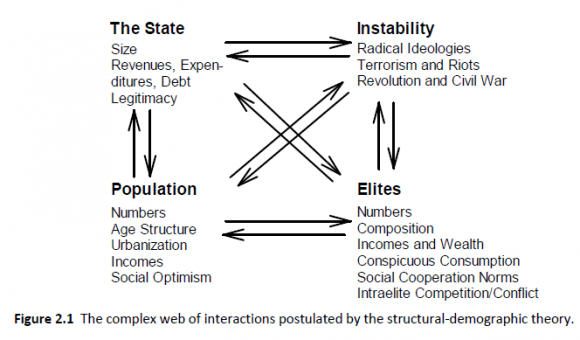
"Ages of Discord" also tests this theory against the example of American history, with special attention to turning points in different trends, which show a remarkable degree of coherence.
One table lists 29 proxies representing 15 variables, all but one of which — life expectancy — reversed direction within about a decade of 1970. These include three proxies of labor oversupply; two of economic and health well-being; three of social well-being and economic inequality; two of elite overproduction, intra-elite competition and intra-elite cooperation; three of cooperation and equity; and one of intra-elite fragmentation, patriotism, state legitimacy, state capacity and sociopolitical instability.
In short, Turchin finds that it wasn't just similar social trends that changed together; trends from every aspect of the model changed direction around the same time.
Conservatives have repeatedly blamed liberals for all manner of social ills, such as the decline in the number of children in two‐parent households, which began during that period. But other trend reversals at the same time — top 1 percent income and wealth shares, real minimum wage, labor union coverage, etc., clearly signal shifts in a more conservative direction.
What's more, similar broad, interrelated changes have occurred repeatedly throughout history, and the positive trend directions that were reversed around 1970 were set in motion decades earlier, and reinforced by major developments of the New Deal. The halcyon days of the 1950s did not reflect a lengthy lost golden age, Turchin argues. Rather, they were a cyclic echo of the “Era of Good Feelings” around 1820, when social discord was at a low ebb, and there was only one national political party — a period that also quickly gave way to new forms of intense social conflict.
The core of the theory in pre-industrial form is that population growth in excess of agricultural productivity gains leads to falling living standards (“popular immiseration”), urban migration, and unrest. It also results in “elite overproduction” — less money for ordinary workers means more for elites, whose numbers grow, producing their own set of problems in the form of intra‐elite competition, rivalry, fragmentation and loss of cohesion. Population growth also leads to growth of the army, state bureaucracy and taxes, pushing it toward fiscal crisis, state bankruptcy and loss of military control, opening the way for elite fragments to rebel and/or mobilize popular resentments to overthrow central authority.
Social integration and disintegration alternate in cycles lasting two or three centuries, overlaid with a shorter 50-year cycle roughly corresponding with two generations, reflecting the fact that social unrest tends to spread, burn itself out, and then rekindle during disintegrative phases: 1870, 1920 and 1970 all approximated such peaks in our own history. America's long cycle has been more rapid than most, probably due to faster population growth — there was a full cycle from 1780 to 1930, and an incomplete cycle since, each dealt with in separate sections of the book. But there's surprisingly little difference from the workings of the pre-industrial model.
While the theory only claims to establish broad, somewhat flexible relationships, because specific historical events not captured by the model inevitably occur and have significant impacts, the broad range of changes roughly in sync — especially around 1970, where the quality and quantity of data is best — is strong evidence in support. But there are also some strikingly exact examples, as seen in the fleshing out of a relatively simple model to explain the level of real wages over an 80-year period:

Because Turchin's focus is on the model and how well it accounts for measurable historical changes, the book is not a set of prescriptions for how to get out of our current mess. But the example of how we escaped the last time is surely useful in a general sense. While the New Deal is considered a turning point by many historians and social scientists, Turchin notes, “When we look at major structural‐demographic variables, however, the decade of the 1930s does not appear to be a turning point. Structural‐demographic trends that were established during the Progressive Era continued through the 1930s, although some of them accelerated.” It's that earlier era, therefore, that deserves our attention. And what we find is a surprisingly mixed bag of what we might today call liberal and conservative measures, intended to restrain out-of-control competition and conflicts.
On the liberal side of things, society turned against unregulated laissez-faire competition, and toward limited recognition of labor rights. When the Great Depression hit, wages were not cut as a result of this changed outlook, even while unemployment skyrocketed. On the conservative side, there was “the 'closing of the patriciate,' in which the established elites close their ranks to newcomers and dramatically reduce, or even reverse upward social mobility.” Elite entry was restricted both through admissions policies at Harvard, Princeton and Yale (hitting Jews and blacks especially hard) and by reducing the number of medical and dental schools, for example.
The elite's turn toward a concern for social harmony meant better treatment for those deemed worthy, at the same time it became more concerned with excluding those seen as not fitting in. This explains both increased exclusion of non-WASPS from the Ivy League and the virtual termination of European immigration, as well as other features of the Progressive Era Turchin doesn't measure, such as the Jim Crow purging of blacks from Southern voter rolls and the growth of the eugenics movement.
One obviously doesn't have to approve of every social reform of that period to appreciate the fact that they did help rebuild social trust, eventually reaching levels not seen since the 1820s. This is what science at its best does for a democracy — not tell us what we must do, but clarify the costs, benefits and trade-offs involved, including the tragic costs of doing nothing. "Ages of Discord" is not a how-to book for fixing our fragmented social and political order, but it is an invaluable guide for actually understanding what has gone wrong, and the kinds of things that are needed to set things right. It's a starting point for serious discussion and dialogue, first to absorb that understanding, and then to apply it.
That's where things get problematic. In order to gain understanding there's got to be a desire to learn. Examples like global warming — an existential threat not just to America, but to modern civilizations — do not suggest the desire is there, at least not yet.
But this election cycle is shaking things up to an extraordinary degree, creating a growing number of strange alliances. There are still many vapid calls and efforts for “bipartisan action” and “consensus,” which fail to take seriously the depth of problems that we face. "Ages of Discord" takes full account of how deep those problems are — they have repeatedly brought about civil wars — and yet it also reflects how, over and over again, social trust and cooperation has been rebuilt, even from the ashes of the most bitter struggles. Now that we know more than ever about this process, we have a rare opportunity for dramatically improving how well we all live together.
PAUL ROSENBERG
Paul Rosenberg is a California-based writer/activist, senior editor for Random Lengths News, and a columnist for Al Jazeera English. Follow him on Twitter at @PaulHRosenberg.
MORE FROM PAUL ROSENBERG
Related Topics
Ages Of Discord Ages Of Discord: A Structural-demographic Analysis Of American History American History Anthropology Books Editor's Picks Elections 2016 Our Picks: Books Peter Turchin U.s. History
joe diN laura i civil war, buy guns 2/19
==
==
Winners Take All by Anand Giridharadas
Former New York Times columnist Anand Giridharadas takes us into the inner sanctums of a new gilded age, where the rich and powerful fight for equality and justice any way they can--except ways that threaten the social order and their position atop it. We see how they rebrand themselves as saviors of the poor; how they lavishly reward "thought leaders" who redefine "change" in winner-friendly ways; and how they constantly seek to do more good, but never less harm. We hear the limousine confessions of a celebrated foundation boss; witness an American president hem and haw about his plutocratic benefactors; and attend a cruise-ship conference where entrepreneurs celebrate their own self-interested magnanimity. Giridharadas asks hard questions: Why, for example, should our gravest problems be solved by the unelected upper crust instead of the public institutions it erodes by lobbying and dodging taxes? He also points toward an answer: Rather than rely on scraps from the winners, we must take on the grueling democratic work of building more robust, egalitarian institutions and truly changing the world. A call to action for elites and everyday citizens alike.
book kpfa
death spiral IRS cuts: but also polar Matthew Effect
[OMG]
The story has been different for poor taxpayers. The IRS oversees one of the government’s largest anti-poverty programs, the earned income tax credit, which provides cash to the working poor. Under continued pressure from Republicans, the IRS has long made a priority of auditing people who receive that money, and as the IRS has shrunk, those audits have consumed even more resources, accounting for 36 percent of audits last year. The credit’s recipients — whose annual income is typically less than $20,000 — are now examined at rates similar to those who make $500,000 to $1 million a year. Only people with incomes above $1 million are examined much more frequently.
==
==
wapo 12/18
It’s the Economies, Stupid
The key to understanding the 2018 midterm results — and the future of American politics — isn’t ideology or culture.
It’s the different economies of red and blue America.
Story by John B. Judis
NOVEMBER 29, 2018
The evening of Tuesday, Nov. 6, brought the latest visual manifestation of our highly divided country: the 2018 midterm elections map. The map was similar to previous election maps — blue on the coasts and, across the rest of the country, wide swaths of red interrupted by blue dots. The major change was in the size of those blue dots: Increasingly, they seemed to be composed of both large cities and the suburbs that surround them. But why?
Listen to this and other great stories from The Washington Post Magazine on the Curio app.]
For two years, the main analytical lens for explaining the unshakable red-blue division in American politics has been culture and ideology: Fox News vs. MSNBC. Gun owners vs. gun skeptics. Colin Kaepernick detractors vs. Colin Kaepernick supporters. “How Everything Became the Culture War” read one recent headline in Politico Magazine. And on the surface, the 2018 midterm elections did indeed appear to boil down to cultural issues: the approach of a caravan of Honduran migrants; the rival narratives of Brett Kavanaugh and Christine Blasey Ford; and perhaps most of all, the political style of President Trump, which Democrats view as exceedingly offensive and many Republicans have come to see as acceptable or even admirable.
Yet in that map — and in those expanding blue dots — was a clue to another lens, one that often gets short shrift in explaining the fracturing of our country. That lens is economics — specifically, jobs. Red and blue America aren’t separated just by their cultural politics; they are separated by sharp differences in how their economies have developed over the past half-century. And those economic differences can, in turn, explain many of the cultural differences that so bedevil our political system.
There are, of course, a number of different sectors of the American economy, and those sectors can have varying kinds of political influence on the people who work in them. But it’s the changing dynamics of two particular sectors — the older industrial economy and the newer ideas economy — that explain how the current U.S. electoral map came to be. Which is why, here in Washington, if we want to formulate policies that might begin to heal our democracy, we need to pay attention not just to ideology and culture, but also to what those blue dots are telling us about where and whether people go to work each day.
Over the past 50 years, America’s industrial economy — based in the production of steel, ships, cars, textiles and other goods that were often made by factory workers on assembly lines, plus the service jobs that flourished around them — has declined substantially. Many of the older industrial sectors have become automated; they produce more with fewer workers. Other industries have moved abroad to lower their costs or have closed down in the face of foreign competition, particularly, over the past 15 years, from China. Between 1979 and today, the number of manufacturing jobs has plummeted from 19.4 million to 12.7 million.
The older industrial economy was based in cities and towns — Midwestern locales like Chicago, Gary, Detroit, Muncie, Akron, Allentown and Pittsburgh; and Southern towns like Mobile and Greensboro. The blue-collar workers tended to live in the cities, and the white-collar office workers and managers in the suburbs. As the older industries have fallen into disrepair or moved, some of the towns and cities have fallen on hard economic times. Many residents have moved to nearby suburbs; their children, if they were able to, left as soon as they finished school.
Alongside the decline of this old economy, a new, knowledge-based economy has arisen. This economy specializes in ideas — embodied in such goods as pharmaceuticals, semiconductors, movies and software. MIT economist Peter Temin has dubbed this sector “FTE”: finance, technology and electronics. In recent years, metropolitan areas identified with FTE have prospered and expanded outward. Some of the FTE areas, like Chicago, Los Angeles and Seattle, are former centers of goods production that have managed to reinvent themselves; others, like Austin and Northern Virginia, are places where the economy was long rooted in government and education. In all of these areas, the older distinction between the city, where production takes place, and the suburbs, where the white-collar workers live, has broken down. Microsoft is a Seattle company, but it is located in a suburb. New Jersey’s pharmaceutical industry is suburban, and much of New Jersey itself is a contiguous suburban metro area.
Metropolitan areas that specialize in a new, knowledge-based economy have prospered and expanded outward.
These areas often have one or more major universities. They host a high percentage of college-educated workers (frequently with advanced degrees), some of whom are highly skilled immigrants. They also include a sizable class of service workers, who are often immigrants and who clean the buildings, mow the lawns, make the beds, drive the taxis and take care of the children of two-earner families. Some of these areas, like Chicago and Los Angeles, include older, low-income, mostly African American inner-city neighborhoods; but African Americans have also increasingly moved into middle-class suburbs like those of Prince George’s County outside Washington, D.C. In fact, from 2010 to 2014, the African American population in the suburbs of the 20 largest metro areas grew by 7.1 percent, while the urban population grew by a bare 0.1 percent.
The regions built around FTE are almost always geographically distinct from the old industrial areas and from areas dominated by agriculture or resource extraction. The separation of the regions has proved to be self-reinforcing, as new high-tech firms seek to be near other high-tech firms and in areas where there are major universities and a high percentage of college-educated workers. In “The New Geography of Jobs,” economist Enrico Moretti has described this process as “geographical agglomeration.”
If you want to see geographical agglomeration in action, look no further than the now-concluded battle over where Amazon.com would locate its next headquarters. (Amazon CEO Jeffrey P. Bezos owns The Washington Post.) The finalists included FTE locations like Austin, Chicago, Atlanta, Los Angeles, Philadelphia, Boston and Denver; the winners — New York and the D.C. metro area — are two of the most FTE-friendly places in the country.
These geographically separate economies have produced very different ways of living — and, crucially, very different personal identities. Identity — the result of imagining ourselves as part of a larger group or cause — invariably plays an essential role in all of our lives. It can contribute to a sense of pride and boost self-esteem; it can even — in the case of an extended family, a religion or a nation — ward off the fear of our own death by allowing us to feel connected to a group or a set of principles that will outlive us.
Many Americans (primarily but not all white) who once lived comfortably in older Midwestern and Southern towns have had important parts of their identity stripped away by the transformation of the U.S. economy. Many of them once enjoyed lifetime employment from the same company and could identify with that company — whether it was General Motors or Sears. They also may have enjoyed the protection and solidarity of belonging to a union. They lived in neighborhoods and frequented the same bars, restaurants, churches and bowling alleys. They and their friends had gone to the same high schools and followed the same local teams. They owned their homes and protected them by owning guns. Many of the men had served in the armed forces and belonged to veterans’ groups.
Move ahead to now: The company has left. The union is gone. The neighborhood is gone. Many of the working-class whites, like the Trump supporters in Ohio I interviewed for my last book, have moved to nearby suburbs, where the main public square is the shopping mall. As identities made possible by the old jobs and the old economy have faded, other identities — ones often associated with hard-line conservative politics — have both endured and filled the void: strong identification with the traditional family, with the home (for which these voters see gun ownership as an essential means of protection), with church and religion, with the flag and the nation. Interwoven among these identities are ones that are fundamentally rooted in resentment: toward undocumented immigrants whom they believe their taxes subsidize; toward both legal and undocumented immigrants who they see as upending the mores and language of their hometowns; toward those minorities who, in their minds, benefit unfairly from affirmative action; and toward distant elites in the cities who project disdain for them and their way of life.
People in industrial America have had many of their identities stripped away by the decimation of the old economy.
These Americans formed much of the political base for the religious right of the 1980s and ’90s, the gun rights movement, the anti-immigrant movement and the tea party movement. They now provide the most fervent backing for Trump’s presidency. His electoral college majority in 2016 was based on their support in states like Ohio, Pennsylvania and North Carolina, together with more traditional Republican support from small and big business and from states like North Dakota and Oklahoma, which are dominated by agriculture and resource extraction.
In the FTE areas, the situation could not be more different. Whereas the people who still live in industrial America have had many of their identities stripped away by the decimation of the old economy, the residents of new metropolitan centers suffer if anything from a surfeit of fluid identities. They celebrate Thanksgiving and would defend the United States if it were attacked, but Trump’s slogan, “Make America Great Again,” has little meaning for them. They don’t look back upon a golden age of GM and Sears and the neighborhood pub. They identify as family members or parents, but their conception of family has been significantly broadened by the feminist and sexual revolutions that began in the 1960s.
Will the Democrats wake up before 2020? A definitive inquiry into the state of the party.]
They may have fond memories of the places where they grew up, but many take more pride in the university they attended. (When I first came to Washington in 1982, I used to amuse myself by privately speculating how long it would take for a downtown hotshot to tell me what university — invariably Ivy League — he had graduated from.) They often belong to professional associations. They derive their identities in part from the products they produce — software, articles, movies — and from the prestigious firms where they work. They are more likely to be part of experimental families, more likely to be gay or have gay friends, more likely to agitate for LGBTQIA rights. (Even in 2018, how many residents of middle America can accurately parse those initials?) They don’t think of themselves as tied to one city. They save their money to travel. They identify as Americans, but also as cosmopolitans. They recoil at Trump calling himself a “nationalist.” They see his supporters as ill-educated bigots, and they see themselves as part of a new global network linked by the Internet.
True, these are sweeping characterizations, and not everyone who lives in FTE areas adheres to them. For one thing, not everyone writes code for a start-up or has graduated from college; invariably, these areas have sizable low- or mid-wage service industries. Yet it is reasonable to assume that those FTE residents who work in service are not immune to the broader values and outlook of the economy that surrounds them. As I told my daughter when she moved to the Bay Area a decade ago, people there won’t want to know what job you have; they’ll want to know what you are “into.” The barista may also be an aspiring actor; the Uber driver (as one in Houston informed me) makes rap videos; the landscaper may have built (as ours did) a political website.
The Democrats’ electoral college majorities in the Barack Obama years and their popular majority in 2016 were powered, in part, by the multiethnic and multiracial members of this urban-suburban FTE economy and culture. Their growing ranks offered a powerful (and overlapping) supplement to the ranks of minority voters who — even when they do not live in FTE areas — have long placed, and continue to place, their faith in the Democrats as the party of civil rights, and of government assistance for those in need.
This electoral coalition is, of course, far from stable — it is riven, for instance, with conflicts over neo-liberalism vs. progressivism and over how much to emphasize racial justice and affirmative action — but it persists and grows because of common opposition to what the Trump coalition stands for. And like the Republican coalition, it is at least partly explained by the kinds of jobs that exist in the places where many of these voters live.
So how did the divide between the different American economies manifest in the 2018 U.S. House races? Let’s start with Virginia, specifically the counties of Northern Virginia and those outside Richmond and Norfolk. These suburbs and exurbs had once been heralded as Republican strongholds, with Democratic support in Richmond or Norfolk strongly linked to African American voters and civil rights; but in 2018, Democrats won almost the entire area stretching from the Northern Virginia suburbs down to Norfolk and Virginia Beach and over to Richmond and its suburbs. Trump was a factor, but so was the spread of the knowledge economy. In Loudoun and Fairfax counties, where Democrat Jennifer Wexton defeated Republican incumbent Barbara Comstock, high-tech firms line the highway to Dulles Airport, and nearly 59 percent of Loudoun residents and 60 percent in Fairfax have at least four-year college degrees.
In Illinois, Democrats extended their reach beyond Chicago and the Cook County suburbs like Evanston to what had been Republican bastions in predominantly white and upscale DuPage and McHenry counties. These counties have become part of the greater Chicago new economy. DuPage County, where Democratic businessman Sean Casten ousted Republican Rep. Peter Roskam, now boasts the Illinois Technology and Research Corridor. Nearly half its residents have four-year college degrees. Very similar results occurred in what had once been thought of as Republican exurbs adjoining metropolitan areas in New Jersey, New York, Pennsylvania, Minnesota, California, New Mexico and Washington state.
Democrats also extended their reach to metropolitan areas in the South. Newt Gingrich’s House Republican majority in 1994 was based in part on places like the Atlanta suburbs of Fulton, Cobb and Gwinnett counties. But in this election, Democrat Lucy McBath defeated incumbent Republican Rep. Karen Handel in Fulton and Cobb, and Democratic challenger Carolyn Bourdeaux managed to force a recount in Gwinnett — in a district that had not previously been competitive — before ultimately losing. These counties are very much part of greater Atlanta’s new economy. In McBath’s district — home to Alpharetta, which brands itself as “the Technology City of the South” — 56 percent of eligible voters have college degrees and 21.6 percent have advanced degrees.
In Georgia’s major statewide race, Stacey Abrams nearly became the nation’s first African American female governor. Yet black turnout — which only went from 29 percent of the electorate in 2014 to 30 percent in 2018 — was not the main factor in her impressive showing. Instead, the statistic that best explains her near-win was the flip in college-educated voters, who went from 55-45 Republican in 2014 to 54-45 Democrat in 2018.
Something very similar happened in Houston and Dallas, where Democrats won in highly educated, wealthy suburban districts that Republicans had long controlled. (Democrats even picked up a seat in upscale Charleston, S.C., and the coastal resort areas.) Democrats also scored in other metropolitan areas that Republicans had previously dominated. In Kansas City, Kan. — the home of Sprint — Sharice Davids, a Native American lesbian, ousted Republican Rep. Kevin Yoder. If you take the 19 American cities that Amazon listed as finalists for its new headquarters, all of them now have Democratic House members.
By contrast, Republicans remained strong in places like the newly created congressional district in southwestern Pennsylvania — made up of small towns that had been manufacturing centers but had lost jobs during the Great Recession. Indeed, according to a post-election analysis by Priscilla Alvarez, Frankie Dintino and Caitlyn Hampton in the Atlantic, Republicans won 68 percent of the vote in manufacturing towns, which are primarily in the Midwest and South.
In southern Minnesota, meanwhile, Republicans flipped a seat that is a microcosm of the electoral divide. The district is split between Rochester — a midsize city of 115,000 that contains the Mayo Clinic and votes Democratic — and former manufacturing and farm towns to the west that have attracted migrant farmworkers, have very few college graduates and have become dependably Republican. In the 2018 election, the Republican candidate, relying on his margin outside Rochester, narrowly upset the Democrat.
To be sure, not all of this year’s results can be explained by the clash between economies. In the House races, Democrats were able to win over some Trump voters by warning of Republican efforts to allow insurance companies to deny coverage to people with existing conditions. Democratic Senate candidates in Texas and Arizona benefited from a boost in Hispanic support. And there is also little doubt that under a less incendiary president, Democrats might not have done as well in places like suburban Atlanta or Houston. But the trend toward political polarization between the two economies did not begin with Trump and won’t end after he leaves office. He merely accentuated it.
As the metropolitan areas grow and expand at the expense of older industrial towns and rural areas, they will — barring gerrymandering — make it easier for Democrats to maintain the House and also to win popular majorities in presidential elections. At the same time, Republicans may be able to maintain control of the Senate, where a relatively unpopulated state with no large new-economy metropolitan area can send the same number of representatives to Capitol Hill as California or Virginia. In this election, Democrats easily carried the House but lost Senate seats in Missouri, North Dakota and Indiana, three states that have few, or any, FTE metro areas. In other words, a split Congress — with all the gridlock that suggests — may become the norm in American politics.
[Related
How to fix American democracy: 38 ideas that get beyond our day-to-day political upheaval]
The divisions between the two economies also make more likely the prospect of the electoral college — which tilts in favor of less populated states that are not dominated by metropolitan areas — failing to reflect the will of a majority of voters. That, in turn, may raise questions about the legitimacy of our presidential elections. Results like 2000 and 2016, when Republicans lost the popular vote but won the presidency, could become increasingly common.
Perhaps the most troubling — and thorny — upshot of these changes is that they have given rise to the latest culture wars, which in turn serve to distract us from addressing the economic issues that have caused so many of our divisions in the first place. Trump, to his credit, seems to have geared his trade policy toward reviving manufacturing in the forgotten regions of middle America. But whatever benefit Americans may get from Trump’s trade policies — and it’s still not clear there will be any — is certain to be outweighed by his never-ending attempts to inflame cultural divisions by inciting nativist fears and racial hatred.
It’s hard to imagine America finally confronting the differences in prosperity and prospects between red and blue areas as long as Trump and his tweets occupy center stage, transfixing Democrats and Republicans alike. Yet for the sake of America’s future, we are going to have to find a way to talk honestly about the massive divide caused by the two economies — and somehow, start working to bridge it.
John B. Judis is the author of “The Nationalist Revival: Trade, Immigration, and the Revolt Against Globalization.”
==