Caesar Rodney Inst
---
NO MERRI
DENIAL HEARTLAND CFACT ASTROTURF
see offshore wind
bak 11 22 CRI
NOTE HEATHER HONEY HAS ORG W/ SAME NAME ELECTION BS
ZUCKERBUCKS BS IS ONE OFF?
---
EPI LEGIT
David Stevenson, who led a national campaign against offshore wind power for the Delaware-based Caesar Rodney Institute, is now fighting land-based solar and wind farms and promoting fossil fuels and nuclear power with the Michigan-based Mackinac Center for Public Policy, a group funded by the donor network of petrochemical billionaires Charles and Chase Koch.
The Caesar Rodney Institute (CRI) and Mackinac Center are both affiliated with the State Policy Network (SPN), which serves as the central hub of a 50-state network of right-leaning think tanks. SPN has long sought to derail state clean energy and climate change policies, and is funded by right-wing and corporate donors that include fossil fuel interests.
“The free-market policy approach employed by affiliated state think tanks helps to identify policies that are focused on helping all people to flourish,” SPN states in the FAQ section of its website.
SPN’s approach to energy policy contradicts its claim to promote policies based on free market principles. In 2024, SPN identified preventing states from adopting wind and solar power as one of the network’s legislative priorities. SPN further encourages politicians to pick winners and losers in the electricity sector by favoring coal, natural gas, and nuclear power.
Last year, SPN credited years of work by CRI and SPN’s Offshore Wind Working Group with laying the groundwork for the Trump administration’s efforts to halt the nation’s offshore wind boom.
Stevenson has said he resigned from his position at CRI in October over a salary dispute, after spending 14 years as Director of CRI’s Center for Energy & Environmental Policy. Stevenson landed his new job as the Mackinac Center’s Director of Energy and Environmental Policy by December. He replaced Jason Hayes, who left the Mackinac Center for the Trump-aligned America First Policy Institute.
During his first few months in Michigan, Stevenson has supported the Mackinac Center’s efforts to derail Michigan’s Healthy Climate Plan and 100% by 2040 clean energy standard, and enable fossil fuels and nuclear power to supplant renewable energy sources like wind and solar power as the Great Lakes State’s primary power sources for the future.
At the Mackinac Center, Stevenson will have at his disposal the resources of an SPN group with significantly more funding than CRI and that, unlike CRI, has received hundreds of thousands of dollars in publicly reported funding annually from Koch-led groups in recent years.
CRI reported revenue of $463,000 for 2024 in its most recent annual report to the IRS. The Mackinac Center reported revenue of over $11 million for 2024, and its lobbying arm, Mackinac Center Action, reported nearly $1.5 million in revenue.
The Kochs’ Stand Together Trust and Stand Together Fellowship organizations reported contributing close to $1.7 million to the Mackinac Center for Public Policy between 2020 and 2024.* The Koch group Americans for Prosperity contributed $550,000 to Mackinac Center Action in 2023 and 2024.
Stevenson and the Mackinac Center use their opposition to wind and solar power as leverage to push for propping up uneconomic coal plants and increasing gas and nuclear power
“Two news outlets, including Bloomberg News, declared him [Stevenson] to be the man who killed offshore wind,” Jarrett Skorup, the Mackinac Center’s Vice President for Marketing and Communications, said in an article earlier this year announcing Stevenson’s hiring.
The Bloomberg story Skorup referenced was the first to report on a policy proposal prepared by Stevenson that showed how CRI’s anti-offshore wind campaign fit into a broader policy agenda that included using the promise of emerging small modular reactor technology (SMR) as leverage for delaying the planned closure of the coal-fired Indian River power plant in Delaware.
In early January of last year, Stevenson emailedcopies of a “SMR Nuclear proposal” he’d prepared for Delaware’s Governor Matt Meyer to Natalie Magdeburger, the mayor of Fenwick Island, along with a copy of a draft anti-offshore wind executive order intended for then president-elect Donald Trump. The Energy and Policy Institute obtained a copy of Stevenson’s email and the attachments through a records request to the Town of Fenwick Island.
[MANY DOCS]
Under Magdeburger’s leadership, the Town of Fenwick Island contributed $10,000 in taxpayer money to the CRI’s anti-offshore litigation fund, as requested by Stevenson.
“CRI is funded entirely from the voluntary contributions of individuals, foundations and corporations,” CRI says on the FAQ section of its website. “CRI neither solicits nor accepts government funding.”
State think tank affiliates of SPN must “not accept government funding,” according to SPN’s website.
The “SMR Nuclear proposal” Stevenson shared recommended that Meyer initiate a dialogue with Exelon and Delmarva Power about purchasing the Indian River coal-fired power plant in Delaware, which would close the following month. Stevenson’s proposal pointed to “headwinds” facing offshore wind, including from the incoming Trump administration, and recommended Exelon purchase the Indian River plant and eventually convert it to SMR.
“Since there is a long lead time to build SMR’s Exelon would need to operate with coal until the replacement becomes available,” Stevenson said in the proposal, which called for Exelon to sell the power from the plant to Delmarva Power, which is owned by Exelon.
Stevenson’s proposal said Delaware would also need to waive Indian Point’s compliance with the Regional Greenhouse Gas Initiative (RGGI) for the extended period when the plant would continue to burn coal. CRI has long opposed RGGI, the multi-state cap-and-trade program that’s helped reduce power sector greenhouse gas emissions in the Northeast and generated funding for energy efficiency and clean energy programs that have saved utility customers $2.7 billion as of 2023.
In 2017, Stevenson acknowledged that his consulting firm, Alternative Strategies Consulting, had worked for “utilities and large energy users” while under examination in a lawsuit where he challenged Delaware’s implementation of RGGI. Stevenson said at the time that he was required to keep the names of all of his clients confidential.
Republican state lawmakers in Delaware have since picked up on the idea of restarting the Indian River coal plant, and potentially converting it to SMR or gas. The plant’s owner, NRG, has said it closed the Indian River plant for economic reasons after two straight years of financial losses for the plant.
Earlier this year, Stevenson contributed to a report where the Mackinac Center laid out its 2026 energy policy recommendations for state lawmakers in Michigan, and called for replacing aging coal plants with nuclear, not wind and solar, power.
“… both the JH Campbell and Monroe coal-fired plants may be suitable locations for either large scale or small modular reactor units,” the Mackinac Center report said.
The report claimed that state lawmakers could save millions by delaying power plant closures, and linked to a December blog post by Stevenson defending the Trump administration’s controversial orders delaying the planned closure of the J.H. Campbell coal plant originally scheduled for May of last year. In the blog post, Stevenson pointed to a 2025 report where the Mackinac Center called for keeping the J.H. Campbell and Monroe plants running until 2040, long past their planned closure dates.
Consumers Energy, which owns the J.H. Campbell plant, has reported that the cost of complying with the Trump administration’s orders has reached $400 million. Consumers Energy is passing those costs on to electric utility customers throughout the 15-state Midcontinent Independent System Operator (MISO) regional power grid that includes Michigan. Consumers Energy had previously expected that replacing the J.H. Campbell plant with solar power and energy storage would save Michigan customers $600 million by 2040.
In March, Trump appointees at the U.S. Department of Energy and the Department of Justice cited Stevenson’s blog post in a legal brief defending the J.H. Campbell plant orders against a legal challenge by Michigan’s Attorney General Dana Nessel. Trump’s Secretary of Energy Chris Wright has issued multiple orders over the past year requiring Consumers Energy to delay closing the J.H. Campbell plant using emergency powers under Section 202(c) of the Federal Power Act.
“The Trump Administration is crying wolf over a non-existent energy emergency, while at the same time undermining every effort made to increase the efficiency, affordability, and reliability of domestic energy markets,” Nessel said last month, after Wright issued his fifth order targeting the plant for continued operation.
In his blog post, Stevenson argued that the J.H. Campbell plant should remain open at least until the Michigan Public Service Commission approves a new generation plan for Consumers Energy, and that state utility regulators should consider nuclear and natural gas as options for replacing Campbell.
The Mackinac Center wants to keep a DTE coal plant that buys petroleum coke from Koch Carbon running until 2040, rather than closing it by 2032
The Monroe coal plant is owned by DTE, which currently plans to close two of the plant’s four coal-burning units in 2028, and the remainder in 2032. DTE expects to save customers $1.4 billion by closing the plant.
Fuel receipt data compiled by the Energy Information Administration through Form 923 shows the Monroe plant buys petroleum coke from Koch Carbon, a subsidiary of Koch Industries, where Charles Koch is chairman and CEO and his son Chase is an executive vice president. Koch Carbon’s piling of petroleum coke in Detroit drew public scrutiny and protest in 2013, prompting the company to move the piles to Ohio. DTE was listed as one of the recipients of the pet coke stored at the Detroit location in Koch Carbon’s response to a request for information from the EPA’s Air Enforcement and Compliance Assurance Branch.
Stevenson and the Mackinac Center want to repeal Michigan’s landmark clean energy laws
In March, Stevenson delivered testimony in support of Michigan House Energy Committee Chair Pauline Wendzel’s “Project Lighthouse” legislation, House Bills 5710 and 5711, which would repeal Michigan’s landmark [2023 clean energy laws](https://www.michigan.gov/mpsc/commission/workgroups/2023-energy-legislation#::text=The%20laws%20also%20include%20three%20one-time%20proceedings:,Increases%20the%20cap%20from%201%25%20to%li%25).
The legislation approved by Republicans in the Michigan House would slow down the “build-out of the cheapest, fastest energy, limiting Michigan’s ability to leverage federal investments and pushing the state toward more expensive, long-term fossil fuel infrastructure” if it becomes law, according to the Michigan League of Conservation Voters (LCV).
It would also remove “basic planning and reporting requirements, allowing pollution to go unreported and increasing costs as energy demand grows,” Michigan LCV said.
In his testimony in support of the legislation, Stevenson again pointed to a 2025 report prepared for the Mackinac Center by the Center for the American Experiment, a Minnesota-based SPN affiliate, and Always on Energy Research, a SPN partner. The Lignite Energy Council, a coal industry group that’s opposed 100% clean energy legislation in neighboring Minnesota, paid the Center of the American Experiment $115,000 for electrical grid and reliability modeling in 2023.
The 2025 reportclaimed that powering Michigan with coal, gas, large-scale nuclear, and SMR would be cheaper than transitioning to a mix of wind, solar, nuclear, and energy storage. In addition to postponing the closures of the J.H. Campbell and Monroe plants until 2040, the report called for outfitting the state’s existing coal and gas plants with carbon capture and storage (CCS). The report also claimed relying on wind, solar, and energy storage “could lead to numerous blackouts throughout the year.”
“Our study might be contested,” Stevenson acknowledged in his testimony.
SMR projects in the U.S. and globally have run into cost overruns, according to the Institute for Energy Economics and Financial Analysis. Multiple high-profile utility projects aimed at demonstrating the commercial viability of CCS for coal plants have devolved into costly economic boondoggles mired in public scandal.
Always on Energy Research has churned out similar reports for other SPN groups, including two reports focused on New England’s power grid prepared for the Americans for Prosperity Foundation and SPN groups based in Connecticut, Maine, Massachusetts, New Hampshire, and Rhode Island. The Acadia Center, an environmental group working to halve carbon emissions in the Northeast by 2030, has published rebuttals of Always on Energy Research reports on New England.
“Misleading analysis grossly inflates the cost of clean energy, selectively ignores fuel savings, and proposes highly unrealistic alternative scenarios,” the Acadia Center said of Always on Energy Research’s methodology in its latest rebuttalin January.
Stevenson received funding from SPN to lead a nuclear waste discussion group with nuclear industry contacts
Isaac Orr of Always on Energy Research noted in a presentation to state lawmakers in North Dakota in September that Stevenson had joined Always on Energy Research as the group’s Director of Nuclear Development. The presentation included a slide that listed Stevenson’s nuclear industry contacts:
INDUSTRY CONTcts gfx always on
Orr’s presentation also said that Stevenson “currently chairs a discussion team to end the used nuclear fuel problem with key members of the nuclear industry, and states that may host recycling and storage through federal legislation.”
Stevenson said in an article last summer that he received a grant from SPN to form the discussion group, in which he described SPN affiliates’ work with supportive lawmakers to identify potential host-states for nuclear waste.
DonorsTrust contributed $50,000 to Always on Energy Research, $200,000 to CRI, nearly $2.9 million to the Mackinac Center, and over $9.8 million to the State Policy Network in 2024. DonorsTrust does not publicly disclose the names of its donors, but tax-exempt foundations that donate to Donor Trust are required to report those contributions publicly in their annual reports to the IRS.
Right-wing tech investor Peter Thiel’s foundation contributed $426,775 to DonorsTrust in 2024, and $1,276,111 in 2023. Thiel has backed major advanced nuclear and SMR start-ups like Oklo, Helion, and General Matters.
Stoking opposition to wind and solar farms
Last year, Stevenson sent President Trump’s political appointees to the U.S. Department of Interior a barrage of messages recommending actions the agencies could take to fulfill Trump’s campaign pledge to halt offshore wind development. EPI obtained copies of the communications through a FOIA request.
Stevenson served on Trump’s first Environmental Protection Agency transition team in 2016. The Mackinac Center has credited Stevenson’s earlier research as having “played a role” in killing the Clean Power Plan, the Obama-era EPA’s attempt to regulate greenhouse gas emissions from power plants nationally for the first time.
“Hi, I have been actively opposing offshore wind for both economic and environmental reasons since 2017, and formed a national coalition, the American Coalition for Ocean Protection, assisting a number of beach community groups organize and grow,” Stevenson said in one email sent to multiple Trump administration officials at DOI in mid-April of 2025.
Stevenson’s anti-offshore wind campaign began in Delaware with the launch of CRI’s Save Our Beach View campaign, which stoked local opposition to offshore wind projects planned off the coasts of Maryland and Delaware.
In 2021, Stevenson and CRI announced the launch of the American Coalition for Ocean Protection (ACOP) to raise money for anti-offshore wind litigation through the Ocean Environment Legal Defense Fund. Membership in ACOP included anti-offshore wind groups and SPN think tanks based along the East Coast, plus the Mackinac Center in Michigan.
The Mackinac Center has a history of opposing offshore wind power development in the Great Lakes region, but supports continued operation of Enbridge’s Line 5 oil and gas pipeline. Tribes, environmentalists, and the State of Michigan have fought for years to shut down Line 5, which runs below the Straits of Mackinac that connects Lake Michigan and Lake Huron, due the risk of a catastrophic spill.
CRI initially served as a fiscal sponsor for the anti-offshore wind group Protect Our Coast NJ.
CRI also offered to serve as a conduit to raise money for anti-offshore wind “Save the Horseshoe Crabs” ads in response to an email from Dianna Harris of Protect Our Coast Delmarva obtained from the Town of Fenwick Island.
“We are planning a zoom call next week with a wider group of about 50 people that have been paying close attention so we may raise some money then,” Stevenson said in one email to Harris.
In 2025, Stevenson and David Wojiick of the Committee for a Constructive Tomorrow served as the lead signers on a letter that called on Trump’s Secretary of the Interior Doug Burgum to revoke federal approvals for eleven offshore wind projects, including four that were already under construction. Cosigners included anti-offshore wind activists from the East and West Coasts, the Great Lakes region, and representatives of multiple SPN affiliate and partner groups.
Stevenson emailed the letter to Burgum to Trump appointees at DOI and BOEM. Laura Keehner Rigas, a White House Liaison to DOI, received a copy of the letter from Stevenson, and forwarded Stevenson’s email to four other political appointees.
“Thank you!” Deidre Kohlrus, a Senior Advisor to Burgum, responded to Rigas.
While operating out of Delaware, Stevenson signaled openness to solar and had solar panels on his roof. Upon arriving at the Mackinac Center, Stevenson quickly got to work attacking solar farms in Michigan.
“The future of electric generation is clearly nuclear, not solar, and state legislation needs to change in recognition of this reality,” Stevenson said in a January blog post for the Mackinac Center.
The Mackinac Center has for years served as a platform for promoting the views of anti-wind and anti-solar activists in Michigan, including Kevon Martis. In 2024, Martis was the public face of the Citizens for Local Choice ballot committee, which aimed to repeal a 2023 Michigan law that streamlined siting of wind and solar farms. Citizens for Local Choice failed to gather enough signatures to get the issue on the ballot, but received a $10,000 contribution from Tom Rastin, a retired gas industry executive who has bankrolled opposition to solar farms in neighboring Ohio.
“Solar projects often face resistance from local governments,” Stevenson wrote in his blog post in January.
“Recognizing local opposition, the Legislature gave the Michigan Public Service Commission authority to override local permit bans,” Stevenson said in the same blog. “Opponents to this law are attempting to repeal it through a ballot initiative.”
Citizens for Local Choice appears to be inactive, but Republican lawmakers in Michigan targeted the 2023 siting law this year as part of Project Lighthouse, as the Mackinac Center noted in another blog post.
Michigan ranked among the top 10 states for new solar additions during the first quarter of this year, according to the Solar Energy Industries Association.
Stand Together Trust reported contributions to the Mackinac Center for Public Policy that totaled $525,000 in 2022 and $400,000 in 2023, both for general operating support, and $421,400 for 2024 for “KAP” (the Koch Associate Program). Stand Together Fellowship contributed $350,000to the Mackinac Center for education in 2020.*}:
Top photo is a screenshot from a Michigan House video of David Stevenson’s testimony before the Energy Committee on April 14, 2026*
Always On Energy ResearchAmerican Coalition for Ocean ProtectionCharles KochChase Kochcitizens for local choiceCommittee for a Constructive TomorrowDavid StevensonDavid WojiickDeidre KohlrusDepartment of InteriorDonald TrumpDoug BurgumEnbridgekevon martisKoch CarbonLaura Keehner RigasLignite Energy CouncilOcean Environment Legal Defense FundProtect Our Coast DelmarvaProtect Our Coast New JerseyStand Together Trusttom rastin
---
---
NY POST
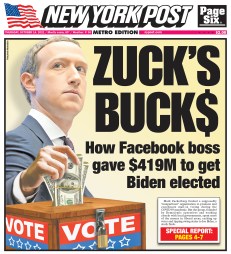
During the 2020 election, Facebook CEO Mark Zuckerberg spent hundreds of millions of dollars to turn out likely Democratic voters. But this wasn’t traditional political spending. He funded a targeted, private takeover of government election operations by nominally nonpartisan — but demonstrably ideological — nonprofit organizations.
Analysis conducted by our team demonstrates this money significantly increased Joe Biden’s vote margin in key swing states. In places like Georgia, where Biden won by 12,000 votes, and Arizona, where he won by 10,000, the spending likely put him over the top.
This unprecedented merger of public election offices with private resources and personnel is an acute threat to our republic and should be the focus of electoral reform efforts moving forward.
The 2020 election wasn’t stolen — it was likely bought by one of the world’s wealthiest and most powerful men pouring his money through legal loopholes.
See Also

### Exclusive book excerpt: How Facebook and Twitter rigged the game in 2020
The Center for Technology and Civic Life (CTCL) and the Center for Election Innovation and Research (CEIR) passed a staggering $419.5 million of Zuckerberg’s money into local government elections offices, and it came with strings attached. Every CTCL and CEIR grant spelled out in great detail the conditions under which the grant money was to be used.
This is not a matter of Democrats outspending Republicans. Private funding of election administration was virtually unknown in the American political system before the 2020 election.
Big CTCL and CEIR money had nothing to do with traditional campaign finance, lobbying or other expenses that are related to increasingly expensive modern elections. It had to do with financing the infiltration of election offices at the city and county level by left-wing activists and using those offices as a platform to implement preferred administrative practices, voting methods and data-sharing agreements, as well as to launch intensive outreach campaigns in areas heavy with Democratic voters.
 6
Joe Biden narrowly won the 2020 presidential election.REUTERS
For instance, CTCL/CEIR funded self-described “vote navigators” in Wisconsin to “assist voters, potentially at their front doors, to answer questions, assist in ballot curing … and witness absentee ballot signatures,” and a temporary staffing agency affiliated with Stacey Abrams called Happy Faces counting the votes amid the election night chaos in Fulton County, Georgia.
 6
Funded by Mark Zuckerberg, the Center for Technology and Civic Life was supposed to provide assistance for voting during the COVID-19 pandemic. But their coordination with local governments heavily favored getting out the vote in Democratic areas, an analysis finds.
CTCL demanded the promotion of universal mail-in voting through suspending election laws, extending deadlines that favored mail-in over in-person voting, greatly expanding opportunities for “ballot curing,” expensive bulk mailings, and other lavish “community outreach” programs that were directed by private activists.
[ 6](https://nypost.com/wp-content/uploads/sites/2/2021/10/14.METRO_.jpg?quality=90&strip=all "Open a slideshow of all 6 article images.")
CTCL drove the proliferation of unmonitored private drop boxes (which created major chain-of-custody issues) and opportunities for novel forms of “mail-in ballot electioneering,” allowed for the submission of numerous questionable post-election-day ballots, and created opportunities for illegal ballot harvesting.
CTCL greatly increased funding for temporary staffing and poll workers, which supported the infiltration of election offices by paid Democratic Party activists, coordinated through a complex web of left-leaning nonprofit organizations, social media platforms and social media election influencers.
The amount of additional money these groups poured into elections offices in Democrat-voting areas was truly staggering. To put it in perspective, federal and state matching funds for COVID-19-related election expenses in 2020 totaled $479.5 million.
The CTCL and CEIR money totaled $419.5 million.
These two private nonprofits were responsible for an 85 percent increase in total additional election funding — and that largesse was concentrated in a relatively small number of heavily Democratic municipalities.
Although CTCL and CEIR are chartered as nonpartisan 501(c)(3) corporations, our research suggests the spending that took place in 2020 was highly partisan in its distribution and its effects.
 6
Mark Zuckerberg spent nearly $420 million in the run-up to the election.AP
Of the 25 grants CTCL provided to cities and counties in Arizona, Georgia, Michigan, North Carolina, Pennsylvania, Texas and Virginia that were $1 million or larger, 23 went to areas Biden won in 2020. One of the two counties won by Donald Trump, Brown County, Wisconsin, received about $1.1 million — less than 1.2 percent of the $87.5 million that CTCL provided to these top 25 recipients.
But even in Brown County, Wisconsin, where heavily Democrat Green Bay is located, the funding disparities are glaring. The Wisconsin legislature provided roughly $7 per voter to the city of Green Bay to manage its 2020 elections. Rural counties in Wisconsin received approximately $4 per voter.
The CTCL funds boosted Democratic-voting Green Bay resources to $47 per voter, while most rural areas still had the same $4 per voter. Similar funding disparities occurred near Detroit, Atlanta, Philadelphia, Pittsburgh, Flint, Mich., Dallas, Houston and other cities that received tens of millions of dollars of CTCL money.
Preliminary analysis shows this partisan targeting of CTCL funding was repeated in battleground states across the country. Our first case study, however, examines the effect of CTCL spending on the 2020 election in Texas.
The figure below shows the counties that received CTCL spending ranked by per-capita CTCL spending in Texas. As can easily be seen, the counties with the highest per-capita levels of CTCL spending were Democratic counties.
 6
It should be noted that Tarrant County, which contains Fort Worth, is listed as a Republican county but flipped Democrat in 2020. The DFW exurban Denton and Collin counties, which are solidly Republican, are not included here because they received no CTCL funding.
Funding and managing elections has always been a government function, not a private one, and for good reason. Private organizations are not subject to the rules for public employees and institutions — they are not required to hold public hearings, cannot be monitored via open-records requests and other mechanisms of administrative and financial transparency, are not subject to the normal checks and balances of the governmental process and are not accountable to voters if the public disapproves of their actions.
The practical effect of these massive, privately manipulated election-office funding disparities was to create a “shadow” election system with a built-in structural bias that systematically favored Democratic voters over Republican voters. The massive influx of funds essentially created a high-powered, concierge-like get-out-the-vote effort for Biden that took place inside the election system, rather than attempting to influence it from the outside.
 6
A voter submits a ballot in an official drop box during early voting in October 2020.AP
We call this the injection of structural bias into the 2020 election, and our analysis shows it likely generated enough additional votes for Biden to secure an Electoral College victory in 2020.
Our preliminary results in Georgia and Wisconsin suggest a similar impact on Biden’s vote margin from CTCL spending. And spending in those states was likely large enough and targeted enough to have shifted them into Biden’s column.
This research and analysis project will culminate in the creation of a counterfactual electoral map based on the combined results of our state-by-state analysis. It will reflect how the election results would have looked after the last legal ballot was counted if CTCL and CEIR did not spend their $419.5 million in 2020.
We have good reason to anticipate that the results of our work will show that CTCL and CEIR involvement in the 2020 election gave rise to an election that, while free, was not fair. The 2020 election wasn’t stolen — it was likely bought with money poured through legal loopholes.
*William Doyle, Ph.D., is principal researcher at Caesar Rodney Election Research Institute in Irving, Texas. He specializes in economic history and the private funding of American elections. Previously, he was associate professor and chair in the Department of Economics at the University of Dallas. Reprinted with permission from The Federalist.
---
GGL 5 26
AI Overview
Yes, William Doyle, Ph.D., is the research director and principal researcher at the Caesar Rodney Election Research Institute in Irving, Texas. [1, 2]
Profile & Expertise
- Role: Serves as Research Director at the Caesar Rodney Institute, a conservative-leaning non-profit.
- Focus Area: Specializes in economic history and the impact of private funding on American elections.
- Background: Formerly an associate professor and chair of the economics department at the University of Dallas. [1, 2]
Notable Research
- Zuckerberg Grants: Doyle is best known for his research on the influx of hundreds of millions of dollars from Facebook founder Mark Zuckerberg and his wife into local government election offices in 2020 (via the Center for Tech and Civic Life and the Center for Election Innovation and Research). [1]
- Media Commentary: His research on election administration, private funding, and campaign finance is frequently published in outlets such as The Federalist and The American Conservative. [1, 2]
[### William Doyle, Author at The Federalist

The Federalist
https://thefederalist.com › author › williamdoyle](https://thefederalist.com/author/williamdoyle/)
William Doyle, Ph.D., is research director at The Caesar Rodney Election Research Institute in Irving, Texas. He specializes in economic history.Read more
NO LNX
William Doyle, Ph.D., is research director at The Caesar Rodney Election Research Institute in Irving, Texas. He specializes in economic history and the private funding of American elections. Previously, he was associate professor and chair in the department of economics at the University of Dallas. He can be contacted at doyle@rodneyinstitute.org.
Posts from William Doyle
Page 1 of 1
Elections
Democrats Can’t Shut Down Election Concerns So Easily This Time Because We Have The Receipts From 2020
William Doyle
November 4, 2024
Elections
Mass Mail-In Voting Is Democrats’ New ‘Blue Wall’ To Beat Republicans
William Doyle
September 16, 2024
Elections
How Red States Can Hold ‘Zuckbucks’ Group Legally Accountable For 2020 Election Meddling
William Doyle
July 2, 2024
2024
How College Student Voters Could Blow Up Democrats’ Ballot-Harvesting Election Ploy
William Doyle
May 15, 2024
Elections
Infamous ‘Zuckbucks’ Group Tries To Election-Meddle Again — This Time With Federal Tax Dollars
William Doyle
January 19, 2024
2022
Without Their Precious ‘ZuckBucks,’ Democrats Won’t Win Georgia In 2022
William Doyle
November 4, 2022
Elections
Don’t Be Fooled: ‘Nonpartisan’ Get-Out-The-Vote Efforts Always Benefit Democrats
William Doyle
September 15, 2022
Elections
Until Election Integrity Issues Are Fixed, Conservatives Should Not Stop Talking About The 2020 Election
William Doyle
August 15, 2022
Elections
How No-Excuse Absentee Voting Allows Special Interests To Manipulate Voters
William Doyle
February 15, 2022
Elections
Why The Wall Street Journal Is Wrong About The 2020 Election
William Doyle
January 28, 2022
Elections
Mark Zuckerberg’s $350 Million In Election Funding Went To Far-Left Activists, Not ‘Nonpartisan’ Outfits
William Doyle
January 18, 2022
Politics
The 2020 Election Wasn’t Stolen, It Was Bought By Mark Zuckerberg
William Doyle
October 12, 2021
[### “Why is the study of election funding so difficult? Well, it doesn't ...

https://www.facebook.com › emkinstitute › posts › why...](https://www.facebook.com/emkinstitute/posts/why-is-the-study-of-election-funding-so-difficult-well-it-doesnt-have-to-be-and-/815987590567027/)
William Doyle, Ph.D., is principal researcher at Caesar Rodney Election Research Institute in Irving, Texas. He specializes in economic history and the ...
[### William Doyle

The American Conservative
https://www.theamericanconservative.com › author › will...](https://www.theamericanconservative.com/author/william-doyle/)
William Doyle is Research Director at the Caesar Rodney Election Research Institute in Irving, TX. The Latest. How Mass Mail-In Voting Changes Everything.Read more
Missing: Ph. D., principal researcher
[### Mark Zuckerberg spent $419M on nonprofits ahead of ...

New York Post
https://nypost.com › 2021/10/13 › mark-zuckerberg-sp...](https://nypost.com/2021/10/13/mark-zuckerberg-spent-419m-on-nonprofits-ahead-of-2020-election-and-got-out-the-dem-vote/)
Oct 13, 2021 — During the 2020 election, Facebook CEO Mark Zuckerberg spent hundreds of millions of dollars to turn out likely Democratic voters.
[### When Facebook founder Mark Zuckerberg donated $400 million ...

https://www.facebook.com › posts › when-facebook-fo...](https://www.facebook.com/abc27news/posts/when-facebook-founder-mark-zuckerberg-donated-400-million-to-help-fund-election-/10159449512510420/)
... William Doyle, Ph.D., the principal researcher at the Caesar Rodney Election Research Institute in Irving, Texas, writes for The Federalist. Doyle, whose ...
[### t Stolen, It Was Bought By Mark Zuckerberg

Groups.io
https://groups.io › topic › the_2020_election_wasn_t](https://groups.io/g/PoliticallyIncorrect/topic/the_2020_election_wasn_t/86277457)
William Doyle, Ph.D., is principal researcher at Caesar Rodney Election Research Institute in Irving, Texas. He specializes in economic history and the ...
[### Zuckerberg had Trump's campaign team embedded in the ...

Facebook · Unions Australia
1 comment · 1 year ago](https://www.facebook.com/groups/unionsaustralia/posts/9521282804617368/)
Revealed: Trump campaign strategy to deter millions of Black Americans from voting in 2016. Rachel Griffiths and 13 others. 14 reactions ·.Read more
[### Zuckerberg Spent $419.5M to Push Democrat Votes in 2020

Newsmax
https://www.newsmax.com › Politics](https://www.newsmax.com/politics/facebook-zuckerberg-2020-democrats/2021/10/14/id/1040463/)
... William Doyle, Ph.D., the principal researcher at the Caesar Rodney Election Research Institute in Irving, Texas, wrote for The Federalist in the article ...
[### Facebook is commissioning an independent study on "the effects ...

https://www.facebook.com › NBCNews › posts › faceb...](https://www.facebook.com/NBCNews/posts/facebook-is-commissioning-an-independent-study-on-the-effects-of-social-media-on/2513266745360007/)
... William Doyle, Ph.D., the principal researcher at the Caesar Rodney Election Research Institute in Irving, Texas, writes for The Federalist. Doyle, whose ...
[### Did this just happen no generators? - Page 7

Class Racer
https://www.classracer.com › classforum › showthread](https://www.classracer.com/classforum/showthread.php?p=649957)
Election reform anyone? Credit; William Doyle, Ph.D., is principal researcher at Caesar Rodney Election Research Institute in Irving, Texas*. He specializes ...
mma 8 23
... shillnberger
- hrown to the Windrelies heavily on the work of “environment and energy activist” Lisa Linowes, who has longstanding ties to the fossil industry, including the Texas Public Policy Foundation.In 2018, Linowes was a senior fellow at TPPF, which for years has been “shaping laws, running influence campaigns and taking legal action in a bid to promote fossil fuels.” Linowes also has ties to the Institute for Energy Research, which has received funding from the Koch network,coal producer Peabody Energy, andthe Edison Electric Institute. In 2017, the Energy and Policy Institute discovered that a letter asking Congress to end the wind production tax credit that had been attributed to Linowes was seemingly written by an IER employee. Energy and Policy Institute,[12/11/17; Mastersource.org, 8/8/22; The New York Times, 12/4/22; Texas Public Policy Institute, 7/13/18;
- Linowes is also a member of Save Right Whales Coalition, which was founded in part by Environmental Progress, Shellenberger’s pro-nuclear nonprofit. Save Right Whales Coalition is a group of East Coast-based organizations that oppose offshore wind projects in the area. Linowes also runs an anti-renewable energy nonprofit called the WindAction Group. Environmental Progress, [8/13/23]
- Linowes has appeared on Fox programs multiple times to attack wind energy in recent years. In 2021, before she joined the Save Right Whales Coalition, Linowes was an expert in a Carlson-produced anti-wind energy documentary in which she claimed that industrial-scale wind development “is not about getting us off fossil fuels.” In June 2022, on Martha MacCallum’s radio show, Linowes claimed that offshore wind turbines could drive right whales to extinction. “These turbines are almost certainly going to stress them and may wipe them off the face of the earth,” she said. However, later in the interview, seemingly contradicting her previous statement, Linowes admitted, “We do not know what the impacts will be on these species.” On Fox Business in March 2023, Linowes called the Bureau of Ocean Management’s attitude toward protecting endangered right whales “cavalier.” Fox Nation,*Tucker Carlson Originals*, [10/21/21; Fox Business, The Big Money Show, 3/3/23; Fox Radio, The Untold Story with Martha MacCallum;6/30/2022]
- Another member group of the Save Right Whales Coalition has ties to conservative dark money groups via David Stevenson, a member of former President Donald Trump’s EPA transition team.Protect Our Coast New Jersey “belongs to the American Coalition for Ocean Protection (ACOP), which was founded by David Stevenson, who formerly served on Trump’s EPA transition team. Stevenson also heads the Center for Energy and Environment Policy at the Caesar Rodney Institute. Under Stevenson, Acop is fundraising to create a permanent wind energy exclusion zone along the east coast.” The Guardian, [7/31/23]
- Stevenson and the Caesar Rodney Institute have direct ties to the fossil fuel industry.Stevenson, who has publicly questioned the science of climate change, is a policy adviser for the Heartland Institute, a conservative think tank that recently sent thousands of climate-denying textbooks to teachers across the country. As Fast Company detailed, the Caesar Rodney Institute is a “nonprofit that has been backed by the conservative dark money groups Donors Capital Fund and DonorsTrust, along with the American Fuel and Petrochemical Manufacturers and the American Energy Alliance, a fossil industry group founded by a former Enron executive.” Fast Company, [3/1/23] Grist, [2/6/23]
- The acoustics expert featured in the documentary has publicly shared debunked climate change theories.Robert W. Rand of the Ocean Mammal Institute publicly supported the false claim that heat from the Earth’s core is a dominant factor influencing how the climate is currently changing. Twitter/X, [12/30/21, 4/27/23] USA Today, [2/14/23]
- ## Shellenberger has a track record of spreading misinformation about climate change...
---
mma 1 23
In an embarrassing attempt to undermine renewable energy, Fox host Jesse Watters platformed a fossil fuel industry-funded envoy flimsily disguised as an “ocean advocate” for Protect Our Coast NJ. Watters hosted self-described “Jersey Shore Lifer” Mike Dean, although he was misidentified on-screen as Mike Davis. Dean’s Twitter account demonstrates opposition to climate science, frequently retweeting Big Oil shill Steve Milloy and “#climatescam” posts.
dean – without evidence – blamed recent whale deaths in New Jersey on wind development and claimed, “The harms with these projects and the costs are limitless, and it’s really hard to find any benefits at all.” (While the cause of the deaths are not known yet, factors including oceanic plastic pollution, the presence of an anomalously large whale population in the area for this time of year due to warmer waters, and underwater sonar use by the military could all lead to these “unusual mortality events.”)
While Protect Our Coast NJ’s website boasts the group as “residents, homeowners, business owners, fishermen and visitors of the New Jersey coastal communities,” reporting has indicated that other interests are playing a part in the group’s activities. Popular Information’s Michael Thomas reported that the donation page redirects to a PayPal page for the Caesar Rodney Institute. The website also links to content from right-wing media’s favorite climate contrarian Michael Shellenberger. The Caesar Rodney Institute is a part of the State Policy Network, a network of conservative and libertarian think tanks.
The Caesar Rodney Institute has a history of hostility toward government environmental regulation and climate change mitigation policies. In 2021, the Caesar Rodney Institute’s Energy and Environment director, David Stevenson, a former member of the Trump EPA transition team, established the American Coalition for Ocean Protection (ACOP), a legal defense fund for groups to file lawsuits to fight offshore wind developments on the Eastern Seaboard. In 2022, the ACOP announced a partnership with Marc Morano’s Committee for a Constructive Tomorrow and the Heartland Institute to fend off a coastal Virginia offshore wind project.
As reported by The Intercept’s Lee Fang, the Caesar Rodney Institute has received funding from the American Energy Alliance, which in return was funded by fossil fuel insiders like the American Fuel and Petrochemical Manufacturers and Stand Together Chamber Commerce, a Koch Industries business trade group.
yahoo mail 11 22
shortly after he took office, President Biden announced a goal of building 30 gigawatts (GW) of offshore wind by 2030, enough clean energy to power 10 million homes. For the administration, the offshore wind target was a part of a larger strategy of reducing carbon pollution and putting the country on track for net-zero greenhouse gas emissions by 2050. But, like many clean energy plans, this one was met with immediate resistance.
In August 2021, CBS News reported that Nantucket Residents Against Turbines — or ACK Rats — launched a lawsuit against the administration's offshore wind plans. The Massachusetts-based resident group argued that offshore wind development “poses a threat to the critically endangered North Atlantic Right Whale.”
A few months later, a resident group in New Jersey launched another lawsuit against the Biden administration. Bob Stern, president of Save Long Beach Island, told Reuters that he and his fellow residents worried that the wind turbines would destroy their local tourism economy.
Within a year of announcing the goal, the Biden administration faced lawsuits from resident groups in every coastal state from Maine to North Carolina. Some groups sued over endangered whales. Others argued that the turbines would hurt their property values or the local fishing industry.
If you only read the news stories about these lawsuits, you might think this was yet another example of wealthy residents blocking clean energy development. Or you might see a familiar story of environmentalists getting in the way of environmental progress. But you’d be missing the most important part of the story. Nearly every story neglects to mention these groups are being funded by a far-right think tank that receives funding from fossil fuel companies and billionaires.
Who’s behind the offshore wind lawsuits?
According to their website, Protect Our Coast NJ — one of the groups opposing Biden’s offshore wind plans — is a group of “residents, homeowners, business owners, fishermen and visitors of the New Jersey coastal communities.” Media reports accept this description at face value.
In May 2022, Ashbury Park Press — the third largest newspaper in New Jersey — ran a story about Protect Our Coast NJ with the headline, “Could offshore wind turbines blow away Long Beach Island tourism?” The story positions Protect Our Coast NJ as a group of residents and features many of the talking points and studies on the nonprofit’s website:
Ric Bertsch, an Ocean City resident and member of the group Protect Our Coast NJ, which opposes the wind projects as they are currently designed, said he worries about the impacts to communities like his own.
He said the county will suffer the consequences of New Jersey's new experiment with offshore wind turbines, which will harm the tourist experience and block large swaths of ocean from commercial fishing
"The only brand (in Ocean City) that we have to offer the world is our old-fashioned values, our quiet, our peaceful place to be," said Suzanne Hornick, also of Ocean City and leading member of Protect Our Coast NJ. "This (wind turbine project) really screws with our brand."
As of this writing, the “Donate” button on the Protect Our Coast NJ website redirects to a PayPal link that reads “Donate to Caesar Rodney Institute.”
| [grift gfx] |
Caesar Rodney Institute (CRI)is one of more than 50 think tanks in the State Policy Network (SPN). As The Intercept’s Lee Fang reported, CRI receives funding from fossil fuel trade groups like the American Fuel & Petrochemical Association. The think tank also receives funding from Donors Trust, the “dark money ATM of the conservative movement.”
In September 2021, CRI’s David Stevenson — a former member of President Trump’s EPA transition team — held a press conference in front of the Massachusetts State House where he announced a legal fund for groups fighting Biden’s offshore wind plans. By that point, Stevenson had raised $75,000 from his network of donors, and said he hoped to raise $500,000 for the effort.
When asked by E&E’s Ben Storrow who was funding the campaign, Stevenson said, “So far there is no Koch money, not that we wouldn’t take it.”
CRI’s efforts quickly attracted the attention of much larger conservative groups like theHeartland Institute and Committee For A Constructive Tomorrow (CFACT). In September 2022, one year after the press conference, both organizations announced a partnership with CRI to sue an offshore wind project in Virginia.
According to the Union for Concerned Scientists, the Heartland Institute and CFACT have both received about $500,000 in funding from ExxonMobil. The Heartland Institute has been called “a leading force in climate change denial.” Media Matters for America named CFACT Founder Marc Morano its climate denier of the year in 2012. Marano, who began his career working for Rush Limbaugh, has said climate scientists “deserve to be publicly flogged.”
In a press release, CFACT President Craig Rucker said, “We are not only very concerned about the future of the right whale, which extensively uses the ocean waters affected by the wind-power project, but also concerned as to how [the federal government] will address the fact that this project, despite its alleged benefits regarding carbon dioxide and climate change, will actually cause the release of more carbon dioxide into the atmosphere than it will consume.” This, like most of CFACT’s statements about climate change, is false.
Reporters consistently tell a misleading story
None of these connections to the country’s infamous climate denial network are mentioned in the Ashbury Park Press news story about Protect Our Coast NJ. And the local New Jersey newspaper isn’t alone. According to a Popular Information analysis, 11 media outlets have covered Protect Our Coast NJ. None of them mention CRI, its donors, or the legal fund.
Popular Information found that reporters routinely failed to mention connections to CRI when writing about Save Our Beach View, Save Long Beach Island, and Nantucket Residents Against Turbines, three of the other resident groups in the coalition. Instead, these articles spread many of the resident groups’ misleading claims about clean energy.
In January, Reuters wrote a story about Save Long Beach Island’s lawsuit against the federal government. The article did not mention the group's ties to CRI.
Bob Stern, president of Save Long Beach Island, told Reuters that they are concerned by the aesthetic impacts of the turbines, and potential lost tourism due to their interference with Long Beach Island's current unobstructed seascape. The group says tourism is the community's "economic lifeblood."
In 2019, researchers at the University of Rhode Island published a paper analyzing the impacts of offshore wind farms on tourism. They used empirical data based on the United States’ only offshore wind farm off the coast of Block Island, Rhode Island. The researchers concluded that the wind farm resulted in more tourism, not less. This study isn’t mentioned in the Reuters story.
Another frequent concern mentioned by resident groups is the risk to endangered species. CBS covered this last year when they wrote:
The "ACK Residents Against Turbines" who filed the lawsuit said the proposed Vineyard Wind project poses a threat to the critically endangered North Atlantic Right Whale.
Jessica Redfern, a senior scientist at Anderson Cabot Center for Ocean Life, told Cape Cod Times that the greatest threat to the North Atlantic Right Whale’s continued existence “comes from collision with vessels and entanglement in fishing gear, particularly lobster pot buoy lines.” She added, “Another big factor is climate change and one of the ways we can minimize that is adopting clean energy (policies) and offshore wind is a great source of that.” She said she had never heard of Save Long Beach Island.
In addition to misleading readers, this poor coverage creates more opposition to offshore wind projects and funnels local residents to the nonprofits’ websites and Facebook pages, which routinely share misinformation about clean energy.
Decarbonizing America’s electric grid and economy will require support from people in every community in the country. But, letting fossil fuel companies and climate deniers control the narrative is a sure way to turn communities of supporters into groups of passionate opponents.
epa sab off bs
Stevenson, David Caesar Rodney Institute David T. Stevenson is an economist (Bachelor of Science in Agricultural Economics from Rutgers University), served on the Environmental Protection Agency Presidential Transition Team, and has worked in the field of energy and environmental policy as an analyst for the last seven years at the Caesar Rodney Institute, a state policy think tank. Stevenson led six major business development List of Candidates with Biosketches for 2017 SAB Annual Membership 59 projects at the DuPont Company and has founded six businesses as an independent entrepreneur providing a strong perspective for balancing economic development and environmental regulation. He has been involved in numerous Public Service Commission dockets as an intervener and consultant, providing guidance on Solar Renewable Energy Credit auctions, electric grid resilience and reliability, electricity and natural gas pricing and service expansion, and electric supply strategies. He has analyzed Delaware’s compliance with National Ambient Air Quality Standard’s on six criteria pollutants and ozone down to the individual Air Quality Monitoring Station level.
He has extensive experience with cost versus benefit analysis, including for proposed Environmental Protection Agency regulations. Stevenson has a strong background in conservation starting with taking the very first environmental science course offered at Rutgers University, creating the first crankcase oil recycling program and greenways land use plan as Conservation Commission Chairman in Southbury, CT. He was part of a team involved in creating today’s solar industry in the United States and India, and also in approving Material Safety Data Sheets as a lab supervisor for the DuPont Company. As a board member of the Delaware Home Builders Association Stevenson cofounded Delaware’s Green Building Council along with building the first “gold” level green home in Delaware using the beta program of the National Association of Home Builders Green Building Program. The transition team briefing experience provided a foundational understanding of the Environmental Protection Agency priorities, organization, budget, and mandated deadlines for 2017/18. He has received no research grants in the last two years.
==
art pope;
Nor does the Tea Party believe that states should be able to choose the best mix of electricity for their inhabitants. Delaware, for example, had entered into a program in which Bloom Energy, a hi-tech manufacturer of innovative fuel cells, agreed to build a factory in Delaware in exchange for the state agreeing to classify fuel cells as qualifying technologies under the state’s Renewable Energy Standard. This kind of incentive to locate manufacturing facilities is standard, plain vanilla state economic development behavior — George Bush and Rick Perry engaged in it when they were governors of Texas, and it was practically the hallmark of Haley Barbour’s governorship in Mississippi — including incentives for electric car and solar companies.
But now the Delaware Tea Party’s legal arm, the Caesar Rodney Institute, is suing the state over the partnership with Bloom, claiming that the agreement is unconstitutional ” economic protectionism.”Since the Bloom cells actually burn any fuel, but mostly these days with gas so cheap are run on plain old geologic methane, this is actually a lawsuit against fossil fuel energy in Delaware — it’s just a cleaner and more reliable way to make electricity from natural gas.
http://www.sourcewatch.org/index.php/Caesar_Rodney_Institute stub
The Caesar Rodney Institute (CRI) is right-wing pressure group in Delaware and a member of the State Policy Network (SPN). CRI states that its mission is "to influence public policy in Delaware by helping every Delawarean understand and put into practice the fundamentals of a free society: individual initiative, personal responsibility, private property, voluntary agreements, informed choice, the rule of law, and strong local communities."[1]
SPN is a web of right-wing “think tanks” in every state across the country. It is an $83 million right-wing empire as of the 2011 funding documents from SPN itself and each of its state "think tank" members. Although SPN's member organizations claim to be nonpartisan and independent, the Center for Media and Democracy's in-depth investigation, "EXPOSED: The State Policy Network -- The Powerful Right-Wing Network Helping to Hijack State Politics and Government," reveals that SPN and its member think tanks are major drivers of the right-wing,American Legislative Exchange Council (ALEC)-backed corporate agenda in state houses nationwide, with deep ties to the Koch brothers and the national right-wing network of funders.[2]
In response to CMD's report, SPN Executive Director Tracie Sharp told national and statehouse reporters that SPN affiliates are "fiercely independent." Later the same week, however, The New Yorker's Jane Mayer caught Sharp in a contradiction. In her article, "Is IKEA the New Model for the Conservative Movement?," the Pulitzer-nominated reporter revealed that, in a recent meeting behind closed doors with the heads of SPN affiliates around the country, Sharp "compared the organization’s model to that of the giant global chain IKEA." She reportedly said that SPN "would provide 'the raw materials,' along with the 'services' needed to assemble the products. Rather than acting like passive customers who buy finished products, she wanted each state group to show the enterprise and creativity needed to assemble the parts in their home states. 'Pick what you need,' she said, 'and customize it for what works best for you.'" Not only that, but Sharp "also acknowledged privately to the members that the organization's often anonymous donors frequently shape the agenda. 'The grants are driven by donor intent,' she told the gathered think-tank heads. She added that, often, 'the donors have a very specific idea of what they want to happen.'"[3]
A set of coordinated fundraising proposals obtained and released by The Guardian in early December 2013 confirm many of these SPN members' intent to change state laws and policies, referring to "advancing model legislation" and "candidate briefings." These activities "arguably cross the line into lobbying,"The Guardian notes.[4]
Contents
- 1 Ties to the Franklin Center for Government and Public Integrity
- 2 Personnel
- 3 Core Financials
- 4 Contact Information
- 5 Articles and Resources
- 6 References
Ties to the Franklin Center for Government and Public Integrity
The Caesar Rodney Institute has hosted writers from the ALEC-connected Franklin Center for Government and Public Integrity, which screens potential reporters on their “free market” views as part of the job application process.[5] The Franklin Center funds reporters in over 40 states.[6] Despite their non-partisan description, many of the websites funded by the Franklin Center have received criticism for their conservative bias.[7][8] On its website, the Franklin Center claims it "provides 10 percent of all daily reporting from state capitals nationwide."[9]
Franklin Center Funding
Franklin Center Director of Communications Michael Moroney told the Center for Public Integrity (CPI) in 2013 that the source of the Franklin Center's funding "is 100 percent anonymous." But 95 percent of its 2011 funding came from DonorsTrust, a spin-off of the Philanthropy Roundtable that functions as a large "donor-advised fund," cloaking the identity of donors to right-wing causes across the country (CPI did a review of Franklin's Internal Revenue Service records).[10] Mother Jones called DonorsTrust "the dark-money ATM of the conservative movement" in a February 2013 article.[11] Franklin received DonorTrust's second-largest donation in 2011.[10]
The Franklin Center also receives funding from the Wisconsin-based Lynde and Harry Bradley Foundation,[12] a conservative grant-making organization.[13]
The Franklin Center was launched by the Chicago-based Sam Adams Alliance (SAM),[14] a 501(c)(3) devoted to pushing free-market ideals. SAM gets funding from the State Policy Network,[15] which is partially funded by The Claude R. Lambe Foundation.[16] Charles Koch, one of the billionaire brothers who co-own Koch Industries, sits on the board of this foundation.[17] SAM also receives funding from the Rodney Fund.
Personnel
Board of Directors
- Bruce A. Bachman (former vice president, DuPont)
- Susan Warren Casscells
- Barrett E. Kidner, Chairman and CEO (president, Barrett Group, Inc.)
- Robert Prybutok (president and CEO, Polymer Technologies Incorporated)
- James P. Ursomarso, Secretary (vice president, Union Park Automotive Group)
- Charles M. Weymouth (Weymouth Architects and Planners)
Staff
- Dr. Christopher D. Casscells, MD - Director, Center for Healthcare Policy
- James E. Hosley - Director, Center for Excellence in Education
- David Stevenson - Director, Center for Energy Competitiveness
- Samuel D. Friedman - Communications Coordinator
- Matthew D. Revel - Events & Development Coordinator
Research Fellows
- James L. Butkiewicz, PhD, Senior Economic Fellow
- Joanne Butler, Senior Economic Fellow
- George Nagle, Senior Economic Fellow
- Francis X. Tannian, PhD, Senior Economic Fellow
Core Financials
2011[18]
- Total Revenue: $145,592
- Total Expenses: $228,098
- Net Assets: $17,054
2010[19]:
- Total Revenue: $319,768
- Total Expenses: $275,875
- Net Assets: $99,560.00
2009[20]:
- Total Revenue: $259,138
- Total Expenses: $206,242
- Net Assets: $55,667
Contact Information
Caesar Rodney Institute
P.O. Box 795
Dover, DE 19903
Phone: (302) 734-2700
Fax: (302) 734-2702
info@caesarrodney.org
Articles and Resources
Related SourceWatch Articles
- State Policy Network:
- American Legislative Exchange Council (ALEC)
- DonorsTrust
- Donors Capital Fund
- Koch Family Foundations
- Koch Industries
- Franklin Center for Government and Public Integrity
- Heritage Foundation
- Think tanks
- Whitney Ball
- Adam Meyerson
- Bridgett Wagner
Related PRWatch Articles
- Brendan Fischer, Why Are the Franklin Center's "Wisconsin Reporter" and "Watchdog.org" Attacking the John Doe?, PRWatch.org, December 19, 2013.
- Rebekah Wilce, The State Policy Network's Cozy Relationship with Big Tobacco, PRWatch.org, December 16, 2013.
- Rebekah Wilce, Did ALEC Found SPN? 1991 Report Suggests So, Exposes SPN Agenda, PRWatch.org, December 12, 2013.
- Rebekah Wilce, Guardian Documents Expose State Policy Network Groups' Intent to Lobby, PRWatch.org, December 5, 2013.
- Rebekah Wilce, State Policy Network: The Stealth Network Dramatically Influencing State Law, PRWatch.org, December 5, 2013.
- Rebekah Wilce, Tracie Sharp: Bursar of Mystery Money and "IKEA Model" Materials to Stink Tanks, PRWatch.org, November 19, 2013.
- Center for Media and Democracy, Reports Expose Extreme Pressure Groups Masquerading as Think Tanks, press release, November 13, 2013.
- Rebekah Wilce, A Reporters’ Guide to the "State Policy Network": the Right-Wing Think Tanks Spinning Disinformation and Pushing the ALEC Agenda in the States, PRWatch.org, April 4, 2013.
- Sara Jerving, ALEC and Heartland Aim to Crush Renewable Energy Standards in the States, PRWatch.org, November 27, 2012.
- Connor Gibson, Meet the Network Hiding the Koch Money: "Donors Trust" and "Donors Capital Fund", PRWatch.org, October 29, 2012.
- Brendan Fischer, Koch-Funded Mackinac Center Brings Wisconsin Act 10 Provisions to ALEC, PRWatch.org, May 2, 2012.
- Sara Jerving, Franklin Center: Right-Wing Funds State News Source, PRWatch.org, October 31, 2011.
External Resources
- DeSmog Blog, Stink Tanks: Historical Records Reveal State Policy Network Was Created by ALEC, December 9, 2013.
- The Guardian, State conservative groups plan US-wide assault on education, health and tax, December 5, 2013.
- Portland Press Herald, "Washington County residents have mixed reactions to plan to eliminate taxes," December 5, 2013.
- The Texas Observer, "The Money Behind the Fight to Undermine Medicaid," December 5, 2013.
- Media Matters, North Carolina Newspapers Largely Ignore Conservative Funding Of Sham Think Tanks, December 3, 2013.
- Shepherd Express, Masters of Manipulation: Right-wing Billionaires, Corporations and the Bradley Foundation Pay for Junk Studies that Prop up Their Agenda, November 27, 2013.
- "Moyers & Company," How a Shadowy Network of Corporate Front Groups Distorts the Marketplace of Ideas, November 19, 2013.
- MSNBC "Rachel Maddow Show," November 18, 2013.
- Free Speech TV "Ring of Fire," Facebook, Microsoft, AT&T and Others Supporting Right Wing Propaganda Machine, November 18, 2013.
- Topeka Capital-Journal, Trabert dismisses report tying KPI to Koch agenda, November 16, 2013.
- The New Yorker (Jane Mayer), Is IKEA the New Model for the Conservative Movement?, November 15, 2013.
- Salon, Ted Cruz and Koch brothers embroiled in shadowy Tea Party scheme, November 15, 2013.
- St. Louis Business Journal, Beyond Sinquefield: Who else is funding the Show-Me Institute?, November 15, 2013.
- The Guardian, Facebook and Microsoft help fund rightwing lobby network, report finds, November 14, 2013.
- Huffington Post, Meet The Little-Known Network Pushing Ideas For Kochs, ALEC, November 14, 2013.
- CBS St. Louis, Show-Me Institute’s Ties Questioned in New Report, November 14, 2013.
- Talking Points Memo, Florida Conservative Group Helping Muck Up Obamacare In Alaska, November 14, 2013.
- Mint Press News, Reports Reveal SPN’s Secret Corporate Agenda Through Use ‘Expert’ Testimony, November 14, 2013.
- Media Matters, Shadowy Right-Wing Group Generates Media Coverage For Conservative Policy From Coast To Coast, November 14, 2013.
- The Institute for Southern Studies, Are conservative think tanks breaking lobbying laws?, November 14, 2013.
- Nonprofit Quarterly, Corporate Money in Network of Right-Wing State Policy Think Tanks, November 14, 2013.
- The Progressive, Right-Wing Think Tanks Push Privatization in the States, November 13, 2013.
- Politico, Report: Think tanks tied to Kochs, November 13, 2013.
- Lawrence Journal-World, Reports released by progressive groups are critical of Kansas Policy Institute, November 13, 2013.
- Maine Insights, Report: Maine Heritage Policy Center’s funding connection to Koch Brothers, November 13, 2013.
- The Florida Current, Liberal groups bemoan lobbying by conservative think tanks, November 13, 2013.
- The Oregonian, Cascade Policy Institute benefits from secretive donor group but says it operates independently, November 13, 2013.
- Center for Media and Democracy, EXPOSED: The State Policy Network, The Powerful Right-Wing Network Helping to Hijack State Politics and Government, organizational report, November 13, 2013.
- Arizona Working Families and CMD, A Reporter’s Guide to the Goldwater Institute: What Citizens, Policymakers, and Reporters Should Know, organizational report, updated November 13, 2013.
- Progress Florida and CMD, Lawmaking Under the Influence of Very Special Interests: Understand the role of Florida ‘think tanks’ in driving a Koch-fueled, ALEC-allied corporate agenda, organizational report, November 13, 2013.
- Maine's Majority Education Fund, Fooling Maine: How national conservative groups infiltrated Maine politics by founding and funding the Maine Heritage Policy Center, organizational report, November 13, 2013.
- Progress Michigan, Who's Running Michigan? The Far-Right Influence of the Mackinac Center for Public Policy, organizational report, November 13, 2013.
- Alliance for a Better Minnesota, Who's in Charge: How Nationalized Corporate-Run Think Tanks Influence Minnesota Politics, organizational report, November 13, 2013.
- Progress Missouri, What Missourians Need to Know About the Show-Me Institute, organizational report, updated November 13, 2013.
- Granite State Progress, Bad Bartlett: The Josiah Bartlett Center and NH Watchdog Answer the Call of the Koch Brothers, organizational report, November 13, 2013.
- ProgressOhio, Smoke Screen: The Buckeye Institute, organizational report, November 13, 2013.
- Keystone Progress, Think tanks or corporate lobbyist propaganda mills?, organizational report, November 13, 2013.
- Progress Texas, TPPF + ALEC, organizational report, November 13, 2013.
- One Wisconsin Now, S is for Shill: Inside the Bradley Foundation's Attack on Public Education, organizational report, November 13, 2013.
- Muncie Voice, Pence and Right-Wing Are Taking Over Public Education, November 13, 2013.
- The Spokesman-Review, Shawn Vestal: Idaho Freedom Foundation pushes limits of word ‘charity’, November 2, 2013.
- AZ Central, When this ‘watchdog’ pitches, taxpayers strike out, October 12, 2013.
- IndyStar, Daniels says speech to partisan group was a mistake, October 10, 2013.
- Muncie Voice, Indiana Policy Review: Not an Independent News Source, October 2, 2013.
- The Spokesman-Review, Idaho Freedom Foundation's charitable status scrutinized, September 15, 2013.
- CounterSpin, Lee Fang on 'The Right Leans In', April 5, 2013.
- FireDogLake, State Policy Network, an umbrella coordinating ALEC, Heritage, Heartland and others, April 4, 2013.
- Thom Hartmann with Lee Fang on MSNBC, The conservative State Policy Network is sneaking into your state & will change America, March 29, 2013.
- Current TV "War Room",
 , March 28, 2013.
- The Nation, The Right Leans In, March 26, 2013.
- Democracy Now, Donors Trust: Little-Known Group Helps Wealthy Backers Fund Right-Wing Agenda in Secret, February 19, 2013.
- Paul Abowd, Center for Public Integrity, Donors use charity to push free-market policies in states, Consider the Source, February 14, 2013.
- John R. Mashey, Fake science, fakexperts, funny finances, free of tax 2, DeSmog Blog report, updated October 23, 2012, p. 74.
- Urban Milwaukee, Stealth Conservatives, October 11, 2012.
- Rome News-Tribune, ANALYSIS: Georgia leaders depend on the same well for ideas, October 2012.
- Andy Kroll, The Right-Wing Network Behind the War on Unions, Mother Jones, April 25, 2011.
- Guidestar, State Policy Network, IRS filings and other organizational information about SPN.
- Center for Policy Alternatives, ALEC and the Extreme Right-Wing Agenda, organizational brochure about ALEC and SPN.
- John J. Miller, Fifty Flowers Bloom: Conservative think tanks — mini–Heritage Foundations — at the state level, National Review, November 19, 2007.
- Bridge Project, State Policy Network, online resource listing grants to SPN and SPN's connections to other groups.
- People for the American Way, State Policy Network, RightWingWatch.org, organizational resource.
- Greenpeace, Koch Industries Climate Denial Front Group: State Policy Network (SPN), organizational resource.
References
- :{Jump up:(style="top:-99999px;clip:rect(1px 1px 1px 1px);overflow:hidden;position:absolute !important;padding:0px !important;border:0px !important;height:1px !important;width:1px !important"):}:↑ "About Us", organizational website, accessed October 2012
- :{Jump up:(style="top:-99999px;clip:rect(1px 1px 1px 1px);overflow:hidden;position:absolute !important;padding:0px !important;border:0px !important;height:1px !important;width:1px !important"):}:↑ Rebekah Wilce, Center for Media and Democracy, EXPOSED: The State Policy Network -- The Powerful Right-Wing Network Helping to Hijack State Politics and Government, organizational report, November 13, 2013.
- :{Jump up:(style="top:-99999px;clip:rect(1px 1px 1px 1px);overflow:hidden;position:absolute !important;padding:0px !important;border:0px !important;height:1px !important;width:1px !important"):}:↑ Jane Mayer, Is IKEA the New Model for the Conservative Movement?, The New Yorker, November 15, 2013.
- :{Jump up:(style="top:-99999px;clip:rect(1px 1px 1px 1px);overflow:hidden;position:absolute !important;padding:0px !important;border:0px !important;height:1px !important;width:1px !important"):}:↑ Ed Pilkington and Suzanne Goldenberg, State conservative groups plan US-wide assault on education, health and tax, The Guardian, December 5, 2013.
- :{Jump up:(style="top:-99999px;clip:rect(1px 1px 1px 1px);overflow:hidden;position:absolute !important;padding:0px !important;border:0px !important;height:1px !important;width:1px !important"):}:↑ Franklin Center, Franklin Affiliates in Your State, organizational website, accessed October 2012.
- :{Jump up:(style="top:-99999px;clip:rect(1px 1px 1px 1px);overflow:hidden;position:absolute !important;padding:0px !important;border:0px !important;height:1px !important;width:1px !important"):}:↑ The Franklin Center for Government and Public Integrity, Think tank Journalism: The Future of Investigative Journalism, organizational website, accessed August 19, 2011.
- :{Jump up:(style="top:-99999px;clip:rect(1px 1px 1px 1px);overflow:hidden;position:absolute !important;padding:0px !important;border:0px !important;height:1px !important;width:1px !important"):}:↑ Rebekah Metzler, "Watchdog" website puts a new spin on politics, The Portland Press Herald, October 2, 2010.
- :{Jump up:(style="top:-99999px;clip:rect(1px 1px 1px 1px);overflow:hidden;position:absolute !important;padding:0px !important;border:0px !important;height:1px !important;width:1px !important"):}:↑ Allison Kilkenny, The Koch Spider Web, Truthout, accessed August 19, 2011.
- :{Jump up:(style="top:-99999px;clip:rect(1px 1px 1px 1px);overflow:hidden;position:absolute !important;padding:0px !important;border:0px !important;height:1px !important;width:1px !important"):}:↑ Sara Jerving, Franklin Center: Right-Wing Funds State News Source, PRWatch.org, October 27, 2011.
- ↑ ^Jump ^up to:10.0 10.1 Paul Abowd, Center for Public Integrity, Donors use charity to push free-market policies in states, organizational report, February 14, 2013.
- :{Jump up:(style="top:-99999px;clip:rect(1px 1px 1px 1px);overflow:hidden;position:absolute !important;padding:0px !important;border:0px !important;height:1px !important;width:1px !important"):}:↑ Andy Kroll, Exposed: The Dark-Money ATM of the Conservative Movement, Mother Jones, February 5, 2013.
- :{Jump up:(style="top:-99999px;clip:rect(1px 1px 1px 1px);overflow:hidden;position:absolute !important;padding:0px !important;border:0px !important;height:1px !important;width:1px !important"):}:↑ Daniel Bice, Franklin Center boss wants apology from Democratic staffer, Milwaukee Journal Sentinel, August 8, 2011.
- :{Jump up:(style="top:-99999px;clip:rect(1px 1px 1px 1px);overflow:hidden;position:absolute !important;padding:0px !important;border:0px !important;height:1px !important;width:1px !important"):}:↑ The Bradley Foundation. The Bradley Foundation. Organizational website. Accessed August 19, 2011.
- :{Jump up:(style="top:-99999px;clip:rect(1px 1px 1px 1px);overflow:hidden;position:absolute !important;padding:0px !important;border:0px !important;height:1px !important;width:1px !important"):}:↑ Sam Adams Alliance. Sam Adams Alliance Media Kit. Organizational PDF. Accessed August 19, 2011.
- :{Jump up:(style="top:-99999px;clip:rect(1px 1px 1px 1px);overflow:hidden;position:absolute !important;padding:0px !important;border:0px !important;height:1px !important;width:1px !important"):}:↑ Media Matters Action Network. Sam Adams Alliance. Conservative Transparency. Accessed August 19, 2011.
- :{Jump up:(style="top:-99999px;clip:rect(1px 1px 1px 1px);overflow:hidden;position:absolute !important;padding:0px !important;border:0px !important;height:1px !important;width:1px !important"):}:↑ Media Matters Action Network. State Policy Network. Conservative Transparency. Accessed August 19, 2011.
- :{Jump up:(style="top:-99999px;clip:rect(1px 1px 1px 1px);overflow:hidden;position:absolute !important;padding:0px !important;border:0px !important;height:1px !important;width:1px !important"):}:↑ Media Matters Action Network. Claude R. Lambe Charitable Foundation. Conservative Transparency. Accessed August 19, 2011.
- :{Jump up:(style="top:-99999px;clip:rect(1px 1px 1px 1px);overflow:hidden;position:absolute !important;padding:0px !important;border:0px !important;height:1px !important;width:1px !important"):}:↑ Caesar Rodney Institute, 2011 Form 990, organizational annual IRS filing, October 5, 2012.
- :{Jump up:(style="top:-99999px;clip:rect(1px 1px 1px 1px);overflow:hidden;position:absolute !important;padding:0px !important;border:0px !important;height:1px !important;width:1px !important"):}:↑ Caesar Rodney Institute, IRS form 990, 2010. GuideStar.
- :{Jump up:(style="top:-99999px;clip:rect(1px 1px 1px 1px);overflow:hidden;position:absolute !important;padding:0px !important;border:0px !important;height:1px !important;width:1px !important"):}:↑ Caesar Rodney Institute, IRS form 990, 2009. GuideStar.
The Caesar Rodney Institute is an American nonprofit free-market research and educational organization in Delaware in the United States. It is a member of the State Policy Network.[1]
It is described as a "non-partisan, non-profit public policy group intent upon affecting measured improvement in the socio-economic well being at all levels and strata of Delaware society and promoting an understanding of our nation’s founding principles of limited government, individual initiative, personal responsibility, private property, the rule of law and free-markets."[2]
Contents |
Initiatives

Transparent Delaware
In February 2012, the Caesar Rodney Institute launched thehttp://transparentdelaware.org/ website, completely dedicated to providing residents of the state of Delaware with data on how the Delaware government spends tax money, with breakdowns by agency and person. Examples of information include state payrolls, and state vendor contracts, which shows to whom government contracts are given to and for how much. The site currently has over 1,100 subscribers.
Upon its launch, http://transparentdelaware.org received praise from both the Americans for Tax Reform and the Center for Fiscal Accountabityhttp://www.sunlightonschools.org/lity.[3][4]
Sunlight on Schools
Sunlight on Schools {http://www.sunlightonschools.org/] is a site dedicated to obtaining information from the Delaware Department of Education and breaking it down for Delaware residents. The data allows parents, educators, and concerned citizens to see staff data, salary data, school enrollment, standardized test scores, and revenue/expenditures for schools and school districts.
Donor Disclosure Policy
The Institute maintains a strict anonymity and public nondisclosure policy as to the sources of its own support, as expressed in a "Donor Bill of Rights".[5]
Personnel
The Caesar Rodney Institute is directed by Barrett Kidner, a former employee of DuPont de Nemours & Co. and the founder of The Barrett Group, an import/export consulting company. He obtained a Bachelor's of Engineering Degree in Industrial Engineering from Johns Hopkins University. He is a former member of the Army Corp. of Engineers, Second Lieutenant. He completed his military service obligation in the U. S. Army Reserve, as commander, Headquarters Company, 304th Engineer Battalion, (Combat), 79th Infantry Division with the rank of Captain.
The Center has three directors of policy analysis:
Dr. John Stapleford P.H.D., Center for Economic Policy and Analysis-Dr. Stapleford is a professor emeritus of economic development from Eastern University and most recently worked as an associate director and senior economist with Moody's Economy.com. He was Director of the Bureau of Economic Research at the University of Delaware and the co-founder of the Delaware Small Business Development Center. He has served as a member of a number of public service organizations including the Governor's General Motors Task Force, the Governor's Urban Community Revitalization Task Force, the Secretary of Finance's Indigent Health Care Working Group, the Labor Market Information Committee of the Delaware Private Industry Council, and the Project Self Sufficiency Task Force. Dr. Stapleford writes about economic policy in the state of Delaware. He is a founding member of the Caesar Rodney Institute.
David Stevenson, Center for Energy Competitiveness Mr. Stevenson joined the Institute in 2010. He holds a B.S. in agricultural economics from Rutgers University, and is founder and president of One Call Services, Inc., a home remodeling company. In his twenty-three years at DuPont, Mr. Stevenson worked with both economic and technical issues including serving in technical service, business management and new business development. His areas of focus included pioneering work in the production of photovoltaic cells and wind turbines, and work on new battery designs. He was a founding member of Delaware's Green Building Council. Mr. Stevenson writes about energy policy in the state of Delaware.
James Hosley, Center for Excellence in Education- Mr. Hosley earned his Executive MBA in International Business at INSEAD in Fontainebleau, France and his Bachelor of Arts with concentrations in History and English at Providence College, Providence, RI. He previously worked as Vice President, Operations and Technology for Crane Plastics in Columbus, Ohio, before being hired by the Caesar Rodney Institute in January 2012. His efforts resulted in recognition of the company as the industry's leader in new products and services. While at Providence College, he was commissioned Second Lieutenant, Armor Branch, Army of the United States. He completed his career as a Major serving with the U.S. Army Reserve, 98th Division, 3rd Brigade Combat Engineers in the state of New York. Mr. Hosley writes about educational policy and implementation in the state of Delaware.
http://caesarrodney.org/
References
- ^ http://www.spn.org/directory/caesar-rodney-institute
- ^ State Policy Network
- ^ http://www.atr.org/state-tanks-provide-new-spending-transparency-a3497#
- ^ http://www.fiscalaccountability.org/new-resource-delaware-taxpayers-a707#
- ^ http://www.caesarrodney.org/pdfs/donordisclosure.pdf
External links
==
Democrats' climate probe brings ‘witch hunt’ accusations
Arizona Rep. Raúl Grijalva is on a mission to expose climate skeptics. Some say he's going too far.
By ALEX GUILLÉN
2/27/15 5:51 AM EST
Updated 2/28/15 6:28 AM EST
Now conservatives are the ones complaining about being the victims in a politically motivated “war on science.”
In a turnabout from years of debate about intrusion into scientific research, Democratic lawmakers launched investigations this week into the funding sources of several scientists whose work is popular with skeptics of manmade climate change. And that’s bringing a furious counterattack from congressional Republicans and right-wing pundits — including some who cheered on a past probe by former Republican Virginia Attorney General Ken Cuccinelli into a leading scientist whose research pointed to man-made causes of climate change.
Arizona Rep. Raúl Grijalva, the top Democrat on the House Natural Resources Committee, sparked the latest dispute by asking universities to turn over documents about grants, congressional testimony and other activities involving seven scientists who have testified at congressional climate hearings. Grijalva was following up on a New York Times story reporting that Wei-Hock “Willie” Soon, a researcher at the Harvard-Smithsonian Center for Astrophysics, had gotten $1.25 million in undisclosed money from fossil fuel companies.
Three Democratic senators then took up the case, asking more than 100 energy companies and trade groups to provide details on their research spending.
Supporters of Soon’s research say it casts doubt on human activity being a major driver of global warming. That made the Times story a public relations coup for the green activists who originally uncovered the documents on his funding. But Grijalva’s broadened inquiry prompted conservatives to accuse him of staging an ideological witch hunt, and even one green-minded science group expressed qualms he may have gone too far. Eleven Republican senators rebuked both Democratic probes on Friday as “wholly inappropriate.”
Still, Democrats are undeterred, saying the two cases are in no way comparable. They note that a strong majority of climate scientists say climate change is real, is primarily driven by human-caused greenhouse gas pollution and poses a threat to civilization.
“Republicans went after amazing scientists doing honest and great work on climate change,” said a spokesman for Sen. Ed Markey (D-Mass.), who helped lead the Senate Democrats’ information request to the energy trade groups. Spokesman Eben Burnham-Snyder added, “What’s different here are some clear indications that the very same companies and trade groups who have been sowing doubt on climate change and stopping any sort of legislative action in Congress, also may have been participating in these ‘denial for hire’ operations where they would pay very specifically for results.”
Grijalva was unavailable to comment on the flap Thursday.
But critics of his document request were quick to liken it to McCarthyism — or worse.
“Are You Now or Have You Ever Been a Climate Skeptic?” asked a headline on the conservative blog Power Line, which appeared atop a post written by one of the researchers Grijalva is probing,Steven F. Haywardof Pepperdine University. The climate skeptic blog Junk Science alleged that Grijalva’s probe “closes in on 1933 Germany, and the Soviet Union.”
But Power Line had a different take on Cuccinelli’s climate probe five years ago, after the then-attorney general ordered the University of Virginia to turn over 11 years of emails and a raft of other documents involving former UVA scientist Michael Mann. Cuccinelli said he wanted to know whether Mann had manipulated data as part of his research, which included a now-famous “hockey stick” graphic showing a sharp increase in global temperatures linked to human activity.
“Cuccinelli’s subpoena has been greeted with howls and protests from warmists and others who view inquiry into a scientist’s work as an infringement of academic freedom — the freedom, that is, to make stuff up, hide or falsify data, and thereby impose trillions of dollars of costs on consumers, all while being supported by taxpayers,”Power Line’s John Hinderaker wrote in May 2010.
Similarly, JunkScience’s Steve Milloy wrote in The Washington Times five years ago that greens’ claims that Cuccinelli was threatening academic freedom were “so much rot.”
“A thorough investigation by someone not in cahoots with the climate mob is the only way to answer legitimate questions related to the expenditure of taxpayer money,” Milloy wrote at the time.
Much like Markey’s spokesman, Hinderaker said Thursday that the Cuccinelli and Grijalva probes are “completely different.”
“The Cuccinelli [document demand] related to the substance of work done by Michael Mann,” Hinderaker wrote in an email to POLITICO. He added: “The Grijalva ‘investigation’ is merely an attempt to smear scientists and others by claiming that they received funding from various private sources; it does not relate to the substance of anything they have written … As you know if you have read my posts, I believe that it is government money, not private money, that is corrupt, because government is the main party in interest in the global warming controversy.”
Cuccinelli’s probe fizzled after the Virginia Supreme Court ruled he did not have the power to demand the university records.
Unlike Cuccinelli, who sought the documents under Virginia’s Fraud Against Taxpayers Act, Grijalva and the other Democratic lawmakers don’t have subpoena power to back up their requests. But the Democrats are citing a motivation similar to what Cuccinelli had offered: protecting taxpayers from policy influenced by bad science.
“Companies with a direct financial interest in climate and air quality standards are funding environmental research that influences state and federal regulations and shapes public understanding of climate science,” Grijalva wrote in letters Tuesday to seven universities, including the Massachusetts Institute of Technology, the University of Colorado and Georgia Tech. “These conflicts should be clear to stakeholders, including policymakers who use scientific information to make decisions.”
Grijalva requested information dating back to 2007, including all drafts of the scientists’ testimony before government bodies, the researchers’ sources of external funding, their financial disclosure forms and “communications” regarding their testimony and funding sources.
Markey and Democratic Sens. Sheldon Whitehouse of Rhode Island and Barbara Boxer of California followed up the next day by asking more than 100 energy companies and trade groups, including the American Petroleum Institute and the National Mining Association, to disclose details on their research funding over the past 10 years.
“This investigation will help to determine who is funding these denial-for-hire operations and whether those who are funded by these fossil fuel interests are keeping their funders’ identities secret from the public and legislators,” Markey said in a statement.
The mining association responded to POLITICO that it “has not financed scientific research on climate change,” although it has commissioned studies on topics including “the serious and far reaching economic consequences of proposed policies ostensibly advanced to address climate change.” API said it is looking into the matter.
Grijalva’s investigation and the Democratic senators’ questions got a rebuttal Friday from all 11 Republicans on the Senate Environment and Public Works Committee, who wrote to the same universities, energy groups and companies to tell them the inquiry was out of line. “We ask you to not be afraid of political repercussions or public attacks regardless of how you respond,” the Republicans wrote.
The scientists themselves were quick to denounce Grijalva’s probe.
“I know with complete certainty that this investigation is a politically motivated ‘witch hunt’ designed to intimidate me (and others) and to smear my name,” Roger Pielke Jr., a professor at the University of Colorado’s Center for Science and Technology Policy Research, wrote on his blog Tuesday under a photo of former Sen. Joe McCarthy.
“I have no funding, declared or undeclared, with any fossil fuel company or interest. I never have,” he added, a statement the university backed up.
Pielke rejects the label of climate skeptic but has questioned the notion that greenhouse gas emissions are connected to the increasing costs of natural disasters. He notes that he supports EPA’s climate regulations and has advocated a small tax on carbon emissions. Still, his views have made him a target for liberals, leading him to quickly part ways last year with the website FiveThirtyEight just a few months after its relaunch.
“Incessant attacks and smears are effective,” Pielke lamented this week.
Other researchers Grijalva is targeting include David Legates of the University of Delaware, John Christy of the University of Alabama in Huntsville, Judith Curry of Georgia Tech and Richard Lindzen of MIT. Many of them reject the notion that they are climate change skeptics, although their work has drawn the attention of the skeptic camp. Christy, for example, testified before Congress that climate models overstate the atmosphere’s sensitivity to greenhouse gases, while Curry has maintained that forecasting the climate is more uncertain that many scientists admit.
Curry took to her own blog to blast Grijalva’s request.
“I don’t think anything good will come of this,” she wrote. “I anticipate that Grijalva will not find any kind of an undisclosed fossil fuel smoking gun from any of the 7 individuals under investigation.”
Hayward, from Pepperdine, wrote on Power Line that he has received “no grants, honoraria, consulting fees, good karma baubles, or even Christmas cards from any fossil fuel interest, though I’d be proud and open about it if I did.” He also questioned the wisdom of judging scientists’ work based on who pays for the research.
“Is the good congressman really telling us that he is incapable of assessing factual claims and judgments about the wisdom of policy on the merits alone?” he wrote. “That doesn’t speak well of his probity.”
Even some groups that support acting on climate change have expressed worries that Grijalva’s questions may intrude on academic freedom. Michael Halpern of the Union of Concerned Scientists wrote in a blog post that Grijalva’s questions about funding are appropriate, but said his request for drafts of congressional testimony amounts to an investigation into private communications.
“Just as I have supported universities’ efforts to protect communications among academics that constitute the research process, so, too, I see justification in protecting drafts of congressional testimony,” Halpern wrote.
The American Meteorological Society jumped into the fray Friday, writing to Grijalva that “publicly singling out specific researchers based on perspectives they have expressed … sends a chilling message to all academic researchers.”
Mann, the former University of Virginia scientist, told National Journal that Grijalva’s letter “does come across as sort of heavy handed and overly aggressive.”
Meanwhile, some climate-skeptic groups chose to mimic Grijalva’s probe by filing a similar request for information about University of Delaware climate scientist John Byrne.
“The sole distinctions are, first, that we far more narrowly tailor our request in comparison to Rep. Grijalva’s; second, our request is made pursuant to statutory authority,” wrote the Free Market Environmental Law Clinic, the Energy & Environment Legal Institute and the Caesar Rodney Institute.
REQUEST UNDER THE DELAWARE FREEDOM OF INFORMATION ACT February 25, 2015 Lawrence White Vice President and General Counsel 124C Hullihen Hall University of Delaware Newark, DE 19716 BY ELECTRONIC MAIL -- lawwhite@udel.edu Dear Mr. White/University FOIA Officer,
Christopher C. Horner, Esq. for the Free Market Environmental Law Clinic Mailing address for productions: 1489 Kinross Lane Keswick, VA 22947 __/s/__ Craig Richardson Executive Director Energy & Environment Legal Institute 722 12th ST NW 4th Fl Washington DC 20005 __/s/__ David T. Stevenson Director, Center for Energy Competitiveness Caesar Rodney Institute 420 Corporate Blvd Newark, DE 19702
:{horner http://eelegal.org/wp-content/uploads/2015/02/EELI-FME-Law-Delaware-Byrne-FOIA-request.pdf
Read more: http://www.politico.com/story/2015/02/climate-change-study-funding-raul-grijalva-115568.html#ixzz3TXnLkCMi}:
==
==