ryan williams ClaremonT
---
---
In the midst of a key U.S. Senate race, right-wing commentator and Republican nominee Kari Lake is spending her time praising and interacting with far-right trolls, extremists, and misogynists. The recipients of her attention have viciously attacked Gov. Tim Walz’s son, claimed that Vice President Kamala Harris is a “hoe” who dances “like a hood rat,” called Tim Walz an anti-LGBTQ slur, and said women are “too mouthy.”
Lake is running for Senate in Arizona, where she previously lost a 2022 race for governor. (The election denier has contested those results even while running for her current race.) Lake has spent a significant amount of her political career attempting to appeal to extremist elements of the media, including interacting with QAnon and antisemitic figures.
In the past few weeks, Lake has continued to cultivate and maintain the support of extremist commentators. Here are four examples of Lake’s recent interactions.
Brenden Dilley frequently traffics in conspiracy theories and misogynistic, discriminatory, and anti-LGBTQ rhetoric. In a representative remark, Dilley said he wished that women would “focus on their pretty dresses and their house and their children and making me sexually satisfied all the time, and food.” On August 22, he viciously attacked Tim Walz’s son Gus.
Lake is a supporter and “friend” of Dilley, who regularly promotes her online. After Dilley made a video supporting her, Lake replied on August 23 (just a day after Dilley launched his attack on Gus Walz): “That was so awesome! Thanks for the song and video. And thank you for your friendship. MAGA!!!”
Laura Loomer has described herself as a “proud Islamophobe” who is “pro-white nationalism.” She has a long history of horrific and bigoted remarks, including celebrating the death of migrants and saying “nobody cares” after the 2019 mass murder of 51 Muslims in Christchurch, New Zealand. Loomer has recently called Harris an ableist slur, falsely claimed she is not Black, and said she’s a “hoe” who dances “like a hood rat.”
Lake is a friend and ally of Loomer. After Loomer wished her happy birthday and posted a picture of her with Lake, the Republican responded on August 23: “Thank you, Laura [heart emoji].”
Roger Stone is a notorious trickster who was convicted of numerous felonies and had his sentence commuted by then-President Donald Trump. He is a proponent of political retribution, including recently saying that Trump’s political opponents will be arrested if Trump wins. (Stone has also recently said that Republican Georgia Gov. Brian Kemp is “going to prison.”) He regularly employs hateful rhetoric and recently called Gov. Tim Walz a “f-----.”
Lake is a friend and ally of Stone. On August 27, Lake posted a picture of her with Stone and wrote: “Happy birthday to my friend—political legend @RogerJStoneJr! Wish we were together toasting you on your birthday. May your year ahead be epic!”
Royce White is a Steve Bannon acolyte who has pushed conspiracy theories about 9/11, the hammer attack on Paul Pelosi, the tragic Maui wildfires, and the 2020 election. He also has a history of using slurs and pejoratives to attack people. He has said that “women have become too mouthy” and stated that Republicans who seek out the votes of suburban women are “losers” with a “cucked mentality.”
White is now the Republican nominee for the U.S. Senate in Minnesota. After he won his primary, Lake wrote on August 14: “So incredibly proud of you. You have done this with no support from the powerbrokers, but all of the support of the Minnesota grassroots. That is admirable! I know you will represent Minnesota well in the United States Senate. Let’s beat Amy Klobuchar and deliver Senator Royce White for the good people of Minnesota.”mma 8 24
---
https://www.alternet.org/2021/11/the-claremont-institute/
no lnx twt
How a little known right-wing think tank continues to add fuel to Trump's 'Big Lie'
Meaghan Ellis November 05, 2021
Former President Donald Trump may have had an overwhelming number of supporters who stormed the U.S. Capitol to "stop the Steal, but one conservative think tank is still helping to perpetuate the big lie.
According to Vice News, the Claremont Institute and its top-ranking members played a dominant role aiding Trump as he attempted to overturn the presidential election.
Per Vice:
"Claremont Institute leaders' actions leading up to, during, and after Jan. 6 are the culmination of five years of increasingly alarmist rhetoric and calls to action from the think tank, whose embrace of Trump and Trumpism have helped mainstream fringe views into the Republican Party ecosystem by positioning themselves as the vanguard in an existential "cold civil war" between true Americans and anti-American progressives."
One leader in particular was Trump loyalists and lawyer John Eastman. Not only did he attempt to pressure former Vice President Mike Pence to overturn the election but he also echoed many of Trump's biggest lies about the election being stolen.
Like many of the conspiracy theorists, Eastman claimed "dead people voted" and Dominion Voting Systems' "'machines contributed to that fraud' by 'unloading the ballots from the secret folder,'" Vice reports.
“All we are demanding of Vice President Pence is this afternoon at 1 o'clock he let the legislators of the state look into this so we get to the bottom of it and the American people know whether we have control of the direction of our government or not," Eastman claimed. “We no longer live in a self-governing republic if we can't get the answer to this question. This is bigger than President Trump. It is the very essence of our republican form of government and it has to be done. And anybody that is not willing to stand up and do it does not deserve to be in the office."
As proof of the think tank leaders' actions, the publication also pointed to tweets and messages that made their stance quite clear. Vice highlighted a tweet shared by Claremont Institute president emeritus and senior fellow Brian Kennedy's tweet just one day before the Jan. 6 insurrection.
"We have been on Capitol Hill all day. We are in a constitutional crisis and also in a revolutionary moment," Kennedy tweeted on Jan. 5. “We must embrace the spirit of the American Revolution to stop this communist revolution. #HoldTheLine."
Claremont Institute President Ryan Williams also echoed similar claims in a YouTube video saying, "The mission of the Claremont Institute is to save Western civilization."
Welcome to the Claremont Institute
www.youtube.com
Political analysts have weighed in to explain just how disturbing the Claremont Institute's actions are as there are concerns about similar incidents occurring in the future.
"Laura K. Field, a political theorist at American University, recently explained why it is so disturbing.
"It's incredibly concerning. They're desperate to take on the role of leading the charge in terms of providing arguments for the anti-democratic populism of Trump, Field explained. "They really want to do everything they can to keep Republicans in power, even if it means manipulating through bad-faith measures the levers of power."
There are also concerns about the future because ongoing attacks leveled at America's voting systems "could lead to more distrust and division and skepticism about various institutions in the medium-to-long run."
FROM YOUR SITE ARTICLES
Virginia Republican's top campaign promise reveals the twisted ... ›
New video of pro-Trump lawyer is 'completely damning': legal expert ... ›
Why a right-wing think tank's 'censorship' ?claims are nonsense ... ›
RELATED ARTICLES AROUND THE WEB
Do They Really Believe The Lies? - The Bulwark ›
What the Hell Happened to the Claremont Institute? - The Bulwark ›
The Conservatives Dreading—And Preparing for—Civil War - The ... ›
---
emma green
"let me start big. The mission of the Claremont Institute is to save Western civilization,” says Ryan Williams, the organization’s president, looking at the camera, in a crisp navy suit. “We’ve always aimed high.” A trumpet blares. America’s founding documents flash across the screen. Welcome to the intellectual home of America’s Trumpist right.
As Donald Trump rose to power, the Claremont universe—which sponsors fellowships and publications, including the Claremont Review of Books andThe American Mind—rose with him, publishing essays that seemed to capture why the president appealed to so many Americans and attempting to map a political philosophy onto his presidency. Williams and his cohort are on a mission to tear down and remake the right; they believe that America has been riven into two fundamentally different countries, not least because of the rise of secularism. “The Founders were pretty unanimous, with Washington leading the way, that the Constitution is really only fit for a Christian people,” Williams told me. It’s possible that violence lies ahead. “I worry about such a conflict,” Williams told me. “The Civil War was terrible. It should be the thing we try to avoid almost at all costs.”
Read: Republicans like Bob Corker have nowhere to go
That almost is worth noticing. “The ideal endgame would be to effect a realignment of our politics and take control of all three branches of government for a generation or two,” Williams said. Trump has left office, at least for now, but those he inspired aredetermined to recapture power in American politics. My conversation with Williams has been condensed and lightly edited for clarity.
Emma Green: What do you see as the threats to Western civilization?
Ryan Williams: The one we have focused on at the Claremont Institute is the progressive movement. [Progressives think that] limited government, in the Founders’ sense—checks and balances, robust federalism, a fairly fixed view of human nature and the rights attendant to it—all has to give way to a notion that rights evolve with the times.
The biggest institutional part of [the progressive movement] is this large bureaucracy or administrative state, which is insulated from control by the executive or even, increasingly, by Congress.
I would say the leading edge of progressivism now is this kind of woke, social-justice anti-racism. It’s a threat to limited government because it seems to take its lead from scholars like Ibram Kendi, who has proposed a Department of Anti-racism that would basically have carte blanche control over local and state governments.His definition of racism is any policy that results in disparate outcomes for different groups. And we take issue with that. You always have different outcomes between different groups. Human nature is varied. We all have different talents. The pursuit of equal results is only going to be successful in a new woke totalitarianism. I realize that sounds a little hyperbolic, but that seems to be the road we’re on.
Green: We’re going to unpack “woke totalitarianism” in a second, but I want to make sure I’m understanding your starting point correctly. When you say Western civilization, it sounds like you’re not necessarily describing people situated in geography or time but rather a set of ideas that you believe are falling out of fashion or are being actively destroyed by various forces in society. Am I getting you right?
Williams: You can never really divorce a set of ideas and principles from the people in which it grew up. America is an idea, but it’s not just that. It’s the people who settled it, founded it, and made it flourish.
Green: Just to ask the question directly, do you mean white people?
Williams: No, not necessarily. I mean, Western civilization happens to be where a lot of white people are, historically, but I don’t think there’s any necessary connection between the two. The ability to believe in natural rights and a regime of limited government the way the Founders did is not reserved only to white people.
Green: So you believe that there are American citizens of other backgrounds who belong in Western civilization—not just white people.
Williams: No. I think “white” is a pretty arbitrary category—
Green: People of European descent.
Williams: Okay, fair enough. No, it’s not an exclusive inheritance of that.
Green: One beef in the Claremont universe is what you all call “Conservatism, Inc.”: the professional-class conservatives who do panel discussions and run multimillion-dollar think tanks that produce white papers that ultimately don’t lead to anything, in your view. You guys are basically a think tank too. Why aren’t you just a slightly different version of Conservatism, Inc.?
Williams: Fair enough. Our target is not to say that good work doesn’t go on at the large conservative think tanks. But we think we’re in a real regime crisis right now. Our political elites and cultural and corporate institutions seem to believe in a way of doing government that is fundamentally at odds with the original, founding view—or even the view of Lincoln. We disagree on what men and women are; on what human nature is; what rights are. That’s a real crisis. We would love if our bigger brethren focused exclusively on what we think are the real threats: identity politics; this ideology of anti-racism and wokeness,which you said we’ll get to; the notion that borders are anachronistic and even racist, and that citizenship is global rather than national; that China is our main rival; the rise of big tech.
Green: Let’s talk about identity politics and being “woke.” People throw those terms around a lot, and they can obscure more than they illuminate. What do you actually mean when you say you stand against them?
Williams: There are a few strands. The most ascendant one right now seems to be critical theory, which was born in France in the ’60s and migrated to American universities. It has birthed all of these academic centers—gender studies, anti-colonialism, African American studies. It has some core tenets: There’s no such thing as truth in politics; it’s all about narratives and power, and we can’t know truth, fundamentally. There’s no such thing as natural rights; politics is making sure discrete identity groups, especially the ones who’ve been oppressed over time, now have an opportunity to express themselves.
That means deconstructing and disrupting what was the dominant narrative for a long time, which was the Founders’ regime of natural rights. One of theinstitutional vehicles for it was the Civil Rights Act of 1964, which was meant to fulfill the promise of the Declaration of Independence for Black Americans coming out of segregation. But the courts and administrative agencies quickly turned against the color-blind, equal-opportunity vision of the founding and toward affirmative action—this calculation of current oppressor or past oppressor, and the pursuit of equity and social justice. Now this seems to mean that we’re really not going to be where we need to be until all groups are equally represented and have the same outcomes for, say, home ownership, wealth, the proportion of CEOs, or members of Congress. That seems to be the goal of wokeism.
Green: I take it that you would not disagree with the basic spirit of the civil-rights movement, which was to disrupt the legal regime of racism enforced by the state primarily against Black Americans?
Williams: No, I don’t disagree with that.
Green: But you do disagree with how you see this manifest on the left today. Do you have an alternative vision of what racial justice or equality—or whatever term you would use—should look like in 2021? How should we address continuing, legally sanctioned discrimination, assuming you think such a thing exists?
Williams: A true regime of nondiscrimination is when the state cannot disadvantage or advantage any group based on their skin color or ethnicity. That’s the original promise of the Declaration of Independence. It is, in many ways, a color-blindConstitution.
The counter from the left is that there’s systemic racism that has built up over years by certain legal systems. I would have to see some real proof of that. The main evidence seems to be that there are disparate results, thus there’s systemic racism.
Green: Let’s take one concrete policy example. The prison system in the United States disproportionately incarcerates Black men. Reasons for this include laws around sentencing, such as three-strike rules, or the possession of certain drugs being punished more harshly than others. This is an area of policy where the left and the right disagree, fundamentally, about the role race has played in the creation of the current carceral system.
So I guess the question is, in your vision of America, is this a problem? And is it a problem caused by racism?
Williams: It would depend on what is driving the disparate results. We would have to separate out the extent to which sentencing is truly discriminatory—and it ought not to be, if it is—and the extent to which the high incarceration rate of Black Americans is due to their much higher propensity to commit violent crime.
Until we can talk about that—if we can acknowledge that on the left and the right—it would be a wonderful starting point to try to dig into some of the issues you’re talking about, like the different classification of drugs being more associated with one group or another. We have to start, though, with the acknowledgment that a lot more Blacks are in prison because they commit violent crimes at a much higher rate [than Americans of other races]. Whites commit violent crime at a much higher rate than Asians do, so I don’t mean to suggest a racial crime hierarchy. But it’s just a fact we have to acknowledge.
Green: But certain crimes are more likely to be seen by the state, right? It’s easier to enforce against petty theft than white-collar crime. The other thing you might say is, okay, there are poor Black communities where more crime happens, but there are reasons why that’s happening: Those communities have been systematically neglected over time. And we as a society should change that.
I’m pressing you on this because it seems like the people in your orbit spend lots of time opposing the progressive program, but I don’t see you articulating a vision of how to appropriately right these kinds of wrongs.
Williams: To the extent that we can discover real discrimination, solely on the basis of race, we ought to.But we need to reject the notion that different outcomes are de facto evidence of discrimination. There are plenty of examples of poverty, even acute poverty, not leading to crime. I think it has a lot to do with culture, family, and all the rest. I want us to be honest social scientists about the pathologies plaguing America.
Read: What Texas abortion foes want next
Green: Glenn Ellmers wrote an essay for The American Mindabout why the Claremont Institute isn’t conservative. One of the things he writes is that some people residing in the United States—“certainly more than half”—are not Americans in any recognizable sense.
What does it mean to declare that more than half of the people residing in the country are not truly American?
Williams: Glenn was, of course, being provocative and polemical. But if Claremont thinks real Americanism is a belief in the principles of the American founding, we have to acknowledge that a good portion of our fellow citizens don’t agree with our principles and conclusions about what politics is for. If we differ on those fundamental things, we’re really two Americas.
Even during the Civil War—I think we’re more divided now than we were then. As Lincoln said, we all prayed to the same God. We all believed in the same Constitution. We just differed over the question of slavery.
Green: This picture you’re painting of unity around a certain set of ideas, principles, and beliefs about the nature of man and God doesn’t feel accurate to the founding conditions of the United States. America was founded as a place where people who had really out-there ideas could come and live peaceably in geographic proximity to one another, eventually governed under a shared constitution. Lots of religious radicals were involved. America was founded on the principle that people needed to tolerate one another, but no more.
How is that different from today, when we are continuing to experience turmoil over who we are and what we believe and what our orientation as a nation should be?
Williams: Well, most of the Founders of America were Christians. There were radicals, to be sure. But there was much more consensus back then on what human nature is—on monotheism, broadly speaking, but really Christianity as well.
Of course, Maryland was a bunch of Catholics who wanted their own place. But there was much more consensus on what government ought to do: to secure the blessings of liberty andnatural rights. First among them was freedom of conscience—your freedom to worship as you see fit. I would reject your assertion that pluralism ruled the day in the founding. Pluralism is a term that comes up much later in the American tradition, meaning that the regime is indifferent to the types of groups that are in the country. I don’t think the Founders would have maintained that at all. They thought natural rights were the possession of human beings across the globe, but the conditions for securing good government and protecting those rights were often unavailable. It took a certain bit of luck and civilizational tradition and learning and philosophy to get there.
In many ways, the miracle of America was to solve the problem that had plagued Western Europe for so many years, which was that every religious difference was an existential political difference that led to civil war and misery and depredation. With Madison and Jefferson leading the way, we solved the political-theological problem—that’s the fancy term from Leo Strauss. They solved it well enough that we could all live together as fellow citizens.
That consensus was around for quite a while—broadly speaking, constitutionalism and limited government. We disputed over those things, but everyone thought the Constitution was a good thing and that government ought to protect rights. The glaring problem that plagued us for many years was the obvious contradiction of slavery to the principles of the Declaration.But there weren’t really any Founders who defended slavery as a good thing. Maybe a few from South Carolina, but that was about it. There was a moral consensus, even if they lived up to it imperfectly, embodied in our constitutional culture. We’ve lost that. If we disagree that human biology is a good guide to male- and femaleness, we’re a long way from the consensus of the founding.
Green: Do you think America can hang together in 2021 without Christianity at its core?
Williams: I’m ambivalent about that question. I think it would be bad for America if that longtime Christian core disintegrated. The Founders were pretty unanimous, with Washington leading the way, that the Constitution is really only fit for a Christian people.
I would modify that a bit and say a majority Christian people could maintain that. But if you don’t think your rights ultimately come from a Creator, you’re halfway down the road to our modern confusion.
Green: Writing in the Claremont universe often has a dire tone to it. The essay “The Flight 93 Election” is one example of this, or that Glenn Ellmers essay.
The thing I always wonder is: What’s the end game? If you truly have a sense that the American project is in crisis; that our country is not one but two entities; and that what’s at stake is nothing less than our ability to be a free people governed under a shared constitution—are you guys, like, stockpiling weapons?
Williams: The ideal endgame would be to effect a realignment of our politics and take control of all three branches of government for a generation or two. The goal would not be thereconquest of blue Americabut rather the restoration of the constitutional regime that we think has been lost.
We have to find some modus vivendi to go forward. If we’re two Americas, one of the more perfect solutions might be the return of federalism—the feds laying off in many respects. Let red America be red and blue America be blue. It’s obviously more complicated than that, because even in red states you have plenty of Democrats, and vice versa. But we need to restore a robust federalism, one that allows states much more leeway. We’ve gone much too far into the realm of federal control, arbitrariness, and overreach.
Read: The knives come out for Josh Hawley
Green: Republicans have lost the popular vote in nearly every presidential election in the last three decades. Do you worry about a project of minority rule—trying to assert your vision upon a country where many, many people do not agree with even your basic premises about what the American republic should look like?
Williams: I reject the premise that just because the popular vote isn’t won, you don’t possess a constitutional majority. We have an Electoral College system for a reason. Democracy, for the Founders, was a means to the end of the protection of rights. They set up a republic, not a democracy. The rule of pure numbers was never the touchstone of justice for the Founders. But the persistent inability of the right to win popular majorities—that is a problem. Ours is a project of persuading our fellow citizens, even independents and Democrats, that the current regime is on the wrong track.
Green: As a descriptive matter, do you think you guys are actually speaking for a silent majority in America that’s actually sympathetic to your goals?
Williams: That’s a testable proposition. I hope so. Trump showed the way it could be done. That was just the beginning.
Green: Many on the right seem to no longer believe in reality. QAnon gets a lot of hype, but many people on the right promote stories and narratives that aren’t supported by evidence or facts, especially about the 2020 election.
Are you at all preoccupied with this problem? I’ve noticed, for example, that one of your Publius fellows this year is a legislative assistant for Marjorie Taylor Greene, whose views certainly do not line up with reality. Does that concern you at all?
Williams: We believe in truth and reason. The question is whose truth and whose reason.[sounds kinda post-structural? or we have the right one ] That’s part of the contested quality of our national politics. And it’s not just the right. A third of the country thinks the election was given to Biden fraudulently. That includes a lot of Democrats.
Our national standard at the elite-media level these days seems to be something far from the truth. We’re no Q fans at Claremont. But it should not be surprising that, in our ideologically divided times, we have real division over truth and reality.Our national elites, and especially media elites, seem to be an ideological wing of left America rather than neutral arbiters of truth. It shouldn’t be a surprise that a good portion of the disaffected right turns to alternative sources for their political information. Many of those sources are cranks and lunatics, but that’s also nothing new. We’ve always had a robust tradition of firebrands and conspiracy theorists. It’s very American, in a way.
Green: Your answer is strikingly postmodern: You seem to be elevating the existence of multiple narratives, which may or may not hold elements of the truth. It’s also mostly a critique of the other side—a lot of people hate the media and think they don’t say true things. But if you’re trying to articulate what truth is as it relates to the American founding and ethos and mission, I would think you would be singularly concerned with the affairs in your own house. Greene has said she doesn’t think 9/11 happened. She thinks the Rothschilds started wildfires using giant space lasers.We are in a fraught time for coming to a shared consensus about what reality is. Are you doing your part to keep your house clean?
Williams: On the MTG question, it’s always been part of our project to educate folks who work in national politics, policy, journalism, etc. So I don’t think it’s suspect in the least for us to improve the staff of Congress, no matter who the congressperson is. Of course we’re concerned in policing our own house and making sure that there are not, in our political and intellectual coalition, people who reject fundamentally what we think is right. That battle is ongoing.
But I will contest what you said. I didn’t mean to elevate the notion of competing narratives. People are increasingly unsure of where to get valid information. A huge contributor to that has been our elite media.
Green: Do you feel like there is a hopeful future for America, or do you think we are headed toward some sort of generationally defining conflict that could potentially be violent?
Williams: I worry about such a conflict. The Civil War was terrible. It should be the thing we try to avoid almost at all costs.
A lot of normal Americans just want to go about their daily lives, raise their families, and make sure that our kids are successful. It’s really not that ideological, ultimately. I place a huge amount of hope in that. At the national level—the elite level—we have to advance intellectual ideas that we think are true, and the politics that we think will be the most successful. But we underestimate the extent to which we can lower the temperature in America and move forward with a lot more unity.
Green: I’ll look for that the next time I read theClaremont Review of Books—that effort to make sure our temperatures are lowered.
---
---
Ryan Williams - Claremont Institute
https://www.claremont.org › leadership-bio › ryan-willi...
Williams holds a B.A. in Political Science and Economics from Hillsdale College and an M.A. in Politics from Claremont Graduate University. A native of Southern ...
Twitter Results
Ryan P. Williams (@RpwWilliams) · Twitter
https://twitter.com/RpwWilliams
:{:{}:
}:
A rare glimmer of sanity up North. www.cbc.ca/news/canada/…
Twitter · 2 hours ago
Web results
Ryan Williams - President - The Claremont Institute | LinkedIn
https://www.linkedin.com › ryan-williams-ab02386
Claremont, California, United States · President · The Claremont Institute
I am honored to serve as the sixth president of The Claremont Institute, where our mission is "to restore the principles of the American Founding to their ...
Claremont Institute - Wikipedia
https://en.wikipedia.org › wiki › Claremont_Institute
Ryan Williams was named president in 2017. The Claremont Institute publishes The Claremont Review of Books, The American Mind, The American Story Podcast ...
Location: Upland, California
Key people: John C. Eastman, Charles R. Kesl...
Budget: Revenue: $5,588,691; Expenses: $4,9...
Harry V. Jaffa · John C. Eastman · Upland, California
The Conservatives Dreading—And Preparing for—Civil War
https://www.theatlantic.com › archive › 2021/10 › clare...
Oct 1, 2021 — The mission of the Claremont Institute is to save Western civilization,” says Ryan Williams, the organization's president, looking at the ...
###
https://www.youtube.com › watch
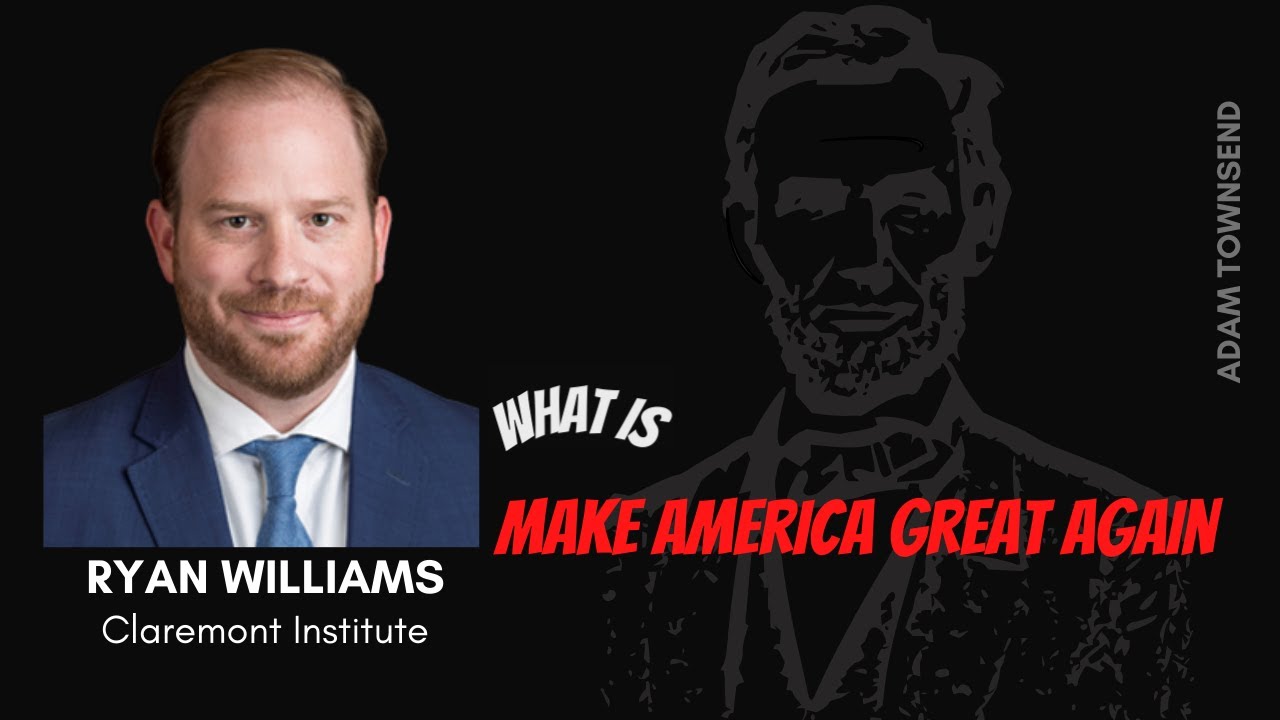
Feb 26, 2021 — Ryan Williams of Claremont Institute answers: What is Make America Great AgainRyan Williams is the President of Claremont Institute; ...
Ryan P. Williams - Claremont Review of Books
https://claremontreviewofbooks.com › author › ryan-p-...
Ryan P. Williams is the President of the Claremont Institute. He has been with the Claremont Institute since August of 2005, and is currently a Ph.D.
Ryan Williams's Email & Phone Number - RocketReach
https://rocketreach.co › ryan-williams-email_12649598
Work · Chief Operating Officer @ The Claremont Institute · Director of Programs @ The Claremont Institute · Lecturer in Political Science @ California State ...
Email Format: jdoe@claremont.org (34%)
Address: 1317 W Foothill Blvd, Ste 120, Upland, ...
How Deplorable Is the Claremont Institute? - by Charlie Sykes
https://morningshots.thebulwark.com › how-deplorable-is...
Oct 2, 2021 — Emma Green's interview with Claremont's deplorable president, Ryan Williams, is revealing on multiple levels. Here's one exchange:.
---