local news
---
see fake newspapers uline metric media?
see news desert (state bureau)
see star fredericks
10/17 orphan
distinction from state level bureaus taken over by rw crypto news service? --- square
---
-=-=
RWW 8 26
- Phil Williams @ Confront The Hate: As Local News Dies, White Nationalists See Opening
At an invitation-only gathering in Italy, far-right leaders mapped out strategies to target rural America while local press coverage vanishes.
-=-=
In news deserts, Trump won in a landslide | Local News Initiative
12 24
In news deserts, Trump won in a landslide
But what does this election-result correlation mean?
by Paul Farhi and John Volk
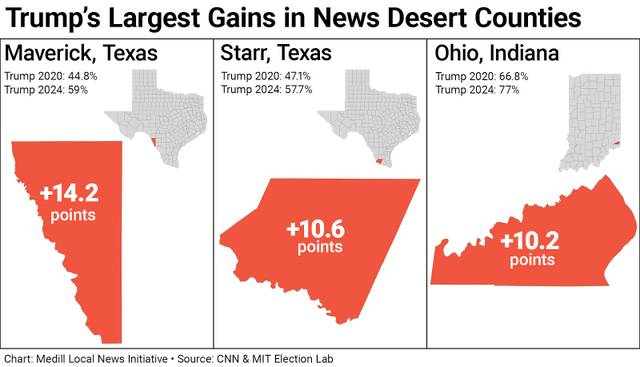
Donald Trump won the 2024 election with one of the smallest popular-vote margins in U.S. history, but in news deserts – counties lacking a professional source of local news – it was an avalanche. Trump won 91% percent of these counties over his Democratic rival, Kamala Harris, according to an analysis of voting data by Medill Journalism School’s State of Local News project.
While Trump’s national popular-vote margin was just under 1.5%, his margin in news deserts was massive. He won these counties by an average of 54 percentage points. In the few won by Harris, her margin was a comparatively slim 18 points, the analysis shows.
The findings are based on results from 193 of the 206 counties Medill has identified as news deserts, in states where county-level election results are currently available. The third annual State of Local News report, released by Medill’s Local News Initiative in October, documented the continuing decline of local news across the country, as measured by the number of newspapers, circulation, frequency of publication, employment and readership.
The report found that the highest concentration of counties with limited access to local news were in solidly “red” states, such as Texas, Kentucky, Arkansas, Idaho, Montana and Mississippi.
In news deserts Trump’s biggest margin of victory, in percentage terms, was in tiny King County in north Texas, which he won by 91 points (123 votes). His biggest margin of victory by votes was in Boone, Ky., a suburb of Cincinnati, which he won by 25,000 votes (37 points). Harris’ biggest margin by percentage points was in Allendale, S.C., which she won by 45 points (1,352 votes). Allendale is 85 percent Black with a 27 percent poverty rate. Her biggest margin of victory by votes was in Chesterfield, Va., a suburb of Richmond, which she won by 19,000 votes (9 points).
Trump’s dominance of news deserts doesn’t imply a cause and effect. That is, people didn’t necessarily vote for Trump because they lack local news. Instead, a simpler and more obvious correlation may be at work: News deserts are concentrated in counties that tend to be rural and have populations that are less educated and poorer than the national average–exactly the kind of places that went strongly for Trump in 2024 and in 2020. (The nonprofit public-policy organization Rebuild Local News found that 87 percent of news-desert counties went for Trump over Joe Biden four years ago.)
Granted, people who live in places without local news don’t lack access to information about a presidential election. Even if there’s no local paper or TV station, they can easily turn to national news sources such as CNN, Fox News, the New York Times; to social media; or to party and candidate campaign material to get information about the race.
But news deserts do have the potential to affect voting behavior in important ways. When voters lose access to local news, they tend to gravitate toward national news sources, according to research by Joshua P. Darr, a professor of public communications at Syracuse University. This kind of news, by definition, focuses on broad national issues—abortion, immigration, the economy, etc.—without regard to local conditions.
The result is increased polarization and partisanship, said Danny Hayes, a political science professor at George Washington University and the co-author of “News Hole: The Demise of Local Journalism and Political Engagement.” People base their choices on the candidates’ statements and on potentially partisan media coverage (say, Fox News or MSNBC), without regard to, or knowledge of, news about local conditions. Local news might tell a voter something that national news can’t, such as how a candidate’s policies might affect local industries or employment.
“The general argument is that local news encourages people to consider other dimensions of a candidate’s appeal besides whether they share the same partisanship,” Hayes said. If you’re regularly exposed to local news about a candidate who has brought funding to your state for roads or other projects, for example, you might be inclined to cast a vote for him or her even if you don’t share the same party affiliation.
The wrong way to interpret this is ‘Oh, the rubes voted for Trump because they’re uninformed.’
Steven Waldman, Rebuild Local News president/founder
But if you’re exposed only to national news, you’re unlikely to know about actions they’re taking, or planning to take, for your state. In that case, “the only thing that’s going to be relevant to you is which candidate shares your views on national issues,” reinforcing basic partisan identity, he said.
In fact, access to local news appears to increase split-ticket voting, moderating the partisan drift. The logic here is simple: Voters who have access to local TV news coverage of their governor and U.S. senators tend to know more about these officials, leading some of them to split their votes among Republican and Democratic candidates, according to research by Daniel J. Moskowitz, a public policy assistant professor at the University of Chicago.
A related but untested question is whether voters in news deserts are more likely to engage in ballot “roll off” – that is, vote for president but leave local and statewide races blank.
Darr, the Syracuse scholar, said roll-off voting explains “much if not all” of the margin in some Senate races this year. In news deserts, said Darr, the assumption is that voters lack information about low-level races and thus decide not to vote in these contests, a potentially harmful trend for democratic participation. “These dynamics seem particularly potent this year, and it could be worth another look,” Darr said.
News deserts have social consequences for everyone who lives in them, but the 2024 voting results indicate that conservative voters may be paying a disproportionate price, said Steven Waldman, Rebuild Local News’ president and founder.
“The wrong way to interpret this is ‘Oh, the rubes voted for Trump because they’re uninformed,’” said Waldman, Report for America’s former president. He pointed out that Trump also increased his support in places with relatively robust local news.
Instead, Waldman said, the election results show “that some of the most common victims of the collapse of local news” are the same people who support Trump. They’re victims, he elaborated, because of all the documented consequences of life in a news desert: more political corruption, higher taxes, lower bond ratings, greater social alienation and rising misinformation, as well as the loss of social cohesion when subjects such as high school sports, local obits and community projects aren’t covered.
The upshot, Waldman said, is that conservative voters – the very ones Trump has targeted with his attacks on the press – “should be helping to lead the drive” to save local news.
About the authors
Project Editor and Contributor
Farhi is the Washington Post's former media reporter. He left the paper at the end of 2023 after nearly 36 years as a staff writer, during which he also covered business, politics and general assignment features. He has also been a senior contributing editor to the American Journalism Review and now contributes to the Atlantic, the Athletic, the Daily Beast, and Columbia Journalism Review. He has been a frequent commentator on TV and radio about the media industry.
Research Associate
Volk manages, updates and analyzes the Medill Local News Initiative’s database of news organizations. A two-time Northwestern graduate (MS and BS in journalism, double major in statistics), he has previously worked at the Star Tribune, the Local News Accelerator and Northwestern Athletics.
---
politico
news-subscriptions-decline-donald-trump-voters-505605
04/08/2018
President Donald Trump’s attacks on the mainstream media may be rooted in statistical reality: An extensive review of subscription data and election results shows that Trump outperformed the previous Republican nominee, Mitt Romney, in counties with the lowest numbers of news subscribers, but didn’t do nearly as well in areas with heavier circulation.
POLITICO’s findings — which put Trump’s escalating attacks on the media in a new context — were drawn from a comparison of election results and subscription information from the Alliance for Audited Media, an industry group that verifies print and digital circulation for advertisers. The findings cover more than 1,000 mainstream news publications in more than 2,900 counties out of 3,100 nationwide from every state except Alaska, which does not hold elections at the county level.
The results show a clear correlation between low subscription rates and Trump’s success in the 2016 election, both against Hillary Clinton and when compared to Romney in 2012. Those links were statistically significant even when accounting for other factors that likely influenced voter choices, such as college education and employment, suggesting that the decline of local media sources by itself may have played a role in the election results.
That gives new force to the widely voiced concerns of news-industry professionals and academicians about Trump’s ability to make bold assertions about crime rates, unemployment and other verifiable facts without any independent checks. Those concerns, which initially were raised during the campaign, were largely based on anecdotes and observations. POLITICO’s analysis suggests that Trump did, indeed, do worse overall in places where independent media could check his claims.
The White House declined to comment for this story, but Trump and his campaign officials have made no secret of their preference for partisan national outlets and social media to mainstream outlets of all types. When dealing with local media, Trump sometimes opted for local TV and radio stations owned by conservative-leaning Sinclair Broadcasting. Trump’s son-in-law and adviser, Jared Kushner, has said Sinclair agreed to have their stations broadcast interviews with Trump without commentary — which includes fact checks. (Sinclair has said it offered the same deal to Clinton, but she didn’t do any interviews.)
Now, as president, Trump is openly touting Sinclair, even though his own Federal Communications Commission is wrestling with whether to approve its effort to vastly expand its reach by buying Tribune Broadcasting. And in praising Sinclair, as in many other areas of policy and politics, Trump is utilizing social media rather than speaking directly to reporters, a method of communication that Trump considers essential to his success.
“I doubt I would be here if it weren’t for social media, to be honest with you,” Trump told Fox Business Network in October. Without it, he said at the time, he “would never … get the word out.”
POLITICO’s analysis shows how he succeeded in avoiding mainstream outlets, and turned that into a winning strategy: Voters in so-called news deserts — places with minimal newspaper subscriptions, print or online — went for him in higher-than-expected numbers. In tight races with Clinton in states like Wisconsin, North Carolina and Pennsylvania, the decline in local media could have made a decisive difference.
To assess how the decline in news subscriptions might have affected the presidential race, POLITICO made a county-by-county comparison of data from AAM. Almost all daily newspapers report their subscription numbers, print and online, to AAM for verification in order to sell to advertisers. (Some of the smallest outlets do not, though, including weekly publications.) After ranking the counties on subscription rates, POLITICO compared election results between counties with high and low subscription rates, and used regression analysis to determine the correlation between news circulation and election results.
Among the findings:
• Trump did better than Romney in areas with fewer households subscribing to news outlets but worse in areas with higher subscription rates: In counties where Trump’s vote margin was greater than Romney’s in 2012, the average subscription rate was only about two-thirds the size of that in counties where Trump did worse than Romney.
• Trump struggled against Clinton in places with more news subscribers: Counties in the top 10 percent of subscription rates were twice as likely to go for Clinton as those in the lowest 10 percent. Clinton was also more than 3.7 times as likely to beat former President Barack Obama’s 2012 performance in counties in the top 10 percent compared to those in the lowest 10 percent — the driest of the so-called news deserts.
• Trump’s share of the vote tended to drop in accordance with the amount of homes with news subscriptions: For every 10 percent of households in a county that subscribed to a news outlet, Trump’s vote share dropped by an average of 0.5 percentage points.
To many news professionals and academics who’ve studied the flow of political information, there’s no doubt that a lack of trusted local media created a void that was filled by social media and partisan national outlets.
“Without having the newspaper as kind of ‘true north’ to point you to issues, you are left to look for other sources,” said Penny Abernathy, a University of North Carolina professor who has closely studied the decline of local media. “And because of the dramatic rise in social media, that ends up being your Facebook friends.”
Rick Tyler, who served as communications director for Sen. Ted Cruz’s (R-Texas) presidential campaign, had a front-row seat for the rise of Trump, and noted that for many Trump supporters, the candidate himself was the most trusted source of news.
“What he’s doing is he is becoming the source and they believe him,” Tyler said. “It doesn’t matter if the people they don’t believe say he’s not telling the truth. Trump’s breakthrough is that he’s unencumbered by the truth.”
Trump himself communicates directly to about 50 million followers on Twitter, and during the presidential primaries,his Twitter following was larger than the total number of votes he received in becoming the Republican Party nominee. His number of Twitter followers far exceeds the number of subscribers for all news outlets, print and digital, in the country — 35 million for weekday and 38 million on Sundays as of 2016, according to AAM figures.
In late December, Trump wrote on Twitter: “I use Social Media not because I like to, but because it is the only way to fight a VERY dishonest and unfair ‘press,’ now often referred to as Fake News Media. Phony and non-existent ‘sources’ are being used more often than ever. Many stories & reports a pure fiction!”
Starting in the 1970s, when the control of the nominating process shifted from party elites to primary-election voters, a common sight at rallies, conventions and debates was small groups of journalists, men and women, most of them having traveled in from Washington, gathering to compare observations. Together, they would decide what news had been made — which candidate handled himself better, which exchanges were the most relevant, which assertions were the most questionable.
In the days before the Internet, about a dozen news outlets dominated national political coverage. They included the major television networks, weekly news magazines, The Associated Press, and about a half-dozen newspapers. Wire services such as The New York Times News Service and The Washington Post-Los Angeles Times service sent out their articles to smaller papers across the country, guaranteeing vastly wider circulation for their stories.
Top columnists and political writers would therefore appear in hundreds of newspapers, reaching tens of millions of homes. The families in those homes might have had little awareness of where the articles originated, but were reassured by knowing that trusted local editors had chosen those pieces for publication. And the local newspapers themselves engendered a strong, often fierce loyalty: They were part of families’ lives from birth to death, offering everything from holiday recipes to obituaries. They were where Mom and Dad’s wedding photo was published, and where yellowing clippings of long-ago heroics on the high-school gridiron were saved for posterity.
The editors lived in the communities they served, and went to the same churches and parent-teacher meetings that their readers attended. So when they decided to publish a story about national politics, it had a local stamp of approval: The local newspaper editor — and, in a similar way, the local TV anchor — were validators for national political coverage by reporters thousands of miles away.
By the start of the 2016 election campaign, newspapers had endured a quarter century of sharp declines in subscriptions — a loss of about 40 percent of their readers — and local TV and radio had lost much of their economic base, as well. And the rate of decline was increasing.
Between 2015 and 2016 alone, print and digital subscription rates dropped 8 percent, according to AAM. Between the 2012 election, in which Barack Obama squared off against Romney, and the 2016 Trump-Clinton clash, weekday subscriptions dropped 19 percent. The Bureau of Labor Statistics reported that between 2004 and 2015. the newspaper industry lost 37 percent of its workers, leaving empty desks in newsrooms where reporters used to work.
People who no longer subscribed to the local paper could get some reported news from the dwindling numbers of free articles per month. They also could share articles from hundreds of sources — mainstream media and ideological media, or, in many cases, from places on the Web that no one could identify. Twitter more than doubled its number of users between 2012 and 2016. Facebook, meanwhile, went from nearly breaking even in 2012 to reporting a profit of $10.2 billion in 2016, emerging as the dominant organizing tool for presidential candidates.
National news outlets fared better than local outlets in the shift from print to digital. Investors — some seeing economic opportunity and others less concerned about profits than pressing openly partisan agendas — swooped in to buy national outlets and create new ones. That meant Washington was awash in reporters while the rest of the country saw an abject collapse of news editing and reporting — 1 in 5 reporting jobs nationwide were in Washington, New York and Los Angeles as of 2014, according to t T he Washington Post, up from 1 in 8 in 2004.
To many media professionals, the decline of local news has had its greatest impact in the lack of scrutiny of city halls and state houses across the country. But the POLITICO analysis indicates that the loss of local outlets, and the downsizing of others, has had a profound effect on the national dialogue, as well.
“Historically, strong local newspapers have had the ability to set the agenda for debate of important policy issues,” Abernathy, a former New York Times executive, said. “Because of the financial pressures that have occurred on the industry, that mission has been significantly diminished.”
Jeffrey Mondak, a University of Illinois political scientist who has written a book on the role of newspapers in politics, noted that a surprising number of small newspapers, even in rural and traditionally conservative markets, refused to endorse Trump, in some cases breaking decades-long allegiances with the Republican Party. But it seemingly made little difference to voters, suggesting that they were making their decisions based on other information.
“Many local papers either endorsed Clinton, didn’t endorse, or very reluctantly endorsed Trump,” Mondrak said in an email. “Without those papers as strong voices speaking to the (possibly negative) local implications of a Trump presidency, the Trump campaign would have had clearer sailing in those areas. My strongest hunch is that [the POLITICO data] means that Trump connected with voters via a national campaign, and that he was most successful when subnational messaging wasn’t able to weaken that connection.”
Across the nation, most of the local news available to readers was becoming as indistinguishable as the bright-eyed faces delivering the weather forecast.
Indeed, the POLITICO analysis found that most of the country was relying more on national outlets than local ones: Most of the counties that were studied had subscription rates of less than 20 percent of households. One in 10 counties had less than 5 percent of homes receiving a print or digital subscription; the top 10 percent of counties studied had subscription rates of 35 percent or higher.
Trump thrived, both against Clinton and compared to Romney in 2012, more strongly in the news-desert counties — the areas with very few subscriptions. For instance, rural Price County in northern Wisconsin had virtually no paid local-news circulation, according to AAM, and Trump walloped Clinton there by 25 points; the county had been a virtual tie between Obama and Romney in 2012.
Meanwhile, Clinton’s numbers often soared, even when comparing with Obama’s in 2012, in areas with relatively high concentrations of subscribers, such as DuPage County in the suburbs of Chicago, where she beat Trump by 54 percent to 40 percent, while Obama had only edged Romney there by a single point.
To some academics who study the media and politics, the results suggest that reading a subscription news product — which carries a level of trust and loyalty greater than simply sharing stories on social media — provides an independent perspective on politics. In the 2016 election, subscribers seem to have gleaned a more skeptical view of Trump from what they read.
“The basic hypothesis is that the collapse of local media institutions has kind of broken the foundation of political engagement in our country, which historically began at the local level,” said Lee Shaker, a political communications scholar at Portland State University, describing his own work in studying the roles of local and community newspapers.
Shaker considers smaller newspapers particularly important as part of the broader “information diet,” a subject he worries isn’t getting enough rigorous research.
“There’s a lot that we’ve underestimated or overlooked in how people get information that has consequences for pretty broad things — not only whether you voted in the mayoral election, but whether you trust your neighbor or trust the government at all,” Shaker said.
Other political scientists are more skeptical about the idea that news subscribers, simply by reading more fact-checked and nuanced articles, turned against Trump. Gregory Martin, a professor at Emory University who has researched the interplay of electoral politics and journalism, suggested that newspaper readers may simply have other qualities that would inherently make them resistant to Trump.
“Newspaper circulation itself is a measure of education — above and beyond college attendance of other metrics,” said Martin, suggesting that political literacy isn’t simply a matter of degrees attained, but a level of attentiveness to detail that’s harder to measure.
Many of the counties in POLITICO’s analysis of news subscription rates tracked with the urban-rural divide that was widely noted in the 2016 election, with higher-density population centers having higher subscription rates. But Trump appeared to struggle even in rural areas with a higher-than-average presence of mainstream media.
Yuma County, Arizona, for instance, had some of the features of the Trump strongholds — a heavily rural county on the Mexican border with sky-high unemployment (15.7 percent as of last November). But voters there tend to get their news from traditional sources: The county’s news subscription rate of more than 40 percent of households is in the top quarter of all counties in the country. Romney beat Obama there by 13 points, but Trump did 8 points worse, edging Clinton by 50 percent to 45 percent.
By contrast, there was Robeson County, North Carolina — the poorest in the state, with a similar economic profile to Yuma County — which has a subscription rate of only 9 percent, according to the Alliance for Audited Media. (The actual rate is somewhat higher, though, because one of the county’s papers, the six-times-a-week Robesonian, doesn’t report its circulation to the AAM.) Robeson County was a traditional Democratic stronghold, with Democrats having more than four times as many registered voters as the Republicans had. Obama swamped Romney there, 58 percent to 41 percent, in 2012. But Trump beat Clinton by more than 4 points — a swing of more than 20 points.
Charles Broadwell, the former publisher of The Fayetteville Observer, the largest newspaper that covers Robeson Country, said he fears that cutbacks in the newspaper have deprived local readers of news they can trust, leaving them open to naked appeals from candidates. Just a few months before the 2016 election, Broadwell’s family sold the newspaper to Gatehouse Media; it ended nearly 100 years of family ownership, but came after the print publication had lost about 40 percent of its subscription base since 2008 alone, necessitating cutbacks that pared down coverage of Robeson County and other outlying areas to focus on the core market of Fayetteville.
“We aspired to be a strong local and regional newspaper in our part of the state,” said Broadwell, whose career included a year covering Robeson County prior to spending two decades in either the editor’s or publisher’s chair.
“I’m concerned now as a citizen,” Broadwell said. “You worry about whether people make a distinction between what somebody’s crazy uncle posts somewhere on Facebook and somebody doing the digging.”
“The Observer does that everyday. I hope and pray that that value will be recognized,” he said.
As president, Trump has followed the media strategy of his campaign. He’s largely avoided the mainstream media, both local and national. He’s granted the majority of his TV interviews to Fox News, the channel favored by conservatives. Twitter is, in every sense, his dominant form of communication, as he even fires Cabinet members via social media, making his feed a must-read for many people. Sometimes, he makes assertions that are later corrected by mainstream media, but it’s hard to assess how many of his 50 million followers will ever see the corrections. Often, the factual assertions in his Twitter feed amount to accusations against his perceived enemies, including the media itself.
“Check out the fact that you can’t get a job at ratings challenged @CNN unless you state you are totally anti-Trump?” he wrote in early April. “Little Jeff Zuker, whose job is in jeopardy, is not having much fun lately.”
But CNN quickly pointed out that there is no questioning of prospective employees about their views on Trump — nor have there been any reports of such a practice. CNN President Jeff Zucker’s job isn’t in jeopardy, either, the network said. CNN’s year-over-year ratings are indeed down, but by a smaller percentage than those at Fox News, the president’s preferred outlet.
Those kind of fact checks are often missed by Trump’s most devoted supporters, who are also known to repeat and sometimes re-tweet his messages, giving them even wider circulation.
Former staff members say it was a deliberate strategy of the Trump campaign to run what former deputy communications director Bryan Lanza called “a national narrative campaign” — and that meant working around members of the mainstream media, whom Trump supporters believe blocked his message and repeatedly demonstrated a bias against him.
“It obviously makes a difference to be able to communicate with the voters free of any of the media interpretation of what the president is saying,” Lanza said in an interview.
Trump’s Twitter attacks on national mainstream outlets are so routine by now that almost anyone can quote his lines — “fake news,” “Failing New York Times,” “Amazon Washington Post.” And with the local outlets who pick up their stories largely on the wane, those national news organizations are more easily dismissed in communities outside their East Coast base. That’s what former Alabama Senate candidate Roy Moore tried to do, with some initial traction, in depicting an on-the-record Post report of sexual misconduct when he was younger as an outside attack by political opponents.
Eventually, local Alabama newspapers validated the Post’s reporting — with some refusing to endorse Moore despite long histories of backing Republicans. He lost by 2 percentage points to Democrat Doug Jones. But to longtime media scholars and observers, there is a very real question of how much longer such local newspapers are going to be able to exist and exert independent judgment. Their concerns are exacerbated by the decline of local TV news, once a nightly staple in most homes, but which has contended with steadily declining ratings amid growing competition from national cable and online outlets.
“All of the problems of newspapers are just starting to come to roost in local TV news,” said Andrew Heyward, who was president of CBS News from 1996 to 2005, and now studies local TV news as a visiting scholar at the MIT Media Lab. Heyward believes stations across the country have to seek new ways of engaging and growing their audiences, largely by stressing their local authenticity and credibility.
“We’re never going back to ‘Walter Cronkite is the most trusted man in America,’ ” Heyward said. “We have scrape and claw for people’s attention.”
While Heyward and some other media scholars remain hopeful of a rebound, believing that new forms of engagement will gradually win back lost readers and viewers, most people in the political world are coming to grips with a media recipe in which traditional outlets provide fewer ingredients. And even some who regularly jousted with those outlets are finding much to fear in the changing landscape.
“It raises questions about what fills the void and most of the answers to that question are not great for democracy,” said Josh Earnest, former White House press secretary under President Barack Obama.
Obtaining an accurate assessment of a president’s performance “will be much, much, much more difficult if there are not news outlets that are widely viewed as independent and credible,” Earnest said. “And in many cases, the most credible— or at least the perception of the most credible and independent news sources — was the dominant newspaper or the local television journalists in a specific market.”
Campaign professionals see an immediate future in which there are more Trump-style campaigns, with clear, simple messages broadcast across the country, with less reliance on mainstream media at either the national or local level.
“One of the big challenges for campaigns these days is to identify and promote a message that is compelling, if not provocative almost, such that it is sufficiently viral that it transmits itself and does not rely on the old guard media outlets ... but rather,it travels on its own based on the virality of it,” said Brian Fallon, who served as Clinton’s press secretary during the 2016 campaign.
“You can’t have a media strategy that is trying to establish a brand and frame yourself that is doing battle one story at a time,” Fallon added. “You have to have something that moves the whole very decentralized social media environment, that brings it with you, that captures its attention and its imagination.”
Lanza, the former deputy communications director for the Trump campaign, agrees.
Asked if, even where local papers were still more robust, would Trump still have tried to go over and around them, Lanza said yes. “He didn’t need local media for eyeballs,” he said.
Last summer, Trump himself suggested that social media was the only truly necessary communications tool in his arsenal.
“My use of social media is not Presidential - it’s MODERN DAY PRESIDENTIAL. Make America Great Again!” he tweeted in July.
*Jason Schwartz contributed to this report.
---
Chevron’s faux news site exploits local journalism’s decline, epitomizing the fossil fuel industry’s insidious greenwashing strategies
Special ProgramsClimate & Energy
Written by Evlondo Cooper
:{Published 08/28/24
Chevron-sponsored “news” site Permian Proud represents one of the fossil fuel industry's latest and most insidious greenwashing strategies, exploiting the decline of local journalism to shape public opinion in oil-rich regions. This tactic epitomizes a broader trend of deceptive practices by Big Oil, which — combined with national TV news’ failure to scrutinize the industry amid the escalating climate crisis — highlights an urgent need for robust accountability reporting.
Chevron's PR firm published a local “news” site without journalists
Felicia Alvarez's investigation for Floodlight, published in the Louisiana Illuminator, exposed Chevron's Permian Proud as a calculated ploy to manipulate public opinion under the guise of local journalism. The site, devoid of actual reporters or editors, is crafted by a San Francisco PR firm and a Chevron public affairs adviser, eliminating any pretense of editorial independence or journalistic integrity.
A search of the Permian Proud’s two-year-old website shows just a smattering of stories about climate change or greenhouse gas emissions — despite the oil and gas industry’s leading role in causing the climate crisis. As of Aug. 12, there were two stories mentioning climate change; one is a recap of a Texas Tribune series about training oil and gas workers and the other quotes a Chevron official about new techniques for measuring methane emissions.
The site has plenty of articles boasting of the importance of the Permian Basin and Chevron, sprinkled in with coverage of events, sports and awards given to local residents.
One story reported on Chevron receiving the highest environmental rating in the Permian Basin. Another announced that Chevron plans to boost its production to meet U.S. energy needs.
And the site reported on a $145,000 company donation to help students in Carlsbad, New Mexico — to pursue careers in energy and natural resources.
Notably absent is any critical coverage of the oil industry's environmental impact or role in the escalating climate crisis — and an eroding local media landscape leaves local residents vulnerable to a distorted view of the oil industry's true impact on their communities and the planet.
“Many of the counties within the Permian Basin are considered ‘news deserts,’ or areas with limited access to local, credible news sources,” Alvarez writes. “Of the 61 counties considered part of the Permian Basin region in Texas, 13 counties had no local newspapers, and the majority had only one newspaper, according to the news desert map maintained by the University of North Carolina.”
Alvarez reveals that Permian Proud isn't an isolated experiment:
It is also part of a network of Chevron-owned news outlets amplifying the company's viewpoint while publishing feel-good stories about local events and people. The same San Francisco public relations firm that provides content for Permian Proud runs the Richmond Standard news site in Richmond, California. It also operates an English-language website in Ecuador, where the energy giant has fought back decades of litigation.
This model, replicated across Chevron's operational areas, forms part of a broader strategy to control the narrative as the fossil fuel industry faces mounting scrutiny.
Permian Proud ignores climate crisis as Texas faces escalating climate disasters and environmental injustice
Texas recently endured a record-breaking heat wave, with temperatures soaring above 110 F in multiple cities. The Washington Post reported that Abilene shattered its all-time high at 113 F, while other cities set new August records. This extreme heat isn't just uncomfortable, it's potentially deadly — and it’s straining the state's power grid to its limits.
This recent crisis is just the latest example of Texas’ extreme vulnerability to climate change. A stark analysis from Public Citizen reveals that between 1980 and 2022, a staggering 44% of all billion-dollar climate and weather disasters in the country affected Texas. The state faces an onslaught of heat waves, hurricanes, floods, droughts, and wildfires that are increasing in both frequency and intensity.
The climate crisis is also creating significant financial impacts for Texas residents. Erin Douglas of The Texas Tribune reported that insurance rates in Texas have skyrocketed by 22% in 2023, twice the average national increase. Even more troubling, “many areas of the state are likely underpriced relative to their climate risk, according to a model created by the First Street Foundation, a nonprofit group of academics and experts that quantifies climate risks,” suggesting that the financial strain on homeowners is only set to worsen.
Notably, the fossil fuel industry operating in Texas bears outsized responsibility for climate change, amplifying the risks facing communities across the state:
Texas emits more greenhouse gas emissions than any other state, according to the Environmental Protection Agency. It accounts for 14% of the nation’s climate-warming emissions, and produces more than twice the total emissions of California, the next largest greenhouse gas emitter. Texas is also the nation’s largest oil and gas producing state, accounting for more than 40% of the nation’s oil production.
Beyond the climate impacts of the fossil fuel industry, Texas also faces severe environmental justice challenges. Low-income communities and communities of color bear a disproportionate burden of industrial pollution — in Port Arthur and Houston, the concentration of petrochemical facilities and other polluting industries near residential areas is a direct result of historical segregation and discriminatory land-use practices. The Texas Commission on Environmental Quality's permitting decisions, particularly for facilities like concrete batch plants in Harris County, have further entrenched these disparities, leading to ongoing health risks for vulnerable populations.
The fossil fuel industry deploys multifaceted deception campaigns like Permian Proud to delay climate action
As the climate crisis intensifies, the fossil fuel industry has shifted from outright denial to a broader PR campaign employing more insidious forms of deception. This multifaceted approach, exemplified by Chevron's Permian Proud, aims to manipulate public opinion and delay climate action.
Recent investigations reveal oil giants are targeting youth via gaming platforms, exploiting inconsistent social media ad labeling, and rebranding as “clean energy providers” while promoting false solutions. In addition, The Guardian exposed the industry's funding of legal efforts to block climate action, with the Republican Attorneys General Association receiving $5.8 million from oil and gas interests since 2020.
These coordinated efforts — from exploiting declining local journalism to influencing younger generations and funding legal challenges — demonstrate the fossil fuel industry’s determination to shape public opinion and policy in its favor. As climate change impacts worsen, the industry's tactics aim to preserve its dominance in a decarbonizing world despite scientific evidence demanding a rapid transition away from fossil fuels. Outlets like Permian Proud are just one facet of this larger industry campaign, underscoring the urgency of recognizing and counteracting these corporate greenwashing strategies.
Local news vacuum enables corporate narrative control
The erosion of local journalism in the United States has reached crisis levels, creating dangerous information vacuums. A Media Matters analysis in May starkly illustrated this problem: Donald Trump's recent corrupt offer to Big Oil executives, asking them to raise $1 billion for his presidential campaign while assuring that they'd be getting a “deal” due to the taxation and regulation they would avoid if he is reelected, was almost entirely ignored by top local newspapers and TV markets in key battleground states.
The 2023 Medill Local News Initiative report quantifies this crisis: Over 50% of U.S. counties now have just one local news source, or none at all. The rate of newspaper closures averages more than two per week, with 2,900 papers having shuttered since 2005 — and “all but about 100 were weeklies, which are often the sole provider of local news in small and mid-sized communities.” Most significantly, 43,000 newspaper journalists representing two-thirds of the industry's workforce have lost their jobs.
This systemic erosion of local news coverage is creating information vacuums across the country, leaving communities vulnerable to misinformation and unchecked corporate narratives — with far-reaching implications for public information and democracy. The absence of robust local journalism directly impacts civic engagement, political accountability, and public understanding of critical issues like climate change and climate solutions.
National TV news fails to consistently connect climate dots, enabling industry narratives
As local journalism crumbles, the responsibility of national media to provide comprehensive reporting about critical issues such as global warming becomes even more crucial.
However, recent Media Matters studies reveal that national outlets are falling short, particularly in their coverage of climate-related extreme weather events in places such as Texas. This failure at both the local and national level creates a dangerous information vacuum that fossil fuel companies like Chevron are eager to exploit.
In February, only 2% of cable and corporate broadcast news segments about the Texas wildfires mentioned climate change. Similarly, just 3 out of 21 broadcast news segments connected January’s Texas flooding to climate issues, while 5% of national TV news segments about the June 2023 Texas heat wave mentioned climate change.
This pattern of omission extends far beyond extreme weather coverage, undermining public understanding of the broader climate crisis. In 2023, for example, a mere 12% of climate segments on corporate broadcast networks mentioned fossil fuels. This persistent failure to connect the dots between fossil fuel consumption, global warming, and their cascading harms leaves viewers uninformed about the true drivers of climate change.
The information vacuum created by this lack of context in extreme weather reporting enables misleading narratives from the fossil fuel industry to flourish unchallenged. Chevron's Permian Proud, for instance, exploits this gap to further its Big Oil agenda, shaping public opinion in oil-rich regions without meaningful counterbalance from mainstream media. This vacuum also allows broader industry greenwashing campaigns to go largely unexamined.
Better news reporting on climate change and corporate accountability is crucial to combating industry narratives
Amid declining local journalism and inadequate national coverage, Chevron’s Permian Proud demonstrates that fossil fuel companies are increasingly willing to fill the void left by traditional journalism with their own content.
In the face of these corporate-sponsored narratives, real news outlets must be pressured to provide coverage that consistently connects extreme weather events and fossil fuels to climate change and potential solutions. This comprehensive approach is essential for public understanding of the climate crisis and for holding the fossil fuel industry accountable, empowering news audiences to cut through Big Oil's propaganda and understand the true scale of the challenge we face.
------
an 6 23
no lnx
canada’s Parliament recently passed Bill C-18, the Online News Act, which would require social media platforms to pay news organizations for posted articles. In response, Meta announced that it was going to ban article sharing in Canada rather than pay up.
The Online News Act received Royal Assent on Thursday, meaning it’s all set to become law after Parliament passed it. The law is expected to go into effect in six months. The Canadian government says that the bill asks social media companies to “bargain fairly with Canadian news businesses” for having their articles posted.
“[The Online News Act] levels the playing field by putting the power of big tech in check and ensuring that even our smallest news business can benefit through this regime and receive fair compensation for their work,” Pablo Rodriguez, Minister of Canadian Heritage, said in a statement.
READ MORE: Facebook’s Zuckerberg Won’t Ban Holocaust Deniers Because He Thinks They Don’t ‘Intentionally’ Get Facts Wrong
The government says social media outlets are getting a clear benefit from users sharing articles. The companies not only sell advertising that appears near the articles, but sharing stories also boosts engagement and the value of the platform to users. In addition, the platforms can find out more about their users based on the type of stories they click on, obtaining their data for targeted advertising. With the Online News Act,smaller outlets are allowed the opportunity for collective bargaining with the tech giants.
Meta, the company that owns Facebook and Instagram, responded by saying Canadian news stories wouldn’t be available to Canadians on its platforms.
“The changes affecting news content will not otherwise impact Meta’s products and services in Canada. We want to assure the millions of Canadians on our platforms that they will always be able to connect with friends and family, grow their businesses and support their local communities,” Meta said in a statement.
Meta threatened to do this earlier this month, and Prime Minister Justin Trudeau panned the company, according to the CBC.
“The fact that these internet giants would rather cut off Canadians’ access to local news than pay their fair share is a real problem, and now they’re resorting to bullying tactics to try and get their way. It’s not going to work,” Trudeau said.
Meta is not the only outlet to consider such a drastic action. Google has suggested on Thursday it may do something similar, the CBC reported.
“Every step of the way, we’ve proposed thoughtful and pragmatic solutions that would have improved the bill and cleared the path for us to increase our already significant investments in the Canadian news ecosystem,” Google said. “So far, none of our concerns have been addressed. Bill C-18 is about to become law and remains unworkable.”
Canada’s Online News Act is not the first of its kind. It’s based on a 2021 Australian law, the News Media Bargaining Code. Nor is Meta’s response the first of its kind—in August 2020, when the NMBC was proposed, the company blocked news in Australia. In early 2021, Facebook reached an agreement with the Australian government and removed the block.
A similar act could even come to America. California is reportedly considering its own version of the Online News Act, according to The Hill. And, as the Hill reports, Meta has made similar threats to the state if the Journalism Preservation Act goes forward.
FROM YOUR SITE ARTICLES
Mental health expert lays out 10 thought patterns that trip up former Christians ›
Senate votes to end President Biden resolution making it harder for immigrants 'to obtain legal status' ›
The deplorable work conditions behind Harrods’ $7,000 'Ambootia Snow Mist' Darjeeling tea ›
RELATED ARTICLES AROUND THE WEB
Facebook to end news access in Canada over incoming law on ... ›
Meta threatens to remove US news content if new law passes - BBC ... ›
Meta to pull plug on news sharing in Canada - POLITICO ›
an 2 23
ahead of former President Donald Trump's Wednesday visit to East Palestine, Ohio—where a Norfolk Southern-owned train transporting carcinogenic chemicals derailed on February 3, prompting a mass evacuation and release of pollutants—progressive critics highlighted the key role his administration played in making the fiery crash and its toxic aftermath more likely.
During his speech, Trump—considered a leading GOP presidential candidate for 2024 despite spearheading a deadly coup attempt following his 2020 loss—criticized how President Joe Biden's administration has responded to the environmental and public health disaster unfolding in East Palestine, a poor rural town of about 4,700 people located a few miles west of the Pennsylvania border.
But as critics noted beforehand, the Trump administration's gutting of train safety rules at the behest of railroad industry lobbyists was instrumental in creating the conditions for the derailment and ensuing chemical spill and burnoff, which has provoked fears of groundwater contamination and air pollution.
"He should be apologizing to that community for his administration rolling back rail regulations," progressive stalwart Nina Turner, a former Ohio state senator, tweeted prior to Trump's address.
philadelphia Inquirer columnist Will Bunch made a similar point in an opinion piece published earlier this week.
"If residents of East Palestine—:{a:(style="background-color:#ffff66;"):}:**:{ modern :(style="background-color:#ffff66;"):}::{news desert:(style="background-color:#ff6600;"):}:**of downsized or disappeared news sources, which allows misinformation to fester—truly knew the reality, a delegation of townsfolk would likely greet Trump with tiki torches and pitchforks," Bunch wrote, comparing the former president's visit to "the tendency of a criminal to return to the scene of his crime."
Bunch noted that "Trump acted specifically to sabotage a nascent government effortto protect citizens from the growing threat posed by derailments of outdated, poorly equipped, and undermanned freight trains that were increasingly shipping both highly flammable crude oil from the U.S. fracking boom as well as toxic chemicals like the ones that would derail in East Palestine."
"Trump had been in office for less than a year when he moved to killthe 2015 rule change initiated by the Obama administration that would have required freight trains to upgrade the current braking technologythat was developed in the 19th century for state-of-the-art electronic systems," wrote Bunch, who pointed out that this came after Norfolk Southern and other rail carriers donated more than $6 million to Republican candidates in 2016 and spent millions more on lobbying.
"With the investigation into the East Palestine wreck still in its early phases, it's not clear if the modern brakes—originally required for installation by 2021—could have prevented the toxic derailment or whether the specific Obama rule would have applied," Bunch continued. "But experts do believe the new brakes could have mitigated the wreckage—and thus the release of so many hazardous chemicals."
"The rule reversal wasn't the only time that Team Trump sided with Big Rail over the forgotten Americans who live on the wrong side of their tracks," he added. "In 2019, for example, the Trump administration moved to not strengthen but relax regulations on shipping fracked natural gas through communities like East Palestine. The same year, Trump's White House also killed an Obama-era proposal that would have required two crew members in freight-train locomotives."
Ahead of Trump's visit,More Perfect Union also argued on social media that the ex-president's "attempt to portray himself as a friend of the town and as someone who would have stood up to Norfolk Southern... couldn't be further from the truth."
As the progressive media outlet observed, the Trump administration "withdrew multiple rail safety recommendations and moved toward a 'self-regulatory approach' where rail companies could do as they pleased."
"It's no surprise that the Trump years were filled with dangerous deregulation," More Perfect Union asserted, describing his decision to nominate top rail industry executives to lead the Federal Railroad Administration and the Pipeline and Hazardous Materials Safety Administration as "a prime example of the revolving door between business and government."
"The Trump approach to the rail industry was to let the companies do what they wanted, which was to avoid regulations, slash jobs, and extract profit," the outlet continued. "This approach, and rail companies' greed, has led to over 1,000 derailments each year. Some are massive catastrophes like East Palestine. But every single one is harmful. And if the industry isn't regulated and forced to change, we'll soon be seeing more disasters."
When Trump "pretends to care about rail workers, or the people of East Palestine, we can't believe him," More Perfect Union added. "His record tells a very different story, the story of his own role in creating this problem in the first place."
Even some conservative critics of Trump have questioned the sincerity of his visit.
"It's clear that it's a political stunt," Ray LaHood, a Republican ex-member of Congress who led the U.S. Department of Transportation (DOT) during former President Barack Obama's first term, told Politico on Wednesday. "If he wants to visit, he's a citizen. But clearly his regulations and the elimination of them, and no emphasis on safety, is going to be pointed out."
Sen. Chris Murphy (D-Conn.) wasted little time in doing exactly that, calling the GOP's indignation "fake" soon after Trump announced his travel plans.
Bunch acknowledged that "it's beyond hypocritical for Trump to bring his Harold Hill-huckster shtick to East Palestine when residents are still experiencing headaches and breathing foul air from the kind of catastrophe he didn't lift a finger to stop from the Resolute Desk."
"But also it's a bit baffling why Biden or his Transportation Secretary Pete Buttigieg—who seems to be channeling**his inner McKinsey & Co**. these days—haven't gone to Ohio," he argued. "Especially when Trump and any other Republicans hoping to make political hay off of East Palestine's misery are coming to town empty-handed."
"None of the anti-Biden critics on this issue have offered a solution, because they can't," wrote Bunch. "The only fix for the kind of runaway abuses of modern capitalism that cause these environmental catastrophes isgovernment regulation, aided by empowering worker safety with strong unions—two things that the Trump-led GOP has opposed at every turn."
Even in the wake of the disaster, Republican lawmakers have refused to demand stronger regulations, as HuffPost reported:
Rep. Bill Johnson (R-Ohio), a vocal Biden critic who represents East Palestine, on Tuesday dismissed immediate calls for stricter rail regulations, saying actions toward accountability will hinge on the findings of a National Transportation Safety Board [NTSB] investigation into the derailment:{.
'That will dictate whether there are laws, regulations that need to be changed, whether there were rules that were violated,' he said during a news conference in East Palestine. 'We don't know any of that yet, and we won't know that until NTSB releases its report.'}:
Hours before Trump spoke, Buttigieg announced that he plans to travel to East Palestine on Thursday. His visit is expected to coincide with the publication of the NTSB's preliminary report about its ongoing probe into the crash.
On Tuesday, Buttigieg unveiled DOT's recommendations for improving the safety of the nation's rail system, though an inter-union alliance of rail workers immediately criticized the plan as inadequate.
Given the scale of the problems—and in light of the transportation secretary's ongoing refusal to exercise his authority to reinstate previously gutted rules along with his consideration of an industry-backed proposal to further weaken the regulation of train braking systems—union leaders have called for nationalizing the railways and implementing their proposed solutions.
Turner, for her part, emphasized that she has "been outspoken about the two years the Biden administration had [to] fix these problems."
"The Trump administration is at fault, as is the Obama administration," Turner contended, referring to the fact that the latter's regulations were also watered down in response to industry pressure.
"The Ohio GOP is to blame as well," she added, echoing recent reporting on Norfolk Southern's campaign to influence state-level lawmakers and officials. "Failure at every level of government and multiple administrations led to this."
:{
}:
ref dayton
https://www.daytondailynews.com/ideas-voices/marcano-the-importance-of-local-media-following-the-east-palestine-derailment/7ORSBKCMPZGLLPR6NAX3EWXNPA/
:{
}:
the Norfolk Southern train wreck near East Palestine has received its share of national news coverage.
The Washington Post covered a raucous town hall that the train company inexplicitly skipped. NPR’s “what to know about the derailment” provided an excellent primer on the wreck. CBS, CNN, NBC, and even Al Jazeera have covered the incident.
The train, pulling 150 cars, derailed on Feb. 3. Three dozen cars went off the tracks, and 11 contained hazardous materials — including five with the man-made, cancer-causing substance vinyl chloride. For the roughly 4,800 residents of East Palestine, on the Pennsylvania border some 40 miles west of Pittsburgh, the current short-term angst will soon turn to long-term worry.
But what happens when the story subsides and the big boys go home?
The Lisbon Morning Journal is the closest newspaper to East Palestine, about 13 miles away. The Salem News has covered the story, and they’re 30 miles away. Particle Media’s online site, Newsbreak, aggregates news content, so that’s useful.
But the train derailment highlights a problem that has affected small communities and areas from Tarboro, North Carolina, to Tucson, Arizona.
Some 360 newspapers closed from the start of the pandemic, according to a report published in the New York Times. The problem is so acute thatone in five Americans live in a news desert with limited access to local news, the Times reported.
Ohio has fared particularly poorly. Since 2004, the state has lost 32% of its newspapers, according to a study by Policy Matters. Most of those companies were run by small operators who cared about the communities they covered.
In years past, the Youngstown Vindicator would have unleashed its army of journalists to travel the 30 minutes to East Palestine. The Vindicator once had the staff and resources to support its 160,000 Sunday circulation product. But the newspaper collapsed under the weight of circulation declines and financial losses and closed in 2019, with a Sunday circulation of just 32,000.
The East Palestine train derailment lays bare what happens when the community loses its news sources.
Newsgathering goes far beyond the daily reporting of who said what at a press conference or who spoke to a crowd at a community gathering. That’s fairly simply blocking and tackling.
I wonder who will go more in-depth.
Who will tell the stories of the townspeople who will be scared for years by the wreck?Who will monitor whether residents start leaving, which would have a cascading effect on property tax revenue and the city’s school district? Who will chronicle the families and children who stay behind and worry about their health?
Who will monitor health department reports to see if residents start getting sick?
Who will act as a watchdog to monitor state officials, who will be charged with ensuring that Norfolk Southern makes restitution, in whatever form that takes? Who will file public records requests to examine the records of any settlements? If there are lawsuits, who will go to the courthouse and report on the findings?
Without reporters and news sources, the people of East Palestine don’t have an independent news source that keeps officials on their toes.
When people say that local media doesn’t matter, take a look at what’s happening a four-hour drive east of the Dayton area. The big boys will go home because they have so many other issues to tackle. Eventually, the citizens of East Palestine will feel the frustration of living in a news desert.
Somehow, we need to strengthen local news, not continue to watch it wither.
Dying newspapers mean there are fewer independent avenues to help communities, fewer ways to cover tragedy, and fewer ways to hold companies and agencies accountable through reporting.
Local news matters. Let’s do a better job supporting it.
Ray Marcano’s column appears on these pages each Sunday. He can be reached at :{raymarcanoddn@gmail.com:(style="box-sizing:content-box;margin:0px;padding:0px;border:0px;vertical-align:baseline"):}:
doh i had seen as escalator/echo source of hype fear
an 7 22
The internet and the digital revolution have changed journalism dramatically in the United States and other countries. What were once strictly weeklies (Time, Newsweek) now function as dailies on their websites, and daily newspapers like the New York Times, the Washington Post and the Chicago Tribune aim for a national audience. Moreover, something that would have been treated like strictly local news 25 or 30 years ago — for example, two people getting into an angry political argument in a local convenience store in Nevada — can easily become a national story in online journalism.
In the high-tech journalism landscape of 2022, according to Axios reporter Sara Fischer, one of the things that is suffering the most is local journalism. And Fischer, in an article published by Axios on July 4, points out that this “local news crisis” is aggravating the United States’ political divisions.
Discussing a new report from Northwestern University in the Chicago area, Fischer explains, “Around two newspapers in the U.S. are closing every week, according to a new report, suggesting the local news crisis spurred by the pandemic will worsen in coming years. Why it matters: Hyperlocal communities are being disproportionately impacted by the fall of local newspapers compared to bigger cities.”
Penelope Muse Abernathy, a visiting professor at Northwestern’s Medill School of Journalism, Media and Integrated Marketing Communications and the report’s primary author, described theshortage of local journalism as “a crisis for our democracy and our society” in an official statement on the report. And she elaborated during an interview with Axios.
Abernathy told Axios, “While the economic decline in many communities was occurring prior to the rise of news deserts, the loss of a local news organization will leave local residents without the critical information to begin to address those problems. At a minimum, the loss of local news worsens the political, cultural and economic divisions in this country."
Fischer notes that “news deserts” in the U.S. tend to have more poverty and less education than areas that aren’t news deserts.
“The average median annual income of a home in a news desert is $15,000 less than the average U.S. household,” Fischer observes. “Only 20% of adults living in news deserts have bachelor’s degrees compared to 38% in the U.S. The lack of reliable local news compounds governance issues that make communities less efficient and prosperous.”
Fischer describes the “local newspaper sector” as being “in in a state of terminal decline.”
“More than 360 newspapers shuttered between late 2019 and May 2022, according to the report,” Fischer explains. “The vast majority of those papers were printed weekly. At this rate, the country is on track to lose more than one-third of its total newspapers by 2025. It's already lost more than a quarter, 2500, since 2005.”
https://www.alternet.org/2021/07/trump-election-claims/
ME
Since the 2020 presidential election, conservative news outlets have been popping up in droves to continue circulating former President Donald Trump's big lie about the election.
So how are outlets continuing to do this? According to NPR, it is more of a trick of the eye. The publication https://www.npr.org/2021/07/02/1011916687/how-pro-trump-local-news-sites-keep-pushing-2020-election-misinformation.
While the publication appears to be just a local news outlet, NPR reports that it is actually flagship of a news syndicate, known as The Star News Network, which consists of several pro-Trump sites. Like The Georgia Star News, the network has created similar sites for states like Arizona, Ohio, and Florida.
Per NPR:
"Its part of the Star News Network - an expanding network of pro-Trump sites seeking to influence local politics with conservative opinion by mimicking the look and feel of local newspaper sites. The group operates eight state-focused news sites, including in key Electoral College states such as Michigan, Arizona, Ohio and Florida."
By focusing on states where Trump is still heavily favored among voters, the network can continue to circulate misinformation since the audience is still focused on what transpired during and after the election.
During a rally in Ohio Las weekend, Trump also added more fuel to the fire with more dangerous claims of voter fraud.
"The biggest tragedy of all is millions of Americans have lost confidence in their vote," Trump said." We can't let that happen. And that's why I say you have to know what took place in 2020 before you can vote in 2022 or 2024."
To name mafter worse, conservative publisher John Fredericksdefended defended sites and the information they share.
"We work very hard to fund our operation through legitimate advertising of all kinds, people that want to reach our expanding audience," he said. "And if somebody needs to reach informed, motivated readers that want the truth, advertising is a great opportunity for them, is a great [return on investment] potential."
FROM YOUR SITE ARTICLES
- Ivanka Trump distances self from dad's election fraud claims as her ... ›
- Trump rants about 2020 election as MAGA cultist claims the former ... ›
- Revealed: Mitch McConnell begged Bill Barr to 'inject some reality ... ›
RELATED ARTICLES AROUND THE WEB
- AP FACT CHECK: Yes, Trump lost election despite what he says ›
- Giuliani's law license suspended over false Trump election claims ... ›
- Trump Pressed Rosen to Wield Justice Dept. to Back 2020 Election ... ›
https://www.mediamatters.org/john-fredericks/pop-disinformation-pro-trump-radio-host-launch-hyperpartisan-news-site-georgia
In case Americans need any more evidence that Georgia is quickly becoming one of the nation’s preeminent political battlegrounds, a talk radio host with close ties to President Donald Trump has announced that he’s launching a hyperpartisan news site to flood the Peach State with right-wing talking points -- just in time for its upcoming runoff elections to decide control of the Senate.
John Fredericks, who is also the editor-in-chief of the Virginia Star and owner of three conservative talk radio stations, announced on Monday that he’s launching the Georgia Star as the newest addition to Star News Digital Media, a network of websites that launder right-wing media content and talking points through pages designed to look like local news sites. The announcement comes ahead of runoff elections for the state’s two Senate seats that will determine control of the chamber in 2021 and beyond. (The site, which Fredericks said aims to unseat TheAtlanta Journal-Constitution, also appears to be co-opting the name of one of the South’s oldest Black newspapers.)
“We're launching that so we can combat the fake-news,corporate AJC and the other crap here in Georgia you have to deal with, all of the corporate media,” Fredericks told his audience from Atlanta, where he claimed to be recruiting local writers to help launch his site and partner with a local radio station. “This is ground zero.”
In addition to discussing on his own show, Fredericks also announced the news during Steve Bannon’s War Room podcast -- which was recently deplatformed after the former Trump adviser called for the beheading of two public officials.
Fredericks launched the Virginia Star in the summer, ahead of the 2020 general election. The site’s umbrella company, Star News Digital Media, was founded in 2017 by “three Tea Party-connected conservative activists: Michael Patrick Leahy, Steve Gill, and Christina Botteri.” The company runs similar pages in Tennessee, Michigan, Ohio, and Minnesota.
If the Georgia Star turns out to be anything like its Star Network peers, the publication will rely on recycled content from pro-Trump media outlets likeThe Daily Caller and American Greatness, float fictive conspiracy theories from dubious "local news" sources, and criticize local politicians for attempting to remove Confederate monuments from public spaces.
===
https://www.mediamatters.org/donald-trump/trump-loyalist-and-radio-host-john-fredericks-running-hyperpartisan-blog-disguised
mma
t
rump loyalist and radio host John Fredericks is running a hyperpartisan blog disguised as a local news site
:{:(style="box-sizing:border-box;display:flex;height:1.5em;margin-right:1em;width:1.5em"):}:10/15/20
John Fredericks, one of Virginia’s most influential talk radio hosts with close ties to President Donald Trump, is using a hyperpartisan blog masquerading as a local news site to solicit support for Trump’s reelection campaign and spread right-wing narratives while promoting his own radio program.
The Virginia Star, which was launched this summer, is the latest addition to Fredericks’ budding media empire and is also a part of the hyperpartisan right-wing Star News Digital Media network. At first glance, the site looks like an ordinary, low-budget local news site. Its Facebook page describes the site as a “NEW source for investigative news, thoughtful opinion and more.” On its Google search landing page, the site is billed as “Leading the Way in News and Education.”
But in reality, The Virginia Star contains little more than partisan bile.
A quick scroll through its home page reveals headlines making dubious claims about voter fraud and criticizing local leaders for spending tax dollars to remove Confederate monuments. Scroll further and find the podcast of Steve Bannon, former executive chairman of Breitbart News and a Trump ally, embedded along the sidebar. That’s the same Steve Bannon who has used his platform in recent months to spread xenophobicconspiracy theories about the coronavirus and has long been a white nationalist idol. [pix]
This conservative framing continues among The Virginia Star’s articles. One recent “news” story, for instance, mocked a “racially equitable” fair-housing initiative put forth by Mayor Levi Stoney of Richmond, Virginia, writing that in the wake of the summer “riots,” the mayor “continues to propose measures other than improving law and order in his city, including legalizing marijuana and removing Confederate monuments.” Another recent article shamed Democratic legislators for appropriating funds for a text messaging service that allows teens to ask questions about sexual health and discreetly find medically accurate answers. The only person quoted in the article is a Republican state senator who proposed a failed measure to eliminate the educational service, calling it “a sex to text talk line.”
The Star has also begun publishing semi-daily updates from the Trump campaign trail. The site’s “Trumpdate" missives solicit political donations to a limited liability corporation registered to Fredericks (through a link that appears to be broken) and also direct readers to the Republican National Committee’s “Trump Victory” page, encouraging readers to volunteer for the campaign.
The Star is just the latest addition to Fredericks’ budding media empire. In addition to hosting his own show, Fredericks owns three conservative talk radio stations in central Virginia. In recent months, he has used his platform to sow distrust of measures to stop the spread of the coronavirus. Fredericks is also a close ally of Trump, serving as the Virginia co-chairperson of the president’s 2016 campaign and as an advisory board member of the Trump 2020 campaign. He's interviewed Trump upward of a dozen times and sometimes serves as a surrogate for the president on CNN.
Though The Virginia Star lists Fredericks as its CEO and editor-in-chief, the site is operated by the Star News Digital Media network, a journalistic organization of dubious origin that was founded in 2017 bytea party-connected conservative activists Michael Patrick Leahy, Steve Gill, and Christina Botteri. The company runs similar pages in Tennessee, Michigan, Ohio, and Minnesota, and The Virginia Star seems to be the only publication in the network that doesn’t list Leahy on its masthead.
The Star News network is but one example of thousands of mostly conservative partisan media outlets that have swept in to fill the nationwide void in coverage by masquerading as local news. Although right-wing media such as the National Review have attempted to suggest that a scourge of liberal-leaning partisan news pages are aggressively targeting voters on Facebook, internal research from Media Matters and reporting from Nieman and Columbia Journalism Review have confirmed that nearly all of the networks pushing partisan content online have a conservative bent. Such sites have been around for nearly a decade, but their numbers have grown exponentially since 2016. Recent reporting suggests that in key swing states, partisan local websites “masquerading as traditional local news outlets” are deluging voters with right-wing talking points at an increasing rate as the election nears.
In 2018, Politico dubbed the Star News network’s sites “baby Breitbarts”for their similarity in tone and demeanor to Breitbart News. In fact, Leahy, who manages the other Star network sites (except for the Virginia outlet), is a regular Breitbart contributor. Like its swing-state peers, The Virginia Star mixes original content with articles it reprints from right-wing media outlets like The Daily Caller, The Daily Wire, American Greatness, and others.
Indeed, this seems to be the standard way the Star network sites operate, producing a mix of original content and reprints from right-wing outlets that promote conservative viewpoints -- and sometimes misinformation. Although The Virginia Star emulates many of the same practices as other pages in the network, Fredericks’ influence appears to have resulted in more original content about Virginia politics.
Fredericks also appears to be cross-promoting his content between the site and his own radio network. His radio show's websiteruns ads for The Virginia Star, while the Star prominently features an advertisement for Fredericks’ show on its home page.
According to social media analytics tool BuzzSumo, roughly 40% of the links Fredericks shared with his almost 20,000 Twitter followers since July go to The Virginia Star. But Fredericks doesn’t list his association with the network or The Virginia Star specifically in his Twitter bio.
With its slanted coverage disguised as local news, The Virginia Star appears to be another example of right-wing radio hosts exploiting a media platform to promote conservative misinformation to their impressionable audiences.
see below for local news relevance :
in recent weeks, a number of political campaigns and committees have received letters from the Federal Election Commission notifying them that they may have violated federal rules and regulations governing campaign finance, such as inaccurately reporting expenditures or accepting campaign donations in excess of the legal limit from dozens of people.
These letters are not uncommon, and not necessarily indicative of wrongdoing — the assumption is that campaigns want to follow the rules but may have made mistakes in the heat of the contest. When the FEC notifies a campaign that it has taken too much money from donors, for instance, the letter lists the names and donation histories of the supporters who gave too much, so the campaign can isolate the over-limit amounts and refund, reattribute or redesignate that money. They have 60 days to do this before they must report back to the FEC.
Some of those lists this year, however, have been exceptionally long — a phenomenon that election experts attribute to automated recurring donations over a long and particularly intense campaign season.
For instance, Sen. Martha McSally, R-Ariz., received two separate notices last week, one of them 38 pages long and the other 41 pages. Each flagged excessive contributions from around 60 donors, for adjacent reporting periods. Her colleague, Sen. Lindsey Graham of South Carolina, received a nine-page list that alone flags a total well above $150,000 in excessive donations that the campaign must explain to the FEC.
In a similar letter to President Trump's re-election campaign last month, the FEC flagged more than 35,000 contributions from 1,045 donors, totaling more than $4.5 million in donations that the campaign needs to explain and reconcile. That list was 855 pages long. On Oct. 1, the FEC sent the campaign another letter flagging excessive donations, this one 814 pages long.
"You have to consider the possibility that some of these serial donors may not have fully appreciated what they were doing when they signed up for recurring contributions," Kappel said.
The McSally notices illustrate this point. The contribution history of one single recurring donor, Bruce P. Bengtson, accounts for more than 10 full pages, or 25% of the list. Other donors take up multiple pages, such as Bill Deaton, whose name appears on 215 line items in one letter.
Deaton, founder of a Kentucky-based data-processing company, was fined $1 million and sentenced to a year of home detention in a federal fraud case in 2010. FEC records show he has contributed $6,706 to McSally this year. The individual limit for a full election cycle is $5,600.
The Graham campaign also appears to have erred in some of its bookkeeping, according to the FEC, and the Harrison campaign needs to explain several donors with foreign addresses and three sources identified as "possible prohibited entities." (While the letter does not elaborate on the latter, one of the names — PCCC, LLC — appears to have been identified as a difficult-to-trace entity in a Center for Public Integrity analysis of 2016 donations to Hillary Clinton.)
One of the over-limit donors to Graham, who has taken to begging for campaign cash in recent Fox News appearances, was Washington attorney Ty Cobb,formerly a lawyer for Trump during the Russia investigations. Cobb has given Graham $1,000 above the $2,800 general election maximum.
A handful of names, however, are on the lists for both Graham and McSally. All those people, according to FEC searches, appear to be retirees. A closed-quote Google search of these donors brings up something unusual: Their names also appear in the headlines of what look like online news articles announcing their donations.
For instance, a man named Henry L. Collins III gave $4,350 to Graham's campaign between April 30 and June 30, in a series of dozens of donations between $50 and $500. During that same period, he gave $4,425 to McSally. FEC records show that as of July 15, Collins had contributed a total $14,745 to McSally, nearly $10,000 above the individual limit, and as of June 30 had given about $8,400 to Graham, an excess of $2,800.
On July 1, Collins' name was featured in a headline for an article in something calling itself PHX Reporter that read: "Martha McSally's campaign committee receives $2,705 from Henry L. Collins III."
But PHX Reporter is identical to another site called Western South Dakota News, which on July 14 announced Collins' $500 contribution to Liz Marty May, a Republican congressional candidate. (Collins did not reply to Salon's request for comment.)
For that matter, Western South Dakota News looks exactly like the Treasure Coast Sun, which looks like the Columbia Standard — a site that published stories about individual contributions to both Graham and Harrison. Collins' name appears in a list of top donors for the month of May on a Columbia Standard article — and three other donors on the list appear to have exceeded the legal limit with contributions from that month alone.
These sites are part of a larger network of what could fairly be described as fake news sites — webpages that publish algorithm-driven content, much of it anonymous and automated, targeted at hyper-local audiences. Those networks of sites — dubbed "pink slime," a play on "yellow journalism" — have tripled in size as Election Day approaches. And they're part of an even larger network, connected to a conservative PAC.
That network, however, also appears to publish campaign refunds at times. One repeat McSally donor who spoke with Salon said that he had been refunded money multiple times over the last year, most recently last week, after the McSally campaign's most recent FEC letter. Earlier refunds made it into the pink slime headlines. The latest news apparently has yet to break.
The McSally, Graham and Harrison campaigns declined to comment for this article.
ref1
https://www.cjr.org/analysis/as-election-looms-a-network-of-mysterious-pink-slime-local-news-outlets-nearly-triples-in-size.php
tHE RUN-UP TO THE 2020 November elections in the US has produced new networks of shadowy, politically backed “local news websites” designed to promote partisan talking points and collect user data. In December 2019, the Tow Center for Digital Journalism:{reported on an intricately linked network of 450 sites:(style="box-sizing:border-box;margin:0px;padding:0px;list-style:none"):}: purporting to be local or business news publications. New research from the Tow Center shows the size of that network has increased almost threefold over the course of 2020, to over 1,200 sites.
Identifying these new sites is a result of further analysis of the closely linked entities with conservative ties illustrated in Figure 1 (below). The Tow Center focused predominantly onMetric Media, Franklin Archer, Local Government Information Services (LGIS), and Locality Labs. Both Metric Media and Franklin Archer claim to be the largest local news provider in the US, though many of their sites have low visibility in both search and social media. Over 90 percent of their stories are algorithmically generated using publicly available data sets or by repurposing stories from legitimate sources.
In the remaining stories that have an authentic byline there is often a conservative bent. As reported by the *Lansing State Journal* and The Guardian, [guk] this includes articles about voter fraud using data from the Heritage Foundation, negative pieces about elected Democratic representatives, and stories supporting conservative candidates. This low-cost automated story generation has come to be known as**pink slime journalism**. In addition to the hundreds of titles that ape the look and feel of local news, our research has detected new sites in this network that address single subjects, appeal to religious orientation, and focus on business news.
no pix ]Figure 1: The organizational structure of the network]
The recent increase in activity is in line with the election cycle. It is becoming an increasingly common campaign strategy for pacs and single-interest lobbyists to fund websites that borrow credibility from news designto help advance particular agendas. The proliferation of politically funded local news sites across the political spectrum raises questions about how these entities represent themselves to the public, and how they are categorized by search engines and social platforms.
The number of news media properties funded by often obscure political interests has been growing for a number of years and will reach a new peak in the 2020 election cycle. A recent report from Open Secrets highlighted “dark money” networks funded by liberal-leaning donors. Academics Jessica Mahone and Phil Napoli recently plotted some of these known entitieson a mapto show the geographic concentration of the networks. But the definitions of what constitutes a politically funded network are hard to establish, particularly if the financial and ownership structures are not clear.
A :{recent report from :(style="box-sizing:border-box;margin:0px;padding:0px;list-style:none"):}:*:{Politico:(style="box-sizing:border-box;margin:0px;padding:0px;list-style:none"):}:* outlined how Courier Newsroom, a group of politically affiliated local news sites, was spending large amounts of advertising money on Facebook on articles promoting Democratic candidates. Establishing how politically funded networks are intrinsically different from news organizations with strong political affiliations such as Breitbart or Fox News is often difficult.Politically funded networks can appear on Facebook pages classified as “Media/News company,” and articles from partisan sites are indexed by Google News.
Today, along with further analysis of this network, we are publishing the full list of websites, the geographic focus of each publication where one exists, and the corresponding organizational entity each site belongs to. However, due to the convoluted connections between these organizations, precise ownership is difficult to establish. Often a site will carry different information about its provenance on its “About” page, its Facebook page, and in the terms and conditions it publishes on its own site.
The overlapping networks seem designed to confuse casual observers as to their provenance and ownership, and delineations between them are fuzzy.The publishers involved are incorporated in different states, have different business models, and provide different services. However, they all share certain distinguishing traits that suggest close overlapping relationships, such as the same authors, story templates, analytics identifiers, and other technological resources.
to identify these new sites and the evolution of the networks, we adopted the same techniques we used for our investigation in December, relying heavily on third-party tools like RiskIQ and Farsight DNSDB.
In our latest research, we found the vast majority of the domains were under the umbrella of Metric Media, a Delaware limited-liability company that is a division of Situation Management Group. Metric Media properties now account for over 960 sites, or 80 percent of all the domains we’ve identified that belong to this network. All publishing is done “under a licensing agreement with the Metric Media Foundation, a 501(c)(3) non-profit news content provider.”
Over seven hundred of these local sites have been activated in 2020, pointing to a sharp acceleration in activity in the lead-up to the November elections. The new activity has seen a host of titles such as the Philly Leader and San Francisco Sun added to the network, with the number of states expanding from ten to all but one. (While Metric Media doesn’t have any titles for Illinois, LGIS does.)
Beyond Metric Media’s rapid expansion, our research showed that Franklin Archer had also expanded the number of networks under its umbrella. The organization boasts that it is “the largest producer of local news in the United States,” with 200-plus active websites and two networks: Metro Business Network and Local News Network. A third network, American Catholic Tribune Media Network, was created in March 2020. There are currently six sites in the network, including the American Catholic Tribune. Further, Franklin Archer products now also include a handful of stand-alone titles that are either single-subject (e.g., Current Science Daily) or geographically focused on specific towns or neighborhoods (e.g., West Loop Today), as well as two podcasts hosted by the Freedom Media Network. Franklin Archer also lists public relations activities on its website, where user testimonials boast about the effectiveness of sponsored content as a marketing tool. [pix]
Evolution and Sprawl of the Network in 2020
The bulk of sites that went live in 2020 are under the Metric Media banner. In 2019, when we were first looking at Metric Media, its:{stated goal:(style="box-sizing:border-box;margin:0px;padding:0px;list-style:none"):}: was to launch “hundreds [of sites] nationwide to inform citizens about news in their local communities.” Today, the language on the same page indicates it has reached the goal of creating “hundreds” of sites. A:{website:(style="box-sizing:border-box;margin:0px;padding:0px;list-style:none"):}: lists its publications by state, along with a one-line explanation of what the company is: “a digital firm managing the online presence of the portfolio of local news sites known as Metric Media.” Based on passive DNS data (RiskIQ and DNSDB Scout),by the end of January 2020, Metric Media had publications devoted to all but one of the forty states that weren’t already covered in 2019; the domains for these were registered in the second half of 2019. The one exception was Illinois, which we cover in more detail further down.
Some sites cover entire states, whereas others are devoted to specific cities and metropolitan areas. The nomenclature is often formulaic, combining compass directions with the names of the states or cities and then generic terms for news publications. Site names include SW Oklahoma News, NE Ohio Times, and West SFV Today (in California’s San Fernando Valley). Many major cities get their own “wire” publication: Detroit City Wire, Dallas City Wire, Seattle City Wire.

Figure 3: Metric Media and LGIS# sites per state
Figure 3 illustrates the number of publications present in each state. Rhode Island has the fewest devoted to it (four), California the most (seventy-four). We didn’t find any publications for either of these two states in 2019; in fact, we only found Metric Media properties in ten states then. Now there are sites covering forty-nine states; only Illinois and Washington, DC, are absent from the Metric Media network.
The absence of Illinois publications may have a relatively simple explanation: LGIS, a stand-alone corporation devoted to covering Illinois since 2015, is part of the extended network, with connections to Metric Media. LGIS has:{ties to conservative figures in the state:(style="box-sizing:border-box;margin:0px;padding:0px;list-style:none"):}:, including Dan Proft and Brian Timpone. Proft, who through his pacs:{has raised millions to back conservative candidates:(style="box-sizing:border-box;margin:0px;padding:0px;list-style:none"):}: in Illinois,:{shut down two :{pac:(style="box-sizing:border-box;margin:0px;padding:0px;list-style:none;font-variant-numeric:normal;font-variant-east-asian:normal;font-variant-caps:small-caps"):}:s earlier this year:(style="box-sizing:border-box;margin:0px;padding:0px;list-style:none"):}:. Timpone has a long history creating businesses focusing on automated low-cost journalism (or “pink slime” journalism), including the:{controversial Journatic:(style="box-sizing:border-box;margin:0px;padding:0px;list-style:none"):}: and its successor:{Locality Labs:(style="box-sizing:border-box;margin:0px;padding:0px;list-style:none"):}:. Locality Labs appears to be the organization creating the technology that allows for the automation of news stories using publicly available data sets across this entire ecosystem of 1,200 websites. One of Proft’s now-shuttered pacs has paid one of Timpone’s other companies, Newsinator, for “Advertising – newspaper,” according to campaign finance records.
Until December, the:{About Us:(style="box-sizing:border-box;margin:0px;padding:0px;list-style:none"):}: page of the Illinois sites stated they were a “product of LGIS—Local Government Information Services,” while the:{Terms of Service:(style="box-sizing:border-box;margin:0px;padding:0px;list-style:none"):}: and:{Privacy:(style="box-sizing:border-box;margin:0px;padding:0px;list-style:none"):}: pages indicated they were properties of Locality Labs LLC. As of March, however, the:{Terms of Service:(style="box-sizing:border-box;margin:0px;padding:0px;list-style:none"):}: and:{Privacy:(style="box-sizing:border-box;margin:0px;padding:0px;list-style:none"):}: pages are blank. The language on their:{About Us:(style="box-sizing:border-box;margin:0px;padding:0px;list-style:none"):}: pages hasn’t changed, maintaining that the sites are part of LGIS and funded in part “by advocacy groups who share our beliefs in limited government.” (Most of the Illinois websites have similar language in their About Us pages, where they mention details specific to the publication, and then details about the objectives of LGIS and its funding. However, for some sites, like the:{Grundy Reporter:(style="box-sizing:border-box;margin:0px;padding:0px;list-style:none"):}: and:{Southern Illinois News:(style="box-sizing:border-box;margin:0px;padding:0px;list-style:none"):}:, the About Us pages have been blank since at least last year, based on snapshots in the Internet Archive.)
In March, these Illinois sites adopted the same website theme (and thus the same look and feel) as the sites that Metric Media explicitly states it runs.
Additionally, Metric Media has at least two single-subject sites: Insurance Rate Reporter and Education Daily Wire. The About Us page for the former is blank, but its Privacy Policy and Terms of Service pages say the site is operated by Metric Media LLC. Education Daily Wire’s Privacy and Terms of Service pages are blank, but its About Us page says it’s funded by the Metric Media Foundation. These publications are not mentioned on either Metric Media website: the LLC or the foundation.
Also absent from any Metric Media website are the fifty-one Metro Business Network publications operated by Metric Media LLC, per their privacy policies and terms of service. According to the:{Metro Business Network site:(style="box-sizing:border-box;margin:0px;padding:0px;list-style:none"):}:, these publications “aim to cover news from Fortune 500’s to SMB’s on Main Street [sic].” While the site does not mention anything about the ownership or funding of these publications, the Privacy Policy and Terms pages state that the network is operated by Locality Labs.
Tracing the ownership of sites within the network is made more complicated by how the sites label themselves on Facebook. The Facebook pages for the business news sites include information about the page owner, which is where information about news and media properties on the platform can be found. However, sites within the same subnetwork (Metro Business Network, in this case) have different confirmed page owners, and in a handful of cases, no confirmed owner at all. Those with confirmed page ownership are split between Franklin Archer and Metric Media, and while the addresses for the two owners are different, their phone number is the same. The social presence of the network is very small, with negligible interactions (followers, likes, and shares) on each page.
Franklin Archer, a fictitious name for Iowa-incorporated DirecTech LLC, “brings coverage to underreported areas of American life,” according to its website. It has two networks: the “Metro Business Daily Network” and the “Local News Network.” As reported by*:{The Guardian:(style="box-sizing:border-box;margin:0px;padding:0px;list-style:none"):}:*, the CEO of Franklin Archer is Timpone’s brother, Michael Timpone. On the corporate front, the relationship between Metric Media LLC and Franklin Archer remains unclear, but they appear to share not only technology resources and authors, but also the publications themselves. To wit, as can be seen below in Figure 4: at the time of writing, the Arizona Business Daily is owned by Franklin Archer, according to Facebook, and the Michigan Business Daily by Metric Media LLC. The New Jersey Business Daily has no confirmed page owner.
[pix]
2020, a third network was added to the Franklin Archer portfolio, although it is not mentioned on its website: the American Catholic Tribune Media Network, which includes five state-specific publications (in Wisconsin, Minnesota, Michigan, Florida, and Arizona) and one national one (the American Catholic Tribune). These sites relay information about parishes and churches, including updates on how various churches intend to conduct Mass every week. Earlier this year, the sites mentioned they are “a product of Franklin Archer,” but that disclaimer no longer exists. Their Facebook pages, however, state they are owned by Franklin Archer.
These sites follow the exact same model as all the other sites in the extended network: rewrite original reporting from existing sources, including diocesan newspapers, repurpose announcements (including Mass timings and homilies) published by various churches under the guise of “press release submissions,” and sprinkle on some original reporting.
:{Yet another new product of Franklin Archer is the Freedom Media Network, which hosts podcasts and a YouTube channel with just under a thousand subscribers. The channel is described as “your source for positive news and content aimed at helping you become more purposeful, productive, and prosperous.” One of the podcasts, Freedom Mindset Radio, is rife with anti-science positions,} :{the suggestion that getting a diagnosis is dangerous, as “they’re labeling a bag of symptoms.” The YouTube videos started being uploaded in January, and the website went live in March. }:
One-off sites continue to be created alongside these dedicated networks and channels. Sites created since our last investigation include the Neighbourhood Guardian, West Loop Today, the Midland Times, and Current Science Daily.
If you have examples of similar networks operating in your area or would like access to more granular data, please get in touch with us here.
ref 2
https://mainebeacon.com/anonymous-maine-news-site-tied-to-conservative-pac-funded-network/
at first glance, Maine Business Daily seems like some kind of local corporate newsletter, combining niche industry reports, localized data summaries, and press releases from regional Maine Chambers of Commerce. The earliest articles on the site date back to spring 2018 and the vast majority of the articles are attributed to anonymous bylines “Maine Business Daily reports” or “Local Labs News Service.”
However, nestled amid the banal business reporting are two recent stories on the allegations that Democratic Maine House Speaker Sara Gideon, who is mounting a challenge to U.S. Senator Susan Collins, violated campaign finance rules. Jason Savage, executive director of the Maine GOP, is quoted heavily in the posts, which are attributed to West Virginia-based freelance journalist Kyla Asbury (and are the only stories on Maine Business Daily that have an actual name as a byline).
The publication and promotion of these pieces raised some flags for Maine readers, with one Reddit user writing “I’ve never heard of Maine Business Daily, but two of the top three articles in their ‘public policy’ section right now are political articles about Sara Gideon that have nothing to do with policy.”
Screenshot of a portion of the Maine Business Daily website featuring stories on House Speaker Sara Gideon.
Maine Business Daily’s “About” section also provides scant information about who is operating the site, though it does note that part of its mission is to “inspire productive discussion among policy makers, business leaders and the public.”
The Maine State Chamber of Commerce told Beacon that, despite the reposting of local chamber releases, it is not affiliated with the website.
The homepage of Maine Business Daily includes a link to theMetro Business Network, which lists 30 other state-based sites as part of its organization. According to its website, the Metro Business Network “provides a fresh take on business news. Launching in all 50 states plus DC, we aim to cover news from Fortune 500’s to SMB’s on Main Steet [sic].”
Matt Gertz, a senior fellow with Media Matters for America who specializes in conservative media infrastructure, says that these kinds of networks have flourished amid the decline of local news.
“As local newspapers get wiped out or bought out by big chains and reporters get laid off and chains try to seek efficiencies, you see a void around local news and these news networks try to fill that void,” Gertz said. “A lot of sites are providing information about local events that previously you would get from local newspaper, so you come for information about a local event and if you end up with some sort of ideological screed about the terrors of government, it’s a win for them.”
The Metro Business web
The Metro Business Network sites are uniform in appearance and content. The same stories appear across the entire network, with each “Education” page filled with versions of this story: “Graduates earn 91 degrees, certificates from the University of Maine at Machias” and each “Public Policy” section has a regional version of this one: “Maine ranks 3rd for rental car tax rates, study finds.”
Gertz said the content is likely being generated by an algorithm, which provides “a way to mass produce seemingly local content almost with no overhead, because you are paying no reporters to write stories but you can pump out a huge amount of stuff.”
Buried amid the posts, however, are partisan landmines such as this op-ed that appeared on numerous publications in the network, “Next Step in Dismantling Obamacare: Independent Payment Advisory Board (IPAB),” that concludes: “This is America. Rationing is for commies. Repeal IPAB now!” The column is written by notorious fake pollster and right wing conspiracy theorist Dean Chambers.
Other articles are more subtle, such as this Illinois news story arguing against the local minimum wage increase.
Anonymous news with a worldview
The website’s privacy policy states that Maine Business Daily and these other business news sites are operated by theDelaware-based Locality Labs, LLC, which, according to an April 2018 investigation by the Chicago Tribune, is owned by the conservative Chicago-based media entrepreneur Brian Timpone.
“A firm of Timpone’s called Journatic once used database mining and low-cost freelance writers to create hyperlocal news stories for the Tribune until complaints emergedof plagiarism and faked bylines,” the Tribune reported. That firm is “now known as Locality Labs.”
An earlier piece published in the Columbia Journalism Review in 2016 revealed that Locality Labs, or Local Labs as it is often called, is part of a web of content creators, online and print publications run by Timpone and his cohorts that were accused of electioneering due to their coverage of and connection to candidates and political action committees. Some of Timpone’s news ventures received hundreds of thousands of dollars in funding from theLiberty Principles PAC, whose objective is to “support candidates for state and local offices who are committed to the economic liberty policy agenda.”
Ashbury, who authored the two stories on Gideon, has bylines published on other Locality Labs-owned sites, including the Cook County Record, West Virginia Record, and Legal Newsline — the website of which explains that its coverage is focused on how state court rulings impact the “legal landscape for corporate executives.”
Asbury’s LinkedIn profile says that for the past year she has worked as a freelance writer for a company called Interactive Content Services. The 2018 Tribune article said that another Trimpone-owned firm Newsinator “has a history of doing paid political work and offers marketing services to companies under the name Interactive Content Services.”
It’s not clear if the Liberty Principles PAC has a stake in Maine’s U.S. Senate race, or if it or another entity are funding the specific, anti-Gideon coverage. The articles feature no campaign finance disclosures.
This is not the first time an anonymous, conservative news site has been launched in Maine. In January 2018, evidence was released connecting Savage and the Maine Republican Party to the Maine Examiner, a then-anonymous publication which often published false and misleading attacks against Democratic candidates.
mickey hart lists 6 ngo's trying to revive local news(papers) McChesney?
https://kpfa.org/episode/the-ralph-nader-radio-hour-september-9-2019/
2nd 1/2
==
919
The Vindicator (Ohio newspaper) - Wikipedia
defunct 919
==
aha fang extracts from press, double whammy death spiral?
https://www.alternet.org/2019/08/a-leading-democrat-has-a-plan-to-save-journalism-from-the-tech-giants/
no lnx
A leading Democrat has a plan to save journalism from the tech giants
Written by Grace Gedye / Washington Monthly August 9, 2019
This was a bad week for journalism, in a depressingly familiar way.
On Monday, the investment firm that controls the newspaper publisher GateHouse Media bought Gannett, another publishing giant, which runs the USA Today network. Both companies own hundreds of newspapers around the country, and had already instituted layoffs this year. Meanwhile, public filings indicate that cost cutting will continue to be a priority, according to the Washington Post.
Then, on Wednesday, Pacific Standard, an online magazine focusing on social and environmental justice, announced abruptly that it would be shutting down. The same day,Governing, which covers state and local policy, said in a statement that it would be closing because it had proven “unsustainable as a business in today’s media environment.”
It’s part of a much larger trend: with Facebook and Google sucking up ever-increasing shares of ad revenue, publications are finding it harder and harder to stay financially viable.
One member of Congress thinks he has a solution. This spring, Rhode Island Congressman David Cicilline proposed the Journalism Competition and Preservation Act, a bill that would allow news publishers to collectively bargain with giant tech companies and negotiate the terms under which their content is republished.
It’s part of Cicilline’s broader effort to counter the negative effects of market consolidation. As chair of the House’s antitrust subcommittee, he has emerged as one of the most prominent critics in Washington of tech giants and monopoly power. This year, he’s leading a congressional investigation into Big Tech, summoning executives to Capitol Hill and grilling them on whether they squash competitors. I spoke with him this week about local journalism, the increasing popularity of reviving antitrust, and whether he thinks President Trump will be an ally—or an obstacle—in the effort.
This conversation has been shortened and edited for clarity
GG: I’d like to start by talking about the topic of yourfirst hearing in the antitrust investigations, which was the impact on local journalism. Why did you choose to start with that subject?
DC: I think this is one of the areas where the market dominance of these large technology platforms is having a really serious and negative impact on our democracy. This is not just about their market dominance resulting in some impact on the sale of widgets, but this is really about the ability of citizens of this country to access trustworthy, reliable, local news, and a free and diverse press—particularly a local press—is really essential to the proper functioning of our democracy.[ANOTHER KIND OF DE FACTO PRESS SUPPRESSION?!]
GG: You proposed a bill in the spring that would allow news publications to collectively bargain with online platforms like Facebook and Google that republish their content. What motivated you to write that bill?
DC: When you look at what’s happening in the marketplace, you see that the vast majority of American people access their news through two large platforms, Facebook and Google. And Facebook and Google have amassed enormous revenue from online advertising—$60 billion last year, the majority of all online revenue. At the very same time, despite [publications’] record levels of online readership, there’s been a steep decline in revenues as a result of the rise of these two large technology giants. And you’re seeing all across the country the impact on newsrooms where people are being laid off, newspapers are closing, and in a lot of ways, local journalism is on life support. So, the legislation I’ve proposed, the Journalism Competition and Preservation Act, provides an interim step to stabilize the marketplace by allowing producers of content online and small newspapers to collectively negotiate with the two large technology platforms.
GG: So, were this bill to pass, what are some specific measures that you could see news organizations pushing for in their negotiations?
DC: Well, I’ll leave it up to them to negotiate, but I think there’s no doubt they will attempt to negotiate terms that ensure that the branding and attribution—that is, when a newspaper has invested significantly in their brand because of high-quality and accurate journalism, then I think they want to be sure that that brand is protected. So, my guess is they would negotiate about attribution and branding, that they would negotiate about making certain that these platforms are not engaged in discriminatory conduct which favors their own publications.
GG: Antitrust seems to be having a resurgence of popularity in the past year or couple of years. It’s now a much more frequent topic of debate in national politics, but we obviously had huge companies before these past couple of years. Why do you think this subject is gaining traction now?
DC: I think we’re beginning to see the consequences of this enormous market concentration: in significant data breaches, in the widespread use of false information on the internet, the consequences of the interference in the American presidential election, the work by Cambridge Analytica. At least in the Democratic Party, we’ve very much focused on developing an economic agenda that really speaks to the anxieties of the American people, the economic anxieties, and focuses on getting the economy to work for everyone, raising family incomes, and being sure that we’re reducing the cost of people’s lives. The kind of mega-mergers and market concentration that we’re seeing is part of the reason that the economy isn’t working for everyone. I think people have just really begun to understand that our failure to be aggressive in antitrust enforcement has contributed to very substantial market concentration and some of the worst income inequality in our country’s history.
GG: For about the past 40 years, much of the discussion about why monopolies are bad—including antitrust legal decisions—has focused on consumer prices, the logic being that monopoly power is bad because it results in higher prices for consumers. But during the antitrust committee hearing that you had a couple of weeks ago, with lawyers from Google, Facebook, Amazon, and Apple, I noticed that very few of your questions had to do with impact on consumer prices. Is that a deliberate pivot?
DC: In the age in which attention is a commodity, and where your attention is monetized for ad revenue, the idea that focusing on, “Well, Facebook and Google are free”—but they’re not actually free. You’re giving them your attention, which is really the coin of the realm. Even in the context where it feels like the service is free, antitrust principles are important. In some ways even more important, because it may feel like “Oh, what’s the big deal, this is all free,” but if in fact they are crushing competitors by excluding them or acquiring them so that there’s no real competition, that has a very adverse impact on innovation. We want to make sure that the next Facebook, or the next Amazon, or the next Google has the ability to be successful.
So, this idea of really seriously impacting innovation is significant. If they are favoring their own products and services while giving you the impression that the search is done in some kind of neutral way, that’s also harmful to the consumer. I think the reason that you probably didn’t hear a lot about consumer prices is that there’s a recognition that that factor alone is insufficient to appreciate the dangers of monopolies and a lack of competition in the 21st century.
GG: Do you think your Republican colleagues agree that we have a monopoly problem?
DC: Yes. I don’t know if they’ll agree with every solution, but I think this is a bipartisan investigation, and I think my Republican colleagues have at least expressed a willingness to be part of the investigation, and help identify some solutions.
GG: So, two weeks or so ago, President Trump said that the government “should be suing Google and Facebook” and then said, “perhaps we will.” The Justice Department also recently opened an antitrust review of tech companies. Do you think President Trump will be an ally in the committee’s work?
DC: Unclear. You know, I don’t take the President at his word, to be very honest. I think this administration has not been effective at all in taking on the question of the technology giants and the deep concentration of market power in the technology platforms, or in monopolies generally. It’s an administration that seems to favor the very wealthy and big corporate interests, so I haven’t seen a lot of evidence that the president is going to be on the side of consumers and workers in the antitrust work and the work for our committee, but we’ll see.
GG: Have you at all been in touch with the president about the committee’s work?
DC: No.
==
==
DN 5/18 alden global capital
==
https://www.bloomberg.com/view/articles/2018-03-26/alden-global-capital-s-business-model-destroys-newspapers-for-little-gain
joe nocera
Heath Freeman, the 37-year-old hedge fund manager who just bought the Boston Herald, is a character straight out of the movie “Wall Street.”
You remember the plot of “Wall Street,” don’t you?
The good guy is the dad, played by Martin Sheen, who heads the maintenance workers’ union at Bluestar Airlines. His son, played the actor’s own son Charlie Sheen, is a young, ambitious stockbroker who falls under the sway of Gordon Gekko, a rapacious corporate raider.
Trying to curry favor with Gekko, the younger Sheen’s character does a variety of unsavory tasks, while absorbing Gekko’s gospel that “greed is good.” For a while he lives the Wall Street high life, until he realizes that Gekko is planning to dismember his father’s airline and put a lot of good people out of work. At which point he regains his moral compass and Does The Right Thing.
Heath Freeman’s father, Brian, wasn’t a union man himself but spent his career representing unions as an investment banker. When he was in his 30s, he fought on the side of airline workers as the companies sought to renegotiate union contracts, forcing the airlines to give up stock and a piece of future profits in return for employee concessions. He was totally dedicated to his clients. In a 1985 New York Times profile, he was described as a “whirling dervish; he’ll hang in there on weekends, through all-night sessions and keep coming back for more.”
Brian Freeman died at the too-young age of 56, when his son Heath was still in college. After the younger Freeman graduated, he went to work on Wall Street, where he eventually landed at a hedge fund run by an under-the-radar, vulture investor named Randall Smith, who specialized in “distressed debt.” It was under Smith’s tutelage that he learned to be, well, a rapacious corporate raider.
In 2007, Smith started Alden Global Capital LLC, installing Freeman as president. The firm and its president have since become notorious as a destroyer of newspapers. In 2010, Alden Global acquired out of bankruptcy MediaNews Group Inc., the newspaper empire William Dean Singleton had built, which included such prominent regional papers as the Denver Post, the Salt Lake City Tribune and the St. Paul Pioneer Press. According to its website, the company, now named Digital First Media, has grown to 97 newspapers.
It is no secret that the newspaper business is in decline. So it’s hardly surprising that Freeman would feel the need to shrink the head count at his newspapers, just as almost every other newspaper owner has had to do for years.
But what sets Freeman apart is that he seems to have a rather unique view of a newspaper’s purpose. In this view, his papers are intended not so much to inform the public or hold officialdom to account, but to supply cash for Freeman to use elsewhere. His layoffs aren’t just painful. They are savage.
For instance, according to figures compiled by the NewsGuild, the union that represents workers at Digital First Media properties, the staff of the Denver Post has fallen from 184 journalists to 99 between 2012 and 2017. The Pottstown Mercury in Pennsylvania went from 73 journalists in 2012 to 19 in 2017. That’s right: 19. The Norristown Times-Herald, also in Pennsylvania, shrank from 45 journalists to 12. The San Jose Mercury News and the Orange County Register, both of which had been dominant papers in their regions before Alden Global bought them, have also been decimated by layoffs.[90% SJMN?]
Last year, Digital First Media’s chief executive, Steve Rossi, sent a company-wide email saying that the company was “solidly profitable,” and that “advertising revenue has been significantly better” than competitors. Yet the layoffs have not let up. Just last week, Alden Global imposed another round of layoffs, including a third of the staff at the Denver Post. As recently as 2009, Denver had two competing newspapers; it is now down to 66 journalists in one demoralized newsroom.
Can you really cover a metro area of over 2 million people with 66 journalists? Of course not. Although those running his papers claim the cuts are driven by necessity, the layoffs seem far in excess of what’s happening elsewhere in the industry. Instead, it appears that Freeman is cutting costs so he can pull out cash, and then, as the business dwindles because the product is damaged, he cuts some more, pulling out yet more cash while further damaging the product.
“There’s no long-term strategy other than milking and continuing to cut,” the “Newsonomics” writer Ken Doctor told the journalist Julie Reynolds. 1 “Their view is that in 2021, they’ll deal with that then. Whatever remnants are there, they’ll try to find a buyer.” Actually, at the rate Freeman is going, there may not be any remnants by 2021.
And what is Freeman doing with the cash? According to a recent lawsuit, he is siphoning it into some of his hedge fund’s poorly performing investments. Among other things, Alden Global invested $80 million in Homex, “a bankrupt developer charged by the Securities and Exchange Commission with committing the biggest real estate fraud in Mexican history,” as Reynolds put it. Most recently, again according to the lawsuit, it plowed $158 million into a failing pharmacy chain, Fred’s Inc. 2
Indeed, without the ability to bleed his papers dry, one has to wonder whether Freeman would even have a hedge fund at this point. Although it is usually described as having $2 billion under management, that’s a little hard to believe given its recent track record. It currently holds three stocks, according to Bloomberg data: ParkerVision Inc., a stock currently worth 80 cents per share; General Electric, whose problems are well-documented; and the aforementioned Fred’s. In late 2016, Alden Global revealed that it owned 25 percent of the stock in Fred’s, an announcement that caused the price to shoot up to over $20 a share. Today the stock is at $2.75, its lowest price in 21 years.
With Fred’s, Freeman has tried to flex his “shareholder activist” muscles. He began by complaining about a handful of Fred’s board members. The company responded by signing a cooperation agreement with Alden Global, and put two executives from Digital First Media on its board. Then in September, it named Freeman as chairman. Alas, the new Alden Global board members haven’t turned the ship around.
According to the lawsuit, which was brought by a minority shareholder in Digital First Media, Freeman has used a wholly owned subsidiary of Alden Global’s newspaper company to make investments that should have been made by the hedge fund itself -- including that $158 million investment in Fred’s. In other words, the cash Freeman freed up by laying off journalists was used to prop up the pharmacy chain. Putting aside the venality of the move, it is hard to see the logic.
But the pattern continues. Last week, no sooner had Digital First Media closed on its purchase of the Boston Herald than it announced that it would cut the staff from 240 employees to 175.
“The people who remain,” added the Boston Globe, “are bracing for more cuts.” Why would they expect anything else?
This column does not necessarily reflect the opinion of the editorial board or Bloomberg LP and its owners.
- For a deeper dive into Alden Global Capital and its newspapers, I highly recommend Reynolds’s work, which has been archived here.
- My efforts to reach Freeman, both by email and telephone, were met with silence.
To contact the author of this story:
Joe Nocera at jnocera3@bloomberg.net
==
http://www.motherjones.com/politics/2017/10/ready-for-trump-tv-inside-sinclair-broadcastings-plot-to-take-over-your-local-news/
out of order:
“The most important force shaping public opinion continues to be local, over-the-air television,” says Andrew Jay Schwartzman, a senior attorney at Georgetown’s Communications and Technology Law Clinic. “That’s the underlying premise of the FCC continuing to regulate broadcast ownership.”
But under the leadership of Ajit Pai, a Republican who joined the commission in 2012 and whom Trump elevated to chairman, the FCC has seemingly gone out of its way to grease the wheels for the Sinclair-Tribune merger, reinstating a rule from the Reagan era that could help the company avoid limits on media consolidation. “The FCC is gaming the rules to directly benefit Sinclair,” says Craig Aaron, the president of the public interest group Free Press.
attempt to ctr?
influencewatch BS:
Controversies
“DARK MONEY” CRITICISM FROM THE LEFT AND RIGHT
Arabella and its nonprofit network have been criticized as “dark money” funders both for channeling hundreds of millions of dollars to left-wing organizations and for hosting hundreds of “pop-up groups”—websites designed to look like standalone nonprofits that are really projects of an Arabella-run nonprofit. [59]
In April 2021, the New York Timescriticized Arabella’s “system of political financing, which often obscures the identities of donors,” as “dark money,” calling the network “a leading vehicle for it on the Left.” [60] In May 2021, the New York Times identified Sixteen Thirty Fund as one of the “leading dark money spenders on the Left” for quietly supporting Democrats with more than $63 million in super PAC donations that hurt Republicans in the 2020 election, as well for “help[ing] create and fund dozens of groups, including some that worked to block Mr. Trump’s nominees and push progressive appointments by Mr. Biden.” [61]
Robert Maguire, research director for the far-left Citizens for Responsibility and Ethics in Washington (CREW), said of Sixteen Thirty Fund in 2021: [62]
“Altogether this is absolutely one of the largest fundraising machines I have ever come across . . . I am really struggling to think of any other group, especially recently, that could rival it,” he added, comparing the amount of money flowing through Sixteen Thirty Fund to the Koch brothers’ network at the height of its influence earlier this decade.
In November 2019, Politico criticized the Sixteen Thirty Fund, the 501(c)(4) advocacy wing of Arabella’s nonprofit network, as a “little-known,” “massive ‘dark money’ group [that] boosted Democrats” in the 2018 midterm elections with $140 million. “The money contributed to efforts ranging from fighting Supreme Court Justice Brett Kavanaugh and other Trump judicial nominees to boosting ballot measures raising the minimum wage and changing laws on voting and redistricting in numerous states,” the left-leaning website reported. Politico also noted that Sixteen Thirty Fund’s biggest single donation (made anonymously) was for $51.7 million, “more than the group had ever raised before in an entire year before President Donald Trump was elected,” adding that “the group’s 2018 fundraising surpassed any amount ever raised by a left-leaning political nonprofit.” [63] However, Politico failed to tie the Sixteen Thirty Fund to Arabella Advisors’ nonprofit network.
The left-leaning Washington Postfurther criticized Arabella’s Sixteen Thirty Fund as a “big campaign donor” in a November 21, 2019 opinion by the editorial board, which called on Congress to change nonprofit disclosure laws, noting in particular a $26.7 million anonymous donation to the Fund. [64] However, the Postalso failed to connect the Sixteen Thirty Fund to Arabella Advisors and its other three nonprofits.
In a November 24, 2019 letter to the editor published by the Washington Post, Capital Research Center president Scott Walter identified the $26.7 million donation as originating with the New Venture Fund, the largest of Arabella’s in-house nonprofits, and confirmed Politico’s suspicion that the Sixteen Thirty Fund is “part of a larger network of dark money.” [65]
In November 2020 Politicocalled the Sixteen Thirty Fund a “liberal dark-money behemoth” and “one of the Left’s biggest financial hubs” for raising $137 million in 2019, much of which was spent on an “eight-figure ad campaign attacking Republican senators.” Politicoalso noted that “more than half of the Sixteen Thirty Fund’s money came from just three anonymous sources in 2019” and it made grants to over “100 different liberal organizations” that year. [66]
ILLEGAL ELECTION INTERVENTION COMPLAINT (2021)
On May 15, 2021, the right-leaning watchdog Americans for Public Trust (APT) filed a complaint (archived here) with the Federal Election Commission (FEC), which oversees political groups’ spending, alleging violations of the Federal Election Campaign Act by Hansjorg Wyss, the Wyss Foundation, the Berger Action Fund, the New Venture Fund (in its capacity as the parent of the Hub Project), and Sixteen Thirty Fund. [67] According to APT, “Mr. Wyss indirectly funded federal electoral advocacy through his nonprofit organizations,” failing to set them up as political action committees (PACs), and “the intended recipient of these funds was ultimately a variety of organizations whose primary purpose is to engage in electoral advocacy.”
Organizations which receive contributions in excess of $1,000 or makes contributions in excess of $1,000 in a calendar year is considered a PAC for the major purpose of influencing elections. PACs are subject to strict financial reporting requirements that 501(c)(3) and (c)(4) nonprofits are not. [68] The complaint points out that the Wyss Foundation, Berger:{Action Fund,}: and New Venture**Fund**, which are all 501(c) nonprofits, have failed to file a statement of organization with the FEC, despite Wyss contributing at least $56.5 million from the Wyss Foundation to the New Venture Fund and another $135 from the Berger Action Fund to the Sixteen Thirty Fund. The 501(c)(4) Sixteen Thirty Fund spent $30 million influencing the 2018 midterm elections in order to favor Democratic candidates, “thereby triggering classification as a political committee,” according to APT.
U.S. law strictly prohibits foreign nationals from making direct or indirect contributions to political action committees. [69] Wyss, who was born in Switzerland, resides in the U.S. under an “E-2 VISA” (which is intended for foreign investors who live and work in the country) and “is not a permanent resident of the U.S. under a ‘green card,'” according to his attorney. [70] The complaint cites $41,000 in illegal federal campaign contributions Wyss paid between 1998 and 2003, claiming that, “Since that time, [Wyss] has made indirect contributions and expenditures by means of an intricate network of organizations in a scheme to obscure his role as the source of these funds.” [71]
APT alleges that Wyss established the Hub Project, a front for the “dark money” funder New Venture Fund and the recipient of significant funding from the Wyss Foundation, in order “to avoid any connection with the sizeable election activities carried out by the Hub Project and Change Now,” a super PAC associated with the Hub Project. “Operating since 2015
without the requisite FEC filing,” APT writes, “the Hub Project has been immune to any oversight and accountability despite significant spending in federal election.” It adds:
The Hub Project has served as a vehicle for the political spending of Mr. Wyss. This is demonstrated by the fact that Mr. Wyss has not publicly disclosed his role in founding the Hub Project. Neither his influence nor his financial support can be found anywhere on the group’s website. Rather, information regarding his involvement with the Hub Project was the result of “interviews with five people with knowledge of The Hub Project, an internal memo from another liberal group that was obtained by The New York Times.”
HIDING POLITICAL AGENDA BEHIND “FAKE NEWS SITES”
The nonprofit watchdog OpenSecrets (published by the Center for Responsive Politics) reported in May 2020 on Arabella’s involvement in numerous “fake news sites,” pouring millions of untraceable dollars into advertisements and other digital content “masquerading as news coverage to influence the 2020 election.” [72]
OpenSecrets identified five Facebook pages (Colorado Chronicle, Daily CO, Nevada News Now, Silver State Sentinel, Verified Virginia) that “gave the impression of multiple free-standing local news outlets,” but are in fact “merely fictitious names used by the Sixteen Thirty Fund,”Arabella’s 501(c)(4) lobbying nonprofit. [73] These pages published Facebook political advertisements that favored Democrats and left-wing causes during the 2020 election. After the report was published a number of these pages were deleted.
States Newsroom, which runs another network of left-wing “fake news” websites, was originally created as “Newsroom Network,” a project of the Arabella-run 501(c)(3) Hopewell Fund. In June 2019, States Newsroom was spun off as an independent nonprofit with its own 501(c)(3) tax-exempt status, but a number of its local affiliates are used by the Hopewell Fund as its own legal aliases. [74]
While States Newsroom does not disclose its donors (and is not required to by the IRS), [75]
IRS application records obtained by OpenSecrets show the States Newsroom was offered a $1 million donation from the Wyss Foundation, a private foundation primarily funded by Swiss billionaire Hansjorg Wyss, who made his fortune as CEO of a controversial medical device manufacturer called Synthes.
A financial statement in the IRS records obtained by OpenSecrets shows that the States Newsroom plans to bring in more than $27 million in contributions before the end of 2021.
And in 2018 theHopewell Fund gave $1.72 million to News for Democracy, which OpenSecrets points out “was at the crux of a network of seemingly independent Facebook pages disguised as news outlets that started spending on digital ads in 2018,” with backing from the Sixteen Thirty Fund and Investing in US, an investment vehicle funded by LinkedIn founder and liberal billionaire Reid Hoffman. [76]
Also among these “dark money” groups was ACRONYM, which raised $9.4 million from “secret donors” through April 2019, including $250,000 from Arabella’s 501(c)(3) New Venture Fund. ACRONYM is affiliated with a super PAC, PACRONYM, which spent close to $18 million aiding Democrats and hurting Republicans through independent expenditures in the 2020 election. [77] ACRONYM also owns and operates Courier Newsroom, which in turn manages a network of left-wing websites that present themselves as local news outlets while spreading “hyperlocal partisan propaganda,” according to the centrist watchdog Newsguard. [78] Courier Newsroom spent at least $20,000 in digital advertising campaigns on Facebook between March 2019 and May 2020; its total spending in Facebook ads as of June 2021 is nearly $1.4 million. [79] [80]...