news desert
new? useful term 2 23
---
In news deserts, Trump won in a landslide | Local News Initiative
12 24
In news deserts, Trump won in a landslide
But what does this election-result correlation mean?
by Paul Farhi and John Volk
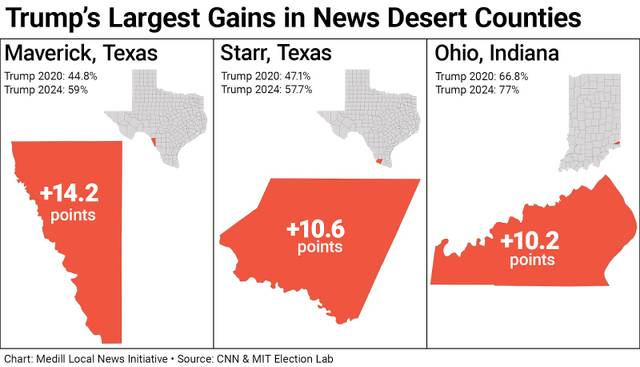
Donald Trump won the 2024 election with one of the smallest popular-vote margins in U.S. history, but in news deserts – counties lacking a professional source of local news – it was an avalanche. Trump won 91% percent of these counties over his Democratic rival, Kamala Harris, according to an analysis of voting data by Medill Journalism School’s State of Local News project.
While Trump’s national popular-vote margin was just under 1.5%, his margin in news deserts was massive. He won these counties by an average of 54 percentage points. In the few won by Harris, her margin was a comparatively slim 18 points, the analysis shows.
The findings are based on results from 193 of the 206 counties Medill has identified as news deserts, in states where county-level election results are currently available. The third annual State of Local News report, released by Medill’s Local News Initiative in October, documented the continuing decline of local news across the country, as measured by the number of newspapers, circulation, frequency of publication, employment and readership.
The report found that the highest concentration of counties with limited access to local news were in solidly “red” states, such as Texas, Kentucky, Arkansas, Idaho, Montana and Mississippi.
In news deserts Trump’s biggest margin of victory, in percentage terms, was in tiny King County in north Texas, which he won by 91 points (123 votes). His biggest margin of victory by votes was in Boone, Ky., a suburb of Cincinnati, which he won by 25,000 votes (37 points). Harris’ biggest margin by percentage points was in Allendale, S.C., which she won by 45 points (1,352 votes). Allendale is 85 percent Black with a 27 percent poverty rate. Her biggest margin of victory by votes was in Chesterfield, Va., a suburb of Richmond, which she won by 19,000 votes (9 points).
Trump’s dominance of news deserts doesn’t imply a cause and effect. That is, people didn’t necessarily vote for Trump because they lack local news. Instead, a simpler and more obvious correlation may be at work: News deserts are concentrated in counties that tend to be rural and have populations that are less educated and poorer than the national average–exactly the kind of places that went strongly for Trump in 2024 and in 2020. (The nonprofit public-policy organization Rebuild Local News found that 87 percent of news-desert counties went for Trump over Joe Biden four years ago.)
Granted, people who live in places without local news don’t lack access to information about a presidential election. Even if there’s no local paper or TV station, they can easily turn to national news sources such as CNN, Fox News, the New York Times; to social media; or to party and candidate campaign material to get information about the race.
But news deserts do have the potential to affect voting behavior in important ways. When voters lose access to local news, they tend to gravitate toward national news sources, according to research by Joshua P. Darr, a professor of public communications at Syracuse University. This kind of news, by definition, focuses on broad national issues—abortion, immigration, the economy, etc.—without regard to local conditions.
The result is increased polarization and partisanship, said Danny Hayes, a political science professor at George Washington University and the co-author of “News Hole: The Demise of Local Journalism and Political Engagement.” People base their choices on the candidates’ statements and on potentially partisan media coverage (say, Fox News or MSNBC), without regard to, or knowledge of, news about local conditions. Local news might tell a voter something that national news can’t, such as how a candidate’s policies might affect local industries or employment.
“The general argument is that local news encourages people to consider other dimensions of a candidate’s appeal besides whether they share the same partisanship,” Hayes said. If you’re regularly exposed to local news about a candidate who has brought funding to your state for roads or other projects, for example, you might be inclined to cast a vote for him or her even if you don’t share the same party affiliation.
The wrong way to interpret this is ‘Oh, the rubes voted for Trump because they’re uninformed.’
Steven Waldman, Rebuild Local News president/founder
But if you’re exposed only to national news, you’re unlikely to know about actions they’re taking, or planning to take, for your state. In that case, “the only thing that’s going to be relevant to you is which candidate shares your views on national issues,” reinforcing basic partisan identity, he said.
In fact, access to local news appears to increase split-ticket voting, moderating the partisan drift. The logic here is simple: Voters who have access to local TV news coverage of their governor and U.S. senators tend to know more about these officials, leading some of them to split their votes among Republican and Democratic candidates, according to research by Daniel J. Moskowitz, a public policy assistant professor at the University of Chicago.
A related but untested question is whether voters in news deserts are more likely to engage in ballot “roll off” – that is, vote for president but leave local and statewide races blank.
Darr, the Syracuse scholar, said roll-off voting explains “much if not all” of the margin in some Senate races this year. In news deserts, said Darr, the assumption is that voters lack information about low-level races and thus decide not to vote in these contests, a potentially harmful trend for democratic participation. “These dynamics seem particularly potent this year, and it could be worth another look,” Darr said.
News deserts have social consequences for everyone who lives in them, but the 2024 voting results indicate that conservative voters may be paying a disproportionate price, said Steven Waldman, Rebuild Local News’ president and founder.
“The wrong way to interpret this is ‘Oh, the rubes voted for Trump because they’re uninformed,’” said Waldman, Report for America’s former president. He pointed out that Trump also increased his support in places with relatively robust local news.
Instead, Waldman said, the election results show “that some of the most common victims of the collapse of local news” are the same people who support Trump. They’re victims, he elaborated, because of all the documented consequences of life in a news desert: more political corruption, higher taxes, lower bond ratings, greater social alienation and rising misinformation, as well as the loss of social cohesion when subjects such as high school sports, local obits and community projects aren’t covered.
The upshot, Waldman said, is that conservative voters – the very ones Trump has targeted with his attacks on the press – “should be helping to lead the drive” to save local news.
an 2 23
ahead of former President Donald Trump's Wednesday visit to East Palestine, Ohio—where a Norfolk Southern-owned train transporting carcinogenic chemicals derailed on February 3, prompting a mass evacuation and release of pollutants—progressive critics highlighted the key role his administration played in making the fiery crash and its toxic aftermath more likely.
During his speech, Trump—considered a leading GOP presidential candidate for 2024 despite spearheading a deadly coup attempt following his 2020 loss—criticized how President Joe Biden's administration has responded to the environmental and public health disaster unfolding in East Palestine, a poor rural town of about 4,700 people located a few miles west of the Pennsylvania border.
But as critics noted beforehand, the Trump administration's gutting of train safety rules at the behest of railroad industry lobbyists was instrumental in creating the conditions for the derailment and ensuing chemical spill and burnoff, which has provoked fears of groundwater contamination and air pollution.
"He should be apologizing to that community for his administration rolling back rail regulations," progressive stalwart Nina Turner, a former Ohio state senator, tweeted prior to Trump's address.
philadelphia Inquirer columnist Will Bunch made a similar point in an opinion piece published earlier this week.
"If residents of East Palestine—a**modern news desert**of downsized or disappeared news sources, which allows misinformation to fester—truly knew the reality, a delegation of townsfolk would likely greet Trump with tiki torches and pitchforks," Bunch wrote, comparing the former president's visit to "the tendency of a criminal to return to the scene of his crime."
Bunch noted that "Trump acted specifically to sabotage a nascent government effortto protect citizens from the growing threat posed by derailments of outdated, poorly equipped, and undermanned freight trains that were increasingly shipping both highly flammable crude oil from the U.S. fracking boom as well as toxic chemicals like the ones that would derail in East Palestine."
"Trump had been in office for less than a year when he moved to killthe 2015 rule change initiated by the Obama administration that would have required freight trains to upgrade the current braking technologythat was developed in the 19th century for state-of-the-art electronic systems," wrote Bunch, who pointed out that this came after Norfolk Southern and other rail carriers donated more than $6 million to Republican candidates in 2016 and spent millions more on lobbying.
"With the investigation into the East Palestine wreck still in its early phases, it's not clear if the modern brakes—originally required for installation by 2021—could have prevented the toxic derailment or whether the specific Obama rule would have applied," Bunch continued. "But experts do believe the new brakes could have mitigated the wreckage—and thus the release of so many hazardous chemicals."
"The rule reversal wasn't the only time that Team Trump sided with Big Rail over the forgotten Americans who live on the wrong side of their tracks," he added. "In 2019, for example, the Trump administration moved to not strengthen but relax regulations on shipping fracked natural gas through communities like East Palestine. The same year, Trump's White House also killed an Obama-era proposal that would have required two crew members in freight-train locomotives."
Ahead of Trump's visit,More Perfect Union also argued on social media that the ex-president's "attempt to portray himself as a friend of the town and as someone who would have stood up to Norfolk Southern... couldn't be further from the truth."
As the progressive media outlet observed, the Trump administration "withdrew multiple rail safety recommendations and moved toward a 'self-regulatory approach' where rail companies could do as they pleased."
"It's no surprise that the Trump years were filled with dangerous deregulation," More Perfect Union asserted, describing his decision to nominate top rail industry executives to lead the Federal Railroad Administration and the Pipeline and Hazardous Materials Safety Administration as "a prime example of the revolving door between business and government."
"The Trump approach to the rail industry was to let the companies do what they wanted, which was to avoid regulations, slash jobs, and extract profit," the outlet continued. "This approach, and rail companies' greed, has led to over 1,000 derailments each year. Some are massive catastrophes like East Palestine. But every single one is harmful. And if the industry isn't regulated and forced to change, we'll soon be seeing more disasters."
When Trump "pretends to care about rail workers, or the people of East Palestine, we can't believe him," More Perfect Union added. "His record tells a very different story, the story of his own role in creating this problem in the first place."
Even some conservative critics of Trump have questioned the sincerity of his visit.
"It's clear that it's a political stunt," Ray LaHood, a Republican ex-member of Congress who led the U.S. Department of Transportation (DOT) during former President Barack Obama's first term, told Politico on Wednesday. "If he wants to visit, he's a citizen. But clearly his regulations and the elimination of them, and no emphasis on safety, is going to be pointed out."
Sen. Chris Murphy (D-Conn.) wasted little time in doing exactly that, calling the GOP's indignation "fake" soon after Trump announced his travel plans.
Bunch acknowledged that "it's beyond hypocritical for Trump to bring his Harold Hill-huckster shtick to East Palestine when residents are still experiencing headaches and breathing foul air from the kind of catastrophe he didn't lift a finger to stop from the Resolute Desk."
"But also it's a bit baffling why Biden or his Transportation Secretary Pete Buttigieg—who seems to be channeling**his inner McKinsey & Co**. these days—haven't gone to Ohio," he argued. "Especially when Trump and any other Republicans hoping to make political hay off of East Palestine's misery are coming to town empty-handed."
"None of the anti-Biden critics on this issue have offered a solution, because they can't," wrote Bunch. "The only fix for the kind of runaway abuses of modern capitalism that cause these environmental catastrophes isgovernment regulation, aided by empowering worker safety with strong unions—two things that the Trump-led GOP has opposed at every turn."
Even in the wake of the disaster, Republican lawmakers have refused to demand stronger regulations, as HuffPost reported:
Rep. Bill Johnson (R-Ohio), a vocal Biden critic who represents East Palestine, on Tuesday dismissed immediate calls for stricter rail regulations, saying actions toward accountability will hinge on the findings of a National Transportation Safety Board [NTSB] investigation into the derailment:{.
'That will dictate whether there are laws, regulations that need to be changed, whether there were rules that were violated,' he said during a news conference in East Palestine. 'We don't know any of that yet, and we won't know that until NTSB releases its report.'}:
Hours before Trump spoke, Buttigieg announced that he plans to travel to East Palestine on Thursday. His visit is expected to coincide with the publication of the NTSB's preliminary report about its ongoing probe into the crash.
On Tuesday, Buttigieg unveiled DOT's recommendations for improving the safety of the nation's rail system, though an inter-union alliance of rail workers immediately criticized the plan as inadequate.
Given the scale of the problems—and in light of the transportation secretary's ongoing refusal to exercise his authority to reinstate previously gutted rules along with his consideration of an industry-backed proposal to further weaken the regulation of train braking systems—union leaders have called for nationalizing the railways and implementing their proposed solutions.
Turner, for her part, emphasized that she has "been outspoken about the two years the Biden administration had [to] fix these problems."
"The Trump administration is at fault, as is the Obama administration," Turner contended, referring to the fact that the latter's regulations were also watered down in response to industry pressure.
"The Ohio GOP is to blame as well," she added, echoing recent reporting on Norfolk Southern's campaign to influence state-level lawmakers and officials. "Failure at every level of government and multiple administrations led to this."