Newspaper
---
no merri twt pix tbl below
see edit bd endorse
see home newspaper support/ ~ mcconn boebert
see op-ed ltr to editor vulnerable/punked / escalator
facebook is an ad co, targetted; papers lose $, fire reporters, fake news feed via FB (death spiral?)
see lEGACY WAPO NYT LAT?
see local news state bureau news desert covid
---
===
---
mma
Newspapers are — correctly — flagging the inflationary effect of Trump's tariff policies
07/18/25
---
11/04/24 mma
===
10 24 ymail judd pop info
owner Jeff Bezos spreads his hands after a ceremonial ribbon cutting during dedication ceremonies for the new Washington Post offices on January, 28, 2016 in Washington, DC. (Photo by Bill O'Leary/The Washington Post via Getty Images)
Jeff Bezos is the second-richest person in the world, with a net worth of approximately $211 billion. Most of Bezos' wealth is derived from his 9% stake in Amazon, the company he founded. Bezos also founded and owns Blue Origin, a private space exploration company worth billions.
Bezos also owns the Washington Post, which he purchased in 2013 for $250 million in cash. Is Bezos now making decisions at the Washington Post to protect and enhance the value of his other enterprises? Many current and former employees of the Washington Post believe so.
The business interests of Amazon and Blue Origin — and, therefore, Bezos — are inextricably linked to the federal government. Consider:
In 2021, Amazon was awarded a $10 billion cloud-computing contract with the National Security Agency. It also has a portion of a $9 billion cloud-computing contract inked in 2022 with the Department of Defense and a multi-billion dollar cloud-computing contract with the CIA.
In 2023, the Federal Trade Commission sued Amazon, alleging "the online retail and technology company is a monopolist that uses a set of interlocking anticompetitive and unfair strategies to illegally maintain its monopoly power." The lawsuit seeks "a permanent injunction in federal court that would prohibit Amazon from engaging in its unlawful conduct and pry loose Amazon’s monopolistic control to restore competition."
> In May 2023, Blue Origin was awarded a $3.4 billion contract to build a lunar lander for NASA. Between 2025 and 2029, the company is expected to compete for $5.6 billion in space launch contracts for the Pentagon.
The Washington Post, unlike Amazon and Blue Origin, has been a money loser for Bezos, reportedly running a deficit of $100 million last year. More importantly, Bezos believes that former President Trump's hostility toward the Washington Post, which produced critical coverage of Trump's presidency, cost his companies billions in government contracts. In 2019, Amazon sued the federal government for awarding a $10 billion cloud-computing contract to Microsoft, alleging that Amazon lost out on the contract based on Bezos' ownership of the Washington Post:
President Trump has made no secret of his personal dislike for Mr. Bezos, Amazon, and the Washington Post, or of his express desire to harm them. The seeds of this animus originate with the Washington Post's coverage of him before he even was elected President. That coverage placed Mr. Bezos, Amazon, and the Washington Post directly in the crosshairs of President Trump's wrath.
…After he assumed office, President Trump grew "obsessed" with Mr. Bezos and determined to "f'*** with him." His new powers expanded his ability to punish Mr. Bezos for the Washington Post's coverage of him
…President Trump has frequently referred to the "Amazon Washington Post" as a single entity, and he has frequently hurled invective against Amazon whenever the Washington Post publishes articles that he believes slight him or his Administration. President Trump has also repeatedly claimed the Washington Post is selling "fake news," and he has called it an "[e]nemy of the [p]eople[.]"
In a few months, it is possible that Trump will be president again. This time, Bezos faces an even more acute threat to his business interests. Elon Musk, who owns Blue Origin's chief rival SpaceX, has aligned himself closely with Trump, spending tens of millions in support of Trump's campaign and making appearances in swing states on Trump's behalf.
On Friday, days before the election, Washington Post publisher William Lewis — installed by Bezos earlier this year — announced that "the Washington Post will not be making an endorsement of a presidential candidate in this election." The announcement, less than 2 weeks before Election Day, was a break from decades of precedent. Bezos made the decision, according to the New York Times, after the Washington Post "editorial board had already drafted an endorsement of Vice President Kamala Harris."
Marty Baron, the former Executive Editor of the Washington Post, slammed Bezos' decision as "cowardice" and linked it to Bezos' desire to appease Trump. Baron said it would backfire, and Trump would "see this as an invitation to further intimidate owner [Bezos]."
Hours after Lewis published the announcement, Trump was seen meeting with Blue Origin CEO David Limp. Steven Cheung, the Trump campaign's chief spokesman, embraced the suggestion that the meeting and the announcement of the non-endorsement were linked.
Robert Kagan, who worked at the Washington Post for two decades and resigned immediately following Lewis' announcement, said the meeting was evidence of a quid pro quo. “Trump waited to make sure that Bezos did what he said he was going to do, and then met with the Blue Origin people,” Kagan told The Daily Beast. “Which tells us that there was an actual deal made, meaning that Bezos communicated, or through his people, communicated directly with Trump, and they set up this quid pro quo.”
According to CNN, "Amazon CEO Andy Jassy also recently reached out to check in" with Trump.
The apparent capitulation to Trump illustrates the danger of billionaires scooping up major media organizations as a side hustle. For nearly everyone, the price Bezos paid for the Washington Post is an unfathomable amount of money. For Bezos, it's less than half the $575 million he paid for his new 417-foot superyacht, Koru, and its 246-foot support yacht, Abeona, which has a helipad, accommodations for staff, and storage for smaller boats and jet skis.
Bezos did not get to the point where he could afford such yachts through his dedication to journalistic integrity. He became the second-wealthiest person in the world by prioritizing the bottom line. And it appears that continues to be his priority.
The Washington Post's incoherent defense
Lewis claims that the decision not to endorse a presidential candidate was based on principle. Specifically, Lewis says the decision was guided by the belief that the Washington Post's mission "is to provide through the newsroom nonpartisan news for all Americans, and thought-provoking, reported views from our opinion team to help our readers make up their own minds."
Lewis doesn't explain why, if that was the case, the Washington Post editorial board endorsed candidates for U.S. Senate and House earlier this month. If it is about the principle that readers should "make up their own minds," why does that principle only apply to presidential candidates?
Further, Lewis tried to insulate Bezos from the fallout. The Washington Post reported that the "decision to no longer publish presidential endorsements was made by The Post’s owner, Amazon founder Jeff Bezos, according to four people who were briefed on the decision."
Lewis attempted to undermine his own paper's reporting, claiming that "[r]eporting around the role of The Washington Post owner and the decision not to publish a presidential endorsement has been inaccurate." But Lewis did not directly dispute that it was Bezos' decision. Instead, he said only that Bezos "was not sent, did not read and did not opine on any draft" — a claim that no one actually made.
Washington Post staff was not buying it. 17 members of the paper's opinion staff signed onto a statement calling the decision not to endorse a "terrible mistake." The Washington Post Guild, the union that represents the paper's reporters, said in a statement that the decision "undercuts the work of our members at a time when we should be building our readers’ trust, not losing it." Legendary Washington Post journalists Carl Bernstein and Bob Woodward called the decision "surprising and disappointing, especially this late in the electoral process."
One could legitimately conclude that newspaper endorsements have outlived their usefulness. It is the timing and context of the Washington Post's change that is raising alarm bells.
The billionaire owner of the LA Times
Patrick Soon-Shiong, the billionaire owner of the LA Times, also abruptly demanded his publication stay neutral in the presidential election. Soon-Shiong bought the paper for $500 million in 2018.
Soon-Shiong is a healthcare and biotech entrepreneur whose companies rely on the federal government. His companies regularly seek FDA approval for new drugs, vaccines and therapies and federal funding for research.
The editorial board had planned to endorse Kamala Harris and publish a series of columns tentatively titled "The Case Against Trump." But in a post on X, Soon-Shiong said he offered the LA Times editorial board "the opportunity to draft a factual analysis of all the POSITIVE AND NEGATIVE policies by EACH candidate during their tenures at the White House, and how these policies affected the nation." Soon-Shiong said that "[i]nstead of adopting this path as suggested, the Editorial Board chose to remain silent and I accepted their decision."
Soon-Shiong did not explain why he did not demand a similar approach for U.S. House and Senate races, state ballot initiatives, and many other contests facing California voters. Beginning in September, the LA Times has endorsed in dozens of races up and down the ballot.
In response to the spiking of the presidential endorsement, 200 LA Times staff members signed an open letter calling on Soon-Shiong to "provide readers with an explanation for not issuing an endorsement, along with clarity about the broader endorsement process."
Three members of the paper's editorial board have resigned. "I am resigning because I want to make it clear that I am not okay with us being silent," Mariel Garza, the LA Times editorials editor, said. "In dangerous times, honest people need to stand up. This is how I’m standing up."
---
===
maybe premATURE, 1 DAY?
Newspaper front pages continue to bury Trump’s former chief-of-staff saying the former president is a fascist who praised Hitler
Only the Los Angeles Times focused a front-page article on John Kelly describing Trump as “the general definition of fascist” and saying he praised Hitler. The New York Times buried its own scoop.
Written by Courtney Hagle
Published 10/24/24 12:33 PM MMA
This week, The New York Times reported that former President Donald Trump’s former chief-of-staff John Kelly said Trump is a fascist, that he has expressed admiration for Adolf Hitler, and that he repeatedly denigrated soldiers and the military. The Los Angeles Times was the only one of five top U.S. newspapers to focus a front-page article on Kelly’s comments, while the Times continued to bury its own scoop.
The Times’ report, drawn from multiple interviews with Kelly, marked Kelly’s most extensive on-the-record comments about Trump. He detailed Trump’s “dictator approach to government” and concerning disregard for the Constitution, confirmed that Trump has made disparaging comments about the military and wounded soldiers, and spoke about Trump claiming that “Hitler did some good things.”
As Media Matters reported yesterday, the morning after the story broke, it was not covered on the print front pages of The Washington Post, the Los Angeles Times, The Wall Street Journal, USA Today, or The New York Times.
Today, the story was adequately covered only on the front page of the Los Angeles Times, with the headline “Ex-aide: Trump is unfit, ‘fascist’.” The Washington Post discussed the comment in a piece focused on Democratic presidential nominee Kamala Harris calling out Trump, titled “Harris, in escalation, calls Trump a fascist.” As journalist Adam Serwer noted, the frame served to position Kelly’s comments as an “aside in a bigger story framed as a partisan attack by his rival.”
The Wall Street Journal and USA Today did not cover the news on their front pages at all. Neither did The New York Times, which placed its own reporting on A12 of today’s print edition. [PIX OF FT PAGES]
===
===
an 8 24
Donald Trump called off an interview with a local newspaper during a visit to Michigan after he was asked to verify his claims about out-of-control crime in the area, according to a new report.
The Republican presidential nominee campaigned Tuesday in Howell, where he argued that a "crime wave" attributed to his Democratic rival Vice President Kamala Harris was occurring at levels "nobody has ever seen before," but he was unwilling or unable to cite evidence for those claims, reported *The Detroit News*.
"The Trump campaign had initially agreed that Trump would participate in an interview with The Detroit News on Tuesday," wrote state politics reporter Craig Mauger. "But after the newspaper began asking about the Michigan crime data before the event, a campaign aide said the presidential candidate no longer had time for an interview after the speech."
The recently convicted felon told supporters at his campaign event that in bigger cities, "almost all run by Democrats," Americans can't even "walk across the street to get a loaf of bread. You get shot. You get mugged. You get raped. You get whatever it may be."
"The amount of crime that we have is unbelievable," Trump said.
National crime data shows the rate of violent crime decreased from 2017 to 2019 during Trump's presidency before spiking in 2020 to 398.5 incidents per 100,000 people, while the violent crime rate dropped in 2021 and 2022 in the first years of Joe Biden's presidency to 380.7 incidents per 100,000 people.
The Trump campaign waved away that FBI data as "totally unreliable" because the statistics were based on "estimated crime numbers" for law enforcement agencies that didn't report numbers.
Michigan State Police reported that violent crime increased 12 percent in the state between 2019 and 2020, the last full year of Trump's presidency, and then another 1 percent in Biden's first year in office before dropping about 7 percent the following year.
"Why would Michigan want to go back to the higher crime rates of the Trump years?" asked transportation secretary Pete Buttigieg, who also challenged the former president's record on crime during a Fox News appearance.
---
no lnx gfx
top 5 newspapers continue to mostly ignore presumptive Republican presidential nominee Donald Trump’s inflationary policies
Newspaper coverage following the release of the February CPI report, which included the period after Trump clinched the GOP nomination, only mentioned his inflationary policies in 2 of 71 articles that discussed inflation
WRITTEN BY ZACHARY PLEAT
PUBLISHED 04/23/24
Media Matters’ analysis of print newspaper articles covering inflation during the period after the release of the February 2024 Consumer Price Index report again found almost no mention of the inflationary policies that former president and current presumptive GOP presidential nominee Donald Trump implemented during his term or has proposed for a second term should he win this fall. Media Matters found that Trump's inflationary policies were mentioned in just 2 out of 71 articles (3%) published during the review period. Previously, Trump’s inflationary policies were mentioned in only 6% of print articles following publication of the December 2023 CPI report and in zero print articles covering inflation following publication of the January 2024 CPI report.
These policies include proposals for the imposition of new across-the-board tariffs, mass deportation of undocumented immigrants, and more tax cuts for the wealthy and corporations. We looked at the top five U.S. newspapers by circulation — The New York Times, The Washington Post, The Wall Street Journal, USA Today, and the Los Angeles Times — from March 12 through April 9.
Trump's inflationary policies were mentioned in only 3% of inflation articles
Our analysis showed that for the period between March 12 and April 9, 2024 — which includes the period between the releases of the February and March 2024 CPI reports — only 2 out of 71 (or 3%) articles covering inflation mentioned that some of Trump's policy proposals for a second term, as well as his past policies as president — tariffs, mass deportations, and tax cuts for the wealthy and corporations — would worsen inflation.
A chart showing that for the period of March 12, 2024, through April 9, 2024 — covering the period from when the February 2024 CPI report was released to the release of the March CPI report — only 2 out of 71 (3%) articles covering inflation mentioned that some of Trump's policy proposals for a second term, and his past policies as president — tariffs, mass deportations, and tax cuts for the wealthy and corporations — would worsen inflation
Trump's attacks on Biden's record on inflation and the economy were quoted in 7% of print news articles about inflation during this time period
Our analysis showed that 5 out of 71 (7%) print news articles on inflation for the period between March 12 and April 9, 2024, included a quote from Trump attacking President Joe Biden's record on the economy and/or inflation, more than the number of articles that mentioned Trump’s own inflationary policies.
A chart showing that 5 out of 71 (4%) print news articles on inflation between February 13 and March 11 included a quote from Trump attacking President Joe Biden's record on the economy and/or inflation
Less than half of articles covering inflation during this time period mentioned positive indicators in the economy
Less than half of print newspaper articles on inflation for the period between March 12 and April 9, 2024, included context addressing recent gains in wages, job creation, and/or economic growth, with 30 of 71 (42%) articles mentioning the strength of the overall economy. This marks an overall decline from the beginning of the year. Between January 11 and February 13, 56% of articles mentioned positive economic indicators; this number dropped to 40% between February 14 and March 11.
A chart showing that that a slightly higher percentage of print newspaper articles on inflation included context of the current economic conditions between March 12 and April 9 compared to the previous month, with 30 of 71 (42%) articles mentioning the strength of the overall economy.
Experts have explained that several of Trump's policy proposals and past policies make inflation worse
Per reporting from The Washington Post, former chief economist for the Trump administration's Council of Economic Advisers Casey B. Mulligan “estimated in an interview that Trump’s 10 percent import tariff proposal would add an extra percentage point to inflation, or a quarter percent a year if spread out over four years.” [The Washington Post, 1/7/24]
Conservative economist Doug Holtz-Eakin suggested that Trump’s trade and immigration policies might lead to a “wage-price spiral,” a condition in which pay increases and prices push one another upward and thus cancel out any seeming benefit for workers. [The Washington Post, 1/7/24]
Conservative American Enterprise Institute economist Michael Strain also suggested that Trump's mass deportation policy “could spark a wage-price spiral, which would be inflationary.” [Politico, 3/7/24]
Center for Economic and Policy Research senior economist Dean Baker: “Trump is promising massive tax increases in the form of tariffs, which will send inflation soaring if he carries through with them.” [Twitter/X, 3/2/24]
Former Federal Reserve economist Claudia Sahm stated that Trump's plan of “jacking up tariffs and cutting off immigration are both inflationary." [Twitter/X, 2/29/24]
Adam Posen, president of the Peterson Institute for International Economics, explained that Trump's mass deportation plan “would lead to very sudden spikes in prices of key goods like fresh produce, hotel rooms, and housing repairs.” [The Washington Post, 1/7/24]
Economic Policy Institute chief economist Josh Bivens: “If a future Trump administration really did deport millions of workers, that would be inflationary.” [Politico, 3/7/24]
The U.S. International Trade Commission found that the Trump administration's tariffs on Chinese imports had the effect of “raising costs for American companies” and “increased prices of US products.” [Bloomberg, 3/16/23]
The Federal Reserve raised interest rates following Trump's tax cuts to counter their inflationary pressure. The Tax Policy Center explained that since Trump's tax cuts were “enacted at a time when unemployment was low and output was near its potential level,” “the increase in demand was offset by tighter monetary policy, as the Federal Reserve held interest rates higher than they otherwise would have been to prevent an increase in inflation.” [Tax Policy Center, January 2024]
Methodology...
===
Mitch McConnell destroyed by hometown newspaper for bowing down to Trump - Alternet.org
newspaper edit bd endorse NOT MENENDEZ SCOTT PERRY DOUG M pa PHILLY INQ
---
---
1 24 judd ymail
david D. Smith, the executive chairman of Sinclair Broadcast Group (Sinclair), purchased the Baltimore Sun — the largest newspaper in Maryland — for an undisclosed sum. The acquisition means another powerful media outlet will be under the control of a wealthy conservative businessman with a history of using local media outlets to push an ideological agenda.
Smith is the son of Sinclair founder Julian Sinclair Smith and, along with his brothers, controls the company. Sinclair, a publicly traded company, owns or operates 185 local television stations across 86 markets. A 2018 study published in the American Political Science Review found that stations purchased by Sinclair "coverage of national politics at the expense of local politics" and undergo "a significant rightward shift in the ideological slant of coverage."
Sinclair regularly requires its local affiliates to run segments pushing right-wing talking points. In 2018, Sinclair affiliates were required to have local anchors read a script warning views about "fake stories" being published by other media outlets "to push their own personal bias and agenda." The trend was described as "extremely dangerous to a democracy." The argument, which included no actual examples, matched then-president Donald Trump's rhetoric about the media.
When Sinclair faced criticism for puppeteering its local anchors, Trump defended the company. "So funny to watch Fake News Networks, among the most dishonest groups of people I have ever dealt with, criticize Sinclair Broadcasting for being biased," Trump said. "Sinclair is far superior to CNN and even more Fake NBC, which is a total joke."
Sinclair stations were also required to run political commentary from Boris Epshteyn, who previously served as a Trump advisor and surrogate. Sinclair hired Epshteyn as its chief political analyst. Epshteyn's segments for Sinclair were mostly indistinguishable from his work for the Trump campaign. "The American people demand change, and they demand action, and that’s exactly what they’ll get from this administration going forward," Epshteyn declared in one piece.
Jared Kushner, Trump's son-in-law and advisor, said that in 2016, the Trump campaign provided Sinclair stations with extensive access to Trump in exchange for friendly coverage that did not include fact-checking. "We are here to deliver your message," Smith told Trump in a 2016 meeting. Sinclair executives denied there was anything unusual or unethical about its dealings with the Trump campaign. Sinclair affiliates have also promoted right-wing conspiracy theories, including claims that DNC staffer Seth Rich was murdered by a hitman as payback for sharing sensitive emails to Wikileaks.
The history of using Sinclair-owned stations to push a right-wing agenda predates Trump. In 2004, "Sinclair ordered its stations to broadcast an hour-long documentary — preempting prime-time programming — titled Stolen Honor: Wounds That Never Heal that blamed Democratic nominee John Kerry for the torture of American prisoners of war in Vietnam."
In an interview with the Baltimore Sun, Smith defended Sinclair's news coverage "as balanced and apolitical." According to Smith, Sinclair is "not perfect" but overall is "much better than a lot of folk."
Smith, not Sinclair, is purchasing the Baltimore Sun — although that may be a distinction without a difference. Smith said, "he envisions opportunities for partnerships between The Sun and Sinclair, such as promoting each other’s stories, and other synergies in the future."
The checkered history of Smith's right-hand man
Smith did not purchase the Baltimore Sun alone. He brought along one partner: Armstrong Williams, a right-wing pundit and operative.
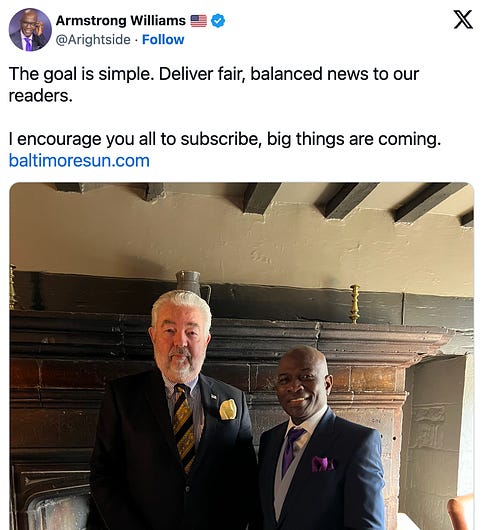 |
:{:{Williams has his own syndicated show on Sinclair stations. His social media accounts are full of incendiary statements about Democrats and liberals. "Each day Joe Biden has sat in office, we have gotten closer and closer to a fascist communist nation," Armstrong wrote on January 10. On January 5, he accused Biden of "destroy[ing] American democracy."}:
On December 19, Armstrong decried "the real time consequences of being infiltrated by radical left-wingers and the acceptance of their insane political agendas." (The issue was the Pope slightly softening his stance on same-sex marriages.) On December 6, Armstrong called Biden "a senile senior citizen" who "barely knows right from left." Armstrong also called the prosecutors pursuing cases against Trump as "terrorists" and promoted false narratives and conspiracy theories about the January 6, 2021 attack on the U.S. Capitol.}:
Armstrong served as an advisor to former presidential candidate and Secretary of Housing and Urban Development Ben Carson. He claims to have paid for Justice Clarence Thomas' wedding reception. In 2005, Armstrong lost his syndicated column after it was revealed that he had been paid $240,000 by the George W. Bush administration to promote their signature education initiative, No Child Left Behind.
Follow the money
Smith has used his vast wealth to support a variety of far-right causes. The Baltimore Banner reports that since 2015, Smith, through his family foundation, has donated large sums to Young Americans for Liberty ($581,000), Project Veritas ($536,000), Turning Point USA ($150,000), and Moms for Liberty ($121,000).
Smith does not support Baltimore Mayor Brandon Scott (D), and has sought to recruit opponents to unseat him. Sinclair stations have provided highly favorable coverage to former Mayor Shelia Dixon (D), who is running against Scott this year. Armstrong conducted an interview with Dixon on a Sinclair affiliate last summer that consisted mostly of "praise for Dixon and criticism of current elected officials."
In 2022, Smith backed a successful ballot initiative to impose term limits on Baltimore's elected officials. Currently, Smith is "underwriting Renew Baltimore, a ballot drive to cap and lower the property tax rate."
Now, Smith has a new tool in his arsenal to shape Baltimore's politics: the city's paper of record.
---
an 2 23
ahead of former President Donald Trump's Wednesday visit to East Palestine, Ohio—where a Norfolk Southern-owned train transporting carcinogenic chemicals derailed on February 3, prompting a mass evacuation and release of pollutants—progressive critics highlighted the key role his administration played in making the fiery crash and its toxic aftermath more likely.
During his speech, Trump—considered a leading GOP presidential candidate for 2024 despite spearheading a deadly coup attempt following his 2020 loss—criticized how President Joe Biden's administration has responded to the environmental and public health disaster unfolding in East Palestine, a poor rural town of about 4,700 people located a few miles west of the Pennsylvania border.
But as critics noted beforehand, the Trump administration's gutting of train safety rules at the behest of railroad industry lobbyists was instrumental in creating the conditions for the derailment and ensuing chemical spill and burnoff, which has provoked fears of groundwater contamination and air pollution.
"He should be apologizing to that community for his administration rolling back rail regulations," progressive stalwart Nina Turner, a former Ohio state senator, tweeted prior to Trump's address.
philadelphia Inquirer columnist Will Bunch made a similar point in an opinion piece published earlier this week.
"If residents of East Palestine—a modern news desertof downsized or disappeared news sources, which allows misinformation to fester—truly knew the reality, a delegation of townsfolk would likely greet Trump with tiki torches and pitchforks," Bunch wrote, comparing the former president's visit to "the tendency of a criminal to return to the scene of his crime."
Bunch noted that "Trump acted specifically to sabotage a nascent government effortto protect citizens from the growing threat posed by derailments of outdated, poorly equipped, and undermanned freight trains that were increasingly shipping both highly flammable crude oil from the U.S. fracking boom as well as toxic chemicals like the ones that would derail in East Palestine."
"Trump had been in office for less than a year when he moved to killthe 2015 rule change initiated by the Obama administration that would have required freight trains to upgrade the current braking technologythat was developed in the 19th century for state-of-the-art electronic systems," wrote Bunch, who pointed out that this came after Norfolk Southern and other rail carriers donated more than $6 million to Republican candidates in 2016 and spent millions more on lobbying.
"With the investigation into the East Palestine wreck still in its early phases, it's not clear if the modern brakes—originally required for installation by 2021—could have prevented the toxic derailment or whether the specific Obama rule would have applied," Bunch continued. "But experts do believe the new brakes could have mitigated the wreckage—and thus the release of so many hazardous chemicals."
"The rule reversal wasn't the only time that Team Trump sided with Big Rail over the forgotten Americans who live on the wrong side of their tracks," he added. "In 2019, for example, the Trump administration moved to not strengthen but relax regulations on shipping fracked natural gas through communities like East Palestine. The same year, Trump's White House also killed an Obama-era proposal that would have required two crew members in freight-train locomotives."
Ahead of Trump's visit,More Perfect Union also argued on social media that the ex-president's "attempt to portray himself as a friend of the town and as someone who would have stood up to Norfolk Southern... couldn't be further from the truth."
As the progressive media outlet observed, the Trump administration "withdrew multiple rail safety recommendations and moved toward a 'self-regulatory approach' where rail companies could do as they pleased."
"It's no surprise that the Trump years were filled with dangerous deregulation," More Perfect Union asserted, describing his decision to nominate top rail industry executives to lead the Federal Railroad Administration and the Pipeline and Hazardous Materials Safety Administration as "a prime example of the revolving door between business and government."
"The Trump approach to the rail industry was to let the companies do what they wanted, which was to avoid regulations, slash jobs, and extract profit," the outlet continued. "This approach, and rail companies' greed, has led to over 1,000 derailments each year. Some are massive catastrophes like East Palestine. But every single one is harmful. And if the industry isn't regulated and forced to change, we'll soon be seeing more disasters."
When Trump "pretends to care about rail workers, or the people of East Palestine, we can't believe him," More Perfect Union added. "His record tells a very different story, the story of his own role in creating this problem in the first place."
Even some conservative critics of Trump have questioned the sincerity of his visit.
"It's clear that it's a political stunt," Ray LaHood, a Republican ex-member of Congress who led the U.S. Department of Transportation (DOT) during former President Barack Obama's first term, told Politico on Wednesday. "If he wants to visit, he's a citizen. But clearly his regulations and the elimination of them, and no emphasis on safety, is going to be pointed out."
Sen. Chris Murphy (D-Conn.) wasted little time in doing exactly that, calling the GOP's indignation "fake" soon after Trump announced his travel plans.
Bunch acknowledged that "it's beyond hypocritical for Trump to bring his Harold Hill-huckster shtick to East Palestine when residents are still experiencing headaches and breathing foul air from the kind of catastrophe he didn't lift a finger to stop from the Resolute Desk."
"But also it's a bit baffling why Biden or his Transportation Secretary Pete Buttigieg—who seems to be channelinghis inner McKinsey & Co**. these days—haven't gone to Ohio," he argued. "Especially when Trump and any other Republicans hoping to make political hay off of East Palestine's misery are coming to town empty-handed."
"None of the anti-Biden critics on this issue have offered a solution, because they can't," wrote Bunch. "The only fix for the kind of runaway abuses of modern capitalism that cause these environmental catastrophes isgovernment regulation, aided by empowering worker safety with strong unions—two things that the Trump-led GOP has opposed at every turn."
Even in the wake of the disaster, Republican lawmakers have refused to demand stronger regulations, as HuffPost reported:
:{:{Rep. Bill Johnson (R-Ohio), a vocal Biden critic who represents East Palestine, on Tuesday dismissed immediate calls for stricter rail regulations, saying actions toward accountability will hinge on the findings of a National Transportation Safety Board [NTSB] investigation into the derailment}::{.}:
'That will dictate whether there are laws, regulations that need to be changed, whether there were rules that were violated,' he said during a news conference in East Palestine. 'We don't know any of that yet, and we won't know that until NTSB releases its report.'}:
Hours before Trump spoke, Buttigieg announced that he plans to travel to East Palestine on Thursday. His visit is expected to coincide with the publication of the NTSB's preliminary report about its ongoing probe into the crash.
On Tuesday, Buttigieg unveiled DOT's recommendations for improving the safety of the nation's rail system, though an inter-union alliance of rail workers immediately criticized the plan as inadequate.
Given the scale of the problems—and in light of the transportation secretary's ongoing refusal to exercise his authority to reinstate previously gutted rules along with his consideration of an industry-backed proposal to further weaken the regulation of train braking systems—union leaders have called for nationalizing the railways and implementing their proposed solutions.
Turner, for her part, emphasized that she has "been outspoken about the two years the Biden administration had [to] fix these problems."
"The Trump administration is at fault, as is the Obama administration," Turner contended, referring to the fact that the latter's regulations were also watered down in response to industry pressure.
"The Ohio GOP is to blame as well," she added, echoing recent reporting on Norfolk Southern's campaign to influence state-level lawmakers and officials. "Failure at every level of government and multiple administrations led to this."
ref dayton
https://www.daytondailynews.com/ideas-voices/marcano-the-importance-of-local-media-following-the-east-palestine-derailment/7ORSBKCMPZGLLPR6NAX3EWXNPA/
the Norfolk Southern train wreck near East Palestine has received its share of national news coverage.
The Washington Post covered a raucous town hall that the train company inexplicitly skipped. NPR’s “what to know about the derailment” provided an excellent primer on the wreck. CBS, CNN, NBC, and even Al Jazeera have covered the incident.
The train, pulling 150 cars, derailed on Feb. 3. Three dozen cars went off the tracks, and 11 contained hazardous materials — including five with the man-made, cancer-causing substance vinyl chloride. For the roughly 4,800 residents of East Palestine, on the Pennsylvania border some 40 miles west of Pittsburgh, the current short-term angst will soon turn to long-term worry.
But what happens when the story subsides and the big boys go home?
The Lisbon Morning Journal is the closest newspaper to East Palestine, about 13 miles away. The Salem News has covered the story, and they’re 30 miles away. Particle Media’s online site, Newsbreak, aggregates news content, so that’s useful.
But the train derailment highlights a problem that has affected small communities and areas from Tarboro, North Carolina, to Tucson, Arizona.
Some 360 newspapers closed from the start of the pandemic, according to a report published in the New York Times. The problem is so acute thatone in five Americans live in a news desert with limited access to local news, the Times reported.
Ohio has fared particularly poorly. Since 2004, the state has lost 32% of its newspapers, according to a study by Policy Matters. Most of those companies were run by small operators who cared about the communities they covered.
In years past, the Youngstown Vindicator would have unleashed its army of journalists to travel the 30 minutes to East Palestine. The Vindicator once had the staff and resources to support its 160,000 Sunday circulation product. But the newspaper collapsed under the weight of circulation declines and financial losses and closed in 2019, with a Sunday circulation of just 32,000.
The East Palestine train derailment lays bare what happens when the community loses its news sources.
Newsgathering goes far beyond the daily reporting of who said what at a press conference or who spoke to a crowd at a community gathering. That’s fairly simply blocking and tackling.
I wonder who will go more in-depth.
Who will tell the stories of the townspeople who will be scared for years by the wreck?Who will monitor whether residents start leaving, which would have a cascading effect on property tax revenue and the city’s school district? Who will chronicle the families and children who stay behind and worry about their health?
Who will monitor health department reports to see if residents start getting sick?
Who will act as a watchdog to monitor state officials, who will be charged with ensuring that Norfolk Southern makes restitution, in whatever form that takes? Who will file public records requests to examine the records of any settlements? If there are lawsuits, who will go to the courthouse and report on the findings?
Without reporters and news sources, the people of East Palestine don’t have an independent news source that keeps officials on their toes.
When people say that local media doesn’t matter, take a look at what’s happening a four-hour drive east of the Dayton area. The big boys will go home because they have so many other issues to tackle. Eventually, the citizens of East Palestine will feel the frustration of living in a news desert.
Somehow, we need to strengthen local news, not continue to watch it wither.
Dying newspapers mean there are fewer independent avenues to help communities, fewer ways to cover tragedy, and fewer ways to hold companies and agencies accountable through reporting.
Local news matters. Let’s do a better job supporting it.
Ray Marcano’s column appears on these pages each Sunday. He can be reached at :{raymarcanoddn@gmail.com:(style="box-sizing:content-box;margin:0px;padding:0px;border:0px;vertical-align:baseline"):}:
an 10 22
A Texas newspaper is calling out Gov. Greg Abbott (R) for his lack of accountability where his leadership flaws are concerned.
During his recent debate with Texas Democratic gubernatorial candidate Beto O'Rourke, Abbott resorted to blaming President Joe Biden for many of the issues in his state.
Now, the Fort Worth Star-Telegram has released a report to remind Republican governor of his own timeline and shortcomings. The editorial board has received comments from other Texans who have weighed in with their take on the recent debates.
READ MORE: Watch: Greg Abbott faces boos at site of Uvalde shooting as he arrives to meet with Biden
One of the glaring facts is that Abbott has been in office for two terms; eight years whereas Biden has not even been in office for one full presidential term.
Bonnie Hromcik of Benbrook, Texas insists some of the issues Abbott is blaming Biden for should have been addressed long before he took office following the 2020 presidential election.
"Biden has been president for only two years," Hromcik pointed out. "Abbott has been Texas governor for eight years, the same time Lt. Gov. Dan Patrick and Attorney General Ken Paxton have been in office. If they could clear things up on the border, fix the power grid and address so many other things they blame on Biden, why haven’t they already?"
So, what is one of the reasons for the ongoing problems in Texas? The newspaper believes "insanity" is part of the problem. "Insanity is voting for the same people and expecting a different outcome," she added.
The latest comes as O'Rourke's ad campaigns intensify with highlights of Abbott's presumably failed leadership in the state of Texas over the course of his two terms as governor.
alternet likes to run eg of home town paper op ed, do these affect voters?
eg https://www.alternet.org/2021/10/hawley/
see fake online newspaper Star news network fredericks:
https://www.alternet.org/2021/07/trump-election-claims/
ME
Since the 2020 presidential election, conservative news outlets have been popping up in droves to continue circulating former President Donald Trump's big lie about the election.
So how are outlets continuing to do this? According to NPR, it is more of a trick of the eye. The publication https://www.npr.org/2021/07/02/1011916687/how-pro-trump-local-news-sites-keep-pushing-2020-election-misinformation.
While the publication appears to be just a local news outlet, NPR reports that it is actually flagship of a news syndicate, known as The Star News Network, which consists of several pro-Trump sites. Like The Georgia Star News, the network has created similar sites for states like Arizona, Ohio, and Florida.
Per NPR:
"Its part of the Star News Network - an expanding network of pro-Trump sites seeking to influence local politics with conservative opinion by mimicking the look and feel of local newspaper sites. The group operates eight state-focused news sites, including in key Electoral College states such as Michigan, Arizona, Ohio and Florida."
By focusing on states where Trump is still heavily favored among voters, the network can continue to circulate misinformation since the audience is still focused on what transpired during and after the election.
During a rally in Ohio Las weekend, Trump also added more fuel to the fire with more dangerous claims of voter fraud.
"The biggest tragedy of all is millions of Americans have lost confidence in their vote," Trump said." We can't let that happen. And that's why I say you have to know what took place in 2020 before you can vote in 2022 or 2024."
To name mafter worse, conservative publisher John Fredericksdefended defended sites and the information they share.
"We work very hard to fund our operation through legitimate advertising of all kinds, people that want to reach our expanding audience," he said. "And if somebody needs to reach informed, motivated readers that want the truth, advertising is a great opportunity for them, is a great [return on investment] potential."
FROM YOUR SITE ARTICLES
- Ivanka Trump distances self from dad's election fraud claims as her ... ›
- Trump rants about 2020 election as MAGA cultist claims the former ... ›
- Revealed: Mitch McConnell begged Bill Barr to 'inject some reality ... ›
RELATED ARTICLES AROUND THE WEB
- AP FACT CHECK: Yes, Trump lost election despite what he says ›
- Giuliani's law license suspended over false Trump election claims ... ›
- Trump Pressed Rosen to Wield Justice Dept. to Back 2020 Election ... ›
--
AHA: correction is a journalistic norm, not a law thus no real penalty for lying or just sloppiness (recall jrnl biz values the scoop 1st, thus speed vs accuracy, and clickbait values hype/eyeballs/ fear hate algo boost]
no lnx
How Pro-Trump Local News Sites Keep Pushing 2020 Election Misinformation
July 2, 20215:00 AM ET
STEPHEN FOWLER
FROM
Georgia Public Broadcasting
Georgia election workers begin their recount of ballots after the November election. Despite three recounts of the tally, former President Donald Trump and his allies falsely claim electoral fraud cost him the state.
If you don't follow politics in Georgia closely — or even if you do — you might be forgiven for not knowing much about The Georgia Star News.
Founded just after the November election when President Biden narrowly flipped the state by about 12,000 votes, it looks like a regular news website with a lifestyle section, a widget for the weather and stories about local and national goings-on.
But the site is more than just a local news outlet. It's part of the Star News Network — an expanding network of pro-Trump sites seeking to influence local politics with conservative opinion by mimicking the look and feel of local newspaper sites. The group operates eight state-focused news sites, including in key Electoral College states such as Michigan, Arizona, Ohio and Florida.
Steve Bannon, a former strategist for former President Donald Trump, described The Georgia Star News in a radio interview as content "you can't get anywhere else."
"We're not Conservative Inc.," he said. "It's very populist, it's very nationalist, it's very MAGA, it's very American First."
Pro-Trump media ecosystem
The Star News sites are part of a larger pro-Trump media ecosystem that emerged over the course of his four years in office. Since last year's election, some of those sites have spent months churning out false content suggesting Trump won the election and claiming that massive electoral fraud will be uncovered.
Many of the Star News sites have been around for a while, but the 2020 election — and an intense focus on swing states like Georgia — has helped the sites' stories reach a much a larger audience.
Georgia's fledgling website gets a boost from publisher John Fredericks' talk radio show that has featured numerous figures from Trump's orbit, including Bannon and former campaign manager Corey Lewandowski. His show also regularly features Georgia Republican politicians who have pushed false claims of election fraud or are challenging those who did not work to overturn the election.
Fredericks, who most recently hosted his talk show from Virginia, came to Georgia ahead of last January's dual Senate runoffs as part of an effort by conservatives (and conservative media) to support then-Sens.Kelly Loeffler and David Perdue's reelection campaign. He alsohosts a TV show on the Real America's Voice networkthat also features Bannon's "War Room: Pandemic" podcast popular with many election skeptics.
So there was a ready-made audience when the Georgia Star published a misleading story mid-June questioning the legitimacy of nearly 20,000 absentee ballots placed in Georgia drop boxes — slightly more than the margin of Biden's victory there.
The story said that Fulton County, which includes Atlanta, could not produce crucial chain of custody documentation for ballots returned in drop boxes, suggesting that the ballots may not have been legitimate.
Days later, county officials were able to find all but eight of those forms, said all the ballots were accounted for — and noted that Georgia's votes were counted three different times in November.
"The most explosive thing" ESCA ECHO
But in the conservative alternate media sphere, the story began to pick up steam. On Fredericks' radio show, Bannon called it "the most explosive thing that I think has happened in the entire process."
From there it ricocheted across the pro-Trump mediasphere to TV networks like One America News and conspiracy sites such as The Gateway Pundit.
But the story was not limited to the fringe of Republican politics: several pro-Trump lawmakers and primary challengers in Georgia demanded an investigation. Republican Secretary of State Brad Raffensperger — himself a frequent target of misinformation, attacks and death threats because of these sites — did too. That led mainstream outlets to run with Raffensperger's response, pushing the story further into the spotlight.
Just a few days after the original Georgia Star story, Trump issued several statements linking to a One America News segment about the misleading story and praising the Georgia Star writer by name for "the incredible reporting you have done."
The Georgia Star hasn't updated its original story, or several follow-up pieces, with Fulton County's release of the data.
In an interview, the story's author, Laura Baigert, blamed the county for providing incomplete documents and information.
"Not our problem to solve" ~ CORRECTION
"If they can't tell us how many forms they have and how many ballots they have, that's an issue for people who are administering an election," she said. "That's not our problem to solve that for them."
At the time, a Fulton County spokeswoman said that the county followed proper procedures in collecting the drop box ballots and the county was continuing to research the few remaining missing chain of custody forms. The county elections director said that staff spent more than 200 hours that week locating the "missing" forms before they were provided to Georgia Public Broadcasting.
But the story breathed new life into Trump's false claims, which he repeated at length during a rally last Saturday in Ohio.
"The biggest tragedy of all is millions of Americans have lost confidence in their vote," he said. "We can't let that happen. And that's why I say you have to know what took place in 2020 before you can vote in 2022 or 2024."
After the rally, Baigert snagged an exclusive half-hour interview with the former president as he rode back to the airport. The next day, an all-caps headline appeared on The Ohio Star, Georgia Star and sister sites in battlegrounds like Michigan and Arizona, touting the conversation and its key takeaway.
"There's no more important issue than the 2020 election," Trump said.
Fredericks defended the outlet's coverage in an interview and said that the Georgia Star is a credible news service for Georgians that acts as an alternative to "fake news" mainstream media."Our goal is to speak truth to power in the world of fake news, and that's really what we're dealing with, that's why we're here," he said. "That's why we have an audience."
Less than seven months into existence, Fredericks said that the website was profitable, thanks to a crush of advertising from local Republican candidates and conservative groups.
"We work very hard to fund our operation through legitimate advertising of all kinds, people that want to reach our expanding audience," he said. "And if somebody needs to reach informed, motivated readers that want the truth, advertising is a great opportunity for them, is a great [return on investment] potential."
see alt newspaper
https://www.alternet.org/2019/09/grocery-store-chains-are-trying-to-kill-your-favorite-local-newsweekly-but-you-still-have-time-to-stop-them/
kroger's grocer
==
jrnl fail: 6 22
https://www.mediamatters.org/washington-post/newspaper-coverage-record-gas-prices-missing-important-context-big-oils-record
aha wa examiner // WT? not a real paper but key in escalator, cross-over from soc med to mainstream? fox?
what happ to pittsburg-X? are local papers failing faster b/c of covid? something else? makes space for fake/online like WT/WE?
escalator, activ meas
https://www.alternet.org/2020/08/how-trump-is-once-again-colluding-with-russia/
no lnx twt
how Trump is once again colluding with Russia
Written by Nancy LeTourneau / Washington Monthly August 14, 2020
Almost two weeks ago, a story circulated that Portland protesters were burning Bibles and American flags. It spread via social media and was picked up by conservative outlets, such as the Washington Examiner. Of course, several Republican leaders joined the bandwagon.
==
https://www.mediamatters.org/climate-deniers/dallas-morning-news-editorial-board-conducted-rare-climate-change-focused-qa
ted mcd
The Dallas Morning News’ editorial board conducted an interview with discredited climate contrarian Bjorn Lomborg and published an edited version without explaining his background or contextualizing his claims. He used the opportunity to push for minor solutions that do not adequately address the scale of the climate crisis.
On December 1, The Dallas Morning News -- a top 15 U.S. newspaper by circulation -- published a condensed interview about climate change solutions with Bjorn Lomborg, a Danish political scientist and director of the think tank Copenhagen Consensus Center. Lomborg criticized current spending on climate change as inadequate and instead proposed that leaders “look at where can you spend a dollar and do the most good” -- which he suggested should include implementing a carbon tax, increased spending on clean energy research and development, investment in climate adaptation, and consideration of “geoengineering,” or using technology to purposefully change the climate.
Those proposals sound relatively benign, and Lomborg has been making these arguments for quite some time. But they are not nearly enough to tackle climate change, and they allow for the continued burning of fossil fuels when what is really needed is a drastic cut in carbon emissions. Lomborg, who has a long history of downplaying the climate crisis, offers relatively minor approaches to solving this massive problem. Unfortunately for readers of the piece, the editorial board does not provide any of this context.
What’s worse, it’s extremely rare for climate change to come up in a Q&A with The Dallas Morning News’ editorial board. Media Matters reviewed Dallas Morning News Q&As going back to January 2017, and just one -- a July 2017 interview with Rep. Eddie Bernice Johnson (D-TX) -- included a substantive mention of climate change. When the topic of climate change was finally addressed again in a Q&A format, instead of reaching out to a climate scientist, activist, or policymaker, the paper chose to talk to serial climate misinformer Lomborg.
Lomborg is a climate contrarian who has connections to the Koch network
The only information provided about Lomborg in this interview reads: “Bjorn Lomborg is an academic and author of the book ‘The Skeptical Environmentalist.’” The interview gives the impression that Lomborg is a credible climate expert, but there are many issues with his climate-related work.
Lomborg is a contrarian who “represents an insidious form of climate change denial,” according to The Washington Post. Lomborg has been long discredited within the climate science community. He’s been caught downplaying the risks of sea level rise and even misrepresenting Intergovernmental Panel on Climate Change reports. His work showing that it’s a poor investment to limit global temperatures to 2 degrees C under the Paris climate agreement has been scrutinized and rejected by scientific experts.
He’s also been credibly accused of misinforming about climate change’s effects on both poverty and extreme weather. NASA climate scientist Gavin Schmidt has said that Lomborg is “totally undermined by his whole career of cherry picking whatever the most favorable reading is and refusing to countenance any possibility of something worse.”
His book is rife with scientific inaccuracies. The one major disclosure about Lomborg in this piece is that he is the author of The Skeptical Environmentalist. This best-selling book published in 2001 helped launch Lomborg to fame, but its main claims have been debunked by the climate science community. In 2003, a Danish government committee found him guilty of “scientific dishonesty,” concluding, “Based on customary scientific standards and in light of his systematic one-sidedness in the choice of data and line of argument, [he] has clearly acted at variance with good scientific practice.” Climate news site Grist spoke with scientific experts in eight environment-related fields, and all of them found his analyses in The Skeptical Environmentalist to be fundamentally flawed -- with one expert noting that Lomborg lacks even “a preliminary understanding of the science in question." Scientific American also shared critical responses to his work. There is even a website that takes down the errors in Lomborg’s book one by one.
Groups connected to the shadowy Koch network have generously donated to Lomborg’s think tank.Since its registration in the U.S. in 2008, the Copenhagen Consensus Center has received $170,000 from the conservative Randolph Foundation, whose director, Heather Higgins, has ties to multiple groups within the Koch network. Copenhagen Consensus Center also received $300,000 from the Ewing Marion Kauffman Foundation, which is part of the Koch network’s attempt to influence state and federal judges. The group also received $200,000 from conservative Republican billionaire Paul Singer, who had previously given more than $1 million to the oil billionaire Koch brothers. The Koch network has donated lavishly to climate denial efforts.
Lomborg generally appears in right wing media to make his case
Climatologist Stefan Rahmstorf said in 2015 that Lomborg’s “propaganda message is not only popular with fossil fuel interests, but continues to get ample space in the media.” Since then, and after Lomborg was thoroughly shut down by the climate science community, he has been generally relegated to right-wing media outlets to make his points (save for a few USA Today op-eds).
Lomborg regularly publishes op-eds in the conservative Wall Street Journal and New York Post. As noted above, he generally downplays the seriousness of climate change, avoids calling for a reduction in carbon emissions, and argues in favor of focusing on milquetoast approaches like increasing clean energy research and development spending.
He’s also appeared on Fox News three times in 2019 -- twice on Tucker Carlson Tonight and once on The Ingraham Angle. In all of these appearances, he’s downplayed the risks of climate change. For example, in an April appearance on Tucker Carlson Tonight, he stated, “They’re telling us global warming is a problem. But it’s also a moderate one.”
His various debunked climate views have largely kept him out of the mainstream media -- until now.
The Dallas Morning News’ news team has done a decent job with climate coverage over the past year: The September youth climate strike and the IPCC land report were important enough for the paper to feature them on its front page. They also took a look at climate change’s role in amplifying extreme weather in Texas and elsewhere. The paper’s opinion section has stepped up, too, with an op-ed from climate scientist Andrew Dessler and an op-ed linking global warming to racial equity. That’s why it’s so disheartening to see that when the editorial board conducts a rare climate-focused interview, it gives that space to such a dishonest actor.
==
lomborg
punked GUK then
https://yyy.theguardian.com/australia-news/2016/sep/24/bjrn-lomborg-centre-got-640000-for-report-saying-limiting-warming-rise-to-2c-not-worth-it
===
https://www.mediamatters.org/coronavirus-covid-19/covering-trumps-coronavirus-response-major-newspapers-barely-mention-he-fired officials 2018
:{
}:
:{
}:
==
==
indirect press suppress:
https://www.alternet.org/2019/10/the-social-media-giant-pays-a-tiny-legal-fine-for-falsifying-video-data-that-news-media-relied-on-to-strategize/
error in metrics?
...
“The average viewership metrics were not inflated by only 60%-80%; they were inflated by some 150 to 900%,” an amended complaint stated.
The result of this “error,” willful or not, was that dozens of news sites shifted their editorial strategies to encompass more video content, particularly on Facebook. Often, this came at the detriment of print journalism, both in editors and writers. “We don’t really know how much damage was done ultimately to the industry — we can sort of see it in terms of the number of lay-offs and things like that — but it’s clearly by any stretch of the imagination it’s clearly a drop-in-the-bucket, it’s pocket change, to an outfit like Facebook,” John Stanton, co-founder of the Save Journalism Project, told Salon in an interview. Stanton, a former BuzzFeed journalist, was laid off around the time that Facebook’s ad metrics fraud was in effect.
Facebook has continued to argue that the contrived metrics were an innocent mistake.
...
==
==
mickey hart lists 6 ngo's trying to revive local news(papers) McChesney?
https://kpfa.org/episode/the-ralph-nader-radio-hour-september-9-2019/
2nd 1/2
==
919
The Vindicator (Ohio newspaper) - Wikipedia
https://en.wikipedia.org › wiki › The_Vindicator_(Ohio_newspaper)
1.
**Owner(s)**: Ogden Newspapers Inc. as of Septe...
Editor: Brenda Linert as of September 1, 2019
Publisher: Charles Jarvis as of September 1, 2019
Founded: 1869
Missing: liberator | Must include:liberator
Youngstown Newspaper Publishes Its Last Edition After 150 ...
https://pittsburgh.cbslocal.com › 2019/08/31 › youngstown-the-vindicator-...
1.
Missing: liberator | Must include:liberator
The Vindicator, Youngstown's daily newspaper, will close after ...
https://www.cleveland.com › news › 2019/06 › the-vindicator-youngstown...
1.
Missing: liberator | Must include:liberator
==
:{Majority of top newspapers in agricultural producing states fail to mention UN climate and land report on their front pages:(style="box-sizing:border-box"):}:
https://www.alternet.org/2019/08/another-nail-in-the-coffin-of-democracy-and-journalism-as-us-newspaper-giants-announce-1-4-billion-merger/
==
1018
ipcc report 10/8/18 check coverage 12 yrs
==
new report issued by the U.N. Intergovernmental Panel on Climate Change this week warned that if immediate and unprecedented action is not taken, the dire consequences of global warming will start to take effect within the next 20 years.
The landmark report dominated the environmental news beat this week, but its impact was not reflected in mainstream media coverage.
Unsurprisingly, Fox Newsdid not cover the report until late Monday afternoon, when Shep Smith spent a few minutes on the topic, saying, “climate change is real, the situation is urgent, and time is running out. That's the new warning from a landmark United Nations report." Smith’s reporting was quickly watered down with correspondent Trace Gallagher describing the goals laid out in the U.N. report as “really unreasonable” and “draconian.”
While most TV networks are notoriously terrible when it comes to covering the real-life causes and impacts of climate change, Fox News stands out among the worst offenders. The network has spent years telling its viewers that global warming is a hoax. They have devoted coverage to undermining climate science across its platforms -- in 2012, the Union of Concerned Scientists found that 93% of Fox News' representations of climate science were misleading.
Fox was not alone in ignoring the climate report: 28 of the top 50 U.S. newspapers made no mention of it on their homepages, including 10 that serve cities listed among the**"25 U.S. Cities Most Affected by Climate Change.**"
The predictions offered in the report would likely affect every American, but the media is largely unwilling or unable to dedicate substantive coverage to climate change and related environmental news. While there is clearly a hunger for climate change reporting--particularly on the responses and solutions to this global crisis--coverage is lacking, if not downright misleading, across every network.
Watch this: Fox News has spent years telling viewers that climate change is not real. We juxtaposed those lies with the dire warnings from the new climate report.
==
==
https://www.alternet.org/they-think-it-would-be-fun-run-newspaper-billionaires-buying-media-another-step-toward-oligarchy
FAIR
announcement that Time magazine would be bought by software CEO Marc Benioff highlighted the growing trend of billionaires buying up media outlets. While media moguls have always been wealthy—with press barons (Rupert Murdoch, Michael Bloomberg, Donald Newhouse, etc.) still well-represented on Forbes’ running list of the world’s billionaires—what distinguishes this new breed of press magnate is that they bought their media properties with fortunes made in other industries.
Some, like Benioff, come out of the tech industry; tech tycoons like Amazon’s Jeff Bezos, eBay’s Pierre Omidyar and Steve Jobs’ widow Laurene Powell Jobs have profited from a tech boom (or bubble) that gives them plenty of cash to spend. Others come out of the financial sector, which has doubled its share of the US economy over the past 70 years. Real estate developer Mort Zuckerman—who owned The Atlantic from 1980–1999, the Daily News from 1993–2017, and still owns US News & World Report, which he bought in 1984—was a harbinger of non-media money coming into the media sector.
Wherever their money comes from, the new moguls’ interest in buying up outlets is generally less the direct profit involved—media profits are typically declining as the old local monopoly model erodes—and more the power that comes with control of the public conversation. Being a latter-day Citizen Kane is a personal ego boost, to be sure, and provides a platform for an individual ideology—whether it’s Philip Anschutz’s social conservatism or Omidyar’s civil libertarianism.
But it also can be a tool to advance more personal interests: Sheldon Adelson is a fervent supporter of Israel and its Likud Party, but he bought a Las Vegas paper when it was running critical coverage of a lawsuit that threatened to shut him out of the gambling business. Bezos’ purchase of the Washington Postinstantly made him the most powerful media figure in the nation’s capital—a handy position to be in when your company is seeking multi-billion-dollar government contracts.
Whatever the motivation, billionaires buying up media is another step toward oligarchy, as a handful of super-wealthy individuals assume power over crucial news outlets, both locally and nationally.
Research: John McCullough
Billionaire
Media Owned Net Worth Source of Wealth
Jeff BezosWashington Post$112 billionAmazonWarren BuffettBuffalo News,
Omaha World-Herald,
Business Wire, etc.$84 billionFinanceSheldon AdelsonLas Vegas Review-Journal$39 billionCasinosLaurene Powell JobsThe Atlantic$19 billionApple
Philip :{Anschutz Weekly Standard, Washington Examiner,
Oklahoman,
Colorado Springs Gazette$13}:billionOil
Pierre OmidyarThe Intercept$11 billioneBay
:{
}:
Patrick Soon-ShiongLA Times,
San Diego Union-Tribune$8 billionBiotech
:{
}:
Marc BenioffTime$5 billionTech
:{
}:
Mort ZuckermanUS News & World Report$2.8 billionReal estate
:{
}:
Glen TaylorMinnesota Star-Tribune$2.6 billionPrinting
:{
}:
John HenryBoston Globe$2.5 billionFinance
:{
}:
Joe MansuetoInc., Fast Company$2.5 billionFinance
==
https://www.mediamatters.org/blog/2018/08/14/hundreds-newspapers-plan-editorials-denounce-trump-s-war-press-fox-hosts-attack-newspapers/220991
Fox News and Fox Business hosts are slamming hundreds of newspapers as “anti-Trump” and “fake news” for coordinating to publish editorials on August 16 denouncing President Donald Trump’s war on the press.
Trump and his administration publicly attacked news organizations and specific journalists hundreds of times in just his first year in office. Though he routinely attacked news organizations during his presidential campaign and the transition period between his election and inauguration, Trump’s anti-press rhetoric reached a new low in February 2017, when he began calling news organizations “the enemy of the American people”: ... more than 100 newspaper editorial boards around the country are reportedly planning to publish editorials on August 16 “on the dangers of the administration’s assault on the press.” Each newspaper will be writing its own editorial in this coordinated effort.
Fox, which has both served as a platform for Trump’s attacks on the press and promoted his attacks on its own, is now criticizing the newspapers participating in this effort as anti-Trump and “fake news.” On August 13, five Fox News and Fox Business hosts took offense to the coordinated editorial release protesting Trump’s anti-press rhetoric. Fox & Friends First co-host Rob Schmitt said these newspapers are releasing editorials “attacking the president” and that “there is just kind of a mainstream, somewhat leftist bias coming from a lot of our media companies.” Fox & Friends co-host Steve Doocy commented that The Boston Globe “said essentially they’re going after the president.” Varney & Co. guest host Ashley Webster and Wall Street Journaleditorial board member James Freeman both defended Trump’s rhetoric that the media are “the enemy of the people,” pushing Trump’s ridiculous claim that his critique applies only to “fake news.” Fox Business host Lou Dobbs referred to the planned editorials as “anti-Trump screeds” by “coordinated national left-wing fake news.” And Fox host Laura Ingraham, while criticizing media coverage of antifa actions against reporters, mocked the newspapers’ coordinated effort as “not collusion or anything.”
...
Government, The Presidency & White House, Justice & Civil Liberties
Network/OutletFox News Channel, Fox Business
PersonDonald Trump, Laura Ingraham, Steve Doocy, Lou Dobbs, James Freeman, Ashley Webster
Show/PublicationFox & Friends First, FOX & Friends, Varney & Co., Lou Dobbs Tonight, The Ingraham Angle
Stories/InterestsTrump's War on the Press
==
https://www.mediamatters.org/blog/2018/07/27/Newspapers-are-failing-to-connect-extreme-heat-to-climate-change/
Al
ost 90 percent of articles about the recent heat wave in the biggest 50 U.S. newspapers failed to mention hot weather’s connection to climate change, according to a new report published by the nonprofit Public Citizen.
This unfortunate trend extends beyond newspapers. Media Matters has documented how rarely broadcast TV networks cover climate change. Our most recent study looked at how the major broadcast networks covered the links between climate change and extreme heat and found that over a two-week period from late June to early July, only one segment out of 127 about the heat wave mentioned climate change.
Public Citizen looked at coverage of extreme heat in the top 50 U.S. newspapers by circulation over the first half of 2018 and found that less than 18 percent of the articles mentioned climate change:
In the top 50 newspapers, a total of 760 articles mentioned extreme heat, heat waves, record heat, or record temperatures from January 1 to July 8, 2018. One hundred thirty-four of these pieces (17.6 percent) also mentioned climate change or global warming.
In late June and early July, when a heat wave was afflicting much of the U.S., the percentage of articles mentioning climate change was even lower:
During the period June 27 to July 8, only 23 of 204 heat-related articles (11.3 percent) mentioned climate.
Public Citizen also looked beyond the top 50 papers to see how extreme heat was covered in papers in 13 states where 10 or more local areas broke heat records from June 27 to July 8. This more localized newspaper coverage was even worse:
During the heat wave, there were 673 articles, with 26 (3.9 percent) mentioning climate.
While writers and editors may want to exercise caution in attributing any individual event to climate change, the science is clear that our warming climate is making extreme events like heat waves, floods, and fires more intense and more frequent. That’s why environmental journalists and communicators have been calling on major news outlets to do a better job of covering climate change and the environmental rollbacks that could make things worse.
Public Citizen’s report did highlight notable exceptions when newspapers did strong reporting to connect extreme heat to climate change -- such as a story by Austin American-Statesman reporter Roberto Villalpando that explained how climate change is bringing 100-degree days to Austin earlier in the year. Despite this, the report concluded, “U.S. news outlets continue to tell only half the story. These exceptions need to become the norm if the public is going to wake from its slumber on climate change in time to take the bold action we urgently need to avoid catastrophic harm, and possibly even an existential threat to the U.S., later this century."
aka trib co
https://www.democracynow.org/2018/7/24/tronc_fires_half_the_staff_of
==
https://www.alternet.org/news-amp-politics/why-are-major-newspapers-and-magazines-hiring-so-many-right-wing-cranks
something charming and retrograde about the shrieking chorus that erupts online every time a major newspaper or legacy magazine hires some new dumbass to write opinions a few times a week. We all get to pretend that any of this still matters, that it’s not all just whistling into the void in a universe where a functionally illiterate American president gets all his information from a garish morning program, and your 60-something moms and dads receive their news from chain-letter-quality Facebook memes. Even those of us who still peruse the opinion pages can’t remember the last thing we read there. Even those of us who write this stuff are pressed to pretend it’s anything other than more frothy ephemera bobbing on the surface of a vast, rising ocean of content.
Many of the most loudly contested recent hires have been of so-called Never Trump conservatives, a cohort of exactly four-dozen people in three zip codes. Fortunately for them, they do have a natural constituency, which consists entirely of the editors of prestige publications. These are people—both the posturing writers and the editors who hire them—with an abiding commitment to the line that our current president represents the inception of something entirely new and gross in our political system, which allows them to conveniently elide the racist savagery of American politics, and American conservativism in particular, more or less from the get-go.
The Atlantic, for instance, whose stable of writers includes former George W. Bush speechwriter #NeverTrumper David Frum, just hired Kevin D. Williamson. A former National Review writer, Williamson was swiftly taken to task on Twitter for proposing that women who have abortions should be hanged, and for once describing an African-American boy as a “three-fifths-scale Snoop Dogg.” (He has since deleted his account.) You may recall another well-known American document that refers to black people by this percentage. Williamson drops this deliberate provocation (he is daring you to call him racist, so he can deny it and accuse you of a deliberately uncharitable reading) immediately after describing the boy as “raising his palms to his clavicles, elbows akimbo, in the universal gesture of primate territorial challenge.” ("Well, humans are primates," he would argue, if you bothered to point out that this, too, is racist trash.)
Williamson has written that dying towns should be left to die, that mobile rootlessness is the key to economic prosperity, and that price gouging after natural disasters is fine and good. These would appear to cut slightly against some of the central rhetorical commitments of conservative writing and thought, which valorizes small-town America, imagines church and family as the central institutions of communal life, and proposes that private charity could pick up the slack for disaster relief and health and human services. We should instead untangle our social networks, abandon our congregations and let Main Street go to seed as our tiny nuclear families blast around America, from one city to another, in search of some tenuous at-will job. How will we pay for the U-Haul, the motels, the first and last months’ rent? Who cares. The truth is that this only seems to cut against conservativism, whose ideals about community were never more than rhetorical, except of course when it came to race, for which the specific boundaries of particular communities retain a totemic power.
Williamson wasn’t the worst writer the Atlantic could have hired. At the National Review, where you can also encounter the fatuous Jonah Goldberg or the perpetually morally panicked David French, he is very nearly reasonable, even if he still appears slightly mad to those of us outside of the asylum. He’s merely a tedious crank. But a lot of tedious cranks seem to be popping up in the upper echelons of opinion journalism these days, and it does well to ask why.
The editors and publishers will tell you that it is so that their overwhelmingly liberal audiences may be exposed to new ideas, as if readers of the Atlantic are unaware that conservatives think affirmative action is bad and subscribers to the New York Times don’t know that there are people who pretend to think that climate change is phony. And if you are the sort of person who complains about these hires online, someone will surely pop into your Twitter mentions to remind you that the outrage machine drives lots of clicks and page views.
The truth, though, is that these columnists are all hired as part of a project of desperate make-believe, in which it is possible to imagine that Donald Trump and our present politics really are a singular event, a historic deviation. In their fantasy, there remain two broadly similar and functional political parties whose respective ideologies meet in a nebulous but desirable middle, wherein reasonable men and their reasonable institutions can yet function as they ever have. It’s a fairly rosy portrayal of American political history to begin with, but there was at least a sense that it was superficially, if only superficially, true. This genteel fiction permits the mandarins of respectable media to indulge the most preposterous fiction of them all, which is that the modern conservative movement in America isn't absolutely and irredeemably deranged.
This is not to overcredit a deeply compromised and corrupt American liberalism, especially in the form of a Democratic Party that more often than not resembles a finishing school for communications professionals and future Wall Street placeholders. But only if we pretend that a tiny cadre of idiosyncratic urban conservatives are in some way representative of even a plurality of conservative thought in this country can we imagine that at a root level, this all amounts to differing attitudes about market incentives and land use policies—that it was ever about any of that to begin with. If that is not the case, then it throws into stark relief the broader identities of these publications as largely neutral arbitrators of a national conversation, and that might mean they’d face some moral obligation to pick a side.
==
Free press advocates and LA Weekly staffers are demanding that the mysterious company that bought the news organization and gutted most of its staff reveal its identity.
Semanal LLC, the secretive buyer that formed for the sole purpose of purchasing LA Weekly last month, closed on the sale Wednesday and promptly laid off nine of the 13 members of the alternative weekly’s editorial staff, sending shock waves across an industry already rattled by unexpected reductions and closures.
On Thursday, the Society of Professional Journalists condemned Semanal’s continued anonymity.
“In an era of rampant misinformation and distrust, it’s especially important that we do not allow the owners and backers of news organizations to remain a mystery,” said SPJ ethics committee chairperson Andrew Seaman. “We cannot allow this to become the norm.”
LA Weekly, which has been in operation in Los Angeles for about 40 years, also posted a story on its site urging readers to question its new ownership.
“The new owners of L.A. Weekly don’t want you to know who they are,” wrote contributor Keith Plocek, a lecturer at the University of Southern California’s Annenberg School for Communication and Journalism. “They are hiding from you. They’ve got big black bags with question marks covering their big bald heads.”
The cuts leave LA Weekly with just one staff writer. A number of the employees laid off on Wednesday tweeted bleak goodbyes.
... still shell shocked after yesterday’s incomprehensible, daringly dumb, “let’s be legends” layoffs, but thank you for all kind words and notes. It was an honor to write for this storied publication. To be a footnote in its history is a dream come true. Farewell, old pal. RIP
- :{9:(style="display:inline-block;vertical-align:text-bottom"):}::{9 Replies:(style="position:absolute !important;overflow:hidden !important;width:1px !important;height:1px !important;padding:0px !important;border:0px !important;clip:rect(1px 1px 1px 1px) !important"):}:
- :{20:(style="display:inline-block;vertical-align:text-bottom"):}::{20 Retweets:(style="position:absolute !important;overflow:hidden !important;width:1px !important;height:1px !important;padding:0px !important;border:0px !important;clip:rect(1px 1px 1px 1px) !important"):}:
- :{178:(style="display:inline-block;vertical-align:text-bottom"):}::{178 likes:(style="position:absolute !important;overflow:hidden !important;width:1px !important;height:1px !important;padding:0px !important;border:0px !important;clip:rect(1px 1px 1px 1px) !important"):}:
:{ > :(style="position:relative;top:1px;display:inline-block"):}:
We were expecting there to be some pain with the sale of @LAWeekly. But we weren't expecting the Red Wedding. That's how deep the cuts are. 1/
- :{61:(style="display:inline-block;vertical-align:text-bottom"):}::{61 Replies:(style="position:absolute !important;overflow:hidden !important;width:1px !important;height:1px !important;padding:0px !important;border:0px !important;clip:rect(1px 1px 1px 1px) !important"):}:
- :{685:(style="display:inline-block;vertical-align:text-bottom"):}::{685 Retweets:(style="position:absolute !important;overflow:hidden !important;width:1px !important;height:1px !important;padding:0px !important;border:0px !important;clip:rect(1px 1px 1px 1px) !important"):}:
- :{1,114:(style="display:inline-block;vertical-align:text-bottom"):}::{1,114 likes:(style="position:absolute !important;overflow:hidden !important;width:1px !important;height:1px !important;padding:0px !important;border:0px !important;clip:rect(1px 1px 1px 1px) !important"):}:
 :(style="position:absolute;-webkit-box-flex:0;flex:0 0 auto;display:inline-block;top:0px;left:0px;width:36px;height:36px;overflow:hidden;background-color:transparent;border-radius:4px"):}::{:{Mara Shalhoup:(style="font-weight:700;overflow:hidden;text-overflow:ellipsis;padding-right:4px"):}::(style="display:flex;-webkit-box-align:center;align-items:center;overflow:hidden"):}::{@mshalhoup:(style="padding-right:4px;flex-basis:100%"):}:
:{ > :(style="position:relative;top:1px;display:inline-block"):}:
Humbled by all the kind words coming my way and to all my amazing colleagues at LA Weekly. Thanks to everyone who took the time to read us. Keep supporting independent journalism. We need it more than ever.
10:10 PM - Nov 29, 2017 · Los Angeles, CA
- :{18:(style="display:inline-block;vertical-align:text-bottom"):}::{18 Replies:(style="position:absolute !important;overflow:hidden !important;width:1px !important;height:1px !important;padding:0px !important;border:0px !important;clip:rect(1px 1px 1px 1px) !important"):}:
- :{34:(style="display:inline-block;vertical-align:text-bottom"):}::{34 Retweets:(style="position:absolute !important;overflow:hidden !important;width:1px !important;height:1px !important;padding:0px !important;border:0px !important;clip:rect(1px 1px 1px 1px) !important"):}:
- :{301:(style="display:inline-block;vertical-align:text-bottom"):}::{301 likes:(style="position:absolute !important;overflow:hidden !important;width:1px !important;height:1px !important;padding:0px !important;border:0px !important;clip:rect(1px 1px 1px 1px) !important"):}:
Digs into Semanal have turned up limited information. David Welch, a lawyer known in Southern California for suing unlicensed cannabis dispensaries, is listed as the registered agent in the California Secretary of State Business Database, according to LA Weekly’s sister site OC Weekly. Brian Calle, chief opinion writer for Southern California News Group, will take over editorial management of the site, the outlet also confirmed.
Last year, OC Weekly named Calle one of “Orange County’s Scariest People of 2016,”pointing to his role in a number of blunders at his previous post.
It’s been a trying month for local news. Earlier this month, Joe Ricketts, the billionaire CEO of news organizations DNAinfo, Gothamist and its sister sites, shut down the sites without warning just days after a number of staff members announced they had formed a union. The decision put 115 journalists out of work left a gaping hole in coverage in the cities those outlets covered: New York, San Francisco, Los Angeles, Chicago and Washington
==
https://kpfa.org/episode/talkies-october-4-2017/
the nation mag
buy small town newspapers for real estate; rent to paper then downsize jobs, then discard;
julie reynolds
king city/ cops tow scam
randall smith global capital
==
Conservative Op-Eds Argued Wrongly That China and India Are Not Taking Action
Right-wing op-eds falsely claimed that China, India and other developing nations were not committed to Paris goals.
In a syndicated column that appeared in USA Today and USA Today Network newspapers, Phil Kerpen, president of American Commitment and a former vice president of Americans for Prosperity, wrote, "The Paris treaty effectively bans coal-fired power plants in the United States—while China has 368 coal plants under construction and more than 800 in the planning stage. India's coal production under the deal is allowed to double by 2020—and they are likely to have emissions much higher than what they promised." And in his anti-Paris op-ed in theBoston Herald, Loris wrote, "Developing nations want affordable, dependable energy to raise their standards of living, and countries such as India, China and Indonesia need to use a lot of coal to get there."
China and India are on pace to meet their emissions targets ahead of schedule.
The Washington Post recently reported that an analysis conducted by the Climate Action Tracker found that "China and India are on track to overachieve on their climate pledges" and quoted Bill Hare, CEO of the nonprofit science and policy institute Climate Analytics, saying that China and India "are going to slow the global growth in CO2 emissions significantly." A New York Times editorial discussing the same analysis noted, "The shift from fossil fuels has ... been much faster and more pronounced than most experts expected. China has reduced coal use for three years in a row and recently scrapped plans to build more than 100 coal power plants. Indian officials have estimated that country might no longer need to build new coal plants beyond those that are already under construction."
China and India are taking big steps to develop clean energy and scale back coal plants.
In January of this year, China announced that it plans to spend more than $360 billion through 2020 on renewable energy sources and is canceling plans to build more than 100 coal-fired power plants. Last year, India announced that it plans to get 57 percent of its total electricity capacity from renewable sources by 2027 and launch a $2 billion equity fund to boost renewable energy development. According to The Associated Press, a March report by the groups CoalSwarm, the Sierra Club and Greenpeace found that "construction starts for coal-fired plants in China and India were down by 62 percent in January from a year earlier while new facilities starting operation declined 29 percent." Additionally, a May 22 New York Times editorial noted, "Electric vehicle sales in China jumped 70 percent last year, thanks in large part to generous government incentives. India is much further behind in this area, but the country's minister of power said last month that all cars sold in the country should be electric by 2030.
Developing nations pushed for a strong Paris agreement and were "crucial" to its adoption.
Developing countries, including the least developed countries, were a key part of the "high ambition coalition" that called for tougher climate change policies and "was widely credited with ensuring the Paris meeting ended in agreement," according to Climate Change News. Far from pushing for a weak agreement and wanting leeway to burn coal, the developing nations have been insistent on the need for fast action to deal with climate change, and have sounded alarms about the role of corporations and lobbyists in UN climate negotiations, fearing that they might weaken emissions goals.
Developing nations committed to cutting emissions even though it's more difficult for them and they have less responsibility to do so.
The world's developing countries have emitted only a small proportion of the climate-warming gases that humans have sent into the atmosphere over the past 160 years, and so they're responsible for only a small proportion of the global warming the world is experiencing. And yet all but two of the world's developing nations signed onto the Paris agreement and submitted action plans, many of which experts said were ambitious. Yet developing countries face a tougher challenge reducing emissions than their wealthier counterparts do. As Robert Lempert of the RAND Corporation explained to the Chicago Tribune, "The richest countries have much of their economy in lower-emitting sectors. ... The U.S. can grow their economy and improve their quality of life without increasing energy use. But in developing countries, you can't do that."
Op-Eds Against the Agreement Pushed Climate Science Denial
Anti-Paris agreement op-eds spread climate science misinformation.
In an op-ed for The Washington Times, Princeton emeritus physics professor and climate denier William Happer wrote that the U.S. "should withdraw from the Paris Climate Agreement," claiming, "For too long, well-meaning policymakers have been misled by propaganda, masquerading as science, that more atmospheric carbon dioxide (CO2) will harm the planet ... More CO2 is not a pollutant but is a benefit to humanity." In an op-ed in The Hill, Patrick J. Michaels of the Cato Institute attempted to undermine the scientific rationale behind the Paris agreement by disputing that human activity is the dominant cause of recent global warming.
Slate's Phil Plait: Claiming CO2 is not a pollutant is "ridiculous" and "in-your-face wrong."
In a Feb. 18 column, science journalist Phil Plait wrote in Slate that the frequently used climate-denier claim that CO2 is not a pollutant is "ridiculous," "in-your-face wrong" and a "typical denier distraction technique, trying to downplay or distract you from what's really going on." He summarized the overwhelming scientific consensus: While some carbon dioxide is necessary for plant life, burning fossil fuels and thus releasing excess carbon dioxide into the atmosphere is warming up the globe "too quickly for many living things to adapt." Carbon pollution is causing rapid changes to the Earth's climate, and, as Plait explained, that speed is the "danger; the rate at which we are heating the planet is unprecedented."
Humans are "by far" the dominant cause of global warming.
InsideClimate News reported in 2016 that "ninety to 100 percent of climate scientists agree that the planet is warming due to human activity, according to a peer-reviewed paper published Wednesday in the journal Environmental Research Letters. The study, called a 'consensus on consensus' synthesizes findings from prior published research." In 2013, the United Nations' Intergovernmental Panel on Climate Change reported, "It is extremely likely that human influence has been the dominant cause of the observed warming since the mid-20th century." The Intergovernmental Panel on Climate Change defines "extremely likely" as having 95 to 100 percent probability. A 2009 letter signed by 18 U.S. scientific organizations stated that "greenhouse gases emitted by human activities are the primary driver" of climate change. In a 2012 literature review for the blog Skeptical Science, Dana Nuccitelli laid out the overwhelming evidence that humans are the primary driver of climate change, writing, "A wide variety of statistical and physical approaches all arrived at the same conclusion: that humans are the dominant cause of the global warming over the past century, and particularly over the past 50 years. This robust scientific evidence is why there is a consensus among scientific experts that humans are the dominant cause of global warming."
Reposted with permission from our media associate Media Matters for America.
==
extensive:
http://mediamatters.org/research/2016/09/01/study-newspaper-opinion-pages-feature-science-denial-and-other-climate-change-misinformation/212700
Three Major Newspapers Published Climate Science Denial On Opinion Pages, Led By The Wall Street Journal
Analysis: Three Major Newspapers’ Opinion Pages Published Climate Science Denial And Other Antiscience Claims. Media Matters examined op-eds, editorials, and columns in The Wall Street Journal, USA Today, The New York Times, and The Washington Post from January 1, 2015, to August 31, 2016, to determine how often climate science denial and other false statements about climate science appeared on each newspaper’s opinion pages. We found that the Journal, the Post, and USA Todayall published climate science misinformation on their opinion pages, while theTimesavoided doing so. Unlike the Journaleditorial board,which has denied climate science, the editorial boards of the Times, the Post, and USA Today all recognize the scientific consensus around man-made climate change. But our analysis found that theTimeswas the only one of these newspapers that did not publish an op-ed or column containing climate science denial during this time period. *Media Matters,* [Climate Denial/Misinformation Spreadsheet; The New York Times, 4/29/15; The Washington Post, 7/21/15; USA Today, 11/30/15]
punked on op eds by CTT:
Fossil Fuel Front Groups
Manhattan Institute’s Robert Bryce: Five Op-Eds. During the time period examined in this study, Robert Bryce, who is a senior fellow at the Manhattan Institute, authored three op-eds in The Wall Street Journal, one in USA Today, and one in The New York Times. The Manhattan Institute has received at least $800,000 from ExxonMobil and millions from Koch-affiliated organizations. In one Journalop-ed, Bryce presented a false choice between acting on climate change or protecting wildlife, and in another, he falsely claimed the people of Vermont oppose wind energy. *Media Matters*, [Frequent Misinformers Spreadsheet; 7/31/15, 2/8/16, 5/16/16, Manhattan Institute, accessed 9/1/16]
Heartland Institute: Four Op-Eds. USA Today and The Wall Street Journalpublished three op-eds and one op-ed, respectively, written by people affiliated with the climate denial organization Heartland Institute, which has received over $700,000 from Exxon and significant funding from organizations tied to the oil billionaire Koch brothers. Three of the Heartland Institute op-eds peddled climate science denial, and the fourth also contained climate-related misinformation. Heartland Institute’s Marc Morano asserted in a November 30 USA Todayop-ed: “The U.N. summit's goal of limiting the Earth's temperature to a rise of no more than 2 degrees Celsius is also not based on science. … The notion that a U.N. agreement to limit emissions will somehow alter the Earth's temperature or storminess is bordering on belief in witchcraft.” In an April 22 USA Todayop-ed, Heartland’s John Coleman described himself as a “skeptic of man-made global warming” and wrote that "the hard cold truth is that the basic theory has failed. Many notable scientists reject man-made global warming fears.” Heartland’s Patrick Moore wrote in a September 3, 2015, Journalop-ed that “the real threat” is not global warming but a coming “cooling of the climate.” And in a June 18, 2015, USA Todayop-ed, Heartland president Joseph Bast criticized Pope Francis’ climate encyclical by pushing the myth that climate action harms “the poor and the elderly, the sick, and vulnerable populations in all countries, but especially in Third World countries.” *Media Matters*, [Frequent Misinformers Spreadsheet; Climate Denial/Misinformation Spreadsheet, 7/31/15, 7/6/15; Heartland Institute, accessed 9/1/16, 9/1/16, 9/1/16]
Cato Institute: Three Op-Eds. The Wall Street Journal published three climate- or energy-related op-eds by members of the Cato Institute, which was co-founded by the oil billionaire Koch brothers and has received millions of dollars from the Koch family. One of the op-eds falsely attacked attorneys general investigations of Exxon, and the other two op-eds promoted climate science denial. In an August 21 op-ed, Cato's Elizabeth Price Foley wrongly claimed that a group of attorneys general, who have committed to holding fossil fuel companies -- including Exxon -- accountable if they obfuscated climate change research in order to protect their financial interests, had pledged to take action against "climate wrongthink." A March 4, 2015, op-ed by Cato's Richard Lindzen questioned “the popular alarm over allegedly man-made global warming,” and criticized world leaders for “demonizing carbon dioxide.” And a January 24 piece by Cato's Patrick Michaels, titled “The Climate Snow Job,” was critiqued by Climate Feedback, an organization that publishes scientists’ assessments of the accuracy of news articles and opinion pieces. Ten scientists analyzed the op-ed and in their summary wrote, “Most of the article is devoted to casting doubt over the accuracy of the global temperature record. The author uses detailed technical descriptions to distract readers from the inaccuracies of the article, which involve cherry-picking data to support multiple unsubstantiated and discredited claims.” They rated its scientific credibility to be “low" to "very low.” *Media Matters*, [Frequent Misinformers Spreadsheet,Climate Denial/Misinformation Spreadsheet, 7/31/15; Florida International University Law School, accessed9/1/16; InsideClimate News, 3/30/16; Climate Feedback, 1/24/16]
Competitive Enterprise Institute: Two Op-Eds. Representatives of the Competitive Enterprise Institute (CEI), which has recently received attention for having peddled climate science denial while receiving funding from Exxon, authored two op-eds during the time period examined in this study, both of which falsely claimed that the Exxon investigations are an attempt to criminalize free speech. In The Washington Post, CEI general counsel Sam Kazman and president Kent Lassman co-authored an op-ed describing the attorneys general investigations of Exxon as an attempt to criminalize “dissent” and “run roughshod” over First Amendment protections. And David B. Rivkin Jr. and Andrew Grossman -- the lawyers that represented CEI in its response to an Exxon-related subpoena from the attorney general of the U.S. Virgin Islands -- wrote an op-ed in The Wall Street Journal alleging that the attorneys general investigations of Exxon are part of a strategy of “punishing dissent from an asserted ‘consensus’ view” on climate change. *Media Matters*, [Frequent Misinformers Spreadsheet, 4/11/16, 6/27/16; CEI.org, 4/20/16]
http://www.theatlantic.com/politics/archive/2015/12/why-did-sheldon-adelson-buy-nevadas-largest-newspaper/421035/
==
==
On Friday, a new weekly newspaper is launching in Philipstown, New York, 60 miles north of Manhattan, to compete with the 146-year-old Putnam CountyNews and Recorder, thebroadsheet **Ailes**purchased in 2008 and that his wife, Elizabeth, now runs.
==
http://mediamatters.org/research/2015/09/16/the-nh-union-leader-just-hired-a-disciple-of-th/205587
The NH Union Leader Just Hired A Disciple Of The Koch Brothers To Run Its Editorial Page
ResearchSeptember 16, 2015 12:37 PM EDT ››› DANIEL ANGSTER
The New Hampshire Union Leader has hired Grant Bosse, a former researcher at a think tank funded by the Koch brothers, to be the new editor of the paper's editorial page. In his previous role as a columnist for New Hampshire's Concord Monitor, Bosse defended the Koch brothers and once wrote that progressives who believe the billionaire industrialists are trying to control the Republican Party subscribe to a "conspiracy theory."
==
rachel urges subscribe local
==
UK:
| The Daily Mirror is read by people who think they run the country, the Guardian is read by people who think they ought to run the country, the Times is read by people who actually do run the country, the Daily Mail is read by the wives of the people who run the country, the Financial Times is read by people who own the country, the Morning Star is read by people who think the country ought to be run by another country and the Daily Telegraph is read by people who think it is." |
|---|
| —Jim Hacker, Yes, Prime Minister |
see fake news
===
nice catch sf chron
http://www.dailykos.com/story/2015/03/18/1371650/-Chemical-lobby-set-to-gut-U-S-toxic-chemical-regulations#
3/15
Chemical lobbyist exposed as author of new bill to regulate industry (link to video segment):
Rachel Maddow reports on the discovery that a draft of a new law to make much-needed updates to regulations on the chemical industry was authored by the American Chemistry Council, the leading trade organization and lobbyist for the chemical industry
The last time U.S. toxic chemical regulations were updated was 39 years ago. Since then many states have opted to enact stricter safety standards than those Federal standards of the past to keep pace with newer chemicals and innovations developed over the years as well as the latest methods to evaluate toxic chemical hazards more accurately. These state standards are now in jeopardy as new Federal regulations are in the making that would cap and essentially override safer more complete laws in some states. California is one of those states. There are many more.
A reporter from the San Francisco Chronicle discovered that a Microsoft Word draft of the new Federal regulations soon on its way to congress was authored by the American Chemistry Council. The Lobbying firm has denied they wrote the Bill. Further investigation by IT experts proved that denial to be untrue.
In recent days, a draft of the bill — considered the product of more than two years of negotiation and collaboration between Sen. David Vitter, R-La., Sen. Tom Udall, D-N.M., and both chemical industry and environmental groups — was circulated by Udall’s office ahead of the hearing. The draft bill, obtained by Hearst Newspapers, is in the form of a Microsoft Word document. Rudimentary digital forensics — going to “advanced properties” in Word — shows the “company” of origin to be the American Chemistry Council.
Senator Barbara Boxer weighed in:
Call me old-fashioned, but a bill to protect the public from harmful chemicals should not be written by chemical industry lobbyists. The voices of our families must not be drowned out by the very industry whose documented harmful impacts must be addressed, or the whole exercise is a sham,” Sen. Barbara Boxer, D-Calif., said Monday.
Boxer, who chaired the committee when the Democrats held the majority, and Sen. Edward Markey, D-Mass., have introduced an alternative version of the bill with much more stringent regulatory provisions.
Ken Cook, president of the Environmental Working Group, who will testify against the bill at Wednesday’s hearing had this to say:
“We’re apparently at the point in the minds of some people in the Congress that laws intended to regulate polluters are now written by the polluters themselves,”
Indeed. I'm glad some people are doing their jobs. And thank you Senator Ed Markey and others on top of this for showing how it's done.
P.S. this story is a day or so old, but it is so important that I thought it worth repeating.
- H/T to kfunk937 for posting this petition link: Don't Abolish State Protections Against Toxic Chemicals
==
alternet:
Editorial: How Bad is the Corporate and Conservative Media?
December 20, 2013 |
HOW BAD IS THE CORPORATE AND CONSERVATIVE MEDIA?
Actually both corporate and right-wing press are getting much worse. There are dozens of examples of journalistic failure every week. The right-wing media is often insane as we report on AlterNet in our super popular weekly series on Right-wing wackos. And, increasingly, mainstream media is about protecting the 1% and the media owner’s financial interests. They too often miss the real story or mislead the reader.
It is no accident that the world's richest man -- Mexico's Carlos Slim, worth $73 billion -- is the second largest stockholder of the New York Times. Or that The Washington Post is now owned totally by one super rich person --Jeff Bezos, the emperor of Amazon.
Bezos recently landed a $600 million contract with the CIA. But, the Post’s articles about the CIA are not disclosing that the newspaper’s sole owner is the main owner of CIA business partner Amazon.
Too often the media's performance is a disgrace to journalism:
The New York Times, in an astonishing bit ofbig bank propaganda,had the audacity to publish, “It is not a crime to make stupid mistakes, and much of what happened in the years before the financial crisis was more foolish than venal.” This is an astonishingly brazen lie, as AlterNet's writer explains, "…our biggest banks were found to have committed -- or have confessed to committing -- thousands of real and deliberate crimes, some of which rank among the largest financial crimes in history (such as LIBOR falsification, phony mortgage scams, and the $800 billion worth of drug money laundered by HSBC, to give just three examples)."
It also was the New York Times that first called the bumpy rollout of healthcare.gov “Obama’s Katrina" in a front-page story. Soon, this over-the-top message was puppeted all over the media. If ever there was a flawed, destructive analogy, this is it. Hurricane Katrina amounted to an abdication of government responsibility, resulting in the deaths and displacements of many thousands? How can anyone in their right mind compare this disaster with the slow web-site role out of the ACA?
Another media shocker was the shameful and distorted editorial inThe Washington Post, which downplayed the retirement crisis and stoked generational tensions by suggesting that Social Security is a burden on young people instead of a vital safeguard. The editorial actually mocked a sensible bill introduced by Sen. Tom Harkin (D-Iowa) that would boost Social Security benefits by increasing taxes on the wealthy. The Washington Post's nonsense was blasted by Senator Elizabeth Warren, who spoke out strongly against cuts of any kind, including Obama's "chained CPI" cut which would prevent Social Security from keeping up with seniors' increasing costs.
Recently, The Washington Post so-called "liberal columnist" Richard Cohen wrote, "People with conventional views must repress a gag reflex when considering the mayor-elect of New York—a white man married to a black woman and with two biracial children.” Enough said on that one. The Post also employs notable rabidly Islamaphobic blogger Jennifer Rubin.
Chuck Todd, NBC News Political Director, actually asserted during an appearance on Morning Joe, “It’s not our job to inform viewers when Republicans lie.” This is what journalism has come to -- in the context of one of the most intense disinformation campaigns in history attacking the Affordable Care Act. What do Chuck Todd and NBC think journalists should do?
There are many more egregious examples... but far too many for this communiqué. Put simply, we cannot trust corporate media to protect us. They too often protect the needs of the billionaire class, not all the classes. Help us provide the alternative 24/7. We have your interests at heart. An end of the year, your tax-deductible contribution will mean a lot.
===
But it’s not just the dangers of the job that are driving coal miners out of work: greater automation in coal mining operations and the rise of cheap, abundant natural gas thanks to fracking have also taken a heavy toll on the coal industry.
Yet a Media Matters analysis of the 233 articles published in major U.S.newspapers this year that mentioned the phrase “war on coal” found that more than half ignored all of these underlying causes of the coal industry’s decline.
Just 68 of the 233 articles mentioned climate change—and that was the issue most frequently cited. The other issues, which have had the biggest impact on coal-producing states in recent decades, recieved “especially sparse” coverage, Media Matter found: “Health and pollution, economic and technological factors, and miner safety received mentions in 43, 33, and eight articles, respectively.”
Even the articles that did mention climate change were often misleading, Media Matters found, as they often did so in the context of the EPA’s Clean Power Plan, which aims to lower global warming pollution from power plants by setting out different emissions reduction levels for each state to reach by 2030, which in many cases will mean retiring aging coal-fired plants. The only problem is, those rules have yet to take effect.
Take out the articles that mention climate change alongside the supposed “war on coal,” and you’re left with only 18% of the 233 that mention the other issues that are actually impacting the industry right now.
The Courier-Journal and The New York Times were the two papers that mentioned the real issues impacting the coal industry most frequently, as you can see from this chart:
Some 127 articles did manage to work in a reference to President Obama being responsible for the “war on coal,” however.
Meanwhile, less than 10% of the 233 articles made any mention of the numerous threats to human health and the environment posed by coal or the many ways in which coal companies attempt to block any new regulations from impeding their ability to conduct business-as-usual.
http://www.alternet.org/newspapers-complicit-selling-phony-war-coal
==
chamberwatch 2011
If the Chamber is a black box in terms of its disclosure, the Institute for Legal Reform is
the black box inside that black box. Similar to how the Chamber allows corporations to
anonymously pursue their lobbying agendas by funneling money through the Chamber
(which in turn does the dirty work for these corporations), increasingly, the Institute for
Legal Reform allows the Chamber to anonymously pursue efforts that it wishes to keep
out of the press, in a different pool of money.
...
n March ofthe following year,the ILR stepped up their campaign in a serious way,
hiring Michael Mukasey,the formerU.S. AttorneyGeneral under PresidentGeorge W.
Bush, to lobby on “issues related to possible amendments to the Foreign Corrupt
Practices Act and issues related to criminal law and policies affecting U.S. corporations.”
In the first three quarters of 2011, the ILR has thus far reported paying Mukasey’s law
firm $140,000xii.
...
The ILR and theNewspaper Business:A“Shameful Propaganda Machine”
In addition to its lobbying and political operations, since 2004, the ILR has been in the
“news” business, publishing actual newspapers in various states and cities with content
that reflects its pro‐tort reform agenda—but in large measure, without a disclaimer
about the bias and affiliation of the publisher. In 2004, Stanton D. Anderson, an ILR
advisor at the time, and Chamber President Tom Donohue published the first of these
papers, theMadison‐St. Clair Record in Illinois. As reported by the Washington Post in
2004:
“Anderson said he didn't agonize over ethics when he was thrashing around…for
a new way to bring attention to the increasing burden class action lawsuits place
on companies. He was focused instead on his frustration that Madison County's
court system plays host to more class action lawsuit filings than any other
country in the nation…His brainstorm: buy a newspaper to spotlight the county's
courts. Purchasing an existing publication proved too pricey even for the
chamber's Institute for Legal Reform, which spent $40 million this year to battle
trial lawyers. So he and Thomas J. Donohue, the chamber's president, decided to
start a newspaper from scratch.”xxv
Other publications followed: LegalNewsline.com, the West Virginia Record, the
Southeast Texas Record, the Louisiana Record, and the Pennsylvania Record all bear the
ILR stamp.
Plenty of media outlets‐‐ including the Washington Post, Columbia Journalism Review,
NPR, the Wall Street Journal, the Nieman Journalism Lab at Harvard University‐‐ have
covered the ILR’s lack of transparency in informing readers about its ownership of the
papers and claims of the publications’ bias to the ILR’s agenda.
Yet the ILR itself has not seen a similar need to disclose. Referring to the Madison‐St.
Clair Record, Andersen simply admitted the paper had a “point of view.” The Record’s
publisher, Brian Timpone (who is also on the masthead of the other Records), would
only say, “I'm a biased guy. I'm a Republican.”xxvi The ILR has reported its ownership of
the Madison County Record in its 990 tax forms since 2005, but doesn’t report any of
the other newspapers as separate entities.
The ILR announced its launch of LegalNewlsine.com on February 1, 2007xxvii yet
LegalNewsline’s “About Us” pagexxviii has no mention of the U.S. Chamber or the ILR’s
ownership of the site, as of October 18, 2011. That is also true of the online “About Us”
pages on the websites of the Madison‐St. Clair Record, the West Virginia Record,
Southeast Texas Record, and the Louisiana Record.
Following the 2004 launch ofthe Madison County Record,the Washington Post’sJeffrey
Birnbaum wrote,
“Nowhere was it reported that the U.S. Chamber of Commerce created the
Record as a weapon in its multimillion‐dollar campaign against lawyers who file
those kinds of suits…. The chamber is one of a growing number of advocacy
groups that blur the distinction between legitimate media and propaganda to
promote their causes.”
xxix
Six years and four publications later, Laura McGann of Harvard’s Nieman Journalism Lab
wrote an October 2010 piece on the ILR’s publications entitled, “Using the power of
publishing to influence: The U.S. Chamber of Commerce’s entry into the news biz.”
McGann explained,
“Nowhere on the main pages of the Chamber sites is the Institute or Chamber
mentioned. In 2008, the most recent year available, the Institute spent $41
million (pdf) on various activities pushing for the cause of tort reform. At the
same time, the Institute’s reporters are covering civil cases with large
settlements and other tort reform‐related news — and working for news outlets
set up in some of the nation’s most tort‐friendly jurisdictions.”xxx
The Chamber’s questionable publications have not escaped legal scrutiny. According to
the Houston Chronicle, in 2007, Texas lawyer Brent Coon subpoenaed the editor and
reporter of the Southeast Texas Record, “questioning about whether they were trying to
taint jurors by handing out their paper. ‘This shameful propaganda machine is deceptive
and demonstrates a willingness to misrepresent fact,’ Coon complained in court
papers.”
xxxi Ultimately, Coon’s request to depose the editor and reporter of the
Chamber’s Texas paper was denied,
xxxii but throughout the debacle, editor Timpone
“said the paper's ownership doesn't matter in all this.”
Just five months ago, the ILR rolled out its newest publication, the Pennsylvania Record.
For the first time, the paper acknowledged the ILR connection on its website, noting on
its “About Us” page, “the Record newspapers and Legal Newsline are owned by the
Institute for Legal Reform, an affiliate of the U.S. Chamber of Commerce.”
There are scant traces of the U.S. Chamber’s ownership of its legal publications in five
different states and of LegalNewsline.com, but they are overwhelmingly absent.
Furthermore, both the Chamber and editor overtly support this journalistic opacity, and
keeping ownership details under wraps. In a larger context, the Chamber’s legal
publications are yet another example of its extreme tactics to further a corporate
agenda while deliberately choosing anonymity
note op-ed in Platforms below, escalator
http://www.alternet.org/print/media/only-koch-brothers-could-make-rupert-murdoch-look-journalisms-savior
==
In the meantime, Gitlin, whose latest book is Occupy Nation: The Roots, the Spirit, and the Promise of Occupy Wall Street, offers a little survey of American print journalism on the way down, without a hint of romance in sight. Tom
Is the Press Too Big to Fail?
It’s Dumb Journalism, Stupid
By Todd Gitlin
Everyone knows this story, though fewer and fewer read it on paper. There are barely enough pages left to wrap fish. The second paper in town has shut down. Sometimes the daily delivers only three days a week. Advertising long ago started fleeing to Craigslist and Internet points south. Subscriptions are dwindling. Online versions don’t bring in much ad revenue. Who can avoid the obvious, if little covered question: Is the press too big to fail? Or was it failing long before it began to falter financially?
In the previous century, there was a brief Golden Age of American journalism, though what glittered like gold leaf sometimes turned out to be tinsel. Then came regression to the mean. Since 2000, we have seen the titans of the news presuming that Bush was the victor over Gore, hustling us into war with Iraq, obscuring climate change, and turning blind eyes to derivatives, mortgage-based securities, collateralized debt obligations, and the other flimsy creations with which a vast, showy, ramshackle international financial house of cards was built. When you think about the crisis of journalism, including the**loss of advertising**and the shriveled newsrooms -- there were**fewer newsroom employees**in 2010 than in 1978, when records were first kept -- also think of anesthetized watchdogs snoring on Wall Street while the Arctic ice cap melts.
Deserting readers mean broken business models. Per household circulation of daily American newspapers has been declining steadily for 60 years, since long before the Internet arrived. It’s gone from1.24 papers per household in 1950 to 0.37 per household in 2010. To get the sports scores, your horoscope, or the crossword puzzle, the casual reader no longer needs even to glance at a whole paper, and so is less likely to brush up against actual -- even superficial -- news. Never mind that the small-r republican model on which the United States was founded presupposed that some critical mass of citizens would spend a critical mass of their time figuring out what’s what and forming judgments accordingly.
Don’t be fooled, though, by any inflated talk about the early days of American journalism. In the beginning, there was no Golden Age. To be sure, a remark Thomas Jefferson made in 1787 is often quoted admiringly (especially in newspapers): "If it were left to decide whether we should have a government without newspapers or newspapers without a government, I should not hesitate for a moment to prefer the latter."
Protected by the First Amendment, however, the press of the early republic was unbridled, scurrilous, vicious, and flagrantly partisan. In 1807, then-President Jefferson, with much more experience under his belt, wrote, "The man who never looks into a newspaper is better informed than he who reads them, inasmuch as he who knows nothing is nearer to truth than he whose mind is filled with falsehoods and errors.”
Two Golden Decades
If there was a Golden Age for the American press, it came in a two-decade period during the Cold War, when total per capita daily newspaper circulation kept rising, even as television scooped up eyeballs and eardrums. Admittedly, most of the time, even then, elites in Washington or elsewhere enjoyed the journalistic glad hand. Still, from 1954 to 1974, some watchdogs did bark. Civil rights coverage, for example, did help bring down white supremacy, while Vietnam and Watergate reportage helped topple two sitting presidents, Lyndon B. Johnson and Richard Nixon.
Of course, press watchdogs also licked the hands of the perpetrators when Washington overthrew democratic governments in Iran in 1953, Guatemala in 1954, and when it helped out in Chile in 1973. As for Vietnam, it wasn’t as simple a tale of journalistic triumph as we now imagine. For years, in manifold ways, reporters deferred to official positions on the war’s “progress,” so much so that today their reports read like sheaves of Pentagon press releases. Typically, all but one source quoted in New York Times coverage of the 1964 Tonkin Gulf incidents, which precipitated a major U.S. escalation of the war, were White House, Pentagon, and State Department officials (and they were lying). In the war’s early years, at least one network, NBC, even asked the Pentagon to institute censorship.
Nonetheless, the sense that the war was an unjustifiable grind grew, especially after the Vietnamese launched the Tet Offensive of January-February 1968, startling the U.S. military, Washington officials, and journalists alike. When, in 1969, Seymour Hersh reported for the tiny Dispatch News Service that a unit from the Americal Division had slaughtered hundreds of Vietnamese civilians in a village named My Lai, his story went mainstream.
Still, the long bombing campaign that President Nixon ordered in Cambodia and Laos did not feature on television, and barely made the newspapers. And even when, in a remarkable feat of reporting, it finally did in a major way, there was no journalistic sequel. The “secret” bombing of Cambodia -- secret from Americans, that is -- was reported on page one of the New York Timeson May 9, 1969, and 37 years later, the reporter, William Beecher, said this about his story: “We're not talking of some small covert operation here, but a massive saturation bombing campaign, with a false set of coordinates to mislead the Congress and the public… You would have thought that such a story would have caused a firestorm. It did not.”
After Watergate, whatever hard-won, truth-bound independence the mainstream press had wrested from its own history failed to hold. In the run-up to George W. Bush’s invasion of Iraq, for example, most Washington journalism once again**collapsed into deference**, and so, too, did the financial press on its own front. Washington’s war-making might and Wall Street’s financial maneuvers were both deemed too mighty, too smart, too hypermodern to fail.
Although the New York Timesand theWashington Postlater acknowledged flawsin their Iraq reporting, neither paper nor other major outlets have owned up to the negligence that led up to the great global economic meltdown of 2007-2008. We are far from grasping how fully business journalism played cheerleader and pedestal-builder for the titans of finance as they erected a fantastical Tower of Derivatives, which grew way too tall to fail without wrecking the global economy.
Start to finish, financial journalism was breathless about the market thrills that led to the 2007-2008 crash: the financialization of the global economy, the metastasis of derivatives, and especially the deregulation underway since the late 1970s that culminated in the 1999 congressional repeal of the 1933 Glass-Steagall Act (with President Bill Clinton blithely signing off on it). That repeal paved the way for commercial and investment banks, as well as insurance companies, to merge into “too-big-to-fail” corporations, unleashed with low capital requirements and soon enough piled high with the potential for collapse.
A Proquest database search of all American newspapers during the calendar year 1999 reveals a grand total oftwopieces warning that the repeal of Glass-Steagall was a mistake. The first appeared in theBangor Daily Newsof Maine, the second in theSt. Petersburg Timesof Florida. Count ‘em: two.
On February 24, 2002, as the scandal of the derivative-soaked Enron Corporation unfolded, the New York Times’sDaniel Altman did distinguish himself with a page-one business section report headlined “Contracts So Complex They Imperil The System.” He wrote: “The veil of complexity, whose weave is tightening as sophisticated derivatives evolve and proliferate, poses subtle risks to the financial system -- risks that are impossible to quantify, sometimes even to identify.” He stood almost alone in those years in such coverage. Most financial journalists preferred then to cite the grand Yoda of American quotables, Federal Reserve Chairman Alan Greenspan. And he was just the first and foremost among a range of giddy authorities on whom those reporters repeatedly relied for reassurance that derivatives were the great stabilizers of the economy.
On March 23, 2008, as the bubble was finally bursting, Times reporters Nelson Schwartz and Julie Creswell noted that “during the late 1990s, Wall Street fought bitterly against any attempt to regulate the emerging derivatives market.” They went on:
“A milestone in the deregulation effort came in the fall of 2000, when a lame-duck session of Congress passed a little-noticed piece of legislation called the Commodity Futures Modernization Act. The bill effectively kept much of the market for derivatives and other exotic instruments off-limits to agencies that regulate more conventional assets like stocks, bonds and futures contracts.”
“Little-noticed” indeed. According to Lexis-Nexis, not a single substantive mention of this law appeared in the Timesthat year. On October 1, 2000, *Washington Post*writer Jerry Knight did note ruefully, “What's fascinating about the policy debate is the agreement on the guiding principle: The government should not stand in the way of financial innovation.”
In a syndicated column on Christmas Eve, way-out-of-the-mainstream columnist Molly Ivins was not so poker-faced. She called the new law “a little horror.” And in that she stood alone. That was it outside of financial journals like theAmerican Banker and HedgeWorld Daily News, which, of course, were thrilled by the act. That magic word “modernization” in its title evidently froze the collective journalistic brain.
Or in those years consider how the New York Times covered the exotic derivatives called “collateralized debt obligations,” among the principal cards of which the era's entire international financial house was built. These tricky arcana, marketed as little miracles of risk management, multiplied from an estimated $20 billion in 2004 to more than $180 billion by 2007. The Times’s Floyd Norris drily mentioned them in a 2001 front-page business section article about American Express headlined “They Sold the Derivative, but They Didn't Understand It.” He quoted the CEO of Wells Fargo Bank this way: "There are all kinds of transactions going on out there where one party doesn't understand it." From then on, no substantial Times front-page business section article so much as mentioned collateralized debt obligations for almost four years.
In 2009, in an enlightening article in the Columbia Journalism Review, Dean Starkman, a former staff writer at the Wall Street Journal, looked at the nine most influential business press outlets from January 1, 2000, through June 30, 2007 -- that is, for the entire period of the housing bubble.A total of 730 articles contained what Starkman judged to be significant warnings that the bubble could burst. That’s 730 out of more than one million articles these journals published.
The formula was simple and straightforward: the business press served the market movers and shakers. It was a reputation-making machine, a publicity apparatus for the industry. In other words, the job of financial reporters in those years was to remain fast asleep as the most flagrantly abusive part of the mortgage industry, subprime mortgages, was integrated into routine banking.
Meanwhile, thanks to that same financial press, a culture of celebrity enveloped the big names of finance: CEOs of major banks, Wall Street investors, operators of hedge funds. They were repeatedly portrayed not just as fabulously successful tycoons doing their best for the society, but as fabulously giving philanthropists, their names engraved into the walls of university buildings, museums, symphony halls, and opera houses. They weren’t just bringers of liquidity to markets, but wise men, too. In an all-enveloping media atmosphere in which the press indulged without a blink, they were held to be not only creators of wealth but moral exemplars. Indeed, the two were essentially interchangeable: they were moral exemplars becausethey were creators of wealth.
The Desertification of the News
Oh, and in case you think that the coverage from hell of the events leading up to the financial meltdown was uniquely poor, think again. On an even greater meltdown that lies ahead, the press is barely, finally, still haphazardly coming around to addressing convulsive climate change with the seriousness it deserves. At least it is now an intermittent story, though rarely linked to endemic drought and starvation. Still, as Wen Stephenson, formerly editor of the Boston Globe’s“Ideas” section and TheAtlantic.com and senior producer of National Public Radio’s “On Point,” summed up the situation in a striking online piece in the alternative Boston Phoenix: the subject is seldom treated as urgent and is frequently covered as a topic for special interests, a “problem,” not an “existential threat.” (Another note on vanishing news: Since publishing Stephenson’s article, the Phoenixhas ceased to exist.)
Even now, when it comes to climate change, our gasping journalism does not “flood the zone.” It also has a remarkable record of bending over backward to prove its “objectivity” by turning piece after piece into a debate between a vast majority of scientists knowledgeable on the subject and a fringe of climate-change deniers and doubters.
When it came to our financial titans, in all those years the press rarely felt the need for a dissenting voice. Now, on the great subject of our moment, the press repeatedly clutches for the rituals of detachment. :{**Two British scholars**:(style="background-color:#fff200"):}:studying climate coverage surveyed 636 articles from four top United States newspapers between 1988 and 2002 and found that most of them gave as much attention to the tiny group of climate-change doubters as to the consensus of scientists.
And if the press has, until very recently, largely failed us on the subject, the TV news is a disgrace. Despite the :{record temperatures:(style="background-color:#fff200"):}: of 2012, the :{intensifying storms:(style="background-color:#fff200"):}:, droughts, :{wildfires:(style="background-color:#fff200"):}: and other wild weather events, the :{disappearing:(style="background-color:#fff200"):}: Arctic ice cap, and the :{greatest meltdown:(style="background-color:#fff200"):}: of the Greenland ice shield in recorded history, their news divisions went dumb and mute. The Sunday talk shows, which supposedly offer long chews and not just sound bites -- those high-minded talking-head episodes that set a lot of the agenda in Washington and for the attuned public -- were otherwise occupied.
All last year,:{**according to**:(style="background-color:#fff200"):}:the liberal research group Media Matters,
“The Sunday shows spent less than 8 minutes on climate change... ABC's This Week covered it the most, at just over 5 minutes… NBC's Meet the Press covered it the least, in just one 6 second mention… Most of the politicians quoted were Republican presidential candidates, including Rick Santorum, who went unchallenged when he called global warming ‘junk science’ on ABC'sThis Week. More than half of climate mentions on the Sunday shows were Republicans criticizing those who support efforts to address climate change… In four years, Sunday shows have not quoted a single scientist on climate change.”
The mounting financial troubles of journalism only tighten the muzzle on a somnolent watchdog. It’s unlikely that serious business coverage will be beefed up by media companies counting their pennies on their way down the slippery circulation slope. Why invest in scrutiny of government regulators when the cost is lower for celebrity-spotting and the circulation benefits so much greater? Meanwhile, the nation’s best daily environmental coverage takes a big hit. In January, theNew York Times'smanagement:{**decided to close down**:(style="background-color:#fff200"):}:its environmental desk, scratching two environmental editor positions and reassigning five reporters. How could such a move not discourage young journalists from aiming to make careers on the environmental beat?
The rolling default in climate-change coverage cries out for the most serious professional self-scrutiny. Will it do for journalists and editors to remain thoroughly tangled up in their own remarkably unquestioned assumptions about what constitutes news? It’s long past time to reconsider some journalistic conventions: that to be newsworthy, events must besingularanddramatic(melting glaciers are held to be boring), must featurenewsworthyfigures (Al Gore is old news), and must be treated withbalance(as in: some say the earth is spherical, others say it’s flat).
But don’t let anyone off the hook. Norms can be bent. Consider this :{apt headline:(style="background-color:#fff200"):}: on the cover of Bloomberg Businessweek after Hurricane Sandy drowned large sections of New York City and the surrounding area: “It’s Global Warming, Stupid.” Come on, people: Can you really find no way to dramatize the extinction of species, the spread of starvation, the accelerating droughts, desertification, floods, and violent storms? With all the dots you already report, even with shrunken staffs, can you really find no way to connect them?
If it is held unfair, or naïve, or both, to ask faltering news organizations to take up the slack left by our corrupt, self-dealing, shortsighted institutions, then it remains for start-up efforts to embarrass the established journals.
Online efforts matter. It’s a good sign that the dot-connecting site InsideClimateNews.org was :{just honored:(style="background-color:#fff200"):}: with a Pulitzer Prize for national reporting.
But tens of millions of readers still rely on the old media, either directly or via the snippets that stream through Google, Yahoo, and other aggregator sites. Given the stakes, we dare not settle for nostalgia or restoration, or pray that the remedy is new technology. Polishing up the old medals will not avail. Reruns of His Girl Friday, All the President’s Men, and Broadcast News may be entertaining, but it’s more important to keep in mind that the good old days were not so good after all. The press was never too great to fail. Missing the story is a tradition. So now the question is: Who is going to bring us the news of all the institutions, from City Hall to Congress, from Wall Street to the White House, that fail us?
Todd Gitlin, who teaches journalism and communications at Columbia University, is the author ofThe Whole World Is Watching,Media Unlimited, and many other books including, most recently,Occupy Nation: The Roots, the Spirit, and the Promise of Occupy Wall Street.

Less than two months ago, *The New York Times* dissolved its environment desk, eliminating its two environment editor positions and reassigning those editors and seven reporters.
Now the paper is swinging the hatchet again, shutting down the Green blog that had been home to original environmental reporting every weekday. The news was announced in a brief post on the blog today:
http://readersupportednews.org/news-section2/317-65/16457-koch-brothers-looking-to-purchase-several-major-newspapers
Koch Brothers Looking to Purchase Several Major Newspapers
By Igor Volsky, ThinkProgress
13 March 13
 ight-wing funders and business industrialists David and Charles Koch may purchase the Tribune Company newspapers, which include the Chicago Tribune, Baltimore Sun, and the Los Angeles Times. The brothers are "interested in the clout they could gain through the Times' editorial pages," the Hollywood Reporter notes. Responding to the report, a spokesperson for Koch told the website that the brothers are "constantly exploring profitable opportunities in many industries and sectors":
Missy Cohlmia, a spokeswoman for Koch Companies Public Sector, LLC, issued the following statement to THR: "As an entrepreneurial company with 60,000 employees around the world, we are constantly exploring profitable opportunities in many industries and sectors. So, it is natural that our name would come up in connection with this rumor. We respect the independence of the journalistic institutions referenced in today's news stories, but it is our long-standing policy not to comment on deals or rumors of deals we may or may not be exploring. "
The Los Angeles Weekly was the first to report that the Kochs could be mulling the purchase of the newspaper assets, which make up $623 million of the company's $7 billion holdings.
The Koch brothers own Koch Industries, the second-largest private company in America, and bankroll a network of Tea Party groups and Republican political war chests.
In 2012, the brothers spent millions to defeat President Obama and even sent mailers to employees urging them to support Mitt Romney and other conservative candidates.
ThinkProgress [1] / By Stephen Lacey [2]
Climate Deniers and Skeptics Get Taken Seriously in American Newspapers... Not So Much by the Rest of the World
October 7, 2012 |
America is unique when it comes to giving a platform to climate deniers and skeptics.
According to a new analysis of data released last year, American newspapers are far more likely to publish uncontested claims from climate deniers, many of whom challenge whether the planet is warming at all and are “almost exclusively found” in the U.S. media. The study was published [3] in the journalEnvironmental Research Letters.
The researchers were trying to answer three important questions: Is climate denial and disinformation as prevalent in the newspapers outside America? Is it mostly right-wing papers publishing these pieces? And what types of skeptics are being published in different countries?
In all three categories, the U.S. emerged as a unique leader in promoting climate denial in the press.
The newspapers surveyed were Folha de São Paulo and Estado de São Paulo in Brazil;People’s Daily and Beijing Evening News in China; Le Monde and Le Figaro in France;The Hindu and Times of India in India; the Guardian/Observer and the Daily/Sunday Telegraph in the United Kingdom; and the New York Times and Wall Street Journal in America. The researchers looked at stories between 2009 and 2010, when the so-called “climategate” story was unfolding. They also compared their findings to coverage in 2007, when the IPCC released its assessment of climate science.
In both periods, the percentage of articles containing voices questioning man-made global warming in the U.S. were dramatically higher than other countries. Here’s a chart illustrating 2009 coverage:

The US newspapers had the largest number of articles in percentage terms (34%) which contained skeptical voices over the period examined, and nearly double the next country which was the UK at 19%. The Chinese newspapers came next with 7% of all articles, although the figures were taken from a low base. India and France followed with roughly 6%, with Brazil last at 3%. So, despite the high number of articles in the Indian and Brazilian press covering the issue, a very low percentage of these included skeptical voices.
So did the political leaning of a newspaper influence its coverage? It’s actually a very mixed picture. When factoring in non-opinion articles, the researchers actually found slightly more articles quoting climate skeptics or deniers in left-leaning newspapers than in right-leaning papers. But when looking at opinion pages, the articles tend to fall within traditional ideological camps — with far more right-leaning publications featuring “uncontested” skeptical voices than left-leaning ones. While France and the UK experienced a similar trend, the U.S. was the leader in this area as well:
In conclusion, we can say that from our sample, there is little evidence for much difference in the percentage of articles containing skeptical voices between left-leaning and right-leaning or centrist newspapers in Brazil, France and India. However, in the USA and the UK, where skeptical voices generally appear in much higher numbers, the differences are more marked. The strongest evidence for a distinction between left-leaning and right-leaning newspapers can be found in the opinion pages in France, the UK and the USA, where right-leaning newspapers are much more likely to include uncontested skeptical voices.
So what kind of voices are being published in these papers? The findings here are also mixed. The researchers break down skeptics into three categories: Those who completely deny the planet is warming (trend skeptics); those who accept that the planet is warming, but question if it’s caused by humans (attribution skeptics); and those who falsely claim that increasing CO2 emissions and a warming planet will be a good thing (impact skeptics).
In Brazil, China, France, India, and the UK, we see a mix of skeptics in the second and third categories who accept that the planet is warming, but question the cause and impact. In the U.S., we see a different trend: a much greater number of deniers who believe that there is no evidence that the planet is warming. (The researchers attribute this to the prominence of Oklahoma Senator James Inhofe, the most outspoken climate denier in Congress, who often appears in news stories).
Such results would support the view that the USA is particularly notable for the presence of skeptics who question the need for strong climate change policy proposals.
The study, while only covering newspapers and only looking at two short time periods, shows that American climate denial is unique and more prevalent than in other countries, and that ideology does influence how the topic is covered. From the report’s conclusion:
There is some evidence for arguing that there is a strong correspondence between the political leaning of a newspaper and its willingness to quote or use uncontested skeptical voices in opinion pieces. The distinction between news pages and opinion pages is important as much of the skepticism in found in the latter category. In right-leaning newspapers such as the Wall Street Journal and theTelegraph, there is very little uncontested skepticism in their news reporting.
There is also evidence for seeing a greater presence in the US media of the sort of skepticism which strongly attacks the scientific legitimacy of climate change policy proposals compared to all the other five countries (with the notable exception of the UK).
Along with the UK, Australia is another country seeing American-style climate denial in the press. A recent analysis [4] from the Australian Center for Independent Journalism found that 73 percent of articles and opinion pieces published in 2011 on a proposed carbon price were negative.
“Some of Australia’s leading newspapers have been so negative in their reporting of the Gillard government’s carbon policy it’s fair to say they’ve campaigned against it rather than covered it,” concluded the author of the report.
See more stories tagged with:
america [5],
Attribution of recent climate change [6],
australia [7],
Australian Center for Independent Journalism [8],
Australian Center [9],
Beijing Evening News [10],
brazil [11],
China [12],
climate change denial [13],
climate change [14],
Climatic Research Unit email controversy [15],
congress [16],
environment [17],
france [18],
Gillard government [19],
Global warming controversy [20],
global warming [21],
guardian [22],
india [23],
james inhofe [24],
Le Figaro [25],
Le Monde [26],
new york times [27],
newspaper [28],
Politics of global warming [29],
Skepticism [30],
Sunday Telegraph [31],
The Hindu [32],
Times of India [33],
united kingdom [34],
united states [35],
wall street journal [36],
author [37],
leader [38]
Source URL: http://www.alternet.org/media/climate-deniers-and-skeptics-get-taken-seriously-american-newspapers-not-so-much-rest-world
Links:
[1] http://www.thinkprogress.org/
[2] http://www.alternet.org/authors/stephen-lacey
[3] http://iopscience.iop.org/1748-9326/7/4/044005/article
[4] http://thinkprogress.org/climate/2012/01/05/398594/murdoch-press-carbon-price-negative-campaigned-against-it/
[5] http://www.alternet.org/tags/america
[6] http://www.alternet.org/tags/attribution-recent-climate-change
[7] http://www.alternet.org/tags/australia-0
[8] http://www.alternet.org/tags/australian-center-independent-journalism
[9] http://www.alternet.org/tags/australian-center
[10] http://www.alternet.org/tags/beijing-evening-news
[11] http://www.alternet.org/tags/brazil-0
[12] http://www.alternet.org/tags/china-turkey-relations
[13] http://www.alternet.org/tags/climate-change-denial-0
[14] http://www.alternet.org/tags/climate-change
[15] http://www.alternet.org/tags/climatic-research-unit-email-controversy
[16] http://www.alternet.org/tags/congress-0
[17] http://www.alternet.org/tags/environment-0
[18] http://www.alternet.org/tags/france-0
[19] http://www.alternet.org/tags/gillard-government
[20] http://www.alternet.org/tags/global-warming-controversy
[21] http://www.alternet.org/tags/global-warming
[22] http://www.alternet.org/tags/guardian-1
[23] http://www.alternet.org/tags/india-0
[24] http://www.alternet.org/tags/james-inhofe
[25] http://www.alternet.org/tags/le-figaro
[26] http://www.alternet.org/tags/le-monde
[27] http://www.alternet.org/tags/new-york-times
[28] http://www.alternet.org/tags/newspaper
[29] http://www.alternet.org/tags/politics-global-warming
[30] http://www.alternet.org/tags/skepticism
[31] http://www.alternet.org/tags/sunday-telegraph
[32] http://www.alternet.org/tags/hindu-0
[33] http://www.alternet.org/tags/times-india
[34] http://www.alternet.org/tags/united-kingdom
[35] http://www.alternet.org/tags/united-states
[36] http://www.alternet.org/tags/wall-street-journal
[37] http://www.alternet.org/tags/author
[38] http://www.alternet.org/tags/leader
[39] http://www.alternet.org/%2Bnew_src%2B
http://www.alternet.org/print/media/climate-deniers-and-skeptics-get-taken-seriously-american-newspapers-not-so-much-rest-world
Major News Outlets Give Fossil-Fuel-Funded Think Tanks a Free Platform
National newspapers publish anti-green-energy articles—without disclosing that the authors work for industry-backed groups, a new study finds.
By Kate Sheppard | Thu Dec. 13, 2012 3:03 AM PST
The fossil fuel industry has long been a source of talking points and "studies" aimed at spreading doubt about climate change, and over the past few years, it has broadened its scope to undermine support for clean energy, as well. Often, this criticism is published in the form of articles in major media outlets—penned by employees of think tanks who don't disclose their groups' industry funding, a new study [1] finds.
The Checks and Balances Project [2], a pro-clean-energy watchdog group, surveyed stories published over the past five years in 60 news outlets, including national and regional newspapers, the Associated Press, and Politico. Researchers found that only 6 percent of the stories disclosed the funding when they cited "experts" from those think tanks. Typically, the stories referred to the groups as "free-market" or "libertarian," without mentioning the dirty-energy support.
Among the most frequent op-ed contributors is Robert Bryce, a senior fellow with the Manhattan Institute [3], a think tank that has made promoting fossil fuels and downplaying climate change a central focus—and that has received $1.21 million in funding from the likes of ExxonMobil and Claude R. Lambe [4], a Koch-owned charitable organization. Bryce is quite deft at mowing down clean energy, which is probably why he's become a regular in the op-ed pages of theNew York Times and the Wall Street Journal, on TV, and speaking at events.
The Checks and Balances report notes that Manhattan Institute was mentioned 65 times in the papers it surveyed. That count includes pieces like Bryce's April 2010 op-ed in the *Washington Post* [5], "Five Myths About Green Energy," which includes lines like, "[I]n in the electric car's century-long history, failure tailgates failure." The piece describes Bryce as a senior fellow at Manhattan Institute, but doesn't mention the funding. Nor does his Wall Street Journal piece from August 2010, "Wind Power Won't Cool Down the Planet," which claims that increasing the use of wind will actually increase our emissions of carbon dioxide. Bryce also popped up in [6] a Christian Science Monitor piece on lessons from the BP oil spill, arguing that nothing can compete with oil—again, with no indication that his organization has a dog in the fight. (Media Matters also posted a piece in 2011 [7] that noted Bryce had made 39 different media appearances that failed to disclose the fossil fuel ties.)
Fossil-fuel-funded AEI fellow Steven Hayward has penned WSJ op-eds with titles like "No: Alternatives Are Simply Too Expensive."
Other conservative think tanks have jumped in the clean-tech-bashing game, too. Take the American Enterprise Institute, recipient of at least $2.8 million in money from fossil-fuel interests like ExxonMobil since 1998. AEI fellow Steven Hayward has penned Wall Street Journal op-eds with titles like "No: Alternatives Are Simply Too Expensive." [8] Then there's the Institute for Energy Research, an industry aligned [9] nonprofit that has taken money from Exxon and the Claude R. Lambe Charitable Foundation, one of the Koch family foundations. The institute's president, Thomas Pyle, appeared in a January 2010 *Houston Chronicle* article [10] arguing that the government should not provide tax credits to renewable energy, because it's been proven that they are "not economically viable in the marketplace."...http://www.motherjones.com/print/210806
America is unique when it comes to giving a platform to climate deniers and skeptics.
According to a new analysis of data released last year, American newspapers are far more likely to publish uncontested claims from climate deniers, many of whom challenge whether the planet is warming at all and are “almost exclusively found” in the U.S. media. The study was published in the journal Environmental Research Letters.
The researchers were trying to answer three important questions: Is climate denial and disinformation as prevalent in the newspapers outside America? Is it mostly right-wing papers publishing these pieces? And what types of skeptics are being published in different countries?
In all three categories, the U.S. emerged as a unique leader in promoting climate denial in the press.
The newspapers surveyed were Folha de São Paulo and Estado de São Paulo in Brazil; People’s Daily and Beijing Evening News in China; Le Monde and Le Figaro in France; The Hindu and Times of India in India; the Guardian/Observer and the Daily/Sunday Telegraph in the United Kingdom; and the New York Times and Wall Street Journal in America. The researchers looked at stories between 2009 and 2010, when the so-called “climategate” story was unfolding. They also compared their findings to coverage in 2007, when the IPCC released its assessment of climate science.
In both periods, the percentage of articles containing voices questioning human-made global warming in the U.S. were dramatically higher than other countries. Here’s a chart illustrating 2009 coverage:
The US newspapers had the largest number of articles in percentage terms (34%) which contained skeptical voices over the period examined, and nearly double the next country which was the UK at 19%. The Chinese newspapers came next with 7% of all articles, although the figures were taken from a low base. India and France followed with roughly 6%, with Brazil last at 3%. So, despite the high number of articles in the Indian and Brazilian press covering the issue, a very low percentage of these included skeptical voices.
So did the political leaning of a newspaper influence its coverage? It’s actually a very mixed picture. When factoring in non-opinion articles, the researchers actually found slightly more articles quoting climate skeptics or deniers in left-leaning newspapers than in right-leaning papers. But when looking at opinion pages, the articles tend to fall within traditional ideological camps — with far more right-leaning publications featuring “uncontested” skeptical voices than left-leaning ones. While France and the U.K. experienced a similar trend, the U.S. was the leader in this area as well:
In conclusion, we can say that from our sample, there is little evidence for much difference in the percentage of articles containing skeptical voices between left-leaning and right-leaning or centrist newspapers in Brazil, France and India. However, in the USA and the UK, where skeptical voices generally appear in much higher numbers, the differences are more marked. The strongest evidence for a distinction between left-leaning and right-leaning newspapers can be found in the opinion pages in France, the UK and the USA, where right-leaning newspapers are much more likely to include uncontested skeptical voices.
So what kind of voices are being published in these papers? The findings here are also mixed. The researchers break down skeptics into three categories: Those who completely deny the planet is warming (trend skeptics); those who accept that the planet is warming, but question if it’s caused by humans (attribution skeptics); and those who falsely claim that increasing CO2 emissions and a warming planet will be a good thing (impact skeptics).
In Brazil, China, France, India, and the U.K., we see a mix of skeptics in the second and third categories who accept that the planet is warming, but question the cause and impact. In the U.S., we see a different trend: a much greater number of deniers who believe that there is no evidence that the planet is warming. (The researchers attribute this to the prominence of Sen. James Inhofe (R-Okla.), the most outspoken climate denier in Congress, who often appears in news stories).
Such results would support the view that the USA is particularly notable for the presence of skeptics who question the need for strong climate change policy proposals.
The study, while only covering newspapers and only looking at two short time periods, shows that American climate denial is unique and more prevalent than in other countries, and that ideology does influence how the topic is covered. From the report’s conclusion:
There is some evidence for arguing that there is a strong correspondence between the political leaning of a newspaper and its willingness to quote or use uncontested skeptical voices in opinion pieces. The distinction between news pages and opinion pages is important as much of the skepticism in found in the latter category. In right-leaning newspapers such as the Wall Street Journal and the Telegraph, there is very little uncontested skepticism in their news reporting.
There is also evidence for seeing a greater presence in the US media of the sort of skepticism which strongly attacks the scientific legitimacy of climate change policy proposals compared to all the other five countries (with the notable exception of the U.K.).
Along with the U.K., Australia is another country seeing American-style climate denial in the press. A recent analysis from the Australian Center for Independent Journalism found that 73 percent of articles and opinion pieces published in 2011 on a proposed carbon price were negative.
“Some of Australia’s leading newspapers have been so negative in their reporting of the Gillard government’s carbon policy it’s fair to say they’ve campaigned against it rather than covered it,” concluded the author of the report.
Stephen Lacey is a reporter with Climate Progress covering clean energy issues. He formerly worked as a producer/editor at RenewableEnergyWorld.com.
http://grist.org/climate-energy/were-no-1-in-climate-denier-coverage/
==
alternet:
Even more Orwellian is the sight of reporters at news outlets like the Washington Post – which has outsourced much of its financial reporting to an organization run by right-wing billionaire Pete Peterson – to use labels such as “extreme” and “fringe” to describe politicians and organizations who are advocated for policies which in some cases are supported by 75 or 80 percent of all Americans. This creates a false reality which supports our final loss of freedom:
==
twilight of the elites says he learned jrnlism at chic Reader (alt) that now gone; Nation to MSNBC chris hedges
September 2004: Study: Media Misrepresents Scientific Understanding of Global Warming
A study surveying media coverage of global warming finds that, on average, news organizations give “roughly equal attention” to opposing views on the causes of climate change. In its effort to be fair and balanced, the media, in many cases, has treated the opinion of a handful of industry-paid scientists and free marketeers as being equal in value to the consensus view of hundreds of the world’s top climate scientists. According to the authors, this has created the false impression that there is no prevailing scientific consensus on the causal factors of global warming. The authors—Maxwell T. Boykoff, a UCSC doctoral candidate in environmental studies and his brother, Jules M. Boykoff, a visiting assistant professor of politics at Whitman College—surveyed 636 stories published by the New York Times, the Washington Post, the Los Angeles Times, and the Wall Street Journal between 1988 and 2002. They found that 53 percent of these articles “gave roughly equal attention to the views that humans contribute to global warming and that climate change is exclusively the result of natural fluctuations.” The results of this study contrast starkly with those of another study which had surveyed 928 articles in peer-reviewed science journals. In that study, the percentage of articles expressing uncertainty about the cause of global warming was zero percent (see December 3, 2004-May 2005). The authors say this difference—between how the causes of global warming is described by the media and between how it is understood by the scientists—represents “a disconnect between scientific findings and public understanding.” “By giving equal time to opposing views, these newspapers significantly downplayed scientific understanding of the role humans play in global warming,” says Maxwell Boykoff. “We respect the need to represent multiple viewpoints, but when generally agreed-upon scientific findings are presented side-by-side with the viewpoints of a handful of skeptics, readers are poorly served. In this case, it contributed to public confusion and opened the door to political maneuvering.” The authors suggest that “disinformation” campaigns funded by the fossil fuel industry (see April 1998) are to blame for the media’s inaccurate coverage. *Global Environmental Change* 14, no. 2, 2004.')" onmouseout="return nd()">Boykoff and Boykoff, 2004; [*Currents (UC Santa Cruz)*, 6 September 2004.')" onmouseout="return nd()">Currents (UC Santa Cruz), 9/6/2004; *Extra!*, November 2004.')" onmouseout="return nd()">Extra!, 11/2004]
Hold hard! Back in the early 1970s, one of Rupert Murdoch's earliest ventures in America was starting The Star, a weekly rival to the best-selling supermarket tabloid, the National Enquirer. It paddled in the shallow waters of Hollywood gossip, gothic crime and stories about Bigfoot.
There was one huge difference. The National Enquirer and The Star were never reckoned to be part of the "national press" as the News of the World has been. They had zero political clout and inflicted no political endorsements on their readers. They sold in 7/11 stores and supermarkets to an audience that did not lay them aside to pick up The New York Times.
The respectable press ignored The Star and the Enquirer, even though they broke big stories. Sold by Murdoch in 1990 to the Enquirer's parent company, The Star was the first to expose Clinton's philandering, during his first run for the presidency in January 1992. He survived precisely because the scoop was in The Star and could be deprecated as being in a mere tabloid.
http://www.truth-out.org/all-publishers-men/1310135909
Israeli press
In 2007, Adelson made an unsuccessful bid to purchase the Israeli newspaper Maariv. When this failed, he proceeded with parallel plans to publish a free daily newspaper to compete with Israeli, a newspaper he had co-founded in 2006 but had left.[14] The first edition of the new newspaper, Israel HaYom, was published on July 30, 2007.
According to a Target Group Index (TGI) survey published in July 2011, Israel HaYom, which unlike all other Israeli newspapers is distributed for free, became the number-one daily newspaper (on weekdays) four years after its inception.[15] This survey found that Israel HaYom had a 39.3% weekday readership exposure, Yedioth Ahronoth 37%, Maariv 12.1%, and Haaretz 5.8%. The Yedioth Ahronoth weekend edition was still leading with a 44.3% readership exposure, compared to 31% for the Israel HaYom weekend edition, 14.9% for Maariv, and 6.8% for Haaretz. This trend was already observed by a TGI survey in July 2010.[16]
In 2011, the Israeli press said that Adelson was unhappy with coverage of him on Israeli Channel 10, which alleged that Adelson had acquired a casino license in Las Vegas inappropriately through political connections.[17] The channel apologized after Adelson threatened a lawsuit. This in turn led to the resignation of the news chief, Reudor Benziman; the news editor, Ruti Yuval; and the news anchor, Guy Zohar, who objected to the apology.[18] After two months of deliberations, the Israeli Second Authority for Television and Radio ruled that although there were some flaws in the manner in which the apology had been conducted, the decision to apologize had been correct and appropriate.[17]
TOP 25 DAILY NEWSPAPERS (with total average circulation)
- Wall Street Journal; 2,117,796
- USA Today; 1,829,099
- New York Times; 916,911
- Los Angeles Times; 605,243
- San Jose Mercury News; 577,665
- Washington Post; 550,821
- New York Daily News; 530,924
- New York Post; 522,874
- Chicago Tribune; 437,205
- Chicago Sun-Times; 419,409
- Dallas Morning News; 404,951
- Houston Chronicle; 364,724
- Philadephia Inquirer; 343,710
- Arizona Republic; 337,170
- Denver Post; 324,970
- Newsday; 298,759
- Star Tribune; 296,605
- St. Petersburg Times; 292,441
- Oregonian; 260,248
- Cleveland Plain Dealer; 254,372
- Seattle Times; 253,742
- Detroit Free Press; 246,169
- San Francisco Chronicle; 235,350
- Newark Star Ledger; 229,255
- Boston Globe; 219,214