ben stein award bad wrong trio
see empirical fail
SEE TRUMP TARIFF BS
see laffer
all austrian libtard?
even in alt rt earth2 you'd think that obvious empirical measurable fail would count [heh] but see pundit econ ben stein and evil trio: laffer, kudlow, moore, navarro
kudlow will not load 3 23
https://webbrain.com/brainpage/brain/E212D5AA-EEF5-535C-9D0D-27920B094E45#-2946
===
Column: Britain's prime minister followed the GOP's economic plan. She lost her job in record time.

Business Columnist Follow
Oct. 24, 2022
Fox Business talking head Larry Kudlow was over the moon on Sept. 23.
“The new U.K. Prime Minister Liz Truss has laid out a terrific supply-side economic growth plan, which looks a lot like the basic thrust of Kevin McCarthy’s ‘Commitment to America’ plan,” he told viewers of his daily program that day.
What got Kudlow vibrating was Truss’ release of a budget plan that included cutting corporate taxes and slashing the top tax rate on the wealthiest Britons to 40% from 45%.
It’s just very exciting that we finally got Thatcher back in Britain under the name of Liz Truss.
— Economist Arthur Laffer, shortly before Truss was ousted as Prime Minister
Kudlow, a former economic advisor to former President Trump, was correct that the Truss plan closely resembled Republican economic orthodoxy, which begins and ends with tax cuts for the rich.
What prompted him to mention House Minority Leader Kevin McCarthy (R-Bakersfield), was a bit of a mystery, however, since the published version of McCarthy’s program is devoid of the details needed to make the comparison.
Get the latest from Michael Hiltzik
Commentary on economics and more from a Pulitzer Prize winner.
No matter, no matter. The point is that far from being “terrific,” the Truss economic plan was a disaster from the start. The United Kingdom bond market plummeted, sending officials at the Bank of England scurrying to try to rectify the damage.
Britain’s entire political establishment, from right to left, was aghast at Truss’ proposal to pare the country’s tax revenues by about $3.4 billion a year without offering any clue to how she would make up the deficit. The idea that the largest tax cut since 1972 would inspire a wave of entrepreneur-driven growth was widely derided.
Truss and her then-Chancellor (or treasury chief) Kwasi Kwarteng reversed course on the tax cut plan on Oct. 3, nine days after they proposed it. Truss fired Kwarteng 11 days after that. And on Oct. 20, a mere 44 days after taking office, Truss herself was forced to resign, marking the shortest tenure of a prime minister in British history.
If there’s a lesson in all this, Kudlow hasn’t voiced it. Whether he has commented at all on the fall of Liz Truss isn’t clear — no clip of him doing so turns up in a search of the Fox Business channel website. (Fox Business did not immediately respond to a request for comment.)
Voices
Hiltzik: A billionaires tax is a necessity. Even the White House knows it
March 28, 2022
But the Fox Business archives are chockablock with praise for Truss by other right-wing economic pundits, all aired in the first days of her premiership.
Here’s economist Art Laffer on Kudlow’s show on Sept. 28: “Now you’re going to watch Britain perform — outperform — the rest of the world year-in, year-out going forward,” Laffer exulted. “It’s just very exciting that we finally got Thatcher back in Britain under the name of Liz Truss.”
On Kudlow’s Sept. 26 show, Stephen Moore, senior economist at the right-wing think tank FreedomWorks and another former member of the Trump economic brain trust, anointed Truss as a “hero” and a “superstar.” Moore said, “It’s hard to find anything not to like about what she has done so far.”
All this cocksure commentary was accompanied by smirking sideswipes at what Kudlow called “business lefties” who were sounding the alarm about Truss at the outset.
We’ve reported before on the unerring talent of Laffer and Moore for being wrong about economic policy. The burst of praise for Truss and the rapidity with which her program collapsed is something new, however.
To paraphrase the late Joan Didion, they were offering analysis in which “measurable cerebral activity is virtually absent.” The great press critic A.J. Liebling might have described it as “the futility of flapdoodle.”
Didion was taking a swipe at Bob Woodward’s vacuous books, Liebling at the lengthy period of uninformed speculation about the health of Joseph Stalin while he lay on his deathbed in 1953.
The wrong calls on the Truss program reflected a knee-jerk impulse of supply-siders to react to anything even remotely resembling the policies of Margaret Thatcher and Ronald Reagan with sedulous adoration.
Voices
Hiltzik: GOP promises to gut your Social Security, Medicare if it takes power
Oct. 19, 2022
This is a habit that only the most rock-ribbed conservatives in Britain itself continued to display, until “a new generation” of Conservative Party members of parliament, including Truss and Kwarteng, “called for a return to the free-market Thatcherite principles of low tax and supply-side reforms,” observed the Financial Times, which no one would mistake for a liberal newspaper.
Their thesis, as it was under Thatcher and Reagan, was that “tax cuts would pay for themselves if they enabled the economy to grow.”
The truth is that the Thatcher and Reagan revolutions did not allow the British and U.S. economies to grow in a way that benefited everyone. Their policies benefited only the rich. Moreover, today is not the 1980s and Truss is not Thatcher, whose nearly 12 years in office made her the longest-serving prime minister since 1885.
Among British economic observers, there were widespread doubts that the Truss tax cuts would have any measurable effect on growth, especially given the self-imposed head winds facing the British economy. Comparing the impact of Thatcher’s tax cuts to Truss’ was sheer folly.
“Under Thatcher, the top rate was slashed from 80 percent to 40 percent,” recalled Martin Wolf, the chief economics commentator of the Financial Times. “It is debatable whether even that improved performance significantly. This mouse of a change surely cannot do so.... For economic performance, these changes are totemic, not real. For income distribution, however, they will be perfectly real, not totemic.”
Added Paul Johnson, head of the London-based Institute for Fiscal Studies, “It is a lack of productivity growth that has led to the stalling of earnings and living standards.... To a large extent, that lack of growth has been a choice. We have chosen not to invest in education, liberalise the planning system or stay in the European single market. The combined cost of this is huge.”
Voices
Hiltzik: Proof the IRS targets the poor for tax audits while leaving millionaires alone
March 14, 2022
Truss and Kwarteng surely knew that their policy would be ineffective and ruinously expensive. Days before announcing their plan, they fired Tom Scholar, the top civil servant at the Treasury, presumably because they knew he would speak out against the tax cuts. They refused to allow the Office for Budget Responsibility, an independent government fiscal watchdog akin to our Congressional Budget Office, to examine the plan.
As a result of these maneuvers and its basic structure, the Truss plan almost produced an immediate political pushback. The reduction of the top tax rate would directly affect only about 600,000 Britons with annual incomes over about $170,000 — almost exactly the top 1%.
As Johnson calculated, the very richest households, the 0.1% with incomes over about $680,000, would get a tax cut of about $22,500 each. Everyone else would see their basic tax rates cut only to 19% from 20%.
Meanwhile, most Britons would face cuts in government services as the government struggled to cover its increased deficit.
There are lessons in all this for the U.S., particularly for Republican policymakers. One is that clinging to Reagan-style economic policymaking won’t help create growth. It didn’t do so in the past and won’t do so now. Another is that continuing to feed fat cats with tax cuts while impoverishing the rest of America has limited appeal, and eventually the public will get wise.
A third is that serious political leaders admit their mistakes. Truss did so, telling the BBC, “We went too far and too fast.” (Not that her confession was enough to save her job.)
Kudlow, Laffer and Moore were spectacularly wrong about Truss and her policies. If they were honest analysts, they’d admit it. Supply-side economics has been a failure for most Americans. They and their GOP followers should stop clinging to the wreckage.
---
REF
Column: Stephen Moore's ranking of states’ economies has been wrong for 12 straight years

Business Columnist Follow
April 24, 2019
If you happened to check out the latest ranking of states for their “economic outlook” published last week by the right-wing political group ALEC, you would be excused for concluding that California is deep in an economic hole and digging itself deeper.
ALEC, the American Legislative Exchange Council, has updated these rankings every year or so since 2008. They’re prepared by economist Arthur Laffer, Heritage Foundation fellow Stephen Moore and Jonathan Williams, ALEC’s chief economist, under the title “Rich States, Poor States.”
We’ve examined “Rich States, Poor States” in the past and found its ability to actually predict states’ economic growth prospects to be essentially nil. But this year’s edition is especially notable because of Moore’s role, since he’s been nominated by President Trump for a seat on the Federal Reserve Board, one of the nation’s premier economic policy bodies. “Rich States, Poor States” probably shouldn’t be seen as a feather in his policymaking cap.
The ALEC economic outlook ranking is, in my assessment, a manifestation of faith-based economics.
— Menzie Chinn, University of Wisconsin
The rankings are based on 15 “policy variables” such as tax rates, anti-union policies and the minimum wage. In the latest edition, the 12th, California ranks 47th overall in its economic outlook.
Among the components of this figure are the state’s top marginal income tax rate of 13.30%, tops in the nation (rank: 50th), its steep tax progressivity (rank: 50th) and its high minimum wage of $12 an hour (rank: 48th). California also gets a black mark for not being a right-to-work — that is, anti-union — state. On the plus side, it doesn’t levy an estate tax. But that’s the only silver lining Laffer, Moore and Williams could find in a jungle of negatives.
Indeed, California has been ALEC’s whipping boy since the rankings first appeared in 2008. In all but one of the 12 editions of “Rich States, Poor States,” California has ranked 43rd or below — including 47th six times, and 46th twice. The state’s high point came in 2012, when it ranked 38th.
Under the circumstances, then, one has to wonder why in recent years California has turned in the most consistently glittering economic performance in the nation. Its growth in real (inflation-adjusted) gross domestic product since the 2009 recession has handily outstripped that of several states with top-flight ALEC rankings, such as Utah (ALEC’s No. 1), Nevada (4), Indiana (5), North Carolina (6), Tennessee (7), Florida (8) and that veritable laboratory of tea party tax-cutting, Kansas (27).
One might almost think that the ALEC rankings are based not on actual economic potential, but on adherence to right-wing shibboleths such as favoring the wealthy and suppressing the income of rank-and-file workers.
Moore told me by email, “I’m not at all optimistic about the economic future of California, but I hope I’m wrong.” He didn’t address my questions about the mismatch between the ALEC rankings he co-authored and the facts on the ground, but noted that “California has lost almost one million net residents to the rest of the nation over the last decade,” adding, “People don’t leave places that are prosperous.”
Yet that’s just another example of beside-the-point reasoning that permeates the ALEC rankings, since California manifestly is prosperous, even if its wealth is not evenly distributed. Moore’s figures derive from a Census analysis for the period 2007 to 2016, not the last decade. In any event the net loss of 1 million residents over a decade is minuscule, considering that California’s population is 39 million. The bulk of the out-migration is among residents without bachelor’s degrees. California has experienced net gains in population among people with graduate degrees and income of more than $110,000.
Laffer, the rankings’ chief author, says he isn’t discouraged by the empirical figures on growth. “California is so magical,” he told me (he should know—he got his economics doctorate from Stanford and taught at USC for eight years before hanging out his shingle as an economic consultant in Nashville). “It’s got so much going for it that can’t be measured in terms of policy variables. I think California grows in spite of its policies.”
An original promoter of Proposition 13, Laffer asserts that the tax-cutting initiative spurred the state’s growth for years, and that even now it would be growing faster if it didn’t saddle itself with high taxes and tolerance for unions.
Yet there’s still reason to ask why the “pro-growth” policies that are advocated by the ALEC team don’t reliably translate into growth. And the evidence is strong that they don’t. That was the conclusion of economist Menzie Chinn of the University of Wisconsin, who in 2015 went hunting for some correlation between states’ economic growth and their rankings in “Rich States, Poor States,” and found none.
If anything, Chinn wrote, there was a negative correlation. As his home state of Wisconsin rose in the ALEC rankings — from 33rd in 2008 to 17th in 2014 (a period that overlapped the election of tea party favorite Scott Walker as governor) — Chinn noticed that the state’s growth rate fell relative to the rest of the country.
“This is not the direction that ALEC-Laffer-Moore-Williams posit,” Chinn observed. “Hence, the ALEC economic outlook ranking is, in my assessment, a manifestation of faith-based economics.”
That’s true of many, if not most, business climate rankings purveyed by business lobbies. They tend to give states demerits for regulations, for the “cost of doing business” (generally taxes and wages and government generosity) and for their cost of living.
Yet many of these categories aren’t drags on a state’s business climate, but reflections of its appeal. Sure, California is an expensive place to live, but that’s because it’s a desirable place to live. The state with the lowest cost of living is Mississippi, but who wants to live there? Yes, there are lots of regulations in California, but that’s because some of the features that draw people in, such as its natural beauty and its climate, need safeguarding.
Some factors measured by ALEC and other business groups have a narrow allure to executives and the rich, but no relationship with broader measures of the quality of life. Laffer and Moore, in their 2014 book “The Wealth of States,” reported on research findings that “industry is strongly attracted to states with … relatively little union activity.”
No kidding? CEOs naturally gravitate toward states where their employees have no voice in workplace policies or the ability to bargain collectively for higher wages. Is this necessarily an unalloyed blessing for anyone but management? Does it ensure a well-financed public sphere, including good schools, clean air and clean water? Hardly.
The most confounding case is Kansas, which for a time was a beacon of ALEC-friendly policymaking. That was during the tenure of Republican Gov. Sam Brownback, who came into office in 2011 intent on creating a low-tax nirvana that would turbocharge economic growth.
It didn’t happen. Laffer maintains that the reason was partially a pushback by an anti-Brownback cabal in the state Legislature that obstructed his tax plan. But in reality, Brownback’s policies blew such a hole in the state budget that the courts had to order higher spending on schools and other expenses. The state, moreover, was left without adequate resources to manage a rural recession. By 2017, the state’s growth rate was down to 0.2%; the U.S. average that year was 2.2%.
None of this guarantees that California will continue to outpace the nation in economic growth. The state faces not a few headwinds, including a lack of affordable housing and an excessive reliance on capital gains taxes. But these aren’t factors in the ALEC rankings, which are focused almost exclusively on policies that enable the rich to get richer while the working class struggles. Is that a formula for growth? Judging from California’s record, the answer is no.
Keep up to date with Michael Hiltzik. Follow @hiltzikm on Twitter, see his Facebook page, or email michael.hiltzik@latimes.com.
Return to Michael Hiltzik’s blog.
--}:
Where Are The Friedmans Of Yesteryear?
Where Are The Friedmans Of Yesteryear?
January 10, 2015
I never got around to commenting on the infamous Economist list of influential economists; they’ve been given plenty of deserved grief, to which I needn’t add. But I think I might have something useful to say about a fact that is really unmistakable when you look at a list corrected by removing central bankers, or make a more subjective judgment: these days, the economist as public intellectual is overwhelmingly likely to be a liberal.
As Noah Smith says, it was not always thus. He argues that the field of economics has changed, with greater emphasis on market failures, and there’s arguably something to that. I’d also argue that the descent of right-leaning macroeconomics into hermetic absurdity matters quite a lot, because macro looms larger in the public sphere than it does within the academy.
But there’s another important factor. Modern conservatism doesn’t have Friedman-like figures — people who would be prominent economists thanks to their research whatever their politics, who are also public intellectuals– because it doesn’t want them. The movement prefers hacks, who needn’t be even minimally competent but can be counted on to defend the party line without any risk of taking an independent stand.
Let me offer my own two short subjective lists. I think if you were going to name the two current econoheroes of U.S. liberals they would probably be Joe Stiglitz and yours truly. (Thomas Piketty has made a huge and well-deserved splash, but so far only on one issue.) The thing that is obvious about Joe is that before becoming a public figure with a political following he established his reputation with vast amounts of widely cited academic research; you can get a sense of what he did by looking at his top entries on Google Scholar. And here are mine.
Now, who would be the conservative counterparts? Who gets cited by, say, Republican governors seeking authority for their tax cuts, or published on a regular basis on conservative opinion pages? I’d say Stephen Moore and Arthur Laffer. No point in looking them up on Google Scholar, although Laffer does show up, marginally, for a 1971 paper co-authored with Eugene Fama.
And it’s not as if Moore and Laffer are guys who may lack academic cred but have proved themselves as working analysts. On the contrary, they’re guys who can’t even cook numbers without screwing up, who have spent years telling us to get ready for soaring interest and inflation rates. But it doesn’t matter; being right is not what they’re paid for.
So in trying to understand where the Milton Friedmans of yore have gone, you want to look at the demand side. The right lacks heavyweight economists with independent reputations partly because they are hard to find, but also because it doesn’t want them. Only hacks need apply.
---
Conservative Economists in Exile in the Age of Trumpism - Stanford Politics
Conservative Economists in Exile in the Age of Trumpism
By Andrew Granato on December 6, 2016
Tony Webster / CreativeCommons
One of the defining stories of the year was a guessing game: which of the political Right’s factions (neoconservatives, libertarians, the Religious Right, etc.) would go along with Trump’s gleeful trashing of traditional movement conservatism and assertion of a populist white nationalism? Where members of each faction chose to stand often said more about them than it did about Trump himself, who often seemed to be making it up as he went along, reversing his policy positions on a dime if it seemed worthwhile at that moment. And as it is with those factions, so it is with the world of conservative economic thought, where the arrival of Trumpism has scrambled alliances and may have fundamentally dislodged economists from Republican policy for years to come.
:{:{Among certain factions on the left, economics as a whole is regarded as a right-wing thorn in society’s side, little more than a corporate-tinged justification for ‘neoliberalism’ and greed. During the Reagan Era, the most well-known economist and public intellectual was conservative-libertarian Milton Friedman, who, in his bestselling books and widely watched PBS series, championed sharp cuts in marginal tax rates, cuts to welfare and entitlement programs, corporate deregulation, and the idea that “the social responsibility of business is to increase its profits.”}:
Republican President Reagan and Conservative British Prime Minister Margaret Thatcher specifically cited and championed the works of economists like Friedman as well as those of the iconoclastic libertarian Austrian School, such as Friedrich Hayek and Ludvig von Mises, which may have contributed to the perception of the field among some as a conservative outpost.}:
The view of economics as a vehicle for conservative ideology is a wild mischaracterization of the field as a whole, and Friedman, Hayek, and von Mises are not representative figures. Many economists work on issues that are not politically contentious, such as theoretical auction design or econometrics (specialized statistics), and their academic articles resemble papers in mathematics or computer science much more than competing policy arguments in the Wall Street Journal and the New York Times. When not mathematical theory, economics journals are usually populated by papers not embracing ideological visions, but performing rigorous proofs or hypothesis testing ofdata. Many economists, particularly those employed at institutions such as the Federal Reserve, try to avoid politicization of their work as much as possible.
While the field takes prevention of political bias in research quite seriously, when explicitly asked about their partisan preferences, a 2003survey of 1000 randomly selected economists actually reported voting for Democratic candidates over Republican ones by a ratio of 2.5 to 1, and a 2016study of faculty party registrations found that economists at 40 top US universities were more likely to be registered Democrats than Republicans by 4.5 to 1. In other words, if economists, in general or at top universities, were the only people who voted, the result would be a Democratic landslide unlike any ever seen in American political history.
:{:{Economists as a whole could only be considered right-wing in the context of the rest of academia, where the same 2003 survey found Democrats are preferred to Republicans by a ratio of 5.5 to 1 in political science, 6 to 1 in history, and 16 to 1 in sociology (the 2016 study of top universities found that faculty had shifted even further left, finding, for example, that the ratio of registered Democrats to Republicans in elite history departments is now 33 to 1).}:
Also, because economists acknowledge that the fundamentals of supply and demand characterize markets and therefore resource allocation, they tend to have a certain bound on how far left they are willing to go, usually stopping at some point before outright government control of the means of production. In much of the social sciences and humanities, the only real political debates are between the center-left and the far-left, with conservatives considered a laughingstock and almost completely marginalized. Economists, on the other hand, although they still clearly lean left, have a long tradition and meaningful presence of conservative thought.}:
It is in this atmosphere that Trump has thrown everything into turmoil.
Drain the Ivory Tower
Before Trump arrived, the economic agenda of political conservatives was organized around several well-known planks: a preference for lower marginal tax rates (particularly on the wealthy) and free trade and opposition to regulation, unions, the minimum wage, deficits, redistributive programs, and economic stimulus.
But although conservative economists served in government economic positions such as the Council of Economic Advisors during Republican administrations, it was not only academics who could push their agendas, but also an assortment of non-academics working in grassroots organizations and some think tanks. Such people did not work in the field of economics or try to publish articles in economics journals, but instead promoted policy ideas like ‘supply-side economics’ or the famouspledge, developed by Grover Norquist, to never increase taxes on any individual or entity under any circumstances, ever. These activists attempted to use the basic vernacular of the field of economics, but did so without participating in the practices of the field meant to enforce rigorous accountability, like peer review.
A good predictor for whether an economics-affiliated conservative supported Trump during the campaign is whether he or she is an economist or one of these political activists. Conservative heavyweight think tanks stacked with economists, like the Hoover Institution or the American Enterprise Institute (AEI), were noticeably reticent about the election. Top officials in previous Republican administrations (John Taylor, Greg Mankiw, John Cochrane, Martin Feldstein, Glenn Hubbard, Richard Schmalensee, William Poole, and more) went on record opposing Trump.
When The Wall Street Journal contacted forty-five economists who had served on the Council of Economic Advisors under eight different presidents, not a single one supported Trump. When Trump initially put out his economic plan, economists across the spectrum immediatelysavaged it. With days to go before the election, a group of 370 economists, including eight Nobel Laureates, published a letter disparaging Trump for “magical thinking and conspiracy theories” just two days after a group of nineteen American economist Nobel Laureates published a letter endorsing Clinton; by contrast, a quadrennialletter signed by hundreds of economists in support of the GOP nominee this year simply registered objection to Clinton’s policies without mentioning Trump at all.
Meanwhile, when a group of over 130 pro-Trump intellectuals published a mission statement, only nine were economists on a list dominated by media commentators, cultural critics, and lawyers/law professors. When Trump unveiled his economic advisoryteam in August, out of the thirteen members, most of them were industry executives in finance and real estate, five of them were major donors to the Trump campaign, and only one, Peter Navarro, was an economist. Trump’s principal economic advisor on the list, Stephen Moore, the ‘chief economist’ at the Heritage Foundation, was a newspaper columnist and the founder of activist group Club For Growth who oncepublished an editorial so riddled with factual errors that the editorial page editor of the paper commented, “You assume Heritage has edited these pieces too. But, lesson learned. There will be no future Heritage pieces published that don’t get thorough fact-checking.”
After Trump’s initial tax plan waspilloried because it would have cost $10 trillion over the next decade, he deployed to fix it Moore and Larry Kudlow, a CNBC host and political pundit who infamouslydeclared that “President George W. Bush may turn out to be the top economic forecaster in the country” and that “it’s a non-recession recession” in May of 2008. What’s more, Grover Norquist, who at one point gotall but seven House GOP Representatives to sign his pledge to never sign any form of tax increase, has been vocally pro-Trump.
University of Michigan economist Justin Wolfers put itbluntly in August:
Most conservative economists have bailed on Trump. But supply-side pseudo economists haven’t.”
While ideologically driven economic activists and a few CEOs, free of having to rigorously justify their assumptions and ideas to other researchers in as much as a research journal, constructed the barest outlines of a policy platform, the actual economists affiliated with the conservative movement rendered their verdict: #NeverTrump. Trump-supporting economic activists are of course free to argue for whatever positions they want, but it is extremely telling that they make these arguments using wild assumptions accepted by almost no one actually in the field, including the economists whose ideological priors lean right.
Trump demonstrated no interest in learning the standard conservative arguments for policies such as increasing the retirement age. The attributes of typical Republican policy he adhered to (tax cuts on the wealthy, repeal of Dodd-Frank) were far more important for the purpose of signaling to his wealthy donors that having him in office would serve their financial interest.
On other issues, Trump ditched the AEI and Hoover-approved conservative orthodoxy, flip-flopping repeatedly on the minimum wage, protesting against any proposed cuts to Medicare and Social Security, and insisting on single-handedly throwing out “bad” trade deals. Trump, while hurling continuous invective at people of color, spent considerable energy on the campaign trai l with working-class whites and claiming that he would turn around downwardly mobile white areas. To Trump, a “bad” trade deal was one that resulted in job loss for white workers in blue-collar positions. In this vein, Trump appropriated some of the traditional language of the left, like “[worker’s party,” a stance in sharp contrast to previous Republican nominee Mitt Romney’s lionization of “job creators.”
Trump triangulated his positions so as to balance his (whites-only) economic nationalism with giveaways to the GOP’s donor class like his highly regressive tax plan, making his economic policies a Frankenstein’s monster of the conservative policies most favorable to the rich alongside a populist affect of anti-trade and entitlement protection.
:{:{Conservative economists like Mankiw, Taylor, and Cochrane favor a tightly limited view of economic policy, in which the government should perform minimal action to uphold property rights, solve select public goods problems, and tax limited externalities, and go no further. This view involves support for policies like cuts to Social Security, a position which two-thirds of the general electorate and over half of the Republican electorateopposes.}:
It also involves support for free trade, a view upon which Trump has heaped scorn and Republican support has correspondingly tanked. While Trump does endorse massive, top-heavy tax cuts, many in the Republican base do not: almost a third of Republicans are willing to go as far as toendorse the statement that the government should “redistribute wealth by heavy taxes on the rich.” Conservative economists tend to oppose raising the minimum wage and sometimes support eliminating it entirely, but nearly40 percent of Republicans support raising the federal minimum wage to $12 an hour.}:
Lastly, economists, including conservative ones, tend to take a favorable view of immigration, and the Republican electorate remains decisively against it, includingfavoring a blanket ban on Muslims from entering the country. The vocal, strongly libertarian wing of the field, concentrated in the George Mason department (Alex Tabarrok, Tyler Cowen, Walter Williams, and Donald Boudreaux, among others), alsoviscerally opposes Trump. Such economists tend to be in favor of policies as radical as open borders — essentially Trumpism’s polar opposite.
In this context, it makes sense that conservative economists refused to play along with Trump, because conservative economists recommending policy tend to be committed to certain visions and ideas based on their priors and academic research, and the motley crew of Trump advisors was interested in some fusion of ideological enforcement and political power, even if it came by riding the coattails of a racist authoritarian with questionable fidelity to their positions.
With Trump having to settle into D.C., will he back off from his conservative heresies? Possibly. The institutional Republican Party retains many movement conservatives, and the Trumpist fever may die down. But the Republican electorate did not care about what ivory tower economists thought about policy when they selected their nominee, and their aggressive middle finger to the entire conservative movement signals what might be a fundamental break.
Since the election, Stephen Moore, that quintessential Reaganite, has directly told House Republicans that Reaganism isover and that the GOP is now a “populist working-class party.” Moore’s comment comes at a time when Trump’s pick for Treasury Secretary isSteven Mnuchin, a hedge fund manager and Goldman Sachs alumnus (who also sits on the board of a bank accused of refusing to lend to black and brown people). In the transition milieu, conservative economists are nowhere to be found, their fate in the Republican Party precarious at best.
*Andrew Granato, a senior studying economics, is a contributing editor of Stanford Political Journal.
---
---
MMA
Right-wing media distract from GOP sabotage of the Affordable Care Act
Trump's media apologists praise his lackluster replacement health care proposal
Written by Zachary Pleat
Published 02/03/26
After Republicans let enhanced premium tax credits for Affordable Care Act Marketplace plans lapse at the end of 2025, health insurance premium costs for many Americans have risen significantly — and are projected to more than double for those who received those subsidies — and the number of signups has plummeted.
Now that Trump has announced his “Great Healthcare Plan” — a vague set of health care policies — and a rural hospital fund established by Trump’s tax cuts announced its first round of funding, right-wing media have jumped on board, ignoring Republicans’ long history of sabotaging the ACA in favor of claiming that the program is unaffordable and praising Trump’s policy ideas, which fail to address the problems he and Republicans helped to create.
Analyses predict massive spikes in insurance premiums and millions losing their insurance from the expiration of enhanced premium tax credits
- AP on January 1: “Health subsidies expire, launching millions of Americans into 2026 with steep insurance hikes.” The Associated Press reported on January 1, “Enhanced tax credits that have helped reduce the cost of health insurance for the vast majority of Affordable Care Act enrollees expired overnight, cementing higher health costs for millions of Americans at the start of the new year. Democrats forced a 43-day government shutdown over the issue. Moderate Republicans called for a solution to save their 2026 political aspirations. President Donald Trump floated a way out, only to back off after conservative backlash. In the end, no one’s efforts were enough to save the subsidies before their expiration date.” The Associated Press, [1/1/26]
- A September KFF analysis estimated that the expiration of the enhanced premium tax cuts would “more than double what subsidized enrollees currently pay annually for premiums—a 114% increase from an average of $888 in 2025 to $1,904 in 2026,” and approved rate changes show an average increase of 20% for all enrollees, more than double the increase for the previous year. An analysis by the Peterson-KFF Health System Tracker noted: “This is the largest rate change insurers have requested since 2018, the last time that policy uncertainty contributed to sharp premium increases.” KFF, [9/30/25; Peterson-KFF Health System Tracker, updated 1/15/26]
- In June, the Congressional Budget Office estimated that 4.2 million people will become uninsured by 2034 from the expiration of the enhanced premium tax credits. The CBO also estimated that permanently extending these tax credits would increase the number of people with insurance by 3.8 million in 2035. Congressional Budget Office, [6/4/25, 9/18/25]
- According to KFF, January data from the Centers for Medicare and Medicaid Services shows that ACA Marketplace sign-ups this year so far are “down by over a million people.” KFF cautioned that “these data may not fully show how much the expiration of the enhanced premium tax credits has affected enrollment in the Marketplaces. A better picture of the enrollment changes likely won’t be known until this summer, when effectuated enrollment data are typically released.” KFF, [1/29/26]
- ## As ACA tax credits lapsed, right-wing media criticized the ACA itself as unaffordable or blamed Democrats
- Right-wing media are claiming that the Affordable Care Act has caused Marketplace plans, which cover specific essential health benefits, to become unaffordable. Yet according to the Center on Budget and Policy Priorities, Marketplace costs are growing at similar rates as employer-sponsored health insurance, which is also heavily subsidized in that employer contributions are not taxed. And in fact, it was Republicans who controlled Congress and refused to extend the enhanced premium tax cuts before they expired, even though they extended Trump’s tax cuts for the rich before their scheduled expiration.
- Fox contributor Dr. Nicole Saphier: “What happened is these insurance companies are being told that you have tvo cover all of these patients. You have all of these mandatory things you have to cover, which — that was a big flaw of the Affordable Care Act, which rose costs by essentially saying everything has to be covered.” Saphier continued: “Imagine if your car insurance covered your oil changes, covered everything about your car. That's not how insurance works. But the Affordable Care Act made that, which is why it got so expensive.” Saphier also said she was “frustrated” that “these politicians have failed” to extend the subsidies, even as she criticized the ACA. Fox News, *Fox & Friends*, [1/1/26]
- Newsmax guest Jennifer Kelly: “The nightmare for Americans remains many still paying premiums higher than their own mortgage payment. And the blame for that falls squarely on Barack Obama and the Democrats’ shoulders. So the GOP should just keep pounding that message all the way to the midterms.” Newsmax, *Wake Up America*, [1/1/26]
- Fox contributor Lisa Boothe called it the “Affordable Care Act that’s not affordable.”Fox News, *Outnumbered*, [1/1/26]
- Fox host Julie Banderas: “Democrats, by the way, who backed Obamacare, … they are the ones that actually put a halt on Obama’s subsidies, which effectively are going to increase people’s medical care costs.” Conservative economist Stephen Moore replied, “What we don’t have in America today is affordable health care.” Fox News, *Fox News Live*, [1/1/26]
- Newsmax guest host David Harris Jr.: “This is the real legacy of Obamacare, friends: skyrocketing prices, more government dependance, and a broken system that Democrats propped up with temporary handouts to mask the inevitable.” Newsmax, *The Chris Salcedo Show*, [1/1/26]
- Fox Business host David Asman: “The premiums have not gone down. They have tripled. They have gone up three times with Obamacare. ... And now they're blaming Republicans for the rates going up.” Fox Business, *Kudlow*, [1/2/26]
- Newsmax host Rob Astorino: “It’s not really debatable anymore that the so-called Affordable Care Act, aka Obamacare, has been a very expensive failure. And Democrats don't care how unaffordable or broken the system actually is. They just want to shovel more money into the pit and add more people to it.” Astorinio added: “Democrats created the mess. Republicans are going to get the blame.” Newsmax, *Saturday Agenda*, [1/3/26]
- Fox contributor Mollie Hemingway: “This Obamacare has been a failure, Democrats know it but don’t want to deal with it, and Republicans, too many of them probably don’t have the courage to tackle it.” Fox Business, *Varney & Co.*, [1/8/26]
- Newsmax senior political analyst Rick Santorum: The enhanced premium tax credits were “all a farce to keep the gravy train rolling.” Santorum also downplayed the loss of more than a million ACA enrollees compared to the previous year, saying that many people were fraudulently enrolled and “the quote dramatic increases actually didn’t affect very many people.” Newsmax, *The Record*, [1/16/26]
- Fox Business host Dagen McDowell downplayed enrollment losses from the expiration of the enhanced premium tax credits. Citing conservative economist Stephen Moore, she said: “It was the fact that the number of people who dropped out of Obamacare was, for the current enrollment year, was incredibly small. And these super-sized subsidies going away had minimal impact on the number of people enrolling in Obamacare.” Fox Business, *The Bottom Line*, [1/16/26]
- Fox Business host Elizabeth MacDonald: “Since Obamacare passed, insurance premiums have nearly tripled.” Fox Business, *The Evening Edit*, [1/19/26]
- Heritage Foundation’s EJ Antoni onFox & Friends First: The premium increases from the lapsed tax credits are “once again exposing yet another lie of Obamacare, the so-called Affordable Care Act. Obviously it was the unaffordable care act.”Fox News, *Fox & Friends First*, [1/28/26]
- ## But Republicans have long been sabotaging the ACA in multiple ways
- Long before Trump’s second term tax cut for the rich further eviscerated the ACA, Republicans were sabotaging the health insurance expansion in numerous ways. This includes at least 70 separate attempts by Republicans in Congress to repeal or weaken the ACA, according to The Washington Post.
- The first Trump administration undertook nearly 100 separate actions “to sabotage the ACA by destabilizing private insurance markets or reversing the law’s historic gains in health coverage.” The Center on Budget and Policy Priorities’ list of actions taken by the first Trump administration to sabotage the ACA spans from January 20, 2017, when Trump was first sworn into office, to January 19, 2021, his last full day in office during his first term. Center on Budget and Policy Priorities, [2/2/21]
- In 2015, The New York Times described a Republican campaign against risk corridor provisions of the ACA as “legislative sabotage.” The Times called a successful effort led by then-Sen. Marco Rubio (R-FL) to limit funding to the “so-called risk corridor provision” of the ACA, which protected “insurance companies against financial losses,” “quiet legislative sabotage.” According to a later study published by the National Bureau of Economic Research, the insurers denied risk corridor payments in 2015 “had 7% higher premium increases over the next two years than did non-claiming insurers.” The New York Times, [12/9/15; Fierce Healthcare, 12/20/17]
- In 2013, The Washington Post reported that Republicans promised to block any efforts to build a federal exchange and urged states to “refuse to build their own online insurance marketplaces.” The Washington Post, [11/2/13]
- In 2013, Politico reported that “Republicans refused repeatedly to appropriate dedicated funds” for the ACA’s implementation. Politico noted that after “most Republican governors declined to create their own state insurance exchanges” and “congressional Republicans refused repeatedly to appropriate dedicated funds” needed for the federal government to “take at least partial responsibility for creating marketplaces serving [those] states.” Republicans’ stonewalling left “the Health and Human Services Department and other agencies to cobble together HealthCare.gov by redirecting funds from existing programs.” Politico, [11/1/13]
- Many Republican-controlled states initially refused to participate in the ACA’s Medicaid expansion, leaving millions without insurance. The New York Times reported in 2013 that many states “largely controlled by Republicans … declined to participate in a vast expansion of Medicaid.” The New York Times, [10/2/13]
- ## Right-wing media have also heaped praise on Trump’s health plan and rural hospital fund
- Instead of calling on Congress to extend the expired tax credits, Trump announced his “Great Healthcare Plan” and a rural hospital fund created last year announced its first disbursements. Right-wing media endorsed both.
- Fox contributor Dr. Nicole Saphier: The rural hospital fund is “going to help health care tremendously.” Fox News, *Fox & Friends*, [1/1/26]
- Fox Business host Dagen McDowell: “The year of health care is here. Or hopefully fixing it. Supersized Obamacare subsidies have officially expired, and the Trump administration's sweeping changes to the industry are now taking effect.” Co-host Brian Brenberg added: “Beginning this month, all 50 states will receive a share of $10 billion in federal funding aimed at revitalizing and protecting rural health care systems.” Fox Business, The Bottom Line, [1/2/26]
- Fox Business host Larry Kudlow introduced a segment by calling Trump’s plan “the greatest health care plan in the history of civilization.” Fox Business, Kudlow, [1/15/26]
- Fox Business host Brian Brenberg: Trump’s health plan is “good economics” because it’s “getting consumers more in touch with the spending rather than all of the middlemen.” Fox Business, Kudlow, [1/15/26]
- Newsmax host Katrina Szish: “The president putting decision-making power back into the hands of Americans. Seems practical to me.” Newsmax, Ed Henry: The Briefing, [1/16/26]
- Newsmax host Shaun Kraisman called Trump’s plan a “new framework of ideas to revolutionize health care in America.” Newsmax, The National Report, [1/16/26]
- Fox guest Steve Forbes: Trump’s plan “could cut out, over time, a trillion dollars [from] the cost of health care.” Fox Business, The Big Money Show, [1/16/26]
- Newsmax White House correspondent Mike Carter: The rural hospital fund is “focusing on those folks, those Americans that live in more rural parts of the country, making sure they have great access to health care by funding rural hospitals.”Newsmax, Newsline, [1/16/26]
- ## Experts say Trump's plan will do little to improve health care affordability and will still result in millions losing their insurance
- The Washington Post described Trump’s plan as a “grab bag of initiatives” that “falls far short of President Donald Trump’s promises to deliver a replacement for the Affordable Care Act.” The Post continued:
Trump’s proposal includes a mix of initiatives that are already underway, such as Trump’s push to cut U.S. drug prices by linking them with the lower cost of drugs sold abroad, and some of his stalled ambitions, such as his desire to redirect billions of dollars in federal funding away from health insurers and toward average Americans. Trump also called to restore funding for the ACA’s cost-sharing reduction program, an insurance subsidy program that he ended in his first term, and to institute “maximum price transparency” by requiring hospitals and insurers to make more information available to consumers.
The proposal does not include new ideas to expand health coverage or simplify America’s often-byzantine health care system.
Additionally, other existing Republican policies stemming from their latest tax cut for the rich are estimated to cause up to 15 million Americans, and possibly more, to lose their health insurance. Other experts said Trump’s plans are so vague that it is unknown what effects they may have but they put people with preexisting conditions at risk and don’t reestablish the expired subsidies:
- Trump’s plan to shift funds from subsidizing insurance plan premiums to health savings accounts is “a terrible approach for” the part of the population that needs assistance with expensive health care bills, according to Johns Hopkins University's Bloomberg School of Public Health health policy professor Gerard Anderson. Bloomberg, [1/23/26]
- According to a December Cornell Health Policy Center survey of health care policy scholars, 70% “believed that depositing the value of a household’s enhanced premium tax credit into an HSA (rather than applying it directly to monthly premiums) would measurably worsen Marketplace affordability.” Health Affairs, [12/17/25]
- KFF senior vice president Cynthia Cox: “The president’s plan is vague and, without knowing more, it is impossible to say what the implications would be for people with pre-existing conditions who rely on the ACA markets. The framework does not explicitly say people with pre-existing conditions are protected.” In a comment to NPR, Cox also said: “This looks much more like a compilation of Republican ideas, including some that are already in the Affordable Care Act. It doesn't appear to address the rising premium payments that we're seeing.” KFF, [1/16/26; NPR, 1/15/26]
- Georgetown University McCourt School of Public Policy research professor Edwin Park: “The plan clearly opposes extension of the expiring ACA marketplace subsidies, without which roughly 4 million people will end up uninsured and many millions more will see their marketplace premiums double or increase by even more.” Park added that Trump’s plan also “appropriates the ‘cost-sharing reductions’ under the Affordable Care Act,” which he said would “have the effect of reducing premium tax credit amounts for those eligible for subsidies (while lowering unsubsidized premiums). The result would actually be more uninsured as low-income people see smaller subsidies and higher premiums they cannot afford.” The Guardian, [1/15/26]
- University of Pittsburgh assistant professor Miranda Yaver: “The result would be inequity (and likely worse health outcomes) and further sabotage of the progress of the ACA.”She added that “it isn’t clear that the plans the Trump administration wants to help people to purchase would be ACA-compliant, which would mean that while healthy patients may enjoy cost savings, there won’t be remotely sufficient protection for the millions of Americans with pre-existing medical conditions.” The Guardian, [1/15/26]
- NYU Grossman School of Medicine head of medical ethics Art Caplan: “It’s a broken plan and a broken idea.”He added: “The average consumer doesn’t really have time to go shopping when they need to go to the hospital for a premature birth or a car accident.” NBC News, [1/15/26]
- Multiple studies have concluded that consumers simply don’t shop for cheaper health care.A 2018 New York Times report explained that even though “scholars have estimated that as much as 30 or 40 percent of care” is “shoppable,” studies show “very few people shop for this type of care.” It also covered a National Bureau of Economic Research working paper examining how people sought out nonemergency MRIs, which found that, “in the context of other studies … if people can’t shop for elective M.R.I.s, there’s hardly a chance they are going to do so with other health care procedures that are more complicated and variable.” A 2024 KFF analysis of Medicare beneficiaries also concluded that “the vast majority of the nation’s 67 million Medicare beneficiaries will not shop around among the coverage options for 2025 or switch plans,” even though it’s “a decision that could have a significant impact on enrollees’ coverage and costs.” The KFF analysis determined that “nearly 7 in 10 Medicare beneficiaries (69%) did not compare their Medicare coverage with other Medicare options during the program’s annual open enrollment period for coverage in 2022.” The New York Times, [7/30/18; KFF, 9/26/24]
- KFF Medicare policy expert Juliette Cubanski: “Generally speaking, most people with insurance coverage will continue to be better off using their insurance to obtain medications rather than purchasing through the TrumpRx direct-to-consumer portal.” NBC News, [1/8/26]
- ## Trump’s rural hospital fund does not replace the rural medical funding he’s cut, and he’s using it to force states to adopt his policies
- The rural hospital fund was added to Trump’s tax cut bill for the rich to convince Republican holdouts to pass the law after they expressed concerns that the Medicaid cuts in the bill would devastate rural health care. The $50 billion fund doesn’t come close to replacing the rural Medicaid funding that was cut in Trump’s tax cut bill, and one state senator characterized it as a thinly disguised “sort of blackmail” given that it’s being used to coerce states into adopting Trump administration priorities and the money can be clawed back at a later date.
- KFF explained that the rural hospital fund “provides $50 billion for state grants” over a five-year period, of which half is to be distributed “equally among all states with an approved application,” and the other half subject to the Trump administration’s discretion.KFF noted that “while the fund is described as a ‘rural’ program, the law appears to give states some ability to direct some of the dollars to urban and suburban areas, pending CMS approval.” KFF further noted that “while many of the major cuts related to Medicaid and the ACA Marketplaces under the law are not time limited, the rural health fund is temporary.” KFF, [8/4/25]
- The reconciliation package also cuts an estimated $137 billion in rural Medicaid spending over 10 years. KFF explained that its estimate may undercount the lost funding for rural areas: “The analysis allocates each state’s estimated spending reductions from the KFF analysis of the reconciliation package to urban and rural areas using the percentage of Medicaid spending that paid for services used by rural enrollees within each state. The estimates may understate the effects on rural areas because they do not account for the full change in total Medicaid spending, which would include the federal spending reductions and the associated reduction in state Medicaid spending stemming from lower enrollment. The estimates also do not account for spending cuts related to Affordable Care Act (ACA) Marketplace coverage from the reconciliation bill, the expiration of enhanced ACA premium tax credits that were enacted during the COVID-19 pandemic, and the impact of proposed Marketplace integrity rules.” KFF, [7/24/25]
- CBS News: An analysis from the University of North Carolina's Cecil G. Sheps Center for Health Services Research determined that 338 rural hospitals are at risk of closure due to the Republicans' cuts of Medicaid spending. The research was commissioned by Democratic senators. CBS News, [6/12/25]
- AP: $12 billion of the fund is tied to “whether states are implementing health policies prioritized by the Trump administration’s ‘Make America Healthy Again’ initiative” and can be clawed back if “state leaders don’t pass promised policies.” This includes further restricting the types of food that Supplemental Nutrition Assistance Program funds could be used to purchase. The Associated Press, [12/29/25]
//
02/03/26 1:38 PM EST
02/03/26 11:00 AM EST
02/03/26
---
---
mma
Right-wing media touted Milei’s austerity schemes. Now Argentina might need a US bailout.
Treasury Secretary Scott Bessent floated a financial lifeline for the right-wing leader even as Trump cuts lifesaving foreign aid across the globe
Written by John Knefel
Published 09/26/25
Right-wing media figures have long embraced Argentina President Javier Milei and his extreme austerity and privatization measures, which have now plunged his country into chaos and even triggered the possibility of a bailout from President Donald Trump.
Conservative pundits have consistently celebrated Milei’s drastic cuts to pension programs and social services, sometimes offering them as a template for domestic policy. When Milei took office in late 2023, he implemented a suite of right-wing economic policies — deregulation, privatization, slashing public sector employment — and took steps to artificially bolster Argentina’s currency to bring down inflation. His government saw temporary success in taming inflation, but his policies created widespread misery and he’s now facing a political backlash that threatens to compound Argentina’s troubles.
With the Argentinian economy in free fall, U.S. Treasury Secretary Scott Bessent assured global markets that the Trump administration would consider extending a series of extraordinary bailout measures to help Milei’s beleaguered government. On September 24, Bessent went as far as to admit the Trump administration’s goal was to provide Milei support to “bridge him to the election.”
For all the support Milei has gotten over the years from conservative media, Fox News and others in right-wing media have barely mentioned the potential bailout at all.
- ### Right-wing media praise Milei’s austerity program
Conservative pundits have embraced Milei — some even prior to his victory in November 2023 — and have repeatedly pointed to his social spending cuts as a model for Trump’s administration.
- A day after Milei was elected, conservative economist Art Laffer argued Milei was “not a kook” or “far-right-winger” and bet he would make Argentina “the outstanding, pro-growth economy of Central and South America” as president. Fox host Larry Kudlow concurred, adding that “the socialism they’ve been flirting with almost all over the continent hasn’t worked. … This guy might turn that around.” Fox Business, *Kudlow*, [11/20/23]
- In June 2024, Newsmax’s Rob Schmitt praised Milei over a chyron that read: “Argentina's Milei shows gov't reduction can be done.” Schmitt said: “When Milei came in to this government, and he’s just ripping up all these different agencies he wants to defund, cut government — cut, cut, cut, cut, cut — and now we see this week, the first time in 30 years they’ve had no inflation on food.” He added: “This is how it has to be done.” Former and current Trump adviser Sebastian Gorka, then out of government, concurred, arguing that Milei understands “the bigger the government, the smaller the citizen.” Newsmax, *Rob Schmitt Tonight*, [6/26/24]
- That September, Fox Business anchor Maria Bartiromo said: “I love that guy, Javier Milei. He's done such a great job.” Bartiromo continued: “It's really amazing to see the kind of change that he has spurred in Argentina.” Earlier in the segment her guest praised Milei because he had “cut half the government.” Fox Business, *Mornings With Maria Bartiromo*, [9/23/24]
- On January 15, as Trump was preparing for his second term, a frequent guest on Steve Bannon’sWar Roompodcast said, “Look at what Milei has achieved in Argentina in such a short space of time.” The guest, Phillip Patrick, continued: “He cut government spending significantly, gutted useless government departments.” Patrick added: “The people are suffering shorter term, but longer term, the economy is looking much healthier. We need that same aggressive move today for the U.S. economy because we’re at the point of no return.” Patrick is a spokesperson for Birch Gold, which is a sponsor of War Room. Real America’s Voice, *War Room*, [1/15/25; Fudgie, accessed 9/26/25; Birch Gold, accessed 9/26/25, 9/26/25]
- In February, Fox News host Will Cain discussed the Trump administration’s early efforts to gut the federal workforce and referred to Argentina as a “source of inspiration.” Milei “came in with meat cleaver, cutting away government waste and spending,” Cain said, later concluding: “The success for America could have been modeled in Argentina.” Fox News, *The Will Cain Show*, [2/18/25]
- Also in February, as the Trump administration was cutting hundreds of thousands of federal jobs, Fox News host Brian Kilmeade defended the administration’s actions by arguing, “Argentina is doing it.” ABC News, [2/24/25; Fox News, Fox & Friends, 2/25/25]
- In March, Schmitt again praised Milei, claiming he had “slashed a bloated government in a country that had terrible inflation and a cratering economy, and he's managing to turn his country around.” His guest, John Stossel, also celebrated Milei’s breakneck deregulation rate and said of the Trump administration: “If they do that, it would be great in America. But I doubt that will happen.” Newsmax, *Rob Schmitt Tonight*, [3/11/25]
- In March, a Brazilian journalist on Bannon’sWar Roomsaid conservatives in the U.S. “are thrilled with Millei in Argentina — we all are. We love Argentina.” Real America’s Voice, *War Room*, [3/31/25]
- As congressional Republicans advanced their One Big Beautiful Bill, Fox News host Will Cain presented a video of Milei promising to eliminate vast swaths of the Argentine government and suggested it was a template that the United States could follow. “It can be done,” Cain said, repeating Milei’s own phrasing. “It’s been done in Argentina. Can it be done here in the United States?” He added: “If you’re going to make government cuts like they did in Argentina, you would think you have to start with Medicaid.” Fox News, *The Will Cain Show*, [6/11/25]
- As recently as July, Bannon argued onWar Roomthat “Argentina is on a tear right now.” Real America’s Voice, *War Room*, [7/22/25]
The promised lifeline to Milei comes amid Trump’s escalating military campaign against Venezuela, which has included extrajudicial strikes on several boats in the Caribbean, and what The Associated Press terms “a unilateral wave of attacks from the Trump administration against Brazil” after former President Jair Bolsonaro, a Trump ally, was sent to prison for attempting a coup. Those attacks have included blistering, retaliatory tariffs on Brazil as punishment for Bolsonaro's prosecution. The bifurcated approach — a carrot for Trump’s allies, a stick for his enemies — illustrates MAGA’s broader goals in Latin America.
- ### MAGA-endorsed austerity has impoverished Argentina
Trump’s supposed beneficence to Argentina stands in stark contrast to his unprecedented cuts to foreign humanitarian aid and reveals his commitment to defending anti-left-wing politicians and market fundamentalism.
The move may have come as a surprise to some, given Trump's dismantling of the government’s foreign aid capacity, but what’s on offer to Argentina isn’t life-saving food and medicine to those in extreme poverty. Instead, it’s a lifeline to a far-right government hell-bent on eliminating social services and exposing its citizens to the discipline of the market. It’s a project shared by Trump, the Republican Party, and their right-wing media allies. In other words, Milei is too big to fail.
In December, The New York Times reported that Milei’s slash-and-burn approach has plunged more than 5 million people in the country into poverty. Although some financial elites praised his efforts to trim inflation, the effects for working class Argentines have been disastrous. Public sector wages cratered by 15 percent as Milei has forced workers into precarious gig and contract labor, part of his larger plan to privatize large sectors of the economy.
Unfortunately for Argentinians, Milei’s bloodletting has failed to cure the patient. Unemployment hit its highest level in four years in the first quarter of 2025, ticking down only slightly in the second quarter, largely due to jobs added in the informal economy. The economic downturn helped drive a loss by Milei’s party in recent local elections in Buenos Aires, which then spurred a run on the peso and a stock market collapse. Milei is facing legislative elections next month, further adding to the political crisis engulfing his administration.
Milei responded to his recent electoral loss by promising to “deepen and accelerate” his regulatory and privatization schemes. That level of commitment to right-wing economic orthodoxy may help explain why Trump recently Milei, at a bilateral meeting during the United Nations General Assembly, as having “done a fantastic job.”
:{:{---}:
---
MMA
04/23/25
---
---
cruz and foghorn jump ship? 4 gop defect on bill 1 cda, 2? budget cut his pwr
narvarro made up ron varo anagram, tossed under bus in 48 min recd?
---
AN 4 25
Treasury Secretary Scott Bessent is allegedly leaping for a window after dashing his “credibility” against the rocks of Trump’s disastrous tariffs, claimed MSNBC host Stephanie Ruhle on Friday.
“Some [sources] have said to me, he’s looking for an exit door to try to get himself to the Fed, because in the last few days he’s really hurting his own credibility and history in the markets,” Ruhle told MSNBC’s Morning Joe,according to Daily Beast.
Bessent, who built a $500 million fortune as a hedge fund manager before working for Trump and entangling his name in Trump’s “Liberation Day” tariff, was not a full-throated supporter of earlier tariff proposals. After Trump announced his new trade duties this week and went to play golf, Bessent found himself not to retaliate.
READ MORE: 'Mistake': Experts say Trump's 'lying about business deals' is a 'national security risk'
“I would advise none of the countries to panic. I wouldn’t try to retaliate because as long as you don’t retaliate this is the high end of the numbers and I think the market could have certainty that this is the number, barring retaliation,” Bessent told Bloomberg. “We got a ceiling, and we can see if there’s a different floor.”
Many international trading partners refused to let Trump trample them, however. China launched reciprocal tariffs, accelerating a trade war with US goods and sending the Dow Jones down more than 2,200 points by the Friday bell ring. Canada — once a staunch U.S. ally — also will match US tariffs, according to Prime Minister Mark Carney.
Ruhle said her sources claim Trump is “not listening” to his own treasury secretary, dangerously alienating one of the more serious voices familiar with market trends in the administration.
“[Bessent] actually understands how the markets work and, what’s happening right now, is only going to hurt markets," she said.
READ MORE:'Step down': Marjorie Taylor Greene blows up at GOP rep over help for new moms in Congress
As president-elect, Trump claimed in November that Bessent “will help me usher in a new Golden Age for the United States.”
“Together we will Make America Rich Again, Prosperous Again, Affordable Again, and, most importantly, Great Again,” Trump said.
---
---
GGL 3 25
8:23
Peter Navarro: We did not have inflation with Trump tariffs in ...
CNBC
2 days ago
1:45
Peter Navarro reacts to Warren Buffett calling Trump's tariffs a ...
YouTube · CNBC Television
2 days ago
4:52
Fox News
Peter Navarro on Trump tariffs: 'We're simply defending ourselves'
Video1 day ago
The New York Times
Gaming Out Trump’s Next Tariff Moves
9 hours ago
CNBC
Trump tariffs live updates: White House says Canada's efforts 'not good enough,' open to exemptions
LIVE15 minutes ago
The White House (.gov)
ICYMI: NAVARRO: President Trump’s Aluminum Tariffs Is “Far More Than a Trade Battle”
5 days ago
ICYMI: NAVARRO: President Trump's Aluminum Tariffs Is “ ...
The White House (.gov)
https://www.whitehouse.gov › News › Articles
5 days ago — ICYMI: NAVARRO: President Trump's Aluminum Tariffs Is “Far More Than a Trade Battle”. February 28, 2025. In today's USA TODAY, White House ...
Navarro: Trump will 'structurally shift' American economy ...
Politico
https://www.politico.com › news › 2025/02/04 › navarr...
Feb 4, 2025 — Trump trade adviser Peter Navarro defended the president's plans to create a new agency to collect tariff income, doubling down on a controversial plan.
A Conversation With the Architect of Trump's New Trade War
The New York Times
https://www.nytimes.com › Podcasts › The Daily
Feb 18, 2025 — So Peter Navarro believes that tariffs are a very important tool to balance out America's trading relationships, that, as we talked about, ...
Navarro Says Trump 'Quite Clear' on Tariff Rollout: Supply ...
Bloomberg Law News
https://news.bloomberglaw.com › international-trade
6 days ago — “Reciprocal tariffs” to be levied against imports from many countries as soon as early April; Tariffs of 25% on autos, lumber, semiconductors ...
Top Trump trade adviser says tariffs will 'level the playing ...
WBUR
https://www.wbur.org › peter-navarro-trade-trump
Feb 25, 2025 — He plans to impose 25% tariffs on North American partners and has already levied a new 10% tariff on Chinese imports. What does this mean for ...
White House's Peter Navarro on Mexico, Canada Tariffs
Bloomberg · Bloomberg
6 days ago
8:08
White House Senior Counselor for Trade & Manufacturing, Peter Navarro, discusses when to expect President Trump's 25% tariffs on Mexico and ...
Navarro on Trump's tariff threats: 'It's a drug war, not a trade ...
Politico
https://www.politico.com › news › 2025/02/04 › navarr...
Feb 4, 2025 — Peter Navarro on Tuesday blamed media “spin” for criticism that the deals temporarily pausing President Donald Trump's tariffs on Canada and ...
===
EARTH2 BEN STEIN WINNERS:
MMA
As Trump wrecks the economy, Fox News pivots to blaming Biden
Fox personalities are blaming worsening economic indicators on the previous administration to absolve Trump of responsibility
Written by Zachary Pleat & Craig Harrington
Research contributions from Lis Power
Published 03/04/25
Even though President Donald Trump’s administration has taken multiple actions that have effectively weakened the economy, Fox News is helping Trump prepare to place the blame for worsening economic indicators on former President Joe Biden, who handed off a strong and stable economy to Trump less than two months ago.
Trump reportedly plans to blame Biden for his own economic turmoil
- Time: “A White House official tells TIME to expect more of” Trump blaming Biden for the Trump “administration’s woes” during his March 4 address to Congress. Time further quoted the Trump official as saying: “He’s going to speak directly to the American people about the challenges he inherited from the previous administration.” Time, [3/3/25]
- On Fox, White House press secretary Karoline Leavitt previewed that Trump will highlight some of his “accomplishments” and “talk about his plans to fix the economic mess that was created and left for him by Joe Biden and his administration.”Fox News, *Fox & Friends*, [3/4/25]
- :{:{Trump trade adviser Peter Navarro told Fox that “the economy is in good shape right now because the Trump cavalry is riding to the rescue,” but that “ Biden inflation” remains a problem.Fox News, *America’s Newsroom*,:(style="background-color:#ffff00ff"):}: [3/4/25]}:
- On Fox, counselor to the president Alina Habba said of economic concerns: “I think honestly the biggest challenge we have is that these are Biden's economic numbers — we’re in the first quarter, so we’re dealing with the repercussions of what was — and we're trying to fix it as quickly as humanly possible.”Fox News, *America’s Newsroom*, [3/4/25]
- ## Fox joins in blaming Biden for Trump’s self-inflicted damage to the economy
- Fox contributor Newt Gingrich: “Just as Reagan inherited Carter's bad economy, President Trump inherited Biden's bad economy.” Gingrich added, “We are sliding towards a recession.” Fox Business, *Mornings with Maria Bartiromo*, [3/3/25]
- Fox Business host Larry Kudlow: “Right now the economy is doing poorly. This is still the Biden economy.” Co-host and Fox Business anchor Cheryl Casone added that Trump has to “remind Americans what” he “was just handed by Joe Biden.” Kudlow concluded: “The Biden economy is sinking rapidly.” Fox News, *Outnumbered*, [3/3/25]
- Fox anchor Sandra Smith on Federal Reserve data indicating an economic slowdown: “This is still the hangover from the Biden administration.” Fox Business host Brian Brenberg added: “The Trump administration is trying to unravel an economy that was absolutely tied up in government spending and government hiring — which is totally unsustainable because it is nobody's money but the taxpayers’ money.” Fox News, *America Reports*, [3/3/25]
- Fox host Laura Ingraham: “Trump is trying mightily” to turn around a “weak” economy. Ingraham said the economy is “weighed down with $36 trillion and counting in debt,” calling it “weakness.” Fox News, *The Ingraham Angle*, [3/3/25]
- Fox guest Stephen Moore: “These numbers that have come in so far are really the Biden numbers. ... This is a bit of the Biden hangover.” After Democratic strategist Robert Wolf listed a number of economic indicators that have quickly soured in Trump's first few weeks in office, anchor Sandra Smith and Heritage Foundation economist Stephen Moore pivoted to blaming the sudden economic malaise on the Biden administration. However, Moore concluded the segment by agreeing that Trump's tariffs “are not a good thing for the economy right now,” adding that businesses and investors disliked the uncertainty Trump's policies had created. Fox News, *America Reports*, [3/4/25]
- ## The labor market was strong before Trump took office
- Washington Post economic columnist Heather Long: “JUST IN: A strong December jobs report. The US economy added 256,000 jobs (well above expectations).” Long concluded, “Bottom line: No recession in site. Hiring did slow, but that's what the Fed wanted.” Twitter/X, [1/10/25]
- KPMG U.S. chief economist Diane Swonk: “We generated 2.2M jobs in 2024, the slowest pace since 2020, but still above the 1.99M of 2019.” Swonk further noted the jobs report is “well outperforming expectations.” Twitter/X, [1/10/25]
- Harvard University economist Jason Furman: “Bottom line: The really economy remains very robust. A variety of indicators show the labor market has stabilized.” Furman also noted that “overall jobs and employment are way above pre-COVID projections. Most of that is the unexpected surge of immigration.” Twitter/X, [1/10/25, 1/10/25]
- RSM US chief economist Joseph Brusuelas: “2024 represented one of the best years in memory for American workers that saw their wages rise above inflation during the entire year while that 4% unemployment rate is pitch perfect definition of full employment.” Brusuelas elaborated: “Over the past year the economy generated 186,000 jobs per month on average and the unemployment rate averaged 4% during 2024. During the entire year wages increased 0.3% on average per month and were up 4% overall.” Twitter/X, [1/10/25]
- ## Trump's mass layoffs and disruptive tariffs are driving economic turmoil, consumer price increases
- Numerous economic indicators have already flipped negative in response to Trump's policy agenda.For months, MAGA sycophants and right-wing media personalities warned that Trump’s agenda to gut the federal government and institute widespread tariffs could devastate the economy, which they attempted to spin as an important step to restoring the balance supposedly missing from the strong economy Trump inherited from the Biden administration. With many of Trump’s policies now being implemented, economists, analysts, and news organizations are pointing to numerous indicators of a pullback in consumer spending, weak consumer confidence, worsening inflation expectations, and higher than expected weekly jobless claims as evidence that the promised economic mayhem has already begun. Media Matters, [3/3/25]
- Bloomberg: U.S. stock markets slumped the day Trump’s tariffs went into effect, erasing all post-election gains. On March 4, Bloomberg reported that “the bet that Trump wouldn’t do anything to disturb the stock market rally has, for now, been lost” as the financial industry recoiled at the imposition of new tariffs. At the time of publication, the S&P 500 index had lost nearly $3.6 trillion in value since peaking last month, a downturn investors attributed directly to Trump’s policies. Bloomberg, [3/4/25]
- University of Michigan economist Justin Wolfers to MSNBC: “What's coming out of the White House is, frankly, unmitigated nonsense, and there's not an economist alive who would defend what they're doing.” Wolfers pointed to stock market declines after Trump’s tariff announcements, saying: “This is the stock market telling you, ‘We think this is absolutely terrible for American business.’” MSNBC, *Ana Cabrera Reports*, [3/4/25]
- Heather Long: “Trump is steering the economy toward a recession with these massive tariffs and swift gov't cuts.” After listing the dropoff in stocks, the reduction in consumer spending, and the Canadian tariffs in particular, Long added: “This is a recipe for much slower growth, fewer jobs and higher prices.” Twitter/X, [3/4/25]
- Jason Furman: 10-year interest rates are declining “because the uncertainty Trump has unleashed is reducing demand.” Twitter/X, [3/3/25]
- Stony Brook University economist Stephanie Kelton on GDP growth for G7 nations: “We had the fastest 🏇 in the race--by far--and Trump decided to take it out back and shoot it.” Twitter/X, [3/4/25]
- Ontario to mark up electricity prices by 25% in three U.S. states in retaliation for Trump’s tariffs.In response to Trump's imposition of a 25% tariff on imported Canadian goods, The Wall Street Journal reported that the province of Ontario “will slap a 25% export tax on electricity it sends to 1.5 million homes in Minnesota, Michigan and New York.” Ontario's conservative premier, Doug Ford, also announced the province was prepared to escalate further retaliatory measures if the Trump administration initiated any additional tariff burdens on Canada. The Wall Street Journal, [3/4/15]
- GasBuddy.com: Prices for gasoline, fuel oil, and other petroleum products will increase across the United States due to Trump’s tariffs. In a March 4 blog post, oil and gasoline industry analyst Patrick De Haan explained how Trump’s imposition of 10% tariffs on petroleum products from Canada would result in fuel price changes across the U.S. De Haan predicted that the Northeast would “see the most significant increase” for gasoline prices “at around 20-40 cents per gallon by mid-March,” while other regions of the country would see a delay in price increases “of 1-3 weeks.” De Haan noted that “U.S. refineries can’t simply switch from processing Canadian to American crude oil due to specialized equipment, infrastructure, and pipeline configuration that has been built up over the last 50 years. Long-term, the tariff will add costs throughout the entire supply and refining system, ultimately passing costs to consumers in the form of higher fuel prices.” GasBuddy.com, [3/4/25]
---
===
MMA
Fox News is the loudest voice in media promoting trickle-down economics
Fox News personalities were the only prominent proponents of trickle-down policies in the second quarter of the year
Written by Craig Harrington
Research contributions from Zachary Pleat
Published 10/28/24
Nearly a quarter of Fox News’ prime-time economic news coverage in the second quarter of 2024 espoused or promoted so-called “trickle-down” economic theory, a discredited economic model that advocates for reduced tax and regulatory burdens at the upper end of the income, wealth, or profit spectrum in order to induce economic growth. A Media Matters analysis of three months of economic news coverage from April through June 2024 from broadcast evening and prime-time cable programs revealed that Fox News was by far the leading vector by which trickle-down talking points were injected into the news ecosystem.
- ## Fox News' trickle-down crusade
- Fox News aired nearly as many economic news segments espousing trickle-down economic theory (16 of 66 total segments) as CNN aired total economic news segments (22) during the second quarter of this year — the latter cable network largely having abdicated its responsibility to cover the economy in prime-time. None of MSNBC’s qualifying coverage (54 total segments) was found to promote trickle-down economic theory.
In addition to advocating, in essence, that society should prioritize the top of the income, wealth, and profit spectrum in order to induce broader economic benefits that supposedly “trickle-down” to the rest of the economy, Fox's trickle-down proponents often also argued that fewer benefits should be provided to those at the bottom, inverting the logical fallacy at the center of trickle-down theory.
Of Fox’s segments espousing trickle-down, 12 included discussion of tax policy, and 12 also covered inflation. Wages were discussed in 10 of these segments. The following chart shows the economic topics Fox personalities were discussing when they espoused trickle-down economics.
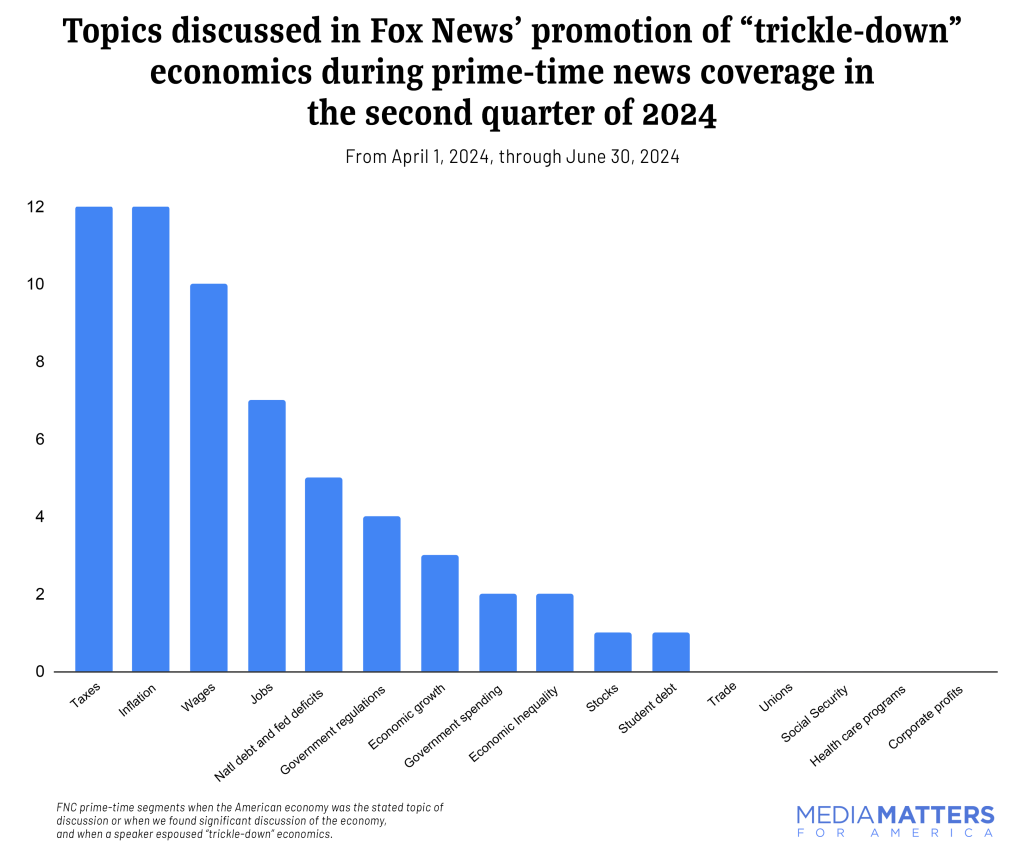
The leading trickle-down misinformer in Fox’s prime-time lineup was frequent guest, Fox Business host, and former Trump administration official Larry Kudlow, who peddled trickle-down theory while slamming the economic agenda of the Biden-Harris administration and puffing up the accomplishments (and future promises) of disgraced former President Donald Trump.
During the 4 appearances in which he peddled trickle-down economics during the second quarter — Kudlow was the only guest to appear more than once in a segment identified as promoting trickle-down economics — he fearmongered about how future tax increases on the wealthy could undermine job creation and slow down economic growth and warned that increasing government spending would imperil the economy.
Fox News and Fox Business personalities Brian Brenberg and David Asman, Fox News host and former Republican Gov. Mike Huckabee, celebrity chef Andrew Gruel, South Carolina Republican Sen. Tim Scott, and Republican Speaker of the House Mike Johnson were among the other prime-time Fox News guests who peddled trickle-down talking points during the second quarter, warning about looming tax increases, clamoring for renewed income tax cuts from a second Trump administration, or warning about the supposed threat posed by stricter government regulations or elevated minimum wages.
Media Matters identified multiple instances in which Fox's prime-time hosts themselves served as the vector peddling trickle down.
Fox prime-time star and informal Trump adviser Sean Hannity led the way with 4 instances of him promoting trickle-down talking points, followed by one instance apiece from hosts Jesse Watters and Greg Gutfeld....
===
mma1123
argentine President-elect Javier Milei is becoming a right-wing media darling in the U.S. due to his austere proposed economic policies and conservative ideology. Right-wing media figures have reacted to Milei’s electoral success by praising him, comparing him to former President Donald Trump, and attacking mainstream media for their critical reporting.}:
- ## Argentina's new far-right president has aligned himself with U.S. right-wing politics
- Milei, a self-described “anarcho-capitalist libertarian,” has aggressively pushed conservative positions on issues such as abortion while also promising to gut government ministries relating to issues like education, diversity, and science. Milei also proposed holding a referendum aimed at overturning Argentina’s right to abortion. Rolling Stone, [11/20/23]
- One of Milei’s defining political positions is “dollarisation,” a form of economic shock treatment, to combat Argentina’s rising inflation and ongoing financial woes.Dollarisation involves getting rid of the Argentine peso and replacing it with the U.S. dollar. Mark Weisbrot, the co-director of the Center for Economic and Policy Research, has labeled this as a “crazed, economically suicidal approach” which could majorly backfire for Argentine people. The Guardian, [11/20/23]
- Milei’s mirroring of Trump’s right-wing populist messaging — down to “Make Argentina Great Again” hats and preemptive voter fraud conspiracy theories — has led to direct praise from the former president.After Milei’s victory, Trump personally congratulated him on Truth Social, posting, “The whole world was watching! I am very proud of you. You will turn your Country around and truly Make Argentina Great Again!" The Guardian, [11/17/23; Rolling Stone, 11/20/23]
- Milei has also been linked to infamous anti-tax lobbyist Grover Norquist. In 2021, Milei promised the Argentine Taxpayers Association, sister organization to Norquist’s Americans for Tax Reform, that he would “cut off [his] own arm” if he raised taxes. Norquist has also gotten many Republican politicians to make similar promises by getting them to sign his organization’s “Taxpayer Protection Pledge.” The Nation, [7/21/2011; Semafor, 11/21/23; ABC News, 11/26/12]
- Mainstream media have responded to Milei’s election by pointing out his similarities to Trump and the implications his victory could have in neighboring countries.The New York Times referred to his election as “Argentina’s Donald Trump moment.” The Washington Post, [11/19/23; The New York Times, 11/20/23]
- ## Right-wing media reacted to Milei’s victory by praising him, comparing him to Trump, spreading voter fraud conspiracy theories, and attacking mainstream media for their coverage of him
- Conspiracy theorist Alex Jones called Milei “an anti-globalist through and through” and claimed he was an Infowars listener. Jones also praised Milei as “a follower” of former Fox host Tucker Carlson and argued his election was evidence that “people are seeing through the globalist lies at every front.” Infowars, *The Alex Jones Show*, [11/20/23]
- Newsmax host Rob Schmitt celebrated Milei, praising him for “fighting an ideology that is destroying the world one country at a time.”Schmitt argued Milei was “fighting the same disease that our nation is fighting” and “isn’t afraid to eviscerate the cancerous tumor that is the socialist politician.” Newsmax, *Rob Schmitt Tonight,* [11/20/23]
- Turning Point USA founder Charlie Kirk claimed that Milei’s victory was a “stimulus of hope” for the chances of Trump winning the presidency in 2024. Kirk portrayed the election as evidence that “the Western world is starting to push back against forced globalism” supposedly orchestrated by “a smaller and smaller radical group of people.” Kirk argued, “If Javier Milei can win by 11 points … Donald Trump can win next November.” Salem Media Group, *The Charlie Kirk Show*, [11/20/23]
- Fox News contributor Sara Carter posted that she “love[s] Javier Milei.” Carter posted in response to a video of Milei ripping tags off a whiteboard with the names of various governmental departments, including the Ministry of Education and Ministry of Health. Twitter/X, [11/20/23]
- Right-wing YouTuber Steven Crowder referred to Milei as “the madman geopolitics deserves.” He also called on Milei to “make Argentina great again.” Twitter/X, [11/20/23]
- Fox Business host Charles Payne called Milei’s election “huge and super encouraging on several fronts.” Payne also alleged that “powerful global forces'' tried to prevent Milei’s victory from “happening.” Twitter/X, [11/20/23]
- Right-wing economist Art Laffer argued Milei was “not a kook” or “far-right winger” and bet he would make Argentina “the outstanding, pro-growth economy of Central and South America” as president. Fox host Larry Kudlow concurred, adding that “the socialism they’ve been flirting with almost all over the continent hasn’t worked. … This guy might turn that around.” Fox Business, *Kudlow*, [11/20/23]
- Right-wing X account End Wokeness complained that “Argentina hand-counted all of their ballots in a few hours, but the big blue areas in our swing states take several days with machines?” Twitter/X, [11/20/23]
- Neo-Nazi collaborator Jack Posobiec claimed that the reason Argentina knew “the election result so fast” was because it “banned electronic voting machines.” Posobiec failed to mention that only Buenos Aires City residents were required to use paper ballots, and that was due to “significant delays” during the primary elections because of technical issues with the machines. Twitter/X, [11/20/23; Buenos Aires Herald, 10/21/23]
- Right-wing political operative Roger Stone praised Argentina for voting “with 100% paper ballots unlike, say, Brazil.” Twitter/X, [11/19/23]
- The Daily Wire’s Ben Shapiro bemoaned the “garbage press” for their coverage of Milei, calling them “international Leftist trash.” Shapiro also touted Milei’s economic policies, claiming Milei is planning to “slash spending and restore fiscal responsibility.” Twitter/X, [11/20/23]
- Conservative blog Red State also decried the press “freak-out” over Milei, claiming mainstream media “love it when far-left socialists take power."The “fairly Libertarian” Milei, the author claimed, could not be compared to Trump, and “the press attempt to tie the two together” was therefore “transparent.” Red State, [11/19/23]
- Stone also posted that it was “really enjoyable watching the elitist pukes at the Washington Post and the New York Times melt down over the election of pro-Freedom Anti-Globalist Javier Milei.” Twitter/X, [11/20/23]
---
---
mma 5 23
as the June 5 deadline to raise the nation’s debt limit approaches, right-wing media are attacking House Speaker Kevin McCarthy (R-CA) for allegedly capitulating to Democrats’ demands in a tentative deal.
The Treasury expects the government to run out of cash by Monday, June 5 if Congress does not raise the debt limit. The tentative agreement to raise the debt ceiling until January 2025 would limit spending, expand work requirements for SNAP recipients, end the pause on student loans repayments and interest accrual, andamend environmental impact statements. Despite these concessions from the White House, there are still many conservatives pushing for more.
Biden and McCarthy have both touted the agreement as a bipartisan deal and are urging Congress to pass it. While some conservatives have praised the deal, many in right-wing media are willing to risk a default, urging Congress to reject the agreement and criticizing McCarthy for supposedly striking a bad deal that favors Democrats:
- Fox News host Laura Ingraham complained that because the debt ceiling deal is being touted by Biden and the Chamber of Commerce, “It should be up to them to get the votes they want. There’s no reason for us to help.”
- In a series of posts on Gettr, former Trump adviser and current right-wing podcaster Steve Bannon decried the deal as a “total cave” to Democrats’ wishes and called McCarthy a “Total and Complete Sell-Out.” In a statement to Newsweek, Bannon said the debt ceiling agreement was “not acceptable” for conservatives, adding, "This shows no leadership whatsoever.”
- Bannon also called for conservatives to primary any Republican member of Congress that votes for the agreement: “If you vote for this, you should be and must be primaried.”
- Conservative radio host Buck Sexton wrote, “With the debt ceiling deal, we’re reminded that conservatism in 2023 is making a series of goal line stands, never crossing into the opponent’s half of the field, and calling that a win.”
- Appearing on Newsmax’s Eric Bolling The Balance, former Trump adviser:{ Peter Navarro c:(style="background-color:#ff6600ff"):}:alled:{ the debt ceiling deal “the McCarthy Memorial Day Weekend Surrender,” and went on to say that McCarthy “got basically nothing” and “took the first off-ramp.”}::{ Guest host }:Carl Higbie:{ urged the House of Representatives to reject the deal, saying, “I'm hoping that enough people see a problem with this and send it back and say, ‘No, no, no. Make it better.’”}:
- Former Fox Business host Lou Dobbs criticized McCarthy, tweeting, “The Speaker went to a horse-whipping, not a negotiation! … He got nothing and is waiting for a participation trophy!”
- Turning Point USA founder Charlie Kirk tweeted, “Mad about the debt ceiling deal?It’s the neocons who were holding this entire deal hostage. They refused to budge on any cuts to our woke military. We could have had a much better deal if we had a GOP willing to limit $ we send to countries that hate us.”
- Fox & Friends Sunday co-host Rachel Campos-Duffy said, “It's a win for McCarthy … but it's a loss for America because this is an unsustainable path, this printing and spending. Just look to Latin America. It doesn't end well, and I don't know how long we can keep doing this.”
- Right-wing Twitter account Catturd tweeted, “If you didn't know Kevin McCarthy would cave on the debt limit - you don't know Kevin McCarthy.”
- Fringe conspiracy theorist and failed GOP congressional candidate Laura Loomer wrote: “McCarthy debt ‘deal’ is a disaster,” adding that Trump’s endorsement of McCarthy “is one of the worst decisions he’s ever made.”
- During an appearance on The Story, Fox contributor and former Republican Congressman Jason Chaffetz said, “I would not vote for this bill. I don't think it solves the problem. I think it perpetuates where we are. I just -- I could never vote as a fiscal conservative in favor of this bill. It perpetuates the status quo, I think.”
- Fox & Friends co-host Ainsley Earhardt asked, “Should he [McCarthy] have just let it default?” She reasoned, “Everybody would have blamed Biden at that point if you are not going to get what you want.”
- On his radio show, Sean Hannitydenounced the debt ceiling deal for not cutting enough spending, lamenting it would still continue to fund “pet projects that the Democrats want.”
- Newsmax’s Eric Bollingsaid McCarthy “gave away the ranch” to the Democrats with the current agreement, saying McCarthy lost all his leverage and “handed Joe Biden a second term.”
---
---
see freedomfest
https://www.c-span.org/video/?521801-5/the-making-modern-economics
the Making of Modern Economics
Author and FreedomFest founder Mark Skousen talked about the latest edition of his book, The Making of Modern Economics. This interview was conducted at FreedomFest, an annual libertarian conference held this year in Las Vegas.
---
no peter? too much legal trouble?
https://www.mediamatters.org/fox-news/fox-networks-fearmonger-over-biden-administrations-new-vehicle-tailpipe-emissions-proposal
on April 12, the Environmental Protection Agency introduced its strictest standards yet to curb planet-warming emissions from American cars and trucks. For automakers to be in compliance, over two-thirds of new vehicles sold in 2032 may have to be electric. Fox’s cable news networks, which for years have both bashed EVs and downplayed or outright denied the climate crisis, are of course not too keen on the proposal.
The EPA’s new standards apply to cars being manufactured in 2027 and beyond. Notably, they do not ban gas-powered vehicles; as NPR reported, the EPA is setting “a standard for emissions, on average, based on the size and type of vehicle being built.” These rules are stringent enough that auto companies will probably “need to produce 67% zero-emission vehicles to meet them.”
The EPA states that the standards would remove billions of tons of carbon emissions from the atmosphere in the coming decades, as well as improve the air quality for communities across the U.S. The standards still need to go through a public comment and review process before being finalized.
Throughout last week, programs on Fox News and Fox Business responded to the proposal by claiming EVs are prohibitively expensive, not popular among the U.S. public, and not environmentally friendly. They also complained about unnecessary federal regulations and blasted any efforts to transition to clean energy because, in their telling, it will only help China and weaken the U.S.
Fox is misleading about the cost and popularity of EVs
A common refrain from Fox is that electric vehicles are too expensive to compete with gas-powered cars, or that consumers in general just don’t want them.
While their upfront costs are currently more expensive than gas-powered cars, EVs are cheaper than gas-powered cars over their entire lifespan. Furthermore, the production costs of EVs continue to fall, and in the next decade EVs are projected to be cheaper to produce than gas cars.
In addition to long-term financial savings, EVs have numerous health benefits, as well. Reporting on the EPA proposal, The Detroit News noted that by 2055, the rules would reduce “fine particulate matter in the air that can have negative health effects and potentially saving up to $1.6 trillion.” Indeed, one recent study estimated that up to 20,000 people in the U.S. die each year due to vehicle pollution.
In terms of popularity, while EVs made up just 6% of total vehicle sales in the U.S. in 2022, this figure is double the amount from 2021 and likely only getting higher. By 2030, EV sales could make up nearly 40% of total passenger car sales in the U.S., according to analysis by S&P Global (without factoring in the proposed EPA standards). Research from Goldman Sachs estimates that EVs will constitute half of global car sales by 2035, and 60% of sales by 2040.
- Fox contributor and former Trump economic adviser Steve Moore: “Only 6% of the car sales are EVs, so they're basically telling the American consumers, ‘We're going to build the cars you don't want.’ I mean, how stupid is that?” Fox Business, The Bottom Line, [4/10/23]
- Fox anchor Harris Faulkner: “Six percent of all new cars are EVs. That is a huge sign that people don't want this.” Frequent Fox guest Steve Forbes agreed that people don’t want EVs: “The fact they have to keep forcing people to do it shows that, again, people don't want it because they don't like the short distances, they don’t like having to charge an hour, hour and a half. People don't have garages to charge these things.” Fox News, The Faulkner Focus, [4/12/23]
- Fox anchor Sandra Smith downplays the costs, popularity, and market share of EVs: “In these big American cities, people are scared to take public transportation because of rising crime rates coast-to-coast. … Why aren't we addressing that rather than pushing for these EVs that are not popular, they’re expensive, and the president’s own energy administration right now is forecasting they’ll only be a mere 10% of the American car market by the year 2050. So, if they were liked, if they were affordable, if they were efficient, wouldn't there just naturally be demand for these cars?” Fox News, America Reports, [4/12/23]
- Fossil fuel shill and writer Robert Bryce: “This is very much a class issue. And it's not just about the affordability of the vehicles themselves, it’s about the upgrades to the grid that we’re all going to have to pay for through the rate base and through our taxes.” Fox News, The Ingraham Angle, [4/12/23]
- President and CEO of Celebrity Motor Cars Tom Maoli suggests that car companies don’t even like EVs: “You know it’s interesting because while you’re saying that the car companies are trying to push EV, it's really the government that’s pushing it. The car companies don't want it. Nobody has figured out how to make money on this venture. … The consumer is not buying into it. They’re coming into the showrooms, they’re afraid of them.” Fox News, Fox & Friends, [4/13/23]
Fox portends that it's strictly government regulations, and not market forces, that are pushing EVs on Americans
Whether Fox wants to admit it or not, major automakers including Ford, GM, Stellantis, Toyota, and Volkswagen already have aggressive goals for EV sales in the next decade. Additionally, climate-focused media outlet Heatmap reports that the EPA “expects that automakers are collectively on track for 44% of vehicle sales to be electric by 2030 without any changes to emissions rules.” Federal regulations will certainly prod automakers to manufacture more EVs, but to say that major automakers focused on the global market are moving to produce more EVs solely because of U.S. regulations is false. As part of this narrative, Fox figures are also claiming that this new rule is an affront to personal liberties. This is straight fearmongering, as the rule does not ban gas-powered cars or force people to give theirs up.
- Investment adviser Gary Kaltbaum: “We have a government now that’s coming out with some more dictates that are going to try to force you to maybe buy something you don't want to buy when there’s no demand there.” Fox News, *Your World*, [4/10/23]
- Fox Business host Sean Duffy denounces the Biden administration’s “attack on gas-powered cars.” “The Biden administration is back at it again using crazy regulations to push their radical green agenda,” Duffy claimed. “The EPA now reportedly getting ready to roll out some of the most aggressive climate regulations ever this coming Wednesday, continuing their attack on gas-powered cars.” Fox Business, *The Bottom Line*, [4/10/23]
- Fox News anchor Sandra Smith: “If you create the cars people want, they'll demand them. You don't have to mandate them.” Fox News, *America Reports*, [4/10/23]
- Fox Business anchor Larry Kudlow states that the EPA is “taking away our free choice.” Kudlow said, “You know the problem with EPA and radical climate change in general is? They are taking away our free choice. So, if you're fed up with a bunch of left-wing central planners jamming stuff down your throat, well, then vote no.” Fox Business, *Kudlow*, [4/11/23]
- Fox contributor Steve Moore suggests an ulterior motive to the emissions proposal: “So this isn't about cleaning up the atmosphere. This is about a radical climate change plan that is going to force people to buy cars they don't want to. I think the Biden people have really stepped in it on this one. Because, as I said, people don't want the government telling them what kind of car they can buy.” Fox News, *Fox & Friends*, [4/13/23]
- Fossil fuel shill Steve Milloy: “Electric cars are so popular government has to mandate them and subsidize them. Look, this whole rule is a failure.” Fox News, *Fox News @ Night*, [4/13/23]
- Fox contributor Phil Flynn says that Americans are “not ready” for the EV transition. “We are not ready for it and they are coming for your car, Sandra, you better lock your garage,” Flynn said, later adding “When the government starts meddling in the free markets and starts to try to pit winners and losers, there is always going to be a backlash that hurts the American people and that's what we’re seeing right now.” Fox News, *America Reports*, [4/13/23]
- Fox Business host Brian Brenberg suggests this is not about EVs but rather controlling peoples’ movement: “Americans are not going to have the choices they have now about what they drive and how they do that. The fact is, Sean, what the president's actually trying to do is not get people into EVs but get them out of cars. He wants to control this whole supply chain. And the point is, the government's going to control how you get around, not you. And that, look, that's the stock and trade of every totalitarian government is to control the means of movement.” Fox News, *Hannity*, [4/14/23]
Fox is insinuating that EVs are worse for the environment than gas cars, and that only China benefits from this proposal
An MIT article from October 2022 stated that “although electric cars' batteries make them more carbon-intensive to manufacture than gas cars, they more than make up for it by driving much cleaner under nearly any conditions.” EVs also don’t have the deadly tailpipe emissions associated with gas-powered cars.
Additionally, claims that only China benefits from this proposal are overstated. While China does control much of the supply chain for EV materials, the U.S. is taking steps to develop its own domestic supply chains (thanks in part to the Inflation Reduction Act) to reduce its reliance abroad. Automakers are also rethinking their supply chain strategies and investing in mines to secure the resources needed for scaling up electric vehicle production.
Finally, in addition to the numerous health benefits that come with reducing gas-powered car use, a transition to EVs would mean drivers would be less vulnerable to high gas prices and the whims of the global oil market. Reporting on the EPA proposal, MarketWatch notes that it “would strengthen American energy security by reducing reliance on 20 billion barrels of imported oil.”
- Fox host Will Cain suggests this plan only gives power to China: “In China, either through its own domestic geography or through its colonization of the world like Africa, has control of those raw materials as well. … If we move in this direction, we're giving that power, we're taking it from ourselves and giving it to China because of their dominance of those raw materials.” Fox News, *Fox & Friends Weekend*, [4/9/23]
- American Petroleum Institute President Mike Sommers states that we are “sacrificing American energy independence” to China.“Doing this the way that they're doing it, which is really just to focus on tailpipe emissions, rather than the emissions that actually exist when you create a vehicle from the very beginning, these electric vehicles, while great technology, most those key components continue to be made in China. We shouldn't just be looking at this from the perspective of emissions, but we should also look at it from a national security perspective. We should not be sacrificing American energy independence to a regime that is certainly hostile to American interests.” Fox Business, *Mornings with Maria*, [4/10/23]
- Fox co-host Brian Brenberg suggests this new proposal just gives China more power: “This is what I meaned, mixed up. We're talking about China's desire to dominate on the world stage, and we have a industrial policy by the Biden administration that wants to throw power to the Chinese by increasing emissions standards and, at the same time, handing all sorts of American taxpayer subsidies to Chinese companies in the U.S. for battery power and for battery production.” Fox Business, *The Big Money Show*, [4/10/23]
- Fox correspondent Jackie DeAngelis insinuates that only China will profit: “Basically with this EV push and the green push in general — our solar panels, a lot of them come from China, as well — you’re basically selling out this country so that China can profit from this. It’s absolutely insane to me.” Fox News, *Fox & Friends*, [4/11/23]
- Fox host Brian Kilmeade: “You can sleep well at night knowing that you're driving an electric car and other people’s lives are being ruined and countries are being destroyed, while China pays them and profits.” Fox News, *The Story*, [4/12/23]
- Fox anchor Dagen McDowell: “We, by this electric vehicle boondoggle, are handing power and our borrowed money to China.” McDowell said: “We have taken a hammer to one of our greatest resources, our energy economy, our fossil fuel economy. We have lowered our standard of living, and so we have ceded power and prosperity to nations that hate us, to Iran and Russia, by reducing our energy output, our oil and natural gas output here, and then in turn we — to Sean's point, we, by this electric vehicle boondoggle, are handing power and our borrowed money to China.” Fox News, *America Reports*, [4/12/23]
- Fox host Sean Hannity: The electric car push only helps China. “The push for electric cars also threatens national security,” Hannity claimed. “Experts warning now it will make us more dependent on China giving them more leverage over this country. Now, as-powered cars, they are just the latest thing that they want to ban.” Fox News, *Hannity*, [4/13/23]
Fox is using good old-fashioned climate bashing to advance their anti-EV agenda
As usual, Fox is downplaying the seriousness of climate change by suggesting that these rules won’t do anything to help fight climate change. However, The Washington Post noted that the proposal is “large enough to avert the equivalent of two full years of nationwide carbon emissions, according to EPA estimates.” This proposal would thus go a long way in helping the U.S. — which is the world’s largest historical carbon emitter — to advance its climate goals. Additionally, as climate change requires a global, collective response, the U.S. would also be following in the footsteps of the European Union, which recently proposed even more-stringent requirements for tailpipe emissions.
- Fox host Greg Gutfeld: “None of their predictions have come true. None of them.” Gutfeld continued, “They are forcing America to do this crap over one, less than a percent Celsius. Less than a percent Celsius. It has no effect. And in fact, as this climate gets warmer, people's lives improve. That's a fact. That's a fact. People die from cold weather more frequently than warm weather.” Fox News, The Five, [4/12/23]
- Fox host Jesse Watters suggests that climate change is like a religion: “It’s not going to lower the Earth's temperature at all. All it does is make the donors happy because this is a religion to them, and it makes my guys in Detroit happy because they sell these things, and we pay for half of it. It’s the taxpayers subsidizing this ‘green revolution.’” Fox News, The Five, [4/12/23]
- Fox contributor Jason Chaffetz argues the proposal is part of a climate denial conspiracy theory related to the 15-minute city idea: “And the only thing they want to ramp up is their goal of limiting your mobility. This is not a mistake. As Laura [Ingraham] discussed last night with famed U.K. professor Norman Fenton, these moves are essential in order to bring about the end game of climate fanaticism — so-called 15-minute cities.” Fox News, The Ingraham Angle, [4/12/23]
- Fox’s Dagen McDowell: “There is no climate crisis. This is all about removing your choice and ending your ability as an American to decide what the hell kind of car you want to drive.” Fox Business, The Bottom Line, [4/12/23]
---
---
mma 3 23
the right-wing media echo chamber pushed a completely fictional talking point that Silicon Valley Bank had supposedly donated $73 million to Black Lives Matter, based on distortions from a far-right think tank. And in Fox News’ rush to amplify the falsehoods, which fit the network’s preposterous political narrative that SVB was a “woke bank,” purported “news” personnel behaved no differently from the network’s opinion hosts.
As a prime example of Fox’s “news” personalities pushing blatantly partisan falsehoods, on the morning of March 15, Fox News White House correspondent Peter Doocy claimed: “Roughly $73 million went to Black Lives Matter-related causes” from the bank. [vid]
and later that night, Fox host Sean Hannity said that Silicon Valley Bank “diverted a massive amount of money to left-wing causes. Now, get this, this is what we have discovered, that includes a whopping $73 million to BLM-related groups."[vid]
this is the same network that, as recently unearthed text messages and emails have shown, will actively reprimand and penalize its alleged “straight news” reporters for debunking misinformation pushed by its opinion hosts and their guests. As such, nobody in the network would have any incentive to even try to unearth the facts, because Fox News is not in any sense a real news organization.
Actual SVB donations to Black Lives Matter: $0.00
The charge itself that SVB contributed over $70 million to Black Lives Matter or closely aligned organizations is based on a supposed “BLM-funding database” maintained by the Claremont Institute, a right-wing and openly anti-democracy organization that is also closely tied to disgraced former law professor John Eastman, who was closely involved in former President Donald Trump’s efforts to overturn the 2020 election results.
The Associated Press confirmed that the database does not show any spending to Black Lives Matter, and obtained a comment in which Claremont explained it was including “reparative initiatives,” which it called “race-based, discriminatory hiring programs; race-based, sub-prime lending; partisan voter initiatives; and DEI efforts.” The AP also obtained a comment from the Black Lives Matter Global Network Foundation, which confirmed it did not receive $70 million from the bank, and added: “Even if we did, the idea that this type of contribution would be controversial is rooted in a pathology that Black organizations don’t deserve to be funded.”
In addition, professor Rodney Ramcharan at the University of Southern California’s Marshall School of Business explained to the AP what actual evidence of bank failure due to “woke” business practices might look like, if such a thing existed. “The bank would have suffered loan losses—writing down bad loans made to ‘woke’ firms,” he explained. “So this is not a matter of opinion, but actual data. Instead, there are no unusual loan losses or loan loss provisioning.” (Claremont had cited “sub-prime lending” as a component of such alleged “woke” practices.)
The database labels any donations that support Black people as “BLM”
Writing for the newsletter Popular Information, Judd Legum, Rebecca Crosby, and Tesnim Zekeria reported that the Claremont Institute’s own database shows a total of $0 in donations to any officially branded Black Lives Matter organization. Instead, the organization’s database also includes spending that it describes as being for “organizations and initiatives that advance one or more aspects of BLM’s agenda.”
Under this amorphous criteria, Popular Information found that Claremont had included a pledge that SVB made in 2021 to spend $50 million over the course of five years for the company’s internal initiative to connect women, Black people and Latinos with startup funding and leadership connections in venture capital. Nearly all the rest came from a $20 million pledge to “support additional COVID-19 relief” and establish a “full-ride, needs-based University Scholarship program to students at Arizona State University, Florida A&M University, Tulane University, and Xavier University.” Both Florida A&M and Xavier University of Louisiana are prominent historically black colleges and universities. (It’s unclear why Claremont lumped in funding for Arizona State and Tulane.)
Talking Points Memo editor-in-chief Josh Marshall also examined the rest of the database on supposed BLM-related corporate spending, and found that Claremont’s appraisal of corporate spending throughout the business world essentially boiled down to “it seems adjacent to Black people, so that’s ‘BLM.’” These included any corporate donations to such longstanding organizations as the United Negro College Fund and the NAACP, or minority-focused business groups such as the Executive Leadership Council or the Forum to Advance Minorities in Engineering, the latter of which was founded in 1976 by DuPont. (Also tagged as “BLM” spending in the Claremont’s database were corporate grants to the American Heart Association and U.S. Vaccine Adoption Grants.)
Keep in mind, Popular Information had also pointed out that the database defines the BLM agenda as allegedly being to “undermine capitalism, the nation state, and Western civilization.” By extension, Claremont is essentially accusing any corporate spending on Black education, health outcomes, or business development to be part of a plot to destroy Western civilization. This is the fabulist message that Fox’s reporters and the rest of the right-wing media ecosystem were so eager to spread.
Fox News drove the right-wing echo chamber’s amplification of false SVB claims
Fox’s alarmist coverage of the supposed link between SVB’s corporate giving and the BLM movement clearly spanned both its purported “straight news” side and opinion hosts, with the two camps voicing the exact same line over and over on Fox News, Fox Business, and the network’s digital properties.
- Fox host Jesse Watters asserted that Silicon Valley Bank (SVB) “donated $74 million to Black Lives Matter." Fox News, Jesse Watters Primetime, [3/14/23]
- Fox host Tucker Carlson: “Silicon Valley Bank, brace yourself, spent more than $73 million on donations to BLM and related organizations.” Fox News, Tucker Carlson Tonight, [3/14/23]
- Fox & Friends co-host Ainsley Earhardt: SVB donated “more than $73 million to Black Lives Matter.” Fox News, Fox & Friends, [3/15/23]
- Fox Business: “Silicon Valley Bank donated millions to Black Lives Matter-related groups, social justice causes, records show.” FoxBusiness.com, [3/14/23]
- Fox White House correspondent Peter Doocy also pushed this, which Fox anchor Dana Perino failed to contradict. Fox News, America’s Newsroom, [3/15/23]
- Fox host Sean Hannity: “Now, SVB was California's woke trendy bank. So, naturally, instead of safeguarding every penny deposited, SVB diverted a massive amount of money to left-wing causes. Now, get this, this is what we have discovered: That includes a whopping $73 million to BLM-related groups, five billion dollars in commitments to climate change.” Fox News, Hannity, [3/15/23]
- Fox Business host Maria Bartiromo: “Silicon Valley Bank donated more than $73 million to groups tied to Black Lives Matter.” Fox Business, Mornings with Maria Bartiromo, [3/15/23]
- Fox Business host Larry Kudlow: “Apparently some more bad, there is such a slew of crazy left-wing stuff surrounding this Silicon Valley Bank. I mean this is some weird bank. First of all, they gave $73 million to the Marxist BLM, Black Lives Matter movement at the height of COVID and the race riots in 2020.”:{ Fox Business, Kudlow, :(style="background-color:#ffffffff"):}:[3/15/23:{]}:
- Fox Business guest Vivek Ramaswamy: “We’re now seeing reports about the amount of money they committed to BLM and related movements.” Fox Business, The Bottom Line, [3/14/23]
- Fox Business guest Stephen L. Miller: “We had to bail this bank out. They’ve given millions of dollars in BLM initiatives and DEI initiatives.” Fox Business, Kennedy, [3/15/23]
- Fox Business guest Mark Tepper: SVB “had pledged $74 million to left-leaning organizations and charities, including BLM.” Fox Business, Mornings with Maria Bartiromo, [3/16/23]
- Fox Business host Stuart Varney expressed shock at the number, while correspondent Lauren Simonetti said “the question is were they distracted. Were executives too concerned about diversity, gender, climate that they missed the financial problem.” Fox Business, Varney & Co., [3/16/23]
- Fox Business host Larry Kudlow: “This bank in Silicon Valley was a rogue bank. They did insane things. The board was full of Hillary Clinton donors, they had one person there with banking experience, they gave $75 million to Black Lives Matter two years ago, $5 billion apparently to climate causes and diversity causes, that’s just nonsense. … This is a rogue bank.” Fox News, America Reports, [3/16/23]
- Fox Business host Larry Kudlow: “It’s a rogue bank, there is no question about that. The mistakes they made were fundamental mistakes also, you know. The duration was wrong. The asset-liability matchbook was all wrong. But you don't give $75 million to Black Lives Matter at the height of racial tensions in the middle of the pandemic. You don't commit $5 billion to all kinds of climate change, diversity, equity, and things of that sort, you don't do that.” Fox Business, The Bottom Line, [3/16/23]
Fox was not alone in spreading this falsehood; many right-wing media outlets pushed the same lies. A New York Post headline read: “SVB donated $73M to Black Lives Matter movement, social justice causes.” An article from The Federalist was headlined: “Silicon Valley Bank Pledged Nearly $74 Million To Black Lives Matter Causes.” The Washington Times, citing The Federalist, wrote: “SVB donated more than $73 million to the Black Lives Matter movement and other social justice causes.” A Washington Examiner headline read: “SVB collapse: Bank donated over $70 million to Black Lives Matter groups before closure.” Gateway Pundit declared in its headline: “Woke Silicon Valley Bank Gave Over $73 Million to Black Lives Matter Movement.” A Daily Caller headline stated: “Silicon Valley Bank Committed Over $73 Million To BLM And Social Justice Causes Before It Collapsed.” And it went on and on and on.
In an amazing turn of events, Breitbart actually issued a correction, noting that “the Claremont Institute’s definition of ‘Black Lives Matter’ included a far wider range of organizations,” and giving credit that “left-wing writer Judd Legum appropriately flagged these issues.”
So as of now, Breitbart has exhibited more journalistic responsibility than the entire roster of Fox News, including one of the network’s White House correspondents.
---
---
msnbc chris hayes shows navarro praise liz truss BS econ plan --> crash & burn
---
---
kansas policy inst brownback fail
Jonathan Williams is an adjunct Fiscal Policy Fellow and the director of the Tax and Fiscal Policy Task Force for the American Legislative Exchange Council (ALEC), where he works with state legislators and the private sector to develop free-market fiscal policy solutions in the states. Prior to joining ALEC, Jonathan served as staff economist at the non-partisan Tax Foundation, authoring numerous tax policy studies. His work has been featured in many publications including The Wall Street Journal, The Los Angeles Times, Forbes and Investor’s Business Daily. With Dr. Arthur Laffer and Steve Moore,Williams co-authored Rich States, Poor States: ALEC-Laffer Economic Competitiveness Index. Jonathan has been a contributing author to the Reason Foundation’s Annual Privatization Report and has written for the Ash Institute at the Kennedy School of Government at Harvard. A Mid-Michigan native, Williams graduated magna cum laude from Northwood University in Midland, Mich., majoring in economics, banking/finance, and business management. While at Northwood, he was the recipient of theprestigious Ludwig von Mises Award in Economics.
---
10 22 mail
new trend is sweeping conservative America. It’s called the anti-ESG movement, or anti-”woke capitalism” movement, and it’s one of the biggest emerging barriers to corporate action on climate change.
Anti-ESG proponents want to stop corporations from following environmentally and socially conscious investing principles, commonly referred to as Environment, Social and Governance (ESG) principles. They say companies are prioritizing “left-wing” goals over the financial interests of businesses and their employees, and should be prevented by law from doing so.
This movement has gained a massive following in the last six months. Elon Musk supports it, as do billionaire investors Peter Thiel and Bill Ackman, who are are backing a new financial firm dedicated to anti-ESG investing. Banning “woke investing” is also one of the biggest recent priorities of Leonard A. Leo, the prominent conservative legal activist who runs one of the “best-funded and most sophisticated operations in American politics,” according to a New York Times investigation published Wednesday. In the past year, 17 states have proposed or adopted legislation seeking to bar state investments in “woke” companies[twt]
---
11 22
https://www.c-span.org/video/?521894-5/stephen-moore-govzilla**Stephen Moore, senior economist at FreedomWorks and a former adviser to President Trump, argued that out-of-control spending by Congress has created a bloated government that needs to be brought down to size. This interview was conducted at FreedomFest, an…
---
---
omg trump trio consistently, spectacularly and devastatingly WRONG! punditry at worst/lethal
jon chait
no lnx
THE NATIONAL INTEREST APR. 25, 2020
The Fatal Calculations of the Economists Steering Our Public Health
By Jonathan Chait
One night in late March, President Trump, seized by one of his periodic bouts of dismay with his public-health officials, sought out a second opinion on how to handle the coronavirus pandemic. He called Arthur Laffer. After missing the president’s first three calls, the 79-year-old Laffer finally answered, and the two men connected for what Laffer described as “a very serious conversation,” shortly after which Trump tweeted, “WE CANNOT LET THE CURE BE WORSE THAN THE PROBLEM ITSELF.”
Trump gravitated back to his public-health advisers, but he is again lurching toward the opposite pole — one anchored by Laffer and his close allies: National Economic Council head Lawrence Kudlow and economic adviser Stephen Moore. They have seized on their historic role as the antagonists to the administration’s public-health wing because they have a particular competence of their own, honed over decades: persuading Republican officials to ignore experts.
Even before his current role, Laffer was perhaps the most successful policy entrepreneur in modern American history, at least if measured by political influence.In the 1970s, as an economics professor who had served in Nixon’s Office of Management and Budget, Laffer developed a friendship with Wall Street Journal editorial writer Jude Wanniski, whose job had previously included defending Richard Nixon’s conduct in the Watergate scandal. The two came to believe that Laffer had developed a blinding insight with world-historical ramifications. A tax rate of either zero or 100 would yield no tax revenue at all, Laffer posited. Drawing a sloping, sideways curve between those points, he further hypothesized that reducing tax rates might increase revenue.
The “Laffer curve,” which at one point Laffer drew on a cocktail napkin for an impressed Dick Cheney (the Smithsonian now claims to display the original), formed the basis of what became known as “supply-side economics.” The doctrine held not only that tax cuts could increase tax revenue, but that changes in tax rates were the primary driver of all economic events. Republican economist Herb Stein coined the name as a term of derision, intending to highlight the absurdity of building a model entirely on one side of the economy instead of considering both supply and demand. Economic experts mocked Laffer’s notion that reductions in tax rates at existing levels could produce anywhere close to enough new economic growth to pay for itself.
And the experts … were completely right. After supply-siders converted Ronald Reagan and promised his tax cuts would pay for themselves, revenue hemorrhaged. Reagan’s non-supply-side advisers prevailed upon him to sign a series of tax increases for the purpose of “reducing the size of the nation’s fiscal disaster,” his budget director later admitted. When Bill Clinton raised the top tax rate from 31 percent to 39.6 percent, supply-siders insisted he would kill the recovery and reduce tax revenue. Instead, revenue soared far higher than anybody had forecast.
Kudlow and Moore began ascending in the 1980s, shuttling between right-wing think tanks and media — especially the Journal editorial page, which remained the high temple of the supply-side cult. I first came across Moore when he was writing Journal columns arguing that the supply-siders had been right to predict Bill Clinton’s tax hike would reduce revenue. (A hallmark of supply-side thought has been to refuse to concede any error or complication in its analysis.) The supply-siders went on to insist that George W. Bush’s tax cuts would produce untold prosperity. Moore wrote a book called Bullish on Bush, and Kudlow wrote the foreword to The Bush Boom and a series of columns dismissing “pessimistas” who detected economic turmoil. “There’s no recession coming. The pessimistas were wrong,” he wrote in December 2007.
In the spring of 2016, just after Trump had sewn up the nomination, Laffer, Kudlow, and Moore set out to meet the candidate at Trump Tower. Like many members of the conservative elite, they initially harbored reservations. But unlike foreign-policy hawks or social traditionalists, their concerns were devoid of any moral component, like a suspicion of dictators or philanderers. Their sole misgiving concerned Trump’s populist rhetoric and occasional campaign vows to raise his own taxes. The troika wanted to find out if he really meant it. To their relief, he didn’t. “He wanted tax cuts. He wanted to deregulate, he wanted to get the government out of the way,” Kudlow recounted in the foreword to Laffer and Moore’s laudatory book, Trumponomics. “The three of us saw Trump in a whole new light.”
We’ll come out of this soon, the economy will reopen, the economy will restart. It will, I hope, take care of itself. Markets will take care of themselves over time.
— Larry Kudlow, optimistic as oil prices tanked, on April 22
Kudlow joined the administration as Trump’s chief economic adviser. Trump announced he would nominate Moore for the Federal Reserve Board, but the Senate killed Moore’s bid over a combination of embarrassing ignorance of the subject — just two years before, he’d admitted on a panel, “I’m not an expert on monetary policy” — and years of sexist comments, including an obsessive hatred of women working as play-by-play commentators on basketball games. He and Laffer instead served as outside advisers and allies to Trump, who last summer bestowed a Presidential Medal of Freedom on Laffer.
Trump rewarded their confidence by implementing a large corporate tax cut, which was intended to encourage more corporate investment and therefore “would yield about the same revenue — and possibly more — than the current system,” Laffer and Moore wrote in Trumponomics. Naturally, it failed. Business owners got a windfall, but there was no corporate-investment boom and corporate-tax revenue fell by more than a third. Just as naturally, they acted as if events had proved them right.
And so, when the coronavirus struck, Trump had on hand a coterie of loyalists who would not hesitate to question legitimate experts.Kudlow forcefully endorsed Trump’s optimism that the virus would never spread. On February 25, Kudlow said it had been “contained … pretty close to airtight.” Even two weeks later, he was insisting, “I would still argue to you that this thing is contained.”
When public-health officials persuaded Trump to abandon his denialism, the supply-siders formed the resistance. Applying Laffer’s old dictum, “All economic problems are about removing impediments to supply, not demand,” they reasoned that the problem facing the economy was not a deadly pandemic but, as ever, bad incentives imposed by government — in this case, restrictions on business and excessively generous unemployment benefits that “discourage work.” If the government just stopped suppressing incentives, the economy would spring back to life.
The Journal editorial page published some of the first pushback against the wisdom of lockdowns. As early as mid-March, Moore denounced on Fox News the first closings, in California, as “a very dangerous, almost Orwellian situation.” Trump began repeating the supply-siders’ warnings that he had ceded too much authority to scientists (“If it was up to the doctors,” he mused, “they might say shut down the entire world”). Trump relented to his public-health experts but, by early April, was again listening to the supply-siders. Moore began proposing May 1 as a deadline to reopen the economy, a timeline Trump endorsed soon thereafter.
The supply-siders’ struggle to tug Trump away from his medical experts has both public and private facets. Laffer and Moore promoted a new administration task force to focus on economic reopening, a counterweight to the coronavirus task force led by doctors Anthony Fauci and Deborah Birx. Moore encouraged anti-shutdown protests in several states to pressure governors to speed up their timetables for reopening businesses. “I call these people the modern-day Rosa Parks,” he explained, “They are protesting against injustice and a loss of liberties.”
In their book, Laffer and Moore fondly recall Kudlow’s instructing Trump to ignore budget forecasts that tax cuts would reduce revenue. “Don’t get stressed out by the phony numbers of Washington’s bean counters,” he said. “They are always wrong.” The message today is largely unchanged. The main difference is that the experts they are urging the president to dismiss are counting lives. We’re the beans.
This article appears in the April 27, 2020, issue of New York Magazine
---
---
https://www.nytimes.com/2018/06/20/magazine/trump-government-heritage-foundation-think-tank.html
nyt
heritage, demint dunlop:
Today it is clear that for all the chaos and churn of the current administration, Heritage has achieved a huge strategic victory. Those who worked on the project estimate that hundreds of the people the think tank put forward landed jobs, in just about every government agency. Heritage’s recommendations included some of the most prominent members of Trump’s cabinet: Scott Pruitt, Betsy DeVos (whose in-laws endowed Heritage’s Richard and Helen DeVos Center for Religion and Civil Society), Mick Mulvaney, Rick Perry, Jeff Sessionsand many more. Dozens of Heritage employees and alumni also joined the Trump administration — at last count 66 of them, according to Heritage, with two more still awaiting Senate confirmation. It is a kind of critical mass that Heritage had been working toward for nearly a half-century.
“Feulner’s first law is people are policy,”Ed Feulner, Heritage’s founder and former president, told me recently. Feulner was the head of domestic policy for the Trump transition, charting the direction of the Environmental Protection Agency, the Department of Agriculture and several other agencies. We met late on a Friday afternoon, in a sitting room at the Metropolitan Club in Washington, a private social club founded by a group of Treasury Department officials during the Civil War. At his feet as we spoke sat a small box of table cards for a dinner he was hosting at the club that evening for the newly appointed director of Trump’s National Economic Council, the television personalityLarry Kudlow— another name on Heritage’s Project to Restore America list. Now 76, ruddy, white-haired and content, almost jovial, Feulner founded Heritage decades ago as an ambitious young legislative aide with a radical dream built on a simple concept. As he put it, sinking deeper into his club chair: “First, you have to have the right people.”
...
While Feulner and his senior staff had reserved the right to review policy papers, they generally avoided intervening in the research and publication process. DeMint and his leadership team were much more aggressive. Papers were heavily edited or even withheld from release altogether. Several scholars quit. DeMint replaced them, bringing in as Heritage’s chief economist Stephen Moore, a Wall Street Journal editorial writer and a founder of the Club for Growth, a lobbying group that advocates cutting taxes.
...
The turnover rates have also been historic. In March, The New York Times reported that nine of the top 21 White House and cabinet positions have been emptied and refilled at least once; neither Obama nor Bush had lost a single cabinet member by that point in their administrations. Since taking office, Trump has replaced more than half of his 65 most influential advisers, according to a tracker created by the Brookings Institution. Christie recently laid the blame for the turnover on what he described as a “brutally unprofessional” transition, saying that proper vetting would have caught a lot of Trump’s most problematic appointees. A number of other senior advisers seem to be on shaky ground with the president, and an exodus is anticipated after the November midterm elections.
Churn is a central feature of this administration, even for its unofficial staffing agency. Paul Winfree, a Heritage economist who helped draft Trump’s first budget, is back at the think tank. So are Stephen Moore, who worked on the Trump tax cuts; David Kreutzer, who played a key role in dissolving a White House working group that was studying the monetary costs associated with climate-warming carbon dioxide; and Hans von Spakovsky, who helped run the now-defunct voter-fraud commission, which was created to find evidence to support Trump’s baseless claim that millions of people voted illegally for Hillary Clinton.
In a sense, the transition is still going, and as long as Trump remains in office it may never end. “I get calls from people every day who still want to go in,” Dunlop told me. “Or I’ll hear from the White House, or I’ll run into someone at a reception or over coffee, and I’ll say, ‘I’ve got a name for you. I’ll send it along.’ ”
---
---