hassett, kevin
---
massive covid fail, tariffs
ben stein honorable mention KUDLOW
ECONOMISTS FOR TRuMP PUZDER NBER
KOCH AEI AAF AM ACTION FORUM CASEY MULLIGAN NBER RANDOLPH FDN
in pjt 2025 rolodex?VOUGHT
ass hat trump
APOSTATE? CARBON TAX?
AFPI?
ACAD SUPPRESS? KRUGMAN
hasset2 26
thug shd be disciplined
acad econ suppress?!
NEWSLETTER CRASH?
2025 Kevin Hassett (who formerly chaired the Council of Economic Advisers)
---
8 26 JUST SAYS DUMB STUFF?
AN 8 26
Trump is flagging in polls, suggesting that he and the Republican Party are in peril for the upcoming midterm elections. Yet according to a recent report, Trump's plan for dealing with his poor approval rating is not to provide economic relief to ordinary Americans suffering from high prices and a weak job market, but to give even more benefits to the wealthy.
"President Donald Trump is looking for new policy pledges he can present to voters ahead of the midterm election, according to a top economic aide and a former administration official, including potentially calling on Congress to cut capital gains taxes and create an exemption for certain home sales," reported Bloomberg's Josh Wingrove on Tuesday. "National Economic Council Director Kevin Hassett said Tuesday in an interview with Fox Business host Larry Kudlow that Trump wants to offer voters more incentives to back Republicans in November’s election."
Even as Trump proposes an economic program that would mainly benefit the rich, he continues to pursue his war against Iran and his tariffs, both of which are causing prices to rise for ordinary Americans. Indeed, while speaking to a group of supporters in Las Vegas
[ You can't cut $2TN without annoying a couple of people.” ...

Facebook · Vivek Ramaswamy
1.1K+ reactions · 1 year ago](https://www.facebook.com/VivekGRamaswamy/posts/you-cant-cut-2tn-without-annoying-a-couple-of-people-well-said-ron-paul/1091432452986103/)
Kevin Hassett, economic policy director of the American Enterprise Institute and chief economic adviser to John McCain's 2000 presidential ...Read more
---
4 26
Friday brought no shortage of bad economic news, with gas prices remaining high due to the ongoing Hormuz Strait closure, and a key Consumer Sentiments Index hitting an all-time low. But even so, White House Director of the National Economic Council Kevin Hassett is still smiling, much to the vexation of Fox Business host Stuart Varney.
The segment began with a discussion of the Strait of Hormuz, which has been closed for weeks due to President Donald Trump’s war on Iran, driving sky-high oil prices, which have begun to translate into cost increases to just about everything else. Even so, Hassett attempted to bluff his way through an assertion that prices are coming down, even as Fox displayed a graphic showing price hikes ranging from +4.6 percent for electricity to +44.2 percent for fuel oil.
“While you were talking we had a graphic on the screen that shows all kinds of items that have gone up very significantly,” noted Verney. “I don't think you've won the war on inflation at this point.”
“That’s exactly right,” admitted Hassett.
They continued to discuss the matter of inflation, as a Labor Department report released Friday shows a 3.3 percent increase over the point last year — the highest jump in two years.
Hassett spent a few months trying to dress up the bad economic situation, but Varney wasn’t buying it.
"A fine performance, if I may say,” declared the bemused host. “3.3 percent inflation and you smiled all the way through — as you usually do.”
When asked whether the Strait would reopen within two months, which would hopefully provide some much-needed relief to prices and consumers, Hassett gave a confident affirmation, saying the White House “A team” is currently engaged in negotiations.
The administration’s negotiators have previously been criticized for being “ill-prepared” during previous talks.
---
2 26
thug shd be disciplined
acad econ suppress?! hasset
0:01
1 second
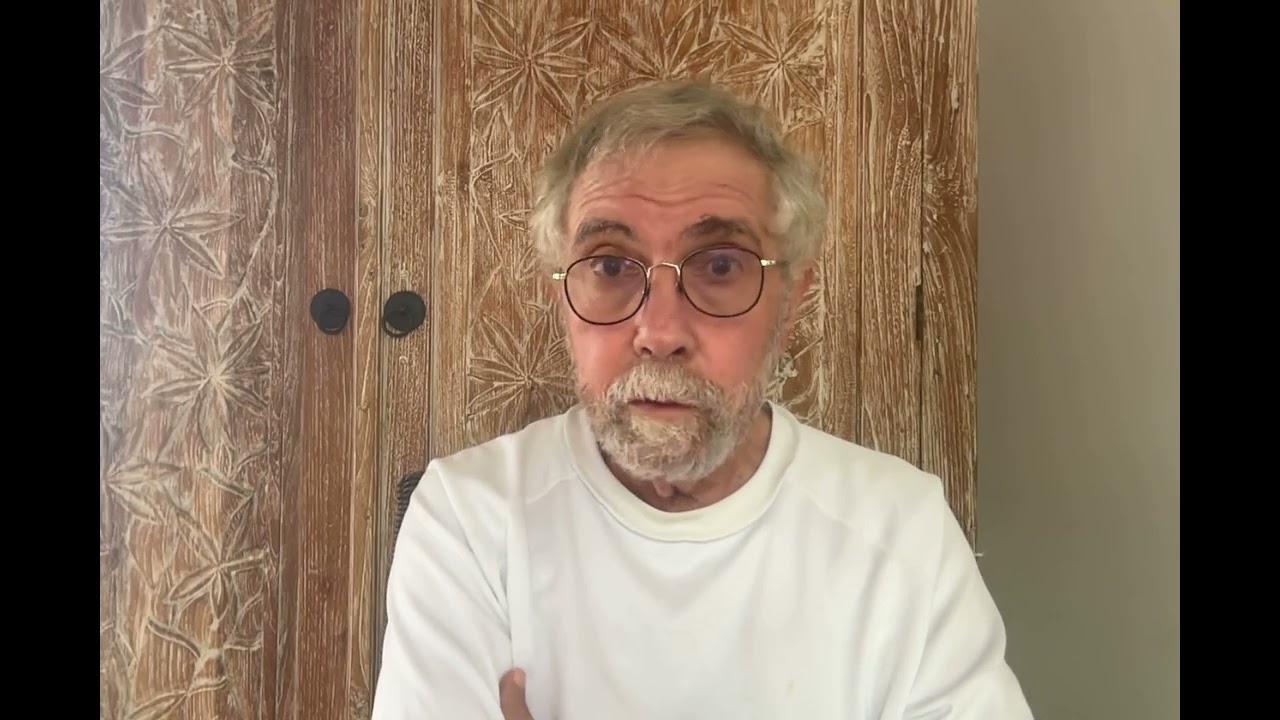
I'm Paul Krugman and this is the first of what may be a series of short video
0:08
8 seconds
takes uh on items that arise in the news that kind of I think I should be responding to and I'm going to try and
0:16
16 seconds
do it a little differently from Substack posts and blue sky tweets. Um it's
0:23
23 seconds
Wednesday, February 18th, and there was a news item this morning, uh a which is
0:31
31 seconds
shocking even though it's really hard to be shocked now, but it represented a new dimension. Uh Kevin Hasset is the chairman of the National Economic
0:39
39 seconds
Council, which is it the structure of economic advising and analysis has
0:45
45 seconds
gotten kind of tangled. uh but in effect he is the Trump administration's chief economist and he went on CNBC this
0:54
54 seconds
morning and attacked a study that was released by the Federal Reserve Bank of
1:00
1 minute
New York um on the who is bearing the impact of Trump's tariffs. The study
1:06
1 minute, 6 seconds
which was carried out by a team of solid reputable economists uh two of whom I know quite well Miriam mei and David
1:15
1 minute, 15 seconds
Weinstein um applying a methodology that they have used elsewhere concluded that foreigners are bearing only a very small
1:23
1 minute, 23 seconds
share of the tariffs and it's mostly falling on the United States with the division between businesses and consumers um not determined by the
1:30
1 minute, 30 seconds
methods they used. Um was this right? I think so. But that's and I cited it in
1:37
1 minute, 37 seconds
my uh primer on previous Sunday as a kind of core piece of the statistical evidence. Uh but that is not the issue.
1:45
1 minute, 45 seconds
The issue is not whether you think this study was right. The issue is that Hasset didn't just say I don't accept
1:52
1 minute, 52 seconds
the results of this study which is somewhat par for the course. It was him saying that the authors of the study should be disciplined.
2:02
2 minutes, 2 seconds
That is thuggish. Now, there's so much violently physical thuggishness out there that saying that some economists
2:10
2 minutes, 10 seconds
should be disciplined is can look trivial, but think about what this means. Uh, and maybe you need a little context.
2:19
2 minutes, 19 seconds
Regional Federal Reserve banks like the New York Fed, especially the New York Fed, but in general, they actually play an important role beyond overseeing
2:28
2 minutes, 28 seconds
banks, handling the implementation of monetary policy and all that. They also have research departments uh which
2:35
2 minutes, 35 seconds
produce they they have tended to specialize they on different things. The New York Fed being where it is is a big
2:44
2 minutes, 44 seconds
regional bank, the biggest has the biggest research department and it's a really crucial source of information.
2:51
2 minutes, 51 seconds
Both they do surveys, they collect statistics and they sponsor a lot of policy relevant research and the kind of
2:59
2 minutes, 59 seconds
research that regional feds sponsor is the kind of stuff that nobody in the private sector would really have an incentive to do on the same scale. So,
3:08
3 minutes, 8 seconds
we really depend upon them. Actually, there there's a whole history I could go on and on, but there's a whole history of in some ways the regional feds
3:15
3 minutes, 15 seconds
keeping academically unfashionable lines of research alive until people realized, hey, it's a good thing we've kept that that line of research going. So, this is
3:23
3 minutes, 23 seconds
really important. And now, um, we have a Trump administration official saying not just that he doesn't like the results of
3:31
3 minutes, 31 seconds
the research from the New York Fed. Not even saying I want them to sponsor a counter study, which would itself be pretty bad, but actually saying that the
3:39
3 minutes, 39 seconds
economists who did the work should be disciplined.
3:43
3 minutes, 43 seconds
That's incredible. That's a saying if you carefully study the data and come up with results that we in the Trump
3:51
3 minutes, 51 seconds
administration don't like, we will punish you personally or we will try to punish you personally. Now, they won't succeed in this case, but think of the
3:59
3 minutes, 59 seconds
of of the logic of the president that's being said here. This is really horrible and you know it matters for me that I
4:08
4 minutes, 8 seconds
know the people involved. It matters for me that they are using the same methodology in this study that they have
4:16
4 minutes, 16 seconds
used in other earlier studies which have been published in the journal of economic perspectives and in the American economic association papers and
4:24
4 minutes, 24 seconds
proceedings. In other words, it's it's ultra respectable. But even that is really not crucial. So the crucial point is the idea that we're going to threaten
4:33
4 minutes, 33 seconds
economists personally if we don't like what they're saying. Of course, you know, you say next they're going to start threatening scientists. Of course,
4:40
4 minutes, 40 seconds
they're doing that, too. But this is an incredible attempt to silence any sort of not just silence uh particular views
4:48
4 minutes, 48 seconds
that that they don't like, but silence any kind of critical thought. This is a terrible terrible thing. [snorts] Uh, and
4:57
4 minutes, 57 seconds
it also confirms that essentially at this point everybody in the Trump
5:03
5 minutes, 3 seconds
administration is a thug. Uh, if you uh they may not have seemed like thugs before has a reputation of being kind
5:13
5 minutes, 13 seconds
of, you know, not too bright, but of being a kind of a nice guy. will not.
5:17
5 minutes, 17 seconds
Turns out whether he started out as a thug or he became a thug because that's a prerequisite of continuing to serve with this administration um is an
5:26
5 minutes, 26 seconds
interesting but not really critical question. The critical point is the absolute thuggishness of this and um we
5:34
5 minutes, 34 seconds
need to get out from this uh regime. It means among other things, you cannot you utterly cannot trust anything that
5:42
5 minutes, 42 seconds
anybody in the Trump administration says because they don't they don't accept dissent. They try to punish descent. And
5:50
5 minutes, 50 seconds
that's true even on things as seemingly innocuous as studying price data to see who paid the cost of the tariffs. And on that note, have a great day.
Sync to video time
---
GGL 6 26
AI Overview
Kevin Hassett is a supply-side, mainstream American economist who served as the Chairman of the Council of Economic Advisers (CEA) under the Trump administration. Unlike the classical, anti-interventionist Austrian School of economics, Hassett is known for advocating active tax cuts, deregulation, and pragmatic fiscal policy to stimulate economic growth. [1, 2, 3, 4, 5]
While Austrian economists strictly oppose government intervention, central planning, and artificial monetary expansion, Hassett’s economic philosophy fundamentally embraces supply-side policies engineered by the state. The contrast between his mainstream approach and the theories formulated by Austrian giants Ludwig von Mises and Friedrich Hayek highlights a major ongoing debate in modern economics:
Core Austrian Principles (Mises and Hayek)
- Ludwig von Mises: Famously developed the Economic Calculation Problem, arguing that central planning and government control of markets are inherently impossible because they lack the price signals generated by a free, private property system. [1, 2]
- Friedrich Hayek: Expanded on Mises' work by emphasizing that vital economic knowledge is too dispersed among millions of individuals for any central authority to utilize efficiently. Hayek is also a foundational figure of the Austrian Business Cycle Theory, which dictates that artificial lowering of interest rates by central banks leads to malinvestment and inevitable economic bubbles. [1, 2, 3]
- Key contrast: Austrian economists emphasize sound money, decentralized markets, and total laissez-faire capitalism, arguing that government intervention distorts the "real economy". [1, 2]
Kevin Hassett's Approach
- Corporate Taxation: Hassett is well-known for arguing that lowering corporate taxes boosts capital accumulation, wages, and overall economic output. [1, 2]
- Pragmatism over Purity: Unlike orthodox Austrian theorists, Hassett has historically advocated for the strategic use of government tools. For example, he co-authored Dow 36,000, a book arguing for the fundamental upward adjustment of stock market values—a stance based on quantitative forecasting models that are generally rejected by Austrian economists (who eschew mathematical forecasting in favor of qualitative, deductive reasoning). [1, 2, 3]
- Macroeconomic Interventions: During his time as a policymaker, he supported government-led strategies to guide fiscal, trade, and economic policies rather than relying purely on the unhampered market forces preferred by Austrian thinkers. [1, 2, 3]
In short, while Hassett champions free-market principles (such as low taxes and deregulation), his reliance on central administration, models, and targeted fiscal policies separates him entirely from the uncompromising, anti-statist methodology of Mises, Hayek, and the Austrian School. [1, 2]
For a closer look at the philosophical clash between top-down government management and free-market forces as detailed by Hayek:
---
OMG SLAUGHTER CASE SCOTUS?
AN 12 25
President Donald Trump is considering naming Kevin Hassett to head the Federal Reserve after the end of Jerome Powell's tenure has ended.
CNBC reported Mondaythat while Hassett may have the president's ear, there is a risk that he'll be seen as in Trump's pocket and do whatever he asks.
Trump has spent the better part of his administration demanding that Powell reduce interest rates. When Powell finally did reduce interest rates, Trump continued to rail against .
CNBC cited Kalshi, the online betting site, for the 51 percent odds that Hassett is the nominee. However, that's down 29 percent from earlier in December. Former Fed Governor Kevin Warsh is currently ranked as a distant second at 44 percent odds. That's up from 11 percent earlier this month.
The concern, however, is whether someone like Hassett could cause a bond market "revolt over time."
"That view could end up having the opposite effect Trump wants, with long-term yields eventually rising on concern Hassett wouldn’t do enough to contain inflation should it ever rebound down the road," the report said.
CNBC speculated it could have been the reason that Hassett spoke to CBS News over the weekend about the independence of the Fed.
Trump “has very strong and well-founded views about what we ought to do. But in the end, the job of the Fed is to be independent and to work with the group of people that are on the Board of Governors, at the FOMC, to drive a group consensus on where interest rates should be,” said Hassett during an appearance on “Face the Nation,” a transcript said.
Hassett was asked whether Trump's views would carry the same weight as the voting members of the central bank.
“No, no, he would have no weight. It’s just his opinion matters if it’s good, you know, if it’s based on data," said Hassett.
Powell's term is officially up in May 2026.
---
---
involved in co?
---
says no insider trading in WH
---
an 11 25
Kevin Hassett, Director of the National Economic Council, said Thursday that due to the government shutdown, October's federal jobs report may never come out, but he can "concoct something" on it, reports Mediaite.
Data collection for the report was halted during the shutdown, making it difficult or impossible to accurately gather retroactively.
President Trump fired Erika McEntarfer, Commissioner of the Bureau of Labor Statistics, on August 1, after the release of a weaker-than-expected July jobs report. Trump later nominated E.J. Antoni, a conservative economist whose nomination was withdrawn in September after he praised a Nazi warship.
Fox News anchor Bill Hemmer asked Hassett if there will ever be an October report, saying, "Is this going to happen or is there another way to make that up?”
After explaining the difference between payroll and household surveys used to comprise the jobs report, Hassett replied, "The household survey wasn’t conducted in October, and so we’ll get half the employment report. We’ll get the jobs part but we won’t get the unemployment rate. And that will just be for one month."
Hassett says the likelihood of an October jobs report is slim — unless they get creative.
"But it probably is true we probably will never — we'll maybe be able to concoct something, but we’ll never actually know for sure what the rate was in October," he said.
---
https://www.thebulwark.com/p/meet-kevin-hassett-conservatisms
no lnx
The Triad
Meet Kevin Hassett: Conservatism’s Invincible Ignoramus
Trump's director of the National Economic Council is a silly man.
Jonathan V. Last
Feb 18, 2025
Programming note: Today on WTF 2.0 I’m going to be joined by The Pillar’s Ed Condon to talk about Catholic Church inside baseball: What’s happening with Catholic Charities and USAID and the Trump administration and JD Vance? I’ll go live on Substack and the site around 1:00 p.m. We’ll send out an alert when we get started and post the replay on the site too.
Kevin Hassett, a very serious man. (Anna Moneymaker/Getty Images)
- My Kevin
Over the weekend the director of the president’s National Economic Council went on TV to share his thoughts about chickens and avian flu. It was . . . something.
That man is Kevin Hassett. I want to tell you two stories about Hassett, one tiny and one large, to illustrate what a silly man he is.
The point isn’t to clown on Hassett—the world is full of silly people—but rather to demonstrate how bankrupt the conservative intellectual world has become. Because no system based on any kind of merit would elevate a man like Hassett to the the heights he has reached.
I took Kevin Hassett to lunch once. It was 2007 and I was a thirtysomething writer at The Weekly Standard while Hassett was a fortysomething scholar at the American Enterprise Institute.
Hassett had published a piece about comic books in AEI’s in-house magazine, the American. He argued that comic books were an amazing investment that should be part of everyone’s portfolio.
This was a subject about which I happened to know a truly embarrassing amount. Enough to know that Hassett’s argument was ridiculous:
A savvy collector who purchased a first edition of a Fantastic Four comic book for 10 cents and kept it in pristine condition over the past 45 years could sell it today for $36,000. That comes to a compounded average annual return of 32 percent.
The Fantastic Four are not unique. Consider Justice League of America and The Avengers, two flagship superhero-group comics published, respectively, by DC Comics and Marvel Comics. According to data I gathered from The Overstreet Comic Book Price Guide, these comics—kept in mint condition—produced annual returns of 21 percent since their inception. Issues of The Amazing Spider-Man comics generated an average rate of return of 26 percent a year. An original 1939 edition of Superman #1 is currently valued at $335,000. In all, a random sample of comic books I constructed for this article returned a whopping 23 percent.
These data raise an important question: Why don’t sophisticated money managers and operating companies invest in comic books?
First, this question is not important. Second, Hassett’s premise was flawed: Certain key issues of comic books would have served as excellent investments if you had bought them for cover price and then preserved them for 50 years.1 But the fundamental problem with investing is that there’s no way to know what issues will turn out to be keys.
In order to get the big returns you’d need to have bought an entire index fund of comics—you’d have to buy every comic book.2 Because that would have been the only way to be sure you bought the issues that eventually saw big appreciation. Then you’d have to preserve many thousands of comics and store them (which costs money at scale). And because the capital outlays for this project would be significant, you’d have to figure out the opportunity cost. Would the resources spent buying and storing every comic book published for half a century have outperformed investing the same dollars in the S&P, or real estate, or whatever?
I could not believe that an economist could miss something so fundamental; the only explanation I could come up with was that Hassett didn’t know anything about comic books. I sent him a friendly email trying to explain his misapprehension and found him unmovable. He was convinced that he was right and that comic books were a great investment.
Thinking that something wasn’t translating over email, I invited him to lunch.
I forget where we met; some place not more than a couple blocks from 17th and M in Washington, where both the Standard and AEI were located at the time. When we sat down Hassett began talking, and kept talking, with little interruption. He talked primarily about how gifted his young son was at baseball.3
Eventually I brought up comic books and tried to explain to Hassett the flaw in his analysis: Sure, if you’d bought Amazing Fantasy #15 (the first appearance of Spider-Man) in August of 1962 and preserved it, then in 2007 it would have been worth hundreds of thousands of dollars. But you would have had to have known that Amazing Fantasy #15 would be the issue to get. And if you had bought all of the comics published in August 1962, then your returns would have been significantly smaller because most of those comics didn’t appreciate at anything close to the rate of AF #15.4
Your argument, I said to Hassett, amounted to: If you only pick stocks that go up, then stocks are a great investment.
Hassett was unmoved. Utterly and completely. It wasn’t that he didn’t understand me; it was that he didn’t want to understand. Invincible ignorance.
Walking back to the office I was amused that someone so daft could have ascended to such an august post at a prestigious think tank.
The amusement did not last.
This is the only kind of fun we get to have, so we might as well luxuriate in it.
- Stock Market Go Up
I started doing some digging on Hassett after lunch and discovered that he had coauthored a book called Dow 36,000.
Written in 1999, Dow 36,000 argued that for structural reasons, the stock market was wildly undervalued and was poised to take off like a rocket. Hassett and his coauthor, James K. Glassman, said that 1999 represented a unique moment during which stocks were, as an asset class, undervalued by something like 350 percent:
[The s]ingle most important fact about stocks at the dawn of the twenty-first century: They are cheap. . . . If you are worried about missing the market's big move upward, you will discover that it is not too late. Stocks are now in the midst of a one-time-only rise to much higher ground—to the neighborhood of 36,000 on the Dow Jones industrial average.
You may remember 1999 as the eve of the dotcom bust. Rather than being poised to make a big move upward, the stock market was at the top of an irrationally exuberant5 bubble.
When Dow 36,000 was published, the Dow Industrial Average was 10,273. That was October. Three months later the bubble popped. By October 2002 the Dow was 7,286.
At the risk of belaboring the obvious: 7,286 < 36,000.
Everyone in journalism gets things wrong from time to time. Lord knows I’ve been wrong about plenty of things. But to be wrong not in an article, but at book length?
And not merely wrong, but precisely, actively, the wrongest you can possibly be? To have the entire motivating idea of your book destroyed within 12 weeks of publication?
This is the kind of error from which a career is not supposed to recover. By the time I had lunch with Hassett in 2007, he should have been a laughingstock. A cautionary tale.
Instead, the conservative world had created a sinecure for him and helped bury Dow 36,000 to such a degree that it was considered gauche to mention in polite company. AEI had even gone to the trouble of standing up an in-house magazine as a perch from which Hassett and his coauthor (who was made the magazine’s editor) could publish economic illiteracies.6
My lunch with Kevin Hassett was the moment in which I stopped believing in meritocracy.
People succeed in life for lots of reasons. Intelligence, nepotism, charm, luck. So far as I could tell, Hassett had none of those. He was dim, ordinary, tiresome, and not particularly lucky, either.7
He was merely the product of a system that needed people like Kevin Hassett to exist. And this system was designed to protect and promote the Kevin Hassetts of the world, irrespective of how silly they were.
Coda: The Dow Jones Industrial Average finally hit 36,000 in November 2023. Under President Joe Biden. Whose economy was the envy of the world.
You may be unsurprised to learn that Hassett criticized Biden relentlessly.
---
5 25
[### Trump's New Budget Boss: Russell Vought to Lead ' ...

MSN
https://www.msn.com › en-us › money › other › trump-s...](https://www.msn.com/en-us/money/other/trump-s-new-budget-boss-russell-vought-to-lead-ruthless-government-cuts-after-musk-steps-down/ar-AA1EAYOF?ocid=Peregrine)
Vought's boldest plan is reviving Schedule F, a Trump-era policy that strips job protections from thousands of senior civil servants, making ...
[### Kevin Hassett Project 2025 Admin
https://project2025admin.com › personnel › kevin-hassett](https://project2025admin.com/personnel/kevin-hassett/)
Announced as Trump's pick for Director of the National Economic Council. Kevin Hassett served as Trump's Chair of the Council of Economic Advisors (CEA) ...
Missing: vought | Show results with: vought
[### Trump's Policy Agenda Will Be Led By Stephen Miller And ...

Forbes
https://www.forbes.com › Business](https://www.forbes.com/sites/alisondurkee/2024/11/11/stephen-miller-will-reportedly-lead-trumps-policy-agenda-heres-who-else-could-help-him/)
Nov 11, 2024 — Project 2025 has been the most prominent work by conservatives on policy plans for a second Trump presidency, as the Heritage Foundation and ...
[### Cole, Vought to huddle with questions mounting about ...

Politico
https://www.politico.com › 2025/04/28 › congress › to...](https://www.politico.com/live-updates/2025/04/28/congress/tom-cole-russ-vought-budget-rescissions-00314511)
Apr 28, 2025 — and National Economic Council Director Kevin Hassett will join Bessent at the 4 p.m. meeting. The plans were described by three people ...
People also ask
---
ctr am prog
---
5 25
not much talk
Kevin Allen Hassett (born March 20, 1962) is an American economist who has been the director of the National Economic Council since 2025. He was the senior advisor and chairman of the Council of Economic Advisers from 2017 to 2019.
Hassett has worked at the American Enterprise Institute, a conservative think tank.[1] He was John McCain's chief economic adviser in the 2000 presidential primaries, as well as economic adviser to the 2004 campaign of George W. Bush and 2008 campaign of McCain. He was an economic adviser on Mitt Romney's 2012 presidential campaign.[2]
:{:{In the Trump administration, Hassett was the 29th chairman of the Council of Economic Advisers from September 2017 to June 2019.[3][4][5][6] He returned to the White House in 2020 to work on the administration's response to the coronavirus pandemic. Hassett did not focus on public health policy, but rather influenced the administration's response from an economic angle amid lockdowns and social distancing.[7][8]}:
Hassett built a model that indicated that COVID-19 deaths would drop off to near zero by May 2020.[7][9] Hassett's model contradicted assessments by public health experts, and was ridiculed by academics and commentators.[8][10]}:
On November 26, 2024, President-elect Donald Trump announced Hassett will be his director of the National Economic Council.[11]
Early life and education
Hassett is from Greenfield, Massachusetts, where he graduated from Greenfield High School. He received a B.A. in economics from Swarthmore College and a Ph.D. in economics from the University of Pennsylvania under the supervision of Alan J. Auerbach.
NBER Alan J. Auerbach - Wikipedia
Beyond academia, Auerbach has significantly impacted public policy, including serving in public policy roles related to his work on taxation, fiscal policy, and macroeconomics. He was a member of the advisory committee for the Bureau of Economic Analysis in the Department of Commerce from 2000 to 2024.[27] He also served as deputy chief of staff for the Joint Committee on Taxation in 1992.[27][1] He also served as a member on the Panel of Economic Advisers for U.S. Congressional Budget Office from 1998 to 2002, and again from 2014 until present day.
...Auerbach, has made notable contributions to public finance policy debates in the US, including social security. From his 1983 paper with coauthors, the Auerbach and colleagues investigated the empirical evidence on the effect of social security on national savings in the US. They find empirical results cannot be predicted with consumption-savings models and therefore confound a strong understanding of the impacts.[28] Auerbach believes social security needs improvements to its fiscal sustainability. During President Bush's attempt to privatize parts of social security, Auerbach stated that this could not be done without increased tax revenue to support the system or a decrease in offered benefits.[27] More recently, in 2025, he identified the interacting issues of the rising US deficit, social security funding, and inflation. He identified that inflation will reduce real benefits to social security recipients due to nominal tax rates which lag behind inflation, and the expansion of general revenue to fund social security.[29]
Wealth tax and inequality
Auerbach's research diverges from the work of other public economists, such as Thomas Picketty. He disagrees with the methodology used by French economists Picketty, Saez and Zucman to measure wealth and income over time, arguing that the measure of both before taxation and transfers fails to capture other drivers of inequality.[30] He also disagrees with measurement choices on the return on capital. Fundamentally, Auerbach does not believe a wealth tax as policy will effectively reduce inequality, due to the forced inter-temporal distortion it will create, and its inability to tax all components of an asset.[31] ENDIT
Career
Hassett was an assistant professor of economics at Columbia Business School from 1989 to 1993 and an associate professor there from 1993 to 1994. From 1992 to 1997, Hassett was an economist in the Division of Research and Statistics at the Federal Reserve Board of Governors. He served as a policy consultant to the United States Treasury Department during the George H. W. Bush and Bill Clinton administrations.[12]
American Enterprise Institute
Hassett joined AEI as a resident scholar in 1997. He worked on tax policy, fiscal policy, energy issues, and investing in the stock market. He collaborated with R. Glenn Hubbard on work on the budget surplus, income inequality, and tax reform. Hassett published papers and articles on capital taxation, the consistency of tax policy, returns on energy conservation investments, corporate taxation, telecommunications competition, the effects of taxation on wages, dividend taxation, and carbon taxes.[12]
In 2003, Hassett was named director of economic policy studies at AEI. Hassett wrote columns in newspapers like The New York Times, The Washington Post, and The Wall Street Journal. He writes a monthly column for National Review and, since 2005, a weekly column for Bloomberg.[13]
In 2007, Hassett argued that the United States was on the wrong side of the Laffer curve in terms of corporate tax rates. Economists and commentators characterized a graph that he used to support his argument as deceptive.[14][15][16][17]
Dow 36,000
Hassett is coauthor with James K. Glassman of Dow 36,000: The New Strategy for Profiting from the Coming Rise in the Stock Market. It was published in 1999 before the dot-com bubble burst. The book's title was based on a calculation that, in the absence of the equity premium, stock prices would be approximately four times as high as they actually were. In its introduction, Glassman and Hassett wrote that the book "will convince you of the single most important fact about stocks at the dawn of the twenty-first century: They are cheap... If you are worried about missing the market's big move upward, you will discover that it is not too late. Stocks are now in the midst of a one-time-only rise to much higher ground–to the neighborhood of 36,000 on the Dow Jones industrial average."[18] The Dow Jones Industrial Average closed at 10,273.00 on the day of the book's publication on October 1, 1999,[19] peaked at 11,722.98 105 days later,[20] then declined 37.8% through October 9, 2002.[21]
Paul Krugman argued on his faculty website that the book contained basic arithmetic errors and was "a very silly book" but regarded Hassett's role as co-author as a "youthful indiscretion."[22] Statistician and blogger Nate Silver described the book as "charlatanic" and suggested on empirical grounds that the authors had failed to notice that at the time of writing stock prices were "as overvalued as at literally any time in American history".[23]
Views on immigration
According to The New York Times, Hassett's nomination by Trump to lead the Council of Economic Advisers was met with opposition by some anti-immigration groups such as Breitbart News, American Renaissance, the Center for Immigration Studies.[24] Hassett—"like most economists ... believes that immigration spurs economic growth.” Prior to Hassett's nomination, President Trump "broke with recent tradition and removed the council's chairman from a cabinet-level position".[24]
Chair of White House Council of Economic Advisors
On September 5, 2018, Hassett released new analysis indicating that real wage growth under Trump was higher than reported, despite figures indicating that wage growth had not picked up.[25]
:{:{On September 13, 2018, on an official visit to Ireland, when questioned if the U.S. considered Ireland as a tax haven, said that: "It's not Ireland's fault US tax law was written by someone on acid". Hassett had labeled Ireland as a tax haven on several interviews in August–December 2017, when advocating for the Tax Cuts and Jobs Act of 2017 ("TCJA").[26]}:
In July 2018, Seamus Coffey, Chairperson of the Irish Fiscal Advisory Council and author of the Irish State's 2016 review of the Irish corporate tax code posted that Ireland could now see a "boom" in the onshoring of U.S. intellectual property, via the Irish Capital Allowances for Intangible Assets (CAIA) BEPS tool which is enhanced by Hassett's TCJA legislation.[27] In February 2019, Brad Setser from the Council on Foreign Relations, wrote a New York Times article highlighting the failings of Hassett's TCJA in addressing the use of tax havens by U.S. corporates and why the TCJA incentivized U.S. corporate use of tax havens.[28]}:
On June 2, 2019, it was announced that Hassett would be stepping down from his role within the coming weeks.[6]
Return to the First Trump Administration
On March 20, 2020, it was announced that Hassett will be returning to the White House on a temporary basis to advise President Trump on economic policy amid the COVID-19 pandemic.[29][30][31] On April 15, 2020, the Trump administration announced Hassett's appointment as a senior advisor.[32] Hassett, who has no experience in infectious disease modeling, built a model that forecast a far lower coronavirus deaths than actually happened, and additional modeling provided grim prediction about the adverse economic effects, such as a 40% reduction in GDP and unemployment numbers in the tens of millions.[7] Hassett's model indicated that coronavirus deaths would peak in mid-April, and subsequently drop off to near zero by May 15.[7][9] Hassett's model contradicts assessments by public health experts.[33] Within the administration, Hassett encouraged the administration to re-open the economy.[7] In early-May 2020, Hassett said there might not be a need for more coronavirus economic relief, invoking the possibility that economies in nearly all states could be re-opened by the end of May.[34] When Hassett's model was released to the public, it was widely criticized by academics and commentators.[8][10]
Second Trump Administration
Hassett was reportedly shortlisted for nomination as Chair of the Federal Reserve if former president Donald Trump were to win re-election in 2024.[35] When President Donald Trump took office for the second time, he chose Hassett as director of the National Economic Council. During Trump's second term, Hassett defended his tariff threats against other countries.[36][37] In February 2025, when questioned about the president's tariff threats against Canada, he claimed he witnessed two drug-related incidents in Edmonton, Alberta and claimed that "Canada has a drug crisis, and it’s spilling into the U.S."[38]
Bibliography
- Hassett, Kevin. "Spending, Taxes and Certainty: A Road Map to 4%", in The 4% Solution: Unleashing the Economic Growth America Needs, edited by Brendan Miniter. New York: Crown Business. 2012.
- Alan J. Auerbach and Kevin A. Hassett, eds. Toward Fundamental Tax Reform. Washington: AEI Press, 2005. (ISBN 0844742341)
- Kevin A. Hassett. Bubbleology: The New Science of Stock Market Winners and Losers. New York: Crown Business, 2002. (ISBN 0609609297)
- Kevin A. Hassett and R. Glenn Hubbard, eds. Inequality and Tax Policy. South Bend, Ind.: Washington: AEI Press, 2001. (ISBN 0844741442)
- Kevin A. Hassett and R. Glenn Hubbard. Transition Costs of Fundamental Tax Reform. Washington: AEI Press, 2001. (ISBN 0844741124)
- James K. Glassman and Kevin A. Hassett. Dow 36,000: The New Strategy for Profiting from the Coming Rise in the Stock Market. New York: Times Books, 1999. (ISBN 0609806998)
- Kevin A. Hassett and R. Glenn Hubbard. The Magic Mountain: A Guide to Defining and Using a Budget Surplus. New York: Free Press, 1999. (ISBN 0844771279)
- Kevin A. Hassett. Tax Policy and Investment. Washington: AEI Press, 1999. (ISBN 0844770868)
- Hassett, Kevin A. (2008). "Investment". In David R. Henderson (ed.). Concise Encyclopedia of Economics (2nd ed.). Indianapolis: Library of Economics and Liberty. ISBN 978-0865976658. OCLC 237794267.
See also
- Base erosion and profit shifting
- EU illegal State aid case against Apple in Ireland
- Double Irish arrangement.
References
---
LAT Opinion: 'Personnel is policy,' and Trump's economic pick is a good sign
mma
08/30/24
Right-wing media claimed a downward jobs revision indicated recession. A new GDP revision shows the economy actually grew more than expected.
Right-wing media have been quick to catastrophize every hiccup in the economy this election cycle, ignoring many of the facts
Written by Zachary Pleat
Published 08/30/24
After the Bureau of Labor Statistics released a report on August 21 showing that 818,000 fewer jobs than initially estimated were created between March 2023-March 2024, right-wing media falsely claimed this report showed that the U.S. is in recession. Fox Business was particularly loud in proclaiming the downward jobs revision was a recession indicator.
However, an August 29 release from the Bureau of Economic Analysis showed that the real gross domestic product (GDP) of the U.S. increased at a 3% rate in the second quarter of this year, an upward revision from an initial estimate of 2.8% and more than double the first quarter GDP growth of 1.4%.
Although it’s not the official definition, recession is generally understood to begin after two consecutive quarters of negative economic growth. Economists take a more holistic approach to determining when the economy is in recession. Given the positive GDP growth over the last two quarters, even this oversimplified yardstick did not indicate the U.S. economy was in recession, and these revised BEA numbers are further proof of the current strength of the economy.
Discussing his analysis of the new BEA release, Bobby Kogan, the Center for American Progress senior director of federal budget policy, gave context on just how strong this data shows the U.S. economy is:
In a separate post, Kogan noted that the “US GDP growth has outpaced all other G7 nations” and “wages at the bottom rose so much, income inequality is down, undoing 1/3 of its growth since Reagan.” Ernie Tedeschi, economic director of Yale’s Budget Lab, also noted that “3% is a very good number.”
These facts did not deter right-wing media however — misleading economic doomsaying about the BLS report from Fox News and others is the latest in a series of false attacks on the economy this year.
Right-wing media falsely claimed the downward jobs revision meant the U.S. is in recession
* Daily Caller cited a Heritage Foundation economist to claim the BLS report shows a “recession may have already begun.” E.J. Antoni told the Daily Caller, “Wall Street is increasingly waking up to the fact that the economy post-covid has never been as good as the government bean counters claimed, and a recession may have already begun. These revisions are a violent shove in the direction of reality.” The Heritage Foundation is the leading organization behind Project 2025. Daily Caller, [8/21/24; Media Matters, accessed 8/30/24]
- Trump economic adviser Kevin Hassett on Fox Business: “What we found out today, in the revisions for the payroll numbers is that we're probably already in a recession.” Fox Business, *Kudlow*, [8/21/24]
*:{:{ Fox Business host Larry Kudlow cited Hassett to say “we could be on the front end of a recession” because of the BLS revision. Fox Business, *Kudlow*:(style="background-color:#ffbb16ff"):}:, [8/22/24]}:
- Fox Business anchor Dagen McDowell also cited Hassett to claim, “This proves right now that, in essence … that the United States is now in a recession.” Fox News, *The Ingraham Angle*, [8/21/24]
Fox News host Jesse Watters and Fox Business host Stuart Varney used the BLS report to claim the economy is in bad shape. Watters said, “The economy’s check engine light has been blinking for three years and Biden and Harris have been ignoring it. They say the economy is great. Just look at the job numbers. Well we did, and they disappeared.” Varney chimed in: “It’s going to be interesting to see how Kamala pivots on this. How do you reverse the idea — oh, we have got a great booming economy, but you don't. … How is she going to pivot with these lousy jobs numbers?” Fox News, *Jesse Watters Primetime*, [8/21/24]
- Fox Business anchor David Asman: Jobs numbers revision shows “a real, genuine slowdown we’re in the midst of right now.” Fox Business, *Kudlow*, [8/20/24]
This follows many other false right-wing media attacks on the Biden-Harris economy
- MAGA media also responded to the BLS revision of jobs numbers with conspiracy theories that the administration is “cooking the books” and that it constitutes “election interference.” In reality, this revision is routine and occurs every year as “a more accurate but less timely data source” that “covers nearly all US jobs” becomes available. Additionally, the same BLS published negative revisions during the Trump administration, including -501,000 in 2019. In 2022, the BLS revision actually revealed that the government had significantly undercounted job growth. Media Matters, [8/21/24]
- Trump and his MAGA media boosters tried to blame Vice President Kamala Harris for a temporary drop in the stock market. Financial news outlets report that the sell off occurred in response to a weaker than expected jobs report, which economists blamed on the Federal Reserve. Additionally, the stock market began its recovery the next day, and a week later, was above the value before the sell off. Media Matters, [8/5/24, 8/14/24]
- Pro-Trump media bizarrely placed blame on Harris for a weaker than expected July jobs report. Economists explained that while the overall economy is still strong, the July jobs report indicated that the Federal Reserve has lagged in cutting interest rates, which remained unchanged after the Federal Open Market Committee met in late July. Indeed, later in August, Fed chairman Jerome Powell indicated that the “time has come” for interest rate cuts. Media Matters, [8/2/24, 8/28/24]
Fox News attacked a blockbuster inflation report that showed the first decline in prices since May 2020.* Media Matters, [7/11/24; Market Watch, 7/11/24]
- Right-wing media reacted to the blowout May jobs report with nativism and related conspiracy theorizing. Following the June 7 release of the latest federal jobs report — which showed that employment increased by 272,000 jobs in May, far more than the expectations of 180,000 jobs — many right-wing commentators responded by denouncing the job creation witnessed during the Biden administration for mostly going to “foreign-born workers” versus “native-born.” However, this charge is misleading; nearly half of “foreign-born workers” are already American citizens, while millions more are lawful permanent residents who legally work in the United States. Right-wing media pushed similar talking points in February, citing an anti-immigrant hate group. Media Matters, [6/10/24, 2/20/24]
- A Fox segment called the April inflation report, which cooled slightly from the previous month and was in line with expectations, a “nasty report” that’s “not good.” Media Matters, [5/15/24]
- Fox also repeatedly attacked the Biden-Harris administration over grocery prices even as they remained flat. Media Matters, [4/11/24, 3/12/24]
---
an 12 23
during his four years in the White House, former President Donald Trump clashed with a long list of conservative Republicans who served in his administration — including a secretary of state (Rex Tillerson), a national security adviser (John Bolton), a U.S. attorney general (Jeff Sessions) and a White House Chief of Staff (John F. Kelly). Former Vice President Mike Pence and former U.S. Attorney General Bill Barr (a Sessions successor) were, for months, regarded as dedicated Trump allies, but in the end, even Pence and Barr became Trump critics.
Trump allies' Project 2025 agenda, according to reporting in the New York Times and the Washington Post, seeks to avoid such clashes during a possible second Trump Administration by making sure that only avowed loyalists are hired.
In a report published on December 15, the Wall Street Journal's Alex Leary describes some of the MAGA Republicans and loyalists who are helping Trump with plans for a possible return to the White House in 2025.
"When Donald Trump sat down in the office of his Bedminster, NJ golf club late this summer to flesh out his trade and border policy," Leary reports, "familiar faces were across from him: Robert Lighthizer and Russell Vought, two of the architects of the former president's populist first-term record. Trump's former trade representative and White House budget director, respectively, are part of a cadre of allies helping him shape policy proposals across a range of topics, laying the groundwork for what would be an aggressive and controversial second-term agenda."
Leary continues, "The group — which also includes Stephen Miller, driver of hardline immigration policies, former Housing Secretary Ben Carson and John Ratcliffe, former director of national intelligence, among others — is stocked with veterans of Trump's first term who are closely aligned with his vision of protectionist economic policies and an isolationist approach to foreign policy."
The WSJ reporter stresses that Trump and his allies want to make sure people picked for a second administration would be "on the same page" when it comes to immigration, foreign policy and economic policy.
According to Leary, other "key people" who "Trump and his team are in regular communication with over policy ideas" range from Brandon Judd (president of the National Border Patrol Council), Kevin Hassett (who formerly chaired the Council of Economic Advisers) and former Acting U.S. Attorney General Matt Whittaker (who came after Sessions and before Barr).
READ MORE:Mehdi Hasan slams 'unhinged' MAGA lawyer who'd make 'Trump’s darkest fascist impulses' a reality
Leary notes that Trump's "policy agenda" has "excited core supporters while alarming Democrats and some Republicans."
One of those Republicans is Marc Short, who served in Trump's administration and later became an adviser for Pence's presidential campaign before Pence dropped out of the race.
Short told WSJ, "He's been pretty clear in saying he will use the levers of government to go after his political opponents, which is anathema to conservatives."
READ MORE:Biden impeachment will 'backfire' against GOP and be 'good news' for his reelection: journalist
*Read the Wall Street Journal's full report at this link (subscription required).
---
---
sUBVERTED, CONCEALED AND FAILED TO COLLECT VITAL STATISTICS ABOUT COVID-19
01.01
Good data about where the coronavirus is spreading, whom it’s affecting, and the capacity of health systems is essential for government officials to make better decisions on, for example, lockdown orders and where to send supplies. Epidemiologists and infectious disease experts can use the information to understand COVID-19 better and, more importantly, to contain it.
But over the past year, experts have watched with bewilderment at how the Trump administration has collected, distributed and used public health data. “We’re still flying blind,” said Ryan Panchadsaram, co-founder of the theUnited States Digital Response, an all-volunteer effort to collect and publish COVID-19 data that the federal government hasn’t.
An early controversy erupted in May, when White House economist Kevin Hassett produced a set of charts on COVID-19 spread that appeared to predict a rapid decline in cases and deaths. In them, the country appeared to be nearly virus-free by summer. Hassett distributed the charts internally—much to the delight of President Donald Trump, according to The Washington Post. When Hassett published the charts on an official White House Twitter feed,experts reacted in horror and said reopening prematurely was likely to cause a new surge in cases, which is precisely what happened.
One month later, the administration abruptly decided to make a major change in how hospitals report their inpatient COVID-19 data. No longer would they submit information to the Centers for Disease Control and Prevention. Instead, hospitals would file data directly (or indirectly through state governments) to the Department of Health and Human Services.
Administration officials said the change would allow them to collect more complete and standardized data. A chorus of angry public health officials, scientists and hospital representatives warned in a public letter that the transition was likely to lead to less information, not more, precisely when the information was needed most.
Sure enough, data on the HHS website was incomplete and lagging for several weeks, in part because the change came with almost no advance warning.
“Usually you’ve got months and months, sometimes years, to prepare for big changes like this,” said Chip Kahn, president of the Federation of American Hospitals. “Here, you had days.”
Larger hospitals and those that were already using the HHS portal were mostly able to adapt. Smaller hospitals frequently struggled because they hadn’t been using the new system and because they didn’t have the dedicated IT staff of larger hospital networks. “The majority of our hospitals in Nebraska are rural, and the staff at these hospitals are often responsible for many roles, which can stretch resources very thin,” said Margaret Woeppel, vice president for quality and data at the Nebraska Hospital Association. “The nurse who is taking care of patients may also be responsible for quality reporting and infection control.”
Panchadsaram, who served as deputy chief technology officer during the Obama administration, said the quality of the data is slowly improving. But he identified another problem: The Trump administration isn’t sharing it with the public.
Every week, the White House coronavirus task force puts together a detailed status report on the outbreak and the response for all 50 states. It includes everything from test positivity rates to a breakdown of which communities have rising caseloads, along with policy recommendations. The task force gives each governor a copy of their state’s report, but otherwise doesn’t make them public. (The few copies that have surfaced have been obtained by reporters and the Center for Public Integrity, which is posting the reports it obtains on its webpage.)
The White House has not responded to questions about why the reports remain private, leaving critics to wonder whether administration officials are reluctant to publish information that might contradict the optimistic outlook of, say, the president or some Reublican governors. “They have a really good analytics team creating these beautiful reports, those reports have really important recommendations on them, and they're not making them public,” Panchadsaram said. “Maybe that is because the reports clearly contradict what governors are saying, that it’s under control when it’s not.”
---
---
https://www.alternet.org/2020/05/about-75-of-trumps-proposed-coronavirus-capital-gains-tax-cut-would-go-to-the-top-1-of-earners/
salon igor
Roughly three-quarters of the benefits from the capital gains tax cut floated by President Donald Trump as part of the administration’s coronavirus relief plan would go to the top 1% of earners, according to the Tax Policy Center.
Trump has repeatedly floated a cut to capital gains taxes, which are taxes paid by investors on profits made when an asset, like stock orreal estate, is sold. The capital gains tax rate is already 35% lower than the top income tax rate, and only about 6% of households in the bottom 80% of earners claim any capital gains, meaning the overwhelming majority of benefits would flow to the wealthy.
White House economic adviser Kevin Hassett argued over Memorial Day weekend that the administration opposed extending enhanced unemployment benefits despite a quarter of the labor force losing their jobs since the pandemic hit the United States. Hassett told CNNthe administration would “consider” another round of $1,200 direct payments to Americans but is more focused on stimulating the economy through tax cuts.
“Right now, it looks like the economy’s picking up at a very rapid rate, in which case we could potentially move on to other things that the president has mentioned, like the payroll tax cut and potentially even a capital gains holiday,” he said.
the idea of a capital gains tax holiday was met with skepticism by economists.
“Capital gains tax cuts are poorly targeted benefits,” writes the nonpartisan Tax Policy Center, which noted that 75% of tax filers who reported capital gains last year were in the top 1% of earners.
“About 6 percent of households in the bottom 80 percent reported any capital gains income at all, compared with 83 percent of those in the top 0.1 percent,” said Tax Policy Center co-founder Leonard Burman, who previously served at the Treasury Department and the Congressional Budget Office. “That elite group (incomes over $3.8 million) accounted for more than half of all long-term capital gains, reporting an average gain of $5.5 million.”
The analysis suggests the tax cut would do little to ease the pain of the economic shock caused by coronavirus-related lockdowns to the vast majority of Americans. But Burman notes that it would also “do little to boost the economy since rich people spend only a fraction of any additional income” and because “capital gains income may be hard to come by in the next few years given asset price declines.”
In other words, even the benefits to the wealthy would not fully kick in until well after the economic crisis has eased.
The cut would also do little to boost the stock market, which has been the president’s primary concern. Less than a third of corporate stock is subject to capital gains taxes, according to a Tax Policy Center report, and even stock in taxable accounts is often untaxed becausemany assets are held until death or donated to charity.And new investors would defer the taxes for as long as they want since they don’t kick in until the investment is sold.
The economic conditions do not warrant such a tax cut, argued Karl Smith, the vice president for federal policy at the business-friendly Tax Foundation.
“There is no [investor] shortage to be eliminated. Even modern supply-side models of the economy suggest that a capital gains tax cut would have a tiny effect on long-term GDP,” he wrote at Bloomberg, joking that “Republicans’ preferred solution to any problem, whether a recession or an alien invasion, is to cut the capital gains tax.”
Steve Wamhoff, the director of federal tax policy at the liberal-leaning Institute on Taxation and Economic Policy (ITEP), argued that “proponents of capital gains tax breaks have always offered a weak argument that they encourage investment” but Trump’s proposal is more dubious given that it is only a temporary cut.
A temporary cut “is supported by no argument at all,” Wamhoff said, since “it would only reward investments made in the past while doing nothing to encourage new investment.”
In other words, a capital gains tax holiday would allow investors to sell off decades of past investments without paying any tax while doing nothing to boost new investment.
House Speaker Nancy Pelosi, D-Calif., slammed the administration’s proposal for ignoring the needs of average Americans.
“If you want to compare the need for us to change the capital gains tax, which, once again, once again, ignores the fact that there are people in our country that are hungry, and that there is some equivalence to that, I respectfully disagree,” she told Bloomberg. “There are certain things that are urgent.”
The capital gains tax holiday is just one of several tax cuts the administration is considering as part of its coronavirus relief effort. While House Democrats proposed a $3 trillion bill that would provide aid to states and local governments, extend unemployment benefits, and issue a new round of $1,200 payments, Senate Republicans have said the proposal is “dead on arrival” as they focus on more pro-corporate policies, like protecting companies from liability from coronavirus-related lawsuits.
The Trump administration is pushing to include a payroll tax cut, which Trump has called for repeatedly in lieu of direct payments to no avail for months, in the upcoming legislation.
Like the capital gains tax cut, a payroll tax cut would overwhelmingly benefit the richest Americans while doing little to boost the economy in the short-term.
A study by ITEP estimated that two-thirds of the benefits from the tax cut would go to the richest 20% of taxpayers. The payroll tax cut would also do nothing to help the 40-plus million Americans who have lost their jobs.
By comparison, the poorest 20% of Americans would receive just 2% of the benefits and the next poorest 20% of Americans would receive just 6% of the benefits.
“A payroll tax cut would help those lucky enough to keep their job and would provide a bigger break to those with more earnings,” the ITEP analysis said. “Sending checks to every household would be a far more effective economic stimulus because it would immediately put money in the hands of everyone who would likely spend it right away, pumping it back into the economy.”
The payroll tax is also used to fund Social Security and Medicare, which would inevitably see cuts if the revenues are slashed.
“Make no mistake: by pushing to cut off the program’s funding stream, President Trump is taking the first step toward dismantling Social Security,” warned Max Richtman, the head of the National Committee to Preserve Social Security and Medicare. “The president’s campaign to eliminate payroll taxes is a violation of his patently false promises to seniors ‘not to touch’ Social Security… Choking off Social Security’s funding stream is an existential threat to seniors’ earned benefits.”
Larry Kudlow, the director of the White House National Economic Council, also floated lowering the corporate tax rate for companies that “onshore” their supply chains from 21% to “about 10.5%”
Economists rejected the idea that such a corporate tax cut would help amid the pandemic.
The proposal is “like trying to graft supply-side Reaganism onto conservative populism,” Samuel Hammond, a policy expert at the conservative Niskanen Center,told The Washington Post. “A lower corporate tax rate probably won’t suffice to build an entirely new factory within U.S. borders.”
“It’s ridiculous. Companies moving their supply chains back from China is not the crisis to address when 30 million people are unemployed,” added Adam Ozimek, the chief economist at the freelancing marketplace Upwork. “This is a distraction at best and could be destructive at worst.”
House Democrats likewise rejected the plan.
“The current health crisis produced by multiple Administration failures, said Rep. Lloyd Doggett, D-Tex., who sits on the Ways and Means Committee, “hardly justifies another windfall for those at the top.”
The proposed tax cuts drew eye rolls from experts, who criticized Republicans for pushing tax cuts as a universal panacea.
“At this point it’s almost a pathology. Whatever the crisis, whatever the state of the economy, Republicans crave another tax cut for the rich,” wrote Washington Post economic columnist Catherine Rampell. “One possible explanation is self-interest: Some important Republican constituents live off their wealth rather than the sweat of their brows.”
==
==
President Trump's nominee to lead a team of White House economists has financial ties to politically right-leaning groups, including some that oppose or downplay benefits of climate regulation, records show.
Trump nominated Kevin Hassett, an economist from the American Enterprise Institute, to chair the Council of Economic Advisers, an agency that assists the president. The Senate Banking Committee voted last week to move his nomination to the full chamber.
Hassett is a well-known tax expert and has supported carbon taxes— a view that places him at odds with Trump and several of the president's Cabinet secretaries, who say climate change is either a fraud or presents minimal risk.
Disclosure records show Hassett gave a speech March 3, 2016, to the National Mining Association, a trade group for the coal industry and a fierce opponent of climate regulation. He was paid $10,800. A spokesman for NMA said he couldn't recall the specifics of Hassett's speech, but didn't think it was about the coal industry.
The files submitted by Hassett also show he was paid $10,000 last year for work with the American Action Forum, a conservative advocacy group that ran against the Obama administration's climate change efforts. A spokeswoman for the group said he consulted about "policy research." She declined to elaborate.
The records also show that Hassett has been an adviser to the Randolph Foundation since 2013. The New York City nonprofit has contributed hundreds of thousands of dollars to political organizations that oppose government policies to cut emissions.
Groups to which the foundation has given money include Donors Trust Inc., the James Madison Institute, and the Property and Environment Research Center. Hassett and the Randolph Foundation did not respond to requests for comment.
"I wouldn't read anything much into a particular speaking engagement," said Adele Morris, an economist and climate change expert at the Brookings Institution.
Think tank researchers and scholars generally maintain a firewall between their work and donor influence, Morris said.
Morris said she has known Hassett for years, adding that he's an "accomplished economist," especially in taxation.
"He's an unqualified expert," she added. "People that have that kind of credibility would guard it very carefully, and rightfully so."
Jeremy Carl, an energy policy researcher at the Hoover Institution, agreed that it would be a mistake to draw conclusions from financial ties.
"I think he's a curious guy with a lot of different relationships," Carl said. "You end up talking to a bunch of people if you're a curious person."
Hassett has the support of economist on both sides of the political aisle. In a recent letter to senators on the Banking Committee, Republicans and Democratic economists expounded on his qualifications.
---