Krugman, Paul
nobel prize
primary 7/18
no merri
~ fascism KOCHADEMIA
see my notes on book
neglected/selective on freq AN op eds
BAK
-=-=
an 11 26
Nobel Prize-winning economist Paul Krugman warns that the billionaires who groveled to flatter President Donald Trump after the 2024 election are now spending a fortune to stop a Democratic wave and the corruption probe that will come with it.
In a Substack post on the eve of the midterms, Krugman argued that Trump is not the only one on the ballot, but the American oligarchs have huge stakes in the outcome.
Krugman noted that Trump urging GOP voters to pretend he is on the ballot is exactly what his Democrat opponents hope they would do, given his historic unpopularity. He added that polls show Republicans almost certain to lose the House and likely to lose the Senate.
The Nobel Prize winner laid out two reasons why America’s oligarchs need to be worried ahead of a pending blue wave. He says that the Democratic Party is not ideologically uniform and is a center-left party as a whole, and would therefore be far “less friendly to plutocrats than the GOP.”
He continued: “And because they rushed to prostrate themselves at Trump’s feet after the 2024 election, many of the oligarchs may find themselves personally in the crosshairs if a Democratic Congress begins serious hearings on Trumpian corruption.”
Krugman said that fear explains the flood of money now pouring into the race. To put their enormous wealth into perspective, he cited a New York Times analysis finding that just 20 donors, about one ten-millionth of the adult population, have put roughly $2 billion into this election, which comes to about 15 percent of all campaign spending.
He noted that the wealthy donors are overwhelmingly backing the GOP. The Times tracks crypto and gambling donors separately, but he wrote that it is a good bet most of their money is also going to right-wing candidates.
Krugman said that their ability to pour so much money into campaigns is partly due to the Supreme Court’s 2010 Citizens United decision, which opened the floodgates to unlimited political spending.
But the bigger factor, he argued, is the staggering concentration of wealth at the very top. Citing estimates from Realtime Inequality, he said this tiny group holds more than ten times the share of national wealth it did a few decades ago.
Krugman closed by invoking Woodrow Wilson, who wrote in 1913: “If there are men in this country big enough to own the government of the United States, they are going to own it.”
Krugman acknowledged there is plenty to criticize about Wilson, but said he was right on this point, and that America once again has men big enough to own its government.
“This midterm is a test of whether they will get away with it,” Krugman wrote. His final word to readers was simple: vote.
-=-=
Trump has 'nothing left to lose' — and Putin has everything to win: Krugman
aN? 10 26
-=-=
Aug 31, 2026
From Kakistocracy to Cheatistocracy
From Kakistocracy to Cheatistocracy
-=-=
AN 8 26
President Donald Trump's latest tariff "scams" are once again confirming his "disdain for his own voters," the Nobel Prize-winning economist Paul Krugman told The New Republic, showing how little regard he has for their intelligence.
Krugman appeared as a guest on the latest edition of the outlet's "Daily Blast" podcast, where host Greg Sargent pressed him about Trump's latest moves regarding tariffs, including the announcement that 300,000 metric tons of imported beef would be allowed into the U.S. without a tariff rate in order to combat soaring prices. He also claimed to have reached an agreement to sell the beef at 25 percent below the market rate to theoretically lower prices even more.
Krugman noted several issues with this plan, which he called "really weird" and "incoherent," including the fact that the White House would not confirm where the beef is being imported from. It is also unclear who the market rate discount has been negotiated with and how supermarkets are supposed to know which beef is the discounted import product.
Beyond those issues, Sargent also noted that the move seemed to be another tacit admission by Trump that his tariffs raise prices for U.S. consumers, despite his past insistence that the exporting countries pay the price for them. Krugman agreed, arguing that the move showed both the president's "contempt" for his supporters, as well as his own fundamental misunderstandings about tariffs.
"I mean, every bit of the policy from the beginning has been contempt—belief that people will not understand what I’m doing, which is helped by the fact that he himself doesn’t understand what he’s doing," Krugman said. "How can you say, 'foreigners pay the tariffs, and, by the way, I will help you by making them not pay the tariffs?' This does not sound to me like any kind of thought-out policy. This is thrashing. And I would ask, by the way — even if I don’t see how this actually helps consumers — but, you know, what is it, nine weeks till the midterms? The idea that this is going to change people’s views about Trump economic policy, aside from the fact that you’re going to have a few thousand really pissed-off beef producers — how does this even work politically?"
He continued: "He’s trying to claim that he’s doing something for consumers. And there’s a lot of hamburger-eating MAGA voters, who he hopes won’t remember that he’s talking out of two sides of his mouth on what tariffs do to prices. And then there’s also—he’s, I guess, taking for granted — I mean, this is not good for the farm sector, which is very, very Trumpy, or was — and he’s basically saying, 'you’ll vote for my people regardless.' And, you know, he might be right, but at this point I’m starting to wonder about that."
-=-=
-=-=
MORal maj , even abort no work, but irs had to figure out tax segregation academies
prop 13 , big tax cut
Aug 20, 2026
Vanessa Williamson on Taxes and Democracy: What tax history teaches us about this dire moment This week, I’m talking to Vanessa Williamson, senior fellow at the Brookings Institution and author of a fantastic short history of taxation called “The Price of Democracy.” Because I’m so interested these days in tax policy, I thought I could talk to Vanessa to get a sense of a lot of these issues where I am very much an amateur and she’s done the homework. Subscribe to Paul Krugman on Substack here: https://paulkrugman.substack.com/subs...
// Vanessa Williamson on Taxes and Democracy
=-=-
---
AN 6 26
Few people are as knowledgeable about the history of finance and money as Paul Krugman, and according to the Nobel Prize-winning economist, there is a 130-year-old theory that may help the world understand what motivates President Donald Trump and much of the wider MAGA movement.
According to Krugman, “In his classic book The Theory of the Leisure Class — published in 1899, at the apogee of the Gilded Age — Thorstein Veblen famously argued that much of the behavior of his era’s elite was driven not by the desire to enjoy life but by the desire to impress others.” With this in mind, he points to Trump’s Sunday birthday cage match on the White House lawn.
“The match and the events that surrounded it — especially the press conference with UFC fighters, shown above, held on the steps of the Lincoln Memorial — were a desecration of America’s capital, whose monuments and buildings have always endeavored to represent small-r republican virtues,” writes Krugman. “The whole affair was an affront to the values on which this nation was founded and also unspeakably vulgar. That last criticism may strike some readers as elitist and trivial. Yet the vulgarity that is the hallmark of Trump and his surrounding circle of oligarchs is a symptom of something not at all trivial: The collapse of social norms.”
The norms matter, asserts Krugman. While “the theory of the leisure class” might explain Trump and MAGA elites’ desire to impress via wealth, one key difference between the Gilded Age of yesteryear and that of today is that back then, members of the upper class “didn’t solely aim to display their wealth. They also tried to appear respectable. There were surely many private affairs and betrayals we will never know about. But the important point is that the super-wealthy of that era presented to the American public an image of being responsible members of society.” In other words, they endeavored to uphold societal norms.
“In addition to modeling upstanding behavior, the extremely rich of the Gilded Age were expected to have, or pretend to have, some virtues that were part of the aristocratic ideal, including a sense of noblesse oblige displayed by good works,” Krugman elaborates. ”Today’s oligarchs, by contrast, have largely given up on the old norms of social and individual responsibility. They give very little money to good causes and their vulgar taste reflects their in-your-face attitude towards the public. In our current hyper-Gilded Age, extreme vulgarity and the decline of philanthropy are really different aspects of the same phenomenon: the rise of an elite so disconnected from ordinary Americans that it feels no need to even appear to be honorable.”
The result, says Krugman, is not merely garish but has consequences, as “in a real sense we are living in the midst of a reenactment of the decline and fall of the Roman Republic, not a second American Gilded Age… there are some obvious parallels. While the causes of the decline of republican government and Rome’s eventual transition to one-man rule were doubtless complex, there is broad consensus among historians that a key factor was the emergence of extreme inequality. A handful of men became incredibly wealthy from the spoils of Rome’s eastern conquests, and their wealth and power eventually became too great for the rules of constitutional, republican government to contain. Sound uncomfortably familiar?”
According to Krugman, the death throes of the Roman Republic went on for years as “politicians declared their rivals enemies of the state, deployed violent gangs to disrupt the rule of law, established temporary dictatorships, and more,,, And during this long twilight of constitutional government, one of the ways the extremely wealthy and powerful sought both to demonstrate their wealth and to curry favor with the mob was by sponsoring gladiatorial games.”
With all this in mind, Krugman arrives at a dire conclusion, writing, “The vulgarity of the Trumpian elite isn’t in itself that important. But it’s a symptom of a collapse in values and norms that, unless confronted and reversed, may herald the end of the American experiment.”
--
--
Where Are The Friedmans Of Yesteryear?
Where Are The Friedmans Of Yesteryear?
January 10, 2015
I never got around to commenting on the infamous Economist list of influential economists; they’ve been given plenty of deserved grief, to which I needn’t add. But I think I might have something useful to say about a fact that is really unmistakable when you look at a list corrected by removing central bankers, or make a more subjective judgment: these days, the economist as public intellectual is overwhelmingly likely to be a liberal.
As Noah Smith says, it was not always thus. He argues that the field of economics has changed, with greater emphasis on market failures, and there’s arguably something to that. I’d also argue that the descent of right-leaning macroeconomics into hermetic absurdity matters quite a lot, because macro looms larger in the public sphere than it does within the academy.
But there’s another important factor. Modern conservatism doesn’t have Friedman-like figures — people who would be prominent economists thanks to their research whatever their politics, who are also public intellectuals– because it doesn’t want them. The movement prefers hacks, who needn’t be even minimally competent but can be counted on to defend the party line without any risk of taking an independent stand.
Let me offer my own two short subjective lists. I think if you were going to name the two current econoheroes of U.S. liberals they would probably be Joe Stiglitz and yours truly. (Thomas Piketty has made a huge and well-deserved splash, but so far only on one issue.) The thing that is obvious about Joe is that before becoming a public figure with a political following he established his reputation with vast amounts of widely cited academic research; you can get a sense of what he did by looking at his top entries on Google Scholar. And here are mine.
Now, who would be the conservative counterparts? Who gets cited by, say, Republican governors seeking authority for their tax cuts, or published on a regular basis on conservative opinion pages? I’d say Stephen Moore and Arthur Laffer. No point in looking them up on Google Scholar, although Laffer does show up, marginally, for a 1971 paper co-authored with Eugene Fama.
And it’s not as if Moore and Laffer are guys who may lack academic cred but have proved themselves as working analysts. On the contrary, they’re guys who can’t even cook numbers without screwing up, who have spent years telling us to get ready for soaring interest and inflation rates. But it doesn’t matter; being right is not what they’re paid for.
So in trying to understand where the Milton Friedmans of yore have gone, you want to look at the demand side. The right lacks heavyweight economists with independent reputations partly because they are hard to find, but also because it doesn’t want them. Only hacks need apply.
---
REF WAPO
Cosmic Cato Koch Convergence
September 15, 2014
It’s one of those mornings when several small items I was thinking about blogging about have, oddly, merged into a single story.
I’ve been getting some mail in response to today’s column from people saying (by and large politely) that they predicted the crisis — by which, it turns out, they mean that they correctly diagnosed a housing bubble. Well, so did I — but I nonetheless don’t consider myself to have predicted the crisis, because I had no idea that the consequences of a burst bubble would be as cataclysmic as they were.
That said, even pointing out the bubble got you heckled; I still treasure the sneering piece by John Hinderaker insisting that the only reason I thought there was a bubble was because I hated Bush. Well, who knew — Hinderaker is still out there, as I learn from Bonddad (via the still invaluable Mark Thoma).
But why is he still out there? In part because being wrong is actually a virtue in the eyes of some people, as long as it’s the right kind of wrong. And those people have money and power: I’d actually forgotten about this, but the Koch brothers tried to install Hinderaker on the board of Cato, which they viewed as insufficiently hackish.
Still, think tanks are one thing; this doesn’t happen in the world of scholarship. Oh, wait. Via Daniel Kuehn, we know now that the Kochs sought to control economics hiring at Florida State University. And you have to wonder how much this sort of thing goes on — usually, one suspects, more subtly and implicitly, without as clear a paper trail.
In the 1940s moneyed interests made an initially successful effort to block the teaching of Keynesian economics, although Samuelson somehow slipped through. If you don’t think that similar things can happen now, you’re naive — and the rich are richer and more powerful now than they were then.
"LITTLE KEYNESIAN PURGE ON THE PRAIRIE KRUGMAN FORTIES
---
AN 5 26
Nobel laureate Paul Krugman calls right-wing politics “deadly” — and predicts that “MAGA Will Kill Many Americans,” by the thousands, driven by greed and willful ignorance.
Krugman goes one step further, arguing outright that this is not by accident:
“Does MAGA want to see thousands of Americans die prematurely from smoking and refusal to get vaccinated? Yes,” he writes.
He argues that the right’s decades-long opposition to health care is driven by greed, especially from “wealthy donors unwilling to pay taxes to help others in need.”
Krugman points to Tuesday’s decision by Trump’s FDA to allow blueberry and mango-flavored vapes, which critics warn will increase use among the young.
Why?
“Trump is reportedly hoping that support for vaping will win back support from young men,” Krugman writes — a constituency the president has been losing during his second term in office.
There’s also the recent decision, again by Trump’s FDA, to block the release of studies finding the COVID-19 and shingles vaccines safe, with side effects rare.
“Beyond this,” he continues, “right-wing politics in America often goes hand in hand with hostility to science in general and medical science in particular. The deadly linkage between reactionary politics and rejection of science was obvious during the Covid pandemic.”
Krugman also implicates greed in the anti-vaccine movement, saying that “quack medicine is big business.”
“Right-wing radio and social media have long relied on peddlers of snake oil for a large part of their revenue. So much of the attack on medical science can be seen as financially motivated,” he writes.
Ideological willful ignorance plays a part as well — driven by the alliance between oligarchs and white Christian nationalism, the latter of which is “deeply hostile to Enlightenment values, modern science very much included.”
To prove his point, Krugman points to the widely-reported resurgence of measles, that was seen as eliminated from the United States decades ago, thanks to vaccines. Now, many parents are choosing to forego vaccinating their children against this highly contagious and potentially deadly disease.
He adds to that the refusal of many red states to expand Medicaid, a program largely paid for by the federal government under the Affordable Care Act.
The data bear him out. Life expectancy in “Trump-leaning” states trails blue states significantly.
There’s “a strong, clear negative correlation between Trump-leaning orientation and low life expectancy at the state level,” Krugman writes. “Deep red states like Alabama and West Virginia have life expectancy comparable to, say, Kazakhstan.”
---
5 26
Don't Cry for Jeff Bezos's Yacht

May 5, 2026
He's selling it to avoid attention. Good.https://paulkrugman.substack.com/p/do...
40 seconds
okay. Obviously, playing the world's tiniest violin. Uh, we're not going to weep for Jeff Bezos's discomfort. Uh,
0:48
48 seconds
and yes, there's a certain amount of just plain satisfaction as seeing him taken down a peg, but I think there's a little bit more to it. This is not just
0:56
56 seconds
u you know invidious comparison and and uh and uh you know the hostility towards
1:04
1 minute, 4 seconds
people who have acquired great wealth although there's nothing wrong with that. Uh this is about the role of
1:13
1 minute, 13 seconds
moods vibes and the motivations of the malifactors of great wealth that play
1:20
1 minute, 20 seconds
such a a large role in the US political system. Now um as everybody should know
1:28
1 minute, 28 seconds
we have seen an extraordinary concentration of wealth at the top probably bigger than the concentration that took place in the guilded age. Uh
1:37
1 minute, 37 seconds
and uh it's gone along with something which is I think different from what we had in the late 19th century.
1:46
1 minute, 46 seconds
the in the late 19th century there were certain proprieties that people of great wealth you know felt that they had to uh
1:56
1 minute, 56 seconds
had to observe. They they had to maintain a certain pretense. The Victorian virtues were honored at least
2:04
2 minutes, 4 seconds
on the face of it. Um uh extremely wealthy men had marriages. Uh how presumably very many of them had
2:12
2 minutes, 12 seconds
mistresses as well. Uh there were certainly lots of you know the the the strictctures of conventional morality
2:18
2 minutes, 18 seconds
were not actually uh obeyed nearly as much as people wanted you to think but they wanted you to think. They they
2:25
2 minutes, 25 seconds
wanted to pretend to be good family men all of that. It was a kind hypocrisy was
2:33
2 minutes, 33 seconds
part of the package and hypocrisy is you the tribute that vice pays to virtue.
2:40
2 minutes, 40 seconds
Now we have a free-for-all. We have a very permissive culture uh which is not on the whole a bad thing. There's a lot
2:47
2 minutes, 47 seconds
of uh openness. There's a lot of misery that is avoided by having not having the to maintain the pretense that all
2:56
2 minutes, 56 seconds
marriages are happy that that people don't have you know whatever uh motivations they they have in reality.
3:02
3 minutes, 2 seconds
Um, but one of the things that's happened is that we have now a putoaucracy, a concentration of of
3:10
3 minutes, 10 seconds
incredible wealth and power at the top without even the hypocrisy of uh of of
3:18
3 minutes, 18 seconds
of morality, the hypocrisy of pretending to be virtuous. Um now there was a little bit you know politically there
3:25
3 minutes, 25 seconds
was some uh back backward pressure against that uh until
3:31
3 minutes, 31 seconds
Trump was elected the second time. And I think we have to bear in mind we have to take seriously the idea that an
3:39
3 minutes, 39 seconds
important reason that we are in the state we're in important reason that we have a uh a wouldbe fascist regime in
3:47
3 minutes, 47 seconds
power. I don't think they're quite managing to pull it off but they're definitely would if they could. um is that a handful of incredibly wealthy men
3:57
3 minutes, 57 seconds
wanted all restraints off. They wanted to be able to live the privilege of their great wealth. They wanted to be
4:05
4 minutes, 5 seconds
able to uh just flaunt their wealth uh performatively uh display their dominance uh not have
4:14
4 minutes, 14 seconds
to worry about people worrying whether they were uh you know chiding them for being uh politically incorrect just
4:22
4 minutes, 22 seconds
because they were abusive towards other people because of their gender, their their whatever their their uh their
4:29
4 minutes, 29 seconds
race, anything. Uh there was a Financial Times article just after the 2024 election with Wall Street people
4:36
4 minutes, 36 seconds
celebrating the fact that they were now free to say and again. Uh this is a pretty big deal. And I think
4:45
4 minutes, 45 seconds
if you look at the first year or so of the second Trump administration, the people at the top,
4:53
4 minutes, 53 seconds
the uh Elon Musk, Jeff Bezos, uh Mark Zuckerberg, they all were acting as if,
5:00
5 minutes
okay, no need to apologize, no need to pretend to be good. By the way, uh charitable giving has dropped way off.
5:08
5 minutes, 8 seconds
the the superw wealthy are just not doing the kind of reputation enhancing philanthropic giving that their
5:17
5 minutes, 17 seconds
predecessors in the guilded age engaged in. So this is a completely um you know amoral I got it you don't I'm in power
5:25
5 minutes, 25 seconds
my friend I'm friends with the people who hold ultimate power you don't have to worry uh you don't you don't I don't
5:32
5 minutes, 32 seconds
care what you think um and but it's not lasting it turns out and this is why I think this is somewhat
5:39
5 minutes, 39 seconds
important it turns out that the backlash is powerful enough uh scary enough at least you know not that I don't think
5:48
5 minutes, 48 seconds
that people like Bezos are actually scared that the uh torches and pitchforks are coming for them, but they are starting to realize that maybe they
5:57
5 minutes, 57 seconds
haven't purchased themselves total immunity the way they thought they had.
...
[sea change?]
---
---
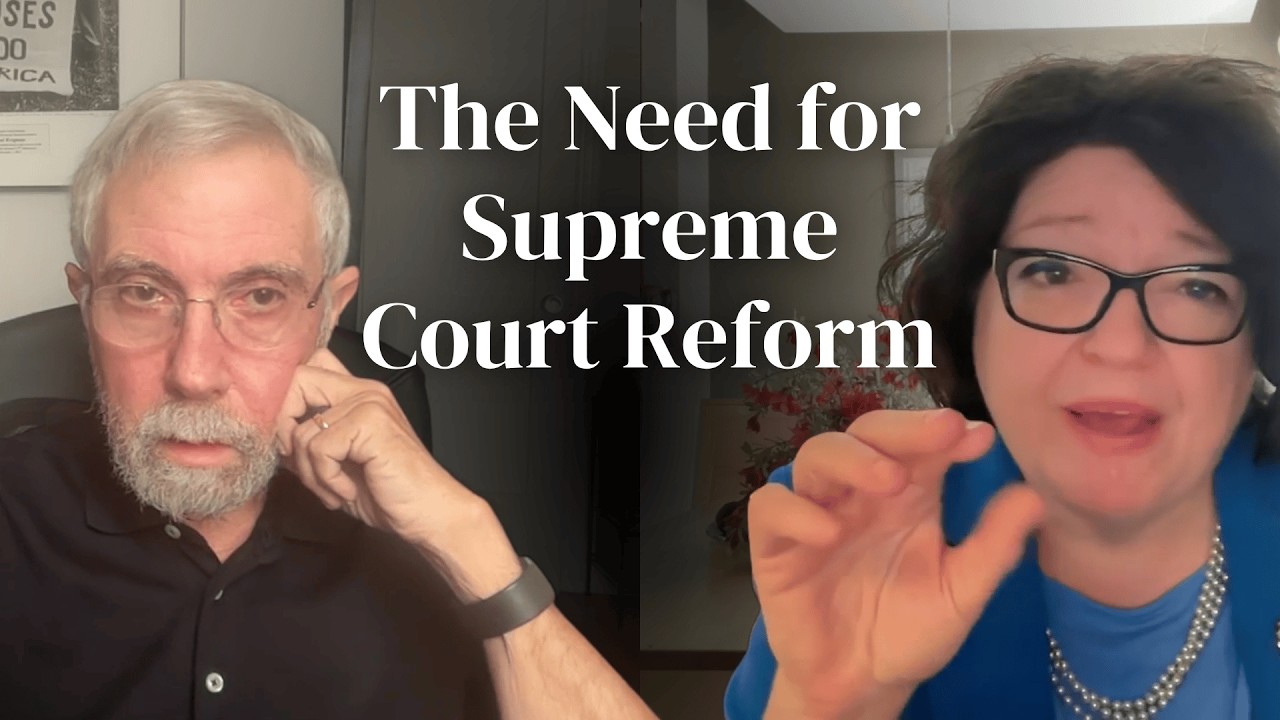
Dangerous Supreme Court Precedents Expanding Presidential Power
4,143 views Apr 13, 2026
Lisa Graves is a legal activist and the author of a remarkable and terrifying book, “Without Precedent,” that documents the assault on democracy via the story of John Roberts. I spoke with her about how America has come to its current state, and what the future may hold. Learn more about “Without Precedent” here: https://bookshop.org/p/books/without-...
//
Apr 11, 2026
On the corruption of our politics — and the Supreme Court
bush v gore
CU
---
acad econ suppress?! hasset
0:01
1 second
I'm Paul Krugman and this is the first of what may be a series of short video
0:08
8 seconds
takes uh on items that arise in the news that kind of I think I should be responding to and I'm going to try and
0:16
16 seconds
do it a little differently from Substack posts and blue sky tweets. Um it's
0:23
23 seconds
Wednesday, February 18th, and there was a news item this morning, uh a which is
0:31
31 seconds
shocking even though it's really hard to be shocked now, but it represented a new dimension. Uh Kevin Hasset is the chairman of the National Economic
0:39
39 seconds
Council, which is it the structure of economic advising and analysis has
0:45
45 seconds
gotten kind of tangled. uh but in effect he is the Trump administration's chief economist and he went on CNBC this
0:54
54 seconds
morning and attacked a study that was released by the Federal Reserve Bank of
1:00
1 minute
New York um on the who is bearing the impact of Trump's tariffs. The study
1:06
1 minute, 6 seconds
which was carried out by a team of solid reputable economists uh two of whom I know quite well Miriam mei and David
1:15
1 minute, 15 seconds
Weinstein um applying a methodology that they have used elsewhere concluded that foreigners are bearing only a very small
1:23
1 minute, 23 seconds
share of the tariffs and it's mostly falling on the United States with the division between businesses and consumers um not determined by the
1:30
1 minute, 30 seconds
methods they used. Um was this right? I think so. But that's and I cited it in
1:37
1 minute, 37 seconds
my uh primer on previous Sunday as a kind of core piece of the statistical evidence. Uh but that is not the issue.
1:45
1 minute, 45 seconds
The issue is not whether you think this study was right. The issue is that Hasset didn't just say I don't accept
the results of this study which is somewhat par for the course. It was him saying that the authors of the study should be disciplined.
That is thuggish. Now, there's so much violently physical thuggishness out there that saying that some economists
should be disciplined is can look trivial, but think about what this means. Uh, and maybe you need a little context.
2:19
2 minutes, 19 seconds
Regional Federal Reserve banks like the New York Fed, especially the New York Fed, but in general, they actually play an important role beyond overseeing
2:28
2 minutes, 28 seconds
banks, handling the implementation of monetary policy and all that. They also have research departments uh which
2:35
2 minutes, 35 seconds
produce they they have tended to specialize they on different things. The New York Fed being where it is is a big
2:44
2 minutes, 44 seconds
regional bank, the biggest has the biggest research department and it's a really crucial source of information.
2:51
2 minutes, 51 seconds
Both they do surveys, they collect statistics and they sponsor a lot of policy relevant research and the kind of
research that regional feds sponsor is the kind of stuff that nobody in the private sector would really have an incentive to do on the same scale. So,
we really depend upon them. Actually, there there's a whole history I could go on and on, but there's a whole history of in some ways the regional feds
keeping academically unfashionable lines of research alive until people realized, hey, it's a good thing we've kept that that line of research going. So, this is
really important. And now, um, we have a Trump administration official saying not just that he doesn't like the results of
the research from the New York Fed. Not even saying I want them to sponsor a counter study, which would itself be pretty bad, but actually saying that the
economists who did the work should be disciplined.
That's incredible. That's a saying if you carefully study the data and come up with results that we in the Trump
administration don't like, we will punish you personally or we will try to punish you personally. Now, they won't succeed in this case, but think of the
of of the logic of the president that's being said here. This is really horrible and you know it matters for me that I
know the people involved. It matters for me that they are using the same methodology in this study that they have
used in other earlier studies which have been published in the journal of economic perspectives and in the American economic association papers and
4:24
4 minutes, 24 seconds
proceedings. In other words, it's it's ultra respectable. But even that is really not crucial. So the crucial point is the idea that we're going to threaten
4:33
4 minutes, 33 seconds
economists personally if we don't like what they're saying. Of course, you know, you say next they're going to start threatening scientists. Of course,
they're doing that, too. But this is an incredible attempt to silence any sort of not just silence uh particular views
that that they don't like, but silence any kind of critical thought. This is a terrible terrible thing. [snorts] Uh, and
it also confirms that essentially at this point everybody in the Trump
administration is a thug. Uh, if you uh they may not have seemed like thugs before has a reputation of being kind
of, you know, not too bright, but of being a kind of a nice guy. will not.
Turns out whether he started out as a thug or he became a thug because that's a prerequisite of continuing to serve with this administration um is an
interesting but not really critical question. The critical point is the absolute thuggishness of this and um we
need to get out from this uh regime. It means among other things, you cannot you utterly cannot trust anything that
anybody in the Trump administration says because they don't they don't accept dissent. They try to punish descent. And
that's true even on things as seemingly innocuous as studying price data to see who paid the cost of the tariffs. And on that note, have a great day.
---
---
Economist Paul Krugman mocks Trump for blackmailing Nobel laureate into handing over medal
AN 1 26
---
AN 11 25
The Wall Street meltdown of September 2008 gave the United States its worst financial crisis since the Great Depression of the 1930s. Both then-President George W. Bush and his successor, Barack Obama, drew criticism for supporting the costly Wall Street bailout, but both of them maintained that the bailout was necessary in order to prevent the Great Recession from worsening.
In a Substack column posted on November 28, liberal economist Paul Krugman made a comparison between the 2008 financial crisis and the current 2025 economy, and laid out a variety of Trump administration policies that he warns could lead to a "future financial crisis" — from a cryptocurrency bubble to undermining the independence of the U.S. Federal Reserve.
"The clear lesson of 2008 is that effective financial regulation is essential," Krugman emphasizes. "For three generations after the great bank runs of 1930-31, America avoided 'systemic' banking crises — crises that threaten the whole financial system, as opposed to individual institutions. This era, which Yale's Gary Gorton calls the Quiet Period, was the result of New-Deal-era protections — especially deposit insurance — and regulations that limited banks' risk-taking. But post-1980, finance was increasingly deregulated."
Krugman adds, "In particular, the government failed to extend bank-type regulation to shadow banks that posed systemic bank-type risks. And the crisis came."
According to Krugman, Trump and his allies haven't learned the lessons of The Great Recession.
"In a way," Krugman explains, "the laxity that made the 2008 crisis possible was understandable. By the 2000s, nobody in government or the financial markets remembered what a real financial crisis was like. And no, watching 'It's a Wonderful Life' on Christmas Day doesn't count. But here we are in 2025, and 2008 wasn't that long ago. Many of us still have vivid memories of the gut-wrenching panic that gripped the world when Lehman fell. Yet Donald Trump's allies and cronies are now moving rapidly to dismantle the precautionary regulations introduced after 2008 to reduce the risk of future financial crises ... But key players in Congress, within the administration, and, alas, at the Federal Reserve, are apparently determined to make a 2008 rerun possible."
"The MAGA war on financial stability is being waged largely on two fronts. First, there's an ongoing effort within some parts of the Federal Reserve to drastically weaken bank supervision — oversight of banks to prevent them from taking risks that could threaten the financial system. The Fed has multiple roles: in addition to setting interest rates, it also has primary responsibility for bank supervision," Krugman continued. "The Fed is supposed to be quasi-independent, and so far, it has preserved its interest-rate-setting independence in the face of intense pressure by Trump to cut rates. Yet a Trumpian agenda is attempting to overtake the Fed's bank supervision operations…. The second front of MAGA's war on financial stability is on behalf of the crypto industry…. Along with its many other sins, the Trump administration is doing its best to make a future financial crisis more likely."
===
an 10 25
Economist Paul Krugman says U.S. consumer sentiment is much weaker than it was pre-Covid, “in fact comparable to its level at the depths of the 2008-2009 financial crisis.”
And people have good reason to feel that way, according to the Nobel laureate's Wednesday Substack article.
“While there have been no mass layoffs so far, people who have lost their jobs or are just entering the work force are finding it very hard to get new jobs,” said Krugman, describing a “K-shaped” economy with affluent people becoming more wealthy and the less well-off “under severe pressure,” an indicated by the rise in car loan and credit card delinquencies and grocery shoppers buying cheaper food. Meanwhile, the top 10 percent of Americans now account for nearly half of all consumer spending.
The rate at which businesses are hiring is currently “not far above its level during the 2008-2009 financial crisis,” Krugman said, although the Trump administration hasn’t released the latest figures.
Surveys conducted by the Conference Board tend to skew optimistic with nearly half of respondents saying in late 2019 — on the eve of Covid — that jobs were plentiful. But the latest Conference Board survey had only 26 percent of respondents saying jobs were “plentiful.”
“And they’re right,” said Krugman. “Overall unemployment hasn’t risen that much, but the number of long-term unemployed — would-be workers who have been jobless for more than 6 months — had soared as of August, and has probably continued to rise since then.”
Another important indicator of a troubled labor market is Black unemployment, which is a reliable Geiger counter for what to expect in the greater economy later, said Krugman.
“After all these years, Black workers still tend to be ‘last hired, first fired.’ And while the overall unemployment rate hasn’t risen much so far, the Black unemployment rate has soared, presumably because Black workers are finding it especially hard to find jobs in this frozen economy,” Krugman said.
And even as the U.S. stock market cranks along, Krugman urged Americans to not be fooled.
“Investors seem to have decided that the wonders of AI matter more than Trump’s tariff madness, so we’re seeing a stock market surge dominated by technology companies,” said Krugman, adding that the AI boom “is troublingly reminiscent of the 90s tech bubble.”
“JPMorgan’s Jamie Dimon suggested parallels between bad lending in the private credit market and the bad subprime lending that brought on the 2008 crisis,” said Krugman. “To quote Dimon: ‘I probably shouldn’t say this, but when you see one cockroach, there are probably more.’”
But aside from the question of whether this is a bubble, Krugman said it’s important to “be aware that the top 10 percent of households own 87 percent of equities, while the bottom half own almost no stock at all and gain nothing from a rising market.”
Read Krugman’s full report at his Substack here.
---===
an 10 25
Economist Paul Krugman says U.S. consumer sentiment is much weaker than it was pre-Covid, “in fact comparable to its level at the depths of the 2008-2009 financial crisis.”
And people have good reason to feel that way, according to the Nobel laureate's Wednesday Substack article.
“While there have been no mass layoffs so far, people who have lost their jobs or are just entering the work force are finding it very hard to get new jobs,” said Krugman, describing a “K-shaped” economy with affluent people becoming more wealthy and the less well-off “under severe pressure,” an indicated by the rise in car loan and credit card delinquencies and grocery shoppers buying cheaper food. Meanwhile, the top 10 percent of Americans now account for nearly half of all consumer spending.
The rate at which businesses are hiring is currently “not far above its level during the 2008-2009 financial crisis,” Krugman said, although the Trump administration hasn’t released the latest figures.
Surveys conducted by the Conference Board tend to skew optimistic with nearly half of respondents saying in late 2019 — on the eve of Covid — that jobs were plentiful. But the latest Conference Board survey had only 26 percent of respondents saying jobs were “plentiful.”
“And they’re right,” said Krugman. “Overall unemployment hasn’t risen that much, but the number of long-term unemployed — would-be workers who have been jobless for more than 6 months — had soared as of August, and has probably continued to rise since then.”
Another important indicator of a troubled labor market is Black unemployment, which is a reliable Geiger counter for what to expect in the greater economy later, said Krugman.
“After all these years, Black workers still tend to be ‘last hired, first fired.’ And while the overall unemployment rate hasn’t risen much so far, the Black unemployment rate has soared, presumably because Black workers are finding it especially hard to find jobs in this frozen economy,” Krugman said.
And even as the U.S. stock market cranks along, Krugman urged Americans to not be fooled.
“Investors seem to have decided that the wonders of AI matter more than Trump’s tariff madness, so we’re seeing a stock market surge dominated by technology companies,” said Krugman, adding that the AI boom “is troublingly reminiscent of the 90s tech bubble.”
“JPMorgan’s Jamie Dimon suggested parallels between bad lending in the private credit market and the bad subprime lending that brought on the 2008 crisis,” said Krugman. “To quote Dimon: ‘I probably shouldn’t say this, but when you see one cockroach, there are probably more.’”
But aside from the question of whether this is a bubble, Krugman said it’s important to “be aware that the top 10 percent of households own 87 percent of equities, while the bottom half own almost no stock at all and gain nothing from a rising market.”
Read Krugman’s full report at his Substack here.
---
---
NO LNXAN
'Failed to deliver': Economist Paul Krugman torches Trump deal as house of cards
Economist Paul Krugman at FIDES 2023 in Rio de Janeiro, Brazil on September 25, 2023 (A.PAES/Shutterstock.com)
Alex Henderson
October 14, 2025 |
President Donald Trump's views on digital currencies have changed dramatically since his first administration. In the past, Trump remarked that Bitcoin "seemed like a scam" and was "based on thin air."
During his second term, however, Trump is all in for cryptocurrencies.
Liberal economist Paul Krugman, in an October 14 column for his Substack page, is highly critical of Trump's crypto activities — arguing that they are a house of cards.
"Stocks fell sharply Friday, (October 10)," Krugman explains, "but the really striking action came in crypto, where Bitcoin fell 20 percent and smaller, less liquid tokens fell even more…. Also, it just so happens that Trump himself holds an estimated $870 million worth of Bitcoin, so he suffered large personal financial losses from the crypto crash. This was the largest one-day crash crypto has experienced so far."
Krugman was skeptical about cryptocurrencies to begin with, but an "intensified trade war," according to the former New York Times columnist, will put them in an even more vulnerable position.
"These days," Krugman warns, "crypto derives its value largely from the support of politicians and government officials — in particular, officials who can be bribed. As a result, at this point, crypto is largely a Trump trade. And crypto fell because the backlash against the potential trade war threatened to weaken Trump politically."
Krugman continues, "A brief history of crypto: When Bitcoin, the original crypto asset, was introduced, enthusiasts predicted that it would displace conventional fiat money, that is, currency issued by governments. The blockchain, they claimed, would make transactions using cryptocurrency easier and cheaper than transactions using dollars. And cryptocurrencies would be safe from the ravages of the printing press: governments couldn't debase your money through inflation. That was more than 15 years ago, and crypto has completely failed to deliver on those promises."
The economist observes that although, "almost nobody uses cryptocurrency as a means of payment," the "public holds roughly $4 trillion in crypto assets."
"Why? Largely as a pure speculative investment," Krugman argues. "In addition, however, crypto has found real-world use as a convenient tool for criminal activity and money-laundering…. So why did Trump's threat of all-out trade war with China cause crypto prices to plunge? Not because the economic damage from such a war would reduce the use of crypto, because crypto basically doesn't have any legitimate uses. But an intensified trade war, especially a trade war America would almost surely lose, would drive Trump's public support into an even deeper hole."
Paul Krugman's full Substack column is available at this link.
:{---
---
Krugman’s ‘Fossilized’ Climate Mind Doesn’t Have a Clue About the Coal Industry
bless Paul Krugman’s little birdbrain. The disgruntled propagandist disguising himself as an economist is once again departing from his normal economic mudslinging schtick to kvetch over the climate change boondoogle.
 Krugman’s latest move was to sling sludge at those who dared defend the utility of fossil fuels in an economy that’s being jawboned into an eco-friendly future.
“Fossil Fuels and Fossilized Minds,” read Krugman’s hilarious September 30 Substack headline, ironic given that this is the same personwho told President Joe Biden before his term in office, “Don’t worry about inflation.” Who exactly has a “fossilized” mind again, Krugman?
After cringeworthy praises of “Wind power” and how he “likes” the eyesore “sight of wind turbines,” Krugman proceeded to attack President Donald Trump because he “hates wind power and loves coal. Both passions are deeply irrational. Yet they are shaping policy.”
Krugman’s new beef was that Trump was trying to revive a dying coal industry that he argued was just phased out by typical market shifts towards natural gas and renewables. “The truth, however, is that coal is a dying industry for very good reasons, and anti-wokeism is unlikely to revive it. Coal stopped being a significant source of jobs decades ago.”
But as Climate Depot founder Marc Morano told MRC Business: “Krugman needs to examine how energy is produced to understand why coal is a crucial component in reviving American energy dominance.”
It's unclear why he considers himself any kind of authority on this matter when he had just finished nuking his own credibility on economics during the Biden administration, but whatever. Then again, this is the same Krugman who stupidly advocated that Americans should “politicize the weather.”
Firstly, said Morano, “a healthy coal industry is crucial for any nation's national security. Domestic coal production is a strategic asset that does not depend on importation. Coal helps achieve economic stability and supply chain resilience.” But in Krugman’s ignorant world, trying to maintain a thriving coal sector is just about a “culture war. Trying to bring back coal is all about owning the libs. And if it damages the environment, well, from MAGA’s point of view that’s a plus.” Morano slammed Krugman’s take as completely false.
One of the biggest boo-boos Krugman made was when he asserted that “Wind power is, in fact, far cleaner and safer than burning fossil fuels.” Morano took that narrative to the cleaners:
Not even close: the documentary Juice explained: ‘Just to produce one turbine, we have to extract 900 tons of steel, 2,500 tons of concrete, and 45 tons of non-renewable plastic. Then we’ve got to transport that and burn fuel, getting it all carried across the world and put up. And none of these things that go into a turbine are renewable.’
Krugman also bleated that it was supposedly a “simple fact that coal is no longer cost-competitive, while wind and solar are…Trying to keep coal alive will make energy more expensive, not less.” But Morano pointed out that Krugman’s argument hinges on a red herring:
The goal of America’s energy sector isn’t to create as many jobs as possible (as Krugman would apparently have us believe), especially the politically-favored and heavily-subsidized renewable energy jobs. Instead, the goal is to produce as much electric power as possible at the lowest possible cost, and that means we want to choose the most productive energy like coal, which requires fewer energy workers.
If that wasn’t clear enough, economist Mark Perry concluded in a 2017 analysis for the American Enterprise Institute that it takes 79 solar workers to produce the same amount of electric power as one coal worker. See the issue with Krugman’s argument yet?
While natural gas and technological advances in fracking have certainly contributed to the market shift away from fossil fuels, Morano argued that “there was also a deadly effective ‘war on coal’ unleashed by the Obama administration and continued by the Biden administration.”
Last year, energy journalist Robert Bryce also undercut the “Western conceit” of a phony energy transition that Krugman made the centerpiece of his thesis: “[D]espite massive federal subsidies and numerous mandates at the local and state levels, wind and solar energy aren’t keeping pace with the growth in natural gas.”
Bryce further wrote that “The U.S. and Western European countries are spending hundreds of billions of dollars on programs like the Inflation Reduction Act and the [German] Energiewende to fund buildouts of solar, wind, batteries, and tutti-fruity-colored hydrogen, but that doesn’t mean the rest of the world will do the same.”
Kind of hard to argue that it was just market forces phasing out coal when one sector was getting pumped with hundreds of billions of dollars in subsidies while another was being stymied by intentional overregulation, eh Krugman?
GMAIL
Marc Morano
Weekly update ⋅ October 3, 2025
The Climate Realist President — The Climate Realism Show #175 - The Heartland Institute
The Heartland Institute
Join Anthony Watts, Sterling Burnett, Linnea Lueken, Jim Lakely, and special guest Marc Morano of CFACT for this live broadcast. Tune in LIVE ...
LOOK IN MIRROR: Krugman Accusing Right of Having 'Fossilized Minds' Is Pretty Hilarious
Newsbusters
But as Climate Depot founder Marc Morano told MRC Business: “Krugman needs to examine how energy is produced to understand why coal is a crucial ...
---
an 7 25 fired labor stats
'Banana republic territory': Krugman says Trump's latest move follows dictator 'playbook'
AN 8 25
During his four years as president, Joe Biden worried that if Donald Trump ever returned to the White House, it would pose a major threat to the North Atlantic Treaty Organization (NATO). Trump, during his first term, toyed with the idea of withdrawing the U.S. from NATO — whereas Biden, as president, aggressively championed NATO's expansion when Sweden and Finland opted to join the alliance.
Seven months into Trump's second presidency, the U.S. is still a NATO member. But author/military historian Phillips O'Brien, during an interview with economist Paul Krugman, stressed that Trump's return to the White House marks a dramatic change in U.S./Europe relations.
Krugman, on August 23, posted video of the interview on his SubStack page and also published it as a Q&A article. And O'Brien voiced major concerns about the United States' relationship with Europe.
READ MORE:Bill Maher hits raw nerve with detailed warning of Trump's 'slow-moving coup'
"The United States is going to great lengths to antagonize its allies," O'Brien told Krugman. "I don't get it. None of this makes any sense to me."
The author/historian said of the Ukraine/Russia War, "I think what happens to Ukraine will determine how Europe deals with this. If Ukraine is sacrificed, I think Europe is going to have a terrible future. Because it's going to be dependent on the U.S., which has basically sacrificed Ukraine to (Russian President Vladimir) Putin's Russia. Europe might even break apart, structurally, such that you'll have the Central Eastern Europeans, the ones who want to stand by Ukraine, the Finns, the Baltics, the Nordics going one way and then the Western Europeans sort of pretending things are OK."
O'Brien added, "So, I think people are underrating the chance of Europe splitting over Ukraine, which is why it's so important, I think, that Ukraine comes out of the war in good shape."
According to O'Brien, U.S. allies in Europe will be paying very close attention to the outcome of the United States' 2026 midterms.
READ MORE:MAGA is panicking as Trump finally meets his match
"Well, that's the key thing, isn't it? The 2026 midterms," O'Brien told Krugman. "I don't think people are paying enough attention, because they have to be run fairly. I do think the Democrats have a very good chance of winning them if they are run fairly and happen under normal conditions. But they could also be easily perverted…. I would say that 2026 elections will show not whether America can come back, but whether it has a chance to come back — or whether the period we're going into could be a lot longer and darker than we imagined."
---
In an October 16, 2023 column for the New York Times, liberal economist Paul Krugman lamented the decline the "Pax Americana" and argued that MAGA Republicans were to blame. The term "Pax Americana" refers to a period of relative stability in the West following World War 2, and that stability, according to the concept, was encouraged by the North Atlantic Treaty Organization (NATO).
A lot has happened politically since Krugman wrote that column. Donald Trump won the 2024 GOP presidential nomination, Joe Biden ended his reelection campaign following a widely criticized debate with Trump, Republicans flipped the U.S. Senate, and Trump narrowly defeated then-Vice President Kamala Harris in the general election before returning to White House on January 20, 2025.
Krugman revisits the "Pax Americana" subject in an article posted on his Substack page on February 10, warning the stability of the West is in serious danger during Trump's second presidency. And Krugman is highly critical of the "destruction of" the United States Agency for International Development (USAID), which, he says, Trump ally Elon Musk encouraged.
READ MORE:'Mark my words': George Conway predicts alarming showdown
"USAID is just the most extreme example of how the Musk/Trump Administration is sabotaging the American empire," Krugman laments. "For years, America is or was an imperial power, although in a different way from most past empires — less reliant on force, more reliant on good will and trust. What Musk and Trump have done is to destroy much of the basis for U.S. influence, leaving America far weaker than it was just a few weeks ago."
The economist continues, "America's imperial era — the Pax Americana — began after World War II. With Europe and Japan in ruins and Britain exhausted, the U.S. had no military or economic peers outside the Soviet Bloc. "
Krugman stresses that "humanitarian aid," USAID's mission, plays "an important role in supporting America's moral authority."
"Were we always the good guys? Of course not," Krugman writes. "America engineered the overthrow of democratically elected leaders it didn't like, from Iran's Mohammed Mosaddegh to Chile's Salvador Allende. We supported tinpot dictators where that served U.S. interests, or in some cases, corporate interests. We killed huge numbers of civilians in Korea, and then again in Vietnam."
READ MORE:Trump is already out gaming America's last line of defense
Krugman adds, "But compare the Pax Americana with any previous hegemony, and we look like a beacon of enlightenment. And our relative decency was rewarded."
Krugman warns that between threatening allies like Canada and Mexico with high tariffs "on spurious grounds," Trump's "threat to seize Greenland," and "the abrupt demolition of USAID," Trump and their allies "have taken a wrecking ball to the foundations of the Pax Americana."
"So now we're a nation that doesn’t keep its word, that can't be trusted to honor its agreements…. All of this makes us distrusted and friendless," Krugman warns. "It also makes us weak, because America needs allies even more now than it did during the Cold War."
READ MORE:'Stomach turning': Trump defends his J6 pardons as 'great for humanity'
*Paul Krugman's full SubStack column is available at this link.
---
an 1 25
Although Paul Krugman retired from his New York Times column after almost 25 years, the liberal economist is still keeping busy and making media appearances — including an interview with The New Republic's Greg Sargent posted on January 14.
Trump aggressively campaigned on the economy last year. But Krugman, during an appearance on The New Republic's podcast, laid out a variety of reasons why he believes Trump voters will suffer economically after he returns to the White House.
Krugman told host Greg Sargent, "A lot of people are going to get brutally scammed. Those are his most fervent supporters…. Probably the local business elites are the most fervent MAGA types out there — more so even than the working class, but that doesn't mean that Trump cares about their interests. Small businesspeople are the people that he's, all through his life, hired as contractors and then not (paid), right? Scamming people like that is what his whole life has been (about)."
READ MORE:DC hotel bookings way down for Trump inauguration as even protesters decide to skip
Small businesses and consumers, the economist warned, will suffer the consequences if Trump follows through on the aggressive tariffs and mass deportations he is proposing.
"Trump has really radical policy ideas," Krugman told Sargent. "I obviously think they're terrible, but they are radical. He wants Smoot-Hawley-level tariffs. He wants mass deportations. He wants to take away the independence of the Federal Reserve. How do you justify all of that when we're pretty much a Goldilocks economy?"
Trump hammered President Joe Biden and Vice President Kamala Harris relentlessly over inflation during his 2024 campaign, but Krugman warned that the tariffs Trump is proposing will be quiet inflationary.
The economist told Sargent, "If we take the totality of stuff that Trump seems to want to do — he wants to raise tariffs but cut taxes on high incomes — it's basically working-class voters (who) are going to face higher prices and upper-income voters (who) are going to benefit from tax cuts. This really is very much contrary to their interests, then you add in all the other stuff. Even more than usual for a Republican, he appears to have an extremely regressive economic program in mind — one that really will effectively redistribute income away from working-class voters to the top."
READ MORE:'Quite unlikely': Analysis exposes key Trump campaign promises as unrealistic — if not 'impossible'
---
6? 24
an
Under President Joe Biden, the United States has enjoyed record-low unemployment and considerable job growth. The unemployment rate, according to the U.S. Bureau of Labor Statistics (BLS), was 4.1 percent in June — which was an increase from 3.7 percent in May but shows no sign of a recession.
Trump has claimed that much of the job growth under Biden has gone to illegal immigrants. But liberal economist Paul Krugman debunks that claim in a July 23 newsletter for the New York Times.
"Since President Biden took office," Krugman explains, "the United States has gained 15.7 million jobs. Trump, however, has been dismissing the good news on employment, claiming that all the job gains are going to illegal immigrants."
READ MORE:Scathing NY Times column warns JD Vance and Aileen Cannon are working hand-in-hand
The economist/columnist goes on to lay out some data.
"The question…. is whether the jobs immigrants have taken would have gone to native-born workers if immigration had been lower," Krugman writes. "Well, if immigrants were stealing our jobs, we'd expect to see a sharp rise in unemployment among the native-born. We don't."
Krugman adds, "The unemployment rate among native-born workers is near a historic low." The economist adds that there is no evidence showing that immigrants cause wages to go down.
READ MORE:George Conway: Trump's now the only one 'the issue of cognitive decline' applies to
"Most labor economists now believe that immigrants don't do much head-to-head competition with native-born workers; they bring different skills and take different jobs," Krugman argues. "And the past few years, with elevated immigration, have also been an era of exceptional growth in wages for the worst paid. So, none of these negative claims about the effects of immigration hold up.
READ MORE:'Revealing exchange' shows what Trump campaign 'feared most about Biden': report
===
an 10 24
Economist Paul Krugman argues in a Monday, October 28 New York Times column that Donald Trump's "biggest, potentially most consequential con has been political: portraying himself as a different kind of Republican, an ally of working Americans."
Krugman submits that "Americans correctly remember Trump’s prepandemic economy as an era of strong job growth and rising wages — largely, I’d argue, because Republicans in Congress opened the fiscal spigots after austerity during the Obama years slowed recovery from the 2008 financial crisis."
However, "Many also implicitly discount or memory-hole the high unemployment of Trump’s final year in office. And they’re still frustrated about higher prices, the consequence of the inflation surge of 2021-22 — even though this surge was a global pandemic phenomenon, and wages adjusted for inflation are now higher than they were right before the Covid-19 pandemic."

The Nobel laureate emphasized, "What relatively few people realize, I believe, is that if he wins next week, Trump’s anti-worker agenda will be much broader than anything he managed to do in 2017-21."
Noting that during his years as a business mogul, Krugman recalls that Trump "left behind a trail of investors who lost money in failed ventures even as he profited, students who paid thousands for worthless courses, unpaid contractors and more."
Additionally, "Even amid his current presidential campaign he has been hawking overpriced gold sneakers and Trump Bibles printed in China," Krugman continues.
The longtime economist emphasizes:
*[Trump's] 2017 tax cut strongly favored high-income Americans. Now he wants to make that tax cut, many of whose provisions will expire in 2025, permanent. He has also floated the idea of a further large cut in corporate taxes (much of which could, by the way, ultimately benefit foreign investors).
*As president, Trump tried to push through deep cuts in Medicaid, although he didn’t succeed. And while he says that he won’t cut Social Security and Medicare, his policy proposals would undermine these programs’ financial foundations.
READ MORE:[Why 'voters consistently say they trust Trump' with the economy than Harris: expert
"So, no, Trump isn’t a friend to working-class Americans; quite the opposite," Krugman concludes.
*Krugman's full column is available at this link (subscription required).
an 1 24 maya
with the Federal Reserve expected "to start reversing the sharp [interest] rate hikes it carried out beginning in March 2022," economist Paul Krugman predicts in a Monday, January 8 New York Times op-ed that "[Donald] Trumpist attacks on the Fed for cutting interest rates are coming."
"What I don’t know is whether the Fed is ready for the political firestorm it’s about to face, and whether it will stand up to the pressure to keep rates too high for too long. Because it’s a safe prediction that Donald Trump and his supporters will scream that the coming rate cuts are part of a deep-state conspiracy to re-elect President Biden," Krugman writes.
The longtime NYT opinion columnist notes, "In a recent dialogue with me about the economy, my colleague Peter Coy suggested that the Fed may be inhibited from cutting rates because it’ll fear accusations from Trump that it’s trying to help Biden. I hope Fed officials understand that they’ll be betraying their responsibilities if they let themselves be intimidated in this way."
He also emphasized, "I hope that forewarned is forearmed. MAGA attacks on the Fed are coming; they should be treated as the bad-faith bullying they are."
Krugman writes:
*I don’t know what the unemployment rate or the rate of economic growth will be in November, but because monetary policy works with a lag, what the Fed does in the next few months won’t have much effect on these numbers.
*Biden, however, is already presiding over a very good economy by normal standards, with solid job growth and plunging inflation. What he needs is for more Americans to accept the good news. And Fed rate cuts will help him with that. They will signal to the public that inflation really is under control; they will lead, other things being equal, to higher stock prices and lower mortgage rates.
*So we can expect howls from Trump and his allies that politics, not economics, is driving the coming rate cuts — even though Trump himself appointed Jerome Powell, the Fed’s chair.
"Trump and his allies constantly engage in projection, assuming that their opponents are doing or will do what they themselves would do or have done, like weaponizing the Justice Department for Trump’s own political ends," the distinguished professor at the City University of New York Graduate Center emphasizes. "And when it comes to interest rate policy, Trump has a track record of doing exactly what I’m sure he will accuse Biden of doing: trying to manipulate the Fed."
He writes, "Why do we know this will happen? Partly because paranoia is MAGAworld’s normal condition: It sees sinister conspiracies everywhere."
READ MORE:Paul Krugman: Why the economy 'may be better for Democrats' than pundits think
*Krugman's full op-ed is here (subscription required).
---
==
desantis-signs-floridas-ban-on-lab-grown-meat
// on May 1, Florida Gov. Ron DeSantis announced that he had signed into law a bill that prohibits the production or sale of lab-grown meat in the state. DeSantis noted that Florida was the first state to enact such a ban, declaring, "Our administration will continue to focus on investing in our local farmers and ranchers, and we will save our beef."
Liberal economist Paul Krugman is vehemently critical of DeSantis' move in his May 7 column for the New York Times. The ban, Krugman argues, is not only against freedom of choice — it also underscores the modern Republican Party's ability to turn anything and everything into a "culture-war" battle.
"It's possible to grow meat in a lab — to cultivate animal cells without an animal and turn them into something people can eat," Krugman explains. "However, that process is difficult and expensive. And at the moment, lab-grown meat isn't commercially available and probably won't be for a long time, if ever."
READ MORE:'Culture wars are getting us nowhere': Florida lawmakers tiring of DeSantis’ 'war on woke'
But DeSantis, Krugman adds, is "cracking down" on an "industry that doesn't even exist yet."
"The new Florida law is a perfect illustration of how crony capitalism, culture war, conspiracy theorizing and rejection of science have been merged — ground together, you might say — in a way that largely defines American conservatism today," Krugman observes. "First, it puts the lie to any claim that the right is the side standing firm for limited government; government doesn't get much more intrusive than having politicians tell you what you can and can't eat."
The fact that "meat consumption, like almost everything else, has been caught up in the culture wars," Krugman laments, shows how intellectually bankrupt and devoid of substance the modern GOP has become in the age of Donald Trump.
"Look, I'm not an admirer of Ronald Reagan, who I believe did a lot of harm as president," Krugman argues. "But at least Reaganism was about real policy issues like tax rates and regulation. The people who cast themselves as Reagan's successors, however, seem uninterested in serious policymaking."
READ MORE:'Star Trek' actor rips Ron DeSantis for Trump endorsement: 'These people aren't serious'
The Times columnist continues, "For a lot of them, politics is a form of live-action role play. It's not even about 'owning' those they term the elites; it's about perpetually jousting with a fantasy version of what elites supposedly want."
READ MORE:Florida in play? Biden and strategists say yes as court puts abortion, marijuana on ballot
*Paul Krugman's full New York Times column is available at this link (subscription required).
---
---
Paul Krugman: FBI figures expose GOP 'politics of fear' on US crime rates - Alternet.org
---
no lnx an 4 23
Economist Paul Krugman: America’s 'superyacht boom' underscores its 'extreme inequality'
Alex Henderson April 12, 2023
During the Joe Biden era, Paul Krugman has been quite bullish on the U.S. economy. The liberal economist and New York Times columnist has emphasized that under Biden, the United States has had some of its lowest unemployment rates in more than half a century.
But Krugman has also had a lot to say about U.S. inequality, complaining that the gap between America's haves and have-nots is still way too large. In his April 11 column, Krugman cites "superyachts" as a reminder of inequality.
"According to a 2022 article in The New Yorker," Krugman explains, "any yacht over 98 feet long is considered a superyacht within the yachting community. Which got me thinking about big yachts and what they tell us about the state of society. When rich people can afford to buy and operate big yachts, they do. Indeed, yachts are a highly visible indicator of inequality, the concentration of income and wealth in the hands of the few. The Gilded Age was marked by a proliferation of ever bigger, ever more elaborately furnished yachts; when J.P. Morgan built a large steam yacht, its 1898 launch was featured in The New York Times."
READ MORE: US inflation was even lower than expected in March: CPI
Krugman continues, "Conversely, the Great Compression of income disparities that took place during the 1940s and made America a relatively middle-class society for the next four decades put an end to the first golden era of superyachts. In 1955, Fortune published a remarkable essay, 'How Top Executives Live,' which stressed how modest their standard of living had become compared with pre-War norms. Among other things, large yachts had 'foundered in the sea of progressive taxation'…. Now, superyachts are back. Indeed, according to that New Yorker article, we're living through 'the greatest boom in the yacht business that has ever existed'…. If you had any doubts about whether we're living in an era of extreme wealth concentration, comparable to or even surpassing the Gilded Age, the superyacht boom should quell those doubts."
In his April 10 column, however, Krugman focuses on some good economic news: the U.S. Bureau of Labor Statistics (BLS) report on unemployment for March 2023. According to the BLS, the U.S. had 3.5 percent unemployment in March —a figure that, Krugman emphasizes, explodes the right-wing myth that big chunks of the U.S. population are lazy.
"Americans, they said, just don't want to work," Krugman writes. "Socialism has made them lazy. They'd rather play video games.… Remember all that talk about Americans dropping out of the labor force?…. The overall unemployment rate is only 3.5 percent; we haven't had that spirit here since 1969. Black unemployment is at a record low. There's good news everywhere you look. So, whaddya know: Provide enough job opportunities, and lazy video-game-playing Americans will take those jobs and, apparently, demonstrate enough skill that employers want to keep them."
BLS figures for March, Krugman adds, show that Biden's economic policies are still working.
READ MORE: US inflation was even lower than expected in March: CPI
"It is worth noting that Republicans keep insisting President Biden's policies have been an economic disaster, and that even the mainstream news media has tended to emphasize inflation — which has been a nasty shock, even though it may be subsiding — rather than job gains," the economist/columnist observes. "So, it does seem worth pointing out that at this point, Biden is presiding over the best job market America has seen in a generation — specifically since the boom of the late (Bill) Clinton years."
READ MORE: 'Bank bailout': Robert Reich busts 3 myths the 'undeserving right' use to justify their wealth
Read Paul Krugman’s full New York Times columns at this link and this link (subscription required).
FROM YOUR SITE ARTICLES
'Anyone who thinks this economy is in recession is bananas': Economists cheer 'hot' Biden jobs report ›
Economists stunned by 'breathtaking' job growth 'boom' as unemployment drops to level not seen since 1969 ›
History shows that Republicans are 'just plain bad at managing the economy': industry experts ›
RELATED ARTICLES AROUND THE WEB
Inflation Is Making Poverty in the U.S. Even More Difficult ›
Inflation inequality: Poorest Americans are hit hardest by soaring ... ›
'Inflation Inequality' Makes Life Harder for Workers - The Atlantic ›
---
random 2 23
When President Joe Biden made a surprise visit to Kyiv on Monday, February 20 and expressed his solidarity with Ukrainian President Volodymyr Zelensky, The Lincoln Project’s Rick Wilson — a Never Trump conservative and former GOP strategist — praised Biden’s "alpha move" and slammed MAGA Republicans for not being on "the right side of history." Wilson is a scathing critic of the MAGA movement, and the affinity that so many MAGA Republicans have for Russian President Vladimir Putin is one of the reasons why he holds Trumpism in such low regard.
It was a year ago, on February 24, 2022, that Russian forces acting on orders from Putin launched a full-fledged invasion of Ukraine. That war has brought the worst fighting in Europe since World War 2, yet Putin's admirers in the MAGA movement haven't soured on him.They view Putin as a symbol of the type of nationalist machismothat, as they see it, the American left and non-MAGA conservatives lack.
Liberal economist and New York Times opinion columnist Paul Krugman examines MAGA Republicans' "creepy" fixation with Putin in his February 23 column. Those Republicans, according to Krugman, believe that identifying with Putin makes them "tough guys" when in reality, it makes them "losers."
READ MORE: Former GOP strategist praises Biden’s 'alpha move' in Ukraine while slamming MAGA response
"How can any American, a citizen of a nation that holds itself up as a beacon of freedom, not be rooting for Ukraine in this war?" Krugman argues. "Yet there are significant factions in U.S. politics — a small group on the left, a much more significant bloc on the right — that not only oppose western support for Ukraine but also clearly want to see Russia win. And my question, on the first anniversary of Russia's invasion, is what lies behind right-wing support for Vladimir Putin?"
Krugman goes on to answer his own question, explaining why Putin is "the subject of" a "creepy personality cult" on the "American right." And he points out that the MAGA far right also admires another authoritarian figure in Eastern Europe: Hungarian Prime Minister Viktor Orbán.
The columnist writes, "I'd argue that many people on the right equate being powerful with being a swaggering tough guy and sneer at anything — like intellectual openness and respect for diversity — that might interfere with the swagger. Putin was their idea of what a powerful man should look like, and Russia, with its muscleman military vision, their idea of a powerful country…. The key to understanding right-wingers' growing Ukraine rage is that Russia's failures don't just show that a leader they idolized has feet of clay — they also show that their whole tough-guy view about the nature of power is wrong. And they're having a hard time coping."
In contrast to the praise that President Biden's Kyiv visit received from anti-Trump conservative Wilson, MAGA figures ranging from Florida Gov. Ron DeSantis to Rep. Marjorie Taylor Greene (R-Georgia) responded by claiming that Biden cares about Ukraine more than he cares about the United States.
READ MORE:Greene blasted for 'parroting Kremlin talking points' on Biden Ukraine trip
Krugman is hoping that the United States will continue to aid Ukraine militarily but warns that many MAGA Republicans are hoping for a very different outcome.
"None of this means that Russia can’t eventually conquer Ukraine," Krugman writes. "If it does, however, it will, in part, be because America's Putin fans force a cutoff of crucial aid. And if this happens, it will be because the U.S. right can't stand the idea of a world in which woke doesn’t mean weak and men who pose as tough guys are actually losers."
READ MORE: How 'cold-blooded and detached' Ron DeSantis failed Ukrainians miserably: conservative
Read Paul Krugman’s full New York Times column at this link.
---
an 2 23 safe net BS ~
https://www.alternet.org/paul-krugman-tears-down-arguments/
---
12 22
https://www.alternet.org/economist-paul-krugman-why-the-latest-inflation-news-is-seriously-encouraging/
---
10 22
READ MORE: Paul Krugman: House Republicans’ 'commitment to America' is 'zombie Reaganomics'
---
9/13/22 big territory gains
---
an 922
The invasion of Ukraine has not gone as planned for the Russian government. When Russian forces invaded Ukraine on February 24, President Vladimir Putin and his Kremlin allies were obviously hoping to take over the country in a hurry; instead, the Ukrainian military have fought back much more aggressively than Putin anticipated — and done so with the support of the Biden Administration and the United States’ European allies in the North Atlantic Treaty Organization (NATO). September has found Russian forces suffering some major humiliations at the hands of the Ukrainian military.
Liberal economist and New York Times columnist Paul Krugman examines the state of the conflict in a September 12 column, drawing a parallel between Putin and his allies in Russia and MAGA Republicans in the United States. Both of them, Krugman argues, underscore the fact that “tough-guy swagger” doesn’t automatically translate to military victories.
Krugman opens his column by noting that on August 29, Fox News’ Tucker Carlson — who Krugman slams as a “Putin cheerleader” — happily told viewers that Putin was “winning the war in Ukraine.”
“Carlson’s timing was impeccable,” Krugman writes. “Just a few days later, a large section of the Russian front near Kharkiv was overrun by a Ukrainian attack. It’s important to note that Putin’s forces weren’t just pushed back; they appear to have been routed. As the independent Institute for the Study of War reported, the Russians were driven into a ‘panicked and disorderly retreat,’ leaving behind ‘large amounts of equipment and supplies that Ukrainian forces can use’…. The Russian collapse seemed to validate analyses by defense experts who have been saying for months that western weapons have been shifting the military balance in Ukraine’s favor, that Putin’s army is desperately short on quality manpower and that it has been degraded by attrition and missile attacks on its rear areas.”
Krugman goes on to explain why “Putin cheerleaders” like Carlson are so flawed in their thinking.
“There’s something special about the MAGA embrace of the mystique of Russian might: a worldview that equates tough-guy swagger with effectiveness,” Krugman writes. “This worldview has warped the right’s perception not just of the Russian Army, but also, of how to deal with many other issues. And it’s worth asking where it comes from. Many Republicans have admired Putin for a long time — even before Donald Trump took over the GOP. Back in 2014, for example, Rudy Giuliani said of Putin, ‘That’s what you call a leader.’ And Trump continued to praise Putin even after he invaded Ukraine.”
Krugman continues, “So, it’s not hard to see where the MAGA right’s admiration for Putinism comes from. After all, Putin’s Russia is autocratic, brutal and homophobic, with a personality cult built around its ruler. What’s not to like?.... On the right…. approval of authoritarian regimes is all bound up with assertions about their military prowess…. The MAGA ethos is all bound up with exaltation of tough talk and denigration of expertise.”
READ MORE:How Vladimir Putin's spies in Ukraine blew it for him in Ukraine: report
MAGA Republicans, according to Krugman, “needed to see Putin as a leader made powerful by his rejection of liberal values.”
“There’s growing speculation about what will happen inside Russia if the invasion of Ukraine ends in outright defeat,” Krugman observes. “But you also have to wonder how the U.S. right will handle the revelation that sometimes, tough guys finish last.”
---
---
https://www.alternet.org/2022/07/supreme-court-climate-change-apocalypse/
krugman
---
---
222
Nasty, brutish and short” is the phrase that British philosopher Thomas Hobbes, in his 1658 book “Leviathan,” famously used to describe the lives of England’s working class. Hobbes, born in 1588, lived a long life and was 91 when he died in 1679, but many working-class Brits of Hobbes’ time didn’t make it to 50.
Centuries later, liberal economist and New York Times columnist Paul Krugman uses Hobbes’ “nasty, brutish and short” concept in his January 31 column — arguing that in 2022, Republican policies are designed to make American lives exactly that: nasty, brutish and short.
“As Thomas Hobbes could have told you, human beings can only flourish, can only avoid a state of nature in which lives are ‘nasty, brutish and short,’ if they participate in a ‘commonwealth’ — a society in which government takes on much of the responsibility for making life secure,” the 68-year-old Krugman explains. “Thus, we have law enforcement precisely so individuals don’t have to go around armed to protect themselves against other people’s violence.”
Krugman continues, “Public health policy, if you think about it, reflects the same principle. Individuals can and should take responsibility for their own health when they can, but the nature of infectious disease means that there is an essential role for collective action, whether it is public investment in clean water supplies or, yes, mask and vaccine mandates during a pandemic. And you don’t have to be a socialist to recognize the need for regulation to maintain the reliability of essential aspects of the economy like electricity supply and the monetary system." [twt]
the liberal economist/columnist lays out a variety of Republican policies that can make the lives of Americans “nasty, brutish and short” — from COVID-19 policies and anti-vaxxer insanity to a failure to support and maintain infrastructure.Krugman specifically mentions Texas Gov. Greg Abbott and Texas Republicans’ failure to properly “winterize” the Lone Star State’s “gas and electricity facilities” and Florida Gov. Ron DeSantis’ efforts to “block just about every measure intended to limit the spread of the coronavirus.”
DeSantis “and his officials,” according to Krugman, “have stopped just short of being explicitly anti-vaccine, but they have catered to the anti-vax fringe.”
“I’m calling the modern American right antisocial — because its members reject any policy that relies on social cooperation, and they want us to return instead to Hobbes’ dystopian state of nature,” Krugman says of the Trumpified GOP of 2022. “We won’t try to keep guns out of the hands of potential mass murderers; instead, we’ll rely on teacher-vigilantes to gun them down once the shooting has already started. We won’t try to limit the spread of infectious diseases; instead, we’ll tell people to take drugs that are expensive, ineffective or both after they’ve already gotten sick.”
Krugman wraps up his column by stressing that the Republicans of 2022 fail to realize that government has its place.
“Government exists for a reason,” the economist/Times columnist writes. “But the right’s constant attacks on essential government functions will take a toll, making all of our lives nastier, more brutish and shorter.”
---
an 1 22
no lnx
Economist Paul Krugman analyzes the 'bizarre alliance between Bitcoin and MAGA'
[Sen. Ted Cruz of Texas speaking at the 2021 Young Latino Leadership Summit, hosted by Turning Point USA at the Arizona Biltmore in Phoenix, ]
Alex Henderson January 12, 2022
In MAGA World, it isn’t uncommon to find far-right Republicans trumpeting their love of Bitcoin and other cryptocurrencies. Sen. Ted Cruz, in October 2021, declared that he wanted to “see Texas become the center of the universe for Bitcoin and crypto” — and former Ohio State Treasurer Josh Mandel tweeted that Ohio “must be a pro-God, pro-family, pro-Bitcoin state.” Liberal economist and New York Times opinion writer Paul Krugman analyzes the MAGA far right’s “bizarre” obsession with Bitcoin in his January 10 column, offering some reasons for the obsession.
Krugman writes, “There has long been a strong connection between support for Bitcoin and right-wing extremism — like the traditional association between conservatism and an obsession with gold, only more so…. It does seem important to understand the cultish aspects of the cryptocurrency movement.”
Krugman’s column isn’t critical of Bitcoin itself, but he finds MAGA Republicans’ obsession with it strange — including Mandel’s goofy willingness to equate Bitcoin with “God and country.”
“I still sometimes encounter people who say that we live in a digital age, so we should be using digital money,” Krugman explains. “But we already do! Like many people, I pay for most things by clicking a mouse, tapping my debit card or pressing a button on my phone. I used to keep singles in my wallet to buy fruit and vegetables from New York’s ubiquitous sidewalk stands, but these days, even they often accept Venmo.”
Krugman continues, “All of these payments, however, depend on trusting a third party: People accept debit cards, Apple Pay, Venmo and so on because they’re linked to a bank account. Bitcoin’s whole purpose, as laid out in its original 2008 white paper, was to remove the need for that kind of trust: It would validate payments using methods related to cryptography — coded communication. The goal was to create a peer-to-peer system of payments independent of financial institutions.”
States that submit to the authority of Almighty God // states that don\u2019t\n\nStates that are pro-family // states that aren\u2019t\n\nStates that invest in #bitcoin infrastructure // states that won\u2019t\n\nOhio must be a pro-God, pro-family, pro-bitcoin state. \n\nI promise we will be.
— Josh Mandel (@Josh Mandel) 1640649612
The economist adds that although Bitcoin has been available since January 2009, it hasn’t caught on with the general public the way its strongest proponents would like.
“The truth is that although Bitcoin has been around a long time by internet standards — 13 years! — it and othercryptocurrencies have made hardly any inroads into the traditional role of money, as a medium of exchange used to purchase goods and services,” Krugman notes. “Hard numbers are scarce, but it looks as if a vast majority of cryptocurrency transactions involve market speculation rather than the ordinary business of life. Yet Bitcoin and its rivals now have a combined market valuation of more than $1 trillion.”
Krugman adds, “What do investors think they’re buying? One answer is protection against theperennial fear that governments will inflate away all your wealth.”
The Times columnist argues that the MAGA movement’s obsession withBitcoin fits in with its conspiracy mindset.
Krugman writes, “What’s with the deepening alliance between Bitcoin and MAGA? The answer, I’d argue, is that Bitcoin was supposed to create a monetary system that functions without trust — and the modern right is all about fostering distrust. COVID is a hoax; the election was stolen; California’s forest fires had nothing to do with climate change, and they were started by Rothschild-controlled space lasers. In this context, it’s perfectly natural for MAGAesque politicians to demand an end to a monetary system that runs through banks — we know who controls them, right? — and rests on a currency that’s managed by government-appointed officials.”
Krugman adds, “There’s no evidence of widespread monetary abuse, but that doesn’t matter on the extreme right. The point, then, is that while there are real economic issues associated with cryptocurrencies, their rise has a lot to do with the broader political madness that has American democracy on the brink.”
FROM YOUR SITE ARTICLES
The myths of Ayn Rand pose real threats to democracy - Alternet.org ›
El Salvador becomes first nation to make Bitcoin legal tender amid ... ›
Cryptocurrency is becoming mainstream — but its carbon footprint ... ›
RELATED ARTICLES AROUND THE WEB
Texas Republicans want to make the state the center of the ... ›
What Is Cryptocurrency? – Forbes Advisor ›
Bitcoin could become 'worthless', Bank of England warns | Bitcoin ... ›
---
11 21 an no lnx
Economist Paul Krugman: The US economy is on the right track — yet many Americans feel 'pessimistic'
Alex Henderson November 10, 2021
On Friday, November 5, the U.S. Department of Labor released its latest economic figures — reporting that unemployment in the United States fell to 4.6% in October and that wages had increased by 4.9% from what they were a year ago. Liberal economist Paul Krugman, who has often praised President Joe Biden's economic policies and his Build Back Better agenda, is bullish and optimistic about the state of the U.S. economy in his November 9 column for the New York Times. But Krugman also points out that many Americans are feeling "pessimistic" about the economy and addresses the reasons for their concerns.
"By the usual measures," Krugman observes, "the U.S. economy has been booming this year. Employment has risen by more than five million since January. A record number of Americans say this is a good time to find a quality job — a sentiment reflected in the willingness of an unprecedented number of workers to quit. Yes, high quit rates are a good sign. Yet Americans are, or say they are, pessimistic about the economic situation."
Krugman goes on to say that while Americans' economic concerns, including "inflation," are certainly valid, it is important to look at the big picture.
The economist/Times columnist explains, "How can people be feeling so bad about a seemingly good economy? One answer is that Americans are upset about inflation and disrupted supply chains. And that's surely true. But I'd suggest that it's only part of the story — that to an important extent, when you ask people about the state of the economy, their replies don't necessarily reflect their actual experience. Instead, they respond based on what they imagine is happening to other people — a perception that can be shaped by news reports and their own political leanings."
Krugman adds that although "inflation is indeed high by recent standards and supply-chain issues are real," right-wing media outlets have been exaggerating those problems.
"Some news organizations have been doing all they can to convey the impression of a troubled economy, whatever the reality," Krugman notes. "As I suggested, while supply-chain issues are real, their impact is often overstated; empty shelves are actually fairly rare. That, presumably, is why Fox News and Newsmax have been running segments about the Biden economy featuring photos of empty shelves that were taken last year or in other countries."
Economically, the COVID-19 pandemic and the recession it triggered have been brutal for millions of Americans, especially those who need to be physically present in brick-and-mortar businesses and don't have the option of being able to work from home. And all the MAGA Republicans who engaged in coronavirus denial, discouraged social distancing measures and the use of protective face masks, and promoted anti-vaxxer lies only made matters worse....
1021 an
For generations, the GOP has pushed itself as the "pro-business party." But when MAGA Republicans take extremist measures in states they control — voter suppression, opposing vaccine requirements and public safety measures during a pandemic — it makes a compelling argument for operating businesses in blue states. And liberal economist Paul Krugman, this week in his New York Times column, argues that Texas Gov. Greg Abbott and other GOP governors are frightening businesses with their "radicalism."
Krugman explains, "Big business is overwhelmingly in favor of requiring that workers get vaccinated against COVID-19. A recent CNBC survey of chief financial officers found that 80% of them say they 'totally support' the Biden Administration's plan to impose a vaccine-or-test mandate on companies with more than 100 workers — and many companies have already announced vaccination requirements for their employees. Yet Greg Abbott, the governor of Texas, just issued an executive order banning vaccine mandates in his state. That is, he's not just refusing to use his own powers to promote vaccination; he's interfering in private decisions, trying to prevent businesses from requiring that their workers or customers be vaccinated."
The GOP and large corporations, Krugman notes, were joined at the hip for many years.
"Republicans have been closely allied with big business since the Gilded Age, when a party originally based on opposition to slavery was in effect captured by the rising power of corporations," Krugman notes. "That alliance lost some of its force in the 1950s and 1960s, an era in which the GOP largely accepted things like progressive taxation and strong labor unions, but came back in full with the rise of Ronald Reagan and his agenda of tax cuts and deregulation."
But thanks to the "rise of Trumpism," Krugman adds, "Republican politicians are at odds with Corporate America on crucial issues."
"It's not just vaccines," Krugman observes. "Corporate interests also want serious investment in infrastructure and find themselves on the outs with Republican leaders who don't want to see Democrats achieve any policy successes….Just to be clear, corporations aren't being good guys. They support vaccine mandates and infrastructure investment because they believe that both would be good for their bottom lines."
In the past, Krugman writes, businesses "could live with a bit of craziness" from Republicans "so long as they got their tax cuts and deregulation. But "Trumpism," according to Krugman, has made the GOP's "craziness" much worse.
"The conflict between the GOP and corporations is a striking new turn in American politics," Krugman emphasizes. "And I wonder if some corporate leaders find themselves asking, in the privacy of their own minds, 'My God, what have we done?' For the truth is that the Republican Party has been growing increasingly radical — and decreasingly rational — for a long time."
an 921
September 11 marked the 20th anniversary of 9/11, the deadliest terrorist attack in United States history. With the Taliban back in control in Afghanistan, Islamist extremism has been in the news a lot recently. Examining the history of terrorism and extremism in the U.S., liberal economist and New York Times columnist Paul Krugman does something that most of the far-right pundits at Fox News will never do: He looks at the big picture. And Krugman stresses that when it comes to terrorism in the U.S., most of the violence has come from domestic extremists — not foreign terrorists and radical Islamists.
"It may seem like a terrible thing to say," Krugman writes, "but a fair number of people — especially in the news media — are nostalgic about the months that followed 9/11. Some pundits openly pine for the sense of national unity that they imagine prevailed in the aftermath of the terrorist attack. More subtly, my sense is that many long for the days when the big threat to America seemed to come from foreign fanatics, not homegrown political extremists."
The anti-Islam hysteria that followed 9/11, Krugman argues, ignored the threat of domestic extremism.
"To his credit," Krugman explains, "President George W. Bush tried to tamp down the anti-Muslim backlash, visiting an Islamic center just six days after the attack and calling on Americans to respect all religions. Try to imagine Donald Trump doing something similar."
Krugman adds, "It's also notable that some of the most prominent neocons — intellectuals who promoted the invasion of Iraq and called for an even wider set of wars — eventually became eloquent, even courageous Never Trumpers. This suggests that their belief in spreading democratic values was genuine even if the methods they advocated — and the political alliances they chose to make — had catastrophic results."
During the 2000s, Krugman argues, many Republicans used the horrors of 9/11 to "seize domestic political advantage."
"This cynicism in the face of the horror tells us that even at a time when America truly was under external attack, the biggest dangers we faced were already internal," Krugman recalls. "The Republican Party wasn't yet full-on authoritarian, but it was willing to do whatever it took to get what it wanted and disdainful of the legitimacy of its opposition. We were well along on the road to the January 6 putsch — and toward a GOP that has, in effect, endorsed that putsch and seems all too likely to try one again."
Krugman ends his column on a disturbing note, pointing out that far-right Republicans are a much greater threat to the U.S. than foreign terrorists.
"It's not an accident that Republicans today have left both tolerance and respect for democracy behind," Krugman warns. "Where we are now, with democracy hanging by a thread, is where we had been heading for a long time. America was viciously attacked 20 years ago. But even then, the call that mattered was coming from inside the house. The real threat to all this nation stands for is coming not from foreign suicide bombers, but from our own right wing."
https://www.alternet.org/2021/06/paul-krugman/
tax rich biden plan complicated
https://www.alternet.org/2020/12/trump-reagan-2649530498/
no lnx pix of trump w/ RR]
Economist Paul Krugman: The GOP’s 'hatred for facts and science' started under Reagan — not Trump
Alex Henderson December 17, 2020
Never Trump conservatives as well as Blue Dog Democrats often cite the Reagan era as a more dignified time in conservative politics — a time when Republicans, policy differences and all, were willing to compromise with Democrats and weren't obsessed with "owning the liberals" the way they are now. But liberal economist Paul Krugman, in his New York Times column as well as his newsletter and a Twitter thread, argues that the modern GOP's "hatred for facts and science" can be traced back to the Reagan era.
Reagan is idolized by many of the Never Trumpers who detest President Donald Trump and were delighted to see President-elect Joe Biden win the 2020 presidential election. And Biden has often bragged about his ability to work with Republicans and play a role in bipartisan achievements during his decades in the U.S. Senate.
Krugman, in his December 14 Times column, makes some of the points that Never Trumpers have been making when he writes, "Republicans spent most of 2020 rejecting science in the face of a runaway pandemic; now, they're rejecting democracy in the face of a clear election loss. What do these rejections have in common? In each case, one of America's two major parties simply refused to accept facts it didn't like."
But Krugman parts company with Never Trumpers in a major way when he looks back on the Reagan era.
"Republicans have, of course, turned Reagan into an icon, portraying him as the savior of a desperate, declining nation," Krugman explains. "Mostly, however, this is just propaganda. You'd never know from the legend that economic growth under Reagan was only slightly faster than it had been under Jimmy Carter, and slower than it would be under Bill Clinton. And rapidly rising income inequality meant that a disproportionate share of the benefits from economic growth went to a small elite, with only a bit trickling down to most of the population. Poverty, measured properly, was higher in 1989 than it had been a decade earlier."
The GOP spent most of 2020 rejecting science in the face of a deadly pandemic; now it's rejecting democracy in the… https://t.co/ZbwGClFyrM
— Paul Krugman (@Paul Krugman)1607697677.0
Republicans have, of course, done their best to beatify Reagan — mainly on the basis of an economic recovery that h… https://t.co/sjVNzcLUUK
— Paul Krugman (@Paul Krugman)1607697765.0
Krugman, over the years, has been a major proponent of New Deal and Great Society economics — often stressing that Reaganomics and trickle-down economics were a departure from New Deal/Great Society economics and were bad for the United States' working class. And in his column, Krugman notes a connection between Reagonomics and a decrease in life expectancy in the U.S.
"In 1980, life expectancy in America was similar to that in other wealthy nations," Krugman notes. "But the Reagan years mark the beginning of the great mortality divergence of the United States from the rest of the advanced world. Today, Americans can, on average, expect to live almost four fewer years than their counterparts in comparable countries. The main point, however, is that under Reagan, irrationality and hatred for facts began to take over the GOP."
Well, for one thing it was the beginning of the great mortality divergence. America used to have about the same lif… https://t.co/tBJ80fjh1o
— Paul Krugman (@Paul Krugman)1607697854.0
One contributing factor was a huge rise in income inequality, partly attributable to Reagan's policies, including u… https://t.co/qOUqnZs0qy
— Paul Krugman (@Paul Krugman)1607697950.0
Poverty, properly measured, was higher in 1989 than a decade earlier, especially for children and working-age adult… https://t.co/ErYfkgc8gk
— Paul Krugman (@Paul Krugman)1607698043.0
Reagan, Krugman recalls, did a lot to encourage the Christian Right's prominence in the Republican Party. And he makes similar points in his newsletter, writing that "under Reagan, irrationality and hatred for facts began to take over the GOP."
"There has always been a conspiracy-theorizing, science-hating, anti-democratic faction in America," Krugman argues in his column. "Before Reagan, however, mainstream conservatives and the Republican establishment refused to make alliance with that faction, keeping it on the political fringe. Reagan, by contrast, brought the crazies inside the tent. Many people are, I think, aware that Reagan embraced a crank economic doctrine — belief in the magical power of tax cuts. I'm not sure how many remember that the Reagan Administration was also remarkably hostile to science."
People also forget how anti-science Reagan was; he denounced evolution as "just a theory" and wanted creationism ta… https://t.co/XdKNHDBPnm
— Paul Krugman (@Paul Krugman)1607698110.0
Krugman cites Christian Broadcasting Network founder Pat Robertson as an example of a far-right fundamentalist who enjoyed prominence in both the Reagan era and the Trump era.
"This rejection of science (under Reagan) partly reflected deference to special interests that didn't want science-based regulation," Krugman recalls. "Even more important, however, was the influence of the Religious Right, which first became a major political force under Reagan, has become ever more central to the Republican coalition and is now a major driver of the party's rejection of facts — and democracy. For rejecting facts comes naturally to people who insist that they're acting on behalf of God. So does refusing to accept election results that don't go their way."
FROM YOUR SITE ARTICLES
Trump's destruction of America started with Reagan - Alternet.org ›
Reagan Foundation demands Trump and RNC stop raising money ... ›
Devastating new ad uses Ronald Reagan's words against Trump to ... ›
RELATED ARTICLES AROUND THE WEB
Op-Ed: Donald Trump, a true Reagan Republican - Los Angeles Times ›
Many more criminal indictments under Trump, Reagan ... - PolitiFact ›
Opinion | Reagan Foundation to Trump, RNC: Quit raising money off ... ›
https://www.alternet.org/2020/11/paul-krugman-2649032621/
In his New York Times column as well as his newsletter and his Twitter threads, liberal economist Paul Krugman has warned that the United States is not immune to the types of economic or political problems that developing countries have faced. And this week in his newsletter, Krugman cites the Trump campaign's refusal to accept the 2020 presidential election results as a disturbing example of "banana-republic politics" coming to the U.S.
Krugman recalls that in his 2009 book, "The Return of Depression Economics and the Crisis of 2008," he argued that the U.S. had "indeed suffered the kind of economic crisis we used to identify with the Third World."
"What I didn't see coming was the political side," Krugman explains. "It's not just that America has been suffering from Third World-type economic crises. We've also been sliding into banana-republic politics, becoming the kind of country in which a president can refuse to acknowledge a clear election defeat — and be backed by most of his party."
President-elect Joe Biden has enjoyed a decisive victory, winning 306 electoral votes and defeating President Donald Trump by over 6 million in the popular vote. Regardless, Trump has refused to acknowledge Biden as president-elect, vowing to keep fighting the election results in court and claiming, without evidence, that he was the real winner in Pennsylvania, Michigan and other battleground states. A Trump campaign lawsuit that Judge Matthew Brann dismissed in Pennsylvania asked the courts to throw out millions of votes in the Keystone State and block Biden from receiving Pennsylvania's 20 electoral votes.
According to Krugman, the Trump campaign's refusal to accept the election results demonstrates that "our democracy is very close to failing." And the economist writes that there are three disturbing takeaways from Trump's response to the election results.
"First, don't dismiss it because the antics of the Trump team — Four Seasons Total Landscaping, melting Rudy Giuliani — are so ridiculous," Krugman warns. "Authoritarian rulers are often ludicrous, because their hangers-on won't tell them how silly they look. When the president of Turkmenistan erected a giant golden statue of himself on horseback, he didn't become a national laughingstock — because nobody in his nation would have dared to laugh.'[twt readi8nf aspqr]
the second takeaway, according to Krugman, is that Trump is hardly the only Republican who engages in this type of behavior.
"Second, don't make the mistake of thinking that this happened all of a sudden," Krugman writes. "Republicans have been systematically undermining democracy for years through voter suppression, gerrymandering that gives them control of state legislatures even when they lose the popular vote by large margins, stripping power from governors who happen to be Democrats, and trying to bring criminal charges against their opponents."
The third and final takeaway, Krugman adds, is, "Don't bothsides this."
"The decay of U.S. democracy isn't about 'politics'; it's about one party's turn away from democracy," Krugman explains. "Today's GOP is nothing like center-right parties in other advanced nations; it's more like Fidesz, which has turned Hungary into a one-party state, than it is like, say, Britain's Tories…. Joe Biden's inauguration won't be the end of the story."
FROM YOUR SITE ARTICLES
- Paul Krugman Eviscerates Crazy Voodoo Economics of New GOP ... ›
- Paul Krugman slams the Trump administration plot to 'sabotage' the ... ›
- Paul Krugman: Republicans' Poisonous Policies Are Finally ... ›
RELATED ARTICLES AROUND THE WEB
- Paul Krugman - Wikipedia ›
- Paul Krugman (@paulkrugman) | Twitter ›
- Paul Krugman - The New York Times ›
https://www.alternet.org/2020/10/economist-paul-krugman-libertarianism-gone-bad-wont-protect-americans-from-the-terrifying-path-of-19/
Paul Krugman explains why Ayn Rand's libertarianism is absolutely deadly
Alex Henderson October 23, 2020
During the coronavirus crisis, President Donald Trump and many of his Republican allies have not only downplayed the severity of the pandemic — they have also vehemently opposed social distancing restrictions, mask wearing and other measures meant to slow down the spread of COVID-19. Liberal economist Paul Krugman discusses that mindset this week in his New York Times column, slamming it as "libertarianism gone bad" and the toxic influence of the late right-wing author Ayn Rand.
"If you look at what Republican politicians are saying as the pandemic rips through their states," Krugman explains, "you see a lot of science denial. Gov. Kristi Noem of South Dakota has gone full Trump — questioning the usefulness of masks and encouraging potential superspreader events…. But you also see a lot of libertarian rhetoric — a lot of talk about 'freedom' and 'personal responsibility.'"
Noting the autumn surge in COVID-19 infections that is occurring across the U.S., Krugman writes, "Donald Trump's disastrous leadership is, of course, an important factor. But I also blame Ayn Rand — or, more generally, libertarianism gone bad, a misunderstanding of what freedom is all about."
Krugman agrees with libertarians that there are many times when the government needs to butt out and mind its own business. But when a pandemic poses so great a threat to public health, Krugman argues, it isn't government overreach to encourage social distancing or ask someone to wear a mask in public.
"Many things should be matters of individual choice," Krugman argues. "The government has no business dictating your cultural tastes, your faith or what you decide to do with other consenting adults. But refusing to wear a face covering during a pandemic, or insisting on mingling indoors with large groups, isn't like following the church of your choice. It's more like dumping raw sewage into a reservoir that supplies other people's drinking water."
According to Johns Hopkins University in Baltimore, the COVID-19 pandemic has killed more than 1.1 million people worldwide and over 223,600 in the United States — and some health officials fear that the worst is yet to come if the pandemic follows a path similar to that of the 1918/1919 Spanish flu pandemic, which went from bad to worse during its second wave. Whatever happens this winter, COVID-19 has already killed a staggering number of people. And in light of all the misery the novel coronavirus has inflicted, Krugman stresses, it is hardly unreasonable to ask Americans to take precautions.
"Many prominent figures still don't seem to understand, or aren't willing to understand, why we should be practicing social distancing," Krugman explains. "It's not primarily about protecting ourselves — if it were, it would indeed be a personal choice. Instead, it's about not endangering others. Wearing a mask may provide some protection to the wearer, but mostly, it limits the chance that you'll infect other people…. Trump may complain that 'all you hear is COVID, COVID, COVID.' The fact, however, is that the current path of the pandemic is terrifying — and we desperately need leadership from politicians who will take it seriously."
https://www.alternet.org/2020/10/economist-paul-krugman-libertarianism-gone-bad-wont-protect-americans-from-the-terrifying-path-of-19/
https://www.alternet.org/2020/10/paul-krugman-even-if-trump-loses-and-democrats-recapture-the-senate-the-gop-can-inflict-considerable-damage-via-the-supreme-court/
If Nov. 3 brings the massive blue wave that Democrats are hoping for, voters will not only replace President Donald Trump with former Vice President Joe Biden — they will also allow the party to maintain a majority in the House and gain a majority in the Senate. The outcome of the 2020 election remains to be seen, but the prospects for such a sweep are raising hopes about potentially major progressive changes in U.S. policy.
Liberal economist Paul Krugman, though, argues this week in his New York Times column that even if Democrats are in total control of the elected branches, Republicans will still be in a position to inflict considerable suffering with a far-right supermajority on the Supreme Court.
The Senate confirmation hearings for Judge Amy Coney Barrett — Trump's far-right nominee to replace the late Justice Ruth Bader Ginsburg on the U.S. Supreme Court — started on Monday, and Senate Majority Leader Mitch McConnell is hoping that Barrett will be confirmed before the end of the month.
Krugman explains: "It looks as if a president who is probably about to become a lame duck — and who lost the popular vote even in 2016 — together with a Senate that represents a minority of the American people, are about to install a right-wing supermajority on the Supreme Court…. Even if Democrats take both the Senate and the White House, they're now almost certain to face a 6-3 Supreme Court — that is, a Court dominated by appointees of an increasingly extremist party that has only won the popular vote for president once in the past three decades."
The Times columnist stresses that having a far-right Supreme Court majority will be terrible in a variety of ways.
"In the hearings for Amy Coney Barrett, Democrats have, rightly and understandably, hammered on the possibility that such a (Supreme) Court would use transparently spurious arguments to overturn the Affordable Care Act, causing tens of millions of Americans to lose health insurance coverage," Krugman notes. "Roe v. Wade is also in obvious danger. But I'd argue that the biggest threat this Court will pose is to environmental policy."
Krugman notes that billionaire Charles Koch "is reportedly investing millions trying to get Barrett confirmed."
"That's not because he's passionately opposed to abortion rights or probably, even because he wants the ACA overturned," Krugman observes. "What he's looking for, surely, is a (Supreme) Court that will block government regulation of business — and above all, a Court that will hamstring a Biden administration's efforts to take action against climate change."
Krugman adds, "It's hard to overstate just how dangerous it will be if the power of the Supreme Court ends up being used to undermine environmental protection…. We're already starting to see the effects of global warming in the form of fires and floods, and if we waste the next few years, it will probably be too late to avoid catastrophe."
The economist concludes his column by warning that even if Democrats are in control of the White House and both houses of Congress next year, a far-right Supreme Court could be an environmental nightmare.
"If a GOP-stacked Supreme Court blocks effective climate policy, it won't just be an outrage — it will be a disaster for America and the world," Krugman warns. "So, that can't be allowed to happen. Never mind all the talk about norms, which only seem to apply to Democrats, anyway. What's at stake here could be the future of civilization."
also heroes bill
https://www.alternet.org/2020/10/paul-krugman-issues-a-warning-about-whats-to-come-when-trump-loses/
===
==
an 920
new York Times columnist Paul Krugman on Wednesday issued a dire warning about what’s to come in the 2020 presidential election, and he predicted that supporters of President Donald Trump would try to violently disrupt voting.
“I wonder how many people are ready for just how bad the next six weeks plus are going to be,” Krugman wrote on Twitter. “This is going to be the most dangerous election since 1860, with substantial odds that America as we know it will be damaged or even destroyed.”
The Nobel Prize-winning economist then walked through how Trump will try to contest the results of the election if he loses, as current polls suggest he will.
“There is… a near-zero percent chance that he’ll accept the result if he loses,” he predicted. “He’ll try to stop counting of absentee ballots, claim massive fraud, and probably try to get the Supreme Court to overturn the result. Expect violence from Trump supporters, maybe lots of it, both to disrupt voting on Election Day and in the days that follow."
The bottom line, Krugman concluded, is that “if you aren’t terrified, you aren’t paying attention” and encouraged his followers to “be asking what you personally can do to save democracy, which is very much under threat.”
==
https://www.alternet.org/2020/09/former-gop-insider-details-why-conservative-economics-is-severely-flawed/
alex h
economist Milton Friedman, who was 94 when he died in 2006, was a major influence on Reaganomics, neoliberalism and trickle-down economics — and everyone from the Libertarian Party to Ronald Reagan’s administration has embraced his views on business and the economy. Friedman, however, has been widely criticized by liberals, progressives and proponents of New Deal and Great Society economics, and former GOP insider Bruce Bartlett lays out some reasons why Friedman’s influence on U.S. economic policy has been harmful in an article published in The New Republican this week.
Bartlett himself was a longtime Republican who worked under Presidents Ronald Reagan and George W. Bush — but he broke with the part under the second Bush’s presidency. The GOP has long revered Friedman as a paragon of economic thought, but Bartlett argues this view is a mistake.
Friedman was known for what has been called “shareholder economics” or “the shareholder theory.” In essence, Friedman disagreed that corporations had an obligation to society on the whole — their only obligation, he argued, was to their shareholders.
“Friedman’s ideas about monetary policy have long created negative economic consequences,” Bartlett explains. “And now, more than 40 years after the monetarist recession that former Fed chief Paul Volcker engineered under the influence of Friedman’s theories, Jay Powell’s Federal Reserve is trying to break free from them." theworst economic downturn of the last century came when the Great Depression started in 1929. Friedman, Bartlett notes, saw the Depression “as primarily a failure of the Federal Reserve.”
According to Bartlett, “By the time the Depression hit, Friedman contended, the Fed had allowed the money supply to shrink by about a third, which brought on a deflation that caused the price level to drop by about 25%. …. But Friedman’s account glossed over why the money collapsed.When banks failed in those days, their deposits simply disappeared: there was no deposit insurance, and the bulk of the money supply consisted of bank deposits, not cash. The Fed lacked the legal authority to buy banks and keep them solvent, which is the only thing that would have helped.”
Barlett elaborates on why Friedman’s views on the causes of the Great Depression were flawed.
“The only thing the Fed can really do to counteract a downturn is buy Treasury securities on the open market using newly created money,” Bartlett explains. “But if the banking system is basically frozen, as it was in the early 1930s, there is no transmission system to get money circulating. So, in the great tradition of academic economics, Friedman just assumed away this problem, insisting that the Fed could have prevented the Depression simply by aggressively buying Treasury securities and flooding the economy with money.”
Friedman was highly critical of economist John Maynard Keynes, who has often been quoted by liberal economist and New York Times columnist Paul Krugman. Barlett points out that Keynes believed that in a “deflationary depression” like the one President Franklin Delano Roosevelt inherited when he took office in 1933, “government was the only entity capable of increasing aggregate spending.”
Barlett wraps up his article by stressing, in essence, that what the Fed needs today is more Keynes influence and less Friedman influence.
“When the Fed first began its efforts to stimulate the economy by dropping interest rates and increasing the money supply in 2008,” Bartlett writes, “conservatives condemned the move, saying rampant inflation would soon result. Although there has been no sign of inflation in all the years since, they are making the same argument today…. The day may come when the Fed must tighten monetary policy to keep inflation in check. But in the past, its preemptive strikes against it by tightening prematurely have nearly aborted the economic expansion it was seeking to spur.”
aha 9/15/20 trump/cap'l reductionstic so cannot come up w/ systemic plan; stopped even pretending to try on health care?
economist Paul Krugman: Republicans have no solutions for the huge problems the US faces in 2021
Alex Henderson September 15, 2020
When Republican presidential candidates lost to Democrats in the past — President Herbert Hoover in 1932, Sen. Barry Goldwater in 1964, President Gerald R. Ford in 1976, President George H.W.…
https://www.alternet.org/2020/08/economist-paul-krugman-lays-into-the-clueless-gop-s-on-california/
no twt charts
California was a red state before the 1990s, but it has become increasingly Democratic since then and is now one of the states far-right Republicans love to demonize. A resident of the East Coast, liberal economist and New York Times columnist Paul Krugman lays out some of the reasons why Republicans are clueless about California in an informative Twitter thread posted on August 31.
Krugman posted the thread in response to a Politico article that was written by journalist Carla Marinucci and published on August 30. Marinucci’s piece outlines some of the ways in which “California-bashing” is part of the GOP’s strategy this election year — for example, trying to vilify the California native who 2020 Democratic presidential nominee Joe Biden chose as his running mate: Sen. Kamala Harris, who served as California’s attorney general before becoming a U.S. senator.
“Not that rationality has anything to do with this, but the GOP attack on CA really involves denial of plain facts,” Krugman tweets. “The state has problems — but not the ones conservatives claim.”
While Republicans often attack California from a health care standpoint, Krugman points out that California has been “an enthusiastic and effective adopter of Obamacare, sharply cutting its number of uninsured.” And the economist backs that up with hard data, posting a graph that shows the number of Californians who lack health insurance compared to other states. Way too many Americans still lack health insurance, but as Krugman demonstrates, California’s willingness to fully embrace the Affordable Care Act of 2010, a.k.a. Obamacare, is why, per capita, it has more people with health insurance than other states.
In other words, California still has a long way to go before it measures up to France, Germany or Italy in terms of access to health care, but it is way ahead of red states like Alabama and Mississippi.
Krugman, however, criticizes California for its lack of affordable housing, but argues that a Trump-like approach would make the crisis even worse.
“CA’s biggest policy problem is housing unaffordability, which can be traced to NIMBYism and hence restrictive zoning,” Krugman writes. “But those are exactly the policies Trump insists we keep, to preserve the Suburban Lifestyle Dream!”
https://www.alternet.org/2020/08/paul-krugman-debunks-right-wing-myths-about-the-u-s-postal-service/
==
https://www.alternet.org/2020/07/economist-paul-krugman-gops-cult-of-selfishness-informed-its-destructive-response-to-coronavirus-pandemic/
Johns Hopkins University in Baltimore has reported a COVID-19 death count of more than 148,000 for the United States, which has become the world’s coronavirus hotspot. Liberal economist Paul Krugman, in his New York Times column, argues that the United States’ high number of coronavirus-related deaths and infections underscores the failures of President Donald Trump and the Republican Party.But Krugman also stresses that the problem goes way beyond Trump’s ineptness and exemplifies “America’s cult of selfishness.”
“Premature reopening led to a surge in infections: adjusted for population, Americans are currently dying from COVID-19 at around 15 times the rate in the European Union or Canada,” Krugman laments. “Yet the ‘rocket ship’ recovery Donald Trump promised has crashed and burned: job growth appears to have stalled or reversed, especially in states that were most aggressive about lifting social distancing mandates, and early indications are that the U.S. economy is lagging behind the economies of major European nations.”
Krugman notes that “Trump and allies were so eager to see big jobs numbers that they ignored both infection risks and the way a resurgent pandemic would undermine the economy.” But he goes on to say that “there’s a deeper explanation of the profoundly self-destructive behavior of Trump and his allies: they were all members of America’s cult of selfishness.”
The economist explains, “You see, the modern U.S. right is committed to the proposition that greed is good, that we’re all better off when individuals engage in the untrammeled pursuit of self-interest. In their vision, unrestricted profit maximization by businesses and unregulated consumer choice is the recipe for a good society."
Republicans who are consumed with selfishness, according to Krugman, have a hard time looking at the big picture.
“I’ve long been struck by the intensity of right-wing anger against relatively trivial regulations, like bans on phosphates in detergent and efficiency standards for lightbulbs,” Krugman writes. “It’s the principle of the thing: many on the right are enraged at any suggestion that their actions should take other people’s welfare into account.”
According to Krugman, far-right Republicans equate irresponsibility with “freedom.”
“This rage is sometimes portrayed as love of freedom,” Krugman observes. “But people who insist on the right to pollute are notably unbothered by, say, federal agents teargassing peaceful protesters. What they call ‘freedom’ is actually absence of responsibility.”
Krugman concludes his column by warning that during the coronavirus pandemic, Republicans have “sacralized selfishness” with deadly results.
“What the coronavirus has revealed is the power of America’s cult of selfishness,” Krugman argues. “And this cult is killing us.
==
https://www.alternet.org/2020/06/paul-krugman-gop-would-cheer-on-trump-if-he-launched-a-military-coup/
vs gop of rmn,
==
https://www.alternet.org/2020/04/stupid-on-multiple-levels-paul-krugman-rips-apart-mcconnells-attack-on-so-called-blue-state-bailouts/
==
https://www.alternet.org/2020/03/economist-paul-krugman-mitch-mcconnell-is-trying-to-create-a-corporate-slush-fund-and-democrats-should-just-say-no/
==
https://www.alternet.org/2020/02/nobel-economist-paul-krugman-explains-how-the-breathtaking-fiscal-hypocrisy-and-double-standards-of-republicans-might-win-trump-reelection/
==
an 220
Nobel Laureate Paul Krugman debunks Trump’s bogus claims about the ‘Obama economy’
==
https://www.alternet.org/2020/02/he-was-lying-nobel-laureate-paul-krugman-breaks-down-trumps-anti-working-class-agenda/
no lnx
‘He was lying’: Nobel laureate Paul Krugman breaks down Trump’s anti-working class agenda
Written by Alex Henderson February 11, 2020
When President Donald Trump defeated Democratic nominee Hillary Clinton in the 2016 presidential election, some Democrats hoped that he would at least have a Nixonian streak on economics: President Richard Nixon, as right-wing as he was, favored universal health care and supported elements of the New Deal and the Great Society. But Trump, for all his pseudo-populist rhetoric, has gone out of his way to attack the United States’ social safety net — and liberal economist Paul Krugman, in his New York Times column, emphasizes that Trump hasn’t delivered on his economic promises of 2016.
“One thing many people forget about the 2016 election is that as a candidate, Donald Trump promised to be a different kind of Republican,” Krugman recalls. “Unlike the mainstream of his party, he declared, he would raise taxes on the rich and wouldn’t cut programs like Social Security, Medicare and Medicaid that ordinary Americans rely on. At the same time, he would invest large sums in rebuilding America’s infrastructure. He was lying.”
The Tax Cuts and Jobs Act of 2017, Krugman notes, “was absolutely standard modern Republicanism: huge tax cuts for corporations, plus tax breaks that overwhelmingly benefited the wealthy” — and Trump “came very close to passing a health care ‘reform’ that would have imposed savage cuts on Medicaid, eliminated protections for those with pre-existing conditions and taken away health insurance from more than 30 million Americans.”
“Trump in practice, as opposed to Trump in pretense, has turned out to be every bit as committed to trickle-down economics as Republicans in Congress have been for decades,” writes @PaulKrugman https://t.co/UNVsP6b0eo
— New York Times Opinion (@nytopinion) February 11, 2020
On February 10, Krugman adds, Trump released a federal budget that proposes “the same reverse Robin-Hoodism as in previous budgets: taking from the poor and middle class while giving to the rich.”
“Trump in practice, as opposed to Trump in pretense, has turned out to be every bit as committed to trickle-down economics as Republicans in Congress have been for decades,” Krugman stresses. “People often say that Trump has captured the GOP, which is true as far as things like rule of law and support for democracy are concerned. But it’s equally true that the GOP has captured Trump when it comes to domestic policy.”
Krugman notes that the GOP has been quite hypocritical where deficits are concerned: although former House Speaker Paul Ryan claimed to be a deficit hawk, the GOP of 2020 could care less how much Trump increases the United States’ federal deficit.
Trump “certainly doesn’t feel any empathy for less fortunate Americans, or actually anyone,” Krugman observes. “So, he was happy to make what amounts to an implicit deal with the Republican establishment: you get to implement your usual policy agenda, and I get a free pass on my corruption and abuse of power.”
Krugman concludes his column on a depression note, fearing that Democrats will “blow” the 2020 presidential election by demanding economic purity tests.
“Democrats took the House in 2018 largely because of the popular backlash against his attempt to destroy Obamacare,” Krugman asserts. “But there’s a real danger that Democrats will blow the election by making it a referendum on ambitious ideas like so-called Medicare for all that are unlikely to become reality, rather than on Trump’s ongoing efforts to destroy programs Americans love.”
==
an 120
no lnx
‘Our chances of ever exiting the nightmare are shrinking’: Paul Krugman explains how the GOP is getting worse
Written by Keith A. Spencer / Salon January 29, 2020
It is a great detriment to civil discourse that the divide between left and right in the United States is often depicted as being purely cultural — as if one’s politics were solely mediated by aesthetics, such as whether one prefers shooting guns or drinking lattes. This fabulist understanding of politics is harmful inasmuch as it masks the real social effects of the policy agendas pushed by left versus right. Seeing politics as aesthetic transforms what should be a quantitative debate — with statistics and numbers about taxation and public policy, questions of who benefits more or less from policy changes — and devolves it into a rhetorical debate over values.
This is especially bad for liberals because there is a lot of quantitative evidence that the right’s economic agenda is a dismal failure in terms of providing any real gains to the vast majority of the population. As most Salon readers are aware, economist, professor, and New York Times columnist Paul Krugman has spent much of his career doing precisely this: debunking the asserted merits of right-wing fiscal and economic policy through unemotional facts and statistics.
As Krugman’s quantitative analyses attest, the economic policies hawked by conservatives are a dismal failure by any measure, in any era. So why do right-wing policy ideas, like lowering taxes on the rich or keeping health care privatized, continue to be celebrated by conservatives? Krugman, winner of the 2008 Nobel Memorial Prize in Economics, has penned anew essay collection on that very theme. Titled “Arguing with Zombies: Economics, Politics, and the Fight for a Better America,” the book features over 400 pages of snappy essays that deflate just about every right-wing and neoliberal economic talking point — “zombies” that should have died long ago, as he says.
“While there is a philosophical case for a low-tax, minimal government society, modern conservatism relies less on philosophical persuasion than on the fact there are people who would gain a lot personally if we were to retrace our steps toward the Gilded Age,” Krugman writes in the book’s introduction. Moreover, he says, the malign influence of these few super-rich people is “propping up zombie ideas — ideas that should have been killed by contrary evidence, but instead keep shambling along, eating people’s brains.”
In interviewing Krugman about his book, I opted to go broad — as throughout the years there are few subject areas untouched by his pen. Hence, our interview touched on economic trends, global politics, and the relative popularity of an especially nerdy theory of economics. As always, this interview has been condensed and edited for print.
You were one of a few mainstream pundits who correctly foresaw the Great Recession as early as 2005. What do you make of the current economic situation? Why hasn’t a recession come yet, and are we overdue?
I don’t see any misalignment as obvious as the housing bubble; inequality and homelessness are bad things, but macroeconomics isn’t a morality play, and injustice doesn’t necessarily lead to recession.
The real secret of the current economy, as I see it, is deficit spending.The 2019 federal deficit was $300 billion higher than CBO [Congressional Budget Office] projected in 2017, before the Trump tax cuts. That’s a lot of stimulus, after years of austerity imposed by the GOP on Obama. It’s badly designed stimulus, but it’s still a lot of money.
Sooner or later something will go wrong, and the idea of Steve Mnuchin in charge of the response is pretty terrifying. But I can’t point to an immediate source of danger.
You write aboutSocial Security, and that being a policy debate the left ultimately won. And yet, one zombie idea, which I still see bandied about, is the idea that social security “is bankrupt” or “will run out of money” by the time millennials like me retire. To me, the normalization of this notion has always seemed like a ploy by the rich to make it so that my generation doesn’t fight back when Congress slashes social security. What do you make of this sly rhetorical turn of phrase, that is, the notion that Social Security will “run out” of money?
It’s not all a conspiracy: right now Social Security is funded by a dedicated tax plus a trust fund accumulated out of past taxes. At some point, probably around 2035, the trust fund will be exhausted and revenues won’t be enough to pay full benefits. So that’s a real thing.
But there are various ways to deal with this; we could easily find new revenue sources to maintain and even expand benefits. So [Social Security] will face an action-forcing event, but that doesn’t mean it has to be slashed.
And I’ve never understood the logic of claims that to avoid the possibility of future benefit cuts, we need to move immediately to . . . cut future benefits. That’s where the ideology comes in. Claiming that Social Security faces a crisis demanding immediate action is very convenient for conservatives and centrists who want to sound tough-minded, but it’s nonsense.
You’ve been trying to debunk myths about debt spending being evil for decades, by my count. Though I know you identify as a Keynesian, I have watched with some curiosity the rise of Modern Monetary Theory (MMT) as a trend— for instance, when I lived in Oakland there was a meeting of MMT enthusiasts that happened outside of any university, which I find remarkable for economics. (Not that it’s boring, just that it’s not generally a hobbyist pursuit.) I am wondering if you feel enthused perhaps that so many young (and probably old) people have seen the light on government debt spending.
Actually, I’m not sure that [Modern Monetary Theory] really is different from Keynesian economics. Most of the time its devotees seem to be inventing new terminology to make arguments mainstream Keynesians already understood perfectly well. A lot of it, I suspect, involves imperfect understanding of what we already knew and personal self-promotion (Look at me! I’m a radical unorthodox thinker! Pay no attention to the fact that I’m substantively saying the same thing as Larry Summers!).
I am, however, gratified to see the debt obsession wane, although it probably matters more that people like [Larry] Summers or Olivier Blanchard are telling us not to worry than what alternative macro people argue.
This leads me to a follow-up question about debt. I’m curious if you’re familiar with David Graeber’s book “Debt,” which is sort of both a cultural history and an economic book about debt. Graeber writes of the historical idea of a debt jubilee, something that happens periodically, often in times of political uprisings. In the case of something like, say, student debt or medical debt, do you see as productive a discussion of a jubilee or mass forgiveness? Would anyone truly suffer if, say, the world were to forgive the debt of many of the third-world countries exploited by the IMF? Debt has been on my mind lately given both Sanders’ and Warren’s plans to forgive a lot of student debt.
I haven’t read Graeber. I am, however, all in favor of debt forgiveness when debt is a real ball-and-chain for the economy. Hey, we have Chapter 11 bankruptcies for corporations when they’re needed to avoid destructive liquidation, so why not for countries too?
But it’s usually something you want to do on a case-by-case basis. Argentina repudiated 70 percent of its debt in 2001, and the results were actually very good for a while. Greece eventually got a lot of debt forgiveness, and the misery there would have been much less if it had happened sooner.
I really don’t know enough about sub-Saharan Africa to know which countries are good candidates for debt relief, but I’m sure there are many.
The thing about student debt is that there was such widespread scamming that a case-by-case approach would be administratively overwhelming. So some kind of broad debt relief sounds good.
I noticed that your writing about different left-leaning states tend to vary in your proscription. You write very positively about Denmark, a social democracy, whereas you don’t have as many kind things to say about Venezuela, which you call a “corrupt petrostate.” Yet Venezuela’s political situation, like Bolivia’s and Cuba’s, is largely the result of operating under the constraints imposed by imperial powers like the U.S. that punish these countries for refusing to cede U.S. capital. On the other hand, Denmark’s high-functioning social welfare state is only possible due to its status as an imperial power in its own right within its situation in the EU. Do you think these subtleties, and these country’s relationship to imperialism, are worth explicating deeper for what they say about both capitalism’s ability to create or destroy leftist states — or perhaps disagree with this assessment?
I suspect the Danes would find it pretty funny to be described as an imperial state. What they are is a rich democracy that respects market forces without worshipping them; they operate a sort of tamed, bounded form of capitalism, and the result is a pretty decent society.
Venezuela isn’t anything like that. It wasn’t always that poor, but the wealth was based on oil, which had a corrupting effect. Before Chavez, they were ruled by a corrupt oligarchy; Chavez came to power for a reason, and the poor did at least get some of the spoils. But the new regime never evolved a sustainable economic model; it combined cronyism (with a different set of cronies) with an attempt to run a command-and-control economy it didn’t have remotely enough competence to operate.
Now, even poorer countries can do a lot to improve social justice. Costa Rica isn’t utopia, but it’s a lot more inclusive than most of Latin America. Taiwan has single-payer health care! The trouble is that social-democratic experiments in developing countries are all too often cut off by coups led by the old oligarchy; and yes, the U.S. has a lot to answer for in its role in backing these coups.
And when a reformist government does come into power, like the Kirchners in Argentina, it often finds it hard to get the balance right. Heterodox economics is sometimes exactly what you need, but you have to know when to stop.
So I don’t see this as a blanket problem with capitalism. Denmark looks capitalist to me, but it’s a kinder, gentler form. Rather than railing against the inherent evil of capitalism, we should be asking how to support countries that try to get the balance right.
Like most Salon readers (and like you) I am no fan of Trump. But also, I don’t see Trump, policy-wise, as particularly different than George W. Bush. Policy-wise, they both did the bidding of the prominent right-wing think tanks, both in foreign policy and economic policy. Sure, Trump is more of a narcissist and openly corrupt, but the results of their rule seem the same — and like most presidents, they are merely steering an imperialist ship that goes from country to country, extracting resources, and ousting redistributive political regimes in favor of any centrist or dictator who will kowtow to American interests. Do you truly see Trump as an aberration, as you’ve written?
I thought I made it clear that I don’t think of Trump as an aberration so much as a culmination. The GOP has achieved something impressive: each successive Republican president makes the preceding one look good by comparison. But yes, the Bush administration was rife with cronyism, tried to dismantle the social safety net, and lied us into war.
The thing about Trump is that we’ve now reached the point where our chances of ever exiting the nightmare are shrinking. There was a lot of vote-rigging, etc., under Bush, but we’re now within striking range of becoming a de facto one-party autocracy — someplace we’ve been heading at least since Newt Gingrich.
We may actually be lucky that Trump is so addled and undisciplined; if he had more self-control, the republic might be gone already.
The title (and theme) of the book, as you write, is this idea of “zombies” — intellectual or policy ideas that stick around not because they work, but because belief in them, and their being enacted in policy, benefits the very wealthy people who promote them directly and indirectly. I was wondering if this might be a sort of a smaller example of a larger idea, one that has existed for thousands of years in human history — specifically, what the Italian Marxist philosopher Antonio Gramsci called hegemony. In his writing, hegemony was the set of ruling-class beliefs and principles that had been normalized such that anyone who thought otherwise was met with ridicule.
I bring this up only because I found myself wondering, during the course of the book, if perhaps the “zombie” wasn’t merely this sort of libertarian free-market view on capitalism. Could it be that capitalism itself is a zombie? Indeed, the majority of my generation (millennials) prefer socialism to capitalism, as polls repeatedly bear out. Do you think that it may be a zombie too?
I guess the question is what we mean by capitalism. If we mean an economy where most (but not all) decisions about production and investment are made by profit-seeking firms, well, we haven’t really found an alternative that works.
But the idea that government can never do anything good IS a zombie. As I write in the book, there’s a range of things the government clearly does better than the private sector, like guaranteeing retirement and health care. Oh, and the Post Office is actually awesome.
What I take from the polling on socialism is that it’s a reaction to right-wing demonizing of every proposal to improve how we live. If you spend 40 years denouncing Social Security, Medicaid, food stamps, antitrust policy, etc as “socialism”; if you say that Denmark is socialist; well, eventually you get a lot of people who say they want socialism.
I suspect that if you asked about what we used to mean by socialism — government control of manufacturing, government-run retailing, and so on — you’d get a much less favorable response.
Paul Krugman’s latest book, “Arguing with Zombies: Economics, Politics, and the Fight for a Better America,” is out today from W.W. Norton.
Keith A. Spencer is a senior editor for Salon. He manages Salon’s science, tech, economy and health coverage. His book, “A People’s History of Silicon Valley: How the Tech Industry Exploits Workers, Erodes Privacy and Undermines Democracy,” was released in 2018. Follow him on Twitter at @keithspencer, or on Facebook here.
https://www.alternet.org/2020/01/a-historical-turning-point-paul-krugman-warns-that-disaster-in-australia-is-a-sign-were-barreling-down-the-road-to-hell/
aha omfg the only way to save the world is to convince troglydites that we can make money doing it?! (which is nice, b/c we can but sheeesh!)
krugman correctly ID's tipping pt? he's a systems guy?
https://www.alternet.org/2020/01/a-historical-turning-point-paul-krugman-warns-that-disaster-in-australia-is-a-sign-were-barreling-down-the-road-to-hell/
no lnx
‘A historical turning point’: Paul Krugman warns that disaster in Australia is a sign we’re ‘barreling down the road to hell’
Written by Alex Henderson January 10, 2020
Although wildfires were causing death and destruction long before climate change, such disasters are getting worse: more common, more widespread, more intense. Climate change didn’t invent wildfires any more than it invented hurricanes, floods or tornadoes, but it is making them worse. Liberal economist and New York Times opinion writer Paul Krugman, in a scathing column this week, warns that extreme events like the wildfires that have been devastating Australia are a preview of things to come — and he stresses that right-wing politicians who deny the reality of climate change are as great a threat as the events themselves.
“In a rational world,” Krugman writes, “the burning of Australia would be a historical turning point. After all, it’s exactly the kind of catastrophe climate scientists long warned us to expect if we didn’t take action to limit greenhouse gas emissions.”
But Krugman goes on to lament that “the world isn’t rational. In fact, Australia’s anti-environmentalist government seems utterly unmoved as the nightmares of environmentalists become reality. And the anti-environmentalist media, the Murdoch empire in particular, has gone all-out on disinformation, trying to place the blame on arsonists and ‘greenies’ who won’t let fire services get rid of enough trees.”
The “Murdoch empire” Krugman is referring to is, of course, the one led by 88-year-old media mogul Rupert Murdoch, a Melbourne, Australia native and founder of Fox News’ parent company, News Corp. One of the silliest talking points at News Corp. is that environmentalists are largely to blame for the Australian wildfires because they have been overly protective of the trees that are now burning.
As destructive as the Australian wildfires have been, Krugman warns, diehard climate change deniers are unlikely to be swayed by science.
“If a nation in flames isn’t enough to produce a consensus for action — if it isn’t even enough to produce some moderation in the anti-environmentalist position — what will?” Krugman asserts. “The Australia experience suggests that climate denial will persist come hell or high water — that is, through devastating heatwaves and catastrophic storm surges alike.”
Right-wing climate change deniers, according to Krugman, are as problematic in Canberra (the Australian capital) as they are in Washington, D.C.
“Very few of the people still denying the reality of climate change or at least opposing doing anything about it will be moved by further accumulation of evidence, or even by a proliferation of new disasters,” Krugman warns. “Any action that does take place will have to do so in the face of intractable right-wing opposition.”
One possible solution, Krugman writes, is to appeal to voters’ self-interest by promoting the economic and job-creating benefits of a Green New Deal.
“Can such a strategy succeed?” Krugman asks. “I don’t know. But it looks like our only chance given the political reality in Australia, America, and elsewhere — namely, that powerful forces on the right are determined to keep us barreling down the road to hell.”
==
https://www.alternet.org/2020/01/paul-krugman-apocalypse-is-the-new-normal/
Paul Krugman: ‘Apocalypse’ is the ‘new normal’
In this Monday, Dec. 30, 2019 photo provided by State Government of Victoria, a helicopter tackles a wildfire in East Gippsland, Victoria state, Australia. Wildfires burning across Australia's two most-populous states trapped residents of a seaside town in apocalyptic conditions Tuesday, Dec. 31, and were feared to have destroyed many properties and caused fatalities. (State Government of Victoria via AP)
Written by Alex Henderson January 3, 2020
Natural disasters, from hurricanes and floods to wildfires, have been occurring for centuries. But as climate change accelerates, such disasters will become more frequent. This week, Australia has been battered by destructive wildfires — and liberal economist Paul Krugman, in his New York Times column, warns that such destruction is becoming “the new normal.”
“The past week’s images from Australia have been nightmarish: walls of flame, blood-red skies, residents huddled on beaches as they try to escape the inferno,” Krugman explains. “The bush fires have been so intense that they have generated ‘fire tornadoes’ powerful enough to flip over heavy trucks.”
The 66-year-old Krugman goes on to assert that Australia’s wildfires are only one of the many recent disasters that underscore the perils of climate change.
“Australia’s summer of fire is only the latest in a string of catastrophic weather events over the past year: unprecedented flooding in the Midwest, a heat wave in India that sent temperatures to 123 degrees, another heat wave that brought unheard-of temperatures to much of Europe,” Krugman warns. “And all of these catastrophes were related to climate change.”
Krugman delivers some more bad news: “Apocalypse will become the new normal, and that’s happening right in front of our eyes.” Moreover, Krugman writes, “Florida as a whole will eventually be swallowed by the sea,” and “much of India will eventually become uninhabitable.”
But Krugman also delivers some good news, observing, “Drastic reductions in greenhouse gas emissions now look remarkably easy to achieve, at least from an economic point of view. In particular, there has been so much technological progress in alternative energy that the Trump Administration is trying desperately to prop up coal against competition from solar and wind.”
Krugman, however, stresses that in the U.S., “growing climate awareness is mainly taking place among Democrats; the Republican base is largely unmoved. And the anti-environmental extremism of conservative politicians has, if anything, become even more intense as their position has become intellectually untenable.”
Krugman concludes his column by stressing that Trump’s environmental policy has been abysmal.
“Donald Trump and his friends are doing everything they can to create more such disasters,” Krugman emphasizes. “For the truth is that Trump’s environmental policy is the worst thing he’s doing to America and the world. And voters should know that.”
==
ref orig
no lnx
Opinion
Apocalypse Becomes the New Normal
We’re already in the early stages of climate crisis.
By Paul Krugman
Opinion Columnist
Jan. 2, 2020
Australia is experiencing a catastrophic fire season.
Australia is experiencing a catastrophic fire season.Credit...Matthew Abbott for The New York Times
The past week’s images from Australia have been nightmarish: walls of flame, blood-red skies, residents huddled on beaches as they try to escape the inferno. The bush fires have been so intense that they have generated “fire tornadoes” powerful enough to flip over heavy trucks.
The thing is, Australia’s summer of fire is only the latest in a string of catastrophic weather events over the past year: unprecedented flooding in the Midwest, a heat wave in India that sent temperatures to 123 degrees, another heat wave that brought unheard-of temperatures to much of Europe.
And all of these catastrophes were related to climate change.
Notice that I said “related to” rather than “caused by” climate change. This is a distinction that has flummoxed many people over the years. Any individual weather event has multiple causes, which was one reason news reports used to avoid mentioning the possible role of climate change in natural disasters.
In recent years, however, climate scientists have tried to cut through this confusion by engaging in “extreme event attribution,” which focuses on probabilities: You can’t necessarily say that climate change caused a particular heat wave, but you can ask how much difference global warming made to the probability of that heat wave happening. And the answer, typically, is a lot: Climate change makes the kinds of extreme weather events we’ve been seeing much more likely.
And while there’s a lot of randomness in weather outcomes, that randomness actually makes climate change much more damaging in its early stages than most people realize. On our current trajectory, Florida as a whole will eventually be swallowed by the sea, but long before that happens, rising sea levels will make catastrophic storm surges commonplace. Much of India will eventually become uninhabitable, but killing heat waves and droughts will take a deadly toll well before that point is reached.
Put it this way: While it will take generations for the full consequences of climate change to play out, there will be many localized, temporary disasters along the way. Apocalypse will become the new normal — and that’s happening right in front of our eyes.
The big question is whether the proliferation of climate-related disasters will finally be enough to break though the opposition to action.
There are some hopeful signs. One is that the news media has become much more willing to talk about the role of climate change in weather events.
Not long ago it was all too common to read articles about heat waves, floods and droughts that seemed to go to great lengths to avoid mentioning climate change. My sense is that reporters and editors have finally gotten over that block.
The public also seems to be paying attention, with concern about climate change growing substantially over the past few years.
The bad news is that growing climate awareness is mainly taking place among Democrats; the Republican base is largely unmoved.
And the anti-environmental extremism of conservative politicians has, if anything, become even more intense as their position has become intellectually untenable. The right used to pretend that there was a serious scientific dispute about the reality of global warming and its sources. Now Republicans, and the Trump administration in particular, have simply become hostile to science in general. Hey, aren’t scientists effectively part of the deep state?
Furthermore, this isn’t just a U.S. problem. Even as Australia burns, its current government is reaffirming its commitment to coal and threatening to make boycotts of environmentally destructive businesses a crime.
The sick irony of the current situation is that anti-environmentalism is getting more extreme precisely at the moment when the prospects for decisive action should be better than ever.
On one side, the dangers of climate change are no longer predictions about the future: We can see the damage now, although it’s only a small taste of the horrors that lie ahead.
On the other side, drastic reductions in greenhouse gas emissions now look remarkably easy to achieve, at least from an economic point of view. In particular, there has been so much technological progress in alternative energy that the Trump administration is trying desperately to prop up coal against competition from solar and wind.
So will environmental policy play a role in the 2020 campaign? Most Democrats seem disinclined to make it a major issue, and I understand why: Historically, the threat posed by right-wing environmental policy seemed abstract, distant and hard to run on compared with, say, Republican attempts to dismantle Obamacare.
But the wave of climate-related catastrophes may be changing the political calculus. I’m not a campaign expert, but it seems to me that campaigns might get some traction with ads showing recent fires and floods and pointing out that Donald Trump and his friends are doing everything they can to create more such disasters.
For the truth is that Trump’s environmental policy is the worst thing he’s doing to America and the world. And voters should know that.
The Times is committed to publishing a diversity of letters to the editor. We’d like to hear what you think about this or any of our articles. Here are some tips. And here’s our email: letters@nytimes.com.
Follow The New York Times Opinion section on Facebook, Twitter (@NYTopinion) and Instagram.
==
https://www.alternet.org/2019/12/paul-krugman-harsh-austerity-measures-left-many-lasting-scars-in-the-2010s-and-the-political-damage-was-enormous/
gt recession austerity
==
https://www.alternet.org/2019/12/paul-krugman-lays-out-why-the-ultra-rich-often-get-their-way-in-politics-regardless-of-what-the-vast-majority-of-voters-want/
no lnx
Paul Krugman lays out why the ultra-rich get their way in politics — regardless often of what the ‘vast majority of voters’ want
Written by Alex Henderson December 27, 2019
The late writer Gore Vidal, famous for his heated debates with conservative National Review founder William F. Buckley during the 1960s, was fond of saying that the United States is a country of the rich, by the rich and for the rich — and seven years after Gore’s death, that assertion is still valid. Liberal economist Paul Krugman, in a post-Christmas New York Times column, describes the enormous influence that the ultra-wealthy continue to have on the political system in the U.S.
“The first thing you need to know about the very rich is that they are, politically, different from you and me,” Krugman explains. “Don’t be fooled by the handful of prominent liberal or liberal-ish billionaires; systematic studies of the politics of the ultra-wealthy show that they are very conservative, obsessed with tax cuts, opposed to environmental and financial regulation, eager to cut social programs.”
The 66-year-old Krugman has, more than once, noted that many liberal positions are quite popular among U.S. voters, from universal health care to a belief that the wealthy don’t pay their fair share of taxes. And in his most recent Times column, Krugman makes it clear that the financial proposals of Sen. Elizabeth Warren are quite mainstream — stressing, however, that the rich often get their way in the U.S. regardless of what most voters favor.
“The rich often get what they want, even when most of the public want the opposite,” Krugman asserts. “For example, a vast majority of voters — including a majority of self-identified Republicans — believe that corporations pay too little in taxes. Yet the signature domestic policy of the Trump administration was a huge corporate tax cut.”
Krugman adds, “Most Americans, including a plurality of Republicans, favor tougher regulation of big banks. Yet even before Donald Trump took office, the relatively mild regulations put into effect after the 2008 financial crisis were under sustained political assault.”
The economist goes on to outline some of the ways in which the ultra-wealthy are able to assert their influence — even when so many U.S. voters don’t share their views.
“Why do a small number of rich people exert so much influence in what is supposed to be a democracy?” Krugman asks. “Campaign contributions are only part of the story. Equally, if not more, important is the network of billionaire-financed think tanks, lobbying groups and so on that shapes public discourse.”
Krugman continues, “And then there’s the revolving door: it’s depressingly normal for former officials from both parties to take jobs with big banks, corporations and consulting firms. And the prospect of such employment can’t help but influence policy while they’re still in office.”
Ideas promoted by the ultra-rich, according to Krugman, dominate the political discourse in the mainstream media — which is another reason why they often get their way, and why so many in the mainstream media are dismissive of what Warren and Sen. Bernie Sanders are proposing.
“You may disagree with progressive ideas coming from Elizabeth Warren or Bernie Sanders, which is fine,” Krugman asserts. “But the news media owes the public a serious discussion of these ideas, not dismissal shaped by a combination of reflexive ‘centrist bias’ and the conscious or unconscious assumption that any policy rich people dislike must be irresponsible.”
==
https://www.alternet.org/2019/12/economist-paul-krugman-explains-why-republicans-are-worse-than-scrooge-their-economic-policies-arent-merely-self-centered-theyre-openly-vicious/
no lnx
Economist Paul Krugman explains why Republicans are worse than Scrooge: Their economic policies aren’t merely self-centered — they’re ‘openly vicious’
Written by Alex Henderson December 24, 2019
During the Christmas season, one often finds liberals and progressives equating Republican economic policies with Charles Dickens’ fictional 19th Century character Ebenezer Scrooge. But economist Paul Krugman, in a New York Times column published two days before Christmas, explains why he now finds Republican/Scrooge comparisons problematic.
“It’s common, especially around this time of year, to describe conservative politicians who cut off aid to the poor as Scrooges; I’ve done it myself,” Krugman explains. “But if you think about it, this is deeply unfair to Scrooge.”
Modern-day Republicans, Krugman observes, are overtly cruel to the poor in ways that never occurred to Scrooge.
“While Dickens portrays Scrooge as a miser, he’s notably lacking in malice,” Krugman notes. “True, he’s heartless until he’s visited by various ghosts. But his heartlessness consists merely of unwillingness to help those in need. He’s never shown taking pleasure in others’ suffering, or spending money to make the lives of the poor worse.”
Cruelty to the poor, the 66-year-old Krugman points out, didn’t start with Donald Trump’s presidency. But it is accelerating in the Trump era.
“Many conservative politicians only pretend to be Scrooges, when they’re actually much worse — not mere misers, but actively cruel,” Krugman asserts. “This was true long before Donald Trump moved into the White House. What’s new about the Trump era is that the cruelty is more open — not just on Trump’s part, but throughout his party.”
According to Krugman, Americans who are among the victims of Republican economic policies include those who are receiving food stamps and unemployment benefits.
“Because America spends relatively little money helping the poor, even harsh cuts — like the Trump Administration’s new rules on food stamps, which will hurt hundreds of thousands — will at best save only tiny amounts compared with the cost of tax cuts,” Krugman writes.
Krugman slams state-level Republicans for opting out of Medicaid expansion under the Affordable Care Act of 2010, a.k.a. Obamacare.
“Why would any state make that choice?,” Krugman asks. “After all, the federal government will pay 90% of the cost, and experience shows that expanding Medicaid produces indirect cost savings — for example, by letting states reduce aid to hospitals for uncompensated costs.”
Moreover, Krugman adds, Medicaid expansion can “boost” a state’s economy because it “raises tax revenues.” But Republicans, Krugman contends, aren’t really motivated by balanced budgets and having budget surpluses rather than budget deficits — their motivation is making sure the poor suffer as much as possible. While Ebenezer Scrooge was self-centered, according to Krugman, Republicans take pleasure in hurting Americans who are struggling.
“I suspect that this mentality is part of the explanation for the seeming paradox of strong Republican support in places like eastern Kentucky, where large numbers of poor whites depend on programs like food stamps: those who aren’t receiving aid actually want to see their poorer neighbors hurt,” Krugman writes. “What Trump has brought to his party is a new willingness to be openly vicious.”
Krugman concludes his column by stressing that going forward, he will — for the sake of accuracy — refrain from comparing Republicans to Ebenezer Scrooge.
“I’m going to stop calling today’s Republicans Scrooges,” Krugman declares. “We’d be in much better shape if Trump and company were merely heartless misers. What they really are is much, much worse.”
==
https://www.alternet.org/2019/12/increasingly-scandalous-paul-krugman-reveals-how-trumps-economic-policy-is-worse-than-predicted/
no lnx
‘Increasingly scandalous’: Paul Krugman reveals how Trump’s economic policy is worse than predicted
Image via Screengrab.
Written by Tom Boggioni / Raw Story December 6, 2019
In a column celebrating the first anniversary of Donald Trump declaring himself “Tariff Man,” New York Times columnist and Nobel Prize-winning economist Paul Krugman attempted to explain the president’s love of tariffs and noted that the negative economic impact in the past year has surpassed even the worst expectations.
Wryly noting Trump self-identification as “Tariff Man” was a rare occasion of the president telling the truth, Krugman wrote, “At this point I’ve lost count of how many times markets have rallied in the belief that Trump was winding down his trade war, only to face announcements that a much-anticipated deal wasn’t happening or that tariffs were being slapped on a new set of products or countries.”
Before getting into Trump’s motivation for seemingly arbitrary economic meddling, Krugman took a look at the damaging economic impact.
“A peculiar aspect of the Trump economy is that while overall growth has been solid, the areas of weakness have come precisely in those things Trump tried to stimulate,” he wrote. “Remember, Trump’s only major legislative accomplishment was a huge tax cut for corporations that was supposed to lead to a surge in investment. Instead, corporations pocketed the money, and business investment has been falling.”
Pointing out that U.S. manufacturing is collapsing at the same time that the trade deficit is growing, the economist stated that the president’s critics’ worst fears have come true far beyond what they predicted.
“The truth is that even economists who opposed Trump’s tax cuts and tariffs are surprised by how badly they’re working out,” Krugman explained. “The most commonly given explanation for these bad results is that Trumpian tariff policy is creating a lot of uncertainty, which is giving businesses a strong incentive to postpone any plans they might have for building new factories and adding jobs.”
“So Trump’s trade war is losing, not gaining, support,” he continued, before asking, “Nevertheless, Trump persists. Why?”
Pointing out that Trump has never been one to let facts get in the way of his beliefs, the economist suggests the president is less interested in trade policy and more interested in flexing his muscles in an effort to not only show off how powerful he is but also to reward his friends.
“This system worked well for many years. It turned out, however, to be extremely vulnerable to someone like Trump, for whom everything is partisan and expertise is a four-letter word,” he wrote. “Trump’s tariff justifications have often been self-evidently absurd — seriously, who imagines that imports of Canadian steel threaten U.S. national security? But there’s no obvious way to stop him from imposing tariffs whenever he feels like it.”
“Tariff policy isn’t the only arena in which Trump can practice crony capitalism — federal contracting is looking increasingly scandalous — but tariffs are especially ripe for exploitation. So that’s why Trump is a Tariff Man: Tariffs let him exercise unconstrained power, rewarding his friends and punishing his enemies,” he concluded.
You can read more here.
https://www.alternet.org/2019/11/paul-krugman-explains-why-the-gop-cant-drop-trump-they-think-democrats-have-no-legitimate-right-to-govern/
no lnx
Paul Krugman explains why the GOP can’t drop Trump: They think Democrats have ‘no legitimate right to govern’
Written by Alex Henderson November 22, 2019
When President Richard Nixon resigned in August 1974, some decidedly right-wing Republicans — Sen. Barry Goldwater of Arizona, for example — had turned against him because of Watergate. President Donald Trump, by contrast, is likely to be acquitted by a GOP-controlled U.S. Senate if he is indicted by the House on articles of impeachment. Liberal economist and New York Times columnist Paul Krugman is troubled by the fact that Trump still enjoys unwavering support from so many Republicans in Congress despite the Ukraine scandal, stressing in a new column that it underscores the corruption of not only Trump, but the modern GOP in general.
Reflecting on all the damning testimony presented this month during the House’s impeachment inquiry, Krugman writes, “In a different era, when both parties believed in the Constitution, Trump’s abuse of his position for personal gain would have led to his removal from office long ago….. The inquiry hasn’t found a smoking gun; it has found what amounts to a smoking battery of artillery. Yet almost no partisan Republicans have turned on Trump and his high-crimes-and-misdemeanors collaborators. Why not?”
Krugman goes on to explain why not: most modern-day Republicans, as Krugman sees it, will justify Trump’s actions because their disdain for Democrats runs so deep.
“I don’t think most observers realize, even now, the extent to which many Republicans view their domestic opponents not as fellow citizens, but as enemies with no legitimate right to govern,” Krugman asserts.
Trump, Krugman emphasizes, is not an anomaly within the Republican Party — he reflects the party in general.
“The GOP is now a thoroughly corrupt party,” Krugman declares. “Trump is a symptom, not the disease— and our democracy will remain under dire threat even if and when he’s gone.”
Krugman notes that one thing that keeps Republicans afraid to criticize Trump are financial incentives: even if they get voted out of office, they will find lucrative job opportunities on the right.
“The modern U.S. right contains many institutions — Fox News and other media, right-wing think tanks, and others — that offer sinecures to former officials,” Krugman observes. “However, this ‘wing-nut welfare’ — which has no counterpart on the left — is available only to those who continue to toe the line.”
Krugman, however, acknowledges that some conservatives still have the guts to publicly reject Trumpism.
“So, are all Republicans corruptly subservient to Trump?” Krugman asks. “No, there are some honorable Never Trumpers, including many of the foreign-policy neocons like William Kristol. Some of us will never forgive this group for misleading us into war, but it turns out that they really do have principles — and deserve recognition for their current political courage.”
Although Krugman makes it clear that he doesn’t believe all conservatives are corrupt and unscrupulous, he concludes his column on a troubling note and asserts that the modern GOP is probably beyond redemption.
“Even catastrophic electoral defeat next year probably wouldn’t do much to change Republican behavior,” Krugman warns. “The big question is whether America as we know it can long endure when one of its two major parties has effectively rejected the principles on which our nation was built.”
==
https://www.alternet.org/2019/10/god-help-us-nobel-laureate-paul-krugman-explains-how-trump-and-barr-are-using-religious-bigotry-to-distract-from-presidents-unsuitability-for-high-office/
no lnx
‘God help us’: Nobel Laureate Paul Krugman explains how Trump and Barr are using ‘religious bigotry’ to distract from president’s ‘unsuitability for high office’
Written by Alex Henderson October 16, 2019
Donald Trump’s presidency has brought one scandal after another, and this week, he is coping with a growing impeachment inquiry as well as widespread criticism over his decision to withdraw U.S. troops from northeastern Syria and abandon the United States’ Kurdish allies. But according to liberal economist and veteran New York Times columnist Paul Krugman, Trump has a way of coping with multiple scandals — resorting to “religious bigotry” — and he is doing it with the help of Attorney General William Barr.
Last week, Krugman notes, Barr gave a “fiery speech” at the Notre Dame University Law School in which he railed against “militant secularists” who are out to destroy the “traditional moral order” and are to blame for everything from violence to drug addiction in the United States. And according to Krugman, such speeches are meant to distract Americans from Trump’s corruption.
“Pardon my cynicism, but I seriously doubt that Barr, whose boss must be the least godly man ever to occupy the White House, has suddenly realized to his horror that America is becoming more secular,” Krugman asserts. “No, this outburst of God-talk is surely a response to the way the walls are closing in on Trump — the high likelihood that he will be impeached for high crimes and misdemeanors.”
Trump, Krugman writes, is “taking shelter behind bigotry — racial, of course, but now, religious as well.”
Krugman emphasizes:
Trump’s response to his predicament has been to ramp up the ugliness in an effort to rally his base. The racism has gotten even more explicit, the paranoia about the deep state more extreme. But who makes up Trump’s base? The usual answer is working-class whites, but a deeper dive into the data suggests that it’s more specific: it’s really evangelical working-class whites who are staying with Trump despite growing evidence of his malfeasance and unsuitability for high office.
Not only was Barr’s speech at Notre Dame a cynical effort to shelter Trump from all the terrible headlines that have come from the Ukraine scandal, Krugman writes — it was also horribly misleading in its critique of secular societies. The Times journalist explains, “Barr’s claim that secularism is responsible for violence happens to be empirically verifiable nonsense.”
No matter how much Trump and Barr play the Culture War card, Krugman stresses, the Ukraine scandal won’t be any less repulsive.
“The efforts of Trump’s henchmen to use the specter of secularism to distract people from their boss’ sins probably won’t work,” Krugman asserts. “But I could be wrong. And if I am wrong — if religious bigotry turns out to be a winning strategy — all I can say is, God help us.”
==
“Republicans have spent the past half-century portraying themselves as more patriotic, more committed to national security than Democrats."
gop authoritarian, so dump trump not enuf
https://www.alternet.org/2019/09/nobel-prize-winning-economist-republicans-show-a-total-contempt-for-democracy-and-constitutional-government/
==
==
|
Democracies don’t necessarily cease to be democracies because of violent… |
https://www.alternet.org/2019/09/its-springtime-for-grifters-paul-krugman-explains-how-trump-is-bad-for-us-business-but-good-for-scams/
no lnx
‘It’s springtime for grifters’: Paul Krugman explains how Trump is bad for US business — but good for scams
Written by Cody Fenwick September 5, 2019
President Donald Trump and his Republican allies have claimed that he is essentially the savior of American business, but economist Paul Krugman argued Thursday in a New York Times column that he is, in fact, the exact opposite.
With his trade wars and aggressive deregulatory policy, Trump is creating substantial economic burdens and uncertainty that appear to be creating serious a drag in the economy.
Many have made similar arguments, but the point about the risks of deregulation — which, unlike tariffs and trade wars, we would have expected from any GOP president elected in 2016 — is often missed:
Imagine yourself as the head of a business that plans and expects to be around for a long time. Sure, you’d like to pay less in taxes and not have to comply with costly regulations. But you also want to invest in your company’s future. And to do that, you need some assurance that the rules of the game will be stable, so that whatever investments you make now aren’t suddenly made worthless by future shifts in policy.
Business leaders aren’t do-gooders, but they are realists. Most of them understand that climate change is happening, that it’s dangerous, and that we’ll eventually have to transition to a low-emissions economy. They want to spend now to secure their place in that future economy; they know that investments that worsen climate change are bound to be long-run losers. But they’ll hold off on investing in our energy future as long as conspiracy theorists who consider global warming a gigantic hoax — and/or vindictive politicians determined to erase Obama’s achievements — keep rewriting the rules.
Indeed, Krugman noted that, to the surprise of some, fossil fuel companies have opposed Trump’s efforts to roll back Obama-era environmental regulation.
We should be careful here, because “business uncertainty” is a buzzword that is often used to attack progressive policies. President Barack Obama was frequently criticized for supposedly creating uncertainty in his efforts to regulate carbon emissions and other harmful externalities (though in reality, the biggest economic problem during his tenure was a shortfall in demand driven by austerity). But some uncertainty may be worth it if it’s the cost of imposing regulations that are actually good for the country and the world. In this case of deregulation, however, Republicans argue that rolling back rules is good for business; if, in fact, the uncertainty created by the changes actually hurts business, their entire putative purpose is undermined.
Krugman added that uncertainty isn’t actually bad for all business. One type of business doesn’t mind Trump’s antics? Scams:
To be fair, however, some kinds of business do thrive under Trumpism — namely, businesses that aren’t in it for the long run, operations whose strategy is to take the money and run. These are good times for mining companies that rush in to extract whatever they can, leaving a poisoned landscape behind; for real estate speculators sponsoring dubious ventures that take advantage of newly created tax loopholes; for for-profit colleges that leave their students with worthless degrees and crippling debt.
In other words, under Trump it’s springtime for grifters.
Of course, we shouldn’t be too surprised to find ourselves in these conditions, Krugman argued, when we elected the founder ofTrump University.
==
==
https://www.alternet.org/2019/03/paul-krugman-explains-the-creepy-and-racist-assumptions-in-trumps-new-economic-report/
Each year, the White House releases an Economic Report of the President, detailing the administration’s view of the country and the administration’s goals to address ongoing economic trends. As the Washington Post’s Catherine Rampell noted, this year’s report stands out for it’s distinctly partisan — and honestly somewhat delusional — focus on “socialism” as a scare tactic about Democratic policy ideas.
For a document that’s supposed to focus on the current and future economic potential of the United States, it spends a bizarre amount of time talking about agricultural policy under Mao Zedong and the Soviet Union.
But this isn’t the only bizarre and disturbing aspect of the report.
On Sunday, Paul Krugman pointed to another portion of the document that seems to rely on racist assumptions:
View image on Twitter
Paul Krugman
@paulkrugman
Replying to @paulkrugman
What really struck me, however, was this table, attempting to show that the Nordics have failed because they're not as rich as Americans of Nordic ancestry 3/
(See page 415 in the report.)
“Will someone explain to me how this isn’t racist?” asked Krugman.
The passage following the graph explained:
Figure 8-7’s red bars show the per capita income of people with Nordic ancestry living in the U.S., and who therefore are not subject to Nordic tax rates and regulations.72 They have incomes of about 30 percent more than the average American and, based also on the red bars, about 50 percent more income than the average in their home country. This suggests that the incomes of Nordic people are not lower because, apart from public policy, low incomes are somehow cultural.
Krugman noted that the report tries to suggest that it’s comparing Nordic people to people of Nordic ancestry in the United States because it somehow holds “culture” as a constant. But, of course, it doesn’t constant. The bulk of Nordic immigration dropped off in the early 20th century. Since that time, the links between Nordic culture and the descendants of Nordic immigrants now living in the United States has largely been swamped by cultural changes in both regions.
“I don’t see any way to read this except as asserting that since blond white people are relatively well off in America, they should have the same incomes everywhere,” said Krugman. “Is this really where you want to go?”
The reference brings to mind one of the low points in the administration’s immigration debates in the last few years (though there have been many). According to multiple reports, President Donald Trump referred to immigrants leaving Haiti and African nations as coming from “shithole countries” — a remark that exposed the blatant racism of his view on immigration.
Instead, he reportedly suggested, the United States should bring in more people from Norway.
==
https://www.alternet.org/2019/02/paul-krugman-explains-how-anti-progressive-activists-are-revealing-their-own-biases-and-ignorance/
Centrist politics haven’t disappeared from the Democratic Party by any means, but it is safe to say that liberal and progressive ideas are enjoying a larger seat at the Democratic table in 2019. And in his latest column for the New York Times, veteran economist Paul Krugman examines progressive proposals and possible ways to pay for them.
Krugman explains that there are “three broad categories of progressive expenditure: investment, benefits enhancement and major system overhaul, which need to be thought about differently from a fiscal point of view.”
By “investment,” Krugman is referring to “spending on infrastructure or research”—and “benefits,” he writes, includes programs like Social Security, Medicare, Medicaid and the Affordable Care Act of 2010, a.k.a. Obamacare. The ACA, according to Krugman, was an example of benefits enhancement in that it “expanded Medicaid while using a combination of regulation and subsidies to make private insurance more available to families above the new Medicaid line.”
Krugman includes most Green New Deal proposals in the “investment” category, saying that “investment” and “benefits” programs can be paid for by “fairly narrow-gauge taxes—in particular, taxes that hit only high-income Americans. That is, in fact, how Obamacare was financed: the revenue component came almost entirely from taxes on high incomes.”
The economist notes that the most complicated of the three categories, from a taxation standpoint, is the “major system overhaul” category—and Krugman includes “the purist version of Medicare for all” in that category.
Krugman acknowledges, “You don’t have to be a neoliberal tool to wonder whether major system overhaul should be part of the Democratic platform right now, even if it’s something many progressives aspire to.”
Krugman stresses that while “investment” and “benefits” programs could be financed by taxes on wealthy Americans, implementing full-fledged Medicare for all and other examples of “major system overhaul” would be much more challenging both economically and politically.
“Proposals in this category are literally an order of magnitude more expensive than benefit enhancements: private health insurance currently amounts to 6% of GDP,” Krugman observes. “To implement these proposals, then, we’d need a lot more revenue, which would have to come from things like payroll taxes and/or a value-added tax that hit the middle class.”
Krugman continues, “You can argue that most middle-class families would be better off in the end, that the extra benefits would more than compensate for the higher taxes. And you’d probably be right. But this would be a much heavier political lift.”
Krugman speaks highly of Sen. Elizabeth Warren of Massachusetts in his column, although he indicates that he prefers her as a U.S. senator and economic theorist than as a 2020 Democratic presidential candidate.
“I don’t know whether Warren will or even should get the nomination,” Krugman writes. “But she’s a major intellectual figure and is pushing her party toward serious policy discussion in a way that will have huge influence whatever her personal trajectory.”
Krugman concludes his column by taking a swipe at former Starbucks CEO Howard Schultz, who is considering running for president as an independent.
“When people ridicule progressive proposals as silly and unaffordable, they’re basically revealing their own biases and ignorance,” Krugman asserts. “Investment can and should be debt-financed; benefit enhancements can be largely paid for with high-end taxes. Howard Schultz won’t like it, but that’s his problem.”
AN 119
Whether or not Alexandria Ocasio-Cortez is ultimately an effective congressperson remains to be seen, writes *New York Times* columnist Paul Krugman, but she’s already doing a great job of advancing tax policy.
Ocasio-Cortez has advocated a tax rate of 70 to80 percent on very high incomes, which Krugman says seems “crazy”—except to the world’s leading expert on public finance.
“It’s a policy nobody has ever implemented, aside from … the United States, for 35 years after World War II — including the most successful period of economic growth in our history,” he writes.
The government should look at taxation as a way to raise revenue for the government.
“When taxing the rich, all we should care about is how much revenue we raise,” he explains. “The optimal tax rate on people with very high incomes is the rate that raises the maximum possible revenue.”
According to a fellow Nobel laureate in economics, “the optimal rate” for taxing the rich is 73 percent.
“So AOC, far from showing her craziness, is fully in line with serious economic research,” he writes. “She definitely knows more economics than almost everyone in the G.O.P. caucus.”
Read the full article here.
==
By Cody Fenwick, AlterNet
He's the embodiment of the worst parts of the party. READ MORE»
With the death of President George H.W. Bush, many conservatives and former Republicans are nostalgic for the old days of the party and bemoan the dark turn the GOP has taken under President Donald Trump. But as economist Paul Krugman argued Monday, the groundwork for Trumpism had been laid long before his rise.
Trump's habit of denying reality and spinning baseless conspiracy theories that fit his preferred vision of the world is a direct outgrowth of the GOP's denial of climate change science, according to Krugman.
"Donald Trump isn’t an aberration, he’s the culmination of where his party has been going for years," he wrote.
Bush the elder does, though, come off relatively well in Krugman's recounting of events.
"The G.O.P. wasn’t always an anti-environment, anti-science party. George H.W. Bush introduced the cap-and-trade program that largely controlled the problem of acid rain," he wrote. "As late as 2008, John McCain called for a similar program to limit emissions of the greenhouse gases that cause global warming."
He continued:
But McCain’s party was already well along in the process of becoming what it is today — a party that is not only completely dominated by climate deniers, but is hostile to science in general, that demonizes and tries to destroy scientists who challenge its dogma.
Trump fits right in with this mind-set. In fact, when you review the history of Republican climate denial, it looks a lot like Trumpism. Climate denial, you might say, was the crucible in which the essential elements of Trumpism were formed.
Because so much of the media tries to play the part of a neutral arbiter in politics, the parties get painted as mirror images in many respects. This is true even while much of mainstream media acknowledges, at least at times, that it's the Democratic Party's views that accurately reflect the reality of climate change, and that Trump really does spread misinformation constantly.
But they'll still refer to the problems of "partisanship" as if its a problem of equal weight for both parties. It's just not true, though. Both parties and every faction of the American political debate have their problems. But it's the Republican Party and the conservative movement that have deeply buried their heads in the sand with regard to climate change in a way that no other major party across the globe has done. The left-wing has its biases, but the right-wing has a unique problem with the truth.
And then there's the problem of industry-funded corruption.
"The truth is that most prominent climate deniers are basically paid to take that position, receiving large amounts of money from fossil-fuel companies," Krugman wrote. "But after the release of the recent National Climate Assessment detailing the damage we can expect from global warming, a parade of Republicans went on TV to declare that scientists were only saying these things “for the money.” Projection much?"
A related point was made separately by ex-Republican Max Boot in a column for the Washington Post on Monday.
Industry lobbying, he observed, "influences ordinary conservatives who fall for the shoddy 'studies' and shallow op-eds designed to minimize the threat of climate change. I ran some of those articles myself years ago when I was the op-ed editor at the Wall Street Journal."
It's a deep point about the Republican Party, but the country has yet to grapple with the basic point: The GOP is fundamentally opposed to fundamental facts, and it's not going to get better on its own.
==
https://www.alternet.org/news-amp-politics/returns-greed-have-gone-way-paul-krugman-explains-how-politicians-unleashed-worst
a New York Times column over the weekend. David Leonhardt laid out the case that the idea of corporate responsibility has been in sharp decline since its pinnacle in the post-war era,leaving us in a place where politicians must reshape the landscape to demand more beneficial stewardship from business leaders. Economist Paul Krugman responded to this column Wednesday, agreeing with the basic idea but pointing out that politics had a significant role in the declining standards of corporate America.
Time was, Leonhardt argued, corporate leaders didn't see their own interests as completely at odds with workers. After World War II, with prosperity hardly guaranteed, these people spoke openly about the idea that creating a thriving middle class would be good for the country and good for business.
"Not every executive did, of course, and management and labor still had bitter disputes," he wrote. "But most executives behaved as if they cared about their workers and communities. C.E.O.s accepted pay packages that today look like a pittance. Middle-class incomes rose faster in the 1950s and 1960s than incomes at the top. Imagine that: declining income inequality."
He continued: "Things began to change in the 1970s. Facing more global competition and higher energy prices, and with Great Depression memories fading, executives became more aggressive. They decided that their sole mission was maximizing shareholder value. They fought for deregulation, reduced taxes, union-free workplaces, lower wages and much, much higher pay for themselves. They justified it all with promises of a wonderful new economic boom. That boom never arrived."
This is where Krugman's account of the story, explained in a Twitter thread, diverges from Leonhardt's. While Leonhardt merely writes that business leaders "decided that their sole mission was maximizing shareholder value," Krugman sees the influence of a pernicious trend in politics.
For example, the decline of unions, driven in large part by efforts to undermine organized labor as demanded by conservatism, has weakened the clout of workers, as Krugman explained:
For one thing, corporations used to have to placate powerful unions. Union power is now greatly reduced, thanks to politics (2/3 of Danish workers are now unionized.) Here's the fraction of US workers in unions 2/ pic.twitter.com/UPAgn6oJbn
And while conservative politics sought to crush unions, it also put most of its energy into giving rich people and corporations as much money as possible:
Meanwhile, the returns to greed have gone way up, because tax rates on high incomes have gone way down. It used to be that CEOs wouldn't see that much personal gain from squeezing workers; now they do 3/ pic.twitter.com/CW
"So yes, corporate leaders are different from the way they used to be," wrote Krugman. "But it was politicians who changed the environment."
Leonhardt notes that Sen. Elizabeth Warren (D-MA) is among those proposing ideas to redress this problem. She has put forward a bill in the Senate that would require corporate boards to have worker representation, thus pushing management to take labor's interests seriously.
"Is Warren’s plan the best way to rein in corporate greed?" he wrote. "I’m not yet sure. I want to see politicians and experts hash out her idea and others — much as they hashed out health care policy in the 2008 campaign."
...
==
AN
new report from the United Nations detailing the looming threat of global warming should be all anyone can talk about this month, but instead, it has been largely ignored in the American political debate.
The reason is simple: Almost no one believes there's much chance the United States has the political will to do anything substantial to combat climate change. Because as long as the Republican Party holds any bit of power in Washington, D.C., it will do whatever it can to thwart efforts to wind down greenhouse gas emissions
In a new *New York Times* op-ed, economist Paul Krugman argued that the shifting responses Republicans — including now President Donald Trump — give in response to questions about climate change reveal that they are not reacting to the issue in good faith. They'll go from denying that climate change is happening, to denying that humans contribute to it, to denying that there's anything to be done about the issue — all without altering their fundamental assumption that there's no reason to impose any costs on the fossil fuel industry.
"Details aside, the very multiplicity of climate-denial arguments — the deniers’ story keeps changing, but the bottom line that we should do nothing remains the same — is a sign that theopponents of climate action are arguing in bad faith," Krugman wrote. "They aren’t seriously trying to engage with the reality of climate change or the economics of reduced emissions; their goal is to keep polluters free to pollute as long as possible, and they’ll grab onto anything serving that goal."
He added: "[We're] now ruled by people who are willing to endanger civilization for the sake of political expediency, not to mention increased profits for their fossil-fuel friends." // noam
The complete vacuity of their position has been clear for literally decades. Krugman continued:
These days, climate deniers seem to have temporarily backed down a bit on claims that nothing is happening. The old dodge of comparing temperatures to an unusually warm year in 1998 to deny that the planet is getting warmer — which is like comparing days in early July with a warm day in May, and denying that there’s such a thing as summer — has been undermined by a string of new temperature records. And massive tropical storms fed by a warming ocean have made the consequences of climate change increasingly visible to the public.
So the new strategy is to downplay what has happened. Climate change models “have not been very successful,” declared Larry Kudlow, the top White House economic adviser. Actually, they have: Global warming to date is well in line with past projections. “Something’s changing and it’ll change back again,” asserted Donald Trump on “60 Minutes,” based upon, well, nothing.
Having grudgingly conceded that maybe the planet is indeed getting a bit warmer, the climate deniers claim to be unconvinced that greenhouse gases are responsible. “I don’t know that it’s man-made,” said Trump. And while he has sort-of-kind-of backed down on his earlier claims that climate change is a hoax concocted by the Chinese, he’s still seeing vast conspiracies on the part of climate scientists, who he says “have a very big political agenda.”
Amazingly, even after the Republican Party has been proven wrong again and again on this issue, it has felt no need to reexamine its fundamental assumptions about the issue or admit error.
And in addition to the corrupt motive of seeking to please their fossil fuel industry donors, Krugman suggests another reason for ignoring the reality of climate change. As the party has continued to devolve and lost any stable values, it clings to theunifying joy of "owning the libs." As long as liberals think combatting climate change is an important issue, Republicans will be happy to ignore it.
But politics is not just a game, despite the cartoonish arguments that have become so common on the right wing. The right's terrible policy choices have real consequences.
"We have good reason to believe that Trump and his associates are selling out America for the sake of personal gain," concluded Krugman. "When it comes to climate, however, they aren’t just selling out America; they’re selling out the whole world."
==
AN
In a new column for the New York Times,economist Paul Krugman took aim at one of the prevailing and most influential articles of faith for Republicans and conservatives: that less government means more freedom.
Limitations on freedom, however, don't just come from the government, Krugman argued.
"In fact, the daily experience of tens of millions of Americans – especially but not only those who don’t make a lot of money – is one of constant dependence on the good will of employers and other more powerful economic players," he wrote.
He continued:
It’s increasingly clear, for example, that monopsony power is depressing wages; but that’s not all it does. Concentration of hiring among a few firms, plus things like noncompete clauses and tacit collusion that reinforce their market power, don’t just reduce your wage if you’re hired. They also reduce or eliminate your options if you’re mistreated: quit because you have an abusive boss or have problems with company policy, and you may have real trouble getting a new job.
The solutions to these problems have often been derided by conservatives as government meddling, wasteful spending, or limitations on choice. But as Krugman argued, these policy levers are also incredibly powerful empowering workers, improving their lives, and giving them more options.
These policies include protecting unions, regulating hiring and firing, and social safety net programs. He notes that the safety net is not just protective, but "liberating" — you're a lot more likely to try a high wire act if you know there's something in place to catch you if you fall.
While a recent ranking by the conservative Cato Institute found New York to be the state with the least economic freedom and Florida to have the most, Krugman argued that this conclusion is just implausible on its face.
He wrote:
But seriously, do the real differences between New York and Florida make New Yorkers less free? New York is a highly unionized state – 25.3 percent of the work force – while only 6.6 percent of Florida workers are represented by unions. Does this make NY workers less free, or does it empower them in the face of corporate power?
It's not a particularly complicated argument, but conservative tropes about freedom are far too often repeated without criticism. It's a national embarrassment that one of the major political parties in the country subscribes to such easily refuted myths.
==
...Krugman, the economist and New York Timescolumnist, pointed out in a new piece Thursday that if Republicans retain power, their agenda will be devastating.
Perhaps most obviously, their continued majorities would mean that they would keep protecting Trump from investigation and scrutiny. There'd be almost no chance he would be impeached or removed, even if special counsel Robert Mueller found serious wrongdoing on Trump's part.
But they would also have an aggressive policy program to pursue, and none of it would be popular or pleasant.
First, they would almost certainly try their hand again at dismantling Obamacare — and this time, it might actually work.
"This would cause tens of millions of Americans to lose health insurance and would in particular hit those with pre-existing conditions," Krugman writes. "There’s a reason health care, not Trump, is the central theme of Democratic campaigns this year."
And it won't stop there. Despite Trump's promises that he would protect Medicare and Social Security, there are clear signs the GOP would work to enact major cuts in those programs as well.
Krugman explained that this fits the consistent pattern of Republican policy priorities.
"First, cut taxes. Then, bemoan the deficit created by those tax cuts and demand cuts in social spending. Lather, rinse, repeat," he wrote. "This strategy, known as 'starve the beast,' has been around since the 1970s, when Republican economists like Alan Greenspan and Milton Friedman began declaring that the role of tax cuts in worsening budget deficits was a feature, not a bug."
Of course, Democrats will yell and scream that Republicans are betraying their voters and that Trump is breaking his promises, but it won't matter. They'll have proven they can win even after voting for and acting on deeply unpopular policies and protecting corruption — so why wouldn't they stick with what works?
===
https://krugman.blogs.nytimes.com**/2015**/04/10/the-laffer-swerve/
no lnx
Paul Krugman - New York Times Blog
The Laffer Swerve
APRIL 10, 2015 10:03 AM April 10, 2015 10:03 am 151
Jim Tankersley has a good article on Arthur Laffer’s never-stronger influence on the Republican party, with just one seriously misleading statement:
:{
}:
Laffer’s ideas have also grown out of fashion with much of the mainstream economic community. There is an entire branch of economic literature that uses detailed equations to show cutting top tax rates does not spark additional growth.
:{
}:
No, Laffer hasn’t “grown out of fashion” with mainstream economics — he was never in fashion. There was never any evidence to support strong supply-side claims about the marvels of tax cuts and the horrors of tax increases; even freshwater macroeconomists, despite their willingness to believe foolish things, never went down that road.
And nothing in the experience of the past 35 years has made Lafferism any more credible. Since the 1970s there have been four big changes in the effective tax rate on the top 1 percent: the Reagan cut, the Clinton hike, the Bush cut, and the Obama hike. Republicans are fixated on the boom that followed the 1981 tax cut (which had much more to do with monetary policy, but never mind). But they predicted dire effects from the Clinton hike; instead we had a boom that eclipsed Reagan’s. They predicted wonderful things from the Bush tax cuts; instead we got an unimpressive expansion followed by a devastating crash. And they predicted terrible things from the tax rise after Obama’s reelection; instead we got the best job growth since 1999.
And when I say “they predicted”, I especially mean Laffer himself, who has a truly extraordinary record of being wrong at crucial turning points. As Bruce Bartlett pointed out a few years ago, Laffer was even wrong during the Reagan years: he predicted that the Reagan tax hikes of 1982, which partially reversed earlier cuts, would cripple the economy; “morning in America” promptly followed. Oh, and let’s not forget his 2009 warnings about soaring interest rates and inflation.
:{
}:
The question you should ask, then, is why this always-wrong economic doctrine now has a stronger grip on the GOP than ever before.
:{
}:
It wasn’t always thus. George W. Bush’s inner circle clearly had little use for the likes of Laffer; they engaged in a lot of deceptive advertising about the economy (and a few other things), but they never made extravagant supply-side claims — and remember that Greg “charlatans and cranks” Mankiw served as chairman of the Council of Economic Advisers. But since 2009 the GOP has swerved hard right into fantasy land — and it has done so despite a remarkable string of dead-wrong predictions by the people peddling that fantasy.
Tankersley quotes me as saying that it’s about wanting economists who tell them what they want to hear, which is self-evidently true. But that kind of wishful thinking is always around. What seems to have happened to American conservatives is that they have lost all the checks and balances that used to limit that kind of solipsism. And of course it’s not just economic policy.
What do we do in the face of a major party gone mad?
==
slate on princeton oligarch study (note aca as equalizer):
...
But in the more recent decades Gilens and Page examine, neither party has enacted policy that fulfilled the wishes of average Americans alone. It did not matter whether the majority party was Democrat or Republican—both tend to ignore the median public opinion. This does not necessarily mean the average voter always loses: Just as poor folk in Kansas sometimes favor policies that benefit the rich, affluent individuals and interest groups can favor policies that benefit the poor. Gilens points out in his 2012 essay that LBJ’s landmark Great Society bills enjoyed only slightly less popularity among elites than among low- and middle-income Americans, but were supported by both groups. Warren Buffett saying he ought to pay higher taxes may not be as unusual as it seems.But it is the support of the rich that matter. Policies favored by the average voter are likelier to pass based on the chance that the rich support them.
Over at the New York Times, Ruy Teixeira thinkspolitical inequality aggravates economic inequality; Jelani Cobb thinks we’re letting the oligarchs rule. Paul Krugman’s response from Monday was more hopeful than most others. He writes:
“Obama has in fact significantly raised taxes on very high incomes, largely through special surcharges included in the Affordable Care Act; and what the Act does with the extra revenue is expand Medicaid and provide subsidies on the exchanges, both means-tested programs whose beneficiaries tend to be mainly lower-income adults.”
Indeed, it is worth pointing out that the most recent data analyzed for the paper ends in 2002. While the relative political clout of the rich has probably only increased, it also means that the data predate the clear expansions of welfare since then. Rich whites are more likely to dislike the Affordable Care Act, and yet it is here to stay. So I don’t think we should be unduly dour. Studying the relative fairness of representation between rich and poor and individuals and political groups is only possible in a mature, self-aware democracy with an eye toward self-improvement. Gilens concluded as much two years ago, when he wrote:...
==
https://www.alternet.org/news-amp-politics/tax-cut-utterly-failing-deliver-paul-krugman-warns-trumps-economic-policy-could
==
https://www.alternet.org/news-amp-politics/administration-has-no-idea-what-its-doing-paul-krugman-issues-dire-warning-about
Trump's looming trade wars aren't the garnering too much media attention, but the economic impacts could be wide-ranging — and they may even have a negative impact on the GOP's chances in the 2018 midterms elections.
But as Paul Krugman warned in an op-ed Monday, Trump will likely resort to scapegoating in an effort to deflect blame from any economic hit the U.S. takes as a result of his naive policies.
And so far, the Trump team has proven itself exceptionally unsophisticated on trade.
..
==
krugman AN
GOP is a party of cons, in both senses of the word, writes Paul Krugman in his Thursday column. First, there are four actual convicts running in Republican primaries for the 2018 midterms. One is Don Blankenship, the former CEO of Massey Energy, best known for his role in a 2010 coal mine explosion that left 29 people dead. He went to prison in 2015, but got out in time to run for Senate.
The second kind of con is that the GOP has been duping the American people for a generation in order to maintain its grip on power.
The two are interrelated. As Krugman notes, “the success of people like Blankenship—or Trump— was an inevitable consequence of the political strategy Republicans have followed for decades. For the simple truth is that ever since Reagan, Republicans have basically played a con game on American voters.”
Republicans' entire strategy is based on “the upward distribution of wealth,” taking from the poor to give to the rich and convincing the former they should be grateful for it. The worst part is, “Only a small minority of Americans wants to see tax cuts for the wealthy, and an even smaller minority wants cuts to major social programs.” That hasn't stopped Republicans, who win elections by “posing as defenders of traditional social values—above all, that greatest of American traditions, racism.”
Because of this, Krugman continues, “Trumpism was more or less fated to happen.” In fact, it was part of the plan all along: “Trump’s crude racism and blatant dishonesty are only exaggerated versions of what his party has been selling for decades, while his substantive policy agenda—slashing taxes on corporations and the wealthy, taking health care away from lower-income families—is utterly orthodox.”
The consequences for the future of our democracy are dire if we don’t take action. First, Krugman admonishes us that we should abandon the hope that so-called principled conservatives will hold their president to account. Second, and perhaps a little more reassuring, we must recognize that the Republican Party has never been more vulnerable. Even if the GOP is running actual, convicted criminals for Congress, Krugman notes, “Republican attacks on health care, not lurid scandals, seem to have been the biggest factor behind Democratic victories in special elections. And in November this backlash could give Democrats not just one or both houses of Congress, but also control of many state governments.”
And if we don’t campaign our hearts out and urge friends and family to do the same? Well, Krugman has an even scarier message:
The nature of the modern G.O.P.’s game gives it a bias against democracy. After all, one way to protect yourself against voters who figure out what you’re up to is to stop them from voting. Vote suppression and extreme gerrymandering are already key parts of Republican strategy, but what we’ve seen so far may be just the beginning.
And if you think that G.O.P. leaders would balk at gross electoral manipulation, you haven’t been paying attention.
Read the entire column.
==
min wage: Minimum Wag
main study is
two decades ago the economists David Card and Alan Krueger ?
https://www.nytimes.com/2015/07/17/opinion/paul-krugman-liberals-and-wages.html
...More than two decades ago the economists David Card and Alan Krueger realized that when an individual state raises its minimum wage rate, it in effect performs an experiment on the labor market. Better still, it’s an experiment that offers a natural control group: neighboring states that don’t raise their minimum wages. Mr. Card and Mr. Krueger applied their insight by looking at what happened to the fast-food sector — which is where the effects of the minimum wage should be most pronounced — after New Jersey hiked its minimum wage but Pennsylvania did not.
Until the Card-Krueger study, most economists, myself included, assumed that raising the minimum wage would have a clear negative effect on employment. But they found, if anything, a positive effect. Their result has since been confirmed using data from many episodes. There’s just no evidence that raising the minimum wage costs jobs, at least when the starting point is as low as it is in modern America.
How can this be? There are several answers, but the most important is probably that the market for labor isn’t like the market for, say, wheat, because workers are people. And because they’re people, there are important benefits, even to the employer, from paying them more: better morale, lower turnover, increased productivity. These benefits largely offset the direct effect of higher labor costs, so that raising the minimum wage needn’t cost jobs after all....
==
==
Aftermath of repeal
Main article: Glass–Steagall: Aftermath of repeal
After the financial crisis of 2007–2008, some commentators argued that the repeal of Sections 20 and 32 had played an important role in leading to the housing bubble and financial crisis. Economics Nobel prize laureate Joseph Stiglitz, for instance, argued that "[w]hen repeal of Glass-Steagall brought investment and commercial banks together, the investment-bank culture came out on top", and banks which had previously been managed conservatively turned to riskier investments to increase their returns.[11] Another laureate, Paul Krugman, contended that the repealing of the act "was indeed a mistake"; however, it was not the cause of the financial crisis.[24]
https://www.nytimes.com/2015/10/16/opinion/democrats-republicans-and-wall-street-tycoons.html
:{Hillary Clinton and Bernie Sanders had an argument about financial regulation during:(style="background-color:#ffffff;"):}::{ :(style="background-color:#ffffff;"):}:[Tuesday’s debate — but it wasn’t about whether to crack down on banks. Instead, it was about whose plan was tougher. The contrast with Republicans like Jeb Bush or Marco Rubio, who have pledged to reverse even the moderate financial reforms enacted in 2010, couldn’t be stronger.
For what it’s worth, Mrs. Clinton had the better case. Mr. Sanders has been focused on restoring Glass-Steagall, the rule that separated deposit-taking banks from riskier wheeling and dealing.And repealing Glass-Steagall was indeed a mistake. But it’s not what caused the financial crisis, which arose instead from “shadow banks” like Lehman Brothers, which don’t take deposits but can nonetheless wreak havoc when they fail. Mrs. Clinton has laid out a plan to rein in shadow banks; so far, Mr. Sanders hasn’t.
]
==
calls out deniers: https://www.nytimes.com/2017/08/11/opinion/climate-science-denial.html
==
http://www.alternet.org/economy/paul-krugman-republicans-are-stripping-our-freedoms-one-one
rhet of freedom vs reality, non-compete clause, shackle to job for rx [arbitration not free to use ct]
==
target 9/16
http://www.alternet.org/election-2016/krugman-unfairly-slammed
In a sane world, Paul Krugman’s reputation shouldn’t be at risk today. But it is.
Not only is the establishment press irritated with Krugman’s latest article, “Hillary Clinton Gets Gored,” in which he highlights the journalistic malpractice evidenced in the news media’s amplification of Hillary Clinton’s non-scandal scandals over Donald Trump’s lengthy menu of real scandals and obscene negatives, but also, strangely, a vocal faction of the left believes Krugman is water-carrying for his “beloved candidate” Hillary.
The latter is perhaps as equally confounding as the former, especially knowing what Krugman and others objectively observe as an historically apocalyptic GOP candidate slowly closing the polling gap with the far more qualified Democratic rival.
After a full month in which Trump’s campaign bungled and botched its way through the first third of the general election, and completely absent any newsworthy reason to shift to a “Trump redemption” narrative, the press is rapidly fabricating one. Even though Trump’s charitable foundation was investigated and fined by the Internal Revenue Service for a pay-to-play deal in Florida, cable news is instead emphasizing the Clinton Foundation’s alleged scandal in which nothing illegal has been uncovered. Worse, we’ve already witnessed the mainstreaming of white nationalism, as political analyst over the long weekend. We’re also beginning to see news segments about Hillary’s alleged health issues — her coughing jag on Tuesday became national news, thanks to Trump and the screeching commandant of his paranoid flying monkeys, Alex Jones.
Even the so-called liberal network, NBC, reported on Hillary’s health:[img]
This is precisely the kind of malpractice Krugman wrote about.
He also observed that the news media’s desperate attempt to mischaracterize the candidates in this election — over-emphasizing Hillary’s minuscule email and foundation stories while de-emphasizing Trump’s more scandalous, disqualifying negatives — is not unlike what occurred 16 years ago during the 2000 election. Candidate George W. Bush was a “straightforward guy,” we were told, while Al Gore was “slippery and dishonest.” The upshot was a pervasively false narrative that both candidates were equally shoddy, or, at best, equally qualified. This time, however, a similar false equivalence could precipitate a far more damaging outcome, even knowing the awful legacy of the Bush presidency. Trump, by any measure, be it on public policy, decorum or X-factors we can’t begin to predict, would be phenomenally worse than Bush, and that’s understating the threat.
Yet there’s still a considerably sizable chunk of non-Trump-supporters who disagree. In other words, Trump’s base aside, there are those in the press and on the left, amazingly, who fail to grasp how potentially catastrophic Trump’s presidency would be. While many begrudgingly acknowledge Trump’s downsides, there’s an entirely disingenuous movement afoot to yank Hillary down to Trump’s level. Indeed, many of the culprits tend to be former Bernie Sanders supporters who currently endorse Green Party nominee Jill Stein. Check the comments below and you’ll probably see a few. They earnestly believe Hillary and Trump are generally on the same level, while some of them will tell you with a straight face that Hillary is much worse than Trump. Bigger picture, they further believe that a Trump presidency might bring about a backlash that will inaugurate a progressive majority. Maybe. That said, they refuse to own the bottomless pit of sheer madness that’d ensue in the interim.
Meanwhile, the pro-Stein #JillNotHill crowd has been joined by The Intercept’s Glenn Greenwald who wrote a lengthy evisceration of Paul Krugman on Monday, accusing the acclaimed economist and author of simply shilling for his candidate. On the other hand, Krugman’s article mainly focused on accurately detailing the emergence of anti-Clinton innuendo and “the impression that [Trump’s] being graded on a curve.”
Krugman wrote:
If he manages to read from a TelePrompter without going off script, he’s being presidential. If he seems to suggest that he wouldn’t round up all 11 million undocumented immigrants right away, he’s moving into the mainstream. And many of his multiple scandals, like what appear to be clear payoffs to state attorneys general to back off investigating Trump University, get remarkably little attention.
Yet Greenwald seems to disagree, sarcastically teasing the “wildly adored” Krugman for taking a stand against, in some cases, the reporting of his own paper, The New York Times.
Greenwald goes on to hyperbolically suggest, “There is probably no more die-hard Clinton loyalist in the U.S. media than Paul Krugman,” adding that while it’s OK to criticize Trump, it’s equally OK to focus on Hillary’s trespasses, despite the reality that Hillary’s downsides are nowhere near as horrendous as Trump’s overflowing colostomy bag of awfulness. Indeed, coverage of the Clinton Foundation story has vastly outweighed coverage of the Trump Foundation story, even though the latter is a real thing and the former is maybe, perhaps, someday a story. Or not.

ThinkProgress’s Judd Legum reported:
A search for coverage in the Nexis database, which contains almost all English language print and broadcast sources, found just 23 mentions of the “Trump Foundation” since September 1. That was vastly overshadowed by continual coverage of the Clinton Foundation, even though it was not the foundation linked to any illegal activity.
Based on his latest, it’s difficult to take Greenwald seriously when he tosses into the mix his seemingly throw-away qualifiers about the GOP nominee’s treachery, or how it’s fine for opinion journalists to support Hillary. It’s convenient cover for Greenwald’s scolding of anyone who fails to see parity between, say, the Clinton Foundation and the Trump Foundation. While he’s stated on several occasions how much he loathes Trump, Greenwald seems to be suggesting that both candidates deserve equal scrutiny, even if the accusations against the Democratic nominee range from wacky Alex Jones conspiracy theories to, as Krugman wrote, debunked innuendo; and even though no one who’s paying attention can possibly find equivalence between the two candidates, we should endeavor to dig one up.
Greenwald wrote: “[J]ournalists should be subjecting Clinton’s financial relationships, associations, and secret communications to as much scrutiny as Donald Trump’s.” By elevating and emphasizing anti-Hillary scrutiny, Greenwald is urging reporters to offer de-facto cover to Trump and an excuse for undecided voters to swing to the red side of the scoreboard. In other words, history has predicted the outcome: news consumers will take away the inaccurate conclusion that Hillary and Trump are both equally crooked. This undeniably helps Trump since his list of negatives is considerably longer. And in reality, paraphrasing Stephen Colbert, when we compare the two contenders, reality has a well-known pro-Hillary bias.
Further undermining Greenwald’s point is the reality that Hillary has been relentlessly scrutinized for 30 years. It’s not as if the press has shied away from concern-trolling and raising suspicions about her qualifications every time she sneezes too loudly. The difference now, however, is that Hillary is the only human being standing between the world and a would-be President Trump. Fabricating scandals, mainstreaming conspiracy theories and drawing false equivalences about Hillary isn’t good journalism. If there’s a story backed by substance that’s of a scale equivalent to Trump’s myriad scandals, fine. Until that story emerges, it makes zero sense to artificially induce one to the benefit of a prospective clown-dictator.
http://www.nytimes.com/2015/11/09/opinion/despair-american-style.html?_r=0
...
been a lot of comment, and rightly so, over a new paper by the economists Angus Deaton (who just won a Nobel) and Anne Case, showing that mortality among middle-aged white Americans has been rising since 1999. This deterioration took place while death rates were falling steadily both in other countries and among other groups in our own nation.
Paul Krugman
Even more striking are the proximate causes of rising mortality. Basically, white Americans are, in increasing numbers, killing themselves, directly or indirectly. Suicide is way up, and so are deaths from drug poisoning and the chronic liver disease that excessive drinking can cause. We’ve seen this kind of thing in other times and places – for example, in the plunging life expectancy that afflicted Russia after the fall of Communism. But it’s a shock to see it, even in an attenuated form, in America.
Yet the Deaton-Case findings fit into a well-established pattern. There have been a number of studies showing that life expectancy for less-educated whites is falling across much of the nation. Rising suicides and overuse of opioids are known problems. And while popular culture may focus more on meth than on prescription painkillers or good old alcohol, it’s not really news that there’s a drug problem in the heartland.
But what’s causing this epidemic of self-destructive behavior?
If you believe the usual suspects on the right, it’s all the fault of liberals. Generous social programs, they insist, have created a culture of dependency and despair, while secular humanists have undermined traditional values. But (surprise!) this view is very much at odds with the evidence.
For one thing, rising mortality is a uniquely American phenomenon – yet America has both a much weaker welfare state and a much stronger role for traditional religion and values than any other advanced country. Sweden gives its poor far more aid than we do, and a majority of Swedish children are now born out of wedlock, yet Sweden’s middle-aged mortality rate is only half of white America’s.
You see a somewhat similar pattern across regions within the United States. Life expectancy is high and rising in the Northeast and California, where social benefits are highest and traditional values weakest. Meanwhile, low and stagnant or declining life expectancy is concentrated in the Bible Belt.
==
==
http://www.alternet.org/economy/krugman-definitively-takes-down-deficit-scolds-right-wing
==
AlterNet [1] / By Janet Allon [2]
Paul Krugman Divulges the Real Reason Why the 'Wrong About Everything' Party Won
November 7, 2014 |
"Politics determines who has power, not who has the truth," Paul Krugman says in his Friday column. T [3]hat is his summing up of the midterm election results this week which delivered a huge win to Republicans. "Still, it’s not often that a party that is so wrong about so much does as well as Republicans did on Tuesday."
Just to review, the Republicans have been demonstrably wrong on the following issues, Krugman writes.
First, there’s economic policy. According to conservative dogma, which denounces any regulation of the sacred pursuit of profit, the financial crisis of 2008 — brought on by runaway financial institutions — shouldn’t have been possible. But Republicans chose not to rethink their views even slightly. :{They invented an imaginary histor:(style="background-color:#ffff66;"):}:y [4] in which the government was somehow responsible for the irresponsibility of private lenders, while fighting any and all policies that might limit the damage. In 2009, when an ailing economy desperately needed aid, John Boehner, soon to become the speaker of the House, declared: “It’s time for government to tighten their belts [5].”
Time has proven all of this wrong. And cutting taxes on the rich to drive economic growth has not worked either. Just ask Kansas.
Not that any of this real life evidence has gotten any Republicans we know of to admit they were wrong.
Second on Krugman's list of Republican wrongheadedness is health reform. Everything Republicans said would happen did not happen, including low enrollment, loss of coverage and skyrocketing costs. Reality stubbornly refused to deliver on all these hysterical and disingenuous predictions. More people than ever have insurance and health spending is down.
The biggest lie of them all is climate change. The Republicans are now a party of climate denialists, who claim that it's all a left-wing hoax concocted by, what, stunt scientists? A mere six years ago this was not so, Krugman points out. "Senator John McCain proposed a cap-and-trade system similar to Democratic proposals [6]." Not going to happen anymore. This is devastating, and is likely to push us past the point of no return in terms of the damage that will be wrought on the Earth.
Time for Krugman's analysis of why voters would give this group such a victory. It's not pretty, and none too flattering to voters.
Part of the answer is that leading Republicans managed to mask their true positions. Perhaps most notably, Senator Mitch McConnell, the incoming majority leader, managed to convey the completely false impression that Kentucky [7] could retain its impressive gains in health coverage even if Obamacare were repealed.
But the biggest secret of the Republican triumph surely lies in the discovery that obstructionism bordering on sabotage is a winning political strategy. From Day 1 of the Obama administration, Mr. McConnell and his colleagues have done everything they could to undermine effective policy, in particular blocking every effort to do the obvious thing — boost infrastructure spending — in a time of low interest rates and high unemployment.
What was bad for America, proved to be good for Republicans. Voters did not get that it was the dysfunctional legislative process that was failing them, they just punished the sitting president for the failure to deliver prosperity.
Be afraid. Be very afraid.
==
AlterNet [1] / By Janet Allon [2]
Paul Krugman Divulges Exactly Why Amazon Is So Evil and Dangerous
October 20, 2014 |
Sometimes Paul Krugman eases into his column by writing metaphorically, or giving some valuable background. In Monday's column [3], he just up and blurts out his point: "Amazon.com, the giant online retailer, has too much power, and it uses that power in ways that hurt America."
He spends most of the rest of the column explaining why this is so, and why, while the online retailer is not quite "a monster [4]" intent on eating the whole economy, as some critics portray it to be, it is nonetheless a too-powerful company that is playing a deeply troubling role
It is in some way comparable to Standard Oil, which in its day had "too much power," Krugman writes, "and public action to curb that power was essential."
By way of illustration, Krugman recounts the dispute between Amazon and Hachette [5], a major publishing house, back in May.
Amazon had been demanding a larger cut of the price of Hachette books it sells; when Hachette balked, Amazon began disrupting the publisher’s sales. Hachette books weren’t banned outright from Amazon’s site, but Amazon began delaying their delivery, raising their prices, and/or steering customers to other publishers.
You might be tempted to say that this is just business — no different from Standard Oil, [6] back in the days before it was broken up, refusing to ship oil via railroads that refused to grant it special discounts. But that is, of course, the point: The robber baron era ended when we as a nation decided that some business tactics were out of line. And the question is whether we want to go back on that decision.
Does Amazon really have robber-baron-type market power? When it comes to books, definitely. Amazon overwhelmingly dominates online book sales, with a market share comparable to Standard Oil’s share of the refined oil market when it was broken up in 1911. Even if you look at total book sales, Amazon is by far the largest player.
How Amazon differs from Standard Oil? Instead of being a monopolist, which Krugman defines as "a dominant seller with the power to raise prices," Amazon is being a monopsonist, "a dominant buyer with the power to push prices down." This is why consumers tend to love Amazon, especially when it comes to buying books, but it is very dangerous indeed. Because, Amazon uses its outsize power in some measure to control the conversation. Publishing, like other entertainment businesses, relies in great measure on buzz. "And what Amazon possesses is the power to kill the buzz," Krugman writes. "It’s definitely possible, with some extra effort, to buy a book you’ve heard about even if Amazon doesn’t carry it — but if Amazon doesn’t carry that book, you’re much less likely to hear about it in the first place."
And the Hachette dispute shows unequivocally that Amazon abuses this power.
It's also telling, Krugman points out, how Amazon is using its power to select what Americans read, which may have everything to do with owner Jeff Bezos' politics.
Last month the Times’s Bits blog [7] documented the case of two Hachette books receiving very different treatment. One is Daniel Schulman’s “Sons of Wichita [8],” a profile of the Koch brothers; the other is “The Way Forward [9],” by Paul Ryan, who was Mitt Romney’s running mate and is chairman of the House Budget Committee. Both are listed as eligible for Amazon Prime, and for Mr. Ryan’s book Amazon offers the usual free two-day delivery. What about “Sons of Wichita”? As of Sunday, it “usually ships in 2 to 3 weeks.” Uh-huh.
Ugghh. Fight the power.
==
http://www.alternet.org/print/environment/krugman-no-cracking-down-coal-wont-cripple-economy
Nobel prize-winning economist Paul Krugman**explains** for the umpteenth time that climate action is super cheap — and that even the pro-pollution U.S. Chamber of Commerce agrees.
What would be the cost to the U.S. of moderate carbon pollution reductions, such as the emissions standards for existing power plants that the EPA will be announcing shortly? It’s a question that we always had to answer since, as everyone knows, EPA is legally obligated to issue rules regulating CO2 from existing power plants.
In April the world’s leading scientists, economists, and governments reviewed the literature and came to the broad consensus that even aggressive climate action would reduce the median annual growth of consumption over this century by a mere 0.06%. And that’s for a scenario in which the rich countries embrace rapid and sharp reductions in CO2, as opposed to the slow and modest reductions the EPA is seeking. Nor does that analysis factor in the hundreds of trillions of dollars of economic benefit from avoiding climate catastrophe — or the co-benefits of mitigation (such as reduced air pollution).
In May, the world’s leading energy experts said we are headed towards catastrophic 11°F warming but that if we wanted to keep warming to a far safer level, under 4°F warming, it would require investment in clean energy of only about 1 percent of global GDP per year through 2050. And that investment would be astoundingly cost-effective: “The $44 trillion additional investment needed to decarbonise the energy system … is more than offset by over $115 trillion in fuel savings — resulting in net savings of $71 trillion.”
Krugman explains that even the latest report by the U.S. Chamber of Commerce — “clearly meant to convey the impression that the E.P.A.’s new rules would wreak havoc” — actually shows the exact opposite.
Specifically, the report considers a carbon-reduction program that’s probably considerably more ambitious than we’re actually going to see, and it concludes that between now and 2030 the program would cost $50.2 billion in constant dollars per year. That’s supposed to sound like a big deal. Instead, if you know anything about the U.S. economy, it sounds like Dr. Evil intoning “one million dollars.” These days, it’s just not a lot of money.
As Krugman notes, our economy is at $17 trillion and growing. So “what the Chamber of Commerce is actually saying is that we can take dramatic steps on climate — steps that would transform international negotiations, setting the stage for global action — while reducing our incomes by only one-fifth of 1 percent. That’s cheap!”
Again, we’re talking about an analysis by the polluting industries showing a loss of 0.2 percent of income a year — without counting any benefit from slowing global warming or reducing air pollution or becoming a leader in what will be the biggest job creating industry of the century, technologies and strategies to cut carbon pollution. Doesn’t seem like a tough choice, does it?
What about the impact on jobs? You may recall that five years ago, Krugman explained how the climate bill being considered in 2009, much more stringent than EPA’s proposed rules, would boost economic growth because it would “create major incentives for new investment — investment in low-emission power plants, in energy-efficient factories and more” during an unprecedented economic slowdown.
In his new column, Krugman repeats that point. “The U.S. economy is still depressed — and in a depressed economy many of the supposed costs of compliance with energy regulations aren’t costs at all,” he writes. “In particular, building new, low-emission power plants would employ both workers and capital that would otherwise be sitting idle, and would, if anything, give the U.S. economy a boost.”
The Natural Resources Defense Council does the math in its recent economic analysis of the carbon rules, assuming they are written flexibly to encourage things like energy efficiency. NRDC finds that a well-designed rule “can save American households and business customers $37.4 billion on their electric bills in 2020 while creating more than 274,000 jobs.” This is a far more credible analysis then the one by the Chamber, not just because NRDC’s is actually consistent with the economic literature, but also because EPA appears to have been influenced by NRDC’s original proposals for how to do the rule flexibly.
Tags:
Republicans realize this, and they’re stamping their feet in frustration. All they can do, it seems, is fulminate (and perhaps scare the administration into backing down). Interestingly, however, right now they don’t seem eager to attack climate science, maybe because that would make them sound unreasonable (which they are). Instead, they’re going for the economic angle, denouncing the Obama administration for waging a “war on coal” that will destroy jobs.
And you know what? They’re half-right. The new Obama plan is, to some extent, a war on coal — because reducing our use of coal is, necessarily, going to be part of any serious effort to reduce greenhouse gas emissions. But making war on coal won’t destroy jobs. In fact, serious new regulation of greenhouse emissions could be just what our economy needs.
So, what is the plan? Mainly, Mr. Obama announced his intention to use the powers of the Environmental Protection Agency to impose limits on carbon emissions from power plants. Such plants aren’t the only source of greenhouse gases, but they do account for about 40 percent of emissions. Furthermore, regulating power-plant emissions is standard practice; we already have policies limiting these plants’ emissions of pollutants such as sulfur dioxide and mercury, so adding carbon to the list isn’t that much of a departure, at least in principle.
But wouldn’t imposing carbon limits raise the cost of electricity? And wouldn’t that destroy jobs? The answer is, yes and no.
Yes, new rules on carbon emissions would increase the costs of electricity generation. Power companies would probably close some old coal-fired plants, turning to more expensive lower-emission alternatives — to some extent renewables like wind, but mainly natural gas. Furthermore, they would be forced to invest in new capacity to replace the old sources.
All of this would, indeed, lead to somewhat higher electricity bills — although not nearly as high as the usual suspects claim. It’s kind of funny, actually: right-wingers love to praise the power of free markets and declare that the private sector can deal with any problem, but then turn around and insist that the private sector will just throw up its hands in despair and collapse in the face of new environmental rules. The actual lesson of history — for example, from efforts to protect the ozone layer and reduce acid rain — is that business can generally reduce emissions much more cheaply than you think, as long as regulation is flexible to allow innovative solutions.
Still, there will be some cost. Won’t this destroy jobs? Actually, no.
It’s always important to remember that what ails the U.S. economy right now isn’t lack of productive capacity, but lack of demand. The housing bust, the overhang of household debt and ill-timed cuts in public spending have created a situation in which nobody wants to spend; and because your spending is my income and my spending is your income, this leads to a depressed economy over all.
How would forcing the power industry to clean up its act worsen this situation? It wouldn’t, because neither costs nor lack of capacity are constraining the economy right now.
And, as I’ve already suggested, environmental action could actually have a positive effect. Suppose that electric utilities, in order to meet the new rules, decide to close some existing power plants and invest in new, lower-emission capacity. Well, that’s an increase in spending, and more spending is exactly what our economy needs.
O.K., it’s still not clear whether any of this will happen. Some of the people I talk to are cynical about the new climate initiative, believing that the president won’t actually follow through. All I can say is, I hope they’re wrong.
Near the end of his speech, the president urged his audience to: “Invest. Divest. Remind folks there’s no contradiction between a sound environment and strong economic growth.” Normally, one would be tempted to dismiss this as the sound of someone waving away the need for hard choices. But, in this case, it was simple good sense: We really can invest in new energy sources, divest from old sources, and actually make the economy stronger. So let’s do it.
Paul Krugman: We Could End This Depression Right Now
By Joshua Holland, AlterNet
Posted on May 22, 2012, Printed on May 26, 2012
http://www.alternet.org/story/155538/paul_krugman%3A_we_could_end_this_depression_right_now
The central message of Paul Krugman's new book, *End This Depression Now!* is simple: It doesn't have to be like this. No external dynamic is keeping unemployment at more than 8 percent and consigning a generation of young workers to an economy in which risk is plentiful and opportunities scarce. It is only a failure of political will -- and an almost universal embrace of conservative voodoo economics – that is keeping us mired in this dark economic moment.
Of the 2009 stimulus, Krugman writes, “Those who had more or less the right ideas about what the economy needed, including President Obama, were timid, never willing either to acknowledge just how much action was required or to admit later on that what they did in the first round was inadequate.” Instead of treating the dismal jobs picture as a crisis requiring their full attention, Washington “pivoted” to talking about the deficit – a phantom menace -- at precisely the wrong time. “People with the wrong ideas,” Krugman writes, “were vehement and untroubled by self-doubt.”
This week, Paul Krugman appeared on the AlterNet Radio Hour to discuss his book. Below is a lightly edited transcript of the conversation (you can listen to the entire show here):
Joshua Holland: Let me ask you first about a somewhat provocative word in your title, the D-word. What makes this a depression rather than a so-called “Great Recession” that we’ve heard so much about?
Paul Krugman: A recession is when things are going down, when the economy is heading down. A depression is when the economy is down, and stays down for a long time. We have the Great Depression, which was more than a decade. There were two recessions in there and there were two periods that were recoveries in the sense that things were getting better, but not much better. The whole period was a period that was really terrible for America and for the world. We’re in a period like that right now. Not as bad as the Great Depression, but that’s not much to recommend it. It’s a sustained thing. We’re now in year five of very high unemployment with terrible prospects for young people. It’s a depression.
JH: I wonder if it’s similar to the so-called Long Depression in the late 19th century. It was kind of two recessions sandwiched around a period of growth. The reason I ask that is because median wages really did not recover after the so-called tech bubble burst in 2000 before we hit this crash. Isn’t that right?
PK: There is an argument that even the so-called “Bush boom” – that period of the middle years of the last decade – was still not very good for most Americans. There is that, but clearly things got an order of magnitude worse after 2007. That’s mostly what I’m focusing on in End This Depression Now.
JH: I want to encourage people to read the book, but can you just give readers a sense of what you think is the most important thing policy makers should be thinking about doing right now?
PK: The moral of the book is: this doesn’t have to be happening. This is essentially a technical process; it’s a small thing. It’s like having a dead battery in a car, and while there may be a lot wrong with the car, you can get the car going remarkably easily, if you’re willing to accept that’s what the problem really is.
First and foremost, what we have is an economy that just doesn’t have enough spending. Consumers are hobbled by debt, corporations don’t want to spend if they don’t see consumer demand. Somebody has to step in and spend, and that somebody is the government. The government could – and by all means let’s talk about forward-looking, big projects -- right away get a big boost in the economy just by reversing the big cutbacks that have taken place in state and local governments these past three years. Get the schoolteachers rehired and get the policemen and firefighters back on the beat. Fill those potholes that have been developing in New Jersey and I believe all over America. We’d then be most of the way back to a decent economy again.
JH: It seems like we take two steps forward with private sector hiring, and then one step back as we’re laying off public sector employees at the state and local levels. Do you have a sense of where the unemployment rate would be had we not been beset by this austerity madness?
PK: If we had had state and local governments expanding at the rate they normally do, which is by population -- which is also by the way the rate in which it expanded in Bush’s first term – then right there we’d have 1.3 million jobs more than we do right now. That’s just the public sector jobs. There’d be indirect effects. People would have more spending power and there would be private sector jobs as well. That’s something like 2 million jobs right there. When you put it all together my back of the envelope says if we weren’t doing this austerity, GDP would be around 3 percentage points higher right now, the unemployment rate would be at least 1.5 points lower, which means we’d be at 6.5 percent unemployment. That’s not great, but it’s not a depression. We’d be in vastly better shape than we are right now.
JH: I have to ask if you’re constantly banging your head against the table. Everything you write in the book strikes me as so much common sense, and yet even Democrats say the government has to pull in spending when families do. Isn’t that the reverse of the truth? Isn’t it the fact that when families are tightening their belts the government needs to loosen its belt to make up for that loss of demand?
PK: That’s right. The whole mistake that people make is that we’re all like a family. We’re not because we’re interdependent. Your spending is my income and my spending is your income. If we both tighten our belts at the same time thinking that’s going to make us better off, it actually makes us worse off. This is a fundamental fallacy.
I’m not going to complain about being me. I’ve got a good job. I’ve got a solid income. It is frustrating, but it’s frustrating because there are 4 million Americans who have been out of work for more than a year. There’s a whole generation of students who are graduating who can’t find jobs, or can’t find jobs that are making use of the education that they’ve acquired at great expense. Those are the people to be concerned about.
JH: I find it frustrating that there is such a concerted effort to create this alternative reality where Keynesian economics has failed and giving tax cuts to the wealthy will create jobs. It’s a parallel universe. Let me ask you for responses to a couple of common talking points. We hear these again and again. Speaking of wealthy people, are they job creators?
PK: No more than anyone else. In general, anyone who spends money is going to be helping to create jobs, but no more so if it’s coming from a rich person. This notion that we have to have extreme income inequality in order to have a successful, growing economy requires that you forget history that’s live in the minds of everybody over the age of 50. The best generation of economic growth we’ve ever had in America was the generation right after World War II. That was a society in which the rich were not even remotely as rich as they are now. How come we created all those jobs -- all those good jobs -- at a time when the top tax rate was as high sometimes as 90 percent? So no, this just flies in the face of all the experience we’ve had in the last half-century.
JH: It seems like humans are supposed to accumulate knowledge, but we haven’t done a very good job in this respect. Is there any chance that we might come to look like Greece?
PK: It’s pretty hard for us to look like Greece. The thing about Greece is that they don’t have their own currency. That makes you vulnerable to a lot of stuff in a way that having your own currency insulates you. Now what we could have is political dysfunction, and we’re working on that, but the people who are working on that are the ones who say because of Greece we must not only slash spending and cut social programs, but also for some reason we must slash taxes on rich and the corporations.
We are nowhere near having a Greek scenario. It’s much more likely that we’re going to find ourselves looking like ourselves in the 1930s or Japan. We’re actually well on our way to a Japan-type long-term stagnation. Greece is the wrong country to be afraid of. They are not a model for us.
JH: It’s the politics. Last year when our credit was downgraded it wasn’t downgraded because of any economic reality, but because Congress couldn’t get it together to lift the debt ceiling.
What about the bond markets? We’re hearing again and again that they’ll punish us if we don’t cut Social Security or if we don’t transfer healthcare costs onto elderly retirees. Have we seen any evidence for this? Is there anything behind this assertion?
PK: Gosh, if you believe the people saying that you would have lost a lot of money. I know people have lost a lot of money doing that. The bond markets are willing to lend America -- the US government -- long-term money at about 1.7 percent as of right now. That’s ridiculously low. The index bonds that are protected from inflation actually have a negative interest rate. The bond markets are saying they’re worried about economic stagnation. They’re worried there aren’t going to be investment opportunities because the demand is so weak. So they’re going to park their money in US government debt, which is considered safe. The last thing you should be worrying about, at least according to the bond market, is those deficits. Those are not the problem right now.
JH: We’re not the only ones who have been afflicted by this scourge of irrational deficit hysteria -- the idea that we should cut spending when private sector demand is deep in a hole. Let’s talk about Europe. Are we headed toward the end of the European economic union? Basically, as I understand it when you look at the very heavily indebted countries, they’ve essentially created a gold standard. They can’t devalue their currencies and can’t do any of the monetary tricks that one would logically pursue in these circumstances.
PK: They created something that’s actually worse than the gold standard. If you’re serious about economic history then you know the gold standard was a major reason that the Great Depression got as bad as it did. But at least countries had their own currencies. All they had to do was say all right, enough of this gold standard business, and they could escape. Now it’s much harder.
I don’t see how Greece stays in the euro. Leaving will be terrible, but staying is a no-hope situation. They will leave. Once people see that can happen, there will be in effect bank runs in Spain and Italy, which are much bigger players. That can only be contained if European elites start to behave very differently. They have to say, wait a second -- punishing people for their alleged fiscal sins is not the priority now -- saving the euro is. That means open-ended lending to the banks and the governments of those countries. It means having a much more expansionary and somewhat inflationary monetary policy. Maybe that will offer enough hope to save the system. It’s moved pretty fast now. I think you can see that there’s quite a large chance that there will be no euro a year from now.
JH: Let me turn you to another topic. We’ve seen stagnant middle-class wage growth for basically a generation. There are all sorts of theories popular in conservative think tanks about why this is either a myth or a really good thing. You wrote a piece recently about how income inequality is driving what one might call “political inequality” -- one follows the other. Can you unpack that idea for us?
PK: First it starts with an observation. Inequality has had its ups and downs. We were a very unequal society before the Great Depression. We became a much more equal society during the 1930s and especially during the 1940s. We stayed middle-class for a while, then became unequal again. Political polarization, which you can actually measure using various statistical things on congressional voting, also has had its ups and downs. They track each other perfectly. Political polarization and income inequality march hand in hand. There’s every reason to believe that relationship is not an accident.
What happens is when the wealthy are very wealthy they can in effect buy political support. The way that’s worked in practice in the United States is that the Republican party moves with the interests of the super elite. Not the 1 percent, but the .01 percent. So the extraordinary explosion in incomes of the .01 percent relative to everybody else has pulled the Republican party far to the right to the point where there is no center. The center did not hold, it dissolved and turned into a chasm. That’s not because Democrats moved to the left, because they didn’t; they moved right. It’s because the Republicans moved off into the Gamma quadrant. That is at the root of our political paralysis right now.
JH: They not only spend money directly on campaigns, but they also fund these networks of what I call alternative information infrastructure. If you look at for example billionaire Pete Peterson he’s put $1 billion of his own money into a network of think tanks and media projects to help us understand that the greatest threat that we face are deficits, far-off deficits projected 30 or 40 years out.
I just want to turn quickly to trade. You won your Nobel Prize for your new trade theory. You were a vocal free trader in the 1990s. You got the New York Times column and I think you started to think more about politics. It's my long-held belief that the purely economic arguments about the benefits of trade are somewhat irrelevant in the real world, because when they go to negotiate these trade deals the US trade representative -- like its counterparts in Europe and Japan -- is heavily influenced by corporate lobbying. So while we may have a theoretical idea of the benefits of trade, when we’re talking about the actual treaties being negotiated behind closed doors under a barrage of lobbying, can they actually yield those theoretical benefits?
PK: I would say that the first 50 years of post-war trade negotiations were a good thing because they produced a world with relatively low barriers, especially to exports of manufactured goods from poor countries. That’s really important because you have success stories, countries that have moved their way up into becoming decent places to live through those exports, and countries that keep their heads above water through exports. If Bangladesh couldn’t sell their exports of cheap clothing through the world market they would be a disaster area.
A lot of trade agreements in the last couple of decades haven’t really been trade agreements. They’ve been agreements about protecting various kinds of interests. I teach a course on and off about this stuff. You look at something like the Central America Free Trade Agreement and that wasn’t really a trade agreement. That was actually an intellectual property agreement largely about making sure our pharmaceutical companies had their monopoly power. So that’s the sense in which you’re right. A lot of what passes under the banner of free trade is actually something else and is often detrimental to the interests of workers both here and abroad.
JH: That was actually a trade protectionism agreement then?
PK: It was in effect. If you really look through it you found out that basically workers in those countries were gaining only a little bit more market access, but pharma companies here and in Europe were gaining a lot more in the ability to basically enforce their monopoly position.
JH: Now you have this elite discourse about the deficit and that elides the success that we’ve seen over generations in terms of Keynesian economics. Do you think the fact that we have a half-dozen countries in Europe have gone back into recession -- and a couple more are teetering on the brink of going back in recession as a result of this austerity madness -- is that changing people’s minds in terms of policy makers?
PK: Well, some. Not enough, but I think we’re making progress. I’ve been writing columns for a dozen years and my first principle is that to a first approximation nobody ever admits that they were wrong about anything. But you can see that, clearly, the tone of the discussion has changed quite a lot over the last six months -- that we are moving back towards sanity. Whether it’ll be time enough to avoid catastrophe I don’t know. I think hammering on these points and pointing to the evidence does seem to work, which is why I published the book. It’s in the hope we can get the debate to move a little bit further in the direction of doing the right thing.
JH: It’s been interesting to watch your progression as a blogger. You're obviously a leading public intellectual, but you're not above posting silly cat videos, are you?
PK: Well, that’s what you’ve got to do. That’s a great medium for somebody who thinks the way I do. It’s kind of a scratch pad for things that end being in columns and books. I find it an all-around fulfilling exercise, although it’s taking up too much time everyday.
Joshua Holland is an editor and senior writer at AlterNet. He is the author of The 15 Biggest Lies About the Economy: And Everything else the Right Doesn't Want You to Know About Taxes, Jobs and Corporate America. Drop him an email or follow him on Twitter.