USFS forest service usda
619 disambig usda sonny perdue
---

//
4 20 26
shUt labs --> slc 9 REGIONAL CTRS ~ LOCALIZE BS
3 ppl blm hq colo
Trump Admin Aims to "Break the Forest Service," Nearly 200 Million Acres at Stake

54,758 views Apr 20, 2026 Latest Shows
Support our work: https://democracynow.org/donate/sm-de...The Trump administration in late March announced an extensive reorganization of the Forest Service, the federal agency responsible for managing 193 million acres of public lands across 43 states, the Virgin Islands and Puerto Rico. As part of the changes, 57 of 77 research stations across the country will be shuttered, with the headquarters relocating from Washington, D.C., to Salt Lake City.
While the overhaul is billed as an effort to improve efficiency, conservationist Jim Pattiz says it will effectively destroy the agency. “This is a critically important agency,” says Pattiz, co-author of the newsletter More Than Just Parks that tracks threats to public lands across the country. “The intent here is obvious. It’s to hollow out this agency and hand it to the resource extraction industry and prepare it for, potentially, the eventual transfer of our public lands to states.”

...
then the regional offices, that's another big one. They're shuttering all
3:29
3 minutes, 29 seconds
nine Forest Service regional offices. Um the this is really where the institutional knowledge of the Forest
3:37
3 minutes, 37 seconds
Service is housed. And when you get rid of those offices, you know, the goal here is to make the agency um
3:44
3 minutes, 44 seconds
subservient to the resource extraction industry that the Trump administration is aligned with.
3:52
3 minutes, 52 seconds
Um can you talk about who you think the Forest Service is
4:00
4 minutes
being given over to? I mean, first of all, obviously sending from Washington DC the Forest Service to Salt Lake City,
4:10
4 minutes, 10 seconds
you're going to lose a massive amount of experience for people who cannot move.
4:15
4 minutes, 15 seconds
Um, but then talk about who it's in the hands of, who's in charge now.
4:23
4 minutes, 23 seconds
Yeah. I think something um people need to understand is the Trump administration has done this before on a
4:30
4 minutes, 30 seconds
much smaller scale. Um in Trump's first term, they moved the Bureau of Land Management another very large um public
4:38
4 minutes, 38 seconds
land management agency um from Washington DC, the headquarters from DC to uh Grand Junction, Colorado. Um that resulted in 87%
4:49
4 minutes, 49 seconds
of the affected staff walking out the door. Um only three people showed up to the new office at Grand Junction. Um,
4:58
4 minutes, 58 seconds
and you know, you can talk to uh people who work at the Bureau of Land Management now and did under the Biden administration. President Biden moved it
5:06
5 minutes, 6 seconds
back to DC, but the agency has never recovered. I mean, you're talking about so much institutional knowledge um and
5:13
5 minutes, 13 seconds
key people leaving out the door because they simply can't uproot their lives and their families um to move to this far-flung, you know, new headquarters.
5:21
5 minutes, 21 seconds
Same thing's playing out here with the Forest Service, but on a much larger scale. Um, this decision will impact up to 5,000 employees. And this is an
5:30
5 minutes, 30 seconds
agency that is already lost over a fourth of its entire staff since Trump Trump took office last January. And then
5:40
5 minutes, 40 seconds
you ask me about, you know, what who this hands it to. I mean, I think, you know, look no further than the state of Utah and the anti-public lands movement.
5:50
5 minutes, 50 seconds
Um you can look throughout the Trump administration up and down in positions of leadership um in land management
5:56
5 minutes, 56 seconds
agencies. Um these are people who are avowed um proponents of transferring our
6:03
6 minutes, 3 seconds
federal public lands to states and private interests. The sitting chief of the United States Forest Service, his
6:11
6 minutes, 11 seconds
previous job was as the executive of a logging company. That's unprecedented in the history of the Forest Service to have the chief as a logging executive.
6:21
6 minutes, 21 seconds
And so, you know, the current nominee for the Bureau of Land Management is uh former Congressman Steve Pierce from New Mexico. And this is a man who said
6:30
6 minutes, 30 seconds
Theodore Roosevelt was wrong to create national parks and national forests. So,
6:34
6 minutes, 34 seconds
the intent here is obvious. It's to hand hollow out this agency and hand it to the resource extraction industry and
6:43
6 minutes, 43 seconds
prepare it for potentially um the eventual transfer of our public lands to states.
6:51
6 minutes, 51 seconds
You've called it asset stripping and you say it's illegal. Explain, Jim.
6:59
6 minutes, 59 seconds
Well, you know, asset stripping is a
---
ecowatch yamil 8 24
[pix water pours out of a pipe beside one of the sites in the San Bernardino Mountains where the company BlueTriton Brands has been collecting water for bottling, near Rimforest, California on Dec. 4, 2021. Allen J. Schaben / Los Angeles Times via Getty Images
The U.S. Forest Service (USFS) has ordered BlueTriton Brands, the company formerly known as Nestlé that bottles and sells bottled water brand Arrowhead Water, to stop drawing water from the San Bernardino Mountains in California.
The decision by USFS supports a cease and desist made last year by the California Water Resources Control Board that stated the company did not have water rights for diverting and bottling water in the San Bernardino National Forest. According to the decision fact sheet, the company was ordered to stop operations at 10 of its 13 diversion points and was required to submit monthly reports for the remaining water being taken and bottled.
Now, USFS has denied BlueTriton’s application for a new permit and is requiring the company to stop its bottling operations in the San Bernardino Mountains. The company has been ordered to remove its diversion infrastructure, including a pipeline, from the area, the Los Angeles Times reported. BlueTriton Brands has sued to challenge the decision, according to a court document filed on August 6.
The decision comes following years of complaints against the company for diverting water and harming wildlife, KTLA reported. The California Water Resources Control Board noted that it had received many complaints about BlueTrition Brands’ “unreasonable use of water” and the impacts it could have in a drought-stricken state.
“It’s a huge victory after 10 years,” Amanda Frye, an activist from Redlands, California, told the Los Angeles Times. “I’m hoping that we can restore Strawberry Creek, have its springs flowing again, and get the habitat back.”
As District Ranger Michael Nobles explained in a letter to BlueTriton Brands about the permit denial, the company stated its operations were for bottled water, but up to 98% of the diverted water per month was going to the old Arrowhead Springs hotel, which the company sold in 2016 to the San Manuel Band of Mission Indians. The amount of water taken in recent months has also increased, Nobles said.
“This increase represents significantly more water than has ever been delivered previously,” Nobles wrote in a letter about the decision. “The hotel and conference facility on the property is not operating, and there is no explanation of where the millions of gallons of water per month are going.”
The area’s Strawberry Creek watershed has been approved for water diversions since 1929, the Los Angeles Times reported. BlueTriton Brands, formerly operating as Nestlé, had long operated in the area under an expired permit that was finally renewed in 2018 with a 5-year timeline.
Despite environmentalists’ complaints against its operations and the reasons outlined for permit rejection in a letter from the U.S. Forest Service, BlueTriton Brands said it “has not negatively affected the Strawberry Canyon environment” and that the permit denial had “no legal merit,” as the Los Angeles Times reported.
Activists are hopeful the decision will help improve the Strawberry Creek watershed and local environment.
“Our goal was to get that water back in the creek and protect the forest,” Frye said. “The proof will be when the pipes and all that infrastructure is taken out and it’s restored. But I think we’re nearing the end.”
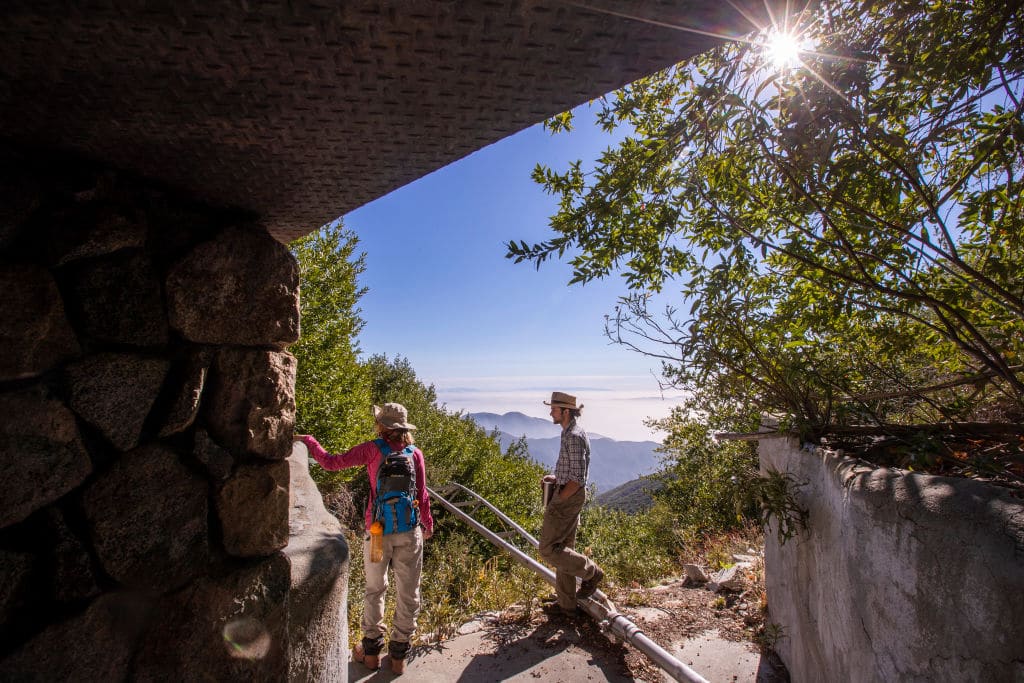 Environmental activists Amanda Frye, left, and Bridger Zadina look over a steel pipe from one of the water collection tunnels in the San Bernardino National Forest on Dec. 4, 2021. Allen J. Schaben / Los Angeles Times
---
1119
My name is Wendsler Nosie Sr. I'm the former chairman of the San Carlos Apache Tribe and a member of Apache-Stronghold.
Five years ago, powerful politicians knelt at the altar of greed and arranged permits for Resolution Copper, a multinational corporation, to drill and extract copper beneath sacred holy lands of the Apache.
For thousands of years, Apaches have come to Oak Flats to pray. Today, we face the possibility that our holy ground will become a giant crater.
We condemn the immoral, racist, and unconstitutional seizure and sale of Oak Flat.
Oak Flat is one of the most holy places in the Apache religious tradition, likened to how Christians and Jews regard Mt. Sinai. Resolution Copper's plan would create a crater below Oak Flat two miles wide and 1,000 feet deep.
The U.S. Forest Servicehas moved forward with an environmental impact statement and has refused to consider the Apaches' religious freedom claim, which would stop this destructive mining project. They have declared war on our religion. And a threat to the practice of any religious tradition in the United States is a threat to U.S. Constitution and the religious liberty of all people of faith.
The forces that seek to exploit Apache holy land for profit are the same forces that pass racist voter suppression laws, militarize our borders, deny health care to millions, poison our water, and pretend to promote a "pro-life" agenda. This is why we call for a moral revolution of values with the Poor People's Campaign: A National Call for Moral Revival.
==
==
bad
Under the guise of “cutting red tape,” the US Forest Service is moving to finalize rules that will cut the public out 9 in 10 timber sales on public land.
The agency says the changes will help it to speed up prescribed burning and thinning, to lower the risks of extreme wildfires on over 50 million acres of federal forests.
“But that’s only part of the picture,” notes KQED. “In 2018, President Donald Trump issued an executive order that encouraged federal agencies to ease environmental review for industrial operations on federal land.”
A 34-year Forest Service veteran sees “smoke and mirrors” in the rule changes”
“Buried deep within 16 pages of legalese are some nasty surprises: a nearly unlimited license to commercially log nearly seven square miles — about 3,000 football fields — or build five miles of logging roads at a time without involving the public or disclosing environmental consequences,” writes Jim Furnish in the Washington Post’s opinion section. “The Forest Service’s road-building system is still flawed, and forest road impacts are long-lasting and often severe. So it’s irresponsible to propose constructing hundreds more miles of national forest roads without public input or environmental review of the potential consequences.”
This kind of development would affect areas that many assume are fully safe from development. “Miles of the Appalachian Trail pass through roadless areas, as does the Pacific Crest Trail and many hiking areas in Utah’s High Uintas Mountains in the Uinta-Wasatch-Cache National Forest,” notes a land conservation expert at the Pew Charitable Trusts. “More than half of the 16.8 million-acre Tongass National Forest in Alaska is protected under the roadless rule.”
If the changes are finalized, “watchdog groups say the policy could mean a tourist returning to a favorite mountain cabin and finding the balcony view sheared of its trees,” reports The Atlanta Journal Constitution. “Or scenery surrounding favorite campsites and hiking trails bulldozed to hang power lines. Or new roads cut through wildlife habitats, so trees as old as the country can be carried off on flatbeds.”
If this issue sounds familiar, it’s because the timber industry and its allies have been bringing this fight in varied guises since 2001, when the Forest Service established its “roadless rule” to protect fully undeveloped swaths of federal forest for old growth wildlife habitat, as well as vehicle-free camping, hiking, hunting, and fishing. “Alaska wants to release 9 million acres in the Southeast Alaska’s Tongass National Forest from the rule, which would be the largest exemption in the country, according to Natalie Dawson, executive director of Audubon Alaska,” reports High Country News, even though “at roughly 17 million acres, the Tongass is the world’s largest remaining coastal temperate rainforest and refuge for some of the world’s oldest trees.”
analysis of bad
The Trump administration’s avid rollback agenda has brought sharp focus to a seldom-examined tension within US environmental policy: The federal agencies tasked with protecting nature are also, often, the same ones tasked with leasing it to resource extraction industries for profit.
The Department of Interior, for instance, contains the National Park Service; the Fish and Wildlife Service (which implements the Endangered Species Act for land-based species); the Bureau of Land Management, which leases mining and drilling on federal lands; and the Office of Surface Mining Reclamation and Enforcement, which both oversees safety and environmental standards at coal mines, and post-mining restoration of the land to something like a natural condition.
The National Oceanic and Atmospheric Administration, which is in charge of saving endangered marine species and their habitats, is part of the Department of Commerce; and the US Forest Service, which manages 154 national forests and 20 national grasslands, is part of the Department of Agriculture.
In the best of times, neither advocates for conservation nor extraction industries get everything they want. Under Obama, oil and gas fracking on public lands expanded, but the boundaries of protected lands and waters did, too. That administration did not deny that with climate change underway, forests and other wilderness are becoming a lot more valuable as sanctuaries for biodiversity, climate-stabilizing carbon sinks, air and water cycling, and sanity-saving open and wild space, than they are as short-term sources of minerals or timber.
From that standpoint, the Trump era defines “the worst of times.” Under this president’s transactional and reality-averse mindset, forests, prairies, grasslands, and wild waters are as valuable as any given day’s prices for oil and gas, fish and logs.
better
The Forest Service has felt enough heat on this rule change to extend the deadline for public reaction and response to August 26. The Federal Register has all the details on how to submit comments.
---
good
Some in Congress are publicly bucking the Trump administration’s conservation rollbacks. Since Reps. Debbie Dingell (D-Michigan 12) and John Fortenberry (R-Nebraska 1) reintroduced the “Recovering America’s Wildlife Act” in mid-July, 98 members of Congress from both sides of the aisle have signed on as co-sponsors.
The bill would “provide $1.4 billion in federal funding to state wildlife agencies and tribal organizations to spend on ‘species of greatest conservation need.’ those are ones endangered or headed that way,” reports Pennsylvania’s TribLive.
great
A sampling of recent conservation news coming out of the states:
- In Virginia, state agencies and The Nature Conservancy have teamed up to protect 22,856 acres of forest just east of the Kentucky border, the “largest open space easement ever recorded in the Commonwealth,” reports WCYB News 5.
- In New England, a team of researchers have busted the “jobs vs environment” argument. Looking at “six states from Connecticut to Maine [that] have protected more than 5 million acres of land, creating a unique natural experiment in conservation,” they found that “saving land can also help local economies. Over those 25 years, land conservation moderately increased local employment numbers and the labor force, without reducing new housing permits.” The Conversation has the story.
- Michigan cherry farmers who have switched from poisoning crop pests to installing nest boxes for kestrals (a bird of prey struggling to survive in recent decades) to have staved off $2.2 million a year in crop losses, reports Environmental Health News. “Unlike balloons or loud noises, kestrels are a genuine threat whose mere presence is enough to scare off pest bird flocks, said cherry grower Jim Nugent, who installed a nest box on his roughly 40-acre Suttons Bay, Michigan, orchard in the mid-90s. It has been occupied almost every year since.”
- In California, a public-private partnership is finalizing plans for a groundbreaking wildlife crossing over US Highway 101. “It will be the first of its kind near a major metropolis and the largest in the world, stretching 200 feet (61 meters) above 10 lanes of busy highway and a feeder road just 35 miles (56 kilometers) northwest of downtown L.A.,” reports AP.
- As I reported for TakePart back in 2015, when this project was first proposed, “the crossing will allow more mountain lions to move safely out of the Santa Monica Mountains National Recreation Area to the much vaster contiguous wildlands to the east in Los Padres National Forest.”
===
bad: forest agency proposes to “streamline” environmental rules
- The U.S. Forest Service (part of the Dept. of Agriculture) has proposed new rules to speed up permits for logging, mining, and road-building projects on public lands.
- Read the proposed changes here, at the USFS website.
- Agriculture Secretary Sonny Perdue said the changes are needed to fast-track “treatment” for millions of acres of federal forest, reports Reuters via U.S. News and World Report.
- “Years of costly analysis and delays are not an acceptable solution,” said Perdue, to lowering the risks of catastrophic wildfires in western forests.
- These risks exist in part because of climate-change-driven rising temperatures, along with many years of drought in western states.
- The other major factor is decades of fire suppression, a scientifically-outmoded practice dating from the early 20th century (to preserve forests for commercial logging), that has left forests loaded with fuel: thick brush, dead trees, downed wood on forest floors.
- Some projects that would be fast-tracked under the reworked rules are unremarkable, like clearing brush from roadsides, or doing prescribed burns to lower forest fuel loads.
- But the revised rules would also fast-track some mining and commercial logging projects, by exempting them from the comprehensive environmental reviews required by a keystone environmental law, the National Environmental Policy Act.
- Going around NEPA would also give the public less chance to weigh in, pro or con, on these projects, because some public comment periods are timed to the release of those environmental reviews.
- This move “comes after other efforts to loosen forest management regulations fell flat in Congress last year,” notes the Sacramento Bee.
- Federal agencies and some industries complain about “analysis paralysis” when it comes to environmental studies, but as NPR reports, “a bigger holdup is budget cuts, particularly in the Forest Service, where money has been diverted away from wildlife, habitat and forestry programs to pay for the skyrocketing costs of wildfire suppression.”
---
==