Vaden Stephen E S Q
3 26 comes up in many srch TB bernhardt
see brOoke r
see move HQ agy // sched F, ~ experts DROUGHT
see DOGE mazarra paxton
JONES DAY
MAZZARA CLERKED
VADEN YALE LAW GRAD 2009; THIEL 2011; TAUGHT VANDY
---
attach? Office of Technology Transfer : USDA ARS
---
acid wash?!

---
off bs
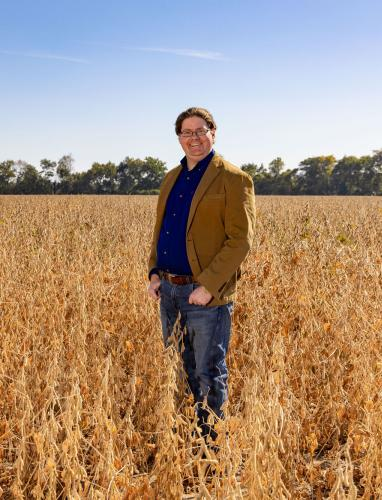
Judge Stephen Alexander Vaden was appointed as the Deputy Secretary of the U.S. Department of Agriculture on July 7, 2025.
Alongside Secretary Brooke L. Rollins, Deputy Secretary Vaden leads the Department’s operations and implements policies that support America’s food and farm systems. A native of Union City, Tennessee, Deputy Secretary Vaden brings expertise in agricultural policy, law, and rural development. Previously, he served as a judge on the U.S. Court of International Trade and as General Counsel of USDA. Throughout Deputy Secretary Vaden’s time as General Counsel, he led successful Supreme Court litigation, advanced regulatory reform, and supported the implementation of the 2018 Farm Bill. He is a graduate of Yale Law School and Vanderbilt University. A public servant with strong agricultural roots, Deputy Secretary Vaden is committed to revitalizing rural America and ensuring an abundant, affordable, and safe U.S. food supply.
---
ggl 6 26
AI Overview


+9
Stephen Vaden is the Deputy Secretary of the U.S. Department of Agriculture (USDA), having previously served as USDA General Counsel and a judge on the U.S. Court of International Trade. His background connects to conservative and libertarian organizations and educational institutions. [1, 2, 3, 4, 5]
His background and connections correspond to the entities mentioned:
- USDA Fellowship: While the USDA offers various internships and fellowships, Vaden does not serve as a "USDA Fellow." Instead, he previously served as USDA General Counsel and was confirmed by the U.S. Senate as Deputy Secretary of Agriculture. [1, 2, 3,
 , 5]
- Koch & IHS: Vaden's ideological and professional background aligns with limited-government and free-market philosophy. He has been closely affiliated with
 The Federalist Society, an organization that frequently receives support from entities associated with the Koch network. Furthermore, his early-career involvement in conservative policy may have intersected with fellowship or internship programs like the
 Stand Together Fellowships (formerly the Institute for Humane Studies or Koch programs). [1, 2]
---
---
OOPS?
AI Overview
The "2018 Farm Bill loophole" is a regulatory oversight in the Agriculture Improvement Act of 2018 that legalized hemp but inadvertently spawned a multi-billion dollar, nationwide market for intoxicating, hemp-derived cannabinoids like Delta-8 THC and THCA. [1]
How the Loophole Worked
- The THC Distinction: The 2018 bill removed hemp (defined as cannabis with less than 0.3% Delta-9 THC by dry weight) from the Controlled Substances Act. [1]
- Focus on Delta-9: Because the legislation specifically only named Delta-9 THC, manufacturers realized they could chemically synthesize other psychoactive isomers (e.g., Delta-8) or sell raw THCA flower, which only converts to intoxicating Delta-9 when heated. [1]
- Gray Market Boom: This allowed for the legal sale of high-potency edibles, beverages, and smokable products outside of state-regulated, taxed marijuana dispensaries. [1, 2]
Closure of the Loophole
Due to safety concerns and lobbying efforts, the federal government officially acted to close the loophole. As part of a government funding package signed into law by President Trump, Congress redefined hemp to close these avenues. The updated federal framework: [1, 2]
- Shifts to a "Total THC" Standard: Legal hemp must contain less than 0.3% Total THC (which includes THCA, Delta-8, and all other psychoactive variants), not just Delta-9.
- Restricts Milligrams: Finished consumable hemp products are capped at 0.4 milligrams of total THC per container.
- Bans Synthetics: It explicitly prohibits cannabinoids manufactured or synthesized outside the plant. [1]
Enforcement Timeline and Current Status
Federal enforcement of this new, restrictive definition of hemp takes effect on November 12, 2026. While the federal ban was signed into law, the industry has a transition period to sell off existing inventory, which has prompted many state governments to also pass emergency legislation restricting or outright banning these products. [1, , 3, 4]
---
GGL 6 26
AI Overview
The original 2018 Farm Bill ( Descriptive Anchor Text Congress.gov) established agricultural policy for years but did not create broad liability shields for pesticide manufacturers. However, during the prolonged Farm Bill renewal process, lawmakers debated highly controversial language designed to immunize manufacturers of chemicals like glyphosate from lawsuits and to preempt local pesticide regulations (
 Descriptive Anchor Text Earth Island Institute). [1, 2, 3,
 ,
 ]
Here are the details of how the pesticide and herbicide provisions shaped the recent debate
The Battle Over Chemical Pesticides and Herbicides in the Farm Bill
During the legislative markup and floor votes in the House, contentious sections were introduced that deeply impacted the agrochemical debate:
- Pesticide Liability Shield: Draft provisions sought to prohibit lawsuits against chemical manufacturers if they failed to provide complete safety warnings (e.g., failure-to-warn claims regarding health conditions like cancer or Parkinson's disease). [1, 2, 3]
- Preemption of State/Local Bans: Proposed text aimed to strip local and state governments of their authority to impose stricter restrictions on pesticide use or labels than what the federal government dictates. [1, 2]
- Environmental Exemptions: Language was proposed to exempt certain EPA-registered pesticides from reviews otherwise required by the Endangered Species Act and the Clean Water Act. [1, 2]
Recent Legislative Action
These provisions faced massive pushback from public health advocates and bipartisan lawmakers. In a major floor vote, the House of Representatives successfully passed an amendment to strip these controversial liability protections and preemption measures from the Farm Bill. [1, 2]
Following the removal of this language, the broader Farm Bill advanced through the House, but continues to face a complex path as it moves to the Senate.
---
Pro-Pesticide Measure Cut from Farm Bill Following Public Outcry
EIJ APR 2026
Besieged by legal troubles, the pesticide industry had been working vigorously behind the scenes to pass a version of the 2026 Farm Bill that would have given the US Environmental Protection Agency (EPA) sole regulatory oversight over pesticide labeling. But faced with mounting opposition, especially from members of the Trump-leaning Make America Healthy Again (MAHA) movement, the Republican-controlled House today voted to strip the pro-pesticide policies from the Farm Bill, which sets the nation’s agriculture policy for five years.
The industry-backed text would have preempted state and local governments from setting their own, potentially more restrictive, labeling guidelines. Environmentalists, farmworker groups, and public health watchdog groups opposing the measure say the now-defeated provision was part of a concerted effort by pesticide manufacturers to shield themselves from legal liability.
“There’s a coordinated three-pronged strategy underway to shield chemical companies from accountability after dangerous pesticides have contaminated the environment and caused cancer, Parkinson’s, and birth defects,” says JW Glass, EPA policy specialist at the Center for Biological Diversity. The plan, he says, involves pushing for federal legislation that would concentrate all regulatory power over pesticide labeling in the hands of the EPA. It also lobbied the EPA to simultaneously reverse or loosen its pesticide-labeling regulations and pass state-level “failure-to-warn” legislation that would offer the industry legal immunity as long as their products comply with the EPA’s labeling requirements. Language in these bills also prohibits the EPA from approving a pesticide product label or taking action that is not in alignment with existing human health assessments or carcinogenic classification for the product.
The pesticide industry’s aggressive efforts to restrict labeling requirements appear to be prompted by several significant wins for consumer lawsuits against pesticide manufacturers in recent years. Court rulings on such suits in three states have required Bayer to pay more than $500 million in damages for failing to warn the public about the health risks of its Roundup herbicides. The Germany-based company, which inherited an avalanche of Roundup-related legal claims when it bought Monsanto in 2018, has already settled around 100,000 lawsuits and paid out over $11 billion in damages. But, according to the Lawsuit Information Center, as of April 27, another 61,000 cases against it are still pending in state and federal courts.
Similarly, ChemChina-Syngenta is facing more than 8,000 lawsuits in the United States over the links between its paraquat weed killer and increased rates of Parkinson’s disease. (Paraquat is banned in China and 70 other countries, but not in the US.) The company has begun to settle some of the lawsuits, but thousands more remain. In early March, Syngenta announced it would stop paraquat production by the end of June, but other manufacturers of the chemical will continue supplying it.
Naturally, this multi-billion-dollar industry is not going to sit still while the lawsuits and setbacks mount. Bayer has already publicly declared that it is “pursuing several measures to manage and mitigate the risks of Roundup litigation in the US.” The company is spearheading an alliance of some 110 agricultural organizations across the US, named Modern Ag Alliance, that is advocating for “farmers’ access to the crop protection tools” such as chemical pesticides and fertilizers, including Roundup and several others, that are known to be toxic to humans and the environment.
It is the Bayer-led Modern Ag Alliance that pushed for the Farm Bill measure. Its effort on that front traces to June 2023, when the alliance and other industry groups backed the so-called Agricultural Labeling Uniformity Act, which provides sweeping protections for pesticide companies. Proposed by Republican Representative Dusty Johnson from South Dakota, the measure ostensibly seeks to address the fragmented regulatory landscape for pesticide use in the country by reaffirming that under the Federal Insecticide, Fungicide, and Rodenticide Act (FIFRA), only the EPA can decide how pesticides should be labeled. It prohibits states and courts from requiring manufacturers to include health warnings not recognized by the EPA.
The bill made it only as far as the Congressional Subcommittee on Conservation, Research, and Biotechnology, but it resurfaced in 2025 as a rider to a Department of Interior appropriations bill. In January this year, following sustained resistance from food and farming watchdog groups, the rider was stripped from the bill.
But it returned again as part of the new Farm Bill introduced in February by House Agriculture Committee Chairman Glenn Thompson. The Republican representative from Pennsylvania’s 15th district received his biggest campaign contributions, incidentally, from the “Crop Production & Basic Processing” and “Agricultural Services/Products” industries. According to OpenSecrets.org, in 2023 to 2024, these contributions amounted to $367,990 and $270,180, respectively. According to a report by news site U.S. Right to Know and data from OpenSecrets.org, Bayer also spent $9.2 million in 2025 to hire lobbyists to push its agenda in Congress and other federal departments.
Though the provision has been stripped from the Farm Bill, the pesticide industry has other cards in play. Key among those is an effort to have the US Supreme Court overturn the 2023 ruling in the Monsanto v. Durnell case, wherein a Missouri court found that Monsanto (now Bayer Crop Science) had failed to warn the plaintiff, John Durnell, that glyphosate could cause cancer. Durnell, a gardener, had sued the company saying he developed non-Hodgkin’s lymphoma after more than 20 years using Roundup — the company’s popular weed killer whose active ingredient, glyphosate, has been linked to cancer by various studies. The EPA, however, says that the pesticide poses no risks to human health when used according to label instructions and doesn’t require a cancer warning (say, the way cigarettes do) on the product label.
The case, which the Supreme Court heard earlier this week, hinges on whether the EPA indeed is the sole authority with the power to implement pesticide label warnings. If the Supreme Court rules that it is, as Bayer contends, then pesticide manufacturers will get the immunity that they want — it will be harder for consumers to file similar lawsuits against not only Bayer, but other pesticide manufacturers, too.
The Trump administration has backed Bayer on this issue, and in February Trump issued an executive order to bump up glyphosate production, calling it necessary for “national security.” But this has put the administration at odds with its MAHA supporters, who staged a People vs. Poison rally along with other environmental groups outside the Supreme Court as it heard the case on Monday.
The court is expected to issue a ruling by late June or early July. Irrespective of how that ruling goes, the industry is pursuing yet another tactic — supporting a slew of state-level “pesticide immunity bills” that are largely similar to the federal Agricultural Labeling Uniformity Act in that they are aimed at limiting the industry’s liability in injury and product liability lawsuits by establishing the EPA as the sole labeling regulator. (According to a report in The American Prospect, the Modern Ag Alliance has been pushing state legislators to introduce these bills since 2024.)
So far, in 2026, at least 10 states have introduced such bills, and they already passed in North Dakota and Georgia last year. Here, for example, is language in Georgia’s Senate Bill 144, which Governor Kemp signed into law: “A manufacturer cannot be held liable for failing to warn consumers of health risks above those required by the United States Environmental Protection Agency with respect to pesticides.”
However, resistance to the industry’s efforts is mounting on both sides of the political aisle.
On April 22, representatives Chellie Pingree (D-Maine) and Thomas Massie (R-Kentucky) introduced an amendment to strip the immunity provision from the Farm Bill. “Big Chemical has spent years trying to buy exactly this kind of protection from Congress: immunity from lawsuits, weaker safeguards, and a federal override of state and local pesticide protections. This Farm Bill would hand it to them on a silver platter,” Pingree said in a press statement. “If a company’s product makes people sick, that company should be held accountable. If states and local communities want to put stronger protections in place, they should have every right to do so,” the statement said, while pointing out that just one state, Maine, has more than 30 state and local regulations related to pesticide use and warning requirements that would have been undermined or preempted under the pesticide provision in the Farm Bill.
Separately, last July, New Jersey Democratic Senator Cory Booker introduced legislation that would allow private citizens to sue pesticide manufacturers in federal court for harm caused by their products. The Pesticide Injury Accountability Act would amend the FIFRA to allow for “private right of action” for injuries caused by pesticides.
Booker has introduced much more extensive FIFRA amendments in past years that didn’t pass, and according to legal experts, there is little chance that this bill, which is currently sitting with the Senate Committee on Agriculture, Nutrition, and Forestry, will become law.
*Note: The Farm Bill is problematic on many other fronts. Learn more about those issues here.
---
6 26 no talk
Stephen Alexander Vaden (born May 15, 1982) is an American lawyer who has served as the United States deputy secretary of agriculture since July 2025. He served as a United States judge of the United States Court of International Trade from December 2020 until taking office as deputy secretary in July 2025.
Early life and education
Vaden was born on May 15, 1982[1] in Memphis, Tennessee.
He graduated from Union City High School as the valedictorian of the class of 2000.[2] He earned a Bachelor of Arts from Vanderbilt University and a Juris Doctor from Yale Law School.[3]
Career
:{After graduating from law school, Vaden served as a law clerk to Judge Julia Smith Gibbons of the United States Court of Appeals for the Sixth Circuit RR DUBYA
husb gop cand governor
Gibbons wrote a concurring opinion in a 2–1 decision upholding Biden administration COVID-19 vaccine mandate for federal employees and contractors. In her concurrence, Gibbons highlighted the limited role of the federal judiciary in COVID policy.[9][10]
:{ and to Judge Samuel H. Mays Jr. DUBYA
of the United States District Court for the Western District of Tennessee. Vaden has practiced law at Patton Boggs and Jones Day, specializing in appellate litigation, election law, and administrative law.[3][4]}:}:
General Counsel of the Department of Agriculture
Vaden served on the first Trump administration's United States Department of Agriculture landing team.[5] He was appointed Principal Deputy General Counsel of the department on March 17, 2017, succeeding Lee Fink.
On September 2, 2017, Vaden was nominated to be the general counsel for the United States Department of Agriculture.[3] He was confirmed by the United States Senate on November 27, 2018 by a 53–46 vote, and was sworn in on December 14, 2018.[6] He left the Department after being commissioned as a Judge of the Court of International Trade.
Trade Court service
On October 2, 2019, President Trump announced his intent to nominate Vaden to the United States Court of International Trade.[7] On October 17, 2019, his nomination was sent to the Senate. President Trump nominated Vaden to the seat vacated by Judge Delissa A. Ridgway, who assumed senior status on January 31, 2019.[8]
A hearing on his nomination before the Senate Judiciary Committee was held on November 13, 2019.[9] On January 3, 2020, his nomination was returned to the President under Rule XXXI, Paragraph 6 of the United States Senate.[10] Later that day, he was re-nominated to the same seat.[11] On January 16, 2020, his nomination was reported out of committee by a 12–10 vote.[12] On November 18, 2020, the Senate invoked cloture on his nomination by a 49–44 vote.[13] His nomination was confirmed later that day by a 49–43 vote.[14] He received his judicial commission on December 21, 2020.[15]
U.S. deputy secretary of agriculture
On December 22, 2024, President-elect Donald Trump announced that he would nominate Vaden to be deputy secretary at the United States Department of Agriculture.[16] On January 20, 2025, his nomination was submitted to the U.S. Senate.[17] On April 8, a hearing on his nomination was held before the Senate Agriculture, Nutrition and Forestry Committee.[18] On May 5, his nomination was favorably reported out of committee by a 12–11 party-line vote.[19] On June 10, the Senate invoked cloture on his nomination by a 48–45 vote.[20] Later that day, his nomination was confirmed by a 48–45 vote.[21] He was sworn in on July 7, 2025.[22]
References
- "House Resolution 19" (PDF). Tennessee House of Representatives.
- Senate Joint Resolution 900 to recognize Stephen Alexander Vaden, 2000 Valedictorian of Union City High School., Tennessee Senate, filed June 7, 2000. Accessed December 20, 2022. "Whereas, Stephen Alexander Vaden is one such exceptional student who was recently named valedictorian of the 2000 graduating class at Union City High School"
- "President Donald J. Trump Announces Intent to Nominate Personnel to Key Administration Posts". whitehouse.gov. September 2, 2017. Retrieved September 14, 2017 – via National Archives.
 This article incorporates text from this source, which is in the public domain.
- Polantz, Katelyn (September 8, 2017). "DC Judge's Best Trial Tips, Government Lawyers Flock to Firms, Mueller's Hotline". The National Law Journal. Retrieved September 14, 2017.
- Scarcella, Mike (September 13, 2017). "Ex-Jones Day Associate Is Trump's Pick for USDA General Counsel". The National Law Journal. Retrieved September 14, 2017.
- "On the Nomination (Confirmation Stephen Alexander Vaden, of Tennessee, to be General Counsel of the Department of Agriculture)". US Senate. United States Senate. Retrieved November 27, 2018.
- "President Donald J. Trump Announces Judicial Nominees – The White House". trumpwhitehouse.archives.gov.
- "Eighteen Nominations Sent to the Senate – The White House". trumpwhitehouse.archives.gov.
- "Nominations | United States Senate Committee on the Judiciary". www.judiciary.senate.gov.
- "PN1244 - Nomination of Stephen A. Vaden for The Judiciary, 116th Congress (2019-2020)". www.congress.gov. January 3, 2020. Retrieved January 4, 2020.
- "Four Nominations Sent to the Senate – The White House". trumpwhitehouse.archives.gov.
- "Results of Executive Business Meeting – January 16, 2020" (PDF). Senate Judiciary Committee.
- "On the Cloture Motion (Motion to Invoke Cloture: Stephen A. Vaden, of Tennessee, to be a Judge of the United States Court of International Trade)". United States Senate. November 18, 2020.
- "On the Nomination (Confirmation: Stephen A. Vaden, of Tennessee, to be a Judge of the United States Court of International Trade)". United States Senate. November 18, 2020.
- Stephen Vaden at the Biographical Directory of Federal Judges, a publication of the Federal Judicial Center.
- "POLITICO Pro: Trump selects Stephen Vaden for USDA deputy secretary". subscriber.politicopro.com. Retrieved March 27, 2025.
- "President Trump Announces Sub-Cabinet APPOINTMENTS" (Press release). The White House. January 20, 2025. Retrieved June 10, 2025.
- "Nomination Hearing". Senate Agriculture, Nutrition and Forestry Committee. April 8, 2025. Retrieved June 10, 2025.
- "Business Meeting" (PDF). Senate Agriculture, Nutrition and Forestry Committee. May 5, 2025. Retrieved June 10, 2025.
- "On the Cloture Motion (Motion to Invoke Cloture: Stephen Vaden to be Deputy Secretary of Agriculture)". U.S. Senate. June 10, 2025. Retrieved June 10, 2025.
- "On the Nomination (Confirmation: Stephen Vaden to be Deputy Secretary of Agriculture)". U.S. Senate. June 10, 2025. Retrieved June 10, 2025.
- "Judge Vaden Sworn in as Deputy Secretary at the U.S. Department of Agriculture". www.usda.gov. Washington, D.C.: United States Department of Agriculture. July 7, 2025. Retrieved July 7, 2025.
External links
- Stephen Vaden at the Biographical Directory of Federal Judges, a publication of the Federal Judicial Center.
- S. Hrg. 115-602 - NOMINATION HEARING: GLEN SMITH, TO BE A MEMBER OF THE FARM CREDIT ADMINISTRATION BOARD, FARM CREDIT UNION, AND STEPHEN ALEXANDER VADEN, TO BE GENERAL COUNSEL OF THE DEPARTMENT OF AGRICULTURE
 This article incorporates text from this source, which is in the public domain.
---
clerk kochademia
Before joining the Office of the Attorney General in September 2022, Mazzara gained legal experience clerking for several judges, including the Honorable Edith H. Jones, Brantley Starr, and Stephen A. Vaden. His background also includes serving as in-house counsel for President Trump's national re-election campaign in 2020. Mazzara is an alumnus of George Mason University's Antonin Scalia Law School, and he has also served as a member of the United States Marine Corps.
2020 cbd?
...
Critically, on October 30th, 2017, a physical meeting occurred at the Eisenhower Executive Office Building, that is described in the subject line of Secretary Bernhardt’s calendar as: “NEC PCC: ESA Section 7 (Read Ahead Attached).” Invited to this meeting by Mr. Bernhardt were the following political appointees: Ray Starling from the Executive Office of the President,Michael Catanzaro from the Executive Office of the President, Jordan Bonfitto from the Executive Office of the President, John Moran from the Executive Office of the President, Francis Brooke from the Executive Office of the Vice President, Mary Neumayr from the Council on Environmental Quality, Alexander Domesle from the Council on Environmental Quality, Christopher Prandoni from the Council on Environmental Quality,Nancy Beck from the Environmental Protection Agency, Erik Baptist from the Environmental Protection Agency, Stephen Vaden from the U.S. Department of Agriculture, Rebeckah Adcock from the U.S. Department of Agriculture, Todd Willensfrom the Department of Interior, James Uthmeier from the Department of Commerce, and finally Michael Dourson from the Environmental Protection Agency. What occurred during this meeting was unknown until recently, when a partially-redacted email sent by Michael Dourson to Secretary Bernhardt was released to the Center for Biological
USDA officials’ ties to Bayer
The U.S. Department of Agriculture oversees farm policy, crop systems, and biotechnology approvals, shaping the subsidies, research, and planting decisions that drive demand for Bayer’s seeds and chemicals. The agency has long faced criticism over its servility to the chemical industry, and the Trump administration is no exception. Current USDA officials with ties to Bayer and its chemical industry allies include:
- Stephen Vaden, deputy secretary of agriculture, is a former associate at Jones Day(2014–2017), a firm that represented Bayer on its acquisition of Monsanto, and Squire Patton Boggs (2011-2014), which represented Bayer and Monsanto in cases involving glyphosate and PCBs.
---
OFF BS FEDSOC
Judge Stephen Alexander Vaden was appointed as the Deputy Secretary of the U.S. Department of Agriculture on July 7, 2025. Alongside Secretary Brooke L. Rollins, Deputy Secretary Vaden leads the Department’s operations and implements policies that support America’s food and farm systems. A native of Union City, Tennessee, Deputy Secretary Vaden brings expertise in agricultural policy, law, and rural development. Previously, he served as a judge on the U.S. Court of International Trade and as General Counsel of USDA. Throughout Deputy Secretary Vaden’s time as General Counsel, he led successful Supreme Court litigation, advanced regulatory reform, and supported the implementation of the 2018 Farm Bill.
He is a graduate of Yale Law School and Vanderbilt University. A public servant with strong agricultural roots, Deputy Secretary Vaden is committed to revitalizing rural America and ensuring an abundant, affordable, and safe U.S. food supply.
---
---
USDA Staffing Crisis: Research Agencies Face Steep Losses as Reorganization Advances - National Sustainable Agriculture Coalition
USDA Staffing Crisis: Research Agencies Face Steep Losses as Reorganization Advances
September 17, 2025
On July 24, 2025, Secretary Rollins released a memo (SM-1078-015) describing the planned reorganization of the U.S. Department of Agriculture (USDA) staff, drafted without any consultation with farmers or other stakeholders. USDA has already lost more than 20,000 staffsince January 2025 and if the reorganization moves forward as planned, it will result in the likely loss of thousands more staff. This is the second post in a series discussing the loss of USDA staff since January 2025 and the expected impacts of the proposed USDA reorganization across issue areas. This post examines staffing losses and planned cuts across the research agencies at USDA and their devastating impacts on agricultural research and innovation. Our previous post describes the staffing losses across the USDA and states.
USDA’s research agencies – the National Agricultural Statistical Service (NASS), Economic Research Service (ERS), Agricultural Research Service (ARS), and National Institute of Food and Agriculture (NIFA) – have been hit particularly hard by recent staff losses and have significant cuts planned in the reorganization. These research staff and sites provide the human capital and infrastructure for agricultural research as well as data collection and analysis for commodities and rural communities. Unfortunately, recent history has shown that staff losses in these agencies leads directly to reduced productivity and support for stakeholders. In this post, we examine the toll of staffing declines and proposed cutbacks in USDA research agencies, and what they mean for the future of agricultural knowledge and innovation.
After widespread concerns about the proposed reorganization, USDA opened an adhoc public comment opportunity. The National Sustainable Agriculture Coalition (NSAC) encourages organizations and individuals to submit their comments, questions, and concerns regarding the reorganization to USDA at reorganization@usda.gov by September 30, 2025. NSAC remains concerned about the lack of transparency involved in this comment period, given that the opportunity for public comment has not been formally provided through the Federal Register, as is standard practice for proposals of this scope.
Research Staff Have Been Gutted
The four major research agencies of USDA have already lost approximately 23% of their staff since January 2025. 1,600 employees left the research agencies through DOGE’s Deferred Resignation Program (DRP). DRP offered federal employees fully paid administrative leave through September 2025 if employees voluntarily resigned their positions. 351 research agency staff accepted the DRP in the first round beginning in January 2025 and an additional 1,249 research staff accepted the second round of DRP in April 2025.
Figure 1: Research Staff Losses
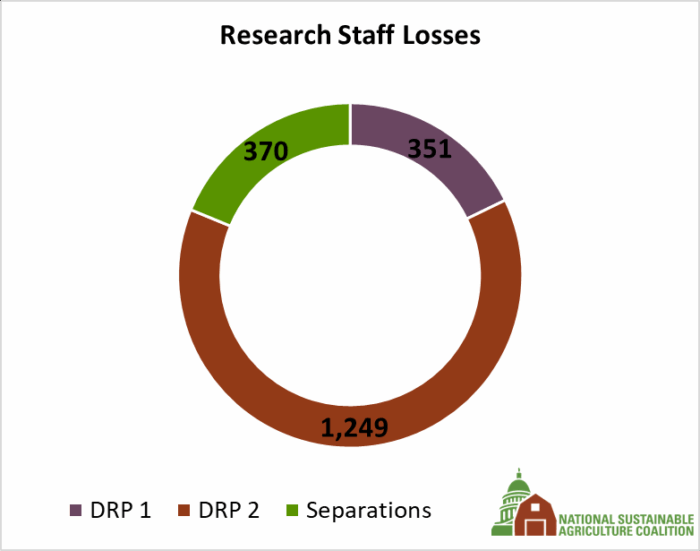
According to the Office of Personnel Management (OPM), approximately 370 additional staff separated from the research agencies between January and March 2025. Separations include staff who retired (voluntary, early, or for disability), quit, had their contracts expired or terminated, were fired, transferred to a different agency, or otherwise separated from employment.
Table 1: Research Staff Losses by Agency
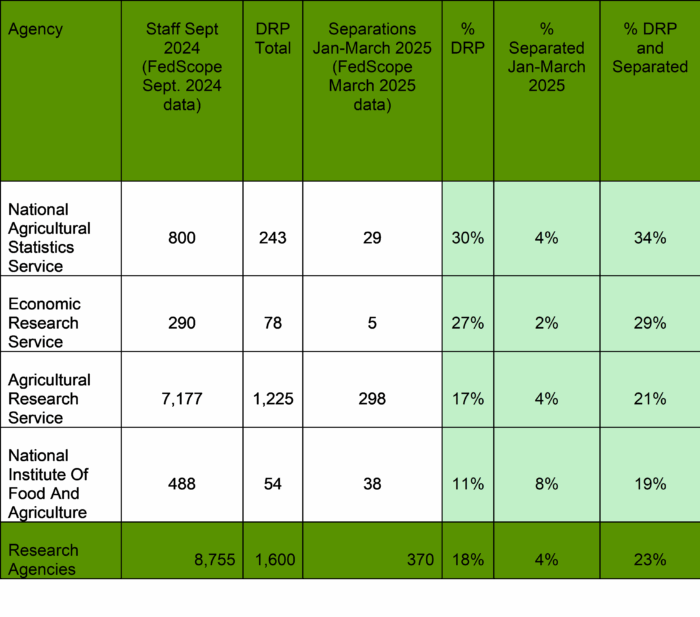
NASS, the internal statistical branch of the USDA, has lost the highest percentage of staff since January 2025 among research agencies, losing approximately 30% of their staff to DRP and 4% additional staff who separated from the agency. NASS collects hundreds of surveys on agriculture and food and prepares a wide range of reports on virtually every component of American agriculture. They administer the Census of Agriculture every five years, the only dataset that provides information on every American county and farm over time. They also collect and analyze data on every commodity and market in American agriculture. NASS provides essential unbiased data on US agriculture that undergirds farmers’ decisions and the decisions of policymakers.
ARS, the internal in-house scientific research agency of the USDA, has lost the largest number of employees since January 2025 among research agencies. ARS lost 1,225 employees to DRP and an additional 298 staff who separated from the agency between January and March 2025. ARS’s mission is to “deliver scientific solutions to national and global agricultural challenges” and they employ a wide range of scientists and staff at a network of research sites throughout the country, often in partnership with universities and private sector companies. The loss of ARS staff undermines the ability of the agency to fulfill its mission and provide the research needed by American farmers and ranchers. ARS researchers, in particular, are highly specialized scientists with skills that are very difficult to replace.
The loss of ARS scientists means that several research projects vital to the resilience of American agriculture have already stopped. In an interview with Wyoming Public Radio, two former ARS researchers talked about the losses caused by the loss of staff such as themselves. According to one scientist: “I worked directly with a lot of farmers, visiting farms, going to meetings of farmers, and making sure that they had the most up-to-date research to inform their management decisions. Also listening to what challenges they were facing, and making sure that those challenges were being reflected in the research that the Agricultural Research Service was doing [and] bringing those concerns back to the researchers.” The scientist further shared: “All my projects revolved around helping smaller farmers deal with the **:{impacts of drought in this region and all of those projects have been cancelled.”}:
The nearly 2,000 employees lost from USDA research agencies directly hinder the ability of the department to fulfill its mission to “advance scientific knowledge related to agriculture.” These staffing losses and administrative setbacks have already led to significant disruptions including delaying or deferring several NIFA research programs for fiscal year 2025. The Foundational and Applied Science Program, for example, was delayed so significantly that the fiscal year 2025 program was skipped altogether and the request for applications is now for fiscal year 2026.
The Reorganization Will Further Degrade Research Agencies
USDA research agencies are already experiencing significant losses in their ability to serve stakeholders and the planned reorganization will cause further damage.
ARS is hit particularly hard by the planned reorganization. The reorganization includes a plan to close the Beltsville Agricultural Research Center (BARC), located in Beltsville, Maryland. BARC has operated since 1910. Comprising approximately 6,000 acres of agricultural research fields and facilities, BARC is the largest ARS research facility and hosts research on food animal production, animal health, entomology, food safety, water management, soil quality, air quality, rangeland systems, sustainable agriculture, plant genetics, plant diseases, crop protection, crop production and virtually every aspect of agricultural production systems.
BARC has produced impactful research for over a century, benefiting American farmers and agriculture. For example, BARC researchers developed and licensed a patented antibody designed for wide-spectrum identification of potyviruses, a major group of plant viruses with high economic impact. These anti-viral technologies are now widely developed and sold by Agdia to detect and prevent potyviruses in a variety of crops such as beans, potatoes, and industrial hemp and prevent billions in lost productivity every year.
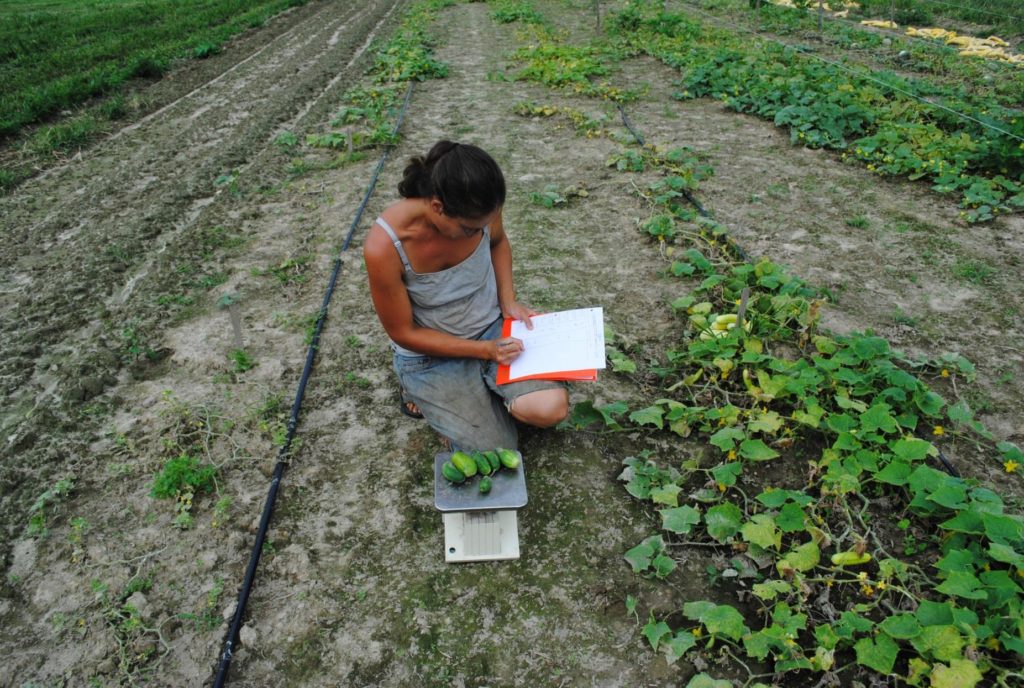
Photo by Kaitlan Balsam on Unsplash
Closing and relocating the Beltsville facility will be extremely difficult and costly and will cause unavoidable damage to research productivity. Long-term field studies are particularly important to agricultural research to understand the long-term functioning of agricultural systems such as soil health and pest burden. The long-term field research at Beltsville cannot simply be relocated, and losing these field sites means losing irreplaceable scientific knowledge. Relocating facilities such as the Electron and Confocal Microscopy Unit (ECMU) would be extremely difficult and expensive, if possible at all. While the USDA reorganization plans to close and relocate BARC over several years to minimize research disruptions, experts are highly doubtful that the closure would be able to do so or would generate any cost savings.
Despite claiming to want to move the Department closer to farmers, the reorganization also calls for the closure of ARS Area Offices. ARS is currently divided into five geographic areas: Northeast, Southeast, Midwest, Plains, and Pacific West. Each area has an Area Office that oversees the facilities and staff in that region, ensuring that the research addresses regionally significant topics and problems. Closing Area Offices would undermine the ability to prioritize regional issues and weaken connections to farmers and stakeholders in the region. It would also mean administrative processes such as hiring and facilities management would be funneled through a single national office, creating delays and inefficiencies and would undermine the important regional partnerships and networks with collaborators such as land-grant universities. Closing ARS Area Offices will not “streamline” services, it will weaken local accountability and slow down work.
Likewise, the reorganization calls for the closure of NASS regional field offices to be replaced with offices in five new USDA hubs. NASS has twelve regional field offices in the country, each responsible for the statistical work in that region. These field offices oversee the data collection and management in the states of their region and provide the data and statistics for those states. The field offices are essential to maintaining stakeholder relationships and making sure that farmers and ranchers in every state and region are adequately represented in national statistics. Consolidating NASS offices to the newly proposed hubs in Raleigh, North Carolina; Kansas City, Missouri; Indianapolis, Indiana; Fort Collins, Colorado; and Salt Lake City, Utah would leave large swaths of the country unrepresented. Farmers and ranchers in the Northeast and West Coast, in particular, would have inadequate representation to ensure they are adequately included in agricultural statistics.
NASS regional offices are essential to improving farmers’ trust of the agency and to boosting survey response rates from farmers. Ensuring every farmer is counted in national statistics is essential and regional offices are vital to that effort.
The Deterioration Continues: Staff Losses at ERS and NIFA Since 2019 Relocations
Despite significant public outcry, ERS and NIFA were relocated to Kansas City, Missouri in 2019 during the previous Trump Administration. ERS provides research on economics and agriculture, producing research on future commodity price projections, farm income, and essentially all aspects of American agriculture and rural communities. The economic reports and research generated by ERS are used by farmers, policymakers, and other stakeholders as they make major decisions for the agricultural economy such as changes to commodity programs or loans. NIFA oversees the department’s competitive grant programs, investing in research, education, and extension programs for American agriculture. NIFA funds universities and other partners to advance agricultural science, innovation, and education nationwide.
This relocation of ERS and NIFA led to hard-learned lessons concerning how destructive relocations can be. According to the Government Accountability Office (GAO), these staff losses reduced the number of reports and articles generated by ERS staff in half and led to the loss or delay of several vital industry reports. The loss of these publications and reports meant that farmers and other stakeholders had to make risky decisions with less information. Within NIFA, the relocation led to delays and suspensions of several grant programs and payments. For example, land grant universities across the country struggled as NIFA’s Capacity Grants that support basic research facilities were delayed by more than a fiscal quarter, undermining the research and services of those universities. When NIFA grants are delayed or suspended, vital research is threatened and American farmers and the agricultural sector suffer.
It has taken years for ERS and NIFA to rebuild their capacity following the relocation and attempt to replace the lost institutional knowledge needed to serve American agriculture and stakeholders. But both agencies are again being decimated by staff losses. ERS has lost 27% of their staff to DRP and an additional 2% to other separations. NIFA has also experienced widespread staffing losses since January 2025. NIFA lost 11% of their staff to DRP and an additional 8% to other separations. These staffing losses have already led to delayed and deferred grant programs and will, we can infer based on recent history, lead to further losses in research productivity and delays that undermine American agriculture.
USDA’s Research, Education, and Economics mission area that houses ARS, ERS, NASS, and NIFA is tasked with providing reliable scientific research, data, and analysis for America’s farmers, ranchers, rural communities, and stakeholders. The staff in these agencies are highly skilled and specialized workers who are dedicated to public service. Each of the four agencies have already lost overwhelming numbers of staff and the planned USDA reorganization will further compromise their ability to fulfill their missions.
Filed Under: Carousel, Research, Education & Extension, Staffing
---
---
E AND E GRNWIRE
NO LNX IN ORIG?
USDA defends secretive rollout of reorganization plan
:{By Marc Heller | 07/31/2025
The surprise reorg announcement last week was a flash point at a hearing Thursday, where senators expressed displeasure about being left in the dark.
Stephen Vaden testifying.
Deputy Agriculture Secretary Stephen Vaden on Wednesday. Senate Agriculture Committee
The Department of Agriculture deliberately kept lawmakers in the dark about its plan to reorganize the agency for fear the information would leak out if shared with their offices, Deputy Agriculture Secretary Stephen Vaden told a Senate committee Wednesday.
Vaden, the USDA’s No. 2 official behind Agriculture Secretary Brooke Rollins, said at a Senate Agriculture, Nutrition and Forestry Committee hearing that officials took the secretive approach out of “common courtesy and respect” to the department’s nearly 100,000 employees whom officials wanted to inform first about the sweeping plan.
“There was a thought to that,” Vaden said, responding to complaints from Democrats and Republicans alike about the lack of prior consultation with Congress.
“The employees are the ones who are most directly affected by the secretary’s decision,” Vaden said. “They should hear that decision from the secretary first, and not from a leak that originated from somewhere else.”
The surprise nature of the reorganization announced last Thursday was a flash point at the hearing, where a few Republicans joined Democrats in expressing displeasure that the Trump administration didn’t involve them in the decision.
Agriculture, Nutrition and Forestry ranking member Amy Klobuchar (D-Minn.) said the committee learned of the plan just minutes before it was announced.
Vaden’s assertion that concern for employees was the top priority fell flat with the American Federation of Government Employees, which represents USDA workers. The department didn’t consult in advance with labor representatives either, although consultation is required by federal law when an agency seeks to reorganize and relocate workers, said an AFGE spokesperson, Tim Kauffman.
The USDA plan includes relocating about 2,600 of the agency’s 4,600 Washington-area employees to five regional hubs to be created from North Carolina to Utah.
“The heart of USDA is in the field,” Vaden said, noting that 90 percent of agency workers are already located away from the nation’s capital.
Big plans, big questions
The department’s South Office Building in Washington would be closed, but the Jamie L. Whitten headquarters building with top-level management would be retained.
The USDA research station at Beltsville, Maryland, would close over the course of a yet-to-be-determined number of years, and the Forest Service would dismantle its nine regional offices and shift a yet-to-be-determined number of employees to other locations.
In all, the plan would save the department around $4 billion, Vaden said, although he didn’t offer an estimate of upfront costs. A reduction in force isn’t planned, the USDA has said, although Rollins projected as many as half of Washington-area employees may elect not to relocate.
Few new details about the plan emerged at the hearing, where Vaden fended off vigorous complaints from Democrats and tried to reassure a few skeptical Republicans that officials will collaborate with them from now on.
“The consultation process has just begun,” Vaden said after taking a verbal lashing from Klobuchar, who’d asked whether the agency had run its ideas past the American Farm Bureau Federation, National Farmers Union, or White House Office of Management and Budget.
Vaden didn’t directly answer whether the Farm Bureau — the nation’s biggest lobbying group for farmers — had any input. He said the agency hadn’t consulted with the NFU.
Sen. Amy Klobuchar (D-Minn.) at a hearing Wednesday, May 21, 2025.
Senate Agriculture ranking member Amy Klobuchar (D-Minn.) had sharp words for the Agriculture Department’s reorganization plan. | Jacquelyn Martin/AP
Officials did submit a plan to OMB, Vaden said, although it wasn’t clear if the submission to OMB is the same one the department announced in a news release.
“A plan was submitted to the Office of Management and Budget, and they’re aware of our current plan,” Vaden said.
Klobuchar called the announcement a “half-baked plan with no notice” that would exacerbate the strain caused by the administration’s push to reduce the USDA workforce — an effort that’s yielded some 15,000 departures so far, mostly through deferred resignations.
Klobuchar, who like other Democrats opposed Vaden’s nomination a matter of weeks ago, reminded him that he’d struck a tone of coordination with the committee at his confirmation hearing earlier this year.
“I did not vote for you,” Klobuchar said, “but I did think that you would go in based on your experience and be able to do things that would actually help rural America.”
She added, “I actually took you at your word when you had pledged to work with us on things that would help. That’s not what happened here when we had absolutely no notice about what you were going to do.”
‘Washington is cost-prohibitive’
Some Republicans took issue with not being consulted as well. Sens. John Hoeven of North Dakota and Deb Fischer of Nebraska said they wished the agency had shared the news ahead of time, if for no other reason than to let their states make a case for becoming a hub location.
Hoeven, chair of the Agriculture Appropriations Subcommittee, added that the reorganization will have upfront costs that could be addressed in spending bills for the fiscal year beginning Oct. 1. Those bills have already moved through congressional committees.
“It’s going to change your funding needs,” Hoeven said.
Hoeven, too, pointed to the contrast between the USDA’s unilateral strategy now and its approach during the first Trump administration to relocate the Economic Research Service and the National Institute of Food and Agriculture from the nation’s capital to Kansas City, Missouri.
In that move — which Vaden helped craft as the USDA’s chief counsel at the time — the department hired an outside consultant to conduct a competition that communities could enter.
A total of 136 parties in 35 states, and some of their elected leaders in Washington, made the case for hosting ERS or NIFA. The USDA picked Kansas City based on lower costs of living and other factors after a nearly yearlong review.
Sen. John Hoeven (R-N.D.) at a hearing on Jan. 23, 2025.
Sen. John Hoeven (R-N.D.) pointed out that the reorganization would have an impact on annual appropriations. | Angelina Katsanis/POLITICO
“That’s kind of what we’re looking for this time,” Hoeven said at Wednesday’s hearing, adding that the USDA would have no hub offices within 600 miles of North Dakota. “And we’re in the heart of ag country.”
Vaden said the five hub locations — Fort Collins, Colorado; Salt Lake City; Indianapolis, Raleigh, North Carolina; and Kansas City — make sense because of lower costs of living, already-in-place USDA workforces and proximity to rural areas, measures the department also cited in selecting Kansas City for the ERS and NIFA moves.
“The cost of living here in Washington is cost-prohibitive,” Vaden said, adding that officials want to encourage employees to spend their careers with the USDA and make their salaries go further.
On the merits of the plan, Vaden faced a more mixed, and often friendly, reception.
Klobuchar was the most critical, questioning why the USDA would seek to shutter and consolidate research facilities, and potentially lose researchers in the process, on the heels of deep cuts already in place or proposed.
But Vaden pushed back, saying the plan would close only four research facilities out of 94 across the country. Work now done at the Beltsville facility would continue in other locations, he said.
The reorganization and closing of buildings has solid legal grounds as well, Vaden said. Buildings need to be at least 60 percent occupied — a requirement the targeted Washington buildings don’t meet — and agencies offices are supposed to be as close as possible to constituents, he said.
The 60-percent threshold, Vaden added, is in the “Use It Act,” which was part of the Water Resources Development Act, and signed by then-President Joe Biden in January.
“That is exactly what USDA is choosing to do, follow the law this body passed,” Vaden said.
‘A political calculation’
Vacating four buildings in Washington will save the USDA around $2.2 billion in deferred maintenance costs, Vaden said. He said officials don’t yet know how much will be saved through less expensive rent on leased buildings in the hub areas.
Lawmakers on both sides of the aisle said they endorse the idea of having USDA employees closer to constituents and support more efficient operations.
Vaden didn’t offer much detail on how specific USDA agencies will be affected. The plan is still being ironed out, he said. But he said the Salt Lake City location will be important for the Forest Service as that agency’s nine-region office structure is abandoned.
The Forest Service plans won’t interrupt wildfire operations, Vaden said. Officials picked the USDA hubs in part to support the Forest Service “and especially its aviation needs,” Vaden said.
He said the department wants to build on the Forest Service’s presence in locations such as Colorado and Utah, although the plan doesn’t put Forest Service leadership in California or the Pacific Northwest.
California Sen. Adam Schiff, a Democrat, lamented what he said looks like an extended political swipe at his state. Vaden denied that was the case.
California faces the possible closure of a USDA research facility, has seen conservation grants for farmers canceled and was deemed ineligible for the latest round of farm disaster aid, Schiff said.
“It’s hard not to perceive this as a political calculation rather than one that’s in the best interest of farmers, given our dominance in agriculture,” Schiff said.
Vaden said the latest round of disaster aid was targeted at farmers with crop insurance, and that a later round will address specialty crop growers like those in California — and that politics didn’t play a role.
“That’s not the case at all,” Vaden said.
Contact this reporter on Signal at hellmarcman.49.
---
DUCK 3 26

Carolina Journal
Deputy Secretary Vaden highlights Raleigh as new USDA workforce hub
Oct 1, 2025The USDA reorganization is built around four key pillars. First, it aims to ensure that the size of the USDA's workforce is appropriately aligned with its available financial resources and the nation's agricultural priorities. Second, it seeks to bring the USDA closer to its customers, enhancing responsiveness and service delivery.
AgriMarketing.com
https://www.agrimarketing.com › s › 155668
AgriMarketing.com - USDA Reorganization To Be Completed In 2026 Deputy ...
Dec 8, 2025"The reorganization is expected to cut the national capital region's 4,600 employees to no more than 2,000, according to the USDA's original July announcement," Johnson reported. "Vaden said USDA is 'being very transparent' in the reorganization process and directed those interested to the USDA's reorganization webpage."

National Sustainable Agriculture Coalition
USDA Staffing Crisis: Research Agencies Face Steep Losses as ...
Sep 17, 2025Since January 2025, USDA research agencies have lost nearly 2,000 staff due to voluntary resignations and separations, severely undermining the department's ability to deliver critical agricultural research, data, and innovation. A proposed USDA reorganization, developed without
USDA
Rollins, Vaden, and Forst Announce Disposal of Dilapidated USDA ...
6 days agoToday's event marks the start of the U.S. Department of Agriculture's Reorganization Plan. Each phase will be thoughtful, and completed according to law, and with mindfulness to USDA employees, Congress, and accountability to the American taxpayer.
onecountryproject.substack.com
https://onecountryproject.substack.com › p › usda-unveils-the-relocation-timeline
USDA Unveils the Relocation Timeline
Feb 4, 2026Two weeks ago, at an event hosted by the National Agricultural Law Center, Deputy Secretary Stephen Vaden shared that USDA is moving forward with the reorganization with plans to move employees to the regional hubs this summer.
Successful Farming
https://www.agriculture.com › usda-says-reorganization-moves-will-happen-this-summer-11889794
USDA Says Reorganization Moves Will Happen This Summer
Jan 21, 2026The movement of USDA employees to five regional hubs across the U.S. will take place between the end of this school year and the beginning of the next, USDA Deputy Secretary Stephen Vaden said during an event Wednesday.
Farm Policy News
USDA Relocation Plan Will Save About $4 Billion, Officials Say
Jul 31, 2025The USDA is confident its push to move more employees out of Washington and into five new hubs around the country will retain most staff and large-scale layoffs will not be necessary, a top official told lawmakers on Wednesday. The department will be saving about $4 billion through the plan.
[
blog.ucs.org
Trump Appointees "Reorganize" the USDA, Putting the Department's ...
Sep 2, 2025Not coincidentally, Vaden presided over a damaging, discriminatory, and likely illegal relocation of USDA research staff in the first Trump administration in 2019, when he was the department's General Counsel.

The Mighty 790 KFGO
https://kfgo.com › 2025 › 12 › 09 › usda-reorganization-to-finish-next-year
USDA reorganization to finish next year - The Mighty 790 KFGO
Dec 9, 2025USDA Deputy Secretary Stephen Vaden said the reorganization of more than half of the current USDA staff in the Washington, D.C., area to five regional hubs across the country will be finished by 2026. In comments to Agri-Pulse, Vaden said the reorganization process, led by Vaden, will have moved over 2,000 USDA employees to five cities, including Raleigh, North Carolina; Kansas City, Missouri ...

E&E News
https://www.eenews.net › articles › usda-defends-secretive-rollout-of-reorganization-plan
USDA defends secretive rollout of reorganization plan
Jul 31, 2025USDA defends secretive rollout of reorganization plan By Marc Heller | 07/31/2025 06:44 AM EDT The surprise reorg announcement last week was a flash point at a hearing Thursday, where senators ...

The Hill
https://thehill.com › homenews › administration › 5427955-usda-plan-senate-hearing
USDA's office relocation plan faces Senate backlash - The Hill
Jul 30, 2025Deputy Agriculture Secretary Stephen Vaden took questions from the Senate Agriculture Committee on Wednesday after the agency's plan to slash its Washington offices and move staff to satellite ...
Farm and Dairy
USDA faces massive staffing losses, proposed budget
Jun 3, 2025Over 15,000 USDA employees exit amid reorganization, budget cuts and legal challenges, raising concerns about impacts on farmers and agency morale.
---
3 26 no tALK
Talk:Stephen Vaden - Wikipedia
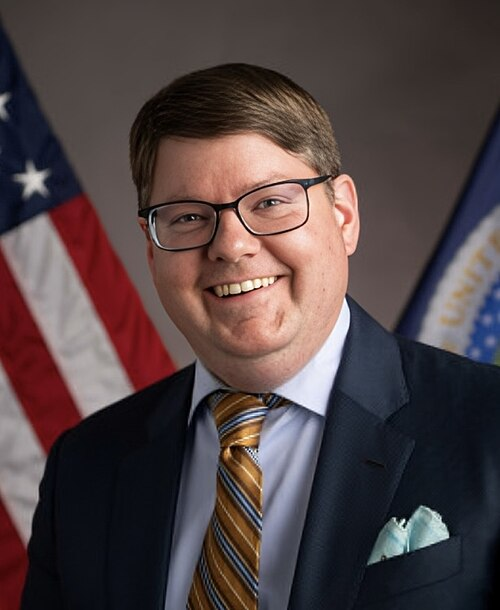
Stephen Alexander Vaden (born May 15, 1982) is an American lawyer who has served as the United States deputy secretary of agriculture since July 2025. He served as a United States judge of the United States Court of International Trade from December 2020 until taking office as deputy secretary in July 2025.
Early life and education
Vaden was born on May 15, 1982[1] in Memphis, Tennessee.
He graduated from Union City High School as the valedictorian of the class of 2000.[2] He earned a Bachelor of Arts from Vanderbilt University and a Juris Doctor from Yale Law School.[3]
Career
After graduating from law school, Vaden served as a law clerk to Judge Julia Smith Gibbons of the United States Court of Appeals for the Sixth Circuit and to Judge Samuel H. Mays Jr. of the United States District Court for the Western District of Tennessee. Vaden has practiced law at Patton Boggs and Jones Day, specializing in appellate litigation, election law, and administrative law.[3][4]
General Counsel of the Department of Agriculture
Vaden served on the first Trump administration's United States Department of Agriculture landing team.[5] He was appointed Principal Deputy General Counsel of the department on March 17, 2017, succeeding Lee Fink.
On September 2, 2017, Vaden was nominated to be the general counsel for the United States Department of Agriculture.[3] He was confirmed by the United States Senate on November 27, 2018 by a 53–46 vote, and was sworn in on December 14, 2018.[6] He left the Department after being commissioned as a Judge of the Court of International Trade.
Trade Court service
On October 2, 2019, President Trump announced his intent to nominate Vaden to the United States Court of International Trade.[7] On October 17, 2019, his nomination was sent to the Senate. President Trump nominated Vaden to the seat vacated by Judge Delissa A. Ridgway, who assumed senior status on January 31, 2019.[8] A hearing on his nomination before the Senate Judiciary Committee was held on November 13, 2019.[9] On January 3, 2020, his nomination was returned to the President under Rule XXXI, Paragraph 6 of the United States Senate.[10] Later that day, he was re-nominated to the same seat.[11] On January 16, 2020, his nomination was reported out of committee by a 12–10 vote.[12] On November 18, 2020, the Senate invoked cloture on his nomination by a 49–44 vote.[13] His nomination was confirmed later that day by a 49–43 vote.[14] He received his judicial commission on December 21, 2020.[15]
U.S. deputy secretary of agriculture
On December 22, 2024, President-elect Donald Trump announced that he would nominate Vaden to be deputy secretary at the United States Department of Agriculture.[16] On January 20, 2025, his nomination was submitted to the U.S. Senate.[17] On April 8, a hearing on his nomination was held before the Senate Agriculture, Nutrition and Forestry Committee.[18] On May 5, his nomination was favorably reported out of committee by a 12–11 party-line vote.[19] On June 10, the Senate invoked cloture on his nomination by a 48–45 vote.[20] Later that day, his nomination was confirmed by a 48–45 vote.[21] He was sworn in on July 7, 2025.[22]
References
- "House Resolution 19" (PDF). Tennessee House of Representatives.
- Senate Joint Resolution 900 to recognize Stephen Alexander Vaden, 2000 Valedictorian of Union City High School., Tennessee Senate, filed June 7, 2000. Accessed December 20, 2022. "Whereas, Stephen Alexander Vaden is one such exceptional student who was recently named valedictorian of the 2000 graduating class at Union City High School"
- "President Donald J. Trump Announces Intent to Nominate Personnel to Key Administration Posts". whitehouse.gov. September 2, 2017. Retrieved September 14, 2017 – via National Archives.
 This article incorporates text from this source, which is in the public domain.
- Polantz, Katelyn (September 8, 2017). "DC Judge's Best Trial Tips, Government Lawyers Flock to Firms, Mueller's Hotline". The National Law Journal. Retrieved September 14, 2017.
- Scarcella, Mike (September 13, 2017). "Ex-Jones Day Associate Is Trump's Pick for USDA General Counsel". The National Law Journal. Retrieved September 14, 2017.
- "On the Nomination (Confirmation Stephen Alexander Vaden, of Tennessee, to be General Counsel of the Department of Agriculture)". US Senate. United States Senate. Retrieved November 27, 2018.
- "President Donald J. Trump Announces Judicial Nominees – The White House". trumpwhitehouse.archives.gov.
- "Eighteen Nominations Sent to the Senate – The White House". trumpwhitehouse.archives.gov.
- "Nominations | United States Senate Committee on the Judiciary". www.judiciary.senate.gov.
- "PN1244 - Nomination of Stephen A. Vaden for The Judiciary, 116th Congress (2019-2020)". www.congress.gov. January 3, 2020. Retrieved January 4, 2020.
- "Four Nominations Sent to the Senate – The White House". trumpwhitehouse.archives.gov.
- "Results of Executive Business Meeting – January 16, 2020" (PDF). Senate Judiciary Committee.
- "On the Cloture Motion (Motion to Invoke Cloture: Stephen A. Vaden, of Tennessee, to be a Judge of the United States Court of International Trade)". United States Senate. November 18, 2020.
- "On the Nomination (Confirmation: Stephen A. Vaden, of Tennessee, to be a Judge of the United States Court of International Trade)". United States Senate. November 18, 2020.
- Stephen Vaden at the Biographical Directory of Federal Judges, a publication of the Federal Judicial Center.
- "POLITICO Pro: Trump selects Stephen Vaden for USDA deputy secretary". subscriber.politicopro.com. Retrieved March 27, 2025.
- "President Trump Announces Sub-Cabinet APPOINTMENTS" (Press release). The White House. January 20, 2025. Retrieved June 10, 2025.
- "Nomination Hearing". Senate Agriculture, Nutrition and Forestry Committee. April 8, 2025. Retrieved June 10, 2025.
- "Business Meeting" (PDF). Senate Agriculture, Nutrition and Forestry Committee. May 5, 2025. Retrieved June 10, 2025.
- "On the Cloture Motion (Motion to Invoke Cloture: Stephen Vaden to be Deputy Secretary of Agriculture)". U.S. Senate. June 10, 2025. Retrieved June 10, 2025.
- "On the Nomination (Confirmation: Stephen Vaden to be Deputy Secretary of Agriculture)". U.S. Senate. June 10, 2025. Retrieved June 10, 2025.
- "Judge Vaden Sworn in as Deputy Secretary at the U.S. Department of Agriculture". www.usda.gov. Washington, D.C.: United States Department of Agriculture. July 7, 2025. Retrieved July 7, 2025.
External links
- Stephen Vaden at the Biographical Directory of Federal Judges, a publication of the Federal Judicial Center.
- S. Hrg. 115-602 - NOMINATION HEARING: GLEN SMITH, TO BE A MEMBER OF THE FARM CREDIT ADMINISTRATION BOARD, FARM CREDIT UNION, AND STEPHEN ALEXANDER VADEN, TO BE GENERAL COUNSEL OF THE DEPARTMENT OF AGRICULTURE
 This article incorporates text from this source, which is in the public domain.
- 1982 births
- Living people
- 21st-century American lawyers
- 21st-century American judges
- First Trump administration personnel
- Jones Day people
- Judges of the United States Court of International Trade
- Lawyers from Washington, D.C.
- Lawyers from Memphis, Tennessee
- Second Trump administration personnel
- Tennessee Republicans
- United States Department of Agriculture officials
- United States deputy secretaries of agriculture
- United States federal judges appointed by Donald Trump
- Vanderbilt University alumni
- Yale Law School alumni
---
LI 6 26
experience

[Deputy Secretary USDA · Full-time
Jul 2025 - Present · 1 yr
Washington, District of Columbia, United States](https://www.linkedin.com/company/4746/)

[Judge U.S. Court of International Trade
Dec 2020 - Jul 2025 · 4 yrs 8 mos
New York, New York, United States](https://www.linkedin.com/company/157288/)

[General Counsel USDA
Jan 2017 - Dec 2020 · 4 yrs
Washington DC-Baltimore Area](https://www.linkedin.com/company/4746/)
Senior Adviser to the Office of General Counsel (January 23, 2017 - March 16, 2017) Principal Deputy General Counsel (March 17, 2017 - December 14, 2018) Acting General Counsel (March 17, 2017 - September 5, 2017) Nominated by the President to serve as General Counsel (September 5, 2017) Confirmed by the Senate (November 27, 2018)

[Associate JONES DAY®
Aug 2014 - Jan 2017 · 2 yrs 6 mos
Washington DC-Baltimore Area](https://www.linkedin.com/company/5096/)
Government Regulation associate practicing in the areas of political law and litigation. Areas of emphasis include election law litigation, appellate litigation, Foreign Agent Registration Act (FARA) compliance, and all aspects of the Freedom of Information Act (FOIA) from filing requests to litigating denials in both administrative and judicial fora.

[Associate Squire Patton Boggs
Jan 2011 - Jul 2014 · 3 yrs 7 mos
Washington DC-Baltimore Area](https://www.linkedin.com/company/7200/)
Litigation associate practicing in the areas of appellate litigation and political law. Chair of the Fellowship Subcommittee, Patton Boggs Foundation: responsible for awarding fellowships to students from 15 law schools to engage in public policy advocacy projects.

[Yale Law School Doctor of Law (J.D.)
2005 – 2008](https://www.linkedin.com/school/4072/)
Activities and societies: Yale Law Republicans, Federalist Society
ggl 6 26
AI Overview
The "Yale Law Republicans" do not have a dedicated, institutional donor funder. Instead, conservative presence and organizing at Yale Law School primarily receive backing through university-recognized student groups, alumni networks, and broad-based conservative organizations with ties to the law school. [1]
Key conservative entities at the school and their associated funders include:
- The Federalist Society: The prominent conservative and libertarian law student organization (founded at Yale) relies on large, national conservative foundations. Its network is heavily bankrolled by groups like the Searle Freedom Trust, the Scaife Foundation, and DonorsTrust, as well as the dark money network overseen by conservative activist Leonard Leo. , [2, 3]
- Institutional Portraits & Specific Initiatives: Major conservative initiatives at the law school have been funded by specific high-profile Republican megadonors. For example, Texas billionaire Harlan Crow provided a $105,000 donation in 2018 to commission and install the official portrait of Justice Clarence Thomas in the law school. [1]
For more than two decades, Yale Law School has also served as a focal point for the broader political ecosystem, helping to foster high-profile conservative leaders and their financiers in Silicon Valley and beyond. [1, 2]

[Vanderbilt University Bachelor of Arts (B.A.), American History (United States)
2000 – 2004](https://www.linkedin.com/school/4565/)
Activities and societies: Phi Beta Kappa, Phi Alpha Theta
Union City High School
1996 – 2000
Valedictorian
...
[Dick Thompson · 3rd
Senior Adviser at Akin Gump Strauss Hauer & Feld LLP
May 3, 2016, Dick worked with Stephen but on different teams
Stephen is an exceptional attorney, His analyses are always rigorous and well reasoned. He is articulate and persuasive in his advocacy and an asset to any organization with which he is affiliated.](https://www.linkedin.com/in/dick-thompson-4aab65a2/)
Publications (5)
Chevron in the Circuit Courts
Federalist Society Teleforum · Oct 27, 2016
...Perez v. Mortgage Bankers Association: Portending a Return to Judicial Engagement
Engage, Volume 16, No. 3 · Dec 1, 2015
An article for the practice journal of the Federalist Society suggesting that Perez signals a coming decline in the deference federal courts show to agency actions.
Tennessee Trial Court Strikes Down State's Tort Reform Act
Federalist Society State Courts Docket Watch · Jun 1, 2015
Article examining Tennessee trial court's decision to invalidate that state's tort reform act and listing potential legal questions that make the opinion vulnerable to being overturned on appeal.
Federalist Society
Administrative Law Practice Group Executive Committee Member · Mar 2015 – Present
http://www.fed-soc.org/practice_groups/page/administrative-law-practice-group-executive-committee-contact-information
More profiles for you
[
Kelsey Barnes
- 3rd
Senior Advisor, U.S. Secretary of Agriculture, Brooke Rollins](https://www.linkedin.com/in/kelsey-barnes-61443091/)
[
Kailee Buller
- 3rd
Candidate for New York’s 22nd Congressional District](https://www.linkedin.com/in/kailee-buller/)
[
Gabrielle Rossi
- 3rd
USDA Office of the Deputy Secretary](https://www.linkedin.com/in/gabriellerossi-/)
[
Courtney Knupp
- 3rd
Director Global Supply Chains, National Security Council](https://www.linkedin.com/in/courtney-knupp/)
[
Luke J. Lindberg
- 3rd
Under Secretary for Trade and Foreign Agricultural Affairs | Believer in the American Dream | South Dakotan (personal account)](https://www.linkedin.com/in/lukejlindberg/)
[
Michelle Bekkering
- 3rd
Deputy Under Secretary for Trade and Foreign Agricultural Affairs at USDA](https://www.linkedin.com/in/michelle-bekkering-11b77684/)
[
Howard W. Lutnick
- 3rd+
Secretary of Commerce](https://www.linkedin.com/in/howardwlutnick/)
[
Alison Slagell
- 3rd
Senior Policy Advisor, U.S. Secretary of Agriculture, Brooke Rollins](https://www.linkedin.com/in/alison-slagell-64bb936a/)
[
Justin Benavidez
- 3rd
Chief Economist, United States House Committee on Agriculture](https://www.linkedin.com/in/justin-benavidez-70227b80/)
[
Jerry Moran
- 3rd+
U.S. Senator for Kansas at United States Senate](https://www.linkedin.com/in/jerry-moran-08976974/)
[
Brett Shumate
- 3rd
Assistant Attorney General, Civil Division](https://www.linkedin.com/in/brett-shumate-54b51935/)
[
Keith Sonderling
ai grants? pell?
spirit airlines
- 3rd
United States Acting Secretary of Labor](https://www.linkedin.com/in/keith-sonderling/)
Experience

[U.S. Department of Labor 1 yr 6 mos
Washington, District of Columbia, United States](https://www.linkedin.com/company/5697/)
- Acting Secretary of Labor Apr 2026 - Present · 3 mos
- [Deputy Secretary of Labor Full-time
Jan 2025 - Present · 1 yr 6 mos](https://www.linkedin.com/company/5697/)

[Ex Officio Member U.S. Semiquincentennial Commission America250
Mar 2025 - Present · 1 yr 4 mos](https://www.linkedin.com/company/37825592/)

[Acting Director Institute of Museum and Library Services
Mar 2025 - Nov 2025 · 9 mos
Washington, District of Columbia, United States](https://www.linkedin.com/company/903920/)

[EEOC 4 yrs
Washington, District of Columbia, United States](https://www.linkedin.com/company/14293/)
- [Commissioner Full-time
Sep 2020 - Aug 2024 · 4 yrs](https://www.linkedin.com/company/14293/)
Human Resources (HR), Federal Government and +9 skills

[Professorial Lecturer in Law (Adjunct Professor) The George Washington University Law School · Part-time
Sep 2022 - Sep 2023 · 1 yr 1 mo
Washington, District of Columbia, United States](https://www.linkedin.com/school/15100267/)
Employment Discrimination Adjunct Professor
Administrative Law, Employment Discrimination and +1 skill
Education

University of Florida BS, Telecommunications

Nova Southeastern University JD, Law
---
[### Antitrust Law Down on the Farm: Farmers, Food Inflation, ...

The Federalist Society
https://fedsoc.org › events › antitrust-law-down-on-the-...](https://fedsoc.org/events/antitrust-law-down-on-the-farm-farmers-food-inflation-and-a-fair-deal)
Jul 9, 2024 — Stephen Alexander Vaden, Judge, United States Court of International Trade ... It's an honor to see you, a fellow alum of the US Department of Ag.
---
klo ltr
ashington, DC 20250
Dear Deputy Secretary Vaden:
We write with strong concern regarding the reorganization of the Food and Nutrition Service
(FNS) at the U.S. Department of Agriculture. After dramatic cuts to nutrition assistance
programs and the significant staff losses at FNS in the past year, this reorganization will further
weaken the ability of the agency to administer federal nutrition assistance programs.
FNS administers 16 federal nutrition assistance programs including the Supplemental Nutrition
Assistance Program (SNAP), the Special Supplemental Nutrition Program for Women, Infants,
and Children (WIC), and the National School Lunch and School Breakfast Programs. Together,
these programs help Americans put nutritious food on the table and promote healthy eating.
These programs serve tens of million Americans in all 50 states from birth to old age in homes,
schools, childcare settings, and afterschool programs, among others. Unfortunately, this
administration has engaged in repeated efforts to undermine these crucial programs: cancelling
over 90 million pounds of food ordered for food banks and schools; enacting the deepest cuts to
SNAP in history; refusing to comply with court orders to fund SNAP benefits during the
government shutdown; and terminating a long-standing food insecurity survey that has measured
hunger in America since the 1990s. At the same time, the USDA has greatly reduced the capacity
of the Food and Nutrition Service to administer nutrition assistance programs and almost 30
percent of FNS staff have left the agency as a result of last year’s Deferred Resignation Program.
USDA’s reorganization announcement on April 30 would further break apart this already
hobbled agency. The USDA’s plan would close five of the seven regional offices and have staff
relocate to different offices based on programmatic work, which would appear to reduce
alignment and efficiencies among the nutrition assistance programs. In fact, the Government
Accountability Office found that USDA’s 2019 relocation of the Economic Research Service and
the National Institute of Food and Agriculture resulted in the loss of over half those agencies’
staff and a significant reduction in productivity. This reorganization push will likely result in
similar or worse attrition at FNS, with a tremendous loss of capacity, expertise, and institutional
memory....
---
coalition-letter-of-support-for-stephen-vaden-to-be-usda-deputy-secretary
Agriculture Retailers Association
American Farm Bureau Federation
American Feed Industry Association
American Seed Trade Association
American Soybean Association
American Sugarbeet Growers Association
CropLife America
Farm Credit Council
International Fresh Produce Association
Meat Institute
National Association of Conservation Districts
National Association of State Departments of Agriculture
National Association of Wheat Growers
National Corn Growers Association
National Cotton Council
National Council of Farmer Cooperatives
National Grain and Feed Association
National Milk Producers Federation
National Pork Producers Council
National Sorghum Producers Association
The Fertilizer Institute
USA Rice
Agribusiness Council of Indiana
Agricenter International
Agricultural Council of Arkansas
Agriculture Teachers Association of Texas
Alabama Agribusiness Council
Alabama Farmers Federation
Alabama Pork Producers
Almond Alliance
Amcot
American Association of Crop Insurers
American Cotton Shippers Association
American Livestock Markets and Dealers Association
American Pistachio Growers
American Sheep Industry Association
American Sugarbeet Growers Association
AmericanHort
Animal Health Institute
Arizona Cotton Growers Association
Arizona Crop Protection Association
Arizona Farm Bureau
Arizona Nursery Association
Arkansas Farm Bureau Federation
Arkansas Soybean Association
Berryman and Associates
Bush Hog, Inc
California Association of Winegrape Growers
California Citrus Mutual
California Farm Bureau
California Pork Producers Association
CEA Alliance
ClearPath Action
Colorado Farm Bureau
Connecticut Farm Bureau Association
Corn Refiners Association
Cotton Growers Warehouse Association
Cotton Warehouse Association of America
Council of Producers & Distributors of Agrotechnology
Crop Insurance and Reinsurance Bureau
Crop Insurance Professionals Association
Delaware Farm Bureau
Ducks Unlimited
Equine Sports Council
Farm Animal Care Coalition of Tennessee
Florida Citrus Mutual
Florida Farm Bureau Federation
Florida Fruit & Vegetable Association
FMI – The Food Industry Association
Forest Landowners Association
Georgia Farm Bureau
Global Cold Chain Alliance
Grain and Feed Association of Illinois
GROWMARK
Growth Energy
Idaho Dairymen’s Association, Inc.
Idaho Farm Bureau Federation
Idaho Grain Producers Association
IL Corn Growers Association
Illinois Farm Bureau
Illinois Seed Trade Association, Inc.
Independent Bakers Association
Indiana Corn Growers Association
Indiana Farm Bureau, Inc.
International Dairy Foods Association
Iowa Farm Bureau
Iowa Pork Producers Association
Iowa Soybean Association
Kansas Agribusiness Retailers Association
Kansas Farm Bureau
Kansas Grain and Feed Association
Kansas Sorghum Producers
Kansas Soybean Association
Kentucky Farm Bureau Federation
Livestock Marketing Association
Livestock Marketing Association of Texas
Louisiana Farm Bureau Federation
Maine Sheep Breeders Association
Massachusetts Farm Bureau Federation
Massachusetts Forest Alliance
McCurdy Sod Farms LLC
Michigan Agri-Business Association
Michigan Farm Bureau
Michigan Soybean Association
Mid Atlantic Soybean Association
Middle TN Nursery Associaiton
Midsouth Grain Association
Midwest Council on Agriculture
Midwest Dry Bean Coalition
Midwest Food Products Association Minnesota Farm Bureau Federation
Minnesota Lamb & Wool Producers Association
Mississippi Farm Bureau Federation
Mississippi Land Bank, ACA
Mississippi River Trust
Missouri Farm Bureau Federation
Missouri Soybean Association
Montana Farm Bureau Federation
National Cotton Ginners Association
National Council of Agricultural Employers
National Fisheries Institute
National Grocers Association
National Oilseed Processors Association
NC Agribusiness Council
NCA – The National Confectioners Association
Nebraska Farm Bureau Federation
Nebraska Pork Producers Association
Nebraska Soybean Association
Nevada Farm Bureau Federation
New Jersey Farm Bureau
New York Farm Bureau
North American Blueberry Council
North American Renderers Association
North Carolina Farm Bureau Federation
North Dakota Corn Growers Association
North Dakota Soybean Growers Association
Northeast Dairy Producers Association
Northwest Horticultural Council
Nutrien
Ohio AgriBusiness Association
Ohio Farm Bureau
Ohio Pork Council
Ohio Soybean Association
Oklahoma Farm Bureau
Oregon Farm Bureau
Pennsylvania Farm Bureau
Pheasants Forever
Pillen Family Farms & DNA Genetics
Plains Cotton Growers, Inc.
Plant Based Products Council
Quail Forever
Second Harvest Food Bank of East Tennessee Snake River
Sugarbeet Growers Association
Society of American Florists
South Carolina Corn and Soybean Association
South Dakota Farm Bureau
South Dakota Soybean Association
Southern Crop Production Association
Southwest Council of Agribusiness
Southwest Meat Association
Tennessee Association of Conservation Districts
Tennessee Beekeepers Association
Tennessee Cattlemen’s Association
Tennessee Corn Growers Association
Tennessee Electric Cooperative Association
Tennessee Farm Bureau Federation
Tennessee Feed & Grain Assn
Tennessee Forestry Association
Tennessee Nursery & Landscape Association, Inc.
Tennessee Pork Producers Assn
Tennessee Sheep Producers Association
Tennessee Soybean Association
Tennessee Walking Horse Breeders’ & Exhibitors’ Association
Tennessee Walking Horse Breeders Foundation
Tennessee Walking Horse National Celebration
Texas Cattle Feeders Association
Texas Citrus Mutual
Texas Farm Bureau
Texas Forestry Association
Texas Grain & Feed Association
Texas International Produce Association
Texas Pork Producers Association
Texas Vegetable Association
Texas Watermelon Association
The Center for Dairy Excellence
The Poultry Federation
TN Dairy Producers Association
TN Poultry Association
U.S. Beet Sugar Association
U.S. Custom Harvesters, Inc.
U.S. Dairy Export Council
U.S. Durum Growers Association
US Rice Producers Association
Utah Farm Bureau Federation
Virginia Agribusiness Council
Virginia Farm Bureau
Walking Horse Report
Washington Apple Commission
Washington Farm Bureau
Washington State Tree Fruit Association
Western Growers
Western Peanut Growers Association
Wildlife Mississippi
Wilson County-Tennessee State Fair
Wisconsin Farm Bureau Federation
Wyoming Farm Bureau Federation
---
[### Trump warns about fertilizer 'price gouging'

Argus Media
https://www.argusmedia.com › latest-market-news › 281...](https://www.argusmedia.com/en/news-and-insights/latest-market-news/2813451-trump-warns-about-fertilizer-price-gouging)
Apr 13, 2026 — USDA deputy secretary Stephen Vaden has gone so far as to allege that the behavior of North American producers is a "duopoly" and that the ...
---
---
[
Riley W. Pagett, JD
- 3rd
Political strategist + policy implementer. Change management certified. Legal counsel. Ice cream cone-oisseur.](https://www.linkedin.com/in/rileypagett/)
[Jennifer T · 3rd
United States Department of Agriculture](https://www.linkedin.com/in/jennifer-t-05152715/)
[
Peter Laudeman
- 3rd
Senior Policy Advisor for Trade and Foreign Agricultural Affairs](https://www.linkedin.com/in/peter-laudeman/)
---
[Brooke Shupe Appleton · 3rd
Deputy Under Secretary, Farm Production and Conservation (FPAC)](https://www.linkedin.com/in/brooke-shupe-appleton-91a4a717/)
---
[Lauren Stump · 3rd+
Deputy Under Secretary; Research, Education, and Economics](https://www.linkedin.com/in/laurenstump/)
---
[
Roman Pidkova
- 3rd
Studying Agriculture Science at Cornell University](https://www.linkedin.com/in/roman-pidkova-832276308/)
---
[
Mary Galey
- 3rd
Executive Affairs Director, The Russell Group](https://www.linkedin.com/in/mary-galey/)
---
[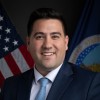
Dominic Restuccia
- 3rd
White House Liaison, United States Department of Agriculture](https://www.linkedin.com/in/dominicrestuccia/)
---
FEDSOC OFF BS
Judge Stephen Alexander Vaden was appointed as the Deputy Secretary of the U.S. Department of Agriculture on July 7, 2025. Alongside Secretary Brooke L. Rollins, Deputy Secretary Vaden leads the Department’s operations and implements policies that support America’s food and farm systems. A native of Union City, Tennessee, Deputy Secretary Vaden brings expertise in agricultural policy, law, and rural development.
Previously, he served as a judge on the U.S. Court of International Trade and as General Counsel of USDA. Throughout Deputy Secretary Vaden’s time as General Counsel, he led successful Supreme Court litigation, advanced regulatory reform, and supported the implementation of the 2018 Farm Bill. He is a graduate of Yale Law School and Vanderbilt University. A public servant with strong agricultural roots, Deputy Secretary Vaden is committed to revitalizing rural America and ensuring an abundant, affordable, and safe U.S. food supply.
---
[### Conversation with USDA Deputy Secretary Stephen Vaden National Agricultural Law Center
https://nationalaglawcenter.org › webinars › vaden](https://nationalaglawcenter.org/webinars/vaden/)
In this webinar, Judge Stephen Vaden, USDA Deputy Secretary, will discuss the latest insights into the current landscape of U.S. agricultural trade, ...
duck 3 26
USDA
https://www.usda.gov › our-agency › about-usda › our-deputy-secretary
Deputy Secretary of Agriculture | USDA
Deputy Secretary of Agriculture Stephen Vaden Judge Stephen Alexander Vaden was appointed as the Deputy Secretary of the U.S. Department of Agriculture on July 7, 2025. Alongside Secretary Brooke L. Rollins, Deputy Secretary Vaden leads the Department's operations and implements policies that support America's food and farm systems.

Wikipedia
https://en.wikipedia.org › wiki › Stephen_Vaden
Stephen Alexander Vaden (born May 15, 1982) is an American lawyer who has served as the United States deputy secretary of agriculture since July 2025. He served as a United States judge of the United States Court of International Trade from December 2020 until taking office as deputy secretary in July 2025.

The National Agricultural Law Center
https://nationalaglawcenter.org › webinars › vaden
A Conversation with USDA Deputy Secretary Stephen Vaden:
Jan 21, 2026In this webinar, Judge Stephen Vaden, USDA Deputy Secretary, will discuss the latest insights into the current landscape of U.S. agricultural trade, including developments in international market access and trade agreements, as well as USDA financial assistance, USDA reorganization efforts, USDA regulatory and litigation priorities, and other related issues impacting producers, lenders, and ...

The Federalist Society
https://fedsoc.org › bio › stephen-vaden
Stephen Alexander Vaden - Federalist Society
Judge Stephen Alexander Vaden was appointed as the Deputy Secretary of the U.S. Department of Agriculture on July 7, 2025. Alongside Secretary Brooke L. Rollins, Deputy Secretary Vaden leads the Department's operations and implements policies that support America's food and farm systems. A native of Union City, Tennessee, Deputy Secretary Vaden brings expertise in agricultural policy, law ...

Tennessee Home and Farm
Tennessee's Stephen Vaden Takes on the Role of USDA Deputy Secretary
Jul 23, 2025Stephen Vaden, Tennessee native and Obion County Farm Bureau member, is the new U.S. Department of Agriculture U.S. Department of Agriculture (USDA) deputy secretary of agriculture. Growing up on his family's diversified farm in northwest Tennessee and southwest Kentucky, a passion for agriculture was instilled in Vaden at an early age. That passion has guided his impressive career, which ...

Food Safety
https://www.food-safety.com › articles › 10509-judge-stephen-vaden-sworn-in-as-usda-deputy-secretary
Judge Stephen Vaden Sworn in as USDA Deputy Secretary
Jul 8, 2025On July 7, Trump nominee Judge Stephen Vaden was sworn in as the Deputy Secretary of USDA. He previously served as General Counsel to USDA and on the U.S Court of International Trade during President Trump's first term.

thefarmtrader.com
https://thefarmtrader.com › new-deputy-secretary-of-agriculture
New Deputy Secretary of Agriculture: Stephen Vaden
Jun 11, 2025Stephen Vaden was confirmed as the new deputy secretary of agriculture. Here's what it means for USDA policy and America's farmers.
AgWeb
Trump Continues to Build USDA Team, Names Stephen Vaden as Deputy ...
Dec 22, 2024Stephen Vaden, former USDA general counsel and judge, will join Brooke Rollins as deputy secretary and secretary of USDA in Trump's second term. Vaden has legal expertise, Supreme Court wins, and farming ties.
fns-prod.azureedge.us
https://fns-prod.azureedge.us › newsroom › usda-0156.25
Judge Vaden Sworn in as Deputy Secretary at the U.S. Department of ...
Washington, D.C., July 7, 2025 — Today, Judge Stephen Alexander Vaden was sworn in as the Deputy Secretary of the U.S. Department of Agriculture. Vaden, of Union City, Tennessee, joins Secretary of Agriculture Brooke L. Rollins to not only deliver on the promises of President Trump but also to execute the agriculture and nutrition policies of the One Big Beautiful Bill. "I am so excited to ...
ABA Banking Journal
https://bankingjournal.aba.com › 2025 › 06 › senate-confirms-usda-deputy-secretary
Senate confirms USDA deputy secretary | ABA Banking Journal
Jun 12, 2025Stephen Vaden, who served as general counsel to the USDA and received an appointment from the president in 2020 to serve on the U.S. Court of International Trade, is now the deputy secretary of the USDA. The Senate confirmed Vaden on June 10 by a vote of 51 to 44 with five senators not voting. He was nominated in December 2024. Not a stranger to farming, Vaden grew up in Union City, Tennessee ...
Searches related to stephen vaden usda
stephen vaden usda **deputy secretary**
vaden usda **reorganization**
judge** stephen vaden **news**
usda **deputy secretary** vaden
deputy secretary** stephen vaden
vaden **deputy secretary of agriculture
---