North Caro NC 2 POPE
SEE NC 3 12 24 PIVOT ELECTION
7/18 see main
oops see other
merri ok
---
yikes mark robinson cand for gov
see GERRY
mccrory coup 2016
---
===
In the 2024 election, many North Carolina voters were willing to split their ticket.
President-elect Donald Trump carried the state, but Democratic North Carolina Attorney General Josh Stein defeated far-right GOP gubernatorial nominee Mark Robinson and will be sworn in as governor in 2025.
North Carolina, a swing state, will have two Democratic governors in a row. But outgoing Gov. Roy Cooper and other North Carolina Democrats are slamming Republicans in the state legislature for making a "power grab" via Senate Bill 382 — which limits Stein's powers as governor in a variety of ways.
READ MORE:[Mehdi Hasan rips Nikki Haley over Biden jab: 'You hated Trump'
For one thing, SB 382 prevents Gov.-elect Stein from appointing members of the North Carolina Board of Elections and moves that power to GOP Auditor-elect Dave Boliek.
Cooper, during a Tuesday, December 3 appearance on MSNBC's "Morning Joe," slammed the bill as an egregious "power grab." And Slate legal analyst Mark Joseph Stern has been equally critical of North Carolina Republicans and SB 382.
In a scathing post on X, formerly Twitter, Stern wrote, "This is a hugely corrupt power grab by the North Carolina General Assembly's Republican supermajority, seizing authority from the governor and the courts to prevent any meaningful check on legislative abuses. Authoritarian stuff. A really dark day for democracy in N.C."
SB 382 also prevents Rachel Hunt, North Carolina's lieutenant governor-elect, from chairing committees on energy issues.
---
an 11 24
The 2024 presidential election was particularly bleak for Democrats, as Republicans swept every battleground state in the Electoral College and even won the popular vote for the first time in 20 years. But at the state level, Democratic candidates notched several big wins that will allow the party to have a few extra arrows in its quiver over the next few years.
The Guardian reported that in multiple state legislatures — including statehouses in several key swing states — Democrats are now well-positioned to use their new gains to frustrate President-elect Donald Trump's agenda in their own backyards. In addition to keeping three governorships in Democratic hands, the party also managed to flip numerous Republican seats in both chambers of several state capitols.
Some of the bigger marquee wins include keeping their one-seat majority in the Pennsylvania House of Representatives, despite Vice President Kamala Harris and Sen. Bob Casey (D-Penn.) losing at the federal level. In North Carolina, Democrats elected Attorney General Josh Stein to become the next governor. Stein dispatched Republican nominee Mark Robinson by a whopping 14-point margin despite Harris losing the Tar Heel State by more than 173,000 votes. North Carolina Democrats also managed to finally wipe out Republicans' legislative supermajority, meaning Stein's future vetoes can't be overridden.
READ MORE:[Mark Robinson on track for 'largest defeat in more than 40 years' of any NC gov candidate
Daniel Squadron, who is the co-founder of the States Project, told the Guardian that Democratic state legislative candidates outperforming Harris was likely due to both their reliance on face-to-face campaigning, and on the high quality field of state house and senate candidates across the country.
"That is the only way it was possible to hold the Pennsylvania house when the statewide results were so disappointing," Squadron said. "It’s the reason the North Carolina house supermajority was broken."
One of the most significant victories for Democrats on election night was in Wisconsin, where Democrats flipped 10 seats in the state assembly and four seats in the state senate. This win notably came a year after the Wisconsin Supreme Court — which has a 4-3 liberal majority — struck down Republicans' heavily gerrymandered state legislative maps in favor of fairer ones.
According to the Princeton Gerrymandering Project, Wisconsin's prior legislative districts were among the most unfair in the United States, with Princeton giving "F" grades to both the state assembly map and the state senate map in 2022. Vox writer Ian Millhiser referred to the Badger State's old maps "America's worst gerrymander" in 2023. Democrats are poised to make additional gains in the Wisconsin legislature in the 2026 elections, when the governor's mansion will also be on the line.
READ MORE:**'America's worst gerrymander' official overturned by Wisconsin Supreme Court**
Andrew Whitley, who is the executive director of the Wisconsin senate Democratic caucus, attributed his party's gains to candidates' deep knowledge of local issues in their own respective districts. He also pointed out that candidates were able to use hot-button national issues like abortion bans to convince voters to send them to the capitol.
“It’s very rare when you have bottom-of-the-ticket state legislators over-perform Kamala and Senator [Tammy] Baldwin,” Whitley said. “They worked their a—es off.”
“It’s going to be truly historic,” he added. “Gone are the days where a manufactured majority can override vetoes and pass super-regressive policies. We’re actually going to have some balance, and we’re on the cusp of not only having a balanced legislature, but a trifecta.”
Click here to read the Guardian's full article.
READ MORE:[Ex-North Carolina GOP gov admits Republicans knew Mark Robinson was a 'ticking time bomb'
---
an 9 24
Donald Trump has long attracted the evangelical Christian vote as the Republican nominee in 2020, and as the Republican nominee now.
Ahead of the presidential election, and of North Carolina's major gubernatorial election — in which the far-right, openly bigoted GOP candidate is backed by Donald Trump — Reverend Jay Augustine of Durham tells *Washington Post* columnist EJ Dionne Jr. that the critical swing state "is going to be ground zero for a faith war."
"The senior pastor of Durham's St. Joseph AME Church insists that "there is an ongoing struggle for the soul of American Christianity between brands of faith that embrace democratic inclusion and extreme forms — particularly white Christian nationalism — that promote exclusion." Dionne emphasizes, "It’s an argument that North Carolina might be called upon to settle for the nation."
READ MORE:'The last thing we need': Core part of Trump’s base threatens to walk away over key issue
Dionne notes that North Carolina "hosts a complex religious history: It’s home to a large evangelical right, but was also the site of Bishop William J. Barber II’s 'Moral Mondays' movement, a religiously inspired but deeply ecumenical focal point for social activism around civil rights, voting rights and economic equality."
Truth Tabernacle Ministries ' Senior Pastor Bishop Haywood Parker told Dionne, “There are White evangelicals who will utilize the gospel and twist it in a way that works to their advantage and gives them a way to support Trump. But there are lots of us who don’t feel that way. When I’m told that if I support Kamala Harris that somehow, I’m anti-church, anti-Biblical, that really bothers me."
The Post columnist writes:
*Religion has created a coalition management challenge for Democrats whose ranks include large majorities of Jewish and Muslim voters and an overwhelming share of voters — particularly among the young — who left organized religion altogether.
*But political scientist David Campbell, co-author of 'Secular Surge: A New Fault Line in American Politics,' argues that the party still has ample room for appeals to religious voters.
"We don’t see any evidence that [secular voters] are hostile to Democrats who use religious language," Campbell told Dionne. "It’s a myth that because they have a secular world view, they are hostile to religion. What they don’t like is the establishment of religion by government, government stepping over the line between church and state."
READ MORE:Evangelicals’ reason for backing Trump 'just collapsed': columnist
Pew Research Center's Gregory Smith told the columnist, "While most White Christian groups have trended in a Republican direction in recent years, significant minorities identify with or lean toward the Democratic Party, including 4 in 10 white nonevangelical Protestants and 37 percent of White Catholics."
Dionne notes, "The battle for Catholics will be important in the northern swing states of Pennsylvania, Michigan and Wisconsin, especially now that Joe Biden, only the second Catholic president in American history, is no longer on the ballot."
READ MORE:How Trump duped Christian nationalists: scholar
*Dionne's full column is available at this link (subscription required).
---
North Carolina GOP says voters have no right to fair electionsELLSWORTH TOOHEY
BB 6 24 Gerry
===
---
mma 3 24
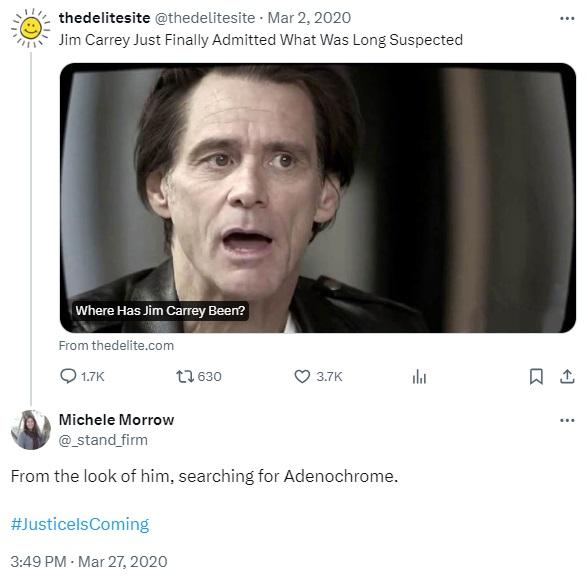
Michele Morrow, the Republican nominee for state superintendent of public instruction in North Carolina, frequently promoted the QAnon conspiracy theory in newly unearthed social media posts. She also referenced a QAnon-fueled conspiracy theory to suggest that actor Jim Carrey drinks the blood of children.
Morrow is a far-right commentator who has written for Newsmax and appeared on various media outlets. Her history includes marching in Washington, D.C., on January 6 (Morrow said that she didn’t storm the Capitol) and attacking public schools as “socialist indoctrination centers.” She espouses anti-LGBTQ views, such as saying during Pride Month in June 2023: “As a nurse, I want you to understand something: There is no pride in perversion.”
Morrow is also anti-Muslim: She has written that the country should “ban Islam” and “ban Muslims from elected offices.” (She has claimed “that she was only talking about supporters of radical Islam.”)
She won the Republican primary on March 5. North Carolina’s superintendent of public instruction oversees more than 2,000 schools and more than 100,000 teachers and administrators.
QAnon is the sprawling far-right conspiracy theory in which supporters claim that Donald Trump has been secretly working to take down pedophilia rings that are supposedly linked to high-profile politicians and entertainment figures, among others. The conspiracy theory has been linked to numerous acts of violence.
Over the years, Republican politicians including Rep. Marjorie Taylor Greene (R-GA) and Rep. Lauren Boebert (R-CO) have promoted the conspiracy theory. Trump has also repeatedly promoted QAnon supporters online.
Morrow frequently engaged with the conspiracy theory in the lead up to the 2020 election.
One of the movement’s hashtags is WWG1WGA (“where we go one, we go all”). In 2020, Morrow posted the QAnon hashtag at least seven times.
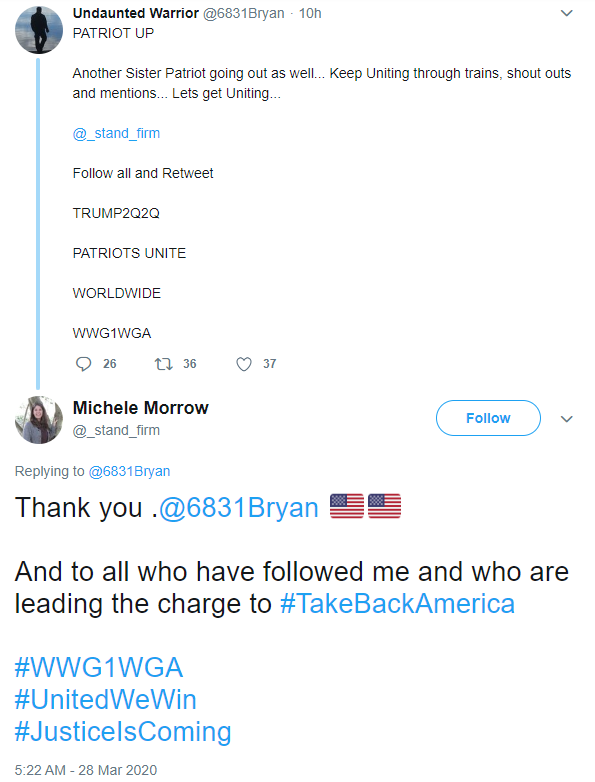
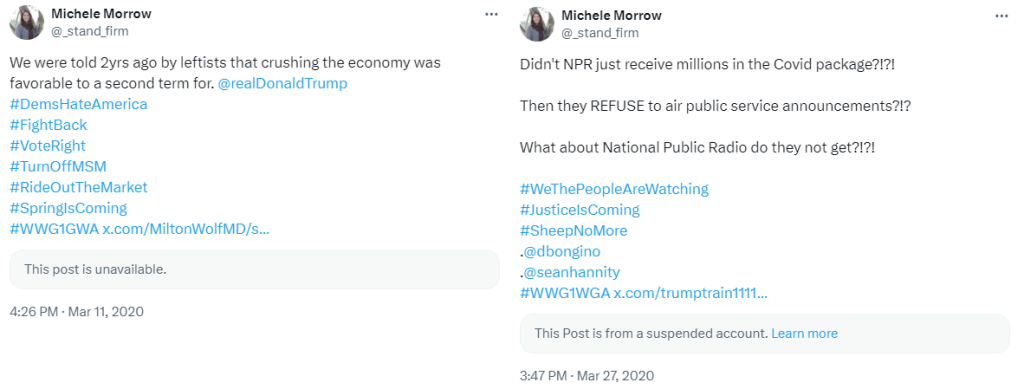
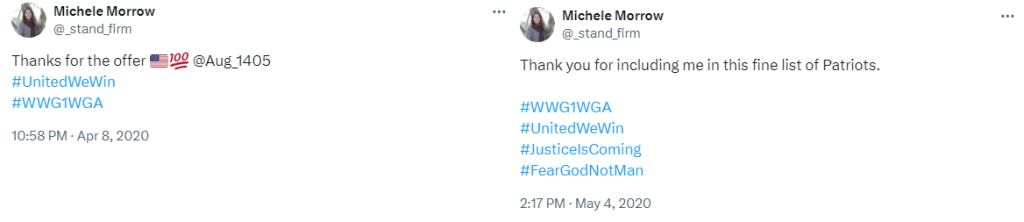
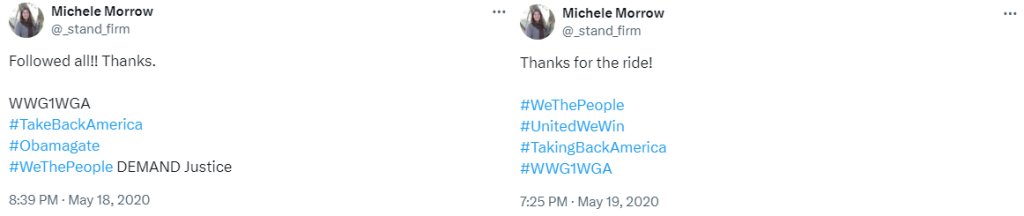
She has also responded to posts that mentioned “Q” and “QAnon.”
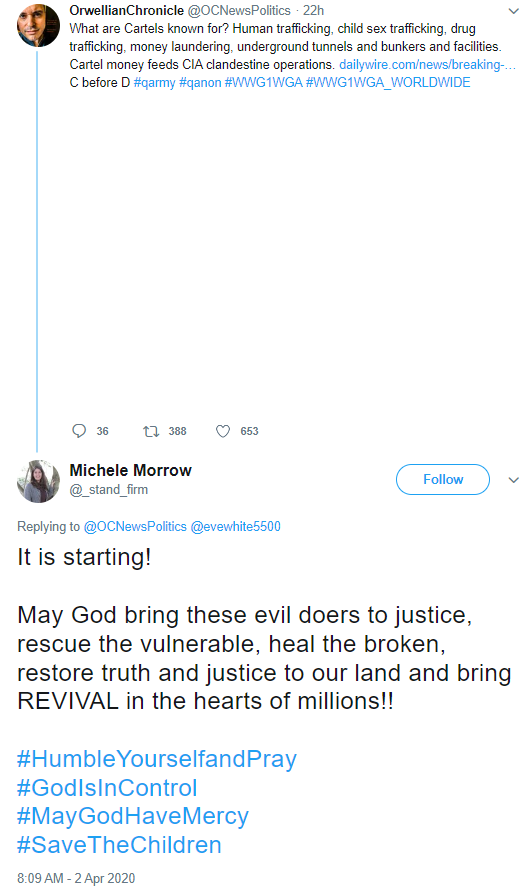
In 2020, she positively responded to a post about Trump going after drug cartels that had the hashtags “#qarmy #qanon #WWG1WGA #WWG1WGA_WORLDWIDE.”
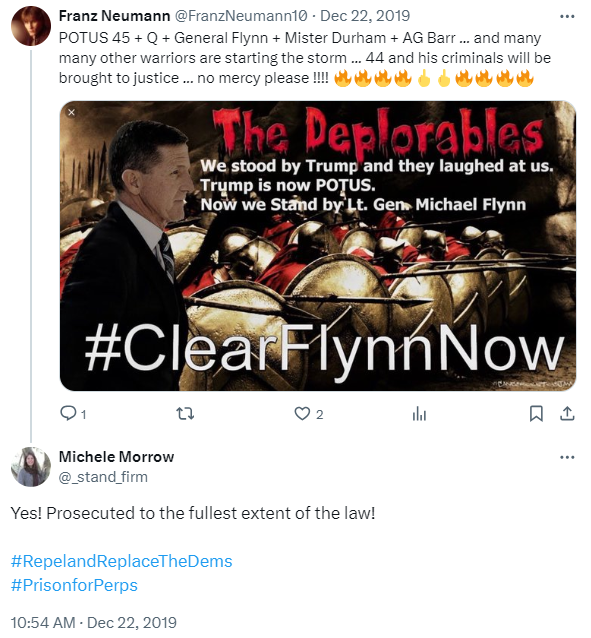
In 2019, she also responded “Yes! Prosecuted to the fullest extent of the law!” to a pro-QAnon post which stated, “POTUS 45 + Q + General Flynn + Mister Durham + AG Barr ... and many many other warriors are starting the storm ... 44 and his criminals will be brought to justice ... no mercy please !!!!”
Additionally, in 2020 she promoted the QAnon-fueled adrenochrome conspiracy theory in response to a post about actor Jim Carrey and added the hashtag “JusticeIsComing”. The conspiracy theory essentially claims that elites are harvesting and drinking the blood of tortured children to extend the drinkers’ lives.
In 2020, Trump thanked Morrow after she praised him on CNN.
--
nazi cow 3 24
Republican public schools nominee supports political killings and ‘death’ to Bill Gates
Michele Morrow official campaign photo
Jordan GreenandRaw Story
March 08, 2024
GREENSBORO, N.C. — Michele Morrow, the newly minted Republican nominee for superintendent of public instruction in North Carolina, wishes “death” on Bill and Melinda Gates.
She’s advocated killing people she considers “traitors.”
Despite seeking to oversee public education in a state of 10.5 million people, she is herself a homeschooler.
She has no prior political experience.
She attended the Jan. 6 rally to support Donald Trump’s quest to overturn the 2020 presidential election.
She received candidate training alongside a Proud Boys member.
And yet, Morrow upset incumbent Catherine Truitt in the Republican primary on Tuesday.
ALSO READ: Inside the neo-Nazi hate network grooming children for a race war
Morrow, who rallied for Trump in Washington, D.C. on Jan. 6, 2021, has repeatedly made false claims that the 2020 election was stolen, while calling for death to Trump’s political enemies — and to former Microsoft CEO Bill Gates and his former wife Melinda Gates for promoting vaccines.
Morrow could not be reached for comment for this story.
In a post on Twitter (now X) on Dec. 29, 2020, Morrow wrote: “I do support death to vaccine mongers like Bill and Melinda Gates.” (Raw Story reviewed the post on Wednesday, but it has since been removed for violating X’s rules. The post has been archived.)
In another post the same day, she wrote: “We need to follow the Constitution’s advice and KILL all TRAITORS!!!!”
Morrow livestreamed herself with other Trump supporters walking to the Ellipse on Jan. 6.
“We are here to take back America,” she said. “We are here to stop the steal. We are here to ensure that President Trump gets four more years.”
Morrow, who has worked as a Christian missionary, exhorted her livestream followers: “We need to fight back with prayer… May the people of God arise. May the Holy Spirit descend on D.C., and may souls be saved. And may the United States once again return to one nation under God with liberty and justice for all.”
In the aftermath of the attack on the U.S. Capitol, Morrow rebuked a call by Sen. Lindsey Graham (R-SC) to prosecute those involved. Four people died during the attack — all Trump supporters — and dozens of police officers were injured.
“We do not condone violence and destruction,” Morrow wrote. Nor will we stand for treason and cowardice. Did anyone offer to talk with those entered? Or only force them out and threaten them? Thousands of us were here in Nov & Dec. We never heard from ANY Congressmen. Now you want to talk?”
Following President Joe Biden’s inauguration in January 2021, Morrow took part in the far-right shift towards focusing on public schools as sites for cultural and political struggle.
A post in the private Facebook group Education First Warriors shows Morrow attending a candidate training with a member of the Proud Boys in January 2022. The photo was posted by Sloan Rachmuth, the president of the Education First Alliance.
Proud Boy member John Fischer, who like Morrow would go on to lose a local school board race that year, later attended a rally with other Proud Boys wearing masks and paramilitary gear who harassed patrons at a drag show in Sanford, N.C.
Public schools are 'greatest threat to humanity'
Truitt, who Morrow defeated Tuesday to win the Republican nomination for superintendent of public instruction, has held the post for the past four years.
The person in this position is responsible for developing curriculum and administering state and federal funds in North Carolina K-12 schools.
Morrow’s primary win sets up what’s likely to be a spirited general election fight with Maurice “Mo” Green, formerly the superintendent of Guilford County Schools — the third largest district in the state — who won the Democratic primary.
Green received the endorsement of the NC Association of Educators, whose president declared the election to “be critical to the future of public education in North Carolina” while warning that “anti-public school politicians want to tear down our schools.”
Some of Morrow’s views on public education are outlined in a 2023 Newsmax opinion article that promotes a Christian nationalist vision for education, while claiming that preserving traditional gender roles is a matter of national security.
Morrow wrote that “government-run (read public) schools and medical systems” are “the greatest threat to humanity,” while arguing that removing God “from the classroom, the courtroom, and the public square” is opening “ourselves up to chaos and confusion.”
ALSO READ: Feds gave classified information to neo-Nazi defendant: lawyer
In the same article, Morrow claimed that the American soldiers who liberated France during World War II are being demonized as “toxic.” She also complained that society is “filling our children’s minds with the lie that gender roles are an oppressive, social construct to be rejected” and “telling them that it is ‘heroic’ to block the natural processes of development.”
Green, the Democratic nominee for superintendent of public instruction, is largely refraining from commenting on his opponent.
In a statement to Raw Story, Green said he will work to make the North Carolina public school system the best in the country by advocating for full funding, ensuring staff receives adequate pay and “celebrating the good in public education.”
Morrow, in contrast, has a history of negatively framing public education.
Speaking at a candidate forum during her unsuccessful bid for a seat on the Wake County Board of Education in 2022, Morrow said her children have been educated in public, private and home schools.
“And what worked best for my kids in preparing them to be critically thinking, hardworking and intelligent adults and prepared for entering into the adult world and following and pursuing a career that they are passionate about was homeschooling,” she said.
Morrow added: “I would be more than happy to put my last child, who is in fifth grade now — 10 years old — to put him in the public school system if I believed that the public education system was focused on academic excellence and preparing our children for the career of their choice.”
https://www.alternet.org/alternet-exclusives/michele-morrow/
---
6 24 pro publ
last fall, out of public view, the North Carolina Supreme Court squashed disciplinary action against two Republican judges who had admitted that they had violated the state’s judicial code of conduct, according to three sources with direct knowledge of the decisions.}:
One of the judges had ordered, without legal justification, that a witness be jailed. The other had escalated a courtroom argument with a defendant, which led to a police officer shooting the defendant to death. The Judicial Standards Commission, the arm of the state Supreme Court that investigates judicial misconduct by judges, had recommended that the court publicly reprimand both women. The majority-Republican court gave no public explanation for rejecting the recommendations — indeed, state law mandates that such decisions remain confidential.
The sources spoke to ProPublica on the condition of anonymity because many of the actions and decisions of both institutions are confidential and because the sources said they feared retaliation.
When it comes to disciplining judges, North Carolina is one of the most secretive states in America, according to data from the National Center for State Courts’ Center for Judicial Ethics. Over half of states make disciplinary proceedings against judges public once charges are filed with their judicial ethics commission. Another dozen make them public if they reach the state’s supreme court. North Carolina is one of only three states, in addition to the District of Columbia, to release information only at the last possible stage of the process — after the Supreme Court orders discipline.
Stephen Gillers, a professor emeritus at New York University’s law school who specializes in legal and judicial ethics, said that making some parts of disciplinary cases against judges confidential can be necessary to protect private or personal information. But North Carolina goes too far, he added. “While secrecy has a place in judicial discipline, it can be used to conceal wrongdoing,” Gillers said. “Once there is a finding of wrongdoing by a disciplinary commission, the case should become public.”
The North Carolina Supreme Court’s decisions not to publicly discipline the two judges, which have not previously been reported, appear to be the only instances in more than a decade in which the Supreme Court did not follow the commission’s recommendation to issue punishment. Those decisions come at a time of accusations and recriminations about politics influencing North Carolina’s high court. Last year, Justice Anita Earls, a Democrat, sued the commission after it launched an investigation into comments she made suggesting that Republican justices were influenced by conservative ideology, remarks that she defended as free speech. And a Republican justice personally attacked Earls in a Supreme Court order in September. In addition, the year before, outside groups sought recusals of more than half of the court’s justices over various conflict-of-interest accusations.
Spokespeople for the North Carolina Supreme Court and the Judicial Standards Commission declined to comment or respond to a detailed list of questions.
Asher Hildebrand, a professor of public policy at Duke University, explained that in the 2010s, North Carolina had policies designed to keep the judiciary above the political fray, such as nonpartisan judicial elections. However, the gradual dismantling of these policies by the Republican-controlled legislature has driven the court’s polarization, according to Hildebrand.
“While we might long for the days when courts were perceived as being above politics, courts are very much a partisan battleground,” he said.
Bob Orr, a former Republican justice, said partisan disputes over the judicial standards process have intensified in recent years.
“The judicial standards process needs a major overhaul in that I don’t think it was set up to deal with the current political atmosphere that judges have been embroiled in,” said Orr, who back in the early 2000s was investigated and received a private warning from the then-Democratic-controlled commission over comments that it deemed to be an impermissible political endorsement. He left the Republican Party in 2021 after being a vocal critic of former President Donald Trump.
Orr added, “It’s important for all the decision-makers in the judicial standards process — the commission, its staff and the Supreme Court — to act in a nonpartisan way to increase trust in the judicial system.”
Since 2011, North Carolina’s Judicial Standards Commission has referred 19 cases to the Supreme Court for judicial discipline, according to the court’s annual reports. In that time, the court has issued 17 public disciplinary orders, ranging from reprimands to suspensions without pay.
Had the Supreme Court followed the commission’s recommendations in the cases of the two Republican judges, it would have meant publicly reprimanding them ahead of elections for both in 2024. Judge Lori Hamilton, a longtime Republican, had campaigned with the slogan, “the ideal conservative.” Judge Caroline Burnette had previously been a Democrat — but she switched her registration before her case got to the Supreme Court, according to public records.
In September 2021, Burnette was conducting a trial when she got into a shouting match with the defendant, Christopher Vaughan, who was facing charges of false imprisonment. Court recordings later published by WRAL News captured a three-minute argument, which escalated after Burnette told Vaughan to “shut up.” When Burnette ordered the bailiff to “take him,” Vaughan rushed Burnette. The bailiff blocked him, the two grappled, and the bailiff shouted that Vaughan had his gun. A police officer who was in the courtroom to testify shot Vaughan in the head, killing him, an incident that was widely reported.
The commission’s work is confidential, but sources say that it soon began investigating Burnette, who had potentially violated multiple parts of the judicial code, including the requirements that a “judge should maintain order and decorum in proceedings” and a “judge should be patient, dignified and courteous.” Burnette declined to comment. A spokesperson for the state court system said Burnette would not respond to ProPublica’s detailed list of questions.
Not long after, in November 2021, Hamilton was overseeing the trial of a man charged with sex crimes against minors. According to court transcripts, Hamilton accused the victims’ mother of bringing them to court late and previously being uncooperative with the state’s lawyers. “I’m going to take you into protective custody to ensure your appearance here at trial,” Hamilton told the mother, ordering that she be handcuffed, detained throughout the trial and denied an attorney. Hamilton also said that the victims should be turned over to Child Protective Services. Court staff were so unsure of how to execute their orders that the bailiff explained to Hamilton that they “don’t know how to book” the mother.
The mother of the victims, whose name is being withheld to protect the identities of her children, said she spent her four days of incarceration worrying about her daughters, crying and asking court staff, “How can you hold me if I’m not charged with nothing?”
The commission soon launched an investigation into Hamilton, sources say. She had potentially violated multiple canons, including that “a judge should uphold the integrity and independence of the judiciary” and that a “judge should be faithful to the law and maintain professional competence in it.” In response to a detailed list of questions from ProPublica, Hamilton answered only one, which asked if she thought that her political affiliation had anything to do with the conservative majority of the Supreme Court going against the commission’s recommendation. “No, I do not,” she replied.
During the commission’s investigations and hearings process, both Hamilton and Burnette stipulated that they had violated the judicial code, according to sources. Those sources said that the commission sent the cases to the Supreme Court to determine final discipline and that the commission recommended that the court give them public reprimands. When the commission determines there to be minor violations, it issues a letter of caution or a verbal warning, which remains private. The vast majority of disciplinary action falls into these categories. But all judicial discipline serious enough to be issued by the Supreme Court becomes public, according to the rules of the commission.
Months after the Supreme Court decided in the fall of 2023 to let Hamilton and Burnette off without public consequences, it issued its most recent disciplinary order. In March 2024, the court concurred with the commission’s recommendation for punishment of Angela Foster, a Black Democratic judge who had pressured a court official to reduce a bond for her son and had taken over a courtroom reserved for other court officials, thereby delaying over 100 cases. The Supreme Court suspended her without pay for 120 days.
At the same time as the court was considering how to handle the two white Republican judges, the commission was weighing another fraught matter.
In March 2023, Earls, the Supreme Court’s lone Black justice and a Democrat, received a letter from the commission informing her that she was under investigation. The letter stated that Earls had been accused of disclosing “confidential information concerning matters being currently deliberated in conference by the Supreme Court.” If the commission found evidence of a serious violation, it could send the case to the Supreme Court, which would make a final determination and could go as far as to expel her.
At the center of the anonymous complaint was the allegation that Earls had told lawmakers and state bar members at two different meetings about proposed rule changes that would give more power to the Republican justices. The complaint, which was made after WRAL News published an article describing the meetings, also alleged that she’d provided confidential information to a reporter.
In her response to the letter, which later was filed in court, her lawyer argued that it had been standard practice for justices to discuss the court’s rule changes with affected parties and that no information had been leaked. Earls’ lawyer also wrote that if the matter proceeded to a hearing, Earls planned to make the investigation public and subpoena “current and former Justices” about their “actions.” In May, the commission dismissed the complaint, providing Earls with verbal and written warnings “to be mindful of your public comments,” according to court documents.
In June, Earls, the only person of color on the court, gave an interview to Law360 in which she criticized Chief Justice Paul Newby and other conservative justices for refusing to address the lack of diversity in the state’s court system. She revealed that Newby had effectively killed its Commission on Fairness and Equity by not reappointing its members and that he had ended implicit bias trainings for judges, which Earls had helped set up. Much of the interview was framed around a Law360 analysis and an outside study that found that the vast majority of state appellate court judges, and the attorneys arguing before them, were white and male. In reference to the findings, Earls said that “our court system, like any other court system, is made up of human beings and I believe the research that shows that we all have implicit biases.” She said that her five Republican colleagues “very much see themselves as a conservative bloc” and that “their allegiance is to their ideology, not to the institution.”
In August, Earls received another letter from the commission alerting her that it had “reopened” the former investigation. The letter warned: “Publicly alleging that another judge makes decisions based on a motivation not allowed under” the code, such as racial or political biases, without “definitive proof runs contrary to a judge’s duty to promote public confidence in the impartiality of the judiciary.”
Rather than letting the investigation proceed in secret again, Earls sued the commission in federal court, seeking an injunction to stop “an on-going campaign” by the commission to “stifle the First Amendment free-speech rights of Justice Earls and expose her to punishment.”
Two weeks after the lawsuit was filed, Democratic state lawmakers held a press conference to call the investigation into Earls “a political hit job” — and one state representative accused Newby of pushing it, though he said he could not reveal his sources. Four sources knowledgeable about Newby’s or the commission’s actions told ProPublica that the chief justice encouraged the investigation. The sources requested anonymity because the inner workings of the commission are confidential and because they feared retaliation.
Newby and Earls declined to comment through a North Carolina Supreme Court spokesperson. Neither responded to questions submitted to the North Carolina Judicial Branch.
The lawsuit led to public outcry, which was fiercely critical of the investigation and which was partially fueled by the fact that Newby had himself made remarkably similar statements alleging that his Democratic colleagues were biased. In the summer of 2019, when Newby was a justice campaigning to become chief justice, he made a speech, first reported by WRAL News, in which he called Earls an “AOC” — referencing progressive U.S. Rep. Alexandria Ocasio-Cortez. He also accused Earls of wanting “to cause social change through our judicial branch,” suggested that she was part of a Democratic strategy to “sue till you’re blue” and warned, “See what kind of judicial activism occurs on your North Carolina court.”
After the speech, the commission, which at the time was under a Democratic court, fielded complaints about Newby. The existence of those complaints has not been previously reported. According to multiple sources, the commission issued Newby a confidential verbal warning, emphasizing he should not so overtly criticize his fellow justices again.
At the time, experts told news outlets that Newby’s statements about Earls were probably protected by the fact that he was campaigning, as the code allows justices greater leeway when seeking reelection. However, in 2023, Earls was also technically in campaign mode and subject to the same protections as Newby. According to Earls’ lawsuit, she had declared her candidacy for her next election many years in advance, as had become standard practice among justices.
Two sources with direct knowledge of the investigations into both Newby and Earls said that Earls faced more scrutiny in terms of both the length and depth of the investigative process. One of those sources, however, said that “there was no bias” in the treatment of Earls. The source chalked up the difference between the two investigations to the fact that in the intervening years, the commission had intensified efforts to rein in the justices as they became more openly contentious about their differing political views.
In January 2024, as Earls’ lawsuit barreled toward a trial, the commission abruptly dropped its investigation. It did not recommend the Supreme Court take any disciplinary action against her.
---
pastor Mark Harris — whose previous primary election win in 2018 was tossed out after an alleged election fraud scheme — has once again won the Republican nomination for a newly drawn US House district deemed as safely Republican.
FiveThirtyEight's Nathaniel Rakich tweeted that Harris officially won the Republican primary to replace outgoing Rep. Dan Bishop (R-North Carolina), who is now the GOP nominee for Attorney General in the Tar Heel State. Harris won the competitive primary in spite of a controversy from 2018 that resulted in the bipartisan North Carolina State Board of Elections calling a new election the following year.
In 2018, Harris narrowly won the general election to the 9th Congressional District by a little more than 900 total votes against Democrat Dan McCready. However, Leslie McCrae Dowless — a consultant who worked for his campaign — was alleged to have illegally handled absentee ballots, which is a felony. Dowless was described as a "shady character" by Harris' son, John, amid allegations that he engaged in similar underhanded practices with absentee ballots in 2016.
READ MORE:'Sheer insanity': NC Republicans on track to pass gerrymandered map erasing 4 Democratic districts
"Witnesses told state officials that Dowless, with help of his assistants, gathered hundreds of absentee ballots from Bladen County in 2018," the AP reported. "Those workers testified they were directed to collect blank or incomplete ballots, forge signatures on them and even fill in votes for local candidates."
00:06
04:05
After investigators compiled a mountain of evidence suggesting Dowless was engaging in underhanded efforts to compromise absentee ballot voting, Harris pivoted from urging election officials to certify his victory to calling for a new election. He ultimately avoided criminal charges in the investigation.
"Through the testimony I've listened to over the past three days, I believe a new election should be called," Harris said at the time. "It's become clear to me that the public's confidence in the 9th District seat general election has been undermined to an extent that a new election is warranted."
But now, with his primary victory on Tuesday night, Harris is poised to cruise to a general election victory in the new district in spite of the scandal that rocked his political career six years ago. This is especially true given how GOP-friendly the district has become after the North Carolina Supreme Court adopted a map regarded as one of the most biased redistricting efforts in recent memory.
READ MORE:Wife of Iowa Republican primary candidate convicted on 52 counts of voter fraud from 2020 election
In late 2023, the Brennan Center for Justice reported that the Tar Heel State's highest court reversed a prior 2022 decision rejecting maps that were deemed unfair to voters of color. That decision notably came after a 2022 election in which two conservatives won two additional seats on the court, granted in response to a request from Republican state lawmakers. The new, more conservative court concluded that gerrymandering was a "political" question and that the judiciary didn't need to involve itself.
While the old maps each had seven predominantly Republican districts and seven Democratic districts, the new maps effectively erased four of those Democratic seats.
"The new map easily ranks, along with Texas’s, as one of the two most extreme congressional maps currently in place," the Brennan Center wrote. "Indeed, the Republicans’ new North Carolina gerrymander is so durable that even an exceptionally strong Democratic wave year (think 2018) would not dislodge it. Even under the rosiest of foreseeable scenarios, Democrats win at most 4 of 14 seats. Put another way, Democrats could win a solid majority of the ballots cast for Congress, but their candidates would win less than 30 percent of seats thanks to Republicans’ carefully engineered gerrymander."
In addition to Harris' victory, Republican Mark Robinson's victory in the GOP gubernatorial primary also made headlines on Tuesday night. Robinson has called the LGBTQ+ community "filth," and likened them to "maggots" and "flies." He also said the Covid-19 pandemic was a "globalist" plot to oust Donald Trump from the White House.
READ MORE:NC governor's race set to draw national attention as Biden and Trump rack up wins
---
an 12 23
president Joe Biden's reelection campaign has joined a lawsuit seeking to halt a law in a battleground state that could disqualify thousands of ballots in 2024.
Politico reported Friday that the Democratic National Committee (DNC) is challenging a law New Hampshire's Republican-controlled legislature passed last year that requires voters who registered to vote on Election Day (which requires the signing of an affidavit attesting that they are a resident of New Hampshire) to produce a photo ID within seven days of registration, or else their votes would be tossed out. Senate Bill 418 stipulates that in addition to rejecting ballots, those voters' names would be referred to the New Hampshire Attorney General's office for investigation.
"President Biden and Vice President Harris believe that we should be making it easier, not harder, for every eligible American voter to participate in our democracy. New Hampshire’s law flies in the face of that belief, and is a chilling and unacceptable embrace of the election fraud hysteria championed by Donald Trump," Biden campaign manager Julie Chávez Rodriguez told Politico. "In an election that could very well determine the fate of our democracy, it is our imperative to fight for the right to vote. This is just the beginning."
According to Politico, there were approximately 75,000 new voters who registered on Election Day 2020, though data on how many of those new voters had photo ID is unavailable. However, Biden won the Granite State by less than 70,000 votes in 2020, meaning the law has the potential to swing election results.
Even though New Hampshire has a Republican trifecta government (with the GOP in control of both chambers of the legislature as well as the governor's mansion) its representatives in the House of Representatives and US Senate are all Democrats, meaning the Granite State's four Electoral college votes are not guaranteed to either party. Having the challenge answered by the February 2024 primary is unlikely, but the Biden campaign aims to have the issue litigated in advance of the 2024 general election in November.
This marks the second such DNC lawsuit challenging a state's election laws, following an October challenge to North Carolina's Senate bill 747, which has similar provisions governing same-day voter registration and photo ID requirements. Democratic governor Roy Cooper vetoed the bill, but the GOP-dominated legislature overrode Cooper's veto. The DNC filed the lawsuit shortly after the law took effect.
SB 418 has been previously challenged by the New Hampshire American Civil Liberties Union (ACLU), which called the law "unconstitutional," saying it would "diminish the secrecy of ballots and tie voter’s names to the candidates and issues for which they voted on their ballot." The suit was ultimately dismissed for a lack of standing.
---
---
an 6 23
dem NC
---
---
why NC den of scum and villainy? gerry meadows?
12 22 kpfa
17 (so gop) states pass laws to prot dark $
---
nc policy
four out of five Americans, across the political spectrum, consistently support transparency when it comes to contributions to organizations that spend money on campaigns. Unfortunately, a growing number of states, now including North Carolina, are advancing so-called “donor privacy” bills to block public access to information about who is spending big money to secretly influence our vote and our government.
:{:{}:
}:
Senate Bill 636, is one such bill that is on track to pass the state Senate this week. What’s more, the mandate in this bill to conceal donor information applies not just to 501(c)(3) charitable, religious, and education organizations, but also to 501(c)(4) organizations that regularly engage in substantial partisan campaign activity, 501(c)(5) labor organizations and 501(c)(6) organizations like chambers of commerce.
Basically, if someone wants to spend big in North Carolina elections, all they will need to do under this legislation is to find some nonprofit groups through which they can route the money and they can be certain that the public won’t be able to trace the cash back to them. The effect will be to render limits on campaign contributions even more meaningless than they already are.
Sadly, all these new so-called donor privacy bills work toward the same general goal: preventing the public identification of big donors to nonprofit organizations. These bills strike at the heart of the “important government interests” that the U.S. Supreme Court identified in the seminal 1976 case,Buckley v. Valeo,in which the justices found that disclosure informs voters about the sources of political spending and helps to guard against corruption.
And it’s no surprise that these “donor privacy” bills are straight out of the ALEC playbook. The organization even has a “toolkit” for it.
Under current North Carolina law, so-called IE-only (independent expenditure) PACs are subject to disclosure, and so are the groups that donate to IE-only PACs. But in dark money shell games, that only accounts for the first two entities that are spending in North Carolina elections. If the money trail goes back further, through three or four nonprofits, the state Board of Elections and the public likely won’t be able to investigate those transactions. Current campaign finance statutes don’t require such nonprofits that are a few steps removed to disclose their donors, and if the SBOE wants to investigate, the nonprofits will be able to point to the provisions that would become law in SB 636 to say that they are not even allowed to disclose those transactions.
These shell games already exist of course, but SB 636 puts up another new wall, saying that the public can’t get access to this information if the money trail goes through more than just one or two nonprofits. The proposal would make it easy for wealthy special interests to route their money through a few groups just to avoid transparency and accountability.
During the 2020 election cycle, North Carolina voters were inundated with ads that distorted the facts. For example, in state Senate District 31, the innocuously named Citizens for a Better NC Senate sent mailers that lied about candidate Terri LeGrand’s policy views. Reporters traced the ultimate funding source for the mailers back to a Virginia nonprofit that was funded, in part, by donations from other nonprofits.
The beneficiary of those false ads was state Sen. Joyce Krawiec, who is now through her sponsorship of SB 636, helping to lead the charge to allow fat-cat donors to hide their political contributions by funneling them through nonprofit groups.
A few big-name examples of 501(c)(4) groups on the GOP side that have abused these loopholes would be the NRA, Club for Growth, and Heritage Action, the 501(c)(4) sister group to the Heritage Foundation. Democratic-leaning groups, like the 1630 Fund and Future Forward, may have less name recognition, but they have also engaged in similar tactics. Even small groups with one or a few wealthy funders can take advantage of the loophole, routing their money through a series of shell LLCs and 501(c)(4) groups before it gets to the Super PACs, at which point it’s impossible to determine where the money ultimately came from.
Donor privacy laws codify these practices and prevent the public from ever finding out who is funding our elections.
The bottom line: We all pay a price when political contributions influence our government. With the Greg Lindberg scandal, the now-imprisoned insurance company executive was trying to buy favorable treatment from regulators, putting North Carolina consumers at risk.When Duke Energy lobbies officials whose campaigns it helped fund to avoid paying its fair share of environmental cleanups, we all pay the price with higher utility bills.
We can all agree that the current political system isn’t working as well as it should for regular North Carolinians and their families. And now with Senate Bill 636, state legislators are threatening to make things even worse, by making it nearly impossible for voters to learn the identities of the big-money donors trying to influence our elections.
Rather than carving our legal protections for nonprofits’ political spending, state lawmakers should require real transparency regarding the sources of big money in our elections to create more government accountability, less influence for wealthy special interests, and less political corruption.
Melissa Price Kromm is the executive director of N.C. Voters for Clean Elections.
---
==
propubl:
In the November election, a million more Americans voted for Democrats seeking election to the U.S. House of Representatives than Republicans. But that popular vote advantage did not result in control of the chamber. Instead, despite getting fewer votes, Republicans have maintained a commanding control of the House. Such a disparity has happened only three times in the last century.
(Here’s a chart comparing 2010 and 2012.)
Analysts and others have identified redistricting as a key to the disparity. Republicans had a years-long strategy of winning state houses in order to control each state's once-a-decade redistricting process. (Confused about redistricting? Check out our song.)
Republican strategist Karl Rove laid out the approach in a Wall Street Journal column in early 2010 headlined "He who controls redistricting can control Congress."
The approach paid off. In 2010 state races, Republicans picked up 675 legislative seats, gaining complete control of 12 state legislatures. As a result, the GOP oversaw redrawing of lines for four times as many congressional districts as Democrats.
How did they dominate redistricting? A ProPublica investigation has found that the GOP relied on opaque nonprofits funded by dark money,supposedly nonpartisan campaign outfits, and millions in corporate donations to achieve Republican-friendly maps throughout the country. Two tobacco giants, Altria and Reynolds, each pitched inmore than $1 million to the main Republican redistricting group, as did Rove's super PAC, American Crossroads; Walmart and the pharmaceutical industry also contributed. Other donors, who gave to the nonprofits Republicans created, may never have to be disclosed.
While many observers have noted that mega-donors like Sheldon Adelson backed losing candidates, a close look at the Republicans' effort on redistricting suggests something else: The hundreds of millions spent this year on presidential TV ads may not have hit the mark, but the relatively modest sums funneled to redistricting paid off handsomely.
Where Democrats were in control, they drew gerrymandered maps just like Republicans. They also had their own secretive redistricting funding. (Last year, we detailedhow Democrats in California worked to undermine the state's attempt at non-partisan redistricting.) But Democrats got outspent 3-to-1 and did not prioritize winning state legislatures. They also faced a Republican surge in 2010.
Exactly how the Republican effort worked has been shrouded in mystery until now. But depositions and other documents in a little-noticed lawsuit in North Carolinaoffer an exceptionally detailed picture of Republicans' tactics.
Documents show that national Republican operatives, funded by dark money groups, drew the crucial lines which packed as many Democrats as possible into three congressional districts. The result: the state's congressional delegation flipped from 7-6 Democratic to 9-4 in favor of Republicans. The combination of party operatives, cash and secrecy also existed in other states, including Wisconsin, Ohio and Michigan.
Redistricting is supposed to protect the fundamental principle of one-person-one-vote. As demographics change, lines are shifted to make sure everyone is equally represented and to give communities a voice. In order for Republicans to win in North Carolina, they undermined the votes of Democrats, especially African-Americans. (Party leaders in North Carolina say they were simply complying with federal voting laws.)
The strategy began in the run-up to the 2010 elections. Republicans poured money into local races in North Carolina and elsewhere. It was an efficient approach. While congressional races routinely cost millions, a few thousand dollars can swing a campaign for a seat in the state legislature
The Republican effort to influence redistricting overall was spearheaded by a group called the Republican State Leadership Committee, which has existed since 2002. For most of that time, it was primarily a vehicle for donors like health care and tobacco companies to influence state legislatures, key battlegrounds for regulations that affect corporate America. Its focus changed in 2010 when Ed Gillespie, former counselor to President George W. Bush, was named chairman. His main project: redistricting.
Soon after Gillespie took over, the RSLC announced an effort to influence state races throughout the country, the Redistricting Majority Project, or REDMAP. Fundraising soared. The group raised $30 million in 2010, by far its best year. (Its Democratic counterpart raised roughly $10 million.)
The RSLC is organized as a type of political group that can take in unlimited corporate donations. It must disclose its contributors. But that doesn't mean it's always possible to trace the origins of the money.
Along with Walmart and tobacco companies, the RSLC's largest funders in 2010 were the Chamber of Commerce and American Justice Partnership, which gave a combined $6.5 million. Those two groups raise money from corporations and others but don't have to disclose their donors.
As the 2010 North Carolina legislative elections heated up, the RSLC jumped into local races. But the way they made contributions kept their involvement away from the attention of state voters. Rather than running campaign ads under its own name, the RSLC distributed money to a newly formed local nonprofit. The RSLC declined to comment.
The RSLC gave $1.25 million to its vehicle of choice Real Jobs NC. The group calls itself a "non-partisan organization that believes we need to return to a reliance on the free enterprise system that made our country great for real answers." It was started in 2010 and got a hefty $200,000 boost from dollar store magnate and Republican supporter Art Pope, although Pope denies his donation was related to redistricting or REDMAP.
Real Jobs NC produced ads and mailers slamming more than 20 state Democrats.
"Steve Goss … nice guy," intoned the voiceover in in North Carolina, attacking then-Democratic State Senator Goss. "Too bad he's voting with the Raleigh liberals over hometown conservatives."
Goss lost, and Democrats lost control of North Carolina's General Assembly for the first time in a century. The pattern repeated itself across the country.
"Twenty legislative bodies which were previously split or under Democratic control are now under Republican control," said a triumphant RSLC REDMAP post-electionanalysis, highlighting its spending in Wisconsin, Ohio, Pennsylvania and North Carolina, among other states.
The next step for Republicans was to draw district maps, which can be expensive. The maps require expertise, extensive data and sophisticated software. Skillful map drawers can make even the most partisan gerrymander look reasonable.
To fund the work, the Republican State Leadership Committee used its previously dormant nonprofit arm, the State Government Leadership Foundation. Such dark money groups are increasingly popular because they are allowed to keep secret the identity of their donors. Federal tax law permits them to do this as long as they pledge that politics is not their primary focus.
Flush with anonymous donors' cash, the Foundation paid $166,000 to hire the GOP's pre-eminent redistricting experts, according to tax documents. The team leader wasTom Hofeller, architect of Republican-friendly maps going back decades.
"Our team would be happy to assist in drawing proposed maps, interpreting data, or providing advice," wrote Chris Jankowski, the head of both the RSLC and State Government Leadership Foundation, in a of introduction to North Carolina legislators. The letter was disclosed as part of the North Carolina lawsuit.
"We are engaged in a number of states and believe we are playing a meaningful role in helping draw fair and legal lines that will allow us to run competitive elections in 2012 and in future cycles," Jankowski added.
The same letter emphasized that the Republican redistricting push was being funded through its dark money nonprofit: "The entirety of this effort will be paid for using non-federal dollars through our 501c(4) organization."
Jankowski, representing both the RSLC and the Foundation, declined to comment.
Because Hofeller's team was paid with dark money and the redistricting process is so secretive, it is hard to know the full extent of its activities. In Wisconsin, the team provided technical assistance to an aide to Rep. Paul Ryan as he drew new districts that favored Republicans. In Missouri, Hofeller was the sole witness called by attorneys representing the Republican legislators who drew the maps there.
In the case of North Carolina, Hofeller made his first trip to Raleigh on Feb. 1, 2011, even before final state Census data had been released, the first of 10 trips that year.
From then on, two parallel redistricting processes unfolded in the state.
Through the spring and summer, legislators in charge of redistricting traveled the state holding public meetings at local colleges, soliciting comment and proposed maps from citizens — though the Republicans on the committee would not produce draft maps themselves.
"We are not here to answer questions. We are not here drawing maps," state Senate redistricting committee chairman Bob Rucho told the crowd at a hearing in Durham. "What we are here for is to basically hear your thoughts and dreams about redistricting."
But that input had little influence on the districts that were eventually drawn.
Instead, the real maps were being produced behind the scenes by a team that based its operations at Republican Party headquarters on Hillsborough Street in Raleigh. Armed with advanced mapping software, Hofeller and others crafted districts that would virtually guarantee big gains for the party.
Hofeller did not attend or read transcripts of any of the public meetings, according to his deposition. Hofeller did not respond to requests for comment.
A mysterious state dark money nonprofit that sprung up just in time for the process, called Fair and Legal Redistricting for North Carolina, hired a technician to operate the mapping workstation day-to-day, and another Republican mapping expert. The group did not respond to our requests for comment.
State-based nonprofits have been a vehicle for Republicans to funnel anonymous money into their map-drawing operations in a number of states, including self-proclaimed nonpartisan groups in Michigan and Minnesota.
Republican state legislators tasked with redistricting frequently visited and consulted with the mapping team, according to depositions.Even Art Pope, the most influentialconservative donor in the state, was appointed "co-counsel" to the legislative leadership and allowed in the room to give direct instructions to the technician.
"We worked together at the workstation," said Joel Raupe, the technical expert paid by Fair and Legal Redistricting, in a deposition. "He sat next to me."
Pope, who is a lawyer but does not actively practice, was made co-counsel to the state legislature, offering his services pro bono. Now, because he was technically a legal adviser to the state, he says any information about his involvement in the redistricting is privileged.
(The New Yorker had a sweeping profile of Pope last year, detailing how he has used his fortune to dominate North Carolina politics.)
North Carolina's Republican incumbents in Congress pushed for a so-called "10-3 map," the majority they hoped to win in the state's delegation.
Hofeller, the mapping expert, delivered. His maps kept most of the districts from being competitive — or even remotely winnable — for Democratic candidates.
A key part of the redistricting strategy was to push minority voters into three districts. Republicans insisted their maps were "fair and legal," necessary to conform to lawsprotecting minority voting rights, although according to a well-known voting rights attorney, the opposite is true.
But federal voting rights law "doesn't require a jurisdiction to pack blacks in districts," said Laughlin McDonald, director of the American Civil Liberties Union's Voting Rights Project. "If you tried to pack minority voters into a district, that would arguably be a violation."
In two of those districts, African-American incumbents been already been winning by large margins for years. Republicans' maps added yet more African-Americans to the districts, what's known in redistricting parlance as "packing." As Hofeller wrote in an email about one of the districts, the plan was to "incorporate all the significant concentrations of minority voters in the northeast into the first district."
A third district was 120-mile long, and sea monkey-shaped, connecting pockets of African-Americans from three different, distant cities. Republicans justified it on the basis of a common media market.
The maps were designed to "segregate African-American voters in three districts and concede those districts to the Democrats," says Bob Hall of Democracy North Carolina, a nonpartisan public interest group that joined the lawsuit against the new maps.
In 2012, Democrats won the three districts by more than 70 percent of the vote. Another effect: the surrounding districts were much more Republican.
Rucho and other Republican legislators had presented the maps as advantageous to Democrats. Indeed, registered Democrats actually outnumbered registered Republicans in seven additional districts beyond those that were clearly slated to be Democratic.
Emails show Republicans decided to make that fact a major talking point.
But the stat was misleading, as the Republicans' own data indicates. An internal analysis of one of Hofeller's later drafts (code name "Blue Horizon 3") obtained by ProPublica shows that those seven allegedly "competitive" districts would have been landslide wins for John McCain in 2008, and for Republican Senator Richard Burr in 2010.
The carefully drawn maps worked. In this year's elections, Democratic candidates for the U.S. House of Representatives in North Carolina won 50.6 percent of the total vote. But the state's House delegation now has nine Republicans and just four Democrats. One of the Democrats won by just a few hundred voters, despite the fact that his newly drawn district skewed heavily Republican and that his own home had been drawn out of it. North Carolina's delegation before the election had seven Democrats and six Republicans
In addition to his pay from national Republican groups, invoices show Hofeller billed North Carolina taxpayers $77,000 for his services.
The Republican maps are still under threat by suits filed by Democrats and the NAACP. The lawsuits are headed to the state Supreme Court. But a flood of contributions tied to the RSLC have lowered the risk of the maps' being overturned.
While judicial elections in North Carolina are nominally nonpartisan, it was common knowledge that Republicans held a 4-3 majority on the court. One of those Republican incumbents was facing a tough challenge in 2012, potentially throwing the whole redistricting result in jeopardy.
Justice Paul Newby was running for re-election against appellate judge Sam Ervin IV, grandson of the famous North Carolina senator who investigated Watergate. With a few weeks left until the November election, Newby was trailing Ervin.
But then, in the final stretch, Newby was the beneficiary of a flood of late spending that can be traced back to the Republican State Leadership Committee.
Once again the contributions were funneled through homegrown groups. With only a few weeks to go, the RSLC gave more than $1.1 million to a group called Justice for All NC. Campaign finance filings show Justice for All NC in turn gave nearly $1.5 million to a super PAC running pro-Newby ads, the NC Judicial Coalition.
Most of the money spent by the super PAC went to pay for hundreds of airings of a featuring lines like, "Paul Newby / Justice tough but fair / Paul Newby / Criminals best beware" set to infectious banjo music.
The spending didn't end there: andPope's fingerprints were also on the race. Two dark money groups affiliated with Pope — the state-basedCivitas Action and Americans for Prosperity— spent another $300,000 on radio ads and mailers supporting Newby. Pope's company also gave to the RSLC in the run-up to this fall's elections.
Pope says he gave money to Americans for Prosperity for years before the judicial race even came up, and that he was not involved in the decision to run pro-Newby ads.
"I'm Republican, I support Republican groups," Pope said. "But just because you support something doesn't mean you're responsible for all they do."
It was an unusually large amount of outside spending for a judicial race. The outside pro-Newby groups had spent more on the race than the two campaigns combined.
In the end, Newby eked out a 52-48 victory, preserving the court's Republican majority.
When the groups contesting the maps called for Newby to recuse himself from redistricting litigation, lawyers for Republican legislators argued that because the campaign ads were paid for by "independent" groups, they did not jeopardize Newby's impartiality.
On Monday, the state Supreme Court rejected the motion for Newby to recuse himself.
"I've got no control over who contributes to an ad. I have no control over who endorses me," Newby — who did not respond to a request for comment — told a local TV station on the eve of the election. "You've got to put your blinders on like lady justice."
==
NB 3 scotus 6/18?
https://us-mg5.mail.yahoo.com/neo/launch?.rand=esmkmv4qcvjj7#3913245312
facing so
this week a panel of three federal judges refused to delay its order that North Carolina redraw congressional maps before the state's March 15 primary elections on the grounds that North Carolina's 1st and 12th districts were unconstitutionally gerrymandered along racial lines.
The ruling was not a surprise: North Carolina's congressional and legislative districts have been embroiled in litigation since they were devised by state Republicans after the 2010 Census. In their decision, the judges agreed with voting rights plaintiffs who argued that the unconstitutional way race was used as a "nonnegotiable criterion" in drawing up the maps outweighed the inconvenience the ruling posed to the state, which would could be forced to move its primaries if the ruling stands.
State attorneys immediately appealed the decision to the U.S. Supreme Court; elections experts are split in their predictions about which way the high court will rule.
The North Carolina case highlights the growing role of powerful, well-funded political organizations in the high-stakes world of election map-making. In North Carolina, the Republican State Leadership Committee — a Washington, D.C.-based super PAC created in 2002 to elect state-level GOP candidates— played a uniquely influential role in both creating the state's contested districts and helping to elect state lawmakers and a N.C. Supreme Court Justice who would pass and approve them.
WINNING THE LEGISLATURE:As documented by Facing South and others, in 2010 the Republican State Leadership Committee made it a priority to win over state legislatures in time for the biennial redistricting process.The RSLC funneled $1.25 million to Real Jobs NC, a 527 political committee launched by conservative donors including Art Pope, who sat on the group's board.
Real Jobs NC was part of a constellation of Pope-connected groups that targeted nearly two-dozen races. Republicans won 80 percent of the contests, helping fuel the GOP's historic capture of the N.C. General Assembly, and putting Republicans in charge of drawing the state's new Congressional and legislative districts.
DRAWING THE LINES:After winning the election, the Republican State Leadership Committee turned to its nonprofit arm, the State Government Leadership Foundation, to aid in creating North Carolina's new political districts.
As reported by ProPublica, Chris Jankowski — who headed both the RSLC and the Leadership Foundation — wrote a letter to North Carolina lawmakers describing the role his groups could play in the process. The letter, which became public as a result of the redistricting lawsuits, read in part:
Our team would be happy to assist in drawing proposed maps, interpreting data, or providing advice … We are engaged in a number of states and believe we are playing a meaningful role in helping draw fair and legal lines that will allow us to run competitive elections in 2012 and in future cycles.
Heading the Leadership Foundation's redistricting team was Tom Hofeller, a GOP mapmaking veteran. On Feb. 1, 2011, Hofeller came to North Carolina for the first of 10 visits he would make to the state. According to depositions gathered in the lawsuit, Hofeller and others — including Art Pope — used Hofeller's software to create a so-called "10-3" map that would pack Democrats (and African Americans) into three districts, allowing 10 others to be dominated by Republicans.
:{SECURING THE COURT: :{With North Carolina's controversial districts guaranteed to face a robust legal challenge, the RSLC moved aggressively to secure a conservative majority on the N.C. Supreme Court, where the redistricting lawsuit would be heard.}:
}:
In 2012, with conservative Justice Paul Newby ) facing a tough election and the court's 5-4 conservative majority on the line, the RSLC funneled nearly $1.2 million into the North Carolina-based group Justice for All N.C., formed in May of that year. Justice for All then used that money and donations from other sources to fund another state-based group, the North Carolina Judicial Coalition, which ultimately spent nearly $2 million on ads supporting Newby. Justice for All also spent $175,000 directly on ads supportingNewby, who beat opponent Sam Ervin by a 52-48 margin.
In 2014, the RSLC sent over another $1.3 million toJustice for All, which spent nearly $900,000 on a widely-panned attack adagainst incumbent justice Robin Hudson, and $425,000 more supporting conservative candidate Mike Robinson in a second supreme court race. Both liberal incumbents held onto their seats.
The N.C. Supreme Court ruled twice to accept the congressional and state legislative districts, most recently in December 2015 on a 4-3 decision following party lines. Justice Newby refused a request from attorneys involved in the redistricting lawsuit that he recuse himself, given the role the RSLC played in both drawing the maps and electing him to office.
The conservative N.C. Supreme Court majority approved the maps in December even after the U.S. Supreme Court, which remanded the case back to North Carolina, had taken a clear stand against racial gerrymandering in a similar case in Alabama. As legal expert Billy Corriher wrote for the Center for American Progress, "When it upheld the maps [in December], the North Carolina Supreme Court's four-justice conservative majority essentially ignored the rules laid out in the Supreme Court's Alabama decision."
This week, the state Supreme Court refused to rehear a different case that challenges both the legislative and congressional districts, a case that may also end up at the U.S. Supreme Court.
Big Money, court conflicts
The RSLC's role in North Carolina's judicial elections has been especially controversial given the backing the political group receives from key corporate interests in North Carolina, including companies and groups with business before the N.C. Supreme Court.
A Facing South/Institute for Southern Studies analysis of reports submitted to the Internal Revenue Service finds that eight North Carolina companies have given $100,000 or more to the RSLC since 2011. While the donations slowed slightly in 2015, they continue to come from many of the companies that have been faithful donors over the years. Total contributions from North Carolina businesses to the RSLC totaled nearly $733,000 last year.
Among the largest North Carolina backers of the Republican State Leadership Committee:
REYNOLDS AMERICAN:Leading the pack by a wide margin is tobacco giant Reynolds American, based in Winston-Salem, which has given the RSLC close to $3.1 million over the past five years. Last year, Reynolds completed a $27.4 billion merger with Greensboro-based tobacco company Lorillard, which is the state's second-biggest donor to the RSLC, having pitched in nearly $335,000 since 2011. The merger unites two already substantial political donors to conservative groups. In addition to funneling money through the RSLC, the two companies — which have had key cases appear in N.C. courts in recent years — have been directly involved in spending on judicial elections: Since 2012, Reynolds American has given Justice for All $130,000 and Lorillard has donated $25,000. Reynolds gave $150,000 to the N.C. Judicial Coalition in 2012.
DUKE ENERGY:The nation's biggest utility company, which has had considerable business before the high court regarding rate hikes and environmental issues such as its 2014 coal ash spill, has given consistently every year since 2011 for a total of $305,000.
Other leading corporate donors to the RSLC from North Carolina include Time Warner Cable ($300,000) and Variety Stores, the retail chain owned byArt Pope($250,000). The following chart outlines North Carolina's top corporate contributors to the RSLC (click on it for a larger version):...
==
==
https://www.citizen-times.com/story/news/politics/elections/2018/01/25/report-5-4-million-nc-supreme-court-race-nations-most-expensive-2016/1065637001/
The 2016 race for a seat on the state Supreme Court that switched the partisan majority on the court was the most expensive of its kind in the country that year — and most of the spending came from groups whose donors can't be traced.
That's according to a recent report from the Brennan Center for Justice at New York University School of Law and the National Institute on Money in State Politics.
The report says $5.4 million was spent on the race between then-incumbent Republican Robert Edmunds Jr. and Democratic challenger Michael Morgan.Morgan won, giving Democrats their first majority on the court since 1998.
Of that $5.4 million, only $672,230 was spent by the candidates' campaigns.
The N.C. Chamber of Commerce spent $1.45 million in support of Edmunds, and Fair Judges, a group funded by the Republican State Leadership Committee's Judicial Fairness Initiative, spent $1.18 million backing Edmunds.
North Carolina Families First, a group that also supported Democratic legislative candidates, spent more than $1.7 million on television advertising to help Morgan.
There is little public information available on who gave the money outside groups like the N.C. Chamber and Families First spent in the race, the report says. So-called "dark money" accounts for more than 60 percent of total spending.
Such spending is a concern for some critics of judicial election systems like North Carolina's. They worry judges will feel obligated to rule in favor of those who helped them win an election and that lavish campaign spending is politicizing state courts.
The report found that $69.3 million was spent on state Supreme Court races for 50 seats around the country in 2015 and 2016. Candidates spent $39.3 million, outside groups $27.8 million and the remaining $2.2 million was either public financing or spending by political parties.
The biggest chunk of spending covered in the report was in Pennsylvania in 2015, where $21.4 million was spent on races for three seats. The Supreme Court there was recently in the news for a decision, along party lines, striking down the lines the Pennsylvania legislature drew for U.S. House districts as a partisan gerrymander.
North Carolina had a state program that provided public financing for judicial candidates who agreed to spending limits. Legislation passed by the General Assembly and signed byGov. Pat McCrory in 2013 did away with it. The legislature has also required that judges now run with their party affiliation listed on the ballot.
Legislators are now talking about going to a system in which judges are appointed, possibly by the governor from a list of candidates approved by the General Assembly. That would require a constitutional amendment.
In testimony before an N.C. Senate committee, an official with the Brennan Center recently advocated public financing for judicial campaigns or a merit selection system whereby a bipartisan, independent commission would recommend the most qualified candidates for a governor to appoint. Legislative appointment of judges would not eliminate pressure from political or special interest groups but instead make it harder for the media and public to track, the center's Alicia Bannon said. She helped write the report on spending in judicial races.
It is not clear, however, whether Democrats and Republicans or the House and Senate can agree on a new system. The legislature's GOP majority may be able to get the votes to put a constitutional referendum on the ballot. But some Democrats say Republicans are trying to rein in judges who have struck down laws passed by the legislature. If Democrats don't endorse a change, convincing the public to approve it might be an uphill task.
Some legislators don't like the idea of taking the vote away from the public on principle and others say any new process would inevitably involve political pressures as well. Some advocates of change say it is unwise to let a flood of money from special interest groups play such a major role in deciding who sits on the bench.
A side note: Mitch Kokai, senior political analyst at the conservative John Locke Foundation in Raleigh, found recently that the change in the N.C. Supreme Court's majority from Republican to Democrat has not so far resulted in lots of partisan divisions on the court.
Of the 58 cases the court decided in 2017, there were only two in which all of the Democrats were on one side and all of the Republicans were on the other, Kokai wrote in the foundation's Carolina Journal. All but 10 cases were decided unanimously.
Kokai wrote that it is possible to look at all the statistics and still expect judges from the two parties to be on the opposite sides of a case with major political implications, like one stemming from the power struggle by Democratic Gov. Roy Cooper and Republicans in the legislature.
But he says figures from the first year "suggest a court that features both a high degree of unanimity and a willingness to assemble majority coalitions that defy party labels."
More: NC GOP asks Supreme Court to intervene on state election maps
More: Supreme Court delays order for North Carolina to redraw maps
More: Don't redraw US House districts now, GOP incumbents in NC ask
==
==
March 27, 2014 - The Renew North Carolina Foundation, a political nonprofit supporting the agenda of Gov. Pat McCrory, doesn't have to disclose its donors. But thanks to a shareholder push for transparency, we now know that tobacco giant Reynolds American donated $50,000 to the group last year.
:{:{}:
}:
---
North Carolina Judicial Coalition | Follow NC Money
www.followncmoney.org/committee/north-carolina-judicial-coalition
1.
Raleigh, NC 27628. Federal ID Number: 45-5146278. SBOE Link: http://app.ncsbe.gov/webapps/cf_rpt_sear... North Carolina Judicial Coalition is a conservative ...
Coalition Runs Ads Against North Carolina Judicial Changes | North ...
https://www.usnews.com/.../north-carolina/.../coalition-runs-ads-against-north-carolina...
1.
north carolina judicial coalition | Facing South
https://www.facingsouth.org/tags/north-carolina-judicial-coalition
1.
North Carolina Judicial Coalition Archives | The Progressive Pulse
pulse.ncpolicywatch.org/tag/north-carolina-judicial-coalition/
2.
The Southern Coalition for Social Justice
https://www.southerncoalition.org/
1.
Staff · About · Employment · Voting Rights
NC Justice Center: Home
www.ncjustice.org/
2.
North Carolina Judicial Coalition - Daily Haymaker
https://dailyhaymaker.com/?tag=north-carolina-judicial-coalition
1.
North Carolina Judicial Coalition: Donor Search | OpenSecrets
https://www.opensecrets.org/527s/527cmtedetail_donors.php?ein=455146278...
1.
Coalition runs ads against North Carolina judicial changes | WCTI
wcti12.com/news/state.../coalition-runs-ads-against-north-carolina-judicial-changes
1.
[PDF]Executive Summary - Democracy North Carolina
https://democracync.org/wp-content/.../SCSJ-Judicial-Redistricting-Analysis-FINAL.p...
1.
---
https://www.newyorker.com/magazine**/2011/**10/10/state-for-sale
A Reporter at LargeOctober 10, 2011 IssueState for SaleA conservative multimillionaire has taken control in North Carolina, one of 2012’s top battlegrounds.
By Jane Mayer
“In a very real sense, Democrats running for office in North Carolina are running against Art Pope,” one political operative says.Illustration by Steve Brodner
In the spring of 2010, the conservative political strategist Ed Gillespie flew from Washington, D.C., to Raleigh, North Carolina, to spend a day laying the groundwork forREDMAP, a new project aimed at engineering a Republican takeover of state legislatures. Gillespie hoped to help his party get control of statehouses where congressional redistricting was pending, thereby leveraging victories in cheap local races into a means of shifting the balance of power in Washington. It was an ingenious plan, and Gillespie is a skilled tactician—he once ran the Republican National Committee—but REDMAP seemed like a long shot in North Carolina. Barack Obama carried the state in 2008 and remained popular. The Republicans hadn’t controlled both houses of the North Carolina General Assembly for more than a century. (“Not since General Sherman,” a state politico joked to me.) That day in Raleigh, though, Gillespie had lunch with an ideal ally: James Arthur (Art) Pope, the chairman and C.E.O. of Variety Wholesalers, a discount-store conglomerate. The Raleigh News and Observer had called Pope, a conservative multimillionaire, the Knight of the Right. The REDMAP project offered Pope a new way to spend his money.
That fall, in the remote western corner of the state, John Snow, a retired Democratic judge who had represented the district in the State Senate for three terms, found himself subjected to one political attack after another. Snow, who often voted with the Republicans, was considered one of the most conservative Democrats in the General Assembly, and his record reflected the views of his constituents. His Republican opponent, Jim Davis—an orthodontist loosely allied with the Tea Party—had minimal political experience, and Snow, a former college football star, was expected to be reëlected easily. Yet somehow Davis seemed to have almost unlimited money with which to assail Snow.Snow recalls, “I voted to help build a pier with an aquarium on the coast, as did every other member of the North Carolina House and Senate who voted.” But a television attack ad presented the “luxury pier” as Snow’s wasteful scheme. “We’ve lost jobs,” an actress said in the ad. “John Snow’s solution for our economy? ‘Go fish!’ ” A mass mailing, decorated with a cartoon pig, denounced the pier as one of Snow’s “pork projects.” It criticized Snow for “wasting our tax dollars,” citing his vote to “spend $218,000 on a Shakespeare festival,” but failing to note that this sum represented a budget cut for the program, which had been funded by the legislature since 1999.In all, Snow says, he was the target of two dozen mass mailings, one of them reminiscent of the Willie Horton ad that became notorious during the 1988 Presidential campaign. It featured a photograph of Henry Lee McCollum, a menacing-looking African-American convict on death row, who, along with three other men, raped and murdered an eleven-year-old girl. After describing McCollum’s crimes in lurid detail, the mailing noted, “Thanks to arrogant State Senator John Snow, McCollum could soon be let off of death row.” Snow, in fact, supported the death penalty and had prosecuted murder cases. But, in 2009, he had helped pass a new state law, the Racial Justice Act, [signed by mccrory, boasted abour in wiki?]that enabled judges to reconsider a death sentence if a convict could prove that the jury’s verdict had been tainted by racism. The law was an attempt to address the overwhelming racial disparity in capital sentences.
“The attacks just went on and on,” Snow told me recently. “My opponents used fear tactics. I’m a moderate, but they tried to make me look liberal.” On Election Night, he lost by an agonizingly slim margin—fewer than two hundred votes.
After the election, the North Carolina Free Enterprise Foundation, a nonpartisan, pro-business organization, revealed that two seemingly independent political groups had spent several hundred thousand dollars on ads against Snow—a huge amount in a poor, backwoods district. Art Pope was instrumental in funding and creating both groups,Real Jobs NC and Civitas Action. Real Jobs NC was responsible for the “Go fish!” ad and the mass mailing that attacked Snow’s “pork projects.” The racially charged ad was produced by the North Carolina Republican Party, and Pope says that he was not involved in its creation. But Pope and three members of his family gave the Davis campaign a four-thousand-dollar check each—the maximum individual donation allowed by state law.
Snow, whose defeat was first chronicled by the Institute for Southern Studies, a progressive nonprofit organization, told me, “It’s getting to the point where, in politics, money is the most important thing. They spent nearly a million dollars to win that seat. A lot of it was from corporations and outside groups related to Art Pope. He was their sugar daddy.”
Bob Phillips, the head of the North Carolina chapter of Common Cause, an organization that promotes campaign-finance reform, said that Snow’s loss signals a troubling trend in American politics. “John Snow raised a significant amount of money,” he said. “But it was exceeded by what outside groups spent in that race, mostly on commercials against John Snow.” Such lopsided campaigns will likely become more common, thanks to the Supreme Court, which, in a controversial ruling in January, 2010, struck down limits on corporate campaign spending. For the first time in more than a century, businesses and unions can spend unlimited sums to express support or opposition to candidates.
Phillips argues that the Court’s decision, in Citizens United v. Federal Election Commission, has been a “game changer,” especially in the realm of state politics. In swing states like North Carolina—which the Democrats consider so important that they have scheduled their 2012 National Convention there—an individual donor, particularly one with access to corporate funds, can play a significant, and sometimes decisive, role. “We didn’t have that before 2010,” Phillips says. “Citizens United opened up the door. Now a candidate can literally be outspent by independent groups. We saw it in North Carolina, and a lot of the money was traced back to Art Pope.”
Though conservatives like Pope took the lead in exploiting the new possibilities for corporate spending, the use of ostensibly nonpartisan advocacy groups has been proliferating on both the left and the right. Fred Wertheimer, who heads Democracy 21, another group that works for campaign-finance reform, says, “Tax-exempt organizations that are supposed to ‘promote the social welfare’ are being improperly used by Democratic and Republican supporters alike to engage in extensive campaign activities.” He just filed a complaint about the practice with the Internal Revenue Service. “The disastrous Citizens United decision has opened the door wide to influence-buying,” he says.
John Snow was not the only candidate in North Carolina to fall victim to such tactics. In Fayetteville, an hour south of Raleigh, Margaret Dickson, a sixty-one-year-old retired radio broadcaster and media executive who had been married for thirty-one years and had three grown children, was seeking reëlection to the North Carolina State Senate. She’d served seven years in the state’s General Assembly, had the backing of much of the business community, and considered herself a centrist, pro-business Democrat. Then came what she calls “the hooker ad.” Her Republican opponent released an ad suggesting that Dickson was using her seat to promote her personal investments. As Dickson describes it, “They used an actress with dark hair who was fair, like me. She was putting on mascara and red lipstick. She had on a big ring and bracelet.” A narrator intoned “Busted!” and the actress’s hand grabbed what appeared to be a wad of hundred-dollar bills. Dickson says, “The thrust of it was that I am somehow prostituting myself.” Another television ad, paid for by Real Jobs NC, described Dickson as a “Tax Twin” to Nancy Pelosi, saying that there was “not a dime’s worth of difference” between them. (Dickson’s voting record is substantially less liberal than Pelosi’s.) Dickson held a press conference to defend her record, but it was too late: “Those ads hurt me. I’ve been through this four times before, but the tone of this campaign was much uglier, and much more personal, than anything I’ve seen.”
Variety Wholesalers, Pope’s company, had contributed two hundred thousand dollars to Real Jobs NC. Roger Knight, the group’s executive director, told me that the Citizens United decision made it much easier to raise money, because “it allowed us to direct the fund-raising toward businesses.” He added that Pope provided the fund-raising effort with essential seed money. “Art would provide some of the guidance” on the attack ads, Knight said, and because Pope was on the board “he would approve them.” Pope says that he was dismayed when he saw the “hooker” ad, which was paid for by Dickson’s opponent. But he and three family members gave money to the opponent’s campaign, and Dickson argues that “political contributors make paid advertising possible” and “bear some responsibility.”
Dickson’s opponent, meanwhile, was championed by another corporate-backed group with financial ties to Pope, Americans for Prosperity, a national Tea Party group, which spent eleven thousand dollars disseminating its message. In the past decade, Pope and groups affiliated with him have contributed more than two million dollars to Americans for Prosperity. Pope is one of the organization’s four directors. Americans for Prosperity bills itself as an independent, nonpartisan “social welfare” organization. But, that fall in North Carolina, its ads, like those of Real Jobs NC, promoted only Republicans.
On Election Night, Dickson fell about a thousand votes short of victory in her district, which has a population of more than a hundred and fifty thousand. “I’ve never met Art Pope,” she says, but she is convinced that “Art Pope was after my seat. It wasn’t personal. They wanted control, and they were willing to say anything and do anything to achieve it.”
That same fall, Chris Heagarty, a Democratic lawyer, ran for a legislative seat in Wake County, which includes Raleigh, where Pope lives. He had previously directed an election-reform group,and was not naïve about political money. Yet even he was caught off guard by the intensity of the effort marshalled against him. Real Jobs NC and Civitas Action spent some seventy thousand dollars on ads portraying him as fiscally profligate, and Americans for Prosperity spent heavily on behalf of his opponent. One ad accused him of having voted “to raise taxes over a billion dollars,” even though he had not yet served in the legislature. Another ad depicted Heagarty, who has dark hair and a dark complexion, as Hispanic. (He is Caucasian.) The ad was sponsored by the North Carolina Republican Party, to which Pope had contributed in 2008. Heagarty said, “They slapped a sombrero on a photo of me, and wrote, ‘Mucho Taxo! Adios, Señor!’ ” He said, “If you put all of the Pope groups together, they and the North Carolina G.O.P. spent more to defeat me than the guy who actually won.” He fell silent, then added, “For an individual to have so much power is frightening. The government of North Carolina is for sale.”
John Hood, the president and chairman of theJohn Locke Foundation—a conservative think tank founded and largely funded by Pope’s family foundation—argued last year that Pope’s critics lack a “rudimentary understanding of the reality of public-policy philanthropy in North Carolina.” In an essay posted on the foundation’s Web site, Hood poked fun at liberals who had begun to “froth at the mouth” over Pope’s spending, and denied that Pope has had an “inordinate influence on the state.”
Yet Pope’s triumph in 2010 was sweeping. According to an analysis by the Institute for Southern Studies, of the twenty-two legislative races targeted by him, his family, and their organizations, the Republicans won eighteen, placing both chambers of the General Assembly firmly under Republican majorities for the first time since 1870. North Carolina’s Democrats in Congress hung on to power, but those in the state legislature, where Pope had focussed his spending, were routed.
The institute also found that three-quarters of the spending by independent groups in North Carolina’s 2010 state races came from accounts linked to Pope. The total amount that Pope, his family, and groups backed by him spent on the twenty-two races was $2.2 million—not that much, by national standards, but enough to exert crucial influence within the confines of one state. For example, as Gillespie had hoped, the REDMAP strategy worked: the Republicans in North Carolina’s General Assembly have redrafted congressional-district boundaries with an eye toward partisan advantage.
Experts predict that, next fall, the Republicans will likely take over at least four seats currently held by Democrats in the House of Representatives, helping the Party expand its majority in Congress. Meanwhile, the Republican leadership in the North Carolina General Assembly is raising issues that are sure to galvanize the conservative vote in the 2012 Presidential race, such as a constitutional ban on gay marriage.
Republican state legislators have also been devising new rules that, according to critics, are intended to suppress Democratic turnout in the state, such as limiting early voting and requiring voters to display government-issued photo I.D.s. College students, minorities, and the poor, all of whom tend to vote Democratic, will likely be most disadvantaged. Obama carried North Carolina by only fourteen thousand votes and, many analysts say, must carry it again to win in 2012, so turnout could be a decisive factor. Paul Shumaker, a Republican political consultant, says, “Art’s done a good job of changing the balance in the state.”
Politicians on the left, unsurprisingly, see things less benignly. Nina Szlosberg-Landis, a Democratic activist in Raleigh, says, “It’s part of a very deliberate national strategy of the ultra-conservative movement to change the face of democracy. And I have to hand it to them. They’re pretty successful.”
For years, Pope, like several other farsighted conservative corporate activists, has been spending millions in an attempt to change the direction of American politics. According to an analysis of tax records by Democracy NC, a progressive government watchdog group, in the past decadePope, his family, his family foundation, and his business have spent more than forty million dollars in this effort. Sizable as Pope’s contributions have been, they are negligible in comparison with his fortune. The Pope family foundation—of which Art Pope is the chairman and president, and one of four directors—reportedly has assets of nearly a hundred and fifty million dollars.
This wealth has enabled Pope to participate in the public arena on a scale that few individuals can match. Some have compared him toCharles and David Koch, the conservative oil-and-chemical magnates, whom Pope regards as friends; Pope has at times joined forces with them, attending some of their semi-annual secret planning summits and, through the family foundation, contributing millions to many of the same causes. Pope, in addition to being on the board of Americans for Prosperity—which David Koch founded, in 2004—served on the board of its predecessor, Citizens for a Sound Economy, which Koch co-founded, in 1984. Charles Koch recently praised the Popes, along with other donors, for providing financial support for the 2012 election effort, and tax records show that Pope has given money to at least twenty-seven groups supported by the Kochs, including organizations opposing environmental regulations, tax increases, unions, and campaign-spending limits.Pope, in fact, helped fund the legal center run by James Bopp, the lawyer who made the initial filing in the Citizens United case.
In pursuit of his goals, Pope, like the Kochs, has created a network combining a family fortune, the resources of a large private company, and family-funded policy organizations. Of the forty million dollars that his network has spent in the past decade,thirty-five million has gone to half a dozen ostensibly nonpartisan policy groups,which he has been instrumental in creating and directing. Pope claims that these organizations are independent of his control, but, on average, the Pope family foundation supplies them with more than eighty-five per cent of their funds. Though these groups are officially defined as philanthropic, almost all parts of the Pope enterprise push the same aggressively pro-business, anti-government message. Because Pope funds the groups through his family foundation, he is able to take tax writeoffs. “I am careful to comply with the law,” Pope says. “And I keep my personal activities separate from my philanthropic, public-policy, grassroots, and independent expenditure efforts.”But, by taking full advantage of recent changes in tax and campaign-finance law, he has created a singular influence machine that, according to critics, blurs the lines between tax-deductible philanthropy and corporate-funded partisan advocacy.
Marc Farinella, a Democratic political consultant who was Obama’s 2008 campaign director in North Carolina, and is now an adviser to the state’s Democratic governor, Beverly Perdue, says, “In a very real sense, Democrats running for office in North Carolina are always running against Art Pope. The Republican agenda in North Carolina is really Art Pope’s agenda. He sets it, he funds it, and he directs the efforts to achieve it. The candidates are just fronting for him. There are so many people in North Carolina beholden to Art Pope—it undermines the democratic process.” Farinella contends that the Citizens United decision is likely to make the problem worse. Because Variety Wholesalers is privately owned by the Pope family, Pope “has access to huge quantities of corporate funds,” which now can be channelled freely into politics. Still, Farinella notes, “there are very few people in North Carolina who understand who Art Pope is.”
I met with Pope recently in a suburban office building that serves as the Raleigh headquarters of Variety Wholesalers. In a spare conference room overlooking a parking lot, he told me that he is indeed misunderstood. “If the left wing wants a whipping boy, a bogeyman, they throw out my name,” he said. “Some things I hear about Art Pope—you know, I don’t like this guy Art Pope that they’re talking about. I don’t know him. If what they say were true, I wouldn’t like a lot of things about me. But they’re just not true.”
Pope said that he was particularly affronted when “people throw around terms like ‘So-and-So tried to buy the election.’ ” In his view, such language evokes “images of actually bribing someone when they vote . . . or bribing a legislator after they’re elected. That’s illegal, that’s corrupt, and that’s something I’ve fought very hard against in North Carolina.” Pope sees himself as a reformer. The money that he spends on politics, he said, strengthens American democracy, by providing voters with more information and more choices: “Most of the efforts that I or my company have supported have been to get the message out on the issues, so that voters can make an informed choice.” He added, “To donate money, or make an independent expenditure to educate voters on the issues, or on voting records of the incumbents—I mean, it helps citizens make informed decisions! It’s the core of the First Amendment!” Asked whether candidates with the biggest budgets might drown out less wealthy candidates, he said, “I really have more faith in the North Carolina voters than that.”“It’s mostly penny weight.”Martin Nesbitt, Jr., the Democratic leader in the North Carolina Senate, says of Pope’s arguments, “Look at his ads and tell me what’s informative about them. They’re simply spewing right-wing stuff at voters, saying, ‘They raise taxes, they raise taxes, they raise taxes.’ ” Of Pope’s spending in 2010, he says, “It wasn’t an education; it was an onslaught. What he’s doing is buying elections.”Pope, who graduated from the University of North Carolina at Chapel Hill in 1978, with a degree in political science, and who has a law degree from Duke University, relishes debate and conflict with his opponents. He once filed a defamation suit against another Republican, who had accused him of buying an ally, and eventually won an apology. The day I met with him, he spent nearly four hours making the case that he and fellow-conservatives are the outspent underdogs in North Carolina, and that his expenditures merely represent a step toward balancing the score. He argued that the Z. Smith Reynolds Foundation, a seventy-five-year-old nonprofit established by the Reynolds tobacco fortune, spends more money than he does in North Carolina, funding mostly progressive social-welfare organizations, many of whose leaders are outspoken critics of Pope. The Reynolds Foundation did spend seventeen million dollars last year, mainly in North Carolina; however, as a nonprofit foundation, it is legally barred from spending money to influence the outcome of a political campaign, unlike Pope and his corporation. The Republican Party filed a complaint alleging that the Reynolds Foundation had crossed this line in 2008, by funding voter guides and get-out-the-vote operations, but the state’s election board dismissed it. Nevertheless, Pope’s conference table was littered with papers, many of them highlighted and footnoted, underscoring his arguments. He is now fifty-five years old and bespectacled, but the energy with which he darted from one file to the next suggested why his classmates at the Asheville School, an élite preparatory academy, had nicknamed him the Flea. He was on the school’s basketball team, and had such a strong tendency to spin and bounce off his opponents that he was often given personal fouls.
As a political combatant, Pope is more subtle than Jesse Helms, his conservative forebear. Mac McCorkle, a former Democratic campaign consultant in the state, who is now a visiting lecturer at Duke, recalls, “Helms would just call you a Commie pinko and shout you down. Pope’s different. A lot of people find him intellectually engaging. He’s been underestimated.” McCorkle said that Pope’s weakness “is that he never comes out except where you think he will. He’ll say he cares about the poor, but there’s a puerile Ayn Randism to him. In the end, his views are pretty cardboard. Deep down, he’s an ideologue, a zealot.”
Pope, when explaining his views to me, invoked not Rand but the great political philosophers. He said, “Politically, I would describe myself as conservative, and philosophically I would describe myself as a classical liberal, which you had in John Locke, David Hume, Adam Smith, and John Stuart Mill.” He added that he supports “a free-market economy, subject to the rule of law.” Pope also described himself as a big admirer of John Rawls’s “A Theory of Justice,” which argues for equality of opportunity, but he had one major caveat: he doesn’t like Rawls’s belief in “redistributive justice,” which allows for the transfer of wealth to the worst-off members of society. Joseph Levine, who teaches political philosophy at the University of Massachusetts-Amherst, and who studied with Rawls at Harvard, says, “John Rawls would be rolling in his grave if he knew what Art Pope said.”
Pope believes that wealth is the just reward for talent and hard work, and that all Americans have a fair chance at success. Using Michael Jordan and rock stars as examples, he said, “Why should they be deprived of that money—why is that unfair?” He said, “I’m not envious of the wealth that Bill Gates has,” and added, “America does not have an aristocracy or a plutocracy.” Citing I.R.S. data, and the Forbes 400 list of the wealthiest Americans, he said that “wealth creation and wealth destruction is constantly happening. And, really, when you look at the lowest income, most of that is just simply a factor of age and marriage. If you’re young and single—and God forbid if you’re young and a single parent, and don’t have a high-school education—then your earnings will be low, and you’ll be in the bottom twenty per cent. But, usually, as people get older . . . they save and retain wealth, and work their way up.”
The Pope network echoes this message. Dallas Woodhouse, the director of Americans for Prosperity North Carolina—a branch that was founded by Pope—rails against tax increases for the well-off, and explained to me that “in some parts of the country couples earning two hundred and fifty thousand dollars a year are just middle class.” Meanwhile, Bob Luebke, a researcher at the John W. Pope Civitas Institute, in Raleigh, which the Pope family foundation almost single-handedly funds, has written that the poor in America live better than the “picture most liberals like to paint.” The evidence he offered was a new study, by the conservative Heritage Foundation, claiming that a majority of the poor have refrigerators, cable television, microwaves, and shelter. “The media obsession with pervasive homelessness also appears to be a myth,” Luebke declared. Similarly, John Hood, the John Locke Foundation’s president, has written that “the extent of true poverty in North Carolina and around the country is woefully overestimated,” and that the poverty that does exist is largely the result of “self-destructive behavior.”
According to Gene Nichol, the chairman of the Center on Poverty, Work, and Opportunity, at the U.N.C. School of Law, seventeen per cent of the state’s population, and a third of its children of color, lives in poverty. “Economic justice is an uphill battle,” Nichol said. “And Mr. Pope and his colleagues make it tougher.”
Pope told me that he cares deeply about the people of North Carolina; he just believes that they are better served by private enterprise than by public largesse. He therefore believes in cutting personal and corporate income taxes, reducing estate taxes, and cutting government spending. He questions the notion that government serves the public interest, and calls himself a supporter of “public-choice theory,” which views the political system as being driven largely by self-interest. At the same time, he donates to food banks and to shelters for the indigent. Robert H. Dorff, a professor at the U.S. Army War College, and a friend of Pope’s, said, “He’s a profound believer in charity. But he believes, philosophically, that it’s the role of others, not the government, to take care of others.”
Such views, which are increasingly entering the mainstream of American politics, incense progressives like Nichol, who says, “Why should we believe the private sector will take care of poverty? It never has in our history.” David Parker, the chair of the Democratic Party in North Carolina, says that Pope’s theories gloss over the fact that he was born privileged. “All this talk about the Protestant work ethic, but he made his money the old-fashioned way: his mother bore a son.” Parker adds, “We are all prisoners of Art Pope’s fantasy world.” Dean Debnam, a North Carolina businessman who backs progressive politics, says that Pope “keeps people working part time, and at minimum wage. It’s a plantation mentality. He preys on the poorest of the poor, and uses it to advance the agenda of the richest of the rich.”
The Pope fortune has always depended on low-income patrons. In 1930, Pope’s grandfather James Melvin Pope established five small dime stores in eastern North Carolina, which he sold to the next generation, during the Second World War. Pope’s father, John W. Pope, whose snowy-haired portrait hangs in the hallway outside Pope’s office, was a tough and thrifty merchant, and he expanded the family business into an empire spanning thirteen states; the family foundation is named after him. Currently, Variety Wholesalers owns several chains of discount stores, among them Roses, Maxway, Super 10, and Bargain Town, amounting to more than four hundred outlets in the Southeast and mid-Atlantic regions. The company favors a specific demographic: neighborhoods with median incomes of less than forty thousand dollars and a population that is at least twenty-five-per-cent African-American.
Because Variety Wholesalers is privately owned, its operations are less transparent than those of a publicly traded company. Ray Gaul, the director of global research at Kantar Retail, a consultant to suppliers such as Procter & Gamble, says of Variety, “We tried to understand what they do, but they’re fairly black-hole-ish.” Gaul says that his research department followed Variety for ten years, before dropping its coverage in 2007. “They were struggling to open new stores,” he says. “A lot of these stores would be considered underperforming compared to Walmart or Dollar General.” (In an e-mail, Pope said, “I readily acknowledge that Variety ‘underperforms’ by some, but not all, measures, compared to Walmart,” but he stressed that his stores are among the few regional merchandisers that, in recent years, have not just survived but grown.)“Here comes God. See you later.”Many of the goods sold at Variety’s stores are inexpensive items made in Asian countries with low manufacturing costs; the profit margins on such items are exceedingly small, requiring the company to maintain a tight operating budget. According to Gaul, employee wages represent a major cost for a discount-store company like Variety. Variety employs some seven thousand people, and the bottom rung earns the minimum wage. Pope insisted that his political activism “has not been motivated by narrow corporate interest,” but fellows at Pope-funded think tanks have repeatedly assailed minimum-wage laws. Roy Cordato, a vice-president at the John Locke Foundation, told me that “the minimum wage hurts low-skilled workers, by pricing them out of the market,” and that concern about worker exploitation was “the kind of thinking that comes from Karl Marx.” In Cordato’s view, “any freely made contracts among consenting adults should be legal,” including those involving prostitution and the sale of dangerous drugs. He supports child-labor laws, but opposes what he calls “compulsory education” for minors.
Pope grew up on Raleigh’s most elegant street, Glenwood Avenue, in a large house next to a country club.While his older brother preferred playing golf, Pope was politically minded, and in high school he volunteered as a driver for a state Republican candidate. He read academic papers on free-market economics, and credits a summer program run by the CatoInstitute, to which he has since given money, for immersing him in the writings of conservative icons such as Friedrich August Hayek and Ayn Rand. His favorite novelist was the science-fiction writer Robert Heinlein, whose book “The Moon Is a Harsh Mistress” popularized an acronym that has become a rallying cry for young libertarians: “TANSTAAFL,” which stands for “There Ain’t No Such Thing as a Free Lunch.”
Pope’s parents, like most white Southerners at the time, were registered Democrats and also staunch conservatives. They admired Barry Goldwater, whom Pope remembers seeing on the campaign trail when he was a child, and Jesse Helms, to whom Pope’s father was close. (The Pope family foundation donates regularly to the Jesse Helms foundation.) In 1976, while Pope was in college, he helped found the Libertarian Party of North Carolina. But he told me that he resigned after “three or four” meetings, because some members had spoken in serious terms about the mythical beast Sasquatch. “I’m more of a traditional conservative,” he said. Ronald Reagan brought Pope and his family fully into the Republican fold. His parents gave the Republican Party in North Carolina so much money that the state headquarters was named for them. His father, whom a family acquaintance describes as “domineering,” became known as a particularly outspoken trustee at U.N.C.-Chapel Hill, which he believed had been taken over by radical scholars.
Pope graduated from Duke Law School in 1981, and after a few years went to work as a general counsel in his father’s company. “I am not an heir,” Pope insisted, explaining that his father demanded that he and his siblings buy equity stakes in the family business. Though Pope was spending his days at Variety Wholesalers, he remained active in Raleigh’s conservative political circles. In 1988, Pope was elected, as a Republican, to the state’s House of Representatives. Richard T. Morgan, a Republican colleague in the legislature, recalls Pope as “a rare breed” among elected officials. In a self-published memoir, Morgan, who became speaker of the state’s House in 2003, describes Pope as an obsessive policy geek, “perennially disheveled, shirt wrinkled, shirt-tail half out, weaving down the halls of the legislature wearing rumpled suits.” He writes that Pope was so focussed on bureaucratic detail that he’d spend hours wading through documents, and, “when he was done, there wasn’t a bone buried in the budget Art hadn’t dug up and chewed on.”
According to the North Carolina Center for Public Policy Research, Pope was a “rising star” in the General Assembly. But Morgan told me that Pope was continually frustrated. “His attitude was ‘My way, or everyone else is wrong,’ ” Morgan said. Martin Nesbitt, now the Democratic leader in the State Senate, recalls serving with Pope in the North Carolina House of Representatives: “Pope didn’t like the legislature, because people wouldn’t listen to him when he talked.”
In 1991, Pope surprised his peers by running for lieutenant governor. He lost soundly. Bob Geary, a political reporter for the Indy, the alternative weekly in Durham, recalls, “Pope was a terrible candidate. I’ve never seen him smile. He’s very introverted, very pedantic.” Pope acknowledged that he was not a natural campaigner. “I am not the charismatic stump speaker,” he admitted. “But I learned a lot.” McCorkle, the Duke lecturer, who advised Pope’s Democratic opponent in the race, says of Pope, “He’s a smart, smart guy who learned he wasn’t a front man. In debates, he came off as too wonkish. He’s not appealing. I think he knows that.” During the campaign, Pope’s opponent successfully tied him to the Cato Institute’s laissez-faire views on drugs, prostitution, and abortion. Since then, Pope has adopted some socially conservative positions, including opposition to gay marriage and to public funding for abortions.
Pope continued to rise at Variety, becoming chief financial officer. During this period, colleagues say, he also sought several powerful state administrative jobs, including chief of staff to the Republican speaker of the House, in 1994, and membership on the North Carolina university system’s board of governors, in 1995. But Morgan told me that Pope was repeatedly rejected by colleagues, because “they thought he was too big for his britches.” When Pope didn’t get his way, Morgan claims in his memoir, he tried to pull rank among the Republicans by citing his family’s money. Morgan writes that, at one point, Pope showed up in his office and “rapped a list down” on his desk with “every candidate and group he and his family had given money to.” Morgan told me, “I think it was his effort to say, ‘You owe me this.’ It happened more than once.” (Pope, in an e-mail, acknowledged delivering such a list to Morgan, but said that Morgan had asked for it, adding, “If Morgan is stating that I engaged in ‘pay to play,’ asking for a favor from him in exchange for past or future contributions, that is defamatory.”)
Relations between Pope and the moderate Republicans in Raleigh deteriorated further, Morgan says in his memoir, when he declined to replace the House whip with Pope’s preferred candidate. Morgan writes that Pope stomped out of his office, swearing, “It’s time to pick a side and go for blood.” Morgan writes, “Beneath his rumpled suits Art had a mean streak.” The two became bitter enemies. (Pope denied this account, saying, “That’s simply not my style,” and adding, “It was Richard Morgan who had a reputation for not only being mean but also petty.”)
Pope returned to the General Assembly in 1999, when he was appointed to fill a vacancy; he then won another term. But in 2002 he abandoned his electoral ambitions.He told me that running for office had become too big a strain on his family. His first marriage, to Alexandra Hightower, a lawyer with whom he had two children, had fallen apart. (He is currently married to the former Katherine Keith, who has a child from a previous marriage.) Pope’s family was also shaken in 2004, when his brother died unexpectedly. Pope waged an acrimonious, and ultimately successful, legal battle against his widowed sister-in-law, who disputed his claim that the brother’s estimated fifty-million-dollar share of the Pope fortune belonged to the family foundation.
Meanwhile, Pope continued to fight battles in Raleigh. In 2004, Morgan writes, Pope attempted to purge Republican moderates from the General Assembly—including him. Pope poured his company’s money into an independent group that, during the primary season, ran ads attacking them. After a complaint was filed with the state election board, Pope testified that the ads—which used the phrase “Call him out!,” rather than “Vote him out!”—were not aimed at defeating candidates, and therefore complied with campaign-finance laws barring direct corporate spending against candidates. His position was upheld, which suggests that even before the Citizens United decision the restrictions against corporate campaign spending were elastic. Pope, for his part, insisted that the Citizens United decision has changed nothing for him, for, as he sees it, none of the campaign ads he has funded have been explicitly intended to defeat candidates.
In Morgan’s view, however, Pope was indeed trying to oust him, as punishment for having been insufficiently partisan. In 2003, when the two parties had equal representation in the House, Morgan had cut a deal to become co-speaker with a Democrat, infuriating Pope. The Democrat was later caught up in a major corruption scandal, which made Pope even angrier. Morgan survived the attack-ad onslaught in 2004, but not a second attempt by the Pope forces, in 2006. The problem, he writes, was money: “I had to raise it, while all Art had to do was write a check.” Two other moderate Republicans, Morgan told me, lost seats because of Pope’s campaign.
In an e-mail, Chris Kromm, the executive director of the Institute for Southern Studies, said of the 2004 and 2006 efforts, “Pope began in earnest his quest to be kingmaker in the North Carolina G.O.P., spending big money to push out moderates and get farther-right Republicans elected.” In doing so, he sent a clear message to the remaining Republican moderates: if they didn’t heed him, he would not hesitate to go after them. “Pope created a climate of fear,” Kromm told me. “He has a whole network that can reward or punish Republicans. . . . That’s the strength of the Pope network. It enforces ideological conformity, and gets people in line. . . . He just keeps pushing this far-down-the-spectrum view relentlessly, until it’s viewed as common consensus.” A prominent Republican in the state, who declined to be named, agreed: “There weren’t a lot of Republicans willing to cross Art after that.”“Mr. Peanut is my dad—you can call me Rick.”During the years that Pope was a legislator, he explored more indirect means of gaining political influence as well. He began to set up a multimillion-dollar conservative-opinion empire aimed not at winning just one election cycle but at transforming the political debate for generations. In 1989, three years after incorporating the family foundation, Pope directed money from it to the think tank that he called the John Locke Foundation, and whose stated purpose is to promote an agenda of limited government and free enterprise. About eighty per cent of its funding has come from the Pope family foundation, and some additional money has come from tobacco companies and two Koch family foundations. Pope, who was previously the chairman of the Locke Foundation’s board and still serves on it, set up the group with the help of John Hood, its current president and chairman. A graduate of U.N.C.-Chapel Hill, Hood had edited a campus libertarian magazine when he was a student, and that caught Pope’s eye.Hood, who later became a fellow at the Heritage Foundation, in Washington, says, “We set up an answer to what we saw as the liberal establishment. The conservatives thought the liberals had the universities, so they had to balance that with think tanks.”
Hood says of his operation, “What we try to do is make arguments. We believe persuasion matters.” The foundation focussed its energies on the fifteen thousand opinion-makers who, in its view, mattered most in the state: politicians, journalists, lobbyists, business leaders, university heads. “We try to pitch those for whom political debate is their job, whether they agree with us or not.” He also believes that the collapse of the traditional news business has provided an opening: “Our goal is to fill in some of the gaps as the state press corps shrinks.” Over time, he has become a ubiquitous presence in the North Carolina media. He is a regular guest on talk radio, and appears as a panelist on “NC Spin,” a weekly statewide television program. He writes an opinion column that is syndicated in more than fifty newspapers across the state. One such column—a vow to resist Obama’s health-care program, titled “I Will Not Comply”—was promoted heavily by Rush Limbaugh. Pope’s funding of the Locke Foundation is rarely noted, in print or on the air.
At first, the Locke Foundation wasn’t taken very seriously, Kromm says, but around the time that Pope’s father died, in 2006, “Pope really took over the reins. He took charge, and the network started exploding. It was a whole new level of influence in state politics.” Geary, the Indy reporter, agrees. “When Pope’s dad died, he got hold of the family fortune. That’s when he really started throwing his money around.” Pope told me that his father’s estate went to his mother, who is still alive, although he noted that in the past decade his family has substantially increased its rate of giving to the Pope foundations. “I’m not going to apologize for making the decisions on how I spend my generation’s money,” he said. “And, actually, when my father was alive, he wasn’t on the board, but he obviously knew what we were doing.”
In 2007, Pope set up yet another technically nonpartisan think tank, the John W. Pope Civitas Institute, which monitors state policy, promotes conservative solutions, and trains people to run for office. Critics describe Civitas as Pope’s conservative assembly line, a characterization that he rejects. “It’s not my organization,” he said. “I don’t own it.” The Pope family foundation has provided more than ninety-seven per cent of the Civitas Institute’s funding since it was founded—more than eight million dollars. Pope sits on its board of directors. Civitas underwrites polls on issues of the day—posing questions that critics have called biased—and disseminates its findings in order to support right-wing arguments. These polls save conservative candidates a lot of expense. “Civitas was clever,” Bob Hall, the executive director of Democracy NC, the progressive watchdog group, says. “It takes campaign expenses—like polling, message development, and voter-turnout analysis—and makes them tax-deductible.” (Pope, in response, said that the poll results are equally available to everyone.)
The top officers of the Pope organizations can seem to be engaged in a perpetual game ofmusical chairs.Currently, the president of the Civitas Institute is Francis De Luca, who formerly ran Americans for Prosperity North Carolina. Though Civitas is ostensibly nonpartisan, its sister organization, Civitas Action, also headed by De Luca, is organized under a different part of the tax code, which allows it to sponsor hard-hitting election ads, and it did so against the Democrats in 2010. Chris Fitzsimon, the founder and director of NC Policy Watch, a progressive think tank, says, “Civitas describes themselves and their polls as ‘nonpartisan,’ yet with another arm they’re running the most virulent ads against Democrats, and it’s the same people. It’s just a shell game.”
Some officials at Civitas appear to shuttle frequently between “nonpartisan” and partisan roles. In early February, 2008, Jack Hawke, a Republican political operative in the state, stepped down as president of the Civitas Institute; by the end of the month, he had signed on with the campaign of Pat McCrory, the Republican gubernatorial candidate, eventually becoming its manager. After McCrory lost, to Beverly Perdue, Hawke returned to Civitas, as a senior fellow. In January, 2010, Hawke signed a form indicating that he will become treasurer of McCrory’s new political-action committee, which is widely seen as the first step toward a rematch of the 2008 governor’s race. Hawke is currently an unpaid senior fellow at Civitas. “Jack Hawke’s serial involvement in Civitas and the McCrory campaign is no accident,” Marc Farinella, the Democratic campaign consultant, said. “Pope has used the federal tax code to create a massive campaign apparatus that is only thinly disguised as a collection of benign, civic-minded nonprofit groups.” Hawke did not respond to interview requests.
McCrory, meanwhile, has been getting a boost from the technically nonpartisan Americans for Prosperity North Carolina. It has been raising McCrory’s profile by using his voice in statewide “robo-calls,” on issues such as opposition to Obama’s health-care plan. “Pat McCrory isn’t a candidate,” Woodhouse, the group’s director, said. “Once he becomes one, he wouldn’t have much to do with us. We don’t endorse or oppose candidates or express advocacy. We talk about issues.” Yet the nonprofit’s Web site features a head shot of Governor Perdue under the headline “VETO BEV PERDUE” and text that reads, “It’s time we take back our government from ARROGANT Bev Perdue!”
Another Pope-funded organization is the John William Pope Center for Higher Education Policy,which broke off from the Locke Foundation in 2003. It has pushed for deep budget cuts in the state’s celebrated university system, and has been a harsh critic of its alleged liberal tilt. Jane Shaw, the center’s president, told me that “a lot of radicals have found their niche” teaching in the state system. In order to support the claims of political bias, the Pope organization has dug up the voter-registration records of professors and trustees. The group also sponsors visits of conservative speakers on campuses; one such speaker was Deroy Murdock, who claims that Saddam Hussein played an important role in the 9/11 attacks.
According to both conservative and liberal observers, Pope’s advocacy network has achieved its greatest influence over the new Republican majority in the North Carolina legislature. Hood, the head of the Locke Foundation, says of the General Assembly, “A significant number of our recommendations were adopted this year. We favored no new taxes, lifting the cap on charter schools, cutting spending, as well as dozens of small-ticket items.” Martin Nesbitt, the Democratic leader, said, “The John Locke and Civitas foundations put out road maps for how to change everything, and the legislature pretty much followed the script.”
Several former staff members at Pope organizations now have positions of power in the state legislature. One former Civitas staffer is the policy adviser to the House speaker, and a staffer from a Pope-sponsored legal foundation serves as the speaker’s general counsel. The Senate clerk was previously the head of communications at Americans for Prosperity North Carolina. Several graduates of an Emerging Leaders fellowship program that Hood runs have been elected to the General Assembly. The pro-corporate agenda of the current legislature is so pronounced that even conservative Republicans seem surprised. Carter Wrenn, a longtime operative in the state, said, “Business is having a field day like it never has before in the legislature.”
Pope’s network has campaigned to slash education budgets, which is a controversial move. George Leef, the director of research at the Center for Higher Education Policy, has described the funding of higher education as “a boondoggle” that robs taxpayers, and Shaw has demanded that the legislature “starve the beast.” Last spring, the Republican majority voted to cut four hundred and fourteen million dollars from the state-university budget—a sixteen-per-cent reduction. Funds were also severely cut for public schools and preschool programs. Even though public opinion overwhelmingly supported leaving a penny sales tax in place, in order to sustain education funding, Republican legislators instituted the cut anyway, overriding a veto by Perdue, the Democratic governor. (Many of the Republicans had signed a no-tax pledge promoted by Americans for Prosperity.)At the university level, the cuts are expected to result in layoffs, tuition hikes, and fewer scholarships, even though the state’s constitution specifically requires that higher education be made as free “as practicable” to all residents. The former U.N.C. president Bill Friday told me that the changes may place higher education out of reach for many poor and middle-income families. “What are you doing, closing the door to them?” he asked. “That’s the war that’s on. It’s against the role that government can play. I think it’s really tragic. That’s what made North Carolina different—it was far ahead. We’re going through a crisis.”“It’s amazing the things you see if you wake up an hour earlier than usual!”At the same time that Pope’s network has been fighting to get university budgets cut, Pope has offered to fund academic programs in subjects that he deems worthwhile, like Western civilization and free-market economics. Some faculty members have seen Pope’s offers as attempts to buy academic control. Burley Mitchell, a Democratic member of the university system’s board of governors, defended Pope as “seriously interested in the betterment of the university. He’s certainly been a generous supporter.” But in 2004, faculty protested a grant proposal from Pope that would have amounted to as much as twenty-five million dollars, and the proposal was eventually scrapped. Bill Race, the former chairman of the classics department at U.N.C.-Chapel Hill, told me, “The Pope machine is narrow-minded and mean-spirited and poisoned the university.” Pope reacted angrily to the notion that some professors consider his money tainted. “We’re in retailing!” he said. “It’s not as if it’s blood diamonds!”
The issue of academic control surfaced again in September, when the John William Pope Center for Higher Education Policy offered to help fund a Western-philosophy course that the university had included in budget cuts. At the same time, the center publicly ridiculed other courses, such as one on the culture of the Beat Generation. Some faculty members objected to an outside political organization trying to hold sway over which courses survived. “It’s sad and blatant,” Cat Warren, an English professor at North Carolina State University, in Raleigh, who has been critical of Pope, says. “This is an organization that succeeds in getting higher education defunded, and then uses those cutbacks as a way to increase its leverage and influence over course content.”
Pope, she believes, has already encroached too far on the economics department at N.C. State, where he has donated more than half a million dollars for free-market-related programs. The grant has funded annual lectures, all of which have been given by prominent conservative and free-market thinkers. The speakers are picked by Steven Margolis, the former department chair, and Andrew Taylor, a political-science professor who is a columnist for Carolina Journal, a John Locke Foundation publication. “I’m pretty sure we would not invite Paul Krugman,” Margolis told me. A dozen members of the economics faculty have been listed as “John Locke Foundation Affiliates.” Among them is Roy Cordato, of the John Locke Foundation. His previous research, including a paper he wrote opposing cigarette taxes, was funded, in part, by tobacco companies. Like Pope, he strongly opposes government efforts to combat climate change. Warren says, “I find it incredibly troubling that there are all these faculty members associated with this particular foundation.”
The John Locke Foundation, meanwhile, is sponsoring what it calls the North Carolina History Project, an online teaching tool aimed at reorienting the study of the state’s history away from social movements and government and toward the celebration of the “personal creation of wealth.” Fitzsimon, of NC Policy Watch, says, “It’s all part of Pope’s plan to build up more institutional support for his philosophy. He’s very savvy about not leaving any strategy unaddressed.”
:{:{Last year, Pope garnered national attention when North Carolina Democrats accused Pope of engineering, in 2009, the re-segregation of public schools in Wake County, which includes Raleigh. Conservative board members, elected with the support of Pope and Tea Party activists, overturned a program that used busing to achieve economic diversity in schools—a program that the Washington Post had called “one of the nation’s most celebrated integration efforts.” The new school board pledged, instead, to send more students to neighborhood schools. Pope was the second-largest individual contributor to the local Republican Party, which helped }::{fund the school-board candidates’ campaigns. The largest contributor was Bob Luddy, who is a board member at the John Locke Foundation and at the Civitas Institute. Americans for Prosperity provided additional support for anti-busing activists, describing them as “freedom loving” and their opponents as “radical union organizers.”}::{}:
The Reverend William Barber, the head of the North Carolina chapter of the N.A.A.C.P., which has filed a civil-rights complaint with the Justice Department, says that the new board wants to racially divide one of the largest, and best, public-school systems in the country. “Civitas pushes this extreme, ultra-right-wing agenda,” he says. “The first thing the school board did was start putting black children back into their so-called neighborhoods. The concept first came out of the lips of George Wallace.” Pope told me, “No one that I know of wants to re-segregate the Wake County schools!” He called himself “a big education reformer” who ardently supports charter schools; one of his three children attended such a school.}:
Bob Hall, the Democracy North Carolina director, sees Pope’s involvement in education as part of a long-term strategy. “It’s about how you shape the future,” Hall says. “It’s one thing to build a building, another to shape a generation’s minds. That’s what they’re after—ideology. Pope is pushing a world view, not just a business deal.” Hall notes that, because the state legislature appoints the university trustees, “Pope’s got trustee influence now, too.” In fact, the General Assembly recently placed Fred Eshelman, the founding director of Real Jobs NC, on the university system’s board of governors. The husband of another Pope functionary, meanwhile, was just appointed to the state’s public-television board.
Chris Fitzsimon, of NC Policy Watch, says of Pope, “You practically need a flow chart to keep track of this guy.” Fitzsimon, a former journalist, often appears in the North Carolina media as an ideological counterweight to the Pope network. But Fitzsimon says that “you’d need a Marxist, not a wishy-washy liberal,” to provide true balance to the views promoted by the Pope network. “He’s moved the whole damn fulcrum of debate in the state to the right.”
Even some North Carolinians associated with Jesse Helms think that Pope has gone too far. Jim Goodmon, the president and C.E.O. of Capitol Broadcasting Company, which owns the CBS and Fox television affiliates in Raleigh, says, “I was a Republican, but I’m embarrassed to be one in North Carolina because of Art Pope.” Goodmon’s grandfather A. J. Fletcher was among Helms’s biggest backers, having launched him as a radio and television commentator. Goodmon describes Pope’s forces as “anti-community,” adding, “The way they’ve come to power is to say that government is bad. Their only answer is to cut taxes.” Goodmon believes that Pope’s agenda is not even good for business, because the education cuts he’s helped bring about will undermine the workforce. “If you want to create good jobs, you need good schools,” he says. “We’re close to the bottom out of the fifty states in education spending, and if they could take it down further they would.” He says of Pope, “It’s never about making things better. It’s all about tearing the other side down.”
So far, Pope’s strategy seems to be a success. Martin Nesbitt, the Democratic leader in the State Senate, says, “Art Pope set out to buy power, and it’s working.” He believes that Pope’s forces, by redrawing the political districts, are setting the stage to control the state for the next decade. Nesbitt says, “I don’t hold anyone’s political views against them. But any time you have the takeover we did, with the influence of money and absolute power, you have to worry. It’s a blue state that has a Democratic governor, and voted for Obama in 2008, but in two years they turned it into a red state, all because of their money.”
Pope is widely expected to pour more money into North Carolina for the 2012 elections. Carter Wrenn, the longtime Republican campaign adviser, says, “I’d guess Art will be a player. I’d be amazed if he decided to just drop it and go to the beach.” Gary Pearce, a longtime Democratic consultant,* says of Pope, “I’d guess the governorship will be his next move. He’ll try to elect a Republican governor. That’s the only thing he doesn’t have now.” McCorkle, speaking of next year’s elections, expresses worry: “The Democrats have become flabby and undisciplined. On our side, we really don’t have anyone like Art Pope. It’s a real problem.” Whatever Pope’s next move, Nina Szlosberg-Landis, the Democratic activist, predicts, “we’re just seeing the beginning of it all. Corporate money is taking over. People are going to wake up in a whole new state, and maybe a whole new country.”
Nothing would please Pope more. When asked about 2012, he said, “Yes, I’m going to support my side. I really do believe in the marketplace of ideas. I really do believe that my philosophies and theories that I support, classical liberalism, will prevail over arguments for socialism and the growth of government.” He added that if his opponents disagreed they could fund their own side: “I welcome the competition.” ?
*Gary Pearce was not the former executive director of the North Carolina Democratic Party, as previously stated.
Jane Mayer has been a New Yorker staff writer since 1995==