KOCH-ademia
see also Koch Notes , and koch1-4
see no hyphen
see GMU
12/16KOCH-ademia (incubators, academic capture)
law schools?
see texas u
---
---
GGL 6 26
Staff Pipelines: The Koch apparatus acts as a political training ground, with many former staffers and network leaders moving into senior roles on Capitol Hill (such as the Senate Finance Committee) and inside presidential administrations. [1]
From Direct to Diffuse Donor Influence:
Charles Koch Foundation Funding in Higher Education, 1990–2024
Isaac Kamola, Aaron Supple, and Ralph Wilson
LONG TECHNICAL
Abstract
This article examines seventy-two available donor agreements between the Charles Koch Foundation (CKF)
and academic institutions signed from 1990 to 2024. We find that contracts signed through 2013 include
considerable direct donor control over the hiring of faculty, with most contracts allowing donors to sit
directly on hiring committees. Contracts signed after 2013 seem to acknowledge that such practices might
be seen as violations of academic freedom. These later contracts are based on template language that includes
several provisions that obscure the donor influence, making it more diffuse and cloaked in the language of
academic freedom. For example, these later agreements often fund named individuals who direct the CKF-
funded centers, thereby still giving the donor considerable influence over what academic work takes place
on campus.
Direct Donor Control (1990–2014
...
Volume Sixteen
in terms of campus influence, policymaking, litigation, and other “outcomes.” Ethnographic
accounts of what these centers are like from the inside would be informative. For example, how
do named individuals interact with the donors? How do students, university faculty, and the
institutions perceive and interact with these centers? While identifying the levers of donor
influence in the contracts is an important first step, additional qualitative analysis is necessary to
understand how these centers operate in practice.
And, finally, it would be helpful to compare these contracts against other agreements with
other donors and foundations. Documenting how far these contracts deviate from the norm is an
important step in establishing ethical campus policies to curtail the ability for donors to wield
direct or diffuse influence.
Isaac Kamola is professor of political science at Trinity College in Hartford, Connecticut, and director of
the AAUP’s Center for the Defense of Academic Freedom. Aaron Supple is a legislative analyst in the
Hawai’i State House of Representatives. Ralph Wilson cofounded UnKoch My Campus and founded and
directs the Corporate Genome ProjecT
---
GGL 6 26
AI Overview
Leonard Leo, a 1989 graduate of Cornell Law School, founded the school’s Federalist Society student chapter in the fall of 1986. While at Cornell, he laid the foundational roots for his later career as the co-chairman of the Federalist Society and a central figure in reshaping the conservative federal judiciary. [1, 2, , 4]
Throughout the conservative legal movement, organizations and initiatives closely linked to Leo have drawn financial support and institutional backing from foundations and advocacy networks associated with Charles Koch, such as the Charles Koch Foundation. [1, ]
The Cornell Connection
- Chapter Founding: Leonard Leo started the
 Cornell University Federalist Society as a law student in the 1980s. He then went on to join the national organization in 1991, playing a major role in its explosive growth and its prominent position as a pipeline for conservative judicial nominations. [1, 2, 3, 4]
- Historical Origins: The national Federalist Society was originally founded in 1982 by law students at Yale and the University of Chicago as a forum to promote limited government and constitutional originalism. [1]
The Koch Connection
- Judiciary Funding: Networks and institutes associated with Charles Koch have heavily funded conservative legal groups and academic centers. These efforts have been instrumental in the rise of conservative legal networks and judicial pipeline programs. [1,
 , 3]
- Broader Influence: The Charles Koch Foundation is a prominent backer of free-market legal advocacy groups and has poured tens of millions of dollars into various university law programs to promote constitutional principles and reduce federal regulation. [1,
 ]
For a deeper dive into how this network has reshaped the American legal system, you can explore the insights detailed by  ProPublica and the
 Yale Daily News. [1, 2]
---
---
RUBBER GLUE BS ATTACK: [### Unclear Funding for UnKoch: Masking Funders Through ...

Capital Research Center
https://capitalresearch.org › article › unclear-funding-pa...](https://capitalresearch.org/article/unclear-funding-part-2/)
Jun 6, 2018 — The Ford Foundation alone gives ten times what the Koch Foundation does in a year to higher education. Yet the Left is not urging universities ...Read more
---
BP, exxon, chevron?
heated 5 24 molly
In July of 2020, Robert Stout, then the head of US policy at BP, wrote an email to his colleague laying out a few updates to the oil company’s relationships with Harvard, Tufts, and Princeton Universities, where BP funded various programs. Stout wrote that Princeton was becoming “increasingly synergistic” with the oil company—“as of course we had planned.”
“If Presidential elections go the way it looks now, I would not be surprised to see some of our friends in senior government policymaking roles as well!” Stout wrote of BP’s counterparts at Princeton.
The “synergistic” nature between Princeton and BP, which has funded the university’s Carbon Mitigation Initiative (CMI) for more than 20 years, is no accident. Big Oil and U.S. universities have long enjoyed a mutually beneficial relationship, as fossil fuel money has flowed to academic centers for decades in exchange for research that advances their objectives, access to policymakers, and civic goodwill. Yet this relationship has for years gone mostly unquestioned by mainstream media and regulators.
Tomorrow’s Senate Budget Committee hearing—and the wealth of subpoenaed documents and bicameral report released in advance of the hearings—mark the first time the U.S. government is calling out the relationship between academia and Big Oil. As students on campuses across the country revolt against their universities’ financial relationships with companies profiting off the war in Gaza, the hearing comes at a time when U.S. academic powerhouses are already in an uncomfortable spotlight.
What, exactly, is in these documents that illustrate how Big Oil works with academic institutions to launder its image and lay the groundwork for industry-friendly policy? Here are some key takeaways.
New Numbers
In 2023, research from Data for Progress estimated that fossil fuel companies have donated at least $700 million to 27 US universities over the past decade. Calculating the exact breakdown of these numbers can be an inexact science. Funding streams and financial ties on campus can become complex, and the vast majority of university research centers do not disclose their donors publicly. Even when asked directly to disclose their fossil fuel-backed research donations, only a handful have done so.
Previously, only the University of California at Berkeley has provided a complete accounting of its fossil fuel-funded research ($108 million from 2010 to 2020). The new documents put some real numbers on BP’s relationships with Princeton, Tufts, and Harvard. . According to the Senate report, BP funneled between $2.1 and $2.6 million to the Princeton CMI program between 2012 and 2017. BP also paid $416k to Harvard and $250k to Tufts each year between 2019 and 2021 for partnerships with programs at Tufts’s Fletcher School and Harvard’s Kennedy School. The focus of these grants is worth noting, too: Harvard’s Kennedy School and Tufts’s Fletcher School are both focused explicitly on policy; at Tufts, BP funds the Climate Policy Lab. These donations don’t just give BP a window into what some of the country’s top public policy schools are researching, it also gives them influence and access to future policy makers. On a spreadsheet detailing the value of these grants, for example, it’s noted that “Harvard is a revolving door for U.S. government officials.”
“BP is committed to transitioning from an international oil company to an integrated energy company,” the company told Drilled in response to a request for comment. “To do this, we are investing in today’s energy system while helping to build out tomorrow’s.”
While the new documents contain the most information on the relationship between BP and US universities, BP wasn’t alone. Exxon planned between 2016 and 2017 to donate hundreds of thousands of dollars to schools across the country, per the Senate report: “$600,000 to MIT; $325,000 to George Washington University’s Regulatory Studies Center; $175,000 to Indiana University’s School of Public and Environmental Affairs; $140,000 to Stanford University; and $50,000 to the University of Massachusetts Amherst.”
In 2017, Shell announced it would spend $25 million over 5 years on funding Berkeley’s Energy Biosciences Institute. In an email uncovered by the subpoena, Shell wrote it had “plans to ‘embed’ Shell scientists at UCB and likewise invite faculty to spend time at Shell’s research hub to further foster deep collaboration.” (EBI was originally created with a $500 million commitment from BP to develop “a sole focus on biofuels”; Shell acknowledged in the email that it was “taking advantage of the huge sunk costs already borne by BP” in funding the program.)
In late 2020, academics at Princeton gave BP a heads-up on a major study it issued modeling pathways for the U.S. to reach net zero by 2050. In emails revealed by the Senate investigation, one BP staffer noted that BP contributed “just under” $2 million of the study’s funding through its partnership with Princeton. (Whether or not this was an additional expense on top of the regular institutional gift was not made clear.)
“BP supports the High Meadows Environmental Institute’s Carbon Mitigation Initiative with an annual contribution that is completely controlled by Princeton academics,” Princeton told Drilled in an email. “The funder has no involvement in the selection of specific research projects for support, in the execution of the research projects, nor in the presentation of final results. All HMEI research is submitted for peer review by independent, external academic experts.”
Not all oil companies’ relationships with universities were accounted for in the new documents. The Senate report documented that despite public partnerships with universities across the country, Chevron did not “[produce] relevant documents on this subject, even though the scope of the House Oversight Committee’s subpoena covered these documents.”
What Oil Companies Pay For
Importantly, the documents also lay out in clear detail what, exactly, fossil fuel companies expected their university money will be going towards: research that supports their objectives, access to academics and policymakers, and positive public associations with climate solutions.
“Our policy programs at Harvard and Tufts provide BP access to unparalleled expertise at the forefront of research in the areas of climate change science, technology, and policy,” one undated document from Dev Sandyal, then an executive VP at BP, explained to staff. The document sought feedback on the programs within these two universities, which, the note says, has “been an opportunity for [BP] to provide a business perspective to help shape international policy thinking in low carbon energy discussions.”
The 2020 Princeton net zero report is a key example of the company leveraging university research for positive PR. In an email discussing press strategy ahead of the report’s release, Omayma Khan, a BP communications official, wrote to other executives that the study “plays to our aims of helping the world get to net zero.”
“The team that worked on [this report] are already advising Biden’s transition team,” Khan added. In a separate email, Stout wrote that BP would make “a continuing effort to leverage the study with the USG [U.S. government].”
Access to staff at these programs—and their relationship to policymakers—was a clear focus for BP in keeping up these relationships as well. Representatives from universities across the country routinely pop up in industry invite lists; BP’s invite list for a private reception at CERAWeek in 2018 included Jason Bordoff, the head of Columbia’s Center on Global Energy Policy, as well as staffers from the Kennedy School, Stanford’s Natural Gas Initiative, and Georgetown University. The same BP document that references Harvard as a “revolving door for U.S. government officials” notes that “Kelly”—referencing Kelly Sims-Gallagher, the Dean of Fletcher School of Law and Diplomacy—is “active in the COP process,” calls her “flexible and accommodating” in her relationships with businesses, and notes that Tufts is “influential in many circles,” including COP and the Clean Energy Ministerial.
In a 2020 email to high-level BP staff describing the Harvard and Tufts partnerships, Stout writes about how many former Obama administration officials are involved in both programs, calling out their “deep insight, credibility, and influence with US and global policymakers.”
Regardless of the independence of Princeton’s research, BP often discussed leveraging its relationship with Princeton to advance its own priorities. In 2020, a BP VP emailed notes from a call with Stephen Pacala, a researcher at Princeton, where they noted their recommendation of developing an infrastructure program “with an emphasis on CCUS [carbon capture, usage and storage]—building ‘backbone’ of pipelines to transport carbon.” In a 2017 email, Stout called Pacala “a big advocate” for BP making its case for natural gas. BP also used its relationship with Princeton as part of a 2020 presentation to the Rocky Mountain Institute, a nonprofit influential with renewable energy circles, noting how it intended to “advance methane science” through its partnerships.
In one 2018 document, BP also discussed a plan to “advance and protect the role of gas—and BP—in the energy transition” following negative press around methane emissions from natural gas. The plan included proposals to fund whitepapers from researchers at Princeton and Imperial College in London “highlighting [the] role of gas as a friend to renewables.”
Not All Programs Created Equal
Simply buying an association with a top-level university is just the first step in the Big Oil PR playbook. The documents reveal that some oil companies are also constantly reevaluating their relationships with universities to maximize their rates of return.
One spreadsheet included in the tranche of released documents lists meticulous details of each of BP’s partnerships with Tufts, Harvard, and Princeton. The spreadsheet includes ranking the universities’ research programs as aligned with BP’s “strategic priorities”—like the “shift to gas,” “advantaged oil” (an industry term used to describe the most desirable oil to be extracted during the energy transition). The spreadsheet also includes details like the number of graduates hired from each school by BP, the number of visit days or meetings for BP executives, and scoring each academic institution on its “Industrial Relations Strategy Maturity” (all schools scored a “Medium” ranking.)
In notes from a 2016 meeting, BP executives mention that the Harvard “relationship began as the climate policy adjunct to the Princeton CMI technical work;” BP executives discussed how to reduce contributions to a program that had, in their eyes, grown beyond its scope in order to “avoid damaging the Harvard/BP relationship.”
“The CMI discussions are directly relevant to BP, whereas the Harvard/Tufts discussions are directed by the Universities and much less relevant to BP,” the notes read.
“The Fletcher School's Climate Policy Lab received a general support grant from BP which concluded at the end of 2021 and has not been extended,” a spokesperson from Tufts told Drilled in an email. “Throughout the duration of that collaboration, Fletcher's research was conducted autonomously and without any influence from the funding source. We remain committed to conducting rigorous, unbiased research that serves the public interest.”
How Academics “Sharpen Corporate Perspective”
The new documents also show how academic centers helped oil companies refine public messages on climate change. A 2016 presentation to BP by Pacala and Robert Socolow, the co-director of the Carbon Mitigation Initiative at Princeton, included a slide titled “Risks of climate change to BP.”
“Effective climate policies can emerge that discourage fossil fuel consumption, that impose environmental performance standards on production processes, and that subsidize or otherwise promote efficiency and low carbon energy,” the slide reads. In the next slide, Pacala and Socolow point out that “BP benefits when CMI disseminates sound information that supports effective public policy discussions.” The center’s research, the researchers point out, also helps “[sharpen] BP’s corporate perspective on climate change.” Later in the presentation, Pacala and Socolow make a series of recommendations to BP, including to “engage policymaking proactively.”
“Identify yourselves with carbon efficiency,” the slide says.
In July of 2019, staffers from Columbia’s Center on Global Energy Policy, including Jason Bordoff, emailed executives at BP a draft of a chapter on carbon capture, utilization, and storage (CCUS) that would be included in an upcoming report from the National Petroleum Council. Gardiner Hill, then the company’s VP of carbon, emailed back several thoughts.
Hill recommended that the chapter “be clearer and bolder on the role of the USA in the emerging energy transition … Low cost oil and gas create a substantial advantage domestically and internationally for the USA. CCUS extends this considerably as the world transitions to a low carbon energy economy.”
“I’m very conscious of the fact that many will read this report as the oil and gas industry saying let’s do CCUS so we can keep on doing oil and gas as usual,” Bordoff responded. “Need to avoid that perception. We heard that from all the independent academics and think tank types involved with putting this chapter together. …I think the credibility of the report will be enhanced if we err on the side of staying away from claims that sound self-serving for the industry.”
“I understand your point about the perception that the remarks regarding low cost oil and gas may look self serving,” Hill responded. “This was genuinely not my intent. It is good to be reminded how others may perceive this—thank you.”
The National Petroleum Council’s page on the final CCUS report notes that of the 300 people tasked with writing the study, “less than 33% are from the oil and natural gas industry.”
What’s Next
The subpoenaed documents, which range from 2015 to 2021, cover an unusual time for oil companies: directly during or after the Exxon Knew investigation, through the Trump years and the early start of the pandemic. As the documents show, oil companies were eager to let the public know that they were working towards climate solutions, moving away from outright denial—while privately pulling the cultural, economic, and political levers of power available to them, including their relationships with universities, to ensure their voices were heard to keep fossil fuels on the table.
Now, many of these companies have reported some of their most profitable earnings to date for the past two years, as the global energy crisis kicked off by Russia’s invasion of Ukraine has jacked up oil prices once more. Many oil majors, including BP, have since walked back on their climate commitments. The Biden administration, meanwhile, proved to be more of an ally to oil and gas companies than a foe, keeping up production levels and carving out advantages for favorite solutions like CCUS and hydrogen. Another potential Trump administration—with its heavy emphasis on American energy independence—would only benefit the industry.
Universities are, similarly, in a much different position than they were during the time of this subpoena. Many have faced divestment campaigns from their student bodies in recent years, with some success for activists. In 2022, Princeton agreed to a partial divestment from fossil fuels—but did not agree to divest funding from programs like CMI. Now, an unexpected new wave of student activism around Palestine is gripping college campuses—and forcing the nation’s attention on where universities’ financial allegiances lie. Perhaps it’s time for these universities’ relationships with Big Oil to help focus that spotlight.
This is the first of several deep dives into the new documents we’ll be doing here at Drilled, along with coverage of the May 1st hearing. Come back for more throughout the week!
REF WAPO
Cosmic Cato Koch Convergence
September 15, 2014
It’s one of those mornings when several small items I was thinking about blogging about have, oddly, merged into a single story.
I’ve been getting some mail in response to today’s column from people saying (by and large politely) that they predicted the crisis — by which, it turns out, they mean that they correctly diagnosed a housing bubble. Well, so did I — but I nonetheless don’t consider myself to have predicted the crisis, because I had no idea that the consequences of a burst bubble would be as cataclysmic as they were.
That said, even pointing out the bubble got you heckled; I still treasure the sneering piece by John Hinderaker insisting that the only reason I thought there was a bubble was because I hated Bush. Well, who knew — Hinderaker is still out there, as I learn from Bonddad (via the still invaluable Mark Thoma).
But why is he still out there? In part because being wrong is actually a virtue in the eyes of some people, as long as it’s the right kind of wrong. And those people have money and power: I’d actually forgotten about this, but the Koch brothers tried to install Hinderaker on the board of Cato, which they viewed as insufficiently hackish.
Still, think tanks are one thing; this doesn’t happen in the world of scholarship. Oh, wait. Via Daniel Kuehn, we know now that the Kochs sought to control economics hiring at Florida State University. And you have to wonder how much this sort of thing goes on — usually, one suspects, more subtly and implicitly, without as clear a paper trail.
---
march 2014
https://publicintegrity.org/politics/inside-the-koch-brothers-campus-crusade/
grf:
| Top higher ed recipients of Koch foundation cash | |||
|---|---|---|---|
| Rank | School | Location | Amount |
| 1 | George Mason University | Fairfax, Va. | $8.49 million |
| 2 | Florida State University | Tallahassee, Fla. | $297,341 |
| 3 | Troy University | Troy, Ala. | $274,500 |
| 4 | University of Arizona | Tucson, Ariz. | $249,520 |
| 5 | Utah State University | Logan, Utah | $170,000 |
| 6 | Clemson University | Clemson, S.C. | $165,000 |
| 7 | Kansas State University | Manhattan, Kan. | $149,000 |
| 8 | West Virginia University | Morgantown, W. Va. | $146,200 |
| 9 | University of North Carolina | Chapel Hill, N.C. | $116,800 |
| 10 | George Washington University | Washington, D.C. | $116,000 |
| 11 | Ohio State University | Columbus, Ohio | $112,000 |
| 12 | Southern Methodist University | University Park, Texas | $100,000 |
billionaire industrialists David and Charles Koch may rank among the nation’s biggest bankrollers of conservative causes and Republican campaign vehicles. But Koch proselytizing of government deregulation and pro-business civics is increasingly targeted not just at creatures of Capitol Hill, or couch sitters in swing states, but at the hearts and minds of American college students, as well.
In all, two of the six private charitable foundations the Koch brothers control and personally fund combined in 2012 to infuse colleges and universities with more than $12.7 million, according to a Center for Public Integrity analysis of Internal Revenue Service tax filings.
| Top higher ed recipients of Koch foundation cash | |||
|---|---|---|---|
| Rank | School | Location | Amount |
| 1 | George Mason University | Fairfax, Va. | $8.49 million |
| 2 | Florida State University | Tallahassee, Fla. | $297,341 |
| 3 | Troy University | Troy, Ala. | $274,500 |
| 4 | University of Arizona | Tucson, Ariz. | $249,520 |
| 5 | Utah State University | Logan, Utah | $170,000 |
| 6 | Clemson University | Clemson, S.C. | $165,000 |
| 7 | Kansas State University | Manhattan, Kan. | $149,000 |
| 8 | West Virginia University | Morgantown, W. Va. | $146,200 |
| 9 | University of North Carolina | Chapel Hill, N.C. | $116,800 |
| 10 | George Washington University | Washington, D.C. | $116,000 |
| 11 | Ohio State University | Columbus, Ohio | $112,000 |
| 12 | Southern Methodist University | University Park, Texas | $100,000 |
| Source: IRS tax returns in 2012 from Charles Koch Foundation, Fred C. and Mary R. Koch Foundation |
The vast majority of this cash was spread among 163 U.S. colleges and universities — many with reputations for liberal faculty and left-leaning patrons — throughout 41 states and the District of Columbia. It came on top of tens of millions of dollars more Koch foundations have given colleges and universities during the past decade, tax filings show.
The Koch foundations together have also spent millions more to fund dozens of academic scholarships and internships, numerous think tanks and education-focused organizations, such as the Philadelphia-based Jack Miller Center. The latter is a nonprofit that used $250,000 in Koch money to help bankroll academic programs that “reinvigorate the teaching of America’s founding principles and history” at 45 institutes of higher education, from Harvard University to American University to the University of California, Los Angeles.
In 2012, the Koch foundations sent six- or seven-figure donations to 12 colleges and universities, including big-name schools such as George Mason University in Virginia, Southern Methodist University in Texas, West Virginia University, Florida State University, Utah State University, Kansas State University and the University of Arizona.
Most of the 20 officials interviewed at various schools receiving Koch foundation grants were adamant that this money did not color classroom curricula — nor did money from any other donor, liberal or conservative. Several specifically said such funds arrive with “with no strings attached” beyond being directed at a certain program or center. They further noted that their universities received hundreds, and in some cases thousands, of different grants from private foundations.
A $100,000 grant the University of North Carolina’s Philosophy, Politics and Economics Program received from the Charles Koch Foundation for a visiting faculty position “has had no impact on the program’s goals or on its curriculum … it is crucial that the funding we receive is entirely free of political requirements or ideological litmus tests,” program director Geoffrey Sayre-McCord said.
“Donor gifts, regardless of their size, have always been accepted with the clear understanding that the gift will not compromise academic integrity or infringe on the academic freedom of our faculty,” said Florida State University spokesman Dennis Schnittker, whose school in 2012 received more than $297,000 from the Charles Koch Foundation that primarily funded graduate student fellowships in its economics department.
But this isn’t always clear.
When, for example, the Charles Koch Foundation in 2011 pledged $1.5 million to Florida State University’s economics department, a contract between the foundation and university stipulated that a Koch-appointed advisory committee select professors and conduct annual evaluations, the Tampa Bay Times reported.
And to be sure, the Koch foundations’ educational grants, regardless of whether they’re made with conditions, aren’t exactly supporting studies of, say, proletarian emancipation or historical materialism.
Instead, they routinely support academic programs or centers that teach theories and principles aligned with the Kochs’ convictions about economics and public policy.
Troy University’s $274,500 Charles Koch Foundation gift helped establish the Manuel H. Johnson Center for Political Economy, spokesman Andy Ellis said. The center describes itself as being “built on the assumption that liberty is valuable in its own right and plays a crucial role in economic development” and “committed to advancing our understanding about the role free markets and capitalist institutions play in promoting prosperity.”
At Ohio State University, $100,000 in Charles Koch Foundation money funds a senior lecturer position in its economics department, university spokesman Gary D. Lewis Jr. confirmed.
New York University’s $35,500 grant from the Charles Koch Foundation meanwhile helped fund a two-year legal studies research fellowship.
No such level of detail is supplied by the Koch foundations in their federal tax filings, with grants typically listed as going toward “general support” or “educational programs.”
The Charles Koch Foundation, which among the various Koch-connected private foundations spent the most on higher education, did tell the IRS in a 2012 filing that it primarily supports “research and education programs that analyze the impact of free societies” and focuses on “a select number of programs where it believes it is best positioned to support positive social change.”
Charles Koch in 2012 contributed more than $60 million to his eponymous foundation, which ended that year with more than $216 million in reported assets.
Officials representing the various Koch foundations, as well as those at Koch Industries Inc., did not respond to phone and email requests seeking comment about their education-related giving.

Competition from Democratic political bankrollers
The Kochs are hardly alone in funding academia: Other prominent political donors — liberal and conservative both — operate private charitable foundations that in part support educational programs and institutions.
Billionaire financier and Democratic megadonor George Soros is chief among them. He’s pumped tens of millions of dollars into educational interests in recent years through a network of private foundations that together boast several times the reported assets that the Koch foundations do.
But the most significant educational contributions Soros made either in 2011 or 2012, when most recent tax forms are available, didn’t fund U.S. colleges and scholars like the Kochs, but foreign ones.
Central European University, an English-language university in Hungary that Soros himself founded, leads all his recipients, taking almost $9 million from the Soros-funded Foundation to Promote Open Society. The university describes itself as promoting “the pursuit of truth wherever it leads, respect for the diversity of cultures and peoples, and commitment to resolve differences through debate not denial.”
The Open Society Institute, another Soros-fueled private foundation, spread about $9.43 million through 900 foreign student grants. The students received the money with the charge they “improve academic, social and democratic environments in home countries,” according to the organization’s tax filings.
Soros’ domestic educational investments, while significant, aren’t as sizable.
The Foundation to Promote Open Society’s roughly $4 million in higher education-related grants were divided among a handful of schools frequently funded programs that focused on racial minorities, foreign affairs and journalism.
American University in Washington, D.C., received about $438,000 for studies on sex crimes, war crimes, human rights violations and government secrecy. George Washington University in Washington, D.C., took in $387,000 to support drug addiction and recovery studies. The University of California, Los Angeles, for example, took in $300,000 to support programs for black workers in Los Angeles.
The Soros Fund Charitable Foundation — a private charity worth about $159.3 million at the beginning of 2013 — directed more than $1 million to more than two-dozen colleges and universities during 2012.
Recipients include Princeton University in New Jersey ($249,150) and Yeshiva University in New York City ($106,350), according to the foundation’s 2012 tax return. It also divvied hundreds of thousands of dollars up among various primary and secondary schools.
The bulk of its $8.62 million in total grant spending, like that of other Soros-connected private foundations, was divided among dozens of primarily health, civic, religious, media and arts charities.
(The Center for Public Integrity receives funding from the Open Society Foundations, which Soros funds. A complete list of Center for Public Integrity funders is found here.)

Meanwhile, movie producer and Democratic bankroller Jeffrey Katzenberg — his political spending last election cycle included $3 million in contributions to pro-Barack Obama super PAC Priorities USA Action — made small contributions to the Oakland (Calif.) School for the Arts and the Pasadena (Calif.) Waldorf School.
Texas attorney Steve Mostyn, who with his wife, Amber, also donated more than $3 million to Priorities USA Action, has recently donated tens of thousands of dollars through his private foundation to various Texas school districts to aid children with special needs.
Billionaire casino mogul Sheldon Adelson, the Republicans’ biggest political financier last election cycle who donated nearly $100 million to various conservative super PACs, made a $1.07 million contribution through the Adelson Family Foundation to the Rashi School of Newton, Mass. — a kindergarten-through-eighth grade academy that touts its “joyfully Jewish approach to learning.”
Adelson and his wife, Miriam, personally donated $45.3 million in 2012 to the foundation, which ended that year with about $57,000 cash on hand after making tens of millions of dollars in contributions to other interests, including $32 million to the Birthright Israel Foundation, which offers free, 10-day trips to Israel to Jews ages 18 to 26.
The Adelsons are also benefactors of the Dr. Miriam and Sheldon G. Adelson Educational Campus in Las Vegas, a pre-kindergarten through high school facility with a mission to “instruct and inspire new generations of students who will draw strength from a rich Jewish heritage, use their knowledge, values and vision to fulfill their own potential, and build a better world.”

Kochs still top of the class
But none of the private foundations controlled by these political powerhouses approach the depth and breadth of Koch-connected foundations’ recent investments in American education.
George Mason University is exemplary.
The Charles Koch Foundation poured $8.49 million into the school during 2012, tax filings show, after it had already invested tens of millions of dollars into programs during recent years at this public school of about 34,000 students 20 miles west of Washington, D.C.
The Koch money largely is earmarked for George Mason University’s Mercatus Center, which describes itself as the “world’s premier university source for market-oriented ideas,” and its Institute for Humane Studies, which specializes in researching the “the practice and potentials of freedom” and operates 14 research projects and initiatives.
Charles Koch himself is chairman of the Institute for Humane Studies’ board of directors and a Mercatus Center board member.
Koch Industries Executive Vice President Richard Fink is a Mercatus Center and Institute for Humane Studies board member.
Fink also serves as a board member of three Koch private foundations, plus Americans for Prosperity, a 501(c)(4) nonprofit organization that during the 2012 election cycle spent at least $33.5 million just on advertisements attacking President Barack Obama, according to the nonpartisan Center for Responsive Politics.
In all, Americans for Prosperity spent $122 million during 2012 — more than it had from its formation in 2004 through 2011. And that’s just a slice of the more than $407 million a complex and secretive network of Koch-connected nonprofits active during the 2012 elections raised.
This year, the Koch brothers are telegraphing their intentions to remain among the nation’s top political actors for years to come. Democrats have made the Kochs their designated bogeymen, demonizing them in fundraising pleas and Senate floor speeches as amoral, self-serving oligarchs — all while public awareness of who the Kochs even are remains spotty, according to a new poll.
George Mason University donors “respect our academic freedom and understand they can’t influence what we do,” university spokesman Michael Sandler said. “Our president [Angel Cabrera] has made clear that if any donor ever threatened our academic freedom, we wouldn’t take their money.”
In an April 2013 question-and-answer session on Reddit.com, Cabrera said as much while responding to a question about Charles Koch’s involvement in George Mason University’s affairs.
Jennifer N. Victor, a George Mason University politics professor who specializes in how individuals and groups influence government, is nevertheless concerned.
George Mason University, she says, is earning a reputation for advocating political conservatism and libertarianism — a reputation she argues is “absolutely unwarranted,” as she’s sensed no pressure to teach a certain way or publish research that clings to a particular philosophy.
“It’s potentially damaging to the image and the reputation of the university and academia, rightly or wrongly, to be associated with ideological anything,” Victor said. “It’s contrary to what the goal of higher education is.”
Student leaders and activists interviewed at 10 colleges receiving Koch foundation funding were generally unaware of the donations.
Some expressed indifference to them, or had more questions than answers.
“The fact of the matter is that, at the end of the day, the political leanings of the organizations which donate to us do not affect the political climate of our student body,” said Jaywin Singh Malhi, student body vice president at Southern Methodist University.
Billy Cerullo, Student Government Association president at Suffolk University in Boston, says the $44,700 donation his school received from the Charles Koch Foundation in 2012 isn’t much discussed — probably because few people know about this or any other private foundation grant.
“It’s probably beneficial for us to know more about how we’re funding moving forward, and that’s something we can definitely bring up to upper administration,” Cerullo said.
Others, however, say they’re upset with Koch cash on their campus.
“I definitely have a problem with it, and it makes me wonder what they’re dictating to the university,” said Ohio State University College Democrats President Vince Hayden. “The major donors here are obvious because they have buildings named after them, but for other donors, the university should be more transparent about who they are. Donors over a certain dollar amount should be published on an easily accessible list.”
Nick Mahon, president of the University of Arizona Young Democrats, says he’s not concerned with any political actor making general support donations or funding capital projects.
“But when they’re funding particular programs, that’s where I think they cross the line, if they’re trying to affect the academic nature of the university,” Mahon said.
Diverse causes supported
The six Koch-led private foundations serve somewhat different purposes and support a variety of endeavors, according to IRS filings.
Among them:
- Charles Koch Foundation, the primary vehicle for funding colleges and universities. It also made grants to non-educational entities that include the American Legislative Exchange Council ($71,100) and Center for Competitive Politics ($34,800), a nonprofit that advocates against campaign finance regulations. Joe Trotter, a spokesman for the Center for Competitive Politics, said its grant specifically paid for the salaries of two interns and a temporary employee. It also reported a $11,000 donation to the Daily Caller News Foundation, the nonprofit sister organization of the Daily Caller that, spokeswoman McKenzie Vaughn confirmed, produces original news content available without charge to news publishers that can guarantee a large audience. The Charles Koch Foundation reported spending about $14 million overall in 2012 and ended the year with $216.3 million in assets.
- Claude R. Lambe Charitable Foundation, which generally funds conservative think tanks. Charles Koch is a director. In 2012, grantees included the Heritage Foundation ($650,000), Federalist Society ($265,000), Manhattan Institute for Policy Research ($175,000), and the American Legislative Exchange Council ($150,000). It also gave $125,000 to the Reason Foundation, which publishes Reason magazine. It reported making $2.23 million in contributions and grants during 2012 and ended the year with about $4.2 million in reserve.
- David H. Koch Charitable Foundation, which focuses on the arts. David Koch is its president. In 2012, it spent $10 million — and authorized an additional $55 million in future spending — for renovations of the David H. Koch Theater at Lincoln Center in New York City. The foundation also sent $500,000 to the New York City Opera, but the money wasn’t enough to keep the struggling company afloat: It declared bankruptcy and closed late last year. The foundation reported $10.5 million in contributions and ended the year with more than $71 million in assets.
- Knowledge and Progress Fund, of which Charles Koch is chairman. In 2012, it made a lone $800,000 grant for “general operating support” to Donors Trust, a tax-exempt, Virginia-based charity that in turn funds pro-free market think tanks throughout the nation. It also is the primary funder of the Franklin Center for Government and Public Integrity, which runs online news outlets in state capitals across the country. It ended 2012 with $21.6 million in reported assets.
- Fred C. and Mary R. Koch Foundation, which focused its spending on schools and arts organizations mostly located in Kansas. Top recipients in 2012 included the Youth Entrepreneurs of Kansas ($626,000), the Bill of Rights Institute of Virginia ($246,000), the Kansas State University Foundation ($149,000) and the Gilder Lehrman Institute of American History in New York City ($60,000). The foundation distributed more than $2 million in grants during 2012 and ended the year with more than $30.4 million in assets.
- Koch Cultural Trust, which received almost all of its $164,000 in revenue during 2012 from funds transferred to it by the Fred C. and Mary R. Koch Foundation. The Koch Cultural Trust, in turn, provided 34 students from Kansas with grants ranging from $1,000 to $5,000 to pursue studies in music, dance, theater, art or screenwriting. Several grants also went toward students’ musical instrument purchases. It made almost $100,000 in grants during 2012 and ended the year with about $4,000 cash on hand.
Charles Koch also operates the Charles Koch Institute, a 501(c)(3) nonprofit group that recently split from the Charles Koch Foundation and exists to promote “advancement of liberty and economic freedom by educating students in a classroom.” It spent $8.57 million during 2012, according to tax filings, and funds hundreds of internships, fellowships and associate placements.
The IRS doesn’t require Koch-related foundations to reveal until late this year how much money they spent on education — or anything else — during in 2013. Grants made during 2014 don’t have to be revealed until late 2015.
But expect a host of new schools not among 2012 Koch cash recipients to rank among those receiving support, according to a document posted on the Koch Family Foundations & Philanthropy website.
While the document doesn’t include dollar figures, it does indicate that big-name colleges such as Brown University, Dartmouth College, Georgetown University, Syracuse University and Texas Tech University are due to receive Koch foundation donations.
kochademia
https://progressive.org/op-eds/elite-schools-quit-koch-money-banks-211201/
12/21
many universities, such as Harvard earlier this year, have earned accolades for divesting their endowments from fossil fuels and promising to fight climate change.
while Duke University has yet to divest, the school’s president, Vincent Price, was recently prompted by activist pressure to acknowledge Duke’s responsibility to address climate change. “We’re going to work to leverage our significant research and policy resources toward sustainable environmental solutions,” Price said.
But in February, Duke announced a lecture from author Bjørn Lomborg on his favorite topic: decrying climate change as a hoax. Why did Duke agree to host thisoft-debunked climate denialist? It may be a question of who was paying.
The invitation came from Duke’s “Center for the History of Political Economy.” The center’s lecture series hosting Lomborg, as well as its expanded staff and programming, is funded by a$5 million grant that came from the Charles Koch Foundation. The foundation is the tool of billionaire fossil fuel magnate Charles Koch, a well-known funder of right-wing politics.
Besides Lomborg, the center’s other recentlecture topics have included “Economic Freedom and the Wealth and Health of Nations” and “Free Market Liberalism Is Humane.”
Duke,Harvard and other universities that advocate for climate justice are also still taking money from the climate change-denying Koch network and their right-wing allies. Some have followed their acceptance of these donations with conspicuous support for academics or research that support Koch’s political views. To truly live up to their word, these universities need to stop giving academic legitimacy to fossil fuel apologists.
Charles Koch said back in1974 that “the educational route is both the most vital and the most neglected,” for advancing his radical capitalist philosophy. One of the network’s primary tools is the funding of campus centers and think tanks, and their efforts are accelerating. Research from my organization, UnKoch My Campus, has revealed that Charles Koch, from 2005 to 2019, donated through his foundations more than $458 million to universities and colleges across the country. In 2019 alone, the Charles Koch Foundation donated more than $112 million to 225 distinct campuses and campus-rooted nonprofits.
New research that we supported by Jake Lowe, a student at George Washington University, found that the Koch network has led a surge in funding for GWU’s Regulatory Studies Center — almost $7 million, most of it in the past four years, from just four right-wing funders, including the Koch Foundation and the ExxonMobil Foundation.
In response, the RSC has almost universally advocated against government regulation, with 96 percent of its public comments on federal regulations arguing for relaxed standards. The RSC’s leadership has repeatedly questioned the scientific consensus around climate change.
Duke and George Washington are hardly alone.
George Mason University and its right-wing think tank, the Mercatus Center, have long been the Koch network’s top academic recipients. Charles Koch and his late brother David had “decision-making roles” in the center’s academic appointments through at least 2009, according to The New York Times.
Florida State came under fire in 2014 when it was revealed that the university had accepted millions of dollars from the Koch Foundation in exchange for aligning its curriculum with Charles Koch’s philosophy, giving him a say in which professors were hired.Tufts University announcedplans to divest from fossil fuels but then its Koch-funded study center issued acontroversial attack on the state’s efforts to limit carbon emissions.
The money these universities accept from the Koch network is, in some ways, more damaging and insidious than the university’s investment in fossil fuel companies. Money is fungible, but academic credibility is not.
This column was produced for The Progressive magazine and distributed by Tribune News Service.
Tags
DARK MONEY MONEY POLITICS BILLIONAIRES MILLIONAIRES COLLEGES CHARLES KOCH UNIVERSITIES EDUCATION WEALTH DIVIDE SCHOOLS OPINION OIL RIGHTWING FOSSIL FUELS CLIMATE CHANGE FAR RIGHT POLITICS REPUBLICANS IVY LEAGUE UNKOCH MY CAMPUS JASMINE BANKS
Jasmine Banks
Jasmine Banks is the executive director of UnKoch My Campus.
SLUDGE 2019
SLUDGE
Former law professor Neomi Rao is facing headwinds in her judicial nomination, so Charles Koch’s Americans for Prosperity is stepping in.
:{:{Billionaire manufacturing magnate Charles Koch has for decades used his enormous wealth and political power to install elected officials (https://readsludge.com/2018/10/19/koch-and-adelson-come-to-the-rescue-of-trump-devotee-ron-desantis-in-florida/),}:
government administrators (https://www.salon.com/2016/06/19/big_men_on_campus_the_koch_brothers_university_donations_are_a_veiled_political_weapon/), and regulators (https://readsludge.com/2018/10/04/koch-backed-sec-commissioner-claims-corporate-law-is-in-the-public-interest/) who will keep the business interests of Koch Industries and other giant, heavily polluting companies in mind.}:
But Koch is also dipping into the judicial arena. One of his protegés has been nominated by President Trump and is poised to join the second-most powerful court in the United States, and Koch’s premier political spending group wants to make sure it happens.
In 2016, the Charles Koch Foundation (CKF) and a mystery donor combined to give $30 million to the George Mason University (GMU) law school, renaming it after the late, conservative Supreme Court Justice Antonin Scalia. Koch’s foundation put in $10 million, and the remaining $20 million, it was later discovered, was administered by Federalist Society officials through a 501(c)(4) nonprofit, BH Fund.
:{:{The grant established 12 new law professorships—nearly all the hires had ties to the conservative Federalist Society (https://legacy.tyt.com/2018/05/18/after-donation-administered-by-federalist-society-leaders-gmu-hired-professors-tied-to-the-federalist-society/)—}:
and founded two ideological law school centers (https://ia601201.us.archive.org/24/items/GMUASSLawMOU2016/GMU%20ASSLaw%20MOU%202016.pdf#page=6),
the Center for Liberty and Law and the Center for the Study of the Administrative State. The founder and director of the latter center was Neomi Rao (https://www.law.gmu.edu/assets/files/faculty/cv/rao.pdf), who had been a law professor at GMU since 2012. She previously clerked for the most conservative Supreme Court justice, Clarence Thomas, and was associate counsel and special advisor to President George W. Bush. She has never been a judge.}:
Rao took a leave of absence from George Mason in 2017 when President Donald Trump appointed her as director of the White House Office of Information and Regulatory Affairs (OIRA), Trump’s “regulation czar.”
:{:{The dean of the GMU law school told another donor to her center, corporate lobbyist and longtime Koch ally C. Boyden Gray (https://www.desmogblog.com/c-boyden-gray), that he hoped to lure her back to GMU with a $1.5-million professorship, funded by Gray, according to an email unearthed by GMU alumna Allison Pienta (}:
:{:{http://www.unkochmycampus.org/dec-20-2018-donor-control-at-gmu-update?rq=boyden%20gray).}:
“This chair would help me to entice Neomi to return home to Scalia Law after she dismantles the administrative state (https://www.documentcloud.org/documents/5750669-Antonin-Scalia-Law-School-Grant-Agreement.html#document/p2/a484188)
while serving at OIRA,” he wrote in a May 2017 letter to Gray. Gray gave another $3 million to the center, and it was renamed in his honor.}:}:
Dismantling the administrative state (p. 2) (https://www.documentcloud.org/documents/5750669-Antonin-Scalia-Law-School-Grant-Agreement.html#document/p2/a484234)
IFrame Content (https://www.documentcloud.org/documents/5750669-Antonin-Scalia-Law-School-Grant-Agreement/annotations/484234.html?embed=true&maxheight=750&maxwidth=500)
View entire document on DocumentCloud (https://www.documentcloud.org/documents/5750669-Antonin-Scalia-Law-School-Grant-Agreement.html#document/p2/a484234)
But instead of returning to the law school, Rao may be headed to the powerful D.C. Circuit Court of Appeals to fill the seat vacated by the newest Trump-appointed Supreme Court justice, Brett Kavanaugh. Rao’s GMU center hosted a conference (https://administrativestate.gmu.edu/rethinking-judicial-deference/) in 2016 that featured Kavanaugh, a fellow Federalist Society member, as keynote speaker.
Rao’s judgeship nomination is perhaps the crowning achievement of the Antonin Scalia Law School’s initiative to reshape the federal judiciary. In 2017, the law school’s Law and Economics Center, which CKF had been funding for years, drew up a funding proposal (https://www.documentcloud.org/documents/5751080-GMU-Law-and-Economics-Center-Federal-Judges-and.html) for the center’s “Federal Judges and Attorneys General Initiatives.”
‘Reshaping’ the Federal Bench
“The election of Donald Trump presents a historic opportunity for a new president to reshape the federal judiciary, reform the regulatory state, promote economic growth, and restore constitutional federalism,” reads the proposal.
The program educates newly appointed judges on economics and other issues so they will “be more likely to make sound decisions that support the rule of law and the free enterprise system.” The new Federal Judges Initiative will “cover topics expected to be highly relevant to the current presidential administration’s policy agenda, such as the economics of health care and health financing, financial services regulation, environmental and energy regulation, health and safety regulation, privacy, labor and employment law, and telecommunications regulation.”
As of 2017, over 5,000 judges and 700 state attorneys general had participated in at least one Law and Economics Center program. In the 2018 fiscal year, the Law and Economic Center requested over $1.7 million for its Judicial Education Budget.
“Rao’s transition from the Koch-funded Antonin Scalia School of Law to her nomination to the second-highest court in the country is exemplary of Koch’s successful strategy of leveraging George Mason University to exert influence on the judicial branch for decades to come,” Samantha Parsons, a GMU graduate and director of campaigns at the activist group UnKoch My Campus, told Sludge. “Her nomination should serve as a warning of the anti-democratic agenda we can expect throughout our nation’s judicial system should George Mason University succeed in its goals to facilitate the education and placement of hundreds of new federal judges under Trump’s presidency.”
:{:{In December, when Trump nominated Rao, Koch’s most prominent political advocacy organization, Americans for Prosperity, endorsed (https://americansforprosperity.org/afp-endorses-slate-of-highly-qualified-judicial-nominees/) her for the judgeship.}:
But Rao has since encountered some bumps in the road. Republican Missouri Sen. Josh Hawley said he has “deep concerns (https://www.axios.com/neomi-rao-dc-circuit-nominee-josh-hawley-concerns-228fe428-7944-430a-bc5c-71a50278ec38.html?utm_source=twitter&utm_medium=twsocialshare&utm_campaign=organic),” telling Axios that she may not be sufficiently anti-abortion.}:
At a recent Senate committee hearing, Iowa Republican Sen. Joni Ernst expressed concerns over Rao’s 1994 essay on date rape (https://www.washingtonpost.com/local/legal-issues/neomi-rao-pressed-on-past-writings-on-date-rape-at-hearing-on-her-judicial-nomination/2019/02/05/156b4784-28b4-11e9-b2fc-721718903bfc_story.html?utm_term=.e68dab1a1db9), which alleged that women who are raped while drunk are partially to blame for being raped. Rao’s OIRA has stalled issuing an employer guidance on sexual harassment for 15 months (https://theintercept.com/2019/02/04/neomi-rao-hearing-oira-brett-kavanaugh/), a process that normally takes no longer than 90 days, as David Dayen reported for The Intercept.
:{:{Americans for Prosperity will fund digital advertising and grassroots efforts (https://www.axios.com/neomi-rao-dc-circuit-nominee-josh-hawley-concerns-228fe428-7944-430a-bc5c-71a50278ec38.html?utm_source=twitter&utm_medium=twsocialshare&utm_campaign=organic)}:
in an attempt to sway public opinion in favor of Rao this week, according to Axios. On Tuesday morning, the Facebook ad archive (https://www.facebook.com/ads/archive/?active_status=all&ad_type=political_and_issue_ads&country=US&q=americans%20for%20prosperity) listed six AFP ads in favor of Rao, which began running on Monday. Each ad targets one Republican senator, including Ernst and Hawley, urgin Facebook users to tell their senator to vote for Rao’s D.C. Circuit Court nomination. Additional targeted senators are Ted Cruz (Texas), Marsha Blackburn (Tenn.), James Lankford (Okla.), and Ben Sasse (Neb.). The Google ad archive did not list any recent AFP purchases.}:
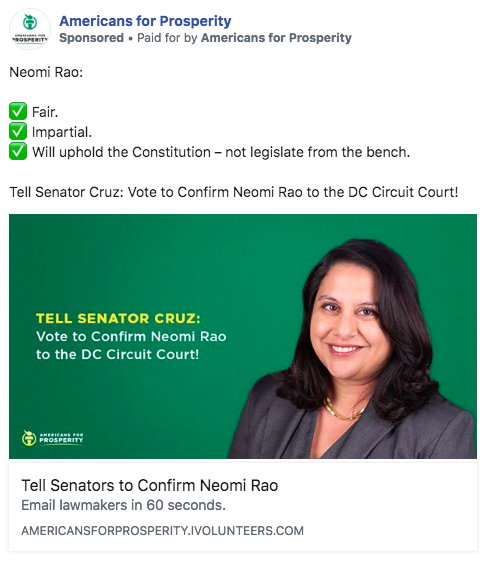 One of Americans for Prosperity’s Facebook ads supporting Neomi RaoFacebook Ad Archive
Americans for Prosperity did not reply to Sludge’s request for comment.
‘Regulatory Obstruction’
The American Constitution Society says OIRA, which is part of the Office of Management and Budget, “has embraced politicized regulatory obstruction (https://www.acslaw.org/acsblog/a-lesson-in-failure-oira-neomi-rao-and-deregulation-at-any-cost/) as its raison dêtre” under Rao. In OIRA’s 2018 report (https://www.whitehouse.gov/wp-content/uploads/2018/10/2018-Unified-Agenda-Cutting-the-Red-Tape.pdf), entitled “Cutting the Red Tape,” Rao writes, “we are working to push back the expansion of the administrative state, which has placed undue burdens on the public and impeded economic growth.”
Under Rao’s leadership, OIRA, has approved sweeping environmental deregulation by the EPA. Koch Industries, which Charles Koch runs, is a giant manufacturing conglomerate with subsidiaries that refine and transport oil, create paper products, and produce chemicals. The company is among the country’s biggest air and water polluters and has paid hundreds of millions of dollars for environmental violations. Koch and his brother David are lifelong libertarians who have fought taxes and regulations for decades.
“Rao has never seen a regulation she didn’t hate, and as a judge would dismantle 40 years of environmental and social progress,” Brett Hartl, government affairs director at the Center for Biological Diversity, said (https://www.buzzfeednews.com/article/zoetillman/trump-nominates-neomi-rao-brett-kavanaugh-seat) in a statement to Buzzfeed News. “Her confirmation would be the most damaging and regressive yet by Trump after Kavanaugh and Gorsuch.”
GMU is by far the biggest recipient of grants from the Charles Koch Foundation (CKF), which gives tens of millions of dollars each year to free-market higher education programs. Since 2005, CKF and the Charles Koch Institute have donated nearly $129 million to GMU, including over $34 million for the free-market Mercatus Center, according to Sludge’s analysis. Another free-market-focused GMU center, the Institute for Human Studies, has received $8.7 million.
The university has come under fire for allowing the CKF to impact hiring decisions (https://www.insidehighered.com/news/2018/05/01/koch-agreements-george-mason-gave-foundation-role-faculty-hiring-and-oversight). In the case of Florida State University, CKF was even allowed to control economics curricula (https://publicintegrity.org/federal-politics/koch-foundation-proposal-to-college-teach-our-curriculum-get-millions/).
AFP isn’t the only Koch-linked group to spend money to influence the judiciary. The Center for Media and Democracy reports that Donors Trust, a donor-advised fund that wealthy conservatives including Koch use to score tax deductions and potentially anonymize their donations to nonprofits, has bankrolled right-wing groups (https://www.prwatch.org/news/2019/02/13449/donorstrust-bankrolled-right-wing-judicial-appointments-trumps-acting-ag-and) such as the Judicial Crisis Network and its sister organization, the Judicial Education Project, which spent millions of dollars on ads supporting the Supreme Court confirmation of Neil Gorsuch. Donors Trust also funds the Federalist Society and, as Sludge recently reported, several Southern Poverty Law Center-designated hate groups (https://readsludge.com/2019/02/19/americas-biggest-charities-are-funneling-millions-to-hate-groups-from-anonymous-donors/).
Related:
Charles Koch Is Funding Rightwing, Pro-Trump Media, New Disclosure Reveals (https://readsludge.com/2018/11/21/charles-koch-is-funding-rightwing-pro-trump-media-new-disclosure-reveals/)
Koch Brothers Continue to Influence Tax Policy After Huge Cuts Last Year (https://readsludge.com/2018/06/18/koch-brothers-continue-to-influence-tax-policy-after-huge-cuts-last-year/)
Koch-Backed SEC Commissioner Claims Corporate Law is in the Public Interest (https://readsludge.com/2018/10/04/koch-backed-sec-commissioner-claims-corporate-law-is-in-the-public-interest/)
Author profile](https://readsludge.com/author/alex/)
Alex Kotch (https://readsludge.com/author/alex/)
Alex is a reporter at Sludge and a contributor to The Young Turks. He was previously part of the award-winning investigative team at International Business Times, and his other work has appeared in T
---
https://www.alternet.org/big-oil-colonized-college-campuses/
no lnx
environmentalists are not hard to find on college campuses, and many of them are sounding the alarm about the dangers of climate change. Terms like "green energy" and "carbon footprint" are not uncommon at universities.
But not everyone who lectures about climate change on campus has a plan for fighting it. In an article published by The Guardian on March 27, journalist Oliver Milman details the fossil fuel industry's efforts to promote its agenda on college campuses.
:{
Milman cites Tim Barckholtz as an example. Barckholtz has lectured extensively at Princeton University in New Jersey about the challenges of moving away from fossil fuels, but he is a scientific adviser for ExxonMobil.}:
READ MORE:'You've got to be kidding me': MSNBC host spooked by revelation that climate change is making fungus deadlier
"Dozens of U.S. universities…. retain links with the fossil fuel industry in a variety of ways, despite the growing pressure on them to cut them," Milman explains. "Several host Exxon representatives on campus and even provide them with office space, similar to Princeton's previous arrangement, a Guardian investigation has found."
Princeton student Claire Kaufman told The Guardian she was "quite shocked" to find out that Barckholtz worked for ExxonMobil.
According to Kaufman, "The fact there was an Exxon employee in this undergrad class blew my mind. It's weird and problematic. He then took the class, but the biggest issue is that public opinion is against Exxon. So, they are looking to install themselves as impartial-looking bodies in classrooms."
The student added, "This is not a neutral industry. It has an agenda; it wants to shape the conversation around climate change and energy. They aren't putting people in classrooms for fun."
READ MORE:'Inequality kills': Author Naomi Klein explains why climate change is an 'economic justice' issue
:{According to Georgia Tech student Evan Montoya, ExxonMobil has a presence on that campus as well.
Montoya told The Guardian, "I see something with Exxon on it once a week, at least. They have a very evident presence on campus. They definitely have a substantial influence here."}:
For decades, the late far-right radio host Rush Limbaugh claimed that climate change was a myth and was a cheerleader for fossil fuels (Limbaugh also claimed that there was no link between cigarettes and lung cancer, which was the cause of his death in 2021). But these days, allies of the fossil fuel industry don't necessarily claim that climate change doesn't exist; instead, they might acknowledge that it's a reality but say that fossil fuels aren’t a major cause.
Milman reports, "Even as elite American universes such as Harvard have bowed to pressure to divest their multibillion-dollar endowments from fossil fuels, and student activists take recalcitrant holdouts to court, oil and gas companies continue to exert a grip upon campus life, through funded research and the physical presence of oil and gas industry employees in lectures and meetings with faculty.Fossil-fuel firms have purposely sought to 'colonize' academia with industry-friendly science, rather than seed overt climate denial, according to Ben Franta, a senior research fellow at the University of Oxford who has studied industry's influence over universities."
READ MORE:Texas agriculture agency: Climate change threatening state's food supply
Read The Guardian's full report at this link.
FROM YOUR SITE ARTICLES
Alexandria Ocasio-Cortez has the perfect response to centrists dragging their feet on climate change action ›
Green energy companies encouraged to sue Tucker Carlson over lie that Texas power grid is 'totally reliant on windmills' ›
Offloading climate responsibility on the victims of climate change ›
RELATED ARTICLES AROUND THE WEB
How Is Climate Change Affecting Floods? - The New York Times ›
How climate change drives floods : NPR ›
What is the 'Green New Deal,' and how would it work? ›
ref guk
https://yyy.theguardian.com/education/2023/mar/27/fossil-fuel-firms-us-universities-colonize-academia
students at Princeton describe unease that Exxon employee had an office on campus, while dozens of universities have big oil links
:{Mon 27 Mar 2023
t}:he lecturer looked, and sounded, the part. Sporting a pale blue shirt and Princeton University ID badge, he had his own office on campus, a short stroll from the room where several dozen students were gathered to hear him confidently talk about the challenges in moving away from fossil fuels.
Tim Barckholtz is not a Princeton professor, however. He is a senior scientific adviser at ExxonMobil, the oil giant that has done so much to both perpetuate and downplay the climate crisis. Barckholtz, an affable figure who has touting its emissions reduction research, spent around six months sitting in and contributing to lectures and research groups, based in his own office space at the elite university.
In September, with the university poised to cut its extensive ties with certain fossil-fuel companies including Exxon, Barckholtz even taught a class of engineering students on “negative emissions technologies”, during which, over pizza and soda, he criticized the divestment decision, warned that the transition away from oil and gas will be “very difficult” and that the unfolding climate emergency was “not our fault”.
“It’s hard for me to figure out who wins [from divestment],” Barckholtz told the class, a recording of it shows. “There are, like, 10 people who win. They are sleeping better at night, but technology is the loser.” Barckholtz then noted that Exxon makes the type of rubber that goes into most car tires. “Are all of the Princeton security cars going to go back to the Flintstones and have no tires?” he asked. “There are some parts of this they didn’t think through completely.”
Asked by a student about the Paris climate agreement, Barckholtz expressed doubt that it could be met, as it was too hard to ditch fossil fuels. “I’m not optimistic, I’m going to call it the way I see it,” he said. “The system is just too big to be flipped.”
“A few of the students thought it was weird he was in the class and that he then taught the class,” said Claire Kaufman, a second year master’s student in public affairs who said she started talking to Barckholtz during one of the first negative emissions technology classes and was “quite shocked” to discover he was an Exxon employee.
Dozens of US universities, however, retain links with the fossil-fuel industry in a variety of ways, despite the growing pressure on them to cut them. Several host Exxon representatives on campus and even provide them with office space, similar to Princeton’s previous arrangement, a Guardian investigation has found.
According to Kaufman, Barckholtz told her Exxon had no interest in renewable energy – aside from, perhaps, offshore wind – beyond using it as a public relations exercise, and that he was looking to fund the work of the professor whose class he sat in. He showed her his Princeton office space, which included a list of a dozen Exxon-funded research projects on a whiteboard.
He later told the class that he was there to “scout out” useful things for Exxon’s nearby research center in New Jersey, and that the company has had someone, like him, monitoring Princeton classes for the previous five years. (In 2015, Princeton said it was “delighted” to forge a new “e-filliates” partnership with Exxon). Barckholtz did not respond to questions from the Guardian over his role at Princeton.
“The fact there was an Exxon employee in this undergrad class blew my mind,” said Kaufman, who is also an organizer at the Divest Princeton group. “It’s weird and problematic he then took the class, but the biggest issue is that public opinion is against Exxon so they are looking to install themselves as impartial-looking bodies in classrooms.
“This is not a neutral industry. It has an agenda, it wants to shape the conversation around climate change and energy. They aren’t putting people in classrooms for fun.”
Barckholtz has since vacated his office, following Princeton’s announcement on 29 September that 90 companies, including Exxon, would not only be divested from its endowment but also would have research funding ties cut, following years of pressure from students for Princeton to follow other major universities in dropping fossil-fuel investments.
But Exxon, which is among a group of oil and gas companies that have funneled more than $700m into research partnerships with leading US universities since 2010, still maintains close ties to dozens of universities, and has a regular on-campus presence at a clutch of prestigious colleges.
At MIT, Exxon is provided office space through its funding of the MIT Energy Initiative research collaboration, and company representatives “come to campus from time to time to meet with principal investigators who are doing sponsored research and student fellows they sponsor”, a university spokesperson said.
Ellie Rabenold, an engineering student and part of the MIT Divest group, said she was unaware that Exxon had office space at her university, and that divestment is a “touchy subject” for members of the faculty that have been bankrolled by various fossil-fuel-funded initiatives. In 2019, an auditorium at MIT was set to be named after Shell, another oil company, until a student and faculty backlash forced a rethink.
Exxon researchers do not have their own office space at Stanford, a university Exxon has given $120m to over the past two decades for climate and energy research, although the company’s researchers are often seen on campus. At other universities, Exxon employees are present at jobs fairs, or as guest speakers or to treat students to meals.
“I see something with Exxon on it once a week, at least.They have a very evident presence on campus,” said Evan Montoya, a third-year student at Georgia Tech. “They definitely have a substantial influence here.”
Even as elite American universes such as Harvard have bowed to pressure to divest their multibillion-dollar endowments from fossil fuels, and student activists take recalcitrant holdouts to court, oil and gas companies continue to exert a grip upon campus life, through funded research and the physical presence of oil and gas industry employees in lectures and meetings with faculty.
Fossil-fuel firms have purposely sought to “colonize” academia with industry-friendly science, rather than seed overt climate denial, according to Ben Franta, a senior research fellow at the University of Oxford who has studied industry’s influence over universities.
Their research dollars, he said, had effectively discouraged academic endeavors that challenge the core business model of burning oil and gas, instead shifting the focus to favored topics such as capturing carbon emissions from polluting facilities, a still niche technology that would allow industry to continue business as usual.
[pix Barckholtz at Princeton in an office and in a university class. Photograph: Divest Princeton
“When you have these companies in class and on campus, it’s like an audition for academics to get research grants,” Franta said. “Sometimes a researcher who’s funded by industry does drift into an anti-industry posture, and then they just cut off their funding. You have professors who will quietly say: ‘I think divestment is a great idea, but I can’t support it because I’ll lose my research funding from oil companies.’
“A standard strategy that industries under threat try is to influence what gets studied and what doesn’t get studied, and how the problem is framed. The tobacco industry did the same thing. For Exxon to have someone with an office at Princeton, and for that person to teach a class, is a shocking example of this.”
The reach of fossil fuels into academia “never ceases to amaze me”, said Robert Brulle, an environmental sociologist at Brown University. “You can barely study climate change at elite universities and not be funded by fossil-fuel companies,” he added. “They drive all this study into carbon capture, so that influences policy and becomes a part of the Biden administration’s agenda. The influence is profound, and the students are right to be wondering what kind of education they are getting here.”
Researchers have stressed that proper academic guardrails ensure no funder dictates outcomes they desire and that important, scientifically sound studies have come from work backed by arm’s-length fossil-fuel interests. Exxon has financed studies and research groups into areas such as carbon capture and dangerous chemical exposures, often alongside other independent researchers.
princeton denies Exxon has had an undue influence over the university’s Andlinger Center for Energy and the Environment,which has received fossil-fuel funding and has produced annual reports in which Exxon expresses gratitude for “access to extraordinary talent and facilities”. Barckholtz sat in some class meetings but “did not play a role in developing the course or its learning objectives”, a Princeton spokesperson said.
Barckholtz was a “fun and productive collaborator” on a project to burn biomass such as forests for energy and capture and bury the resulting emissions, said Eric Larson, a senior researcher at the Andlinger Center. More than a dozen Exxon-funded research projects at Princeton, including work on technologies to offset or capture carbon emissions, will have to be funded by other means itself following the disassociation, a move that Larson considers unnecessary and potentially counterproductive.
“We chose the project, and Exxon was interested enough to support it. My research agenda isn’t impacted at all by who is funding it,” Larson said. “I’m OK with taking Exxon stock out from the Princeton endowment – that’s a way to make a statement – but this was taking research money away from work designed to decarbonize our society as rapidly as possible. We need everyone inside the tent to solve this problem, including the fossil-fuel industry.”
An Exxon spokesperson said that the company “enjoyed a long and fruitful relationship with Princeton, but it has become clear that there are individuals associated with the university who are choosing to put their individual views above the opportunity to accelerate the energy transition we all seek”
Exxon, which has provided more than $10.7m in research funding to Princeton over the past 10 years, had more than 25 research projects with the university, the company spokesperson added.
But even Princeton has not jettisoned all fossil-fuel partners. Its Carbon Mitigation Initiative will continue to be financed by BP, which has given $26.4m to the university over the past decade and does not fall under the precise terms of the divestment, which was only aimed at companies with coal or tar sands assets, rather than all oil firms.
Other oil and gas companies, such as Shell, may even join as partners under these terms in a new “energy research fund”. Princeton’s ties to the industry are deep and historical – letters buried in the university’s library archive show its leadership aggressively courted Exxon in the 1970s, complaining in one instance it has “not received its fair share from Exxon”.One PhD student told the Guardian she was almost certain her work was being funded by fossil fuels, but that she had not received a straight answer from the university over this.
Michael Oppenheimer, a Princeton climate scientist, said he was disappointed the university’s trustees did not enact a divestment broad enough to also evict businesses such as BP, but that it is difficult to criticize researchers for getting funding where they can.
"They have to live with whatever decisions they make. I try to not judge others,” he said. “Personally, I would never take a penny from Exxon due to their disinformation on climate change. You can talk to the devil sometimes, but you don’t have to take to take money from the devil, and the devil is Exxon.”
The presence of carbon-intensive industries in Princeton classrooms has not dissipated, either. Two weeks ago, a class called Oil, Energy and the Middle East featured a guest appearance from Sheikh Nawaf Saud Al Sabah, chief executive of the Kuwait Petroleum Corporation, who told the gathered students that “we are never going to get out of fossil fuels: we need them for plastics and medicine … we are too reliant upon them”, according to Frida Ruiz, a sophomore in mechanical engineering who took the class.
Just before the class, Ruiz was perusing the shared class materials on a Princeton phone app, and saw a professor had posted a cartoon mocking supporters of fossil-fuel divestment, showing them near-naked and befuddled without any of the modern appliances that require fossil fuels.
“I thought, ‘Huh, I guess I now have a sense of what this class is going to be like,’” Ruiz said, adding she heard later it was meant as an example of industry propaganda.
:{
Are you a student at a US university where fossil fuels industry staffers have an on campus presence? If so we would like to hear from you. Contact oliver.milman@theguardian.com
}:
Topics
regular readers of the denier roundup know this already, but former journalist John Stossels is now a leading disinformation producer, regularly featuring fake experts who just-so-happen to be, like Stossel, all Koch’d up.
But today’s COP, Look, Listen provides some new information on Stossel’s conflicts of interest and his latest high-traction disinformation video, which “racked up , 674k views / 23k interactions on FB, and909k view / 21k like on Twitter, where it was also the second most-shared post in the ‘anti-green tech’ narrative. In addition, it is being circulated as text via the Koch-funded disinfo media system, with Reason,the Daily Caller andthe Daily Signal all publishing the piece as op-eds.”
The video was “the first in a series” attacking Electric Vehicles, and “featuresMark Mills of theManhattan Institute, who Stossel fails to disclose has received over $1.3 million from Koch foundations since 2014 – see tax filings of Charles Koch Foundation and Charles Koch Institute for further detail. John Stossel’s brother Thomas is also a former senior fellow at the Manhattan Institute.”
Unsurprisingly, “the 5-minute segment is rife with already-debunked disinformation. Mills claims that it takes mining ‘500,000 pounds’ of minerals to produce an EV battery, a point that has been comprehensively fact-checkedby AFP andUSA Today. He also alleges that the adoption of 500 million EVs would only ‘reduce world oil consumption by about 10%.’ The roughly 16 million EVs on the road already have reduced oil demand by 3.5% in total, so 500 million would certainly lower emissions by more than an additional 6.5%.”
Stossel and Mills want viewers to think EVs are no cleaner than fossil fueled cars, but “Argonne National Laboratoryproduced a model and have a whole page set upto do exactly this calculation. They found that EVs generally emit far less carbon over a 12-year lifespan.'[ani grx]
what’s more, “even in a coal-only grid, EVs come out better for the environment than diesel or petrol alternatives. In addition, a report from the Union of Concerned Scientists found that over their lifetime, EVs produce 50 percent less Greenhouse Gasses than gas or diesel cars. No matter where in the US, an average EV is cleaner than an average gas car, and for 90% of Americans the average EV is better than even the most efficient gas alternative.”
Whoops!
Surely Stossel’s failure to do any sort of journalistic fact-checking of his guest was just an innocent mistake, right?
Perhaps! Maybe Stossel deserves the benefit of the doubt, those of you more kind and forgiving than us may suggest. But consider Stossel’s history, and see if you’re still feeling generous:
Failure to disclose financial conflicts of interest is the norm for Stossel’s content and guests. In 2017, when his company JFS Productions was revealed as a top contractor of the Charles Koch Institute, a syndicated op-ed defended the Koch family from public criticism. In 2022, a two-part video series from Stosel featured Johan Norberg (senior fellow at the Cato Institute) and Texas Tech University professor Ben Powell, who is among those involved in a controversial department that has received over $6.5 million from the Charles Koch Foundation. Powell is also an officer of the Koch-funded :{Association of Private Enterprise Education (APEE:(style="background-color:#ff6600;"):}::{):(style="background-color:#ffffff;"):}:.
In 2019, a Stossel was critically fact checked, prompting him to unsuccessfully sue Facebook for defamation. The video featured a panel consisting entirely of professional climate disinformers affiliated with the Cato Institute, the CO2 Coalition, the Competitive Enterprise Institute (CEI), The Heartland Institute and the Manhattan Institute.
Stossle’s “Center for Independent Thought” is also totally dependent on the same funders of the groups whose representatives he promotes as “other recent donors to Stossel’s Center for Independent Thought include,” Cato and CEI funding Claws Foundation, Cato, CEI and Heartland funding JP Humphreys Foundation, Cato and Manhattan funding Jewish Communal Fund, Cato, CO2 Coalition, CEI, Heartland and Manhattan Institute funding DonorsTrust, and Cat, CO2 Coalition and Manhattan Institute funding Thomas W. Smith Foundation.
Those funders, according to the bulletin, “plus the Charles Koch Foundation, gave a combined total of $1,494,688 to Stossel’s Center from 2019-2020, worth 40% of its $3,783,057 revenue in that two-year period.”
So while “Stossel tries to maintain his image as a reporter, and judging by his large audience across platforms is largely succeeding in that goal. The content itself, however, is far from adhering to journalistic standards from both a factual, ethical and financial standpoint, and should be exposed at every possible opportunity.”
Normally “exposing yourself” is considered a bad thing, but in this context, it’s about the most ethical thing Stossel could do, and the only way to regain any sense of credibility if he actually wanted to be a journalist again.
(Originally appeared at DailyKos)
https://www.zinnedproject.org/if-we-knew-our-history/koch-brothers-want-students-learn-slavery/
adam g -- 2018
given that the billionaire Charles Koch has poured millions of dollars into eliminating the minimum wage and paid sick leave for workers, and that in 2015 he had the gall to compare his ultra-conservative mission to the anti-slavery movement, he’s probably the last person you’d want educating young people about slavery.
Yet the history-teaching wing of the Koch brothers empire is seeking to promote an alternate narrative to slavery, the Civil War, and Reconstruction. The political goal of these materials is to ensure students see racism and slavery as flaws in an otherwise spotless U.S. record, rather than woven into the fabric of our country from its inception.
The Bill of Rights Institute (BRI) is the education arm of the network of front groups the Koch brothers use to promote their far-right ideology. Maureen Costello, the education director from Teaching Tolerance, has pointed out the many factual inaccuracies in the “Homework Help” video the BRI has recently promoted to teach students about slavery. She concludes that the history presented is “superficial, drained of humanity, and neglects to reckon with the economic and social reality of what opponents called ‘the slave power.’”
A dive into their “Documents of Freedom” readings reveals an even more disturbing agenda. The BRI bills the “Documents of Freedom” as a “modern take on the traditional textbook” — a “completely free digital course on history, government, and economics” authored by unnamed “teachers.” It’s essentially an online textbook that aims to promote a particular version of history, government, and economics that aligns with the interests of the Kochs.
 The main “Documents of Freedom” reading on slavery, titled “Slavery and the Constitution,” is essentially a defense of the founding fathers and the Constitution against “some scholars” who “portray the founding fathers as racists.” The reading cherry-picks quotes from “the Founders” to argue that they believed slavery was morally wrong. Although the authors write that “most of the signers of the Declaration and the Constitution own[ed] slaves,” they steer clear of the brutal reality of chattel slavery.
They paint Thomas Jefferson as an anti-slavery crusader who “attacked the slave trade in harsh language” and “included African Americans in the universal understanding of the promise of liberty and equality.” But the Kochs’ curriculum fails to mention that Jefferson wrote Black people were “inferior to the whites in the endowments both of body and mind.” Jefferson kept nearly 200 people in bondage, and even in his death emancipated only five. He regularly sold human beings away from their families to raise money to buy wine, art, and luxuries that only wealthy planters could afford. Nothing in the BRI reading acknowledges any contradiction between “the Founders’” awareness of “the immorality of slavery and the need for action” and their actual actions defending and protecting slavery.
Furthermore, the reading justifies the so-called three-fifths compromise — whereby an enslaved person was counted as three-fifths of a person for the purpose of congressional representation — by arguing “the Founders” had to make a “prudential compromise with slavery because they sought to achieve their highest goal of a stronger Union of republican self-government. Since some slaveholding delegations threatened to walk out . . .” Not only is this type of “compromise” immoral, but the problem with this logic is that the “slaveholding delegations” that threatened to walk out were themselves “Founders” who played an important role in crafting the Constitution.
In addition to selectively quoting the founders, the authors use quotations from Frederick Douglass and Abraham Lincoln to bolster their argument that the Constitution was an anti-slavery document. It ignores that most politicians, including Lincoln, believed that the Constitution protected slavery where it existed. It also ignores the very large wing of the abolitionist movement, whose most prominent figure was William Lloyd Garrison, that viewed the Constitution as a “devil’s pact,” one “dripping with blood.” Douglass himself was part of that wing of the movement until he broke with Garrison in the 1850s, when he became convinced that framing the Constitution as an anti-slavery document could be a useful tool in the struggle to end slavery.
 The reading also ignores how central slavery was to the economic growth of the United States, with phrases like “the number of slaves steadily grew through natural increase.” Natural? There was nothing natural about the expansion of slavery. Slavery expanded because it was profitable. The authors seek to divorce the expansion of slavery from the economic design of the capitalist cotton empire and from the horrific practice of breeding, which became a large source of revenue, especially for Virginia slaveholders.
What is most egregious is what the reading leaves out. Even today’s corporate textbooks will include a paragraph or two that attempt to provide the perspective of enslaved people. However, this reading concludes by arguing there was a steady “rise of freedom” after the Constitution because “the new nation was mostly bent on expanding liberty and equality.” The only way the Koch brothers’ Bill of Rights Institute can draw this conclusion is by completely ignoring the perspective of those whose land and labor were violently stolen by the wealthy U.S. elite.
As if that reading wasn’t bad enough, the follow-up reading, titled “Civil War and Reconstruction,” is a long, boring account that almost exclusively focuses on the battles between Radical Republicans in Congress, who the authors claim wanted to “punish the South,” and Presidents Lincoln and Johnson, who favored more “moderate” reconstruction plans. It might be the first reading I’ve ever looked at on Reconstruction that makes almost no mention of what Black people were doing during the era and barely discusses anything happening in the South.
Only in a pro-KKK film like *Birth of a Nation* and in the Koch brothers’ curriculum is Reconstruction reduced to a punishment for white Southerners. Let’s look at Reconstruction from the standpoint of those who were freed from more than 200 years of enslavement. It was a time when the formerly enslaved became congressmen; when the Black-majority South Carolina legislature taxed the rich to pay for public schools; when experiments in Black self-rule in the Georgia Sea Islands led to land reform, new schools, and a vital local governance. During Reconstruction Blacks and poor whites organized Union Leagues, and led strikes, boycotts, demonstrations, and educational campaigns. During this period other social movements, especially labor and feminist movements, were inspired by the actions of African Americans to secure and define their own freedom.....
texas tech econ ~ ag-econ, 2 others nix till yes; fac finds out about ctr when press announce; offer $ can't refuse
u kty fac vote no 2x, GMU ~ fac new ctr
kochademia double $ in 3 yrs, 2x # campus ?! exponential?! // koch corp $?
grad fellowships, pick fellows and diss topics?! WCU and wakefield ~
80 min AAAS?
https://www.youtube.com/watch?v=Vrz4nBRH4nw
Ralph Wilson senior researcher at UnKoch My Campus was invited to give a presentation to students and faculty of Wake Forest University, Jan 30, 2017, entitled "Are the Koch's a threat to higher education and Wake Forest?"
chris hedges AA woman guest 6/23/21? laughs at it CRT taking over unis, economics maybe ~ kochademia? law and econ ctr cf
kochademia 100M$
https://www.exposedbycmd.org/2020/11/23/koch-funding-of-universities-topped-100-million-in-2019/
...gmu $17,608,073
Institute for Humane Studies, George Mason University $4,957,124
Florida State University $4,518,000
Arizona State University Foundation $3,212,641
New York University $3,017,956
Rice University $3,000,500
Utah State University $2,500,000
North Dakota State University Foundation $2,436,000
Southern Methodist University $2,386,618
Catholic University of America $1,971,283
Montana State University-Bozeman $1,642,250
Duke University $1,554,415
Claremont Graduate University $1,477,214
Texas A&M University Foundation $1,525,160
University of Florida Foundation $1,379,625
Indiana University $1,171,903
Ohio State University & Foundation $1,138,301
University of Pittsburgh $1,120,000
University of Notre Dame $1,115,641
University of North Carolina-Chapel Hill $1,106,500
...
==
...The importance of the Walgreen Foundation’s support raises a counterfactual: would these scholars have enjoyed prominent careers without that financial assistance? Like all counterfactuals, the conclusion must be speculative. Certainly, many of the scholars at the University of Chicago who received funding from the Walgreen Foundation (such as Posner and Becker) may well have had brilliant academic careers even if the Walgreen Foundation and the Graduate School of Business had never existed. However, this misses the point: the success of George Stigler’s Walgreen-funded project created a scholarly network and a financial infrastructure with which to promote their pro–free market ideas. Without Walgreen’s support, that may well have been more difficult.
CASE STUDY II: HENRY MANNE AND LAW AND ECONOMICS
The success of Stigler’s project can be understood within the context of a broader conservative philanthropic movement that built upon past victories. Before Stigler constructed an antistatist economics and business program at the University of Chicago, Keynesians (who supported muscular state interventions in the economy) tended to dominate economic thought in the United States. The most prominent economists and economics programs in America (e.g., Paul Samuelson, who served as an economic advisor to John F. Kennedy and Lyndon Johnson and built MIT’s economics department into a powerhouse) predominantly belonged to the Keynesian tradition.11 Stigler’s antistatist economics program not only allowed for the transformation of economics programs throughout American higher education, but provided academic support for the conservative transformation of the law. Steven Teles’s (2008) book on the development of the conservative legal establishment, The Rise of the Conservative Legal Movement: The Battle for Control of the Law, strongly emphasizes the Chicago school’s importance in the creation of the field of “law and economics” in the 1970s. “Law and economics” is, essentially, the application of economic analysis—specifically economic analysis rooted in the Austrian school’s free market philosophy—to public policy and legal questions.12 Not every early attempt to institutionalize conservative legal and economics programs was as successful as Stigler’s. Henry Manne, whom Teles calls one the great organizational entrepreneurs of law and economics, attempted to build a dedicated conservative law program at the University of Rochester in the late 1960s by cultivating conservative alumni and foundation support.
...
CASE III: THE OLIN FOUNDATION AND THE BEACHHEAD THEORY
Although a dense network of conservative philanthropic foundations—including the Lynde and Harry Bradley Foundation, the Scaife Foundations, and the Charles G. Koch Charitable Foundation—became prominent funders of right-wing causes in the 1970s and early 1980s, the John M. Olin Foundation has received the most scholarly attention for the following three reasons: (1) it was one of the first conservative foundations to focus on giving in higher education to achieve its political aims, (2) its peer institutions considered it an innovative leader in right-wing philanthropic giving, and (3) it has actively supported studies that highlight its history and mission. Such studies include John J. Miller’s official history of the foundation, A Gift of Freedom: How the John M. Olin Foundation Changed America, and Steven Teles’s more neutral The Rise of the Conservative Legal Movement, both of which received support from Olin Foundation grants. 17 Scholars and philanthropic officials have centered these points (particularly its reputation for innovation) in criticisms of the Olin Foundation’s politics (Sally Covington’s Moving a Public Policy Agenda, for example, devotes one of its major case studies to the foundation because of its reputation for innovation and impact).
Given the success of the Olin Foundation’s projects and of its broader vision of promarket social change rooted in college and university campuses, this reputation is well deserved.18 John M. Olin, whose Winchester Repeating Arms Company made a fortune during World War II manufacturing arms and ammunition for the US Army, was not the first right-wing billionaire to establish a dedicated philanthropic foundation in their name (Henry Ford, John D. Rockefeller, and even the comparatively less wealthy Charles Walgreen preceded him). But Olin was concerned that “mission creep” had set in at the major establishment philanthropic organizations, leading them to betray their founders’ promarket ideals. He was determined to avoid the same fate, and to ensure his money was tied to meaningful institution-building and political change. The Olin Foundation was therefore designed to have a limited lifespan: Olin died in 1982, and the foundation folded in 2005 after having disbursed nearly $300 million to conservative causes.19
...
CASE IV: THE KOCHS AND GEORGE MASON UNIVERSITY
The Koch Family Foundations took a similar approach to Olin, except that unlike Olin, the Koch foundations funded “Gramscian” and “Fabian” strategies simultaneously. As of 2015, the Kochs had spent nearly $150 million funding academic programs at no fewer than 307 higher education institutions. In fact, they dedicated $50 million to a single flagship campus in the Koch system: George Mason University.34 How GMU became a Koch campus—or rather, how the Kochs became the major financial backers of several of the school’s promarket research centers, along with its economics department and law school—is worth exploring in detail. The Kochs’ approach to philanthropic giving is similar to Olin’s in important ways, among them the committed ideological vision, the importance of
...
CASE V: THE FEDERALIST SOCIETY
Institutions created by conservative philanthropy in higher education can have profound political, social, and cultural influence. The most influential of these institutions is the Federalist Society, founded as a group for conservative law students in 1982. The Federalist Society has given educational and social support to a generation of right-wing judges, attorneys, and legal scholars. The landmark cases settled by a conservative-leaning Supreme Court in the past decade—Citizens United v. FEC, Shelby County v. Holder, Janus v. AFSCME, and Trump v. Hawaii 46—would have been considerably more difficult for conservatives to win without the Federalist Society’s influence, not least because Chief Justice John Roberts and Associate Justices Samuel Alito, Neil Gorsuch, Brett Kavanaugh, the late Antonin Scalia, and Clarence Thomas are all Federalist Society alumni. One opinion columnist has called the Federalist Society the “farm system for the [judiciary],” ensuring the ideological reliability of judicial appointees and preventing missteps like Richard Nixon’s appointment of Harry A. Blackmun (who wrote the majority opinion in Roe v. Wade) to the Supreme Court or George H.W. Bush’s appointment of David Souter (who was identified with the court’s liberal faction for most of his career).47 Although the media
...
CASE V: UNDERGRADUATE STUDENT GROUPS
Although the Federalist Society and conservative domination of the legal system represent conservative philanthropy’s most consequential achievements, other kinds of higher education philanthropy have contributed to right-wing political success. Conservative activists and philanthropists have underwritten right-wing undergraduate student activism that advocates free market ideology on college campuses. One of the earliest organized efforts was Young Americans for Freedom, founded by a group of some 90 young activists at conservative publisher William F. Buckley Jr.’s Connecticut estate in September 1960.55 (Young Americans for Freedom is not to be confused with Young America’s Foundation, discussed below. For clarity, I refer to both organizations by their full names...
notes: 54Maxine Joselow, “Is George Mason the New Trump U?” E&E News, July 17, 2018, https://www.eenews.net/stories/1060089361; “Tracking Deregulation in the Trump Era,” Brookings Institution, January 16, 2019, https://www.brookings.edu/interactives/tracking-deregulation-in-the-trumpera/. 55 There are three scholarly treatments of Young Americans for Freedom by historians. These are Gregory L. Schneider’s Cadres for Conservatism: Young Americans for Freedom and the Rise of the Contemporary Right (New York: New York University Press, 1999), John A. Andrew’s The Other Side of the Sixties: Young Americans for Freedom and the Rise of Conservative Politics (New Brunswick, NJ: Rutgers University Press, 1997), and sociologist Rebecca E. Klatch’s A Generation Divided: The New Left, the New Right, and the 1960s (Berkeley: University of California Press, 1999). There are also a handful of accounts from conservative pundits involved in Young Americans for Freedom, notably William F. Buckley Jr.’s Flying High: Remembering Barry Goldwater (New York: Basic Books, 2008) and Wayne J. Thorburn’s (former executive director of Young Americans for Freedom) A Generation Awakes: Young Americans for Freedom and the Creation of the Conservative Movement (Ottawa, IL: Jameson Books, 2010). ]]
It should also be noted that Young America’s Foundation and Leadership Institute alumni have gone on to prominent positions in the American Right in the 2010s,including White House advisor and architect of the Trump administration’s draconian immigration policy Stephen Miller (Young America’s Foundation) and media provocateur James O’Keefe (Leadership Institute). 65
This poses another counterfactual: would a similar conservative leadership cadre have developed absent support from organizations like Young America’s Foundation and the Leadership Institute? Ultimately, it seems unlikely that conservative organizations operating independently on college campuses without any kind of overarching political and financial coordination would have developed such a wide-ranging and politically disciplined leadership class. For instance, the broad support that conservative philanthropy has provided to conservative firebrand Dinesh D’Souza, now a bestselling author, suggests that a vibrant conservative ecosystem, both on and off campus, is crucial for cultivating conservative leaders. The Olin Foundation and the Institute for Educational Affairs first supported D’Souza through his right-wing campus newspaper, Dartmouth Review, in the early 1980s. After graduating from Dartmouth, D’Souza secured a John M. Olin Fellowship at the American Enterprise Institute, where he helped popularize the phrase “political correctness” to decry early 1990s campus culture. It seems fair to say that D’Souza owes much of his success to Olin, which can likely be said for many lesser-known conservative thinkers and writers who have reliably promoted free enterprise and procapitalist views.66
CONCLUSIONS AND RECOMMENDATIONS
A survey of the literature on conservative philanthropy in higher education yields the following key themes: The importance of dense networks to achieve immediate and long-term goals. Michael Joyce, a senior official at the Olin Foundation and later the head of the Bradley Foundation, called this the “wine collection” effect; I refer to it as the career pipeline. This pipeline is a way for foundations to invest in conservative figures when they are students or scholars, who mature and eventually contribute to rightwing politics off campus.67
This was the Olin Foundation’s stated goal when it supported writers and activists like Dinesh D’Souza. But it was also a goal of institution-building on college campuses. Multiple foundations funded overlapping efforts at colleges and universities across the United States to establish centers for right-wing thought, and those efforts operated cumulatively over time. The creation of a center of conservative economic thought at the University of Chicago allowed for future successes; even failed attempts like Manne’s entrepreneurship at Rochester and Emory reaped results under different circumstances at George Mason.
The establishment of conservative student groups, from the Federalist Society to undergraduate conservative newspapers, provided a pipeline of talent to these institutions and, in the case of the Federalist Society, eventually provided financial support. Identifying faculty organizational entrepreneurs and sympathetic administrators. From an operational standpoint, this was a critical component of the eventual establishment of conservative centers on campus. When any of the three ingredients (dense networks of donors, dedicated organizational entrepreneurs among faculty, and a sympathetic administration)were lacking—as at the University of Rochester in the 1960s and Emory University in the 1980s—the institution-building efforts failed.
When those three ingredients were present, as they were at Harvard in the late 1980s and George Mason University since the 1970s, the transformations could be profound.The Koch network at George Mason would never have been as successful as it has been without the collaboration of faculty and administrators. A corollary to this is the importance of overcoming institutional resistance. There has been tremendous resistance in the academy to right-wing philanthropy. Three of the right-wing efforts discussed in this review—at the University of Chicago in the 1940s, the University of Rochester in the 1960s, and Emory University in the 1980s—were unsuccessful because of faculty or administration resistance; the successes were possible when support from faculty and, above all, administration was forthcoming.
see shukla, butler, barre seid
https://usrtk.org/food-for-thought/trevor-butterworth-spins-science-for-industry/
STATS GLP entine split?
Koch Industries / George Mason University Foundation
Charles Koch, CEO of the petrochemical conglomerate Koch Industries, gave over $100 million to 361 college campuses from 2005 to 2014, according to a Greenpeace analysis of IRS filings. The George Mason University Foundation, which received $45.5 million, was by far the largest beneficiary of this largesse.
Students at GMU raised concerns about Koch funding in a 2014 letter to the GMU president, noting that the university has been “criticized as being a subsidiary of Koch Industries.” In response to a public records request for information about Koch funding, the students “were told that all financial donations are funneled through the GMU Foundation, which does not have to respond to our FOIA request as a distinct private entity.”
The GMU Foundation funded STATS sister organization CMPA $220,990 in 2012, and $75,670 in 2013, according to tax records. In those years CMPA also helped finance STATS. In 2012, STATS reported a $203,611 loan from CMPA that “due to inadequate funding” has “not been reimbursed.” In 2013, STATS reported a loan from CMPA for $163,914.
Tax records for 2014 show no loans between the groups or donations from GMU Foundation. CMPA’s 2014 tax filingshows compensation of $97,512 for Butterworth and $173,100 for Jon Entine, a longtime public relations operative with deep ties to the chemical industry, who runs the Genetic Literacy Project, an agrichemical industry front group.
Wholly Independent?
guess who? pow satire fail brett k
no lnx
$10M gift from Koch brothers rejected by N.Y. college over 'political correctness'
STORY TOPICS
BUSINESS_FINANCE
EDUCATION
MITCHELL LANGBERT
BROOKLYN COLLEGE
By Douglas Ernst - The Washington Times - Tuesday, June 24, 2014
Brooklyn College reportedly turned down an $10 million grant from the Koch brothers, and one professor at the CUNY college says it’s because of politics.
“It’s political correctness. It’s intolerance about anyone who doesn’t toe the left-wing line,” said Mitchell Langbert, the associate professor of business and deputy chairman for business at Brooklyn College, the New York Post reported.
The professor is so livid that the university would turn down the successful businessmen that he wrote a letter to the state Senate Education Committee saying, “The Charles G. Koch Foundation has repeatedly called Brooklyn College and me personally with an offer of as much as a $10 million grant. … This grant would have been considerably larger than any that I have seen in my nearly quarter-century of teaching.”
SEE ALSO: MSNBC’s Lawrence O’Donnell gives thanks — to David Koch
Mr. Langbert said the decision to reject the $10 million grant was made by CUNY School of Business Dean William Hopkins, the Post reported.
“I have never seen a dean not interested in a $10,000 grant, much less a $10 million one,” Mr. Langbert said.
School spokesman Jason Carey told the paper, “We have neither received an offer from, nor submitted a proposal to the Koch Foundation at this time for the business school.”
==
https://www.theatlantic.com/education/archive/2015/10/spreading-the-free-market-gospel/413239/
https://theconversation.com/why-some-public-universities-get-to-keep-their-donors-secret-129309
April 2018, the public learned that George Mason University had let the Charles Koch Foundation have a say in the hiring and review of faculty. The revelation confirmed long-held suspicions that Virginia’s largest public university was susceptible to pressure from wealthy people who make big donations to a foundation that solely exists to support the school.
The news also raised more questions. For example, how was the school able to conceal the strings-attached gift agreements for years? Do other public universities have similar arrangements, in which donations flow not to them, but to affiliated foundations?
Most importantly, do these foundations give donors a legal right to shape a public institution of higher education without public oversight if they so choose?
As a journalist-turned-professor who researches the tension between privatization and the public’s right to know, I can tell you the vast majority of public colleges and universities have separate foundations that exist to receive and manage their private donations. And unless state lawmakers do more to address the transparency status of these foundations, I’m concerned there are few ways to detect the kind of influence allowed at George Mason.
The George Mason case
Transparent GMU, a student advocacy group formed in 2013, had tried for years to access the Koch agreements under Virginia’s Freedom of Information Act (VFOIA). The group suspected that, like Florida State University, George Mason might be trading academic influence for Koch dollars.
The group’s VFOIA requests were denied on the basis that the George Mason University Foundation possessed the agreement records and, as a private entity, did not have to share them.
Transparent GMU sued the foundation in 2017. The group argued that because the nonprofit accepts, disburses and administers funds for the sole benefit of a public university, it should be subject to VFOIA requests just like the university.
More than a year later, while the case was still pending, the university released the agreements and acknowledged that allowing donors to influence faculty decisions “falls short of the standard of academic independence we should expect in every gift.”
In the wake of the scandal, in May 2019 the university revised its gift acceptance policy. The university now accepts conditions attached to a private donation in writing, which makes them part of the public record. The Charles Koch Foundation also announced that it will now make public all multi-year agreements with colleges and universities.
But Transparent GMU ultimately lost its court challenge. In a unanimous decision that leaves no path for appeal, the Virginia Supreme Court ruled Dec. 12 that as a privately held corporation with its own bylaws, the George Mason University Foundation is not a public body. Therefore, it’s not obligated to disclose records.
State by state
Unless it’s related to the federal government, public information access is regulated state by state under individual Freedom of Information laws. Each state defines in its own way what constitutes a public body, public records and public meetings.
Only Nevada explicitly defines university foundations as governmental entities under its public records act. A handful of other states, including Colorado, Georgia and Minnesota, have laws dictating that foundations disclose certain financial records while still remaining private. In most cases, even in Nevada, donor identities remain confidential.
Virginia’s Freedom of Information Act applies to public agencies, bodies supported wholly or principally by public funds, and entities “of the public body created to perform delegated functions of the public body.”
The state Supreme Court cited the Webster’s dictionary definition of the word “of” in deciding the George Mason foundation wasn’t a product “of” the university, even though it exists to support that school, pays the majority of the president’s salary, operates on campus, is part of the GMU website and staff directory, and is considered a “component unit” in university accounting.
“Had the General Assembly intended the unreserved inclusion of nonprofit foundations, that exist for the primary purpose of supporting public institutions of higher education, as public bodies under VFOIA, it could have so provided, but it has not,” Justice Cleo Powell wrote. “Policy determinations of this nature are peculiarly within the province of the General Assembly, not the judiciary.”
California case
Courts in other states have followed the same logic. In 2001 a California appellate court found that the California State University, Fresno Association, a nonprofit that operates the university’s commercial enterprises, wasn’t a public agency under the state’s Public Records Act (CPRA).
The court looked at the language of the law, weighed it against the spirit of transparency, and saw a puzzling gap.
“We are fully cognizant of the fact that our conclusion seems to be in direct conflict with the express purposes of the CPRA ‘to safeguard the accountability of government to the public,’” Justice Rebecca Wiseman wrote. “The Legislature’s decision to narrowly define the applicability of the CPRA, balanced against its sweeping goal to safeguard the public, leaves us scratching our judicial heads and asking, ‘What was the Legislature thinking?’”
But courts don’t act as super-legislatures to determine the wisdom or propriety of statutes, she continued. “The rewriting of a statute is a legislative, rather than a judicial function, a practice in which we will not engage.”
Ten years later, California passed a law that makes university foundations’ financial records, contracts and correspondence subject to public disclosure.
Under the Richard McKee Transparency Act of 2011, donors can remain anonymous unless they receive something in exchange that’s worth more than $2,500 or a no-bid contract within five years of the donation, or if they attempt to influence university curriculum or operations....
==
Trump supporters throwing the term “coup” around, French emphasizes, aren’t even using it correctly.
“A coup is an unlawful, often violent seizure of power,” French explains. “Impeachment is a constitutional process that can’t succeed without the affirmative votes of, first, a majority of the House, and then, a supermajority of the Senate — and every person voting is a person who won an election, also according to constitutional process. Impeachment isn’t the dissipation of constitutional government, it’s the exercise of constitutional authority.”
Another talking point on the “Trumpist right,” French points out, is the claim that under the Sixth Amendment to the U.S. Constitution, Trump has the right to confront the whistleblower — a claim that is ludicrous, he says, because the Sixth Amendment deals with criminal prosecutions, not an impeachment in Congress. And French laments that even Steven Calabresi, a conservative legal scholar who teaches law at Northwestern University, has referenced the Sixth Amendment to defend Trump.
“The scope and reach of the Sixth Amendment has been extensively litigated, and it most assuredly does not apply to the House’s impeachment inquiry,” French emphasizes. “One can certainly make a good-faith argument that maintaining the whistleblower’s anonymity is unfair, but to argue that it violates the Sixth Amendment is simply and plainly wrong.”
https://www.desmog.co.uk/2019/09/19/koch-network-structure-social-change-kill-electric-car
quite long, kochademia, this is actually big pix?
If it feels like the oil industry’s attacks on the burgeoning electric car market are well coordinated, that’s because they are. The industry is following a blueprint laid out decades ago, and refined ever since, by Koch network insiders.
In a revelatory article, published in Philanthropy Magazine in 1996, an executive vice president of Koch Industries named Richard Fink laid out a three-tiered integrated strategy for promoting libertarian ideals and free-market principles, and, in doing so, protecting the Kochs’ sprawling petrochemical refining and shipping businesses.
Fink, who also led the Charles Koch Foundation, described the strategy for investing the Kochs’ fortunes through grants and financial support to organizations and individuals at different stages of policy development and implementation, from universities to think tanks to advocacy groups, all of which, in Fink’s words, “present competing claims for being the best place to invest resources.” Rather than prioritize grantmaking to one of these levels, the Koch network has invested heavily in all three.
Describing this “Structure of Social Change,” Fink writes:
“At the higher stages we have the investment in the intellectual raw materials, that is, the exploration and production of abstract concepts and theories. These still come primarily (though not exclusively) from the research done by scholars at our universities …
In the middle stages, ideas are applied to a relevant context and molded into needed solutions for real-world problems. This is the work of the think tanks and policy institutions …
But while the think tanks excel at developing new policy and articulating its benefits, they are less able to implement change.Citizen activist or implementation groups are needed in the final stage to take the policy ideas from the think tanks and translate them into proposals that citizens can understand and act upon.”
Today, as the federal and state governments consider their roles in accelerating adoption of electric vehicles (EVs), particularly in light of the climate crisis, we can see the effectiveness of these investments play out in the public policy debates.
Whether through highly-coordinated attacks on the federal EV tax credit or interventions in arcane proceedings in state public utility commissions (PUC) — and through public and covert efforts to spread disinformation — the beneficiaries of the Kochs' strategic funding are working to slow the transition to zero-emission, plug-in vehicles, effectively preserving the market demand for the refined petroleum products the Koch empire is selling.
Academia: The 'Intellectual Raw Materials' for the EV Fight
The Koch network has spent decades investing in colleges and universities, often times funding faculty positions or free market centers and programs and staffing them with ideologically aligned academics. In recent years, this funding has come under considerable scrutiny, and much has been reported on the strings attached to funding of programs like the Mercatus Center at George Mason University, the Center for Growth and Opportunity at Utah State University, and the Department of Economics at Florida State University.
By design, this is an “investment in the intellectual raw materials,” as Fink wrote, “that is, the exploration and production of abstract concepts and theories.”
The abstract nature of such academic exploration makes it a little harder to see the impact of the Koch network’s investments in universities on a single policy issue as discreet as transportation electrification. But not impossible.
...
Indeed, some of the Kochs' chosen academics and Koch-funded centers have spoken publicly to the issue.
One of the most visible academic figures arguing against the federal EV tax credit is Veronique de Rugy, a Senior Research Fellow at the Mercatus Center. Last fall, as Congress considered a couple of opposing bills — a bipartisan proposal to extend the tax credit and another to cancel it — de Rugy railed against the tax credit in an op-ed.
It’s worth noting that the bill to eliminate the credit was introduced by Senator John:{ Barrasso:(style="background-color:#ffff66;"):}: of Wyoming, the third largest recipient of Koch Industries donations in the Senate, and that Koch Industries formally lobbied for Barrasso’s bill. De Rugy wrote that “Barrasso's proposal makes the tax code simpler and less distortionary, making it the most economically sound.”
Earlier this year, de Rugy wrote another op-ed bashing the bipartisan support for the federal EV tax credit, and describing the consumer tax incentive as a “corporate handout.”
Another Mercatus Center economist, Matthew Mitchell, publishes frequently on the subjects of government favoritism and privilege, making the popular free-market argument that the government shouldn’t support private industries through fiscal policies like tax preferences, loan guarantees, and direct subsidization.
Curiously, Mitchell never writes of the massive subsidies enjoyed by the mature oil and gas industries, which the U.S. treasury has calculated out to $4.7 billion per year. Nor does he take issue with the more than $500 million that Koch Industries itself — the second largest private company in the U.S. — has benefited from over the past two decades, according to the Subsidy Tracker built by Good Jobs First. Mitchell does, however, use Tesla as a “beautiful illustration of the problem of favoritism and crony capitalism” in a video he narrates for the Federalist Society, and in a number of related articles.
It’s more common for Koch-funded academics to influence the EV policy discussion indirectly, through the “abstract concepts and theories” that Fink described or through other related issues.
The gasoline tax provides a good example. The Koch network opposes any increase to federal or state gas taxes, for obvious reasons — the taxes would make Koch Industries’ refined petroleum products more expensive (and make alternatives like mass transit and electric cars more attractive). However, gas taxes typically fund roads, and gas tax revenues are dwindling as they haven’t kept pace with inflation and cars have gotten far more fuel efficient.
[omg pix:
Koch Student Commons, on the ground floor of the University of Kansas' business school. ]
The Koch network is actively pushing the argument that electric vehicles, which don’t pay a gas tax, are to blame for highway funding shortfalls, despite vast evidence to the contrary. Some states have enacted special EV fees to bolster highway funds, and Senator Barrasso is spearheading an effort to create a new fee at the federal level. This despite a recent report by Consumer Reports which found that the majority of these fees are punitive in that they charge plug-in drivers more than the equivalent that gas-powered cars would generate in gas taxes annually.
Even so, some Koch-funded academics have argued recently against raising gas taxes, while taking shots at electric cars. Writing in the Orange County Register last year, a professor and research fellow from Utah State University’s Koch-funded program claim that “The decline in gas-tax revenue caused by the shift away from internal-combustion engines is stressing the highway trust funds in many states,” adding that some states now “charge special fees for electric-car owners to compensate for the lost revenue.”
Similarly, in a recent op-ed in :{Forbes:(style="background-color:#ffff66;"):}:, Adam Milsap, the associate director of the Koch-funded L. Charles Hilton Jr. Center for the Study of Economic Prosperity and Individual Opportunity at Florida State University, writes that “the gas tax is not the long-term funding answer” for road funds. While Milsap doesn’t promote a fee for EVs, he does portray them as a growing part of the problem. Milsap is, to borrow Mitchell’s phrase, “a perfect illustration” of the Koch-funded higher ed ecosystem.
In a 2014 panel on “Leveraging Science and the Universities” at the Koch Freedom Partners donor summit session, Milsap described how Koch-funded programs — like George Mason University's Mercatus Center and the Institute for Humane Studies — trained him to cultivate a “new talent pipeline” for all levels of the Koch network. He also described how academics should use all “viable mediums,” including “major Republican blogs, op-eds, and policy briefs” to spread ideas to a broader, more popular audience, as he regularly does on Forbes and in other outlets.
Think Tanks: Translating Free Market Ideas to EV Antagonism
Fink described the role of think tanks as translating ideas into actual solutions and policy proposals. Here, at this stage, “ideas are applied to a relevant context and molded into needed solutions for real-world problems.”
The role that think tanks and policy institutions play in fighting against EV-friendly policies cannot be overstated, as they develop and push deceptive talking points about electric cars into the public policy debates, and even produce reports and “studies” that cherry-pick data to promote a burn-more-gas agenda.
As Elliot Negin of the Union of Concerned Scientists wrote, “these think tanks and advocacy groups essentially function as public relations arms for their benefactors, representing their interests under the guise of being neutral, albeit conservative, policy shops.”
Negin references a September 2018 letter, which DeSmog also reported extensively on, that reveals the breadth of the Koch think tank influence in the debate over the federal EV tax credit. The letter, signed by 30 self-described “conservative free-market organizations” — the majority of which have clear ties to Charles Koch and Koch Industries through their funding or leadership — called for Congress to halt the expansion of the EV tax credit, or to eliminate it entirely.
If there is a central hub of the Koch network’s think tank efforts, it appears to be the American Energy Alliance (AEA), which organized the letter to Congress.
The AEA is the advocacy wing of the Institute for Energy Research, both of which receive Koch funding. Both groups are lead by Tom Pyle, who has a long history of working with and for the Koch brothers and Koch Industries. He was the top lobbyist at Koch Industries, and then later as a private lobbyist, he lobbied on behalf of Koch Industries and the National Petrochemical & Refiners Association (now theAmerican Fuel & Petrochemical Manufacturers), of which Koch Industries is a core and influential member.
The AEA has been consistently vocal in its opposition to the electric vehicle tax credit, and in June released a now-annual deceptive push poll that relied on demonstrably false data and leading questions to allege that Americans don't support the tax credit.
Joining Pyle in signing the letter were representatives of another 29 organizations, at least 17 of which have clear, demonstrable ties to the Koch network.
There's the “Action” arm of the Koch-funded corporate bill mill the American Legislative Exchange Council (ALEC) and the Competitive Enterprise Institute (CEI), a conservative advocacy group dedicated to “economic freedom” that has received funding from ExxonMobil, Texaco, and the family foundations of both Koch brothers.
Then there's American Commitment, run by Phil Kerpen, a former vice president of Americans for Prosperity (founded and funded by the Kochs). And don't forget Less Government, an “organization dedicated to reducing the power of government and protecting the First Amendment from governmental assault,” founded and run by Seton Motley, staunch Koch defender, who is also a policy adviser to the climate science-denying Heartland Institute, which has received millions in grants from Koch family network foundations.
And there's Frontiers of Freedom, run by George Landrith, a group which has received significant funding from Koch network foundations and dark money organizations like DonorsTrust, and which launched an offshoot calledthe Energy Equality Coalition to battle against the federal electric vehicle tax credit.
Besides collaborating on the occasional letter to Congress, representatives from these groups regularly reach out into the public sphere to influence public opinion and bend political will.
When the Energy Equality Coalition launched, one of the group's board members, George Landrith, told The Weekly Standard, “Working-class people are paying taxes to subsidize luxury goods for the richest among us … We believe there should be energy equality, not special treatment for the wealthy.” Landrith’s comment anticipated a talking point that would become a favorite of the Koch network, one that has been repeated dozens, if not hundreds, of times in op-eds and commentaries penned by Koch reps.
Over a two-month span after Senator Barrasso introduced his bill to eliminate the EV tax credit last fall, a flurry of such pieces hit the presses. In December 2018, Jonathan Lesser of the Manhattan Institute (which has received more than $2.6 million from Koch foundations) tried to paint the EV tax credit as “inequitable” in Investors Business Daily.
A couple days later, Landrith argued the same in:{ The Daily Caller:(style="background-color:#ffff66;"):}:. Then came Ross Marchand of the Taxpayers Protection Alliance(at least $1.1 million from Koch groups), bashing the “EV tax credit gravy train,” and Drew Johnson of the National Center for Public Policy Research(at least $1 million from DonorsTrust and Donors Capital Fund) asking readers of the Austin American Statesmen to “Imagine taxing middle-class families to help rich folks buy luxury cars.”
This echo chamber has proven effective.In February 2019, Senator Barrasso himself wrote in a FoxNews op-ed that “Every time one of these cars sells, the U.S. taxpayer must help pay for it,” and also stated inaccurately that “Eight out of 10 electric-car tax credits go to households earning at least $100,000 — buyers who don’t need a subsidy.” Speaking in the Senate, Barrasso repeated that the EV program “disproportionately subsidizes wealthy buyers” and that “hard-working Wyoming taxpayers shouldn't have to subsidize wealthy California luxury-car buyers.”
It’s worth noting that this particular talking point is intentionally misleading — leaving out the huge contribution of electric car leases — and is easily debunked. (See our explanation on KochvsClean here, and check out the rest of our EV Facts while you’re there.)
So, where does it come from? That brings us to the other main purpose of the Kochs’ investments in think tanks: producing the raw materials for the disinformation that gets pumped through the conservative echo chamber.
The “eight of out 10” statistic that has been repeated ad nauseum is typically attributed to a report by Wayne Winegarden of the Pacific Research Institute (which has received $1.7 million from Koch foundations). It has been roundly debunked for cherrypicking outdated statistics and ignoring leased vehicles, which play a significant role in the EV market.
Yet the study has been cited in countless articles and op-eds, including those described above and others published in the Wall Street Journal, the Washington Examiner, the National Review, and more, as well as inletters to Congressional leaders, including the one described above. Clearly, the Koch network’s investments in the Pacific Research Institute are paying off.
The institute's product is one of a handful of reports and studies that Koch network commentators will regularly cite in their attacks on electric cars. Another comes from the Manhattan Institute, supporting the obviously misleading claims that widespread adoption of electric cars would increase air pollution and have a negligible impact on the global climate. Another, by NERA Economic Consulting, was commissioned by a subsidiary of Koch Industries and is often referenced to support macroeconomic arguments against lifting the EV tax credit's cap.
To review: The Koch network’s massive investment in think tanks and policy institutions not only funds the production of deceptive talking points, but also the voices from seemingly reputable organizations who pump the disinformation through the echo chamber and influence public opinion and shape political will.
The Ground Game: Citizen Activist Organizations and Front Groups
In his magazine article, “Structure of Social Change,” Fink wrote that “Citizen activist or implementation groups are needed in the final stage to take the policy ideas from the think tanks and translate them into proposals that citizens can understand and act upon.”
To this end, the Kochs’ sprawling 501(c)4 advocacy group Americans for Prosperity (AFP) is a massively influential player, with more than 2.3 million members and operations in 35 states. The national AFP team operates publicly much like the think tanks described above — see, for instance, this op-ed on why “Tesla drivers don’t need taxpayer handouts” by an AFP policy analyst, or the chief government affairs officer’s signature on the EV tax credit letter.
[marco conf]
But at the state level and local level, AFP chapters work more directly to rally voters and pressure elected and appointed policymakers.
As a number of states consider policies and regulations concerning electric vehicles, AFP’s influence is growing. They are even intervening in arcane electric utility regulatory proceedings. As Politico recently reported, AFP’s state chapters have mobilized against utility investments in EV charging infrastructure in Arizona, Illinois, and Iowa.
Various AFP state chapters have also pushed legislators to pass annual EV registration fees, many inspired by a model resolution discussed for years at the Koch-funded and -controlled ALEC meetings. The model resolution that passed at last fall’s ALEC meeting was written and promoted by none other than Tom Pyle of the American Energy Alliance, as revealed in emails obtained by the corporate watchdog Documented, providing yet another example of how the policy influence flows through this multi-tiered Koch network.
In Colorado in 2017, AFP’s state chapter lobbied aggresively for a billthat would end the state’s tax incentive for the purchase of a new electric car. The effort paid off, as the state legislature canceled the tax credit. (Though the victory was short-lived, as the Democrats swept the statewide offices in the 2018 elections and quickly introduced a new tax incentive.)
Colorado, a recent hotbed of EV policy action, hosts more Koch-tied ground game groups than just AFP.
Earlier this year, a group called the Freedom to Drive Coalition launched, using the Koch’s disinformation playbook to oppose efforts by the governor’s office to introduce cleaner air standards and adopt low- and zero-emission vehicle mandates.
As DeSmog reported this summer, the coalition portrays itself as the voice of the Colorado driver, but is run by a handful of Colorado-based public affairs professionals. One of them is Sean Paige, a former director of Americans for Prosperity’s Colorado chapter. The coalition itself includes car dealers and auto groups, some agricultural associations, and the Colorado Petroleum Association.
Notably, the only national member is the American Fuel & Petrochemicals Manufacturers (AFPM), a national trade association representing 98 percent of oil refining capacity in the United States, in which Koch Industries is an influential member. (James Mahoney served as AFPM chairman while he was an executive vice president at Koch Industries, and there has been a perpetual revolving door between the leadership and staff at AFPM, Koch Industries, ALEC, and the Institute for Energy Research.)
Similar efforts are evident on the ground in states across the country, wherever policymakers are considering proposals to help accelerate the transition to electric cars. Other efforts are less evident, but almost certainly underway.
The Koch ground game often runs campaigns through front groups that mask the Big Oil money and present a facade of public and consumer support. (Recall that Americans for Prosperity was once itself a little known political advocacy group masquerading as a decentralized grassroots libertarian movement that helped juice the early Tea Party upwelling.)
The Koch network and Marathon Petroleum were already revealed in a New York Times investigation to be behind a covert effort to bundle public comments in support of a rollback of President Obama's clean car standards, which the Trump administration is on the verge of formalizing. If that roll back survives certain legal challenges — which most legal experts doubt — it would force American drivers to burn an extra 500,000 barrels of gasoline every day, and would disincentivize automakers from producing and selling all-electric models that are currently in development.
While the Koch network's fingerprints on that effort were exposed, there are almost certainly more front groups that haven't yet been tied to Koch funding or coordination.
All told, the Koch network's investments throughout their “structure of social change” give politicians plenty of cover, through disinformation and the veneer of public support, to promote policies that put the brakes on the market for electric vehicles.
Then factor in the considerable cash invested directly in political campaigns by Koch Industries and its subsidiaries, and the dark money that flows from Koch-affiliated PACs, and the campaign-caliber ground game provided before elections by Americans for Prosperity, and the startling volume of voter data they've compiled in their i360 voter files.
That's how you get policymakers to spurn electric cars, instead supporting policies that only benefit the oil industry, at the expense of public health, the climate, and the personal finances of American drivers.
==
https://www.alternet.org/2019/07/as-charles-koch-cultivates-anti-war-image-koch-industries-profits-from-defense-contracts/
no lnx
As Charles Koch cultivates anti-war image, Koch industries profits from defense contracts
Written by Alex Kotch / The American Prospect July 26, 2019
Libertarian billionaire industrialist Charles Koch has gone to great lengths to paint himself as an anti-interventionist. He has funded foreign policy-focused think tanks and university centers such as the conflict-averse Center for the Study of Statesmanship at Catholic University and the Notre Dame International Security Center, which is directed by anti-NATO professor Michael Desch.
Most recently, he teamed up with an extremely unlikely ally, liberal billionaire philanthropist George Soros, to found the Quincy Institute for Responsible Statecraft. The Charles Koch Foundation and Soros’ Open Society Foundations each contributed $500,000 to help found the Quincy Institute, which will open in September, along with $800,000 from other donors.
“Political leaders have increasingly deployed the military in a costly, counterproductive, and indiscriminate manner, normalizing war and treating armed dominance as an end in itself,” reads the institute’s website. “The Quincy Institute is an action-oriented think tank that will lay the foundation for a new foreign policy centered on diplomatic engagement and military restraint.”
But Koch Industries, the giant oil, chemical, paper, and electronics conglomerate owned and led by Koch, has been cashing in on Department of Defense contracts. Since 2016, two Koch Industries subsidiaries have gotten federal contracts worth a total of close to $2.3 million to provide the Navy with circuit boards for its ships, according to Sludge’s review of federal contract data from the Federal Procurement Data System.
A Navy spokesperson told Sludge that “circuit boards are used in a variety of ships, submarines and aircraft” but declined to provide additional details regarding the use of the Koch subsidiaries’ electronics.
The two most recent contracts, which total nearly $500,000, went to Camarillo, California-based Interconnect Systems, which Koch Industries subsidiary Molex acquired in 2016. Naval Surface Warfare Systems Crane, a Navy office with a mission “to provide acquisition engineering, in-service engineering and technical support for sensors, electronics, electronic warfare and special warfare weapons,” initiated a $247,350 contract with Interconnect Systems in March 2019 for “digital signal processing computer card[s].” The company had signed a similar contract in September 2018 with NSWS Crane for $243,950.
Interconnect Systems scored a $1 million contract for circuit cards in July 2018 from the Defense Logistics Agency’s (DLA) maritime facility in Mechanicsburg, Pennsylvania. DLA Land and Maritime “manages the supply chain for ground-based and maritime weapons systems repair parts, small arms parts, and fluid-handling systems.”
Nallatech, a subsidiary of Interconnect Systems, has gotten close to $247,000 worth of Navy contracts since 2016. The majority of that money came from NSWC Crane, but some came from the NAVSUP Weapons Support Systems agency, which supports naval weapons systems. NSWC Crane gave Nallatech its largest contract, for $147,000 worth of hybrid processors, in September 2017.
Since 2016, Interconnect Systems and its subsidiary, Nallatech, have gotten $2,260,000 worth of Defense contracts.
Nallatech, which last year integrated with Molex subsidiary BittWare, has received over $617,000 worth of Defense contracts since 2008, the year it was acquired by Interconnect Systems, according to usaspending.gov. The company advertises military and aerospace products such as radar systems for manned and unmanned vehicles that “provide unprecedented situational awareness and target coordination,” as well as a “ballistic digitizer.”
Molex, an Illinois-based manufacturer of electrical connectors, provides parts for a number of industries. In its defense section, the Molex website lists products for use in unmanned vehicles, missiles, and ground vehicles.
Koch Industries, the Quincy Institute, the Charles Koch Foundation, and Open Society Foundations did not respond to requests for comment.
More Navy Connections
A partially Koch-funded foreign policy center at a California state university is also involved with the Navy.
The University of California at San Diego’s Center for Peace and Security Studies got a $3.3 million multi-year grant from the Charles Koch Foundation in 2017, its second year of existence.
“We’re excited about U.C. San Diego and its scholars’ work to better understand emerging issues in security studies and their implications for U.S. foreign policy,” said Charles Koch Foundation Vice President for Research William Ruger in a university news story. Ruger, an Afghanistan war veteran, is in the Navy Reserve.
The Center for Peace and Security Studies also gets funding from the Office of Naval Research’s Minerva Research Initiative. Its current grant, covering 2014-19, is called “Deterrence with Proxies.”
The center’s website describes its work on military automation. “Technologies that supplant human labor in battle—such as UAVs (drones) and ground combat robots—lower military labor costs and limit political risks associated with friendly casualties. The tendency should thus be for military automation to increase the scope of threats or uses of force by the most advanced economies, geographically and in terms of the issues in dispute.”
UCSD has a long and lucrative relationship with the Navy; the Navy’s Naval Information Warfare Systems Command, which works with the defense industry to create new weapons systems, has been headquartered at the university since 1997. Since 1981, UCSD has raked in nearly $250 million from Navy contracts, according to data from the Federal Procurement Data Service.
Political science professor Erik Gartzke, a former Army and Navy officer who runs the Center for Peace and Security Studies, has written papers about “costless combat” drones.
Meanwhile, American Legislative Exchange Council (ALEC), the Koch-backed corporate bill mill, supported domestic drone use through its proposed Unmanned Aerial Vehicle program.
‘The Case for Private Defense’
“Charles Koch’s anti-interventionist posturing is more clearly understood through his decades-long support of anarcho-capitalist scholars who have developed and championed the call to privatize police and military defense,” said Ralph Wilson, co-founder of the Corporate Genome Project and former research director of activist group UnKoch My Campus.
Koch’s political views are shaped by the Austrian School of economics, which advocates unfettered free markets and small governments. One prominent right-wing think tank that has promoted these concepts is the Mises Institute, which was established in 1982 and is named after one of the 20th century’s leading Austrian economists, Ludwig von Mises.
The late Murray Rothbard, Mises’ close associate and vice president of academic affairs at the Mises Institute for 13 years, argued against the state entirely and advocated a privatized military and police force. Like Rothbard, Mises Institute senior fellow Hans-Hermann Hoppe supports fully privatized security. In a paper first published by the Mises Institute in 1998, Hoppe argues that “collective security is a myth that provides no justification for the modern state, [and] all security is and must be private.”
In a 2002 essay, republished by the Mises Institute in 2010, Mises Institute fellow Robert Murphy made the case for privatized defense. Since then, he has continued to speak on the issue; Murphy held a session called “The Market for Military Defense” at this month’s “Mises University,” an annual free-market-economics boot camp.
Murphy owes much of his career to the generosity of Koch; he’s a research assistant professor at Texas Tech’s Free Market Institute, which is heavily funded by the Charles Koch Foundation (but also, ironically, gets substantial funding from the state government); a senior economist at the Institute for Energy Research, which Koch helped found and which has received funding from the three Koch family nonprofits; and a research fellow at the Independent Institute, which has scored grants from two Koch foundations.
Rothbard and Koch co-founded the libertarian Cato Institute in 1977 but had a falling out in the early 1980s. Still, their spheres continue to intersect, as several other current Mises Institute associates teach in university programs also funded by the Charles Koch Foundation.
Just Another Rebrand?
The Koch family has struggled with image problems for some time. Koch, along with his younger brother, David, has helmed a libertarian-minded political operation for decades, which has helped propel conservative Republicans to state and national office, and helped to found the Tea Party. Koch Industries is one of the country’s biggest polluters and has had to pay over $800 million in fines for environmental, labor, workplace, and other violations.
Because of their poor reputations, Koch Industries and Koch’s political network have undergone a series of rebrands, including Koch’s newest incarnation as a philanthropist who works with both parties to reform the criminal justice system and restrain America’s forever wars. For several years now, Koch has compared himself and his network of wealthy conservative donors to civil rights heroes such as Frederick Douglass and Martin Luther King.
But critics say these recent initiatives are largely distractions from Koch’s core mission, which he has always followed: to cut taxes and slash regulations in order to maximize Koch Industries’ profits.
“Koch Industries has consistently chosen corporatism and profit over their own ‘principled’ libertarianism, whether contracting with the U.S. military or accepting over half a billion dollars in local, state, and federal subsidies,” Wilson told Sludge.
Koch will likely continue to fund think tanks focused on preventing wars, but his company’s simultaneous role in the military-industrial complex should not be overlooked.
==
main: http://www.unkochmycampus.org/
==
mid-1970s, Charles Koch outlined a plan to finance university academic centers branded with misleading names and mission statements to carry out anti-government “scholarship.”
I recently spent months on a deep dive into one of these centers — and what I found was shocking.
The Koch-funded Regulatory Studies Center at George Washington University claims to do “unbiased” and “objective” research into regulations.
However, my new report reveals that virtually everything the center issues matches the vision that Charles Koch laid out in the 1970s.
This is what the Regulatory Studies Center pushes:
- Policies that undercut Obama-era plans to combat climate change;
- Cars that are less fuel-efficient; and
- Fewer protections against fraud for college students taking out loans.
Don’t let the Kochs get away with this.
Sign our petition now to send a message:
Universities must not sell their integrity to the Kochs.
It would be bad enough if the Kochs were doing this at just one university.
But the Koch network helps fund more than 50 university centers.
===
ref
https://www.citizen.org/article/koch-cog-rsc/
The Regulatory Studies Center, or RSC, is one of about 70 research centers and institutes operated by George Washington University, a school of 26,000 students located in the nation’s capital.
The RSC purports to be a “leading source for applied scholarship in regulatory issues” and a training ground for those seeking to “ensure that regulatory policies are designed in the public interest.”[[1]](https://www.citizen.org/article/koch-cog-rsc/?eType=EmailBlastContent&eId=ab4a011e-a30b-428d-805a-411de0805c8e#_ftn1)RSC Director Susan Dudley has described the center as providing “an objective, unbiased look at the regulatory system, with our academic credentials.”[[2]](https://www.citizen.org/article/koch-cog-rsc/?eType=EmailBlastContent&eId=ab4a011e-a30b-428d-805a-411de0805c8e#_ftn2)
But evidence – including the content of RSC’s work, the backgrounds of its researchers and the composition of its funders – reveals that the true purpose of the RSC is to provide scholarly rationales against government regulation, focusing on measures that would affect the fossil fuel industry, such as those to reduce pollution or combat climate change.
The RSC’s primary output consists of written materials, including analyses of discrete regulatory proposals that are submitted to government agencies under the rubric of “public comments.” Although public comments submitted by RSC researchers carry a disclaimer that they represent the views of the individual researchers, not the RSC, they are remarkably consistent in the antiregulatory views they express.
When characterizing broad regulatory trends, RSC researchers habitually cite studies – some of dubious credibility – that feed a narrative that regulations are excessive and burdensome. Meanwhile, these researchers typically ignore or downplay the benefits of regulations or dangers of under-regulating. These omissions are especially notable because the RSC was formed in 2009, just as the nation was crawling out of a catastrophic recession that was almost indisputably caused by gaps in the regulation of financial derivatives and a failure of regulators to enforce rules on mortgage lending.
The RSC appears to be influential. Many of the planks of President Donald Trump’s deregulatory agenda were put forth by the RSC long before Trump’s election. These include dramatically reducing the cost that the government attributes to carbon emissions.
The RSC does not generally disclose its sources of funding. But reports by other organizations, along with some cryptic disclosures by George Washington University and the RSC, show that its major donors include the charitable foundation operated by Charles Koch, who is the billionaire co-owner of petrochemical giant Koch Industries Inc. and financier of a sprawling political empire. Koch Industries is among the leading emitters of toxic waste and greenhouse gases in the United States, which means that it could benefit from the RSC’s policy advocacy in Washington, D.C.[[3]](https://www.citizen.org/article/koch-cog-rsc/?eType=EmailBlastContent&eId=ab4a011e-a30b-428d-805a-411de0805c8e#_ftn3) Other RSC donors include oil companies, industry trade associations, and other foundations that support limited-government causes. Individuals who have donated include several prominent antiregulatory strategists and lawyers.
Susan Dudley – who is the RSC’s founder and director and served as the government’s “regulatory czar” at the end of the George W. Bush administration[[4]](https://www.citizen.org/article/koch-cog-rsc/?eType=EmailBlastContent&eId=ab4a011e-a30b-428d-805a-411de0805c8e#_ftn4) – has called herself a “free-market environmentalist.”[[5]](https://www.citizen.org/article/koch-cog-rsc/?eType=EmailBlastContent&eId=ab4a011e-a30b-428d-805a-411de0805c8e#_ftn5) This is a view often associated with a libertarian philosophy that trusts market forces, rather than laws, to achieve desired results. Dudley has opposed standards to improve air quality throughout her career. Perhaps most famously, she once argued that the U.S. Environmental Protection Agency had scored a proposal to reduce air pollution too generously because it did not account for the benefits of smog that would be lost. In effect, she argued that smog should be valued for its potential to prevent skin cancer by blotting out the sun.[[6]](https://www.citizen.org/article/koch-cog-rsc/?eType=EmailBlastContent&eId=ab4a011e-a30b-428d-805a-411de0805c8e#_ftn6)
Dudley has been affiliated with at least eight Koch-funded organizations besides the RSC, including one dedicated to infusing libertarian viewpoints into higher education. Dudley is not alone. More than half of the RSC authors who filed public comments between 2013 and 2018 have been affiliated with organizations funded by the Koch family. These authors accounted for 75 percent of the public comments that the RSC submitted in this time period.
[big lil sis map]
The RSC fits into a much broader initiative that Charles Koch has fostered for more than four decades. In a 1974 speech, Koch outlined numerous avenues to “fight for free enterprise,” which, to Koch, meant stripping the government to its bare bones. Koch rated “the educational route the most vital and the most neglected” of the options he listed.[[7]](https://www.citizen.org/article/koch-cog-rsc/?eType=EmailBlastContent&eId=ab4a011e-a30b-428d-805a-411de0805c8e#_ftn7) “The educational method enables the businessman to work effectively without exposing himself to the same public criticism that the other methods, particularly politics, seem to evoke,” Koch said.[[8]](https://www.citizen.org/article/koch-cog-rsc/?eType=EmailBlastContent&eId=ab4a011e-a30b-428d-805a-411de0805c8e#_ftn8)
Koch declared “the development of a well-financed cadre of sound proponents of the free enterprise philosophy the most critical need facing us at the moment.”[[9]](https://www.citizen.org/article/koch-cog-rsc/?eType=EmailBlastContent&eId=ab4a011e-a30b-428d-805a-411de0805c8e#_ftn9)In a 1976 speech, Koch’s political aide described a strategy of establishing academic centers that would be connected to universities – thus making use of the institutions’ reputations and resources – but remain under the control of their funders. Because “visible control” could evoke opposition, the aide recommended engaging in deceptive practices.[[10]](https://www.citizen.org/article/koch-cog-rsc/?eType=EmailBlastContent&eId=ab4a011e-a30b-428d-805a-411de0805c8e#_ftn10)
“To keep control without creating such opposition, it would be necessary to use ambiguous and misleading names, obscure the true agenda, and conceal the means of control,” a former historian for Koch Industries paraphrased the aide as saying. “This is the method that Charles Koch would soon practice in his charitable giving and later in his political actions.”[[11]](https://www.citizen.org/article/koch-cog-rsc/?eType=EmailBlastContent&eId=ab4a011e-a30b-428d-805a-411de0805c8e#_ftn11)
By the mid-1990s, Charles Koch had become the chief patron of the libertarian movement and had played an intrinsic role in creating several major university centers, think tanks and advocacy groups.[[12]](https://www.citizen.org/article/koch-cog-rsc/?eType=EmailBlastContent&eId=ab4a011e-a30b-428d-805a-411de0805c8e#_ftn12) An essay written in 1996 by Richard Fink, who had become Charles Koch’s chief strategist, laid out a blueprint for integrating different types of organizations to achieve policy changes. Fink conceived of a “structure of production of ideas” in which “intellectual raw materials” would be created through “research done by scholars at our universities.” The raw materials would be converted “into various types of products” by think tanks and policy groups and handed off to activist groups that would “press for the implementation of policy change.”[[13]](https://www.citizen.org/article/koch-cog-rsc/?eType=EmailBlastContent&eId=ab4a011e-a30b-428d-805a-411de0805c8e#_ftn13)
Fink’s production line is in full gear today, and the RSC is a key cog within it.
Adam Brandon, who is president of the advocacy group FreedomWorks, wrote in 2018 that “research institutions, such as the Mercatus Center and the Regulatory Studies Center at George Washington University, work closely with the Heritage Foundation, American Enterprise Institute, and the Competitive Enterprise Institute to act as the brains of the conservative regulatory fight.” Activist groups like Club for Growth, Americans for Prosperity, and Young Americans for Liberty serve as “the muscles of the conservative movement” and take “the fight to Washington in the moments that matter most,” Brandon wrote.[[14]](https://www.citizen.org/article/koch-cog-rsc/?eType=EmailBlastContent&eId=ab4a011e-a30b-428d-805a-411de0805c8e#_ftn14)
Today, the Koch network funds more than 50 university centers, along with dozens of think tanks and advocacy groups.[[15]](https://www.citizen.org/article/koch-cog-rsc/?eType=EmailBlastContent&eId=ab4a011e-a30b-428d-805a-411de0805c8e#_ftn15) Koch network leaders envision these groups working together in a “fully integrated” manner. “We’ve got a constellation of network organizations that are focused on applying what comes out of the universities to change the world,” said Charlie Ruger, director of investments for the Charles Koch Foundation. “That’s sort of the core of the partnership. Money plus the network.”[[16]](https://www.citizen.org/article/koch-cog-rsc/?eType=EmailBlastContent&eId=ab4a011e-a30b-428d-805a-411de0805c8e#_ftn16)
The Koch educational initiative has trampled academic norms, as we document in Chapter VII of this report, which draws extensively on the findings of the watchdog group UnKoch My Campus. The Koch network has usurped universities’ independence in choosing their faculty, at times insisting on veto power. These Koch-funded faculty have inserted opinions that are antithetical to scientific consensus into curricula, such as teaching that man-made climate change is a fallacy. At times, Koch-funded researchers have engaged in advocacy work that is almost indistinguishable from lobbying.
Public Citizen holds longstanding institutional positions on regulations. We generally favor rules to promote safer cars and workplaces, cleaner air, improved energy efficiency, as well as measures to prevent reckless gambling by Wall Street firms, predatory lending, and other abusive practices by the financial services industry. We believe that adoption of the sorts of policy proposals put forth by the RSC would make our society more polluted, hazardous and unequal.
We recognize – even celebrate – the rights of others to disagree with us. But it is not appropriate for George Washington University, or any university, to enable a corporate-funded, anti-regulatory group to masquerade as a neutral center of academic inquiry. George Washington University should assess whether the RSC should remain in operation and, if so, determine how to ensure that is not merely serving as a cog in an industry-backed campaign to attack regulation. At the conclusion of this report, we suggest steps for GWU and other universities to protect their integrity.
The practice of individuals who are funded by special interests representing themselves as independent scholars has the potential to deceive lawmakers and other public officials. U.S. Sen. Elizabeth Warren (D-Mass.) and U.S. Rep. Pramila Jayapal (D-Wash.) put forth legislation in the last Congress that would require disclosure of the sponsors of some research that is submitted as part of public comments.[[17]](https://www.citizen.org/article/koch-cog-rsc/?eType=EmailBlastContent&eId=ab4a011e-a30b-428d-805a-411de0805c8e#_ftn17) Proposals such as this might provide a guide to Congress, as well as state and local governments, for ways to unmask the special interests that lurk behind purported independent scholarship.
==
antidote to law econ BS
https://www.alternet.org/2019/04/the-world-is-in-desperate-need-for-a-revolution-in-economics-education/
==
https://www.mercurynews.com/2018/06/11/5-million-to-california-university-from-billionaire-charles-koch-sparks-an-uproar/
no lnx many:
California News
$5 million to California university from billionaire Charles Koch sparks an uproar
In this file photo, Charles Koch speaks in his office at Koch Industries in Wichita, Kan. The conservative Charles Koch Foundation is dramatically increasing its donations to colleges and universities at a time when its philanthropy is facing increasing scrutiny, according to tax records. The foundation gave nearly $49 million to more than 250 colleges across the U.S. in 2016, according to an Associated Press review of the foundation’s most recent tax records. (Bo Rader/The Wichita Eagle via AP)
By MARGOT ROOSEVELT | Southern California News Group
PUBLISHED: June 11, 2018 at 6:10 am | UPDATED: June 11, 2018at 6:10 am
A Nobel laureate decries the “hate speech.” The university president accuses faculty critics of seeking to stifle academic freedom. Professors tar each other as “disingenuous,” spreading “baseless lies and accusations.”
The normally tranquil Orange County campus of Chapman University is in the throes of a bitter controversy — all due to a $5 million donation from the Charles Koch Foundation.
The gift from the conservative billionaire helps fund a program in “Humanomics,” which the university defines as “reintegrating the study of the humanities and economics.”
The question at hand: Are political strings attached to the money?
“No other donor would be allowed to pre-select professors based on their ideology,” said Tom Zoellner, an English professor. “Appointments were hustled through without due process or necessary transparency.”
Last fall, the English department voted to reject two candidates for tenured professorships partly funded by the Koch donation. The two literature scholars were later hired by the business school for the interdisciplinary program, but only after the head of an economics hiring committee resigned in protest, citing “a lack of objectivity.”
This spring, more than 50 faculty members attended a forum to debate the Koch gift. And the Chapman University Young Democrats, a student group, sponsored a talk by a co-founder of the national activist group “UnKoch My Campus.”
At the faculty forum, in newspaper interviews, and in a May 20 op-ed in the Wall Street Journal, Chapman President Daniele Struppa forcefully defended the Koch donation.
“I don’t think there is an ideological component,” he told the Register. “We can hire whoever we decide to hire.”
Faculty objections are “politically motivated,” Struppa suggested. “The Koch brothers are detested by much of liberal academia… People think they want to control the world.”
Koch’s academic push
Charles Koch, CEO of Koch Industries, the Kansas-based oil and chemicals conglomerate, and his brother David are ranked by Forbes as the 8th richest people in the world, with a net worth of $60 billion each.
The brothers are best known for spending hundreds of millions of dollars to elect conservative Republicans to public office, and to dispute the impact of fossil fuels on the global climate.
Less known is that Charles Koch’s foundation has become one of U.S. academia’s largest private funders. In recent years, it has given an estimated $200 million to colleges and universities, much of it to advance a free-market, anti-regulatory, tax-cutting agenda through think tanks, professorships and conferences.
In 2016, $50 million of the foundation’s $77 million in gifts went to 249 institutions of higher learning, nearly double the amount of the year before. Overall giving rocketed to $120 million in 2017, with donations to more than 300 colleges, according to the foundation.
“The Koch foundation is just one example of a politically motivated donor,” Rudy Fichtenbaum, president of the American Association of University Professors, wrote in the Chronicle of Higher Education last month.
Cuts in government funding, Fichtenbaum contended, have created an opening for “cash-rich corporations, wealthy individuals, and philanthropic foundations to remake public universities into entities that better serve their narrow political and economic objectives.”
Protests have erupted over Koch donations at public universities such as Florida State, Montana State, Arizona State, George Mason University, the University of Utah, the University of Kentucky, the University of Kansas, the University of Arizona, and Western Carolina University.
But private institutions are also vulnerable to government funding cuts and eager for Koch support. Faculty and students at Wellesley College, Wake Forest University and Catholic University have pushed back against the foundation’s gifts, claiming it seeks to exercise ideological influence on faculty hiring.
Faculty and students at George Mason University protested against the Charles Koch Foundation outside a Virginia courthouse in April 2018. A campus group affiliated with UnKoch My Campus filed a lawsuit which forced the university to disclose confidential contracts with the Koch foundation. (Courtesy of UnKoch My Campus)
Faculty and students at George Mason University protested against the Charles Koch Foundation outside a Virginia courthouse in April 2018. A campus group affiliated with UnKoch My Campus filed a lawsuit which forced the university to disclose confidential contracts with the Koch foundation. (Courtesy of UnKoch My Campus)
Questionable contracts?
In April, a student lawsuit forced the disclosure of confidential agreements between the foundation and Virginia’s George Mason, the recipient of some $50 million in Koch gifts. The documents show Koch officials exercised a say in the hiring and performance reviews of the professors who benefited from the donations.
University President Angel Cabrera apologized for contracts that “fall short of the standards of academic independence I expect any gift to meet” and ordered a review of donor policies.
Liberal donors such as the Russell Sage Foundation, the Soros Foundation and the Ford Foundation also give to U.S. academia, but not on the same scale as the Kochs and their allies, according to the news outlet “Inside Philanthropy.”
“Barely a month goes by when we don’t hear news of another large conservative gift going to fund conservative and libertarian thinking on university campuses,” wrote Inside Philanthropy’s Mike Scutari in an article on the Chapman gift and the Koch network. “We can’t think of any progressive donors that fund on a comparably wide and systematic level.”
The Koch foundation declined to respond to requests for comment.
The Chapman donation, like many of Koch’s grants, funds an academic center focused on economics, but one aimed at drawing liberal arts majors into courses exploring the moral underpinnings of capitalism. It is the foundation’s largest gift to a California institution so far, according to its tax returns.
The new $15.18 million Smith Institute for Political Economy and Philosophy is jointly named for Adam Smith, the 18th century economist whose influential work, “The Wealth of Nations,” extolled laissez-faire capitalism, and for Vernon Smith, a Chapman economist who won a 2002 Nobel Prize.
Chapman University's Smith Institute for Political Economy and Philosophy was founded in December 2016 with a $5 million donation from the Charles Koch Foundation and two other gifts. It has touched off a controversy on campus over whether its hiring and its research are ideologically influenced by the conservative foundation. (Photo by Margot Roosevelt, Orange County Register/SCNG)
Chapman University’s Smith Institute for Political Economy and Philosophy. (Photo by Margot Roosevelt, Orange County Register/SCNG)
The institute’s interdisciplinary research will “provide intellectual support for how liberty and markets make us both prosperous and ethical,” according to the proposal given to donors.
“Koch has been a force in a number of institutions that are champions of freedom,” economist Smith said in an interview, adding that he first met Charles Koch in the 1970s and later served with him on the Koch-funded Mercatus Center, George Mason’s influential conservative think tank.
“Koch wants to create people who are better informed intellectually to go into government jobs.”
Humanomics
The money, disbursed over five years, will help pay to hire 11 professors, five post-doctoral fellows, visiting academics and conferences. They are to include scholars in economics, politics, philosophy and literature.
Smith said he first approached the Koch foundation in late 2015 to find matching donors for an anonymous $5 million challenge grant from an Orange County investor.
Koch officials agreed to contribute $5 million, and they obtained a third major gift from Gavin Herbert, Smith said. Herbert is a founder and former CEO of the pharmaceutical giant Allergan Inc. and a member of the Koch brothers’ political network.
Dr. Vernon Smith, Chapman University professor of economics and law, attends a course on "Humanomics: Adam Smith and the Morality of Markets" with students on the Orange campus. (Photo by Cindy Yamanaka, Orange County Register/SCNG)
Vernon Smith, Chapman University professor of economics and law, attends a course on “Humanomics: Adam Smith and the Morality of Markets” with students on the Orange campus. (Photo by Cindy Yamanaka, Orange County Register/SCNG)
Before coming to Chapman, Smith had received Koch grants in 1999 to move his academic group from the University of Arizona to George Mason University, money that was raised by Struppa, who was then George Mason’s Dean of the College of Arts and Sciences.
At Chapman, Smith’s chair was endowed with $3 million from William Dunn, a Florida financier who has given tens of millions of dollars to libertarian causes and has served on the boards of the Koch-funded Reason Foundation and Cato Institute.
“When you look at the idea of combining economics and humanities, it sounds benign,” said English professor Ian Barnard. “But most if not all the Koch hires have the same libertarian politics. Is this a coincidence?
“My students expressed horror,” Barnard added. “They said: The Koch foundation already has economics and business (majors) and now it wants to get to the English majors who are seen as liberal. That is the nefarious side.”
The texts in Chapman’s Humanomics course last fall were “The Bourgeois Virtues: Ethics for an Age of Commerce,” a defense of capitalist ethics by Dierdre McCloskey, a self-described “Christian libertarian,” and Matt Ridley’s “The Rational Optimist,” which posits markets as the driver of human progress.
Hate speech?
Last month, following a spate of Koch-related articles in Chapman’s student newspaper, The Panther, Smith dismissed the critics. Writing in the paper’s comments section, he said “getting adequate support for our ambitions for Chapman is not aided by people exercising their right to hate speech.”
In the same thread, faculty president David Pincus accused critics of “baseless lies and accusations” in asserting that strings were attached to the donation.
Chapman’s Koch grant, although it was mentioned in a December 2016 announcement of the institute’s creation, might have gone unremarked but for an uproar in the English department last fall.
The department was asked to hire two tenured professors to teach institute courses, but after examining their credentials, two-thirds of the department voted against the candidates.
Some faculty felt their expertise was not in areas the English department needed. Others thought they lacked strong qualifications. And others questioned whether they were chosen more for ideology than for scholarship.
One candidate, Duke University’s Michael Moses, had been a contributing editor to Reason, the libertarian magazine. His new wife, Miami University’s Katharine Gillespie, was to be a spousal hire, a common practice in academic recruitment.
Moses came recommended by Smith, who said they had met “years ago at a Liberty Fund colloquium.” The fund is an Indiana-based free-market think tank.
When the English department turned down Moses and Gillespie, they were hired by the business school where Smith teaches, as does institute director Bart Wilson, also a former George Mason professor.
An ‘ideological component?’
That move, which some saw as an end-run around the English department’s scholarly judgment, touched off a broader university debate over academic freedom.
“It was not appropriate to hire them into the business school,” said economist Daniel Kovenock, who resigned as chair of a faculty review committee rather than accept the two hires.
“They were not economists. They were not doing work we would consider to be a reason to provide such an appointment.”
The Smith Institute has “an ideological component,” Kovenock added. “It sounds innocuous, but we know when you talk about expanding support for free markets, it means you are against regulations, such as pollution controls.
“Suppose your research finds regulations are effective, but a donation depends on a particular ideology. Then you have a conflict of interest not to report the results.”
Faculty critics note the Koch donation is to be doled out in $1 million annual increments, and funding can be canceled by Koch with 30 days notice under its contract with Chapman – provisions they see as proof of implicit influence.
Meanwhile, the 11 new professors are funded for just five years, but the fact that many of them are hired with tenure guarantees the Koch influence will persist beyond the donation’s time frame, critics say.
Control may not be explicit, Kovenock said, “but it’s a wink and a nod.”
Struppa counters, “Termination clauses exist in every contract from every foundation.”
Moreover, he adds, the Koch money “is irrelevant. We have a $400 million budget. This is a million per year donation. If the million dollars went away tomorrow morning, we wouldn’t even notice it.”
Students divided
And not all the hiring for the Smith Institute has been rocky. The philosophy department, without incident, brought on Bas van der Vossen from the University of North Carolina, a specialist in political philosophy and ethics, and co-author of the 2017 “Routledge Handbook of Libertarianism.”
“I hold libertarian ideas,” van der Vossen wrote in a Panther op-ed. “I believe that market economies generally make people better off, rich and poor. But… I am a philosopher first, and a philosopher’s job is to seek the truth, following the arguments wherever they might lead.”
Students seem divided over whether the Koch donation matters.
“This is a hot-button issue,” said Olivia Kellett, a music major from Rancho Santa Margarita. “You can tell strings are attached by the professors being hired and the ideology being taught.”
Olivia Kellett, 22, was chair of the Chapman University Young Democrats which invited a representative of UnKoch My Campus in April to give a talk about the Charles Koch Foundation. The foundation is accused by some faculty and students of undue influence in the hiring of professors for a new campus institute. (Photo by Margot Roosevelt, Orange County Register/SCNG)
Olivia Kellett, 22, was chair of the Chapman University Young Democrats which invited a representative of UnKoch My Campus in April to give a talk about the Charles Koch Foundation. The foundation is accused by some faculty and students of undue influence in the hiring of professors for a new campus institute. (Photo by Margot Roosevelt, Orange County Register/SCNG)
But Max Lopez, a political science major from Long Beach, said his Humanomics course last fall “was not telling us how to think…I’m pretty liberal. It offered me a different perspective.”
In May, responding to calls for transparency, Struppa allowed a Panther editor and the faculty president to view the university’s confidential contract with Koch. But the foundation insisted, and Struppa agreed, they could not take notes, photographs or quote directly from the document.
“I’m not going to break my relationship over a confidentiality clause,” Struppa said, adding that the contract has “nothing in violation of anything.”
Academic freedom
And if Koch critics view the issue as one of academic freedom, so does Struppa. “Vernon Smith has a freaking Nobel Prize,” Struppa said. “If I told him don’t take Koch money, that would violate his academic freedom. He’s not asking for money from the Mafia.”
Moreover, for Chapman, the Koch connection is lucrative beyond the $5 million. In January, Struppa gave a half-hour talk on academic freedom in Indian Wells, at the Koch brothers’ annual summit for more than 550 wealthy donors in its political network.
“At least one person who was there made a significant donation to Chapman University after the speech,” Struppa said.
In July, Struppa will double down on his public relations offensive, giving a talk in Las Vegas at Freedom Fest, the annual libertarian confab. His title: “Antonio Gramsci and the Cultural Revolution: How Marxists Took Over Higher Education, and How to Take It Back.”
“My title is supposed to be catchy,” Struppa said, explaining that Gramsci was a founder of the Italian Communist Party whose ideas became influential in academia.
“But I don’t think one should go, as some have suggested, towards affirmative action for conservatives. That is a silly idea. What we should be doing is to ensure there is free speech.”
==
https://www.theatlantic.com/education/archive/2015/10/spreading-the-free-market-gospel/413239/
see below
https://www.thenation.com/article/how-charles-koch-is-helping-neo-confederates-teach-college-students/
no many lnx
How Charles Koch Is Helping Neo-Confederates Teach College Students
The Koch Foundation is often praised for its higher-ed funding, but the money is going to some radical professors
By Alex Kotch MARCH 21, 2018
Billionaire industrialist and conservative political mega-donor Charles Koch first entered the political world through the John Birch Society, a secretive anti-Communist outfit that campaigned against the civil-rights movement. Since then, he and his brother David amassed enormous wealth and put together a powerful conservative political network that rivals either major party in size and funding.
A new report from activist group UnKoch My Campus shows that Charles Koch’s ties to white supremacy have persisted throughout his adult life. The report details an array of instances where Koch has funded neo-Confederate scholars—a largely unnoticed aspect of the Koch Industries CEO’s ambitious project of funding higher education.Most alarming is a collaboration between Florida Atlantic University, the Charles Koch Foundation, and a major private-prison company, which is led by a professor who was a member of the research arm of a white-nationalist hate group.
While raking in corporate profits as the head of the family’s oil-refining business since the mid-1960s, Charles Koch and his top tactician, Richard Fink, developed a “Structure of Social Change,” which they would deploy to pull America as far to the right on taxes and regulations as they could. Koch, a libertarian, had resigned from the John Birch Society after opposing its position on the Vietnam War, and created a regressive sphere of influence. The first step in this strategy was funding higher education, because, as he said at a 1974 gathering of the Institute for Humane Studies, now a George Mason University center that he finances and directs, “educational programs are superior to political action, and support of talented free-market scholars is preferable to mass advertising.”
Koch and his family foundations have donated hundreds of millions of dollars to colleges and universities around the United States. In 2013, the Charles Koch Foundation began donating to Florida Atlantic University, offering $5,000 that year. By 2016, the annual donation had risen to $32,000.
Marshall DeRosa, who runs a prison-education program with financial backing from the Koch Foundation, is a Florida Atlantic University political-science professor who has written extensively on the Confederacy. He also has ties to its modern remnants.
From 2000 until at least 2009, according to archived web pages, DeRosa was a “faculty member” at the League of the South Institute, the “educational arm of the Southern independence movement” where “the South’s finest unreconstructed scholars” taught summer institutes and seminars. The LOS Institute acts as the charitable nonprofit of the League of the South, which the Southern Poverty Law Center considers a neo-Confederate hate group, and supports a second Southern secession in order to form a nation ruled by “Anglo-Celtic” people.
The LOS was co-founded in 1994 by an original member of the Center for Libertarian Studies, which was launched in 1976 with seed money from Charles Koch. Michael Tubbs, a white nationalist who once stockpiled military weapons and planned to target businesses owned by African Americans and Jews, is still the current chairman of the Florida LOS chapter, according to Newsweek, and has appeared at the side of LOS president Michael Hill as recently as January 2018. In 1987, Hill and three accomplices called themselves “guardians of the gene pool.”
The League of the South Institute is “the educational branch of the Mary Noel Kershaw Foundation,” named after the wife of the late Jack Kershaw, longtime leader within the violent White Citizens Council and founding board member of the League of the South. In 1998, Kershaw erected a statue of Ku Klux Klan leader Nathan Bedford Forrest and declared, “Somebody needs to say a good word for slavery. Where in the world are the Negroes better off today than in America?”
Recently, LOS was a prominent white-nationalist force at the infamous “Unite the Right” rally in Charlottesville, Virginia. Hill, a board member of the Kershey Foundation, had told supporters to prepare for violence. Another LOS member was charged in January for brutally beating a 20-year-old black man at the rally.
Regarding his LOS affiliation, DeRosa told The Nation, “That was a long time ago. I disengaged early on. They’d invite me to things and I’d go to talk about my scholarship, especially the Confederate constitution, but I got an inkling as to some of the characters involved…. I didn’t feel comfortable.”
Experts on hate groups have a different view. “The LOS was different when DeRosa was involved, not as militant, but it still had very, very bad racial views,” said Heidi Beirich, an expert on right-wing extremism and director of the Intelligence Project at the Southern Poverty Law Center. “He can’t scurry away from the fact that for a long time he was a member of a group that had white-supremacist view
DeRosa isn’t the only former LOS Institute academic in the Koch higher-ed network. The founder of the institute, Donald Livingston, who served on the Institute for Humane Studies Academic Review Committee—which grants Koch’s “Humane Studies Fellowships” (originally “Claude R. Lambe Fellowships”)—from 1996 to 1999, has stayed in the network’s orbit. Last spring, he lectured at an Institute for Humane Studies seminar at George Mason University.
Thomas DiLorenzo, an “affiliated scholar” of the LOS Institute as recently as 2008, was an economics professor in George Mason University and worked on policy for the Koch-funded, libertarian Cato Institute. In 2005, several years after the Southern Poverty Law Center classified LOS as a hate group, he defended the organization, writing that it “advocates peace and prosperity in the tradition of a George Washington or a Thomas Jefferson.”
DeRosa and DiLorenzo taught a three-day LOS “summer school” together in 2000 on topics including “Why secession was, and is, constitutional” and “How the ‘Fourteenth Amendment’ was never constitutionally passed by Congress nor ratified by the States.”
Not long after SPLC labeled the LOS a hate group in the early 2000s, Livingston left the LOS Institute and founded its successor, the Abbeville Institute, named after the birthplace of fierce slavery advocate John Calhoun, and is still president. (DiLorenzo is currently affiliated with the Abbeville Institute, as well.) In 2009, The Chronicle of Higher Education dubbed the Abbeville Institute a place where scholars “nostalgic for the Old South” went to “study the virtues of secession.” The Chronicle reported that Abbeville scholars argued that the Civil War, or “the War of Northern Aggression,” was “not about slavery…and that the antebellum Southern states had every right to secede.”
Beirich said that while Livingston did leave the LOS when it became especially extreme, “he runs his own incredibly neo-Confederate institute…. A question [for the Koch Foundation] is, why are you affiliated with a person like that? His position is not a serious historical position. The South did not just fight for states’ rights—it was about slavery. These are distorted views of history.”
DeRosa remains part of Abbeville as well, and other ex-LOS Institute scholars including DiLorenzo have recently been active with the group.
Several former LOS scholars are also part of the Mises Institute, a think tank formed in 1982 that the Southern Poverty Law Center says has “strong neo-Confederate principles.” Its founder, Lewis Rockwell, argued that the Civil War “transformed the American regime from a federalist system based on freedom to a centralized state that circumscribed liberty in the name of public order.”
At least nine Mises Institutes scholars have worked with LOS, according to the UnKoch report, and Mises employs several Koch-funded academics. Mises scholars collectively received $12.5 million in academic funding from the Charles Koch Foundation between 2005 and 2016.
“Through their support for these faculty, the Koch Foundation is subsidizing and strengthening an already booming wave of violent, alt-right anarcho-capitalists,” said Ralph Wilson, the UnKoch report’s author and the group’s co-founder.
When asked for detailed comment about several aspects of this reporting, the Koch Foundation issued a two-sentence reply to The Nation: “The Charles Koch Foundation’s criminal justice reform work is rooted in the principles of human dignity. We do not tolerate racism in any shape or form.”
THE PRISON-TO-WHITE-SUPREMACY PIPELINE
But Florida Atlantic students aren’t the only minds that DeRosa is being paid to shape. After getting commitments from the Koch Foundation and GEO Group, one of the world’s largest private-prison companies, DeRosa got state certification for a pilot program, the Inmate Civics Education Enhancement Project. He taught the first class at a South Bay, Florida, GEO Group prison in 2015.
“It’s disturbing that people of color might be exposed to neo-Confederate ideas in prison,” said Beirich of the Southern Poverty Law Center. “If you’re going to find someone to teach in prisons you’d think you could find someone who wasn’t involved with a neo-Confederate hate group.”
Meanwhile, at least four GEO Group executives have served on the Florida Atlantic University board of trustees. GEO Group had an agreement with FAU to donate $6 million to the university in 2013 in exchange for naming rights over the football stadium, but it was withdrawn because it sparked significant controversy. “GEO is very much committed to recidivism. They have a reentry program. They’re amazing,” said DeRosa.
The Koch Foundation offered a one-time grant for the pilot program, said DeRosa, which was extended twice because of the program’s success. The money funded graduate students to teach alongside DeRosa at the prison. What began as one course became four: civics, economics, ethics, and literature. Now the money has run out, said DeRosa, and he’s planning to apply for more.
The ICEEP purports to be an effort to reduce recidivism, which is common among ex-prisoners. But DeRosa suggested in a spring 2017 James Madison Institute journal that an additional goal may be to convert felons in prison, who are more likely to vote for Democrats, to conservatism and then re-enfranchise them. In the article, he noted that “if conservatives were to rally around a practical reform-minded approach that looked to restore rights to those who have completed civics programming while incarcerated, the results would be to expose thousands of new voters to the very constitutional principles which conservatives hold dear.” The James Madison Institute, which received $226,000 from the Koch Foundation in 2016, is a partner of the ICEEP.
DeRosa denied having any partisan agenda, saying his only point was that conservatives “have it all wrong,” and that once inmates have paid their debt to society, they should have the right to vote. “My objective is to reduce recidivism and get them as leaders in their communities,” he said.
Ex-felons are generally not allowed to vote in Florida, but a judge ruled against aspects of the felon-disenfranchisement law on February 1, making re-enfranchisement more of a possibility. Floridians will vote in November on a proposed constitutional amendment that would overturn the state’s disenfranchisement law.
DeRosa says his first prison class was popular, so he applied for additional Koch Foundation money to teach two classes the following year. As of 2016, there were 36 “graduates” of the program, according to GEO Group PR. That year, Koch grant money to Florida Atlantic University quadrupled.
Wilson, the UnKoch report’s author said Koch’s free-market ideology might fit into DeRosa’s federalist and neo-Confederate views. “Koch and DeRosa both subscribe to a fierce version of anarcho-capitalism that views civil rights, and any other government ‘intervention,’ as an overreach of the state,” he said. “DeRosa is simply more honest than Koch about the roots and implications of these beliefs.”
The reality of the situation is staggering: An academic who worked with a neo-Confederate organization is teaching inmates, including many of color, a curriculum he designed, funded by one of the wealthiest conservative political donors in the country and instituted at the facilities of a notorious, predatory private-prison company that is accused of violating federal anti-slavery laws.
In recent years, the Koch brothers hired a public relations firm to help them improve their lagging image as politically polarizing plutocrats. Koch Industries came out with a new motto, “We are Koch,” and the Koch Foundation made a $25 million donation to the United Negro College Fund. The rebrand included shifting their language around cuts to welfare programs, recasting these ideas as the promotion of “well-being.”
While Charles Koch poses as a virtuous billionaire who wants to help ex-felons and welcome immigrants, Koch is funding neo-Confederate academics. Students—whether in prison or a college classroom—should know who their teachers are, and who’s pulling the strings.
==
===
http://www.wildcat.arizona.edu/article/2017/12/n-koch-in-tucson
Fo*rbes Magazine* ranks David and Charles Koch each as one of the country’s top ten richest people. Their business, Koch Industries, is the second largest private company in the US. The family's net worth was $82 billion in 2016.
Combined, the brothers and their affiliated organizations have donated tens of millions of dollars to universities across the nation, funding research centers and educational programs, including at the University of Arizona.
The Koch's have been accused of attempting to drive policy in higher education, and through it public opinion, to the political right through their university donations and public school programs.
Book brings scrutiny
Investigative reporter Jane Mayer of *The New Yorker* released a book in 2016 called "Dark Money," furthering these allegations with much more detail.
Mayer offered the example of Topeka's public schools. The district, strapped for cash, allowed the Koch's to step in, and they offered their version of American History and Economics.
RELATED:**Expert panel addresses free speech and expression at university**
"Among other things, Franklin Roosevelt didn’t alleviate the Depression, minimum wage laws and public assistance hurt the poor, lower pay for women was not discriminatory, and the government, rather than business, caused the 2008 recession," Mayer writes.
The accusations against the Koch's are nothing new; public media has been reporting on them for over a decade. Mayer's book, however, renewed scrutiny on academic institutions associated with the brothers.
At the UA, donations from Charles Koch helped fund the Center for the Philosophy of Freedom. Better known as the "Freedom Center," it was established in 2008 by UA Philosophy Professor David Schmidtz, and initially funded by Randy Kendrick.
Schmidtz and Kendrick met by chance, and, as Schmidtz puts it ,“that’s a pretty long story, but bottom line is she (Kendrick) saved my life.”
Kendrick’s motivation for funding the center was described as absolutely not political. Randy is wife to Ken Kendrick, owner of the Arizona Diamondbacks. She was part of a Koch-led donor network that donated almost $900 million on the 2016 election cycle.
She left the network after it refused to attack Trump, according to British newspaper *The Guardian*.
In 2010, Schmidtz secured more private funding for the center, allowing him to hire four core faculty members. Of these donations, $1.8 million came from Charles Koch.
The center, its funding, the associated new department of Political Economy and Moral Science and a high-school course, have all raised concerns within the UA and greater Tucson community. A campus group of UA faculty, Koch of Campus, has formed in resistance.
TUSD controversy
Recently, the spotlight has fallen on the Freedom Center for its involvement with a high-school course. Conceived as part of the Freedom Center’s outreach efforts, the class, known as Ethics, Economy and Entrepreneurship, is described by Michael McKenna, the Freedom Center’s director, as a project of Schmidtz’s.
The course is offered for UA credit at high-schools across Tucson Unified School Distirct. Half way through its second academic year, the TUSD governing board realized the course was never actually approved.
The course received initial approval but failed to continue along the approval process.The class, as well as its text book, co-authored by Schmitdz, has been accused of being unbalanced.
David Gibbs, a UA History professor, told the *Arizona Daily Star*, “the course presents a skewed version of economics that ignores concepts that don’t fit in neatly with free-market ideals.” He described the textbook as pure propaganda.
“There’s a worry that the indirect incentive is to introduce to high-school students ideas friendly to either libertarian or right-wing political causes through this high-school course,” said McKenna.
Though he personally thinks the course leans a certain direction, he said many people are overreacting to the content. Schmidtz echoed that sentiment.
“We’ve got people going and saying there’s an ideological problem; TUSD doesn’t see an ideological problem. And they shouldn’t, there isn’t one,” Schmidtz said.
He said the course is not on American History but on citizenship, and the high-schools understand that. The course was funded by the John Templeton Foundation.
Tension in the community
The Freedom Center itself has been accused of perpetuating a libertarian, right-wing ideology. These accusations are based in large part of the sources of funding the center has received, as well as the political views of several of its key faculty.
The donation from Charles Koch in 2010 has raised the most eyebrows. The donation is no secret. “I am associated with the Koch brothers, I have raised money from them,” Schmidtz said.
Schmidtz continued to say that, no, it was not just for the one donation in 2010, but he declined to comment further.
McKenna empathized with people’s fear that the center had an agenda, based on the reading of "Dark Money."
“To the extent that what’s claimed in that book is legitimate, its really offensive and its really scary,” McKenna said. “If you read that book and you believe what’s going on in that book, then it’s easy to see what’s happened in the freedom center through the lends of that book.”
McKenna, Schmidtz, and a third core faculty member, Daniel Russell, all deny the presence of an agenda within the Freedom Center however, especially one dictated by the political and economic views of the Koch brothers.
They referred to it as both comical and naïve to believe philosophers as well established as themselves could be bought.
“Somebody who needed a job in philosophy so badly that they would agree to let someone tell them what to write and what not to write, would not be a good enough philosopher to hire here,” Russell said.
Part of the center’s criticism has been their perceived lack of transparency. McKenna, Schmidtz, and Russell all claimed they have never been contacted by either members of Koch Off Campus, or media outlets currently publishing related stories.
“We’re getting more attention now, as of this semester,” Russell said, “and the thing that’s a bit disheartening about this is how little information people really have.”
Schmidtz said he would share the donor list with the *Daily Wildcat*.As of Dec. 13, neither the Daily Wildcat or the reporter of this story have received a comprehensive donor list.
The Freedom Center: defined
The Freedom Center is a research unit housed in the college of Social and Behavioral Science; its core faculty are all tenured in the Philosophy department. Their contract with the Freedom Center gives them a lighter course load in order to focus more on research and writing.
Straddling a broad spectrum of topics joint only by their relation to freedom, the center is not an "academic center" as the TUSD high-school course is independent of it.
The center recently created a new department, approved this fall by the Arizona Board of Regents. Called the department of Political Economy and Moral Science, it was funded in large part by a grant from the state legislature, earmarked to be spent for the Freedom Center.
“The department was created because David Schmidtz wanted to create a new department, and there were funds that became available through the state legislature,” McKenna said.
Russell said one of the reasons the new department was created was to be a home for faculty who didn’t fit elsewhere. “It’s going to sound funny,” Russell said, “but as a way of creating a tenure home for people who don’t really fit in any narrow category."
If Adam Smith or Karl Marx were alive today, Russell said he doubted they would receive tenure in any existing department.
It is exactly this that worries some UA members. “Up until now, the people who have been involved were people who were tenured through traditional departments,” said Jeremy Vetter, a history professor at the UA.
“We may agree or disagree with their work, but they were tenured and promoted through a process that is recognizable. This new one seems to be designed to evade disciplinary accountability because it’s a discipline that doesn’t exist, really anywhere else.”
The root of the issues is believed to be the decline in public funding. Cash-strapped universities are more vulnerable to accepting private donations. “Its only common sense that when you take a man’s money, you take his advice. Here the advice is clearly is to slant their work in this sort of free market, far right-wing direction that would suit the ideas of their donors,” Gibbs said.
Further worrying critics is the seemingly special favors from the state legislator in support of the Freedom Center. Even as Arizona has cut it’s funding to public education, the state has allocated $2 million specifically for the center at the UA and a separate $3 million for Arizona State’s School of Civic and Economic Thought and Leadership.
RELATED:**Regents approve UA's proposed $1.1 billion budget**
The Arizona State institute also received over $1 million in grants from the Charles Koch Foundation.
However, there appears to be no evidence that Charles Koch exerts any influence of the Freedom Center itself.
“You’re not allowed to find people guilty in the court of law by association — you actually have to establish facts," Russell said. "And there are no facts of the sort that would lead people to say the things that are being said about us."
Although he has donated to Koch related causes in the past, Schmidtz said that Charles Koch has never called or checked in with the center — but he wouldn’t mind if he did.
“I wouldn’t feel like he was interfering if he did, but he never does,” Schmidtz said. “He has seemingly complete trust in our ability, our willingness to make good decisions. In my own experience, you can’t get as far from interfering as he has gotten.”
==
==
https://kpfa.org/episode/the-ralph-nader-radio-hour-january-15-2018/
http://www.unkochmycampus.org/
unkoch my campus: ralph wilson (grassroots donor, small grants)
FSU report "mechanism of control"
speaker series picked by kochs not by campus; campus free speech bills; ceriricate pgm minor; chair agreed to stay on 105K$ (bribe to him personally or to pgm?) 5 student astroturf gps; can fire phd student if do not like diss proposal; NDA
==
can't get CHE paywall
Think You Know What Type of College Would Accept Charles Koch Foundation Money? Think Again.
By Paul Basken DECEMBER 20, 2017 PREMIUM CONTENT FOR SUBSCRIBERS. SUBSCRIBE TODAY
At some public regional universities, the foundation’s conservative politics have made it a tough sell. But a growing number of prestigious institutions now are among the top recipients of Koch funding.
===
Authors:STRIPLING, JACKSource:Chronicle of Higher Education. 5/27/2016, Vol. 62 Issue 37, pA27-A29. 3p.
How George Mason Became Koch’s Academic Darling
IN THE ANNALS of George Mason University's history, few outsiders have claim to a role so prominent as Charles G. Koch's.
Indeed, one can scarcely separate the story of George Mason from that of Mr. Koch, a libertarian billionaire who, along with his brother, David H. Koch, has used his fortune to try to swing elections and to emancipate markets from regulation.
The Koch brothers' war of ideas expands far across academe, where programs aligned with their political interests curry philanthropic favor, but no institution has benefited as consistently from their largess as George Mason. And, arguably, no university has suffered as much criticism as a result.
The Charles Koch Foundation pumped nearly $50 million into George Mason from 2011 to 2014, according to an analysis of tax forms conducted by the Associated Press. Much of that money was steered toward the Mercatus Center, a libertarian-style economic think tank that Charles Koch helped to establish.
While there is little question that George Mason owes a great deal to Mr. Koch's generosity, there is considerable disagreement over whether his donations lend him undue influence over the direction of the university or merely serve to enhance a few academic programs that have long attracted scholars with a free-market orientation.
The dispute reached a tipping point this spring, when George Mason announced that it would name its law school for Antonin Scalia, the late Supreme Court justice, in recognition of a $10-million gift from the Charles Koch Foundation and a $20-million donation from an anonymous benefactor.
In naming the school for Justice Scalia, a hero to conservatives and a villain to many progressives, George Mason saw its uneasy relationship with one of the nation's most influential political families come under closer review. It has also pitted professors against one another in an ethically charged dialogue about donor influence on teaching and research.
THE SEEDS of Mr. Koch's relationship with George Mason were planted in 1980, when the Mercatus Center set up shop on the campus. The center, which bills itself as "the world's premier university source for market-oriented ideas," helped George Mason lure some of the biggest names in economics. They include James M. Buchanan Jr. and Vernon L. Smith, both of whom have won Nobel Prizes.
Mercatus was founded by Richard Fink, a professor who would help forge formal links between the university and Mr. Koch's vast financial and political enterprises. As Mr. Fink ascended in Koch Industries Inc., becoming an executive vice president and member of the company's Board of Directors, his influence grew at George Mason, where he served for eight years as a member of the Board of Visitors.
An economist, Mr. Fink remains a member of the Mercatus Center's board, along with Charles Koch and Brian Hooks, executive director of the Koch foundation.
George Mason's emergence as a hot spot for free-market thinking soon extended to the university's Law & Economics Center, a unit of the law school, which attracted legal minds of an often libertarian persuasion. Regardless of whether Charles Koch shaped George Mason's trajectory or simply supported it, few other institutions have become so strongly identified with a particular school of economic thought across multiple disciplines.
Walter E. Williams, George Mason's John M. Olin distinguished professor of economics, had a ringside seat for the university's evolution. On a recent morning at his office, Mr. Williams, who joined the faculty in 1980, sounded unsurprised by the latest controversy concerning Mr. Koch, whom he considers a personal friend.
Most of George Mason's faculty members, the professor says, "have utter contempt for the Constitution."
"So a constitutional person like Scalia would be very offensive to them."
That is the sort of red meat Mr. Williams offers up to listeners of Rush Limbaugh's radio broadcasts, where the professor occasionally fills in as guest host. Over the course of an hourlong interview, he lambasted "nasty liberals" at the University of Massachusetts, compared most forms of taxation to slavery, and watched a video of Mr. Koch toasting the professor at a dinner several years ago. During the toast, Mr. Kochseemed to relish an anecdote about Mr. Williams, who is black, once claiming that if any Black Panther Party members messed with him, he could "kick their butts."
At 6 feet 4 inches, perhaps that is true.
Mr. Williams's politics are no secret. On his bookshelves rest a bust of Adam Smith, patron saint of unimpeded capitalism, and a copy of The Libertarian Reader. But he is careful not to bring his opinions, hardened as they are, into the classroom, he says. He scoffs at any suggestion that George Mason's economics department indoctrinates students with antiregulatory, free-market messages. He does, however, hope that his students will come to see the world just as he does.
"I would like students to share my subjective opinions," Mr. Williams says. "If they become hard-minded thinkers, they will adopt many of my opinions."
FEW PEOPLE seem to dispute that George Mason, at least in the disciplines of law and economics, is a more conservative campus than are many other public institutions. The harder question is whether Kochmoney perpetuates that reality, and in so doing ensures that the university's scholarship and teaching will serve the Koch foundation's political interests.
To answer that question, skeptics naturally look toward Mercatus. The center is a private, nonprofit research organization that operates independently of the university and without state or federal money, but it has considerable cross-pollination with George Mason's economics department, some of whose professors rely upon the center to supplement their incomes. This year, about two dozen George Mason faculty members received a total of $432,000 from the center, Mercatus officials said. It has also provided financial support to 64 graduate students, nearly all of them in economics.
Mercatus has come under increased scrutiny over the past year, and much of that attention is due to Jane Mayer's book Dark Money: The Hidden History of the Billionaires Behind the Rise of the Radical Right (Doubleday, 2016). The book recounts the political maneuverings of Charles and David Koch as characterized in a confidential study written by Clayton A. Coppin, a management consultant at Koch Industries who taught history at George Mason.
In the study, Mr. Coppin described Mercatus as "a lobbying group disguised as a disinterested academic program." By donating money to the center, he wrote, Charles Koch received a tax deduction for financing what amounted to an advocacy arm for his "corporate interest."
Establishing centers and institutes, Mr. Coppin said, was preferable to giving money to universities outright because it gave Mr. Koch more leverage.
"It would be necessary to use ambiguous and misleading names, obscure the true agenda, and conceal the means of control," Mr. Coppin wrote. "This is the method that Charles Koch would soon practice in his charitable giving, and later in his political actions."
Tyler Cowen, general director of Mercatus, declined an interview request and referred all questions to Bob Ewing, the center's director of media relations. Mr. Ewing said he had not read Dark Money and could not comment on Mr. Coppin's characterization of the center. He emphasized that the Koch foundation is just one of more than 3,000 foundations, individuals, and corporations that provide Mercatus with financial support.
John C. Hardin, director of university relations at the Charles Koch Foundation, said it is "interested in pursuing questions about the relationship between freedom and prosperity."
"That's what Charles is excited about supporting," Mr. Hardin said. "It's unfortunate that some folks have used political tactics to silence or attack scholars they don't agree with instead of dealing with the ideas themselves."
The Mercatus Center's conflict-of-interest statement speaks directly to concerns of donor meddling, labeling any such interference as unacceptable. "Mercatus financial supporters have absolutely no influence or control over the research design, methodology, analysis, or findings of Mercatus research projects, nor do they have influence or control over the content of educational programs," the statement reads. "Offers of financial support predicated on such expectations are not accepted."
The center's strong language involves overt and egregious forms of donor influence, which academics of all political stripes would presumably find inappropriate. Subtler donor influences on the culture of GeorgeMason University, however, are more difficult to detect and harder to quantify.
Carrie A. Meyer, an associate professor of economics, first joined the faculty in 1988, after finishing her Ph.D. at the University of Illinois at Urbana-Champaign. A former Peace Corps volunteer, she describes herself as a political moderate who leans left of her colleagues. Looking back on her career, she said, she has held back in her scholarship at George Mason, gravitating toward vanilla topics, such as a book based on the diaries of her family's farm. She did not want to rock the boat.
"I carefully chose my research so it wouldn't be objectionable to them," she said.
Ms. Meyer described her colleagues as smart economists but said they collectively provide graduate students with a narrow view of the discipline. "I would tell people that it's better to go to a place where they would get a broader education," she said.
Other George Mason professors push back against that critique. Peter J. Boettke, a professor of economics and philosophy, said the university values rigorous intellectual debate, not the parroting of some political orthodoxy.
"We have a variety of people with different views here," said Mr. Boettke, director of a Mercatus program and an authority on the Austrian school of economics, which looks askance at government spending as an economic stimulus. "Let's say we have a graduate student who wanted to write a thesis on the Affordable Care Act. Would they be discouraged from doing it because of Mercatus? I would hope not. I hope they would see this is an environment of open discourse, and the best arguments win out."
Whatever questions Mercatus has prompted, administrators have consistently concluded that the center helps bring superstars into the university. Peter N. Stearns, a former provost, said that the center'sassociation with politically motivated donors raised "yellow flags, but not red ones."
"We didn't know as much about the Kochs then as we do now," said Mr. Stearns, who served as provost from 2000 to 2015. "I was aware of it and not entirely comfortable with it. But the program was providing us with objectively high-quality faculty. The reputation was high, even if they were aligned with a libertarian or a free-market stance."
WHAT ONCE passed for mild suspicion of the Kochs' perceived influence has boiled over into outright disdain among some professors at George Mason. The Mercatus Center and the Institute for Humane Studies, another Koch-funded nonprofit center on the university's property, have been seen by critics as troubling satellite operations on the fringe of the institution proper. But the gift to the law school brings those concerns closer to the core, and the Scalia naming tracks as a middle finger to liberal-minded students and professors.
Justice Scalia's record on gay rights and racial preferences in college admissions are particularly troubling to some faculty members, who see his opinions as counter to the inclusive mission of the university. During oral arguments over affirmative action last year, Mr. Scalia raised the specter of "mismatch theory," questioning whether black students might do better at a "slower-track school."
"I don't know how we can call ourselves a public university and associate ourselves with someone who doesn't believe that African-Americans belong at a school like Mason," said Craig Willse, an assistant professor of cultural studies.
Henry N. Butler, dean of the law school, said the idea of naming the school for Justice Scalia came from the anonymous donor, who has pledged $20 million to go along with the Koch Foundation's $10-million contribution. The naming, Mr. Butler said, was by no means an endorsement of the totality of Justice Scalia's views. Indeed, the dean said, he would just as happily have named the law school for Ruth Bader Ginsburg, a reliably liberal justice on the court, had that been the donor's wish.
"I would have that thirty-million-dollar smile on my face," he said.
George Mason's Faculty Senate passed a resolution this month calling on the university to put the renaming on hold until the gift agreements could be further reviewed. The discussion before the vote revealed an intensifying rift between law professors, who say the gift will advance the school's national profile, and faculty members in other disciplines, who say the contribution will give the Koch Foundation undue leverage over university affairs.
Lloyd R. Cohen, a law professor, stood before a packed room of his colleagues and described the resolution as "hate-filled."
"Consider the barely concealed contempt for the law-school faculty and administration, that we would voluntarily sell out our right to faculty governance and academic freedom for a donor," Mr. Cohen said.
The anonymous donor's gift agreement, which provides for scholarship money that will in turn generate tuition revenue to help pay for 12 new professorships, gives the donor broad discretion to terminate the deal if the school "is no longer principally focused" on its "mission." It also stipulates that Mr. Butler, specifically, "is a critical part of advancing the school's mission," and that the donors should be notified "immediately" if he is removed or resigns.
None of those stipulations, Mr. Butler said, infringe on the president's or provost's authority to fire the dean, or the law school's authority to appoint the professors it sees fit. To suggest that the school would agree to anything less, Mr. Butler said, is offensive.
"They challenge our academic integrity, and they act like a bunch of purists," he said of his critics. "It's all political. I don't throw hand grenades at other people in the university, and they are taking cheap shots."
What Mr. Butler cannot deny, however, is that George Mason is taking a gamble. The business plan, such as it is, relies on the premise that the law school, which has seen steep drops in enrollment and a corresponding decline in rankings, will rebound with help of the donors' largess. The school expects to exhaust the $30 million in about 10 years, the dean said, after which it will count on sustained enrollment increases to continue to pay for the dozen new professors.
Count David L. Kuebrich as a skeptic. An associate professor of English, he has spent years researching donor influence at George Mason, often finding that the university foundation's agreements are confidential and not subject to public-records laws. The new agreements, which were made public because they required the president's signature for the Scalia naming, ensure that the university will be indefinitely on the hook to pay for new faculty positions, regardless of whether the plan works or the donors deliver, Mr. Kuebrich said.
"The Kochs always cut hard deals," he said. "They get a lot for their money, and it's coming ultimately from Virginia taxpayers."
LIKE the economics department, George Mason's law school has a solid reputation as a bedrock of libertarian thought. Its blending of law and economics draws upon the traditions of the University of Chicago, a number of whose leading scholars have a history of praising the power of unfettered markets.
The Scalia naming has rekindled concerns about the Law & Economics Center's Mason Judicial Education Program. The program, which receives money from the Charles Koch Foundation and other right-leaning groups, provides seminars that aim to give judges an "understanding of critical economic disciplines" to inform their decision making, according to its website.
Critics on George Mason's faculty have questioned whether the seminars are designed to ideologically influence judges.
"There is no brainwashing going on here," D. Bruce Johnsen, the program's director, told professors at the Faculty Senate meeting. "To suggest that anyone could get a bunch of judges together and brainwash them is just nonsense. These people, as their profession, listen to smart advocates constantly and sift through what they say, and they make up their own mind. So, again, I think this is just a thinly veiled attempt to tell a lie and repeat it over and over again."
The law school's reputation as a libertarian stronghold, however, may give some job candidates pause. When David N. Schleicher interviewed for a faculty position, in 2008, he asked Daniel D. Polsby, who was then dean, whether it was a problem that Mr. Schleicher leaned left politically.
"He said, 'Of course not. Are you crazy?'" recalls Mr. Schleicher, who earned tenure at George Mason and is now an associate professor at Yale Law School.
To the extent that George Mason's law school has hired conservative scholars, he said, it is at least in part because those professors are not thought to be as highly sought after by the more-liberal programs that dominate academe.
"The school has developed a bit of an ideology around hiring, the belief that you can hire better people because of biases elsewhere," Mr. Schleicher said. "But it is certainly not exclusive in their hiring, as evidenced by them hiring me."
Thrust into the center of this debate is Angel Cabrera, who took over as George Mason's president nearly four years ago. Mr. Cabrera, a native of Spain, previously served as president of the Thunderbird School of Global Management, a financially struggling institution that, in 2014, was taken over by Arizona State University.
Before he assumed his duties at George Mason, Mr. Cabrera was briefed on all of the university's key donors and prospects, including Charles Koch. He later met with Mr. Koch at an Arlington, Va., hotel, where Mr. Cabrera was disabused of some of the legends about Mr. Koch as a dark and mysterious ideologue, he said. The two did not talk politics but rather business-management theory, a shared passion.
"I've been around enough to know that everybody is a lot more nuanced and complicated and interesting than they are portrayed to be," Mr. Cabrera said. "It is human nature to simplify people's characters and positions."
To Mr. Cabrera, Mr. Koch is no different than a passionate climate-change activist who invests in a university well known for its research on global warming. The president said he was not concerned about the Koch foundation's establishing a "beachhead" of political action at the university, as some critics have suggested, because George Mason applies the same standards of tenure, promotion, and peer review throughout the university.
"Call it a beachhead. I don't know. Call it anything you want," Mr. Cabrera said. "All I see as a university president is a generous philanthropist who believes in one of the many things we do and he's willing to invest there. And I say thank you, keep it coming."
[The law school's dean says he would have named it for Ruth Bader Ginsburg had that been the donor's wish. Few people dispute that George Mason is a more conservative campus than are many other public institutions.]
==
http://www.prwatch.org/news/2017/01/13210/charles-koch-ramps-higher-ed-funding-talent-pipeline
widget
Billionaire Koch Industries CEO and Republican mega-donor Charles Koch has, since the 1970s, funded higher education, typically giving large donations to free-market economics programs at hundreds of U.S. colleges and universities.
Recently released tax documents (accessible as attachments below) reveal that these donations are ramping up. Two Koch family foundations and one Koch institute gave $33 million to higher education in 2015, the most ever in a single year for the nonprofits and nearly $10 million more than the previous record in 2014.
The Koch Structure of Social Change
Koch thinks funding higher education is the foundation for transforming society.
New Yorker reporter Jane Mayer found that Koch once urged his wealthy friends to focus on "attracting youth" because "this is the only group that is open to a radically different social philosophy." At a 1976 gathering organized by Koch, writes Mayer, libertarian historian Leonard Liggio, recommended theNazi authoritarian tactic of creating a youth movementand building group identity. Liggio who went on to become president of the Koch-funded Institute for Humane Studies.
Decades ago, Charles Koch and his right-hand man, Richard Fink, devised a strategy called "The Structure of Social Change," which begins with funding higher education to educate young minds on the benefits of free-market capitalism. Professors and researchers he funds produce policy papers favoring his ideology—tax cuts, deregulation and small government—which Koch-funded think tanks such as the Cato Institute can package into easily digestible policy proposals. Koch-funded advocacy organizations such as his astroturf group "Americans for Prosperity" promote these initiatives to the American people and to legislative bodies. And a web of Koch candidates and policymakers help hasten social change by sponsoring legislation written by the Kochs' favorite corporate bill mill, the American Legislative Exchange Council.
The higher education donations, which come mostly from the Charles Koch Foundation, go towards founding free-market academic centers, professorships, post-doctoral and graduate fellowships, scholarships, course creation, lecture series usually featuring speakers who come from universities or think tanks funded by Koch, and student groups that read laissez-faire economics books and even books authored by Koch himself.
Two other Koch institutions pitch in as well. The Fred and Mary Koch Foundation, directed by the Koch brothers, Charles Koch's wife and Fink, contributes to schools in Kansas, the Kochs' birthplace and home to the Koch Industries headquarters. The Charles Koch Institute, also a nonprofit, also donated to two universities in 2015.
From the indoctrination of young minds, Koch foundations harness what they call a "talent pipeline," funneling students into the Koch "social change" infrastructure, often as professors, think-tank fellows or political operatives. Over decades, the ranks of Koch-funded professors, as well as Koch think-tank and political recruits, have grown significantly.
According to Charles Koch Foundation vice president for higher education Ryan Stowers, the Koch's had a network of "scholars" in 2014. The foundation now funds at least 53 free-market academic centers, run by many of these scholars, on college and university campuses around the country
According to this reporter's calculations, the Koch foundations doled out almost $142 million to nearly 400 U.S. colleges and universities from 2005 to 2015.
And the Kochs are paying attention to what their money is buying.
"The Koch Foundation's academic control extends all the way down to approval over graduate fellowship recipients and the content of their dissertation topics, which bodes well for Kochs' 'talent pipeline' but poorly for the integrity of any institution hosting these programs," said Ralph Wilson, co-founder and senior researcher with UnKoch My Campus, an activist group of students and researchers who uncover the details of Koch donations. The group views the donations as obstructing academic freedom and pushing an extreme, rightwing agenda, including climate change denial, into the academic mainstream at hundreds of colleges and universities.
Koch U: George Mason and the Institute for Humane Studies
George Mason University (GMU) is by far the biggest recipient of Koch funding over the years, having received over $95 million from the Charles Koch Foundation from 2005 to 2015 and earning it the title of "Koch U" from investigative reporter Dave Levinthal. A $10 million grant to GMU's law school in 2016, changing its name to honor the late, conservative Supreme Court justice Antonin Scalia, moves that total well over $100 million.
In 2015, the school took in nearly $18 million from the Charles Koch Foundation, including $4.6 million to the Institute for Humane Studies (IHS), a libertarian, on-campus think tank that offers scholarships, faculty funding, seminars, conferences, reading groups and career advice. It used to host the Charles G. Koch Summer Fellow Program. Considerable Koch money funds the GMU economics department and its Law and Economics Center.
From 1986 through 2015, the Charles Koch Foundation, the David Koch Foundation, the Claude R. Lambe Charitable Foundation—a nonprofit founded by Koch that dissolved in 2013—and the Charles Koch Institute gave IHS a combined $34.2 million. Its current eleven-member board of directors features Charles Koch, who as of August 2015 was chair, two Charles Koch Foundation administrators, four Koch-linked professors and Art Pope, a North Carolina-based close ally of the Kochs and fellow Republican mega-donor whose family foundation has given $2.7 million to IHS since 2004.
IHS, "a haven for climate change deniers,"according to Mother Jones, shares an Arlington, Virginia building with the Mercatus Center, another Koch-funded think tank at GMU. Mercatus has Charles Koch and several Koch associates on its board including Fink and Brian Hooks, president of the Charles Koch Foundation.
Mercatus is "'critical' to advancing policy priorities," says Stowers of the Charles Koch Foundation. Koch-funded politicians have cited Mercatus research related to bills they have sponsored, including Republican Rep.Tom Price (R-GA), Donald Trump's nominee to lead the federal Health and Human Services Department.Price and another Koch-funded representative teamed up in2015 to oust the director of the Congressional Budget Office, replacing him with a former Mercatus research fellow. Other Mercatus fellows have held, or have been nominated for, federal government posts.
Other Universities Receiving More than $1 Million in Koch Funding
Three more universities took in over $1 million from the Charles Koch Foundation in 2015, while many others received over $500,000 a piece. At most of these institutions, Koch has played an important role in founding free-market academic centers, and in some cases such as at Florida State, his foundation has been closely involved in hiring decisions and course development.
"Charles Koch is doubling down on the multi-million dollar money dumps that buy him real control over professors," said Connor Gibson, a co-founder of UnKoch My Campus. "He has privatized dozens of economics and business departments that now preclude critical inquiry if it challenges the donor's personal ideology. Students can expect to pay more and learn less."
Texas Tech University
In 2015, Texas Tech scored more than $2 million from the Charles Koch Foundation, which bankrolls the school's Free Market Institute, a privately funded think tank that also managed to siphon $1.4 million of public money from a state incentives program.
Its director, sweatshop defender Benjamin Powell, got his doctorate from GMU and is on the executive committee of the Association of Private Enterprise Education, an organization financed in part by Koch that holds annual gatherings where Koch-funded professors, think-tank researchers and private industry representatives share strategies for founding and expanding free-market programs at colleges and universities. The Institute's board includes several Koch-linked professors from other schools including Peter Boettke of GMU, who's been a visiting scholar at the Free Market Institute and has been featuring at the Institute's "Weekend Exploring Liberty," cohosted by IHS.
"Evidence of an enduring impact from this research could include observing free-market think tanks change their strategy of promoting social change to more closely mirror the findings of our research," wrote Powell in a grant application to another private funder. "Other evidence may include pro-freedom policy makers changing their strategies to mirror the findings of our research."
The Charles Koch Foundation also funds Texas Tech's Institute for the Study of Western Civilization, which co-hosted an event with the right-wing, Koch-funded Texas Public Policy Foundation that presented a panel featuring the Koch Foundation's director of university relations and the deputy director of the Koch-funded Center for the Philosophy of Freedom at the University of Arizona.
The Texas Observer reported that the Koch Foundation made a $7.7 million long-term commitment to Texas Tech in 2016, causing significant outcry from faculty and students.
Utah State University
Utah State University collected over $1.3 million from the Charles Koch Foundation and the Charles Koch Institute in 2015. The foundation supports tenure-track professors at the business school's its Institute of Political Economy and has donated heavily to a new addition to the school. Current faculty at the Institute include Chris Fawson, who is on leave and working at the Koch Foundation "on business school and faculty research initiatives sponsored by the Foundation"; Randy Simmons, director of the Institute, who is also a fellow at the Koch-funded Property and Environmental Research Center and a scholar at the climate-change-denying, Koch-backed Competitive Enterprise Institute; two others who received their PhDs from GMU; and another who has taught there. The Charles Koch Foundation also offers a paid Koch scholar program, a Koch associates program and Koch internships through the school of business.
In 2015, $335,000 went to Strata Policy—an affiliate of the Institute of Political Economy run by three Utah State professors, including the Institute's Simmons—employs student researchers, co-hosts events with the Charles Koch Institute and lists the Koch scholars program on its website. The center initially worked out of Utah State office space, and its founders incorporated it in 2012.
University of Texas at Austin
UT Austin raked in close to $1.4 million for its Center for Politics in Government. Its director, Ryan Streeter, was deputy chief of staff for then-Governor of Indiana Mike Pence, a favorite politician of the Kochs. This center's associate director of research earned her PhD in economics from GMU and was a fellow at the Mercatus Center, and the director of communications was once deputy finance director to former Texas governor Rick Perry, who has received significant political donations from David Koch and Koch Industries.
In addition, Internal Revenue Service reports show that several other schools got more than half a million dollars from the Charles Koch Foundation in 2015; at most of these institutions, Koch has funded at least one economics or regulatory center.
Other Koch investments in higher education can be accessed at the table below.
In addition, new media reports indicate that schools set to receive large, multi-year commitments coming after 2015 include:
- Catholic University ($10 million)
- Montana State University ($5.7 million)
- University of Kentucky ($4 million)
- Wake Forest University ($3.7 million)
- Notre Dame University ($3.5 million)
- Ball State University ($3.25 million)
- Western Carolina University ($2 million)
The Kochs' higher education donations consistently raise the eyebrows of students, faculty and community members, as Koch leads a huge, ideological political network that rivals both major parties in terms of funding. But activists on many campuses are exposing this funding stream, and they are beginning to successfully convince universities to reject Koch money or sever ties with Koch-funded think tanks.
==
ref deniers gmu
ihs
http://www.greenpeace.org/usa/global-warming/climate-deniers/front-groups/institute-for-humane-studies-ihs/
- wodget
- 25,386,167 from Koch foundations, 1997-2014
The Institute for Humane Studies at George Mason University offers scholarships and career training to libertarian students. Charles Koch is the Chairman of the IHS board of directors.
IHS is a member of the [State Policy Network](http://www.greenpeace.org/usa/en/campaigns/global-warming-and-energy/polluterwatch/koch-industries/state-policy-network-spn/?utma=1.834972712.1309880319.1345146585.1345148660.342&utmb=1.1.10.1345148660&utmc=1&utmx=-&utmz=1.1345137232.339.249.utmcsr=google|utmccn=%28organic%29|utmcmd=organic|utmctr=%28not%20provided%29&utmv=-&__utmk=254992904).
In a recent article, Mother Jones called the Institute for Human Studies a “haven for climate change deniers.” Several climate deniers have prominent positions at IHS, including: Robert Bradley, member of the Academic Review Committee and author of *Climate Alarmism Reconsidered* (2003); and Fred Singer, Research Professor at IHS.
A number of climate deniers who share affiliation with other Koch-funded organizations are guest lecturers for IHS. Examples include Bruce Yandle of Clemson University, among Charles Koch’s most-funded universities, who also serves as Senior Associate with the Property and Environment Research Center (PERC). Another example is Kenneth Green, Resident Scholar with the American Enterprise Institute (AEI) and the defunct Environmental Literacy Council, a group that pushed for teachers to present climate science as controversial.
==
Since 2014, UnKoch My Campus has taken up the fight against Koch’s influence on colleges and universities, a critical part of Koch’s political strategy.
Recent recordings from the Kochs' secretive donor summits have shown clearly the political purpose of their academic programming. Our 2016 recordings from a conference of Koch-funded academics have revealed a network of scholars in lockstep with Koch’s pro-corporate agenda, colluding to “take over” departments, engage in political fights, and use their classrooms as “recruiting grounds” for Koch’s corporate “Liberty Movement.” These professors are privy to Koch’s “integrated strategy,” which uses the targeted funding of universities, think tanks, and political groups for the “implementation of policy change.”
UnKoch My Campus is dedicated to exposing and disrupting Koch’s weaponization of academia. Earlier this year, with the help of the state’s firefighters, a Koch funded professor in Alabama was stripped of his appointment as department chair after our recordings showed him bragging about efforts to “bring down” the state pension system.
In 2016 alone, we’ve helped expose or destabilize Koch’s efforts inKentucky, Texas, North Carolina, Indiana, Florida, and Virginia, while supporting a larger network of students and faculty attempting to resist the proliferation of Koch’s politicized programs on their campuses.
Earlier this year, we teamed up with CMD to reveal the private corrections interests behind Koch’s “criminal justice reform” program through in-depth research about their activities at Florida State University.
Activists also uncloaked a workshop for high school teachers disseminating a K-12 economics curriculum (developed by Koch professors) teaching the morality of “Sacrificing Lives for Profit.”
A reactionary and dramatic alteration of the American education system is an essential step in completing Charles Koch’s vision for corporate “liberty.”
As Trump cabinet fills up with Koch network insiders, it has never been more urgent to protect our institutions of education, and to expose the roots of pro-corporate reformers who are poised to rise to prominence in coming years.
Ralph
Co-founder of UnKoch My Campus, and alumnus of Florida State University
ralph@unkochmycampus.org
(Read more at www.UnKochMyCampus.org)
The corrosive influence of money in U.S. politics is a well known problem that crosses the vast partisan divide we currently face. Education and higher education specifically have followed this trend, as companies and wealthy executives see opportunities to leverage a school's financial needs with their personal ideologies and business preferences.
Nobody has field tested this pernicious influence as doggedly as Charles Koch, CEO of Koch Industries.
Recordings and documents from the Charles Koch Foundation and its network of professors shows how Koch's academic programming is political rather than educational,  " for political gain.
Koch Industries and their network of wealthy donors use an "integrated strategy," called the Structure of Social Change that uses targeted funding of universities, think tanks, and political groups for the "implementation of policy change."
Koch's network, many of whom make up the Freedom Partners Chamber of Commerce, have been using this integrated strategy for decades, and their spending is accelerating. Read more about Koch's politically driven academics.
re
NETWORK OF PROFESSORS
ASSOCIATION OF PRIVATE ENTERPRISE EDUCATION (APEE)
Academic programming is the crux of Charles Koch's "integrated strategy" for pro-corporate political change.
The Association for Private Enterprise Education (APEE) self-describes as “an association of teachers and scholars from colleges and universities, public policy institutes, and industry with a common interest in studying and supporting the system of private enterprise.”
Our recent recordings of the APEE 2016 conference included several Koch moderated panels and many Koch-funded professors confirm their role in the "integrated strategy"
Several professors spoke far-too candidly, about how to “take over” curriculum, majors, and hiring, and about using the classroom as “primarily as recruitment grounds” for Koch's liberty movement.
Speaking to room full of professors, the Koch foundation's Charlie Rugerwas clear, “we want these great ideas of the APEE network to be applied, the way we think about it at least, across sort of anintegrated structure of production for culture change,” to include “arranging state legislative testimony to make sure that, you know, these kinds of ideas have a seat on the table in public policy.”
SEE THE 2016 CONFERENCE PROGRAM AND A LIST OF PARTICIPANTS BY UNIVERSITY.
FIND ALL RECORDINGS AND TRANSCRIPTS BELOW
Koch's donor network includes some of the nation's wealthiest families and corporate interests. Together, the Freedom Partners are bankrolling free-market campus programming across the country at an accelerating rate in order to bolster their wealth and their stranglehold on the american political system.
It Pays To Think Koch's APEE-Thoughts
For donors, several thousands of dollars may provide a lecture series, or a paid student book club, but recent years have brought a sharp rise in the creation of professorships and multi-million dollar free-market "centers."
Charles Koch told USA Today that two-thirds of the $899 million Freedom Partners initially aimed to spend on the 2016 election, would be for "education and research."
APEE claims to be “instrumental in establishing Chairs and Centers of Private Enterprise in colleges and universities, which in turn develop courses and programs reaching tens of thousands of students each year."
Our research, and the APEE recordings (below) show that these centers are used to leverage donor influence over hiring, curricular, and extra-curricular programs - facilitating Koch's political strategy in the public sphere and in the classroom.
Listen for yourself.
Also:see Alex Kotch's excellent two part series on Koch's free market centers, based on the recordings below: pt 1 and pt 2.
ALL RECORDINGS AND TRANSCRIPTS BELOW
ASSOCIATION OF PRIVATE ENTERPRISE EDUCATION - 2016 Meeting
"BEING A LIBERTY-ADVANCING ACADEMIC"
MONDAY, APRIL 4, 2016
CLICK FOR FULL TRANSCRIPT
Peter Boettke, George Mason University
Adam Christopher Smith, Johnson & Wales University
Art Carden, Samford University
Steve Miller, Troy University
"ESTABLISHING A SUCCESSFUL ACADEMIC CENTER"
TUESDAY, APRIL 5, 2016
CLICK FOR FULL TRANSCRIPT
Charlie Ruger, Charles Koch Foundation
Howard Wall, Lindenwood University
Steve Gohmann, University of Louisville
"SUCCESSFUL MODELS OF PROGRAMS IN PRIVATE ENTERPRISE"
TUESDAY, APRIL 5, 2016
CLICK FOR FULL TRANSCRIPT
Charlie Ruger, Charles Koch Foundation
Steve Gohmann, University of Louisville
John Garen, University of Kentucky
Brad Thompson, Clemson University
Gerald Gunderson, Trinity College
PANEL2.C.5: "BEING AN INTELLECTUAL ENTREPRENEUR"
MONDAY, APRIL 4, 2016
CLICK FOR FULL TRANSCRIPT
George Crowley,Troy University
Chris Surprenant, University of New Orleans
Derek Yonai, Florida Southern College
Joshua Hall, West Virginia University
PANEL 3.F.6: "SCHOLARSHIP AT THE CROSSROADS OF POLICY AND ACADEMIA"
TUESDAY, APRIL 5, 2016
CLICK FOR FULL TRANSCRIPT
Michael Van Beek, Mackinac Center:
Jonathan Williams, ALEC and William Freedland, ALEC:
Michael LaFaive, Mackinac Center
Michael Hicks, Ball State University (scheduled to attend but was unable to)
https://www.youtube.com/watch?v=dUhX-Tt1vZM&feature=youtu.be&t=5
Published on Oct 30, 2015
Video transcript: "Leverage Science and the Universities" from 2014 Koch donor retreat in Dana Point, CA.
Moderated by Ryan Stowers, Director of Higher Education at the Charles Koch Foundation.
Panelists: Brian Hooks (Mercatus Center & Charles Koch Foundation), Jim Otteson (Wake Forest), Diana Thomas (Creighton University),Adam Millsap (Mercatus Center & Clemson University).
==
ref
https://www.theatlantic.com/education/archive/2015/10/spreading-the-free-market-gospel/413239/
https://www.publicintegrity.org/2015/10/30/18684/koch-brothers-higher-ed-investments-advance-political-goals
Koch brothers' higher-ed investments advance political goals
Boost in school funding builds free-market 'talent pipeline'
By Dave Levinthal email 3:01 am, October 30, 2015 Updated: 4:27 pm, November 4, 2015
no links image i hope this is 2x: nope?
Last year, a top lieutenant of Charles and David Koch’s vast network of philanthropic institutions laid bare the billionaire brothers’ strategy to evangelize their gospel of economic freedom.
Political success, Kevin Gentry told a crowd of elite supporters attending the annual Koch confab in Dana Point, Calif., begins with reaching young minds in college lecture halls, thereby preparing bright, libertarian-leaning students to one day occupy the halls of political power.
“The [Koch] network is fully integrated, so it’s not just work at the universities with the students, but it’s also building state-based capabilities and election capabilities and integrating this talent pipeline,” he said.
“So you can see how this is useful to each other over time,” he continued. “No one else has this infrastructure. We’re very excited about doing it.”
The Center for Public Integrity obtained a previously unpublished audio recording of the meeting, which focused on the Kochs’ higher education funding strategy, from liberal activists who produce The Undercurrent, an online video program.
Higher education has become a top Koch priority in recent years. And funding — as well as pushback against it — is increasing.
During 2013, a pair of private charitable foundations Charles Koch leads and personally bankrolls combined to spread more than $19.3 million across 210 college campuses in 46 states and the District of Columbia, according to a Center for Public Integrity analysis of Internal Revenue Service tax filings.
That represents a significant increase from the $12.7 million the Koch foundations distributed among 163 college campuses in 41 states and the District of Columbia during 2012. It’s also exponentially more than what the Koch foundations together spent directly on higher education a decade ago.
The Center for Public Integrity reviewed hundreds of private documents, emails and audio recordings that, along with interviews with more than 75 college officials, professors, students and others, indicate the Koch brothers’ spending on higher education is now a critical part of their broader campaign to infuse politics and government with free-market principles.
Clockwise, from left: George Mason University's Arlington campus, where the the School of Law is located, David Koch and Charles Koch Sarah Whitmire/Center for Public Integrity, YouTube (David, Charles)
Spreading the free-market gospel
It is no secret that the Kochs’ network has invested hundreds of millions of hard-to-track dollars in conservative political nonprofits that influence elections. The brothers, who earned their billions leading private oil, chemical and manufacturing conglomerate Koch Industries Inc., were dominant forces in recent election cycles. They’re now poised to rank among the most influential Americans shaping next year’s presidential and congressional vote.
Much less well known: their activities on college campuses.
The Kochs are among many wealthy political patrons who give money to education, including conservative Robert McNair, independent Michael Bloomberg and liberal billionaire financier George Soros. (The Center for Public Integrity receives funding from the Open Society Foundations, which Soros funds. A complete list of Center for Public Integrity funders is found here.)
The Kochs’ giving, however, has a laser-like focus on a specific, politically relevant discipline — free market economics — unmatched by other political mega-donors. Koch officials routinely cultivate relationships with professors and deans and fund specific courses of economic study pitched by them.
Detractors argue the Koch brothers’ college-focused money, by helping advance a philosophy of economic liberty, is eroding a fundamental aspect of higher education: academic freedom.
But some conservatives and libertarians consider the Kochs’ investments in higher education a much-needed counterweight to an American higher education system that historically tilts leftward.
And they explain the Kochs’ decision to influence education most certainly does not spring, as many liberal partisans would like the body politic to believe, from the compulsions of steel-souled industrialists more concerned about fortune and power than, say, protecting the environment or helping the poor.
“Since the ‘60s, they’ve been imbued with the sense that the world would be a better place if the country instituted their libertarian values,” author Brian Doherty said of the brothers.
“For Charles, his time horizon, as he gets a little older, has become a little shorter. He has lots of money, and he wants to see action in his lifetime,” continued Doherty, the author of “Radicals for Capitalism: A Freewheeling History of the Modern American Libertarian Movement” and senior editor at Reason who’s interviewed both Koch brothers.
“I’m not doing anything I’m ashamed of,” Charles Koch himself told Forbes last month. “You’ve gotta change the hearts and minds of the people to understand what really makes society fairer and what’s going to change their lives. And it’s not more of this government control.”
The Kochs educational giving, while rarefied, isn’t the nation’s largest. With his wife, Betty, Gordon Moore, the co-founder of Intel, this year pledged $100 million to the California Institute of Technology — and allowed the school to spend it as it sees fit.
Koch defenders also note, accurately, that the pair has donated generously to educational causes not necessarily animated by political considerations: the Smithsonian, public television, media organizations, music scholarships, medical research and a variety of others. David Koch, for his part, has poured hundreds of millions of dollars into medicine and the arts over the years.
But it’s clear where there is an ideological bent to their giving: Tax returns, as well as emails and private documents exchanged among Charles Koch Foundation officers and various college and university officials, indicate the foundation’s commitment to funding academics is deep and growing. Koch education funding, which is almost singularly focused on economics, also sometimes comes with certain strings attached.
How colleges used Koch money in 2013
School State Money received Koch foundations' stated purpose What the money really goes toward
George Mason University Virginia $14,487,000 Educational programs Programs at the Mercatus Center and Institute for Humane Studies, which are closely tied to the Koch brothers. Also funded building renovations at campus building Mason Hall. "We appreciate the generosity of our donors including the Koch Foundation and are excited about all gifts we receive," George Mason University spokesman Michael Sandler said.
Florida Southern College Florida $400,000 Educational programs School officials did not respond to questions. "The Science of Success" by Charles Koch is on the book club reading list of the school's Center for Free Enterprise, which is led by Derek Yonai, who received his doctorate at George Mason University.
FloridaState University Florida $358,140 Educational programs Economics Ph.D. fellowships to candidates, a faculty salary in the economics department, undergraduate student research and guest speakers for a registered student organization, said university spokesman Dennis Schnittker. A memorandum of understanding signed in April 2013 by Florida State University and the Charles Koch Foundation indicates a $1.5 million foundation commitment to help fund several professorships, a teaching specialist, undergraduate and post-doctoral programs and administrative costs.
Texas A&M University Texas $263,000 Educational programs "These are gifts to support the mission of the university. We do not disclose donor information, typically," said Monika Blackwell, a Texas A&M University Foundation spokeswoman. Political science professor Joseph Daniel Ura did list on his resume $9,700 in Charles Koch Foundation funding received in 2010.
The Catholic University of America District of Columbia $215,000 Educational programs Part of a $2.75 million commitment over several years to "bolster the school’s goal of advancing the study and practice of principled entrepreneurship." The money "puts our school far along the path of creating a cadre of faculty dedicated to research exploring how we can make business and economics more humane,” Andrew Abela, dean of the university's School of Business and Economics, said in a press release. “That’s not only the vision for our school; it’s also a moral imperative that Pope Francishas been championing with great passion.” University spokesman Victor Nakas declined further comment.
Southern Methodist University Texas $192,000 Educational programs University spokesman Kent Best says the money does not go to a certain department, institute or program and does not affect how it teaches. "SMU values freedom of speech and diversity of opinion within the university and respects the diversity of opinions among our many supporters," he said.
Baylor University Texas $171,500 Educational programs "Research and support of graduate programs in the Baugh Center for Entrepreneurship and Free Enterprise in Baylor’s Hankamer School of Business," spokeswoman Lori Fogleman said. Recent doctoral graduate Christopher Bissex now works as the Charles Koch Foundation's program manager for academic careers.
Utah State University Utah $145,000 Educational programs An even $100,000 went toward "faculty support," while another $45,000 funded the Koch Scholars Program — an "opportunity to meet on a weekly basis to discuss an assortment of select books, movies and podcasts." Said spokesman Tim Vitale: "We looked closely at the agreement and made absolutely clear that if at any time we perceived any kind of outside pressure whatsoever, we would end the relationship."
Clemson University South Carolina $140,000 Educational programs Funding for the Clemson Institute for the Study of Capitalism, the Department of Economics and the Charles Koch Annual Fellowship for an economics student, university spokeswoman Robin Denny said. "Gifts are for educational purposes that are clearly defined prior to receipt," she said.
Ohio State University Ohio $130,000 Educational programs An even $100,000 went toward salary and benefits for an economics department instructor who will teach an estimated eight courses a year in “on topics related to economic freedom and competitive markets, such as the history of thought, public finance, industrial organization, and micro and macroeconomic principles,” university spokeswoman Amy Murray said. The rest went toward “various department activities as identified by the chair to enhance the department, including seminar presentations, graduate student research and travel and faculty teaching,” she said. The school also received $132,000 during 2014, she said.
University of North Carolina, Chapel Hill North Carolina $115,000 Educational programs Half of "a pledge for the Charles Koch Visiting Scholars Program in UNC-Chapel Hill’s Philosophy, Politics and Economics Program. This program is conducted in collaboration with Duke University," university spokesman Jim Gregory said.
Texas TechUniversity Texas $109,000 Educational programs The school's Free Market Institute and the Institute for the Study of Western Civilization, spokesman Chris Cook said.
Brooklyn Law School New York $100,000 Educational programs Faculty support under the control and supervision of Brooklyn Law School, said school spokesman John MacKin.
Indiana University-Purdue University Inianapolis Indiana $92,500 Educational programs A university spokeswoman directed questions to Kathy Gutowsky, spokeswoman for the university's nonprofit fundraising arm, the Indiana University Foundation. "We will not provide specific details with regard to the Charles Koch Foundation or other donors," Gutowsky said.
Oklahoma State University Oklahoma $69,000 Educational programs "Oklahoma State University and the OSU Foundation maintain the confidentiality of gifts made by donors," spokesman Gary Shutt said. The university's Institute for the Study of Free Enterprise does, however, advertise a "Koch Internship Program" and "Koch Summer Fellow Program."
George Washington University District of Columbia $62,000 Educational programs The university's Regulatory Studies Center received $50,000 and School of Business received $12,000, university spokesman Jason Shevrin said.
College of Charleston South Carolina $52,000 Educational programs Support for the College of Charleston’s Center for Public Choice and Market Process in the college's School of Business, spokesman Mike Robertson said. “The College of Charleston considers many factors before it partners with a particular group or organization,” he added, noting that the school strictly adheres to an established gift acceptance policy.
Ohio University Ohio $50,000 Educational programs The university's Prague Study Abroad Program in Economics received $35,000, while $15,000 went to speakers and undergraduate research fellowships at the George Washington Forum — a "civic education initiative which aims to promote intellectual diversity and civil public debate," university spokeswoman Katie Quaranta said.
Troy University Alabama $50,000 Educational programs School officials did not respond to questions. In 2014, spokesman Andy Ellis said a previous contribution "provided gifts to establish the Manuel H. Johnson Center for Political Economy within the Sorrell College of Business." The center is led by Stephen C. Miller, who earned his doctorate at George Mason University and "received a five-year grant to support free enterprise educational activities by the Charles Koch Foundation."
Loyola University,[austrian school wacko?] New Orleans Louisiana $42,000 Educational programs "The gift from the Koch Foundation helped to fund a program/speaker series within the College of Business," spokeswoman Patricia Murret said.
--
Harvard University Massachusetts $40,000 Educational programs "Faculty research, as well as student life," spokesman Patrick McKiernan said. "Many of our donors are politically active across a wide range of perspectives, but they share in common support for Harvard."
University of Arizona Arizona $40,000 Educational programs Graduate students in the UA Center for the Philosophy of Freedom, housed in the College of Social and Behavioral Sciences, spokesman Chris Sigurdson said. He added that the university doesn't take into consideration donors' political leanings, just the gift itself. "Political speech should never be a litmus test for academic philanthropy."
University of Central Arkansas Arkansas $40,000 Educational programs "The money was used to bring in a featured speaker, pay student assistants to write papers that were presented at a conference (one student used that presentation to help him earn a fellowship to grad school), pay for travel, conference registration and hotel for two students and two faculty members," spokeswoman Christina Muñoz Madsen said.
Sources: Internal Revenue Service tax filings, Center for Public Integrity interviews, contracts between Charles Koch Foundation and various universities, press releases, published resumes.
Notes: Funding covers calendar year 2013 for schools receiving $40,000 or more in money from private foundations led by Charles Koch and/or David Koch. Two Koch-backed foundations that directly fund universities — the Charles Koch Foundation and the Fred C. & Mary R. Koch Foundation — provide explanations of university funding in annual tax reports filed with the Internal Revenue Service.
Recruiting new believers
At the College of Charleston in South Carolina, for example, documents show the foundation wanted more than just academic excellence for its money. It wanted information about students it could potentially use for its own benefit — and influence over information officials at the public university disseminated about the Charles Koch Foundation.
It sought, for one, the names and email addresses — “preferably not ending in .edu”— of any student who participated in a Koch-sponsored class, reading group, club or fellowship. The stated purpose: “to notify students of opportunities” through both the Charles Koch Foundation and the Institute for Humane Studies at George Mason University.
And the foundation certainly did not want the College of Charleston to speak to news reporters about its Koch-funded programs without prior consent from the Charles Koch Foundation.
“[I]f you intend to engage in press releases or other media outreach associated with programmatic activities, please notify us in advance,” Charles Koch Foundation officialsCharlie Ruger and Derek Johnsonwrote Peter Calcagno, director of the College of Charleston’s Center for Public Choice and Market Process. “We consider media outreach a collaborative effort and would appreciate the opportunity to both assist and advise.”
Donors are often sent unpublished press releases about programs they fund “as a courtesy so that they will know the contents,” school spokesman Mike Robertson said.
At Florida State University, one of the nation’s top educational recipients of Koch foundation money this decade — about $1.38 million from 2010 through 2013 — a similar request is more direct.
“FSU will allow [the Charles Koch Foundation] to review and approve the text of any proposed publicity which includes mention of CKF,” reads a memorandum of understanding signed between the university and foundation in 2013.
Such provisions aren’t new at Florida State University: the Center for Public Integrity last year reported that the Charles Koch Foundation first attempted in 2007 to place specific conditions on its financial support of the school, when it initially considered providing funding.
Among the proposed conditions: Teachings must align with the libertarian economic philosophy of Charles Koch, the Charles Koch Foundation would maintain partial control over faculty hiring and the chairman of the school’s economics department — a prominent economic theorist — must stay in place for another three years despite his plans to step down.
Florida State University ultimately didn’t agree to the initial requests when, in 2008, it reached a funding agreement with the foundation. It’s also tightened and clarified policies that affect private donors’ contributions to the university.
Relationships between certain school officials and the Charles Koch Foundation personnel nevertheless blossomed. One gatekeeper to Charles Koch’s riches practically became family — if not by blood, then money.
“Thought you might want to see our ‘nephew!’” wrote executive assistant Tonja Guilford to David Rasmussen, her boss and dean of Florida State University’s College of Social Sciences and Public Policy.
Attached to the October 2014 email were photos of this “nephew” — the tow-headed toddler son of John C. Hardin, director of university relations for the Charles Koch Foundation.
Hardin and his family had previously visited with Florida State University officials in Tallahassee. Talk of future get-togethers, and more pictures of Hardin’s son in a Superman costume, aloft in his father’s arms, would follow.
“I was just thinking this morning I needed new pictures to post outside my door,” Guilford fawned to Hardin in an email. “He is just way too cute in his superman costume. He’s my ‘little’ superman – I just love him!”
Friend-raising
Rasmussen, who routinely pursues private funding on behalf of his department, declined interview requests from the Center for Public Integrity, as did Guilford.
Florida State University spokesman Dennis Schnittker described the email exchanges as “friendly correspondence between individuals,” adding that collegial communications are a valuable part of school culture.
“Most university presidents would tell you before you can fundraise, you have to ‘friend raise,’” Schnittker said.
Today, the Kochs’ friendship with Florida State University appears stronger than ever.
An email written in September 2014 by Jesse Colvin, Florida State University’s College of Social Sciences and Public Policy development director, indicates the Charles Koch Foundation is committed to funding the work of economic department doctoral students “during 2015-2016 and in subsequent years.”
A series of other meetings and conversations between Hardin, from the Charles Koch Foundation, and Florida State University officials followed, documents indicate.
In November 2014, Florida State University officials huddled in the office of newly installed university President John Thrasher for a meeting entitled “Koch briefing.” Schnittker, the university spokesman, said the meeting was an “opportunity for our new president to be briefed by university staff about a gift agreement that obviously preceded his tenure.” Hardin of the Charles Koch Foundation was not present, Schnittker said.
Meanwhile, when officials at the Florida State University Project on Accountable Justice went hunting for funding, the Charles Koch Foundation factored into their strategy.
The Koch brothers, after all, were telegraphing their intent to make criminal justice reform a personal priority, reasoning that “overcriminalization,” like overregulation of industry, is resulting in more Americans enjoying fewer economic freedoms.
Not everyone at the Florida State University Project on Accountable Justice appeared thrilled at pursuing Koch cash.
“I know you really hate them, but we really need to send them some stuff,” then-Chairman Allison DeFoor wrote Executive Director Deborrah Brodsky late last year. “They have money. We don't.”
Reached separately by phone last week, DeFoor, an unabashed conservative, and Brodsky, a Canadian whose politics point more leftward, both laughed off the exchange as comedic banter between longtime colleagues.
But they confirmed they had pursued the Charles Koch Foundation. It hasn’t yet funded the project but did provide the organization “strategic support,” including co-hosting a forum on criminal justice.
DeFoor would conclude, following presentations in Washington, D.C., to both the Charles Koch Foundation and the conservative American Legislative Exchange Council, that Koch interest in issues the project researches “is sincere, potentially aggressive and deep.”
As a small, three-year-old “research- and evidence-based” program, the Florida State UniversityProject on Accountable Justice will gladly take money from most anyone along the ideological spectrum who’s dedicated to its study of and work on criminal justice system reforms, Brodsky said. She counts liberal lions such as the American Civil Liberties Union, Southern Poverty Law Center and Human Rights Watch as partners.
The Charles Koch Foundation executives declined to be interviewed individually. Trice Jacobson, a foundation spokesperson, instead provided a statement that she said “captures what we all hope to share for this piece.”
“Like many charities, the Charles Koch Foundation recognizes the importance of supporting a diversity of ideas so scholars and students can continue to push the frontiers of knowledge and help people discover new and better ways to live fulfilling lives,” the statement read. “Our giving has expanded to support new research and programs on critical issues ranging from criminal justice reform to corporate welfare.”
In a separate statement of its “academic giving principles,” the Charles Koch Foundation asserts that it is “committed to advancing a marketplace of ideas and supporting a ‘Republic of Science’ where scholarship is free, open and subject to rigorous and honest intellectual challenge.”
It also notes that scholars and students “who are free to teach, learn, research, speak, critique and receive support for their work without interference” are in the “best position to discover the advances that will help improve well-being.”
Hazel Hall, home of the Mercatus Center and the Institute for Humane Studies on the George Mason University Arlington campus. Wikimedia Commons
George Mason, aka Koch U
Nowhere is expanded Koch involvement in higher education more evident than atGeorge Mason University,which receives more funding from the Kochs than any other school.
The large, diverse public school in northern Virginia, about 20 miles from the White House, today houses and lends its name to what’s effectively Charles Koch’s personal academic workshop. The Charles Koch Foundation in 2013 donated more than $14.4 million to George Mason University and the research centers it hosts. That’s on top of tens of millions in Koch dollars that George Mason University and the affiliated research centers have collectively received in recent years.
Charles Koch himself is a George Mason University fixture. He’s the recipient of an honorary doctorate in science from the university, which boasts a student population of more than 33,700. He is a director of the university-based Mercatus Center — Mercatus means “market” in Latin — that Charles Koch Foundation Vice President Ryan Stowers described at the 2014 Koch gathering in California as “critical” to advancing policy priorities.
Koch also enjoys the company of several current and former George Mason University affiliates who play multiple roles across the Koch brothers’ sprawling educational, corporate and political network.
Chief among them is Gentry, who presided over the Koch’s closed-door higher education workshop last year.
Gentry possesses unique knowledge about the interconnectivity of the Koch’s various interests and operations because he embodies its reach. He’s a Charles Koch Foundation vice president and a key fundraiser for the Kochs’ political action arm. He’s a former vice president of both the Mercatus Center and the Institute for Humane Studies at George Mason University. And today, he’s even Eastern vice chairman of the Republican Party of Virginia.
Brian Hooks, now president of the Charles Koch Foundation, is another key Koch network player.
Hooks served as the Mercatus Center’s executive director and chief operating officer from 2005 until 2014 and remains a Mercatus Center board member. The year Hooks took over, the Mercatus Center posted $4.9 million in total revenue, according to tax filings. The year he left, it posted nearly $20.7 million.
“Our job is to make sure that we’ve got a strategy for our work to have a disproportionate impact,” Hooks said at the Kochs’ conference in 2014, noting that the Mercatus Center is the “largest collection” of “free market faculty” at any university in the world. “These guys are producing research that groups in this network can rely on to advance economic freedom every single day.”
Kochs’ higher education funding strategy
This previously unpublished recording of Koch aides discussing education funding strategy with potential donors was provided to the Center for Public Integrity by The Undercurrent, an online program produced by liberal political activists.
Scholarly research performed by academics at Koch-funded schools and programs is indeed sometimes used by Koch-backed nonprofit organizations that, in turn, overtly advocate for political candidates or causes.
For instance, to support assertions made in a recent, 67-page policy paper, Koch-supported American Encore regularly cites and quotes Mercatus Center research and mentions the center nearly a dozen times.
Among the academic work American Encore’s paper highlights: a 2014 Mercatus Center study by Keith Hall, a senior research fellow who had previously served as commissioner of the Bureau of Labor Statistics, and a 2014 commentary about a federal regulations tracking and measurement tool by Patrick A. McLaughlin, another senior research fellow.
“Yet another study has confirmed what we already knew —states with lower taxes do better,” read an article by the Kochs’ flagship nonprofit, Americans for Prosperity, about a study published July 7 by the Mercatus Center. “Overall, the rankings provide more evidence that economic freedom works, and bigger government means bigger trouble.”
And the 60 Plus Association, a retiree-focused nonprofit that’s benefited from tens of millions of dollars of the Koch brothers’ money over the years, for a time tapped Walter Williams, a George Mason University economics professor, syndicated columnist and Rush Limbaugh Show fill-in host, as a member of its “truth squad.” His mission: to “battle” against Democrats on Social Security and Medicare programs.
Congress takes notice
Congress is also paying more attention to the Mercatus Center, which from 1999 to 2008 was mentioned by name 32 times in either the Congressional Record or congressional committee reports. Since 2009, it’s been mentioned 93 times, often in reference to Mercatus Center faculty who were testifying before Congress.
This year, Congress even cited Mercatus Center research in the text of budget bills. House Concurrent Resolution 27 and Senate Concurrent Resolution 11 note that a Mercatus Center study “estimates that Obamacare will reduce employment by up to 3 percent, or about 4 million full-time equivalent workers.”
Mercatus Center Vice President Carrie Conko, [gregory]while declining to address critics’ “ad hominem attacks” of Charles Koch, stressed the institution’s work is the product of hard work and high standards — not the whims of some patron puppet master.
“As a university research center, our scholarship is independent and subjected to rigorous peer review,” Conko said. “Our researchers are interested in understanding what shapes societies and economies and that covers a spectrum of research from the history of economic thought to the application of economics to questions of public policy.”
Conko also noted that the Mercatus Center abides by a strong conflict of interest and research independence policy, which she described as “stronger than those of most found with typical academic centers or departments.”
Mercatus Center officials note that the center isn’t part of George Mason University the same way as, say, its chemistry or psychology departments. Instead, it’s organized as a stand-alone nonprofit, and as such, George Mason University isn’t directly responsible for it.
The Mercatus Center doesn’t receive direct funding from George Mason University, Conko said.
But George Mason University and its students do receive millions of dollars in annual financial benefit from the Mercatus Center, according to federal tax filings.
That alone is a major incentive for a public university inVirginia, where state funding of higher education is dwindling, to host a privately funded operation on its campus — today, a fairly common practice among public schools.
The Mercatus Center spent $3.64 million during that time to “support graduate students at George Mason University” by “training future scholars and decision-makers to advance and apply a research agenda for understanding institutions and change,” according to a tax filing.
The Mercatus Center helped fund $1.82 million worth of communication efforts that included promoting its research and ideas “to the media and opinion shapers.”
And it made a $10,000 grant to the AtlasEconomic Research Foundation, which operates a “global network of more than 400 free market organizations.” They include several Koch-backed nonprofit groups such as Americans for Prosperity, the American Legislative Exchange Council and Americans for Tax Reform.
McAuliffe mum?
The Mason-Mercatus-Koch nexus may seem like rich fodder for a Democrat such as Virginia Gov. Terry McAuliffe, whose national party brethren makes demonizing the Koch brothers a central strategy of their electoral and fundraising agenda.
Virginia Democratic Gov. Terry McAuliffe speaks at the Battleground Forum in August 2013 at the Prince William campus of George Mason University in Manassas, Va. Cliff Owen/AP
McAuliffe’s own political committee, Common Good VA, bashed the “ultra right wing Koch Brothers” in an email earlier this month, accusing them of working against “expanding health care for all” and “ensuring a living wage.”
But McAuliffe — the outspoken former chairman of both the Democratic National Committee and Hillary Clinton’s 2008 presidential campaign — declined Center for Public Integrity requests to discuss George Mason University’s relationship with the Koch brothers.
George Mason University’s top undergraduate leader, Student Body President Khushboo Bhatia, also declined comment.
University spokesman Michael Sandler explained that George Mason is among the nation’s most diverse campuses, and “this notion of diversity and inclusion that is so central to our mission applies to our donors, as well.”
Sandler said the university appreciates the Charles Koch Foundation’s donations, as well as those from thousands of other donors.
“While we are grateful for all of the gifts we receive, we value academic freedom above all else,” Sandler said. “This freedom allows our faculty and researchers to ask questions and make discoveries that others wouldn’t otherwise pursue, and we will not compromise that freedom for anything or anyone.”
Jennifer Victor, a George Mason University politics professor who specializes in how individuals and groups influence government, is skeptical.
George Mason University’s marriage to an ideologically motivated donor with a policy agenda to achieve “raises some eyebrows,” Victor said. “I don’t really see what Mason gets from them, and I don’t think the situation is healthy or consistent with the university’s teaching mission.”
Chairman of the board of Americans for Prosperity Foundation David Koch speaks at the Defending the American Dream summit hosted by Americans for Prosperity at the Greater Columbus Convention Center in Columbus, Ohio, Friday, Aug. 21, 2015. Paul Vernon/AP
No comment on Koch funding
Some college officials such as Sandler are willing to discuss the financial support their schools receive from Koch-run private foundations, with many emphasizing that gifts from donors, whether liberal or conservative, don’t affect coursework or the manner in which students learn. They also note that their schools receive hundreds, and sometimes thousands of contributions each year from individuals, private foundations and the like.
But it’s not uncommon for other school officials to button up.
Take Victor Nakas, a spokesman for The Catholic University of America in Washington, D.C.
Posed a series of questions about the $215,000 the university received in 2013 from the Charles Koch Foundation, he emailed a pair of dated press releases announcing grants.
“We will be unable to provide you with more than links to these announcements,” he said.
Follow-up messages went unreturned.
Michael Schoenfeld, the vice president for public affairs and government relations at Duke University, declined to say how the school used the $37,000 it recently received from the Charles Koch Foundation.
“As a rule, we do not comment on individual donors or contributions without the donor’s permission,” he explained.
Officials at Oklahoma State University likewise offered no details about how the school used the $69,000 the Charles Koch Foundation recently gave it.
Why the silence?
An email exchange between two Florida State University officials, obtained by the Center for Public Integrity, offers a measure of explanation.
In it, the officials indicate deep concern about the potential effects of releasing more information about the school’s moneyed donors in response to activist demands.
“[R]equiring donors to disclose more than they already do will likely result in fewer gifts and smaller gifts, and it will impose an additional administrative hurdle for the university,” wrote Thomas W. Jennings, vice president for university advancement, to David Coburn, Florida State University chief of staff.
Revealing donor gift agreements, even for donors who have not requested anonymity, might “have a negative effect on FSU’s relationships with many of its donors, who don’t want that kind of attention,” Jennings continued.
The University of North Carolina-Chapel Hill received $115,000 from the Charles Koch Foundation in 2013, one of nearly 100 schools that year to receive a five-figure contribution from a Koch foundation.
But that’s information not easily accessed by students. Whether by design, happenstance or ignorance, “most individuals don’t know where any of the university’s funds come from,” University of North Carolina-Chapel Hill Student Body President Houston Summers said.
University spokesman Jim Gregory confirmed the school received $110,000 for the Charles Koch Visiting Scholars Program in UNC-Chapel Hill’s Philosophy, Politics and Economics Program, conducted in collaboration with Duke University. Donors are allowed to remain anonymous, if they choose.
However, some universities are facing blowback over scant information about school donors from increasingly organized anti-Koch groups and activists.
The umbrella group UnKoch My Campus, for one, has staged protests, demanded meetings with administrators and launched chapters at George Mason University and Florida State University, among others. The organization accuses the Kochs and their allies of undermining issues many students care about, such as environmental protection, workers’ rights, healthcare expansion and public education.
Its immediate goal, beyond convincing colleges to de-Koch themselves?
“Transparency, because students should have the capability to be more aware of who’s funding their school and their education, and where funding might conflict with student interests,” said Kalin Jordan, an UnKoch My Campus organizer. “The universities — most don’t do a good job of informing students at all.”
Said Colin Nackerman, a student activist at George Mason University: “You should know, if you’re going into a classroom, that $30 million is going into your school from someone who wants you to think a certain way.”
Largely silent in the past, the Charles Koch Foundation has begun to push back at such dissenters.
“They don’t want students and scholars to expand their educational horizons,” Hardin, the foundation’s university relations director, wrote in a May 26 Wall Street Journal op-ed. “Rather than engage in a vigorous and civil debate about the merits of different ideas, they seek to prevent those with which they disagree from ever being heard.”
Liberals give big, too
If George Mason University is Charles Koch’s academic playground, Bard College is that of Democratic bankroller George Soros, often viewed as the Koch brothers’ pre-eminent liberal foil.
The tiny New York liberal arts school nestled along the Hudson River is renowned for both scholarship and hippy-dippyness. It received more than $11.2 million from Soros’ private foundation in 2013 — part of a $60 million, multiyear commitment.
But for Soros, himself a multibillionaire with wealth comparable to the Kochs, his contributions to Bard College aren’t generally earmarked for core academics or domestic political considerations.
George Soros, Chairman of Soros Fund Management, talks during a television interview for CNN, Sunday, Sept. 27, 2015 at the Clinton Global Initiative in New York. Mark Lennihan/AP
Instead, Soros’ money mainly helps fund Bard College’s Center for Civic Engagement, which houses a broad portfolio of both U.S. and overseas programs aimed at “advancing the ideals of an innovative, hands-on liberal arts education through a myriad of opportunities across the globe.”
This tracks with Soros’ broader tack on educational giving: The vast majority of his tens of millions of dollars in education-related contributions fund foreign schools and programs, particularly in Eastern Europe and the Middle East. (Soros lived his early life in Hungary, where as a Jew, he survived Nazi occupation before emigrating.)
Among the U.S. schools Soros does aid, many of his most sizable grants are earmarked for programs with international goals, such as $500,000 to Harvard University funding a project on economic growth in Albania, and $159,834 to The George Washington University in Washington, D.C., to “develop effective and influential public policy leaders in Central Asia.”
Soros’ foundation even gave George Mason University more than $22,500 — not to fund economics programs, but to organize meetings in Mexico and Peru about conflict reconciliation.
“As a general rule,” Soros said in 2011, “I do not support higher education in the United States.”
Soros does make exceptions.
An avowed advocate of campaign finance reform, Soros has used his private foundations to fund certain domestic college initiatives squarely rooted in American politics and elections.
One Soros foundation, for example, gave New York City’s Fordham University $200,000 in 2013 to study the “role of money in democratic process.”
The money is part of a $1 million, multi-year grant to determine how disclosure of campaign money influences voters — an awfully political endeavor by any measure.
But school officials say the research they conduct is free of outside influence and subject to the highest academic and legal reviews and standards.
“None of this work is ‘political’ per se in terms of any ideological dimensions … it is all strictly nonpartisan,” said Costas Panagopoulos, director of Fordham’s Center for Electoral Politics and Democracy, who is leading the program.
Penn State University’s economics department in 2013 benefited from $150,000 in Soros money to help build a research center focused in part on “interactions between new media and society.”
And the Ohio State University Research Foundation received $50,000 to conduct a research project aimed at better understanding the role independent expenditures play in federal elections and “how those expenditures influence the legislative process.”
Bard College officials do hear their share of criticism for taking a massive amount of money from Soros’ private foundation, said Jonathan Becker, the school’s vice president for academic affairs and director for civic engagement.
But, similar to some of the schools that accept Koch money, the school’s tenuous budget situation means that it’d take funding from just about anyone so long as the transaction was legal and wasn’t intended to fund an initiative “antithetical to our vision,” Becker said.
That vision, in the words of its student handbook, imagines a “supportive, intellectually rich environment where students can engage themselves to the fullest while respecting all members of the community.”
So what if the Charles Koch Foundation wanted to donate $1 million to Bard College?
Or $10 million?
“We would say ‘thank you,’ and we would cash the check quickly,” Becker said.
Other conservative donors
Unlike the Kochs, Soros and many other prominent political donors, both left and right of center, have charitable agendas that largely diverge from their domestic political agendas.
Robert McNair, the Houston Texans owner who this year alone has spread $3 million among five super PACs backing several Republican presidential candidates, used his private foundation to give millions of dollars to various medical schools and a scholarship program for doctors performing research in areas such as breast cancer, juvenile diabetes and neuroscience.
Sheldon and Miriam Adelson, two other top-shelf Republican donors whom 2016 presidential candidates have endlessly wooed, directed almost all of their university-related private foundation funding — millions of it in 2013 — to medical research.
A private foundation co-run by former World Wrestling Entertainment honcho Linda McMahon, a major GOP donor who herself twice unsuccessfully ran self-funded U.S. Senate campaigns, gave its most sizable, six-figure contributions to substance abuse help group Liberation Programs.
Then there’s one late Republican superdonor whose philanthropy has been at war with his political giving: Harold Simmons.
The Texas businessman bankrolled his eponymous foundation, but his liberal daughters run it. In doing so, they saw to it that Planned Parenthood — the ultimate Republican scourge of late — received more than $300,000 of his money during 2013. It’s also given hundreds of thousands of dollars to Public Campaign, a Washington, D.C.-based money-in-politics reform group also supported in 2013 with $300,000 from a private foundation led by liberal hedge fund manager Jonathan Soros, son of George Soros.
Money the Harold Simmons Foundation did give to colleges in 2013 mostly went toward infrastructure and general operating expenses.
Key Kochworld lieutenants
Several associates of Charles and David Koch span multiple aspects of the billionaire brothers’ political, educational, charitable and industrial juggernauts. Among them:
Richard Fink is among Charles Koch’s top aides. Fink is the co-founder of George Mason University’s Mercatus Center and a current member of the center’s board of directors. Fink has also served on the boards of several of Charles and David Koch’s private foundations. That includes serving as president of the Charles Koch Foundation until 2014 and as a director for the Fred C. & Mary R. Koch Foundation alongside Charles and David Koch themselves. Fink likewise sits on the board of directors for Americans for Prosperity, a “social welfare” nonprofit that doesn’t reveal its donors but spent more than $33.5 million during the 2012 election advocating against President Barack Obama’s re-election. Fink also works as chairman and chief executive of Koch Companies Public Sector, LLC, the legal, government and public affairs wing of Koch Industries Inc.
University of Dayton says ‘no thanks’
While more schools than ever are engaging with Koch foundations, at least one school — the University of Dayton in Ohio — has seemingly soured on Koch cash, which it has previously accepted in five-figure amounts.
Jay Riestenberg, a research analyst at campaign reform advocacy group Common Cause and University of Dayton alumnus, earlier this year emailed the school’s Interim Provost Paul H. Benson, asking him if the University of Dayton is still funded by, or seeking new funding from Koch foundations.
Attached was an op-ed Riestenberg has written for the school’s student newspaper. In it, he explains that his education at the small Catholic school inspired him to care about other people, protect the environment and fight for social justice.
“UD accepting Koch funding is in clear violation of the institution’s Catholic Marianist values,” Riestenberg wrote in the April 28 email.
Benson replied later that night. His answer: The University of Dayton no longer accepts Koch cash, and it will not in the future — despite the efforts of Koch-backed organizations.
“There have been instances in which other foundations who are funded in part by the Koch Brothers have tried to interest us in establishing centers at UD,” Benson wrote Riestenberg. “We have not supported those proposals, precisely for the reasons you cite.”
Benson declined an interview request by the Center for Public Integrity.
In a statement, University of Dayton spokeswoman Cilla Shindell explained that the school did reject a recent proposal from a “foundation that is in part funded by the Koch family” because it “would have been structured in a way that would limit oversight by the university in such areas as curriculum and faculty hiring.”
She did not name the foundation.
A version of this story was co-published with The Atlantic.
More stories about
Conservatism in the United States, Koch family, Koch Industries, Americans for Prosperity, Charles Koch, George Mason University, George Soros, Institute for Humane Studies, Ed Koch, Mercatus Center, David Koch, Kevin Gentry, Robert McNair
==
ref
https://ia601304.us.archive.org/10/items/TheStructureOfSocialChangeLibertyGuideRichardFinkKoch/The%20Structure%20of%20Social%20Change%20_%20Liberty%20Guide%20_%20Richard%20Fink%20_%20Koch.pdf
fink
(A version of this originally appeared in the Philanthropy Magazine, Winter 1996, under the title, From Ideas to Action: The Role of Universities, Think Tanks, and Activist Groups)
Universities, think tanks, and citizen activist groups all present competing claims for being the best place to invest resources. As grant-makers, we hear the pros and cons of the different kinds of institutions seeking funding. The universities claim to be the real source of change. They give birth to the big ideas that provide the intellectual framework for social transformation. While this is true, critics contend that investing in universities produces no tangible results for many years or even decades. Also, since many academics tend to talk mostly to their colleagues in the specialized languages of their respective disciplines, their research, even if relevant, usually needs to be adapted before it is useful in solving practical problems.
The think tanks and policy development organizations argue that they are most worthy of support because they work on real-world policy issues, not abstract concepts. They communicate not just among themselves, but are an immediate source of policy ideas for the White House, Congress, and the media. They claim to set the action agenda that leaders in government follow. Critics observe, however, that there is a surfeit of well-funded think tanks, producing more position papers and books than anyone could ever possibly read. Also, many policy proposals, written by “wonks” with little experience outside the policy arena, lack realistic implementation or transition plans. And all too often, think tanks gauge their success in terms of public relations victories measured in inches of press coverage, rather than more meaningful and concrete accomplishments.
Citizen activist or implementation groups claim to merit support because they are the most effective at really accomplishing things. They are fighting in the trenches, and this is where the war is either won or lost. They directly produce results by rallying support for policy change. Without them, the work of the universities and policy institutes would always remain just so many words on paper, instead of leading to real changes in people’s lives. Others point out, however, that their commitment to action comes at a price. Because activist groups are remote from the universities and their framework of ideas, they often lose sight of the big picture. Their necessary association with diverse coalitions and politicians may make them too willing to compromise to achieve narrow goals.....
==
ref
http://www.unkochmycampus.org/the-donors/
Charles Koch’s political activities, now largely referred to as the Freedom Partners Chamber of Commerce, utilizes what they call an “integrated strategy” for privately funded policy change.
It involves the targeted funding of universities, think tanks, front groups, and politicians for the “implementation of policy change.”
Since 2003, this strategy has been utilized at Koch's highly secretive bi-annual donor summits.
The Center for Public Integrity published (Lauren Windsor's) recordings of a 2014 Koch summit, in particular, a session entitled “Leveraging Science and Universities."
At the 2014 summit, Kevin Gentry of Koch Industries and the Charles Koch Foundation bragged to a roomful of donors [vid]and click here for the full transcript ]
students that graduate out of these higher education programs also populate thestate-based think tanks and the national think-tanks…they become the major staffing for the state chapters on the grassroots innovationaround the country….
So the network is fully integrated. So it’s not just work at the universities with the students, but it’s also building state-based capabilities and election capabilities, and integrating this talent pipeline. I hope that those of you [who] are excited about the electoral process, you’ll invest there. Those of you who are excited about universities, invest there. (full transcript)
Fundraising simultaneously for academic and political projects, Gentry reminds donors of a 32-state strategy for a “culture of freedom that will not just change the policies of those states, but also have a significant impact on the federal government.”
Florida State University’s Bruce Bensondescribed in 2007 how potential university grant recipients may attend Koch Foundation summits:
Koch has organized a group of Foundations with similar agendas that meet twice a year to discuss funding strategies, etc. If some version of this proposal is agreed to, Koch will invite representatives from FSU to these meetings, introduce us, allow us to make our pitch, and encourage others to join them in funding the program…. [T]hey also want FSU to demonstrate a commitment to the program (e.g., make a sincere effort to raise other money from their network of foundations). (Benson memo, 2007)
FREE MARKET PROGRAMS FUNDED BY KOCH'S NETWORK OF DONORS ARE POLITICAL, NOT EDUCATIONAL.
Additional documents from Koch's summits, as well as recordings from a conference of Koch funded academics, suffice to show that Koch's academic programs are being executed in bad faith, and that they should be rejected outright.
==