grossman, andrew esq
---
pow --> MOFO west va v epa seby elbert lin
ENDANGERMENT ZELDIN CO2 COALITION BAKER HOSTETLER
gmu law school!
rivkin sidekick
made bones on harris v quinn?
buckeye?!
free speech in science short lived BS
limits on fed power // pruitt bs
pro uncle tom, anti AA
ozone for heritage, cf alford
---
---
GGL 6 26
AI Overview
The  CO2 Coalition is a 501(c)(3) non-profit advocacy organization that argues against the scientific consensus on climate change. Founded in 2015, they promote the view that additional carbon dioxide in the atmosphere provides significant benefits to ecosystems, agriculture, and humanity. [1, 2,, 4, 5]
Core Mission & Activities
- The Role of CO₂: The organization characterizes CO₂ as a "miracle molecule" and a vital plant nutrient rather than a pollutant.
- Advocacy: Under the direction of geologist Gregory Wrightstone, the group actively pushes back against government mandates and policies aimed at reducing carbon emissions.
- Membership: The coalition consists of nearly 200 members, including scientists, economists, and researchers from various disciplines. [1, 2, 3, 4,[
Location & Contact Information
The organization's historical headquarters in Arlington, VA is registered at the following address:
Official Resources & Background
- Website: For a deeper look at their white papers, statements, and research, visit the CO2 Coalition home page.
- Organizational Details: You can find out more about the non-profit's background and leadership through the
 About Us page.
- Non-profit Profile: View their organizational profile and community standing on
 Idealist or read neutral perspectives on
 Wikipedia. [1]
:{:{---}:
---
FF BS
CO2 Coalition Intervenes in Endangerment Finding - CO2 Coalition
CO2 Coalition Seeks to Defend Repeal of EPA Rule
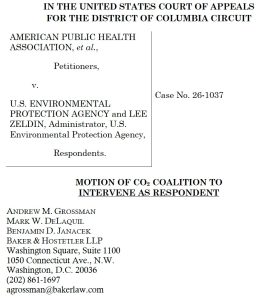
CO2 Coalition Motion to Intervene
FAIRFAX, Va. – The CO2 Coalition is requesting to join a federal D.C. Court of Appeals case to support the EPA’s repeal of a 2009 rule that classified carbon dioxide emissions from vehicles as a dangerous pollutant.
The Coalition’s March 20th motion to intervene is a response to environmental organizations and several states that filed legal challenges to the EPA repeal, which was announced in February. The agency had concluded that it did not have authority under the federal Clean Air Act to regulate carbon dioxide.
“The basis of the wrongheaded Endangerment Finding put ideology ahead of science,” said Gregory Wrightstone, Executive Director of the CO2 Coalition, a nonprofit organization of more than 200 scientists and researchers. “The rule has been an impediment to economic growth, a cause of rising energy costs and a destroyer of many thousands of jobs at power plants, coal mines and manufacturing facilities.
“Since its 2009 enactment, the Endangerment Finding’s scientific underpinnings have been found to be even weaker than previously believed and contradicted by empirical data, peer-reviewed studies and research.”
Founded in 2015, the CO2 ~Coalition is a nonprofit organization with a mission to advance the public understanding of carbon dioxide’s essential role in sustaining plant life, agriculture and the global ecosystem.
The Coalition filing includes statements of members engaged in activities like farming and forestry. They note the benefits of higher levels of atmospheric CO2 for plants and list negative effects of the Endangerment Finding, including higher costs for equipment and of doing business in general.
“EPA’s repeal of the Endangerment Finding is a welcome action based on sound legal reasoning,” said Executive Director Wrightstone. “The CO2 Coalition will present scientific facts and data demonstrating the fallacy underlying the rule – that carbon dioxide is a toxin. The planet is benefiting from rising CO2 levels and will continue to do so. There is no climate crisis.”
Attorneys Andrew Grossman, Mark Delaquil and Benjamin Janacek of Baker and Hostetler law firm filed the intervention on behalf of the CO2 Coalition.
Download here: CO~2 Coalition – Motion to Intervene with Declarations – As Filed
Contact: Gregory Wrightstone
Email:executivedirector@co2coalition.org
Phone:(703) 540-4700
Tags: Endangerment Finding, EPA
---
Experience

Baker & Hostetler LLP 21 yrs 10 mos

[Summer Associate Baker & Hostetler LLP
May 2002 - Aug 2002 · 4 mos
Greater Orlando](https://www.linkedin.com/company/10459/)
Education

[Harvard Law School Doctor of Law (JD)
2001 – 2004](https://www.linkedin.com/school/1654/)

[University of Florida Bachelor of Arts (BA), History and Economics
1997 – 2001](https://www.linkedin.com/school/4282/)
2016 Law360 Rising Star
Issued by Law360, Portfolio Media · Apr 2016

Associated with Baker & Hostetler LLP
I was selected as one of the "Top Four Environmental Attorneys Under 40."
---
https://www.eenews.net/articles/meet-the-lawyers-teeing-up-the-supreme-court-climate-showdown/
1/22
as arguments approach in the most significant Supreme Court environment battle of the decade, teams of lawyers are already making their case for how the justices should view EPA’s climate authority.
When the justices take the bench on Feb. 28 to hear arguments in West Virginia v. EPA,they will arrive armed with information from reams of briefs prepared by some of the nation’s leading environmental lawyers.
Those attorneys’ arguments will lay the groundwork in a high-stakes case that has the potential to upend EPA’s ability to regulate greenhouse gases from power plants — one of the nation’s largest sources of carbon dioxide emissions.
the challenge — brought by Republican-led states and coal companies — asks the Supreme Court to overturn a ruling by the U.S. Court of Appeals for the District of Columbia Circuit that struck down a Trump-era EPA rule gutting the Obama-era Clean Power Plan.
The 2015 Obama rule invoked EPA’s authority under the Clean Air Act to set systemwide requirements for power plant emissions reductions.
After the D.C. Circuit ruling, President Biden’s EPA had a clean slate to craft its own rule. The agency had said it would not return to the Clean Power Plan, whose goals have already been met by the power sector, even though the regulation never took effect.
The justices then took the unusual step of agreeing to hear a dispute over a regulation that does not technically exist.
Their ruling in the case, which is expected by next summer, could not only constrain EPA from issuing a comprehensive new carbon rule but also prevent Congress from handing off broad regulatory authority to federal agencies.
Here are some of the lawyers to know in this year’s high court climate slugfest:
Lindsay See
Leading the briefs for West Virginia is Lindsay See, the state’s solicitor general.
The coal-rich state, joined by 18 others, filed the first plea for the Supreme Court to weigh in on EPA’s climate authority. It was followed by three other petitions, which are now consolidated in one massive case.
See has served as West Virginia’s leading litigator since 2017 and previously worked as an associate atGibson, Dunn & Crutcher LLP, a firm with a prominent Supreme Court practice.
She has appeared once before the nation’s highest bench, in a 2018 case related to a discrimination challenge against an exemption in West Virginia tax law that protected state and local — but not federal — employees from having their pension benefits taxed. West Virginia lost the case.
West Virginia Attorney General Patrick Morrisey (R) and other state lawyers said the D.C. Circuit should not have allowed EPA to regulate power plant emissions under a “rarely used, ancillary provision of the Clean Air Act.” They referred to Section 111(d) of the statute, which served as the basis for the carbon rule.
“Save for a few general factors EPA was to take into account, the lower court told EPA it has ‘no limits’ on the emission-related measures it can impose — on any economic sector or almost any actor,” says the states’ most recent brief, which was signed off on by See.
See is a Harvard Law School graduate and clerked for former D.C. Circuit Judge Thomas Griffith.
Paul Seby
One other state has echoed West Virginia’s arguments in a petition and brief led by a lawyer who has been involved in the EPA carbon rule battle since the Clean Power Plan days.
Paul Seby, a shareholder at the firm Greenberg Traurig LLP and special assistant to North Dakota Attorney General Wayne Stenehjem (R), signed off on a brief that said the D.C. Circuit ruling “undermines the cooperative federalism framework carefully crafted by Congress” by finding that EPA — rather than states — can set power plant performance standards.
North Dakota v. EPA is one of the four petitions in the consolidated Supreme Court case.
Seby has argued against EPA carbon regulations before, back when the Clean Power Plan was before the D.C. Circuit. The court held a marathon argument over the regulation in 2016 but never reached a ruling.
Earlier that year, the Supreme Court had blocked the rule from taking effect, which allowed the Trump administration to dismantle it.
Seby holds a bachelor’s degree from the University of San Diego and a law degree from Lewis & Clark College.
Andrew Grossman
One of the other lead petitioners in the climate case,Westmoreland Mining Holdings LLC, hired Andrew Grossman to make its case to the high court.
Grossman leadsBakerHostetler’s appellate practice and is a frequent conservative commentator on wide range of administrative and constitutional issues.
Grossman is an adjunct scholar at the libertarian Cato Institute and a former legal analyst at the Heritage Foundation. He’s also a familiar face on Capitol Hill, having testified several times before the House and Senate Judiciary committees.
In Westmoreland’s petition, Grossman raised what some environmental advocates referred to as a killer question: whether EPA may use Section 111(d) to create performance standards for existing stationary sources under the provision’s “hazardous air pollutants” program.
The justices granted the petition alongside others, but they said they would only consider the second question posed by Westmoreland’s petition: whether EPA’s carbon rule violated the major questions doctrine, which restricts federal agencies from deciding issues of “vast economic and political significance.”
Grossman attended Dartmouth College and theGeorge Mason University’s SCALIA School of Law.
Yaakow Roth
The fourth petition in the consolidated case comes from North American Coal Corp., represented byJones Daypartner Yaakov Roth.
Like the other challengers, the coal company argues that EPA and the D.C. Circuit have taken far too broad a view of federal climate authority under the Clean Air Act.
Roth comes to the EPA climate case with lots of experience before the Supreme Court. He was the brainchild behind an argument that led the Supreme Court to overturn convictions in the New Jersey “Bridgegate” scandal.
He has also fought to preserve restrictive voting laws in Arizona and to dismantle the Obama-era Affordable Care Act.
Roth has clerked for the late Supreme Court Justice Antonin Scalia and a federal appeals court judge.
He is a graduate of Harvard University and York University.
Elizabeth Prelogar
Before the Supreme Court agreed to hear West Virginia v. EPA, Elizabeth Prelogar had argued on behalf of the federal agency that it was too early for the justices to get involved.
The solicitor general noted in a brief filed in August that Biden’s EPA has not yet written a new carbon rule and has no plans to revive the Obama plan.
EPA instead intends to issue a new rule “after taking into account all relevant considerations, including changes to the electricity sector that have occurred during the last several years,” she wrote.
Prelogar, who was confirmed in late October, has already made several appearances before the Supreme Court, including in one case in which she argued on behalf of the federal government against abortion laws in Mississippi and Texas.
Since her appointment as acting solicitor general in January, Prelogar has also led Supreme Court briefs in several environmental cases, including one in which the Biden administration backed efforts by the developer of the PennEast natural gas pipeline to acquire state-owned land in New Jersey (Energywire, March 10, 2021). The pipeline company won its case, but the project was eventually canceled.
Prelogar, a Harvard Law School graduate, has previously served as assistant to the solicitor general and has worked in private practice. During a prior stint at the Justice Department, she served on the special counsel’s investigation into Russian meddling in the 2016 election.
She clerked for Attorney General Merrick Garland when he was a judge on the U.S. Court of Appeals for the District of Columbia Circuit and for Supreme Court Justices Ruth Bader Ginsburg and Elena Kagan.
Prelogar is the second woman to be confirmed as solicitor general. Kagan was the first.
Sean Donahue
Environmental groups that support broad EPA regulatory authority have turned to an experienced Supreme Court litigator to represent them in the case: Sean Donahue.
Donahue has been a go-to lawyer for environmental groups and public health advocates in some of the most high-profile litigation of the last decade, including Clean Air Act and climate cases.
He’s also represented environmentalists in key cases on the social cost of carbon for fuel economy and vehicle emissions standards.
Donahue and his team, including the Environmental Defense Fund’s Vickie Patton, will have a challenging task ahead of them. Several conservative justices have signaled skepticism of doctrines requiring them to defer to agency expertise, and the current case appears to be a coordinated effort to curtail EPA’s regulatory authority broadly.
In an interview, Donahue said once again it may be an environmental case that set an important precedent for administrative law.
"Statutes like the Clean Air Act," he said, "necessarily depend upon expert agencies to apply Congress’ health and environmental directives to complex factual records, developing technologies, about particular industries and pollutants."
Donahue, who works for Donahue, Goldberg & Littleton, clerked for former Supreme Court Justices Ginsburg and John Paul Stevens. He’s also a veteran of the Justice Department. He attended Columbia University and University of Chicago’s Law School.
Beth Brinkmann
Another attorney with Supreme Court experience is making the case for electric utilities that want to preserve the D.C. Circuit decision striking down the Trump-era carbon rule.
Before the justices granted the case, Covington & Burling LLP partner Beth Brinkmann led a brief on behalf of Consolidated Edison Inc. and other companies that said Supreme Court review of a nonexistent regulation would run the risk of a “ruling untethered to actual circumstances.”
Moreover, she wrote, the red states and coal companies are seeking relief from the justices even as the power industry has achieved the Clean Power Plan’s 2030 emissions reductions targets more than a decade in advance —even though the rule never officially took effect.
“Those changes, which include reductions in the cost of emission-reduction technologies and increasing consumer preferences for clean power, have only accelerated since adoption of the ACE Rule,” she wrote.
Brinkmann has argued more than two dozen times before the Supreme Court. As former deputy assistant attorney general at the Justice Department’s civil rights division, for example, she defended the Obama administration’s Affordable Care Act.
She has also worked in the appellate practice at the firm Morrison & Foerster and as an assistant federal public defender representing indigent criminal defendants.
Brinkmann is a graduate of the University of California, Berkeley, and Yale Law School. She clerked for the late Supreme Court Justice Harry Blackmun.
Elbert Lin
A utility industry group that opposes EPA’s ability to craft rules like the Clean Power Plan has staffed its legal team with an attorney who, at only 43 years old, has already made a significant impact on environmental law at the Supreme Court.
Elbert Lin was the lawyer who secured the unprecedented stay of President Obama’s climate regulatory regime, the Clean Power Plan, in 2016 while he was West Virginia’s solicitor general.
Lin said in an interview that his interest in environmental and administrative law was born out of necessity when he was West Virginia’s solicitor general. It was during Obama’s second term, and the administration was promulgating many major environmental rules, including the Clean Power Plan.
"Environmental regulations were of significant importance of the state," he said.
Now in private practice at the firm Hunton Andrews Kurth LLP, Lin is back in the EPA carbon rule litigation, representing America’s Power, a trade association of companies that produce electricity from coal.
Lin, who is the son of Taiwanese immigrants, has also argued key Clean Water Act cases at the high court. He argued on behalf of Maui, Hawaii, in a case over whether a federal permit is required for pollution that is pumped underground but eventually reaches the ocean.
The Supreme Court delivered a new test for determining whether a permit was needed, and a federal judge in Hawaii later sided with environmental groups arguing that Maui should have secured a Clean Water Act approval (Greenwire, Oct. 21, 2021). Legal experts say they are watching to see how other courts apply the Supreme Court’s test.
Lin attended Yale for undergrad and law school, and heclerked for a federal appeals court judge and Supreme Court Justice Clarence Thomas.
Reporters Lesley Clark and Niina H. Farah contributed.
---
---
ref
https://legalnewsline.com/stories/511398628-in-suing-exxon-over-climate-change-boulder-is-hoping-company-s-deep-pockets-will-pay-for-its-left-wing-agenda-group-says
BOULDER, Colo. (Legal Newsline) – It remains to be seen if Exxon will fight the latest climate change lawsuit against it in the same way it is attacking the first round, by scrubbing municipal documents for evidence of hypocrisy by the public officials filing them.
According to a conservative group following the case, mounting such a defense might be overkill. The lawsuit filed by Boulder, Colo., and two Colorado counties is so frivolous, Exxon could end up seeking reimbursement for the costs of defending itself, according to Mountain States Legal Foundation.
William Perry Pendley, president of MSLF, says he isn't surprised that politicians in Boulder are going through Exxon's deep pockets "to pay for their costly, radical, left-wing boondoggles."
"But taxpayers who think at least they will not have to pay for this pricey misadventure and might even get some tax relief if it is successful, should think again," Pendley said.
"This lawsuit could not be more frivolous and if the judges do what other judges have done, legal sanctions and hefty fines will be imposed."
To defend itself from the California lawsuit, Exxon is seeking to depose government officials and a private lawyer in Texas court over whether their allegations of impending climate change-caused doom are contradicted by bond offerings that make no mention of it.
Asked if Boulder ever disclosed climate change-related threats to its property in any bond offerings, the City declined to comment.
It's unclear whether the bond argument is a possible defense for Exxon in Colorado, and the company did not return a request for comment.
As for Boulder, which filed its lawsuit with Boulder and San Miguel counties, its most recentofficial statement does not include references to climate change.
The official statement on acquisitions of land does not contain the terms “climate change,” “weather” or “global warming.”
Pendley said there is no science to support the lawsuit. Judges in the California lawsuits have yet to rule on motions to dismiss filed by the energy industry.
"Causation between the alleged inactions of the companies and the imagined harms is missing in its entirety and the demand that whimsical injuries be redressed (‘Help us pay to paint our streets white,’ one imagines) is laughable," Pendley said.
Addressing the bond topic last week was David Bookbinder of the Niskanen Center, which is one of two nonprofits representing Boulder on a pro bono basis. A third firm is taking as much as a 20% contingency fee, according to Boulder County's website.
Bookbinder was a speaker at an American Enterprise Institute discussion of California climate litigation the same day his lawsuit was being filed in a Colorado state court. He used an expletive to describe Exxon’s strategy and said that he was “ashamed” of the law firm representing the company.
“If we needed more evidence that no one thinks this was improper or fraudulent or disingenuous, my former adversaries in the plaintiffs securities bar – those people are extremely aggressive. The time lapse between bad news coming out and lawsuits filed by what were called the ‘strike bar’could be measured in, you know, one day, 48 hours, 72 hours, maybe four days – 96 hours,” Bookbinder said.
“There have been no lawsuits filed against any of these cities for their bond disclosures. That should tell you something as well.”
In 2017, the counties of Marin, Santa Cruz and San Mateo and the cities of San Francisco, Oakland, Santa Cruz and Imperial Beach filed suit against dozens of energy companies, including Exxon and 17 other Texas-based businesses, over climate change. The company has previously been targeted by the attorneys general of Massachusetts and New York.
“It is reasonable to infer that the municipalities brought these lawsuits not because of a bona fide belief in any tortious conduct by the defendants or actual damage to their jurisdictions, but instead to coerce ExxonMobil and others operating in the Texas energy sector to adopt policies aligned with those favored by local politicians in California,” attorneys for the company wrote.
In doing so, they must have lied to potential investors in their respective bond offerings, the company claims.
Statements made to potential investors contradict allegations made by the municipalities when they sued the energy industry, the filing says.
For example, San Mateo County’s complaint says it is “particularly vulnerable to sea level rise” and that there is a 93% chance the county experiences a “devastating” flood before 2050. However, bond offerings in 2014 and 2016 noted that the county “is unable to predict whether sea-level rise or other impacts of climate change or flooding from a major storm will occur."
Bookbinder noted that the offerings came with a statement regarding a final paper from the California Climate Change Center that said property in San Francisco Bay is vulnerable to impacts associated with sea-level rise.
But the cities did not present an opinion on the accuracy of those claims, which was noted by Devin Watkins, an attorney at the Competitive Enterprise Institute who attended the event.
The CEI has called on the Securities and Exchange Commission to investigate the matter.
Panel member Andrew Grossman, [rivkin wingmaN/NUT] a partner at BakerHostetler, said he isn’t sure whether there is evidence of securities fraud or violations of other regulations.
“It seems like it’s enough, at the very least, that it would be warranted, and that it is warranted, for there to be an investigation, for there to be somebody, you know, for the regulators who look at these things to take a look at them and determine, you know, did the cities live up to their obligations,” he said.
“If there was something that was inconsistent in the lawsuits versus the disclosures, honestly, it wouldn’t surprise me because, probably, nobody thought about it. And if they are consistent, well good for them. I guess they got it right.”
---
==
https://www.eenews.net/stories/1060095511
zc
When EPA announced yesterday it wasreconsidering a power plant rule with which major utilities already comply, many saw it as a largely fruitless exercise.
But struggling coal-fired power plants saw it as a lifeline.
Whatever damage came from the Mercury and Air Toxics Standards, or MATS, is already done in the eyes of big players like Duke Energy Corp. and American Electric Power Co. They've installed the technology to reduce pollution that MATS required. Aging reactors that shut down rather than add the costly kit aren't coming back(Greenwire, Aug. 29).
But a clutch of coal-saturated utilities see an avenue for avoiding "Armageddon," according to an industry attorney.
Those utilities want to move regulations for mercury and other pollution out of one section of the Clean Air Act and into another — the one EPA is using to set limits for carbon — to avoid more stringent future regulations that could signal a death knell for the nation's most coal-intensive reactors.
"Legally what he's suggesting is bonkers, but it's fascinating," John Walke, director of the federal clean air, climate and clean energy program with the Natural Resources Defense Council, said of the case being raised by those attorneys.
At issue is what's known as the "Risk and Technology Review" under the Clean Air Act's Section 112, a provision that requires a check-in eight years after developing pollution standards to see whether initial controls have done enough to eliminate or reduce the risks of cancer, heart and lung ailments, and other public health problems. There's no negotiating; that review comes in 2020 for power plants so long as the MATS rule developed in 2012 remains in effect.
What concerns coal-saturated power operators is that environmental groups will use the findings from those reviews to press for stricter standards on a host of pollutants. That would include particulate matter — tiny soot particles — the reduction of which generated a significant amount of benefits for the Obama administration's now-defunct climate rule, the Clean Power Plan.
Officially, those utilities are arguing that re-evaluating MATS and placing it under Section 111(d) — which the Trump and Obama administrations used to impose carbon emissions rules for power plants — would satisfy the "112 exclusion."
That argument claims EPA cannot regulate power plants under Section 111(d) if those facilities also face rules under Section 112. They see EPA's move yesterday to reassess whether the Obama administration's determination to regulate mercury and air toxins was "appropriate and necessary" as the starting point for shifting the program from 112 to 111(d).
"The EPA has an excellent opportunity now to streamline its regulatory approach under Section 111(d), encourage the states to play a meaningful role in the regulatory process, and allow the kind of flexibility and sensitivity to local needs that the Clean Air Act was intended to promote," Andrew Grossman, an attorney with BakerHostetler, said in an email.
Unofficially, the situation is a little different.
"It's about what the environmental groups will use those reviews to do and what D.C. Circuit Court judges would do to EPA," the utility attorney said. "The first war on coal was about [sulfur dioxide]. And the second will be on particulate matter."
In fact, many utilities want EPA to keep the MATS rule. Because most have complied with the rules — chalked up as the costliest in EPA history — there's little upside to ditching it now.
Trade groups Edison Electric Institute and National Rural Electric Cooperative Association, along with labor unions, wrote a July letter urging EPA air chief Bill Wehrum to maintain the rule and to "complete the statutorily mandated Residual Risk and Technology Review (RTR) for power plants as expeditiously as possible" (Greenwire, July 11).
The developing strategy from those looking to squash the 112 program exposes a subtle division among utility industry lawyers, Walke said.
Some attorneys who represent utilities that have spent billions of dollars complying worry that undoing and rewriting the MATS rule would take too long. That means it could park the Risk and Technology Review squarely within a Democratic administration rather than a more sympathetic Trump EPA.
"That July letter strongly promotes moving straight to that process, to the residual risk process," Walke said of the letter from utility organizations and labor unions. "They want the Trump EPA to complete it. They want Bill Wehrum to say, 'We don't want you to do any more.'"
But industry attorneys on the other side of that argument worry about the effects the reviews would have on power plants that use only electrostatic precipitators to remove pollutants rather than scrubbers, the latter of which Walke said are more effective. Those are the types of facilities that could come under greater pressure from actions resulting from that review.
"The issue going forward is there is a future round of standards," the utility attorney said.
Proponents of that legal opinion argue that the section the Obama administration used for MATS was always imperfect for power plants. That part of the Clean Air Act was intended for a national program, but power plants use different types of coal for various reasons and compete regionally, not across the whole country.
"This claim is valid. In general, coal plants that burn eastern coal had a much more expensive compliance pathway than coal plants that burn [Powder River Basin] coal," Brian Potts, an environmental and energy attorney and partner at Perkins Coie, said in an email, though he wasn't commenting on the overarching legal play.
Still, doing what those utilities envision — shifting the regulatory program from Section 112 to Section 111(d) — is no easy task, Potts said.
That, essentially, is what EPA tried to do under President George W. Bush, Potts said. Courts struck down the Clean Air MercuryRule because they said the agency lacked authority to simply delist power plants from Section 112 and replace it with a cap-and-trade program.
"Plants are already complying with the current standards now. Certainly if the current standards are made more stringent, that could impact some plants," Potts said. "But it seems a bit odd to me to preemptively revoke standards in order to avoid the possibility of a future administration making them more stringent — especially when the current administration is in its first term."
==
==
media realclear and fedsoc
note 1st amend free sp fought hard for by tobacco (previous RICO?)
cei ~RICO
Free Speech and Climate Change
11,877 views•Apr 19, 2016
Andrew M. Grossman discusses climate change and freedom of speech in a Federalist Society produced video

sez not // tobacco RICO b/c it covered up harm that was certain; agw NOT certain of harm (catastrophic?)
answers unclear on AGW; objects to CEI subpoena off all docs related to climate for decades [true?]
puts a cloud of legal uncertainty, intimidatuon, threat of criminal sanctions, will chill very important debate/discussions that we needto formulate correct policy, more speech is better (vs censor, implies truth will win)
:{Andrew Grossman, Partner at BakerHostetler, explains the investigation of the fossil fuel industry and public policy groups skeptical of climate change by the Attorneys General of nineteen states. He underscores the importance of free speech in public policy debates on climate change. Mr. Grossman is also Counsel for the Competitive Enterprise Institute.
As always, the Federalist Society takes no position on particular legal or public policy issues; all expressions of opinion are those of the speaker. Related links: John Schwartz, Pressure on Exxon Over Climate Change Intensifies With New Documentshttp://www.nytimes.com/2016/04/14/sci... CEI Fights Subpoena to Silence Debate on Climate Change, April 7, 2016https://cei.org/content/cei-fights-su...Addressing the Risks of Climate Change: ExxonMobil's Views and Actionshttps://exxonmobil.com/Benelux-Englis...A.G. Schneiderman, Former Vice President Al Gore And A Coalition Of Attorneys General From Across The Country Announce Historic State-Based Effort To Combat Climate Changehttp://www.ag.ny.gov/press-release/ag... David Rivkin Jr. and Andrew M. Grossman, Punishing Climate Change Skepticshttp://www.wsj.com/articles/punishing...}:
WSJ. Magazine
OPINION COMMENTARY
Punishing Climate-Change Skeptics
Some in Washington want to unleash government to harass heretics who don’t accept the ‘consensus.’
By David B. Rivkin Jr. and Andrew M. Grossman
March 23, 2016 6:29 pm ET
:{:{}:
}:
Galileo Galilei was tried in 1633 for spreading the heretical view that the Earth orbits the sun, convicted by the Roman Catholic Inquisition, and remained under house arrest until his death. Today’s inquisitors seek their quarry’s imprisonment and financial ruin. As the scientific case for a climate-change catastrophe wanes, proponents of big-ticket climate policies are increasingly focused on punishing dissent from an asserted “consensus” view that the only way to address global warming is to restructure society—how it harnesses and uses energy. That we might muddle through a couple degrees’ of global warming over decades...
:{:{}:
}:
RELATED VIDEO
Opinion Journal: Free Speech for Scientists!
:{:{}:
}:
Opinion Journal: Free Speech for Scientists!
Baker Hostetler Partner David Rivkin on a legal effort to protect climate-change scientists from bullying and intimidation
The Climate Change Inquisition by Peggy Littlehttp://www.fed-soc.org/blog/detail/th...The fossil-fuel industry’s campaign to mislead the American people by Sen. Sheldon Whitehousehttps://www.washingtonpost.com/opinio...}:
==
https://cei.org/content/cei-fights-subpoena-silence-debate-climate-change
april 2016 kazman
The Competitive Enterprise Institute (CEI) today denounced a subpoena from Attorney General Claude E. Walker of the U.S. Virgin Islands that attempts to unearth a decade of the organization’s materials and work on climate change policy. This is the latest effort in an intimidation campaign to criminalize speech and research on the climate debate, led by New York Attorney General Eric Schneiderman and former Vice President Al Gore.
“CEI will vigorously fight to quash this subpoena. It is an affront to our First Amendment rights of free speech and association for Attorney General Walker to bring such intimidating demands against a nonprofit group,” said CEI General Counsel Sam Kazman. “If Walker and his allies succeed, the real victims will be all Americans, whose access to affordable energy will be hit by one costly regulation after another, while scientific and policy debates are wiped out one subpoena at a time.”
The subpoena requests a decade’s worth of communications, emails, statements, drafts, and other documents regarding CEI’s work on climate change and energy policy, including private donor information. It demands that CEI produce these materials from 20 years ago, from 1997-2007, by April 30, 2016.
On March 30, 2016, Attorney General Schneiderman, former Vice President Al Gore, and attorneys general from Massachusetts, Virginia, Connecticut, Maryland, Vermont, as well as Attorney General Walker, held a press conference in New York City to announce “an unprecedented coalition of top law enforcement officials committed to aggressively protecting and building upon the recent progress the United States has made in combating climate change.” Schneiderman said that the group, calling itself “AGs United for Clean Power,” will address climate change by threatening criminal investigations and charges against companies, policy organizations, scientists, and others who disagree with its members’ climate policy agenda.
CEI has long been a champion of sound climate change policy, and opposed previous attempts to use McCarthy-style tactics by officials aiming to limit discussions between nonprofit policy groups and the private sector regarding federal policies. CEI is being represented in this matter by attorneys Andrew M. Grossman and David B. Rivkin, Jr., who recently founded the Free Speech in Science Project to defend First Amendment rights against government abuses.
>> Read the subpoena here (PDF).
==
https://cei.org/sites/default/files/CEI%20Subpoena%20from%20USVI%20AG%20Claude%20Walker%20April%207%202016.pdf
...ExxonMobil is suspected to have engaged in, or be engaging in, conduct constituting a civil violation of the Criminally Influenced and Corrupt Organizations Act, 14 V.I.C. § 605, by having engaged or engaging in conduct misrepresenting its knowledge of the likelihood that its products and activities have contributed and are continuing to contribute to Climate Change in order to defraud the Government of the United States Virgin Islands (''the Government") and consumers in the Virgin Islands, in violation of 14 V.I.C.§ 834 (prohibiting obtaining money by ··false pretenses) and 14 V.I.C. § 551 (prohibiting conspiracy to obtain money by false pretenses).
In relation to the Government's investigation of the above matter, YOU ARE HEREBY DIRECTED, by the authority granted to the Attorney General of the United States Virgin Islands ("USVI'') , pursuant to the provisions of 14 V.I.C. § 612, to produce and deliver the documents responsive to the inquiries set forth herein, on or before April 30, 2016, directed to the attention of Attorney General Claude Earl Walker, Esq. Failure to comply with this subpoena may result in an enforcement action being brought against you pursuant to 14 V.I.C. § 612(k)...
"Climate Change" refers to the general subject matter of changes in global or regional climates that persist over time, whether due to natural variability or as a result of human activity. All Documents or Communications concerning the likelihood, certainty, uncertainty, scope, causes, or impacts of Climate Change concern Climate Change. Any Documents or Communications using any of the terns "climate change," "climatology," "climate science," "climate model," "climate modeling,'' "global warming," "greenhouse gas," "greenhouse effect," "CO2 greenhouse," "Kyoto Protocol," "UNFCCC," "IPCC," "climate skeptics," "climate skepticism," "global cooling," "solar variation," "arctic shrinkage," "carbon tax," "climate legislation," or "Keeling Curve" concern Climate Change, although Documents or Communications need not include any of these terms to concern Climate Change.
Any Documents or Communications concerning rising sea levels, Arctic and/or Antarctic ice melt, declining sea ice, melting glaciers, declining snowfall, oceanic warming, ocean acidification, or increases in extreme weather events--or the opposites of these phenomena (e.g., dropping sea levels, oceanic cooling)-concem Climate Change, although Documents or Communications need not refer to any of these phenomena to concern Climate Change
...
The relevant time period, unless otherwise indicated in a specific request, is fromJanuary I, 1997 to January I, 2007. The time limits should not be construed as date limits; for example, if a policy, contract, or other document in effect during the relevant time period was created before the relevant time period, then such document must be produced.
==
bs cato
Grossman practices appellate and constitutional litigation in the Washington, D.C., office of BakerHostetler. He has written widely on law and finance, bankruptcy law, national security law, and the constitutional separation of powers and is a frequent adviser to Congress on complex legal and policy issues, particularly concerning constitutional limitations on federal power. He has testified numerous times before both the House and Senate judiciary committees. In addition to articles in journals and professional publications, Grossman’s legal commentary has appeared in dozens of newspapers and periodicals, including the Wall Street Journal, USA Today, theWashington Post, and the Los Angeles Times. He is also a frequent commentator on legal issues on radio and television, having appeared on Fox News Channel, CNN, MSNBC, CNBC, NPR and its affiliates, CBN, and elsewhere.
:{:{}:
}:
Grossman has written amicus briefs for the Cato Institute in several cases before the U.S. Supreme Court and the federal courts of appeals. Prior to joining Cato as an Adjunct Scholar, he was affiliated for over a decade with the Heritage Foundation, most recently serving as a Legal Fellow in Heritage’s Edwin Meese III Center for Legal and Judicial Studies. Grossman is a graduate of Dartmouth College, the University of Pennsylvania’s Fels Institute of Government, and the George Mason University School of Law. He clerked for Judge Edith Jones of the U.S. Court of Appeals for the Fifth Circuit.
==
bs spkr bur bio:
Andrew M. Grossman is a visiting legal fellow in The Heritage Foundation’s Center for Legal and Judicial Studies.
where he researches and writes about law and finance, bankruptcy, national security law and the constitutional issue of separation of powers. Grossman is a frequent adviser to Congress on complex legal and policy issues, particularly concerning constitutional limitations on federal power. He has testified numerous times before both the House and Senate judiciary committees.
In addition to articles in journals and professional publications, Grossman’s legal commentary has appeared in dozens newspapers and periodicals, including The Wall Street Journal, USA Today, The Washington Post, The Washington Times and the online journals Homeland Defense Journal, Class Action Watch and CQ Researcher, among others. He is a regular commentator on legal issues on radio and television, having appeared on Fox News Channel, CNN, MSNBC, CNBC, NPR and its affiliates, CBN and elsewhere.
Outside Heritage, Grossman is a litigator in the Washington office of the global law firm Baker & Hostetler. He has represented states in challenges to the constitutionality of federal statutes and the legality of federal environmental regulations. He also is active in commercial litigation. He has participated in cases before the Supreme Court by authoring or contributing to certori-stage filings, merits briefs and amicus briefs and by “mooting” top Supreme Court litigators and state solicitors general before they make their oral arguments.
Grossman originally joined Heritage in 2003, rising from writer, editor and general analyst to senior legal policy analyst. Before his departure in 2009, he researched and wrote about issues as diverse as bankruptcy and “overcriminalization.” In 2007, the Burton Foundation and the Library of Congress presented Grossman with the Burton Award for Legal Achievement, citing his research on federal evidentiary law and Internet communications technologies. He is a graduate of the George Mason University School of Law, where he received the Adrian S. Fischer Award for Student Research and the Betty Southard Murphy Award for Constitutional Law. He also served as senior articles editor of George Mason Law Review and was a judicial clerk to Chief Judge Edith H. Jones of the United States Court of Appeals for the Fifth Circuit. Grossman received his master's degree in government from the University of Pennsylvania and his bachelor's degree in economics and anthropology from Dartmouth College, where he edited The Dartmouth Review.
Click Here to register and get pricing on booking Andrew M. Grossman for your next event!
==
Harris v. Quinn and the Forced Unionization of Home-Care Workers
www.heritage.org/.../harris-v-quinn-an-end-to-the-forced-un...
The Heritage Foundation
Jan 23, 2014 - Harris v. Quinn: An End to the Forced Unionization of Home-Care Workers? By Andrew M. Grossman. On January 21, 2014, the Supreme Court ...
Andrew M. Grossman - Heritage Foundation
www.heritage.org/about/staff/g/andrew-grossman
The Heritage Foundation
Andrew M. Grossman is a non staff member at The Heritage Foundation. ... Harris v. Quinn: An End to the Forced Unionization of Home-Care Workers?
Harris v. Quinn: A Win for Workers' First Amendment Rights | Cato ...
www.cato.org/blog/harris-v-quinn-win-workers-first-amendment-rights
Cato Institute
Jun 30, 2014 - Harris v. Quinn: A Win for Workers' First Amendment Rights. By Andrew M. Grossman. Share. Tweet · Like · Submit · Plus. Enough is enough ...
Harris v. Quinn | Cato Institute
www.cato.org/publications/legal-briefs/harris-v-quinn
Cato Institute
Harris v. Quinn. By Ilya Shapiro, Trevor Burrus, and Andrew M. Grossman. January 4, 2012. Over the past decade, more than a dozen states have forced ...
Harris v. Quinn | Cato Institute
www.cato.org/publications/legal-briefs/harris-v-quinn-0
Cato Institute
Harris v. Quinn. By David B. Rivkin Jr., Andrew M. Grossman, Lee A. Casey, Ilya Shapiro, Trevor Burrus, & Karen Harned. November 29, 2013. The Supreme ...
The Practical Impact of Harris v. Quinn: A Major Blow to Organized ...
www.cato.org/.../practical-impact-harris-v-quinn-major-blow-organized-...
Cato Institute
Jun 30, 2014 - Quinn: A Major Blow to Organized Labor. By Andrew M. Grossman ... in this previous post, the Supreme Court's decision today in Harris v.
Re: Tomorrow's Ruling in Harris v. Quinn - | National Review
www.nationalreview.com/.../re-tomorrows-ruling-harris-v-quinn-ed-...
National Review
Jun 29, 2014 - Quinn presents: As this excellent backgrounder by Andrew M. Grossman nicely explains, the dispute in Harris arises from an aggressive effort ...
Unionizing Domestic Workers?: Harris v. Quinn Decided - Podcast ...
www.fed-soc.org/.../unionizing-domestic-workers-harris-v-quinn-de...
Federalist Society
Jul 1, 2014 - The Harris petitioners contend that Abood was wrongly decided and ... University of Michigan Law School; Andrew M. Grossman, Associate, ...
==
WRONG:
GM earns record $6.3B profit; Investors say 'so what?'
www.freep.com/.../general-motors/.../gm...profit.../797...
General Motors Profit Soars On North America Surge | Stock News ...
www.investors.com/news/general-motors-profit-...
---
http://www.**washingtonexaminer.**com/the-myth-of-auto-bailout-jobs/article/2512555
There's one problem: That story isn't true. If anything, the Obama auto bailout left Chrysler and GM in worse shape than they would have been otherwise, while funneling over $25 billion in taxpayer dollars to the United Autoworkers labor union.
When Obama entered office, GM and Chrysler were racing fast toward bankruptcy. As the Obama campaign spins it, that would have been the end of the road for auto manufacturing in the United States. But that's simply not the way it works. Were it true, then there would no longer be companies like Macy's, 7-Eleven and most of the major airlines, which have all gone through Chapter 11 reorganizations, emerging as stronger competitors with sound long-term finances.
Chapter 11 bankruptcy gives hard-up companies the chance to make a fresh start. It lets them overcome obstacles to success, such as unreasonable contracts, unsustainable debt loads and poor management. Chapter 11 is a sensible choice for potentially profitable businesses that must adjust quickly to new economic realities -- just as Chrysler and GM were in 2009.
There's no reason to believe that it would have been any different for GM and Chrysler. Both would have kept producing cars in bankruptcy while reorganizing and preserving jobs in their long-term competitive interests.
The Obama administration agreed that Chapter 11 was the right choice for the ailing automakers, but it decided to insert itself into the reorganization process. It directed all major decisions and injected $80 billion in taxpayer funds from the Troubled Asset Relief Program (which Congress had limited to stabilizing the banking sector) into the companies.
The result was a reorganization that superficially resembled bankruptcy but was driven as much by politics as economic realities. The Obama administration's "Auto Task Force" decided which nameplates to shutter and how the automakers should invest in product going forward. Many of these decisions had a political basis -- consider, for example, GM's ongoing billion-dollar investment in the electric plug-in Volt, a white-elephant project that will likely never turn a profit.
By the numbers, the real beneficiary of the bailout was not GM or Chrysler, but to the United Auto Workers, whose PAC gave 99 percent of its federal contributions in 2008 to Democratic candidates. As James Sherk and Todd Zywicki explain in a recent report for the Heritage Foundation, the Obama administration directed $26.5 billion more to the UAW than it would have received in a normal bankruptcy in which similarly situated creditors are treated equally. That figure exceeds taxpayers' $23 billion in expected losses for the auto bailouts.
The labor union's special treatment has left the automakers at a long-term competitive disadvantage. In a normal Chapter 11 case, everything is on the table to make reorganization successful, and that includes collective bargaining agreements. But rather than push UAW members to accept prevailing market wages and benefits, the Obama administration accepted serious concessions only for future hires, while trimming at the margins for existing workers. The result is that GM still pays above-market compensation, averaging $56 per hour.
Also from the Washington Examiner
This uncompetitive compensation structure, combined with still-rigid work rules mandated by the collective bargaining agreement, leaves GM in particular at a disadvantage to its rivals, threatening its future success.
The only unknown -- and the point that the Obama administration cites as justifying its intervention -- is whether the automakers could have obtained financing to complete their reorganizations at a time when the credit markets were in turmoil. But the government could have ensured financing was available through limited guarantees to lenders. That would have provided greater protection to taxpayers and allowed the bankruptcy process to go forward in an orderly and fair fashion, without letting politics supersede the business's best interests.
The auto bailout was not inevitable, and it was certainly not necessary to rescue the industry. A typical bankruptcy, without the Obama administration calling the shots, would have given Chrysler and GM breathing room to reorganize. The result would have been a resurgent industry, likely on sounder financial and competitive footing than it is today. And it wouldn't have put taxpayers on the hook for a $25 billion handout to a politically connected labor union.
Andrew M. Grossman is a visiting fellow at theBuckeye Institute for Public Policy Solutions,and is a litigator in the Washington office of BakerHostetler LLP.
==
The U.S. economy won a temporary reprieve with the Environmental Protection Agency’s (EPA) announcement last week that new ozone standards, which had been slated for this summer, will be delayed. The EPA’s “reconsideration” of the ozone standards it set in 2008 and issuance of more stringent standards violate all three of the fundamental values EPA Administrator Lisa Jackson pledged to honor: “science-based policies and programs, adherence to the rule of law, and overwhelming transparency.”[[1]](http://www.heritage.org/research/reports/2011/08/high-on-ozone-the-epas-latest-assault-on-jobs-and-the-economy#_edn1)
This enormously expensive regulation is unsupported by scientific evidence, violates the Clean Air Act (CAA), and appears timed to evade ongoing judicial review of the rulemaking process. Even the EPA’s estimate that the new rule will impose up to $90 billion in compliance costs annually[[2]](http://www.heritage.org/research/reports/2011/08/high-on-ozone-the-epas-latest-assault-on-jobs-and-the-economy#_edn2) severely understates the impact on economic development and jobs in communities where attainment of the new standards will be impossible. Congress should make the EPA’s temporary postponement of its new ozone standards a permanent one.
Background
The CAA requires the EPA to set National Ambient Air Quality Standards (NAAQS) for ozone, among other pollutants, at a level that is not “higher than is necessary…to protect the public health with an adequate margin of safety.”[[3]](http://www.heritage.org/research/reports/2011/08/high-on-ozone-the-epas-latest-assault-on-jobs-and-the-economy#_edn3) Areas that are not in attainment must reduce emissions from existing sources and impose stringent controls on new ones. Even areas in attainment must strictly regulate new sources to prevent any increase in emissions.
In 2008, as part of the regular NAAQS review process, the EPA revised the ozone standard to 0.075 parts per million (ppm), down from the 0.080 ppm level set by the Clinton EPA.
In 2009, just months after President Obama took office, the EPA announced that it would “reconsider” and revise the 2008 standard, circumventing the mandatory process for revisions specified in the CAA. On January 19, 2010, the agency proposed to set a primary standard in the range of 0.060 to 0.070 ppm and, in an unprecedented step, introduce a separate and additional secondary standard (intended to protect such things as vegetation) based on cumulative ozone concentrations in summer. The EPA’s case for the new NAAQS is based on its controversial re-analysis of the data from two small studies that even their author states does not support reduced standards. Indeed, Jackson concedes that the scientific support for both the 2008 standards and the current proposal is “limited.”[[4]](http://www.heritage.org/research/reports/2011/08/high-on-ozone-the-epas-latest-assault-on-jobs-and-the-economy#_edn4)
Unprecedented Expense
The Obama EPA continues to outdo itself, proposing a series of CAA rules each more expensive than the last. Its new ozone standards would be among the most expensive yet, with the agency estimating costs of $19 billion to $90 billion annually, depending on stringency.
Why are the costs so high? Because, as the EPA acknowledges, the technology needed to comply does not exist. Spending on “known controls” would amount to only $3.3–4.5 billion, while the remainder would go to “other, currently unknown technologies that would be needed to attain the proposed primary standards.”[[5]](http://www.heritage.org/research/reports/2011/08/high-on-ozone-the-epas-latest-assault-on-jobs-and-the-economy#_edn5) Given that uncertainty, the costs may be higher, or it may prove more cost-effective to simply shutter industrial capacity.
Beyond compliance costs, the new standards will exact a toll on many communities. Even assuming “aggressive technological change,” the EPA projects that its new primary standard would force up to 451 counties into non-attainment—and even that is a low-ball estimate, due to forthcoming rules that will push more areas into non-attainment.[[6]](http://www.heritage.org/research/reports/2011/08/high-on-ozone-the-epas-latest-assault-on-jobs-and-the-economy#_edn6) The secondary standards would throw an additional “large number of counties”—exactly how many is unclear—into non-attainment status.[[7]](http://www.heritage.org/research/reports/2011/08/high-on-ozone-the-epas-latest-assault-on-jobs-and-the-economy#_edn7)
The economic consequences of non-attainment are severe. New and modified sources—factories, power plants, and the like—in non-attainment areas must employ costly emissions control technologies and offset emissions by taking other industrial capacity offline, directly costing jobs. At best, this drives up the cost of development and discourages businesses from expanding. At worst, it is a near prohibition on new industry. And where businesses are unable to relocate—such as is often the case with utilities—the result is higher costs for consumers.
Finally, the primary standards may be impossible to attain.The Clean Air Scientific Advisory Committee (CASAC) [legit but infiltrate 2017]explained that “as levels for ozone standards move closer to ‘background’ levels, new issues [note do not say insurmountaBLE] may arise with implementation.”[[8]](http://www.heritage.org/research/reports/2011/08/high-on-ozone-the-epas-latest-assault-on-jobs-and-the-economy#_edn8) In many areas, background levels of ozone approach or exceed the proposed standard, placing those areas in permanent non-attainment, with all the economic consequences. This problem will only get worse: Mexican and Canadian emissions already have a large and growing impact on bordering states’ ozone levels,[[9]](http://www.heritage.org/research/reports/2011/08/high-on-ozone-the-epas-latest-assault-on-jobs-and-the-economy#_edn9) and a recent study concluded that rising Asian emissions “may hinder the USA’s compliance with its ozone air quality standard.”[[10]](http://www.heritage.org/research/reports/2011/08/high-on-ozone-the-epas-latest-assault-on-jobs-and-the-economy#_edn10)
Inflated Benefits
Even the EPA concedes that the ozone NAAQS will likely flunk the cost–benefit test. The EPA claims, however, that the costs of the rule will be partially offset by tens of billions of dollars in annual benefits. But the agency runs up the numbers by manipulating assumptions,[[11]](http://www.heritage.org/research/reports/2011/08/high-on-ozone-the-epas-latest-assault-on-jobs-and-the-economy#_edn11)exaggerating harms, and double-counting the hypothetical indirect benefits that it relies upon to justify many of its most expensive proposals.
The biggest purported benefits—alleged to be worth tens of billions of dollars per year—have to do not with ozone but with reductions in airborne particulate matter that would supposedly be achieved by the emissions controls required to meet a new ozone standard. This claim is speculative, because the “unknown technologies” necessary to comply may or may not achieve these reductions. Moreover, the EPA claims these same benefits for its rule on interstate air pollution, its massively expensive Utility MACT proposal, and its NAAQS for fine particulate matter and sulfur dioxide.[[12]](http://www.heritage.org/research/reports/2011/08/high-on-ozone-the-epas-latest-assault-on-jobs-and-the-economy#_edn12) If a private entity followed the EPA’s lead and quintuple-counted profits, its executives would wind up in prison.
Nor does the science suggest that the new NAAQS will yield much of a direct benefit to anyone. The EPA relies solely on findings of minor physical effects from low-level ozone exposure in its statistical re-analysis of two small studies that, in their original form, provided no support for stricter standards. The EPA’s re-analysis has proven controversial and been criticized by the two studies’ author and other scientists. For example, CASAC member Dr. Sverre Vedal of the University of Washington stated that the EPA’s re-analysis “amounts to attempting to find effects in a very few individuals when the statistical tests are not significant.”[[13]](http://www.heritage.org/research/reports/2011/08/high-on-ozone-the-epas-latest-assault-on-jobs-and-the-economy#_edn13) And former CASAC chair Roger McClellan testified, “The validity of this re-interpretation and the significance of the functional changes is open to debate.”[[14]](http://www.heritage.org/research/reports/2011/08/high-on-ozone-the-epas-latest-assault-on-jobs-and-the-economy#_edn14)
Check the EPA’s Overreaching
The usual check on the EPA overreaching is judicial review, but the EPA’s unlawful “reconsideration” will end or indefinitely postpone the pending challenges to the EPA’s 2008 NAAQS, delaying judgment on the EPA’s bad science by years.
It is therefore incumbent on Congress to rein in the agency’s excesses. In addition to vigorous oversight directed at convincing the EPA to obey the law and halt its “reconsideration,” Congress should act to avert the enormous damage to economic growth and job creation that the EPA’s current regulatory program promises. In light of the EPA’s string of expensive and job-destroying CAA regulations, lawmakers should impose a moratorium on all major CAA actions by the EPA—and halt those published over the past year—and investigate the agency’s misrepresentation of science and regulatory benefits. With the economy already burdened with billions of dollars of EPA regulations, the agency must be held accountable for its actions.
Andrew M. Grossman is a Visiting Legal Fellow in the Center for Legal and Judicial Studies at The Heritage Foundation.
==