Buckeye Inst for Pub Pol Sol
==
see ariel solar BS
see 1851 spinoff
===
Fossil fuel interests are working to kill solar in one Ohio county. The hometown newspaper is helping.
A retired gas industry executive, a shadowy 'grassroots' group and a controversial media company are spreading misinformation while turning residents against a proposed solar farm — and each other
Miranda Green/Floodlight, Jennifer Smith Richards/ProPublica, Priyanjana Bengani/Tow Center for Digital Journalism
Oct 8, 2024 — 17 min read
Rich Piar farms soybeans in Knox County, Ohio. “We try to be good stewards of the ground,” he said. The solar project he hopes will be built on his land, “from my research, is a decent thing. We have electric power plants shutting down, coal fire plants. We need energy.” (Sarahbeth Maney / ProPublica)
Co-published with*ProPublica*, a nonprofit newsroom that investigates abuses of power.*Sign up for Dispatches*, a newsletter that spotlights wrongdoing around the country, to receive our stories in your inbox every week.
Word tends to spread fast in rural Knox County, Ohio. But misinformation has spread faster.
The first article in the Mount Vernon News last fall about a planned solar farm simply noted that residents were “expressing their concern.” But soon the county’s only newspaper was packed with stories about solar energy that almost uniformly criticized the project and quoted its opponents.
Then a new “grassroots” organization materialized and invited locals to an elaborate event billed as a town hall, with a keynote speaker who denied that humans cause climate change.
Someone sent text messages to residents urging them to “stop the solar invasion” and elect two county commission candidates who opposed the solar farm. And one day this past March, residents received an unfamiliar newspaper that contained only articles attacking Frasier Solar, a large project that would replace hundreds of acres of corn and soybeans with the equivalent of 630 football fields of solar panels.
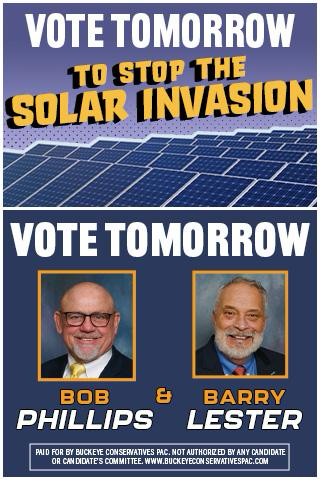 An anti-solar group sent text messages to residents of Knox County, Ohio urging them to “stop the solar invasion.”
To many in the deep-red central Ohio community, it seemed that solar had become the focus of news and politics. They were right. Fossil fuel interests were secretly working to shape the conversation in Knox County.
Floodlight is a nonprofit newsroom that investigates the powers stalling climate action.
Subscribe
Each cog in the anti-solar machine — the opposition group, the texts, the newspaper, the energy publication — was linked to the others through finances and overlapping agendas, an investigation by Floodlight, ProPublica and The Tow Center for Digital Journalism found.
The campaign against solar power benefited from a confluence of two powerful forces funded by oil and gas interests. A former executive at Ariel Corporation, the county’s largest employer and one of the world’s biggest manufacturers of methane gas compressors, was working behind the scenes. And helping in a more public way is the Mount Vernon News, a newspaper now in the hands of Metric Media, which operates websites that reportedly engage in pay-to-play coverage.
Rural Knox County, Ohio, is home to extensive farmland and has deep ties to the gas industry. (Sarahbeth Maney / ProPublica).
Ariel and the former executive did not respond to requests for comment. Metric Media’s leader did not answer questions for this story; he has previously denied that his news outlets are partisan.
Across the country, the oil and gas industry and power companies have exploited a struggling news industry and a fraught political process to fight the transition to clean energy and maximize profits, Floodlight and its partners have reported. In Florida, two power companies paid a consulting firm to hire newspapers to attack a pro-solar politician. In Alabama, the state’s largest monopoly electric company purchased a historic Black newspaper, then didn’t write about soaring power bills. In California, Chevron launched its own newsroom when other papers shuttered; it doesn’t cover itself critically.
In Mount Vernon, a city of 17,000 where the local university named its new sports complex CH4 after the chemical formula for methane, a variety of tactics have been deployed simultaneously, creating an anti-solar echo chamber.
Mount Vernon Nazarene University’s CH4 Stadium was partially funded by Ariel Foundation, the philanthropic arm of Ariel Corporation, one of the world’s biggest manufacturers of methane gas compressors.(Sarahbeth Maney / ProPublica).
Residents are bombarded with dubious claims: Solar panels are toxic. Their construction depletes the soil and floods fields and depresses home values. China is using them to invade. The campaign has stoked their skepticism and ignited their passions. It intensified the debate in a conservative county that prizes its roots in the gas industry.
Bright yellow “No Industrial Solar” yard signs have sprung up everywhere, competing with a smattering of green “Yes Solar” ones. Citizens packed local government meetings. More than 4,000 public comments, both for and against, were filed with the state regulator that will decide if the solar project can be built — triple the number for any previous solar project in Ohio. And all those opinions have drowned out the voices of the nine landowners, mostly farmers, who’ve signed leases with Frasier’s developer and for whom a total of about $60 million is at stake.
“People are so radicalized and they’re not thinking clearly,” said Rich Piar, a third-generation farmer who hopes to secure his financial future by leasing a portion of his 1,650 acres to Open Road Renewables, the Texas-based company developing the Frasier Solar project.
A plaque on the Mount Vernon Nazarene University’s CH4 Stadium explains that, like the chemical bonds in methane, the bond between the university and Ariel is strong. (Sarahbeth Maney / ProPublica).
Politicians who didn’t forcefully denounce the solar project were attacked in Mount Vernon News stories. Thom Collier, a long-serving Republican on the county commission who thinks landowners should be able to choose whether to use their property for solar infrastructure, ultimately lost his reelection bid after a barrage of misleading coverage about his stance on solar.
“I pin this on one or two people from Ariel and some close friends that they have,” Collier said of the anti-solar offensive. “They determined it didn’t matter how much money it would take, they were going to fight this and make it ugly, and they have.”
The Yellowbud Solar project in Pickaway County, Ohio, shown in 2022, became operational last year. It is about 90 miles southwest of Knox County. (Dan Gearino / Inside Climate News)
‘They want everybody to buy gas’
Just 20 days after Knox Smart Development was registered as an LLC in Ohio, the anti-solar group hosted a town hall at a historic Georgian revival theater in Mount Vernon with 1,000 red velvet seats. Attendees were offered free food and alcohol.
The November 2023 event centered on a presentation from Steve Goreham, who argues global warming is natural and who is the author of several books, including “The Mad, Mad, Mad World of Climatism: Mankind and Climate Change Mania.”
The Mount Vernon News’ new owners opened an office in the Woodward Opera House, a historic downtown building that the Ariel Foundation helped renovate. (Sarahbeth Maney / ProPublica)
“When I think of a town hall meeting, I think of a meeting where everybody from the community can go, everybody has their say. That’s not how their meeting was,” said Kathy Gamble, who said organizers only reluctantly agreed to let her in. She’s pro-solar and not quiet about it.
The town hall established Knox Smart Development as a leading voice against the Frasier Solar project. The group calls itself a simple grassroots defender of Knox County.
It isn’t.
The man who registered the group as a business — and who is its sole member and spokesperson — was an Ariel Corporation employee two decades ago and remained an acquaintance of a top executive there, Tom Rastin. The group’s website was owned for a time by a woman working as an executive assistant at Ariel.
And one of Knox Smart Development’s larger funders is Rastin, a Republican megadonor and a retired executive vice president at Ariel, according to records and sworn testimony. Rastin’s father-in-law founded Ariel and, until recently, Rastin and his wife, Karen Buchwald Wright, led the company. Wright is still the chairman, and her son operates it now. Rastin and Wright did not respond to questions for this story.
Ariel Corporation expanded in 2017, adding a training center for employees and customers near its headquarters in Mount Vernon, Ohio. (Sarahbeth Maney / ProPublica).
The group’s founder, Jared Yost, said in an email that Rastin has not tried to steer its activism. “As a local resident, I believe he should be allowed to donate to whatever cause he aligns with, regardless of his former employment, and to state otherwise is to suggest Mr. Rastin should be censored,” Yost wrote in an email. He said the group relies on volunteers and “our intentions are genuine.”
He added: “The oil and gas industry is not involved in our fight.”
Jared Yost, founder of Knox Smart Development, testifies in August during an Ohio Power Siting Board hearing about his group’s opposition to the Frasier Solar project.(Sarahbeth Maney / ProPublica).
The town hall event headliner, Goreham, said he appeared as a favor to Rastin and Wright. In 2019, he had dinner with the couple when Goreham and his wife were passing through town from Illinois on a road trip to their second home in Virginia Beach. Goreham said that he and Rastin connected over their mutual feelings on the benefits of gas. He said he was glad to accept the invitation to speak at the anti-Frasier Solar event.
“First off, it’s in his county there. Mount Vernon is his city where he lives and where they are based,” said Goreham. “They’re pretty much opposed to renewables and they want everybody to buy gas. That’s their business.”
Goreham says he wasn’t paid to speak, but Wright bought 200 copies of his latest book, “Green Breakdown: The Coming Renewable Energy Failure,” which warns about a net-zero-emissions agenda that will cause energy grids to fail. Local officials were given copies of the book that included a personal note from Wright: “Hello! Given the significant misinformation surrounding solar and wind arrays, I bought you this book that really lays out the facts.” She signed the note “Karen Wright, Chairman — Ariel Corporation.”
Shortly after the group was formed, Knox Smart Development’s “No Solar” ads became a fixture on the Mount Vernon News website and in the paper.
‘You believe people’
The Mount Vernon News had been owned by the same family since 1939, and for decades it chronicled local doings from city council meetings to the county fair.
At its height in the early 2000s, before newspapers started hemorrhaging advertising revenue and readers, the News employed about 15 full-time local reporters. An orange Maine coon cat named Scoop roamed the newsroom.
But by 2020, the News was barely hanging on. Its reporters were still using clunky 20-year-old computers. The back wall of the building was falling down and needed $250,000 in repairs. Kay Culbertson, who owned both the paper and the building, said that she knew it was time to sell. Paying for the repairs would be impossible; even making payroll was a stretch.
The former Mount Vernon News building, home to the paper since 1939, sits empty. (Sarahbeth Maney / ProPublica)
An acquaintance of Culberston’s connected her with Metric Media, part of an eight-company network operating more than 1,100 online local news sites. These sites have been described by media researchers and journalists as “pink slime,” named for a filler in processed meat. The final product looks natural, but it’s been tampered with.
A Syracuse University researcher concluded in a journal article published in February that :{sites like Metric’s “that seem like original news outlets and that appeal to local identity are filling the void” left by the decline of local news. And The Washington Post reported last year that Republican campaigns requested customized news stories that appeared on Metric-owned sites.}:
Both conservative and liberal pink slime sites exist. But Metric is run by Brian Timpone, an Illinois-based former broadcast reporter who has contributed tens of thousands of dollars to conservative campaigns and causes. Timpone’s ventures have been criticized for using foreign-based writers to produce material. Some also have been accused of plagiarism and fabricating quotes. Timpone has blamed the problems on foreign writers providing content, and he apologized to readers.
Metric Media’s nonprofit arm has received $1.4 million “for general operations” from DonorsTrust, a dark-money group that has received significant funding from Charles and David Koch, who made their billions in oil pipelines and refineries. The eight-company network that Metric is part of also has ties to conservative billionaires, including oil-and-gas-industry titan Tim Dunn, shipping magnate Richard Uihlein and PayPal co-founder Peter Thiel. (Political groups that organize as nonprofits do not have to disclose donors, which is why they’re called “dark money.”)
DonorsTrust CEO and President Lawson R. Bader said in an email that the organization makes about 4,000 grants a year and that it does not dictate how those donations are spent.
Timpone responded to a request for an interview by writing, “We at the Mount Vernon News are now also working on a story — about Pro Publica and Floodlight’s efforts to promote taxpayer-funded ‘solar energy’ businesses in Central Ohio.” He did not respond to detailed questions.
But in interviews, he has said his business keeps local news alive when many outlets are scaling back or shutting down. Timpone told the Deseret News in Utah that his sites have no political leaning and are “data-driven and fact-centric.”
Research and news investigations have found that Timpone’s publications tend to champion conservative causes and politicians; they often are linked to mysterious newspapers distributed during key elections.
Culbertson and assistant publisher Liz Lutwick said in an interview that they knew little about Metric Media before the sale. But the company’s promises sounded good and, Lutwick said, “You believe people.”
“They were going to keep everything the same for a while. Lo and behold, they didn’t,” Culbertson said.
Metric paid at least $1 million for the Mount Vernon News, the first time it had purchased an established news organization printing a local paper. When the new owners visited the paper after the sale, they told the staff they’d stop printing every day and would no longer provide benefits; instead, employees would become contractors. Half the staff quit on the spot.
“It was awful. You feel like you’ve betrayed people,” Culbertson said.
‘We call it the Solar Times’
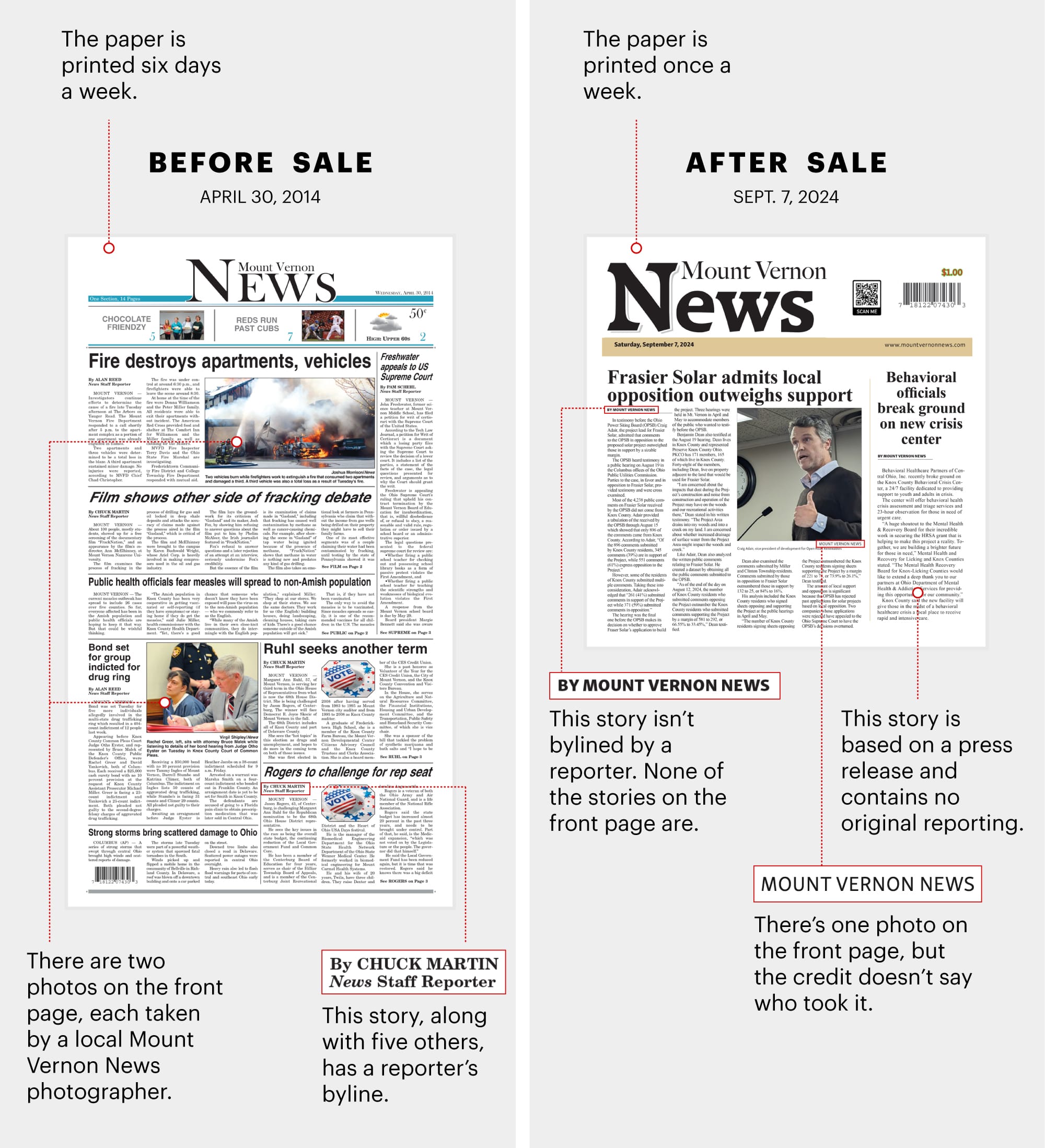
Today, the Mount Vernon News only publishes once a week and has no local reporters or photographers.
“It’s obvious when you read the stories, either they’re AI-generated or they’re written by somebody who’s sitting in an office in Chicago who has never been here,” said Bill Davis, a sports editor who said he worked at the paper from 2010 to 2019.
Since Metric took over, only 11% of stories credited the work to authors working for Metric or its sister companies. Most of what it publishes are press releases or content submitted by companies and community groups, according to an analysis by the Tow Center, ProPublica and Floodlight.
After the sale, residents said they could no longer get timely obituaries — people were buried by the time funeral announcements were published — but they could read a lot about endangered farmland and concerns that the sun’s reflection off solar panels could blind nearby pilots.
Even Mount Vernon’s mayor, who was once a sports reporter at the paper, said he stopped reading it. Tanner Salyers, a former Mount Vernon city council member who now oversees public safety for the city, said quality dropped after the sale. “Then Frasier kicked up and they were like, ‘No more news.’ We call it the Solar Times.”
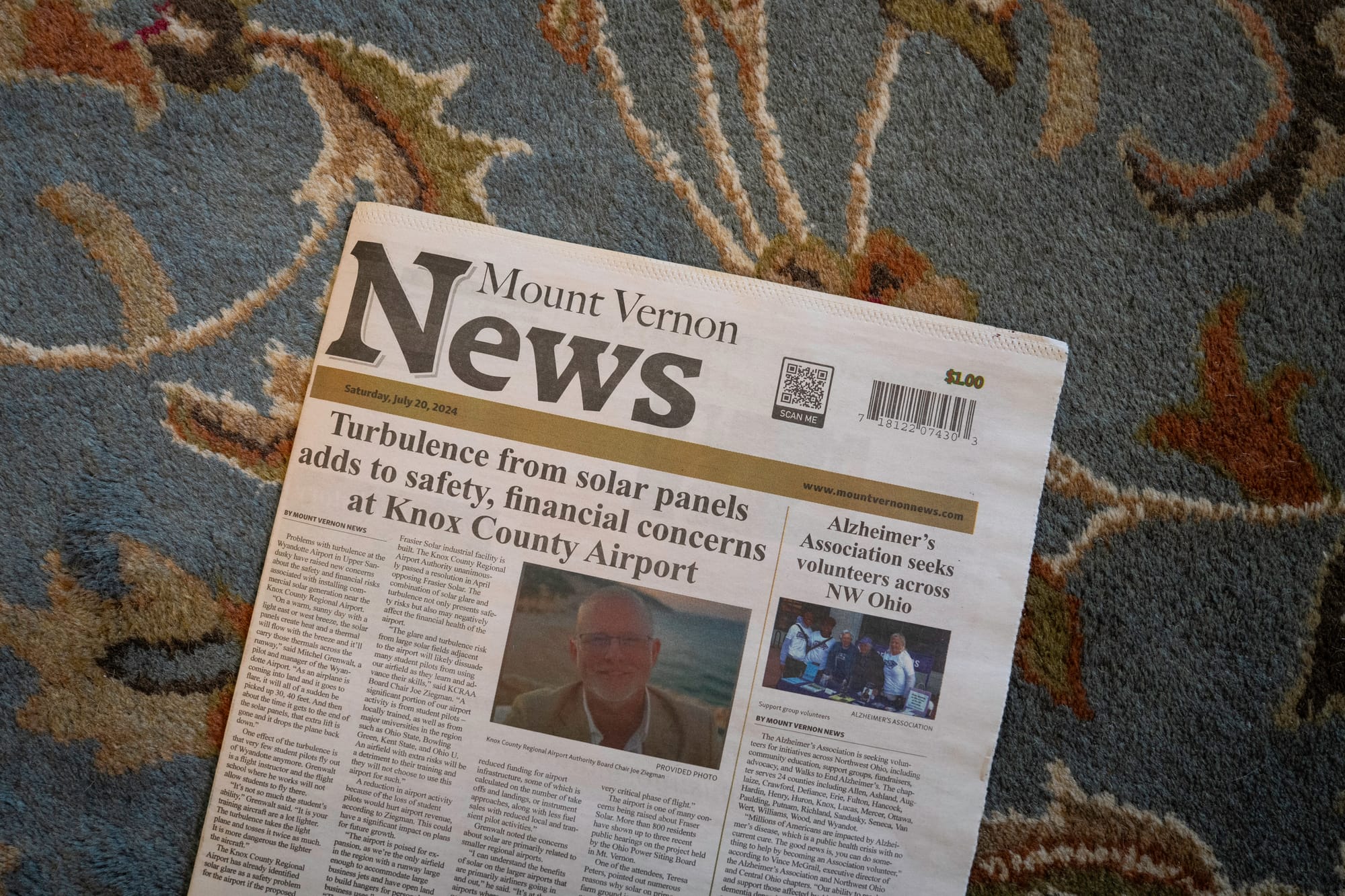 A summer issue of the Mount Vernon News on the floor of the paper’s business office, where one local employee now works. There are no local reporters or photographers. (Sarahbeth Maney / ProPublica).
Over the last 12 months, the paper has published at least 52 online news stories on solar energy — 42 of them about the Frasier proposal, the analysis found. Of the 40 print editions published this year, 17 have featured front-page stories about solar. And though the paper has occasionally run a pro-solar letter to the editor, nearly all of the stories slanted anti-solar, according to an analysis of coverage by Floodlight, ProPublica and the Tow Center.
The paper began publishing a weekly opinion column called “Afternoon TEA” — TEA being an acronym for The Empowerment Alliance, a dark-money gas advocacy group Rastin leads.
The columns extolled the superiority of gas as a fuel source.
It isn’t clear if The Empowerment Alliance paid the Mount Vernon News to run the “Afternoon TEA” columns.
But tax filings show that since 2020 The Empowerment Alliance has spent at least $6.3 million on a “public education campaign,” which included publishing “Afternoon TEA.” The goal was to promote “the importance of natural gas to the economy and national energy independence.”
One of The Empowerment Alliance’s stated goals is “fighting the nonsense of turning corn fields into solar fields.” It has financed online advertisements attacking President Joe Biden’s energy policies and spearheaded an Ohio bill that defined gas as a “green” fuel source.
Half of the Frasier stories published in the Mount Vernon News over the past year have mentioned Knox Smart Development, the anti-solar group linked to Rastin. Articles often quoted people or cited work from a Koch-backed think tank, The Buckeye Institute, but did not interview Frasier or farmers willing to lease land to it.
The Buckeye Institute is part of the State Policy Network, a group of think tanks that has received millions in funding from organizations connected to the Koch family. Rastin’s wife has served as a director on the State Policy Network board, and in 2019 she gave it $700,000, according to a tax record that typically would’ve been redacted but was posted to a government site.
The Mount Vernon News and pro-gas political groups also were working to influence local elections. The text messages that boosted anti-solar candidates were from a conservative Ohio PAC tied to a group that ran a pro-gas campaign.
And, leading up to the primary, a newspaper called the Ohio Energy Reporter was mailed to Knox County homes. The 8-page paper reprinted several Mount Vernon News stories on solar and featured other articles with headlines including “Ohio’s coming ‘solar trash wave’ ” and “Could the Texas Power Crisis happen in Ohio?”
The publication did not disclose its owners. The Floodlight, ProPublica and Tow Center investigation used source code from the website, its IP address and business mailing addresses to confirm that it is a product of the wider Metric Media network.
The stories the Mount Vernon News published began undermining politicians who were seen as insufficiently anti-solar and boosting the profiles of solar power’s outspoken critics.
In one article, the News accused Mount Vernon Mayor Matthew Starr of bowing to “energy activists” and pledging to try to remove natural gas from the city. It was not true. Starr was furious and asked the editors to take down the article, but they would not.
And in nearly a dozen stories that mentioned Collier, the county commissioner who was later ousted, the paper consistently misused a comment he’d given about newly placed solar panels at the county jail to falsely insinuate he supported the Frasier project.
Collier was never interviewed for those stories. Yet the paper ran a story devoted entirely to anti-solar commissioner candidate Drenda Keesee, a megachurch pastor who’d never run for office before; the article said she had “emerged as a vocal opponent of solar projects encroaching on the community.” Keesee, whose property would border a portion of the solar site, was the only source in the story.
She won the primary against Collier and is unopposed in the November general election.
Drenda Keesee, right, is a pastor at Faith Life Church and a candidate for a seat on the Knox County Commission. Keesee, who’s running on an anti-solar platform, attended a Ohio Power Siting Board hearing in Columbus in August. (Sarahbeth Maney / ProPublica)
‘You can’t eat solar panels’
For the community, the debate over solar has been passionate and persistent. What it hasn’t always been is civil. Yard signs have been stolen. Insults hurled. Middle fingers extended. Friendships frayed.
“Other than solar, we don’t have any problems with each other,” said Kathy Gamble, who runs the pro-solar group Knox County For Responsible Solar.
Many people in the community say they don’t view the debate through the lens of climate science or fossil fuels; they care about land rights and preserving rural life. Members of Preserve Knox County, an anti-solar group with several members whose land borders the proposed solar arrays, said they worry the solar project will scare off the sandhill cranes and bald eagles that visit their backyards.
Many members are distrustful of Biden’s renewable energy initiatives; they are staunch supporters of former President Donald Trump, who questions the scientific consensus that the climate is undergoing dangerous changes. They also don’t trust the solar developer’s promises to plant enough trees to block the panels from view. And they don’t want to lose the farmland that gives the area its agricultural identity.
Knox County residents Connie and Jim Boeshart, who live next to property where solar panels would be built if the Frasier Solar project is approved, attend an Ohio Power Siting Board hearing in August. (Sarahbeth Maney / ProPublica)
“You can’t eat solar panels,” said Jim Boeshart, whose home would be adjacent to solar arrays.
Keith Strait, a farmer who lives not far from Boeshart, agreed: “Let’s face it,” he said, pointing at the ground, “They’re not making any more of this. There will be a time when there won’t be any farm left. Where’re you going to get your food from?”
Keith Strait, a farmer in Knox County, said, “I don’t like it,” of the solar proposal. “They’re taking away a lot of farm ground.” (Sarahbeth Maney / ProPublica)
The farmers who want to lease their land feel their voices have been lost in the debate. For them, a 40-year land contract with Frasier Solar would be steady income. One farmer said he could make four times as much money per acre leasing to the solar project as he’d make renting to another farmer.
Rich Piar, the third-generation farmer, is looking to the solar panels as a retirement plan. He said he has no one to take over the operation when he retires, and he doesn’t think anyone should dictate what he does with his land or when he stops farming.
“Most farmers’ exit strategy is their health,” Piar said. “I don’t want to have that kind of predetermined exit strategy.” He went to one of the public meetings about Frasier but said it was so packed he didn’t get to speak until almost midnight.
Rich Piar stands near his cornfield in Knox County, Ohio. He is one of the local farmers who plans to lease his land for the Frasier Solar project. (Sarahbeth Maney / ProPublica)
In August, the Ohio Power Siting Board, which will rule on whether the project can be built, held a final hearing to accept evidence from both sides. One of the attorneys who spoke on behalf of a farmer who is leasing land for the project was from the Sabin Center for Climate Change Law at Columbia University. (The Tow Center also is based at Columbia, but its work is separate.)
Frasier lawyers cross-examined Knox Smart Development spokesperson Jared Yost at the hearing, where he testified that Rastin, the retired Ariel executive, was one of the group’s biggest donors. To Open Road Renewables’ vice president of development, Craig Adair, the confirmation pierced the veil.
Everything changed, Adair said in an interview, “when The Empowerment Alliance decided to use its vast financial resources” to shape the debate in Knox County and in the Mount Vernon News.
Craig Adair, vice president of development at Open Road Renewables, the company developing the Frasier Solar project, testifies at the Ohio Power Siting Board hearing on the project in August. (Sarahbeth Maney / ProPublica),
The News published two stories on the hearing but did not mention the public admission of Knox Smart Development’s ties to Rastin, the Ariel Corporation and The Empowerment Alliance.
The board’s decision is likely to take months.
In the meantime, construction has started at the old Mount Vernon News building, which is being turned into an academic hub for a local university. The building will be named after Rastin’s stepson, a former president of Ariel Corporation.
*Floodlight**is a nonprofit newsroom that investigates the powerful interests stalling climate action.
===
State Policy Network
1851 Center is an associate member of the State Policy Network (SPN). SPN is a web of right-wing “think tanks” and tax-exempt organizations in 50 states, Washington, D.C., Canada, and the United Kingdom. As of August 2020, SPN's membership totals 162. Today's SPN is the tip of the spear of far-right, nationally funded policy agenda in the states that undergirds extremists in the Republican Party. SPN Executive Director Tracie Sharp told the Wall Street Journal in 2017 that the revenue of the combined groups was some $80 million, but a 2019 analysis of SPN's main members IRS filings by the Center for Media and Democracy shows that the combined revenue is over $120 million.[4]
Although SPN's member organizations claim to be nonpartisan and independent, the Center for Media and Democracy's in-depth investigation, "EXPOSED: The State Policy Network -- The Powerful Right-Wing Network Helping to Hijack State Politics and Government," reveals that SPN and its member think tanks are major drivers of the right-wing, American Legislative Exchange Council (ALEC)-backed corporate agenda in state houses nationwide, with deep ties to the Koch brothers and the national right-wing network of funders.[5]
In response to CMD's report, SPN Executive Director Tracie Sharp told national and statehouse reporters that SPN affiliates are "fiercely independent." Later the same week, however, The New Yorker's Jane Mayer caught Sharp in a contradiction. In her article, "Is IKEA the New Model for the Conservative Movement?," the Pulitzer-nominated reporter revealed that, in a recent meeting behind closed doors with the heads of SPN affiliates around the country, Sharp "compared the organization’s model to that of the giant global chain IKEA."
She reportedly said that SPN "would provide 'the raw materials,' along with the 'services' needed to assemble the products. Rather than acting like passive customers who buy finished products, she wanted each state group to show the enterprise and creativity needed to assemble the parts in their home states. 'Pick what you need,' she said, 'and customize it for what works best for you.'" Not only that, but Sharp "also acknowledged privately to the members that the organization's often anonymous donors frequently shape the agenda. 'The grants are driven by donor intent,' she told the gathered think-tank heads. She added that, often, 'the donors have a very specific idea of what they want to happen.'"[6]
A set of coordinated fundraising proposals obtained and released by The Guardian in early December 2013 confirm many of these SPN members' intent to change state laws and policies, referring to "advancing model legislation" and "candidate briefings." These activities "arguably cross the line into lobbying," The Guardian notes.[7]
Ties to Big Tobacco
The 1851 Center's parent organization, the Buckeye Institute (BIPPS) received at least $60,000 in funding from Philip Morris and other tobacco corporations in the 1990s, according to documents in the Tobacco Library -- previously secret papers unveiled as a result of government lawsuits -- analyzed by Progress Now and the Center for Media and Democracy, publishers of SourceWatch. According to the report, "The Buckeye Institute was considered an 'allied' organization, a resource to be used in building coalitions and advancing [the tobacco industry's] corporate interests."[8] Such comprehensive documents are not available from more recent years, but Altria funding documents show that Big Tobacco is still funding BIPPS as recently as 2012 and 2009, although the amounts are not known.[9][10]
In exchange, the "Buckeye Institute has compiled a record of supporting the issues important to its Big Tobacco funders," the report notes, and details many instances of this support.[8] The tobacco industry also funds BIPPS' parent group, SPN.
1851's executive director, Maurice Thompson, led legal efforts against Ohio’s public smoking ban, representing the bar that challenged the smoking ban in front of the Ohio Supreme Court.[11]
Funding
The 1851 Center for Constitutional Law is not required to disclose its funders. Its major foundation funders, however, can be found through a search of the IRS filings.
- Citizens for Self-Governance: $14,000 (2011-2012)
- Donors Capital Fund: $185,000 (2010-2011)
- DonorsTrust: $175,000 (2010-2018)
- State Policy Network: $20,000 (2013)
==
https://www.exposedbycmd.org/2022/03/11/revealed-new-leaders-of-council-for-national-policy-set-extremist-agenda/
david a
at its first meeting of 2022, the secretive Council for National Policy (CNP) laid out its plans for influencing this year’s midterm elections, abolishing abortion rights, defunding the left, limiting China’s influence, and countering a topic of great concern to Republicans: “wokeness.”
According to an agenda obtained by the Center for Media and Democracy (CMD), the CNP meeting took place the last weekend in February at the posh Ritz-Carlton in Dana Point, California. The agenda reveals changes in leadership and current priorities of the influential group, which is closelytied to Trump and the Republican Party.
Kevin Roberts, a CNP board member and president of the Heritage Foundation, kicked the event off with a speech on “how the Conservative Movement can go on the offense to promote America’s founding principles across the country.”
CNP is known for “connecting the manpower and media of the Christian right with the finances of Western plutocrats and the strategy of right-wing Republican political operatives,” as Columbia University Professor Anne Nelson describes the group in her definitive book :{:{Shadow Network: Media, Money, and the :(style="background-color:#ffff66;"):}::{Secret Hub :(style="background-color:#ff9900;"):}::{of the Radical Right:(style="background-color:#ffff66;"):}::(style="box-sizing:inherit"):}:.
Leadership Changes Elevate Voter Suppression Advocates
The program for the February meeting offers the first glimpse of the secretive group’s high-level members and leaders since CMDpublished its September 2020 Membership Directory, provided by open source intelligence researcher Brent Allpress.
The group’s Executive Committee is headed by Judicial Watch President Tom Fitton, who has taken over from William Walton as CNP’s president. Judicial Watch’s “Election Integrity Project” has pushed for voter roll purges and promotes the myth that voter fraud is widespread in the U.S.
At the August 2020 CNP meeting, Fitton facilitated two panels on “election integrity,” CMDreported. “We need to stop those [vote-by-mail] ballots from going out, and I want the lawyers here to tell us what to do,” Fitton told meeting attendees, according to videos obtained by The Washington Post.
Another lifelong advocate of voter suppression now serves as CNP’s vice president: J. Kenneth Blackwell, a former secretary of state in Ohio and member of Trump’s failed voter fraud panel, the Presidential Advisory Commission on Election Integrity. He currently chairs the Center for Election Integrity at the America First Policy Institute (AFPI), a nonprofit spin-off of the Trump administration.
In May 2021, Blackwell facilitated an “Action Session” at CNP’s 40th anniversary meeting on how to combat the national voting rights effort, featuring U.S. Rep. Byron Donalds (R-FL), who voted against certifying the 2020 presidential electoral college results, and GOP lawyer Cleta Mitchell, who has promoted Trump’s Big Lie and advised him on his infamous call pressuring Georgia’s secretary of state to “find” enough votes for the former president to win the state.
At its February meeting, CNP hosted a screening of the film:{**Capitol Punishment**:(style="box-sizing:inherit"):}: with director Chris Burgard, which promotes the claim that, “Everything that we are being told [about the insurrection] is a lie and Americans are being persecuted to support that lie.” CNP has extensive ties to #StoptheSteal and the violent insurrection at the Capitol on Jan. 6, CMD reported.
Others joining the CNP executive committee this year include Jerry A. Johnson (treasurer), former president of the National Religious Broadcasters; William G. Boykin, retired Army lieutenant general and executive vice president of theFamily Research Council; Chad Connelly, president of Faith Wins; and Millie Hallow, managing director of executive operations at the National Rifle Association.
Blackwell is also listed as president of the board of directors for CNP Action, and Fitton is a new director of the affiliate.
The Gold Circle Members list is largely similar to the September 2020 directory, with many of the new additions representing shifts from lower membership tiers. Notable new members include Ashland University President Carlos Campo; Lynn Friess, widow of GOP megadonor Foster Friess;and Ryan Helfenbein, executive director of the Standing for Freedom Center and a vice president at Liberty University.
Politicizing Covid
“The pandemic led to unprecedented government mandates, the erosion of civil liberties, and an outright assault on freedom,” CNP’s agenda booklet argues. “Americans have seen and experienced what unchecked government power can do, and they have had enough.”
CNP has been instrumental in the relentless push from the right to ignore public health guidelines from the Centers for Disease Control and Prevention (CDC) during the deadly Covid-19 pandemic. It played a leading role in the anti-lockdown coalition known as “Save Our Country,” with members making up half of its leadership counciland organizing weekly conference calls to coordinate response tactics.
In May 2020, CMD also revealed that CNP Action, CNP’s 501(c)(4) affiliate, organized a call to discuss a plan for recruiting “extremely pro-Trump” doctors to campaign against Covid public health restrictions.
CNP’s February meeting featured a general session on the state of the pandemic in the U.S. led byDr. Jay Bhattacharya, a leading advocate for herd immunity who has advised Florida Governor Ron DeSantis (R) on his controversial anti-mask policies.
Focus on Elections
Despite being a tax-exempt organization barred from engaging in electoral politics, CNP is focusing heavily on elections this year, according to the agenda for its February meeting.
Dave Bossie, president of Citizens United, led things off at the Gold Circle Dinner with a presentation on “the most pressing political battles in DC and their impact on the Conservative Movement.”
A general session titled “Virginia 2021: Lessons Learned” featured Chad Connelly, founder and president of Faith Wins; Mark Campbell, campaign manager for Glenn Youngkin, the Republican who won the 2021 governor’s race in Virginia; Victoria Cobb, president of The Family Foundation of Virginia; and Chris Wilson, CEO of WPA Intelligence sharing “their analyses of the Virginia race” and “what it means for 2022.”
After not winning a statewide race in more than a decade, in 2021 Republicans in Virginia won the offices of governor, lieutenant governor, and attorney general, while also recapturing the majority in the state House.
Former Virginia Secretary of Natural Resources Becky Norton Dunlop, a past president of CNP, joined the four “Lessons Learned” panelists for a CNP Action session “to chart the course to success nationwide in November.”
In his capacity as CNP Action chairman, Blackwell also hosted “Candidate Introductions” for attendees. While candidates were not listed on the program, CMD obtained a flier for Drew Montez Clark, a Republican candidate for Florida’s 25th district seat in the U.S. House, that was circulated at the meeting.
Clarkreportedly co-organized two buses carrying 100 Floridians to the Jan. 6 rally in DC that led to the violent insurrection at the Capitol. He also spoke at a far-right “America First” rally in April 2021 headlined by Rep. Marjorie Taylor Greene (R-GA).
Supreme Court Takes Center Stage
“This term of the Supreme Court could be one of the most consequential ever, and CNP Members have been central to some of the landmark cases being decided,” the CNP’s February meeting program notes. Speakers at a general session on the subject included Alan Sears, founder of the Christian right litigation powerhouse Alliance Defending Freedom; Susan B. Anthony List President Marjorie Dannenfelser; and First Liberty President Kelly Shackelford.
“CNP has been strategizing to dominate the Supreme Court for decades,” CNP expert Anne Nelson told the Associated Press in Oct 2020. “They have worked through the Federalist Society, the Heritage Foundation, and the National Rifle Association, all run by members of the CNP.”
Dannenfelserwas among 14 other CNP members to attend the Sept. 26, 2020, Rose Garden ceremony at the White House where Amy Coney Barrett accepted the nomination for the Supreme Court, solidifying the far-right’s hold on the nation’s highest court.
The agenda notes that Dannenfelser “will provide an update on the Dobbs v. Jackson Women’s Health Organization case that could result in completely gutting or overturning Roe v. Wade,” the 1973 Supreme Court decision guaranteeing women in America the constitutional right to an abortion.
Mississippi’s Speaker of the House Phillip Gunn (R-Miss.), the 2020 chair of the American Legislative Exchange Council (ALEC), touted the Dobbs v. Jacksoncase and its prospects for leading to a decision to overturn Roe v. Wade during a panel at the CNP meeting last May, CMD reported.
“We think that’s going to be a landmark case. All of us know that the United States Supreme Court composition has changed… in a way that is more pro-life,” Gunn told meeting attendees last spring. “They say that Amy Coney Barrett is one of the most active, pro-life people in America, so we believe that she brings a new dynamic to that court. We think our case, our law that we passed in 2018, will be transformative in the arena in abortion. We’re proud of that.”
Dannenfelser then led a CNP Action panel “on how the Conservative Movement can be best equipped for the impending Supreme Court decision on Dobbs” and to “strategize on messaging, state legislation, and more with attendees.”
One of the panelists,Mike Thompson, is a senior vice president with CRC Advisors. Leonard Leo,who played an integral role in Trump’s effort to pack the federal judiciary with right-wing judges, founded CRC Advisors in 2020 with Greg Mueller to “funnel big money and expertise across the conservative movement.” As of September 2020, Leo was aBoard of Governors member of CNP....
Pushing Back Against China, the Left, and a “Woke” Military
Placing China “at the heart of the greatest challenges facing the United States in recent years”—from Covid to currency manipulation, climate policies, and “undue influence over American corporations”—Economic War Room host Kevin Freeman led a discussion titled “The 21st: An American or Chinese Century?”
Freeman was joined in the panel by Beau Brunson, Consumers’ Research Director of Policy and Regulatory Affairs. Consumers’ Research has committed millions in dark money to fight environmental, social, and corporate governance concerns (ESG) and “woke” capitalism, where BlackRock has emerged as a top target of its campaign for its “hypocritical” investments in China.
CMD recently exposed Consumers’ Research as one of the largest sponsors of the State Financial Officers Foundation, a group of Republican treasurers, auditors, and staff from 16 states, which has also prioritized fighting the ESG movement and “woke” capitalism.
Also on the panel were Pete Hoekstra, former ambassador to the Netherlands under Trump, and Steve Milloy, a FoxNews contributor and paid advocate for Phillip Morris, ExxonMobil, and other corporations.
The three also participated in a CNP Action panel on “Countering China,” where they collectively worked “on ways to combat the increasing and pervasive threat China poses to the United States and American life.”
Leading an CNP Action panel discussion on “Defunding the Left,”**Buckeye Institute** President and CEO Robert Alt facilitated a tutorial on how to cut off contributions to “left-wing causes” by targeting public employee unions, trial lawyers, and investment management firms. O.H. Skinner, executive director of Alliance for Consumers, and Bridgett Wagner, vice president of policy promotion at the Heritage Foundation, joined the discussion.
New CNP Executive Member Boykin led a panel discussion focused on the question: “Can a Woke Military Address Future Threats?” with Mike Berry, First Liberty’s general counsel, and Keith Kellogg, retired Army lieutenant general and co-chair of AFPI’s Center for American Security. The three talked about “extreme policies [that] have been implemented through the Department of Defense” and “how woke ideologies have influenced our armed services.”
Two other CNP meetings are scheduled for this year, May 18–20 in McLean, VA, and September 15–17 in Frisco, TX.
120
Ohio’s Right-Wing Buckeye Institute Goes National
By Don Wiener and Arn Pearson | January 27th, 2020 at 12:01 PM (CST)
The Ohio-based Buckeye Institute has nearly doubled its revenues in recent years and is increasingly taking its pro-corporate fights to other states.
=
http://www.progressive.org/news/2015/07/188231/ohio-charter-schools-werent-reporting-failing-grades
July 22, 2015
The Ohio State Board of Education, dominated by appointees of Republican Governor John Kasich, met and discussed why, as Ohio began to evaluate the sponsor-authorizers of Ohio’s charter schools, the test scores of students at online charters were quietly omitted.
The act is a violation of state law, as Republican chair of the state senate’s education committee, Peggy Lehner, and Republican state auditor, Dave Yost, have both confirmed.
When underlings of David Hansen, the department's director of school choice, could not adequately answer the questions of Senator Peggy Lehner, who had come to the meeting of the State Board to ask questions, she demanded their boss come downstairs to the meeting room to address her concerns.
On Saturday, Hansen resigned from his post overseeing charter schools for the Ohio Department of Education.
This is all a huge embarrassment for Governor John Kasich. David Hansen’s wife, Beth, hasservedas Kasich’s chief of staff for some time, but she recently left the position to chair Kasich's campaign staff, as he plans to soon announce his candidacy for president.
Before coming to the Ohio Department of Education in 2013, David Hansenledthe extremely conservative Buckeye Policy Institute, which is part of the far-rightState Policy Network.
The Plain Dealer notedin a recent editorial: “A 2012 state law on evaluating charter schools clearly mandated ODE (Ohio Department of Education) to include the grades of all online charter schools when grading their sponsors—agencies with oversight over the charter schools. Lawmakers hoped the pressure on sponsors would force them to provide better oversight of their schools… However, Plain Dealer education reporter Patrick O’Donnell recently revealed that ODE quietly ignored that law, a revelation that shocked the state Board of Education among others.” Because Hansen excluded the performance of online schools from his rating of sponsors, one sponsor, “the Ohio Council of Community Schools… earned the highest grade—exemplary—even though its online schools including OHDELA, which is run by the politically connected White Hat Management, earned the lowest–Fs.”
Patrick O’Donnell, an education reporter in Cleveland,reported: “The evaluations of charter school sponsors, also called authorizers—the agencies that help create and oversee charter schools—are the cornerstone of Gov. John Kasich and the state’s roundabout plan to improve Ohio’s charter schools… The key beneficiary of the exclusion—so far—was the Ohio Council of Community Schools, a non-profit agency which collects about $1.5 million in sponsor fees a year from the more than 14,000 students attending Ohio Virtual Academy and OHDELA, the online school run by White Hat Management.”
David Brennan, owner of White Hat Management, and William Lager, the founder of the Electronic Classroom of Tomorrow (ECOT) and the private company that provides services for ECOT, Altair Management, are known to be among the state’s largest contributors to the campaigns of Ohio’s Republican elected officials. It is well known that Ohio Virtual Academy (Ohio’s K12 affiliate), OHDELA, and ECOT have among the state’s highest dropout rates and notoriously low student achievement.
Last Friday, in afollow upto the story that had broken earlier in the week,O’Donnell noted that when asked whether he would count ECOT’s persistently low scores in an upcoming evaluation of ECOT’s sponsor, “State Superintendent Richard Ross is refusing to say whether he will count the F grades for the Electronic Classroom of Tomorrow, or ECOT, Ohio’s largest online school and one run by a major Republican contributor, in a key charter school evaluation coming soon… Though an evaluation involving ECOT is imminent, he declined to answer direct questions from The Plain Dealer about how ODE will handle failing state report card grades for the online school that receives close to $100 million in state tax dollars for its 14,600 students.”
On Friday,the *Columbus Dispatch* reported that Ohio’s state auditor, Dave Yost, “is examining how the Ohio Department of Education excluded poor student-performanc data from online charter schools when it rated the schools’ sponsors last spring.” "You don’t get to pick and choose the laws you obey," Yost said.
State Senator Teresa Fedor, a Toledo Democrat, hasdemandedthe resignation of Richard Ross, Ohio’s state superintendent. The Plain Dealer’s editorsdo not spareRoss in yesterday’s editorial: “If Richard Ross, state superintendent of schools, hopes to regain his credibility and make true inroads in reforming Ohio’s broken charter school system, he must explain why he allowed this to happen. An Ohio law requires state evaluations of all online schools and requires those evaluations to be part of overall sponsor evaluations—that means honest evaluations, not cooked grades… Ross must correct course immediately.”
What few have said directly is that the mess is also an enormous embarrassment to Governor Kasich. Hansen’s quick resignation is clearly part of an attempt to contain the damage.
Section:
Topics:
- See more at: http://www.progressive.org/news/2015/07/188231/ohio-charter-schools-werent-reporting-failing-grades#sthash.E06OXrGA.dpuf - See more at: http://www.progressive.org/news/2015/07/188231/ohio-charter-schools-werent-reporting-failing-grades#sthash.E06OXrGA.dpuf
http://www.prwatch.org/comment/36416#comment-36416
Ohio state education officials are now admitting that Ohio has almost ten times as many failing charter schools as the state initially claimed.
This revelation comes as Ohio tries to hang onto a $71 million federal charter school grant in the wake of scandals over misleading the grant application reviewers and breaking state law by altering charter school performance statistics. That was the largest grant award by the U.S. Department of Education last year.
Ohio newspapers and the Center for Media and Democracy reported last October that the Ohio Department of Education's claims about the excellence of the state's charter-school system were intentionally misleading.
In the state's July 2015 grant application, education officials reported that in the 2012-13 school year Ohio had no "poor performing" charters, even though about a third of the schools didn't meet any of the standards on state report cards and 60 percent earned D's or F's on a measure of how students perform on state tests.
The grant application also said an automatic-closure law would shut down any failing charter schools without disclosing that the law will not be in effect for several years.
Meanwhile, it turns out that then-Ohio charter school chief David Hansen, who drafted the grant application, also rigged charter school sponsor evaluations to improve their ratings. Hansen resigned July 18, two days after submitting the grant request to the feds and several days after admitting he broke the law by excluding failing grades for some charter schools in the evaluations.
Hansen's wife, Beth Hansen, is Ohio Governor John Kasich's former chief of staff and the manager of Kasich's newly surging presidential campaign.She left her government post for the campaign in the midst of the scandal as the pre-primary season was beginning. Kasich has not been asked about the charter school failures in the national debates.
In the latest news, Ohio's Department of Education now says there were actually 57 poor-performing charter schools in the state in the 2013-14 school year, not six.
Its July grant application claimed there were only six.
Conversely, the state said there were 93 "high-performing charter schools" in July and now it says there are just 59.
These performance statistics are for 290 brick-and-mortar charter schools and still do not include online charters (which Hansen omitted).
These numbers were included in a January 29 letter to the federal regulators who put a hold on Ohio's charter-school grant amid the concerns. The 20-page letter is signed by interim state superintendent Lonny J. Rivera, and was the state's third response to questions from federal regulators since the review was opened.
Part of the reason Ohio won the grant in the first place was a glowing endorsement from the National Association of Charter School Authorizers (NACSA)—an organization that had previously referred to the charter system in Ohio as "broken."
But NACSA rethought that assessment as it signed a $40,000-a-year agreement with the Ohio Department of Education to lend assistance to the state's charter school authorizers. The deal was brokered by former NACSA senior executive and lobbyist Hansen before he resigned as head of the Ohio Office of Quality School Choice.
During his time as NACSA's top lobbyist, Hansen represented the organization at meetings of the American Legislative Exchange Council (ALEC), touting "high quality" charters. That's the post he took after he left the "Buckeye Institute" and before Kasich put him in charge of charters for the state of Ohio.
Hansen previously led the Buckeye Institute, an Ohio "think tank" that is part of the controversial "State Policy Network" (SPN). SPN special interest groups amplify ALEC's lobbying agenda, which includes numerous bills to siphon money from traditional public schools to charters and for-profit enterprises. It should be no surprise that a virtual school corporation, K12, sits on ALEC's corporate board and has co-chaired its education task force where corporate lobbyists and special interest groups vote as equals with state legislators on bills, behind closed doors at posh resorts with fancy private parties. Before Hansen became Kasich's point person on charters, NACSA sent Hansen to ALEC to advance its charter school agenda there.
Cleveland's Plain Dealer reported last June that Hansen intentionally left F grades for online charter schools out of academic evaluations of charter school oversight agencies. Those F grades for schools run by major Republican donors would have dragged down the rating of the oversight agencies.
One of the largest such agencies in the state is the Ohio Council of Community Schools, which collects about $1.5 million in sponsor fees a year from students attending Ohio Virtual Academy and the Ohio Distance and Electronic Learning Academy (OHDLA), an online school run by a company owned by David Brennan, a big Republican campaign donor in Ohio.
Ohio has hoped to use the $71 million in federal aid to give grants of up to $700,000 to applicants seeking to open new charter schools. That's nearly a million dollar giveaway per charter to experiments, which have often failed, while traditional public schools are facing budget cuts that hurt school children and their learning environment.
But, as CMD revealed in its "Charter School Black Hole" report last October, out of the 88 Ohio charter schools created by planning and implementation grants under the Charter School Program between 2008 and 2013, at least 15 closed within a few years and another seven never opened at all. These charters received more than $4 million in federal taxpayer money.
Despite this track record and despite the false and deceptive claims the state made in its application for more federal tax dollars for charters , Ohio landed the biggest one-year grant in the 2015 competition for federal funding, $32.6 million, with more planned in the coming years.
Since 2004, Ohio has been granted more than $195 million in American tax dollars by the U.S. Department of Education under the Charter School Program for State Educational Agencies (CSP-SEA). That's part of the more than $3.7 billion CMD has documented that the federal government has spent fueling the charter school industry over the past few decades.
==
http://www.sourcewatch.org/index.php/Buckeye_Institute_for_Public_Policy_Solutions
Buckeye Institute for Public Policy Solutions (BIPPS) is a right-wing advocacy group based in Ohio. It is a member of the $83 million-a-year State Policy Network (SPN), a web of state pressure groups that denote themselves as "think tanks" and drive a right-wing agenda in statehouses nationwide. According to its website, the organization seeks to "set the policy debate in Ohio by researching and promoting relevant and practical solutions to Ohio's most pressing public policy issues."[1] It was founded in 1984 as the Buckeye Center, in part by the Atlas Economic Research Foundation's former president, John Blundell (Atlas is a prominent SPN associate member).[2] It changed its name to Buckeye Institute in 1995.[3] Atlas award-winner Sam Staley later became BIPPS' president,[4] and Atlas President Alex Chafuen was on BIPPS' board.[3]
The 1851 Center for Constitutional Law started as a litigation center operated by the Buckeye Institute,[5] but spun off as its own 501(c)(3) non-profit in 2010.[6]
SPN is a web of right-wing “think tanks” in every state across the country. It is an $83 million right-wing empire as of the 2011 funding documents from SPN itself and each of its state "think tank" members. Although SPN's member organizations claim to be nonpartisan and independent, the Center for Media and Democracy's in-depth investigation, "EXPOSED: The State Policy Network -- The Powerful Right-Wing Network Helping to Hijack State Politics and Government," reveals that SPN and its member think tanks are major drivers of the right-wing, American Legislative Exchange Council (ALEC)-backed corporate agenda in state houses nationwide, with deep ties to the Koch brothers and the national right-wing network of funders.[7]
In response to CMD's report, SPN Executive Director Tracie Sharp told national and statehouse reporters that SPN affiliates are "fiercely independent." Later the same week, however, The New Yorker's Jane Mayer caught Sharp in a contradiction. In her article, "Is IKEA the New Model for the Conservative Movement?," the Pulitzer-nominated reporter revealed that, in a recent meeting behind closed doors with the heads of SPN affiliates around the country, Sharp "compared the organization’s model to that of the giant global chain IKEA." She reportedly said that SPN "would provide 'the raw materials,' along with the 'services' needed to assemble the products. Rather than acting like passive customers who buy finished products, she wanted each state group to show the enterprise and creativity needed to assemble the parts in their home states. 'Pick what you need,' she said, 'and customize it for what works best for you.'" Not only that, but Sharp "also acknowledged privately to the members that the organization's often anonymous donors frequently shape the agenda. 'The grants are driven by donor intent,' she told the gathered think-tank heads. She added that, often, 'the donors have a very specific idea of what they want to happen.'"[8]
A set of coordinated fundraising proposals obtained and released by The Guardian in early December 2013 confirm many of these SPN members' intent to change state laws and policies, referring to "advancing model legislation" and "candidate briefings." These activities "arguably cross the line into lobbying," The Guardian notes.[9]
Banned by Columbus Dispatch for Plagiarism
According to a November 2013 report by ProgressOhio and the Center for Media and Democracy (CMD):[10]
"In October 2003, the Columbus Dispatch 'banned' the Buckeye Institute and announced that it would no longer publish op-eds bearing the Institute or its scholars' names after it was discovered that Buckeye Director Joshua Hall [had] plagiarized part of a recently published opinion piece."In that case, a Dispatch reader discovered that Hall had copied five passages from an op-ed written by Geoffrey F. Segal of the Reason Public Policy Institute (which is also funded by the Koch family fortune and includes Koch reps on its board) published in The Baltimore Sun several months earlier. When confronted, Hall repeatedly denied any wrongdoing."The Dispatch persisted and in a meeting with the paper, Buckeye Institute President Samuel R. Staley admitted that both Segal and Hall’s works were plagiarized. In fact, the research and text in question had originally been prepared by a public-relations firm in Alexandria, Virginia, which had forwarded the information to interested parties as part of a communications strategy."
Questions of Lobbying
In February 2011, former Buckeye Institute President Matt Mayer (now president of the newer SPN affiliate Opportunity Ohio) was caught in a contradiction regarding the organization's lobbying and advocacy activity. In a tweet to the blog Plunderbund, Mayer said, “Of course we weigh in on ideas (repeal), especially ones we propose-we don’t advocate for specific bills ('vote for x') or pols." But on the same day, in a blog post about a bill -- 2011 SB 5 -- on Buckeye's website, Mayer wrote, "We need to be calling, faxing, and emailing every Ohio Senator, every day, until this vote is passed. They need to be told with total certainty that this vote is a choice between the citizens of this state and the public sector employee unions. Get the numbers and emails out to your membership and tell them to make that choice clear.”[11]
Ties to the American Legislative Exchange Council
The Buckeye Institute often promotes the American Legislative Exchange Council (ALEC), its policies, and its reports on its website. According to the ProgressOhio/CMD report:[10]
- "In May 2013, the Buckeye Institute promoted the release of ALEC's 'Rich States, Poor States' report on its website.[12] That report has been the subject of devastating criticism for its methodology and the distorted way it tallies state's economic health.[13]
- "The Buckeye Institute cited four ALEC model bills as 'promising policy approaches' in its November 2010 report Smart on Crime.[14]
- "The Buckeye Institute cited ALEC's 2011 edition of 'Rich States, Poor States' in its May 2012 Policy Brief, 'Big Government Spending Not Requisite for Economic Growth.'[15] Such claims have been subject to numerous criticisms.[16]
- "Buckeye Institute policy analyst Greg Lawson spoke favorably about ALEC's influence in Ohio, specifically in the Kasichadministration. Lawson is quoted as saying: 'Quite frankly, Ohio only started making the changes ALEC recommended in recent years… It's a little premature to be making some of these judgments until the policies are fully implemented. We're only now beginning to see the impact.'"[17]
For more, see the report, "Smoke Screen: The Buckeye Institute," here.
SPN's predecessor, the Madison Group, was "launched by the American Legislative Exchange Council or ALEC . . . and housed in the Chicago-based Heartland Institute," according to a 1991 report by the National Committee for Responsive Philanthropy (NCRP) found in the University of California-San Francisco's Legacy Tobacco Documents.[18][19]
The case is strengthened by an October 1987 ALEC directory also available via the Tobacco Documents that says, "The Madison Group is chaired by Mrs. Constance Heckman now Constance Campanella, founder of the lobbying firm [Stateside Associates], Executive Director of ALEC . . ."[20] A speakers list also available in the Tobacco Documents says in Constance Campanella's biography, "She was a co-founder and first President of The Madison Group, the first network of free-market state think tanks."[21]
SPN has been a member of the American Legislative Exchange Council (ALEC) for many years. In the mid-2000s, SPN secured funding for more of its member think tanks to join ALEC in order to help develop model legislation. By 2009, 22 SPN member think tanks were active ALEC members and participants in ALEC task forces, according to an SPN newsletter, and SPN was being rewarded for its services by ALEC.[22] As of 2013, at least 35 SPN member think tanks have demonstrable ties to ALEC in addition to SPN's own ties, and all of SPN's member think tanks push ALEC's agenda in their respective states, according to a review by the Center for Media and Democracy (CMD).
See SPN Ties to ALEC for more.
Ties to the Franklin Institute for Government and Public Integrity
BIPPS used to host writers from theALEC-connected**Franklin Center** for Government and Public Integrity, which screens potential reporters on their “free market” views as part of the job application process.[23] The Franklin Center funds reporters in over 40 states.[24] Despite their non-partisan description, many of the websites funded by the Franklin Center have received criticism for their conservative bias.[25][26] On its website, the Franklin Center claims it "provides 10 percent of all daily reporting from state capitals nationwide."[27]
In 2010, BIPPS -- at the time a Franklin Center affiliate -- was denied credentials in the Ohio Legislative Correspondents Association. Association President Jim Siegel said, "They were denied because they were more of a conservative think tank than a professional news-gathering organization… [T]here were some questions about where their funding came from." Buckeye Institute President (as of 2012) Kevin Holtsberry confirmed the past financial support from the Franklin Center with the Center for Media and Democracy.[28]
Franklin Center Funding
Franklin Center Director of Communications Michael Moroney told the Center for Public Integrity (CPI) in 2013 that the source of the Franklin Center's funding "is 100 percent anonymous." But 95 percent of its 2011 funding came from DonorsTrust, a spin-off of the Philanthropy Roundtable that functions as a large "donor-advised fund," cloaking the identity of donors to right-wing causes across the country (CPI did a review of Franklin's Internal Revenue Service records).[29] Mother Jones called DonorsTrust "the dark-money ATM of the conservative movement" in a February 2013 article.[30] Franklin received DonorTrust's second-largest donation in 2011.[29]
The Franklin Center also receives funding from the Wisconsin-based Lynde and Harry Bradley Foundation,[31] a conservative grant-making organization.[32]
The Franklin Center was launched by the Chicago-based Sam Adams Alliance (SAM),[33] a 501(c)(3) devoted to pushing free-market ideals. SAM gets funding from the State Policy Network,[34] which is partially funded by The Claude R. Lambe Foundation.[35] Charles Koch, one of the billionaire brothers who co-own Koch Industries, sits on the board of this foundation.[36] SAM also receives funding from the Rodney Fund.
Funding
The Buckeye Institute has received significant funding from the Koch-fueled Donors Capital Fund -- which obscures the true sources of its grants -- according to the ProgressOhio/CMD report: "In 2008 and 2009, grants from Donors Capital made up 57 percent of Buckeye’s total grants received in those two years, and 19 percent in 2010. The Koch brothers have also given to the Buckeye Institute directly through their foundations, the Charles G. Koch Charitable Foundation and the Claude R. Lambe Charitable Foundation."[10]
Ties Between Buckeye and Big Tobacco
BIPPS received at least $60,000 in funding from Philip Morris and other tobacco corporations in the 1990s, according to documents in the Tobacco Library -- previously secret papers unveiled as a result of government lawsuits -- analyzed by Progress Now and CMD. According to the report, "The Buckeye Institute was considered an 'allied' organization, a resource to be used in building coalitions and advancing [the tobacco industry's] corporate interests."[10] Such comprehensive documents are not available from more recent years, but Altria funding documents show that Big Tobacco is still funding BIPPS as recently as 2012 and 2009, although the amounts are not known.[37][38]
In exchange, the "Buckeye Institute has compiled a record of supporting the issues important to its Big Tobacco funders," the report notes, and details many instances of this support.[10]
The tobacco industry also funds BIPPS' parent group, SPN. See SPN Funding for more.
Other Funding
Major foundational donors to BIPPS, many of which are allied with the Kochs, include:[39]
| Funder | Amount | Year |
|---|---|---|
| Castle Rock Foundation | $34,600 | 1995-2010 |
| [[Charles G. Koch Charitable Foundation ]] | $28,281 | 2007-2009 |
| Chase Foundation of Virginia | $61,100 | 2001-2011 |
| Claude R. Lambe Charitable Foundation | $10,000 | 2005 |
| Donors Capital Fund | $1,090,205 | 2005-2010 |
| **Jaquelin Hume**Foundation | $285,280 | 1999-2009 |
| JM Foundation | $80,000 | 1999-2010 |
| Neal and Jane Freeman Foundation | $500 | 2004 |
| Searle Freedom Trust | $121,500 | 2009 |
| State Policy Network | $55,000 | 2003-2011 |
| The Lynde and Harry Bradley Foundation | $1,500 | 1994 |
| The Randolph Foundation | $25,000 | 2007-2009 |
| The Roe Foundation | $315,000 | 1998-2011 |
| Thomas B. Fordham Foundation | $18,500 | 1999 |
| William H. Donner Foundation | $30,000 | 1998 |
Core Financials
2011[40]
- Total Revenue: $491,240
- Total Expenses: $623,952
- Net Assets: $224,511
2010[41]:
- Total Revenue: $819,385.00
- Total Expenses: $531,271.00
- Net Assets: $357,122.00
2009[42]:
- Total Revenue: $878,745.00
- Total Expenses: $655,685.00
- Net Assets: $69,008.00
Personnel
Board of Directors
As of November 2012:[43]
- Greg Lashutka (former Mayor of Columbus), Chair
- Dan Peters, Vice Chair
- Matt A. Meyer, President
- Brad Smith, Secretary/Treasurer
- Deborah L. Owens (associate professor of marketing and international business in The University of Akron's College of Business Administration and co-author of Direct Marketing in Action), Trustee
- Ronald A. McMaster, Trustee
- Jerry Jordan, Trustee
Staff
As of November 2013:[44]
- Robert Alt, President
- Rebekah Alt,Senior Advisor for Strategic Communication and Advancement
- Danielle Beckett, Major Gifts Officer
- Andrew M. Grossman, Visiting Fellow
- Greg R. Lawson, Statehouse Liaison & Policy Analyst
- Dan Lusheck, Administrative & Research Assistant
- Joe Nichols, William and Helen Diehl Transparency Fellow
- Nathaniel Stewart, Visiting Fellow
- Erin Sutter, Office Manager
- Josh Vaughan, William and Helen Diehl Fiscal Policy Fellow
Former Staff and Fellows
- Steven Carozza, Fellow
Contact Details
88 East Broad St., Ste. 1120
Columbus, OH 43215-3506
Phone: (614) 224-4422
Fax: (614) 224-4644
Email: info AT buckeyeinstitute DOT org
Web: http://www.buckeyeinstitute.org
Articles and Resources
Related SourceWatch Articles
- DonorsTrust
- Donors Capital Fund
- Koch Family Foundations
- Koch Industries
- Franklin Center for Government and Public Integrity
- Heritage Foundation
- Think tanks
- Whitney Ball
- Adam Meyerson
- Bridgett Wagner
Related PRWatch Articles
- Brendan Fischer, Why Are the Franklin Center's "Wisconsin Reporter" and "Watchdog.org" Attacking the John Doe?, PRWatch.org, December 19, 2013.
- Rebekah Wilce, The State Policy Network's Cozy Relationship with Big Tobacco, PRWatch.org, December 16, 2013.
- Rebekah Wilce, Did ALEC Found SPN? 1991 Report Suggests So, Exposes SPN Agenda, PRWatch.org, December 12, 2013.
- Rebekah Wilce, Guardian Documents Expose State Policy Network Groups' Intent to Lobby, PRWatch.org, December 5, 2013.
- Rebekah Wilce, State Policy Network: The Stealth Network Dramatically Influencing State Law, PRWatch.org, December 5, 2013.
- Rebekah Wilce, Tracie Sharp: Bursar of Mystery Money and "IKEA Model" Materials to Stink Tanks, PRWatch.org, November 19, 2013.
- Center for Media and Democracy, Reports Expose Extreme Pressure Groups Masquerading as Think Tanks, press release, November 13, 2013.
- Rebekah Wilce, A Reporters’ Guide to the "State Policy Network": the Right-Wing Think Tanks Spinning Disinformation and Pushing the ALEC Agenda in the States, PRWatch.org, April 4, 2013.
- Sara Jerving, ALEC and Heartland Aim to Crush Renewable Energy Standards in the States, PRWatch.org, November 27, 2012.
- Connor Gibson, Meet the Network Hiding the Koch Money: "Donors Trust" and "Donors Capital Fund", PRWatch.org, October 29, 2012.
- Brendan Fischer, Koch-Funded Mackinac Center Brings Wisconsin Act 10 Provisions to ALEC, PRWatch.org, May 2, 2012.
- Sara Jerving, Franklin Center: Right-Wing Funds State News Source, PRWatch.org, October 31, 2011.
External Resources
- DeSmog Blog, Stink Tanks: Historical Records Reveal State Policy Network Was Created by ALEC, December 9, 2013.
- The Guardian, State conservative groups plan US-wide assault on education, health and tax, December 5, 2013.
- Portland Press Herald, "Washington County residents have mixed reactions to plan to eliminate taxes," December 5, 2013.
- The Texas Observer, "The Money Behind the Fight to Undermine Medicaid," December 5, 2013.
- Media Matters, North Carolina Newspapers Largely Ignore Conservative Funding Of Sham Think Tanks, December 3, 2013.
- Shepherd Express, Masters of Manipulation: Right-wing Billionaires, Corporations and the Bradley Foundation Pay for Junk Studies that Prop up Their Agenda, November 27, 2013.
- "Moyers & Company," How a Shadowy Network of Corporate Front Groups Distorts the Marketplace of Ideas, November 19, 2013.
- MSNBC "Rachel Maddow Show," November 18, 2013.
- Free Speech TV "Ring of Fire," Facebook, Microsoft, AT&T and Others Supporting Right Wing Propaganda Machine, November 18, 2013.
- Topeka Capital-Journal, Trabert dismisses report tying KPI to Koch agenda, November 16, 2013.
- The New Yorker (Jane Mayer), Is IKEA the New Model for the Conservative Movement?, November 15, 2013.
- Salon, Ted Cruz and Koch brothers embroiled in shadowy Tea Party scheme, November 15, 2013.
- St. Louis Business Journal, Beyond Sinquefield: Who else is funding the Show-Me Institute?, November 15, 2013.
- The Guardian, Facebook and Microsoft help fund rightwing lobby network, report finds, November 14, 2013.
- Huffington Post, Meet The Little-Known Network Pushing Ideas For Kochs, ALEC, November 14, 2013.
- CBS St. Louis, Show-Me Institute’s Ties Questioned in New Report, November 14, 2013.
- Talking Points Memo, Florida Conservative Group Helping Muck Up Obamacare In Alaska, November 14, 2013.
- Mint Press News, Reports Reveal SPN’s Secret Corporate Agenda Through Use ‘Expert’ Testimony, November 14, 2013.
- Media Matters, Shadowy Right-Wing Group Generates Media Coverage For Conservative Policy From Coast To Coast, November 14, 2013.
- The Institute for Southern Studies, Are conservative think tanks breaking lobbying laws?, November 14, 2013.
- Nonprofit Quarterly, Corporate Money in Network of Right-Wing State Policy Think Tanks, November 14, 2013.
- The Progressive, Right-Wing Think Tanks Push Privatization in the States, November 13, 2013.
- Politico, Report: Think tanks tied to Kochs, November 13, 2013.
- Lawrence Journal-World, Reports released by progressive groups are critical of Kansas Policy Institute, November 13, 2013.
- Maine Insights, Report: Maine Heritage Policy Center’s funding connection to Koch Brothers, November 13, 2013.
- The Florida Current, Liberal groups bemoan lobbying by conservative think tanks, November 13, 2013.
- The Oregonian, Cascade Policy Institute benefits from secretive donor group but says it operates independently, November 13, 2013.
- Center for Media and Democracy, EXPOSED: The State Policy Network, The Powerful Right-Wing Network Helping to Hijack State Politics and Government, organizational report, November 13, 2013.
- Arizona Working Families and CMD, A Reporter’s Guide to the Goldwater Institute: What Citizens, Policymakers, and Reporters Should Know, organizational report, updated November 13, 2013.
- Progress Florida and CMD, Lawmaking Under the Influence of Very Special Interests: Understand the role of Florida ‘think tanks’ in driving a Koch-fueled, ALEC-allied corporate agenda, organizational report, November 13, 2013.
- Maine's Majority Education Fund, Fooling Maine: How national conservative groups infiltrated Maine politics by founding and funding the Maine Heritage Policy Center, organizational report, November 13, 2013.
- Progress Michigan, Who's Running Michigan? The Far-Right Influence of the Mackinac Center for Public Policy, organizational report, November 13, 2013.
- Alliance for a Better Minnesota, Who's in Charge: How Nationalized Corporate-Run Think Tanks Influence Minnesota Politics, organizational report, November 13, 2013.
- Progress Missouri, What Missourians Need to Know About the Show-Me Institute, organizational report, updated November 13, 2013.
- Granite State Progress, Bad Bartlett: The Josiah Bartlett Center and NH Watchdog Answer the Call of the Koch Brothers, organizational report, November 13, 2013.
- ProgressOhio, Smoke Screen: The Buckeye Institute, organizational report, November 13, 2013.
- Keystone Progress, Think tanks or corporate lobbyist propaganda mills?, organizational report, November 13, 2013.
- Progress Texas, TPPF + ALEC, organizational report, November 13, 2013.
- One Wisconsin Now, S is for Shill: Inside the Bradley Foundation's Attack on Public Education, organizational report, November 13, 2013.
- Muncie Voice, Pence and Right-Wing Are Taking Over Public Education, November 13, 2013.
- The Spokesman-Review, Shawn Vestal: Idaho Freedom Foundation pushes limits of word ‘charity’, November 2, 2013.
- AZ Central, When this ‘watchdog’ pitches, taxpayers strike out, October 12, 2013.
- IndyStar, Daniels says speech to partisan group was a mistake, October 10, 2013.
- Muncie Voice, Indiana Policy Review: Not an Independent News Source, October 2, 2013.
- The Spokesman-Review, Idaho Freedom Foundation's charitable status scrutinized, September 15, 2013.
- CounterSpin, Lee Fang on 'The Right Leans In', April 5, 2013.
- FireDogLake, State Policy Network, an umbrella coordinating ALEC, Heritage, Heartland and others, April 4, 2013.
- Thom Hartmann with Lee Fang on MSNBC, The conservative State Policy Network is sneaking into your state & will change America, March 29, 2013.
- Current TV "War Room",
 , March 28, 2013.
- The Nation, The Right Leans In, March 26, 2013.
- Democracy Now, Donors Trust: Little-Known Group Helps Wealthy Backers Fund Right-Wing Agenda in Secret, February 19, 2013.
- Paul Abowd, Center for Public Integrity, Donors use charity to push free-market policies in states, Consider the Source, February 14, 2013.
- John R. Mashey, Fake science, fakexperts, funny finances, free of tax 2, DeSmog Blog report, updated October 23, 2012, p. 74.
- Urban Milwaukee, Stealth Conservatives, October 11, 2012.
- Rome News-Tribune, ANALYSIS: Georgia leaders depend on the same well for ideas, October 2012.
- Andy Kroll, The Right-Wing Network Behind the War on Unions, Mother Jones, April 25, 2011.
- Guidestar, State Policy Network, IRS filings and other organizational information about SPN.
- Center for Policy Alternatives, ALEC and the Extreme Right-Wing Agenda, organizational brochure about ALEC and SPN.
- John J. Miller, Fifty Flowers Bloom: Conservative think tanks — mini–Heritage Foundations — at the state level, National Review, November 19, 2007.
- Bridge Project, State Policy Network, online resource listing grants to SPN and SPN's connections to other groups.
- People for the American Way, State Policy Network, RightWingWatch.org, organizational resource.
- Greenpeace, Koch Industries Climate Denial Front Group: State Policy Network (SPN), organizational resource.
References
- Buckeye Institute for Public Policy Solutions, About Us, organizational website, accessed November 2012.
- Center for Freedom and Prosperity, Archive: At a Glance, organizational website, accessed November 2013.
- National Education Association, State Policy Network Appendix: Members: Ohio, "The Real Story Behind 'Paycheck Protection': The Hidden Link Between Anti-Worker and Anti-Public Education Initiatives: An Anatomy of the Far Right," organizational report, 1998.
- Samuel Reisz Staley, Curriculum Vitae, Florida State University faculty document, May 6, 2013.
- Buckeye Institute for Public Policy Solutions, 2009 Form 990, organizational annual IRS filing, September 16, 2010.
- 1851 Center for Constitutional Law, 2010 Form 990, organizational annual IRS filing, February 1, 2011.
- Rebekah Wilce, Center for Media and Democracy, EXPOSED: The State Policy Network -- The Powerful Right-Wing Network Helping to Hijack State Politics and Government, organizational report, November 13, 2013.
- Jane Mayer, Is IKEA the New Model for the Conservative Movement?, The New Yorker, November 15, 2013.
- Ed Pilkington and Suzanne Goldenberg, State conservative groups plan US-wide assault on education, health and tax, The Guardian, December 5, 2013.
- ProgressOhio and Center for Media and Democracy, Smoke Screen: The Buckeye Institute, organizational report, November 13, 2013.
- ProgressOhio, The Liar Wire: Matt Mayer At The Buckeye Institute, organizational blog, February 14, 2011.
- Buckeye Institute for Public Policy Solutions, Ohio Makes Significant Jump In Rankings, but Still Needs Improvement in Annual Rich State, Poor States Report, organizational publication, May 24, 2013.
- Rebekah Wilce, ALEC's Economic Policies Do More Harm Than Good, New Report Shows, PRWatch, November 28, 2012.
- Buckeye Institute for Public Policy Solutions, Smart on Crime: With Prison Costs on the Rise, Ohio Needs Better Policies for Protecting the Public, organizational report, November 2010.
- Buckeye Institute for Public Policy Solutions, [http://www.buckeyeinstitute.org/uploads/files/Spending%20Burden%20Handout%20-%20Final(1).pdf Big Government Spending Not Requisite for Economic Growth], organizational "policy brief," May 2012.
- Nick Surgey, "Business Climate" Rankings Bogus, Says New Report, PRWatch, May 2, 2013.
- Tom Beyerlein, Kasich budget likely to ignite robust debate; Sides divided sharply over state's tax policies (sub. req'd.), Dayton Daily News, December 13, 2012.
- National Committee for Responsive Philanthropy, Special Report: Burgeoning Conservative Think Tanks, organizational report, Spring 1991, p. 2.
- Rebekah Wilce, Did ALEC Found SPN? 1991 Report Suggests So, Exposes SPN Agenda, PRWatch, December 12, 2013.
- American Legislative Exchange Council, ALEC Personnel Directory, The State Factor, October 1987, p. 3.
- Speakers List, document available in the University of California-San Francisco's Legacy Tobacco Documents, accessed December 2013.
- State Policy Network, SPN & Alec: A Model Relationship, SPN News, organizational newsletter, July/August 2009, p. 4.
- Franklin Center, Franklin Affiliates in Your State, organizational website, accessed October 2012.
- The Franklin Center for Government and Public Integrity, Think tank Journalism: The Future of Investigative Journalism, organizational website, accessed August 19, 2011.
- Rebekah Metzler, "Watchdog" website puts a new spin on politics, The Portland Press Herald, October 2, 2010.
- Allison Kilkenny, The Koch Spider Web, Truthout, accessed August 19, 2011.
- Sara Jerving, Franklin Center: Right-Wing Funds State News Source, PRWatch.org, October 27, 2011.
- Sara Jerving, How a Right-Wing Group Is Infiltrating State News Coverage, PRWatch, July 12, 2012.
- Paul Abowd, Center for Public Integrity, Donors use charity to push free-market policies in states, organizational report, February 14, 2013.
- Andy Kroll, Exposed: The Dark-Money ATM of the Conservative Movement, Mother Jones, February 5, 2013.
- Daniel Bice, Franklin Center boss wants apology from Democratic staffer, Milwaukee Journal Sentinel, August 8, 2011.
- The Bradley Foundation. The Bradley Foundation. Organizational website. Accessed August 19, 2011.
- Sam Adams Alliance. Sam Adams Alliance Media Kit. Organizational PDF. Accessed August 19, 2011.
- Media Matters Action Network. Sam Adams Alliance. Conservative Transparency. Accessed August 19, 2011.
- Media Matters Action Network. State Policy Network. Conservative Transparency. Accessed August 19, 2011.
- Media Matters Action Network. Claude R. Lambe Charitable Foundation. Conservative Transparency. Accessed August 19, 2011.
- Altria Family of Companies, 2012 Recipients of Charitable Contributions from Altria Family of Companies, corporate document, accessed November 2013.
- Altria Family of Companies, 2009 Recipients of Charitable Contributions from Altria Family of Companies, corporate document, accessed November 2013.
- American Bridge 21st Century Foundation, Recipient: Buckeye Institute for Public Policy Solutions, Bridge Project conservative transparency website, accessed November 2013.
- Buckeye Institute for Public Policy Solutions, IRS Form 990, 2011, organizational tax filing, November 12, 2012.
- Buckeye Institute for Public Policy Solutions, IRS form 990, 2010. GuideStar.
- Buckeye Institute for Public Policy Solutions, IRS form 990, 2009. GuideStar.
- Buckeye Institute for Public Policy Solutions, 2011 Form 990, organizational annual IRS filing, November 12, 2012.
- Buckeye Institute for Public Policy Solutions, About Us: Staff, organizational website, accessed November 2013.
| This article is a stub. You can help by expanding it. |
==