seibt, naomi anti-greta
dn 1 25
quinn s
Naomi Seibt, the Alternative for Germany influencer, who he has done so much to boost, sort of cultivates this sort of anime-like appearance.}:
https://redstate.com/terichristoph/2024/12/20/elon-musks-latest-political-move-has-everyone-on-the-left-reaching-for-their-smelling-salts-n2183468
The Five Words Tweeted by Elon Musk That Have the Global Elite Reaching for Their Smelling Salts
By Teri Christoph | 4:25 PM on December 20, 2024The opinions expressed by contributors are their own and do not necessarily represent the views of RedState.com.
AP Photo/Alex Brandon
Elon Musk has done it again.
Fresh off of tweeting the original Continuing Resolution (CR) into oblivion, Musk has now set his sights on Europe, and what he tweeted about Germany has the international community of leftists retreating to their fainting couches and calling Jeeves to bring the smelling salts.
I’ve Got a Question for All Those Democrats Who Are Gnashing Their Teeth Over Elon Musk
Elon Musk Issues Ominous Threat to Any Member Who Votes for the 'Cramnibus'; Vivek Also Weighs In
In response to a video posted to X by Naomi Seibt—a young German YouTuber who is known as the "anti-Greta Thunberg"—in which Seibt calls out Germany's presumptive chancellor Friedrich Merz for not wanting to work with the "Germany First" AfD party, Musk tweeted out five words:
Well, you would have thought he had called for Christmas and Kwanzaa to be canceled and all the gifts to be given to Jewish children based on the tantrums thrown by globalists everywhere. Here's a taste of some worldwide headlines:
"Outrage as Elon Musk claims ‘only AfD can save Germany’" (The Guardian)
"Backlash builds as Elon Musk endorses Germany’s far right" (Politico EU)
"Anger after Musk backs German far right" (France 24)
Musk Pauses Torment of GOP to Praise German Extremists (New York Magazine)
They are big, big mad.
The propagandists at NBC had this to say about the endorsement:
Elon Musk waded into Germany’s election Friday, expressing his support for a far-right anti-immigrant and anti-Islam party that's being monitored by the country’s domestic intelligence agency.
Sounds like Germany has its very own Deep State, doesn't it?
Let's take a closer look at what Musk is actually endorsing here. Is AfD (Alternative für Deutschland) the second coming of Adolph Hitler (not that the modern-day left would have a problem with that based on their unabashed support of Hamas)?
Here's how AfD describes itself on its official website, under the headline, "COURAGE FOR GERMANY. FREE CITIZENS, NOT SUBJECTS":
We are liberals and conservatives. We are free citizens of our country. We are convinced democrats.
And what does AfD stand for?
As free citizens, we stand up for direct democracy, the separation of powers and the rule of law, the social market economy, subsidiarity, federalism, the family and the living tradition of German culture. Because democracy and freedom are based on shared cultural values and historical memories. In the tradition of the two revolutions of 1848 and 1989, with our civil protest we articulate the will to complete national unity in freedom and to create a Europe of sovereign democratic states that are bound together in peace, self-determination and good neighborliness.
We are committed to fundamentally renewing our country in the spirit of freedom and democracy and to restoring these principles. We are open to the world, but we want to be and remain German. We want to permanently preserve human dignity, the family with children, our Western Christian culture, our language and tradition in a peaceful, democratic and sovereign nation state of the German people.
AfD is basically as close to a Germanic MAGA movement as you're going to get. They are Europeans, though, so not as MAGA as they could be, but still, the most promising party to save the country with the largest economy in Europe. You'll notice that the attacks against AfD are the same exact attacks that they've been leveling against Donald Trump for years, and look where that's gotten them.
The worldwide left is running scared at Donald Trump's looming second term, Elon Musk's growing political influence, and the rise of hardline conservative politicians like Giorgia Meloni and Marine LePen. European governments are collapsing at a regular rate, yet the left keeps pushing the same propaganda that saw them soundly defeated in the U.S. on November 5th.
Germany is expected to vote on February 23 to replace the leftist government led by Chancellor Olaf Scholz that collapsed earlier this week.
Teri Christoph
Teri Christoph is the author of the Smart Girl Politics meme-letter. Follow her on Twitter or check out her carefully curated meme-posting over on Facebook.
Feel free to hit her up with memes, complaints and the like at teri.christoph@gmail.com.
https://newrepublic.com/article/158797/climate-change-alarmism-greta-thunberg-naomi-seibt
no lnx
Stella Levantesi, Giulio Corsi/August 6, 2020
Climate “Realism” Is the New Climate Denial
Climate change deniers like Naomi Seibt claim to be fighting Greta Thunberg’s “alarmism,” but their real target is climate action itself.
Climate skeptic Naomi Seibt at Conservative Political Action Conference (CPAC) 2020.]
Going by headlines and poll results, climate change awareness has never been higher. While social media provides fertile ground for propaganda techniques, smear campaigns, fake experts, and conspiracy theories, the increasingly visible proof of climate disruption, along with movements such as Fridays for Future and Extinction Rebellion, seem to be persuading more people by the day. Climate change denial—the multitude of strategies deployed by the fossil fuel industry and its political allies to downplay the threat of global warming and suggest an ongoing debate on the existence of climate change—appears to be in retreat.
But climate change denial has not disappeared. Instead, it has shifted—its adherents adopting new language and tactics. The denial machine has a new communications strategy and an “us versus them” narrative: not climate deniers versus climate believers but climate “realists” versus climate “alarmists.”
It’s a canny approach to discrediting a legitimate scientific warning. By associating themselves with the term “realist,” those employing this rhetoric reiterate a longstanding principle of climate change denial: that those who warn about the catastrophic impacts of the climate emergency are out of touch with reality, “alarmists” who want us to “panic” rather than “think,” as 19-year-old German YouTuber and prominent climate skeptic Naomi Seibt has put it. “Evidence is growing that climate alarmists—those peddling the delusion that human-caused climate change is destroying the Earth—are growing ever more desperate,” an article at the libertarian and climate denial-promulgatingHeartland Institute, which has employed Seibt,declared in January. These sorts of sentences present climate science as emotional and deniers as grounded and rational.
Curious about the development of this new communicative strategy on social media, we recently collected all English-language tweets that contained a set of keywords linked to climate alarmism and realism since the launch of Twitter in 2006. That amounted to a total of 66,561 tweets, with a tweet matching the keywords first appearing in December 2007. While the use of both expressions on Twitter was negligible until 2016 (an average of fewer than 200 tweets per year), the use of the two terms started increasing in 2016. Not until 2019 did the terms climate “realism” and “alarmism” become commonplace: Between January 2016 and March 2020, the use of these terms grew by 900 percent, with the largest yearly increase recorded between 2018 and 2019.
This obviously wasn’t a peer-reviewed statistical study, which would need to investigate how these trends compared to broader trends on Twitter: the growth of tweeting overall, for example. But we were interested in what these tweets, laid alongside rhetoric shifts from prominent institutions and individuals, suggested about the way this narrative was developing and being deployed in reaction to individual events. The jump from 2018 to 2019, for instance, corresponds to another trend: 2019 represented a watershed year for climate action and public awareness on the climate crisis, so much so that it has been defined on more than one occasion as “the year the world woke up to climate change.”
Peaks in tweeting activity on alarmism and realism often correspond to high-profile speeches by Swedish activist Greta Thunberg; the highest level of alarmism/realism tweeting activity came on the day of Greta’s famous “How Dare You” speech during the U.N. Climate Summit. This is consistent with a longstanding pattern others have observed as well: The climate change denial machine always goes in full gear just as global action on climate change becomes a higher priority for government policies, much like the tobacco industry and its misinformation campaign reached a peak as government regulation of it was about to be enacted.
The term “alarmists” has been used by deniers in the past, mostly to denigrate climate scientists. But today, the dichotomy of alarmism and realism appears to be carefully constructed around Thunberg, whom deniers consider a stereotypical “alarmist.”
While some use of the term “alarmist” may be organic, some of it seems more deliberate.Over the past year, the Heartland Institute has enlisted Naomi Seibt as a counter-figure to Thunberg. Seibt denounced the scientists’ and Thunberg’s “climate alarmism,” contrasting it with the “climate realism” of those who, Seibt and Heartland would have it, are merely skeptics grounded in reality. In March,Friends of Science, a notorious climate change denial website, published a video with a title that all too clearly summarized the communicative strategy: “Greta or Naomi: Climate Alarmism v Realism.”
Accumulating proof of anthropogenic global warming and climate disruption within our ecosystems has made it increasingly difficult even for deep-pocketed deniers to argue against emissions-curbing laws. In the face of record-high temperatures, melting ice caps and rising seas, and more intense, frequent fires, floods, and extreme weather events, how do you keep convincing people that climate change is not an immediate priority and also not humanity’s (or, more specifically, the fossil fuel industry’s) responsibility?
Results from our data analysis show that between 50 and 60 percent of the top users most frequently tweeting on climate realism and alarmism follow the Heartland’s Twitter account. The think tank also frequently used the terms both on its Twitter account and website and, around the end of 2019, went so far as to launch the website climaterealism.com.
The Heartland Institute has received extensive funding from the fossil fuel industry. Most of Heartland’s income comes through Donors Capital Fund and its affiliated organization Donors Trust, both described as the “dark money ATM” of the conservative movement for their ability to funnel funding while concealing identities. Greenpeace’s ExxonSecrets reports that the Heartland Institute has received $676,500 from ExxonMobil since 1998 and at least $55,000 from Koch Industries. But the total today might be even higher. A 2019 Influence Map report found that “the five largest publicly-traded oil and gas majors (ExxonMobil, Royal Dutch Shell, Chevron, BP, and Total) have invested over $1Bn of shareholder funds in the three years following the Paris Agreement on misleading climate-related branding and lobbying.”
While Seibt reportedly chose not to renew her contract with Heartland as of April 2020 after facing potential fines from a regional broadcasting authority, the Heartland’s YouTuber phase is crucial to the understanding of the climate denial machine. Seibt offered a strong online presence to counter Thunberg, creating the perception of an ongoing debate on climate change and the degree and timing of its impacts. Transforming climate change into a political issue rather than a scientific one, and making sure it stays that way, allows the denial machine—the fossil fuel industry, the conservative think tanks, the ultra-conservative politicians and their media platforms—to exploit public polarization and to keep telling “their side of the story.”
Framing the debate as “realism” versus “alarmism” feeds off emotions and exploits the public’s fear of an altered planet and the sense of losing control over our future. Who doesn’t want to hear that worst-case scenarios—the loss of beloved cities, the collapse of biodiversity and agriculture, deaths through severe weather and starvation—are mere hysteria? But the deniers’ campaigns are fundamentally economical—it’s about power and money. By spreading doubt and misinforming, the fossil fuel industry can delay emission-control measures and continue to pursue its billion-dollar profits undisturbed.
Current denial tactics, from climate to vaccination or the coronavirus, share fundamental dynamics. The issues are rooted in science, but denial makes them political. Experts who have warned about the dangers of the coronavirus and the importance of acting on the science have also been called out as “alarmists”; those who fear for their assets and their position—including the president of the United States—initially denied the existence of the problem and then downplayed its threat, with dire consequences for the people.
This is what denial does: It reshapes reality, like a funhouse mirror. Calling various activists “alarmists” shouldn’t necessarily be seen as softer than outright denial. Calling those worried about worst-case scenarios “alarmists” denies one of the fundamental principles of climate science: that scientists can predict a range of scenarios but don’t yet know exactly which one will play out. Crucially, that’s not the same as saying scientists have no idea what will happen. And as report after report emerges, suggesting global warming is happening faster, not slower, than earlier projections, the case for so-called alarmism is only growing.
Stella Levantesi @StellaLevantesi
Stella Levantesi is a journalist based in Italy and New York.
Giulio Corsi @gcorsi_
Giulio Corsi is a Ph.D. student at Cambridge University. He studies climate change disinformation.
2x lnx
Going by headlines and poll results, climate change awareness has never been higher. While social media provides fertile ground for propaganda techniques, smear campaigns, fake experts, and conspiracy theories, the increasingly visible proof of climate disruption, along with movements such as Fridays for Future and Extinction Rebellion, seem to be persuading more people by the day. Climate change denial—the multitude of strategies deployed by the fossil fuel industry and its political allies to downplay the threat of global warming and suggest an ongoing debate on the existence of climate change—appears to be in retreat.
But climate change denial has not disappeared. Instead, it has shifted—its adherents adopting new language and tactics. The denial machine has a new communications strategy and an “us versus them” narrative: not climate deniers versus climate believers but climate “realists” versus climate “alarmists.”
It’s a canny approach to discrediting a legitimate scientific warning. By associating themselves with the term “realist,” those employing this rhetoric reiterate a longstanding principle of climate change denial: that those who warn about the catastrophic impacts of the climate emergency are out of touch with reality, “alarmists” who want us to “panic” rather than “think,” as 19-year-old German YouTuber and prominent climate skeptic Naomi Seibt has put it. “Evidence is growing that climate alarmists—those peddling the delusion that human-caused climate change is destroying the Earth—are growing ever more desperate,” an article at the libertarian and climate denial-promulgating Heartland Institute, which has employed Seibt, declared in January. These sorts of sentences present climate science as emotional and deniers as grounded and rational.
curious about the development of this new communicative strategy on social media, we recently collected all English-language tweets that contained a set of keywords linked to climate alarmism and realism since the launch of Twitter in 2006. That amounted to a total of 66,561 tweets, with a tweet matching the keywords first appearing in December 2007. While the use of both expressions on Twitter was negligible until 2016 (an average of fewer than 200 tweets per year), the use of the two terms started increasing in 2016. Not until 2019 did the terms climate “realism” and “alarmism” become commonplace: Between January 2016 and March 2020, the use of these terms grew by 900 percent, with the largest yearly increase recorded between 2018 and 2019.
This obviously wasn’t a peer-reviewed statistical study, which would need to investigate how these trends compared to broader trends on Twitter: the growth of tweeting overall, for example. But we were interested in what these tweets, laid alongside rhetoric shifts from prominent institutions and individuals, suggested about the way this narrative was developing and being deployed in reaction to individual events. The jump from 2018 to 2019, for instance, corresponds to another trend: 2019 represented a watershed year for climate action and public awareness on the climate crisis, so much so that it has been defined on more than one occasion as “the year the world woke up to climate change.”
Peaks in tweeting activity on alarmism and realism often correspond to high-profile speeches by Swedish activist Greta Thunberg; the highest level of alarmism/realism tweeting activity came on the day of Greta’s famous “How Dare You” speech during the U.N. Climate Summit. This is consistent with a longstanding pattern others have observed as well: The climate change denial machine always goes in full gear just as global action on climate change becomes a higher priority for government policies, much like the tobacco industry and its misinformation campaign reached a peak as government regulation of it was about to be enacted.
The term “alarmists” has been used by deniers in the past, mostly to denigrate climate scientists. But today, the dichotomy of alarmism and realism appears to be carefully constructed around Thunberg, whom deniers consider a stereotypical “alarmist.”
While some use of the term “alarmist” may be organic, some of it seems more deliberate. Over the past year, the Heartland Institute has enlisted Naomi Seibt as a counter-figure to Thunberg. Seibt denounced the scientists’ and Thunberg’s “climate alarmism,” of those who, Seibt and Heartland would have it, are merely skeptics grounded in reality. In March, Friends of Science, a notorious climate change denial website, published a video with a title that all too clearly summarized the communicative strategy: “Greta or Naomi: Climate Alarmism v Realism."
accumulating proof of anthropogenic global warming and climate disruption within our ecosystems has made it increasingly difficult even for deep-pocketed deniers to argue against emissions-curbing laws. In the face of record-high temperatures, melting ice caps and rising seas, and more intense, frequent fires, floods, and extreme weather events, how do you keep convincing people that climate change is not an immediate priority and also not humanity’s (or, more specifically, the fossil fuel industry’s) responsibility?
Results from our data analysis show that between 50 and 60 percent of the top users most frequently tweeting on climate realism and alarmism follow the Heartland’s Twitter account. The think tank also frequently used the terms both on its Twitter account and website and, around the end of 2019, went so far as to launch the website climaterealism.com.
The Heartland Institute has received extensive funding from the fossil fuel industry. Most of Heartland’s income comes through Donors Capital Fund and its affiliated organization Donors Trust, both described as the “dark money ATM” of the conservative movement for their ability to funnel funding while concealing identities. Greenpeace’s ExxonSecrets reports that the Heartland Institute has received $676,500 from ExxonMobil since 1998 and at least $55,000 from Koch Industries. But the total today might be even higher. A 2019 Influence Map report found that “the five largest publicly-traded oil and gas majors (ExxonMobil, Royal Dutch Shell, Chevron, BP, and Total) have invested over $1Bn of shareholder funds in the three years following the Paris Agreement on misleading climate-related branding and lobbying.”
While Seibt reportedly chose not to renew her contract with Heartland as of April 2020 after facing potential fines from a regional broadcasting authority, the Heartland’s YouTuber phase is crucial to the understanding of the climate denial machine. Seibt offered a strong online presence to counter Thunberg, creating the perception of an ongoing debate on climate change and the degree and timing of its impacts. Transforming climate change into a political issue rather than a scientific one, and making sure it stays that way, allows the denial machine—the fossil fuel industry, the conservative think tanks, the ultra-conservative politicians and their media platforms—to exploit public polarization and to keep telling “their side of the story.”
Framing the debate as “realism” versus “alarmism” feeds off emotions and exploits the public’s fear of an altered planet and the sense of losing control over our future. Who doesn’t want to hear that worst-case scenarios—the loss of beloved cities, the collapse of biodiversity and agriculture, deaths through severe weather and starvation—are mere hysteria? But the deniers’ campaigns are fundamentally economical—it’s about power and money. By spreading doubt and misinforming, the fossil fuel industry can delay emission-control measures and continue to pursue its billion-dollar profits undisturbed.
Current denial tactics, from climate to vaccination or the coronavirus, share fundamental dynamics. The issues are rooted in science, but denial makes them political. Experts who have warned about the dangers of the coronavirus and the importance of acting on the science have also been called out as “alarmists”; those who fear for their assets and their position—including the president of the United States—initially denied the existence of the problem and then downplayed its threat, with dire consequences for the people.
This is what denial does: It reshapes reality, like a funhouse mirror. Calling various activists “alarmists” shouldn’t necessarily be seen as softer than outright denial. Calling those worried about worst-case scenarios “alarmists” denies one of the fundamental principles of climate science: that scientists can predict a range of scenarios but don’t yet know exactly which one will play out. Crucially, that’s not the same as saying scientists have no idea what will happen. And as report after report emerges, suggesting global warming is happening faster, not slower, than earlier projections, the case for so-called alarmism is only growing.
Stella Levantesi@StellaLevantesi
Stella Levantesi is a journalist based in Italy and New York.
Giulio Corsi is a Ph.D. student at Cambridge University. He studies climate change disinformation.
https://www.desmogblog.com/2020/08/27/qanon-conspiracy-naomi-seibt-climate-science-deniers
Back in December 2019, two conspiratorial worldviews collided as, for the first time, QAnon’s Q suggested his followers should question anew a topic that, by now, has been considered, and reconsidered, for decades: climate change.
“The Paris Agreement on Climate is Another Scam to Ripoff Taxpayers and Enrich the Politicians,” the Q-Drop (the term QAnon followers use to refer to messages they believe come from some sort of government insider who signs messages with the letter Q) claimed, labeling climate action a “con.”
In May, a second Q-Drop riffed on climate change, with a link to a snarky tweet about science and the Swedish teen climate activist Greta Thunberg by a would-be House Republican who’d lost her primary race in March.
Both of those Q-Drops were picked up by a report commissioned by a coalition of environmental groups and conducted by the research firm Graphika, which found that a group of vocal climate science deniers began using QAnon hashtags in May — and they haven’t stopped since.
“The QAnon movement hasn’t traditionally covered climate change, but in May, when an influential QAnon account tweeted about climate denial, there was a notable and sustained increase of QAnon content shared within the climate denial group,” Michael Khoo, an advisor on disinformation for the environmental group Friends of the Earth, and Melissa Ryan, CEO of CARD Strategies and author of the Ctrl Alt-Right Delete weekly newsletters, wrote in an article published today on Medium.
[pix] Asked and Answered
The questions that Q advanced on climate change have been asked and answered — as essentially all of the burning questions on climate science still churning around in climate denial circles have been.
And today, as the impacts of a warming climate are accelerating, it is very clear that we collectively have little time to spare waiting until those who haven’t been keeping up with, or who refuse to acknowledge, the scientific consensus are convinced. The longer the world waits to slash greenhouse gas pollution, the less chance we collectively have to calm the worst impacts of a warming world, according to the world's top climate experts, and if we don't, climate change could make all of the calamities we’ve faced in 2020 soon pale in comparison.
Q, however, raised different concerns about climate action.
“Who audits where the money goes?” the December Q-Drop asked, linking to an article about the Green Climate Fund, which provides funding to help developing countries reduce their greenhouse gas emissions to help them meet their Paris Agreement goals.
Nevermind that if you want the audits of the Green Climate Fund alluded to in the Q-Drop, the answer is extraordinarily unmysterious and unglamorous: the audited financial statements are posted online and they’re done by accountants. Nevermind also that the Paris Agreement itself was never fundamentally about the movement of money, but instead involves countries promising to regulate pollution inside their borders — something we’re still continuing to fail to do, both in the United States and worldwide.
And nevermind that the U.S., whose politicians the Q-Drop implies are pocketing money somehow along the way, has nearly walked away from both the Paris Agreement and the Green Climate Fund. That's despite the glaring fact that the U.S. has been the world’s worst climate polluter since 1750, meaning that this country has played the single largest role in causing the very problem that the global climate pact attempts to (somewhat) address.
To turn Q’s question around, one very basic question Q has never answered is who exactly they are — and to what extent, if any, they’ve sought to monetize the power and influence they’ve been busy amassing. “At this point, who's behind it is speculation more than anything,” Ryan told DeSmog.
Another key part of the problem — as ever — is that climate science deniers publicly talk a lot more than others. Whereas in years past, mainstream media was faulted for giving climate science deniers a misleading amount of airtime, today, they’re using social media to achieve the same ends. Graphika’s research found that for every social media post by the vocal climate scientists and environmentalists they studied, the vocal climate science deniers they studied posted four times.
“On average, they observed that the Climate Denial group was about four times ‘louder’ (number of tweets relative to the group size) than the Climate Science group,” Khoo and Ryan, both advisors to a coalition of environmental groups that commissioned Graphika’s research, wrote.
Clutching at Q’s Coattails
Not only is QAnon taking up climate denial, but prominent climate deniers have been taking up QAnon.
“The other thing we see is that the right needs QAnon more and more to amplify their messaging,” said Ryan.
Take, for example,Naomi Seibt, a young German YouTuberwho has questioned climate science and who has worked with the Heartland Institute, a U.S. think tank and notorious promoter of climate science denial.
“So do you want a beautiful planet that you can stare at but that’s it? It’s just like looking at a TV screen,” the Express, a UK newspaper, quoted Seibt as saying in May. “As a climate realist, I don’t deny that we don’t have some negative impact on the planet. But I don’t think that it’s related to CO2 emissions.”
Seibt briefly rose to broader prominence following a Washington Post article about her in February — though she remains far less well-known than Greta Thunberg, the young environmental activist who the Heartland Institute has sought to compare with Seibt. “She reportedlychose not to renew her contractwith [the] Heartland [Institute] in April 2020 after facing potential fines from a regional broadcasting authority,” DeSmog’s profile on Seibt notes.
In addition to speaking about climate, Seibt has publicly spoken about her views on race and religion. “Seibt’s rise as the young face of climate skeptics has drawn scrutiny of her past remarks. On Friday, video circulated of Seibt’s remarks after a shooting at a German synagogue,” Bloomberg reported on February 28. “'The normal German consumer is at the bottom, so to speak. Then the Muslims come somewhere in between. And the Jew is at the top. That is the suppression characteristic,' she said in comments first reported by The Guardian.”
In July, the trial of that synagogue shooter, charged with murdering two people and the attempted murder of dozens more, began with the accused shooter stating that he felt he was “on the bottom rung of society” and that he was “superseded,” as he sought to justify horrific crimes.
As in Germany, white supremacists in the U.S. have increasingly engaged in racially motivated “mass shooter” armed attacks on unarmed people. And QAnon followers have also begun committing violent acts. “I think it's also important to remember that the FBI has declared QAnon a domestic terrorism threat,” said Ryan, “and QAnon has inspired kidnappings, it has inspired at least one murder, it has inspired arson, there is a real danger from these folks who are drawn to this and become just embroiled in it.”
Naomi Seibt speaking at a Heartland Institute event. pix]
The teenage Seibt has previously denied allegations of anti-Semitism and her mother, an attorney whose clients have reportedly included politicians from the far-right German AfD party, previously told The Guardian that Naomi is not a supporter of the far-right. “'In fact, I was commenting that I think it’s wrong to comment on different races and to view them differently,' Seibt said,” in response to questions about her views on race, The Guardian reported. “'We should just all be regarded as the same.'”
More recently, in addition to talking about climate change and other topics, Seibt has begun posting about QAnon. “As of right now, I don’t consider myself an active part of the QAnon movement,” Seibt said in a YouTube video posted earlier this month and whose title refers to two QAnon themes, “but I am on the side, watching and evaluating for myself what I think is verifiable and what to me seems too far out there.”
“I do not consider myself an active part of the QAnon movement, nor will I ever attach a label to my activism,” Seibt said in response to a question from DeSmog about whether her position had since changed, adding that she also does not identify as a white nationalist, part of the far-right, or an anti-Semite. “But as long as the QAnon movement continues its peaceful protest against matters of injustice, I consider it a positive contribution to the global political discourse.”
“I do not view any ethnicity or religion as superior,” she said, adding that she identifies as a libertarian. “I promote a reduction of centralised state power so that individuals may act freely. The premise for that freedom, of course, is that the individual does no harm to his or her fellow citizens.”
Social Media Fail
Khoo and Ryan pointed to the ways that social media companies for years failed to conduct the most basic scrutiny of information that they publish online and allowed all sorts of demonstrably false information to be repeated in an endless rumor mill online.
“Facebook has policies that let Trump lie uninterrupted,” they wrote. “And when climate deniers get a simple fact-check on Facebook, members of Congress themselves have sent letters to company executives to complain.”
All of this can, of course, have significant policy consequences in the real world.
“The danger for environmental advocates and for the planet is that QAnon could be the energy that stops a big push for any meaningful climate action,” Khoo told DeSmog. “If a Green New Deal is the next thing, we could see QAnon followers serving as the foot soldiers in that war.”
There’s also the risk that fossil fuel companies and trade organizations might jump on the QAnon bandwagon, inspired by the conspiracy theory's popularity. Last week, President Trump praised the movement, claiming not to know much about it except that “they like me very much.”
“If QAnon becomes more mainstream,” Ryan said, “I could see a scenario where industry groups that are invested in climate denial and fossil fuels and such will be incentivized to embrace QAnon or rely on those tactics and networks.”
The other risk is that conspiracy theorizing, when mixed with social media, can not only bring in adherents, it can also raise money.
“The new addition to this history of climate capitalism is the capitalism behind the clicks, the monetizing of disinformation that happens on all the platforms,” Khoo and Ryan wrote. “Virality is central to the profit model, as are ads. Whether or not they’re true is secondary, from a business perspective.”
And the reality is that QAnon has been growing, with NBC News reporting earlier this month that Facebook discovered QAnon accounts and pages have attracted over 3 million member and follower accounts.
Last week, Facebook removed nearly 800 QAnon groups and took some steps to restrict QAnon hashtags and other social media. That follows moves by Twitter to take down roughly 7,000 Twitter accounts and designating QAnon as “coordinated harmful activity.”
Some see that as far too little, far too late. “They’ve had three years of almost unfettered access outside of certain platforms to develop and expand,” Brian Friedberg, a senior researcher at the Harvard Shorenstein Center’s Technology and Social Change Project, told MIT Technology Review in July.
As of press time, Facebook and Heartland have not responded to questions from DeSmog.
==
htlnd vids bs
blk leather jacket interviewed by mohawky guy?
naomi Seibt vs. Greta Thunberg: Whom Should We Trust?
229,594 views•Dec 20, 2019
The Heartland Institute
31.7K subscribers
Greta Thunberg took the world by storm with her doomsday climate predictions. Naomi Seibt, a rising star, advocates for proper scientific discourse over climate change. Who seems like the more reasonable advocate to you?
https://www.youtube.com/watch?time_continue=13&v=Tq4fJdjt_vM&feature=emb_logo
https://www.youtube.com/watch?time_continue=2&v=HxX-1cWSvVc&feature=emb_logo
2:30 flashes of freedom, followed by bro ask $
Naomi Seibt, a 19-year-old German YouTube personality and influencer, has joined The Heartland Institute's Arthur B. Robinson Center on Climate and Environmental Policy. Naomi will be working on communicating the climate realism message to her generation – which has marinated in apocalyptic nonsense their whole lives – for audiences in both in Europe and the United States. See her personal channel here: https://www.youtube.com/channel/UCeYS...Unlike the global legacy media’s favorite young climate communicator, Greta Thunberg, Naomi doesn’t want you to “panic.” She wants you to “think” – the way she did to free herself from the climate alarmist indoctrination. As she says in this video introducing herself on Heartland’s YouTube Channel: “I’ve got very good news for you. The world is not ending because of climate change. In fact, 12 years from now we will still be around casually taking photos on our iPhone 18s. … “We are currently being force-fed a very dystopian agenda of climate alarmism that tells us that we as humans are destroying the planet. And that the young people, especially, have no future – that the animals are dying, that we are ruining nature. “I really believe that many [members of left-wing environmental groups] have good intentions, that they are genuinely scared of the world ending, and that they are scared that their parents and grandparents are ruining the planet. It’s breaking relationships. It’s breaking up families. And we at The Heartland Institute, we want to spread truth about the science behind climate realism, which is essentially the opposite of climate alarmism. “Many people are now actually developing mental disorders and referring to them as eco-anxiety and eco-depression. I believe it’s important that we act now and change this entire mainstream narrative of fear-mongering and climate alarmism, because it’s basically just holding us hostage in our own brains. “Don’t let an agenda that is trying to depict you as an energy-sucking leech on the planet get into your brain and take away all of your passionate spirit. “I don’t want you to panic. I want you to think.”
https://www.youtube.com/watch?time_continue=5&v=HxX-1cWSvVc&feature=emb_logo
==
she saws greta does not know or even refer to sci; also pols don't know sci
cpac vid bkgd]
cites piers morgan "apology" (he did have adj, but..) ; he real and signif, she real-ish but insignif
https://www.youtube.com/watch?v=aKET8Hs2aac
sky news aust murdoch
Self-proclaimed "climate realist" and "anti-Greta Thunberg sensation" Naomi Seibt says while she doesn’t deny the climate is warming, "the effect is absolutely insignificant”. Ms Seibt said the world "did benefit from some amount of warming” because it encouraged “better crop yields” which she said allowed the earth to sustain a growing population. According to Ms Seibt, Greta Thunberg’s rejection of the European Union’s proposal of zero net emissions by 2050 was “just another way to spread panic”. “I have never heard her talk about the science so how is she supposed to know anything about the perfect political measures to take when it comes to climate change,” Ms Seibt told Sky News host Chris Smith. “We need cheap and reliable energy” and "we cannot drive people into eco-depression, eco-anxiety and energy-poverty. “It’s fantastic if we invest in research on alternative energy sources” but we must be careful not to “demonize alternative sources like nuclear energy,” she said.
==
good morn brit 8 min
https://www.youtube.com/watch?v=L3BVN4XcVLk
GMB #PiersMorgan #SusannaReid
Is Greta Thunberg Over-Reacting About Climate Change? | Good Morning Britain
194,825 views•Mar 4, 2020
2.1K
2.6K
Good Morning Britain
621K subscribers
Subscribe now for more! http://bit.ly/1NbomQa
Today Greta Thunberg will visit the European Parliament to discuss future laws and environmental targets. The 17-year-old has led a global movement through climate change strikes and marches. But is Greta really representative of what the world's young people really think? Is she inspiring change or causing unnecessary alarm?
Broadcast on 04/03/2020
Like, follow and subscribe to Good Morning Britain!
The Good Morning Britain YouTube channel delivers you the news that you’re waking up to in the morning. From exclusive interviews with some of the biggest names in politics and showbiz to heartwarming human interest stories and unmissable watch again moments.
Join Susanna Reid,Piers Morgan, Ben Shephard, Kate Garraway, Charlotte Hawkins and Sean Fletcher every weekday on ITV from 6am until 9 every weekday!
Website: http://bit.ly/1GsZuha
YouTube: http://bit.ly/1Ecy0g1
Facebook: http://on.fb.me/1HEDRMb
Twitter: http://bit.ly/1xdLqU3
http://www.itv.com
#GMB #PiersMorgan #SusannaReid
"act in communities of change...
does test
"catrastrophize" all we talk abouty 6 mos
why not go to india china?
ns sez activists have no sci/ not done res, ~IPCC based on models
"at a dangerous rate" clear fact support by 2k sci (want to be anti-greta) just a fact the plane is heating up", which is it?"
ns co2 not factor/driver
pm: you think FF not a factor?
very slight contrib factor to some amt of gw, exaggerated
==
guk
https://www.theguardian.com/environment/2020/feb/28/naomi-seibt-anti-greta-activist-white-nationalist-inspiration
no lnx guk
naomi Seibt: 'anti-Greta' activist called white nationalist an inspiration
German teenager spoke at an event at US rightwing conference CPAC
Stephanie Kirchgaessner and Emily Holden in Washington
Fri 28 Feb 2020 11.00 ESTLast modified on Fri 28 Feb 2020 15.50 EST
Naomi Seibt
Naomi Seibt styles herself as a ‘climate realist’. Photograph: YouTube
A young campaigner who has been hailed by climate sceptics as the right’s answer to Greta Thunberg has previously described a white nationalist who appeared to promote “white genocide” theories as one of her “inspirations”.
Naomi Seibt, a 19-year-old from Münster, Germany, who styles herself as a “climate realist”, has also had to deny she made remarks that could be seen as antisemitic following an attack on a synagogue last year.
Seibt has been described as the darling of climate change deniers and spoke at a small side event of the Conservative Political Action Conference (CPAC) – a high-profile annual meeting of rightwing activists in Washington that will also feature the US president, Donald Trump.
:{
}:
She has been called a young, fresh voice for “free markets and climate realism” for questioning the scientific consensus on the climate crisis, which she has called “ridiculous”.
“Today climate change science really is not science at all,” Seibt has said. “The goal [of climate scientists] is to shame humanity. Climate change alarmism at its very core is a despicably anti-human ideology and we are told to look down at our achievements with guilt, with shame and disgust, and not even to take into account the many major benefits we have achieved by using fossil fuels as our main energy source.”
An examination of the young activist’s YouTube videos and interviews has revealed that Seibt has shown support for an alt-right activist.
In a YouTube discussion last year that was highlighted in a report by the German broadcaster ZDF, Seibt discussed an attack on a synagogue in Halle that killed two people who were outside the temple, and said Jews were considered to be “at the top” of groups who were seen as being oppressed. “Ordinary Germans”, she said, were “at the bottom”. Muslims, she added, were somewhere in between.
The remarks were part of a video discussion that appears to have been deleted. They were seen by some experts as saying that Germans had less pity for “ordinary German” victims of crime than for Jews and Muslims. A portion of the discussion was included in a report by ZDF and is still available online.
Seibt did not respond to a request for comment from the Guardian, although her mother argued she is not a supporter of the far right.
At the conservative event, Seibt was asked twice about this article. She called it “ridiculous how the media cherrypicks things that I said” and said she is not an antisemite.
“In fact, I was commenting that I think it’s wrong to comment on different races and to view them differently,” Seibt said. “We should just all be regarded as the same. That is what I was actually saying, that is how I perceived the public view on different races or different religions.”
“It is clear that she is articulating – no matter how inarticulately – age-old tropes of Jewish power and white grievance: the idea that Jews are a privileged class and that white people are oppressed by them,” said Imran Ahmed, the chief executive of the Center for Countering Digital Hate, who studied the remarks.
When Seibt was challenged by German reporters about whether the remarks could be seen as antisemitic, Seibt replied: “If someone perceives [my remarks] as meaning something different, well, then of course I cannot influence this perception.”
In another YouTube interview describing her embrace of “views that were outside the mainstream”, Seibt referred to the Canadian alt-right internet activist Stefan Molyneux as an “inspiration”.
Molyneux has been described as an “alleged cult leader who amplifies scientific racism, eugenics and white supremacism” by the Southern Poverty Law Center, which monitors extremism and white supremacy.
Molyneux said in a statement to the Guardian: “I have always opposed the idea of racial superiority/inferiority.”
In 2019, Molyneaux said: “I’ve always been skeptical of the ideas of white nationalism, of identitarianism, and white identity. However, I am an empiricist, and I could not help but notice that I could have peaceful, free, easy, civilized and safe discussions in what is, essentially, an all-white country.”
Seibt defended that comment, saying it was out of context.
“He is not devaluing other races, not at all, he’s just describing his experience in western countries, and I agree with that … it’s not that we are better in any way in western countries, and that’s not the point that Molyneaux is trying to make – it’s just that we still have freedom of speech in these countries, and we’re very happy that’s the case.”
Seibt has been hired by a US thinktank called the Heartland Institute, which has traditionally been financed by fossil fuel and coal companies and is known for pushing radical anti-science theories about the climate crisis.
In 2012, Heartland set up a billboard in Illinois that featured a photograph of the “Unabomber” Ted Kaczynski and the words “I still believe in global warming. Do you?”
The move led to some high-profile defections of corporate sponsors. In another case, the group was criticised for sending hundreds of thousands of “educational pamphlets” to schools across the country that promoted false theories about global heating.
The Mercer Family Foundation, which is run by Rebekah Mercer, a financial donor to Donald Trump and the daughter of the hedge fund mogul Robert Mercer, has previously been one of Heartland’s biggest contributors, with records showing a total of $7.5m in donations since the group’s founding.
Records show that the public backing by the Mercers has waned over the last several years, while another organisation called Donors Trust – and its affiliates – have become Heartland’s primary funder.
Donors Trust and associated organisations have donated more than $20m to Heartland, according to records compiled and analysed by DeSmog, which tracks the funding of climate denying groups. The Mercer Family Foundation is a donor to Donors Trust and its affiliates.
Heartland officials did not respond to multiple requests for comment about Seibt, her previous remarks, or questions about who is funding the campaigner’s work for Heartland. The Mercer Family Foundation did not respond to a request for comment about its support for Heartland.
Brendan DeMelle, the executive director of DeSmog, said Heartland was considered so extreme in Washington that “they can’t even get support any more from Exxon”.
Sheldon Whitehouse, a Democratic senator from Rhode Island who has called for action on the climate crisis, said in a statement to the Guardian: “Even among … climate denial groups, Heartland’s … behaviour and brazen attacks on science stand out.”
Kert Davies, the founder of the Climate Investigations Center, which investigates climate denying groups, said Heartland was promoting a counter-narrative to the environmentalists but would ultimately fail.
“They are trying to ride Greta’s wave, but there is no way this person is going to win hearts and minds the way Greta has,” Davies said. “They are trying to blunt the impact of Greta.”
lnx
https://www.washingtonpost.com/climate-environment/2020/02/23/meet-anti-greta-young-youtuber-campaigning-against-climate-alarmism/
https://www.france24.com/en/20200227-german-teen-naomi-seibt-the-darling-of-climate-change-deniers
https://www.zdf.de/politik/frontal-21/nach-dem-anschlag-in-halle-100.html
==
https://insideclimatenews.org/news/12032020/heartland-instutute-climate-change-skeptic
[naomi Seibt, a 19-year-old climate change skeptic and self-proclaimed climate realist, speaks during a workshop at the Conservative Political Action Conference 2020 on Feb. 28, 2020. Credit: Samuel Corum/Getty Images]
:{
}:
:{
}:
The conservative Heartland Institute, which made its name undercutting mainstream climate science, has launched a new effort to try to influence public discussion and political debate about global warming.
The move comes as the organization is reportedly struggling financially and has fallen into renewed controversy over its work in Europe promoting climate denial there. Last week it laid off staff just weeks after it announced the hiring of a teenage German climate skeptic to counter the global popularity of environmental activist Greta Thunberg.
The new website, called Climate at a Glance, includes brief explanations of key climate science and policy issues, many of which are either misleading or inaccurate.
"It's attempting to emulate a more scientific website than previously," said Robert Brulle, a visiting professor at Brown University who has studied public relations campaigns by the fossil fuel industry. "Other than that it's still the same sort of systematic distortion."
An explainer of a carbon tax, for example, claims wind and solar power are "already very expensive." In fact, those sources of energy are now competitive with or even cheaper than new coal or natural gas plants. A discussion of sea level rise claims that "there has been very little recent acceleration." In truth, the rate of rise has more than doubled in recent years compared to during most of the 20th century.
The website comes amid evidence that the clout of Heartland and other groups that have promoted skepticism about climate change may be waning. An increasing number of Republican politicians have sought to distance themselves from climate denial. Last month, House Minority Leader Kevin McCarthy of California, a Republican, introduced a package of bills to promote carbon capture and sequestration technology. Sen. Lisa Murkowski (R-Alaska), in her final year as chair of the Senate Energy and Natural Resources Committee, has been attempting to lead a bipartisan effort to pass energy efficiency and technology investment.
"I think they're becoming more and more marginal," Brulle said of Heartland, noting that some major corporate funders such as ExxonMobil distanced themselves from the group years ago. "You have all the big fossil fuel companies, they're not attacking climate science any more."
Last week's layoff was part of what Heartland called a reorganization. But the HuffPost reported that the downsizing of "more than half" the staff was a result of financial problems for the organization. Their report said it was primarily mismanagement, rather than falling revenue, that led to the problems. In recent years, the group's funders have included hedge fund billionaire Robert Mercer, who was President Donald Trump's largest campaign donor in 2016.
It was just the latest bad news for the Illinois-based organization. In February, European journalists published an investigation about Heartland's efforts to sow its climate denial in Europe. The journalists went undercover, posing as public relations consultants working for clients in the energy and auto industries. The report detailed Heartland's methods for channeling donations through a third party, and "how disinformation is professionally scattered around society."
Heartland did not reply to email or phone requests for comment for this article.
The organization has also come under fire for its hiring of a 19-year-old German woman to serve as the face of a new campaign against what it calls "climate alarmism." Naomi Seibt, a YouTube star, has been criticized for her ties to Germany's far-right and for comments that some challenged as anti-Semitic.
The new website is not Heartland's first attempt to inject its materials about climate science into public discourse. And interviews suggest that, at least to an extent, the organization may be achieving at least some of its goal of spreading doubt.
Heartland has been trying to influence science curricula in schools for years.In 2017, it sent hundreds of thousands of copies of its publication "Why Scientists Disagree About Global Warming" to teachers around the country.
One of the recipients was Jane Ramos, who teaches 8th grade science at Vincent J. Gallagher Middle School in Smithfield, Rhode Island. She said she's never used it with her students, but has referred to it on her own and was struck by its tone, which she found misleading.
"They take something that seems quite straightforward, and then they make you say, 'Oh wait a minute,'" she said. "They put out all these other facts that sound so scientific, and I feel like it muddies the waters."
Michael Whaley, who teaches environmental science at Pendleton High School and at Tri-County Technical College in South Carolina, said he has used the materials as "a conversation starter." He said he thinks all sources are biased, so he has pointed his students to Heartland's materials as an example of one side of the story.
"I do like what Heartland is doing, because they do call attention to it," he said. "I think what you see in the media is heavily biased more towards alarmism. No matter where you look it's easier to find that stuff, so they're playing a role in at least keeping it even."
While the new website's launch comes amid Heartland's latest controversies and financial problems, the organization registered the website last summer, before any of this was news.
In this light, the campaign may be the latest sign, along with the hiring of Seibt, that Heartland is shifting its messaging. The climate movement and public discourse about global warming have changed dramatically over the past 18 months.
https://www.washingtonpost.com/climate-environment/2020/02/23/meet-anti-greta-young-youtuber-campaigning-against-climate-alarmism/
Millions of students and activists have taken to the streets, lawmakers have introduced the first piece of a Green New Deal, and even Republican leaders have begun to move away from Heartland's old line.
It's not surprising that the institute would fall back on tactics that have worked well for it in the past, but it's unclear if those will be as effective in this new landscape.
==
https://www.washingtonpost.com/climate-environment/2020/02/23/meet-anti-greta-young-youtuber-campaigning-against-climate-alarmism/
no lnx vid
Climate and Environment
The anti-Greta: A conservative think tank takes on the global phenomenon
How a group allied with the Trump administration is paying a German teen to question established climate science.
Naomi Seibt poses for a portrait near her home in Munster, Germany. Seibt, 19, uses YouTube to denounce “climate alarmism,” countering the arguments of young climate activist Greta Thunberg.
Naomi Seibt poses for a portrait near her home in Munster, Germany. Seibt, 19, uses YouTube to denounce “climate alarmism,” countering the arguments of young climate activist Greta Thunberg. (Sebastien Van Malleghem for The Washington Post)
By
Desmond Butler and
Juliet Eilperin
Feb. 23, 2020
For climate skeptics, it’s hard to compete with the youthful appeal of global phenomenon Greta Thunberg. But one U.S. think tank hopes it’s found an answer: the anti-Greta.
Naomi Seibt is a 19-year-old German who, like Greta, is blond, eloquent and European. But Naomi denounces “climate alarmism,” calls climate consciousness “a despicably anti-human ideology,” and has even deployed Greta’s now famous “How dare you?” line to take on the mainstream German media.
“She’s a fantastic voice for free markets and for climate realism,” said James Taylor, director of the Arthur B. Robinson Center for Climate and Environmental Policy at the Heartland Institute, an influential libertarian think tank in suburban Chicago that has the ear of the Trump administration.
In December, Heartland headlined Naomi at its forum at the UN climate conference in Madrid, where Taylor described her as “the star” of the show. Last month, Heartland hired Naomi as the young face of its campaign to question the scientific consensus that human activity is causing dangerous global warming.
“Naomi Seibt vs. Greta Thunberg: whom should we trust?” asked Heartland in a digital video. Later this week, Naomi is set to make her American debut at the Conservative Political Action Conference, or CPAC, a high-profile annual gathering just outside Washington of right-leaning activists.
If imitation is the highest form of flattery, Heartland’s tactics amount to an acknowledgment that Greta has touched a nerve, especially among teens and young adults. Since launching her protest two years ago outside the Swedish parliament at age 15, Greta has sparked youth protests across the globe and in 2019 was named Time magazine’s “Person of the Year,” the youngest to ever win the honor.
The teenager has called on the nations of the world to cut their total carbon output by at least half over the next decade, saying that if they don’t, “then there will be horrible consequences.”
“I want you to panic,” she told attendees at the World Economic Forum in Davos, Switzerland, last year. “I want you to feel the fear I feel every day. And then I want you to act.”
Naomi, for her part, argues that these predictions of dire consequences are exaggerated. In a video posted on Heartland’s website, she gazes into the camera and says, “I don’t want you to panic. I want you to think.”
Graham Brookie directs the Digital Forensic Research Lab, an arm of the nonprofit Atlantic Council that works to identify and expose disinformation. While the campaign “is not outright disinformation,” Brookie said in an email, it “does bear resemblance to a model we use called the 4d’s — dismiss the message, distort the facts, distract the audience, and express dismay at the whole thing.”
Brookie added: “The tactic is intended to create an equivalency in spokespeople and message. In this case, it is a false equivalency between a message based in climate science that went viral organically and a message based in climate skepticism trying to catch up using paid promotion.”
Naomi said her political activism was sparked a few years ago when she began asking questions in school about Germany’s liberal immigration policies. She said the backlash from teachers and other students hardened her skepticism about mainstream German thinking. More recently, she said that watching young people joining weekly “Fridays For Future” protests inspired by Greta helped spur her opposition to climate change activism.
“I get chills when I see those young people, especially at Fridays for Future. They are screaming and shouting and they’re generally terrified,” she said in an interview. “They don’t want the world to end.”
Naomi said she does not dispute that greenhouse gas emissions are warming the planet, but she argues that many scientists and activists have overstated their impact.
“I don’t want to get people to stop believing in man-made climate change, not at all,” she said. “Are manmade CO2 emissions having that much impact on the climate? I think that’s ridiculous to believe.”
Naomi argues that other factors, such as solar energy, play a role — though the amount of solar energy reaching the Earth has actually declined since the 1970s, according to federal measurements. A slew of peer-reviewed reports, from scientific bodies in the U.S. and elsewhere, have concluded that greenhouse gas emissions are the dominant cause of warming since the mid-20th century, producing a range of devastating effects from massive marine die-offs in South America to severe wildfires in Australia and sinking ground in the Arctic.
In addition to climate change, Naomi echoes far-right skepticism about feminism and immigration. The German media have described her as sympathetic to the nationalist Alternative for Germany (AfD), the biggest opposition party in parliament, whose leaders have spoken of fighting “an invasion of foreigners.” Naomi says she is not a member of AfD — she describes herself as libertarian — but acknowledges speaking at a recent AfD event.
Her path to Heartland began in November with a speech at EIKE, a Munich think tank whose vice president is a prominent AfD politician.By then, Naomi was already active on YouTube, producing videos on topics ranging from migration to feminism to climate change. In the audience was Heartland’s Taylor. He said he immediately recognized her potential and approached her about working with Heartland.
Founded in 1984 and funded largely by anonymous donors, Heartland has increasingly focused on climate change over the past decade. Its staff and researchers enjoy ready access to the Trump administration, and one of its senior fellows, William Happer, served as a senior director on the White House National Security Council between September 2018 and 2019.
An emeritus professor of physics at Princeton University, Happer has repeatedly argued that carbon emissions should be viewed as beneficial to society — not a pollutant that drives global warming. During his time with the Trump administration, he sought to enlist Heartland’s help in promoting his ideas and objected to a U.S. intelligence official’s finding that climate impacts could be “possibly catastrophic,” according to documents obtained by The Washington Post.
Why would an American think tank want to get involved in German politics? Because it worries that Berlin’s strong stance on reducing greenhouse-gas emissions could be contagious, according to a recent investigation aired on German television.
For two decades, Germany has been a leader in pressing other nations to curb carbon output and shift to renewable energy. Though it is falling short of its ambitious goals, Germany has pledged to cut its greenhouse gas emissions this year by 40 percent compared to 1990 — and by up to 95 percent by mid-century.
In December, during the Madrid climate conference, two undercover staffers from the nonprofit investigative newsroom CORRECTIV approached Taylor and claimed to work for a wealthy donor from the auto industry who wanted to give Heartland a half-million euros. Taylor took the bait, and followed up with a three-page proposal outlining a campaign to push back against German efforts to regulate emissions.
“These restrictive environmental programs are largely unnecessary,” says the document, a copy of which was obtained by The Post. “Worse, other nations — including the United States and European Union nations — are increasingly being influenced by unwise German policy.”
The proposal described Naomi as “the star” of a “Climate Reality Forum” organized by Heartland during the Madrid talks. With “over 100,000 people viewing her talk on climate realism,” the proposal said, Naomi was well-positioned to fight German climate policies.
“Funding for our Germany Environmental Issues project will enable Heartland to provide Naomi with the equipment and the sources she needs to present a series of effective videos calling attention to the negative impacts of overreaching environmental regulations,” the proposal says.
CORRECTIV aired its report on Heartland earlier this month on German TV. Taylor dismissed the report, saying, “Heck, I would have spoken with them if they told us who they were, and the answers would have been pretty much the same.”
The investigators filmed Naomi at a public event, posing as would-be donors. She struck back with her own video response. Invoking Greta, she said, “To the media, I have a few last words: How dare you?"
Greta Thunberg confronts world leaders at the U.N. climatre summit: 'How dare you?'
Despite echoes of Greta’s style, Naomi has objected to the comparison.
“The reason I don’t like the term anti-Greta is that it suggests I myself am an indoctrinated puppet, I guess, for the other side,” she says in one video. Asked if she meant that as a criticism of Greta, Naomi says: “That sounds kind of mean, actually.” She added: “I don’t want to shame her in any way.”
Taylor said the tendency to associate Naomi with Greta is “kind of natural” — and benefits Heartland’s message.
“To the extent that Naomi is pretty much the same, just with a different perspective, yeah, I think that it’s good that people will look at the two as similar in many ways,” he said.
Still, Naomi has a long climb to reach the level of global attention lavished on Greta. While Greta measures her social media following in the millions, Naomi counts slightly under 50,000 YouTube subscribers.
Through her spokespeople, Greta declined to comment.
==
https://www.drillednews.com/post/why-is-news-coverage-leaving-out-the-fossil-fuel-funding-of-the-anti-greta
[pix]
Journalists are creating a false equivalence between environmental activist Greta Thunberg and a 19-year-old German Youtuber named Naomi Seibt, without including information about the fossil fuel ties of the group funding her.
Seibt recently joined the Heartland Institute, a think tank with documented fossil fuel industry funding, and is scheduled to speak at the annual Conservative Political Action Conference in Washington, D.C., this week.
The coverage of Seibt, which has appeared in outlets including The Washington Post and The Independent, has focused on her “skepticism” while failing to note her fossil fuel ties, which are not limited to the funding connection. Several of her talking points are demonstrably false, decades-old talking points cooked up by the fossil fuel industry itself.
When mainstream media outlets generally considered to be credible leave out such details, subsequent pieces in smaller outlets tend to follow their framing, which can allow disinformation topropagate more quickly.
The Washington Post, which was the first American media outlet to cover Seibt, described her as “like Greta...blond, eloquent and European.” Thunberg is a brunette, but the more important difference between her and Seibt is that she cites scientific studies, while many of Seibt’s points on climate come from industry, not science.
The Post's story stated that the Heartland Institute is “funded largely by anonymous donors” without mentioning any of the known donors, some of which are fossil fuel companies or trade groups that represent the industry.
When the Post story came out, Seibt had about 50,000 YouTube followers, a relatively small audience for the platform. In the days since, she has gained more than 10,000 more.
During a recentinvestigation by German outlets CORRECTIV and Frontal21, Heartland director James Taylor told undercover journalists that much of the organization's money is funneled through the dark money group Donors Trust, which has ties to Charles Koch.
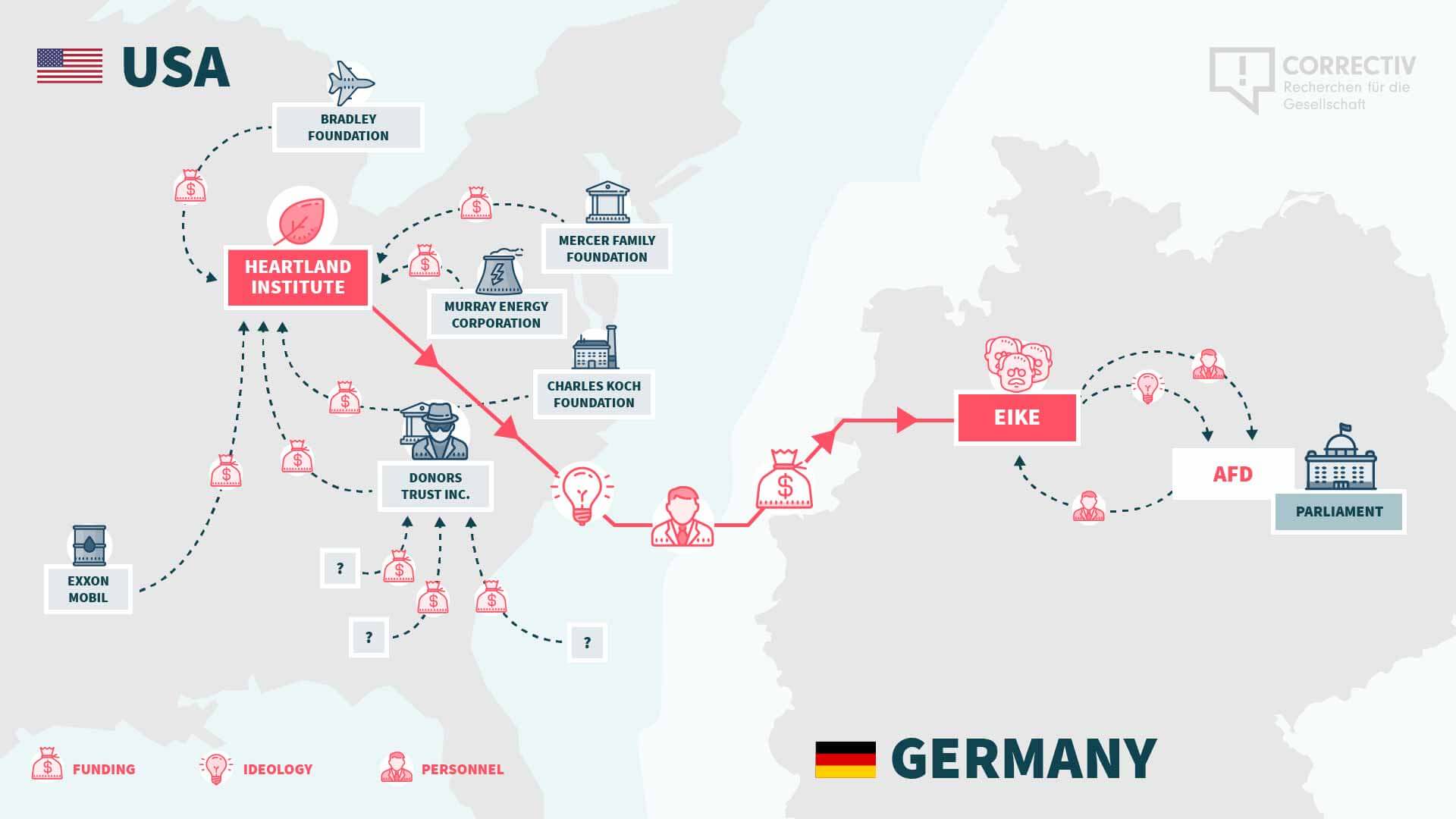
“Donors Trust is now directing between two-thirds and three-quarters of its budget to Heartland to support its climate-skeptical positions," Taylor told the undercover reporters.
The American Fuel and Petrochemical Manufacturers, an industry trade group whose members include ExxonMobil, Chevron and BP, also gave $75,000 to the Heartland Institute in 2017.
The Post story also quoted Graham Brookie, who directs the Digital Forensic Research Lab, an arm of the nonprofit Atlantic Council. Brookie said the ideology Seibt presents “is not outright disinformation," but that it does "bear resemblance to a model we use called the 4d’s — dismiss the message, distort the facts, distract the audience, and express dismay at the whole thing.”
The Post's story did not mention that the Atlantic Council is funded by ExxonMobil, ConocoPhillips, the Abu Dhabi National Oil Company, Chevron, Shell, and BP.
In response to a request for comment, The Washington Post’s Molly Gannon said only, “Our story speaks for itself.”
Other news outlets seem to have copied the omission. The Guardian, The Independent, France24, the Daily Mail, Mediaite, Mic, and MassLive all published follow-on stories that did not mention the Heartland Institute’s financial backing from the fossil fuel industry.
The Heartland Institute seems to be trying to look like it has the youth on its side. So it has found a Gen Z surrogate who can parrot decades-old fossil fuel talking points, and earned major press coverage that frames her as a figure who compares to Thunberg, while completely leaving out the group's obvious, and documented, oil and gas industry connections.
==