atlantic cncl
see theirdigital forensics lab? target
cmd
...
The rebrand appears to be working. In the past five years, Charles Koch and his staff have managed partnerships with musicians like and Guns ‘N’ Roses drummer . Celebrity athletes have also participated. Koch’s “Prime 5” collaboration involved retired football player Deion Sanders, and the LeBron James Family Foundation received a $575,000 grant from Koch’s Stand Together Chamber of Commerce in 2020. Charles Koch touts his collaboration with former political foe Van Jones, who allegedly thinks of his primary contact at Koch
 “
In sharp contrast, Koch’s historical political extremism—dating back to his work with the John Birch Society during the height of the Civil Rights Movement in the 1960s—continues unabated.
The Bill of Rights Institute, an organization operating out of Koch’s compound in Arlington, Virginia, was involved in efforts to whitewash the history of slavery in the U.S. in its lesson plans. Koch cash flowed to members of a network of neo-Confederates and white supremacists as recently as 2017. Since then, he has continued to support groups that manufacture hysteria over critical race theory, despite his public statements disavowing the trend.
Most recently, the Atlantic Council ceased its $4.5 million collaboration with the Charles Koch Institute after new staff hired from the Koch-founded Cato Institute advocated against focusing on Russia’s violations of human rights. This followed Koch Industries’ controversial refusal to discontinue its business operations in Russia immediately after Vladimir Putin ordered the invasion of Ukraine in February. By April, the company reversed its position following weeks of dogged investigations by journalist Judd Legum.
evil b/c pervert class action
https://www.rawstory.com/jim-jordan-2661556363/
no lnx raw 6 23
Jim Jordan leads GOP push to cripple 'fight against disinformation': report
Matthew Chapman
June 19, 2023,
Republican lawmakers are joining forces with far-right activists to attack universities and even private businesses that are investigating the spread of disinformation online — claiming that this amounts to an effort to silence conservatives on the internet, according to a report.
The New York Times posted a details of the actions they are taking on Monday.
"The effort has encumbered its targets with expansive requests for information and, in some cases, subpoenas — demanding notes, emails and other information related to social media companies and the government dating back to 2015. Complying has consumed time and resources and already affected the groups’ ability to do research and raise money, according to several people involved," reported Steven Lee Myers and Sheera Frenkel.
"They and others warned that the campaign undermined the fight against disinformation in American society when the problem is, by most accounts, on the rise — and when another presidential election is around the corner. Many of those behind the Republican effort had also joined former President Donald J. Trump in falsely challenging the outcome of the 2020 presidential election."
The House Judiciary Committee, under Rep. Jim Jordan (R-OH), has been leading the charge. Meanwhile, a group founded by far-right former Trump adviser Stephen Miller has filed a class-action lawsuit in federal court going after the same entities.
"Targets include Stanford, Clemson and New York Universities and the University of Washington; the Atlantic Council, the German Marshall Fund and the National Conference on Citizenship, all nonpartisan, nongovernmental organizations in Washington; the Wikimedia Foundation in San Francisco; and Graphika, a company that researches disinformation online," said the report.
"In a related line of inquiry, the committee has also issued a subpoena to the World Federation of Advertisers, a trade association, and the Global Alliance for Responsible Media it created. The committee’s Republican leaders have accused the groups of violating antitrust laws by conspiring to cut off advertising revenue for content researchers and tech companies found to be harmful."
The new push is part of a broader, years-long conspiracy theory among right-wing activists that the government and "big tech" companies are colluding to silence conservative speech on the internet. There is no evidence of any such conspiracy; in fact, research shows conservative content actually spreads more easily on Facebook and Twitter.
:{
}:
LNX
There is no evidence of any such conspiracy; in fact, research shows conservative content actually spreads more easily on Facebook and Twitter.
https://www.drillednews.com/post/why-is-news-coverage-leaving-out-the-fossil-fuel-funding-of-the-anti-greta
[pix]
Journalists are creating a false equivalence between environmental activist Greta Thunberg and a 19-year-old German Youtuber named Naomi Seibt, without including information about the fossil fuel ties of the group funding her.
Seibt _{recently joined}_ the Heartland Institute, a think tank with documented fossil fuel industry funding, and is scheduled to speak at the annual Conservative Political Action Conference in Washington, D.C., this week.
The coverage of Seibt, which has appeared in outlets including The Washington Post and The Independent, has focused on her “skepticism” while failing to note her fossil fuel ties, which are not limited to the funding connection. Several of her talking points are demonstrably false, decades-old talking points cooked up by the fossil fuel industry itself.
When mainstream media outlets generally considered to be credible leave out such details, subsequent pieces in smaller outlets tend to follow their framing, which can allow disinformation to_{ propagate more quickly}_.
The Washington Post, which was the first American media outlet to cover Seibt, described her as “like Greta...blond, eloquent and European.” Thunberg is a brunette, but the more important difference between her and Seibt is that she cites scientific studies, while many of Seibt’s points on climate come from industry, not science.
The Post's story stated that the Heartland Institute is “funded largely by anonymous donors” without mentioning any of the known donors, some of which are fossil fuel companies or trade groups that represent the industry.
When the Post story came out, Seibt had about 50,000 YouTube followers, a relatively small audience for the platform. In the days since, she has _{gained more than 10,000 more.}_
During a recentinvestigation by German outlets CORRECTIV and Frontal21, Heartland director James Taylor told undercover journalists that much of the organization's money is _{funneled through the dark money}_ group Donors Trust, which has _{ties to Charles Koch}_.
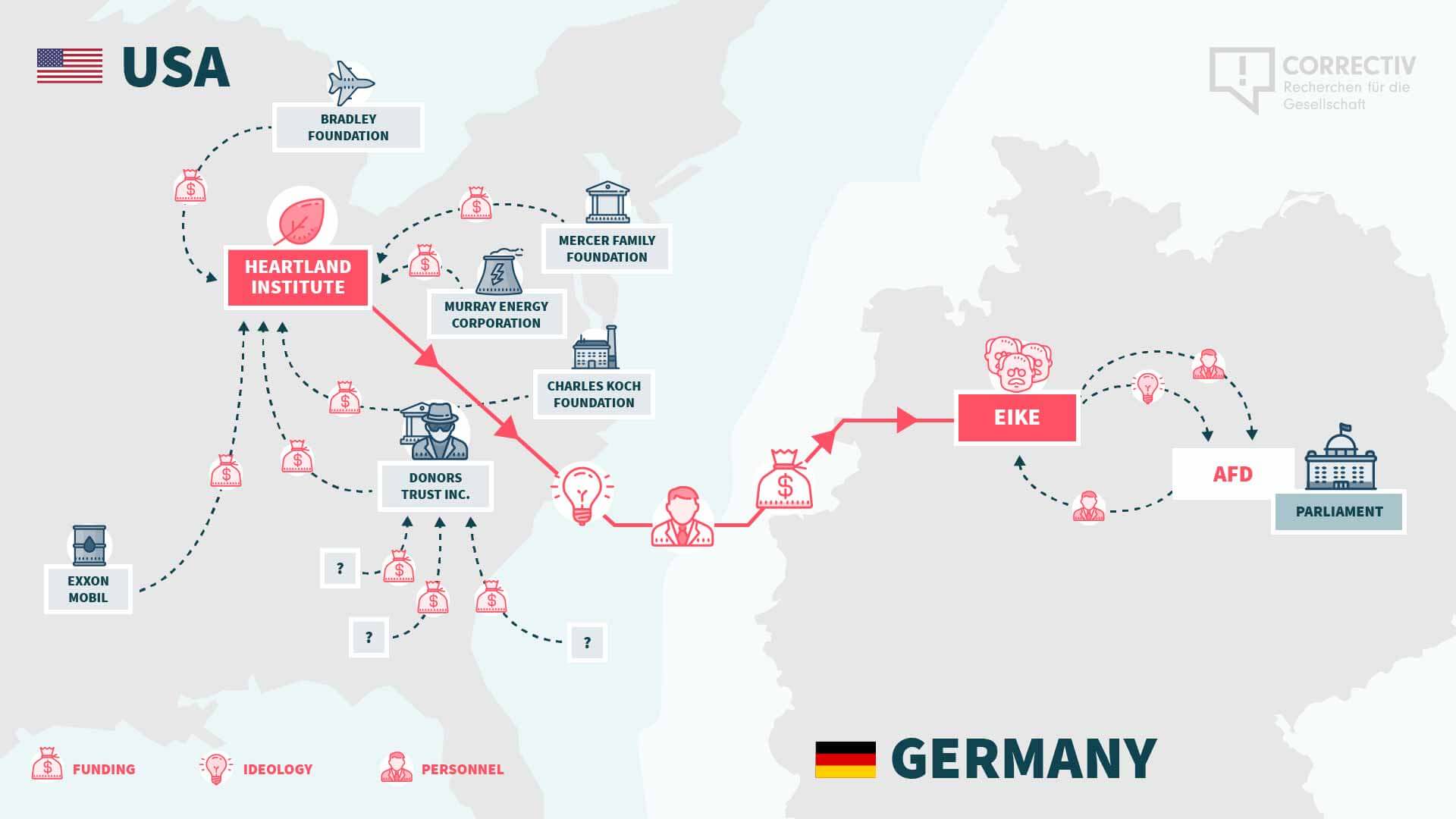
“Donors Trust is now directing between two-thirds and three-quarters of its budget to Heartland to support its climate-skeptical positions," Taylor told the undercover reporters.
The American Fuel and Petrochemical Manufacturers, an industry trade group whose members include ExxonMobil, Chevron and BP, also _{gave $75,000}_ to the Heartland Institute in 2017.
The Post story also quoted Graham Brookie, who directs the Digital Forensic Research Lab, an arm of the nonprofit Atlantic Council. Brookie said the ideology Seibt presents “is not outright disinformation," but that it does "bear resemblance to a model we use called the 4d’s — dismiss the message, distort the facts, distract the audience, and express dismay at the whole thing.”
The Post's story did not mention that the Atlantic Council _{ is funded by}_ ExxonMobil, ConocoPhillips, the Abu Dhabi National Oil Company, Chevron, Shell, and BP.
In response to a request for comment, The Washington Post’s Molly Gannon said only, “Our story speaks for itself.”
Other news outlets seem to have copied the omission. _{The Guardian}_, _{The Independent}_, _{France24}_, _{the Daily Mail}_, _{Mediaite}_, _{Mic}_, and _{MassLive}_ all published follow-on stories that did not mention the Heartland Institute’s financial backing from the fossil fuel industry.
The Heartland Institute seems to be trying to look like it has the youth on its side. So it has found a Gen Z surrogate who can parrot decades-old fossil fuel talking points, and earned major press coverage that frames her as a figure who compares to Thunberg, while completely leaving out the group's obvious, and documented, oil and gas industry connections.
==
2. Think Tank Partnerships Establish Facebook as Tool of US ...
https://www.projectcensored.org › 2-think-tank-partnerships-establish-face...
1.
Facebook Partners with US Government Surrogates to Fight ...
https://www.projectcensored.org › Validated Independent News
1.
Walter Lippmann in Wonderland: Project Censored's Top 10 ...
https://www.northcoastjournal.com › humboldt › Content
1.
#2 Most Censored Story of 2019: Think... - Project Censored ...
https://www.facebook.com › ProjectCensored › photos › 2-most-censored-...
1.
:{MEMBER OF:(style="box-sizing:border-box;font-weight:bold;letter-spacing:0.1em;box-shadow:#ffffff;;text-transform:uppercase"):}: Project Veritas gave testimony in a federal court case indicating that the right-wing group, known for its undercover videos, violates Facebook policies designed to counter systematic deception by Russian troll farms and other groups. Thedeposition raises questions over whether Facebook will deter American operatives who use the platform to strategically deceive and damage political opponents as vigorously as it has Iranian and Russian propagandists. But is the company capable of doing so without just creating more problems?
Close observers of Veritas and Facebook, including one at a research lab that works with the social network, said the testimony shows the group is clearly violating policies against what Facebook refers to as “coordinated inauthentic behavior.” The company formally defined such behavior in a December 2018 video featuring its cybersecurity policy chief Nathaniel Gleicher, who said it “is when groups of pages or people work together to mislead others about who they are or what they’re doing.” The designation, Gleicher added, is applied by Facebook to a group not “because of the content they’re sharing” but rather only “because of their deceptive behavior.” That is, using Facebook to dupe people is all it takes to fit the company’s institutional definition of coordinated inauthentic behavior.
In practice, “coordinated inauthentic behavior” has become a sort of catchall label for untoward meddling on Facebook, snagging everyone from Burmese military officers to Russian meme spammers. But curbing such activity has become a very public crusade for Facebook in the wake of its prominent role as a platform for the spread of disinformation, propaganda, and outright hoaxes during the 2016 presidential campaign. This past January, Gleicher announced the removal of coordinated inauthentic behavior from Iran, which spread when operatives “coordinated with one another and used fake accounts to misrepresent themselves,” thus triggering a Facebook ban. Similarly, in a 2017 update on Facebook’s internal investigation into Russian online propaganda efforts, the company’s then-head of security Alex Stamos assured the world’s democracies the company was providing “technology improvements for detecting fake accounts,” including “changes to help us more efficiently detect and stop inauthentic accounts at the time they are being created.”
Throughout all of this, coordinated inauthentic behavior has remained more or less synonymous with “foreign actors” and “nation-states,” the cloak-and-dagger stuff of an increasingly militarized internet filled with enemies of the Western Democracy who seek to subvert it from abroad.
Project Veritas, a hybrid of an opposition research shop and a ranting YouTube channel, has taken pride in its ability to deceive since its creation in 2010. With conservative backers like Peter Thiel, the Koch brothers, and the Trump Foundation, the group and its founder James O’Keefe have worked relentlessly to target and malign individuals at institutions they deem leftist, whether it’s Planned Parenthood (reportedly targeted by O’Keefeposing as a young teen’s 23-year-old boyfriend), George Soros (the progressive philanthropist whose professional circle Veritas tried andspectacularly failed to infiltrate), or the Washington Post (whose reporter was offered a fake story on Alabama Senate candidate Roy Moore). O’Keefe has long attempted to position himself in the context of dogged, daring, traditional journalism, describing Veritas’s efforts as “investigative” reporting executed by “undercover journalists.” But his efforts are often executed by what the New Yorker has called “amateurish spies” — their efforts against the Post and Soros resembled a Three Stooges bit — and packaged with mendacious editing, duplicitous production, and outright lying, making Veritas’s audience as much a victim of its productions as the subjects. Debates over who or what is to be considered “real journalism” are almost always counterproductive and contrived, but Veritas stands out for the shamelessness with which it pursues nakedly partisan ends.
There is, of course, a proud tradition of undercover journalism executed unequivocally in the name of informing the public. Writers like Barbara Ehrenreich and Shane Bauer have taken jobs they were not otherwise interested in in order to reveal injustices in society’s margins, and some of the most damning details of the Cambridge Analytica scandal were exposed by a reporter with the UK’s Channel 4 posing as a foreign politician interested in the company’s services. This reporting involved lying, sure — or at least the withholding of true intent, and a willingness to let others deceive themselves — but only as a means to a truthful end. The distinction between these reporters and Veritas operatives may be that the end the latter group seeks, the final media product, is typicallyjust another act of partisan misdirection that doesn’t withstand further scrutiny.
Neither Project Veritas nor Facebook commented for this story.
“Legend Building” by Project Veritas
Project Veritas has systematically deceived not just targets on the left and viewers on the right but Facebook users as well (their official page has over 200,000 followers) at a time when the company is publicly dedicated to fighting this sort of systemic duplicity. That’s a wrinkle that raises questions about Facebook’s commitment to rooting out coordinated inauthentic behavior closer to home — Thiel sits on the company’s board — not to mention Project Veritas’s presence on social media.
“We thus have the admission of intent by the organization and evidence of action by multiple of its agents.”
In 2017, O’Keefe sued the Suffolk County district attorney over a Massachusetts law barring the covert recording of government officials. This past December, a federal judge overturned the rule. But in the course of the lawsuit, Joe Halderman, a member of the Project Veritas inner circle who was previously convicted of trying to extort late night television host David Letterman in 2010, sat for a deposition. In it, Halderman was compelled to submit to a sworn interrogation of Veritas methods. Just how does one go about duping savvy politicos and the politico-adjacent in the 21st century?
During his deposition, Halderman, Project Veritas’s self-described “executive producer,” stated under oath that the organization falsifies Facebook accounts as part of its overall strategy of deceiving the targets of its investigations. Halderman, characterizing himself as “integrally involved in [Project Veritas’s] investigations and have been since I started four years ago,” describes the work that went into setting up Robert Creamer, a Democratic operative recorded by Veritas in a 2016. That video attempted to portray Creamer as complicit in a Hillary Clinton-led campaign to violently disrupt Donald Trump’s campaign events with counterprotests and engaging in counter-Trump voter fraud — both regular, unfounded talking points repeated by Trump on the campaign trail. Last year, the Wisconsin Department of Justice concluded an investigation into the videos, determining that they “reveal no evidence of election fraud,” the Associated Press reported.
But before Veritas could get Creamer on camera, they needed to make contact via a fake persona, Halderman explained. Per the transcript (emphasis added):
Q. And you spoke earlier about PVA [Veritas] creating this donor, Charles. When you say create the donor, what did PVA do to create the donor?
A. So, I thought of a name. I talked to the undercover journalist who was the person who met with Foval. We between us sort of created this story of this person. I got some business cards made. I got an e-mail. I set up an e-mail account. What else did I do? I think that’s about all I did.
Again, in this particular case, we didn’t feel like they were going to get seriously vetted. In some investigations we do legend building because we believe or our concern is that we’re going to be vetted reasonably, you know, by open source information.
So, we’ll create a Facebook page, a LinkedIn page. We’ve even gone so far in the past of creating LLCs, offshore bank accounts. We do a lot of things because undercover journalism is a tricky, complicated business.
According to Lauren Windsor, a political organizer and partner at Democracy Partners (alongside Robert Creamer) who began documenting Veritas’s team of “undercover” operatives and their various aliases after her own organization was infiltrated, this sort of use of phony social accounts is the group’s standard operating procedure. “In conducting extensive outreach to victims and extensive research of social media networks to build the vetting resource website :{Project Veritas Exposed:(style="box-sizing:border-box"):}:,” explained Windsor, “I documented several instances of PV violating Facebook’s terms by creating fake profiles. We thus have the admission of intent by the organization and evidence of action by multiple of its agents.”
Windsor’s work includes cataloging Project Veritas’s network of fake Facebook accounts; Windsor provided screenshots toThe Intercept. In one example, Veritas operative Marisa Jorge’s likeness is used for the Facebook profile of “Ava-Marie Joyce.” The bio of the Ava-Marie persona bizarrely describes herself as “Carrie Tallinn, a self-employed professional women’s right activist.”
According to a 2018 lawsuit reported by The Intercept last year, Jorge previously misrepresented herself as a University of Michigan student in order to gain improper access to teachers union documents. The friends list for “Ava-Marie Joyce” lists another profile fabricated by Project Veritas, “Ava Marie Allen.”
Another screenshot shows a Facebook profile for “Tyler Marshall,” which O’Keefe himself disclosed as a fabricated identity in his 2018 book “American Pravda.” In a section of that book (subtitle: “My Fight For Truth in the Era of Fake News”) detailing Veritas’s attempts to infiltrate protestors planning action around Trump’s presidential inauguration, O’Keefe wrote that his operatives all “of course, establish a social media presence under their assumed names—‘Tyler Marshall,’ say, or ‘Adam Stevens.’ The presence includes Twitter, Facebook, and email at the least.”
Exploitation of Facebook by a Group Linked To Military Intelligence
Emerson Brooking, a resident fellow at the Atlantic Council’s Digital Forensics Research Lab, said Veritas’s homegrown social media deception is a clear violation of Facebook’s policy. After reading the deposition, Brooking told The Intercept, “Mr. Halderman describes the creation of fake Facebook personas for the purpose of deception” and “implies that this is a regular and systematic practice. Under any reasonable definition, Project Veritas is engaged in coordinated inauthentic behavior and abuse of the Facebook platform.”
“Under any reasonable definition, Project Veritas is engaged in coordinated inauthentic behavior and abuse of the Facebook platform.”
Brooking’s group, a frequently cited authority on online electoral interference and other digital propaganda campaigns, entered into an official partnership with Facebook last year. A Facebook director wrote at the time that experts at the lab “will work closely with our security, policy and product teams to get Facebook real-time insights and updates on emerging threats and disinformation campaigns from around the world.”
If it sounds like a stretch to compare Project Veritas to a Russian troll farm, consider the group’s links to the U.S. defense establishment. As The Intercept reported in May, Veritas members underwent “intelligence and elicitation techniques from a retired military intelligence operative named Euripides Rubio Jr.,” personally arranged by the infamous American mercenary and Trump adviser Erik Prince. What we have here, then, is a 2016 military intelligence-linked, organized effort to undermine the Democratic Party and boost the Trump presidential campaign using falsified social media profiles. If that doesn’t sound familiar, it certainly should.
The problem with Facebook and its peers has never been identifying abuses and misuses, whether truly dangerous or merely toxic; Facebook, Twitter, and Google alone represent perhaps history’s greatest living catalog of antisocial behavior, a frenzy of rule violation on a mass scale. Whether these companies deem comprehensive content moderation simply too expensive or not worth the public relations mess, the fact is that the public rarely sees movement on these issues in the absence of congressional scolding or media uproar.
The real issue is uneven, arbitrary enforcement of “the rules.” Max Read, writing in New York magazine on another social network’s enforcement blunders, argued that “the problem for YouTube is that for rules to be taken seriously by the people they govern, they need to be applied consistently and clearly.” YouTube is about as terrible at this exercise as Facebook is, and there’s a good chance that if Facebook treated malicious right-wing American exploitation of its network the same way it treats malicious foreign exploitation of its network, it would probably botch the whole thing and end up burning people who actually do use phony Facebook profilesfor work toward the public good.
That a company like Facebook is even in a position to create “rules” like the coordinated inauthentic behavior policy that apply to a large chunk of the Earth’s population is itself a serious problem, one made considerably worse by completely erratic enforcement. It’s bad enough having a couple guys in California take up the banner of defending “Democracy” around the world through the exclusive control of one of the most powerful information organs in human history; if nothing else, we should hope their decisions are predictable and consistent.
Correction: June 11th, 2019, 11:19 a.m.
This article has been updated to name Lauren Windsor’s employer, Democracy Partners, where she is a partner.
giant pp:
Global Power Elite are well aware of their existence as
a very small wealthy 1 percent minority in a vast sea of impov-
erished humanity. The Atlantic Council, for example, serves
:{
}:
as a nonprofit, nongovernmental policymaking group to pro-
tect the security of concentrated wealth, a goal often described
:{
}:
as part of our national “vital interests.” We identify the 35 key
Global Power Elite individuals on the executive committee of
the Atlantic Council. These people are the essential protectors
of concentrated global capital. The Pentagon, NATO, and intel-
ligence agencies pay close attention to their recommendations
and research reports.
===
https://www.goodreads.com/author/show/15438.Chris_Hedges/blog
October 25, 2018 14:36 • 1 view
Is Facebook Systematically Censoring Alternative Media?
This October, Facebook and Twitter deleted the accounts of hundreds of users, including many alternative media outlets maintained by American users. Among those wiped out in the coordinated purge were popular sites that scrutinized police brutality and U.S. interventionism, like The Free Thought Project, Anti-Media, and Cop Block, along with the pages of journalists like Rachel Blevins.
Facebook claimed that these pages had “broken our rules against spam and coordinated inauthentic behavior.” However, sites like The Free Thought Project were verified by Facebook and widely recognized as legitimate sources of news and opinion. John Vibes, an independent reporter who contributed to Free Thought, accused Facebook of “favoring mainstream sources and silencing alternative voices.”
In comments published here for the first time, a neoconservative Washington insider has apparently claimed a degree of credit for the recent purge — and promised more takedowns in the near future.
“Russia, China, and other foreign states take advantage of our open political system,” remarked Jamie Fly, a senior fellow and director of the Asia program at the influential think tank the German Marshall Fund, which is funded by the U.S. government and NATO.“They can invent stories that get repeated and spread through different sites. So we are just starting to push back. Just this last week Facebook began starting to take down sites. So this is just the beginning.”
Fly went on to complain that “all you need is an email” to set up a Facebook or Twitter account, lamenting the sites’ accessibility to members of the general public. He predicted a long struggle on a global scale to fix the situation, and pointed out that to do so would require constant vigilance.
Fly made these stunning comments to Jeb Sprague, who is a visiting faculty member in sociology at the University of California-Santa Barbara and co-author of this article. The two spoke during a lunch break at a conference on Asian security organized by the Stiftung Wissenschaft und Politik in Berlin, Germany.
In the tweet below, Fly is the third person from the left who appears seated at the table.
A rare opportunity to discuss Asian security in Berlin, with an excellent group of experts from the region @SWPBerlin pic.twitter.com/Ogdc9d5BVK
— Garima Mohan (@GarimaMo) October 15, 2018
The remarks by Fly — “we are just starting to push back” — seemed to confirm the worst fears of the alternative online media community. If he was to be believed, the latest purge was motivated by politics, not spam prevention, and was driven by powerful interests hostile to dissident views, particularly where American state violence is concerned.
Jamie Fly, Rise of a Neocon Cadre
Jamie Fly is an influential foreign policy hardliner who has spent the last year lobbying for the censorship of “fringe views” on social media. Over the years, he has advocated for a military assault on Iran, a regime change war on Syria, and hiking military spending to unprecedented levels. He is the embodiment of a neoconservative cadre.
Like so many second-generation neocons, Fly entered government by burrowing into mid-level positions in George W. Bush’s National Security Council and Department of Defense.
In 2009, he was appointed director of the Foreign Policy Initiative (FPI), a rebranded version of Bill Kristol’s Project for a New American Century, or PNAC. The latter outfit was an umbrella group of neoconservative activists that first made the case for an invasion of Iraq as part of a wider project of regime change in countries that resisted Washington’s sphere of influence.
By 2011, Fly was advancing the next phase in PNAC’s blueprint by clamoring for military strikes on Iran. “More diplomacy is not an adequate response,” he argued. A year later, Fly urged the US to “expand its list of targets beyond the [Iranian] nuclear program to key command and control elements of the Republican Guard and the intelligence ministry, and facilities associated with other key government officials.”
Fly soon found his way into the senate office of Marco Rubio, a neoconservative pet project, assuming a role as his top foreign policy advisor. Amongst other interventionist initiatives, Rubio has taken the lead in promoting harsh economic sanctions targeting Venezuela, even advocating for a U.S. military assault on the country. When Rubio’s 2016 presidential campaign floundered amid a mass revolt of the Republican Party’s middle American base against the party establishment, Fly was forced to cast about for new opportunities.
He found them in the paranoid atmosphere of Russiagate that formed soon after Donald Trump’s shock election victory.
PropOrNot Sparks the Alternative Media Panic
A journalistic insider’s account of the Hillary Clinton presidential campaign, Shattered, revealed that “in the days after the election, Hillary declined to take responsibility for her own loss.” Her top advisers were summoned the following day, according to the book, “to engineer the case that the election wasn’t entirely on the up-and-up … Already, Russian hacking was the centerpiece of the argument.”
Less than three weeks after Clinton’s defeat, the Washington Post’s Craig Timberg published a dubiously sourced report headlined, “Russian propaganda effort helped spread ‘fake news.’” The article hyped up a McCarthyite effort by a shadowy, anonymously run organization called PropOrNot to blacklist some 200 American media outlets as Russian “online propaganda.”
The alternative media outfits on the PropOrNot blacklist included some of those recently purged by Facebook and Twitter, such as The Free Thought Project and Anti-Media. Among the criteria PropOrNot identified as signs of Russian propaganda were “Support for policies like Brexit, and the breakup of the EU and Eurozone” and “Opposition to Ukrainian resistance to Russia and Syrian resistance to Assad.” PropOrNot called for “formal investigations by the U.S. government” into the outlets it had blacklisted.
According to Craig Timberg, the Washington Post correspondent who uncritically promoted the media suppression initiative, Propornot was established by “a nonpartisan collection of researchers with foreign policy, military and technology backgrounds.” Timberg quoted a figure associated with the George Washington University Center for Cyber and Homeland Security, Andrew Weisburd, and cited a report he wrote with his colleague, Clint Watts, on Russian meddling.
Timberg’s piece on PropOrNot was promoted widely by former top Clinton staffers and celebrated byex-Obama White House aide Dan Pfeifferas “the biggest story in the world.” But after a wave of stinging criticism, including in the pages of the New Yorker, the article was amended with an editor’s note stating, “The [Washington] Post… does not itself vouch for the validity of PropOrNot’s findings regarding any individual media outlet.”
PropOrNot had been seemingly exposed as a McCarthyite sham, but the concept behind it — exposing online American media outlets as vehicles for Kremlin “active measures” — continued to flourish.
The Birth of the Russian Bot Tracker — With U.S. Government Money
By August, a new, and seemingly related initiative appeared out of the blue, this time with backing from a bipartisan coalition of Democratic foreign policy hands and neocon Never Trumpers in Washington. Called the Alliance for Securing Democracy (ASD), the outfit aimed to expose how supposed Russian Twitter bots were infecting American political discourse with divisive narratives. It featured a daily “Hamilton 68” online dashboard that highlighted the supposed bot activity with easily digestible charts. Conveniently, the site avoided naming any of the digital Kremlin influence accounts it claimed to be tracking.
The initiative was immediately endorsed by John Podesta, the founder of the Democratic Party think tank the Center for American Progress, and former chief of staff of Hillary Clinton’s 2016 presidential campaign. Julia Ioffe, the Atlantic’s chief Russiagate correspondent, promoted the bot tracker as “a very cool tool.”
Unlike PropOrNot, the ASD was sponsored by one of the most respected think tanks in Washington, theGerman Marshall Fund, which had been founded in 1972 to nurture the special relationship between the US and what was then West Germany.
The German Marshall Fund is substantially funded by Western governments, and largely reflects their foreign-policy interests. Its top two financial sponsors, at more than $1 million per year each, are the U.S. government’s soft-power arm the U.S. Agency for International Development (USAID) and the German Foreign Office (known in German as the Auswärtiges Amt). The U.S. State Department also provides more than half a million dollars per year, as do the German Ministry of Economic Cooperation and Development and the foreign affairs ministries of Sweden and Norway. It likewise receives at least a quarter of a million dollars per year from NATO.
german marshall fund fundersThe US government and NATO are top donors to the German Marshall Fund
Though the German Marshall Fund did not name the donors that specifically sponsored its Alliance for Securing Democracy initiative, it hosts a who’s who of bipartisan national-security hardliners on the ASD’s advisory council, providing the endeavor with the patina of credibility. They range from neocon movement icon Bill Kristol to former Clinton foreign policy advisor Jake Sullivan and ex-CIA director Michael Morell.
Jamie Fly, a German Marshall Fund fellow and Asia specialist, emerged as one of the most prolific promoters of the new Russian bot tracker in the media. Together with Laura Rosenberger, a former foreign policy aide to Hillary Clinton’s 2016 campaign, Fly appeared in a series of interviews and co-authored several op-eds emphasizing the need for a massive social media crackdown.
During a March 2018 interview on C-Span, Fly complained that “Russian accounts” were “trying to promote certain messages, amplify certain content, raise fringe views, pit Americans against each other, and we need to deal with this ongoing problem and find ways through the government, through tech companies, through broader society to tackle this issue.”
Yet few of the sites on PropOrNot’s blacklist, and none of the alternative sites that were erased in the recent Facebook purge that Fly and his colleagues take apparent credit for, were Russian accounts. Perhaps the only infraction they could have been accused of was publishing views that Fly and his cohorts saw as “fringe.”
What’s more, the ASD has been forced to admitthat the mass of Twitter accounts it initially identified as “Russian bots” were not necessarily bots — and may not have been Russian either.
“I’m Not Convinced on This Bot Thing”
A November 2017 investigation by Max Blumenthal, a co-author of this article, found that the ASD’s Hamilton 68 dashboard was the creation of “a collection of cranks, counterterror retreads, online harassers and paranoiacs operating with support from some of the most prominent figures operating within the American national security apparatus.”
These figures included the same George Washington University Center for Cyber and Homeland Security fellows — Andrew Weisburd and Clint Watts — that were cited as experts in the Washington Post’s article promoting PropOrNot.
Weisburd, who has been described as one of the brains behind the Hamilton 68 dashboard, once maintained a one-man,anti-Palestinian web monitoring initiative that specialized in doxxing left-wing activists, Muslims and anyone he considered “anti-American.” More recently, he has taken to Twitter to spout off murderous and homophobic fantasies about Glenn Greenwald, the editor of the Intercept — a publication the ASD flagged without explanation as a vehicle for Russian influence operations.
Watts, for his part, has testified before Congress on several occasions to call on the government to “quell information rebellions” with censorious measures including “nutritional labels” for online media. He has received fawning publicity from corporate media and been rewarded with a contributor role for NBC on the basis of his supposed expertise in ferreting out Russian disinformation.
Clint Watts has urged Congress to “quell information rebellions”
However, under questioning during a public event by Grayzone contributor Ilias Stathatos, Watts admitted that substantial parts of his testimony were false, and refused to provide evidence to support some of his most colorful claims about malicious Russian bot activity.
In a separate interview with Buzzfeed, Watts appeared to completely disown the Hamilton 68 bot tracker as a legitimate tool. “I’m not convinced on this bot thing,” Watts confessed. He even called the narrative that he helped manufacture “overdone,” and admitted that the accounts Hamilton 68 tracked were not necessarily directed by Russian intelligence actors.
“We don’t even think they’re all commanded in Russia — at all. We think some of them are legitimately passionate people that are just really into promoting Russia,” Watts conceded.
But these stunning admissions did little to slow the momentum of the coming purge.
Enter the Atlantic Council
In his conversation with Sprague, the German Marshall Fund’s Fly stated that he was working with the Atlantic Council in the campaign to purge alternative media from social media platforms like Facebook.
The Atlantic Council is another Washington-based think tank that serves as a gathering point for neoconservatives and liberal interventionists pushing military aggression around the globe. It isfunded by NATO and repressive, US-allied governments including Saudi Arabia, Bahrain and Turkey, as well as by Ukrainian oligarchs like Victor Pynchuk.
This May, Facebook announced a partnership with the Atlantic Council’s Digital Forensic Research Lab (DFRLab)to “identify, expose, and explain disinformation during elections around the world.”
The Atlantic Council’s DFRLab is notorious for its zealous conflation of legitimate online dissent with illicit Russian activity, embracing the same tactics as PropOrNot and the ASD.
Ben Nimmo, a DFRLab fellow who has built his reputation on flushing out online Kremlin influence networks, embarked on an embarrassing witch hunt this year that saw him misidentify several living, breathing individuals as Russian bots or Kremlin “influence accounts.” Nimmo’s victims included Mariam Susli, a well-known Syrian-Australian social media personality, the famed Ukrainian concert pianist Valentina Lisitsa, and a British pensioner named Ian Shilling.
In an interview with Sky News, Shilling delivered a memorable tirade against his accusers. “I have no Kremlin contacts whatsoever; I do not know any Russians, I have no contact with the Russian government or anything to do with them,” he exclaimed. “I am an ordinary British citizen who happens to do research on the current neocon wars which are going on in Syria at this very moment.”
With the latest Facebook and Twitter purges, ordinary citizens like Shilling are being targeted in the open, and without apology. The mass deletions of alternative media accounts illustrate how national security hardliners from the German Marshall Fund and Atlantic Council (and whoever was behind PropOrNot) have instrumentalized the manufactured panic around Russian interference to generate public support for a wider campaign of media censorship.
In his conversation in Berlin with Sprague, Fly noted with apparent approval that, “Trump is now pointing to Chinese interference in the 2018 election.” As the mantra of foreign interference expands to a new adversarial power, the clampdown on voices of dissent in online media is almost certain to intensify.
As Fly promised, “This is just the beginning.”
no lnx many chris hedges?
==
hmmn, see hedges
Facebook has taken another step to reassure users and regulators in the wake of its central roles in Russia’s 2016 election disinformation campaign and the Cambridge Analytica data privacy scandal. On Thursday, the social media behemoth announced a partnership with the Atlantic Council’s Digital Forensic Research Lab (DFRLab) to help provide “real-time insights…on emerging threats and disinformation campaigns from around the world.”
“This will help increase the number of ‘eyes and ears’ we have working to spot potential abuse on our service,” Katie Harbath, Facebook’s global politics and government outreach director, wrote in a statement posted to the company’s website, “enabling us to more effectively identify gaps in our systems, preempt obstacles, and ensure that Facebook plays a positive role during elections all around the world.”
“The research community is, for good reason, highly skeptical.”
The DFRLab is a division of the Atlantic Council, a Washington, D.C.-based international affairs think tank. The lab documents disinformation efforts around the world—including Syria, Europe, and the US—as they happen. It was on the leading edge of exposing the American alt-right’s disinformation efforts ahead of the French presidential elections in 2017. Its researchers also documented doctored photos designed to sway 2017 parliamentary elections in Germany, and Twitter botnet activity ahead of elections in Italy in March.
Past DFRLab investigations have focused on disinformation spread on Facebook. The lab’s host, the Atlantic Council, is funded by various donorsthat include large international and domestic corporations, foreign governments, government agencies, foundations, and individuals. The organization’s donor policy “stipulates that the Atlantic Council is accepting such contribution on the condition that the Atlantic Council retains intellectual independence.” Still, the sheer size, reach, and makeup of its donors has drawn criticism, with some worrying that the money from foreign governments and corporations inevitably influences the final research product.
The partnership is just the latest effort Facebook has announced to better police its platform for electoral disinformation. In April, the day before Facebook CEO Mark Zuckerberg sat for two days of Congressional questioning, the company announced it was partnering with several big-name foundations to form a commission to “provide independent, credible research about the role of social media in elections.” This commission will facilitate scholarship and research with the help of “privacy-protected datasets from Facebook,” which the company has promised not to review prior to publication. Facebook has also partnered with dozens of news organizations, civil society groups, and governmental organizations in Mexico to fight the spread of “fake news” ahead of that country’s July 1 election in a project called “Verificado 2018.”
The company has worked to burnish its image via a large television advertising campaign that laments the platform’s promotion of “fake news and data misuse” and promises to do better. Meanwhile, Zuckerberg has so far rebuffed calls from British lawmakers to come and answer questions. Facebook has also tightened public access to data across its platforms (it also owns Instagram and WhatsApp) through its Application Programming Interfaces (APIs), the process by which third parties, including researchers, get data from the company for review. That prompted at least 20 academics from around the world to write Facebook an open letter demanding more access for research.
“Facebook is under immense pressure from lawmakers and civil society organizations to stop enabling malicious actors through willful negligence,” Miranda Bogen, a policy analyst at Upturn, a nonprofit research organization that examines technology and public policy, tells Mother Jones. “While the election interference, predatory advertising, human rights abuses and rampant harassment that has spread across the platform in recent years doesn’t seem to have made a dent in the company’s profits, the platform is skating on thin ice with regulators and the public.”
Bogen recently co-authored a paper arguing that Facebook has made progress on offering users transparency about advertising on the site, but has not gone far enough. She says Facebook is “right to recognize that it won’t be able to spot emerging threats alone, but the specific terms of this partnership and the company’s other research initiatives are far from clear.”
Bogen suggests the public would benefit from additional ways to independently monitor Facebook’s behavior. “Think tanks have taken heat,” she says, “for close association with companies that have an interest in the policy matters those organizations study,” adding that some might question whether organizations like the DFRLab “who rely on a friendly relationship with Facebook will find it difficult to stay neutral” when publishing conclusions that might threaten their access.
Graham Brookie, the managing editor and acting director of the DFRLab, told Mother Jones that he is well aware of Facebook’s record and its critics. But he sees a role for the DFRLab, and it’s mission to document and expose disinformation, to play inside of Facebook. “The whole point of it is that if we’re going to be more connected than at any point in human history then we need to be more resilient” to disinformation efforts, he says.
According to a blog post Brookie wrote on Thursday, the partnership will allow the lab to “focus more closely on the challenge of defending democratic debate in elections around the world.” He wrote that the lab’s researchers will still “cast an independent and critical eye on all platforms, including Facebook itself,” stressing it will not be monitoring elections forFacebook, but rather monitoring election disinformation activity across all online platforms.
“The research community is, for good reason, highly skeptical,” he tells Mother Jones, adding that that’s what he’d expect. “We’re looking forward to seeing what we can do and hopefully we can have an impact.”
2x?
https://www.nytimes.com/2016/08/08/us/politics/think-tanks-research-and-corporate-lobbying.html
no many links
How Think Tanks
Amplify Corporate
America’s Influence
Think tanks are seen as independent, but their scholars often push donors’
agendas, amplifying a culture of corporate influence in Washington.
By ERIC LIPTON and
BROOKE WILLIAMS
WASHINGTON — As Lennar Corporation, one of the nation’s largest home builders, pushed ahead with an $8 billion plan to revitalize a barren swath of San Francisco, it found a trusted voice to vouch for its work: the Brookings Institution, the most prestigious think tank in the world.
“This can become a productive, mutually beneficial relationship,” Bruce Katz, a Brookings vice president, wrote to Lennar in July 2010. The ultimate benefit for Brookings: $400,000 in donations from Lennar’s different divisions.
Think Tanks Inc.
Articles in this series examine how research institutions have become part of the corporate influence machine in Washington.
Think Tank Scholar or Corporate Consultant? It Depends on the Day
The think tank began to aggressively promote the project, San Francisco’s biggest redevelopment effort since its recovery from the 1906 earthquake, and later offered to help Lennar, a publicly traded company, “engage with national media to develop stories that highlight Lennar’s innovative approach.”
And Brookings went further. It named Kofi Bonner, the Lennar executive in charge of the San Francisco development, as a senior fellow — an enviable credential he used to advance the company’s efforts.
“He would be a trusted adviser,” an internal Brookings memo said in 2014 as the think tank sought one $100,000 donation from Lennar.
Photo
Kofi Bonner, then a regional vice president for Lennar Corporation, at Hunters Point in San Francisco in 2008. The Brookings Institution named him a senior fellow in 2014. Credit Jim Wilson/The New York Times
Think tanks, which position themselves as “universities without students,” have power in government policy debates because they are seen as researchers independent of moneyed interests. But in the chase for funds, think tanks are pushing agendas important to corporate donors, at times blurring the line between researchers and lobbyists. And they are doing so while reaping the benefits of their tax-exempt status, sometimes without disclosing their connections to corporate interests.
Thousands of pages of internal memos and confidential correspondence between Brookings and other donors — like JPMorgan Chase, the nation’s largest bank; K.K.R., the global investment firm; Microsoft, the software giant; and Hitachi, the Japanese conglomerate — show that financial support often came with assurances from Brookings that it would provide “donation benefits,” including setting up events featuring corporate executives with government officials, according to documents obtained by The New York Times and the New England Center for Investigative Reporting.
Similar arrangements exist at many think tanks. On issues as varied as military sales to foreign countries, international trade, highway management systems and real estate development, think tanks have frequently become vehicles for corporate influence and branding campaigns.
U.S. & POLITICS By A.J. CHAVAR and ERIC LIPTON 1:43
‘This Is Thinly Disguised Lobbying’
Video
‘This Is Thinly Disguised Lobbying’
Senator Elizabeth Warren, Democrat of Massachusetts, explains how some think tanks engage in “thinly disguised lobbying” to influence lawmakers. By A.J. CHAVAR and ERIC LIPTON on Publish Date August 7, 2016. . Watch in Times Video »
Embed
ShareTweet
“This is about giant corporations who figured out that by spending, hey, a few tens of millions of dollars, if they can influence outcomes here in Washington, they can make billions of dollars,” said Senator Elizabeth Warren, Democrat of Massachusetts, a frequent critic of undisclosed Wall Street donations to think tanks.
Washington has seen a proliferation of think tanks, particularly small institutions with narrow interests tied to specific industries. At the same time, the brand names of the field have experienced explosive growth. Brookings’s annual budget has doubled in the last decade, to $100 million. The American Enterprise Institute is spending at least $80 million on a new headquarters in Washington, not far from where the Center for Strategic and International Studies built a $100 million office tower.
The shift has occurred as nonprofits in general have been under increasing pressure from their donors to meet specific goals. But for think tanks, that pressure can threaten their standing as independent arbiters in policy debates in Congress, the White House and the news media.
“Wouldn’t it be nice to go back to the greatest generation, in the post-World War II era of philanthropy, where they said, gosh, ‘Here is $1 million; spend it how you wish,’” Kimberly Churches, the managing director at Brookings, said in an interview.
Think tank executives reject any suggestion that they are tools of corporate influence campaigns and say they are simply teaming up with donors that have similar goals, like helping cities with economic development.
“We do not compromise our integrity,” said Martin S. Indyk, Brookings’s executive vice president. “We maintain our core values of quality, independence, as well as impact.”
But he acknowledged that the arrangement to appoint the Lennar executive as a senior fellow had created the “appearance of a conflict of interest.” And he said that Brookings, in the interest of transparency, had recently decided to prohibit corporations or corporate-backed foundations from making anonymous contributions.
At think tanks like Brookings, the majority of reports and events, with titles like “Five Evils: Multidimensional Poverty and Race in America” or “India at the Global High Table,” have no obvious link to corporate donors.
Still, the benefits afforded to corporations looking to cloak themselves with the authority of think tanks are strikingly evident, according to a review of documents from more than a dozen institutions.
...
The likely conclusions of some think tank reports, documents show, are discussed with donors — or even potential ones — before the research is complete. Drafts of the studies have been shared with donors whose opinions have then helped shape final reports. Donors have outlined how the resulting scholarship will be used as part of broader lobbying efforts. The think tanks also help donors promote their corporate brands, as Brookings does with JPMorgan Chase, whose $15.5 million contribution is the largest by a private corporation in the institution’s history.
Despite these benefits, corporations can write off the donations as charitable contributions. Some tax experts say these arrangements may amount to improper subsidies by taxpayers if think tanks are providing specific services.
“People think of think tanks as do-gooders, uncompromised and not bought like others in the political class,” said Bill Goodfellow, the executive director of the Center for International Policy, a Washington-based think tank. “But it’s absurd to suggest that donors don’t have influence. The danger is we in the think tank world are being corrupted in the same way as the political world. And all of us should be worried about it.”
A group of Democratic state attorneys general is investigating whether Exxon Mobil worked with certain think tanks in past decades to cover up its understanding of fossil fuels’ impact on climate change, in part by financing reports questioning the science, a suggestion the company rejects.
Document: Brookings Institution and Its Corporate Donors
Executives at Brookings, the Center for Strategic and International Studies and other think tanks say they have systems in place to ensure that their reports are based on scholars’ independent conclusions.
“We strongly believe in our model of seeking solutions to some of our country’s most difficult problems,” John J. Hamre, the chief executive at C.S.I.S., said in a written reply to questions. “We gather stakeholders, vet ideas, find areas of agreement and highlight areas of disagreement.”
Yet researchers at think tanks are seeing corporate influence firsthand. Rachel Stohl, a senior associate at the Stimson Center in Washington, said she had been quizzed by potential donors as she tried to raise money for research on the military’s use of armed drones.
“‘Are you going to say drones are bad?’” she recalled one potential financial backer asking. “‘We are not interested in funding something that says drones are bad.’”
Donations and Rewards
The confidential Brookings spreadsheet had an unassuming title: Corporate Overviews Tracking. It listed nearly 90 corporations, from Alcoa to Wells Fargo, providing a glimpse of the vast electronic file that Brookings maintained on donors and prospects, and the benefits it might offer.
The database, along with thousands of pages of emails, solicitations for money and memos on meetings with corporate officials, highlighted Brookings’s practice of assuring that donors would see results from their contributions.
The Brookings Institution, which operates on a $100 million annual budget, twice what it was a decade ago. Credit Greg Kahn for The New York Times
The files included company priorities and a tally of donations. General Electric wanted to fund work on rail networks and clean energy programs — both critical parts of its business — and Brookings then featured G.E. executives, joined by officials from the White House and Congress, at events that focused on these industries.
In 2004, Brookings established its Metropolitan Policy Program, devised to stimulate economic growth in cities. As the country was emerging from recession, Brookings bolstered its ties to corporate donors in 2010 by naming Marek Gootman, a lobbyist from Patton Boggs, as its first director of strategic partnerships. He was assigned to work with “a national network of elected, business and civic leaders engaged in city and metropolitan area policy development and implementation.”
From the start, the program blended a variety of insights on urban matters, including from corporate, nonprofit and government sources. And Mr. Indyk noted that any reports issued were made public.
Donations to the program exploded, from $4.3 million in 2005 to $12.5 million in 2013, nearly 20 percent of Brookings’s overall program spending that year.
K.K.R., after starting special funds around 2010 to invest in real estate and other infrastructure projects, donated $450,000 to Brookings, some of it as the institution agreed to set up meetings for a top K.K.R. executive with community leaders in Philadelphia and Detroit, where the company was considering real estate projects. Brookings separately produced a report, published on K.K.R.’s website, promoting one of the company’s infrastructure projects in New Jersey, after the company executive suggested such a piece.
In advance of a 2014 event Brookings officials attended with corporate executives including Henry R. Kravis, a co-chairman of K.K.R., one memo marked as confidential noted: “K.K.R. has given a total of $350K to Brookings. Last gift came in on 3/27/2014 for $150K to Metro; Henry has donated $75K to Brookings, most going to the individual unrestricted fund.”
The tally demonstrates the important distinction that Brookings makes between “unrestricted” donations, which the think tank can spend on any research, and project-based funding restricted to specific topics that the donor has a particular interest in.
Photo
Marek Gootman, center, with Gina Luna, a JPMorgan Chase executive, in April. Formerly a lobbyist at Patton Boggs, Mr. Gootman was appointed in 2010 as Brookings’s first director of strategic partnerships. Credit Erin Hull for The New York Times
Lennar joined Brookings’s Metropolitan Leadership Council, established for the program’s top donors, in July 2010. That month, the company won approval to redevelop Hunters Point in San Francisco, turning the area into a more than 700-acre mix of housing, education and commercial development.
Brookings would later name the project one of the three most “transformative investments in the United States.”
The San Francisco project generated controversy from the beginning, with critics concerned about toxic waste left by the former Navy shipyard.
Lennar joined with Brookings as protests were escalating in 2010. One complaint, filed by area residents with the Environmental Protection Agency, said the San Francisco Health Department was “conspiring with Lennar Corporation to conceal the health threats of asbestos-laden dust.” The company was busy at the time looking for investors to help it complete the project, known as the San Francisco Shipyard.
A spokesman for Lennar, Glenn Bunting, disputed claims that the company had donated to Brookings out of self-interest — and said the alliance was not related to the protests.
“There was nothing needed in the way of assistance for Lennar to ‘buy’ from Brookings,” Mr. Bunting said in an email. Brookings, though, continued to promote the project.
“San Francisco’s Shipyard project is both physically and economically transformative for the Bay Area and globally significant,” Mr. Katz, the Brookings vice president, said in a news release issued by San Francisco’s mayor in 2011 as Lennar’s hunt for major investors intensified. “This project promises to set a new paradigm for successfully conceiving, financing and delivering transformative infrastructure projects in the United States.”
Follow-up memos were more explicit: Brookings, as it sought an additional $50,000 from Lennar in 2014, said it was prepared to “use our convening power, research expertise, network connections and knowledge of innovative practices to help further drive the ultimate impact and success” of Lennar’s project and to “provide public validation of San Francisco’s efforts through national and local media coverage.”
The think tank soon delivered.
In a July 2014 document, Brookings sought more money from Lennar while offering to help with its San Francisco project.
Mr. Katz made appearances alongside Mr. Bonner, the Lennar executive, to promote the project to government officials and business leaders in California. In 2014, around the time the think tank sought an additional round of money from Lennar, Brookings invited its new nonresident senior fellow, Mr. Bonner, who has a master’s degree in architecture and is a former government planner for several California cities, to appear at an event at its headquarters.
“I am working in San Francisco in a fabulous property,” Mr. Bonner said at the event, referring to Lennar’s Shipyard project.
In March, at a conference of real estate developers and investors in Cannes, France, Lennar sponsored a session in which Brookings researchers helped the company highlight the Shipyard.
“Kofi is what I would describe as the quintessential city builder,” Julie Wagner, a Brookings nonresident senior fellow, said as she introduced Mr. Bonner at an event where projects with no connection to donors were also featured.
At least some of the $400,000 Lennar has donated to Brookings since 2010 has come from its SunStreet Energy division, which sells rooftop solar systems, at the same time that Brookings’s metropolitan program has published research on the rooftop solar industry.
Mr. Indyk said the collaboration simply reflected shared goals of revitalizing cities. Brookings scholars promoted other real estate projects, he said, involving local governments, universities or even developers that were not donors — including one in Detroit backed by Dan Gilbert, the founder of Quicken Loans, and one in Seattle backed by Paul G. Allen, a co-founder of Microsoft.
But Mr. Indyk acknowledged that naming Mr. Bonner, who declined to be interviewed, a Brookings nonresident scholar had “created the impression that because Lennar was giving money, he was getting the title.” His post, which was unpaid, was not renewed.
Martin S. Indyk, the Brookings Institution’s executive vice president, said the think tank’s collaboration with Lennar to redevelop Hunters Point in San Francisco reflected a shared goal to revitalize cities. “We do not compromise our integrity,” he said. Credit T.J. Kirkpatrick for The New York Times
Hitachi has been another large donor to the metropolitan program, giving a total of $1.8 million to Brookings over the last decade, according to Brookings documents. The think tank reviewed the company’s corporate marketing and sales strategy targeting the United States, an internal memo shows. Brookings also organized public events that featured top Obama administration officials and allowed Hitachi executives to promote their products.
“Metro has held nine meetings and several conference calls in the past six months with executives from Hitachi’s water, transportation and data business lines and are collaborating more fully on defining what it means to be a ‘Smart City,’” a confidential Brookings memo said.
Officials at Brookings said they had not lobbied for Hitachi, and they provided examples of reports that they said included conclusions challenging the company’s position. “Helping a corporation’s for-profit agenda is not in any way our agenda,” Ms. Churches, the managing director, said.
Yet Ms. Churches also said the contract language with donors like Lennar and Hitachi was “inelegant,” although not improper.
When asked if the documents read like a fee-for-service agreement, she said, “It could be misconstrued.”
Mr. Indyk said Brookings had recently changed its policies so that “today, there is no way in which those words would be used in our documents.”
‘Growing the Economy’
When JPMorgan offered a major donation to the metropolitan program in 2011, Brookings created the Global Cities Initiative, complete with a new logo that called it a “joint project of Brookings and JPMorgan Chase.”
The project was premised on a common interest between the bank and the think tank. Brookings wanted to promote economic growth in cities by encouraging international trade, and JPMorgan wanted to gain new business by offering loans to companies in the same markets.
In contract documents, Brookings emphasized that it would control the conclusions of its reports and said it would “not directly or indirectly communicate with any party” to help get JPMorgan business.
Mr. Indyk and executives from JPMorgan said the company and the think tank simply agreed on a worthy agenda.
“This was about growing the economy, and we are incredibly proud of the results of this initiative,” said Peter Scher, the head of the corporate responsibility program at JPMorgan. “We believe it’s had a huge impact in more than 30 cities that are involved.”
At the same time, hundreds of pages of memos — status reports to JPMorgan, internal reports by Brookings staff to prepare for meetings with top bank executives, and formal documents soliciting more money — make clear that Brookings saw the Global Cities Initiative as a branding effort that could help JPMorgan bolster its standing in cities.
“Bottom line: Growing metro economies is good for the nation and for JPMC; also, many U.S. cities are JPMC clients — motivation to support them and their clients,” said one Brookings document dated July 2011, as officials from the think tank met with top bank executives to discuss a planned donation that eventually totaled $15 million.
The Global Cities Initiative, another document written by a Brookings senior fellow explained, “must mean a marriage between JPMC corporate interests” and “Brookings continued thought leadership.”
JPMorgan, in a document dated a month before the agreement was signed, said the pending donation to Brookings “deepens/extends relationships with important client base among business and civic leaders both in the U.S. and abroad.”
And Brookings was ready to do its part.
“Our events, which in part target these audiences,” said an internal 2014 Brookings memo, referring to the Global Cities Initiative and federal and state leaders, “have yielded 100+ media hits, with 97% of them referencing GCI and 90% referencing JPMorgan; by the end of this year, we will have held events in 13 domestic markets and 9 international markets.”
At times, Brookings officials seemed worried they were not doing enough for the bank.
Photo
One of hundreds of documents detailing confidential discussions between Brookings and JPMorgan in 2011 as the parties were negotiating a $10 million gift for the Global Cities Initiative.
“No one wants to create overt marketing opportunities for JPMC, but we need to carve out roles and thought leadership opportunity for market presidents,” said a 2013 Brookings memo, referring to a dinner with the bank’s executives. “We need to do a better job tying it back to JPMC.”
It remains difficult to assess whether the relationship helped the bank’s business, but Mr. Scher said that was not the goal.
“If the Global Cities Initiative strengthens the economic competitiveness of cities, it’s a win for small businesses, job creation and everyone involved in these communities, including us,” Mr. Scher said in a statement.
Donations from the corporations to Brookings are tax exempt based on the premise that the think tank’s work benefits the public good, not a company’s bottom line.
But two lawyers who specialize in nonprofit law — Miranda Perry Fleischer, a professor at the University of San Diego School of Law, and Clifford Perlman, a partner at a New York-based firm — said Brookings’s agreements raised questions.
“Tax deductions are subsidies that are paid for by all taxpayers,” Ms. Fleischer said. “And the reason the subsidy is provided is that the charitable organization is supposed to be doing something for the public good, not that specifically benefits the private individual or corporation in the form of providing them goods or services.”
Mr. Indyk said that opinion was “totally unfounded,” noting that Brookings had retained its own lawyers to review the documents and found no problems.
“Brookings’s conclusion that all of these activities it engaged in with these donors primarily benefited the public rather than the donors is consistent with the applicable federal tax standards,” Douglas Varley, one of the lawyers for Brookings, said in a statement.
Close Partnerships
Other think tanks have been even more closely aligned with corporate agendas.
FedEx teamed up with the Atlantic Council — a think tank that focuses on international relations, with annual revenue that has surged to $21 million from $2 million in the last decade — to build support for a free-trade agreement the company hoped would increase business.
Document: Atlantic Council and Corporate Donors
Six months before the Atlantic Council report was issued, FedEx and the think tank worked on plans to use the report as a lobbying tool.
“The impact and reach of the report would be maximized by a rollout event” including a “public report launch with member(s) of Congress from one of the relevant committees,” said a two-page summary drafted by the Atlantic Council months before the study was completed.
FedEx and the Atlantic Council, working with the European American Chamber of Commerce, also told companies being asked to participate in the study that the goal was to “emphasize the positive impact that a comprehensive agreement would have on American and European small businesses.”
When the report came out in late 2014, its conclusions mirrored arguments FedEx had been aggressively pushing on Capitol Hill, including recommending a reduction in trans-Atlantic tariffs and allowing more duty-free shipments.
An executive vice president at FedEx, Rajesh Subramaniam, attended an event at Atlantic Council headquarters in Washington to celebrate the release of the final report. So did a key supporter, Representative Erik Paulsen, Republican of Minnesota.
“This is very exciting,” Mr. Subramaniam said at the event, referring to the potential for more trade. “The upside opportunity is quite large.”
Frederick Kempe, the Atlantic Council president, said that FedEx had donated just $20,000 to help fund the effort and that the staff at the Atlantic Council had handled the research.
A 2013 Atlantic Councilbrochure detailed the benefits of membership in the think tank’s corporate program.
“There is no doubt the work of think tanks has more credibility than the work of lobbyists, but the only way we preserve it is through intellectual independence,” Mr. Kempe said.
‘We Do Not Lobby’
General Atomics, the California-based manufacturer of Predator drones, had a clear problem. Prospects for sales were falling as the wars in Afghanistan and Iraq wound down. The company wanted the Obama administration to change its policy to allow for sales to other countries, a lucrative proposition.
“When the budgets are going down in the U.S., you would like to be able to export more,” Frank Pace, the president of the company’s aircraft systems group, told a Reuters reporter in late 2013 at an air show in Dubai.
At about that time, the industry turned to the Center for Strategic and International Studies for help, providing money that the think tank used to conduct a study on drone policy, including exports.
While defense contracting giants like Lockheed Martin and Boeing have cumulatively donated at least $77 million since 2010 to two dozen think tanks, disclosure records show, General Atomics’s contribution to the Center for Strategic and International Studies was quite small — in the tens of thousands of dollars.
C.S.I.S. set up confidential meetings at its headquarters with company representatives, inviting top officials from the Navy, the Air Force, the Marine Corps, the Coast Guard, the State Department and the office of the defense secretary, according to emails and other documents obtained by The Times through open records requests.
Document: C.S.I.S. and the Military Drone Maker
“Our series will be unique in convening a much broader group of stakeholders than is typical,” Samuel J. Brannen, the think tank’s lead scholar, wrote in an email to Aaron W. Jost, one of the State Department officials in charge of regulating drone exports.
As a think tank, the Center for Strategic and International Studies did not file a lobbying report, but the goals of the effort were clear.
“Political obstacles to export,” read the agenda of one closed-door “working group” meeting organized by Mr. Brannen that included Tom Rice, a lobbyist in General Atomics’s Washington office, on the invitation lists, the emails show.
Boeing and Lockheed Martin, drone makers that were major C.S.I.S. contributors, were also invited to attend the sessions, the emails show. The meetings and research culminated with a report released in February 2014 that reflected the industry’s priorities.
“I came out strongly in support of export,” Mr. Brannen, the lead author of the study, wrote in an email to Kenneth B. Handelman, the deputy assistant secretary of state for defense trade controls.
But the effort did not stop there.
Mr. Brannen initiated meetings with Defense Department officials and congressional staff to push for the recommendations, which also included setting up a new Pentagon office to give more focus to acquisition and deployment of drones. The center also stressed the need to ease export limits at a conference it hosted at its headquarters featuring top officials from the Navy, the Air Force and the Marine Corps.
Mr. Brannen, who has since left C.S.I.S., declined to comment. The think tank insisted that its efforts to influence administration policy were not lobbying.
“C.S.I.S. will not represent any donor before any government office or entity, including congressional lawmakers and executive branch officials,” Mr. Hamre, the chief executive, said in his statement to The Times. “We do not lobby.”
One thing is clear: The result was a victory for General Atomics.
Photo
A Predator drone manufactured by General Atomics Aeronautical Systems. General Atomics helped fund a study that led the United States to ease restrictions on sales of drones to governments overseas. Credit Sandy Huffaker for The New York Times
In February 2015, almost one year after the C.S.I.S. report was issued, the State Department announced a clarification of its rules, easing final approval that month for General Atomics’s long-planned sale of unarmed Predator drones to the United Arab Emirates, the first such sale to a non-NATO nation. The think tank report was just one of many voices pushing for the change.
A State Department spokesman said that while the government officials involved in the review had received opinions from think tanks and industry officials, “at the end of the day, this is a considered U.S. government policy.”
Huntington Ingalls Industries had an equally clear objective: to create an elaborate public relations and lobbying campaign to convince Congress that the nation needed to confront an emerging threat from China by building more nuclear-powered aircraft carriers — at a cost of about $11 billion each. The clear beneficiary? Huntington, the lone builder of the ships.
As part of a broader communications effort, Huntington helped finance a think tank report that enhanced the company’s argument for more funding. Bryan McGrath, a former naval officer who had commanded a guided-missile destroyer, approached Huntington Ingalls and offered to write a study on a fee-for-service basis as a private industry expert. The company turned down his offer.
Later, after he had joined the Hudson Institute and helped create the Center for American Seapower, he approached Huntington officials again, and they were interested.
“A think tank has more prestige,” Mr. McGrath said.
Huntington Ingalls paid $100,000 to fund the work, a critical commitment for Mr. McGrath, who said he was paid by Hudson only if he could successfully solicit donations to support his research.
Mr. McGrath said he had always been a strong proponent of aircraft carriers, so the company was not buying his opinion.
“The Hudson Center makes no secret about being very pro-sea power,” he said. “If a company came that wanted us to write a piece that advocated for something other than that, the answer would be no.”
In exchange for Huntington Ingalls’s support, company officials were given regular briefings on the research and the opportunity to suggest revisions to early drafts, Mr. McGrath said.
Document: The Aircraft Carrier Industry’s Lobbying and Think Tank Plan
“We have an iterative process already laid out in which we will sit down with them and go through drafts and discuss where we are going,” Mr. McGrath said. He added that he had not accepted all of the company’s suggestions.
The report was released in October at the Rayburn House Office Building. Mr. McGrath received an introduction from one of the industry’s most important boosters, Representative J. Randy Forbes, Republican of Virginia, the chairman of the House Armed Services subcommittee that oversees the Navy.
The report did not mention that Huntington Ingalls had helped pay for it. Asked about the failure to disclose the contribution, John P. Walters, Hudson’s chief operating officer, called it a mistake. The report was subsequently revised — months after it was released and the congressional event held — to disclose the donation.
A second industry-funded report, prepared by the Center for Strategic and Budgetary Assessments, came out a month later with a similar urgent call for more money to build more ships and to base more ships abroad, although it did not mention that it had been funded by the Navy League of the United States, a nonprofit group whose large corporate donors include Huntington Ingalls.
“This report is yet another important tool for Navy Leaguers to use in the field when educating local leaders and lawmakers,” Skip Witunski, the Navy League president, wrote to the group’s members late last year.
The strategy — lining up think tank reports as lobbying tools that echoed each other — was backed up with a series of letters to the editor, dozens of posts on Twitter and Facebook, and op-ed pieces.
Mr. McGrath said he, too, wondered if this storm of industry-funded work might be threatening the integrity of the process.
“I see a lot of stuff that comes out in Washington,” Mr. McGrath said, “and I got to scratch my head and say, ‘That guy must be on the payroll."
==
http://216.92.66.74/index.php/Atlantic_Council_of_the_United_States
The Atlantic Council of the United States (ACUS), according to the organization's web site, "promotes constructive U.S. leadership and engagement in international affairs based on the central role of the Atlantic community in meeting the international challenges of the 21st century.
The Council embodies a nonpartisan network of leaders who aim to bring ideas to power and to give power to ideas by:
- stimulating dialogue and discussion about critical international issues with a view to enriching public debate and promoting consensus on appropriate responses in the Administration, the Congress, the corporate and nonprofit sectors, and the media in the United States and among leaders in Europe, Asia and the Americas;
- conducting educational and exchange programs for successor generations of U.S. leaders so that they will come to value U.S. international engagement and have the knowledge and understanding necessary to develop effective policies.
Contents
- 1 History
- 2 Accomplishments
- 3 Atlantic Council Sponsors
- 4 Board of Directors
- 5 Personnel
- 6 Board (2013)
- 7 Contact
- 8 Resources
History
Within a few years of the signing of the North Atlantic Treaty in 1949, voluntary organizations emerged in the member countries of the Alliance to promote public understanding and support for the policies and institutions that would build collective security and peace. This international network of citizens' associations was bound together formally in 1954 with the creation of the Atlantic Treaty Association.
In 1961 former Secretaries of State Christian A. Herter and Dean Acheson, with Will Clayton, William Foster, Theodore C. Achilles and other distinguished Americans, recommended the consolidation of the U.S. citizens groups supporting the Atlantic Alliance into the Atlantic Council of the United States, incorporated as a non partisan, educational, tax-exempt organization.
Throughout the 1960s, the Council produced a series of reports on the state of public opinion towards Alliance member countries and sought to actively educate the public about the need for engagement in international affairs through television commercials (starring Bob Hope), an academic journal, and its newsletter. In 1967, the Council produced its first edited volume, Building the American – European Market: Planning for the 1970s. By 1975, the Council was producing numerous policy papers, books, monographs, and other works with the help of international practitioners and had expanded the scope of its work to include environmental management and the relationship between Japan and the West.
In 1979, Atlantic Council Vice-Chairman Theodore Achilles, recognizing the need to formally reach out to young leaders, established the Committee on Education and the Successor Generations. He wanted future policymakers to understand the solidarity required among people of good conscience if they were to build a better world. In 1980, the Council began to host mid-career professionals for a one-year fellowship, in order to provide opportunities for government officials, research scholars, business, media and other private sector leaders worldwide to pursue a year of independent study. In 1985, the NATO Information Office opened in conjunction with the U.S. Department of State, in order to focus public attention on issues of importance to the collective security of the United States and its Allies.
The Council convened a major international conference on rebuilding East-West relations in 1988, featuring speeches by President Ronald Reagan, then-presidential candidate Michael Dukakis, Zbigniew Brzezinski, Jeane J. Kirkpatrick, Colin Powell, and Brent Scowcroft.
After the fall of communism, programs began to examine the transition underway in Eastern Europe and the former Soviet states, the long-term impact of the conflicts in the Balkans, efforts toward European integration, and nuclear security. Since 1996, the Council has recognized “Distinguished International Leaders” through its annual awards dinner. In 2004, the Council became the U.S. partner in the British-North American Committee, a group of leaders from business, labor, and academia in the United Kingdom, the United States, and Canada committed to harmonious, constructive relations among the three countries and their citizens.
Since that time, the Council has expanded the scope of its programs to include political and economic as well as security issues, and to cover Asia, the Americas and other regions in addition to Europe. All its programs are, however, based on the conviction that a healthy transatlantic relationship is fundamental to progress in organizing a stronger international system.
Accomplishments
Through its diverse networks, the Council builds broad constituencies to support constructive U.S. international leadership and policies. Examples of important contributions by the Council include:
- identifying and shaping responses to major issues facing the Atlantic Alliance and transatlantic relations;
- engaging students from across the Euro-Atlantic area in the processes of NATO transformation and enlargement;
- balancing growing energy needs and environmental protection;
Atlantic Council Sponsors
See List of Sponsors.
Board of Directors
Board Members
- General James L. Jones, Chairman
- Frederick S. Kempe, President and CEO
- Henry E. Catto, Jr., Chairman Emeritus
- Ronald M. Freeman, Treasurer
- John D. Macomber, Treasurer
- Jan M. Lodal, Director
- Walter B. Slocombe, Secretary [1]
Vice Chairs
- Carol Adelman
- Charles W. Freeman, Jr.
- Roger Kirk
- Geraldine S. Kunstadter
- Richard L. Lawson
- John D. Macomber
- Virginia A. Mulberger
- W. DeVier Pierson
- Paula Stern
- Ronald P. Verdicchio
Honorary Directors
- James Addison Baker III
- Frank Charles Carlucci III
- Warren Christopher
- Harlan B. Cleveland
- Russell E. Dougherty
- Gerald R. Ford
- Alexander M. Haig, Jr.
- Christian A. Herter, Jr.
- Robert S. McNamara
- Bernard W. Rogers
- Edward L. Rowny
- Raymond P. Shafer
- George P. Shultz
- William H. Webster
- John C. Whitehead [2]
Personnel
- Christopher J. Makins - Former President (1999-?)
Board (2013)
Accessed December 2013: [1]
- Stephane Abrial, Odeh Aburdene, Peter Ackerman, Timothy D. Adams, John Allen, Michael Ansari, Richard L. Armitage, Adrienne Arsht, David D. Aufhauser, Elizabeth F. Bagley, Ralph Bahna, Sheila Bair, Lisa B. Barry, Rafic Bizri, Thomas L. Blair, Julia Chang Bloch, Francis Bouchard, Myron Brilliant, R. Nicholas Burns, Richard R. Burt, Michael Calvey, James E. Cartwright, Ahmed Charai, Wesley K. Clark, John Craddock, David W. Craig, Tom Craren, Ralph D. Crosby, Jr., Thomas M. Culligan, Nelson Cunningham, Ivo H. Daalder, Gregory R. Dahlberg, Paula J. Dobriansky, Christopher J. Dodd, Conrado Dornier, Patrick J. Durkin, Thomas J. Edelman, Thomas J. Egan, Jr., Stuart E. Eizenstat, Julie Finley, Lawrence P. Fisher II, Alan H. Fleischmann, Michèle Flournoy, Ronald M. Freeman, Robert S. Gelbard, Sherri W. Goodman, Stephen J. Hadley, Mikael Hagström, Ian Hague, Frank Haun, Rita E. Hauser, Michael V. Hayden, Annette Heuser, Marten H.A. van Heuven, Marillyn Hewson, Jonas Hjelm, Karl Hopkins, Robert Hormats, Mary L. Howell, Robert E. Hunter, Wolfgang Ischinger, Deborah James, Reuben Jeffery III, Robert Jeffrey, James L. Jones, Jr., George A. Joulwan, Stephen R. Kappes, Maria Pica Karp, Francis J. Kelly, Jr., Zalmay M. Khalilzad, Robert M. Kimmitt, Henry A. Kissinger, Peter Kovarcik, Franklin D. Kramer, Philip Lader, David Levy, Henrik Liljegren, Jan M. Lodal, George Lund, John D. Macomber, Izzat Majeed, Wendy W. Makins, Mian M. Mansha, William E. Mayer, Eric D.K. Melby, Franklin C. Miller, Judith A. Miller, Alexander V. Mirtchev, Obie L. Moore, George E. Moose, Georgette Mosbacher, Bruce Mosler, Thomas R. Nides, Franco Nuschese, Sean O'Keefe, Hilda Ochoa-Brillembourg, Ahmet Oren, Ana Palacio, Thomas R. Pickering, Andrew Prozes, Arnold L. Punaro, Kirk A. Radke, Joseph W. Ralston, Teresa M. Ressel, Jeffrey A. Rosen, Charles O. Rossotti, Robert Rowland, Stanley O. Roth, Michael L. Ryan, Harry Sachinis, William O. Schmieder, John P. Schmitz, Anne-Marie Slaughter, Alan J. Spence, John M. Spratt, Jr., James Stavridis, Richard J.A. Steele, James B. Steinberg, Paula Stern, John S. Tanner, Peter J. Tanous, Ellen O. Tauscher, Karen Tramontano, Clyde C. Tuggle, Paul Twomey, Melanne Verveer, Enzo Viscusi, Charles F. Wald, Jay Walker, Michael F. Walsh, Mark R. Warner, J. Robinson West, John C. Whitehead, David A. Wilson, Maciej Witucki, Mary C. Yates, Dov S. Zakheim
Contact
Atlantic Council of the United States
1101 15th Street, NW
11th Floor
Washington, DC 20005 USA
Phone: (202) 463-7226
Fax: (202) 463-7241
Email: info AT www.acus.org
Web: http://www.acus.org
Also see Atlantic Council Foundation, Atlantic Council
Resources
Related Sourcewatch articles
- Vance D. Coffman
- In December 2013 their interim chairman was Brent Scowcroft, and Peter Ackerman was a board member
References
- :{Jump up:(style="user-select:none;top:-99999px;clip:rect(1px 1px 1px 1px);overflow:hidden;position:absolute !important;padding:0px !important;border:0px !important;height:1px !important;width:1px !important"):}:↑ Atlantic Council of the United States Board, organizational web page, accessed December 9, 2013.
==