Sen Rick Scott 2
===
promote primary 6 22 on lie ad, gas price and defacto GOP libtard plan
DRUCKER LEADERSHIP PAC PJT RESCUE AM
MEDICARE FRAUD
SEDITION CAUCUS
DOGE COUP?
PAM BONDI
leadership pacs drucker
geo gp
KOCH INDUSTRIES
NRA
VOTER SUPPRESS
DAVID SACKS VC
CAYMAN OFFSHORE
merri ok
see gov 420
CAPT, see links below
---
dk horse sen maj leader, push by trump failson? and xian nat
gave us aileen cannon?
-----
GGL 8 26
AI Overview
Senator Rick Scott (R-FL) has a long, controversial history tied to the health care industry, corporate management, and Republican party fundraising. His background bridges private sector hospital operations, a massive federal fraud case, and conservative policy-making. [1, 2, 3, 4, 5]
Corporate Background and Fraud Case
- Columbia/HCA: Scott served as the CEO and co-founder of Columbia/HCA, a massive hospital and health care network. [1, 2, 3]
- Record Settlement: Under his leadership, the company became the center of a federal investigation into Medicare and Medicaid fraud. Columbia/HCA ultimately pleaded guilty and paid a historic $1.7 billion fine to the U.S. government. [1, 2]
- Departure: Scott resigned from the company in 1997 amid the scandal, walking away with a substantial severance package and stock holdings. [1, 2]
Political Career and Health Policy
- Florida Governor: As Governor of Florida, Scott strongly opposed the federal Affordable Care Act (ACA) and initially rejected, then later altered his stance on, parts of Medicaid expansion while pushing to privatize portions of Florida’s Medicaid system. [1, 2]
- GOP Leadership & Campaigns: Scott transitioned into federal politics, winning election to the U.S. Senate and chairing the National Republican Senatorial Committee (NRSC). [1, 2]
- ACA Counter-Proposals: Scott has frequently spearheaded Republican policy efforts to craft alternatives to the ACA, advocating for health savings accounts (such as his "Trump Health Freedom Accounts" proposal) and criticizing government health subsidies. [1, 2, 3]
Donor and Funder Connections
- Healthcare & Oncology Donors: Throughout his campaigns for governor and the Senate, Scott and the Republican Party of Florida received substantial campaign contributions from healthcare executives, private hospital networks, and medical corporations based in Florida. [1]
- Super PACs and GOP Funding: Scott's campaigns and leadership committees have historically drawn heavy financial backing from conservative donors, business political action committees, and wealthy individuals aligned with the corporate wing of the GOP. [1]
-=-=
COMM DR
New Face of GOP Healthcare Fix Is Senator Linked to Largest Medicare Fraud Scheme in US History
Sen. Rick Scott is warning fellow Republicans of a “slow creep” toward single-payer healthcare if they don’t craft an alternative to the Affordable Care Act.Jake Johnson
Dec 03, 2025
US Sen. Rick Scott, former CEO of the company that was at the center of the biggest Medicare fraud scheme in American history, has emerged as the most vocal Republican proponent of healthcare reform, warning his fellow GOP lawmakers that continued refusal to engage with the issue risks a “slow creep” toward single-payer healthcare.
On Thursday, according to Axios, Scott (R-Fla.) is “convening a group of House and Senate conservatives on Capitol Hill to pore over fresh polling to develop GOP alternatives to the Affordable Care Act.”
RECOMMENDED...
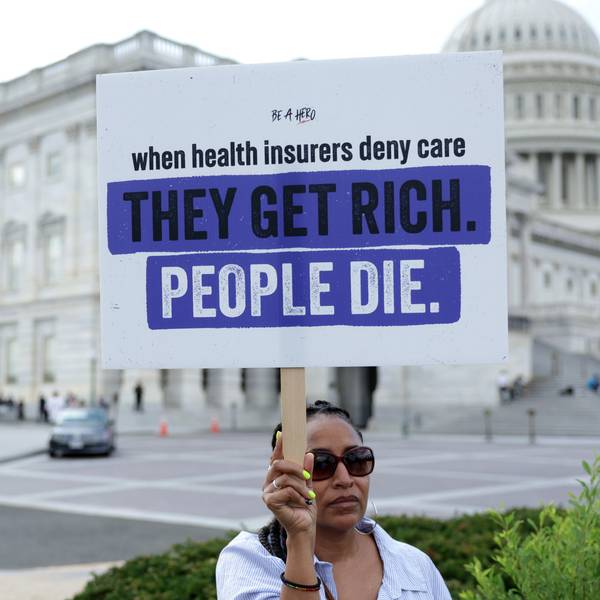
‘Their Goal Is to Destroy Medicare’: GOP Senators Block Bid to Stop AI Care Denials
Late last month, Scott unveiled his own proposal titled the More Affordable Care Act, which would keep ACA exchanges intact while creating “Trump Health Freedom Accounts” that enrollees could use to pay for out-of-pocket costs. Scott’s plan, as the health policy group KFF explained, would allow enhanced ACA tax credits to expire and let states replace subsidies in the original ACA with contributions to the newly created health savings accounts.
“Unlike ACA premium tax credits, which can only be used for ACA Marketplace plans, the accounts in the Scott proposal could be used for any type of health insurance plan, including short-term plans that can exclude people based on preexisting conditions,” KFF noted. “States could also waive certain provisions of the ACA, including the requirement to cover certain benefits.”
“While ACA plans would still be required to cover people with preexisting conditions under the Scott proposal,” the group added, “it is likely that the ACA marketplace would collapse in states that seek a waiver under his approach.”
Last month, amid the longest government shutdown in US history, Scott leapt at the opportunity to champion possible Republican alternatives to the healthcare status quo, despite his ignominious record.
In 2003, the US Justice Department announced that the hospital chain HCA Inc.—formerly known as Columbia/HCA—had agreed to pay hundreds of millions of dollars in penalties and damages to settle what the DOJ characterized as the “largest healthcare fraud case in US history.”
Scott resigned as CEO of Columbia/HCA in 1997, days after federal agents raided company facilities as part of the sweeping fraud probe. The federal government and company whistleblowers said the hospital giant “systematically defrauded” Medicare, Medicaid, and other healthcare programs through unlawful billing and other ploys.
“In 2000, Scott invoked the Fifth Amendment 75 times in a deposition as part of a civil case involving his time leading the company,” Florida Phoenix reported last year. A former HCA accountant accused Scott, who was never directly charged in the case, of leading “a criminal enterprise.”
Scott later served two terms as governor of Florida and is now one of the wealthiest members of Congress, and he maintains he was the victim of a politically motivated DOJ investigation.
“The Clinton Justice Department went after me,” Scott complained during his 2024 Senate reelection campaign.
It’s unclear whether Scott’s healthcare ideas will gain sufficient traction with President Donald Trump and Republican lawmakers, who have seemed content to bash the existing system without proposing anything concrete or viable to replace it. Trump was supposed to unveil his own healthcare proposal last month, but the White House pulled the plug amid GOP pushback.
Some members of the Democratic caucus, meanwhile, are making the case for the very system Scott is warning his colleagues about.
“Let’s finally create a system that puts your health over corporate profits,” Sen. Chris Van Hollen (D-Md.) said earlier this week. “We need Medicare for All.”
-=-=-
GGL 8 26
New Face of GOP Healthcare Fix Is Senator Linked to ...

https://www.commondreams.org › News › rick-scott
Dec 3, 2025 — Rick Scott is warning fellow Republicans of a "slow creep" toward single-payer healthcare if they don't craft an alternative to the Affordable ...Read more
Missing: FUNDER HMO
Democrats: Medicare fraud is 'fungus' Scott will never get ...

https://www.politico.com › florida › story › 2018/08/30
Aug 30, 2018 — Gov. Rick Scott is used to being attacked for the historic $1.7 billion Medicare fraud fine slapped on his former hospital company. decision to ...
Missing: HMO | Show results with: HMO
Rick Scott's Fraud Settlement Resurfaces as Senate GOP ...

https://www.newsweek.com › rick-scotts-fraud-settleme...
Aug 20, 2022 — "Rick Scott oversaw the biggest Medicare fraud in history, so the GOP in its genius put him in charge of its national campaign fund and now is ...Read more
Missing: HMO | Show results with: HMO
Rick Scott, Who Oversaw One of the Largest Medicaid ...

https://newrepublic.com › breaking-news
Nov 15, 2022 — The former hospital company CEO oversaw what was the biggest case of Medicare fraud at the time. Under his leadership, Columbia/HCA gave ...Read more
Scott says Medicare fraud case was 'political persecution'

https://www.miamiherald.com › news › article288431251
May 9, 2024 — The Republican U.S. senator and former Florida governor cast himself as a victim of “political persecution” outside the Manhattan courthouse ...
Missing: FUNDER HMO GOP
Rick Scott 'oversaw the largest Medicare fraud' in U.S. ...

https://politifact.com › mar › florida-democratic-party
Mar 3, 2014 — He lost the right to accuse Democrats of raiding Medicare when he oversaw the largest Medicare fraud in the nation's history. Rick Scott's ...Read more
A Rick Scott Story Part II, how political giving and getting is ...

https://www.floridabulldog.org › 2018/10 › rick-scott-s...
Oct 31, 2018 — Rick Scott was sworn in as governor in 2011, he and the Republican Party of Florida have raked in nearly $1.2 million in contributions
Missing: GOP | Show results with: GOP
AN 1225
US Sen. Rick Scott, former CEO of the company that was at the center of the biggest Medicare fraud scheme in American history, has emerged as the most vocal Republican proponent of healthcare reform, warning his fellow GOP lawmakers that continued refusal to engage with the issue risks a “slow creep” toward single-payer healthcare.
On Thursday, according to Axios, Scott (R-Fla.) is “convening a group of House and Senate conservatives on Capitol Hill to pore over fresh polling to develop GOP alternatives to the Affordable Care Act.”
Late last month, Scott unveiled his own proposal titled the More Affordable Care Act, which would keep ACA exchanges intact while creating “Trump Health Freedom Accounts” that enrollees could use to pay for out-of-pocket costs. Scott’s plan, as the health policy group KFF explained, would allow enhanced ACA tax credits to expire and let states replace subsidies in the original ACA with contributions to the newly created health savings accounts.
“Unlike ACA premium tax credits, which can only be used for ACA Marketplace plans, the accounts in the Scott proposal could be used for any type of health insurance plan, including short-term plans that can exclude people based on preexisting conditions,” KFF noted. “States could also waive certain provisions of the ACA, including the requirement to cover certain benefits.”
“While ACA plans would still be required to cover people with preexisting conditions under the Scott proposal,” the group added, “it is likely that the ACA marketplace would collapse in states that seek a waiver under his approach.”
Last month, amid the longest government shutdown in US history, Scott leapt at the opportunity to champion possible Republican alternatives to the healthcare status quo, despite his ignominious record.
In 2003, the US Justice Department announced that the hospital chain HCA Inc.—formerly known as Columbia/HCA—had agreed to pay hundreds of millions of dollars in penalties and damages to settle what the DOJ characterized as the “largest healthcare fraud case in US history.”
Scott resigned as CEO of Columbia/HCA in 1997, days after federal agents raided company facilities as part of the sweeping fraud probe. The federal government and company whistleblowers said the hospital giant “systematically defrauded” Medicare, Medicaid, and other healthcare programs through unlawful billing and other ploys.
“In 2000, Scott invoked the Fifth Amendment 75 times in a deposition as part of a civil case involving his time leading the company,” Florida Phoenix reported last year. A former HCA accountant accused Scott, who was never directly charged in the case, of leading “a criminal enterprise.”
Scott later served two terms as governor of Florida and is now one of the wealthiest members of Congress, and he maintains he was the victim of a politically motivated DOJ investigation.
“The Clinton Justice Department went after me,” Scott complained during his 2024 Senate reelection campaign.
It’s unclear whether Scott’s healthcare ideas will gain sufficient traction with President Donald Trump and Republican lawmakers, who have seemed content to bash the existing system without proposing anything concrete or viable to replace it. Trump was supposed to unveil his own healthcare proposal last month, but the White House pulled the plug amid GOP pushback.
Some members of the Democratic caucus, meanwhile, are making the case for the very system Scott is warning his colleagues about.
“Let’s finally create a system that puts your health over corporate profits,” Sen. Chris Van Hollen (D-Md.) said earlier this week. “We need Medicare for All.”
---
an 2 25
Elon Musk, the richest man in the world, has been making unprecedented moves to slash federal spending with the blessing of President Donald Trump. As the head of the Department of Government Efficiency (which is not yet an official federal agency authorized by Congress), Musk is exploring major cuts to the Department of Education and plans to shut down USAID — the agency responsible for foreign aid. His team has also been granted access to the Treasury Department’s payments system. But unlike much of the country, some Senate Republicans couldn’t be bothered, NOTUS reported on Tuesday.
One major source of distress among experts is that Musk is rejecting appropriations laws passed by Congress -- in other words, taking authority over funding. Sen. Thom Tillis (R-N.C.) said these actions are indeed unconstitutional, but he is not concerned, saying: “Nobody should bellyache about that."
“That runs afoul of the Constitution in the strictest sense,” Tillis said. But “it’s not uncommon for presidents to flex a little bit on where they can spend and where they can stop spending.”
READ MORE:These 'relatively traditional' Trump Cabinet picks are actually 'spineless cowards': analysis
Other Republicans are glad that Musk is looking at cutting costs.
“He’s doing exactly what he should be doing,” Sen. Rick Scott (R-Fla.) said Monday. “He’s going through every agency and looking at how to make sure the money’s spent right.” And while Article I, Section 8 of the U.S. Constitution gives that job to Congress, Scott argued: “It doesn’t look like Congress is doing their job."
“The actions that have been taken with USAID are long overdue,” Sen. Bill Hagerty (R-Tenn.) said. “The agency is out of control.”
Unlike Tillis, Sen. John Kennedy (R-La.) said Musk has not violated the Constitution.
“Mr. Musk is acting under the authority of the president of the United States,” he said. “It’s perfectly legal, perfectly constitutional. And the issue, anyway, is not process. The issue is substance. Did they find wasteful spending, or not?”
READ MORE:'Unchecked power': Trump himself ordered firings of prosecutors working criminal cases against him
Still, some Republicans are concerned. Sen. Susan Collins (R-Maine), the top Republican on the Appropriations Committee, said she was “very concerned about Mr. Musk or any of his assistants going into federal agencies and demanding personal information on employees.” She said that his actions have not met “the requirements of the law.” BUT THEN VOTED FOR PAM BONDI?
Sen. Mike Rounds (R-S.D.) joined Republicans in defending Musk. “He’s working with the president, and they’re making recommendations in some cases on agencies,” he told NOTUS. “But the whole program here is that we’re spending way more money than what we’re bringing in.”
He added: “The president has the authority to operate the executive branch of government. So.”
READ MORE:'Call somebody who cares': GOP senator slammed over response to 'friends who are upset' FOGHORN
Click here to read NOTUS' report in full.
---
fail on secret vote to Thune //McConnell
aha short window for shock and awe smash and grab, recess appt in maj sen; bannon beat chest, to puff up signif of win and his role in it; push advantage/ big mo?
//
Fox News’ Jason Chaffetz threatens Republicans who refuse to confirm Fox & Friends weekend co-host Pete Hegseth for Secretary of Defense
11/12/24 MMA
Charlie Kirk threatens to remove Sen. John Thune (R-SD) as majority leader
11/13/24
-=-=
omfg desantis would pick
an 11 24
If Sen. Marco Rubio (R-Fla.) is confirmed as President-elect Donald Trump's next secretary of state, it could open the door for Trump's family to get an even deeper foothold in the federal government.
Any Senate vacancy in Florida has to be filled by Governor Ron DeSantis (R) until the next election, which wouldn't happen until 2028. And MAGA is now pushing for Trump's daughter-in-law, Lara, to be appointed senator in Rubio's place should his seat become vacant. The Daily Beast reported that Lara Trump herself is now actively offering herself as a replacement for Rubio.
"This is my home state now and has been for three years," the Republican National Committee co-chair told Fox News' Sean Hannity, adding that she would "love to serve the people of Florida." Sen. Katie Britt (R-Ala.) also endorsed the idea of Lara Trump's appointment. And CBS News' Scott MacFarlane posted to the social media platform Bluesky that Sen. Rick Scott (R-Fla.) is also reportedly on board.
READ MORE:**GOP senator suggests Trump's daughter-in-law take Marco Rubio's Senate seat**
Ric Grenell, who was Trump's acting Director of National Intelligence in his first administration, was thought to be a front-runner to helm the State Department before the news of Rubio's appointment was made public. Tara Palmieri of Puck News tweeted that DeSantis was not in the loop, and learned about Florida's senior U.S. senator being nominated as the nation's potential next top diplomat while he was on vacation in Italy.
Trump tapping Rubio to head the State Department is particularly noteworthy given that they were bitter rivals in the 2016 Republican presidential primary. In a debate, Rubio took a jab at the size of Trump's hands, implying that the billionaire reality TV star was small elsewhere. This led Trump to say there was "no problem" with the size of any of his body parts.
Political strategist and columnist Cheri Jacobus, who is a former communications staffer for the RNC, offered one potential explanation for Rubio's appointment to one of the most high-ranking Cabinet positions — "to open the seat for his daughter-in-law."
"I think that may be the main reason Trump picked Rubio," Jacobus wrote on Bluesky.
READ MORE:**Lara Trump says Project 2025 has 'productive' ideas that would be 'great for this country'**
However, not all Republicans are as enthusiastic about the prospect of Lara Trump joining the Senate. Conservative columnist Scott Morefield called it a "bridge too far" in a post on X.
"Yes, Donald Trump should get his Cabinet picks, but the Senate pick is DeSantis’, not Trump’s," Morefield wrote. "And it would be a bad idea because it would make the seat vulnerable when election time rolls around."
Like Rubio, DeSantis is also a former Trump rival, having run a short-lived campaign for the Republican nomination in 2024. The two-term Florida governor went all-in on the Iowa Caucuses, only to come up short to Trump. He suspended his campaign shortly afterward and endorsed Trump.
Click here to read the Daily Beast's report in full (subscription required).
READ MORE:[All in the family? How Marco Rubio's Senate seat could go to a DeSantis or a Trump
---
ass kicked by biden sotu
https://www.alternet.org/rick-scott-plan/
---
---
an 1 23
Sen. Rick Scott (R-FL) announced that he is running for reelection, promising to push his tax-raising plan that has already received “bipartisan condemnation,” NBC reports.
The senator’s announcement came amid speculation that he was planning to run for president in 2024. But he insists that because he knows every Republican that is considering a presidential run, he is “going to focus” on the Senate race.
Now that Scott is all in on his senatorial campaign, he is committed to implementing his “controversial conservative” plan, also known as “Rescue America.”
NBC reported the “Rescue America” plan proposal, which was "panned by Senate GOP leader Mitch McConnell" last Spring, as well by his Democratic colleagues, received major backlash due to the impact it would have on tax increases for the poor.
However, the former Florida governor decided he is not backing away from the plan as he campaigns for his second term.
“I’m going to continue to push it," Scott told NBC. “I tell people these are my ideas. Let’s start fighting over ideas. If Democrats have a better way of getting people back to work, it doesn’t seem to be working.Labor participation rates are down. We’re not creating full-time jobs. Look at the job market. All we’re doing for last few months is adding part-time jobs. That’s not a great economy. Inflation: 40-year high. If we did what I put in my plan, then it would be better for Americans, all Americans.”
According to NBC, the senator thinks that many “able-bodied” individuals are opting out of work, and that, perhaps, forcing more of them to work “would grow the workforce and expand the number of taxpayers.”
But regarding claims that he aims to raise taxes for poor people, Scott maintains that is not his intention. He said, “It’s the opposite of what I do. I’ve cut taxes and fees, and I’ve never voted for a tax or fee increase.”
White House deputy press secretary Andrew Bates told NBC that he isn’t buying Scott’s claims.
“We’ve seen this movie so many times,” he said, also mentioning the House GOP members who aim to cut taxes for the wealthy while intentionally cutting social services millions depend on.
Relatedly, a Palm Beach writer recently asserted that the “real problem facing Floridians” is the GOP’s persistent efforts to gut Social Security.
READ MORE:Republican Sen. Rick Scott continues to distance himself from his own tax hike plan
Bates said Scott is doing just that by "tripling down on his ultra MAGA agenda to raise taxes on middle class families andschedule Medicare and Social Security to expire,” which puts the senator “fundamentally at odds with the wishes of the American people."
The Biden administration staffer said President Biden “is firmly against” the plan.
“Instead of selling out working families to rich special interests, the President is fighting to build an economy that works from the bottom up and the middle out," Bates asserted.
Although Democratic lawmakers are expecting GOP officials to “echo similar arguments'' to Scott's around the current state of the economy, they are confident that inflation and gas prices will continue to decrease, and that "wages are higher now than in the summer."
Scott, who has “never won” his elections “by more than a percentage point” and spent a total of $149.5 million on previous races, contends that he’s “ready to do whatever it takes to win this time.”
READ MORE:Khanna warns House GOP wants to 'hijack the entire US economy' to cut Social Security
---
cnn 2020 stolen
https://www.alternet.org/2022/10/rick-scott-repeatedly-fact-checked/
---
---
https://www.alternet.org/2022/08/**rick-scott-ron-johnson/
---
when up for re-election?
https://www.alternet.org/2022/08/ron-johnson-targets-medicare-and-social-security-for-annual-budget-discussions/
---
---
dirty trick
an 9 22 badash
More than 50 House and Senate Republicans are joining in an effort to disenfranchise “lame duck” Democrats in the House and Senate to prevent them from voting on critical budget legislation, but not trying to apply the same standard to their fellow GOP lawmakers.
In a move that sounds somewhat like what Senator Mitch McConnell did to derail Merrick Garland’s Supreme Court appointment, the far-right Republicans are urging their colleagues to block any budget bill until a new Congress is sworn in, hoping Democrats lose control of one or both branches of Congress.“
The Monday letters come as Congress has 10 days to take action before government funding runs out at the end of the fiscal year after Sept. 30,” The Hill reports.
READ MORE: Biden Approval Soars as Trump’s Sinks
“We must not accept anything short of a ‘clean’ Continuing Resolution (‘CR’) that contains no additional spending or extraneous policy riders,” writes Sen. Mike Lee (R-UT) in the Senate GOP’s letter. “At a minimum, any agreement on a clean CR must carry over into the beginning of the 118th Congress. Failure to stand strong against lame-duck spending and caving to the Democrats will likely worsen inflation, prolong the current economic recession, and advance policies contained in the Biden administration’s progressive wish-list.”
The U.S. is not in a recession, nor is one expected in the coming months.
The House letter is even more extreme.
“Federal dollars are fueling rampant inflation and funding theBiden administration’s radical agenda,” it begins. “This includes empowering authoritarian bureaucrats at agencies like the IRS and FBI, implementing open-border policies that are threatening our communities, imposing COVID-19 mandates that shut down schools and are forcing our military servicemembers out of their jobs, and advancing self-destructive energy policies.”
Among the far right Republicans signing on to the Senate letter are Sen. John Barrasso (R-WY), Sen. Ted Cruz (R-TX), and Sen. Rick Scott (R-FL).
In the House, signatories include far right GOP Members of Congress Chip Roy, Ralph Norman, Jim Banks, Dan Bishop, Jim Jordan, Lauren Boebert, Kat Cammack, Scott DesJarlais, Scott Perry, Jody Hice, Ken Buck, Matt Gaetz, Paul Gosar, Marjorie Taylor Greene, Byron Donalds, Thomas Massie, and Louie Gohmert.
---
---
https://www.alternet.org/2022/06/second-embarrassing-gop-campaign-ad/
in the space of three weeks, the National Republican Senatorial Committee overseen by Sen. Rick Scott (R-FL) has watched two ads attacking Democrats that were blatantly misleading pulled off the air, according to a report from MSNBC.
According to Steve Benen of MSNBC, complaints about misrepresentation in attack ads are common, but what is less common is the offending ads being yanked from public view by local TV stations.
"It can be frustrating, but the vast majority of the time, stations don’t want to be in the business of deciding which commercials are so brazenly dishonest that they’re ultimately unsupportable," but that there are exceptions which Scott's committee found out the hard way in less than a month.
The first ad claimed that gas prices under Sen. Maggie Hassan (D-NH) increased 23 percent during her prior tenure as governor -- which turned out to not only be false, but prices actually decreased according to the report the GOP cited.
The second ad went after North Carolina’s Cheri Beasley and accused her of setting free a "child porn offender,” when she served as chief justice of the North Carolina Supreme Court.
As the New York Times reported, "On Friday, five TV stations in Raleigh and Charlotte said they would pull the ad or that they had 'paused' it pending an examination of its claims, according to emails from the stations to Courtney Weisman, a lawyer working for the Democratic Senatorial Campaign Committee, which were reviewed by The New York Times. On Thursday, two Charlotte stations took the ad off the air."
According to Benen, who called the two ads an "embarrassing" black eye for Republicans, "For those keeping score, the National Republican Senatorial Committee has now had two television ads pulled over the course of three weeks. Election Day 2022 is still 22 weeks away, and I don’t imagine anyone would be too surprised if that total grows."
---
---
mma 6 22
no lnx many twt]
facebook failed to consistently label similar high-performing posts as “energy independence” misinformation
It’s clear these two posts breach Facebook’s fact-checking policy. However, our research identified 37 other posts earning 1.5 million combined interactions that made very similar statements regarding energy independence. None of these other posts were flagged with a missing-context label.
For example, on March 6, Fox News posted a graphic with a quote fromSen. Rick Scott (R-FL), presented as fact. The post claims that Scott claimed the Biden administration is preventing the U.S. from being energy independent because it has considered the possibility of sourcing oil from Venezuela or Iran rather than increasing domestic drilling. Compared to Franklin Graham’s labeled post, this post is similarly misleading, pushing the same message about how the president’s energy policies have impacted energy independence. And yet, this post, which earned 55,000 interactions, has not received a label.
Fox News, Facebook, March 6, 2022 Energy Independence
Another example is a March 10 post from Mike Rowe. Rowe has hosted the TV series Six Degrees, which is sponsored by the American Petroleum Institute and contains fossil fuel propaganda in every episode. Rowe’s nonprofit has also received funding from Koch Industries. In the post, which accompanies a pro-fossil fuel episode of Rowe’s web series Good Questions, Rowe writes: “One minute, America was a net exporter of oil and natural gas. The next minute, we’re back to buying oil from despots and sheiks, with gas prices at an all-time high. Honest question - Why would we allow energy independence to slip through our fingers?”
Again, the post creates a misunderstanding of energy independence, suggesting that the U.S. cannot be energy independent while importing oil from other countries and that the U.S. is no longer a net exporter of energy. Both claims are false. This post earned 30,000 interactions. Even though the misinformation in Rowe’s post mirrors the misinformation in the other labeled posts, it lacks a fact-check label.
High gas prices have been a key driver of climate change and energy-related Facebook misinformation since 2021.
Media Matters found high gas prices have been a key driver of Facebook misinformation not just since Russia invaded Ukraine, but for the entire seven-month period Media Matters examined, starting September 2021. In total, 41 out of the top 100 posts were in response to the pain Americans are feeling at the pump and while buying everyday goods. These posts accounted for 1.8 million interactions.
The right has repeatedly blamed this crisis on various Biden administration policies despite a lack of evidence supporting that claim. The decision to cancel the construction of the Keystone XL pipeline was cited in 30 of the top 100 posts as a main culprit behind high gas prices. A March survey from the Federal Reserve Bank of Dallas found that in reality, oil companies aren’t drilling because of pressure from investors to reliably return profits through dividends and stock buybacks instead of investing in new production. Biden also approved more permits for oil and gas drilling on public lands in his first year than the Trump administration did in its first year. As for the Keystone XL pipeline extension, experts have pointed out that it would do virtually nothing to lower gas prices in the short term. Nonetheless, 34% of posts about high gas prices also argued for increased fossil fuel extraction, production, and infrastructure to further U.S. energy independence.
The right has consistently used loaded language like “energy independence” to defend fossil fuels despite their harmful impacts on human health, geopolitics, and the economy. Meanwhile, right-wing media and influencers spread misinformation about the viability of renewable energy, and even inaccurately blamed the shortcomings of fossil fuel infrastructure on wind energy during the Texas winter storm and power outages in February 2021. Understanding how the global energy market works could help media consumers understand that renewable energy can move the country closer to self-reliance, and that there is legislation moving with the aim of making that happen. As climate advocates have pointed out, transitioning to renewable energy is the only way for countries to achieve this sort of freedom from the fluctuations of the global fossil-fuel system in which we are deeply entrenched.
Even while Facebook managed to label 2 posts, these labels can only have a limited impact when they are so vastly outnumbered by disinformation across media. With midterm elections approaching, the Biden administration has broken a key climate campaign promise by reopening federal lands for new oil and gas drilling lease sales. The move is unlikely to help with high gas prices in the short term and is in direct conflict with the International Energy Agency’s pathway to reach net-zero emissions by 2050. Voters must be equipped with accurate information about the conditions that created high gas prices. According to a recent ABC News/Ipsos poll, 71% of Americans blame Putin a “great deal” or a “good amount” for the increases in gas prices. However, the poll also found that 52% blame the price increases on Democratic Party policies, and 51% blame Biden. Facebook’s failure to uphold its own policies and crack down on misinformation is having real consequences and influencing how Americans view both this crisis and the role that fossil fuels should play in our economic future.
Methodology...
---
---
rick scott?
https://www.alternet.org/2022/03/revealed-new-gop-plan-to-raise-taxes-on-working-people-and-end-social-security/
---
// rick scott?
https://www.alternet.org/2022/02/madison-cawthorn-2656782306/
U.S. Rep. Madison Cawthorn (R-NC) has revealed his “New Contract with America” that’s designed to destroy Social Security, one of the most successful and life-saving programs in U.S. history, to “incentivize” the elderly to return to work.
---
famously the last stand of bi-partisan cooperation
this is bi-part: Some of the Republican Party's top donors are not pleased with the number of Republicans, including Senate Minority Leader Mitch McConnell, backing President Joe Biden's infrastructure package.
Florida Gov. Rick Scott (R), who chairs the donor-funded National Republican Senatorial Committee, told Senate colleagues of donors' reactions to the vote during a closed door Senate luncheon on Tuesday, two sources told Axios.
According to Scott, the organization's donors are not pleased with the 19 Senate Republicans and 13 House Republicans who voted to pass the legislation.
Axios reports that given the scrutiny McConnell faced for supporting Biden's agenda, donors believe its essentially a form of political suicide to advance the opposing side's agenda.
READ: Evangelical warns Christians have 'erected a graven image' of Trump and let it corrupt the faith]
Scott, according to Axios, said "some donors had also been paying attention to Trump's statements, one of the sources said, which have included the former president calling the Republicans 'RINOs' who 'should be ashamed of themselves.'"
As a second source noted, most of the Republicans who attended the luncheon actually voted in favor of the infrastructure package. In fact, some even helped author the bill.
On Monday, just one day before the luncheon, eight of the Republican lawmakers— including Sens. Lisa Murkowski (R-Alaska), Shelley Moore Capito (R-W.Va.), Rob Portman (R-Ohio), Rep. Don Young (R-Alaska), Bill Cassidy (R-La.), Susan Collins (R-Maine) and Mitt Romney (R-Utah), as well as Rep. Tom Reed (R-N.Y.) — attended the White House signing ceremony.
---
---
an 521 R Reich
At the risk of being the skunk at the picnic, I feel compelled to warn you that if we forget and move on from the tragedies of this past year, we're setting ourselves on a dangerous path. Of course I understand the desire to forget all the unpleasantness and start a new chapter. But if we do, we're inviting greater tragedies in the future.
Let me remind you: Donald Trump lied about the results of the last election. And then – you remember, don't you? – he tried to overturn the results.
Trump twisted the arms of state election officials. He held a rally to stop Congress from certifying the election, followed by the violent attack on the Capitol. Five people died. Senators and representatives could have been slaughtered.
Several Republican members of Congress encouraged the attempted coup by joining him in the big lie and refusing to certify the election — even after the mob desecrated the halls of our democracy.
This was in January of this year, yet we seem to be doing everything we can to blot it out of our memory. Meanwhile, those responsible for instigating the attack haven't been held accountable in any respect — including by the media.
The Washington Post hosted a live video chat with Missouri Republican senator Josh Hawley, a ringleader in the attempt to overturn the results of the election. Hawley had even made a fist-pump gesture toward the mob at the Capitol before the attack.
But the Post billed the interview as being about Hawley's new book on big tech. It even posted a biography of Hawley that made no mention of Hawley's sedition,referring instead to his supposed reputation "for taking on the big and the powerful to protect Missouri workers" and as "a fierce defender of the Constitution."
CBS This Morning interviewed Florida Republican Rick Scott, another senator who tried to overturn the election by not certifying the results. But there was no mention of his sedition, either. The CBS interviewer confined his questions to Biden's spending plans, which Scott unsurprisingly opposed.
Senators Ted Cruz and Ron Johnson and House Minority Leader Kevin McCarthy also repeatedly appear on major news programs without being questioned about their attempts to undo the results of the election, or their continued promotion of Trump's lies.
The media is supposed to serve as a crucial check on those in power. But in its breathless desire to cover the "news" it is failing to remind us of our recent past.
The consequences of this failure are dire.
Trump's big lie that the 2020 election was stolen, and that President Biden is not legitimate, is not disappearing. A majority of Republican voters believe him.
That big lie is being used by Republican state legislatures to justify an all-out assault on the right to vote.
Hours after Florida enacted new voting restrictions, Texas's Republican-led legislature pushed ahead with its own bill that would make it one of the hardest states in which to cast a ballot.
The Republican-controlled Arizona Senate launched a private recount of the 2020 presidential election results in Maricopa County – farming out 2.1 million ballots to GOP partisans with no experience in ballot counting or election monitoring. At least one person involved in the recount participated in the Capitol attack.
The Republican Party even purged one of its leaders, Wyoming representative Liz Cheney, for telling the truth about the election.
Meanwhile, Republican state legislatures are muscling their way into election administration, as they attempt to dislodge or bully local election officials who have always run our voting systems.
Trump's big lie will continue to flourish unless the lawmakers who went along with it and have failed to renounce it face real consequences.
That means no book promotions, no cushy interviews, no guest op-eds in the Sunday paper.
What possible excuse is there for booking them if they have not publicly retracted their election lies? If they must appear, they should be asked if they continue to deny the election results and precisely why.
It also means a thorough independent 9-11 type inquiry into what happened, whether members of Congress were involved, how Donald Trump and others were involved.
Republican leaders must not duck this. History is watching.
They must be held accountable to the truth. Otherwise the trauma of 2020 will return — perhaps in even more terrifying form.
---
---
https://en.wikipedia.org/wiki/Rick_Scott
Richard Lynn Scott (né Myers, December 1, 1952) is an American politician serving as the junior United States senator from Florida since 2019.[5][6] A member of the Republican Party, he previously served as the 45th governor of Florida from 2011 to 2019.
Scott is a graduate of the University of Missouri, Kansas City and of Southern Methodist University Dedman School of Law. In 1987, after serving in the United States Navy and becoming a law firm partner, he co-founded Columbia Hospital Corporation. Columbia later merged with another corporation to form Columbia/HCA, which eventually became the largest private for-profit health care company in the United States.[7] Scott was pressured to resign as chief executive of Columbia/HCA in 1997. During his tenure as chief executive, the company defrauded Medicare, Medicaid and other federal programs. The Department of Justice ultimately fined the company $1.7 billion in what was at the time the largest health care fraud settlement in U.S. history.[8] Scott was not charged with a crime.[9] Following his departure from Columbia/HCA, Scott became a venture capitalist and pursued other business interests.
Scott ran for governor of Florida in 2010. He defeated Bill McCollum in a vigorously contested Republican primary election, and then narrowly defeated Democratic nominee Alex Sink in the general election.[10] Scott was re-elected in 2014, defeating former governor Charlie Crist. He was barred by term limits from running for re-election in 2018, and instead ran for the United States Senate that year.
Scott won the 2018 Florida Senate election, defeating Democratic incumbent Bill Nelson. The initial election results were so close that they triggered a mandatory recount. The recount showed that Scott had won by 10,033 votes; Nelson then conceded the race. Scott took office following the expiration of his term as governor of Florida on January 8, 2019.
- 1Early life, family, education, and early career
- 2Career in health care
- 3Venture capitalist career
- 4Political career
- 4.1Conservatives for Patients' Rights
- 4.2Florida gubernatorial campaigns
- 4.3Governor of Florida
- 4.3.1Death penalty
- 4.3.2Donald Trump
- 4.3.3Drug testing for welfare recipients
- 4.3.4Economy
- 4.3.5Education
- 4.3.6Environment
- 4.3.7Financial disclosures
- 4.3.8Gun laws
- 4.3.9Health care
- 4.3.10Hurricane Irma
- 4.3.11Immigration and refugees
- 4.3.12Medical marijuana
- 4.3.13Redistricting amendments
- 4.3.14Transportation
- 4.3.15Voting rights
- 4.4U.S. Senate
- 5Net worth and investments
- 6Electoral history
- 7Awards and honors
- 8Notes
- 9References
- 10External links
Early life
...
Career in health care
Columbia Hospital Corporation
In 1988, Scott and Richard Rainwater, a financier from Fort Worth, each put up $125,000 in working capital in their new company, Columbia Hospital Corporation,[27] and borrowed the remaining money needed to purchase two struggling hospitals in El Paso for $60 million.[28] Then they acquired a neighboring hospital and shut it down. Within a year, the remaining two were doing much better.[18] By the end of 1989, Columbia Hospital Corporation owned four hospitals with a total of 833 beds.[28]
In 1992, Columbia made a stock purchase of Basic American Medical, which owned eight hospitals, primarily in southwestern Florida. In September 1993, Columbia did another stock purchase, worth $3.4 billion, of Galen Healthcare, which had been spun off by Humana Inc. several months earlier.[29] At the time, Galen had approximately 90 hospitals. After the purchase, Galen stockholders had 82 percent of the stock in the combined company, with Scott still running the company.[28]
Columbia/HCA
In April 1987, Scott made his first attempt to buy the Hospital Corporation of America (HCA). While still a partner at Johnson & Swanson, Scott formed the HCA Acquisition Company with two former executives of Republic Health Corporation, Charles Miller and Richard Ragsdale.[30] With financing from Citicorp conditional on acquisition of HCA,[31] the proposed holding company offered $3.85 billion for 80 million shares at $47 each, intending to assume an additional $1.2 billion in debt, for a total $5 billion deal. However, HCA declined the offer, and the bid was withdrawn.[32]
In 1994, Columbia Hospital Corporation merged with HCA, "forming the single largest for-profit health care company in the country." Scott became CEO of Columbia/HCA.[33] According to The New York Times, "[in] less than a decade, Mr. Scott had built a company he founded with two small hospitals in El Paso into the world's largest health care company – a $20 billion giant with about 350 hospitals, 550 home health care offices and score of other medical businesses in 38 states."[34]
On March 19, 1997, investigators from the Federal Bureau of Investigation, the Internal Revenue Service and the Department of Health and Human Services served search warrants at Columbia/HCA facilities in El Paso and on dozens of doctors with suspected ties to the company.[35] Eight days after the initial raid, Scott signed his last SEC report as a hospital executive. Four months later, the board of directors pressured Scott to resign as chairman and CEO.[36] He was succeeded by Thomas F. Frist Jr.[37] Scott was paid $9.88 million in a settlement, and left owning 10 million shares of stock then worth more than $350 million.[38][39][40] The directors had been warned in the company's annual public reports to stockholders that incentives Columbia/HCA offered doctors could run afoul of a federal anti-kickback law passed in order to limit or eliminate instances of conflicts of interest in Medicare and Medicaid.[37]
During Scott's 2000 deposition, he pleaded the Fifth Amendment many times.[41] In settlements reached in 2000 and 2002, Columbia/HCA pleaded guilty to 14 felonies and agreed to a $600+ million fine in what was at the time the largest health care fraud settlement in American history. Columbia/HCA admitted systematically overcharging the government by claiming marketing costs as reimbursable, by striking illegal deals with home care agencies, and by filing false data about use of hospital space. They also admitted fraudulently billing Medicare and other health programs by inflating the seriousness of diagnoses and to giving doctors partnerships in company hospitals as a kickback for the doctors referring patients to HCA. They filed false cost reports, fraudulently billing Medicare for home health care workers, and paid kickbacks in the sale of home health agencies and to doctors to refer patients. In addition, they gave doctors "loans" never intending to be repaid, free rent, free office furniture, and free drugs from hospital pharmacies.[42][8]
In late 2002, HCA agreed to pay the United States government $631 million, plus interest, and pay $17.5 million to state Medicaid agencies, in addition to $250 million paid up to that point to resolve outstanding Medicare expense claims.[43] In all, civil lawsuits cost HCA more than $2 billion to settle; at the time, this was the largest fraud settlement in American history.[44][45]
Venture capitalist career
After his departure from Columbia/HCA in 1997, Scott launched Richard L. Scott Investments, based in Naples, Florida (originally in Stamford, Connecticut[46]), which has stakes in health care, manufacturing and technology companies. Between 1998 and 2001, Scott purchased 50% of CyberGuard Corporation for approximately $10 million. Among his investors was Metro Nashville finance director David Manning.[46]
In 2006, CyberGuard was sold to Secure Computing for more than $300 million. In February 2005, he purchased Continental Structural Plastics, Inc. (CSP) in Detroit, Michigan. In July 2006, CSP purchased Budd Plastics from ThyssenKrupp, making Continental Structural Plastics the largest industrial composites molder in North America.[47]
In 2005–06, Scott provided the initial round of funding of $3 million to Alijor.com (named for the first three letters of his two daughters' names), which offered hospitals, physicians, and other health care providers the opportunity to post information about their prices, hours, locations, insurance accepted, and personal backgrounds online.[48] Scott co-founded the company with his daughter Allison.[46]
In 2008, Alijor was sold to HealthGrades. In May 2008, Scott purchased Drives, one of the world's leading independent designers and manufacturers of heavy-duty drive chain-based products and assemblies for industrial and agricultural applications and precision-engineered augers for agricultural, material handling, construction and related applications. Scott reportedly has an interest in a chain of family fun centers/bowling alleys, S&S Family Entertainment, in Kentucky and Tennessee led by Larry Schmittou, a minor league baseball team owner.[49]
America's Health Network (AHN)
In July 1997, Columbia/HCA Healthcare purchased a controlling interest in America's Health Network (AHN), the first 24-hour health care cable channel. They[who?] pulled out of the deal on the day of the closing because Scott and Vanderwater were terminated, which caused the immediate layoffs of more than 250 people in Orlando. Later that same year, Scott became majority owner of AHN.[50]
In 1998, Scott and former Columbia/HCA Healthcare president David Vandewater led a group of investors who gave AHN a major infusion of cash so that the company could continue to operate. By early 1999, the network was available in 9.5 million American homes.[51]
In mid-1999 AHN merged with Fit TV, a subsidiary of Fox; the combination was renamed The Health Network.[52] Later that year, in a deal between News Corp. and WebMD, the latter received half-ownership of The Health Network. WebMD planned to relaunch The Health Network as WebMD Television in the fall of 2000, with new programming, but that company announced cutbacks and restructuring in September 2000, and, in January 2001, News Corp. regained 100% ownership.[53] In September 2001, Fox Cable Networks Group sold The Health Network to its main rival, the Discovery Health Channel, for $155 million in cash plus a 10 percent equity stake in Discovery Health.[54]
Solantic
Solantic, based in Jacksonville, Florida, was co-founded in 2001 by Scott and Karen Bowling, a former television anchor Scott met after Columbia bought what is now Memorial Hospital in 1995.[14]
Solantic opened its first urgent care center in 2002. It provides urgent care services, immunizations, physicals, drug screening, and care for injured workers. The corporation attracts patients who do not have insurance, cannot get appointments with their primary care physicians, or do not have primary care physicians. Solantic is an alternative to the emergency department care that these types of patients often seek, or for not seeing a doctor at all. In 2006, Scott said that his plans for Solantic were to establish a national brand of medical clinics.[14]
In August 2007, the company received a $40 million investment from a private equity firm and said that it expected to open 35 clinics by the end of 2009, with annual revenues of $100 million once all these clinics were open, compared to $20 million at the time.[55] As of March 2009, Solantic had 24 centers, all located in Florida.[56]
Solantic was the target of an employment discrimination suit, which claimed that there had been a policy to not hire elderly or obese applicants, preferring "mainstream" candidates. It was settled for an undisclosed sum on May 23, 2007. Scott responded to Salon regarding the claims of discrimination pointing out that "currently 53 percent of Solantic's employees are white, 20 percent black and 17 percent Hispanic."[57]
Pharmaca
In 2003, Scott invested $5.5 million in Pharmaca Integrative Pharmacies,[58] which operates drugstores/pharmacies that offer vitamins, herbal medicine, skin products, homeopathic medicines, and prescriptions.
Other work
In the 1990s, Scott was a partner of George W. Bush as co-owner of the Texas Rangers.[59]
Scott founded[when?] and managed Naples, Florida-headquartered Novosan, marketer of the Viosan Health Generation food supplements, which have been criticized by alternative medicine critic and Quackwatch webmaster Stephen Barrett as being promoted with non-explicit suggestions that they could cure various diseases when such promotion is violation of federal law.[60]
Political career
Conservatives for Patients' Rights
Main article: Conservatives for Patients' Rights
Governor Scott speaking at the 2011Conservative Political Action Conference (CPAC) in Orlando, Florida

In February 2009, Scott founded Conservatives for Patients' Rights (CPR), which he said was intended to put pressure on Democrats to enact health care legislation based on free-market principles.[61] As of March 2009, he had given about $5 million for a planned $20 million ad campaign by CPR.[62]
Florida gubernatorial campaigns
2010
Main article: 2010 Florida gubernatorial election
Scott ran against Democratic nominee Alex Sink.[63] On April 9, 2010, Scott announced his candidacy for the 2010 Republican Party nomination for governor of Florida.[64]
Susie Wiles, former communications chief to Jacksonville Mayor John Peyton, served as his campaign manager, and Tony Fabrizio was his chief pollster. It was reported on May 7 that Scott's campaign had already spent $4.7 million on television and radio ads.[65] Scott's first video advertisement was released to YouTube on April 13.[66]
During the primary campaign, Scott's opponent, Bill McCollum, made an issue of Scott's role at Columbia/HCA. Scott countered that the FBI had never targeted him. Marc Caputo of the Miami Herald contended that a 1998 bill sponsored by McCollum would have made it more difficult to prosecute Medicare fraud cases, and was counter to his current views and allegations.[67] Scott won the August primary with approximately 47% percent of the vote, compared to 43% voting for McCollum, with McCollum conceding the race after midnight. By the date of the Tampa debate between Scott and Sink (October 25, 2010), Scott had spent $60 million of his own money on the campaign compared to Democratic opponent Alex Sink's reported $28 million.[68] Scott campaigned as part of the Tea Party movement.[69]
The Fort Myers News Press quoted Scott as saying in total he spent roughly $78 million of his own money on the campaign, although other figures indicate he spent slightly over $75 million. He won in the general election for governor of Florida, defeating Sink by around 68,000 votes, or 1.29%.[70] He took office as the 45th governor of Florida on January 4, 2011.
2014
Main article: 2014 Florida gubernatorial election
In October 2011, Scott announced that he would be running for reelection in 2014.[71] His political funding committee, Let's Get to Work, had raised $28 million for his campaign as of May 2014.[72][73]
As of early June 2014, Scott had spent almost $13m since March on television advertisements attacking former governor Charlie Crist, who then appeared to be the likely Democratic nominee, and who was eventually nominated. The ads resulted in a tightening of the race, mainly due to a decline in Crist's favorability ratings, while Scott's favorability ratings did not increase.[74]
By late September 2014, Scott's television ad spending had exceeded $35m[75][76] and in mid-October it reached $56.5 million, compared to $26.5 million by Crist. On October 22 it was reported that Scott's total spending had exceeded $83 million and he announced that, having previously said he would not do so, he would be investing his own money into the campaign, speculated to be as much as $22 million.[77]
Crist hoped to draw strong support from Florida's more than 1.6 million registered black voters, an effort that was challenging with regards to his previous political career as a Republican. A poll conducted in September 2014 by Quinnipiac University revealed his support among black voters was at 72 percent against Scott, which was well below the 90 percent analysts believed he needed to defeat Scott.[78]
Scott and Crist met in a debate on October 15, held by the Florida Press Association at Broward College.[79] Scott refused to take the stage for seven minutes because Crist had a small electric fan under his lectern. The incident was dubbed "fangate" by media sources such as Politico.[80] On November 4, 2014, Scott and Carlos Lopez-Cantera won the general election against Crist and Annette Taddeo-Goldstein by 64,000 votes. The Libertarian candidates, Adrian Wyllie and Greg Roe, received a total of 223,356 votes.[81]
Governor of Florida
Scott, Florida attorney generalPam Bondi, and other state officials

In 2013, Scott signed the Timely Justice Act (HB 7101)[83] to overhaul the processes for capital punishment in Florida.[84] The Supreme Court of the United States struck down part of this law in January 2016 in Hurst v. Florida, declaring, in an 8–1 decision, that a judge determining the aggravating facts to be used in considering a death sentence with only a non-binding recommendation from the jury based on a majority vote was insufficient and violated the Sixth Amendment guarantee of a jury trial.[85][86]
Death penaltyDuring Hurricane Irma, he led Florida through the largest mass evacuation in U.S. history. Unemployment, taxpayer debt, and crime declined statewide during Scott's tenure. He signed a repeal of Florida's 1985 growth management laws, reduced funding for water management districts, reduced oversight at the Florida Department of Environmental Protection, and supported increased funding for Everglades restoration. Scott supported permanent tax cuts and "focused on job numbers rather than on running state agencies or making sweeping policy changes."[82]
The Florida Legislature passed a new statute to comply with Hurst v. Florida, changing the sentencing method to require a 10-juror supermajority for a sentence of death with a life sentence as the alternative.[87] This new sentencing scheme, however, was struck down by the Florida Supreme Court in a 5–2 ruling in October 2016, which held that a death sentence must be issued by a unanimous jury.[88] The Florida Supreme Court ruled the law "cannot be applied to pending prosecutions" which means that until the Florida legislature acts, there is no procedure or law allowing a prosecutor to seek the death penalty; it leaves open,[clarification ^needed]^ however, the status of sentences passed under the twice-struck down provisions,[89] also left open by the January 2016 United States Supreme Court Hurst decision. The Court granted Hurst a new sentencing hearing following the same Supreme Court decision.[89]
During Scott's tenure, the State of Florida executed more inmates (28) than had been executed under any other governor in the state's history.[90][91]
Donald Trump
In the 2016 Republican primaries, Scott endorsed Trump after Trump won the Florida primary.[92] Scott chaired a pro-Trump super PAC in the 2016 election.[92][93] Unlike many other establishment Republicans, Scott praised then-candidate Trump as tough on terrorism and as an outsider during the 2016 Republican convention.[92]
When Trump "sparred with the Muslim father of a slain U.S. soldier," Scott said "I'm never going to agree with every candidate on what they're going to say."[92] When the Donald Trump Access Hollywood tape was publicized, in which Trump spoke of grabbing women "by the pussy," Scott rebuked Trump, saying "I'm not following politics closely right now, but this is terrible. I don't agree with anyone talking like this about anyone, ever."[94]
Drug testing for welfare recipients
In June 2011, Scott signed a bill requiring those seeking welfare under the federal Temporary Assistance for Needy Families program to submit to drug screenings. Applicants who fail a drug test may name another person to receive benefits for their children.[95]
In an interview with CNN host Don Lemon, Scott said, "Studies show that people that are on welfare are higher users of drugs than people not on welfare" and "the bottom line is, if they're not using drugs, it's not an issue". PolitiFact said this comment was "half true". Government researchers in 1999–2000 reported "that 9.6 percent of people in families receiving some type of government assistance reported recent drug use, compared to 6.8 percent among people in families receiving no government assistance at all."[96]
Preliminary figures from Florida's program showed that 2.5% of applicants tested positive for drugs, with 2% declining to take the test, while the Justice Department estimated that around 6% of Americans use drugs overall.[97] The law was declared unconstitutional, with the United States Court of Appeals for the Eleventh Circuit upholding that ruling in December 2014.[98] The Scott administration declined to appeal the decision to the US Supreme Court.
Economy
In Scott's 2010 gubernatorial campaign, he promised to create 700,000 jobs in the state. In 2018, PolitiFact ruled Scott's job creation pledge as a "Promise Kept".[99]
Under Scott, Florida's job creation far outpaced the rest of the nation, while wages were below-average and poverty rates were above-average. During Scott's tenure as governor, Florida employers created nearly 1.5 million jobs, and the state's employment grew 20.3 percent, compared to 12.5 percent growth for the U.S. as a whole. Florida's household income is lower than the national average, with a widening gap. At 15.8%, the state's poverty rate is slightly above the national rate of 14.7%.[100]
Education
In his 2010 gubernatorial campaign, Scott vowed to expand school choice. PolitiFact rated this a "Promise Kept" due to Scott's push to expand school choice as governor. School choice legislation signed by Scott includes the creation of the Hope Scholarship Program, which subsidizes the cost of private school or allows a transfer to another public school for students who were bullied.[101]
In December 2012, Scott announced a plan to encourage students to pursue majors in engineering and science by reducing tuition for some majors.[102]
In 2016, Scott signed a bill allowing parents to pick any public school in the state for their children, regardless of traditional attendance lines or county boundaries.[103]
In 2017, Scott signed a $419 million public school bill that included charter school expansion. The bill was supported by House Republicans, school choice proponents, and conservative political groups and it was opposed by superintendents, school boards, parent groups, and teachers unions.[104][105]
During the summer of 2017, Scott signed a bill (HB 989 and SB 1210) that would allow any Florida resident to "challenge the use or adoption of instructional materials" in public schools."[106] Proponents of the bill argue that the bill will allow parents to be more proactive in their child's education. Opponents of the bill argue that the bill will allow more censorship, especially for scientific topics like global warming and evolution.[107]
Environment
Scott rejects the scientific consensus on climate change, saying "I'm not a scientist".[108][109] The quote or paraphrases thereof became talking points for some Republican political candidates in the 2014 election campaigns.[110] The political blog Daily Kos proposed a new category for Scott, "climate-change mutism", for "those unable to express an opinion."[111][112][113]
When questioned by the press on March 9, 2015, in Hialeah, Florida, Scott did not indicate whether or not he believes global warming is a problem or whether Florida's Department of Environmental Protection has made or is making preparations for its potential consequences.[114][115]
In March 2015, accusations were made that his administration had instructed Department of Environmental Protection officials to avoid the terms "climate change" or "global warming" in any official communications. Scott denied the claims that his administration had banned the terms.[116][117][118][119]
Scott cut $700 million from Florida's water management districts over his tenure as governor.[120] The cuts stirred controversy in 2018 when Florida faced a water contamination crisis.[120][121]
Financial disclosures
In 2017, a Democratic activist and lawyer named Donald Hinkle filed a lawsuit claiming that Scott had not disclosed sufficient information about his wealth and holdings and may have underestimated his net worth. Scott appealed to a three-judge panel of the First Circuit Court of Appeal. The appeals court granted a writ of prohibition barring the circuit judge from taking any further action in the case. The five-page ruling agreed with Scott's argument that only the Commission on Ethics “has constitutional authority to investigate Mr. Hinkle's complaint.”[122][123]
Gun laws
As of February 2018, Scott had an A+ rating from the National Rifle Association (NRA), indicating a record of supporting gun rights.[124] The NRA stated in 2014 that Scott "signed more pro-gun bills into law – in one term – than any other governor in Florida history"[125]
In 2011, Scott signed the Firearm Owners' Privacy Act (informally called "Docs vs. Glocks"), which made it illegal for doctors and mental health professionals to ask patients about their gun ownership unless they believed "that this information is relevant to the patient's medical care or safety, or the safety of others."[126] Provisions of the law, including the part forbidding doctors from asking about a patient's gun ownership, were struck down as unconstitutional in 2017 by the United States Court of Appeals for the Eleventh Circuit.[126]
On June 9, 2017, Scott signed an expanded version of Florida's stand-your-ground law into law.[127]
In February 2018, after the Stoneman Douglas High School shooting in Parkland, Florida, Scott stated his support of raising the minimum age to purchase any firearm from 18 to 21; at the time of the shooting, 21 was the minimum age to buy a handgun, but rifles could be purchased at age 18. Scott announced his support of a ban on bump stocks. Scott also stated, "I want to make it virtually impossible for anyone who has mental issues to use a gun," requesting $500 million in funds for mental health and school safety programs.[128]
In March 2018, the Florida Legislature passed a bill titled the Marjory Stoneman Douglas High School Public Safety Act which incorporated many of the issues Scott supported. It raised the minimum age for buying firearms to 21, established waiting periods and background checks, provided a program for the arming of some teachers and the hiring of school police, banned bump stocks, and barred potentially violent or mentally unhealthy people arrested under certain laws from possessing guns. In all, it allocated around $400 million.[129] Scott signed the bill into law on March 9.[130] That same day, the National Rifle Association (NRA) filed a lawsuit in federal court, challenging the law's provision banning gun sales to people under 21. An NRA spokesman said, "We filed a lawsuit against the state for violating the constitutional rights of 18- to 21-year-olds."[131]
Health care
Scott has been a harsh critic of the Affordable Care Act, also known as Obamacare,[132] but in his 2018 Senate campaign stopped harshly criticizing the bill.[133] In 2017, Scott said that individuals with preexisting conditions should be protected.[134] In June 2018, when the Trump administration sought to remove provisions of the Affordable Care Act protecting individuals with preexisting conditions, Scott declined to criticize the administration.[133][134][135] Scott said that he did not know enough about it to comment.[134]
Scott has taken a number of positions on Medicaid expansion. For much of his first term as governor, Scott was against Medicaid expansion in Florida, saying it was too costly. In 2013, he came out in support of Medicaid expansion, and reiterated his support in 2014 when he was up for re-election.[135] After getting re-elected, Scott reversed his position and adamantly fought against efforts by the Florida Senate to pass Medicaid expansion in 2015.[136]
Scott has been accused of having fueled an HIV epidemic in the state while governor, by ensuring the state returned $54 million in unspent federal HIV-prevention grants and blocking $16 million in CDC grants to Miami-Dade and Broward counties.[137] The effect of this rejection of federal funds combined with Scott's stance on Medicaid expansion, has been described as "helping explain why the state’s HIV epidemic became almost peerlessly severe during Scott’s time in office", with the state accounting for 13% of the country's HIV diagnoses in 2017.[137]
Hurricane Irma
Scott's handling of Hurricane Irma boosted his profile in advance of his U.S. Senate campaign, with The Hill writing that his "aggressive approach to Irma, which saw him order an extensive evacuation ahead of the storm and coordinate disaster relief efforts as the storm came ashore, has sent his political stock even higher" and that Scott's "preparedness has impressed Republicans and some Democrats."[138]
An investigation by WFOR-TV found that after Hurricane Irma, Scott ignored existing debris removal contracts and instead issued emergency contracts for hurricane clean-up efforts. Florida state officials sent an email to several companies on September 11 inviting them to hand in bids for debris clean-up by the next day. On September 13, state officials decided to use the services of MCM and Community Asphalt, firms owned by contributors to the Republican Party and Scott's campaigns. According to the television station, the emergency contracts cost $28 to $30 million more than the existing contracts.[139]
Immigration and refugees
In 2010, Scott ran for governor as an immigration hard-liner.[140][69] At the time, he favored similar laws as Arizona's controversial Arizona SB 1070 which targeted illegal immigrants, and criticized Florida lawmakers for not being tougher on illegal immigrants.[141][140] Scott called for police to check individuals' immigration status.[141] By 2014, PolitiFact wrote that Scott had "abandoned promises to get tough on illegal immigration."[142] Over time, he moderated his views on immigration.[69]
In 2011, Scott opposed giving in-state tuition for illegal immigrants, but reversed course in 2014 and signed a bill giving DREAMers in-state tuition in an effort to place limits on how much state institutions can raise tuition each year.[143][144] In 2013, Scott vetoed legislation that would have given DACA-eligible immigrants the ability to obtain temporary driving licenses.[145][144] By 2018, he spoke in favor of giving DREAMers a path to citizenship.[140]
In June 2018, Scott opposed the Trump administration family separation policy, which involved separating children from their parents, relatives, or other adults who accompanied them in crossing the border, sending the parents to federal jails and placing children and infants under the supervision of the U.S. Department of Health and Human Services. In a letter to United States secretary of health and human services Alex Azar, Scott wrote: "I have been very clear that I absolutely do not agree with the practice of separating children from their families. This practice needs to stop now."[146][147]
Scott's administration awarded Comprehensive Health Services, Inc. (CHSi) a tax incentive package of $600,000 to expand in Cape Canaveral, Florida. CHSi runs the Homestead Temporary Shelter for Unaccompanied Children which detains minor migrants, including those separated from families at the border.[148]
Medical marijuana
After voters approved a constitutional amendment to legalize medical marijuana, Scott signed a bill passed by the legislature which allowed the use of medical marijuana but not smokeable medical marijuana.[149] A judge ruled the ban on smokeable medical marijuana unconstitutional.[150] Scott appealed the decision.[151][152]
Redistricting amendments
In the 2010 elections, Florida voters passed constitutional amendments banning gerrymandering of congressional and legislative districts.[153] In February 2011, Scott withdrew a request to the United States Department of Justice to approve these amendments, which, according to The Miami Herald, might delay the implementation of the redistricting plan because the Voting Rights Act requires preclearance of state laws likely to affect minority representation. Scott said he wanted to make sure the redistricting was carried out properly.[154]
Several advocacy groups[which?] sued Governor Scott in federal court to compel him to resubmit the acts to the Justice Department.[clarification ^needed][155]
Transportation
On February 16, 2011, Scott rejected $2.3 billion in federal funding to develop high-speed rail between Tampa and Orlando. Scott cited California's experience with high-speed rail, namely much lower than expected ridership and cost overruns that doubled the final price.[156] In response, a veto-proof majority in the Florida Senate approved a letter rebuking Scott and asking the Department of Transportation to continue funding. On March 1, 2011, two Florida state senators filed a petition with the Florida Supreme Court to compel Scott to accept the rail funds on the grounds Scott lacked constitutional authority to reject funds which had been approved by a prior legislature.[157] On March 4, the Florida Supreme Court ruled that Scott's rejection of the rail funds did not violate the Constitution of Florida.[158]
In March 2011, Scott moved to have the Florida Department of Transportation amend its work plan to include $77 million for dredging PortMiami to a depth of 50 feet. Once the port is dredged, Panamax-sized vessels coming through the expanded Panama Canal could load and unload cargo there.[159]
In 2018, Scott reversed course and supported a high-speed rail project between Tampa and Orlando when the company All Aboard Florida sought to get taxpayer-backed funding from state and federal governments.[160] Scott and his wife had invested at least $3 million in the parent company of All Aboard Florida, which had made donations to Scott's political campaigns.[160]
Voting rights
Scott frequently sought to implement voter IDs as Florida governor, with numerous courts ruling against him in voting rights cases.[161][162][163] Scott has signed into law bills that created barriers to registering new voters, limited early voting, ended early voting on the Sunday before Election Day (known as "souls to the polls" in African-American churches), and restricted the ability of ex-felons to restore their voting rights. In 2012, Scott attempted to purge non-citizens from voter rolls just prior to the election; a court stopped Scott from doing so, and it was revealed that legitimate voters were on the voter rolls. The Tampa Bay Times noted that under Scott's tenure, Florida had the longest voting lines of any state in the 2012 election.[161] After harsh criticism, Scott expanded early voting hours, and allowed early voting on the Sunday before Election Day.[161]
In 2016, Scott refused to extend registration deadlines after ordering evacuations due to Hurricane Matthew; courts ultimately extended the deadline. Scott signed legislation into law which rejected mail ballots where signatures on the ballet envelope did not match signatures in files; in 2016 a court struck down the law.[161] In 2014, Scott blocked a request by the city of Gainesville to use a facility at the University of Florida as a site for early voting.[161] In July 2018, a judge ruled against Scott's prohibition of early voting on campus, saying that Scott's ban showed a "stark pattern of discrimination."[162][163] In 2013, Scott ordered Pinellas County to close down sites where voters could submit mail ballots. In 2012, a court ruled that Scott could not place heavy fines on groups that registered voters but failed to submit the registrations within 48 hours.[161]
Scott rolled automatic restoration of rights for nonviolent crimes, giving former felons a five- to six-year waiting period before they can apply for a restoration of voting rights.[164] Of the approximately 30,000 applications from former felons to have their voting rights restored during Scott's tenure, Scott approved approximately 3,000.[164] A 2018 investigation by the Palm Beach Post found that during his governorship, Scott restored the voting rights of three times as many white men as black men, and that blacks accounted only for 27% of those granted voting rights despite blacks being 43% of those released from state prisons in the past twenty years.[165] The percentage of blacks among those whose voting rights were restored was the lowest in more than 50 years, and Scott restored a higher share of Republican voting rights than Democrat voting rights than in almost 50 years.[165] A clemency board set up by Scott held hearings on applications, but there were no standards on how to judge the worthiness of individual applications. In March 2017, seven former felons filed a class action lawsuit arguing that the clemency board's decisions were inconsistent, vague and political.[164]
In February 2018, a U.S. District Court described Scott's process as arbitrary and unconstitutional, and ruled that Scott had to create a new process to restore felons' voting rights.[161][164] The ruling said that Scott and his clemency board had "unfettered discretion" to deny voting rights "for any reason," and that "to vote again, disenfranchised citizens must kowtow before a panel of high-level government officials over which Florida's governor has absolute veto authority. No standards guide the panel. Its members alone must be satisfied that these citizens deserve restoration."[164] The Brennan Center for Justice described the clemency rules issued by Scott in 2011 as among the most restrictive in the country.[166]
U.S. Senate
2018 election
Main article: 2018 United States Senate election in Florida
After months of speculation about a potential run, Scott officially announced on April 9, 2018, that he would challenge incumbent Democratic U.S. senator Bill Nelson in the 2018 election.[167][168]
Scott defeated Rocky De La Fuente in the Republican primary.[169][170] In the general election, Scott's involvement in a large Medicare fraud case stirred controversy.[171][172] Scott responded with ads accusing Nelson of having cut Medicare benefits and stolen from Medicare; fact-checkers found that both of Scott's assertions were false.[173][171] During the campaign, Scott called Nelson a "socialist", an assertion PolitiFact described as "pants-on-fire" false.[174] During the campaign, Scott sought to avoid mentioning President Trump and at times criticized or distanced himself from actions of the Trump administration, whereas in the past used his friendship with Trump to boost his profile and been an early and vocal supporter of Trump in 2016.[92] Trump endorsed Scott in his Senate bid.[93]
The initial election results showed Scott leading Nelson by 12,562 votes, or 0.15% of the vote. Under Florida law, a manual recount is triggered if election results show a margin of less than 0.5% of the vote.[175] Both candidates filed lawsuits in connection with the recount. Following the recount, Florida elections officials announced on November 18, 2018, that Scott had prevailed. Scott received 50.05% of the vote, while Nelson received 49.93%; the margin of victory was 10,033 votes out of 8.19 million votes cast. Nelson then conceded the race to Scott.[176] The race was the most expensive Senate race in the nation in 2018.[177]
Tenure
The Senate term for the 116th Congress began on January 3, 2019; however, Scott's term as governor ended on January 8. On December 4, 2018, Scott's office announced that he would finish his full term as governor and would not resign early.[6] Scott attended the ceremonial swearing-in of his successor as governor, Ron DeSantis, on the morning of January 8, 2019, in front of Florida's historic Old Capitol.[178] Scott left the ceremony early to fly to Washington, D.C., and was sworn in to the Senate by Vice President Mike Pence later that afternoon.[179][6][180]
In January 2019, Scott encouraged President Trump to declare a national emergency to build a border wall if Congress would not give him the funds to do so.[181] In February 2019, when Trump declared a national emergency, Scott applauded the decision.[182]
In April 2019, amid calls for an American military intervention in Venezuela, Scott said that the Maduro regime was perpetrating a "genocide" and that the U.S. was "not aggressive enough" about the situation. Fact-checkers and experts described Scott's assertion of a genocide as false and misguided.[183][184] Scott called on the U.S. to position its military assets to be prepared to respond to events in Venezuela.[185]
Committee assignments
Rick Scott serves on the following five committees:[186]
- Armed Services
- Subcommittee on Airland
- Subcommittee on Cybersecurity
- Subcommittee on Personnel
- Commerce, Science and Transportation
- Subcommittee on Communications, Technology, Innovation, and the Internet
- Subcommittee on Science, Oceans, Fisheries, and Weather
- Subcommittee on Transportation and Safety
- Subcommittee on Security
- Homeland Security and Governmental Affairs
- Subcommittee on Federal Spending Oversight and Emergency Management
- Subcommittee on Regulatory Affairs and Federal Management
- Budget
- Aging (Special)
Net worth and investments
Scott's net worth was estimated at US$219 million in 2010, $84 million in 2012, and $133 million in 2013.[187][188] On July 1, 2015, it was reported that Scott's net worth had grown to $147 million,[189] $149 million on December 31, 2016,[190] and $232 million on December 31, 2017.[191] As of August 2018, his net worth is estimated at $255 million.[2]
Creation of "blind trust"
Early in gubernatorial tenure, Scott said he created a blind trust for his holdings to avoid the appearance of a conflict of interest. In October 2018, The New York Times reported that the blind trust in question was blind in name only, and that there were various ways in which Scott could know what his precise holdings were. The holdings in question included investments in companies and funds that Scott could have had an impact on through his administration's policies.[192] The trust in question was managed by one of Scott's business associates from before he became a governor.[193]
In February 2019, Scott announced that he would no longer keep his holdings in a blind trust.[194]
Controversial investments
In 2017, Scott and his wife held stocks in firms that did business with the Maduro regime in Venezuela and a shipping firm with close ties to the Putin regime in Russia.[195][196][197] Scott himself had been a harsh critic of the Maduro regime and chastised companies that invested in Venezuela, saying "Any organization that does business with the Maduro regime cannot do business with the state of Florida."[197] By 2018, Scott and his wife no longer held stocks in the firms with links to the Maduro and Putin regimes.[195]
In a July 2018 financial disclosure statement, Scott and his wife reported earnings of at least $2.9 million in hedge funds registered in the Cayman Islands, a well-known tax haven. The financial statement said that the assets were held in a blind trust and a 2018 campaign spokesperson said Scott did not have a role in selecting particular investments.[195]
Scott and his wife invested at least $3 million in the parent company of All Aboard Florida, a rail investment company that proposed to build high-speed rail between Orlando and Tampa.[160][198] In 2018, Scott supported the efforts of the company to build the rail and get taxpayer-financing. Scott had previously, early in his tenure as governor, rejected $2.3 billion in federal funding to develop high-speed rail between Tampa and Orlando.[160]
Scott was an investor in the firm Conduent Inc., which was awarded a $287 million Florida contract in 2015 to manage SunPass, the toll program in the state of Florida. Due to glitches in SunPass, motorists were charged bank fees and overdraft charges, and the Department of Transportation in Florida came under criticism for failing to take action. Scott himself defended the Florida Department of Transportation handling of the SunPass controversy.[193]
Electoral history
...
==
COVID IS A STRESS TEST WE FAIL:
aha soc safe net is a buffer, adds resilience, includes unemployment insurance that keeps workers alive when they get fired (slowly in case of "creative destruction" mkt shifts, or more sudden recession / pandemic); so it enables capitalism, basically a subsidy to corps?!
eg
https://www.alternet.org/2020/04/this-is-horrible-florida-republicans-furious-after-unemployment-system-they-mangled-puts-trumps-re-election-in-jeopardy/
no lnx
‘This is horrible’: Florida Republicans furious after unemployment system they mangled puts Trump’s re-election in jeopardy
==
==
https://www.alternet.org/2019/05/disgusting-chat-log-with-photos-show-alleged-tampering-with-absentee-ballots-in-miami/
most of the chat log for a group, which named itself after the candidate they served, seemed to be the typical dry canvassing discussion you’d expect between campaign workers: coordinating lunch plans, meeting points, talking strategy, etc.
Until, that is, it suddenly wasn’t. Alex Diaz de la Portilla used to be a GOP Florida Senator for 10 years. He ran in last year’s election against Zaraida Barreiro for Miami-Dade County Commissioner. Although the election is nominally nonpartisan, Barreiro is a Democrat, and Diaz de la Portilla is Republican.
The chat log was leaked to the *Miami New Times*. The chat showed pictures of absentee ballots accompanied by disturbing texts. These were first posted by a Miami blogger that I have linked to, but you can also see the photos on the main MNT story.
One showed a photo of an absentee ballot marked for Zoraida Barreiro with the text “Byebye.”
Another person in the group posted a different ballot and wrote “Stolen, hahahaa. I did not give it to the lady but what do we do if she voted for Zoraida????"
Below is a discussion between five people in the group:
:{:{Person 1: Tear up the ballot good.}:
Person 2: Are you sure?
Person 1: Take it to [NAME REDACTED].
Person 2: Take it better.
Person 3: She will know what to do.
Person 3: Okay, perfect!
Person 4: [Thumbs up and happy-face emojis]
Person 5: Take it to [TOWING COMPANY] at the end. Make sure that nobody sees it please.
Person 2: Nooo
Person 2: I already have it super hidden.
Person 5: [Thumbs-up emoji]
Person 2: Ready!
Person 2: Thank God we took away votes from two democrats, hahaha}:
Alex Diaz de la Portilla responded to the paper’s story by saying “None of this is from my campaign or my campaign workers,” he said. “Your article is libelous.”
As a reminder, the group called itself “Alex Diaz de la Portilla” and had 150 pages of political chat discussion that included photos of absentee ballots they acquired. I should also mention that Diaz de la Portilla was once fined $311,000 for 311 campaign violations. Moving on.
Zoraido Barreior responded as well:
“Proof they will do anything to steal an election!”
Diaz de la Portilla is currently running for the city of Miami’s commission, and is far ahead in the money game, as you can see.
This speaks to a wider issue. Absentee ballot fraud has been rampant in Miami for decades. Way back in 1997, the Miami mayor’s race was overturnedbecause of more than 5,000 fraudulent absentee ballots. “Boleteros”, or ballot brokers, who can have large teams of people working for them, get paid for collecting absentee ballots. This has been problematic. Rick Scott paid thousands to a shady boletero for his 2010 election, and despite losing with early and Election Day voting in liberal Miami-Dade, Scott suddenly surged there with thousands of absentee ballots.
Surprisingly, Scott always targeted the non-existent “in-person” voting fraud as governor; yet he never addressed the massive actual fraud with absentee ballots.
Odd that.
==
==
https://www.alternet.org/election-03918/rick-scott-blind-trust-new-york-times
as reporters have uncovered a steady stream of ethically questionable investment holdings by Florida governor and GOP Senate candidate Rick Scott that appear to have been affected by decisions made by the state government, he has stuck to a singular refrain: there is no conflict of interest because his investments are in a "blind trust."
The New York Times, however, points out that Scott's "blind trust" is in fact full of loopholes that would, if he wanted, have allowed him to be aware of his holdings:
To shield himself from future conflict charges, Mr. Scott, who is now running to unseat the incumbent senator Bill Nelson, created a $73.8 million investment account that he called a blind trust. But an examination of Mr. Scott’s finances shows that his trust has been blind in name only. There have been numerous ways for him to have knowledge about his holdings: Among other things, he transferred many assets to his wife and neither "blinded" nor disclosed them. And their investments have included corporations, partnerships and funds that stood to benefit from his administration's actions.
Only in late July, when compelled by ethics rules for Senate candidates, did Mr. Scott disclose his wife's holdings. That report revealed that his wife, Ann Scott, an interior decorator by trade, controlled accounts that might exceed the value of her husband's. Their equity investments largely mirrored each other, meaning that Mr. Scott could, if he wanted, track his own holdings by following his wife's.
Among the suspect assets owned by Scott and his wife include $3 million in a credit fund for an investment group that owns All Aboard Florida, a private rail company that Scott supported as governor while rejecting a federal high-speed rail project along the same corridor. He also has holdings in Gilead Sciences, a pharmaceutical manufacturer that overcharged Florida Medicaid for drugs to treat hepatitis C, although state health officials deny that they or Scott had any role in forcing doctors to prescribe Gilead's products to beneficiaries.
Scott's financial arrangement has been considered suspect for months. He is also facing a lawsuit that alleges his trust does not comply with financial disclosure laws.
The Times further notes that, with assets between himself and his wife estimated to be worth anywhere from $254-510 million, should he win, "Mr. Scott could well become the richest member of the next Congress. His broad menu of investments might regularly present conflicts that require recusal. He has declined to say whether he would use a blind trust in the Senate, where the rules controlling them are far more stringent."
The Florida Senate race is one of the most competitive in the country, and early voting has begun with three weeks left until Election Day.
==
same time as WVa crisis
Rick Scott Has an Insane Plan to Pack the Florida Supreme Court on His Last Day of Office
Florida Supreme Court Just Thwarted the Republican Governor's Underhanded and Desperate Plot to Grab Power
https://www.alternet.org/election-03918/florida-supreme-court-rick-scott-appointments
This year, Florida has very good oddsof electing Andrew Gillum, the charismatic, progressive Tallahassee mayor, as their next governor. But outgoing GOP governor Rick Scott thought he had a perfect plan to ensure that even if Gillum won, the state courts would remain in solid Republican control for years to come.
On Monday, however, the Florida Supreme Court put a stop to his scheme.
Scott's idea was that on his last day in office, he would appoint three Republicans to the Florida Supreme Court. The state consitution says that three existing Democratic-appointed justices on the court would hit mandatory retirement on the same date he would exit the governor's mansion: January 8. Scott twisted the meaning of this to interpret it as, the justices would be out of office at midnight on January 8, but he would still be governor until the moment the next governor is sworn in — meaning he would have a window of a few hours to jam his own cronies onto the court instead of the next governor. Last month, in anticipation of this, Scott ordered the judicial nominating commission — whose members he himself appointed — to give him a list of candidates to pick from on January 8.
Had Scott gone through with this scheme, the Florida Supreme Court would have gone from 4-3 Republican appointees to 7-0, all but ensuring the state courts would become a rubber stamp for the GOP regardless of who won the governor's race.
==
spooked by lil old ladies
https://www.alternet.org/news-amp-politics/rick-scott-campaign-event-public-beach-access
==
https://www.alternet.org/news-amp-politics/gop-governor-declares-state-emergency-over-algae-pollution-after-cutting-700
GOP Governor Declares State of Emergency Over Algae Pollution After Cutting $700 Million From Agencies That Control It
---
==
https://www.alternet.org/news-amp-politics/rick-scott-gave-600k-tax-break-child-detention-camp-engaged-fraud
---
Scott Has Personal Investments in Private Rail Company He is Championing in Florida
==
bulldog
/
16641 SEEN
/
By Dan Christensen, FloridaBulldog.org
 AHCA Secretary Elizabeth Dudek at Feb. 6, 2014 “signing day celebration” for winners of Medicaid Managed Medical Assistance contracts. Prestige Health Choice, a company in which Rick Scott donor Dr. Daniel Dosoretz had a substantial investment, was a winner.
Since shortly after Rick Scott was sworn in as governor in 2011, he and the Republican Party of Florida have raked in nearly $1.2 million in contributions from companies owned or controlled by Dr. Daniel Dosoretz, the ambitious founder and former chief executive of giant 21st Century Oncology.
State election records show that many of those contributions appear to have been timed to influence the award of a billion dollar state Medicaid contract by the Scott administration’s Agency for Health Care Administration (AHCA) in 2014. If so, they worked.
Prestige Health Choice LLC, another company in which Dosoretz had a substantial financial stake, was one of more than a dozen bidders when AHCA solicited proposals in late December 2012 from health plans seeking to provide managed medical assistance (MMA) services for Medicaid enrollees in Region 11 – Miami-Dade and Monroe counties. AHCA said the MMA procurement “may be the largest procurement in Florida government.”
While AHCA’s award was pending in 2013, more than a dozen Dosoretz companies, including Fort Myers-based 21st Century Oncology, its lobbyists and Dosoretz business partner Dr. Howard Sheridan, contributed $191,500 to Let’s Get to Work, the “independent” political action committee funding Gov. Scott’s 2014 re-election effort. That was atop $141,000 that Dosoretz’s companies gave to Let’s Get to Work and the Republican Party of Florida in 2011-2012 before AHCA’s Invitation to Negotiate.
On Sept. 23, 2013 AHCA announced its intent to award its Region 11 contract for a Medicaid MMA Provider Service Network (PSN) to Prestige. Each region of the state was required by law to offer a PSN as a choice for Medicaid enrollment, in addition to health maintenance organizations (HMOs). PSN’s must be majority-owned by health care providers.
Four days later, records show, 21st Century oncology coughed up another $120,000 to Let’s Get to Work.
A bid protest
But that wasn’t the end of the money flow. On Oct. 4, a competitor filed a bid protest alleging, among other things, that Prestige was not really a PSN because it was not majority-owned by health care professionals who treat patients. At the time, the HMO Florida True Health owned 40 percent of Prestige’s shares with an option to purchase the remaining 60 percent. Florida True Health was owned by two insurers, Florida Blue and AmeriHealth Caritas.
Just after the new year, on Jan. 2, 2014, an administrative judge in Tallahassee filed a 69-page report finding that Prestige was ineligible to receive the PSN contract because it was not a PSN; that is, it was not majority-owned by health care professionals. Judge John G. Van Laningham recommended that AHCA rescind the proposed award to Prestige.
The judge’s report was quickly followed by a new burst of political giving by 21st Century Oncology. On Jan. 13, 2014, the company contributed another $150,000 to Let’s Get To Work. On Jan. 31, 21st Century and nine other Dosoretz companies gave Rick Scott’s campaign $3,000 each, or another $30,000.
 Secretary Elizabeth Dudek, far right, and Florida Medicaid director Justin Senior, far left, with representatives from Prestige Health at Feb. 2014 contract signing. Senior is AHCA secretary today.
The additional $180,000 funneled to the governor’s re-election effort seemed to do the trick. AHCA soon rejected the judge’s recommendation.
On Feb. 6, 2014, at a public ceremony for new Medicaid HMOs and PSNs, AHCA Secretary Elizabeth Dudek – a Scott appointee – handed Prestige representatives a signed contract to provide services in Miami-Dade and Monroe counties under Florida’s MMA program. Over five years, the contract was worth in excess of $1 billion.
“Through a rigorous competitive procurement process, the Agency selected the best health plans to provide services to more than 3 million Floridians who will enroll in the MMA program when implementation is complete in August 2014,” said an AHCA press release announcing the contract signings.
More Dosoretz money to Scott, Republicans
Over the next year – from March 2014 until March 2015 – 21st Century and other Dosoretz companies gave the Republican Party of Florida another $430,000. The company also gave Let’s Get to Work another $30,000.
The dollar-value of Dosoretz’s investment in Prestige is not known and Dosoretz did not respond to requests for comment left with his offices over two days. Available public documents, however, show it to be sizable.
 Dr. Daniel Dosoretz, left, and Gov. Rick Scott
A PowerPoint presentation prepared by Prestige as it was starting up in early 2007 identified Dosoretz as leading a Florida-based physician group that would provide as much as $4 million in equity plus $8 million in reserves. And state records show that between 2008 and 2015 Dosoretz’s son-in-law, Brian Fox, was one of seven Prestige’s seven corporate managers.
In 2012, Florida True Health paid more than $34 million for 40 percent of Prestige. The price paid to acquire the remaining 60 percent in 2015 was not disclosed.
In March 2014, as a major owner and director of Fort Myers’ Edison Bancshares Inc, Dosoretz filed paperwork with the Federal Reserve Board stating that as of Dec. 31, 2013 he owned 8.42 percent of Prestige Health and 25 percent of Prestige Health Capital Partners. Two months later, 21st Century filed with the SEC its employment agreement with Dosoretz in which it was disclosed he was a member of Prestige’s board of directors.
Dosoretz steps down
Dosoretz stepped down as 21st Century’s chief executive in September 2016 and quit its board in January 2017 as legal and financial problems mounted. They included a $54-million payout to settle federal billing fraud allegations. 21st Century filed for bankruptcy protection in May 2017 and emerged under new leadership early this year.
Since moving on, Dosoretz has continued his political giving.
As *Florida Bulldog* reported on Oct. 16, two Dosoretz companies, Theriac Management Associates and TEM, contributed $70,000 to Gov. Scott’s “independent” New Republican Super PAC in May. That Super PAC is funding his campaign to unseat Democrat Sen. Bill Nelson.
Dosoretz and his wife, Celia, have kicked in another $16,200 directly to Scott’s Senate campaign.
Those contributions were made shortly after Gov. Scott recommended that the Legislature approve a non-recurring grant of $733,660 for DNA Comprehensive Therapy Services, LLC, a Fort Myers for-profit founded in 2013 by Dosoretz’s daughter, Elizabeth Dosoretz, and her husband, Jason Moon. The company provides mental health services to adults and children under the name Elite DNA Therapy Services.
The grant was the second of two identical, non-recurring state grants to Elizabeth Dosoretz’s company. In 2017, Elite DNA hired the governor’s longtime friend, lobbyist William “Billy” Rubin, of Fort Lauderdale, paying his firm between $20,000 and $30,000, records show. Gov. Scott signed the state budget that included that first grant in July 2017. The two-year total award to Elite DNA was $1.47 million.
=-=-=
....