Bechtel
==
BW bk: katrina $575M Bechtelboe
==
geo shultz rev dr?
===
7:16
But the real legacy of Coors isn't beer.
7:18
Joseph co-founded and funded the Heritage Foundation with other club members in 1976.
7:24
Heritage is part of a network that has influenced, led and funded Pro-corporate politics for decades,
7:30
all of which are connected to the club through funding, founders or board members and directors.
7:36
Heritage was immensely powerful during the Reagan administration
7:40
and had huge influence on his policy.
7:42
Charles Koch, synonymous with Anti-worker political spending, obviously attends the Grove,
7:48
And remember when Supreme Court Justice Clarence Thomas got caught
7:51
taking lavish gifts from Club for Growth lead Harlan Crow?
7:55
One of those gifts was a trip to Bohemian Grove.
8:00
Heritage founder Coors Sr is long dead,
8:02
but his co-founder, Edwin Fuelner, is on the attendance list
8:06
for The Grove in 2023, when he would have been 82 years old
8:10
and he was on the Board of Heritage until he died in late 2025.
8:13
But there's one family that's more deeply tied to the Bohemian Club
8:17
and elite collusion than any other.
8:20
That brings us to...
8:22
tax heist.
8:23
the Bechtel family and Corporation isn't a household name,
8:27
but they're one of the wealthiest families and largest private corporations in the world.
8:31
There are two Bechtels on our list, and the family has been involved for generations.
8:37
Here's Steven Bechtel Sr at camp with Henry Kissinger,
8:42
which came with a cute little memo from Bechtel to Kissinger.
8:46
The Bechtel Corporation works in massive construction projects.
8:50
The kinds a government needs to pay for.
8:52
This is just a partial list of people who sit in the center of the Bechtel executives, government,
8:58
Bohemian club member, Venn diagram.
9:00
Caspar Weinberger, George Shultz, Edwin Meese, John McComb.
9:05
McComb invented the concept of cost plus for government contractors,
9:10
the system where contractors tell the government how much something cost, then get a little profit
9:16
treat on top of that. Because the contractor determines the cost,
9:19
they have no reason to keep costs down, especially surrounding executive pay.
9:24
It's screwed us on everything from how much of our tax dollars go to the wealthy to Medicare Advantage.
9:30
Then in the early 2000, the US invaded Iraq,
9:35
driven by club members like George W Bush,
9:38
Dick Cheney, Donald Rumsfeld and Colin Powell.
9:41
Bechtel got paid millions to clean up the mess.
9:45
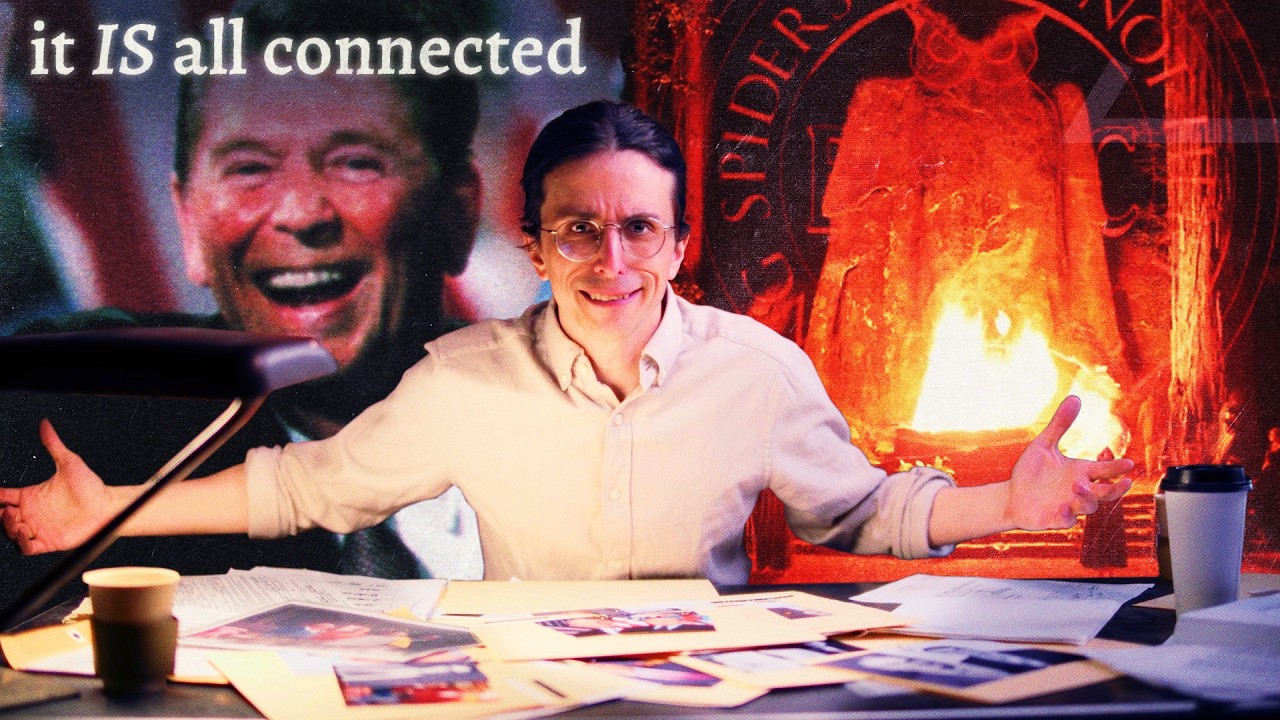
Since so much of this was planned at the Grove, we had to see the place
9:49
where the slogan is supposedly "weaving spiders come not here"
9:52
which implies they aren't supposed to be doing business there
9:55
So what exactly are they doing up there?
9:58
So we drove over.
....
12:27
They most recently focused their spending, fighting a ballot measure
12:30
that would have marginally increased property taxes on the most wealthy to fund affordable housing.
12:35
And top donor,
12:36
William Oberndorf
12:37
Who used his charitable foundation
12:39
to donate $2,000 to Make-A-Wish Foundation and $200,000 to Neighbors.
12:46
And Neighbors like Heritage or any of these ghoulish national organizations
12:51
is just one part of a network of linked organizations
12:55
sharing a small pool of donors and board members across the city.
12:59
But let's zoom back out nationally.
13:02
Mary said something that made me curious about the power of the Grove today.
13:07
Trump is not welcome at the Grove.
13:10
He tried to join. He's not a member. He's not on the list. You'll see.
13:16
They didn't want him.
13:18
But the Trump agenda is still inherently tied to the Bohemian Club.
13:23
This is how they held on to power.
13:27
Back in New York,
13:28
Dan and I started digging into the influence of the club on today's administration and politics.
13:34
I found this clip of Ed Fuelner, who's one of the founders,
13:36
and he's been attending The Grove for years. He was on your list in 2023.
13:41
He did die a little bit after this, but here he is.
13:44
Just a few months before that meeting of the Grove.
13:48
[Edwin Feulner] Tomorrow at our celebration,
13:51
we'll be introducing Mandate for Leadership 7
13:55
called Project 2025, Mandate for Leadership, the Conservative Promise.
14:02
A sincere thank you from this old man who was around the first time it all happened.
14:08
The first time it all happened, that's, you know, going into the Reagan administration
14:11
and making all the changes that we're still facing today,
14:14
and making our lives, more difficult today.
14:16
And it goes to show these people's ability to re consolidate power. Right.
14:21
They didn't get the guy they wanted the first time around.
14:24
They didn't let Trump in, but they were still able to weasel their way in and craft his policy book.
14:29
In the months that Project 2025 was being written.
14:32
The board of the Heritage Foundation was like a quarter Bohemian Club guys.
14:36
But it goes even further: on our 2023 list in Mandalay, the same camp as Michael Bloomberg
14:43
and Henry Kissinger, for whom this would be the last Grove, is another name: David McCormick.
14:49
At the time, McCormick was but a simple hedge fund billionaire who'd tried to run for Senate
14:55
in Pennsylvania before being defeated by Doctor Oz in the primary.
14:59
But just two months after this, he announced he was running again.
15:04
And this time he won.
15:06
So I compared our attendee list to McCormick donors.
15:10
11 men in Mandalay camp donated to McCormick's campaign.
15:14
And that's not even including the ones who gave through dark money tricks.
15:18
As Senator McCormick was part of an announcement with President Trump
15:21
for a big push for AI investment in Pennsylvania data centers and power plants.
15:28
at the same event was...
15:31
this guy
15:32
Brendan Bechtel, the latest family CEO and heir to the Bechtel fortune.
15:38
Bechtel is poised to get billions in construction contracts from this deal.
15:44
funneling money and power to Bechtel seems as important
15:46
to the Trump administration as it did to earlier administrations.
15:50
Bechtel is getting big deals with foreign companies for U.S. construction, brokered by Trump.
15:56
They have money tied up in the Venezuelan pipelines Trump wants to seize from the Venezuelan people,
16:01
and they've been floated as a beneficiary of the Kushner/Trump plan to rebuild Gaza.
16:08
We're seeing a level of collusion among the ultra wealthy that seems almost unbeatable.
16:14
They are all on the same team. They are all protecting each other.
16:18
It's not even about party politics, Paul Pelosi, Nancy's husband, is on the list, as is his nephew,
16:25
who works for Harlan Crowe, as are several major centrist and Democratic Party donors.
16:31
They have class solidarity, but so do we.
16:35
A tenants union was organized specifically to fight against John Atwater's Prime Realty,
16:40
and they've had big wins because they organized every building that Prime owns.
...
15:06
So I compared our attendee list to McCormick donors.
15:10
11 men in Mandalay camp donated to McCormick's campaign.
15:14
And that's not even including the ones who gave through dark money tricks.
15:18
As Senator McCormick was part of an announcement with President Trump
15:21
for a big push for AI investment in Pennsylvania data centers and power plants.
15:28
at the same event was...
15:31
this guy
15:32
Brendan Bechtel, the latest family CEO and heir to the Bechtel fortune.
15:38
Bechtel is poised to get billions in construction contracts from this deal.
15:44
funneling money and power to Bechtel seems as important
15:46
to the Trump administration as it did to earlier administrations.
15:50
Bechtel is getting big deals with foreign companies for U.S. construction, brokered by Trump.
15:56
They have money tied up in the Venezuelan pipelines Trump wants to seize from the Venezuelan people,
16:01
and they've been floated as a beneficiary of the Kushner/Trump plan to rebuild Gaza.
16:08
We're seeing a level of collusion among the ultra wealthy that seems almost unbeatable.
16:14
They are all on the same team. They are all protecting each other.
16:18
It's not even about party politics, Paul Pelosi, Nancy's husband, is on the list, as is his nephew,
16:25
who works for Harlan Crowe, as are several major centrist and Democratic Party donors.
16:31
They have class solidarity, but so do we.
bush 41
George Shultz served as the president and director of the Bechtel Company from 1974 to 1982. After leaving Bechtel, he became President Ronald Reagan's secretary of state. At the State Department, he worked forcefully to increase economic ties between the United States and Iraq in general and specifically on behalf of an oil pipeline from Iraq to Jordan that Bechtel would build. After leaving the State Department, Shultz aggressively advocated for war against Iraq as the chairman of Jackson's Committee for the Liberation of Iraq. Today Shultz is back at Bechtel as a director, where he is enjoying the company's nearly $3 billion in Iraq reconstruction contracts. Shultz is also a former member of the board of the Chevron Corporation, and he played a large role in securing a seat on this board for Condoleezza Rice. Condoleezza Rice was once George H.W. Bush's National Security Council director of Soviet and East European affairs, where she helped draft corporate globalization policy for the newly liberated Soviet Union. Next, she sat on the board of directors of Chevron, where she was the principal expert on Kazakhstan during a period in which the company moved aggressively into the Caspian region, thanks in large part to economic policies she helped to write. She also chaired Chevron's Committee on Public Policy when Chevron was one of the only U.S. oil companies with a contract to sell Iraqi oil under the United Nation's oil-for-food program with Hussein. Today, she is the secretary of state, as Chevron moves into position to take advantage of new radically opened Caspian, Afghani, and Iraqi oil sectors. Already, 2004 and 2005 marked the most profitable years in Chevron's 126-year history. Oil is a common thread linking all four companies. Each owes its roots and a good deal (in some cases, all) of its longevity and fortunes to oil—from their mutual beginnings in the California oil boom, which was made possible by high tariffs on, imported oil, to their more recent histories in Iraq. Each company traces its corporate history approximately one hundred years back to a pioneering founding father who discovered his calling at the dawn of the twentieth century in California.
Each company has grown, thrived, and survived using a similar formula: a knack for mergers, acquisitions, and consolidations; a revolving door with the U.S. government, allowing the companies to both write and be rewarded by U.S. legislation; a mastery of international trade; an apparent tendency to ignore laws that do not serve the companies' interests; and a willingness, in the words of Dick Cheney, to "go where the oil is" regardless of the political, social, economic, or environmental impacts of the pursuit.
These histories reveal a pattern of destructive, even deadly, corporate behavior that strongly contradicts the claim that increased corporate globalization, particularly less government regulation of corporate activity, is in the public interest. In the previous chapter I posited the question, "What happens when foreign investment does come to a country?" The answer provided in this chapter is that without strong government regulation, and even in spite of it, the results can be disastrous.
==
http://www.sourcewatch.org/index.php?title=Bechtel_Group,_Inc.
Bechtel Group, Inc. is the largest contractor in the U.S. The company does construction projects worldwide. It has been involved in such projects as the cleanup at the Chernobyl nuclear power plant and the construction of Hoover Dam. The company makes most of its money from oil, gas & chemicals and from government contracts. With Chairman and CEO Riley P. Bechtel at the head, the Bechtel family is in its fourth generation of leadership of the company. [1]
Bechtel is a defense contractor with very strong political ties and a long history of doing business in Iraq, including an unsuccessful pipeline deal that at one point involved a meeting between Donald H. Rumsfeld, former secretary of defense, and Saddam Hussein. That project later drew scrutiny from a special prosecutor looking into allegations of impropriety involving Edwin A. Meese III, the former White House counsel and attorney general in the Reagan administration. [1]
Contents[hide] |
Coal projects sponsored by Bechtel
- Bechtel / Kennecot Project (Montana) - cancelled
- Gilberton Coal-to-Clean-Fuels and Power Project (Pennsylvania)
- Trimble County Generating Station 2 (Kentucky)
Renewable energy projects
- Lake Erie wind project near Cleveland, Ohio[2]
- Ivanpah Solar Electric Generating System, Mohave Desert, California[3]
Bechtel connections
With Bin Laden Group
Jane Mayer of The New Yorker writes about the connections of Bechtel, the Bin Laden Group/family, and Bush, and past, administration officials, "The bin Ladens have a ten-million-dollar stake in the Fremont Group, a San Francisco-based company formerly called Bechtel Investments, which was until 1986 a subsidiary of Bechtel. The Fremont Group's Web site, which makes no mention of the bin Ladens, notes that 'though now independent, Fremont enjoys a close relationship with Bechtel.' Mayer further writes, "One Fremont director, Riley Bechtel, is the chairman and chief executive officer of the Bechtel Group, and is a member of the Bush administration: he was appointed this year to serve on the President's Export Council. In addition, George P. Shultz, the Secretary of State in the Ronald Reagan Administration, serves as a director both of Fremont and of the Bechtel Group, where he once was president and still is listed as senior counsellor." [2]
With U.S. Government
- "Former Secretary of Defense, Caspar Weinberger, was vice president and general counsel of the Bechtel Group before going to Washington in 1980." [3]
- "Daniel Chao, a Bechtel senior vice president, serves on the very same advisory committee of the Export-Import Bank of the United States while Ross J. Connelly, a 21-year veteran of Bechtel Group, is the chief operating officer for the Overseas Private Investment Corporation (OPIC), the other major source of funding from the federal government for American companies overseas." [4]
- "Jack Sheehan, a senior vice president at Bechtel, is a member of the Defense Policy Board ... Andrew Natsios, the administrator of USAID, which awarded the reconstruction contract for Iraq, was overseeing Bechtel just two years ago as the chairman of the Massachusetts Turnpike Authority, which hired the company to complete the Boston Central Artery project."[5]
- The Department of Energy's National Renewable Energy Laboratory (NREL) is operated by the Midwest Research Institute (MRI), Battelle, and Bechtel.[6]
Political contributions
The Bechtel political action committee gave $269,500 to federal candidates in the 2006 election - 37% to Democrats and 62% to Republicans. [4]
Lobbying
CorpWatch wrote in 2003, George P. Schultz, Bechtel board member, "used his political connections to lobby on behalf of a military invasion of Iraq. Bechtel received a request to bid on the reconstruction of Iraq before the invasion even began in a secret, undemocratic process. The contract itself has still not been seen by the Congress, much less the American public. Bechtel has once again used its revolving door to benefit itself and its friends at the expense of the majorities of the world's people and the planet." [5]
The company spent $540,000 for lobbying in 2006. Six lobbying firms were used along with in-house lobbyists. [6]
Personnel
[7] Key executives:
- Riley P. Bechtel, Chairman and CEO
- Adrian Zaccaria, President and Chief Operating Officer
- Jude Laspa, Deputy Chief Operating Officer
Selected board members:
- Steve Bechtel, Jr., Chairman, Retired
- Alan Dachs, President & Chief Executive Officer, Fremont Group
- Peter Dawson, Chief Financial Officer
Contact details
50 Beale St.
San Francisco, CA 94105
Phone: 415-768-1234
Fax: 415-768-9038
Web: http://www.bechtel.com
Articles and resources
Related SourceWatch articles
- BWX Technologies Inc.
- defense contractors
- Iraq's oil industry
- Military-industrial complex
- nuclear weapons complex
- oil industry
- Post-war Iraq
- Post-war Iraq contractors
References
- ↑ Bechtel Profile, Hoovers, accessed August 2007.
- ↑ New projects.
- ↑ Ivanpah Solar Electric Generating System.
- ↑ 2006 PAC Summary Data, Open Secrets, accessed August 2007.
- ↑ "Bechtel: Profiting from Destruction", CorpWatch, June 5, 2003.
- ↑ Bechtel lobbying expenses, Open Secrets.
- ↑ Leadership, Bechtel, accessed August 2007.
External resources
External articles
- Bob Herbert, "Ultimate Insiders", The New York Times, April 14, 2003.
- Iraq Reconstruction Contract, Washington Post, April 17, 2003.
- "Bechtel Has Ties in Washington, and to Iraq," The New York Times, April 18, 2003.
- David R. Baker, USA: Bechtel to Rebuild Iraq. Politically Connected Firm Wins $680 Million Bid, San Franciso Chronicle, April 18, 2003.
- Documentation of Rumsfeld in Iraq to sell Bechtel pipleline in 1983. Secret state department documents show he knew Iraq was using poison gas (WMD) against the Kurds at the time.
- Pratap Chatterjee, Bechtel's Friends in High Places, CorpWatch, April 24, 2003.
- Pratap Chatterjee, Bechtel Wins Iraq War Contracts, CorpWatch, April 24, 2003: "Soon after Riley Bechtel was appointed as an advisor to Bush, on April 21, Terry Valenzano, the man who ran Bechtel's construction business in Saudi Arabia, flew into Kuwait city to meet with Jay Garner, the Pentagon official appointed to oversee Iraq. The two men met at the Hilton resort to plan the reconstruction of Iraq after the fall of Saddam Hussein's government."
- Jane Mayer, "Dept. Of Connections: The Contractors," The New Yorker, April 28, 2003.
- Pratap Chatterjee, Bechtel's Nuclear Nightmares, CorpWatch, May 1, 2003.
- Pratap Chatterjee, Bechtel's Water Wars, CorpWatch, May 1, 2003.
- Pratap Chatterjee, Bechtel drums up war business, Asia Times, May 22, 2003.
- CorpWatch, Public Citizen, Global Exchange, "Global Exchange, and Public Citizen, Bechtel: Profiting from Destruction. Why the Corporate Invasion of Iraq Must be Stopped", June 5, 2003, accessed January 13, 2004. "These case studies reveal a legacy of unsustainable and destructive practices that have reaped permanent human, environmental and community devastation around the globe."
- U.S. Government's Iraq Infrastructure Reconstruction Program, with August 19, 2003, Project Update and List of Awarded Subcontracts (since April 25, 2003) for USAID Contract EEE-C-00-03-00018-00.
- Karim El-Gawhary, "Bechtel Fails Reconstruction of Iraq's Schools", Corpwatch, December 2, 2003.
- "Bechtel lands Qatar airport deal," BBC/UK, January 24, 2004: "Qatar has signed a contract with US engineering giant Bechtel to build a new airport for its capital Doha. The scheme is expected to cost a total of about $5bn. Passenger handling capacity will be boosted to 12m when the first phase is completed by 2009."
- "Windfalls of War", Center for Public Integrity, January 25, 2004: "Contracts and Reports."
- A.C. Thompson, "Inside Bechtel's Spin Machine," San Francisco Bay Guardian, May 5, 2004.
- Antonia Juhasz, "Bechtel Takes a Hit for War Profiteering," AlterNet, August 4, 2006.
- David R. Baker, "Bechtel pulling out after 3 rough years of rebuilding work," San Francisco Chronicle, November 1, 2006.
- Press release, "DOE Cites Bechtel National Inc. for Price-Anderson Violations," U.S. Department of Energy, September 15, 2008.
- Press release, "DOE Cites Bechtel National Inc. for Price-Anderson Violations," U.S. Department of Energy, December 3, 2008.
- Annette Cary, "DOE set to fine Hanford contractor Bechtel $385,000," Tri-City Herald (Tri-Cities, Washington), December 4, 2008.
---
Bolivia Water wars http://www.corpwatch.org/article.php?id=6670**
---
Bechtel Corporation (Bechtel Group) is the largest engineering company in the United States, ranking as the 3rd-largest privately owned company in the U.S. With headquarters in the Financial District of San Francisco,[2] As of 2010, Bechtel had $30.8 billion in revenue and employed 49,000 workers on projects in nearly 50 countries.
Bechtel participated in the building of Hoover Dam in the 1930s. It has also had involvement in a number of other high profile construction engineering projects: numerous power projects such as refineries and nuclear power plants; transportation projects including the Channel Tunnel, the BART system, King Fahd International Airport in Dammam (the largest Airport in the world by land area), Hong Kong International Airport and the Big Dig; and other projects such as the Kingdom Centre and Tower in Saudi Arabia, Jubail Industrial City, the rebuilding of the civil infrastructure of Iraq funded by the United States Agency for International Development (USAID), and the hauling and installing of more than 35,000 trailers and mobile homes for Hurricane Katrina victims in Mississippi.
The Bechtel family has owned Bechtel since incorporating the company in 1945. Bechtel's size, its political clout, and its penchant for privacy have made it a constant subject of scrutiny for journalists and politicians since the 1930s. Bechtel owns and operates power plants, oil refineries, water systems, and airports in several countries including the United States, Turkey, and the United Kingdom.
Contents[hide] |
[edit] History
[edit] Early 1900s
Bechtel has always functioned as a family-owned company. Its founder, Warren A. Bechtel, started as an employee of the burgeoning United States railroad industry in 1898 after his Oklahoma cattle ranch failed. Over the next 20 years, he built up a sizeable contracting business that specialised in railroad and highway building. One of Bechtel's earliest major contracts was grading the site of the Oroville, CA depot for the Western Pacific Railroad, then under construction.
In 1919, Warren Bechtel and his partners (including his brother Arthur) built the Klamath Highway in California, and in 1921 Warren Bechtel partners won a contract to build the water tunnels for the Caribou Hydroelectric Facility in that state. In 1925, Warren A. Bechtel's sons Warren Jr., Stephen, and Ken joined him and incorporated as W.A. Bechtel Company. In 1926, the new company won its first major contract, the Bowman Lake dam in California.
[edit] 1930s
In 1928, the U.S. Congress passed the Boulder Canyon Project Act, which mandated the construction of a hydroelectric dam on the Colorado River. The plan used the name "Boulder Dam", but after some controversy the structure gained the name of "Hoover Dam" (in honor of President Herbert Hoover). The construction involved the largest civil engineering project ever undertaken at the time.
Over the next two years several companies competed for dam-building contracts. To compete for the contract, the W.A. Bechtel Company joined with five competitors to form the Six Companies Corporation. This partnership formed for the sole purpose of the Hoover Dam project, and their combined strength virtually guaranteed that they would submit the most competitive bid. On March 11, 1931, the United States Department of the Interior selected the Six Companies to build the dam. Construction of the Hoover Dam began in late 1931 and finished in 1936, two years ahead of schedule.
Warren A. Bechtel died suddenly while traveling abroad in 1933, in the midst of the Hoover Dam project. His son Warren A. Bechtel, Jr. took over as president of the company and served in that position until succeeded by his brother Stephen.
After the building of Hoover Dam, Bechtel's reputation soared. However, Stephen Bechtel wanted the company to become more than just a construction firm. He pushed the W.A. Bechtel Company to undertake more complex engineering projects and oil contracts.
From 1933 to 1936, Bechtel helped build the 8 mile (13 km) long San Francisco – Oakland Bay Bridge. In 1937, Bechtel joined forces with John McCone's engineering company to form an engineering/construction firm called the Bechtel-McCone Company.
[edit] World War II
On July 19, 1940, President Roosevelt signed the Two-Ocean Naval Expansion Act, which authorized the construction of two huge fleets in both the Atlantic and Pacific theaters. The U.S. Maritime Commission selected Bechtel to build a new shipyard for the Pacific fleet. Bechtel constructed the Marinship Bechtel Shipyards in Sausalito, California and produced hundreds of cargo ships and oil tankers for the Navy. John McCone's California Shipbuilding Company also gained many large and profitable shipbuilding contracts, starting in early 1941 and continuing through the end of World War II.
While the United States built its "Arsenal of Democracy", American war planners increasingly worried about what would happen if the Axis gained control of the world's oil reserves. The Italian invasion of Egypt in September 1940 caused deep concern, as did the April 1941 coup in Iraq which brought the pro-German Golden Square faction to power.
Matters came to a head after the Japanese attack on Pearl Harbor in December 1941. War planners became concerned that the Japanese might invade Alaska and threaten the northern oil fields, which had started to become an important part of the U.S. oil supply. In April 1942, the United States Army authorized the creation of the ALCAN (Alaskan-Canadian Highway) to facilitate the movement of troops and supplies to Alaska. Soon afterwards the authorities authorized the CANOL oil pipeline.
The CANOL pipeline contract went to Bechtel-Price-Callahan, a partnership formed for the purpose by the W.A. Bechtel Co., the H.C. Price Co., and the W.E. Callahan Construction Co. In June 1942, the Japanese invaded the Aleutian Islands off the coast of Alaska, and the construction began in earnest. However, due to poor planning by the Army and mismanagement by the contractors, the CANOL project failed totally. The pipeline consumed more oil than it produced and cost taxpayers an enormous amount of money. Furthermore, as time went on, it became clear that the Japanese did not have the resources to invade Alaska. The CANOL pipeline was abandoned after a mere 11 months in operation.
During the pre-war period in late 1940 and early 1941, several scandals and allegations had surfaced involving wartime profiteering and widespread corruption at a number of defense contractors. In 1941, the U.S. Senate created the Special Committee to Investigate the National Defense Program at the urging of Senator Harry Truman. This committee, chaired by Truman, spent two years investigating waste and corruption in the defense industry.
In 1943, the "Truman Committee" released a scathing judgment on the $143 million CANOL project, calling it more destructive to the war effort than any act of sabotage by an enemy. The judgment singled out Bechtel-Price-Callahan for criticism for its role in the cost overruns and mismanagement that plagued the project.
[edit] Post-war era: late 40s through 50s
After the war, the W.A. Bechtel Company bought out John McCone's share in Bechtel-McCone and incorporated as Bechtel Corporation. John McCone went on to head the Atomic Energy Commission and later the Central Intelligence Agency (see below).
In 1947, Bechtel expanded its oil pipeline activities with its construction of the Trans-Arabian Pipeline in Saudi Arabia. At over 1,000 miles (1,600 km), this comprised the longest pipeline in the world at the time. In addition to the pipeline itself, Bechtel built large parts of the modern infrastructures of Saudi Arabia and Kuwait, including airports, sea ports, and oil refineries.
In 1946, the U.S. Congress authorized government research into nuclear power with the Atomic Energy Act of 1946. This act created the Atomic Energy Commission, later headed by Bechtel's former partner John McCone. Following President Eisenhower's famous Atoms for Peace speech in 1953, commercial research into nuclear power was authorized.
In 1956, Bechtel won the right to build the world's second commercial nuclear power reactor, the Dresden-1 in Illinois. Construction began in 1957 and the plant came fully online in 1960, four years after the first commercial nuclear power reactor, Calder Hall in Sellafield, England.
In 1959, a Bechtel partnership called Parsons Brinckerhoff-Tudor-Bechtel gained the contract for San Francisco's Bay Area Rapid Transit (BART) system. The system, completed in 1972, served as a model for other urban transit systems around the world.
[edit] 60s and 70s
Throughout the 1960s and 1970s, Bechtel expanded its energy engineering activities. In 1963, Bechtel began construction of the San Onofre Nuclear Generating Station in California. However the company was embarrassed in 1977 when it installed a 420-ton nuclear-reactor vessel backwards at the power plant in San Onofre.[3]
At this time the Corporation also diversified into other areas. In the late 1960s, Bechtel launched its development, finance, and investment arm, named Bechtel Enterprises Holdings, Inc. This firm leveraged Bechtel's experience, its capital, and its government ties to help other companies compete for engineering contracts throughout the world.
In 1972, Bechtel won a $13 billion contract for the James Bay hydroelectric project in northwest Quebec. The project was completed in 1985 and drew criticism from the growing environment movements in the U.S. and Canada.
In 1976, Bechtel was awarded a contract to build Jubail Industrial City in Saudi Arabia. By 1992, the 360 square mile (930 km²) city of Jubail was one of the most modern cities in Saudi Arabia, with a population of over 70,000. After the successful completion of the project in the late 1980s, Bechtel's contract was extended by the government of Saudi Arabia through 2007.
[edit] 1980s
The 1980s were not kind to Bechtel. Employee headcount plunged from 44,000 in 1982 to 16,000 in 1995; one of the 1995 layoffs ultimately resulted in a landmark 2000 employment law decision of the Supreme Court of California, which noted that it was Bechtel who had presented evidence of its massive layoffs to the trial court.[4]
In 1981, Bechtel constructed the Ok Tedi Mine, the largest mine in Papua New Guinea at the time. An engineering feat, the mine was constructed in one of the most remote and inaccessible regions in the world. Controversy would surround the major shareholder of the mining company, Broken Hill Proprietary (BHP), which is now known as BHP Billiton, when it allowed mine waste to be dumped directly in the Ok Tedi River after a tailings dam built by Bechtel was destroyed in a landslide. The Ok Tedi Environmental Disaster resulted from the riverine dumping of pollution.[5]
In 1981, Bechtel bought controlling interest in Wall Street investment bank Dillon, Read & Co., and George Schultz joined Dillon Read's board representing Bechtel.
Bechtel's recent history has been fraught with controversy. In 1988, just after Saddam Hussein had earned international condemnation for using poisonous gas against thousands of Kurds, Bechtel signed contracts with Iraq to build a chemical plant. Bechtel never completed the project due to the onset of the first Gulf War in 1990.
In 1989, Bechtel repaired the San Francisco – Oakland Bay Bridge after a 30 ft (9 m) section collapsed as a result of the Loma Prieta Earthquake.
[edit] 1990s
According to the Wall Street Journal, Bechtel established a strong relationship with the rebel leader Laurent Kabila during the First Congo War of 1996-7 in central Africa, compiling "the most complete mineralogical and geographical data of the former Zaire ever assembled, information worth a fortune to any prospective mining or oil firm" and commissioning and paying for "U.S. National Aeronautics and Space Administration satellite studies of the country and for infrared maps of its mineral potential." According to government officials, some of the satellite data provided to Kabila by Bechtel was "militarily useful information." [6]
In the late 1990s Bechtel was awarded the contract from Saudi Arabia's Civil Aviation Authority to build Dammam's King Fahd International Airport, the largest airport in the world in terms of land area (780 km²), thus making it larger than the nearby country of Bahrain, that Bechtel completed later than schedule and at a cost that was over budget while bad transport roads led many locals to fly via the nearby Bahrain International Airport.
[edit] 2000 to present
[edit] Bolivia
In September 1999, Bechtel signed a contract with Hugo Banzer, the elected president and former dictator of Bolivia, to privatize the water supply in Bolivia's 3rd-largest city, Cochabamba. The contract was officially awarded to a company named Aguas del Tunari, a consortium in which Bechtel held a 27.5 percent interest. Shortly thereafter, claims surfaced that water rates in that city went up an average of about 50 percent.[7] Both of these actions resulted in the Cochabamba protests of 2000. Many had to withdraw their children from school and stop using doctors because of higher costs for water. Martial law was declared, and Bolivian police killed at least 6 people and injured over 170 protesters. Amidst Bolivia's nationwide economic collapse and growing national unrest over the state of the economy, the Bolivian government withdrew the water contract.
In 2001, Bechtel filed suit against the Bolivian government, citing damages of more for $25 million. Bechtel argues that its contract was only to administer the water system, which suffered from terrible internal corruption and poor service, and that the local government raised water prices. The continuing legal battle attracted attention from anti-globalization and anti-capitalist groups. This topic is explored in the 2003 documentary film The Corporation, in the 2010 Spanish film Even the rain by Icíar Bollaín and on Bechtel's website. In January 2006, Bechtel and the other international partners settled the lawsuit against the Bolivian government for a reported two bolivianos, after intense protests that followed a ruling on jurisdiction favorable to Bechtel by the International Centre for the Settlement of Investment Disputes.[8]
[edit] Saudi Arabia
In 2002, Bechtel finished work on the Kingdom Centre in Riyadh, Saudi Arabia. The Kingdom Centre includes a shopping centre, a Four Seasons Hotel, state-of-the-art apartments, and most importantly the Kingdom Tower, a 302 meter tower, the tallest in Saudi Arabia and the 25th tallest building in the world. The total cost of the project was 1.717 billion Saudi Arabian Riyals and is owned by Alwaleed bin Talal bin Abdulaziz Al Saud.[9]
[edit] London
In January 2003 as part of the 30 year London Underground PFI, Bechtel has a one third interest in Tube Lines.[10]
Bechtel announced in May 2010 that it has entered into an agreement to sell its one-third interest in Tube Lines to Transport for London (“TfL”) for £103 million.[11]
[edit] Boston
In early 2003, the Boston Globe launched an investigation into Bechtel's role in massive cost overruns and accounting irregularities in Boston's Big Dig project totaling over $1 billion. Bechtel rebutted the allegations on its website. The Globe, along with the Associated Press, filed papers requesting that Massachusetts Turnpike Authority make public the results of all Bechtel's performance audits related to the Big Dig. Bechtel sought a preliminary injunction to block the release of the documents, but the superior court judge in the case denied Bechtel's request on April 11, 2003, opening the way for public release of the documents.[12]
Bechtel has long had close ties to the American government. From 1974 to 1982 George Schultz, former United States Secretary of Treasury and future Secretary of State, was president and director. The late former U.S. Secretary of Defense Caspar Weinberger was general counsel for Bechtel in the late 1970s. Former deputy Secretary of Energy W. Kenneth Davis was Bechtel's vice-president. Riley Bechtel, the company's chair, was on President George W. Bush's Export Council. Jack Sheehan, a former senior vice-president of Bechtel, was a member of the U.S. Defense Policy Board. The Clinton Administration also appointed senior Bechtel managers to senior positions.[13]
Like most large American companies, Bechtel and its employees have contributed large amounts of money to United States politicians (over a million dollars in campaign contributions between 1999 and 2002).[14]
[edit] Iraq
On April 17, 2003, following the 2003 U.S. invasion of Iraq, George W Bush, through USAID, awarded the first Iraq reconstruction contract, valued at $680 million, to Bechtel. [15][16] It is alleged that some of the construction projects managed by Bechtel were either poorly implemented, failing within months of their installation, or designed in such a way that Iraqi engineers did not have the knowledge or components to fix Bechtel's proprietary technology.[17][18]
On May 5, 2003, The New Yorker ran an article revealing that the bin Laden family had passively invested several million dollars in The Fremont Group, a private equity fund owned by the Bechtel family.[19]
[edit] Oak Ridge
In 2004 BWXT, a partnership of BWX Technologies and Bechtel National are fined $82,500 for a February, 2003 accident at Oak Ridge, Tennessee's Y-12 facility after an accident caused a small explosion, a fire, and contaminated three employees.[20]
[edit] Boston
In late 2004, a significant leak sprouted in the Big Dig's Tip O'Neill I-93 Tunnel, due to a contractor's failure to remove gravel or other debris before pouring concrete. Bechtel acknowledged failing to catch and correct the error. The Boston Globe also made a major issue of many leaks that sprang from gaps in the roof of the tunnel; these were later sealed by the tunnel contractors as part of the construction process.[21]
[edit] Romania
In 2004, a contract was awarded to Bechtel in Romania for building the A3 freeway. The contract came under criticism from the European Union because it was awarded through negotiation, not competitive bid. In 2005, the new Romanian government held up the project to renegotiate the contract but construction is now underway. As of January 2011, after 6 years, Transilvanian Highway is still under construction, 52 km of road finished and 1.2 billion Euro paid from Romania to Bechtel USA. [22] In January 2011, Bechtel announced its intention to bid for the contract for building two new reactors at the Cernavoda nuclear plant.[23]
[edit] New Orleans
In 2005, Bechtel was awarded a no-bid contract by the Federal Emergency Management Agency to install temporary housing for the Hurricane Katrina disaster relief effort. The lack of competitive bidding for the contracts was criticized, as was the high cost of the contracts and the failure to support local, minority-owned businesses.[24]
[edit] Boston
On July 10, 2006 a three ton section of concrete suspended ceiling crashed in the east bound lanes of the Massachusetts Turnpike I-90, in Boston. This tunnel ceiling collapse was in the Big Dig which Bechtel along with Parsons Brinckerhoff were responsible for building. This collapse claimed the life of Melena Del Valle, a 38 year old native of Costa Rica. Massachusetts Attorney General Tom Reily immediately designated the accident scene a crime scene. He has left open the possibility of negligent homicide charges being levied against Big Dig contractors and managers.[25]
[edit] U.S. Department of Energy
Effective October 1, 2007, the US Department of Energy awarded Bechtel partnership LLNS LLC the contract to operate Lawrence Livermore National Laboratory: Bechtel has a presence, through various partnerships, of the bulk of the US nuclear weapons facilities, including Los Alamos National Laboratory (design and pit production), Lawrence Livermore National Laboratory (design), Savannah River Site (nuclear materials), Hanford Site (nuclear materials), Pantex Plant (assembly/disassembly), Y-12 National Security Complex (nuclear materials), and the Nevada Test Site (subcritical testing).[26]
[edit] Executives
- Riley P. Bechtel is the CEO of Bechtel. With a net worth of $3.2 billion, he is the 50th richest person in the U.S. and the 127th richest in the world. In February 2003, he was appointed by President George W. Bush to the Export Council, which advises the president on international trade issues. He served for one year.
- David O'Reilly serves on the Bechtel Group, Inc. board of directors and is the former chairman & CEO of Chevron.
- George P. Shultz is the former U.S. Secretary of State under Ronald Reagan, former president of Bechtel, and a former Bechtel director. He is a former member of the board of Dillon, Read & Co. Inc.
- The late Caspar Weinberger served as the United States Secretary of Defense under Ronald Reagan. Prior to holding this position, Weinberger was the Vice President, Director, and General Counsel of the Bechtel Group of companies.
- Gen. John J. Sheehan, USMC (ret.) is the former NATO Supreme Allied Commander, Atlantic and the former Special Advisor to Asia for the U.S. Defense Department and the former General Manager of the Petroleum and Chemical Business Unit for Europe/Africa/Middle East/South West Asia and was also a Bechtel partner. He was also a member of the Defense Policy Board.
- Ross J. Connelly is the former CEO of Bechtel Energy Resources Corporation. He served on the Overseas Private Investment Corporation under George W. Bush.
- W. Kenneth Davis is a former Bechtel senior vice-president and is the former U.S. Deputy Energy Secretary.
---
boho:
| His father died under strange circumstances in Moscow. The Bechtel Company is a privately owned (giant) construction firm operating worldwide and headquartered in San Francisco and is a mainstay of the nuclear industry. Bechtel designed the military space shuttle facility at Vandenburg Air Force Base. It is known for decades for its many boondoggles all over the world. Bechtel had been rescued in its time of need by J. Henry Schroder and Avery Rockefeller. On June 3, 1954, the New York Times announced that Stephen Bechtel, chmn of Bechtel Corp. had become partner of J.P. Morgan Co. In 1955, Fortune reported that as Under Secretary of State, C. Douglas Dillon had arranged important contracts for Bechtel with the Saudi Arabian government, culminating in the present $135 billion Jubail operation. In January, 1975, Fortune pointed out that Bechtel had never been in the red for a single year, because "Its engineering projects are invariably financed by its clients." These clients are usually governments, a lesson which may have been learned from the Rothschilds. Bechtel funds the Heritage Foundation, which made large contributions to the neocon agenda since the 1980's. Heritage is headed by Le Cercle member Edwin J. Feulner, who is another member of the Bohemian Grove. Bechtel is a leading player in water system privatization, ranking just behind the big three -- Suez Lyonnaise des Eaux, Vivendi Universal and RWE/ Thames Water. Member of the Council on Foreign Relations. |
===
Last week the proposed Trans-Pacific Partnership (TPP) trade agreement leapt from behind the closed doors of negotiations to the front pages of major newspapers, thanks to information from Wikileaks revealing previously unpublished details of the proposed intellectual property chapter of the deal.
If you hadn’t yet heard about the TPP, there is a reason for that. Not even members of the US Congress have been allowed to see the negotiating text. Thanks to a set of leaks however, we´re beginning to get glimpses of exactly how dangerous the agreement is. The Wikileaks revelations have shone an urgent public light on the agreement’s onerous implications regarding intellectual property.
In 2012, however, another leak uncovered what may be an even more dangerous aspect of the TPP. The proposed investment chapter of the deal revealed plans to expand the system of international investment tribunals that deal with what is called ‘investor-state dispute settlement’. These are closed-door courts that take direct aim at the ability of governments across the world to enact environmental, public health and other protections for their citizens.
We don’t need much help to imagine what a world under these provisions of the TPP would look like. We need look no further than some of the current investor-state dispute cases in which powerful international corporations are demanding millions – sometimes billions – of dollars in claims, against countries both poor and wealthy, for the sin of protecting their citizens.
This is the very same system that the Bechtel Corporation used to attempt to drain $50 million from the Bolivian public treasury after the corporation had been thrown out during the Cochabamba Water War.
This is the same system that Canadian mining firm Pacific Rim, recently taken over by Oceana Gold, is using to try to extract over $300 million from the people of El Salvador for having rejected mining operations that threaten to contaminate their drinking water.
And it’s the same system that Philip Morris, the tobacco giant, is using against Uruguay and Australia to try to eliminate important public health regulations designed to reduce tobacco consumption.
The number of these investment cases has exploded in recent years, with 2012 breaking all records. Cases such as these, with serious implications for government ability to regulate for public health, environmental protection and access to water, are now being heard far away from domestic legal systems in international investor-state arbitration courts. Decisions in these closed door tribunals are made by three investment lawyers working on a for-profit basis with no obligation to balance the public interest with the profit-making interest of corporations. Governments, meanwhile, have no corresponding right to bring legal action against corporations in these arbitration tribunals when they breach national environmental regulations or human rights laws. It’s all one-way traffic.