Military-Industrial Complex
2/17 MIC 2 capt 719
COME YE MASTERS OF WAR
see MIC tag
===
see 4 horses: TCC
giants pp:
crisis of humanity
We have University of California, Santa Barbara, sociologist
William I. Robinson to thank for his book Global Capitalism
and the Crisis of Humanity (2014), which helps frame this
section of our introductory chapter.25
Robinson claims that
the world faces an unprecedented crisis of social inequality,
environmental degradation, global violence, and economic
[p30 giants: the global power elite]
destabilization. He says the world system has centralized and
over-accumulated capital to the point that investment oppor-
tunities are limited and that there are onlythree mechanisms
of investing excess capital: risky financial speculation, wars and
war preparation, and the privatization of public institutions.
The use of these mechanisms tends to result in a government
legitimation problem, in which democratic structures are con-
tinually undermined and militarized police states are emerging
around the world.
...
War and war preparation is another area in which the TCC
invests excess capital. Stockholm International Peace Research
Institute reports world military spending at $1.69 trillion in
2016, or 2.2 percent of global GDP.33 In 2016 the top military
spenders (spending more than $10 billion each) were the United
States ($611 billion), China ($215 billion), Russia ($69 billion),
Saudi Arabia ($63 billion), India ($55 billion), France ($55 bil-
lion), the United Kingdom ($54 billion), Japan ($46 billion),
Germany ($41 billion), South Korea ($36 billion), Italy ($28
billion), Australia ($24 billion), Brazil ($23 billion), Israel ($18
billion), Canada ($15 billion), Spain ($14 billion), United Arab
Emirates ($14 billion), Turkey ($14 billion), Iran ($12 billion),
Algeria ($10 billion), and Pakistan ($10 billion).34 Still timely are
Dwight Eisenhower’s 1953 words, “Every gun that is made, every
warship launched, every rocket fired signifies, in the final sense,
a theft from those who hunger and are not fed, those who are
cold and are not clothed.”35
The post-9/11 wars continue to wreak havoc, chaos, and
death in the Middle East, Africa, and other regions.
...
}:
https://mail.yahoo.com/d/folders/1/messages/216362?reason=invalid_crumb
y mail 6 23
new report from Brown University's Watson Institute of International and Public Affairs, shared exclusively with Popular Information, reveals how decades of enormous military spending have reshaped the federal government and the U.S. economy. Today, more than half of all discretionary spending is spent on defense, military personnel make up the majority of federal government employees, and private military contractors are a leading force in the U.S. economy. Meanwhile, "investments in infrastructure, healthcare, education, and emergency preparedness" have been crowded out.
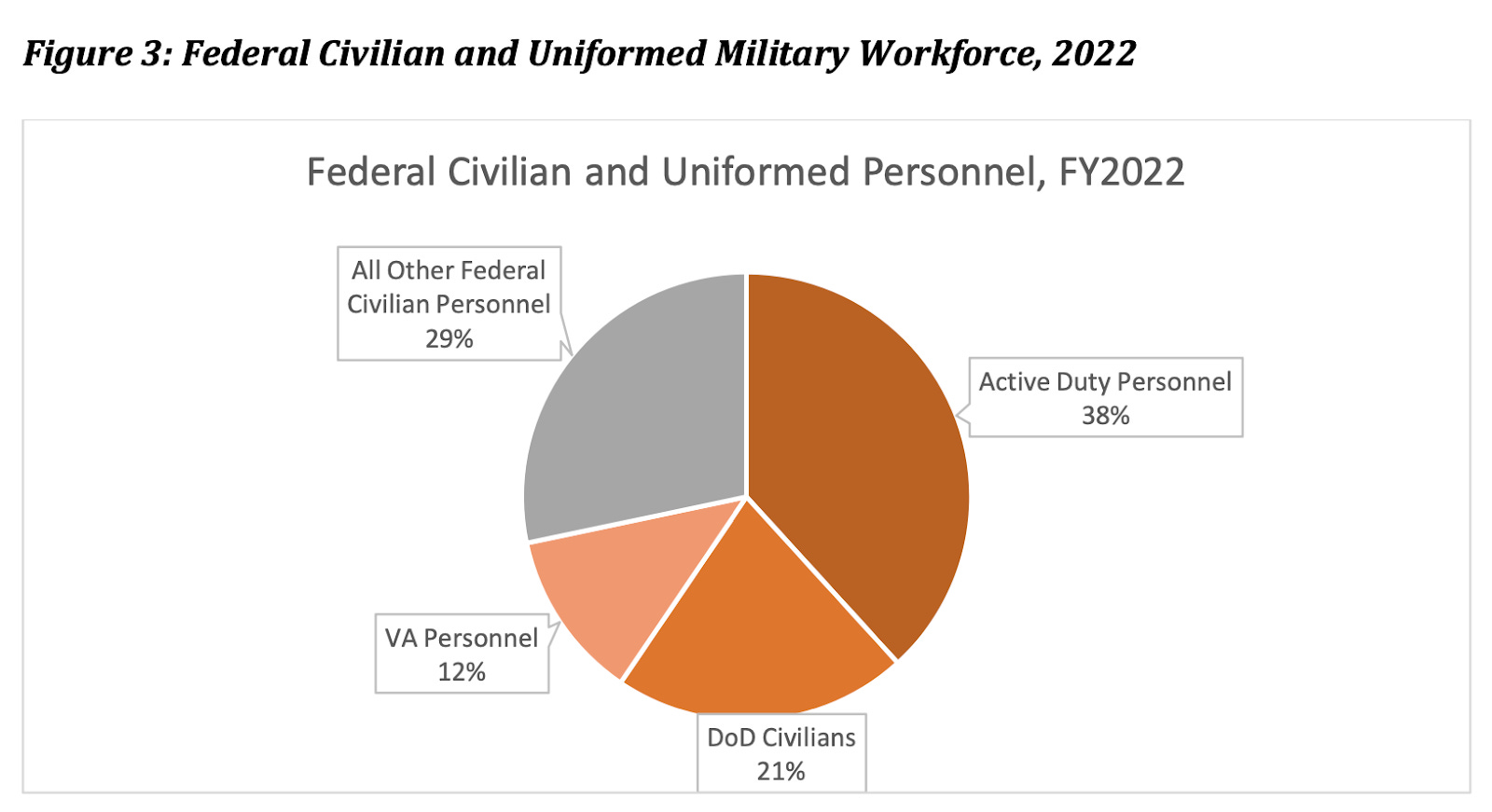
The numbers are startling. There are about 3.5 million people who work for the federal government, including civilians and uniformed military personnel. 72% of all federal workers are "defense-related," including Department of Defense civilians, uniformed military personnel, and the Department of Veterans Affairs staff. Meanwhile, the Department of Health and Human Services employs 4% of federal civilian workers. The State Department, tasked with using diplomacy to avert wars, employs 1%.
 |
The Department of Defense has a budget of $849 billion in the current fiscal year, and more than half is funneled to military contractors. About 30% of this money goes to just five firms: Lockheed Martin, Boeing, Raytheon, General Dynamics, and Northrup Grummond. Billions are awarded without competitive bidding. In 2020, for example, only 10% of Lockheed Martin's contracts were subject to competition. Despite the massive sums of money involved, "we know surprisingly little about how they spend these funds, what kinds of jobs and pay are supported, which sub-contractors are paid and how much." All five companies spend in excess of $10 million annually lobbying the federal government.
Today, "military contracts are distributed to every congressional district and nearly every county in the U.S." According to the report, this isn't an accident. Military contractors understand that "spreading out contracts means buying and gaining political support." The strategy produces "more constituents and more politicians fighting to win or maintain those contracts for the sake of jobs."
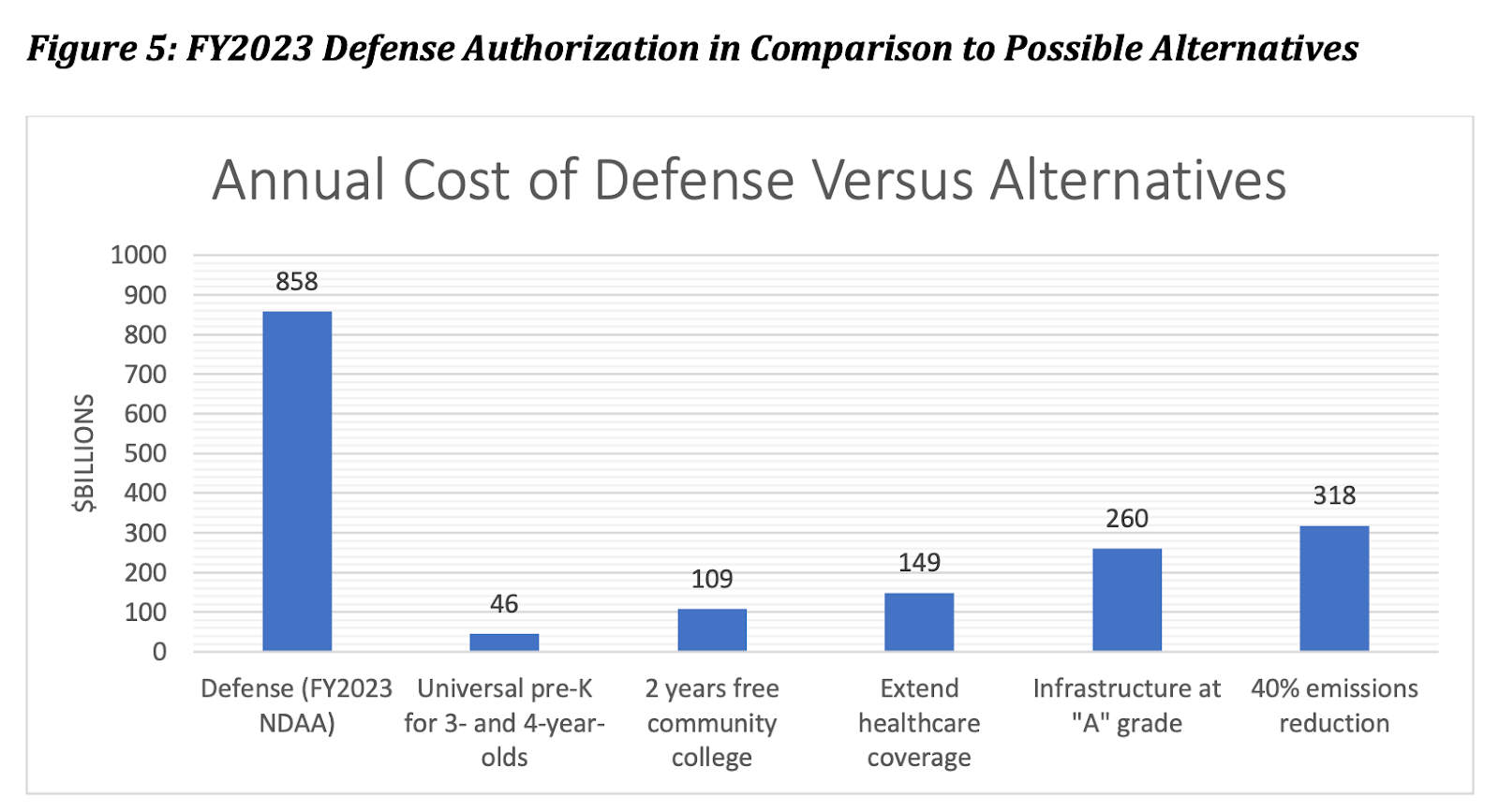
But military spending comes at a cost. Since 2015, the U.S. has added more than $300 billion to its annual defense spending. That is equivalent to the annual cost of providing universal pre-K for 3 and 4-year-olds, 2 years of free community college for high school graduates, and health insurance for uninsured Americans — combined.
 |
The situation described in the report is likely to worsen following the recent passage of a deal to raise the debt ceiling, which reduces most discretionary spending for two years while allowing defense spending to continue apace.
"U.S. taxpayers have gotten what they’ve paid for, which is an economy that is devoted to the military, both in terms of spending and in terms of jobs," the author of the study, Dr. Heidi Peltier, concludes. The following is a transcript of Popular Information's interview with Peltier, edited for length and clarity.
LEGUM: You describe in the report that, today, both the federal government and, to a certain extent, the economy overall, is dominated by military spending. When did this dynamic begin?
PELTIER: Until recently, [the defense budget] would go up during wartime and down during peacetime. And what we're seeing in recent years is that it keeps going up even when we're not at war. So with the exit from Afghanistan and the winding down of the Iraq war, we really should be seeing military spending going down. And yet we continue to see increased military budgets. So that is something that I think has changed over the last 20 years in the post-9/11 era.
LEGUM: Many politicians and pundits argue that the United States is not spending enough on the military. One of the arguments that I see centers around purchasing power. The argument is that we spend more than the next 10 or 11 countries combined on our military, but that distorts reality because it's much cheaper for the Chinese to pay for things. What would you say to that?
PELTIER: We spend three times as much as China, and we spend 10 times as much as Russia. If that argument were true, you could look at the numbers of tanks, drones, weapons, and ammunition. There's some ability to make things cheaper in China, but the United States still has a lot more tanks and a lot more nuclear weaponry, a lot more ammunition, and a lot more weapons systems of all types.
LEGUM: Another common argument is that we have a dominant position over countries like China now, but they are investing aggressively. So we need to continue to invest aggressively to stay ahead....
===
:{https://historynewsnetwork.org/article/171840:(style="background-color:#ffffff;"):}:
:{4/28/19
}:
Beware Anew the Military-Industrial Complex: Revisiting Eisenhower's Warning
tags: military history, Eisenhower, military industrial complex:{
}:
:{
}:
“The only thing we learn from history is that we learn nothing from history.”
“What experience and history teaches us is that people and governments have
never learned anything from history, or acted on principles deduced from it.”
– G.W.F. Hegel
The military-industrial complex, a term brought to life by President Dwight D. Eisenhower in his 1961 farewell address to the nation, is widely acknowledged, quoted, and even embraced today.Yet, ironically, the ubiquity of this embrace hasn’t actually affected the outsized influence of that complex.
“In the councils of government,” Eisenhower warned, “we must guard against the acquisition of unwarranted influence, whether sought or unsought, by the military-industrial complex [‘military-industrial-congressional complex’ in the original text]. The potential for the disastrous rise of misplaced power exists and will persist.”
He had prefaced these words in the same address by observing: “The total influence [of the then-new conjunction of an immense military establishment and a large arms industry] – economic, political, even spiritual – is felt in every city, every Statehouse, every office of the Federal government. We recognize the imperative need for this development. Yet, we must not fail to comprehend its grave implications.”
If we were blessed with an ideal state of civil-military relations in this country, its distinguishing characteristics would include – in addition to a strategically effective military and strategically competent civilian overseers – what we might call a properly subordinated military-industrial complex. This complex would, accordingly, be subordinated to and supportive of national interests, aims, and responses. Quite the opposite has been the case, though, throughout the almost six decades since Eisenhower alerted the American people the centrality of military industries to civilian life. Today, it is a mammoth, strategically distorting, even strategically dysfunctional confluence of political, ideological and, yes, economic interests that warrants renewed attention, if not alarm. This is especially important as the military-industrial complex has been given new, unfettered life and license by the 2018 National Defense Strategy document, now in place, that has assumed the de facto position of representing America’s current strategic posture.
Roughly 13% of the U.S. federal budget now goes to private-sector contractors, 63% of those contracts beingfor defense. Some 51% of defense contracts are for products, 41% for services, the rest for R&D. Defense contracts represent 52% of overall defense spending. In FY 2018 alone, the Defense Department awarded over $358 billion in contracts. The top 10 defense contractors– Lockheed Martin, Raytheon, Northrop Grumman, Boeing, General Dynamics, United Technologies, L3 Technologies, Huntington Ingalls, Leidos, Booz Allen Hamilton – collectively receive some $167 billion a year in defense revenues. That amount exceeds the GDPs of more than 130 of the world’s countries. Lockheed’s defense revenues alone – $48 billion – exceeds the annual military expenditures of all but six countries; while numbers 2 and 3 – Raytheon and Northrop Grumman – each receive over $20 billion in defense revenues, thereby exceeding military expenditures of all but 13 countries.
To be fair, economically speaking, overall defense expenditures represent 3.5% of U.S. GDP; the defense sector provides over 4 million jobs; and roughly 10% of the $2.2 trillion in U.S. factory output goes to arms production. These are not inconsequential considerations for the politically minded and politically motivated among us. At the same time, the United States claims the dubious honor of ranking first in the world in international arms transfers, commanding 36% of the global market. This also isn’t inconsequential for thestrategically minded among us who recognize the potentially destabilizing, arms-race-inducing effects of such transactions.
Because Eisenhower’s warning conveyed concern about the well-being of democracy, it is especially important to note thatthe defense sector of industry assiduously exercises its First Amendment rights through lobbying and campaign contributions: $128 million spent on the former, $30 million on the latter in the 2017-18 federal campaign cycle alone. Since 1990, the defense sector has accounted for nearly $200 million in campaign contributions – dwarfed, in comparison, by other sectors, but nonetheless more than mere “beanbag,” as they say.
Eisenhower’s April 1953 “Chance for Peace” speech to the American Society of Newspaper Editors, delivered almost immediately after he took office, is even more telling even than his 1961 farewell address. Also broadcast nationwide, it is worth quoting at some length for the examples it affords:
Every gun that is made, every warship launched, every rocket fired signifies, in the final sense, a theft from those who hunger and are not fed, those who are cold and are not clothed.
This world in arms is not spending money alone.
It is spending the sweat of its laborers, the genius of its scientists, the hopes of its children.
The cost of one modern heavy bomber is this: a modern brick school in more than 30 cities.
It is two electric power plants, each serving a town of 60,000 population.
It is two fine, fully equipped hospitals. It is some 50 miles of concrete highway.
We pay for a single fighter plane with a half million bushels of wheat.
We pay for a single destroyer with new homes that could have housed more than 8,000 people.
This, I repeat, is the best way of life to be found on the road the world has been taking.
This is not a way of life at all, in any true sense. Under the cloud of threatening war, it is humanity hanging from a cross of iron.
Of course, that was then, when a destroyer cost something on the order of $6 million apiece, a bomber $2.4 million, a fighter jet $211,000. This is now, when an Arleigh Burke-class destroyer runs $1.2 billion (and a Zumwalt-class destroyer $4.5 billion), a B-21 stealth bomber $564 million, an F-35 Joint Strike Fighter $141 million. Thanks to the National Priorities Project, we can see what some selected tradeoffs akin to those Eisenhower offered might look like:
For the $19.95 billion we are paying for nuclear weapons and associated costs, we could create, for example, 359,099 infrastructure jobs for a year, or pay 246,838 elementary school teachers for a year.
For the $11.45 billion we are paying for the F-35 Joint Strike Fighter, we could provide, for example, 1.11 million military veterans VA medical care for a year, or 344,676 scholarships for university students for four years.
For the $1.51 billion we are paying for Predator and Reaper drones, we could provide, for example, 638,124 children or 424,963 adults low-income healthcare for a year.
These aren’t just incongruent apples-and-oranges tradeoffs; they are strategic tradeoffs. Those, most notably, who either produced or zealously support the NDS consider such tradeoffs anything but strategic, precisely because the types of domestic spending alternatives offered aren’t militarily relevant.
The NDS is a retro, militaristic call for a self-reaffirming, self-serving, self-fulfilling New Cold War that implicitly bows to and embraces a dominant and domineering military-industrial complex.The NDS claims that (a) the world we face today is determined by Great Power competition, defined in predominantly military terms, in which “revisionist powers” China and Russia seek to unseat us; (b) our supremacy in every domain of warfare – air, land, sea, space, and cyberspace – is now contested and begs restoration; (c) peace (through strength) is achievable primarily, if not solely, by being prepared for war; and (d) the primary line of effort for carrying out this “strategy” is heightened lethality.
The NDS would have us believe that the preferred vehicle for restoring America’s deserved primacy in all the aforementioned domains of warfare is the technological superiority provided by what is now labeled the “National Security Innovation Base.” Such labeling seemingly implies that national security and defense are essentially synonymous, and that a future-oriented Innovation Base is somehow different (at least rhetorically) than a backward-looking Defense Industrial Base. Irony again intrudes here, by the way, since mobilization is implicitly given new life, but mobilization in the most parochial World War II, giant on-off switch terms.
...
==
nick turse:
Marshall reportedly refused a number of lucrative offers to write his memoirs, including the then-princely sum of a million dollars after taxes from Time and Life publisher Henry Luce. He did so on the grounds that it was unethical to profit from service to the United States or to benefit from the sacrifices of the men who had served under him, supposedly telling one publisher “that he had not spent his life serving the government in order to sell his life story to the Saturday Evening Post.” In his last years, he finally cooperated with a biographer and gave his archives to the George C. Marshall Research Foundation on “the condition that no monetary returns from a book or books based on his materials would go to him or his family but would be used for the research program of the Marshall Foundation.” Even his biographer was asked to “waive the right to any royalties from the biography.” Marshall also declined to serve on any corporate boards.
Marshall may have been a paragon of restraint and moral rectitude, but he wasn’t alone. As late as the years 1994-1998, according to an analysis by the Boston Globe, fewer than 50% of retiring three- and four-star officers went to work as consultants or defense executives. By 2004-2008, that number had jumped to 80%. An analysis by the Washington D.C.-based nonprofit group, Citizens for Responsibility and Ethics in Washington, found that it was still at a lofty 70% for the years 2009-2011.
Celebrity generals like Petraeus and fellow former four-star generals Stanley McChrystal (whose military career was also consumed in the flames of scandal) and Ray Odierno (who retired amid controversy), as well as retired admiral and former chairman of the Joint Chiefs of Staff, Mike Mullen, don’t even need to enter the world of arms dealers and defense firms. These days, those jobs may increasingly be left to second-tier military luminaries like Marine Corps general James Cartwright, the former vice chairman of the Joint Chiefs of Staff, now on the board of directors at Raytheon, as well as former Vice Admiral and Director of Naval Intelligence Jack Dorsett, who joined Northrop Grumman.
If, however, you are one of the military’s top stars, the sky is increasingly the limit. You can, for instance, lead a consulting firm (McChrystal and Mullen) or advise or even join the boards of banks and civilian corporations like JPMorgan Chase (Odierno), Jet Blue (McChrystal), and General Motors (Mullen).
For his part, after putting his extramarital affair behind him, Petraeus became a partner at the private equity firm Kohlberg, Kravis, Roberts & Co. L.P. (KKR), where he also serves as the chairman of the KKR Global Institute and, according to his bio, “oversees the institute's thought leadership platform focused on geopolitical and macro-economic trends, as well as environmental, social, and governance issues.” His lieutenants include a former chairman of the Republican National Committee and campaign manager for President George W. Bush, as well as a former leading light at Morgan Stanley.
KKR’s portfolio boasts a bit of everything, from Alliant Insurance Services and Panasonic Healthcare to a host of Chinese firms (Rundong Automobile Group and Asia Dairy, among them). There are also defense firms under its umbrella, including TASC, the self-proclaimed “premier provider of advanced systems engineering and integration services across the Intelligence Community, Department of Defense, and civilian agencies of the federal government,” and Airbus Group’s defense electronics business which KKR recently bought for $1.2 billion.
KKR is, however, just where Petraeus's post-military, post-CIA résumé begins.
==
last year, I spent some timedigging into the Pentagon’s “reconstruction” efforts in Iraq and Afghanistan, countries it invaded in 2001 and 2003 in tandem with a chosen crew of warrior corporations.
http://www.tomdispatch.com/archive/175507/tom_engelhardt_the_arrival_of_the_warrior_corporation (all vol force idea fail so pvt to fill gap)
As a story of fabled American can-do in distant lands, both proved genuinely dismal no-can-do tales, from roads built (that instantly started crumbling) to police academies constructed (that proved to be health hazards) to prisons begun (that were never finished) to schools constructed (that remained uncompleted) to small arms transfers (that were “lost” in transit) to armies built, trained, and equipped forstunning sums (that collapsed). It was as if nothing the Pentagon touched turned to anything but dross (including the never-ending wars it fought). All of it added up to what I then labeled a massive “$cam” with American taxpayer money lost in amounts that staggered the imagination.
All of that came rushing back as I read TomDispatch regular William Hartung’s latest post on “waste” at the Pentagon. It didn’t just happen in Kabul and Baghdad; it’s been going on right here in the good old USA for, as Hartung recounts, the last five decades. There’s only one difference I can see: in Kabul, Baghdad, or any other capital in the Greater Middle East and Africa, if we saw far smaller versions of such “waste” indulged in by the elites of those countries, we would call it “corruption” without blinking. So here’s my little suggestion, as you read Hartung: think about just how deeply what once would have been considered a Third World-style of corruption is buried in the very heart of our system and in the way of life of the military-industrial complex. By now, President Dwight Eisenhower must be tossing and turning in his grave.-Tom Engelhardt
How Not to Audit the Pentagon
Five Decades Later, the Military Waste Machine Is Running Full Speed Ahead
From spending $150 million on private villas for a handful of personnel in Afghanistan to blowing $2.7 billion on an air surveillance balloon that doesn’t work, the latest revelations of waste at the Pentagon are just the most recent howlers in a long line of similar stories stretching back at least five decades. Other hot-off-the-presses examples would include the Army’s purchase of helicopter gears worth $500 each for $8,000 each and the accumulation of billions of dollars' worth of weapons components that will never be used. And then there’s the one that would have to be everyone’s favorite Pentagon waste story: the spending of $50,000 toinvestigate the bomb-detecting capabilities of African elephants. (And here’s a shock: they didn’t turn out to be that great!) The elephant research, of course, represents chump change in the Pentagon’s wastage sweepstakes and in the context of its $600-billion-plus budget, but think of it as indicative of the absurd lengths the Department of Defense will go to when what’s at stake is throwing away taxpayer dollars.
Keep in mind that the above examples are just the tip of the tip of a titanic iceberg of military waste. In a recent report I did for the Center for International Policy, I identified 27 recent examples of such wasteful spending totaling over $33 billion. And that was no more than a sampling of everyday life in the twenty-first-century world of the Pentagon.
The staggering persistence and profusion of such cases suggests that it’s time to rethink what exactly they represent. Far from being aberrations in need of correction to make the Pentagon run more efficiently, wasting vast sums of taxpayer dollars should be seen as a way of life for the Department of Defense. And with that in mind, let’s take a little tour through the highlights of Pentagon waste from the 1960s to the present.
How Many States Can You Lose Jobs In?
The first person to bring widespread public attention to the size and scope of the problem of Pentagon waste was Ernest Fitzgerald, an Air Force deputy for management systems. In the late 1960s, he battled that service to bring to light massive cost overruns on Lockheed’s C-5A transport plane. He risked his job, and was ultimatelyfired, for uncovering $2 billion in excess expenditures on a plane that was supposed to make the rapid deployment of large quantities of military equipment to Vietnam and other distant conflicts a reality.
The cost increase on the C-5A was twice the price Lockheed had initially promised, and at the time one of the largest cost overruns ever exposed. It was also an episode of special interest then, because Secretary of Defense Robert McNamara had been pledging to bring the efficient business methods he hadlearned as Ford Motors’ president to bear on the Pentagon’s budgeting process.
No such luck, as it turned out, but Fitzgerald’s revelations did, at least, spark a decade of media and congressional scrutiny of the business practices of the weapons industry. The C-5A fiasco, combined with Lockheed’s financial troubles with its L-1011 airliner project, led the company to approach Congress, hat in hand, for a $250 million government bailout. Wisconsin Senator William Proxmire, who had helped bring attention to the C-5A overruns, vigorouslyopposed the measure, and came within one vote of defeating it in the Senate.
In a time-tested lobbying technique that has been used by weapons makers ever since, Lockheed claimed that denying it loan guarantees would cost 34,000 jobs in 35 states, while undermining the Pentagon’s ability to prepare for the next war, whatever it might be. The tactic worked like a charm. Montana Senator Lee Metcalf, who cast the deciding vote in favor of the bailout, said, “I’m not going to be the one to put those thousands of people out of work.” An analysis by the New York Times found that every senator with a Lockheed-related plant in his or her state voted for the deal.
By rewarding Lockheed Martin for its wasteful practices, Congress set a precedent that has never been superseded. A present-day case in point is -- speak of the devil -- Lockheed Martin’s F-35 combat aircraft. At $1.4 trillion in procurement and operating costs over its lifetime, it will be the most expensive weapons program ever undertaken by the Pentagon (or anyone else on Planet Earth), and the warning signs are already in: tens of billions of dollars in projected cost overruns and myriad performance problems before the F-35 is even out of its testing phase. Now the Pentagon wants to rush the plane into production by making a “block buy” of more than 400 planes that will involve little or no accountabilityregarding the quality and cost of the final product.
Predictably, almost five decades after the C-5A contretemps, Lockheed Martin has deployed an inflationary version of the jobs argument in defense of the F-35, making the wildly exaggerated claim that the plane will produce 125,000 jobs in 46 states. The company has even created a handy interactive map to show how many jobs the program will allegedly create state by state. Never mind the fact that weapons spending is the least efficient way to create jobs, lagging far behind investment in housing, education, or infrastructure.
The Classic $640 Toilet Seat
Despite the tens of billions being wasted on a project like the F-35, the examples that tend to draw the most attention from the media and the most outrage among taxpayers involve overspending on routine items. This may be because the average person doesn’t have a sense of what a fighter plane should cost, but can more easily grasp that spending $640 for a toilet seat or $7,600 for a coffee pot is outrageous. These kinds of examples -- first exposed through work done in the 1980s by Dina Rasor of the Project on Military Procurement -- undermined the position taken by President Ronald Reagan’s administration that not a penny could be cut from its then-record peacetime Pentagon budgets.
The media ate such stories up. Pentagon overpayments for everyday itemsgenerated hundreds of articles in newspapers and magazines, including front-page coverage in the Washington Post. Two whistleblowers were even interviewed on the Today Show, and Johnny Carson joked about such scandals in his introductory monologues on the Tonight Show. Perhaps the most memorable depiction of the problem was a cartoon by the Washington Post’s Herblock that showed Reagan Secretary of Defense Caspar Weinberger wearing a $640 toilet seat around his neck. This outburst of truth-telling, whistleblowing, investigative journalism, and mockery helped put a cap on the Reagan military buildup, but -- you won’t be surprised to learn -- didn’t keep the Pentagon from finding ever more innovative ways to misspend tax dollars.
The most outrageous spending choice of the 1990s was undoubtedly the Clinton administration’s decision to subsidize the mergers of major defense firms. As Lockheed (yet again!) and Martin Marietta merged, Northrop teamed with Grumman, and Boeing bought McDonnell Douglas, the Pentagon provided funding to pay for everything from closing down factories to subsidizing golden parachutes for displaced executives and board members. At the time, Vermont Congressman Bernie Sanders aptly dubbed the process “payoffs for layoffs,” as executives of defense firms received healthy payouts while laid-off workers were largely left to fend for themselves.
The Pentagon’s rationale for giving hundreds of millions of dollars to these emerging defense behemoths was laughable. The claim -- absurd on the face of it -- was that the new, larger companies would provide the Pentagon with lower prices once they had eliminated unnecessary overhead. Former Pentagon official Lawrence Korb, who opposed the subsidies at the time, noted the obvious: there was no evidence that weapons programs grew any cheaper, cost overruns any less, or wastage any smaller thanks to government subsidized mergers. As in fact became clear in the world of the weapons giants that followed, the increased bargaining power of companies like Lockheed Martin in a significantly less competitive market undoubtedly resulted in higher weapons costs.
It Took $6 Billion Not to Audit the Pentagon
The poster child for waste in the first decade of the twenty-first century was certainly the billions of dollars a privatizing Pentagon handed out to up-armored companies like Halliburton that accompanied the U.S. military into its war zones and engaged in Pentagon-funded base-building and “reconstruction” (aka “nation building”) projects in Iraq and Afghanistan. The Special Inspector General for Afghan Reconstruction (SIGAR) alone seems to come out with new examples of waste, fraud, and abuse on practically a weekly basis. Among Afghan projects that stood out over the years was a multimillion-dollar “highway to nowhere,” a$43 million gas station in nowhere, a $25 million “state of the art” headquarters for the U.S. military in Helmand Province, with all the usual cost overruns, that no one ever used, and the payment of actual salaries to countless thousands of no ones aptly labeled “ghost soldiers.” And that’s just to begin enumerating a long, long list. Last year, Pro Publica created an invaluable interactive graphic detailing $17 billion in wasteful spending uncovered by SIGAR, complete with information on what that money could have purchased if it had been used productively.
One reason the Pentagon has been able to get away with all this is that it has proven strangely incapable of doing a simple audit of itself, despite a Congressionally mandated requirement dating back to 1990 that it do so. Conveniently enough, this means that the Department of Defense can’t tell us how much equipment it has purchased, or how often it has been overcharged, or even how many contractors it employs. This may be spectacularly bad ...
http://www.alternet.org/world/amount-our-tax-payer-money-military-pisses-away-just-unbelievable
==
https://projects.propublica.org/graphics/afghan
waste billions
==
http://www.truthdig.com/tag/military/P50
http://www.propublica.org/article/thank-you-for-your-service-how-one-company-sues-soldiers-worldwide USA Discounters predatory
==
5/15
Scathing reports have once again spotlighted the massive cost and delays surrounding the F-35 Joint Strike Fighter, a jet designed for multiple branches of the military that has been dubbed the single most expensive weapons program in history. Even as criticism has rained down upon them, though, the four main contractors on the project have made sure campaign funds flow to lawmakers who are instrumental in keeping government payments coming for the jet. And all four contractors upped the ante last year with record contributions.
One of the recent reports, from the U.S. Government Accountability Office, is critical of engine failures and software glitches that have caused delays in manufacturing and testing. Notably, an engine fire last summer grounded the entire fleet, some of which were expected to enter active service by the end of this year. The engine is designed by Pratt & Whitney, a subsidiary of United Technologies — a company that also took fire in a separate report from the Department of Defense Inspector General this month, which mentioned more than 60 breaches in the company’s compliance with Pentagon requirements and policies.
F-35 procurement is expected to cost nearly $400 billion, according to the GAO report, and the Pentagon’s budget for it is projected to rise from $8.4 billion in 2015 to $12 billion in 2018.
A 2011 OpenSecrets blog report linked members of a then-new group of F-35 enthusiasts on Capitol Hill — the Joint Strike Fighter Caucus — to the contractors. But a new analysis of 2014 data shows that some of the top recipients from the contractors are powerful legislators: party leaders and chairs or ranking members of influential committees and subcommittees.

Contributions from Lockheed Martin since 1990. (Center for Responsive Politics)
All together, United Technologies,Lockheed Martin, Northrop Grumman, and BAE Systems donate millions of dollars every couple of years to lawmakers in the Capitol. Following slightly differing time frames, their individual giving has grown enormously since the JSF program started in 1997. The main contractor, Lockheed, and Northrop Grumman led the pack in 2014, each contributing $4.1 million to campaigns. UT spent $2.1 million, and BAE gave $1.4 million. For all four, 2014 was a record year.
Giving from the contractors typically favors Republican candidates by large margins. In the case of Lockheed, for instance, Republican support generally hovers at 60 percent of its total giving (2008 and 2010 were two recent exceptions to the rule, but, as seen in the chart above, Republicans are once again the favored party).
At the top of their recipients list, however, are lawmakers on both sides of the aisle with powerful spots in important committees. The House Armed Services Committee, House Appropriations Committee, and Senate Appropriations Committees were the biggest targets of all of the companies; lawmakers in each received $1.7 million, $1.3 million, and $658,499, respectively.
Sen. Dick Durbin (D-Ill.) is the only lawmaker in the top five of each company. Now the Senate minority party’s No. 2, and ranking member of the Appropriations Subcommittee on Defense, Durbin in 2014 took $62,000 from Northrop Grumman, $54,000 from UT, $29,600 from Lockheed, and $29,299 from BAE.
Senate Majority Leader Mitch McConnell (R-Ky.) showed up in the top five of two of the contractors — $27,400 from Lockheed, $23,500 from BAE — as did Appropriations Committee Chairman Sen. Thad Cochran (R-Miss.) — $14,000 from BAE, and $11,500 from UT.
Members of the House appropriations and Armed Services Committees were up there as well — often taking in more than the lawmakers in the Senate.
Rep. Mac Thornberry (R-Texas), the chairman of the House Armed Services Committee, received $75,900 from Lockheed, and $29,000 from Northrop Grumman. The top Democrat in the Committee, Washington Rep. Adam Smith took in $28,200 from Northrop Grumman. Rep. Joe Courtney (D-Conn.), the ranking member of a subcommittee in Armed Services took in $11,500 from UT. Rep.Duncan Hunter (R-Calif.), just a member of the Committee, got $11,500. Hunter is also the son of former House Armed Services Chairman, former Rep. Duncan L. Hunter (R-Calif.).
In Appropriations, several subcommittee chairs make a showing in the companies’ top fives as well. Rep. Kay Granger (R-Texas) the chairwoman for the State and Foreign Operations Subcommittee and vice-chair of the Defense Appropriations Subcommittee received $73,350 from Lockheed (Granger also lists herself as co-chair of the JSF caucus on her website with a link to the 2011 press release announcing the caucus). The ranking New Jersey lawmaker on the panel, Republican Rep. Rodney Frelinghuysen, saw $73,350 from Lockheed (Frelinghuysen is also the chairman of the Homeland Security and Defense Committee). Rep. Ander Crenshaw (R-Fla.) took in $35,700 from Northrop Grumman, and $13,600 from BAE.
Categories: Defense
Tags: Adam Smith, ander crenshaw, barbara comstock, BEA systems, clark mindock, departmet of defense,Dick Durbin, Duncan Hunter, elizabeth etsy, F-35, gao, Government accountability offices, homeland security,House Appropriations Committee, House Armed Services Committee, joe courtney, John Larson, joint strike fighter, Kay Granger, Lockheed Martin, Mac Thornberry, mitch mcconne, Northrop Grumman, Pratt & Whitney,Rodney Frelinghuysen, Senate Appropriations Committee, Thad Cochran, United Technologies
Clark is the Center's spring 2015 reporting intern. He went to school at Northern Arizon
lee f 3/15
If you read enough news and watch enough cable television about the threat of the Islamic State, the radical Sunni Muslim militia group better known simply as IS, you will inevitably encounter a parade of retired generals demanding an increased US military presence in the region. They will say that our government should deploy, as retired General Anthony Zinni demanded, up to 10,000 American boots on the ground to battle IS. Or as in retired General Jack Keane’s case, they will make more vague demands, such as for “offensive” air strikes and the deployment of more military advisers to the region.
But what you won’t learn from media coverage of IS is that many of these former Pentagon officials have skin in the game as paid directors and advisers to some of the largest military contractors in the world. Ramping up America’s military presence in Iraq and directly entering the war in Syria, along with greater military spending more broadly, is a debatable solution to a complex political and sectarian conflict. But those goals do unquestionably benefit one player in this saga: America’s defense industry.
Keane is a great example of this phenomenon. His think tank, the Institute for the Study of War (ISW), which he oversees along with neoconservative partisans Liz Cheney and William Kristol, has provided the data on IS used for multiple stories by The New York Times, the BBC and other leading outlets.
Jack Keane
Keane has appeared on Fox News at least nine times over the last two months to promote the idea that the best way to stop IS is through military action—in particular, through air strikes deep into IS-held territory. In one of the only congressional hearings about IS over the summer, Keane was there to testify and call for more American military engagement. On Wednesday evening, Keane declared President Obama’s speech on defeating IS insufficient, arguing that a bolder strategy is necessary. “I truly believe we need to put special operation forces in there,” he told host Megyn Kelly.
Left unsaid during his media appearances (and left unmentioned on his congressional witness disclosure form) are Keane’s other gigs: as special adviser to Academi, the contractor formerly known as Blackwater; as a board member to tank and aircraft manufacturer General Dynamics; a “venture partner” to SCP Partners, an investment firm that partners with defense contractors, including XVionics, an “operations management decision support system” company used in Air Force drone training; and as president of his own consulting firm, GSI LLC.
To portray Keane as simply a think tank leader and a former military official, as the media have done, obscures a fairly lucrative career in the contracting world. For the General Dynamics role alone, Keane has been paid a six-figure salary in cash and stock options since he joined the firm in 2004; last year, General Dynamics paid him $258,006.
Keane did not immediately return a call requesting comment for this article.
Disclosure would also help the public weigh Keane’s policy advocacy. For instance, in his August 24 opinion column for The Wall Street Journal, in which he was bylined only as a retired general and the chairman of ISW, Keane wrote that “the time has come to confront the government of Qatar, which funds and arms IS and other Islamist terrorist groups such as Hamas.” While media reports have linked fundraisers for IS with individuals operating in Qatar (though not the government), the same could be said about Saudi Arabia and Kuwait, where many of the major donors of IS reportedly reside. Why did Keane single out Qatar and ignore Saudi Arabia and Kuwait? Is it because his company, Academi, has been a major business partner to the United Arab Emirates, Qatar’s primary rival in the region?
Other examples abound.
Anthony Zinni
In a Washington Post story about Obama’s decision not to deploy troops to combat IS, retired Marine General James Mattis was quoted as a skeptic. “The American people will once again see us in a war that doesn’t seem to be making progress,” Mattis told the paper. Left unmentioned was Mattis’s new role as Keane’s colleague on the General Dynamics corporate board, a role that afforded Mattis $88,479 in cash and stock options in 2013.
Retired General Anthony Zinni, perhaps the loudest advocate of a large deployment of American soliders into the region to fight IS, is a board member to BAE Systems’ US subsidiary, and also works for several military-focused private equity firms.
CNN pundit Frances Townsend, a former Bush administration official, has recently appeared on television calling for more military engagement against IS. As the Public Accountability Initiative, a nonprofit that studies elite power structures, reported, Townsend “holds positions in two investment firms with defense company holdings, MacAndrews & Forbes and Monument Capital Group, and serves as an advisor to defense contractor Decision Sciences.”??
“Mainstream news outlets have a polite practice of identifying former generals and former congressmembers as simply ‘formers’—neglecting to inform the public of what these individuals are doing now, which is often quite pertinent information, like that they are corporate lobbyists or board members,” says Jeff Cohen, an associate professor of journalism at Ithaca College.
Media outlets might justify their omissions by reasoning that these pundits have merely advocated certain military strategies, not specific weapons systems, so disclosure of their financial stake in the policy need not be made. Yet the drumbeat for war has already spiraled into calls for increased military spending that lifts all boats—or non-operational jets for that matter.
When the Pentagon sent a recent $2 billion request for ramped-up operations in the Middle East, supposedly to confront the IS issue, budget details obtained by Bloomberg News revealed that officials asked for money for additional F-35 planes. The F-35 is not in operation and would not be used against IS. The plane is notoriously over budget and perpetually delayed—some experts call it the most expensive weapon system in human history—with a price tag now projected to be over $1 trillion. In July, an engine fire grounded the F-35 fleet and again delayed the planned debut of the plane. How it ended up in the Pentagon’s Middle East wish list is unclear.
“I think an inclination to use military action a lot is something the defense industry subscribes to because it helps to perpetuate an overall climate of permissiveness towards military spending,” says Ed Wasserman, dean of the UC Berkeley Graduate School for Journalism. Wasserman says that the media debate around IS has tilted towards more hawkish former military leaders, and that the public would be best served not only with better disclosure but also a more balanced set of opinions that would include how expanded air strikes could cause collateral civil casualties. ”The past fifty years has a lot of evidence of the ineffectiveness of air power when it comes to dealing with a more nimble guerrilla-type adversary, and I’m not hearing this conversation,” he notes.
The pro-war punditry of retired generals has been the subject of controversy in the past. In a much-cited 2008 exposé, The New York Times revealed a network of retired generals on the payroll of defense contractors who carefully echoed the Bush administration’s Iraq war demands through appearances on cable television. ??
The paper’s coverage of the run-up to a renewed conflict in the region today has been notably measured, including many voices skeptical of calls for a more muscular military response to IS. Nonetheless, the Times has relied on research from a contractor-funded advocacy organization as part of its IS coverage. Reports produced by Keane’s ISW have been used to support six different infographics used for Times stories since June. The Times has not mentioned Keane’s potential conflict of interest or that ISW may have a vested stake in its policy positions. The Public Accountability Initiative notes that ISW’s corporate sponsors represent “a who’s who of the defense industry and includes Raytheon, SAIC, Palantir, General Dynamics, CACI, Northrop Grumman, DynCorp, and L-3 Communication.” As the business network CNBC reported this week, Raytheon in particular has much to gain from escalation in Iraq, as the company produces many of the missiles and radar equipment used in airstrikes.
In addition to providing reports and quotes for the media, ISW leaders have demanded a greater reaction to IS from the Obama administration. In The Weekly Standard this week, ISW president Kim Kagan wrote that President Obama’s call for a limited engagement against IS “has no chance of success.” ??
ISW’s willingness to push the envelope has gotten the organization into hot water before. In 2013, ISW suffered an embarrassing spectacle when one of its analysts, Elizabeth O’Bagy, was found to have inflated her academic credentials, touting a PhD from a Georgetown program that she had never entered.
Please support The Nation. Donate now!
But memories are short, and the media outlets now relying heavily on ISW research have done little to scrutinize the think tank’s policy goals. Over the last two years, ISW, including O’Bagy, were forcefully leading the push to equip Syrian rebels with advanced anti-tank and anti-aircraft weaponry to defeat Bashar al-Assad.
For Keane, providing arms to Syrian rebels, even anti-American groups, was a worthwhile gamble. In an interview with Fox Business Network in May of last year, Keane acknowledged that arming Syrian rebels might mean “weapons can fall into radical Islamists’ hands.” He continued, “It is true the radical Islamists have gained in power and influence mainly because we haven’t been involved and that is a fact, but it’s still true we have vetted some of these moderate rebel groups with the CIA, and I’m convinced we can—it’s still acceptable to take that risk, and let’s get on with changing momentum in the war.” ??That acceptable risk Keane outlined has come to fruition. Recent reports now indicate that US-made weapons sent from American allies in the region to Syrian rebels have fallen into the hands of IS.
Keane, and ISW, is undeterred. The group just put out a call for 25,000 ground troops in Iraq and Syria.
http://www.thenation.com/article/181601/whos-paying-pro-war-pundits
==
Defense: Background
Although the defense sector contributes far less money to politicians than many other sectors, it is one of the most powerful in politics.The sector includes defense aerospace, defense electronics and other miscellaneous defense companies.
Individuals and political action committees associated with the defense sectorcontributed more than $27 million to political candidates and committees during the 2012 campaign cycle, with far more going to Republicans than Democrats: $16.4 million versus $11 million.
Since 1990, the sector has contributed a total of nearly $200 million, with 57 percent going to Republican candidates.
The sector also has a formidable federal lobbying presence, having spent $132 million in 2012 -- though that's down from a high of $150.8 million in 2008. In 2012, more than 900 lobbyists represented nearly 266 clients.
The sector's biggest companies include Center for Responsive Politics "Heavy Hitters"Lockheed Martin, Boeing and General Dynamics, as well as Northrop Grumman and Raytheon.
The main issue for the defense sector is securing government defense contracts and earmarks and influencing the defense budget to make those contracts more likely. Sector favorites include House and Senate members who sit on the armed forces and appropriations committees that oversee military and defense spending.
Rep. Buck McKeon (R-Calif.), chairman of the House Armed Services Committee in 2013, has received more than $1.4 million from the defense sector since he first ran for the House in 1992, including $567,000 during the 2012 campaign cycle.
In contrast, the Michigan Democrat who runs the Senate Armed Services panel, Sen.Carl Levin, is viewed as far less friendly to the sector. He's received just $495,000 from defense since his first Senate campaign in 1978.
-- Viveca Novak
Updated August 2013
--
2014:
Total for Defense: $61,921,623
Total Number of Clients Reported: 207
Total Number of Lobbyists Reported: 734
Total Number of Revolvers: 490 (66.8%)
--
http://www.opensecrets.org/industries/indus.php?Ind=D
| Lockheed Martin |    $2,392,153 |
|---|---|
| Northrop Grumman |    $2,267,924 |
| Boeing Co |    $1,985,235 |
| Raytheon Co |    $1,830,893 |
| United Technologies |    $1,305,320 |
| General Dynamics |    $1,126,358 |
| BAE Systems |    $907,254 |
| Huntington Ingalls Industries |    $697,094 |
| Harris Corp |    $493,914 |
| L-3 Communications |    $378,995 |
| Honeywell International |    $369,876 |
| SAIC |    $346,830 |
| DRS Technologies |    $342,450 |
| Sierra Nevada Corp |    $327,880 |
| DynCorp International |    $326,372 |
| Alliant Techsystems |    $316,386 |
| General Electric |    $263,500 |
| Emergent Biosolutions |    $258,450 |
| Triumph Group |    $231,540 |
| Exelis Inc |    $202,000 |
==
2014
| Cochran, Thad (R-MS) | Senate | $392,300 | $392,300 |
|---|---|---|---|
| 2 | Thornberry, Mac (R-TX) | House | $303,850 |
| 3 | Durbin, Dick (D-IL) | Senate | $270,499 |
| 4 | Cornyn, John (R-TX) | Senate | $238,000 |
| 5 | Frelinghuysen, Rodney (R-NJ) | House | $204,981 |
| 6 | Wittman, Rob (R-VA) | House | $196,250 |
| 7 | Graham, Lindsey (R-SC) | Senate | $178,393 |
| 8 | Reed, Jack (D-RI) | Senate | $175,650 |
| 9 | Smith, Adam (D-WA) | House | $174,450 |
| 10 | Granger, Kay (R-TX) | House | $174,100 |
| 11 | Kingston, Jack (R-GA) | House | $162,100 |
| 12 | McKeon, Buck (R-CA) | House | $160,950 |
| 13 | Hunter, Duncan D (R-CA) | House | $154,165 |
| 14 | Ruppersberger, Dutch (D-MD) | House | $153,250 |
| 15 | Warner, Mark (D-VA) | Senate | $148,250 |
| 16 | Forbes, Randy (R-VA) | House | $147,106 |
| 17 | Inhofe, James M (R-OK) | Senate | $147,099 |
| 18 | Palazzo, Steven (R-MS) | House | $138,700 |
| 19 | Sessions, Jeff (R-AL) | Senate | $137,400 |
| 20 | Moran, Jim (D-VA) | House | $134,729 |
Industries in this Sector:Search for an industry:

Find Your Representatives
METHODOLOGY: The numbers on this page are based on contributions from PACs and individuals gi
==
9/14
Who’s Paying the Pro-War Pundits?
Talking heads like former General Jack Keane are all over the news media fanning fears of ISIS. Shouldn’t the public know about their links to Pentagon contractors?
September 12, 2014
If you read enough news and watch enough cable television about the threat of the Islamic State, the radical Sunni Muslim militia group better known simply as ISIS, you will inevitably encounter a parade of retired generals demanding an increased US military presence in the region. They will say that our government should deploy, as retired General Anthony Zinni demanded, up to 10,000 American boots on the ground to battle ISIS. Or as in retired General Jack Keane’s case, they will make more vague demands, such as for “offensive” air strikes and the deployment of more military advisers to the region.
But what you won’t learn from media coverage of ISIS is that many of these former Pentagon officials have skin in the game as paid directors and advisers to some of the largest military contractors in the world. Ramping up America’s military presence in Iraq and directly entering the war in Syria, along with greater military spending more broadly, is a debatable solution to a complex political and sectarian conflict. But those goals do unquestionably benefit one player in this saga: America’s defense industry.
Keane is a great example of this phenomenon. His think tank, the Institute for the Study of War (ISW), which he oversees along with neoconservative partisans Liz Cheney and William Kristol, has provided the data on ISIS used for multiple stories by The New York Times, the BBC and other leading outlets.
Keane has appeared on Fox News at least nine times over the last two months to promote the idea that the best way to stop ISIS is through military action—in particular, through air strikes deep into ISIS-held territory. In one of the only congressional hearings about ISIS over the summer, Keane was there to testify and call for more American military engagement. On Wednesday evening, Keane declared President Obama’s speech on defeating ISIS insufficient, arguing that a bolder strategy is necessary. “I truly believe we need to put special operation forces in there,” he told host Megyn Kelly.
Left unsaid during his media appearances (and left unmentioned on his congressional witnessdisclosure form) are Keane’s other gigs: as special adviser to Academi, the contractor formerly known as Blackwater; as a board member to tank and aircraft manufacturer General Dynamics; a “venture partner” to SCP Partners, an investment firm that partners with defense contractors, including XVionics, an “operations management decision support system” company used in Air Force drone training; and as president of his own consulting firm, GSI LLC.
To portray Keane as simply a think tank leader and a former military official, as the media have done, obscures a fairly lucrative career in the contracting world. For the General Dynamics role alone, Keane has been paid a six-figure salary in cash and stock options since he joined the firm in 2004; last year, General Dynamics paid him $258,006.
Keane did not immediately return a call requesting comment for this article.
Disclosure would also help the public weigh Keane’s policy advocacy. For instance, in his August 24 opinion column for The Wall Street Journal, in which he was bylined only as a retired general and the chairman of ISW, Keane wrote that “the time has come to confront the government of Qatar, which funds and arms ISIS and other Islamist terrorist groups such as Hamas.” While media reports have linked fundraisers for ISIS with individuals operating in Qatar (though not the government), the same could be said about Saudi Arabia and Kuwait, where many of the major donors of ISIS reportedly reside. Why did Keane single out Qatar and ignore Saudi Arabia and Kuwait? Is it because his company, Academi, has been a major business partner to the United Arab Emirates, Qatar’s *primary rival* in the region?
Other examples abound.
In a Washington Post story about Obama’s decision not to deploy troops to combat ISIS, retired Marine General James Mattis was quoted as a skeptic. “The American people will once again see us in a war that doesn’t seem to be making progress,” Mattis told the paper. Left unmentioned was Mattis’s new role as Keane’s colleague on the General Dynamics corporate board, a role that afforded Mattis $88,479 in cash and stock options in 2013.
Retired General Anthony Zinni, perhaps the loudest advocate of a large deployment of American soliders into the region to fight ISIS, is a board member to BAE Systems’ US subsidiary, and also works for several military-focused private equity firms.
CNN pundit Frances Townsend, a former Bush administration official, has recently appeared on television calling for more military engagement against ISIS. As the Public Accountability Initiative, a nonprofit that studies elite power structures, reported, Townsend “holds positions in two investment firms with defense company holdings, MacAndrews & Forbes and Monument Capital Group, and serves as an advisor to defense contractor Decision Sciences.” ...
“Mainstream news outlets have a polite practice of identifying former generals and former congressmembers as simply ‘formers’—neglecting to inform the public of what these individuals are doing now, which is often quite pertinent information, like that they are corporate lobbyists or board members,” says Jeff Cohen, an associate professor of journalism at Ithaca College.
Media outlets might justify their omissions by reasoning that these pundits have merely advocated certain military strategies, not specific weapons systems, so disclosure of their financial stake in the policy need not be made. Yet the drumbeat for war has already spiraled into calls for increased military spending that lifts all boats—or non-operational jets for that matter.
When the Pentagon sent a recent $2 billion request for ramped-up operations in the Middle East, supposedly to confront the ISIS issue, _{budget details}_obtained by Bloomberg News revealed that officials asked for money for additional F-35 planes. The F-35 is not in operation and would not be used against ISIS. The plane is notoriously over budget and perpetually delayed—some experts call it the most expensive weapon system in human history—with a price tag now projected to be over $1 trillion. In July, an engine fire grounded the F-35 fleet and again delayed the planned debut of the plane. How it ended up in the Pentagon’s Middle East wish list is unclear.
“I think an inclination to use military action a lot is something the defense industry subscribes to because it helps to perpetuate an overall climate of permissiveness towards military spending,” says Ed Wasserman, dean of the UC Berkeley Graduate School for Journalism. Wasserman says that the media debate around ISIS has tilted towards more hawkish former military leaders, and that the public would be best served not only with better disclosure but also a more balanced set of opinions that would include how expanded air strikes could cause collateral civil casualties. ”The past fifty years has a lot of evidence of the ineffectiveness of air power when it comes to dealing with a more nimble guerrilla-type adversary, and I’m not hearing this conversation,” he notes.
The pro-war punditry of retired generals has been the subject of controversy in the past. In a much-cited 2008 exposé, The New York Timesrevealed a network of retired generals on the payroll of defense contractors who carefully echoed the Bush administration’s Iraq war demands through appearances on cable television.
The paper’s coverage of the run-up to a renewed conflict in the region today has been notably measured, including many voices skeptical of calls for a more muscular military response to ISIS. Nonetheless, the Times has relied on research from a contractor-funded advocacy organization as part of its ISIS coverage. Reports produced by Keane’s ISW have been used to support six different infographics used for Times stories since June. The Times has not mentioned Keane’s potential conflict of interest or that ISW may have a vested stake in its policy positions. The Public Accountability Initiative notes that ISW’s corporate sponsors represent “a who’s who of the defense industry and includes Raytheon, SAIC, Palantir, General Dynamics, CACI, Northrop Grumman, DynCorp, and L-3 Communication.” As the business network CNBC reported this week, Raytheon in particular has much to gain from escalation in Iraq, as the company produces many of the missiles and radar equipment used in airstrikes.
In addition to providing reports and quotes for the media, ISW leaders have demanded a greater reaction to ISIS from the Obama administration. In The Weekly Standard this week, ISW president Kim Kagan wrote that President Obama’s call for a limited engagement against ISIS “has no chance of success.”
ISW’s willingness to push the envelope has gotten the organization into hot water before. In 2013, ISW suffered an embarrassing spectacle when one of its analysts, Elizabeth O’Bagy, was found to have inflated her academic credentials, touting a PhD from a Georgetown program that she had never entered.
But memories are short, and the media outlets now relying heavily on ISW research have done little to scrutinize the think tank’s policy goals. Over the last two years, ISW, including O’Bagy, were forcefully leading the push to equip Syrian rebels with advanced anti-tank and anti-aircraft weaponry to defeat Bashar al-Assad.
For Keane, providing arms to Syrian rebels, even anti-American groups, was a worthwhile gamble. In an interview with Fox Business Network in May of last year, Keane acknowledged that arming Syrian rebels might mean “weapons can fall into radical Islamists’ hands.” He continued, “It is true the radical Islamists have gained in power and influence mainly because we haven’t been involved and that is a fact, but it’s still true we have vetted some of these moderate rebel groups with the CIA, and I’m convinced we can—it’s still acceptable to take that risk, and let’s get on with changing momentum in the war.” That acceptable risk Keane outlined has come to fruition. Recent reports now indicate that US-made weapons sent from American allies in the region to Syrian rebels have fallen into the hands of ISIS.
Keane, and ISW, is undeterred. The group just put out a call for 25,000 ground troops in Iraq and Syria.
http://www.thenation.com/article/181601/whos-paying-pro-war-pundits
==
In July 2005 O'Dwyers PR Daily reported that BKSH had been hired by The Lincoln Group "one of three firms selected last month by the U.S. Special Operations Command to wagepsychological warfare on behalf of the Pentagon in Iraq and other hot spots."
"BKSH has experience on the Iraqi front earned from work forAhmed Chalabi and his Iraqi National Congress.Col. James Treadwell, director of the Joint Psychological Operations Support Element, said TLG was selected to develop 'cutting-edge types of media,' including radio/TV ads, documentaries, text messages, Internet spots and podcasts for the U.S. military. The Pentagon expects to spend $3M in the first-year as a 'test,' and could spend up to $300M over five years if the 'psyops' operations conducted by TLG, SYColeman and Science Applications International Corp are deemed successful," O'Dwyers reported.
7. Merchants of Death and Nuclear Weapons
The Physicians for Social Responsibility released a study estimating that one billion people—one-seventh of the human race—could starve over the decade following a single nuclear detonation
http://www.democracynow.org/2013/10/18/the_military_industrial_pundits_conflicts_of#
http://public-accountability.org/2013/10/conflicts-of-interest-in-the-syria-debate/
Key Findings
The media debate surrounding the question of whether to launch a military attack on Syria in August and September of 2013 was dominated by defense industry-backed experts and think tanks. These individuals and organizations are linked to dozens of defense and intelligence contractors, defense-focused investment firms, and diplomatic consulting firms with strong defense ties, yet these business ties were rarely disclosed on air or in print. This report brings transparency to these largely undocumented and undisclosed connections.
For more on the methodology used to identify commentators, think tanks, and industry ties, please see the “Methodology” section below.
Commentators
- 22 commentators. The report identifies 22 commentators who weighed in during the Syria debate in large media outlets, and who have current industry ties that may pose conflicts of interest. The commentators are linked to large defense and intelligence contractors like Raytheon, smaller defense and intelligence contractors like TASC, defense-focused investment firms like SCP Partners, and commercial diplomacy firms like the Cohen Group.
- 111 appearances, 13 attempts at disclosure. These commentators made 111 appearances – as op-ed authors, quoted experts, or news show guests – in major media outlets such as CNN, MSNBC, Fox News, Bloomberg, and the Washington Post. Despite the commentators’ apparent financial and professional stakes in military action, major media outlets typically failed to disclose these relationships, noting them, often incompletely, in only 13 of the 111 appearances (see table below for media outlet breakdown).
- Varying types of conflicts of interest. In some cases, commentators have undisclosed industry ties that pose significant and direct conflicts of interest. In other cases, the undisclosed ties were less direct, but still suggest that the commentator has a financial interest in continuing heightened levels of US military action abroad. A number of consultants are included because their business relationships are foreign policy-focused and likely involve work for defense clients, though most do not disclose client lists. One consulting relationship highlighted in the report is with the Department of Defense – not an industry connection, but a significant conflict of interest.
- Largely supportive of military action. The commentators profiled have largely expressed support for military action in Syria, and many have framed the decision as an issue of national security. However, the opinions they expressed were not uniformly supportive of military action. Several commentators identified, such as Robert Scales, opposed military intervention outright. (see correction)
The following is a selection of commentators, profiled at greater length below, who have multiple undisclosed ties to the defense industry and have expressed strong support for military intervention in Syria in multiple appearances:
- Jack Keane has strongly supported striking Syria on PBS, the BBC, and Fox News. Though Keane is currently a director of General Dynamics, one of the world’s largest military services companies, and a venture partner of SCP Partners, a defense-focused investment firm, only his military and think tank affiliations were identified in all sixteen appearances.
- General Anthony Zinni has expressed support for military action in Syria during three appearances on CNN and one on CBS This Morning, and has been quoted in the Washington Post. Though a director with major defense contractor BAE Systems and an advisor to defense-focused private equity firm DC Capital Partners, only Zinni’s military experience was considered relevant by the media outlets interviewing him all five times.
- Stephen Hadley has voiced strong support for a strike on Syria in appearances on Bloomberg TV, Fox News, and CNN, as well as in a Washington Post op-ed. Though he has a financial stake in a Syria strike as a current Raytheon board member, and is also a principal at consulting firm RiceHadleyGates, he was identified all four times only as a former National Security Advisor to George W. Bush.
- Frances Townsend has appeared on CNN’s Anderson Cooper 360 six times strongly favoring action in Syria. Though Townsend holds positions in two investment firms with defense company holdings, MacAndrews & Forbes and Monument Capital Group, and serves as an advisor to defense contractor Decision Sciences, only her roles as a CNN national security analyst and member of the CIA and DHS advisory committees were revealed in all six appearances.
Think Tanks
- Seven think tanks. The report profiles seven prominent think tanks with significant industry ties that weighed in on intervention in Syria. These think tanks were cited 144 times in major US publications from August 7th, 2013 to September 6th, 2013. The Brookings Institution, Center for Strategic and International Studies, and The Institute for the Study of War were the most cited think tanks from our dataset.
- Experts with The Brookings Institution were cited in 31 articles on Syria in our dataset, more than any other think tank. Brookings is an influential think tank that is presented in the media as an independent authority, yet it receives millions in funding from the defense industry, including $1 – 2.5 million from Booz Allen Hamilton and $50,000 – $100,000 from Boeing, General Dynamics, Lockheed Martin, Northrop Grumman, and Palantir Technologies. Brookings Executive Education’s Advisory Council Chair, Ronald Sanders, is a Vice President and Senior Fellow at Booz Allen Hamilton.
- The Center for Strategic and International Studies was cited in 30 articles on Syria. CSIS has ample individual connections to the defense industry through its advisors and trustees, including CSIS Senior Advisor Margaret Sidney Ashworth, Corporate Vice President for Government Relations at Northrop Grumman, and CSIS Advisor Thomas Culligan, Senior Vice President at Raytheon. CSIS President and CEO John Hamre is a director for defense contractor SAIC.
- Analysts representing The Institute for the Study of War were cited in 22 articles on Syria in our dataset. One such article by former ISW Senior Research Analyst Elizabeth O’Bagy was cited by Secretary John Kerry and Senator John McCain during congressional hearings in their effort to justify intervention.1 ISW’s Corporate Council represents a who’s who of the defense industry and includes Raytheon, SAIC, Palantir, General Dynamics, CACI, Northrop Grumman, DynCorp, and L-3 Communication.
The report also includes profiles on the Council on Foreign Relations, the American Enterprise Institute, the Atlantic Council, and the Center for American Progress. Each profile includes a selection of commentary from analysts associated with the think tank and a selection of defense industry ties. These ties are both organizational (corporate sponsorships and donations) and individual (ties through their directors, advisors, trustees, fellows, and analysts).
4. Support military missionaries on government salaries.Twenty to 30 years ago, evangelical Christians identified the U.S. military as a prime mission field and soldiers as potential missionaries to the world. Hundreds of evangelical and Pentecostal “endorsing” agencies began credentialing chaplains. Today, according to [21] investigative reporter Jeff Sharlet, more than two thirds of U.S. military chaplains come from one of these two traditions. They have successfully redirected female cadets into the more time-honored roles of wife and mother, shaped entertainment and education in military academies, and cultivated a cadre of officers who support their mission. TheMilitary Religious Freedom Foundation [22] has resisted some of their bold attempts to build an army of Christian soldiers, but [23] continue to serve and shape America’s fighting men and women, all on the public dime. The door for more remains open. alternet
Caribbean Water Supplies Severely Threatened By Climate Change, Scientists Warn
|  |
==
infamous for rev door:
- Edward C. (Pete) Aldridge, Jr. - In the month before he left the Pentagon to join the board of Lockheed Martin, Aldridge approved a $3 billion contract to build 20 Lockheed planes, "after having long criticized the program as overpriced and having threatened to cancel it."[2] While on the Lockheed board, Aldridge was named to head President Bush's commission on space exploration. "Lockheed is one of NASA's biggest contractors, and only Senator John McCain, ...objected and called for Mr. Aldridge's removal, complaining of conflict of interest."
- Ronald Fogleman: While serving on the Defense Policy Board, which advises the Secretary of Defense (Donald H. Rumsfeld at the time) on military strategy, was hired by Boeing Company as a consultant while it was seeking Pentagon approval for a $20 billion contract for aerial refueling tankers. "An internal Boeing e-mail message indicated that the men, Adm. David Jeremiah, a retired vice chairman of the Joint Chiefs of Staff and a member of five corporate boards, and Gen. Ronald Fogleman, who retired from the Air Force, were to lobby Mr. Rumsfeld's office."[7]
- [3]
- David E. Jeremiah: While serving on the Defense Policy Board, which advises the Secretary of Defense (Donald H. Rumsfeld at the time) on military strategy, was hired by Boeing Company as a consultant while it was seeking Pentagon approval for a $20 billion contract for aerial refueling tankers. "An internal Boeing e-mail message indicated that the men, Adm. David Jeremiah, a retired vice chairman of the Joint Chiefs of Staff and a member of five corporate boards, and Gen. Ronald Fogleman, who retired from the Air Force, were to lobby Mr. Rumsfeld's office."[13]
John M. Shalikashvili was born in Warsaw, Poland, on 27 June 1936, the "grandson of a tsarist general and the son of a Polish army officer. Shalikashvili and his mother fled Poland in 1944 and settled in Germany. He immigrated to the U.S. with his family in 1952, when he was 16, and settled in Elmwood, IL."[1]
Shalikashvili is a member of the Board of United Defense Industries.[2] He is a member of the Council on Foreign Relations.[[3]](http://www.namebase.org/main2/John_M_-28gen-29_Shalikashvili.html) In May 2000, he was elected to the Board of Directors (term expires 2003) at Boeing and selected to serve on the Audit and Finance Committee. He also serves on the boards of Frank Russell Trust Company, L-3 Communications Holdings, Inc.[4], and Plug Power Inc..[5].
- Thomas E. White
- Government: Secretary of the Army from May, 2001 until forced to resign April, 2003
- Industry: Senior executive at Enron Corporation, 1990-2001
- Government: Retired as Army brigadier general in 1990
- Christine Todd Whitman - After resigning as Secretary of the U.S. Environmental Protection Agency (a post she held from January 2001 to May 2003), Whitman formed the Whitman Strategies Group consulting firm. The firm's first client was FMC Corporation, "a chemical company negotiating with the EPA over the cleanup of arsenic-contaminated soil at a factory near Buffalo, N.Y." In a May 2005 interview, Whitman said she had not worked directly with FMC, but would likely advise them on "how to improve their image" and gain "access to the people they need to speak to." FMC "is responsible for 136 Superfund sites across the country ... and has been subject to 47 EPA enforcement actions." [35]
- Donald C. Winter - To serve as Secretary of the Navy, President Bush Jr. nominated Donald Winter, currently the Vice President of Northrop Grumman, which builds many of the Navy's warships and receives billions of dollars to build other weapons. [36]
- Michael W. Wynne - Bush Jr. also nominated Michael Wynne as Secretary of the Air Force. Wynne was one of several people who were blamed by a Pentagon inspector general for a failed 23.5 billion dollar deal with Boeing, which many lawmakers call the most significant case of contract abuse in decades. [37]
rfk2:
MIL: rep commissed by Andrew Marshall, fr of SW and emince gris on strategy says
disater if climate shifts over a couple decades, as 1`2k yrs ago. 47 N Eur freeze
b/c of gulf stream, famine, drought refugees "elevated beyond sci debate to US
nat'l sec concern " cf Schwartz and Randall Encri Def oct 2003 ems.org
http://www.democracynow.org/2013/5/29/julian_assange_stratfor_hacker_jeremy_hammond
assange argues that MIC nexus includs pvt intl, grads more tax $ at expense of human depts
http://www.publicintegrity.org/2012/10/03/11077/pac-profile-congressional-leadership-fund
=l==
2012 pac contrbutors
| National Assn of Realtors | $3,960,282 | 44% | 55% |
|---|---|---|---|
| National Beer Wholesalers Assn | $3,388,500 | 41% | 59% |
| Honeywell International | $3,193,024 | 41% | 59% |
| Operating Engineers Union | $3,182,887 | 84% | 15% |
| National Auto Dealers Assn | $3,074,000 | 28% | 72% |
| Intl Brotherhood of Electrical Workers | $2,853,000 | 97% | 2% |
| American Bankers Assn | $2,736,150 | 20% | 80% |
| AT&T Inc | $2,543,000 | 35% | 65% |
| American Assn for Justice | $2,512,500 | 96% | 3% |
| Credit Union National Assn | $2,487,600 | 47% | 52% |
| Northrop Grumman | $2,416,400 | 42% | 58% |
| Plumbers/Pipefitters Union | $2,380,550 | 94% | 5% |
| American Fedn of St/Cnty/Munic Employees | $2,279,140 | 99% | 1% |
| Lockheed Martin | $2,258,000 | 41% | 59% |
| Blue Cross/Blue Shield | $2,177,898 | 33% | 66% |
| Machinists/Aerospace Workers Union | $2,173,500 | 98% | 1% |
| American Federation of Teachers | $2,171,144 | 99% | 0% |
| Every Republican is Crucial PAC | $2,086,000 | 0% | 100% |
| Teamsters Union | $2,053,410 | 96% | 4% |
| Boeing Co | $2,044,000 | 44% | 56% |
==
AlterNet [1] / By John Knefel [2]
Meet 6 Politicians Getting Rich from America's Endless Wars
February 18, 2013 |
War is a racket, and perpetual war is a money-printing machine. Though the defense industry as a whole contributes relatively little to members of Congress compared to, say, the pharmaceutical lobby, it remains an incredibly powerful and influential lobby. Below are the six members of the House whose primary industry donor in the 2012 election cycle was the defense sector. (Numbers are from the Center for Responsive Politics [3], unless otherwise noted.)
1. Howard “Buck” McKeon (R-CA): $566,100 in 2012 cycle defense sector donations.
It's impossible to talk about defense industry beneficiaries without mentioning Buck McKeon. He became the ranking Republican on the House Armed Services Committee in 2009, and then the chairperson after the GOP took the House in the 2010 election. Donations from the defense sector to his 2012 campaign dwarfed all other House campaigns, with McKeon bringing in a whopping $566,100.
That big pile of money certainly seems to have made McKeon a friend to the military. As part of the House, McKeon doesn't have the opportunity to vote on Defense Secretary nominee Chuck Hagel, but he still publicly opposed the appointment, due to Hagel's presumed willingness to back defense spending cuts. A statement on McKeon's website [4] reads in part, “[Hagel's] refusal to shut the door on further defense cuts put him at stark odds with the current Defense Secretary and military leaders.” McKeon is also, predictably, against a round of planned automatic cuts to domestic spending and the military budget, known as the sequester, which he has said [5] could “start costing lives.”
Regarding the US' longest war, McKeon thinks it hasn't gone on long enough. He has called [6] the planned troop drawdown next year, “needlessly fraught with risk,” and said that “our hard-fought gains are fragile and reversible.” If that language sounds familiar, it's because he said almost the same thing regarding troops leaving Iraq. "I remain concerned that this full withdrawal of US forces will make that road tougher than it needs to be,” he said in a statement posted on his website [7]. “These shortcomings could reverse the decade of hard work and sacrifice both countries have endured to build a free Iraq.”
McKeon is [8] on Iran, consistently supports [9] providing military aid to Israel, and is in favor [10] of expanding military powers as contained in the 2012 NDAA act, which critics say allows [11] for the indefinite detention of US citizens by the military.
2. CW “Bill” Young (R-FL): $229,760 in 2012 cycle defense sector donations.
Bill Young is the longest-serving Republican member of Congress, having served since 1970, and a long-time beneficiary of defense sector contributions. Since 1989, when CRP's data begins, Young has received $1,440,385 from defense PACs and individual contributors. And since at least 1998, defense sector contributions to Young's campaigns have been greater than from any other industry, often by staggering amounts. He is currently the chairperson of the defense appropriations subcommittee [12], a powerful position he has held on and off since the mid-1990s.
In 2012 he wavered on his support for continuing the war in Afghanistan, telling the *Tampa Bay Times* [13] that the longer we stay in-country, the more we're “killing kids who don't have to die.” Those comments, however, come after more than a decade of war, and after numerous refusals by Young to even consider a timetable for withdrawal.
Recently, Young came under attack [14] from then-Defense Secretary Robert Gates about a Humvee project Young was protecting that Gates said was unnecessary. Makers of the Humvee, AM General, had contributed $80K [15] to Young's campaign, but he denied that the contractor's donations played any role in his decision to defend the program.
Young was one of the targets of an independent ethics investigation in 2010 that involved six other members of the defense appropriations subcommittee. The investigation [16] – conducted by the Office of Congressional Ethics, which is not comprised of members of the House – found, according to the New York Times, “that private contractors who received millions in defense industry earmarks from the seven lawmakers generally believed that their political contributions to the members facilitated the financing their companies received.” All seven were cleared by the House ethics committee, which is to say, the colleagues of the targets.
The congressman has also faced down charges of nepotism [17] after earmarking millions of federal dollars to a defense contractor that employed his son. The porkbarreling doesn't stop with family members: the Center for Public Integrity reports [18] Young “obtained about $475 million in earmarks over the past three years, mostly funneling money to defense contracting firms that are also among his top donors."
3. Charles Albert “Dutch” Ruppersberger III (D-MD): $229,550 in 2012 cycle defense sector donations.
The third biggest recipient of defense sector contributions in the House over 2011- 2012 is Dutch Ruppersberger, a Maryland Democrat. Dutch took office in 2003 and became the first first-term congressperson appointed to the House Select Committee on Intelligence [19]. He became the ranking member – highest committee post for the minority party – in 2011, landing him a spot on the so-called “Gang of 8,” who are supposed to be kept apprised of the president's intelligence decisions. He has previously served on the Armed Services committee.
Dutch has been in the news lately for co-sponsoring a bill, along with House intelligence committee chair Mike Rogers (R-MI), called the Cyberintelligence Sharing and Protection Act, or CISPA. CISPA gives private companies the ability to share information with government intelligence agencies, which could potentially use the data however they see fit – in the name of national security, of course. An identical version of the bill [20] passed the House in 2012, but went nowhere after Internet privacy activists mounted a campaign against it and Obama threatened a veto. CISPA has returned, however, much to the dismay of activists who say it could be the end of what little privacy remains online.
“In seeking to promote cybersecurity information sharing, CISPA creates a sweeping exception to all privacy laws,” Leslie Harris, president of the Center for Democracy and Technology, told [21] the New York Times.
A tweet from Dutch's official Twitter handle [22] reads, “#CISPA: Because U.S. companies need to protect your personal information from hackers.” One has to wonder if the next industry to do massive fundraising for Dutch might be the telecoms, which overwhelmingly [23] support [24] CISPA.
4. Morris “Mo” Brooks (R-AL): $202,020 in 2012 cycle defense sector donations.
Second-term congressperson Mo Brooks is a minor figure compared to the first three on this list. He traffics in boilerplate GOP positions like opposing the debt ceiling [25] increase and pushing an absurd bill to impeach the president [26] if he and Congress don't pass a balanced budget. Bruce Bartlett once called [27] a balanced budget amendment the “dopiest constitutional amendment of all time.”
Brooks, like many on this list, sits on the House armed services committee. He enjoys photo ops with Raytheon [28], tied for his fifth largest contributor. He also managed to keep $403 million in a defense budget for a missile project the military didn't want, in which Boeing, a major contributor to Brooks, was the lead contractor [29].
Brooks has said he favors eliminating all foreign aid, save to Pakistan for the remainder of the war in Afghanistan, which he thinks [30] should end, and Israel.
As Israel bombarded Gaza with disproportionate force, Brooks' official Twitter handle [31] said he, “stand[s] with our close ally #Israel [...] during this violent and horrific attack on innocent civilians.”
In a similarly tin-eared tweet, his official handle responded [32] to the Supreme Court's decision to uphold the Affordable Care Act (which Brooks is against) by saying, “Our founding fathers fought for individual liberty.” More shockingly, Brooks said of removing undocumented immigrants [33] from the US, “I will do anything short of shooting them.”
5. Adam Smith (D-WA): $201,000 in 2012 cycle defense sector donations.
Smith is the ranking Democrat on the House Armed Services committee, and has served on that committee [34] since he entered Congress in 1997. He is a centrist, “New Democrat [35]."
Like every other member of the House, save [36], Smith voted in favor [37] of the 2001 Authorization for the Use of Military Force (AUMF). He voted against [38] a bill calling for the withdrawal of troops from Afghanistan in 2011, but now says he believes [39] it's time for the war to end. In 2002, Smith joined [40] 80 House Democrats and 215 House Republicans to vote in favor of going to war with Iraq. Smith voted for the Patriot Act in 2001, against [41] the reauthorization in 2005, but reversed himself again and voted in favor [42] of the reauthorization in 2011.
In 2011, Smith voted [43] against banning the president from using ground forces in Libya – that is, Smith wanted to leave the option of using ground forces open to Obama.
He voted in favor of the 2012 NDAA, which, as mentioned earlier, critics say allows for the indefinite detention of US citizens by the military. Smith wrote a letter [44] urging for the bill's passage and arguing that the scope of NDAA is more limited than critics allege. Several months after the passage of the 2012 NDAA, Smith co-sponsored legislation [45] that would ensure due process rights to any individual detained on US soil, and, according to a statement Smith released, “prohibit military commissions and indefinite detention.” That bill died [46] after it was referred to committee, while the NDAA is currently facing a lawsuit challenging its constitutionality.
6. Silvestre Reyes (D-TX): $199,500 in 2012 cycle defense sector donations (lost in primary).
This member of the House has received more donations from defense contractors than from any other industry.
Reyes was defeated in a primary challenge by Beto O'Rourke, who now represents Texas' 16th district. Reyes was on both the House armed services and select intelligence committees [47], making him a powerful ally for defense contractors. So it should be no surprise that those very same contractors attempted to rescue him from O'Rourke's primary challenge at the last minute by flooding [48] his campaign with contributions.
Reyes is a full-on drug warrior, even suggesting sending armed drones [49] into Mexico to kill drug cartel leaders.
Despite being on the House intelligence committee, Reyes often appeared clueless about basic elements of foreign policy. He incorrectly referred [50] to al Qaeda as “predominantly probably Shi'ite” (it is Sunni) and couldn't identify which of the two sects dominated Hezbollah. (The answer is Shi'ite.)
Beto O'Rourke, for his part, has come out in favor of legalizing marijuana [51], and received virtually no funding from the defense sector [52].
See more stories tagged with:
Perpetual war [53],
buck mckeon [54],
bill young [55],
dutch ruppersberger [56],
mo brooks [57],
adam smith [58],
silvestre reyes [59]
Source URL: http://www.alternet.org/news-amp-politics/meet-6-politicians-getting-rich-americas-endless-wars
Links:
[1] http://www.alternet.org
[2] http://www.alternet.org/authors/john-knefel
[3] http://www.opensecrets.org/industries/recips.php?cycle=2012&ind=D
[4] http://mckeon.house.gov/news/ documentsingle.aspx?DocumentID=318380
[5] http://www.navytimes.com/news/2013/02/military-joint-chiefs-sequester-forecast-020613w/
[6] http://www.federaltimes.com/article/20130212/AGENCY04/302120004/GOP-leader-critical-Obama-pledge- reduce-number-U-S-troops-Afghanistan?odyssey=mod%7Cnewswell%7Ctext%7CAcquisition%7Cp
[7] http://mckeon.house.gov/news/documentsingle.aspx?DocumentID=291506
[8] http://www.youtube.com/watch?v=Np5HdLvO4y4
[9] http://mckeon.house.gov/news/documentsingle.aspx?DocumentID=294923
[10] http://www.politico.com/blogs/under-the-radar/2011/ 12/defense-bill-passes-house-107550.html
[11] http://truth-out.org/news/item/14418-can-the-military-detain-us-citizens-appeals-court-hears-arguments-in-ndaa-lawsuit
[12] http://young.house.gov/press-release/statement-congressman-bill-young-his-reappointment-chair-appropriations-subcommittee
[13] http://www.tampabay.com/news/military/war/us-rep-cw-bill-young-changes-course-says-us-should-withdraw-from/1252055
[14] http://www.tampabay.com/blogs/the-buzz-florida-politics/content/bill-young-vs-defense-secretary-robert-gates
[15] http://www.washingtonpost.com/wp-dyn/content/article/2011/03/02/AR2011030206041.html
[16] http://query.nytimes.com/gst/fullpage.html?res=9F0CE7DF1130F934A15751C0A9669D8B63&ref=cwbillyoung
[17] http://cltampa.com/dailyloaf/archives/2012/06/07/activists-protest-rep-youngs-earmarks-for-defense-contractors#.UR4_DFripAt
[18] http://www.publicintegrity.org/2010/11/04/2355/cw-bill-young-%E2%80%94-appropriations-subcommittee-defense
[19] http://dutch.house.gov/committees.shtml
[20] http://www.washingtonpost.com/business/technology/digital-rights-activists-vow-to-fight-cispa/2013/02/14/e0c63282-7626-11e2-8f84-3e4b513b1a13_story.html
[21] http://bits.blogs.nytimes.com/2013/02/14/the-president-revives-an-old-debate-about-privacy/
[22] https://twitter.com/Call_Me_Dutch/status/302457676229648384
[23] http://www.reuters.com/article/2013/02/13/verizon-cybersecurity-idUSnPnNY59962+160+PRN20130213
[24] http://attpublicpolicy.com/cybersecurity/att-statement-on-the-cyber-intelligence-sharing-and-protection-act/
[25] http://blog.al.com/breaking/2013/01/rep_mo_brooks_argues_against_r.html
[26] http://blog.al.com/breaking/2013/01/rep_mo_brooks_proposes_bill_to.html
[27] http://capitalgainsandgames.com/blog/bruce-bartlett/2194/dopiest-constitutional-amendment-all-time
[28] http://brooks.house.gov/blog/content/november-update-raytheon-ribbon-cutting-and-more/]
[29] http://blog.al.com/breaking/2012/05/house_oks_642_billion_defense.html
[30] http://blog.al.com/breaking/2012/08/times_watchdog_report_congress.html
[31] https://twitter.com/RepMoBrooks/status/269537336914755584
[32] https://twitter.com/RepMoBrooks/status/218383317320466434
[33] http://thinkprogress.org/justice/2011/06/29/257324/mo-brooks-anything-but-shoot-immigrants/
[34] http://democrats.armedservices.house.gov/index.cfm/ranking-member-adam-smith
[35] http://ndcpac.com/
[36] http://www.youtube.com/watch?v=Zh_sxilhyV0
[37] http://votesmart.org/bill/3086/7933/845/authorization-for-use-of-military-force#.UR_ChlripAs
[38] http://clerk.house.gov/evs/2011/roll193.xml
[39] http://blog.thenewstribune.com/politics/2012/03/20/u-s-rep-adam-smith-joins-calls-to-bring-troops-home-from-afghanistan/
[40] http://clerk.house.gov/evs/2002/roll455.xml
[41] http://adamsmith.house.gov/news/documentsingle.aspx?DocumentID=123014
[42] http://votesmart.org/bill/12641/33447/845/extension-of-various-patriot-act-provisions#.UR_LTFripAs
[43] http://votesmart.org/bill/13491/35357/845/ground-forces-in-libya#.UR_HLlripAs
[44] http://www.lawfareblog.com/2011/12/adam-smiths-dear-colleague-letter-on-the-ndaas-detention-provisions/
[45] http://democrats.armedservices.house.gov/index.cfm/press-releases?ContentRecord_id=2ab81a72-1561-4e09-87bd-d93e0cc2cb33
[46] http://www.govtrack.us/congress/bills/112/hr4192
[47] http://beta.congress.gov/member/silvestre-reyes/1516?pageSize=25&House_Committee%5B%5D=Committee+on+Armed+Services
[48] http://www.republicreport.org/2012/drone-drug-warrior/
[49] http://www.republicreport.org/2012/reyes-drones-drugs-cash/
[50] http://www.nytimes.com/2006/12/17/weekinreview/17cave.html?_r=0
[51] http://www.huffingtonpost.com/2012/05/29/beto-orourke-marijuana-_n_1554661.html
[52] http://www.opensecrets.org/politicians/industries.php?cycle=2012&cid=N00033540&newMem=Y&type=I
[53] http://www.alternet.org/tags/perpetual-war
[54] http://www.alternet.org/tags/buck-mckeon-0
[55] http://www.alternet.org/tags/bill-young
[56] http://www.alternet.org/tags/dutch-ruppersberger
[57] http://www.alternet.org/tags/mo-brooks
[58] http://www.alternet.org/tags/adam-smith
[59] http://www.alternet.org/tags/silvestre-reyes
[60] http://www.alternet.org/%2Bnew_src%2B
http://www.yesmagazine.org/planet/five-ways-the-space-program-is-helping-to-battle-global-warming
The Real Reason the Military is Going Green
Big Oil is a big risk for national security. Can our military—the world's No. 1 oil guzzler—change the politics of climate change?
http://www.yesmagazine.org/issues/making-it-home/the-real-reason-the-military-is-going-green
Retired Brig. Gen. Steven Anderson calls himself “an accidental environmentalist.”
His epiphany about climate change started with a tactical problem. In 2006 and 2007, when he served as the military’s chief logistician in Iraq, he coordinated the transport of millions of gallons of fuel across the country to power everything from vehicles to the large compressors used to cool individual tents—or, as Anderson puts it, for “air conditioning the desert.” He was taking one casualty for every 24 fuel convoys, and he was doing 18 convoys a day. That’s one casualty every other day. He needed to get the trucks off the road. He needed to find a way to reduce the military’s fuel use.
The question remains, can the weight and pragmatism of military leadership sway political leaders in Washington?
“There’s a direct relationship between energy and the military. The more energy consumed, the less effective you are militarily because you’re more vulnerable,” said Anderson, who reported to General David Petraeus. “They love to take out our field trucks. They make a big boom when they do.”
Since then, Anderson, like many military leaders, has realized that guzzling oil makes the United States vulnerable in other ways. “I’m a soldier,” Anderson said. “Why should I be concerned about climate change? Climate change brings about global instability. That makes the world more vulnerable and it’s more likely that soldiers like myself will have to fight and die somewhere.”
Never mind D.C. conservatives who claim to be tough on defense and suspicious of climate science: The Department of Defense isn’t denying that climate change is a major national security threat. “The change is happening. It’s just a reality,” said retired Marine Col. Mark Mykleby, a former strategy assistant to the Joint Chiefs of Staff. “Science tells us it’s coming our way.”
The Defense Department first acknowledged climate change as a factor in its operations in its 2010 Quadrennial Defense Review. “[Climate change] may act as an accelerant of instability or conflict, placing a burden to respond on civilian institutions and militaries around the world,” read the report.
Now the military is going green. Taking fuel trucks off the road. Developing solar energy.
Their reasons are strategic, not altruistic. “The Department of Defense is involved in this area for national security reasons,” said Dan Nolan, co-author of the blog dodenergy.blogspot.com, which monitors the department’s positions on energy use. “It’s not economic. It’s not environmental. It’s a national security mission.”
But the message is clear. From the most practical standpoint, the United States cannot afford to ignore climate change or rely heavily on fossil fuels any longer. The question remains, can the weight and pragmatism of military leadership sway political leaders in Washington?
The Long Fight Against Oil Addiction
The military has been concerned about oil dependence for decades. “This isn’t some newly green military,” said Andrew Holland, senior fellow for energy and climate policy at the non-partisan American Security Project. “When they do have to fight a war, they want to mitigate risks to their personnel and equipment.”
And foreign oil use has long put the United States at risk. “Eight presidents have declared addiction to foreign oil a threat to national security,” said Bill James, an Army veteran who now runs a company that offers a solar-powered transportation system. “The military cannot consume at the scale it is consuming and still defend the nation. If you’re not self-reliant and able to defend the nation within its resources, you’re not able to defend the nation.”
"If you’re not self-reliant and able to defend the nation within its resources, you’re not able to defend the nation.”
James goes even further, noting that if the eight presidents, from Nixon to Obama, are correct, then foreign oil is an enemy of the Constitution. That would mean anyone using foreign oil is aiding and abetting an enemy. “Anyone,” he said, “who doesn’t aggressively cut oil consumption to within domestic production is technically committing treason.”
Climate change simply brings the question of alternative fuel development into sharper focus.
“[Climate change is] a threat multiplier, increasing instability in some of the most volatile regions in the world,” said Lt. Gen. Norman Seif, a retired U.S. Air Force commander who is now active in promoting clean energy. “That can be a threat to us and our own national security.”
Shrinking Carbon Bootprints
The military imperative is to prepare. In many ways, it’s leading the way in the development of new energy sources, said Brandon Fureigh, advocacy director for the Truman National Security Project. And with a massive budget and an oversized carbon bootprint, the military is in a good position to drive innovation. “The military has always been a good testing ground for technology in general and one reason is they have a large budget,” he said, noting how ideas sparked by military research trickle into the general business arena. Its budget for clean energy has tripled in the last four years to $1.2 billion.
The Pew Project on National Security, Energy, and Climate breaks down the different approaches each military branch is taking to reduce dependence on oil in its report, “From Barracks to the Battlefield. Clean Energy Innovation and America’s Armed Forces.”
For example, the Army is working toward a “Net Zero” Initiative, starting with 17 bases that, by 2020, will use only as much energy and water as they can produce. It has added 4,000 electric vehicles to its arsenal and installed its first wind turbine.
The Air Force has set the aggressive goal of obtaining 50 percent of aviation fuels from “alternative blends” by 2016. About 99 percent of its aviation fleet is certified to fly on a 50-50 alternative blend of biofuels and jet fuel. The Navy has a goal of creating a “Great Green Fleet,” a strike group powered largely by biofuels, by 2016. It is also experimenting with algae-based biofuels. Not all of their new fuels are green: the options include a synthetic liquid fuel that is derived from coal or natural gas. And some crop-based biofuels have a major environmental impact because they divert land from forest and food cultivation. But the Defense Department requires that new fuels have a carbon footprint no greater than what they replace.
The Marines aim to reduce battlefield fuel demand by 25 percent by 2015 and 50 percent by 2025, in part through the introduction of solar-powered equipment. In March, Marine Col. Bob Charette, director of Expeditionary Energy for the Marine Corps, told States News Service that the solar-powered generators were also saving lives. “A lot of our enemies can follow us around by the noise of our generators,” he said. “Marines start using this, and they believe it scares the bad guys because they can’t hear where we’re at because there’s no generator running.”
Fureigh noted that solar-powered equipment allowed the Marines to clear their packs of batteries, leaving more room for food and other supplies.
To those who say climate change is a myth, Dan Nolan says that, at the very least, the research and work the military is doing will result in cleaner air and better technology.
Politics or Pragmatism?
Of course, not everyone supports the military’s green policies. In February, Virginia Republican Representative Randy Forbes pounded his desk after hearing Secretary of the Navy Raymond Mabus Jr. detail some of the Navy’s plans for going greener during a House Armed Services Committee Meeting.
“You’re not the Secretary of the Energy—you’re Secretary of the Navy,” Forbes told Mabus.
Instead of spending money on biofuels, Forbes said the Navy should spend more money on new ships and airplanes.
“I love green energy. I’m not against it,” Forbes said. “It’s a matter of priorities.”
Mabus also caught an earful from Sen. James Inhofe (R-Okla.), during a March hearing of the Senate Armed Services Committee. Inhofe, who is a vocal denier of human-made climate change, said the high cost of a “50/50 blend” of diesel fuel and a biofuel supplement—$15 per gallon versus $5 per gallon for regular fuel—made its use prohibitive.
When there are fewer soldiers spending their time protecting fuel convoys, there’s more time for them to do hearts-and-minds-type missions.
Similarly, Sen. John McCain (R-Az.) said the Navy’s biofuels push could become a “Solyndra situation,” referring to the now-bankrupt solar energy company that benefited from millions of dollars in Energy Department loan guarantees.
To wean the military off foreign oil, the United States should drill domestically, some opponents say. But Fureigh, of the Truman National Security Project, said that won’t work.
“Oil is a global commodity,” he said. “Even if we flooded the market with the oil in our reserves, gas would still be high because OPEC would shut down production.”
“Being reliant on a single source of fuel is a danger in itself,” Fureigh said. “It’s a significant cost for the U.S. in life and treasure to be reliant on this particular source of fuel.”
Democrats have come out in support of the military’s stances on energy efficiency. Senators Bernie Sanders and Sheldon Whitehouse recently held a hearing with the Environment and Public Works Committee that reviewed the military’s commitment to sustainable energy. “Sustainable energy investments by the military also benefit the taxpayer,” said Sanders. “The Department of Defense is the largest consumer of energy in America … So it is no wonder the military sees reducing reliance on costly fossil fuels—imported in some cases from hostile, unstable nations—as a priority.”
And the White House is pushing for more. Obama and the Department of Defense recently announced plans to invest in billions of dollars worth of renewable energy projects around the country. The department will develop 3 gigawatts of renewable power in the next several years, equivalent to powering 750,000 homes.
Cleaner Energy, A More Secure World
In the Middle East, realities in the field lend immediacy and urgency to new strategies that can break America’s oil habits. By Anderson’s count, more than 1,000 Americans have been killed moving fuel in Iraq and Afghanistan, usually in convoys that some soldiers call “Taliban Targets.”
After writing an op-ed on the subject that appeared in The New York Times, Anderson received an email from an Army company commander in Afghanistan. The commander explained that every two weeks, he had to shut down his combat operations to get fuel and, while he was gone, the enemy would re-entrench their positions. “I have to start over every two weeks,” he wrote.
Energy efficiency and military effectiveness go hand in hand. When there are fewer soldiers spending their time protecting fuel convoys, there’s more time for them to do hearts-and-minds-type missions.
Anderson stressed it’s not just foreign oil that’s the enemy; fossil fuels, in general, are the problem. He has publicly come out against domestic developments like the Keystone XL pipeline because, he said, they would only feed our oil addiction.
In an editorial co-written with other former military officers and published in multiple newspapers, Anderson noted that “clean energy is a solution we must pursue.”
“Without changing our energy mix,” he wrote, “we will continue to undermine our economic stability—and with it, our stature in the world.”
Natalie Pompilio wrote this article forMaking it Home, the Summer 2012 issue of YES!
http://www.alternet.org/print/economy/7-shocking-ways-military-wastes-our-money
...
5. Military golf.Of course, generals and admirals aren’t the only ones who get to enjoy some of perks of being in the U.S. armed forces. Although lower ranking service members don’t get private jets and personal chefs, U.S. taxpayers still spend billions of dollars a year to pay for luxuries that are out of reach for the ordinary American.
The Pentagon, for example, runs a staggering 234 golf courses around the world, at a cost that is undisclosed.
According to one retired Lieutenant Colonel in the Air Force, who also just happens to be the senior writer atTravel Golf, the very best military golf course in the U.S. is the Air Force Academy's Eisenhower Blue Course [12] in Colorado Springs, CO.
He writes [13], “This stunning 7,000-plus yard layout shares the same foothills terrain as does the legendary Broadmoor, just 20 minutes to the south in Colorado Springs. Ponderosa pines, pinon and juniper line the fairways with rolling mounds, ponds and almost tame deer and wild turkey.” (The Department of Defense did come under fire a number of decades ago when it was discovered that the toilet seats at this course cost $400 a pop.)
And the number of golf courses is often undercounted, with controversial courses in Guantanamo Bay, Cuba and Mosul, Iraq, often left off the lists [14], which makes assessing the total costs difficult.
Yet some courses rack up staggering expenses as they become far more than mere stretches of grass.
According to journalist Nick Turse [14], “The U.S. Army paid $71,614 [in 2004] to the Arizona Golf Resort -- located in sunny Riyadh, Saudi Arabia... The resort actually boasts an entire entertainment complex, complete with a water-slide-enhanced megapool, gym, bowling alley, horse stables, roller hockey rink, arcade, amphitheater, restaurant, and even a cappuccino bar -- not to mention the golf course and a driving range.”
DoD's Sungnam golf course in the Republic of Korea, meanwhile, is reportedly valued at $26 million.
For non-golfers, the military also maintains a ski lodge and resort in the Bavarian Alps [15], which opened in 2004 and cost $80 million.
6. “The Army goes rolling along!”Vacation resorts aren’t the only explicitly non-defense-related expenditures of the Department of Defense. According to a Washington Post investigation, the DoD also spends $500 million annually on marching bands.
The Navy, the Army, the Air Force and the Marine Corps all maintain their own military bands [16], which also produce their own magazines and CDs.
The bands are [pun intended] “an instrument of military PR,” according to Al McCree, a retired Air Force service member who owns Altissimo Recordings, a Nashville record label featuring music of the service bands.
The CDs are--by law--distributed for free, but that doesn’t mean the private sector can’t profit off these marching bands. According to the Washington Post article [16], “The service CDs have also created a private, profitable industry made up of companies that obtain the band recordings under the Freedom of Information Act. They then re-press and package them for public sale.”
As if subsidizing the industry of multibillion-dollar arms dealers weren’t enough, the record industry is apparently also leeching off the taxpayer-funded military spending.
7. The Pentagon-to-Lockheed pipeline.While the exorbitant costs of private planes and hundreds of golf courses may seem bad enough, the most costly problem with the entitlement-culture of the military happens aftergenerals retire. Since they’re so used to the luxurious lifestyle, the vast majority of pension-reaping high-ranking officers head into the private defense industry.
According to William Hartung, a defense analyst at the Center for International Policy in Washington DC, about 70 percent of recently retired three- and four-star generals went straight to work for industry giants like Lockheed Martin.
“If you don’t go into industry at this point you are the exception,” Hartung said.
This type of government-to-industry pipeline, which he said was comparable to the odious Wall Street-to-Washington revolving door, drives up the prices of weapons and prevents effective oversight of weapon manufacturing companies--all of which ends up costing taxpayers more and more each year.
“I think the overspending on the generals and all their perks is bad enough, but the revolving door and the ability of these people to cut industry a break in exchange for high salaries costs more in the long run,” said Hartung. “This can affect the price of weapons and the whole structure of how we oversee companies. It’s harder to calculate, but certainly in the billions, compared to millions spent on staff per gen...
military spending [17]
Brigadier General On Keystone XL Pipeline: 'All Americans Should Be Outraged' (VIDEO)
The Huffington Post | By Megan Robertson Posted: 12/14/2012 12:22 am EST | Updated: 12/14/2012 11:14 am EST
In an interview with HuffPost Live Thursday, former U.S. Army Brigadier General Steven M. Anderson spoke out against the building of the Keystone XL pipeline, warning that "all Americans should be outraged" about the national security implications of the project.
"I want to stop paying big oil and I want to start seeing a green economy in this nation," he told host Alicia Menendez. "And big oil is pushing Keystone, and Keystone is essentially going to maintain the status quo for another 25 years. And during that time I can only imagine the impact it's going to have on our environment and, indeed, our national security."
Gen. Anderson said that "all Americans should be outraged about the potential implications for our national security" because the pipeline "keeps us hopelessly addicted to oil."
"We've already seen by virtue of Hurricane Sandy and Katrina and others that the world is changing, and we've got to do something about the way we expend energy," he said.
Retired Brigadier General Anderson served under General David Petraeus as Deputy Chief of Staff for Logistics for the Multi-National Force in Iraq in 2006 and 2007. He is currently Chief Marketing Officer for RELYANT, a Tennessee-based defense contractor that provides construction, logistics and munitions response to U.S. forces in Afghanistan.
"If you understood like I do how things work in Afghanistan, it's criminal. We've had over 1,000 Americans killed moving fuel -- moving liquid fuel -- in Iraq and Afghanistan over the last ten years. I know because I was a senior logistics officer and worked for General Petraeus for 15 months over there," Anderson said.
Watch the full segment on HuffPost Live.
http://www.tomdispatch.com/dialogs/print/?id=175627
...
And you know what else is unprecedented? Hundreds of thousands of Americans cycle annually through our various global garrisons, ranging from small American towns with all the attendant amenities, including fast-food joints, PXes, and Internet cafes to the most spartan of forward outposts, and yet our “Baseworld,” as the late Chalmers Johnson used to call it, is hardly noticed in this country and seldom considered worthy of attention.
We built, for example, 505 bases at the cost of billions of dollars in Iraq (without a single reporter uncovering anything close to that number until we abandoned all of them in 2011). Over the years, millions of soldiers, private contractors, spies, civilian employees of the U.S. government, special ops types, and who knows who else spent time on them, as undoubtedly did hundreds of reporters, and yet news of those American ziggurats was rare to vanishing. On the whole, reporters on bases so large that one had a 27-mile fortified perimeter, multiple bus lines, and its own electricity grid and water-bottling plant generally looked elsewhere for their “news.”
Our latest base-building mania: Washington’s expanding "empire of bases" for its secret CIA and Special Forces drone wars in the Greater Middle East goes almost unnoticed (except at sites like this). We now, for instance, have a drone base in the Seychelles, an archipelago that evidently needs an infusion of money. Unless you had the dough for a high-end wedding in the middle of the Indian Ocean or a vacation in “paradise,” you’ve probably never heard of the place.
No matter. You’re still paying for the deployment of 82 people to those islands to fly and land crash-prone drones in our now endless “covert” robotic air wars in the Greater Middle East and Africa. With the so-called fiscal cliff now eternally on the media horizon, there’s been reporting recently on how your tax dollars are being spent, but do you have the faintest idea what it actually costs you to garrison the globe? No? Then you’re in good company, and the Pentagon certainly isn’t interested in telling you either.
Fortunately, basing expert and TomDispatch regular David Vine decided to make sense of what garrisoning the planet means to our pocketbooks. Read this piece and you’ll know what it costs all of us to build and support that Baseworld and more generally the American global military presence. Think about it: at the cost of possibly $2 trillion since 9/11, it should be one of the stories of the century. If it were, maybe by now we would be starting to pull back from the “military cliff.” Tom
Picking Up a $170 Billion Tab
How U.S. Taxpayers Are Paying the Pentagon to Occupy the Planet
By David Vine
“Are you monitoring the construction?” asked the middle-aged man on a bike accompanied by his dog.
“Ah, sì,” I replied in my barely passable Italian.
“Bene,” he answered. Good.
In front of us, a backhoe’s guttural engine whined into action and empty dump trucks rattled along a dirt track. The shouts of men vied for attention with the metallic whirring of drills and saws ringing in the distance. Nineteen immense cranes spread across the landscape, with the foothills of Italy’s Southern Alps in the background. More than 100 pieces of earthmoving equipment, 250 workers, and grids of scaffolding wrapped around what soon would be 34 new buildings.
We were standing in front of a massive 145-acre construction site for a “little America” rising in Vicenza, an architecturally renowned Italian city and UNESCO world heritage site near Venice. This was Dal Molin, the new military base the U.S. Army has been readying for the relocation of as many as 2,000 soldiers from Germany in 2013.
Since 1955, Vicenza has also been home to another major U.S. base, Camp Ederle. They’re among the more than 1,000 bases the United States uses to ring the globe (with about 4,000 more in the 50 states and Washington, D.C.). This complex of military installations, unprecedented in history, has been a major, if little noticed, aspect of U.S. power since World War II.
During the Cold War, such bases became the foundation for a “forward strategy” meant to surround the Soviet Union and push U.S. military power as close to its borders as possible. These days, despite the absence of a superpower rival, the Pentagon has been intent on dotting the globe with scores of relatively small “lily pad” bases, while continuing to build and maintain some large bases like Dal Molin.
Americans rarely think about these bases, let alone how much of their tax money -- and debt -- is going to build and maintain them. For Dal Molin and related construction nearby, including a brigade headquarters, two sets of barracks, a natural-gas-powered energy plant, a hospital, two schools, a fitness center, dining facilities, and a mini-mall, taxpayers are likely to shell out at least half a billion dollars. (All the while, a majority of locals passionately and vocally oppose the new base.)
How much does the United States spend each year occupying the planet with its bases and troops? How much does it spend on its global presence? Forced by Congress to account for its spending overseas, the Pentagon has put that figure at $22.1 billion a year. It turns out that even a conservative estimate of the true costs of garrisoning the globe comes to an annual total of about $170 billion. In fact, it may be considerably higher. Since the onset of “the Global War on Terror” in 2001, the total cost for our garrisoning policies, for our presence abroad, has probably reached $1.8 trillion to $2.1 trillion.
How Much Do We Spend?
By law, the Pentagon must produce an annual “Overseas Cost Summary” (OCS) putting a price on the military’s activities abroad, from bases to embassies and beyond. This means calculating all the costs of military construction, regular facility repairs, and maintenance, plus the costs of maintaining one million U.S. military and Defense Department personnel and their families abroad -- the pay checks, housing, schools, vehicles, equipment, and the transportation of personnel and materials overseas and back, and far, far more.
The latest OCS, for the 2012 fiscal year ending September 30th, documented $22.1 billion in spending, although, at Congress’s direction, this doesn’t include any of the more than $118 billion spent that year on the wars in Afghanistan and elsewhere around the globe.
While $22.1 billion is a considerable sum, representing about as much as the budgets for the Departments of Justice and Agriculture and about half the State Department’s 2012 budget, it contrasts sharply with economist Anita Dancs’s estimate of **:{$250 billion:(style="color:#ed1c24"):}:**. She included war spending in her total, but even without it, her figure comes to around $140 billion -- still $120 billion more than the Pentagon suggests.
Wanting to figure out the real costs of garrisoning the planet myself, for more than three years, as part of a global investigation of bases abroad, I’ve talked to budget experts, current and former Pentagon officials, and base budget officers. Many politely suggested that this was a fool’s errand given the number of bases involved, the complexity of distinguishing overseas from domestic spending, the secrecy of Pentagon budgets, and the “frequently fictional” nature of Pentagon figures. (The Department of Defense remains the only federal agency unable to pass a financial audit.)
Ever the fool and armed only with the power of searchable PDFs, I nonetheless plunged into the bizarro world of Pentagon accounting, where ledgers are sometimes still handwritten and $1 billion can be a rounding error. I reviewed thousands of pages of budget documents, government and independent reports, and hundreds of line items for everything from shopping malls to military intelligence to postal subsidies.
Wanting to err on the conservative side, I decided to follow the methodology Congress mandated for the OCS, while also looking for overseas costs the Pentagon or Congress might have ignored. It hardly made sense to exclude, for example, the health-care costs the Department of Defense pays for troops on overseas bases, spending for personnel in Kosovo, or the price tag for supporting the 550 bases we have in Afghanistan.
In the spirit of “monitoring the construction,” let me lead you on an abbreviated account of my quest to come up with the real costs of occupying planet Earth.
Missing Costs
Although the Overseas Cost Summary initially might seem quite thorough, you’ll soon notice that countries well known to host U.S. bases have gone missing-in-action. In fact, at least 18 countries and foreign territories on the Pentagon’s own list of overseas bases go unnamed.
Particularly surprising is the absence of Kosovo and Bosnia. The military has had large bases and hundreds of troops there for more than a decade, with another Pentagon report showing 2012 costs of $313.8 million. According to that report, the OCS also understates costs for bases in Honduras and Guantánamo Bay by about a third or $85 million.
And then other oddities appear: in places like Australia and Qatar, the Pentagon says it has funds to pay troops but no money for “operations and maintenance” to turn the lights on, feed people, or do regular repairs. Adjusting for these costs adds an estimated $36 million. As a start, I found:
$436 million for missing countries and costs.
That’s not much compared to $22 billion and chump change in the context of the whole Pentagon budget, but it’s just a beginning.
At Congress’s direction, the Pentagon also omits the costs of bases in the oft-forgotten U.S. territories -- Puerto Rico, Guam, American Samoa, the Northern Mariana Islands, and the U.S. Virgin Islands. This is strange because the Pentagon considers them “overseas.” More important, as economist Dancs says, “The United States retains territories... primarily for the purposes of the military and projecting military power.” Plus, they are, well, literally overseas.
Conservatively, this adds $3 billion in total military spending to the OCS.
However, there are more quasi-U.S. territories in the form of truly forgotten Pacific Ocean island nations in “compacts of free association” with the United States -- the Marshall Islands, the Federated States of Micronesia, and Palau. Ever since it controlled these islands as “strategic trust territories” after World War II, the U.S. has enjoyed the right to establish military facilities on them, including the nuclear test site on the Bikini Atoll and the Ronald Reagan Ballistic Missile Defense Test Site elsewhere in the Marshalls.
This comes in exchange for yearly aid payments from the Office of Insular Affairs, adding another $571 million and yielding total costs of:
$3.6 billion for territories and Pacific island nations.....
tomgram mattea : 4. The U.S. military is outrageously expensive and yet poorly tailored to the actual threats to U.S. national security:Candidates from both parties pledge to protect the Pentagon from cuts, or even, in the case of the Romney team, to increase the already staggering military budget. But in a country desperate for infrastructure, education, and other funding, funneling endless resources to the Pentagon actually weakens “national security.” Defense spending is already mind-numbingly large: if all U.S. military and security spending were its own country, it would have the 19th largest economy in the world, ahead of Saudi Arabia, Taiwan, and Switzerland. Whether you’re counting aircraft carriers, weapons systems, or total destructive power, it’s absurdly overmatched against the armed forces of the rest of the world, individually or in combination. A couple of years ago, then-Secretary of Defense Robert M. Gates gave a speech in which he detailed that overmatch. A highlight: “The U.S. operates 11 large carriers, all nuclear powered. In terms of size and striking power, no other country has even one comparable ship.” China recently acquired one carrier that won’t be fully functional for some time, if ever -- while many elected officials in this country would gladly build a twelfth.
gangs of america: Consider the decision to go to war against Iraq. In its public statements
justifying the attack, the Bush Administration cited the heightening
of national security concerns since September 11, 2001. Yet ideas
such as “regime change” and “preemptive war” had actually been developed
by corporate-supported policy development groups even before
the 2000 election. The founders of one such think tank, the Project for a
New American Century (PNAC), included a number of men who would
later become top members of the Bush Administration: Donald Rumsfeld,
Dick Cheney, Paul Wolfowitz. Indeed, former executives, consultants,
and shareholders of top defense contractors fairly peppered the
policy-making ranks. Eight came from Lockheed Martin, the largest
defense contractor; seven came from Northrop Grumman, the third largest
defense contractor. One investigator of the relationship between the
Bush Administration and the defense industry described it as a “seamless
web.” Yet, aside from a few allegations of conflict of interest, that
web did not appear to depend on any actual illegalities. In that regard,
the defense industry followed a pattern that can be seen in any number
of other areas where corporate influence has an overriding effect on
public policy: energy, finance, pharmaceuticals, telecommunications,
media, agriculture, tobacco, high tech, criminal justice, and many more.
nbc reality show: http://www.latimes.com/entertainment/tv/showtracker/la-et-st-stars-earn-stripes-criticism-from-veterans-20120815,0,1262321.story
american swastika; neo-nazi in military
see also
http://www.democracynow.org/2012/8/9/author_sikh_temple_massacre_the_outgrowth
journalist Matt Kennard, who details the rise of the far-right radicals in the armed forces in his forthcoming book, "Irregular Army: How the U.S. Military Recruited Neo-Nazis, Gang Members, and Criminals to Fight the War on Terror," out next month. "
http://www.democracynow.org/2010/1/11/white_power_usa_the_rise_of
ecoteror law artl:
Government also plays a role in influencing the "proper perspective" provided by the mass media. During World War I, the federal government's Committee on Public Information discovered that one of the best ways of controlling the news was to flood the news channels with official information on the "facts."[[227]](http://www.elawreview.org/elaw/382/ecoterrorism_a_critical_analys.html#_edn227)Accordingly, the federal government has joined private industry in developing extensive public relations networks which prepare official news that is easy to process and reproduce-including advance copies of reports and speeches, scheduled photo opportunity sessions, well-timed press conferences, etc.[[228]](http://www.elawreview.org/elaw/382/ecoterrorism_a_critical_analys.html#_edn228)While exact statistics on the number of government personnel creating and disseminating official information is not easily available, in a moment of transparency decades ago following the Watergate scandal, the Pentagon revealed that at that time its public information services involved thousands of employees and hundreds of millions of dollars each year.[[229]](http://www.elawreview.org/elaw/382/ecoterrorism_a_critical_analys.html#_edn229)In 1979 and 1980, it revealed specifically that the Air Force alone published 690,000 copies per week of 140 newspapers, published a magazine with a monthly circulation of 125,000, operated thirty-four radio and seventeen TV stations, disseminated 615,000 hometown news releases, conducted 6600 interviews with news media, conducted 3200 news conferences, presented 11,000 speeches, and more.[[230]](http://www.elawreview.org/elaw/382/ecoterrorism_a_critical_analys.html#_edn230)
Recently, I wrote to you about the crazy “Keeping Politics Out of Federal Contracting Act” (KPOFCA), which would keep secret political spending by federal contractors like Northrop Grumman and Academi (formerly Blackwater) in the dark.
Now Congressional Republicans are fighting transparency on another front. On a party-line vote, the House GOP stuck language in a must-pass appropriations bill that, unless the Senate takes it out, will block significant new transparency requirements for political ads.
Don’t let corporate cronies block political spending transparency.
Urge your senators to remove the House GOP’s dark money language and to oppose KPOFCA (S. 1100).
What are the transparency requirements that corporations are so afraid of?
Well, the Federal Communications Commission (FCC) recently created a new rule that requires TV stations to make the information they collect about political ad spending available on the Internet.
This is information the TV stations are already collecting, and the data is already public. However, right now it’s only accessible by physically going to a TV station and requesting the files.
The new rule is just a modernizing update to how things work in the 21st Century. If the data is truly public, it should be posted online.
The House GOP’s anti-disclosure language in the appropriations bill specifically strips the FCC’s funding to implement the rule.
KPOFCA, meanwhile, has already passed out of the Senate Homeland Security Committee.
Backed by Sen. Susan Collins (R-Maine), whose top campaign contributor is General Dynamics (a military contractor that makes fighter jets) and Sen. Joe Lieberman (I-Conn.) whose top contributor is Northrop Grumman (another military contractor), KPOFCA would prevent the government from requiring federal contractors to disclose money they’re spending to influence elections.
==
GOOD NEWS; GREENING
by Dominique Browning, via Moms Clean Air Force
As more polls show that a majority of Americans want action on carbon pollution and global warming, leadership on fighting climate change is coming from surprising places—starting with the military.
At a recent reception held by Environmental Defense Fund in Washington D.C…. Defense Secretary Leon Panetta gave a speech in which he connected the dots between climate change, energy and security issues. He became the highest-ranking official in the Obama administration to do so.
Panetta explained that his Department of Defense is facing a budget shortfall of more than $3 billion because of unexpected fuel costs. “I have a deep interest in more sustainable and efficient energy options,” he said. Secretary Panetta went on to describe how the U. S. military will be called on for humanitarian assistance in the face of rising seas, longer droughts, and more frequent and the severe natural disasters that are a result of global warming.
Secretary Panetta was followed on the podium by Secretary of the Navy Ray Mabus, who has served since May 2009. In 1987, the Harvard-trained lawyer became the youngest governor in the nation when he won office in Mississippi. Mabus declared, in an inimitably rich Southern drawl: “We buy too much fossil fuel from the most volatile places on earth.”
He emphasized that “drilling alone will never solve our national security concerns over foreign oil.” Mabus went on to announce that the Navy has made a commitment to get 50% of its energy from renewable sources, like biofuels, solar and wind, by 2025. That’s the most ambitious goal for renewable energy in the country—higher even than California’s!
Mabus pointed out that the Navy has always led in pioneering new sources of fuel, whether it was from moving from sail to coal in the 1850s, to oil in the 20th century, and nuclear energy in the 1950s. “Every time, there were doubters and naysayers,” he said forcefully. “Every time. And every single time, they were wrong and they will be wrong again this time.”
Mabus vigorously countered the argument that renewable energy is more expensive.“Well of course it is! Every new technology is more expensive. What if we hadn’t started using computers because they were more expensive than typewriters? What if we hadn’t started using cell phones because they were more expensive than land lines? Where would we be?”
Both Panetta and Mabus are on the front lines again—in a battle that will help us curb carbon emissions and lead us to energy independence. Anyone want to join the notoriously craven science deniers at the Heartland Institute in their claim that any leader who fights global warming is no better than tyrants and killers like Charles Manson, Osama bin Laden and Unabomber Kacyznski?
Go ahead. Make Secretary Mabus’ day.
bad news: house
GOP tries to block use of cleaner fuels
Last week, the Republican-led House Armed Services Committee proposed a new Pentagon budget. Tucked away inside it was a provision that would prohibit the Department of Defense from buying any alternative fuels that cost more than conventional fossil fuels. TPM has the story.
Slate’s Fred Kaplan laments that this provision would kill the $12 million “Green Strike Group” program the Navy is running, which would field a strike group running entirely on biofuels (and a nuclear-powered carrier) for a naval exercise in June. The Navy hopes to have an entire “Great Green Fleet” in the water by 2016.
But the language is far broader than that. It would effectively prohibit military field-testing of any non-fossil fuel. After all, if alternatives were already cheaper than fossil fuels, they wouldn’t be alternatives. The Air Force couldn’t experiment with fuel blends for its jets. The Army couldn’t fuel its “Green Warrior Convoy.” This provision would explicitly ban the military from being an instrument of energy innovation.
GOP tries to push use of dirtier fuel
But wait! There is one expensive alternative fuel that congressional Republicans support. You see, Section 526 of 2007′s Energy Independence and Security Act prohibits the military from buying fuel that is more carbon-intensive than crude oil. Earlier this month, Rep. Bill Flores (R-Texas) offered an amendment to an appropriations bill, later passed by the House, that would bar the military from enforcing Sec. 526.
Why, you ask? “Placing limits on federal agencies’ fuel choices,” says Flores, “is an unacceptable precedent to set in regard to America’s energy policy and independence.”
Yes, I’ll let that irony sink in a moment.
Why are Republicans so keen to get rid of Sec. 526? Are there dirtier-but-cheaper fuels the military could be using?
Well, no. Instead, Republicans have seized on the idea of using the Fischer-Tropsch process to convert coal to liquid fuel (a technology made famous by Hitler — don’t tell the Heartland Institute). Building a plant to do this requires enormous capital investment, running one requires enormous operational and maintenance investments, and the result is … fuel more expensive than oil. This is to say nothing of the fact that it requires mining and transporting coal on the front end and releases up to 2.5 times as much CO2 as oil when burned.
So, let’s pause and review. The Republican position on military fuel choices is as follows: Congressional restrictions are an “unacceptable precedent” when they prohibit dirtier fuels, but necessary when they prohibit cleaner fuels. Also, it is unacceptable for the military to pay more for cleaner fuels, but necessary for it to pay more for dirtier fuel.
LOBBYING:
The Consequences
The success of the Powell–Chamber of Commerce plan transformed American law, government, and society, with two devastating consequences for the country. First, corporations gained new political power at the expense of average citizens and voters. Corporations poured out money to lobbying and election campaigns and to help friendly politicians and hurt unfriendly politicians. With even modest reform crushed by corporate rights decisions such as Bellotti v. First National Bank of Boston — and now much more so, Citizens United — corporations could threaten “independent expenditure” campaigns against politicians who did not bend their way. Corporate money to influence legislative votes and politician behavior lost its scandalous, shameful nature. Bags of corporate cash were no longer bags of cash; they were “speech.” How could “speech” be corrupt or scandalous?
Washington and many state capitals became playgrounds for corporate lobbyists, and our elected representatives became increasingly disconnected from the will of the people. With the new, organized corporate radicalism, staggering amounts of corporate money flooded Washington and our political system. Between 1998 and 2010, for example, the Chamber of Commerce spent $739 million on lobbying. Pharmaceutical and health care corporations spent more than $2 billion on lobbying in the past twelve years. Three corporations seeking military contracts, Northrop Grumman Corporation, Lockheed, and Boeing, spent more than $400 million on lobbying. GE Corporation ($237 million), AT&T ($162 million), the pharmaceutical corporate lobby PHRMA ($195 million), ExxonMobil ($151 million), Verizon ($149 million), and many more corporations all joined the lobby- fest.25 Financial, labor, energy, environmental, health, trade, and other legislation and policy tilted in favor of corporate interests; the hurdles for advancing the public interest became much higher.
http://www.amazon.com/Corporations-Are-Not-People-Rights/dp/1609941055
Halliburton doing biz in iran, BC outlaws, 1995 so hires DC and co creates cayman is subsid to keep doing (previously fined for violating export ban). to be legal subsid has to be indep, but houston still ran co; iran was helping kill us troops [in iraq?] p 85
DC brought in fmr generals into co, rhwn they worked as lobbyists to get biz 86 also acted as booster for afgan war, as reveraled by 2008 pulitzer prize davis barstow nyt "msg machine" patriot acts
http://www.democracynow.org/2009/5/8/pentagons_pundits_ny_times_reporter_david
DN:
DAVID BARSTOW:I think the program had its roots in the 2002, in the run-up to, the buildup to the war in Iraq. The main architect or architects were folks inside the Pentagon, notably Torie Clarke, who was the main spokesperson for the Pentagon at the time and a former public relations executive who had some pretty sophisticated ideas about how it is that you influence the American public in a sort of spin-saturated world, where people are increasingly cynical both of journalists and of public —- the official spokespeople of the government. And her idea, the idea that she pitched to Don Rumsfeld, then the Secretary of Defense, was that the way to really influence the American public was to try and find people who were viewed as independent of both government and the media, people who were considered authoritative and expert, people who would have an ability to cut through the spin.
And the group that they began zeroing in on were all the military analysts who were being hired in droves after 9/11 by all the major TV networks. In the view of Torie Clarke and her staff, these guys were sort of the ultimate key influencers. They were seen as, most of them, retired decorated war heroes. They were, many of them, retired generals, some three— and four-star generals. They came from an institution that traditionally is extremely trusted by the American public. And they were seen by the public not really as of the media, but not of the government either....
AMY GOODMAN:According to Media Matters, the army of analysts that you identified, what, made 4,500 appearances and quotations on ABC, ABC News, CBS, CBS Radio Network, NBC, MSNBC, CNBC, CNN, CNN Headlines News, Fox News and NPR.
DAVID BARSTOW:At least that many.
AMY GOODMAN:Give us the story, the one case study, one of the case studies you do, “One Man’s Military-Industrial-Media Complex.” Tell us the story of Barry McCaffrey, General Barry McCaffrey.
DAVID BARSTOW:Well, General Barry McCaffrey is really one of the most sort of impressive military leaders. He was the youngest four-star Army general, I believe, in our history. He was the man who became famous during the first Gulf War for leading the left hook into Iraq. He also then became the drug czar under President Clinton.
And in September of 2001, an odd thing happened. Actually, the week before 9/11, he was asked to join the advisory — defense advisory board of a major private equity firm in New York called Veritas Capital, which at that moment, just at that moment, was making plans to invest heavily into defense contractors. Nine-eleven happened. Weeks later, General McCaffrey was hired by NBC to be its — one of its military analysts. And so, what you see happening with General McCaffrey in the years since is that he has been on, time and time again, talking about the war in Iraq, the war in Afghanistan, but at the same time, most notably through his ties to Veritas Capital, he has been deeply involved in the business affairs of some of the major defense contractors who are operating in both of those war zones.
USMC goes green: http://www.grist.org/renewable-energy/2011-11-22-the-u.s.-marines-pursue-clean-energy-and-efficiency
http://www.outsideonline.com/templates/Outside_Print_Template?content=133578433
...
For another, the Marines’ efforts will drive R&D that could bring down prices for the kinds of technologies desperately needed in regions affected by war, poverty, or natural disasters. The same solar panels and LED lights that worked for India 3/5 could be utilized in remote villages or refugee camps. This is of more than altruistic interest to the Pentagon. Even under Donald Rumsfeld’s leadership, the Department of Defense acknowledged that “stability operations are a core U.S. military mission.”...
rev door;http://www.sourcewatch.org/index.php?title=Government-industry_revolving_door
---
spending: http://www.informationclearinghouse.info/article17552.htm
The Magnitude of U.S. Military Spending
Even without the costs of the wars in Iraq and Afghanistan, which are fast surpassing half a trillion dollars, U.S. military spending is now the largest item in the federal budget. Officially, it is the second highest item after Social Security payments. But Social Security is a self-financing trust fund. So, in reality, military spending is the highest budget item.
The Pentagon budget for the current fiscal year (2007) is about $456 billion. President Bush’s proposed increase of 10% for next year will raise this figure to over half a trillion dollars, that is, $501.6 billion for fiscal year 2008. A proposed supplemental appropriation to pay for the wars in Afghanistan and Iraq “brings proposed military spending for FY 2008 to $647.2 billion, the highest level of military spending since the end of World War II—higher than Vietnam, higher than Korea, higher than the peak of the Reagan buildup.”[1]
Using official budget figures, William D. Hartung, Senior Fellow at the World Policy Institute in New York, provides a number of helpful comparisons:
- Proposed U.S. military spending for FY 2008 is larger than military spending by all of the other nations in the world combined....
- The FY 2008 military budget is over 120 times higher than the roughly $5 billion per year the U.S. government spends on combating global warming.
http://www.amazon.com/Shadow-World-Inside-Global-Trade/dp/0374208387
bae, barclays
andrew feinstein osoc ist shadow world kpfa 1/2/12
WA Post secret
http://projects.washingtonpost.com/top-secret-america/companies/hbgary-federal/
Published on Saturday, July 2, 2011 by the Inter Press Service
Climate Change May Pose Biggest Security Threat
Aligning Security with Reality
by Pam Johnson
WASHINGTON - As a budget battle rages on in the U.S. Congress and President Barack Obama's military budget comes under increasingly harsh scrutiny, a report just released here by the Institute for Policy Studies suggests that reallocating defense spending towards tackling climate change might be the only solution to the administration's woes.
The United Security Budget for the United States, FY 2012 "[The] president speaks beautifully on the need to change our relationship with the rest of the world but the budget itself hasn't fulfilled the promise of that rhetoric," Miriam Pemberton, co-author of "The United Security Budget for the United States, FY 2012" report and research fellow at the Institute for Policy Studies, told IPS.
"The bottom line is that the current [desire] for deficit reduction provides a strong opening to really get serious about making military cuts. Moving money into non-military foreign engagement will do a lot to underwrite and make real the administration's promises," Pemberton added.
The report, released annually since 2004 and supported by a task force of prominent military and civilian experts, claims that "The Defense Department has begun to recognize climate change as a major security threat even as federal government funding to address the issue has begun to be cut in FY 2012."
Though Obama threw his weight behind climate efforts in 2009 under the stimulus American Recovery and Reinvestment Act (ARRA), that support has now slowed to a trickle at a time when even mainstream observers are taking seriously the impacts of mega-floods, severe droughts and rapidly melting icecaps.
In October 2003, the Pentagon published a report titled An Abrupt Climate Change Scenario and Its Implications for United States National Security by Peter Schwartz and Doug Randall. The authors conclude by stating that "this report suggests that, because of the potentially dire consequences, the risk of abrupt climate change, although uncertain and quite possibly small, should be elevated beyond a scientific debate to a U.S. national security concern."[3]
http://www.politicalfriendster.com/showPerson.php?id=1579&name=Military-Industrial-Complex
tomdispatch
The Complex: How the Military Invades Our Everyday Lives
Here is the new, hip, high-tech military-industrial complex -- an omnipresent, hidden-in-plain-sight system of systems that penetrates all our lives. Mapping out what should more properly be called the Military - Industrial - Technological - Entertainment - Scientific - Media - Intelligence - Corporate Complex, historian Nick Turse demonstrates just how extensively the Pentagon, through its little-noticed contacts (and contracts) with America's major corporations, has taken hold of the nation.
http://www.amazon.com/dp/0805078967/ref=nosim/?tag=tomdispatch-20#reader_0805078967
| Published on Tuesday, June 29, 2004 by the Inter Press Service |
|---|
| Report Shows Revolving Doors Between Gov't, Business |
| by Emad Mekay |
WASHINGTON - Hundreds of U.S. military and government officials routinely leave their posts for jobs with private contractors who deal with the government, a process that has eroded the lines between government and the private sector, according to report released by a watchdog group on Tuesday. �There is a revolving door between the government and large private contractors where conflict of interest is the rule, not the exception,� said the report by the Project on Government Oversight (POGO), a Washington-based group that monitors military expenditures. �The revolving door has become such an accepted part of federal contracting in recent years that it is frequently difficult to determine where the government stops and the private sector begins,� adds the report, titled �The Politics of Contracting�. The document says that the current contracting system where current and former public servants use their positions for private gain means powerful private contractors can potentially rig the system in their favor. The group examined the current top 20 federal government contractors from January 1997 through May 2004 and found that in fiscal year 2002, those top 20 contractors received over 40 percent of the 244 billion dollars in total contracts awarded by the federal government. The group says that it also identified 291 instances involving 224 high-ranking government officials who moved to the private sector to serve as lobbyists, board members or executives of the contractors. The report found that at least one-third of the former senior government employees who went to work for or served on the board of a government contractor were in official positions allowing them to influence government contracting decisions, and that accountability rules were not enough to control them. �Generally, revolving door laws do not apply to the most senior policymakers who ultimately have the most power in shaping programs and policies that benefit contractors,� says the report. The issue is gaining interest in the U.S. Congress. Arizona Senator John McCain, a leading Republican, is expected to hold hearings in mid-July that would be the first congressional oversight of the revolving door question in nearly a decade. But the report says that some congressmen are also part of the revolving door practice. At least two-thirds of the former members of Congress who are lobbying or have lobbied for the top 20 government contractors, served on authorization or appropriations committees that approved programs or funds for their future employer or client during their tenure in Congress. Among the companies benefiting from the tolerated practice are top U.S. defense contractor Lockheed Martin, which now employs 57 former senior officials, aerospace giant Boeing which employs 33, Air Force contractor Northrop Grumman at 20, Raytheon at 23 and General Dynamics which employs 19. The nonprofit watchdog gave the example of Richard Perle, a former Pentagon official who served as assistant secretary of defense in the Ronald Reagan administration and was a member of the Defense Policy Board from 1987-2004, serving as its chair from 2001 to 2003. He resigned as chairman in March 2003, after a conflict of interest controversy involving a consulting job he took with the bankrupt telecommunications firm, Global Crossing Ltd. The report says that during the summer of 2003, Perle expressed his support for a Boeing tanker contract -- a deal that would direct billions of dollars to the company. His support for the tankers came just 16 months after Boeing pledged to invest 20 million dollars with Perle's venture capital firm, Trireme Partners, notes the report. The report also cites how Pentagon official Darleen Druyun, who supervised and directed the management of the Air Force's weapons acquisition program, moved through the revolving door to become Boeing's deputy general manager for missile defense systems. �Darleen Druyun is the poster child for the ills of the revolving door,� said the report. The report recommends �revolving door protections�, especially when it comes to high-level officials. |
Indeed, the campaign to sow doubts about climate change has grown more aggressive in recent years. No longer is the administration simply censoring scientific reports - it has moved to silence the scientists themselves. In the wake of Hurricane Katrina, the administration refused to allow a top federal scientist whose research links increased hurricane intensity to global warming to speak to the press. It sent out a gag order to top government polar scientists, demanding that anyone attending international scientific conventions agree not to speak to reporters about "climate change, polar bears and sea ice." And it ordered a former intern from the Bush-Cheney campaign in the NASA press office to prevent Dr. James Hansen, the godfather of global-warming science, from talking to the media. "Interference with communication of science to the public has been greater during the current administration than at any time in my career," Hansen testified before Congress in March, suggesting that NASA's press office had become an "office of propaganda." This month, when news leaked that the Pentagon plans to kill a satellite program critical to monitoring the Earth's climate, NASA's scientists issued a confidential memo warning that the move "places the overall climate program in serious jeopardy."
see cheney
GLOBAL WARMING
ONE OF few B2 entities that aknowledge the reality and danger of GW
corpwatch BAE
http://www.corporatewatch.org/?lid=182
BAE SYSTEMS aims to be ‘a truly global systems, defence and aerospace company with unrivalled capability…[the] prime contractor and systems integrator for our customers, in the air, land, sea, and space’.[2] As such, the company has interests in areas spanning the range of avionics and defence systems, from hardware manufacture to personnel training. Primarily, however, BAE is an arms company, ranking first in the world in terms of arms sales.[3] Military equipment currently accounts for around 75% of the company’s total sales.[4] In 2000 it pulled in $13,248 million in military revenue.[5] It is the world's fourth largest defence and aerospace firm, behind Boeing, Lockheed Martin, and EADS.[6]
Defense contractors
From SourceWatch
Jump to: navigation, search
 | This article is part of the Center for Media & Democracy's focus on the fallout of nuclear "spin." |
 | This article, or a section of this article, is requested to be expanded. See the request on the listing or elsewhere on this talk page. Once the improvements have been completed, you may remove this notice and the page's listing. |
A defense contractor is a business organization or individual that provides products or services to a dense department of a government. Products typically include military aircraft, ships, vehicles, weaponry, and electronic system. Services can include logistics, technical support, and training and communications support [1].
Defense contractors generally do not provide direct support of military operations. Under 1949 Geneva Conventions defense contractors engaged in direct support of military operations may be legitimate targets of military attack.
The following listing of Defense Contractors includes either internal or external links to information.
Also see Military-industrial complex, Prison-industrial complex, Homeland Security contractors, National Missile Defense Contractors, Private Military Corporations and federal contractors.
- Accenture Ltd.
- Aerojet / Aerojet
- Aeromet Inc.
- Aerospace Center Support
- Aerospace Corporation
- Alliant Techsystems
- Allied-Signal Inc.
- AM General Corporation / AM General Corporation (Hummer/Humvee)
- American Petroleum Institute
- Anteon International Corporation
- Applied Research Associates Inc.
- Astronautics Corporation of America
- ATK / ATK
- Avondale Industries Inc. / Avondale Industries Inc. (division of Northrup Grumman)
- BAE Systems (British Aerospace)
- Ball Aerospace & Technologies Ball Aerospace & Technologies
- Ball Corporation
- Bath Holding Corporation
- Battelle Memorial Institute
- Bechtel Corporation
- Bell Helicopter / Bell Helicopter (divison of Textron)
- BDM Corporation
- Boeing Company
- Boeing Sikorsky Comanche Team
- Booz Allen & Hamilton Inc.
- Brashear (owned by Nextel)
- British Nuclear Fuels Limited / British Nuclear Fuels Limited
- CACI International Inc.
- Carlyle Group
- Carnegie Mellon University
- Charles Stark Draper Laboratories
- CNA Corporation
- COLSA Corporation
- Concurrent Technologies Corporation
- Convergys Corporation
- Computer Services Corporation / Computer Services Corporation
- Cubic Corporation
- Davidson Technologies Inc. / Davidson Technologies
- Dewberry
- Digital System Resources Inc.
- DynCorp
- Edison Welding Institute
- EDO
- Electro Design Manufacturing
- Electronic Data Systems Corporation
- Electric Boat (division of General Dynamics)
- EOIR Technologies / EOIR Technologies
- Environmental Tectonics Corporation / Environmental Tectonics Corporation
- Exxon Mobil Corporation
- F M C Technologies
- Foster Wheeler Ltd.
- Foundation Health Systems Inc.
- General Atomic Technologies Company
- General Dynamics
- General Electric Corporation PLC
- General Electric's Military Jet Engines Division
- Geo-Centers Inc.
- GMD Solutions, Inc.
- Goodrich Corporation
- GTE
- Halliburton Company
- Harris Corporation / Harris Corporation
- Health Net / Health Net
- Hewlett-Packard Company
- Honeywell / Honeywell
- Hughes Electronics Corporation
- Humana Inc.
- Humboldt Trading Corporation
- IBM
- IET (Information Extraction & Transport Inc., Rosslyn, VA)
- Ingalls Shipbuilding / Ingalls Shipbuilding (division of Northrup Grumman)
- Institute for Defense Analysis / Institute for Defense Analyses
- Intelsat
- International Resources Group
- ITT Industries Inc.
- ITT Research Institute
- Jacobs Engineering Group Inc.
- Johns Hopkins University Inc.
- JPS Communications / JPS Communications (wholly owned subsidiary of Raytheon)
- Kearfott Guidance & Navigation Corporation / Kearfott Guidance & Navigation Corporation
- Kellogg Brown and Root
- Kollsman Inc. / Kollsman Inc.
- Kongsberg Protech
- L-3 Communications Holdings, Inc.
- Litton Industries Inc.
- Lockheed Martin
- Longbow Limited Liability Inc.
- Maersk Line and Patriot Contract Services
- ManTech International Corporation
- Marconi Corporation PLC / Marconi Corporation PLC
- Massachusetts Institute of Technology
- McDonnell Douglas Corporation
- MEVATEC Corporation
- Mission Research Corporation
- MITRE Corporation; also see ANSER Institute for Homeland Security
- Mitretek Systems Inc.; see MITRE Corporation and ANSER Institute for Homeland Security
- Mitsubishi
- Motorola Inc.
- NASSCO Holdings Inc.
- Nextel
- Nichols Research Corporation
- Newport News Shipbuilding / Newport News Shipbuilding (division of Northrup Grumman)
- NLX Corportation / NLX Corporation
- Northrop Grumman Corporation
- Ocean Shipholdings Inc.
- Olin Corporation; also see John M. Olin and John M. Olin Foundation
- OMI Corporation
- Orbital Sciences Corporation
- Pennsylvania State University
- Peregrine Semiconductor Corporation
- Peregrine Systems, Inc.
- Photon Research Associates / Raytheon Photon Research Associates
- Pratt & Whitney / Pratt & Whitney (division of United Technologies)
- Private Military Corporations
- Private Federal Corporations
- Quantum3D
- Raytheon
- Rockwell Collins / Rockwell Collins
- Rockwell International / Rockwell International
- RONCO (de-mining operations Horn of Africa)
- Saudi Logistics and Technical Support / SALTS
- Schafer Corporation / Schafer Corporation
- Science Applications International Corporation (SAIC)
- SEI (Systems & Electronics Inc. / SEI)
- Sequa Corporation
- Shaw CENTCOM Services, LLC
- Shaw Group Inc.
- Shell Oil Company
- Siemens / Siemens
- Sikorsky Aircraft Company / Sikorsky Aircraft Company
- SOS International
- Sparta Inc.
- Spectrum Astro
- SRI International
- Standard Missile Company LLC
- Stevedoring Services of America
- Stewart and Stevenson / Stewart and Stevenson
- Sverdrup Corporation
- Talla-Tech
- TCom
- Teledyne Brown Engineering
- Teledyne Technologies Inc.
- Telos Corporation
- Texas Instruments Inc.
- Textron Inc.
- 3D Research Corporation / 3D Research Corporation
- The Titan Corporation
- Tracor Inc.
- TRW Inc.
- Tyco International Ltd.
- University of Texas System
- Unisys
- United Defense Industries
- United Industrial Corporation
- URS Corporation
- United Technologies
- US Counter Intelligence Agency
- Vanguard Research Inc.
- Verdian Corporation
- Verizon Communications
- Vinnell Corporation
- Vinnell Brown and Root
- VSE Corporation
- Washington Group International
- Westinghouse Electric Corporation
- Worldcorp Inc.
- WVC3 Group, Inc.
- Wyvern Technologies / Wyvern Technologies, Aerospace & Defense Contractors
Contents[hide] |
Resources
Related SourceWatch articles
- corporate inversion
- federal contractors
- Homeland Security contractors
- Locations of Boeing, Lockheed Martin, Raytheon, and TRW
- Military-industrial complex
- National Missile Defense Contractors
- Prison-industrial complex
- war profiteering
References
External resources
- List of Defense Contractors, U.S. Army
- Top 50 Defense Contractors, U.S. Army, 2002
- Top 50 Defense Contractors, U.S. Navy, 2002
- Top 50 Defense Contractors, U.S. Air Force, 2002
- Top 50 Defense Contractors, Defense Logistics Agency, 2002
- Top 50 Defense Contractors, Other Agencies, 2002
- Table of Top 100 Parent Companies, Defense Contractors, 2002
- Table of Top 100 Parent Companies and Their Subsidiaries, Defense Contractors, 2002
- Table of Top 100 Companies, Defense Contractors, by Category of Procurement, 2002
- Top 100 Defense Contractors 1998
- Lists and Tables for Defense Contractors, 1996 to 2001
- Contractors and Subcontractors of Selected Major Weapons Systems (1999)
- Post-war Contractors Ranked By Total Government Earnings 1990-2002
- Schema-root.org: military industry 38 military industry topics, each with a current news feed
- Private Security Transnational Enterprises in Colombia José Alvear Restrepo Lawyers' Collective
External articles
- 12 People to Watch in 2003. Defense Contractors, Washington Business Journal, January 6, 2003: The long-expected boom in defense spending should hit its target, now that the war on terrorism is under way and a war in Iraq on the horizon.
- CEOs at Defense Contractors Earn 45 Percent More, Study Finds. Campaign Contributions Tied to Bigger Contracts, United for a Fair Economy, April 28, 2003.
- Bechtel lands Qatar airport deal, BBC/UK, January 24, 2004]: "Qatar has signed a contract with US engineering giant Bechtel to build a new airport for its capital Doha. The scheme is expected to cost a total of about $5bn. Passenger handling capacity will be boosted to 12m when the first phase is completed by 2009."
- "Windfalls of War", Center for Public Integrity, January 25, 2004: "Contracts and Reports."
- "War means windfall for defense contractors," Think Progress, September 19, 2007.
Retrieved from "http://www.sourcewatch.org/index.php?title=Defense_contractors"
Categories: Nuclear PR | Articles to be expanded | Corporations | Defence manufacturers | Defence manufacturers (US) | Lists | National Missile Defense | War in Iraq
from new complex
pew military sen john warner v adm d mcginn gen ; adm j nathan; sullivan, http://www.youtube.com/user/PewClimateSecurity
PewClimateSecurity.org
largest user of FF? uses smart grids
cei says
Figuring out what Eisenhower meant by the military-industrial complex--and whether he was right to see it as something to be guarded against--is one of James Ledbetter's many tasks in "Unwarranted Influence." Exactly how the MIC (as we might abbreviate it) operates is the avowed subject of William Hartung's "Prophets of War," a scathing portrait of Lockheed Martin, America's largest defense contractor.
http://online.wsj.com/article/SB10001424052748704694004576019694128627856.html?mod=googlenews_wsj
Climate Change and the Military
As Don Fitz wrote in 2007, "[t]he military is the only sector of the economy where emissions of greenhouse gases (GHG) can be reduced by greater than 100%. This is because militarism is the only type of activity whose primary purpose is destruction." [1]
Indeed, Fitz concludes that: "The world does not need a global warming strategy which features tanks charged by wind power or Israelis using solar-powered bulldozers for leveling Palestinian homes. Given the oil used by the military, its interconnections with other economic sectors, and its increasing permanence, no proposal for reducing GHG should be taken seriously if it does not include a massive restructuring of war industry into a peacetime economy." [2]
On the contrary, a 2004 "secret report, suppressed by US defence chiefs and obtained by The Observer, warns that major European cities will be sunk beneath rising seas as Britain is plunged into a 'Siberian' climate by 2020. Nuclear conflict, mega-droughts, famine and widespread rioting will erupt across the world." Unfortunately, this observation is only likely to lead to an increase in military budgets, as the report's authors note that climate change "should be elevated beyond a scientific debate to a US national security concern". [3]
Ironically, there have even been calls that Governments must declare war on climate change.
Also see, Council on Foreign Relations "Special Report on Climate Change and National Security" (author: Joshua W. Busby)
Contents[hide] |
Articles and resources
Related SourceWatch articles
References
External resources
External articles
- Joni Seager, "Earth Follies: Coming to Feminist Terms with the Global Environmental Crisis", Routledge, 1993. (see pp. 14-69 for a discussion of the influence of war on the environment)
- Mark Townsend and Paul Harris, "Now the Pentagon tells Bush: climate change will destroy us", The Observer, February 22, 2004.
- Jeffrey Sachs, "Climate Change And War", TomPaine, March 1, 2005.
- Don Fitz, "What’s Possible in the Military Sector? Greater than 100% Reduction in Greenhouse Gases", Znet, April 30, 2007.
Retrieved from "http://www.sourcewatch.org/index.php?title=Climate_Change_and_the_Military"
Categories: Climate change | Environment | War/peace | Coal Issues
Szasz: I begin with two early, exemplary texts, the Center for Naval Analyses’s pioneering study, “National Security and the Threat of Climate Change” (2007), and the National Intelligence Council’s National Intelligence Assessment (Fingar, 2008).
Navy:
“climate change poses a serious threat to America’s national security. The predicted effects ... include extreme weather events, drought, flooding, sea level rise, retreating glaciers, habitat shifts, and the increased spread of life-threatening diseases. These conditions ... [have] the potential to created sustained natural and humanitarian disasters ... [that] will likely foster political instability... [Climate change will] seriously exacerbate already marginal living standards in many Asian, African, and Middle Eastern nations, causing widespread political instability and the likelihood of failed states. ... as food production declines, diseases increase, clean water becomes increasingly scarce ... large populations move in search of resources. Weakened and failing governments, with an already thin margin for survival, foster the conditions for internal conflicts, extremism, and movement toward increased authoritarianism and radical ideologies.” (p. 6; emphasis added)
And if one were to look for the single “takeaway” message of the report, it would be:
“Climate change acts as a threat multiplier for instability in some of the most volatile regions of the world.” (p. 6, emphasis added)
..
National Intelligence Assessment, 2008
In 2003, the CIA asked two consultants to author a think piece on the national security implications of sudden climate change. That piece, Schwartz and Randall, 2003, depicted a potential future in which crop yields fall 10-15% and there are “catastrophic shortages of water (p. 14).” Such conditions would “pose a severe risk to political, economic and social stability (p. 5).” The world would become “increasingly disorderly and potentially violent (p. 2) … humanity would revert to its [earlier] norm of constant battles for diminishing resources. ... Once again warfare would define human life (pp. 16-17).”
Stark as that paper was, it was a stand-alone, one-off piece until 2007-08, when Congress directed the National Intelligence Council (NIC), the federal government’s leading national security agency, to include climate change in its next National Intelligence Assessment (Mazzetti, 2008). That Assessment, completed the next year, was CLASSIFIED, but its main findings were reported in Congressional testimony by Dr. Thomas Fingar, Deputy Director of National Intelligence for Analysis and Chairman of the National Intelligence Council.
12/10 testimony by gen clark (capt at west pt did study on energy)
http://globalwarming.house.gov/files/HRG/120111SecurityJobsClimate/clark.pdf
Today, we can look back on the continuing failures of American government
spanning the terms of seven Presidents, Republican and Democratic. Over this time
we have been twisted and turned in our foreign policy by our pursuit of energy
security, we have subsidized foreign governments inimical to our own interests,
seen “petrodollars” diverted to corruption and terrorism, deployed hundreds of
thousands of troops, and billions of dollars worth of materiel, fought the Gulf War,
invaded Iraq, and remained engaged in a long term commitment in Afghanistan, at
costs already exceeding a trillion dollars, all directly or indirectly due to our energy
dependence. It makes all of those concerns expressed in the early 1970’s seem a
little understated.
And the costs of that dependence continue to grow. Today the American economy
sits with over 16% unemployment, or underemployment. Yet even in this slack
economy we will be sending over $300 billion dollars abroad this year to pay for
American’s thirst for petroleum. This is equivalent to a tax – a levy – a bounty of
about $1,000 for every man, woman and child in America…money that is
desperately needed within the American economy to create jobs, build communities,
fund education, repair infrastructure, and give our children and grandchildren a
future. Instead it is sent abroad to fund governments in places like Venezuela,
Nigeria, and states on the Arabian peninsula. And then, we ask our military to
organize, train and equip our forces, and deploy to fight, or provide secure access to
these petroleum resources? So, add to the $300 billion annual costs to the American
economy in the defense budget for the “secure access” portion of the Defense
Department budget – ships, aircraft, bases, Marines, ground troops, prepositioned
equipment, exercises, and all the long‐lead time procurement that goes with this.
Then add another amount ‐ $150‐$200billion per year for the costs of the actual
engagement in Iraq and the fighting in Afghanistan. Surely we are one of the most
generous nations in history, not only purchasing oil abroad but organizing vast
armed forces , equipped, trained, deployed and engaged in fighting which is directly
or indirectly aimed at protecting some of he very nations to which we are remitting
vast sums of money in exchange for oil and gas. And somehow, although we don’t
take the majority of our oil imports from the Gulf, nevertheless, we pay the vast
majority of the costs for access there. Why should a nation struggling to create jobs
and move its economy forward be spending hundreds of billions of dollars
importing oil, when alternatives are available?
Of course, unlike 1973, we now understand that the greenhouse effect of carbon
dioxide and other global warming gases is contributing significantly, and perhaps
decisively, to long‐term world wide climate change.
http://www.govexec.com/top200/topdla.htm