KT McFarland
===
IS SHE REPPING FLYNN AT EASTMAN WAR GAMES?
fired by barb ledeen?
how xian/islamophobe?
empty whl said flynn perjury to protect KT McF? (eastman war games)
---
Right-wing media praise Trump’s made-up excuses for war against Venezuela
Trump massively inflated threat from Venezuelan “narco-terrorists” smuggling fentanyl into the US
Written by Zachary Pleat
Research contributions from Jane Lee
Published 11/24/25
President Donald Trump and right-wing media have been quick to cite fentanyl interdiction as the supposed justification for the administration’s likely illegal strikes against vessels in the Caribbean Sea and Pacific Ocean, which they have blamed on so-called “narco-terrorists” tied to the regime of President Nicolas Maduro of Venezuela. But reporting has shown the Trump administration’s excuses are built on lies — with virtually no fentanyl arriving in the United States via routes currently being targeted by the military in a bombing campaign that has already claimed at least 83 lives.
This isn't the first time Trump and his media allies have used fentanyl as an excuse for his out-of-control policies, as it was used to justify his instigation of a trade war with Mexico and Canada earlier this year. The Trump administration’s military buildup also follows multiple actions that undermine efforts to combat fentanyl trafficking into the U.S.
Reporting based on government data makes clear that Venezuela is not the source of the fentanyl problem America faces
- The New York Times: Military officials have told Congress “there was no fentanyl on the boats” destroyed by Trump administration military strikes. Rep. Sara Jacobs (D-CA) told the Times that according to briefings from military officials, the Trump administration’s “rationale for the strikes is because fentanyl is killing so many Americans, but these strikes are targeting cocaine.” Jacobs also told HuffPost that Pentagon officials “argued that cocaine is a facilitating drug of fentanyl, but that was not a satisfactory answer for most of us.” Another congressional source told HuffPost: “They’ve not recovered fentanyl in any of these cases. It’s all been cocaine.” The New York Times, [11/19/25; HuffPost, 11/4/25]
- The New York Times: Multiple government agencies have found that “Venezuela plays virtually no role in the fentanyl trade.” A September New York Times report explained: “Fentanyl is almost entirely produced in Mexico with chemicals imported from China, according to the U.S. Drug Enforcement Administration, the Justice Department and the Congressional Research Service.” It added: “There is no proof that it is manufactured or trafficked from Venezuela or anywhere else in South America.” The New York Times, [9/3/25]
- The Atlantic: Coast Guard data shows “Fentanyl Doesn’t Come Through the Caribbean.” A September 26 article in The Atlantic countered the Trump administration’s justification for extrajudicial killings via military strikes against boats off the coast of Venezuela: “Although the United States Coast Guard interdicts staggering quantities of illegal drugs in the Caribbean each year, it does not encounter fentanyl on the high seas. South American cocaine and marijuana account for the overwhelming majority of maritime seizures, according to Coast Guard data, and there isn't a single instance of a fentanyl seizure—let alone ‘bags’ of the drug—in the agency's press releases.” The Atlantic, [9/26/25]
- According to the State Department’s March 2025 International Narcotics Control Strategy Report: “The Department of State, in consultation with the Drug Enforcement Administration (DEA) and other relevant agencies, has identified Mexico as the only significant source of illicit fentanyl and fentanyl analogues significantly affecting the United States during the preceding calendar year.” Washington Office on Latin America, [11/5/25]
- ## Trump has bombed boats and built up a military presence near Venezuela based on dubious fentanyl-trafficking claims
- The United States has carried out at least 21 military strikes on alleged drug-smuggling vessels, in which at least 83 people have been killed, in the Caribbean and the Pacific since September 2. Trump and the Department of Defense have claimed the boats carried fentanyl and were being operated by “narcoterrorists.” After the first strike, Trump claimed that the people on the boat were members of Tren de Aragua; the Trump administration has falsely claimed that gang is controlled by Venezuela’s government and invaded the U.S., and has used the gang to justify many unrelated immigration arrests. CNN, [11/16/25; ABC News, 11/16/25; PolitiFact, 9/3/25; ProPublica, 11/13/25]
- Trump gave the CIA permission to carry out covert operations in Venezuela and has built up a military presence in the Caribbean. The USS Gerald R. Ford carrier strike group entered the Caribbean recently. According to Military.com, more than 2,000 Marines are also stationed nearby on amphibious landing ships, and altogether it “marks the heaviest U.S. naval concentration in the Caribbean since the Cold War era.” BBC, [10/16/25; Military.com, 11/20/25]
- ## Right-wing media suggested these military strikes are necessary to stop fentanyl from being moved into the U.S.
- Eric Trump on Fox News: “Now every single time a boat goes out of Venezuela, it's get blown up into a million pieces. ... I personally have four friends that have lost children to fentanyl.” Fox News, *The Story with Martha MacCallum*, [10/15/25]
- On Fox, former acting Drug Enforcement Administration Administrator Derek Maltz called fentanyl “a weapon of mass destruction” and said he’s “very thankful” for the Trump administration's “aggressive” approach in destroying boats off the Venezuela coast. He also claimed that “of course it's fair game” to attack cartels on land because “we’re at war.” Fox News, *America’s Newsroom*, [10/24/25]
- Former deputy national security adviser KT McFarland praised Trump’s “gunboat diplomacy” on Fox to target “the drug cartels that are poisoning Americans with fentanyl.” She said: “It’s all part of a bigger plan that President Trump has, which is to go after the drug cartels that are poisoning Americans with fentanyl and with the gun trafficking and the gang bangers and ruining our security in our cities.” Fox News host Brian Kilmeade added, “And we’d love to kick China, Russia, and Iran right out of Venezuela and right out of our hemisphere. And that could happen in one swoop.” Fox News, *Fox & Friends*, [8/21/25]
- McFarland on Fox Business justified Trump's military strikes on boats near Venezuela to “stop the drug trade, stop the fentanyl into the United States.” McFarland also criticized members of Congress “complaining he has no right to bomb these cartel boats out of the water, the fentanyl.” She added: “They should be applauding President Trump's actions in stopping the fentanyl trade.” Fox Business, *Mornings with Maria*, [11/24/25]
- Fox News host Jesse Watters claimed that Democrats didn’t criticize former Presidents Barack Obama or Joe Biden for airstrikes carried out during their administrations, but “Trump sinks a boat full of narcos with enough fentanyl to kill a small city and they want to bring him to the Hague.” He added: “That speedboat was full of killers heading to our coast. That’s an enemy attack. Trump neutralized it.” Fox News, *Jesse Watters Primetime*, [9/3/25]
- Conspiracy theorist Alex Jones: “It’s clear that hundreds of thousands of people dying a year of fentanyl, most of it coming out of Venezuela.” Jones added: “Trump is doing what he must do, taking out these drug boats. ... He's doing the right thing moving to topple Maduro, the communist dictator.” Real America’s Voice, *War Room*, [10/27/25]
- Fox & Friendsco-host Ainsley Earhardt: “Pete Hegseth said about what we’re looking at now — every boat that we strike is 25,000 American lives that have been saved. We are talking about … fentanyl pills. We’re talking about fentanyl powder.” Fox News, *Fox & Friends*, [10/24/25]
- Fox host Laura Ingraham: “Hitting narco terrorists before they traffic their deadly drugs into the United States — good.” Ingraham continued: “Now President Trump has them looking over their shoulders, over the horizon, and up in the sky because for once, they're running scared. No more free passes into the U.S., using boats to smuggle fentanyl and other deadly junk into our country. So now instead of open waters, it's open season on the cartels. At least five drug boats off the coast of Venezuela have been blown out of the water in recent weeks. But hell won't just rain down on them in open waters.” Fox News, *The Ingraham Angle*, [10/16/25]
- Fox host and former White House press secretary Kayleigh McEnany defended the legality of Trump’s boat strikes: “I want to bring up another count, it’s one we just showed in the intro: It’s the 400,000 Americans who have died of fentanyl. Four-hundred thousand daughters, sons, brothers, sisters not here because [of] an attack — I’m willing to call it an attack on the United States — drug smuggling across our border and over our seas.” Fox News, *Outnumbered*, [9/5/25]
- Fox senior strategic analyst Jack Keane on the military sinking boats: “I really applaud the administration for getting after this. … This is a focus on Venezuela where the Maduro regime, President Maduro, draws significant revenue from this narco trafficking that’s taking place. And they move this narco drugs, in this case fentanyl and other drugs like it. … And this is an attempt to stop that seaborne traffic and just completely shut it down.” Fox News, T*he Story with Martha MacCallum*, [9/4/25]
- Fox host Sean Hannity: “Yesterday, President Trump, he took decisive action to keep Americans safe from the vile scourge of fentanyl. He blew up a boat filled with drugs that were coming from Venezuela. He took 11 narco terrorists with it.” Fox News, *Hannity*, [9/3/25]
- Fox host Griff Jenkins explaining the military build-up in the Caribbean: “Remember, the first Trump administration in 2020 indicted Maduro … because Maduro has been for many years the head of the Cartel de los Soles which is responsible for so much cocaine and fentanyl trafficking.” Co-host Lawrence Jones added: “I think at its core, the issue is the American people that are dying because of the fentanyl that have come across the border.” Fox News, *Fox & Friends*, [9/2/25]
- ## The Trump administration has also taken many actions to undermine any fight against fentanyl
- The Trump administration has repeatedly slashed the Substance Abuse and Mental Health Services Administration (SAMHSA), which provides grants to programs to reduce fentanyl deaths. A March STAT opinion piece titled “Trump administration says it wants to fight fentanyl, but it’s slashing budget to fight opioid overdoses” called out the administration for firing hundreds of SAMHSA staffers and closing offices. During the government shutdown, NPR reported that the Trump administration fired approximately 125 more staffers from the agency. STAT, [3/27/25; NPR, 10/11/25]
- The Trump administration’s focus on mass deportation has taken federal agents away from stopping fentanyl smuggling. In a January interview with The New Republic’s Greg Sargent, former senior Immigration and Customs Enforcement official Deborah Fleischaker explained that “all of these other federal law enforcement agencies have now been given immigration enforcement powers and are being told to do immigration enforcement.” She mentioned that ICE Homeland Security Investigations personnel are being taken away from “fentanyl work,” and noted that this also applies to “DEA and ATF and FBI” agents: “All of those functions are going to be impacted because they’re working on immigration enforcement as opposed to their core functions.” The New Republic, [1/28/25]
- Trump emptied border checkpoints along fentanyl-smuggling routes for his mass deportation agenda. The Wall Street Journal reported: “The president’s campaign to deport immigrants in the U.S. illegally has taken federal agents away from drug-traffic interdiction. In Arizona, two Customs and Border Protection checkpoints along a main fentanyl-smuggling corridor from Mexico have been left unstaffed. Officers stationed there were sent to process detained migrants.” The Wall Street Journal, [9/16/25]
- The Trump administration redirected prosecutors with the Organized Crime Drug Enforcement Task Force to “provide focused resources and attention to immigration-related prosecutions.” According to a Department of Justice memo posted by American Immigration Council senior fellow Aaron Reichlin-Melnick, the administration further directed assistant U.S. attorneys attached to these drug enforcement task forces “to devote significant time and attention to the investigation and prosecution of” immigration-related offenses instead of drug crimes. Reichlin-Melnick commented that “Trump is literally letting fentanyl traffickers off the hook.” Twitter/X, [2/2/25]
- According to Reuters, Trump’s freeze on foreign aid “temporarily stopped U.S.-funded anti-narcotics programs in Mexico that for years have been working to curb the flow” of fentanyl into the U.S. This freeze halted all of the State Department’s Bureau of International Narcotics and Law Enforcement programs in Mexico, which “include training Mexican authorities to find and destroy clandestine fentanyl labs and to stop precursor chemicals needed to manufacture the illicit drug from entering Mexico.” Former State Department official Dafna H. Rand told Reuters: “By pausing this assistance, the United States undercuts its own ability to manage a crisis affecting millions of Americans.” Reuters, [2/13/25]
- Reuters: Trump’s foreign aid freeze also stalled a U.N. program to stop Mexican cartels from obtaining fentanyl chemicals through Mexican ports. Reuters reported that “the initiative provided Mexico’s Navy with training and equipment to improve screening of cargo entering and exiting the Port of Manzanillo, the nation’s busiest container port. Two additional Mexican seaports — Lázaro Cárdenas and Veracruz — were to be added this month, a rollout that’s now on hold due to the funding cutoff.” Reuters added: “The U.S. funding freeze has also shelved, for now, future training and equipment donations at Manzanillo, four of the sources said. The port was slated to receive additional cargo scanners and drug-testing equipment, two sources said.” Reuters, [2/24/25]
- Trump redeployed hundreds of California National Guard servicemembers who had been interdicting fentanyl shipments. A June 25 press release from California Gov. Gavin Newsom stated: “An estimated 32% of CalGuard’s servicemembers dedicated to the state’s Counterdrug Task Force have been reassigned by President Trump to militarize Los Angeles. Typically, under the Governor’s command, nearly 450 servicemembers are deployed statewide, including at ports of entry, to combat transnational criminal organizations and seize illegal narcotics.” According to the press release, “since they started drug interdiction efforts in 2021, they have helped seize nearly 31,000 pounds of fentanyl and more than 50 million pills containing fentanyl, with a street value of more than $450 million.” State of California, [6/25/25]
MMA //
03/05/25 2:56 PM EST
10/29/25 4:26 PM EDT
10/29/25 3:31 PM EDT
09/05/25 6:34 PM EDT
09/05/25 10:00 AM EDT
05/28/25
omg yikes
https://www.alternet.org/2021/11/trump-2655520362/
no lnx
'Barely concealed bloodlust': Claremont Institute laid out detailed plan for using cops to overturn Trump’s election loss
Travis Gettys and Raw Story November 08, 2021
The right-wing Claremont Institute published a report in mid-October 2020 that gamed out a scenario where Donald Trump would remain in office through an alliance between law enforcement and militant extremists.
The report was prepared by attorney John Eastman, who authored a memo laying out another strategy for keeping Trump in office, and former Trump deputy national security advisor K.T. McFarland, as well as Kevin Roberts, then-executive director of the Texas Public Policy Foundation, alt-right figure Jeff Giesea and right-wing blogger Charles Haywood, reported The Bulwark.
"Despite the authors' pretensions to scholarship and rigor — 'for a simulation to be valuable, the other side gets a vote and actions must be based in realism' — the final document is a frenzied and paranoid piece of work, revealing of the anxieties and aspirations of the authoritarian right," writes columnist Christian Vanderbrouk. "Practically, the report is an instruction manual for how Trump partisans at all levels of government — aided by citizen 'posses' of Proud Boys and Oath Keepers — could, quite literally, round up opposition activists, kill their leaders, and install Donald Trump for a second term in office."
Most of the predictions in the report, titled "79 Days to Inauguration," did not come to fruition, such as the authors' belief that some states' voting results would be fatally tainted by cyber attacks and suspicious fires, and left-wing mobs did not converge on Washington, D.C., to incite violence, and police did not execute antifa/Black Lives Matter leaders as part of a federal operation.
"A barely concealed bloodlust runs through the report," Vanderbrouk writes. "This isn't a serious wargame or a policy study so much as a bowdlerized retelling of The Turner Diaries."
The report was produced in response to the bipartisan Transition Integrity Project's (TIP) exercise on "Preventing a Disrupted Presidential Election and Transition," which considered the prospect of Trump refusing to concede an election loss and made recommendations for avoiding a crisis -- which seems to be the opposite intent of the Claremont Institute's exercise.
"To the extent that the Claremont-TPPF report offers recommendations, they are mostly focused on how to emerge victorious from the chaos, including preparation 'for destructive urban unrest [with] potential targets includ[ing] ballot counting facilities, government buildings, especially state capitols and city halls, as well as television and radio studios,'" Vanderbrouk writes. "The Claremont task force seems either resigned to—or perhaps energized by—the view that 'prudent steps are likely to be spun as preparations for a military takeover or coup and may result in negative consequences either way.'"
"Either way. It's as if they're steering into the violence instead of trying to avoid it," he adds. "The message is clear:do whatever it takes to crush your opponents and all will be forgiven in the second Trump term."
https://www.thebulwark.com/notes-on-an-authoritarian-conspiracy-inside-the-claremont-institutes-79-days-to-inauguration-report/
ref 1
sun rises on January 6, 2021 while a nation is in crisis.
Michigan’s presidential electors are in dispute after a mysterious fire in Detroit destroyed thousands of mail-in ballots, ultimately throwing the election to Congress.
The nation’s capital is overwhelmed by riots organized by left-wing radicals.
A Republican member of Congress is attacked and critically injured in the violence, potentially depriving Donald Trump of the decisive vote.
However, the representative heroically insists on being taken to the House floor. “With IVs and blood transfusions being administered, the member casts the deciding vote, giving Trump 26 state delegations and the needed majority.”
This is the grisly climax of a report published in mid-October 2020 by the Claremont Institute and Texas Public Policy Foundation’s (TPPF) called “79 Days to Inauguration,” prepared by “Constitutional scholars, along with experts in election law, foreign affairs, law enforcement, and media . . . coordinated by a retired military officer experienced in running hundreds of wargames.”
Among these luminaries were figures such as John Eastman—lawyer for Donald Trump and author of a memo advising Vice President Mike Pence to unilaterally block certification of Joe Biden’s win in order to buy time for GOP-controlled state legislatures to send competing slates of electors—and K.T. McFarland, who served as deputy national security advisor under Michael Flynn in the Trump White House.
Other participants include Kevin Roberts, then-executive director of the Texas Public Policy Foundation (soon to be head of the Heritage Foundation), Jeff Giesea, “a [Peter] Thiel protégé and secret funder of alt-right causes,” and Charles Haywood, a fringe blogger who anxiously awaits an American “Caesar, authoritarian reconstructor of our institutions.”
 The distinguished wargamers.
Yet despite the authors’ pretensions to scholarship and rigor—“for a simulation to be valuable, the other side gets a vote and actions must be based in realism”— the final document is a frenzied and paranoid piece of work, revealing of the anxieties and aspirations of the authoritarian right.
Practically, the report is an instruction manual for how Trump partisans at all levels of government—aided by citizen “posses” of Proud Boys and Oath Keepers—could, quite literally, round up opposition activists, kill their leaders, and install Donald Trump for a second term in office.
When Trump refused to accept the outcome of the election, he cooked up a scheme…
The scenario begins late on Election Night. The networks have declared Joe Biden the winner, his campaign having upset Trump in the state of Texas. The call is withdrawn moments later, following reports of a cyberattack involving the state’s tabulation system. As it becomes clear there will be no definitive winner on Election Night, attention shifts to a few battleground states with large numbers of outstanding ballots.
Riots break out in more than a dozen major cities . . . 14 law enforcement officers are known to have been shot, with one confirmed death. There are unconfirmed reports of a car bombing of a police precinct building in Philadelphia.
The violence, as imagined by Claremont and TPPF, overwhelms police and fire officials.
Police recede to a defensive posture around their precincts, it is unsafe to maneuver police vehicles down the streets and responding to calls for service, even emergency calls, is suspended. Fire departments are unable to approach buildings on fire without police escorts, which are not happening.
The next day, the federal government announces Operation Spearfish, targeting
Leaders and agitators within the groups associated with BLM, Antifa, Boogaloo, and NFAC . . . with over one thousand arrest warrants issued using federal and state statutes from RICO to disorderly conduct… The decision to obtain arrest warrants even for the barest minimum of probable cause on the lowest of charges is meant to remove the players from the picture, at least temporarily. Social media sources and other intelligence sources were used to find any instances of incitement to violence, threats, or other criminal activity that met federal or local statutes and act on them.
Remember, this narrative is the result of a role-playing exercise in which the participants imagined themselves as key decision-makers in the federal government. The actions described, therefore, might be best understood as a combination of group therapy and suggestions for how they believe the federal government and law enforcement should behave in a moment of constitutional crisis.
Some of the report is revealing. Some of it is sad. Some of it is darkly funny. For instance, the authors’ recommendation for mass, politically motivated arrests “to remove the players from the picture” sits oddly next to the right’s outraged reaction to the prosecution of Trump supporters who stormed the U.S. Capitol on January 6.
There’s more irony in how the task force imagines right-wing gangs would operate during such a period: with quiet discipline and in cooperation with law enforcement.
A lack of social media activity and overt action by the rioting by members of the Proud Boys draws the attention of law enforcement officials suspecting they may be operating covertly on the ground in several major urban rioting areas, but their exact involvement is unknown. Reports of militias moving into suburban areas is being monitored. Several groups affiliated with the Three Percenters and Oath Keepers have openly offered to assist law enforcement in putting down the violence via social media, touting significant current and retired law enforcement and military membership.
Which is . . . not how the Trumpist forces behaved during the actual crisis:...
https://www.mediamatters.org/lou-dobbs/kt-mcfarland-tells-lou-dobbs-president-trump-watches-your-show
==
https://www.alternet.org/2019/03/explosive-new-letter-reveals-trump-aides-unsecured-scheme-to-transfer-sensitive-u-s-nuclear-technology-to-an-authoritarian-state/
Former Deputy National Security Adviser K.T. McFarland and other aides in the White House appear to have worked on a plan to “transfer sensitive U.S. nuclear technology” to Saudi Arabia over unsecured emails,according to a new letter from the House Oversight Committee chair sent on Thursday.
The detail is one of many allegations in a broader letter about the White House’s compliance with the Presidential Records Act, which has strict requirements about how administration officials should conduct and record official business. The letter, signed by Rep. Elijah Cummings (D-MD), said that the committee has been investigating concerns about the White House’s use of private emailand messaging apps, including use by President Donald Trump’s son-in-law and top aide Jared Kushner.
Trump and his supporters emphasized the issue of administration messaging and recordkeeping practices in the 2016 campaign in light of the investigation of Hillary Clinton’s use of private email when she was secretary of State.
But the new revelation that Trump administration officials were working on a plan to transfer “nuclear technology” to Saudi Arabia is a remarkable development, given the continuing scandal of the White House’s twisted relationship with the authoritarian regime.
The letter noted that McFarland’s discussion of the plan, using an AOL email address, was done in coordination with Tom Barrack, who is described as “a personal friend of President Trump and the chairman of President Trump’s inaugural committee.”
Cummings also said that Steve Bannon, the president’s former top strategist who has left the White House, may also have been involved. One email “appears to show that Steve Bannon, former White House Chief Strategist, received documents pitching the plan from Mr. Barrack through his personal email account,” according to the letter.
The letter continued:
These communications appear to be sent while Mr. Bannon worked at the White House in order to inform Mr. Bannon’s official work relating to developing “broader middle east policy.”
These communications raise questions about whether these officials complied with the Presidential Records Act and whether the White House identified this personal email use during its internal review and took steps to address it. The Committee has jurisdiction over the Presidential Records Act and our oversight over compliance with the law will inform whether additional changes to strengthen the law are necessary.
McFarland no longer works at the White House. At the time of the emails in question, she served under National Security Adviser Michael Flynn, who was since ousted, indicted, and charged with lying to the FBI by Special Counsel Robert Mueller and accused of working as an unregistered foreign agent.
As the Mueller investigation has moved along, names like Roger Stone, Paul Manafort and Michael Cohen have moved to center stage.
On Friday, MSNBC's Rachel Maddow went back to the start of the saga, when Donald Trump staffers like Michael Flynn and his aide K. T. McFarland were the focus of investigation and speculation.
"The big question about Flynn—and this has been raised over and over again by critics of the Mueller investigation—why did Mike Flynn lie about this?" Maddow asked. "There's always been something hard to figure out about the Flynn case... why did Mike Flynn lie about this stuff?"
Flynn was fired from his job as national security adviser after he apparently lied to Vice President Mike Pence about his communication with Russian officials. But this was far from his only lie, Maddow said.
"Mike Flynn also lied about those conversations he had with Russia talking about sanctions," she said. "He lied in public. He lied to reporters. He lied to the FBI. Why were they lying about it? I mean, on its face, they didn't need to. It would make sense that they'd be talking about sanctions to the Russian government conceivably. They're the top two security officials in the National Security Agency for the incoming administration. Obviously there is going to be a change on the policy. It's not that weird. But they lied about it."
Because Flynn and McFarland lied, Maddow said, "they were both compromised by Russia from the very beginning."
"Because, of course, Russia knew the truth, right?" she said. "Russia was on the other end of the phone. They knew that these guys had been having conversations about Russia, right? It wasn't secret from Russia. But it was being kept secret from the American public, the American press, the American Congress, and even the FBI."
At this point, Maddow circled back to the Trump Tower Moscow project, which Cohen and others lied about—and which came to an abrupt halt on the very same day that it was revealed Russian hackers were seeking to influence the election.
"The story about Russian government hackers being exposed for their role in trying to get into our elections—that was the reason they stopped working on the Trump Tower project that day. The secret project they'd been working on for many, many, many months including direct contact with the Kremlin and planned travel to Moscow stopped that day. Why? What was the connection between those two things?" Maddow asked.
"If the big picture Russian dream here is to have their very own president of the U.S.A., if their dream is to compromise an American presidential candidate so that candidate is beholden to them and then install that compromised candidate as president, then the Trump Tower Moscow project which compromises Trump and the election interference campaign [ruins it]," she said. "Install the candidate, and then leverage the candidate to lift sanctions and free Russia to do what it wants. Now, over this past week, we suddenly can see the full plan."
Watch the segments below.
==
oh, she's in the club:
YAF Congratulates Close Allies on Victory, Key Positions in New Administration
Young America’s Foundation congratulates its close allies in the Trump campaign on their victory over Hillary Clinton. The Foundation also extends congratulations to its allies who have been appointed as members of the president-elect’s administration.
Critical members of the campaign have long and rich histories with Young America’s Foundation, pouring efforts into our conservative youth movement for decades prior to this cycle. Key Foundation allies involved with the campaign include Kellyanne Conway, who has served as the Foundation’s pollster for many years, Steve Bannon, who has collaborated with the Foundation to create a number of powerful films, Vice President-elect Mike Pence, a frequent speaker at Foundation conferences and events, Reagan Ranch Board of Governors member Rebekah Mercer, and David Bossie, an alumnus of Foundation programs.
...
Young America’s Foundation also congratulates its allies among the distinguished list of appointments to the Trump administration including Senator Jeff Sessions, a YAF alumnus, Lieutenant General Michael Flynn, Secretary Elaine Chao, YAF alumna and speaker KT McFarland, and Congressman Tom Price on their new roles.
All are strong conservative leaders who have taken the time to address Young America’s Foundation’s audiences over the years. Most recently, General Flynn andKT McFarland spoke to hundreds of students and supporters at the Foundation’s Fall Retreat the week of the election this November. Secretary Chao has addressed the Foundation’s renown National Conservative Student Conference multiple times and Congressman Price recently spoke to the Young Americans for Freedom chapter at the University of Michigan.
==
nyt
Emails Dispute White House Claims That Flynn Acted Independently on Russia
Image
Michael T. Flynn, right, on Feb. 10, three days before he was fired as national security adviser.CreditDoug Mills/The New York Times
By Michael S. Schmidt, Sharon LaFraniere and Scott Shane
Dec. 2, 2017
584
WASHINGTON — When President Trump fired his national security adviser, Michael T. Flynn, in February, White House officials portrayed him as a renegade who had acted independently in his discussions with a Russian official during the presidential transition and then lied to his colleagues about the interactions.
But emails among top transition officials, provided or described to The New York Times, suggest that Mr. Flynn was far from a rogue actor. In fact, the emails, coupled with interviews and court documents filed on Friday, showed that Mr. Flynn was in close touch with other senior members of the Trump transition team both before and after he spoke with the Russian ambassador, Sergey I. Kislyak, about American sanctions against Russia.
While Mr. Trump has disparaged as a Democratic “hoax” any claims that he or his aides had unusual interactions with Russian officials, the records suggest that the Trump transition team was intensely focused on improving relations with Moscow and was willing to intervene to pursue that goal despite a request from the Obama administration that it not sow confusion about official American policy before Mr. Trump took office.
On Dec. 29, a transition adviser to Mr. Trump, K. T. McFarland, wrote in an email to a colleague that sanctions announced hours before by the Obama administration in retaliation for Russian election meddling were aimed at discrediting Mr. Trump’s victory. The sanctions could also make it much harder for Mr. Trump to ease tensions with Russia, “which has just thrown the U.S.A. election to him,” she wrote in the emails obtained by The Times.
It is not clear whether Ms. McFarland was saying she believed that the election had in fact been thrown. A White House lawyer said on Friday that she meant only that the Democrats were portraying it that way.
But it is evident from the emails — which were obtained from someone who had access to transition team communications — that after learning that President Barack Obama would expel 35 Russian diplomats, the Trump team quickly strategized about how to reassure Russia. The Trump advisers feared that a cycle of retaliation between the United States and Russia would keep the spotlight on Moscow’s election meddling, tarnishing Mr. Trump’s victory and potentially hobbling his presidency from the start.
As part of the outreach, Ms. McFarland wrote, Mr. Flynn would be speaking with the Russian ambassador, Mr. Kislyak, hours after Mr. Obama’s sanctions were announced.
“Key will be Russia’s response over the next few days,” Ms. McFarland wrote in an email to another transition official, Thomas P. Bossert, now the president’s homeland security adviser.
In an interview, Ty Cobb, the White House lawyer handling the Russia inquiry, said there was nothing illegal or unethical about the transition team’s actions. “It would have been political malpractice not to discuss sanctions,” he said, adding that “the presidential transition guide specifically encourages contact with and outreach to foreign dignitaries.”
The only problem, Mr. Cobb said, was that Mr. Flynn had lied to White House officials and to F.B.I. agents about what he had told the Russian ambassador. Mr. Flynn’s misstatements led to his firing in February and his guilty plea on Friday to charges of lying to federal agents.
With Mr. Flynn’s plea and agreement to cooperate with Robert S. Mueller III, the special counsel investigating the Russian election interference, the inquiry edges closer to Mr. Trump. The president tried to persuade the F.B.I. director, James B. Comey, to drop the bureau’s criminal investigation of Mr. Flynn, and fired Mr. Comey after he failed to comply.
Mr. Trump and his aides have suggested that his concern about Mr. Flynn’s potential legal jeopardy was motivated mainly by the president’s admiration for his former national security adviser’s military service and character.
But the new details about Mr. Flynn’s Russia contacts underscore the possibility that the president may have been worried not just about Mr. Flynn but also about whether any investigation might reach into the White House and perhaps to the Oval Office. That question will be at the center of any consideration by Mr. Mueller of whether Mr. Trump’s actions constituted obstruction of justice.
The Trump transition team ignored a pointed request from the Obama administration to avoid sending conflicting signals to foreign officials before the inauguration and to include State Department personnel when contacting them. Besides the Russian ambassador, Mr. Flynn, at the request of the president’s son-in-law, Jared Kushner, contacted several other foreign officials to urge them to delay or block a United Nations resolution condemning Israel over its building of settlements.
Mr. Cobb said the Trump team had never agreed to avoid such interactions. But one former White House official has disputed that, telling Mr. Mueller’s investigators that Trump transition officials had agreed to honor the Obama administration’s request.
Image
K. T. McFarland made clear in an email exchange that the Trump presidential transition team was intensely focused on relations with Russia.CreditGabriella Demczuk for The New York Times
Mr. Bossert forwarded Ms. McFarland’s Dec. 29 email exchange about the sanctions to six other Trump advisers, including Mr. Flynn; Reince Priebus, who had been named as chief of staff; Stephen K. Bannon, the senior strategist; and Sean Spicer, who would become the press secretary.
Mr. Obama, she wrote, was trying to “box Trump in diplomatically with Russia,” which could limit his options with other countries, including Iran and Syria. “Russia is key that unlocks door,” she wrote.
She also wrote that the sanctions over Russian election meddling were intended to “lure Trump in trap of saying something” in defense of Russia, and were aimed at “discrediting Trump’s victory by saying it was due to Russian interference.”
“If there is a tit-for-tat escalation Trump will have difficulty improving relations with Russia, which has just thrown U.S.A. election to him,” she wrote.
Mr. Bossert replied by urging all the top advisers to “defend election legitimacy now.”
Mr. Flynn, who had been fired by Mr. Obama as director of the Defense Intelligence Agency, was the point person for the transition team on policy toward Russia and other countries. After Mr. Trump named him as his national security adviser in November, Mr. Flynn began briefing him — some say daily — on foreign policy.
Ms. McFarland, who served until May as deputy national security adviser and is awaiting confirmation as ambassador to Singapore, was sometimes referred to by other transition officials as “Flynn’s brain.” She could not be reached for comment.
Mr. Flynn’s Dec. 29 call with Mr. Kislyak was one of the first formal interactions between the incoming administration and a foreign government. On that winter day, Mr. Trump’s closest associates were scattered around several warm-weather locations.
Mr. Flynn was in the Dominican Republic. Other senior members of Mr. Trump’s transition team, including Ms. McFarland, were at Mr. Trump’s Mar-a-Lago resort in Palm Beach, Fla. Mr. Kushner was vacationing in Hawaii with his family.
Obama administration officials were expecting a “bellicose” response to the expulsions and sanctions, according to the email exchange between Ms. McFarland and Mr. Bossert. Lisa Monaco, Mr. Obama’s homeland security adviser, had told Mr. Bossert that “the Russians have already responded with strong threats, promising to retaliate,” according to the emails.
In his phone call with Mr. Kislyak, Mr. Flynn asked that Russia “not escalate the situation,” according to court documents released on Friday. He later related the substance of the call — including the discussion of sanctions — to a senior transition official, believed to be Ms. McFarland. A few days later, he briefed others on the transition team.
Mr. Flynn’s intervention appeared to have a dramatic effect. To the surprise of foreign policy experts, the Russian president, Vladimir V. Putin, did not immediately respond with retaliatory expulsions of Americans from Moscow.
Mr. Trump praised that decision in a tweet, writing: “Great move on delay (by V. Putin) — I always knew he was very smart.”
It is uncertain how involved Mr. Trump was in the discussions among his staff members of Mr. Flynn’s conversation with the Russian ambassador. Mr. Spicer told reporters on the morning of Dec. 29 that the president-elect would be meeting with his national security team, including Ms. McFarland, that day. A phone call that included Mr. Trump, Mr. Flynn, Ms. McFarland, Mr. Priebus and Mr. Bannon was scheduled for 5 p.m., shortly after Ms. McFarland’s email exchange. It is unclear whether the call took place.
Mr. Cobb said that Mr. Trump did not know that Mr. Flynn had discussed sanctions with Mr. Kislyak in the call. After the inauguration, “Flynn specifically denied it to him, in the presence of witnesses,” he said.
Some legal experts have speculated that the contacts during the transition between Trump aides and foreign officials might violate the Logan Act, a law that prohibits private American citizens from working with a foreign government against the United States. But the act has not been used to prosecute anyone since the 19th century. Mr. Cobb said the law “certainly does not apply” to a presidential transition team.
The day after the president fired Mr. Flynn, he talked about the F.B.I. inquiry with Mr. Comey, the agency’s director. Mr. Comey has said the president urged him to drop the inquiry. “I hope you can see your way clear to letting this go, to letting Flynn go,” Mr. Trump said, according to a memo that Mr. Comey wrote immediately afterward. The White House has denied that account. The president fired Mr. Comey in May.
Testifying before Congress in June, Mr. Comey declined to say whether the president had fired him to impede the investigation. “I don’t think it’s for me to say whether the conversation I had with the president was an effort to obstruct,” he said. “I took it as a very disturbing thing, very concerning, but that’s a conclusion I’m sure the special counsel will work towards to try and understand what the intention was there, and whether that’s an offense.”
Mark Landler and Matt Apuzzo contributed reporting.
==
vox
Politico is out with story on “Where Trump Gets His Fake News.” The horror within it is so bountiful that although Vox’s Matt Yglesias and Yochi Dreazen have already covered some of it, more remains to be explored.
Let’s focus on the opening anecdote:
Just days earlier, K.T. McFarland, the deputy national security adviser, had given Trump a printout of two Time magazine covers. One, supposedly from the 1970s, warned of a coming ice age; the other, from 2008, about surviving global warming, according to four White House officials familiar with the matter.
Trump quickly got lathered up about the media’s hypocrisy. But there was a problem. The 1970s cover was fake, part of an internet hoax that’s circulated for years. Staff chased down the truth and intervened before Trump tweeted or talked publicly about it.
Beautiful. But it gets better. Later in the piece:
…another White House official familiar with the matter tried to defend it as an honest error that was “fake but accurate.”
“While the specific cover is fake, it is true there was a period in the ’70s when people were predicting an ice age,” the official insisted. “The broader point I think was accurate.”
Obviously, the headline news from this anecdote is that Trump’s aides fed him a hoax and he fell for it.
But is this particular hoax “fake but accurate”?
Ha. No.
As it happens, this particular bit of climate nonsense is not only fake, but one of the oldest, dumbest, most oft-debunked pieces of climate nonsense on the entire internet. The fact that conservatives are still repeating it — still falling for it, still telling the president about it — is a straightforward barometer of how deep into the right-wing bubble they have drifted. That views on climate change at the highest level of government are being shaped by this nonsense is the most horrific part of an already horrific story.
“The cooling, the warming, it’s all fake news!” Alex Wong/Getty Images
The “scientists predicted an ice age in the ’70s” talking point is decades old
Anyone who has written about climate change on the internet has been exposed to a set of climate-skeptic talking points, many of which remained — and remain — unchanged over decades, despite being debunked hundreds of times.
Sunspots. Milankovitch cycles. Water vapor. “The models have been wrong.” “The climate has always changed.” And of course: “In the ’70s, scientists predicted global cooling!”
In the early days, people writing about climate change — mostly scientists, a precious few journalists — felt a kind of holy calling to answer these arguments. They set out to correct erroneous information, point the confused and doubtful toward the facts, and educate the masses.
Hours and hours and hours were spent on message boards, in comment sections, on email lists, debunking the same skeptic talking points over and over and over again. My God, the hours. (I understand now that the vast bulk of that time was wasted — but that’s for another post.)
As a result, it is very, very easy to find debunkings of any particular skeptic argument, including the one Trump fell for.
Back when I was at Grist, we had a series called “How to Talk to a Climate Skeptic” that addressed dozens of the most common skeptic talking points. It is well over 10 years old now, but remains remarkably current, because none of the skeptic arguments ever seem to change. Here is the entry on “scientists predicted global cooling in the ’70s.”
Skeptical Science (a nonprofit educational site) is also a reliable repository of fact-based responses to common skeptic nonsense. Here’s their entry on “what 1970s science said about global cooling.” (Which, according to them, is the No. 7 most-cited piece of climate skeptic mythology.)
Finally, there’s a piece in the journal of the American Meteorological Society by scientists Thomas Peterson and William Connolley, along with journalist John Fleck: “The Myth of the 1970s Global Cooling Scientific Consensus.”
Suffice to say, “they used to predict global cooling” is a deeply stupid argument in the first place. The fact that scientists have been wrong before does not disprove any scientific theory in particular.
Regardless, “scientists” did not predict an ice age. There was no climate science as such, but there were scientists trying to puzzle out the relative atmospheric effects of aerosols (which have a short-term cooling effect) and greenhouse gases (which have a long-term warming effect).
In the midst of this early exploratory science, some journalists plucked results out of context and wrote goofy, over-hyped articles. (Lucky that never happens anymore!) But there was never a consensus, or anything close to it, that a long period of cooling lay ahead.
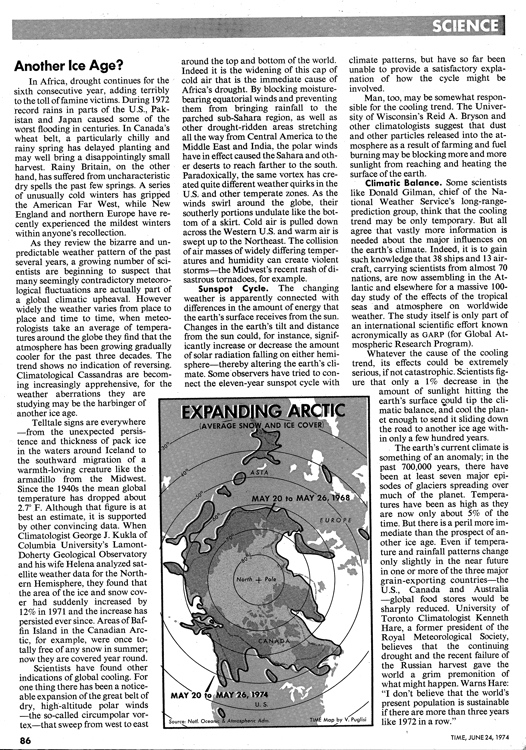
Instead, the scientists of the time were piecing together a story, helping to build, as the AMA paper puts it, “the foundation on which the cohesive enterprise of modern climate science now rests.”
Scientists are confident that human beings are causing global warming in a way none ever were about a cooling trend. This is obvious to anyone who takes so much as moment to look into it — anyone who cares even the slightest about the truth of the matter.
And therein lies the horror of the Trump story
“I’ve had it up to here with fake news I tell you!” Christopher Furlong/Getty Images
Trump is a blank slate surrounded by idiot scribes
McFarland — a Fox News “analyst” who Trump chose as deputy national security adviser, kept on even when it cost him his first pick for national security adviser (to replace the disgraced Michael Flynn), and finally demoted to ambassador to Singapore — still finds the “scientists predicted global cooling in the ’70s” myth convincing.
In fact, she finds it so convincing she believes it needs to be brought to the urgent attention of the president of the United States. And then Trump fell for it. He didn’t hesitate. And then his staff covered up for him with the “fake but accurate” nonsense.
That’s the cycle the Politico piece describes: Trump the blank slate, led to and fro by grasping morons, protected from consequences by enablers. It’s a veritable layer cake of incompetence and mendacity.
The thing is, there were a few articles in the popular press in the ’70s hyping a coming ice age. But they don’t mean what conservatives think they mean. Trump didn’t fall for something “fake but accurate.” He fell for a fake version of something even faker, a veneer over a rotten core.
Come to think of it, not a bad synecdoche for modern US conservatism.
NEXT UP IN :{ENERGY & ENVIRONMENT:(style="box-sizing:border-box;vertical-align:inherit;font-style:inherit;margin:0px;padding:0px;position:relative;z-index:2"):}:
- Scott Pruitt gave “super polluting” trucks a gift on his last day at the EPA. A court just put it on hold.
- Electric vehicles are gaining momentum, despite Trump
- The disturbing reason heat waves can kill people in cooler climates
- Costa Rica has an ambitious new climate policy — but no, it’s not banning fossil fuels
- Sucking carbon out of the air won’t solve climate change
==
https://www.newyorker.com/news/news-desk/the-agonizingly-slow-downfall-of-k-t-mcfarland
no lnx
The Agonizingly Slow Downfall of K. T. McFarland
By Adam EntousJanuary 29, 2018
The Russian investigation and K. T. McFarland’s gaffes—some self-inflicted and others outside her control—have trapped the former deputy national-security adviser in a battle over her future.Photograph By Tom Williams / CQ Roll Call / Getty
Last February, Michael Flynn, who was then the national-security adviser, huddled with top aides in his White House office. Flynn had been under fire for days, since press reports revealed that he had misled the Vice-President and other officials regarding his contacts with Russia’s Ambassador to the United States, Sergey Kislyak. Flynn’s deputy, K. T. McFarland, spoke for the group when she appealed to her boss to try to save his job by talking with President Trump directly, according to people in the room. She argued that it would be a mistake for Flynn to surrender to his opponents so quickly. Flynn chose not to follow McFarland’s advice, telling aides that he would leave the decision to the President. That night, he handed in his resignation letter.
A year later, McFarland faced her own choice. At the end of 2017, the Senate sent her nomination to serve as Trump’s Ambassador to Singapore back to the White House, after Democrats accused her of misleading lawmakers regarding her own knowledge of Flynn’s contacts with Kislyak. Instead of heeding congressional warnings about her dim prospects for Senate confirmation, Trump re-nominated her for the Singapore post, earlier this month. Even though most White House officials consider it hopeless, McFarland recently told friends that she is preparing for another round of meetings with senators, hoping to somehow pull through. “She still thinks she has a shot,” one friend said. A senior congressional aide said of McFarland’s unwillingness to concede defeat, “I feel sorry for her.”
McFarland’s tenure in the Trump White House began auspiciously. After Trump’s Inauguration, she moved into “the Suite,” a cluster of offices on the first floor of the West Wing reserved for close aides. McFarland ’s office was the size of a closet, but she made room for a two-person couch and a pair of dining-room-style chairs so that members of her team could meet more informally there, instead of downstairs in the Situation Room.
To give the space a more personal touch, McFarland put on display one of her most cherished family heirlooms: an American flag salvaged from her father-in-law’s warship during the Second World War. She added photographs, news clippings, and other mementos from her time working as a member of Henry Kissinger’s National Security Council staff, in the nineteen-seventies, and later as a speechwriter to Secretary of Defense Caspar Weinberger, under President Ronald Reagan.
Some N.S.C. veterans thought that McFarland, a Fox News commentator who hadn’t served in government in three decades, was ill-suited for the job of deputy national-security adviser, a position that typically entails working longer hours than anyone else in the West Wing and helping oversee high-stakes government programs and covert action. But her organizational skills—compared to those of other senior officials in a chaotic White House—and her welcoming, open-door approach won over many junior staffers, some of whom came to see her as “the N.S.C.’s mom.” During her brief tenure at the N.S.C. under Trump, McFarland was known to cut off her intelligence and counterterrorism briefers mid-sentence to ask, “Did I offer you coffee or tea?” McFarland also played a hands-on role in steering early policy debates, including a “soup-to-nuts” review of options to counter North Korea’s nuclear program, officials said. (One of those options, which was quickly rejected, called for accepting North Korea as a nuclear state.)
:{
}:
It was McFarland’s mentor, Kissinger, who had personally recommended her to Trump for the job. Trump, who admired McFarland’s work on Fox, called her on Thanksgiving Day to offer her the position.
During the transition, McFarland forged a close working relationship with Flynn. When they weren’t in meetings together in Trump Tower, Flynn and McFarland communicated frequently by phone and e-mail. In December, 2016, Kislyak contacted Flynn to discuss sanctions imposed by the Obama Administration to punish the Kremlin for interfering in the U.S. Presidential election. Flynn consulted McFarland about what, if anything, he should convey to the Russian Ambassador. For reasons that remain unclear, Flynn falsely told Vice-President Mike Pence and F.B.I. agents that he had never discussed sanctions with Kislyak. Those errors led to Flynn’s resignation and, later, to his guilty plea for making false statements to the F.B.I.
After Flynn’s departure, McFarland held the Suite together, aides said. Members of her staff credited her with running an efficient operation. Then, on February 20th, Trump appointed H. R. McMaster as Flynn’s replacement. When McMaster made it clear that he wanted to appoint his own deputy, McFarland was presented with other opportunities in the Administration, including possible ambassadorships. One of the few important diplomatic postings in Asia that had not already been filled was Ambassador to Singapore. McFarland told an N.S.C. official that going abroad could help her escape the political firestorm over Russia. If things went well in Singapore, she could possibly return to Washington in two years to assume a higher-level position.
VIDEO FROM THE NEW YORKER
The Absurdity of the Trump-Putin Summit in Helsinki
Officials said that Trump was conflicted about McFarland’s departure from the N.S.C. He was fond of her and told her on several occasions that he liked having her as the deputy national-security adviser. “What would you rather do, go to Singapore or stay here? Are you sure you want to go?” Trump asked her, according to one official. McFarland chose Singapore, and Trump submitted her nomination, though he continued to ask her if she was certain she wanted to go.
In May, lawyers representing Trump’s transition requested that the General Services Administration, the organization that housed the servers used by the transition, provide them with copies of transition e-mails and calendars, including McFarland’s. The lawyers agreed to share whatever they received from the G.S.A. with McFarland and her staff, to help her prepare for her confirmation hearings. But, when McFarland’s team later asked the lawyers for her transition documents, the lawyers said that the G.S.A. had yet to release them, presumably because they were of interest to the special counsel Robert Mueller. Transition lawyers wouldn’t get a full set of McFarland’s e-mails until November. (The G.S.A. didn’t respond to requests for comment.)
McFarland’s interview with Senate Foreign Relations Committee staff members went ahead, as planned, on July 19th, even though she couldn’t review her e-mails or calendars beforehand. During the closed-door session, staffers asked McFarland if she took part in any phone calls with Russian officials during the transition. According to officials, McFarland answered that she served as a note-taker during transition phone calls with the Russian President, Vladimir Putin, and the Russian foreign minister, Sergey Lavrov. After the interview, committee staff members checked and found only one call, in November, between Trump and Putin, which was before McFarland joined the transition, and no call with Lavrov. Aides said that McFarland had botched her answers. She was forced to send a clarification letter to the committee, acknowledging that her recollections of the calls were mistaken.
On July 20th, McFarland appeared before the Senate Foreign Relations Committee for her confirmation hearing. That same month, Senator Cory Booker, a Democrat from New Jersey, had given McFarland a series of written questions, including one about whether she had ever discussed “contacts with Russian Ambassador Sergey Kislyak directly with General Flynn?” McFarland’s curt written response read, “I am not aware of any of the issues or events as described above.”
With support from Republicans and a single Democrat, McFarland cleared the Senate Foreign Relations Committee on September 19th, but the nomination languished for months, never advancing to the Senate floor for a vote. Then, on December 1st, Flynn pleaded guilty to a single count of lying to the F.B.I. about the contents of his communications with Kislyak. In court papers accompanying his plea agreement, federal investigators disclosed that Flynn had coördinated his contacts with Kislyak with an unnamed senior transition official, who was later identified as McFarland.
The disclosures prompted Booker to accuse McFarland of giving false testimony. He called her answers “another example of a pattern of deception on the part of Trump’s closest associates regarding their connections and communications to Russian government officials.” Veterans of the Senate Foreign Relations Committee say that the surest way for a nomination to be withdrawn is for a nominee to be accused of lying to senators. One of the Administration’s lawyers said that McFarland should have been able to recall at least some of her telephone and e-mail exchanges with Flynn regarding Kislyak, even if she couldn’t get access to her e-mails and calendars.
One of McFarland’s advisers acknowledged that her brief written response to Booker’s question was poorly worded but said that her answer was taken out of context by Booker and journalists, accusing them of wanting “another scalp.” When McFarland wrote that she wasn’t “aware of any of the issues or events as described above,” she was referring to Booker’s earlier assertions, not his question about Kislyak, the adviser said. One of McFarland’s friends said that she couldn’t answer questions from senators more thoroughly because lawyers wouldn’t let her. “It set her up to look like she was lying,” one aide said.
The top Democrat on the Senate Foreign Relations Committee placed a “hold” on McFarland’s nomination on December 8th. On December 20th,Senator Bob Corker,the chairman of the Foreign Relations Committee, called McFarland to explain that the prospects of her winning confirmation in 2017 were all but dead, and that her prospects in 2018 would be uncertain if she decided to give it another try.
Earlier this month, Trump re-nominated McFarland for the Singapore job. She told friends that she welcomed the decision as a show of support from the President. One congressional staffer said that the situation reminded him of the movie “Groundhog Day,” in which Bill Murray’s character gets stuck in a time loop, reliving the same day, over and over again. Senator Ben Cardin, of Maryland, the ranking Democrat on the Foreign Relations Committee, was more blunt; aides said that he made clear that McFarland’s nomination won’t advance anytime soon and another candidate should be put forward. Cardin’s message, according to one staffer, amounted to “Please make this go away.”
Adam Entous is a staff writer at The New Yorker.
==
ENERGY HOLDINGS PERMEATE TRUMP STAFF:Six of President Donald Trump’s senior advisers together own between $3.7 million and $12.3 million in energy company stocks, Pro’s Ben Lefebvre reports. Those officials — Ken Juster, Marc Short, Chris Liddell, Kathleen "KT" McFarland, Stephen Munisteri and Greg Katsas — have holdings in energy giants Exxon Mobil, Chevron, Kinder Morgan and a host of other companies. Watchdogs say that could create major conflicts of interest for a White House that has pledged to grow the nation's fossil fuel production.
[ad: chev heart nature]
Overall, about a dozen White House officials have some stake in energy companies, according to POLITICO and Center for American Progress analysis of financial disclosure forms. And the holdings would violate conflict of interest laws if any of these Trump staff try to shape energy policy, according to Paul S. Ryan, vice president of policy and litigation at government watchdog Common Cause. “It becomes a legal problem if it causes a conflict of interest. They would have to say, ‘Nope, sorry boss, can’t work on that,’” he told Ben.
K.T. McFarland: Deputy National Security Adviser
McFarland Worked As A Fox Analyst For Years. K.T. McFarland, whom Trump named as his deputy national security adviser, was a national security analyst for Fox, where she repeatedly pushed for war with Iran. *Media Matters*, [11/26/16;Deadline Hollywood,11/25/16]