impoundment RECISS
---
neGlected see CHECKS 2
see liars eastman paoletta
SEE IMPERIAL PRES
===
BD OF PEACE
4 10 26 YT SECULAR?
1.5b FROM usaid FEMA ETC?!
1B FROM DICTATOR BUY IN?
VENEZ OIL $ TO PVT OFFSHORE ACCT?
---
-=-=
see recission
-=-=
-=-=
AN 11 26
Russell Vought, President Donald Trump's Director of the Office of Management and Budget and architect of his Project 2025 agenda, has been one of the most powerful people in Washington since the Republican started his second term. Yet according to a new report, Vought is about to find his job in danger.
"Congressional Democrats obviously have lots of things on their to-do list for next year, starting with cost-of-living issues and cracking down on corruption," wrote The Bulwark's Catherine Ramnpell on Thursday. "But there’s another key priority that has gotten less attention but is no less important: restoring the constitutional separation of powers so that Congress actually controls the power of the purse again."
She added, "Or to put it in more colorful terms: Congress is about to reclaim its cojones, and then go after the low-profile cabinet member who sliced them off in the first place."
After breaking down the details of how Vought has stymied Congress and allegedly behaved illegally, Rampell added, "Once back in the majority, Democratic lawmakers have some tools at their disposal to reclaim the power of the purse. Or at the very least, make it harder for Trump and Vought to keep violating the Constitution."
She continued, "A lot of the tools involve more careful writing of appropriations bills, and taking away any plausible claim Trump has for exercising discretion in spending decisions. For example, lawmakers could be more specific in how they lay out the criteria for awards, so Trump has no effective way to favor friends and disfavor perceived enemies (e.g., by specifying that any state that has had landfall of a storm blowing with hurricane-force winds must be treated as eligible for Stafford Act funding, thereby preventing Trump from withholding those funds from blue states). Congress could also make it easier for private parties to bring a lawsuit when funding gets illegally frozen."
Rampell added, "That’ll help prevent future illegal impoundments. But what about damage already done? Democrats could start by subpoenaing documentation of all the ways Vought has helped the administration break the law."
In August, economist Dr. Robert J. Shapiro — who advised President Bill Clinton during his balanced budgets and four surpluses — told AlterNet that the current $40 trillion deficit is largely Trump's fault.
"Deficits equal to six or seven percent of GDP, which is unprecedented in the postwar era," Shapiro told AlterNet at the time. "It's a real outlier. And that's driven entirely by his tax changes, which carry enormous budgetary costs, plus a wholesale, large-scale increase in defense spending. So how much of this is Trump? A majority of it — not all of it, but a majority."
On Thursday Shapiro told AlterNet that the deficits have also compounded the economic problems facing ordinary Americans, the same ones that played a large role in them turning against Republicans during the midterm elections on Tuesday.
"The debt does have effects that have exacerbated the economic squeeze on people," Shapiro told AlterNet. "Most clearly, financing the debt absorbs so much available savings that other forms of credit, like mortgages and credit card debt, become more expensive. It's supply and demand. There's less savings left over, because when you have a $40 trillion debt, it's not simply that you have to finance an additional $2 trillion each year, because that's the annual deficit now: $2 trillion. In addition, $10 trillion each year comes up for refinancing. That is, the Treasury securities mature, and so you have to float new Treasury securities to refinance the debt that has now matured. You buy a 10-year bond, or you buy a five-year note. Five years later, it matures. You've got to pay it off, and in order to pay it off, you've got to borrow the money."
-=-=
9 26 1b$ clawback dei AI bs
-=-=
-=-=
AN 10 26
Republicans are growing increasingly angry with President Donald Trump's administration officials who continue to refuse to deliver on funds that Congress appropriated.
Democrats have long complained about it, but now Republicans are getting involved, too. The U.S. Constitution states that the legislative branch (the House and Senate) allocates funding. They pass a budget for the government, programs, the military, Medicare and all of the other things that keeps the country operational. The Trump administration has taken that money, and if officials don't like it, they don't send it out.
Lawmakers are now asking the Government Accountability Office (GAO) to sue the administration for refusing to release approved spending and canceling funding, Politico reported Friday.
The GAO has repeatedly claimed that the administration violated federal law. In fact, this week it concluded that the Trump administration illegally withheld more than $1 billion for education and health care research programs. The problem is that the GAO doesn't have a permanent director. Only an interim director is in charge until the Senate can confirm someone. Thus far, that interim director has not exercised the GAO's authority to take the administration to court.
“They are empowered to sue,” said Sen. Susan Collins (R-Maine), who has been among the Republicans angry about the administration's move. She chairs the Senate Appropriations Committee.
“I think the biggest problem is that we have an acting director of the GAO, who understandably is wary of suing the administration without direct congressional approval," Collins added.
With the Nov. 3 election in the next 25 days, and the House expected to change hands, they could sue the administration for violating the law. The Republican-led House sued President Barack Obama's administration in July 2014 over Obamacare spending. In Sept. 2020, the Democratic-led House sued the Trump administration over border wall funding that Congress never appropriated.
Trump also recently canceled $810 million in approved spending. The fiscal year ended Sept. 30, and if programs didn't use the money, it expired. There is a question about Trump using government funding to run TV ads promoting himself. He's also being questioned about the $352 million he took from the Secret Service budget to build his ballroom.
Politico cited a recent report from The Washington Sun, which said on Thursday that Trump officials were thinking of nominating Eric Ueland, who currently serves in the White House budget office. The Office of Management and Budget Director Russ Vought is the official, who, under Trump's authority, "has used every lever he can reach to stanch the flow of federal dollars," wrote one columnist.
A series of August reports cited a group of what they're calling "zombie programs" across the U.S. government. Those are programs like the CDC's Alzheimer’s disease program or programs around epilepsy and sickle cell disease data collection operations. There's even a rape prevention unit. Congress has approved and fully funded all of them. When Elon Musk went through his DOGE cuts, the people who worked on the programs were let go.
Vought has encouraged the president to impound money that Congress has allocated, even if it's against the law. In fact, Brown cited "a law specifically forbidding the practice."
Republicans allege that Trump is using “pocket rescissions” tactics.
"I’m very disappointed in their action here, and it will have to be rectified,” said Sen. Mike Rounds (R-S.D.). “I’m not sure who should do it. All I know is I want a different result than what we have right now.”
Comptroller General Gene Dodaro, who left at the end of his 15-year term, said “the law is very clear that GAO’s ability to sue doesn’t preclude anybody else from suing.”
-=-=
Oct. 5, 2026,
Throughout American history, officials have recognized that Congress has what’s known as “the power of the purse.” In our constitutional system, it’s lawmakers who have the sole authority to dictate government spending. It’s designed this way for a reason: As the editorial board of The New York Times explained last fall, “Money is power, and the founders of this country feared that a president would turn into a monarch if he alone could dictate how the government uses the federal Treasury.”
It’s a model that Donald Trump has never been altogether comfortable with. Indeed, Russell Vought, who leads the president’s White House budget office, made clear during his Senate confirmation hearings early last year that he believes in an executive branch that has vast powers when it comes to federal spending.
He clearly meant what he said. Consider three examples that emerged over the course of a week.
On Friday, Sept. 25, the White House decided unilaterally to cut nearly $1 billion in domestic spending appropriated by Congress, executing a tactic known as a “pocket rescission.” Days later, the Government Accountability Office reaffirmed its stance that this is illegal, and Team Trump said it didn’t care.
On Wednesday, Sept. 30, the Trump administration redirected tens of millions of dollars in U.S. military assistance from European and Middle Eastern countries to reward conservative governments in Latin America.
As The Washington Post reported, the State Department notified Congress of its intention to do so last month, at which point the top Democrats on the House and Senate foreign affairs committees placed a hold on the diversion of funds. Last week, the administration decided it would proceed with its plan anyway.
In a letter to Secretary of State Marco Rubio on Wednesday, the two Democratic lawmakers, Sen. Jeanne Shaheen of New Hampshire and Rep. Gregory Meeks of New York, wrote to Secretary of State Marco Rubio, describing the move as a violation of statutory requirements about where the money could go. Team Trump apparently didn’t care about this, either.
On Friday, Oct. 2, the Times reported that the National Science Foundation, one of the biggest sources of federal research funding, withheld $1.4 billion that Congress had intended for research over the course of the past year as part of a brazen effort to circumvent Congress.
Rep. Zoe Lofgren of California, the top Democrat on the Science, Space and Technology Committee, said, “The money should be granted as Congress intended, and essentially, they’re ignoring what Congress did.”
Or more to the point, they’re ignoring what Congress did again.
//
Trump uses rare authority to claw back nearly $1 billion in spending approved by Congress
-=-=
Christopher Lewis @ Slate: How the Legal Mastermind of Trump’s Most Damaging Policies Stays Anonymous
Mark Paoletta is not a household name. Despite this, over the past decade, he has quietly become one of the conservative legal movement’s most influential operators, making Paoletta an underrated political power in his own right.
Over a career spanning roles in both House and Senate Republican leadership, the George H.W. Bush White House, the courts, and conservative advocacy organizations, Paoletta has formulated and defended expansive legal theories of presidential power, molding governing reality. Today he is helping Office of Management and Budget Director Russ Vought reshape the federal bureaucracy. Understanding why he matters means understanding that the modern federal government is shaped not only by elected officials but also by attorneys who craft legal arguments justifying government action.
There are two central components to Paoletta’s dangerous philosophy: fury at the independence of the civil service, and belief in nearly unlimited presidential authority. Close D.C. watchers should recognize these as the calling cards of Voughtism. Indeed, Vought and Paoletta are close allies—Vought executes the dubious budgetary procedures; Paoletta handles the legal arguments. As Politico’s Sophia Cai rightly points out, “If Russ Vought sees his question to dismantle the federal bureaucracy as a race against time, his lawyer sidekick Mark Paoletta is holding the stopwatch.” As Cai goes on to mention, Paoletta has been the center of Vought’s team, ensuring that funds are withheld from furloughed workers and redirected to Donald Trump’s ridiculous vanity projects.
Between the two Trump administrations, Paoletta bided his time as a senior fellow at Vought’s Center for Renewing America, the Trump-aligned think tank that effectively was another administration in waiting. There, alongside other Trump officials, like Ken Cuccinelli and Kash Patel, Paoletta wrote multiple articles about impoundment and expanding executive authority. One of those pieces bemoaned Congress’ constraints on the president’s ability to spend. He specifically claimed that the Impoundment Control Act “reverses an understanding of the Constitution’s allocation of executive and congressional spending authority dating to the Founding. The ICA is unconstitutional.”
For the record, this is nonsense. Fundamentally, what makes a legislature powerful is its control over taxing and spending, the power of the purse. That goes back to precolonial Parliament and the Magna Carta—at best, Paoletta is staggeringly ignorant of the “history and tradition” that conservative legalists claim to adore; at worst, his arguments indicate that he is an unrepentant monarchist (at least when a MAGA king is on the throne). Paoletta uses the real estate he is allotted to rationalize why presidents should be able to usurp the constitutional authority of other co-equal branches of government.
....
---
an 3 26
Law and Crime reports a federal court of appeals upheld a series of lower court orders barring the Trump administration from enforcing a "sweeping and unprecedented categorical" spending "freeze.”
In one 58-page opinion, the U.S. Court of Appeals for the 1st Circuit took a group of "consolidated appeals" of several different orders and mostly rejected the White House’s argument in favor of continuing the freeze. Judges found the Trump administration’s arguments unconvincing in one case and utterly ignored the administration’s argument in another.
“In one order from March 2025, the lower court extended a pause on the spending freeze – enjoining myriad federal agencies from slashing funds and directing them to pay out ‘awarded grants, executed contracts, or other executed financial obligations,’” reports Law and Crime.
In an additional two orders from April 2025, the lower court enforced the preliminary injunction against the Federal Emergency Management Agency (FEMA) and then denied a reconsideration and stay requested by the Trump administration.
With this slate of decisions, the appellate court has joined a legion of courts dismantling President’s Donald Trump’s executive orders and policies, and it further complicates Trump’s effort to starve certain nonprofits and research.
One of the lawsuits against Trump, led by New York Attorney General Letitia James, alleged the spending freeze violated several tenets of the Administrative Procedure Act (APA), federal laws and the U.S. Constitution, which mandates the distribution of congressionally-appropriated funds.
James, who has won a landmark case against Trump for fraud, welcomed the 1st Circuit's opinion.
"This decision is a clear reminder that the president cannot treat congressionally-approved funding like a switch he can flip on and off," James said. “For more than a year, the Trump administration has repeatedly tried to freeze critical funding that states rely on to serve their communities, and once again the courts have rejected that unlawful power grab."
---
AN 2 26
President Donald Trump will now have more difficulty withholding money for federal programs appropriated by Congress, thanks to lawmakers from both parties.
The New York Times reported Tuesday that in the government funding package Congress passed last week (which Trump later signed into law) includes language meant to hamstring Trump's attempts to carry out "pocket rescissions," in which he freezes money meant to be disbursed. Language restricting Trump's use of pocket rescissions made its way into all 11 spending bills the president signed, which will last through September 30 of this year.
According to the Times, Republicans in the Senate were more open to restricting executive action withholding spending than their House counterparts. And some more stringent provisions attempting to rein in Trump didn't get enough votes to make it into the final legislation.
Still, the outlet reported that the language "reflects bipartisan frustration with how the White House has attempted to wrest away Congress’s spending powers." And lawmakers aim to use those bills as ammunition in potential legal battles with the Trump administration should the president attempt to withhold Congressionally appropriated money in the future.
"This marks an important milestone and shows that Congress can work together in a bipartisan manner to carry out our Article I responsibilities and deliver results for the people we are honored to represent," said Sen. Susan Collins (R-Maine), who is the chair of the Senate Appropriations Committee.
The Trump administration maintains that despite the language in the bills, the White House never agreed to sign anything that would limit its power over spending in any way. Office of Management and Budget (OMB) communications director Rachel Cauley told the Times: "None of our executive authorities to control spending were compromised by these appropriations bills, which was a red line in our discussions with the Hill."
The Trump administration's pattern of routinely withholding money already appropriated by Congress is a violation of the Impoundment Control Act of 1974, which Congress passed to assert its authority (under Article 1, Section 8 of the U.S. Constitution) during former President Richard Nixon's administration. OMB Director Russ Vought insists that law is illegal.
---
AN 11 25
The Trump administration’s disregard for Congress’s “power of the purse” has raised alarms across Washington, including within his own party. According to a new report from NOTUS, when one top GOP official sought to rein in the president’s monetary power grab, his efforts were swiftly quashed.
As the U.S. Constitution dictates, only Congress has the power to decide how government funds are spent and distributed. Since taking office for his second term, however, President Donald Trump has largely disregarded this rule, refusing to spend certain funds explicitly allocated by Congress, such as $5 billion in previously approved foreign aid payments.
While many Republicans in Congress have gone along with Trump’s withholding of these funds, at least one leading House GOP member attempted to rein things in. Rep. Mario Díaz-Balart (R-FL), vice chair of the House Appropriations Committee, included a provision in a 2026 funding bill for the National Security, Department of State, and Related Programs Subcommittee that would have blunted the tactic Trump has favored for withholding funds, sources close to the matter told NOTUS.
This tactic, known as “pocket rescission,” involves the president requesting that a piece of allocated funding be withheld, giving Congress a certain amount of days to consider the request. This request, however, is made too late in the fiscal year for Congress to respond, and once the calendar ticks over to the next fiscal year, the White House considers the funding officially withheld.
Back in July, Díaz-Balart added a clause to the fiscal bill that would have given Congress 45 extra days to respond to such requests made late in the fiscal year.
The sources that spoke with NOTUS claimed that Russell Vought, director of the White House’s Office of Management and Budget and originator of the pocket rescission strategy, reached out to the GOP congressman to express the Trump administration’s concern over the provision.
Other Republican members of the Appropriations Committee were also reportedly pressured to get the wording out of the bill. These officials then, in turn, applied their own pressure to Díaz-Balart. In short order, the provision disappeared from the bill.
Several GOP committee members, including Rep. Andrew Clyde and Rep. Andy Harris, confirmed that they had conversations with Díaz-Balart about the issue.
For his own part, Díaz-Balart claimed that the original provision was not specifically meant to target Trump or his administration.
“I’ve always believed that Congress has a tendency to always give too much away to the administration — any president, any administration,” the Florida congressman told NOTUS.
===
CONTEXT
OMFG PUBLIC HEALTH
an 11 25
When President Donald Trump posted a satirical music video on social media in early October depicting his budget director, Russell Vought, as the Grim Reaper lording over Democrats in Congress, public health workers recognized a kernel of truth.
Vought has exerted extraordinary control over government spending this year, usurping congressional decisions on how the nation’s money is used. His push for more layoffs during the government shutdown is only the latest blow, following months of firings, canceled grants, and withheld funds.
By cutting and freezing public health funds, in particular, the Trump administration has already begun to undercut efforts to provide medical care, outbreak response, housing assistance, and research across the U.S., according to health officials, nonprofit directors, and federal agency staffers interviewed by KFF Health News.
Since most federal funds for public health flow to states, Vought is rivaling the Department of Health and Human Services secretary, Robert F. Kennedy Jr., in his ability to upend government-led efforts to keep Americans healthy. In Texas, Centers for Disease Control and Prevention funds to stem a measles outbreak weren’t available until after the crisis had subsided and two children had died. A project to protect Alabamans from raw sewage and hookworm was abandoned. People with HIV have had to delay medical care as clinics scale back hours. Time-dependent surveys on HIV and maternal mortality were halted. Food banks have canceled events. Tobacco prevention programs lapsed. Initiatives to protect older adults at risk of falling have been harried.
No matter what budget Congress ultimately passes for next year, the Trump administration may continue to thwart financial support for such programs in ways that will harm people’s health. “The White House has shown that they are willing to unilaterally exert control over funding,” said Gillian Metzger, a constitutional law professor at Columbia University.
“This is a huge deal,” she added, “because the power of the purse is central to Congress’ ability to shape and direct policy.”
Before he was appointed to lead the White House’s Office of Management and Budget this year, Vought outlined budgetary strategies the executive branch could deploy to wrest power from Congress and federal agencies in Project 2025, the Heritage Foundation’s conservative blueprint.
Vought’s tactics unfolded this year, often below the radar. They include abrupt grant cancellations, extraordinary constraints on how funds can be spent, and excessive layers of review, agency officials say, at every step in the grantmaking process. Getting money out the door has been further complicated by layoffs that have gutted offices overseeing grants on chronic disease prevention, HIV, maternal mortality, and more.
Government employees have described these tactics to members of Congress, said Abigail Tighe, executive director of the National Public Health Coalition, a group that includes current and former staffers at the CDC and HHS. “We want Congress to act, because this is preventing states and communities from doing critical public health work to keep our country safe,” she said. “If they don’t have capacity, we all collectively suffer.”
Democrats on the House and Senate appropriations committees have pushed for transparency, but the extent to which money Congress appropriated for public health in 2024 and 2025 has gone unspent because of the administration’s disruptions is not yet known. “This is a sophisticated strategy to cause money to lapse and then say, ‘If they can’t spend it, they don’t need it,’” said Robert Gordon, a public policy specialist at Georgetown University and a former assistant finance secretary at HHS.
“No one thought this was possible or legal, but that is what’s happening,” he said.
Details on how the administration has subverted health spending have received little attention because many changes have been made quietly — and people who rely on federal funds fear retribution. The Trump administration has defunded and threatened federal offices that hold the government accountable and fired whistleblowers. It has abruptly revoked funds for local governments and organizations.
Vought and spokespeople at the White House and the OMB did not respond to queries from KFF Health News. However, Vought described his intentions in VID] a. He said that federal agencies and Congress had gained more power over spending since the 1970s and that their control became “woke and weaponized” under Presidents Barack Obama and Joe Biden.
“Thankfully, President Trump won,” he said. “And we have now been embarked on deconstructing this administrative state.”
Many Parts, Many Malfunctions
Like a car, the federal budget process has many components that can break down. Through the OMB and its partner, Trump’s Department of Government Efficiency, or DOGE, the administration has intervened at various junctures. “There are so many ways in which money is not operating in the way it is supposed to operate,” said Bobby Kogan, the senior director of federal budget policy at the Center for American Progress, a left-leaning think tank, and a former OMB adviser.
Typically, Congress passes a budget that appropriates money for the next fiscal year to federal agencies. For many public health programs, ranging from housing assistance to cancer screening, agencies then post open calls online for states, local governments, and organizations to apply for funding. Agency experts select winners and send notices of awards — or notices of ongoing funding to groups that previously won multiyear awards.
Next, the OMB, which administers the federal budget, activates money for agencies, like a bank activates a credit card, so that grantees can spend and get reimbursed rapidly. Auditors keep an eye on spending, but the government has in the past limited interruptions so that programs run smoothly.
Early on, the Trump administration canceled billions of dollars in awards granted in 2024 and early 2025 for research and global health. In March, it clawed back $11.4 billion in covid-era funds that Congress had earmarked for health departments that were using the money for disease surveillance, vaccinations, and more.
Although some funds have been restored because of lawsuits, the Supreme Court has allowed other cuts by the administration to stand while the cases move through the courts.
Beyond these “shotgun” cancellations, the administration has taken a quieter, “in-the-weeds, slowing, cutting, conditioning” approach that’s frozen funds for public health, said Matthew Lawrence, a law professor specializing in health policy at Emory University.
By August, the CDC’s center for HIV and tuberculosis prevention had doled out $167 million less than the historical average, according to an analysis by the Center on Budget and Policy Priorities, a think tank focused on reducing inequality. The CDC’s funding for chronic disease prevention lagged by $259 million, the Ryan White HIV/AIDS Program had underspent by $105 million, and funds for mental health at the Substance Abuse and Mental Health Services Administration were more than $860 million behind what was expected.
An unknown amount of Congress’ 2025 funding for research and public health has yet to be awarded and will probably lapse this year, said Joe Carlile, an author of the center’s analysis and an associate OMB director during the Biden administration. The obstructions appear to be concentrated in areas where the White House proposed cutting the federal budget next year. “The administration may be executing their 2026 budget request through administrative controls,” Carlile said.
“This is boring but crazy-high stakes,” he added. “A one-branch veto of spending neuters the power of the purse in the Constitution that Madison said was the fundamental check on the executive branch.”
Incremental Chaos
A key tactic Vought described in Project 2025 occurs when the OMB activates funds for agencies in installments, called apportionments. Vought wrote that “apportioned funding” could “ensure consistency with the President’s agenda.”
Under Vought, the OMB shrank the size of apportionments, HHS and CDC staffers said. It’s illegal for agencies to let grantees withdraw money before the total amount is in the metaphorical bank, so that delayed agencies’ ability to greenlight spending.
The OMB and DOGE also placed conditions on apportionments through memos, footnotes, and spoken directives telling agencies to ensure that spending “aligns with Administration priorities,” according to reports and HHS employees who said that notices of funding opportunities and awards required excessive layers of sign-off. The CDC and other agencies circulated lists of priorities that reflect White House stances, including those targeting diversity, equity, and inclusion efforts; immigration; and transgender rights. Public health efforts have been especially caught up in red tape, since many focus on populations bearing an unequal burden of death, disease, and injury.
Groups that rely on federal funds have largely been unaware of the reasons grants were held up, but they’ve fielded what they viewed as unsettling queries. For example, Kathy Garner, the head of a Mississippi nonprofit, said officials asked her to defend the exclusion of men from a program to shelter women who experienced domestic violence.
Delays were made worse by uncertainty. Grantees said they’ve been unable to reach program officers because tens of thousands of federal workers have been laid off. Agency officials said firings slow funding further.
“Everyone’s inbox is full of letters from grant recipients asking, ‘How do we proceed?’” one high-ranking CDC official told KFF Health News, which granted agency officials anonymity because of their fears of retaliation. “We just say, ‘Please wait.’”
Time was critical as a measles outbreak surged in West Texas early this year. The state asked for federal funding for the response in March, but it didn’t arrive until May, after the outbreak had largely faded in Texas, according to an investigation by KFF Health News. Apportionment control was a key reason, CDC staffers said.
In July, 81 HIV organizations sent a letter to Kennedy. “With every day of delayed FY2025 funding release, the delivery of essential HIV services is compromised,” said the letter, which was reviewed by KFF Health News. Because of delays and uncertainty, it said, HIV clinics had laid off case managers and reduced clinician hours, closed sites, and pared down hotlines that patients call with urgent questions. The funds arrived about a month later, but HIV providers remain shaken.
Lauren Richey, medical director at University Medical Center’s HIV clinic in New Orleans, backed out of hiring a sorely needed dentist she had recruited. “I was afraid to tell someone to move across the country for a job when I wasn’t sure if or when we’d get the funding for their salary,” she said. “The wait is now three to four months for dental services, when it was usually a couple of weeks at most.”
Tamachia Davenport, program director at the St. John AIDS outreach ministry in New Orleans, said that “a lot of us are having to rob Peter to pay Paul.”
When the group didn’t get CDC funds it expected this summer, Davenport had to decide between cutting staff or supplies. Concerned her top employees would take jobs elsewhere, she stopped buying the condoms they distribute throughout the city to prevent the spread of sexually transmitted infections.
Louisiana already has one of the highest rates of HIV, chlamydia, and gonorrhea in the country. Condoms cost far less than treating these diseases. For a person infected by HIV at age 35, such costs exceed $326,000.
Groups focused on cancer, diabetes, and heart disease also report lasting repercussions from delays, as well as ongoing fears that they will happen again. Louisiana State University’s Healthy Aging Research Center canceled some of its workshops to train health workers on caring for people with dementia. “There may be fewer people who have this very specific expertise next year in Louisiana and Mississippi,” said Scott Wilks, the director of the center. “That’s on top of the big shortage we have already.”
Nationwide surveys tallying maternal and infant mortality froze for about five months because of funding delays, causing an irrecoverable gap in data that had been collected continuously since 1987, CDC officials say.
“We are seeing the administration get their way with or without an approved budget,” one said. “It’s such a terrible shame to play with people’s health this way.”
DOGE also inserted itself into grant reimbursements this year, stalling the rapid turnaround that public health groups typically expect to cover salaries, rent, and other monthly costs outlined in budgets that have already been approved. In what’s now labeled Departmental Efficiency Review, itemized expenses must be regularly justified by multiple government officials, according to documents reviewed by KFF Health News.
DOGE posted on its website expense reports covering about a month’s span from April to May. Nearly 230 of the individual expenses filed to federal agencies during that period are for $1 or less. Other entries break down monthly salaries for individual employees and petty costs for postage or monthly subscriptions.
“Public funds deserve scrutiny, but this is different from audit practices I’ve been a part of,” Carlile said.
DOGE also stalled calls for applications for 2025 funding — and some calls never appeared as the fiscal year came to a close on Sept. 30. Among them are programs for groups that provide housing assistance. People will be evicted when these organizations run out of money left over from 2024, said Steve Berg, chief policy officer at the National Alliance to End Homelessness.
Other solicitations came out months behind schedule, leaving groups with a few weeks to put together complicated applications for multimillion-dollar awards, including for Alzheimer’s care, addiction recovery, senior support, and chronic disease management.
“They’ve set projects up to fail,” one HHS official said.
*KFF Health News is a national newsroom that produces in-depth journalism about health issues and is one of the core operating programs at KFF—an independent source of health policy research, polling, and journalism. Learn more about KFF.
---
---
no lnx in orig
The Technocrat Engineering a Vast Expansion of Trump's Power
How Russell Vought, an author of Project 2025, is using a once low-profile budget office to decimate federal agencies, fire vast numbers of workers, and test the rule of law.
By Andy Kroll
October 17, 2025
:{“He has centralized decision-making power to an extent that he is the Commander-in-Chief,” a senior official said of Vought.
This article is a collaboration between The New Yorker and ProPublica.*
On the afternoon of February 12th, Russell Vought, the director of the White House Office of Management and Budget, summoned a small group of career staffers to the Eisenhower Executive Office Building for a meeting about foreign aid. A storm had dumped nearly six inches of snow on Washington, D.C. The rest of the federal government was running on a two-hour delay, but Vought had offered his team no such reprieve. As they filed into a second-floor conference room decorated with photos of past O.M.B. directors, Vought took his seat at the center of a worn wooden table and laid his briefing materials out before him.
Vought, a bookish technocrat with an encyclopedic knowledge of the inner workings of the U.S. government, cuts an unusual figure in Trump’s inner circle of Fox News hosts and right-wing influencers. He speaks in a flat, nasally monotone and, with his tortoiseshell glasses, standard-issue blue suits, and corona of close-cropped hair, most resembles what he claims to despise: a federal bureaucrat. The Office of Management and Budget, like Vought himself, is little known outside the Beltway and poorly understood even among political insiders. What it lacks in cachet, however, it makes up for in the vast influence it wields across the government. Samuel Bagenstos, an O.M.B. general counsel during the Biden Administration, told me, “Every goddam thing in the executive branch goes through O.M.B.”
The O.M.B. reviews all significant regulations proposed by individual agencies. It vets executive orders before the President signs them. It issues workforce policies for more than two million federal employees. Most notably, every penny appropriated by Congress is dispensed by the O.M.B., making the agency a potential choke point in a federal bureaucracy that currently spends about seven trillion dollars a year. Shalanda Young, Vought’s predecessor, told me, “If you’re O.K. with your name not being in the spotlight and just getting stuff done,” then directing the O.M.B. “can be one of the most powerful jobs in D.C.”
During Donald Trump’s first term, Vought (whose name is pronounced “vote”) did more than perhaps anyone else to turn the President’s demands and personal grievances into government action. In 2019, after Congress refused to fund Trump’s border wall, Vought, then the acting director of the O.M.B., redirected billions of dollars in Department of Defense money to build it. Later that year, after the Trump White House pressured Ukraine’s government to investigate Joe Biden, who was running for President, Vought froze two hundred and fourteen million dollars in security assistance for Ukraine. “The President loved Russ because he could count on him,” Mark Paoletta, who has served as the O.M.B. general counsel in both Trump Administrations, said at a conservative policy summit in 2022, according to a recording I obtained. “He wasn’t a showboat, and he was committed to doing what the President wanted to do.”
After the pro-Trump riots at the U.S. Capitol on January 6, 2021, many Republicans, including top Administration officials, disavowed the President. Vought remained loyal. He echoed Trump’s baseless claims about election fraud and publicly defended people who were arrested for their participation in the melee. During the Biden years, Vought labored to translate the lessons of Trump’s tumultuous first term into a more effective second Presidency. He chaired the transition portion of Project 2025, a joint effort by a coalition of conservative groups to develop a road map for the next Republican Administration, helping to draft some three hundred and fifty executive orders, regulations, and other plans to more fully empower the President. “Despite his best thinking and the aggressive things they tried in Trump One, nothing really stuck,” a former O.M.B. branch chief who served under Vought during the first Trump Administration told me. “Most Administrations don’t get a four-year pause or have the chance to think about ‘Why isn’t this working?’ ” The former branch chief added, “Now he gets to come back and steamroll everyone.”
At the meeting in February, according to people familiar with the events, Vought’s directive was simple: slash foreign assistance to the greatest extent possible. The U.S. government shouldn’t support overseas anti-malaria initiatives, he argued, because buying mosquito nets doesn’t make Americans safer or more prosperous. He questioned why the U.S. funded an international vaccine alliance, given the anti-vaccine views of Trump’s nominee for Secretary of Health and Human Services, Robert F. Kennedy, Jr. The conversation turned to the United States Institute of Peace, a government-funded nonprofit created under Ronald Reagan, which worked to prevent conflicts overseas; Vought asked what options existed to eliminate it. When he was told that the U.S.I.P. was funded by Congress and legally independent, he replied, “We’ll see what we can do.” (A few days later, Trump signed an executive order that directed the O.M.B. to dismantle the organization.)
The O.M.B. staffers had tried to anticipate Vought’s desired outcome for more than seven billion dollars that the State Department and the U.S. Agency for International Development spent each year on humanitarian assistance, including disaster relief and support for refugees and conflict victims. During the campaign, Trump had vowed to defund agencies that give money to people “who have no respect for us at all,” and Project 2025 had accused U.S.A.I.D. of pursuing a “divisive political and cultural agenda.” The staffers proposed a cut of fifty per cent.
Vought was unsatisfied. What would be the consequences, he asked, of a much larger reduction? A career official answered: less humanitarian aid would mean more people would die. “You could say that about any of these cuts,” Vought replied. A person familiar with the meeting described his reaction as “blasé.” Vought reiterated that he wanted spending on foreign aid to be as close to zero as possible, on the fastest timeline possible. Several analysts left the meeting rattled. Word of what had happened spread quickly among the O.M.B. staff. Another person familiar with the meeting later told me, “It was the day that broke me.”
What Vought has done in the nine months since Trump took office goes much further than slashing foreign aid. Relying on an expansive theory of Presidential power and a willingness to test the rule of law, he has frozen vast sums of federal spending, terminated tens of thousands of federal workers, and, in a few cases, brought entire agencies to a standstill. In early October, after Senate Democrats refused to vote for a budget resolution without additional health-care protections, effectively shutting down the government, Vought became the face of the White House’s response. On the second day of the closure, Trump shared an A.I.-generated video that depicted his budget director—who, by then, had threatened mass firings across the federal workforce and paused or cancelled twenty-six billion dollars in funding for infrastructure and clean-energy projects in blue states—as the Grim Reaper of Washington, D.C. “We work for the President of the United States,” a senior agency official who regularly deals with the O.M.B. told me. But right now “it feels like we work for Russ Vought. He has centralized decision-making power to an extent that he is the Commander-in-Chief.”
At the start of Trump’s second term, Elon Musk’s Department of Government Efficiency, which promised to slash spending and root out waste, dominated the headlines. A gaggle of tech bros, with little government experience, appeared to be marching into federal buildings and, with the President’s blessing, purging people and programs seen as “woke” or anti-Trump. The sight of Musk swinging a chainsaw onstage at a conservative conference captured the pell-mell approach, not to mention the brutality, of the billionaire’s plan to bring the federal government to heel.
But, according to court records, interviews, and other accounts from people close to Vought, DOGE’s efforts were guided, more than was previously known, by the O.M.B. director. Musk bragged about “feeding U.S.A.I.D. into the wood chipper,” but the details of the agency’s downsizing were ironed out by Vought’s office. When DOGE took aim at obscure quasi-government nonprofits, such as the United States Institute of Peace, O.M.B. veterans saw Vought’s influence at work. “I can’t imagine that the DOGE team knew to target all these little parts of the government without Russ pointing them there,” the former O.M.B. branch chief told me. Vought also orchestrated DOGE’s hostile takeover of the Consumer Financial Protection Bureau, crippling a regulator that Republicans had hoped to shutter during Trump’s first term. “DOGE is underneath the O.M.B.,” Michelle Martin, an official with Citizens for Renewing America, a grassroots group founded by Vought, said in May, according to a video of her remarks. “Honestly, a lot of what Elon began pinpointing . . . was at the direction of Russ.”
Vought, who declined to be interviewed for this story, voiced concerns about some of DOGE’s tactics—cancelling budget items that the O.M.B. had wanted to keep, for instance—but he mostly saw the department as a useful battering ram. An Administration official who has worked with Vought and Musk told me that DOGE showed Vought it was possible to ignore legal challenges and take dramatic action. “He has the benefit of Elon softening everyone up,” the official told me. “Elon terrified the shit out of people. He broke the status quo.”
Vought is a stated opponent of the status quo. One of the few prominent conservatives to embrace the label of “Christian nationalist,” he once told an audience that “the phrasing is too accurate to run away from the term. . . . I’m a Christian. I am a nationalist. We were meant to be a Christian nation.” American democracy, he has said, has been hijacked by rogue judges who make law from the bench and by a permanent class of government bureaucrats who want to advance “woke” policies designed to divide Americans and silence political opponents. “The stark reality in America is that we are in the late stages of a complete Marxist takeover of the country, in which our adversaries already hold the weapons of the government apparatus,” Vought said in 2024, during a conference hosted by the Center for Renewing America, a nonprofit think tank that he also founded. “And they have aimed it at us.”
{The central struggle of our time, he says, pits the defenders of this “post-constitutional” order—what he calls the “cartel” or the “regime,” which in his telling includes Democrats and Republicans—against a group of “radical constitutionalists” fighting to destroy the deep state and return power to the Presidency and, ultimately, the people. Vought counts himself as a member of the latter group, which, in his view, also includes right-wing stalwarts such as the political strategist Steve Bannon and Stephen Miller, the architect of Trump’s mass-deportation campaign. “We want the bureaucrats to be traumatically affected,” he said in a private speech in 2023. “When they wake up in the morning, we want them to not want to go to work, because they are increasingly viewed as the villains.”}:
The ultimate radical constitutionalist, Vought says, is Donald Trump. In Vought’s view, Trump, the subject of four indictments during his time out of office, is a singular figure in the history of the American republic, a once persecuted leader who returns to power to defeat the deep state. “We have in Donald Trump a man who is so uniquely positioned to serve this role, a man whose own interests perfectly align with the interests of the country,” Vought said in his 2024 speech. “He has seen what it has done to him, and he has seen what they are trying to do to the country. That is nothing more than a gift of God.” As Bannon put it, sitting onstage with Vought at a closed-door conference in 2023, Trump is “a very imperfect instrument, right? But he’s an instrument of the Lord.”
In Vought’s vision for the U.S. government, an all-powerful executive branch would be able to fire workers, cancel programs, shutter agencies, and undo regulations that govern air and water quality, financial markets, workplace protections, and civil rights. The Department of Justice, meanwhile, would shed its historical independence and operate at the direction of the White House. All of this puts Vought at the center of what Steve Vladeck, a law professor at Georgetown, described to me as the Trump Administration’s “complete disregard” for the law. “The President has no authority to not spend money Congress has appropriated—that’s not a debate,” he told me. “The President has no authority to fire civil servants who are protected by statute—that’s not a debate.” He added, “We are seeing exertions of executive power the likes of which we have never seen in this country.”
Vought, who is forty-nine, has spent his entire adult life in Washington. He met his wife, Mary, on Capitol Hill, where they both eventually worked for Mike Pence, at the time a Republican congressman from Indiana. (The Voughts divorced in 2023.) Yet, after nearly thirty years in the nation’s capital, he still views himself as an outsider. He once described his upbringing, in Trumbull, Connecticut, as “blue collar” and his parents as part of America’s “forgotten men and women.”
Vought’s father, Thurlow, served in the Marines and worked as an electrician. His mother, Margaret, spent more than twenty years as a schoolteacher and administrator. Before they married each other, Vought’s parents had both been widowed in their thirties and left to raise families on their own; Russ was their only child together. In 1981, when Russ was four, one of Thurlow’s daughters died in a car crash. Not long after the accident, Thurlow had a religious awakening. “That completely changed the direction of our immediate family,” one of Vought’s half sisters later wrote on social media.
Vought’s mother helped launch a Christian school, where the curriculum relied heavily on the Bible. One history book the school considered using included the instruction to “Defend the statement that all governmental power and authority come from God.” America was built on Judeo-Christian values, she told a local newspaper, and if the American people gave up on those values “then they’re going to have to pay the price based on sin, sickness, disease and anarchy.”
Vought attended a private Christian high school, then went to Illinois to study at Wheaton College, which is known as the “evangelical Harvard.” He moved to Washington after graduation and, in 1999, landed a job in the office of Phil Gramm, a Republican senator from Texas. Vought, who started in the mailroom, would later say that working for Gramm laid the “conservative foundation” for the rest of his life.
Gramm was an uncompromising budget hawk. He was famous for the “Dickey Flatt test,” named after a printer Gramm knew in Texas. For every dollar of federal spending, Gramm said, lawmakers must ask themselves: Did it improve the lives of people like Dickey Flatt? (In Gramm’s estimation, the answer was often no; every year, he introduced legislation designed to ruthlessly slash the budget.) Years later, when Vought testified before Congress, he said that people like his parents “have always been my test for federal spending. Did a particular program or spending increase help the nameless wagon pullers across our country, working hard at their job, trying to provide for their family and future?”
Under Gramm’s tutelage, Vought developed a reputation as a master of the arcane rules that can get legislation passed or killed. He climbed the ranks of the Republican Party, going on to advise Pence, who was then the leader of the House Republican Conference. But the closer Vought got to the center of congressional power, the more disillusioned he became. In the late two-thousands, when Republican lawmakers, who professed to care about deficits and balanced budgets, voted in favor of bills loaded with corporate giveaways and pork-barrel spending, Vought felt that they were abandoning their principles and duping their constituents. He later recalled of this time, “I would say, ‘If there’s an opinion in this leadership room, I’m telling you it’s ninety-five per cent wrong.’ ” A former Capitol Hill colleague of Vought’s told me, “I think he thought the Republican leadership was a bigger impediment to conservative causes than Democrats were.”
In 2010, Vought quit working for House Republicans and helped launch Heritage Action for America, an offshoot of the influential conservative think tank Heritage Foundation. The foundation was known for dense policy papers and its voluminous “Mandate for Leadership” governing guide. Heritage Action had a different purpose—to strong-arm Republicans in Congress into acting more conservatively.
Vought was instrumental in turning Heritage Action into the interest group that congressional Republicans feared most. He picked fights with Party leaders over agriculture subsidies and greenhouse-gas regulations, and published a scorecard that rated how lawmakers voted on key bills. In Heritage Action’s first year, according to a person familiar with Vought’s work there, he came up with an idea for a mailer that attacked Bob Corker, a Republican senator from Tennessee, for his vote to approve a nuclear-weapons treaty with Russia. The mailer featured a photograph of Corker alongside images of Barack Obama, Vladimir Putin, and the Iranian leader Mahmoud Ahmadinejad. Heritage Action’s tactics so infuriated the Republican leadership that Senator Mitch McConnell called on Heritage donors to stop funding the group. (McConnell did not respond to a request for comment.)
In 2013, Heritage Action announced a campaign to defund the Affordable Care Act. Vought and his colleagues toured the country, whipping up the grass roots, and poured millions of dollars into advertisements and lobbying. They wanted Republicans in the House and the Senate to insist that any spending bill passed to avert a shutdown must also defund Obamacare. The Republican lawmakers who embraced the strategy came to be known as the “suicide caucus,” and their protest led to a sixteen-day government shutdown. In the end, Republican leaders cut a deal to reopen the government, leaving Obamacare intact.
Heritage Action saw the 2016 Presidential election as an opportunity to put a true conservative back in the White House. The group’s C.E.O., Michael Needham, openly supported Senator Ted Cruz, of Texas, who, three years earlier, had helped orchestrate the shutdown. Trump, at least initially, was treated with disdain. During an appearance on Fox News in 2015, Needham called him a “clown” who “needs to be out of the race.”
Vought and Trump couldn’t have been more different: one was a deacon at his Baptist church; the other was a twice-divorced philanderer who had been caught on camera bragging about grabbing women “by the pussy.” But, after Trump won the election, Vought was offered a job as a senior adviser at the O.M.B., where he’d dreamed of working since his days in Phil Gramm’s office. Years later, Vought would say that, at the time, he had no ambition of one day running the agency. He had planned to help with the transition and some of the O.M.B.’s early efforts, then go to seminary to become a pastor. But, he later said in a podcast interview, “God had other plans.”
In March, 2017, Trump signed an executive order that called for a top-to-bottom reorganization of the federal government. Mick Mulvaney, a former congressman, served as Trump’s first budget director, but, inside the O.M.B., Vought took the lead. According to a former senior staffer at the agency, Vought initially pushed for the President’s plan to eliminate U.S.A.I.D. and the Consumer Financial Protection Bureau. He also wanted to fold the Department of Health and Human Services, along with food-stamps programs, into a new Department of Health and Public Welfare. “They wanted to call it that because they think it sounds bad,” a former O.M.B. analyst told me. In one meeting, according to a person in the room, Vought asked, “Why do we do economic assistance abroad at all?” The former O.M.B. analyst said, “There were very few, if any, debates where Russ wouldn’t take the most extreme option available to him, the most conservative, the most budget-cutting.”
Trump’s Cabinet secretaries resisted wholesale cuts. The former senior staffer recalled, “The general counsels at these agencies are calling the White House counsel and saying, ‘We’re not trying to introduce legislation to delete ourselves, are we?’ ” Few of the recommendations in Vought’s final reorganization plan, which was released in 2018, were implemented. But the document now reads like a guide to the second Trump Administration. “I didn’t realize it then,” the former O.M.B. senior staffer told me, “but I was writing the first draft of Project 2025.”
Vought increasingly clashed with the O.M.B.’s staff over proposed cuts to popular programs. Meals on Wheels, the food-delivery program, was a topic of intense debate. Even after O.M.B. staff explained how the program, which received more than nine hundred million dollars in funding from Congress, acted as a lifeline for homebound seniors, Vought and Mulvaney pushed for major cuts that would have hobbled its operations, according to the former O.M.B. senior staffer. The staffer added that it was often hard to reconcile Vought’s deeply held Christian faith—he hosted a prayer session for select colleagues—with his eagerness to cut programs that helped the vulnerable. “It always struck me as a strange thing,” the person said. “There’s compassion, but it only extends to certain people.”
In 2018, Mark Paoletta, a former attorney in the George H. W. Bush White House, joined the O.M.B. as general counsel. Paoletta was best known for publicly defending Clarence Thomas, who, during his Supreme Court confirmation hearing, in 1991, was accused of sexual harassment by his former colleague Anita Hill. Paoletta had worked on Capitol Hill, then entered private practice, where he advised politicians under scrutiny by Congress. Paoletta and Vought quickly forged an alliance. The former O.M.B. branch chief told me that the office’s culture changed after Paoletta arrived. “There was a shift that we were all deep state,” he said. “They thought we were pushing back because we had our own leftist-leaning agenda.” (Paoletta declined to comment.)
It was Vought’s idea to use an obscure budgetary maneuver called a rescission to claw back funds that Congress had already appropriated, according to Paoletta’s remarks at the conservative policy summit. In 2018, at Vought’s urging, Trump sent Congress the largest rescission request in decades, asking lawmakers to roll back more than fifteen billion dollars, including money for U.S.A.I.D.’s Ebola response, the Children’s Health Insurance Program, and an Energy Department loan program for auto manufacturing. O.M.B. employees “looked at us like we were crazy,” Paoletta said. “They just thought it was something they didn’t do.” Once again, Vought’s own party thwarted him: the measure failed by a single vote in the Republican-held Senate.
Vought also encountered resistance inside the White House. When Congress refused to give Trump billions in funding to construct new border fencing, Vought and Paoletta devised a novel strategy. Trump could declare a national emergency at the U.S.-Mexico border, giving him the authority to seize money from other parts of the government. According to Paoletta, John Kelly, the President’s chief of staff, kept the plan from Trump. Paoletta said that Kelly’s message to the O.M.B. was “We don’t want to tell the President he has that authority, because God knows what he’ll do.”
Eventually, Trump badgered Mulvaney, the O.M.B. director, to find him the money for his wall. Mulvaney told the President that he’d been trying to meet with him about the issue, but that Kelly had blocked him. Within days, Trump replaced Kelly with Mulvaney. Vought took over as the acting director of the O.M.B., and money from the Defense Department was tapped to fund the wall. (Kelly did not respond to requests for comment.)
Under Vought, the O.M.B. produced budgets that called for more cuts than any in modern history. Congress all but ignored them. A former staffer in the O.M.B.’s legislative-affairs office recalled that Republicans didn’t believe Trump cared about the sweeping reductions included in his own annual budgets. “They kept saying, ‘The President’s not really pushing this or that cut—that’s a Russ Vought thing, isn’t it?’ ” the legislative-affairs staffer said.
In July, 2019, Trump asked the O.M.B. to freeze hundreds of millions of dollars in security assistance to the government of Ukraine. The request coincided with a phone call Trump had with President Volodymyr Zelensky in which Trump pressured him to investigate Biden and Biden’s son Hunter, who had served on the board of a Ukrainian energy company. The money for Ukraine had already been approved by Congress, but Vought agreed to hold back the funds. Paoletta signed off on a memo authorizing the freeze. Under the law, the move was known as an impoundment. (The Government Accountability Office, an independent nonpartisan agency, later deemed it illegal.)
Any fan of “Schoolhouse Rock!” knows that the first job assigned to Congress in the Constitution is the power of the purse. The President, meanwhile, must “take Care that the Laws be faithfully executed,” according to Article II of the Constitution. Most legal scholars interpret this to mean that the President’s duty is to spend the money Congress appropriates, and that the President does not have the power to withhold funds. In 1969, William Rehnquist, the conservative future Supreme Court Chief Justice, wrote that the impoundment power was “supported by neither reason nor precedent.”
The question of impoundment’s legality came to a head in the nineteen-seventies, when President Richard Nixon withheld billions in congressionally approved funds for environmental-cleanup efforts. Courts undid Nixon’s actions, and Congress eventually passed the Impoundment Control Act of 1974, which outlawed the maneuver, leaving only narrow exceptions—rescissions—that required congressional sign-off. (Democrats are calling for restrictions on the rescission process as part of the current shutdown negotiations.) Over the years, the Impoundment Control Act would come to be viewed as sacrosanct at the O.M.B. That didn’t stop Vought. “I had been personally told, ‘Look, I want the money cut off until we can figure out where it’s going,’ ” Vought later said of the Ukraine funding in an interview with the conservative commentator Tucker Carlson. “It was like all hell broke loose within the bureaucracy.”
The impoundment triggered congressional investigations and, ultimately, Trump’s first impeachment. (Ukraine eventually received the money.) Vought refused to coöperate with investigators, calling the probe a “sham process that is designed to relitigate the last election.” One of the impeachment articles named Vought, saying that the President had pressured him and others not to respond to subpoenas. Trump, for his part, continued to express support for impoundment, calling it the “secret weapon” that could tame the “bloated federal bureaucracy.”
In early 2021, on one of the final days of Trump’s first term, Vought visited him in the Oval Office. Both men felt a sense of unfinished business, Vought would later recall. Only a few months earlier, when Vought was sworn in as the O.M.B. director, Trump had told him that, after three and a half years as President, he had finally got the hang of the job. “Russ, we’ve got to get another term,” Trump said. “We finally figured out how to do this.”
Vought, frustrated by what he saw as years of obstruction by civil servants, had recently pushed through a new policy to vastly expand the number of at-will employees in the government, making them easier to fire. But the COVID-19 pandemic had dashed any chance of leaving the government smaller than he’d found it. Trump had signed trillion-dollar stimulus bills to prop up the American economy; by the time he left office, the national debt had swelled by $7.8 trillion. After the violence on January 6th, a second Trump term looked less likely than ever. Vought, however, had not given up hope.
In the Oval Office, he told Trump that he would soon launch a new political operation that would keep the MAGA movement alive while attacking the policies of the incoming Biden Administration. Trump blessed the venture, with one request. That summer, in the wake of George Floyd’s murder, national protests had forced a racial reckoning in the country. Trump wanted Vought, who as O.M.B. director had scrubbed training materials for federal employees of any references to “white privilege” and “systemic racism,” to find a way for conservatives to push back against the Black Lives Matter movement. “This was an assignment I was given from President Trump,” Vought later recalled. “I’m the budget guy. If I can talk about race, you can talk about race.”
A few days after Trump left office, Vought announced the launch of the Center for Renewing America, a MAGA think tank that aspired to act as an incubator for future Republican Administrations. Its activist arm, Citizens for Renewing America, would mobilize grassroots supporters to pressure elected officials to embrace the think tank’s agenda. The overarching goal, Vought wrote in an op-ed for the Federalist, was to “restore an old consensus in America that has been forgotten, that we are a people For God, For Country, and For Community.”
At the Center for Renewing America, Vought surrounded himself with other radical constitutionalists from the first Trump Administration. He brought on Jeffrey Clark, the Justice Department official who had tried to use his agency to help Trump overturn the 2020 election. (A D.C. disciplinary board recently recommended that Clark, who now works at the O.M.B., lose his law license as punishment for those efforts, an outcome that Clark is appealing and that his lawyer called a “travesty of justice.”) Kash Patel, Trump’s current F.B.I. director, and Ken Cuccinelli, a top immigration official in the first Trump Administration, joined as senior fellows. Working at the center, Cuccinelli explained at the conservative policy summit, allowed him to “stake out the outer boundary of reasonable constitutional law.”
The Center for Renewing America’s ideas included how the President could invoke the Insurrection Act to deploy military troops to American cities to put down protests; how the White House could freeze billions in federal funding without waiting for a vote in Congress; and how agency leaders could defy government unions and fire workers en masse. The think tank also set out to create shadow versions of the O.M.B. and of the Justice Department’s Office of Legal Counsel to anticipate legal challenges and counter internal pushback. In his 2024 address, Vought explained, “I don’t want President Trump having to lose a moment of time having fights in the Oval Office about whether something is legal or doable or moral.”
Vought and his colleagues at the center also worked closely with the House Freedom Caucus to urge other congressional Republicans to use government shutdowns as a way of forcing through major policy changes. One of their first targets was critical race theory, a once obscure academic concept that had become a flashpoint during the 2020 racial-justice protests. According to previously unreported recordings of briefings held by Citizens for Renewing America, Vought said that he had pressured members of the Freedom Caucus to yoke a ban on critical race theory to must-pass bills on raising the debt limit and funding the government. “We have to have a Speaker that goes into these funding fights with a love for the shutdowns,” Vought said during a November, 2022, briefing call, “because they create an opportunity to save the country.”
But Republicans never shut down the government during the Biden Presidency, and Vought grew increasingly frustrated with them for not using more aggressive tactics. On one briefing call, he praised Cori Bush, a progressive Democrat from Missouri, after she camped out for several days on the Capitol steps to protest the end of a pandemic-era moratorium on evictions. Vought called her politics “very, very bad,” but he admired her methods: “We need this from Republicans.”
The centerpiece of Vought’s work during the Biden years was his campaign to popularize the concept of “woke and weaponized” government. The tagline brought together two of Vought’s rallying cries: “woke” policies, like diversity, equity, and inclusion efforts and transgender rights, and a “weaponized” F.B.I. and Justice Department that had allegedly been wielded against the Democrats’ political enemies, including, most notably, Trump. When the Center for Renewing America released a federal budget blueprint in late 2022, calling for nearly nine trillion dollars in cuts in the course of ten years, the word “woke” appeared seventy-seven times across a hundred and three pages.
Jessica Riedl, a budget expert who works for the conservative Manhattan Institute, told me that it was “just silly” to claim, as the Center for Renewing America’s budget did, that Veterans Affairs, the Occupational Safety and Health Administration, and farm subsidies required enormous cuts for being too woke. “It’s a way to dress up spending cuts that aren’t popular on their own merits,” Riedl said. Vought described his framing as an attempt to “change paradigms.” “We have to be able to defund agencies,” he said in the private speech in 2023. “That is why these things have to be indelibly linked, and that is why we are focussing so much on ‘woke and weaponized.’ ”
Any hope that Vought had of implementing his ideas in a second Trump Administration nearly ran aground last summer. He had written a chapter of Project 2025’s eight-hundred-and-eighty-seven-page report, arguing for an expansion of executive power that would put the Justice Department and other traditionally independent agencies fully under Presidential control. Center for Renewing America fellows had written two more chapters in the report. But, as Election Day neared, Project 2025 became a liability for the Trump campaign. Polls showed that a majority of Americans opposed its most aggressive proposals, including removing the abortion drug mifepristone from the market, eliminating the Department of Education, and implementing Vought’s plan to more easily fire nonpolitical federal workers. As criticism of Project 2025 grew, Trump insisted that he knew “nothing” about it, while also claiming that “some of the things they’re saying are absolutely ridiculous and abysmal.”
The month before the election, Politico reported that Donald Trump, Jr., had compiled a list of people who would not be allowed to serve in a second Trump Administration, including a number of leading contributors to Project 2025. But, according to a former Trump campaign official with close ties to the White House, Vought deftly navigated the controversy. “Russ is a consummate team player,” the official told me. “He was the one person at Project 2025 that we could have a conversation with during the course of the campaign.”
A week after Trump’s victory, the President-elect announced his plans for the Department of Government Efficiency. “It will become, potentially, ‘The Manhattan Project’ of our time,” Trump said in a statement. He tapped two of his biggest backers to run it: Elon Musk, who had donated nearly three hundred million dollars to help elect Trump and other Republicans, and the biotech entrepreneur Vivek Ramaswamy, who briefly ran for President on an anti-woke platform. Two days after the announcement, Vought met with Musk and Ramaswamy at Mar-a-Lago. Vought and Musk “hit it off,” according to the Times; both were “on the same wavelength in terms of taking the most extreme action possible.” Soon after the meeting, Trump nominated Vought to run the O.M.B.
One of DOGE’s first targets was the Consumer Financial Protection Bureau. The C.F.P.B. had first been proposed by Senator Elizabeth Warren, who, as a law professor, argued for the creation of a regulator that could protect Americans from predatory mortgages and hidden fees. Created by law in the wake of the 2008 financial crisis, the bureau developed a reputation as an aggressive enforcer of fair-lending and consumer-protection laws. The bureau’s work has led to nearly twenty billion dollars in direct relief to consumers and five billion dollars in civil penalties for alleged wrongdoing. For Vought, the bureau embodied the gross regulatory overreach that he loathed; outside of government, the agency’s biggest foes, Wall Street and Silicon Valley, were major funders of Trump’s second campaign.
On February 7th, Trump named Vought the bureau’s acting director, a role he would perform on top of his duties at the O.M.B. That morning, a small team of DOGE staffers arrived at the C.F.P.B.’s headquarters. According to previously unreported e-mails and depositions, the members of DOGE took orders from Vought as they disabled the C.F.P.B.’s website and decided which of the agency’s employees to fire. Musk weighed in on X: “CFPB RIP.”
Trump had targeted the C.F.P.B. during his first term. “There were days in Trump One where it felt like we were getting punched in the face,” one longtime employee told me. Over time, however, the President seemed to lose interest, and the C.F.P.B.’s last director under Trump, a political appointee named Kathy Kraninger, supported the bureau’s mission. In 2020, under Kraninger, the C.F.P.B. filed the second-highest number of enforcement actions in its nearly ten-year existence.
Current and former C.F.P.B. staff told me that they assumed a second Trump Administration would look like the first one. “Generally, we thought there would be a conservative agenda we’d be handed, and we’d figure out how to enact it,” the veteran employee said. Soon after taking over, Vought informed Jerome Powell, the chairman of the Federal Reserve, which funds the C.F.P.B., that the agency would not need any more money. He barred C.F.P.B. employees from doing most types of work and told them not to go to the office. When confusion arose over what duties, if any, remained for the staff to do, Vought clarified the matter in a February 10th e-mail, telling employees to “stand down from performing any work task.”
In the following weeks, Vought and Paoletta stopped oversight activities, quashed ongoing investigations, and froze active enforcement cases, which included matters involving some of the largest banks in the nation, such as JPMorgan Chase, Bank of America, and Capital One. Rohit Chopra, the bureau’s director under Biden, said that Vought’s actions had put the C.F.P.B. “in a coma.” The bureau’s top enforcement officer resigned in June, writing in a letter to colleagues that the C.F.P.B.’s leadership “has no intention to enforce the law in any meaningful way.”
The final blow came when Vought announced a plan to lay off more than eighty per cent of the C.F.P.B.’s employees. A federal appeals court ruled in August that the mass-firing plan could proceed. It took Vought four months to accomplish what the previous Trump Administration had been unable to do in four years.
The unwinding of the C.F.P.B., however, was quickly overshadowed by another Vought victory. That same month, he completed his assault on foreign aid. Secretary of State Marco Rubio, who had been running what was left of U.S.A.I.D., announced that, with Trump’s approval, he had empowered Vought to officially eliminate the agency. “Russ is now at the helm to oversee the closeout of an agency that long ago went off the rails,” Rubio announced. “Congrats, Russ.”
Four months before the 2024 election, the Center for Renewing America had welcomed a small group of congressional staffers to its headquarters, a few blocks from the Capitol. Some of them worked for the House and Senate Budget Committees, which every year help set spending levels for the federal government. The purpose of the meeting was to brief the staffers on the center’s latest policy fight—an attempt to build the case for the use of impoundment.
At the briefing, Paoletta argued that the Impoundment Control Act was unconstitutional. Spending laws passed by Congress were a ceiling, not a floor, Paoletta argued, according to a person in the room. In that view—which most legal experts dismiss as a fringe position—the White House is not permitted to spend more than a law calls for, but it has the power to spend far less. “Congress passes statutes episodically, and often with conflicting purposes and demands,” Paoletta later wrote in an essay for the Center for Renewing America. “It is left to the President and his subordinates to harmonize their execution in a coherent manner.”
According to Democrats on the House Appropriations Committee, the Trump Administration has since frozen or cancelled more than four hundred and ten billion dollars in funding on everything from energy subsidies for low-income households and Head Start after-school programs to President George W. Bush’s H.I.V.-reduction initiative, PEPFAR, and artists’ grants from the National Endowment for the Humanities. Vought directed the National Institutes of Health to withhold—illegally, according to the Government Accountability Office—an estimated fifteen billion dollars in grants for outside research projects. The N.I.H. also moved to cap funding for so-called indirect costs, which research universities rely on to pay for their buildings, utilities, and administrative staff. Scientists I interviewed said that these cuts would inevitably lead to less medical research, including into a drug that Vought’s ex-wife credited with improving the life of their eleven-year-old daughter, who was born with cystic fibrosis. A scientist who receives government funding to study cystic-fibrosis treatment told me that, without sufficient money for indirect costs, “we probably won’t be able to do the research and will have to relinquish the grants.”
The O.M.B. claims that it is vetting federal spending to insure that the money does not fund “woke” programs. “We can confirm that President Trump and Director Vought are carefully scrutinizing spending that has previously run on autopilot or worse—toward transing our kids, the Green New Scam, and funding our own country’s invasion—just as the president promised,” an O.M.B. spokesperson told the Times in August. But blocking funds is also a way to pressure officials and agencies to comply with the Administration’s demands. “O.M.B. is like a giant funnel that everything has to go through in order to happen,” Lester Cash, a former O.M.B. employee, told me. “You can get agencies to agree to things just to get the funnel to open back up.”
In March, the O.M.B. took down a legally mandated public website that made it possible to track the funding freezes. The move elicited a rare show of bipartisanship. In a letter to Vought, the Democratic and Republican leaders of the House and Senate Appropriations Committees urged him to “restore public access to apportionment data in accordance with statute.” Vought said the information listed on the site was “predecisional” and a risk to national security. The O.M.B. restored the site only when a judge ruled that taking it down was illegal, saying that the government’s position relied “on an extravagant and unsupported theory of presidential power.”
The O.M.B.’s funding freezes have wreaked havoc. On June 30th, the Department of Education told state agencies that congressional appropriations for after-school activities and English-as-a-second-language instruction would not arrive the next day, as planned. The unexpected shortfall affected thousands of school districts, which served millions of students, in all fifty states. The Administration only backed down after both Democrats and Republicans criticized the move. “When something’s been appropriated, signed into law, and people are writing contracts based on the commitment of the federal government, and then they don’t know if they’re going to get it or not, it creates such chaos,” Don Bacon, a Republican House member from Nebraska, told me. “I’m not sure what the O.M.B. director thought he was doing.” (A spokesperson for Vought at the O.M.B. would not comment on the record in response to a detailed list of questions.)
In June, Trump sent a rescission request to Congress, seeking to cancel roughly nine billion dollars in funding for foreign aid and for the Corporation for Public Broadcasting, which supports NPR, PBS, and other public radio and TV stations nationwide. The programs were viewed, the senior agency official told me, as “soft targets,” a test to see if Vought could persuade Republicans to put aside their concerns about undermining Congress’s power of the purse. Unlike in Trump’s first term, Vought’s rescission plan succeeded. The measure, which faced opposition from Democrats and a few Republicans, passed after Vice-President J. D. Vance cast two tie-breaking procedural votes. Jeff Merkley, the top Democrat on the Senate Budget Committee, told me, “You’ve basically said to Congress, ‘Hey, compromise all you want, but we’re going to undo that in the way we want as soon as you’ve signed the bill.’ ”
On the Friday before Labor Day, Vought made his most audacious move yet. The White House sent Congress a new rescissions package, targeting nearly five billion dollars in foreign aid. But this time Vought informed lawmakers that he didn’t need their approval. He asserted that the President could make the request, putting a temporary freeze on the funds, then simply wait for the fiscal year to expire, on September 30th, at which point the money would be cancelled out. Vought called it a “pocket rescission,” but it was impoundment by another name. Susan Collins, a Republican from Maine, who chairs the Senate Appropriations Committee, said it was a “clear violation of the law.”
The Government Accountability Office can sue the O.M.B. over an impoundment or pocket rescission to get the money released. In April, Gene Dodaro, who leads the Government Accountability Office, testified that his office had opened thirty-nine investigations into potential violations of the Impoundment Control Act by the Trump Administration. The O.M.B. has responded by attacking Dodaro’s agency. In one letter, Paoletta said that the O.M.B. would coöperate with the Government Accountability Office only if its demands didn’t get in the way of Trump’s agenda. In another letter, Paoletta told the Department of Transportation to ignore a Government Accountability Office ruling that found that the O.M.B. had illegally impounded money for electric-car development. Vought, for his part, has flatly declared that the Government Accountability Office “shouldn’t exist.”
Vought’s actions could provoke a challenge to the Impoundment Control Act in the Supreme Court. In the meantime, a number of current and former government employees told me that they worried about the long-term consequences of what he has already done: the terminating of vital research projects that could have led to life-saving breakthroughs; the nation’s lost standing as an international leader; the uncertainty cast over the fundamental workings of government. “They’ve given up on the idea that they need to persuade anybody,” Bagenstos, the former general counsel at the O.M.B., said of Vought and Paoletta. They’re “just going to use brute force and dominance.” As the former O.M.B. analyst told me, “They’ve dropped a grenade into the system.”
The government shutdown has illustrated, in the starkest terms, Vought’s expansive theory of executive power and his willingness to ignore Congress. On October 2nd, Trump posted on Truth Social that he would meet with Vought to decide which “Democrat Agencies” to cut on a temporary or permanent basis. A few days later, the O.M.B. released a memo claiming that, seemingly in defiance of a 2019 law, furloughed federal employees were not guaranteed back pay following a shutdown. Then, on October 10th, Vought announced that his campaign of mass firings across the bureaucracy had begun. So far, more than four thousand employees have been laid off, disrupting government services devoted to, among other things, cybersecurity efforts, special-education programs, substance-abuse treatment, and loans for small businesses. A federal judge put a temporary stop to the cuts, but that same day Vought predicted that the total number of firings would be “north of ten thousand.” As one official texted me, “Trauma achieved.” ♦
ProPublica is a nonprofit newsroom that investigates abuses of power. Sign up to get stories like this one as soon as they are published.*}:
Published in the print edition of the October 27, 2025, issue, with the headline “The Shutdown Artist.”
*The New Yorker
Andy Kroll, an investigative reporter at ProPublica, is the author of the book “A Death on W Street.”
---
not a win yet?
an 8 25
President Donald Trump's administration is having a difficult time defending the legality of its policies — even to judges Trump himself put on the bench.
Politico reported Monday that U.S. District Judge Dabney Friedrich, who Trump appointed to the U.S. District Court for the District of Columbia during the first year of his first term, wasn't buying the administration's argument in favor of withholding congressionally appropriated funds for the National Endowment for Democracy (NED). Politico correspondents Katherine Tully-McManus and Kyle Cheney called Friedrich's Monday ruling "one of the most significant benchmarks in the legal response to the Trump administration’s effort to test the president’s power to withhold congressionally approved funds."
White House Office of Management and Budget (OMB) Director Russell Vought claimed that the administration's refusal to disburse the $315 million appropriation for NED was legally justified by not only saying the administration had the right to hold onto money that wasn't lined up with the president's priorities, but that it was also in the best interest of NED.
READ MORE:'Tangled mess': Nicolle Wallace exposes Trump's mounting 'contradictions' on Epstein
"The defendants’ official justification for that withholding — preserving the Endowment’s funding stability for the coming year — is not plausible," Friedrich wrote in her ruling, while also slamming "repeated maneuvers to impede the Endowment’s flow of funds."
NED — which focuses on promoting democratic ideals overseas – has typically had access to its full amount of funding since it was established in 1982 under then-President Ronald Reagan's administration. However, after Trump took office in January, NED became a casualty of Tesla and SpaceX CEO Elon Musk's Department of Government Efficiency (DOGE), which rampaged through multiple federal agencies, fired thousands of workers and axed billions of dollars in federal grants and contracts.
Previously, NED had pursued litigation to gain access to its full congressional appropriation, though its efforts were somewhat curtailed after the Trump administration relented and released most of its money. However, NED's legal efforts continued after the administration continued to justify freezing the disbursement of millions of dollars designated as "no-year" funds, meaning there was no deadline attached to when they had to be spent.
Congress banned presidents from singlehandedly refusing to disburse money passed in appropriations bills with the Impoundment Control Act of 1974, and Politico reported that the Government Accountability Office (GAO) found that the administration had violated the act on five different occasions since his second term began. Vought complained in a May social media post that Trump critics were "going to call everything an impoundment because they want to grind our work to manage taxpayer dollars effectively to a halt."
READ MORE:'Why aren't you here to apologize?' GOP rep in deep-red district loudly booed at town hall
Click here to read Politico's full report in its entirety.
---
:{{===
sorta random on trump slump mma
03/11/25 4:45 PM EDT
03/11/25 3:38 PM EDT
03/11/25 2:42 PM EDT
03/11/25 1:37 PM EDT
:{:{03/11/25}:
03/11/25 12:58 PM EDT
03/11/25 12:21 PM EDT
03/11/25 12:02 PM EDT
03/11/25 9:06 AM EDT
03/10/25
---
---
1 25
mma
fox touted the impoundment memo from Trump's OMB. The memo was just rescinded after widespread pushback.
Written by Zachary Pleat
Published 01/29/25
Barely two days after the Trump administration issued a memo ordering a freeze on federal grants and loans — which was temporarily put on hold by a federal judge before it officially went into effect — the administration issued another memo today seemingly rescinding the funding freeze.
White House press secretary Karoline Leavitt further confused the issue hours later, stating, “This is NOT a rescission of the federal funding freeze. It is simply a rescission of the OMB memo.” Leavitt’s comments reportedly caused a different federal judge to issue a restraining order against this funding freeze in a lawsuit brought by over 20 state attorneys general.
Experts argued that the funding freeze, which caused chaos and risked damage to innumerable critical programs across the country, amounted to an unconstitutional impoundment of congressionally authorized spending, and it had fingerprints from Project 2025 all over it. That didn’t stop Fox News and Fox Business personalities from vociferously defending the likely illegal power grab throughout Tuesday and into Wednesday.
Trump’s attempt to freeze federal spending was likely an unconstitutional power grab
- Georgetown Law professor Josh Chafetz: “There is simply no plausible argument that the president has the constitutional authority to refuse to spend appropriated funds because he doesn’t like how the money is being spent. The legality of policy impoundments is just not a close question.” Bluesky, [1/28/25]
- University of Michigan Law School professor Sam Bagenstos: “The delay OMB has ordered specifically contradicts the Impoundment Control Act.”Bagenstos was addressing suggestions that “a mere delay in spending appropriated funds is legal,” adding, “But that's not really true.” In a thread on Bluesky, he laid out how the Impoundment Control Act specifically prohibits the Trump OMB’s actions. He also noted that the memo “doesn’t come close to meeting” requirements under the ICA for legal spending pauses. In a statement to HuffPost, Bagenstos said: “The Trump Administration is ostentatiously flouting Congress’s power of the purse, which is one of the most basic principles of our republic.” Bluesky, [1/28/25, 1/28/25; HuffPost, 1/27/25]
- Georgetown Law professor Stephen Vladeck: The memo is “in direct conflict with Congress’s constitutional power of the purse, and in even more flagrant violation of the Impoundment Control Act of 1974 (ICA).”Vladeck also explained that the Trump administration failed to follow the ICA’s legal pathway to impound any of the spending. One First, [1/27/25]
- Slate legal writer Mark Joseph Stern: “Trump is attempting to unilaterally freeze trillions of dollars in federal spending that’s been duly appropriated by Congress. This is completely insane and illegal.”Bluesky, [1/27/25]
- Senate Minority Leader Chuck Schumer (D-NY): “More lawlessness and chaos in America as Donald Trump’s Administration blatantly disobeys the law by holding up virtually all vital funds that support programs in every community across the country.”Schumer added: “Congress approved these investments and they are not optional; they are the law.” NBC News, [1/28/25]
- Top Democratic appropriators Sen. Patty Murray (D-WA) and Rep. Rosa DeLauro (D-CT) wrote in a letter to the Trump White House that the actions violate the law. Specifically, they wrote “to urge you in the strongest possible terms to uphold the law and the Constitution and ensure all federal resources are delivered in accordance with the law.” CNN, [1/27/25]
- Center for American Progress senior director for federal budget policy Bobby Kogan said Trump’s order “illegally pauses” multiple low-income assistance programs. In a statement to HuffPost, Kogan said “pausing like a third of government funding ― which is illegal and massive.” And on Bluesky, Kogan said news outlets should be framing the order as “Trump illegally stops funding for housing and home heating assistance during the middle of winter.” Twitter/X, [1/27/25; HuffPost, 1/27/25; Bluesky, 1/28/25]
- Georgetown University Law professor David Super explained in-depth how the Trump administration memo violates the ICA.Super wrote that “this entire order is unlawful,” noting it includes “many ambiguities” that seem “certain to cause chaos and harm vulnerable people.” Balkinization, [1/28/25]
- ## Trump’s impoundment scheme would harm millions of Americans
- Center for American Progress senior director of economic policy Brendan Duke: “One way to think about this is that it’s akin to a unilateral partial government shutdown. Federal employees still get paid but billions and billions of dollars of government functions are on pause without any congressional sign off.” Twitter/X, [1/28/25]
- Federal spending makes up about 30% of state budgets, and the freeze would hurt state and local governments in funding infrastructure, disaster recovery, and other priorities. Maryland Matters reported that a federal funding freeze could harm its large biotech sector and risked “research that directly impacts patient health and quality of life.” In Texas, officials worried that the freeze would affect efforts to “help tackle crime, housing unaffordability and homelessness” — The Texas Tribune reported that the state is relying on nearly $100 billion in federal spending “to help cover the cost of state health care services, public schools, higher education institutions and highway spending among other spending priorities over the next two years.” The Associated Press, [1/28/25; Maryland Matters, 1/28/25; The Texas Tribune, 1/28/25]
- The spending freeze would devastate American universities and their research.AP reported that Gallaudet University researchers “were told to stop work on grant-funded projects” during the initial freeze, and included a statement from the Association of Public and Land-Grant Universities that a freeze would “sideline world-leading American scientists who are working toward cures for cancer, developing breakthroughs in AI and quantum computing, driving progress in advanced manufacturing, and supporting American farmers.” Inside Higher Ed reported that had the freeze not been stayed by a judge, “critical STEM research and student success initiatives were among the thousands of programs whose funding would have been paused until at least Feb. 10.” Inside Higher Ed also reported that the freeze may strip funding from universities that predominately enroll Black students. The Associated Press, [1/28/25; Inside Higher Ed, 1/28/25]
- The Center for American Progress detailed how Trump’s spending freeze applied to numerous programs that serve low-income Americans.CAP reported that “internal guidance from OMB to the agencies leaked Tuesday morning named thousands of programs that agencies were to review, including” Head Start, low-income rental assistance, Children’s Health Insurance Program (CHIP), the Special Supplemental Nutrition Program for Women, Infants, and Children (WIC), the Supplemental Nutrition Assistance Program (SNAP), Title I education grants for low-income area schools, the National School Lunch Program, child care funding for low-income families, and the Community Health Center Program, which helps fund over 1,300 community health centers nationwide. Center for American Progress, [1/28/25]
- Medicaid funding was shut down nationwide. KFF Health News reported, “By midmorning Tuesday, state officials around the country reported they had been shut out of a critical online portal that allows states to access federal Medicaid funding.” According to the article, Medicaid covers more than 70 million, or about 1 in 5 Americans, and the program “pays for most long-term care for Americans and for about 40% of all U.S. births.” The Office of Management and Budget later clarified that Medicaid was not supposed to be included in the spending freeze, even though its initial order did not specifically exempt the program. KFF Health News, [1/28/25]
- ## Fox personalities supported and defended Trump’s actions to freeze federal spending
- Fox News host Laura Ingraham dismissed opposition to Trump’s impoundment as “media sob stories, Democrat sob stories. … They went nuts.” She continued: “Meals on Wheels, no. No one is cutting Meals on Wheels. That's a complete media — that's the typical media sob story, is it not?” Fox News, *The Ingraham Angle*, [1/28/25]
- Fox guest Josh Holmes: “I can’t believe that’s controversial.” Holmes called the objection to Trump’s impoundment scheme an “absurdity,” adding: “The idea that we’ve hit this constitutional crisis because an incoming administration wants to take a look at how taxpayers' money is spent in all these various agencies, I can't believe that's controversial. I can't believe this is a discussion that anyone outside of the beltway would for a moment be concerned about.” He continued: “What he's done is reveal how angry people get when you just simply shut off the spigot. And that's frankly what Americans have been asking for for quite some time.” Fox News, *Special Report*, [1/28/25]
- Fox contributor Guy Benson dismissed the opposition to Trump’s impoundment order as “hyperventilation from some of the Democrats.” He added, “No, this is not going to stop benefits.” Fox News, *Special Report*, [1/28/25]
- On his radio show, Fox host Sean Hannity agreed with a Republican senator’s defense of Trump’s impoundment scheme. After Sen. Steve Daines (R-MT) said, “This is about a temporary pause to make sure we're faithful stewards of taxpayer money,” Hannity replied, “I mean, you can’t say it any better.” Premiere Radio Networks, *The Sean Hannity Show*, [1/28/25]
- Hannity also accused Democrats of “demagoguing it and lying about it.”Hannity claimed: “And by the way, no, it's not going to hurt the elderly. It's not going to hurt services that are usually performed. None of that is true.” Premiere Radio Networks, *The Sean Hannity Show*, [1/28/25]
- Fox host Jeanine Pirro defended Trump’s likely illegal impoundment while mocking “Democrat and media hysteria over the order,” and Fox anchor Sandra Smith said, “The media seems to be fearmongering a little bit here.” After introducing a segment on Trump’s impoundment scheme by mocking “Democrat and media hysteria” about the order’s impact on average Americans, Pirro repeated the administration’s claims that “the pause is not across-the-board, it’s to eliminate programs that the president promised he would eliminate, that he was elected on, and that is DEI programs. And it’s pausing money only from 5 o’clock today until February 10 so that they can take a look and decide what they're going to do.” Smith added: “This is an administration following through on its promises and that they understand that we've got to cut back, and we've got to start somewhere, and they've got to get aggressive. Because you can't just do this bit by bit in small batches.” Fox News, *The Five*, [1/28/25]
- Fox anchor Trace Gallagher: Democrats are working to “gin up the fear” about “Trump freezing some federal funding.” Fox News, *Fox News @ Night*, [1/28/25]
- Fox host Jesse Watters: “Trump’s trying to pump the brakes on spending and Democrats are going nuts.” Fox News, *Jesse Watters Primetime*, [1/28/25]
- Fox Business host Dagen McDowell: This was “just a pause” but “there has been a top notch Democrat freak out” over it.Fox Business, *The Bottom Line*, [1/28/25]
- Fox Business host Elizabeth MacDonald: “The media has been misleading America on President Trump freezing federal aid grants and loans.” MacDonald further complained that “the media is not focusing on that taxpayer abuse” of supposed fraudulent overpayments. Fox Business, *The Evening Edit*, [1/28/25]
- Fox Business host Taylor Riggs dismissed a “funny headline” about cities worried that Trump’s impoundment order would affect their budgets. Riggs continued: “Basically what I like about this, everything is up for review. Everything is on the chopping block. It doesn't mean everything is permanent. It means we are pausing to evaluate our options, and then, when we get to see what policies are being spent money on that we like and what policies have a ton of money that we're spending on that we don't like, then we get to review. But I like the pause because it stops the bleeding, allows us to reevaluate, and then we can figure out how to move forward.” Fox Business, *Kudlow*, [1/28/25]
- Fox contributor Jason Chaffetz endorsed Trump’s impoundment: “Because Congress appropriated, doesn't mean you have to actually spend it, and that's what Donald Trump understands.” Fox Business, *Varney & Co.*, [1/28/25]
- Fox host Todd Piro: Those on the left “are hyperventilating, as they often times do.” Piro added: “Trump's just saying, I want to look at all of these things. One, see if there's fraud. Two, if these priorities are necessary for our country, and if they're not, we're taking the money.” Fox Business, *Varney & Co.*, [1/29/25]
- Fox Business host Brian Brenberg defended Trump’s illegal impoundment: “What President Trump is doing here is what you would see in any private sector business all the time.” Brenberg added: “Of course, if you don't want the government to spend less money, you freaked out about that. And that's what we saw.” Fox News, *Fox & Friends*, [1/29/25]
//
01/28/25 1:33 PM EST
- ### Project 2025 partner lays foundation for Trump to ignore congressional spending in major power grab
07/08/24 9:57 AM EDT
01/17/2x
===
mma
Russ Vought’s fingerprints are all over Trump’s new federal funding freeze
The Project 2025 architect has long argued in support of the president’s power to impound — that is, refuse to spend — funds allocated by Congress
Written by John Knefel
Published 01/28/25
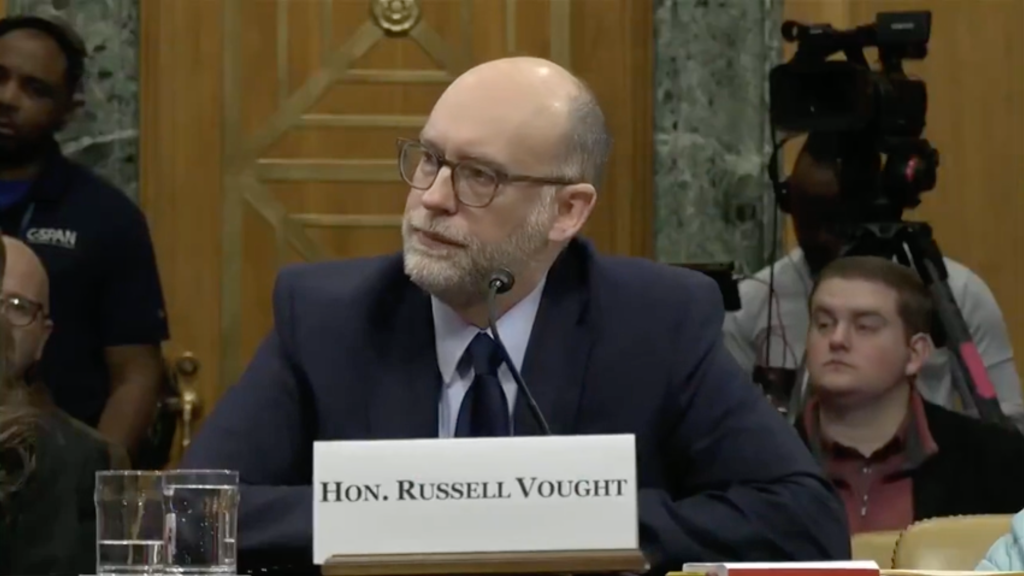
A new memo issued by the Trump administration directing the federal government to temporarily cease disbursing billions of dollars in funds appears to draw on arguments made by Russ Vought, the president’s selectee to run the Office of Management and Budget.
Vought was a primary architect of Project 2025, a sprawling effort organized by The Heritage Foundation to provide policy and staffing recommendations for President Donald Trump’s second term. In addition to that role, Vought is also the founder of the Center for Renewing America, a MAGA-aligned think tank that has spent over a year arguing that the president can unilaterally refuse to spend funds allocated by Congress, an authority known as the impoundment power that was severely curtailed by Congress in 1974.
The new Trump administration memo was issued by Matthew Vaeth, acting director of OMB pending Vought’s confirmation vote. The document calls for federal agencies to “temporarily pause all activities related to obligation or disbursement of all Federal financial assistance.”
“The use of Federal resources to advance Marxist equity, transgenderism, and green new deal social engineering policies is a waste of taxpayer dollars that does not improve the day-to-day lives of those we serve,” the memo states.
Although the two-page memo doesn’t use the term impoundment, law professor Steve Vladeck argued that the Trump administration is claiming “the unilateral power to at least temporarily ‘impound’ tens of billions of dollars of appropriated funds—in direct conflict with Congress’s constitutional power of the purse, and in even more flagrant violation of the Impoundment Control Act of 1974.” The existence of the document was first reported by journalist Marisa Kabas and later confirmed by The Washington Post and The New York Times. (OMB issued a follow-up memo claiming the freeze does “not apply across-the-board” and withheld funds are “not an impoundment under the Impoundment Control Act.”)
The direct effects of the memo are unknown given its scope and vagueness, but they could be detrimental even if the pause is short-lived.
“Experts said the memo as written was poised to bring a rapid halt to scores of federal functions, from assistance to homeless shelters to financial aid for college students,” the Post reported. “Health grants distributed by the Centers for Disease Control and Prevention, and state aid for disaster reconstruction, might face delays.”
The memo appears to exempt Social Security and Medicare recipients, and it says the halt “does not include assistance provided directly to individuals.” It isn’t clear whether Medicaid recipients will be affected, although some early reports indicated that payments had been disrupted.
The New York Times additionally reported that transportation funding and loans to small businesses could also be affected. In a statement to the Times, Diane Yentel, the chief executive of the National Council of Nonprofits, warned: “From pausing research on cures for childhood cancer to halting food assistance, safety from domestic violence and closing suicide hotlines, the impact of even a short pause in funding could be devastating and cost lives.”
HuffPost reported already that some payments for Head Start — which funds preschool for low-income families — are at risk of being delayed. HuffPost also reported that officials at Meals on Wheels, the food program for elderly Americans, are worried they could face funding disruptions.
Vought and his think tank pushed for a radical interpretation of the impoundment power for years prior to Trump’s election.
In June 2023, Vought posted on X (formerly Twitter), “Making Impoundment Great Again!” Days later, the Center for Renewing America’s X account wrote that “the impoundment power is our secret weapon to totally dismantle the WOKE & WEAPONIZED federal bureaucracy.” The CRA post linked to a Real Clear Politics article quoting Vought as saying, “When you think that a law is unconstitutional” — referring to the Impoundment Control Act — the response should be to “push the envelope.”
In July 2023, CRA senior fellow Jeffrey Clark — who as a DOJ attorney attempted to overturn the 2020 election by pushing a fake elector scheme at the end of Trump’s first term — appeared on Steve Bannon’s War Room to argue against the Impoundment Control Act.
“So what I’m working on, essentially, are the constitutional arguments for why that was wrong and various ways in which the Impoundment Control Act is just flatly unconstitutional,” Clark said.
Video
From the July 3, 2023, edition of Real America's Voice's War Room
Vought continued to beat the drum months later.
“The loss of impoundment authority — which 200 years of presidents enjoyed — was the original sin in eliminating the ability for a branch-on-branch to control spending,” Vought said the following February on Fox Business.
Video
From the February 12, 2024, edition of Fox Business' Kudlow
In June 2024, the Center for Renewing America released a white paper arguing that the Impoundment Control Act — passed following President Richard Nixon’s refusal to spend funds for environmental, transportation, and educational priorities — is unconstitutional and a break with legal precedent. The authors of that paper later wrote articles for The Hill and right-wing blog The Federalist making similar claims.
Vought highlighted the centrality of the impoundment power to his think tank’s project. “Why did we found the Center for Renewing America?” he wrote on X. “To write papers like this.”
During Trump’s first term, he attempted to unilaterally withhold roughly $400 billion in foreign aid funding for Ukraine, leading to his first impeachment for violating the impoundment law.
During Vought’s recent confirmation hearing to serve as director of OMB during Trump’s second administration — a job he also held during Trump’s first term — Vought refused to promise to follow the Impoundment Control Act on the grounds that both he and Trump believe it is illegal.
Last August, Vought was filmed in an undercover video claiming that he and his Project 2025 collaborators had written “about 350 different documents that are regulations and things of that nature” in preparation for a possible Trump victory. He said in the video that one of his goals is to “end multiculturalism” in America.
The OMB memo has triggered a massive reaction across the political spectrum. Bannon celebrated the move on War Room, while Senate Democrats are calling for a delay to Vought’s confirmation vote following the news. A former OMB official said the memo read like a “hostage note written directly by Russ Vought.”
===
===
mma
Russ Vought’s fingerprints are all over Trump’s new federal funding freeze
The Project 2025 architect has long argued in support of the president’s power to impound — that is, refuse to spend — funds allocated by Congress
Written by John Knefel
Published 01/28/25
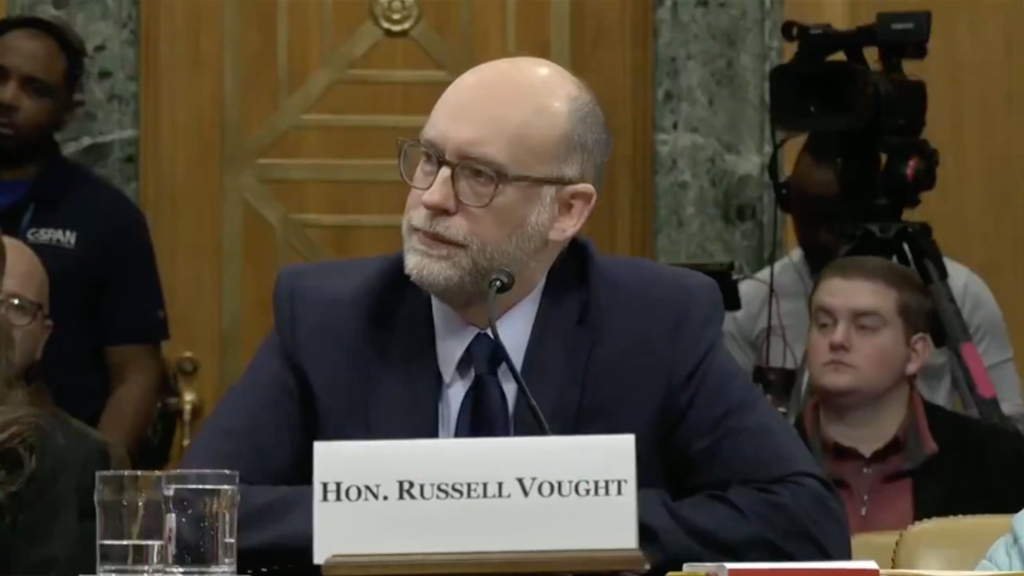
A new memo issued by the Trump administration directing the federal government to temporarily cease disbursing billions of dollars in funds appears to draw on arguments made by Russ Vought, the president’s selectee to run the Office of Management and Budget.
Vought was a primary architect of Project 2025, a sprawling effort organized by The Heritage Foundation to provide policy and staffing recommendations for President Donald Trump’s second term. In addition to that role, Vought is also the founder of the Center for Renewing America, a MAGA-aligned think tank that has spent over a year arguing that the president can unilaterally refuse to spend funds allocated by Congress, an authority known as the impoundment power that was severely curtailed by Congress in 1974.
The new Trump administration memo was issued by Matthew Vaeth, acting director of OMB pending Vought’s confirmation vote. The document calls for federal agencies to “temporarily pause all activities related to obligation or disbursement of all Federal financial assistance.”
“The use of Federal resources to advance Marxist equity, transgenderism, and green new deal social engineering policies is a waste of taxpayer dollars that does not improve the day-to-day lives of those we serve,” the memo states.
Although the two-page memo doesn’t use the term impoundment, law professor Steve Vladeck argued that the Trump administration is claiming “the unilateral power to at least temporarily ‘impound’ tens of billions of dollars of appropriated funds—in direct conflict with Congress’s constitutional power of the purse, and in even more flagrant violation of the Impoundment Control Act of 1974.” The existence of the document was first reported by journalist Marisa Kabas and later confirmed by The Washington Post and The New York Times. (OMB issued a follow-up memo claiming the freeze does “not apply across-the-board” and withheld funds are “not an impoundment under the Impoundment Control Act.”)
The direct effects of the memo are unknown given its scope and vagueness, but they could be detrimental even if the pause is short-lived.
“Experts said the memo as written was poised to bring a rapid halt to scores of federal functions, from assistance to homeless shelters to financial aid for college students,” the Post reported. “Health grants distributed by the Centers for Disease Control and Prevention, and state aid for disaster reconstruction, might face delays.”
The memo appears to exempt Social Security and Medicare recipients, and it says the halt “does not include assistance provided directly to individuals.” It isn’t clear whether Medicaid recipients will be affected, although some early reports indicated that payments had been disrupted.
The New York Times additionally reported that transportation funding and loans to small businesses could also be affected. In a statement to the Times, Diane Yentel, the chief executive of the National Council of Nonprofits, warned: “From pausing research on cures for childhood cancer to halting food assistance, safety from domestic violence and closing suicide hotlines, the impact of even a short pause in funding could be devastating and cost lives.”
HuffPost reported already that some payments for Head Start — which funds preschool for low-income families — are at risk of being delayed. HuffPost also reported that officials at Meals on Wheels, the food program for elderly Americans, are worried they could face funding disruptions.
Vought and his think tank pushed for a radical interpretation of the impoundment power for years prior to Trump’s election.
In June 2023, Vought posted on X (formerly Twitter), “Making Impoundment Great Again!” Days later, the Center for Renewing America’s X account wrote that “the impoundment power is our secret weapon to totally dismantle the WOKE & WEAPONIZED federal bureaucracy.” The CRA post linked to a Real Clear Politics article quoting Vought as saying, “When you think that a law is unconstitutional” — referring to the Impoundment Control Act — the response should be to “push the envelope.”
In July 2023, CRA senior fellow Jeffrey Clark — who as a DOJ attorney attempted to overturn the 2020 election by pushing a fake elector scheme at the end of Trump’s first term — appeared on Steve Bannon’s War Room to argue against the Impoundment Control Act.
“So what I’m working on, essentially, are the constitutional arguments for why that was wrong and various ways in which the Impoundment Control Act is just flatly unconstitutional,” Clark said.
Video
From the July 3, 2023, edition of Real America's Voice's War Room
Vought continued to beat the drum months later.
“The loss of impoundment authority — which 200 years of presidents enjoyed — was the original sin in eliminating the ability for a branch-on-branch to control spending,” Vought said the following February on Fox Business.
Video
From the February 12, 2024, edition of Fox Business' Kudlow
In June 2024, the Center for Renewing America released a white paper arguing that the Impoundment Control Act — passed following President Richard Nixon’s refusal to spend funds for environmental, transportation, and educational priorities — is unconstitutional and a break with legal precedent. The authors of that paper later wrote articles for The Hill and right-wing blog The Federalist making similar claims.
Vought highlighted the centrality of the impoundment power to his think tank’s project. “Why did we found the Center for Renewing America?” he wrote on X. “To write papers like this.”
During Trump’s first term, he attempted to unilaterally withhold roughly $400 billion in foreign aid funding for Ukraine, leading to his first impeachment for violating the impoundment law.
During Vought’s recent confirmation hearing to serve as director of OMB during Trump’s second administration — a job he also held during Trump’s first term — Vought refused to promise to follow the Impoundment Control Act on the grounds that both he and Trump believe it is illegal.
Last August, Vought was filmed in an undercover video claiming that he and his Project 2025 collaborators had written “about 350 different documents that are regulations and things of that nature” in preparation for a possible Trump victory. He said in the video that one of his goals is to “end multiculturalism” in America.
The OMB memo has triggered a massive reaction across the political spectrum. Bannon celebrated the move on War Room, while Senate Democrats are calling for a delay to Vought’s confirmation vote following the news. A former OMB official said the memo read like a “hostage note written directly by Russ Vought.”
===
1 25 trump j6 parsons, chris hayes said some scotus decision was actually written by Paoletta?
impoundment
The President’s Constitutional Power of Impoundment | The Center for Renewing America
The History of Impoundments Before the Impoundment Control Act of 1974
June 24, 2024 | by Mark Paoletta, Daniel Shapiro, Brandon Stras
Defenders of the Impoundment Control Act misunderstand the power of the purse, overread Supreme Court precedent, and fail to address unbroken Executive impoundment practice and congressional acquiescence.