SOCIAL SAFETY 3
---
ESTB 1 25 target gop maga mike pjt 2025
SEE MEDICARE SNAP school lunch
see fill in the swim pool white grIevance
SEE WORK REQ STINK TANK
SEE EMPATHY ~ FASCISM
-=-=
-=-=
AN 10 26
Ken Paxton suggests cutting federal benefit programs in 4th leaked audio
-=-=
-=-=
AN 10 26
CONTEXT?
'Straight-up bribery': Insider tears apart Trump 'plan' to loot Social Security
Matthew RozsaOctober 08, 2026 |
Editor's Note: After this article was published, AlterNet received the following email from the White House.
“The doomers and naysayers have consistently doubted President Trump: when he pledged to create the historic Trump Accounts, lowered prescription prices with Most Favored Nations, secured the border with no crossings, cleaned up our streets, ended taxes on tips, grew real wages, renegotiated broken trade deals, and reshored key manufacturing back to the United States," White House spokesperson Davis Ingle told AlterNet. "President Trump has consistently proven his doubters wrong, drawing a clear contrast with the Democrats’ record of historic inflation, unfettered illegal immigration, skyrocketing crime, and weakness on the world stage. With the continued support of the American people, President Trump will keep delivering real results.”
President Donald Trump and his closest advisers, including Secretary of the Treasury Scott Bessent and the world's richest man Elon Musk, claim they want to fix waste in America's biggest and most important social safety net.
Their critics say they are simply coming up with excuses to loot Social Security.
America's $2.56 trillion worth of Social Security funds are a constant point of contention in current political debate. Liberals want to protect the program and accuse conservatives of using terms like "reform" and "modernize" as codes for cutting benefits and ultimately privatizing it into institutions they can access.
To address these issues Trump is sending $90 checks to senior citizens, although those checks are of mysterious propriety. He is also offering to pay every American adult $5,000 if Republicans retain control of Congress during the midterm elections.
Democrats, by contrast, are trying to save the program. Democratic Senate candidates like Josh Turek of Iowa, James Talarico of Texas and Troy Jackson of Maine have argued that any serious financial issues facing Social Security can be addressed by simply forcing the rich to pay their fair share. Specifically, to keep the funds solvent past 2032, raise the current cap that says recipients are only taxed on earnings up to $184,500.
To learn more about the political dilemma facing Social Security, AlterNet spoke with President Joe Biden's Social Security Commissioner, Martin O'Malley.
This interview has been lightly edited for clarity, context and length.
ROZSA: I’m reading from NBC News. "A swath of Senate candidates across blue and red states are campaigning on raising Social Security taxes on higher incomes to prevent a benefit cut from taking effect in less than six years. Currently, Americans are taxed on earnings up to $184,500 to fund Social Security. These candidates, most of them Democrats, are calling for lifting that cap to boost revenues ahead of a fast-approaching 2032 deadline for insolvency." What are your thoughts on that?
O'MALLEY: Well, it’s the most straightforward way to strengthen Social Security for the far future, as well as increased benefits here and now. Right now, a person making a billion dollars pays nothing more into Social Security than a family making $184,000. So most Americans think that’s unfair, and that wealthier people should pay the same Social Security tax rate that all of the rest of us do, or rather the most wealthy people in America should pay the same Social Security tax rate that all of the rest of us do.
ROZSA: What do you expect the political backlash to this to be? Where do you think it will come from?
O'MALLEY: Ooh, I think if there’s any pushback from it, it’ll come from the 6% of Americans who make more than $250,000 or more than $400,000, depending on where Congress decides to scrap the cap. So people like Donald Trump have always hated Social Security. They feel like employers pay into it, but employers don’t get anything back from it like individual workers do. And that’s been true from the beginning of the program. But in terms of organized opposition, there aren’t many small businesses that are paying salaries in excess of $184,000. So I actually think as people come to understand the solution and what’s at stake as that cliff gets closer and closer, I think you’re going to find broad public support for requiring that the wealthiest of Americans pay the same Social Security tax rate that all of the rest of us do.
ROZSA: Trump is saying that he will pay every American adult $5,000 if Republicans retain the midterms, which to me sounds like socialism, but then they say that Social Security is socialism. And so my argument is there seems to be an inconsistency, a, dare I say, expediency to what is or is not defined as socialism. Does that make sense?
O'MALLEY: Yeah, but look, I don’t think that’s socialism or capitalism, that’s bribery. That’s paying people to vote a certain way. If he stood outside a polling place in Baltimore and around the corner from it was offering to give people $5,000 to vote for him, they’d put handcuffs on him, if he were a citizen. So that’s not capitalism or socialism, that’s just straight-up bribery.
ROZSA: All right. So overall, what are your thoughts on what needs to be done to keep Social Security solvent?
O'MALLEY: Yeah, the solution is very straightforward. The reason Social Security’s Baby Boomer surplus is being depleted sooner than they thought way back in the ’80s is because of income inequality. It’s because of the fact that as it’s currently structured, the wealthiest people in America pay almost nothing into Social Security, and they need to pay the same Social Security tax rate on their earnings that all of the rest of us do. And whether you’re an Independent or Republican or a Democrat, every American wants to see Social Security strengthened except for people like Donald Trump or Elon Musk or Vivek Ramaswamy or these other multimillionaires and billionaires who are the folks who have resented the program ever since its beginning.
ROZSA: I’ve never understood that resentment. I don’t understand why the people who have so much money are so upset about people who have less money receiving a little bit of extra help.
O'MALLEY: Yeah. Well, if they don’t have money to spend, they’re not gonna— If we go back to the days when millions of seniors died in poverty, when orphan kids had to sell themselves on the streets, that’s not very good for anybody’s profits in America. So, yeah, it’s the age of gilded greed, and with a lot of shades of eugenicist philosophy.
The notion that some people are useless, as Elon Musk said, non-character players. That guy, he said that empathy is the greatest weakness in the Western mind. The rest of the world, though, thought that empathy is what allowed us to create this land of opportunity, the strongest democracy once upon a time in the world, and the strongest economy, and the post-World War II era, up until the present, as hard as they worked to undermine it and its currency. Yeah, so the reason Elon Musk doesn’t like Social Security is not because he was able to find any gross inefficiencies and waste or even single prosecution of an illegal immigrant receiving benefits. No, he dislikes the program because he thinks that some human beings are waste. People that are too disabled to work in his economy are waste, just elderly. They’re waste.
ROZSA: I’m now going to bring up a personal observation here. Elon Musk, like me, is autistic. Donald Trump, although he has never been diagnosed, shows signs of ADD, which means if he is ADD, he’s also on the neurodiversity spectrum. I find it galling that they view disabled people as wastes when they are themselves disabled, and if they hadn’t been born rich, could also have been viewed as wastes. What are your thoughts on that observation?
O'MALLEY: Yeah. The biggest waste of money in America is the buckets and buckets of tax breaks that we continue to shower on the wealthiest of individuals and corporations. That’s the biggest waste in America.
ROZSA: I agree. So again, is there anything else you’d like to say before I close the interview?
O'MALLEY: Given how many Americans have earned their Social Security benefits and how much support there is for the program, it’s surprising to me, not that some candidates are saying that wealthier people should pay the same tax rate as the rest of us, but what’s surprising to me is knowing that people like Ken Paxton and Vivek Ramaswamy and Ashley Hinson are still talking about cutting it or privatizing it. That’s what surprises me. It’s not that people would want the fairness of the same tax rate for wealthier people, for the wealthiest people, but that some of these politicians, Republicans, are still talking about privatizing and cutting it. I don’t get that.
-=-=
-=-=
an 9 26
Economist blows whistle on multi-billion dollar plot to rob Social Security
===
mpu
pgm more $ for admin than services?!
every diff state gets billed for each query over and over
Sep 8, 2026
The biggest welfare scam in the country is run by a consulting giant. Deloitte has made over $6 billion running error-prone eligibility systems that make it harder for Americans to get the healthcare and food aid they rely on. We investigated the big business of welfare.
The People Abusing Welfare Are Not Who You Think
-=-=
-=-=
an 8 26
Trump’s $500/month Social Security cuts will go nuclear in Alabama: report
-=-=
an 8 26
From dismantling the Affordable Care Act to supporting Republican lawmakers’ attacks on Medicare and Medicaid, President Donald Trump has made it much more difficult for people to receive health care during his second term. Now a new report reveals how millions of Americans will literally die because of these policies — that is, once their votes for Trump are in the bag.
“When the Republican Congress enacted Trump’s One Big Beautiful Bill in July 2025, it included massive cuts in the Medicaid program, totaling around $1 trillion over 10 years—but made sure to postpone them until 2027, conveniently after the midterm elections,” wrote The New Republic's Norman J. Ornstein on Sunday. “The cuts focused on adding onerous work and paperwork requirements, all designed to force recipients off the rolls, and will remove somewhere between 10 and 15 million people from the program, leaving them without any health coverage. That is in addition to the millions losing coverage or facing huge premium increases with the erasure of subsidies for the Affordable Care Act.”
Ornstein added, “But the impact will go far beyond those directly losing their health insurance. Medicaid money does not go to Medicaid recipients. It goes to the providers. The loss of a major chunk of the money going out to them will have big reverberations.”
After detailing how the cuts will harm hospitals and nursing homes in essential ways, Ornstein characterized the consequences as devastating to American patients. For example, when it comes to the hospital cuts, ERs will be overtaxed while hundreds of necessary workers will be thrown into unemployment. Patients will find it more difficult to receive care, even as health workers struggle to make ends meet.
“As for the nursing homes, some will close; others will cut staff and staff pay,” Ornstein wrote. “The ratio of residents to staff will decline, meaning residents unable to secure help when they need it for such vital tasks as getting medications when they require them, getting help going to the bathroom, getting help in bed to prevent bedsores or worse, having responsive care during a health trauma or emergency. More unqualified staff could mean more abuse of the residents.”
He concluded, “There will be more effects seen throughout the country, for everyone who is a part of our intertwined health care system, from those working in it to those using it. No wonder Republicans made sure none of the Medicaid cuts would happen before voters experienced the impact.”
Referring to America as a “kakistocracy,” or government run by the least competent and most corrupt, Ornstein opined that “it turns out that kakistocracy is not just a funny word, but a reality with horrific consequences.”
-=-=
-=-=
an 8 26
From dismantling the Affordable Care Act to supporting Republican lawmakers’ attacks on Medicare and Medicaid, President Donald Trump has made it much more difficult for people to receive health care during his second term. Now a new report reveals how millions of Americans will literally die because of these policies — that is, once their votes for Trump are in the bag.
“When the Republican Congress enacted Trump’s One Big Beautiful Bill in July 2025, it included massive cuts in the Medicaid program, totaling around $1 trillion over 10 years—but made sure to postpone them until 2027, conveniently after the midterm elections,” wrote The New Republic's Norman J. Ornstein on Sunday. “The cuts focused on adding onerous work and paperwork requirements, all designed to force recipients off the rolls, and will remove somewhere between 10 and 15 million people from the program, leaving them without any health coverage. That is in addition to the millions losing coverage or facing huge premium increases with the erasure of subsidies for the Affordable Care Act.”
Ornstein added, “But the impact will go far beyond those directly losing their health insurance. Medicaid money does not go to Medicaid recipients. It goes to the providers. The loss of a major chunk of the money going out to them will have big reverberations.”
After detailing how the cuts will harm hospitals and nursing homes in essential ways, Ornstein characterized the consequences as devastating to American patients. For example, when it comes to the hospital cuts, ERs will be overtaxed while hundreds of necessary workers will be thrown into unemployment. Patients will find it more difficult to receive care, even as health workers struggle to make ends meet.
“As for the nursing homes, some will close; others will cut staff and staff pay,” Ornstein wrote. “The ratio of residents to staff will decline, meaning residents unable to secure help when they need it for such vital tasks as getting medications when they require them, getting help going to the bathroom, getting help in bed to prevent bedsores or worse, having responsive care during a health trauma or emergency. More unqualified staff could mean more abuse of the residents.”
He concluded, “There will be more effects seen throughout the country, for everyone who is a part of our intertwined health care system, from those working in it to those using it. No wonder Republicans made sure none of the Medicaid cuts would happen before voters experienced the impact.”
Referring to America as a “kakistocracy,” or government run by the least competent and most corrupt, Ornstein opined that “it turns out that kakistocracy is not just a funny word, but a reality with horrific consequences.”
-=-=
AN TC 7 26 GOOD HISTORY OVERVIEW
The Trump administration announced on July 21, 2026, that it’s withholding US$867 million in federal healthcare funding for California and $200 million for Minnesota – a total of more than $1 billion.
Federal officials said the two states had failed to provide sufficient evidence that a number of disputed medical claims were legitimate. These include bills for in-home care and other services covered by the two states’ Medicaid programs for low-income residents.
Medicaid administrators say the funds can be recovered if the states supply the requested documentation.
But the action is highly unusual: Typically, Medicaid officials partner with states to conduct an audit when they suspect fraud, a careful process that often takes years.
It’s the second time in 2026 that the Trump administration has withheld or deferred federal Medicaid funds for several states, including California and Minnesota, because of alleged fraud and abuse. The Democratic governors of those states have called the decision a politically motivated attack on their constituents.
I’m a historian of social policy who led the first comprehensive historical overview of Medi-Cal, California’s statewide Medicaid system. I’ve found that U.S. leaders have long used the language of fraud and abuse to blur the line between correcting very real failures within Medicaid and – as I believe the Trump administration is currently doing – discrediting and defunding the program itself.
https://www.youtube.com/embed/12oT-Wk800k?wmode=transparent&start=0
Who pays when Medicaid is cut? It affects children’s health care, nursing home care, disability services and health insurance.
Slashing the safety net
The Medicaid restrictions are part of the Trump administration’s overall efforts to slash federal funding for the safety net.
The large tax-and-spending bill that Trump signed into law in July 2025 as the cornerstone of his second-term agenda pared eligibility for Medicaid by introducing work requirements for some adults. It is cutting close to $1 trillion in federal spending on the program over the next decade.
Researchers estimate that almost 12 million people, on top of the estimated 28 million without health insurance in 2025, could become uninsured by 2034 due to these changes. By mid-2026, more than 3 million people had already lost their insurance coverage due to Republican changes to the Affordable Care Act.
‘Padlocking’ the ‘cookie jar’
In February 2026, Vice President JD Vance, Health Secretary Robert F. Kennedy Jr. and Dr. Mehmet Oz, the administrator of the Centers for Medicare & Medicaid Services, or CMS, announced a new anti-fraud initiative called Comprehensive Regulations to Uncover Suspicious Healthcare.
Also known by its rather unsubtle acronym, CRUSH, this initiative is taking unprecedented steps to withhold and defer funds in response to suspected fraud. “CMS is done trying to catch fraudsters with their hands in the cookie jar,” Oz said in announcing CRUSH’s formation. “Instead, we’re padlocking the jar and letting them starve.”
To be sure, Medicaid fraud, waste and abuse – such as providers billing Medicaid for services that are unnecessary or never rendered – are very real problems that cost taxpayers billions of dollars annually. They do divert funds from the low-income and disabled Americans enrolled in the program.
But the Trump administration’s latest moves are part of a much broader history of weaponizing Medicaid fraud and abuse – both real and imagined. I see them as a politicized attempt to prove that Medicaid itself is wasteful, that state governments cannot be trusted to administer federal money, and that public benefits inevitably invite dishonesty.
 Secretary of Health and Human Services Robert F. Kennedy Jr. speaks about alleged Medicaid fraud and charges in Minneapolis in May 2026. Christopher Juhn/Anadolu via Getty Images
Providing little oversight at the start
Medicaid was established, along with Medicare for older adults, in 1965 as part of President Lyndon B. Johnson’s “Great Society” reforms. Despite providing millions of Americans with health insurance coverage for the first time, these programs had few centralized mechanisms for the kind of federal oversight that could prevent and catch fraud and abuse.
And the sheer scale and complexity of the Medicaid system – joint federal-state funding, varying eligibility requirements, millions of enrollees and thousands of providers – created opportunities for questionable billing practices among providers.
The 1970s saw a number of highly publicized Medicaid scandals involving nursing homes, laboratories, pharmacies and so-called “Medicaid mills” – healthcare providers that sought to bill the government for large numbers of Medicaid patients for shoddy and often fraudulent care.
A series of high-profile congressional investigations spurred demand for stronger Medicaid oversight and enforcement. That led to the Medicare-Medicaid Anti-Fraud and Abuse Amendments of 1977, which established the national Medicaid Fraud Control Units program.
The state-run Medicaid Fraud Control Units received generous federal matching funds to investigate and prosecute fraud.
The most serious Medicaid fraud was generally committed by healthcare providers and contractors, not patients. Medicaid Fraud Control Units were principally responsible for investigating providers, while also prosecuting the abuse and neglect of patients whose care was billed to Medicaid.
At the same time, however, Medicaid was becoming entangled in a broader political debate over social spending, whether many Americans were becoming too dependent on government benefits, and the alleged use of benefits by people who should not have received them. In the 1980s and 1990s, widely circulated stories about Medicaid exposed fraud and malfeasance by providers.
But disproportionately, they also highlighted the comparatively few instances of fraud by people enrolled in the program, such as cases where they submitted false receipts for covered medically related travel or sold drugs they obtained through Medicaid for free or at low cost.
Using Medicare fraud to justify spending cuts
The distinction between Medicaid and cash assistance programs, such as the Aid to Families with Dependent Children “welfare” program, frequently disappeared in political rhetoric. False or exaggerated stories that portrayed African American single mothers living extravagantly while fraudulently claiming welfare benefits became potent symbols of supposed government failure.
While campaigning as a presidential candidate, Ronald Reagan seized on this trope of the “welfare queen” in his attacks on social spending.
 People line up at the Baltimore City Welfare Office in 1975, years before concerns about social spending led to big cuts to safety net programs. O'Halloran/Library of Congress via Getty Images
By the mid-1990s, opposition to welfare programs had become increasingly bipartisan. Politicians in both parties often used tales of Medicaid fraud on the part of providers and recipients to justify tighter eligibility rules and spending cuts.
Federal oversight expanded further with the Deficit Reduction Act of 2005, which created the Medicaid Integrity Program and strengthened federal oversight of state programs. The Affordable Care Act, the landmark healthcare legislation Congress passed in 2010, added new measures to screen providers and verify billing.
Concerns about Medicaid’s “integrity” became highly politicized in the debates surrounding the ACA. Critics of Medicaid expansion argued that increasing the number of people who could get health insurance through the program would increase fraud and improper enrollment. Supporters of expanding Medicaid to help more Americans gain health insurance maintained that anti-fraud rhetoric often disguised ideological opposition to the program’s expansion.
Blurring distinctions then and now
For the six decades that this program has helped millions of low-income Americans get healthcare, politicians have blurred the distinction between protecting Medicaid from abuse and using abuse to discredit Medicaid itself.
In my view, the Trump administration’s campaigns against California and Minnesota continue that pattern. It is using real weaknesses within Medicaid to advance much broader political arguments: that Democratic states cannot be trusted, that public benefits naturally invite abuse, and that withholding funds is itself a form of reform.
The result will no doubt be that fewer low-income Americans will be able to get the healthcare they need.
Ben Zdencanovic, Assistant Professor of U.S. History, University of Cambridge
This article is republished from The Conversation under a Creative Commons license. Read the original article.
-=-=-=
---
mma
---
---
an 5 26
Research reveals that white people appear to support social safety net programs unless they perceive those programs as also helping nonwhites.
“White Americans who feel they are on the losing side of politics are more likely to oppose economic redistribution programs,” reports PsyPost, citing research posted in Research and Politics. “This effect only appears when people compare their political standing directly to that of racial minorities.
Economic redistribution involves transferring wealth or income within a society, usually through taxation and social welfare programs, reports PsyPost, and in many developed nations, high levels of income inequality usually lead to increased public demand for these programs. But the U.S. is different in this regard. Despite the nation suffering high economic inequality, public support for government redistribution remains relatively low.
University of Delaware political scientists Sumeyye Mine Iltekin Gocer and Joanne M. Miller, wanted to test how these social comparisons operate across racial lines. What they learned was that hostility to safety net programs appears to be an issue primarily with White people — even those in poverty — because they fear the programs give nonwhites a boost.
The researchers focused specifically on more than 700 white survey respondents and divided them into two groups: those asked “whether white Americans have been winning or losing in politics lately,” and those asked “if white Americans have been winning or losing in politics compared to racial minorities.”
Both groups were then asked to rate their support for two specific types of economic proposals, reports PsyPost. “The first was an index of general economic redistribution, and included questions about government intervention to reduce the gap between the rich and the poor. The second policy question was more targeted: It asked if the current government is spending too much or too little to reduce income disparities between white people and racial minorities.
“[White respondents in the second group] who felt their group was losing in politics became less supportive of both types of economic redistribution,” said PsyPost. “They opposed general public welfare programs and initiatives specifically aimed at reducing racial inequality.
Researches noticed also that the relationship held true regardless of the respondents’ income, employment status, political ideology, or underlying racial beliefs.
“The results highlight the power of framing in political messaging,” according to PsyPost. “The mere feeling of losing is not enough to shift economic policy preferences toward the conservative end of the spectrum. A person has to feel that they are losing out relative to another specific demographic group.”
The study suggests why populist leaders like President Donald Trump and MAGA frequently rely on group-based rhetoric to build a white base.
“Stoking fears of relative decline appears to be a highly effective way to mobilize opposition to egalitarian economic policies,” PsyPost reports.
---
---
MMA
05/13/26
---
---}:
mma
03/19/26
March 19, 2026, edition of Fox News' America Reports
SANDRA SMITH (ANCHOR): They want more money for this homeless population. They are now saying in the city, you just heard it, more per homeless person than the average person makes in the year.
JOHN CATSIMATIDIS (GUEST): Why should we pay that $81,000 I saw on the screen, for a homeless person where they can leave for— live in Uganda for $8.13 a day. We'll give them the check for $8.13 a day, let them live some place else.
SMITH: It would be one thing if proving that spending all this money would be helping the homeless population get off the streets and get back into work but there's no sign of that. In fact, the homeless population is only growing.
Per Forbes, John Castimatidis is the owner of a New York City supermarket chain and an oil refinery, and has an estimated net worth of $4.8B.
---
---
an 12 25
an in-depth report published by the Washington Post on Tuesday offers new details about the damage being done to the Social Security Administration during President Donald Trump’s second term.
The Post, citing both internal documents and interviews with insiders, reported that the Social Security Administration (SSA) is “in turmoil” one year into Trump’s second term, resulting in a customer service system that has “deteriorated.”
The chaos at the SSA started in February when the Trump administration announced plans to lay off 7,000 SSA employees, or roughly 12% of the total workforce.
This set off a cascade of events that the Post writes has left the agency with “record backlogs that have delayed basic services to millions of customers,” as the remaining SSA workforce has “struggled to respond to up to 6 million pending cases in its processing centers and 12 million transactions in its field offices.”
The most immediate consequence of the staffing cuts was that call wait times for Social Security beneficiaries surged to an average of roughly two-and-a-half hours, which forced the agency to pull workers employed in other divisions in the department off their jobs.
However, the Post‘s sources said these employees “were thrown in with minimal training... and found themselves unable to answer much beyond basic questions.”
One longtime SSA employee told the Post that management at the agency “offered minimal training and basically threw [transferred employees] in to sink or swim.”
Although the administration has succeeded in getting call hold times down from their peaks, shuffling so many employees out of their original positions has damaged the SSA in other areas, the Post revealed.
Jordan Harwell, a Montana field office employee who is president of American Federation of Government Employees (AFGE) Local 4012, said that workers in his office no longer have the same time they used to have to process pay stubs, disability claims, and appointment requests because they are constantly manning the phones.
An anonymous employee in an Indiana field office told the Post that she has similarly had to let other work pile up as the administration has emphasized answering phones over everything else.
Among other things, reported the Post, she now has less time to handle “calls from people asking about decisions in their cases, claims filed online, and anyone who tries to submit forms to Social Security—like proof of marriage—through snail mail.”
Also hampering the SSA’s work have been new regulations put in place by Tesla CEO Elon Musk’s Department of Government Efficiency that bar beneficiaries from making changes to their direct deposit information over the phone, instead requiring them to either appear in person at a field office or go online.
The Indiana SSA worker told the Post of a recent case involving a 75-year-old man who recently suffered a major stroke that left him unable to drive to the local field office to verify information needed to change his banking information. The man also said he did not have access to a computer to help him change the information online.
“I had to sit there on the phone and tell this guy, ‘You have to find someone to come in... or, do you have a relative with a computer who can help you or something like that?’” the employee said. “He was just like, ‘No, no, no.’”
Social Security was a regular target for Musk during his tenure working for the Trump administration, and he repeatedly made baseless claims that the entire program was riddled with fraud, even referring to it as “the biggest Ponzi scheme of all time.”
---
an 12 25
Trump's Social Security changes spark 4 major consequences: report
nyer mag 10 25
...In March, 2017, Trump signed an executive order that called for a top-to-bottom reorganization of the federal government. Mick Mulvaney, a former congressman, served as Trump’s first budget director, but, inside the O.M.B., Vought took the lead. According to a former senior staffer at the agency, Vought initially pushed for the President’s plan to eliminate U.S.A.I.D. and the Consumer Financial Protection Bureau. He also wanted to fold the Department of Health and Human Services, along with food-stamps programs, into a new Department of Health and Public Welfare. “They wanted to call it that because they think it sounds bad,” a former O.M.B. analyst told me. In one meeting, according to a person in the room, Vought asked, “Why do we do economic assistance abroad at all?” The former O.M.B. analyst said, “There were very few, if any, debates where Russ wouldn’t take the most extreme option available to him, the most conservative, the most budget-cutting.”
Trump’s Cabinet secretaries resisted wholesale cuts. The former senior staffer recalled, “The general counsels at these agencies are calling the White House counsel and saying, ‘We’re not trying to introduce legislation to delete ourselves, are we?’ ” Few of the recommendations in Vought’s final reorganization plan, which was released in 2018, were implemented. But the document now reads like a guide to the second Trump Administration. “I didn’t realize it then,” the former O.M.B. senior staffer told me, “but I was writing the first draft of Project 2025.”
Vought increasingly clashed with the O.M.B.’s staff over proposed cuts to popular programs. Meals on Wheels, the food-delivery program, was a topic of intense debate. Even after O.M.B. staff explained how the program, which received more than nine hundred million dollars in funding from Congress, acted as a lifeline for homebound seniors, Vought and Mulvaney pushed for major cuts that would have hobbled its operations, according to the former O.M.B. senior staffer. The staffer added that it was often hard to reconcile Vought’s deeply held Christian faith—he hosted a prayer session for select colleagues—with his eagerness to cut programs that helped the vulnerable. “It always struck me as a strange thing,” the person said. “There’s compassion, but it only extends to certain people.”
...
---
The split in the right over SNAP and food stamps: Some attack the program and its recipients, while others try to use cuts as a cudgel against Democrats
Written by Jason Campbell
Research contributions from Helena Hind & Jane Lee
Published 10/29/25
The 42 million Americans who rely on the Supplemental Nutrition Assistance Program will not receive assistance in November, and some right-wing media are using the opportunity to attack the program and its recipients while others are using SNAP recipients as a cudgel against Democrats.
The $8 billion in congressional appropriations for the benefits, known as food stamps, lapsed with the October 1 government shutdown, and there is no indication that Congress will appropriate funds for the program. The Department of Agriculture, which administers the program, has further said it will not shift funds around to keep the program operational despite SNAP having having some contingency funds available and the department's own "shutdown-funding plan," which was struck from its own website, that indicated emergency funds could be used.
About 1 in 8 Americans rely on SNAP benefits, receiving an average of $187 a month in food aid. The vast majority of households which receive SNAP benefits include children, an elderly person, or someone with a disability.
Right-wing pundits are calling the program too generous, with some attacking recipients — who now are also being attacked online with fake racist AI-generated videos.
- The Daily Wire’s Matt Walsh: “If you look at what food stamp recipients are saying in their own words ... you come away with the impression that many of these people are simply entitled, lazy, barely literate, and, like, some of them are just frankly bad people."
- While discussing SNAP benefits, Newsmax’s Rob Schmitt denied that there is food insecurity in the U.S. and asked, “Why is it that we are subsidizing food for people that weigh 300 pounds?” He also said, “The entitlement of the people on these programs is through the roof."
- Podcaster Steven Crowder insulted SNAP recipients in some pretty ugly ways typical of his program.
- While discussing SNAP, Newsmax host Carl Higbie said that “our welfare programs are out of hand” and “these programs should definitely sunset."
- The Daily Wire’s Ben Shapiro: “It is insane that there are 42 million Americans on food stamps. That is a wild statistic. And the amount of government dependency in this country is just way too high, period. But they are, in fact, dependent on food stamps."
While some right-wing pundits are claiming that too many people are receiving SNAP benefits, others are arguing that SNAP is an essential benefit and blaming Democrats for taking it away.
- Fox & Friends host Ainsley Eardhardt said if Democrats “really care about families, and people in need, and people who can’t afford to go to the grocery store, then open up the government."
- Turning Point USA’s Alex Clark posted, “So when people claim they’re starving and have no food remember it was the democrats, not Trump, who did this to you."
- And Fox anchor Harris Faulkner said that “we have food insecurity in this country” and blamed Democrats for keeping the government shut down.
During the Obama administration, many right-wing media pundits attacked the SNAP program, often calling for it to be discontinued, while others attacked food assistance recipients.
The gleeful enthusiasm with which some right-wing media personalities suggest food should be taken away from their fellow countrymen is truly disturbing — and ultimately in line with the cruelty which defines so much of the MAGA movement.
//
mma
Matt Walsh: “We need drug testing and weight testing for anyone receiving SNAP”
:{10/29/25
an 10 25
Not a 'gut-wrenching' Problem: Republican senator shrugs off millions losing subsidies
MMA
10/07/25
---
mma
Fox Business' Maria Bartiromo pushes raising retirement age for Social Security
09/18/25
---
AN 9 25
President Donald Trump's 'Reverse Robin Hood" policies of taking from the poor and giving to the rich isn't just making people poorer, but it's leading to the "collapse of democracy and civil society," according to Salon's senior politics writer Chauncey DeVega.
"Whether the American people are capable of connecting poverty, inequality and homelessness to the collapse of democracy and civil society under Trumpism" is an entirely other question, DeVega adds.
Pointing to what he deems "The Big Vile Bill," DeVega cites a pollby University of Chicago and The Associated Press-NORC Center for Public Affairs Research showing a "stark" divide in which it's clear, according toNew York Timescolumnist Jamelle Bouie, that the "American right sees the market as the ultimate decider of survival."
READ MORE:'Irrational': GOP senators are 'sick of' Trump’s 'love affair with everything Putin'
In that poll, “Republicans are more likely than Democrats to cite personal choices as major factors for both poverty (77 percent vs. 49 percent) and homelessness (77 percent vs. 51 percent),” whereas, “In contrast, Democrats are more likely than Republicans to cite lack of government support as major factors for both poverty (61 percent vs. 21 percent) and homelessness (63 percent vs. 26 percent).”
DeVega says this split is deepening, and "since Trump’s return to power, this right-wing moral economy has become even more hard-hearted."
As a result, the right-wing "moral economy," DeVega notes, has led conservatives to "increasingly view human empathy as a weakness, something wholly alien," as seen recently when Fox News host Brian Kilmeade suggested executing homeless people.
READ MORE:'Speechless': Free speech advocates rip Trump AG’s 'psychotic' claim about Charlie Kirk'
And while Republicans are "driven by small government ethos," DeVega says, "as Trump expands his power and control over all areas of American life, those same so-called principled conservatives who spent decades howling about 'states’ rights' and 'big government' have fallen deafeningly silent."
The performative patriotism of the right, draping themselves in American flags and waving pocket Constitutions, DeVega says, has now "been revealed as a sham — and about obtaining power to impose their will on other people."
And when it comes to the social safety net, "white working-class people who form the base of Trump’s MAGA movement — hold some alarming ideas," says DeVega.
Among those ideas the author notes: "They support government assistance primarily for white people like themselves, whom they deem deserving and to be 'real Americans.'"
READ MORE: 'Deeply troubling': Military expert warns Trump is unilaterally 'deciding to kill people'
When they use programs like welfare or food stamps, they see it as temporary and justified, DeVega says.
"But when Black and brown people — especially women — use the same programs, they are labeled lazy, undeserving takers or 'welfare queens,'" the author writes.
These callous views, DeVega notes, are of another era. "A society’s values are, in large part, reflected by how it treats its most vulnerable members — and America in the 21st century is growing increasingly Dickensian."
As American society continues to fracture, the public and their leaders must broaden their understanding of how poverty and other forms of social inequality are directly linked to structural — and political — violence, DeVega says.
READ MORE: 'We don't care': Fox host downplays murder of Democratic lawmaker in profane meltdown
“We live with this kind of violence, we experience it, every single day. We just don’t call it ‘political.’ To conservatives, it’s not even violence," writes author Jessica Valenti, who says that pregnant women dying of sepsis, abortion provider assassinations, school shootings and people dying from insurance claim denials are all examples of political violence.
“We live with this kind of violence, we experience it, every single day. We just don’t call it ‘political.’ To conservatives, it’s not even violence," Valenti says.
The social safety net that is supposed to protect people, DeVega writes, saying, "Healthy democracies have a strong social safety net that helps to prevent and alleviate poverty and other forms of social inequality."
Unfortunately, authoritarians and demagogues don't have much concern for the public good, DeVega says. In fact, they thrive on misery And therein lies the problem.
"These leaders have an interest in keeping their constituents vulnerable. Economic insecurity breeds malleability, and an increased willingness to seek out the protection of a strongman,"DeVega concludes. "Inequality, they know, is a dagger to the heart of democracy — and it’s one they enthusiastically wield."
---
---
AN 7 25
According to U.S. Bureau of Labor Statistics (BLS) figures released on Friday, August 1, U.S. employment was at 4.2 percent in July. The U.S., according to economists, still isn't in a recession, but the BLS report was a disappointment in terms of job creation.
According to BLS data, "Among the unemployed, the number of new entrants increased by 275,000 in July to 985,000. New entrants are unemployed people who are looking for their first job…. In July, the number of long-term unemployed (those jobless for 27 weeks or more) increased by 179,000 to 1.8 million. The long-term unemployed accounted for 24.9 percent of all unemployed people."
Trump responded angrily to the report, firing BLS Commissioner Erika McEntarfer and accusing her of "rigging" the data against him.
READ MORE: Donald Trump just debunked his own lie — and it should get him sued
In a sobering article published on August 5, Salon's Chauncey DeVega warns that thanks to "MAGA's culture of cruelty and gangster capitalism," Americans are likely to suffer economic pain in a variety of ways in the months ahead — from rising unemployment to inflation to a weakened safety net."
"On Friday," DeVega explains, "the bleak economic figures released by the Bureau of Labor Statistics showed the truth about what is happening in Donald Trump’s America…. Friday's numbers indicate the likelihood of stronger economic turbulence that would impact all of us, from the middle-class to the men I encountered on the street. They, and so many others like them, no longer have much of a social safety net. In an economy strangled by inflation, low wages and rising inequality, the number of homeless Americans will almost certainly grow."
DeVega continues, "The (Trump) Administration seems to be preparing for that possibility. In a grossly underreported story, on July 24, Trump signed an executive order designed to remove people from the streets, including institutionalizing or sending homeless people to mental health or addiction treatment without their consent, marking a policy shift away from 20 years of a housing-first approach."
To make matters worse, DeVega laments, millions of Americans are expected to lose their health insurance.
READ MORE: Trump official reminds the world that the US now has a 'national position' on a single word
"Based on all available evidence and historical precedent," DeVega warns, "the Big Ugly Bill, along with the (Trump) Administration's other cuts to the social safety net, looks likely to trigger a sharp rise in homelessness. The legislation strips away billions of dollars in food assistance. Nursing homes and end-of-life hospice care will face funding shortfalls. With the Big Ugly Bill’s cuts to Medicare, Medicaid and the Affordable Care Act, it has been estimated that nearly 12 million Americans will lose their health care. That number will likely rise: In 2026, more than 24 million Americans will see their premiums increase, with some facing spikes as high as 15 percent, according to the nonpartisan health policy and advocacy organization KFF, formerly the Kaiser Family Foundation."
DeVega argues that Trump's economic policies are designed to promote an "authoritarian" agenda.
"A healthy democracy depends on a humane society — and a robust social safety net. Autocrats and authoritarians know this," DeVega writes. "That’s why they attack and attempt to destroy social programs. They want to eliminate every possibility of a real social democracy to cement their rule forever. Donald Trump is well on his way."
READ MORE: 'Desperation': Nicolle Wallace says Trump’s been poked at 'his greatest political weakness'
*Chauncey DeVega's full Salon article is available at this link.
---
b3 medicare cuts will hurt/close rural hosp and NURSING HOMES
make healthcare more dificult and expensive FOR EVERYONE
TAX CUT $6K FOR RICHER sR TEMP?!
---
b3 pass senate jdv tie murkowski? side deal? WHALERS?
:{---
AN 7 25 BESSANT?
Trump official slammed for saying this policy is 'backdoor to privatizing Social Security'
---
mma
June 30, 2025, edition of Newsmax'sRob Schmitt Tonight
ROB SCHMITT (HOST): And we couldn't even get the turn -- you needed 60 to get the illegals off of Medicaid today, right? So that didn't happen. That was a big loss, right? I mean, that's going to be a very expensive, I think, mistake by the parliamentarian.
SEN. RON JOHNSON (GUEST): Well, again, we can complain about the parliamentarian, but we have a job to do here. And, you know, the good news is that $651 billion shortfall could be easily solved. All we have to do is vote for Rick Scott's amendment. He's an expert in health care. He's proposed the most damaging part of Obamacare. That's the, what they call Medicaid expansion. But what that is — traditional Medicaid pays one, for every dollar state puts in traditional Medicaid, federal government puts in, on average, about $1.33. For the Medicaid expansion, the single adults that should be working, could be working -- for every dollar the state puts in, we put in 9. That is creating all kinds of distortions. The states are scamming the system. Providers are scamming the system. That's what we're trying to correct. So Rick Scott would just say we're going to cap Medicaid expansion enrollment sometime in the future. That literally could save $500 billion if we do it on January 1, 2029. Give these providers plenty time to rearrange their budgets so it's not really dependent on that scam.
SCHMITT: Yeah. But I just -- you know what's really frustrating is that, I mean, you look at these programs, I mean, at some point every entitlement needs to be looked at. And the moment that you even talk about it, you get lambasted by the media and the other side as if they're not aware of the deficit disaster that we already currently have. I mean, you even just hint at Medicaid reform because there is so much waste. There's so many people pulling from that that shouldn't be. And they immediately say, you're going to kill somebody's grandma.
JOHNSON: Again, that was the design of Obamacare. You know, let's go to single-payer system. Let's bring up single adults who should be working, getting health care through their employer. But we incentivize them not to work. Your earlier segment was saying, we can't get people to fill these jobs. Well, we pay them not to work --
SCHMITT: Pay them not to work.
JOHNSON: So this is a huge problem. Nobody wants to take Medicaid away from children. It's Medicaid expansion. Those single adults who get, again, reimbursed $9 to 1 that's crowding out to those vulnerable populations from even providers.
SCHMITT: It's not an easy job that you guys have. And I have to say that I have respect for the ones like yourself and others that are willing to at least consider the debt and the deficit in this country, even if it gets you catching hell from even the president at some point. It's, you know, you're speaking for the people that don't have a voice in Washington, and that is appreciated.
---
---
an 7 25
A proposal from the Trump administration would impose a strict two‑year limit on Housing and Urban Development's (HUD) flagship rental assistance programs, including Section 8 vouchers and public housing. If enacted, the change could leave 1.4 million of the nation’s lowest-income households without housing support, the Associated Press reported Thursday.
A New York University analysis of HUD data concludes that the two-year cap would force 1.4 million households — predominantly working families with children—out of subsidized housing, leading to widespread evictions and upheaval, per the report.
The report spotlighted Havalah Hopkins, a 23-year-old working mother of an autistic son, who fears such a limit would render them homeless, as neither wages nor local affordable housing currently offer a viable safety net.
READ MORE: 'Who in the world would be stupid enough to believe that?' Morning Joe torches Trump
“A two‑year time limit is ridiculous,” she told AP. “It’s so disrespectful. I think it’s dehumanizing—the whole system.”
She further said, “It’s a cycle of feeling defeated and depleted, no matter how much energy and effort and tenacity you have towards surviving."
Since hearing about Trump’s proposal, Hopkins says she's been consumed by the fear of loading her life into a van with her son, unraveling the sense of safety she’s worked so hard to build.
The report noted that both Democrats and Republicans have acknowledged that imposing time limits could reduce HUD's notoriously long waitlists.
READ MORE: 'Sad Sunday': Christian power couple smacks down evangelical conservatives in rare public statement
Some hard‑liners believe that the looming threat of losing housing will prompt recipients to become self‑sufficient; others argue that limits — if paired with support services and job-training incentives — could encourage tenants to make positive life changes.
Meanwhile, it remains uncertain whether Congress will support Trump’s HUD agenda.
This week, the House appropriations committee is evaluating HUD’s fiscal year 2026 budget — but so far, no time-limit provisions are included, per AP.
HUD spokesperson Kasey Lovett said in a statement to AP that the Senate has not yet released its budget blueprint for the agency and emphasized the administration’s intent to press forward with implementing time limits.
READ MORE:MAGA is mad about more than a broken promise
:{“HUD will continue to engage with colleagues on the hill to ensure a seamless transition and enforcement of any new time limit,” she said.
:{---
MMA
Fox guests have spent months advocating cuts to SNAP, which are now reportedly included in the Big Beautiful Bill
Written by Isabella Corrao, Helena Hind, Jane Lee & Alicia Sadowski
:{Published 06/27/25
Senate Republicans are planning to include big cuts to the Supplemental Nutrition Assistance Program (aka food stamps) to pay for tax cuts in the “Big Beautiful Bill,” per new reporting in The New York Times and Politico.
Fox News has consistently argued against and criticized the nation’s food stamps program, which helps over 42 million people purchase groceries. Similarly, Project 2025 called for sweeping cuts to the program.
Politico reports that the current plan “would cut around $186 billion from federal spending on agriculture, with the majority from coming from SNAP.” In response to a previous House plan to cut SNAP food assistance, one expert said that “a lot of people are going to lose their benefits as a consequence” of the plan, which would effectively push some costs of SNAP onto states.
Fox guests advocated for cuts to SNAP to reduce the deficit
- Conservative podcast host Matt Whitlock on cuts to Medicaid and SNAP: “The fraud, waste, and abuse in those programs is making it more difficult for those programs to serve the people that need it.” Fox News, *Fox News @ Night*, [5/30/25]
- Fox News Sunday guest Sen. Rand Paul (R-KY) argued that those who opposed cuts to SNAP and other welfare programs were “just not frankly serious.” Paul said: “There is no free lunch. You can offer people free stuff, but if you're borrowing money to do it, you end up punishing them with inflation. The same people that are getting the free stuff are also being punished by inflation and never seem to creep out of poverty or climb up out of poverty. So, it's a bait and switch.” Fox News, *Fox News Sunday*, [5/25/25]
- ## Fox guests advocated for work requirements to be added to SNAP in the spending bill
- By expanding work requirements for households with school-aged children and raising the maximum age for required employment, researchers estimate that the bill’s expanded SNAP work requirements alone would cause 1.8 million people to “lose benefits entirely.”
- Senate Majority Whip John Barrasso (R-WY) declared: “There are five million people in this country, working-age men who ought to be working, but they're not, and they're getting food stamps, they’re getting Medicaid. We need to have strict work requirements. That's why we have to get this bill passed soon, so the hardworking taxpayers in this country get the benefits almost immediately.” Host Maria Bartiromo agreed: “These are such important points that you have just made, senator.” Fox News, *Sunday Morning Futures with Maria Bartiromo*, [6/15/24]
- Former Trump economic adviser Stephen Moore: “If you're going to get food stamps, or if you're going to get Medicaid, if you're going to get free public housing, any of these programs, you should have to work for these. … You either should be in a job training program or you should be in work if you're an employable adult.” Fox News, *Sunday Night in America with Trey Gowdy*, [6/9/25]
- Rep. Chip Roy (R-TX) touted “some really good things” in Trump’s big, beautiful bill, noting that the House “made Medicaid work requirements move up to 2026 to make sure they would actually apply” and “applied work requirements to food stamps.” Roy continued: “If we were to actually make sure that the able-bodied were no longer scamming, along with the blue states, the vulnerable population on Medicaid — and it is actually waste, fraud, and abuse what’s going on, I support the president on that — we could save another $4, 500 billion.” Fox News,*The Will Cain Show*, [6/5/25]
- Centers for Medicare and Medicaid Services administrator Dr. Mehmet Oz: “There is a work requirement for SNAP, right, the food stamps program. There's a lot we can do to — I think there's a moral hazard if we don't, because you’ve got people who are not working who could work, who should work. And it's better for them and better for the country if they do. And it's worth about $400 billion to the reconciliation bill.” Fox News, *Sunday Morning Futures*, [5/25/25]
- ## Fox guests praised efforts by Republican governors to limit sugary items from SNAP
- On May 19, Nebraska became the first state to receive a USDA waiver banning the purchase of soda and energy drinks with SNAP. Data does not show that banning soda from SNAP reduces their consumption or improves public health, and advocates maintain that such exemptions further marginalize low-income people.
- Former TV personality Jillian Michaels praised the effort by states to ban soda and junk food, claiming, “This is a supplemental nutrition program. There is no nutrition in a soda.” Fox News, *Fox & Friends*, [6/12/25]
- Senior advisor to the White House on “Make America Healthy Again” Calley Means claimed that through SNAP, “we subsidize and recommend sugar for children.” Fox News, *The Story with Martha MacCallum*, [6/4/25]
- Fox News senior medical analyst Mark Siegel said that he supported the changes to SNAP because sugar consumption was “almost like opioid addiction in that the receptors in the brain are used to seeing a ton of sugar or seeing fats or high-fructose corn syrup.” Fox News, *Fox News Live*, [4/19/25]
- On Fox & Friends, Maricopa County Superintendent Shelli Boggs said if Arizona Gov. Katie Hobbs does not sign a bill banning SNAP recipients from using benefits to buy soda that it “would just say that she supports, you know, poisoning these kids.” Fox News, *Fox & Friends*, [4/9/25]
- ## Fox guests claimed “illegal aliens” are benefitting from access to SNAP
- Under federal law, undocumented immigrants are not eligible to receive SNAP benefits.
- Fox News contributor Newt Gingrich remarked that the Boulder attacker, an asylum seeker, “may well be on Medicaid and may well be on food stamps.” Fox News, *The Faulkner Focus*, [6/4/25; NBC News, 6/5/25]
- OnFox News Sunday, Speaker Mike Johnson (R-LA) declared: “We're ensuring that programs like Medicaid and SNAP are strengthened for the U.S. citizens who need and deserve them and not being squandered away by illegal aliens and persons who are ineligible to receive them and are cheating the system.” Fox News, *Fox News Sunday*, [5/18/25]
- ## Fox News has a long history of arguing against SNAP benefits and criticizing the program
- In 2013, Fox News aired a special profiling Jason Greenslate, “a blissfully jobless California surfer,” in an attempt to make him the face of SNAP recipients. Media Matters, [8/9/13]
- In 2014, when a report showed that the SNAP benefits program hit a historic low for waste in 2012, Fox’s Brian Kilmeade accused the program of being wasteful. He stated, “The government is overpaying on food stamps by about $2 billion.” Media Matters, [7/24/14]
- In 2018, Mollie Hemingway blamed SNAP for helping perpetuate obesity in America. Hemingway: “People on these programs tend to eat a lot of cookies, candies, sugary snacks.” Fox News, *The Story with Martha MacCallum*, [2/13/18]
- In 2018, Fox's Jesse Watters praised the Trump administration's food stamp cuts and claimed that SNAP fraud was a major issue, even though it had fallen over the past several decades.Watters also said, “Food stamps skyrocketed under President Obama and under President Trump they’re coming down. That’s a good thing. You don’t want to be dependent on government, but you want to do it with heart.” Media Matters, [2/13/18; Time, 3/30/17]
- In 2019,Fox & Friendsguest Star Parker celebrated Trump’s move kicking hundreds of thousands of people off SNAP: “This is fantastic news.” She added, “They are now acknowledging those that are sitting on their couch, they've gotten very comfortable on the couch, to say our national food stamp program is for those that are in need, desperate need.” Fox News, *Fox & Friends*, [12/5/19]
:{:{---}:
How Fox News is hiding the GOP’s brutal Medicaid cuts
06/26/25
Broadcast nightly news ignores Senate's proposed cuts to Medicaid
06/20/25 MMA
---}:
sn an 6 25
U.S. Sen. Josh Hawley is presenting himself as the rare Republican willing to fight for low-income Americans who will lose their health care or food assistance if his party makes massive cuts to Medicaid and SNAP. He has been rewarded with much credulous reporting suggesting he is sincere about that.
But as Missouri’s senior U.S. senator and former attorney general, it’s fair to expect Hawley to know what is happening on the ground here: an abject failure to administer federal benefits in compliance with current law.
There is absolutely no possibility that Missouri can handle additional red tape like the “work requirements” in both the House and Senate versions of Republicans’ “Big Beautiful Bill,” yet Hawley has endorsed them.
Missouri just isn’t capable of enhanced eligibility requirements. A lawsuit brought by disabled Missourians who were denied SNAP benefits, formerly known as food stamps, proves this.
One plaintiff with cancer and COPD, lacking internet access, transportation — and, let’s not forget, food —used her prepaid cell phone minutes sitting on hold for days trying to get an application. When she gave up and paid for a ride to a benefits office, she got an application but couldn’t complete the required interview due to lack of staff. So she spent more days on hold before having her application denied for failure to complete the interview that she couldn’t get.
That lawsuit was filed when Hawley’s fellow senator from Missouri, Eric Schmitt, was our attorney general. Instead of fixing the problem, the state has defended the lawsuit for three years.
When the court found that Missouri was not complying with the law, current Attorney General Andrew Bailey appealed a non-appealable order that merely requires monthly progress reports on call wait times. In January of this year, the lowest daily average call wait time was 58 minutes and the highest average was 2 hours. The maximum wait time was 5 hours, roughly 21,000 calls were dropped and 14,134 callers gave up (or ran out of cell phone minutes, or had to pick up their kids, or had to go to work, etc).
On the Medicaid front, Missouri was investigated and offered support by the Biden Administration to deal with our worst in the nation, legally non-compliant wait times for enrollment.
Individuals submitting their renewal information — online, in person, by fax, or even certified mail — regularly lose their coverage automatically because the state fails to process their documents in time.
A woman who already had coverage through MO HealthNet, Missouri’s Medicaid program, went months without prenatal care because she was unable to reach anyone to tell them she was pregnant.
When the pandemic freeze on Medicaid disenrollments expired, Missouri made a mess of the eligibility review process so families learned at the pediatrician’s office that their children had lost their health insurance despite still being eligible. Children who went without medications for manageable conditions like asthma ended up at emergency rooms.
Now imagine everyone has to navigate a dysfunctional system every six months to keep their health insurance as both versions of the bill would require. Or even once a month – as the bills would allow.
You have to take time off work to prove you are working. Or you have to use up time and cell phone minutes to try to prove you can’t work and qualify for an exemption. In a system as broken as Missouri’s, many people can’t jump through those hoops even when they treat it like a full time job.
If Missouri can’t or won’t run it’s SNAP program properly under current law – where the federal government pays all of the benefits and 50% of the cost of administering those food aid dollars that go straight into our local economies – there is no way food insecurity here won’t get significantly worse and our economy won’t take a serious hit with Republicans’ planned cuts.
Those proposed cuts include states losing at least 5% and up to 25% of their SNAP dollars depending on their “error rate” of under and over payments to households with SNAP. Missouri’s most recent error rate is 10.2%, which means we would lose 25% of our funding for being over 10%, like the majority of states. And the bill would also cut funding for administrative costs which will inevitably make our error rate worse. SNAP is an optional program, and I wouldn’t put it past our legislature to end it all together and let people starve.
As to Medicaid, instead of allocating the funding needed to run MO HealthNet properly, our legislators blame leadership issues or technology problems. Our legislature has done nothing to prepare for what the proposed Trump cuts would do to us, nor what the DOGE impoundments are already doing. They just keep passing tax cut after tax cut.
Given we are not currently capable of running our Medicaid or SNAP programs, there is no possibility that we can manage added expensive red tape.
But that’s the goal. Republicans know, because it has been widely documented, that work requirements don’t work even in more functional states. They don’t increase employment because people with Medicaid who can work are already working.
(I am setting aside the larger undiscussed issue of why working full time in the U.S. is not enough to afford health care, unlike in peer nations.)
The idea that there is $880 billion, or even a fraction of that, in “fraud, waste, and abuse,” in Medicaid is ridiculous. The savings Republicans are counting on would come from deliberately making it too burdensome for the struggling people these programs were intended to help to continue using them.
Look at Arkansas. The state implemented a work requirement and 18,000 people lost their insurance in the few months before a court determined the requirement had been illegally implemented.
Georgia enacted a program in lieu of Medicaid expansion that requires monthly eligibility paperwork. It has enrolled only 3% of Georgians with qualifying incomes, and the money spent on verifying eligibility has dwarfed that spent on providing actual medical care.
Republicans are counting on this happening on a much larger scale to offset their tax cuts. It’s an incredibly wasteful and dangerous strategy.
We burn money on processes to root out non-existent “fraud.” Then, when the people least equipped to navigate those processes can’t do so, they will lose their preventative health care and end up sicker and resorting to more expensive care at hospitals that are required by law to treat them regardless of ability to pay. Then all our premiums go up.
In Missouri, cuts will exacerbate our existing shortage of healthcare providers as more rural hospitals shutter due to lack of funds.
Hawley acknowledged that Missouri’s rural hospitals are in trouble when he opposed a different provision in the House bill, which would curtail a Republican-created and very popular state tax used to get federal Medicaid dollars to hospitals. (He has since caved on the House’s curtailment, and now only opposes the Senate’s significantly more drastic one.)
Rural Missourians will have particular difficulty navigating the work requirement due to lacking internet access, transportation, and job opportunities. And you know what makes it harder to keep a job? Losing your health insurance so you can’t manage your health conditions.
Despite there being no universe in which Missouri becomes capable of administering additional eligibility requirements anytime soon, Hawley doesn’t even object to Republicans moving the implementation deadline up from 2029 to next year. This is not a serious proposal for a functioning eligibility process. It’s a plan to take insurance from eligible people on purpose.
When Hawley was asked last week about people “inadvertently losing coverage,” he said: “We can sort that out.” How? If it’s so easy to sort, why didn’t Hawley or Schmitt sort it out when they were state officials or since?
Hawley is portraying himself as an advocate for the people by using the Trumpian tactic of telling us that up is down and a cut is not a cut. Presuming Hawley knows anything about the reality in Missouri, he knows better.
Missouri Independent is part of States Newsroom, a nonprofit news network supported by grants and a coalition of donors as a 501c(3) public charity. Missouri Independent maintains editorial independence. Contact Editor Jason Hancock for questions: info@missouriindependent.com.
---
===
Sen. Ron Johnson (R-WI) insisted that President Donald Trump's attack on Iran made him more determined to pass a bill that could strip health care from more than 10 million Medicaid recipients.
"Does this change anything for you, knowing that we are now looking at a world where our adversaries are on the march?" Fox News host Maria Bartiromo asked Johnson during a Sunday interview.
"No, if anything, it just strengthens my resolve," Jonson replied. "I mean, how do we expect to defend this nation if we're mortgaging its future, if we're bankrupting it?"
ALSO READ:America's enemies are tricking hobbyists into sharing national secrets: experts
The senator argued, however, that Trump's One Big Beautiful Bill did not go far enough.
"Again, I appreciate what the House has done," he said. "I really don't have a beef with what they've done. It's just inadequate to the enormity of the problem."
Watch the video below from Fox News or at the link.
---
---
AN 6 25
Dr. Oz — who has $200 million — says Americans must 'earn the right' to be on Medicaid
---
mma
Right-wing media solidify around “able-bodied” myth as Senate GOP weighs Medicaid cuts
Congressional Republicans are set to kick millions off of Medicaid by implementing work requirements, which conservative pundits falsely claim will strengthen the health insurance program
Written by John Knefel
Research contributions from Sophie Lawton
:{Published 06/04/25
As Republicans in Congress negotiate a budget expected to deliver massive tax cuts to the wealthy while decimating the social safety net, right-wing media figures are perpetuating the myth that large numbers of Medicaid recipients are able-bodied people who refuse to work and therefore should be removed from the program.
The messaging from conservative pundits echoes rhetoric from the Trump administration, which denies that its proposals will kick millions of people off of Medicaid. Instead, the White House is arguing that those who will lose Medicaid coverage “didn’t deserve it in the first place,” according to Politico, which further reports that the administration’s goal is to win passage for the bill “by redefining what qualifies as a cut.”
House Republicans passed their version of the bill on May 22. It has now been taken up by the Senate.
- ### Congressional Republicans push bill to slash Medicaid and deliver windfall to the rich
- On May 22, The New York Times reported that the “work requirement in the bill that just passed the House represents the strictest version Republicans in Congress have ever put forward.” The bill “would require childless adults without disabilities who want Medicaid coverage to prove that they had worked, volunteered or attended school for 80 hours in the month before enrollment.” Medicaid enrollees who failed to meet the requirement would also be barred from buying insurance through the Affordable Care Act’s exchanges. The New York Times, [5/22/25]
- The Congressional Budget Office, which offers nonpartisan analysis of federal spending, determined that an earlier version of the bill would cause at least 7.6 million people to become uninsured, with 10.3 million fewer Medicaid enrollees. According to an analysis from liberal think tank the Center on Budget and Policy Priorities, when other aspects of the House bill’s changes are included — such as cuts to subsidies for people on ACA plans — “roughly 15 million low- and moderate-income people would lose health coverage and become uninsured under the House Republicans’ sweeping and draconian health care agenda.” Politico, [5/13/25; Center on Budget and Policy Priorities, 5/29/25]
- Research from KFF, formerly the Kaiser Family Foundation, determined that 92% of Medicaid enrollees are either working full- or part-time, or could qualify for a work requirement exemption — such as being enrolled in school, having a disability, or performing caretaking duties. A separate study from the University of Massachusetts Boston found that of able-bodied people who would not qualify for an exemption, 79% are women who likely live in rural areas, are taking care of elderly parents or adult children, and have recently left the workforce. KFF, [5/20/25; University of Massachusetts Boston, 5/2025]
- CNBC reported that the Medicaid-slashing bill will deliver its biggest financial windfalls to “to the wealthiest Americans, courtesy of tax-cutting measures such as those for business owners, investors and homeowners in high-tax areas.” Further analysis from the Center on Budget and Policy Priorities found that “the top 1 percent of people would receive tax cuts three times the size of those for people with incomes in the bottom 60 percent, measured as a share of after-tax income.” CNBC, [5/23/25; Center on Budget and Policy Priorities, 5/22/25]
- ### Right-wing media figures push myth that Medicaid is overwhelmed by able-bodied people who refuse to work
- On Newsmax, former Trump campaign press secretary Hogan Gidley said the bill “strengthens Medicaid by making sure 1.4 illegal aliens aren't on the program stealing from American citizens. It makes sure that able-bodied Americans, those who can work but refuse to work — also cheating from the system — are no longer covered under this.” Newsmax, *Wake Up America*, [6/3/25]
- Fox News host Laura Ingraham lamented the rise of “stay-at-home sons,” and her guest, Fox contributor Tomi Lahren, suggested that they “may be deadbeat folks on Medicaid.” Fox News, *The Ingraham Angle*, [5/29/25]
- Fox News contributor James Freeman criticized the Affordable Care Act’s Medicaid expansion for opening up the program to “able-bodied, working age people.” The ACA’s expansion has allowed more than 20 million people across 40 states and the District of Columbia to access the health care program. Freeman urged Republican senators to go after the Medicaid expansion, saying, “I think they need to be bolder in the Senate.” He continued: “For example, one big change that Barack Obama made was extending Medicaid, which used to be for disabled people and poor children, to able-bodied working age people. That needs to be rolled back.” He praised the House bill for including work requirements, but argued the entire expansion should be “rescinded, if they want to change the trajectory of federal spending.” Fox News, *America’s Newsroom*, [5/29/25; KFF, “State Health Facts,” accessed 6/2/25; KFF, “Status of State Medicaid Expansion Decisions,” 5/9/25]
- Fox News host Greg Gutfeld: “In terms of cutting Medicaid, let’s be honest about the Medicaid cuts — this is about able-bodied young men and illegal immigrants.” Fox News, *The Five*, [5/28/25]
- The Daily Wire’s Ben Shapiro: “Of course, if you are able-bodied and just poor, you should have to work in order to receive Medicaid.” He added that “80 hours a month, again, that’s 20 hours a week, that’s four hours a workday — my kids are in school for like twice that length of time.” Shapiro previously argued that for able-bodied people who aren’t working, it’s “not because of lack of job opportunity,” and told Medicaid recipients to “get off your butt and work.” Despite Shapiro’s blithe dismissals, when Arkansas implemented its work requirements, roughly 1 in 4 Medicaid recipients statewide lost their coverage even though 95% of the targeted population met the requirements or qualified for an exemption. The Daily Wire, *The Ben Shapiro Show*, [5/22/25, 5/15/25; KFF, “5 Key Facts About Work Requirements,” 2/18/25; New England Journal of Medicine, 6/19/19]
- On the morning the House bill passed, Fox national correspondent Aishah Hasnie said that some Republicans were “worried there were going to be massive cuts,” but that “really, Republicans wanted to go after illegal immigrants that were using Medicaid and able-bodied men that were on Medicaid.” She added: “They wanted to add work requirements, and those work requirements now will start in 2026. It’s a huge win for fiscal conservatives.” Fox News, *Fox & Friends*, [5/22/29]
- Fox News anchor Martha MacCallum claimed that “Medicaid was designed for low-income families with children, pregnant women, the elderly, people with disabilities, and people in need of long-term care. It was not designed for able-bodied people who can work and aren't working.” She added that the government should make sure only “people who deserve these benefits can get them.” Fox News, *The Story With Martha MacCallum*, [5/20/25]
- Fox News host Jesse Watters said, “If you're a young, able-bodied, healthy American man — 26 years old, you don't even want to go to work — you can get on Medicaid.” He added: “You can live at your parents’ house, play softball on the weekend, sell ecstasy on the side, not even look for a job — and you can get free health care. That’s what they’re doing. They’re just closing that lazy loophole.” Fox News, *The Five*, [5/19/25]
- Fox News host Charlie Hurt falsely argued that work requirements would strengthen Medicaid. “A major Democrat attack on the bill is they claim it cuts Medicaid,” Hurt said on May 19. “What it actually does is it saves Medicaid by not paying, first of all, people who are ineligible for it, but also because it doesn’t — it puts in work requirements for, you know, 30-year-old, able-bodied males without dependents, and it says, you know, if you are going to get welfare from the government, you're going to need to work, and that seems like a really low standard to a regular person.” Fox News, *Fox & Friends*, [5/19/25]
- Former Trump adviser Steve Bannon has simultaneously attempted to portray himself as a defender of Medicaid — by acknowledging that many of President Donald Trump’s voters use the program — while also arguing for harsh work requirements. “We don't have great jobs, and that’s why a lot of MAGA is on Medicaid,” Bannon said. He added: “An able-bodied seaman ought to be putting in, I don’t know, 40-60 hours? If it’s a month they ought to just rack it up.” (Bannon is a former Navy officer and frequently speaks in military slang.) “If you’re able-bodied, you’ve got to show that you’ve got work requirements, minimum,” he concluded. Real America’s Voice, *War Room*, [5/13/25; Media Matters, 3/4/25]
---
mma
- ### Sean Hannity says spending on Social Security, Medicare and Medicaid is “a clear, present danger”
:{06/06/25
:{06/06/25
:{06/06/25
:{06/05/25
:{06/05/25
:{06/05/25
- ### Fox complains CBO’s tax bill deficit estimate doesn’t include Trump's huge tax hike on Americans
06/05/25 12:23 PM EDT
06/05/25 11:41 AM EDT
:{06/05/25
:{06/05/25
an 6 25
Gunning for Social Security: Analyst says GOP 'not satisfied with massive reductions to Medicaid'
MAGA media parrot GOP lie about looming Medicaid cuts
Analysts predict millions of Americans will lose Medicaid coverage to fund Republican tax cuts for the rich
Written by Zachary Pleat
Published 06/03/25 mma
Trump administration officials and Republican lawmakers are getting help from their MAGA media allies to deny the effects of their “One Big Beautiful Bill,” which passed the GOP-controlled House last month and is expected to kick millions of Americans off their Medicaid coverage while cutting taxes for the rich. Journalists and experts are calling out these Republicans for their lies that their bill won’t cut Medicaid.
Following this criticism, the administration is reportedly shifting its argument to falsely claim that the only people who will lose Medicaid coverage will be those who don’t deserve it, specifically “people who are here illegally” and “capable and able-bodied men who refuse to work.” This too, is a lie.
The vast majority (92%) of people on Medicaid already work or engage in caregiving or have disabilities or other statuses that would exempt them from a work requirement. The remaining 8% of the population is overwhelmingly made up of women, not the hypothetical “capable and able-bodied men who refuse to work.” And furthermore, federal Medicaid funding already cannot be used to pay for coverage of undocumented immigrants; states that currently provide analogous health care coverage to undocumented immigrants do so with their own tax dollars.
- ## Republican officials denied Medicaid cuts will result in enrollment losses
- House Speaker Rep. Mike Johnson (R-LA) said on NBC’sMeet the Pressthat “4.8 million people will not lose their Medicaid unless they choose to do so.” Johnson was defending the work requirements the GOP legislation is adding to Medicaid. NBC News, [_{6/1/25}_]
- Trump Office of Management and Budget Director Russ Vought on CNN’sState of the Union: “No one will lose coverage as a result of this bill.” Vought also defended the new Medicaid work requirements, stating: “We have able-bodied working adults that don’t have a work requirement that they would have in TANF or even SNAP. And those are something that’s very important to institute. That’s what this bill does.” Politico, [_{6/1/25}_]
- Trump Centers for Medicare and Medicaid Services Administrator Dr. Mehmet Oz said in a Politico interview, “We’re not cutting Medicaid.” Later in the interview, Oz agreed when interviewer Dasha Burns said that work requirements are “the biggest part of” how Republicans “want to kind of cut and cull” Medicaid. Politico, [_{6/1/25}_]
- Sen. Markwayne Mullin (R-OK) on CNBC’sSquawk Box: “There’s a lot of confusion that Democrats have lied about. They went out there, Joe, and said that we’re cutting Medicaid benefits.” CNBC, *Squawk Box*, [_{6/2/25}_]
- Sen. Joni Ernst (R-IA) told a constituent that “we are all going to die” in response to complaints about the GOP bill stripping Americans of Medicaid coverage. This comment followed her claim that only people ineligible for Medicaid would lose coverage. NPR, [_{5/31/25}_]
- ## Right-wing media have amplified these Republican lies that their bill will not lead to losses in Medicaid coverage
- Breitbart: “Speaker Johnson: ‘No Medicaid cuts in the big beautiful bill.’”Breitbart, [_{6/1/25}_]
- The Post Millennial posted clips of Johnson claiming “we’re not cutting Medicaid,” defending Medicaid work requirements, and framing those requirements as “strengthening the program.” Twitter/X, [_{6/1/25}_, 6/1/25]
- Daily Caller: “‘We’re not cutting Medicaid’: Dr. Oz seems to confirm Trump’s ‘Big, Beautiful Bill’ will not cut program.” Daily Caller, [_{5/30/25}_]
- Pro-Trump CNBC host Joe Kernen joined Mullin in denying that Republicans are cutting Medicaid, stating: “No one believes that.” CNBC, *Squawk Box*, [_{6/2/25}_; Mediaite, 12/5/24]
- Fox Business host Dagen McDowell: “Anybody on the left, Josh Hawley, anybody crying about Medicaid cuts, there are no cuts. Shut up.” Fox Business, *The Big Money Show*, [_{6/2/25}_]
- Newsmax chyron: “Dems lie about Trump’s ‘big beautiful bill.'” Newsmax host Carl Higbie aired clips of Democrats calling out Republican cuts to Medicaid and said, “They are not exactly telling the truth.” His guest, Rep. Derrick Van Orden (R-WI), said, “Medicaid, Medicare, Social Security are not getting touched,” after Higbie said: “So no cuts there.” Newsmax, *Carl Higbie Frontline*, [_{5/29/25}_]
- Newsmax host Marc Lotter cited a Trump post claiming there will be “NO CUTS” to Medicaid when asking a guest, “Do you think, finally, Americans can actually separate the fact from fiction here?” Lotter added: “Democrats use this same rhetoric every time they oppose Republicans.” Newsmax, *Wake Up America*, [_{6/3/25}_]
- ## Media and issue experts call out Republicans for lies about the bill cutting Medicaid coverage
- Rolling Stone: “Mike Johnson and Russ Vought continue to lie about Medicaid cuts.” The Rolling Stone article noted that Vought vastly exaggerated the rate of “improper” Medicaid payments, and falsely claimed that undocumented immigrants are “on the program.” Rolling Stone then cited multiple estimates showing millions of people losing Medicaid coverage if the GOP bill becomes law. A second Rolling Stone article on this topic declared, “Republicans are flat-out lying about their Medicaid cuts.” Rolling Stone, [_{6/1/25}_, 6/2/25]
- Washington Post economics columnist Catherine Rampell mocked the Republican dissembling about Medicaid coverage losses from their bill. Rampell wrote: “OP response to credible estimates that ~8m people will lose insurance due to Medicaid cuts: 1) no one will lose coverage 2) only the freeloaders and bums will lose coverage (not deserving people like you!) 3) look we're all going to die anyway.” Twitter/X, [_{6/1/25}_]
- Public Notice’s Aaron Rupar: “Vought blatantly lies about Medicaid cuts on CNN, claiming ‘no one will lose coverage as a result of this bill.’” Twitter/X, [_{6/1/25}_]
- Rupar: “Mike Johnson blatantly lies on Meet the Press: ‘You can underscore what I'm about to tell you -- there are no Medicaid cuts in the big beautiful bill.’”Twitter/X, [_{6/1/25}_]
- Rupar: “CNBC allows Markwayne Mullin to lie with impunity that Republicans aren't cutting Medicaid benefits (they are cutting Medicaid benefits).” Twitter/X, [_{6/2/25}_]
- Chamber of Progress director of economic analysis Tahra Hoops: “This is incredibly false. Millions would lose their coverage under this bill, there is no other result should this pass.” Twitter/X, [_{6/1/25}_]
- KFF executive vice president for health policy Larry Levitt: “You can’t argue that cuts to Medicaid of over $700 billion over a decade won’t result in people losing coverage.”Twitter/X, [_{6/1/25}_]
- The Atlantic contributing writer James Surowiecki: “If no one will lose Medicaid coverage as a result of the budget bill, then Republicans are telling extraordinary lies about the spending cuts in the bill.” Twitter/X, [_{6/2/25}_]
- Bloomberg columnist Matthew Yglesias: “The CBO says that approximately 7,600,000 people will lose coverage as a result of the bill’s Medicaid cuts.” Yglesias was responding to a clip of Vought denying losses of Medicaid coverage in his CNN interview. Twitter/X, [_{6/1/25}_]
- ## Independent estimates predict millions of Americans will lose their Medicaid coverage if the bill passes
- Center on Budget and Policy Priorities: Republicans’ tax bill would cut $1.1 trillion from Medicaid, the Affordable Care Act, and SNAP to fund tax cuts for people earning more than $500,000 annually. Center on Budget and Policy Priorities, [_{5/16/25}_]
- Politico: The Congressional Budget Office estimated that “the Medicaid portions of the GOP megabill would lead to 10.3 million people losing coverage under the health safety net program and 7.6 million people going uninsured.” According to Politico, this was a partial estimate released by Republicans. Politico, [_{5/13/25}_]
- CBPP: “Roughly 15 million people could lose coverage and become uninsured under House Republican plan.” The CBPP added the expected 7.6 million uninsured from the Medicaid cuts alone to estimates of coverage losses from the House GOP bill’s failure to extend premium tax credits and other cuts to the Affordable Care Act. Center on Budget and Policy Priorities, [_{5/29/25}_]
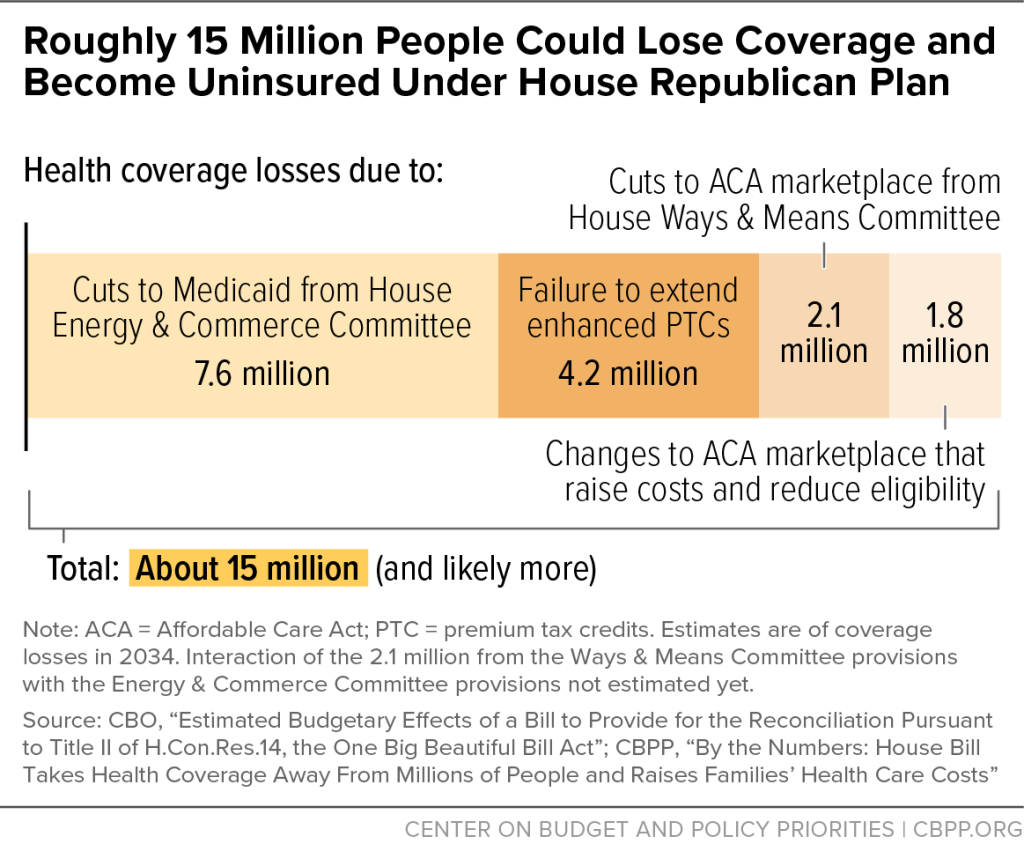
- KFF: Forty states and the District of Columbia could see at least 13% of their Medicaid recipients kicked off their insurance, with rates of loss as high as 32%. This is a high-end estimate of state-by-state Medicaid coverage losses from KFF. KFF, [_{5/16/25}_]
- Center on Budget and Policy Priorities: New work requirements alone could put “9.7 million to 14.4 million people at risk of losing Medicaid coverage in 2034.” CBPP explained, “Evidence shows that much of the coverage loss due to work requirements would occur among people who work or should qualify for an exemption but nevertheless would lose coverage due to red tape.” Center on Budget and Policy Priorities, [_{5/13/25}_]
- Economic Policy Institute: “Work requirements effectively function like a cut to programs.” EPI explained that “while work requirements do not reliably increase employment, they do significantly increase the administrative burden and costs of applying for safety net programs. This increased administrative burden, in turn, reduces access and take-up.” EPI further explained, “In many cases, the sheer amount of additional administrative burdens levied on adults seeking benefits, and on case workers screening to ensure that work requirements are met, is a major driver in the decline in participation.” Economic Policy Institute, [_{1/24/25}_]
//
:{05/20/25
:{06/03/25
05/28/25
---
an
no lnx
Expert warns 'gaslighting' Republican plan does 'much more harm' than just gutting Medicare
John Stoehr June 04, 2025
The Republican budget bill that recently passed the House adds onerous work requirements that would push millions of people off Medicaid. House Speaker Mike Johnson told “Meet the Press” over the weekend that they’d only lose their healthcare if “they choose to do so.” But that, according to Charles Gaba, is “gaslighting b-------.”
“The entire point of imposing work requirements,” Charles told me, “is to either discourage eligible people from enrolling or to make the requirements difficult to comply with, resulting in millions being kicked off the program even if they are working or volunteering.”
Charles Gaba is “the biggest powerhouse Democratic donor wrangler that nobody has ever heard of,” according toPolitico. As the editor and publisher of ACAsignups.net, he’s also one of the country’s leading authorities on Obamacare, Medicaid and healthcare policy, generally.
After the House Republicans passed their budget bill, I got in touch with Charles. I asked him straight up if the legislation guts Medicaid.
Yes, he said, but it does so much more harm than that.
If the congressional Republicans do not extend insurance subsidies passed during the pandemic, Obamacare enrollees will “face massive premium hikes – in many cases, three and four times higher than what they're paying right now,” he said. That’s impacting some 24 million Americans, most of them, Charles reminds me, residing in red states.
The following is a long interview, but vital to anyone with a stake.
Are the Republicans really going to gut Medicaid? Huge numbers of people who voted for and who support Donald Trump depend on it.
The version of the budget bill passed recently by House Republicans absolutely would, if implemented, gut Medicaid – particularly for around 20 million Americans who are currently enrolled in Medicaid via the Affordable Care Act expansion that’s in effect across 41 states.
Obviously, there will be changes made to it in the Senate, so we don't know what the final version of the bill will be, and even if it passes through both the House and Senate, and is signed into law by Trump, there will no doubt be legal challenges to some provisions within it.
But yes, the current version passed by House Republicans would be pretty devastating to both Medicaid as well as ACA exchange enrollees.
There has been less attention to those ACA exchange enrollees. What does the budget bill do to the Affordable Care Act? What do those changes say about Trump and the GOP’s plans for the safety net?
The first way the budget bill hurts the ACA is what it doesn’t include – extend the improved tax credit formula under the Inflation Reduction Act (IRA), which is scheduled to expire at the end of this year.
If the IRA subsidies expire this year, nearly all of the around 24 million Americans enrolled in healthcare coverage via the ACA exchanges will face massive premium hikes – in many cases, three and four times higher than what they're paying right now.
Millions will be priced out of being able to afford coverage at all, while most of the rest will have to either eat the higher premiums, downgrade to a lower-quality plan with higher deductibles, higher copays, a worse provider network or all of the above. Or they'll have to move to non-ACA coverage via so-called "junk plans," which have few if any of the patient protections required by ACA plans.
That’s what the budget bill doesn’t do to the ACA. What does it do?
It makes a bunch of changes to how ACA exchange enrollment and tax credit eligibility work. Some of these get pretty wonky, and some would "just" be codifying rules that are already being put into place by the Trump Administration, but the list includes things like:
Denying tax credits via ACA exchange plans to anyone who (ironically) gets kicked off of Medicaid for failing to meet the new "work reporting requirement" provisions.
Changing the ACA's formula for determining "maximum out of pocket" costs (MOOP), so that enrollees would face hundreds of dollars in higher deductibles and copays.
Weakening the ACA "metal level" rules to let insurance carriers make plans less comprehensive (ie, silver plans are supposed to cover around 70 percent of average enrollee costs; under the GOP changes, a silver plan cold cover as little as 66 percent.)
Cutting the open enrollment period nearly in half, from the current 76 days down to 45 days.
Mandating a $5 per month premium on some low-income enrollees who are currently eligible for $0 per month premiums.
Adding a whole bunch of extra red tape to millions of enrollees for them to remain eligible for tax credits.
All of this illustrates Trump and the GOP's disdain for and hatred of the social safety net as a whole: If they can't get rid of it outright, they'll deliberately make it too cumbersome and complicated to work, thus allowing them to claim government itself doesn't work.
:{Or,:{ as PJ O'Rourke once put it: The Republicans are the party that says government doesn't work and then they get elected and prove it}:
- YouTube
www.youtube.com
How are the Republicans going to justify taking health insurance away from people or making what they do have worse than it is?
GOP House Speaker Mike Johnson has repeatedly used the "lazy young men playing videogames" stereotype, as who he claims they want to force into "getting off the couch to get a job" etc, even though there's no evidence that a lack of healthcare coverage inspires young men to seek employment and plenty of evidence that providing healthcare coverage to people makes them more likely to get and keep a job.
They're also trying to claim that millions of undocumented immigrants are "stealing" healthcare even though federal dollars don't pay for Medicaid for any undocumented immigrants. There's a few states that pay for Medicaid for that population using 100 percent state dollars, which is entirely up to the voters of those states. Yet the House Republican bill tries to blackmail those states into not paying for Medicaid for undocumented immigrants by threatening to withhold federal dollars for US citizens and documented residents if they don't.
I'm going to be generous and say that Trump voters seem confused. A recent report by NPR suggested that they don't want Medicaid cuts for people they know, but do want cuts for some kind of makebelieve freeloader. This seems to me a recipe for continued support for Trump, even as he's hurting his own people. Thoughts?
Sadly, that sounds likely to be the case. I listened to and read the NPR piece you mentioned, and everyone who talked about "waste" or "abuse" spoke in very vague terms without ever specifying who exactly they think is "abusing" or "wasting" Medicaid dollars.
In addition, they seem to simply flat-out refuse to believe that Republicans and Trump will take away their healthcare, because "that wouldn't be right" and "I need it," regardless of what's in the bill.
I've even read other articles where Trump supporters shrugged off the potential loss of Medicaid/ACA coverage, because they figured that Democrats would stop or reverse the cuts from happening, which seems like a rather twisted sort of justification for supporting Republicans.
That seems to be happening in the interplay between the House and the Senate. Trump voters want cuts for "those people." So the House bill passed. They don't want cuts for themselves. So the bill is stalling in the Senate. I don't know what any Democrat could say to Trump voters when the point for them is theater, not solving problems.
I know that Missouri Senator Josh Hawley has been vocal about opposing any major cuts to Medicaid while Alaska Senator Lisa Murkowski has openly called for the IRA subsidies to be extended.
The House GOP bill does a lot to try to punish Democrats more than Republicans, but it would still be pretty devastating for millions of Republicans no matter what, making it difficult to square the circle.
While I noted there are more Medicaid expansion enrollees in blue House districts, there are more ACA exchange enrollees in red House districts, and even within those, there's still no way of knowing for certain whether a particular enrollees is a "one of their own" or not.
NOW READ: 'Watch carefully': Marjorie Taylor Greene doubles down in new 'warning' to lawmakers
---
---
still saying 300 yr get SS but now fixed!
raw 625
Late-night Trump brag shattered by 'damning' report issued just hours later
// an 6 25
An analysis by Washington Post fact checker Glenn Kessler shows the Trump administration is still wheeling out lies months after they’ve been outed.
“This is an example of how, even after falsehoods are exposed, the spin machine keeps working,” wrote Kessler, referring to a March 4 post by President Donald Trump that “government databases list … 3.47 million people from ages 120 to 129, 3.9 million people from ages 130 to 139. 3.5 million people from ages 140 to 149. And money is being paid to many of them.”
In February, the Washington Post published an article documenting the truth of the matter, that Social Security databases rely on an almost 70-year-old computer programming language called COBOL, which doesn’t have a standardized way to store dates.
READ MORE: 'Stop the foolishness': Susan Collins in the hot seat as she navigates Trump's second term
This means ancient programmers assigned a default date, such as 1875, to people lacking birth information, many of them seniors born before a reliable federal birth recording program was in place. But when Musk’s DOGE team scanned Social Security systems, “they were shocked to find people listed in the system with absurd ages because of the limitations of an old programming language,” writes Kessler.
People familiar with Social Security’s systems were already aware of the issue, of course. The Social Security Administration has automatically terminated the benefits of people once they reach age 115 since 2015. Kessler reports the U.S. Office of Inspector General had recommended a cleanup of the system in 2023, but Social Security deferred the project because it would “divert resources” from other important work and “would have limited or no benefit to the administration.” A 2023 IG report found the vast majority of beneficiaries who lacked a birth date had already died and been purged from the system anyhow. Plus, any major overhaul could introduce new errors to the system.
Still, the notion of wrongdoers scamming Social Security was “an irresistible talking point,” says Kessler, so much so that DOGE bragged of fixing the “problem” late last month on social media: “After 11 weeks, Social Security has finished this major cleanup initiative: ~12.3M individuals aged 120+ have now been marked as deceased.”
“The post was carefully worded,” said Kessler. “It did not claim that 12 million people had received improper payments. Instead, it said that these people had been marked as deceased. In other words, DOGE appears to have implemented the plan suggested by the IG two years ago.”
READ MORE:Swing state voters beg their Republican senator to protect them from the Trump grift-ocracy
Despite that, Kessler said Trump supporters eagerly greeted the news and used it to justify the president's “original false claim.”
Sen. Tim Scott (R-S.C.) was one of many cheerleaders jumping aboard a non-moving train, claiming: "No more 300-year-olds getting Social Security checks because of Elon Musk. Thank God President Trump had the wisdom to put Elon in place."
The train included other personalities such as right-wing entertainer Sean Hannity, and Speaker Mike Johnson.
“… [W]ithin the echo chamber of the pro-Trump universe, a problem that never existed now has been fixed,” Kessler said.
READ MORE: MAGA rhetoric backfires as far-right activist suggests violence against trump admin officials
Read the original Washington Post report at this link.
---
an 5 25
:{:{During the House’s marathon markup of President Donald Trump’s historic budget bill, the Chairwoman of the powerful Rules Committee lashed out at Democrats for plainly describing the legislation’s sweeping consequences. Officially dubbed the “One Big, Beautiful Bill Act,” the measure narrowly passed in the early hours of Thursday by a 215–214 vote. }:
It removes $800 billion in funding from Medicaid, would lead to $535 billion in cuts to Medicare, and is projected to cause an estimated 8.6 to 13.7 million Americans to lose their health care. It will also add $3 trillion to the federal deficit—fueled by tax breaks heavily tilted toward the wealthy and the nation’s first-ever $1 trillion defense budget.}:
“I am concerned about what has been said about this bill and what it’s going to do,” Chairwoman Virginia Foxx (R-NC) told the members of her committee Wednesday night. “The extreme comments that have been made about it, and how I believe that it is scaring people out there in the country unnecessarily.”
“The words I’ve heard, particularly today, are ‘cut,’ ‘rip,’ ‘gut,’ ‘kill,’ ‘cruel,’ ‘stealing food,’ ‘losing coverage,’ ‘jammed through,’ ‘biggest transfer of wealth from vulnerable to wealthy people,’ ‘irresponsible’.”
“That is not the way we ought to be talking about this bill.”
READ MORE: ‘Sovereignly Appointed’: Trump Praised in Pentagon Prayer Event Led by Hegseth and Pastor
Many appear to disagree.
MSNBC columnist Michael A. Cohen, just after the bill passed Thursday morning, wrote: “What we do know about the legislation the GOP is calling the ‘One Big Beautiful Bill Act’ is genuinely terrifying.”
“What makes this situation even worse is that Republicans, from the president on down, are consistently lying about what the bill would do,” Cohen charged.
“The House Republican budget plan would eviscerate Medicaid and food assistance and shift resources toward the wealthiest Americans,” the Center for American Progress (CAP) warned ten days ago, adding that it “would implement the largest cuts to both Medicaid and the Supplemental Nutrition Assistance Program (SNAP) in history—kicking millions of Americans off their health insurance and taking food away from hungry children.”
“It would raise household electricity costs while trapping most middle-class and poor students in greater student loan debt to afford a higher education,” CAP’s Bobby Kogan, Senior Director for Federal Budget Policy wrote. “And it would make all these changes as a means to partially offset tax breaks that disproportionately go to the richest Americans, giving households in the top 0.1 percent a multihundred-thousand-dollar tax break on average while increasing deficits by trillions of dollars. Taken as a whole, the bill would add trillions of dollars to structural deficits despite these enormous cuts to critical services.”
“If enacted,” Kogan warned, “this would be the largest transfer of wealth from the poor to the rich in a single law in U.S. history.”
READ MORE: ‘Get Out of Here’: Trump Erupts, Calls for NBC Probe After Reporter Asks About Qatari Jet
“Taken as a whole, this bill would harm Americans—particularly the most vulnerable people—and leave the country worse off. It would lead to preventable deaths by taking health care away from millions of people. It would worsen food insecurity by taking food away from the hungry, particularly kids.”
“Budgets showcase our morality because they force governments to decide how to prioritize limited resources. The House Republican budget plan would shift funding away from the sick and hungry and, instead, toward the wealthiest Americans.”
U.S. Rep. Veronica Escobar (D-TX) responded to Foxx, saying, “In other words, ‘please don’t call this bill what it is or say what it does’.”
Watch the video below or at this link.
---
===
SEE BAD FAITH LIE TRUMP CONSTANTLY SAYS NO CUT SOC SEC; GOP SAY SAME BUT PASS BILL TO CUT 800M NO OTHER WAY
an 525
'Under cover of night,' Republicans unveil plan to kick over 8 million off healthcare
AOC STRONG
---
AN 5 25 COMM DR
U.S. Rep. Alexandria Ocasio-Cortez castigated House Republicans for pursuing massive cuts to Medicaid "in the dead of night" as a committee markup hearing on the GOP's legislation dragged on into the early hours of Wednesday morning.
Ocasio-Cortez (D-N.Y.) said it is shameful that Republicans are rushing ahead with their proposal "at 2:38 in the morning, when everyone is asleep, when we've asked for the opportunity to do this in the light of day so that people can call their representatives' offices in order to stop this disaster."
As the House Energy and Commerce Committee hearing kicked off Tuesday afternoon, demonstrators gathered in the Rayburn House Office Building and more than two dozen people were arrested for protesting the GOP's Medicaid proposal, which would cut the program by around $800 billion over the next decade and leave around 8 million more people uninsured.
But attention on the hearing naturally dwindled as it continued into the night and early Wednesday morning. As of this writing, the critical .
During her remarks at the hearing, Ocasio-Cortez said Republicans have looked to the state of Georgia as a model for their Medicaid proposals—particularly their push for work requirements that advocates say would endanger coverage for millions of people who are eligible for benefits.
Ocasio-Cortez noted that Georgia is among the states with the highest uninsured rates in the nation.
"The Republican majority has looked at the state with the third-highest number of uninsured Americans and said, 'That's what we want to model our Medicaid system after—this catastrophic failure,'" said the New York Democrat.
The Center on Budget and Policy Priorities (CBPP) noted Tuesday that beginning in 2029, the GOP bill would "require states to deny coverage to people applying for Medicaid if they are not already working (or participating in another qualifying activity) at least 80 hours per month, as well as terminate Medicaid for people already enrolled if they cannot document that they are meeting work requirements."
"Evidence shows that much of the coverage loss due to work requirements would occur among people who work or should qualify for an exemption but nevertheless would lose coverage due to red tape (states should be able to exempt most people with children automatically, but many others who should be exempt, such as people with disabilities, would not be automatically exempted)," the group observed.
CBPP estimated that the Republican plan would put between 9.7 million and 14.4 million people at risk of losing Medicaid coverage by 2034.
"Let me be clear—this is not a moderate bill, and it is not focused on cutting 'waste, fraud, and abuse,'" said Rep. Frank Pallone Jr. (D-N.J.), the ranking member of the House Energy and Commerce Committee. "Instead, Republicans are intentionally taking healthcare away from millions of Americans so they can give giant tax breaks to the ultra-rich who don’t need them."
Politicoreported early Wednesday that "after hours of debate, Republicans in unison voted down a Democratic amendment that would have required the Health and Human Services Secretary to certify that the GOP bill would not reduce any Medicaid benefits offered by states, pointing to President Donald Trump's repeated pledges to protect the program."
Republicans started several markup sessions for key pieces of their reconciliation package at around the same time on Tuesday, reportedly a deliberate effort to disperse and weaken the opposition.
"Down the hallway, they are trying to finance tax cuts for people who are inheriting $22 million houses," Ocasio-Cortez said Wednesday, referring to the House Ways and Means Committee's marathon hearing on the tax section of the reconciliation bill.
Republicans also held a hearing Tuesday for their proposal to slash the Supplemental Nutrition Assistance Program (SNAP) by hundreds of billions of dollars. The lasted more than three hours and is expected to resume Wednesday morning.
"Tonight, you're taking food away from single moms with 7-year-olds at home—as if being a single parent raising a young child wasn't hard enough already. And farmers, too, will suffer from your direct attacks on SNAP," Rep. Angie Craig (D-Minn.), the top Democrat on the House Agriculture Committee, said at the hearing. "Benefits will get cut—and for what? To fund tax breaks for everyone but the middle class."
NOW READ:How MAGA got brainwashed: The science behind the right-wing’s 50-year propaganda campaign
---
---
AN RAW 5 245
NO LNX
'A bumpy ride': Republican extremists and moderates unite to defy Trump
Matt Lasloand Raw StoryMay 15, 2025
A long-simmering Republican Party feud is threatening to derail President Donald Trump’s agenda.
Representatives from either ideological end of the GOP U.S. House conference, hard right and moderate center, told Raw Story on Wednesday work on the GOP’s contentious spending bill, covering tax and spending cuts and enshrining Trump's hardline immigration policy, remains a long way from done.
“This one isn't real close,” said Andy Harris (R-MD), chair of the hard-right Freedom Caucus. “It’s not ready for prime time.”
“This as it stands, I’ve been very clear, does not have my support,” said Mike Lawler (R-NY), a prominent moderate demanding a raise in the cap on SALT, the state and local tax deduction key to Republicans from prosperous, Democratic-led states.
“I know the speaker is trying,” Lawler added. “I know he's going to continue to negotiate in good faith. But as this stands right now, I am a no, and so they're going to need to come up with a solution quickly if they want to stay on the schedule they have.”
Speaker Mike Johnson first wanted to get the budget — containing all Trump's spending priorities in “one big beautiful bill” – done by Memorial Day, towards the end of May. Amid marathon mark-up sessions and seemingly endless negotiations, that target has slipped to the next big holiday: July 4.
Republicans control the House 220-213, with two Democratic seats vacant. Johnson cannot afford many nos.
A main aim of the Republican measure, which when passed will have to be reconciled with a Senate version, is to extend tax cuts passed under the first Trump administration in 2017. It’s also needed to fund the deportation force Trump is bent on unleashing nationwide.
Right-wingers want to secure such tax cuts while slashing federal spending and reducing the federal deficit. More moderate members see the need to raise the SALT cap and threats to impose major cuts to Medicaid as threatening serious damage back home.
Other members of the Freedom Caucus voiced their skepticism to Raw Story.
“I'm not flexing this because I'm trying to get something to South Carolina,” said Ralph Norman (R-SC). “I'm trying to get the math in order to get this country back on track financially. And it just hadn't happened.”
Eric Burlison, of Missouri, predicted ongoing “negotiations and discussions” and voiced support for Ron Johnson, the rightwing Wisconsin senator who on Tuesday said the bill could go down “like the Titanic.”
“Ron Johnson, he has doubts on this, and he's right to have doubts,” Burlison said, adding that he “expect[s] the Senate to be more squishy than us.”
Republicans control that chamber 53-47.
Burlison said the budget talks presented “an opportunity to fix Medicaid … an opportunity to do a lot of reform that we're leaving on the table.
“This Medicaid situation is unsustainable,” he said, before raising a familiar Republican boogeyman: “California has figured it out. California gets more money from the federal government and Medicaid than Florida spends on their entire state budget.
“It's crazy … they're gaming the system, they're gaming the federal government, and then this bill is going to lock in that gamesmanship that blue states like California and New York have been playing and that's what's frustrating to me.
“We have the opportunity to fix this stuff or get the United States government on a financially balanced footing, and we're not taking advantage of this opportunity.”
Jason Smith (R-MO) is chair of the House Ways and Means Committee — one of the most stressful jobs on Capitol Hill right now.
He insisted that “we’re gonna get it done” and if it’s “a bumpy ride, the whole ride, everyone should expect that.”
“I’m OK for whatever passes the bill,” Smith said, adding: “I will do whatever is necessary. I've said it all along … I'll do whatever this takes.”
Lawler and his fellow New Yorker Nick LaLota would like Smith and other leaders to give ground on SALT.
“People are passionate to support their constituency,” said LaLota, who held his Long Island seat last year by beating the CNN host John Avlon.
“Their passion [is] to put this great country back on the right track. That that passion has led to some frustrations is totally fine. I think we'll get there.
“I think we all want to come to a deal ultimately, but it's got to be a deal that's both good for my constituents and the country.
“My constituents helped pay for the 2017 tax cuts when [Republican leaders] capped SALT unfairly at $10,000. The bill was placed on districts like mine to pay for the rest of the nation's prosperity. We can't make that mistake” again."
===
an 5 25
PHOENIX — As an Arizona bill to block people from using government aid to buy soda headed to the governor’s desk in April, the nation’s top health official joined Arizona lawmakers in the state Capitol to celebrate its passage.
Health and Human Services Secretary Robert F. Kennedy Jr. said to applause that the legislation was just the start and that he wanted to prevent federal funding from paying for other unhealthy foods.
“We’re not going to do that overnight,” Kennedy said. “We’re going to do that in the next four years.”
Those words of caution proved prescient when Arizona’s Democratic governor, Katie Hobbs, vetoed the bill a week later. Nevertheless, state legislation to restrict what low-income people can buy using Supplemental Nutrition Assistance Program benefits is gaining momentum, boosted by Kennedy’s touting it as part of his “Make America Healthy Again” platform. At least 14 states have considered bills this year with similar SNAP restrictions on specific unhealthy foods such as candy, with Idaho and Utah passing such legislation as of mid-April.
Healthy food itself isn’t largely a partisan issue, and those who study nutrition tend to agree that reducing the amount of sugary food people eat is a good idea to avoid health consequences such as heart disease. But the question over the government’s role in deciding who can buy what has become political.
The organization largely behind SNAP restriction legislation is the Foundation for Government Accountability, a conservative policy think tank out of Florida, and its affiliated lobbying arm, which has used the name Opportunity Solutions Project.
FGA has worked for more than a decade to reshape the nation’s public assistance programs. That includes SNAP, which federal data shows helps an average of 42 million people afford food each month. It also advocates for ways to cut Medicaid, the federal-state program that connects 71 million people to subsidized health care, including efforts in Idaho and Montana this year.
FGA’s proposals often seek to limit who taps into that aid and the help they receive. Those backing the group’s mission say the goal is to save tax dollars and help people lift themselves out of poverty. Critics argue that FGA’s proposals are a backdoor way to cut off aid to people who need it and that making healthy food and health care more affordable is a better fix.
Now, FGA sees more room for change under the Trump administration and the Kennedy-led health department, calling 2025 a “window of opportunity for major reform,” according to its latest annual report.
A Vision for Limiting Government Benefits
Tarren Bragdon, a former Maine legislator, founded FGA in 2011 to promote policies to “free millions from government dependency and open the doors for them to chase their own American Dream,” he said in a statement on FGA’s website. The main foundation started out as a staff of three with about $60,000 in the bank. As of 2023, it had a budget of more than $15 million and a team of roughly 64, according to the latest available tax documents, and that’s not counting the lobbying arm.
The foundation got early funding from a grant from the State Policy Network, which has long backed right-leaning think tanks with ties to conservative activists including brothers Charles and David Koch.
FGA declined several interview requests for this article.
In recent years, the nonprofit helped draft a 2017 Mississippi law, the Jackson Free Press found, which intensified eligibility checks for public aid that made it more difficult for some applicants to qualify. It successfully pushed a 2023 effort in Idaho to impose work requirements for food benefits that health care advocates said led some recipients to lose access.
The same year, the group helped pass SNAP restrictions affecting eligibility in Iowa. Since those restrictions have taken effect, the Food Bank of Iowa has seen a record number of people show up at its pantries amid rising grocery prices and a scaling back of covid pandemic-era federal support, said Annette Hacker, a vice president at the nonprofit.
Part of the group’s strategy is to pass legislation state by state, with the idea that the crush of new laws will increase pressure on the federal government. For example, states can’t limit what food is purchased through SNAP without federal approval through a waiver process. And in the past, some of FGA’s efforts have stalled because states never got that approval.
Kennedy’s agenda now echoes some of FGA’s key messages, and he has said states can expect approval of their waivers. Meanwhile, congressional leaders are eyeing nationwide Medicaid cuts and work requirements, which FGA considers among its major issues. The foundation also has a connection working inside the administration: Its former policy director, Sam Adolphsen, was tapped to advise President Donald Trump on domestic matters.
“We’re excited to fight from Topeka to Washington, D.C., as opposed to Washington, D.C., to Topeka,” Roy Lenardson, FGA’s state government affairs director, told Kansas lawmakers in February when testifying in support of SNAP legislation there.
Shaping State Policies
In the states, FGA has become known as a conservative “thought leader,” said Brian Colby, vice president of public policy for Missouri Budget Project, a progressive nonprofit that provides analysis of state policy issues.
“Conservatives used to try to chop away at the federal budget,” Colby said. “These guys are doing it at the state level.”
In its 14 years, FGA has created a playbook to shape state policy discussions around public benefits behind the scenes. In Montana, retired Republican legislator Cary Smith, who worked with FGA, said not all of the think tank’s ideas split along party lines.
“They offer a buffet of options,” he said. “Their agenda is making government accountable; it’s in the name.”
He said besides drafting legislation, FGA provides talking points and data to help policymakers support their arguments. “They would go in and would say, ‘This is what Medicaid fraud is costing us,’” Smith said. “That would be the number you’d want to use in your bill.”In January, FGA released a memo for states to “stop taxpayer-funded junk food.” In February, Stateline reported that Wyoming Republican state Rep. Jacob Wasserburger said the group asked him to sponsor a SNAP restriction bill. The state sponsor of similar legislation in Missouri has repeated at least one of FGA’s talking points, as reported by the Missouri Independent. In Arizona, Republican Rep. Leo Biasiucci, who sponsored the SNAP legislation there, told KFF Health News FGA was behind that bill as well.
Opponents of such bills argue the proposals are not as simple as they sound. Amid debate on a SNAP bill in Montana, Kiera Condon, with the Montana Food Bank Network, testified the legislation would force grocery store workers to sort through what counts as soda or candy, “which could result in retailers not participating in SNAP at all.”
State lawmakers tabled the Montana bill in April.
Montana legislators also easily passed a bill to extend the state’s Medicaid expansion program even after FGA began publishing a series of papers that asserted the program was “breaking” Montana’s budget. FGA had presented data saying most Montanans on the program don’t work, which state data refutes.
Ed Bolen, who leads food aid strategies at the left-leaning Center on Budget and Policy Priorities think tank, said FGA has a pattern of proposing technical changes to existing laws and “unworkable work requirements” that cause people to lose benefits.
After working with policymakers in Kansas for a decade, FGA helped pass legislation that limited how long people can access cash assistance, added work requirements to SNAP, and banned the state from spending federal or state funds to promote public aid. Many of those changes came through 2015 legislation known as the “HOPE Act” drafted by FGA, The Washington Post reported.
Analysis from Kansas Appleseed, an advocacy organization for low-income Kansans, found the SNAP caseload sharply declined after the bill was enacted because of the new hurdles, dropping from 140,000 households in January 2014 to 90,000 as of January 2020.
“It’s death by a thousand cuts,” said Karen Siebert, an adviser for Harvesters, a community food bank network in Kansas and Missouri. “Some of these FGA proposals are such complex policies, it’s hard to argue against and to explain the ripple effects.”
In 2024, the foundation produced more than two dozen videos featuring state politicians from across the nation touting the organization’s goals and dozens of research papers arguing public benefits are wrecking state budgets. FGA also has its own polling team to produce data out of the states it’s working to influence.
The organization released a list of 14 states it labeled as “redder and better” places to exert more influence. That included Idaho, where the group has four registered lobbyists in the state Capitol.
In 2023, FGA helped present and successfully lobby for legislation there to require people receiving food aid to work at least 80 hours a month. The organization called the resulting law “landmark welfare reform” years in the making.
And this year, Idaho lawmakers passed more requirements for people enrolled in Medicaid who can work. FGA staffers worked with one of the co-sponsors of the legislation on a similar bill last year that failed, then again this year. A compromise bill passed with FGA’s backing, marking another victory for the foundation.
David Lehman, a lobbyist for the Idaho Association of Community Providers, which represents health organizations that have opposed FGA bills, said Idaho illustrates how FGA works with sympathetic lawmakers in conservative states to gain more ground.
“They’re pushing an already rolling rock downhill,” he said.
KFF Health News is a national newsroom
---
---
AN 525 COMM DR
A letter that a group of 20 far-right House Republicans released earlier this week as part of a campaign in support of slashing Medicaid appears to have been authored by the head of a research institute with ties to the Koch network.
Politicoreported Friday that "digital metadata embedded in a PDF copy" of the letter that was circulated inside the House of Representatives "lists the author as Brian Blase, president of Paragon Health Institute."
InfluenceWatch notes that in 2021, Paragon received a nearly $2 million donation from Stand Together, "a right-libertarian funding organization that acts as the umbrella organization for the political network that is largely funded by right-leaning businessman and political donor Charles Koch."
Paragon recently urged federal policymakers to require states to conduct more frequent eligibility checks for Medicaid recipients in a purported effort to root out improper payments. Health policy advocates say such a change would make it more difficult for eligible enrollees to keep their Medicaid coverage.
The letter signed by Rep. Chip Roy (R-Texas) and other House Republicans aligns with Paragon's objectives, claiming that "political abuse" of Medicaid "is helping to bankrupt the federal government" and calling for "structural Medicaid reform" in the party's forthcoming reconciliation package.
Tony Carrk, executive director of the watchdog group Accountable.US, said in a statement that "you'd be hard pressed to find a more shameless example of congressional Republicans taking their cues from special interests at the cost of the American people than Chip Roy copying and pasting a letter directly from... special interests."
"This remarkably blatant kowtowing to conservative billionaires is a sad reflection of the congressional Republicans' willingness to make devastating cuts to Americans' healthcare to pay for lower taxes for the richest," said Carrk.
The letter was released as congressional Republicans grappled internally with how and how much to cut Medicaid as they seek to offset the massive projected costs of another round of tax breaks for the rich.
Earlier this week, as Common Dreamsreported, Rep. Don Bacon (R-Neb.) said he would not accept more than $500 billion in cuts to Medicaid over the next decade. Cuts of that magnitude would still be the largest in the program's history and would strip health coverage from tens of millions of people.
ref
A letter signed by 20 hard-line House Republicans calling for deep cuts to Medicaid in the GOP’s domestic policy megabill appears to be written at least in part by a conservative think tank with ties to top Republican leaders.
Rep. Chip Roy of Texas led the letter and promoted it publicly but digital metadata embedded in a PDF copy circulated inside the House and obtained by POLITICO lists the author as Brian Blase, president of Paragon Health Institute.
Blase served on the White House National Economic Council during President Donald Trump’s first term. He and other conservative health wonks launched Paragon in 2021, and it has rapidly gained influence in GOP policy circles. Former Paragon staffers are now top health aides to Speaker Mike Johnson and President Donald Trump.
According to tax records gathered by InfluenceWatch, Paragon has received seven-figure donations from groups linked to high-profile conservative activists Charles Koch and Leonard Leo.
The push from Roy and his fellow hard-liners to enact massive “structural” reforms across Medicaid comes as centrists and even some more conservative-leaning members have raised concerns about cutting too deeply into the program. Trump is also wary of slashing the program but has signaled he supports some efforts to curb spending.
The letter urges House Republicans to pursue “meaningful” reforms to the safety-net health program: “If the House budget reconciliation package does not include structural Medicaid reform that achieves desired Republican outcomes, we will be setting up massive tax increases and benefit cuts in the future,” Roy & Co. wrote. “For once, Congress should stop procrastinating, using excuses, and finally fulfill the Republican agenda.”
Asked if Blase was in fact the document’s author, Paragon spokesperson Anthony Wojtkowiak said in a statement that the group “sent a list of Medicaid reform principles to policymakers.”
“It appears that the excellent letter by Chip Roy and colleagues incorporated some of our ideas,” Wojtkowiak said, noting the group frequently works with lawmakers on policy issues.
A Roy spokesperson did not respond to a request for comment.
xitter https://x.com/chiproytx/status/1918039017955926054
eli crane and clyde Stutzman mary miller mark harris scot perry keith self, andy fucing ogles, eric burlison sheri biggs barry moore Byron donalds, clay higgins, gosar, any biggs, andy harris MD, josh brecheen, Michael cloud, ralph norman
---
an 4 25
GOP unveils plan to give $150B more to Pentagon amid threats of cuts to Social Security
SOC SAFE NET STEALTH ATTACK? RFK2
AN 4 25
While Republicans throughout the United States are intensifying efforts to regulate soda, lawmakers in Texas, Arkansas, West Virginia, Idaho, Nebraska, Michigan, Arizona, and South Carolina have reportedly declined to support a ban on the drink. However, they are aligned with businessman Michael Bloomberg's other initiatives: banning the purchase of soda with food stamps, formally known as the Supplemental Nutrition Assistance Program (SNAP).
An article in the Atlantic by Nicholas Florko published on Tuesday noted that these states are taking cues from Health and Human Services Secretary Robert F. Kennedy Jr., who has expressed strong opposition to allowing low-income Americans on SNAP to use government funds to buy soda.
"The soda wars have long broken along partisan lines. New York City’s ban was struck down in court before it could go into effect, but even more modest attempts to regulate soda have been concentrated in deeply blue cities such as Berkeley and San Francisco. Liberals drink soda too, of course, though the drink’s biggest defenders are on the right. President Donald Trump loves Diet Coke so much that in both of his terms, he’s had a button installed in the Oval Office to summon a refill; on the campaign trail, now–Vice President J. D. Vance claimed that Democrats see Diet Mountain Dew, his drink of choice, as 'racist,'" the article reads.
ALSO READ: 'You own this': Top GOP senator who backed RFK Jr. now under attack after HHS mass firings
"The federal government’s own research has shown that Americans who receive food stamps have worse diets than nonparticipants with similar incomes, and soda is surely part of that problem. These proposed bans should be even more palatable because they wouldn’t be permanent; they are pilot programs to try out the idea."
Overall, Democrats largely continue to stand against soda bans, the article notes. In both Idaho and Arizona, no Democratic legislators in the state Senates supported the proposed measures in their states. To effectively address soda consumption in the U.S., initiatives like these will need to be included in the solution, the author said.
He further pointed out that the Republican Party’s "about-face on soda" is more stark in West Virginia.
"In July, the state removed its soda tax. And now, less than a year later, it is pushing forward with a SNAP soda ban as part of an effort to decrease consumption of 'ultra-processed crap that barely qualifies as food,' Republican Governor Patrick Morrisey said late last month," the article notes.
ALSO READ:A deadly mosquito-borne illness is rising in the US as Trump cuts health funding
Many seasoned advocates against soda express skepticism about Republicans' motives. Marion Nestle, a professor emeritus at NYU and the author of Soda Politics: Taking on Big Soda (And Winning), has supported bans on soda within the SNAP program. She told the Atlantic that she views the current Republican initiatives as a disguise for their true aim, which is to reduce SNAP funding. Nestle added that while soda is detrimental to health, restricting food stamps also poses risks and that research indicates that the program greatly alleviates food insecurity and lowers healthcare expenses.
Supporters of the soda ban emphasize that the official name of the food-stamp program is the Supplemental Nutrition Assistance Program, highlighting that a two-liter bottle of Pepsi does not contribute to nutritional assistance. However, public health and anti-hunger advocates contend that any food is better than having no food at all.
===
an 4 25
'Hospitals are going to close': Johnson insisted he won’t 'touch Medicaid — but now pushes deep cuts
---
---
an 4 25
President Donald Trump’s firings at the Department of Health and Human Services included the entire office that sets federal poverty guidelines, which determine whether tens of millions of Americans are eligible for health programs such as Medicaid, food assistance, child care, and other services, former staff said.
The small team, with technical data expertise, worked out of HHS’ Office of the Assistant Secretary for Planning and Evaluation, or ASPE. Their dismissal mirrored others across HHS, which came without warning and left officials puzzled as to why they were “RIF’ed” — as in “reduction in force,” the bureaucratic language used to describe the firings.
“I suspect they RIF’ed offices that had the word ‘data’ or ‘statistics’ in them,” said one of the laid-off employees, a social scientist whom KFF Health News agreed not to name because the person feared further recrimination. “It was random, as far as we can tell.”
Among those fired was Kendall Swenson, who had led development of the poverty guidelines for many years and was considered the repository of knowledge on the issue, according to the social scientist and two academics who have worked with the HHS team.
The sacking of the office could lead to cuts in assistance to low-income families next year unless the Trump administration restores the positions or moves its duties elsewhere, said Robin Ghertner, the fired director of the Division of Data and Technical Analysis, which had overseen the guidelines.
The poverty guidelines are “needed by many people and programs,” said Timothy Smeeding, a professor emeritus of economics at the La Follette School of Public Affairs at the University of Wisconsin. “If you’re thinking of someone you fired who should be rehired, Swenson would be a no-brainer,” he added.
Under a 1981 appropriations bill, HHS is required annually to take Census Bureau poverty-line figures, adjust them for inflation, and create guidelines that agencies and states use to determine who is eligible for various types of help.
There’s a special sauce for creating the guidelines that includes adjustments and calculations, Ghertner said. Swenson and three other staff members would independently prepare the numbers and quality-check them together before they were issued each January.
Everyone in Ghertner’s office was told last week, without warning, that they were being put on administrative leave until June 1, when their employment would officially end, he said.
“There’s literally no one in the government who knows how to calculate the guidelines,” he said. “And because we’re all locked out of our computers, we can’t teach anyone how to calculate them.”
ASPE had about 140 staff members and now has about 40, according to a former staffer. The HHS shake-up merged the office with the Agency for Healthcare Research and Quality, or AHRQ, whose staff has shrunk from 275 to about 80, according to a former AHRQ official who spoke on the condition of anonymity.
HHS has said it laid off about 10,000 employees and that, combined with other moves, including a program to encourage early retirements, its workforce has been reduced by about 20,000. But the agency has not detailed where it made the cuts or identified specific employees it fired.
“These workers were told they couldn’t come into their offices so there’s no transfer of knowledge,” said Wendell Primus, who worked at ASPE during the Bill Clinton administration. “They had no time to train anyone, transfer data, etc.”
HHS defended the firings. The department merged AHRQ and ASPE “as part of Secretary Kennedy’s vision to streamline HHS to better serve Americans,” spokesperson Emily Hilliard said. “Critical programs within ASPE will continue in this new office” and “HHS will continue to comply with statutory requirements,” she said in a written response to KFF Health News.
After this article published, HHS spokesperson Andrew Nixon called KFF Health News to say others at HHS could do the work of the RIF’ed data analysis team, which had nine members. “The idea that this will come to a halt is totally incorrect,” he said. “Eighty million people will not be affected.”
Secretary Robert F. Kennedy Jr. has so far declined to testify about the staff reductions before congressional committees that oversee much of his agency. On April 9, a delegation of 10 Democratic members of Congress waited fruitlessly for a meeting in the agency’s lobby.
The group was led by House Energy and Commerce health subcommittee ranking member Diana DeGette (D-Colo.), who told reporters afterward that Kennedy must appear before the committee “and tell us what his plan is for keeping America healthy and for stopping these devastating cuts.”
Matt VanHyfte, a spokesperson for the Republican committee leadership, said HHS officials would meet with bipartisan committee staff on April 11 to discuss the firings and other policy issues.
ASPE serves as a think tank for the HHS secretary, said Primus, who later was Rep. Nancy Pelosi’s senior health policy adviser for 18 years. In addition to the poverty guidelines, the office maps out how much Medicaid money goes to each state and reviews all regulations developed by HHS agencies.
“These HHS staffing cuts — 20,000 — obviously they are completely nuts,” Primus said. “These were not decisions made by Kennedy or staff at HHS. They are being made at the White House. There’s no rhyme or reasons to what they’re doing.”
HHS leaders may be unaware of their legal duty to issue the poverty guidelines, Ghertner said. If each state and federal government agency instead sets guidelines on its own, it could create inequities and lead to lawsuits, he said.
And sticking with the 2025 standard next year could put benefits for hundreds of thousands of Americans at risk, Ghertner said. The current poverty level is $15,650 for a single person and $32,150 for a family of four.
“If you make $30,000 and have three kids, say, and next year you make $31,000 but prices have gone up 7%, suddenly your $31,000 doesn’t buy you the same,” he said, “but if the guidelines haven’t increased, you might be no longer eligible for Medicaid.”
The 2025 poverty level for a family of five is $37,650.
As of October, about 79 million people were enrolled in Medicaid or the related Children’s Health Insurance Program, both of which are means-tested and thus depend on the poverty guidelines to determine eligibility.
Eligibility for premium subsidies for insurance plans sold in Affordable Care Act marketplaces is also tied to the official poverty level.
One in eight Americans rely on the Supplemental Nutrition Assistance Program, or food stamps, and 40% of newborns and their mothers receive food through the Women, Infants, and Children program, both of which also use the federal poverty level to determine eligibility.
Former employees in the office said they were not disloyal to the president. They knew their jobs required them to follow the administration’s objectives. “We were trying to support the MAHA agenda,” the social scientist said, referring to Kennedy’s “Make America Healthy Again” rubric. “Even if it didn’t align with our personal worldviews, we wanted to be useful.”
---
04/11/25
04/10/25 mma
---
an 4 25
With President Donald Trump's tariff proposals causing considerable anxiety in the stock market, a combination of business leaders — including JPMorgan Chase CEO Jamie Dimon — and economists (including Paul Krugman and Robert Reich) fear the possibility of a recession.
If a recession occurs, many Americans will need help from the federal government — be it food assistance via the Supplemental Nutrition Assistance Program (SNAP) or health insurance through Obamacare.
But according to Brendan Duke (senior director for federal budget policy at the Center on Budget and Policy Priorities), the 2025 federal budget being proposed by Republicans in Congress is designed to erode and undermine — not fund — the United States' social safety net.
READ MORE:'Compete mess': Trump slammed as Wall St. CEO says policies will 'probably' cause recession
In a Q&A interview with Salon's Chauncey DeVega published on April 10, Duke warned, "Everywhere you look, you see an attack on core government functions. The Trump Administration is trying to degrade the Social Security Administration's ability to provide elderly and disabled Americans the benefits they're entitled to. They are firing people working at the National Weather Service who provide the data for the weather report you see on your phone. They're hamstringing billions of dollars of cancer research by putting on leave the people who make sure that the research dollars go to cancer researchers."
Duke added, "The goal is not to let all of the horrible things distract you from doing your job, though. It's critical that people whose job it is to protect the programs that low- and moderate-income people rely on focus on the threats and opportunities that are appearing."
Duke cited specific safety-net programs that GOP lawmakers are targeting for major cuts.
"The plans being talked about right now, such as cutting Medicaid and SNAP to finance tax cuts for the wealthy, are part of the standard conservative playbook," Duke told DeVega. "The difference is that our fiscal situation has gotten worse over the last 25 years — we're a long way off from the Clinton budget surpluses — so they feel pressure to cut programs instead of putting tax cuts for rich people on the credit card."
READ MORE:Donald Trump has an addiction: WSJ
Duke continued, "We're still at the stage where they aren't providing specifics of how they're going to cut these programs, but the House Republican budget sets them on a course to cut Medicaid by 10 percent and SNAP by 20 percent. Those are enormous cuts. Some of the goodies they are planning to give to rich people include allowing high-income business owners to write off 20 percent of their profits, doubling the amounts the heirs of the largest estates can inherit tax-free from $14 million to $28 million per couple, and enacting hundreds of billions of dollars of tax breaks for businesses that don't need a tax break."
READ MORE:GOP’s defense of 'Dear Leader' Trump’s 'idiocy' resembles famous suicide cult: analysis
*Chauncey DeVega's full Salon interview with Brendan Duke is availableat this link.
---
AN 3 25
One of President Donald Trump's closest advisors is now suggesting that most of the tens of millions of Americans who rely on Social Security wouldn't be concerned if they didn't receive their benefits.
During a with Chamath Palihapitiya and David Friedberg, Commerce Secretary Howard Lutnick vociferously defended the Trump administration's mass firings and budget cuts to multiple federal agencies. He also heaped praise on South African centibillionaire Elon Musk's Department of Government Efficiency (DOGE) — particularly his controversial goal of cutting Social Security.
In one exchange, Lutnick — who has a net worth of approximately $2 billion according to Investopedia — suggested that the best approach to root out fraud within the Social Security Administration (SSA) was to "stop payments and listen." He also argued that only a "fraudster" would call the SSA if they missed their monthly Social Security payment.
READ MORE:'This is not right!' Elderly woman explodes at GOP senator over Social Security cuts
"I describe it to people this way: Let's say Social Security didn't send out their checks this month. My mother-in-law, who is 94, she wouldn't call and complain. She just wouldn't. She'd think something got messed up, and she'll get it next month," said Lutnick, who paid for his 16,250 square-foot mansion with $25 million in cash. "A fraudster always makes the loudest noise, screaming, yelling and complaining."
"Elon [Musk] knows this by heart," he continued. "Anyone who's been in the payment system and the process system knows the easiest way to find a fraudster is to stop payments and listen. Because whoever screams is the one stealing!"
Lutnick's assertion that Social Security beneficiaries would be unbothered by a missed payment ignores the fact that for millions of recipients, those monthly benefits are critical. According to the Center on Budget and Policy Priorities, nearly four in 10 American adults aged 65 and up would have incomes below the official poverty line without Social Security. Alex Lawson, who is executive director of the advocacy group Social Security Works, told AlterNet that Lutnick's remarks reveal "the problem with government by the billionaires for the billionaires."
"They have no idea what life is like for ordinary Americans. Living in lazy luxury means Lutnick cannot understand that for millions of Americans, missing a single Social Security check means they can’t eat, they can’t pay their rent, they can’t live," Lawson said. "I cannot imagine a more offensive and out of touch comment, it would be funny if it weren’t actually terrifying.”
READ MORE:'You work for us not Trump!' Protesters met with silence from Alaska U.S. senator
Watch the video of Lutnick's comments below, or byclicking this link.
---
---
an 3 25
Defenders of the Social Security Administration on Friday blasted acting Commissioner Leland Dudeks' threat to shut down the agency in response to a federal judge cutting off the Department of Government Efficiency's access to SSA data.
U.S. District Judge Ellen Hollander wrote Thursday that "the DOGE team is essentially engaged in a fishing expedition at SSA." She issued a temporary restraining order targeting affiliates of the government-gutting entity created by Republican President Donald Trump and led by Big Tech CEO Elon Musk, the richest person on the planet.
While the advocacy and labor groups behind the lawsuit celebrated the order from Hollander—who was appointed to the District of Maryland by former President Barack Obama—Dudek responded to the ruling with a threat to shut down the agency entirely.
"My anti-fraud team would be DOGE affiliates. My IT staff would be DOGE affiliates," Dudek told Bloomberg. "As it stands, I will follow it exactly and terminate access by all SSA employees to our IT systems."
"Now, like a child who didn't get his way, he is threatening to shut down Social Security."
Dudek—who is leading the SSA until the U.S. Senate decides whether to confirm Trump's nominee, former Fiserv CEO Frank Bisignano—said he would ask the judge to immediately clarify her order, adding: "Really, I want to turn it off and let the courts figure out how they want to run a federal agency."
Lee Saunders, president of the American Federation of State, County, and Municipal Employees (AFSCME)—which filed the suit with the Alliance for Retired Americans and the American Federation of Teachers—said in a Friday statement that "for almost 90 years, Social Security has never missed a paycheck—but 60 days into this administration, Social Security is now on the brink."
"Acting Commissioner Leland Dudek has proven again that he is in way over his head, compromising the privacy of millions of Americans, shutting down services that senior citizens rely on, and planning debilitating layoffs, all in service to Elon Musk's lies," he continued. "Now, like a child who didn't get his way, he is threatening to shut down Social Security. Rather than comply with a lawful court order, he wants to see millions of families, retirees, and disabled individuals go hungry, suffer, and potentially lose their homes all to curry favor with anti-worker billionaires. It's despicable."
"Even for this administration, this is a new low. Project 2025 didn't dare mention Social Security, but we always knew they would put it on the table," he added, citing a Heritage Foundation-led blueprint for remaking the government. "We've fought back efforts by anti-union extremists and billionaires to privatize and gut Social Security before, and we'll do it again. Workers paid into this program; it belongs to us."
Groups that are not part of the case also took aim at Dudek on Friday. Max Richtman, president and CEO of the National Committee to Preserve Social Security and Medicare, called the threat "to hold hostage" the earned benefits of over 70 million people "inexcusable" and "yet another example of the Trump administration's hostility to American seniors."
"Dudek is throwing a temper tantrum—claiming that if DOGE can't access American's data, neither can anyone else," he said. "No one in the federal government has the breadth of access to data that Elon Musk has demanded. Social Security employees' access is compartmentalized and only made available on a 'need-to-know' basis, and those with access to the data go through rigorous screening, training, and are subject to fines and/or jail time for violating this policy."
Richtman asserted that "Musk's continued effort to justify his actions by doubling down on thoroughly debunked claims of 'massive fraud' at SSA are being laid bare as a mere pretext for acquiring every American's personal information—which could then be used as weapons against anyone who disagrees with the Trump administration's actions."
Nancy Altman, president of Social Security Works, declared that "Dudek's leadership has been the darkest in Social Security's nearly 90-year history. He has sown chaos and destruction... His highest loyalty is to Elon Musk and Donald Trump, not to the beneficiaries that the agency is meant to serve. Singlehandedly, he has taken the security out of Social Security."
"Members of Congress who remain silent are complicit. The Trump-nominated commissioner, who will have his confirmation hearing next week, is no better. In fact, he proudly calls himself 'a DOGE person,'" she warned of Bisignano.
"Every member of Congress, Republicans and Democrats alike, must condemn the destruction of our Social Security system and demand that the Trump administration follow Judge Hollander's order," Altman added. "They must make it clear that no president—even one who thinks he is a king—can shut down our Social Security system."
===
an 3 25
Critics cheer as Dem rips GOP refusal to probe Trump-Musk push to privatize Social Security
===
mma
“You need to cut Medicaid”: Right-wing pundits call to gut health coverage for the poor
Written by Emma Mae Weber & Reed McMaster
Research contributions from John Knefel & Zachary Pleat
Published 03/11/25
Right-wing pundits are calling for cuts to Medicaid as the administration searches for ways to offset Trump’s tax cuts for the wealthy. Conservative media have set their sights on health care, advocating cuts to Medicaid and work requirements for its beneficiaries, which could knock millions off of their health insurance.
* ## Republicans are currently focusing in on cuts to Medicaid, which could put millions at risk of losing healthcare coverage
- On February 25, Republicans in the House of Representatives passed a budget framework calling for up to $2 trillion in spending cuts and $4.5 trillion in tax cuts.The resolution doesn’t directly call for cuts to Medicaid and instead uses a rhetorical sleight-of-hand to disguise the rollbacks as part of an unspecified $880 billion reduction in spending. The New York Times reported that “Medicaid is likely to be the largest target for cuts to achieve the $880 billion in budget savings set out in the legislation.” NYT, [2/26/25, 2/25/25]
- According to the Congressional Budget Office, the GOP's budget resolution will not be feasible without huge cuts to Medicaid or Medicare. Trump said that only “fraud” will be cut to fund the agenda. House Speaker Mike Johnson (R-LA) falsely insisted that the Republican plan would help “save the program for those who really need it” by cutting “out the fraud, waste, and abuse.” Politico, [2/25/25; The Guardian, 3/6/25; Media Matters, 3/6/25; Fox News, Outnumbered, 3/7/25]
Enacting work requirements for Medicaid could put 36 million people at risk of losing their coverage. As it currently stands, nearly two-thirds of Medicaid recipients are already working full or part-time, while most of the rest are either caring for family, have an illness or disability that prevents them from working, or are in school. The remaining 8% are not working because they are retired, unable to find work, or for another reason. Center on Budget and Policy Priorities, [2/5/25; KKF, 2/18/25]|}:
- ## Right-wing pundits advocate for sweeping cuts to Medicaid
- Fox News contributor Ari Fleischer: “Medicaid needs to be touched.” Fleischer called for kicking people off their health insurance, saying, “These people need to come off.” Fleischer added, “They shouldn't be on Medicaid for life. So, Medicaid needs to be touched.” Fox News, *The Story with Martha MacCallum*, [2/26/25]
- Daily Wire’s Ben Shapiro suggested Medicaid is a waste of money and that coverage is “no better” than having no coverage. Shapiro praised the House budget blueprint and claimed, “There's some good studies that actually demonstrate that Medicaid coverage is no better than you having no coverage.” The Daily Wire, *The Ben Shapiro Show*, [2/26/25]
- Right-wing podcaster Candace Owens bizarrely claimed getting rid of Medicaid will make healthcare more affordable.Appearing on Theo Von's podcast, Owens argued, “If we get rid of Medicaid, if we get rid of Obamacare, whatever it is, then you guys are not gonna be able to afford — it's actually the exact opposite. Like, you get rid of these things, and you'll be able to afford it because you're getting rid of all these people that are just taking money from you and stealing from you.” *This Past Weekend with Theo Von*, uploaded to YouTube, [3/5/25]
- Right-wing pundit Kane from Citizen Free Press celebrated the cuts and called for more, specifically for Medicaid. “I’m so excited, Charlie, I’ve never seen anything like these cuts,” Kane said on The Charlie Kirk Show. He added: “I want more. And we haven’t even gotten started. You know: Social Security, Defense, Medicare, Medicaid, those are going to be really, really big for cuts.” Salem Media Group, *The Charlie Kirk Show*, [2/25/25]
- Fox guest Noah Rothman: “Until we start to address the really popular stuff that people like in entitlement programs, Medicare, Medicaid, Social Security and the interest on all that, we’re not going to be talking about real deficit reduction.”Rothman continued, “All of it matters, all of it contributes to, you know, getting back to a fiscally sound trajectory. We shouldn't be pooh-poohing this stuff that is bright and shiny and really obnoxious in the waste of what the federal government spends, but it’s just not going to be the end all, be all to get us to the point at which we're on a sounder fiscal trajectory.” Fox News, *America’s Newsroom*, [3/3/25]
- ## Right-wing pundits call for Medicaid work requirements
- Steve Bannon argued, “You need to cut Medicaid. You can cut Medicaid with both work requirements and stopping Medicaid for illegal aliens, but it has to be really thought through."Real America’s Voice, *War Room*, [2/24/25]
- Bannon also said, “I’m all for cutting Medicaid, particularly taking the waste, fraud, and abuse.”Bannon argued, “Number one, I do think there has to be significant and meaningful work requirements for this.” He added, “Number two, all illegal aliens — or even anyone on the margins of illegal aliens — have to be off those rolls.” Real America’s Voice, *War Room*, [2/24/25]
- Fox News anchor Martha MacCallum argued that work requirements are “common sense” while agreeing with Sen. John Kennedy (R-LA) that there should be work requirements for Medicaid. Discussing a recent op-ed in National Review by Kennedy, MacCallum claimed, “The idea is that if you're able-bodied and you are accepting Medicaid, you should be working as well. Gainfully employed. And it is an idea that I think would be common sense to a lot of people.” Fox News, *The Story with Martha MacCallum*, [2/7/25; National Review, 2/6/25]
- Fox News anchor John Roberts also referenced Kennedy’s op-ed and falsely claimed there are “15 million able-bodied adults without children on Medicaid” who could work.Kennedy’s op-ed relied on a mischaracterization of a 2023 report from the Congressional Budget Office, which in fact found that “many of those people would qualify for an exemption.” Fox News, *America Reports*, [2/6/25; National Review, 2/6/25; Congressional Budget Office, 4/25/23; Media Matters, 3/4/25]
- Ben Shapiro praised a September 2024 op-ed in The Wall Street Journal calling for Medicaid work requirements, adding that “what’s actually going to bring long-lasting success is the politically difficult thing.” Shapiro agreed with the article’s conclusions, arguing that the thing that “is actually driving America’s systemic national debt” is “the means-tested social welfare spending programs, and precisely the things that neither party actually wants to touch — things like Medicaid, food stamps,” and other social programs. The Daily Wire, *The Ben Shapiro Show*, [2/24/25; The Wall Street Journal, 9/11/24]
---
an 3 25
the Trump administration is cutting over $600 million from a program designed to help schools and child care facilities buy healthy food from local farmers, the GOP’s latest attack on poor families. The administration is also cutting a similar program that helps local food banks and other organizations feed people. In total, Politico reported, the cuts come to over $1 billion.
“Roughly $660 million that schools and child care facilities were counting on to purchase food from nearby farms through the Local Food for Schools Cooperative Agreement Program in 2025 has been canceled, according to the School Nutrition Association,” Politico reported. “State officials were notified Friday of USDA’s decision to end the LFS program for this year.”
Coincidentally, last week the U.S. Department of Agriculture (USDA) celebrated National School Breakfast Week:

The decision by the USDA to eliminate funding for healthy food from local farmers also comes as congressional Republicans target programs like the Supplemental Nutrition Assistance Program (SNAP) for cuts.
READ MORE: Democrat Schools Musk on ‘What Makes America Great’ After He’s Called a ‘Traitor’
“Late last month,” Axios reported on Saturday, “House Republicans voted to pass a budget resolution that sets the stage for $230 billion or more in cuts to agriculture programs, with a large chunk expected to come from SNAP.”
The move to ax funding for programs that help children eat healthy foods appears to conflict with Health and Human Services Secretary Robert F. Kennedy Jr.’s claim to want to “Make America Healthy Again.”
That slogan has led RFK Jr. to announce he wants to curtail the types of foods families can buy through SNAP, which could especially affect Americans living in rural areas or “food deserts,” as Axios also reported last month.
According to The Guardian, “more than one in eight households say they have difficulty getting enough food.” SNAP, “formerly known as food stamps, helps more than 42 million people fill those gaps, and is considered the country’s most effective tool to fight hunger. But now, the USDA-run program is facing attacks from House Republicans who see deep cuts as a way to pay for an extension of the 2017 tax bill that benefits the very wealthy.”
READ MORE: ‘Chilling’: Amid Recession Alarms and Market Nosedive Trump White House Blames Biden
Critics are blasting the cuts.
“Taking $230 billion out of the food economy hurts the farmers who grow our food, the truckers who move it, the processors who package it and the grocery stores that sell it,” House Agriculture Committee Ranking Member Angie Craig (D-MN) said in a statement in February. “Cutting farm bill nutrition programs does not make life affordable for everyday people. Instead of cutting SNAP to pay for handouts to wealthy donors, Republicans should prioritize helping working people and rural economies.”
Melanie D’Arrigo, executive director of the Campaign for New York Health remarked, “Trump is cutting $660M meant for local farmers to provide healthy food for kids in schools. Big win for the giant processed food corporations who poured millions into Donald Trump’s campaign. How does hurting farmers and kids make America great again?”
Zach Rodvold, director of public affairs at Second Harvest Heartland, a hunger-relief organization, wrote: “With hunger rates soaring and the farm economy under threat, now is not the time to cut funding for local farm-to-school and food bank programs. (In fact, we should be doing just the opposite.)”
“This is absolutely unacceptable. They’re literally taking kids’ lunch money and farmers’ incomes so they can give tax cuts to billionaires,” observed U.S. Rep. Josh Riley (D-NY).
“Cutting food aid hurts kids, farmers and struggling folks,” noted U.S. Senator Tim Kaine (D-VA). “Why is Trump doing it? To help pay for his tax cut for the rich. Heartless.”
an 2 25
Like many Americans who voted for Donald Trump, Jason Rouse hopes the president’s return will mean lower prices for gas, groceries, and other essentials.
But Rouse is looking to the federal government for relief from one particular pain point: high health care costs. “The prices are just ridiculous,” said Rouse, 53, a retired Michigan firefighter and paramedic who has voted for Trump three times. “I’d like to see a lower cap on what I have to pay out-of-pocket.”
Government regulation of health care prices used to be heresy for most Republicans. GOP leaders fiercely opposed the 2010 Affordable Care Act, which included government limits on patients’ costs. More recently, the party fought legislation signed by former President Joe Biden to cap prescription drug prices.
But as Trump begins his second term, many of the voters who sent him back to the White House welcome more robust government action to rein in a health care system many Americans perceive as out of control, polls show.
“That idea that government should just keep its hands off, even when things are tough for people, has kind of lost its sheen,” said Andrew Seligsohn, president of Public Agenda, a nonprofit that has studied public attitudes about government and health care.
“We’re wandering around the country with a set of old, outdated frameworks about what ordinary Democrats and ordinary Republicans like,” he said.
Republican voters strongly back federal limits on the prices charged by drug companies and hospitals, caps on patients’ medical bills, and restrictions on how health care providers can pursue people over medical debt.
Even Medicaid, the state-federal insurance program that Republican congressional leaders are eyeing to dramatically cut, is viewed favorably by many GOP voters, like Ashley Williamson.
Williamson, 37, a mother of five in eastern Tennessee who voted for Trump, said Medicaid provided critical assistance when her mother-in-law needed nursing home care. “We could not take care of her,” Williamson said. “It stepped in. It made sure she was taken care of.”
Williamson, whose own family gets coverage through her husband’s employer, said she would be very concerned by large cuts in Medicaid funding that could jeopardize coverage for needy Americans.
For years, Republican ideas about health care reflected a broad skepticism about government and fears that government would threaten patients’ access to physicians or lifesaving medicines.
“The discussions 10 to 15 years ago were all around choice,” said Christine Matthews, a Republican pollster who has worked for numerous GOP politicians, including former Maryland governor Larry Hogan. “Free market, not having the government limit or take over your health care.”
Matthews and fellow pollster Mike Perry recently convened and paid for several focus groups with Trump voters, including Rouse and Williamson, which KFF Health News observed.
Skepticism about government lingers among rank-and-file Republicans. And ideas such as shifting all Americans into a single government health plan, akin to “Medicare for All,” are still nonstarters for many GOP voters.
But as tens of millions of Americans are driven into debt by medical bills they don’t understand or can’t afford, many are reassessing their inclination to look to free markets rather than the government, said Bob Ward, whose firm, Fabrizio Ward, polled for Trump’s 2024 campaign.
“I think most people look at this and say the market is broken, and that’s why they’re willing for someone, anyone, to step in,” he said. “The deck is stacked against folks.”
In a recent national survey, Fabrizio Ward and Hart Research, which for decades has polled for Democratic candidates, found that Trump voters were more likely to blame health insurers, drug companies, and hospital systems than the government for high health care costs.
Sarah Bognaski, 31, an administrative assistant in upstate New York, is among the many Trump voters who say they resent profiteering by the health care industry. “I don’t think there is any reason a lot of the costs should be as high as they are,” Bognaski said. “I think it’s just out of pure greed.”
High health care costs have had a direct impact on Bognaski, who was diagnosed four years ago with Type 1 diabetes, a condition that makes her dependent on insulin. She said she’s ready to have the government step in and cap what patients pay for pharmaceuticals. “I’d like to see more regulation,” she said.
Charles Milliken, a retired auto mechanic in West Virginia, who said he backed Trump because the country “needs a businessman, not a politician,” expects the new president to go even further.
“I think he’s going to put a cap on what insurance companies can charge, what doctors can charge, what hospitals can charge,” said Milliken, 51, who recently had a heart attack that left him with more than $6,000 in medical debt.
Three-quarters of Trump voters back government limits on what hospitals can charge, Ward’s polling found.
And about half of Trump voters in a recent KFFpoll said the new administration should prioritize expanding the number of drugs whose price is set through negotiation between the federal Medicare program and drug companies, a program started under the Biden administration.
Perry, who’s convened dozens of focus groups with voters about health care in recent years, said the support for government price caps is all the more remarkable since regulating medical prices isn’t at the top of most politicians’ agenda. “It seems to be like a groundswell,” he said. “They’ve come to this decision on their own, rather than any policymakers leading them there, that something needs to be done.”
Other forms of government regulation, such as limits on medical debt collections, are even more popular.
About 8 in 10 Republicans backed a $2,300 cap on how much patients could be required to pay annually for medical debt, according to a 2023 survey by Perry’s polling firm, PerryUndem. And 9 in 10 favored a cap on interest rates charged on medical debt.
“These are what I would consider no-brainers, from a political perspective,” Ward said.
But GOP political leaders in Washington have historically shown little interest in government limits on what patients pay for medical care. And as Trump and his allies in Congress begin shaping their health care agenda, many Republican leaders have expressed more interest in cutting government than in expanding its protections.
“There is oftentimes a massive disconnect,” Ward said, “between what happens in the caucuses on Capitol Hill and what’s happening at family tables across America.”
===
an no lnx
The 'MAGA civil war' narrative has been greatly exaggerated
John Stoehr, The Editorial BoardFebruary 27, 2025
This week, the Republicans in the House passed a budget resolution that would, if it later becomes law, take nearly a trillion dollars away from Medicaid over 10 years to cut taxes for the very obscenely rich.
Every House Democrat voted against it. Even so, the way is clear from House leaders to begin negotiations with the Senate Republicans. They are trying to make things “revenue-neutral” to dodge the filibuster.
The move aroused the belief among liberals and Democrats that the Republicans are themselves heading for trouble with their own people, as most of the more than 80 million Americans who are on Medicaid are supporters of Donald Trump. Indeed, Medicaid recipients are more highly concentrated in red states compared to blue states. Yet every single Republican voted Tuesday night to take their healthcare away.
As evidence of the trouble ahead, liberals and Democrats cited the various town halls that have made headlines in which Trump supporters appear to take issue with the president’s assault on the federal government, including firing people who voted for him.
Liberals and Democrats also cited Steve Bannon. They quoted a segment from his February 14 podcast in which he warned the president and billionaire Elon Musk, who is spearheading the assault, that “you got to be careful, because a lot of magas [are] on Medicaid. I’m telling you, if you don’t think so, you are dead wrong. Medicaid is going to be a complicated one. Just can’t take a meat axe to it.”
This tension was reflected in a segment aired Monday in which ABC News reporter Rachel Bade accidentally told the truth. Most people think Medicaid is just for the poor, for “inner cities, more Democratic areas” – which is to say, Black – but that’s not true, she said. One in five receive assistance. Today, Hart Research released a poll showing that 71 percent of Trump voters said Medicaid cuts are unacceptable.
Because Bannon has called Musk a “phony” who is in league with the Chinese Communist Party, which is to say, not one of “the chosen people,” liberals and Democrats are taking his warning against cutting Medicaid as sign of brewing civil war inside magaworld – between white working-class people, represented by Bannon, and the very obscenely rich, represented by Musk. There’s a lot of effort right now to demonstrate that the Republicans are not the party of working class Americans. Critics say there’s no better evidence than the Republicans’ attempt to rob 80 million ordinary people and give to the .001 percent?
It’s here, however, that I think many liberals and Democrats are making a basic mistake. Donald Trump’s people don’t support him in spite of the fact that he’s a crooked billionaire. They support him because of that fact. There is no cognitive dissonance, because their bond has little or nothing to do with money. It has everything to do with prejudice against a system of government that treats everyone equally.
Billionaires have so much wealth that they can do pretty much whatever they want. Trump voters know they can’t have that kind of money. But with his support, they can have that kind of impunity.
Liberals and Democrats tend to believe that Bannon’s warning is about cutting Medicaid for everyone, but a shrewder reading of his fuller remarks shows something different – and the complexity of the challenge ahead for Democrats who are trying to mount a resistance. He does not say do not cut Medicaid, because “a lot of magas [are] on Medicaid.” He says go ahead and cut it, but not for the magas.
In that February 14 podcast, Bannon doubted that Musk was cutting spending. He said that if he is really serious about dismantling the government, he would “stop whining about entitlements. Get into that discretionary spending. Get into the Pentagon. Get into Medicaid.”
So Bannon’s warning wasn’t a warning as much as a note of caution: be careful with Trump’s people. As Bannon said: “You got to be careful because a lot of magas [are] on Medicaid. I’m telling you, if you don’t think so, you are dead wrong. Medicaid is going to be a complicated one. Just can’t take a meat axe to it, although I would love to.”
In other words, use a scalpel. Precision cuts for non-white people who are undeserving of a safety-net. No cuts for white people who are.
But even this might be too generous a reading of Bannon’s remarks.
As he said, he wouldn’t take a meat axe to Medicaid, “although I would love to.” There is a plenty of risk to cutting healthcare for Trump’s people, but there’s also plenty of room for convincing them that Trump and the Republicans are cutting it for the sake of the country. This is where liberals and Democrats make another mistake: underestimating how much suffering Trump’s voters are willing to endure in his name.
People who can be told to believe that Haitians eat dogs – or that the covid isn’t real or that Democrats drink the blood of children – can also be told to believe that losing their healthcare is a good thing. Given Trump’s hold on their minds, they might believe it. It’s unlikely that they will complain about tax cuts, or the assault on the government, even if it hurts them, not as long as he gives them someone to blame.
Liberal and Democrats find themselves in a position in which they must trust Trump voters to figure out that the president and his party are screwing them. That is misplaced trust, to say the least, because their bond isn’t about money or policy. It’s about power, namely hate.
fill in the swim pool
===
mma
Steve Bannon: “We’re going to block grant” Medicaid or have “stringent work requirements”
02/26/25
mma
Febuary 26, 2025, edition of Fox News' The Story with Martha MacCallum
MARTHA MACCALLUM (HOST): Ari, final thought from you, because obviously you cannot make the kinds of cuts that Elon Musk talked about, which are tremendous. He said you have to cut $4 billion every day in order to meet their goal. You can't do it without getting into Medicare, Medicaid, the programs, and at least looking for fraud.
ARI FLEISCHER (FOX NEWS CONTRIBUTOR): Yeah, you know, during the campaign the president said he wouldn't touch Social Security and Medicare — a program for the elderly. Now, he has added, it seems, Medicaid to it, which to me puts the president on thin ice. I don't know how they're going to do what they want to do on Capitol Hill if they can't make reforms to Medicaid. If they're required to lock in all of the surge of people who got put onto Medicaid by the Biden administration post-COVID. These people need to come off. They shouldn't be on Medicaid for life. So, Medicaid needs to be touched. It needs to be touched the right way. But they can't do their job without that.
---
MMA
02/26/25
February 26, 2025, edition of The Daily Wire'sThe Ben Shapiro Show
:{:{BEN SHAPIRO (HOST): So the House Energy and Commerce Committee is responsible with coming up with $880 billion in the savings. But the reason the Democrats are saying it's all coming from Medicare and Medicaid is because the House Energy and Commerce Committee presides over programs like Medicare and Medicaid. So House minority leader Hakeem Jeffries, he, of course, is suggesting that's exactly where all the cuts are gonna come from. They're gonna come from Medicare. They're gonna come from Medicaid. They're not gonna come from Medicare. President Trump does not want any cuts to Medicare. }:
Medicaid is a bit of a different story, and we'll get into that in a moment because the truth is Medicaid is one of the great boondoggles in American public policy. We expend literally hundreds of millions of dollars a year. We expend literally hundreds of billions of dollars a year on Medicaid, and the returns on Medicaid are truly atrocious just in speaking in terms of public policy, speaking in terms of health outcomes.}:
There's some good studies that actually demonstrate that Medicaid coverage is no better than you having no coverage and just going for emergency care to the hospital. Why? Because the reimbursement rates on Medicaid are so low that doctors don't even take Medicaid. Good doctors don't like taking Medicaid because the reimbursement rates are pennies on the dollar of what they could earn from private insurance. Medicaid is in fact a giant government make-work program that does not have particularly good outcomes. But just as with every giant government make-work program, it has now become a third rail of American politics.
Hakeem Jeffries and Democrats are, of course, going to suggest that it's tax cuts for the 1%, and on the basis of that, it's gonna be cuts for the poor. Let's be realistic about this. The only people paying taxes in The United States of America on an income level are the people in the top quintile. In terms of net taxes paid, net of benefits received from the government, the only people paying any level of net income taxes in the United States are people in the top income quintile. Everybody else is receiving on net money from the federal government. So if you're gonna cut taxes, how who who else presumably is going to have their taxes cut? How would that work? By the way, it also happens to be the case that the Trump tax cuts disproportionately affected people in actually the middle income quintiles. AFFECTED = CRUMBS?
---
an 2 25
Democrats are voicing strong opposition to House Speaker Mike Johnson’s budget framework, which narrowly passed Tuesday night by a razor-thin margin of 217-215.
The framework is widely expected to cut $880 billion from Medicaid, a program that helps one in four Americans, and another $230 billion from SNAP, which helps feed about one in eight Americans — while raising the debt ceiling by $4 trillion to provide a massive $4.5 trillion in tax cuts, largely for the wealthiest of Americans. People making less than $200,000 a year could effectively see their taxes rise, because Johnson’s legislation does not renew tax cuts from 2017. Johnson’s budget, supported by President Donald Trump, requires a minimum of $2 trillion in cuts to the federal budget.
Every Republican except one voted for Johnson’s budget legislation. U.S. Rep. Thomas Massie (R-KY) was the only holdout, refusing to give in to pressure from GOP leadership.
Every Democrat present voted against the bill. Only one was not present due to his battle against cancer.
READ MORE: House GOP: Federal Employees Are ‘Bloated Bureaucrats’ Who ‘Do Not Deserve Their Jobs’
But every other Democrat showed up and stood firm.
“After 3 surgeries, a blood clot, an infection, & being hospitalized for over a week – the moment I was discharged from the hospital, I immediately rushed to the airport so I could fly to D.C. and vote NO on Republicans’ disastrous budget plan. I’m proud to stand with @HouseDemocrats to fight Republican’s extreme agenda,” wrote U.S. Rep. Kevin Mullin, (D-CA).
Republicans refused to allow U.S. Rep. Brittany Pettersen (D-CO), out on maternity leave, to vote by proxy, so she traveled across the country with her four-week old newborn, Sam, to vote against the GOP budget.
I have a message for Donald Trump: nobody fights harder than a mom.
Republican leadership may have denied my ability to vote by proxy but that didn’t stop us from voting against this disastrous budget that strips away health care and food for seniors, veterans, kids and… pic.twitter.com/rfoKNoyeVJ
— U.S. Rep. Brittany Pettersen (@RepPettersen) February 26, 2025
U.S. Senator Chris Murphy (D-CT), largely seen as the loudest and most consistent voice on the left opposing President Donald Trump’s agenda, tore into Republicans.
“Good morning. The House voted yesterday to kick millions of off their health care, close rural hospitals, and shut down addiction clinics. All in order to afford a giant tax cut for Elon Musk, Donald Trump and their billionaire and corporate friends,” he charged Wednesday.
On Tuesday, Senator Murphy denounced the GOP’s “greed” at an outdoor press conference.
Calling the Republicans’ budget framework “the most massive transfer of wealth and resources from poor people in the middle class to the billionaires and corporations in the history of this country,” Murphy (video below) said, “You’re talking about 880 billion dollars of cuts to Medicaid.”
“Now I get it, like, $880 billion. Like, what does that mean? Right? That’s a huge number, nobody understands. Let me tell you what that means. That that means that sick kids die in this country. That means that hospitals in depressed communities and rural communities close their doors. Right? That means that drug and addiction treatment centers disappear. All across this country.”
:{READ MORE: Refusing to Publicly Reveal DOGE Head, White House Says It’s Been ‘Incredibly Transparent’
“That means that millions of working families who have insurance today, because by the way, 24% of Americans get their health care from Medicaid, they all of a sudden don’t have their health care tomorrow,” he continued, adding, “the scope of this greed is something that we have never ever seen before in this country, and we should not accept it as normal in the United States of America.”
24% of Americans get their health insurance from Medicaid.
Seniors. Working families. Millions of kids.
Republicans voted tonight to burn Medicaid to the ground.
And for what? To fund a giant tax cut for their billionaire friends.
A moral abomination. pic.twitter.com/Xez9GmzJlC
— Chris Murphy 🟧 (@ChrisMurphyCT) February 26, 2025
U.S. Rep. Jim McGovern (D-MA) explained how Johnson’s budget legislation came together, and all the things Republicans voted against.
He said Democrats asked Republicans to “vote against tax breaks for people earning over $100 million per year.”
“Every Republican vote no,” he said, regarding that proposal, as well as on protections for large numbers of Americans who need support.
Republicans voted against assuring “the American people that they’re not gonna steal school meals from kids in order to give tax breaks for millionaires,” and on protecting Medicaid, which McGovern noted, “covers 41% of all births in the United States.”
“Nearly half of children with special healthcare needs and five in eight nursing home residents,” he said, are also covered by Medicaid.
“Democrats offered an amendment preventing tax giveaways for people earning over $1 million a year. Every Republican voted no,” the Massachusetts Democrat said. “We even offered an amendment preventing tax cuts for people with a net worth of over, get this, $1 billion. Every Republican voted no.”
McGovern: Democrats offered an amendment to protect Medicaid. Every Republican voted no.
Democrats offered an amendment to extend tax cuts for people making under $400,000 while ensuring that corporations and billionaires pay their fair share. Every Republican voted no.… pic.twitter.com/IiuC8skXc2
— Acyn (@Acyn) February 25, 2025
Watch the videos above or at this link.
READ MORE: ‘Grave Moral Evil’: Republicans Are Moving to Impeach Judges Over Anti-DOGE Rulings
===
AN 2 25
Few voters likely expected President Donald Trump in the first weeks of his administration to slash billions of dollars from the nation’s premier federal cancer research agency.
But funding cuts to the National Institutes of Health were presaged in Project 2025’s “Mandate for Leadership,” a conservative plan for governing that Trump said he knew nothing about during his campaign. Now, his administration has embraced it.
The 922-page playbook compiled by the Heritage Foundation, a conservative research group in Washington, says “the NIH monopoly on directing research should be broken” and calls for capping payments to universities and their hospitals to “help reduce federal taxpayer subsidization of leftist agendas.”
Universities, now slated to face sweeping cuts in agency grants that cover these overhead costs, say the policy will destroy ongoing and future biomedical science. A federal judge temporarily halted the cuts to medical research on Feb. 10 after they drew legal challenges from medical institutions and 22 states.
Project 2025 as Prologue
The rapid-fire adoption of many of Project 2025’s objectives indicates that Trump acolytes — many of its contributors were veterans of his first term, and some have joined his second administration — have for years quietly laid the groundwork to disrupt the national health system. That runs counter to Trump’s insistence on the campaign trail, after Democrats made Project 2025 a potent attack line, that he was ignorant of the document.
“I have no idea what Project 2025 is,” Trump said Oct. 31 at a rally in Albuquerque, New Mexico, one of many times he disclaimed any knowledge of the plan. “I’ve never read it, and I never will.”
But because his administration is hewing to the Heritage Foundation-compiled playbook so closely, opposition groups and some state Democratic leaders say they’re able to act swiftly to counter Trump’s moves in court.
They’re now preparing for Trump to act on Project 2025 recommendations for some of the nation’s largest and most important health programs, including Medicaid and Medicare, and for federal health agencies.
“There has been a lot of planning on the litigation side to challenge the executive orders and other early actions from a lot of different organizations,” said Noah Bookbinder, president of Citizens for Responsibility and Ethics in Washington, a watchdog group. “Project 2025 allowed for some preparation.”
The plan, for example, calls for state flexibility to impose premiums for some beneficiaries, work requirements, and lifetime caps or time limits on Medicaid coverage for some enrollees in the program for low-income and disabled Americans, which could lead to a surge in the number of uninsured after the Biden administration vastly expanded the program’s coverage.
“These proposals don’t directly alter eligibility for Medicaid or the benefits provided, but the ultimate effect would be fewer people with health coverage,” said Larry Levitt, executive vice president for health policy at KFF, a health information nonprofit that includes KFF Health News. “When you erect barriers to people enrolling in Medicaid, like premiums or documenting work status, you end up rationing coverage by complexity and ability to pay.”
Congressional Republicans are contemplating a budget plan that could result in hundreds of billions of dollars being trimmed from Medicaid over 10 years.
Project 2025 called for expanding access to health plans that don’t comply with the Affordable Care Act’s strongest consumer protections. That may lead to more choice and lower monthly premiums for buyers, but unwitting consumers may face potentially massive out-of-pocket costs for care the plans won’t cover.
And Project 2025 called for halting Medicaid funding to Planned Parenthood affiliates. The organization, an important health care provider for women across the country, gets roughly $700 million annually from Medicaid and other government programs, based on its 2022-23 report. Abortion made up about 4% of services the organization provided to patients, the report says.
The administration’s steps to scrub words such as “equity” from federal documents, erase transgender identifiers, and curtail international medical aid — all part of the Project 2025 wish list — have already had sweeping ramifications, hobbling access to health care and eviscerating international programs that aim to prevent disease and improve maternal health outcomes.
Under a memorandum issued in January, for example, Trump reinstated and expanded a ban on federal funds to global organizations that provide legal information on abortions.
Studies have found that the ban, known as the “global gag rule” or “Mexico City Policy,” has stripped millions of dollars away from foreign aid groups that didn’t abide by it. It’s also had a chilling effect: In Zambia, one group removed information in brochures on contraception, and in Turkey, some providers stopped talking with patients about menstrual regulation as a form of family planning.
Project 2025 called on the next president to reinstate the gag rule, saying it “should be drafted broadly to apply to all foreign assistance.”
Trump also signed an executive order rolling back transgender rights by banning federal funds for transition-related care for people under age 19. An order he signed also directed the federal government to recognize only two sexes, male and female, and use the term “sex” instead of “gender.”
The Project 2025 document calls for deleting the term “gender identity” from federal rules, regulations, and grants and for unwinding policies and procedures that its authors say are used to advance a “radical redefinition of sex.” In addition, it states that Department of Health and Human Services programs should “protect children’s minds and bodies.”
“Radical actors inside and outside government are promoting harmful identity politics that replaces biological sex with subjective notions of ‘gender identity,’” the Project 2025 road map reads.
Data Disappears
As a result of Trump’s order on gender identity, health researchers say, the Centers for Disease Control and Prevention took down online information about transgender health and removed data on LGBTQ+ health. A federal judge on Feb. 11 ordered that much of the information be restored; the administration complied but added notices to some webpages labeling them “extremely inaccurate” and claiming they don’t “reflect biological reality.”
The CDC also delayed the release of information and findings on bird flu in the agency’s Morbidity and Mortality Weekly Report. Federal workers have said they were told to retract papers that contain words such as “nonbinary” or “transgender.” And some hospitals suspended gender-affirming care such as hormone therapy and puberty blockers for youths.
Advocacy groups say the orders discriminate and pose barriers to medically necessary care, and transgender children and their families have filed a number of court challenges.
Lawyers, advocates, and researchers say implementation of many of Project 2025’s health policy goals poses a threat.
“The playbook presents an antiscience, antidata, and antimedicine agenda,” according to a piece last year by Boston University researchers in JAMA.
The Project 2025 blueprint sets out goals to curb access to medication abortion, restructure public health agencies, and weaken protections against sex-based discrimination. It would have seniors enroll by default in Medicare Advantage plans run by commercial insurers, in essence privatizing the health program for older Americans. And it calls for eliminating coverage requirements for Affordable Care Act plans that people buy without federal subsidies, which, insurance experts say, risks leaving people underinsured.
“It’s the agenda of the Trump administration,” said Robert Weissman, a co-president of Public Citizen, a progressive consumer rights advocacy group. “It’s to minimize access to care under the guise of strict work requirements in Medicaid, privatizing Medicare, and rolling back consumer protections and subsidies in the Affordable Care Act.”
The White House didn’t respond to a message seeking comment. Conservatives have said implementation of the project’s proposals would curb waste and fraud in federal health programs and free health systems from the clutches of a radical “woke” agenda.
“Americans are tired of their government being used against them,” Paul Dans, a lawyer and former director of Project 2025, said last year in a statement. “The administrative state is, at best, completely out of touch with the American people and, at worst, is weaponized against them.”
Dans did not return messages seeking comment for this article.
The Heritage Foundation has sought to separate itself and Project 2025 from Trump’s executive orders and other initiatives on health.
“This isn’t about our recommendations in Project 2025 – something we’ve been doing for more than 40 years. This is about President Trump delivering on his promises to make America safer, stronger, and better than ever before, and he and his team deserve the credit,” Ellen Keenan, a spokesperson for Heritage, said in a statement.
Versions of the document have been produced roughly every four years since the 1980s and have influenced other GOP presidents. Former President Ronald Reagan adopted about two-thirds of the recommendations from an earlier Heritage guide, the group says.
In some instances, the Trump administration hasn’t just followed Project 2025’s proposals but has gone beyond them.
The document called on the next president to scale back and “deradicalize” the U.S. Agency for International Development, an independent federal agency that provides foreign aid and assistance, including for many international health programs. The administration hasn’t just scaled back USAID. Trump adviser Elon Musk bragged on his social media platform, X, that his “Department of Government Efficiency” fed the agency “into the wood chipper,” physically closing its offices and putting nearly all its staff on administrative leave while ending funding for its programs and disseminating misinformation about them.
But the administration risks waning public support if it adopts the project’s goals to upend U.S. health care and health policy. Almost 60% of voters said they felt negatively about Project 2025 in a September poll by NBC News.
“Project 2025 was never a thought exercise; it was always a blueprint,” said Ally Boguhn, a spokesperson for Reproductive Freedom for All, an abortion rights group. “We’re only a few weeks into his presidency, and it’s setting the groundwork for even more.”
*KFF Health News is a national newsroom that produces in-depth journalism about health issues and is one of the core operating programs at KFF—an independent source of health policy research, polling, and journalism. Learn more about KFF.
---
AN 2 25
Although Trump promised not to touch Medicare, Medicaid, and Social Security last week, his new billionaire Commerce Secretary, Howard Lutnick, has now said otherwise.
“Social Security won’t be touched, other than if there’s fraud or something. It’s going to be strengthened. Medicare, Medicaid — none of that stuff is going to be touched,” Trump said last week.
Trump has also said he would "love and cherish" the programs. “We’re not going to do anything with that, unless we can find some abuse or waste,” he added. “The people won’t be affected. It will only be more effective and better.”
READ MORE:'Inaccuracies' on DOGE website suggest Trump admin is taking credit for cuts they did not make
Lutnick, who was co-chair of Trump’s transition team, said otherwise.
“When I set up DOGE with Elon, so back in October … I flew down to Texas, got Elon Musk to do it [set up DOGE], and here was our agreement: that Elon was gonna cut a trillion dollars of waste fraud and abuse,” Lutnick told Fox News’ Jesse Waters Wednesday.
“Think about it. We have almost $4 trillion of entitlements, and no one’s ever looked at it before. You know Social Security is wrong, you know Medicaid and Medicare are wrong. So he’s gonna cut a trillion and we’re gonna get rid of all these tax scams that hammer against America and we’re gonna raise a trillion dollars of revenue,” he continued.
“And our objective under Donald Trump is to balance this budget and I’m telling you, you watch and we’re gonna do it,” he said.
READ MORE:Busted: DOGE took credit for canceling $8 billion contract — but it was really $8 million
House Republicans’ budget plan, which Trump has endorsed, includes billions of cuts to Medicaid in order to finance Trump’s tax plan.
“Maybe he was lying during his Fox interview. Maybe he doesn’t know what’s in the House GOP plan he endorsed. Maybe he assumes the public won’t notice the contradiction,” writes Steve Benen at MSNBC. "Whatever the explanation, Trump’s incoherence both complicates his own party’s legislative strategy and imperils the future of a health care program that helps protect tens of millions of Americans," he added.
About 79 million people are enrolled in Medicaid, according to NPR.
"The level of cuts being discussed would be incredibly damaging and catastrophic for our hospitals," said Beth Feldpush, senior vice president of policy and advocacy at America's Essential Hospitals, a trade group, told NPR.
READ MORE:'Nobody knows what’s going on': Veteran calls out 'nerve-racking' government firings
---
doge fail fired nuke security, does not have info to recall
//
an 2 25
Trump’s Press Secretary, Karoline Leavitt, pushed a claim Monday on Fox News that there may be many dead people receiving Social Security payments. Experts have pushed back against that idea, which has come from Elon Musk and the Department of Government Efficiency, indicating that the numbers are off or misinterpreted.
“President Trump has directed Elon Musk and the DOGE team to identify fraud at the Social Security Administration. They haven’t dug into the books yet, but they suspect that there are tens of millions of deceased people who are receiving fraudulent Social Security payments,” she said.
“And so their goal in going into the Social Security Administration is to identify three things. Number one, to identify duplicate payments and to end them. Number two, to identify payments that are going to deceased people who are no longer living and should no longer be receiving that money, and number three, to protect the integrity of this system for hard working Americans who have been paying into it their entire lives.
“There are maybe hundreds of deceased people receiving fraudulent benefits, not tens of millions. There are about 70 million people TOTAL receiving Social Security — does anyone really think one third+ of them are dead???” Marc Goldwein, senior vice president and senior policy director for the Committee for a Responsible Federal Budget, posted on X.
Over the weekend, Musk posted a table supposedly showing that the Social Security database has millions of people in it over the age of 140.
“What's especially frustrating about Musk making it seem as if millions of Social Security checks might be going out to people aged 100+ is that we know how many Social Security checks went out in December to people aged 99+: 89,106,” journalist James Surowiecki posted on X. He added: “89,106 is, as it happens, fewer than the number of centenarians in the U.S., as estimated by the Census. So we are, again, not sending out billions in SS checks to people aged 130.”
Ninety-eight percent of social security number holders who are age 100 or older do not receive benefits, Justin Wolfers, professor of public policy and economics at the University of Michigan, explained on X. “Why are there dead people on (this one table of) the social security database? They died before the use of electronic death records,” he added.
READ MORE:'Time to think of Plan B': Musk ripped after forcing out Social Security chief
“Should government databases be cleaner? It's a cost-benefit question. Cost: $5-10m to clean out the old records Benefit: Only "limited benefit" because "almost none" of these records are receiving payments. This hardly feels like big potatoes, either way,” he explained.
At Wired, David Gilbert wrote: “Computer programmers quickly claimed that the 150 figure,” or the idea that 150-year-olds were collecting Social Security, “was not evidence of fraud, but rather the result of a weird quirk of the Social Security Administration’s benefits system, which was largely written inCOBOL, a 60-year-old programming language that undergirds SSA’s databases as well as systems from many other US government agencies.” He added: “COBOL is rarely used today, and as such, Musk’s cadre of young engineers may well be unfamiliar with it.”
“Musk could also have simply looked up the SSA’s own website, which explains that since September 2015 the agency has automatically stopped benefit paymentswhen anyone reaches the age of 115,” Gilbert wrote.
“When everything they say is designed to mislead, you're left to wonder why,” Wolfers wrote.READ MORE:Lawmaker vows 'strong resistance' if Musk agency recommends Social Security or Medicare cuts
---
===
VOODOO TAX CUT
AN 2 25
A Washington Post columnist rebuked Republicans on Thursday night over their budget plans, which she said sounded like it was hatched by cold-hearted miser Ebenezer Scrooge.
Catherine Rampell, a vocal critic of President Donald Trump's economic plans, wrote Thursday that the GOP is eyeing taking food and health care away from the poor to subsidize tax cuts for the rich.
"That might sound like a stale, Scroogy stereotype. But it's not an exaggeration: It's laid out, in black and white, in GOP budget plans released this week," she said.
Republicans have sought for years to shrink government health programs and food supplements, she noted, and now they're "desperate to extend and expand" Trump's 2017 tax cuts. That means they're "especially motivated" this time around to "shred the safety net," as they have to find savings "somewhere," said Rampell.
Given the massive dollar amounts on Trump's economic agenda, his party now must fill a gaping budget hole.
"They claim they'll do it through a combination of fake math, nonbinding promises and shanking the poor," she chided. That includes what the writer called "ludicrous economic assumptions to paper over" the House's massive revenue losses in its budget plan, such as assuming productivity growth will, in the words of Manhattan Institute fellow Jessica Reidl, "magically nearly double" and then remain there forever.
The budget also includes a "wistful throwback" to the Reagan era "magic asterisk," she said, pointing to $3 trillion in "unspecified" savings government-wide.
Rampell called out three pieces specifically and decoded them: Forthcoming cuts by the Agricultural Committee — which oversees food stamps and farm supports — to the tune of $230 billion; looming cuts to Medicaid, included in materials distributed just last month by the GOP's budget committee chair; and planned cuts of $880 billion from the Energy and Commerce Committee, which oversees Medicaid and parts of Medicare.
" Trump has his enemies list, and lawmakers have theirs. The latter might just include your ability to feed your family," she concluded.
---
===
an 1 25
Stephen Miller, President Donald Trump’s White House Deputy Chief of Staff, is under fire after appearing repeatedly to attempt to whitewash the Office of Management and Budget memo that ordered a funding freeze on “all Federal financial assistance, and other relevant agency activities that may be implicated by the executive orders, including, but not limited to, financial assistance for foreign aid, nongovernmental organizations, DEI, woke gender ideology, and the green new deal.”
The OMB memo, which was not publicly rolled out but rather discovered by journalist Marisa Kabas, appears to have led to the shuttering on Tuesday of the Medicaid portals in all 50 states. There were also reports that in addition to the Medicaid portal, the portal for SNAP, the Supplemental Nutrition Assistance Program formerly known as “food stamps,” also went down on Tuesday, along with other sources or recipients of federal funding.
Miller declared that the massive nationwide concern and confusion were a media creation. //KARO BS
“I can’t help it if left-wing media outlets published a fake news story that caused confusion,” he told CNN’s Jake Tapper. The confusion, Miller insisted, was a “false story” that was “created by the media.”
READ MORE: ‘Despair and Violence’: RFK Jr. Is a ‘Predator’ Says Caroline Kennedy in ‘Damning’ Video
Later on Tuesday Miller doubled down, declaring on social media, “Welcome to the first dumb media hoax of 2025. OMB ordered a review of funding to NGOs, foreign governments and large discretionary contracts. It explicitly excluded all aid and benefit programs. Leftwing media outright lied and some people fell for the hoax.”
OMB was forced to issue an explainer Tuesday after media outlets accurately reported what the OMB memo stated. But some say that the FAQ was an opportunity for OMB to backtrack after massive, nationwide anger, fear, and confusion — which was somewhat quieted after a federal judge issued a temporary partial pause on the OMB memo.
U.S. Rep. Seth Magaziner (D-RI) responded to Miller’s remarks, writing: “They are back-tracking because we spoke up. Good. But make no mistake: their OMB memo ordered a freeze of *all* grants. The Medicaid and SNAP portals went dark. Head Start providers couldn’t draw funds. This was not a coincidence. It was their plan. And they screwed up bigly.”
Despite Miller’s repeated claims that the memo was clear and did not affect a wide array of federally-funded programs, The Boston Globe reported that “Children’s Friend, a Head Start program in Rhode Island, said it was unable to draw down $500,000 for this week’s payroll,” and “Open Door Health, an LGBTQ+ health clinic, said it could not access its federal funds on Tuesday.”
Congressman Magaziner also posted a list of organizations that he says are being blocked from receiving funding by the Trump Department of Homeland Security. “This is a gift to terrorists and our adversaries across the world. Trump needs to stop this madness and resume funding now,” Magaziner, the Homeland Security Ranking Member for Counterterrorism, wrote:
Outrage at Miller’s remarks calling the massive public upset and confusion over OMB’s memo a “dumb media hoax” was extensive.
READ MORE: ‘Hostage Note’: Trump’s Funding Freeze Will Deliver ‘Greatest Harm’ Says OMB Veteran
“Completely false. Your first lie of the year. Payment Management Services (PMS), through which states get Medicaid funds from the federal government, had a banner saying payments were stopped because of Trump’s order. Stop lying,” wrote MSNBC columnist Rotimi Adeoye, whose bio says he is a former congressional aide and advisor for the ACLU Voting Rights Project.
“Sure there are dumb media hoaxes but if you accidentally turn off Medicaid people notice,” observed Matt Stoller, a political commentator, author, and the research director of the American Economic Liberties Project.
“Another familiar messaging strategy from the White House – cause confusion and blame it on a ‘media hoax.’ In reality, Programs like Medicaid, Meals on Wheels, etc were locked out of funding today. Either White House made errors or they aren’t telling the truth,” wrote Fox 32 Chicago Political Correspondent Paris Schutz.
“Republicans send out a vague, sloppy, unclear memo that gives everyone the impression that aid to orgs are under attack, Medicaid and other services stop working, Republicans go on AIR supporting this, but Democrats are blamed for pushing a hoax? C’mon get a new playbook,” wrote Tahra Jirari, Director of Economic Analysis at Chamber of Progress.
“No…you complete clowns put out a sweeping vaguely worded executive order that ORDERED ALL FEDERAL GRANT AND LOAN FUNDING TO CEASE, were called out by the public and the media for the disaster this would present, and are now blaming everyone else. You overstepped and got caught,” declared political commentator Andrew Wortman.
“Yeah, it was so explicit that OMB had to release another document in an attempt to clarify,” said Tad DeHaven, a Cato Institute policy analyst.
“Dude you guys literally shut off Medicaid. Which part of that were Democrats or the media involved with?” asked Paul Iskajyan, the Communications Director for U.S. Rep. Scott Peters (D-CA).
READ MORE: Trump DOJ Fires ‘More Than a Dozen’ Prosecutors from Special Counsel Jack Smith’s Team
an 1 25
One House Republican appeared to suggest that the tens of millions of kids on free and reduced school lunch programs are moochers who should have to work to earn food.
During a Tuesday interview on CNN, host Pamela Brown interviewed Rep. Rich McCormick (R-Pa.) about President Donald Trump's new announcement that he was imposing a 90-day pause on all disbursements of federal money until agencies could ensure spending is line with Trump's agenda. The vaguely worded funding freeze — which is expected to begin at 5 PM Eastern Time and is already being challenged in court — could impact everything from Medicaid funding to food stamps and possibly even federal funding for school lunches.
McCormick — who joined Brown from Trump's Doral resort in Florida where House Republicans are having a retreat — defended Trump's decision, and suggested that kids at risk of losing their school lunch benefits could instead learn the "value" of hard work.
READ MORE:GOP already 'chomping at the bit' to cut Social Security, Medicaid and Medicare: analysis
"You talk about school lunches? Hey, I worked my way through high school. I don't know about you, but I've worked since I was 13 years old, picking berries in a field before we had child labor laws that precluded that," said McCormick, who is 56 years old and was born well after President Franklin Delano Roosevelt introduced child labor laws in 1938. "You're telling me that kids who stay at home, instead of going to work at Burger King, McDonalds during the summer, should stay at home and get their free lunch instead of going to work? I think we need to have a top-down review."
Brown pushed back, saying his remarks were "not necessarily a fair assessment" of the roughly 30 million kids who depend free or reduced lunches in school. McCormick argued that he was "absolutely not" agreeing with Brown's characterization of his statement as saying poor kids are "just sitting at home and not working." However, he argued that the funding freeze gives agencies a chance to see how federal money was being spent.
"Who can actually go and actually produce their income?" McCormick countered. "I mean how many people got their start in fast food restaurants when they were kids, versus just a blanket rule that gives all kids lunches in high school who are capable of going out and actually getting a job and doing something that makes them have value? Thinking about their future instead of thinking about how they're going to sponge off of the government when they don't need to?"
The Georgia Republican's remarks drew strong rebuke from journalists, commentators and various experts on social media. Texas Democratic Party executive committee member Micah Erfan tweeted that Republicans wanted "tax cuts for the rich paid for by eliminating school lunches for the poor." Council on Foreign Relations member Laurie Garrett responded by posting an excerpt of Charles Dickens' "The Christmas Carol" in which Ebenezer Scrooge says he hopes the needy will die in order to "decrease the surplus population." TV producer Brittany Valenzuela quote-tweeted the clip of McCormick and wrote: "If you’re arguing against providing free FOOD FOR OUR YOUTH, you need to seek help."
READ MORE:'Biggest challenge': Even Republicans are nervous about Trump's new $4.6 trillion tax cut
"What a p—k," tennis legend Martina Navratilova tweeted. "What about 10 year olds??? They are supposed to WORK FOR THEIR LUNCH!!!!?????"
Louisiana Public Service Commissioner Davante Lewis responded to McCormick by asserting the "Republican plan" was to "send your kindergarten[er] to afford breakfast and lunch at school." Globe and Mail editorial writer Peter Scowen called the Georgia Republican's comments part of "the new American war on empathy."
"Children are lazy and should start picking berries to pay for their school lunches is a take," author Shannon Watts tweeted.
===