nat'l endowment for democ NED
---
not a win yet?
an 8 25
President Donald Trump's administration is having a difficult time defending the legality of its policies — even to judges Trump himself put on the bench.
Politico reported Monday that U.S. District Judge Dabney Friedrich, who Trump appointed to the U.S. District Court for the District of Columbia during the first year of his first term, wasn't buying the administration's argument in favor of withholding congressionally appropriated funds for the National Endowment for Democracy (NED). Politico correspondents Katherine Tully-McManus and Kyle Cheney called Friedrich's Monday ruling "one of the most significant benchmarks in the legal response to the Trump administration’s effort to test the president’s power to withhold congressionally approved funds."
White House Office of Management and Budget (OMB) Director Russell Vought claimed that the administration's refusal to disburse the $315 million appropriation for NED was legally justified by not only saying the administration had the right to hold onto money that wasn't lined up with the president's priorities, but that it was also in the best interest of NED.
READ MORE:'Tangled mess': Nicolle Wallace exposes Trump's mounting 'contradictions' on Epstein
"The defendants’ official justification for that withholding — preserving the Endowment’s funding stability for the coming year — is not plausible," Friedrich wrote in her ruling, while also slamming "repeated maneuvers to impede the Endowment’s flow of funds."
NED — which focuses on promoting democratic ideals overseas – has typically had access to its full amount of funding since it was established in 1982 under then-President Ronald Reagan's administration. However, after Trump took office in January, NED became a casualty of Tesla and SpaceX CEO Elon Musk's Department of Government Efficiency (DOGE), which rampaged through multiple federal agencies, fired thousands of workers and axed billions of dollars in federal grants and contracts.
Previously, NED had pursued litigation to gain access to its full congressional appropriation, though its efforts were somewhat curtailed after the Trump administration relented and released most of its money. However, NED's legal efforts continued after the administration continued to justify freezing the disbursement of millions of dollars designated as "no-year" funds, meaning there was no deadline attached to when they had to be spent.
Congress banned presidents from singlehandedly refusing to disburse money passed in appropriations bills with the Impoundment Control Act of 1974, and Politico reported that the Government Accountability Office (GAO) found that the administration had violated the act on five different occasions since his second term began. Vought complained in a May social media post that Trump critics were "going to call everything an impoundment because they want to grind our work to manage taxpayer dollars effectively to a halt."
READ MORE:'Why aren't you here to apologize?' GOP rep in deep-red district loudly booed at town hall
Click here to read Politico's full report in its entirety.
---
James Aaron Rice is the Legislative Director for U.S. Senator Chuck Grassley of Iowa, for whom he has worked since June 2000. In this role, James oversees Senator Grassley’s legislative team while also serving as the chief advisor to Senator Grassley on foreign policy matters. This includes staffing Senator Grassley in his role as co-chair of the Senate Baltic Freedom Caucus where James coordinates with the three Baltic embassies and Baltic American organizations to build on the strong U.S.-Baltic partnership. James’s previous professional experience includes positions in the Iowa Senate, an internship with the British Conservative Party, and work on various political campaigns. James has received a public diplomacy award from the Estonian Ministry of Foreign Affairs for his contributions to understanding of Estonia in the United States and has been awarded the National Defence System of the Republic of Lithuania Medal of Merit for civilians for his work on Baltic security. He has been selected as a National Review Institute Washington Fellow, a Hillsdale College Madison Fellow, and an Atlantic Council Eurasia Congressional Fellow. James received a B.A. from Drake University with majors in political science and history and an M.A. in Statecraft and International Affairs from the Institute of World Politics. He speaks French. James was born and raised in Davenport, Iowa.
==
ref 1
https://www.counterpunch.org/2015/09/11/modern-warfare-korea-the-weaponization-of-human-rights/
...TheNational Endowment for Democracy heavily finances those NGO’s who develop such hysteria. It is interesting that in order to obtain a NED grant, one must meet two qualifiers in their proposal – to promote religious freedom and human rights. Burk’s arguments pass the Litmus Test for government intentionality to manufacture and harness human rights hysteria, otherwise NED would give grants for cultural and educational exchanges without the two requirements — knowing that those forms of engagement spread democracy more effectively than forcing one’s own ethnocentric worldviews on ‘the cognitive other.’ The fact that human rights awareness campaigns have exponentially increased since the COI is concerning for several reasons, and worthy of explaining how the human rights network is constructed and aligned.
While NED is the go-to organization for financial support amongst North Korea Human Rights (NKHR) NGO’s, the Department of Defense finances a vast human rights industry. Human rights epistemological influence is rooted directly to the military, according to Perugini and Gordon, and has thereby resulted in “the proliferation of human rights appropriations.” They state; “…it is not surprising that state security institutions that hold the monopoly over legitimate violence also began invoking international humanitarian and human rights law in their work,” pointing out that according to Amnesty International, “the US government trains approximately 100,000 foreign police and soldiers from more than 150 countries in approximately 275 military schools and installations while offering 4,100 human rights courses” (p.10-11).
...
==
https://www.thenation.com/article/our-gang-venezuela/
david corn 2002
In the weeks before the April 12-13 coup in Venezuela, Asociacion Civil Consorcio Justicia, a legal rights outfit, was planning an April 10 conference to promote democracy in that country. At the time, Venezuela was undergoing severe political strife. Business groups and labor unions were bitterly squaring off against President Hugo Chavez, a democratically elected strongman/populist. Using an $84,000 grant from the Washington-basedNational Endowment for Democracy,a quasi-governmental foundation funded by Congress, Consorcio Justicia was supposed to bring together political parties, unions, business associations, religious groups and academicians to discuss “protecting fundamental political rights,” as an NED document put it. In a proposed agenda Consorcio Justicia listed as one of the main speakers Pedro Carmona, president of Fedecamaras, a leading Venezuelan business group. But when the coup came, Carmona was handpicked by the plotters to head a government established in violation of the Constitution. Then he signed a decree suspending the National Assembly and the Supreme Court. Carmona, it turns out, was hardly interested in safeguarding “fundamental political rights.”
Fortunately for NED, the conference was part of a series that never happened. The program was canceled as Venezuela was hit by national strikes that would lead to the massive business-and-labor demonstration against Chavez on April 11, in which at least eighteen people were killed by unidentified gunmen. The murders provided Chavez’s military foes cause, or cover, to move against him early the next morning. (A recent Human Rights Watch report concluded, “Both sides bear responsibility for the shootings.”) But imagine if the NED-backed conference had occurred and Carmona had appeared there–days before becoming a front man for the coup-makers. That was a close call for NED. Instead, the episode may be no more than a mild what-if embarrassment for NED, which is supposed to finance pro-democracy activism around the world. It shows, though, how democracy-promotion can slip, perhaps unintentionally, toward supporting the opposite–especially in a highly polarized political environment like the one in Venezuela.
Created by President Ronald Reagan and Congress in 1983, NED was designed to run a parallel foreign policy for the United States, backing and assisting entities that Washington might not be able to officially endorse–say, an opposition party challenging a government with which the United States maintained diplomatic relations. In a way, NED took public some of the covert political activity the CIA had previously mounted. The endowment–which devotes much of its budget to funding the foreign policy arms of the Democratic and Republican parties, the Chamber of Commerce and the AFL-CIO (its core grantees)–has been involved in both questionable and praiseworthy projects. It awarded a large grant to a student group linked to an outlawed extreme-right paramilitary outfit in France, helped finance the development of conservative parties in countries where democracy was doing just fine and played a heavy-handed role in Nicaragua’s 1990 elections. In the late 1980s it aided the pro-democracy opposition in Chile and antiapartheid organizations in South Africa. But even if its programs have indeed enhanced democracy on occasion, NED overall has long been problematic, as it has handed taxpayer dollars to private groups (such as the two major parties) to finance their overseas initiatives and has conducted controversial programs that could be viewed abroad as actions of the US government. What might the reaction be here, if the British government funded an effort to improve the Democratic Party’s get-out-the-vote operation in Florida?
Which brings us back to Venezuela–where the US Embassy was compelled after the coup to declare as a “myth” the notion that “the US government, through organizations such as the National Endowment for Democracy, financed coup efforts.” For months before the coup, Americans–including US government officials and officials of NED and its core grantees–were in contact with Venezuelans and political parties that became involved or possibly involved with the coup. This has provided Latin Americans cause to wonder if the United States is continuing its tradition of underhandedly meddling in the affairs of its neighbors to the south. And these contacts have prompted some, though not much, official probing in Washington. The issue is not only whether the United States in advance OK’d this particular coup (of which there is little evidence) or tried to help it once it occurred (of which there is more evidence). But did discussions between Americans and Chavez foes–such as those involving NED–encourage or embolden the coup-makers and their supporters? Give them reason to believe the United States would not protest should they move against Chavez in an unconstitutional manner? Much of the two-day coup remains shrouded in confusion. (It came and went so quickly: Carmona fled office the day after he seized power, once several military units announced they opposed the military coup, whereupon Chavez was returned to his office.) But enough questions linger about US actions in Venezuela to warrant a good look.
Consider some NED activities there. When Consorcio Justicia began to assemble the pro-democracy conferences, it approached the two main opponents of Chavez–Carmona and his Fedecamaras, as well as the Confederation of Venezuelan Workers (CTV), the leading anti-Chavez labor union–according to documents obtained from NED under a Freedom of Information Act request. Christopher Sabatini, NED’s senior program officer for Latin America, says, “The idea was that the conferences (which were to include Chavistas) would be able to define a consensus-based policy agenda” for the entire country. But certainly NED’s core grantees were trying to beef up Venezuelan organizations challenging Chavez. The AFL-CIO, for example, was working (seemingly laudably) to bolster and democratize the CTV, which Chavez had been trying to intimidate and infiltrate. The International Republican Institute was training several parties that opposed Chavez. At one session, Mike Collins, a former GOP press secretary, taught party leaders how to mount photo-ops; at another he suggested to Caracas Mayor Alfredo Peña, a prominent Chavez foe, how he “could soften his aggressive image in order to appeal to a wider range of voters,” according to an IRI report. (Human Rights Watch found that at least two members of the police force controlled by Peña–now Chavez’s primary rival–fired weapons during the April 11 melee.) The question, then, is, since it was not explicit US policy to call for Chavez’s ouster–though his departure from office was desired by the Bush Administration, which detested his oil sales to Cuba and close ties to Iraq, Iran and Libya–should US taxpayer dollars have gone to groups working to unseat Chavez, even through legitimate means?
Moreover, NED and its grantees helped organizations that may have been represented in the coup government. When Carmona unveiled his Cabinet on the morning of April 12–hours after he was placed in power by the military at 5 am–his junta included a leading official from COPEI, the Christian Democrat party, and one from Primero Justicia, a new party. IRI had provided assistance to both. Carmona also named a member of the CTV board as minister of planning, even though he was not a recognized leader of the union. And when Carmona assumed power in the presidential palace, a leading CTV figure was supposedly nearby–though his whereabouts and his role have been subjects of debate. The CTV did denounce Carmona–but not until Carmona, on the afternoon of April 12, announced his decree to shutter the National Assembly and the Supreme Court. It’s not easy to determine whether Carmona’s Cabinet appointees were acting on behalf of their parties or freelancing. And as one current Venezuelan official says, “The appointees were never sworn in as ministers, so they can claim they did not approve of Carmona’s decree.”
On April 12 Carmona also said he was establishing an advisory council for his government. But he did not name the several dozen members of this group. After the coup, the Chavez government maintained that it found a list of council members. The roster supposedly included leading officials of COPEI, Primero Justicia and the CTV, including CTV head Carlos Ortega–all of whom had been in touch with and/or received assistance from NED or its core grantees. This document, if accurate, raises the prospect that recipients of NED assistance, when the crunch arrived, were more interested in overthrowing Chavez than adhering to the democratic process.
Asked whether it might be troubling if political figures who worked with NED and its grantees had agreed to assist the coup, NED’s Sabatini said, “It’s important to remember that these are independent groups, reacting–on their own–to their very difficult political environment. The NED’s programs with the groups…were very specific programs of technical assistance and training…. It’s also important to remember that these groups (when they were named to the Cabinet or to the advisory council) were acting under the belief that Chavez had resigned–as had been announced on TV.” But according to postcoup news reports, Chavez actually refused to submit his resignation. And, as Venezuelan human rights outfits argued while the coup was in progress, Carmona’s military-installed government was unconstitutional, whether or not Chavez had resigned.
At least two key NED partners did cheer the coup (as did the Bush Administration initially). On April 12 George Folsom, the IRI president, issued a statement supporting the action: “Last night, led by every sector of civil society, the Venezuelan people rose up to defend democracy in their country.” Three days later, after the coup was reversed, NED president Carl Gershman sent Folsom a letter of rebuke, noting that by welcoming Chavez’s “removal through unconstitutional means,” Folsom had “unnecessarily interjected IRI into the sensitive politics of Venezuela.” Folsom’s statement, Gershman added, “will only make it more difficult for the IRI to work in Venezuela and the region as a whole.” Gershman, though, didn’t threaten to withdraw support from IRI. And on the night of April 12–after Carmona suspended the assembly–Mercedes de Freitas, a director of the Fundacion Momento de la Gente, a legislative monitoring project subsidized by NED, e-mailed the endowment defending the military and Carmona, claiming the takeover was not a military coup.
Not all NED allies were rooting for Carmona. On April 13Carlos Ponce, executive director of Consorcio Justicia, e-mailed NED that the coup was illegal and that the decision to eliminate the legislature was “terrible.” Yet several weeks earlier Ponce had almost jumped into bed with coup supporters. While developing NED’s pro-democracy conferences, he solicited the participation of the Frente Institucional Militar de Venezuela, an organization of former military officials. That prompted a swift reply from Washington. “This is a group that has proposed a military coup!” Sabatini exclaimed in an e-mail. He noted that NED “will NOT–I repeat–will NOT support anything that involves the FIM.” Ponce subsequently said that he was unaware of FIM’s position (noting that its participation had been suggested by Carmona), and he quickly booted the organization from the conference. Another potential embarrassment was averted.
But NED was only a part of the picture. For months before the coup, according to several US media reports, US officials in Venezuela had assorted conversations with Chavez foes, and these interactions, purposefully or not, may have led the plotters to believe the Bush Administration would look favorably on anyone who made Chavez go away. Newsday noted that long before the coup, business, union and civic leaders were meeting to plan opposition to Chavez, and at one such meeting–attended by Carmona and held at the US Embassy–a coup was proposed. US officials, according to the newspaper, say they immediately killed the idea. But the officials continued to interact with these Chavez opponents. The newspaper quoted one Venezuelan source familiar with these discussions as saying, “All the United States really cared about was that it was done neatly, with a resignation letter or something to show for it.” And the Los Angeles Times reported that a “Venezuelan leader who visited Washington for an official meeting said he concluded after talks with US officials that the Americans would not necessarily punish the leaders of a government that overthrew Chavez.” A Western diplomat told the Washington Post, “I don’t think the US provided any active or material support for [the coup]. But the people involved may have seen all of these meetings and visits, added them all up, and come up with an idea that they were on the same team.” Last November then-US ambassador Donna Hrinak instructed the US military attaché in Venezuela to cut off contacts with dissident military officers. But Vice Adm. Carlos Molina, one of the leading military opponents of Chavez, said he had met with a US official several weeks before the coup.
After the coup failed, Chavez officials found inside the presidential palace documents left behind by the coup-makers. One was a note apparently written by Luis Herrera Marcano, chargé d’affaires in the Venezuelan Embassy in Washington. He was reporting on a conversation he had had with State Department official Phillip Chicola while the coup was under way. According to a copy published by Proceso, a Mexican newsmagazine, Chicola said, “Given that the United States signed and fully supports the Inter-American Democratic Charter, which condemns any violation of constitutional rule, it is necessary that the transition currently under way in Venezuela, which [the United States] understands and sympathizes with, conserve constitutional structures.”
On the morning of April 12, according to the New York Times, Otto Reich, the Assistant Secretary of State for Western Hemisphere Affairs, told a gathering of Latin American and Caribbean ambassadors that they had to support the new government. The next day Reich spoke twice to Venezuelan media magnate Gustavo Cisneros, according to a Cisneros spokeswoman. Cisneros’s role in the coup–if he had one–has been a topic of speculation in Venezuela, for on the night of April 11 Carmona met with other opposition leaders at a TV station owned by Cisneros. (Cisneros denies he was a force behind the coup.) Cisneros’s spokeswoman maintains that Reich called on April 13 “as a friend” because Chavez supporters were protesting at media outlets in Caracas. And on the morning of April 13, US ambassador to Venezuela Charles Shapiro met with Carmona. According to Carmona, Shapiro expressed concern regarding Carmona’s dissolution of the legislature and urged Carmona to be less antidemocratic. If Carmona is to be believed, Shapiro did not oppose the unconstitutional means by which Carmona seized power.
The Bush Administration claims that all the contacts before and during the coup were kosher. The US Embassy in Venezuela released a statement maintaining that “of course” US officials met with opposition figures, for “that is an Embassy’s job.” But it insisted that “officials in Washington and in Caracas consistently and repeatedly emphasized the United States’ opposition to any extra-constitutional alteration of power.” The embassy denied that US military officials were involved in coup activities. It noted that Secretary of State Colin Powell declared, “We condemn the blows to constitutional order.” But Powell said that on April 19–six days after the coup collapsed.
There has been no thorough public exploration in Washington of the precoup contacts or the efforts of Bush officials to nudge the coup in a direction that would permit the Administration to openly support the takeover. At the request of Senator Christopher Dodd, who chairs the Foreign Relations Subcommittee on Latin America, the Inspector General of the State Department has been examining Bush Administration actions before and during the coup. Dodd asked the IG to review cables, e-mails and other records to determine what US officials told Chavez’s foes and to examine NED programs. The report is due at the end of July, and Dodd expects to hold hearings afterward. On April 23 the New York Times reported that the Pentagon was reviewing its actions during the coup to insure that no military officials had encouraged the plotters. But Lieut. Comdr. Jeff Davis, a Pentagon spokesman, says no formal review was initiated: “It was just a matter of getting the facts together. There were questions why people from the US defense attaché were on a Venezuelan military base while this thing was going on. It was nothing out of the ordinary.”
One matter that warrants scrutiny is a Washington Post report that two military officials who publicly challenged Chavez in the weeks before the coup–Vice Admiral Molina and Col. Pedro Soto–each received $100,000 from a Miami bank. The newspaper cited an unnamed diplomat in Venezuela as its source for this curious allegation. Who in the United States might have been secretly subsidizing Chavez’s foes? Any official body that wants to investigate could start by subpoenaing Soto. In April he fled Venezuela for the United States, and in June he asked the Immigration and Naturalization Service in Miami for political asylum, claiming that he feared for his life.
Postcoup Venezuela is a jittery place of deepening division, marked by rising gun sales, political violence, constant rumors of another coup and talk of assassination. Former President Jimmy Carter failed to broker talks between Chavez and his foes; on July 11 an estimated 600,000 people demonstrated against Chavez. For the time being, Consorcio Justicia has given up on holding a large pro-democracy conference. “It’s a nasty environment,” executive director Ponce says. “We have a radical opposition and a radical government. We are unable to find ways to negotiate.” So his group is now using NED money for smaller projects. The failed coup has changed his perspective. Has it affected the policies and plans of the Bush Administration, NED or NED’s grantees? If a Congressional hearing regarding Venezuela’s cloudy coup ever convenes, that is one of many questions that ought to be asked.
https://www.mintpressnews.com/the-making-of-juan-guaido-how-the-us-regime-change-laboratory-created-venezuela-coup-leader/254387/
Project — Before the fateful day of January 22, fewer than one in five Venezuelans had heard of Juan Guaidó. Only a few months ago, the 35-year-old was an obscure character in a politically marginal far-right group closely associated with gruesome acts of street violence. Even in his own party, Guaidó had been a mid-level figure in the opposition-dominated National Assembly, which is now held under contempt according to Venezuela’s constitution.
But after a single phone call from US Vice President Mike Pence, Guaidó proclaimed himself as president of Venezuela. Anointed as the leader of his country by Washington, a previously unknown political bottom dweller was vaulted onto the international stage as the US-selected leader of the nation with the world’s largest oil reserves.
Echoing the Washington consensus, the New York Times editorial board hailedGuaidó as a “credible rival” to Maduro with a “refreshing style and vision of taking the country forward.” The Bloomberg News editorial board applauded him for seeking “restoration of democracy” and the Wall Street Journal declared him “a new democratic leader.” Meanwhile, Canada, numerous European nations, Israel, and the bloc of right-wing Latin American governments known as the Lima Group recognized Guaidó as the legitimate leader of Venezuela.
While Guaidó seemed to have materialized out of nowhere, he was, in fact, the product of more than a decade of assiduous grooming by the US government’s elite regime change factories.Alongside a cadre of right-wing student activists, Guaidó was cultivated to undermine Venezuela’s socialist-oriented government, destabilize the country, and one day seize power. Though he has been a minor figure in Venezuelan politics, he had spent years quietly demonstrated his worthiness in Washington’s halls of power.
“Juan Guaidó is a character that has been created for this circumstance,”Marco Teruggi, an Argentinian sociologist and leading chronicler of Venezuelan politics, told the Grayzone. “It’s the logic of a laboratory – Guaidó is like a mixture of several elements that create a character who, in all honesty, oscillates between laughable and worrying.”
Diego Sequera, a Venezuelan journalist and writer for the investigative outlet, Mision Verdad, agreed: “Guaidó is more popular outside Venezuela than inside, especially in the elite Ivy League and Washington circles,” Sequera remarked to the Grayzone, “He’s a known character there, is predictably right-wing, and is considered loyal to the program.”
While Guaidó is today sold as the face of democratic restoration, he spent his career in the most violent faction of Venezuela’s most radical opposition party, positioning himself at the forefront of one destabilization campaign after another. His party has been widely discredited inside Venezuela, and is held partly responsible for fragmenting a badly weakened opposition.
“‘These radical leaders have no more than 20 percent in opinion polls,” wrote Luis Vicente León, Venezuela’s leading pollster. According to Leon, Guaidó’s party remains isolated because the majority of the population “does not want war. ‘What they want is a solution.’”
But this is precisely why he Guaidó was selected by Washington: he is not expected to lead Venezuela towards to democracy, but to collapse a country that for the past two decades has been a bulwark of resistance to US hegemony. His unlikely rise signals the culmination of a two-decades-long project to destroy a robust socialist experiment.
Targeting the “troika of tyranny”
Since the 1998 election of Hugo Chavez, the United States has fought to restore control over Venezuela and is vast oil reserves. Chavez’s socialist programs may have redistributed the country’s wealth and helped lift millions out of poverty, but they also earned him a target on his back. In 2002, Venezuela’s right-wing opposition briefly ousted him with US support and recognition before the military restored his presidency following a mass popular mobilization. Throughout the administrations of US Presidents George W. Bush and Barack Obama, Chavez survived numerous assassination plots before succumbing to cancer in 2013. His successor, Nicolas Maduro, has survived three attempts on his life.
The Trump administration immediately elevated Venezuela to the top of Washington’s regime change target list, branding it the leader of a “troika of tyranny.”Last year, Trump’s national security team attempted to recruit members of the military brass to mount a military junta, but that effort failed. According to the Venezuelan government, the US was also involved in a plot codenamed Operation Constitution to capture Maduro at the Miraflores presidential palace, and another called Operation Armageddon:{ to assassinate him at a military parade in July 2017. Just over a year later, exiled opposition leaders }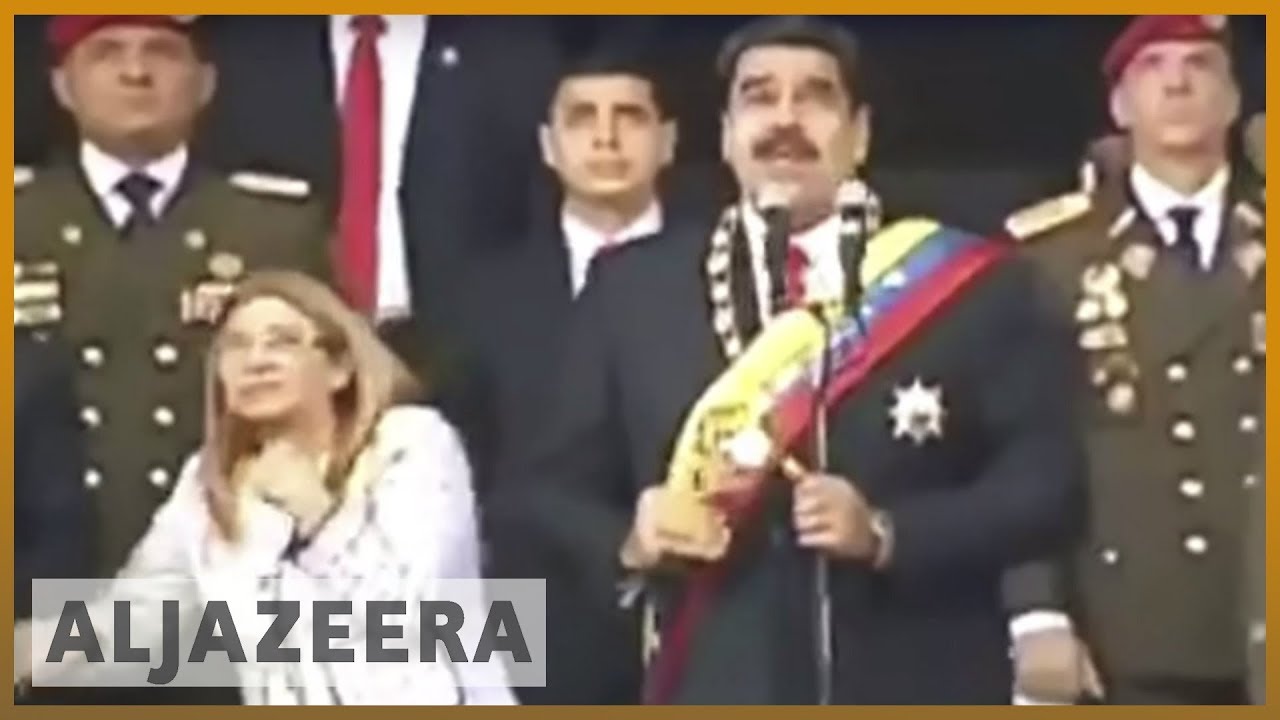 :{ with drone bombs during a military parade in Caracas.}:
More than a decade before these intrigues, a group of right-wing opposition students were hand selected and groomed by an elite, US-funded regime change training academy to topple Venezuela’s government and restore the neoliberal order.
Training from the “‘export-a-revolution’ group that sowed the seeds for a NUMBER of color revolutions”
On October 5, 2005, with Chavez’s popularity at its peak and his government planning sweeping socialist programs, five Venezuelan “student leaders” arrived in Belgrade, Serbia to begin training for an insurrection.
The students had arrived from Venezuela courtesy of the Center for Applied Non-Violent Action and Strategies, or CANVAS. This group is funded largely through the National Endowment for Democracy, a CIA cut-out that functions as the US government’s main arm of promoting regime change; and offshoots like the International Republican Institute and the National Democratic Institute for International Affairs. According to leaked internal emails fromStratfor, an intelligence firm known as the “shadow CIA,”“[CANVAS] may have also received CIA funding and training during the 1999/2000 anti-Milosevic struggle.”
CANVAS is a spinoff of Otpor, a Serbian protest group founded by Srdja Popovic in 1998 at the University of Belgrade. Otpor, which means “resistance” in Serbian, was the student group that gained international fame – and Hollywood-level promotion – by mobilizing the protests that eventually toppled Slobodan Milosevic. This small cell of regime change specialists was operating according to the theories of the late Gene Sharp, the so-called “Clausewitz of non-violent struggle.” Sharp had worked with a former Defense Intelligence Agency analyst, Col. Robert Helvey, to conceive a strategic blueprint that weaponized protest as a form of hybrid warfare, aiming it at states that resisted Washington’s unipolar domination.
A fence covered with posters of Slobodan Milosevic behind bars, titled “When?” and “People’s Movement Otpor” in Belgrade, Serbia, March 30, 2001. Darko Vojinovic | AP]
Otpor was supported by the National Endowment for Democracy, USAID and Sharp’s Albert Einstein Institute. Sinisa Sikman, one of Otpor’s main trainers, once said the group even received direct CIA funding. According to a leaked email from aStratfor staffer, after running Milosevic out of power, “the kids who ran OTPOR grew up, got suits and designed CANVAS… or in other words a ;export-a-revolution’ group that sowed the seeds for a NUMBER of color revolutions. They are still hooked into U.S. funding and basically go around the world trying to topple dictators and autocratic governments (ones that U.S. does not like ;).”
Stratfor revealed that CANVAS “turned its attention to Venezuela” in 2005 after training opposition movements that led pro-NATO regime change operations across Eastern Europe.
While monitoring the CANVAS training program, Stratfor outlined its insurrectionist agenda in strikingly blunt language: “Success is by no means guaranteed, and student movements are only at the beginning of what could be a years-long effort to trigger a revolution in Venezuela, but the trainers themselves are the people who cut their teeth on the ‘Butcher of the Balkans.’ They’ve got mad skills. When you see students at five Venezuelan universities hold simultaneous demonstrations, you will know that the training is over and the real work has begun.”
Birthing the “Generation 2007” regime change cadre
The “real work” began two years later, in 2007, when Guaidó graduated from Andrés Bello Catholic University of Caracas. He moved to Washington DC to enroll in the Governance and Political Management Program at George Washington University under the tutelage of Venezuelan economist Luis Enrique Berrizbeitia, one of the top Latin American neoliberal economists. Berrizbeitia is a former executive director of the International Monetary Fund who spent more than a decade working in Venezuelan energy sector under the oligarchic old regime that was ousted by Chavez.
That year, Guaidó helped lead anti-government rallies after the Venezuelan government declined to to renew the license of Radio Caracas Televisión (RCTV). This privately-owned station played a leading role in the 2002 coup against Hugo Chavez. RCTV helped mobilize anti-government demonstrators, falsified information blaming government supporters for acts of violence carried out by opposition members, and banned pro-government reporting amid the coup. The role of RCTV and other oligarch-owned stations in driving the failed coup attempt was chronicled in the acclaimed documentary, The Revolution Will Not Be Televised.
That same year, the students claimed credit for stymying Chavez’s constitutional referendum for a “21st century socialism” that promised “to set the legal framework for the political and social reorganization of the country, giving direct power to organized communities as a prerequisite for the development of a new economic system.”
From the protests around RCTV and the referendum, a specialized cadre of US-backed class of regime change activists was born. They called themselves “Generation 2007.”
The Stratfor and CANVAS trainers of this cell identified Guaidó’s ally – a street organizer named Yon Goicoechea – as a “key factor” in defeating the constitutional referendum.The following year, Goicochea was rewarded for his efforts with the Cato Institute’s Milton Friedman Prize for Advancing Liberty, along with a $500,000 prize, which he promptly invested into building his own Liberty First (Primero Justicia) political network.
[milton prize px]
no lnx pix
Goicoechea receives the Milton Friedman Prize for Advancing Liberty at the Waldorf-Astoria in New York, May 15, 2008. Seth Wenig | AP
Friedman, of course, was the godfather of the notorious neoliberal Chicago Boys who were imported into Chile by dictatorial junta leader Augusto Pinochet to implement policies of radical “shock doctrine”-style fiscal austerity. And theCato Institute is the libertarian Washington DC-based think tank founded by the Koch Brothers, two top Republican Party donors who have become aggressive supporters of the right-wing across Latin America.
Wikileaks published a 2007 email fromAmerican ambassador to Venezuela William Brownfield sent to the State Department, National Security Council and Department of Defense Southern Command praising “Generation of ’07” for having “forced the Venezuelan president, accustomed to setting the political agenda, to (over)react.” Among the “emerging leaders” Brownfield identified were Freddy Guevara and Yon Goicoechea. He applauded the latter figure as “one of the students’ most articulate defenders of civil liberties.”
Flush with cash from libertarian oligarchs and US government soft power outfits, the radical Venezuelan cadre took their Otpor tactics to the streets, along with a version of the group’s logo, as seen below:
Otpor | Venezuela px]
“Galvanizing public unrest…to take advantage of the situation and spin it against Chavez”
In 2009, the Generation 2007 youth activists staged their most provocative demonstration yet, dropping their pants on public roads and aping the outrageous guerrilla theater tactics outlined by Gene Sharp in his regime change manuals. The protesters had mobilized against the arrest of an ally from another newfangled youth group called JAVU. This far-right group “gathered funds from a variety of US government sources, which allowed it to gain notoriety quickly as the hardline wing of opposition street movements,” according to academic George Ciccariello-Maher’s book, “Building the Commune.”
While video of the protest is not available, many Venezuelans have identified Guaidó as one of its key participants. While the allegation is unconfirmed, it is certainly plausible; the bare-buttocks protesters were members of the Generation 2007 inner core that Guaidó belonged to, and were clad in their trademark Resistencia! Venezuela t-shirts, as seen below:
Juan Guaido | Protest
Is this the ass that Trump wants to install in Venezuela’s seat of power?
That year, Guaidó exposed himself to the public in another way, founding a political party to capture the anti-Chavez energy his Generation 2007 had cultivated. Called Popular Will, it was led byLeopoldo López, a Princeton-educated right-wing firebrand heavily involved in National Endowment for Democracyprograms and elected as the mayor of a district in Caracas that was one of the wealthiest in the country. Lopez was a portrait of Venezuelan aristocracy, directly descended from his country’s first president. He was also thefirst cousin of Thor Halvorssen, founder of the US-based Human Rights Foundation that functions as a de facto publicity shop for US-backed anti-government activists in countries targeted by Washington for regime change.
Though Lopez’s interests aligned neatly with Washington’s, US diplomatic cables published by Wikileaks highlighted the fanatical tendencies that would ultimately lead to Popular Will’s marginalization. One cable identified Lopez as “a divisive figure within the opposition… often described as arrogant, vindictive, and power-hungry.” Others highlighted his obsession with street confrontations and his “uncompromising approach” as a source of tension with other opposition leaders who prioritized unity and participation in the country’s democratic institutions.
Leopoldo Lopez | Wealth
Popular Will founder Leopoldo Lopez cruising with his wife, Lilian Tintori.]
By 2010, Popular Will and its foreign backers moved to exploit the worst drought to hit Venezuela in decades. Massive electricity shortages had struck the country due the dearth of water, which was needed to power hydroelectric plants. A global economic recession and declining oil prices compounded the crisis, driving public discontentment.
Stratfor and CANVAS – key advisors of Guaidó and his anti-government cadre – devised a shockingly cynical plan to drive a dagger through the heart of the Bolivarian revolution. The scheme hinged on a 70% collapse of the country’s electrical system by as early as April 2010.
“This could be the watershed event, as there is little that Chavez can do to protect the poor from the failure of that system,” the Stratfor internal memo declared. “This would likely have the impact of galvanizing public unrest in a way that no opposition group could ever hope to generate. At that point in time, an opposition group would be best served to take advantage of the situation and spin it against Chavez and towards their needs.”
By this point, the Venezuelan opposition was receiving a staggering $40-50 million a year from US government organizations like USAID and the National Endowment for Democracy, according to a report by the Spanish think tank, the FRIDE Institute. It also had massive wealth to draw on from its own accounts, which were mostly outside the country.
While the scenario envisioned by Statfor did not come to fruition, the Popular Will party activists and their allies cast aside any pretense of non-violence and joined a radical plan to destabilize the country.
Towards violent destabilization
In November, 2010, according to emails obtained by Venezuelan security services and presented by former Justice Minister Miguel Rodríguez Torres, Guaidó, Goicoechea, and several other student activists attended a secret five-day training at the Fiesta Mexicana hotel in Mexico City. The sessions were run by Otpor, the Belgrade-based regime change trainers backed by the US government. The meeting had reportedly received the blessing ofOtto Reich, a fanatically anti-Castro Cuban exile working in George W. Bush’s Department of State, and theright-wing former Colombian President Alvaro Uribe.
At the Fiesta Mexicana hotel, the emails stated, Guaidó and his fellow activists hatched a plan to overthrow President Hugo Chavez by generating chaos through protracted spasms of street violence.
Three petroleum industry figureheads – Gustavo Torrar, Eligio Cedeño and Pedro Burelli – allegedly covered the $52,000 tab to hold the meeting.Torrar is a self-described “human rights activist” and “intellectual” whose younger brother Reynaldo Tovar Arroyo is the representative in Venezuela of the private Mexican oil and gas company Petroquimica del Golfo, which holds a contract with the Venezuelan state.
Cedeño, for his part, is a fugitive Venezuelan businessman who claimed asylum in the United States, and Pedro Burelli a former JP Morgan executive and the former director of Venezuela’s national oil company, Petroleum of Venezuela (PDVSA). He left PDVSA in 1998 as Hugo Chavez took power and is on the advisory committee of Georgetown University’s Latin America Leadership Program.
Burelli insisted that the emails detailing his participation had been fabricated and even hired a private investigator to prove it. The investigator declared that Google’s records showed the emails alleged to be his were never transmitted.
Yet today Burelli makes no secret of his desire to see Venezuela’s current president, Nicolás Maduro, deposed – and even dragged through the streets and sodomized with a bayonet, as Libyan leader Moammar Qaddafi was by NATO-backed militiamen.
View image on TwitterView image on Twitter
Pedro Mario Burelli
@pburelli
.@NicolasMaduro, jamas me has hecho caso. Me has fustigado/perseguido como @chavezcandanga jamás osó. Óyeme, tienes sólo dos opciones en las próximas 24 horas:
- Como Noriega:pagar pena por narcotráfico y luego a @IntlCrimCourt La Haya por DDHH.
- O a la Gaddafi.
Escoge ya!
1,051
10:09 PM - Jan 16, 2019
1,252 people are talking about this
The alleged Fiesta Mexicana plot flowed into another destabilization plan revealed in a series of documents produced by the Venezuelan government. In May 2014, Caracas released documents detailing an assassination plot against President Nicolás Maduro. The leaks identified the Miami-based Maria Corina Machado as a leader of the scheme. A hardliner with a penchant for extreme rhetoric, Machado has functioned as an international liaison for the opposition, visiting President George W. Bush in 2005.
maria corina machado | george bush
Machado and George W. Bush, 2005.]
“I think it is time to gather efforts; make the necessary calls, and obtain financing to annihilate Maduro and the rest will fall apart,” Machado wrote in an email to former Venezuelan diplomat Diego Arria in 2014.
In another email, Machado claimed that the violent plot had the blessing of US Ambassador to Colombia, Kevin Whitaker. “I have already made up my mind and this fight will continue until this regime is overthrown and we deliver to our friends in the world. If I went to San Cristobal and exposed myself before the OAS, I fear nothing. Kevin Whitaker has already reconfirmed his support and he pointed out the new steps. We have a checkbook stronger than the regime’s to break the international security ring.”
Guaidó heads to the barricades
That February, student demonstrators acting as shock troops for the exiled oligarchy erected violent barricades across the country, turning opposition-controlled quarters into violent fortresses known as guarimbas. While international media portrayed the upheaval as a spontaneous protest against Maduro’s iron-fisted rule, there was ample evidence that Popular Will was orchestrating the show.
“None of the protesters at the universities wore their university t-shirts, they all wore Popular Will or Justice First t-shirts,” a guarimba participant said at the time. “They might have been student groups, but the student councils are affiliated to the political opposition parties and they are accountable to them.”
Asked who the ringleaders were, the guarimba participant said, “Well if I am totally honest, those guys are legislators now.”
Around 43 were killed during the 2014 guarimbas. Three years later, they erupted again, causing mass destruction of public infrastructure, the murder of government supporters, and the deaths of 126 people, many of whom were Chavistas. In several cases, supporters of the government were burned alive by armed gangs.
Guaidó was directly involved in the 2014 guarimbas. In fact, he tweeted video showing himself clad in a helmet and gas mask, surrounded by masked and armed elements that had shut down a highway that were engaging in a violent clash with the police. Alluding to his participation in Generation 2007, he proclaimed, “I remember in 2007, we proclaimed, ‘Students!’ Now, we shout, ‘Resistance! Resistance!’”
Guaidó has deleted the tweet, demonstrating apparent concern for his image as a champion of democracy.
On February 12, 2014, during the height of that year’s guarimbas, Guaidó joined Lopez on stage at a rally of Popular Will and Justice First. During a lengthy diatribe against the government, Lopez urged the crowd to march to the office of Attorney General Luisa Ortega Diaz. Soon after, Diaz’s office came under attack by armed gangs who attempted to burn it to the ground. She denounced what she called “planned and premeditated violence.”
Leopoldo Lopez | Juan Guaido
Guaido alongside Lopez at the fateful February 12, 2014 rally. Photo | PanAm Post]
In a televised appearance in 2016, Guaidó dismissed deaths resulting from guayas – a guarimba tactic involving stretching steel wire across a roadway in order to injure or kill motorcyclists – as a “myth.” His comments whitewashed a deadly tactic that had killed unarmed civilians like Santiago Pedroza and decapitated a man named Elvis Durán, among many others.
This callous disregard for human life would define his Popular Will party in the eyes of much of the public, including many opponents of Maduro.
Cracking down on Popular Will
As violence and political polarization escalated across the country, the government began to act against the Popular Will leaders who helped stoke it.
Freddy Guevara, the National Assembly Vice-President and second in command of Popular Will, was a principal leader in the 2017 street riots. Facing a trial for his role in the violence, Guevara took shelter in the Chilean embassy, where he remains.
Lester Toledo, a Popular Will legislator from the state of Zulia, was wanted by Venezuelan government in September 2016 on charges of financing terrorism and plotting assassinations. The plans were said to be made with former Colombian President Álavaro Uribe. Toledo escaped Venezuela and went on several speaking tours withHuman Rights Watch, the US government-backed Freedom House,the Spanish Congress and European Parliament.
Carlos Graffe, another Otpor-trained Generation 2007 member who led Popular Will, was arrested in July 2017. According to police, he was in possession of a bag filled with nails, C4 explosives and a detonator. He was released on December 27, 2017.
Leopoldo Lopez, the longtime Popular Will leader, is today under house arrest, accused of a key role in deaths of 13 people during the guarimbas in 2014. Amnesty International lauded Lopez as a “prisoner of conscience” and slammed his transfer from prison to house as “not good enough.” Meanwhile, family members of guarimba victims introduced a petition for more charges against Lopez.
Yon Goicoechea, the Koch Brothers posterboy and US-backed founder of Justice First, was arrested in 2016 by security forces who claimed they found a kilo of explosives in his vehicle. In a New York Times op-ed, Goicoechea protested the charges as “trumped-up” and claimed he had been imprisoned simply for his “dream of a democratic society, free of Communism.” He was freed in November 2017.
View image on Twitter
@YonGoicoechea
Hoy, en Caricuao. Llevo 15 años trabajando con @jguaido. Confío en él. Conozco la constancia y la inteligencia con la que se ha construido a sí mismo. Está haciendo las cosas con bondad, pero sin ingenuidad. Hay una posibilidad abierta hacia la libertad
5:10 PM - Jan 19, 2019
136 people are talking about this
David Smolansky, also a member of the original Otpor-trained Generation 2007, became Venezuela’s youngest-ever mayor when he was elected in 2013 in the affluent suburb of El Hatillo. But he was stripped of his position and sentenced to 15 months in prison by the Supreme Court after it found him culpable of stirring the violent guarimbas.
Facing arrest, Smolansky shaved his beard, donned sunglasses and slipped into Brazil disguised as a priest with a bible in hand and rosary around his neck. He now lives in Washington, DC, where he was handpicked bySecretary of the Organization of American States Luis Almagro to lead the working group on the Venezuelan migrant and refugee crisis.
This July 26, Smolansky held what he called a “cordial reunion” with Elliot Abrams,the convicted Iran-Contra felon installed by Trump as special US envoy to Venezuela. Abrams is notorious for overseeing the US covert policy of arming right-wing death squads during the 1980’s in Nicaragua, El Salvador, and Guatemala. His lead role in the Venezuelan coup has stoked fears that another blood-drenched proxy war might be on the way.
David Smolansky
@dsmolansky
Cordial reunión en la ONU con Elliott Abrams, enviado especial del gobierno de EEUU para Venezuela. Reiteramos que la prioridad para el gobierno interino que preside @jguaido es la asistencia humanitaria para millones de venezolanos que sufren de la falta de comida y medicinas.
10:46 AM - Jan 26, 2019
2,619 people are talking about this
Four days earlier, Machado rumbled another violent threat against Maduro, declaring that if he “wants to save his life, he should understand that his time is up.”
A pawn in their game
The collapse of Popular Will under the weight of the violent campaign of destabilization it ran alienated large sectors of the public and wound much of its leadership up in exile or in custody. Guaidó had remained a relatively minor figure, having spent most of his nine-year career in the National Assembly as an alternate deputy. Hailing from one of Venezuela’s least populous states, Guaidó came in second place during the 2015 parliamentary elections,winning just 26% of votes cast in order to secure his place in the National Assembly. Indeed, his bottom may have been better known than his face.
Guaidó is known as the president of the opposition-dominated National Assembly, but he was never elected to the position. The four opposition parties that comprised the Assembly’s Democratic Unity Table had decided to establish a rotating presidency. Popular Will’s turn was on the way, but its founder, Lopez, was under house arrest. Meanwhile, his second-in-charge, Guevara, had taken refuge in the Chilean embassy. A figure named Juan Andrés Mejía would have been next in line but reasons that are only now clear, Juan Guaido was selected.
“There is a class reasoning that explains Guaidó’s rise,” Sequera, the Venezuelan analyst, observed. “Mejía is high class, studied at one of the most expensive private universities in Venezuela, and could not be easily marketed to the public the way Guaidó could. For one, Guaidó has common mestizo features like most Venezuelans do, and seems like more like a man of the people. Also, he had not been overexposed in the media, so he could be built up into pretty much anything.”
In December 2018, Guaidó sneaked across the border and junketed to Washington, Colombia and Brazil to coordinate the plan to hold mass demonstrations during the inauguration of President Maduro. The night before Maduro’s swearing-in ceremony, both Vice President Mike Pence and Canadian Foreign Minister Chrystia Freeland called Guaidó to affirm their support.
A week later, Sen. Marco Rubio, Sen. Rick Scott and Rep. Mario Diaz-Balart – all lawmakers from the Florida base of the right-wing Cuban exile lobby – joined President Trump and Vice President Pence at the White House. At their request, Trump agreed that if Guaidó declared himself president, he would back him.
Secretary of State Mike Pompeo met personally with Guaidó on January 10, according to the Wall Street Journal. However, Pompeo could not pronounce Guaidó’s name when he mentioned him in a press briefing on January 25, referring to him as “Juan Guido.”
Embedded video
Dan Cohen
@dancohen3000
Secretary of State Mike Pompeo just called the figure Washington is attempting to install as Venezuelan President "Juan *Guido*" - as in the racist term for Italians. America's top diplomat didn't even bother to learn how to pronounce his puppet's name.
1:58 PM - Jan 25, 2019
By January 11, Guaidó’s Wikipedia page had been edited 37 times, highlighting the struggle to shape the image of a previously anonymous figurewho was now a tableau for Washington’s regime change ambitions. In the end, editorial oversight of his page was handed over to Wikipedia’s elite council of “librarians,” who pronounced him the “contested” president of Venezuela.
Guaidó might have been an obscure figure, but his combination of radicalism and opportunism satisfied Washington’s needs. “That internal piece was missing,” a Trump administration said of Guaidó. “He was the piece we needed for our strategy to be coherent and complete.”
“For the first time,” Brownfield, the former American ambassador to Venezuela, gushed to the New York Times, “you have an opposition leader who is clearly signaling to the armed forces and to law enforcement that he wants to keep them on the side of the angels and with the good guys.”
But Guaidó’s Popular Will party formed the shock troops of the guarimbas that caused the deaths of police officers and common citizens alike. He had even boasted of his own participation in street riots. And now, to win the hearts and minds of the military and police, Guaido had to erase this blood-soaked history.
On January 21, a day before the coup began in earnest, Guaidó’s wife delivered a video address calling on the military to rise up against Maduro. Her performance was wooden and uninspiring, underscoring the her husband’s limited political prospects.
At a press conference before supporters four days later, Guaidó announced his solution to the crisis: “Authorize a humanitarian intervention!”
While he waits on direct assistance, Guaidó remains what he has always been – a pet project of cynical outside forces. “It doesn’t matter if he crashes and burns after all these misadventures,” Sequera said of the coup figurehead. “To the Americans, he is expendable.”
Top Photo | Venezuela’s self-declared interim leader Juan Guaido, center, greets supporters after a rally at a public plaza in Las Mercedes neighborhood of Caracas, Venezuela, Jan. 26, 2019. Fernando Llano | AP]
Dan Cohen is a journalist and filmmaker. He has produced widely distributed video reports and print dispatches from across Israel-Palestine. Dan is a correspondent at RT America and tweets at @DanCohen3000.
Max Blumenthal is the founder and editor of GrayzoneProject.com, the co-host of the podcast Moderate Rebels, the author of several books and producer of full-length documentaries including the recently released Killing Gaza. Follow him on Twitter at @MaxBlumenthal.
Source | GrayZone Project
==