Venezuela
see 2 bak 219
new fbi bk djt called to take venez oil on our doorstep
==
619 djt has lost interest when no quick win? bolton literally sent to mogolia while he does 20 ft walk thru dmz in korea with bromance
==
see max blumernthal consortium
https://consortiumnews.com/tag/juan-guaido/
guaido tag:
US State Dept Deletes Sadistic Hit List Boasting of Venezuela’s Ruin
May 14, 2019 • 39 Comments
Grayzone has obtained a list of “key outcomes” that include wrecking the nation’s economy, destabilizing its military and puppeteering its political opposition, reports Anya Parampil.
Read more ?
Activists at Venezuelan Embassy Offer State Department a Peaceful Resolution to Standoff
May 13, 2019 • 24 Comments
Sign on embassy door. (Facebook page of Venezuelan Venezuelan Embassy Protection Collective)
Activists protecting the Venezuelan Embassy in Washington have written to the State Department offering a way to peacefully end the standoff between themselves and an argy mob of Guaidó supporters.
Read more ?
Venezuela: Failed Coup Argues for New Approach
May 1, 2019 • 56 Comments
Pence, Guaido and President Iván Duque Márquez of Colombia, Feb. 25, 2019 (White House/ D. Myles Cullen)
The Trump administration should set aside its disinformation campaign and start looking at reality, says Fulton Armstrong.
Read more ?
VIPS Urge Trump to Avoid War in Venezuela
April 4, 2019 • 89 Comments
VIPS warn that Trump’s policies regarding Venezuela appear to be on a slippery slope that could take us toward war in Venezuela and military confrontation with Russia.
Read more ?
Intl Trade Unions Condemn Recognition of Guaidó
March 22, 2019 • 22 Comments
Juan Guido sworn in as Venezuela's interim president before a crowd on Jan. 23. (National Assembly)
Even a labor group currently at odds with Caracas opposes foreign interference in the matter of the presidency, reports Ivar Andersen.
Read more ?
US Regime Change Blueprint Proposed Venezuelan Electricity Blackouts as ‘Watershed Event’
March 12, 2019 • 84 Comments
The group that trained Juan Guaidó and his allies laid out plans for galvanizing public unrest in a 2010 memo, Max Blumenthal reports for Grayzone.
Read more ?
Trump Threatens Havana With a New Embargo
February 27, 2019 • 32 Comments
The National Capitol building in Havana. (Michael Oswald via Wikimedia)
Opening the litigation floodgates would harm U.S. companies and punish the Cuban people even more, writes Marjorie Cohn.
Read more ?
Burning Aid: Apparent Deception on Colombia-Venezuela Bridge
February 25, 2019 • 66 Comments
Marco Rubio and coup leaders are accusing the Venezuelan National Guard, but Max Blumenthal lines up opposing evidence.
Read more ?
JOHN PILGER: The War on Venezuela is Built on Lies
February 22, 2019 • 155 Comments
Chavez voting in 2007. (Wikimedia)
The reporter as clown — for whom the truth is too difficult to report —may be the final stage of much of mainstream journalism’s degeneration, writes John Pilger for Consortium News.
Read more ?
How Much of Venezuela’s Crisis is Really Maduro’s Fault?
February 15, 2019 • 79 Comments
President Nicolás Maduro, 2016. (Cancillería del Ecuador via Flickr)
There are several factors for Venezuela’s economic crisis, but you wouldn’t know it by listening to U.S. leaders or following corporate media, writes Steve Ellner.
many linx pix
FOREIGN POLICY, INTELLIGENCE, INTERNATIONAL, VENEZUELA
Burning Aid: Apparent Deception on Colombia-Venezuela Bridge
February 25, 2019 • 66 Comments
Marco Rubio and coup leaders are accusing the Venezuelan National Guard, but Max Blumenthal lines up opposing evidence.
By Max Blumenthal
in Caracas
Grayzone
The Trump administration’s coup against Venezuela culminated on Feb. 23 with U.S.-backed opposition attempting to ram several trucks loaded with boxes of USAID “humanitarian aid” across the previously unused Francisco de Paula Santander bridge connecting Colombia to Venezuela.
The trucks failed to reach the other side — but that was never really the point of the stunt. As Father Sergio Munoz, a right-wing Venezuelan activist posted on the Colombian side of the border, explained to journalist Dan Cohen, the humanitarian “aid” was a purely symbolic provocation aimed at discrediting Venezuelan President Nicolás Maduro in international eyes and generating waves of destabilizing violence.
By the end of the day, the trucks lined up on the Francisca de Paula Santander bridge were flanked by gangs of guarimberos.
(Telesur)
These were the nihilistic masked youth who form the shock troops of the right-wing opposition, and who placed Caracas under siege with violent barricade protests, known as guarimbas, at several points between 2014 and 2017. A mob of guarimberos burned to death Orlando Figuera, a 22-year old black Venezuelan accused of supporting Maduro, on an eastern Caracas street in broad daylight, back in June 2017.
On the Santander bridge this Feb. 23, the guarimberos rained down a hail of rocks and molotov cocktails on Venezuelan national guardsmen holding the line against the USAID trucks. Suddenly, the trucks caught fire and the masked youth began unloading boxes of aid before they burned. Within minutes, pro-opposition media reported that the Venezuelan national guard forces were responsible for the fires.
A reporter for the private anti-government channel NTN24 claimed without evidence that the Venezuelan security forces had caused the fires with tear gas:
taseenb
@taseenb
Another false flag at the border with Colombia. A "reporter" from @NTN24ve (opposition tv known for fake news) said a truck went on fire because the Venezuelan police launched tear gas. Let me know if you've seen tear gas burn a truck before#Venezuela #HandsOfVenezuela
Embedded video
702
12:02 PM - Feb 23, 2019
Twitter Ads info and privacy
564 people are talking about this
The claim was absurd on its face. I have personally witnessed tear gas canisters hit every kind of vehicle imaginable in the occupied Palestinian West Bank, and I have never seen a fire like the one that erupted on the Santander bridge.
In 2013, the San Bernadino Sheriff’s Department deployed special incendiary teargas canisters (“burners”) to torch the house where fugitive cop killer Chris Dorner had holed up. But it is highly unlikely that the Venezuelan national guardsmen had anything like this weapon in their arsenal when they confronted the rioters on Feb. 23.
The total lack of evidence of Venezuelan culpability did not stop Cuban-American Sen. Marco Rubio from tweeting this accusation from nearby in Cucuta, Colombia:
Marco Rubio
?
@marcorubio
They may not realize it yet but today the Maduro Regime made it easier to isolate them internationally.
After today it will be difficult for nations to remain neutral. And for their allies to continue to support it defend them. (Cont)
12.3K
4:38 PM - Feb 23, 2019
Twitter Ads info and privacy
8,621 people are talking about this
Sen. Dianne Feinstein, who is facing calls for her own resignation after video appeared of her condescendingly browbeating a group of environmentalist children, repeated Rubio’s baseless allegation, using it to call for Maduro to step down.
By blaming the Venezuelan government for burning the USAID trucks, Rubio was clearly attempting to establish the casus belli he had been seeking. Yet neither he nor anyone in the “whole world” had seen the national guard set the fire, as he claimed. In fact, the evidence pointed in the exact opposite direction, suggesting that the masked opposition youth had torched the trucks themselves.
Colombian writer Humberto Ortiz produced footage from a pro-opposition channel showing what appears to be the exact moment when a guarimbero sets the aid on fire with a molotov cocktail:
Humberto Ortiz
@graffitiborrao
Creo que @NoticiasUno nos puede ayudar a aclarar si la molotov lanzada por este muchacho pudo causar el incendio del camión.
Embedded video
1,820
9:25 PM - Feb 23, 2019
Twitter Ads info and privacy
1,775 people are talking about this
Telesur reporter Madelein Garcia published photographs showing a guarimbero with a gas canister next to one of the burning trucks:
Madelein Garcia
@madeleintlSUR
- #ÚltimoMinuto| en #exclusiva @teleSURtv aquí las evidencias de quienes quemaron el camión con supuesta ayuda humanitaria en #Ureña, fueron los mismo guarimberos
View image on TwitterView image on Twitter
2,084
2:01 PM - Feb 23, 2019
Twitter Ads info and privacy
4,180 people are talking about this
Drone footage also published by Garcia shows how far away the trucks were from Venezuelan national guardsmen when they caught fire, and demonstrates that they were clearly on the Colombian side of the border:
Madelein Garcia
@madeleintlSUR
- Ahora veamos las imágenes aéreas este fue justo el momento cuando quemaron los camiones
Embedded video
1,356
2:03 PM - Feb 23, 2019
Twitter Ads info and privacy
2,649 people are talking about this
Even Bloomberg News, which has run a relentless stream of pro-opposition reports, published video showing guarimberos on the bridge making molotov cocktails, which could easily set a truck cabin or its cargo alight:
QuickTake by Bloomberg
?
@QuickTake
- Feb 23, 2019
Replying to @QuickTake
MORE: The bus activists hijacked was set on fire as protests continue to turn violent in Ureña #tictocnews
Embedded video
QuickTake by Bloomberg
?
@QuickTake
MORE: A member of the Venezuelan army defects during clashes at the Simon Bolívar border bridge. The defector was dragged to a building of the Colombian Migration office and protected by the Colombian police #tictocnews
Embedded video
61
12:28 PM - Feb 23, 2019
Twitter Ads info and privacy
43 people are talking about this
Meanwhile, the International Red Cross issued a statement condemning Venezuelan opposition activists disguising themselves as Red Cross workers – a blatant breach of humanitarian protocol. A screenshot from pro-opposition NTN24 coverage shows a fake Red Cross worker near one of the burning trucks:
Max Blumenthal
?
@MaxBlumenthal
- Feb 23, 2019
Replying to @MaxBlumenthal
Nicole Kramm, photojournalist wounded by national guard defectors on Venezuelan border: “They wanted to kill civilians on the border. At full speed... I can’t believe they’re presented as heroes.” https://mobile.twitter.com/UNoticias/status/1099364281651523590?s=19 …
Últimas Noticias
?
@UNoticias
#ElPaís #VIDEO Nicole Kramm, fotoperiodista chilena que fue herida hoy durante falso positivo en la frontera: "Querían matar a la gente civil que estaba parada en la frontera. A toda velocidad. Me salvé por poco. No puedo creer que los presenten como héroes".
Embedded video
Max Blumenthal
?
@MaxBlumenthal
The International Red Cross condemns yet another deception by the Venezuelan opposition https://mobile.twitter.com/Federation/status/1099374815394308102?s=19 …
IFRC Intl. Federation #RedCross #RedCrescent
?
@ifrc
We’ve learned that there are some people not affiliated w/ @cruzrojacol & @CruzRojaVe wearing Red Cross emblems at Colombia-#Venezuela & Brazil-Ven border.
We urge them to stop doing this. They might mean well but they risk jeopardizing our neutrality, impartiality & independence
496
1:12 PM - Feb 23, 2019
Twitter Ads info and privacy
501 people are talking about this
Days ago, self-proclaimed interim president Juan Guaidó announced that he would lead a “human wave” across the bridge and into Venezuela. But as darkness fell on Feb. 23, Guaido found himself at a stormy press conference with other right-wing, U.S.-aligned Latin American leaders. By his side was Colombian President Ivan Duque, who repeated the evidence-free allegation that Venezuelan security forces had burned the aid trucks.
Having failed miserably at every phase of the coup he had attempted to engineer, Rubio ended the day with a Twitter tantrum that peaked with a call for “multilateral actions” against Venezuela’s government. What form that action could take is still unclear, but it will certainly be justified by a series of baseless claims about what took place on the Santander bridge.
Max Blumenthal is an award-winning journalist and the author of books including best-selling “Republican Gomorrah,” “Goliath,” “The Fifty One Day War” and “The Management of Savagery,” which will be published in March 2019 by Verso. He has also produced numerous print articles for an array of publications, many video reports and several documentaries including “Killing Gaza” and “Je Ne Suis Pas Charlie.” Blumenthal founded the Grayzone Project in 2015 to shine a journalistic light on America’s state of perpetual war and its dangerous domestic repercussions.
Tags: Colombia Francisco de Paula Santander bridge guarimberos International Red Cross Juan Guaidó Max Blumenthal Nicolas Maduro Sen. Marco Rubio Trump administration USAID Venezuela Venezuela coup
https://www.thenation.com/article/our-gang-venezuela/
The National Endowment for Democracy has been busy--and far from alone.
By David Corn
JULY 18, 2002
david corn
In the weeks before the April 12-13 coup in Venezuela, Asociacion Civil Consorcio Justicia, a legal rights outfit, was planning an April 10 conference to promote democracy in that country. At the time, Venezuela was undergoing severe political strife. Business groups and labor unions were bitterly squaring off against President Hugo Chavez, a democratically elected strongman/populist. Using an $84,000 grant from the Washington-basedNational Endowment for Democracy,a quasi-governmental foundation funded by Congress, Consorcio Justicia was supposed to bring together political parties, unions, business associations, religious groups and academicians to discuss “protecting fundamental political rights,” as an NED document put it. In a proposed agenda Consorcio Justicia listed as one of the main speakers Pedro Carmona, president of Fedecamaras, a leading Venezuelan business group. But when the coup came, Carmona was handpicked by the plotters to head a government established in violation of the Constitution. Then he signed a decree suspending the National Assembly and the Supreme Court. Carmona, it turns out, was hardly interested in safeguarding “fundamental political rights.”
Fortunately for NED, the conference was part of a series that never happened. The program was canceled as Venezuela was hit by national strikes that would lead to the massive business-and-labor demonstration against Chavez on April 11, in which at least eighteen people were killed by unidentified gunmen.The murders provided Chavez’s military foes cause, or cover, to move against him early the next morning. (A recent Human Rights Watch report concluded, “Both sides bear responsibility for the shootings.”)But imagine if the NED-backed conference had occurred and Carmonahad appeared there–days before becoming a front man for the coup-makers. That was a close call for NED. Instead, the episode may be no more than a mild what-if embarrassment for NED, which is supposed to finance pro-democracy activism around the world. It shows, though, how democracy-promotion can slip, perhaps unintentionally, toward supporting the opposite–especially in a highly polarized political environment like the one in Venezuela.
Created by President Ronald Reagan and Congress in 1983, NED was designed to run a parallel foreign policy for the United States, backing and assisting entities that Washington might not be able to officially endorse–say, an opposition party challenging a government with which the United States maintained diplomatic relations. In a way, NED took public some of the covert political activity the CIA had previously mounted. The endowment–which devotes much of its budget to funding the foreign policy arms of the Democratic and Republican parties, the Chamber of Commerce and the AFL-CIO (its core grantees)–has been involved in both questionable and praiseworthy projects.It awarded a large grant to a student group linked to an outlawed extreme-right paramilitary outfit in France, helped finance the development of conservative parties in countries where democracy was doing just fine and played a heavy-handed role in Nicaragua’s 1990 elections. In the late 1980s it aided the pro-democracy opposition in Chile and antiapartheid organizations in South Africa. But even if its programs have indeed enhanced democracy on occasion, NED overall has long been problematic, as it has handed taxpayer dollars to private groups (such as the two major parties) to finance their overseas initiatives and has conducted controversial programs that could be viewed abroad as actions of the US government. What might the reaction be here, if the British government funded an effort to improve the Democratic Party’s get-out-the-vote operation in Florida?
Which brings us back to Venezuela–where the US Embassy was compelled after the coup to declare as a “myth” the notion that “the US government, through organizations such as the National Endowment for Democracy, financed coup efforts.”For months before the coup, Americans–including US government officials and officials of NED and its core grantees–were in contact with Venezuelans and political parties that became involved or possibly involved with the coup. This has provided Latin Americans cause to wonder if the United States is continuing its tradition of underhandedly meddling in the affairs of its neighbors to the south. And these contacts have prompted some, though not much, official probing in Washington. The issue is not only whether the United States in advance OK’d this particular coup (of which there is little evidence) or tried to help it once it occurred (of which there is more evidence). But did discussions between Americans and Chavez foes–such as those involving NED–encourage or embolden the coup-makers and their supporters? Give them reason to believe the United States would not protest should they move against Chavez in an unconstitutional manner? Much of the two-day coup remains shrouded in confusion. (It came and went so quickly: Carmona fled office the day after he seized power, once several military units announced they opposed the military coup, whereupon Chavez was returned to his office.) But enough questions linger about US actions in Venezuela to warrant a good look.
Consider some NED activities there. When Consorcio Justicia began to assemble the pro-democracy conferences, it approached the two main opponents of Chavez–Carmona and his Fedecamaras, as well as the Confederation of Venezuelan Workers (CTV), the leading anti-Chavez labor union–according to documents obtained from NED under a Freedom of Information Act request. Christopher Sabatini, NED’s senior program officer for Latin America, says, “The idea was that the conferences (which were to include Chavistas) would be able to define a consensus-based policy agenda” for the entire country. But certainly NED’s core grantees were trying to beef up Venezuelan organizations challenging Chavez.The AFL-CIO, for example, was working (seemingly laudably) to bolster and democratize the CTV, which Chavez had been trying to intimidate and infiltrate.The International Republican Institute was training several parties that opposed Chavez. At one session, Mike Collins, a former GOP press secretary, taught party leaders how to mount photo-ops; at another he suggested to Caracas Mayor Alfredo Peña, a prominent Chavez foe,how he “could soften his aggressive image in order to appeal to a wider range of voters,” according to an IRI report. (Human Rights Watch found that at least two members of the police force controlled by Peña–now Chavez’s primary rival–fired weapons during the April 11 melee.) The question, then, is, since it was not explicit US policy to call for Chavez’s ouster–though his departure from office was desired by the Bush Administration, which detested his oil sales to Cuba and close ties to Iraq, Iran and Libya–should US taxpayer dollars have gone to groups working to unseat Chavez, even through legitimate means?
Moreover, NED and its grantees helped organizations that may have been represented in the coup government. When Carmona unveiled his Cabinet on the morning of April 12–hours after he was placed in power by the military at 5 am–his junta included a leading official from COPEI, the Christian Democrat party, and one from Primero Justicia, a new party. IRI had provided assistance to both. Carmona also named a member of the CTV board as minister of planning, even though he was not a recognized leader of the union. And when Carmona assumed power in the presidential palace, a leading CTV figure was supposedly nearby–though his whereabouts and his role have been subjects of debate. The CTV did denounce Carmona–but not until Carmona, on the afternoon of April 12, announced his decree to shutter the National Assembly and the Supreme Court. It’s not easy to determine whether Carmona’s Cabinet appointees were acting on behalf of their parties or freelancing. And as one current Venezuelan official says, “The appointees were never sworn in as ministers, so they can claim they did not approve of Carmona’s decree.”
On April 12 Carmona also said he was establishing an advisory council for his government. But he did not name the several dozen members of this group. After the coup, the Chavez government maintained that it found a list of council members. The roster supposedly included leading officials of COPEI, Primero Justicia and the CTV, including CTV head Carlos Ortega–all of whom had been in touch with and/or received assistance from NED or its core grantees. This document, if accurate, raises the prospect that recipients of NED assistance, when the crunch arrived, were more interested in overthrowing Chavez than adhering to the democratic process.
Asked whether it might be troubling if political figures who worked with NED and its grantees had agreed to assist the coup, NED’s Sabatini said, “It’s important to remember that these are independent groups, reacting–on their own–to their very difficult political environment. The NED’s programs with the groups…were very specific programs of technical assistance and training…. It’s also important to remember that these groups (when they were named to the Cabinet or to the advisory council) were acting under the belief that Chavez had resigned–as had been announced on TV.” But according to postcoup news reports, Chavez actually refused to submit his resignation. And, as Venezuelan human rights outfits argued while the coup was in progress, Carmona’s military-installed government was unconstitutional, whether or not Chavez had resigned.
At least two key NED partners did cheer the coup (as did the Bush Administration initially). On April 12 George Folsom, the IRI president, issued a statement supporting the action: “Last night, led by every sector of civil society, the Venezuelan people rose up to defend democracy in their country.” Three days later, after the coup was reversed, NED president Carl Gershman sent Folsom a letter of rebuke, noting that by welcoming Chavez’s “removal through unconstitutional means,” Folsom had “unnecessarily interjected IRI into the sensitive politics of Venezuela.” Folsom’s statement, Gershman added, “will only make it more difficult for the IRI to work in Venezuela and the region as a whole.” Gershman, though, didn’t threaten to withdraw support from IRI. And on the night of April 12–after Carmona suspended the assembly–Mercedes de Freitas, a director of the Fundacion Momento de la Gente, a legislative monitoring project subsidized by NED, e-mailed the endowment defending the military and Carmona, claiming the takeover was not a military coup.
Not all NED allies were rooting for Carmona. On April 13Carlos Ponce, executive director of Consorcio Justicia, e-mailed NED that the coup was illegal and that the decision to eliminate the legislature was “terrible.” Yet several weeks earlier Ponce had almost jumped into bed with coup supporters. While developing NED’s pro-democracy conferences, he solicited the participation of the Frente Institucional Militar de Venezuela, an organization of former military officials. That prompted a swift reply from Washington. “This is a group that has proposed a military coup!” Sabatini exclaimed in an e-mail. He noted that NED “will NOT–I repeat–will NOT support anything that involves the FIM.” Ponce subsequently said that he was unaware of FIM’s position (noting that its participation had been suggested by Carmona), and he quickly booted the organization from the conference. Another potential embarrassment was averted.
But NED was only a part of the picture. For months before the coup, according to several US media reports, US officials in Venezuela had assorted conversations with Chavez foes, and these interactions, purposefully or not, may have led the plotters to believe the Bush Administration would look favorably on anyone who made Chavez go away. Newsday noted that long before the coup, business, union and civic leaders weremeeting to plan opposition to Chavez, and at one such meeting–attended by Carmona and held at the US Embassy–a coup was proposed. US officials, according to the newspaper, say they immediately killed the idea. But the officials continued to interact with these Chavez opponents. The newspaper quoted one Venezuelan source familiar with these discussions as saying, “All the United States really cared about was that it was done neatly, with a resignation letter or something to show for it.” And the Los Angeles Times reported that a “Venezuelan leader who visited Washington for an official meeting said he concluded after talks with US officials that the Americans would not necessarily punish the leaders of a government that overthrew Chavez.” A Western diplomat told the Washington Post, “I don’t think the US provided any active or material support for [the coup]. But the people involved may have seen all of these meetings and visits, added them all up, and come up with an idea that they were on the same team.” Last November then-US ambassador Donna Hrinak instructed the US military attaché in Venezuela to cut off contacts with dissident military officers. But Vice Adm. Carlos Molina, one of the leading military opponents of Chavez, said he had met with a US official several weeks before the coup.
After the coup failed, Chavez officials found inside the presidential palace documents left behind by the coup-makers. One was a note apparently written by Luis Herrera Marcano, chargé d’affaires in the Venezuelan Embassy in Washington. He was reporting on a conversation he had had with State Department official Phillip Chicolawhile the coup was under way. According to a copy published by Proceso, a Mexican newsmagazine, Chicola said, “Given that the United States signed and fully supports the Inter-American Democratic Charter, which condemns any violation of constitutional rule, it is necessary that the transition currently under way in Venezuela, which [the United States] understands and sympathizes with, conserve constitutional structures.”
On the morning of April 12, according to the New York Times,Otto Reich, the Assistant Secretary of State for Western Hemisphere Affairs, told a gathering of Latin American and Caribbean ambassadors that they had to support the new government. The next day Reich spoke twice to Venezuelan media magnate Gustavo Cisneros,according to a Cisneros spokeswoman. Cisneros’s role in the coup–if he had one–has been a topic of speculation in Venezuela, for on the night of April 11 Carmona met with other opposition leaders at a TV station owned by Cisneros. (Cisneros denies he was a force behind the coup.) Cisneros’s spokeswoman maintains that Reich called on April 13 “as a friend” because Chavez supporters were protesting at media outlets in Caracas. And on the morning of April 13, US ambassador to Venezuela Charles Shapiro met with Carmona. According to Carmona, Shapiro expressed concern regarding Carmona’s dissolution of the legislature and urged Carmona to be less antidemocratic. If Carmona is to be believed, Shapiro did not oppose the unconstitutional means by which Carmona seized power.
The Bush Administration claims that all the contacts before and during the coup were kosher. The US Embassy in Venezuela released a statement maintaining that “of course” US officials met with opposition figures, for “that is an Embassy’s job.” But it insisted that “officials in Washington and in Caracas consistently and repeatedly emphasized the United States’ opposition to any extra-constitutional alteration of power.” The embassy denied that US military officials were involved in coup activities. It noted that Secretary of State Colin Powell declared, “We condemn the blows to constitutional order.” But Powell said that on April 19–six days after the coup collapsed.
There has been no thorough public exploration in Washington of the precoup contacts or the efforts of Bush officials to nudge the coup in a direction that would permit the Administration to openly support the takeover. At the request of Senator Christopher Dodd, who chairs the Foreign Relations Subcommittee on Latin America,the Inspector General of the State Department has been examining Bush Administration actions before and during the coup. Dodd asked the IG to review cables, e-mails and other records to determine what US officials told Chavez’s foes and to examine NED programs. The report is due at the end of July, and Dodd expects to hold hearings afterward. On April 23 the New York Times reported that the Pentagon was reviewing its actions during the coup to insure that no military officials had encouraged the plotters. But Lieut. Comdr. Jeff Davis, a Pentagon spokesman, says no formal review was initiated: “It was just a matter of getting the facts together. There were questions why people from the US defense attaché were on a Venezuelan military base while this thing was going on. It was nothing out of the ordinary.”
One matter that warrants scrutiny is a Washington Post report that two military officials who publicly challenged Chavez in the weeks before the coup–Vice Admiral Molina and Col. Pedro Soto–each received $100,000 from a Miami bank. The newspaper cited an unnamed diplomat in Venezuela as its source for this curious allegation. Who in the United States might have been secretly subsidizing Chavez’s foes? Any official body that wants to investigate could start by subpoenaing Soto. In April he fled Venezuela for the United States, and in June he asked the Immigration and Naturalization Service in Miami for political asylum, claiming that he feared for his life.
Postcoup Venezuela is a jittery place of deepening division, marked by rising gun sales, political violence, constant rumors of another coup and talk of assassination. Former President Jimmy Carter failed to broker talks between Chavez and his foes; on July 11 an estimated 600,000 people demonstrated against Chavez. For the time being, Consorcio Justicia has given up on holding a large pro-democracy conference. “It’s a nasty environment,” executive director Ponce says. “Wehave a radical opposition and a radical government. We are unable to find ways to negotiate.” So his group is now using NED money for smaller projects. The failed coup has changed his perspective. Has it affected the policies and plans of the Bush Administration, NED or NED’s grantees? If a Congressional hearing regarding Venezuela’s cloudy coup ever convenes, that is one of many questions that ought to be asked.
==
no vetted
Venezuela’s power struggle reaches a tense stalemate, as human suffering deepens
David Smilde, Tulane University
As rival factions vie for control over Venezuela, many of the country’s 31 million people are suffering prolonged power outages, food and water shortages, and limited access to medicine.
==
Pathological Deceit: The NYT Inverts Reality on Venezuela’s Cuban Doctors
A New York Times “exposé” of Cuban doctors’ supposed interference in Venezuelan elections was riddled with inaccuracies, omissions and misrepresentations.
Afterdebunking Washington’s lies about the burning of “humanitarian aid” trucks on the Venezuelan/Colombian border (more than two weeks after being scooped by independent journalists), the New York Times quickly reverted to form in anarticle by Nicholas Casey headlined “‘It is Unspeakable’: How Maduro Used Cuban Doctors to Coerce Voters” (3/17/19).
As the title not-so-subtly suggests, Casey claimed to present bombshell revelations regarding the Nicolás Maduro government’s alleged weaponization of Cuban medical personnel as a means of holding on to power. On closer inspection, however, the article is riddled with factual inaccuracies, omissions and misrepresentations.
Dubious claims of politicized healthcare
Relying on the testimony of three Cuban doctors who have defected from the Venezuelan/Cuban health mission and taken up residence in other countries, as well as 16 anonymous sources within Venezuela, Casey provides the reader with shocking vignettes of how Cuban medical personnel have supposedly been used to manipulate Venezuelan politics.
One central allegation is that the Barrio Adentro healthcare mission staff, most of them Cuban doctors, are denying patients care on the basis of political affiliations. One Cuban doctor currently residing in Chile told the Times that one patient was refused treatment “because she was from the opposition.” The only other evidence to substantiate this grave accusation is the account of an opposition mayor who claims he was “denied medication.”
As has been widely documented (Guardian, 10/13/15), defector testimonies are often unreliable, given the political stakes involved. Similar reservations apply to a politician aligned with an opposition spearheading a foreign-backed coup in Venezuela.
Likewise worthy of skepticism is Human Rights Watch Americas director Jose Miguel Vivanco, whose quote, “it is unspeakable,” gives the piece its headline, though a reader might assume these were the words of an actual doctor. Human Rights Watch, whose revolving door with the US national security state is now notorious, can always be counted on to attack the Venezuelan government, though its charges have been debunked on several occasions.
Vivanco is an especially dubious source, given his extremely biased track record on Venezuela. Just over a decade ago, the HRW official was publiclyrebuked by over 100 Latin America experts for a report on Venezuela that did “not meet even the most minimal standards of scholarship, impartiality, accuracy or credibility,” which included similar sweeping allegations of politicized denial of care, based on the second-hand testimony of one individual.
Implausible electoral interference
The Times’ questionable allegations of denial of care quickly give way to even dodgier claims of Cuban doctors interfering in Venezuelan politics. “One former Cuban supervisor said that she and other foreign medical workers were given counterfeit identification cards to vote in an election,” Casey wrote, adding that Cuban doctors “were asked to vote with false identification” in 2013.
Anyone who knows how voting works in Venezuela would dismiss these allegations immediately. The first step upon entering a polling station is presenting ID and biometrically scanning fingerprints. Computerized voting screens will literally not open unless a valid fingerprint is presented. Cuban doctors, since they are of course not Venezuelans, would not have their fingerprints in the system, and thus not get past this first step. (It’s worth noting that Cuban doctors in Venezuela number roughly 30,000, in a country with an electorate of around 20 million, making the notion of a secret program to enable them to vote illegally in hopes of affecting electoral outcomes rather far-fetched.)
Another passage suggested a similar lack of familiarity with the Venezuelan electoral process:
On the day Mr. Maduro was elected to his first term, [a Cuban doctor] witnessed officials opening ballot boxes and tampering with votes, including destroying ballots that chose the opposition.
In Venezuela, the vote count is electronic, verified by paper receipts.
First off, there are no “ballot boxes” or “ballots,” because voting is fully automated. After the voter makes their selection on the computer screen, a paper receipt is printed and placed in a box. At the end of election day, 54 percent of all voting machines, chosen at random, have their electronic totals cross-checked with the paper receipts. Destroying the receipts (not ballots) would not serve any purpose, other than raising a red flag when they did not agree with the electronic tally. (If the Times’ source had bothered to name the voting center, one could check the results and confront the National Electoral Council with any discrepancy, since the paper tallies are kept for a number of years.)
Secondly, all parties or candidates have witnesses at every electoral center. At the end of the day, the witnesses and the electoral delegates all sign a certificate validating the results. In the case of the April 14, 2013 election, there was not a single electoral center where opposition candidate Henrique Capriles’ witnesses did not validate the results, nor any reports of destruction of ballots, perhaps because there are no “ballots.”
For someone who covers Venezuela regularly, Casey makes a remarkable number of errors in his account of the country’s electoral system. For example, he wrote, “In mid-2017, Mr. Maduro made a bid to consolidate power: a referendum for a second legislature to replace the opposition-controlled National Assembly.”
What took place on July 30, 2017, was an election, not a referendum, for a national constituent assembly, a body that is outlined in Articles 347–349 of the 1999 Bolivarian Constitution, and which is much more than a “second legislature.” Furthermore, the National Assembly was declared “null and void” by the Venezuelan Supreme Court in 2016 (BBC, 1/11/16), after defying a court order to unseat three legislators pending an investigation for electoral crimes.
Whitewashing opposition violence
Given their factual implausibility, Casey’s anonymously sourced claims of ballot-stuffing and illegal voting in the 2013 presidential election represent a thinly veiled maneuver to delegitimize Maduro’s victory, which was challenged by no country in the world except the United States—a fact that is conveniently omitted.
One unnamed source accused the Chavista government of “blackmail[ing]” voters that the opposition would eliminate the Barrio Adentro medical mission if Capriles won. Casey did not inform readers that the Venezuelan opposition has long vowed to suspend bilateral cooperation agreements with Havana should it come to power.
Cuban doctor hanged in effigy in Caracas. (The sign reads, “Out with Cuban ‘Doctors’!” (photo: News24.com,via **Venezuelanalysis**)
Nor did Casey mention the opposition’s repeated acts of violence against Cuban health professionals and clinics. Following Capriles’ US-sanctioned refusal to recognize the indisputable 2013 election results, and his call for his supporters to  ” in the streets, seven people were killed in the ensuingstreet violence that saw 18 Cuban-staffed neighborhood health clinics set ablaze. The violent anti-government protests of 2014 likewise featured no less than162 attacks against Cuban doctors, who were prominently lynched in effigy. In omitting these rather important details, Casey succeeded in inverting reality: He presented Cuban medical staff as witting or unwitting gendarmes of a brutal regime, rather than frequent victims of opposition violence.
This whitewashing of right-wing terror extended also to Casey’s framing of the 2017 anti-government mobilizations, which he said led to 100 deaths in a “government crackdown,” leaving out the numerous killings carried out by opposition supporters, including mob lynchings of Afro-Venezuelan men and sniper assassinations of Chavista activists.
In addition to relitigating the internationally recognized 2013 election, Casey repeated the now-boilerplate allegations of fraud in the 2018 presidential elections, pointing to opposition figures barred from running, with “Leopoldo López…dragged between house arrest and a military prison,” and Capriles “banned from running, along with most opposition parties.” Casey didn’t mention that López was convicted of inciting violence during the 2014 street protests, while Capriles was barred due to corruption allegations that even the opposition has moved to investigate.
Casey’s highly selective picture of Capriles and López is particularly disingenuous, given that both politicians actively participated in the short-lived 2002military coup, with the former leading an against the Cuban embassy, and both of them involved in the mob
 of Interior Minister Ramón Rodríguez Chacín. That alone would have disqualified them from holding political office anywhere else in the world.
It is also false that opposition parties were banned, since what was required of them was to revalidate their legal status by collecting a minimum number of signatures following their boycott of the December 10, 2017, municipal elections. Whether or not this was a political hurdle, some opposition parties, such as Acción Democrática, fulfilled it. And the fact remains that opposition candidates did run against Maduro, notably former Lara Gov. Henri Falcón, who was actively undermined by the hardline factions of the opposition, and was even threatened with US sanctions for defying the opposition boycott.
Erasure of sanctions
In an article explicitly dedicated to uncovering alleged foreign interference in Venezuelan state and society, it is ironic that Casey entirely omitted the most egregious form of external intervention: US sanctions. Since 2017, Trump’s financial sanctions have battered the healthcare system directly, with recurring cases of medicine shipments blocked or assets destined for imports frozen as a result of US financial crimes enforcement directives, according to Torino Capital chief economistFrancisco Rodriguez. In one such case, the Venezuelan government denounced the freezing of $1.6 billion of its assets by Brussels-based financial services agency Euroclear, half of which was reportedly destined for medicine imports.
US economic sanctions also debilitate healthcare indirectly by decimating the Venezuelan economy overall. According to conservative estimates, US financial sanctions cost Venezuela at least $6 billion annually in lost revenues, or around six percent of GDP. For comparison, healthcare spending in Latin Americaaverages approximately seven percent of GDP, and, prior to the crisis, Venezuela was importing around $2 billion in medicine per year. Rodriguez estimates that the new US oil sanctions, amounting to an effective trade embargo, will cost Venezuela an additional 15 percent in real GDP loss, for a cumulative contraction of 26 percent in 2019.
Despite his stated concern for the “politicization” of healthcare in Venezuela, Nicholas Casey doesn’t think it relevant to mention his own government’s deliberate effort to destroy the Venezuelan economy, further devastating the country’s fragile health sector and killing thousands, if not tens of thousands, of Venezuelans. Rather, the New York Times’ Andes bureau chief mobilizes anonymous sources and defectors—whose testimony ranges from dubious to preposterous—to further demonize Venezuela and provide cover for Washington’s murderous regime change policy.
==
omg
https://www.mintpressnews.com/the-making-of-juan-guaido-how-the-us-regime-change-laboratory-created-venezuela-coup-leader/254387/
Project — Before the fateful day of January 22, fewer than one in five Venezuelans had heard of Juan Guaidó. Only a few months ago, the 35-year-old was an obscure character in a politically marginal far-right group closely associated with gruesome acts of street violence. Even in his own party, Guaidó had been a mid-level figure in the opposition-dominated National Assembly, which is now held under contempt according to Venezuela’s constitution.
But after a single phone call from US Vice President Mike Pence, Guaidó proclaimed himself as president of Venezuela. Anointed as the leader of his country by Washington, a previously unknown political bottom dweller was vaulted onto the international stage as the US-selected leader of the nation with the world’s largest oil reserves.
Echoing the Washington consensus, the New York Times editorial board hailedGuaidó as a “credible rival” to Maduro with a “refreshing style and vision of taking the country forward.” The Bloomberg News editorial board applauded him for seeking “restoration of democracy” and the Wall Street Journal declared him “a new democratic leader.” Meanwhile, Canada, numerous European nations, Israel, and the bloc of right-wing Latin American governments known as the Lima Group recognized Guaidó as the legitimate leader of Venezuela.
While Guaidó seemed to have materialized out of nowhere, he was, in fact, the product of more than a decade of assiduous grooming by the US government’s elite regime change factories.Alongside a cadre of right-wing student activists, Guaidó was cultivated to undermine Venezuela’s socialist-oriented government, destabilize the country, and one day seize power. Though he has been a minor figure in Venezuelan politics, he had spent years quietly demonstrated his worthiness in Washington’s halls of power.
“Juan Guaidó is a character that has been created for this circumstance,”Marco Teruggi, an Argentinian sociologist and leading chronicler of Venezuelan politics, told the Grayzone. “It’s the logic of a laboratory – Guaidó is like a mixture of several elements that create a character who, in all honesty, oscillates between laughable and worrying.”
Diego Sequera, a Venezuelan journalist and writer for the investigative outlet, Mision Verdad, agreed: “Guaidó is more popular outside Venezuela than inside, especially in the elite Ivy League and Washington circles,” Sequera remarked to the Grayzone, “He’s a known character there, is predictably right-wing, and is considered loyal to the program.”
While Guaidó is today sold as the face of democratic restoration, he spent his career in the most violent faction of Venezuela’s most radical opposition party, positioning himself at the forefront of one destabilization campaign after another. His party has been widely discredited inside Venezuela, and is held partly responsible for fragmenting a badly weakened opposition.
“‘These radical leaders have no more than 20 percent in opinion polls,” wrote Luis Vicente León, Venezuela’s leading pollster. According to Leon, Guaidó’s party remains isolated because the majority of the population “does not want war. ‘What they want is a solution.’”
But this is precisely why he Guaidó was selected by Washington: he is not expected to lead Venezuela towards to democracy, but to collapse a country that for the past two decades has been a bulwark of resistance to US hegemony. His unlikely rise signals the culmination of a two-decades-long project to destroy a robust socialist experiment.
Targeting the “troika of tyranny”
Since the 1998 election of Hugo Chavez, the United States has fought to restore control over Venezuela and is vast oil reserves. Chavez’s socialist programs may have redistributed the country’s wealth and helped lift millions out of poverty, but they also earned him a target on his back. In 2002, Venezuela’s right-wing opposition briefly ousted him with US support and recognition before the military restored his presidency following a mass popular mobilization. Throughout the administrations of US Presidents George W. Bush and Barack Obama, Chavez survived numerous assassination plots before succumbing to cancer in 2013. His successor, Nicolas Maduro, has survived three attempts on his life.
The Trump administration immediately elevated Venezuela to the top of Washington’s regime change target list, branding it the leader of a “troika of tyranny.”Last year, Trump’s national security team attempted to recruit members of the military brass to mount a military junta, but that effort failed. According to the Venezuelan government, the US was also involved in a plot codenamed Operation Constitution to capture Maduro at the Miraflores presidential palace, and another called Operation Armageddon:{ to assassinate him at a military parade in July 2017. Just over a year later, exiled opposition leaders }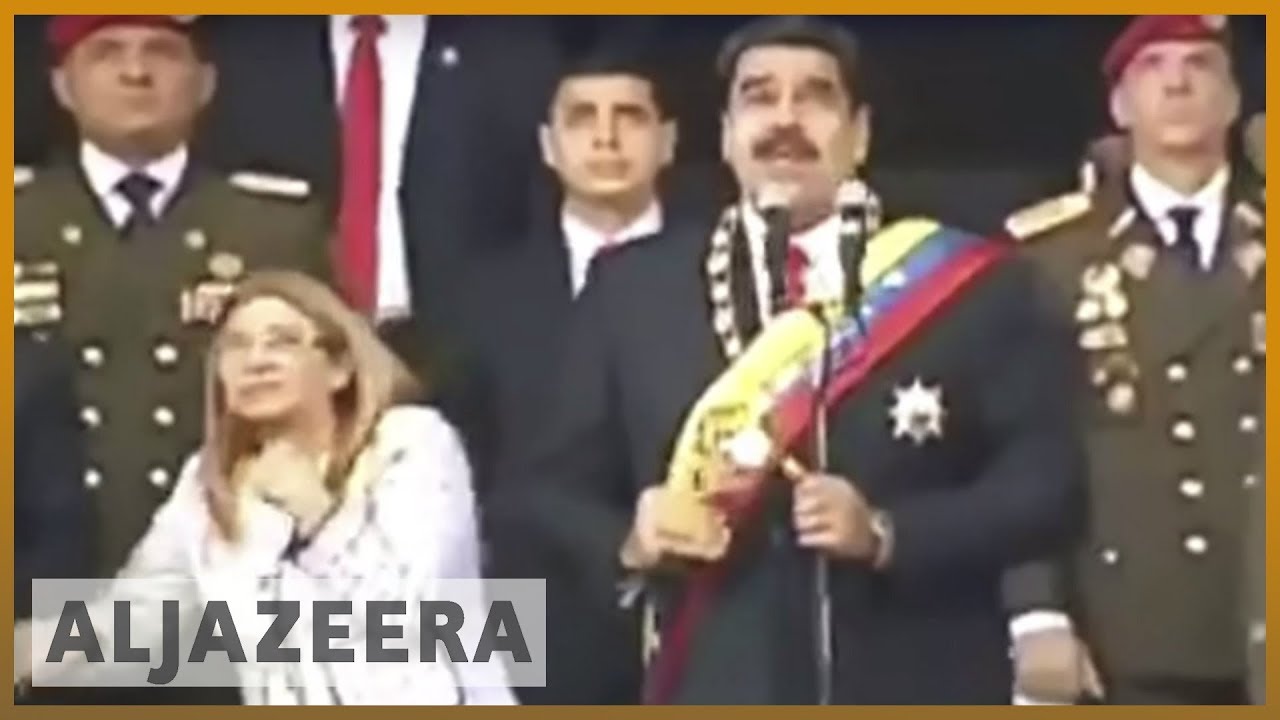 :{ with drone bombs during a military parade in Caracas.}:
More than a decade before these intrigues, a group of right-wing opposition students were hand selected and groomed by an elite, US-funded regime change training academy to topple Venezuela’s government and restore the neoliberal order.
Training from the “‘export-a-revolution’ group that sowed the seeds for a NUMBER of color revolutions”
On October 5, 2005, with Chavez’s popularity at its peak and his government planning sweeping socialist programs, five Venezuelan “student leaders” arrived in Belgrade, Serbia to begin training for an insurrection.
The students had arrived from Venezuela courtesy of the Center for Applied Non-Violent Action and Strategies, or CANVAS. This group is funded largely through the National Endowment for Democracy, a CIA cut-out that functions as the US government’s main arm of promoting regime change; and offshoots like the International Republican Institute and the National Democratic Institute for International Affairs. According to leaked internal emails fromStratfor, an intelligence firm known as the “shadow CIA,”“[CANVAS] may have also received CIA funding and training during the 1999/2000 anti-Milosevic struggle.”
CANVAS is a spinoff of Otpor, a Serbian protest group founded by Srdja Popovic in 1998 at the University of Belgrade. Otpor, which means “resistance” in Serbian, was the student group that gained international fame – and Hollywood-level promotion – by mobilizing the protests that eventually toppled Slobodan Milosevic. This small cell of regime change specialists was operating according to the theories of the late Gene Sharp, the so-called “Clausewitz of non-violent struggle.” Sharp had worked with a former Defense Intelligence Agency analyst, Col. Robert Helvey, to conceive a strategic blueprint that weaponized protest as a form of hybrid warfare, aiming it at states that resisted Washington’s unipolar domination.
A fence covered with posters of Slobodan Milosevic behind bars, titled “When?” and “People’s Movement Otpor” in Belgrade, Serbia, March 30, 2001. Darko Vojinovic | AP]
Otpor was supported by the National Endowment for Democracy, USAID and Sharp’s Albert Einstein Institute. Sinisa Sikman, one of Otpor’s main trainers, once said the group even received direct CIA funding. According to a leaked email from aStratfor staffer, after running Milosevic out of power, “the kids who ran OTPOR grew up, got suits and designed CANVAS… or in other words a ;export-a-revolution’ group that sowed the seeds for a NUMBER of color revolutions. They are still hooked into U.S. funding and basically go around the world trying to topple dictators and autocratic governments (ones that U.S. does not like ;).”
Stratfor revealed that CANVAS “turned its attention to Venezuela” in 2005 after training opposition movements that led pro-NATO regime change operations across Eastern Europe.
While monitoring the CANVAS training program, Stratfor outlined its insurrectionist agenda in strikingly blunt language: “Success is by no means guaranteed, and student movements are only at the beginning of what could be a years-long effort to trigger a revolution in Venezuela, but the trainers themselves are the people who cut their teeth on the ‘Butcher of the Balkans.’ They’ve got mad skills. When you see students at five Venezuelan universities hold simultaneous demonstrations, you will know that the training is over and the real work has begun.”
Birthing the “Generation 2007” regime change cadre
The “real work” began two years later, in 2007, when Guaidó graduated from Andrés Bello Catholic University of Caracas. He moved to Washington DC to enroll in the Governance and Political Management Program at George Washington University under the tutelage of Venezuelan economist Luis Enrique Berrizbeitia, one of the top Latin American neoliberal economists. Berrizbeitia is a former executive director of the International Monetary Fund who spent more than a decade working in Venezuelan energy sector under the oligarchic old regime that was ousted by Chavez.
That year, Guaidó helped lead anti-government rallies after the Venezuelan government declined to to renew the license of Radio Caracas Televisión (RCTV). This privately-owned station played a leading role in the 2002 coup against Hugo Chavez. RCTV helped mobilize anti-government demonstrators, falsified information blaming government supporters for acts of violence carried out by opposition members, and banned pro-government reporting amid the coup. The role of RCTV and other oligarch-owned stations in driving the failed coup attempt was chronicled in the acclaimed documentary, The Revolution Will Not Be Televised.
That same year, the students claimed credit for stymying Chavez’s constitutional referendum for a “21st century socialism” that promised “to set the legal framework for the political and social reorganization of the country, giving direct power to organized communities as a prerequisite for the development of a new economic system.”
From the protests around RCTV and the referendum, a specialized cadre of US-backed class of regime change activists was born. They called themselves “Generation 2007.”
The Stratfor and CANVAS trainers of this cell identified Guaidó’s ally – a street organizer named Yon Goicoechea – as a “key factor” in defeating the constitutional referendum.The following year, Goicochea was rewarded for his efforts with the Cato Institute’s Milton Friedman Prize for Advancing Liberty, along with a $500,000 prize, which he promptly invested into building his own Liberty First (Primero Justicia) political network.
[milton prize px]
no lnx pix
Goicoechea receives the Milton Friedman Prize for Advancing Liberty at the Waldorf-Astoria in New York, May 15, 2008. Seth Wenig | AP
Friedman, of course, was the godfather of the notorious neoliberal Chicago Boys who were imported into Chile by dictatorial junta leader Augusto Pinochet to implement policies of radical “shock doctrine”-style fiscal austerity. And theCato Institute is the libertarian Washington DC-based think tank founded by the Koch Brothers, two top Republican Party donors who have become aggressive supporters of the right-wing across Latin America.
Wikileaks published a 2007 email fromAmerican ambassador to Venezuela William Brownfield sent to the State Department, National Security Council and Department of Defense Southern Command praising “Generation of ’07” for having “forced the Venezuelan president, accustomed to setting the political agenda, to (over)react.” Among the “emerging leaders” Brownfield identified were Freddy Guevara and Yon Goicoechea. He applauded the latter figure as “one of the students’ most articulate defenders of civil liberties.”
Flush with cash from libertarian oligarchs and US government soft power outfits, the radical Venezuelan cadre took their Otpor tactics to the streets, along with a version of the group’s logo, as seen below:
Otpor | Venezuela px]
“Galvanizing public unrest…to take advantage of the situation and spin it against Chavez”
In 2009, the Generation 2007 youth activists staged their most provocative demonstration yet, dropping their pants on public roads and aping the outrageous guerrilla theater tactics outlined by Gene Sharp in his regime change manuals. The protesters had mobilized against the arrest of an ally from another newfangled youth group called JAVU. This far-right group “gathered funds from a variety of US government sources, which allowed it to gain notoriety quickly as the hardline wing of opposition street movements,” according to academic George Ciccariello-Maher’s book, “Building the Commune.”
While video of the protest is not available, many Venezuelans have identified Guaidó as one of its key participants. While the allegation is unconfirmed, it is certainly plausible; the bare-buttocks protesters were members of the Generation 2007 inner core that Guaidó belonged to, and were clad in their trademark Resistencia! Venezuela t-shirts, as seen below:
Juan Guaido | Protest
Is this the ass that Trump wants to install in Venezuela’s seat of power?
That year, Guaidó exposed himself to the public in another way, founding a political party to capture the anti-Chavez energy his Generation 2007 had cultivated. Called Popular Will, it was led byLeopoldo López, a Princeton-educated right-wing firebrand heavily involved in National Endowment for Democracyprograms and elected as the mayor of a district in Caracas that was one of the wealthiest in the country. Lopez was a portrait of Venezuelan aristocracy, directly descended from his country’s first president. He was also thefirst cousin of Thor Halvorssen, founder of the US-based Human Rights Foundation that functions as a de facto publicity shop for US-backed anti-government activists in countries targeted by Washington for regime change.
Though Lopez’s interests aligned neatly with Washington’s, US diplomatic cables published by Wikileaks highlighted the fanatical tendencies that would ultimately lead to Popular Will’s marginalization. One cable identified Lopez as “a divisive figure within the opposition… often described as arrogant, vindictive, and power-hungry.” Others highlighted his obsession with street confrontations and his “uncompromising approach” as a source of tension with other opposition leaders who prioritized unity and participation in the country’s democratic institutions.
Leopoldo Lopez | Wealth
Popular Will founder Leopoldo Lopez cruising with his wife, Lilian Tintori.]
By 2010, Popular Will and its foreign backers moved to exploit the worst drought to hit Venezuela in decades. Massive electricity shortages had struck the country due the dearth of water, which was needed to power hydroelectric plants. A global economic recession and declining oil prices compounded the crisis, driving public discontentment.
Stratfor and CANVAS – key advisors of Guaidó and his anti-government cadre – devised a shockingly cynical plan to drive a dagger through the heart of the Bolivarian revolution. The scheme hinged on a 70% collapse of the country’s electrical system by as early as April 2010.
“This could be the watershed event, as there is little that Chavez can do to protect the poor from the failure of that system,” the Stratfor internal memo declared. “This would likely have the impact of galvanizing public unrest in a way that no opposition group could ever hope to generate. At that point in time, an opposition group would be best served to take advantage of the situation and spin it against Chavez and towards their needs.”
By this point, the Venezuelan opposition was receiving a staggering $40-50 million a year from US government organizations like USAID and the National Endowment for Democracy, according to a report by the Spanish think tank, the FRIDE Institute. It also had massive wealth to draw on from its own accounts, which were mostly outside the country.
While the scenario envisioned by Statfor did not come to fruition, the Popular Will party activists and their allies cast aside any pretense of non-violence and joined a radical plan to destabilize the country.
Towards violent destabilization
In November, 2010, according to emails obtained by Venezuelan security services and presented by former Justice Minister Miguel Rodríguez Torres, Guaidó, Goicoechea, and several other student activists attended a secret five-day training at the Fiesta Mexicana hotel in Mexico City. The sessions were run by Otpor, the Belgrade-based regime change trainers backed by the US government. The meeting had reportedly received the blessing ofOtto Reich, a fanatically anti-Castro Cuban exile working in George W. Bush’s Department of State, and theright-wing former Colombian President Alvaro Uribe.
At the Fiesta Mexicana hotel, the emails stated, Guaidó and his fellow activists hatched a plan to overthrow President Hugo Chavez by generating chaos through protracted spasms of street violence.
Three petroleum industry figureheads – Gustavo Torrar, Eligio Cedeño and Pedro Burelli – allegedly covered the $52,000 tab to hold the meeting.Torrar is a self-described “human rights activist” and “intellectual” whose younger brother Reynaldo Tovar Arroyo is the representative in Venezuela of the private Mexican oil and gas company Petroquimica del Golfo, which holds a contract with the Venezuelan state.
Cedeño, for his part, is a fugitive Venezuelan businessman who claimed asylum in the United States, and Pedro Burelli a former JP Morgan executive and the former director of Venezuela’s national oil company, Petroleum of Venezuela (PDVSA). He left PDVSA in 1998 as Hugo Chavez took power and is on the advisory committee of Georgetown University’s Latin America Leadership Program.
Burelli insisted that the emails detailing his participation had been fabricated and even hired a private investigator to prove it. The investigator declared that Google’s records showed the emails alleged to be his were never transmitted.
Yet today Burelli makes no secret of his desire to see Venezuela’s current president, Nicolás Maduro, deposed – and even dragged through the streets and sodomized with a bayonet, as Libyan leader Moammar Qaddafi was by NATO-backed militiamen.
View image on TwitterView image on Twitter
Pedro Mario Burelli
@pburelli
.@NicolasMaduro, jamas me has hecho caso. Me has fustigado/perseguido como @chavezcandanga jamás osó. Óyeme, tienes sólo dos opciones en las próximas 24 horas:
- Como Noriega:pagar pena por narcotráfico y luego a @IntlCrimCourt La Haya por DDHH.
- O a la Gaddafi.
Escoge ya!
1,051
10:09 PM - Jan 16, 2019
1,252 people are talking about this
The alleged Fiesta Mexicana plot flowed into another destabilization plan revealed in a series of documents produced by the Venezuelan government. In May 2014, Caracas released documents detailing an assassination plot against President Nicolás Maduro. The leaks identified the Miami-based Maria Corina Machado as a leader of the scheme. A hardliner with a penchant for extreme rhetoric, Machado has functioned as an international liaison for the opposition, visiting President George W. Bush in 2005.
maria corina machado | george bush
Machado and George W. Bush, 2005.]
“I think it is time to gather efforts; make the necessary calls, and obtain financing to annihilate Maduro and the rest will fall apart,” Machado wrote in an email to former Venezuelan diplomat Diego Arria in 2014.
In another email, Machado claimed that the violent plot had the blessing of US Ambassador to Colombia, Kevin Whitaker. “I have already made up my mind and this fight will continue until this regime is overthrown and we deliver to our friends in the world. If I went to San Cristobal and exposed myself before the OAS, I fear nothing. Kevin Whitaker has already reconfirmed his support and he pointed out the new steps. We have a checkbook stronger than the regime’s to break the international security ring.”
Guaidó heads to the barricades
That February, student demonstrators acting as shock troops for the exiled oligarchy erected violent barricades across the country, turning opposition-controlled quarters into violent fortresses known as guarimbas. While international media portrayed the upheaval as a spontaneous protest against Maduro’s iron-fisted rule, there was ample evidence that Popular Will was orchestrating the show.
“None of the protesters at the universities wore their university t-shirts, they all wore Popular Will or Justice First t-shirts,” a guarimba participant said at the time. “They might have been student groups, but the student councils are affiliated to the political opposition parties and they are accountable to them.”
Asked who the ringleaders were, the guarimba participant said, “Well if I am totally honest, those guys are legislators now.”
Around 43 were killed during the 2014 guarimbas. Three years later, they erupted again, causing mass destruction of public infrastructure, the murder of government supporters, and the deaths of 126 people, many of whom were Chavistas. In several cases, supporters of the government were burned alive by armed gangs.
Guaidó was directly involved in the 2014 guarimbas. In fact, he tweeted video showing himself clad in a helmet and gas mask, surrounded by masked and armed elements that had shut down a highway that were engaging in a violent clash with the police. Alluding to his participation in Generation 2007, he proclaimed, “I remember in 2007, we proclaimed, ‘Students!’ Now, we shout, ‘Resistance! Resistance!’”
Guaidó has deleted the tweet, demonstrating apparent concern for his image as a champion of democracy.
On February 12, 2014, during the height of that year’s guarimbas, Guaidó joined Lopez on stage at a rally of Popular Will and Justice First. During a lengthy diatribe against the government, Lopez urged the crowd to march to the office of Attorney General Luisa Ortega Diaz. Soon after, Diaz’s office came under attack by armed gangs who attempted to burn it to the ground. She denounced what she called “planned and premeditated violence.”
Leopoldo Lopez | Juan Guaido
Guaido alongside Lopez at the fateful February 12, 2014 rally. Photo | PanAm Post]
In a televised appearance in 2016, Guaidó dismissed deaths resulting from guayas – a guarimba tactic involving stretching steel wire across a roadway in order to injure or kill motorcyclists – as a “myth.” His comments whitewashed a deadly tactic that had killed unarmed civilians like Santiago Pedroza and decapitated a man named Elvis Durán, among many others.
This callous disregard for human life would define his Popular Will party in the eyes of much of the public, including many opponents of Maduro.
Cracking down on Popular Will
As violence and political polarization escalated across the country, the government began to act against the Popular Will leaders who helped stoke it.
Freddy Guevara, the National Assembly Vice-President and second in command of Popular Will, was a principal leader in the 2017 street riots. Facing a trial for his role in the violence, Guevara took shelter in the Chilean embassy, where he remains.
Lester Toledo, a Popular Will legislator from the state of Zulia, was wanted by Venezuelan government in September 2016 on charges of financing terrorism and plotting assassinations. The plans were said to be made with former Colombian President Álavaro Uribe. Toledo escaped Venezuela and went on several speaking tours withHuman Rights Watch, the US government-backed Freedom House,the Spanish Congress and European Parliament.
Carlos Graffe, another Otpor-trained Generation 2007 member who led Popular Will, was arrested in July 2017. According to police, he was in possession of a bag filled with nails, C4 explosives and a detonator. He was released on December 27, 2017.
Leopoldo Lopez, the longtime Popular Will leader, is today under house arrest, accused of a key role in deaths of 13 people during the guarimbas in 2014. Amnesty International lauded Lopez as a “prisoner of conscience” and slammed his transfer from prison to house as “not good enough.” Meanwhile, family members of guarimba victims introduced a petition for more charges against Lopez.
Yon Goicoechea, the Koch Brothers posterboy and US-backed founder of Justice First, was arrested in 2016 by security forces who claimed they found a kilo of explosives in his vehicle. In a New York Times op-ed, Goicoechea protested the charges as “trumped-up” and claimed he had been imprisoned simply for his “dream of a democratic society, free of Communism.” He was freed in November 2017.
View image on Twitter
@YonGoicoechea
Hoy, en Caricuao. Llevo 15 años trabajando con @jguaido. Confío en él. Conozco la constancia y la inteligencia con la que se ha construido a sí mismo. Está haciendo las cosas con bondad, pero sin ingenuidad. Hay una posibilidad abierta hacia la libertad
5:10 PM - Jan 19, 2019
136 people are talking about this
David Smolansky, also a member of the original Otpor-trained Generation 2007, became Venezuela’s youngest-ever mayor when he was elected in 2013 in the affluent suburb of El Hatillo. But he was stripped of his position and sentenced to 15 months in prison by the Supreme Court after it found him culpable of stirring the violent guarimbas.
Facing arrest, Smolansky shaved his beard, donned sunglasses and slipped into Brazil disguised as a priest with a bible in hand and rosary around his neck. He now lives in Washington, DC, where he was handpicked bySecretary of the Organization of American States Luis Almagro to lead the working group on the Venezuelan migrant and refugee crisis.
This July 26, Smolansky held what he called a “cordial reunion” with Elliot Abrams,the convicted Iran-Contra felon installed by Trump as special US envoy to Venezuela. Abrams is notorious for overseeing the US covert policy of arming right-wing death squads during the 1980’s in Nicaragua, El Salvador, and Guatemala. His lead role in the Venezuelan coup has stoked fears that another blood-drenched proxy war might be on the way.
David Smolansky
@dsmolansky
Cordial reunión en la ONU con Elliott Abrams, enviado especial del gobierno de EEUU para Venezuela. Reiteramos que la prioridad para el gobierno interino que preside @jguaido es la asistencia humanitaria para millones de venezolanos que sufren de la falta de comida y medicinas.
10:46 AM - Jan 26, 2019
2,619 people are talking about this
Four days earlier, Machado rumbled another violent threat against Maduro, declaring that if he “wants to save his life, he should understand that his time is up.”
A pawn in their game
The collapse of Popular Will under the weight of the violent campaign of destabilization it ran alienated large sectors of the public and wound much of its leadership up in exile or in custody. Guaidó had remained a relatively minor figure, having spent most of his nine-year career in the National Assembly as an alternate deputy. Hailing from one of Venezuela’s least populous states, Guaidó came in second place during the 2015 parliamentary elections,winning just 26% of votes cast in order to secure his place in the National Assembly. Indeed, his bottom may have been better known than his face.
Guaidó is known as the president of the opposition-dominated National Assembly, but he was never elected to the position. The four opposition parties that comprised the Assembly’s Democratic Unity Table had decided to establish a rotating presidency. Popular Will’s turn was on the way, but its founder, Lopez, was under house arrest. Meanwhile, his second-in-charge, Guevara, had taken refuge in the Chilean embassy. A figure named Juan Andrés Mejía would have been next in line but reasons that are only now clear, Juan Guaido was selected.
“There is a class reasoning that explains Guaidó’s rise,” Sequera, the Venezuelan analyst, observed. “Mejía is high class, studied at one of the most expensive private universities in Venezuela, and could not be easily marketed to the public the way Guaidó could. For one, Guaidó has common mestizo features like most Venezuelans do, and seems like more like a man of the people. Also, he had not been overexposed in the media, so he could be built up into pretty much anything.”
In December 2018, Guaidó sneaked across the border and junketed to Washington, Colombia and Brazil to coordinate the plan to hold mass demonstrations during the inauguration of President Maduro. The night before Maduro’s swearing-in ceremony, both Vice President Mike Pence and Canadian Foreign Minister Chrystia Freeland called Guaidó to affirm their support.
A week later, Sen. Marco Rubio, Sen. Rick Scott and Rep. Mario Diaz-Balart – all lawmakers from the Florida base of the right-wing Cuban exile lobby – joined President Trump and Vice President Pence at the White House. At their request, Trump agreed that if Guaidó declared himself president, he would back him.
Secretary of State Mike Pompeo met personally with Guaidó on January 10, according to the Wall Street Journal. However, Pompeo could not pronounce Guaidó’s name when he mentioned him in a press briefing on January 25, referring to him as “Juan Guido.”
Embedded video
Dan Cohen
@dancohen3000
Secretary of State Mike Pompeo just called the figure Washington is attempting to install as Venezuelan President "Juan *Guido*" - as in the racist term for Italians. America's top diplomat didn't even bother to learn how to pronounce his puppet's name.
1:58 PM - Jan 25, 2019
By January 11, Guaidó’s Wikipedia page had been edited 37 times, highlighting the struggle to shape the image of a previously anonymous figurewho was now a tableau for Washington’s regime change ambitions. In the end, editorial oversight of his page was handed over to Wikipedia’s elite council of “librarians,” who pronounced him the “contested” president of Venezuela.
Guaidó might have been an obscure figure, but his combination of radicalism and opportunism satisfied Washington’s needs. “That internal piece was missing,” a Trump administration said of Guaidó. “He was the piece we needed for our strategy to be coherent and complete.”
“For the first time,” Brownfield, the former American ambassador to Venezuela, gushed to the New York Times, “you have an opposition leader who is clearly signaling to the armed forces and to law enforcement that he wants to keep them on the side of the angels and with the good guys.”
But Guaidó’s Popular Will party formed the shock troops of the guarimbas that caused the deaths of police officers and common citizens alike. He had even boasted of his own participation in street riots. And now, to win the hearts and minds of the military and police, Guaido had to erase this blood-soaked history.
On January 21, a day before the coup began in earnest, Guaidó’s wife delivered a video address calling on the military to rise up against Maduro. Her performance was wooden and uninspiring, underscoring the her husband’s limited political prospects.
At a press conference before supporters four days later, Guaidó announced his solution to the crisis: “Authorize a humanitarian intervention!”
While he waits on direct assistance, Guaidó remains what he has always been – a pet project of cynical outside forces. “It doesn’t matter if he crashes and burns after all these misadventures,” Sequera said of the coup figurehead. “To the Americans, he is expendable.”
Top Photo | Venezuela’s self-declared interim leader Juan Guaido, center, greets supporters after a rally at a public plaza in Las Mercedes neighborhood of Caracas, Venezuela, Jan. 26, 2019. Fernando Llano | AP]
Dan Cohen is a journalist and filmmaker. He has produced widely distributed video reports and print dispatches from across Israel-Palestine. Dan is a correspondent at RT America and tweets at @DanCohen3000.
Max Blumenthal is the founder and editor of GrayzoneProject.com, the co-host of the podcast Moderate Rebels, the author of several books and producer of full-length documentaries including the recently released Killing Gaza. Follow him on Twitter at @MaxBlumenthal.
Source | GrayZone Project
==
==
https://www.alternet.org/2019/02/heres-the-real-and-terrifying-reason-trump-is-pushing-for-a-coup-in-venezuela/
Monday, President Donald Trump met with the Venezuelan community in Miami, Florida. His speech represented more than just disdain for the country’s president Nicolas Maduro; it was a sign of what may really be behind his increasing rhetoric against Venezuela: Reelection. 2020.
Florida will be a key swing state in next year’s elections. Trump’s overtures to both the Venezuelan and Cuban-American communities were clear.
“The days of socialism and communism are numbered, not only in Venezuela but in Nicaragua and in Cuba as well,” Trump told the crowd.
But Trump’s push on Venezuela is not just about winning over key votes in Florida. It’s about sidelining progressives, distracting from domestic policies, and driving the U.S. into a war that could easily lift him into a second term.
Venezuela has been front and center over the last month. The U.S. has backed the National Assembly head Juan Guaido in his grab for the presidency, enacted devastating sanctions, pushed humanitarian aid, and, according to Cuba, is sending special forces to Puerto Rico and other Caribbean islands with the goal of toppling President Nicolas Maduro.
This is not the first time the White House has been engaged in trying to undermine the Venezuelan government. It’s been at it since the early 2000s. Washington backed the coup against President Hugo Chavez in 2002. The National Endowment for Democracy and the U.S. Agency for International Development have paid millions to opposition groups in the name of democracy.
But never have the sanctions been so crippling. Never has the threat of military intervention loomed so large. Such a move would play right into Trump’s 2020 campaign. A war in America’s backyard. A trojan horse to lock in the president’s second term. Democrats in Congress have been either complacent or complicit.
A war with Venezuela would not be swift, even if carried out through proxy militaries like Colombia and Brazil. Venezuela is polarized and politicized. The country has almost two million soldiers ready to serve, including reservists. Violent action would likely throw Venezuela into a bloody civil war—a war that would last well through the 2020 presidential elections.
Sound familiar?
George W. Bush launched his invasion of Iraq on March 20, 2003, the year prior to the 2004 electoral campaign. He was reelected. No WMDs were found. Nor was Osama bin Laden, though the United States did generate enough animosity that it planted the seeds for the birth of the Islamic State.
Ronald Reagan’s invasion of Grenada in October 1983 helped to lift his failing approval rating the year before his reelection.
Of course, the situation in Venezuela is dire. President Nicolas Maduro shoulders plenty of the blame. Inflation is through the roof. His fiscal policy has been ineffective. Over two million Venezuelans have left the country in recent years. But the economic warfare and the U.S. sanctions, imposed in 2017 and deepened in recent weeks, have cost the country billions of dollars and blocked access to critical medicine for Venezuelan citizens.
In his discourse on Venezuela, President Donald Trump talks about democracy and the humanitarian crisis. But he overlooks these issues for the countries he considers allies. A great example is Honduras.
If the president was actually concerned with resolving humanitarian crises in the region, he should look not to Venezuela, but to Central America, to fix the structural problems that have led to the migrant crisis—the whole reason Trump says he needs a border wall—and which the United States helped to cause.
Millions have fled Honduras, El Salvador and Guatemala in recent years. They flee violence, drug gangs, repressive regimes. The murder rates in El Salvador and Honduras hover above the rate in Venezuela, according to the World Bank.
In Honduras, the Juan Orlando Hernandez regime retained power in 2017 through fraudulent elections, after he strong-armed Congress and the Supreme Court to approve changes to the Constitution to allow him to run for reelection—the very reason that Congress ousted president Manuel Zelaya in 2009.
In Venezuela, by contrast, despite the opposition’s boycott of last year’s election—after it pulled out of the two-year-long talks with the government at the last minute—Maduro still won the presidency with a greater percentage of the overall Venezuela voting population than Trump won in the United States in 2016.
In Honduras, the assault on community, environmental and indigenous leaders is widespread. Berta Caceres’ assassination is only the most prominent example. Security forces have killed protesters with live rounds to the head. Impunity is rampant.
According to the Center for Economic and Policy Research, Honduras has “the most unequal distribution of income in Latin America,” an inequity that has accelerated over the last decade.
This all has spurred hundreds of thousands to flee each year in an attempt to reach asylum in the United States. Trump’s response has been to send the military to the border and to build a wall.
Ironically, the Central American crisis is one the United States helped to create, by backing brutal regimes and illegally funneling weapons into the region—a strategy it seems it may be trying to duplicate in Venezuela. The very man in charge of those weapons was Ronald Reagan’s Assistant Secretary of State for Human Rights and Humanitarian Affairs, Elliott Abrams, who was recently tapped by Trump to bring so-called democracy to Venezuela.
If he succeeds in toppling Venezuela, the future is bleak. Central America today is perhaps an image of what we can expect for the future: a crime rate through the roof, poverty, widespread inequality.
The White House has an interest in keeping the focus on Venezuela, and not on the controversies and domestic issues that have dogged Trump and his presidency. Venezuela is a way for the president to distract U.S. citizens. A way to tarnish a resurgence in the debate about socialism, which he highlighted in his State of the Union address.
With his bellicose rhetoric and point people trained in subversion and violence, Trump is willing to put peace on the line, not in the interest of the Venezuelan people, but for the United States, for U.S. corporations and conservatives.
Donald Trump’s push on Venezuela is about grabbing at the largest oil reserves in the world, making an example to any other would-be leftist leaders, and above all else, reelecting Trump in 2020.
The Democrats appear to be willing to give it to him.
Michael Fox is a freelance journalist and the former editor of the NACLA Report on the Americas. He is the coauthor of the books Venezuela Speaks and Latin America’s Turbulent Transitions
==
https://www.democracynow.org/2019/2/19/venezuela_in_crisis_as_us_pushes
Trump called for regime change in Venezuela, Cuba and Nicaragua on Monday, in a major speech urging the Venezuelan military to abandon its support for President Nicolás Maduro and to support self-proclaimed Venezuelan president Juan Guaidó. During the speech, Trump said the U.S. seeks a peaceful transition of power in Venezuela, but that all options remain on the table. This comes as a new book out by former FBI Deputy Director Andrew McCabe reveals Trump privately discussed going to war with Venezuela in 2017. Venezuelan President Nicolás Maduro responded to Trump’s speech in Miami by accusing him of engaging in Nazi-like discourse. We speak with Venezuelan economist Francisco Rodríguez, who headed the Venezuelan National Assembly’s Economic and Financial Advisory Office under Hugo Chávez. We also speak with Vijay Prashad, director of Tricontinental: Institute for Social Research and chief editor of LeftWord Books. He is the author of several books, including “The Poorer Nations: A Possible History of the Global South.”
JUAN GONZÁLEZ: President Trump traveled to Miami, Florida, Monday, where he gave a major speech calling for regime change in Venezuela, as well as in Cuba and Nicaragua. He urged the Venezuelan military to abandon its support for President Nicolás Maduro and to support self-proclaimed Venezuelan President Juan Guaidó.
PRESIDENT DONALD TRUMP: Peace-loving nations are ready to help Venezuela reclaim its democracy, its dignity and its destiny. All the nations in our hemisphere have the shared interest in preventing the spread of socialist tyranny. Socialism, by its very nature, does not respect borders. It does not respect boundaries or the sovereign rights of its citizens or its neighbors. It’s always seeking to expand, to encroach and to subjugate others to its will. The twilight hour of socialism has arrived in our hemisphere and, frankly, in many, many places around the world. The days of socialism and communism are numbered, not only in Venezuela, but in Nicaragua and in Cuba, as well.
AMY GOODMAN: During his speech, Trump said the U.S. seeks a peaceful transition of power in Venezuela, but that all options remain on the table. Meanwhile, a new book out today by former FBI Deputy Director Andrew McCabe reveals Trump privately discussed going to war with Venezuela in 2017. McCabe writes, quote, “Then the president talked about Venezuela. That’s the country we should be going to war with, he said. They have all that oil and they’re right on our back door,” unquote. Venezuelan President Nicolás Maduro responded to Trump’s speech in Miami by accusing him of engaging in Nazi-like discourse.
PRESIDENT NICOLÁS MADURO: [translated] Today Donald Trump was in Miami with a tired rhetoric, questioning the right of our country to adopt the ideas of human, Christian socialism, our socialism, just like a Nazi-style speech to prohibit ideologies. Donald Trump wants to ban ideologies, political diversity, and wants to impose the unique thinking of white supremacists of the White House.
JUAN GONZÁLEZ: This all comes as a standoff intensifies on the Venezuelan border. The U.S. is continuing to deliver aid to the Colombian side of the border in defiance of Maduro. The United Nations, the Red Cross and other relief organizations have refused to work with the U.S. on delivering that aid to Venezuela, which they say is politically motivated. The border will be the site of dueling concerts in the coming days, one organized by the British billionaire Richard Branson, the other by the Venezuelan government. Meanwhile, Maduro says Russia is delivering 300 tons of humanitarian aid by air.
AMY GOODMAN: We’re joined now by two guests. Here in New York, Venezuelan economist Francisco Rodríguez. He headed the Venezuelan National Assembly’s Economic and Financial Advisory Office under President Hugo Chávez. He recently co-wrote, with Jeffrey Sachs, a New York Times opinion piece headlined “An Urgent Call for Compromise in Venezuela.” And in Hartford, Connecticut, we’re joined by Vijay Prashad, director of Tricontinental: Institute for Social Research and chief editor of LeftWord Books. He’s the author of several books, including The Poorer Nations: A Possible History of the Global South.
Let’s begin with Francisco Rodríguez. Talk about the situation in Venezuela right now and what you are proposing.
FRANCISCO RODRÍGUEZ: OK, well, now there’s a standoff in Venezuela between the government of Maduro, which is deeply unpopular but still has the support of the military leadership, and the opposition, who has now regained the power to mobilize its supporters, to mobilize its base, that it had lost over the past year and a half. And nothing much seems to be changing in terms of the standoff. This, in fact, is a standoff that, in some variety or another, we’ve seen over the course of the past two decades.
Now, the new ingredient that we have right now is huge international pressure, and that takes different forms. On the one hand, you have Trump in the U.S. who is explicitly talking about the possibility of military action. On the other hand, you have the European Union, who has shied away from taking those steps but has recognized Juan Guaidó as interim president of Venezuela.
But, more importantly, I think, now you have U.S. economic sanctions. You have oil sanctions. And these sanctions are going to be crippling for an economy like Venezuela’s. More than 90 percent of Venezuelan exports come from oil. And what these sanctions have done is not only cut off the possibility of Venezuela selling oil to the U.S., but also made it very difficult for Venezuela to sell oil to other countries, because, for example, India is Venezuela’s second purchaser of oil, and Indian companies right now are concerned that they may be sanctioned for dealing with Venezuela.
So, the concern that I and other persons, such as my co-author, Jeffrey Sachs, in a recent New York Times piece, have posited is: Well, what’s the plan B here? What if this strategy doesn’t work in getting Maduro out of power? Then you have a country that’s already in a very fragile humanitarian situation, and you’re imposing crippling economic sanctions, and this risks creating a famine. And therefore we go through a number of alternatives there, from a political negotiation to create an interim government that could, effectively, envision a transition towards elections but also stabilize the economy, to an oil-for-food program, which is something basic that we should be discussing right now. How is Venezuela going to feed itself if it can’t sell oil to the rest of the world? Well, in the case of Iraq, in the case of Iran, there were exceptions to a sanctions regime. In the case of Venezuela, the Trump administration has imposed a sanctions regime without any type of exceptions. And for a country that essentially only produces oil—and, by the way, its second export, which is gold, is also sanctioned by the U.S.—this is very, very dangerous. This risks creating a famine in Venezuela.
JUAN GONZÁLEZ: Vijay Prashad, I’d like to get your perspective, first on President Trump’s speech and, of course, the administration still holding out the possibility of direct military intervention in Venezuela. Your take on what’s going on?
VIJAY PRASHAD: Juan, this is a very dangerous situation. We’re dealing with a government, the government of Donald Trump, that has for a very long time sought, you know, some kind of military action against Venezuela. As you said, they considered a war in 2017. The people around Trump—John Bolton, national security adviser, and now, resurrected out of the dirty wars of Central America, Elliott Abrams—these people are not actually committed to democracy or to the Venezuelan people. They want to do exactly what Trump falsely claimed socialism wants to do, which is to spread across its borders their agenda into places like Venezuela and to subjugate people elsewhere. I mean, the very fact that Trump has openly said—and Bolton has repeated this—that there is oil there, and American oil companies should get, you know, primary access to it—in other words, increase their ability to draw out profits from Venezuelan oil—the fact that they’ve openly said this should encourage people to see that this is not a credible attempt at helping the Venezuelan people. This is not a credible, you know, set of concerns about democracy or human rights. These people want to go to war. These are resource wars.
I think one should be very careful about taking their point of view seriously, even allowing them to define the so-called international community. I mean, India, I think, has made its own moves here. Large populations of the world—India, China, Russia—don’t accept what the United States is saying. India has said it’s going to do its very best, as it did against the U.S. sanctions on Iran, to find an end run around the U.S. sanctions on Venezuela. I don’t think most of the world is in agreement with the American strategy here, which is plainly to provoke a war on the north of South America. I think we need to be very cautious about how we proceed in discussing the situation. This is not being seen from Washington with the lens of humanitarianism. It’s being seen through the lens of war in order to secure resources.
AMY GOODMAN: Let me go to that Bolton SOT, John Bolton, the national security adviser, talking about the U.S. oil in Venezuela. This was a recent interview on Fox Business where he openly said U.S. oil companies could benefit from what’s happening in Venezuela.
JOHN BOLTON: We’re in conversation with major American companies now that are either in Venezuela or, in the case of Citgo, here in the United States. I think we’re trying to get to the same end result here. You know, Venezuela is one of the three countries I call the troika of tyranny. It will make a big difference to the United States economically if we could have American oil companies really invest in and produce the oil capabilities in Venezuela. It’d be good for the people of Venezuela. It’d be good for the people of the United States.
AMY GOODMAN: Francisco Rodríguez, can you respond to this? And has the U.S. exempted oil companies from the sanctions, and talking about U.S. oil company involvement in this attempted coup
FRANCISCO RODRÍGUEZ: It has not exempted them from the sanctions. It has declared a set of temporary wind-down provisions for some service companies that are involved in Venezuela. It has immediately stopped any shipments of NAFTA[inaudible], which Venezuela needs to produce about a third of its production, are dependent on imports of this material from the U.S. And that is immediately banned for any U.S. company. And for the rest of U.S. companies, for importing oil from Venezuela, there is a wind-down period, also until April 28th. However, any money paid for that oil has to go into a blocked account, which is going to be managed by the Guaidó administration, not by the Maduro administration. So, there is no—doesn’t make any sense for Maduro to sell oil into these accounts. I think that—
JUAN GONZÁLEZ: But let me ask you about—
FRANCISCO RODRÍGUEZ: Yeah, sure.
JUAN GONZÁLEZ: On this oil situation, because I’m not sure that the complexity of what’s going on here, in terms of oil, is understood. As you said, India is the second-largest importer of Venezuelan oil. China is the third largest. And the Soviet—Russia currently now owns 49 percent of Citgo in the United States, in exchange for a loan that Russia gave. So, Russia, China and India are all heavily invested in what happens to Venezuelan oil. They’re all recognizing the Maduro government. So it’s not a simple thing on this oil issue, as you just cut off the U.S. supply, right?
FRANCISCO RODRÍGUEZ: Oh, no, no, no, that’s perfectly right. That’s correct. However, what you will find is that when the U.S. imposes this type of sanctions, it creates significant costs for other countries to continue to trade with the sanctioned country. And, in fact, that’s what happened in Iran. In Iran, there were Chinese and—both China and India were concerned about continuing to deal with Iran in the wake of U.S. sanctions, and therefore the U.S. had to create—first the Obama administration, now Trump—the significant reduction exemptions clause, which allowed them to continue trading with Iran. So, and we had news over the weekend, still unreported, but Reuters and the Financial Times say that they have confirmed that Russian bank, state-owned bank, Gazprombank, has frozen the accounts of PDVSA precisely because they’re concerned with the possibility of being sanctioned for dealing with PDVSA. So there’s a reach—I mean, there’s a sense in which U.S. foreign policy goes beyond just the direct effect of trading with the U.S. It also affects using the dollar as an international reserve currency. And that can severely limit what other countries can do.
If on top of that you have the fact that—and here I want to stress something. Europe has not imposed economic sanctions, but there’s something that most European countries have done, which is to recognize Guaidó. And this is something very rare. This is something that, in the case of the U.S., the U.S., the last time that it recognized a government that did not have de facto control over at least part of its territory was in World War II with the Nazi-occupied countries of Europe. So, this is something that is not usually done. I mean, the U.S. recognized the government of Saddam Hussein even as it was invading Iraq. And the problem with that is that once you start going down that route, then you start falling into a problem where foreign policy decisions end up having economic implications. And now Venezuela cannot sell oil either through U.S. accounts, through the U.S. financial system, or through the European financial system. And this makes it very difficult for the country to actually obtain dollars or a reserve currency that it can use internationally, even if it manages to continue selling oil to some countries.
JUAN GONZÁLEZ: Vijay Prashad, what about that, this whole issue of the breakdown in terms of the international community? Because you’ve written about the Global South, and it does appear that most of the countries that are recognizing the Guaidó government, other than some Latin American countries that are being pressured by the United States, are from the Global North.
VIJAY PRASHAD: Yes, that’s exactly correct. I mean, this is the illusion of the phrase “international community.” It largely refers to the United States and its European allies, when, in fact, of course, you know, governments that represent the majority of the world haven’t actually recognized Mr. Guaidó and continue to recognize Mr. Maduro.
But I do have very great concerns about the lack of alternatives, both for holding and doing trade in oil, but also insurance for carriers and so on. I mean, you know, the Chinese, the BRICS countries had attempted to create some forms of alternatives to the European- and American-dominated financial system, the money transfer system and so on. And this has not really come to fruition. In the case of Iran, the Europeans have tried just now to create an alternative strategy for payments to Iran so that they can continue to buy oil from Iran. And as you may have seen at the Warsaw conference, the United States directly attacked the Europeans on this. I mean, there have been attempts by China, by India certainly, to create alternatives, outside the European- and American-dominated financial system, you know, to basically continue to trade with places like Iran and Venezuela. But each time they propose an alternative, these get attacked. And I think this is something for people to pay attention to—in other words, that there is a politicization of economic activity, of trade activity, a politicization that, you know, has the drumbeats of war behind it. Because if the United States is going to squeeze Venezuela to the extent that it’s doing now, and perhaps more, this is going to push that country into civil war. There’s going to most likely be ramped-up pressure for the United States to intervene militarily. And, you know, this would be terrible for South America, for Latin America.
I mean, I want to put on the table for us to consider that, you know, during the high point of high oil prices, the Venezuelan government made a choice: It didn’t build up its sovereign wealth fund, a rainy day fund; instead, it started to help countries, for instance, in the Caribbean, you know, through things like the Petrocaribe scheme. And, you know, you should recognize that the current uprising in Haiti is not merely about Haiti and the IMF presence from last year, but it’s also because the Petrocaribe scheme has basically run aground. There are three American-filled oil tankers sitting in Port-au-Prince. They are not unloading the oil until the government in Haiti pays in cash. And every day that they’re not unloading these ships, the government of Haiti is liable for $20,000. I mean, I want to put this on the table, because this is one form of behavior towards poor countries like Haiti—you know, the opposite of humanitarianism. And the other was, at its highest point, the Venezuelan government providing low-price oil at very reasonable rates to countries like Haiti—a genuine form of humanitarianism. When Venezuela went into crisis, you know, the world didn’t come to its defense to help Venezuela, instead, of course, using this opportunity to curry favor with Washington, as it basically bangs louder on the drumbeats of war.
AMY GOODMAN: We’re going to break, then come back to this discussion with Vijay Prashad and Francisco Rodríguez, Venezuelan economist. This is Democracy Now!Back in a minute.
[break]
AMY GOODMAN: “Bolivariana,” from the album Chile: Songs for the Resistance. This is Democracy Now! I’m Amy Goodman, with Juan González.
JUAN GONZÁLEZ: Well, a standoff is intensifying on the Venezuelan border. The U.S. is continuing to deliver aid to the Colombian side of the border in defiance of Maduro. The United Nations and Red Cross and other relief organizations have refused to work with the U.S. on delivering aid to Venezuela, which they say is politically motivated. On Monday, President Trump criticized Maduro for not allowing humanitarian aid into the country.
PRESIDENT DONALD TRUMP: Two days ago, the first U.S. Air Force C-17—that’s a big, beautiful plane—landed in Colombia, loaded with crucial assistance, including thousands of nutrition kits for little Venezuelan children. Unfortunately, dictator Maduro has blocked this life-saving aid from entering the country. He would rather see his people starve than give them aid.
AMY GOODMAN: Still with us, two guests. Here in New York, the Venezuelan economist Francisco Rodríguez, headed the Venezuela National Assembly’s Economic and Financial Advisory Office under President Hugo Chávez. He recently co-wrote, with professor Jeffrey Sachs, a New York Times opinion piece headlined “An Urgent Call for Compromise in Venezuela.” And in Hartford, Connecticut, Vijay Prashad, director of the Tricontinental: Institute for Social Research, chief editor of LeftWord Books.
So, Francisco Rodríguez, if you can talk about what’s happening on the border? It looks like the U.S. is pushing for this to be the flashpoint, but you have the U.N., the International Red Cross saying they won’t participate in this because they don’t see so-called humanitarian aid being pushed by one side as a real humanitarian aid.
FRANCISCO RODRÍGUEZ: Yeah. I mean, there’s a reality, which is that the humanitarian aid issue in Venezuela has become politicized. And this happens in a lot of countries. Now, I think that a lot of the fault here, quite frankly, is Maduro’s, because, from four years ago, when this started to be talked about in the Venezuelan political debate, Maduro and his government have denied that there’s a humanitarian crisis in Venezuela, and refuse to accept any type of humanitarian aid. It was only in November of last year that they finally accepted some aid from the United Nations. However, during most of that period, they insisted that there was nothing. And you saw the country slide into hyperinflation. You saw the country enter into what is now the world’s largest economic contraction to happen outside of wartime in any country in world history, has happened in Venezuela.
And this is not just a—U.S. sanctions are very recent. I mean, this is driven by the huge mismanagement of the Maduro and Chávez administration. I mean, even—Vijay was talking about aiding other countries, but recognized that Chávez did not do—as a result partly of that policy, did not do what it should have done and what is recommended for oil-exporting countries, which is to build up a rainy day fund, to be able to save for when oil prices came down. So this country had committed a lot of policy mistakes. It went into a huge economic crisis as a result of mismanagement. Poverty shot up from 27 to 94 percent. The government has been very cynical about this, because the government doesn’t even publish statistics. It stopped publishing poverty statistics in 2015, inflation statistics for a country that’s in the midst of a hyperinflation, GDP data. So the government denies that the crisis is there, but doesn’t have any data to show, because it’s effectively banned the publication of this data.
So, in that context, the Venezuelan opposition has taken this issue as an issue of debate. It has effectively challenged the government to accept humanitarian aid. And now, as the Venezuelan political conflict, domestic political conflict, has become internationalized, then the U.S. and the opposition are effectively riding on this and trying to tell Maduro and the military, “You must accept the humanitarian aid into the country.” Now, it’s true—and I fully recognize that—that there’s a lot of concern among humanitarian aid agencies that you shouldn’t let humanitarian aid be politicized, because once it becomes politicized, then one of the two sides is going to try to stop it. And that’s a big problem right now in Venezuela. But I do think at the root of this politicization you have to find the Maduro government’s, in my view, cynical denial of the existence of a deep economic and humanitarian crisis in Venezuela.
JUAN GONZÁLEZ: And in terms of this crisis, because no one denies that there are major, major problems within Venezuela, your perspective on how this opposition has operated? Because I think there was an expectation that once Guaidó was declared president and the United States rallied behind him, that the Maduro government would collapse.
FRANCISCO RODRÍGUEZ: Right.
JUAN GONZÁLEZ: And that hasn’t happened.
FRANCISCO RODRÍGUEZ: Right.
JUAN GONZÁLEZ: And would you agree that the longer this drags out, the more likelihood there is that the Maduro government will manage to persevere, except for a U.S. intervention?
FRANCISCO RODRÍGUEZ: Well, depends on what you mean by “persevere.” I mean, they may be able to retain their hold on power, but this country is going to go through a humanitarian catastrophe that—like what we have never seen in this hemisphere. Again, I’d like to come back to the issue that you already have a country where 30 percent of Venezuelans are eating less than three meals a day, as opposed to only 5 percent when Maduro came to power, a country that’s ravaged by hyperinflation, with poverty exceeding 90 percent. So, when you take this situation and you impose these crippling oil sanctions on the country, you’re risking creating a humanitarian catastrophe. And that’s our concern.
AMY GOODMAN: So, would you say the U.S. is intensifying this humanitarian catastrophe?
FRANCISCO RODRÍGUEZ: That’s our concern. Yes, the way that I would see it is the following. This policy of the United States of recognizing Guaidó and threatening the Venezuelan military, as Trump continued to do in his speech, so that it will decide to overthrow Maduro is a policy that, if it works, it can be very good, but if it doesn’t work, what’s plan B? What’s the other strategy? Are we simply going to stop Venezuela from selling oil to the rest of the world, and have millions of Venezuelans starve as a result? And that, in my view, not only doesn’t seem right. I mean, I think that that’s deeply unconscionable.
AMY GOODMAN: Vijay Prashad, your response?
VIJAY PRASHAD: Well, you know, the interesting thing is that this humanitarian aid that the United States is promising is going to be about $20 million, maybe $50 million, at most. Meanwhile, the United States and the Bank of England have plundered this country of billions of dollars, which it could have used in the open market to have bought the goods that it needs. I mean, imports into Venezuela have contracted deeply, and partly because of this plunder.
You know, we take our eyes off this ball quite a bit. People haven’t effectively reported what happened, for instance, to the Libyan sovereign fund, the investment agency. Billions of dollars in Libya were held in banks outside the country as part of Libya’s sovereign fund. After the invasion of that country, that money essentially just vanished. There’s been no audit of it. I mean, there’s been no conversation even about Libya’s sovereign fund.
And in the case of Venezuela, there’s a kind of open plunder happening. $1.2 billion of gold, Bank of England says you have no access to it. The money that the Venezuelan government has outside the country, the United States—you know, with Trump saying that it’s socialism that goes over the borders and subjugates people, here the United States government says what’s Venezuelan government money is now no longer its money, and we’re going to control it. Meanwhile, of course, you have a sanctions regime, which is costing the country billions of dollars.
I mean, the immediate issue has to be that Venezuela must be permitted to sell its oil. The Venezuelan government needs to be able to capitalize the oil fields. There’s been neglect of the infrastructure. Money needs to come into that sector. You know, you’re not going to be able to pivot this country within one or two years away from oil dependence. Oil was discovered in Venezuela in 1908. Until 1999, it was not the socialists who governed Venezuela. And all those 91 years, Venezuela continued to be a one-commodity export economy. You can’t put that on Chávez. You can’t put that on Maduro. That’s the history of the Global South, countries like Venezuela. It’s going to take a long time to pivot away from oil dependence. But until then, you’ve got to allow a country like Venezuela to sell its oil on the open market and import goods to help a population that is in the midst of a serious crisis. I think this has to be the principal question on the table. And, of course, the Trump administration and its European allies have gone in the exact opposite direction. They want to prevent Venezuela from selling oil, and therefore they want to starve the population further. This is hardly a humanitarian strategy.
JUAN GONZÁLEZ: Francisco, I’d like to ask you about the plan B issue that you raise, that the Trump administration doesn’t really have a plan B. Let’s assume a worst-case scenario, that the Trump administration does decide to send in troops. I don’t think anyone denies that while Maduro does not have a majority of the population, he still has a significant portion of the population that believes that the revolution launched by Chávez bettered their lives, and are willing to fight to defend that, and that there are also significant numbers of Cuban advisers that have been in Venezuela for years, and Cuba is not about to cross its hands if the United States decides to invade Venezuela, and not try to, somehow or other, act to support that Venezuelan resistance. So, you’re talking about the potential for a civil war that will create economic dislocation, not just in Venezuela, but around the world, because there’s a lot of money—there’s debt, there’s oil—that’s involved in Venezuela. It’s not a simple solution like removing Maduro.
FRANCISCO RODRÍGUEZ: No, I think that’s correct.
AMY GOODMAN: We have less than a minute.
FRANCISCO RODRÍGUEZ: I think a lot of people draw poor analogies with Panama. But Panama was a country with a very small army, that essentially came conveniently pre-invaded, because the U.S. had a military base in the Panama Canal. Here, we’re talking about the danger not only of the Venezuelan army being able to resist, but also what happens even if it doesn’t. This is a country where you have a significant amount of arms, of weapons, that are in the hands of the Venezuelan military. You have guerrillas, guerrilla movements in Colombia, that are still active, that are allied to the Venezuelan military. So I think that what we could see is that even if the U.S. invades and takes over power quickly in Venezuela, we will probably see a very prolonged civil war and very bloody times for Venezuela and for the region ahead.
AMY GOODMAN: Well we want to thank you both for being with us, Vijay Prashad, Tricontinental: Institute for Social Research, and Francisco Rodríguez, Venezuelan economist. We will link to their pieces at democracynow.org.
==
http://time.com/5512005/venezuela-us-intervention-history-latin-america/
https://theconversation.com/why-maduro-is-blocking-venezuela-bound-humanitarian-aid-when-so-many-people-in-his-country-need-it-111585
==
neo-nazi guanimbas blackades, molotov IED vs army? threaten to burn blk pl and pro gov ppl alive (douse w/ gas) nyt supermkt story pix
abby
President Maduro continues to call out the U.S. for its role in attempting to oust him from power. In an interview with the BBC Tuesday, Maduro said that the U.S. is ruled by white supremacists.
President Nicolás Maduro: “It’s a political war of the American empire, of the interests of the extreme right that today governs, of the Ku Klux Klan that rules over the White House, to take over Venezuela.”
==
dn
As the political crisis in Venezuela continues to mount, tens of thousands of Venezuelans took to the streets Tuesday in dueling pro-government and pro-opposition protests. Opposition leader Juan Guaidó addressed his supporters and announced a deadline for allowing aid shipments to enter the country.
Juan Guaidó: “Today we announce that February 23rd is the day for humanitarian aid to enter Venezuela. We stand by all sectors—delivery drivers, nurses, medics—to get ourselves organized.”
Military officers, who in large part have remained loyal to President Nicolás Maduro, have been blocking access to supplies at the Venezuela-Colombia border. Critics have blasted the U.S. for using aid as a political tool to undermine Maduro’s presidency while garnering support for Guaidó. The Red Cross and the U.N warned the U.S. to not send aid to Venezuela without the approval of the sitting president. The U.N. said, “Humanitarian action needs to be independent of political, military or other objectives.” On Monday, Guaidó tweeted a photo of himself surrounded by pill bottles, saying that some aid in the form of nutritional supplements made it into Venezuela, although it’s unclear where they came from.
==
https://www.democracynow.org/2019/2/13/venezuela_accuses_us_of_secretly_shipping
North Carolina-based air freight company has halted flights to Venezuela following a report by McClatchy linking it to possible arms smuggling. Last week, Venezuelan authorities claimed they had uncovered 19 assault weapons, 118 ammunition cartridges and 90 military-grade radio antennas on board a U.S.-owned plane that had flown from Miami into Valencia, Venezuela’s third-largest city. The Boeing 767 is owned by a company called 21 Air based in Greensboro, North Carolina. The plane had made nearly 40 round-trip flights between Miami and spots in Venezuela and Colombia since January 11, the day after Venezuelan President Nicolás Maduro was sworn in to a second term. The flights ended after McClatchy first reported on them. Venezuela accused the U.S. government of sending the arms as part of its attempt to topple the Maduro government. While no definitive links between 21 Air and the U.S. government have been established, McClatchy reports the chairman of 21 Air, Adolfo Moreno, as well as another employee at the company have ties to Gemini Air Cargo, which was involved in the CIA’s rendition program during the administration of George W. Bush. We speak to McClatchy reporter Tim Johnson, who broke the story. Johnson was part of a team that shared a 2017 Pulitzer Prize for its investigation of the Panama Papers.
Transcript
This is a rush transcript. Copy may not be in its final form.
JUAN GONZÁLEZ: We turn now to Venezuela. A North Carolina-based air freight company has halted flights to that country following a report by McClatchy linking it to possible arms smuggling. Last week, Venezuelan authorities claimed they uncovered 19 assault weapons, 118 ammunition cartridges and 90 military-grade radio antennas on board a U.S.-owned plane that had flown from Miami into Valencia, Venezuela’s third-largest city. The Boeing 767 is owned by a company called 21 Air based in Greensboro, North Carolina. The plane had made nearly 40 round-trip flights between Miami and spots in Venezuela and Colombia since January 11th, which is the day after Venezuelan President Nicolás Maduro was sworn in to a second term. The flights ended after McClatchy first reported on them. Venezuela accused the U.S. government of sending the arms as part of its attempt to topple the Maduro government. Bolivarian National Guard General Endes Palencia Ortiz said, “This materiel was destined for criminal groups and terrorist actions in the country, financed by the fascist extreme right and the government of the United States.”
AMY GOODMAN: 21 Air has denied knowledge of the arms shipment, saying the flight had been chartered by another company called GPS-Air, which also denied sending arms. While no definitive links between 21 Air and the U.S. government have been established, McClatchy reports the chairman of 21 Air, Adolfo Moreno, as well as another employee at the company have ties to Gemini Air Cargo, which was involved in the CIA’s rendition program during the administration of George W. Bush. In 2006, Amnesty International identified Gemini as a front company that had authorization to land on U.S. military bases worldwide.
The CIA has a long history of running front companies for covert actions. Most famously, the CIA ran a front airline called Air America, which operated from 1950 to 1976. In the ’80s, a CIA front company called Southern Air Transport was used to send arms to the U.S.-backed Contras in Nicaragua.
We’re joined now by Tim Johnson, who has been reporting on the story for McClatchy, joining us from Pennsylvania.
Welcome to Democracy Now! Tim, would you lay out what you found?
TIM JOHNSON: Well, as you mentioned, this air charter company, 21 Air, went repeatedly to places in Venezuela and Colombia starting January 11th. Prior to that, it had largely operated domestically, and suddenly it began to change its patterns. And often there would be even two flights a day between Miami and places in Colombia or Venezuela.
I actually learned about this from somebody who tweeted about it. A gentleman in Canada who follows ship and plane movements noticed this, and we started looking into the history of the chairman of 21 Air and saw that he has a number of businesses. And two of those businesses used an address in northwest Miami that were previously used by a subsidiary of Gemini Air Cargo, which, as you mentioned, was listed in that Amnesty International report as having participated in renditions.
JUAN GONZÁLEZ: Now, Tim Johnson, a Boeing 767 is a pretty big plane, and the cache of weapons that the Venezuelan government claims they found, while they’re clearly lethal weapons, is not a huge shipment. I’m wondering: Do you have any way of being able to tell what the manifest of this flight, as well as the other 39 or so flights that this airline engaged in—what they were claiming to hold?
TIM JOHNSON: I actually don’t know. We’ve tried to get that, and we haven’t been able to get the manifests yet. So, you know, what was aboard the other flights going to South America, we don’t know. This is a very puzzling case. If you look on social media and dig into the backgrounds of employees of 21 Air and associated companies, you see that there are many accounts of employees who follow the Venezuelan opposition, and opposition accounts that follow them, as well. So, there’s certainly some sympathy from employees within the company to the opposition to Maduro in Venezuela.
AMY GOODMAN: Talk more about the leadership of the company that you investigated, based in North Carolina. And explain what you mean when you talk about the links to rendition under President George W. Bush.
TIM JOHNSON: Well, Adolfo Moreno is a 75 percent owner of 21 Air, and he’s got many other companies, but he’s been involved out of Miami. I don’t know—while the company is registered in North Carolina, the operations really are out of Miami, as far as I can tell. That’s where many of the flights have been operated. They have a huge operation center at Miami International Airport.
A curious secondary aspect of this story is that the company that consigned the cargo also has tangential links to, you know, this historical—the Iran-Contra affair. The head of GPS Air is a man named José Manuel Calvo, and he, like Moreno, has many companies. And one of those companies, with the partner that he used to create this company, is a company called Heavylift Air. And that company has a subsidiary out of the UAE that is controlled by in Iranian American named Farhad Azima, who also had a role in Iran-Contra. So there’s all these circumstantial things, but there’s really no smoking gun, that I could tell. You know, this may be just circumstantial.
AMY GOODMAN: Are you reporting this new now on Iran-Contra, what you’re saying? And explain, for people who aren’t familiar with the Iran-Contra scandal, this happening under the Reagan-Bush years, the selling of weapons to Iran to take that money to support the Contras in Nicaragua, which violated U.S. law, the Boland Amendment.
TIM JOHNSON: Yes. So, that scandal involved Southern Air Transport, which also was a CIA front company. That really exploded into the news back in 1986 because the Sandinista army shot down a twin-engine plane that was run by Southern Air Transport, that was taking armaments to the Contra rebels fighting in Nicaragua. So, Southern Air Transport was actually heavily involved in all the arms shipments to Iran and from the Middle East to the Contra rebels in Nicaragua.
JUAN GONZÁLEZ: Well, I want to ask you about Eugene Hasenfus, who you mention in your article. In 1986, he was aboard a U.S. plane that was shot down in Nicaragua while on a secret mission to bring arms to the Nicaraguan Contras. He the only passenger to survive. I want to turn to a documentary made by Wisconsin Public Television called the The Eugene Hasenfus Story from 1991. It featured an excerpt from the station’s initial coverage of what happened to him in 1986.
REPORTER: A Wisconsin man has been the focus of international news this week. Forty-five-year-old Eugene Hasenfus of Marinette was captured in Nicaragua after his cargo plane was shot down. At a press conference Thursday, Hasenfus said his mission was directed by the CIA. But U.S. officials say the flights were privately directed. Mrs. Sally Hasenfus joined her husband in Nicaragua this week. Hasenfus has been jailed and may stand trial.
JUAN GONZÁLEZ: The documentary also featured an interview with Eugene Hasenfus’s wife, Sally.
SALLY HASENFUS: The next morning, I tried to call President Reagan. I thought, “Well, it’s the only place I’m going to get answers.” He’s—you know, I should be able to trust him. He’s the president. And I knew he knew. He put me in touch with a man named Elliott Abrams. He said, “I don’t know who you are, and I don’t know what you’re talking about.” I got angry. And before I hung up, he did admit that he knew what I was talking about. And he kept warning me that—you know, “Be careful of the press, and be careful what you say. Be careful what you do.”
JUAN GONZÁLEZ: And interestingly or coincidentally, Elliott Abrams is now the special envoy of the White House to Venezuela. I’m wondering your assessment of this affair back then, the impact it had on what was going on at the time, in terms of the war on the Contras?
TIM JOHNSON: I’m not sure I can really speak to the historical impact. But, of course, it—you know, I think it helped lead to a negotiated settlement, leading to the elections in Nicaragua in 1990, because it was, you know, clearly a major impact on that. But I really couldn’t speak further to that.
AMY GOODMAN: But this whole issue of Eugene Hasenfus, this former marine, a mercenary, shot down over Nicaragua, then held by Nicaragua, eventually released, and his contact with the U.S. government at the time, and now you raising this issue in your current piece around the arms shipment that was found going into Venezuela—not clear exactly if there’s a connection to the U.S. government, but clearly the U.S. government is very overtly supporting the attempted overthrow of Maduro, explicitly, and these flights starting a day after Maduro’s inauguration on January 10th.
TIM JOHNSON: Well, yes, there’s a lot of these coincidental links, and it’s worth paying quite close attention to. Again, I use “coincidental” only because we don’t really know. You know, other people point out to me that there are many people that could have a vested interest in this, whether the arms were really aboard that plane. Or, is it possible that this was something that was ginned up by the Venezuelan government to rally support for Maduro? I don’t know. I just—we haven’t been able to determine for a fact that those weapons were loaded aboard that 767 in Miami, that somehow they passed through the normally rigorous screening by TSA for air cargo. These are things that are just yet to be investigated.
JUAN GONZÁLEZ: And has the company answered in terms of—as you mentioned, they normally were not traveling to Venezuela and Colombia—the 40 flights, what they were actually carrying, or are they saying they just didn’t know?
TIM JOHNSON: Both have been very limited in what they’ve said, other than denying that they knew what the cargo was. Generally, an air charter company would trust the consignee of the freight to handle any declarations, I believe. And for its part, GPS-Air said, well, it was—you know, it doesn’t know what was in the cargo.
AMY GOODMAN: And finally, back to that issue of rendition, though you don’t know exactly who this company was working for, what you do have a record of is the company being involved with the U.S. government during the President George W. Bush years, being involved with rendition and having clearance to land on any military base in the world. Can you explain what those renditions, so-called, what some called kidnappings, were about?
TIM JOHNSON: Well, basically, the renditions were to take terrorist suspects, following 9/11, for interrogation in black site jails scattered around the world. There were a number of them in Eastern Europe. I know there was one outside of Chiang Mai, Thailand, elsewhere. And these were used to, you know, forcefully interrogate, waterboard even, suspects in the war against terror. So these rendition flights were commonly used in the period after 9/11.
AMY GOODMAN: Well, I want to thank you so much for joining us, Tim Johnson, McClatchy reporter who’s been covering national security and technology issues since 2016, his recent article headlined “Venezuela says plane from Miami delivered weapons for use by enemies of Maduro.” Tim Johnson was part of a team that shared a 2017 Pulitzer Prize for its investigation of the Panama Papers. Earlier in his career, he spent two decades as a foreign correspondent in Asia and Latin America. We’ll link to your piece at democracynow.org.
==
https://www.alternet.org/2019/02/trump-administration-is-reportedly-holding-secret-talks-with-venezuelan-military/
In an effort to encourage defections from Venezuela’s elected President Nicolas Maduro, the Trump administration is reportedly holding secret talks with members of the Venezuelan military as top U.S. cabinet officials continue to issue aggressive threats and push for regime change.
According to Reuters, which cited an anonymous senior White House official, the U.S. “is holding direct communications with members of Venezuela’s military urging them to abandon President Nicolas Maduro and is also preparing new sanctions aimed at increasing pressure on him.”
“The Trump administration expects further military defections from Maduro’s side,” Reuters reported, “despite only a few senior officers having done so since opposition leader Juan Guaido declared himself interim president last month, earning the recognition of the United States and dozens of other countries.”
As Common Dreams reported, Guaido’s move to declare himself “interim president”—which was denounced by experts and activists as the beginnings of a possible coup—was highly coordinated with the Trump White House, which vowed ahead of time to back the opposition leader in his attempt to seize power.
In an interview with Reuters, the anonymous Trump official said the White House believes the few officers who have defected from Maduro are the “first couple pebbles before we start really seeing bigger rocks rolling down the hill.”
News that the Trump administration is holding direct talks with members of the Venezuelan military comes after Venezuelan government officials said they discovered a crate of weapons and ammunition delivered by a U.S.-based plane this week to an airport in the city of Valencia.
Venezuela’s vice minister of citizen security said the weapons shipment was “destined for criminal groups and terrorist actions in the country, financed by the fascist extreme right and the government of the United States.”
With hawkish Trump White House officials like national security adviser John Bolton continuing to warn that U.S. military intervention in Venezuela remains “on the table,” Maduro published an open letter to the American public urging opposition to “warmongering and war.”
“I say this to the people of the United States of America to warn them of the serious and dangerous intent that factions in the White House have for invading Venezuela, which would have unforeseeable consequences for my nation and for all of the Americas,” Maduro wrote.
“The people of the United States should know that this complex, multi-form aggression is being carried out with total impunity and in flagrant violation of the United Nations Charter, which expressly forbids the threat or use of force, among other principles and resolutions in the pursuit of peace and relations of friendship amongst nations,” he added.
While criticizing Maduro for his crackdown on protesters and other abuses, progressive lawmakers in the U.S. have denounced the Trump administration’s interference in Venezuela’s internal political affairs.
“We must condemn the use of violence against unarmed protesters and the suppression of dissent,” Sen. Bernie Sanders (I-Vt.) wrote last month. “However, we must learn the lessons of the past and not be in the business of regime change or supporting coups—as we have in Chile, Guatemala, Brazil, and the Dominican Republic.”
==
omg
https://theintercept.com/2019/01/30/elliott-abrams-venezuela-coup/
==
no lnx
https://www.alternet.org/2019/02/trumps-venezuela-playbook-is-disturbingly-familiar-heres-the-12-step-american-method-for-regime-change/
Trump’s Venezuela playbook is disturbingly familiar: Here’s the 12-step American method for regime change
Trump’s Venezuela playbook is disturbingly familiar: Here’s the 12-step American method for regime change
written by Vijay Prashad / Independent Media Institute February 1, 2019
263
On September 15, 1970, U.S. President Richard Nixon and National Security Adviser Henry Kissinger authorized the U.S. government to do everything possible to undermine the incoming government of the socialist…
On September 15, 1970, U.S. President Richard Nixon and National Security Adviser Henry Kissinger authorized the U.S. government to do everything possible to undermine the incoming government of the socialist president of Chile, Salvador Allende. Nixon and Kissinger, according to the notes kept by CIA Director Richard Helms, wanted to “make the economy scream” in Chile; they were “not concerned [about the] risks involved.” War was acceptable to them as long as Allende’s government was removed from power. The CIA started Project FUBELT, with $10 million as a first installment to begin the covert destabilization of the country.
U.S. business firms, such as the telecommunication giant ITT, the soft drink maker Pepsi and copper monopolies such as Anaconda and Kennecott, put pressure on the U.S. government once Allende nationalized the copper sector on July 11, 1971. Chileans celebrated this day as the Day of National Dignity (Dia de la Dignidad Nacional). The CIA began to make contact with sections of the military seen to be against Allende. Three years later, on September 11, 1973, these military men moved against Allende, who died in the regime change operation. The United States “created the conditions,” as U.S. National Security Adviser Henry Kissinger put it, to which U.S. President Richard Nixon answered, “that is the way it is going to be played.” Such is the mood of international gangsterism.
SPONSORED
Chile entered the dark night of a military dictatorship that turned over the country to U.S. monopoly firms. U.S. advisers rushed in to strengthen the nerve of General Augusto Pinochet’s cabinet.
What happened to Chile in 1973 is precisely what the United States has attempted to do in many other countries of the Global South. The most recent target for the U.S. government—and Western big business—is Venezuela. But what is happening to Venezuela is nothing unique. It faces an onslaught from the United States and its allies that is familiar to countries as far afield as Indonesia and the Democratic Republic of Congo. The formula is clichéd. It is commonplace, a twelve-step plan to produce a coup climate, to create a world under the heel of the West and of Western big business.
Step One: Colonialism’s Traps. Most of the Global South remains trapped by the structures put in place by colonialism. Colonial boundaries encircled states that had the misfortune of being single-commodity producers—either sugar for Cuba or oil for Venezuela. The inability to diversify their economies meant that these countries earned the bulk of their export revenues from their singular commodities (98 percent of Venezuela’s export revenues come from oil). As long as the prices of the commodities remained high, the export revenues were secure. When the prices fell, revenue suffered. This was a legacy of colonialism. Oil prices dropped from $160.72 per barrel (June 2008) to $51.99 per barrel (January 2019). Venezuela’s export revenues collapsed in this decade.
Step Two: The Defeat of the New International Economic Order. In 1974, the countries of the Global South attempted to redo the architecture of the world economy. They called for the creation of a New International Economic Order (NIEO) that would allow them to pivot away from the colonial reliance upon one commodity and diversify their economies. Cartels of raw materials—such as oil and bauxite—were to be built so that the one-commodity country could have some control over prices of the products that they relied upon. The Organization of Petroleum Exporting Countries (OPEC), founded in 1960, was a pioneer of these commodity cartels. Others were not permitted to be formed. With the defeat of OPEC over the past three decades, its members—such as Venezuela (which has the world’s largest proven oil reserves)—have not been able to control oil prices. They are at the mercy of the powerful countries of the world.
Step Three: The Death of Southern Agriculture. In November 2001, there were about 3 billion small farmers and landless peasants in the world. That month, the World Trade Organization met in Doha, Qatar, to unleash the productivity of Northern agri-business against the billions of small farmers and landless peasants of the Global South. Mechanization and large, industrial-scale farms in North America and Europe had raised productivity to about 1 to 2 million kilograms of cereals per farmer. The small farmers and landless peasants in the rest of the world struggled to grow 1,000 kilograms of cereals per farmer. They were nowhere near as productive. The Doha decision, as Samir Amin wrote, presages the annihilation of the small farmer and landless peasant. What are these men and women to do? The production per hectare is higher in the West, but the corporate takeover of agriculture (as Tricontinental: Institute for Social Research Senior Fellow P. Sainath shows) leads to increased hunger as it pushes peasants off their land and leaves them to starve.
Step Four: Culture of Plunder. Emboldened by Western domination, monopoly firms act with disregard for the law. As Kambale Musavuli and I write of the Democratic Republic of Congo, its annual budget of $6 billion is routinely robbed of at least $500 million by monopoly mining firms, mostly from Canada—the country now leading the charge against Venezuela. Mispricing and tax avoidance schemes allow these large firms (Canada’s Agrium, Barrick and Suncor) to routinely steal billions of dollars from impoverished states.
Step Five: Debt as a Way of Life. Unable to raise money from commodity sales, hemmed in by a broken world agricultural system and victim of a culture of plunder, countries of the Global South have been forced to go hat in hand to commercial lenders for finance. Over the past decade, debt held by the Global South states has increased, while debt payments have ballooned by 60 percent. When commodity prices rose between 2000 and 2010, debt in the Global South decreased. As commodity prices began to fall from 2010, debts have risen. The IMF points out that of the 67 impoverished countries that they follow, 30 are in debt distress, a number that has doubled since 2013. More than 55.4 percent of Angola’s export revenue is paid to service its debt. And Angola, like Venezuela, is an oil exporter. Other oil exporters such as Ghana, Chad, Gabon and Venezuela suffer high debt to GDP ratios. Two out of five low-income countries are in deep financial distress.
Step Six: Public Finances Go to Hell. With little incoming revenue and low tax collection rates, public finances in the Global South have gone into crisis. As the UN Conference on Trade and Development points out, “public finances have continued to be suffocated.” States simply cannot put together the funds needed to maintain basic state functions. Balanced budget rules make borrowing difficult, which is compounded by the fact that banks charge high rates for money, citing the risks of lending to indebted countries.
Step Seven: Deep Cuts in Social Spending. Impossible to raise funds, trapped by the fickleness of international finance, governments are forced to make deep cuts in social spending. Education and health, food sovereignty and economic diversification—all this goes by the wayside. International agencies such as the IMF force countries to conduct “reforms,” a word that means the extermination of independence. Those countries that hold out face immense international pressure to submit under pain of extinction, as the Communist Manifesto (1848) put it.
Step Eight: Social Distress Leads to Migration. The total number of migrants in the world is now at least 68.5 million. That makes the country called Migration the 21st-largest country in the world, after Thailand and ahead of the United Kingdom. Migration has become a global reaction to the collapse of countries from one end of the planet to the other. The migration out of Venezuela is not unique to that country but is now merely the normal reaction to the global crisis. Migrants from Honduras who go northward to the United States or migrants from West Africa who go toward Europe through Libya are part of this global exodus.
Step Nine: Who Controls the Narrative? The monopoly corporate media take their orders from the elite. There is no sympathy for the structural crisis faced by governments from Afghanistan to Venezuela. Those leaders who cave to Western pressure are given a free pass by the media. As long as they conduct “reforms,” they are safe. Those countries that argue against the “reforms” are vulnerable to being attacked. Their leaders become “dictators,” their people hostages. A contested election in Bangladesh or in the Democratic Republic of Congo or in the United States is not cause for regime change. That special treatment is left for Venezuela.
Step Ten: Who’s the Real President? Regime change operations begin when the imperialists question the legitimacy of the government in power: by putting the weight of the United States behind an unelected person, calling him the new president and creating a situation where the elected leader’s authority is undermined. The coup takes place when a powerful country decides—without an election—to anoint its own proxy. That person—in Venezuela’s case Juan Guaidó—rapidly has to make it clear that he will bend to the authority of the United States. His kitchen cabinet—made up of former government officials with intimate ties to the United States (such as Harvard University’s Ricardo Hausmann and Carnegie’s Moisés Naím)—will make it clear that they want to privatize everything and sell out the Venezuelan people in the name of the Venezuelan people.
Step Eleven: Make the Economy Scream. Venezuela has faced harsh U.S. sanctions since 2014, when the U.S. Congress started down this road. The next year, U.S. President Barack Obama declared Venezuela a “threat to national security.” The economy started to scream. In recent days, the United States and the United Kingdom brazenly stole billions of dollars of Venezuelan money, placed the shackles of sanctions on its only revenue-generating sector (oil) and watched the pain flood through the country. This is what the United States did to Iran and this is what they did to Cuba. The UN says that the U.S. sanctions on Cuba have cost the small island $130 billion. Venezuela lost $6 billion for the first year of Trump’s sanctions, since they began in August 2017. More is to be lost as the days unfold. No wonder that the United Nations Special Rapporteur Idriss Jazairy says that “sanctions which can lead to starvation and medical shortages are not the answer to the crisis in Venezuela.” He said that sanctions are “not a foundation for the peaceful settlement of disputes.” Further, Jazairy said, “I am especially concerned to hear reports that these sanctions are aimed at changing the government of Venezuela.” He called for “compassion” for the people of Venezuela.
Step Twelve: Go to War. U.S. National Security Adviser John Bolton held a yellow pad with the words “5,000 troops in Colombia” written on it. These are U.S. troops, already deployed in Venezuela’s neighbor. The U.S. Southern Command is ready. They are egging on Colombia and Brazil to do their bit. As the coup climate is created, a nudge will be necessary. They will go to war.
None of this is inevitable. It was not inevitable to Titina Silá, a commander of the Partido Africano para a Independència da Guiné e Cabo Verde (PAIGC) who was murdered on January 30, 1973. She fought to free her country. It is not inevitable to the people of Venezuela, who continue to fight to defend their revolution. It is not inevitable to Tricontinental: Institute for Social Change’s friends at CodePink: Women for Peace, whose Medea Benjamin walked into a meeting of the Organization of American States and said: No!
It is time to say “No” to regime change intervention. There is no middle ground.
Vijay Prashad is an Indian historian, editor and journalist. He is a writing fellow and chief correspondent at Globetrotter, a project of the Independent Media Institute. He is the chief editor of LeftWord Books and the director of Tricontinental: Institute for Social Research. He has written more than twenty books, including The Darker Nations: A People’s History of the Third World (The New Press, 2007), The Poorer Nations: A Possible History of the Global South (Verso, 2013), The Death of the Nation and the Future of the Arab Revolution (University of California Press, 2016) and Red Star Over the Third World (LeftWord, 2017). He writes regularly for Frontline, the Hindu, Newsclick, AlterNet and BirGün.
This article was produced by Globetrotter, a project of the Independent Media Institute.
==
venezuela: VP Pence Calls for Overthrow of President Maduro
==
https://www.nytimes.com/aponline/2018/09/28/us/politics/ap-us-trump-chile.html
praises the "miracle?"
wapo
Trump Meets With Chilean Leader at the White House
By The Associated Press
Sept. 28, 2018
WASHINGTON — President Donald Trump met Friday with President Sebastian Pinera of Chile at the White House for talks that focused on trade, security and the humanitarian crisis in Venezuela.
Trump welcomed Pinera to the Oval Office days after he imposed financial sanctions on members of Venezuelan President Nicolas Maduro's inner circle and suggested Maduro could be ousted in a military coup as a way to restore the country's democracy. Tens of thousands of Venezuelan migrants are in Chile.
"Venezuela is a mess and it's got to be cleaned up and people have to be taken care of," Trump said in response to a question from a reporter.
It was Pinera's first visit to the White House since he returned to Chile's presidency last spring.
Chile has been watching Trump's trade fight with China, which is Chile's largest trading partner. Chile is the world's largest exporter of copper and its central bank has raised concerns about the U.S.-China trade and a decline in copper prices.
The White House said after the meeting that the two leaders discussed security issues, freedom and democracy in the Americas and "fair and reciprocal" trade between the two nations.
Their consultations took place ahead of Trump's first trip to Latin America in late November, when he's scheduled to attend the G20 summit in Argentina and also visit Colombia.
In front of the cameras, however, it was all pleasantries for two billionaires who were entrepreneurs before entering politics in their respective countries.
Trump praised Chile as "one of the most beautiful countries in the world" and raved about the South American country's coastline. Pinera said the two nations were "likeminded countries."
In a show of solidarity with his American counterpart, Pinera displayed for Trump a printout of a red-white-and-blue American flag that contained the outline of a small Chilean flag.
"This is the American flag, and there is the Chilean flag, right at the very heart of the U.S. flag," Pinera said holding the print-out, bringing a smile to Trump's face.
==
==
kpfa us in talks with rw
==
http://www.alternet.org/news-amp-politics/why-wont-american-media-tell-truth-about-whats-happening-venezuela
Earlier this week, Donald Trump stood before the U.N. and called for the restoration of "political freedoms" to a South American nation in the thoes of an economic crisis. The country in question was Venezuela, but he could have just as easily been describing Argentina, whose right-wing government imprisoned indigenous politician Milagro Sala, has run inflation into the double digits and is in the process of re-imposing the sort of austerity policies that triggered a popular revolt and debt default in 2001.
The description also fits Brazil, where President Michel Temer has been caught on tape discussing bribes, his former cabinet member's apartment recently raided to the tune of 51 million reais ($16 million). Temer, who assumed office only after leading the impeachment of his predecessor, Dilma Rousseff, has also run an aggressive program of austerity, dissolving the programs that lifted tens of millions of Brazilians out of poverty and into the middle class.
In both countries, right-wing forces have taken power and undermined fragile democratic norms with the objective of reversing the modest redistribution of wealth achieved under left-wing administrations over the past 15 years. Backed by a United States government with a long history of subverting leftist movements in the region, and a mainstream media that's all too eager to carry its water, the right is now attempting the same feat in Venezuela.
How the opposition fights a popular government
Unlike Brazil and Argentina, Venezuela has been victimized by a number of factors outside of its control, but especially a precipitous drop in the price of oil, the country's main source of revenue.
The oil price drop of 2015 was a global phenomenon. Since the formation of OPEC in the 1970s, the Saudi Kingdom has been able to use its immense reserves to undermine other oil-producing countries' attempts to maintain a high and stable price for petroleum. Even if all these nations were to ally, the Saudi Kingdom can turn the tap up or down and change the entire global economy to benefit its own geopolitical agenda and that of its U.S. patron. It did so in the late 1970s to offset lowered production in Iran after the 1979 revolution. And it did so again in 2015, partly in response to the success of the Iran-U.S. nuclear deal. It's not a perfect mechanism; the price drop hurt the Saudi economy before prices slowly climbed anew. But the most severe effects were felt by the United States' designated enemies: Russia, Iran and Venezuela.
Since 1999, the Venezuelan government has experimented with a process of social and economic reform using constitutional and electoral means. The president who initiated the experiment, Hugo Chavez, called it the "Bolivarian Revolution,” but for the most part it is now simply called Chavismo.
Chavez held power from 1999 until his death in 2013, interrupted by a three-day coup in 2002. During his presidency, the country saw a referendum on a constitutional assembly, the election of that assembly, a referendum to ratify the new constitution, a new election under that constitution, an attempt to use a provision in the constitution to recall Chavez, and two additional presidential elections, all of which were won by Chavez's government. To say that Chavismo's popularity and that of Chavez himself has been tested at the polls is an understatement.
While Chavez was alive, no politician could rival him for the presidency. This was true despite the 24-hour demonization of him in the country's private media and the systematically negative coverage of his government across Western news outlets. As often occurs whenever a country runs afoul of the U.S., Chavez was presented as a dictator, despite his numerous electoral victories. So popular was he that when opposition leaders seized power for 72 hours in 2002, one of their first orders of business was to shut down the government's TV channel. As the 2003 documentary, The Revolution Will Not Be Televised, reveals, the coup was ultimately defeated when officials managed to get back onto the airwaves.
Phases of economic warfare
When coup and media campaigns failed to upend the government or silence its mouthpiece, the opposition resorted to economic warfare. This war has had several phases: a national strike in 2002-2003 brought Venezuela's state-run oil company, PDVSA, to a halt, denying the government its main source of revenue. But despite their personal suffering, the company's lower-ranking officials remained loyal to Chavez (as did many of the middle ranks), stepping up to replace the striking managers and engineers in order to get the oil flowing again.
A more recent phase around 2014 saw smugglers take huge quantities of subsidized fuel, food and staples across the border to Colombia to sell or simply dump, denying poor Venezuelans essential goods as a means of exerting pressure on the federal government. The Maduro administration has been able to mitigate some of these losses by carefully controlling the distribution of subsidized staples.
Ultimately, the greatest source of Venezuela's economic woes has been its own currency, the bolívar. Global markets can wreak havoc on governments by making runs on their currency, and Venezuela has attempted to immunize itself against this by imposing a fixed exchange rate. Any fixed exchange rate invites a black market, but the fixed rate in Venezuela is so far off the black market rate that anyone who obtains U.S. dollars stands to profit handsomely. Dollars can only legally be obtained through the sale of oil, so the black marketeers' gains are the government's losses.
The opposition's politics of rejection and the threat of U.S. military interventionTwo decades of relentless critcism from the right has created an unforgiving environment for mistakes. And mistakes have been made. Over the long term, the Venezuelan revolution has not been able to surmount the country's dependency on the extractive industry generally or petroleum specifically, which had always been one of its goals. Nor has it been able to dislodge entrenched bureaucracies or elite corruption, persistent problems that would be faced by any progressive government or movement. More recently, sensible economic proposals like those of UNASUR have been ignored, or even dismissed as capitulations to neoliberalism, when they likely would have strengthened the Chavista project. Without real changes to its economic policy, Venezuela will continue to lurch from one crisis to another.
If the opposition has succeeded in sabotaging the economy over the past couple of years, it has also benefited from Chavez's death. The Democratic Unity Roundtable (MUD) may have lost the presidential election to Chavez's successor, Nicolas Maduro, but it captured the National Assembly.
No sooner did MUD assume its new seat of power than it immediately declared it would not work with Maduro. Rather than help solve the country's economic crisis, it has celebrated it, hoping it will finally topple the governing United Socialist Party of Venezuela (PSUV). Its aims are entirely negative: MUD has no positive economic or political program of which to speak. It wants only regime change, if necessary through another military coup or a U.S. intervention, which some officials have openly pined for.
If the opposition does ultimately capture the presidency, the best-case scenario is that Venezuela adopts the ruinous austerity policies of Macri's Argentina or Temer's Brazil. The worst-case scenario could look something like the U.S.-led occupation of Haiti, with the country's oil industry turned over to the multinationals, like Iraq's was more than a decade ago.
How the opposition might rule is a matter of less speculation. During its three-day coup in 2002, it annulled the constitution and immediately began persecuting Chavistas. Older Venezuelans remember the years before 1999, when austerity policies were enforced with torture, disappearances and even massacres like the Caracazo of 1989.
Violent threats have always been leveled against Chavismo, mainly through paramilitary incursions from Colombia. At the moment, the Venezuelan opposition is conducting a small-scale urban insurgency against the government. Abby Martin's July program on TeleSUR, "Empire Files," offers a flavor of : the assassination of Chavistas, the intimidation of Chavista voters and the destruction of government buildings and warehouses (including those for subsidized food).
The insurgency has put the government in an impossible position: If it represses these protests, it risks providing a pretext for a U.S. intervention or another coup. If it does not, a relatively small and unpopular opposition could impose minority rule. Meanwhile, the opposition adds fuel to the flames by refusing the government's attempts at dialogue (which the Pope has offered to mediate).
The Venezuelan government recently tried to bring its opponents back into the fold by calling for a new constitutional assembly, whose members were elected in July 2017 and which is currently in session. Its reward? Another boycott, and the rejection of all constitutional changes the elected assembly makes as illegitimate.
The coup playbook
These methods—foreign incursions, sabotage and violent demonstrations, combined with a refusal to negotiate—were part of the Haitian opposition's playbook in the years preceding the 2004 overthrow of Haiti's elected government. Despite the mass anti-war protests of that period, the Haitian coup was met with surprisingly little international resistance, which helps explain why Venezuela finds itself in such a precarious position. What in the early aughts looked like the birth of a new Latin American sovereignty has been rolled back: coups have overthrown governments in Honduras (2009), Paraguay (2012) and arguably Brazil (2016).
As the U.S. steps up its regime change efforts in Caracas, many leftists in progressive and social media have expressed confusion or equivocation. Their difficulty in distinguishing between an embattled social democracy and a violent, right-wing rejectionist opposition is a testament to the weakness of anti-imperialism in Western politics at the moment. Progressives should have no such difficulty. Chavismo is an incomplete, flawed, ongoing democratic experiment. The alternatives on display are clear: terror, occupation and austerity.
Dept of state $?! exxon past? rex?
http://www.alternet.org/world/what-have-we-got-here-looks-some-us-libertarians-are-supporting-overthrow-venezuela
If you've never heard of the Atlas Network, The Intercept's recent story, "Sphere of Influence: How American Libertarians are Remaking Latin American Politics," will certainly be an eye opener. The Atlas Network aims to rid Latin America of leftist-led governments, limit the organizing wherewithal of unions, and liberal and progressive movements, and reshape Latin America in ways the Koch Brothers, and like-minded US-based right-wing billionaires support.
The existence, and recent successes, of the Atlas Network might help explain why from seemingly out of nowhere, President Donald Trump recently took time away from taking time away, watching Fox News, and his latest tweet storm threatening North Korea with "fire and fury," to bombastically throw Venezuela into the conversation. "We have many options for Venezuela, including a possible military option if necessary," Trump said.
As Lee Fang, the author of The Intercept's piece, recently explained, the Atlas Network is a "libertarian network, which has reshaped political power in country after country, [and] has also operated as a quiet extension of U.S. foreign policy, with Atlas-associated think tanks receiving quiet funding from the State Department and the National Endowment for Democracy, a critical arm of American soft power."
Rather then helping to calm the situation in Venezuela, which is in the midst of a political and economic crisis, Trump's remarks appear to have made the situation more problematical. As businessinsider.com's Christopher Woody noted, "Just as Trump's remarks sent a chill through a region that was growing stronger in its condemnation of [Venezuelan President Nicolás] Maduro, the president's words have left the Venezuelan opposition in an unfavorable position."
Not only did Trump's off-the-cuff comments force the opposition to speak out against any US military intervention, it also allowed two other Latin American leaders and critics of Maduro -- Colombian President Juan Manuel Santos and Argentine President Mauricio Macri – to speak out against US military interference.
"It forced them to speak out against the threat of US intervention at a time when they'd much rather be focusing criticism on Maduro," Geoff Ramsey, the associate for Venezuela at the Washington Office on Latin America, told Business Insider. In addition, Ramsey added, "Maduro continues to capitalize on the US threat to help rally his base and recover his slipping support among the Chavista coalition," Ramsey told Business Insider. "This is red meat for them."
If the opposition hopes that there would be an insurrection by the Venezuelan military, those hopes were at least temporarily dashed by Trump's comments. "I also think it's clear that Trump's remark makes it even less likely that disaffected elements military will break from Maduro," Ramsey told Business Insider.
"The armed forces' leadership is doing its best to equate turning against Maduro with allying with a foreign aggressor," he said. "This makes it far harder to justify coming out against the government."
By threatening US military action Trump, as is his wont, went too far. But hold on, wait a minute. Trump's talk about Venezuela may not have merely fallen from the sky. Someone on Team Trump may be paying attention to the Atlas Network (formerly known as the Atlas Economic Research Foundation), a string of libertarian think tanks financed by big-buck libertarians, who have specifically targeted Venezuela.
The Atlas Network
Fang, a journalist examining the influence of organized interest groups and wealthy donors on politics, pointed out that "The Atlas Network spans dozens of other think tanks across the region, including prominent groups supporting right-wing forces behind the unfolding anti-government movement in Venezuela…"
A Freedom of Information Act by author and activist Eva Golinger, and whistleblower Chelsea Manning's disclosures, "reveal U.S. policymakers' sophisticated effort to use Atlas think tanks in a long-running campaign to destabilize the reign of Venezuelan leader Hugo Chávez."
Fang:
According to Alejandro Chafuen, who heads up the Atlas Network, "When there is an opening, you have a crisis, and there is some demand for change, you have people who are trained to push for certain policies.""As early as 1998, Cedice Libertad, Atlas's flagship think tank in Caracas, Venezuela's capital, received regular financial support from the Center for International Private Enterprise. In one grant letter, NED funds marked for Cedice are listed to help advocate "a change in government." The director of Cedice was among the signatories of the controversy 'Carmona Decree' supporting the short-lived military coup against Chávez in 2002.
"A 2006 cable laid out a strategy from U.S. Ambassador William Brownfield for funding politically active nonprofits in Venezuela: '1) Strengthening democratic institutions, 2) penetrating Chávez's political base, 3) dividing Chavismo, 4) protecting vital U.S. business, and 5) isolating Chávez internationally.'
"In Venezuela's current crisis, Cedice has promoted the recent spate of protests against … Maduro, Chávez's embattled successor. Cedice is closely affiliated with opposition figure María Corina Machado, one of the leaders of the massive anti-government street demonstrations in recent months. Machado has publicly recognized Atlas for its work. In a videotape message delivered to the group in 2014, she said, 'Thank you to the Atlas Network, to all freedom fighters.'"
Fang noted that "Chafuen pointed to numerous Atlas-affiliated leaders now in the spotlight: ministers in the new conservative government in Argentina, senators in Bolivia, and the leaders of the Free Brazil Movement that took down Dilma Rousseff's presidency, where Chafuen's network sprang to life before his very eyes."
Bill Berkowitz is a longtime observer of the conservative movement.
==
==
history
uber1 https://webbrain.com/brainpage/brain/6950F840-FB80-FCB0-D505-8AB1FA685F08#-4500
https://kpfa.org/episode/letters-and-politics-august-22-2017/
https://www.democracynow.org/2017/8/11/lee_fang_on_how_a_little
A new investigation published by The Intercept exposes how a libertarian think tank called the Atlas Network is remaking Latin American politics with the help of powerful conservative institutions and funders in the United States, some of whom you may recognize, such as the Koch brothers. The Intercept reports the Atlas Network is behind dozens of prominent groups that have supported right-wing forces in the anti-government movement in Venezuela, as well as those who ousted Brazilian President Dilma Rousseff. We are joined by The Intercept’s Lee Fong, who covers the intersection of money and politics. His new piece is tilted, Sphere of Influence: How American Libertarians Are Remaking Latin American Politics.
ref
FOR ALEJANDRO CHAFUEN, the gathering this spring at the Brick Hotel in Buenos Aires was as much a homecoming as it was a victory lap. Chafuen, a lanky Argentine-American, had spent his adult life working to undermine left-wing social movements and governments in South and Central America, and boost a business-friendly version of libertarianism instead.
It was a lonely battle for decades, but not lately. Chafuen was among friends at the 2017 Latin America Liberty Forum. The international meeting of libertarian activists was sponsored by the Atlas Economic Research Foundation, a leadership-training nonprofit now known simply as theAtlas Network, which Chafuen has led since 1991. At the Brick Hotel, Chafuen was reveling in recent victories; his years of work were starting to pay off, thanks to political and economic circumstances — but also because of the network of activists Chafuen has been working for so long to cultivate.
Over the past 10 years, leftist governments have used “money to buy votes, to redistribute,” said Chafuen, seated comfortably in the lobby. But the recent drop in commodity prices, coupled with corruption scandals, has given an opportunity for Atlas Network groups to spring into action. “When there is an opening, you have a crisis, and there is some demand for change, you have people who are trained to push for certain policies,” Chafuen noted, paraphrasing the late Milton Friedman. “And in our case, we tend to favor to private solutions to public problems.”
Chafuen pointed to numerous Atlas-affiliated leaders now in the spotlight: ministers in the new conservative government in Argentina, senators in Bolivia, and the leaders of the Free Brazil Movement that took down Dilma Rousseff’s presidency, where Chafuen’s network sprang to life before his very eyes.
“In Brazil, I have been in the street demonstrations, and I’m like, ‘Hey, this guy I met when he was 17, 18 — he is up there on the bus leading this. This is crazy!’” Chafuen said, excitedly. Those in Atlas’s orbit were no less excited to run into Chafuen in Buenos Aires. Activists from various countries stopped Chafuen intermittently to sing his praises as he walked through the hotel. For many, Chafuen, from his perch at Atlas, has served as a mentor, fiscal sponsor, and guiding beacon for a new political paradigm in their country.
Ousted Honduras' President Manuel Zelaya, left, looks down inside a car on his way to the airport where he will board a flight to Nicaragua on the outskirts of San Jose, Sunday, June 28, 2009. Soldiers seized Honduras' national palace and sent the President Zelaya into exile in Costa Rica on Sunday, hours before a disputed constitutional referendum. Zelaya, an ally of Venezuelan President Hugo Chavez, said he was victim of a coup. Honduras' Congress sworn in Sunday congressional leader Roberto Micheletti as the country's new President. (AP Photo/Kent Gilbert)
Ousted Honduran President Manuel Zelaya, left, looks down inside a car on the outskirts of San Jose on his way to the airport to board a flight to Nicaragua, June 28, 2009. Photo: Kent Gilbert/AP
A RIGHTWARD SHIFT is afoot in Latin American politics. Triumphant socialist governments had once swept the region for much of the 21st century – from Argentina’s Cristina Fernández de Kirchner to land reform populist Manuel Zelaya in Honduras– championing new programs for the poor, nationalizing businesses, and challenging U.S. dominance in hemispheric affairs.
In recent years, however, leftist leaders have fallen one after another, sometimes in spectacular fashion. Zelaya was led from the presidential palace in his pajamas in a military coup; in Argentina, a real-estate baron swept to the presidency and Kirchner was indicted for corruption; and in Brazil, the ruling Workers’ Party, facing a growing corruption scandal and a mass protest movement, was swept out of office via impeachment over charges of budget chicanery.
This shift might appear as part of a larger regional rebalancing, merely economic circumstances taking hold. And yet the Atlas Network seems ever-present, a common thread nudging political developments along.
The story of the Atlas Network and its profound impact on ideology and political power has never been fully told. But business filings and records from three continents, along with interviews with libertarian leaders across the hemisphere, reveal the scope of its influential history. The libertarian network, which has reshaped political power in country after country, has also operated as a quiet extension of U.S. foreign policy, with Atlas-associated think tanks receiving quiet funding from the State Department and the National Endowment for Democracy, a critical arm of American soft power.
Though recent investigations have shed light on the role of powerful conservative billionaires, such as the Koch brothers, in developing a business-friendly version of libertarian thought, the Atlas Network, which receives funding from Koch foundations, has recreated methods honed in the Western world for developing countries.
The network is expansive, currently boasting loose partnerships with 450 think tanks around the world. Atlas says it dispensed over $5 million to its partners in 2016 alone.
Over the years, Atlas and its affiliated charitable foundations have provided hundreds of grants to conservative and free-market think tanks in Latin America, including the libertarian network that supported the Free Brazil Movement and organizations behind a libertarian push in Argentina, including Fundación Pensar, the Atlas think tank that merged with the political party formed by Mauricio Macri, a businessman who now leads the country. The leaders of the Free Brazil Movement and the founder of Fundación Eléutera in Honduras, an influential post-coup neoliberal think tank, have received financial support from Atlas, and are among the next generation of political operatives that have gone through Atlas’s training seminars.
The Atlas Network spans dozens of other think tanks across the region, including prominent groups supporting right-wing forces behind the unfolding anti-government movement in Venezuela and the campaign of Sebastián Piñera, the right-of-center candidate leading the polls for this year’s presidential election in Chile.
FILE - In this Dec. 2, 2015 file photo, people demonstrate against the government as they take part in protest in favor of impeaching Brazil's President Dilma Rousseff, in front of the National Congress, in Brasilia, Brazil. The country has seen a vicious circle of ballooning crises over the past year. Major scandals, some of which are connected to Rousseff, have combined with tanking commodity prices to deliver blows to the powerhouse economy, including credit-rating downgrades, a sharp currency devaluation and 10-percent annual inflation. (AP Photo/Eraldo Peres, File)
People demonstrate in favor of impeaching Brazil’s President Dilma Rousseff in front of the National Congress in Brasilia, Brazil, Dec. 2, 2015. Photo: Eraldo Peres/AP
NOWHERE HAS THE Atlas method been better encapsulated than in anewly formed network of Brazilian free-market think tanks. Recently formed institutes worked together to foment anger at socialist policies, with some cultivating academic centers, while others work to train activists and maintain a constant war in the Brazilian media against leftist ideas.
The effort to focus anger solely at the left paid dividends last year for the Brazilian right. The millennial activists of the Free Brazil Movement, many of them trained in political organizing in the U.S., led a mass movement to channel public anger over a vast corruption scandal against Dilma, the left-of-center president popularly known by her first name. The scandal, nicknamed Operação Lava Jato, or Operation Car Wash, is a still-unfolding tale of bribery involving leading politicians from all of Brazil’s major political parties, including the right-wing and center-right parties. But the social media-savvy Free Brazil Movement, known by its Portuguese initials, MBL, managed to direct the bulk of outrage squarely at Dilma, demanding her ousting and an end to the welfare-centric policies of her Workers’ Party.
The uprising, which has drawn comparisons to the tea party movement, especially considering the quiet support from local industrial conglomerates and a new conspiracy-minded network of far-right media voices, ended 13 years of rule by the Workers’ Party by removing Dilma from office through impeachment in 2016.
The landscape that MBL sprang from is a new development in Brazil. There were perhaps three active libertarian think tanks 10 years ago, said Helio Beltrão, a former hedge fund executive who now leads Instituto Mises, a nonprofit named after the libertarian philosopher, Ludwig von Mises. Now, he said, with the support of Atlas, there are close to 30 such institutes active in Brazil, all working collaboratively, along with groups, such as Students for Liberty and MBL.
“It’s like a soccer team. Defense is the academia. The forward guys are the politicians. We’ve scored a few goals,” he said, referring to Dilma’s impeachment. The midfield, he said, are the “cultural guys” that shape public opinion.
Beltrão explained that the think tank network is hoping to privatize the national post office in Brazil, calling it “low-hanging fruit” that could lead to a larger wave of free-market reforms. Many of the conservative parties in Brazil embraced libertarian campaigners when they showed they could mobilize hundreds of thousands of people to protest against Dilma, but haven’t yet adopted the fundamentals of supply-side theory.
Fernando Schüler, an academic and columnist associated with Instituto Millenium, another Atlas think tank in Brazil, made the case another way.
“Brazil has 17,000 unions paid by public money, one day of salary per year goes to unions, completely controlled by the left,” said Schüler. The only way to reverse the socialist trend has been to out-maneuver them. “With technology, people could by themselves participate, organize at low cost — WhatsApp, Facebook, YouTube, using networks, a kind of public manifestation,” he continued, explaining the way libertarian organizers mobilized a protest movement against left-leaning politicians.
Organizers against Dilma had created a daily barrage of YouTube videos mocking the Worker’s Party government, along with an interactive scoreboard to encourage citizens to lobby their legislators to support impeachment.
Schüler noted that the Free Brazil Movement and his own think tank receive financial support from local industrial trade groups, but the movement had succeeded in part because it is not identified with the incumbent political parties, most of which the general public views with suspicion. He argued that the only way to radically reshape society and reverse popular sentiment in support of the welfare state was to wage a permanent cultural war to confront left intellectuals and the media.
ONE OF THE founders of Schüler’s Instituto Millenium think tank, Brazilian blogger Rodrigo Constantino, has polarized Brazilian politics with hyperpartisan rhetoric.Constantino, who has been called the “Breitbart of Brazil” for his conspiratorial views and acidic right-wing commentary, chairs yet another Atlas think tank, Instituto Liberal. He sees the Brazilian left’s every move as a veiled attempt at subverting democracy, from the use of the color red in the country’s World Cup logo to the Bolsa Família cash assistance program to poor families.
Constantino is credited with popularizing a narrative that Worker’s Party supporters are limousine liberals, wealthy hypocrites that flock to socialism to claim the moral high ground while snubbing the working classes they claim to represent.
The Breitbartization of public discourse is but one of the many ways the Atlas network has subtly influenced political debate.
“It’s a very paternalistic state. It’s crazy. It’s a lot of state control, and that’s the long-term challenge,” said Schüler, adding that despite recent victories, libertarians had a long way to go in Brazil. He hoped to copy the model of Margaret Thatcher, who relied on a network of libertarian think tanks to push unpopular reforms. “This pension system is absurd. I would privatize all education,” Schüler, rattling off a litany of changes he would make to society, from defunding labor unions to repealing the law that makes voting compulsory.
Yet the only way to make all that possible, he added, would be to build a network of politically active nonprofits all waging separate battles to push the same libertarian goals. The existing model — the constellation of right-wing think tanks in Washington, D.C., supported by powerful endowments — is the only path forward for Brazil, Schüler said.
Atlas, for its part, is busy doing just that. It gives grants for new think tanks, provides courses on political management and public relations, sponsors networking events around the world, and, in recent years, has devoted special resources to prodding libertarians to influence public opinion through social media and online videos.
An annual competition encourages Atlas’s network to produce viral YouTube videos promoting laissez-faire ideas and ridiculing proponents of the welfare state. James O’Keefe, the provocateur famous for needling Democrats with his undercover videos, has appeared before Atlas to explain his methods. Producers from a Wisconsin group that worked to create online videos to discredit teacher protests against Gov. Scott Walker’s law busting public sector unions have also provided instructions for Atlas’s training sessions.
Crowd members burn a puppet of Venezuelan President Hugo Chávez at Plaza Altamira in protest against the government. Photo: Lonely Planet Images/Getty Images
AMONG ITS OTHER exploits of late, Atlas has played a role in a Latin American nation roiled by the region’s most acute political and humanitarian crisis: Venezuela.Records obtained through the Freedom of Information Act by author and activist Eva Golinger, as well as State Department cables disclosed by whistleblower Chelsea Manning, reveal U.S. policymakers’ sophisticated effort to use Atlas think tanks in a long-running campaign to destabilize the reign of Venezuelan leader Hugo Chávez.
As early as 1998, Cedice Libertad, Atlas’s flagship think tank in Caracas, Venezuela’s capital, received regular financial support from the Center for International Private Enterprise. In one grant letter, NED funds marked for Cedice are listed to help advocate “a change in government.” The director of Cedice was among the signatories of the controversy “Carmona Decree” supporting the short-lived military coup against Chávez in 2002.
A 2006 cable laid out a strategy from U.S. Ambassador William Brownfield for funding politically active nonprofits in Venezuela: “1) Strengthening democratic institutions, 2) penetrating Chávez’s political base, 3) dividing Chavismo, 4) protecting vital U.S. business, and 5) isolating Chávez internationally.”
In Venezula’s current crisis, Cedice has promoted the recent spate of protests against President Nicholás Maduro, Chávez’s embattled successor. Cedice is closely affiliated with opposition figure María Corina Machado, one of the leaders of the massive anti-government street demonstrations in recent months. Machado has publicly recognized Atlas for its work. In a videotape message delivered to the group in 2014, she said, “Thank you to the Atlas Network, to all freedom fighters.”
Venezuelan opposition leader María Corina Machado has recognized Atlas for its work: “Thank you to the Atlas Network, to all freedom fighters,” she said in 2014.
AT THE ATLAS Network’s Latin American Liberty Forum in Buenos Aires, young leaders buzzed back and forth, sharing ideas on how to defeat socialism at every level, from pitched battles on college campuses to mobilizing an entire country to embrace impeachment.
Think tank “entrepreneurs” from Peru, the Dominican Republic, and Honduras competed in a format along the lines of “Shark Tank,” an America reality show where start-up businesses pitch to a panel of wealthy, ruthless investors. Instead of seeking investments from a panel of venture capitalists, however, the think tank leaders pitched policy marketing ideas for a contest that awarded $5,000. In another session, strategies were debated for attracting industry support to back economic reforms. In another room, political operatives debated arguments “lovers of liberty” can use to respond to the global rise of populism to “redirect the sense of injustice many feel” toward free-market goals.
One young leader from CADAL, a think tank in Buenos Aires, presented on an idea to rank each Argentine province using what he called an “economic liberty index,” which would use the level of taxation and regulation as the main criteria to generate buzz for free-market reforms. The idea is consciously modeled on similar strategies from the U.S., including the Heritage Foundation’s “Index of Economic Freedom,” which measures countries based on criteria that includes tax policies and regulatory barriers to business formation.
Think tanks are traditionally associated with independent institutes formed to develop unconventional solutions. But the Atlas model focuses less on developing genuinely new policy proposals, and more on establishing political organizations that carry the credibility of academic institutions, making them an effective organ for winning hearts and minds.
Free-market ideas — such as slashing taxes on the wealthy; whittling down the public sector and placing it under the control of private operators; and liberalized trade rules and restrictions on labor unions — have always struggled with a perception problem. Proponents of this vision have found that voters tend to view such ideas as a vehicle for serving society’s upper crust. Rebranding economic libertarianism as a public interest ideology has required elaborate strategies for mass persuasion.
But the Atlas model now spreading rapidly through Latin America is based on a method perfected by decades of struggle in the U.S. and the U.K., as libertarians worked to stem the tide of the surging post-war welfare state.
Map of Atlas group locations in South America. Map of Atlas group locations in South America. Map: The Intercept
ANTONY FISHER, A BRITISH entrepreneur and the founder of the Atlas Network, pioneered the sale of libertarian economics to the broader public. The tack was simple: Fisher made it his mission to, in the words of an associate, “litter the world with free-market think tanks.”
The basis for Fisher’s ideals came from Friedrich Hayek, a forbearer of modern thought on limited government. In 1946, after reading the Reader’s Digest version of Hayek’s seminal book, “The Road to Serfdom,” Fisher sought a meeting with the Austrian economist in London. As recounted by his close colleague John Blundell, Fisher suggested Hayek enter politics. But Hayek demurred, replying that a bottom-up focus on shifting the public discourse could better shape society.
Meanwhile, in the U.S., another free-market ideologue, Leonard Read, was entertaining similar notions after leading the U.S. Chamber of Commerce’s Los Angeles branch into bruising battles with organized labor. To counter the growth of the welfare state, a more elaborate response would be necessary to share popular debates around the direction of society, without the visible link to corporate interests.
Fisher was propelled forward by a fateful visit to Read’s newly formed nonprofit, the Foundation for Economic Education, in New York, which was founded to help sponsor and promote the ideas of free-market intellectuals. There, libertarian economist F.A. Harper, at the time working at FEE, advised Fisher on methods for creating his own nonprofit in the U.K.
During the trip, Fisher also traveled with Harper to Cornell University to observe the latest animal industry breakthrough of battery cages, marveling at the sight of 15,000 chickens housed in a single building. Fisher was inspired to bring the innovation home with him. His factory, Buxted Chickens, grew rapidly and made Fisher a substantial fortune in the process. Some of those profits went into the other goal fostered during his New York trip: In 1955, Fisher founded the Institute of Economic Affairs.
IEA helped popularize the once-obscure set of economists loosely affiliated with Hayek’s ideas. The institute was a place to showcase opposition to British society’s growing welfare state, connecting journalists to free-market academics and disseminating critiques on a regular basis through opinion columns, radio interviews, and conferences.
Businesses provided the bulk of funding to IEA, as leading British industrial and banking giants — from Barclays to BP — pitched in with annual contributions. According to “Making Thatcher’s Britain,” by historians Ben Jackson and Robert Saunders, one shipping magnate remarked that, since universities were providing ammunition for the unions, the IEA was an important source of bullets for business.
As the economic slowdown and rising inflation of the 1970s shook the foundations of British society, Tory politicians gravitated more and more to the IEA to provide an alternative vision — and IEA obliged with accessible issue briefs and talking points politicians could use to bring free-market concepts to the public. The Atlas Network proudly proclaims that the IEA “laid the intellectual groundwork for what later became the Thatcher Revolution of the 1980s.” IEA staff provided speechwriting for Margaret Thatcher; supplemented her campaign with policy papers on topics as varied as labor unions and price controls; and provided a response to her critics in the mass media. In a letter to Fisher after her 1979 victory, Thatcher wrote that the IEA created “the climate of opinion which made our victory possible.”
“There’s no doubt there’s been enormous progress in Britain, the Institute of Economic Affairs, which Antony Fisher set up, made an enormous difference,” Milton Friedman once said. “It made possible Margaret Thatcher. It made possible not her election as prime minister but the policies that she was able to follow. And the same thing in this country, the developing thought along these lines made possible Ronald Reagan and the policies he was able to follow.”
IEA had come full circle. Hayek set up an invitation-only group of free-market economists called the Mont Pelerin Society. One of its members, Ed Feulner, helped found the conservative Washington think tank the Heritage Foundation, drawing on IEA’s work for inspiration. Another Mont Pelerin member, Ed Crane, founded the Cato Institute, the most prominent libertarian think tank in the U.S.
Austrian-British economist and political philosopher Friedrich Hayek (1899 - 1992) with a class of students at the London School of Economics, 1948. (Photo by Paul Popper/Popperfoto/Getty Images) Austrian-British economist and political philosopher Friedrich Hayek with a class of students at the London School of Economics, 1948. Photo: Paul Popper/Popperfoto/Getty Images
IN 1981, FISHER, who had settled in San Francisco, set out to develop the Atlas Economic Research Foundation at the urging of Hayek.Fisher had used his success with IEA to court corporate donors to help establish a string of smaller, sometimes regional think tanks in New York, Canada, California, and Texas, among other places. With Atlas, though, the scale for Fisher’s free-market think tank project would now be global: a nonprofit dedicated to continuing his work of establishing libertarian beachheads in every country of the world. “The more institutes established throughout the world,” Fisher declared, “the more opportunity to tackle diverse problems begging for resolution.”
Fisher began to fundraise, pitching corporate donors with the help of letters from Hayek, Thatcher, and Friedman, including an urgent call for donors to help reproduce the success of IEA through Atlas. Hayek wrote that the IEA model “ought to be used to create similar institutes all over the world.” He added, “It would be money well spent if large sums could be made available for such a concerted effort.”
The proposal was sent to a list of high-level executives and soon, money began pouring in from corporate coffers and Republican mega-donors, including Richard Mellon Scaife. Companies, such as Pfizer, Procter & Gamble, and Shell, all gave to Atlas. But their influence would need to remain cloaked for the project to work, Fisher contended. “To influence public opinion, it is necessary to avoid any suggestion of vested interest or intent to indoctrinate,” Fisher noted in a proposal outlining the purpose of Atlas. Fisher added that IEA’s success hinged on the perception that it was academic and impartial.
Atlas grew rapidly. By 1985, the network featured 27 institutions in 17 countries, including nonprofits in Italy, Mexico, Australia, and Peru.
And the timing could not have been better: Atlas’s international expansion came just as the Reagan administration was doubling down on an aggressive foreign policy, hoping to beat back leftist governments abroad.
While in public, Atlas declared that it received no government funding (Fisher belittled foreign aid as just another “bribe” used to distort market forces), records show the network quietly worked to channel government money to its growing list of international partners.
In one 1982 letter from the International Communication Agency, a small federal agency devoted to promote U.S. interests overseas, a bureaucrat at the Office of Private Sector Programs wrote to Fisher, in response to an inquiry about acquiring federal grants. The bureaucrat said he was barred from giving “directly to foreign organizations,” but could cosponsor “conferences or exchanges with organizations” hosted by groups like Atlas. He encouraged Fisher to send over a proposal. The letter, sent one year after Atlas’s founding, was the first indication that the network would become a covert partner to U.S. foreign policy interests.
Memos and other records from Fisher show that, by 1986, Atlas had helped schedule meetings with business executives to direct U.S. funds to its network of think tanks. In one instance, an official from the U.S. Agency for International Development, the principal foreign aid arm of the federal government, recommended that the head of Coca-Cola’s subsidiary in Panama work with Atlas to set up an IEA-style affiliate think tank there. Atlas’ partners also drew funding from the coffers of the National Endowment for Democracy, a government-charted nonprofit, founded in 1983, that is funded largely by the State Department and USAID to build U.S.-friendly political institutions in the developing world.
Alejandro Chafuen, of the Atlas Economic Research Foundation, back right, shakes hands with Rafael Alonzo, of Venezuela's Freedom Center for Economic Studies, CEDICE, left, as Peruvian writer Mario Vargas Llosa applauds during the opening of the "Freedom and Democracy" international forum in Caracas, Thursday, May 28, 2009.(AP Photo/Ariana Cubillos)
Alejandro Chafuen, of the Atlas Economic Research Foundation, back right, shakes hands with Rafael Alonzo, of Venezuela’s Freedom Center for Economic Studies, CEDICE, left, as Peruvian writer Mario Vargas Llosa applauds during the opening of the “Freedom and Democracy” international forum in Caracas, May 28, 2009. Photo: Ariana Cubillos/AP
WITH CORPORATE AND U.S. government funding pouring in, Atlas took another fortuitous turn in 1985 with the arrival of Alejandro Chafuen. Linda Whetstone, Fisher’s daughter, remembered in a tribute that, in 1985, a young Chafuen, then living in Oakland, showed up to Atlas’s San Francisco office “and was willing to work for nothing.”
The Buenos Aires-born Chafuen hailed from what he described as “an anti-Peronist family.” They were wealthy and, though raised in an era of incredible turmoil in Argentina, Chafuen lived a life of relative privilege. He spent his teenage years playing tennis, dreaming of becoming a professional athlete.
Chafuen credits his youthful ideological path to his appetite for devouring libertarian texts, from Ayn Rand to booklets published by FEE, the Leonard Read group that had originally inspired Fisher. After studying at Grove City College, a deeply conservative Christian liberal arts school in Pennsylvania, where he served as the president of the student libertarian club, Chafuen returned to his home country. The military had stepped in, claiming a threat from communist revolutionaries. Thousands of students and activists would be tortured and killed in the crackdown on left-wing dissent following the coup d’etat.
Chafuen remembers the time in a mostly positive light, later writing that the military had acted out of necessity to prevent a communist “takeover of the country.” While pursuing a teaching career, Chafuen encountered “totalitarians of every style” within academic life. After the military coup, he wrote that he noticed that his professors became “gentler,” despite their differences with him.
In other Latin American countries, too, libertarianism was finding a receptive audience among military governments. In Chile, after the military swept out the democratically elected government of Salvador Allende, Mont Pelerin Society economists quickly flocked to the country, setting the stage for widespread libertarian reforms, including the privatization of industry and the country’s pension system. Throughout the region, under the watch of right-wing military leaders that had seized power, libertarian economic policies began to take root.
For his part, Chafuen’s ideological zeal was on display as early as 1979, when he published an essay for FEE titled “War Without End.” He described the horrors of leftist terror, “like the Charles Manson family, or in regimental strength, like the guerilla troops in the Middle East, Africa, and South America.” There was a need, he wrote, for the “forces of individual freedom and private property” to fight back.
His enthusiasm garnered attention. In 1980, at age 26, Chafuen was invited to become the youngest member of the Mont Pelerin Society. He traveled to Stanford, an opportunity that put him in direct contact with Read, Hayek, and other leading libertarians. Within five years, Chafuen had married an American and was living in Oakland. He began reaching out to Mont Pelerin members in the Bay Area, including Fisher.
Throughout the region, under the watch of right-wing military leaders that had seized power, libertarian economic policies began to take root.
According to Atlas’s board meeting notes, Fisher told his colleagues he had made a $500 ex gratia Christmas payment that year to Chafuen, and hoped to hire the young economist full-time to develop Atlas think tanks in Latin America. The following year, Chafuen organized the first Atlas summit of Latin American think tanks in Jamaica.
CHAFUEN UNDERSTOOD THE Atlas model well and worked diligently to expand the network, helping to launch think tanks in Africa and Europe, though focusing his efforts in Latin America. Describing how to attract donors, Chafuen once noted in a lecture that donors cannot appear to pay for public surveys because the polls would lose credibility. “Pfizer Inc. would not sponsor surveys on health issues nor would Exxon pay for surveys on environmental issues,” Chafuen noted. Libertarian think tanks, such as the ones in Atlas’s network, however, could not only present the same survey with more credibility, but do so in a way that garnered coverage in the local media.
“Journalists are very much attracted by whatever is new and easy to report,” Chafuen said. The press is less interested in quoting libertarian philosophers, he contended, but when a think tank produced a survey people would listen. “And donors also see this,” he added.
In 1991, three years after Fisher died, Chafuen took the helm of Atlas and would have the opportunity to speak to donors with authority about Atlas’s work. He quickly began to rack up corporate sponsors to push company-specific goals through the network. Philip Morris contributed regular grants to Atlas, including a $50,000 contribution to the group in 1994, which was disclosed years later through litigation. Records show that the tobacco giant viewed Atlas as an ally for working on international litigation issues.
Journalists in Chile, however, found out that Atlas-backed think tanks had worked to quietly lobby against smoking regulations without disclosing their funding from tobacco companies, a strategy similar think tanks repeated across the globe.
Corporate giants, such as ExxonMobil and MasterCard, were among Atlas’s donors. But the group also attracted leading figures in libertarianism, such as the foundations associated with investor John Templeton and the billionaire brothers Charles and David Koch, which lavished Atlas and its affiliates with regular contributions.
Chafuen’s fundraising prowess extended to the growing number of wealthy conservative foundations that were beginning to flourish. He was a founding member of Donors Trust, a secretive donor-advised fund that has doled out over $400 million to libertarian nonprofits, including members of the Atlas Network. He also serves as a trustee to the Chase Foundation of Virginia, which was founded by a Mont Pelerin Society member and similarly sends cash to Atlas think tanks.
Another wellspring of money came from the American government. Initially, the National Endowment for Democracy encountered difficulty setting up U.S.-friendly political nonprofits. Gerardo Bongiovanni, the president of Fundación Libertad, an Atlas think tank in Rosario, Argentina, noted during a lecture with Chafuen that the early seed money from NED’s grant partner, the Center for International Private Enterprise, totaled $1 million between 1985 and 1987. The think tanks that received those initial grants quickly folded, Bongiovanni said, citing lack of management training.
Atlas, however, managed to turn U.S. taxpayer money coming through the NED and Center for International Private Enterprise into an important source of funding for its growing network. The funding vehicles provided money to help boost Atlas think tanks in Eastern Europe, following the fall of the Soviet Union, and, later, to promote U.S. interests in the Middle East. Among the recipients of the Center for International Private Enterprise’s cash is Cedice Libertad, the group thanked by Venezuelan opposition leader María Corina Machado.
WASHINGTON, DC - JUNE 09: White House Deputy Assistant To The President Sebastian Gorka participates in a television interview outside the White House West Wing June 9, 2017 in Washington, DC. A former national security editor for Breitbart, Gorka has hard-line stands on Islam and terrorism and past involvement in right-wing Hungarian politics. (Photo by Chip Somodevilla/Getty Images)
Sebastian Gorka, White House deputy assistant to the president, participates in a television interview outside the West Wing on June 9, 2017, in Washington, D.C. Photo: Chip Somodevilla/Getty Images
AT THE BRICK HOTEL in Buenos Aires, Chafuen reflected on the last three decades. Fisher “would be overall pleased, and he would not believe how much our network grew,” Chafuen said, noting that perhaps the Atlas founder would not have expected the level of direct political engagement the group is involved in.
Chafuen lit up when U.S. President DonaldTrump came up, offering praise for the president’s appointees. And why not? The Trump administration is littered with alumni of Atlas-related groups and friends of the network.Sebastian Gorka, Trump’s Islamophobic counterterrorism adviser, once led an Atlas-backed think tank in Hungary. Vice President Mike Pence has attended an Atlas event and spoken highly of the group. Education Secretary Betsy DeVos and Chafuen were close through their leadership roles at the Acton Institute, a Michigan think tank that develops religious arguments in favor of libertarian policies — which now maintains an affiliate in Brazil, the Centro Interdisciplinar de Ética e Economia Personalista.
Perhaps Chafuen’s most prized figure in the administration, however, is Judy Shelton, an economist and senior fellow at the Atlas Network. After Trump’s victory, Shelton was made the chair of the NED. She previously served as an adviser to the Trump campaign and transition effort. Chafuen beamed when he talked about it. “There you have the Atlas people being the chair of the National Endowment for Democracy,” he said.
Before ending the interview, Chafuen intimated that there was more to come: more think tanks, more efforts to overturn leftist governments, and more Atlas devotees and alumni elevated to the highest levels of government the world over. “The work is ongoing,” he said.
Later, Chafuen appeared at the gala for the Latin America Liberty Forum. Along with a panel of Atlas experts, he discussed the need to ramp up libertarian opposition movements in Ecuador and Venezuela.
Listen to reporter Lee Fang discuss his investigation of the Atlas Network on our podcast Intercepted:
==
==
https://kpfa.org/episode/rising-up-with-sonali-april-24-2017/
Venezuela and Latin America with Miguel Tinker-Salas, Professor of Latin American history at Pomona College. recs https://www.venezuelanalysis.com
exxon wants in; brazil and mex crit but coup and hu rights violations
==
inaug slush fund
citgo and
39 112 IND HABBOUSH, R.W. $500,000 1/19/2017 6822 GEORGETOWN PIKE MCLEAN VA 22101 Donated $500,000, but company only has annual revenues of less than $100,000. Venezuelan lobbyist, trying to get sanctions lifted. CEO of Habboush Group met with members of National Security Council before Flynn resignation to discuss lifting of sanctions on Venezuela
==
As Venezuela Starves, Maduro's Regime Gave Trump $500K for Inauguration Party
THURSDAY, APRIL 20, 2017 AT 8:54 A.M. BY TIM ELFRINK
Venezuela's dire situation needs no embellishment: Millions are starving. There's hardly any food, no gas, and little medicine. Toilet paper has been scarce for so long that Caracas' airport bathrooms don't even pretend they have any. The dire situation has snowballed into massive protests against President Nicolás Maduro's authoritarian regime, including yesterday's "Mother of All Protests," which brought out hundreds of thousands and left at least three dead.
Amid all of the misery and chaos, $500,000 could go an awfully long way. Think of how many Caracas mothers could feed their families for a month with just a fraction of that sum.
Instead, newly filed federal campaign records show, Maduro's regime gave half a million bucks to Donald Trump to help him throw a party in Washington, D.C. Through the state-owned Citgo Petroleum, Maduro's government dropped that cash to Trump's inaugural committee: one of the largest corporate donations listed on the newly filed federal disclosures.
If it seems odd that a self-branded socialist revolutionary who blames most of his ills on evil American plots would give so much cash to the new U.S. president, it shouldn't. Maduro, though talking tough domestically, has worked hard not to overly antagonize Trump.
RELATED STORIES
Venezuelan Oligarchs Who Robbed Country Bring Cash and Corruption to Miami and Houston
Eligio Cedeño: A banker battles Hugo Chavez
What better way to build bridges than a cool half-million dollars to Trump's favorite kind of charity: one dedicated solely to throwing a self-congratulatory party. In all, Trump's committee raised more than $100 million for his inauguration, which — despite what the president insisted — drew less than either of Barack Obama's swearing-in ceremonies.
As Venezuela Starves, Maduro's Regime Gave Trump $500K for Inauguration Party
via FEC records
(A quick review of the disclosures also turn up a handful of generous Miamians: Attorney Stuart Kalb dropped $25,000, financier Bruce Berkowitz chipped in $125,000, former ambassador and GOP sugar daddy Clifford Sobel handed over $100,000, and controversial golf course developer Wayne Rosen added $25,000. The biggest South Florida-tied cash came from the Fanjul sugar barons, whose Florida Crystals gave Trump $500,000).
The image of Maduro-tied bureaucrats chumming it up in D.C. at Trump's white-tablecloth parties could hardly stand in greater contrast to the bedlam in Caracas right now.
Yesterday hundreds of thousands marched through Caracas and other cities to demand Maduro step down. They were met by riot police, tear gas, and even live ammunition, which killed at least three marchers.
View image on TwitterView image on Twitter
Follow
Mariana_Atencio ? @marianaatencio
Protesters in Caracas pushed back by government security forces launching tear gas. Pics from sources on the ground #Venezuela #19A
1:08 PM - 19 Apr 2017
550 550 Retweets 263 263 likes
Twitter Ads info and privacy
More protests are scheduled today across Venezuela, but Maduro seems unlikely to bend. He vaguely promised new elections yesterday but gave no date when they would happen. Unlike past uprisings in Venezuela, this one seems to be driven by the same poor barrio dwellers who largely formed the base of former President Hugo Chávez's Bolivarian Revolution.
Tim Elfrink
Tim Elfrink is an award-winning investigative reporter, the managing editor of the Miami New Times and the co-author of "Blood Sport: Alex Rodriguez and the Quest to End Baseball's Steroid Era." Since 2008, he's written in-depth pieces on police corruption, fatal shootings and social justice issues across South Florida. He's won the George Polk Award and has been a finalist for the Goldsmith Prize for Investigative Reporting.
==
https://kpfa.org/episode/upfront-april-12-2017/
Venezuela and Latin America with Miguel Tinker-Salas, Professor of Latin American history at Pomona College. He is a leading expert on Venezuela and on political and social issues confronting Latin America. He’s author of several books including “Venezuela: What Everyone Needs to Know”. And “The Enduring Legacy: Oil, Culture, and Society in Venezuela”.
==
"The Making of Leopoldo López: A Closer Look at the Democratic Bona Fides of the Rock Star of Venezuela’s Opposition." That’s the headline to a new investigation into Venezuela’s most prominent opposition leader who has been jailed since February 2014. President Nicolás Maduro dismisses him as a criminal. But López’s supporters call him a political prisoner and accuse Maduro of silencing a dissenting voice. We speak with Roberto Lovato about his new piece in Foreign Policy. Lovato is a writer and visiting scholar at the UC Berkeley Center for Latino Policy Research. http://foreignpolicy.com/2015/07/27/the-making-of-leopoldo-lopez-democratic-venezuela-opposition/
http://www.democracynow.org/2015/8/5/the_making_of_leopoldo_lopez_an
Carmona, dad signed, but denied.
...FP
Leopoldo López was born in 1971 to one of Venezuela’s most elite families, a direct descendent of both 19th-century revolutionary leader Simón Bolivar and Venezuela’s first president, Cristóbal Mendoza. His mother, Antonieta Mendoza de López, is a top executive at the Cisneros Group, a global media conglomerate. His father, Leopoldo López Gil, is a restaurateur and businessman who sits on the editorial board of El Nacional.
“I belong to one percent of the privileged people,” López said as a teenager, long before the Occupy movement popularized the term, during an interview with a student newspaper at the Hun School of Princeton, an elite private boarding school in New Jersey. It was at Hun, whose alumni roster includes Saudi princes, the child of a U.S. president, and the child of a Fortune 500 CEO, that López said he experienced “an awakening of the responsibility I have towards the people of my country.”
López went on from Hun to Kenyon College, a liberal arts college in Ohio, where he developed relationships that would serve him to this day. It was a former classmate and political consultant, Rob Gluck, who led the effort to set up Friends of a Free Venezuela, the media-centered advocacy group behind a high-profile U.S. campaign for López’s release. As a testament to the “powerful impact [López] has had on people,” Gluck, a spokesperson for the group, told me, “within days of the arrest, really within hours,” friends from Kenyon in influential positions in journalism, communications, advocacy, and government were “emailing, connecting, volunteering, [and] asking what could we do.”
Some of these classmates went on to found the Free Leopoldo campaign, a well-connected advocacy group that has run a vibrant PR and social media campaign on López’s behalf. Among the Kenyon classmates helping to power Free Leopoldo in the United States is Republican Party operative Leonardo Alcivar, who ran communications strategies for the Romney campaign and the 2004 Republican National Convention and now works at a communications firm that advises companies on their online strategy. No other element of the Venezuelan opposition has anything resembling the U.S. media operation that López has through Free Leopoldo.
Gluck is himself also a former Republican strategist who worked on Lamar Alexander’s presidential campaign and the successful campaign to recall California Governor Gray Davis, which resulted in the election of Arnold Schwarzenegger. He is currently a managing partner at High Lantern Group, a Pasadena-based communications strategy firm. He said López has “always been progressive,” and if measured on the U.S. political spectrum, he’d be “left of center.” Gluck runs Friends of a Free Venezuela pro bono — “personal time, passion, and connections” drive the work, he said — but his communications firm has also been retained by López’s family, he said, to “get the message out about [López’s] situation.”
After Kenyon, López went to Harvard’s John F. Kennedy School of Government, where he met another influential figure who would become a key supporter — Venezuelan national Pedro Burelli, a former JP Morgan executive and pre-Chávez-era member of the board of directors of PDVSA, Venezuela’s national petroleum firm, which controls the world’s largest crude reserves. The two first met, Burelli said, during a recruiting trip at Harvard while Burelli was still at JP Morgan. “Someone called my attention to this young Venezuelan who was at the Kennedy School where I had graduated many years before,” said Burelli, who is now a corporate consultant with B+V Advisors, “and I connected him.” López went to work at PDVSA in 1996 and stayed there as an analyst for three years during Burelli’s tenure on PDVSA’s board. In 1998, López’s mother joined PDVSA as well, as vice president of corporate affairs.
Burelli considers himself a “very good friend” of López, and said he has provided informal advice to the opposition leader through his many contentious political transitions, from López’s time at PDVSA to the most recent clashes with the Maduro government. Burelli explained that while he was at PDVSA, López helped found a group called Primero Justicia — which led, in 2000, to the formation of an opposition party of the same name. In 1998, a comptroller general investigation found that López’s mother had channeled $120,000 in corporate donations from PDVSA to Primero Justicia while she and López were at the firm, in violation of anti-corruption laws. López’s attorneys point out that Primero Justicia was a nonprofit at the time, not yet a party, and López never stood trial on the charges. But the comptroller general nevertheless barred López from holding office from 2008 until 2014.
López left Primero Justicia in 2007 over disputes with other party members and then leapt from one political party to another, leading up to his quixotic run for president in 2012 on the ticket of his current party, Voluntad Popular. He was also, during these years, playing a pivotal role in Venezuela’s rising student opposition movement. A leaked State Department cable from 2007 reads, in part, “the young, dynamic opposition mayor of Chacao Municipality in Caracas, Leopoldo Lopez, addressed students during early demonstrations in his jurisdiction, and he is actively advising them behind-the-scenes”; another describes López as “the best channel to the student movement.” Some JAVU leaders, including one mentioned in the cables, went on to become active in Voluntad Popular, the party that fueled López’s rise to national prominence....
==
chlorox
9/22/14
stock up on announce will sell venez assets
Greg Palast: Koch brothers could save two billion dollars a year if they can replace Venezuelan heavy crude crude with Canadian tar sands – one of the dirtiest sources of carbon emissions on the planet.
http://dissidentvoice.org/2013/02/koch-brothers-driving-keystone-xl-pipeline-from-canada-to-cut-out-venezuelan-oil/
Boyd’s disclosure that a single source shopped opposition research to him and Buzzfeed at the same time confirmed the existence of a coordinated campaign orchestrated by elements exploiting the Snowden drama for political gain. Boyd’s remark that he “jumped the gun” suggests that the source intended for Buzzfeed to be the first to publish the story, and that he inadvertently embarrassed the site by running with it before them. There is also the possibility that Boyd was the source all along, and that his tweet to Gray was designed to establish deniability. Either way, the source seemed to be carefully managing the operation, wielding Snowden as a cudgel against the Ecuadorian government and timing the story for maximum impact.
Soliciting smears, dreaming of headless opponents
Who is Boyd, and how did he appear in the middle of the Snowden saga?
A London-based representative of Venezuela’s political opposition, Boyd solicits his services as an opposition researcher, informing potential clients through his official bio, [13] “Alek can be contracted to do due diligence on individuals and companies in Venezuela and LatAm.”
As I reported for The Electronic Intifada [14], Boyd has repeatedly promoted terrorism and assassination against members of the elected government of Venezuela. Back in 2004, Boyd wrote, “I wish I could decapitate in public plazas [Venezuelan politicians] Lina Ron and Diosdado Cabello. I wish I could torture for the rest of his remaining existence Vice President Jose Vicente Rangel … I wish I could fly over Caracas slums throwing the dead bodies of the criminals that have destroyed my country … Only barbaric practices will neutralize them, much the same way [Genghis] Khan did. I wish I was him.” A year later, he declared, “Re: advocating for violence yes I have mentioned in many occasions that in my view that is the only solution left for dealing with [Hugo] Chavez.”
In 2008, Boyd’s services were contracted by the Human Rights Foundation (HRF), an NGO run by a veteran conservative activist named Thor Halvorssen. [14] The son of a Venezuelan oligarch and former CIA asset who funneled money to the Nicaraguan Contras, Halvorssen founded HRF to publicize the human rights abuses of Hugo Chavez’s government. His first cousin, Leopoldo Lopez, the son of an oil industry executive, is one of the most visible leaders of the Venezuelan opposition, and as such, has received substantial financial support from the US. In 2002, Lopez was among the politicians who momentarily seized power from Chavez during a failed coup attempt. At the 2010 Oslo Freedom Forum, a yearly confab Halvorssen promotes as “the Davos of human rights,” Lopez was presented to an audience of foreign correspondents and diplomats as a “human rights leader.”
Boyd claimed [15] that during his year and a half working for Halvorssen, he successfully campaigned for the release of Guadelupe Llori, an Ecuadorian opposition politician jailed by Correa under charges of sabotage and terrorism for her role in leading a crippling oil workers’ strike. (After her release, Llori was junketed to Halvorssen’s Oslo Freedom Forum). During this time Boyd visited Llori in prison in Ecuador while meeting [16] opposition activists “to coordinate future projects,” as he told an interviewer. Whether this was how he made initial contact with the source that supplied him and Buzzfeed with the documents on Ecuador’s deal with the Israeli surveillance firms is unknown.