DISRUPTER 2 flood zone
NEGLECTED, --> DISRUPTER 2 4 25 ON DOGE COUP
FMRLY DISTRACT
SEE XO 2ND TERM
SEE FASCISM nihilism
SEE TECH FASCISM BROLIARCHY
SEE PSEUDO-POPULISM , blow up rigged system not working for me
~ norm inst democ moderation
==
omg bannon strategy has gone global authoritarian, --> covid collapse in brazil and india?!
aha: 2 sep big pict analysis see gt recession as root; (also effect); inequality
see salon, wa mo connects dots
-=-=
-=-=
rww 10 26
- Nick Fuentes wants to see America taken over by a dictator who will "literally just break the system."
// ceo alt rt yarvin bs? nihilism?
-=-=
===
AN 8 26
In the UK, the MAGA movement has been allying itself with the far-right/populist Reform Party — which is vehemently disdainful of Britain's Conservative Party in much the same way that MAGA disdains traditional conservatives in the United States. Former White House Press Secretary Karine Jean-Pierre examines this MAGA/Reform alliance in an article for the UK-based i Paper, arguing that it is a dire "warning" on far-right movement's ability to exploit widespread "frustration" and discontent.
Liberal Jean-Pierre, who served in the Biden administration after Jen Psaki (now an MS NOW host) left her White House press secretary position, explains, "Since leaving the White House in 2025 with Donald Trump returning to power, I have spent the past two years listening to people who feel politically unanchored.
Voters in the United States and the United Kingdom are turning to movements that promise simple answers to complicated problems because they no longer believe the major parties see what they see or feel what they feel. The appeal of Reform, Restore and fringe MAGA figures grows out of that frustration, and the links between Nigel Farage and American political voices show how these narratives travel across borders and feed the same fears."
Although Jean-Pierre, in her i Paper article, is highly critical of MAGA and Reform, she emphasizes that the "frustration" that they are trying to use to their advantage is quite real.
"After more than 15 years working in U.S. politics, including service to two presidents and most recently as White House press secretary," Jean-Pierre warns, "I have watched how quickly trust erodes when institutions fall behind the pressures people face. I sat in senior-level briefings where immigration, border security and crime were not abstractions but daily operational challenges."
Far-right MAGA Republican and "War Room" host Steve Bannon often describes himself as a "Leninist" — not because he favors communism, but because he embraces Soviet Union leader Vladimir Lenin's view that it is necessary to destroy in order to create. Jean-Pierre notes Bannon's alliance with Farage, describing "disruption rather than governance" as a key goal of MAGA and its UK counterparts.
"Movements like Reform UK and Rupert Lowe's breakaway party, Restore Britain, have stepped into that space with messages that feel direct and uncomplicated," Jean-Pierre observes. "They speak to voters who believe the country has lost control of its borders and who worry that national identity is slipping away. In the U.S., fringe MAGA voices push a similar story. They argue that institutions have failed and that only disruption can restore order. These groups do not operate in isolation. They borrow from one another, repeat one another and amplify one another…. The major parties do not need better slogans. They need to rebuild trust by addressing the underlying issues that have pushed voters away."
Jean-Pierre continues, "They need to modernize immigration systems, strengthen border management and speak honestly about crime and public safety. They need to reconnect with the realities people face and show they understand the pressures shaping daily life. If they do not, the political landscape on both sides of the Atlantic will continue to shift toward movements that thrive on fear rather than on solutions. And voters will continue to look for answers in places the major parties never expected."
-=-=
---
AN TC 11 25
The headlines documenting President Donald Trump’s plan to send federal troops to San Francisco followed a familiar arc. “Trump claims ‘unquestioned power’ in vow to send troops to San Francisco,” The Guardian reported on Oct. 20, 2025. The next day, the San Francisco Chronicle blared: “S.F. threatens to sue if Trump brings in National Guard.” Then, on Oct. 23, “Trump reverses his decision to send troops to San Francisco,” as ABC News put it, after Trump posted that conversations with the city’s mayor and tech moguls had swayed him.
It was another example of how Trump’s shifting policy positions, racially inflammatory statements and threats frequently fuel a flurry of headlines, reflecting what some psychologists are calling “media saturation overload” or “Trump stress disorder.”
This barrage of information may seem like overcommunication from a hyperactive administration. But it is much more than that.
Scholars have found that the constant, often conflicting and at times false information coming out of the White House and shared via social media posts and the conventional news media causes members of the public to see truth and fact as relative and makes them more likely to dismiss those who disagree with them as untruthful. This leaves doubt about what’s real and what isn’t.
This citizen paralysis creates what philosopher Hannah Arendt described in “The Origins of Totalitarianism” as a general public “for whom the distinction between fact and fiction … no longer exist.” When lies are truth and truth is derided as lies, Arendt wrote, ordinary people lose their bearings and can be manipulated for totalitarian objectives.
Meanwhile, many journalists have openly acknowledged fatigue with the pace and nature of the Trump administrations’ news cycles, amid frequent newsroom layoffs, mergers and closures.
I am a longtime journalist and now scholar of journalism and race, trained to see the methods and aims behind political leaders’ press operations. And as I show in my forthcoming book, the Trump administration’s rhetorical strategies echo the playbooks of authoritarian and white supremacist organizations such as the Third Reich and some factions of the modern alt-right movement. They are intended to narrow the scope of who belongs as an American.
Headlines at ‘muzzle velocity’
The Trump administration’s rhetorical strategies include claiming victim status while often laying blame on immigrants or other scapegoats in ways that I believe betray racist intent. At the same time it has overwhelmed journalists and the public with breaking news.
This strategy was laid out by Steve Bannon, an influential Trump supporter and strategist in his first administration, during a 2019 PBS “Frontline” interview, when he described the media as “the opposition party.”
“They’re dumb and they’re lazy, they can only focus on one thing at a time,” he said. “All we have to do is flood the zone. … Bang, bang, bang. These guys will never – will never be able to recover. But we’ve got to start with muzzle velocity.”
Bannon has long been associated with the alt-right, a movement known for rhetorical tactics that minimize and obfuscate its true aims.
A strategy forged in Trump’s first term
As I detail in my book, “American Otherness in Journalism: News Media Representations of Identity and Belonging,” Trump and his key advisers have been developing, refining and ramping up their news media manipulation for a long time.
An early example of this is the way the administration used these tactics through Trump’s public responses to the fatal violence at the August 2017 Unite the Right protest in Charlottesville, Virginia.
The two-day rally was organized by a white nationalist blogger and attended by members of neo-Nazi, white supremacist and far-right militias protesting the removal of a statue of Confederate Gen. Robert E. Lee from a Charlottesville park. They marched with tiki torches, flew Confederate and Nazi flags and chanted antisemitic and racist slogans.
Amid violent clashes with counterprotesters on the second day, a neo-Nazi sympathizer drove into a crowd, killing a 32-year-old woman and injuring many others.
My study of television news coverage of Unite the Right found that the majority of news reports focused on the contradictory and inflammatory statements that Trump made about the antisemitic and racist protesters. Trump’s Aug. 15, 2017, press conference remark about blame on both sides after what happened garnered the most news media attention: “I think there is blame on both sides,” he said. “You had some very bad people in that group. You also had some very fine people on both sides.”
Exploiting chaos
The uncertainty surrounding what he meant created a cycle of news stories implying and denying that he sympathizes with white supremacists.
This is-he-or-isn’t-he intrigue spurred a surge of what fits the description of Bannon’s “muzzle-velocity” news headlines: “Trump declares ‘racism is evil’ amid pressure over Charlottesville” followed closely by “Trump defends White-nationalist protesters” and “Why Trump can’t get his story straight on Charlottesville.”
With the focus on Trump’s comments and what he might have really meant, the news media ultimately missed covering at the time the long-term threat posed by these white supremacist and other extremist groups.
Echoing a playbook from the past
Scholars have identified the fascist roots of these “post-truth” strategies: strongmen leaders uninterested in establishing leadership through honesty and transparency.
A recent scholarly analysis of Trump’s leadership concludes that the second-term president is overwhelming the public into “organized despair” by pitting races against each other while targeting minority groups as scapegoats, a tactic that hearkens back to 1930s Germany.
A 2019 analysis of Trump’s narrative style describes how he presents himself as a “strongman” fighting invisible forces of censorship and suppression. It also points out that this was part of the appeal of fascist leaders such as Mussolini and Hitler.
Researchers of Nazi propaganda identified key tactics in the German press such as name-calling and lumping together groups seen as opposition – communists, liberals and Jews – until public understanding of those groups blur into phrases like “enemies of Germany.” The messaging was constant and immersive, carried in local and national newspapers, radio, film and posters.
A key part of Trump’s rhetorical strategy is using race without directly referring to it. For example, Trump has described cities with large nonwhite populations such as Washington, D.C., and Chicago as “out of control” or “dirty,” contrary to actual crime statistics. He’s also questioned Kamala Harris’ racial identity, suggesting she “happened to turn Black.” And referring to Black football players who had been protesting systemic racism by kneeling during the national anthem, Trump said, “Get that son of a bitch off the field right now,” which many observers interpreted as racist because he was insulting people of color for the act of protesting racism.
This racial coding has been used by white supremacist groups to mask their true intent. They also use less overt labels such as “alt-right” or “pro-white” as a “rhetorical bridge” to the mainstream public.
In the case of the NFL protesters, the plausible deniability became an actual denial. Trump perfected this move when, during a 2020 debate with Joe Biden, he said, “Proud Boys – stand back and stand by,” referencing another group accused of thinly veiled racism.
Drowning in headlines
I believe that the endgame for this strategy is authoritarian power that greatly narrows the scope of who truly belongs and has rights in this country as an American.
This media saturation – drowning the public with a thousand Trump-generated headlines – allows his administration to keep dominating and controlling national attention.
But the media-consuming public can use the tools they have to encourage news outlets to better inform the public by identifying the media saturation strategy and reporting on why leaders are using it.
Otherwise, if news consumers let the headline overload do what it’s intended to do, and become overwhelmed and paralyzed, they become pawns in what I consider a ploy to make America less egalitarian and less democratic.
Angie Chuang, Associate Professor of Journalism, *University of Colorado Boulder
This article is republished from The Conversation under a Creative Commons license. Read the original article.
---
an 5 25
I was struck by something J. Michael Luttig, a former federal appeals court judge appointed by President George H.W. Bush, wrote recently to columnist Thomas Edsall.
Referring to Trump, Luttig said there has never
“been a U.S. president who I consider even to have been destructive, let alone a president who has intentionally and deliberately set out to destroy literally every institution in America, up to and including American democracy and the rule of law. I even believe he is destroying the American presidency, though I would not say that is intentional and deliberate.”
I’m not questioning Luttig’s conclusion. There’s far too much evidence for it. But the deeper question remains: Why do Trump and his regime — and Republicans in Congress who are complicit with them — want to destroy every institution in America?
Let me list several possibilities:
1. Personal demons are driving this. Trump is a pathological narcissist who doesn’t give a damn about anyone else. His only goals are money and power. Around him are a collection of people who are crazed in different ways. JD Vance, Russell Vought, Elon Musk, Stephen Miller, Peter Navarro, David Sacks et al. are filled with rage at the American system. I’m no psychoanalyst, so I’m not sure where the rage comes from, but there’s evidence that many of them (including Trump) were abused or neglected by their parents. They want to tear everything down.
2. Trump and his inner circle believe it’s necessary. A second possibility is that they genuinely believe that the nation is so corrupt, ossified, stagnant, and incapable of being reformed that every major American institution must be destroyed in order to make way for a wholly new and superior system. They think of it as a giant disruption, similar to technological disruptions that generate entirely new waves of invention — but on a far vaster scale.
3. Russia and/or other foreign powers are behind this. Vladimir Putin must be jubilant about the destruction of America. Xi Jinping is likely to be no less pleased. Add in Kim Jong Un, Ali Khamenei, and other global thugs and you have a plethora of forces that could be behind this. Whether they’re directly bribing Trump and his cronies to destroy the nation or are building popular support for what the Trump regime is doing through social media and other payoffs, they could well be the real forces seeking to destroy America.
4. The oligarchic titans of corporate America and the super-wealthy are behind this.As wealth and power have moved to the top of America, the corporate titans and super wealthy who have been aggregating them don’t want to lose them to a majority of Americans who could — if given the chance — take them away. No longer dependent on the rest of America because they’ve insulated themselves physically and economically, they have everything to gain and little to lose by destroying the institutions of the nation.
So, today’s Office Hours discussion question: Assuming that Judge Luttig is correct, and that Trump and his accomplices are intentionally and deliberately seeking to destroy every institution in America, why are they trying to do so?
NOW READ:A dangerous new lie is being peddled by Trump's toadies
---
---
NO LNX
Time's up for the GOP
Thom Hartmann April 25, 2025
We’ve spent years watching Donald Trump attack our democratic institutions, inflame divisions, and corrupt the public discourse.
But focusing solely on Trump misses the larger, more disturbing reality: Trump isn’t acting alone. He’s a dangerous pathogen that found the perfect host in today’s Republican Party, an organism already compromised and eager to be infected.
The evidence of this dangerous symbiosis is alarming and immediate. Just days ago, America crossed a threshold that should chill every citizen who still believes in the rule of law.
Kilmar Abrego Garcia, a young man living peacefully in Maryland with no criminal record, was ripped from his home and deported to El Salvador — not by rogue agents, not by mistake, but in deliberate defiance of multiple federal court orders.
A judge had explicitly ordered that Garcia not be deported. The U.S. Supreme Court had intervened. And still, the Trump-controlled Department of Justice — under Attorney General Pam Bondi — refused to comply.
Garcia vanished from U.S. soil like a political dissident in a dictatorship. Senator Chris Van Hollen flew to El Salvador to find him yesterday, only to be denied access. The Salvadoran government wouldn’t even confirm his location. Garcia now sits detained, alone in a foreign country, denied lawyers, family, or recourse.
He’s not a criminal — he’s a political hostage. His only crime was existing under an administration that believes it is above the law.
This isn’t abstract. This is what the death of democracy feels like. A court order ignored. A life uprooted. A senator stonewalled.
And it’s a precedent set: if the executive branch can disappear a legal US resident despite Supreme Court orders, democracy is already bleeding out right in front of our eyes.
To fully comprehend the gravity of our situation, we must recognize that Trump is both a symptom and a disease. Like any opportunistic virus, he didn’t invent the weakness — he exploited it. The Republican Party, drifting toward authoritarianism since Nixon, became the perfect host.
From the backlash to the 1954 Brown v. Board of Education decision, to Nixon's Southern Strategy, to the Tea Party’s billionaire-funded anti-government rage against our first Black president, the GOP built a party on grievance and fear. It corroded democratic norms for decades. Gerrymandering, voter suppression, union busting, judicial stacking, demonizing immigrants and queer people, rightwing propaganda media — all laid the groundwork.
Trump didn’t create this environment. He walked into it, flipped the switches, and set it ablaze. He didn’t poison the well. He found it already poisoned and drank deeply.
What’s particularly chilling is how methodical Trump’s attack on democracy has been.
He’s spent years convincing millions that elections are fraudulent — despite no credible evidence. This isn’t just the tantrum of a defeated candidate. It’s a calculated attempt to destroy the one institution that makes a republic function: trust in the vote. When citizens no longer believe their ballots count, democracy dies.
That was the goal. Undermine faith in the system so completely that only Trump — and those who pledge loyalty to him — are seen as legitimate.
His authoritarian instincts were never hidden. He praised dictators like Putin, Orbán, MBS, and Kim Jong Un. He demanded personal loyalty from government officials, attacked the judiciary, and labeled the free press “the enemy of the people.” Every move was pulled straight from the autocrat’s playbook, designed to erode checks on his power.
The insurrection on January 6 was not an outlier, but rather the inevitable outcome of years of lies, hate, and democratic erosion. Trump didn’t just incite a mob; he sat and watched — gleefully — as it ransacked the Capitol, hunted lawmakers, and shattered windows in the temple of democracy. He delayed help. He wanted it to succeed.
And the Republican Party? It shrugged. Which is the key to both understanding and stopping Trump.
None of this destruction would be possible without the Republican Party’s active complicity. They are not passive bystanders; they are eager enablers. Leaders who once called Trump “dangerous” and “unfit” now parrot his lies and excuse his crimes.
Why? Because they’ve traded principle for power. The “party of family values” excused porn star hush money because it helped rig the 2016 election. The “party of fiscal responsibility” celebrated massive tax cuts for billionaires that exploded our nation’s deficit. The “party of national security” turned a blind eye as Trump aligned with America's adversaries and vilified NATO.
They sold their souls. And for what? Judges? Tax cuts? A fleeting grip on power?
At the core of this transformation is the deliberate cultivation of cruelty as political strategy. Trump’s policies were never just misguided: they were purposefully cruel.
The separation of children at the border wasn’t a failure; it was a feature. Designed to cause pain. Designed to deter. Designed to send a message that America no longer welcomed the tired, the poor, the huddled masses, at least when their skin is not white.
His refusal to return Kilmar Garcia to his family and community (and over 200 others) is not an outlier. It’s the same cruelty repackaged. The same contempt for legal restraint. The same hunger for domination. And if he’s not stopped by Republicans on the Supreme Court or Republicans in Congress, history and his own words tell us he’ll be coming for you and me next.
Beyond policy, Trump has waged a relentless war on truth itself. He didn’t just lie; he declared war on the very idea of truth. He called climate change a hoax. He politicized a deadly pandemic. He turned science into a partisan enemy and transformed medical expertise into a battleground.
The result? Hundreds of thousands of unnecessary Covid (and now measles) deaths. A public so divided they couldn’t agree on masks or medicine. That wasn’t an accident. It was the point: destroy our shared reality, and you can then more easily destroy democracy.
Perhaps most destructive of all, Trump didn’t merely inherit America’s divisions: he weaponized them. He didn’t unify urban and rural, rich and poor, Black and white: he pitted them against each other for personal gain. Rage was his currency. Fear his strategy. When people are busy hating each other, he knows, they don’t notice who’s robbing them blind.
What we now face is no longer a political party but a vicious, cruel cult of personality. Today’s GOP isn’t defined by principles or policies: Disagree and you’re exiled — just ask Liz Cheney. Ask Adam Kinzinger. Ask Mitt Romney.
Marjorie Taylor Greene doesn’t represent a fringe any longer; she is the mainstream now. Her recent town hall — where dissenters were tased — wasn’t an aberration. It’s the new GOP, where violence is celebrated as a tool, not a last resort, and elected officials revel in their own cruelty, brutality, and ability to ignore the needs of their constituents while taking millions from their donors.
She’s the perfect reflection of Trump: His pathological narcissism drives much of his destructive behavior. A man who cannot tolerate criticism, admit fault, or share the spotlight will burn down democracy itself to protect his fragile ego.
When faced with a choice between national interest and personal gratification, Trump invariably chooses the latter. His demand for absolute loyalty — to him personally, not to the nation or the Constitution — reveals a man who sees America not as a nation to serve but as a stage for his own aggrandizement.
There’s also method in Trump’s chaos. By keeping the country in a constant state of outrage and crisis, he prevents organized resistance and meaningful accountability. The chaos isn’t accidental; it’s strategic, designed to exhaust opponents and normalize previously unthinkable behavior. Each new outrage makes the previous one seem quaint by comparison, creating a downward spiral of degraded expectations.
Trump has weaponized division for political gain. He doesn’t simply observe American divisions; he actively creates and exploits them. By turning Americans against each other — urban versus rural, white versus non-white, native-born versus immigrant — he creates tribal loyalties that override ethical concerns or policy considerations. A divided America is easier to manipulate and control than a united one.
What’s most terrifying about this transformation is that Trump has created a blueprint for future authoritarians. He’s shown how to destroy a developed, advanced democracy from within — legally, slowly, under the guise of patriotism.
And the Republican Party? It’s not just following the map. It’s paving the road.
The critical question before us isn’t whether Trump has damaged America. He has. The question is whether that damage is reversible.
— Can we still rebuild?
— Can Republican elders return to principle?
— Can billionaire donors withdraw their support and allow democratic values to reassert themselves?
— Will it take a second Republican Great Depression to shock the party awake?
Americans don’t yet know any of the answers here, but we do know this: inaction is surrender.
Our democratic survival depends on recognizing that Trump is the virus, but the Republican Party is the host. And if we don’t treat the host, the next authoritarian will be worse. Smarter. More effective. More dangerous.
What happened to Kilmar Garcia could happen again. It will happen again, in fact, if we let it. Our democratic immune system — the press, the courts, business and the legal profession, the voters — must fight back. Because we are running out of time.
Rebuilding what they’ve destroyed will require more than simply removing Trump from power; it will demand a fundamental recommitment to democratic values and institutions by the GOP.
Republicans: Wake up!
You are the last firewall. This is your reckoning. Your move.
NOW READ: Farmers in deep-red state spell trouble for Trump as he mocks the Constitution
===
aha critical thinking is systems thinking, it is the antidote to nihilism and authoritarianism, which is radically reductionist
---
aha: someone said alt right is search for uncastrated father; jordan p gives rules; muslim kids in french ghettos get radicalized, so do cuck in parent's basements who can't be pick up artists and wohl of wall street. [matrix 4 guy does sys analysis:darwin/ invis hand meritocrisy leaves losers to blame themselves, not structural forces.
---
==
aha: it is a deliberate strategy to overwhelm correction [by lamestream media, fake news?!] and thus moderation; you cannot trust news nor gubmint thus civil society erodes and --> authoritartian/fascism strong MAN/strict FATHER to fix, maga
flood the zone with shit/disinfo might originally been troll tactic to deflect accurate critiques/blame and rubber glue inverse crypto bizarro mirror world --> Earth2; but always hype fear about THEM enemy threat to all that's good, grift for $ to fight the evil
amplify/accelerate --> radicalization; enemy // target // tyrant
aha echo is the opposite of correction,[WELL THERE'S A SORT OF CORRECTION BUT IN THE WRONG DIRECTION BY A SMALLER AND SMALLER SUBSET OF WACKOS THAT IS IRONICALLY GETTING LARGER AND LARGER AND FINDING/MAKING EACH OTHER [[CRAZIER]]; and algo gives incremental DOSE of crazy that builds on previous slightly less crazy:--> earth2 delusional break from reality is phase shift/level up/ tip pt? doom spiral?
12 21 an salon https://www.alternet.org/2021/12/tucker-carlson/
the TV was talking to me. I was in the midst of a delusion that the news anchors on CNN were operatives of a shadow government run by the Clintons. Every time I crossed the living room of my father's dingy basement apartment, their heads followed me and the news anchors interrogated me about my role in the Russia investigation. I believed "Russia investigation" was really code for a global conspiracy to enslave humanity through mind control. President Donald Trump and the Republicans were secretly working to overturn this shadow government and end the deep state programs. Targets of torture like me would be set free.
I turned the channel to FOX News. They repeated over and over that Hilary Clinton was a criminal. Even though I was a Democrat and had voted for Bill Clinton twice, I mailed in the form to join the Republican Party. Then I faxed evidence to the Russian consulate and sent a letter to the CIA offering to cooperate in the investigation.
What I didn't know I was that I was in the advanced stages of untreated paranoid schizophrenia. I was experiencing a psychotic break from reality.
It all seemed so real.
When I was eventually treated, my psychiatrist explained to me, "With paranoid schizophrenia it's just like "The Bourne Identity" — there are people for you, people against you, and somebody always has to be the villain."
I know what you're thinking — thank God they have medication for these people.Now, I wonder, is the average American so different from me? Are we all susceptible to paranoid thoughts, conspiratorial thinking and bias when executive function in the frontal lobes and our ability to reason are disabled by fear?
Terrified by a global pandemic, there are people who believe Bill Gates is an evil mastermind who engineered the coronavirus, with plans to depopulate and microchip the world's population, while profiting in the process. Antivaxxers refuse to take a vaccine they think will alter the structure of human DNA. Our brains seek to impose order. Conspiracy theories can provide answers to people who feel overwhelmed. But ideally the frontal lobes should step in to challenge strange thoughts by asking the question: Is what I am perceiving based in reality?
Dr. Oliver Freudenreich, Co-Director of the Massachusetts General Hospital Psychosis Program, states that there is no generally agreed-upon definition on what constitutes a delusion. From a psychiatric or biological perspective, delusions are driven by excessive amounts of the neurotransmitter dopamine. There is a biological basis to them, and treatment can correct this abnormality. A person with such delusions (e.g., somebody with schizophrenia) is expected to respond to being treated with an antipsychotic medication which blocks dopamine. In other words, one can take a pill and think rationally.
However, many people can't do that if their delusional thinking is part of a worldview that is more an ideology. According to Dr. Freudenreich, when people create their own insular groups — where delusional ideas are never corrected, but simply bounce around in an echo chamber — it is much harder to fight those types of delusions.
Policy divides are now often framed as a battle between good and evil.The most obvious consequence of overheated partisan rhetoric is that someone with an untreated psychiatric illness can go on to commit an act of violence against a person or group that they believe is a perpetrator of their suffering. This is rare. More common is the normal person who goes down the conspiracy theory rabbit hole and finds a world that makes sense to them.
On January 6th, 2021, incited by President Trump and believing the election had been stolen, a mob attacked the Capital building. Some in the crowd showed up for the "Storm," which is a QAnon conspiracy theory that posits that Trump was planning mass arrests of a secret cabal of satanic pedophiles and coup plotters, headed by Hilary Clinton and George Soros. Capitol police described the scene as being like fighting a medieval battle.
Social dynamics can propagate conspiracy-based thinking that mimics biologically triggered delusions. But there is no medication that will stop mass violence fueled by conspiracies.
I was a forty-six-year-old filmmaker when I suddenly began to have paranoid thoughts that people were following me. When I lost my day job due to bizarre behavior, I lost my excellent health insurance. I was dumped into America's broken mental health care system that offers substandard psychiatric care to patients on Medicaid, while spending vast amounts of taxpayer money. Misdiagnosed and neglected at the county hospital, I got sicker and sicker … until the TV started talking to me.
Years of my life are now gone. I try not to be bitter that I ended up unemployed, bankrupt and almost homeless, when all I needed was proper medical care. Every day I am grateful that I didn't wind up living on the streets or locked up in prison, like so many people with schizophrenia.
It's easy to mock people who think Bill Gates wants to put a microchip in them with the coronavirus vaccine. But it's much harder to separate conspiracy theorists' larger existential fears from our own. We're approaching the second year of a global pandemic, which is causing mass anxiety and depression. The internet routinely displays images of future roads in major cities as gushing rivers due to climate change. Billions of fish were boiled in the American Northwest and Canada during an unprecedented heatwave this summer. If someone's mind starts spinning with their wildest fears and finds solace in a conspiracy theory, can you really blame them?
Television is a powerful medium. CNN and FOX News repeat the same headlines, the same phrases, over and over in the same news day. Back then, these read to my unhinged mind as coded speech; to the unsuspecting public, it is more akin to propaganda. When I was psychotic, I thought a shadow government had a ministry of propaganda and they colluded across networks. I worry about living in a country where the two major political parties are always at war, unable to get anything done, and the public is fed a delusional world by networks and social media companies competing for viewers.
People with paranoid schizophrenia see patterns that don't actually exist. Just like conspiracy theorists, they are constantly scanning the news for pieces of information to connect the dots about unseen forces controlling events. Both groups believe they are being persecuted by others. I had grandiose beliefs that I was at the center of every news story on TV. My mind was looking to cast a villain to account for the symptoms of a brain disease. The media handed me a culprit to blame. [q or trump sent me]
Dr. Anthony Fauci has complained about the extraordinary divisiveness surrounding the public health crisis created by the pandemic. The current battle is over masks and vaccines. FOX News paints the Democratic Party as a threat to democracy that has invented domestic enemies, such as the unvaccinated, to desperately cling to power. News anchors across CNN repeat the phrase "viral blizzard" to warn the public and scare the unvaccinated about the new variant. Fear mongering is psychologically destabilizing to the most normal person. But this media environment can be toxic to someone with an untreated psychiatric illness. I wish politicians and their media allies would stop contributing to the collective unraveling of the American mind.
---
---
an 11 23
the security surveillance dump announced this week that many Republicans claim will show the Jan. 6 Capitol riot was a mostly peaceful affair is about to blow up in their faces, an analyst wrote Wednesday.
Writing for Salon, Amanda Marcotte says the tactic of releasing the footage as an attempt to absolve those who participated "doesn't seem like the smartest electoral strategy."
"But the GOP now is primarily composed of professional trolls who cannot turn down an opportunity to spew noxious gases online," she writes. "Sure enough, some of the most annoying people in Congress tweeted conspiracy theories about the footage in language so fevered you could practically hear them panting as they typed."
:{:{:{Also read:Legal expert maps out realistic ways Trump can stop all of his trials:}:
Marcotte also points to a tweet from Republican Utah Sen. Mike Lee, in which he shared a picture of a convicted rioter who he claimed was an undercover federal agent — a claim that was easily debunked by NBC News reporter Ryan Reilly.
Marcotte also points out that Georgia GOP Rep. Marjorie Taylor Greene shared Lee's tweet, but later deleted it after it was shown to be fake. Lee, nevertheless, doubled down on the claim.
"We know Lee is lying because, while Lee may not be the smartest man, almost no one is stupid enough to believe this 'FBI did it' conspiracy theory," Marcotte writes, adding that the point of these conspiracy theories, "Is not to believe them, but to sucker liberals into go-nowhere arguments with disingenuous actors."
"The end game is to overwhelm their opposition with so many lies and bizarre digressions that people eventually just get exhausted and give up."
---
---
cdv
https://www.alternet.org/2020/06/matrix-4-writer-breaks-down-the-clash-between-trumps-right-wing-revolution-and-the-democrats-wishful-thinking/
Matrix 4’ writer breaks down the clash between Trump’s right-wing revolution and the Democrats’ ‘wishful thinking’
Written by Chauncey DeVega / Salon June 3, 2020
The American people are in pain. There have been days of protest and civil unrest in many American cities following the killing of George Floyd, an unarmed black man, by the Minneapolis Police Department on Memorial Day.
This article was originally published at Salon
These convulsions in the American body politic are not just the result of one more murder of an unarmed, surrendered black man by a white cop, televised before the world like a New Age lynching. America’s problems are vast.
The coronavirus pandemic has killed more than 108,000 people in the United States, with the total number of cases now approaching 2 million. Donald Trump and his administration have responded with malevolent indifference. These deaths are but another entry in a social Darwinist ledger where the “useless eaters” are being left to die for “capitalism” — and in service to Trump’s 2020 re-election campaign.
Now the American people are struggling through a second Great Depression, in which tens of millions cannot pay their rents or mortgages, or feed their families. Republicans have only offered a pittance for ordinary people amid this global economic disaster — a onetime payment of $1,200 — while giving big corporations and the richest citizens trillions of dollars of the American people’s money.
Overall, there is a sense that something is deeply wrong in this country and this society, which elevated a racial authoritarian demagogue and avatar of corruption to the presidency. Many Americans feel ashamed by how their country now appears before the world. There is great potential for positive change in America, but to this point no great hero or leader has emerged. That vacuum is what makes Trump’s power so great. Even though he lacks a great mass movement after the model of Adolf Hitler and the Nazis, he commands cult-like followers who will carry out his every wish.
Trump is an authoritarian and neofascist, who only knows how to destroy and not create. He is not a unifier but a divider. Like other leaders of that ilk, Trump uses violence, chaos and pain as a primary means of expanding and securing power.
For Trump and the Republican Party, America’s pain is a target of opportunity for their gangster capitalist agenda.
Trump has used “stochastic terrorism” to encourage violent threats by his followers and enforcers against prominent Democrats like Joe Biden, Hillary Clinton and Barack Obama. Trump has also targeted nonwhite people, Muslims, immigrants and “liberals” in general with violent threats.
Trump has made reference to “Second Amendment solutions” as a way of inspiring right-wing militias and other paramilitaries to attack his perceived enemies. As seen with his recent declaration of “MAGA Night,” Trump would like to mobilizes white supremacists and other right-wing terrorists as his street hooligan enforcers.
Trump has urged his armed followers to threaten or perhaps overturn the governments of Democratic-led states and cities if they do not bow to his will by ending public health measures designed to slow the spread of the coronavirus pandemic. To some extent, they have been successful: The Michigan state legislature was recently forced into recess by such threats of violence.
This week, Trump has threatened to invoke a 200-year-old law called the Insurrection Act to crush the protests and civil unrest which has burst forth in response to the killing of George Floyd. This is one more step in Trump’s effort to create an autocratic pseudo-democracy where he rules indefinitely. Martial law would be the most efficient way for Donald Trump to use a “state of emergency” — his personal Reichstag-fire moment — as a way to end America’s constitutional democracy and the rule of law.
Donald Trump has his knee on the throat of American democracy, just as surely as Minneapolis police officer Derek Chauvin had his on the throat of George Floyd.
In a recent article for the Intercept, Bosnian-born novelist Aleksandar Hemon — also the co-writer of the forthcoming “Matrix” sequel — warns that the United States is careening towards ethnic violence, civil war and self-destruction under Donald Trump. The “most important and troubling symptom,” he writes, is the rising atmosphere of conflict “meant to culminate in transformative, cathartic violence; this marks the beginning of collective self-actualization.” Hemon continues:
As we bear witness to armed white American militias storming or protesting outside government institutions, it is clear that the chaos and tragedy of Covid-19 are being used by Trump and the GOP to enhance the conflict and accelerate the birth of a new, greater America. At the heart of every nationalist mythology is some kind of a rebirth, usually bloody and requiring sacrifices, preferably of the weak and the doubtful. …
For many of my fellow ex-Yugoslavs, it was instantly clear that once the GOP and Trump committed to conflict and destruction, they could never afford to quit, for that would constitute a tactical error leading to an irreversible defeat. They now have no choice but to follow their trajectory to its logical extreme, which must be victory and rebirth at all cost. They will kill if they have to, or at least let Covid-19 do it.
When armed Trumpists pretend to be a happening of good people who demand the end of the lockdown, anti-fascist ex-Yugoslavs don’t necessarily see an American version of murderous Serbian paramilitaries. What we see with heart-clenching clarity is that the familiar nationalist strategy of perpetually inciting conflict is advancing along a predictable trajectory.
In our recent conversation, Hemon warned that Donald Trump and the far right are engaged in revolutionary politics where compromise is not possible because they are preparing for armed conflict, while Joe Biden and the Democrats are only worried about the normative strategy and tactics of electoral democracy. Hemon also described Trump as leading a death cult organized around white supremacy and the related existential insecurities of the white men who are attracted to such politics. Like other death cults, Trump’s supporters are willing to kill and die in his name, believing it will lead to personal rebirth and glory.
Hemon also shared details on a proposed project he developed with Lana Wachowski and David Mitchell in 2017, about a United States ruined by Trump-like demagogues, civil war, environmental disasters and — believe it or not — a pandemic. As usual, our conversation has been edited for length and clarity.
So many people are in a state of terror and fear right now. From my perspective they should have been afraid at least four years ago in response to Trump. Why were so many people in denial about the dire dangers of Donald Trump and what he represents? Why are they so late in realizing the reality of the situation? It was all so obvious.
The fight is not over. This moment with Trump, the other members of the global right-wing and the virus is going to have consequences across many areas of our lives. We are struggling just to stay alive right now. There are going to be severe consequences from all the forces coming together that no one can quite predict.
The virus allows Trump, Boris Johnson, Jair Bolsonaro, Vladimir Putin, Viktor Orbán and other authoritarians to accelerate a total reconfiguration of their respective societies. Such leaders are not fighting the virus so much as they are fighting to radically change society to serve their far-right agenda. That goal and agenda is not always visible to many people.
Donald Trump keeps saying that he is a “war president.” That claim is being misinterpreted by most observers in the mainstream news media. What Trump really means is that he is an authoritarian and the rule of law does not apply to him. Trump is able to hide his true intent because he floods the zone with chaos, distractions and lies. In most important ways, Donald Trump is open about his plans.
This is part of a strategy. The global right and its leaders want to make everything meaningless. They want people to “fish in murky waters,” as the saying goes back in my home of Yugoslavia. One headline by itself would stand out and the public would understand the danger. People either understand the entirety and wholeness of this dangerous situation or they choose not to. If the public cannot see the big picture, they will also not be able to see how the smaller parts fit together as a whole. It all seems like one isolated series of events after another. For those who cannot see the big picture, it is a maelstrom and they lack perspective to make sense of it all.
Another element of Trump’s authoritarianism — and this is why the mainstream media is still unable to effectively grapple with this crisis — are the threats against reporters and journalists, where he calls them “fake news” and “human scum”. Journalists have also been attacked and killed in America under Trump.
There is an inability to grasp the magnitude of the catastrophe. Before the war in Bosnia, in the former Yugoslavia, the catastrophe of war was so huge that people were too fearful to imagine what was happening because that would have meant — as turned out to be the case — that their entire way of life, the very structure of life, would be destroyed. If the people in Bosnia or the former Yugoslavia were then to have acknowledged or understood the magnitude of the catastrophe it would have meant making choices about changing their lives. This would have helped them to keep their agency. But too many of them waited, therefore losing their agency, and the catastrophe of the civil war and ethnic cleansing made the decision for them.//AGW
This is a frightening proposition to a lot of people. That meant, in case of their war, they would have to get up and leave their lives and not take much for themselves. And so one finds oneself in a situation where you see that there is a catastrophe unfolding and say, “But what am I going to do now?”
Difficult decisions must be made. And it’s terrible. It is a horrible proposition. People start negotiating with reality to avoid the catastrophe and the real possibility of death. In this country at present that looks like, “Maybe it’s not that bad? Maybe Biden is going to fix it? Maybe somehow Trump is going to turn presidential all of a sudden? Maybe the Republicans actually do love this country? Maybe I should wait to see what happens, and decide in a month?”
With Trumpism the news media has to change the entire way in which they interpret and engage with reality. The American news media, for the most part, cannot do it. They cannot make that pivot. The rules are different with an authoritarian such as Donald Trump.
At the same time, the advantage of Trump and his movement is that they do not care about reality or the truth. They are a death cult. They are not afraid to die. The Trumpists and Republicans are excited and motivated by the possibility of remaking reality itself, because they are in revolutionary mode. The Democrats and everyone else are, by comparison, trying to find a magical way to retain the status quo. Which, even if the status quo was somehow good enough, is now impossible to salvage. The American right’s, and the global right’s, revolutionary process is far too advanced at this point.
What guidance would you give the average person about maintaining perspective and reorienting themselves to this new reality?
People are struggling with the logistics of life, just staying on the surface and not drowning. Given the circumstances with the economy and the state of the world I would not blame anyone for that. But there has been this longstanding notion that America is a stable society. It is a country with its own deep tradition of checks and balances. In America, however deep the social injustice and inequality, the future was something that could be reasonably anticipated. Even if things were bad, there was a sense of continuity and predictability.
But what is happening now with COVID is that people in the United States simply do not know what is going to happen in a month. The future has become unpredictable. In America, people are now negotiating reality. Having to figure out reality and what is true or not on a basic level is a shocking change for many people in America and some other parts of the world. People are now thinking of the “future” in terms of months and not three or 10 or 30 years in the future. With this disruption in even being able to plan for the future, it takes agency away and gives it to other people and individuals. Someone else is now deciding your fate. Meanwhile, the people on the right have guns and think that they are some type of liberation force. They think they are the ones with the agency and freedom. Being on the left puts you in a position of not having agency in the United States at present.
One person’s dystopia is another person’s utopia. The global right wing has purpose. They have got the guns. They are highly ideological and committed. There is a core group of the global right-wing extremists who are committed to “accelerationism,” destroying society in order to create their own new world.
The right wing is in revolutionary mode because part of every nationalist movement or discourse is a myth of some kind of sacrifice or rebirth in blood and sacrifice. That logic justifies all of their wars and mass killing. Donald Trump has no ideology or understanding of political theory and philosophy. But Trump does have an instinctive understanding of nationalism.
He just said the other day, “Our doctors are at war.” It’s a war that is part of the rebirth of the nation.
Donald Trump and the right wing are in revolutionary mode, but there are so many observers who believe that they are just stupid and insane. These outsiders do not really understand what is happening. They dismiss what the right wing is doing as some type of farce or joke when it is deadly serious.
Revolutionary political parties do not need many supporters or members to succeed. Obsessing over how many people do or do not support Donald Trump is an error. Numbers are not the absolute measure of his strength. The true measure of Trump’s strength is how many people are willing to die for him. How many people in America and Europe are willing to die for a leftist cause? Donald Trump has stormtroopers. We don’t have stormtroopers. It is that simple. The Democrats are so afraid of anyone who even appears that they might just be a tiny bit radical. Even something like national health care is treated as too radical. The Democrats are not preparing for a fight; they’re preparing for a vote. Those are not the same things. It is not enough. And it is probably useless in the long run, when the Democrats are up against a revolutionary right-wing movement.
The other part of the equation is the people who are willing to kill for Donald Trump and his movement. Moreover, Trump’s supporters have been killing their “enemies” here in the United States through mass shootings and other violence. Those murders, assaults and other violence have been a feature of Trump’s regime. Unfortunately, the mainstream news media has not been consistently reporting on it because such outcomes are now normalized.
A large number of people who are willing to die for Donald Trump are also willing to kill for him. These Trump supporters are willing to sacrifice their previous morality and to be reborn through an act of blood and sacrifice in service to him. The military is very important here. During the wars in the former Yugoslavia it came down to who controlled the military. In the United States, people on the left are saying, “Well, if it really gets that bad, the military will intervene and save us.” We are at a point where people on the left in the United States are hoping for military intervention — as though that’s a good thing. What will the United States military do? I don’t know.
The Democrats really believe they can just vote Trump out of office. They are not properly organizing for all possibilities and in response to what the right wing is doing.
We hope that Biden will get elected and then somehow we’ll return to some status quo from before and pre-Trump democracy will be restored in some way. That’s just wishful thinking. Totally wishful thinking. Meanwhile, Donald Trump and the right wing and the Republicans are preparing for a showdown.
Trump and the broader right are now saying that people should sacrifice themselves for “the economy” by dying from the coronavirus pandemic. Specifically, those who should die are the elderly and others who are vulnerable to the disease. This is social Darwinism. It is fascistic. That logic should be abhorrent but there has been little outrage from the American people.
I don’t know what could constitute enough outrage and opposition. There has to be change at the end. Otherwise it is just yelling at the wind. Moreover, what is needed now to counter Trump and his movement is more than just objections — it must be a vision and an alternative plan. There must also be a movement that is created out of that rage and anger in order to follow through on the necessary work and struggle.
Being angry is a precondition, I suppose, for some kind of radical or at least committed action. But it’s a necessary but not sufficient condition. There is plenty of outrage. What is lacking is a framework for what to do with that outrage. Democrats are afraid of that outrage. Whatever happens with Trump and the 2020 election, and afterwards, the United States is going to be radically different than before. The question becomes, who wins? Trump and the revolutionary right wing, or the left and the Democrats?
Suppose Joe Biden and the Democrats win. Who in their sane mind thinks that will lead to a radical correction to the country? Who really believes that Donald Trump and his enforcers are just going to drop their weapons and go home? That is not going to happen. The United States is heading towards a conflict. This conflict cannot be resolved politically. I believe that it may have to be resolved extra-politically.
I initially accepted the fact that some people voted for Trump in 2016 because they are straight-ticket Republican voters. I think that is a horrible decision, but I can understand it on a certain level. But to continue to support Trump at present given the authoritarianism, corruption, white supremacy, misogyny, environmental destruction and malevolent negligence is to be complicit. Trump’s supporters are now active agents of fascism. I have suggested in my writing and interviews that people of conscience and other good people should not interact in any way with Trump supporters, even if they are members of the family. How have you made such decisions?
I agree. Trump’s supporters are participating in a project that directly impacts my life, my family and the people I love in a very negative and dangerous way. We are past the point of understanding with Trump and his supporters. That moment was gone a long time ago. Any intelligent, active citizen understands the consequences of their actions. The whole idea that somehow these white people voted for Donald Trump while not meaning to be racist is just nonsense. If they somehow did not know that Donald Trump is a racist, then it is their responsibility to find out. Now it is evident because Trump is a rabid white supremacist who is aligned with the worst racist elements in the country. To support Donald Trump is to be complicit with white supremacy. It is to actively support a white supremacist project.
I do not talk to Donald Trump’s supporters. They are my enemies. I want them to go away and not be anywhere near me. I do not want to “unite” with such people in this country. I do not care if they live in the same country as me. Donald Trump’s supporters are my enemies and I want them gone from my life. And that’s a hard thing to say. Countries break up over such things. This is imaginable in this country now. And what is imaginable is possible.
You have written about the ethnic conflict and civil war in Yugoslavia and your fears of how such a thing is now on the horizon in the United States. How are people — especially young men — seduced and radicalized into committing such acts of violence?
It is empowering. It flatters their masculine power. Nationalism and fascism are always masculine political projects.This is why misogyny is always an aspect of any kind of nationalism. Fascism and nationalism also empowers old men. And in the context of white male supremacy, the advances of people of color and women were imagined as somehow disempowering white men. These white men became disgruntled. They lost jobs. But the problem with that white male anger is that it ignores that black and brown people lost their jobs too from deindustrialization, neoliberalism, globalization and related forces. The anger and sense of loss and feeling that they do not have agency was compensated for by uniting behind Donald Trump.
I always took Trump seriously. He was always capable of reaching this point. It’s not that he’s exceptional. It is rather that the conditions were right for Trump to win the presidency because he embodies this vulgar, blatant misogyny, sexism and arrogance. His psychopathic characteristics exactly match the fantasies of fascism.
There is another aspect of Donald Trump’s popularity among his followers. There is something terribly reassuring to a certain type of person that one can be stupid and lazy and so openly unpleasant and still become president of the United States. By comparison Barack Obama had to be a saint. He had to be perfect, Harvard-educated and wise. But Trump’s white supporters hated him intensely. Trump restores a certain type of faith in white supremacy for his supporters because someone as stupid and bad and lazy and evil as Trump can become president of the United States. Trump’s supporters now know that the worst of them can still be president. That must be terribly reassuring.
Donald Trump’s narcissism and other mental pathologies exactly match the collective pathology of white nationalists. Trump is a natural-born white supremacist because in any other context he is an idiot and a psychopath.
You are one of the co-writers of “The Matrix 4.” The Age of Trump, and now this pandemic and associated economic collapse is a surreal living nightmare. Could you have sat down and made up such a story? Would it even be believable?
With the same writers I worked with on “The Matrix 4,” we developed a spec script in December of 2017. The premise of the project was the disintegration of the United States and what happened afterward, as seen through the lives of several characters over 25 or so years of time in the story. Anything imaginable is possible. In our story there was a pandemic, environmental collapse, random violence, militias and rogue governors of different states.
I am sure people are writing science fiction stories based in this current moment, and his gets us back to politics in this moment and the power of imagination. I believe that many people cannot accept what is happening and are in denial because they lack imagination. They cannot make sense of the headlines because their minds eliminate so many possibilities about what is happening in the world right now — and what will happen in the future.
==
---
https://www.alternet.org/2020/02/an-age-of-manufactured-nihilism-a-writer-details-the-disquieting-assault-on-truth-from-trump-bannon-and-putin/
no lnx
‘An age of manufactured nihilism’: A writer details the disquieting assault on truth from Trump, Bannon and Putin
Written by Alex Henderson February 6, 2020
83
The term “information overload” has been around since at least 1964, when it was used in the Bertram Gross book, “The Managing of Organizations.” But the concept — being overwhelmed by too much information — is alive and well in 2020. And journalist Sean lling, in a think piece published in Vox this week, takes a look at some of the ways in which information overload can affect politics.
“We live in a media ecosystem that overwhelms people with information,” Illing explains. “Some of that information is accurate, some of it is bogus, and much of it is intentionally misleading. The result is a polity that has increasingly given up on finding out the truth.”
Politically, information overload can manifest itself in different ways, according to Illing.
Some people, feeling overwhelmed, don’t know what to believe and ignore politics altogether; others only rely on sources that cater to their biases.
“We’re in an age of manufactured nihilism,” Illing observes. “The issue for many people isn’t exactly a denial of truth as such. It’s more a growing weariness over the process of finding the truth at all. And that weariness leads more and more people to abandon the idea that the truth is knowable.”
Illing cites Steve Bannon as a perfect example of someone who uses information overload as part of his political strategy. Bannon headed Breitbart News before becoming, in 2017, chief strategist for President Donald Trump’s administration — and in 2018, Illing notes, Bannon reportedly said, “The Democrats don’t matter; the real opposition is the media. And the way to deal with them is to flood the zone with shit.”
Russian President Vladimir Putin, Illing adds, is also a master of “flooding the zone” —and so is White House Adviser Kellyanne Conway. Illing observes, “We don’t need a master puppeteer pulling the media’s strings. The race for content, the need for clicks, is more than enough. Bannon or Conway can shake things up by feeding nonsense into the system.”
Although the term “information overload” was being used decades before the internet was created, the concept is more relevant than ever in an era of smartphones, laptops, e-mail, social media and text messaging. Trump, according to Illing, “can dictate an entire news cycle with a few unhinged tweets or an absurd press conference.”
“What we’re facing is a new form of propaganda that wasn’t really possible until the digital age,” Illing asserts. “And it works not by creating a consensus around any particular narrative, but by muddying the waters so that consensus isn’t achievable.”
---
ref
https://www.vox.com/policy-and-politics/2020/1/16/20991816/impeachment-trial-trump-bannon-misinformation
"Flood the zone with shit”: How misinformation overwhelmed our democracy
The impeachment trial didn’t change any minds. Here’s why.
By Sean Illing@seanillingsean.illing@vox.com Updated Feb 6, 2020, 9:27am EST
On Wednesday, the Senate voted toacquit President Trump of charges of abuse of power and obstruction of justice.
Despite all the incontrovertible facts at the center of this story, it was always inevitable that this process would change very few minds. No matter how clear a case the Democrats made, it was always highly likely that no single version of the truth was ever going to be accepted.
This fact underscores a serious problem for our democratic culture. No amount of evidence, on virtually any topic, is likely to move public opinion one way or the other. We can attribute some of this to rank partisanship — some people simply refuse to acknowledge inconvenient facts about their own side.
But there’s another, equally vexing problem. We live in a media ecosystem that overwhelms people with information. Some of that information is accurate, some of it is bogus, and much of it is intentionally misleading. The result is a polity that has increasingly given up on finding out the truth. As Sabrina Tavernise and Aidan Gardiner put it in a New York Times piece, “people are numb and disoriented, struggling to discern what is real in a sea of slant, fake, and fact.” This is partly why an earth-shattering historical event like a president’s impeachment did very little to move public opinion.
The core challenge we’re facing today is information saturation and a hackable media system. If you follow politics at all, you know how exhausting the environment is. The sheer volume of content, the dizzying number of narratives and counternarratives, and the pace of the news cycle are too much for anyone to process.
One response to this situation is to walk away and tune everything out. After all, it takes real effort to comb through the bullshit, and most people have busy lives and limited bandwidth. Another reaction is to retreat into tribal allegiances. There’s Team Liberal and Team Conservative, and pretty much everyone knows which side they’re on. So you stick to the places that feed you the information you most want to hear.
:{:{:{}:
House Speaker Nancy Pelosi reading totals of a vote approving articles of impeachment. Robert Alexander/Getty Images}:}:
My Vox colleague Dave Roberts calls this an “epistemic crisis.” The foundation for shared truth, he argues, has collapsed. I don’t disagree with that, but I’d frame the problem a little differently.
We’re in an age of manufactured nihilism.
The issue for many people isn’t exactly a denial of truth as such. It’s more a growing weariness over the process of finding the truth at all. And that weariness leads more and more people to abandon the idea that the truth is knowable.
I call this “manufactured” because it’s the consequence of a deliberate strategy. It was distilled almost perfectly by Steve Bannon, the former head of Breitbart News and chief strategist for Donald Trump. “The Democrats don’t matter,” Bannon reportedly said in 2018. “The real opposition is the media. And the way to deal with them is to flood the zone with shit.”
This idea isn’t new, but Bannon articulated it about as well as anyone can. The press ideally should sift fact from fiction and give the public the information it needs to make enlightened political choices. If you short-circuit that process by saturating the ecosystem with misinformation and overwhelm the media’s ability to mediate, then you can disrupt the democratic process.
What we’re facing is a new form of propaganda that wasn’t really possible until the digital age. And it works not by creating a consensus around any particular narrative but by muddying the waters so that consensus isn’t achievable.
Bannon’s political objective is clear. As he explained in a 2017 Conservative Political Action Conference talk, he sees Trump as a stick of dynamite with which to blow up the status quo. So “flooding the zone” is a means to that end. But more generally, creating widespread cynicism about the truth and the institutions charged with unearthing it erodes the very foundation of liberal democracy. And the strategy is working.
What flooding the zone actually means
For most of recent history, the goal of propaganda was to reinforce a consistent narrative. But zone-flooding takes a different approach: It seeks to disorient audiences with an avalanche of competing stories.
And it produces a certain nihilism in which people are so skeptical about the possibility of finding the truth that they give up the search. The fact that 60 percent of Americans say they encounter conflicting reports about the same event is an example of what I mean. In the face of such confusion, it’s not surprising that less than half the country trusts what they read in the press.
Bannon articulated the zone-flooding philosophy well, but he did not invent it. In our time, it was pioneered by Vladimir Putin in post-Soviet Russia. Putin uses the media to engineer a fog of disinformation, producing just enough distrust to ensure that the public can never mobilize around a coherent narrative.
:{:{:{}:
Russian President Vladimir Putin appears onscreen during a press conference in Moscow on December 19, 2019. Mikhail Svetlov/Getty Images}:}:
In October, I spoke to Peter Pomerantsev, a Soviet-born reality TV producer turned academic who wrote a book about Putin’s propaganda strategy. The goal, he told me, wasn’t to sell an ideology or a vision of the future; instead, it was to convince people that “the truth is unknowable” and that the only sensible choice is “to follow a strong leader.”
One major reason for the strategy’s success, both in the US and Russia, is that it coincided with a moment when the technological and political conditions were in place for it to thrive. Media fragmentation, the explosion of the internet, political polarization, curated timelines, and echo chambers — all of this allows a “flood the zone with shit” strategy to work.
The role of “gatekeeping” institutions has also changed significantly. Before the internet and social media, most people got their news from a handful of newspapers and TV networks. These institutions functioned like referees, calling out lies, fact-checking claims, and so on. And they had the ability to control the flow of information and set the terms of the conversation.
Today, gatekeepers still matter in terms of setting a baseline for political knowledge, but there’s much more competition for clicks and audiences, and that alters the incentives for what’s declared newsworthy in the first place. At the same time, traditional media outlets remain committed to a set of norms that are ill adapted to the modern environment. The preference for objectivity in political coverage, in particular, is a problem.
As Joshua Green, who wrote a biography of Bannon, explained, Bannon’s lesson from the Clinton impeachment in the 1990s was that to shape the narrative, a story had to move beyond the right-wing echo chamber and into the mainstream media. That’s exactly what happened with the now-debunked Uranium One story that dogged Clinton from the beginning of her campaign — a story Bannon fed to the Times, knowing that the supposedly liberal paper would run with it because that’s what mainstream media news organizations do.
In this case, Bannon flooded the zone with a ridiculous story not necessarily to persuade the public that it was true (although surely plenty of people bought into it) but to create a cloud of corruption around Clinton. And the mainstream press, merely by reporting a story the way it always has, helped create that cloud.
You see this dynamic at work daily on cable news. Trump White House adviser Kellyanne Conway lies. She lies a lot. Yet CNN and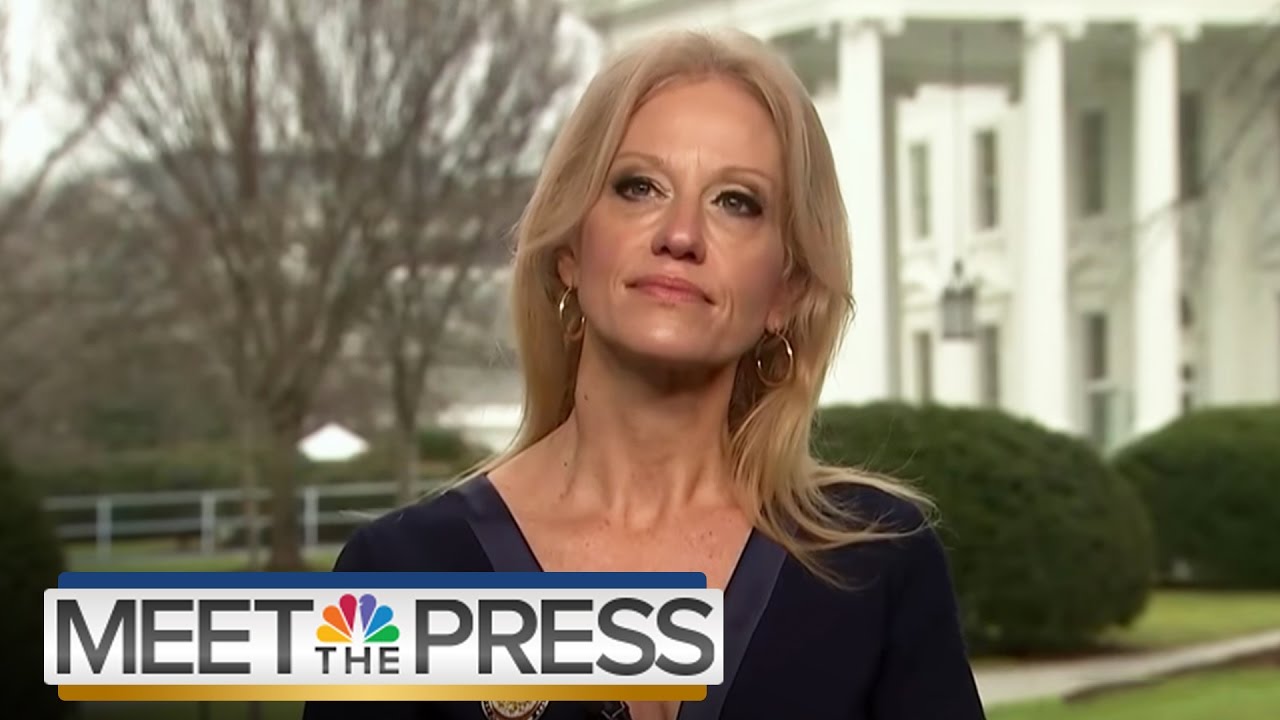 have shown zero hesitation in giving her a platform to lie because they see their job as giving government officials — even ones who lie — a platform.
Even if CNN or MSNBC debunk Conway’s lies, the damage will be done. Fox and right-wing media will amplify her and other falsehoods; armies on social media, bot and real, will, too (@realDonaldTrump will no doubt chime in). The mainstream press will be a step behind in debunking — and even the act of debunking will serve to amplify the lies.
UC Berkeley linguist George Lakoff calls this the “framing effect.” As Lakoff puts it, if you say “don’t think of an elephant,” you can’t help but think of an elephant. In other words, even if you reject an argument, merely repeating it cements the frame in people’s minds. Debunking it is still useful, of course, but there’s a cost to dignifying it in the first place.
There is some research that points to the utility of fact-checking. Political scientists Brendan Nyhan and Jason Reifler have shown that repeated exposure to fact-checking does tend to increase the accuracy of beliefs. But the issue with zone-flooding is an overabundance of news, which diminishes the importance of any individual story, no matter how big or damning.
In this environment, there are often too many things happening at once; it’s a constant game of whack-a-mole for journalists. And we know that false claims, if they’re repeated enough, become more plausible the more often they’re shared, something psychologists have called the “illusory truth” effect. Our brains, it turns out, tend to associate repetition with truthfulness. Some interesting new research, moreover, found that the more people encounter information the more likely they are to feel justified in spreading it, whether it’s true or not.
Flooding the zone, polarization, and why many people still don’t know what Trump did
This all intersects with political polarization in troubling ways. One consequence of pervasive confusion about what’s happening is that people feel more comfortable siding with their political tribe. If everything’s up for grabs, and it’s hard to sift through the competing narratives to find the truth, then there’s nothing left but culture war politics. There’s “us” and “them,” and the possibility of persuasion is off the table.
It’s worth noting that this polarization is asymmetric. The left overwhelmingly receives its news from organizations like the New York Times, the Washington Post, or cable news networks like MSNBC or CNN. Some of the reporting is surely biased, and probably biased in favor of liberals, but it’s still (mostly) anchored to basic journalistic ethics.
As a recent book by three Harvard researchers explains, this just isn’t true of the right. American conservative media functions like a closed system, with Fox News at the center. Right-wing outlets are less tethered to conventional journalistic ethics and exist mostly to propagate the bullshit they produce.
All this has created an atmosphere that has helped Trump. The Trump administration was remarkably successful at muddying the waters on Ukraine and impeachment, and Republicans in Congress helped by parroting the administration’s talking points.
:{:{:{}:
Reps. Guy Reschenthaler (R-PA), Jim Jordan (R-OH), and Louie Gohmert (R-TX) look on as fellow Republicans speak to the press after the House Judiciary Committee approved articles of impeachment against President Trump on December 13, 2019. Drew Angerer/Getty Images}:}:
The fact is, Trump did what Democrats have accused him of doing. We know, with absolute certainty, that the president tried to get a foreign government to investigate a family member of one of his political rivals. And we know this because of the witnesses who testified before the House Intelligence Committee and because Trump’s own White House released a record of the call proving it.
Yet all the polling data we have suggests that public opinion on Trump and Ukraine basically held steady. Again, some of this is pure partisan recalcitrance. But there’s good reason to believe that the right’s muddying of the waters — making the story about Ukraine and Hunter Biden, pushing out conspiracy theories, repeatedly trumpeting Trump’s own version of events, etc. — played a role.
The issue is that the coverage of the trials, in both the mainstream press and right-wing outlets, ensured that these counternarratives are part of the public conversation. It added to the general atmosphere of doubt and confusion. And that’s why zone flooding presents a near-insoluble problem for the press.
The old model is broken
The way impeachment played out underscores just how the new media ecosystem is a problem for our democracy.
It helps to think of zone-flooding less as a strategy deployed by a person or group and more as a natural consequence of the way media works.
We don’t need a master puppeteer pulling the media’s strings. The race for content, the need for clicks, is more than enough. Bannon or Conway can shake things up by feeding nonsense into the system.
:{:{:{}:
Fox & Friends hosts Steve Doocy, Ainsley Earhardt, and Pete Hegseth interview former US Army Lt. Clint Lorance on November 18, 2019. John Lamparski/Getty Images}:}:
Trump can dictate an entire news cycle with a few unhinged tweets or an absurd press conference. The media cycle is easily commandeered by misinformation, innuendo, and outrageous content. These are problems because of the norms that govern journalism and because the political economy of media makes it very hard to ignore or dispel bullshit stories. This is at the root of our nihilism problem, and a solution is nowhere in sight.
The instinct of the mainstream press has always been to conquer lies by exposing them. But it’s just not that simple anymore (if it ever was). There are too many claims to debunk and too many conflicting narratives. And the decision to cover something is a decision to amplify it and, in some cases, normalize it.
We probably need a paradigm shift in how the press covers politics. Nearly all of the incentives driving media militate against this kind of rethinking, however. And so we’re likely stuck with this problem for a very long time.
As is often the case, the diagnosis is much easier than the cure. But liberal democracy cannot function without a shared understanding of reality. As long as the zone is flooded with shit, that shared understanding is impossible.
---