NatCon nat'l conservativism
---
oops see main -S
merri ok
see pjt 2025
see jdv
this cd be for conf?
SEE THEO BROS XIAN NATL
SEE COOCH CTR RENEWING AM RUFO, COOCH
fake electors trump coup
vought OMB HIRED JEFFREY BOSSERT CLARK
paoletta of course
---
fla Republican Nominee Marched at Violent Neo-Nazi Rally - Yahoo
Sep 14, 2026Florida state House of Representatives nominee Marshall Rawson marched in the 2017 neo-Nazi "Unite the Right" rally in Charlottesville, Virginia.
JOHN OLIVER 10 26
The Republican Party & The Far Right: Last Week Tonight with John Oliver (HBO)
NEO-NAZI TUCKER FUENTES EXCUSE
hertzl inst edmund burke inst logo
---
---
AN 12 25
Brookings Institution nonresident fellow and philosopher Laura Field says a 77-year-old book can explain the MAGA new right, and much of it deals with the rejection of truth.
Author Richard Weaver wrote a book in 1948 that describes the basic contours of the New Right’s closed philosophical approach. Field said you can hear the book’s title, “Ideas Have Consequences,” as a popular catchphrase among conservatives.
Field said Weaver explored a philosophical concept called nominalism, which involves the “rejection of universal concepts and absolute truths — including transcendental moral truths.” Nominalism believes that there is no universal objective moral reality, and “it does not exist as an expression of the divine,” said Field.
By challenging the idea of universal objective moral reality, Weaver said modern man had “succumbed to individualism, relativism, materialism, historicism and politics as will to power.”
“In my research on the MAGA New Right and in the countless hours I’ve spent in conservative academic circles, I’ve heard this Weaver-esque refrain again and again,” said Field. “It is hard to think of a single significant thinker of the MAGA New Right who would disagree with his assessment of the ways in which modern thought is inherently corrosive or who would dissent from his insistence that we must restore some kind of transcendental moral orthodoxy to our politics.”
But when Weaver argued that modern ideas are evil, Field said “he helped legitimate the repression of anyone who thinks about truth differently.”
“When the thinkers of MAGA New Right suggest that only conservatives — or as some put it, heritage Americans — have access to America’s founding principles or that America is a Christian nation, they are providing a justification for authoritarian actions on the part of the government.”
Israeli political theorist and conservatism advocate Yoram Hazony promotes in the United States,
that “the only thing that is strong enough to stop woke neo-Marxism, the religionof woke neo-Marxism, is the religion of biblical Christianity.”
“These ideas, to [Hazony], justify limiting immigration as a way to maintain cultural cohesion,” said Field.
Similarly, Field argues that President Donald Trump and Vice President JD Vance seek “to dominate a nation and impose their politics on those who don’t share [their] vision.”
:{:{“It is not the model that America’s founders aspired to,” said Field. “That country is a liberal democracy, and one of its major aspirations — and sometimes its achievement — is that it allows people who have different orientations and belief systems to live together in relative peace and freedom. That is the vision for our country that we must strive to achieve.”}:
Read the New York Times report at this link.
---
---
EXTREMISM MOJO
To Understand JD Vance, You Need to Meet the “TheoBros”
These extremely online young Christian men want to end the 19th Amendment, restore public flogging, and make America white again.
Kiera ButlerNovember+December 2024 Issue
*Our November+December issue investigates the Christian nationalist movement that aspires to take over government at all levels, from school boards and state legislatures to Congress and the Supreme Court. Read the series of stories here.
On July 15, when former President Donald Trump first appeared at the Republican National Convention in Milwaukee, he brought along two new accessories. One was a large bandage covering his ear, which had been nicked by a would-be assassin’s bullet. The other was Ohio’s first-term senator and Hillbilly Elegy author JD Vance, who was about to debut as the GOP vice presidential hopeful.
Two days later, after paying tribute to his wife, Usha—the child of immigrants from India—and their three biracial kids, Vance portrayed a vision of America that resonated deeply with Trump voters. “America is not just an idea,” he said solemnly. “It is a group of people with a shared history and a common future. It is, in short, a nation.”
To many viewers at home, this seemed like the stuff of a boilerplate, patriotic stump speech. But the words “shared history” lit up a far-right evangelical corner of social media. “America is a particular place with a particular people,” Joel Webbon, a Texas pastor and podcaster, wrote on X. “This is one of the most important political questions facing America right now,” posted former Trump administration official William Wolfe. “Answer it wrong, we will go the way of Europe, where the native-born populations are being utterly displaced by third world migrants and Muslims. Answer it right, and we can renew America once more.”
Vance was embracing one of their most cherished beliefs: America should belong to Christians, and, more specifically, white ones. “The American nation is an actual historical people,” says Stephen Wolfe (no relation to William), the author of the 2022 book The Case for Christian Nationalism, “not just a hodgepodge of various ethnicities, but actually a place of settlement and rootedness.” For this group of evangelical leaders, Vance, a 40-year-old former Marine who waxes rapturous about masculinity and women’s revered role as mothers, was the perfect tribune to spread their gospel of patriarchal Christian nationalism.
For years, graying, khaki-clad evangelists have faithfully made the rounds at conservative events. However, as Wolfe, a 41-year-old former Princeton postdoc, writes in his book, these “men in wrinkled, short-sleeve golf shirts, sitting plump in their seats” are yesterday’s Christians. Among younger activists, they inspire the rolling of eyes—they are the embodiment of an ineffective boomer approach to taking over the United States for Jesus.
In their place, a group of young pastors hope to spearhead a Christian nationalist glow-up as they eagerly await a “Christian prince” to rule America. These often bearded thirty- and fortysomethings have suits that actually fit. They are extremely online, constantly posting on myriad platforms, broadcasting their YouTube shows from mancaves, and convening an endless stream of conferences for likeminded followers. Let’s call them, as one scholar I spoke with did, the TheoBros.
For all their youthful modishness, this group is actually more conservative than their older counterparts. Many TheoBros, for example, don’t think women belong in the pulpit or the voting booth—and even want to repeal the 19th Amendment. For some, prison reform would involve replacing incarceration with public flogging. Unlike more mainstream Christian nationalists, like House Speaker Mike Johnson, who are obsessed with the US Constitution, many TheoBros believe that the Constitution is dead and that we should be governed by the Ten Commandments.

In American Reformer, their unofficial magazine, hagiographies of Spanish dictator Francisco Franco appear alongside full-throated defenses of countries that execute gay people. On podcasts, the TheoBros unpack “the perils of multiculturalism,” expose “Burning Man’s wicked agenda,” and peel back the nefarious feminist plot of Taylor Swift. In Wolfe’s The Case for Christian Nationalism, one of their seminal texts, he writes that in an ideal Christian nation, heretics could be executed.
The rise of the TheoBros worries more mainstream religious conservatives. Janet Mefferd, a former Christian radio host and journalist who tracks their ascendancy, says her community is alarmed to see an extremist movement gaining traction. “I’m not sure what the endgame is, other than they want to advance Christian nationalism,” she says. “But a lot of us find that terrifying.”
“I’m not sure what the endgame is, other than they want to advance Christian nationalism—but a lot of us find that terrifying.”
The TheoBros’ strategy is bottom-up: They aim to convert small American towns into Christian enclaves. But it is also top-down: Some are working to position themselves close to the locus of federal power. Vance, a Catholic convert married to a Hindu, would seem an unlikely hero for a movement of devout Protestants who believe in a homogeneous America. But over the last few years, his political orbit has increasingly overlapped with that of the TheoBros—so much so that to careful observers, his public echoes of their ideas are beginning to sound less like coincidence and more like dog whistles.
And those dog whistles signal the major themes of this election: hypermasculinity, declining birthrates, ethnonationalism—and no small measure of carefully curated misogyny. If you want to know some of the actors who red-pilled Vance, or at least those who flock to him, you need to meet the TheoBros.
 Clockwise from top-left: Douglas Wilson, Joel Webbon, Josh Abbotoy, Andrew Isker, William Wolfe, and Brian SauvéYouTube
With no meetings, website, or an explicit statement of faith that unifies their beliefs, the TheoBros are not an official organization. They identify with 16th-century French theologian John Calvin, who spawned a rigid and deterministic form of Protestantism. Julie Ingersoll, a University of North Florida religion scholar, traces the current movement back to R.J. Rushdoony, an Armenian American philosopher who popularized the idea of Christian nationalism (and homeschooling) in the early 1970s.
Out of Rushdoony’s movement emerged two camps: the charismatic Christians, now known as the New Apostolic Reformation, and the reformed Protestants, which include the TheoBros. They share the goal of creating a Christian nation, says Ingersoll, but differ on a key point of theology: Adherents of the New Apostolic Reformation believe that God is still speaking directly to people through pastors who have declared themselves apostles and prophets. The TheoBros, meanwhile, believe that God said all he needed to say in the Bible.
Many TheoBros are also proponents of postmillennialism, the idea that believers can hasten Jesus’ return by fighting against the satanic forces of liberal excess. TheoBro Aaron Renn, an Accenture consultant turned Christian pundit, has described our current era as a “negative world,” where Christians are persecuted for their beliefs. Andrew Isker, another Bro, calls it “trashworld.”
Like all self-respecting millennials, the TheoBros have little tolerance for boomers, with the exception of their patriarch, Douglas Wilson, a 71-year-old pastor in Moscow, Idaho. When he was younger, Wilson imagined himself going into the family business—Christian bookstores—but after a stint in the military, he moved to Moscow in 1975 to study philosophy at the University of Idaho, where he became involved with the Jesus People, a kind of mashup of evangelical and hippie culture. He helped found Christ Church, the congregation over which he still presides and that regularly draws crowds of 1,300.
Wilson has since turned the college town into his own Christian kingdom. He helped found New Saint Andrews College, the Canon Press publishing house, and Logos School, one of the nation’s first classical Christian schools, where students exclusively study the Western canon. Wilson embraced Calvinism in 1988 and remade his church from the freewheeling Jesus People hub into something far more sober and buttoned-up, where women couldn’t be church leaders and the only music allowed was hymns and psalms. In the early 1990s, Wilson helped launch the Association of Classical Christian Schools, which had 502 member institutions across the United States as of March 2023.
“The sexual act cannot be made into an egalitarian pleasuring party. A man penetrates, conquers, colonizes, plants. A woman receives, surrenders, accepts.”
His influence over Moscow has not been without controversy. In a 2021 Vice exposé, former members of Christ Church alleged that ministers had encouraged them to stay in abusive relationships. That tracks with Wilson’s 1999 book, Fidelity: How to Be a One-Woman Man, in which he wrote, “The sexual act cannot be made into an egalitarian pleasuring party. A man penetrates, conquers, colonizes, plants. A woman receives, surrenders, accepts.” For that reason, Wilson wrote, the dynamic of a dominant man and a submissive woman is “an erotic necessity.” (Wilson called allegations of the church urging women to stay in abusive relationships “categorically false.”)
Wilson has also promoted another form of dominance. In the 1996 book Southern Slavery: As It Was, Wilson and his co-author argued that the master-slave dynamic was “a relationship based upon mutual affection and confidence,” and “there has never been a multi-racial society which has existed with such mutual intimacy and harmony in the history of the world” as that of the antebellum South. (In a 2020 blog post, Wilson said he now allows that while “the benevolent master is not a myth, the idea of the horrific taskmaster is no abolitionist myth either.”) When I asked Wilson about his controversial statements, he likened himself to a chef who strategically deploys jalapeno peppers: “Then some of my enemies online have combed through my writings, have gathered up all the jalapenos and put them on one Ritz cracker.”
:In July, at the National Conservatism Conference in Washington, DC, Wilson shared the stage with Sens. Josh Hawley (R-Mo.), Ron Johnson (R-Wis.), and Mike Lee (R-Utah), as well as Vance, who auditioned his “America is a people” bit a week before his star turn at the GOP convention. Wilson agrees with Vance’s suggestion that children should be allotted votes, managed by their parents. “I would like to see elections where households vote,” he told me. Men, as the heads of households, would actually cast the votes. Though he believes that women’s suffrage was “a mistake,” he would allow a special exception for single mothers.}:
Wilson offered the crowd a few one-liners (“I’m a Presbyterian, not a Lesbyterian”), but mostly, he talked about the persecution of Christians. “It used to be that the sexually troubled had to keep their kinks hidden away in the closet,” he mused. “Now it is the conservative Christian who needs to keep his virtues hidden in the recesses of the closet.” After the National Conservatism Conference, Wilson appeared at the Believers’ Summit, which was headlined by Trump and hosted by the conservative political group Turning Point USA.
But it’s not just conferences and interviews with the likes of where Wilson promotes his ideas. He has a blog, a podcast, and a YouTube channel, thanks mostly to the urging of his children and younger colleagues. One example is that every year since 2018, Wilson has been celebrating what he calls No Quarter November: “The month where we say out loud what everyone is thinking.” In a
, which was the brainchild of one of his sons, Wilson sits at a sumptuously appointed Thanksgiving table, surrounded by his children and grandchildren, and addresses the camera. “If you think of my blog as a shotgun,” he says, “this is the month when I saw off all my typical, careful qualifications and blast away with a double-barreled shorty.” His wife, clad in an apron, brings out a turkey and places it in front of him, and then the tranquil scene is interrupted by a blaring alarm and a glowing red “perimeter breach” sign. Wilson excuses himself, heads to his garage, and straps on a flamethrower. After using it to light a cigar, he aims the fire at cardboard cutouts of Disney princesses Elsa and Ariel, and the logos of Instagram, TikTok, Twitter, and Netflix.
Wilson’s willingness to make campy content sets him apart, says Rachel Tabachnick, an extremism researcher who has been studying Christian nationalism for decades. “Instead of a crotchety old guy talking about stoning people, he’s like, super cool,” she says. “He’s witty.”
In subsequent videos, Wilson tackled women’s culpability in rape, the dark side of empathy, and the virtues of “something called the patriarchy—that which, according to our soi-disant and lisping political theorists, must be smashed. Only they say something like ‘thmasth.’”
Melek Zertal
Wilson has used his platforms to anoint the next generation of ultraconservative reformed Christian pastors, all of whom happened to be men. Mefferd, the conservative Christian journalist, told me that Wolfe’s The Case for Christian Nationalism got traction in mainstream Christian circles in part “because Doug Wilson endorsed.” Another Wilson is Joel Webbon, a 38-year-old pastor who hosts a podcast and YouTube show, which he films from a wingback leather chair in a book-lined room.
Webbon wasn’t always reformed—he is an alumnus of a Bible school run by a New Apostolic Reformation affiliated outfit, which he now considers “straight-up heretical.” In his 20s, he broke from the group, moved to Texas, and started his own church. In a video from a few years ago, Webbon Wilson with emboldening him to say whatever he wanted—like telling a guest that the Founding Fathers weren’t responsible for the slave trade because Africans had done the actual kidnapping and enslaving.
“Kamala sees happy, large families and hates them. She wants them destroyed. She wants you to never be able to have this. She is a nasty, bitter harridan who hates all that is true, good, and beautiful.”
For Webbon, it was intensely liberating to watch Wilson speak in public without worrying about being canceled. “You stay in your little corner, you stay on your little leash, because you’re like, I don’t know what will happen,” Webbon said. “But when you see some other guy do it, and you’re like—that’s the worst thing that can happen? Vice writes an article about you? [Christianity Today editor-in-chief] Russell Moore won’t invite you to his birthday party anymore? Like, that’s it.” At a , he registered dismay over immigrants in his community. “It’s like full, straight-up Hindu garb at our neighborhood swimming pool, that my daughter is asking [about and] I’m trying to explain.”
In August, he remarked on his show that “a lot of people are gonna be surprised” when “you’re spending eternity worshipping Christ next to Stonewall Jackson and Robert E. Lee and Jonathan Edwards, and, you know, George Whitefield and Martin Luther King Jr.’s in hell.”
Webbon is so impressed by his own audacity that he maintains an online list of all the controversies in which he’s become embroiled. There, he explains why he called Christian men living in California “stupid” (they could just move to a red state); why he once ordered his wife to stop reading a book on theology (he didn’t want her exposed to beliefs that were different from his own); and why he believes in a patriarchal household structure (the Bible says so). Webbon, who is planning to host a conference in Texas next spring called “Christ Is King: How to Defeat Trashworld!” maintains that a “return to the Constitution is impossible” and that the only viable alternative is the Ten Commandments.
Some of Wilson’s other acolytes are attempting to create their own versions of Moscow, Idaho. Take Brian Sauvé, a 33-year-old Christian recording artist, podcaster, and pastor of Refuge Church in Ogden, Utah. Like Webbon, Sauvé wasn’t always reformed—Refuge began as a charismatic Christian church. After the lead pastor resigned in a scandal, the then-24-year-old Sauvé ascended to take his place, immersed himself in reformed theology, and moved the church in a new direction. Today, he presides over a Moscow-esque ecosystem: a publishing house called New Christendom Press, as well as St. Brendan’s Classical Christian Academy, modeled after those in Wilson’s network. “Can you feel it in the sails?” reads St. Brendan’s website. “The stiff breeze out of Moscow, Idaho? We can.”
On his three podcasts and to his more than 53,000 followers on X, Sauvé regularly states that women’s primary function is to bear children. In July, after Vance’s comments about “childless cat ladies who are miserable” began widely circulating, he posted: “It is desperately sad to think of all the intentionally barren women who will find themselves totally alone in their 50s, realizing their irreversible mistake. They will wish they could trade it all—money, vacations, independence, all of it—for children they can now never have.”
But unlike more mainstream conservatives, Sauvé does not even pretend to champion the idea of a Judeo-Christian nation. He posted in July, “[O]ur political system is heavily influenced by Jews who reject Christ and embrace all manner of evils.”
An even more well-connected Wilson emulator is Josh Abbotoy, executive director of American Reformer and managing partner of a venture capital fund and real estate firm called New Founding. A former fellow of the right-wing think tank the Claremont Institute, Abbotoy reported that he recently participated in a Project 2025 presidential transition “strategic planning session” hosted by the right-wing think tank the Heritage Foundation. Bucks County Beacon reporter Jennifer Cohn revealed venture capitalist Chris Buskirk was listed as the editor and publisher of American Reformer. (The publication’s cofounder, Nate Fischer, later clarified to Mother Jones that Buskirk’s listing in the filing had been a clerical error, and that he was actually a board member of American Reformer.) In 2022, Buskirk co-founded the Rockbridge Network, a collection of powerful Trump donors including Catholic judicial kingmaker Leonard Leo and Silicon Valley billionaire Peter Thiel. Another co-founder of the Rockbridge Network? None other than JD Vance.
Thiel, Vance’s mentor and former employer, is also a major funder of the National Conservatism movement. Obsessed with global birthrates, Thiel spent $10 million on his protégé’s successful 2022 Senate campaign. In July, shortly after Trump had announced Vance as his running mate, Cohn surfaced a tweet by New Founding’s network director, Josh Clemans: a photo of Vance with several New Founding staffers. The caption read “Our guy.”
New Founding lists as a partner the Society for American Civic Renewal, a secretive fraternal order founded by Indiana shampoo baron Charles Haywood, who describes himself as an aspiring Christian “warlord.” According to founder Nate Fischer, New Founding wants to “form the backbone of a renewed American regime” and that its members “understand the nature of authority and its legitimate forceful exercise.” But its main public-facing project appears to be turning tracts of land in Appalachia into Christian communities. Promotional materials describe a community of “unmatched seclusion” where “simple country faith” protects local culture from rainbow flags and crime. Potential buyers, he advises, should not delay. “Who’s going to grab the land? Is it going to be good, based people who want to build something inspiring, something authentic to the region’s history, or is it going to be Bill Gates and BlackRock and hippies from California?”
One eager customer is 38-year-old TheoBro Andrew Isker—the pastor who interned at Wilson’s church, studied divinity at New Saint Andrews, and co-wrote a book on Christian nationalism with Andrew Torba, the openly antisemitic CEO of the social media platform Gab. In July, Isker announced on X that he planned to move his family of seven to lead a church in a New Founding community in Tennessee. Life in his native Minnesota, he said, had become untenable because of permissive laws around trans rights and abortion, not to mention how hospitable the state has been to refugees. “Minnesota is one of the top destinations for resettling foreign people hostile to our way of life,” he said.
That month, Isker spoke at a Texas conference about the “war on white America” alongside Paul Gottfried, the mentor of prominent white nationalist Richard Spencer. The conference was hosted by the True Texas Project, a far-right group with ties to Sen. Ted Cruz (R-Texas) and Texas Attorney General Ken Paxton.
Like many TheoBros, Isker sees much to like in Vance. In early July, before Trump announced his running mate, Isker referred to him as “Senator JD Vance (R-Heritage America).” In late July, he posted a video of Vance and told his 29,000 followers, “You need to double down on childless cat lady discourse. Kamala sees happy, large families and hates them. She wants them destroyed. She wants you to never be able to have this. She is a nasty, bitter harridan who hates all that is true, good, and beautiful.”
One problem is that there simply are not enough TheoBros to populate Christian communities like the one Isker plans to move to. Enter William Wolfe, the founder of the Center for Baptist Leadership, which aims to persuade members of the Southern Baptist Convention that it, the largest of all Protestant denominations in the United States, has fallen prey to the corrupting forces of liberalism. Baptists are only the beginning. Wolfe wants to win over the entire evangelical mainstream, which he and other TheoBros refer to as “Big Eva.” In August, he posted on X, “Once you realize that Big Eva thinks it’s a bigger sin to desire to preserve the customs, heritage, values, and cultural homogeneity of your own nation than to kill the unborn in the womb, you can better understand their moral framework.”
Wolfe served in the Trump administration both as the deputy assistant secretary of defense and as director of House affairs at the Department of State. He is also an alumnus of Heritage Action, a sister organization of the Heritage Foundation, the arch-conservative think tank behind Project 2025, whose chief architect, Russell Vought, posted on X that he was “proud to work with @William_E_Wolfe on scoping out a sound Christian Nationalism.” A few months later, the Bucks County Beacon uncovered a lengthy online manifesto on the goals of Christian nationalists. The document, which listed Wolfe and Joel Webbon as contributing editors and Oklahoma Sen. Dusty Deevers as a co-author, called for “civil magistrates” to usher in “the establishment of the Ten Commandments as the foundational law of the nation.”
The manifesto doesn’t specify exactly how Christian nationalists should achieve these goals. As Tabachnick, the extremism researcher, interprets it, the TheoBros are imagining a utopia where “they are going to be free to be entrepreneurs in all different senses, including the tech world that they’re mixing with so freely.” The key, she said, is that authoritarianism “is required to have the utopian vision.”
Last year, the extremism watchdog group Right Wing Watch a video of Wolfe quoting a scripture passage. There are times when “even the God of peace proclaims by his providence, ‘to arms!’” he says. “If we have ever lived in a point of time in American history since then that we could argue that now is a time ‘to arms’ again, I think we are getting close.”
William Wolfe’s Christian nationalism manifesto made the rounds on social media, but in mainstream conservative outlets, it was Stephen Wolfe who brought TheoBro ideas to the wider world. In his book, which was praised by editors at the Federalist and theAmerican Conservative, Wolfe paints America as a “gynocracy” whose government and culture have been feminized by unhappy women leaders. (Sound familiar?) He has stated on X that women should not have the right to vote, and that “interethnic” marriage can be “sinful.”
Wolfe grew up in Napa, California, and his father was an admirer of the right-wing pundit and erstwhile GOP presidential candidate Pat Buchanan. After attending West Point and serving in the Army, Wolfe earned advanced degrees before leaving academia to “do the Wendell Berry thing” in North Carolina with his wife and four kids.
Over the summer, Wolfe, 41, agreed to speak with me on the condition that I refer to him as “Dr. Wolfe” and call him an “expert on Christian nationalism.” The Dr. Wolfe I spoke with was a more muted version of the firebrand I’d watched online. He said his ideal version of America would be led by a Caesar figure. Gay marriage would be strictly prohibited. Women would not be allowed to vote—instead, men would vote for their households.
When I brought up the bit from his book about heretics being killed, he grew annoyed. “I do think it’s permissible, in principle, for a state to suppress theological heresy, but that doesn’t mean that it’s prudent or proper, suitable in every circumstance or every tradition or way of life.” The Founding Fathers, he added, had encouraged religious liberty, so killing heretics would not be appropriate in the United States that we inhabit.
We turned to remarks he had made at a recent conference convened by Brian Sauvé: “I think we need to reflect on this idea of Judeo-Christianity, or Judeo-Christian worldview, or Judeo-Christian whatever, and really eradicate that from our thinking. Because if we say that America is a Judeo-Christian country, then it can’t be a Christian country, okay?” What role, I asked him, would Jews play? After a deep sigh, he told me that they would be allowed to “exercise their religion freely.”
“We need to reflect on this idea of Judeo-Christianity, or Judeo-Christian worldview, or Judeo-Christian whatever, and really eradicate that from our thinking. Because if we say that America is a Judeo-Christian country, then it can’t be a Christian country, okay?”
We spoke a week before Vance’s RNC speech, and Wolfe’s remarks helped me understand what the TheoBros heard in Vance’s phrase about America as a people. The founders, Wolfe noted, intended for their country to be “Anglo-Protestant with an American inflection.” America, he continued, is “a place of settlement and rootedness, but it’s an open ethnicity in which people can become one of us.” Which is to say that, like some others, Wolfe is not necessarily opposed to the idea of nonwhite people in America—as long as they agree to assimilate to the Anglo-Protestant dominant culture.
In this telling, America is not a pluralistic society at all, but rather one in which there exists an uneasy truce between Christians and those they reluctantly tolerate. Toward the end of our conversation, I asked Wolfe what motivated him. “I want Christians to be more assertive and to recognize the Christian heritage of the American way of life, and to seek to restore that,” he said. “This is a Christian country, and we’ve got to work to restore it to what it once was.”
In his keynote at Sauvé’s conference, titled “Why Multicultural Pluralism Fails and What to Build Instead,” Wolfe called the concept of America as a melting pot “an early 20th-century idea cooked up by a Jew in New York who despised the confident Anglo-Protestant establishment.” WASPs were the “distinct ethnicity” of America, he insisted, and America should only welcome those who aspired to assimilate. As he put it, “This is our homeland, and we welcome you on the condition of conformity.” Or, in the words of JD Vance, America “is a group of people.”
*Correction, September 19: An earlier version of this article inaccurately described Chris Buskirk’s role at American Reformer.
Update, January 14: After this story was published, Nate Fischer, CEO of New Founding and co-founder of American Reformer, clarified toMother Jonesthat Buskirk’s listing in tax filings as the editor and publisher ofAmerican Reformerhad been a “clerical error (presumably copying his bio fromAmerican Greatness, where he was editor and publisher)” and that Buskirk was actually a board member ofAmerican Reformer. The sentence has been revised.*
{Read our full investigation into the rise of Christian nationalism.*}:
---
---
AN 9 25
The far-right National Conservatism Conference used to be an event that many traditional Goldwater and McCain conservatives made a point of avoiding. But with President Donald Trump's MAGA movement now dominating the GOP, NatCon is drawing a lot more attention in Republican circles.
In an article published on September 13, Salon's Heather Digby Parton points to growing interest in NatCon as a troubling example of how much Christianity's lunatic fringe is influencing the GOP and the MAGA movement.
Describing the most recent NatCon gathering — which was held in Washington, D.C. in early September — Parton explains, "'Overturn Obergefell' was one featured panel, the AP's Joey Cappelletti reported. 'The Bible and American Renewal' was another. The conference, he wrote, 'underscored the movement's vision of an America rooted in limited immigration, Christian identity and the preservation of what speakers called the nation's traditional culture' — which is putting it very mildly. It certainly doesn’t seem there was much talk of individual freedom, free markets or liberty of any kind, and that is a big change from the conservative movement that has dominated Republican politics since the Reagan Administration."
READ MORE:'Doing a pretty terrible job': Trump official mocked over response to dismal economic data
The far-right NatCon gathering should not be confused with National Council for Mental Wellbeing event that is also abbreviated NatCon. The health event was held in Philadelphia in May, not in Washington, D.C. in early September, and has zero connection to the political event.
This year's political NatCon, Parton observes, featured some prominent figures in the Trump Administration — including National Intelligence Director Tulsi Gabbard; Russell Vought, director of the Office of Management and Budget and a key architect of Project 2025; and border czar Tom Homan.
"But perhaps the most revealing moment was a viral speech by Missouri GOP Sen. Eric Schmitt titled 'What is an American?' in which he made the claim that the country belongs to the descendants of white Europeans who took the land from the violent Native Americans fair and square because they were just plain superior," Parton observes. "He said straight out: 'America doesn't belong to them — it belongs to us.… We can no longer apologize for who we are. Our people tamed the continent, built a civilization from the wilderness. We Americans are the sons and daughters of the Christian pilgrims who poured out onto the ocean's shores.'"
Schmitt, Parton adds, even promoted the Great Replacement Theory during his speech.
READ MORE:'Republican for Trump': Alleged Kirk shooter's grandmother confirms entire family is MAGA
A recurring theme of NatCon, Parton warns, is that the U.S. is not only a Christian nation — it is a white Christian nation.
"It's tempting to write off NatCon, and Schmitt's speech in particular, as an example of a bunch of right-wing kooks indulging their little fever dream of creating a white Christian autocracy," Parton stresses. "But these are powerful people now, and if there's any person in government who is trying to create 'a pastiche of past glories' — largely by erasing the true American past, both good and bad — it's the most powerful one of all, Donald Trump, who has certainly discovered that 'you can just do things!'"
Parton continues, "Nobody paid attention to Project 2025 until it was too late, and look where that got us. It would be foolish to make that same mistake again."
READ MORE: 'Doing a pretty terrible job': Trump official mocked over response to dismal economic data
*Heather Digby Parton's full article for Salon is available at this link.
---
an 9 25
The Guardian reports the Friday National Conservatism Conference in Washington, D.C. hosted a wide variety of far-right religious extremists, from men-only secret societies to theocratic right-wing pundits and associations.
Other event speakers were closely associated with the secretive Society for American Civic Renewal (SACR), an invitation-only, Christian ultra-nationalist network with “undercurrents of neo-fascist accelerationism,” according to a Middlebury Institute report.
Mingling and mixing among the theocrats, however, were Trump officials.
READ MORE: 'Whiplash': Insider says Trump 'knows where things stand' — and it’s killing him
“NatCon is filled with extremists touting white nationalism and conspiracy theories,” said Heidi Beirich, the chief strategy officer and co-founder of the Global Project Against Hate and Extremism. “What is notable is how Trump administration officials and allies are key players in the event, showing that it is near impossible today to distinguish the far right from the administration.”
One speech by White house “border czar” Tom Homan contained warnings for the city of Chicago, which Trump is threatening to douse with federal agents and national guard troops, as he already has in Los Angeles and Washington, D.C.
“I said two months ago, we’re going to flood the zone and that’s exactly what we’re doing,” Homan told the crowd. “In Chicago, it’s coming. So, watch what happens in the very near future.”
The Guardian reports Trump’s deputy attorney general, Harmeet Dhillon, gave her own speech in which she characterized the justice department’s civil rights division as “the president’s shock troops.”
READ MORE: Trump discovers rejection on the world stage — because of his 'weak mind': analysis
“We’re the front guard. We are going to go first and clear the way for others to do their work,” said Dhillon, who has assigned civil rights lawyers to investigate anti-genocide campus protests and perceived “anti-Christian bias.”
Other administration figures speaking at NatCon included Director of National Intelligence, Tulsi Gabbard, and Small Business Administration leader and former senator, Kelly Loeffler.
These Trump officials shared screen time with leading figures of the so-called “new right,” an anti-democratic and ultra-nationalist far-right movement “whose reactionary views have undergirded the Trump administration’s actions,” according to the Guardian. They also shared space with Society for American Civic Renewal Co-founder Charles Haywood — a regular engagement farmer on X — who recently posted: “Has a single (subcontinent) Indian ever accomplished anything of truly major note in the modern period?”
The Guardian reports the conference also featured “prominent faces from the universe of thinktanks surrounding the Trump administration who have signed on to, or even devised the Project 2025 agenda that has provided a blueprint for Trump’s actions in its first months.” This included Heritage Foundation president, Kevin Roberts, whose speech “leaned into male grievance and anti-immigrant sentiment,” according to the Guardian.
READ MORE: 'Game over': Bill Maher sends shockwaves with new warning about Trump
Read the full Guardian report at this link.
---
AN 8 25
Back in the early 1980s, left-wing R&B singer Gil Scott-Heron (remembered for his incendiary "The Revolution Will Not Be Televised") was fond of saying that "the New Right is the same old wrong." The term "New Right," in those days, referred to President Ronald Reagan's fragile coalition — a mixture of neocon defense hawks, evangelical Christian fundamentalists, libertarian budget hawks and moderate Reagan Democrats. But in 2025, "New Right" has a radically different connotation and is synonymous with President Donald Trump's far-right MAGA movement.
Journalist Laura Field, author of the book "Furious Minds: The Making of the MAGA New Right," examines the elements of the 2025 "New Right" in an interview with Vox's Zack Beauchamp published in Q&A form on August 14.
Field describes today's New Right as a coalition, but one that is considerably different from the Reagan coalition of the 1980s.
READ MORE:'That's how this ends': George Conway reveals 'the only way' to stop Trump's 'gangsterism'
"I'm talking about the MAGA New Right, (in contrast) with the Reagan-Buckley right, or the establishment right, which is propped up by fiscal conservatism (free-market economics), social conservatism (conservative social values), and anti-communism," Field told Vox. "The New Right turns against a lot of that. Michael Anton, one of these Claremont Institute guys, says that Trumpism and the New Right is all about economic nationalism — turning against the free market orientation of the establishment — as well as closed, secure borders."
Field added, "So that's the anti-immigration strain and America First foreign policy. I think that there's also just a hardcore social conservatism at the core of a lot of this — at least spiritually."
The Clairemont Institute, a right-wing think tank, was founded in 1979 by the late Harry V. Jaffa, once a speechwriter for Sen. Barry Goldwater (R-Arizona). Claremont has changed dramatically since then, and its ultra-MAGA leanings are a major departure from the Goldwater and Reagan conservatism it once championed.
Describing the elements of the MAGA New Right, Field told Vox, "I have three main camps: the Claremonters, the post-liberals, and the national conservatives. Then, I talk also about the hard right, but the hard right travels alongside all three of them ideologically. The hard right is the hardcore, Manosphere-fascist types. Each of these groupings are different. The Claremonters are the West Coast Straussians that I was speaking about before. They are really committed, at least in theory, to the American founding. They have this very grandiose vision that's beyond even your ordinary patriotism. It's that this is the best regime of all time. They're also at the very cutting edge of the culture war…. And then, there's the national conservatives."
READ MORE:'Disgusting': MAGA erupts at Democratic governor over 'classless' remark about Trump 'bro'
Field continued, "They're a little more vanilla, with just nationalism as their core thing. But it turns into ethno-nationalism in some cases and certainly Christian nationalism. They're a big tent."
The journalist/author stressed that even though the New Right is full of "weirdos," that doesn't mean they haven't achieved power in the Republican Party.
"The knee-jerk reaction to think 'who cares' is a natural one, because a lot of these people are bizarre — weirdos," Field told Vox. "That's why it's alarming to see them wield so much power, to see (Vice President) JD Vance have that clout. I think they have dramatically reoriented the GOP."
READ MORE:'Severe pushback': House Republicans fear constituent revolt over divisive new proposal
ref
no lnx
The “weirdos” shaping Trump’s second term
Politics
The “weirdos” shaping Trump’s second term
A liberal writer explains her journey through intellectual MAGAland.
by Zack Beauchamp
Aug 14, 2025,
Key Speakers At Conservative Political Action Conference
Michael Anton, current director of policy planning at the State Department, speaking during the Conservative Political Action Conference (CPAC) in National Harbor, Maryland, on March 2, 2023. Al Drago/Bloomberg via Getty Images
Zack Beauchamp
Zack Beauchamp is a senior correspondent at Vox, where he covers ideology and challenges to democracy, both at home and abroad. His book on democracy, The Reactionary Spirit, was published 0n July 16. You can purchase it here.
If you’ve been following American politics in the Trump era, there’s a decent chance you’ve heard of “the New Right.” It’s a loose movement of radical intellectuals who share a basic hostility to American liberal democracy. They all think the system is rotten, that it needs to be fundamentally overhauled, and that Donald Trump can be a vehicle for putting something better in its place.
But why do they think that? How much influence do they really have? And what would a response to their rising prominence look like?
In an upcoming episode of Vox’s The Gray Area podcast, I spoke about all of this with Laura Field — a political theorist who spent a lot of time in the conservative intellectual world. Her book Furious Minds: The Making of the MAGA New Right is a fascinating taxonomy of the wild world of far-right thinking.
We talk about who these people are and how they replaced the “old” conservatism with something more aggressive and authoritarian. We also talk about how they are influencing the Trump administration, and why ordinary Americans should care what a handful of thinkers are putting out on obscure Substacks and YouTube channels.
Part of our conversation is transcribed below, edited and condensed for clarity. The full interview contains much more, and you can listen to it on Monday. We’ll update this link with the embed when the episode is out.
And, if you just can’t get enough of Zack and Laura content, you can come to our Vox-sponsored panel at the Liberalism in the 21st Century conference — held in DC on Friday. There’s already a waitlist, so sign up soon.
You’re someone who is liberal but found yourself as a professional academic and intellectual in conservative spaces — and that’s pretty unusual because there tends to be a lot of self-segregation away from that world. What pulled you into it and what was it like being an insider-outsider in the conservative world of ideas?
I wanted to go into medicine and be a doctor in the developing world. I was very, very liberal and sort of a save-the-world type. I had to take some required courses in political philosophy, and one was a wonderful course on ancient political philosophy and early modern thought. It was mind-blowing.
The right today uses this language of being “red-pilled,” where you see through the lies that we are told by the regime. They use this extreme language, but something sort of parallel happened to me, just reading Plato with these really great teachers.
I fell in love with these books and the tradition of political philosophy and literature that these teachers were so good at explaining. My politics didn’t change dramatically, but some of those circles were quite adjacent to the people who were the leaders of the avant-garde of defending Trumpism: the West Coast Straussians, call them the Claremont Institute people.
When that started happening, I was really quite alarmed.
You use “new right” as an umbrella term for all of these different pro-Trump factions. What makes the new Right a cogent grouping, not just a random smattering of people who all like Trump? What connects them and what differentiates them from the old right?
I’m talking about the MAGA new right, [in contrast] with the Reagan-Buckley right, or the establishment right, which is propped up by fiscal conservatism (free-market economics), social conservatism (conservative social values), and anti-communism.
The new right turns against a lot of that. Michael Anton, one of these Claremont Institute guys, says that Trumpism and the new right is all about economic nationalism — turning against the free market orientation of the establishment — as well as closed, secure borders. So that’s the anti-immigration strain and America-first foreign policy.
I think that there’s also just a hardcore social conservatism at the core of a lot of this — at least spiritually.
The new right has shared principles: preoccupation with gender, strong support for Trump, a general disinterest in the traditional norms of democratic politics, and a commitment to unremitting culture war against the left. But there are huge divisions. If you were to divide the new right into camps, what would you say the fault lines are?
I have three main camps: the Claremonters, the post-liberals, and the national conservatives. Then I talk also about the hard right, but the hard right travels alongside all three of them ideologically. The hard right is the hardcore, manosphere-fascist types. Each of these groupings are different.
The Claremonters are the West Coast Straussians that I was speaking about before. They are really committed, at least in theory, to the American founding. They have this very grandiose vision that’s beyond even your ordinary patriotism. It’s that this is the best regime of all time. They’re also at the very cutting edge of the culture war. So America is the best regime of all time, but we’ve completely lost the plot. The liberals and liberal way of thinking have taken over to such a degree that we need a counter-revolution. They’re the [type] who defended January 6.
Michael Anton, who you mentioned earlier, is now a Trump administration official, a high-ranking one. He’s one of the key leaders in that faction.
Yeah. And then there’s the national conservatives. They’re a little more vanilla, with just nationalism as their core thing. But it turns into ethno-nationalism in some cases and certainly Christian nationalism. They’re a big tent.
The tensions are clearest when we are talking about the post-liberals, who are the most highbrow of the New Right. They tend to be Catholic intellectuals: people like Adrian Vermeule at Harvard, Patrick Deneen at Notre Dame, and writer Sohrab Ahmari. These are serious Catholics who are more committed to social conservatism and really want to shape the morals of the country in a much more traditional Catholic direction. But they’re also interestingly much more sincere about the left-oriented [redistributive] economics.
The new right as a whole speaks as if they want to help the working class, and create new populist programs. But I think that the people who are closest to Trump haven’t really followed through. They’ve got the tariffs, but otherwise economically, they’re still doing the big tax cuts. They’re still beholden to donors. So that’s been a big fissure, because the post-liberals are almost open to socialism.
A lot of other fissures come in terms of how accepting they are of the hard right. Ahmari has been quite outspoken against the Proud Boys and the manosphere, Bronze Age Pervert and those guys.
I think another interesting divide, which came about just after the election, was DOGE vs. MAGA. DOGE came in and did the destructive part of getting rid of the so-called administrative state. But a big part of the new right wants to harness the state and weaponize it for their own purposes.
Why does any of this matter for our politics?
The knee-jerk reaction to think “who cares” is a natural one, because a lot of these people are bizarre — weirdos. That’s why it’s alarming to see them wield so much power, to see JD Vance have that clout.
I think they have dramatically reoriented the GOP. It’s not just JD Vance who’s some weirdo who’s gotten to the top. It also seems to matter a lot to young people. These kinds of movements can build energy, and young men are influenced by these circles.
A lot of these people I’m writing about are in the intellectual spheres. They’re pretty smart. A lot of them have PhDs, which is no marker of genius, but they have a lot of education and resources available to them. They’re experts in ways that would surprise many people. They know a whole lot. I wouldn’t want to debate some of them on the founding or other questions.
These well-learned people shape the minds of people like Joe Rogan. Ideologically, there is a trickle-down effect. The culture war has a big impact. You see the impact of someone like Christopher Rufo.
You argue that the right operates with an “ideas first” approach, believing that ideas have a tangible, causal impact on politics. Democrats, in contrast, are putting ideas last. You contrast the “coarse brazenness of [the right’s] ideologues and the tepid intellectual and cluelessness and cowardice of so many centrist and liberal leaders both within academia and beyond.”
That is a stinging indictment of the liberal intellectual class. Where are you coming from here? When you say that they’ve failed in contrast to the coarse brazenness of the new right, what do you mean?
Trump has been much more effective in his second term. The Democrats are in a difficult position. They had a very rocky electoral cycle with Biden staying in so long and Harris in this awful position of having to parachute in and not being very well prepared.
I don’t feel like there’s much of a response from the left intellectually to what’s going on. It doesn’t seem to me like the party has much to offer on the ideological front.
It is frustrating as an observer to see that Bernie and AOC were the people who went and toured the country. But I didn’t see more centrist Democrats doing very much. And I still think that’s the case. They seem very shocked and unprepared. And I think that that comes down to a failure of imagination — taking way too much for granted for a very long time. And that’s part of what got us Trump in the first place.
See More:
Politics
Most Popular
The White House has a preferred alternative to PBS. It may already be in countless classrooms.
Take a mental break with the newest Vox crossword
The 25 pieces of culture that explain the last 25 years
The Air Quality Index and how to use it, explained
The Joe Rogan Experience is a mirror for America
Today, ExplainedUnderstand the world with a daily explainer, plus the most compelling stories of the day.
===
:{---
===
RWW 9 24
*Analysis
Vice presidential candidate J.D. Vance has spent his short career in politics soaking in and promoting anti-democratic ideas. It is terrifying that he could become vice president to Donald Trump, the oldest presidential nominee in history, who is displaying his own increasingly aggressive dictatorial intentions. Americans’ freedom and our future as a democratic society are at stake.
- Vance’s leap into the U.S. Senate in his first run for elected office was funded by Peter Thiel, a billionaire who has openly expressed his contempt for democracy. Over the past few years, Vance has aligned himself with different strains of the “illiberal” right, including Christian nationalism, right-wing Catholic integralism, “National Conservatism,” anti-immigrant nativism, and, of course, “America first” Trumpism.
- While these movements and their leaders have different underlying motivations and priorities, they share a willingness—or eagerness—to sacrifice democracy and Americans’ freedom in order to impose “traditional” values and their vision of “order” and an ideal society on all Americans. For some, that vision goes back centuries, well before America’s founding. Some openly call for an American Caesar.
- Vance’s anti-feministand anti-LGBTQ allies “aim to control women’s reproductive choices and individual freedoms concerning gender, sexuality, and identity,” among other things, as journalist Molly Olmstead has noted.
- Like the authors of Project 2025, the policy roadmap for a second Trump term, right-wing factions aligned with Vance have abandoned a libertarian distrust for government power in favor of an intention to use power aggressively to reshape our country. Vance has been clearon this front, saying
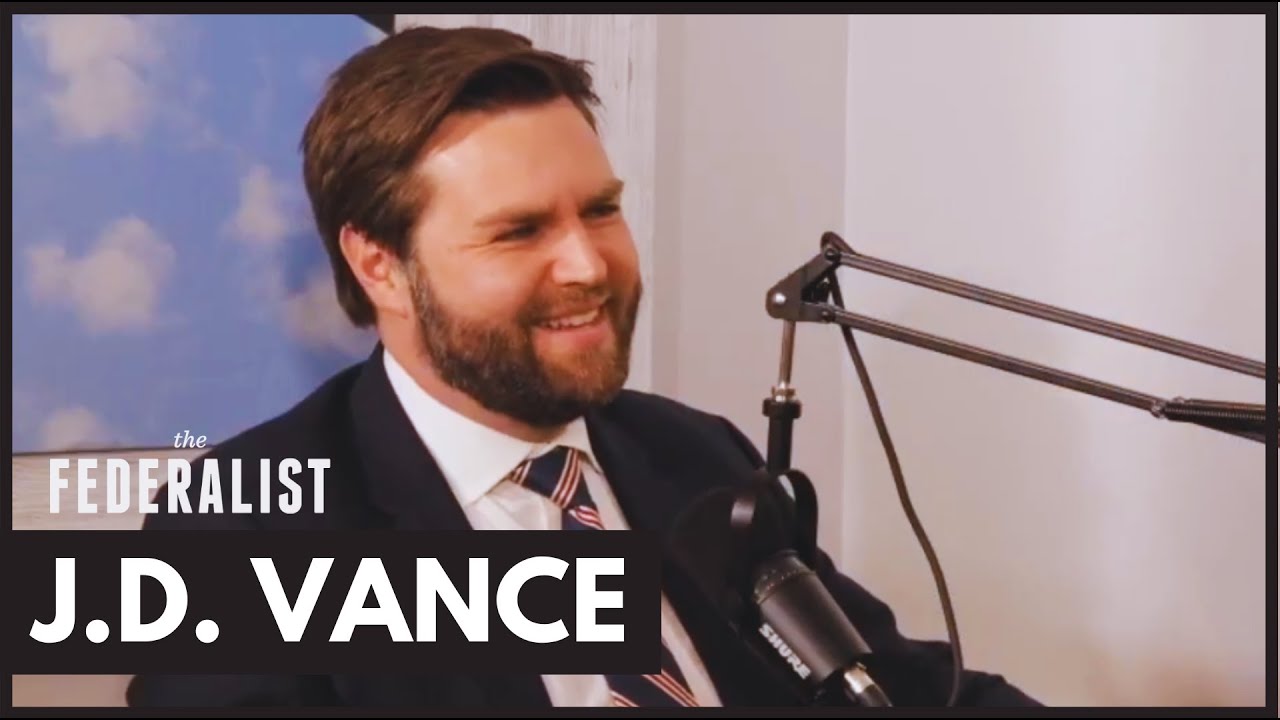 when it comes to the exercise of our power.”
VID]
- Vance “comes from an authoritarian, reactionary tradition that explicitly rejects conservatism, liberalism, and democracy,” writes political analyst Matthew Sheffield, formerly a conservative activist. “Trump wants absolute power, and Vance wants him to have it to destroy what he believes to be a decadent and corrupt society.”
* Vance has repeatedly spoken at “National Conservatism” conferences; the movement’s statement of principles declares that “in those states or subdivisions in which law and justice have been manifestly corrupted, or in which lawlessness, immorality, and dissolution reign, national government must intervene energetically to restore order.”
Vance described his outlook in a far-right podcast appearance in 2022, recounted by the Washington Post’s Dana Milbank:
Vance suggested that former president Donald Trump, once elected in 2024, should fire all civil servants and replace them with “our people,” defy court orders blocking such an illegal action, and then “do what Viktor Orban has done,” referring to the Hungarian dictator’s banson certain topics from school curricula. Vance justified such “outside-the-box” authoritarian actions by reasoning that the United States is “far gone” and not “a real constitutional republic” anymore.
Before Vance decided to run for office, he called Trump “reprehensible” and wondered whether Trump might be “America’s Hitler.” But when Vance became a candidate in the MAGA Republican Party, he flipped so hard that former Trump aide Steve Bannon suggested that Vance could be, as a reporter paraphrased, “St Paul to Trump’s Jesus—the zealous convert who spreads the gospel of Trumpism further than Trump himself ever could.”
J.D. Vance vs. Democracy and Freedom
- Vance has echoed hard-right calls for “regime change” and said it is necessary to “get pretty wild, pretty far our there, and go in directions that a lot of conservatives right now are uncomfortable with.” Vance expressed a desire to “seize the administrative state for our own purposes” and ignore the Supreme Court if it objects.
- Vance says if he were vice president in 2020, he would have done what Vice President Mike Pence refused to do: Vance would have abused his power, ignored the Constitution, and refused to accept the electors certified by states that Trump was contesting.
* Vance defends the illegal “fake electors” scheme that Trump strategists used to try to override the will of the voters. Vance says Trump’s efforts to overturn the 2020 election were addressing a “very legitimate grievance” and says “I can’t help but roll my eyes” at the idea that Trump threatens democracy. “I don’t believe this is about some deep principle,” he says. “This is about power.”
In a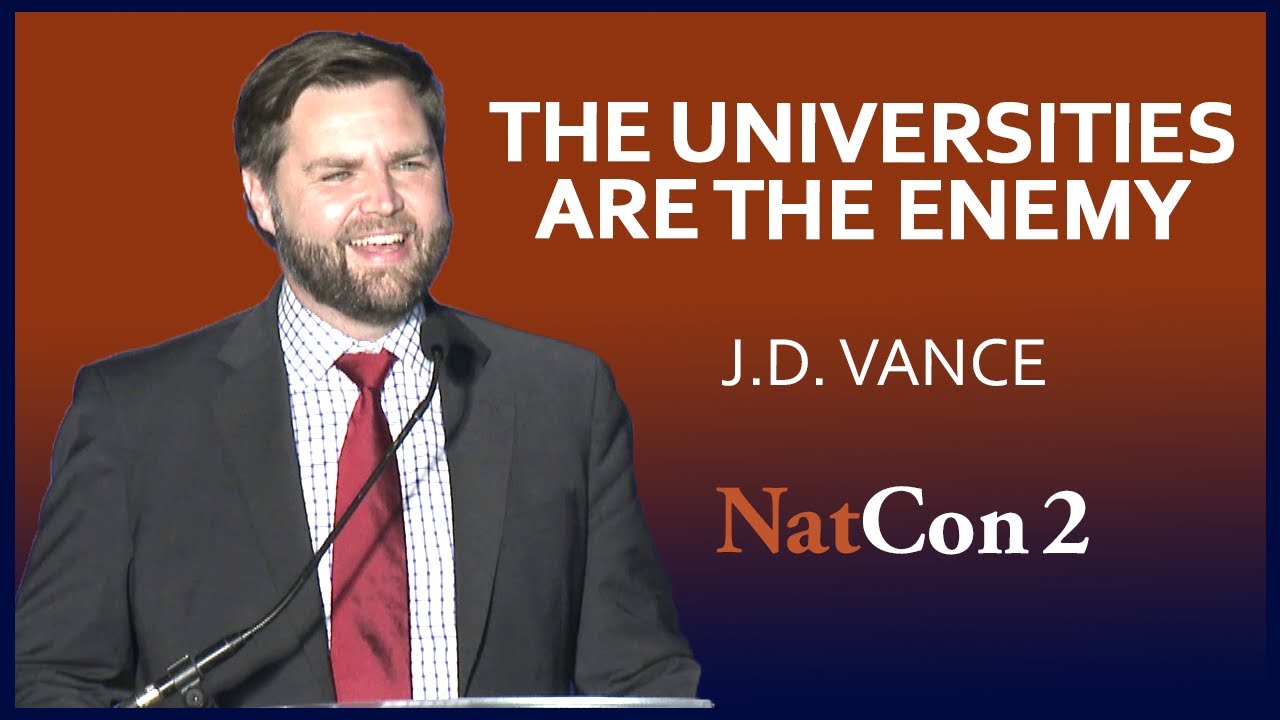
VID]at the National Conservatism conference in 2021, Vance said the movement has to “aggressively attack the universities in this country,” claiming that they “transmit deceit and lies” rather than “knowledge and truth.” Vance has praised Hungary’s dictatorial leader Viktor Orban for his “smart decisions” in seizing control of universities. Trump’s own Agenda 47 calls for seizing the endowments of top universities to fund an anti-wokeness online academy.
- At this year’s National Conservatism conference, Vance said that the American nation is not an idea but “a people with a common history,” and he claimed that immigration has made western societies “poorer, less safe, less prosperous, and less advanced,” a preview of his recent willingness to spread dangerous lies about Haitian immigrants for his own political gain—despite the very clear harm it has brought to the community of Springfield, Ohio.
- While Vance as VP candidate has adopted Trump’s deliberately muddled stance on access to abortion, his own opinion has been that abortion should be banned without exceptions for cases of rape and incest. In 2022 he called for a “federal response” to prevent women living in states where abortion has been banned from traveling to states where abortion remains legal. Last year he signed a letter urging the Justice Department to ban the mailing of abortion medicine, part of Project 2025’s agenda.
- Vance opposed the Respect for Marriage Act, which was passed to protect legal recognition for same-sex couple’s marriages if the MAGA Supreme Court justices reverse the court’s 2015 marriage equality ruling as religious-right groups are urging them to do. Vance has defended far-right “groomer” smears. He introduced legislation that would ban higher education institutions from teaching about gender-affirming care and ban any federally subsidized insurance plans from covering it.
- Vance is aligned with Christian nationalists who seek to dismantle separation of church and state. Vance is scheduled to join dominionist New Apostolic Reformation figure Lance Wallnau’s “Courage Tour” in Pennsylvania Sept. 28. In 2022, Vance told Christian-right radio host Eric Metaxas that “one of the great evils of modern liberalism is this pretense of neutrality” on religion, claiming that “if you can’t say a prayer before a public school session, then you’re not neutral, you’re explicitly anti-Christian.” Vance said the First Amendment “doesn’t mean you can’t talk about Jesus in a public school.”
Birds of a Feather: Vance’s Ideological Connections
Vance has spoken at National Conservatism conferences and events organized by “post-liberal” thinkers—who want to abandon liberal democracy—and advocates for integralism—a sort of right-wing Catholic version of Christian dominionism. At a 2023 conference at Catholic University, Vance identified as “a member of the post-liberal right.” Vance’s 2019 conversion to Catholicism was reportedly assisted by priests connected to Opus Dei, which has invested decades in building political power among and for right-wing Catholics in Washington, D.C.
Journalists and scholars like Laura Field have published quite a few detailed looks into Vance’s ideological allies, many of which are linked to in this post. Here are brief descriptions of just a few of the many far-right and antidemocratic intellectuals and institutions that Vance is associated with:
- Curtis Yarvin is a self-described monarchist and founder of a school of thought called “neoreactionism.” He argues that a visionary leader should seize power and dismantle the current regime. When Vance was describing his plan to fire federal employees and defy the Supreme Court, he acknowledged Yarvin’s influence, saying, “So, there’s this guy, Curtis Yarvin, who has written about some of these things.” Vance calls Yarvin a friend; both have benefited from Peter Thiel’s support.
- Patrick Deneen is a Notre Dame professor who has written books about the failure of liberal democracy and the need for “Regime Change,” the title of his latest book. To Deneen and his fellow “post-liberal” Catholic thinkers, “this means replacing the people and institutions that dominate America’s cultural, economic, and political life with a new elite willing to eschew liberal norms in service of supposedly higher ideals,” writes scholar Damon Linker. In other words, Deneen wants to put the power to govern in the hands of a conservative aristocracy. In 2023, Vance attended a speech by Deneen, praised his book, and “wrapped him in an enthusiastic hug,” Politico reported.
- Adrian Vermeule is a Harvard University professor and former Supreme Court clerk who promotes a form of integralism, which he calls “common good Constitutionalism.” He says it “does not suffer from a horror of political domination and hierarchy, because it sees that law is parental, a wise teacher and an inculcator of good habits.” That means the government wielding authority “against the subjects’ own perceptions of what is best for them” and changing laws around “free speech, abortion, sexual liberties, and related matters.” Journalist Sarah Jones notes, “integralism imagines a future when the state may punish the baptized for violations of ecclesiastical law”—a frighteningly far cry from the American principle of church-state separation. Vance appeared at a conference with Deneen and Vermuele at the Franciscan University of Steubenville, Ohio, in 2022.
- Rod Dreheris a blogger, author, and right-wing culture-warrior who in recent years moved further to the right and actually moved to Hungary where he functions as a sort of international p.r. agent for Orban’s authoritarian and Christian nationalist government. Dreher is a friend of Vance; in an article for a Hungarian conservative publication this summer, he compared Vance to a young Orban and said Vance “embodies” Trumpism.
- Yoram Hazonychairs the Edmund Burke Foundation, which was created in 2019 to promote National Conservatism. Vance has regularly spoken at its conferences. Its statement of principles declares, “Where a Christian majority exists, public life should be rooted in Christianity and its moral vision, which should be honored by the state and other institutions both public and private.” When journalist Katherine Stewart asked about minorities in such a model being stuck with an outsider status, Hazony said, “That simply is reality,” adding that minorities would not get the same treatment as the majority, but “should be grateful for the fact that you’re not persecuted as minorities often have been in history.”
Claremont Instituteis a think tank that ramped up its attacks on multiculturalism in advance of the 2020 election; the New York Times has called it a “nerve center of the American right.” Claremont is home to Michael Anton, who called the 2016 presidential election “the flight 93 election”—referring to the flight hijacked during the 9/11 attacks in which passengers stormed the cockpit. Anton’s book called for a stop to the “ceaseless importation of Third World foreigners with no tradition of, taste for or experience in liberty.” He has suggested that an American Caesar is inevitable.
Claremont was also a center of pro-Trump activity after the 2020 election. Claremont lawyer John Eastman has defended his involvement in Trump’s efforts to stay in power by saying Trump’s presidency was necessary to save America from a left bent on its destruction. Politico reports that “Vance is “closely tied to Claremont circles,
 speaking at their events and appearing alongside their scholars.”
Two Futures: Freedom or Fascism?
Long before Donald Trump selected J.D. Vance as his running mate, there was a mountain of evidence that Trump’s election would threaten Americans’ freedom and undermine democracy: Trump’s own threats to jail his political opponents, go after universities and media outlets he doesn’t like, and carry out vast police state operations against immigrants; Project 2025 plans hatched by former Trump officials to give him virtually unchecked power; and the MAGA Supreme Court justices preemptively telling Trump he would not be held accountable for crimes committed as president.
Trump’s selection of J.D. Vance—cheered by “post-liberal” and anti-democratic leaders—is confirmation that the authoritarian threat to freedom and democracy is an urgent issue in this year’s presidential election—and that the threat will continue regardless of the outcome.
Tags: Adrian VermeuleDonald TrumpJ.D. VanceJohn EastmanMichael AntonPatrick DeneenRod DreherAuthoritarianismChristian NationalismElection 2025MAGANational ConservatismClaremont Institute
===
an 6 24
Although 2024 GOP presidential nominee Donald Trump has tried to distance himself from Project 2025 — the Heritage Foundation's 900-page blueprint for a second Trump Administration — many of Trump's critics have been pointing out that a long list of his MAGA allies were heavily involved in crafting the controversial document.
According to NBC News reporter Allan Smith, the "brain trust behind Project 2025 isn't sweating" Trump's "disavowals."
"At recent events in Washington, D.C., and Milwaukee," Smith reports, "Project 2025 proponents and allies sought to defuse tensions and go on offense against the press and Democrats, after Trump took the wind out of their sails with critical social media posts as Democrats oriented their campaign around the plans."
The events that Smith is referring to are the recent National Conservatism Conference and the 2024 Republican National Convention, which got underway in Milwaukee on Monday, July 15 — only two days after Trump survived an assassination attempt at a rally in Western Pennsylvania.
During Heritage's Policy Fest at the convention, Heritage CEO Kevin Roberts told NBC News, "The lesson of the last few days and the motivation for something like Project 2025 is to make Washington a heck of a lot less important in our lives."
Smith notes that during the National Conservatism Conference in Washington, D.C., "more than a dozen" Project 2025 organizers and contributors "made their case for drastically reconstituting the civil service, retaliating against Democrats for the ongoing prosecutions of Trump, launching mass deportations of undocumented immigrants and countering 'anti-white' discrimination."
According to a member of the Project 2025 advisory board, Heritage and its allies aren't worried about Trump's criticism of the plan.
READ MORE: Wife of dead rally-goer says she hasn’t heard from Trump — but won't take Biden’s call
That source, presumably interviewed on condition of anonymity, told NBC News, "The general sense is this is a PR gesture for him to provide himself maximum room to maneuver and avoid making any commitments at this point. He wants to avoid having to answer questions about anything he doesn't want to answer questions about. Most people I know who are involved with it don't seem overly worried that this actually constitutes a repudiation and is going to mean anything on January 20."
READ MORE: J.D. Vance VP pick won't 'help secure Trump a particular state': expert
*Read NBC News' full report at this link.
===
---
desmog
April 19, 2024 – UK Edition
Two stories this week highlighted the way giddy Westminster journalism can provide saturation coverage and still miss the point.
Former Prime Minister Liz Truss toured media studios plugging her book and talking about how a shadowy “deep state” plotted her downfall. Despite the attention, it was left to DeSmog to reveal that her book calls for landmark climate laws to be “abolished”, and that she claims to have tried to stop the UK from hosting the COP26 climate summit.
Across the Channel, the row over a Belgian mayor’s attempt to shut down the National Conservatism conference made headlines. But as Sam Bright reported, one of the groups behind the far-right jamboree is bankrolled by a Hungarian oil company – a notable fact given the event’s attacks on climate action.
---
y mail 5 23
this week an important conference in London featured a showdown between powerful elites and brave dissidents.
No, I’m not talking about the National Conservatism conference, this week’s great political circus that led the news thanks to the attendance of senior Conservative politicians.
I mean Salome Nduta, a Kenyan human rights campaigner at OilWatch Africa, who believes she was deliberately excluded from the Africa Energies Summit in London as vested interests sought to dodge any awkward questions about fossil fuel expansion.
Nduta bought a £4,000 delegate pass to the event – whose sponsors included Royal Dutch Shell, TotalEnergies, Chevron, ExxonMobil and Eni – but was then told it was “sold out”.
Global Witness’s Hanna Hindstrom commented: “This is the classic fossil fuel playbook: push to extract; shut out and ignore the participation of those who will be hit first and hardest as a result of their toxic practices.” Read the full story by DeSmog’s Phoebe Cooke here.
Speaking of pollution, over at the NatCon event, talks were hosted with Home Secretary Suella Braverman, Levelling Up Secretary Michael Gove, Tory Deputy Chair Lee Anderson, former Business Secretary Jacob Rees-Mogg, and Lord (David) Frost.
But as DeSmog’s Joey Grostern and I reported, the event was packed with speakers and groups hostile to climate action and with ties to the fossil fuel industry.
For example, the conference co-chair Christopher DeMuth was president of the American Enterprise Institute from 1986 to 2006, a US-based climate science denial think tank which has received millions from ExxonMobil and the fossil fuel funded Koch Industries. DeMuth has himself cast doubt on climate science in the past.
And so, it’s fitting that NatCon should have been headlined by Braverman, who – lest we forget – ran for Tory leader last year vowing to “suspend the all-consuming desire to achieve Net Zero by 2050”, while fellow speaker Lord Frost is a director of DeSmog faves the Global Warming Policy Foundation.
But while NatCon speakers used their platforms to rail against “the elites”, genuinely brave campaigners like Salome Nduta are standing up to real power in defence of human rights and protecting the planet.
---
an ah 2 23
When Patrick Buchanan ran against President George H.W. Bush in the 1992 GOP presidential primary, he campaigned on a pseudo-populistmixture of economic angst, social conservatism and white male resentment. It was a message that most Republican strategists and organizers rejected at the time, arguing that instead of resenting the rich, Americans should learn from them and try to be more like them.
But Buchanan’s ideas eventually found a home in former President Donald Trump’s MAGA movement, and Trump-inspired Republicans like Sen. Josh Hawley of Missouri and Sen. J.D. Vance of Ohio have a lot more in common with Buchanan than they do with President Ronald Reagan or the late Sen. Barry Goldwater (R-Arizona).
In an article published by The Nation on February 3, journalist Jeet Heer examines GOP efforts to brand itself as a “working-class party” — and lays out some reasons why MAGA Republicans are not practicing what they often preach.
“Trump’s success in 2016 and his near-victory in 2020 — Joe Biden’s narrow triumph resting on fewer than 44,000 votes in three states — was due to the former reality-show star’s strong appeal to white non-college-educated voters,” Heer writes. “To be sure, the white working class was trending toward the GOP before Trump arrived on the scene. But in 2016, he solidified and intensified this trend through a shrewd message of economic populism: Trump eschewed traditional Republican calls for cuts to Medicare and Social Security, hinted that he’d replace Obamacare with his own better version of health care, criticized globalism in the form of trade agreements that led to the loss of manufacturing jobs, and called for immigration restrictions as a way to bolster wages.”
Heer adds, “There’s evidence that Trump’s populism in 2020 helped him to gain traction not just with the white working class, but also, with blue-collar people of color, especially Latinos.”
The journalist goes on to stress, however, that many MAGA economic policies haven’t been pro-working class.
“Notably, the tax cuts (Trump’s) party pushed through skewed heavily toward the wealthy,” Heer observes. “Trump’s failed bid to repeal Obamacare didn’t offer any replacement. Nor has Trump ever fulfilled his promise to deliver an alternative plan. But in the wake of Trump’s electoral strength and partial policy success, a new faction within the political right emerged that claimed to take the agenda of economic populism seriously. This group often calls themselves national conservatives or NatCons.”
READ MORE:'Rotten' and 'grossly regressive' GOP tax proposals are a major 'gift' for Democrats: conservative
Heer cites Hawley, Vance and billionaire donor Peter Thiel as examples of Republicans with a “national conservative” message, arguing that in reality, the GOP “shows little interest in economic populism.”
“For the Republicans, stoking the culture wars remains the easiest way to keep white working-class support without alienating the wealthy,” Heer explains. “It’s hardly a surprise that the two frontrunners for the 2024 Republican presidential nomination are Donald Trump and Ron DeSantis: both masters of pouring fuel into the fire of transphobia, xenophobia and racism. Rather than Hawley’s meager gestures at pro-worker economic policy, they represent the future of the GOP.”
READ MORE: Ex-White House official: Joe Biden made 'a good case' about Donald Trump's MAGA movement threats
Read The Nation’s full article at this link.
===
---
https://www.alternet.org/tucker-carlson-2658998824/
---
On Wednesday, December 21, Ukrainian President Volodymyr Zelenskyy met with President Joe Biden in the White House and gave an English-language speech during a joint session of Congress.
This was Zelenskyy’s first visit to the United States since Russian forces, on orders from President Vladimir Putin, launched an all-out invasion of Ukraine on February 21. During his speech before Congress, Vice President Kamala Harris and outgoing House Speaker Nancy Pelosi stood behind Zelenskyy while holding up a Ukrainian flag in solidarity with his country.
But some far-right MAGA Republicans were not happy to see Zelenskyy getting a warm reception from Biden, Harris, Pelosi and other Democrats. And libertarian/conservative journalist Cathy Young calls out those MAGA Republicans in a biting article published by The Bulwark on December 22 and headlined, “Putin’s Useful Idiots: Right Wingers Lose It Over Zelenskyy Visit.”
READ MORE: George Will: Why Americans should 'give thanks' for Volodymyr Zelensky’s 'pugnacious individualism'
Young observes, “Ukrainian President Volodymyr Zelenskyy’s surprise arrival in Washington on Wednesday for a meeting with President Joe Biden and a speech before Congress has unhinged the always-seething anti-Ukraine Trumpian right, triggering a deluge of snark and grievance…. ‘National conservative’ pundit and Newsweek opinion editor Josh Hammer, who played the ‘obviously, Putin is a thug and Ukraine is the victim here, but….’ game in the early days of the war, went full Putin this time around.”
Hammer, on December 21, tweeted, “Raise your hand if you are personally DONE with the Ukraine gravy train.” And Republican activist Donald Trump Jr., on Twitter, posted, “Zelenskyy is basically an ungrateful international welfare queen.”
“To top it off, Hammer, who shares Zelenskyy’s Jewish heritage, also accused the Ukrainian president of being a bad Jew — unseemly under any circumstances, but all the more so considering that only a few days earlier, Hammer had been spotted at a New York Young Republicans’ Club Gala in the company of various alt-right types with, shall we say, a complicated relationship to antisemitism,” Young writes. “Among them: Rep. Marjorie ‘Jewish Space Lasers’ Taylor Greene, the founders of the white nationalist website VDARE, and erstwhile Jew-baiting troll Jack Posobiec.”
Young notes that the Daily Wire’s Matt Walsh said of Zelenskyy, “Get this grifting leech out of our country please,” while Fox News’ Tucker Carlson mocked Zelenskyy as a “Ukrainian strip club manager” and said of his visit to the U.S., “It may be impossible to imagine a more humiliating scenario for the greatest country on Earth.”
MAGA conspiracy theorist Benny Johnson and Turning Point USA’s Charlie Kirk slammed Zelenskyy for wearing casual attire during his speech before Congress.
Young writes, “A few other right-wing pundits, including career plagiarist-turned-conspiracy-theory-peddler Benny Johnson and Turning Point USA grifting leech Charlie Kirk, homed in on the really important stuff: Zelenskyy’s outfit…. Of course, Zelenskyy’s clothes were meant to visually convey the fact that he’s in the middle of a brutal war. When you’re just back from a visit to the front lines in an area that looks like a ghost warscape from World War I come back to life, you’ve earned the right to make that particular fashion statement — even on a visit to Washington, D.C.”
The libertarian/conservative journalist goes on to offer some reasons why many MAGA Republicans have such intense “hatred” for Zelenskyy.
“The question of why the Trumpian populist right is so consumed with hatred for Ukraine — a hatred that clearly goes beyond concerns about U.S. spending, a very small portion of our military budget, or about the nonexistent involvement of American troops — doesn’t have a simple answer, Young explains. “Partly, it’s simply partisanship: If the libs are for it, we’re against it, and the more offensively the better. And if the pre-Trump Republican establishment is also for it, then we’re even more against it. Partly, it’s the belief that Ukrainian democracy is a Biden/Obama/Hillary Clinton/‘Deep State’ project, all the more suspect because it’s related to Trump’s first impeachment.”
Young continues, “Partly, it’s the ‘national conservative’ distaste for liberalism — not only in its American progressive iteration, but in the more fundamental sense that includes conservatives like Ronald Reagan and Margaret Thatcher: the outlook based on individual freedom and personal autonomy, equality before the law, limited government, and an international order rooted in those values. Many NatCons are far more sympathetic to Russia’s crusade against secular liberalism than to Ukraine’s desire for integration into liberal, secular Europe. Whatever the reason, the anti-Ukraine animus on the right is quite real and widespread.”
---
---
https://www.alternet.org/2022/11/postliberalism/
kay joyce
On a Friday night in early October, in a downtrodden city in eastern Ohio, a speaker laid out a grim vision. At the height of 2020's first, most terrifying wave of COVID-19, an employee at a Chinese slaughterhouse led his coworkers on a walkout. For years, the state-owned company had abused its staff with continual video surveillance, punishing production quotas and demerits for bathroom breaks. Now it was casually disregarding their safety during a once-in-a-century pandemic. Following the walkout, the employee was fired, and then vilified through a PR campaign that denounced his protest as immoral and possibly illegal.
This article originally appeared on Salon.com.
After a pause came the reveal: That hadn't happened in China, but in New York City's Staten Island; the hero wasn't a Chinese meatpacker, but a young warehouse worker named Chris Smalls; the villain wasn't the Chinese government but Amazon.com. The speaker went on, quoting from Karl Marx about "masters and workmen" and the "spirit of revolutionary change" before clearing his throat to deliver another correction: Apologies, that was actually Pope Leo XIII.
Both jokes were preface to a larger punchline, one that's particularly relevant after the 2022 midterm elections: This wasn't happening at a Bernie Sanders rally or a Democratic Socialists of America meetup, but a decidedly conservative conference at Ohio's Franciscan University of Steubenville, a center of U.S. right-wing Catholic thought. The speaker (and conference organizer) was Sohrab Ahmari, a Catholic writer best known for his 2019 polemic against conservatives insufficiently committed to the culture wars. The conference, "Restoring a Nation: The Common Good in the American Tradition," was a showcase for the modestly-sized but well-connected Catholic integralist movement, part of the broader current of conservative thought known as postliberalism.
Over the two-day conference, 20 speakers, including then-Ohio Senate candidate J.D. Vance, hammered home the argument that the same faith used to justify abortion bans and curtail LGBTQ rights also demanded a different approach to the economy, one that might plausibly be called socialist. Laissez-faire capitalism, speakers said, wasn't the organic force conservatives have long claimed but the product of state intervention; ever-expanding markets hadn't brought universal freedom but wage-slavery and despair; Franklin D. Roosevelt's New Deal — demonized on the right for generations — was in fact a "triumph for Catholic social thought"; social welfare programs were good.
All that might be striking enough. But the conference also served as something of a rebuttal to another gathering of right-wing intellectuals that had taken place a few weeks before: the third major National Conservatism conference, held this September in Miami. The two conferences — one in a hollowed-out former steel town, the other in a $400-per-night golf resort — represented two sides of what some partisans recently called a "fraught postliberal crack-up." Broadly speaking, these are ideological kin: members of the Trump-era intellectual "new right" who see themselves as rebels fighting an elite "Conservative, Inc." But it's a family in the midst of a feud, and the public split signified by the two meetings comes after months of less visible infighting over questions only hinted at in headline Republican politics.
Earlier this month, after the midterms failed to deliver a promised "red wave," those fights spilled into the headlines, as Republicans' disappointed hopes led to some of the first open shots in what's been a cold civil war over the party's future. Partly that fight revolves around whether Donald Trump or Florida Gov. Ron DeSantis will lead the GOP into the 2024 presidential election. But it goes much deeper than that, and the fight also has implications that go well beyond the right.
The midterms gave conservatives of all stripes something to claim, or to denounce.Activists who spent the last two years sniffing for "critical race theory" and "gender ideology" in public schools cheered DeSantis' re-election as proof that maximalist culture war is the key to Republican success. Anti-Trump conservatives pointed to culture warriors' widespread losses elsewhere as proof the GOP needs to come "home to liberal democracy." In a New York Times op-ed, Ahmari chastised conservatives who'd spent the run-up to the election mocking an overworked Starbucks barista as one likely reason that "the red wave didn't materialize." Vance's victory in Ohio was simultaneously touted as proof that right-wing populism remains viable and that "the culture war still wins."
Others called on Republicans to actualize their claim to be the new party of the "multiracial working class." The ecumenical religious right journal First Things exhorted conservatives to join picket lines. The conservative policy think tank American Compass unveiled a comprehensive "New Direction" economic agenda, repurposing lyrics from the Clash to propose things like realigning financial markets with the common good. In , Trump strode into a Mar-a-Lago ballroom to announce his 2024 presidential candidacy to the "Les Misérables" anthem "Do You Hear the People Sing?"
And after days of lambasting "Washington Republicanism" for offering little of substance for the working class, Sen. Josh Hawley, R-Mo., issued a proclamation: "The old party is dead. Time to bury it. Build something new."
* * *
The right-wing populist wave that elected Donald Trump in 2016, like the U.K.'s Brexit vote a few months earlier, is typically described as a watershed moment for conservatism. But the fact of the Trump revolution arrived before the theory. Something had clearly changed in the political order, but Trump's impulsiveness and lack of coherent ideology or policy agenda created a vacuum that needed to be filled, retroactively, by intellectuals on the right.
A variety of themes emerged from those efforts. One was an "America First"-inspired rehabilitation of nationalism, long tarnished by its association with authoritarian movements in pre-World War II Europe. Another was heard in Steve Bannon's call to dismantle the "administrative state" of unelected bureaucrats who might stand in Trump's way. A third was the conviction that classical liberalism — in the historical Adam Smith sense of that word, which prioritizes individual rights, pluralism and free trade and which guided both parties for generations — had been a catastrophe, replacing traditional norms with a destructive free-for-all.
As postliberals like Notre Dame political theorist Patrick Deneen, author of the influential 2018 book, "Why Liberalism Failed," argue, classical liberalism promised peace and prosperity but instead delivered an era of haves and have-nots, swapping good jobs for dehumanizing gig work, empowering corporations to enforce a homogeneous global monoculture and promoting social policies that led people — particularly working-class people — away from traditionalist values like church, marriage and parenthood. In that light, conservative regions' higher rates of divorce, teen pregnancy and opioid deaths weren't evidence of red-state hypocrisy but rather an unrecognized form of class warfare.
The right's retconned Trumpist ideology also made a meta-argument: that the conservative "fusion" that had defined the Republican Party since the 1960s — uniting religious traditionalists, Cold Warriors and free marketeers in opposition to communism — had ultimately failed.
In 2019, Ahmari and a cadre of mostly conservative Catholic intellectuals gave voice to that argument through a group manifesto, "Against the Dead Consensus," which declared (several years before Josh Hawley) that the old conservative coalition was over and something new must take its place. Two months later, Ahmari wrote a follow-up, declaring never-Trump National Review writer David French the poster boy of that dead consensus, for being the sort of conservative who would defend Drag Queen Story Hours on the grounds of free expression. There was no polite, pluralist way to fight such an abomination, Ahmari argued, only a zero-sum approach to fighting the culture war "with the aim of defeating the enemy and enjoying the spoils in the form of a public square re-ordered to the common good and ultimately the Highest Good."
Language like "the Highest Good" was a hat-tip to integralism, a right-wing faction of Catholicism that aspires to effectively re-found America as a Catholic "confessional state," where state power is subordinate to the church and government is devoted to fostering public virtue and the "common good." Part of that project aims to replace the longstanding conservative legal ideology of constitutional originalism (as championed by the late Supreme Court Justice Antonin Scaliaand his followers on the current court) with "common good constitutionalism" (primarily theorized by Harvard Law professor and former Scalia clerk Adrian Vermeule), wherein the law works as "a teacher" to instruct, and enforce, public morality. In other words, if the actual public doesn't want to live by conservative Christian ideology, a new governing class should impose it.
That premise has led other Catholics (conservative and liberal alike) to condemn integralism as reactionary and authoritarian. When integralists weren't being intentionally vague about their plans, critics charged — in a widely-discussed 2020 Atlantic essay, Vermeule declined to specify what common good constitutionalism would mean in practical terms — those plans are frightening, as in one integralist text that suggests limiting citizenship and the vote to members of the faith.
James Patterson, a political science professor at Ave Maria University, has written about integralism's troubled lineage going back to pre-World War II European fascist or authoritarian movements, including the Spanish Falangists that supported dictator Francisco Franco or the antisemitic Action Française that grew out of France's Dreyfus Affair. On Twitter recently, a Catholic parody account posted a satirical book jacket for an "updated and honest" edition of Vermeule's latest book with images of combat boots and a tank and an invented blurb from Ahmari: "Finally we can stop pretending what we're really talking about."
But the postliberal critique resonated beyond the cloistered world of right-wing Catholic discourse, intersecting with another post-Trump project: the rapidly-growing national conservatism movement. Led by Israeli philosopher Yoram Hazony, author of the 2018 book "The Virtue of Nationalism," the NatCons also see classical liberalism as fatally flawed— its central premise of a neutral public square, where no religion or culture reigns over any other, is nonsense, because liberalism is both a competing worldview and a slippery slope, inevitably leading to cultural revolution. As Hazony often argues, within two generations of the Supreme Court's ban on religious instruction in public schools, marriage rates and religious observance had plummeted and "woke neo-Marxism" took their place.
Since its first conference in 2019, NatConhas come to represent a series of positions: hostility to transnational bodies like the EU and UN; a quasi-isolationist skepticism of foreign entanglements; sharp reductions or a complete moratorium on immigration; realigning the free market with national interests (variously described); and, most importantly, replacing the illusion of a neutral public square with the conviction that, "Where a Christian majority exists, public life should be rooted in Christianity and its moral vision," as a recent NatCon statement of principles holds.
From the get-go, there were important differences between the integralists and NatCons. Catholicism makes a fundamental claim to universality (and some integralists speak wistfully of empire), which fits uneasily with NatCons' nation-centric vision. Integralists have far more ambitious economic plans than most NatCons would support.
But there were important commonalities too: a mutual opposition toward mainstream conservatism, a largely shared rejection of liberalism, a common desire to return Christianity to the center of American public life. Both camps swooned for Hungarian Prime Minister Viktor Orbán and saw his avowedly "illiberal" "Christian democracy" — with its expanded government power, sharp restrictions on immigration, repression of LGBTQ rights and pronatalist family subsidies — as the primary model to emulate. Both sides also benefited, to one degree or another, from the largesse of right-wing donors who are funding numerous projects (and candidates) on the "new right."
"If anti-communism bound together the old conservative consensus," said Jerome Copulsky, a research fellow at the Berkley Center for Religion, Peace and World Affairs, the new right's coalition "is animated by antiliberalism and a belief that a high degree of religious and cultural uniformity is necessary for social cohesion and political legitimacy."
But there are problems with building alliances on the basis of shared enemies, Copulsky warned. "The coalition-building is about the Venn diagram of who they don't like: liberals, 'woke' multiculturalists, non-traditional sexuality and gender roles. But as they move forward, their different understandings of what they want to put into place will bring out the tensions and contradictions of their alliance. The 'enemy of my enemy is my friend' attitude only goes so far."
* * *
Over the last year, that exact problem has played out through quarrels fought on social media, in new right publications and on conference stages. It was even visible in the difference between this year's NatCon conference in Miami and the one held a year before.
In November 2021, multiple new right camps converged in Orlando for NatCon 2. The heart of the conference was an evening panel featuring the nationalist Hazony and integralist Ahmari, as well as "anti-Marxist classical liberal" Dave Rubin and British neocon Douglas Murray, all discussing whether a new alliance could be forged. Hazony, an Orthodox Jew, had a surprising suggestion: Bible instruction must be restored in public school, as a crucial first step toward reasserting America's identity as a Christian nation and a "conservative democracy."
There were tensions, most notably around the fact that Rubin and Murray are both gay: would there be room, Rubin asked, for him and his family in this new right? But after reaching apparent agreement that the problem wasn't gay people per se but rather expanded trans rights or LGBTQ representation in schools, the session closed as it had begun, with the PA system playing "We Are Family."
That unity was short-lived. This September, when NatCon reconvened in Miami, the only panelist who returned was Hazony himself, reflecting a number of upheavals in the preceding months.
One seeming result was that this year's NatCon — the movement's largest to date — reflected a marked increase in hostility toward not just "gender ideology" but LGBTQ rights in general. In one plenary address, a seminary president declared that in order for conservatives to resist "the fantasy and folly" of transgenderism, they must also reject same-sex marriage: "He who says 'LGB' must say 'TQ+.'" Another speaker argued that the failure of any major U.S. institutions to denounce "the LGBT agenda" proved that America has become "basically anti-American." NatCon's own statement of principles, released just months after asking two gay men to help build the new right, defines marriage as only between a man and a woman.
In part, this shift reflected some conservatives' belief that NatCons' tent had gotten "a little too big." One right-wing website used a photo of the 2021 panel to warn about "the quiet rise of LGBTQ influence in Christian and conservative circles." Rubin had also become the center of a conservative firestorm, after he announced that he and his husband were expecting the birth of two babies being carried by surrogate mothers — news that sparked not congratulations but widespread denunciations of both Rubin and any conservative who stood by him.
But the altered mood also reflected something else, Hazony told Salon: The Supreme Court's June decision overturning Roe v. Wade had opened a new world of conservative possibilities, and the sense that it might be "possible to restore an earlier constitutional order." Post-Dobbs, conservatives giddily discussed which Supreme Court precedents they might topple next, and the 2015 Obergefell decision that had legalized same-sex marriage nationwide was high on the list. To Hazony, it suggested a rapid revival of the desire to reassert biblical values in the political sphere. Conservatives wanted to go for it all.
In his own conference address, Hazony called on conservatives to commit to being "fully Christian in public," arguing, "The only thing that is strong enough to stop the religion of woke neo-Marxism is the religion of biblical Christianity." For the politicians in attendance — including DeSantis, Hawley and Florida's two Republican senators, Marco Rubio and Rick Scott — that meant not just mouthing platitudes about God-given rights, but insisting that American freedom comes from the Bible. Less than an hour later, Hawley happily obliged, declaring, "Without the Bible, there is no America," with a fervor matched by other speakers eagerly reclaiming the label "Christian nationalist" as a battle cry.
Perhaps even more conspicuous were the missing Catholic integralists, who in 2021 had provided much of NatCon's intellectual framework. This year, their absence prompted so many subtle, and less subtle, asides throughout the conference that one confused audience member raised his hand to request an explanation.
A British priest who said he'd been invited to affirm that, contra some people, Catholicism and national conservatism go together just fine, suggested that the integralists' seeming boycott amounted to useless theological squabbling: Who cared "how many integralists can dance on the head of a pin"? In a breakout session, another Catholic panelist suggested it was "cringe" for integralists to believe they'd ever set the moral framework for a "basically Protestant nation."
The biggest rebuke came from Kevin Roberts, the recently-appointed president of the Heritage Foundation, the great white whale of institutional conservatism, which has been shaping Republican priorities since the first years of Ronald Reagan's presidency. Roberts' presence at the conference was itself a coup. Two years earlier, Hazony said, Heritage had attacked him for "importing nationalism" into the U.S. Now the foundation had underwritten much of this year's conference, had met with NatCon leaders to discuss their statement of principles and had published a 20-page booklet recounting a conversation between Roberts and Hazony on "Nationalism and Religious Revival." In a line widely quoted after the conference, Roberts declared, "I come not to invite national conservatives to join our conservative movement, but to acknowledge the plain truth that Heritage is already part of yours."
Roberts, who describes himself as a Catholic populist, also admonished his missing coreligionists ("Integralists, heal thyselves!"), accusing them of rejecting "conventional constitutional" politics and seeking to "subordinate the state to an institutional church" in ways that would discredit both. Alluding to the fact that many prominent integralists are recent Catholic converts, Roberts continued that, while he shared many of their frustrations, "and I certainly rejoice in their religious conversion," their zeal had "led them into error."
The integralists fired back. At the start of the Miami conference, Ahmari tweeted that he was "emphatically not a 'NatCon.'" The movement's academic Substack published a long theological rebuttal to Roberts' claim that integralists wanted to establish a theocracy. Another writer asked whether NatCon's big tent still had room for integralists. When Gladden Pappin, cofounder of the conservative journal American Affairs and a professor at the University of Dallas, repeated the question on Twitter, Hazony responded with exasperation: Pappin could answer that question himself, since he'd spoken at a NatCon event several months earlier.
"In my view, conditions of ongoing animosity and hostility between NatCon and the five or six of you would be a colossal waste of time," Hazony wrote. "However, if you decide that a strategy of hostility, boycott or insults is the way to go — I can assure you that a wiser Catholic intellectual leadership will arise to take your place."
* * *
"There is clearly some kind of break," Hazony told Salon, but he saw it arising primarily from the integralists' side. Several had been invited to sign NatCon's statement of principles in June, but all had refused. Ideological differences that were "soft-pedaled a year or two ago" were suddenly getting "a high-octane emphasis."
For Hazony, the primary issue was about how conservatives understand China, the rising superpower that NatCons see as America's No. 1 rival. Their conference had banned all speakers who are "pro-Xi, pro-Putin, racists or antisemites," although that standard seems malleable at times. (As Political Research Associates' Ben Lorber reported, this year'sNatCon included a meditation on the viciously xenophobic French novel "Camp of the Saints," approving mention of antisemitic Action Française leader Charles Maurras and an address by a former Trump speechwriter fired for alleged ties to white nationalists.) But some integralists, Hazony charged, had "always had a soft spot for dictatorship, for imperialism and for China," and in recent months that had become impossible to ignore, as members of the movement wrote articles praising China's government or culture.
Then there was Compact Magazine, the hybrid "radical American journal" Ahmari co-founded last March with fellow Catholic Matthew Schmitz and Marxist populist Edwin Aponte. Its professed agenda was to wage "a two-front war on the left and the right" and promote "a strong social-democratic state that defends community — local and national, familial and religious — against a libertine left and a libertarian right."
Although Compact has declined to specify who funds the magazine, a source familiar with its operations told Salon that it was launched with significant support from right-wing tech billionaire Peter Thiel — who has funded numerous other "new right" projects, from NatCon conferences to the political campaigns of J.D. Vance, Blake Masters and Josh Hawley — and Claremont Institute chair Tom Klingenstein (another top NatCon donor). Klingenstein did not respond to requests for comment. A source close to Thiel denied that Thiel has directly funded Compact, but couldn't rule out the possibility that an entity Thiel funds has in turn donated to the magazine. In a statement, Ahmari said, "Compact is an independent, for-profit publication supported by our subscribers. A group of investors helped us jump-start it. We respect their privacy and decline to name them."
Both Thiel and Klingenstein spoke at NatCon this year, and a handful of other NatCon speakers attended the integralist conference too. But on the whole, Hazony said, Compact was a bridge too far for most NatCons. While many in the movement were open to "rethinking the commitment to the free market as an absolute principle," and might even support targeted business regulations, he said, there was "no appetite, no capacity among nationalist conservatives to accept the ideal of social democracy as an alternative to the market mechanism."
Integralists had their own complaints. Some also involved foreign policy questions, like whether NatCons' enthusiastic defense of Ukraine amounted to a creeping neoconservative revival, or whether their strident hostility to China reflected warmed-over Cold War politics. But their main concern was more fundamental: NatCons, they charged, were abandoning the populist promise of Trumpism for a seat at the establishment table.
To be sure, NatCon 3 featured critiques of big business, but, with limited exceptions, most amounted to dragging "woke corporations." Ron DeSantis (introduced in Miami as "the future president") spoke dutifully about how free enterprise should be seen as a tool to help "our own people" rather than an end in itself. But his real firepower was saved for war stories: his battle with Disney over Florida's "Don't Say Gay" law, his resolution banning state pension funds from weighing environmental or social justice concerns in investment decisions, a promised law to help Floridians sue tech companies that commit "viewpoint discrimination."
Other speakers called forblacklisting banks that disinvest in fossil fuels; seizing universities' endowments; and making it illegal for employers to ask if applicants attended college, in order to disincentivize young people from entering the "inherently liberalizing environment" of higher education. (In a more recent example, after contrarian billionaire Elon Musk bought Twitter and numerous companies stopped advertising on the platform, Republicans suggested that congressional hearings into "leftist corporate extortion" might be in order.)
To Ahmari, this amounted to "fake GOP populism." "This may sound strange coming from me," he said — that is, the guy who made his name by denouncing "David Frenchism" — "but it's just culture war." He was increasingly convinced that whipping up Twitter wars over corporate gestures towards progressive politics was the kind of conservatism "designed to ensure" that nothing important ever changed. "It's easier to pick a fight over Disney than to take on corporate power as such."
"There is this emerging sense on our side," Ahmari continued, "that the old Reaganite establishment is reconsolidating itself under the banner of NatCon or populism, but the agenda and personnel haven't changed." For instance, he said, the Heritage Foundation's Kevin Roberts calls himself a populist, but this summer tweeted the Reaganesque claim that "Government is not the solution, but the obstacle, to our flourishing." If the new right wanted to "get in bed with Heritage," Ahmari wrote this summer in an essay lambasting "Fusionism 2.0," that was fine. But then it didn't get to call itself populist; he refused to be such "a cheap date."
Integralists also expressed a worry shared by radical movements since time immemorial: Their language and ideas were being co-opted and neutralized by either establishment Republicans or elements of the new right all too eager to go mainstream.
Now that postliberals had made certain policy ideas "trendy," said Gladden Pappin, who's written extensively about replicating Hungarian social policies in the U.S., others on the right were "trying to fill them with concepts that bring it back down to classical liberal conservatism." You'd see people suggesting, he explained, that the foundation of conservative family policy should be religious liberty and right-to-work laws, or libertarians saying, "You know what supports the common good? Radical free markets."
Postliberals weren't the only ones drawing that conclusion. When Roberts told NatCon that Heritage was part of their movement, supporters celebrated it as "the moment they went mainstream." But other attendees remarked that they were increasingly unsure of how NatCon actually differed from regular "con." New York Times columnist Ross Douthat warned that the movement risked being "reabsorbed into the GOP mainstream without achieving its revolution," so that a hypothetical President DeSantis might call himself a national conservative while pushing through more tax cuts for the rich. New York Magazine described this year's conference as having "the flavor of a party convention," albeit one headed toward a "middle ground between Reagan and Mussolini."
Perhaps this evolution was both natural and inevitable. If national conservatives originally intended to build a new right, James Patterson wrote recently, its current, apparent reconciliation with fusionism reflects changed political realities. In 2019, when NatCon held its first conference, the Trump presidency was in full swing and the movement sought to fill the ranks with true believers. By their next meeting in 2021, Republicans were newly out of power and eager to forge alliances to win it back. This year, Patterson noted, the Dobbs decision demonstrated that there might be life in the "dead consensus" yet, since a Supreme Court dominated by old-line originalists — not their "common good" critics — had just delivered the right's biggest victory in decades.
"They're learning the lessons of why the last fusion collapsed," said Jerome Copulsky: Different factions of the right can work together easily enough until their movement begins to gain power. Then they come to realize "that someone's policies will be implemented, that there will be winners and losers in this coalition."
The NatCons feel pretty sure which of those things they are. At one point during this year's conference, Hazony recalled, Southern Baptist Theological Seminary president Albert Mohler — perhaps the preeminent voice of the evangelical right — excitedly told him, "This is what it was like in the 1980s when the Moral Majority was first getting organized." In a midterm postmortem with British outlet The Spectator, Hazony sidestepped the question of whether Trump or DeSantis would win the right's civil war. NatCons would rally around Trump, or someone else, he said; either way, their ideology would lead.
* * *
In response, integralists vowed to build a coalition of their own. "NatCon is trying to put the constellation of right-wing organizations back together," said Pappin, "whereas I'm trying to articulate a political vision that could be successful at governing and also oriented towards the common good."
Considering various constituencies that have swung right in recent years — like law-and-order Latinos in Texas or the Midwestern white working class — Pappin said he was more interested in finding ways to keep them in the fold. That could happen through "something that a lot of Republicans would call left-wing economics," he suggested. "Can Republicans articulate a vision that might be more traditional morally, but also favor a supportive state?" Compared to efforts to reassemble the old right-wing fusion, Pappin asked, which was real coalition building?
"U.S. conservatism has so long been associated with pro-capitalist policies that we sometimes forget that conservative movements in other countries can look extremely different," said University of Michigan political scientist Matthew McManus, a progressive who's written extensively about the modern right. Postliberals' favored models in Hungary and Poland demonstrate that, he said, with expansive social welfare programs tied to "socially conservative and exclusionary practices."
It's not unthinkable that such a political gumbo might also work in the U.S., said University of Oregon professor Joseph Lowndes, co-author of "Producers, Parasites, Patriots." A clear lineage can be traced, he said, from the populist presidential campaigns of paleoconservative Patrick Buchanan in 1992 and 1996 through the Tea Party to Trumpism to projects like Compact today. "Not to put it in crude Marxist terms, but when you're under the material conditions of a second Gilded Age, when you have real gaps in wealth and neoliberalism becomes less and less credible," Lowndes said, "it opens up space for something that could wed the cultural politics of conservatism to a social order that seems more humane."
To that end, Patrick Deneen's forthcoming book, "Regime Change: Toward a Postliberal Future," calls for replacing "the self-serving liberal elite" with a "new elite devoted to a 'pre-postmodern conservatism'" that's aligned with the working class. Compact's own hybrid politics, said Ahmari, represents a similar attempt to forge a "positive vision" that is "liberated from the dogmas of the establishment right" and thus creates space for alliances with the left.
In practice, that has meant that Compact publishes essays on unions or trust-busting from conservatives and lefties who agree to disagree about cultural questions like abortion and same-sex marriage. Ahmari — who's undergone his own political odyssey, from socialist to neocon to postliberal, and increasingly these days, something like post-conservative — says he hasn't changed any of his positions on social issues but believes that building economic alliances can "lower the temperature" of those disagreements. "If you just have less corporate power," he proposed, "then whatever the corporate agenda is, wokeism or whatever, it doesn't bear down on ordinary people so much."
As for conservatives who dismiss their vision as a pipe-dream, Ahmari said there are "far fewer Americans than these folks think who favor the idea that the government is always an obstacle" and far more who might be mobilized by the resurrection of a mid-century conservatism at peace with the New Deal. After all, he said, "the last time Catholics voted as a united bloc was for the New Deal coalition."
That's not quite the whole story, argues James Patterson, recalling substantial Catholic infighting over FDR's agenda. But beyond historical quibbling, he says, the postliberal conviction that there is an untapped reserve of fiscally liberal, socially conservative voters waiting for something like integralism ignores the fact that most people who fit that demographic aren't the proverbial white working class but rather immigrants and people of color likely to be suspicious of a movement that "cites the Francisco Franco right." (Not coincidentally, Lowndes notes that Pat Buchanan's father was a legendary Franco fan and Buchanan himself called the dictator a "Catholic savior" and "soldier-patriot.") In an earlier critique of the new right's courtship of the working class, the left-wing journal Jacobin argued that right-wing populism is only viable in the context of "historic levels of demobilization and disorganization for the working class."
Perhaps, Patterson said, the integralists were setting their hopes on J.D. Vance (as of this month a senator-elect), and the possibility that their movement might influence, or even staff, his Capitol Hill office. After all, a sub-tenet of integralism is the contention that the movement doesn't need a majority, if enough believers can place themselves inside "the shell of the liberal order" to effect "integralism from within."
That's one answer, said Copulsky, to the question of how either side of the new right expects to "shape a culture when the majority of the public doesn't agree with you anymore." Neither the NatCons nor the integralists represent a majority position, "so they either have to go convert a bunch of people or use the coercive power of the state to make people follow their rules."
"People are always like, 'Who cares about the integralists? No one's going to vote for this,'" added Patterson. "But what if they don't know they're voting for it? What if J.D. Vance doesn't even fully know what he's getting himself into?"
* * *
Over the course of the new right feud, both sides have accused the other of betraying the cause. Integralists accused NatCons of being closet liberals and channeling populist anger towards safe external enemies. A NatCon speaker dedicated a podcast episode to arguing that "Catholic Integralism Is an Op," intended to "collect and discharge" Trumpist energies in ways "that are ultimately harmless." In short order, the allegations became as tangled as leftist infighting that dates back to the Russian Revolution. (Online, it became inscrutably meta, as when one "crypto-fascist" "anti-leftist Marxist" launched a Substack series charging that all dissident publications serve as an "exhaust valve for middle-class discontent.")
Shortly after Compact launched last spring, journalist John Ganz called the magazine an "unholy alliance" that recalled previous efforts to combine "socialism + family, Church, nation." Specifically, Ganz wrote, it sounded like a 19th-century proto-fascist French movement that synthesized left and right positions and whose adherents often called themselves "national socialists" — a term, Ganz notes, "that once sounded fresh and innovative."
Other observers pointed to a more recent analogue: the New York critical theory journal Telos, founded in the late 1960s by New Left devotees of Herbert Marcuse, but which by the 2010s was better known for its association with far-right thinkers who inspired the alt-right.
Telos' metamorphosis, explains Joseph Lowndes, who watched some of it happen, wasn't a simplistic example of "horseshoe theory" but rather the result of the people behind the project, frustrated by their search for an effective form of dissent, accepting "easy, far-right answers to complicated social and political questions." After Trump's election, Lowndes wrote about Telos' strange history as a warning: At this precarious moment in history, he argued, there were "two off ramps" from the vast inequalities of neoliberalism. One led to a very dark place.
Overall, Ganz views the postliberal movement as a "boutique intellectual project," a "tiny sect arguing with other intellectuals." But the possible inroads it might make with a disillusioned "post-left" were worrisome, he told Salon: "There's this broader thing going on where disenchanted leftists, who view their leftism as cultural revolt against liberalism, are becoming actually, substantially conservative. And they're crystallizing into a kind of quasi-fascist politics."
Beyond publishing articles about how the GOP might reconcile with unions, Compact has also published work by monarchist "neoreactionary" Curtis Yarvin as well as a number of leftists, or "post-leftists," who generally agree with the right on social issues: anti-immigration social democrats, anti-"gender ideology" radical feminists, leftists who see "wokeism" as "capital's latest legitimating ideology" (e.g., union-busting companies that fly Pride flags or post about Black Lives Matter). In September, the magazine published an essay exploring, with cautious sympathy, a hashtag movement called #MAGACommunism, which calls on leftists to abandon "toxic" social progressivism in favor of "the only mass working-class and anti-establishment movement that currently exists in America."
"[N]ot quite what I was going for," tweeted Compact cofounder Edwin Aponte in response. By then, Compact's resident Marxist had been gone from the project for several months, after disagreements over the leaked Dobbs decision forced him to conclude that his politics were irreconcilable with those of his colleagues and ultimately led to the dissolution of their partnership.
Aponte told Salon that when he first joined the project, as a Bernie Sanders leftist disillusioned with the collapse of that movement, he and his co-founders agreed to avoid issues like abortion "because, per them, they weren't interested in relitigating settled issues. But the second the Dobbs decision dropped, it was no longer a settled issue." When Compact published what Aponte saw as a "weirdly triumphalist article" proposing that Republicans respond to the fall of Roe by creating Hungary-style family subsidies, he had something of an epiphany.
"It revealed what they really cared about, and it was something highly specific and normative: that you can have a generous and materially comfortable state, as long as all these moral and cultural conditions are met," said Aponte. "On the surface, we wanted the same things. But the motivations behind it were different." It wasn't that he doubted their sincerity, he said, so much as that "the engine behind it is what goes unsaid, and is what actually matters more." For his right-wing partners, he said, "those material politics are a means to an end, rather than an end. And the end they have in mind is not something I think is good or just."
Exactly what that end is, Aponte doesn't feel sure, but he saw some troubling signs.
In late September, Compact held its first public event in an arthouse theater in downtown Manhattan: several dozen 20-somethings gathered in a basement screening room to listen as Anna Khachiyan, co-host of the quasi-socialist podcast Red Scare, introduced "heterodox economist" Michael Lind for an academic lecture about models of social organization.
It was one version of the weird, politically amorphous downtown scene where, as journalist James Pogue described in Vanity Fair last April, "New Right-ish" politics and converting to Catholicism "are in," and where Peter Thiel may or may not be "funding a network of New Right podcasters and cool-kid culture figures as a sort of cultural vanguard." (Earlier that month, the New York Times reported that a new Thiel network is channeling millions towards media projects, including journalism and "influencer programs.")
It's a scene suffused with a sense of ironic transgression, Ganz says, giving a "performance quality" to everything, "like part of this cultural revolt is about making yourself into a spectacle." For example: in recent weeks Khachiyan has promoted a "based literary journal" that includes an extended interview with her alongside a celebration of Kyle Rittenhouse and an exploration of whether the blood libel — the centuries-old conspiracy theory that Jews ritually murder Christian children — might actually be true.
"I don't think that white working-class voters who are even a little bit Trumpy are interested in this ideology," said Ganz. "It's a hipster thing trying to pass as working-class stuff, so it's kind of fake, but kind of scary. I don't really know where to situate it."
Throughout history, Aponte said, "Authoritarian reactionary movements have gained support and energy from such incoherence and contradictions." This movement seemed to have sufficient gravitational pull, he said, that "everyone starts falling in and gradually being converted. I've seen it happen with people I thought were really good leftists, who, next thing I knew, had turned into racists, transphobes and homophobes."
"Everyone's kind of on board, the specifics are blurry, but the direction is titled one way, whether anybody wants to acknowledge it or not," Aponte continued. "That's something we haven't seen in a long time. It's a vibe, and the kids love it, because the kids are not happy — justifiably so. It's a really spooky and dangerous time, and I feel foolish for participating. I feel bad."
In the end, what unites the right's various factions will likely hold more weight than what divides them. Generally speaking, said McManus, the right is better than the left at putting aside its internal differences to unite against a common foe. In J.D. Vance's speech in Steubenville, he called for a ceasefire in the new right's civil war. "We can't be so mean to one another," he told the audience, noting that all conservatives who challenge GOP orthodoxies are taking risks. They were right to be on guard against "Fusionism 2.0," Vance acknowledged, but perhaps the best way to prevent that was "being charitable to one another's ideas." After all, they had real enemies to fight, like transgender health care.
"We need to do more on the political left to inoculate people against the temptation to move in these radically right directions that can masquerade as a genuine critique of the status quo," said McManus. "Some people are being very foolish in toying around with these movements," perhaps because they don't take new right fulminations against trans rights or its idolization of Viktor Orbán seriously, believing "they won't actually go that far." In fact, McManus said, "There's a very large wing within these movements that wants to go exactly that far. Some of them want to go even further."
On Twitter, Aponte tried such an inoculation, addressing warnings to "all my heterodox former-leftist friends" that he'd "seen what lies behind the curtain." "[B]e careful with whom you ally," he wrote. "Their enemies might be your enemies for a just reason, but the devil is in their programmatic details."
---
---
an 9 22 ah
Among Never Trump conservatives, there has been a lot of debate over whether former President Donald Trump or Florida Gov. Ron DeSantis would be more dangerous to have in the White House in 2025. One school of Never Trumper thought argues that Trump would be more dangerous because he is undisciplined and lacks self-control; another Never Trumper argument, however, is that DeSantis would be more dangerous because he is a more focused and disciplined version of Trump. But one thing those Never Trumpers agree on is that the MAGA movement in general has an authoritarian mindset.
Conservative Daily Beast opinion columnist Matt Lewis, in a September 13 column, analyzes some of the MAGA Republicans who are being mentioned as possible post-Trump options for the GOP — namely, DeSantis and Blake Masters,who is running against incumbent Democratic Sen. Mark Kelly in Arizona’s 2022 U.S. Senate race. And the main thing they have in common, according to Lewis, is an affinity for “heavy-handed” authoritarianism.
“Ever since Donald Trump came down that gold-plated escalator in 2015, the American right has relied more on coercion than persuasion,” Lewis explains. “This month’s National Conservatism Conference — its third edition, held in Miami — signaled an increasing commitment to this heavy-handed approach. One breakout session included a call for mandatory military service for anyone making over $250,000 a year. And a speech by Blake Masters, the Republican candidate for U.S. Senate in Arizona, led a prominent conservative to unironically tweet: ‘Sounds like (Masters) is absorbing the Viktor Orban lesson.”
READ MORE: Fox News hosts furious over Joe Biden calling MAGA 'semi-fascism'
Lewis continues, “But perhaps the most newsworthy example came when Florida Gov. Ron DeSantis said tech companies ‘cannot be viewed as private entities’ because ‘we know without a shadow of a doubt they are doing the regime’s bidding when it comes to censorship.’ This, of course, comes on the heels of DeSantis going after Disney — when the company opposed Florida’s controversial “Parental Rights in Education’ bill, dubbed ‘Don’t Say Gay’ by its critics.”
The “prominent conservative” Lewis was referring to is author/journalist Rod Dreher, known for his work for the National Review, the now-defunct Weekly Standard and other publications. In a September 11 tweet, Dreher quotes Masters as saying that “libertarianism doesn’t work.”
“What happened to ‘limited government’ conservatives opposing intervention in the private sector, and opposing the state picking winners and losers?” Lewis writes. “The new right waves away such concerns, instead advocating for the government to use its awesome powers to do ‘good,’ as defined by the new right, just as it selectively embraces the good tech elites. Take, for example, PayPal founder Peter Thiel, an erstwhile libertarian, who during NatCon 3, praised DeSantis. Thiel, of course, famously funded successful GOP primary victories for Ohio Senate candidate J.D. Vance and Arizona Senate candidate Blake Masters.”
Lewis argues that DeSantis and Masters “represent a dangerous worldview that could define the post-Trump American right.”
READ MORE:Why Ron DeSantis is stumping for election deniers in key swing states: report
“Whereas Trump lacked a coherent and consistent philosophy — he flirted with populism, but Trump’s main agenda was always advancing Trump — these national conservatives are more competent, and they have an ethos,” Lewis warns.
“Trump can at least be laughed at, because he is essentially an out-of-touch old guy who says crazy shit. Likewise, ridiculous Republican lawmakers like Marjorie Taylor Greene and Lauren Boebert spout absurd, deliberately offensive things and are constantly committing malapropisms," Lewis continues. "These Trumpers get clicks, but they are not part of the new right’s ‘brain trust,’ like the NatCons. This raises the now-trite question of whether DeSantis would be more dangerous than Trump.”
Lewis speculates that DeSantis “might be merely playing up his authoritarian persona to appease the Trumpy Republican base” but adds that “DeSantis’ remarks about private companies and ‘the regime’ at NatCon 3 do little to quell my anxiety.”
“Devout believers in limited government have reason to fear national conservatism, and so do devout believers in Christianity,” Lewis writes. “But national conservatism isn’t about philosophical ideas or spiritual transcendence. It’s about earthly power — and who wields it.”
---
---
nazi rhet
https://www.alternet.org/2022/07/libertarian-writer-slams-the-gops-creepy-affection-for-viktor-orban/
On Saturday, July 23, far-right Hungarian Prime Minister Viktor Orbán — who is adored by the MAGA movement in the United States — gave a speech in Romaniathat was controversial even by his authoritarian standards. Orbán used the rhetoric of the Great Replacement theory, a cornerstone of modern White supremacist and White nationalist ideology, and he claimed that a “mixed-race world” is hurting western countries. The speech was so extreme that even Zsuzsa Hegedüs, a long-time ally and adviser, slammed it as “openly racist” and “a purely Nazi diatribe worthy of Joseph Goebbels” when she submitted a resignation letter on Tuesday, July 26.
Regardless, Orbán is still scheduled to speak a Conservative Political Action Committee (CPAC) gathering in Dallas in August that will also feature former President Donald Trump and Rep. Marjorie Taylor Greene of Georgia. And conservative/libertarian journalist Cathy Young, in an article published by The Bulwark on July 28, slams Orbán “apologists” in the Republican Party who continue to openly embrace and praise the Hungarian prime minister despite his extremism. Young is especially critical of MAGA journalist Rod Dreher, a senior editor for Patrick Buchanan’s publication The American Conservative.
During his speech in Romania, Young notes, Orbán praised “Le Camp des Saints” (“The Camp of the Saints”), a 1973 novel by far-right French author Jean Raspail. The book has an overtly racist, anti-immigrant outlook and is adored by White nationalists in France and other countries. And Orbán described it as “outstanding,” saying, “I recommend it to anyone who wants to understand the spiritual developments underlying the West’s inability to defend itself.” Typically, those on the French far right who praise “Le Camp des Saints” also praise Renaud Camus’ 2011 book “Le Grand Remplacement” (“The Great Replacement”), which is considered essential reading among White supremacists and White nationalists.
READ MORE:CPAC 'proud' to host Hungarian strongman Viktor Orbán to 'fight against socialism'
“Raspail’s novel — the full text of which can be easily found online — is highly popular with the American and European far right,” Young observes. “Erstwhile Trump adviser Steve Bannon is a fan. So is Steve King, the former congressman from Iowa who managed to become a pariah even in the Trumpified Republican Party by wondering aloud why such terms as ‘White nationalist’ and ‘White supremacist’ should be considered offensive. So is Stephen Miller, the immigration policy chief in the Trump White House.”
Young continues, “Dreher doesn’t exactly love ‘The Camp of the Saints.’ He read it back in 2015 in response to refugee crisis in Europe, and reported that it is ‘a bad book, both aesthetically and morally,’ but nonetheless one with ‘something valuable to say to us’ — namely, that ‘the sentimental liberal humanitarianism’ of the West’s elites and their longing for ‘redemption for the West’s sins’ will bring about the death of western civilization by stripping it of the will to defend itself against the invading hordes from the Third World.”
“Le Camp des Saints,” Young notes, “is not just about the ‘clash of civilizations’ but, quite explicitly, about racial warfare: White people versus everybody else.”
“Given the expressions of complicated feelings by some of the book’s sympathetic American readers,” Young writes, “it’s important not to lose sight of the fact that Orbán glowingly endorses ‘The Camp of the Saints’ without any kind of ‘yes, it’s awful and racist, but’ disclaimer. Considered together with his comments about ‘race-mixing,’ his unqualified praise for Raspail’s book looks very much like a mask-off moment.”
Young continues, “The enthusiasm for Orbán among American ‘national conservatives’ like Dreher was creepy enough before the speech in Romania,” Young explains. “Orbán’s quasi-authoritarian drift, his demonization of dissenters and aliens, and his fondness for Vladimir Putin are all long-established aspects of his politics and persona. But now, the Hungarian prime minister is rather brazenly flirting with White nationalism — something that the NatCons have strenuously disavowed. If they still want to embrace Orbán and his ‘vision,’ will they have any credibility left when claiming that they stand for a civic nationalist creed and consider racial ethnonationalism abhorrent?”
READ MORE:Critics are horrified as Trump endorses strongman Viktor Orbán in Hungarian election
---
---
no lnx few
https://www.alternet.org/2022/06/national-conservative-manifesto-a-plan-for-fascism-but-it-s-not-hypothetical/
'National Conservative' manifesto: A plan for fascism — but it's not hypothetical
[Viktor Orbán in 2014, Wikimedia Commons
Trump endorses strongman Viktor Orbán in Hungarian election: ‘He has my complete support’]
Kathryn Joyce andSalon June 24, 2022
Last November in Orlando, dozens of the right's leading intellectuals, writers and think tank staffers gathered for the first meeting of the National Conservatism conference since the COVID pandemic hit, drawing journalists from across the political spectrum seeking to untangle what this high-brow gathering of avowed nationalists was all about. The emergence of the "NatCon" movement several years earlier had alarmed many liberal, centrist and even mainline conservative observers with its efforts to rehabilitate the concept of nationalism.But it energized many on the right who were starting to describe themselves as "post-liberal," meaning they were no longer satisfied with the conservative marriage of convenience that had existed since at least the Reagan era and had drawn together the religious right, anti-communists and free-marketeers in a potent but sometimes uneasy coalition. That consensus, they declared loudly, was dead, and a new conservative fusion must arise to take its place.
After the disruption of the pandemic, the loss of the presidency and the rage of Jan. 6, last fall's NatCon II conference was focused on the goal of building that new coalition along nationalist and post-liberal lines: blending extreme social conservatism with a skeptical approach to some forms of laissez-faire capitalism and a sharp hostility to both global or international authority and what they see as corporate-driven liberal cultural hegemony.
Now, the movement has formalized its ideas in a new manifesto, "National Conservatism: A Statement of Principles," released last week by the Edmund Burke Foundation. This ambitious document calls for the creation of a "world of independent nations" as the sole bulwark against "universalist ideologies" that would impose a "homogenizing, locality-destroying imperium over the entire globe." The credited authors include some leading lights of the NatCon world: Israeli political theorist and Burke Foundation chair Yoram Hazony, former American Enterprise Institute president Christopher DeMuth, First Things editor R.R. Reno and American Conservative columnist Rod Dreher.
But the list of signatories is much longer, and also far broader, ranging from right-wing mega-donor Peter Thiel to former Trump administration staffers Mark Meadows and Ken Cuccinelli, Charlie Kirk of Turning Point USA, anti-critical race theory activist Christopher Rufo, multiple officials from Hillsdale College — a nerve center of contemporary right-wing politics — and numerous other think tank staffers and writers from across the spectrum of conservative media.
The manifesto hasn't gotten much attention so far — which isn't surprising, considering how much else is happening in the political realm. A column by David von Drehle in the Washington Post declared its contents akin to fascism, and a more substantial fisking in The Bulwark by Cathy Young found it "a document steeped in thinly veiled and sometimes distressingly overt authoritarian ideology." That's not wrong. But it's also worth observing that, in the battle to build a new conservative coalition, much of the NatCon platform has already won.
As Young notes, many of the NatCon's 10 priorities read, at first, like banal restatements of conservative ideology in general: national independence, the rule of law, God and public religion, free enterprise, family and children. But in ways both subtle and unsubtle, those familiar terms don't all mean what you'd think.
The NatCons hope to divorce nationalism from its association with the Nazis, who they claim were not "nationalist" at all.
The first two items, national independence and rejecting globalism and imperialism, follow one of the core, if questionable, goals of the NatCon movement, which is to divorce the concept of nationalism from its most powerful associations, such as the fascist regimes of Nazi Germany and Mussolini's Italy, which National Conservatives see as imperialist. Instead, NatCons want to attach the term to smaller, scrappier scrappy countries that resisted the Nazis or Soviet Communism.
While the manifesto holds that "Each nation capable of self-government should chart its own course," in alignment with its own legal, cultural and religious traditions, it warns against their "transferring" authority to any "transnational or supranational bodies" and advocates opposing "imperialism in its various forms." Those forms include modern-day China and Russia, of course, but also "the liberal imperialism of the last generation, which sought to gain power, influence and wealth by dominating other nations and trying to remake them in its own image."
The "liberalism" described here, as in most NatCon contexts, isn't the center-left politics of the Democratic Party, but rather "classical" liberalism, focused on individual rights, free trade and pluralistic cultures, which until recently was embraced by most mainstream conservatives as well. But within the post-liberal and NatCon world, that small-l liberalism contained the seeds of conservatism's undoing, leading inevitably to the big-L liberalism of progressive ideology by creating a culture in which it's too hard to raise children along traditionalist lines. In this view, societies that uphold pluralistic tolerance and diversity are inherently unfair by denying the majority the right to live in a culture that supports their values — in essence, allowing the minority to oppress the majority.
While both Young and von Drehle read the jabs at boomer "imperialism" as allusions to the Iraq War — which is at least partly true — "empire" for NatCons also has a larger meaning. First, they believe that international compacts, accords and governing bodies like the European Union or the UN infringe on national sovereignty, particularly when it comes to social issues. In the movement's conference this March in Brussels, Hazony sought to align the NatCon vision with Ukraine's fight against Russian aggression. Vladimir Putin's disdain for borders and national independence, he suggested, mirrored the attitudes of bureaucrats in Brussels and Washington. The obvious subtext was that Hungary and Poland — two post-liberal, overtly nationalist countries greatly admired within the movement — were facing EU sanctions over a variety of human rights issues, which Hungarian and Polish leaders rejected as an attempt to squash the rights of the nation-state, and sympathetic fellow speakers cast as the workings of a new "evil empire."
"Empire," in the NatCon world, refers to the right's long, losing battle in the cultural sphere, these days largely waged against what American conservatives call "woke corporations."
Secondly, and more broadly, "empire" in the NatCon world also refers to the sense of fighting a long, losing battle on the cultural front, largely against what American conservatives have taken to calling "woke corporations." This can take the form of Twitter bans, corporate Pride celebrations or the Walt Disney Company lobbying against Florida's "Don't Say Gay" law. (That same call to fight back against supposed ideological imperialism also underlies Rufo's recent calls for conservatives to "lay siege" to America's cultural institutions.)
That leads to one of the manifesto's next items, on "public religion," which declares that "No nation can long endure without humility and gratitude before God" and that therefore the Bible must be restored to its place "as the first among the sources of a shared Western civilization in schools and universities, as the rightful inheritance of believers and non-believers alike."The manifesto goes on to say that, "Where a Christian majority exists, public life should be rooted in Christianity and its moral vision, which should be honored by the state and other institutions both public and private."
At the NatCon convention in Orlando last fall, that idea was the centerpiece of the conference's most significant panel, as Hazony and three other writers from different corners of the right debated whether a new conservative coalition could be founded on the premise that wherever Christians compose the majority of a nation, they should be allowed to set the terms of public life, with "carve-outs" for Jews and other religious minorities, but no pretense of a neutral public square.
Around the same time, several writers in the greater post-liberal orbit — including one of that night's panelists, Sohrab Ahmari — issued a rhyming call for Western countries to adopt the idea of "cultural Christianity." These writers were part of a loose coalition of post-liberals interested in the Catholic right idea of integralism, which argues that governments should "inculcate virtue" in the public, and laws should therefore focus less on individual freedoms than on the common good — as understood by conservative Christians, of course.The shift towards a call for "cultural Christianity" instead, was a pragmatic softening of that idea: rather than unrealistic proposals for a theocratic "confessional state," the writers argued that maintaining the trappings of public religion in "post-Christian cultures" — as seen in Donald Trump's patently insincere Bible-waving — can help create a society more hospitable to the faith.
Ahmari now appears to be on the outs with the NatCons over his opposition to aid for Ukraine, and is not among the manifesto's signatories. But the fact that this idea became one of the top items in the manifesto suggests that Orlando's trial balloon has become a core NatCon principle. But it also illuminates the apparent meaning behind a troubling section on national government, where the manifesto proposes that while federalism is generally a good thing, central governments should be ready to "energetically" intervene in states "in which lawlessness, immorality and dissolution reign." As Young notes, it's hard to read this as anything other than a potential crackdown on "blue states," which might encompass everything from banning Drag Queen Story Hours (one of the founding bugaboos of post-liberalism) and "immoral" books to National Guard raids on cities that allow homeless encampments.
Federalism is generally a good thing, the NatCons agree. But governments should "energetically" intervene where "lawlessness, immorality and dissolution reign" — in other words, a crackdown on Drag Queen Story Hour.
Other sections argue that "unconstrained individualism" and "sexual license" have harmed the traditional family; that free enterprise must be modified to serve the nation's general welfare, probably by banning "vice" industries and companies that "censor" political speech; that if universities are overly "partisan and globalist in orientation," they should be defunded until they "rededicate themselves to the national interest"; and that immigration should be overhauled or perhaps shut down entirely until more controlled and "assimilationist policies" are developed. (Last December, many people in the NatCon orbit were excited by the campaign of far-right French presidential candidate Éric Zemmour, who vowed to take France "back from minorities that oppress the majority.")
So far, Young writes, this all amounts to little more than "flexing" by the terminally online. But if conservatives manage to retake the government in upcoming elections, the manifesto could "become the seed of a plan."
That's true enough. But it's also true that many of these ideas have already spread well beyond the ranks of the NatCon faithful. At CPAC Hungary a few weeks ago in Budapest, speaker after speaker extolled ideas that would have fit in seamlessly in Orlando, starting with the opening speech by Hungarian Prime Minister Viktor Orbán, who championed "national conservatism" as part of his 12-point recipe for conservative success.
A drumbeat message throughout the conference, which drew government and political party leaders from numerous European countries alongside many American right intellectuals, was the sacred sovereignty of "the nation-state," under threat from both the "globalist agenda" and "major multinational corporations" who were working together to "undermine faith and nation."
Rick Santorum spoke about the need for societies to maintain a core "national identity"; Nigel Farage hailed sovereign states that stand up "against the globalist establishment"; andMark Meadowsdeclared that conservatives fighting to maintain family and nation in the face of "the open society" and corporations, should remember that "The empire of Caesar was defeated by the empire of a carpenter."
Anti-immigrant talk was vehement and ubiquitous, with mass migration described as a "weapon of mass destruction" worse than a nuclear bomb and the claim — less than a week after a gunman radicalized by "great replacement theory" killed 10 Black people in Buffalo — that leftists are seeking to eradicate "white Western nations." The most bombastic rhetoric came not from Hungarians defending their effective ban on Muslim immigration, but from Hillsdale College professor David Azerrad — one of the first names listed below the new NatCon manifesto — who said that bringing in "untold millions of people of different colors, creeds and cultures for decades on end" was the sort of thing "tyrants do to conquer a broken people," and that the "ruling class" of Western countries had come "to equate whiteness with evil" and so had decided to make their nations "less white" through "third world immigration."
And it's not just CPAC. Republican-dominated states like Florida and Texas, are doing their utmost to emulate Hungary, the country NatCons view as their primary model. (In April, manifesto signatory Rod Dreher suggested that Florida, in fact, "is becoming our Hungary.") The notion that conservatives are valiantly confronting a progressive cultural empire as powerful as any invading force from history has become the backbone of myriad cultural panics over things like CRT and LGBTQ rights, recasting the squelching of minority rights as a liberation struggle. Public universities in red states are already facing threats to their funding unless they appease conservative leaders. And corporations across the country are facing new campaigns to punish them for supposedly "woke" activism.
The seeds of the NatCon plan are now germinating, and its leaders are planning ahead. Two days after the release of the manifesto, Yoram Hazony tweeted an addendum, saying it was "not time to compromise," but rather to "Consolidate our camp," "Clarify its vision" and "demonstrate our strength."