blake masters thiel
---
again 2024 senate
masters, who will run against mark kelly astro gabby, beaten
SEE KIRK
don jr PO'd at mcconn
---
---
---
// CONTEXT REICHSTAG BIGG BALLS DC
9 25 an
After it was confirmed that far-right activist Charlie Kirk died after being shot during a Wednesday event on a college campus, and while the shooter remains at large as of Wednesday evening, MAGA activists are still blaming the political left for Kirk's death on social media — and vowing revenge.
Initial responses to the news of Kirk's death, including from President Donald Trump, were encouraging conservatives to pray for the conservative commentator and his family. However, several MAGA influencers and other public figures influential on the far right insisted that Kirk's death should be seen as a mass mobilization event.
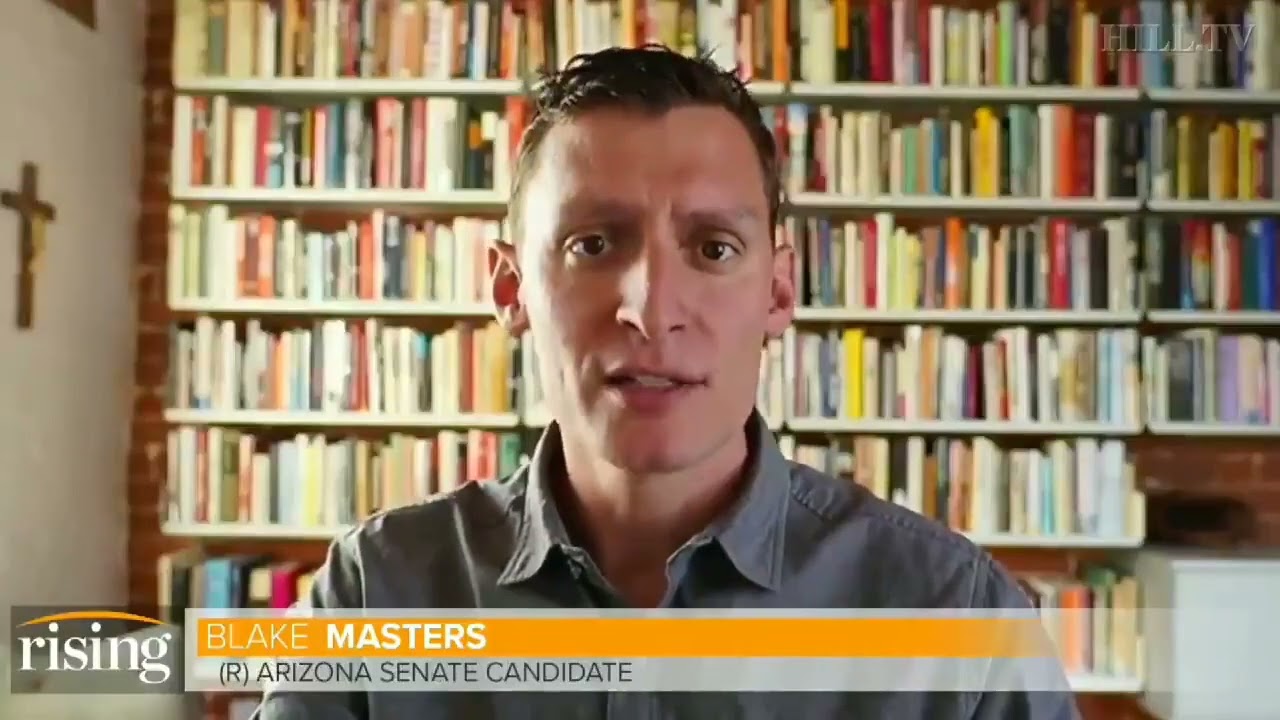
"Left-wing violence is out of control, and it’s not random," former Arizona Republican U.S. Senate candidate Blake Masters tweeted. "Either we destroy the NGO/donor patronage network that enables and foments it, or it will destroy us."
READ MORE:'Put two and two together': Conservative argues CNN told hosts to be soft on Trump-Epstein
:{:{MAGA influencer Sam Hyde called on his hundreds of thousands of X followers to watch the video of Kirk being struck by a bullet, writing "It could have been any one of us exercising the first amendment" while adding: "You all need to know what our enemies want." Conservative social media personality FischerKing tweeted: "If this isn't a wake-up call then we're never going to wake up."}:
Tesla and SpaceX CEO Elon Musk reposted a separate tweet from FischerKing, who said the "left-wing mainstream media" had created a "climate of hysteria against right-wing figures that could radicalize any number of unstable people to engage in political violence." Musk commented: "Exactly."}:
"We're in a war," conspiracy theorist Alex Jones said in a video. "The left has been saying put a bullseye on Trump, put a bullseye on his supporters, they've been calling for violence ... they're going to attack."
"The Rubicon has been crossed. Not by Trump or MAGA, but by the far left," wrote far-right activist Mike Cernovich, who spawned the "Pizzagate" conspiracy theory. "Randy Paul can shove his book reports up his a--. F--- everyone who played footsie with these dark demonic forces. We will not be scolded any longer."
"The attack on Charlie Kirk and free speech is evil, pure and simple. The hate, violence and evil being peddled by radical extremists has no place in this country! Schools and social media have become breeding grounds for liberal hate," the Utah Republican Party's official X account posted. "Enough!"
READ MORE:House hearing derailed after Dem calls GOP rep 'lapdog to the president' in shouting match
---
===
an 11 24
Trump's children aren't wasting any time launching new money-making opportunities after their father was elected to a second term in the White House.
According to the Daily Beast, Lara Trump – the Republican National Committee co-chair who is married to the president-elect's son, Eric — is now launching a new clothing line. Her company, LT Brand by Lara Trump Collection, is labeled "a celebration of strength, resilience and patriotism." She wrote on Instagram that it would help "American workers and factories" and that her products will be "handcrafted in the USA because I believe in bringing jobs back home and making a difference where it matters most."
The Wall Street Journal recently reported that Trump's eldest son, Donald Jr., is now going into business with a former supporter of Florida Republican Governor Ron DeSantis to specifically fund companies eschewing ESG (environmental, social and governance) philosophy. His new business partner, Omeed Malik, is a former Bank of America executive who was fired in 2018 over allegations of making unwanted advances toward female employees and was in relationships with female subordinates.
READ MORE:Inside Donald Trump Jr.'s plan for 'building the new Republican Party': report
Their new firm, 1789, is now seeking $100 million in startup capital with a promise to exclusively fund American companies in "response to the weaponization of capital by foreign entities." Some of the more notable board members of the company include failed Arizona U.S. Senate Republican nominee Blake Masters and Jamie McCourt, who was the U.S. Ambassador to France during Trump's first term in office.
Virginia Canter, who is the chief ethics counsel for the watchdog group Citizens for Responsibility and Ethics in Washington, told the Journal that the Trump children's businesses raise numerous questions about how their private sector work will benefit from their familial connections.
"If it is a regulated entity, will it be given less oversight? Will they be treated differently than other regulated industries?" She said.
According to the Journal, Trump Jr. and Malik first got acquainted while doing business with the company PublicSquare, which was expressly focused on marketing to conservatives who felt alienated by more mainstream brands. Trump Jr. said on a 2023 episode of his podcast that he wanted to help PublicSquare "really get that dual economy going until the other side is willing to not be political, to not hate your guts, to not hate your freedoms, your religion, your values, until they’re willing to not jam their woke bulls— down your throats."
READ MORE:['If he was on The Apprentice right now he'd be fired': Analyst explains why Trump Jr.'s deposition matters
However, PublicSquare has yet to show any definitive proof of success. Despite having a valuation of roughly $200 million in February of 2023, the Journal reports that it has since seen its value plunge by approximately 90%, trading from around $29.80 per share down to around $2 per share in late 2024. In the first three quarters of 2024, PublicSquare posted revenue of $16 million, but losses of nearly $37 million. And the company recently laid off more than a third of its workforce.
Trump Jr. is no stranger to launching failed businesses. He's coming off of a failed cryptocurrency venture called World Liberty Financial, whose signature "gold paper" currency has an image of the president-elect's face on the front. After being unable to tap into a mass market of buyers for its tokens that can't be resold, it reduced its sales targets by 90% after just launching in September.
Lara Trump and Donald Jr. aren't the only Trump relatives to try their hand in business. Trump's son-in-law, Jared Kushner (who is married to his eldest daughter, Ivanka) runs the firm Affinity Partners out of Miami, Florida. That company has attracted billions of dollars in investments from foreign governments including Saudi Arabia and Qatar, along with money from Taiwanese billionaire Terry Gou, who founded the manufacturing giant Foxconn.
Ivanka also had her own clothing line during Trump's first term. However, she eventually shuttered it, with the Beast reporting that the Trump heiress opted to instead focus on supporting her father's administration. The Journal noted that Ivanka's decision to shut down her business was also "tired of the extra restrictions and scrutiny."
READ MORE:Kushner firm may be 'front to funnel foreign government money' to Trump family: Senate Dem
Click here to read the Beast's article about Lara Trump, and click here to read the Journal's full report about Trump Jr. (subscription required)
---
---
an ah 1023
arizona's political landscape is radically different from what it was 30 or 40 years ago. The Arizona of the past was a deep red state that was synonymous with the GOP conservatism of Sen. Barry Goldwater and his successor, Sen. John McCain.
In 2023, Arizona is a swing state with a Democratic governor (Katie Hobbs), a Democratic U.S. senator (Mark Kelly), an independent U.S. senator who used to be a Democrat (Kyrsten Sinema), and a Democratic attorney general (Kris Mayes). The Arizona GOP, however, has taken a far-right ultra-MAGA turn and moved away from the traditional Goldwater/McCain conservatism of yesterday.
In a biting opinion column published on October 30, the Arizona Republic's E.J. Montini argues that Donald Trump's "carnivorous pack of howling, growling, backbiting followers" are getting ready to "cannibalize" each another in 2024.
"It shouldn't surprise anyone that MAGA sycophants like Arizona Republican Rep. Paul Gosar and failed governor candidate and current U.S. Senate candidate Kari Lake, who supported one another in previous elections, are at loggerheads when it comes to who should replace retiring Rep. Debbie Lesko in Arizona's heavily Republican Congressional District 8," Montini explains. "Gosar is backing failed Republican U.S. Senate candidate Blake Master…. Lake, on the other hand, is backing failed Arizona attorney general candidate Abe Hamadeh."
Montini argues that Lake's endorsement of Hamadeh "doesn't come because she particularly likes Hamadeh, but because she did not like the fact that Masters thought of challenging her for the Senate nomination."
"The competition must seem odd to casual observers," Montini writes. "Masters and Hamadeh are of the same stripe, the same breed. Essentially, they're the same person. They share a lack of qualifications, a fealty to Trump and a history of losing. But this is a different kind of pack. They eat their own."
---
---
an 2 23
Democratic strategists have been expressing their concerns about Arizona’s 2024 U.S. Senate race, fearing that if Sen. Kyrsten Sinema seeks reelection as an independent, a split between Sinema and liberal Democratic Rep. Ruben Gallego among voters could give the GOP nominee — whoever that turns out to be — an advantage. Gallego’s recent announcement that he is seeking the Democratic nomination in that race was well-received by his party’s liberals and progressives;Gallego’s Senate campaign said it raised more $1 million in a single day.
Meanwhile, on the Republican side, GOP insiders have their own worries about that Senate race. According to Politico reporters Holly Otterbein, Burgess Everett and Ally Mutnick, Republicans in Arizona fear that the Republican nominee in that race could be, if they run, either Kari Lake or Blake Masters — both of whom were among the hyper-MAGA Republicans who lost in the 2022 midterms.
Politically, Arizona has changed a great deal in recent years. Once a deep red state, Arizona was, for decades, synonymous with Goldwater conservatism — as in Republican Sen. Barry Goldwater and his successor, Sen. John McCain (a self-described “Goldwater conservative” or “Goldwater Republican”). Goldwater suffered a landslide defeat when incumbent Democratic President Lyndon B. Johnson, empowered in part by the crushed him in the 1964 presidential election. But in Arizona, Goldwater was a conservative rock star. And his influence on right-wing Arizona politics remained long after he left the U.S. Senate.
READ MORE: 'It’s done': These Republicans are openly questioning Kari Lake’s future in Arizona politics
Goldwater was considered arch-conservative in his day. But by far-right MAGA standards, the late senator would be considered a RINO (Republican In Name Only). And the MAGA movement didn’t fare well in Arizona in 2022, when Lake lost to Democratic now-Gov. Katie Hobbs and Masters lost to incumbent Sen. Mark Kelly (who now sits in the Senate seat once held by Goldwater and later, McCain).
Republican strategists were hoping that a Sinema/Gallego split among voters — assuming Sinema seeks reelection — would give them a good shot at retaking that Senate seat. But now, according to Otterbein, Everett and Mutnick, they fear that Lake or Masters could doom their hopes.
“The possibility of Lake and Masters entering the political waters once more is complicating the newfound optimism GOP officials felt about capitalizing on Sinema’s recent party switch to independent,” the Politico reporters explain in an article published on February 1. “With Democratic Rep. Ruben Gallego already in the race, Republicans see a prime opportunity to win the election with a plurality of the vote. Now, there are new fears that they’d fumble the opportunity by putting forth a candidate who remains aligned with former President Donald Trump or fixated on election denialism.”
Barrett Marson, an Arizona-based Republican strategist, isn’t bullish on either Lake or Masters as a possible Senate candidate.
READ MORE:Arizona lawmaker wages war against Kyrsten Sinema with new Senate campaign
Marson told Politico, “Just look at what happened in the last two elections. You in no way have to guess what happens when MAGA candidates ignore bread-and-butter issues that Arizonans care about. Kari Lake is not governor. Blake Masters is not senator. Republicans have to get back to basics.”
Nor is Senate Minority Whip John Thune excited about the prospect of either Lake or Masters running for the U.S. Senate seat now held by Sinema.
The South Dakota Republican told Politico, “Any candidate in ’24 that has, as their principal campaign theme, a stolen election, is probably going to have the same issues that some of the ’22 candidates had. I just don’t think that’s where the American public is. It’s a swing state — we need to have a good Republican nominee, obviously. You know, whoever gets in, I hope they focus on the future, not the past.”
READ MORE: Kari in 'Neverland': Arizona columnist buries GOPer Lake for 'duly-elected governor' claim
Read Politico’s full report at this link.
---
---
to get thiel $? preserve bench strength? incubator?
an 11 22
Embattled Republican National Committee chair Ronna McDaniel is launching two advisory groups in an effort to expand the party’s appeal to voters and examine what went wrong in the wake of stunning, historic midterm election losses – and she’s turning to some of the right’s most extreme leaders to perform the investigations.
Political analysts on both sides of the aisle generally agree that Donald Trump, Trumpism, the party’s lurch to far right wing extremism including white nationalism, white supremacy, Christian nationalism, antisemitism, authoritarianism, fascism, and the “Big Lie” of stolen elections hurt, not helped candidates in the 2022 midterms.
McDaniel has now tapped some of the very purveyors of that failed extremism to lead the shrinking party’s efforts to broaden its outreach and correct its errors.
“The RNC is tapping nearly a dozen people to serve in what it’s calling a ‘Republican Party Advisory Council’ – a group that includes former Donald Trump White House adviser Kellyanne Conway, evangelical leader Tony Perkinsand a pair of Senate candidates who ran this year,” Politico reports.
Perkins is a far right wing religious extremist and anti-LGBTQ activist who decades ago reportedly had ties to white supremacist groups, which he has denied. For decades he has been president of the Family Research Council, which appears on the Southern Poverty Law Center’s list of anti-LGBTQ hate groups.
Deeply embedded in Republican theocratic politics, Perkins was appointed twice by Senate Republican Leader Mitch McConnell to the U.S. Commission on International Religious Freedom (USCIRF), an independent federal government body that has a history of advancing the agenda of America’s Evangelical Christian movement.
He is also a past president of the highly-secretive far Christian right organization, Council for National Policy (CNP).
CNP’s members are believed to include far right activist and lobbyist Ginni Thomas, whose attempts to overturn the 2020 presidential election results have been the subject of numerous reports. Also, Charlie Kirk, the founder of Turning Point USA, which has faced allegations of racism, and far right conspiracy theorist Jerome Corsi.
...
Other members of the Council for National Policy include two other heads of organizations that appear on the Southern Poverty Law Center’s list of anti-LGBTQ hate groups: Mat Staver, the founder of Liberty Counsel; and Tim Wildmon, President of the American Family Association.
“The panel will also include former Arizona Senate candidate Blake Masters, who in the wake of his loss has called on the party to move on from ‘consultant one-size-fits-all strategies,'” Politico reports.
Masters is a “Big Lie” purveyor who has also promoted the white nationalist conspiracy theory of the “Great Replacement,” which falsely claims immigrants – people of color – are “replacing” white Americans.
Separately, Politico adds, the RNC is commissioning an investigation into what went wrong, commonly referred to as an “autopsy” to ensure in future elections the same decisions are not made. That work will be lead by current RNC members.
---
---
an ah 11 22
When the results of 2022 midterms came in on Election Night, one saw some patterns emerging. Democrats were performing much better than expected, and many of the Republicans who were defeating Democrats in statewide races in swing states tended to be traditional conservatives rather far-right hyper-MAGA conspiracy theorists.
Hyper-MAGA, ultra-Trumpian candidates, in fact, lost key gubernatorial races in Pennsylvania, Arizona, Wisconsin and Michigan, while many of the GOP governors who were reelected — Ohio’s Mike DeWine, Georgia’s Brian Kemp, New Hampshire’s Chris Sununu — were more traditional conservatives. One saw some ticket splitting in New Hampshire; Sununu was reelected by around 15 percent, while far-right MAGA conspiracy theorist Don Bolduc lost to incumbent Democratic Sen. Maggie Hasan by 9 percent.
DeWine and Sununu are often slammed as RINOs (Republicans In Name Only) by the MAGA crowd, but unlike Arizona’s Kari Lake, Michigan’s Tudor Dixon or Pennsylvania’s Doug Mastriano — Republican gubernatorial nominees who ran on ultra-MAGA platforms — they won. Conservative Washington Post opinion columnist Henry Olsen had a blunt comment in his November 22 column: “College-educated voters just aren’t into MAGA.”
But “weird” Republicans, The New Republic’s Graham Gallagher emphasizes in an article published on November 25, aren’t going away. In fact, they have achieved more and more prominence in the GOP and are making their presence felt in some right-wing think tanks such as the Claremont Institute.
“The ascendant weird right will likely struggle to sell its deeply anti-patriotic vision to many voters,” Gallagher explains. “In these segments of the mostly young, online-influenced American right, the optimistic vision espoused by Ronald Reagan’s ‘morning in America’ has been discarded. The elite educated right has moved even beyond the overt pessimism of Donald Trump’s ‘American carnage’ — now, disgust with equitable citizenship, personal liberty, and democratic self-governance is commonplace. Fed by an endless outrage cycle and a motivated and well-resourced donor class willing to pour money into increasingly reactionary think tanks like the avowedly anti-democratic Claremont Institute, right-wing thinkers and activists have begun to identify the foundational pillars of the United States itself with immorality and adopted a new fascination with medieval Catholicism and imported European extremisms.”
Gallagher points to “the right-wing embrace of (Russian President Vladimir) Putin” and former Rep. Allen West’s obsession with the Medieval Knights Templar as examples of how “bizarre” the “online weird right” can be. Others include beliefs that “real men don’t eat soybeans, seed oils are dangerous, meat substitutes will turn men into women and…. the best diet is all-meat.” And Gallagher cites some specific examples of how “weird” MAGA candidates could be in the 2022 midterms.
“Blake Masters and J.D. Vance — two Republican candidates for Senate funded in part by tech billionaire and new-right linchpin Peter Thiel — have embraced new-right ideas and actively courted the ‘weird right,’” Gallagher observes. “Vance has questioned whether women should leave violent marriages; Masters has praised domestic terrorist Theodore Kaczynski’s infamous manifesto, argued against legal access to contraception, and openly said that democracy is a smokescreen for the masses ‘stealing certain kinds of goods and redistributing them as they see fit.’ Americans on balance like democracy; legal contraception is almost universally popular; and Kaczynski’s unpopularity is so widely assumed that pollsters rarely ask about him. Masters, perhaps unsurprisingly, lost his bid to unseat Mark Kelly, and Vance badly underperformed in his blood-red home state.”
---
---
etch-a-sketch pivot to genl more desperate?
https://www.alternet.org/2022/08/gop-nominee-blake-masters-blames/ AA and lgbt
---
https://www.alternet.org/2022/10/peter-thiel/ dating app rt stuff pre incubator?
---
an 10 22 me
Arizona Republican Senate candidate Blake Masters is facing scrutiny as a new public rebuke warns against voting for him in the upcoming midterm election.
According to HuffPost, the concerns about Masters were detailed in an open letter collectively supported by several of his former teachers, classmates, and other alumni from his school, Green Fields Country Day School in Tuscon, Ariz.
In the letter, they warned Masters will "lead Arizona down a dark, dystopian path” if he is elected in November. They also expressed concern about the aspiring lawmaker's dangerous rhetoric.
The letter, which was signed by more than 75 individuals affiliated the school, insists Masters is now “barely recognizable” compared to when he attended the school.
They also provided examples of Masters' disturbing actions and the political attacks.
"The Blake we see today is barely recognizable. He peddles extremist ideology — attacking veterans, calling abortion 'demonic,' being endorsed by Neo-Nazis, blaming gun violence on 'Black people, frankly,' and that’s just the tip of the iceberg," they wrote.
"He also belittles those who don’t share his views, and it’s clear Blake will lead Arizona down a dark, dystopian path," they added. "He is a man who gave up everything — his friends, his community, his values, and his integrity — all in pursuit of power, position, and prestige."
READ MORE: Republican Senate candidate Blake Masters gets blasted by the best man at his wedding
They also noted their concerns about the current state of politics and how Masters is contributing to the threats against democracy.
"We are deeply grieved to see the Blake we knew for two decades become the dangerous politician he is today. He is beholden to a power-hungry billionaire and his radical ideology. He wants to outlaw abortion nationally, privatize Social Security, and rip away the fundamental rights of others — women, people of color, and members of the LGBTQ community."
They later added, "We cannot sit idly by while his dishonesty, his selfishness, and his hateful, divisive rhetoric become the voice of Arizona in the U. S. Senate. The person Blake has become represents an unprincipled rejection of the way we all grew up in Arizona, and at Green Fields."
In conclusion, they wrote a direct message to Masters. "To Blake: If you’re reading this, even though you have abandoned our values, we will not let you diminish our community. We will continue standing together, without you."
---
lcv aug 2022
Washington, D.C. – In response to Blake Masters winning the Republican Primary for U.S. Senate in Arizona, LCV Victory Fund issued the following statements:
“Blake Masters has tied himself to big oil and MAGA radicals who want to upend our democracy,” said LCVVF Regional Campaigns Director Eva Estrada. “He continues to question climate science and has repeatedly pushed the Big Lie that the election was stolen from Donald Trump. Thankfully Arizonans have a proven climate leader who has taken on big oil and fought time and again to protect our democracy. LCV Victory Fund has made this race a top priority and will fight like hell to keep Captain Mark Kelly in the Senate.”
“We feel the impacts of climate change everyday. Record breaking heat and worsening droughts are affecting millions across our state, especially those who can least afford it.” said Chispa Arizona State Co-Director Vianey Olivarria. “It is frightening to see Blake Masters, a known climate denier and white supremacists, as the GOP nominee. “He does not reflect our values. Climate and the future of our communities is top of mind for Arizonans, and we deserve leaders in Congress who will stand up for us. We know Arizonans will elect a reasonable leader to the Senate again – Senator Mark Kelly.”
Blake Masters has shown time and again he is a radical candidate, questioning science and threatening our democracy:
- :{He has repeatedly }
 :{ in interviews, claiming, “we have to figure out if the earth is warming and why….”}:
- Blake Masters was Peter Thiel’s Deputy on the Trump transition team when they attempted to appoint William Happer, a known climate change denier, to be Trump’s science adviser.
- He has continuously repeated the big lie, pushing the false claim that President Trump won the 2020 election. Trump’s endorsement of Masters said ‘Blake knows that the ‘Crime of the Century’ took place, he will expose it and also, never let it happen again.’
- Super PAC funded by Masters’ old boss Peter Thiel blasted his opponent for not believing that the election was stolen from President Trump. ‘Mark Brnovich says President Trump is wrong on voter fraud. Really? Brnovich failed to convene a grand jury, certifying Biden as president. Now he’s nowhere to be found, making excuses … instead of standing with our president.”
---
---
an 922
From Fox News’ Tucker Carlson to Sen. Ted Cruz of Texas to former President Donald Trump, MAGA Republicans have been claiming that Democrats are undermining the U.S. military by trying to make it as “woke” as possible. Cruz, in a May 19, 2021 tweet, praised the Russian military for not being “woke” and “emasculated” — a tweet that received a scathing response from Sen. Tammy Duckworth of Illinois.
But the MAGA narrative claim that Democrats and so-called RINOs (Republicans In Name Only) are harming the U.S. military by making it “woke” persists. And Never Trump conservative Max Boot, in a September 26 opinion column for the Washington Post, argues that some disturbing motivations are behind this MAGA narrative.
“Donald Trump Jr., for example, claims a ‘militant female’ can become an admiral or general in today’s military ‘for no other reason other than they’re probably female,’ or “if you can say: Hey, I’m trans,’” Boot explains. “Tucker Carlson asserts: ‘It has been one calculated humiliation after another for the U.S. armed forces: vax mandates, anti-White ideology, sex changes, drag shows. Whatever is necessary to telegraph to the United States military you are worthless.’”
Boot continues, “Needless to say, these fanciful descriptions from bomb-throwers who never served in uniform bear no relation to reality. The U.S. military remains one of the most conservative institutions in America, with traditions dating back centuries. That the military now welcomes African-Americans, women and LGBTQ people — all groups that were kept out in the past — only strengthens an institution that needs to draw on the talents of the whole country to defend it. So, why are cartoonish inhabitants of the Fox News Cinematic Universe caterwauling about a ‘woke military?’”
The conservative columnist answers his question by arguing that the “MAGA brigades want to populate the military with far-right officers who will do whatever Trump or a Trump mini-me commands, no matter how illegal.”
Boot notes that Gen. Mark Milley, chairman of the Joint Chiefs of Staff, “became anathema to Trump & Co. not by embracing ‘critical race theory,’ but by making clear that the military would place loyalty to the Constitution above loyalty to Trump.”
“All of these attacks against the military for being too ‘woke’ should be seen as part of the MAGA strategy to harness the armed forces — ‘the guys with the guns,’ as Milley put it — to advance their authoritarian agenda,” Boot warns. “Blake Masters, the ultra-MAGA Republican Senate nominee in Arizona, has even advocated firing all the generals — ‘they’re left-wing politicians’ — and replacing them with ‘the most conservative colonels.’
Unfortunately, there would be little to stop a President Trump or a President Ron DeSantis from doing precisely that as long as the Senate confirms their new generals. A MAGA president could even summon back to active duty loony retired generals such as (Gen. Michael) Flynn or Don Bolduc, the GOP Senate nominee in New Hampshire, and appoint them to senior commands as long as the Senate consents…. The growing chorus of MAGA complaints about the ‘woke military,’ nonsensical as they are, indicate that the challenges will only grow. A homegrown extremist movement that has already captured control of one of the two major political parties is now trying to bend the armed forces to its supreme leader’s malign will.”
---
---
an 922
When Democrats enjoyed a major blue wave in the 2006 midterms and recaptured both branches of Congress, the dominant factor was frustration over the Iraq War. But Democrats, especially Rep. Nancy Pelosi of California, also hammered then-President George W. Bush over his proposal to privatize Social Security. Republican Bush described that blue wave as a “thumping” for his party.
Despite that 2006 thumping, former House Speaker Paul Ryan subsequently advocated privatizing Social Security during the Barack Obama years — once again giving Democrats an issue to attack Republicans on. Journalist Natalie Allison, in an article published by Politico on September 22, emphasizes that as wildly unpopular as that proposal is, some Republicans continue to revisit it anyway.
“For two decades, campaign after campaign, Republican politicians have floated the idea of privatizing government entitlement programs, including Social Security and Medicare,” Allison explains. “And campaign after campaign — from Paul Ryan to George W. Bush — it’s been a loser. But for some reason, they keep trying. The latest is Don Bolduc, New Hampshire’s GOP Senate nominee, who advocated privatizing Medicare during a campaign town hall in early August.”
READ MORE: Congressional progressives warn GOP wants to 'take a chainsaw to' Social Security
Bolduc, a far-right MAGA Republican and conspiracy theorist who once called conservative Republican New Hampshire Gov. Chris Sununu a “Chinese communist sympathizer,” is hoping to unseat incumbent Democratic Sen. Maggie Hassan in New Hampshire. And he has done a lot of flip flopping during his campaign. In 2021, Bolduc was a “Stop the Steal” Trumpster, making the false and thoroughly debunked claim that widespread voter fraud robbed former President Donald Trump of a second term. Now, Bolduc is walking that back, saying that the 2020 election was not stolen from Trump and admitting that President Joe Biden won the election fairly. And another thing Bolduc is walking back is his proposal to privatize Medicare.
“Bolduc’s remarks about privatizing Medicare will all but certainly be used against him in advertisements by Democrats, who have long used the threat of changes to Social Security and Medicare to animate older voters,” Allison notes. “Bolduc’s opponent, incumbent Sen. Maggie Hassan, has said she would fight to protect existing Social Security and Medicare programs. The reversal on Medicare isn’t Bolduc’s first since he clinched the Republican nomination in New Hampshire’s primary last week. Bolduc, who unapologetically declared over the last two years that he believed the 2020 election was stolen from Trump, announced two days after the primary that he had changed his mind — a clear attempt to appeal to the more moderate and independent voters he’ll need to vote for him in the general election in November.”
In Wisconsin, Allison observes, Republican Sen. Ron Johnson — who is seeking a third term — has suggested that Medicare and Social Security should not be automatically renewed every year. And his Democratic opponent, Mandela Barnes, has been attacking him for it via a group called Seniors for Mandela.
Meanwhile, in Arizona’s U.S. Senate race, Blake Masters — the Trump-backed MAGA Republican who is running against incumbent Democratic Sen. Mark Kelly — has also flip-flopped on privatizing Social Security. In June, Masters said, “We need fresh and innovative thinking. Maybe we should privatize Social Security. Private retirement accounts, get the government out of it.” But Masters now says that he is opposed to privatizing Social Security or Medicare.
READ MORE:JD Vance changes course on Social Security and Medicare
“Masters’ change of heart on Social Security hasn’t stopped Democrats from pummeling the Republican nominee with television attack ads on the issue,” Allison writes. “The Democratic Senatorial Campaign Committee has spent more than $1.7 million on television ads in Arizona specifically highlighting Masters’ comments on privatizing Social Security — a topic they’re still putting money behind on the air. Other Democratic groups have taken out digital ads on the topic. It appears their messaging is breaking through to voters. During a focus group conducted Thursday by the anti-Trump Republican Accountability Project, viewed exclusively by Politico, two of the nine Arizona voters participating — each of whom voted for Trump in 2016 but not in 2020 — brought up Masters’ views on Social Security.”
READ MORE:'Self-serving, multimillionaire' Ron Johnson targets Medicare and Social Security
---
---
an 9 22 ah
Among Never Trump conservatives, there has been a lot of debate over whether former President Donald Trump or Florida Gov. Ron DeSantis would be more dangerous to have in the White House in 2025. One school of Never Trumper thought argues that Trump would be more dangerous because he is undisciplined and lacks self-control; another Never Trumper argument, however, is that DeSantis would be more dangerous because he is a more focused and disciplined version of Trump. But one thing those Never Trumpers agree on is that the MAGA movement in general has an authoritarian mindset.
Conservative Daily Beast opinion columnist Matt Lewis, in a September 13 column, analyzes some of the MAGA Republicans who are being mentioned as possible post-Trump options for the GOP — namely, DeSantis and Blake Masters,who is running against incumbent Democratic Sen. Mark Kelly in Arizona’s 2022 U.S. Senate race. And the main thing they have in common, according to Lewis, is an affinity for “heavy-handed” authoritarianism.
“Ever since Donald Trump came down that gold-plated escalator in 2015, the American right has relied more on coercion than persuasion,” Lewis explains. “This month’s National Conservatism Conference — its third edition, held in Miami — signaled an increasing commitment to this heavy-handed approach. One breakout session included a call for mandatory military service for anyone making over $250,000 a year. And a speech by Blake Masters, the Republican candidate for U.S. Senate in Arizona, led a prominent conservative to unironically tweet: ‘Sounds like (Masters) is absorbing the Viktor Orban lesson.”
READ MORE: Fox News hosts furious over Joe Biden calling MAGA 'semi-fascism'
Lewis continues, “But perhaps the most newsworthy example came when Florida Gov. Ron DeSantis said tech companies ‘cannot be viewed as private entities’ because ‘we know without a shadow of a doubt they are doing the regime’s bidding when it comes to censorship.’ This, of course, comes on the heels of DeSantis going after Disney — when the company opposed Florida’s controversial “Parental Rights in Education’ bill, dubbed ‘Don’t Say Gay’ by its critics.”
The “prominent conservative” Lewis was referring to is author/journalist Rod Dreher, known for his work for the National Review, the now-defunct Weekly Standard and other publications. In a September 11 tweet, Dreher quotes Masters as saying that “libertarianism doesn’t work.”
“What happened to ‘limited government’ conservatives opposing intervention in the private sector, and opposing the state picking winners and losers?” Lewis writes. “The new right waves away such concerns, instead advocating for the government to use its awesome powers to do ‘good,’ as defined by the new right, just as it selectively embraces the good tech elites. Take, for example, PayPal founder Peter Thiel, an erstwhile libertarian, who during NatCon 3, praised DeSantis. Thiel, of course, famously funded successful GOP primary victories for Ohio Senate candidate J.D. Vance and Arizona Senate candidate Blake Masters.”
Lewis argues that DeSantis and Masters “represent a dangerous worldview that could define the post-Trump American right.”
READ MORE:Why Ron DeSantis is stumping for election deniers in key swing states: report
“Whereas Trump lacked a coherent and consistent philosophy — he flirted with populism, but Trump’s main agenda was always advancing Trump — these national conservatives are more competent, and they have an ethos,” Lewis warns.
“Trump can at least be laughed at, because he is essentially an out-of-touch old guy who says crazy shit. Likewise, ridiculous Republican lawmakers like Marjorie Taylor Greene and Lauren Boebert spout absurd, deliberately offensive things and are constantly committing malapropisms," Lewis continues. "These Trumpers get clicks, but they are not part of the new right’s ‘brain trust,’ like the NatCons. This raises the now-trite question of whether DeSantis would be more dangerous than Trump.”
Lewis speculates that DeSantis “might be merely playing up his authoritarian persona to appease the Trumpy Republican base” but adds that “DeSantis’ remarks about private companies and ‘the regime’ at NatCon 3 do little to quell my anxiety.”
“Devout believers in limited government have reason to fear national conservatism, and so do devout believers in Christianity,” Lewis writes. “But national conservatism isn’t about philosophical ideas or spiritual transcendence. It’s about earthly power — and who wields it.”
---
---
8 15 22 an
In six key battleground states that played a decisive role in the 2020 presidential race, Republican candidates who have openly embraced former President Donald Trump's "Big Lie" have won nearly two-thirds of the GOP nominating contests for positions with power over state and federal elections, a potentially seismic threat to democracy.
According to a Washington Post analysis published Monday, 54 of 87 Republican nominees for key posts in Arizona, Georgia, Michigan, Nevada, Pennsylvania, and Wisconsin have denied the legitimacy of President Joe Biden's 2020 election victory.
"Had those candidates held power in 2020, they would have had the electoral clout to try something that the current officeholders refused: overturning the vote and denying Biden the presidency," the Post notes. "Whether they could have succeeded in practice is a matter of vigorous debate among scholars, who cite the potential for court challenges and other means of upholding the results."
"But the experts agree on one thing: A close presidential contest that comes down to the outcome in states where officials are willing to try to thwart the popular will could throw the country into chaos," the newspaper adds. "It would potentially delay the result, undermine confidence in the democratic system, and sow the seeds of civil strife on a scale even greater than what the nation saw on January 6, 2021."
Trump, who is gearing up for a possible 2024 run as he's under criminal investigation by the Justice Department, has endorsed and campaigned for many of the candidates featured in the Post's analysis, including Arizona gubernatorial candidate Kari Lake—a former TV news anchor whose incessant lies about the 2020 election catapulted her to a win in the GOP primary earlier this month, delighting the former president.
Even in victory, Lake lashed out at the Arizona election process, complaining that the results "took longer than they should have."
The Post's analysis confirms that Arizona, a state Biden carried narrowly in 2020, is a bastion of election denial on the GOP side: 12 of 13 Republican nominees for state and federal offices there have questioned the election, including the chosen candidate for secretary of state.
[twt graf]
noah Bookbinder, president of Citizens for Responsibility and Ethics in Washington, called the rise of GOP election deniers across the U.S. "the biggest story not enough people are watching."
"This is how our democracy could crumble, quickly and quietly," Bookbinder warned.
The notion that Biden was elected illegitimately is broadly popular with Republican voters, according to recent opinion surveys. As the Post points out, "The predilection among Republican primary voters toward candidates who deny the result of the last election extends well beyond Michigan, Pennsylvania, and Arizona—three states that together accounted for 47 electoral votes in 2020, more than enough to flip the last election to Trump."
Ian Vandewalker, senior counsel at the Brennan Center for Justice, wrote in a blog post earlier this month that "the Big Lie that the election was stolen from Trump has been pushed by powerful politicians, starting with Trump himself."
"But it may be leaders closer to home who have the greatest ability to affect the popularity of election denial among the people of their state," he added.
One prominent Republican officeholder that is actively boosting election deniers is Florida Gov. Ron DeSantis, a possible 2024 presidential contender.
The Orlando Sentinel reported last week that DeSantis is "set to appear at rallies for Pennsylvania GOP governor's candidate Doug Mastriano, Arizona candidate for governor Kari Lake, and U.S. Senate candidate Blake Masters, all of whom have denied Biden's win and falsely claimed election fraud.
DeSantis was one of the first Republicans to suggest state legislatures could overrule voters to choose Trump.
"Appearing on Fox News on November 5, two days after the election," the Sentinel observed, "he said 'presidential electors are done by the legislators and the schemes they create and the framework. And if there's departure from that, if they're not following law, if they're ignoring the law, then they can provide remedies as well.'"
The Republican Party's elevation of fervent election deniers—often with the support of dark money—in battleground states and nationwide has dramatically raised the stakes of the upcoming November contests, given that they could usher into power officials willing to subvert the democratic process to secure their desired outcome.
Wisconsin offers an illustrative example of November's implications. As the New York Times reported Monday, "The governor's race this fall, along with a pivotal State Supreme Court contest next spring, will decide whether Republicans can solidify their grip on the swing state and remake its voting laws."
"Nowhere in the country have Republican lawmakers been more aggressive in their attempts to seize a partisan edge than in Wisconsin," the Times noted. "Having gerrymandered the Legislature past the point that it can be flipped, they are now pushing intensely to take greater control over the state's voting infrastructure ahead of the 2024 presidential contest."
---
---
https://azdem.org/if-you-cant-beat-em-hire-em-azsen-edition/
3/22
to compete with fake elector Jim Lamon, Blake Masters just put one on his payroll
PHOENIX — In the latest desperate attempt to out-election conspiracy theory the GOP Senate primary field for “kingmaker” former President Donald Trump’s heart (read: endorsement), Blake Masters just hired fringe Arizona GOP bigwig Greg Safsten to join his campaign.
In addition to promoting the GOP’s Maricopa County “audit,” Safsten was an active participant in the fake elector scam, co-conspiring with Masters’ opponent, Jim Lamon, in an attempt to override millions of Arizona votes. And yes, this is the same fake elector scam that Masters’ other opponent, Mark Brnovich, is refusing to investigate in the hopes that his cooperation will score him points — and a quick dollar — with Trump.
But Masters — a Silicon Valley sweetheart who has the backing (and $10 million pledge) of tech tycoon Peter Thiel — couldn’t just hire any fake elector. He picked Safsten, a like-minded hypocrite so clearly beholden to big tech that the Arizona GOP voted to nominate Trump for his 2020 re-election bid via a blockchain app under his leadership. Blake Masters also called for the U.S. to have a strategic reserve of Bitcoin.
“This latest move by Blake Masters confirms what we already knew: He was bred by big tech, is funded by big tech, and is now staffed by big tech,” said ADP spokesperson Hannah Goss. “What’s more, Masters just made it crystal clear that this primary field is in a race to the bottom to prove who is most focused on an election that occurred nearly two years ago instead of on the issues that matter most to Arizonans right now — and all to win the approval of one man: Donald Trump.
---
---
https://www.nytimes.com/2022/08/03/opinion/blake-masters-arizona-senate.html
no lnx
ref 1
Guest Essay
The Violent Fantasies of Blake Masters
Aug. 3, 2022
By Sam Adler-Bell
Mr. Adler-Bell is a writer and a co-host of “Know Your Enemy,” a podcast about the conservative movement.
Blake Masters’s first campaign ad opens with a shot of the Sonoran Desert. A plaintive piano theme tinkles as Mr. Masters, a 35-year-old venture capitalist and, as of early Wednesday morning, the Republican nominee for Senate in Arizona, delivers a monologue in voice-over. “The truth is, we can’t take America for granted,” he says. “And if we want to keep it, we’ve got to fight for it.”
The angles are wide, and the focus is deep. The camera floats above the ground, drifting after a boy’s legs running over the dunes and peering upward at Mr. Masters and his family hiking at the golden hour. In another video, from November, Mr. Masters stands in the desert cradling a gun. “This is a short-barreled rifle,” he says. “It wasn’t designed for hunting. This is designed to kill people.”
Mr. Masters has said that his ads, which mingle scenes of wistful domesticity with bellicose rhetoric and stark vistas of Arizona wilderness, were inspired by the films of Terrence Malick, the enigmatic American director. Mr. Malick once told an interviewer that in filming “Badlands” — a movie set in 1958 about young lovers on a killing spree — he tried to minimize ’50s-era visual cues. “Nostalgia,” he said, “is a powerful feeling; it can drown out anything.” Instead, he wanted the film to feel like “a fairy tale, outside time.” This, he hoped, would “take a little of the sharpness out of the violence but still keep its dreamy quality.”
Perhaps Mr. Masters is trying to strike a similar balance. Juxtaposing pastoral serenity with masculine violence, his ads conjure a latent darkness — an eagerness to subdue through coercion and threat — undergirding the American dream.
In his victory speech in Chandler, Ariz., on Tuesday night, Mr. Masters — who was endorsed by Donald Trump in June — echoed the themes of his campaign: America is in trouble, riddled with crime and disorder; illegal immigration is an invasion; Big Tech is censoring conservatives and colonizing young people’s minds, while globalist corporations outsource jobs and make American life all but unlivable for middle-class families.
:{:{}:
}:
In his speech, Mr. Masters attacked “a small minority ofhard-core Democratic Party activists” who, he said, “control newspapers and television and schools and universities — and you better believe they control Big Tech, too,” framing the race as a battle against “the cartels,” “giant global corporations” and “a system that’s actively trying to destroy families.”
To close followers of conservative politics, this message may sound familiar. Mr. Masters is unmistakably a figure of the New Right: militant, internet-savvy culture warriors who position themselves as insurgent challengers of the sclerotic establishment in both parties. No longer doctrinaire libertarians, they see coercive state power as an indispensable tool for achieving conservative ends: mandating patriotic curriculums in schools, supporting the formation of “native-born” families, banning abortion and pornography, and turning back the rights revolution for L.G.B.T.Q. Americans.
“If you’re not using any political power to shore up a good society that follows the rule of law,” Mr. Masters warned recently, “you’ll get rolled.” Locked in civilizational battle with the radical left — the “enemy of true progress, the enemy of everything that is good” — conservatives who insist on libertarian orthodoxy are, for Mr. Masters, like pacifists in wartime: “You can recite an eloquent poem about pacifism right before they line you up against the wall and shoot you.”
For many young Trumpists, Mr. Masters is a dream candidate: a true believer who — as a ubiquitous New Right shibboleth has it — knows what time it is. He wants to ban “critical race theory” from schools and defund “gender ideology.” His campaign distributes yard signs that read, “Blake Masters won’t ask your pronouns in the U.S. Senate.” And he recently told the conservative talk show host Charlie Kirk that Dr. Anthony Fauci “will see the inside of a prison cell this decade.”
Likewise, his Twitter account is an endless stream of insular right-wing watchwords. In April, he called the Supreme Court nominee Ketanji Brown Jackson a “pedophile apologist.” In November, he tweeted, “When a society celebrates Antifa looters, arsonists, and pedophiles as heroes, while turning brave people like Kyle Rittenhouse into villains, it is a society that is not long for this world.” He frequently amplifies Mr. Trump’s 2020 election lies and he recently suggested that Democrats will “cheat” in the midterms.
But Mr. Masters also represents a distinctive innovation upon the swaggering MAGA message of other Republican hopefuls. A quintessential nerdy jock, he seems more Menlo Park than Capitol Hill; even in his pastoral campaign videos, he can sometimes be seen holding an iPad. He keeps a great deal of his wealth in cryptocurrencies. He is the well-groomed avatar of a hard-right Silicon Valley brain trust, including his former employer, the billionaire investor Peter Thiel, and an array of farseeing, anti-democratic titans of industry who see America as a stagnant and feeble empire in desperate need of vitalist reinvention.
Where Mr. Trump was merely a vehicle for disruption, Mr. Masters sees himself and his allies — including his fellow Thiel-backed Senate hopeful J.D. Vance of Ohio — as midwives of transformation.
Their diagnoses of American malaise are not fantastical; everyone can see the country is in trouble. But their prescriptions for how to fix it, the means they are willing to entertain to do so, are far outside the American mainstream, drawing on a political vision that sees democracy as an obstacle to the urgent interventions of enlightened philosopher kings.
Most strikingly, Mr. Masters’s presentation — mannered and serious; boyish but grave — is utterly devoid of Trumpian camp; there is none of the irony and kitsch that clung to Mr. Trump even in his cruelest moments. What’s left is only bitterness, enmity and a histrionic vision of a world being torn apart by the globalist left.
Mr. Masters faces a vulnerable Democratic incumbent, Mark Kelly, in November, but even if he doesn’t prevail, his nomination is a clear sign of a growing conservative appetite for radical solutions to American decline. If Mr. Masters does win, however, it may well be his bizarre and menacing vision of American politics — not the rosy amnesia of Mike Pence or the truculent populism of Ron DeSantis — that defines the future of the Republican Party.
Like many conservatives of his generation, Mr. Masters started out a libertarian.
At 19, he blogged on LiveJournal under the username kinggps in support of drug legalization, unfettered immigration and the elimination of the Supreme Court, which, he wrote, is “little more than a coercive microcosm of democracy.” As for national borders, Mr. Masters wrote, “Are we really supposed to believe that a government can draw a line in the sand, and that the people living on one side are somehow inherently different or deserving of more or less rights” than “those on the other?”
Mr. Masters shared his political musings in forums for body builders, CrossFit and gun enthusiasts, his online presence exuding the overconfidence, haughty logic-chopping, and occasional paranoia typical of late-aughts libertarianism. “I don’t mean any disrespect — but it takes years to understand where I’m coming from, let alone agree or disagree,” a beleaguered Mr. Masters posted on a CrossFit message board in 2007. He then signed off, recommending a workout for their minds: “taking 30 min. of your day” to read antiwar.com, the libertarian Mises Institute website, LewRockwell.com and CounterPunch.
A handful of dorm mates from Mr. Masters’s undergraduate years at Stanford told me he once recorded a liberty-themed rap, which, to my great regret, is no longer available online — though Mother Jones did uncover one 2008 video in which Mr. Masters wears Native American war paint and freestyles, “I’ve got the war paint on, as you can see/Who said what about cultural insensitivity?”
Mr. Masters’s life and political trajectory changed in 2012, when, as a law student at Stanford, he took a class taught by Mr. Thiel, the early Facebook investor who co-founded PayPal and Palantir.
When they met, Mr. Thiel was on his own journey away from hard-core libertarianism toward a more traditionalist and muscular nationalism. Like Mr. Masters, he had backed Ron Paul for president in 2008. And in a programmatic essay published the following year, Mr. Thiel declared that he no longer believed democracy and freedom were compatible: “The great task for libertarians is to find an escape from politics in all its forms.”
Lamenting that there were “no truly free places left in our world,” Mr. Thiel placed his hopes in “some sort of new and hitherto untried process that leads us to some undiscovered country.” That country, he wagered, would be found in cyberspace, outer space or in the open ocean. (At the time, Mr. Thiel had begun investing in “seasteading,” which entails building libertarian communes on seaborne platforms in international waters.)
This worldview, pervasive in Silicon Valley at the time, can be summarized as a libertarianism of “exit.” In 1970, the economist Albert O. Hirschman identified the choices for dissatisfied constituents of a troubled organization, business or nation:They can “exit,” leaving the organization behind and building something new, or they can use their “voice” to improve it from within.(“Loyalty,” a third choice, mediates between the other two.)
“The fate of our world,” Mr. Thiel wrote in his 2009 essay, “may depend on the effort of a single person who builds or propagates the machinery of freedom that makes the world safe for capitalism.”
By the time Mr. Masters was his student, however, Mr. Thiel was losing confidence that unfettered capitalism, alone, would lead to a better future. He was preoccupied with stagnation and a sense that the motor of technological change had stalled out. (“We wanted flying cars — instead we got 140 characters,” he complained in 2011.) In his Stanford class, Mr. Thiel — seeming to draw as much from the writings of French philosopher and literary critic René Girard as from business economics — described the impulse to imitate competitors as the death knell of true innovation, which requires visionaries to zig while everyone else zags.
Enthralled by these lectures, Mr. Masters began posting his meticulous class notes, in essay form, on a blog. The notes became a sensation, leading Mr. Thiel and Mr. Masters to collaborate on a 2014 book, “Zero to One: Notes on Startups, or How to Build the Future.” (The book is attributed to “Peter Thiel with Blake Masters.”) Since then, the two men’s lives have been entangled. Mr. Thiel invested in Mr. Masters’s start-up in 2012. And after he graduated from law school, he began working for Mr. Thiel, eventually becoming chief operating officer of Thiel Capital and president of the Thiel Foundation.
In “Zero to One,” Mr. Thiel and Mr. Masters describe the ideal founder as a sort of trollish uber-mensch: undaunted by censure, eager to offend, and constantly asking himself “the contrarian question”: What important truth do few people agree with me on? True innovation, they imply, requires heresy. Leaders must be willing to scandalize.
It was this philosophy that helped them see promise in Donald Trump. Where most conservative elites saw Mr. Trump’s offensiveness and vulgarity as a liability, Mr. Thiel and Mr. Masters saw it as an asset, a sign that he could disrupt establishment politics and break things open. As Mr. Masters said in an interview last year, “You can think of his administration as a start-up of sorts.”
But by investing in Mr. Trump, Mr. Thiel was also subtly reorienting his political posture. Once a leading advocate for “exit,” Mr. Thiel has since found his “voice,” using his wealth and power to shape American governance to his liking. In just a few years, he went from pining for off-world colonies and funding anarchist barges, to a prominent role on a presidential transition team.
In 2016, Mr. Thiel and Mr. Masters were charged with recommending appointees to populate the administrative state — a dream job for reformed libertarians convinced that their brilliant colleagues should be running the government. But their list of 150 names, Max Chafkin reported in his biography of Mr. Thiel, included people who were “too extreme even for the most extreme members of Trump’s inner circle.”The person they proposed for the F.D.A., for instance, was a tech mogul and bitcoin investor who had suggested replacing the agency with a “Yelp for drugs.”
“It was too much,” Steve Bannon told Mr. Chafkin. “People thought Trump was a disrupter. They had no earthly idea.”
For Mr. Thiel and Mr. Masters, the transition was a sign of greater disappointments to come. Despite all his bluster and chaos, Mr. Trump barely got anything done. Mr. Masters told National Review in November that an America First agenda “can’t just be doing tax cuts and deregulation and assuming that everything will work out.” But that’s basically all Mr. Trump accomplished.
Curtis Yarvin, an influential neo-reactionary blogger who is close to both Mr. Thiel and Mr. Masters, has furnished an explanation for this failure: Even a more dedicated nationalist than Mr. Trump would be thwarted in accomplishing his goals because he doesn’t actually control the state. Nothing happens without the consent of an unelected oligarchy of status-obsessed elites: the journalists and professors who shape the nation’s political reality, the corporate leaders who set its economic priorities, and the tenured agency bureaucrats empowered to decide, ultimately, how and whether to carry out the president’s will. This cabal, which Mr. Yarvin calls “the Cathedral,” has no investment in America’s national interest, only in the perpetuation of its own cultural hegemony. // deep state?
A creature of Silicon Valley, Mr. Yarvin sees American governance as a piece of old software larded with junk code: an accumulation of inefficient solutions to coding errors encountered in its long existence. The best way to radically improve its operation, Mr. Yarvin reasons, is to cease adding more workarounds and get rid of the junk code in one fell swoop. How? By replacing the president with a “Caesar” figure or “monarch” who would bypass the Constitution, shut down independent news outlets like CNN and The New York Times, and abolish many federal agencies.
That may sound nuts. And yet, a sense that the American state has become too weak to achieve its own aims is common among intellectuals across the political spectrum. The economist Tyler Cowen’s “state capacity libertarianism” and the Times columnist Ezra Klein’s “supply-side progressivism” are distinct flavors of the same plaint. All of them identify an accumulation of regulations and administrative procedures as a hindrance to delivering the things people need — energy, drugs, housing and infrastructure — in greater and cheaper abundance.
What’s distinctive about Mr. Yarvin is his hostility to democracy as such, which Mr. Masters and Mr. Thiel seem to share.As James Pogue reported in Vanity Fair, Mr. Masters has taken to citing Mr. Yarvin on the campaign trail. He has repeatedly referred to his own campaign — like Mr. Trump’s presidency — as a “start-up.” And according to Thielite doctrine, start-ups are not democratic. As Mr. Masters records in the notes from one of Mr. Thiel’s lectures that didn’t make it into “Zero to One,” “A start-up is basically structured as a monarchy. We don’t call it that, of course,” because “anything that’s not democracy makes people uncomfortable.”
Founders should not run an “absolute dictatorship,” Mr. Thiel said, according to Mr. Masters’s notes, but they do need to be “more tyrant than mob” to give their companies the nimbleness to execute a singular, revolutionary vision. “The best arrangement,” Mr. Thiel said, “is a quasi-mythological structure where you have a kinglike founder” who can “do more” than a democratic ruler. Many members of the New Right have called for a “refounding,” a moment when the rules are suspended and rewritten from above.
In a rambling conversation with a former Trump administration official, Michael Anton, on a podcast last summer, Mr. Yarvin described in detail how a future Trump-figure (or Mr. Trump himself) could seize dictatorial power, even elaborating a blueprint for a more organized and successful version of Jan. 6.It would require federalizing the National Guard, the participation of sympathetic law enforcement, and a mass mobilization many orders of magnitude bigger than Jan. 6.
:{:{}:
}:
Of course, Mr. Masters and Mr. Thiel have never endorsed such a plan. And Mr. Anton is careful to emphasize repeatedly that he and Mr. Yarvin are having a merely “theoretical” discussion.
But given how catastrophic Mr. Masters believes America has become — a “dystopian hell-world” he has called it — one wonders what exactly is justified and when. “The usual narrative is that society should be organized to cater to and reward the people who play by the rules,” Mr. Masters wrote on his blog in 2012, once again summarizing Mr. Thiel’s lecture.“But perhaps we should focus more on the people who don’t play by the rules. Maybe they are, in some key way, the most important. Maybe we should let them off the hook.”
The Masters campaign declined to comment for this article. Mr. Masters’s adviser, Katie Miller, grew impatient when I told her I was hoping to trace his intellectual journey from libertarianism to Trumpism, telling me she didn’t want another hit job trying to link Mr. Masters to the “alt-right.” No doubt Ms. Miller and Mr. Masters will dismiss the analysis above as guilt by association, too. Sure, Mr. Thiel and Mr. Yarvin are Mr. Masters’s friends and donors; that doesn’t mean he shares all their beliefs.
Mr. Masters, for his part, has insisted that if elected, he won’t be Mr. Thiel’s puppet. “I’ll hear him out because he’s smart,” he told Politico. “And I’ll take some votes that piss him off.” (It’s not clear which votes those might be. But Mr. Masters has said, despite having teared up at Mr. Thiel and his husband’s wedding in 2017, that he believes the Supreme Court erred in its Obergefell decision and that marriage ought to be “between a man and a woman.”)
In any case, it may not matter if Mr. Masters has some bonkers ideas; one senator with monarchist sympathies does not a counterrevolution make.
Just as socialists like Alexandria Ocasio-Cortez were elected on transformative platforms only to find themselves bogged down in the daily muck of legislating, surrounded by adherents to status quo policy and norms, this new crop of right-wing militants may likewise resign themselves to largely symbolic dissenting votes, Twitter provocation and media spectacle. (I, for one, would happily watch Blake Masters read from the Unabomber manifesto while preparing a casserole on Instagram Live.)
Then again, unlike the Democrats, who hastily sidelined Ms. Ocasio-Cortez as soon as she entered Congress, the Republican Party — belligerent, on the march, but deprived of an undisputed standard-bearer — may be more inclined to take leadership cues from young ideologues like Mr. Masters, who will enter office with a governing vision more coherent and radical than anything Mr. Trump espoused.
Already, Mr. Masters’s campaign is more embedded and on better terms with his party elite than left-wing insurgents were with the Democrats. His campaign manager, Amalia Halikias, was a press assistant for Jeb Bush in 2016. Despite the populist noises he occasionally makes on the trail, Mr. Masters is endorsed by the anti-tax billionaires of the Club for Growth PAC. Ms. Miller was Mike Pence’s press secretary and, later, communications director; she’s married to the senior Trump adviser Stephen Miller.
Most important, Mr. Masters’s vision, idiosyncratic as it may sound, comports with the basic governing impulses of the modern Republican Party. That vision might be summarized as “exit from within” — an escape from the inefficient obligations of democracy: oversight, dialogue, compromise, humility. It may be impossible to free the next Republican president from the tyranny of “the Cathedral,” but he will enjoy the fruits of the long conservative war on democratic institutions: a rubber-stamp Supreme Court, a geographically disenfranchised opposition, and state officials who sow doubt about election integrity.
The Thielites want to see the government hollowed out — to eject the administrative state and erase its memory — not to enhance liberty, but to make our nation’s current operating system more suitable for coercion. They wish to unseat the liberal technocratic elite only so they can install their own: a more competent, compliant and unfettered one.
Mr. Masters’s vision resonates in a Republican Party that longs for escape from the inefficient obligations of democracy: oversight, dialogue, compromise, humility.
What this vision is not, is a conservatism of limits. Rather, it is Promethean, progressive, in the most basic sense: It deplores any constraint on its power to govern, shape the future, despoil the planet, innovate, and expand the American economy. All limits — pluralism, democracy, ecology, human frailty — must be overcome in pursuit of winning the world game, reasserting American dominance and dispelling our decadent malaise. (At one time, Mr. Thiel and Mr. Masters were both interested in overcoming the ultimate limit: death itself.)
“The future is coming, whether or not we try to ignore it,” Mr. Masters wrote on Facebook in November 2020, endorsing Mr. Trump. “We can act to shape that future,” or wait “until it crashes down upon us. That vital impulse — of action over surrender — is what Trump represents.”
...? Mr. Malick’s films take a more ambivalent stance on the martial virtues. The man who fights is rarely morally superior to the man who stands completely still — though, often, they are the same man. “The Thin Red Line” (1998) depicts a proud moment for American empire, a pivotal battle on the Pacific front in World War II, from the standpoint of a dozen indistinct and alienated Army grunts. “This great evil, where does it come from?” a voice-over wonders, as our somnambulant soldiers kill the remaining Japanese. “How’d it steal into the world?” Mr. Malick, meditating on theodicy, not history, has no interest in worldly answers.
What Mr. Malick reveals about war, however — that it rewards bravery no more than cowardice, love no more than hate, and pity least of all — is perhaps a lesson Blake Masters has internalized. Mr. Masters treats politics as a game of moral and physical carnage in which nothing is precious, and rules are for losers and marks. Great nations are those that allow great men to rise above the law, while binding the rest of us ever tighter to its dictates. And Blake Masters wants to make America great again.
Sam Adler-Bell (@SamAdlerBell) is a co-host of the podcast “Know Your Enemy.”
The Times is committed to publishing a diversity of letters to the editor. We’d like to hear what you think about this or any of our articles. Here are some tips. And here’s our email: letters@nytimes.com.
Follow The New York Times Opinion section
---
---
https://www.alternet.org/2022/07/blake-masters-blasted-best-man/
---
an 7 22 pvt all
Since the beginning of his campaign, Blake Masters, the conservative venture capitalist turned U.S. Senate hopeful from Arizona, has been drawn to the kind of rhetorical extremism that now animates the Republican Party, bandying insults and talking points of the kind that require no specialized knowledge or experience but nevertheless leave an indelible impression on Republican voters. As far back as 2015, Masters told The Washington Post, he'd been entranced by the rhetoric of Donald Trump, a loud misogynist, who during one of his presidential debates proudly embraced accusations of sexism rather than deny them.
"You've called women you don't like fat pigs, dogs, slobs, and disgusting animals," then-Fox News anchor Megyn Kelly said to Trump during a 2016 GOP debate. "Your Twitter account ––"
"Only Rosie O'Donnell," Trump interjected, before getting rapturous applause from the crowd.
It was during this now-notorious back-and-forth, Masters explained, that he had his lightbulb moment.
"Somehow he just busted through some wall," Masters recently told the Post of Trump. "He didn't apologize. He kind of just picked on her as this target."
Since then, Masters has largely emulated the former president's brashness on all matters political. Just this May, in the wake of the Supreme Court's rescission of Roe v. Wade, the former tech executive stressed the need for nationwide ban on abortion, a practice that he called "demonic" just last year, according to The Tuscon Weekly. Masters also believes that the Capitol riot was an FBI-led "false flag operation"; that the American education system is pushing "gay sex ideology" onto students; and that Democratic elites are deliberately attempting to loosen borders and win future elections with a more pliant voting bloc from the Third World.
Of course, none of this is particularly unique to the MAGA agenda, which has for the most part set its sights on culture war issues like abortion, race, immigration, sex, and gender. But Masters also espouses a strange flavor of half-baked libertarianism that calls for the complete abolition of long-standing cornerstones for American welfare.
For one, Masters supports a generalized push to privatize the country's water supply, according to audio provided to Salon by American Bridge, a Democratic Super PAC.
"Would you support the transferring of water resources to private ownership?" a voter asked Masters two weeks ago during a campaign event in Sedona, Arizona.
"In general, yes," Masters responded, because "the state can't do it and you don't want the government doing a lot of this stuff."
To be sure, private water companies would be nothing new for the nation. But anecdotal evidence suggests that water is the kind of basic human right that has no business under Corporate America's thumb.
Back in 2017, The Washington Post reported that states that offload their publicly-owned water infrastructure to private corporations tend to see rate hikes for customers, adding to the millions of Americans whose sinks, toilets, and showers are routinely disconnected for unpaid bills, as The Guardian reported.
Janice Beecher, the director of Michigan State University's Institute of Public Utilities, told the Post that state officials "should ask good questions, and they should understand the trade-offs" before selling off their municipal water systems, because "once it's gone, it's gone."
According to a sweeping 2016 analysis from the Food & Water Watch, a consumer rights organization, private water companies charge 58 percent more than their publicly-owned counterparts. In states like New Jersey and Pennsylvania, the premium can be as high as 79 and 84 percent respectively.
And that's just pricing. Public Citizen, another consumer rights group, found that privatization leads to worse water quality, job losses, over-extraction, and corruption. To add insult to injury,$26.5 billion of the EPA's budget goes to for profit-water providers, which presently control 10% of the nation's water supply, suggesting that water companies have trouble sustaining themselves without the largesse of the government.
Meanwhile, cities all across America are now attempting to expropriate water infrastructure they sold off in response to complaints about rate hikes and bad service. However, as the Post reported, exercising eminent domain in this area can be extremely costly, leading to municipal deficits that, ironically, might have been the original impetus for privatization.
Apart from water, Masters also has a grand, albeit ill-defined, vision to privatize Social Security, the federal insurance program that provides benefits to 65 million retired, disabled, and unemployed people.
"We got to cut the knot at some point though because I'll tell you what, I'm not going to receive Social Security," Masters said at a primary debate back in June. "I'm a millennial."
"We need fresh and innovative thinking, maybe we should privatize Social Security," he added at the time. "Private retirement accounts, get the government out of it."
Make no mistake: Social Security security has been a perennial punching bag for the Republican Party for decades.
As early as 2004, then-President Bush campaigned on privatizing the program, arguing that young people should be able to take "ownership" of their future benefits by investing their tax withholdings into a private account that would be subject to the whims of market forces.
"We should make the Social Security system a source of ownership for the American people," Bush said in a January 2004 State of the Union address.
However, the plan ultimately unraveled once it became clear that it was massively unpopular amongst the American public, 96 percent of whom currently support Social Security as is.
Today, both parties agree that Social Security needs to be reformed, in part because the retirement funds are projected to run dry by 2034. But what that reform should look like breaks down across party lines.
Democrats, for their part, have argued that the program should be expanded – along with provisions that would create a minimum benefit and a cost-of-living adjustment – through tax increases. Unsurprisingly,Republicans have repudiated this plan as anti-business, instead proposing plans to raise the minimum age of retirement, establish "rescue committees" that would mull cuts behind closed doors, and even sunset the program every five years.
---
blake Masters, a Republican candidate in Arizona's U.S. Senate race, rejected the endorsement Friday of Andrew Anglin, the creator of neo-Nazi blog site Daily Stormer.
---
aha/hmmn:
ar15 totemic, tribal membership and a tool/power/spell to defend themselves (hype fear soc med] gubmint tyrant black antifa commie rioters --> MAGA
chris hayes had 2 experts and ref'd sev artl but not sure i found]
https://www.rollingstone.com/politics/politics-features/guns-republican-primary-campaign-ads-midterms-1336903/
see greitens rino hunt, assault ar15
no lnx twt many pix
The Real Reason Republicans Are Loading Their 2022 Campaign Ads With Guns
Conservative candidates have responded to the attack on the Capitol by doubling down on firearm worship and violent imagery to court their base
By RYAN BORT
A Republican official poses with a large gunA Republican official poses with a large gun
20,885 people were killed by guns in America in 2021, according to the Gun Violence Archive. That figure does not include suicides.
Youtube
Garrett Soldano released a pretty strange campaign ad last fall. The only words spoken in it came from a voice aggressively asking, “WHO?” and a chorus twice chanting “WE THE PEOPLE!” in response. The rest of the ad was 45 seconds of Soldano firing various weapons at a gun range, set to a heavy, looping guitar riff.
Soldano is not running for sheriff, or even for a seat in the state House. He’s a Republican running to become the next governor of Michigan.
Soldano’s ad may have been absurd, but it wasn’t atypical. Republican candidates are turning to guns, guns, guns in a very big way ahead of the midterms, serving their potential constituents with a torrent of campaign ads, Instagram posts, and even Christmas cards of themselves toting and firing deadly weapons. Conservatives using guns in campaign ads is nothing new, of course, but the way in which they’re being used in the wake of Trump’s term in office — and particularly in the wake the violent attack on the Capitol that ended it — portends a dark future for the party, and if it regains control of Washington, D.C., for the nation.
Ron Filipkowski, a researcher who tracks right-wing activity online and has highlighted several examples of Republicans going gun crazy in their campaign ads, says the use of guns in ads has “absolutely” ratcheted up this primary cycle compared to 2020 and 2018.
[RELATED STORIES
GOP Candidate Fantasizes About Murdering Political Opponents in New Ad [greitens?]
Ohio Shrinks Training Requirement for Teachers to Carry Guns From 700 Hours to 24]
“I started noticing it and was like, ‘What’s going on?'” he says. “I think it’s almost like the [Lauren] Boebert-, [Marjorie Taylor] Greene-ization of the whole America First movement that’s driving the Republican Party now. It’s those candidates who are the ones that are doing it. I feel like the establishment candidates kind of feel like they have to do it too, now.”
Boebert built her successful 2020 campaign largely around guns, and last year released an ad promising to carry a Glock on Capitol Hill. Greene in an ad for her 2020 campaign cocked an assault rifle as she warned “antifa terrorists” to stay out of her district, and last fall blew up a Prius with a 50-caliber rifle. Establishment Republicans like Lindsey Graham, who last year released a video of himself at a shooting range in khakis, are struggling to keep up, but the point is that they feel like they need to try. This is what the party is now.
Filipowski says he really started noticing the uptick in gun-centric ads, which were often the first big campaign rollout ads candidates would release, last fall. They haven’t stopped since.
Here’s Max Miller, a former Trump aide running for the Ohio U.S. House seat left vacant by retiring Republican Rep. Anthony Gonzalez, talking about using “a rifle to protect our country.”
Here’s Georgia U.S. House candidate Michael Collins blowing up “Nancy Pelosi’s Plan for America” before hopping in a big rig, throwing a football, and firing another assault rifle for good measure. “I’m not afraid to say I was pro-Trump from Day One,” he adds.
Here’s Blake Masters, who’s running for Senate in Arizona, with an intimate — and frankly, creepy — ad about his love for his Walther PPK and silencers.
Masters, a venture capitalist and favorite of Trump-loving billionaire Peter Thiel, has featured guns prominently throughout his primary campaign. He responded to President Biden’s promise on Monday to crack down on “ghost guns,” which are homemade and untraceable, bytweeting a picture of a “ghost gun” he recently built himself. “Very legal & very cool,” he wrote.
“Our founders built their own guns,” Masters added. “They intended us to as well — it’s the ultimate political act, a liberty the 2A protects. Technology will not stop. With 3D printing, this is going to get easier year after year. I’ll be a political check on ‘gun control,’ but the technological check is inevitable.”
Masters isn’t the only Republican to cry that the Second Amendment is under assault while vowing to scale back gun reform policy — Florida U.S. House candidate Anthony Sabatini even responded to Biden’s address on Tuesday by calling for the abolition of the ATF — and if the party takes back Congress in November they are likely to attempt to pass a slew of pro-gun legislation, from clearing the way for nationwide open carry to doing away with background checks. “Far-right politicians in primaries are licking the boots of gun lobbyists,” Moms Demand Action founder Shannon Watts told Rolling Stone in an email on Tuesday. They’ll certainly continue to do so once in office.
But there’s something more insidious behind the sudden rash of pro-gun ads than protecting the Second Amendment. It’s a visual reminder that the party believes Jan. 6 was a good thing, that the attack on the Capitol was a valiant effort, and that Republicans deserve candidates who is willing to implicitly or explicitly condone the use of violence to reclaim a bygone version of the United Statesthey’ve seen slip through their fingers under Democratic leadership — to make America great again.
“It’s an extremist movement,” says Mike Madrid, a Republican strategist and co-founder of The Lincoln Project. “The GOP base, at least a wide swath of it, has been radicalized. There are very few things you can do to demonstrate you’re more extreme and intense on tribal issues than to insinuate, tacitly or overtly, violence, that you are willing to fight for the cause. That’s what it is. It’s not a Second Amendment issue. It’s saying, ‘I’m this intense. I’m this extreme. I’m willing to go to these measures to fight for our tribe.’ That’s what it’s all about.”
As Idaho gubernatorial candidate Janice McGeachin put it in an ad released Monday in which she fires an assault rifle, “the Second Amendment wasn’t ratified into the Bill of Rights so we could bird hunt.”
“The Second Amendment has always been a defensive posture,” Madrid continues. “It’s always been don’t take my guns. What we are moving into now is something foundationally different. It’s now advocating that gun ownership and bearing arms is a virtue. It’s not a right. It’s almost an obligation. … There’s a desire to see a society that is centralized on this type of weaponry. There’s a lot of paranoia involved here, but it’s also demonstrative of a society that a lot of these members feel is out of their control.They feel quote unquote America is gone. It’s behind them. It’s already been taken, and theonly way to defend themselves from whatever that boogeyman is, is to have a stockpile of gold bullion, canned goods, and a ton of weaponry.”
Madrid, like Filipkowski, acknowledges that the use of guns in political ads is “growing,” and that by 2024 Republicans are going to be blowing stuff up. “Brandishing weapons and leaning into gun culture is viewed as revolutionary, and by revolutionary I mean, in their minds, the most virtuous sense, as defenders of quote unquote America,” he says. “There’s the 1776 rhetoric and there’s the patriot rhetoric, and there’s the American flag that’s always waved. It’s this absurd definition of what American is, and it’s getting more and more extreme in the Republican Party every election cycle.”
The fact that it’s getting so extreme among Republicans, and Republicans alone, may lead some to believe that the tenor of the ads could calm down a little ahead of the general election, when candidates typically pivot to a more moderate message in an effort to court a wider swath of voters.
In last year’s gubernatorial election in Virginia, Glenn Youngkin hammered guns, abortion, and his love of Trump during the Republican primary, but eased up on guns and abortion and distanced himself from Trump ahead of the general election, which he went on to win convincingly over Democrat Terry McAullife.
But this new fixation on guns is not coming from savvy billionaires like Youngkin. It’s coming from the hardcore MAGA set, and not only is it likely to stick around beyond the primaries, it’s likely hardwired into the DNA of a party now driven by extremism, conspiracy, and a belief that violence is a legitimate tool to achieve desired political outcomes.
“It’s not going to change,” Madrid says. “This is not this is not a primary tactic. This is mainstream Republicanism. So once you start to move off of that, you will start to lose the intensity of the support and turnout you need from the shrinking Republican base. Radicalization is the goal. This is about saying I’m willing to go to arms to overthrow what’s here or what’s coming. I’m willing to be violent in that cause. It’s not a small fringe group. These people are winning Republican primaries.”
In This Article: guns, Lauren Boebert, marjorie taylor greene
---
---
vid
https://www.youtube.com/watch?v=Ue-DMv4dzWI&t=567s
https://www.alternet.org/2022/06/man-wearing-blm-shirt-arizona/
A man who showed up to an Arizona GOP candidate mixer Saturday wearing a “Jail Trump” hat and a “Black Lives Matter” t-shirt ended up getting knocked to the ground by a U.S. Senate candidate, and tossed outside on the sidewalk until deputies arrived, the Green Valley News reports.
Peter Jackson, 73, said he decided to make an appearance when he heard that more than 20 GOP candidates had signed up for a meet-and-greet kegger at Continental Shopping Plaza, an event that was sponsored by United Republicans of Green Valley. According to Jackson, Green Valley Republicans are dragging the country back to "1930s Germany."
“I went in hoping to be allowed to witness the event and listen to the candidates and possibly share the video I was obviously taking,” he said. “Post-event, I would like people to see that they’re not rational people. They’re really violent people. They’re people Americans should be concerned about.”
“I didn’t want to get into a hassle,” he said. “If I am approached with reason, I would listen. But they were just telling me to get out.”
In video of the incident that was taken by Jackson's GoPro camera, a woman confronts him and appears to strike him. A scuffle then ensues, and U.S. Senate candidate Blake Masters appears to lunge at Jackson, put his hands on him and push him backward.
After falling to the ground, Jackson was swarmed by around five people and thrown outside. Jackson was later charged with trespassing and simple assault.
"A left-wing activist came to a Republican event, started harassing people, and then hit a woman," Masterssaid in a statement to Green Valley News. "I intervened and put an end to that. He was subsequently detained by the police and cited for assault. Let me be clear: if you come to an event I'm at and attack a woman, it's going to be a bad day for you."
Watch the video below:
---
https://www.alternet.org/2022/06/masters-gun-violence-black-people/
---
an 2 22
Conservative technology mogul and billionaire investor Peter Thiel has announced that he is stepping down from the board for Facebook and Instagram's parent company, Meta. Thiel, who is considered one of the earliest investors in Facebook, will continue to serve in the capacity of board director until Meta's upcoming annual shareholders' meeting. At that point, he will not seek to be re-elected.
According to The Wall Street, Thiel will now be focusing his efforts on helping the Republican Party elect candidates who align with former President Donald Trump's political agenda. Speaking to Bloomberg, an insider familiar with the situation and Thiel's departure revealed which Republican candidates Thiel will be focused on helping.
“He thinks that the Republican Party can advance the Trump agenda and he wants to do what he can to support that,” a source close to Thiel told Bloomberg. “His focus will be on supporting Blake Masters,JD Vance and others who support the Trump agenda.”
In a press release following the announcement of Thiel's departure, Facebook CEO Mark Zuckerberg applauded him for his work. “Peter has been a valuable member of our board and I’m deeply grateful for everything he has done for our company,” Zuckerberg said. “Peter is truly an original thinker who you can bring your hardest problems and get unique suggestions.”
Thiel also spoke highly of Zuckerberg saying, “His talents will serve Meta well as he leads the company into a new era."
---
https://www.alternet.org/2021/10/peter-thiel/
igor salon
Billionaire Republican donor Peter Thiel is bankrolling election conspiracists and primary challengers against Republicans who backed Donald Trump's impeachment after the Jan. 6 Capitol riot, including an Arizona Senate candidate who is literally on his payroll.
Thiel, the Facebook board member who co-founded PayPal and later the controversial data-mining company Palantir, has long been a top Republican benefactor, donating millions to GOP candidates and political action committees. But in the wake of Trump's 2020 defeat, Thiel has grown more aggressive in his political investments, dropping more than $20 million to support two far-right Senate candidates and helping to fund primary challengers against Rep. Liz Cheney, R-Wyo., and other Republicans who called for Trump's removal after the deadly riot.
"He wants to be the patron of the Trump wing of the Republican Party," said Max Chafkin, a Bloomberg reporter and author of "The Contrarian: Peter Thiel and Silicon Valley's Pursuit of Power." Thiel is focused on building out "Trumpism after Trump," Chafkin said in an interview with Salon, describing the tech billionaire as "in many ways further to the right than Trump."
Thiel, who donated $1.25 million to back Trump in 2016, has made an even bigger splash this election cycle with a $10 million donation to back his protégé Blake Masters, who plans to run for the Republican nomination in next year's Arizona Senate election. Masters is uniquely connected to Thiel, serving as the chief operating officer of Thiel Capital, the billionaire's venture capital fund, and co-writing Thiel's book "Zero to One."
While candidates like Virginia's Glenn Youngkin have stepped away from their corporate careers to run for office, Masters appears to still be on Thiel's payroll. He earned $775,000 from Thiel Capital last year and received more than $340,000 in royalty payments from the sales of "Zero to One," according to a personal finance disclosure that was first reported by Insider. Masters did not respond to questions from Salon about whether he still collects a salary from Thiel's company, but still lists himself as the firm's COO on his LinkedIn page.
Thiel last month hosted a fundraiser for Masters' campaign at his Los Angeles home that cost up to $5,800 to attend.
Saving Arizona PAC, the Thiel-funded effort that has already spent nearly $1.7 million in Arizona, has launched ads attacking state Attorney General Mark Brnovich, Masters' principal GOP opponent, for rejecting Trump's lie that voter fraud cost him the election.
"Mark Brnovich says President Trump is wrong on voter fraud. Really? Brnovich failed to convene a grand jury, certified Biden as president. Now he's nowhere to be found, making excuses … instead of standing with our president," .
Brnovich was one of multiple state officials, including Republican Gov. Doug Ducey, who certified the election results. The ad does not explain why Brnovich should have convened a grand jury. There has been no evidence of widespread fraud in Arizona or any other state, and courts have repeatedly rejected challenges by Trump allies seeking to overturn Biden's win.
The PAC also blasted Brnovich on Twitter, arguing that he is "nowhere to be found in the fight against voter fraud."
Masters is the "only candidate who will demand fair and transparent elections," the PAC said.
The Saving Arizona PAC recently made yet another six-figure ad buy attacking Brnovich for not being Trumpy enough.
Masters, who was endorsed by Trump's former national security adviser Robert O'Brien this week, has walked a fine line when discussing the presidential election. He has stopped short of claiming that the election was stolen outright, but has boosted conspiracy theories on Twitter about "dead people voting," Dominion voting machines and fears about election "integrity," echoing a trope employed by numerous other Republicans who have tried to distance themselves from the voter fraud lie while still trying to appease Trump loyalists.
After the dubious so-called audit in Arizona's Maricopa County actually showed Biden gaining a handful of votes compared to the official total, Trump and other Republicans began to claim that the audit had turned up serious questions about the election administration. In fact, Republican audit officials testified to Congress last week that the county held a "**free, fair and accurate election."Masters, however, sided with TrumpWorld throughout the process, teasing the release of the audit report, echoing Trump's claims about "fake" polls and "anti-Trump disinformation," and making the evidence-proof argument that "no matter what the audit finds, we know this election wasn't fair."
Masters later demanded action from Brnovich in response to the audit, though he did not say exactly what he wanted the state attorney general to do.
"The AZ audit findings have been referred to the Attorney General," Masters tweeted. "The ball is now in Brnovich's court. He has a track record of doing the bare minimum, so let's pay attention, and we'll see if the Republican establishment is serious about election integrity."
Masters also demanded that Ducey immediately "call a special session" to impose new voting restrictions, even though Ducey had already signed a bill to restrict mail ballots and purge the state's popular early voting list in the spring.
"Get the legislature back to work so they can tighten up our election laws," Masters tweeted. "Starting with universal voter ID for every kind of ballot — nothing less is acceptable."
Masters did not respond to questions from Salon about whether he believes Biden legitimately won Arizona, or what he would like Brnovich to do in response to the "audit" results.
The attacks on Brnovich come as Masters seeks to close a massive early polling deficit against the attorney general. A Republican poll conducted last month showed Brnovich leading Masters, by 41% to 6%. Another September poll from OH Predictive Insights also showed Masters polling at just 6% and performing the worst of any candidate against incumbent Sen. Mark Kelly, a Democrat.
"It's clear Blake Masters is threatened by AG Brnovich," Joanna Duka, a spokeswoman for Brnovich, said in a statement to Salon.
Thiel has also dropped another $10 million to back J.D. Vance, another longtime business associateand the author of "Hillbilly Elegy," in Ohio's Senate race. As with Masters, Thiel has a long business relationship with Vance, who got his start in venture capital working at Thiel's Mithril Capital Management, which is named after a fictional metal in "The Lord of the Rings." Vance later got an investment from Thiel to help start his own venture fund, Narya Capital, which is named after one of the Elven rings in J.R.R. Tolkien's fantasy classic. Both men recently invested in the right-wing video platform Rumble.
Masters and Vance are "kind of extensions of Peter Thiel," Chafkin said, describing them as "hardcore ideologues" who are more disciplined and coherent than Trump, but largely focused on the same issues.
Vance has tried to stay away from election conspiracies but defended rioters at the Jan. 6 Capitol attack as mostly "super peaceful." Thiel's allies have generally avoided directly claiming that the 2020 was rigged, but have continued to raise irrelevant or baseless questions about the result.
"They're trying to walk a line and come up with some kind of intellectually respectable version of The Big Lie," Chafkin said, adding that the Thiel-backed candidates have tried to "cozy up" to hardcore Trump backers and "be perceived as friendly to them."
Thiel himself has also cultivated relationships in TrumpWorld. He developed close ties to former Trump campaign chief and White House strategist Steve Bannon, whom Chafkin described as Thiel's "ideological" ally who shares his views on the "deep state." Thiel routed his big 2016 donation to back Trump through the super PAC controlled by Rebekah Mercer, also a major donor to far-right Republicans. Mercer was a longtime patron of Bannon and his projects and has joined Thiel in funding Vance's Ohio campaign. Mercer has spent **millionsto support some of the leading proponents of Trump's election lies, as well as election objectors who fueled the Capitol riot.
More recently, Thiel met with Trump at the ex-president's Bedminster, New Jersey, resort and began funding candidates in support of the former president's revenge tour against pro-impeachment Republicans, according to Politico.
Thiel donated the maximum $5,800 to Harriet Hageman, the Trump-backed primary challenger to Rep. Liz Cheney, R-Wyo. Hageman has continued to claim that there are "legitimate questions about what happened during the 2020 election" and supported the Arizona "audit."
Thiel has also donated to Joe Kent, the Trump-backed primary challenger to Rep. Jaime Herrera Beutler, R-Wash., who also voted to impeach Trump after the riot. Kent spoke at the recent "Justice for J6" rally in Washington in support of the Capitol rioters charged in the attack. He vowed to lead a "full congressional inquiry" into the 2020 election if elected. Kent was among a group of Trump supporters who filed lawsuits last month in Washington state accusing multiple counties of "flipping votes" and calling for a "full forensic audit" of the election.
Thiel's funding for candidates pushing election lies is "totally consistent" with his embrace of Trumpism, Chafkin said. Though Thiel ultimately decided not to donate to Trump in 2020 out of frustration about the former president's "perceived competence," the billionaire has sought candidates who will pursue Trump's hardline policies on immigration, relations with China, regulation of tech companies, "political correctness" and globalization.
On all those issues, Thiel "basically agrees" with Trump, Chafkin said. "He wants to be involved in this movement and what you're seeing now is he's making that play. He's trying to be the main patron to his part of the Republican Party."
---
---
blake Masters, an author and venture capitalist now seeking the Republican nomination in Arizona’s high-profile Senate race, has cast himself as an outspoken immigration hawk who frequently inveighs against the dangers of “open borders” amid an influx of “illegal aliens” from Mexico carrying enough drugs “each month,” he warns, “to kill every American twice over.”
“Not on my watch,” Masters declares on his campaign site, pledging to “finish the wall,” “triple” the number of Border Patrol officials and “always oppose amnesty for illegal aliens,” among other measures. “As your Senator I will fight tirelessly to end illegal immigration and secure our border.”
While stridently worded, such hardline policy objectives are by no means unusual for a Republican primary candidate in Arizona, where border security is among the top issues. Masters’ approach stands out, however, because it is so strikingly at odds with sentiments he expressed in the mid-aughts as an undergraduate at Stanford University.
In a series of short, polemical blog posts, Masters once suggested that “illegal immigration is an ethical contradiction in terms,” argued that “‘unrestricted’ immigration is the only choice,” and commended U.S. service members who had participated in a drug trafficking ring along the southwestern border as “heroes,” among other things.
The posts, published to a LiveJournal account in 2005, when Masters was 19, were recently unearthed by Jewish Insider and have not previously been reported. The account was operated under a pseudonym, but a person familiar with the entries — who asked to remain anonymous for fear of reprisal — confirmed to JI that Masters had written them.
Amalia Halikias, a spokesperson for Masters’ campaign, did not respond to numerous calls, text messages and emails from JI over multiple days. Masters himself did not respond to requests for comment from JI via text.
Masters, who is now 35, composed the entries nearly 17 years ago, when he identified as something of a libertarian purist whose deep skepticism of state power appears to have influenced a proudly laissez-faire approach to drug legalization, military authority, unfettered immigration and even the pretense of national borders themselves.
In one representative entry, for instance, Masters suggested that a government-drawn border is just a “line in the sand,” and said that libertarians “would have no trouble stating that ‘illegal immigration is an ethical contradiction in terms, with regards to nation-states.’”
“Does this mean unrestricted flooding of immigrants and the stereotypically ensuing anarchistic chaos? Hardly,” he explained, using the abstract jargon typical of undergraduate students entrenched in political theory. “The key to the puzzle is private property rights.Anyone can clearly see the arbitrary and even violent foundation of a nation state…after all, are we really supposed to believe that a government can draw a line in the sand, and that the people living on one side are somehow inherently different or deserving of more or less rights (i use a negative concept of rights here) than those on the other?”
Elsewhere, Masters applauded U.S. law enforcement officers involved in a widespread criminal conspiracy — uncovered by an FBI sting operation known as Operation Lively Green — to smuggle cocaine into the U.S. from Mexico. The drug bust, Masters insisted, had “it backwards.”
“For seeking a profit while conducting trade between groups of consenting adults, in the face of government oppression, these men and women arrested in the latest cocaine sting are heroes,” he proclaimed. “Furthermore, since many were members of the armed ‘services,’ the time they spent focusing on conducting this voluntary and peaceful trade was more time they were unable to spend executing a far less peaceful profession: that of a state soldier or military officer.”
The blog posts provide unique and seemingly unvarnished insight into the mind of an opinionated young political activist, once steeped in libertarian thought, who is now gaining traction in his first bid for public office while promoting a completely different message.
“Under Democrat rule, we have drug mules crossing the border freely while brave American law enforcement officers die to save their lives,” Masters said in one recent tweet. “Democrats have given up on you,” he charged in another, promising to “put an end to smuggling.” The border, he bemoaned, “is wide open” as “tons of drugs pour into Arizona.”
Masters claims to have jettisoned his libertarian views and embraced right-wing orthodoxy when he became a staunch supporter of former President Donald Trump, whose policies he has championed as a Senate candidate. On Thursday, following months of speculation, Masters notched a coveted endorsement from Trump, who praised the political newcomer as “a great modern-day thinker” who is “strong on border security” and will “support our military and our vets.”
“It’s incredible to have his endorsement,” Masters said in a statement last week. “I wish everyone could know how this feels. Soon we will have a young, fearless, dynamic America First coalition in the U.S. Senate and that is thanks to Donald Trump.”
Since he launched his campaign last summer, Masters has gained prominence as a figurehead in the so-called “national conservative” movement, which hews to a style of reactionary populism that has recently gained a foothold within the Republican Party. Curtis Yarvin, the “neoreactionary” blogger who is viewed as an intellectual godfather of national conservatism — and openly favors monarchy over democracy — seems to appreciate Masters’ approach. He gave the maximum amount allowed for individual contributions, $5,800, to Masters’ Senate campaign.
Even as Masters claims to have evolved in recent years, his older writings suggest a deeper penchant for extreme and often contrarian views that seem to be a defining feature of his political self-conception.
That he is given to significant ideological shifts — veering from an unqualified endorsement of open borders to vilifying undocumented immigrants, for example — could raise more immediate questions over the positions he is likely to adopt if elected to the Senate.
Of course, Masters first needs to advance past the August primary, where he is among five Republicans jockeying for the chance to unseat Sen. Mark Kelly (D-AZ), who is seen as a vulnerable incumbent. Trump’s blessing is all but certain to give Masters’ campaign a much-needed boost in the final months of the race. Polling has shown him in third place behind Mark Brnovich, the attorney general of Arizona, and Jim Lamon, the well-funded solar executive who has said he will spend $50 million on his campaign.
While Masters is comparatively under-resourced, he has benefited from at least $13.5 million in outside support from a super PAC funded by a powerful mentor, the billionaire tech investor and Republican donor Peter Thiel.
Masters, the former chief operating officer of Thiel Capital and president of the Thiel Foundation, first met his future boss at Stanford Law School, where Thiel taught a class on startups. Then in his mid-20s, Masters was so impressed that he published his notes on a personal blog, which would form the basis for Zero to One: Notes on Startups, or How to Build the Future, the bestselling book he co-authored with Thiel in 2014.
Prior to running for office, Masters — who is now known as a fierce critic of Big Tech — seems to have been an enthusiastic user of social networking sites and other online message boards.
As recently as four years ago, for instance, he was posting his favorite book covers and children’s home decor ideas to Pinterest. Between 2012 and 2015, the Tucson native — who found success in Silicon Valley before returning to Arizona — maintained a Tumblr page, featuring personal and professional updates such as the birth of a son and a round of fundraising for a legal research and analytics startup he had co-founded.
Masters was also apparently an active commenter on web forums for gun enthusiasts and weightlifters. Back in 2008, for example, on a site called GlockTalk.com, a user named “kinggps,” who claimed to be “located in Tucson,” expressed interest in buying “a cheap 12g, an SKS, AK’s, or a good .308 bolt action rifle, among other things,” concluding, “and go Ron Paul!” — a reference to the former libertarian congressman from Texas who was then running for president. (Masters supported Paul’s campaign.)
On another site, BodyBuilding.com, a user with the same “kinggps” handle described himself as “a 6’3″ college student weighing in at 185 pounds” and “training to walk-on to” his school’s varsity basketball team — as Masters had tried to do at Stanford. (The former athlete has said he “ultimately didn’t make” the cut, but did serve as a male practice player with the Stanford women’s basketball team during his time in college.)
In documenting his progress, the aspiring basketball star uploaded a number of shirtless selfies showing a man, who appears to have been a young Masters, flexing his muscles in front of a mirror while holding a digital camera. (The photos were removed from the site shortly after JI shared them with Masters’ campaign on Friday, though the profile page remains online.)


PHOTOS POSTED TO THE “KINGGPS” ACCOUNT ON BODYBUILDING.COM
While the exact meaning behind “kinggps” is unclear, Masters has long favored the moniker as an online handle, according to three high school friends who spoke with JI. It was, Masters’ old classmates said, the screen name he used for his AOL instant messaging account when he attended Green Fields Country Day School, a private school in Tucson that closed in 2019.
If the message-board comments are largely amiable and even earnest at times, Masters’ LiveJournal entries are, by comparison, contemptuous of power.
The account was created on May 12, 2004, and last updated on Oct. 20, 2005 — two years before the site was purchased by a Russian media company. Founded in 1999, LiveJournal was once a popular blogging platform that served as an online diary of sorts where users posted confessional writing and other musings, back when the internet was a far more anonymous domain. It is now widely viewed as a repository of neglected accounts that many users have likely forgotten to deactivate.
LiveJournal was allegedly hacked in 2014, and emails and passwords associated with more than 26 million users were later leaked online. Among the accounts compromised in the security breach was “kinggps,” according to DeHashed, a searchable database that collects leaked information. The email connected with the account, DeHashed indicated, was b-masters@comcast.net, while the password included Masters’ initials, BGM, along with a string of numbers that seem to represent his birthday, off by one day.
The website Have I Been Pwned?, which announced in 2020 that it had obtained the data from the LiveJournal security breach, also revealed that a LiveJournal account tied to the email b-masters@comcast.net had been compromised.
Though his LiveJournal account has been dormant for years, Masters seems to have used the platform as a testing ground for intellectual ventures, despite having published only four posts. Even writing under an alias, he showed interest in engaging with the limited number of readers who happened upon his blog.
“Let me know what you think,” he concluded in one entry, eliciting a comment from a fellow LiveJournal user who had recently been introduced to Masters through a mutual friend and was intrigued by the staunchly libertarian thrust of his opinions.
The former acquaintance — who confirmed that Masters was behind the blog — recalled reading and remarking on his posts during the brief period his account had been active in the late summer and early fall of 2005. The user, whose LiveJournal account is now private, was unaware their comments were still visible on Masters’ page until JI inquired about them on Monday. The comments have since been deleted.
For his part, Masters appears to have been a gruff interlocutor, if also somewhat apologetic for his unsparing tone. “Sorry if I come across as an asshole when it comes to politics,” he said in one exchange, on the merits of a series of Supreme Court rulings. “I just refuse to compromise when I’m dealing with freedom and peace. But no bad feelings. I am actually kind of normal outside the political realm, anyways.”
During his time at Stanford, where he received a political science degree in 2008, Masters was a lonely if exceedingly capable student who was known to spend time in the college library researching and writing papers for other undergraduates who paid for his services, according to two former friends from Tucson who kept in touch with him in college and said he had bragged about the scheme.
“He just thought Stanford was really, really easy and he was not challenged,” one childhood friend, who grew apart from Masters over his political views, said in an interview with JI.
In many instances, Masters’ LiveJournal posts suggested a similar attitude, as he expounded on a variety of subjects with characteristic bluster.
“I don’t care about the Supreme Court,” Masters declared at the beginning of one entry. “It just doesn’t matter. That everyone thinks it does, or should, only illustrates the degree to which people prefer to dwell on what they’re fed than actually think.But I’m bored, I’ll play along. If I did care about the Supreme Court, here’s what I’d say.”
Among his arguments was the surprising suggestion — buried in a parenthetical near the end of the post — that American democracy had been a misguided experiment. The Founding Fathers were “wrong to set up the Supreme Court (and, by extension, the entire government),” Masters argued. “To their credit, I doubt they ever imagined we were going to be conditioned to worship democracy and let things get so messy.”
Now that he is running for Senate, Masters has taken a more active interest in the High Court, alleging that Democrats are “chomping at the bit” to “pack” the bench and describing President Joe Biden’s newly confirmed Supreme Court pick, Justice Ketanji Brown Jackson, as a “pedophile apologist.”
While the blog posts contradict Masters’ current thinking on a range of key issues, they also demonstrate how his political beliefs have, by varying degrees, shifted from one extreme to the other over nearly the past two decades.
“That’s the biggest surprise for us, meaning anybody who knew him,” Collin Wedel, a Tucson native who said Masters had been one of his closest friends until they stopped talking because of political differences that arose during the Trump era and have continued into the Senate bid, told JI. “If he had announced that he was running for Senate on some kind of weird libertarian, we-should-have-a-gold-standard platform, I think all of us would have said, ‘Well, yeah, that was Blake.’”
Before Trump, Wedel said in a recent interview, Masters had long espoused the views of a “classic, extreme libertarian” who endorsed “open borders,” backed the gold standard and identified as an “outspoken” supporter of abortion rights. “Blake was the one who convinced me to be pro-choice,” said Wedel, who is now an attorney in Los Angeles. “I remember him arguing with me. I mean, it was Tucson, Arizona, in the ‘90s, so it was a very conservative evangelical community, and he was not that.”
“How can you control somebody else’s life or body?” Wedel said Masters had once reasoned while questioning the anti-abortion line.
Masters now says on his campaign site that he is “100% pro-life,” describingRoe v. Wade, the Supreme Court ruling that legalized abortion at the federal level, as “a horrible decision” that “must be reversed.”
Masters’ teenage scribblings weren’t reserved exclusively to LiveJournal. In recent weeks, he has faced scrutiny for a provocative essay — published on a libertarian website in 2006 and discovered by JI — in which he referenced a “poignant quotation” from Hermann Goering, the high-ranking Nazi leader, while arguing that “the U.S. hasn’t been involved in a just war in over 140 years,” among other tendentious assertions.
In a statement to JI in late April, Masters acknowledged that he had gone “too far” when he said “that no recent American wars have been just,” but he did not address his decision to include the Goering quotation.
Speaking last month with Fox News host Tucker Carlson, who has hailed Masters as “the future of the Republican Party,” the Senate hopeful boasted that “most” of the essay — which had also cited a noted conspiracy theorist who has been accused of espousing antisemitic tropes — “holds up” in hindsight. “I explain how the state often uses propaganda to sell its wars,” Masters said onCarlson’s TV show, where he is a frequent guest. “I pointed out that that’s what the Nazis did.”
Masters, who describes himself as an “anti-progressive,” has expressed some surprise that his views have fueled controversy. But he has also often invited criticism, not least in a series of online ads whose stark imagery and alarming rhetoric have drawn national attention.In the videos, Masters has falsely asserted that “Trump won in 2020,” declared that “psychopaths are running the country” and argued that Americans “should be able to raise a family on one single income.”
Yet the revelation that Masters once quoted Goering seems to have unsettled the typically unflappable Senate candidate, notwithstanding the persistent accusations of extremism that have been directed at his campaign. Rather than bending to what he has criticized as a harmfully censorious media culture, Masters has aggressively pushed back against the “cheap journalist tactic” of “guilt by association,” rejecting the implication that he had in any way been wrong to invoke a Nazi war criminal who was known as Hitler’s right-hand man.
Last month, Masters even threatened litigation against an Arizona Mirror reporter who wrote that he had “praised” Goering — an allegation Masters disputed as defamatory in a letter from his attorney. “Blake Masters Is Not and Never Has Been a Nazi Sympathizer,” the letter said, while arguing, among other things, that JI’s initial report had made no such claim. TheMirror article has since “been updated to change the reference to Masters’ 2006 writing,” according to an editor’s note.
Not long after Trump issued his endorsement last week, Lamon had already gone on the offensive, releasing an attack ad designed to ensure that voters would not forget the contents of Masters’ college essay.
“You think you know Blake Masters?” a narrator intones, before noting that the Republican Senate candidate had “called World War II unjust,” “extensively quoted an antisemite who believes Jews and Zionists are bent on world domination” and “unironically quoted a Nazi war criminal.”
On Friday, Masters responded in a video statement he shared with his nearly 130,000 Twitter followers. “Lamon basically calls me a Nazi, an antisemite, he implies that I somehow dislike veterans or that I support terrorism,” he said bluntly, his toddler-age son nestled in one arm. “It’s the worst.”
“As my competitors self-destruct, I’m sure these attacks are only going to increase,” Masters speculated. “They’ll interview my classmates from middle school. They’ll pore over whatever I may have written as a teenager and try to twist it all out of proportion. But I’m not going to get sucked into that kind of petty, dirty politics because I actually have something concrete to talk about — an optimistic vision to save Arizona and save this country. President Trump sure saw the difference between me and Jim Lamon.”
Still, Masters’ critics — particularly within Arizona’s Jewish community — remain convinced that the Nazi quotation was objectionable, even if his decision to mention Goering had been “the opposite” of an endorsement, as he argued at a local Republican club event.
“The overlap between conspiracy theorists and antisemites is quite strong,” Tim Eckstein, who chairs the Jewish Community Relations Council of Greater Phoenix, explained in an email exchange with JI. “Masters is no exception. The Goering quote is, in and of itself, not antisemitic. It is that Masters cannot appreciate that other non-Nazis have said similar things, and there is something pernicious in quoting Goering, or any other prominent member of that murderous regime. For him, it is all one big game.”
Masters does appear to delight in prodding at liberal orthodoxies. Lately, he has taken heat for blaming gun violence on “Black people” and agreeing with an interviewer who likened campaign finance law to Kristallnacht. Masters has also promoted the “great replacement” theory, arguing that Democrats want to “change the demographics of this country,” while vowing to impeach Biden over what he characterizes as the president’s egregiously lax immigration policies.
Not unexpectedly, Masters held an opposing view as a college student. “People are free to move from place to place,” he wrote in one of his LiveJournal entries, “so long as they do not violate the property rights of the owners.”
In the following post, Masters held forth on the occasional merits of both conservative and liberal viewpoints — suggesting an ecumenical outlook that now largely appears to have vanished as the former libertarian seeks the kind of political power he might once have impugned on his LiveJournal account.
“Sometimes the conservatives are morally right, and sometimes the liberals are morally right,” Masters wrote. “Sometimes everybody’s wrong
---
https://www.cnn.com › 2022 › 06 › 08 › politics › blake-masters-january-6-comments › index.html
Blake Masters: Audio shows Trump-endorsed Arizona Senate candidate ...
1 day agoBlake Masters, the Republican Senate candidate from Arizona, met with conservative activists at a Phoenix IHOP this spring and was asked whether he would support investigating US intelligence ...
https://news.yahoo.com › blake-masters-trump-backed-senate-164721440.html
Blake Masters, Trump-backed Senate candidate, blames 'Black people ...
1 day agoMasters, a venture capitalist who has major financial backing from tech billionaire Peter Thiel, is seeking the Republican nomination for the U.S. Senate in the Arizona primary on Aug. 2. The comments about Black people came on "The Jeff Oravits Show" in April. Opinion:Blake Masters blames Black people for gun violence. But remember, he's ...
https://www.dscc.org › news › icymi-the-evolution-of-blake-masters-jewish-insider
ICYMI: The Evolution of Blake Masters [Jewish Insider]
2 days agoblake masters, an author and venture capitalist now seeking the republican nomination in arizona's high-profile senate race, has cast himself as an outspoken immigration hawk who frequently inveighs against the dangers of "open borders" amid an influx of "illegal aliens" from mexico carrying enough drugs "each month," he warns, "to kill every …
Reporter Who Accused GOP Candidate Of Praising Nazis Fired For Posting ...
1 day ago— Blake Masters (@bgmasters) June 7, 2022 Rosenblatt accused Masters of praising Nazis in a May 6 article written for the Arizona Mirror, titled "GOP senate candidate Blake Masters wants to allow states to ban contraception use." The piece cited a 2006 essay where Masters quoted Nazi Party leader Hermann Göring.
https://www.thedailybeast.com › blake-masters-blames-gun-violence-on-black-people-frankly
Blake Masters Blames Gun Violence on 'Black People, Frankly'
3 days agoTech investor and Arizona Republican Senate hopeful Blake Masters acknowledges that the United States has a gun violence problem. ... the Stanford-educated libertarian went on to complain to ...
---