Nation Magazine
---
See john Nichols
---
---
ANNO LOST
AN 10 25
Roosevelt University political science professor David Faris warned The Nation that blue states may have to resort to a ‘tax strike’ to stop being the MAGA regime’s ‘second tier’ Americans.
“Since his election, Trump has … treated blue states not as equals … but rather like defeated vassals who must pay tribute to their new emperor in the form of policy capitulations and abrogations of their constitutional rights,” said Faris, adding that Trump’s explicit mandate to make blue states suffer “is the gravest threat to the constitutional union since the Civil War.”
“Last week, Trump escalated this campaign of autocratic intimidation by screaming on his fourth-tier microblogging website that Illinois Governor J.B. Pritzker and Chicago Mayor Brandon Johnson should be imprisoned,” Faris said. “His corrupt henchman — er, ‘immigration czar’ — Tom Homan has distributed threats of arrest on cable news like he’s tossing paper towels to hurricane victims, against everyone from New York Democratic Representative Alexandria Ocasio-Cortez to California Governor Gavin Newsom.”
Meanwhile, Faris said Trump and his “Cabinet goons can count on the reliably servile U.S. Attorney General Pam Bondi to do whatever the administration asks.”
Faris said Trump is also using ICE to disproportionately target blue states and Democratic-run cities, with CNN reporting that Trump’s troops deliberately marching up and down Latino-majority streets is “killing business” and shutting down whole sections of Chicago.
“Citizens in blue states feel like they are living under a constant state of military siege, rhetorical harassment and punitive partisan budgetary cuts because that is in fact what is happening. And it is not sustainable for another three years,” said Faris. “The compact between the states is not magical or self-executing or ordained by divine providence to ensure that it can’t be undone by ruthless MAGA tyrants. It has fallen violently apart once before.”
Faris said blue state officials are already mulling a tax strike.
“In 2024, California and New York alone combined to send nearly $1.2 trillion in income and other taxes to the federal government, making up close to a quarter of all revenue. The reliance of many small, rural Republican-leaning states on federal funding is well known,” Faris said. “… By themselves, the states that voted for Kamala Harris — leaving aside the consensus battleground states — represent half of all federal tax revenue.”
The gamble, said Faris, is that Trump’s own diminished IRS would not be able to summon the resources or personnel to verify and punish citizens participating in a strike, even though Faris said Trump appears more than willing to muster some form of federal force to discourage a protest from taking “root on its own.”
Another option, said Faris, could be a national general strike with infuriated federal workers walking off their jobs and bringing society “to a screeching halt.”
“If workers in just the Social Security Administration, Internal Revenue Service, Federal Aviation Administration and the Department of Veterans Affairs went out at once (they would need to resign, take time out under the Family and Medical Leave Act, or find some other workaround to avoid prohibitions on striking), and if they were joined by, say, public school teachers, the country would be snarled in an almost unimaginably chaotic crisis within 24 hours.”
Read the Nation report at this link.
---
---
nation mag
no lnx pix
POLITICS / AUGUST 29, 2023
The War Within the Young Republican Party
At the Young Republican National Convention, far-right figures made few inroads—but they did read my Nation investigation.
AMANDA MOORE
Gavin Wax, president of the New York Young Republican Club, speaks to members of the media during a rally outside the New York County Criminal Court in New York City on Monday, March 20, 2023.
On August 19, The Nation released my article to subscribers detailing some of what I saw during my 11 months undercover in far-right circles. By chance, the article’s publication coincided with the Young Republican National Convention in Dallas, Tex., an event I had long planned to cover. I knew that Gavin Wax, one of the figures mentioned in the piece, would also be there in his role as the president of the New York Young Republican Club.
During the convention, my investigation was only available to subscribers—it wasn’t pushed in front of the hard paywall until Tuesday, August 22, so I figured no one would read it at the Omni Dallas Hotel. After all, how many subscribers to The Nation could possibly be at a Young Republican event?
Read the Article that Enraged the Right
Undercover With the New Alt-Right
AMANDA MOORE
On Saturday morning, Wax greeted me with an over-the-top hello and a joke about the far right taking over. I had written about Wax twice before, and one of those times he worked to mass report both my Twitter account and my editor’s in retaliation for my coverage of him. I assumed his sarcastic acknowledgment was related to my prior work. By that night, things changed.
Saturday evening was the National Awards Gala. After the event, I ran into Wax in the hallway. The NYYRC and New York State Young Republican Club had won an award for outstanding recruitment, which Wax was holding. Wax and Chelsea Hall, the NYYRC’s communications director, announced that Wax had won an award, and told me I should write about that next time. Not realizing they had read the undercover piece, I was confused. I congratulated Wax on doing such a good job. “He did do a good job,” Hall yelled, and I promised to mention the award next time I wrote about him. (Promise kept.)
I made my way over to a group of Young Republicans who were aware that I was a journalist. NYYRC Vice President Nathan Berger walked up to us, and aggressively asked who I was and why I was there. At that moment, I couldn’t place his face, though I was pretty sure he was a member of NYYRC.
“Do you know Gavin Wax? I’m a journalist, and I write about him,” I said, then told Berger he looked familiar. He assured me that I didn’t. Someone asked what club he was from, and when he said New York, one gestured to me and said that he must know who I was.
Berger snapped that he did not know me, then immediately announced that I had just written a piece for The Nation, and everyone should read it.
“Sounds like you know who she is!” someone replied to Berger.
Uncomfortable with Berger’s temper and bizarre confrontation style, we made our way downstairs, where we ran into Wax and Hall. Wax began yelling at the person next to me, screaming that I was antifa and demanding to know why he was talking to me. This was a Young Republican event, he said, and I was not a Republican. “Did you know that she’s antifa?” he asked.
The YR being yelled at told Wax that he didn’t know who he was, but his angry, loud demeanor did not make him seem particularly credible. Wax announced that I was secretly recording everything everyone said to me, and it dawned on me that I probably should record this interaction. When I pulled out my phone, Hall pointed out what I was doing.
“Yeah, I know that she’s recording,” Wax replied. “And I love that you admitted that you committed multiple felonies in Florida.”
When I countered that the places were public—or at least not venues where you’d have an expectation of privacy—Wax smirked. “OK, you can argue that in court. I cannot wait for the arrest warrants.” He turned back to the YR who was talking to me. “But anyway! Good luck, she’s recording everything you’re doing, and have the best time here.”
While Wax was happy to cause a scene, most of the YRs just avoided me, though a few were willing to talk. Wax is brash and aggressive on Twitter, and he will leverage his followers against outspoken YRs whom he considers RINOs. At YRNC, that brutish, Trumpian approach to politics was not the norm. Multiple people who heard Wax confront me apologized for his behavior later.
As with the larger GOP, Donald Trump has divided the YRNF. On August 19, the YRs voted on their new national leadership. There were two coalitions to choose from: the more moderate Grow YR and Ascend, who largely represented the MAGA wing of the YRs. (A representative from Ascend told me the group does not want to make YRNF a MAGA populist organization, though nearly every person I talked to supporting Grow disagreed.)
Popular
We Have Mounting Proof That Cruel Men Control Women’s Bodies in Red StatesWe Have Mounting Proof That Cruel Men Control Women’s Bodies in Red States
JOAN WALSH
Grow’s candidate for national chair was Hayden Padgett of the Texas Young Republicans. In 2020, Padgett released a video saying that George Floyd was murdered and that Black lives matter. Padgett’s message in the 2020 video was not an endorsement of the Black Lives Matter protest movement but of the idea that everyone is created equally and in God’s image.
Some of his detractors spent a year and half using the video to discredit him, even buying the URL www.haydenpadgett.com and redirecting it to a clip of him acknowledging anti-Black racism.
But the campaign didn’t work, and Padgett won with overwhelming support, pulling in 575 votes to his opponent’s 127. As it turns out, the Trumpian wing of YRNF does not have the same pull within the organization that they have on social media.
Kari Lake was the keynote speaker for the awards gala, and there had been rumors of a walkout. And when she went up to speak, a few people did leave the room. Some YRs complained about her lies over the election. One person said they didn’t want to hear about Ukraine, saying that Ukrainian immigrants in their district were reliable Republican voters and that the US was right to defend the country’s sovereignty.
The last day of the convention, the Texas YRs de-federated the Dallas Young Republicans, removing the chapter from Texas Young Republican Federation and stripping them of the right to use the Texas Young Republican name. The Dallas YRs have a reputation for being “based,” which in this context means they embody some of the worst characteristics of Trumpian politics. The group’s chair, for instance, has an event next month featuring John Doyle, who planned a Stop the Steal rally with Nick Fuentes and is a proud Christian nationalist.
“The Dallas YRs were removed, because they have refused to engage with the parent organization for a very long time,” said Matt Wiltshire, the YRNF’s finance director. “They don’t talk to us or communicate. They have not cared about rules for years. They allow expelled Texas YRs to attend their events.” (Dallas YRs have since spent their time on Twitter, insisting they quit before they were voted out.)
The Texas YRs also voted to separate themselves from the Republican Party of Texas, due to their strained relationship with Matt Rinaldi, the Texas GOP chairman. In the lead-up to the election, Rinaldi refused to endorse Padgett, a fellow Texan who was almost unanimously supported by the Texas YRs, or even to remain uninvolved. Instead, Rinaldi endorsed Padgett’s more MAGA opponent, whose brand of Republicanism was more in line with his own.
“Rinaldi came to the convention not to spend time with the Texas YRs, but to go to the New York State Young Republican meeting,” Wiltshire explained. The meeting had “people who have been cruel to many members of our organization,” and Rinadli went “in order to disparage the Texas YRs and Hayden.”
Just before the cote, a representative from Ascend had told me, “Even though it’s the last thing we want, I assume there will be splinter organizations. This could be the last large YRNF convention ever.” This may already be playing out.
On Sunday, the Rockwall County YRs voted to leave the Texas Young Republican Federation, citing TYRF’s decision to end their partnership with the Republican Party of Texas. Like Dallas, Rockwall has a reputation for being a based club, one that is not in lockstep with TYRF’s leadership. In their release, they wrote that they “are proud to form a coalition with the Dallas Young Republicans.”
While the MAGA populists might often be the loudest voices from YRNF, they appear to be losing the internal struggle for power. Much like within the GOP, the rift over is likely to grow wider and deeper in the lead-up to the 2024 election.
Amanda Moore is a writer and researcher who focuses on far-right extremism. }}}:
---
---
ref
https://www.thenation.com/article/society/undercover-maga-alt-right/
no lnx 8 23
Undercover With the New Alt-Right
For 11 months, I pretended to be a far-right extremist. I discovered a radical youth movement trying to infiltrate the Republican Party.
AMANDA MOORE
Infiltrating MAGA: From left to right, Amanda Moore poses with right-wing activist Laura Loomer; Trump’s former national security adviser Mike Flynn; Mike Lindell, the CEO of My Pillow; and her undercover mic set up. (Courtesy of Amanda Moore)
This article appears in the September 4/11, 2023 issue.
Going to a Proud Boys riot with a neo-Nazi is not something I ever expected to do. But in August 2021, I found myself driving through downtown Portland, Ore., with an avowed white supremacist named Alex Nelson. We were on our way to the abandoned K-Mart parking lot that the Proud Boys had commandeered for their “Summer of Love” rally. The event marked the one-year anniversary of a “Back the Blue” demonstration that had become a brawl between the Proud Boys and militias on one side and anti-fascist counter-protesters on the other.
Earlier that week, Nelson, a man in his late 20s who was fond of discussing his “Anglo heritage,” had invited me to join him to watch what he assumed would be violent clashes. “Portland has canceled all parades and markets for the past year and a half. This is the only culture in Portland now. There will probably be a thousand spectators or more lining the bridges and sidewalks,” he assured me.
By then, I had been undercover with the far right for nine months, motivated by my belief that the fascist threat to the country was misunderstood by much of the press and far more dangerous than what was being reported. At first, I had planned only to sell the audio from “Stop the Steal” rallies to a podcast and write a couple of blog posts. But I found myself wanting to get a behind-the-scenes look at the far-right movement—to go to events from which the press was barred and observe extremists when they felt they were in their “safe space”—so the project grew into something far bigger: a long-term infiltration of the network of young white nationalists in America.
More on the Alt-Right
Going Undercover on a Racist Dating Site
TALIA LAVIN
The Racist Right Looks Left
DONNA MINKOWITZ
The Libertarian Party Goes Alt-Right
JEET HEER]
As we cruised the city, Nelson said, “The people who go to that parking lot, they’re highly violent, unhinged, very angry older Gen X or boomers. You can’t just show up—they have to know you. And they don’t know anyone under the age of 35.”
By contrast, he added, last night he had been to an Oregon Young Republicans meeting that was “full of normal, healthy, attractive young people.” As we pulled up to a red light, Nelson looked over at me and smirked. “But none of those people are going to be in the K-Mart parking lot.”
People in the political center and on the left tend to have a monolithic view of the far right. In reality, it is an expansive ecosystem that includes neo-Nazis, Christian nationalists, conspiracy theorists, anti-government militias, and white nationalists. These groups have some beliefs that conflict, but they are generally willing to overlook their differences. Still, not every group uses the same tactics to try to gain power.
:{I attended more than a dozen extremist and conspiracy events and went to ostensibly mainstream Republican conferences, including the Conservative Political Action Conference, or CPAC, the annual gathering of Republican activists, politicians, and hopefuls, and Turning Point USA’s Student Action Summit, and witnessed a radical youth movement trying to take over the GOP. Like a parasitic pilot fish, a robust fascist community follows the big Republican events into every town.
They host shadow parties, receptions, and speeches as they work to recruit new members. The conservative establishment benefits from the presence of these farther-right gatherings; the extremists are often younger, well-dressed, and social-media savvy. While the more mainstream GOP organizations occasionally ban the most overt racists from a featured event, their attempts often feel half-hearted, and there are always other extremists who step up and fill the role as intermediaries between the white nationalists and normie conservatives.}:
Some of the neo-Nazis and fascists I met undercover in 2020 are working as congressional campaign staffers and helping to form congressional caucuses. They are meeting with leaders of far-right political parties in Italy and Hungary. They are leaders in their local Young Republican organizations. They have access to elected GOP officials at the national and local level.
Despite this growing influence, few of them or their true beliefs are known to the public. Some have worked hard to scrub themselves from the Internet or to curate their online personas; others operate in the shadows, so that people do not even know to look for them. But they network with each other, calling in favors and introductions. They’ve created a social maze that’s almost impossible to trace—unless you are invited to become one of them.
The Trump Youth: Gavin Wax, president of the Young Republican Club, speaks at a Trump rally outside the New York County Criminal Court in March 2023. (Alexi J. Rosenfeld / Getty Images)
:{:{At just 29 years old, Gavin Wax, the president of the New York Young Republican Club, has already been working for years to push the Republican Party to the right and encourage those on the far right to enter mainstream GOP organizations.}:In 2016, Wax was the editor of Liberty Conservative, an online libertarian magazine.
Alongside palatable pieces on libertarian candidates and policy, Wax published racist work by the white nationalist James Allsup.Ultimately, the magazine shifted so far right that multiple contributors quit. And since 2019, when he was elected president of the club, Wax has led a MAGA-style takeover of the previously moderate NYYRC. He was also the national spokesman for Republicans for National Renewal, an organization whose mission is to infiltrate the GOP with “hard core conservatives” and “unabashed America First patriots.”}:
In 2021, Turning Point USA made Wax an ambassador. TPUSA’s ambassador program is essentially an agreement to share the organization’s content, while also benefiting from TPUSA’s own audience.
Shortly after joining the TPUSA program, Wax appeared on a far-right podcast called Killstream. During the now-deleted interview, the host, Ethan Ralph, brought up Wax’s ambassadorship, something that would typically be mocked by the Killstream audience for being too mainstream. “I’m definitely kind of on the edge of where they stand ideologically,” Wax acknowledged. “My view is that we should use every institution we can to our benefit. If you have to shift the Overton window, shift it to the right, take it over from the inside…. If they’re gonna elevate my message and my platform, then we’re all square in my book.”
Some far-right figures deride TPUSA founder Charlie Kirk for not moving to the right enough, but Wax told Ralph he disagreed. “If they’re going to change their tune, if people are going to start to acquiesce to our movement—or, I don’t even know if I can say ‘our movement,’ but shifting to the right—then take the W.”
Working from within the system isn’t a strategy unique to Wax, who did not respond to my requests for an interview. Wax’s tactics have become a model for how to seize power. Increasingly, young far-right activists appear just reasonable enough to be let in the door, and once inside the establishment, they recruit people to the movement. Wax’s former colleague James Allsup did this well. After Allsup became aGOP precinct committee officer in Washington State, one neo-Nazi said on a podcast, “We can’t all be Andrew Anglin [the founder of the neo-Nazi outlet The Daily Stormer], but 10,000 of us can be James Allsup.”
The insurrection: Amanda Moore photographed Jacob Chansley, also known as the “QAnon Shaman,” at the January 6 attack at the Capitol.]
The far right is an exhausting, angry world to live in, but I know it well. I spent much of my life amid the paranoia and fear that drives the MAGA world. Though I grew up just outside Washington, D.C., I thought that speaking in tongues and believing that a Left Behind–style Rapture was imminent and that literal demons walked the earth were all part of mainstream Christianity. I was taught that Bill and Hillary Clinton were personally connected to the Antichrist and that Democrats planned to outlaw God and establish a one-world government. By the time I was 12, I was a libertarian, and that remained a part of my identity for years. I finally walked away from the party in my mid-20s after I witnessed the negative reactions of many of my fellow libertarians to the Black Lives Matter protests.
My lifelong interest in politics has often overlapped with my love of blogging. One of my favorite things to write about was my on-the-ground experiences: the 2014–15 Black Lives Matter marches, Trump’s inauguration, and then the protests that followed. I used to joke that if journalism paid decently, I would have been a writer instead of booking models for live events—but that stopped being a joke once Covid-19 shut down any public gatherings.
On January 6, 2021, texts poured in, some from people I had not spoken to in years. Ex-boyfriends, the woman who does my waxing, all reached out with the same general message: Are you there? I know you’re there. Be safe. (I am nothing if not predictable.)
So naturally, after attending and writing about January 6, I decided to buy a ticket for CPAC Orlando. The conference is usually held in the D.C. area, but in 2021, it was relocated to Florida to get around Covid restrictions. I decided I needed a more discreet recording system.
In the movies, spies have tiny audio recorders that perfectly capture sound, but the real-life options aren’t so glamorous. I ended up with a bulky Bluetooth microphone set that used my old iPhone as the receiver. I kept the iPhone in my purse, stuck blue painter’s tape over the microphone’s indicator lights, and blackened the tape with a Sharpie. If I wore a push-up bra and an opaque top, I could easily hide the microphone between my boobs.
My plan for CPAC was mostly to observe and record. I created a loose backstory. Much of my alter ego’s life was similar to mine: She was also named Amanda; she was from Annapolis, Md., where I had once lived; and she had been a libertarian for years—but where I went left, she turned far-right.
I spent very little time at CPAC itself. I was more interested in the surrounding parties and fundraisers, where attendees would feel comfortable among their like-minded fellows. One of these events was a reception hosted by Republicans for National Renewal (RNR). Their speakers for 2021 included the far-right provocateur Laura Loomer and US Representatives Marjorie Taylor Greene and Paul Gosar.
I arrived early, hoping to get a front-row seat. A man who looked to be in his 30s tried to make conversation with me; wearing a disheveled suit and sporting two gashes on his face, he didn’t seem like someone who would be capable of spearheading a fascist takeover of the GOP. “Trump has really changed things in Michigan,” he told me as I scanned the room for anyone who looked important. “Like, all the hard-core Trump people are now in positions of power. I’m the district chair. The leader of the Trump Republicans is the cochair of the party…. We’re really seizing that power over the GOP.”
Seizing power? Suddenly I was all ears. He introduced himself as Shane Trejo, and we chatted a bit before he went up to give a speech. Though he spoke for less than two minutes, Trejo urged the audience several times to grab one of the RNR booklets. “That pamphlet will tell you everything you need to do to become a precinct captain. And then we can, from the bottom up, throw out all these RINOs and make the GOP a solidly America First party.”
After the event, Trejo asked me for my phone number. The next morning, I texted him to find out if he was going to stick around for Trump’s speech. Trejo took the opportunity to hit on me: “We should meet at the double tree. U got a room for me to nap in? Lol.”
I rolled my eyes but decided to play nice. In addition to being the chairman of Michigan’s 11th District Republican Committee, Trejo was an election “whistleblower” and a writer for Big League Politics, a far-right propaganda outlet where he had published a video “verifying” his claims that poll workers in Detroit were trained to lie to voters. While the clip did not actually show this, it did get him mild notoriety in far-right circles—and earned the outlet a cease-and-desist letter from Michigan’s attorney general.
Trejo also wrote for Wax at Liberty Conservative. In 2017 and 2018, Trejo cohosted a podcast called Blood Soil and Liberty with fellow Liberty Conservative contributor Alex Witoslawski, an outspoken member of the white nationalist hate group Identity Evropa. “Blood and soil” is a reference to the idea in Nazi Germany that ethnic Germans have a deep and unique connection to the land. Trejo had registered the domain for the podcast just days after the 2017 “Unite the Right” rally in Charlottesville, Va., where marchers chanted “Blood and soil!”
In November of that year, Trejo and Witoslawski had guest-hosted an episode of Nationalist Review, a far-right podcast normally cohosted by James Allsup and Nick Fuentes. Every episode but one of Nationalist Review has been scrubbed from the Internet, but I received the one Trejo appeared on from Daniel Harper, whose podcast I Don’t Speak German tracks the far right. In the two-hour podcast, Trejo and Witoslawski doubled down on their support for Roy Moore, a serial assaulter of teenage girls (Trejo called him a “folk hero”); blamed minority outreach for the destruction of the Libertarian Party; and championed the idea of “free-market eugenics.”
So when RNR sent out an e-mail asking if anyone who had attended its reception wanted to get involved with the organization, I immediately replied yes. When Laura Loomer shared a video of Trejo on her Telegram channel, I texted him the link and gushed, “OMG you didn’t tell me you were famous!” When I met Roger Stone at an event, I sent Trejo a photo. In June, Trejo responded to one of my messages with an update on his “Stop the Steal” mission. “We are doing affidavits to demand a forensic audit in Michigan today. I’ve been notarizing affidavits all day.” He said they would be turning them in within two weeks. “We are gonna have a fuuuuuuckload.”
I asked what he thought would happen. “I don’t think the election results will be overturned. But we can drag them thru the mud,” he wrote back.
“Lol monopolize their time and expose their bullshit?”
“Ya,” he responded. “Like they did with trump and russia. Keep hammering these fucks and delegimizing [sic] them.”
In early June of 2021, I broke my arm. Fresh out of surgery and with nothing to do but spend time on my phone, I texted Trejo. Another CPAC was coming up, and I asked if he thought Trump would be canceled as a speaker for being too openly “America First.”
“He should be like ‘I got to say it…after seeing eight months of Biden, I’m feeling like Jan 6 was justified,’” Trejo replied.
This was the first time that January 6 had come up between us. I said that everyone wanted to pretend that it was the work of the FBI or antifa. Trejo immediately replied he didn’t believe that, and the people who did were “fuckin sheep. They are all such morons.” And then he described how he had experienced the Capitol riot:
I was at all three rallies. Conservatives were getting suppressed by police and became more angry and militant with every rally. The police literally enforced the fuckin vote steal. And protected antifa and black lives matter terrorists. Nobody as far as I can tell is talking about any of this except me. And I can’t talk about it loudly enough because I am an elected GOP official now. It’s so fuckin frustrating.
During the riot, I’d heard people blaming antifa, and it didn’t take long for former Fox News host Tucker Carlson to suggest that FBI infiltrators were involved. The scapegoating was effective: Almost without fail, the boomer conspiracy theorists who populated QAnon conferences were quick to say January 6 was a peaceful day. But the fascists and those with ties to white nationalist groups were proud of storming the Capitol.
Trejo once texted me, “Jan 6 was some real life 1776 shit.”
Republican golden boy: Amanda Moore poses with a Donald Trump statue at the Conservative Political Action Conference in Orlando, Fla. (Courtesy of Amanda Moore)]
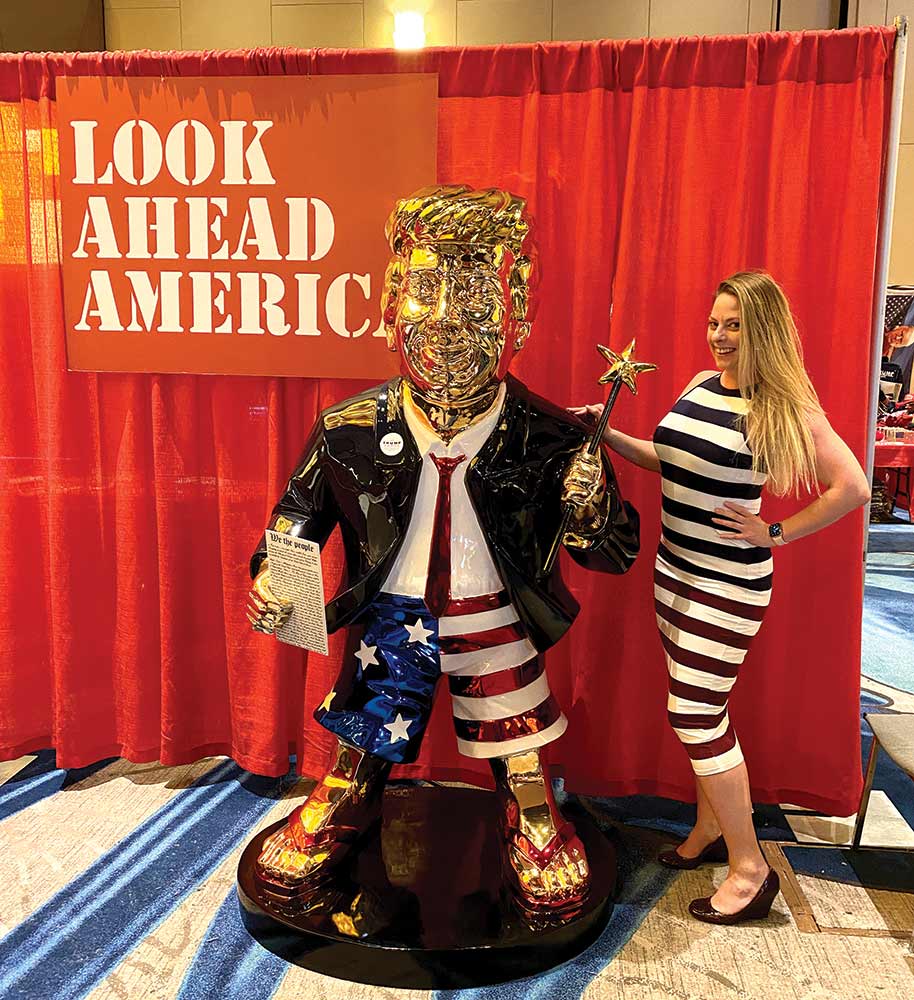
In July 2021, I met Alex Nelson for the first time at a cocktail reception during Turning Point USA’s Student Action Summit in Tampa. I was standing in line for a glass of wine when Nelson asked me what my vision for America was. To avoid encouraging people, I was always careful not to be more extreme than the people I met, so I deflected and asked what he wanted for the country.
“Uh… like a friendlier Nazi Germany,” Nelson responded.
Our conversation quickly turned to our disappointment in January 6. Nelson had been optimistic that hundreds of rioters around the country would stand their ground against the FBI. “None of them fought back. None of them Ruby Ridged themselves,” he noted.
“But they were all FBI and antifa, so it doesn’t matter,” I quipped sarcastically.
“Yeah, according to the conspiracy theories on the right,” Nelson said. “It’s like, no, they didn’t steal the election…. No, they weren’t antifa. Actually, guess what? Our people are upset.”
Nelson’s admission that Joe Biden had won the election took me by surprise. Whether they believed it or not, people like Trejo used the veneer of a stolen election to defend the January 6 insurrectionists. Nelson’s statement was far more direct: The Capitol rioters were “our people,” and January 6 was a riot of white rage.
Nelson said he’d tried to convince other members of the far right that Biden won the election, but the TPUSA attendees wouldn’t listen.
As we talked, the ballroom’s lights turned on, signaling that the staff wanted us to leave. Nelson told me there was aProject Veritas party across the street,and we headed over, debating whether New York City should be the capital of America. Once we were outside, people unaffiliated with TPUSA walked by, some of whom were not white. Nelson, undeterred, said loudly that we should kick out all the Jamaicans and Haitians who live in New York City.
“My mentality is the Anglo nation is one of the greatest nations to have ever walked the earth,” he said. “You know, we should not have to worry about like, ‘Oh my gosh, there’s a bunch of nasty Jamaicans and Haitians that are gonna rob me.’ Well, then beat them up, then beat the crap out of them, kick them out of the city, kick them out of the country, take their homes.”
I was relieved once we were inside, where it was unlikely anyone would get upset if they overheard him. Nelson’s glee in planning a genocide was disgusting. Nodding along with conspiracies was one thing, but condoning violence—even if it was just a fantasy—was a step too far. It turned out that Project Veritas had sprung for an open bar, and I took advantage of it. I had never been blackout drunk at an event before, but after listening to Nelson for hours, I granted myself an exception.
God, guns, and conspiracies: Amanda Moore attended the ReAwaken America Tour, a recruiting tool for the far right that helped unite Christian nationalists and conspiracy theorists. (Courtesy of Amanda Moore)]
It was just a month after we met that I found myself in Portland with Nelson, trying to get a glimpse of the Proud Boys riot at the K-Mart parking lot. We quickly realized it wasn’t possible to view the area from the street. Instead, we aimlessly drove around as Nelson told me about his plans to dress up in a three-piece suit and attend “quality indoor Republican” events while carrying brochures from the Oregon and Washington Young Republicans clubs to give himself legitimacy. “I’ll just be like, ‘Oh well, my darling, I’m a nationalist, of course,’” he said.
In his view, the “big tent” version of conservatism that the boomers loved was a failure. “If demographics are indeed destiny, then that means the right wing is only five to 10 years away from being a full-on racist, nationalist organization. Because, I mean, there’s no non-white people at right-wing events.”
We drove back to the K-Mart and parked so we could walk around for a bit. Even though we were dressed neutrally, Nelson was on high alert, worried that a counterprotester would see through our disguises. When I walked too close to a group that was chanting and marching, he pulled me back. Big, bad Alex—ready to “beat the crap out of” Jamaicans in New York City, but afraid to walk by a little protest in daylight.
We made our way to the waterfront, where someone had tagged “Kill Patriot Front” on a pillar. Patriot Front is a white nationalist, neofascist hate group that produces professional-quality videos that feature masked members stenciling their logo and website address in public spaces or participating in marches meant to intimidate people. Prompted by the graffiti, Nelson told me about joining the organization.
He had traveled to Idaho for an interview with aPatriot Front recruiter. As they chatted, they placed the organization’s stickers around town and took photos of them. The recruiter, whom Nelson described as a “stupid redneck,” asked anti-Semitic questions, but they were just subtle enough that he played down his answers.
“Do you think a Jew can ever really be an American?” the recruiter asked.
“Well, to an extent, people can assimilate into the dominant culture,” Nelson told me he’d responded.
The recruiter told Nelson to keep at conservatism and attend a few more Trump rallies; maybe then he could join, but for now, he didn’t meet their standards. “I was extremely hard-core,” Nelson told me, complaining that he hadn’t been considered anti-Semitic enough. He said he then clarified to the recruiter, “I was trying to be a little polite here…. The only true Americans are white Anglo-Saxon Protestants. If you have even one drop of non-European blood, you do not belong here.”
This answer was satisfactory, and Nelson was added to the Patriot Front group chat. He picked a nickname from a preapproved list and joined their weekly phone calls, which were largely about putting up stickers. But Nelson quickly soured on the group’s culture of paranoia. “They were truly terrified that there were federal agents around every corner,” he said. “A lot of it is kind of a cult. Because they’re like, ‘Oh, none of us can ever reveal our faces, except our leader.’”
Afew weeks after I returned from Portland, photos of me started to appear on Telegram—but photos of the real me, not the fascist me.“Amanda Moore is a 33 year old communist infiltrator in the DC area,” an account dedicated to “doxing Antifa” wrote.
Within days, Trejo had blocked me on all platforms. I had a small, anonymous Twitter account from which I shared updates while undercover, and I decided to unmask myself. “Hey everyone. My name is Amanda, andI have been undercover as a MAGA since the 2020 NovemberStop the Steal Rally in Washington, D.C.,” I tweeted, adding photos of myself with various far-right figures.
Today, Trejo continues to peddle propaganda through his work at Big League Politics, defending Kanye West’s anti-Semitic statements and trivializing the suffering of the Sandy Hook parents who sued Alex Jones for defamation. He helped form a PAC in Michigan whose aim is to move the Republican Party to the right and has appeared on Roger Stone’s radio show. He recently promoted his article about the gang rape of an American woman in Pakistan with the tagline “This woman received some multiculturalism, good and hard.”
In fall 2021, Nelson became the chairman of RNR’s Oregon committee. In 2022, he became the Washington Young Republicans’ national committeeman, until he was kicked out for his racist beliefs. He also briefly worked for Republican Joe Kent’s congressional campaign but was fired when he was overheard advocating for white nationalism. (Matt Braynard, Kent’s campaign spokesman, told me that the campaign told Nelson to “‘get the fuck out of here’—and you can quote me on that.”)
Nelson was also a member of the European American Community, a group that supports thinly veiled white nationalism. The EAC has hosted introductory get-togethers alongside several mainstream events, including CPAC Dallas. On the first day of CPAC, the EAC asked its Instagram followers what American citizenship should be based on. The answers it reposted included: “Ideally 90-95% European ethnicities and the rest being made up of Western aligned”; “European ancestry 100% for the blacks who are already here they should get their own section”; and “Colonial Ancestry and its related stock, because it was formed by and for british protestants.”
The EAC formed a British Nationalists offshoot group, which has held recruitment receptions across the country. In November, the group announced that it would be holding one in D.C. at the Waldorf Astoria, formerly the Trump Hotel. For the first time in a year, I dug out my old iPhone and charged my microphones. I arrived 20 minutes before the event was to start.
Nelson arrived right on time and sat alone at a table. No one showed up. Eventually, I walked over. He was too engrossed in his phone to look up until I dropped my purse on his table. “Am I too late?” I asked, sitting down across from him.
It was clear from his expression that Nelson had not expected to see me. I asked him if he wanted to comment on anything he’d told me while I was undercover.
More on the Emerging Right
Hungarian Rhapsody: The Right Dreams of an “American Orbánism”
JEET HEER
Why the Right Embraces Military-Veteran Vigilantes
SPENCER ACKERMAN
Why Does This Racist Keep Getting Silicon Valley Money?
JEET HEER]
After a long pause, Nelson said, “I’m not a partisan.” He tried to explain that he was an “intellectual”—not really part of the right or the left.
After I was doxed, a researcher sent me an archived recording of a live stream that Nelson hosted. He praised the January 6 rioters and downplayed the severity of the threat, making jokes about boomers taking selfies in the Capitol. Using a Tucker Carlson–style affectation, Nelson told viewers, “Let’s just say it was a coup. Let’s say that it actually was a violent mob of revolutionary insurrectionists…. I would much prefer to live under the government that would be established by these patriotic revolutionaries than I am to live under the current government we have.”
But in the lobby of the Waldorf, Nelson had a different recollection of his words. “The stream I did about J6 said all my opinions on it. That the people were deluded. That it was very sad.”
It was a far cry from his wish that the rioters would have “Ruby Ridged” themselves—but that was before he knew he was speaking to a journalist.
Amanda Moore is a writer and researcher who focuses on far-right extremism.
---
an 6 23 brandon
author and justice correspondent forThe Nation Elie Mystal tore into Republicans on Monday for doubling down on their servility to twice-indicted former President Donald Trump.
"The entire Republican party continues to debase itself in service of Donald Trump and in service of that white supremacist base that Kari Lake is talking to, right? Like as you point out, Amy, in a normal party, when one of your rivals is indicted on thirty-seven counts of espionage, the rest of the field is like, 'hmm, maybe you should elect me and not the guy who just got indicted,'" Mystal said to Democracy Now! host Amy Goodman.
Although Trump was not charged with "espionage," United States Department of Justice special counsel Jack Smith's complaint does allege that Trump perpetrated thirty-one violations of the Espionage Act.
"But in the modern Republican party, they're all theming, right?" Mystal continued. "They're all like, jonesing for the next hit off of Trump's white supremacist base. And so they can't risk saying mean things about Trump, even though he's just been indicted. They have to instead placate Trump even as they purport to be running against him."
Mystal also contemplated what potential impact the GOP's sycophancy could have on holding Trump accountable.
"It is pathetic on their part," Mystal added, "but the debasement of one of the two major political parties in the country is an ongoing problem because as you start to kind of work through the kind of practical realities now — not just of indicting Trump, but bringing him to trial and potentially convicting him — that becomes really hard to do if during the course of this process, he is crowned the Republican standard bearer for the 2024 presidential election."
---
ref by an 3 23
it was the latest stop on Florida Governor Ron DeSantis’s “where woke goes to die” tour. The focus was on higher education—specifically: diversity, equity, and inclusion (DEI) initiatives at Florida universities. The roundtable event featured speakers like Christopher Rufo, the lead architect of the GOP’s crusade against critical race theorywho is now helping to mastermind the ideological makeover of Florida’s New College. The gathering followed the by-now-standard script of education-themed right-wing grievance: DEI initiatives are a scam orchestrated by the “woke mob,” and Florida is not about to submit to them—not if the governor and his brain trust have anything to say about it.
The event would make headlines after an Axiosreporter called the official press release “propaganda” and was fired as a result. But the ensuing furor over journalistic standards sidestepped what’s ultimately at stake in DeSantis’s war on the alleged woke excesses of the education establishment—a drive to deliver colleges and universities back to the rule of white male elites, and thereby turn back the clock on 75 years of progress.And at the center of this crusade is a West Coast bastion of cultural conservatism—the Claremont Institute, which served as a key intellectual recruiting ground for Donald Trump’s rise to power but has now shifted its allegiance to DeSantis.
DeSantis’s agenda was neatly distilled in the title of a new report by Claremont fellow Scott Yenor, who teaches political science at Boise State University: “Florida Universities: From Woke to Professionalism.” The paper was released in conjunction with theDEIroundtable, and claimed to document the unhinged course of DEI initiatives in Florida’s public university system, while also detailing steps the state can take to rein them in. Among Yenor’s recommendations: defund and dismantle all DEI offices in Florida’s colleges and universities, make collecting data on the basis of race and sex illegal, and scuttle any DEI-infused disciplines—education and law are particular targets—in favor of “science.” And that’s just the start. “From Woke to Professionalism” seeks to provide a playbook for Florida to go to war against the “reigning national civil rights regime.”
:{:{This means more than simply targeting the DEI establishment. Yenor also urges state officials to remedy what he sees as a core problem in higher education: too many women.}: State officials, he argues, should conduct civil rights investigations into academic programs, including education and nursing, in which women vastly outnumber men, while also ditching any curriculum or programs deemed “anti-male.” :{Disparate impact theory, a favorite target of the cultural right for its emphasis on systemic discrimination, gets repurposed here to boost the real victims of diversity policies: white men. MIRROR INVERT}:
}:
The report’s pivot away from DEI-bashing to the systematic purge of female students is part of Yenor’s ambitious proposal to correct what he sees as the damage done by feminism. Last year, he gave a speech at the National Conservatism Conference in which he denounced colleges and universities as “the citadels of our gynocracy,” and derided career-oriented women as “medicated, meddlesome and quarrelsome.” Traditionally male-dominated fields such as engineering, law, and medicine should stop trying to recruit women, he argued. The culture should return to urging women to pursue “feminine goals”—chief among them, staying home and having children in the interest of restoring strong families, and through them, a strong nation. Yenor’s bid to dragoon the nation’s women back into the separate sphere of domesticity and child-rearing is but one key directive he’s undertaken as head of Claremont’s Center for the American Way of Life. Together with Rufo—another Claremont scholar—Yenor has been dispatched to the Sunshine State front lines in what Claremont director Ryan Williams calls the “fight against woke leftism.” He will serve as Claremont’s new senior director of state coalitions, based in the state capital of Tallahassee.
Claremont’s leaders have marshaled so much early support behind DeSantis because they see him as a staunch ally in thwarting the alleged march of “wokeism” through virtually every American institution: the media, corporations, and education, from pre-K through college. They view DeSantis’s legislative assault on diversity and inclusion—including stripping the Walt Disney Company of some state tax breaks, reversing diversity policies, and sharply curtailing discussions of race and gender in Florida schools—as a model for right-wing activism across the country. Claremont and DeSantis both are holding forth Florida as a red-state template—a militant Republican state government providing a “blueprint” for rolling back civil rights across the country.
this tight ideological alliance explains why DeSantis’s brain trust is stocked with Claremonsters, as the think tank’s staff and fellows refer to themselves, who now play an outsized role in shaping policy. Rufo, for example, advised DeSantis on his Stop WOKE Act, which prohibits schools, colleges and businesses from teaching students and employees anything that would cause anyone to “feel guilt, anguish or any form of psychological distress” due to their race, color, sex or national origin. And when DeSantis orchestrated a takeover of New College, he tapped Rufo to lead the effort to remake the school as a “Hillsdale of the south,” referencing the fundamentalist Michigan college long positioned on the vanguard of right-wing culture warfare.
Even DeSantis’s new speechwriter has Claremont ties. Nate Hochman, a rising star in the intellectual right’s amorphous coalition of culture warriors, self-proclaimed economic populists, and unabashed America firsters, is both a former Claremont intern and a fellow. Hochman, who proclaimed earlier this year that he hopes that the “Republican party agenda is going to cohere around the culture war as its organizing, totalizing force,” now will be able to bring that mandate into the forefront of DeSantis’s campaign messaging.
Meanwhile, behind the scenes, Claremonsters will continue chipping away at what they see as Florida’s misguided dalliances with the woke. In his road map for higher education in Florida, Yenor holds up as his model the University of California, Berkeley–in the 1950s, before the Free Speech movement and the hippies wrecked everything. The University of Florida, he writes, should be a beacon of academic freedom and meritocracy for the country, just as UC Berkeley was back then. Of course, UC Berkeley was also an elite, and almost entirely white, institution in the 1950s. Some 90 percent of entering freshmen in the 1960s were white, and most hailed from families that were substantially wealthier than the typical Californian. And just one-quarter of students were women. For them, the school offered a 10-week course on marriage, jokingly known to students as “From Courtship to Venereal Disease in Ten Easy Lessons.”
Elsewhere, Yenor has argued more explicitly that returning college to the elites should be the goal. Only 8 percent of Americans attended college as late as 1960, he pointed out in a recent op-ed for the Christian advocacy organization American Reformer. “The United States should move toward 8% from its current 46%.”
“Too many of the wrong sorts of people go to college” is not exactly the stuff of campaign bumper stickers. DeSantis knows this firsthand, thanks to his ill-considered effort to escalate Florida’s assault on AP African American Studies into a full-scale attack on “Advanced Placement, Inc.” No doubt DeSantis and his corps of culture warriors calculated that the entire Advanced Placement program was a ripe target in the rolling war on wokeness, but the move was a political disaster. Parents in Florida regard AP classes not as a manufactory of left-wing ideological conformity but as a crucial path to getting their kids admitted to select colleges—and saving money when they get there. And they’re not wrong—so the politically savvy DeSantis has since moved on to other targets.
nor does Yenor’s wide-ranging campaign against the “gynocracy” seem likely to resonate with the suburban women to whom the GOP tries intermittently to appeal. As Daily Beast columnist Michael Daly pointed out, DeSantis’s wife, Casey, who tweeted enthusiastically about Yenor’s Tallahassee appointment, holds a BA in economics—one of the disciplines Yenor regards as subject to gynocratic infiltration. And her mother is a speech pathologist—another of the female-dominated fields that he wants dismantled.
There are also growing signs that DeSantis’s war on wokeness is losing its luster among Florida voters. A recent poll found that his marquee bill aimed at rooting out diversity efforts in the state’s higher education system is particularly unpopular. Sixty-five percent of voters, including 38 percent of Republicans, oppose it. And as his signature issue—limiting what students can learn and teachers can teach in Florida’s public schools in the name of parent rights—becomes synonymous with book banning, his popularity is likely to dim further.
Of course, the GOP supermajority in the Florida state legislature will continue to rubber-stamp increasingly outlandish bills on gender and diversity, regardless of whether the public supports them. Indeed, the pliant legislative body is a big reason Claremont is so bullish on Florida spearheading the nation’s return to the pre–civil rights era.
When DeSantis officially launches his candidacy, he’ll point to a long list of right-wing policy accomplishments. But using the levers of power to ram through an unpopular agenda is not the same thing as winning over hearts and minds. As he sells a retrograde vision of America with the help of a militant right-wing intellectual cadre, DeSantis is likely to learn that lesson the hard way.
Jennifer C. BerkshireJennifer C. Berkshire hosts the education podcast Have You Heard. She is the author, with Jack Schneider, of A Wolf at the Schoolhouse Door.
---
https://kpfa.org/episode/upfront-march-11-2022/
3/11 covid crims, ---- profiteers bk nichols
trump was going to do mask mandate but MM stopped b/c it was off freedom brand
---
---
broke law firms w/ bad code
r too long, law firms have been given carte blanche for their contributions to the climate crisis: They lobby on behalf of the fossil fuel industry, file the paperwork necessary for carbon-emitting projects, and litigate cases against indigenous and frontline communities. With over 1,500 lawyers in offices around the world, Gibson, Dunn, & Crutcher LLP is regarded as one of the top law firms in the United States. Like many of its peers, Gibson Dunn profits from squashing class action lawsuits and labor organizing drives, keeping shareholders from reforming corporate practices and debtors from getting their day in court, and shielding US companies from accountability for their actions overseas and from regulation at home. Even by the standards of the legal industry, however, Gibson Dunn’s behavior is notorious. In 2007, the Montana Supreme Court rebuked the firm for engaging in “actual malice” and “legal thuggery,” and a Delaware judge recently described its pretrial practices as constituting “fraud.”
But Gibson Dunn’s behavior goes even further. It spent more than a decade defending Chevron in a lawsuit brought by indigenous communities whose homeland was poisoned by an oil spill in Ecuador. When Ecuadorian courts awarded those indigenous communities a $9.5 billion judgment, Gibson Dunn was involved in overturning that ruling in a corporate-friendly US court, leading to the prosecution of Steven Donziger, a human rights attorney who represented the Ecuadorian plaintiffs. Gibson Dunn’s involvement in the Chevron case is a chilling example of the lengths the firm is willing to go to represent the fossil fuel industry and silence anyone in the way.
And Gibson Dunn’s record on climate change is unapologetically awful. Law Students for Climate Accountability (LSCA), an organization that scores law firms based on their environmental activities, gave the firm an F this year, the lowest score possible. In addition to its involvement in dozens of climate change cases, Gibson Dunn has lobbied for Koch Industries and represented the corporation behind the Dakota Access Pipeline, a project that would violate indigenous rights. (In another affront to native sovereignty, Gibson Dunn has also represented those seeking to overturn the Indian Child Welfare Act). Over the last decade, the firm has brought in nearly $27 billion in fossil fuel and energy revenue, with no sign of slowing down even as the need to halt and reverse carbon emissions becomes all the more urgent.
In April 2021, dozens of law student organizations signed a letter from LSCA calling on Gibson Dunn to change its contracting standards. Following Gibson Dunn’s refusal to engage with this petition, in December 2021, LSCA announced a boycott so that individual students too can announce that they are #DoneWithDunn. Meanwhile, Gibson Dunn strives to maintain a liberal, even progressive image: One of the firm’s star litigators is vocally anti-Trump, even as he heartily defends oil and gas companies. Indebted law students are enticed by high pay, diversity initiatives and pro bono opportunities, but may not be aware that their first work assignments may include overturning Covid eviction moratoriums or defeating suits for toxic exposure. In increasing numbers, however, young workers are demanding that their would-be employers disentangle from work furthering environmental and social catastrophe.
When it comes to the climate crisis, business as usual won’t cut it, and nowhere is that more true than in the legal profession. Gibson Dunn is but one of many law firms with a terrible track record on climate, yet this boycott from LSCA is a crucial step in forcing Big Law to take responsibility for how it normalizes, entrenches, and exacerbates Big Carbon work that imperils our planet and its people. By doing so, we join a movement already changing norms at ad agencies, financial institutions, and tech companies, all of which are the sites for organizing to end profiteering from carbon extraction.
Reshaping the economic and social incentives for individual workers, their companies, and indeed entire industries is no small order. But this is exactly what is asked of our generation. Law firms are not leading the way on a just transition toward renewable energy; the only way they will is if we hold their feet to the very fires they are fanning.
Leehi YonaLeehi Yona is a PhD student in environment and resources and a Knight-Hennessy Scholar at Stanford University. Her research is on climate change science, policy, and justice.
David CreminsDavid Cremins is a JD candidate at Stanford Law School.
---
https://www.alternet.org/2020/10/fbi-memo-warns-of-far-right-violence-to-come-during-post-election-flashpoint/
one day after President Donald Trump urged his supporters to engage in voter intimidationduring the general election and called on the violent white supremacist group Proud Boys to "stand by" rather than "stand down," The Nation reported that the FBI is preparing for a "violent extremist threat" posed by a far-right, anti-government militia whose members have advocated for a "race war."
Identifying the loosely-organized group known as the "Boogaloos" as the specific threat, the FBI's Dallas field office prepared anintelligence report on Tuesday—the day of the first presidential debate—titling the document, "Boogaloo Adherents Likely Increasing Anti-Government Violent Rhetoric and Activities, Increasing Domestic Violent Extremist Threat in the FBI Dallas Area of Responsibility."
Known for wearing Hawaiian shirts and military fatigues and carrying weapons to rallies, "Boogaloos" reportedly intend to bring about a second American Civil War, which some adherents believewill be a "race war." In one high-profile case against a Boogaloo proponent, Steven Carrillo was accused this year of killing two law enforcement officers with the aim of "provoking retaliation from the police against the demonstrators" at a Black Lives Matter rally.
The Boogaloo movement has also had a strong presence at protests against Covid-19 restrictions, where many adherents were armed.
With Trump repeatedly stoking the perception among his supporters that—despite the fact that he trailsDemocratic candidate Joe Biden in several swing state polls—the only legitimate election will be one that he wins and that mail-in ballots will result in a rigged election, the FBI believes Election Day could be a "potential flashpoint" in an escalation of the Boogaloos' violent activities over the next three months, leading up to Inauguration Day in January 2021.
"Boogaloo adherents likely will expand influence within the FBI Dallas AOR [Area of Responsibility] due to the presence of existing anti-government or anti-authority violent extremists, the sentiment of perceived government overreach,heightened tensions due to Covid-19-related state and local restrictions, and violence or criminal activity at lawful protests as a result of the death of an African American USPER [US person] in Minneapolis, factors that led to violence at otherwise peaceful and lawful protests in the FBI Dallas AOR," thereportreads.
"Indicators that this assessment is correct include increased violent social media posts of boogaloo adherents and increased 'patrolling' or attendance at events that are anti-law enforcement, anti-government, or anti-authority," the Dallas field office continues.
On social media, journalist Medhi Hasan called the report "a huge story." Nation reporter Ken Klippenstein, who wrote about the FBI's warning for the outlet, urged federal law enforcement agents to share more information about their concerns regarding the election and potential violence by white supremacist groups.
If you're federal law enforcement, please text me at 202-510-1268 (use Signal). I know you guys are a lot more wo… https://t.co/UH4KwCa79I
— Ken Klippenstein (@Ken Klippenstein)1601512167.0
AsCommon Dreamsreported Wednesday, members of the Proud Boys celebrated the president's refusal to denounce white supremacy at the debate.
The group's reaction was "a perfect example of how Trump's voter fraud disinformation and emboldened white supremacists and other violent extremists are a recipe for disaster this fall," tweetedAmy Spitalnick of the anti-racist group Integrity First for America.
---
---
https://www.thenation.com/article/archive/citizens-united-and-corporate-court/
raskin 9/12
no lnx
“And may the odds be ever in your favor.”
—Effie Trinket, announcer for the corporate state in The Hunger Games
We live in what will surely come to be called the Citizens United era, a period in which a runaway corporatist ideology has overtaken Supreme Court jurisprudence. No longer content just to pick a president, as five conservative Republicans on the Rehnquist Court did in 2000, five conservative Republicans on the Roberts Court a decade later voted to tilt the nation’s entire political process toward the views of moneyed corporate power.
In Citizens United (2010), the Court held that private corporations, which are nowhere mentioned in the Constitution and are not political membership organizations, enjoy the same political free speech rights as people under the First Amendment and may draw on the wealth of their treasuries to spend unlimited sums promoting or disparaging candidates for public office. The billions of dollars thus turned loose for campaign purposes at the direction of corporate managers not only can be but—under the terms of corporate law—must be spent to increase profits.If businesses choose to exercise their newly minted political “money speech” rights, they must work to install officials who will act as corporate tools.
The Court, transformed by the addition of Chief Justice Roberts and Samuel Alito, who were nominated by that lucky winner in Bush v. Gore, took this giant step to the right of all prior Courts without even being asked to do so. The petitioner, Citizens United, sought only a ruling that the electioneering provisions of the Bipartisan Campaign Reform Act (better known as McCain-Feingold) didn’t apply to its on-demand movie about Hillary Clinton. But the conservatives sent the parties back to brief and argue the paradigm-shifting constitutional question they were so keen to decide. As dissenting Justice John Paul Stevens observed, the justices in the majority “changed the case to give themselves an opportunity to change the law.”
Before Citizens United came down, corporations were already spending billions of dollars lobbying, running “issue ads,” launching political action committees and soliciting PAC contributions. Moreover, CEOs, top executives and board directors—the people whose income and wealth have soared over the past several decades in relation to the rest of America—have always contributed robustly to candidates. But there was one crucial thing that CEOs could not do before Citizens United: reach into their corporate treasuries to bankroll campaigns promoting or opposing the election of candidates for Congress or president. This prohibition essentially established a wall of separation—not especially thick or tall, but a wall nonetheless—between corporate treasury wealth and campaigns for federal office.
The Roberts Court’s 5-4 decision to demolish most of this wall also bulldozed the foundational understanding of the corporation that had governed American law for two centuries. The Court had always regarded the corporation not as a citizen with constitutional rights but as an “artificial entity” chartered by the states and endowed with extraordinary privileges in order to serve society’s economic purposes. The great conservative Chief Justice John Marshall wrote in Dartmouth College v. Woodward (1819), “A corporation ?is an artificial being, invisible, intangible, and existing only in contemplation of law. Being the mere creature of law, it possesses only those ?properties which the charter of creation confers upon it, either expressly, or as incidental to its very existence.”
This “artificial entity” understanding of corporate law prevailed until Big Tobacco lawyer and corporate-state visionary Lewis Powell, of Richmond, Virginia, joined the Court. In First National Bank of Boston v.Bellotti (1978), the key forerunner to Citizens United, Powell assembled a bare majority to give corporations and banks the right to spend without limit to influence public opinion in ballot issue campaigns. The decision, which approved the desire of banks in Massachusetts to campaign against progressive tax measures, unveiled the key doctrinal move of what would later become the Citizens United era: “If the speakers here were not corporations, no one would suggest that the State could silence their proposed speech,” Justice Powell wrote. “The inherent worth of the speech in terms of its capacity for informing the public does not depend upon the identity of its source.”
The Bellotti decision cracked open the door of campaign finance law, and the Citizens United majority blew that door off its hinges. The Court announced that, when it comes to campaign spending rights, the “identity of the speaker” is irrelevant and an impermissible basis upon which to repress the flow of money speech. What matters is the “speech” itself, never the speaker—a doctrine that would have come in handy for the public employees, public school students, whistleblowers, prisoners and minor-party candidates whose free-speech rights have been crushed by the conservative Court because of their identity as (disfavored) speakers.
Taken seriously, the Citizens United doctrine has astonishing implications for campaign finance.If it’s true that the “identity of the speaker” is irrelevant, the City of New York—a municipal corporation, after all—should have a right to spend money telling residents for whom to vote in mayoral races. Maryland could spend tax dollars urging citizens to vote for marriage equality in November, and President Obama could order the Government Printing Office to produce a book advocating his re-election. Surely the Supreme Court would never ban a book containing campaign speech!
Further, under the new doctrine, churches—?religious corporations—would have a First Amendment right not only to promote candidates from the pulpit but to spend freely on television ads advocating their election or trashing their opponents. The claim that churches surrender their right to engage in electioneering when they accept 501(c)(3) status is obsolete after Citizens United, which rejected the view that groups can be divested of their right to participate in politics when they receive incorporated status and special legal and financial privileges. If the identity of the speaker is truly irrelevant, there should be nothing to stop the Church of Latter-Day Saints or Harvard University from bankrolling political campaigns.
In the real world, the claim that the identity of the speaker is irrelevant cannot be taken seriously, and it is already being disregarded by the justices who signed on to it. The Court has so far declined to strike down the ban on foreign spending in American politics and the century-old ban on direct corporate contributions to candidates, laws that the new doctrine logically should invalidate. A total wipeout of campaign finance law appears to be just a step too far—at least right now—for a Court already facing plummeting public legitimacy.
But even if this incoherent doctrine goes no further, the surging stream of corporate and billionaire spending has already made a sweet difference for the Republican Party, which despairs of the nation’s demographic and cultural changes and depends on a mix of right-wing propaganda and voter suppression to confuse and shrink the electorate. Indeed, the potency of Citizens United became clear in the same year the decision was released.
The 2010 election should have been framed by three recent corporate catastrophes: the BP oil spill in the Gulf of Mexico, which inflicted billions of dollars in damage; Massey Energy’s collapsing coal mines in West Virginia, which cost twenty-nine people their lives and were enabled by the corporation’s aggressive lobbying and corruption of government; and the subprime mortgage meltdown brought on by the misconduct and power plays of AIG and Wall Street, which cost the American people trillions of dollars in lost homes and home values, ravaged pension and retirement funds, and destroyed stock equity.
But the infusion into the campaign of hundreds of millions of dollars from corporate and personal sources through secretive 501(c)(4) advocacy groups, 501(c)(6) trade associations and eighty-three new Super PACs completely changed the subject. The theme of the propaganda-soaked campaign became, remarkably, the urgent importance of deregulating corporations. The Republicans and the Koch brothers–funded Tea Party captured control of the House, bringing near paralysis to the government.
Citizens United did not accomplish this feat alone; it had a junior partner in SpeechNow.org v. FEC. This decision came from the US Court of Appeals for the DC Circuit, which struck down limits on what individuals can give to independent expenditure campaigns, a ruling that turbo-charged the Super PACs. While Citizens United freed the corporations, SpeechNow.org emancipated billionaires like Sheldon Adelson, the casino king who bets large on right-wing causes. Adelson’s millions kept the floundering Newt Gingrich afloat for the Dixie primaries. After Gingrich’s campaign went craps, Adelson sent $10 million to a pro-Romney Super PAC and vowed to spend as much as ?$100 million to defeat Obama as president.
Today there are 844 Super PACs and countless 501(c) vehicles; experts say billions of dollars, much of it untraceable, will flood the 2012 election. We will never know for sure whose money is paying for the show, because the front groups easily conceal their donors, including foreign corporations. Moreover, right-wing lawyers are now challenging campaign finance disclosure requirements as unconstitutional compelled speech, like making Jehovah’s Witness schoolchildren pledge allegiance to the flag. They argue that corporations should be free to keep their political spending secret because they may face intimidation and even—God forbid—boycotts from consumers who dislike their politics. In other words, corporations have a right to speak because they are like people, but they should be completely insulated from the speech reactions of natural people. This is some “marketplace of ideas” the champions of corporate power have in mind for us.
Support for a constitutional amendment to reverse Citizens United is growing because, as Justice Stevens objected, ?”A democracy cannot function effectively when its constituent members believe laws are being bought and sold.” An amendment to allow for reasonable regulation of campaign expenditures and contributions would empower Congress to return corporations to the economic sphere. It would also solidify the public’s interest in campaign disclosure and, as Harvard professor Laurence Tribe has observed, the much-eroded interest in building a public financing system that makes participating candidates at least minimally competitive with privately financed candidates. This is an interest that the Roberts Court has trashed, in cases like Davis v. FEC (2008) and Arizona Free Enterprise Club’s Freedom Club PAC v. Bennett (2011).
In these decisions, the Court, in essence, ruled that privately financed candidates backed by wealthy interests not only have a right to spend to the heavens to win office but also a right, in states with public financing laws, to lock in their massive financial advantage over publicly financed candidates, whose campaign speech may not be even modestly amplified by public funding when they get outspent. Here, as distorted beyond recognition by the Roberts Court, the First Amendment becomes not the guardian of democratic discussion but the guarantee of unequal protection for well-born and wealth-backed politicians. Today, corporations can saturate the airwaves and billionaires can spend to their hearts’ content, but government cannot create even a modest megaphone to help poorer candidates be heard.
A constitutional amendment to correct these distortions may seem impossible now, but all amendments seem impossible until they become inevitable. Most amendments since the Bill of Rights have expanded democracy or, like the Twenty-Fourth Amendment banning poll taxes, removed obstacles to democracy authorized by the Supreme Court. President Obama’s recent statement of support for mobilizing a campaign to amend the Constitution suggests a coming surge of political engagement on the issue. FIND THIS]
Defenders of our new plutocracy point out that there are many thousands of corporations in America, most of them small, but this bit of faux small-business populism is an irrelevant distraction from how the corporate “wealth primary” works in the real world.Major industries that have an “extractive” character and a parasitic relationship with government—Wall Street, Big Oil, Big Pharma, the military-industrial complex—have cultivated a pervasive financial dependency on elected officials that permits them to continue the exploitative symbiosis that economists call “rent-seeking.” Avoiding the hazardous risks of innovation, investment and competition, many conglomerates prefer playing power politics in Washington. They don’t increase the pie; they just grab ever larger slices of it.
These arrangements operate on a simple return-on-investment basis: corporations devote millions to electing and lobbying politicians and then collect hundreds of millions in tax breaks, corporate welfare, sweetheart contracts, bailouts, deregulation and inside deals. This squalid form of “public policy,” which even Republicans call “crony capitalism” (in the primaries anyway), works splendidly for those involved but dismally for everyone else, including businesses that lack the finance capital to invest in the political system.A plutocratic state denies us both political justice and a fair economy.
When a bristling Justice Antonin Scalia went on CNN in July and defended Citizens United, which is considered a recipe for corruption by nearly 70 percent of Americans, he enlisted everyone’s favorite founder. “I think Thomas Jefferson would have said, ‘The more speech, the better,’” Scalia opined.
One must charitably assume Scalia’s utter ignorance of Jefferson’s political philosophy and how much the Sage of Monticello feared the rise of a “single and splendid government of an aristocracy, founded on banking institutions, and moneyed incorporations,” which he foresaw “riding and ruling over the plundered ploughmen and beggared yeomanry.” The Citizens United era bears a disturbing resemblance to Jefferson’s nightmare vision of what might happen if corporate power swallowed the government. But Justice Scalia and the other juriscorporatists managing our scales of justice know just what good wishes to offer the “plundered ploughmen and beggared yeomanry” of our day, and the rest of the people we call the 99 percent: “May the odds be ever in your favor.”
ALSO IN THIS FORUM
Bill Moyers and Bernard A. Weisberger: “The 1 Percent Court”
William Yeomans: “How the Right Packed the Court”
Dahlia Lithwick: “One Nation by and for the Corporations”
Michael Greenberger: “The Roberts Court and Wall Street”
Craig Becker and Judith Scott: “Isolating America’s Workers”
Herman Schwartz: “Rewriting Antitrust Law”
Sherrilyn Ifill: “A Court Out of Touch”
Nan Aron: “The Way Forward”
Jamie Raskin, a professor of constitutional law at American University, is a member of the Maryland State Senate, where he serves as majority whip. He recently led the successful floor fight in the Senate to repeal the death penalty in his state.
---
JUNE 30, 2020
John Roberts Is Not Your Friend
Despite his recent rulings on abortion, DACA, and LGBTQ rights, Roberts is no moderate. He’s a rock-ribbed Republican playing the long game.
ELIE MYSTAL
---
MARCH 17, 2020
The Long Roots of Corporate Irresponsibility
Nicholas Lemann’s history of 20th century corporations, Transaction Man, shows how an unrelenting faith in the market and profit doomed the American economy.
RICK PERLSTEIN
---
NOVEMBER 27, 2019
Meet the Men Fueling the Climate Crisis
Until there are courts willing to hold the titans of the climate crisis accountable, it’s up to people to begin calling them out by name.
BEN EHRENREICH
---
JANUARY 21, 2020
Is Anti-Monopolism Enough?
In Goliath, Matt Stoller argues that US history has been defined by a struggle between monopoly and democracy, but to understand inequality today requires engaging with questions of class and labor that he and other anti-monopolists tend to ignore.
GABRIEL WINANT
---
- What if reporters covered the climate crisis like Edward R. Murrow covered the start of World War II?" That was the question from Bill Moyers as Columbia Journalism Review and The Nation launched a new program to increase coverage of climate change.
- The Trump administration moved to silence the head of the CDC's climate and health program -- but he is fighting back.
- Sen. Sheldon Whitehouse took to the Senate floor and called for better media coverage of the climate crisis: "I have noticed this trend so I’ve begun keeping an eye on the Sunday shows’ coverage this year. Each month I look at how many substantive segments on climate change each show runs. It’s not good. In April, for instance, there were only two substantive segments on climate change across all five shows. They have basically become Sunday morning political gossip columns."
==
no lnx
https://www.thenation.com/article/archive/ecuadors-battle-environmental-justice-against-chevron/
The Nation
ENVIRONMENTAL ACTIVISMFOSSIL FUELSFEATUREJUNE 22-29, 2015 ISSUE
Ecuador’s Battle for Environmental Justice Against Chevron
For more than two decades, impoverished indigenous people have been seeking restitution from the oil giant for polluting their region.
By James North JUNE 2,2015
Quito—Rafael Correa, Ecuador’s popular president, does not mince words when he talks about the Chevron Corporation. In an interview with The Nation here recently, Correa accused the oil giant—the third-largest company in the United States, as measured by gross revenue—of “deliberately polluting” the Amazon rain forest in eastern Ecuador, of “shamelessly lying” to evade its legal responsibility to clean up, and of waging a ferocious international campaign “to destroy the reputation of our justice system and government.” In a wide-ranging, hourlong interview in the centuries-old presidential palace, Correa was intense and passionate as he spoke about how Texaco—which was taken over by Chevron in 2001—had dumped toxic waste into nearly 1,000 pits and spilled billions of gallons of oil-exposed water into a 1,700-square-mile area between 1972 and 1992. Correa said that Texaco could have chosen not to pollute. “Back then, better techniques [of waste disposal] already existed,” he said. “The techniques they used here were against the law in their own country. They weren’t interested in the human beings who lived in the Amazon region. To me, it is a question of racism.”
For more on Rafael Correa, see James North at TheNation.com.
Correa’s outspoken comments are just one of the latest developments in a massive international legal case that has pitted 30,000 poor Ecuadorans who live in the rain forest against a corporation that reported $19.2 billion in profits last year—more than half of Ecuador’s entire government budget. The battle has already lasted 22 years, spanned several countries on three continents, and shows no signs of ending anytime soon.
The American public is largely uninformed about this epic struggle, even though it’s as important as the dispute over the Keystone XL oil pipeline. The mainstream US media, when it hasn’t ignored the case, has often taken Chevron’s side, implicitly (and sometimes explicitly) endorsing the company’s view that an alliance of Ecuadoran extortionists and crooked US lawyers is using the corrupt Ecuadoran court system to shake down an innocent corporation.
On closer inspection, the truth is totally different. If the plaintiffs finally win in the end, the rain-forest inhabitants will not just have their habitat start to be cleansed of the oil muck that oozes into their water supply, or enjoy improved health facilities to treat what they argue are elevated levels of cancer and other diseases. They will also have proved the success of an innovative legal strategy that recruits financial help in the rich developed world to provide at least a fighting chance against a corporate colossus like Chevron, which has already spent, by some estimates, $2 billion in its massive legal and propaganda campaign. But if Chevron prevails, it will be one more depressing proof that multinational corporations can defy national and international law and pollute with impunity.
Here, as briefly as possible, is what has happened so far:Texaco left Ecuador in 1992, having disposed of its wastes by methods that in some cases would have been illegal, and in others unethical, in the United States. The company dumped a combination of drilling muds, “formation water,” and actual crude oil into unlined waste pits—a procedure that Texas outlawed back in 1969. It released billions of gallons of oil-laced “produced” waters straight into the streams and lakes, even though standard procedure in the United States was to “reinject” the potentially toxic compounds safely deep underground. In 1995, Texaco agreed to “remediate” part of the mess, which it later said cost $40 million. In 1998, Ecuador’s government certified that the purported cleanup had been successfully completed, thus relinquishing its right to bring further legal action.
But popular movements in the rain forest that had already started organizing against Texaco’s pollution were outraged, charging that their government had sold them out. They brought their own lawsuit against Texaco in a New York federal court in 1993. Eventually, the plaintiffs would represent some 30,000 people, known as the afectados (affected ones) in Spanish.
In 2001, Chevron took over Texaco.The oil giant’s lawyers were already fighting to dismiss the case in the United States and move it to Ecuador. That same year, federal judge Jed Rakoff finally agreed, ruling that the case “had everything to do with Ecuador and nothing to do with the United States.” So, in 2003, the legal battle reopened in the eastern oil-frontier town of Lago Agrio. The Ecuadorans would soon be led by Pablo Fajardo, a young lawyer who had grown up in the region and lived through the contamination firsthand.
In 2007, Chevron, probably sensing that the case was going against it, sold all of its assets in Ecuador—which now meant that even if the plaintiffs won a judgment, they would struggle to collect; they would be forced to bring lengthy and costly legal action in other countries where the company still had operations. Finally, in 2011, the local court found in favor of the rain-forest residents. The original judgment was for $19 billion. Chevron appealed to higher courts, and the case ended up in Ecuador’s National Court of Justice, which in 2013 reduced the judgment to $9.5 billion. The amount may sound large, until you consider that another major oil corporation, BP, has already spent $27 billion to clean up its 2010 Deepwater Horizon spill in the Gulf of Mexico, and could face an additional US fine of nearly $14 billion.
By then, Chevron’s intransigence was drawing some unwanted attention in the financial world. A respected oil analyst, Fadel Gheit of Oppenheimer & Co., said in 2013 that the litigation was damaging the corporation’s stock price and encouraged it to settle. New York State Comptroller Thomas DiNapoli, who is responsible for some $540 million of Chevron stock in a state pension fund, had also pointedly suggested in 2011 that Chevron come to an agreement.
Instead, Chevron launched a publicity counterattack. The oil giant’s home page includes a prominent banner linking to its views on the case.It ran large ads in print, on television, and online—not to encourage readers to buy its products, but to boast in general terms about its purported social and environmental conscience.
Other tactics in Chevron’s onslaught were vicious, and historically unprecedented in their scope and intensity. In 2011, the corporation came back to a federal district courtroom in New York, this time before Judge Lewis Kaplan, and counter-charged a group of Ecuador’s lawyers and plaintiffs under the notorious RICO Actwith “racketeering” and “fraud.” The corporation’s main target was Steven Donziger, an American attorney who had been part of the Ecuadoran legal team almost from the start.
Here is where the Chevron/Ecuador legal saga becomes truly bizarre. After a three-year trial without a jury, a US judge, in a US courtroom, somehow found the predominantly Ecuadoran defendants guilty of fraud in the Ecuadoran courts, and then issued a legal injunction that would almost certainly prevent them from collecting on the judgment they’d won in Ecuador anywhere else in the world. Judge Kaplan did concede that “there is pollution” in Ecuador’s rain forest, and that “On that assumption, Texaco and perhaps even Chevron—although it never drilled for oil in Ecuador—might bear some responsibility.” But he insisted that his chief concern was the fraud that he decided had taken place in an Ecuadoran courtroom more than 3,000 miles away.
It’s little wonder that legal scholars have been scratching their heads over Kaplan’s verdict. The US Court of Appeals for the Second Circuit, which had already reversed one of Kaplan’s earlier rulings in the Ecuador case, heard arguments from Donziger and his codefendants on April 20 of this year. Meanwhile, the Ecuadoran legal team remains undeterred: The plaintiffs are already taking action to collect their judgment in other countries. Canada, where Chevron has an estimated $15 billion in assets, is their first target, and a leading Canadian trial attorney is already fighting their case there.
Chevron’s ferocious counteroffensive didn’t stop in Judge Kaplan’s courtroom. Even though Ecuador’s government is not a party to the lawsuit, President Correa denounced, in our interview, what he called Chevron’s “multimillion-dollar publicity campaign” against his country and its judicial system. He also criticized Chevron for bringing a case against his government at the Permanent Court of International Arbitration in The Hague,where the corporation alleged that its rights under the Bilateral Investment Treaty between the United States and Ecuador had been violated. Chevron’s demands are brazen: It’s asking the Hague tribunal to either order the government of Ecuador to quash the lawsuit brought on behalf of the 30,000 rain-forest residents, or to financially compensate the company for any verdict against it.
Correa has visited the polluted Amazon region several times and criticized what he’s witnessed there. Chevron’s supporters contend that his comments reveal bias—and imply an interference in the judicial process. Correa was indignant at this assertion. “It is a monstrous lie,” he said. “Of course I spoke out about our citizens in the affected zone; they have all our sympathy. But it is an independent judicial system. When President Obama said that BP had to take responsibility for the oil spill in the Gulf of Mexico, that did not mean he was interfering in court cases.” Correa concluded, with feeling: “If they can show that the president interfered in this case, I will resign the same day.”
Chevron doesn’t deny that there is substantial pollution in eastern Ecuador. But it blames Petroecuador, the state-owned oil company, which took over some operations after Texaco left in 1992. President Correa counters Chevron’s assertion by arguing that some of the most polluted waste pits are right alongside wells that have not pumped any oil since Texaco departed. “Just ask the people in the community: Who contaminated? I invite the readers of your magazine—the entire world—to come to Ecuador and put your hands in those waste pits. Your hands will come out black with oil.”
* * *
I had, in fact, already visited the polluted rainforest zone three years earlier. My guide back then was Donald Moncayo, a serious, even somber man, now in his 40s, who belongs to the Amazon Defense Coalition, a popular organization that represents the 30,000 rain-forest afectados. Over the years, he had led several hundred of what he calls “toxi-tours,” but he hasn’t gotten tired, or lost his indignation at Texaco for poisoning his home area. He seemed to know many of the waste pits by name; he said there were 953.
Our two-day tour started in Lago Agrio, the raw, ramshackle oil town 120 miles east of Quito that Texaco founded after it struck oil in the 1960s. Lago Agrio is a shabby place, with no sign that the oil boom had much local benefit. The courtroom in which Chevron first lost the historic decision is on the third floor of an unprepossessing building trimmed in yellow paint.
Here are the tools of Moncayo’s trade as a toxi-tour guide: a machete to cut through the forest underbrush; a spade for digging up the shallower waste pits; a coring device for taking soil samples at other dumps, where the waste is more deeply covered up; and rubber gloves for when he does unearth the oozing poison.
We set off into the rain forest. Oil pipelines of various sizes run alongside the roads; in one spot, you can count dozens of them, like strands of spaghetti. Moncayo uses the tour to rebut, point by point, Chevron’s main claims, such as blaming Petroecuador for the pollution. He started at Aguarico 2, a well that has been closed for years and that Petroecuador never operated. The oily residue is still floating on the surface. Then he marched down a steep slope to a stream, where you could see and smell the oil as well.
Chevron says that during the mid-1990s, Texaco “remediated”—cleaned up—some of the waste pits where it did acknowledge responsibility for the pollution. Moncayo went to Pozo Lago 2, which is near the modest wood-frame house where he lives with his wife and baby daughter. He pulled out his core sampler and set to work. After only a meter and a half, he struck some viscosity; before two meters, he hit heavy oil soak. “Texaco said they cleaned up here,” he said. “All they really did was dump some soil over the mess.” Less than 50 yards away, people were washing in a stream. (An irony is that the word in Spanish for the waste pits—piscinas—actually means “swimming pools.”)
Chevron’s supporters insinuate that the local people are the pawns of ambulance-chasing lawyers in the United States. Halfway through the tour, we crossed La Victoria River; people were doing their laundry as children splashed in the water. Moncayo explained that the fight against Texaco started there, back in 1986—not in the offices of US attorneys. He said that local people carried out a paro—a work stoppage and road blockade—to protest the pollution, then formed the grassroots organizations that launched the long campaign for environmental justice.
During the two days of the toxi-tour, Moncayo regularly asked by name about cancer sufferers all over the area. The 30,000 afectados cite five peer-reviewed scientific studies that show an increased incidence of cancer and other health risks in the area; one article in the International Journal of Epidemiology reported on the “statistically significant higher rates of cancer found in people living in oil-producing areas compared to people living in similar regions of the Ecuadorian Amazon unaffected by oil operations.” (Chevron funded its own peer-reviewed study, which claimed to find no such increased cancer risk.) As Moncayo pointed out, “Our local hospital is not capable of diagnosing cancer properly, much less treating it. So we really don’t know how many cases there have been.” Some cancer patients have to travel all the way to Quito, or even farther, for treatment.
Moncayo emphasized that the legal case is not about winning cash payments. “None of us is going to get a check,” he said. “The damages will be used for environmental repair, not individual indemnifications. We have discussed this all in our Assembly of Affected People. The money will be used to genuinely clean up the piscinas and to set up a proper hospital to treat our cancer patients.”
The final stop on the toxi-tour was the Sacha 41 oil well, which Moncayo said had been truly fixed. You see a deep excavation, from which tons of earth had evidently been removed and scoured, rather than waste covered up by spreading a few feet of soil over it. “Only 28 of the 953 pits have been remediated like this,” Moncayo told me. “This is what must happen all over our region.”
* * *
Burt Neuborne, 74, is a nationally respected human-rights attorney who is also a professor at the New York University Law School. He’s appealing on behalf of Hugo Gerardo Camacho Naranjo and Javier Piaguaje Payaguaje, two of the Ecuadoran defendants who got snared in Chevron’s “racketeering” case against Steven Donziger in Judge Kaplan’s New York courtroom. Neuborne declines to comment publicly while the Chevron/Ecuador case is pending before the federal appeals court in Lower Manhattan, where he appeared on April 20 on behalf of his clients. But his vigorous, closely reasoned, and biting arguments are publicly available in the two appellate briefs he has filed. He apparently finds it hard to hide his astonishment at Judge Kaplan’s verdict.
Neuborne notes that Kaplan’s decision included a sweeping indictment of Ecuador’s entire judicial system, but he reminds the appeals court that it was actually Chevron that argued hard and successfully back in the early 2000s to transfer the case to Ecuador. Neuborne writes that “scarcely a decade ago,” Chevron fought “to send the case to Ecuador by swearing that its courts were fully capable of resolving this dispute justly.” He argues that Chevron should not be permitted to get away with shopping around for a more sympathetic venue. In passing, he also notes that Chevron has not produced “an iota of evidence” suggesting that President Correa has interfered in the case.
Neuborne reserves some of his most compelling language for Chevron’s star witness, a disgraced former judge in Ecuador named Alberto Guerra, who testified in Kaplan’s New York courtroom that Donziger and Fajardo had agreed to pay a $500,000 bribe to let them ghost-write the Ecuadoran trial judge’s final opinion. Judge Kaplan accepted Guerra’s testimony as convincing.
Neuborne is scathing in response. He notes that Chevron admitted in court that it had given Guerra cash and benefits that added up to $2 million, including relocating his family to the United States. Neuborne’s appeal argues: “The uncorroborated word of Alberto Guerra, a conceded liar and cheat who was paid at least $2 million by Chevron for his intensely rehearsed testimony (Guerra met with Chevron’s lawyers at least 53 times to prepare his testimony), cannot possibly be deemed clear and convincing evidence of judicial bribery…. If such thin, uncorroborated testimony by a conceded liar and crook justifies a finding of judicial bribery, no verdict (or judge) is safe from corrupt collateral attack.”
Neuborne observes that Judge Kaplan was forced to acknowledge that pollution had taken place in the Ecuadoran rain forest, even though he ignored the extent of the environmental poisoning. His brief asserts that “the District Court’s preoccupation with Mr. Donziger’s alleged wrongdoing in the Ecuadorian trial court cannot erase the independent legal rights of thousands of innocent inhabitants of the environmentally ravaged areas….”
* * *
To hear Chevron’s side of the story, I offered to visit the oil giant’s world headquarters, a leafy 92-acre campus in the San Francisco Bay Area.The corporation declined my request, but Morgan Crinklaw, whose job title is “manager, issues management communications,” did answer my questions by e-mail. In response to Correa’s claim that Chevron is waging a “multimillion-dollar publicity campaign” against Ecuador and its judicial system, Crinklaw said: “If President Correa has evidence to support his claims, he has yet to present it….” And in response to the claim that Texaco “deliberately polluted” the rain forest, Crinklaw answered: “President Correa’s rhetoric is nothing more than an effort to evade his government’s own responsibility for addressing the environmental, social and economic needs of the people of the Amazon.” I asked him how much Chevron had paid ex-judge Guerra; if the company was still paying him; and whether he could put me in touch with Guerra. Crinklaw’s complete response: “In his sworn declaration to the U.S. court, Judge Guerra testified under oath that he was not being compensated for his testimony.” Crinklaw didn’t answer my query as to why Chevron had sold all its assets in Ecuador.
Steven Donziger, the American lawyer who is the main target of Chevron’s counterattack, lives on New York’s Upper West Side. In person, he is tall and intense, but also friendly and open. He said that his ongoing status as a defendant in the racketeering case meant that he would prefer to speak on the record by e-mail.
Donziger commenced by pointing out: “Since the legal case began 22 years ago, we estimate that Chevron has spent at least $2 billion to pay at least 60 law firms, 2,000 lawyers, 200 private investigators, dozens of lobbyists and at least eight different public-relations firms. Most of that amount has been spent in the past four years as part of an unprecedented retaliation campaign designed by Chevron management to cover up the company’s misconduct from its own shareholders, and to silence anybody who helped to hold the company accountable for its wrongdoing and fraud in Ecuador.”
(I asked Chevron spokesman Crinklaw, “How much does Chevron estimate that it has spent so far on this legal case? How many attorneys has Chevron used?” His answer: “We have not disclosed the resources that we have dedicated to defending ourselves in this case. The amount of resources we have expended is commensurate with the level of fraud perpetrated against the company.”)
Donziger contrasts Chevron’s bitter resistance with the actions of BP after its 2010 disaster in the Gulf of Mexico. “It is instructive to compare Chevron’s model of perpetual litigation in the Ecuador matter with BP’s response,” he wrote. “In the immediate aftermath of that spill, BP created a $20 billion fund to compensate its victims without so much as a trial.”
The central mystery in this epic battle, noted by many who have followed the case over more than two decades, is simply this: Why didn’t Chevron cut its losses and settle long ago, avoiding the expenses and the damaging publicity of the endless intercontinental litigation? Donziger argues that the case is about more than just Ecuador’s contaminated rain forest. He believes that a victory for the rain-forest plaintiffs would set an important precedent: It would prove the success of a business model that can inspire other communities around the world to confront Chevron and other multinational corporations with some chance of success.
Donziger uses the expression “monetize hope” to describe this new business model. He explains that the affected Ecuadoran communities could never have financed legal action on their own—“not even the filing fee for the original lawsuit.” So he and others found investors around the world: American law firms, hedge funds, and other backers. “When there is a recovery on the judgment,” he explained, “many of these individuals and entities will receive their investment back plus a modest percentage of the overall recovery. This is just like thousands of other contingency-fee cases filed every year in the United States and around the world.
“What is unusual about this one,” he continued, “is that it involves indigenous groups in Ecuador. These folks usually don’t figure out how to access funds and lawyers to carry on year after year and ultimately win against a big oil company and its army of sophisticated lawyers, lobbyists, political consultants, and public-relations propagandists.”
Donziger emphasized that the fight against Chevron concerns more than just money: “Chevron is trying to kill off the idea that impoverished indigenous groups and lawyers can pool their talents and resources like we have to take on Big Oil and be successful.”
* * *
On April 20, a three-judge panel of the US Court of Appeals in Lower Manhattan heard oral arguments in Chevron Corporation v. Steven Donziger, et al. Chevron was represented by a phalanx of corporate lawyers headed by Theodore Olson, solicitor general of the United States in the George W. Bush administration. Olson continued the attack against Rafael Correa and Ecuador’s entire legal system, asserting that “the president of Ecuador has laid his hands on this case.” As Donziger looked on in the visitors’ gallery, attorneys for him and the Ecuadoran rain-forest plaintiffs vigorously countered these arguments; Neuborne charged that the decision in Judge Kaplan’s lower court “stands on sand.”
Later, Donziger met the press outside the courtroom. “I’m as strong as I’ve ever been,” he said. “I represent the people of Ecuador, who will continue to fight to get this valid judgment enforced, to force Chevron to comply with the law. This case is not about Steven Donziger; it’s about the people of Ecuador. The people of Ecuador will continue to fight with all the tools at their disposal. This battle will continue.”
James North has reported from Africa, Latin America, and Asia for four decades. He lives in New York City.
==
Center for Am Freedom
in May 2012, PRWeek reported that ALEC had hired the notorious global PR firm Edelman. Edelman is the firm of choice for big tobacco, big oil, and big pharma, all key sponsors of ALEC. ALEC also held a special meeting asking right-wing bloggers, such as the Breitbart operation,for help in "a very aggressive campaign to really spread the word about what we actually do," as CMD has reported.
An "aggressive campaign" is clearly underway.
ALEC's note to legislators claims that CMD's "top investigative reporter" has a "lengthy criminal background." It links to a attack-piece published by a newly created entity called The Washington Free Beacon (WFB), the online publication of the self-proclaimed "conservative advocacy group" the Center for American Freedom.
In that piece, recent college grad CJ Ciaramella focuses on Beau Hodai, a freelance reporter who has written for the Center for Media and Democracy,In These Times, Prison Legal News,Extra! (a publication of Fairness and Accuracy in Reporting), and the investigative news publication he founded, DBA Press.
Beau has been researching and reporting on ALEC since late 2009. His reporting has detailed the relationship between ALEC and private prison contractors in the dissemination of bills based on Arizona's SB 1070, and has identified ALEC as one of the key forces behind attempts to destroy public employee unions and privatize public services.
Notably, the WFB attack job does not find any material errors in any of Beau's extensively documented reports on ALEC, but focuses on misdemeanor court records. It dwells on the fact that his legal first name is Mohamad. Beau has been nicknamed "Beau" since birth. (It is worth noting that "CJ" is not Ciaramella's legal first name but the nickname he uses instead of "Carl.")
Beau recently stirred the pot with a special report detailing corruption in the Ohio General Assembly based on public records that raise questions as to whether the state's elected officials in ALEC are complying with Ohio's ethics laws regarding gifts.
Interestingly enough, Beau learned that exactly one week following the publication of the Ohio ALEC corruption story, a private investigation firm requested court records concerning a past arrest. Allegations from those same court records emerged as the centerpiece of the WFB attack article.
The Washington Free Beacon's "Aerial Hunting Operation"
WFB's Matthew Continetti (who previously was an opinion editor at the right-wing Weekly Standard, where he remains a contributing editor) outlined the WFB's strategy as part of its recent launch:
"What would happen if the media wolf pack suddenly had to worry about an aerial hunting operation? You are about to find out. The Washington Free Beacon is here to enter the arena of combat journalism. [...] At the Beacon, we follow only one commandment: Do unto them."
And this is the team ALEC is using to attempt to discredit CMD as an "attack-dog"?
This is not the first such piece to come out of WFB. In the past few months, Ciaramella has written three pieces personally attacking reporters and activists working to expose ALEC. In addition to the piece on Beau, he published a similar attack on Color of Change staffer Gabriel Rey-Goodlatte, as well as The Nation reporter Lee Fang. Fang has also written for Think Progress (blog of the Center for American Progress) and Republic Report, and who has reported critically on ALEC over the past year. Color of Change has been instrumental in the call for ALEC corporate members to sever ties with the organization.
The latest piece also takes a shot at George Soros by attempting to link Beau to the philanthropist through PRWatch. But CMD openly discloses on its website that the past grant it received from the Open Society Institute was focused on homeland security, not ALEC. Notably, neither the WFB nor CAF disclose to the public which corporations, organizations, or individuals bankroll their operations or smear campaigns.
The People Behind the "Center for American Freedom"
WFB is a creature of the Center for American Freedom (CAF), which was incorporated in Washington, D.C., on August 18, 2011, as a not-for-profit corporation. According to District of Columbia Department of Consumer and Regulatory Affairs (DCRA) records, CAF has two active trade names: "Free Bacon" [sic] and "Washington Free Beacon," both of which were formally effected in March 2012.
DCRA records list the names of two founding CAF "governors," Michael Goldfarb and Aaron Harison.
Harison, currently CAF's president, previously served as director of communications for the Republican National Committee (RNC). Harison is joined at CAF by former RNC acting director of communications, and current CAF research director, Tim Killeen.
Harison is also the former executive director of Keep America Safe, an operation co-founded in 2009 by Dick Cheney's daughter, Liz Cheney. William Kristol, the founder and editor of the neoconservative Weekly Standard, is a founding board member of Keep America Safe. Kristol is currently listed as a board member of CAF, and is the former executive director of the Project for the New American Century (PNAC), a neocon "think tank" that had strong ties to the American Enterprise Institute.
Michael Goldfarb, CAF's chairman, has reportedly worked as an advisor to Keep America Safe and the militaristic Emergency Committee for Israel. (Kristol is also a board member for the Emergency Committee for Israel). Goldfarb is also listed as a contributing editor to Weekly Standard.
:{In addition, Goldfarb is a partner in the lobby/PR firm, :{Orion Strategies:(style="background-color:#ffff66ff"):}: LLC. Not surprisingly, given Goldfarb and Kristol's warmongering predilections, Orion has lobbied on issues of arms sales and foreign relations for very special interests like defense contractors and foreign governments.}:
While these ties may explain some of the content on the WFB, what does any of this have to do with its efforts to defend ALEC by attacking its critics?
According to Politico, right-wing financiers Charles and David Koch also employ the services of Orion Strategies and, as CMD has documented, Koch Industries and/or the Koch family fortune have helped fund ALEC and numerous ALEC private sector members that help operationalize the brothers' ideological and financial agenda. There is no indication that the Kochs asked WFB to jump to the defense of ALEC. However, the right wing has been howling that the press and progressive groups have been too persuasive in exposing ALEC and in making the case about how ALEC helps make the corporate wish list into law through its members and operations.