Peru
new prez says rep indig/poor at UN? 921
---
david stoll artl
cia evangelical
Evangelical Christianity Is Literally a PSYOP

576,460 views Jan 31, 2026
US intelligence agencies have conducted a long-term psychological operation promoting Evangelical Protestantism.
Go to https://ground.news/skeptic to get all sides of every story. Subscribe through my link to save 40% off unlimited access.
Liberation Theology is absolutely based. My interview with Colten: [ • Our Evangelical Christian Universities Wer...](https://www.youtube.com/watch?v=-2KI50nB7cs)
...
1:41
1 minute, 41 seconds
theology responds to such criticism with just one question. What part have you played in the effective and integral liberation of the oppressed? In El
1:50
1 minute, 50 seconds
Salvador, thinkers like John Sabrino and Ignasio Aakuria related the suffering of the poor to the passion of Christ directly and the sin of oppressors to
1:59
1 minute, 59 seconds
the sins for which he was crucified. The crucified people, that is the poor, are the historical continuation of Yahweh's
2:06
2 minutes, 6 seconds
servant whom the sin of the world continues to deprive of his human face.
2:11
2 minutes, 11 seconds
The powerful of this world continue to strip them of everything to snatch everything from them even their lives
2:18
2 minutes, 18 seconds
especially their lives. Jesus takes a very different approach to each group.
2:22
2 minutes, 22 seconds
He offers salvation to all and makes demands of all but in a very different way. He directly demands a radical conversion of the oppressor, an act of
2:30
2 minutes, 30 seconds
cessation from oppressing. For these the coming of the kingdom is above all a radical need to stop being oppressors.
2:39
2 minutes, 39 seconds
These theologians did not invent liberation theology from above. They put into words what Christian-based communities were discovering for
2:47
2 minutes, 47 seconds
themselves as they studied scripture in the shadow of military dictatorships, land monopolies, and US-backed elites.
2:54
2 minutes, 54 seconds
These communities did not just pray together. They examined the conditions of their lives. They asked why their societies were structured to benefit a
3:02
3 minutes, 2 seconds
small ruling class and what it meant that Jesus identified with the poor.
3:08
3 minutes, 8 seconds
Liberation theology took those questions seriously and treated them as a call to collective action, offering ordinary
3:16
3 minutes, 16 seconds
people tools to interpret their own oppression and to organize for land reform, workers rights, literacy, and
3:23
3 minutes, 23 seconds
democracy. You might see the problem with this. for the wealthy, the greedy,
3:27
3 minutes, 27 seconds
the powerful, aka the US empire. This movement encouraged those who suffered most under the existing political order
3:35
3 minutes, 35 seconds
to demand they be treated with basic respect. By the late 1960s, US intelligence assessments characterized
3:43
3 minutes, 43 seconds
progressive Catholic clergy as an increasingly disruptive force whose work threatened established political order
3:49
3 minutes, 49 seconds
in Latin America. A 1969 CIA memorandum warned that liberationoriented priests,
3:55
3 minutes, 55 seconds
sermons, and writings have already aroused the concern of conservative church officials and military leaders and predicted some clergy may be driven
4:04
4 minutes, 4 seconds
into alignment with leftist political groups. By 1971, President Nixon identified the deterioration of the
4:11
4 minutes, 11 seconds
attitude of the Catholic Church as the single most important event in Latin America over the previous decade,
4:18
4 minutes, 18 seconds
worrying that priests were now standing with the peasants and workers against the oligarchs and the armies. Yes, he
4:27
4 minutes, 27 seconds
actually said that the 1980 Santa Fe document prepared for the incoming Reagan administration declared that liberation theology represented Marxist
4:36
4 minutes, 36 seconds
Leninist forces using the church as a political weapon against private property and productive capitalism and
4:43
4 minutes, 43 seconds
called for US foreign policy to mount a counterattack on and not merely react against liberation theology. The US did
4:53
4 minutes, 53 seconds
use direct violence to manage its problem, and we'll talk about that. But with liberation theologies proponents having some protection from the Vatican,
5:02
5 minutes, 2 seconds
the US couldn't just take out everyone it disliked, at least. So, it chose an
5:10
5 minutes, 10 seconds
additional approach to liberation theology. It would dilute, replace, and counterprogram it. How might it do this?
5:18
5 minutes, 18 seconds
As a 1969 report by Republican politician and eventual vice president Nelson Rockefeller said, since the
5:25
5 minutes, 25 seconds
Catholic Church in Latin America raises the consciousness of the people, the US should give support to fundamentalist Christian groups. As I'm filming this,
...
14:22
14 minutes, 22 seconds
and which of these things I'm saying are are my actual words. All right, you've been warned. If SIL linguists were zealous, as they often were, the
14:29
14 minutes, 29 seconds
teachers imposed an evangelical order as a condition for the schooling and other material advantages they introduced.
14:35
14 minutes, 35 seconds
Where necessary, the teacher pastors concentrated dispersed populations around the schools, which tended to produce ecological and social
14:44
14 minutes, 44 seconds
instability. For decades, SEL told the Peruvian government that it would reconcile jungle Indians to colonization, that is to the loss of
14:52
14 minutes, 52 seconds
most of their land. According to Yaandrand, Sil has helped the Aguana face a new highway and colonization by one, anchoring them around the bilingual
15:02
15 minutes, 2 seconds
schools so that they not abandon choice land and flee into the hills as the elders initially advised. Two,
15:08
15 minutes, 8 seconds
convincing the teachers of the highways benefits through new trade opportunities. And three, by giving the Agorana a feeling for progress in the
15:15
15 minutes, 15 seconds
accumulation of material goods. As that last quote indicated, missionaries also introduced foreign trade goods, clothes,
15:22
15 minutes, 22 seconds
medicines, vehicles, building materials,
15:25
15 minutes, 25 seconds
and along with them a capitalist market economy and materialist consumerrist culture to indigenous people. This meant
15:33
15 minutes, 33 seconds
to break indigenous traditions of reciprocity as well as their community's self-reliance. Since control over trade
15:40
15 minutes, 40 seconds
goods, medicine, and schooling is so basic to missionary work, it is tempting to dismiss it as a coercive economic transaction, one which simply alienates
15:49
15 minutes, 49 seconds
native people from their culture and induces them to accept exploitation in the image of the suffering Jesus. In the
15:56
15 minutes, 56 seconds
marginal situation, Sil therefore enslaves native people to the trade good. Considerable economic power is
16:03
16 minutes, 3 seconds
concentrated in the teacher who becomes the agent of trade good dependency and is placed under pressure to break with
16:10
16 minutes, 10 seconds
the tradition of reciprocity. The population is more likely to require concentration around the school and the evangelical order becomes a condition
16:19
16 minutes, 19 seconds
attached to the trade good. SIL's own aviation service, Jungle Aviation and Radio Service, or JARS, also
16:26
16 minutes, 26 seconds
occasionally transported state officials in regions where leftist guerilla movements operated. JARS pilots were not
16:34
16 minutes, 34 seconds
CIA assets, per se, but they did operate in regions otherwise inaccessible to government forces, and their cooperation was certainly mutually beneficial.
16:45
16 minutes, 45 seconds
Finally, as if all that's not enough,
16:47
16 minutes, 47 seconds
SIL missionaries actively helped oil companies and the USbacked Ecuadorian government force indigenous people in
16:55
16 minutes, 55 seconds
Ecuador into reservations. The evangelicals under the strategic leadership of the more politically sophisticated SIL supported the oil
17:03
17 minutes, 3 seconds
companies and an ethnocidal Ecuadorian government policy of encouraging highland homesteaders that's referring to the missionaries to stake out parcels of land along oil company access roads.
17:15
17 minutes, 15 seconds
After consultation with the Ecuadorian military, Aka converts flying above the remaining band of uncontacted kin in SIL
17:22
17 minutes, 22 seconds
helicopters operating on Texico fuel were urged to put down their arms and join their evangelized kin at Rachel
17:30
17 minutes, 30 seconds
Saints Reserva Village. In similar frontier conditions, the American missionaries grandfathers had pacified the American West and placed the Indians
17:39
17 minutes, 39 seconds
on reservations. Now their grandchildren in the service of the same 19th century god proposed reservos for the shiwara
17:48
17 minutes, 48 seconds
and the aas. Imagine Ecuadorian native reservos a legal entity administered in
17:54
17 minutes, 54 seconds
effect by sil missionaries evangelical protestants and dictatorships under USbacked military dictatorships across
18:03
18 minutes, 3 seconds
Latin America. Progressive Catholics faced serious persecution alongside the people with which they organized. In
18:10
18 minutes, 10 seconds
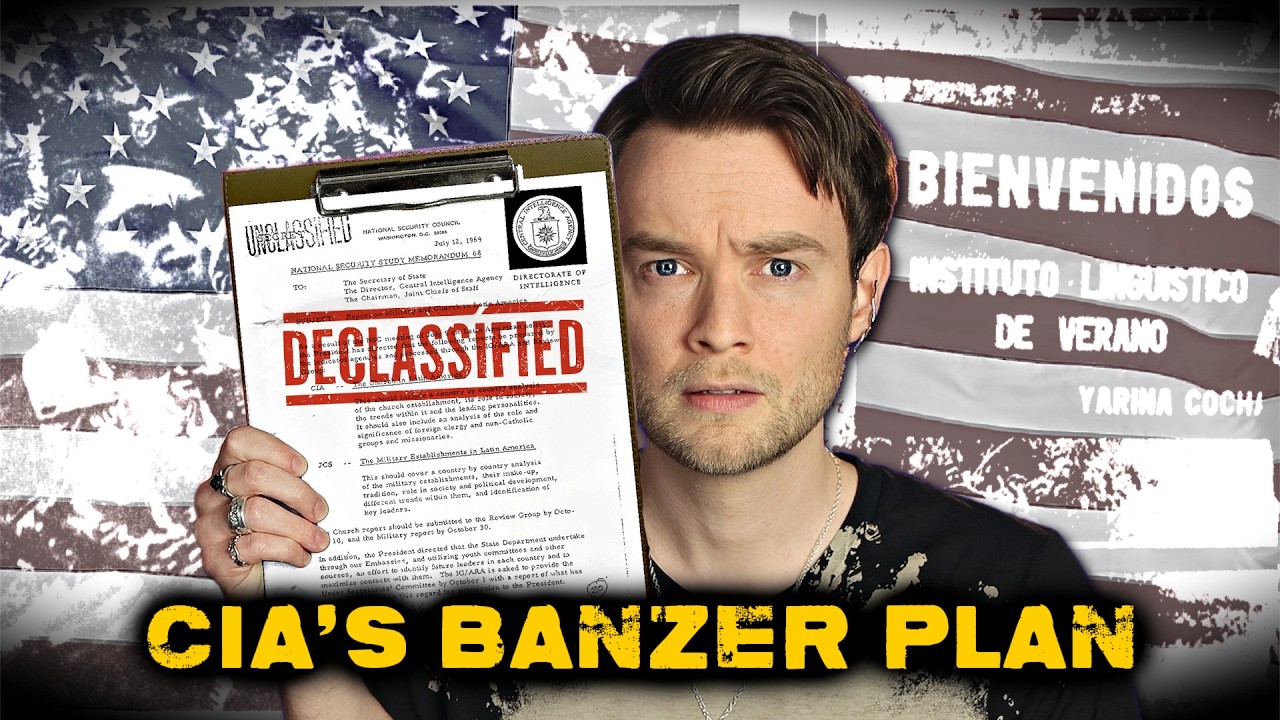
1975, not long after Nixon's ruminations about Catholicism, Bolivia's Hugo Banzer, with advice from his Nazi
18:17
18 minutes, 17 seconds
security chief, Klaus Barbie urged his interior ministry to draw up a plan against liberation theology. Para worked
18:25
18 minutes, 25 seconds
closely with the CIA to draw up what would be known as the Banzer plan, which was a direct attack on liberation
18:32
18 minutes, 32 seconds
theology. Bolivian intelligence joined by the CIA and by the intelligence services of 10 other Latin American countries began to compile dossas on
18:41
18 minutes, 41 seconds
liberation theologists to plant communist literature in churches to shut down any progressive church publication and to arrest and expel foreign priests
18:50
18 minutes, 50 seconds
and nuns who believed in liberation theology. Things are about to get even heavier somehow in this video. So,
18:58
18 minutes, 58 seconds
content warning for a discussion of genocide and torture, like even a little bit more explicitly than we've already
19:04
19 minutes, 4 seconds
discussed. Uh, Eric, let's find a time stamp where people can skip to um after
19:13
19 minutes, 13 seconds
that specific discussion is over. Under Brazil's military dictatorship, which the US financially supported at an
19:20
19 minutes, 20 seconds
unprecedented rate at that time, the state sought to assimilate and eliminate the indigenous people in order to
19:26
19 minutes, 26 seconds
develop the Amazon. Some Catholic clergy advocated for the rights of indigenous people. So, Brazil's generals also
19:34
19 minutes, 34 seconds
railed against the church, even kidnapping and torturing church representatives. The regime killed at least 8,350
19:44
19 minutes, 44 seconds
indigenous people during the dictatorship. According to Brazil's National Truth Commission, in 1980s El Salvador, where 2026 USbacked
19:53
19 minutes, 53 seconds
concentration camps are currently located, groups of US-trained army and national guardsmen sexually abused and
20:00
20 minutes
murdered Catholic nuns and priests. In Chile and across Latin America, dictator Austo Pinish's government and its allies, all backed by the USA at the
20:09
20 minutes, 9 seconds
time, carried out Operation Condor, a project which killed an estimated 50,000 civilians, disappeared 30,000 who were
20:19
20 minutes, 19 seconds
all presumed dead, and imprisoned 400,000 for being suspected communist
20:25
20 minutes, 25 seconds
sympathizers. Many thousands of these civilians were likely tortured. The United States provided the funding and
20:34
20 minutes, 34 seconds
inspiration for this project and the CIA specifically instructed Latin American security forces in methods of torture
20:43
20 minutes, 43 seconds
and bomb construction. While all of this was happening, evangelical Protestant leaders supported these dictatorships and they received some love in return.
20:54
20 minutes, 54 seconds
In December 1974, Chilean General Pinocha personally attended the dedication of the Hotbee Pentecostal Methodist Church Cathedral in Santiago,
21:02
21 minutes, 2 seconds
marking the first time a Chilean head of state had ever attended a Protestant service. 2 days earlier, approximately
21:10
21 minutes, 10 seconds
2500 evangelicals had gathered to publicly pledge their support for the Huta and denounce Chile's international
21:18
21 minutes, 18 seconds
critics. By September 1975, the Methodist Pentecostal Church had assumed the Catholic Church's traditional role
21:26
21 minutes, 26 seconds
of hosting the annual Tedum service, a patriotic ceremony attended by Pinocha and other government leaders. Billy
21:33
21 minutes, 33 seconds
Graham, who we were all raised to rever in evangelical churches, coordinated directly with Latin American military dictatorships. Between 1962 and 1974,
21:44
21 minutes, 44 seconds
Graham personally met with Brazil's dictator Ernesto Geel and other authoritarian rulers. He praised Chile's
21:51
21 minutes, 51 seconds
Augusto Pinochet as a great Christian leader. And then there is Ephraim Rios
21:58
21 minutes, 58 seconds
Mont. Eric, can you please record yourself saying this dude's name with the utmost disrespect?
22:06
22 minutes, 6 seconds
Yeah, Spanish names can be difficult sometimes. Um, I can help. Uh, here is how you pronounce that.
22:22
22 minutes, 22 seconds
Hope that helps. Thank you. If there was a single moment when evangelical Christianity and US counterinsurgency
22:30
22 minutes, 30 seconds
fully merged, it was this period in Guatemalan history. Rios Mont was a general who took power in a 1982
22:37
22 minutes, 37 seconds
military coup. He was a born-again Pentecostal and a member of an American affiliated charismatic church. His
22:44
22 minutes, 44 seconds
weekly national TV addresses sounded like sermons mixing Bible verses with calls for obedience to God and the
22:52
22 minutes, 52 seconds
state. His government carried out one of the worst genocides in modern Latin American history against the Maya and
23:00
23 minutes
the US financially and spiritually supported him. Good old Ronald Reagan praised Mont as a man of great integrity.
23:09
23 minutes, 9 seconds
I know that President Rios Mont is a man of great personal integrity and commitment.
23:14
23 minutes, 14 seconds
Jerry Fwell openly supported him. Pat Robertson interviewed the dictator on his TV show, The 700 Club. Ephraim Rios Mont who was uh the president there.
23:26
23 minutes, 26 seconds
He's a terrific guy. He was with the Elver Verbo Church and um they had a a a marvelous government. Christian
23:33
23 minutes, 33 seconds
evangelist Luis Pau told Christianity Today in 1983, "It's great to have a Christian president as a model. The hand of God appears to be upon him."
23:44
23 minutes, 44 seconds
Meanwhile, remember Catholic priests who supported indigenous rights were being assassinated, disappeared, and tortured along with countless other civilians.
23:54
23 minutes, 54 seconds
Rios Mont's rule was the logical end of a decadesl long project. Replace politically engaged Catholicism with a
24:03
24 minutes, 3 seconds
politically compliant Protestantism so that the structures of inequality remained untouched.
24:10
24 minutes, 10 seconds
Even today, evangelical Protestants in Latin America overwhelmingly support the same kinds of politicians which evangelical Protestants in the US support, authoritarian right-wingers.
...
---
an 1 25
During Donald Trump's first term as president, Paul Manafort was among the many Trump allies who faced criminal charges. The veteran GOP operative was sentenced to 47 months in prison in 2019 after being found guilty on multiple charges of tax fraud and bank fraud, but in 2020, Trump granted him a presidential pardon.
Manafort has a long history of lobbying for extreme far-right figures in Europe, Latin America and other parts of the world. And in 2025, according to the **Daily Beast's Sean Craig, Manafort and "his team" have been offering their "services" to the far right in Ukraine and France (including a "billionaire backer of" National Front leader Marine Le Pen).
Craig, in an article published on January 13, reports, "A memo pitching the services of Manafort's team — including Trump's 2024 co-campaign manager Chris LaCivita and his 2024 pollster Tony Fabrizio — was circulated in Kyiv recently, the (New York) Times reported, to anxious reception….. Manafort told the Times that he has been contacted 'by numerous parties in Ukraine,' though said he 'never submitted a proposal on any matter to anyone in Ukraine.'"
READ MORE:['Fascist ideology': Veteran actor slams 'orange idiot' Trump for 'nonsense' claims about LA wildfires
Craig adds, "LaCivita said he and Fabrizio “are not currently under contract” with Manafort’s team, adding 'successful political consultants on both the right and left routinely do political consulting overseas.'"
Manafort served as one of Trump's campaign managers in 2016 before Kellyanne Conway joined the campaign. Craig notes that although Manafort's "connections to people with Russian intelligence ties" worried members of the Senate Intelligence Committee in 2020, his "prospects on the global consulting circuit have been revived by Trump's election victory in November."
"A pitch memo sent to French billionaire Pierre-Édouard Stérin, who plans to invest $150 million in the next decade in far-right parties in his country — including Le Pen’s —offered to 'develop a state-of-the-art and multidimensional campaign plan' that would target voters and use opposition research to discredit opponents," Craig explains. "Stérin’s associate Arnaud Rérolle told the (New York) Times that he held a call with Manafort, whose team agreed to provide the memo."
Craig adds, "They opted not to sign a contract with his team, however. Manafort may turn to Peru, where the Times said he spoke with a representative of Lima Mayor Rafael López Aliaga last month. Aliaga leads the conservative Popular Renewal and is a likely presidential candidate in 2026."
https://truthout.org/articles/capitalisms-bullets-in-latin-america-invisible-empires-state-power-and-21st-century-colonialism/
no lnx
Capitalism’s Bullets in Latin America: Invisible Empires, State Power and 21st Century Colonialism
BY Benjamin Dangl, Upside Down World
June 21,2014
Police open fire on protestors blocking road in Bagua Grande, Peru. June 5, 2009. (Image: powless / Flickr)]
Updated 6/17/14
“Soccer, metaphor for war, at times turns into real war,” wrote Uruguayan author Eduardo Galeano. For many people in Brazil, a war has indeed broken out surrounding the current World Cup. Poor communities have been displaced by stadiums and related infrastructure for the event, the high level of security has increased police violence, and the enormous economic costs of the World Cup are seen by many as a blow against the rights of the country’s most impoverished people. As a result of these controversies, the international sports event has been met with wide-spread protests.
Cracking down on some of these protests are Brazilian security forces trained by the US private military and security company Academic, previously known as Blackwater. This training was brought to light by the Brazilian press and US sportswriter David Zirin, who, in an article on the topic, pointed to a 2009 diplomatic cable released by Wikileaks, which showed that Washington anticipated the World Cup-related crises in Brazil would provide opportunities for various types of US involvement. Zirin wrote that for Washington, “Brazil’s misery created room for opportunism.”
Capitalism’s bullets follow the World Cup just as they do Free Trade Agreements (FTAs) signed with the US. Five years ago this month, protests were raging in northern Peru where thousands of indigenous Awajun and Wambis men, women and children were blockading roads against oil, logging and gas exploitation on Amazonian land. The Peruvian government, having just signed an FTA with the US, was unsure how to deal with the protests – partly because the controversial concessions in the Amazon were granted to meet the FTA requirements. According to a diplomatic cable released by Wikileaks, on June 1st, 2009 the US State Department sent a message to the US Embassy in Lima: “Should Congress and [Peruvian] President Garcia give in to the [protesters’] pressure, there would be implications for the recently implemented Peru-US Free Trade Agreement.” Four days later, the Peruvian government responded to the protest with deadly violence, leading to a conflict which left 34 dead, including 24 police officers and 10 civilians. The US-supported escalation of the conflict worked; the FTA moved forward as planned.
The US is infamous for its imperial history in the region. But Washington isn’t the only empire in its backyard. Global and local forces of capitalism, imperialism and modern-day colonialism are at work across Latin America, from soccer stadiums to copper mines.
China has outpaced the US as the primary trading partner with the region’s richest countries; most of its business is in the area of natural resource extraction. And for many nations in the southern cone, Brazil – now a world superpower outpacing Britain as the 6th largest economy – is an imperial force, utilizing much of the region’s natural wealth, land and hydroelectric power to fuel its booming industries and population.
Capitalism has many faces and allies, and they’re not just based in the global north or within these economic giants. As sociologist William Robinson writes “The new face of global capitalism in Latin America is driven as much by local capitalist classes that have sought integration into the ranks of the transnational capitalist class as by transnational corporate and financial capital.” From Mexico to Argentina, this local capitalist class has created some 70 globally-competitive transnational conglomerates.
Friends of empire and capital are found at the heights of power among Latin America’s political leaders. While the US has spied on Latin America for years, as recently made clear by Edward Snowden’s leaks, Chile’s Michelle Bachelet administration asked for the US government’s help in spying on Mapuche indigenous leaders defending land rights during her first term in office. While the US supported the coup against Fernando Lugo of Paraguay in 2012, before he was pushed out of office, Lugo himself called for a state of emergency in the countryside to expand repression of campesino activists fighting soy company incursions on their land.
For many indigenous communities in Latin America, the state, often in alliance with transnational corporations, maintains a colonialist worldview into the 21st century, particularly in the area of natural resource extraction in mining, oil and gas industries. As Professor Manuela Picq of the Universidad San Francisco de Quito in Ecuador writes, “The unilateral expropriation of land for mining today is a continuation of the Doctrine of Discovery. It conceptualized the New World as terra nullis, authorizing colonial powers to conquer and exploit land in the Americas. […] Today, the idea of ’empty’ lands survives in extractivist practices.”
Indeed, mining concessions have been granted on 80% of Colombia’s legally-recognized indigenous territories, and 407,000 square kilometers of Amazon-based mining areas are on indigenous land. As a part of this region-wideextractivist land grab, Picq explains that 200 activists were killed in Peru between 2006 and 2011, 200 people were criminalized in Ecuador for protesting the privatization of natural resources, and 11 anti-extractivist activists have been murdered in Argentina since 2010.
The mining industry is also typically devastating for the environment, whether it’s run by the state or the private sector. Picq points out that Guatemala’s Marlin mine, owned by theCanadian company Goldcorp, utilizes in just one hour the same amount of water a local family uses over the span of 22 years, and the mining industry in Chile – where the state owns the largest copper producing company in the world – utilizes 37% of the nation’s electricity.
Capitalism, empire and 21st century colonialism come from afar and descend on their victims in Latin America. But these forces are also in the tear gas canisters that Brazil’s security forces use at the World Cup, in the state that extracts natural resources on indigenous territory, and in the free trade deals signed in blood.
https://www.bbc.com/news/science-environment-58508001
no lnx pix
Record number of environmental activists murdered
By Claire Marshall
BBC Environment & Rural Affairs Correspondent
Published 13 September
image captionSouth African environmental activist Fikile Ntshangase was shot dead in her own home
A record number of activists working to protect the environment and land rights were murdered last year, according to a report by a campaign group.
227 people were killed around the world in 2020, the highest number recorded for a second consecutive year, the report from Global Witness said.
Almost a third of the murders were reportedly linked to resource exploitation - logging, mining, large-scale agribusiness, hydroelectric dams and other infrastructure.
The report called the victims "environmental defenders" killed for protecting natural resources that need to be preserved, including forests, water supplies and oceans.
Since the Paris Agreement on climate change was signed in 2015, the organisation says on average four activists have been killed each week.
It said this "shocking figure" was likely to be an underestimate because of growing restrictions on journalists and other civic freedoms.
Logging was the industry linked to the most murders with 23 cases - with attacks in Brazil, Nicaragua, Peru and the Philippines.
Indigenous peoples, most often on the frontline of climate change, accounted for a further one third of cases. Colombia had the highest recorded attacks, with 65 people killed last year.
'Unbearably heavy burden'
A senior campaigner for Global Witness, Chris Madden, called on governments to "get serious about protecting defenders." He said companies must start "putting people and planet before profit' or he warned that "both climate breakdown and the killings" would continue.
"This dataset is another stark reminder that fighting the climate crisis carries an unbearably heavy burden for some, who risk their lives to save the forests, rivers and biospheres that are essential to counteract unsustainable global warming. This must stop''.
The organisation called on governments to formally recognise the human right to a safe, healthy and sustainable environment, and ensure commitments made at November's UN climate change conference, COP26, integrate human rights protections.
In response, COP26 president Alok Sharma told the BBC he had "prioritised meeting people on the front line of climate change," to ensure the voices of all are heard."
'Shot dead in her living room'
Those murdered includedSouth African Fikile Ntshangase, 65, who was involved in a legal dispute over the extension of an opencast mine operated by Tendele Coal near Somkhele in KwaZulu-Natal province. She was shot dead in her own living room.
Her daughter, Malungelo Xhakaza, 31, said her "mother's struggle lives on." She said: "To this day no arrests have been made in the investigation into my mother's murder. There has been no accountability. It seems to me that someone wants this mine expansion and the extraction to go ahead, no matter the cost."
Petmin Limited, which owns the Somkhele mine through its subsidiary Tendele Coal Mining, told Global Witness that it "acknowledges community tensions may have been a factor in Fikile's death." The company said it "strongly condemns any form of violence or intimidation" and has offered full co-operation with the police.
Óscar Eyraud Adams
image captionÓscar Eyraud was killed in his home in Mexico in 2020
The killings also included Óscar Eyraud Adams, who was murdered in Mexico in September 2020. He was working to help the indigenous Kumiai community in Baja California have better access to water.
Global Witness said activists still under threat included communities in Guapinol in Honduras, where dozens of people have been protesting against an iron oxide mining concession that was granted by the central government in a protected area. Campaigners believe the Guapinol river, a vital water source, is threatened. The organisation says "many community members remain incarcerated."
==
covid authoritarian:
...India is continuing to harass and arrest its most vocal critics, raising fears that the government will use the pandemic chaos to suppress protests and civil society activism in the foreseeable future.
- Zimbabwe
Paul Friesen, University of Notre Dame, and Chipo Dendere, Wellesley University
While reported cases of coronavirus are not yet significant in Africa, the pandemic is already emboldening several governments on the continent to flex their state powers in the name of protecting citizens.
Zimbabwe’s authoritarian-leaning government already inspired fear and distrust among citizens. Then, on March 30, President Emmerson Mnangagwa, who came to power after the removal of Robert Mugabe in 2017, issued a sudden and strict 21-day lockdown, clamping down on nearly all movement and activities.
The total shutdown comes with no government bailout, and Zimbabwe is already in economic crisis.
Fear of government forces has so far proven effective in motivating most of Zimbabwe’s 15 million people to stay at home. But inevitably, many people will have to violate the lockdown to get food, water and other basics goods that are hard to access even in normal times.
Mnangagwa recently ousted Zimbabwe’s health minister as COVID-19 czar and appointed his military hardliner vice president to manage the pandemic response. That was a signal about the potential for use of force. With Zimbabwe forcing citizens to choose between eating and facing the wrath of the military, there could be a flare-up of violence.
4. Peru
Anthony Bebbington, Clark University, and Gisselle Vila Benites, University of Melbourne
Peruvian President Martín Vizcarra’s rapid response to COVID-19 – which includes a $26 billion stimulus package to aid both businesses and families passed shortly after a March 15 state of emergency decree – has been praised domestically and internationally for its sensitivity to the social and economic impacts of the pandemic.
Vizcarra is unlikely to use coronavirus to consolidate authoritarian power, but Peru’s history of impunity during previous states of emergency raises other concerns.
Civil society, human rights groups, journalists and even the Justice Ministry have flagged, for example, the risks of a new “police protection” law passed by the president of the Congress, Manuel Merino. It exempts officers and soldiers from criminal responsibility for any death or injury caused during the state of emergency.
Peru’s government also has a track record of using emergency powers to protect its mining industry against protests. Mined silver, gold, copper, zinc and other precious metals account for 12% of Peru’s gross domestic product, though many local people and environmental groups oppose these massive projects.
The possibility that the COVID-19 state of emergency could be abused by Peruvian police and mining elites to repress civil liberties merits monitoring.
- United States...
==
==
Fringe religious party gains power in :{crisis-stricken:(style="margin:0px;padding:0px;border:0px;outline:0px;vertical-align:baseline;background-image:initial;background-position:initial;background-size:initial;background-repeat:initial;background-attachment:initial;background-origin:initial;background-clip:initial;white-space:nowrap"):}: Peru
Matthew Peter Casey, Arizona State University
After a bribery scandal that took down four presidents and led Congress to dissolve, some Peruvians are putting their faith in an austere religion called the Israelites of the New Universal Pact.
https://www.ecowatch.com/environmental-activists-amnesty-international-2563882266.html
Environmental Leaders Under Threat in Paraguay and Peru, Amnesty Reports
Authorities in Paraguay and Peru are unjustly criminalizing activists who speak out to protect their environment and land, an Amnesty International report released Thursday revealed.
The report, *A Recipe for Criminalization: Defenders of the Environment, Territory and Land in Peru and Paraguay*, outlined the three "ingredients" both countries use to undermine the efforts of activists. First, they delegitimize activists through smear campaigns. Second, they apply laws and regulations that allow for forced evictions. And, third, they misuse the criminal justice system to prosecute activists for unfounded reasons.
"Those who bravely stand up to defend their land and the environment are frequently targeted because of their work. These attacks have a devastating impact on their physical, mental and emotional wellbeing, as well as that of their families and communities," Amnesty International Americas director Erika Guevara-Rosas said in a press release.
The report included examples of how these ingredients combine on the ground.
...
"Those who bravely stand up to defend their land and the environment are frequently targeted because of their work. These attacks have a devastating impact on their physical, mental and emotional wellbeing, as well as that of their families and communities," Amnesty International Americas director Erika Guevara-Rosas said in a press release.
The report included examples of how these ingredients combine on the ground.
For example, Amnesty International highlighted the case of community activists working to protect their home in Peru's Cajamarca region from the gold and copper Conga mining project. On 26 April 2013, police arrested 16 protesters on trumped up charges of abduction and coercion. The state prosecutor sought 30-year prison sentences. But the evidence presented was secondhand and so spotty and contradictory that a court dismissed the case in 2017.
In Paraguay, the Tekoha Sauce community of the Avá Guaraní People was evicted from their ancestral lands by a court order following a dispute with local businessman German Hultz. The community was forced onto a nature reserve where they struggle to survive because hunting and fishing is not allowed. During the court proceedings leading up to the eviction, their opponents stigmatized the indigenous community by referring to them as a "gang of criminals."
The report recommended that the governments of the two countries "must recognize as legitimate the work of human rights defenders working on issues related to land, territory and the environment." It also concluded that both governments should incorporate a gender- and ethnic-specific perspective to protect activists into legislation, stop abusing the justice system to prosecute environmental defenders, investigate and put a stop to all instances where the justice system is being used to harass protesters, and further investigate and prosecute anyone who is carrying out attacks on activists and land defenders.
...
==
==
http://www.alternet.org/activism/us-mining-company-defends-deploying-hired-thugs-against-indigenous-farmers-peru
The Denver-based Newmont Mining Corporation was hit with negative press last week following reports that its Peruvian subsidiary sent security forces to attack the prominent indigenous environmental defender Máxima Acuña de Chaupe at her remote farm in the northern Andean highlands. Now, the mining giant's latest public relations campaign to defend its use of force against the Chaupe family, including the destruction of their crops, is provoking fresh outcry from human rights and environmental organizations.
Máxima attracted international acclaim—and a Goldman Environmental Prize—for her years-long resistance against the Yanacocha mining company, which is 51.35 percent owned by Newmont and has waged a relentless campaign to transform her plot into the open-pit Conga gold and copper mine. In retaliation for her refusal to sell her land to Yanacocha in 2011, Máxima says she has endured a steady stream of intimidation, harassment and surveillance, alongside an ongoing legal campaign to drive her family from their home of more than 20 years. The mine is widely opposed by peasants and workers in the region, who have staged mass protests and general strikes to resist the project.
The dispute came...
==
http://ecowatch.com/2015/04/23/fight-gold-mine-yanacocha
Community activists from Cajamarca, Peru appeared at the annual shareholders’ meeting of Denver-based Newmont Mining Corporation this week to deliver a petition bearing 150,000 signatures protesting the company’s practices in the region, and demanded that it live up to its own goals for human rights and sustainability.
==
peru
Community activists from Cajamarca, Peru appeared at the annual shareholders’ meeting of Denver-based Newmont Mining Corporation this week to deliver a petition bearing 150,000 signatures protesting the company’s practices in the region, and demanded that it live up to its own goals for human rights and sustainability.
Representatives of Earthworks, EarthRights and Grufides delivered over 150,000 signatures to the Newmont annual shareholders' meeting. Photo credit: EarthRights International
Newmont is majority owner of the massive Peruvian gold mine Yanacocha, the second largest gold mine in the world, and its planned Conga gold and copper mine nearby would be even larger, requiring a farming community to move and the four lakes they rely on for irrigation to be drained.
But the community has so far refused to relinquish its treasured land and lakes, and in response activists say the company has reacted with intimidation and harassment.
One person particularly in the company’s cross-hairs is Máxima Acuña de Chaupe, says activist Mirtha Vásquez, a Peruvian lawyer at Wednesday’s meeting. Acuña de Chaupe’s land abuts one of the four lakes but after de Chaupe refused to sell her land in 2011, nongovernmental organizations (NGOs) like Earthworks reported that her family became the target of harassment and violence in the form of beatings and destruction of the family home. Then Newmont sued her for “land invasion” and violent retaliation, which it lost on appeal in December 2014....
ecowatch 4/15
http://www.globalpossibilities.org/the-laundering-machine-how-u-s-corporations-threaten-perus-forests-through-illegal-logging/
https://www.scotusblog.com/case-files/cases/occidental-petroleum-corporation-v-carijano/
Occidental Petroleum Corporation v. Carijano
Petition for certiorari denied on April 22, 2013
| Docket No. | Op. Below | Argument | Opinion | Vote | Author | Term |
|---|---|---|---|---|---|---|
| 12-385 | 9th Cir. | N/A | N/A | N/A | N/A | OT 12 |
Issue: (1) Whether, in an action brought by foreign plaintiffs for alleged injuries occurring in a foreign country to foreign land and foreign citizens, the foreign plaintiffs can obtain a strong presumption in favor of a U.S. forum by adding a nominal U.S. plaintiff for the tactical purpose of defeating a forum non conveniens dismissal; and (2) whether a federal court may assume hypothetically that it has Article III jurisdiction for the purpose of denying a forum non conveniens dismissal and retaining a case in federal court.
| Date | Proceedings and Orders (key to color coding) |
|---|---|
| Aug 16 2012 | Application (12A168) to extend the time to file a petition for a writ of certiorari from August 29, 2012 to September 28, 2012, submitted to Justice Kennedy. |
| Aug 20 2012 | Application (12A168) granted by Justice Kennedy extending the time to file until September 28, 2012. |
| Sep 27 2012 | Petition for a writ of certiorari filed. (Response due October 29, 2012) |
| Oct 18 2012 | Order extending time to file response to petition to and including December 28, 2012. |
| Jan 2 2013 | Waiver of right of respondent Tomas Maynas Carijano, et al. to respond filed. |
| Jan 9 2013 | DISTRIBUTED for Conference of February 15, 2013. |
| Jan 17 2013 | Response Requested . (Due February 19, 2013) |
| Feb 1 2013 | Order extending time to file response to petition to and including March 21, 2013. |
| Mar 21 2013 | Brief of respondents Tomas Maynas Carijano, et al. in opposition filed. |
| Apr 2 2013 | Reply of petitioner Occidental Petroleum Corporation filed. |
| Apr 3 2013 | DISTRIBUTED for Conference of April 19, 2013. |
| Apr 22 2013 | Petition DENIED. |
COUNSEL Marco Simons (argued), Richard Herz, Earthrights International, Washington, D.C.; Paul Hoffman, Benjamin Schonbrun, Michael D. Seplow, Schonbrun Desimone Seplow Harris & Hoffman LLP, Venice, California; Natalie L. Bridgeman, Law Offices of Natalie L. Bridgeman, San Francisco, California, for the plaintiffs-appellants.
Daniel P. Collins (argued), Manuel F. Cachán, Gabriel P. Sanchez,
Munger, Tolles & Olson L.L.P., Los Angeles, California; Ernest J. Getto, Michael G. Romey, Kirk A. Wilkinson,Latham & Watkins, L.L.P., Los Angeles, California, for the defendants-appellees.
....
OPINION WARDLAW, Circuit Judge: These cross-appeals arise from the petroleum and oil exploration operations conducted by defendant Occidental Peruana (“OxyPeru”), an indirect subsidiary of defendant Occidental Petroleum Corporation (collectively “Occidental”), along the Rio Corrientes in the northern region of Peru. Plaintiffs, 25 members of the Achuar indigenous group dependent for their existence upon the rainforest lands and waterways along the river, and Amazon Watch, a California corporation, sued Occidental in Los Angeles County Superior Court for environmental contamination and release of hazardous waste. Although Occidental’s headquarters is located in Los Angeles County, Occidental removed the suit to federal district court where it successfully moved for dismissal on the ground that Peru is a more convenient forum. Plaintiffs timely appeal the dismissal of their suit. Occidental cross-appeals from the district court’s determination that its Rule 12 motion to dismiss Amazon Watch for lack of standing is moot. Because Occidental failed to meet its burden of demonstrating that Peru is a more convenient forum, and the district court gave insufficient weight to the strong presumption in favor of a domestic plaintiff’s choice of forum, the district court abused its discretion by dismissing the lawsuit without imposing mitigating conditions for the dismissal.
I. FACTUAL AND PROCEDURAL BACKGROUND We accept as true the facts alleged in the Achuar Plaintiffs’ and Amazon Watch’s (“Plaintiffs”) First Amended Complaint 7126 CARIJANO v. OCCIDENTAL PETROLEUM (“FAC”). See Vivendi SA v. T-Mobile USA, Inc., 586 F.3d 689, 691 n.3 (9th Cir. 2009); Aguas Lenders Recovery Group v. Suez, S.A., 585 F.3d 696, 697 (2d Cir. 2009) (accepting the facts alleged in the complaint as true where the case was dismissed on forum non conveniens grounds without a factual hearing). Occidental is among the largest oil and gas companies in the United States. Its Peruvian operations began in the early 1970s with the development of a pair of lots near the Ecuadorean border known as “Block 1-AB.” Its subsidiary, OxyPeru, built Block 1-AB into a thriving extraction, processing, and distribution site, providing 26 percent of Peru’s total historical oil production from 1972 to 2000, at which point Occidental sold its stake in Block 1-AB to the Argentine oil company Pluspetrol.
The Peruvian government granted Occidental its first concession in the region in 1971; oil was found the next year. The company built dozens of wells, a 530- kilometer network of pipelines, refineries, and separation batteries for processing crude oil, as well as roads, heliports and camps to support the operation at Block 1-AB. The Achuar are indigenous people who have long resided along the rivers of the northern Peruvian rainforest. Block 1- AB encompasses significant portions of the Corrientes and Macusari rivers, home to several Achuar communities. The inhabitants use the rivers and their tributaries for drinking, fishing, and bathing. The region is remote, with access typically limited to small planes, helicopters, small boats, and canoes. The complaint alleges that, during its thirty years in the Achuar territories, Occidental knowingly utilized out-of-date methods for separating crude oil that contravened United States and Peruvian law, resulting in the discharge of millions of gallons of toxic oil byproducts into the area’s waterways. Achuar children and adults came into frequent contact with the contaminants by using polluted rivers and tributaries ...
==
==