corruption bak intl
1019
merri ok
THIS IS MOSTLY ABOUT INTERNATIONAL BRIBERY? ALSO IT'S THE OPPOSITE OF TRANSPARENCY?
domestic will be under crimes and scandals
MAP: http://transparency.org/cpi2010/results
kleptowatch: http://100r.org/feature/kleptowatch/
promoted to primary 818 confluence of for and domestic, trump real estate MONEY LAUNDER
also ties to tax dodge offshore bank
// to human rights violations
---
an 3 25
The Trump administration announced Sunday it will cease to enforce penalties and fines on businesses that fail to adhere to beneficial ownership financial reporting requirements under the Corporate Transparency Act, an anti-money laundering law passed by Congress in 2021. The announcement was panned by advocates, economists, and other critics who called the move an on-ramp for corruption.
The Corporate Transparency Act, a bipartisan effort, includes a rule that requires many corporations and limited liability companies to disclose information on who owns and controls a business entity (also known as the beneficial owner) to the Financial Crimes Enforcement Network (FinCEN), a bureau of the U.S. Treasury Department.
"Exciting news!" wrote Trump on Truth Social when announcing that the Treasury Department would no longer enforce the reporting rule, which he called "invasive and outrageous."
Garbiel Zucman, a professor of economics, reposted Trump's message on X, and wrote: "Exciting news for tax evasion and money laundering!"
Economist and author Anders Åslund reacted to the update writing, "to oppose corporate transparency is to favor corruption."
Supporters of the Corporate Transparency Act, which has face court challenges, argue that the policy is an important step toward reining in anonymous companies, which are the preferred vehicle for moving around illicit funds.
"God, this is grim," weighed in author Oliver Bullough, who has written a book about global wealth and corruption. "The White House has killed the Corporate Transparency Act, which was itself a tiny first step in the marathon journey of stopping U.S. companies from being the most egregiously opaque shell structures on the planet."
In a Monday statement, Ian Gary, executive director of the Financial Accountability and Corporate Transparency Coalition, called the move a "hollowing out" of the Corporate Transparency Act that runs counter to years of bipartisan work to "end the scourge of anonymous shell companies."
Treasury Secretary Scott Bessent, for his part, said ceasing enforcement is a "victory for common sense," according to a Sunday statement. "Today's action is part of President Trump's bold agenda to unleash American prosperity by reining in burdensome regulations, in particular for small businesses that are the backbone of the American economy," he said. In response, Bullough, argued that Bessent doesn't recognize that fraud "suppresses prosperity, rather than enables it."
According to the announcement, the Treasury Department will issue a proposed rulemaking with the aim of narrowing the scope of the rule so that it solely applies to foreign reporting companies.
---
11 24
aha: tax dodge = amplifying feedback --> inequality/ polarization --> instability --> crisis
aha2 // billionaires hide $ in fam fdn, // gop attack gubmint, degrade ability to work, trash more rinse repeat downward death spiral, deconstruct admin state burn it down alt rt nihilism? bannon trump clown car cabinet; corp dark money to drop tax rate more and kill regulations --> extraction
an 11 24
A study published Tuesday estimates that tax dodging enabled by the United States, the United Kingdom, and other wealthy nations is costing countries around the world nearly half a trillion dollars in revenue each year, underscoring the urgent need for global reforms to prevent rich individuals and large corporations from shirking their obligations.
The new study, conducted by the Tax Justice Network (TJN), finds that "the combined costs of cross-border tax abuse by multinational companies and by individuals with undeclared assets offshore stands at an estimated $492 billion." Of that total in lost revenue, corporate tax dodging is responsible for more than $347 billion, according to TJN's calculations.
"For people everywhere, the losses translate into foregone public services, and weakened states at greater risk of falling prey to political extremism," the study reads. "And in the same way, there is scope for all to benefit from moving tax rule-setting out of the OECD and into a globally inclusive and fully transparent process at the United Nations."
The analysis estimates that just eight countries—the U.S., Canada, the U.K., Japan, Israel, South Korea, Australia, and New Zealand—are enabling large-scale tax avoidance by opposing popular global reform efforts. Late last year, those same eight countries were the lonely opponents of the United Nations General Assembly's vote to set in motion the process of establishing a U.N. tax convention.
According to the new TJN study, those eight countries are responsible for roughly half of the $492 billion lost per year globally to tax avoidance by the rich and large multinational corporations, despite being home to just 8% of the world's population.
"The hurtful eight voted for a world where we all keep losing half a trillion a year to tax-cheating multinational corporations and the super-rich," Alex Cobham, chief executive of the Tax Justice Network, said in a statement Tuesday. "The U.K. and the U.S. are both among the biggest enablers and the biggest losers of this lose-lose tax system, and their people consistently demand an end to tax abuse, so it's absurd that the U.S. and U.K. are seeking to preserve it."
"It's perhaps harder to understand why the other handful of blockers, like Australia, Canada, and Japan, who don't play anything like such a damaging role, would be willing to go along with this," Cobham added.
TJN released its study as G20 nations—a group that includes most of the "hurtful eight"—issued a communiqué pledging to "engage cooperatively to ensure that ultra-high-net-worth individuals are effectively taxed." Brazil, which hosted the G20 summit, led the push for language calling for taxation of the global super-rich.
The document drew praise from advocacy groups including the Fight Inequality Alliance, which stressed the need to "transform the rhetoric on taxing the rich into global reality."
The communiqué was released amid concerns that the election of far-right billionaire Donald Trump in the U.S. could derail progress toward a global solution to pervasive and costly tax avoidance.
The new TJN study cites Trump's pledge to cut the statutory U.S. corporate tax rate from 21% to 15% and warns such a move would accelerate the global "race to the bottom" on corporate taxation.
"People in countries around the world are calling in large majorities on their governments to tax multinational corporations properly," Liz Nelson, TJN's director of advocacy and research, said Tuesday. "But governments continue to exercise a policy of appeasement on corporate tax."
"We now have data from these governments showing that when they asked multinational corporations to pay less tax, the corporations cheated even more," Nelson added. "It's time governments found the spines their people deserve from their leaders."
===
===
--> IMPEACH
https://www.alternet.org/2020/09/democrats-say-the-gops-attempt-to-smear-biden-accidentally-exposed-a-trump-officials-corrupt-scheme/
igor salon
the Republican report aimed at raising questions about the dealings of Democratic nominee Joe Biden and his son Hunter Biden in Ukraine appears to have accidentally implicated former Energy Secretary Rick Perry in an energy scheme in the foreign nation, according to the top Democrat on the Senate Finance Committee.
Republicans led by Sen. Ron Johnson, R-Wis., released their much-hyped report on Hunter Biden’s role at the Ukrainian energy firm Burisma on Wednesday. However, it found no evidence of actual wrongdoing and relied largely on debunked claims, old statements and narratives pushed as part of a Russian disinformation campaign.
But the report did find new evidence related to Perry’s actions in Ukraine while he served in President Donald Trump’s Cabinet.
Amos Hochstein, a member of the supervisory board at the state-owned Ukrainian energy firm Naftogaz, told lawmakers that Perry “inappropriately pressured the Ukrainian government” to place Texas oil executive Robert Bensh on the board of the company while officials at the Department of Energy pressured the government to sign a deal with a “private business entity connected to Mr. Bensh,” according to a letter Wyden sent to Department of Energy Inspector General Teri Donaldson.
perry also pressured the Ukrainian government to place one of his longtime campaign supporters, Michael Bleyzer, on the board during a trip to Ukraine for President Volodymyr Zelensky’s inauguration in 2019, Wyden wrote. Bleyzer and his partner were later awarded a drilling contract in the country.
“Mr. Bleyzer’s contract that he was awarded was despite the fact that he was not the highest bidder in the process,” Hochstein told lawmakers. “Other . . . bids were higher, and therefore, Ukraine chose a bid that paid itself less.”
The heads of the state-owned Naftogaz conglomerate have since filed a lawsuit seeking to overturn the contract, arguing that the Ukrainian government acted “illegally and with bias” in agreeing to the deal, Wyden noted.
“Witness testimony in this investigation has directly implicated former Secretary Rick Perry in alleged wrongdoing, and the department more broadly, in a scheme to undermine anti-corruption efforts that were implemented by Ukraine in partnership with the international community,” Wyden wrote.
Politico reported last year that Perry — who along with then-Ambassador to the European Union Gordon Sondland and Ukraine envoy Kurt Volker were the “three amigos” who pushed a shadow foreign policy in Ukraine — played an active role in the Trump administration’s pressure on Zelensky, which ultimately led to thepresident’s impeachment.
ProPublica reported earlier this month that Perry repeatedly pushed deals that “were potentially worth billions of dollars to Perry’s friends and political donors” and could “stand to benefit” the secretary himself. Two of the deals, including one worth $20 billion, went to the Texas firm Energy Transfer. Perry served on the company’s board before and after his stint at the Energy Department and bought shares now worth about $800,000 three months after leaving his post, according to the report.
Ethics experts told the outlet that Perry’s efforts were violations of federal regulations. His actions also caught the attention of federal prosecutors, though he is reportedly not the target of any investigations.
The interview with Hochstein was part of the Senate Republicans’ investigation into whether Hunter Biden’s position at Burisma affected U.S. foreign policy. The report asserted that his position was “problematic and did interfere in the efficient execution of policy with respect to Ukraine.” However, it did not include any new evidence suggesting his role affected the Obama administration’s policy. It also acknowledged that “the extent to which Hunter Biden’s role on Burisma’s board affected U.S. policy toward Ukraine is not clear.”
Wyden, the ranking Democrat on the Senate Finance Committee, said the probe pushed “Russian disinformation.” He further described it as “an attempted political hit job facilitated by the State Department.”
A Finance Committee aide told Talking Points Memo that finding new evidence against the Trump administration “was certainly not Republicans’ goal.”
“While Republicans’ Ukraine investigation showed Vice President Biden did nothing wrong,” the aide said, “it succeeded in implicating former Secretary Perry in a corrupt scheme to pressure the Ukrainian government to change the board of Naftogaz.”
---
===
an 1 24 no lnx thom
Why Trump wants a country where everything is for sale
Thom Hartmann
January 09, 2024
Donald Trump and his fellow rightwing billionaires have a plan for America. They want to turn the United States from a prosperous, middle-class nation into a country of paupers, where bribery is common and the wealthy can get away with anything.
The latest example of this comes from the House Oversight Committee’s report last week documenting how Donald Trump took at least $7 million in bribes in exchange for changes to US foreign policy when he was president.
Most of the world already operates the way Republicans are pushing our country: no social safety net, corrupt regulatory and police agencies, politicians and legislation for sale, and absolute immunity for the morbidly rich.
It was 1980 when I first really discovered what it’s like doing business or just living life in countries that are the models for how this nation’s rightwing billionaires are trying to remake America.
I was a volunteer on behalf of an international relief organization out of Germany and had flown into Kenya, on my way to Uganda. Tanzania had recently evicted the murderous dictator Idi Amin (who was welcomed, along with his bevy of wives, by Saudi Arabia, where he lived like a king in his own palace to the day he died). Famine was creeping across the northern part of the country. (I wrote about this trip in The Prophet’s Wayand published that chapter on my website.)
Three days in a row I’d gone to the Ugandan embassy to try to get an entry visa into the country; each time I was told, after waiting a few hours and without explanation, to come back the next day.
I was staying at the New Stanley Hotel in Nairobi, and they had an outdoor bar called the Thorn Tree Café, where Ernest Hemmingway used to stay and where he popularized the Swahili word “safari” and wrote The Snows of Kilimanjaro. I’d gotten to know an old British expat who lived in the hotel and we shared a couple of gin-and-tonics every afternoon in the café. When I told him about my frustration, he said:
“When you go in tomorrow, slip a $20 bill into your passport when you hand it to the official. You’ll get your visa.”
There were a couple of other regulars sitting with us and they all agreed, so the next day, with some trepidation, I tried the bribe. It worked: the Ugandan diplomat lifted the bill out of my passport, it vanished into the top drawer of his desk, and I had the visa stamp in my passport in thirty seconds.
When I got to the airport and the Ugandan Airlines’ check-in desk, I was told that my plane reservation, which I’d booked and paid for over the phone, “Can’t be found.” The agent shrugged, like it was an everyday occurrence. I slid another twenty across the counter and he broke into a huge smile, scratched out a line on the flight manifest with his pencil, and said, “Give me your name again?” I did and he wrote it in and an hour later I was on the plane to Entebbe.
A few months later I was in Haiti, meeting with the government official in charge of licensing foreign charities to operate in the country. He was less subtle than the Ugandans; he told me right up-front that I’d have to give him a substantial cash down-payment (I’m remembering $5,000, but could be in error) and an annual smaller payment, all in cash and all handed over directly to him.
While I was successful in starting a program in Uganda that’s still running to this day (among others), when the level of bribery got as high and as naked as it was in Haiti, we chose to pull the plug on our plans to operate in that Caribbean country.
Later that year I was pulled over by a Mexican police officer while driving with a Vice President of Scientific Atlanta from the Acapulco airport to our hotel; the cop told me — even though I’d been traveling the same speed as every other car on the highway — that I’d have to stay in town for a week to show up in court unless I gave him $50 cash on the spot. He got his bribe, and, on reflection of some legal peril, I listed it as such on my expense report.
You may be shaking your head right now, thinking all of this bribery to do business or even travel in foreign countries is terrible. America would never tolerate such corruption, right?
Wrong.
We’re already there on one level; it’s just that there’s only one class of Americans who can legally bribe the system to get what they want, and they blow through every obstacle in front of them by simply paying people off.
That group is America’s rightwing billionaires. And they damn well want to keep things that way. As long as they can bribe their way into or out of things, they’re very happy with the status quo and will continue to fund efforts to keep things this way.
Look at, for example, how they spiffed Clarence Thomas to get him to agree to be the deciding vote in Citizens United, which legalized bribery of both American politicians and Supreme Court justices. Multiple rightwing billionaires spent literally millions of dollars buying Thomas’ and his wife’s loyalty and rewarding their behavior on the billionaires’ behalf.
The fossil fuel industry showers millions every year on Republican politicians, both in direct bribes campaign contributions and through the political cover they get from the rightwing media and think-tanks they underwrite. As a result, you won’t find a single Republican politician who’s willing to do anything whatsoever about climate change, and most won’t even acknowledge it exists so long has the money keeps flowing.
Ditto for Big Pharma, Big Insurance, and Big Banks: all three routinely rip off Americans, and the Republican answer is to gut the regulatory agencies that might hold them to account.
While Uganda was in chaos in 1980 and the people I paid off were probably just freelancing because they weren’t even getting paid, when I was in Haiti I heard from other people operating in the country that part of the bribe money they’d paid was going all the way to the top: “Baby Doc” Jean-Claude Duvalier ran that country like his own personal corrupt little fiefdom until he was deposed in 1986.
Donald Trump aspires to Baby Doc (or even “Papa Doc”) status, and showed us — during the one-term presidency that Vladimir Putin helped him secure — how he and his billionaire buddies want to reshape our country in Duvalier’s image. This is how a country travels the path from functioning democracy to corrupt oligarchy.
Trump came into office echoing a widespread public freak-out about the 20 million or so jobs that had been offshored to China by Reaganomics. Trash-talking China worked really well on the campaign trail for Trump, but when he became president he began acting like that Mexican cop who’d pulled over me and my client.
— The Chinese embassy and one of the country’s largest banks (that helps North Korea evade US sanctions) shoveled $5.5 million into Trump’s corporate checking accounts; within months he hopped on a plane, flew to China, and told Chinese dictator Xi “my feeling toward you is an incredibly warm one.”
— Trump was trash-talking Qatar, calling them a “funder of terrorism,” so, as Mary Trump notes in her excellent newsletter:
“[I]n April of 2018, the Qatari Permanent Mission to the United Nations bought a fourth apartment at Trump World Tower for $6.5 million, and then in the SAME MONTH, Donald welcomed its monarch to the Oval Office and labeled Qatar as a partner in ‘stopping the funding of terrorism.’”
Not only that, Qatar went on to backstop a billion-dollar buyout of Jared Kushner’s terrible 666 Fifth Avenue building purchase.
— Trump was ignoring Kuwait’s desire to buy an air-force-worth of F18 Hornet fighter jets, so, like my sticking a $20 bill into my passport in Nairobi, they moved their Christmas Party to his DC hotel, putting hundreds of thousands of dollars in Trump’s pocket; he promptly approved the sale of the weapons systems.
— Saudi Arabia was reeling under international condemnation for murdering and dismembering Washington Post journalist Jamal Khashoggi, so they gave Trump well over a half-million dollars cash by renting entire floors in his properties; he immediately went against his own policy advisors’ advice and began selling them billions of dollars’ worth of high-tech weapons without congressional authorization.
And this is just the tip of the iceberg, the little bit that Democrats on the House Oversight Committee were able to discover before Republicans took control of the House and put Trump toady James Comer in charge of the committee; Comer immediately ended the investigations into the Trump family and redirected their efforts to investigating Hunter Biden. (There’s a great summary of the House Democrat’s report, with a link to the report itself, here.)
This is the America that our country’s rightwing billionaires want. Where everything is for sale, but the price is usually so high that only the morbidly rich can afford it.
— Want $600 billion a year in fossil fuel subsidies that help destroy our children’s future? Give Republican politicians a few hundred million over the years.
— Want to own a private island and run an underage sex ring? Just buy off or blackmail enough politicians and a guy who ends up in Trump’s cabinet will, himself, arrange sweetheart deals for you to avoid prison or liability (until it all comes unraveled years later).
— Want such massive tax cuts that they will leave the nation $34 trillion in debt and siphon a full $50 trillion out of the homes and savings of working class people, reducing the middle class income from two-thirds of us to 43 percent? Just recycle a few billion of those trillions to fund a few hundred Republicans’ campaigns.
America has become a nation increasingly run by rightwing grifters and greedy corporations:
— Want to sell pesticides that are neurotoxic to children?
— Dump toxic waste from mining operations into our rivers where it will poison downstream water supplies?
— Gut workers’ rights?
— Sell off and ruin public parklands for pennies on the dollar?
— Steal from working people’s retirement plans without consequence?
Every one of those five things (and more) happened in the first months of Trump’s administration, and in every case there was big money paying off Trump and congressional Republicans for taking those actions.
We’re seeing a similar embrace of corruption in Republican-controlled states across the country. Texas’ Attorney General Ken Paxton, for example, has been facing securities fraud charges for eight years now; the trial is finally scheduled for next year, but don’t hold your breath. Meanwhile, he’s suing to prevent women with crisis pregnancies from getting life-saving abortions.
In Virginia, that state’s Republican Attorney General went after “good government” as soon as he took office. As Radley Balko notes in his Substack newsletter, The Watch:
“Jason Miyares made his priorities clear the moment he took office. Shortly after the Virginia Republican was sworn in as the state’s new attorney general in 2022, he abruptly fired everyone in the conviction integrity unit (CIU), the office charged with investigating and rectifying wrongful convictions. …
“Miyares fired 17 attorneys and 30 total employees, including many attorneys in the civil rights division, as well as the general counsel for the University of Virginia — who at the time had taken leave to serve as lead investigator for the special congressional committee investigating January 6th. Miyares insisted the attorney’s termination had nothing to do with his work on the attempted insurrection.”
And it’s not just American billionaires who are paying off Republican politicians (and apparently one Democrat in the Senate). A foreign billionaire who may be the richest man in the world controls a massive social media operation that can build up or tear down any Republican who doesn’t dance to his tune.
Vladimir Putin, a billionaire who makes his friends into billionaires, has invested heavily in social media troll farms, now that billionaires Zuckerberg and Musk have dialed back on content moderation, leaving Nazis, Russian agents, and their Republican fellow travelers to flourish on their platforms.
Putin’s social media operations have been so successful that he’s managed to bring a few dozen Republican politicians under his control, most notably Tommy Tuberville and Marjorie Taylor Greene. As the Byline Supplement Substack newsletter noted last week:
“Among Republican politicians, Marjorie Taylor Greene of Georgia has led the way in normalizing extremist pro-Russian propaganda, making a public appearance at a pro-Putin rally and floating Putin’s peace plan which cedes all occupied territory to Russia. Greene calls the defense of Ukraine a corrupt scheme, citing as her source a Russian propaganda outlet that was sanctioned by the US Treasury Department over alleged interference in the 2020 presidential elections.
“On the US Senate side, Tommy Tuberville of Alabama blames Democrats, claiming Democrats “created” the war in Ukraine — exactly parroting the Kremlin influence operation as reported by the declassified US intelligence assessment. Tuberville has gone so far as to green-light a Russian takeover of Ukraine, opining against all contrary evidence that he sees no risk of further Russian aggression once Ukraine is subdued. Tuberville is a close ally of Donald Trump, who claims he has a plan for an immediate end to the war.”
And, of course, Putin was able to buy Trump’s loyalty by running an online influence operation, outed by Robert Mueller’s investigation, that helped Trump win the electoral college and occupy the White House even though he lost to Hillary Clinton by about 3 million votes.
This is the America our rightwing billionaires have been working to create ever since the Reagan Revolution: a nation where everything’s for sale and everyone’s on the take.
After all, when everybody’s a criminal, nobody’s a criminal.
And it all really started in a big way when five corrupt Republicans on the Supreme Court legalized political bribery by billionaires (1976) and corporations (1978), most recently overturning hundreds of good government laws nationwide with their bizarre Citizens United (2010) decision declaring that corporations are persons and money is “First Amendment-protected ‘free speech.’”
For two decades now, we’ve had Republican justices who’ve been put on the bench through millions of dollars from a handful of rightwing billionaires and the institutions they fund. They’re then groomed with first class and private jet travel, homes, travel trailers, speaking gigs, entrance to billionaire-only private events, and millions in “pay” opportunities for justices’ spouses.
They’re backstopped by billionaires who own media operations like Fox “News” and the CEOs of industries that want to continue making money while exploiting or even killing us and our children.
The simple reality is that today in America rightwing billionaires can buy just about anything, including tax breaks, new laws that protect them and their businesses, and immunity from prosecution for anything they say or do. They can even buy henchmen who will take down university presidents who offend them.
Widespread Republican victories this November will make the situation far worse, and, if Trump keeps his promises, will finish the job Reagan began of gutting the middle class and fully handing control of America over to the GOP’s billionaire overlords.
Then Ken Paxton, Clarence Thomas, and Ron DeSantis types of politicians will rule the nation, always bowing to the demands of their rich benefactors.
Democrats (Senator Menendez notwithstanding) have been fighting this corruption and promise to end the culture of bribery and impunity that Citizens United established. They tried with the For The People Act, but the GOP filibuster prevailed.
The choice has never been starker: do we want America to sink farther into the GOP‘s version of Uganda or Mexico? Or do we want to become a nation where we all have opportunity and prosperity, and all Americans are both bound and protected equally by the law?
What kind of country do we want to leave to our children? A functioning democracy or a corrupt kleptocracy run by the toadies of a handful of rightwing billionaires?
The stakes this November are huge. Pass it along.
---
---
tom dispatch 3/20
...
Before zeroing in on Ukraine, however, let’s consider just a few of Giuliani’s other foreign ventures. Since leaving office as New York’s mayor, through Giuliani Partners, the Bracewell & Giuliani law partnership, and (after 2016) the giant law firm of Greenberg Traurig, along with Giuliani Security & Safety and Giuliani Capital Advisers, the former mayor has pulled in millions of dollars working on behalf of foreign clients, including highly controversial ones. Among those deals, contracts, and maneuvers, before and after Trump became president and hired his old friend Rudy to serve as his personal attorney in 2018, Giuliani has been involved in a far-flung series of deals: he’s been a paid lobbyist in Romania; had a cybersecurity contract inQatar; had deals in Colombia, Argentina, and El Salvador; worked shadow diplomacy (with a business angle) with Venezuela’s President Nicolas Maduro; operated in Japan, Serbia, and Guatemala; and that only begins to tell the story.
Consider Turkey, starting in 2017. Back then, when Lieutenant General Michael Flynn was forced to resign after just a few weeks as national security advisor, it turned out that he had quietly (and without reporting it) been working on behalf of Turkey’s autocratic government, led by President Recep Tayyip Erdogan, during the 2016 election campaign. Erdogan was disturbed by the presence of a dissident, Fethullah Gulen, in the United States. As an unregistered advocate for Turkey, Flynn lobbied in 2016 to have the United States expel Gulen and send him back to Turkey. Early the next year, Flynn was gone, but no fear, Rudy Giuliani promptly took up the same cause. He began urging President Trump to extradite Gulen to Turkey, where Erdogan was accusing him of having plotted an attempted coup d’état. (In the end, Gulen wasn’t expelled.)
Given Giuliani’s ability to mix policy with business, you won’t be surprised to learn that he was also enmeshed in more lucrative efforts in Turkey. At around the same time, he was lobbying Trump to endorse a prisoner swap involving one of his clients, an Iranian-born Turkish gold trader named Reza Zarrab whom the FBI had arrested in 2016 on charges of money laundering and trying to do an end run around economic sanctions on Iran. According to the New York Times,Zarrab had been working with Halkbank, a major Turkish bank with close ties to Turkish Finance Minister Berat Albayrak who is also President Erdogan’s son-in-law, to “funnel more than $10 billion in gold and cash to Iran.”
At first blush, it might seem odd for Giuliani to offer his services on behalf of an Iranian expat accused of trying to break U.S. sanctions whose family, it turned out, had close ties to former Iranian President Mahmoud Ahmadinejad. Curious, yes, but for Giuliani, business is business and there were bucks to be made. That he would use his connections to the Oval Office in an ultimately unsuccessful appeal for his client is even odder, given that Giuliani is otherwise a militant hardliner when it comes to demanding the overthrow of the Iranian government....
---
https://www.alternet.org/2020/02/hotbed-of-abuses-here-are-3-seldom-discussed-news-stories-that-need-to-be-exposed/
no lnx
Hotbed of abuses: Here are 3 seldom-discussed news stories that need to be exposed
Written by Ralph Nader / Common Dreams February 23, 2020
The news is filled with stories about President Trump and his predecessors imposing sanctions on other countries, their officials, and other prominent persons. But the media rarely spells out exactly what these sanctions are, the intermediaries who enforce them, the impacts they have on innocent civilians – women, men and children – how they are countered or evaded, and whether they fulfill or undermine their diplomatic, military, or economic purposes.
For example, sanctions against Iran by Trump increase by the year. They force banks and other financial institutions to cut off all decreed transactions, such as exports from Iran or purchase by Iran of critical spare parts, raw materials, even medical devices. Years ago, sanctions against Iraq under Saddam Hussein prohibited Iraq from purchasing chlorine to purify drinking water and children’s catheters. These sanctions produced deadly results for innocents. Iran’s economy is now in ruins and the brunt of the pain is suffered by innocent families. Under international law, disproportionate harm on civilians from sanctions is a serious violation.
Presently, from Trump there are sanctions on individuals in numerous countries, restricting their travel, their purchases and more. When banks like Citigroup and Bank of America are told by Washington to cut off any financial transactions from any companies doing business with a sanctioned country, do the banks receive payment for their trouble, or are there other quid pro quo rewards? We do not know. Secret government actions are pervasive, though sometimes a freedom of information request, followed by litigation, may pry open what is hidden.
Media alert! Sanctions are potential hotbeds for corruption and illegalities.
A little told story relates the tariffs Trump is imposing on imports from other countries, especially China.There are serious questions as to whether presidents have the constitutional authority or whether Congress must maintain authority on tariffs. Veteran constitutional law litigator Alan Morrison is now contesting sweeping executive tariff power in the federal courts. Reporting on this overreaching by the President is scarce.
Digging deeper, reporters should be asking what standards control presidential discretion or whims on imposing tariffs. The “national security flag” can’t just be waved arbitrarily.
Trump passes out many waivers for certain U.S. companies. Why, for example, did Trump give Apple CEO Tim Cook a waiver on tens of billions of dollars in iPhones imported from China, but not provide waivers to any number of smaller U.S. companies who buy products from China for their manufacturing or retail/wholesale sales?
Constitutional law specialist, Bruce Fein, says the absence of standards for giving waivers raises fundamental questions of unlawful delegation by Congress.
Media alert! Potential incentives for corruption and lawlessness in these burgeoning behind the scenes intrigues are huge.
The third hotbed of abuses relates to the charges by Washington that countries abroad tolerate “corruption,” and that security and economic relations with them are either jeopardized or unworkable. Such charges are regularly made against the governments of Afghanistan and Iraq – both militarily occupied by the U.S.
Corruption involves more than high-level officials taking bribes. Low-level public servants, so woefully underpaid, take money under the table to survive. As it happens, Ashraf Ghani, the elected president of Afghanistan, a former professor at Johns Hopkins University, was a leading expert on the nuances and functions of bribery in third-world countries. He can be a worthy source of knowledge on corruption.
U.S. agencies are a major generator of secret corruption in countries like Afghanistan.For example, cargo planes full of crisp one hundred dollar bills are shipped to Kabul and then trans-shipped to places like Kandahar. It doesn’t take much imagination to frame a reporter’s investigation—of what happens to cash in occupied, desperate societies.
Books and articles on the intelligence agencies note that cash handouts, big and small, are critical to achieve their purposes. There is so much bribery cash in Afghanistan that to stop the flow would seriously affect their shaky economy.
Bribery is a two way street – the briber and the bribee. Secret payments and bribes have often backfired against U.S. foreign policies in many undesirable ways.
Bribes to get what Washington and giant multinational corporations want from fragile countries merits more reporting, if only to show that a good deal of the bribery is under our control and within our power to reverse.
Media Alert!
---
==
https://www.alternet.org/2020/01/federal-prosecutors-target-foreign-corporations-for-illegal-activities-us-companies-commit-all-the-time/
FCPA
no lnx
Federal prosecutors target foreign corporations for illegal activities US companies commit all the time
Written by Phil Mattera / DC Report January 17, 2020
Questions of fairness arise out of recent fines exacted on foreign companies.
Federal prosecutors recently announced telecommunications giant Ericsson will pay more than $1 billion to resolve allegations that it conspired to make illegal payments to win contracts in five countries. The settlement included a $520 million criminal penalty imposed by the Justice Department and a $540 million civil payment to the Securities and Exchange Commission.
This was the latest in a long series of cases brought under the Foreign Corrupt Practices Act, the 1977 law.The act emerged out of the Watergate-era revelations about improper overseas payments by U.S. corporations. But what the case against Sweden’s Ericsson highlights is the extent to which the law is being applied to foreign versus domestic corporations.
$4 Billion in Penalties
In fact, companies based outside the United States increasingly appear to be the primary targets of prosecutors. Since Donald Trump took office, foreign corporations have paid about $4 billion in penalties. That is more than seven times the sum paid by domestic firms. Apart from the Ericsson settlement, the largest combined penalties have been paid by a Russian company, $831 million by Mobile TeleSystems PJSC, and another Swedish firm, $731 million by Telia.
By contrast, U.S.-based firms have gotten off much easier. The only domestic company paying more than $100 million was Walmart. Yet, long-delayed $281 million penalty was well below expectations.
The tougher treatment of foreign companies can also be seen in the prosecution of price-fixing. Violation Tracker shows that during the Trump administration foreign companies have paid more than $723 million to DOJ in criminal penalties; domestic firms, only $44 million. There were seven fines of $50 million or more among the foreign companies; none among those based in the United States.
Not Just Trump
Imposing heavier penalties on foreign companies is not unique to the Trump years. During the Obama administration, seven of the 10 largest FCPA settlements involved foreign corporations, as did nine of the 10 largest price-fixing cases.
There is no evidence to suggest that foreign companies are more prone to law-breaking and thus account for more of the penalties. When it comes to offenses that are more purely domestic in nature – such as environmental, consumer protection and employment violations – U.S.-based companies more than hold their own.
Is the United States using enforcement powers to put an added burden on the foreign competitors of U.S. companies? Perhaps this is an indirect form of protectionism.
I have no problem with the prosecution of foreign corporations that are engaged in misconduct, as long as wayward domestic companies are not being let off the hook.
Phil Mattera is research director at Good Jobs First and director of the Corporate Research Project. This article first appeared in the Dirt Diggers Digest newsletter.
---
---
aha: authoritarians need to degrade/capture courts/rule of law:
https://www.scientificamerican.com/article/environmental-activists-have-higher-death-rates-than-some-soldiers/
Claudelice Silva dos Santos was shocked but not surprised when her brother and his wife were murdered. For years José Cláudio Ribeiro da Silva and Maria do Espírito Santo da Silva had been on the receiving end of death threats and attacks for their work combatting illegal logging and deforestation in Brazil’s Amazon rain forest, where they lived. “We knew that there was a high risk that it could happen,” Santos says. “But we always believed that it never would happen, that the resistance, the visibility of our fight—all the things we did to prevent the killing—would work out.”
Santos’s relatives were among more than 1,500 people across 50 countries to be murdered in retaliation for protecting land, water, forests and other natural resources between 2002 and 2017. The annual death toll doubled over that 15-year period, and the killings tended to take place in countries with high levels of corruption and weak rule of law, according to study findings published Monday in Nature Sustainability. As the authors report, in that period, murders of environmental defenders outweighed the combined deaths of soldiers from the U.K. and Australia deployed to overseas war zones.
“These cases include everything from award-winning people who were successful in garnering international support to others who were very much operating at the local level,” says Mary Menton, a research fellow in environmental justice at the University of Sussex in England and a co-author of the new study. “Oftentimes it’s individuals killed, but there have also been cases of massacres.”...
==
https://www.alternet.org/2019/11/massive-criminal-enterprise-new-report-claims-giuliani-sought-ukraine-business-deals-as-he-dug-up-dirt-on-biden-for-trump/
no lnx
‘Massive criminal enterprise’: New report claims Giuliani sought Ukraine business deals as he dug up dirt on Biden for Trump
Written by Jake Johnson / Salon November 28, 2019
Public optics for Rudy Giuliani continued to get worse on Wednesday after the New York Times and Washington Post both reported that President Donald Trump’s personal attorney earlier this year sought hundreds of thousands of dollars worth of business opportunities in Ukraine from the same government officials he was working with to uncover dirt on former Vice President Joe Biden.
The Post reported that Giuliani negotiated a contract earlier this year to represent Yuri Lutsenko, then Ukraine’s top prosecutor, for at least $200,000. The negotiations came at the same time Giuliani was working with Lutsenko to dig up damaging information on Biden for the benefit of Trump.
“The agreements were never executed, and there is no indication that Giuliani was ultimately paid by Lutsenko or other Ukrainian officials,” the Post noted. “But the negotiations proceeded far enough that legal agreements were drafted under which Giuliani’s company would have received more than $200,000 to work for the Ukrainians.”
According to the Times, Giuliani and lawyers close to him were engaged in a months-long effort to take on “various Ukrainian officials or their agencies as clients.”
The Times reviewed “a proposal signed in February by Mr. Giuliani,” which “called for the Ukrainian Ministry of Justice to pay his firm $300,000.”
“In return, Mr. Giuliani would help the government recover money it believed had been stolen and stashed overseas,” the Times reported. “The Times could not determine whether the documents it reviewed comprise the entirety of the efforts by Mr. Giuliani and other lawyers to represent Ukrainian government officials.”
Giuliani downplayed the talks in an interview with the Times and said he “never received a penny” from Ukrainian officials.
The new reporting was viewed by progressives and analysts as further evidence that Giuliani and Trump were pursuing corrupt ends in Ukraine while publicly claiming to be fighting corruption.
This is getting so bad for @RudyGiuliani that he’s now getting embroiled in a set of side scandals all his own. @paulwaldman1 on the latest Rudy revelations:https://t.co/PnW9dWa9fz
— Greg Sargent (@ThePlumLineGS) November 27, 2019
Rudy Giuliani sought a payments of $200,000 from the recently dismissed prosecutor general of Ukraine earlier this year.
So, Mr. President, about that corruption in Ukraine you said you were so worried about… https://t.co/tOQMu56ue4
— Rep. Don Beyer (@RepDonBeyer) November 27, 2019
Reflecting on the new revelations, Post columnist Paul Waldman wrote:
Why would Giuliani be simultaneously pursuing what former national security official Fiona Hill called a “domestic political errand” on Trump’s behalf — pressuring Ukraine to announce an investigation that would smear former vice president Joe Biden — while simultaneously looking to cash in himself?
The better question is, why wouldn’t he?
“Trumplandia is just a massive criminal enterprise,” tweeted Adam Serwer, staff writer at The Atlantic.
==
Sondland's Ties to Romanian Official Ana Birchall Set Off ...
https://www.thedailybeast.com › sondlands-ties-to-romanian-official-ana-bi...
1.
National Security Council had concerns about Gordon ...
https://www.rawstory.com › 2019/11 › national-security-council-had-conc...
1.
https://yyy.theguardian.com/world/2019/jul/25/amazonian-rainforest-near-unrecoverable-tipping-point
Amazon deforestation accelerating towards unrecoverable 'tipping point'
Data confirms fears that Jair Bolsonaro’s policy encourages illegal logging in Brazil
Thu 25 Jul 2019 17.40 BST Last modified on Thu 25 Jul 2019 21.37 BST
https://www.alternet.org/2019/10/russian-witness-thrown-from-a-window-after-his-name-was-exposed-by-trump-tower-lobbyist-emails
no lnx
Russian witness thrown from a window after his name was exposed by Trump Tower lobbyist: emails
Written by Tom Boggioni / Raw Story October 4, 2019
According to a report from the Daily Beast, a witness who was taking part in a U.S. trial aimed at Russian corruption — and who fell from a window to his death — reportedly had his name exposed in emails connected to alleged pro-Kremlin disinformation campaign operative Natalia Veselnitskaya.
Emails uncovered by the Beast point the finger directly at Veselnitskaya, who met with Don Trump Jr. at Trump Tower in 2016 that became a major part of special counsel Robert Mueller’s report on Russian involvement in Donald Trump’s presidential campaign.
Noting the death of Nikolai Gorokhov, who was reportedly thrown from the window of a hotel in Moscow prior to appearing in a corruption trial, the Beast reports, “A cache of emails obtained by the Dossier Center, which is a Russian opposition organization based in London, exposes the depth of foreign asset entanglement in Trump’s America at the precise moment that the president’s dealings with Ukrainian officials threaten to pull the Department of Justice and State Department into an unseemly impeachment fight.”
The report goes on to state that “The cache of emails that detail Veselnitskaya’s legal campaign and lobbying efforts in Washington, D.C., were shared with The Daily Beast by the Dossier Center, which is funded by Mikhail Khodorkovsky,one of Putin’s most prominent exiled critics, ” before adding, “The emails cannot be independently verified by The Daily Beast via a digital signature but elements contained within them including cell phone numbers, bank details, planning, email addresses, and hearing dates can be confirmed by cross-checking with subsequent court papers, lobbyist filings and other reporting.”
“New emails from the same cache, which includes messages from and to Veselnitskya and her aide and translator Murat Glashev, shed light on Veselnitskaya’s lobbying and legal campaign against the Magnitsky Act and appear to suggest that it may have been carried out in breach of another U.S. law and court orders,” the report continues. “Some of the emails suggest the breaking of an order put in place by a New York court to protect the identity of Gorokhov, a Russian witness who testified in a sealed deposition. His evidence was hidden amid fears of reprisals back home.”
You can read more here.
---
Corruption triumphs in Guatemala’s presidential election
Naomi Roht-Arriaza, University of California, Hastings
For their next president, Guatemalans must choose between two veteran politicians with shady pasts and alleged ties to organized crime.
==
key argument requires many qualifiers in the final summation (possibly after the intervention of libel lawyers): “Mogilevich and the Russian mafia’s compromising of Trump had begun by possibly using Trump real estate to launder their money,” he writes. “They had ensnared him with some form of kompromat, most likely, though exactly what form is unclear.”
---
https://www.alternet.org/election-2016/how-donald-trump-was-bailed-out-bankruptcy-russia-crime-bosses
sumner d kos
In 2008, Donald Trump Jr. attended a real estate conference, where he stated that
Russians make up a pretty disproportionate cross-section of a lot of our assets. We see a lot of money pouring in from Russia.
As it turns out, that may have been an understatement. Human rights lawyer Scott Horton, whose work in the region goes back to defending Andrei Sakharov and other Soviet dissidents, has gone through a series of studies by the Financial Timesto show how funds from Russian crime lords bailed Trump out after yet another bankruptcy. The conclusions are stark.
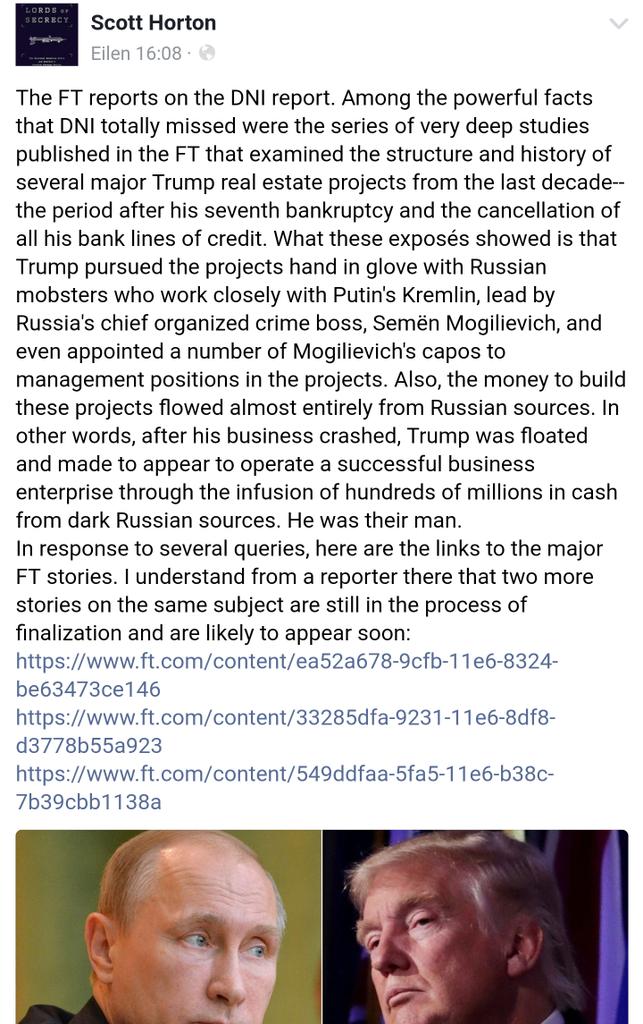
Among the powerful facts that DNI missed were a series of very deep studies published in the [Financial Times] that examined the structure and history of several major Trump real estate projects from the last decade—the period after his seventh bankruptcy and the cancellation of all his bank lines of credit. ...
The money to build these projects flowed almost entirely from Russian sources. In other words, after his business crashed, Trump was floated and made to appear to operate a successful business enterprise through the infusion of hundreds in millions of cash from dark Russian sources.
He was their man.
Yes, even that much seems fantastic, and the details include business agencies acting as a front for the GRU, billionaire mobsters, a vast network of propaganda sources, and an American candidate completely under the thumb of the Kremlin.
It reads like the a B-grade spy novel, a plot both too convoluted—and too bluntly obvious—for John le Carré. The problem is it may not be a conspiracy theory. It may be a conspiracy.
Horton’s analysis comes from piecing together information in three Financial Times “deep reports.” One of these focused on Sergei Millian, the head of the Russian American Chamber of Commerce in the US at the time of Trump Jr.’s “money pouring in from Russia” claim.
Mr Millian insists his Russian American Chamber of Commerce (RACC) has nothing to do with the Russian government. He says it is funded by payments from its commercial members alone.
Most of the board members are obscure entities and nearly half of their telephone numbers went unanswered when called by the Financial Times. An FT reporter found no trace of the Chamber of Commerce at the Wall Street address listed on its website.
Why was RACC’s background filled with so many holes? The Financial Times quotes former Russian MP Konstantin Borovoi in tagging the chamber as a front for intelligence operations that dates back to Soviet times.
“The chamber of commerce institutions are the visible part of the agent network . . . Russia has spent huge amounts of money on this.”
Millian helped arrange for Trump to visit Moscow in 2007, and had other outings with Trump in the states, including a visit to horse races in Miami. Millian claims that he had the right to market Trump properties in Russia.
“You could say I was their exclusive broker,” he told Ria. “Then, in 2007-2008, dozens of Russians bought apartments in Trump properties in the US.” He later told ABC television that the Trump Organisation had received “hundreds of millions of dollars” through deals with Russian businessmen.
Despite documents and photos showing Trump with Millian, Trump denied their association during the campaign.
Hope Hicks, Mr Trump’s campaign spokeswoman, said Mr Trump had “met and spoke” with Mr Millian only “on one occasion almost a decade ago at a hotel opening”.
The second *Financial Times* article puts Trump at the middle of a money laundering scheme, in which his real estate deals were used to hide not just an infusion of capital from Russia and former Soviet states, but to launder hundreds of millions looted by oligarchs. All Trump had to do was close his eyes to the source of the money, and suddenly empty apartments were going for top dollar.
Among the dozens of companies the Almaty lawyers say the Khrapunov laundering network used were three called Soho 3310, Soho 3311 and Soho 3203. Each was a limited liability company, meaning their ownership could easily be concealed.
The companies were created in April 2013 in New York. A week later, property records show, they paid a total of $3.1m to buy the apartments that corresponded with their names in the Trump Soho, a 46-storey luxury hotel-condominium completed in 2010 in a chic corner of Manhattan.
Why would Trump’s organization make such a good means of laundering funds? Because real estate has an arbitrary value. Is that apartment worth $1 million? Two million? Why not $3 million for a buyer who really wants it? When the whole transaction is just one LLC with undisclosed ownership paying another LLC with undisclosed ownership, it’s even neater than hiding the money in an offshore account. And while some businesses require due diligence in looking at the source of funds, real estate is a bit more … flexible.
The laws regulating US real estate deals are scant, experts say. Provisions against terrorism financing in the Patriot Act, passed in the aftermath of the September 11 2001 attacks, obliged mortgage lenders to conduct “know your customer” research. But money launderers pay in cash. Sales such as those of the Trump Soho apartments have passed through this loophole, which was partially closed only this year.
Converting funds stolen overseas into property in the US and cash in the account of an LLC represented a win for both the oligarchs and Trump. Best of all, Trump’s sole requirement was that he pay scant attention to the deal—something at which he was already a proven master. For example, the actual owners of the Trump Soho were anotherlimited liability company, Bayrock.Trump was a partner in the LLC and Bayrock cut the checks Trump received when those apartments were sold. And yet ...
In a 2011 deposition, given in a dispute over the Fort Lauderdale project, Mr Trump said he had “never really understood who owned Bayrock”.Jody Kriss, a former Bayrock finance director, has claimed in racketeering lawsuits against his former employer that Bayrock’s backers included “hidden interests in Russia and Kazakhstan”. Bayrock has denied Mr Kriss’s allegations but declined to answer questions about the source of its funds and its relationship with the Khrapunovs.
The third articledigs more deeply into the origins of Bayrock and its connection with Trump. That connection … was very close.
The Republican presidential nominee and Bayrock were both based in Trump Tower and they joined forces to pursue deals around the world — from New York, Florida, Arizona and Colorado in the US to Turkey, Poland, Russia and Ukraine. Their best-known collaboration — Trump SoHo, a 46-storey hotel-condominium completed in 2010 — was featured in Mr Trump’s NBC television show The Apprentice.
This is the same group about which Trump said he “never really understood” the ownership.
“I don’t know who owns Bayrock,” Mr Trump said. “I never really understood who owned Bayrock. I know they’re a developer that’s done quite a bit of work. But I don’t know how they have their ownership broken down.”
At the very least, Trump confessed to partnering with, taking money from, and acting as a representative for a corporation whose ownership he didn’t know, in deals that totaled hundreds of millions in countries around the world.However, it seems far more likely that Trump knowingly worked with oligarchs, groups associated with the Russian government, and plain old mobsters. Why? Because he was desperate.
By the 2000s, the property developer and casino owner with ready access to the capital markets and the biggest New York banks was no more. A series of corporate bankruptcies had limited his financing options. Mr Trump had become an entertainer who portrayed a tycoon on television and licensed his name to businesses looking for a brand, leading to fee-making opportunities as disparate as Trump University and Trump Vodka.
The Trump Organization was a hollow shell and Trump was bankrupt, but Donald Trump the public figure was a “successful businessman,” a screen behind which criminal activity could be carried out on a massive scale. Throwing his name at every scheme in existence wasn’t a strategy, it was a fire sale on Trump’s respectability. Steaks? Water? Vodka? Fake real estate school? You pony up the cash, and Trump will slap his name on it. Because by the early 2000s, Trump wasn’t just broke, he had nothing left to pawn. He wasn’t a successful businessman, but he still played one on TV. His image had more value than his real estate portfolio.
But the apartments and buildings where Trump held some degree of ownership could be turned into value again. All it took was partnering with foreign crime bosses looking for a place to stash their cash. To inflate the value of his portfolio, Trump had to do nothing other than look away as the dirty money poured in from one LLC to the next.Citizens in Russia, Kazakhstan, and other former Soviet states lost hundreds of millions, but Trump got a cut as looted funds flowed through offices and apartments in buildings that carried those critical gold letters.
Horton’s evaluation of this material in coordination with the declassified DNI report is that Trump actively worked with and for Russian interests.
What these exposes showed, is that Trump pursued the projects hand in glove with Russian mobsters who worked closely with Putin’s Kremlin ...
But based on the information in the Financial Times report, it appears that there are actually two possible answers. Trump may have been actively involved with and working for Russian sources. He might also have simply played the role of useful idiot, displaying his readiness to feign ignorance about any deal … so long as it generated some funds to float his sinking boat.
In the end, there’s not a lot of difference in the outcome. Trump got money. Oligarchs cleaned their cash. Russia got their man.
==
==
Trump Jr. Pushed ‘Blatantly Illegal’ Project In India, Former Official Says — ‘Trump, Inc.’ Podcast
by Eric Umansky, ProPublica , and Andrea Bernstein , WNYC
A Trump project in Mumbai had its permits revoked after investigators found “significant irregularities.” Then Trump Jr. travelled to India to get the decision overruled.
https://www.propublica.org/article/trump-inc-podcast-donald-trump-jr-india-project
propublica
==
==
omg why?
https://www.ecowatch.com/disappointing-backwards-step-critics-blast-u-s-exit-from-global-oil-gas-anti-corruption-effort-2505846330.html
==
omg why?
https://www.ecowatch.com/disappointing-backwards-step-critics-blast-u-s-exit-from-global-oil-gas-anti-corruption-effort-2505846330.html
...Bloomberg reported that the withdrawal comes after the American Petroleum Institute, Exxon Mobil Corp. and Chevron Corp. lobbied against a similar regulation compelling U.S. energy and mining companies to disclose those payments, which President Donald Trump rolled back earlier this year.
"It's pretty disgraceful for the United States," Jana Morgan, director of Publish What You Pay, a coalition that urges financial transparency in the extractive industry, told Bloomberg. "Chinese state-owned oil companies and Russian state-owned oil companies" are disclosing payments.
"So you literally have American companies that are less transparent than Russian and Chinese state-owned enterprises," she said.
Democrats also criticized the decision. The Hill reported that the U.S. joined the agreement in 2011 after a joint effort from Sen. Ben Cardin (D-Md.) and former Sen. Richard Lugar (R-Ind.)....
---
---
above i make distinction, but now coming to USA (norms must be codified b/c djt says no line anymore (//ta-n coates)
Expert sees risk of corruption in Trump foreign government deals
Sarah Chayes, author of "Thieves of State," talks with Rachel Maddow about the structure of corruption in some developing nations and why she sees a risk of that kind of corruption spreading to the United States under Donald Trump. Duration: 9:13
http://www.msnbc.com/rachel-maddow/watch/expert-sees-risk-of-corruption-in-trump-foreign-government-deals-1078287427951
---
Mossack Fonseca panama papers
--
http://www.ecowatch.com/pulitzer-prize-storm-lake-times-2355740850.html
In addition, an international collaboration between McClatchy, the Miami Herald and the International Consortion of Investigative Journalists that resulted in the landmark Panama Papers investigation into offshore tax havens was awarded the prize for Explanatory Reporting.
The Guardian listed [no linl] the wide-ranging ramifications of the revelations contained in the Panama Papers:
Iceland's prime minister Sigmundur Davíð Gunnlaugsson wasforced to quit after it emerged that his family had sheltered cash offshore. There were demonstrations in Argentina and a small war in Azerbaijan, initiated—some believed—to distract from revelations concerning the president and his daughters.
In China, censors blocked the words "Panama Papers" and jammed the website of the Guardian. In Russia, aides to Vladimir Putin fumed about a western "spy" conspiracy after it emerged that Putin's oldest friend, the cellist Sergei Roldugin, had about $2bn flowing into a network of British Virgin Islands companies.
The founders of the Panamanian law firm, Jürgen Mossack and Ramón Fonseca, were arrested in February. They are currently in jail on suspicion of money laundering following a coordinated swoop by prosecutors across Latin America.
---
---
https://globalvoices.org/2016/01/01/for-s**outheast-asia-2015-was-a-year-of-corruption-scandals/**
Three issues grabbed the headlines in Southeast Asia in 2015, namely, the historic electoral defeat of the military-backed party in Myanmar, the Indonesian haze caused by forest fires, and the corruption scandals involving leaders of the ruling parties.
In Malaysia, the prime minister is accused of pocketing more than 600 million US dollars from anomalous bank transactions involving the country’s state-run investment firm. In Thailand, the junta which grabbed power in 2014 is facing allegation that it built a graft-ridden park. In Indonesia, the House speaker resigned his post after he was implicated in an extortion scandal. And in the Philippines, the vice president is hounded by plunder charges.
Malaysian Prime Minister Najib Abdul Razak admitted that he has 600 million dollars in his bank but denied that the funds came from state coffers. He claimed that a supporter from the Middle East donated the money for the election campaign of the ruling party. Many doubted his explanation and called for his resignation. The issue generated funny Internet memes mocking the prime minister while large protests were organized across the country.
The Wall Street Journal published an investigative piece on the questionable bank transfers involving the prime minister and 1MDB, the state-owned investment firm:
#1MDBMovies : Popcorn ready guys pic.twitter.com/jUh8yWhzWp
— Pemegang Kuali (@rzmil) July 8, 2015
In Thailand, the junta’s anti-corruption pledge became less credible after allegations surfaced that large kickbacks were demanded for the construction of the Rajabhakti Park in Prachuap Khiri Khan Province. The junta commissioned the construction of the park featuring seven giant statues of popular kings in honor of the monarchy. An army general acknowledged the anomaly which led to a formal investigation although government spokespersons denied that the park is overpriced. Last month, the junta ordered the indefinite closure of the park to prevent protesters from staging political actions in the area. Meanwhile, Facebook users who shared and liked infographics about the park scandal were charged for insulting the monarchy, a crime that can result to several years of incarceration.
View image on Twitter
View image on Twitter
Follow
Bangkok Post @BangkokPostNews
New inquiry into Rajabhakti Park http://bit.ly/1R3aLNb
2:38 AM - 24 Nov 2015
4 4 Retweets 1 1 like
This cartoon shows the junta leader preventing activists from holding a protest in the park
View image on Twitter
View image on Twitter
Follow
stephff cartoonist @stephffart
cartoon of the day : Rajabhakti Park corruption scandal
9:07 AM - 8 Dec 2015
2 2 Retweets 2 2 likes
In Indonesia, House Speaker Setya Novanto is accused of asking for a 20 percent stake in theFreeport mining worth 4 billion US dollars in exchange of a contract allowing the company to continue operating in the country. An audio recording between Novanto and Freeport executives was presented as evidence against the politician. Novanto admitted that he made the demand but insisted that he was only joking. He was being investigated for ethics violation when he stepped down as House speaker last December 16. Novanto’s behavior was widely condemned in Indonesia.
Novanto is no stranger to controversy. Last September, he was criticized for appearing at the political rally of United States presidential candidate Donald Trump
3 Sep 15
Yenni Kwok @yennikwok
Indonesia House Speaker Setya Novanto & Deputy House Speaker Fadli Zon attend Donald Trump's campaign rally in NYC https://twitter.com/apathoni/status/639578912171823104 …
Follow
Yenni Kwok @yennikwok
Donald Trump: Do they like me in Indonesia?
Setya Novanto: Yes, highly
Fadli Zon: [Trump]'s a friend of Indonesia http://www.businessinsider.com/heres-the-story-behind-the-end-of-donald-trumps-press-conference-2015-9 …
6:35 PM - 3 Sep 2015
Photo published for Here's the story behind the unexpected moment at the end of Donald Trump's press conference
Here's the story behind the unexpected moment at the end of Donald Trump's press conference
He has big fans in the Indonesian government.
businessinsider.com
6 6 Retweets 2 2 likes
In the Philippines, Vice President Jejomar Binay is facing several corruption charges in connection to alleged anomalous contracts he signed when he was still mayor of Makati City, the country’s financial center. Binay, one of the frontrunners in the 2016 presidential election, described the corruption cases as politically-motivated. He questioned the string of cases filed against him, which he said was made to disqualify him as a candidate in the election.
Here's one of the many Internet memes alluding to Vice President Binay's corruption cases:
View image on Twitter
View image on Twitter
Follow
Caste @castewyo_rene
Down with corruption…..down Binay
6:41 PM - 7 Aug 2015
Retweets likes
2015 will be remembered as the year when Myanmar voted for change. But elsewhere in the Southeast Asian region, it’s politics as usual for politicians who are accused of abusing their power for personal gain.
==
dodd- frankprovision to acc't for oil? it? $
white SEC
Finish 1504
make sure the Securities and Exchange Commission finishes the job to make Big Oil publish what they pay and put an end to secret deals.
---
http://www.c-span.org/video/?406808-5/open-phones-sarah-chayes
seb junger pal/recs
https://www.amazon.com/Thieves-State-Corruption-Threatens-Security/dp/0393239462
Thieves of State: Why Corruption Threatens Global Security 1st Edition
by Sarah Chayes
===
America's Descent into a Third-World-Style Kleptocracy
By Rebecca Gordon [1] / TomDispatch [2]
November 24, 2015
A top government official with energy industry [4] holdings huddles [5] in secret with oil company executives to work out the details of a potentially lucrative “national energy policy.” Later, that same official steers billions [6] of government dollars to his former oil-field services company. Well-paid elected representatives act with impunity, routinely trading [7]government contracts and other favors for millions of dollars. Meanwhile, ordinary citizens live in fear of venal police forces [8] that suck them dry by charging fees [9] for services,throwing [10] them in jail when they can’t pay arbitrary fines or selling [11] their court “debts” to private companies. Sometimes the police just take people’s life savings [12] leaving them with no recourse whatsoever. Sometimes they steal and deal [13] drugs on the side. Meanwhile, the country’s infrastructure crumbles. Bridges collapse [14], or take a quarter-century [15] to fix after a natural disaster, or (despite millions spent) turn out not to be fixed [16] at all. Many citizens regard their government at all levels with a weary combination of cynicism and contempt. Fundamentalist groups respond by calling for a return to religious values and the imposition [17] of religious law.
What country is this? Could it be Nigeria or some other kleptocratic [18] developing state? Or post-invasion Afghanistan where Ahmed Wali Karzai, CIA asset and brother of the U.S.-installed president Hamid Karzai, made many millions [19] on the opium trade (which the U.S. was ostensibly trying to suppress), while his brother Mahmoud raked in millions more [20] from the fraud-ridden Bank of Kabul? Or could it be Mexico, where the actions of both the government and drug cartels have created [21] perhaps the world’s first narco-terrorist state?
In fact, everything in this list happened (and much of it is still happening) in the United States, the world leader -- or so we like to think -- in clean government. These days, however, according to the Corruption Perception Index of Transparency International (TI), our country comes in only 17th [22] in the least-corrupt sweepstakes, trailing European and Scandinavian countries as well as Canada, Australia, and New Zealand. In fact, TI considers us on a par with Caribbean island nations like Barbados and the Bahamas. In the U.S., TI says [23], “from fraud and embezzlement charges to the failure to uphold ethical standards, there are multiple cases of corruption at the federal, state and local level.”
And here’s a reasonable bet: it’s not going to get better any time soon and it could get a lot worse. When it comes to the growth of American corruption, one of TI’s key concerns[24] is the how the Supreme Court’s 2010 Citizens United decision [25] opened the pay-to-play floodgates of the political system, allowing Super PACs to pour billions of private and corporate money into it, sometimes in complete secrecy [26]. Citizens Unitedundammed the wealth of the super-rich and their enablers, allowing big donors like casino capitalist -- a description that couldn’t be more literal -- Sheldon Adelson to use [27] their millions to influence government policy.
Kleptocracy USA?
Every now and then, a book changes the way you see the world. It’s like shaking a kaleidoscope and suddenly all the bits and pieces fall into a new pattern. Sarah Chayes’sThieves of State: Why Corruption Threatens Global Security [28] shook my kaleidoscope. Chayes traveled to Afghanistan in 2001 as a reporter for NPR. Moved by the land and people, she soon gave up reporting to devote herself to working with non-governmental organizations helping “Afghans rebuild their shattered but extraordinary country.”
In the process, she came to understand the central role government corruption plays in the collapse of nations and the rise of fundamentalist organizations like the Taliban, al-Qaeda, and the Islamic State. She also discovered just how unable (and often unwilling) American military and civilian officials were to put a stop to the thievery [29] that characterized Afghanistan’s government [30] at every level -- from the skimming [31] of billions in reconstruction funds at the top to the daily drumbeat of demands for bribes and “fees” from ordinary citizens seeking any kind of government service further down the chain of organized corruption. In general, writes Chayes, kleptocratic countries operate very much as pyramid schemes, with people at one level paying those at the next for the privilege of extracting money from those below.
Chayes suggests that “acute government corruption” may be a major factor “at the root” of the violent extremism now spreading across the Greater Middle East and Africa. When government robs ordinary people blind, in what she calls a “vertically integrated criminal enterprise,” the victims tend to look for justice elsewhere. When officials treat the law with criminal contempt, or when the law explicitly permits government extortion, they turn to what seem like uncorrupted systems of reprisal and redemption outside those laws. Increasingly, they look to God or God’s laws and, of course, to God’s self-proclaimed representatives. The result can be dangerously violent explosions of anger and retribution. Eruptions can take the form of the Puritan iconoclasm [32] that rocked Catholic Europe in the sixteenth century or present-day attempts by the Taliban or the Islamic State to implement a harsh, even vindictive version of Islamic Sharia law, while attacking “unbelievers” in the territory they control.
Reading Thieves of State, it didn’t take long for my mind to wander from Kabul to Washington, from a place where American-funded corruption was an open secret [33] to a place where few would think it applicable. Why was it, I began to wonder, that in our country “corruption” never came up in relation to bankers the government allowed to sell mortgages to people who couldn’t repay them, then slicing and dicing their debt into investment “securities” that brought on the worst recession since the 1930s? (Neil Barofsky, who took on the thankless role of inspector general for the Troubled Asset Relief Fund, tells the grim tale of how the government was “captured by the banks” in his 2012 bookBailout [34].)
Chayes made me wander ever deeper into the recent history of Washington's wheeling and dealing, including, for instance, the story of the National Energy Policy Development Group, which Vice President Dick Cheney convened in the first weeks of George W. Bush’s presidency. Its charge was to develop a national energy policy for the country and its deliberations -- attended [5] by top executives of all the major oil companies (some of whom then denied [5] before Congress that they had been present) -- were held in complete secrecy. Cheney even refused to surrender the list of attendees when the Government Accountability Office sued him, a suit eventually dropped after Congress cut that agency’s budget. If the goal was to create a policy that would suit the oil companies, Cheney was the perfect man to chair the enterprise.
In 2001, having suggested [35] himself as the only reasonable running mate for Bush, Cheney left his post as CEO at oilfield services corporation Halliburton. “Big changes are coming to Washington,” he told [35] ABC News, “and I want to be a part of them.” And so he was, including launching a disastrous war on Iraq, foreseen and planned for in those energy policy meetings. Indeed, documents shaken loose in a Freedom of Information Act suit brought by Judicial Watch and the Sierra Club showed that in March 2001 -- months before the 9/11 attacks -- energy task force members were already salivating [36] over taking possession of those Iraqi oil fields. Nor did Cheney forget his friends at Halliburton. Their spin-off company, KBR, would receive [37] a better-than-1,000-to-1 return on their investment in the vice president (who’d gotten a $34 million [4] severance package from them), reaping $39.5 billion in government contracts in Iraq. And yet when did anyone mention “corruption” in connection with any of this?
Chayes’s book made me think in a new way about the long-term effects of the revolving door [38] between the Capitol -- supposedly occupied by the people’s representatives -- and the K Street suites of Washington’s myriad lobbyists. It also brought to mind all those former members of Congress [39], generals [40], and national security state officials who parachute directly out of government service and onto the boards of defense-oriented companies or into cushy consultancies [41] catering to that same security state.
It also made me think in a new way about the ever-lower turnouts [42] for our elections. There are good reasons why so many Americans -- especially those living in poverty and in communities of color -- don’t vote. It’s not that they don’t know their forebears died [43] for that right. It’s not that they don’t object when their votes are suppressed [44]. It’s that, like many other Americans, they clearly believe their government to be so corrupt that voting is pointless.
Are We in Ferguson -- or Kabul?
What surprises me most, however, isn’t the corruption at the top, but the ways in which lives at the bottom are affected by it. Reading Thieves of Stateset me thinking about how regularly money in this country now flows from the bottom up that pyramid. If you head down, you no longer find yourself on Main Street, U.S.A., but in a place that seems uncomfortably like Kabul; in other words, a Ponzi-scheme world of the first order.
Consider, for instance, the Justice Department’s 2015 report [45] on the police in Ferguson, Missouri, about whom we’ve learned so much since Michael Brown, an unarmed black teenager, was shot [46] to death on August 9, 2014. As it happens, the dangers for Ferguson’s residents hardly ended with police misconduct. “Ferguson’s law enforcement practices are shaped by the city’s focus on revenue rather than by public safety needs,” Justice Department investigators found:
“This emphasis on revenue has compromised the institutional character of Ferguson’s police department, contributing to a pattern of unconstitutional policing, and has also shaped its municipal court, leading to procedures that raise due process concerns and inflict unnecessary harm on members of the Ferguson community.”
The report then recounted in excruciating detail the extent to which the police were a plague on the city’s largely black population. Ferguson was -- make no mistake about it -- distinctly Kabul, U.S.A. The police, for instance, regularly accosted residents for what might be termed “sitting in a car while Black,” and then charged them with bogus “crimes” like failing to wear a seat belt in a parked car or “making a false declaration” that, say, one’s name was “Mike,” not “Michael.” While these arrests didn’t make money directly for the police force, officers interested in promotion were told to keep in mind that their tally of “self-initiated activities” (tickets and traffic stops) would have a significant effect on their future success on the force. Meanwhile, those charged often lost their jobs and livelihoods amid a welter of court appearances.
Ferguson’s municipal court played its own grim role in this ugly scheme. As Justice Department investigators discovered, it did not “act as a neutral arbiter of the law or a check on unlawful police conduct.” Instead, it used its judicial authority “as the means to compel the payment of fines and fees that advance[d] the city’s financial interests.”
By issuing repeated arrest warrants when people missed court appearances or were unable to pay fines, it managed to regularly pile one fine on top of another and then often refused to accept partial payments for the sums owed. Under Missouri state law, moving traffic violations, for instance, automatically required the temporary suspension of a driver’s license. Ferguson residents couldn’t get their licenses back until -- you guessed it -- they paid their fines in full, often for charges that were manufactured in the first place.
As if in Kabul, people then had to weigh the risk of driving license-less (and getting arrested) against losing their jobs or -- without a car -- not making it to court. With no community service option available, many found themselves spending time in jail. From the police to the courts to city hall, what had been organized was, in short, an everyday money-raising racket of the first order.
And all of this was linked to the police department, which actually ran the municipal court. As the Justice Department report put it, that court “operates as part of the police department... is supervised by the Ferguson chief of police, is considered part of the police department for city organizational purposes, and is physically located within the police station. Court staff report directly to the chief of police.” He, in turn, ran the show, doing everything from collecting fines to determining bail amounts.
The Harvard Law Review reported [11] that, in 2013, Ferguson had a population of 22,000. That same year, “its municipal court issued 32,975 arrest warrants for nonviolent offenses,” or almost one-and-a-half arrests per inhabitant. The report continued:
“In Ferguson, residents who fall behind on fines and don’t appear in court after a warrant is issued for their arrest (or arrive in court after the courtroom doors close, which often happens just five minutes after the session is set to start for the day) are charged an additional $120 to $130 fine, along with a $50 fee for a new arrest warrant and 56 cents for each mile that police drive to serve it. Once arrested, everyone who can’t pay their fines or post bail (which is usually set to equal the amount of their total debt) is imprisoned until the next court session (which happens three days a month). Anyone who is imprisoned is charged $30 to $60 a night by the jail.”
Whether in Kabul or Ferguson, this kind of daily oppression wears people down. It’s no surprise that long before the police shot Michael Brown, the citizens of Ferguson had little trust or respect for them.
Privatizing Official Corruption
But might Ferguson not have been an outlier, a unique Kabul-in-America case of a rogue city government bent on extracting every penny from its poorest residents? Consider, then, the town of Pagedale [47], Missouri, which came up with a hardly less kleptocratic way of squeezing money out of its citizens. Instead of focusing on driving and parking, Pagedale routinely hit [47] homeowners with fines for “offenses” like failing to have blinds and “matching curtains” on their windows or “unsightly lawns.” Pagedale is a small town, with 3,300 residents. In 2013, the city’s general revenues totaled $2 million, 17% percent from such fines and fees.
Might such kleptocratic local revenue-extraction systems, however, be limited to just one Midwestern state? Consider then the cozy relationship that Augusta, capital of Georgia, has with Sentinel Offender Services, LLC [48]. That company makes electronic monitoring equipment used by state and local government agencies, ranging from the Los Angeles County Probation Department to the Massachusetts Office of the Commissioner of Probation. Its website touts the benefits to municipalities of what it calls “offender-funded programs” in which the person on probation pays the company directly for his or her own monitoring, saving the courts the cost of administering a probation system. In return, the company sets its own fees at whatever level it chooses. “By individually assessing each participant a fee based on income,” says Sentinel, “our sliding-fee scale approach has shifted the financial burden to the participant, allowing program growth and size to be a function of correctional need rather than budget availability.”
“Profiting from Probation,” a 2014 Human Rights Watch report [49], offers a typical tale of an Augusta resident named Michael Barrett. Arrested for shoplifting a can of beer, he entered a local court system that was focused on revenue extraction via a kind of official extortion, which is the definition of corruption. Even to step into a courtroom to deal with his “case,” he had to hand over an $80 fee for a court-appointed defense lawyer. Then, convicted, he would be sentenced to a $200 fine and probation. Because the charge was “alcohol-related,” the court required Barrett to wear an electronic bracelet that would monitor his alcohol consumption, even though his sentence placed no restrictions on his drinking. For that Sentinel bracelet, there was a $50 startup fee, a $39 monthly “service” charge, and a $12 “daily usage” fee. In total, he was forced to pay about $400 a month to monitor something he was legally allowed to do. Since Barrett couldn’t even pay the startup fee, he was promptly thrown in jail for a month until a friend lent him the money.
Such systems of privatized “justice” that bleed the poor are now spreading across the U.S., a country officially without debtor’s prisons. According to the Harvard Law Reviewarticle, some cities charge a “fee” to everyone they arrest, whether or not they’re ever convicted of an offense. In Washington, D.C., on the other hand, for “certain traffic [50] and a number of lower level criminal offenses,” you can simply pay your arresting officer “to end a case on the spot,” avoiding lengthy and expensive court costs. Other jurisdictions charge people who are arrested for the costs of police investigations, prosecution, public defender services, a jury trial (“sometimes with different fees depending on how many jurors a defendant requests”), and incarceration.
Watch Your Ass(ets)
Even Machiavelli, who counseled princes seizing new territory to commit all their crimes at once because human beings have such short memories, warned that people will accept pretty much any kind of oppression unless “you prey on the possessions or the women of your subjects.” So many centuries later, while we women now tend to believe we belong to ourselves, civil asset forfeiture [51] is still a part of American life. Unlike criminal asset forfeiture, which permits the government to seize a person’s assets after conviction of a crime, civil forfeiture allows local, state, or federal law enforcement to seize and keep someone’s money or other property even if he or she is never charged. If, say, you are suspected of involvement with drugs or terrorism, the police can seize all the money you have on you on thespot, even if they don’t arrest you -- and you have to go to court to get it back.
Federal asset forfeiture collections have risen from around $800 million in 2002 to almost $4.5 billion in 2014, according [51] to the Institute for Justice (IJ). Governments defend the practice as a means of preventing suspected criminals -- especially high-level drug dealers -- from using their money to commit more crimes. But all too often, it’s poor people whose money is “forfeited,” even when they've committed no crime. The Pennsylvania ACLU reported [52] that police take around a million dollars from Philadelphians each year in 6,000 separate cases -- and not from drug lords either. More than half the cases involve seizures of less than $192, and in a city that’s only 43% black, 71% of those seizures from people charged with no crimes come from African Americans. If your property is seized, you can try to go to court to get it back but, says the ACLU [53], you should expect to make an average of four court appearances. Most people just give up.
Reading Thieves of Statereminded me that we’re not living in the country many of us imagine, but in something like an American klepto-state. Corruption, it turns out, doesn’t just devour the lives of people in far-off nations. Right now, it’s busy shoving what’s left of our own democracy down our throats.
Chayes documents how such corruption can lead to violent explosions in other countries. Indeed, it was a final kleptocratic insult -- a police woman’s slap in the face after he refused to pay a bribe to retrieve his confiscated vegetable cart -- that led Tunisian Mohamed Bouazizi [54] to burn himself to death and touch off the Arab Spring. As Machiavelli wrote so long ago, people will put up with a lot -- torture [55], mass surveillance [56], even a car full of clowns [57] masquerading as candidates for president -- but they don’t like being robbed by their own government. Sooner or later, they will rebel. Let’s hope, when that happens, that we don’t end up under the rule of our own American Taliban [58] or some billionaire reality TV star.
Rebecca Gordon is the author of Mainstreaming Torture: Ethical Approaches in the Post-9/11 United States [59]. She teaches in the philosophy department at the University of San Fran
---
*Source URL: http://www.alternet.org/news-amp-politics/americas-descent-third-world-style-kleptocracy*
*Links:
[1] http://www.alternet.org/authors/rebecca-gordon
[2] http://www.tomdispatch.com/
[3] http://tomdispatch.us2.list-manage.com/subscribe?u=6cb39ff0b1f670c349f828c73&id=1e41682ade
[4] http://www.politifact.com/truth-o-meter/statements/2010/may/24/chris-matthews/chris-matthews-says-cheney-got-34-million-payday-h/
[5] http://www.washingtonpost.com/wp-dyn/content/article/2005/11/15/AR2005111501842_pf.html
[6] http://www.businessinsider.com/halliburton-company-got-395billion-iraq-2013-3
[7] http://www.citizensforethics.org/policy/entry/earmark-reform
[8] https://www.washingtonpost.com/news/wonk/wp/2015/11/10/report-in-lean-times-police-start-taking-a-lot-more-stuff-from-people/
[9] http://www.policechiefmagazine.org/magazine/index.cfm?fuseaction=print_display&article_id=2108&issue_id=62010
[10] http://www.npr.org/sections/codeswitch/2015/02/09/384968360/jail-time-for-unpaid-court-fines-and-fees-can-create-cycle-of-poverty
[11] http://harvardlawreview.org/2015/04/policing-and-profit/
[12] http://ij.org/report/policing-for-profit/introduction/
[13] http://www.alternet.org/drugs/5-outrageous-cases-drug-war-police-corruption-week
[14] https://en.wikipedia.org/wiki/I-35W_Mississippi_River_bridge
[15] https://en.wikipedia.org/wiki/Eastern_span_replacement_of_the_San_Francisco%E2%80%93Oakland_Bay_Bridge
[16] http://www.sfgate.com/bayarea/article/Plague-of-problems-puts-Bay-Bridge-seismic-safety-6253577.php
[17] http://www.politicususa.com/2015/02/25/57-republicans-dismantle-constitution-christianity-national-religion.html
[18] http://www.aljazeera.com/indepth/features/2014/03/revealing-tunisia-corruption-under-ben-ali-201432785825560542.html
[19] http://www.nytimes.com/2009/10/28/world/asia/28intel.html
[20] http://www.reuters.com/article/2014/11/11/us-afghanistan-bank-idUSKCN0IV1X020141111
[21] http://www.tomdispatch.com/blog/175971/tomgram%3A_rebecca_gordon,_it_didn%27t_work_in_afghanistan,_so_let%27s_do_it_in_mexico
[22] https://www.transparency.org/cpi2014/results
[23] http://www.transparency.org/country#USA
[24] https://www.transparency.org/country/#USA_Overview
[25] https://www.law.cornell.edu/supct/html/08-205.ZS.html
[26] http://www.acslaw.org/acsblog/citizens-united%E2%80%99s-biggest-surprise-the-collapse-of-disclosure
[27] http://talkingpointsmemo.com/cafe/iran-deal-big-donors-citizens-united
[28] http://www.amazon.com/dp/0393352285/ref=nosim/?tag=tomdispatch-20
[29] http://www.tomdispatch.com/post/176068/tomgram%3A_engelhardt%2C_roads_to_nowhere%2C_ghost_soldiers%2C_and_a_%2443_million_gas_station_in_afghanistan/
[30] https://www.americanprogress.org/issues/security/report/2015/03/17/108613/tackling-corruption-in-afghanistan-its-now-or-never/
[31] http://www.voanews.com/content/bribes-in-afghanistan-last-year-reached-almost-four-billion-dollars/1599111.html
[32] https://en.wikipedia.org/wiki/Iconoclasm#Protestant_Reformation
[33] http://www.tomdispatch.com/post/176068/tomgram%3A_engelhardt,_roads_to_nowhere,_ghost_soldiers,_and_a_$43_million_gas_station_in_afghanistan/
[34] http://www.amazon.com/dp/1451684959/ref=nosim/?tag=tomdispatch-20
[35] http://abcnews.go.com/US/story?id=96384&page=1
[36] http://www.projectcensored.org/8-secrets-of-cheneys-energy-task-force-come-to-light/
[37] http://www.ibtimes.com/winner-most-iraq-war-contracts-kbr-395-billion-decade-1135905
[38] http://www.opensecrets.org/revolving/
[39] https://www.opensecrets.org/revolving/top.php?display=Z
[40] http://www.duffelblog.com/2013/02/general-worried-about-finding-job-as-lobbyist-defense-consultant-after-retirement/
[41] http://www.thefiscaltimes.com/Articles/2013/06/05/DOD-Retirees-From-4-star-General-to-7-Figure-Income
[42] http://www.nytimes.com/2014/11/12/opinion/the-worst-voter-turnout-in-72-years.html
[43] https://www.splcenter.org/what-we-do/civil-rights-memorial/civil-rights-martyrs
[44] https://www.aclu.org/map/battle-protect-ballot-voter-suppression-measures-passed-2013
[45] http://www.justice.gov/sites/default/files/opa/press-releases/attachments/2015/03/04/ferguson_police_department_report.pdf
[46] http://www.nytimes.com/interactive/2014/08/13/us/ferguson-missouri-town-under-siege-after-police-shooting.html?_r=0
[47] http://www.nytimes.com/2015/11/05/us/lawsuit-accuses-missouri-city-of-fining-homeowners-to-raise-revenue.html?emc=edit_th_20151105&nl=todaysheadlines&nlid=65427895
[48] http://www.sentrak.com/faqs/
[49] http://perma.cc/K6WC-T2XT
[50] http://www.dccourts.gov/internet/public/aud_criminal/handlearrest.jsf
[51] http://ij.org/report/policing-for-profit/introduction/#citation_32
[52] https://www.aclu.org/news/new-aclu-report-shows-philadelphia-da-seizes-1-million-cash-annually-innocent-philadelphians
[53] http://www.aclupa.org/files/1814/4526/3118/Broken_Justice_-_Montgomery_County_final.pdf
[54] https://en.wikipedia.org/wiki/Mohamed_Bouazizi
[55] http://www.nytimes.com/interactive/2014/12/09/world/cia-torture-report-document.html
[56] http://www.theguardian.com/world/interactive/2013/nov/01/snowden-nsa-files-surveillance-revelations-decoded#section/1
[57] http://www.rollingstone.com/politics/news/inside-the-gop-clown-car-20150812
[58] http://www.salon.com/2014/07/03/we_are_a_corporate_theocracy_now_the_christian_right_seeks_cultural_and_political_domination/
[59] http://www.amazon.com/dp/0199336431/ref=nosim/?tag=tomdispatch-20
[60] mailto:corrections@alternet.org?Subject=Typo on America's Descent into a Third-World-Style Kleptocracy
[61] http://www.alternet.org/
[62] http://www.alternet.org/%2Bnew_src%2B*
==
Mauritania 103 84
Nepal 104 94
Pakistan 104 109
Honduras 104 109
Togo 104 112
The Gambia 104 131
Azerbaijan 104 135
Kazakhstan 104 136
Nicaragua 111 91
Madagascar 111 109
Russia 113 131
Nigeria 114 91
Lebanon 114 94
Cameroon 114 115
Kyrgyzstan 114 115
Iran 114 143
Uganda 119 104
Ukraine 119 113
Papua New Guinea 121 54
Bangladesh 121 100
Kenya 121 104
Guinea 121 115
Laos 121 140
Central African Republic 126 127
Paraguay 126 72
Tajikistan 128 138
Congo, Republic of 128 107
Chad 130 127
Congo 130 136
Cambodia 132 120
Myanmar 132 124
Zimbabwe 132 126
Burundi 135 131
Syria 135 144
Haiti 137 102
Guinea-Bissau 137 121
Angola 137 125
Yemen 137 138
Venezuela 137 140
Libya 142 118
Eritrea 142 147
Uzbekistan 142 148
Turkmenistan 145 149
Iraq 146 127
Afghanistan 147 131
Sudan 148 145
Somalia 149 146
North Korea 149 150
==
==
nam tries to quash transparency laws
*terra verde 6/6/14 http://www.kpfa.org/archive/show/45*
oil co's africa coltan FEC? global witness, 1504 dodd frank
resources watch ; co's pay for dodged tax in billions? US even? karina
http://www.earthrights.org/
[http://www.earthrights.org/ EarthRights International] (ERI) is a nongovernmental, nonprofit organization that combines the power of law and the power of people in defense of human rights and the environment, which we define as "earth rights." We specialize in fact-finding, legal actions against perpetrators of earth rights abuses, training grassroots and community leaders, and advocacy campaigns. Anti-corrpution, [http://www.earthrights.org/campaigns/true-cost-chevron-network True Cost of Chevron].
===
Arctic specialHow oil and corruption have become so closely linked
Eifion Rees
As a new oil-fever gathers pace in Arctic countries such as Greenland the lesson from history is that where there is oil, corruption will quickly follow.
...
Rumours that a deeper, darker ocean flows beneath the cold coastal waters of Greenland have triggered a scramble to drill for oil off the world’s largest island.
And if prospectors hit pay dirt – a potential 52 billion barrels of oil equivalent – then it won’t be virgin white pack ice and a pristine marine environment alone that risk becoming sullied. Reputations, business deals and politicians may be tarred and sticky too.
Because where oil is found then history tells us that corruption will follow.
Transparency International’s Corruptions Perceptions Index 2010highlights the connection: Russia, the world’s largest producer and second largest exporter of oil, ranks 154 out of 178 countries for corruption. Its low standing spells trouble for the Russian Arctic, where oil-fever is increasing as sea ice recedes. In August, state oil company Rosneft signed a £1.9 billion deal with ExxonMobil to drill for 40 billion barrels under the South Kara Sea.
Meanwhile Mikhail Khodorkovsky, formerly head of Russian oil company Yukos languishes in jail on charges of fraud that many believe are politically motivated – Yukos is now part of Rosneft – and this week a high court battle begins between another two oil-rich oligarchs. Boris Berezovsky claims he was intimidated by Roman Abramovich into selling his shares in the oil company Sibneft for a knock-down price. Berezovsky fled Russia in 2000 after falling out with Vladimir Putin. Russia’s powerful president is also alleged to be Europe’s richest man.
Greenland does not yet feature on the corruption index – which has Iran and pre-war Libya (fourth and 17th largest oil producers in the world) tied at 146 and Iraq and Afghanistan at 175 and 176 respectively – but that will change if oil is found. Its ability to spread and taint is already well documented elsewhere in the world.
Nigeria, Venezuela and Ecuador...
Last month a report revealed the extent of damage wrought to Nigeria’s Niger Delta by 50 years of oil drilling by Shell. A succession of governments effectively relied on the company to police itself and clean up spills. Almost 80 per cent of Nigeria’s revenue comes from oil and gas, which has earned Africa’s largest oil producer an estimated $600 billion since the 1960s. Approximately 70 per cent of its people live below the poverty line.
In 2009, Shell paid £9.6m to settle a legal action accusing it of complicity in the execution in 1995 of nine Ogoni tribal leaders including playwright Ken Saro-Wiwa, who were campaigning to stop the destruction of their environment. The settlement meant it did not have to answer charges of colluding with the military dictatorship of the time to clamp down on protests and had whole army units in its pay.
A confidential 2009 cable published by Wikileaks last year also found Shell boasting that it had company spies in ‘all the relevant ministries’ of Nigeria’s government.
Huge environmental and social harm has been wrought in South America too, as governments and corporations link up to exploit vast oil reserves. When oil was discovered in Venezuela at the start of the last century, corruption worsened drastically. The world’s 11th largest producer and exporter of oil is now ranked 164th in the world for corruption.
In Ecuador it is an oil company alleging dirty dealings. Chevron-Texaco was sole operator in the country from 1964 to 1990, causing massive contamination of land and damage to human health. In February, an Ecuadorian court fined it £5.3 billion and ordered it to pay £600 million in compensation.
The US firm had initially requested the trial be held in Ecuador but has since branded its justice system corrupt and vowed to fight the charges ‘until hell freezes over’. America was the victim following the Deepwater Horizon oil spill in the Gulf of Mexico in 2010. Compare the relative alacrity of BP’s response to that particular disaster.
The world’s largest oil reserves are controlled by national oil companies (NOCs), which – as a March 2011 report into the policies of the 44 companies that control 60 per cent of the world’s oil companies makes clear – are among the least open in terms of anti-corruption programmes. For these countries, oil and the national interest are inextricably intertwined; some may be run by corrupt leaders or dictators, but a world addicted to oil still needs to access their reserves. As a result it often becomes politically expedient to look the other way.
Tony Blair shook hands with Colonel Gaddafi in 2004 to facilitate a £550m Shell deal for exploration rights in Libya, for example – to the outrage of families of the victims of the Lockerbie bombing. Oil companies from across the world are now scrambling to return to post-Gaddafi Libya, including British firm BP and French firm Total, the two countries most supportive of the colonel’s ousting.
‘All too often corruption and lack of government accountability mean the citizens of oil-rich countries remain poor while powerful elites cash in,’ says Oliver Courtney of Global Witness, which has recently released a report on corruption in Liberia’s oil sector. ‘Companies don’t have to declare what they pay foreign governments for access to oil and governments don’t have to make the contracts public. If they don’t know what deal has been done, citizens can’t tell if it’s fair or sustainable. Too often, it’s neither.’
A new hope for transparency
One positive move towards more transparency came earlier this month, as the US joined the Extractive Industries Transparency Initiative (EITI) and also proposed legislation that would force new firms to reveal their ultimate owners to prevent foreign politicians squirreling away stolen wealth in stateside ‘shell’ companies.
EITI signatories must ensure that oil, gas and mining interests – public and private – openly declare what they pay to government in order to prevent revenues being pocketed by corrupt officials. But compliance won’t prevent questionable oil deals being brokered: with no internationally recognised government since a coup in 2009, EITI ‘candidate country’ Madagascar recently offered up its tar sands to Total for the extraction of billions of barrels of oil.
Nigeria was designated EITI compliant this year, a country in which in 2005 were identified ‘unprecedented financial discrepancies, mispaid tax and system inefficiencies. Over $800m of unresolved differences between what companies said they paid in taxes, royalties and signature bonuses, and what the governments said it received were identified.’ Transparency International still ranks Nigeria 134th out of 178 countries for corruption.
As with wider environmental issues there is a notable lack of leadership from other countries. Only 35 countries have signed up to EITI; non-signatories include Canada and the UK, both of which are held up by emerging energy powerhouses such as Brazil and India as reasons not to join themselves. It remains to be seen what difference, if any, the new US position will make.
In the meantime the rumoured sea of oil off Greenland remains elusive. The firm with drilling rights, Edinburgh-based Cairn Energy, has two more test wells to sink this year, but the signs are not promising. It may yet strike it lucky, however, in which case Greenland will be making its debut on the corruption index in the very near future.