African Am 2 bak
maybe a bit neglected, but tag being used, and issues eg PIC
pattern of sellouts: cf also hispanic CoC
new tag AfrAm 3/17
see renta-tom
see DEI BS
see inequality redline voodoo tax cut 2017
see gerry eg N caro
see voter fraud suppression integrity
DISENFRANCHISE FELONS
related: GOP trying to shake off image as racist, so will recruit and retain tokens, and will create fronts
some bad code on main 4 22
capt 817 419
===
YT? MSNBC ON AA FIRED/ CHARGED DOJ 5 26
LIBR OF CONGRESS....// WOODROW WILSON
VRA GUTTED SCOTUS DEI DOGE WITCHHUNT SCHED F UNIVERSITIES
KAVANAUGH STOPS
---
-=-=
-=-=
an 8 26
President Donald Trump won North Carolina three times, yet as Democrats seem poised to take the state's Senate seat in the upcoming midterm election, Republicans are going to great lengths to cling to power — including by limiting voting opportunity for North Carolina's African American community.
"North Carolina’s state board of elections once again refused to provide an accessible early voting location at North Carolina A&T State University, the nation’s largest historically Black college or university," reported Democracy Docket's Natalie Hausmann on Thursday. "With student activists in the front row, the GOP-controlled board rejected student pleas for an on-campus polling place in November’s general election during a Thursday vote."
Hausmann added, "Earlier this year, the board voted along party lines to deny students a voting site on their campus. Brian Kennedy of Democracy North Carolina told Democracy Docket at the time that the vote served as a 'blueprint for what voter suppression across the nation can look like.' Now, it’s happened all over again."
The students were allowed to attend the meeting in which the decision was announced, even though that choice was ultimately made against them. In addition to making it more difficult for African Americans to vote in a state with a long history of segregation and other forms of racial discrimination, the decision is controversial because it specifically targets a voting practice that is disproportionately popular among African American communities.
"The denial followed a series of election board votes to curtail Sunday voting – popular among black voters – across several counties," Hausmann wrote. She went on to quote one of the Democrats on the state board who outright claimed the decision could have been racially motivated.
"Jeff Carmon, one of two Democrats on the state board, said some GOP county plans had 'racial undertones,'" Hausmann reported. "'Can we identify a single voter who is better served by having fewer opportunities to cast a ballot?' Carmon asked at the start of the meeting."
-=-=
-=-=
an 5 26
Fox News was broadcasting immediately as the FBI conducted a raid on the office of Virginia state Sen. Louise Lucas, a Democrat, and progressive foe of President Donald Trump.
Trump has spent the past several months using his Justice Department to target his political enemies after his former attorney general failed to secure indictments of them.
Lucas has been a thorn in the digital side of Trump for the past few years, relentlessly trolling him and Sen. Ted Cruz (R-Texas) on X.
There is currently no information on how the FBI obtained a warrant to raid Lucas' office, however, WJLA News cited sources saying it might be related to a corruption probe. The warrants were approved by a federal judge.
Bulwark reporter Sam Stein questioned how Fox News happened to be on hand just as the FBI acted.
"I will say. Some pretty remarkable instincts by Fox News to have its London correspondent placed in Portsmouth, Virginia right in time for the FBI raid of Louise Lucas," wrote Stein.
According to Fox's reporting, it wasn't merely Lucas, there were many people taken into custody during the raid "as agents move through the area."
WJLA News reported that federal agents are also serving a warrant at a cannabis dispensary nearby.
Former FBI Director James Comey was indicted about a year after he posted a photo of shells on the beach spelling out 8647.
"She told Fox News that she had no idea what the FBI agents were doing at her office," the Fox report said.
---
an 7 25
The Department of Justice’s (DoJ) civil rights chief is urging a federal judge to hand down just one day behind bars for the Louisville Metro Police Department (LMPD) officer convicted in Breonna Taylor’s 2020 death, the New York Times reported Thursday.
This is a surprising shift from the unit’s typical stance on combatting racial inequities in law enforcement.
Taylor was a 26-year-old Black emergency medical technician from Louisville, Kentucky. In March 2020, LMPD officers executed a “no-knock” warrant at her apartment, linked to a drug investigation targeting someone else. During the raid, police fired multiple shots into her home.
READ MORE:'Sad Sunday': Christian power couple smacks down evangelical conservatives in rare public statement
In a Kentucky federal trial last year, Officer Brett Hankison was found guilty of violating Taylor’s civil rights. The jury determined he used excessive force by firing multiple shots through her window during a drug raid gone wrong.
On Wednesday, Harmeet K. Dhillon, the assistant attorney general for civil rights, urged Judge Rebecca Grady Jennings to impose “one day in prison” for Hankison — time he has essentially already served — and to sentence him to three years of supervised release.
Facing up to life in prison, Hankison’s fate hinges on a sentencing hearing scheduled for next week, during which the judge will weigh the government’s recommendation, per the report.
The DOJ's move generated backlash on social media.
READ MORE:'Didn’t you vote to pass this?' GOP rep stumps CNN host after blasting bill he voted for
Wisconsin state senator Chris Larson (D) wrote on the social platform X: "Just when you think this Administration can’t stoop any lower, they go and do something like this. I don’t ever want to hear anyone who supports this President talk about being 'tough on crime' ever again."
Author Devin Burghart wrote: "Trump's DOJ declares emphatically that Black lives don't matter. Justice Dept. Asks for 1-Day Sentence for Ex-Officer Convicted in Breonna Taylor Raid."
History professor Hasan Kwame Jeffries, the brother of House Minority Leader Hakeem Jeffries (D-N.Y.) wrote: "Cop facing up to life in prison for his conviction for actions connected to the murder of #BreonnaTaylor, and this racist a-- regime's #JusticeDepartment asks the judge to sentence him to one. This is what white supremacy looks like."
Lawyer and civil rights activist Maya Wiley said: "#BreonnaTaylor should be alive & we can’t look away. Her life, Black lives, are worth more than a day. Trump Exec Order explicitly stated police should be 'unleashed.' Police must be accountable. This isn’t accountability!"
READ MORE: 'Who in the world would be stupid enough to believe that?' Morning Joe torches Trump
Journalist Brian Fydenborg wrote: "People can argue that MAGA isn't inherently racist. Those people would be f------ wrong. For how else can you explain that Breonna Taylor's life is worth 1 day? So blatant it's literally designed to spark riots, so Trump can send in troops. L.A. was warmup."
---
===
an 12 24
The Tax Cuts and Jobs Act, a set of tax cuts Donald Trump signed into law during his first term as president, will expire on Dec. 31, 2024. As Trump and Republicans prepare to negotiate new tax cuts in 2025, it’s worth gleaning lessons from the president-elect’s first set of cuts.
The 2017 cuts were the most extensive revision to the Internal Revenue Code since the Ronald Reagan administration. The changes it imposed range from the tax that corporations pay on their foreign income to limits on the deductions individuals can take for their state and local tax payments.
Trump promised middle-class benefits at the time, but in practice more than 80% of the cuts went to corporations, tax partnerships and high-net-worth individuals. The cost to the U.S. deficit was huge − a total increase of US$1.9 trillion from 2018 to 2028, according to estimates from the Congressional Budget Office. The tax advantage to the middle class was small.
Advantages for Black Americans were smaller still. As a scholar of race and U.S. income taxation, I have analyzed the impact of Trump’s tax cuts. I found that the law has disadvantaged middle-income, low-income and Black taxpayers in several ways.
Cuts worsened disparities
These results are not new. They were present nearly 30 years ago when my colleague William Whitford and I used U.S. Census Bureau data to show that Black taxpayers paid more federal taxes than white taxpayers with the same income. In large part that’s because the legacy of slavery, Jim Crow and structural racism keeps Black people from owning homes.
The federal income tax is full of advantages for home ownership that many Black taxpayers are unable to reach. These benefits include the ability to deduct home mortgage interest and local property taxes, and the right to avoid taxes on up to $500,000 of profit on the sale of a home.
It’s harder for middle-class Black people to get a mortgage than it is for low-income white people. This is true even when Black Americans with high credit scores are compared with white Americans with low credit scores.
When Black people do get mortgages, they are charged higher rates than their white counterparts.
It’s harder for middle-class Black people to get a mortgage than it is for low-income white people. MoMo Productions/Getty Images
Trump did not create these problems. But instead of closing these income and race disparities, his 2017 tax cuts made them worse.
Black taxpayers paid higher taxes than white taxpayers who matched them in income, employment, marriage and other significant factors.
Broken promises, broken trust
Fairness is an article of faith in American tax policy. A fair tax structure means that those earning similar incomes should pay similar taxes and stipulates that taxes should not increase income or wealth disparities.
Trump’s tax cuts contradict both principles.
Proponents of Trump’s cuts argued the corporate rate cut would trickle down to all Americans. This is a foundational belief of “supply side” economics, a philosophy that President Ronald Reagan made popular in the 1980s.
From the Reagan administration on, every tax cut for the rich has skewed to the wealthy.
Just like prior “trickle down” plans, Trump’s corporate tax cuts did not produce higher wages or increased household income. Instead, corporations used their extra cash to pay dividends to their shareholders and bonuses to their executives.
Over that same period, the bottom 90% of wage earners saw no gains in their real wages. Meanwhile, the AFL-CIO, a labor group, estimates that 51% of the corporate tax cuts went to business owners and 10% went to the top five highest-paid senior executives in each company. Fully 38% went to the top 10% of wage earners.
In other words, the income gap between wealthy Americans and everyone else has gotten much wider under Trump’s tax regime.
Stock market inequality
Trump’s tax cuts also increased income and wealth disparities by race because those corporate tax savings have gone primarily to wealthy shareholders rather than spreading throughout the population.
The reasons are simple. In the U.S., shareholders are mostly corporations, pension funds and wealthy individuals. And wealthy people in the U.S. are almost invariably white.
Sixty-six percent of white families own stocks, while less than 40% of Black families and less than 30% of Hispanic families do. Even when comparing Black and white families with the same income, the race gap in stock ownership remains.
These disparities stem from the same historical disadvantages that result in lower Black homeownership rates. Until the Civil War, virtually no Black person could own property or enter into a contract. After the Civil War, Black codes – laws that specifically controlled and oppressed Black people – forced free Black Americans to work as farmers or servants.
State prohibitions on Black people owning property, and public and private theft of Black-owned land, kept Black Americans from accumulating wealth.

A woman protests outside Trump Tower over the Trump administration’s proposed tax cut on Nov. 30, 2017, in New York City. Spencer Platt/Getty Images
Health care hit
That said, the Trump tax cuts hurt low-income taxpayers of all races.
One way they did so was by abolishing the individual mandate requiring all Americans to have basic health insurance. The Affordable Care Act, passed under President Barack Obama, launched new, government-subsidized health plans and penalized people for not having health insurance.
Department of the Treasury data shows almost 50 million Americans were covered by the Affordable Care Act since 2014. After the individual mandate was revoked, between 3 million and 13 million fewer people purchased health insurance in 2020.
Ending the mandate triggered a large drop in health insurance coverage, and research shows it was primarily lower-income people who stopped buying subsidized insurance from the Obamacare exchanges. These are the same people who are the most vulnerable to financial disaster from unpaid medical bills.
Going without insurance hurt all low-income Americans. But studies suggest the drop in Black Americans’ coverage under Trump’s plan outpaced that of white Americans. The rate of uninsured Black Americans rose from 10.7% in 2016 to 11.5% in 2018, following the mandate’s repeal.
The consumer price index conundrum
The Trump tax cuts also altered how the Internal Revenue Service calculates inflation adjustments for over 60 different provisions. These include the earned income tax credit and the child tax credit – both of which provide cash to low-wage workers – and the wages that must pay Social Security taxes.
Previously, the IRS used the consumer price index for urban consumers, which tracks rising prices by comparing the cost of the same goods as they rise or fall, to calculate inflation. The government then used that inflation number to adjust Social Security payments and earned income tax credit eligibility. It used the same figure to set the amount of income that is taxed at a given rate.
The Trump tax cuts ordered the IRS to calculate inflation adjustments using the chained consumer price index for urban consumers instead.
The difference between these two indexes is that the second one assumes people substitute cheaper goods as prices rise. For example, the chained consumer price index assumes shoppers will buy pork instead of beef if beef prices go up, easing the impact of inflation on a family’s overall grocery prices.
The IRS makes smaller inflation adjustments based on that assumption. But low-income neighborhoods have less access to the kind of budget-friendly options envisioned by the chained consumer price index.
And since even middle-class Black people are more likely than poor white people to live in low-income neighborhoods, Black taxpayers have been hit harder by rising prices.
What cost $1 in 2018 now costs $1.26. That’s a painful hike that Black families are less able to avoid.
The imminent expiration of the Trump tax cuts gives the upcoming GOP-led Congress the opportunity to undertake a thorough reevaluation of their effects. By prioritizing policies that address the well-known disparities exacerbated by these recent tax changes, lawmakers can work toward a fairer tax system that helps all Americans.
Beverly Moran, Professor Emerita of Law, Vanderbilt University
---
---
6 24 msnbc joy reid
trump woos black men esp young by saying he is also victim/felon, gold sneakers, in brooklyn? bronx rally 80’s AA icons rappers/fighters all also felons?
---
aha GERRY a sort of force multiplier? varIous oTher dirty tricks supported by it eg vote harvest
an 3 24
pastor Mark Harris — whose previous primary election win in 2018 was tossed out after an alleged election fraud scheme — has once again won the Republican nomination for a newly drawn US House district deemed as safely Republican.
FiveThirtyEight's Nathaniel Rakich tweeted that Harris officially won the Republican primary to replace outgoing Rep. Dan Bishop (R-North Carolina), who is now the GOP nominee for Attorney General in the Tar Heel State. Harris won the competitive primary in spite of a controversy from 2018 that resulted in the bipartisan North Carolina State Board of Elections calling a new election the following year.
In 2018, Harris narrowly won the general election to the 9th Congressional District by a little more than 900 total votes against Democrat Dan McCready. However, Leslie McCrae Dowless — a consultant who worked for his campaign — was alleged to have illegally handled absentee ballots, which is a felony. Dowless was described as a "shady character" by Harris' son, John, amid allegations that he engaged in similar underhanded practices with absentee ballots in 2016....
....
READ MORE:'Sheer insanity': NC Republicans on track to pass gerrymandered map erasing 4 Democratic districts
-----
===
an 5 24
in the summer of 2023, I read that YouTube had demonetized a podcast called “Fresh & Fit,” meaning that the show could no longer earn ad revenue.
While YouTube didn’t point to an inciting incident, the podcast had recently come under fire for hosting white supremacist Nick Fuentes. During the episode, Fuentes had called women “baby machines” and denied the existence of the Holocaust.
Until then, I hadn’t heard of “Fresh & Fit.” But once I learned that the hosts were two young Black men, Myron Gaines and Walter Weekes, I wanted to learn more about what they were saying on their show – and how they said it.
The show is part of the “manosphere”: online places where men have conversations for, with and about men. Journalists and scholars generally describe younger white men as the most common audiences for manosphere influencers.
As a researcher of male-dominated spaces, I wondered: Were Gaines and Weekes specifically trying to target Black male followers? And, if so, how were they pulling this off?
As I listened to their episodes, I started noticing something interesting – the two hosts regularly used language to appeal to Black men. They spoke in the parlance of social justice movements, but applied it, in a twisted way, to justify misogyny and male superiority.
Enter the manosphere
I study male subcultures such as gaming and the military to see the types of rhetoric and behaviors that get rewarded and which kinds of topics are avoided.
There’s the widespread belief that men don’t express their feelings well or have a hard time being vulnerable.
The manosphere purports to upend that notion. On podcasts, YouTube series and discussion boards, men get into the weeds about their lives, their relationships and the challenges they face.
Some have argued that these interviews, posts and threads can be healthy and productive. But the manosphere generally evokes controversial internet personalities such as Andrew Tate and Jordan Peterson, who have become notorious for their misogynistic and homophobic tirades. Tate doesn’t just say outrageous stuff – he’s been charged with sex trafficking and is awaiting trial in Romania. [vid?]
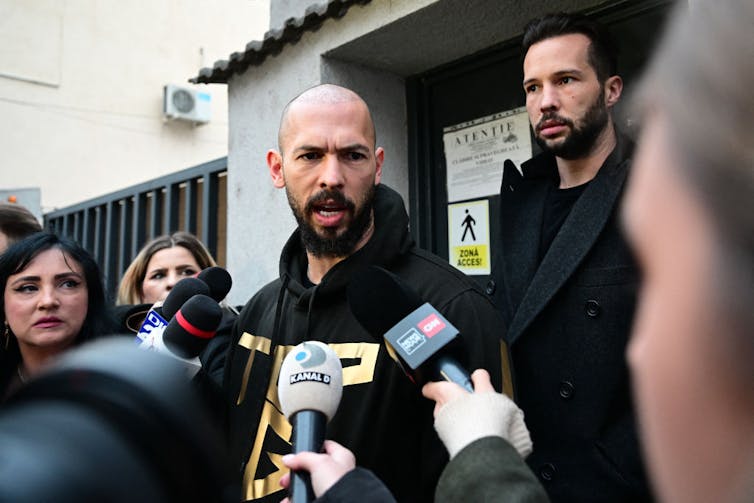
British American former professional kickboxer and controversial influencer Andrew Tate speaks to the press after being released from detention in Bucharest, Romania, on March 12, 2024. Daniel Mihailescu/AFP via Getty Images
To Tate and Peterson, being a better man isn’t about learning to be more vulnerable. Instead, they argue that straight men have become marginalized in a society that’s gotten too soft, too effeminate and too politically correct. In their view, men need to embrace their traditional roles as protectors, providers and producers.
Research has shown that young men in particular are receptive to these ideas. Of course, young Black men make up some of this cohort. But they rarely get mentioned in critiques of the manosphere.
Fitness, health … and Fuentes
“Fresh & Fit” bills itself as a discussion on men’s fitness, fashion and mental health.
Gaines is author of the book “Why Women Deserve Less,” in which he writes, “Women are benefiting unfairly at nearly every man’s expense.”
Weekes is a business mogul who firmly believes in meritocracy; he credits his success to his own hard work, a point he eagerly reiterates on a number of episodes.
The show normally involves commentary from the hosts about current events, and they’ll often feature guests ranging from CrossFit coaches and gym owners to more controversial interviewees like Fuentes and conservative political commentator Candace Owens.
The YouTube shows are wildly popular, with some episodes garnering hundreds of thousands of views.
There’s also a spinoff, “Fresh & Fit After Hours,” which tends to include panels of young women. During these conversations, the women – who usually work in fields such as modeling, sex work or professional dance – often find themselves put on the spot by the hosts, who ask them to speak on behalf of all women.
Locker-room talk
I listened to 40 randomly selected episodes of the main show and 25 of the “After Hours” show, and the conversations veered into explorations of gender differences and debates about why men are better than women. All of these elements fall under what sociolinguist Scott Kiesling calls “masculine linguistic practices” – the ways in which men express their masculinity in conversation with one another.
Each episode is replete with misogyny. On one,[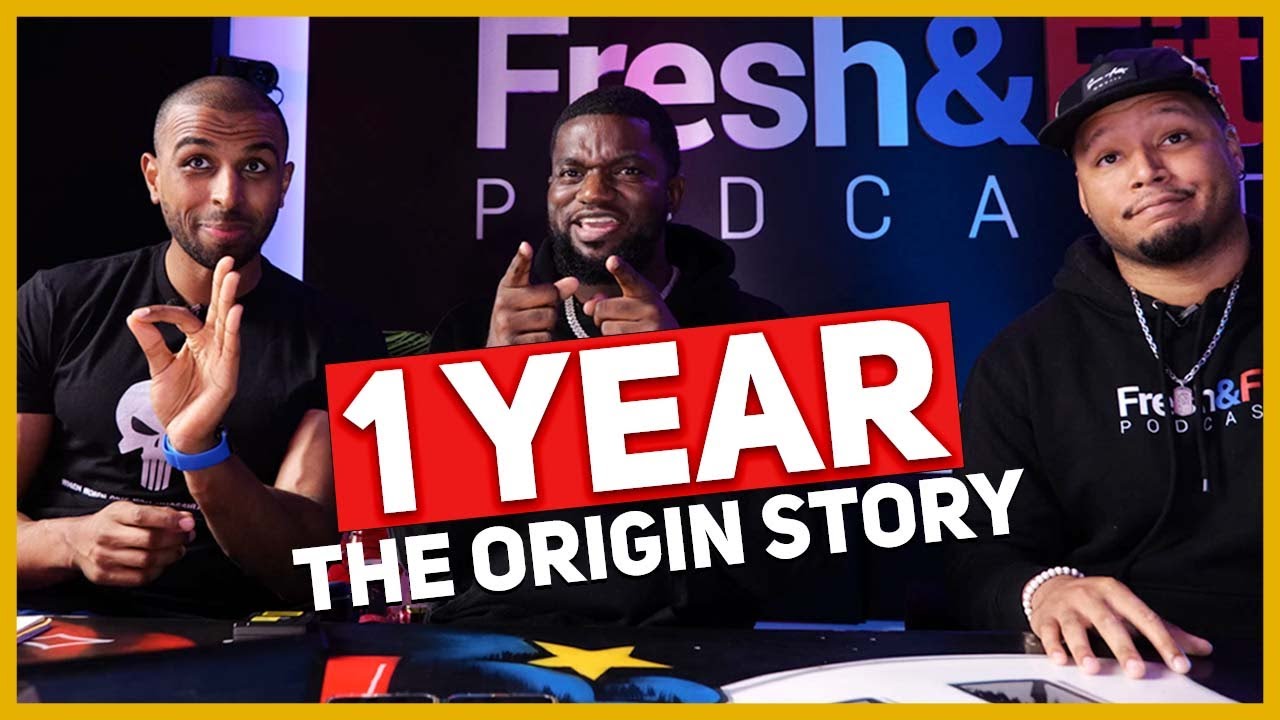 [vid] ](https://youtu.be/T16En55Sf0c) to not go to Miami – not because it’s too expensive or it’s too hot, but because the women in South Beach think they’re “better than you.” On another, when talking about what men are looking for in a partner, he notes, “When we look for security in y'all, it’s security in making sure the kid is ours. And a woman that has a promiscuous past might continue that trend in the future.”
Gaines and Weekes do give a platform to women – but it’s to women who echo the hosts’ warped theories on gender.
In several of the “Fresh & Fit After Hours” episodes I watched, the hosts booked female guests who often admitted that they are status-conscious opportunists – that they want to be taken care of, that they expect men to give them gifts, and that they should be treated “like a lady.”
In one episode of “After Hours,” when a guest says she wishes men could approach her without being overly flirtatious, Gaines is quick to undermine her: Surely she gets approached by men every day. But are they all flirtatious?
Then he throws out another question: How many of the men she ended up dating hadn’t flirted with her?
She holds up her hand in the shape of a zero.
Messages that resonate with Black listeners
Watching “Fresh & Fit” also showed me how the hosts sought to specifically appeal to Black viewers and listeners.
I think it’s important to note that although Black men are highly susceptible to being seen as a collective group, they aren’t a monolith. Many Black men hold conservative views. Instances of homophobia, misogyny and transphobia are as common among Black Americans as they are among white Americans.
In other words, there isn’t any sort of cultural insulation that would protect Black men from negative messages in the manosphere, and the hosts subtly use language and imagery common to Black culture to inculcate Black listeners to their views.
Gaines and Weekes invariably slip in and out of African American Vernacular English, which conveys not only authenticity but also forges a connection with Black listeners.
Additionally, a common theme is the degree to which men are being “kept down.” In the context of their show, “kept down” refers to the ways in which women constrain them. But in Black culture, the phrase is commonly used to talk about the ways in which the dominant white culture forces them to behave or act a certain way.
Criminal law scholar Paul Butler refers to the impact of those stereotypes about Black men as “black male exceptionalism.”
To Butler, commonly repeated statistics about Black men – their higher incarceration rates, worse education outcomes and lower employment rates – reinforce the idea of Black men as an “endangered species.” My upcoming research expands on this, exploring how the internalization of this exceptionalism can be a self-fulfilling prophecy.
The darker corners of the manosphere stoke beliefs about disenfranchisement and discrimination against men. So it’s worth pointing out that these messages can easily resonate among minority men, too.
If they listen to Gaines and Weekes, they’ll come away from the episodes thinking that it isn’t just racism keeping them down: It’s women, too.
Steven Dashiell, Assistant Research Professor, *Morgan State University
This article is republished from The Conversation under a Creative Commons license. Read the original article.
===
---
an 11 23
In the years since the Great Recession, when housing prices dramatically fell, Wall Street investors have been buying large numbers of single-family homes to use as rentals. As of 2022, big investment firms owned nearly 600,000 such properties nationwide.
Critics say this practice drives up home prices and worsens the housing shortage, making it harder for families to afford to buy. Industry advocates dismiss such charges, arguing that large investment firms own a tiny fraction of single-family rental housing across the U.S. – less than 4% of the total.
As a professor of public policy at Georgia Tech, I wanted to understand how this trend was affecting my neighbors. So I analyzed more than 1 million property sales in the Atlanta metropolitan area from 2007 to 2016. Since the study period included the mortgage crisis, I excluded bulk sales, such as the packages of foreclosed homes, that aren’t available to typical homebuyers. I examined only arm’s-length transactions of single-family detached homes, where buyers and sellers act independently.
I found that global investment firms buying up local properties are indeed hurting Atlanta families – specifically, Black ones.
Neighborhood transformations

In the period I studied, homeownership declined across the Atlanta metro area by more than 5 percentage points, similar to a nationwide trend. For an average neighborhood, home purchasing by large corporate investors explained one-quarter of that decline.
But when I broke the analysis down by race, I found that Black families were hit much harder: Large investment firms buying up local properties explained fully three-quarters of the decline in African American homeownership. In contrast, non-Hispanic whites were largely unaffected.
It turns out that while Wall Street firms control just a sliver of the single-family rental market nationally, they can have much more influence at the local level. In the Atlanta metro area, these firms own nearly one-third of all single-family rental properties. They’re even more concentrated in predominantly Black neighborhoods, where more than 10 houses in a row can be owned by the same corporation.
In my study, I found that large investors tend to snap up housing in majority-nonwhite, lower-income suburban neighborhoods. This makes homebuying even more challenging for middle-class families of color, as they get pushed out of the bidding market by global investors.
Home is where the financial security is
Homeownership has long been one of the main pathways for the American middle class to accumulate wealth. Despite this, the national homeownership rate declined by 5.5 percentage points between 2007 and 2016, reaching a five-decade low of 62.9%. Although homeownership has rebounded somewhat since 2016, it remains below pre-2008 levels.
And who owns these homes is starkly divided by race. Between 2015 and 2019, more than 70% of white families owned a home, compared with just 41% of Black families, according to an analysis by Harvard University’s Joint Center for Housing Studies.
To be sure, policies like racial covenants, discriminatory mortgage lending practices and redlining fueled low homeownership rates for Black Americans long before the Great Recession. But global investors’ growing control of single-family homes only widens existing racial gaps in homeownership and wealth.
Directions for new research
While my study focused on Atlanta, it’s not the only place where residents are competing with global investors for housing. Investment firms’ single-family rental portfolios are largely concentrated in Sun Belt metro areas, including Phoenix, Charlotte and Jacksonville. It wouldn’t be surprising to see similar conflicts playing out in those cities.
Since my analysis stopped in 2016, I can’t be sure that Black Atlanta residents are still affected by Wall Street firms buying up housing. Many investment firms have recently been switching from a buy-to-rent business model to a build-to-rent model, which could complicate matters.
In the meantime, while residents and policymakers have claimed that large corporations don’t invest in local communities, researchers lack robust evidence this is the case. Academics should study whether properties owned by institutional landlords are more likely to be poorly maintained or have code violations, as anecdotal evidence suggests.
It’s also worth investigating whether big investment firms undermine local revenue collection by serially filing property tax appeals.
An open-source tool for housing policy research
It’s been hard for researchers to identify corporate-owned, single-family homes, since it requires proprietary real-estate data and labor-intensive number crunching. In a separate project, my colleagues and I have developed a simple, user-friendly methodology that gets around such challenges with the use of open-source software and public tax parcel data.
Local governments and nonprofits can use our methodology to unveil all the corporate-owned residential properties in any neighborhood and link them to outcomes such as code violations. Using data-driven approaches like this is an important step toward developing policy solutions.
Brian Y. An, Director of Master of Science in Public Policy Program & Assistant Professor of Public Policy, Georgia Institute of Technology
This article is republished from The Conversation under a Creative Commons license. Read the original article.
---
---
6 23 DC election integrity BS AA
https://www.alternet.org/unworthy-of-this-body-raskin/
---
---
mta 2 23
BHM observances should include how corporations and those of immense wealth have amassed political power and economic wealth by exploiting racism toward people of color, especially African Americans, in this country over several centuries.
Examples:
- The Royal African Company and other British “crown corporations” transported slaves to the American colonies
- The “Fugitive Slave Clause” of the U.S. Constitution (Article I, Section 2, Clause 3) mandated that escaped slaves (the property of slaveholders) when caught had to be returned to their owners.
- The “Three-Fifths “Compromise” in the Constitution(Article I, Section 2, Clause 3) defined slaves (which had no political rights) as 3/5ths of a person in determining a state’s population – to ensure that southern states would have more votes in the Electoral College to perpetuate slavery.
- JP Morgan bank used slaves as collateral for loans to slave owners in the 19th century.
- The 13th Amendment contained an “exceptions clause” – prisoners could be used as forced labor. “Convict leasing” or “slavery by another name” involved African American forced to to work forrailroads, U.S. Steel and other corporations to rebuild the south after the Civil War.
- African-American strikebreakers were used widely in the meat packing, steel, coal mining, automobile, and railroad industries between the end of Civil War and New Deal to stoke racism between white and black workers to prevent the rise of unions.
- Housing, automobile, and construction corporations profited by laws (including discriminatory FHA mortgage underwriting) that promoted redlining of neighborhoods to maintain high housing values, especially in suburbia.
- The disproportionate mass imprisonment of African Americans, due to racist drug and other laws, has given rise to highly profitable and powerful private prison corporations, namely CoreCivic and Geo Group. The Prison Industries Act (promoted byALEC, the American Legislative Exchange Council) has expanded prison labor and financially benefited many companies, among them Victoria's Secret, Whole Foods Market, Walmart, Microsoft, Starbucks, BP,Nintendo,AT&T,Target, Dell, Eddie Bauer, and Boeing.
- Racial predatory loans by Wall Street financial entities, which profited in the billions, fueled the 2007-9 financial crisis.
- Toxic industries tend to be placed or to expand in African American poor communities.
- The explosion of police violence against innocent African Americans in cities and subsequent financial settlements in amounts that communities can not afford has given rise to a new profitable financial instrument for corporate and individual investors: “police brutality bonds.”
:{:{Not to be overlooked is the corporate hijacking of the Fourteenth Amendment, intended to provide legal due process and equal protection to African Americans when it was ratified in 1868. Two decades later, the Supreme Court hijacked the decision, ruling that a corporation is a “person” with the same due process and equal protection rights intended exclusively for African Americans. ...}:
}:
---
an 422
Extremist groups and lawmakers are engaged in an "insidious and coordinated” plot to undermine American democracy. That's according to a newly issued report from the nonpartisan civil rights organization National Urban League (NUL).
The report, titled "Under Siege: The Plot to Destroy Democracy," documents the “conspiracy and the urgent case for a national mobilization to protect and defend our most sacred constitutional right”. NUL specifically notes four key tactics in the effort: gerrymandering, voter suppression, misinformation and intimidation.
In 2021 alone, 20 states have leveraged census data to redraw congressional maps, it noted. It labeled the new maps proposed by Republican state lawmakers “no more than modern-day gerrymandering that strips voting power away from communities with Black and brown voters."
By NUL's count, 34 laws were passed in 19 states between January 1 and December 7 2021 that make it more difficult for people to vote.
In addition to shortening the window to apply and deliver mail ballots, it says, those laws limit absentee voting lists, restrict assistance in returning a voter’s mail ballot, reduce the availability of mail ballot drop boxes, and increase barriers for voters with disabilities, among other restrictions.
"The burden of these laws – strict photo ID requirements, the elimination or restriction of Sunday voting, voting by mail and early voting, and the closing of polling locations – overwhelmingly falls on Black voters,” Marc Morial, president and CEO of NUL, said in the report.
“Since the passage of the Voting Rights Act in 1965, the United States has seen a steady rise in disenfranchisement practices giving one party an edge over the other. But never before has the nation seen such an insidious and coordinated campaign to obliterate the very principle of ‘one person, one vote’ from the political process.”
---
---
trump campaign targeted 3.5 million Black voters for suppression: report
White House
David Badash and The New Civil Rights Movement September 28, 2020
The Trump campaign focused its digital efforts on 3.5 million Black American voters in 2016, targeting them in an effort to deter them from voting.
A new report from the UK's Channel 4, which also helped expose how Cambridge Analytica precisely targeted voters for the Trump campaign during the 2016 election, makes the stunning revelation.
Pointing to "a vast cache of data used by Donald Trump's 2016 presidential campaign on almost 200 million American voters," Channel 4 reports it has obtained the data, which "reveals that 3.5 million Black Americans were categorized by Donald Trump's campaign as 'Deterrence' – voters they wanted to stay home on election day."
"In 16 key battleground states, millions of Americans were separated by an algorithm into one of eight categories, also described as 'audiences', so they could then be targeted with tailored ads on Facebook and other platforms," Channel 4 reports.
One of the categories was named 'Deterrence', which was later described publicly by Trump's chief data scientist as containing people that the campaign "hope don't show up to vote".Analysis by Channel 4 News shows Black Americans – historically a community targeted with voter suppression tactics – were disproportionately marked 'Deterrence' by the 2016 campaign.
Here's a promotional video from Channel 4, tweeted by the UK investigative journalist who exposed the Facebook-Cambridge Analytica scandal.
Here's video showing Channel 4 actually visiting voters in Wisconsin, and showing them what information the Trump campaign had on them.
The Trump campaign had data on voters' home address, date of birth, jobs, income, and housing status, and matched that to individual people to target them, Channel 4 revealed.
The plan worked."Overall turnout" in one Milwaukie, Wisconsin precinct, "fell from 75% in 2012, to just 56% in 2016."
In another, turnout fell from 81% to 55%.
Trump won the 2016 Electoral College by just 77,000 votes across three states. no lnx twt vid
https://www.alternet.org/2020/09/trump-campaign-targeted-3-5-million-black-voters-for-suppression-report/
---
==
new
---
Elizabeth Warren has a plan to reform "Heirs' Property," which allows wealthy white property developers to steal Black family homes
Heirs' property is a relic of post-Reconstruction law, which allows white developers to exploit the diffuse ownership of Black family homes to steal them and kick out the people who live there. Read the rest
==
==
new
https://www.democracynow.org/2019/8/16/vann_newkirk_great_land_robbery
Over the 20th century, black people in the U.S. were dispossessed of 12 million acres of land. Half of that loss — 6 million acres — occurred over just two decades, from 1950 to 1969, a period largely associated with the civil rights struggle. This mass land dispossession, which affected 98% of black agricultural land owners, is part of the pattern of institutional racism and discrimination that has contributed to the racial wealth gap in the United States. Many of the driving forces behind this land theft were legal and originated in federal policies, as documented by Vann Newkirk, staff writer at The Atlantic. His latest piece for the magazine is the September cover story: “The Great Land Robbery: The shameful story of how 1 million black families have been ripped from their farms.”
---
https://www.alternet.org/2019/04/how-artificial-intelligence-systems-could-threaten-democracy/
U.S. technology giant Microsoft has teamed up with a Chinese military university to develop artificial intelligence systems that could potentially enhance government surveillance and censorship capabilities. Two U.S. senators publicly condemned the partnership, but what the National Defense Technology University of China wants from Microsoft isn’t the only concern.
As my research shows, the advent of digital repression is profoundly affecting the relationship between citizen and state. New technologies are arming governments with unprecedented capabilities to monitor, track and surveil individual people. Even governments in democracies with strong traditions of rule of law find themselves tempted to abuse these new abilities.
In states with unaccountable institutions and frequent human rights abuses, AI systems will most likely cause greater damage. China is a prominent example. Its leadership has enthusiastically embraced AI technologies, and has set up the world’s most sophisticated surveillance state in Xinjiang province, tracking citizens’ daily movements and smartphone use.
Its exploitation of these technologies presents a chilling model for fellow autocrats and poses a direct threat to open democratic societies. Although there’s no evidence that other governments have replicated this level of AI surveillance, Chinese companies are actively exporting the same underlying technologies across the world.
Increasing reliance on AI tools in the US
Artificial intelligence systems are everywhere in the modern world, helping run smartphones, internet search engines, digital voice assistants and Netflix movie queues. Many people fail to realize how quickly AI is expanding, thanks to ever-increasing amounts of data to be analyzed, improving algorithms and advanced computer chips.
Any time more information becomes available and analysis gets easier, governments are interested – and not just authoritarian ones. In the U.S., for instance, the 1970s saw revelations that government agencies – such as the FBI, CIA and NSA – had set up expansive domestic surveillance networks to monitor and harass civil rights protesters, political activists and Native American groups. These issues haven’t gone away: Digital technology today has deepened the ability of even more agencies to conduct even more intrusive surveillance.
For example, U.S. police have eagerly embraced AI technologies. They have begun using software that is meant to predict where crimes will happen to decide where to send officers on patrol. They’re also using facial recognition and DNA analysis in criminal investigations. But analyses of these systems show the data on which those systems are trained are often biased, leading to unfair outcomes, such as falsely determining that **African Americans** are more likely to commit crimes than other groups.
AI surveillance around the world
...
==
new cointelpro blk extremists
https://www.alternet.org/2019/04/the-fbi-appears-to-be-engaged-in-a-modern-day-version-of-cointelpro-aclu-racial-justice-program-deputy-director/
---
AN 419
When Sen. Bernie Sanders of Vermont conceded the 2016 Democratic presidential primary to former Secretary of State Hillary Clinton and encouraged his supporters to vote for her in the general election, many of them agreed that Clinton—shortcomings and all—would be much better for his liberal/progressive movement than GOP nominee Donald J. Trump. Sanders aggressively voiced his support for the centrist Clinton during his speech at the 2016 Democratic National Convention in Philadelphia, stressing that a Trump presidency would be terrible for the United States (an assertion that proved to be frighteningly accurate). The “Bernie or Bust” crowd, however, adamantly maintained its opposition to Clinton: some voted for Green Party nominee Jill Stein or Libertarian Party nominee Gary Johnson (a former Republican governor of New Mexico), some didn’t vote at all, some even voted for Trump. And the Washington Post, in an article published on Friday, is reporting that some of Sanders’ more anti-Clinton supporters may have been manipulated by the Kremlin three years ago.
Russian interference in the 2016 election and President Vladimir Putin’s preference for Trump over Clinton was probed extensively by Special Counsel Robert Mueller, whose Russia investigation concluded in March. But one thing that hasn’t been reported nearly as much is efforts by the Kremlin to manipulate and deceive Sanders’ supporters. And in the Washington Post, Michael Kranish reports that three years ago, there was a concerted effort by Russians to convince Sanders supporters that they would be better off under Trump.[wacko at mta MOVIE]
Kranish reports that in 2016, a Twitter account called Red Louisiana News told Sanders supporters, “Conscious Bernie Sanders supporters already moving towards the best candidate Trump! #Feel the Bern #Vote Trump 2016.” And analysis by Clemson University, according to Kranish, found that Red Louisiana News was among thousands of pro-Trump online accounts that were actually based in Russia—not the United States—and stressed to Sanders supporters that they had more in common with Trump than with Clinton. Kranish also reports that Mueller, during his Russia investigation, alleged that a St. Petersburg, Russia-based group called the Internet Research Agency instructed its employees to write social media posts that were anti-Clinton but favorable to Sanders and Trump.
In a 2018 interview, Kranish notes, Sanders told Vermont Public Radio that in 2016, one of his campaign workers suspected that Russians were behind those posts and warned the Clinton campaign, “I think these guys are Russians.” Kranish adds, however, that the campaign worker didn’t share those concerns with Sanders himself.
Sanders also told Vermont Public Radio that in 2016, Russian government operatives “were playing a really disgusting role” in the election and set out to “sow division in this country.” The senator commented, “What they were saying is—in so many words—is Bernie Sanders is not going to win. So if you are a Bernie Sanders supporter, let me tell you: Hillary Clinton is a criminal, a murderer, a terrible person…. crazy, all of these disgusting things.”
Clemson University’s research, Kranish adds, found that “some 9000” tweets coming from Russia used the name “Bernie” and were retweeted 61,804 times and “liked” 59,281 times.
One of the Russian social media accounts mentioned in Kranish’s article called itself#BlackMenForBernie, had 72,121 followers and tried to convince African-American Sanders supporters that they shouldn’t support Clinton. One of its tweets read, “#BlackMenForBernie Leader Switches to Trump! I will Never Vote for Hillary, Welcome aboard the Trump Train.”
Kranish concludes his report by quoting Clinton spokesman Nick Merrill, who warns that if people in the Russia government were able to manipulate the 2016 presidential election, they inevitably “will strike again.” And therefore, Merrill asserts, “Democratic candidates” must “work together and support each other to defend against these threats.”
---
ref no lnx
Inside the Russian effort to target Sanders supporters — and help elect Trump
Sen. Bernie Sanders, I-Vt, and former Secretary of State Hillary Clinton spar in February 2016 during a Democratic presidential primary debate hosted by MSNBC at the University of New Hampshire in Durham, N.H. (David Goldman/AP)
By Michael Kranish April 12 at 6:00 AM
After Bernie Sanders lost his primary campaign for president against Hillary Clinton in 2016, a Twitter account called Red Louisiana News reached out to his supporters to help sway the general election. “Conscious Bernie Sanders supporters already moving towards the best candidate Trump! #Feel the Bern #Vote Trump 2016,” the account tweeted.
The tweet was not actually from Louisiana, according to an analysis by Clemson University researchers. Instead, it was one of thousands of accounts identified as based in Russia, part of a cloaked effort to persuade supporters of the Vermont senator to elect Trump. “Bernie Sanders says his message resonates with Republicans,” said another Russian tweet.
While much attention has focused on the question of whether the Trump campaign encouraged or conspired with Russia, the effort to target Sanders supporters has been a lesser-noted part of the story. Special counsel Robert S. Mueller III, in a case filed last year against 13 Russians accused of interfering in the U.S. presidential campaign, said workers at a St. Petersburg facility called the Internet Research Agency were instructed to write social media posts in opposition to Clinton but “to support Bernie Sanders and then-candidate Donald Trump.”
That strategy could receive new attention with the release of Mueller’s report, expected within days.
:{:{}:
}:
Sanders told Vermont Public Radio last year that one of his campaign workers figured out what was going on, alerted the Clinton campaign and told them, “I think these guys are Russians.” But Sanders said he never knew, and he later backed off his suggestion that his staff did. A spokesman referred questions to 2016 campaign manager Jeff Weaver, who said in an interview that Sanders “misspoke a little bit and conflated a few of the facts. .?.?. He did not know, I did not know, none of us knew” that Russia was behind the efforts.
Only recently, with the latest analysis of Twitter data, has the extent of the Russian disinformation campaign been documented on that social media platform.
:{:{}:
}:
A pair of Clemson University researchers, at the request of The Washington Post, examined English-language tweets identified as coming from Russia, many of which were designed to influence the election. It is impossible to say how many were targeted at Sanders supporters because many don’t include his name. Some 9,000 of the Russian tweets used the word “Bernie,” which were “liked” 59,281 times and retweeted 61,804 times.
:{:{}:
}:
But that was only one element of the Russian effort to target Sanders supporters, the researchers said. Many thousands of other tweets, with no direct reference to Sanders, were also designed to appeal to his backers, urging them to do anything but vote for Clinton in the general election.
“I think there is no question that Sanders was central to their strategy. He was clearly used as a mechanism to decrease voter turnout for Hillary Clinton,” said one of the Clemson researchers, Darren Linvill, associate professor of communications. The tweets examined in the new analysis “give us a much clearer understanding of the tactics they were using. It was certainly a higher volume than people thought.”
[Trump disavows past enthusiasm for WikiLeaks after Assange’s arrest]
The Russian social-media strategy underscores a challenge that Sanders faces as he once again seeks the Democratic presidential nomination, this time in a crowded field. Many Sanders supporters believe he was treated unfairly by the Democratic Party and Clinton, a point the Russians sought to capitalize on as they worked to undermine Clinton in the November election.
Although Sanders later denounced the Kremlin’s efforts and campaigned for Clinton, some Democrats believe he could have done more to smooth over tensions and encourage his supporters to support his onetime opponent. A former senior Clinton campaign official, speaking on the condition of anonymity to avoid publicly criticizing Sanders ahead of the 2020 primaries, said that there remains bitterness over the way Sanders repeatedly said the system was tilted against him.
Sanders said in May 2016 that party rules enabling Clinton to collect “superdelegates” did not meet the definition of “rigged,” but he called it a “dumb process which certainly has disadvantaged our campaign.”
The effort to promote Sanders as a way to influence the U.S. election began shortly after he declared his candidacy in spring 2015, according to Mueller’s indictment of the Russians. Russia’s aim was to defeat or weaken Clinton, who had angered Russian President Vladimir Putin when she had been secretary of state.
One reason that Sanders was on Russia’s radar has been little noted: he, like Trump, opposed trade deals such as the Trans-Pacific Partnership. Russian PresidentVladimir Putin had been critical of the TPP, saying it was secretive and “hardly facilitates sustainable development of Asia Pacific.”
:{:{}:
}:
During the primaries, Sanders gave at least three interviews to a Russia-controlled television network, RT, in which his trade stance was highlighted. The network in February 2016 criticized MSNBC for breaking away from Sanders after he said he was “helping to lead the opposition to the Trans-Pacific Partnership.” The network posted a story headlined, “Bernie Sanders 'censored' by MSNBC while criticizing trade deal.”
Around the same time that Sanders was featured on RT, Russian employees at the Internet Research Agency were given a document explaining how to influence the U.S. election. The workers were told to “use any opportunity to criticize Hillary and the rest (except Sanders and Trump — we support them),” according to Mueller’s indictment of the Russians.
The Twitter database shows the impact. The tweets sent from Russia, cloaked to look as though they came from Americans, included: “Bernie Sanders looks to black voters to boost his underdog campaign”; “Hillary Clinton’s summer of drama creates openings for Bernie Sanders and Joe Biden”; and “I’m for Bernie all the way!”
Then, in July 2016, WikiLeaks released emails from the Democratic National Committee that suggested the party machinery was tilted against Sanders. The DNC computers were later revealed to have been hacked by Russia. The hack prompted Trump to stoke the divide among Democrats. “Leaked e-mails of DNC show plans to destroy Bernie Sanders,” Trump tweeted July 23, 2016. “.?.?. On-line from Wikileakes [sic], really vicious. RIGGED!”
Russian trolls significantly increased their effort to persuade Sanders supporters to oppose Clinton in the general election. One of their methods was to try to convince African Americans that they couldn’t trust her.
“#BlackMenForBernieLeader Switches to Trump! I will Never Vote for Hillary,Welcome aboard the Trump Train,” said a tweet from an account that was said to come from Texas and was identified as “Southern. Conservative Pro God. Anti Racism.” The account, actually operated by a Russian, had 72,121 followers. The message was liked 260 times and retweeted 295 times, according to the Clemson database.
Linvill, the Clemson researcher, said Sanders was seen as “just a tool” to the Russians. “He is a wedge to drive into the Democratic Party,” resulting in lower turnout for Clinton, he said. The tweets suggested either voting for Trump or a third-party candidate such as Green Party nominee Jill Stein, or writing in Sanders’s name.
While it is impossible to show a direct correlation between a Russian-based tweet and someone’s vote in the United States, a post-election survey conducted for Ohio State University documented how false stories spread on social media may have caused a decline in turnout for Clinton. Only 77 percent of those surveyed who had voted for Barack Obama in 2012 supported Clinton in 2016; 10 percent backed Trump, 4 percent voted for third-party candidates, and 8 percent did not vote, according to the YouGov survey.
[Bernie Sanders unveils new Medicare-for-all legislation]
In an effort to demonstrate how inaccurate information makes its way into the mainstream, the survey asked respondents about three demonstrably false articles that had been widely distributed. A quarter of respondents believed the false story that Clinton was in “very poor health,” 10 percent believed that Trump had been endorsed by the Pope, and 35 percent (including 20 percent of Obama supporters) believed that Clinton had approved weapons sales to “Islamic jihadists, including ISIS.”
:{:{}:
}:
The Ohio State team concluded in a soon-to-be published final version of its report that “belief in these fake news stories is very strongly linked to defection from the Democratic ticket by 2012 Obama voters.” Obama voters who recognized all three stories as false voted for Clinton at a rate of 89 percent, while 61 percent who believed one of the stories was false voted for her, and 17 percent of those who believed two of the false stories supported Clinton.
:{:{}:
}:
Yoel Roth, Twitter’s head of site integrity, said Twitter had studied what happened during the presidential election and will apply those lessons as the 2020 campaign unfolds.
“Protecting the integrity of public conversation around elections is core to Twitter's mission,” Roth said in a statement to The Post. “Since 2016, we've launched new policies, significantly scaled our enforcement against malicious automation, built strong partnerships within the industry and with government entities, and opened the largest public archive of potential information operations online, including thousands of Russian-linked accounts we have removed.”
Sanders told Vermont Public Radio last year that the Russians “were playing a really disgusting role because they don’t believe in anything. And all they want to do is sow division in this country, bring people against each other. So what they were saying is — in so many words — is Bernie Sanders is not going to win, so if you are a Bernie Sanders supporter, let me tell you, Hillary Clinton is a criminal, a murderer, a terrible person .?.?. crazy, all of these disgusting things.”
Clinton spokesman Nick Merrill said “the Russians will strike again.” As a result, he said, it is imperative for “everyone else, especially Democratic candidates, to work together and support each other to defend against these threats.”
Craig Timberg contributed to this report.
https://www.washingtonpost.com/politics/inside-the-russian-effort-to-target-sanders-supporters--and-help-elect-trump/2019/04
...url?
==
---
black turnout key in 2016 and 2018? bl woman key? So voter suppression key, limit eary voting, blk sn citizens told to get off the bus; stacey abrams gov almost won, as did gillum in fla;
==
sum IRA:
Finally, here’s an official report that says there were dirty tricks in the 2016 elections, just as we’re hearing about more localized dirty tricks in the elections in November.
The report by cybersecurity experts hired by the Senate Intelligence Committee released on Monday says without hesitation that it was the Russians who used a wide variety of social media outlets to spread disinformation aimed at suppressing the black vote in America and to move conservatives toward candidate Donald Trump. It wasn’t a 400-pound guy on a couch in New Jersey, no matter what Trump says.
“The report adds new details to the portrait that has emerged over the last two years of the energy and imagination of the Russian effort to sway American opinion and divide the country, which the authors said continues to this day,” concluded The New York Times.
Of course, dirty tricks have been part of American elections since there was an American election. Just ask Richard Nixon. Or maybe John Adams.
But suppressing the black vote? That, as any number of critics would note, has been an American tradition all of its own. Just this last cycle, we saw Republican Georgia Gov. Brian Kemp win his election over Democrat Stacy Adams, who is black, simply by a series of actions aimed at disenfranchising black voters all around the state. There’s a congressional race still being contested in North Carolina with dirty tricks so bad for the Republican candidate that the GOP is thinking of disowning the candidate.
The remarkable thing here is the breadth of effort that the Russians undertook to target African-Americans, to try to suppress turnout among Democratic voters and to promote the Trump campaign.
There was no attempt to explain exactly why – other than the obvious – that Russians were targeting African-American voters.
On MSNBC yesterday, pundits were talking about the suppression allegations while simultaneously showing televised clips of candidate Donald Trump repeating much of the same messages as in the Russian voter campaigns. But, there is nothing here in writing to suggest that there was more than a topical link, or “collusion.”
Indeed, “Active and ongoing interference operations remain on several platforms,” says the report by New Knowledge, a cybersecurity company based in Austin, Tex. One continuing Russian campaign, for instance, seeks to influence opinion on Syria by promoting Bashar al-Assad, the Syrian president and a Russian ally in the brutal conflict there. A second report was written by the Computational Propaganda Project at Oxford University along with Graphika, a company that specializes in analyzing social media.
The Russian influence campaign in 2016 was run by a St. Petersburg company called the Internet Research Agency,owned by a businessman, Yevgeny V. Prigozhin, who is a close ally of President Vladimir V. Putin of Russia. Prigozhin and a dozen of the company’s employees were indicted last February as part of the investigation of Russian interference by Robert S. Mueller III, the special counsel. Both reports stress that the Internet Research Agency created social media accounts under fake names on virtually every available platform. A major goal was to support Donald Trump, first against his Republican rivals in the presidential race, then in the general election, and as president since his inauguration.
The Russian campaign was the subject of Senate hearings last year and has been widely scrutinized by academic experts. The new reports largely confirm earlier findings: that the campaign was designed to attack Hillary Clinton, boost Trump and deepen divisions in American society.
The Washington Post reported last night that the Senate report also detailed efforts byRussia’s disinformation teamsto target Special Counsel Robert S. Mueller** III as a threat to Trump, falsely claiming that the former FBI director was corrupt and that the allegations of Russian interference in the 2016 election were crackpot conspiracies.
New Knowledge gave particular attention to the Russians’ focus on African-Americans, which is evident to anyone who examines collections of their memes and messages.
The Internet Research Agency also created a dozen websites disguised as African-American in origin, with names like blackmattersus.com, blacktivist.info, blacktolive.organd blacksoul.us. On YouTube, the largest share of Russian material covered the Black Lives Matter movement and police brutality, with channels called “Don’t Shoot” and “BlackToLive.”
The report does not seek to explain the heavy focus on African Americans. But the Internet Research Agency’s tactics echo Soviet propaganda efforts from decades ago that often highlighted racism and racial conflict in the United States, as well as recent Russian influence operations in other countries that sought to stir ethnic strife.
Funny how our longtime embrace of dirty tricks actually comes full circle to show us that they were exploiting our most divisive American politics.
Maybe that’s the worst of it. Russians do American dirty tricks better than we do ourselves.
---
---
https://www.alternet.org/news-amp-politics/why-are-poor-whites-more-depressed-and-pessimistic-poor-african-americans
AN alex anderson
Carol Graham appeared on Charles Ellison’s “Reality Check” program on WURD AM/FM (a liberal/progressive African-American talk radio station in Philadelphia) and discussed theemotional differences between poor blacks and poor whites. It was a fascinating conservation: according to Graham’s research, poor African-Americans in the United States are, on the whole, more optimistic than poor whites—who Graham described to Ellison as being much more likely to fall into despair. As worried as the African-American community is by the Trump Administration and its horrible policies, Graham finds poor whites to be in a much worse state emotionally and are decidedly more pessimistic.
WURD callers, mostly African-Americans living in Philadelphia, offered different views on Graham’s findings. Some asserted that formerly middle-class whites who fell into poverty during the Great Recession were ill-equipped, emotionally, to handle the types of economic struggles African-Americans have been facing all these years. But another explanation for Graham’s findings is that poor whites—whether they became the neo-poor during the Great Recession or were poor long before that—are much more likely to have been thoroughly indoctrinated into right-wing Republican ideology, especially in Republican-dominated areas of the U.S. And as a result, they feel a certain self-hatred and blame themselves for their economic misfortunes in a way that poor African-Americans don’t. Poor whites (especially the ones based in rural areas or small towns) and poor African-Americans often live in very different worlds—and everything from the media outlets they embrace to the churches they attend to the music they listen to is likely to affect whether they view the poor as morally deficient or as people who have been seriously screwed over.
As much as right-wingers like to whine about the mainstream media having a liberal bias—which, for the most part, it doesn’t—the fact is that right-wing media is vast, from Fox News to white AM talk radio to Breitbart, Townhall, the Weekly Standard and countless other high-traffic wingnut websites. And theright-wing media has invested considerable time and energy in teaching that the poor are useless freeloaders living off the sweat, hard work and innovation of the rich (who Rush Limbaugh calls “the achievers”). Rural whites who have been bombarded with decades of poor-bashing from Fox News and white talk radio are bound to take that message to heart and view themselves as moral failures if they are not doing well financially. The overall message at an African-American talk radio station like WURD is totally different from what one hears on Limbaugh’s show. From the local programming that dominates the station to the Rev. Al Sharpton’s syndicated program, “Keeping It Real,” Donald Trump’s presidency and the Republican Party are painted in a consistently negative light on WURD—and the poor are not painted as parasites or leeches by any means, but as people who have been screwed over by crony capitalism and a rigged game. While WURD callers often sound angry and frustrated over the political climate in the Trump era, the anger doesn’t sound like self-hatred or self-blame. Sharpton and Ellison will encourage education, self-improvement and job training, but in a way that uplifts rather demonizes or belittles the poor.
Christianity comes in wildly different forms in the U.S., where white fundamentalist megachurches often have a very different view of economics than African Methodist Episcopal (AME) denominations. The Christian Right, white megachurches and fundamentalist Pentecostals typically embrace the so-called “prosperity gospel,” which teaches that the rich are blessed with affluence because of their moral superiority and that the poor are poor because of their immoral, sinful ways. But in black AME churches, one often hears that it is a Christian’s duty to feed the poor and help the homeless—and one is more likely to hear Jesus Christ quoted as saying, “It is easier for a camel to fit through the eye of a needle than for a rich person to enter the kingdom of heaven.”
In AME churches, the burden of proof is usually on the rich rather than the poor. So, if an African-American in an AME congregation graduated from the University of Pennsylvania’s medical school or law school and has a six-figure income, that’s all well and good—but they’re still encouraged to roll up their sleeves and do some volunteer work in a homeless shelter because that’s their duty as a Christian. The prosperity gospel is viewed as wrong-headed and unchristian in many black AME congregations.
Liberal AME pastors view Jesus Christ as an advocate for the poor and the downtrodden. To right-wing white megachurches, Jesus hates the poor and spits in their faces.
Musicis another way in which poor whites and poor blacks can receive radically different messages. The fact that Kanye West said some favorable things about President Trump earlier this year was controversial in the hip-hop community, where Immortal Technique, Public Enemy, Ice-T, KRS-1, Paris, N.W.A, Ice Cube and countless other rappers have been known for their left-of-center views. But modern country-rock is full of right-wing activists who think former Alaska Gov. Sarah Palin represents “the real America.” The Dixie Chicks became pariahs in the country music community after Natalie Maines criticized President George W. Bush and the Iraq War in 2003; Maines found out the hard way that being openly liberal can seriously damage one’s career in country music.
The message poor blacks are receiving is that poverty is the result of injustice and the failures of crony capitalism. The message many poor whites are receiving is that if you’re poor, you’re a loser and a parasite. Of course, Jay-Z, Chance the Rapper and other hip-hop stars attract racially diverse audiences and have plenty of white fans. And as many liberals and progressives as there have been in hip-hop, conservative rappers are not nonexistent. But on the whole, the poor receive a lot more emotional support in hip-hop than they do in modern country music. And even though hip-hop has plenty of imagery of bling and Benzes while modern country music likes to portray itself as music of the common man, hip-hop—at the end of the day—tends to view the poor in a much more compassionate and favorable light.
With so many poor whites being demonized whether they’re turning on Fox News, going to a megachurch or hearing their favorite country-rock stars urging them to vote Republican and support President Trump’s agenda, it’s no wonder that so many of them have fallen into despair, hopelessness and self-hatred.
==
---
"owned" doc levittown,. redlining
african socialist blacklist suburb tract los angeles modern ames architect owen documentary levittown
https://kpfa.org/episode/upfront-june-13-2018/
==
---
https://www.alternet.org/news-amp-politics/racist-origin-second-amendment-and-rise-black-gun-ownership
...
Total gun deaths in the United States average around 37,000 a year, she writes, “with two-thirds of those deaths being suicide, leaving 12,000 homicides, a thousand of those at the hands of police.” Mass shootings, although horrible enough, account for only 2 percent of gun killings annually.
In an interview, Dunbar-Ortiz explained that the right to have a gun comes from the Bill of Rights. “And the Bill of Rights is about individual rights,” which at the time it was written meant the rights of White men who needed guns to dominate slaves and Native Americans.
There’s a misconception that the Second Amendment is about state’s rights and arming a military. It’s not, she says. The establishment of a standing army is in the Constitution. The establishment of formal militias, which became the modern-day National Guard, is in the body of the Constitution—it’s constitutional law, she adds. Collective rights are already in the Constitution.
“So the Bill of Rights is the right for each individual to practice whatever religion they want, freedom of speech, and so forth. And to arm themselves.” There was a period in time, she said, when it was against the law for the new settlers not to carry a weapon.
“But it doesn’t work for freedom movements,” said Dunbar-Ortiz. “It was created for domination of people of color—for slave patrols, and militias to kill Indians. So, it still has that element”: Now it is used to criminalize people of color, she said.
Throughout history, gun control laws have been used against people of color as a tool to invite brutal state responses. Consider the Black Panthers who armed themselves, the Native Americans who fought in the Battle of Wounded Knee, Black Lives Matter protesters, the Standing Rock uprising.
We’ve witnessed it more recently for individuals like Philando Castile, who was killed by a fearful police officer in 2016 for legally having a firearm during a traffic stop.
In 2012, a Black Florida woman, Marissa Alexander, was sentenced to 20 years for firing a gun at her estranged husband who she said was attacking her. She had a permit for the gun. Since her release last year after serving five years, she has sided with Florida Republicans and become an advocate for gun ownership and stand-your-ground defenses.
In fact, many Black people are against tighter gun laws because those laws, even more so than drug laws, continue to be used disproportionately to put them into the criminal system.
According to the 2009 report Racial and Ethnic Disparities in the US Criminal Justice System, Black people are arrested for weapons crimes at a rate 4.4 times higher than White people. FBI data for 2016 shows weapons violations at the city, state, and federal level were used to arrest Black people 42 percent of the time, and White people 56 percent. Black people make up 13 percent of the population.
Chanel Tillman of the Black Gun Owners Association in Jacksonville, Florida, said she could only imagine the horrors for people of color if gun laws were reformed.
“If they can remove firearms like that from the masses, that basically…takes them away from us,” Tillman said. “And honestly, I think that’s the biggest part of it [for us]. You can guarantee that there will be some kind of loophole that will affect Black and Brown people more than anybody else.”
Our motto is “Stay armed. Live free.” If you take our guns from us, she said, we are no longer free. “Then they are free to do whatever they want to us, and we have no way to protect ourselves.”
Tillman co-founded the Jacksonville chapter last September, and it now has 32 members.
She said she’s aware the origin of the Second Amendment was to arm White people against people of color and also understands Dunbar-Ortiz’s position that we’re not really “free” if we have to carry guns to protect us.
But, she said, “why worry, if you know you have the ability to protect yourself? You don’t have to worry about it. You just have to be proactive and ready when the time comes.”
And this is the message the national Black Gun Owners Association shares with its membership of 10,000 legal gun owners. Its one-year anniversary is in April.
“Safety and protection of family, that’s the biggest thing. And making sure we’re aware of our rights.” Firearm safety and tactical training are part of what members receive, too, she said, and someone to look out for them.
The association is not a political organization, she said, but exists for their community "to get an understanding of firearm safety and obtain proper training with people who look like them and share the same concerns as them for our people.”
Gun ownership among Black people is about the same things as for White people, she says. “Protection of self, family and property. Gun ownership has always been taught as a pseudoscience for Blacks because of slavery and Jim Crow. We aren't here to hurt anyone, but protecting our own will come first.”
“We just want people like us to know there are gun advocate groups that are here for them,” she said. “The NRA comes out when things happen to White people, but when things happen to Black people you don’t hear from the NRA,” she said. “So, we’re hoping to bridge that gap. Somebody to stand for us when there’s a gun crime against one of us.”
Meanwhile, Detroit attorney Desiree Ferguson, who is advising on the appeal for Siwatu-Salama Ra’s Second Amendment defense, expects an uphill battle.
Appeals take a long time, and there’s a good probability that Ra could have served the two years by the time there’s a resolution. The hope, Ferguson said, lies with the governor’s office and a possible pardon or commutation. She is also hoping to get Ra released on bond pending the appeal “so that she can be with her family when she gives birth. And not have to be immediately severed from her newborn baby.”
What is certain is that gun control and Second Amendment debates do not clearly line up as left-right issues, and many people of color are faced with uneasy support for a civil right that began as a way to oppress them.
Author Dunbar-Ortiz says, if more people on the left understood the history of the Second Amendment and how it’s been used against people of color, she doubts they would support it.
“They don’t need the Second Amendment to justify self-defense. That’s an international human right. That’s a basic human right.”
---
==
https://www.democracynow.org/2018/3/9/how_an_alabama_town_is_fighting_against
Uniontown, Alabama, have lived with the Arrowhead landfill, which is twice the size of New York’s Central Park, have protested shipments of toxic coal ash—the residual byproduct of burning coal—from a massive spill in Kingston, Tennessee, believed to be the largest coal ash disaster in U.S. history. For two years, nearly 4 million tons of coal ash was also shipped by rail from a mostly white Tennessee county to Uniontown. Coal ash contains toxins, including arsenic, mercury and boron, that can affect the nervous and reproductive systems and cause other health problems. According to the EPA, people living within a mile of unlined coal ash storage ponds have a one-in-50 risk of developing cancer. In 2013, some Uniontown residents filed a complaint under Title VI of the Civil Rights Act. This week, the EPA dismissed the claim, saying there was “insufficient evidence.” We speak with Ben Eaton, vice president of Black Belt Citizens Fighting for Health and Justice and a resident of Uniontown, Alabama; and with Mustafa Santiago Ali, former head of the EPA’s environmental justice program.
==
==
https://www.alternet.org/election-03918/florida-felon-voting-rights-restoration-campaign-threshold-getting-november-2018
A grassroots campaign to amend Florida’s constitution to restore the voting rights of upwards of 1.5 million Floridians who have been convicted of non-violent felonies and completed their sentences is poised to qualify for the November 2018 ballot.
By Wednesday, the Florida Department of State has certified more than 745,000 petition signatures of the 766,000 needed to get on the ballot. The proposed constitutional amendment also has to meet signature thresholds in 14 legislative districts and has done so in 12 of them, campaign organizers said.
“In total, we submitted well over 1.1 million petitions to the supervisors of elections offices all across the state, from Pensacola to Key West,” campaign manager Jackie Lee said on a conference call Tuesday. “And all the petitions, we think, where we needed to verify, were also all in by December 29th, to ensure that we could make the ballot. We all know they needed to be verified by February first. So because of all of your hard work, we had them in on time. We’re... actually even excited to submit a couple right after that date because they kept on coming in from all around the state.”
The felon rights restoration effort is one of America’s most important electoral initiatives in 2018. More than 10 percent of Florida’s voting-age population, 1.7 million residents, have lost their voting rights under the nation’s most punitive felon disenfranchisement law—a statute that has its roots in the Old South’s racist Jim Crow culture.
“This amendment restores the voting rights of Floridians with felony convictions after they complete all terms of their sentence including parole or probation,” the legal petition states. “The amendment would not apply to those convicted of murder or sexual offenses, who would continue to be permanently barred from voting unless the governor and cabinet vote to restore their voting rights on a case-by-case basis.”
Florida is the third most populous state, with slightly more than 20 million people. In 2016, Donald Trump beat Hillary Clinton by 1.2 percent, which was slightly less than 113,000 votes, to win its 29 Electoral College votes. Should 60 percent of Floridians—the threshold for passage—who vote next fall approve the constitutional amendment, it could deeply alter the state’s politics as well as its criminal justice system.
The campaign’s organizers, led by Desmond Meade, a former felon who became a lawyer, are casting their effort as a redemption-steeped crusade to give a second chance to all of those who have done their time for non-violent crimes. In a teleconference organized by Floridians for a Fair Democracy Tuesday, he repeatedly emphasized this was a moral crusade and avoided any discussion of the political consequences.
“I want to make sure we are oriented right back where we started from,” Meade told the 150 activists, including clergy, on the call. “When each and every one of you made a decision to be involved in this campaign, it was based around people. It was based around the personal stories of your family members and your friends who were looking for second chances in Florida. And I think it is this orientation that has not only gotten us this far, but will take [us] across this finish line. It’s not about anything else. It’s not about politics. At the core of this, it’s about everyday all-American citizens, who just want a second chance.”
Meade’s framing, which reflects his life story, has resounded because Florida has so many ex-felons who cut across society. Only 30 percent are black, campaign organizers said, and a great many were victims of overzealous drug war prosecutions. Evidence of that deep resonance can be found in the fact that nearly a quarter-million of the petition signatures gathered were collected from volunteers, not paid circulators.
“We are very confident with moving forward with the campaign,” said Lee. “As of right now before the call, we are at 745,000 verified of the 766,200 that we need. So we are approaching that overall number and we are also verified in 12 of the 14 [legislative] districts that we need. So we are marching forward.”
Emphasizing Redemption, Not Political Power
...
==
==
aha: interesting // katrina and flint, disaster capitalism?
perfect storm
Representing billionaire Eli Broad, Bruce Reed celebrated the paralysis in local governance in post-Katrina New Orleans as key to pulling off the rapid expansion of charter schools, exploiting disaster without oversight by any “central office”:
“New Orleans is an amazing story — when you make it possible to get political dysfunction and sick a bunch of talent on the problem — it’s the one place where grand bargain of charters has been kept the best.”
New Orleans' "amazing" story resulted in the firing of 7,500 mostly black school employees, wiping out a substantial part of the city’s black middle class. Meanwhile, the “miracle” claims of boosters like Reed have fallen apart. A recent editorial in New Orleans’ African American newspaper called out the false promises and lack of results from the charter experiment.
==
black churches: souls to the polls, EJ
---
moral mondays NC EJ
https://www.washingtonpost.com/news/acts-of-faith/wp/2017/06/29/woe-unto-those-who-legislate-evil-rev-william-barber-builds-a-moral-movement/
==
related:
https://www.systemchangenotclimatechange.org/article/diary-peoples-climate-train-day-one-seven
Brentin Mock, “Black church leaders rev up for climate justice” 16 Sep 2014, http://grist.org/climate-energy/black-church-leaders-rev-it-up-for-clima...
It’s a common misconception that churches haven’t been doing their part in the green fight — and black churches in particular. Your John Birch and Alan Keyes Christians notwithstanding, that’s not entirely true.
Katharine Hayhoe, a leading climate scientist, works with evangelical Christians on the issue. Rev. William Barber’s Moral Movement counts promoting environmental justice among its 14-point agenda. Ditto for the Faith Leaders for Environmental Justice in New York, who’ve been working on food, energy, and climate issues for years now. In fact, the environmental justice movement was initiated by a 1987 report commissioned by the United Church of Christ religious denomination.
The tradition continues. In D.C., Rev. Lennox Yearwood has been leading flocks to the climate change struggle through his work not only as a minister, but also as president of the Hip Hop Caucus, which uses the culture to spur youth into political activism. Rolling Stone called him one of the “New Green Heroes” last year. He co-authored a Huffington Post op-ed last with Climate Crisis Solutions President Tom Weis last week calling for a “Zero Emissions Manifesto for the Climate Justice Movement,” challenging world leaders to commit to complete carbon neutrality at the upcoming UN Climate Summit.
Out of Chicago, where city leaders are trying to shake the “Chi-raq” label bestowed upon their city because of all the gun violence, there’s Rev. Otis Moss III, a newcomer to the climate struggles, but fully committed. He heads Trinity United Church of Christ, one of Chicago’s largest churches (and President Obama’s former faith home), which hails from the aforementioned United Church of Christ denomination that helped birth the EJ movement. Over the weekend, Rev. Moss assembled his congregation for the Faith in Place to educate members of the community on local climate change impacts and to whip up support for the EPA’s Clean Power Plan.
Rev. Yearwood on climate justice and racial equality:
“Once you get how serious [climate justice] is, you know it’s not just about equality but about existence. There are other issues to deal with concerning equality, like how you are treated by the police, racial profiling, and that’s all important, but the deal with climate change is whether we exist or not. This is why the People’s Climate March will be a game changer for the climate movement. It will change how we talk about the issue.
“Like with you, I would read your blogs and think, ‘You know what, the climate movement is not as diverse as we’d like.’ But at the same time, why are we waiting for anybody to invite us to the table? This is our planet, our water, our air, why are we waiting for anybody to say we that we can be a part of this?”
Rev. Yearwood on the upcoming People’s Climate March and whether marches matter:
“Marches definitely matter. They’re critical for us to come together for organizing and networking, but the more important part is when people stay in touch after the march. It gets people to continue to push things forward, either through direct action or creating new public policy. They also help people to connect the dots between various issues. We have to use this march strategically, and we’re doing that by shining a spotlight on the UN Climate Summit, to bring awareness to the world about this problem, and I believe that will help the long-term goals. I hope this march will spawn other marches.”
Rev. Moss on the role of black churches in the climate fight:
“We believe that this is part and parcel with our relationship and our commitment to Jesus Christ. Our ‘creation care’ ministry says that God has deemed us stewards of the earth — not to have dominion over the earth, but to be stewards. We are leasing space on earth, and God has entrusted us to care for his creation. Issues of climate change and environmental justice directly impact the African-American community. We are adversely affected, with higher rates of asthma, and the dumping of chemical waste in our communities, so developing sustainable communities with low carbon impacts is important to us.”
==
Lawmakers to Facebook: Don’t Let Advertisers Exclude by Race
by Eric Umansky
Four members of the Congressional Black Caucus wrote Facebook's Mark Zuckerberg telling him that the company should stop allowing advertisers to exclude people by race.
---
Hustle's most revelatory chapter focuses on black churches. And it's illuminating precisely for how Spence connects the content of "prosperity gospel," a variant of evangelical Christianity, to the political imaginations of churchgoers. Rarely do academics—or journalists for that matter—look at what is presented in churches as political content, outside of how churchgoers impact elections. (For example, the emergence of the Christian right as a voting block in the 1970s.) Spence argues that what is said in church from the pulpit represents a neoliberalization of the black church.
The chapter opens with a brief discussion of two New York Times articles from the Detroit area following the 2008 economic crash that hit the automotive industry and the region hard. One, "Detroit Churches Pray for 'God's Bailout,'" was a report from the Greater Grace Temple, one of Detroit's many churches that, at the time, held special services to help its congregations through a difficult time. Spence notes that in the photo that ran with the article, three white luxury SUVs shared the stage with the church's leader, Bishop Charles H. Ellis III. The article reported that the vehicles were on loan from local dealerships and that Bishop Ellis, "urged worshipers to combat the region's woes by mixing hope with faith in God." Spence sees the vehicles as having two symbolic values. For those who worked in the automotive industry, it was a symbol of what they depended on to survive. For those who didn't work making automobiles, the SUVs were status symbols, reminders of what they could have if they would only hustle harder.
The following year, another Times reporter visited Pontiac, about 30 miles outside Detroit, to write about the automotive industry's role in creating a black middle class in that area, and how the industry's collapse was decimating those families. Titled "GM, Detroit, and the Fall of the Black Middle Class," the article told its story through a profile of Marvin Powell, a longtime autoworker, one of the 600 who still worked making trucks at General Motors' Pontiac Assembly Center. Powell worked the only shift the plant maintained after getting rid of nearly two-thirds of its workforce through buyouts, early retirement, and layoffs.
Prosperity gospel frames the problem of poor people as a problem of those who do not improve their human capital, not as something wrong with the system in which they must live.
During the reporting of the story, Powell learned that GM was planning on shutting down all of its factories for 10 weeks, which would leave him without his $900-per-week paycheck for that period. Powell said he might use the freed-up time to try and become a chef and start a catering company, adding that he had never intended to be a "GM lifer."
He attributed his positive outlook in trying circumstances to being a Greater Grace congregant, where he led a Sunday school class and was one of the church's armor bearers, an honorary position. His leadership role in Greater Grace had made him an esteemed figure at the auto plant, and his co-workers had encouraged him to run for a union leadership role. He demurred from that, but they sought him out for advice, nevertheless. What was he going to do when the plant closed? Powell told them that he couldn't control the plant's closing, so he didn't worry about it. He also said, "I tell them that God provides for his own, and I am one of his own."
That leapt out at Spence. Born and raised in Detroit as the son of a Ford autoworker, he was struck by Powell's resilience in the face of so much economic upheaval. But he was also taken aback by the way Powell conceptualized the situation. The autoworker didn't consider a union leadership position as providing him with an opportunity to fight for his and his co-workers' jobs. Instead, as Spence writes, "in Powell's opinion those who choose God will be saved from the worst of the economic crisis while those who don't, won't." Spence identifies this idea as part of the message spread by prosperity gospel, a doctrine that started in white churches in the 1950s and sprang to national attention through 1980s televangelism. It has taken strong root in black megachurches over the past two decades. Spence visited a black church in Baltimore County led by a charismatic prosperity gospel preacher who argued that everything associated with the economic crisis—debt, poverty, unemployment—was caused by a "poverty mindset." The minister reasoned that this mindset causes people to spend their money instead of saving it, causes "them to lay around when they should be hustling." And this mindset was the direct result of somebody having a bad relationship with God.
Spence writes: "Note the logic here. People are materially poor because they don't think right. Their inability to think right makes it impossible to receive God's blessings"—which can come in the form of spiritual or material reward. And the only way to right that bad personal relationship with God is for a person to change how he or she thinks—to improve their human capital through spiritual pursuits. These spiritual pursuits, it should be noted, often take the form of sermons and books that congregants can buy and workshops they can pay to attend, in addition to supporting the church by tithing.
For Spence, prosperity gospel, through prolific and celebrated pastors such as Creflo Dollar, founder of the mammoth World Changers Church International in Georgia, transforms "the Christian Bible into an economic self-help guide people can use to develop their human capital." It's a way to make questions about who lives comfortably and who lives in poverty a matter of which one spiritually deserves to do so. This notion, Spence writes, represents a neoliberalization of the black church—not only because the prosperity gospel frames the problem of poor people as a problem of those who do not improve their human capital (not as something wrong with the system in which they must live), but also in how the increasingly multi-millionaire leaders of black megachurches compete for their congregants' tithes and spiritual consumerism. Such a practice not only creates vast economic disparities between ministers and congregants—Spence notes an AtlantaBlackstar.com news website article that named eight black preachers who make more than 200 times what their churchgoers do—but it shapes parishioners' political imagination.
Fighting poverty, debt, and whatever economic adversity a congregant faces thus becomes only a spiritual matter for the individual, not the collective concern of a political organization. And getting people to see the political content in a church service is something Spence hopes readers will take away from the book. "What I want is for people to read it and see their world through new eyes," he says, adding that he hopes that by pointing out how prosperity gospel reproduces neoliberalism's disparities, readers might begin to seek other solutions to dealing with it.
==
CPP AA
see also big data flint
http://grist.org/grist-50/profile/jalonne-l-white-newsome/
==
==
AN 1/1
NEWS & POLITICS
5 of the Most Cynical Libertarian Stealth Campaigns of 2015
Read the fine print and there's someone trying to make a buck.
...
Using Black Lives Matter to push Uber in New York City
Back in July, the head of the decidedly libertarian Silicon Valley goliath Uber, trotted out several members of New York’s black clergy class, including a member of Reverend Al Sharpton’s National Action Network, to sell the anti-regulation car service as good for black communities. The effort, headed up by Uber PR frontman and former Obama speechwriter David Plouffe was a fairly crass exercise in libertarian piggybacking off Black Lives Matter:
There’s a lot of discussion in this city by some leaders about progressive politics, economic equality and economic opportunity,” David Plouffe, Uber’s chief adviser, said. “What they’re doing is killing over 10,000 jobs.”
The press conference, which included one member of the Rev. Al Sharpton’s National Action Network, came one day after Plouffe met with Sharpton, reportedly to enlist Sharpton to oppose the growth cap. Sharpton, a friend and occasional political ally of Mayor Bill de Blasio, "has questions" about the bill’s impact on the city’s minorities, Crain’s reports.
Things took a turn for the worse when Brooklyn-based bishop Gerald Seabrooks, presumably reading off of Uber’s PR script, made the rather vulgar claim that police killings of black men were somehow a result of “lack of jobs”, jobs that Uber could in theory provide. “If [Eric] Garner had a job, today he would be alive,” Seabrooks said. “We’re talking economics here. We’re talking jobs.”
The article reads like a perfect parody of what happens when #BlackLivesMatter becomes #BlackLivesMatter™. The amount of cynicism it takes to parlay Eric Garner’s death into a commercial for a car service with a $50 billion market cap is truly a masterclass in marketing pap. The reality is, job status had nothing to do with Garner or any other African-Americans death at the hands of cops.
==
---
http://www.desmogblog.com/2015/11/10/poll-shows-african-americans-support-clean-power-plan-and-climate-action-except-exxon-funded-national-black-chamber
One tactic of the fossil fuel industry’s attack on the proposed Clean Power Plan is to say it unfairly targets minority communities when in fact the opposite is true. Industry-funded groups like the National Black Chamber of Commerce are among the groups making these claims.
In the past National Black Chamber of Commerce (NBCC) president Harry Alford dismissed climate change by quoting Stevie Wonder, saying, “When you believe in things you don't understand; you suffer. Superstition ain't the way.”
And while Alford may equate science to superstition, there is no doubt that he understands one thing very well – collecting oil industry money. The NBCC has received over $1 million from ExxonMobil alone.
A new poll released by the Natural Resources Defense Councilreports the reality that 83% of African Americans support the Clean Power Plan. And 67% of African Americans say that action should be taken to reduce the threat of global warming.
Which shouldn’t be that surprising as African Americans are more likely to feel the impacts of environmental pollution and risk than other communities in America.
The 2012 report “Coal Blooded:Putting Profits Before People” revealed that of the 6 million people living in proximity to coal-fired power plants, 39% were people of color and that seventy-eight percent of African Americans live within 30 miles of a coal-fired power plant.
And research shows African Americans are nearly three times as likely as whites to be hospitalized or killed by asthma.
In addition to the findings of the new NRDC poll, leaders of major black churches recently presented over 10,000 pastors’ signaturesto Congressional Black Caucus members in support of President Obama’s Clean Power Plan.
As reported by the Minnesota Spokesman-Recorder, Rev. Jesse Bottoms, vice president of the National Baptist Convention, explained what was driving this effort.
“Environmental concerns are not abstractions for African Americans,” Bottoms said. “They are real, and they affect us in very real ways, particularly our children and seniors.”
However, despite the polling and the efforts of the black church leadership, one critical group is not leading on the issue — the politicians representing many of these communities.
In September, as reported by the Los Angeles Times, an ad appeared in a Spanish-language newspaper targeting five Latino and African American lawmakers posing the question, “Would these politicians be willing to confront the petroleum industry and fight for Latino families?”
Of course, the reality is that the five politicians who were targeted have received at least $260,000 combined from oil companies. That might explain statements like the one from Assemblyman Jim Coopersaying that solar panels and electric vehicles “are great, but they don't come to our neighborhoods.”
As far as the Congressional Black Caucus (CBC), they do not even list climate change as an issue on their Issues page. TheCBC is notorious for its ability to raise funds from corporations, including polluters in the fossil fuel industry.
A 2010 article in the New York Timesabout the CBC noted that “lobbyists and executives from coal, nuclear and power giants like Peabody Energy and Entergy helped draft a report in the caucus’s name” and that a “policy document issued by the Black Caucus Institute last year asserted that the financial impact of climate change legislation should be weighed before it is passed, a major industry stand.”
A 2014 article in Grist ran with the headline, “This ambassador for black politicians argues that solar drags down African Americans.” This is another favored industry talking point that claims that rooftop solar will result in higher electricity costs for low-income communities and unfairly target African Americans.
Mark Davis, CEO of minority-owned WDC Solar, was part of the group discussing the new NRDC poll results and has a very different view on the opportunity solar represents for low-income communities.
“I am a Green For All Climate Champion, and renewable energy and energy efficiency are two pillars of our plan for low-income communities to lower the cost of energy, create green jobs for low-income residents, and improve the environment,” Davis said. “The Clean Power Plan can accelerate an increase we’ve already seen in African American participation in clean energy and can enhance economic empowerment in low-income communities.”
The new NRDC poll reports that 87% of African Americans support using more solar over coal or nuclear power.
So while it is clear that African Americans support the Clean Power Plan, solar power, and acting on climate change, it remains to be seen if the politicians representing those communities will do their jobs and go with the will of the people over the will of polluters.
==
---
http://www.alternet.org/environment/dirty-air-silent-killer-black-communities
Dirty Air: The Silent Killer in Black Communities
The system of discrimination that supports racist policing is the same system that supports environmental racism.
By Jalonne White-Newsome / We Act for Environmental Justice November 12, 2015
Black people are dying at the hands of police officers far too often. The world is glued to the news or their timelines consumed with outrage and sometimes an overwhelming sense of hopelessness. And the list of names of gets longer and longer. Rekia Boyd, Mike Brown, Freddie Gray: The focus on racism and what is going on in our communities is occurring at a level that hasn't happen since the civil rights movement.
But where there's smoke, there's fire. While many of us are hyper-focused, and rightfully so, on the unjustified murders of too many unarmed members of our communities, we are either unaware or unfortunately overlooking a threat that all of us are in jeopardy of perishing from. As the bullets fly we are all silently being smothered by incredibly dirty air and decades of environmental policies that unfairly overburden our communities.
We of course should be concerned about the safety of our children being the unfortunate target of gun violence. But police violence isn’t the only danger we face. If we are to truly defend black lives, we must put the environment at the top of our agenda. Yes, since the death of Michael Brown, over 1,000 people have been killed at the hands of police officers. This is unjustifiable. But according to the Centers for Disease Control and Prevention (CDC), in the United States in 2014, over 3,600 people have died from asthma, with 990 of those representing Black Lives. If we were asked to say their names we would be here for days and in that time more would have succumbed to the same ailments.
The system of racism and discrimination that has festered for decades, creating a police force that seems to view black and brown people as lesser, is the same system that wraps the hands of injustice around our necks and suffocates us with air that doesn't exist in white communities or the suburbs. Dirty air matters because it impacts how we breathe, and it can exacerbate the existence of chronic diseases like asthma and other respiratory concerns.
In 2013, according to the CDC, 14.6 percent of the 40.8 million African Americans in the United States were in poor health; with the three leading causes of death being heart disease, cancer and stroke. The ailments don’t stop there. In a recent groundbreaking report by the Columbia Center for Children’s Environmental Health (CCEH), researchers discovered that “children born to mothers experiencing economic hardships, and were exposed to high levels of PAHs (polycyclic aromatic hydrocarbons) — dangerous chemicals formed from burning fuels — scored significantly lower on IQ tests compared with children born to mothers with greater economic security and less exposure to the pollutants."
So how do we save Black Lives? By putting out the sources of the fire that continue to contaminate our communities. While there has been some progress through progressive initiatives and environmentally focused regulations to protect our air through the Clean Air Act, we still have a way to go. That is why it is essential that our leaders at the federal and state level hear our Black Voices loud and clear.
Here is an opportunities for you to help save Black Lives and clean our air:
In August, the Environmental Protection Agency released the final Clean Power Plan, which is a major step to reduce carbon pollution and get cleaner sources of energy in the communities that deserve it the most. Public hearings are being planned across the country, so anyone who cares about clean air and clean energy can have a say in how this plan is implemented in their state…so make your voice heard. Check the EPA website and the list of people to contact to find out when a public hearing is happening near you in your state, then use the Environmental Justice Leadership Forum on Climate Change tool kit to learn about the Clean Power Plan and how it can affect you...
---
ONE OF THE FIRST FREE TOWNS FOUNDED BY FORMER SLAVES IS BEING TAKEN OVER BY BIG OIL see alsohere. 10/15.
==
cf alford:
NBCC is not the only black organization that opposes adoption of a clean energy bill. Another opponent is the Congress of Racial Equality, which not coincidentally has also received funding from Exxon Mobil, some $275,000 since 1998. CORE's chairman, Roy Innis, stated last year that global warming proposals "threaten to roll back much of the civil rights progress for which civil rights revolutionaries and Dr. King struggled and died." Innis made that speech in that epicenter of civil rights clashes, Salt Lake City, where he encouraged Utah residents to join him "in challenging these energy killers, these modern-day Bull Connors and George Wallaces, who are standing in the door, trying to prevent poor Americans from achieving Martin Luther King's dream of equal opportunity and true environmental justice."
However, black organizations don't fit neatly into categories of Exxon Mobil-funded climate change deniers and those who aren't. Exxon Mobil was a sponsor of last week's NAACP's 100th anniversary national convention. While every member of the Congressional Black Caucus except Artur Davis (D-Ala.) and Alcee Hastings (D-Fla.) voted for the American Clean Energy and Securities Act [Wax-M] when it passed the House in June (Davis voted against it, and Hastings abstained), Exxon Mobil gave the CBC Foundation Inc. $20,000 for its annual legislative dinner and an additional $25,000 for "event support." The CBC doesn't speak for black America, but it does vote for most of it, so it's encouraging that Exxon Mobil's financial influence hasn't been felt in the same way as it has for CORE and NBCC. Still, it is a fair question for African Americans to ask who exactly is attempting to speak for them on Capitol Hill, and also who is funding those speakers.
==
http://www.alternet.org/labor/facebook-only-hired-7-black-people-latest-diversity-count
==
...While writing that series, I found other examples of how the ALEC/Edison anti-net metering resolution is being used in political channels, particularly among those that purport to represent black people’s best interests. The National Black Caucus of State Legislators (NBCSL), for instance, also passed a similar resolution during its latest annual legislative conference. The resolution carries some of the same basic language as the ALEC version (ALEC, which is short for American Legislative Exchange Council, focuses on state legislators).
The chair of NBCSL’s Transportation and Environment committee, Florida State Rep. Joseph Gibbons, wrote an op-ed recently making the same claim that homes that generate electricity from their own solar energy equipment will mean financial burdens passed on to non-solar, African-American households. His argument was imported to Wisconsin, where another African-American state legislator, Sen. Lena C. Taylor, published it as a criticism of policies passed by Milwaukee’s city council to help expand solar net metering.
And it’s not just African-American politicians who are tripping over this. Monica Martinez, a former Michigan Public Service Commissioner, also wrote an op-ed that’s been circulating with the same ideas about raising energy rates, except for Latino households. (It was submitted to Grist to print. We turned it down.)
So what’s up with this? What is it about making it easier for Americans to transition to cleaner energy that some black and Latino politicians are just not getting?
There’s a few things to remember here when considering those questions:
One, there’s nothing unique about black and Latino policymakers that makes them allergic to clean energy policies. There are plenty of white policymakers who do the same, and they’re financially and politically backed by the same entities: utility companies, the fossil fuel industry, ALEC and similar cohorts.
Of the electric utility lobby’s top twenty donor recipients in Congress in 2014, only two are people of color, Sen. Cory Booker (D-NJ) and Rep. James Clyburn (D-SC), according to the Center for Responsive Politics. In 2012, it was just Clyburn and Obama; in 2010, it was Clyburn alone. Of Edison Electric’s top 10 donor recipients in Congress, again, it’s just Clyburn. You might be thinking, “Somebody needs to holla at Clyburn.” That’s fine. Just so long as somebody also hollas at all the other non-Clyburn, non-black Congress members getting Edison and utility money as well.
The second thing to remember is that not all black lawmakers oppose net metering. Plenty of black organizations, including the NAACP, know better, as domost black Americans. And there are many black lawmakers also committed to expanding clean energy. I covered the Congressional Black Caucus’s legislative conference last year and saw the bulk of them rise to applause when EPA Chief Gina McCarthy made a surprise visit to announce her clean energy plans. At this year’s conference, Congressman Keith Ellison accepted a challenge from the Hip Hop Caucus to work to stop Congressional Black Caucus members from accepting fossil fuel money.
That being said, there seems to be another reason why black lawmakers are taking their cues from the fossil fuel industry on energy: Green groups and clean energy companies don’t appear to be reaching out to black politicians as aggressively as their fossil-fuel counterparts.
When you look at the advisory boards and funders of those associations that represent black public officials, you see a whole bunch of corporations of every stripe, including a whole bunch of polluters:
- The Congressional Black Caucus Foundation’s corporate advisory board has Duke Energy, which is fighting solar in North Carolina, and Exelon, a nuclear energy giant that solar advocates at DC Solar United Neighborhoods are fighting over the company’s proposed merger with DC utility PEPCO.
- The CBC Foundation’s 2012 Annual report lists among its top donors Exxon Mobil, Walmart, McDonald’s, American Petroleum Institute, BP, Chevron, Duke Energy and General Electric.
- The list of member corporations for the National Black Caucus of State Legislators includes a whole slew of fossil fuel utility and energy companies, including Edison Electric.
- The National Organization of Black County Elected Officials held its annual conference in April, with top sponsorship from Edison and the American Coalition for Clean Coal Electricity.
But who is at these tables to counter these fossil fuel companies? You’d be hard-pressed to find the names of any clean energy companies, major green NGOs, or environmental foundations on any of those lists above.
All of those groups also get funding and have board representation from foundations that deal with fighting poverty and poor health. But they are far outnumbered by the representation of fossil fuel companies, which seem to only bring up black health and poverty at their own convenience. When it comes to solar energy, they too often are bringing them up with misleading information.
It would be great if environmental justice organizations were at these tables, but they are already overwhelmed with their work in grassroots communities. Lobbying “grasstops” organizations like National Policy Alliance is mostly outside their bailiwicks, but they don’t have the funding to take it on even if they wanted to. The major green NGOs and foundations should be at these tables, but to do that, the green NGOs need the kinds of staffs that have people who can be most effective in these policy talks.
This is why diversity matters. The question for major environmental groups is whether they know the issues of African-American communities well enough to even approach tables like the National Policy Alliance. Are the green groups participating in the conferences and confabs where African-American political issues are being discussed and prioritized?
According to the Green 2.0 report, a comprehensive study on diversity among environmentalists released over the summer, this is one of the green organizations’ biggest weaknesses. The report found that “few of the organizations studied collaborate with ethnic minority or low-income institutions or groups,” and that they “are less likely to collaborate with low-income organizations than with ethnic minority organizations.” And yet the fossil fuel industry seems to have no problems making inroads with organizations that represent both low-income households and communities of color.
The green NGOs will often say they are not funded to do that kind of outreach. If that’s the case, then I see what environmental justice guru Robert Bullard meant when he recently made the case for diversifying funding for green causes. Wrote Bullard, shortly after the People’s Climate March:
This “call for funding diversity” must not be limited solely to grassroots community groups and environmental and climate justice leaders. Clearly, we need our mainstream environmental organization friends and allies in the philanthropic community who supported the People’s Climate March to join us in supporting the recommendations for diversifying funding and building an infrastructure of “grassroots” efforts, ethnic-based networks, and regional environmental and climate initiatives—better known as the Climate Justice Movement.
Without diverse funding and diverse staffing, the green movement will continue to find it difficult to get through to black lawmakers, whom the fossil fuel companies have no qualms about engaging. The Green 2.0 report offers recommendations for resolving these diversity problems, and Green 2.0’s partnership last week with Guidestar, the organization that collects information on other nonprofits nationally, should go a long way in helping track progress there. But until more is done here, I expect more resolutions like the one on net metering to continue finding easy passageways to the domains of black elected officials.
Want more on net metering? Read this next: Black lawmakers push back against coal utilities’ new trick.
==
4/15
A reverend quietly walked on stage at the Brookhaven College Sustainability Summit early April. Reverend Lennox Yearwood, Jr. wore the obligatory black suit with the bright white clerical collar, but his converse sneakers and flat-billed baseball cap sparked the interest of the crowd. His Keynote Address started off calm, cool and soft spoken. He hit his stride a few minutes in, and the crowd responded to his rhythmic spoken words with clapping and cheers of “Yes!” throughout his hour-long speech.
Reverend Yearwood and I after his Keynote Speech at Brookhaven College’s Sustainability Summit.

Reverend Yearwood is the president and CEO of the Hip Hop Caucus, a civil and human rights organization based out of Washington, DC that works with musicians to engage people and influence people to use their political and social voice. Reverend Yearwood’s phone rang in the media room, pumping out the Pharell song “Happy” as his ringtone, emphasizing his roots in hip hop. Utilizing hip hop allows climate change to be discussed in a different way, gets to the heart of the matter and uses art and culture to reach people.
“When the movement is strong, the music is strong” says Reverend Yearwood. And it showed in late 2014 when the likes of Common, Ne-Yo and Kanye West’s producer Malik Yusef put together the album “Home” in response to the People’s Climate March in New York City that drew more than 400,000 people. Proceeds from “Home,” which stands for Heal Our Mother Earth, go to organizing communities impacted by climate change.
At first glance, Reverend Yearwood isn’t the stereotypical hippie we normally think of leading the green movement. That is exactly the point. His speech emphasized the need of all people to get involved in reducing climate change because it’s a human issue, not just one particular group’s problem. He saw the need to diversify the movement and stepped up.
“The kind of people (community) that I want to be a part of is a people that loves to create change, that love this country, and loves to come together, doesn’t care about republican or democrat, if you’re rich or poor, if you’re black or white, that we come together to figure out and listen to hey we have a problem here in regards to climate change” Reverend Yearwood said.
Reverend Yearwood warned of playing the middle of the road through examples of our past in slavery, asbestos and cigarette smoking. At some point our culture accepted these issues and it took a long time to take a hard stand against them. Reverend Yearwood urged us that this is our time, now is not the time to play middle of the road on this issue, if we fail, we have no second chances.
It was inspiring and refreshing to watch someone deliver the climate change message in a non-traditional way. Whether you like hip hop music or not, there was a message for you in his speech. A lot of students who attend Dallas County Community Colleges are preparing for a future nursing career and Reverend Yearwood did his homework reaching out to those students. He emphasized the role nurses play on the front lines of climate change witnessing pollution induced diseases on a daily basis. He encouraged students not to sit back and watch more people get sick without getting to one of the roots of the problem.
Reverend Yearwood’s powerful words mixed with his infectious giggle led the audience through an encouraging way to tackle climate change. His cap read, “DIVEST” meaning to divest from the fossil fuel industry. He strongly stated, “It is morally wrong to continue to pollute and corrupt our planet. It is wrong for us to continue on this path of not moving from fossil fuels toclean energy and we must stop the madness now.” Urge policy makers, school and company boards, and community leaders to stand strong and make changes away from fossil fuels.
The crowd erupted the loudest after Reverend Yearwood led us in his vision of a fossil free future. “What I now say, 50 years later, with our work together that one day … they will rejoice in what you have done and they will say that we are fossil free at least, fossil free at last, thank God oh mighty we are fossil free at last!” The strength and volume of his “fossil free at last” energized the crowd and left us all with a hope and inspiration that together, we can make it happen.
Being a lover of hip hop, I was surprised I had not heard of the album “Home.” I immediately downloaded it from iTunes and started listening as I left the summit. The remake of the song “A Big Yellow Taxi” really hits home for all of us here in Dallas. The famous line is, “They paved paradise and put up a parking lot.”
---
==
2014 post mortem alternet
In ways that might be unexpected, voter suppression, too, has become a climate issue.Al Jazeera reported [19] earlier this week that climate is a high-priority issue for voters of color, in no small part because communities of color have been some of the hardest hit by the impacts of climate change and extraction. Harry Enten at FiveThirtyEight.com found that non-white voters were almost twice as likely [20] to see climate change as a “top priority,” skewing traditional perceptions of climate as a white issue. Unfortunately, voters of color, who tend to vote for Democrats, are also those most likely to face challenges getting to the polls. The Supreme Court’s repeal [21] of Section 4 of the Voting Rights Act of 1965 last summer opened the floodgates for even more brash gerrymandering and voter suppression [22] by conservatives this election cycle. [23]
==
This gift to UNCF supports historically black colleges and provides scholarships. The fund's decision to accept the donation led the American Federation of State, County, and Municipal Employees to end a joint scholarship program with UNCF. In a letter to fund president Michael Lomax, AFSCME head Lee Saunders wrote that he was "truly stunned to learn that less than two weeks [after accepting the donation], you attended and spoke at the Koch brothers summit in California…The Koch brothers and the organizations they fund…support voter identification laws. They seek to restrict early voting and voter registration. They funded organizations that advocated for the Supreme Court's rolling back of the Voting Rights Act. The Koch brothers are the single most prominent funders of efforts to prevent African Americans from voting."
Received money from: - Charles Koch Foundation and Koch Industries $25,000,000
---
Edison Electric Institute has some history with the Congressional Black Caucus and other groups representing black public officials, as Grist reporter Brentin Mock hascovered extensively. The National Policy Alliance, which brings together federal, state and local African-American elected officials, recently approved a resolution opposing net metering that Edison had submitted to the group. Mock first reported last week that the CBC briefing with Edison was taking place.
The NAACP issued a report in December endorsing net metering policies as well as renewable portfolio standards and energy efficiency measures,finding that "these policies will help to prevent climate change, as well as protect the well-being of communities."
There is unlikely to be a federal net metering policy up for debate in Congress anytime soon. The source who attended the meeting said it appeared the briefing was designed to make caucus members "hate solar." He said the questions attendees asked of the speakers were "challenging," however....
http://www.huffingtonpost.com/2014/10/24/solar-energy-black-caucus_n_6039290.html?ir=Green
---
berman accuse of hypoc?
Congressional Black Caucus Foundation
"Our mission is to advance the global black community by developing leaders, informing policy and educating the public." ^[1]
Contents
Directors
Accessed August 2008: ^[2]
- Chairperson - The Honorable Kendrick B. Meek, Member of Congress
- President - Elsie L. Scott, Ph.D., Congressional Black Caucus Foundation, Inc.
- Vice Chairperson - Kimberly Williams, GlaxoSmithKline
- Secretary - Virgil Griffin, Freddie Mac
- Treasurer - Elliott Hall, Dykema Gossett, PLLC
- Clayton Adams - State Farm Insurance Companies
- Donna Brazile - Brazile and Associates
- Kevin M. Brown - Dell, Inc.
- Chaka T. Burgess - Amgen, Inc.
- The Honorable G.K. Butterfield - Member of Congress
- The Honorable Donna M. Christensen - Member of Congress
- The Honorable Danny K. Davis - Member of Congress
- Michael Draine - AstraZeneca Pharmaceuticals LLP
- Eric V. Eve - Citi
- Roderick D. Gillum - General Motors Corporation
- Darryl Hazel - Ford Motor Company
- Fred Humphries, Jr. - Microsoft Corporation
- Guillermo Hysaw - Garrison Walker Financial Group, Inc.
- Ingrid Saunders Jones - The Coca-Cola Company
- The Honorable Stephanie Tubbs Jones - Member of Congress
- The Honorable Barbara Lee - Member of Congress
- The Honorable Sheila Jackson Lee - Member of Congress
- The Honorable John Lewis - Member of Congress
- Robert McGlotten - McGlotten & Jarvis
- Lewis L. McKinney - Anheuser-Busch Companies
- The Honorable Gregory W. Meeks - Member of Congress
- Kim Nelson - General Mills
- The Honorable Donald M. Payne - Member of Congress
- T. Daniel Tearno - Heineken USA
- Yelberton Watkins - Office of the House Majority Whip
- The Honorable Melvin Watt - Member of Congress
- Kimberly Woodard - Wal-Mart Stores Inc.
EX-OFFICIO MEMBERS
- Simone-Marie Meeks - CBC Spouses Chairperson
- The Honorable Carolyn Cheeks Kilpatrick - CBC Chairperson
- Ernest McFadden - PepsiCo, CAC Chairperson
DIRECTOR EMERITUS
- The Honorable Cardiss Collins - Retired Member of Congress
CBCF GENERAL COUNSEL
Contact
Resources and articles
Related Sourcewatch articles
- Eli Lilly's Grants and Contributions (US)/Organizations Names Beginning With A-K
- Congressional Black Caucus
- Ramona H. Edelin - Former Executive Director
- Frank Morris - Former Executive Director
References
- Jump up↑ Mission, Congressional Black Caucus Foundation, accessed August 20, 2008.
- Jump up↑ Directors, Congressional Black Caucus Foundation, accessed August 20, 2008.
---
koch 2914: Also on Sunday, conservative columnist Amity Shlaes was interviewed about her recent biography of Calvin Coolidge. Charles Murray, the libertarian political scientist and author of the controversial book The Bell Curve,gave dinner remarks. Other highlights included“Collectivism: Exploring Its Nature and Consequences” and “The Foundation for Progress,” which was broken down into several sessions, including “Part One: Drive the National Conversation,” “Part Two: Leverage Science and the Universities,” “Part Three: Advance in the States,” concluding with the aforementioned McConnell talk. Part One featured Michael Lomax, the president and CEO of the United Negro College Fund, which recently received a $25 million donation from the Kochs to create a special “Koch Scholars” program emphasizing entrepreneurialism and free markets. Lomax has faced a storm of criticism for taking the money, given the history of attacks [8] by Koch-funded organizations on voting rights, which do the most harm to underprivileged minorities who typically vote Democratic.
the nation
---
2012
his month the United States celebrates the Selma-to-Montgomery marches of 1965 to commemorate our shared history of the civil rights movement and our nation’s continued progress towards racial equality. Yet decades later a broken criminal-justice system has proven that we still have a long way to go in achieving racial equality.
Today people of color continue to be disproportionately incarcerated, policed, and sentenced to death at significantly higher rates than their white counterparts. Further, racial disparities in the criminal-justice system threaten communities of color—disenfranchising thousands by limiting voting rights and denying equal access to employment, housing, public benefits, and education to millions more. In light of these disparities, it is imperative that criminal-justice reform evolves as the civil rights issue of the 21st century.
Below we outline the top 10 facts pertaining to the criminal-justice system’s impact on communities of color.
1. While people of color make up about 30 percent of the United States’ population, they account for 60 percent of those imprisoned. The prison population grew by 700 percent from 1970 to 2005, a rate that is outpacing crime and population rates. The incarceration rates disproportionately impact men of color: 1 in every 15 African American men and 1 in every 36 Hispanic men are incarcerated in comparison to 1 in every 106 white men.
2. According to the Bureau of Justice Statistics, one in three black men can expect to go to prison in their lifetime. Individuals of color have a disproportionate number of encounters with law enforcement, indicating that racial profiling continues to be a problem. A report by the Department of Justice found that blacks and Hispanics were approximately three times more likely to be searched during a traffic stop than white motorists. African Americans were twice as likely to be arrested and almost four times as likely to experience the use of force during encounters with the police.
3. Students of color face harsher punishments in school than their white peers, leading to a higher number of youth of color incarcerated. Black and Hispanic students represent more than 70 percent of those involved in school-related arrests or referrals to law enforcement. Currently, African Americans make up two-fifths and Hispanics one-fifth of confined youth today.
4. According to recent data by the Department of Education, African American students are arrested far more often than their white classmates. The data showed that 96,000 students were arrested and 242,000 referred to law enforcement by schools during the 2009-10 school year. Of those students, black and Hispanic students made up more than 70 percent of arrested or referred students. Harsh school punishments, from suspensions to arrests, have led to high numbers of youth of color coming into contact with the juvenile-justice system and at an earlier age.
5. African American youth have higher rates of juvenile incarceration and are more likely to be sentenced to adult prison. According to the Sentencing Project, even though African American juvenile youth are about 16 percent of the youth population, 37 percent of their cases are moved to criminal court and 58 percent of African American youth are sent to adult prisons.
6. As the number of women incarcerated has increased by 800 percent over the last three decades, women of color have been disproportionately represented. While the number of women incarcerated is relatively low, the racial and ethnic disparities are startling. African American women are three times more likely than white women to be incarcerated, while Hispanic women are 69 percent more likely than white women to be incarcerated.
7. The war on drugs has been waged primarily in communities of color where people of color are more likely to receive higher offenses. According to the Human Rights Watch, people of color are no more likely to use or sell illegal drugs than whites, but they have higher rate of arrests. African Americans comprise 14 percent of regular drug users but are 37 percent of those arrested for drug offenses. From 1980 to 2007 about one in three of the 25.4 million adults arrested for drugs was African American.
8. Once convicted, black offenders receive longer sentences compared to white offenders. The U.S. Sentencing Commission stated that in the federal system black offenders receive sentences that are 10 percent longer than white offenders for the same crimes. The Sentencing Project reports that African Americans are 21 percent more likely to receive mandatory-minimum sentences than white defendants and are 20 percent more like to be sentenced to prison.
9. Voter laws that prohibit people with felony convictions to vote disproportionately impact men of color. An estimated 5.3 million Americans are denied the right to vote based on a past felony conviction. Felony disenfranchisement is exaggerated by racial disparities in the criminal-justice system, ultimately denying 13 percent of African American men the right to vote. Felony-disenfranchisement policies have led to 11 states denying the right to vote to more than 10 percent of their African American population.
10. Studies have shown that people of color face disparities in wage trajectoryfollowing release from prison. Evidence shows that spending time in prison affects wage trajectories with a disproportionate impact on black men and women. The results show no evidence of racial divergence in wages prior to incarceration; however, following release from prison, wages grow at a 21 percent slower rate for black former inmates compared to white ex-convicts. A number of states have bans on people with certain convictions working in domestic health-service industries such as nursing, child care, and home health care—areas in which many poor women and women of color are disproportionately concentrated.
Theses racial disparities have deprived people of color of their most basic civil rights, making criminal-justice reform the civil rights issue of our time. Through mass imprisonment and the overrepresentation of individuals of color within the criminal justice and prison system, people of color have experienced an adverse impact on themselves and on their communities from barriers to reintegrating into society to engaging in the democratic process. Eliminating the racial disparities inherent to our nation’s criminal-justice policies and practices must be at the heart of a renewed, refocused, and reenergized movement for racial justice in America.
There have been a number of initiatives on the state and federal level to address the racial disparities in youth incarceration. Last summer Secretary of Education Arne Duncan announced the Schools Discipline Initiative to bring increased awareness of effective policies and practices to ultimately dismantle the school-to-prison pipeline. States like California and Massachusetts are considering legislation to address the disproportionate suspensions among students of color. And in Clayton County, Georgia, collaborative local reforms have resulted in a47 percent reduction in juvenile-court referrals and a 51 percent decrease in juvenile felony rates. These initiatives could serve as models of success for lessening the disparities in incarceration rates.
Sophia Kerby is the Special Assistant for Progress 2050 at American Progress.
---
2006
According to the most recent statistics, the nationwide college graduation rate for black students stands at an appallingly low rate of 42 percent. This figure is 20 percentage points below the 62 percent rate for white students. Here, the only positive news we have to report is that over the past two years the black student graduation rate has improved by three percentage points.
---
wiki
In 1999, the median income of African-American families was $33,255 compared to $53,356 of European Americans. In times of economic hardship for the nation, African Americans suffer disproportionately from job loss and underemployment, with the black underclass being hardest hit. The phrase "last hired and first fired" is reflected in the Bureau of Labor Statistics unemployment figures. Nationwide, the October 2008 unemployment rate for African Americans was 11.1%,[74] while the nationwide rate was 6.5%.[75]
The income gap between black and white families is also significant. In 2005, employed blacks earned 65% of the wages of whites, down from 82% in 1975.[56] The New York Times reported in 2006 that in Queens, New York, the median income among African-American families exceeded that of white families, which the newspaper attributed to the growth in the number of two-parent black families. It noted that Queens was the only county with more than 65,000 residents where that was true.[43]
In 2011, it was reported that 72% of black babies were born to unwed mothers.[76] The poverty rate among single-parent black families was 39.5% in 2005, according to Williams, while it was 9.9% among married-couple black families. Among white families, the respective rates were 26.4% and 6% in poverty.[77]
---
http://www.pewsocialtrends.org/2013/08/22/kings-dream-remains-an-elusive-goal-many-americans-see-racial-disparities/
...
Finances. Between 1967 and 2011 the median income of a black household of three rose from about $24,000 to nearly $40,000.1 Expressed as a share of white income, black households earn about 59% of what white households earn, a small increase from 55% in 1967. But when expressed as dollars, the black-white income gap widened, from about $19,000 in the late 1960s to roughly $27,000 today. The race gap on household wealth has increased from $75,224 in 1984 to $84,960 in 2011.
Other indicators of financial well-being have changed little in recent decades, including homeownership rates and the share of each race that live above the poverty line. The black unemployment rate also has consistently been about double that of whites since the 1950s.
Education. High school completion rates have converged since the 1960s, and now about nine-in-ten blacks and whites have a high school diploma. The trend in college completion rates tell a more nuanced story. Today, white adults 25 and older are significantly more likely than blacks to have completed at least a bachelor’s degree (34% vs. 21%, a 13 percentage point difference). Fifty years ago, the completion gap between whites and blacks was about 6 percentage points (10% vs. 4%). But expressed a different way, theblack completion rate as a percentage of the white rate has improved from 42% then to 62% now.
Incarceration. Black men were more than six times as likely as white men in 2010 to be incarcerated in federal and state prisons, and local jails, the last year complete data are available. That is an increase from 1960, when black men were five times as likely as whites to be incarcerated.
Voter turnout. Participation rates for blacks in presidential elections has lagged behind those of whites for most of the past half century but has been rising since 1996. Buoyed by the historic candidacies of Barack Obama, blacks nearly caught up with whites in 2008 and surpassed them in 2012, when 67% of eligible blacks cast ballots, compared with 64% of eligible whites.
Life Expectancy. The gap in life expectancy rates among blacks and whites has narrowed in the past five decades from about seven years to four.
---
http://www.tomdispatch.com/post/175731/tomgram%3A_laura_gottesdiener%2C_the_backyard_shock_doctrine/foreclosure 10 mil ppl DN
http://www.democracynow.org/2013/8/6/a_dream_foreclosed_as_obama_touts
http://www.democracynow.org/2013/8/6/california_city_threatens_to_use_eminent
---
Amy Ridenour is also runs or is associated with the: [9]
- Board of Directors of Black America's PAC, a political action committee that works to help elect more African-Americans to Congress and other elected offices.
---
wreck crew; cmmi JA played colonialism card (or racism) went after black caucus as cover
norquist: African American Republican Leadership Council
ca prop 23
---
The 244-Year Holocaust
Of course, human rights abuses are not just an overseas phenomenon.
Slavery lasted from 1621 to 1865 in the United States, and when it
was over African-Americans were left with no personal, family, or institutional
assets with which to build new lives. On January 16, 1865,
General William Tecumsah Sherman issued Special Field Order No. 15,
granting land south of Charleston for settlement by freed slaves, who
were to receive forty acres and a mule. In March of the same year, ConFIGHTING
BACK 243
gress passed a law allowing “every male citizen, refugee or freedman …
not more than forty acres of land.” But by April, 1965, with Lincoln
dead, President Andrew Johnson vetoed the “forty acres” bill. But the
promise was not forgotten.
Tired of waiting for the day when Congress might pass some sort
of legislation providing reparations, one activist turned to corporate
America. On March 26, 2002, New York researcher Deadria Farmer-
Paellmann filed a class action lawsuit on behalf of herself and other descendents
of slaves against corporations that had built their assets by
means of slave labor. Farmer-Paellman was inspired by the success of
similar suits against Volkswagen, Siemens, Deutsche Bank, and DaimlerChrysler
for Nazi-era slave labor. Those cases had compensated victims
directly, but in the case of the Farmer-Paellmann lawsuit, any
settlement would be directed into a humanitarian trust fund.
Initially, Farmer-Paellmann’s suit cited FleetBoston Financial Corporation
(from financing slaving ships), Aetna Inc. (from insuring
slaves), and CSX (from using slave labor to build railroads). Later,
Farmer-Paellmann added additional companies as further documentation
of slavery-related activities emerged, including J.P Morgan Chase,
Lehman Brothers Holdings, Brown Brothers Harriman, American International
Group, Lloyd’s of London, Loews Corporation, Union Pacific,
Norfolk Southern, WestPoint Stevens, R. J. Reynolds Tobacco Holdings,
Brown and Williamson Tobacco, and Liggett Group.
Aetna Corporation offered an apology. “We express our deep regret
over any participation at all in this deplorable practice,” spokesman
Fred Laberge told Reuters, adding, “We are actively engaged in determining
what actions might be taken.”
Later, the company issued a brief statement: “We have concluded
that, beyond our apology, no further actions are required.”
Farmer-Paellmann responded, “The profits Aetna gained from the
crime against humanity that was chattel slavery helped it to become a
multibillion-dollar corporation today. That’s unjust enrichment.”
gangs of am