Fresh and Fit &
---
thugswarm overwhelm
mma 1 24
misogynistic “manosphere” influencers including Andrew Tate, Sneako, and Jon Zherka are promoting violence against women and finding virality on TikTok via fan accounts posting their content. Some of these figures, including Sneako and Zherka, have over 100 fan accounts dedicated to sharing their toxic content, making it difficult for the platform to moderate and track the hateful rhetoric that these figures push.
While manosphere influencers themselves are not posting their content to TikTok, their large fan bases are flooding the platform with these influencers’ misogynistic and toxic content. This method — using swaths of devotees to overrun a platform with a particular figure’s content — is not new and has been used by fans of white nationalist and conspiracy theorist figures on TikTok to promote fringe and extremist content. TikTok has not successfully counteracted the massive fan account uploads that violate its Community Guidelines.
These influencers are part of the manosphere, an online community of right-wing websites, bloggers, and personalities cultivating a worldview based on conservative and regressive gender politics repackaged for the internet age.
Figures in this group often push extremism and antisemitism while blaming women for myriad societal woes and treating them as an inferior sex. Rhetoric from these influencers can sometimes be overtly cruel and promote hitting, degrading, and shaming women.
Manosphere personalities use other topics that interest young men — like weightlifting, video games, and boxing — to draw in viewers before diving into extremist content and misogyny, creating a dangerous pipeline for their fans.
TikTok is a uniquely dangerous place for these influencers to infiltrate, as the platform is extremely popular with kids and teens — one survey found that phone users aged 11-17 spend a median time of one hour and 52 minutes per day on the app. Additionally, TikTok’s For You Page algorithm feeds toxic content to users even if they are not seeking it out, which could lead to accidental radicalization; an issue that already plagues men who fall prey to the extreme online communities.
Misogynistic content has previously been singled out as an “enforcement gap” on TikTok, meaning the platform has struggled to moderate content that has promoted sexism. According to TikTok’s Community Guidelines, it does “not allow sexual exploitation or gender-based violence, including non-consensual sexual acts, image-based sexual abuse, sextortion, physical abuse, and sexual harassment."
examples of manosphere influencers promoting violence on TikTok}:
- Here are several examples of the kind of violent manosphere content that is currently on TikTok and violating the platform’s Community Guidelines.
In one video, right-wing streamer Sneako (real name Nico Kenn De Balinthazy) is seen hitting a woman in the face. “Yeah, she’s been acting up all night,” he says in response to an onlooker asking if he hit her.
- :{:{Video}:
CitationTikTok video uploaded by user @n3on_kicktv
- Sneako is a manosphere influencer and associate of pro-Hitler rapper Ye (formerly Kanye West) and has been described as “a cheap imitation” of misogynist, media personality, and alleged human trafficker Andrew Tate. Sneako is banned on TikTok and YouTube and has promoted the abuse of women.
Additionally, Sneako has refused to condemn Adolf Hitler and attacked Jewish people online, saying that “the Nazis had drip” and that the swastika is “aesthetically pleasing.” He is also an associate of white supremacist and Holocaust denier Nick Fuentes and spoke at one of Fuentes’ antisemitic rallies.
And in various TikTok videos, self-proclaimed woman-hater and manosphere influencer Jon Zherka is seen promoting violence against women. Zherka has previously described Hitler as a “good guy,” praised Fuentes, flirted with underage girls online, and shared content promoting violent attacks and abuse against women.
During one video, Zherka claimed that it is acceptable to beat a woman if he is fighting a couple over public displays of affection.
“If you’re a straight dude doing all that fucking nasty shit, making out with your girl at the park, I try and fight both of them, at the same time,” Zherka said. “I go, you know, it’s a two verse one, so I guess I can hit a woman."
“We need some Saudi energy,” Zherka continued. “We need to start cutting tongues for this kind of shit."
- Video file
:{:{Video}:
CitationTikTok video uploaded by user @jonzherkaa
- In another TikTok pulled from the misogynistic Fresh & Fitpodcast, Zherka said that if he had a daughter he would “beat the shit out of her and disown her” if she made an OnlyFans account, after making bizarre comments about dating and having a child with his own daughter.
- Video file
:{:{Video}:
CitationTikTok video uploaded by user @redpillvault
- Zherka said, “We have to discipline children, we have to beat the shit out of children” in a different TikTok video.
- Video file
:{:{Video}:
CitationTikTok video uploaded by user @ZherkaOnTop
- ## Tracking virality and views of manosphere influencers on TikTok
- Several of these misogynistic figures have millions of views under hashtags associated with them.
For example, there are 6.4 billion views under the “sneako” hashtag on the platform, and 2 billion under the hashtag “sneakoclips.”

- The “jonzherka” hashtag has 227.8 million views.

- Tate, who is perhaps the most well-known influencer in the manosphere space, is banned on TikTok but has many hashtags associated with him on the platform, through which users can encounter his content. The alleged human trafficker was banned for promoting sexist and violent content.
Many of the Tate-associated hashtags have millions of views.

- TikTok videos that include manosphere-aligned hashtags only represent a fraction of all the toxic content on the app that features these influencers, as these videos don’t always include manosphere hashtags or captions.
Manosphere fan accounts run amok on TikTok}:}:
- When Tate was first banned from TikTok, several fan accounts began to reshare his misogynistic content across the platform. TikTok has never been successful in cracking down on fan accounts that post Tate content, and it continues to be an issue on the platform.
Now several other manosphere influencers have similar fan account networks.
These accounts regularly repost content from manosphere influencers and share links that are associated with these personalities. It is unclear if these networks of fan accounts are connected or acting independently.
According to a Media Matters analysis, there are over 175 fan accounts dedicated to Sneako on TikTok.

- Similarly, there are over 100 fan accounts dedicated to Zherka and 55 accounts dedicated to Tate.
There are likely fewer accounts and hashtags dedicated to Tate despite his fame because TikTok has previously pledged to crack down on the influencer’s content on the platform.

- Other manosphere programs, including the misogynistic Fresh & Fit podcast and Whatever’s Dating Talk podcast, also have multiple fan accounts on TikTok.
- ## Influence on young users
- Tate has had a big impact on young boys and men since his rise to fame in 2022. Reporting shows how easily toxic rhetoric from manosphere influencers like Tate can infiltrate the minds of young audiences, even among users as young as 11 years old.
The videos of these manosphere influencers meeting their fans are a reminder of just how young some of these viewers and devotees are.
- IFrame Content
- In one clip, young Sneako fans are repeating his toxic rhetoric back to him, saying, “Fuck the women,” and, “All gays can die.” He seems to half-jokingly ask the camera, “What have I done?”
- IFrame Content
- Misogynistic and extremist rhetoric from these influencers does not live in a vacuum online; it can lead to real-world violence and harassment.
- ## What can TikTok do?
- To protect its young users, TikTok must be proactive, making sure that influencers who promote violence against women are not finding success or a home on its platform.
Some bad actors are getting better at dodging moderation and are using terms that may not be picked up by the platform's “automated moderation technology,” an AI tool used by TikTok to determine if content violates the Community Guidelines. Human content moderators should take precedence when uploaded content concerns the manosphere or any influencer in this space, and should be reviewed more than once to ensure that violent and misogynistic content is not slipping through the cracks, and on to millions of young users’ screens.
===
an 5 24
in the summer of 2023, I read that YouTube had demonetized a podcast called “Fresh & Fit,” meaning that the show could no longer earn ad revenue.
While YouTube didn’t point to an inciting incident, the podcast had recently come under fire for hosting white supremacist Nick Fuentes. During the episode, Fuentes had called women “baby machines” and denied the existence of the Holocaust.
Until then, I hadn’t heard of “Fresh & Fit.” But once I learned that the hosts were two young Black men, Myron Gaines and Walter Weekes, I wanted to learn more about what they were saying on their show – and how they said it.
The show is part of the “manosphere”: online places where men have conversations for, with and about men. Journalists and scholars generally describe younger white men as the most common audiences for manosphere influencers.
As a researcher of male-dominated spaces, I wondered: Were Gaines and Weekes specifically trying to target Black male followers? And, if so, how were they pulling this off?
As I listened to their episodes, I started noticing something interesting – the two hosts regularly used language to appeal to Black men. They spoke in the parlance of social justice movements, but applied it, in a twisted way, to justify misogyny and male superiority.
Enter the manosphere
I study male subcultures such as gaming and the military to see the types of rhetoric and behaviors that get rewarded and which kinds of topics are avoided.
There’s the widespread belief that men don’t express their feelings well or have a hard time being vulnerable.
The manosphere purports to upend that notion. On podcasts, YouTube series and discussion boards, men get into the weeds about their lives, their relationships and the challenges they face.
Some have argued that these interviews, posts and threads can be healthy and productive. But the manosphere generally evokes controversial internet personalities such as Andrew Tate and Jordan Peterson, who have become notorious for their misogynistic and homophobic tirades. Tate doesn’t just say outrageous stuff – he’s been charged with sex trafficking and is awaiting trial in Romania. [vid?]
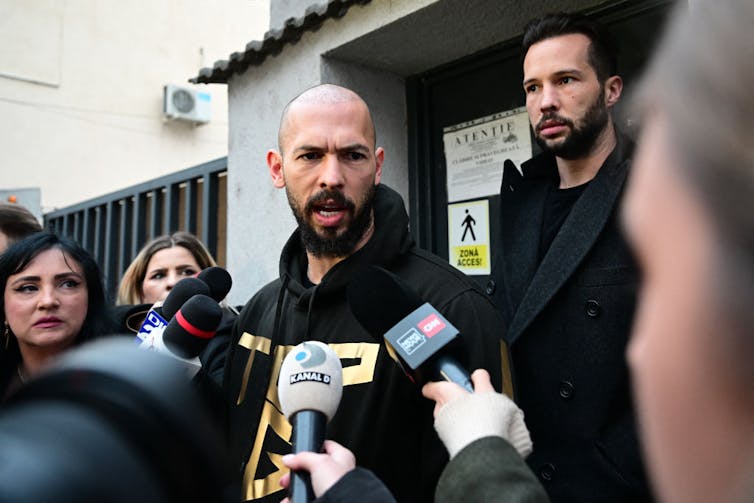
British American former professional kickboxer and controversial influencer Andrew Tate speaks to the press after being released from detention in Bucharest, Romania, on March 12, 2024. Daniel Mihailescu/AFP via Getty Images
To Tate and Peterson, being a better man isn’t about learning to be more vulnerable. Instead, they argue that straight men have become marginalized in a society that’s gotten too soft, too effeminate and too politically correct. In their view, men need to embrace their traditional roles as protectors, providers and producers.
Research has shown that young men in particular are receptive to these ideas. Of course, young Black men make up some of this cohort. But they rarely get mentioned in critiques of the manosphere.
Fitness, health … and Fuentes
“Fresh & Fit” bills itself as a discussion on men’s fitness, fashion and mental health.
Gaines is author of the book “Why Women Deserve Less,” in which he writes, “Women are benefiting unfairly at nearly every man’s expense.”
Weekes is a business mogul who firmly believes in meritocracy; he credits his success to his own hard work, a point he eagerly reiterates on a number of episodes.
The show normally involves commentary from the hosts about current events, and they’ll often feature guests ranging from CrossFit coaches and gym owners to more controversial interviewees like Fuentes and conservative political commentator Candace Owens.
The YouTube shows are wildly popular, with some episodes garnering hundreds of thousands of views.
There’s also a spinoff, “Fresh & Fit After Hours,” which tends to include panels of young women. During these conversations, the women – who usually work in fields such as modeling, sex work or professional dance – often find themselves put on the spot by the hosts, who ask them to speak on behalf of all women.
Locker-room talk
I listened to 40 randomly selected episodes of the main show and 25 of the “After Hours” show, and the conversations veered into explorations of gender differences and debates about why men are better than women. All of these elements fall under what sociolinguist Scott Kiesling calls “masculine linguistic practices” – the ways in which men express their masculinity in conversation with one another.
Each episode is replete with misogyny. On one,[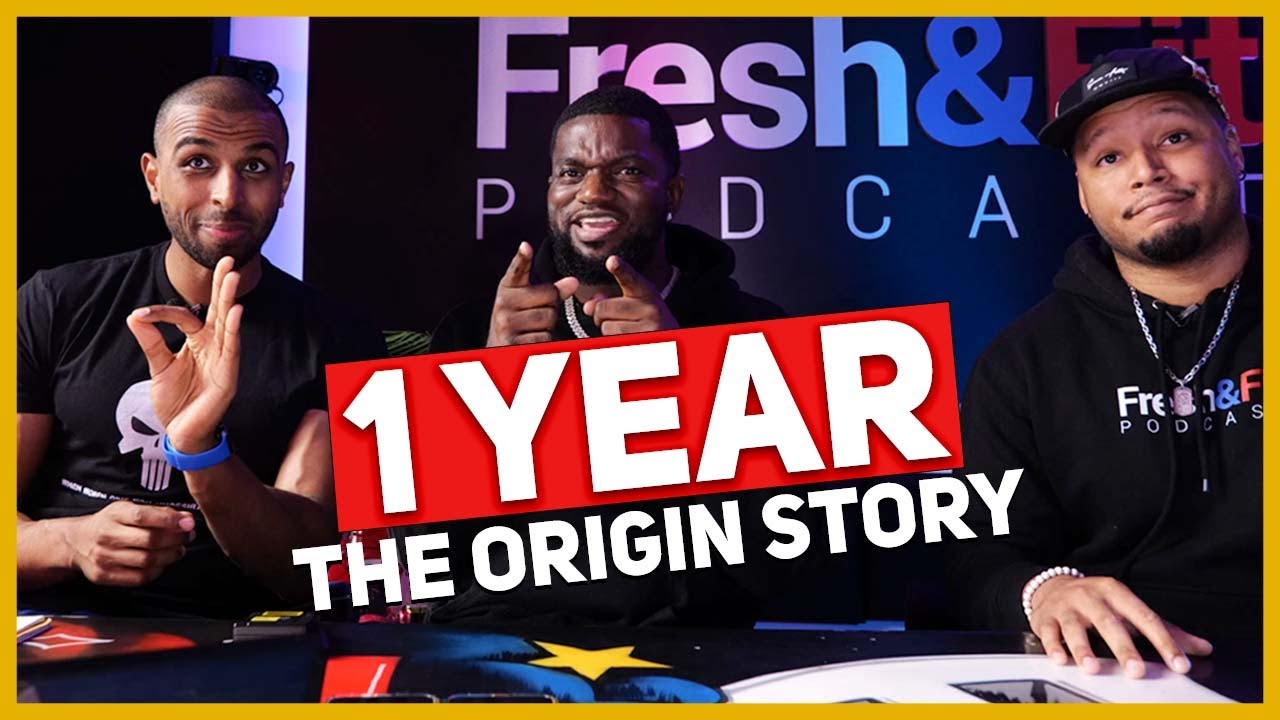 [vid] ](https://youtu.be/T16En55Sf0c) to not go to Miami – not because it’s too expensive or it’s too hot, but because the women in South Beach think they’re “better than you.” On another, when talking about what men are looking for in a partner, he notes, “When we look for security in y'all, it’s security in making sure the kid is ours. And a woman that has a promiscuous past might continue that trend in the future.”
Gaines and Weekes do give a platform to women – but it’s to women who echo the hosts’ warped theories on gender.
In several of the “Fresh & Fit After Hours” episodes I watched, the hosts booked female guests who often admitted that they are status-conscious opportunists – that they want to be taken care of, that they expect men to give them gifts, and that they should be treated “like a lady.”
In one episode of “After Hours,” when a guest says she wishes men could approach her without being overly flirtatious, Gaines is quick to undermine her: Surely she gets approached by men every day. But are they all flirtatious?
Then he throws out another question: How many of the men she ended up dating hadn’t flirted with her?
She holds up her hand in the shape of a zero.
Messages that resonate with Black listeners
Watching “Fresh & Fit” also showed me how the hosts sought to specifically appeal to Black viewers and listeners.
I think it’s important to note that although Black men are highly susceptible to being seen as a collective group, they aren’t a monolith. Many Black men hold conservative views. Instances of homophobia, misogyny and transphobia are as common among Black Americans as they are among white Americans.
In other words, there isn’t any sort of cultural insulation that would protect Black men from negative messages in the manosphere, and the hosts subtly use language and imagery common to Black culture to inculcate Black listeners to their views.
Gaines and Weekes invariably slip in and out of African American Vernacular English, which conveys not only authenticity but also forges a connection with Black listeners.
Additionally, a common theme is the degree to which men are being “kept down.” In the context of their show, “kept down” refers to the ways in which women constrain them. But in Black culture, the phrase is commonly used to talk about the ways in which the dominant white culture forces them to behave or act a certain way.
Criminal law scholar Paul Butler refers to the impact of those stereotypes about Black men as “black male exceptionalism.”
To Butler, commonly repeated statistics about Black men – their higher incarceration rates, worse education outcomes and lower employment rates – reinforce the idea of Black men as an “endangered species.” My upcoming research expands on this, exploring how the internalization of this exceptionalism can be a self-fulfilling prophecy.
The darker corners of the manosphere stoke beliefs about disenfranchisement and discrimination against men. So it’s worth pointing out that these messages can easily resonate among minority men, too.
If they listen to Gaines and Weekes, they’ll come away from the episodes thinking that it isn’t just racism keeping them down: It’s women, too.
Steven Dashiell, Assistant Research Professor, *Morgan State University
This article is republished from The Conversation under a Creative Commons license. Read the original article.
===