Anderson, Jack
---
powell memo leaked to
assassination plot
lsd?
==
plot 86d by watergate crisis?
0:30
business wasn’t so oppressed as he made it out to be in his memo, Sydnor sent Powell a congratulatory letter and informing him that the Chamber of Commerce would be meeting to discuss
20:39
his memo. Sydnor expressed his hope that Powell would continue to give the Chamber advice on how to proceed with the plans laid out in the memo. What had originally been marked Confidential had
20:48
now been seen by a couple handful of people, but the memo was still unknown generally, and was not a subject of the Senate’s review of Powell during his confirmation hearings.
20:57
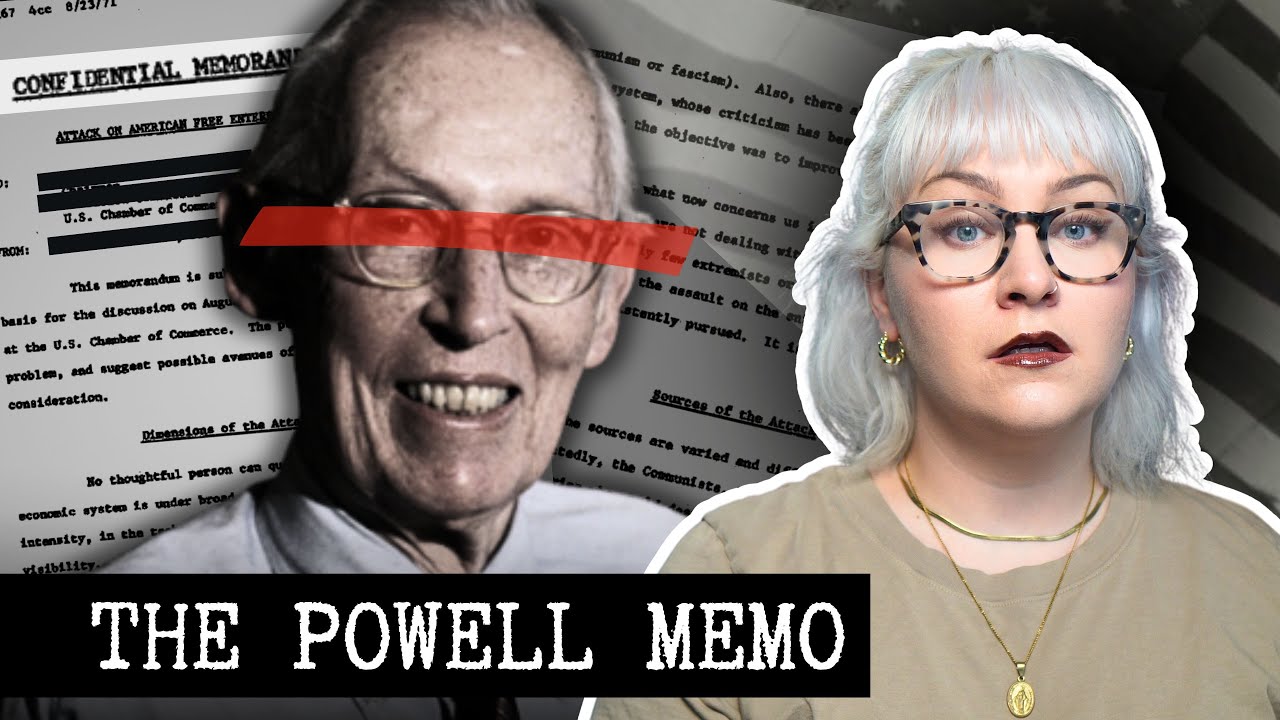
Then, one year later, in late September 1972, investigative journalist and general thorn in the side of big business Jack Anderson received a leaked copy of the Powell Memo, highlighting in
21:07
a series of columns the various more provocative quotes from the memo. To counteract the incendiary
21:12
narrative of Jack Anderson’s columns, the Chamber of Commerce published the memo in full, making it available to anyone requesting it from the Chamber. This leak led to major public
21:20
outcry. A Supreme Court Justice advocating vigorously for the rights of big business,
21:27
in secret with the most powerful business association in the country, including using a line like “Under our constitutional system, especially with an activist-minded Supreme Court,
...
23:08
to implement his suggestions in the Powell Memo, and he kept in touch with Sydnor for years into his tenure on the Supreme Court. A conservative radio broadcast in 1973 called the Powell Memo
23:18
“The most important single document regarding the free enterprise system ever written.” As an aside, Jack Anderson, remember that pioneering investigative journalist who
23:27
first leaked the Powell Memo? He was also a thorn in the side of Nixon, exposing virtually every Nixon scandal since he first entered politics, and doubling down once he became President. And Nixon
23:36
and his cronies did everything they could think of to try to discredit him. They planted a spy
23:42
in his newsroom, but his secretary discovered him snooping. He was given forged documents posing as a major leak, but Anderson figured out they were bogus. The CIA wiretapped and planted spies at his
23:51
home, but he had nine children and a wife, and a house that full of activity easily discovered the spies sitting outside their house, and Anderson openly mocked the CIA in his column. Nixon is
24:02
even said to have ordered a smear campaign against Anderson to out him as gay, but that went nowhere because it was false and also he was happily married with NINE CHILDREN. Then in March 1972,
24:12
White House special Counsel Charles Colson met with Nixon in his secret hideaway office. Afterwards, he contacted White House operatives E. Howard Hunt and G. Gordon Liddy,
24:22
and proposed to assassinate Anderson. According to official testimony after the fact, Colson told Hunt that he was “authorized to do whatever was necessary” to eliminate Anderson. The group
24:31
brainstormed various means of assassination, from untraceable poison, a high dose of LSD
24:37
while he was driving, administered via slathering his steering wheel with a thin layer of it,
24:44
planting poisoned aspirin in his home, staging a car crash, or just offing him in the street
24:49
and hoping it would be pegged as just a product of the high street crime rate in Washington at the time. A few days after the brainstorming session, however, the hit was called off. The
24:58
White House had more urgent work for them to do: breaking into and bugging the Democratic National Committee headquarters in the Watergate office building. All three would later go to prison for
25:07
crimes related to the Watergate scandal. After the leak of the Powell Memo, the business community sprung into action, galvanized by this document that so clearly laid out a path to their
{===}:
9 24 the lever podcast series
powell justice sterilization never gave out memo, ref of to coc pal; fbi did not mention in senate nom dossier; PR problem post jack anderson brief?
RR promo for pacific legal
trailer: Master Plan | Listen Now
ep 4
3 mtg orlando dallas and --- same time? jerry ford vp
white of US steel
devos amway pal, joe coors/ AILES
In this episode, we definitely answer that question for the very first time. Master Plan lead producer Jared Jacang Maher has uncovered troves of never-before-reported evidence that proves corporate executives and politicians didn’t just read Powell’s memo — they acted on it.
This includes three secret meetings of a “Powell Memo Task Force” — including one at Disney World. These gatherings drew together America’s most powerful businessmen, a future president, and an ambitious young media consultant named Roger Ailes.
By the end of 1974, the Powell Memo had transformed from a set of ideas into an actual master plan — and the pieces were in place to carry out a decades-long assault on American democracy.
---
press2:
Historical context:
Mark Feldstein in Poisoning the Press points out that early newspapers were party organs, often subsidized by printing fed docs p9 Thomas Jefferson partisans leaked sex scandal on Hamilton which led to Burr duel and others came back w/ Sally (page 9). Eventually press became commercial entities and journalism eventually professionalized, but Richard Nixon (with the help of Roger Ailes) adept at using press for propaganda, and Feldman claims deregulation began as a sop to get media to back off (they also pioneered the liberal press myth (Agnew "nattering nabobs of negativism," the "silent majority" is on our side) ITT telecomm.
Feldman: Jack Anderson had 70 million audience in his syndicated column, TV, radio, books and speeches p 5 In part because he was a victim of JEH's FBI using the tactics against him, he used eavesdropping, going through trash cans, some suicide b/c of his exposes;
Nixon and he also had a longstanding vendetta that stretched over decades, each perhaps driving the other to more extreme methods, with occasional truces borne of exhaustion, according to Feldstein. Began with Nixon stories on red bait 40's (a bit odd since Anderson was pals with McCarthy), exposed and drive WH scandals; Anderson had freedom b/c of syndicated column, and did not worry about bias p7 Anderson used bugging close to bribe and extortion p8
Nearly all of Nixon's setbacks could be linked to Anderson,
Checkers Speech 1952 slush fund
Howard Hughes $205,000 loan to brother never repaid.
psychotherapy, met with Elvis
1972 ITT $400,000, memo proved Nixon had intervened in an anti-trust action (mojo rev)
so Jack Anderson targeted for assassination by Nixon Admin. Colson recruited Liddy, so he and Hunt spoke with doctor who consulted on Castro hit; discussed LSD on steering wheel, in aspirin, finally Liddy decided on a fake mugging to stab him to death, called off by Colson (diverted to Watergate?) Colson never admitted, even when Anderson was on deathbed, and Anderson had offered to lend Colson money before the want to jail and subsequently had religious conversion). bush2 FBI tried to grab 200 boxes after Jack A death, prevented by family and public outrage on the left and right.
Bernstein and Woodward's heroic reporting on Watergate made modern investigative reporting iconic, but we had illustrious precedent in Ida Tarbell's book length expose on Standard Oil and Upton Sinclair's Jungle that helped establish the FDA. (ironically Uppie taken out by Nixon's Campaigns Inc, which later have us Kuwaiti incubators). [also Segretti and rat-fucking].
Though journalism effective and professionalized
However, the institutional support began to erode:
===
In 1971, Lewis F. Powell, then acorporate lawyer and member of the boards of 11 corporations, wrote a memo to his friend Eugene Sydnor, Jr., the Director of the U.S. Chamber of Commerce. The memorandum was dated August 23, 1971, two months prior to Powell's nomination by President Nixon to the U.S. Supreme Court.
The Powell Memo did not become available to the public until long after his confirmation to the Court. It was leaked to Jack Anderson, a liberal syndicated columnist, who stirred interest in the document when he cited it as reason to doubt Powell's legal objectivity. Anderson cautioned that Powell "might use his position on the Supreme Court to put his ideas into practice...in behalf of business interests."
===
brit hume and JAnderson implied agnew son gay (in defense?) related to commies and queers) mccarthy
kpfa N&P liddy, hunt cia toxicologists dr edward Gunn (not actually retired) ~ Castro cigar mar 72 mtg ~ JackA (both admitted)
liddy offered to do hit himself; lsd on steering whl so aspirin roulette, stage fatal accident (roundabout) but did not want CIA to have leverage
liddy decided to stage a mugging (Cuban might blab) diverted to Watergate
mark feldstein Posioning the Press book http://www.amazon.com/Poisoning-Press-Richard-Anderson-Washingtons/dp/0374235309#reader_0374235309
Jack Anderson targetted for assassination by Nixon Admin. feldman: 70 mill aud in col, tv, radio, books speeches p 5 eavesdripping, trash cans, some suicide b/c of expose; re rmn stoirs on red bait 40's, exposed and drive WH scandals;freedom b/c of synd col, and did not worry about bias p7 ja used bugging close to bribe and extortion p8
early newspapers were party organ, subsid by priting fed docs p 9TJ partisans leaked sex scandal on Hamilton and others came back w/ sally
"
It is March 1972, and the Nixon White House wants Jack Anderson dead.
The syndicated columnist Jack Anderson, the most famous and feared investigative reporter in the nation, has exposed yet another of the President’s dirty secrets. Nixon’s operatives are ordered to “stop Anderson at all costs”—permanently. Across the street from the White House, they huddle in a hotel basement to conspire. Should they try “Aspirin Roulette” and break into Anderson’s home to plant a poisoned pill in one of his medicine bottles? Could they smear LSD on the journalist’s steering wheel, so that he would absorb it through his skin, lose control of his car, and crash? Or stage a routine-looking mugging, making Anderson appear to be one more fatal victim of Washington’s notorious street crime?
Poisoning the Press: Richard Nixon, Jack Anderson, and the Rise of Washington’s Scandal Culture recounts not only the disturbing story of an unprecedented White House conspiracy to assassinate a journalist, but also the larger tale of the bitter quarter-century battle between the postwar era’s most embattled politician and its most reviled newsman. The struggle between Nixon and Anderson included bribery, blackmail, forgery, spying, and burglary as well as the White House murder plot. Their vendetta symbolized and accelerated the growing conflict between the government and the press, a clash that would long outlive both men.
Mark Feldstein traces the arc of this confrontation between a vindictive president and a flamboyant, crusading muckraker who rifled through garbage and swiped classified papers in pursuit of his prey—stoking the paranoia in Nixon that would ultimately lead to his ruin. The White House plot to poison Anderson, Feldstein argues, is a metaphor for the poisoned political atmosphere that would follow, and the toxic sensationalism that contaminates contemporary media discourse.
Melding history and biography, Poisoning the Press unearths significant new information from more than two hundred interviews and thousands of declassified documents and tapes. This is a chronicle of political intrigue and the true price of power for politicians and journalists alike. The result—Washington’s modern scandal culture—was Richard Nixon’s ultimate revenge." also says RMN pioneered PR, propaganda, myth of lib media, started dereg that led to sensation as buyoff;
colson called "hit man" in WH
JAnderson revealed $ scandal 1952, 1960 on eve of election, blamed for loss to jfk; 1968 nixon psychiatrist (true), N and Kissenger lied ; RNConv paid for in return for anti-trust (2 convicted)
JA used burglary himself, paid and blackmailled sources (stole to expose theft) blackmailled robert byrd sen leader to nix nominee (nixon arrested JA assoc on trumped charges)
used leaked tax returns on wallace (DEM) FROM NIXON WH?
created tabloid scandal culture (really a kind of celebrity gossip)
bush2 fbi tried to grab 200 boxes after Jack A death (~ JEH said gay, went thru his trash) in middle of b2 crackdown on press, claimed classified docs)
cheney and rummy covered by JA in past
===
Jack anderson
wiki
Jack Anderson was a key and often controversial figure in reporting on J. Edgar Hoover's apparent ties to the Mafia, Watergate, the John F. Kennedy assassination. He also broke open the case of John Lennon, who was followed, had his phone tapped and was generally harassed by the Nixon administration during the fight to deport him, the search for fugitive ex-Nazi officials in South America and the Savings and Loan scandal. He discovered a CIA plot to assassinate Fidel Castro,[^^1]^(http://en.wikipedia.org/wiki/Jack_Anderson_%28columnist%29#cite_note-spartacus-0) and was credited for breaking the **Iran-Contra affair**, though he has said the scoop was "spiked" because he had become too close to President Ronald Reagan.
Anderson feuded with FBI chief J. Edgar Hoover in the 1950s, when he exposed the scope of the Mafia, a threat that Hoover had long downplayed. Hoover's retaliation and continual harassment lasted into the 1970s.[^^4]^(http://en.wikipedia.org/wiki/Jack_Anderson_%28columnist%29#cite_note-3) Hoover once described Anderson as "lower than the regurgitated filth of vultures."[^^5]^(http://en.wikipedia.org/wiki/Jack_Anderson_%28columnist%29#cite_note-time-4)
Anderson told his staff, "Let's do to Hoover what he does to others."[^^6]^(http://en.wikipedia.org/wiki/Jack_Anderson_%28columnist%29#cite_note-5) Anderson had his people go through Hoover's garbage, which is the kind of thing FBI people used to do. Anderson's investigations were a tipping point in the attitude of the public and the press towards Hoover. Prior to Anderson's exposés few people of stature had dared to publicly criticize Hoover. After Anderson, many followed suit, and the man who had been the public persona of exemplary law enforcement became exposed for his failures and questionable activities in the areas of organized crime and civil rights, many of which were of questionable legality.
Anderson grew close to :{Joseph McCarthy:(style="background-color:#fff200"):}:, and the two exchanged information from sources,[^^1]^(http://en.wikipedia.org/wiki/Jack_Anderson_%28columnist%29#cite_note-spartacus-0) but when Pearson went after McCarthy, Anderson reluctantly followed at first, then actively assisted with the eventual downfall of his one-time friend.
In the mid-1960s, Anderson exposed the corruption of Senator Thomas J. Dodd, unearthed a memo by an ITT executive admitting the company paid off Richard Nixon's campaign to stymie anti-trust prosecution. His reporting on Nixon-ITT corruption earned him a place on the master list of Nixon political opponents.[^^7]^(http://en.wikipedia.org/wiki/Jack_Anderson_%28columnist%29#cite_note-6)
Anderson collaborated with Pearson on "The Case Against Congress," published in 1969.[^^1]^(http://en.wikipedia.org/wiki/Jack_Anderson_%28columnist%29#cite_note-spartacus-0)
According to the family jewels documents, in 1971, during the Indo-Pakistani War, the director of the CIA, :{Richard Helms:(style="background-color:#fff200"):}:, put Anderson under tap. Jack Anderson had written two articles on assassination attempts on Castro through John Roselli.[^^8]^(http://en.wikipedia.org/wiki/Jack_Anderson_%28columnist%29#cite_note-7)
Targeted
In 1972, Anderson was the target of an assassination plot in the White House. Two Nixon administration conspirators admitted under oath they plotted to poison Anderson on orders from White House aide Jeb Magruder.[^^11]^(http://en.wikipedia.org/wiki/Jack_Anderson_%28columnist%29#cite_note-10) White House "plumbers" **G. Gordon Liddy**and**E. Howard Hunt**met with a**CIA**operative [edward gunn tox]to discuss the possibilities, including drugging Anderson with LSD, poisoning his aspirin bottle, or staging a fatal mugging.[^^12]^(http://en.wikipedia.org/wiki/Jack_Anderson_%28columnist%29#cite_note-11) The conspirators were never ordered to proceed, and the plot was aborted when the plotters were arrested for the Watergate break-in. Nixon had long been angry with Anderson, blaming Anderson's election eve story about a secret loan from Howard Hughes to Nixon's brother[^^13]^(http://en.wikipedia.org/wiki/Jack_Anderson_%28columnist%29#cite_note-12) for Nixon's loss of the 1960 presidential election. Anderson remained a target of FBI investigation after his death; in February 2006, the FBI contacted Anderson's family to obtain his files and search for classified documents.[^^14]^(http://en.wikipedia.org/wiki/Jack_Anderson_%28columnist%29#cite_note-chronicle-13)The FBI agents claimed to be looking for documents pertaining to**American Israel Public Affairs Committee**(AIPAC) as part of an espionage investigation. In November 2006, the FBI quietly gave up its pursuit of the archive.[b/c of public outrage left and right, as well as family standing tough] The archive, as revealed in *The Chronicle of Higher Education*, contains Anderson's CIA file, along with information about prominent public figures such as Richard Nixon, Ronald Reagan, Thomas Dodd, and J. Edgar Hoover.[^^15]^(http://en.wikipedia.org/wiki/Jack_Anderson_%28columnist%29#cite_note-chronicle2-14)
^----^
Thomas Eagleton's Mental Health – 1972
Eagleton had kept the explosive information from McGovern at the convention, but too many Missouri politicians and others knew about his secret for it to be kept under wraps. An anonymous tip about Eagleton's past to the Detroit Free Press began the chain of events that eventually brought the Democrat's episodes to public view. The least responsible coverage of the ensuing frenzy was provided by columnist Jack Anderson, who falsely reported a half-dozen Eagleton "arrests" for drunk driving and other traffic offenses based on a questionable and unverified tip. Anderson's gross breach of journalistic ethics in printing unproven gossip generated some sympathy for Eagleton, but it could not save him. Under pressure from McGovern and many senior Democrats, Eagleton withdrew from the ticket, but not before McGovern had swallowed a suicide pill by declaring himself to be "1,000 percent" behind his doomed partner. http://www.washingtonpost.com/wp-srv/politics/special/clinton/frenzy/eagleton.htm spartacus Drew Pearsonwas born in Evanston, Illinois, on 13th December, 1897. In 1902 the family moved to Pennsylvania, where his father, Paul Pearson, became professor of public speaking at Swarthmore College. Pearson was educated at the Phillips Exeter Academy and Swarthmore College, where he edited the student newspaper, The Phoenix. In 1919 Pearson, a Quaker, travelled to Serbia where he spent two years rebuilding houses that had been destroyed during the First World War. After returning to America, Drew taught industrial geography at the University of Pennsylvania. In 1923 he embarked on a worldwide tour visiting Japan, China, Australia, New Zealand and India. He paid for his trip by writing articles for an American newspaper syndicate. Pearson taught briefly at Columbia University before returning to journalism and reporting on anti-foreigner demonstrations in China (1927), the Geneva Naval Conference (1928) and the Pan American Conference in Cuba (1928). In 1929 Pearson became Washington correspondent of the *Baltimore Sun*. Three years later he joined the Scripps-Howard syndicate, United Features. His Merry-Go-Roundcolumn was published in newspapers all over the United States. Pearson was a strong supporter of Franklin D. Roosevelt and his New Deal program. He also upset more conservative editors when he advocated United States involvement in the struggle against fascism in Europe. Pearson's articles were often censored and so in 1941 he switched to the more liberal *The Washington Post*. During the Second World War Pearson created a great deal of controversy when he took up the case of John Gates, a member of the American Communist Party, who was not allowed to take part in the D-Day landings. Gates later pointed out: "Newspaper columnist Drew Pearson published an account of my case... Syndicated coast-to-coast, the column meant well but it contained all kinds of unauthorized, secret military information - the name of my battalion, the fact that it had been alerted for overseas, my letter to the President and his reply, and the officers' affidavits. As a result of this violation of military secrecy, the date for the outfit going overseas was postponed, the order restoring me to my battalion was countermanded and I was out of it for good. It seems that some of my friends, a bit overzealous in my cause, had given Pearson all this information, thinking the publicity would do me good." Pearson also became a radio broadcaster. He soon became one of America's most popular radio personalities. After the war he was an enthusiastic supporter of the United Nations and helped to organize the Friendship Train project in 1947. The train travelled coast-to-coast collecting gifts of food for those people in Europe still suffering from the consequences of the war. In 1947 Pearson recruited **Jack Anderson**as his assistant. Over the next few years Anderson was able to use his contacts that he had developed in the**Office of Strategic Services** (OSS)in**Chin**a during the Second World War. This included John K. Singlaub, Ray S. Cline, Richard **Helms**, E. Howard Hunt, Mitchell WerBell, Paul Helliwell, Robert Emmett Johnson and Lucien Conein. Others working in China at that time included Tommy Corcoran, Whiting Willauer and William Pawley. One of Anderson's first stories concerned the dispute between Howard Hughes, the owner of Trans World Airlines and Owen Brewster, chairman of the Senate War Investigating Committee. Hughes claimed that Brewster was being paid by Pan American World Airways (Pan Am) to persuade the United States government to set up an official worldwide monopoly under its control. Part of this plan was to force all existing American carriers with overseas operations to close down or merge with Pan Am. As the owner of Trans World Airlines, Hughes posed a serious threat to this plan. Hughes claimed that Brewster had approached him and suggested he merge Trans World with Pan Am. Pearson and Anderson began a campaign against Brewster. They reported that Pan Am had provided Bewster with free flights to Hobe Sound, Florida, where he stayed free of charge at the holiday home of Pan Am Vice President Sam Pryor. As a result of this campaign Bewster lost his seat in Congress. In the late 1940s Anderson became friendly with **Joseph McCarthy**. As he pointed out in his autobiography, *Confessions of a Muckraker*, "Joe McCarthy... was a pal of mine, irresponsible to be sure, but a fellow bachelor of vast amiability and an excellent source of inside dope on the Hill." McCarthy began supplying Anderson with stories about suspected communists in government. Pearson refused to publish these stories as he was very suspicious of the motives of people like McCarthy. In fact, in 1948, Pearson began investigating J. Parnell Thomas, the Chairman of the House of Un-American Activities Committee. It was not long before Thomas' secretary, Helen Campbell, began providing information about his illegal activities. On 4th August, 1948, Pearson published the story that Thomas had been putting friends on his congressional payroll. They did no work but in return shared their salaries with Thomas. Called before a grand jury, J. Parnell Thomas availed himself to the 5th Amendment, a strategy that he had been unwilling to accept when dealing with the Hollywood Ten. Indicted on charges of conspiracy to defraud the government, Thomas was found guilty and sentenced to 18 months in prison and forced to pay a $10,000 fine. Two of his fellow inmates in Danbury Federal Correctional Institution were Lester Cole and Ring Lardner Jr. who were serving terms as a result of refusing to testify in front of Thomas and the House of Un-American Activities Committee. In 1949 Pearson criticised the Secretary of Defence, James Forrestal, for his conservative views on foreign policy. He told Jack Anderson that he believed Forrestal was "the most dangerous man in America" and claimed that if he was not removed from office he would "cause another world war". Pearson also suggested that Forrestal was guilty of corruption. Pearson was blamed when Forrestal committed suicide on 22nd May 1949. One journalist, Westbrook Pegler, wrote: "For months, Drew Pearson... hounded Jim Forrestal with dirty aspersions and insinuations, until, at last, exhausted and his nerves unstrung, one of the finest servants that the Republic ever had died of suicide." Drew Pearson andJack Anderson also began investigating General Douglas MacArthur. In December, 1949, Anderson got hold of a top-secret cable from MacArthur to the Joint Chiefs of Staff, expressing his disagreement with President Harry S. Truman concerning Chaing Kai-shek. On 22nd December, 1949, Pearson published the story that: "General MacArthur has sent a triple-urgent cable urging that Formosa be occupied by U.S. troops." Pearson argued that MacArthur was "trying to dictate U.S. foreign policy in the Far East". Harry S. Truman and Dean Acheson, the Secretary of State, told MacArthur to limit the war to Korea. MacArthur disagreed, favoring an attack on Chinese forces. Unwilling to accept the views of Truman and Dean Acheson, MacArthur began to make inflammatory statements indicating his disagreements with the United States government. MacArthur gained support from right-wing members of the Senate such as Joe McCarthy who led the attack on Truman's administration: "With half a million Communists in Korea killing American men, Acheson says, 'Now let's be calm, let's do nothing'. It is like advising a man whose family is being killed not to take hasty action for fear he might alienate the affection of the murders." On 7th October, 1950, Douglas MacArthur launched an invasion of North Korea by the end of the month had reached the Yalu River, close to the frontier of China. On 20th November, Pearson wrote in his column that the Chinese were following a strategy that was "sucking our troops into a trap." Three days later the Chinese Army launched an attack on MacArthur's army. North Korean forces took Seoul in January 1951. Two months later, Harry S. Truman removed MacArthur from his command of the United Nations forces in Korea. Joe McCarthy continued to provide Jack Anderson with a lot of information. In his autobiography, *Confessions of a Muckraker*, Anderson pointed out: "At my prompting he (McCarthy) would phone fellow senators to ask what had transpired this morning behind closed doors or what strategy was planned for the morrow. While I listened in on an extension he would pump even a Robert Taft or a William Knowland with the handwritten questions I passed him." In return, Anderson provided McCarthy with information about politicians and state officials he suspected of being "communists". Anderson later recalled that his decision to work with McCarthy "was almost automatic.. for one thing, I owed him; for another, he might be able to flesh out some of our inconclusive material, and if so, I would no doubt get the scoop." As a result Anderson passed on his file on the presidential aide, David Demarest Lloyd. On 9th February, 1950, Joe McCarthy made a speech in Salt Lake City where he attacked Dean Acheson, the Secretary of State, as "a pompous diplomat in striped pants". He claimed that he had a list of 57 people in the State Department that were known to be members of the American Communist Party. McCarthy went on to argue that some of these people were passing secret information to the Soviet Union. He added: "The reason why we find ourselves in a position of impotency is not because the enemy has sent men to invade our shores, but rather because of the traitorous actions of those who have had all the benefits that the wealthiest nation on earth has had to offer - the finest homes, the finest college educations, and the finest jobs in Government we can give." The list of names was not a secret and had been in fact published by the Secretary of State in 1946. These people had been identified during a preliminary screening of 3,000 federal employees. Some had been communists but others had been fascists, alcoholics and sexual deviants. As it happens, if McCarthy had been screened, his own drink problems and sexual preferences would have resulted in him being put on the list. Pearson immediately launched an attack on Joe McCarthy. He pointed out that only three people on the list were State Department officials. He added that when this list was first published four years ago, Gustavo Duran and Mary Jane Keeney had both resigned from the State Department (1946). He added that the third person, John S. Service, had been cleared after a prolonged and careful investigation. Pearson also argued that none of these people had been named were members of the American Communist Party. Jack**Anderson**asked Pearson to stop attacking McCarthy:"He is our best source on the Hill." Pearson replied, "He may be a good source, Jack, but he's a bad man." On 20th February, 1950, Joe McCarthy made a speech in the Senate supporting the allegations he had made in Salt Lake City. This time he did not describe them as "card-carrying communists" because this had been shown to be untrue. Instead he argued that his list were all "loyalty risks". He also claimed that one of the president's speech-writers, was a communist. Although he did not name him, he was referring to David Demarest Lloyd, the man that Anderson had provided information on. Lloyd immediately issued a statement where he defended himself against McCarthy's charges. President Harry S. Truman not only kept him on but promoted him to the post of Administrative Assistant. Lloyd was indeed innocent of these claims and McCarthy was forced to withdraw these allegations. As Anderson admitted: "At my instigation, then, Lloyd had been done an injustice that was saved from being grevious only by Truman's steadfastness." McCarthy now informed Jack Anderson that he had evidence that Professor Owen Lattimore, director of the Walter Hines Page School of International Relations at Johns Hopkins University, was a Soviet spy. Pearson, who knew Lattimore, and while accepting he held left-wing views, he was convinced he was not a spy. In his speeches, McCarthy referred to Lattimore as "Mr X... the top Russian spy... the key man in a Russian espionage ring." On 26th March, 1950, Pearson named Lattimore as McCarthy's Mr. X. Pearson then went onto defend Lattimore against these charges. McCarthy responded by making a speech in Congress where he admitted: "I fear that in the case of Lattimore I may have perhaps placed too much stress on the question of whether he is a paid espionage agent." McCarthy then produced Louis Budenz, the former editor of *The Daily Worker*. Budenz claimed that Lattimore was a "concealed communist". However, as Jack Anderson admitted: "Budenz had never met Lattimore; he spoke not from personal observation of him but from what he remembered of what others had told him five, six, seven and thirteen years before." Pearson now wrote an article where he showed that Budenz was a serial liar: "Apologists for Budenz minimize this on the ground that Budenz has now reformed. Nevertheless, untruthful statements made regarding his past and refusal to answer questions have a bearing on Budenz's credibility." He went on to point out that "all in all, Budenz refused to answer 23 questions on the ground of self-incrimination". Owen Lattimore was eventually cleared of the charge that he was a Soviet spy or a secret member of the American Communist Party and like several other victims of McCarthyism, he went to live in Europe and for several years was professor of Chinese studies at Leeds University. Despite the efforts of Jack Anderson, by the end of June, 1950, Drew Pearson had written more than forty daily columns and a significant percentage of his weekly radio broadcasts, that had been devoted to discrediting the charges made by Joseph McCarthy. He now decided to take on Pearson and he told Anderson: "Jack, I'm going to have to go after your boss. I mean, no holds barred. I figure I've already lost his supporters; by going after him, I can pick up his enemies."McCarthy, when drunk, told Assistant Attorney General Joe Keenan, that he was considering "bumping Pearson off". On 15th December, 1950, McCarthy made a speech in Congress where he claimed that Pearson was "the voice of international Communism" and "a Moscow-directed character assassin." McCarthy added that Pearson was "a prostitute of journalism" and that Pearson "and the Communist Party murdered James Forrestal in just as cold blood as though they had machine-gunned him." Over the next two months Joseph McCarthy made seven Senate speeches on Drew Pearson. He called for a "patriotic boycott" of his radio show and as a result, Adam Hats, withdrew as Pearson's radio sponsor. Although he was able to make a series of short-term arrangements, Pearson was never again able to find a permanent sponsor. Twelve newspapers cancelled their contract with Pearson. Joe **McCarthy**and his friends also raised money to help Fred Napoleon Howser, the Attorney General of California, to sue Pearson for $350,000. This involved an incident in 1948 when Pearson accused Howser of consorting with mobsters and of taking a bribe from gambling interests. Help was also given to Father **Charles Coughlin**, who sued Pearson for $225,000. However, in 1951 the courts ruled that Pearson had not libeled either Howser or Coughlin. Only the *St. Louis Star-Times* defended Pearson. As its editorial pointed out: "If Joseph McCarthy can silence a critic named Drew Pearson, simply by smearing him with the brush of Communist association, he can silence any other critic." However, Pearson did get the support ofJ. William Fulbright, Wayne Morse, Clinton Anderson, William Benton and Thomas Hennings in the Senate. In October, 1953, Joe McCarthy began investigating communist infiltration into the military. Attempts were made by McCarthy to discredit Robert T. Stevens, the Secretary of the Army. The president, Dwight Eisenhower, was furious and now realised that it was time to bring an end to McCarthy's activities. The United States Army now passed information about McCarthy to journalists who were known to be opposed to him. This included the news that McCarthy and**Roy Cohn** had abused congressional privilege by trying to prevent David Schine from being drafted. When that failed, it was claimed that Cohn tried to pressurize the Army into granting Schine special privileges. Pearson published the story on 15th December, 1953. Some figures in the media, such as writers George Seldes and I. F. Stone, and cartoonists, Herb Block and Daniel Fitzpatrick, had fought a long campaign against McCarthy. Other figures in the media, who had for a long time been opposed to McCarthyism, but were frightened to speak out, now began to get the confidence to join the counter-attack. Edward Murrow, the experienced broadcaster, used his television programme, *See It Now*, on 9th March, 1954, to criticize McCarthy's methods. Newspaper columnists such as Walter Lippmann also became more open in their attacks on McCarthy. The senate investigations into the United States Army were televised and this helped to expose the tactics of**Joseph McCarthy**. One newspaper, the *Louisville Courier-Journal*, reported that: "In this long, degrading travesty of the democratic process, McCarthy has shown himself to be evil and unmatched in malice." Leading politicians in both parties, had been embarrassed by McCarthy's performance and on 2nd December, 1954, a censure motion condemned his conduct by 67 votes to 22. McCarthy also lost the chairmanship of the Government Committee on Operations of the Senate. He was now without a power base and the media lost interest in his claims of a communist conspiracy. As one journalist, Willard Edwards, pointed out: "Most reporters just refused to file McCarthy stories. And most papers would not have printed them anyway." In 1956 Pearson began investigating the relationship between Lyndon B. Johnson and two businessmen, George R. Brown and Herman Brown. Pearson believed that Johnson had arranged for the Texas-based Brown and Root Construction Company to avoid large tax bills. Johnson brought an end to this investigation by offering Pearson a deal. If Pearson dropped his Brown-Root crusade, Johnson would support the presidential ambitions of Estes Kefauver. Pearson accepted and wrote in his diary (16th April, 1956): "This is the first time I've ever made a deal like this, and I feel a little unhappy about it. With the Presidency of the United States at stake, maybe it's justified, maybe not - I don't know." Jack Anderson also helped Pearson investigate stories of corruption inside the administration of President Dwight Eisenhower. They discovered that Eisenhower had received gifts worth more than $500,000 from "big-business well-wishers." In 1957 Anderson threaten to quit because these stories always appeared under Pearson's name. Pearson responded by promising him more bylines and pledged to leave the column to him when he died. Pearson and Anderson began investigating the presidential assistant Sherman Adams. The former governor of New Hampshire, was considered to be a key figure in Eisenhower's administration. Anderson discovered that Bernard Goldfine, a wealthy industrialist, had given Adams a large number of presents. This included suits, overcoats, alcohol, furnishings and the payment of hotel and resort bills. Anderson eventually found evidence that Adams had twice persuaded the Federal Trade Commission to "ease up its pursuit of Goldfine for putting false labels on the products of his textile plants." The story was eventually published in 1958 and Adams was forced to resign from office. However, Jack Anderson was much criticized for the way he carried out his investigation and one of his assistants, Les Whitten, was arrested by the FBI for receiving stolen government documents. In 1960 Pearson supported Hubert Humphrey in his efforts to become the Democratic Party candidate. However, those campaigning for John F. Kennedy, accused him of being a draft dodger. As a result, when Humphrey dropped out of the race, Pearson switched his support to Lyndon B. Johnson. However, it was Kennedy who eventually got the nomination. Pearson now supported Kennedy's attempt to become president. One of the ways he helped his campaign was to investigate the relationship between Howard Hughes and Richard Nixon. Pearson and Anderson discovered that in 1956 the Hughes Tool Company provided a $205,000 loan to Nixon Incorporated, a company run by Richard's brother, Francis Donald Nixon. The money was never paid back. Soon after the money was paid the Internal Revenue Service (IRS) reversed a previous decision to grant tax-exempt status to the Howard Hughes Medical Institute. This information was revealed by Pearson and Jack Anderson during the 1960 presidential campaign. Nixon initially denied the loan but later was forced to admit that this money had been given to his brother. It was claimed that this story helped John F. Kennedy defeat Nixon in the election. In 1963 Senator John Williams of Delaware began investigating the activities of Bobby Baker. As a result of his work, Baker resigned as the secretary to Lyndon B. Johnson on 9th October, 1963. During his investigations Williams met Don B. Reynolds and persuaded him to appear before a secret session of the Senate Rules Committee. Reynolds told B. Everett Jordan and his committee on 22nd November, 1963, that Johnson had demanded that he provided kickbacks in return for him agreeing to this life insurance policy. This included a $585 Magnavox stereo. Reynolds was also told by Walter Jenkins that he had to pay for $1,200 worth of advertising on KTBC, Johnson's television station in Austin. Reynolds had paperwork for this transaction including a delivery note that indicated the stereo had been sent to the home of Johnson. Don B. Reynolds also told of seeing a suitcase full of money which Bobby Baker described as a "$100,000 payoff to Johnson for his role in securing the Fort Worth TFX contract". Reynolds also provided evidence against Matthew H. McCloskey. He suggested that he given $25,000 to Baker in order to get the contract to build the District of Columbia Stadium. His testimony came to an end when news arrived that President John F. Kennedy had been assassinated. As soon as Johnson became president he contacted B. Everett Jordan to see if there was any chance of stopping this information being published. Jordan replied that he would do what he could but warned Johnson that some members of the committee wanted Reynold's testimony to be released to the public. On 6th December, 1963, Jordan spoke to Johnson on the telephone and said he was doing what he could to suppress the story because " it might spread (to) a place where we don't want it spread." Abe Fortas, a lawyer who represented both Lyndon B. Johnson and Bobby Baker, worked behind the scenes in an effort to keep this information from the public. Johnson also arranged for a smear campaign to be organized against Reynolds. To help him do this J. Edgar Hoover passed to Johnson the FBI file on Reynolds. On 17th January, 1964, the Committee on Rules and Administration voted to release to the public Reynolds' secret testimony. Johnson responded by leaking information from Reynolds' FBI file to Drew Pearson and Jack Anderson. On 5th February, 1964, the *Washington Post* reported that Reynolds had lied about his academic success at West Point. The article also claimed that Reynolds had been a supporter of Joseph McCarthy and had accused business rivals of being secret members of the American Communist Party. It was also revealed that Reynolds had made anti-Semitic remarks while in Berlin in 1953. A few weeks later the *New York Times* reported that Lyndon B. Johnson had used information from secret government documents to smear Don B. Reynolds. It also reported that Johnson's officials had been applying pressure on the editors of newspapers not to print information that had been disclosed by Reynolds in front of the Senate Rules Committee. Like other political journalists, Pearson and Anderson investigated the death of President John F. Kennedy. Sources close to John McCone and Robert Kennedy claimed that the assassination was linked to the plots against Fidel Castro of Cuba. In 1966 attempts were made to deport Johnny Roselli as an illegal alien. Roselli moved to Los Angeles where he went into early retirement. It was at this time he told attorney, Edward Morgan: "The last of the sniper teams dispatched by Robert Kennedy in 1963 to assassinate Fidel Castro were captured in Havana. Under torture they broke and confessed to being sponsored by the CIA and the US government. At that point, Castro remarked that, 'If that was the way President Kennedy wanted it, Cuba could engage in the same tactics'. The result was that Castro infiltrated teams of snipers into the US to kill Kennedy". Morgan took the story to Pearson. The story was then passed on to Earl Warren. He did not want anything to do with it and so the information was then passed to the FBI. When they failed to investigate the story Jack Anderson wrote an article entitled "President Johnson is sitting on a political H-bomb" about Roselli's story. It has been suggested that Roselli started this story at the request of his friends in the Central Intelligence Agency in order to divert attention from the investigation being carried out by Jim Garrison. In 1968 Jack Anderson and Drew Pearson published *The Case Against Congress*. The book documented examples of how politicians had "abused their power and priviledge by placing their own interests ahead of those of the American people". This included the activities of Bobby Baker, James Eastland, Lyndon B. Johnson, Dwight Eisenhower, Hubert Humphrey, Everett Dirksen, Thomas J. Dodd, John McClellan and Clark Clifford. On 18th July, 1969, Mary Jo Kopechne, died while in the car of Edward Kennedy. Pearson began investigating the case when he died on 1st September. Chalmers Roberts of the *Washington Post* wrote: "Drew Pearson was a muckraker with a Quaker conscience. In print he sounded fierce; in life he was gentle, even courtly. For thirty-eight years he did more than any man to keep the national capital honest." |


mojo
http://motherjones.com/politics/2010/09/nixon-jack-anderson-mark-feldstein
Thu Sep. 30, 2010 3:04 AM PDT
A dying journalist. He has one final assignment: Find out if President Richard Nixon ordered him assassinated.
That's what occurred at the end of the life of the infamous columnist Jack Anderson, one of the most influential Washington reporters of the 1950s, '60s, and '70s. This intriguing and poignant tale is recounted by Mark Feldstein, a former investigative correspondent for CNN and ABC (and onetime Anderson intern) in his marvelous new book,Poisoning the Press: Richard Nixon, Jack Anderson, and the Rise of Washington's Scandal Culture.
First, some background: After writing for the military newspaper Stars and Stripes during World War II, Anderson hit Washington, DC, and eventually became a "legman" for Drew Pearson, whose muckraking "Washington Merry-Go-Round" column was carried by more newspapers than any other column at the time. Over the course of the next three decades, Richard Nixon would be a constant target of the column as he rose from House member to senator to vice president to president. (Pearson and Anderson's discovery of a Nixon slush fund in 1952 led to Nixon's :
They subsequently reported that Nixon intervened with federal officials to help a millionaire Romanian exile obtain a large tax break. (They did not report the tip that Nixon had pocketed: a $100,000 campaign contribution from this fellow.) In 1956, the column noted that Nixon had used a Los Angeles gangster to collect campaign contributions "from the underworld." Days before the 1960 election, Pearson and Anderson dropped a bomb on presidential candidate Nixon: Industrialist Howard Hughes had given a secret loan of $205,000 to Nixon's brother, and Nixon was in on it. Nixon lost the election by a hair. He and his aides believed the loan controversy was partly to blame.
Eight years later, when Nixon was again the GOP's presidential nominee, Anderson and Pearson revived their previous stories and reported more details about Nixon's earlier efforts to bag campaign money from gangsters. The pair also came close to reporting that Nixon had previously been treated by a New York City psychotherapist—a story that could have ruined him, given popular prejudice at the time against such treatment. They had the story confirmed, but Pearson killed it at the last minute. Then days after the election, Pearson in a speech at the National Press Club revealed that Nixon had sought this treatment and that the psychotherapist had expressed concern about Nixon's ability to contend with "great pressure."
During the Nixon years, Anderson pursued the president like Ahab after the great whale. (Pearson died in September 1969.) He regularly published scoops based on leaked documents showing Nixon administration deception regarding US actions in Vietnam. He revealed that the White House was secretly assisting the military dictatorship of Pakistan during the India-Pakistan war. He took a cheap shot at Vice President Spiro Agnew with a column hinting that Agnew's son was gay. In public, Anderson bragged that he regularly was leaked copies of Nixon's private memos and minutes of confidential White House meetings. He broke the story of Nixon's secret meeting with Elvis Presley (who asked the president to sign him up as a narcotics agent). Nixon and his aides despised Anderson and repeatedly railed against him. The president yearned to prosecute "that bastard." His aides discussed blackmailing the columnist. The White House even sicced the CIA on Anderson—to no avail.
Then in 1972, Anderson unearthed a blockbuster story: a memo written by a lobbyist proving that Nixon had intervened in a giant antitrust case involving ITT, a telecommunications conglomerate, in exchange for ITT donating $400,000 to his re-election campaign. Another Nixon scandal erupted. In the middle of the hullabaloo, Charles Colson, a top White House aide (who in his current bio refers to himself as Nixon's "hatchet man"), met with E. Howard Hunt, a former CIA officer who had become a Nixon dirty trickster, working as part of the secret "Plumbers" unit that would soon be caught breaking into the Watergate. According to Hunt, Colson told him that Nixon was enraged by Anderson and that the reporter had to be killed in what should look like an accident.
To pull off this job, Colson recruited G. Gordon Liddy, who had recently joined the Nixon campaign as an operative.As Hunt and Liddy have acknowledged, the two trailed Anderson. They sought advice from a CIA physician GUNN who had been involved in the agency's efforts to assassinate Fidel Castro. The duo considered various plots: placing poison in medicine Anderson was taking, placing LSD on the steering wheel of Anderson's car (in the hope he would start tripping and crash his vehicle), staging a fake mugging in which Anderson would be fatally knifed. But before any plan was hatched, according to Hunt, Colson told him to call off the hit.
As Feldstein notes in his book, some Nixon aides have questioned whether the murder plot occurred—despite the fact that Hunt and Liddy in later years publicly discussed it in great detail. Hunt believed that the order to kill Anderson came directly from the president. Colson, who after serving prison time for a Watergate-related charge founded Prison Fellowship Ministries, has always claimed that he and Nixon had nothing to do with this lethal conspiracy.
But Anderson never believed Colson's denial. Shortly before he died in 2005, while hospitalized for Parkinson's disease, Anderson took a stab at nailing this story—and Nixon. As Feldstein writes:
The newsman passed word to Colson that he was dying and asked him to call out of Christian compassion. Colson did. "I told him I'd been at the hospital and was having a hard time,' Anderson said, and that "no recovery was possible." The two men exchanged pleasantries and flattery, and talked about old times. Anderson had once offered to loan Colson money before he went to prison, and Colson remembered the gesture with gratitude.
Eventually, Anderson nudged the conversation toward the murder plot. "What really happened?" he asked Colson. The conversation went from warm to chilly, as Colson issued the standard denial. Anderson assumed Colson, these days a leading Christian conservative, was still lying to protect Nixon. He still believed Nixon had been in on it. But he had failed to win this much sought-after confession. (After Anderson died, Liddy, now a folk hero on the right, sent an email to a former Anderson reporter: "too bad the plumbers didn't get to that anti american traitor jackoff anderson, good riddance.")
Feldstein's work, an absorbing read that details Anderson's many accomplishments and his many warts, chronicles the modern-day rise of spin and combative politics in the nation's capital, showing how the dirty politics and media wars of today are linked to those of the Nixon era and, in some cases, perpetuated by once-young Nixonites (paging Roger Ailes). Moreover, the book once again reminds us that at a crucial point in US history—when war was being waged, when the society was divided over fundamental social issues—the man in charge of the government was a venal, dishonest, and essentially psychopathic thug, whether or not he ordered Jack Anderson killed. And that was a story that Anderson spent years exposing.
David Corn is Mother Jones' Washington bureau chief.
stone hell 10
This last statement eludes – and Liddy allows it to be eluded – that fellow Watergate burglar had first brought up the possibility of killing Anderson, and he did so at the behest of Charles Colson, very much a close associate of Richard Nixon. The assassination was proposed by Hunt at a luncheon attended by Liddy and a medical doctor named Edward Gunn. Both Gunn and Hunt were former members of the CIA. From Will, the luncheon where this killing was proposed, and where Liddy clearly alleges that this order comes directly from Colson:
The purpose of the luncheon, Hunt had explained to me previously, was to take advantage of the expertise of Dr. Gunn in preparing, for the approval of Hunt’s “principal,” a plan to stop columnist Jack Anderson. Even with each other, Hunt and I often, when discussing the most sensitive of matters, used the term my principal rather than identify our superiors. I, at least, had several. Hunt, to my knowledge, had only one: Chuck Colson.
Anderson, Hunt reported, had now gone too far. As the direct result of an Anderson story, a top U.S. intelligence source abroad had been so compromised that, if not already dead, he would be in a matter of days. That was too much. Something had to be done.
I took the position that, in a hypothetical case in which the target had been the direct cause of the identification and execution of one of our agents abroad, halfway measures were not appropriate. How many of our people should we let him kill before we stop him, I asked rhetorically, still not using Anderson’s name. I urged as the logical and just solution that the target be killed. Quickly.
My suggestion was received with immediate acceptance, almost relief, as if they were just waiting for someone else to say for them what was really on their minds.
Furthermore, Liddy would also allege that he’d been told to go ahead and “get rid of” Anderson by the head of CREEP, Jeb Magruder. The following is the relevant excerpt from Will:
At lunch with [E. Howard Hunt] I brought up the matter of killing Jack Anderson. He told me to forget it, from which I concluded that the decision from Colson, I assumed, was negative. I inquired no further. A short while later Magruder called me into his office to deliver another whining complaint about Anderson. One of my first assignments from him had been to check out a rumor – which proved impossible to substantiate – that Anderson had been involved in a land fraud on Maryland’s Eastern Shore. Another was that he had sent someone to break into our committee headquarters but was thwarted by our security. I checked that one with McCord and he knew nothing about it. I was in no mood for any more of Magruder’s petty carping about Anderson, so I tuned him out; but one sentence came through loud and clear: “Gordon, you’re just going to have to get rid of Jack Anderson.”
For serious reasons of state I had just offered to kill Anderson for the White House and been turned down. Now this pipsqueak wanted to put out a contract on him for no more reason than that he was a general pain in the ass.
This, of course, leaves hanging the unanswered question, whether Magruder had authority to sign off on his ownsome, the killing of a well-known journalist, or whether he had to get a head nod or implied assent from someone higher up for this order to be given. That there was no penalty or repercussion for the planning of this assassination is explained in another brief exchange on “The Howard Stern Show”. “Conspiring to murder someone, though, I think would put you in prison for life,” said Stern. “Only if you take, see…the conspiracy laws are very interesting,” replied Liddy. “You and I could sit here, and conspire to kill Bababooey all day long. But unless, and until, either one of us takes one affirmative action to advance that, there’s no crime.” Stern: “So, the planning is not a crime?” Liddy: “No.”316(http://italkyoubored.wordpress.com/2014/02/24/roger-stone-pretty-reckless-is-going-straight-to-hell-part-ten/#ftnote316) We might see these two parallel cases of Stone working for politicians associated with the killing of reporters as either an ascent or a descent. He had started out in the employ of any administration where the murder of journalists was only planned, and he had ended up with a client where substantial evidence pointed to him having actually done the deed.