Powell, Lewis just
---
see lever master plan
see Powell Memo
see tobacco institute
bak 220 html agri-corporate
===
ep 3 youtube [pix of robe PM]

BTB segregate schools 4 24
guy in World War two. His whole thing. In World
War Two, Lewis Powell had been like he'd written longingly
about the bombing of Dresden, like this is we did
a great job with Dresden. This is really like the
finest hour of our air power, you know, really murdering
all of these civilians and not getting the Germans to surrender.
After the war, he'd chaired the Richmond School Board where
he Richmond, Virginia, where he had fought like hell against
(01:10:44):
the attempts to desegregate public schools. And then once he
failed at stopping schools from desegregating, he took a job
representing the Tobacco Institute during the height of its evil.
So this is like a guy, this is a man
whose business is being the devil, right.
===
{===}:
9 24 the lever podcast series
powell justice sterilization never gave out memo, ref of to coc pal; fbi did not mention in senate nom dossier; PR problem post jack anderson brief?
RR promo for pacific legal
trailer: Master Plan | Listen Now
ep 4
3 mtg orlando dallas and --- same time? jerry ford vp
white of US steel
devos amway pal, joe coors/ AILES
In this episode, we definitely answer that question for the very first time. Master Plan lead producer Jared Jacang Maher has uncovered troves of never-before-reported evidence that proves corporate executives and politicians didn’t just read Powell’s memo — they acted on it.
This includes three secret meetings of a “Powell Memo Task Force” — including one at Disney World. These gatherings drew together America’s most powerful businessmen, a future president, and an ambitious young media consultant named Roger Ailes.
By the end of 1974, the Powell Memo had transformed from a set of ideas into an actual master plan — and the pieces were in place to carry out a decades-long assault on American democracy.
---
sep 2024
The Powell Memo Helped Create Project 2025
A new investigative podcast shows the toxic legacy of the founding father of modern American plutocracy.
Jeet Heer
When Supreme Court Justice Lewis Powell died in 1998, The New York Times’ obituary hailed him as a judge “who brought a voice of moderation and civility to an increasingly polarized Court during his 15-year tenure.” The newspaper added, “He was the balancer and compromiser, a political moderate with an aversion to heated rhetoric and doctrinal rigidity.”
As so often, the Times was distilling the elite consensus, a view that had an element of truth only if one accepted a very narrow meaning of “moderation.” Powell’s reputation as an avatar of middle-of-the-road sanity rested largely on his social liberalism. Powell joined the Supreme Court in 1972 after a long career as one of the nation’s top corporate lawyers, known particularly for his long association with the tobacco company Philip Morris. Powell’s reputation for moderation rested largely on his personal style as an old-school Southern gentleman and his liberalism on social matters. He was part of the 7-2 majority that affirmed a constitutional right to abortion in Roe v. Wade and helped protect affirmative action in Regents of the University of California v. Bakke (1978). Both decisions have been overturned by subsequent right-wing courts.
Powell also benefited from the contrast between his social liberalism and the increasingly strident conservatism of more recent Republican appointees to the Supreme Court. When Powell resigned in 1987, Ronald Reagan tried to replace him with Robert Bork, a rebarbative reactionary who was seen as the antithesis of Powell. Bork’s nomination failed, but subsequent Supreme Court justices such as Clarence Thomas and Samuel Alito have made many centrist liberals nostalgic for the age of Lewis Powell.
Yet Powell’s moderation was highly selective, coming into play only on issues where the power of big business was not at stake. On economic matters—which make up the bulk of cases that come before the Supreme Court—Powell was no compromiser but an open partisan of unchecked corporate domination of society.
Part of the strength of the excellent new documentary podcast series Master Plan (created by the journalist David Sirota and his team at The Lever) is that it thoroughly debunks the bland image of Powell as a moderate and instead shows that he was one of the founding fathers of modern American plutocracy.
Powell earns particular pride of place in the show because of his authorship of a notorious 1971 memo (prepared for the US Chamber of Commerce) that laid out a strategy for a corporate counterrevolution against the emerging social movements of the 1960s and early ’70s (notably the Black Power movement, environmentalism, and consumer protection). The memo was a call to arms for corporate America to use its economic power to push back against the left, with particular emphasis on the importance of gaining sway over the courts, the academy, and the media.
The Powell Memo was the Project 2025 of the Nixon era—a detailed program for establishing and entrenching right-wing power over the commanding heights of American government and society.
On the left, there’s been much dispute over the actual impact of the Powell Memo: Was it really the blueprint for the conservative counterrevolution against liberalism that has remade America—or just the little-read grousing of an angry corporate lawyer?
Writing in The American Prospect in 2005, policy analyst Mark Schmitt decried the “myth” that the memo was influential. Schmitt claimed: “The memo was circulated within Chamber of Commerce circles and became public after Powell’s confirmation to the court, when journalist Jack Anderson unearthed it to question Powell’s judicial temperament. After that, it seems to have been forgotten.”
To its credit, Master Plan forthrightly addresses Schmitt’s reasonable argument, and uses fresh investigative reporting to document that the Powell Memo, far from having been “forgotten” after Jack Anderson’s reporting, was in fact the seedbed for high-level right-wing organizing that undergirds the conservative counterrevolution.
To illuminate both the Powell Memo and its legacy, Master Plan highlights Powell’s formation during his career as a corporate lawyer. He was no mere legal-gun-for-hire for Philip Morris but a full-fledged wartime consigliere, deeply involved in strategizing the firm’s long campaign of disinformation to discredit the science proving that smoking causes cancer. This campaign included pioneering the creation of astroturf groups that both lied about the science and pretended to be independent grassroots voices—a technique later picked up by fossil fuel firms promoting climate change denial.
This opposition to mainstream medical science grew out of a belief that nothing should stand in the way of corporate profit, certainly not any concern for the health of individuals or collective concern for environmental costs. Part of the spark for the Powell Memo was Powell’s anger that consumer advocate Ralph Nader was becoming a popular hero, subject to glowing profiles even in pro-business journals such as Fortune.
This pro-capitalist attitude went hand-in-hand with rabid anti-communism and a willingness to attack any radical movement as subversive. During his years as a corporate lawyer, Powell was a close confidant of FBI director J. Edgar Hoover and an informant to the FBI. The Powell Memo compares the Black Panther Party and New Left groups to Nazis.
The Powell Memo was written at a time when corporate America felt under siege by the rising demands of new social movements. It helped galvanize the counterrevolutionary reaction to progressive politics that encompassed not just Midwestern manufacturers and petite bourgeoisie (who had long formed the backbone of the American right) but also new allies among country club Republicans and corporate America (in other words, the sort of people Powell worked with at Philip Morris). These groups had been at odds since the start of the Cold War—which divided the isolationists from the internationalists—but the Powell Memo figured out a way to unite them against a common enemy.
The Powell Memo offered the business world an approach to politics that Powell had already seen work in Philip Morris’s campaign against medical science: a flexing of lobbying power through astroturf groups and a two-fisted opposition to any attempt to limit corporate spending in politics.
Master Plan opens with a remarkable scene that took place after Powell was elevated to the Supreme Court. Philip Morris threw a lavish party, hiring none other than legendary CBS News anchor Walter Cronkite to emcee a show highlighting key moments in Powell’s life. Powell was also presented with a gift: a judicial gown with the Phillip Morris logo stitched on—as if he were a race car driver advertising his sponsor. There’s not much of a leap from that gown to the expensive gifts Clarence Thomas and Samuel Alito have accepted from their billionaire pals.
Far from being forgotten, the Powell Memo was an underground bestseller in business circles. The Chamber of Commerce made copies easily available in the many thousands. Readers of the memo include a veritable pantheon of right-wing donors: the Koch brothers, Richard Mellon Scaife, and Joe Coors.
In 1973, the Chamber of Commerce organized two Powell Memo Task Force meetings. One was held in Disney World and was attended by Republican House minority leader Gerald Ford (who would soon to ascend to the presidency). Other members of the task force, as David Sirota notes, “included CBS president Richard Jenks, ABC executive James Hagerty, Ad Council chairman Barton Cummings, Metromedia executive Mark Evans, Hill & Knowlton president James Cassidy, and newspaper magnate Edward Scripps II.”
A concurrent Powell Memo Task Force met in Dallas and featured a speech by a young television producer, Roger Ailes—later the founder of Fox News. According to a report by attendee John Howard (president of Rockford College), Ailes “outlined the power which advertisers would be able to exert upon TV programming if they were moved to do so.” Ailes advised guests on “where and how they can apply leverage and be given the tools to exert the leverage.”
In 1974, CBS president Arthur Taylor in correspondence wrote about how the Powell Memo Task Force spurred him to push journalists at this network to be friendlier to big business. Taylor wrote, “I’ve been attempting as persuasively as possible for the last year to correct the situation at CBS News with some results, but I’m afraid it’s going to take a long time.”
Given the evidence presented in Master Plan, the Powell Memo had a very clear real-world impact. It wasn’t a distant shooting star. It was a massive asteroid that smashed the earth. It provided the theoretical program for right-wing think tanks in the coming decades of ideological war, and gave corporate donors a strategy for maximizing the impact of their spending in politics. More broadly, it can be fairly seen as the inspiration for such institutions as Fox News and the Federalist Society.
From the vantage point of the present, the Powell Memo was the precursor to Project 2025. The question that should haunt us is: If the Powell Memo achieved so much, how much more might Project 2025 accomplish?
===
the-powell-memo-and-supreme-court-a-counteroffensive-against-the-many
2x?
Politics & Government, Social Economics, Marxist Studies
By Derek Ford
Republished from[Liberation School
INTRODUCTION: THE DOMESTIC RIGHT-WING COUNTEROFFENSIVE
By the early 1970s, the global revolutionary tide of socialist and national liberation struggles was at its apex, and the tide was washing over the U.S., with expanding and increasingly militant social movements and political organizations. The beginning of “neoliberalism” was a domestic aspect of the coming global counterrevolution, which devastated the world for decades.
This article tells the story of how the right wing of the capitalist class came to drive a new set of reactionary Supreme Court rulings, government policies, and ideological battles against democracy and the basic democratic rights our class won and that the right wing soon started rolling back. A key figure in this anti-democratic turn was Lewis F. Powell Jr., a tobacco company executive turned Supreme Court Justice. In the transition between the two roles, he wrote his infamous “Powell Memo.”
In hindsight, the private memorandum Lewis F. Powell Jr. sent to the U.S. Chamber of Commerce on August 23, 1971—known as the “Powell Memo”—in many ways represents the inaugural moment in this counteroffensive. Titled, “Attack on American Free Enterprise System,” the Memo clearly expressed the sharpness of the class struggle at that time and encapsulated the capitalist class’ fear that they were losing the battles of ideas and the world. It undoubtedly laid the groundwork for some key components of U.S. imperialism’s new offensive against the global revolutionary upsurge that characterized the immediate post-World War II environment, an offensive that is still with us today.
Understanding the background, context, and content of the Memo helps us get a sense of the right-wing counteroffensive against domestic people’s movements. Powell eventually entered the Supreme Court and helped usher in a wave of reactionary rulings against the people and for corporate profits. Thus, while the exact impacts of the Memo are hard to ascertain, they eventually made their way into the law books, attacking affirmative action and establishing a theory of corporate speech and “personhood.” More immediately, after the Memo’s circulation, the Chamber of Commerce “expanded its base from around 60,000 firms in 1972 to over a quarter of a million ten years later,” spending almost $1 billion annually to promote their interests [1].
THE IDEOLOGICAL STAKES AT PLAY IN THE POWELL MEMO
Powell wrote and sent the confidential memo at the request of one of his colleagues, Eugene B. Sydnor, Jr., who chaired the education committee of the U.S. Chamber of Commerce, for a high-level discussion with the Chamber’s Vice President Arch Booth the next day. The Chamber of Commerce is not, as the name might imply, a government agency, but is the largest private pro-business lobbying group in the country. Because the Memo was written for the capitalist class by one of their most fervent ideologues, it displays the fears and ambitions of the imperialists in the most blatant manner, revealing exactly how they speak to each other when they don’t have to feign decorum or decency, providing a glimpse into how much they feared progressive movements.
“No thoughtful person can question that the American economic system is under broad attack,” the Memo begins [2]. The problem is not so much with the usual suspects like “the Communists, New Leftists and other revolutionaries who would destroy the entire system, both political and economic.” Although such “extremists of the left” are growing in numbers, support, and legitimacy in unprecedented fashion, Powell continues, they are still relatively minor players on their own.
Powell’s primary fear was that revolutionaries, the usual suspects, were now influencing “perfectly respectable elements of society” such as “the college campus, the pulpit, the media, the intellectual and literary journals, the arts and sciences, and from politicians.” In essence, Powell expresses how the global tide of revolutionary and progressive struggles sweeping the world during that period were normalizing and popularizing radical political change and demands [3]. As he puts it, the issue is that respectable institutions like the campus were hijacked “by minorities” who “are the most articulate, the most vocal, the most prolific in their writing and speaking.”
Powell’s insistence on the influence of vocal minorities—a prelude of sorts to the “silent majority”—was more than just a rhetorical flourish. Although the “Marxist doctrine that the ‘capitalist’ countries are controlled by big business” had widespread currency at the time, for Powell, nothing could be further from the truth. Simply put, Powell’s memo claimed that in capitalist countries capitalists had no influence or control over the government or society. This ridiculous claim is phrased frankly:
“…as every business executive knows, few elements of American society today have as little influence in government as the American businessman, the corporation, or even the millions of corporate stockholders. If one doubts this, let him undertake the role of ‘lobbyist’ for the business point of view before Congressional committees. The same situation obtains in the legislative halls of most states and major cities.”
Powell goes further still, in a sentence that constructs the corporation not only as a person, but as a minority person in need of protection: “One does not exaggerate to say that, in terms of political influence with respect to the course of legislation and government action, the American business executive is truly the ‘forgotten man.’”
This dire situation, in which the very existence of capitalism and imperialism are at stake—claims that are, to say the least, exaggerated—calls for drastic and wide-ranging responses. To address the supposed exclusion of corporations in the U.S. government and the attack on the capitalist system, Powell included a vast list of recommendations for pursuing their ideological agenda, in which the Chamber of Commerce would play a central and organizing role. Powell’s upbringing and professional career account for his deep concern for the position of the corporation in U.S. society and politics.
POWELL: A FIGHTER FOR “OPPRESSED” TOBACCO COMPANIES
With a family lineage traced back to “one of the original Jamestown settlers,” Powell graduated from an elite prep school, McGuire’s University School in Richmond, Virginia in 1925 [4]. From there, he ascended the ranks of the political elite, earning a Master of Laws degree from Harvard Law School in 1932 before returning to Virginia and starting a long career with a Richmond law firm. After a brief stint as an intelligence officer in the Army, Powell integrated himself into Virginia’s political scene and rose through the ranks of the American Bar Association, becoming the ABA’s president in 1965.
Powell served on over a dozen boards, including the Colonial Williamsburg Museum and, most pertinently, the tobacco giant Philip Morris. Powell joined Philip Morris’ Board of Directors in 1964 at a time when, historian Jeffrey Clements notes, “the corporation sought to mitigate the US Surgeon General’s report about the grave dangers of smoking” [5].
When he penned his infamous memo, Powell was in the trenches defending Philip Morris and other tobacco corporations through their lobbying group, the now-discredited Tobacco Institute. He was also busy defending big tobacco when Richard Nixon asked him to serve on the Supreme Court in 1971 (although his appointment went into effect in 1972).
During his tenure at the Tobacco Institute, he fought against the “radicals” and liberals in public health and education who were increasingly sounding the alarm on the dangers of tobacco and nicotine addiction. In their 1967 annual report, issued on behalf of Powell and the rest of the Philip Morris board, they deplored how “unfortunately the positive benefits of smoking which are so widely acknowledged are largely ignored by many reports linking cigarettes and health, and little attention is paid to the scientific reports which are favorable to smoking” [6].
Powell was nothing if not a champion of free-enterprise, facts be damned.
THE IDEOLOGICAL COUNTEROFFENSIVE
It’s not hard to draw the line between Powell’s defense of big tobacco and the broader capitalist system, on the one hand, and his derision of public health, education, and the public interest, on the other. For Powell, it was a small and logical step to move from attacking health researchers to attacking other “revolutionaries” and those they influenced in “respectable” places like universities.
In addressing “what can be done about the campus,” Powell outlines an array of tactics and strategies to beat back the insurgent student tide and revert educational institutions away from critical inquiry. He called for the Chamber of Commerce to establish a cadre of “highly qualified” pro-capitalist scholars, a full-time paid staff of speakers, and a Speaker’s Bureau that would advocate for capitalists.
The Chamber’s “faculty of scholars” should be given “incentives” to publish prolifically in scholarly journals because “one of the keys to the success of the liberal and leftist faculty members has been their passion for ‘publication’ and ‘lecturing.’” Powell wasn’t concerned with the number of leftist faculty per se, and his memo only cited one by name: Herbert Marcuse, one of the few remaining critical theorists who remained committed to organizing and who supervised, among other important revolutionaries (and against the advice of his colleagues), the doctoral work of Angela Davis [7].
Those like Marcuse “need not be in a majority” because “they are stimulating teachers… prolific writers and lecturers,” according to Powell [8]. In fact, “as his attention to charismatic teaching, textbooks, and other writings shows, Powell based his strategy for ideological warfare on the intellectual productivity that he observed among progressive thinkers” [9].
The historical context for Powell’s ire is instructive, as it was during this time that oppressed nationalities were forcing changes in hiring practices, curricular content, and even creating physical spaces dedicated to the study of radical politics and oppressed nationalities and successfully fighting for open admissions.
The militant organized movements of students, workers, Black people, Chicano people, women, the LGBTQ community, and others—many of whom were openly Marxists—forced open some space within universities and society, legitimizing their grievances, proposals, and knowledge [10]. Importantly, the demands of the student movements “were organized around the redistribution of outcomes in the university and in US society generally” [11]. They helped, in part, to fundamentally restructure what and whose knowledge counted by positioning oppressed groups as central knowledge producers.
Unable to captivate audiences with their ideas or teaching, Powell urged the Chamber to ensure capitalist ideologues would gain audiences on campus. He called on the Chamber to “insist upon equal time on the college speaking circuit” between critics and proponents of capitalist exploitation and oppression. Importantly, they must be “attractive, articulate and well-informed speakers” who “exert whatever degree of pressure—publicly and privately” to ensure equal speaking opportunities” [12].
Powell’s focus on “equal speaking opportunities” denies the larger political and historical context of the times, as if socialists and capitalists get equal time and space in the mainstream news outlets or corporate papers. At the same time, within the universities, they’re still mobilized to promote right-wing ideologues. Today, it’s clear to growing numbers of people in the U.S. that “freedom of speech” policies are intended to limit the dissemination of and engagement with revolutionary ideas.
THE SUPREME COURT: DEFENDING WHITE SUPREMACY AND CORPORATE SPEECH
Powell’s disdain for revolutionaries wasn’t personal (or wasn’t primarily personal); it was political. Take, for example, his role in the 1978 Supreme Court case Regents of the University of California v. Bakke, a ruling that was a significant step on the way to undoing affirmative action. Although the ruling sustained affirmative action, it declared racial quotas for university admissions to be unconstitutional and, specifically, in violation of the Equal Protection Clause of the Fourteenth Amendment.
In his majority opinion, Powell claimed that “the United States had become a Nation of minorities” and the U.S. Constitution was meant “to overcome the prejudices not of a monolithic majority, but of a ‘majority’ composed of various minority groups” [13]. White people were, according to his ruling opinion and his own beliefs, minorities deserving protection [14].
In 1982, he issued the majority opinion in Central Hudson Gas & Electric Corporation v. Public Service Corporation of New York, declaring that private utility and energy corporations could, with the protection of the right-wing activist court, dominate the imaginary “marketplace of ideas.” The case revolved around the prohibition of energy corporations from promoting their services during and after the 1973 oil crisis. Powell’s opinion affirmed that corporate “expression not only serves the economic interest of the speaker, but also assists consumers and furthers the societal interest in the fullest possible dissemination of information.” The opinion “rejected the ‘highly paternalistic’ view that government has complete power to suppress or regulate commercial speech” [15].
With the backing of a new barrage of pro-capitalist think tanks and institutes, Powell led the Supreme Court on a pro-corporate rampage that was based on an illegitimate precedent. As discussed in the Liberation School article on Santa Clara County v. Southern Pacific Railroad Company, the 1886 Supreme Court case has been falsely interpreted as setting the “precedent” for corporate personhood [16]. The case did not rule on the question of corporate personhood. Rather, a statement on corporate personhood was included in a headnote added to the case. Headnotes are not legally binding and therefore do not impact the establishment of legal precedent.
Nevertheless, the same year that Powell led the court to undo affirmative action in the Regents of the University of California, he also established “corporate speech” as protected under the First Amendment. That case, First National Bank of Boston v. Bellotti, for the first time held that corporations are protected by the First Amendment and therefore are entitled to “free speech.” Powell delivered the majority opinion in the case, stating “the Court has not identified a separate source for the right when it has been asserted by corporations.” In the footnote accompanying the statement, he claims that “it has been settled for almost a century that corporations are persons within the meaning of the Fourteenth Amendment,” incorrectly citing Santa Claraas legal precedent [17].
With Powell’s new theory of corporate speech, “the Court struck down law after law in which the states and Congress sought to balance corporate power with the public interest” [18].
CONCLUSION: THE STRUGGLE FOR SOCIALISM AND LIBERATION TODAY
Powell’s Memo and interventions in the Supreme Court were part of an overall strategy to defeat or at least de-radicalize the revolutionary movements of the time, especially the radical transformations they achieved in education. A central element in the capitalist state, education always plays an important role in the class struggle, as it is a primary place where we form our ideology or worldview, whether we know it or not.
The struggle wasn’t—and isn’t—confined to the university, and in fact, its radical edge comes from its ability to link the university to broader social struggles, from anti-imperialism and socialism to anti-racism and sexism, then and now. As the Powell Memo shows, for the ruling class at the time, the balance of forces tipped too far toward the exploited and oppressed. In response, the capitalists launched a virulent counteroffensive in all areas of society, and Powell, his role on the Supreme Court, and his Memo were integral parts of this reactionary wave we need to, and will, push back.
REFERENCES
[1] David Harvey,A Brief History of Neoliberalism(New York: Oxford University Press, 2005), 43.
[2] Lewis Powell, “Attack on American Free Enterprise System,”PBS. Availablehere.
[3] See Brian Becker, “From Inter-Imperialist War to Global Class War: Understanding Distinct Stages of Imperialism,”Liberation School, 28 July 2018. Availablehere.
[4] Tinsley E. Yarbrough, “Powell, Lewis F., Jr. (1907-1998), Supreme Court Justice,”American National Biography, 01 January 2001.
[5] Jeffrey D. Clements,Corporations are Not People: Reclaiming Democracy from Big Money and Global Corporations(San Francisco: Berrett-Koehler Publishers, 2014), 21.
[6] Cited in Ibid., 22-23.
[7] Gabriel Rockhill, “Critical and Revolutionary Theory: For the Reinvention of Critique in the Age of Ideological Realignment,” inDomination and Emancipation: Remaking Critique, ed. D. Benson (Lanham: Rowman & Littlefield, 2021).
[8] Powell, “Attack on American Free Enterprise System.”
[9] Roderick A. Ferguson,We Demand: The University and Student Protests(Oakland: University of California Press, 2017), 44.
[10] See Stephen Ferguson II,Philosophy of African American Studies: Nothing Left of Blackness(New York: Palgrave Macmillan, 2015), 16.
[11] Ferguson,We Demand, 40.
[12] Powell, “Attack on American Free Enterprise System.”
[13] Regents of the University of California v. Bakke, 438 U.S., 265 (1978), 292. Availablehere.
[14] Ibid., 295.
[15] Central Hudson Gas & Electric Corp. v. Public Service Commission, 447 U.S., 557 (1980), 561, 562. Availablehere.
[16] Curry Malott, “Corporate Personhood, Monopoly Capital, and the Precedent that Wasn’t: The 1886 ‘Santa Clara’ Case,”Liberation School, 09 February 2023. Availablehere.
[17] First National Bank of Boston v. Bellotti, 435 U.S. 765 (1978), footnote 15. Availablehere.
[18] Clements,Corporations are Not People, 25.
===
https://en.wikipedia.org/wiki/Antonin_Scalia
In 1981, he became the first faculty adviser for the University of Chicago's chapter of the newly founded Federalist Society.[32]
In 1986, Chief Justice Warren Burger informed the White House of his intent to retire. Reagan first decided to nominate Associate Justice William Rehnquist to become Chief Justice. That choice meant that Reagan would also have to choose a nominee to fill Rehnquist's seat as associate justice.[38] Attorney General Edwin Meese, who advised Reagan on the choice, seriously considered only Scalia and Robert Bork, a fellow judge on the DC Circuit.[39] Feeling that this might well be Reagan's last opportunity to pick a Supreme Court justice, the president and his advisers chose Scalia over Bork. Many factors influenced the decision. Reagan wanted to appoint the first Italian-American justice.[40] In addition, Scalia was ten years younger and would likely serve longer on the Court.[38]Scalia also had the advantage of not having Bork's "paper trail";[41] the elder judge had written controversial articles about individual rights.[42] Scalia was called to the White House and accepted Reagan's nomination.[38]
...In 1982, President Reagan appointed Bork to the Court of Appeals for the District of Columbia Circuit. In 1987, Reagan nominated Bork to the Supreme Court after Justice **Lewis Powell** announced his retirement. His nomination precipitated unprecedented media attention and efforts by interest groups to mobilize opposition to his confirmation,[3] primarily due to his criticisms of the Warren and Burger courts' interpretations of the Constitution, especially of the First Amendment and the constitutional right to privacy, and his role in the Saturday Night Massacre.
===
===
ciarra torres s
Chapter 5 · This Politician Was Brought to You By . . . 101
2009 18 corps had 36% of all wealth 1.5Trill$; 18 corps had 500B$; J Powell sneaky in Bellotti protect speech not spkr, Rehnquist dissent; Memo;
Buckley Valeo (8 magic words) plus Bellotti--> CU
BCRA Bipart electioneering communications, upheld by McConnell but ~ 7 yrs later in 2010; Acting Solic gen'l Malcolm Stewart messed up saying applied to 500 pg book hypo; [Kagan walked back 2nd round] what CU did vs did not p 114; key change is allowed corp $ for indep expenditures [ 501c4?] and electioneering comm = pol ads; pretended to empower "disfavored assoc of cits" while rich ppl can spend as much as they want? 115 Justice JP Stevens passionate dissent " 115; later bk same opinion;Lessig 500% increase in Neg ads 117; depress turnout; ~ BO in 1st SOU ~, foreign $, Alito "not true" [russian $ yes jesse benton at least , rudy pals?]
===
===
Hunton Wms
ask arch at CoC not to make copies, but LP wants to share w/ clients (cf pdf archive) powell speech research
passion of nader art'l clipped FTC going for "affirmative disclosure" future ads have to admit to lies in old ones!
===
see cei 2 for nyt letter (names below)
==
===
BUSINESS
How Corporations Took Over the First Amendment
More and more, it's companies—not individuals—that are benefiting from free-speech rights.
JOE PINSKER [odd choice given beat /family?]
APRIL 1, 2015
https://www.theatlantic.com/business/archive/2015/04/how-corporations-took-over-the-first-amendment/389249/
When the D.C. Circuit Court of Appeals ruled that POM Wonderful was overstating pomegranate juice's health benefits in its advertisements, a press release from the FTC, which was challenging POM in court, called the decision “a victory for consumers.” The Wall Street Journal agreed, describing it as “a notable win.” In a sense, it was: The company was banned from trumpeting its juice as an elixir that could help prevent heart disease, prostate cancer, and erectile dysfunction if there wasn't sufficient research done to back up those claims.
But in another sense, the decision wasn’t a victory at all. Buried in the FTC’s press release was the reluctant acknowledgement that the Circuit Court denied the FTC the ability to require that POM base its advertising on at least two randomized, well-controlled clinical trials. (POM only relied on one.) It’s a loss for consumers if there are situations in which no disclaimer of “initial” or “preliminary” must accompany any product whose benefits were determined by a single study—a fairly flimsy standard, given how frequently published studies are withdrawn.
To arrive at this decision, the Court wasn’t relying on some obscure bit of corporate law; it was relying on the First Amendment. How problematic is it that a company selling at least $100 million worth of juice every year based on sketchy empiricism could defend its preposterous advertising claims in court on free-speech grounds, and still be humored?
-
That’s one question that John Coates, a professor at Harvard Law School and a former corporate lawyer, explores in a recent survey of what he calls “the corporate takeover of the First Amendment.” According to Coates, companies are now the beneficiaries of cases involving the First Amendment just as often as individuals, and the frequency of those cases has been rising since the mid-70s. This represents a troubling appropriation of the law: “Power is taken from ordinary individuals with identities and interests as voters, owners, and employees, and transferred to corporate bureaucrats pursuing narrowly framed goals with other people’s money,” Coates writes.
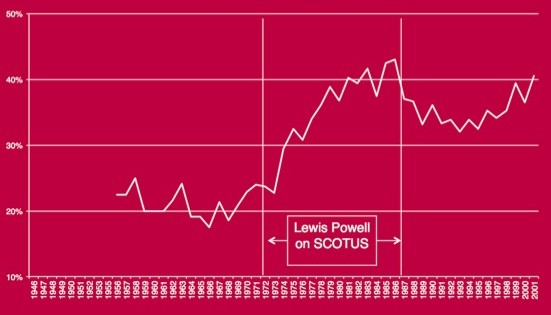
To determine the most-frequent beneficiaries of First Amendment, Coates analyzed the 423 Supreme Court cases between 1946 and 2014 that dealt with questions of speech. He noticed a turning point in the data in 1975, the year that the Court decided Virginia Pharmacy, a case that overruled the precedent that commercial speech deserved no First Amendment protection. (The case involved a drug store that wanted to advertise its prices, and was challenging a ban that would have prevented it from doing so.) Before Virginia Pharmacy, businesses were involved in an average of 1.5 free-speech cases per year, and they had a 20 percent win rate. After, they were involved in 2.2 cases per year, with a 55 percent win rate.
---
The Percentage of First Amendment Cases Involving Businesses, 1946-2001
 COATES
---
The large jump in the 1970s came shortly after Justice Lewis Powell joined the Supreme Court. Powell was well known as a proponent of corporate interests at a time when anticorporate sentiments began agglomerating—a confidential memo he wrote that went public the year before began serving indicates as much. “The time has come,” he wrote to the director of the Chamber of Commerce, “for the wisdom, ingenuity and resources of American business to be marshaled against those who would destroy it.” Suffice it to say Powell sided with the drug store in 1975, and many other businesses during his 15-year tenure.
(In order to make sure that the data wasn’t being warped by the fact that the Supreme Court is highly selective in the cases it takes on, Coates also examined data from appeals courts. He found that the number of cases citingCentral Hudson, a 1979 casethat formed an important basis for corporate speech, has increased each year since then. Coates's methodology is convincing, but the possibility does remain that what has increased in recent decades is not corporations' desire to appropriate the First Amendment, but regulators' likeliness to try to regulate, for instance, advertising language—in which case an escalated reliance on free-speech precedents could be read as a creative defense rather than a shrewd arrogation of power.)
Coates’s work is a reminder, in a decade when Citizens United is many Americans’ foremost association with corporate speech, not to forget what corporations have and haven’t been allowed to do since 1789.In 1819, Chief Justice John Marshall legally defined a corporation as “an artificial being, invisible, intangible, and existing only in the contemplation of law.” And in the hundreds of years since, corporate speech has been tightly regulated, as courts have restricted what companies can and cannot communicate in contracts, to employees, and to the public. In fact, some 150 years passed between the writing of the First Amendment and its first use to strike down a law in favor of an individual (a decision supporting corporate free speech came even later)—which is to say that corporations got along just fine without First Amendment rights before Justice Powell decided they were in need of help.
So if the Court says, as it did in its decisions in Citizens United and Hobby Lobby, that a company should be viewed as a collection of individuals, it seems to be overlooking centuries of precedents that suggest otherwise—that corporations’ speech is something to be controlled firmly. Given that, as Coates says, these pro-business First Amendment rulings encourage companies to “increasingly place bets not on new technologies and marketing strategies, but on legal and political ‘innovation,’” the courts’ stances are only that much more puzzling.
===
refto derek above
corporate-personhood-monopoly-capital-and-the-precedent-that-wasnt-the-1866-santa-clara-case
feb 2023 pod
editor’s note: Beginning with overturningRoe v. Wade, the ultra right-wing Supreme Court continues to attack hard-won and elementary democratic rights in the United States, from affirmative action to the Indian Child Welfare Act. The following article is the third in our series “Crimes of the Supreme Court,” which demonstrates the fundamentally reactionary and anti-democratic nature of the Supreme Court.
By examining key decisions in the Court’s history, we explain their historical and political context, the legal concepts and frameworks used to justify their decisions, and lay out their implications for later cases. This entry focuses on an 1886 Supreme Court ruling that is often cited as the precedent guaranteeing corporations the same protections as “natural persons,” although it did no such thing. Nonetheless, this case and several preceding ones demonstrated how the struggle for corporate personhood—particularly under the “Equal Protection Clause” of the 14th Amendment—was intimately bound up in the transition to U.S. monopoly capitalism.
Introduction
How do the actual people in charge of corporations manage to remain protected from the consequences of the countless crimes they commit year after year? How is it that when CEOs make clear and obvious decisions that habitually violate every existing worker-won regulation, from the Clean Air Act to the Civil Rights Act, with very few exceptions, they charge the corporation—the “artificial” or “unnatural” person—instead of the CEO—the actual, “natural person” who made those decisions?
The legal grounds that corporations have the same protections and rights as “natural persons” is commonly justified by the 1886 Supreme Court ruling in Santa Clara County v. Southern Pacific Railroad Company. As we’ll see, the Court’s decision in the case didn’t establish any precedent for corporate personhood, nor did the Court make any ruling on it. To the extent that the Supreme Court even debated “artificial,” “corporate,” and other kinds of personhood, they did so to facilitate the transition from “free competition” to monopoly capitalism in the country.
In this article, we explore the Santa Clara case before turning to debates within the institutions of power in the U.S. over the Equal Protection Clause of the 14th Amendment. These debates can only be understood if situated within their historical, political, and economic context: the transition to monopoly capital in the U.S. To conclude, we explore the case’s destructive legacy, or the way it was illegitimately used to set precedent for the growth of monopoly capital.
The facts and outcome of the case
During the 1878-79 California Constitutional Convention, the state enacted a new tax code that, in part, prevented railroad corporations from factoring existing debts and mortgages into their total taxable value. The Southern Pacific Railroad Company, along with the Central Pacific Railroad Company, refused to follow the new code. They did not pay the additional tax, nor did they pay the back taxes they subsequently owed.
The first point of contention were back taxes—including the interest on them—that railroad companies refused to pay in California, specifically the taxes being levied on the fencing along the railroads’ right-of-way. Among the handful of complaints brought forth, lawyers representing the railroads argued that it was the county and not the state that should have assessed the value of the fencing. As Thom Hartmann points out, “the railroad was refusing to pay taxes of about $30,000,” which is “like having a $10,000 car and refusing to pay a $10 tax on it—and taking the case to the Supreme Court” [1].
Faced with the loss of revenue, a number of counties in California, including San Mateo County, filed suit against the railroad companies in an attempt to collect the taxes that the railroads refused to pay. According to Southern Pacific’s executives, they were being treated unfairly relative to “legal” or “natural” persons who could deduct debts and mortgages from their taxable income or value. The cases were consolidated before reaching the California Supreme Court, which ruled mostly in favor of the counties and against the railroad companies. The one exception concerned the fences constructed around the railroads. The Court affirmed that the fences “were improperly included by the State Board in its assessments” and, as a result, there was no legal basis for the counties to collect additional taxes [2].
The origins of corporate personhood?
Interestingly, however, the Santa Clara decision is rarely remembered for the issue of taxation and, more specifically, the role of railroad monopolies, and is instead mostly cited as the first instance of the Supreme Court upholding “corporate personhood.”
One of the railroad’s defenses at the Supreme Court hearing included arguing that the “Equal Protection Clause” of the 14th Amendment applied to corporations, so therefore the state couldn’t tax them differently from other citizens. Yet this was only a minor point among the six arguments presented by the railroads.
Moreover, it seems Chief Justice Morrison Waite quickly dismissed the argument in the case by stating that it is a general, agreed upon principle that the clause applies to corporations. According to the ruling’s “headnote,” Waite stated the Court would not even consider “whether the provision in the 14th Amendment to the Constitution, which forbids a State to deny any person within its jurisdiction the equal protection of the laws, applies to these corporations. We are all of the opinion that it does” [3].
Did the Supreme Court, then, establish a legal precedent that corporations have the same legal protections as natural persons? Despite the Supreme Court citing it as precedent for a century, and despite that it was routinely taught to law students as precedent, the ruling did no such thing.
Waite’s comment above was not part of the official ruling. Instead, it was included in a headnote written by the Court’s Reporter of Decisions, journalist J.C. Bancroft Davis, former president of the Newburgh and New York Railway Company. Headnotes are introductory summaries of cases added to Court rulings to make it easier for legal professionals and others to sift through cases.
Headnotes, therefore, are not legally-binding and hold no legal authority. It wasn’t until the 1906 ruling in United States v. Detroit Lumber Co.that the Supreme Court officially ruled in its majority opinion that headnotes aren’t part of the Court’s rulings or findings. As then-Chief Justice David Brewer wrote, “the headnote is not the work of the court, nor does it state its decision… it is simply the work of the reporter, gives his understanding of the decision, and is prepared for the convenience of the profession in the examination of the reports” [4]. This, however, hasn’t prevented the U.S. courts in general, and the Supreme Court in particular, from citing the headnote as precedent.
The headnote is significant in a few ways. First, the report of Waite’s comments didn’t include any legal or constitutional justification; it was a mere assertion. As a result, since 1886 the status of corporations as “people” protected under the Constitution has been a source of controversy. Moreover, “the concept of the corporate person lacks a principled definition and, therefore, seems to expand, or contract, depending on the circumstances and on the personal predilections of the speaker” [5].
The headnote is especially significant because of Waite’s sweeping acceptance that corporations are protected by the Equal Protection Clause of the 14th Amendment. This differs from a previous Court ruling in the 1873 SlaughterhouseCases that made their way to the U.S. Supreme Court after an 1869 Louisiana legislature decision to issue a charter confining slaughterhouse operations in New Orleans to a single corporate entity, the Crescent City Live-Stock Landing and Slaughter-House Company.
Crescent City’s charter required the company to run its waste downstream, ordered other slaughterhouses, most of which were much smaller, to close, and forbid the establishment of any new slaughterhouses in the area for the next 25 years. In effect, the legislature produced a monopoly on slaughterhouses for the time period. This meant that all workers, including butchers, had to work for Crescent or find work elsewhere. As a result, hundreds of members of the Butchers’ Benevolent Association, which represented smaller or independent slaughterhouses, filed suit in the Louisiana Supreme Court on the basis that the monopoly violated the 13th and 14th Amendments by forcing butchers into “involuntary servitude” and taking away their property without compensation or due process.
When the U.S. Supreme Court took up the cases, the majority opinion explicitly stated that the Amendments did not apply in this instance. The dissenting opinion by Justice Stephen Field proposed a broad definition of the Amendments at stake, one that would become more expansive as the overthrow of Reconstruction solidified. The crucial issue, he stated, was “whether the recent amendments to the Federal Constitution protect the citizens of the United States against the deprivation of their common rights by State legislation.” Field closed the dissenting opinion by asserting that the 14th Amendment applies to corporations and monopolies. He wrote that the Amendment “does afford such protection, and was so intended by the Congress which framed and the States which adopted it” [6].
Between his time on California’s Ninth Circuit Court and the Supreme Court, “Field worked tirelessly to expand the 14th Amendment to include the rights of corporations.” He was driven by careerism and a desire to reach the country’s highest court and maybe even the presidency “with the support of railroad money” [7].
In his dissenting opinion in a related railroad case, Fields expressed his outrage that the Court was neglecting the crucial question, which was if “an unlawful and unjust discrimination was made . . . and to that extent depriving it of the equal protection of the laws” [8].
Whether or not the original drafters of the post-Civil War amendments explicitly considered if and how the 14th Amendment—or the 13th— could apply to corporations or any group other than Black people is unclear. Based on available records, some argue that Congress may indeed have considered or intended for corporations to be included in the 14th Amendment, as the original drafters “were inundated with petitions from insurance companies and railroads complaining about protectionist state measures” [9]. That the 14th Amendment makes a distinction between “persons” and “citizens” is also significant, as the former “are entitled to due process and equal protection” while the latter are only “guaranteed the privileges and immunities of national citizenship” [10].
What is certainly true, however, is that almost none of the 14th Amendment cases heard by the Supreme Court concerned the rights of Black people. The Supreme Court itself affirmed this in 1938. In his dissenting opinion on Connecticut Gen Life Ins C. v. Johnson, Justice Hugo Black cited Miller’s majority opinion in the 1873 Slaughterhouse cases, doubting that the 13th and 14th Amendments would include anyone except Black people. “Yet,” he continued, “of the cases in this Court in which the 14th Amendment was applied during the first fifty years after its adoption, less than one-half of 1 per cent. invoked it in protection of the negro race, and more than 50 per cent. asked that its benefits be extended to corporations” [11].
Further, recent history affirms that the U.S. ruling class considers and treats corporate entities much more humanely than they treat Black people.
Corporate personhood and a new phase of U.S. capitalism
The period leading up to the 1886 case was characterized by monumental shifts in the political, social, economic, and racial order of the U.S. This included the heroic Reconstruction era as well as its tragic defeat and the rapid growth of monopoly capital in the country.
In the decade leading up to Santa Clara case, railroad barons emerged as a new faction of the capitalist class that provided the model for monopoly capital. This is why, just before the 1878-79 California Convention, California allowed the Southern Pacific Railroad Company to absorb several other corporations. Prior to that, Congress granted 11 million acres of land to Southern Pacific, although for their expansion the company acquired additional debts through a mortgage on its construction, equipment, railcars, and so on. Southern Pacific was also granted the legal authority to construct a line connecting San Francisco to Texas.
The trend toward monopoly predated the Civil War and coincided with the ongoing conquest of the continent. Large corporations, with state funding, facilitated the expanding interstate commerce through railways and canals, which in turn led to a larger and more integrated national economy. Federal and state legislatures promoted this centralization of capital insofar as it took the economic burden off the state while still allowing the state to use the new networks for postal and military purposes.
The pressing question for the U.S. ruling class was whether or not the government-backed monopolists would ultimately represent a unique and temporary phenomenon or provide a model for capital as a whole.
There was a clear struggle between the ideologues of small enterprises that formerly dominated the economic landscape and operated similarly to the idealistic “free competition” phase of capitalism and those of monopoly capital, where the various enterprises dispersed throughout different entities were consolidated into large ones.
As Morton J. Horowitz details in his account of how legal structures raced to keep up with the latest changes in capital, in the 1880s there wasn’t any precedent about “natural” or “corporate” persons because these categories threatened individualism and free-market competition. By the turn of the century, however, the struggles over “political economy between small entrepreneurs and emergent big business over the legitimacy of large scale enterprise” erupted [12].
The debates taking place within the ruling class had to do with whether or not there was an inherent tendency for capital to centralize. At the time, most political economists didn’t give credence to the inevitability of monopolization, seeing the railroads as exceptional. It didn’t take long until politicians, bourgeois economists, and others rightly interpreted the railroad’s economic trajectory as a precursor to a coming phase of industrial monopolization.
There was a shift in power and influence within the capitalist class from the old “free enterprise” capitalists to the new monopolists:
“By the late nineteenth century in America, fundamental changes had already taken place in the legal treatment of the corporation. First, and by far the most important, was the erosion of the so-called ‘grant’ or ‘concession’ theory of the corporation, which treated the act of incorporation as a special privilege conferred by the state for the pursuit of public purposes. Under the grant theory, the business corporation was regarded as an ‘artificial being’ created by the state with powers strictly limited by its charter of incorporation. As we shall see, a number of more specific legal doctrines were also derived from the grant theory in order to enforce the state’s interest in limiting and confining corporate power” [13].
From this point of view, the rise of monopoly capitalism, or the centralization of larger and larger sectors of the means of production into fewer and fewer hands, is driven by the self-expansive and competitive nature of capitalist production. The Supreme Court provided the legal grounds for facilitating this transformation.
Legacy of the case
In the immediate aftermath of Santa Clara, “the Court did away with 230 state laws that had been passed to regulate corporations” [14]. It was clear evidence monopoly capital was in control of politics. Supreme Court decisions in the years between 1908 and 1914, often citing corporate personhood, struck down minimum-wage laws, workers’ compensation laws, utility regulation, and child labor laws—every kind of law that a people might institute to protect its citizenry from abuses” [15].
For over a century now, the state has continued to take power and rights away from working and oppressed people and transferred it to capital. They have even perverted the hard-won gains won by people’s movements into justifications for increasing corporate power, perhaps none more disgusting than the misuse of the 14th Amendment.
While even to this day there is no clear legal basis for corporate personhood, that hasn’t stopped the Supreme Court from waging class war against the people on behalf of corporations. Because the nine unelected judges determine the law, they can legally justify whatever tactics they deploy against us.
The misuse of Santa Clara’s headnote has not only severely inhibited the ability to regulate corporations, but it has created a space for CEOs and shareholders to operate with near impunity. For example, Joel Bakan notes that “corporate illegalities are rife throughout the economy…By design, the corporate form generally protects the human beings who run corporations from legal liability, leaving the corporation, a ‘person’…the main target of criminal prosecution” [16].
The Supreme Court was created to serve the interests of the capitalist class. Its very existence stands as a barrier to the working and oppressed peoples’ desire for a true democracy. As the Supreme Court unleashes its most current wave of attacks on our basic democratic rights, we will continue to fight for a new system.
References
[1] Thom Hartmann, Unequal Protection: How Corporations Became People–and How You can Fight Back(San Francisco: Berrett-Koehler Publishers, 2010), 18.
[2] Santa Clara County. v. South Pacific Railroad, 118 U.S. 394 (1886), 411. Available here.
[3] Ibid., 396.
[4] United States v. Detroit Lumber Co., 200 U.S. 321 (1906). Available here.
[5] Malcolm J. Harkins III, “The Uneasy Relationship of Hobby Lobby, Conestoga Wood, the Affordable Care Act, and the Corporate Person: How a Historical Myth Continues to Bedevil the Legal System,” Saint Louis University Journal of Health Law & Policy 7, no. 2 (2014): 204.
[6] Ibid.
[7] Nicholas S. Paliewicz, “How Trains Became People: Southern Pacific Railroad Co.’s Networked Rhetorical Culture and the Dawn of Corporate Personhood,” Journal of Communication Inquiry43, no. 2 (2019): 204-205.
[8] Cited in Ibid.
[9] Matthew J. Zinn and Steven Reed, “Equal Protection and State Taxation of Interstate Business,” The Tax Lawyer 41, no. 1 (1987): 89-90.
[10] Ibid., 90.
[11] Connecticut General Life Ins. Co v. Johnson, 303 U.S. 77 (1938). Available here.
[12] Morton J. Horowitz, “Santa Clara Revisited: The Development of Corporate Theory,” West Virginia Law Review 88, no. 2 (1986): 187.
[13] Ibid., 181.
[14] Howard Zinn, A People’s History of the United States (New York: Perennial Classics, 1980/1999), 261.
[15] Hartmann, Unequal Protection, 24.
[16] Joel Bakan, The Corporation: The Pathological Pursuit of Profit and Power (New York: The Free Press, 2004), 75-79.
===
winkler we the corps bk
evil b/c corps grab progressive wins, eg 14th, PACs,
newspaper co's 1936 huey Long, 2c tax on lies (ad tax),scotus? broadens press rights
lewis powell and raplh nader 70's drugs (Va pharamcy ads with drug prices) = listener's right --> CU
apple fended off fbi req on iphone based on corp personhood?
webster hired by corps, won them rights?
14th --> brown v bd, lgbt
Bank of US v devo
https://en.wikipedia.org/wiki/Bank_of_the_United_States_v._Deveaux
interview fundraising
https://kpfa.org/episode/letters-and-politics-may-16-2018/
==
==
nom scotus 2x? last guy to turn down after confirm b/c making too much $ as lawyer for RR (he said explicitly)
adam winkler
https://kpfa.org/episode/letters-and-politics-october-3-2018/
28 14th AA mostly lost, v 311
sprr 2nd 1corp pers case?!
corps use personhood to override legislation
apple v fbi iphone
hwy thru ggl campus w/ compensation
but corps do not need ALL rights of ppl ([where to draw line? they have lots of lawyers ad lobbyists]
huey long LA put advert tax on newspapers (on lies) so newspapers sued (corps) pentagon paPERS,, V BALDWIN TO CrIT GOvT OFFICIALS
1st AMend expand NaDer consumer pharmacy advertize drug prices land mark case, consumer have 1st amebnd listener's right jiu jitsu to CU
4th, PAC etc co-opt left/progressive to expand corp power (nader Va case led to many uses to DISadvantage consumer?
1st Roman, had to re-org on ppl die; mining corps 1st mass pollution
roman cath church claims in 3rd C AD; in MA used for non-biz eg NRA sierra club now
...
corps use personhood to override legislation
apple v fbi iphone
hwy thru ggl cam[us w/ compensation
but corps do not need ALL rights of ppl ([where to draw line? they have lots of lawyers ad lobbyists]
huey long LA put advert tax on newspapers (on lies) so newspapers sued (corps) pentagon paPERS,, V BALDWIN TO CrIT GOvT OFFICIALS
1st AMend expand NaDer consumer pharmacy advertize drug prices land mark case, consumer have 1st amebnd listener's right jiu jitsu to CU
Lewis pwl ~ nader; memo turned into const law; --> ballot measure;--> CU
corps seek new rights eg masterpiece bakeshop LTD
60's race cases clained const protection but lost.
==
===
ref 1
Corporate Speech and the First Amendment: History, Data, and Implications
Constitutional Commentary, Forthcoming
41 Pages Posted: 9 Mar 2015 Last revised: 14 May 2015
:{
John C. Coates, IV
Harvard Law School
Date Written: February 27, 2015
Abstract
This Article draws on empirical analysis, history, and economic theory to show that corporations have begun to displace individuals as direct beneficiaries of the First Amendment and to outline an argument that the shift reflects economically harmful rent seeking.
The history of corporations, regulation of commercial speech, and First Amendment case law is retold, with an emphasis on the role of constitutional entrepreneur Justice Lewis Powell, who prompted the Supreme Court to invent corporate and commercial speech rights. The chronology shows that First Amendment doctrine long post-dated both pervasive regulation of commercial speech and the rise of the U.S. as the world’s leading economic power – a chronology with implications for originalists, and for policy. Supreme Court and Courts of Appeals decisions are analyzed to quantify the degree to which corporations have displaced individuals as direct beneficiaries of First Amendment rights, and to show that they have done so recently, but with growing speed since Virginia Pharmacy, Bellotti, and Central Hudson.
Nearly half of First Amendment challenges now benefit business corporations and trade groups, rather than other kinds of organizations or individuals, and the trend-line is up. Such cases commonly constitute a form of corruption: the use of litigation by managers to entrench reregulation in their personal interests at the expense of shareholders, consumers, and employees. In aggregate, they degrade the rule of law, rendering it less predictable, general and clear. This corruption risks significant economic harms in addition to the loss of a republican form of government.
Keywords: First Amendment, corporations, Court of Appeals, Virginia Pharmacy, Bellotti, Central Hudson
JEL Classification: D72, K10, K22, K23, K42, L51
Suggested Citation:
Coates, IV, John C., Corporate Speech and the First Amendment: History, Data, and Implications (February 27, 2015). Constitutional Commentary, Forthcoming . Available at SSRN: https://ssrn.com/abstract=2566785 or http://dx.doi.org/10.2139/ssrn.2566785
}:
==
==
http://www.vox.com/the-big-idea/2017/2/14/14601932/exxon-first-amendment-free-speech-citizens-global-warming
Why is the attorney general of Massachusetts, Maura Healey, being forced to justify to a Texas judge why and how she is doing her job?
In the latest instance of the corporate takeover of the First Amendment — and other constitutional rights — Exxon Mobil, the world’s largest oil and gas corporation, has invented a constitutional right to obstruct state investigations into allegations of fraud.
Investigations by the Massachusetts and New York attorneys general began late last year after the Los Angeles Times reported that Exxon scientists and executives have known for decades about the connection between fossil fuel consumption and the likelihood of catastrophic changes in the Earth’s atmosphere and climate.
The report alleged that as early as the 1980s, Exxon scientists were warning the company in internal communications that global climate change could "indeed be catastrophic (at least for a substantial fraction of the earth's population)." According to the journalists’ report, Exxon’s internal teams used that information for purposes of assessing the potential for profitable investment in new oil exploration and production. Yet these were the same climate models that Exxon “dismissed as unreliable and based on uncertain science” in statements to investors, consumers, and the general public....The attorneys general embarked on investigations on behalf of their citizens, asking whether Exxon was guilty of selling products and equity while concealing information about their risks.
The similarity of these allegations to the illegal conspiracy of the tobacco industry — a cover-up of internal corporate knowledge about deadly consequences of continued consumption of its products — did not escape notice. In January 2016, the Department of Justice asked the FBI to investigate whether Exxon should be prosecuted under the federal Racketeer Influenced and Corrupt Organizations Act, as the tobacco industry was. The investigations by the Massachusetts and New York attorneys general, focusing on whether Exxon had been forthright in its disclosures to investors, soon followed....Given identified sources and specific studies cited in news reports, it is not surprising that chief law enforcement officers of federal and state governments would investigate. Indeed, it would be extremely troubling if they did not....But rather than show that the allegations of investor and consumer fraud are baseless, Exxon Mobil is misusing the Constitution to continue to conceal what it knew about the connection between catastrophic climate change and continued fossil fuel use, and when.
It is not uncommon, of course, for companies to resist subpoenas from attorneys general on a variety of legal grounds. For example, Exxon could have filed a motion in Massachusetts asking a judge to set aside the subpoena on the grounds that it was overly broad, and arguing that the investigation exceeded the jurisdiction of the attorney general. (In fact, Exxon did just that, and lost.)
Until fairly recently, no US court would have entertained free speech claims by a corporation that wanted to strike down regulation
But Exxon has gone much further. It has filed a federal “civil rights” lawsuit in its home court of Texas against the New York and Massachusetts attorneys general. The multibillion-dollar global corporation claims that the state investigations violate a previously unrecognized corporate right under the Constitution both to “speak” and to “not speak” about climate change any way it wants, however deceptive that speech may be.
This is where the Supreme Court’s decision in Citizens United v. Federal Election Commission is taking the country. That 2010 ruling is infamous for opening the floodgates of big, dark money in our elections by deciding that any limits on supposedly “independent” political ads violate the speech rights of corporations, unions, and billionaires. What is less well-known about Citizens Unitedis how radically it empowers corporations to misuse the First Amendment in other ways — ways we now see playing out in the Exxon case, and elsewhere.
Citizens United was the capstone on a remarkable series of cases, dating only to the 1970s, that revolutionized the application of the First Amendment in the corporate context. Very few people realize just how quickly this constitutional revolution has occurred; very few people realize that American corporations thrived for the first two centuries of American history with virtually no First Amendment protections.
In the early 20th century, First Amendment cases involving firms tended to involve media companies, as when Louisiana Gov. Huey Long imposed special taxes on newspapers (a clear attempt to punish them). It was generally assumed that the “speech” of business corporations was no more free from court scrutiny than the language of their contracts or their SEC filings....(1978), which held that corporations can contribute to ballot initiatives, and again in Central Hudson Gas & Electric Corp. v. Public Service Commission(1980), which asserted that a utility could run advertisements promoting the use of electricity. Those two cases continue to be cited in almost all commercial speech cases — and they are cited more and more frequently. Citizens United affirmed those cases and extended them to campaign finance laws.
After his appointment to the high court in 1971, however, Justice Lewis F. Powell Jr., a former business lawyer who ardently believed that corporate America was being undermined by the public’s support for reformers like Ralph Nader, helped reinvent the Court’s doctrine in this area. In Virginia State Pharmacy Board v. Virginia Citizens Consumer Council (1976), the Court said, on First Amendment grounds, that the state could not forbid pharmacists from advertising prescription drug price — a remarkable departure from precedent.
Despite the “free speech” rhetoric, corporations are not simply seeking to offer opinions about public policy issues. They do that all the time, routinely spending millions to fund ads, research, policy papers, and lobbying activities. Today corporations are claiming that their “rights” to speak clash with longstanding forms of regulation of business activity. Whenever they are required to disclose information to consumers, regulators, the public, or enforcement officials, they argue, their First Amendment rights are implicated. Whenever they seek or transmit information, they say, they are “speaking,” and the First Amendment gives them the right to do that without fear of consequences....Powell Joins Supreme Court - In January 1972, Powell will join the Supreme Court, where he will become regarded as a moderate-to-conservative justice, sympathetic to business interests but not unwilling to consider other points of view. (Though the press will subsequently publish leaked copies of the memo, no senator will ask Powell about his memo or his business interests in his confirmation hearings.) One of his most pro-business decisions is his majority opinion in 1978’s First National Bank of Boston v. Bellotti, in which Powell will create a First Amendment “right” for corporations to influence ballot questions.
==
democ now 11/9/11 guest says cit united began in 30 yr quest started by powell cf john boniface
---
Belloti
===
johnson:
MEMO
In 1971 the National Chamber of Commerce circulated a
memo by future Supreme Court Justice Lewis Powell among
business leaders which claimed that "the American
economic system" of business and free markets was "under
broad attack" by "Communists, New Leftists and other
revolutionaries who would destroy the entire system,
both political and economic." Powell argued that those
engaged in this attack come from "the college campus,
the pulpit, the media, the intellectual and literary
journals, the arts and sciences, and from politicians."
According to the Powell memo, the key to solving this
problem was to get business people to "confront this
problem as a primary responsibility of corporate
management" by building organizations that will use
"careful long-range planning and implementation, in
consistency of action over an indefinite period of
years, in the scale of financing only available in joint
effort, and in the political power available only
through united action and national organizations." It
helped immeasurably, Powell noted, that the boards of
trustees of universities "overwhelmingly are composed of
men and women who are leaders in the system," and that
most of the media "are owned and theoretically
controlled by corporations which depend upon profits,
and the free enterprise system to survive."
Powell wrote that these organizations should employ a
"faculty of scholars" to publish in journals, write
"books, paperbacks and pamphlets," with speakers and a
speaker's bureau, as well as develop organizations to
evaluate textbooks, and engage in a "long range effort"
to correct the purported imbalances in campus faculties.
"The television networks should be monitored in the same
way that textbooks should be kept under constant
surveillance." Powell said that this effort must also
target the judicial system.
http://en.wikipedia.org/wiki/Lewis_F._Powell,_Jr.
Lewis Franklin Powell, Jr. (September 19, 1907 – August 25, 1998) was an Associate Justice of the Supreme Court of the United States. He developed a reputation as a judicial moderate, and was known as a master of compromise and consensus-building. He was also widely well-regarded by contemporaries due to his personal good manners and politeness.
Contents[hide] |
[edit] Early life
Powell was born in Suffolk, Virginia. He attended Washington and Lee University, garnering both an undergraduate and a law degree from that university. He was elected president of student body as an undergraduate and was a member of Phi Kappa Sigma fraternity and the Sigma Society. At a leadership conference, he met Edward R. Murrow and they became close friends. He attended Harvard Law School for a master's degree.
During World War II, he spent more than three years in Europe and North Africa. He started as a First Lieutenant, and eventually rose to the rank of Colonel. He worked mostly in intelligence, decoding German messages.
Powell was a partner for over a quarter of a century at Hunton, Williams, Gay, Powell and Gibson, a large Virginia law firm, with its primary office in Richmond (now known as Hunton & Williams LLP). Powell practiced primarily in the areas of corporate law (especially in the field of mergers and acquisitions) and in railway litigation law. He had been a board member of Philip Morris between 1964 until his appointment in 1971 and had acted as a contact point for the tobacco industry with the Virginia Commonwealth University. Through his law firm, Hunton Williams Gay Powell & Gibson (later just Hunton & Williams) he represented the Tobacco Institute and the various tobacco companies in numerous law cases.
In 1936, he married Josephine Pierce Rucker, with whom he had three daughters and one son. Powell's wife died in 1996.
[edit] Virginia government
Powell also played an important role in local community affairs. From 1952 to 1961, he was Chairman of the Richmond School Board. Powell presided over the school board at a time when the Commonwealth of Virginia was locked in a campaign of defiance against the Supreme Court's decision in Brown v. Board of Education. (Interestingly, Powell's law firm had represented one of the defendant school districts in the case that was decided by the U.S. Supreme Court under the "Brown" label. Powell did not take any part in his law firm's representation of that client school district. The lawsuit, Davis v. County School Board of Prince Edward County, later became one of the five cases decided under the caption Brown v. Board of Education before the Supreme Court of the United States in 1954.) The Richmond School Board had no authority at the time to force integration, however, as control over attendance policies had been transferred to the state government. Powell, like most white Southern leaders of his day, did not speak out against the state's defiance, though he would foster a close relationship with many black leaders, such as civil rights lawyer Oliver Hill, some of whom offered key support for Powell's nomination. Powell proudly swore in Virginia's first black governor, Douglas Wilder, in 1990. Powell was President of the American Bar Association from 1964–1965, where he enjoyed an enormously productive tenure. Powell led the way in attempting to provide legal services to the poor, and he made a key decision to cooperate with the federal government's Legal Services Program. Powell was also involved in the development of Colonial Williamsburg, where he was both a trustee and general counsel.
[edit] The Powell Memorandum
Based in part on his experiences as a corporate lawyer and as a representative for the tobacco industry with the Virginia legislature, he wrote the Powell Memo to a friend at the U.S. Chamber of Commerce. The memo called for corporate America to become more aggressive in molding politics and law in the U.S. and may have sparked the formation of one or more influential right-wing think tanks.
In August 1971, prior to accepting Nixon's request to become Associate Justice of Supreme Court, Lewis Powell had sent to the leadership of the U.S. Chamber of Commerce the "Confidential Memorandum", better known as the Powell Memorandum, and still under the radar of general public. It sounded an alarm with its title, "Attack on the American Free Enterprise System." The previous decade had seen the increasing regulation of many industries. Powell argued, "The most disquieting voices joining the chorus of criticism came from perfectly respectable elements of society: from the college campus, the pulpit, the media, the intellectual and literary journals, the arts and sciences, and from politicians." In the memorandum, Powell advocated "constant surveillance" of textbook and television content, as well as a purge of left-wing elements.
In an extraordinary prefiguring of the social goals of business that would be felt over the next three decades, Powell set his main goal: changing how individuals and society think about the corporation, the government, the law, the culture, and the individual. Shaping public opinion on these topics became, and would remain, a major goal of business.
[edit] Supreme Court tenure
In 1969, :{President Nixon}: asked him to join the Supreme Court, but Powell turned him down. In 1971, Nixon asked him again. Powell was unsure, but Nixon and his Attorney General, :{John N. Mitchell}:, persuaded him that joining the Court was his duty to the nation.[2] One of the primary concerns that Powell had was the effect leaving his law firm and joining the high court would have on his personal financial status, as he enjoyed a very lucrative private practice at his law firm. Another of Powell's major concerns was that, as a corporate attorney, he would be unfamiliar with many of the issues that would come before the Supreme Court, which at that time, as today, heard very few corporate law cases. Powell feared this would place him at a disadvantage and make it unlikely that he would be able to influence his colleagues.
He and William Rehnquist were nominated by President Nixon on the same day to serve on the Court. Powell took over the seat of Hugo Black. On the day of Powell's swearing-in, when Rehnquist's wife Nan asked Josephine Powell if this was the most exciting day of her life, Josephine reportedly said, "No, it is the worst day of my life. I am about to cry."
Lewis Powell served from January 7, 1972 until June 26, 1987, when he resigned.
Powell compiled a decidedly moderate record on the Court, cultivating a reputation as a swing vote with a penchant for compromise. (The most detailed account of Justice Powell's Supreme Court tenure is in John Calvin Jeffries's biography Lewis F. Powell). While on the court, he worked hard at familiarizing himself with the issues and arguments in the cases and coming up with distinct and well-reasoned positions on them.
Powell compiled a conservative record on the Court, at the same time cultivating a reputation as a swing vote with a penchant for compromise.[7] While on the court, he worked hard[neutrality ^is disputed][citation needed] at familiarizing himself with the issues and arguments in the cases and coming up with distinct and well-reasoned positions on them.[neutrality ^is disputed]
Powell was among the 7-2 majority who legalized abortion in the United States in Roe v. Wade. Powell's :{pro-choice}: stance on abortion stemmed from an incident during his Richmond law firm, when the girlfriend of one of Powell's office staff bled to death from an illegal :{coat hanger abortion}:.[8]
For example, his opinion in Regents of the University of California v. Bakke (1978), joined by no other justice in full, represented a compromise between the opinions of Justice William J. Brennan, who, joined by three other justices, would have upheld affirmative action programs under a lenient judicial test, and the opinion of John Paul Stevens, also joined by three justices, who would have struck down the affirmative action program at issue in the case under the Civil Rights Act of 1964. Powell's opinion was striking down the law urged that "strict scrutiny" be applied to affirmative action programs but hinting that some affirmative action programs might pass Constitutional muster. Powell, who dissented in the case of Furman v. Georgia (1972), striking down capital punishment statutes, was a key mover behind the Court's compromise opinion in Gregg v. Georgia (1976), which allowed the return of capital punishment but only with procedural safeguards.
In the controversial case of Snepp v. U.S. (1980), the Court issued a per curiam upholding the lower court's imposition of a constructive trust upon former CIA agent Frank Snepp and its requirement that he preclear all his published writings with the CIA for the rest of his life. In 1997, Snepp gained access to the files of Justices Thurgood Marshall (who had already died) and William Brennan (who voluntarily granted Snepp access) and confirmed his suspicion that Powell had been the author of the per curiam opinion. Snepp later pointed out that Powell had misstated the factual record and had not reviewed the actual case file (Powell was in the habit of writing opinions based on the briefs alone) and that the only justice who even looked at the case file was John Paul Stevens, who relied upon it in composing his dissent.[3] From his days in counter-intelligence during World War II, Powell had developed a great respect for the need for government secrecy, a concern he also urged on his colleagues during the Court's consideration of 1974's United States v. Nixon.
Powell wrote the majority opinion in First National Bank of Boston v. :{Bellotti:(style="background-color:#ffff66;"):}: (1978), which overturned a Massachusetts law restricting corporate contributions to referendum campaigns not directly related to their business.[4]
Powell was the swing vote in Bowers v. Hardwick 478 U.S. 186 (1986), in which the Court upheld Georgia's sodomy laws. He was reportedly conflicted over how to vote. A conservative clerk advised him to uphold the ban, and Powell, who believed he had never met a gay person (not realizing that one of his own clerks was a closeted homosexual), voted to uphold Georgia's law, though Powell in a concurring opinion expressed concern at the length of the prison terms prescribed by the law.[5] The Court, 17 years later, expressly overruled Bowers in Lawrence v. Texas, 539 U.S. 558 (2003).
In 1990, after his retirement from the Court, he said, "I think I made a mistake in the Hardwick case," marking one of the few times a justice expressed regret for one of his previous votes.[6]
Powell also expressed post-retirement regret over his majority opinion in McCleskey v. Kemp, where he voted to uphold the death penalty against a study that demonstrated that - except as punishment for the most violent of crimes - people who killed whites were significantly more likely to receive the death penalty as punishment for their crimes than people who killed blacks.[7]
[edit] Retirement
Powell was nearly 80 years old when he retired from his position as Supreme Court justice. His career on the bench was summed up by Gerald Gunther, a professor of constitutional law at Stanford Law School, as "truly distinguished" because of his "qualities of temperament and character," which "made it possible for him, more than any contemporary, to perform his tasks in accordance with the modest, restrained, yet creative model of judging."[8]
He was succeeded by :{Anthony Kennedy}:. Kennedy was the third nominee for his position. The first, :{Robert Bork}:, was not confirmed by the :{United States Senate}:. The second, Douglas H. Ginsburg, withdrew his name from consideration after admitting to having smoked marijuana both as a college undergraduate and as a law professor with his students.
Following his retirement from the high court, Powell sat regularly on various United States Courts of Appeals around the country, especially enjoying sitting on circuit courts venued in temperate climes during the winter months.[citation needed]
Justice Powell died at his home in the Windsor Farms area of Richmond, Virginia, of pneumonia, at 4:30 in the morning of August 25, 1998, at the age of 90. He is buried in Richmond's Hollywood Cemetery.
In her 2002 book, The Majesty of the Law, Justice Sandra Day O'Connor wrote, "For those who seek a model of human kindness, decency, exemplary behavior, and integrity, there will never be a better man."
Powell's personal and official papers were donated to Washington and Lee University School of Law, where they are open for research subject to certain restrictions.
J. Harvie Wilkinson, currently a judge on Fourth Circuit, was a law clerk for Justice Powell. Wilkinson later wrote a book titled Serving Justice: A Supreme Court Clerk's View describing the experience.
In 1993, President Clinton signed into law an act of Congress renaming the Federal couthouse at Richmond, Virginia in his honor, the Lewis F. Powell, Jr. United States Courthouse.
[edit] See also
[edit] References
- ^ "Members of the Supreme Court of the United States". Supreme Court of the United States. http://www.supremecourt.gov/about/members.aspx. Retrieved April 26, 2010.
- ^ Bob Woodward; Scott Armstrong (1981). *The Brethren: inside the Supreme Court*. Avon Books. p. 188. ISBN 9780380521838. http://books.google.com/books?id=q1IEu9zWWTIC.
- ^ Frank Snepp, Irreparable Harm: A Firsthand Account of How One Agent Took On the CIA in an Epic Battle Over Secrecy and Free Speech (New York: Random House, 1999), 349-350.
- ^ 435 U.S. 765 (1978)
- ^ Stephanie Mencimer, High Court Homophobia (July/August 2001), The Washington monthly.
- ^ Nat Hentoff, Infamous Sodomy Law Struck Down, Village Voice, December 16 - 22, 1998.
- ^ John C. Jeffries, Jr., Justice Lewis F. Powell, Jr.: A Biography 451 (1994).
- ^ Freeman, Anne Hobson: The Style of A Law Firm (1989), Algonquin Books, p. 193.
[edit] External links
=
http://www.phibetaiota.net/2011/12/david-swanson-history-of-corporate-personhood-how-lewis-powell-us-chamber-of-commerce-bought-the-us-supreme-court/
The following is an excerpt of Jeffrey Clement’s *Corporations Are Not People: Why They Have More Rights Than You Do and What You Can Do About It*.
In 1971, Lewis Powell, a mild-mannered, courtly, and shrewd corporate lawyer in Richmond, Virginia, soon to be appointed to the United States Supreme Court, wrote a memorandum to his client, the United States Chamber of Commerce. He outlined a critique and a plan that changed America.
Complete excerpt below the line — real history killing real people.
Lewis Powell, like the Citizens Uniteddissenter Justice John Paul Stevens, was a decorated World War II veteran who returned to his hometown to build a most respected corporate law practice. By all accounts, Powell was a gentleman — reserved, polite, and gracious — and a distinguished lawyer and public servant. Commentators and law professors cite Powell’s “qualities of temperament and character” and his “modest” and “restrained” approach to judging. At his funeral in 1998, Sandra Day O’Connor, who had joined the Supreme Court in 1987, said, “For those who seek a model of human kindness, decency, exemplary behavior, and integrity, there will never be a better man.” Even the rare critic will cite Lewis Powell’s decency and kindness.
Much about these accounts must be true, but none tells the whole story of Lewis Powell. All of them, and even the principal Powell biography, omit the details of how he used his gifts to advance a radical corporate agenda. It is impossible to square this corporatist part of Powell’s life and legacy with any conclusion of “modest” or “restrained” judging.
Powell titled his 1971 memo to the Chamber of Commerce “Attack on American Free Enterprise System.” He explained, “No thoughtful person can question that the American economic system is under broad attack.” In response, corporations must organize and fund a drive to achieve political power through “united action.” Powell emphasized the need for a sustained, multiyear corporate campaign to use an “activist-minded Supreme Court” to shape “social, economic and political change” to the advantage of corporations.
Powell continued:
But independent and uncoordinated activity by individual corporations, as important as this is, will not be sufficient. Strength lies in organization, in careful long-range planning and implementation, in consistency of action over an indefinite period of years, in the scale of financing available only through joint effort, and in the political power available only through united action and national organizations.
The roots of Citizens Unitedlie in Powell’s 1971 strategy to use “activist” Supreme Court judges to create corporate rights. “Under our constitutional system,” Powell told the U.S. Chamber of Commerce, “especially with an activist-minded Supreme Court, the judiciary may be the most important instrument for social, economic and political change.”
Powell’s call for a corporate rights campaign should not be misunderstood as a “conservative” or “moderate” reaction to the excesses of “liberals” or “big government.” Rather, to understand the perspective of Powell and his allies is to understand the difference between a conservative and a corporatist.
Powell and the Tobacco Corporations Show the Way
By the time of his 1971 memorandum, Lewis Powell was a director of more than a dozen international corporations, including Philip Morris Inc., a global manufacturer and seller of cigarettes. Powell joined Philip Morris as a director in 1964, when the United States surgeon general released the most devastating and comprehensive report to date about the grave dangers of smoking. He remained a director of the cigarette company until his appointment to the Supreme Court in 1971. Powell also advised the Tobacco Institute, the cigarette lobby that finally was exposed and stripped of its corporate charter in the 1990s after decades of using phony science and false statements to create a fraudulent “debate” about smoking and health.
The story of the cigarette corporations and their response to public efforts to address addiction, smoking, and health is a big piece of the larger story of how corporate rights took such significant pieces of the Constitution and American democracy. The ideas expressed by Powell in his 1971 memorandum to the Chamber of Commerce came out of his personal involvement in the aggressive resistance of the cigarette corporations to efforts to address the devastating social and public costs of its lethal products. As a director and an executive committee member of Philip Morris, Powell shared responsibility for the fraudulent attack on the conclusions of scientists and the surgeon general by the cigarette industry and for its false insistence for years that “no proof” showed cigarettes to be unhealthy.
Hints of this work can be seen in the Philip Morris annual reports issued during Powell’s tenure as a director, which reflected the broader campaign of the company and the cigarette industry to discredit the science about smoking and health and to misrepresent the facts to keep people smoking and get young people to start. We now know, thanks to the 2007 findings of a federal judge, that many of the assertions in these annual reports were knowingly false. According to the reports themselves, these statements and others were made “on behalf of the Board of Directors,” including Powell:
• 1964: “The industry continues to support major research efforts directed towards resolving the many unanswered questions on smoking and health.”
• 1967: “The year 1967 was marked by an intensification of exaggerated claims made relative to the possible adverse health effects of smoking on health. … We deplore the lack of objectivity in so important a controversy. … Unfortunately the positive benefits of smoking which are so widely acknowledged are largely ignored by many reports linking cigarettes and health, and little attention is paid to the scientific reports which are favorable to smoking.”
• 1967: “We would again like to state that there is no biological proof that smoking is causally related to the diseases and conditions claimed to be statistically associated with smoking … no proof that the tar and nicotine levels in smoke are significant in relation to health.”
• 1969: “No biological or clinical proof that smoking is causally related to human disease … serious doubt that smoking is a causative factor in heart disease.”
• 1970: “Often the scientific information which is relied on to indict cigarette smoking is of dubious validity.”
Absent convincing evidence, it might be reckless to say that Philip Morris and the other tobacco corporations engaged in a willful, aggressive, wide-ranging conspiracy and racketeering enterprise so that the corporations could sell more products that kill people. But now that the evidence is in, we know that that is exactly what happened. We know this thanks to scientists, victims of the conspiracy, state attorneys general (both Democrats and Republicans), the United States Department of Justice (under both Presidents Bill Clinton and George W. Bush), and Judge Gladys Kessler and a panel of U.S. Court of Appeals judges appointed by Presidents Ronald Reagan, Bill Clinton, and George H. W. Bush.
In 2006, the U.S. Department of Justice took the cigarette corporations to trial, alleging that they had engaged in a racketeering conspiracy. Eighty-four witnesses testified in the nine-month trial, and hundreds of internal corporate secrets were finally exposed. When the verdict came in, Judge Kessler concluded that “overwhelming evidence” proved that the cigarette corporations “conspired together” to fraudulently deny that cigarettes caused cancer, emphysema, and a long list of other fatal diseases; to manipulate levels of highly addictive nicotine to keep people smoking; to market addictive cigarettes to children so that the corporations would have “replacement smokers” for those who quit or died; and that they “concealed evidence, destroyed documents, and abused the attorney-client privilege to prevent the public from knowing about the dangers of smoking and to protect the industry” from justice.
As counsel to the cigarette industry and as a Philip Morris director, Powell already had begun testing the use of activist-minded courts to create corporate rights. In one case in the late 1960s, Powell argued that any suggestion that cigarettes caused cancer and death was “not proved” and was “controversial.” Therefore, according to Powell, the Federal Communications Commission wrongly violated the First Amendment rights of cigarette corporations by refusing to require “equal time” for the corporations to respond to any announcement that discouraged cigarette smoking as a health hazard.
Even the U.S. Court of Appeals for the Fourth Circuit, based in the tobacco-friendly South, rejected this claim. Although Powell lost that time, he went on to win far more than he could have imagined after he got on the Supreme Court and helped change the Constitution.
Powell’s 1971 memo to the Chamber of Commerce laid out a corporate rights and a corporate power campaign. The Chamber and the largest corporations then implemented these recommendations with zeal, piles of money, patience, and an activist Supreme Court. In equating corporations with “We, the People” in our Constitution, no justice would be more of an activist than Lewis Powell after he joined the Supreme Court in 1972.
1972: Powell Gets His Chance
In January 1972, President Nixon filled two Supreme Court vacancies, appointing Powell to one seat and William Rehnquist, a conservative Republican lawyer from Phoenix, Arizona, to the other. Rehnquist never hid his conservative views, which were well known and, to some, controversial. At the same time, neither Congress nor most Americans knew of Powell’s radical corporatist views. In his Senate confirmation hearing, no one asked about his recent proposal to the Chamber of Commerce recommending the use of an “activist-minded Supreme Court” to impose those views on the nation. No one asked because neither Powell nor the Chamber of Commerce disclosed the memo during his confirmation proceedings.
Once on the Court, these two Nixon appointees followed very different paths. Justice Powell would go on to write the Court’s unprecedented decisions creating a new concept of “corporate speech” in the First Amendment. Using this new theory, the Court struck down law after law in which the states and Congress sought to balance corporate power with the public interest. With increasing assertiveness by the Supreme Court even after Powell retired in 1987, the new corporate rights theory has invalidated laws addressing the environment, tobacco and public health, food and drugs, financial regulation, and more.
Powell helped shape a new majority to serve the interest of corporations, but for years, several vigorous dissents resisted the concept of corporate rights. The most vigorous came from the conservative Justice William Rehnquist. He grounded his dissents in the fundamental proposition that our Bill of Rights sets out the rights of human beings, and corporations are not people. For years, Rehnquist maintained this principled conservative argument, warning over and over again that corporate rights have no place in our republican form of government.
Here Come the Foundations
Despite the Rehnquist dissents, Powell’s vision of an unregulated corporate political “marketplace,” where corporations are freed by activist courts from the policy judgment of the majority of people, won out. Powell, of course, could not have acted alone. He could not have moved a majority of the Court to create corporate rights if no one had listened to his advice to organize corporate political power to demand corporate rights. Listen they did — with the help of just the sort of massive corporate funding that Powell proposed.
Corporations and corporate executives funded a wave of new “legal foundations” in the 1970s. These legal foundations were intended to drive into every court and public body in the land the same radical message, repeated over and over again, until the bizarre began to sound normal: corporations are persons with constitutional rights against which the laws of the people must fall.
Huge corporations, including Powell’s Philip Morris, invested millions of dollars in the Chamber of Commerce’s National Chamber Litigation Center and other legal foundations to bring litigation demanding new corporate rights. In rapid succession, corporations and supporters funded the Pacific Legal Foundation, the Mid-Atlantic Legal Foundation, the Mid-America Legal Foundation, the Great Plains Legal Foundation (Landmark Legal Foundation), the Washington Legal Foundation, the Northeastern Legal Foundation, the New England Legal Foundation, the Southeastern Legal Foundation, the Capital Legal Center, the National Legal Center for the Public Interest, and many others.
These foundations began filing brief after brief challenging state and federal laws across the country, pounding away at the themes of corporations as “persons,” “speakers” and holders of constitutional rights. Reading their briefs, one might think that the most powerful, richest corporations in the history of the world were some beleaguered minority fighting to overcome oppression. The foundations and the corporate lawyers argued that “corporations are persons” with the “liberty secured to all persons.” They used new phrases like “corporate speech,” the “rights of corporate speakers,” and “the corporate character of the speaker.” They demanded, as if to end an unjust silence, “the right of corporations to be heard” and “the rights of corporations to speak out.”
This corporate campaign sought to redefine the very role of corporations in American society. The message was insistent: We should no longer think of corporations as useful but potentially insidious industrial economic tools. We should no longer be concerned that corporations might leverage massive economic power into massive political power or trample the public interest for the profit of the few. Instead, we should think of corporations as pillars of liberty, institutions that Americans can trust. They would protect our freedom for us. They would stand up to “bad” government for us.
A 1977 brief of the Chamber of Commerce, for example, argued that the Court should strike down a state law that limited corporate political spending in citizens’ referendum elections because corporations help maintain our freedoms: “Business’s social role is to provide the people a valuable service which helps maintain their freedoms. … The statute at issue prevents the modern corporation from fulfilling a major social obligation. … ”
By 1978, the millions of dollars invested in the radical corporate rights campaign began to pay off. The first major victory for the corporate rights advocates came in 1978, with a corporate attack on a Massachusetts law in First National Bank of Boston v. Bellotti.Several international corporations — including Gillette, the Bank of Boston, and Digital Equipment Corporation — filed a lawsuit after the people of Massachusetts banned corporate political spending intended to influence a citizen referendum. Justice Lewis Powell cast the deciding vote and wrote the 5–4 decision wiping off the books the people’s law intended to keep corporate money out of citizen ballot questions. For the first time in American history, corporations had successfully claimed “speech” rights to attack laws regulating corporate money in our elections.
With that success, an emboldened corporate rights campaign next attacked energy and environmental laws. In the 1982 case of Central Hudson Gas & Electric Corporation v. Public Service Corporation of New York,utility corporations and the array of corporate legal foundations all argued that a New York law prohibiting utility corporations from promoting energy consumption violated the corporations’ rights of free speech. The corporations won again, and again Justice Powell wrote the decision for the activist Supreme Court that he had imagined in his 1971 Chamber of Commerce memo. The corporate interest in promoting energy consumptionfor corporate profit trumped the people’s interest in energy conservation. Over a period of six years, Justice Powell wrote four key corporate rights decisions for the Supreme Court. These unprecedented cases transformed the people’s First Amendment speech freedom into a corporate right to challenge public oversight and corporate regulation.
Powell led a majority of the Court to accept the repeated mantra that “corporations are persons” and corporate “voices” must be free, and the sustained attacks on the people’s laws continued for the next two decades. Oil, coal, and utility corporations, tobacco corporations, chemical and pharmaceutical corporations, alcohol corporations, banking and other Wall Street corporations, and many others all successfully claimed corporate speech rights to invalidate federal, state, and local laws. As you will see in Chapter Two, corporations even succeeded in attacking the right of parents to know whether the milk they fed their children came from cows treated with Monsanto’s genetically engineered recombinant DNA bovine drug.
In 2007, the U.S. Chamber of Commerce’s National Chamber Litigation Center celebrated thirty years of using judicial activism on behalf of corporations and admitted that it was “the brainchild of former U.S. Supreme Court Justice Lewis Powell.” The brainchild, with its motto of “Business Is Our ONLY Client,” bragged about such “victories” as convincing the Supreme Court to throw out a decision by a jury of people to impose punitive damages for the unlawful conduct of Philip Morris, Inc.
The Consequences
The success of the Powell–Chamber of Commerce plan transformed American law, government, and society, with two devastating consequences for the country. First, corporations gained new political power at the expense of average citizens and voters. Corporations poured out money to lobbying and election campaigns and to help friendly politicians and hurt unfriendly politicians. With even modest reform crushed by corporate rights decisions such as Bellotti v. First National Bank of Boston — andnow much more so, Citizens United — corporationscould threaten “independent expenditure” campaigns against politicians who did not bend their way. Corporate money to influence legislative votes and politician behavior lost its scandalous, shameful nature. Bags of corporate cash were no longer bags of cash; they were “speech.” How could “speech” be corrupt or scandalous?
Washington and many state capitals became playgrounds for corporate lobbyists, and our elected representatives became increasingly disconnected from the will of the people. With the new, organized corporate radicalism, staggering amounts of corporate money flooded Washington and our political system. Between 1998 and 2010, for example, the Chamber of Commerce spent $739 million on lobbying. Pharmaceutical and health care corporations spent more than $2 billionon lobbying in the past twelve years. Three corporations seeking military contracts, Northrop Grumman Corporation, Lockheed, and Boeing, spent more than $400 million on lobbying. GE Corporation ($237 million), AT&T ($162 million), the pharmaceutical corporate lobby PHRMA ($195 million), ExxonMobil ($151 million), Verizon ($149 million), and many more corporations all joined the lobby- fest.25 Financial, labor, energy, environmental, health, trade, and other legislation and policy tilted in favor of corporate interests; the hurdles for advancing the public interest became much higher.
Second, the successful corporate rights campaign created a corporate trump card over public interest laws. If laws that were inconvenient to corporate business models somehow made it through the corporate lobbyist machine, corporations now had constitutional “rights” to attack the laws in the courts. It no longer mattered if the majority of people and our representatives chose laws to curb pollution, require disclosure, protect the public health, or nurture small businesses and local economies. The democratic process was no longer enough to decide the issue. After the creation of “corporate speech” rights, it was now up to federal judges to decide whether the law served an “important” state interest and was not too “burdensome.”
The Lost Promise of Earth Day
On that far-off Earth Day in 1970, Americans reclaimed the water, air, land, and forests that belong to all of us and to our descendants. We reclaimed the promise of government of the people, where people and our representatives would weigh, debate, and decide the balance of private and public, corporate and human. Since that spring day in 1970, we have pushed resources and the ecological systems on which life depends to the breaking point. Even as the oil, gas, and coal corporations mimic the strategy of the cigarette corporations to create a fraudulent “controversy” and “open question” about the global warming “hoax,” we have ripped past the point of no return on climate pollution.
While the evidence of national and global environmental destruction at a level that will challenge our civilization and way of life is more compelling now than in 1970, our leaders in government are not even debating, let alone enacting, possible solutions. Incredibly, the current debate in Congress is not what we can do to save our world but whether Congress should strip the Environmental Protection Agency of its authority to regulate pollution that causes the global climate crisis.
Corporate media might tell you that the reason for inaction is that Americans oppose environmental regulation and oppose drastic changes to address the energy and environmental crisis. Yet there is little reason to believe that this is true. In fact, try an experiment. Find a moment to talk seriously in a nonpolitical, non-confrontational way with your friends, neighbors, or family members, regardless of what political party or philosophy they may favor. I bet that you will find that they too think that we cannot continue to rely on corporations to protect freedom for us and that corporate business as usual will condemn us to disastrous energy, economic, and environmental policies and ensure that we pass to our children a very bleak and weak nation and world.
This basic understanding of the connection between our state of decline and crisis on one hand and our corporate-driven energy, environmental, economic, foreign and military policy on the other, is one of the many points of consensus among the American people that the corporatist political elite ignores. According to an independent, nonpartisan 2010 Pew Research poll, for example, huge majorities of Americans favor better fuel efficiency standards for cars and trucks (79 percent), more funding for alternative energy (74 percent), more spending on mass transit (63 percent), and tax incentives for hybrid or electric vehicles (60 percent).
Similarly, for years, most Americans have supported, and still support, stronger, not weaker, environmental and energy policies. This is true even in times of recession, terrorism, and deep concern about budgets.26 From 1995 to 2008, when the independent multiyear Gallup poll was last done, through every variety of political environment, from good economies to bad, from terrorist attacks to war, the American people have been consistent in the response. More than twice as many Americans say we need “additional, immediate, and drastic action” to prevent major environmental disruption, compared to those who say “we should just take the same actions we have been taking on the environment.” The percentage of those identifying a need for “drastic, immediate action” was 35 percent in 1995, 38 percent in 2007, and 34 percent in 2008. When you add in those who say “we should take some additional action,” the range of Americans who want better, stronger, tougher environmental protection has stayed between 80 and 90 percent over the past ten years. The percentage of those who chose the status quo answer (“we should just take the same actions we have been taking on the environment”) has ranged from 13 to 20 percent.
For years, most of us have known that the gathering and urgent environmental and energy crisis cannot be ignored, but what has our government done? Maintain the status quo, more or less, and usually much less as the global environmental crisis has worsened and the demand for fossil fuel exploitation soars.
Polls are not infallible, but I suspect that these results would be duplicated in most family discussions around the dinner table. And I believe that we would see a similar disconnect between what people know about the state of our nation and the world and what the corporate-dominated government does. Whether the issue is the environment, the economy, the decades-long wars in the Middle East and bloated military budgets, agri-corporate subsidies and industrial food systems, or corporate welfare, what most people think or want out of our government does not matter much anymore.
We have become accustomed to thinking that we cannot change, that our problems are too big, that our government can- not be effective. This was not always so, and it does not have to be so now. The choice we face in America now about whether to succeed or fail begins with our choice about whether we agree with Lewis Powell, the U.S. Chamber of Commerce, and the corporate rights movement that massive, global corporate entities are the same as people
Jeff Clements is the co-founder and general counsel of Free Speech for People and a former assistant attorney general of Massachusetts.