FAIR Acc Rept
oddly? blank 3/19
promote primary 220 b/c if jrnl fail matters, #1 watchdog?
see jrnlism fail
see corp mainstream jrnlism
https://fair.org/
eg
==
https://www.alternet.org/2020/03/pundits-and-reporters-arent-being-honest-about-the-major-issues-driving-trumps-response-to-the-coronavirus/
---
FAIR AN 5 25
The death of former 1960s radical turned right-wing provocateur David Horowitz brought to mind the time he called me “stupid” (Michigan Daily, 9/8/03) because he disliked a column (Michigan Daily, 9/2/03) I wrote about neoconservatism.
I was reminded of that again just days later when Matt Taibbi (Racket News, 5/4/25), a journalist who left Occupy Wall Street populism for ruling class sycophancy, attacked my recent article, “Cuts to PBS, NPR Part of Authoritarian Playbook” (FAIR.org, 4/25/25). In his response, titled, “No, State Media and Democracy Don’t Go ‘Hand in Hand.’ Just the Opposite,” Taibbi asked, “How nuts do you have to be to think ‘strong state media’ doesn’t have a dark side?”
It’s a straw man argument, with a heavy dose of McCarthyism thrown in to boot. I’d encourage everyone to read both pieces in full, but here I’ll break down the main problems with Taibbi’s piece.
Public vs. state media
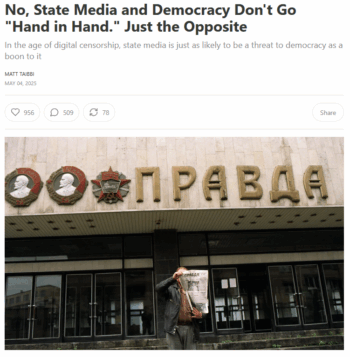
Matt Taibbi (Racket News, 5/4/25): “The above is either satire or written by someone consciously ignoring the history of state media.”*
Taibbi’s main trick is to pretend that “state media” and “public media” are interchangeable. They’re not. State media consists of government propaganda outlets that answer directly to executive authority, rather than independent editors. Public media are independent outlets that receive taxpayer subsidies. As I wrote in my piece, NPR “only gets 1% of its funding directly from the CPB,” the Corporation for Public Broadcasting.
Obviously, if NPR and PBS were “state media,” Trump wouldn’t need to try to shut them down; he would already control them editorially. That’s not to say that they’re perfectly independent. FAIR writers, including myself (11/26/20), have for decades been critical of NPR and PBS political coverage. FAIR (e.g., 6/1/99, 9/17/04, 5/11/24, 10/24/24) has pointed out again and again that right-wing complaints about supposed left-wing bias in public broadcasting have repeatedly resulted in compromised coverage. (I noted in the very piece Taibbi purports to critique that Republican critics of public broadcasting “use their leverage over CPB funding to push NPR and PBS political programming to the right.”)
FAIR’s Julie Hollar (FAIR.org, 5/2/25) wrote just days before Taibbi’s post that NPR had downplayed the Trump administration’s attack on free speech, taking a false “both sides” approach to the issue. So, yes, FAIR is outspoken about the “dark side” of NPR and PBS, and Taibbi surely knows it. But he doesn’t seem interested in an honest argument.
His words, not mine
:{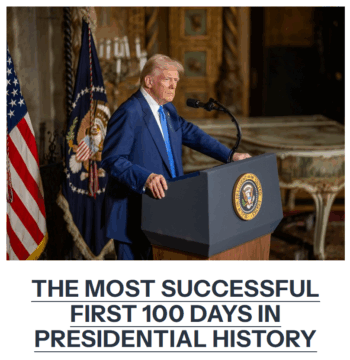
*White House Wire (4/30/25) is already the kind of state media Taibbi warns PBS could turn into.
Taibbi used quotation marks around “strong state media” twice, when those aren’t the words I used—they’re his. He claimed that I was “consciously ignoring the history of state media,” though much of my piece concerned state efforts to force conformity on public outlets. While failing to engage with the rest of my article, he took the reader to Russia in the 1990s, when independent journalists (like himself) were working:
That period, like the lives of many of those folks, didn’t last long. Vladimir Putin sent
on May 11, 2000, capping less than ten years of quasi-free speech. “Strong state media” remained, but actual journalism vanished.
I’m very open about my opposition to the tyranny of autocrats shutting down and raiding journalistic institutions (FAIR.org, 5/19/21, 6/8/23, 8/14/23, 10/22/24). And my article noted that other wannabe autocrats are attacking public broadcasters, notably in Italy, Israel and Argentina, a fact that does not undermine but rather supports the idea that there’s a correlation between public broadcasting and democracy.
If Taibbi were truly worried about “state media,” he wouldn’t be mad at a meager government subsidy to NPR or PBS, but instead would show more concern for something like the Trump administration’s White House Wire, “a news-style website that publishes exclusively positive coverage of the president on official White House servers” (Guardian, 5/1/25). And mentioning Putin’s attacks on “independent TV” is certainly a better argument against Trump’s FCC investigations into private US outlets like ABC and CBS than it is against the existence of NPR or PBS.
Taibbi’s invocation of “Putin” and “Russia” as a reason why we should not be concerned about Trump’s attacks on public broadcasting is such an illogical non sequitur, it makes more sense to interpret it as standard-issue McCarthyism. This is bolstered by Taibbi’s invocation of more paranoia about any state subsidy for media:
Yes, Car Talk and the MacNeil/Lehrer Report were cool, but outlets like Neues Deutschland, Télé Zaïre and Tung Padewat more often went “hand in hand” with fingernail factories or firing squads than democracy.
He seemed to be trying to scare the reader into thinking that we are just one episode of Wait, Wait…Don’t Tell Me! away from the Cambodian genocide.
The neo–Cold War trick is to just say “Putin” enough times in hopes that the reader will eventually realize that the US government funding anything is a sign of impending tyranny. It’s an old joke to accuse greying reactionaries of hating publicly funded snowplows because “that’s socialism,” but that appears to be where Taibbi is these days.
A sloppy attack
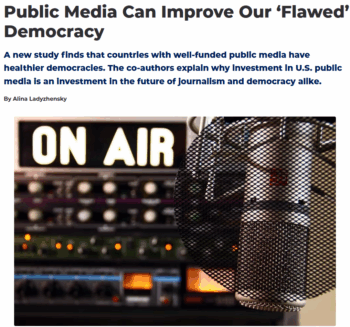
*Timothy Neff and Victor Pickard (International Journal of Press/Politics, 7/24): “High levels of secure funding for public media systems and strong structural protections for the political and economic independence of those systems are consistently and positively correlated with healthy democracies.”
Taibbi pretended to refute my claim that “strong public media systems and open democracy go hand in hand,” but in his article’s large block quotation, he omitted two embedded citations to scholarly studies that support this assertion. One of those was from Political Quarterly (3/28/24), the other was an Annenberg School study (3/16/22) whose co-author, Annenberg’s Victor Pickard, has also written about the importance of public media for The Nation (4/15/25).
Taibbi could have challenged those studies if he wanted, and good-faith disagreement is welcome. Omitting them from the quotation, though, leaves out the critical part of my statement.
Taibbi continued:
People who grew up reading the BBC or AFP may imagine a correlation between a state media and democracy, but a more dependable indicator of a free society is whether or not obnoxious private journalism (like the Russian Top Secret,whose editor Artyom Borovik died in a mysterious plane crash) is allowed to proliferate.
I’ve written at length about that dangers that the Trump administration poses when it comes to censorship, intimidating journalists, lawfare against media and using the power of the state to chill speech (FAIR.org, 12/16/24, 1/23/25, 2/18/25, 2/26/25, 3/28/25, 4/29/25). Taibbi ignored this part of my record, which is referenced in part in the very article to which he’s responding. This is crucial, because my defense of PBS and NPR in this instance is part of a general belief that the government should not attack media organizations, public or private.
As someone who read Taibbi enthusiastically when he was a Rolling Stone and New York Press writer, it’s sad to see someone I once admired so sloppily attack FAIR’s defense of press freedom against anti-democratic state power. But on the bright side, his outburst acts as an inspiration for a place like FAIR to continue defending free speech and a free press, while mercilessly calling out state propagandists who disguise themselves as journalists.
---
FAIR
jULY 25, 2022
Fox Seeks Allies Across the Political Spectrum to Shill for Bolsonaro
Fox’s propaganda blitz preemptively sets the stage for the normalization of a possible military coup in Brazil this October.
an 1120
https://www.alternet.org/2020/11/centrist-democrats
Biden hadn't even been declared the victor of the 2020 election before establishment Democrats, in the face of poorer-than-expected results in House and Senate races, began pointing fingers at the left—with corporate media giving them a major assist.
Democrats had been hoping for big wins on election night, with the possibility of winning not only the presidency but also the Senate, and increasing their majority in the House. But while Biden has come out on top, the party's most optimistic outcome in the Senate would be a 50/50 split (if they win both Georgia runoff seats), giving them a majority with the vote of Vice President Kamala Harris. And rather than gaining in the House, Democrats lost several seats.
In the wake of these disappointments, the right wing of the party immediately blamed its left wing for the poor showing, airing their grievances in a private conference call among House Democrats that was leaked to reporters.
In a write-up about the call, the Washington Post's Rachael Bade and Erica Werner (11/5/20) quoted and paraphrased 14 sources blaming those who "endorse far-left positions" for Democrats' losses, counterbalanced by only four sources defending the left. All of the progressive sources were named; half of the establishment sources were either quoted anonymously or presented as unspecified "moderates"—or, twice, simply as "Democrats," committing the exasperatingly common journalistic sleight-of-hand that erases progressive Democrats as legitimate members of their party.
In addition to quoting a handful of participants on the call, Bade and Werner interviewed numerous "moderates" for the article ("Several moderate Democrats said in interviews…"), but only managed to interview two progressives: Alexandra Rojas, head of the leftist PAC Justice Democrats, along with Rep. Jared Huffman, a member of the Congressional Progressive Caucus—who took the side of the centrists.
Huffman's contrary position, while perhaps surprising to some readers, and serving to portray the "centrist" view as even more of a consensus position, would have been less surprising to Bade, who had quoted Huffman just a few days earlier (11/1/20) about his opposition to leftists' efforts to exert more influence within the party. In other words, the reporters appeared to seek out only one source who could have been expected to offer a forceful defense of bold leftist ideas, to balance a whole parade of attackers.
In its piece on the dust-up, in which "Democrats traded excuses, blame and prognostications," the New York Times (11/5/20) quoted South Carolina Rep. James Clyburn, who "cautioned against running on 'Medicare for all or defunding police or socialized medicine,' adding that if Democrats pursued such policies, 'we're not going to win.'" What the article didn't mention was that Clyburn has taken more money from the pharmaceutical industry in the past decade than any other member of the House or Senate (Post and Courier, 12/16/18).
The piece then quoted Rep. Marc Veasey, who "warned his fellow members against anti-fracking talk." Veasey ranked fourth among House Democrats in taking oil and gas industry money in the 2020 election cycle, and got 70% of his total campaign contributions from PACs. (To put that into perspective, the two progressives quoted in the Times piece, Pramila Jayapal and Rashida Tlaib, got 13% and 3% of their campaign contributions from PACs, respectively.) Readers might have found such information useful in analyzing the motivations behind those quotes.
CNN's Chris Cillizza (11/6/20) jumped into the fray as well, praising Rep. Abigail Spanberger, a former CIA official (another piece of relevant context not mentioned by Cillizza) who had some of the harshest words for progressives, for speaking "some hard truth to her party"–like, "We need to not ever use the words 'socialist' or 'socialism' ever again," as if the McCarthy era had never ended (FAIR.org, 10/9/20).
After quoting Spanberger extensively and then printing some of Rep. Alexandria Ocasio-Cortez's rebuttal ("You can't just tell the Black, brown and youth organizers riding in to save us every election to be quiet or not have their reps champion them when they need us"), Cillizza wrote:
What's beyond debate is that Republican strategists took comments made by liberals within the Democratic Party and used them to blast everyone from Spanberger on down.
Though all of these pieces offered plenty of suggestions that the left wing's vocal support for things like socialism, Medicare for All, the Green New Deal and defunding the police cost the party seats in 2020, they failed to provide any actual data that might have helped readers evaluate the veracity of those statements.
It's an important point, because understanding Democrats' lackluster performance should help guide their platform and messaging moving forward. But these articles aren't shedding light on the data—perhaps because it would thoroughly undermine the anti-progressive framing.
As the New York Times' Jim Tankersley (10/14/20) reported just last month in an unusually frank assessment of the popularity of left-wing ideas, the right's wall-to-wall attempts to bring down Democrats with the "socialist" label haven't been very effective, despite Cillizza's suggestion to the contrary. [DADFE CTR FLORIDA CUBAN NENEZ?]That's in part because Biden and other centrists deny them so forcefully, but in part because "many of the plans favored by the most liberal wing of Democratic leaders remain popular with wide groups of voters, polling shows." Tankersley pointed to a recent Times poll that found 2 in 3 respondents support a wealth tax, 3 in 5 favor Medicare for All (including 2 of 3 independent voters), and even higher numbers support free college tuition.
The Green New Deal is likewise broadly popular: One poll specifically of swing House districts (YouGov/Data for Progress, 9/19) found that respondents supported the idea by a 13-point margin, 49% to 36%—even when informed that it will cost trillions of dollars.
And with some races still not called, it's safe to say that Medicare for All and the Green New Deal didn't sink the Dems. Ocasio-Cortez pointed out (Twitter, 11/7/20) that every Democratic co-sponsor of Medicare for All in a swing district won re-election. And Gizmodo's Brian Kahn (11/9/20) found that of 93 Democratic incumbents who co-sponsored the Green New Deal—including five in swing districts—only one lost their race.
On the question of calls to "defund the police," it's important to clarify—as did the Intercept (11/6/20), but none of these establishment media reports—that such calls grew out of the Black Lives Matter protests, not the platform of progressive congressmembers, and that that movement led to a massive spike in Democratic voter registration. In other words, without the movement that gave us the slogan "defund the police," the Democrats would almost certainly have witnessed even greater losses– including, quite probably, the White House.
As the Intercept also pointed out, it appears likely that left-wing organizing in Minnesota, Michigan and Pennsylvania resulted in decisive Democratic gains in key cities and suburbs in those swing states.And Ocasio-Cortez named many other problems with the establishment's campaign strategies, running from underinvestment in digital campaigning to a lack of a ground game to a lack of recognition of or outreach to communities of color.
Clearly the 2020 election contains many lessons for the 2022 midterms, but it's unlikely the right conclusions will be drawn from the fact-free centrist narrative presented by corporate media.
Julie Hollar is the managing editor of FAIR's magazine, Extra!. Her work received an award from Project Censored in 2005, and she has been interviewed by such media outlets as the L.A. Times, Agence France-Presse and the San Francisco Chronicle. A graduate of Rice University, she has written for the Texas Observer and coordinated communications and activism at the Lesbian/Gay Rights Lobby of Texas. Hollar also co-directed the 2006 documentary Boy I Am and was previously active in the Paper Tiger Television collective.
FROM YOUR SITE ARTICLES
- Here's why the 'political center' is a dangerous myth — and how it ... ›
- Union leaders rebuke centrist Democrats for claiming Medicare for ... ›
- For WaPo's centrist sources, progressive politics are 'purity tests ... ›
- Democrats — and the U.S. — won't have a future if Biden adopts a ... ›
richer ppl in primary vote ~ bernie
several FAIR media reports on corp media
https://www.alternet.org/2020/02/hell-hath-no-fury-like-corporate-power-scorned-the-escalating-class-war-against-bernie-sanders
===
https://www.alternet.org/2020/09/voters-should-be-wary-of-usa-todays-false-balance-on-election-2020
no lnx grafx
voters should be wary of USA Today’s false balance on Election 2020
Written by Julie Hollar / FAIR September 18, 2020
One thing readers can count on every election season is false balance in the press (FAIR.org, 12/9/16, 10/3/12; Extra!, 11–12/08; FAIR.org, 9/30/04), and despite the current threats to democracy (FAIR.org, 9/15/20) that one might hope would lead journalists to up their game, this year is no different.
Case in point: USA Today‘s front-page piece on Monday (9/14/20) with the remarkable headline, “With 50 Days Till Election Day, Voters ‘Anxious,’ Wary of Trump, Biden Alike.” On the web, the headline ran: “‘Anxious, Fearful, Angry.’ At 50 days Out to Election Day, Many Voters Are Wary of Both Trump and Biden.”
USA Today: 'Anxious, fearful, angry.' At 50 days out to Election Day, many voters are wary of both Trump and Biden
USA Today‘s headline (9/14/20) elides a key difference between the two candidates: Generally, more people like Biden than dislike him, which hasn’t been true of Trump since January 2017.
“It’s 50 days until voters cast their ballots for president, and Americans are on edge,” the article, by Ledyard King and Phillip M. Bailey, began:
It’s not just that they have been cooped up at home to avoid a deadly contagion. Or that some downtown areas have been wracked with unrest fueled by protests over police violence and racism. Or that Americans are facing financial hardships because of the pandemic. Many voters view the White House race between President Donald Trump and former Vice President Joe Biden as crucial to America’s future. But while the president’s supporters are more enthusiastic than Biden’s, many voters grappling with multiple crises are unimpressed and uninspired by the choice they will face on November 3.
This framing clearly implies that there’s no clear answer at the voting booth for “many” people; the headline directly suggests that “voters” are equally wary of both candidates.
No one disputes that there is an enthusiasm gap between Trump and Biden supporters. But the idea that the choice seems like a toss-up to most people, and that the general sentiment in the country is one of equal wariness toward both candidates, is much harder to defend. Biden’s favorability ratings have consistently been much higher than Trump’s, and Biden has led national polling averages by a minimum of 4 percentage points (currently he’s averaging almost 6 points ahead) for the last several months. And while anxiety does dominate this election year, Biden supporters are much more anxious than Trump supporters—which is hardly surprising, given Trump’s clear efforts to subvert the election (FAIR.org, 9/15/20).
Real Clear Politics: 2020 Favorability Ratings
It’s misleading to describe voters as being equally wary of these two candidates (Real Clear Politics, 9/17/20).
You get a hint at the problem with the article in the line about protest: Are Americans on edge because there has been unrest in some downtowns—or because of the conditions of police violence and racism that have spurred that unrest? USA Today seems to be talking about a particular kind of reaction, had by a particular subset of people.
And in fact, despite referring to “Americans”—and the slightly narrower “voters”—multiple times in the headline and first few paragraphs, the article soon reveals that it’s actually talking about neither of the above. The anxiety referred to in the headline, it turns out, comes from a characterization of voters in swing states who voted for Barack Obama in 2012 and Trump in 2016—not exactly a representative group.
The paper then offers quotes from several “undecided voters” from swing states that they interviewed, including such statements as, “I can’t with good conscience say that I have an educated enough decision to vote either way. You constantly have to filter through the fighting to hear what they’re actually trying to say.” The reporters return to that voters’ words to conclude the piece: “Hopefully, we’ll hear more about what they actually plan on doing [in the debates]” she said. “And less about how much they hate each other.”
Interviewing undecided voters is one of journalists’ favorite election season pastimes. It’s not an irrelevant angle, though corporate reporters tend to overemphasize the white, conservative-leaning and rural swing voter to the exclusion of other crucial groups that might decide the election (FAIR.org, 5/20/14). But you have to wonder if people would remain so undecided if news media used more front-page real estate to cover candidates’ plans than to publish uninformed opinions about those candidates.
And it’s important that the obsession with swing state voters—while, again, justified to some extent, because of the way our Electoral College makes many voters’ opinions largely inconsequential—doesn’t so cloud reporters’ judgment that they use those voters to stand in for “Americans” as a whole. By doing so, outlets like USA Today overstate Trump’s support and create the impression of a balance that doesn’t exist.
==
https://www.alternet.org/2020/03/elite-media-dismiss-voter-suppression-on-grounds-that-its-complicated
no lnx pix twt
Elite media dismiss voter suppression on grounds that it’s ‘complicated’
Written by Julie Hollar / FAIR March 14, 2020
Some voters—disproportionately black and brown ones—waited in line for several hours on Super Tuesday to cast their ballots in the Democratic primary, and media paid attention. But their love for a good visual doesn’t always correspond with a love for connecting the dots, and so most of the coverage downplayed any suggestion that there might be voter suppression going on in 2020.
NYT: Why Did It Take So Long to Vote in Texas and California?
The New York Times (3/4/20) assured us that voting problems were not caused by “deliberate efforts to drive down turnout.”
“Why Did It Take So Long to Vote in Texas and California?” asked a New York Times headline (3/4/20), which offered a reassuring answer in its subhead: “Some voters stood in lines for hours. But despite voter suppression concerns, the primary breakdowns apparently reflected snafus more than malign intent.” Reporter Michael Wines explained:
Some critics complained on Twitter and elsewhere that the delays amounted to voter suppression in a state where Republicans have been frequently sued, sometimes successfully, for trying to minimize Democratic power. But Texas elections are tightly controlled by local officials, not state ones. And in big cities like Houston and Austin which had the biggest problems on Tuesday, those officials are Democrats with scant reason to depress turnout in Democratic urban strongholds.
And yet, in the very next paragraph, Wines reported that “voting machines were divided equally between Democratic and Republican voters—but many more Democrats turned out to vote on Tuesday,” later explaining that
the imbalance stemmed from the county Republican Party’s refusal to agree with Democrats to hold a joint primary election in metropolitan Houston in which voters could cast ballots on any machine. All but a handful of the state’s 254 counties held joint primaries.
The article’s final paragraph noted that the Houston voting site at historically black Texas Southern University, where people waited up to seven hours to vote,
allotted 10 voting machines to each party, and eventually added 14 additional machines for Democratic voters, she said. But of those who showed up on Tuesday, 1,132 voted in the Democratic primary. Sixty-eight voted for Republican candidates.
WaPo: Long voting lines in Texas spotlight concerns about access to the polls
The Washington Post (3/4/20) blamed long voting lines on ” a number of complicated factors.”
It’s a curiously stark mismatch between evidence and conclusions, a phenomenon repeated in the Washington Post (3/4/20), where reporter Elise Viebeck likewise took issue with those suggesting voter suppression was happening:
One of the remaining Democrats in the presidential field—Sen. Bernie Sanders (I-Vt.)—seized on the episode, tweeting that it revealed a “crisis of voter suppression.”
However, interviews with election officials, activists and voters pointed to a number of complicated factors that combined to produce the massive lines in Harris County.
(The print version’s lead: “Voter suppression came to mind for some, but the reality was complicated.”)
Like Wines, Viebeck noted the Harris County GOP’s refusal to hold a joint primary, and that, after the Supreme Court’s 2013 Shelby County v. Holder decision that gutted the Voting Rights Act, Texas closed 750 polling places—more than any other state.
A Houston Chronicle article (3/4/20) about the situation slightly complicated the question of responsibility for giving equal numbers of machines to each party (reporting that though Republicans refused the joint primary, which would have prevented the problem, they were given more machines than they asked for, because the Democratic county clerk’s office worried about charges of discrimination), but it also pointed out that “almost two-thirds of the county’s voting centers were in county commissioner precincts in west Harris County held by Republicans.”
Sure, there were plenty of technological snafus and administrative errors—and those certainly need to be highlighted, so that pressure is put on election officials to fix them—but why pooh-pooh charges of voter suppression when voter suppression (which often masquerades as bureaucratic incompetence) is also an undeniable problem?
MSNBC: Lawrence O'Donnell on Super Tuesday
Lawrence O’Donnell (MSNBC, 3/3/20) on long Super Tuesday lines: “They’re all kind of excited about this.”
Others went so far as to celebrate the lines. On MSNBC (3/3/20), Lawrence O’Donnell reported:
My phone is filled with texts from people, friends of mine in those lines. I have one from a Hollywood polling place where the casting director is in a conversation with a cinematographer and a math teacher and someone who was an undecided voter an hour ago in that line. And she says they just realized and only just realized that they’ve been on the line for two hours, because it’s been so much fun…. I’ve got one from a very affluent community in the Pacific Palisades, a director who’s been in line for two hours. He’s not complaining. They’re all kind of excited about this.
It’s charitable that the affluent aren’t complaining about standing in line for hours (as no one should face obstacles to vote)—but they’re also typically not worried about getting fired or missing a paycheck for doing so. Oblivious to this reality, O’Donnell also dismissed the idea that a city should be expected to make it possible for all of its citizens to vote:
And the infrastructure for voting in Los Angeles is a difficult one to maintain. Because on the last mayoral election, this is the election for the mayor of Los Angeles, the voter turnout was 20%. And so to build an infrastructure in Los Angeles that is capable of handling this giant surge turnout that they’re getting tonight is impossible.
To be fair, most journalists were more concerned than O’Donnell about people’s access to democracy, but they were still remarkably disinterested in asking how the concerted (and partisan) efforts to suppress turnout post-Shelby are playing out in 2020. In the Super Tuesday coverage, NBC (3/4/20) was the only broadcast network to air the words “voter suppression” (in a quote from a voter standing in line in Texas), in a segment less than two minutes long that noted the elimination of many voting centers in both Texas and California, but didn’t mention the partisan nature of that act in Texas, instead characterizing it as simply “designed to make voting easier.”
NYT: The Student Vote Is Surging. So Are Efforts to Suppress It.
The New York Times‘ earlier reporting (10/24/19) on efforts to suppress the student vote did not inform coverage of lower-than-expected youth turnout in the 2020 primaries.
The failure to connect the dots extends to coverage of lower-than-expected turnout, in particular youth turnout. Plenty of reporters seized on early turnout numbers to point out that Bernie Sanders’ campaign is failing in its goal of mobilizing youth and other traditionally low-turnout groups, but rarely do they look at the relationship between turnout and suppression—despite the fact that those groups typically face more obstacles to voting.
And Wines’ dismissal of suspicions of voter suppression on the grounds that urban polling places are controlled by Democrats seems to willfully ignore the fact that establishment Democrats often have a strong incentive to make sure that older Democrats vote more than young ones—and have been known to manipulate the voting process to their own advantage (City & State, 11/6/18).
In fact, the Times‘ coverage was even more remarkable, given Wines’ insightful reporting months earlier about efforts to suppress the student vote in Texas and several other states (10/24/19), in which he noted that recently enacted “restrictions fit an increasingly unabashed pattern of Republican politicians’ efforts to discourage voters likely to oppose them.”
There surely are multiple reasons for lower-than-hoped-for turnout that no doubt intersect with each other, including both obstacles to voting and failure (or lack) of efforts to mobilize voters; it’s instructive to see where journalists instinctively turn to look for the culprit. Particularly post-Shelby, ID requirements, poll closures and voter roll purges have ramped up, inevitably taking a toll on democratic access. As Emory University’s Carol Anderson recently told Counterspin (3/3/20) about voter suppression:
To see the overall pattern, and continuing to hammer it home, about what is at stake in this democracy…requires good investigative journalism, it requires going beyond the soundbite, it requires a clarion call: This nation is in danger.
===
==
https://www.alternet.org/2020/02/how-the-wapo-backing-limited-impeachment-was-constitutional-disaster/
no lnx
How the WaPo backing limited impeachment was constitutional disaster
Written by Joshua Cho / FAIR February 28, 2020
FAIR (11/26/19, 2/4/20) has covered how one flagship ResistanceTM newspaper, the New York Times, trivialized the importance of the impeachment process as a check on authoritarianism by covering it as a partisan competition, littered with false equivalences, and underplaying the danger Donald Trump and the rest of the Republican Party poses to whatever tatters of democracy the US has left. Instead of raising critical questions about impeachment that would inform their audience of the ways the Democratic Party could function as an effective opposition party, the Times merely regurgitated uncritical “he said, she said” statements, without making the effort to determine whether one side had greater credibility.
Another critical flaw with corporate media’s coverage of impeachment was how it obscured the extent of the Trump administration’s litany of impeachable offenses. The political case for expanding the scope of impeachment, going beyond the Democratic establishment’s narrow attention to abuse of power and obstruction of Congress in the Ukraine case, to all of Trump’s crimes, has been made in several places (e.g., Intercept, 9/26/19; Current Affairs, 2/5/20). Renowned attorney Ralph Nader and constitutional scholars Bruce Fein and Louis Fisher presented no less than 12 impeachable offenses in the Congressional Record (12/18/19).
They range all the way from violations of the Constitution’s Declare War and Treaty clauses, when Trump waged war in countries like Libya and Syria, and unilaterally terminated the Intermediate Nuclear Forces Treaty with Russia, to violations of the Appropriations and Appointments clauses, as when he spent billions in excess of what Congress appropriated for the US/Mexican border wall, and appointed “acting” Cabinet officials not confirmed by the Senate.House Democrats impeaching Trump exclusively for his dealings with the Ukrainian president, and for preventing Congress from investigating that isolated incident, was a form of unilateral disarmament that implied Trump was not guilty of anything else, and journalists were under no obligation to stick to that script.
A look at how impeachment was covered by another crusading ResistanceTM publication, the Washington Post, shows how the paper obscured the credible case for impeaching Trump on a variety of other grounds, endorsing the Democrats’ tunnel-vision approach.
The Post’s “For Impeachment, Quick and Narrow Is the Way to Go” (12/9/19), by deputy editorial page editor Ruth Marcus, argued:
Narrow is better because the president’s bad conduct with respect to Ukraine was significantly worse than his bad conduct elsewhere, including his demonstrated efforts to obstruct justice in the special counsel’s probe into Russian meddling….
Sooner is better than later, even though that means lawmakers and the public will be deprived of important, potentially revelatory, testimony that Democrats might be able to compel through court proceedings. The reason is that, even assuming such litigation would succeed, going to court to compel testimony from such recalcitrant witnesses as former national security adviser John Bolton or acting White House chief of staff Mick Mulvaney, and then determining the permissible scope of that testimony, would likely take months.
Post columnist Jennifer Rubin (12/9/19) likewise argued that the Democrats’ fixation on abuse of power and obstruction of Congress was powerful precisely because it was the “tightest possible case,” and that testimonies from Donald McGahn and John Bolton were unnecessary to make a “razor-sharp case,” because the “central misdeed is provable from Trump’s own words.”
Another Post op-ed (12/4/19), by Watergate Era Judiciary Committee member Elizabeth Holtzman, argued that there are “good reasons” for “including non-Ukraine-related abuses in the charges against Trump,” because focusing “only on Ukraine suggests that Trump’s impeachable offenses are limited to this one matter.” But although it mentioned that Trump’s “abuses are staggering and continuous,” it suggested that other issues—her focus is on Trump’s “impeding the Russia investigation”—could be included in “a broader article of impeachment against Trump for hindering Congress in its constitutional role in conducting an impeachment inquiry.” This would obviate the need for “further investigation”—but also limit the charges against Trump to a circular complaint that he prevented Congress from bringing substantive complaints.
When the Washington Post (12/10/19) explained the House’s articles of impeachment, it mentioned that the House’s allegations of abuse of power were specifically confined to Trump’s dealings with Ukraine in order to launch investigations into political opponent Joe Biden. However, the Post left out other ways Democrats could go after Trump’s abuse of power. One example that Nader, Fein and Fisher’s list of Trump’s offenses included in the category of abuse of power was Trump’s making “presidential lies as routine as the rising and setting of the sun” and “confounding civil discourse truth and public trust.” This has precedent, as the House cited Richard Nixon’s “false or misleading public statements for the purpose of deceiving the people of the United States” as part of its articles of impeachment in 1974.
In another report, the Post (9/25/19) parroted the “private discussions” Democratic officials were having regarding the scope of impeachment, where they asserted that the “evidence was incriminating enough,” and “easy enough for voters to understand,” that “narrowing the investigation, if only in terms of political messaging, made sense.” Why does the Post take Democratic officials at their word when they claim to be pursuing this approach to impeachment for the sake of easing understanding, or leave their strategy unchallenged? The Post doesn’t need to rely on Democratic officials to inform their audience of the possible impeachment strategies Democrats could pursue.
Later, the Post (10/10/19) reported that “recent revelations” were “testing the limits of House Speaker Pelosi’s narrow impeachment strategy, leading some Democrats to wonder whether the probe should be expanded beyond the Ukraine scandal.” It claimed that by “solely focusing on Ukraine, Democrats could miss the opportunity to build a stronger case against the president,” but restricted the potential broadening of the case to Trump trying to enlist then-Secretary of State Rex Tillerson’s aid in stopping the prosecution of a Turkish-Iranian gold trader, and to Trump’s public request to the Chinese government to investigate the activities of Hunter Biden. Apparently, the Post doesn’t consider things like Trump initiating the withdrawal of the US from the Paris climate agreement—and sabotaging international efforts to avoid further climate catastrophe—as a “high crime” and an impeachable offense, as legal scholar Marjorie Cohn does (Truthout, 6/6/17).
When the Post (12/2/19) reported on Democratic officials potentially drafting additional articles of impeachment related to obstructing Mueller’s Russia investigation and using the presidency to enrich himself, it euphemized Trump’s unconstitutional refusal to divest himself from his businesses as an “unorthodox decision,” and uncritically parroted other Democrats absurdly claiming that “the evidence is not there to support such an indictment.”
Journalist Christian Parenti (Jacobin, 1/9/20), by contrast, reported that the Democrats were uncomfortable with going after Trump on his blatant violations of the emoluments clause—forbidding him from receiving gifts from foreign powers and limiting presidential remuneration solely to the presidential salary—because it would inevitably open a discussion on the legal bribes the Democrats take from the same corporations that patronize Trump’s hotels.
This suggests that the Democrats pursued such a disastrous approach to impeachment—not out of incompetence or in good faith—but as a cynical spectacle of faux resistance. When the late historian Howard Zinn discussed how the Democrats and the media handled President Richard Nixon’s impeachment, he observed that they didn’t want to emphasize elements of his behavior “found in other presidents” that “might be repeated in the future,” leaving things like “corporate influence on the White House,” and the “power of the president to do anything he wanted in the name of ‘national security,’” intact:
Valuable information came out of the investigations, but it was just enough, and in just the right way—moderate press coverage, little television coverage, thick books of reports with limited readership—to give the impression of an honest society correcting itself.
That might be why the Post’s later report (2/5/20) on the Democrats’ failure to remove Trump from office contained no insights on whether impeachment would have had more political success if the Democrats pursued a broader investigation into Trump’s crimes. Of course the Senate was never going to convict; the point was to hold the president accountable—and win over public opinion in the process—by operating as an effective opposition party possessing moral integrity.
Journalist Aaron Maté (Le Monde Diplomatique, 11/19) discussed how the Russiagate conspiracy theory and the Ukraine scandal were both focused on protecting the unsavory conduct of establishment Democratic figures, and portraying Trump as an incompetent steward of the US empire. Maté concluded that the Democrats pursued such a shallow impeachment process because in Washington, elites generally face consequences for the harm they cause not to the general population but to other members of the club. The standard was laid bare in Watergate (1972–74), when Richard Nixon faced impeachment, not for mass murder in Vietnam, Cambodia and Laos, but for targeting the opposing elite faction and trying to cover it up. George W. Bush could have been impeached for the Iraq invasion in 2003 had this crime not been carried out with bipartisan support.
Ever since the election of Donald Trump, the Washington Post has always presented itself as one of the crusading publications leading the ResistanceTM movement against the current administration. It even adopted the “Democracy Dies in Darkness” motto on its masthead as a marketing gimmick to attract more subscribers. Yet it’s clear that the Post’s impeachment coverage served more to preserve the stability and legitimacy of US institutions—rather than their integrity—by obscuring the extent of the Trump administration’s crimes and impeachable offenses, and endorsing a fatally narrow scope of impeachment.
==
https://fair.org/home/venezuela-coverage-takes-us-back-to-golden-age-of-lying-about-latin-america/
no lnx pix many
FEBRUARY 22, 2019
Venezuela Coverage Takes Us Back to Golden Age of Lying About Latin America
MARK COOK
Crowd in support of the elected Venezuelan President Nicolas Maduro...
an 1219
no lnx
Corporate media’s mantra is ‘anyone but Sanders or Warren’ — and they’re doing the work of the extremely wealthy
Written by Norman Solomon / Common Dreams December 2, 2019
Anyone who’s been paying attention should get the picture by now. Overall, in subtle and sledgehammer ways, the mass media of the United States—owned and sponsored by corporate giants—are in the midst of a siege against the two progressive Democratic candidates who have a real chance to be elected president in 2020.
Some of the prevalent media bias has taken the form of protracted swoons for numerous “center lane” opponents of Bernie Sanders and Elizabeth Warren. The recent entry of Michael Bloomberg has further jammed that lane, adding a plutocrat “worth” upwards of $50 billion to a bevy of corporate politicians.
The mainline media are generally quite warm toward so-called “moderates,” without bothering to question what’s so moderate about such positions as bowing to corporate plunder, backing rampant militarism and refusing to seriously confront the climate emergency.
Critical reporting on debate performances and campaign operations has certainly been common. But the core of the “moderate” agenda routinely gets affirmation from elite journalists who told us in no uncertain terms four years ago that Hillary Clinton was obviously the nominee who could defeat Donald Trump.
This year, Sanders has taken most of the flak from reporters and pundits (often virtually indistinguishable), serving as a kind of “heat shield” for Warren. But as Warren gained ground in polling this fall, the attacks on her escalated—to the point that she now has a corporate media bullseye on her political back.
The disconnect between voters and corporate media is often huge. Meanwhile, with fly-on-the-wall pretenses, media outlets that have powerfully distorted proposals like Medicare for All are now reporting (with thinly veiled satisfaction) that voters are cool to those proposals.
The Washington Post, owned by one of the world’s richest people Jeff Bezos, has routinely spun Medicare for All as some sort of government takeover. In a prominent Nov. 30 news story that largely attributed Warren’s recent dip in polls to her positioning on healthcare, the Post matter-of-factly—and falsely—referred to Medicare for All as “government-run healthcare” and “a government-run health plan.”
:{
}:
Such pervasive mass-media reporting smoothed the way for deceptions that have elevated Pete Buttigieg in polls during recent weeks with his deceptive “Medicare for All Who Want It” slogan. That rhetoric springboards from the false premises that Medicare for All would deprive people of meaningful choice and would somehow reduce coverage.
:{
}:
In late September, with scant media scrutiny, Buttigieg launched an ad campaign against Medicare for All that has continued. Using insurance-industry talking points, he is deliberately confusing the current “choice” of predatory for-profit insurance plans with the genuine full choice of healthcare providers that top-quality Medicare for everyone would offer.
Mainstream media outlets are ill-positioned to refute such distortions since they’re routinely purveying such distortions themselves. Warren’s backtracking step on Medicare for All in mid-November was a tribute to media pressure in tandem with attacks from centrist opponents.
The idea of implementing some form of a substantial “wealth tax” has also been denigrated by many corporate-employed journalists. Countless pundits and political beat reporters have warned that proposals like a wealth tax, from Warren and Sanders, risk dragging Democrats down with voters. The truth is that such proposals are unpopular with the punditocracy and the extremely wealthy—while it’s a very different matter for most voters, who strongly favor a wealth tax.
On the same day this fall, the New York Times and the Washington Post published stories on Democratic elites’ “anxiety” about the presidential election.The Post wrote that Democrats “fret” Warren and Sanders “are too liberal to win a general election.” (With disdain, the article made a matter-of-fact reference to “the push for liberal purity.”) The Times similarly wrote of “persistent questions about Senator Elizabeth Warren’s viability in the general election.” Contrary voices were absent in both news stories.
Assessing those articles, FAIR.org media analyst Julie Hollar pointed out: “The pieces interviewed a number of big donors and centrist party leaders, who fretted about their preferred candidate’s struggles and expressed hope for someone more corporate-friendly than Warren to enter the race and challenge her rise.”
Hollar added: “The thinking of powerful people in the Democratic Party is worth writing about. But it’s crucial not to just take their claims at face value. . . . What establishment Democrats are really worried about, of course, is their own power in the party, which is threatened by a surging left wing. Don’t look to their establishment media counterparts to report on that transparently.”
Part of the problem is the TV network that many Democrats (mistakenly) trust. MSNBC is becoming notorious for its hostility to Bernie Sanders, often expressed through egregious omission or mathematical fib if not direct antipathy.
Ongoing media analysis is crucial, but even more important is activist pushback against the 24/7 onslaught of corporate-minded propaganda, often couched as common sense and incontrovertible reality. Among the needed counterpunches are these:
Support progressive media outlets as they provide independent coverage of the presidential campaign
Widely share, via email forwarding and social media, online pieces that you like. (Hopefully including this one.)
Recognize, challenge, and organize against the corporate-media echo chamber that affects so many voters
You shouldn’t have to be an active supporter of Bernie Sanders (as I am) or of Elizabeth Warren to voice outrage about corporate media biases. What’s at stake includes democracy—the informed consent of the governed—and so much more.
History is unfolding in real time. It’s not a product on the media shelf, to be passively bought and consumed. As Bernie 2020 campaign co-chair Nina Turner says, “All that we love is on the line.”
Norman Solomon is co-founder and national coordinator of RootsAction.org. His books include “War Made Easy: How Presidents and Pundits Keep Spinning Us to Death” and “Made Love, Got War: Close Encounters with America’s Warfare State.” He is the founder and executive director of the Institute for Public Accuracy.
==
Pathological Deceit: The NYT Inverts Reality on Venezuela’s Cuban Doctors
A New York Times “exposé” of Cuban doctors’ supposed interference in Venezuelan elections was riddled with inaccuracies, omissions and misrepresentations.
Afterdebunking Washington’s lies about the burning of “humanitarian aid” trucks on the Venezuelan/Colombian border (more than two weeks after being scooped by independent journalists), the New York Times quickly reverted to form in anarticle by Nicholas Casey headlined “‘It is Unspeakable’: How Maduro Used Cuban Doctors to Coerce Voters” (3/17/19).
As the title not-so-subtly suggests, Casey claimed to present bombshell revelations regarding the Nicolás Maduro government’s alleged weaponization of Cuban medical personnel as a means of holding on to power. On closer inspection, however, the article is riddled with factual inaccuracies, omissions and misrepresentations.
Dubious claims of politicized healthcare
Relying on the testimony of three Cuban doctors who have defected from the Venezuelan/Cuban health mission and taken up residence in other countries, as well as 16 anonymous sources within Venezuela, Casey provides the reader with shocking vignettes of how Cuban medical personnel have supposedly been used to manipulate Venezuelan politics.
One central allegation is that the Barrio Adentro healthcare mission staff, most of them Cuban doctors, are denying patients care on the basis of political affiliations. One Cuban doctor currently residing in Chile told the Times that one patient was refused treatment “because she was from the opposition.” The only other evidence to substantiate this grave accusation is the account of an opposition mayor who claims he was “denied medication.”
As has been widely documented (Guardian, 10/13/15), defector testimonies are often unreliable, given the political stakes involved. Similar reservations apply to a politician aligned with an opposition spearheading a foreign-backed coup in Venezuela.
Likewise worthy of skepticism is Human Rights Watch Americas director Jose Miguel Vivanco, whose quote, “it is unspeakable,” gives the piece its headline, though a reader might assume these were the words of an actual doctor. Human Rights Watch, whose revolving door with the US national security state is now notorious, can always be counted on to attack the Venezuelan government, though its charges have been debunked on several occasions.
Vivanco is an especially dubious source, given his extremely biased track record on Venezuela. Just over a decade ago, the HRW official was publiclyrebuked by over 100 Latin America experts for a report on Venezuela that did “not meet even the most minimal standards of scholarship, impartiality, accuracy or credibility,” which included similar sweeping allegations of politicized denial of care, based on the second-hand testimony of one individual.
Implausible electoral interference
The Times’ questionable allegations of denial of care quickly give way to even dodgier claims of Cuban doctors interfering in Venezuelan politics. “One former Cuban supervisor said that she and other foreign medical workers were given counterfeit identification cards to vote in an election,” Casey wrote, adding that Cuban doctors “were asked to vote with false identification” in 2013.
Anyone who knows how voting works in Venezuela would dismiss these allegations immediately. The first step upon entering a polling station is presenting ID and biometrically scanning fingerprints. Computerized voting screens will literally not open unless a valid fingerprint is presented. Cuban doctors, since they are of course not Venezuelans, would not have their fingerprints in the system, and thus not get past this first step. (It’s worth noting that Cuban doctors in Venezuela number roughly 30,000, in a country with an electorate of around 20 million, making the notion of a secret program to enable them to vote illegally in hopes of affecting electoral outcomes rather far-fetched.)
Another passage suggested a similar lack of familiarity with the Venezuelan electoral process:
On the day Mr. Maduro was elected to his first term, [a Cuban doctor] witnessed officials opening ballot boxes and tampering with votes, including destroying ballots that chose the opposition.
In Venezuela, the vote count is electronic, verified by paper receipts.
First off, there are no “ballot boxes” or “ballots,” because voting is fully automated. After the voter makes their selection on the computer screen, a paper receipt is printed and placed in a box. At the end of election day, 54 percent of all voting machines, chosen at random, have their electronic totals cross-checked with the paper receipts. Destroying the receipts (not ballots) would not serve any purpose, other than raising a red flag when they did not agree with the electronic tally. (If the Times’ source had bothered to name the voting center, one could check the results and confront the National Electoral Council with any discrepancy, since the paper tallies are kept for a number of years.)
Secondly, all parties or candidates have witnesses at every electoral center. At the end of the day, the witnesses and the electoral delegates all sign a certificate validating the results. In the case of the April 14, 2013 election, there was not a single electoral center where opposition candidate Henrique Capriles’ witnesses did not validate the results, nor any reports of destruction of ballots, perhaps because there are no “ballots.”
For someone who covers Venezuela regularly, Casey makes a remarkable number of errors in his account of the country’s electoral system. For example, he wrote, “In mid-2017, Mr. Maduro made a bid to consolidate power: a referendum for a second legislature to replace the opposition-controlled National Assembly.”
What took place on July 30, 2017, was an election, not a referendum, for a national constituent assembly, a body that is outlined in Articles 347–349 of the 1999 Bolivarian Constitution, and which is much more than a “second legislature.” Furthermore, the National Assembly was declared “null and void” by the Venezuelan Supreme Court in 2016 (BBC, 1/11/16), after defying a court order to unseat three legislators pending an investigation for electoral crimes.
Whitewashing opposition violence
Given their factual implausibility, Casey’s anonymously sourced claims of ballot-stuffing and illegal voting in the 2013 presidential election represent a thinly veiled maneuver to delegitimize Maduro’s victory, which was challenged by no country in the world except the United States—a fact that is conveniently omitted.
One unnamed source accused the Chavista government of “blackmail[ing]” voters that the opposition would eliminate the Barrio Adentro medical mission if Capriles won. Casey did not inform readers that the Venezuelan opposition has long vowed to suspend bilateral cooperation agreements with Havana should it come to power.
Cuban doctor hanged in effigy in Caracas. (The sign reads, “Out with Cuban ‘Doctors’!” (photo: News24.com,via **Venezuelanalysis**)
Nor did Casey mention the opposition’s repeated acts of violence against Cuban health professionals and clinics. Following Capriles’ US-sanctioned refusal to recognize the indisputable 2013 election results, and his call for his supporters to  ” in the streets, seven people were killed in the ensuingstreet violence that saw 18 Cuban-staffed neighborhood health clinics set ablaze. The violent anti-government protests of 2014 likewise featured no less than162 attacks against Cuban doctors, who were prominently lynched in effigy. In omitting these rather important details, Casey succeeded in inverting reality: He presented Cuban medical staff as witting or unwitting gendarmes of a brutal regime, rather than frequent victims of opposition violence.
This whitewashing of right-wing terror extended also to Casey’s framing of the 2017 anti-government mobilizations, which he said led to 100 deaths in a “government crackdown,” leaving out the numerous killings carried out by opposition supporters, including mob lynchings of Afro-Venezuelan men and sniper assassinations of Chavista activists.
In addition to relitigating the internationally recognized 2013 election, Casey repeated the now-boilerplate allegations of fraud in the 2018 presidential elections, pointing to opposition figures barred from running, with “Leopoldo López…dragged between house arrest and a military prison,” and Capriles “banned from running, along with most opposition parties.” Casey didn’t mention that López was convicted of inciting violence during the 2014 street protests, while Capriles was barred due to corruption allegations that even the opposition has moved to investigate.
Casey’s highly selective picture of Capriles and López is particularly disingenuous, given that both politicians actively participated in the short-lived 2002military coup, with the former leading an against the Cuban embassy, and both of them involved in the mob
 of Interior Minister Ramón Rodríguez Chacín. That alone would have disqualified them from holding political office anywhere else in the world.
It is also false that opposition parties were banned, since what was required of them was to revalidate their legal status by collecting a minimum number of signatures following their boycott of the December 10, 2017, municipal elections. Whether or not this was a political hurdle, some opposition parties, such as Acción Democrática, fulfilled it. And the fact remains that opposition candidates did run against Maduro, notably former Lara Gov. Henri Falcón, who was actively undermined by the hardline factions of the opposition, and was even threatened with US sanctions for defying the opposition boycott.
Erasure of sanctions
In an article explicitly dedicated to uncovering alleged foreign interference in Venezuelan state and society, it is ironic that Casey entirely omitted the most egregious form of external intervention: US sanctions. Since 2017, Trump’s financial sanctions have battered the healthcare system directly, with recurring cases of medicine shipments blocked or assets destined for imports frozen as a result of US financial crimes enforcement directives, according to Torino Capital chief economistFrancisco Rodriguez. In one such case, the Venezuelan government denounced the freezing of $1.6 billion of its assets by Brussels-based financial services agency Euroclear, half of which was reportedly destined for medicine imports.
US economic sanctions also debilitate healthcare indirectly by decimating the Venezuelan economy overall. According to conservative estimates, US financial sanctions cost Venezuela at least $6 billion annually in lost revenues, or around six percent of GDP. For comparison, healthcare spending in Latin Americaaverages approximately seven percent of GDP, and, prior to the crisis, Venezuela was importing around $2 billion in medicine per year. Rodriguez estimates that the new US oil sanctions, amounting to an effective trade embargo, will cost Venezuela an additional 15 percent in real GDP loss, for a cumulative contraction of 26 percent in 2019.
Despite his stated concern for the “politicization” of healthcare in Venezuela, Nicholas Casey doesn’t think it relevant to mention his own government’s deliberate effort to destroy the Venezuelan economy, further devastating the country’s fragile health sector and killing thousands, if not tens of thousands, of Venezuelans. Rather, the New York Times’ Andes bureau chief mobilizes anonymous sources and defectors—whose testimony ranges from dubious to preposterous—to further demonize Venezuela and provide cover for Washington’s murderous regime change policy.
==
Topics
Regions
——————-
Issues
Outlets & Media Figures
==
https://www.alternet.org/2019/10/mainstream-media-is-turning-on-elizabeth-warren/
no lnx
Mainstream media is turning on Elizabeth Warren
Written by Julie Hollar / FAIR October 10, 2019
Just two weeks ago, our survey of media coverage of Sen. Elizabeth Warren’s presidential campaign found a fairly — though not exclusively — positive tenor, with stories often contrasting her favorably to Sen. Bernie Sanders and highlighting her outspoken commitment to capitalism. But with erstwhile frontrunner Joe Biden under fierce attack from Donald Trump and Sanders recovering from a heart attack, establishment Democrats and their big donors are suddenly looking at Warren’s rising poll numbers as a sign that her candidacy has very real potential — and is a very real threat to their power.
As centrist Democratic sources go, so go the media.
Among the “events of the past two weeks [that] have created huge uncertainty for the candidates who have dominated the Democratic nomination race,” the Washington Post (10/6/19) lists “persistent doubts among some party leaders” about Elizabeth Warren
Under the headline, “Uncertainty Takes Over the Lead in the Democratic Presidential Race,” the Washington Post’s Michael Scherer and Matt Viser (10/6/19) report that recent events “have created huge uncertainty for the candidates who have dominated the Democratic nomination race.” Those recent events? For Sanders, a heart attack; for Biden, an uncomfortable role in the impeachment inquiry; and for Warren, the curiously un-event-like “persistent doubts among some party leaders that she is too liberal to win the general election.”
The Democratic Party has many leaders from both its left and right wings; for the Post, the adjective “some” serves to obscure the fact that its sources expressing those doubts are almost exclusively from the right.
People like former Sen. Heidi Heitkamp of North Dakota, who lost her 2018 re-election campaign (in which she emphasized how often she voted with Trump) by more than 10 percentage points — who better to turn to for an opinion about how to win an election?
Or there’s consultant Donna Bojarsky, who has donated to Sens. Kamala Harris, Amy Klobuchar and Cory Booker — all representatives of the corporate wing of the party. How about former Obama adviser David Plouffe, who went on to flack for Uber after his Obama years, and now runs policy for Mark Zuckerberg’s philanthropy company? Then you have self-described “radical centrist” Mitch Landrieu, who told the Post:
[Warren] says she can do all these things. There’s a thing called political reality…. Aspiration is wonderful, but you can’t eat aspiration for lunch and send your kids to college on it. That’s a fundamental decision that Democratic primary voters need to make a decision on.
The best bits come from anonymous donors, though, who are given cover to sow fear about a candidate whose policy proposals (like a wealth tax and a lobbying tax) would directly impact their own finances and political influence:
As Warren has steadily marched upward in the polls, the reality that she could become the nominee has unsettled some of the party’s top donors, who worry that she would hand the race to Trump. If it starts to look like Warren will win the party’s nomination, a longtime Democratic bundler said, “there will be efforts to stop that.”
Another anonymous donor, who the paper tells us is “seeking a moderate as a nominee,” expressed worries that if Warren is the nominee, her presence would ruin any Democratic chances to win the Senate, because voters would perceive having a Republican majority as “the only way to keep her in check” as president.
To end the hit parade, the Post reminds us that even if Biden falters, we still have centrist choices — calling up Sen. Michael Bennet and Rep. Tim Ryan, candidates currently polling below 1 percent, for some closing thoughts.
There’s obviously a lot of uncertainty at the moment; it’s just that the Washington Post, relying on its corporate centrist cast of characters, can’t give anything like an honest accounting of it.
Julie Hollar is senior analyst for FAIR’s Election Focus 2020 project. She was Extra!’s managing editor from 2008 to 2014.
==
==
https://www.alternet.org/2019/10/the-phony-liberalism-of-bill-maher/
==