bolsonaro 2 bak
see big lie
see cpac
see facebook
see jr eduardo
see tucker
see fascism/authoritarian
to be fair pbs showed hungry brasil ppl lined up for gov't food not there? 420
FLAVIO RUNNING 7 26
AN TC 7 26
We can see all of this at play in the rise of the global far right over recent decades. Former Brazilian president Jair Bolsonaro declared at his first inauguration that Brazil’s flag would never be red. Colombia’s president-elect, Abelardo de la Espriella, denounced his reformist opponent as a “radical left Marxist”.
===
MMA 6 26
...
From the Fraud-Fighter Summit on June 16, 2026, streamed on Rumble
- In addition to U.S. elections, the summit also featured substantial discussion of Brazil and South Korea, both of whichhave been a focusfor far-right American pundits in recent years. The first night of the summit was in part dedicated to a movie about former Brazilian President Jair Bolsonaro. One speaker at the conference was Douglas Frank, who visited South Korea as part of a “Korea-US Election Fraud Joint Investigation Team.” Frank claimed the people of South Korea had “lost their country” after “corrupt elections.” During his appearance, Frank also spoke with former South Korean Prime Minister Hwang Kyo-ahn, who claimed via translator that “the days of election fraud will be numbered.”
[vid]
musk bolso chainsaw cpac 2 25
this guy was finished after failed coup, hiding from law in florida? chainsaw is tool of deforestation, but also big penis? halo videogame? kash cuts of dem heads.
no lnx an
'You have been gaslit': CPAC oozes MAGA's 'male inequality' agenda
People react as U.S. President Donald Trump (not pictured) addresses the Conservative Political Action Conference (CPAC) annual meeting in National Harbor, Maryland, U.S., February 22, 2025.
Matt Laslo February 23, 2025
NATIONAL HARBOR, MD — This just might be the year American men finally overcome centuries of political, cultural and marital oppression that have ravaged the gender and kept guys locked out of key policies, like the Violence Against Women Act.
That’s what one conservative vendor peddled at this year’s Conservative Political Action Conference. And they’re not alone. The oft-repeated message being subtly driven into CPAC attendees – is that the era of male victimhood is over.
Culture wars are now king.
In years past, the conservative confab focused on fiscal responsibility and cutting federal spending. This year — even as Republicans in Congress and the White House debate trillions of dollars in budget cuts — leaders stoked gendered culture wars.
“Don't allow this broken culture to send you a message that you're a bad person because you're a man, because you like to tell a joke, because you like to have a beer with your friends or because you're competitive," Vice President J.D. Vance told CPAC attendees Thursday.
Eradicating diversity, equity and inclusion, or DEI, initiatives may have merely been a stepping stone. Conservatives have rallied behind a new, if antiquated, gospel of manhood as they work to turn back time and eviscerate what they call "wokeness" in real time.
At CPAC, this is truly a man’s world, or will be soon if the resurgent right succeeds.
“Male Inequality”
Masculinity is everywhere here at CPAC. It’s tangible, making this year’s conference feel more like an all-male retreat than the policy-focused escape the annual event was before President Donald Trump remade American conservatism in his image.
In these conservative confines, there’s no gender pay gap (even as statistics show women earn roughly 75 cents for each dollar a man makes). Women’s suffrage, practically speaking, is a fairy tale of a bygone era. While Bibles abound, the Book of Ruth and its strong, central female cast, is an afterthought (if a thought at all).
The real problem is “Male Inequality,” according to the newly launched Men’s Equality Network, or MEN.
‘Areas of Male Inequality’ — a pamphlet MEN are handing out at this year’s CPAC.
At CPAC, MEN seeks to drum up support for the hashtag #genderequalityformen, while also giving away free caps emblazoned with “Watchdog: Stop the gender agenda.”
MEN's tagline succinctly sums up the mission that drives the group: “assuring due process, fairness and equal opportunities for men.” And while they may only be a few weeks old, MEN has already attracted 18 partners, ranging from United Families International to the Child Custody Coalition.
The group is so new, it hasn't held its first meeting. But MEN soon plans to start hosting monthly training sessions with partner organizations, then storm the marble halls of Washington, demanding equality for men.
And MEN has allies in powerful places in Trump’s Washington.
"Our culture sends a message to young men that you should suppress every masculine urge, you should try to cast aside your family, you should try to suppress what makes you a young man in the first place," Vance opined from the CPAC main stage. He, like MEN, provided no evidence to support his contention.
While the group is surely easy to single out, it's far from alone in its drive to restore manhood to its properly patriarchal perch at CPAC but also throughout society.
"Go fu#% yourself Planned Parenthood”
Entering this year’s hall of vendors at CPAC, it’s seemingly impossible to miss the loud magenta “Go fu#% yourself Planned Parenthood” banner next to a cardboard cutout of President Trump.
Defund Planned Parenthood photo (Photo credit: Matt Laslo)
A few rows away, at first blush, the booth for "Date on the Right" seems dedicated to online romance for Republicans. But the material seems more focused on connecting hardline conservatives with their policy dreams.
Instead of promising long-term love, the group’s selling point feels more politically inclined than lifemate: “Dating for conservatives: only two genders – male and female allowed. No pronouns but male or female allowed.”
Other booths are dotted with free swag seeking to uproot political correctness — “I support free speech, not political correctness,” reads one sticker — through slogans like, “God, Guns and Girly Things” or “Woman: an adult human female.”
“We have an entire generation of young men who are smoking weed, watching porn, not getting married — not even pursuing women,” American Principles Project President Terry Schilling told CPAC attendees. “We have this thing called incels — involuntary celibates. It's terrible. And we can't become a great nation again — we can't make America great again — until our men are great again.”
“You’ve been gaslit to high heaven”
For attendees, conservatives are undeniably victims. The thousands gathered at CPAC are set on righting those past perceived wrongs.
“You’ve been gaslit to high heaven every time you picked up a newspaper in the United States,” conservative anchor Megyn Kelly told the crowd. “Every time you’ve turned on CNN. You’ve been lied to. You’ve been bullied — or seen others with lesser power — bullied by the media and the leftist Democrats. You have been a victim of overbearing and controlling leftists who think they are the final arbiters of what’s best for you and your life.”
While this may be MEN's year, conservative women aren’t going quietly.
CPAC may be a man’s world these days, despite all the powerful women in today’s GOP, like White House Press Secretary Karoline Leavitt, who, at 27, is the youngest person to ever hold the prestigious role.
On the CPAC stage this week, former White House communications director Mercedes Schlapp — wife of CPAC chair Matt Schlapp who a sheriff wrote up earlier this month for allegedly groping a man — asked Leavitt about being a woman in Trump world.
"Look at the White House and look at the exceptional Cabinet President Trump has put together," Leavitt said. "While we don’t care about identity politics…the president has appointed Susie Wiles, our first female chief of staff in United States history; Brooke Rollins heading up as our secretary of agriculture — look across the entire Cabinet. There are incredible women — Linda McMahon, leading the Department of Education — the list goes on and on."
As for her advice to young women, Leavitt departed from her party’s new man-centric mantra.
"Stay strong, speak the truth and don’t let anybody tell you that you can’t achieve your dream, or you can’t get to that next step. Just believe in yourself, because there will be a lot of people who don’t believe in you, who cast doubt on you, who talk bad about you," Leavitt said. "Screw ‘em. It doesn’t matter. It doesn’t matter."
NOW READ: Whoever tries to tell you that Trump is Christian needs to look up this passage in the Bible
--==
---
mike benz tenpenny browstone bs
.... It’s a stretch to now, years later, accuse USAID of helping the Taliban. ENDIT
What emerges is not just a list of expenditures, but a blueprint for global reality architecture: From Kazakhstan to Ireland, from Serbia to Peru, from Vietnam to Egypt – there isn’t a corner of the world untouched by this system. This isn’t merely a distribution of resources, but a strategic infrastructure of global influence. Each allocation – whether to media outlets, health initiatives, or cultural programs – represents a carefully placed node in a network designed to shape perception across multiple domains. First, control the flow of information through media funding. Then, establish legitimacy through health and development programs. Finally, reshape social structures through cultural programming. The end goal isn’t just to influence what people think, but to determine the boundaries of what can be thought – and to do so on a planetary scale.
For those who’ve been studying the architecture of censorship, like Mike Benz has been documenting for years, none of this comes as a surprise. It’s perfect symmetry: we knew about the censorship. Now we’re seeing the receipts. One hand feeds them talking points, the other hand feeds them our taxpayer dollars. This isn’t speculation; it’s documented fact. Even Wikipedia’s own funding database contains over 45,000 reports tied to USAID – many detailing corruption, media influence, and financial manipulation. The evidence has always been there, but it was ignored, dismissed, or buried under the very fact-checking apparatus USAID funds. These weren’t crackpot theories; they were warnings. And now, we finally have the receipts.
And it doesn’t stop at controlling information. USAID isn’t just shaping media portrayals – it’s funding the systems that enforce them. Last week, Benz broke a bombshell: USAID gives twice as much money ($27 million) to the fiscal sponsor of the group controlling Soros-funded prosecutors than Soros himself gives ($14 million). This isn’t about one billionaire’s influence – it’s about state-backed enforcement of scripted accounts. The same network that dictates what you can think is dictating who prosecutes crime, what laws are enforced, and who faces consequences.
 Source: Wikileaks
USAID’s influence isn’t just about funding media control—it extends to direct political interference. It didn’t just send aid to Brazil – it funded censorship, backed left-wing activists, and helped rig the 2022 election against Bolsonaro.
Former State Department official Benz revealed that the agency waged a “holy war on censorship,” systematically suppressing Bolsonaro supporters online while bolstering opposition voices. Millions flowed to NGOs pushing leftist framing, including the Felipe Neto Institute, which received US funding while Bolsonaro’s allies were deplatformed. USAID also bankrolled Amazon-based activist groups, financed media campaigns designed to manipulate public opinion, and funneled money into Brazilian organizations that pushed for stricter internet regulations.
This wasn’t aid – it was election interference disguised as democracy promotion. USAID used American tax dollars to decide Brazil’s future, and it likely deployed similar tactics in many other countries – all under the guise of humanitarian assistance.
And it’s not just abroad. While USAID’s defenders claim it’s a tool for charity and development in poor nations, the evidence suggests something much more insidious. It’s a $40 billion driver of regime change overseas – and now, evidence points to its involvement in regime change efforts at home. Alongside the CIA, USAID appears to have played a role in the 2019 impeachment of Trump – an illegal effort to overturn a US election using the same tools of perception sculpting and political engineering it deploys abroad.
Left vs right, vaxxed vs unvaxxed, Russia vs Ukraine, believer vs skeptic (on any topic) – these false dichotomiesserve to fragment our understanding while reality itself is far more nuanced and multidimensional. Each manufactured crisis spawns not just reactions, but reactions to those reactions, creating endless layers of derivative meaning built on artificial foundations.
The real power isn’t in manufacturing individual facts, but in creating systems where false facts become self-reinforcing. When a fact-checker cites another fact-checker who cites a “trusted source” that’s funded by the same entities funding the fact-checkers, the pattern becomes clear. The truth isn’t in any individual claim – it’s in recognizing how the claims work together to create a closed system of artificial reality.
...
---
an 7 25
in 2024, the United States enjoyed a $7.4 billion trade surplus with Brazil, meaning the U.S. is importing a lot more goods to Brazil than Brazil is importing to the U.S. But U.S. President Donald Trump is threatening Brazil with a 50 percent tariff — not for economic reasons, but because he claims that far-right former Brazilian President Jair Bolsonaro is being treated unfairly.
Bolsonaro is on trial for what Brazilian prosecutors are describing as a coup attempt. In 2022, Bolsonaro was voted out of office and lost to left-wing now-President Luiz Inácio Lula da Silva, but he tried to stay in office nonetheless — not unlike Trump after he lost the United States' 2020 presidential election to Democrat Joe Biden and made false, repeatedly debunked claims of widespread voter fraud.
If Trump follows through with his 50 percent tariff on Brazilian goods, all the coffee that Brazil imports to the U.S. could become a lot more expensive (as Frank Sinatra famously sang, "they've got an awful lot of coffee in Brazil"). But according to The Guardian's Tom Phillips, Trump's threat is only making things worse — not better — for Bolsonaro.
READ MORE:'I'm done with this': Retiring GOP senator uses profanity in veiled threat to Trump
"Bolsonaro could face up to 43 years in prison if found guilty of masterminding a botched coup attempt after losing the 2022 presidential election," Phillips reports from Rio de Janeiro, Brazil in an article published on July 16. "He is expected to be convicted and sentenced by the (Brazilian) Supreme Court in the coming weeks…. The U.S. president apparently expected his intervention to improve the outlook for Bolsonaro, 70, who is already banned from running in next year's election. Bolsonaro's senator son, Flávio, urged Lula's administration to immediately cave in to Trump's ultimatum by offering his father an amnesty from prosecution…. But a week after Trump's tariff announcement, the ploy seems to be backfiring badly."
Phillips continues, "The move has reinvigorated Bolsonaro's left-wing rivals, given Lula a bounce in the polls and prompted a wave of public anger, largely focused on the Bolsonaro clan who have spent years portraying themselves as flag-loving nationalists."
On Tuesday, July 15, Brazil's Estado de São Paulo — a conservative publication — slammed Bolsonaro as an opportunist, saying, "Jair Bolsonaro couldn't care less about Brazil. He's a phony patriot."
Lula is standing up to Trump. The photo published with Phillips' article shows him wearing a hat that reads, in all caps, "O BRASIL E DOS BRASILEIROS" — which, in Portuguese, means "Brazil is for Brazilians."
READ MORE:'Good evidence': New data shows the 'surest sign' Trump policies are making inflation rise
Silvana Marques, a Brazilian teacher and activist who is vehemently critical of Trump and Bolsonaro, is urging Brazilian officials not to cave in to "crazy" Trump and considers the Bolsonaros "a family of traitors."
Marques told The Guardian, "We cannot allow this to happen…. And the Americans must be thinking: Are we really going to have to pay 50 percent more for the things we import from Brazil just to defend this worn-out old horse?"
READ MORE:'Disgusting': Fox hosts pilloried for 'super racist' segment 'calling themselves Nazis'
*Read Tom Phillips' full article for The Guardian at this link.
---
MMA
07/10/25
---
MMA
Matt Gaetz says the same “playbook” is being used against Jair Bolsonaro as was used against Trump
02/19/25
---
an 2 25
Trump is known for being highly litigious, often filing civil lawsuits that his critics regard as frivolous. Trump typically targets political or media figures in the United States, but Politico's Kyle Cheney reports that Trump's media company, Trump Media & Technology Group, is suing a Brazilian judge "who is involved in the potential prosecution of" former Brazilian President Jair Bolsonaro.
The far-right Bolsonaro, who was voted out of office, is among Trump's top non-U.S. allies and is — like Hungarian Prime Minister Viktor Orbán and Russian President Vladimir Putin — popular in the MAGA movement.
The case is Rumble Inc. and Trump Media & Technology Group v. Alexandre De Moraes, filed in Florida. Justice De Moreas is part of the Brazilian government, and Trump is drawing plenty of mockery on Bluesky for suing a Brazilian official in a U.S. court.
READ MORE:Mike Johnson's big budget bill likely dead on arrival as 'key holdouts' threaten to sink it
Bluesky user Jorge C. Santos posted, "How can you sue a foreign judge in US courts? US Courts can’t compel him to do anything? What's their standing? What is this?"
Attorney Justine Andronici argued, "This seems odd. Wondering what they are worried might come out? Never thought I'd be rooting for other countries justice systems to save us."
Similarly, Bluesky user Russ Novack wrote, "Ok, so where's the federal question here? And why is this being brought in Tampa? (I know the answer to that one) How can a US court enjoin a foreign court from acting? How is an EO binding on the judicial system of a foreign country?"
Video editor Deirdre Bell posted, "Now Trump is conducting foreign policy through his personal businesses? This is off the charts bonkers. He's supporting his coup buddy & pressuring a foreign judge. Can he sue a judge? The principle of judicial immunity is the foundation of judicial independence. Right? Are we in bizarro world???"
READ MORE:How Ron DeSantis is gaslighting Black Floridians
Writer Linda James commented, "Trump thinks his EO's extend to foreign judges? And that his business has the ability to enforce it through a lawsuit? Which U.S. prosecutor will take that on?
Self-described "reformed Republican" Gail Lane wrote, "Seriously, I know lots of words but they are all beginning to either be overused or lack the necessary importance to express my disgust.
---
diplo visa --> 6 mos tourist 1 23
jan 6 bolosonaro //
https://www.alternet.org/american-insurrectionists-crossed-rubicon-history/
==
no amnesty
https://www.alternet.org/brazil-fascists-attack-democracy-amnesty/
https://www.mediamatters.org/brazil/new-right-pretends-be-isolationist-their-rhetoric-brazil-shows-couldnt-be-further-truth
no lnx vid
The new right pretends to be isolationist. Their rhetoric on Brazil shows that couldn’t be further from the truth.
Right-wing pundits are increasingly embracing the Monroe Doctrine, one of the oldest expressions of US imperialism, and looking to manufacture a new cold war against China in the process
WRITTEN BY JOHN KNEFEL
PUBLISHED 01/13/23
Right-wing media personalities are increasingly embracing a two-century-old expression of U.S. imperialism called the “Monroe Doctrine,” and exposing their own militaristic impulses in the process.
Fox News’ top star Tucker Carlson and former Trump adviser Steve Bannon have both recently endorsed the Monroe Doctrine as a guiding principle, undercutting their supposedly isolationist views on U.S. military policy. In both cases, the conservative pundits invoked the doctrine as a means of opposing what they see as China’s increasing political and economic importance in South America, specifically in Brazil.
Bannon and Carlson both position themselves as antagonists towards the neocons, a faction of the conservative movement that ascended during the presidency of George W. Bush and was a driving factor in the invasion and occupation of Iraq and Afghanistan.
The so-called America First ideology that Bannon, Carlson, and others in the Trump-aligned wing of the conservative movement identify with is sometimes described, incorrectly, as isolationist. Their recent invocations of the Monroe Doctrine suggest that, far from being isolationists, these conservatives are increasingly interested in dominating China militarily, especially in the Western Hemisphere.
Carlson, Bannon, and their allies have adopted a new Cold Warrior posture, with China replacing the great boogeyman of the USSR, and Brazil — for now — taking the place of Vietnam, Afghanistan, El Salvador, and other countries where the U.S. waged proxy wars against the perceived communist threat. But whatever investments China has made in South America don’t, or shouldn’t, justify the recent insurrection in Brazil, which right-wing media in the United States celebrated.
A much better approach would be to support interstate partnerships following the “pink tide” that has surfaced across Latin America since 2018. Leftist leaders have been elected across the region in recent years, most recently in Colombia and Brazil. The ability of these left-of-center governments to fulfill their promises toward greater social equality remains in question, as their countries are still shackled with the conditions created and defined in many ways by the Monroe Doctrine.
“The United States deployed this doctrine [the Monroe Doctrine] to keep Latin America subordinate to U.S. interests, whether through direct interventions like coups, invasions, and assassinations or institutional arrangements like free-trade agreements and painful structural adjustment programs,” write David Adler and Guillaume Long in The American Prospect. “As a result, Latin American countries remain highly dependent on exporting raw materials to large powers like the U.S., and importing high-value products and sophisticated technology.”
The two argue that “Latin America must be free to build the independent institutions that it deems necessary to guarantee health, security, and a strong economy in an increasingly turbulent world.” The Biden administration could — but hasn’t — adopted this approach, which would likely have the added benefit of building regional resiliency against a potentially unwanted Chinese incursion. But because the Latin American leaders who could implement this policy are various stripes of socialists, they face strong headwinds from U.S liberals and overt hostility from conservatives.
Carlson, the Monroe Doctrine, and “our hemisphere”
Last year, Carlson’s team made a documentary-style film about Brazil that conspicuously avoided discussing whether then-President Jair Bolsonaro would respect the results of the upcoming election, or if he’d attempt to stay in power using extrajudicial means.
Carlson began the film by offering his definition of the Monroe Doctrine, and explicitly claiming U.S. imperial domain over the rest of the Western Hemisphere.
Video
CitationFrom the September 22, 2022, Tucker Carlson Original The China Takeover: Brazil
“In 1823, President James Monroe announced a policy that has been the center of American foreign policy for the last 200 years, called the Monroe Doctrine,” Carlson began.
“Great powers would not be allowed to control nations in the Western Hemisphere,” he continued. “That would be a direct threat to the interests of the United States. And for 200 years, we haven't allowed it.”
Carlson then accused President Joe Biden of changing that policy, saying the doctrine was “no longer enforced,” in part because the administration was overly focused on Russia’s invasion of Ukraine.
“The Biden administration has abdicated its responsibility and into the void left by the United States moves a new superpower,” he concluded. “We've come to Brazil to see for ourselves the rise of China and how the government of China is replacing the United States as the dominant power in our hemisphere.”
Carlson’s use of the first-person plural, possessive phrases here — “our hemisphere” — is key. The “our” clearly refers to the United States, not a broader collective of self-governed countries in the hemisphere. In Carlson’s rendering, the fight is between the United States and China for dominance over Brazil – not for Brazilian sovereignty in itself.
The rest of the movie is a series of fearmongering accusations leveled against China, all in support of Carlson’s primary thesis: that the Chinese Communist Party is attempting to turn Brazil into a de facto colony. Carlson appears more upset that China is supposedly taking on this role (instead of the United States) than that any country is engaged in this kind of imperial project in the first place. “There is one government left in South America that is sympathetic to the United States, and it's this one here in Brazil,” Carlson said to conclude his film. “But it's being ignored by the Biden administration for ideological reasons. When the smoke clears, China may control Brazil too.”
Carlson has casually asserted the United States’ rightful domain over Latin and South America before. In February, he reported that China had “announced a partnership with Argentina, in part on currency.”
“Argentina's president also said his nation would join China's Belt and Road Project,” he continued. “Again, it's in our hemisphere. Monroe Doctrine, anyone? But it's happening, and nobody is even mentioning it.”
Bannon’s New Cold War
:{
}:
Former Trump adviser Steve Bannon is almost monomaniacally obsessed with China’s rise and the threat he believes it poses to U.S. hegemony, both globally and specifically in the Western Hemisphere. As one small but telling example, his show’s bumper music is a rap song by Chinese dissident — and Bannon-backer — Miles Guo whose hook is: “Let’s take down the CCP.”
Shortly after pro-Bolsonaro forces staged an insurrection by storming multiple Brazilian governmental buildings, Bannon invoked the Monroe Doctrine to justify the rioters’ actions. Bannon falsely characterized President Luiz Inácio Lula da Silva, known as Lula, as nothing but a puppet of the Chinese government, and argued that China is attempting to seize power across the region.
:{
}:
The CCP aims to create “Latin America as a communist superstate backed by the Chinese Communist Party directly aimed at the United States,” Bannon said. “This is what the Monroe Doctrine is about.”
:{
}:
“Our founders, our framers warned us, ‘Don’t go searching for monsters to slay in Ukraine — watch what they do here in the Western Hemisphere,’” he continued.
“We’re not in a great position, and now we have it in our hemisphere,” his guest,Matthew Tyrmand,responded. “China, under Lula, will have control of the entire wealth, and power, and geopolitical strategic positioning of South America.”
South America “will be a Marxist superstate should the Brazilians accept Lula as their leader,” Tyrmand added.
Video
CitationFrom the January 9, 2023, edition of Real America's Voice's War Room
Bannon and Tyrmand had previously had almost the exact same discussion, including the invocation of the Monroe Doctrine, on the night of Bolsonaro’s loss in late October.
“The communists, the CCP foothold in this hemisphere has been growing already, and this would be very deleterious,” Tyrmand said. “And of course we’ve got corrupt, senile, comatose vegetable in the White House fiddling as our Rome-hemisphere burns.”
“And so, all of MAGA should understand, these are our allies in Brazil,” Bannon responded, referring to Bolsonaro and his supporters.
“Remember, this hemisphere was kept orderly because of the Monroe Doctrine,” Bannon continued. “We absolutely had a line in the sand from the beginning of this republic that there would be no foreign interference in this, in this — and by the way, for 200 years we've been adamant about that.”
He added that now “the CCP” is “deeply involved in a takeover” of “the most significant country in Latin America, South America.”
Video
CitationFrom Steve Bannon's Gettr account, streamed October 30, 2022
In the summer of 2021, Bannon spoke with conspiracy theorist and neo-Nazi collaborator Jack Posobiec at least twice about China’s role in the Western Hemisphere. As protesters took to the streets in Cuba, cheered on by right-wing U.S. media, Posobiec expressed his outrage that foreign countries would warn the United States not to meddle in the demonstrations. Like Carlson, he referred to “our hemisphere” in describing U.S. dominion over sovereign countries.
“Yesterday you had China, Iran and Russia — came out and they put out a statement jointly saying the United States needs to not interfere in Cuba,” Posobiec said. “I'm sorry. No, you don't get to tell us in our homes what happens in our hemisphere. This is the Monroe Doctrine."
“That was U.S. policy, bipartisan for generations in this country,” he continued. “Who are you to say that you were going to tell us what's going on in our backyard? No, I don't think so. Are we a great power or not?”
As in the more recent case with Brazil, Posobiec invoked the Monroe Doctrine explicitly as a justification to counter hypothetical Chinese expansionism. “What's Joe Biden going to do? What's [Secretary of State Tony] Blinken going to do when you've got Chinese subs off the coast of Havana?” Posobiec asked. “Because you know that's coming next. You know, what are you going to do? Are you going to stand up and defend our hemisphere, to defend our national interest or not?"
When they returned to the topic that October, the two were even more explicit in their comparisons to the Cold War. During the segment, Bannon’s producers showed a graphic that was reminiscent of anti-communist propaganda from the 1950s, lest the point get lost on any War Room viewers.
Video
CitationFrom the October 20, 2021, edition of Real America's Voice's War Room: Pandemic
Bannon asked Posobiec to “talk about the Chinese Communist Party, what they are doing in South America and the Caribbean, and the direct impact on the United States of America.”
“The United States has largely, you know, in the past been sort of seen as sort of the hegemon when it comes to the Western Hemisphere,” Posobiec replied. “This goes back to Monroe Doctrine.”
“This is classic U.S. policy,” he continued. “It's the idea of when the Soviet Union wanted to get a foothold in Cuba and plant their missiles.”
Posobiec then argued that “now you're seeing China come in to play that role,” before claiming that “of course they're going to Cuba; of course they're going to Venezuela, but they're doing everything they can to get into these countries like Colombia, like Brazil, like Bolivia, Argentina.”
He added that then-President Bolsonaro is “the guy that's fighting back against what China is doing” and that if China “can take over Brazil, they are going to be able to use that to control the entire South American continent.”
America First means MAGA empire
Carlson and Bannon both exert considerable influence over the shape of the Republican Party. They are not simply talk show hosts, but political operators whom Republican politicians often seek to curry favor with. Both played significant roles in the GOP’s approach to the midterms, for example. Carlson provided Republicans with messaging support, endorsed candidates in primaries, and then attempted to help those candidates win. The same is true for Bannon, who dedicated his show to pushing an unrelenting stream of election denialism prior to last November’s contests.
Both Carlson and Bannon — as well as the rest of the Republican Party — fared poorly in the midterms, but that doesn’t retroactively negate their influence. Indeed, the early days of the new House GOP majority suggest that hardliners in the Carlson and Bannon mold are as empowered within the caucus as they’ve ever been. When the two of them show their true colors as imperialist neo-Cold Warriors, they can be seen as a stand-in for a much larger element within the broader conservative movement.
For Carlson, Bannon, and their fellow travelers, America First isn’t a call for directing public policy to benefit people living in the United States, no matter their protestations. It is instead a rearticulation of a standard ideology based on U.S. dominance, both in the Western Hemisphere and in what they see as the larger geopolitical battle with China. In this way, their philosophy is not nearly as different from the neocons as they claim it is.
Where the neocon project was largely justified under a flimsy pretext of spreading democracy, America Firsters are reimagining and recreating Cold War-style global power struggles. This context is key to understanding and deciphering conservative foreign policy goals and rhetoric in the coming election cycle. The Trump wing of the movement may pay lip service to opposing U.S. foreign wars, but their chauvinistic invocation of the Monroe Doctrine shows they believe in maintaining U.S. military and political hegemony, just like their factional rivals.
mma 1 23
Far-right media coverage of Brazil’s January 8 riots — in which supporters of Brazil’s far-right ex-President Jair Bolsonaro stormed the country’s federal buildings over baseless voter fraud allegations — closely mirrors the rhetoric of the media’s pre- and post-January 6 insurrection coverage.
In both instances, American right-wing media pushed outlandish conspiracy theories and defended the seditious rioters while casting doubt on presidential election results. Right-wing figures, including coup plotter Steve Bannon, conspiracy theorist Alex Jones, and Fox News host Tucker Carlson, all recycled talking points from 2020 and 2021 to defend the Brazilian attackersand find a way to blame outside — and sometimes imaginary — forces rather than the extremists actually at fault.
an 1 23
in florida? trump? desantis?
When Rep. Kevin McCarthy of California was struggling to be chosen as House speaker from January 3-6, it was clear that he wasn’t going to give up easily. McCarthy, thanks to a group of far-right MAGA lawmakers who were dubbed the “Never Kevin” Republicans,” was rejected in 14 roll-call votes in a row. But on Friday night, January 6, McCarthy was finally chosen as House speaker when a 15th roll-vote was held and enough “Never Kevin” holdouts agreed to support him.
McCarthy had to make a lot of promises and agree to a lot of conditions with MAGA Republicans in order to finally make it past the finish line. In a column published by :{The Bulwark:(style="background-color:#ffff66;"):}: on January 9, Never Trump conservative Charlie Sykes warns that House Speaker McCarthy is indebted to way too many extremists for his own good or for the good of the United States.
Sykes’ column is headlined, “What Could Go Wrong?” That expression is typically delivered with major sarcasm, and Sykes warns that with McCarthy having needed the support of Rep. Marjorie Taylor Greene of Georgia and former President Donald Trump, a lot could go wrong. Greene and Trump both urged the Never Kevin Republicans to reconsider when they were voting against him repeatedly.
READ MORE: **'Despicable': Critics revile Kevin McCarthy over his lack of response to Brazilian insurrection**
“In the last several weeks,” Sykes notes, “Donald Trump: (1) expressed solidarity with the January 6 insurrectionists, (2) dined with a Neo-Nazi, (3) flung racial slurs at the wife of the Senate GOP leader, and (4) called for the termination of the Constitution so that he could be restored to power. And yet, within minutes of being elected to the third highest constitutional office in the land — in the early morning hours after the second anniversary of the attack on the Capitol — this is what My Kevin had to say…. ‘I do want to especially thank President Trump. I don’t think anybody should doubt his influence. He was with me from the beginning. He was all in.’”
Sykes notes that McCarthy also took a “selfie” with Greene.
“What, exactly is the GOP’s plan?” Sykes writes. “Wielding the threat of a catastrophic default on the national debt, the GOP’s Real Men of Genius ‘agreed to drive a hard line in upcoming budget talks, potentially including demands for significant changes to Social Security and Medicare.’ Punchbowl also reports that ‘three of the first 12 bills that the House will vote on are designed to tighten abortion restrictions.’ Really, what could go wrong?”
Sykes continues, “But as Republicans are about to find out, it’s one thing for the right to rail against wokeness and demand endless investigations of the FBI and Hunter Biden’s laptop. It’s quite another to go after Social Security and Medicare, programs that were popular even among Tea Party supporters, and which Trump famously promised to protect. Besides Social Security and Medicare, Republicans are also threatening deep cuts to the military budget, which will also be a strange new flex for the party of Fire and Fury…. The politics of all of this is, shall we say, deeply problematic.”
The conservative columnist laments that having to kowtow to extremists is nothing new for Republicans who want to be successful in the Trumpified version of their party. Sykes comments, “All of this seems so familiar: the nihilism, truckling toadyism, recklessness, and extremism that The Bulwark has been writing about for the last four years on days that end in ‘y’….Dysfunction is the point. So strap in, because the chaos theater is about to become very real.”
In his January 9 column, Sykes also points out that some of Trump’s MAGA allies have been applauding a coup attempt in Brazil that is being described by many pundits as a “Brazilian January 6.” On January 8, 2023 in Brasilia, supporters of former President Jair Bolsonaro invaded Brazil’s Congressional and Supreme Court Buildings and surrounded the Brazilian Presidential Palace. The insurrectionists were demanding that far-right Bolsonaro be reinstated, and leftist President Luiz Inacio Lula da Silva vowed to fight back against the “fascist forces” trying to overthrow his presidency. Lula was sworn in as president on New Year’s Day.
Sykes comments, “No points for subtlety here. Steve Bannon is openly applauding the coup, calling the rioters ‘Brazilian freedom fighters.’”
READ MORE:**Kevin McCarthy promises to repeal IRS funding meant to catch rich tax cheats**
https://www.alternet.org/2022/10/meta-tiktok-stop-the-steal/
no lnk twt
Meta and TikTok busted for 'actively pushing' 'Stop the Steal 2.0' on eve of Brazil's presidential election
Brett Wilkins and Common Dreams October 30, 2022
As Brazilians prepare to vote in Sunday's decisive presidential runoff, a report published Saturday revealed that social media giants Meta—Facebook's parent company—and TikTok are driving traffic to content promoting a military coup to overthrow Brazil's democracy.
The report—entitled Stop the Steal 2.0: How Meta and TikTok Are Promoting a Coup—was published by the San Francisco-based activist group SumOfUs and asserts that "on the eve of the second vote in Brazil's most important election in decades, Meta and TikTok continue to put the integrity of the election on the line through their disastrous recommendation systems."
The publication comes ahead of Sunday's second-round contest between far-right incumbent Jair Bolsonaro—who has said he may not accept the outcome of the election if he loses–and former leftist President Luiz Inácio Lula da Silva. Aggregate polling showed the two candidates in a statistical dead heat on Friday.
According to the new report:
Meta claims that Brazil is a priority region and that the company is committed to enforcing policies and practices that uphold the integrity of the vote. But not only does SumOfUs' previous research show that the platforms are awash with conspiracy theories about the election, claims of electoral fraud, and calls for a military coup, this research report sets out how Facebook's recommender systems are actively pushing users towards this content.
:{
}:
Far-right extremists, who are openly agitating for a military coup, are operating freely on Meta's platforms, and Meta is not only allowing them to spread their message and recruit new members, but the platform's algorithms are prioritizing anti-democratic groups, accounts, and posts. The report also looked at the role TikTok is playing in tackling the growing problem of election disinformation on its platform, and found its moderation lacking...
The findings confirm civil society organizations' worst fears, that platforms like Facebook and Instagram are enabling bad actors to organize and recruit new members, just as it did in the U.S. 2020 elections, which ended in violent insurrectionists storming the U.S. Capitol on January 6th.
"At this point, it is safe to say that Meta has become Bolsonaro's official disinformation machine," SumOfUs campaign director Flora Rebello Arduini said in a statement. "This is not Meta's first time wreaking havoc on democracy and Brazilians deserve better from this multi-billion dollar company."
"As this report shows," she added, "TikTok needs to up its game and not follow Meta's lead in fueling the disinformation crisis in Brazil."
On Saturday evening, SumOfUs activists projected an image of Meta co-founder and CEO Mark Zuckerberg setting the Brazilian flag alight with the message "Meta is destroying Brazilian democracy" at Kings Cross tube station in London, just around the corner from Meta's U.K. headquarters.
The new report comes amid warnings and acts of right-wing political violence. While no motive has yet been announced, on Friday local São Paulo-area politician Reginaldo Camilo dos Santos, a prominent supporter of da Silva and the left-wing Workers' Party running for Congress, was assassinated in a drive-by shooting near his home in Jandira.
Agência Pública, an independent Brazilian investigative journalism outlet, reported earlier this month that from August 16 and the end of the first round on October 2, there wereat least 148 cases of electoral violence across the country.
A separate report published last week by the anti-corruption and human rights organization Global Witness revealed that YouTube approved 100% of Brazilian election misinformation ads submitted for approval, while Facebook accepted around half of such submissions.
https://www.alternet.org/2022/10/donald-trump-endorses-jair-bolsonaro/
10 22 48 43% --> runoff threat coup if lose
https://www.mediamatters.org/infowars/alex-jones-claims-massive-election-fraud-brazilian-presidential-election
https://www.mediamatters.org/tucker-carlson/coup-shaped-hole-tucker-carlsons-new-film-about-brazil
Carlson’s new “documentary” style film about Brazil focuses on what he presents as China’s malignant influence and purported control over the country. Totally absent from the short movie, however, is the fact that Brazil’s crypto-Fascist President JairBolsonaro has said that if he loses in the next election next month, he might not accept the results. This omission tracks with Carlson’s history of embracing Bolsonaro’s illiberal policies, along with those of other authoritarian leaders around the world.
This looming, potential coup has alarmed many in the United States, including Sens. Bernie Sanders (I-VT) and Tim Kaine (D-VA). Sanders has spent weeks trying to whip support for a Senate resolution that would make clear that the United States would recognize the outcome of Brazil’s election, scheduled for October 2, as long as it was deemed legitimate by international outside observers. The resolution would also make it clear that the U.S. would not recognize any government that came to power through force or other irregular means. As of publication, no Republicans have signed on.
There are glaringly obvious parallels between Bolsonaro’s position and that of former U.S. President Donald Trump, who spearheaded a multipronged effort to overturn the results of the 2020 election. Republican opposition to the Sanders resolution is likely at least partly tied to Trump’s control of the GOP, and the risk of angering Trump by breaking with Bolsonaro.
Another possible explanation, which is not mutually exclusive from the first, is conservatives’ obsession with the so-called rise of China. It may very well be that Republican senators would happily support Bolsonaro’s illegal seizure of power if it meant opportunities for U.S. capital investment in the country and a strongman they could pit against China.
Carlson’s team traveled to Brazil in June to film in the country and has had ample time since then to include context about Bolsonaro’s threats to remain in power.
Just weeks before Carlson’s crew arrived, Bolsonaro supporters that he’s prepared to “go to war” to stay in office.
In July, Bolsonaro hosted foreign leaders to manufacture and legitimize unfounded voter fraud conspiracy theories, clearly laying the foundation for a potential extra-legal challenge to the election if he loses.
In August, Bolsonaro said there were only three available outcomes for him. “I have three alternatives for my future: being arrested, killed or victory,” he told a meeting of evangelical leaders, according to The Guardian.
That same month, The New York Times ran a massive story under the headline: “The Question Menacing Brazil’s Elections: Coup or No Coup?”
In short, the question of whether Bolsonaro will accept an electoral loss is not an ancillary question in next month’s contest, either in Brazilian or U.S. media and political circles.
Nonetheless, all of this information is absent from Carlson’s film, which instead portrays Bolsonaro as a bulwark against Chinese authoritarianism and imperialism.
“If Bolsonaro loses that election, China will certainly dominate Brazil,” Carlson narrates.
Carlson has a well-known admiration for foreign authoritarian leaders, including Bolsonaro. The feeling between the two of them is mutual. In June, Carlson aired an interview with Bolsonaro in which the leader heaped praise on the cable star.
“I can only say that you will be the most welcome in Brazil,” Bolsonaro gushed. “You would be an excellent counterpart to the other vehicles or outlets." [vid]
VideoCitationFrom the June 30, 2022, edition of Fox News' Tucker Carlson Tonight
that admiration is foregrounded in the new film. “In the past year, traditionally conservative governments like those in Chile and Colombia have been replaced by far-left leaders sympathetic to China,” Carlson says. “Bolsonaro is the only remaining pro-American head of state in all of South America.”
The clear takeaway for Carlson’s viewers is that Bolsonaro is a force for self-determination in the face of Chinese expansionism. The actual story is that Carlson and the conservative movement writ large are happy to export Trump-style election denialism if it will help them achieve their reactionary goals.
an 9 22 cmn dr no lnx
https://www.alternet.org/2022/09/january-6th-all-over-again/
Trailing badly in the polls with the presidential election less than a month away, far-right Brazilian leader Jair Bolsonaro is attempting to galvanize his supporters with incendiary rhetoric and lies about the integrity of the vote—and Facebook is supplying him with a megaphone to do so.
That's according to a new report released Monday by SumOfUs, a global group that's been tracking Facebook's failure to combat blatant disinformation on its platform ahead of Brazil's closely watched October 2 presidential election.
The report finds that Facebook, Instagram, and WhatsApp—each owned by Meta—"are being used by Bolsonaro and his allies to push election lies and grow Brazil's own 'Stop the Steal' movement," a reference to former U.S. President Donald Trump's effort to overturn the results of the 2020 presidential contest.
That campaign culminated in the January 6, 2021 attack on the U.S. Capitol, and observers fear that similar or far worse violence could occur in Brazil, where Bolsonaro has indicated he may not concede defeat and hinted at a coup attempt if his leftist opponent, former president Luiz Inácio Lula da Silva, prevails.
"This is January 6th all over again—Meta is actively helping mobilize an online army in Brazil that's peddling conspiracy theories about the integrity of the election and threatening a violent coup," said Flora Rebello Arduini, campaign director for SumOfUs. "Regulators the world over need to take urgent action, or we'll only see these kinds of attacks on democracy intensify."
SumOfUs says in the new report—titled Stop the Steal 2.0: How Meta Is Subverting Brazilian Democracy—that the tech giant is "profiting directly from" Bolsonaro's attacks on Brazil's electoral process, just as it did during the lead-up to the January 6 insurrection.
During its investigation of Meta's content policies ahead of Brazil's high-stakes presidential contest, SumOfUs found:
Multiple examples of Facebook ads that break the federal government's own pre-electoral advertising rules;
An ecosystem of posts and ads echoing the far-right's cry for a violent uprising on September 7th, peddling conspiracy theories about the integrity of the election and candidates, and attacking democratic institutions and public officials; and
Surging levels of extremist rhetoric on WhatsApp and Telegram groups about staging a military coup, removing Supreme Court justices, and questioning the integrity of the electronic voting system.
Focusing specifically on large far-right rallies planned for this upcoming Wednesday—Brazil's independence day—SumOfUs found that a "relatively small sample of 16 ads related to antidemocratic rallies on September 7th... had racked up 615,000 [Facebook] impressions by 26th August 2022."
"It illustrates again Facebook's role in pumping out violent and hateful content to large numbers of users," the group said. "One ad, which was taken down before the release of this report, features a military combat knife and gear with hashtags related to the 7th September rallies. It ran during the week of August 25th... Despite the ad takedown, an almost identical post remains up on the shop page 'Military Bazar' since August 23rd. SumOfUs has reported the post."
Ads on Facebook and Instagram in Brazil
The organization also examined major group chats on WhatsApp, Meta's messaging service and the most popular social media platform in Brazil, and found abundant "pro-coup extremism."
"SumOfUs researchers monitored three WhatsApp groups between August 20-26th and were bombarded with messages about the September 7th rallies," the report notes. "One post compared the protests to Tahrir Square, citing the 18-day protest in Egypt in 2011 which ended in the overthrow of the government."
Arduini argued the new research makes clear that "Meta has learned absolutely nothing since January 6 in the U.S."
"We are seeing ads that are pushing not just for a violent coup in the country, but also narratives discrediting the electoral processes in Brazil," Arduini told TIME.
In order to "change course and prevent a repeat of January 6 in Brazil and beyond," SumOfUs is urging Meta to strengthen its policies by:
Beefing up its content moderation systems, including by hiring more content moderators with sufficient understanding of the local political context; and providing them with fair pay and decent working conditions;
Improving its ad account verification process so as to more effectively filter out accounts posting content that undermines the integrity of elections;
Assessing, mitigating, and publishing the risks posed by their platforms to human rights in the countries in which they operate;
Publishing details of the steps they've taken in each country and in each language to ensure election integrity;
Increasing transparency by listing full details of all ads in the Meta ad library, including intended target audience, actual audience, ad spend, and ad buyer;
Allowing verified independent third-party auditors to check whether the company is doing what it is saying, and to ensure it can be held accountable;
Publishing its pre-election risk assessment for Brazil; and
Responding to the 90+ Brazilian civil society organizations' policy recommendations in their report The Role of Digital Platforms in Protecting Electoral Integrity in the 2022 Brazilian Election.
"With tens of thousands expected to join anti-democracy marches in Brazil on September 7th, and Bolsonaro and his allies stoking support for an armed coup online, it is clear we are now at a crunch point," SumOfUs said. "Meta is failing to live up to its promises of protecting electoral integrity in Brazil."
an 9 22
Former Brazilian President Luíz Inácio Lula da Silva (known as Lula) runs about on stage at the Latin America Memorial in São Paulo. He was there on August 22, 2022, speaking at a book launch featuring photographs by Ricardo Stuckert about Lula’s trips around the world when he was the president of Brazil from 2003 to 2010. Lula is a man with a great deal of energy. He recounts the story of when he was in Iran with his Foreign Minister Celso Amorim in 2010, trying to mediate and end the conflict imposed by the United States over Iran’s nuclear energy policy.Lula managed to secure a nuclear deal in 2010 that would have prevented the ongoing pressure campaign that Washington is conducting against Tehran. There was relief in the air. Then, Lula said, “Obama pissed outside the pot.” According to Lula, then-U.S. President Barack Obama did not accept the deal and crushed the hard work of the Brazilian leadership in bringing all sides to an agreement.
This article was produced by Globetrotter.]
Lula’s story puts two important points on the table: he was able to build on Brazil’s role in Latin America by offering leadership in far-off Iran during his previous tenure as president, and he is not afraid of expressing his antipathy for the way the United States is scuttling the possibility of peace and progress across the world for its own narrow interests.
The book release took place during Lula’s campaign for president against the current incumbent—and deeply unpopular—President Jair Bolsonaro. Lula is now in the lead in the polls ahead of the first round of Brazil’s presidential election to be held on October 2.
Fernando Haddad, who ran against Bolsonaro in 2018 and lost after receiving less than 45 percent of the vote, told me that this election remains “risky.” The polls might show that Lula is in the lead, but Bolsonaro is known to play dirty politics to secure his victory. The far right in Brazil, like the far right in many other countries, is fierce in the way it contests for state power. Bolsonaro, Haddad said, is willing to lie openly, saying offensive things to the far-right media and then when challenged about it by the mainstream media, he tends to feign ignorance.
“Fake news” seems to be Bolsonaro’s best defense each time he is attacked. The left is far more sincere in its political discourse; leftists are unwilling to lie and eager to bring the issues of hunger and unemployment, social despair and social advancement to the center of the political debate. But there is less interest in these issues and less noise about them in a media landscape that thrives on the theatrics of Bolsonaro and his followers. The old traditional right is as outflanked as the far right in Brazil, which is a space that is now commanded by Bolsonaro (the old traditional right, the men in dark suits who made decisions over cigars and cachaça, are unable to supplant Bolsonaro).
Both Bolsonaro and Lula face an electorate that either loves them or hates them. There is little room for ambiguity in this race. Bolsonaro represents not only the far right, whose opinions he openly champions, but he also represents large sections of the middle class, whose aspirations for wealth remain largely intact despite the reality that their economic situation has deteriorated over the past decade. The contrast between the behavior of Bolsonaro and Lula during their respective presidential campaigns has been stark: Bolsonaro has been boorish and vulgar, while Lula is refined and presidential. If the election goes to Lula, it is likely that he will get more votes from those who hate Bolsonaro than from those who love him.
Former Brazilian President Dilma Rousseff is reflective on the way forward. She told me that Lula will likely prevail in the election because the country is fed up with Bolsonaro. His horrible management of the COVID-19 pandemic and the deterioration of the economic situation in the country mark Bolsonaro as an inefficient manager of the Brazilian state. However, Rousseff pointed out that about a month before the election, Bolsonaro’s government—and the regional governments—have been rolling out policies that have started to lighten the burden on the middle class, such as the lifting of taxation on gasoline. These policies could sway some people to vote for Bolsonaro, but even that is not likely. The political situation in Brazil remains fragile for the left, with the main blocs on the right (agro-business, religion and the military) willing to use any means to maintain their hold on power; it was this right-wing coalition that conducted a “legislative coup” against Rousseff in 2016 and used “lawfare,” the use of law for political motives, against Lula in 2018 to prevent him from running against Bolsonaro. These phrases (legislative coup and lawfare) are now part of the vocabulary of the Brazilian left, which understands clearly that the right bloc (what is called centrão) will not stop pursuing their interests if they feel threatened.
João Paulo Rodrigues, a leader of the Landless Workers Movement (MST) is a close adviser to the Lula campaign. He told me that in the 2002 presidential election, Lula won against the incumbent Fernando Henrique Cardoso because of an immense hatred for the neoliberal policies that Cardoso had championed.The left was fragmented and demoralized at that time of the election. Lula’s time in office, however, helped the left mobilize and organize, although even during this period the focus of popular attention was more on Lula himself rather than the blocs that comprised the left. During Lula’s incarceration on corruption charges, which the left says are fraudulent, he became a figure that unified the left: *Lula Livre*, “Free Lula,” was the unifying slogan, and the letter L (for Lula) became a symbol (a symbol that continues to be used in the election campaign). While there are other candidates from Brazil’s left in the presidential race, there is no question for Rodrigues that Lula is the left’s standard-bearer and is the only hope for Brazil to oust the highly divisive and dangerous leadership of President Bolsonaro. One of the mechanisms to build the unity of popular forces around Lula’s campaign has been the creation of the Popular Committees (comités populares), which have been working to both unify the left and create an agenda for the Lula government (which will include agrarian reform and a more robust policy for the Indigenous and Afro-Brazilian communities).
The international conditions for a third Lula presidency are fortuitous, Rousseff told me. A wide range of center-left governments have come to power in Latin America (including in Chile and Colombia). While these are not socialist governments, they are nonetheless committed to building the sovereignty of their countries and to creating a dignified life for their citizens. Brazil, the third-largest country in the Americas (after Canada and the United States of America), can play a leadership role in guiding this new wave of left governments in the hemisphere, Rousseff said. Haddad told me that Brazil should lead a new regional project, which will include the creation of a regional currency (*sur*) that can not only be used for cross-border trade but also for holding reserves. Haddad is currently running to be the governor of São Paulo, whose main city is the financial capital of the country. Such a regional currency, Haddad believed, will settle conflicts in the hemisphere and build new trade linkages that need not rely on long supply chains that have been destabilized by the pandemic. “God willing, we will create a common currency in Latin America because we do not have to depend on the dollar,” said Lula in May 2022.
Rousseff is eager for Brazil to return to the world stage through the BRICS bloc (Brazil, Russia, India, China and South Africa), and offer the kind of left leadership that Lula and she had given that platform a decade ago. The world, Rousseff said, needs such a platform to offer leadership that does not rely on threats, sanctions and war. Lula’s anecdote about the Iran deal is a telling one since it shows that a country like Brazil under the leadership of the left is more willing to settle conflicts rather than to exacerbate them, as the United States did. There is hope, Rousseff noted, for a Lula presidency to offer robust leadership for a world that seems to be crumbling due to the myriad challenges such as climate catastrophe, warfare and social toxicity.
Author Bio: Vijay Prashad is an Indian historian, editor and journalist. He is a writing fellow and chief correspondent at Globetrotter. He is an editor of LeftWord Books and the director of Tricontinental: Institute for Social Research. He is a senior non-resident fellow at Chongyang Institute for Financial Studies, Renmin University of China. He has written more than 20 books, including The Darker Nations and The Poorer Nations. His latest books are Struggle Makes Us Human: Learning from Movements for Socialism and (with Noam Chomsky) The Withdrawal: Iraq, Libya, Afghanistan, and the Fragility of U.S. Power.
==
an 8 22
in Brazil, far-right President Jair Bolsonaro has been a scathing critic of environmentalism — not unlike his American ally, former U.S. President Donald Trump, and other MAGA Republicans — while encouraging the use of fossil fuels, including coal, over green energy. Bolsonaro has made no secret of the fact that he believes climate change is a myth, and he doesn’t view deforestation in the Amazon as a problem.
But journalist Terrence McCoy, in an in-depth article published by the Washington Post on August 30, lays out some reasons why the destruction of the Amazon is an environmental disaster that Bolsonaro’s policies have encouraged.
“The violent and lawless erasure of the Amazon is perhaps the world’s greatest environmental crime story,” McCoy explains. “Scientists warn that the forest, seen as vital to averting catastrophic global warming, is at a tipping point. But in Brazil, home to about 60 percent of the Amazon, nearly one-fifth has already been destroyed. And virtually no one, law enforcement officials say, has been held accountable.”
READ MORE: Record deforestation pushing Amazon Rainforest toward 'the tipping point of no return': report
Bolsonaro, McCoy stresses, has treated deforesters in the Amazon “not as criminals, but as honest workers oppressed by authoritarian environmentalists.” And environmental inspector Ivan de Jesus Pereira de Araújo e Silva told the Post that under Bolsonaro, Brazil’s environmental agencies “have been shrunk so much.”
Bolsonaro is up for reelection in 2022, and his critics fear that his environmental policies will grow even worse if he wins a second term.
One of Bolsonaro’s left-wing critics in the United States is Sen. Bernie Sanders of Vermont. In a column published on August 23, liberal Washington Post opinion writers Greg Sargent and Paul Waldman reported that Sanders had met with Brazilian activists who fear that even if he loses the 2022 presidential election in Brazil, Bolsonaro won’t accept defeat and will try to stage a coup d’état.
“Such fears have prompted Sanders and his staff to draft a resolution that would seek to get ahead of any such eventuality,” Sargent and Waldman reported. “It would express the view of the Senate that if Bolsonaro loses and refuses to step down, the United States will view it as an unacceptable outcome. The resolution — which we have viewed in draft form — declares that the United States will immediately recognize the election outcome that international monitors deem free and fair. And it warns that the United States will reevaluate its relationship with any government that assumes power through undemocratic means, including a military coup. It says this could imperil future U.S. aid.”
READ MORE:**How Brazil’s military has played a role in the destruction of the Amazon**
During an interview, Sanders told Sargent and Waldman, “It is absolutely imperative that the U.S. Senate make it clear, through a resolution, that we support democracy in Brazil. We look forward to a free and fair election.”
In mid-August, Brazilian pollster Datafolha found that Bolsonaro’s left-wing rival, Luiz Inacio Lula da Silva, had a 15 percent lead over him — and Sanders believes that Bolsonaro, like Trump and his MAGA allies in the U.S., is quite capable of trying to steal a presidential election.
Sanders told Sargent and Waldman, “What we are seeing all across the world are massive attacks and rollbacks to democracy…. where people are giving up on democracy and moving toward authoritarianism. We have groups that have done that right here in the United States.”
READ MORE:**'The genocide of his people is complete': Last member of remote Brazilian tribe found dead**
Activists and conservationists worldwide mourned Monday following news that a man believed to be the last of a remote Brazilian tribe was found dead after years of resisting all efforts by the outside world to contact or interfere with him.
Known by defenders of Indigenous rights as "Indian of the Hole" or "The Man of the Hole" (Índio do Buraco)—a name given due to pits he dug for shelter, concealment, and possibly hunting—he was the only inhabitant of Tanaru Indigenous Territory in Rondônia state, in the western Brazilian Amazon. First encountered 26 years ago, the man—believed to be approximately 60 years old at the time of his death—lived reclusively in the remote region after other members of his tribe were thought to have been poisoned by ranchers who wanted to develop the land where they lived.
OPI, the Observatory for the Human Rights of Uncontacted and Recently-Contacted Peoples, issued a statement (translated here into English) bemoaning that "another Indigenous person, the last representative of his people, has died."
"In the recent past," the group continued, "he was the victim of an atrocious extermination process, as a result of the installation of large state-sponsored farms. He witnessed the death of his people, lost his territory to pastures and was sentenced to spend the rest of his life in a small portion of forest interdicted by justice, surrounded by large farms in the region of the Corumbiara River in Rondônia."
"For resisting with extreme determination to any endeavors of contact," OPI added, the man "died without letting know which ethnicity he belonged to, nor the motivations of the holes he dug inside his house."
As The Guardian reports, "Officials know very little about the man, but his determined independence and evident solace helped create a mystique around him that captured the attention of activists and media across Brazil and around the world."
Survival International, which advocates for Indigenous rights and autonomy in Brazil and elsewhere around the world, called the death of the man—whose remains were recently found in a state of decomposition in the Tanaru territory—a symbol of genocide against the Amazon's Indigenous peoples. The group called the region where he lived as "a small island of forest in a sea of vast cattle ranches, in one of the most violent regions in Brazil."
Fiona Watson, research and advocacy director for Survival International who visited the man's territory in 2004 with a government monitoring team, commented on the man's passing.
"No outsider knew this man's name, or even very much about his tribe—and with his death the genocide of his people is complete," said Watson. "For this was indeed a genocide—the deliberate wiping out of an entire people by cattle ranchers hungry for land and wealth."
[twt]
what the man symbolized, said Watson, was "both the appalling violence and cruelty inflicted on Indigenous peoples worldwide in the name of colonization and profit, but also their resistance. We can only imagine what horrors he had witnessed in his life, and the loneliness of his existence after the rest of his tribe were killed, but he determinedly resisted all attempts at contact, and made clear he just wanted to be left alone."
Watson also invoked the policies of Brazilian President Jair Bolsonaro who is notorious for his antagonism toward the Indigenous people of Brazil and his wanton destruction of the Amazon rainforest by backing the logging, cattle, and mining interests who have sought massive profits from the region's land and natural resources.
"If President Bolsonaro and his agribusiness allies get their way," warned Watson, "this story will be repeated over and over again until all the country's Indigenous peoples are wiped out. The Indigenous movement in Brazil, and Survival, will do everything possible to ensure that doesn't happen."
According to government officials with Funai, which monitored the man from a distance, it appeared the man had prepared for his death and that neither foul play nor a violent end was suggested. A forensic doctor with the nation's federal police is expected to carry out an autopsy and anthropologists and other researchers are expected to try to learn more about how he lived.
Following the man's death, OPI renewed its called for the Tanaru reserve where he lived his final years to be permanently protected as a memorial to Indigenous genocide.
omfg
https://www.alternet.org/2022/07/record-deforestation-amazon-tipping-point/
jake j cmn dr
the Brazilian government published data Friday showing that more than 2,500 fire hotspots were recorded in the Amazon rainforest last month, the highest number for June since 2007—one of the worst years ever for the critical ecosystem.
The latest report from Brazil's National Institute for Space Research showed that the Brazilian Amazon has lost 1,450 square miles of jungle since the start of 2022.
Greenpeace Brazil said in response to the alarming figures that the far-right Bolsonaro government's systematic rampage against basic environmental protections is responsible for the surge in rainforest fires and overall deforestation, which have helped transform parts of the Amazon—long known as a key carbon "sink"—into sources of planet-warming greenhouse gas.
"Agribusiness is hitting new records for forest destruction as the dry season arrives in the Amazon," said Cristiane Mazzetti, a spokesperson for Greenpeace Brazil. "Illegal burnings and deforestation have accelerated over the last three years as a direct result of the Brazilian government's anti-environmental agenda that encourages the destruction of the forest."
"If this trend does not change," Mazzetti added, "we will approach the tipping point of no return in which the Amazon could fail as a rainforest."
Brazilian academics have warned in recent months that a Bolsonaro victory in the October presidential election would mean total demise for the Brazilian Amazon. Recent polling shows that Bolsonaro is trailing leftist former President Luiz Inácio Lula da Silva, who has vowed to pursue "net-zero deforestation" if elected.
"If Bolsonaro remains in the power of presidency, it's hopeless in terms of the environment," Marcio Astrini, executive secretary of the São Paulo-based Climate Observatory, told HuffPost in April, a record-shattering month for Amazon deforestation.
"There will be more deforestation," said Astrini. "The Amazon will fast forward to its collapse point."
Environmental groups have voiced dismay at the Biden administration's failure to confront Bolsonaro on the international stage over his government's assault on the Amazon. The U.S. is Brazil's second-largest trading partner.
Last month, during the U.S.-hosted Summit of the Americas in Los Angeles, President Joe Biden went as far as to praise Bolsonaro for trying to "protect the Amazon."
"In addition to being divorced from reality, Biden's statement is remarkably tone-deaf," Maria Laura Canineu and Luciana Téllez Chávez of Human Rights Watch wrote on the final day of the summit, where the two leaders met for the first time. "Biden has shamefully squandered the opportunity to leverage his meeting with Bolsonaro to support the courageous defenders of the Amazon."
"These defenders are putting their lives on the line to protect the world's largest rainforest and a vital bulwark against climate change," they continued. "Biden should correct this mistake and press Bolsonaro to reverse his damaging policies, urging Bolsonaro to get Brazil back on track in fighting deforestation and protecting forest defenders from violence."
Diana Ruiz, the head of forests at Greenpeace USA, said in a statement Friday that "up to now, the Biden administration has only legitimized the Brazilian government's anti-Indigenous and anti-environmental agenda."
"The U.S. has a responsibility to act and stop making deals with President Bolsonaro, who continues to wage an assault against Indigenous Peoples and environmental defenders," Ruiz added.
FAIR
jULY 25, 2022
Fox Seeks Allies Across the Political Spectrum to Shill for Bolsonaro
Fox’s propaganda blitz preemptively sets the stage for the normalization of a possible military coup in Brazil this October.
https://newrepublic.com/article/166976/tucker-carlson-jair-bolsonaro-interview-brazil
no lnx
live From Brazil: A Clueless Tucker Carlson
Fox News’s chief wingnut has spent all week fawning over authoritarian President Jair Bolsonaro and making absurd, ignorant statements about the country.
Last year, Tucker Carlson traveled to Budapest to celebrate Viktor Orbán, Hungary’s aggressively illiberal and xenophobic prime minister, by filming a week of episodes that included “lessons” the United States could draw from his anti-democratic, immigration-restrictionist rule. In a sit-down interview, Carlson nodded approvingly as Orbán railed against “post-Christian, post-national societies” and their “very risky” mixture of Muslim and Christian communities. This week, Carlson visited another country undergoing an alarming democratic erosion and fawned over its far-right ruler: Brazil’s Jair Bolsonaro.
Broadcasting from both Rio de Janeiro and the capital, Brasília, Carlson has been urging his viewers to pay attention to what’s happening there. This October, Brazilians will go to the polls either to reelect Bolsonaro or cast him out of office. Carlson was there to insist that Bolsonaro isn’t the villain he seems to be in much stateside coverage. “Guess what, this will shock you: Bolsonaro bears no resemblance whatsoever to the descriptions of Bolsonaro you have read in The New York Times—completely different person,” Carlson said in a teaser of his sit-down interview with Bolsonaro, which aired Thursday night. “Seen that before?”
Though he doesn’t explicitly say it, Carlson’s goal with these field trips is to rehabilitate the images of reactionary leaders who have rightfully earned international scorn. But by parachuting into Brazil without any apparent grasp of its politics and culture, Carlson ended up on a sort of confirmation-bias egg hunt: finding evidence everywhere that the real threats in global stability are coming from the liberal internationalist order.
Carlson clearly believes the press unfairly picks on anti-democratic leaders like Bolsonaro—and presumably guys like Orbán, Trump, and maybe even Putin—because of what they get right with the power in their hands rather than their misdeeds.According to Carlson, for example, the Hungarian prime minister “thinks families are more important than banks.He believes countries need borders. For saying these things out loud, Orbán has been vilified.” Bolsonaro, according to Carlson, has been the target of so much animus because he is at heart a nationalist, which places him at odds with the “globalist” agenda in general and China’s hegemonic aspirations in particular.
Highlighting the latter was Carlson’s putative aim in Brazil. In addition to his interviews with Bolsonaro and those close to him, Carlson was filming a documentary for Fox’s premium streaming service about Chinese encroachment on the Americas—he seems downright giddy about the prospect of a new cold war. “China is working hard to turn the developing world into a colony … and that’s particularly true in Brazil,” he stated this week, wildly speculating about Brazil serving as a launching pad for Chinese military incursions in the Western Hemisphere. As far as Carlson is concerned, the U.S. has an interest in a Bolsonaro victory because he is the only one in the region standing in the way of a hostile takeover by Xi Jinping.
In domestic terms, as Carlson put it in the interview that aired Thursday night, Bolsonaro faces “a coalition of billionaires, college professors, and CNN,” all of whom are supposedly eager to pledge allegiance to the Chinese Communist Party. In asking Bolsonaro how he plans to deal with this type of opposition, Carlson is grafting the image that U.S. conservatives have of the Democratic Party onto Brazilian politics, and it’s not even remotely accurate. For one thing, polls show that the supposedly populist Bolsonaro performs best among the wealthiest Brazilians. (To quote Carlson: Seen that before?) Furthermore, CNN launched in Brazil just two years ago. It is hardly the influential behemoth in Brazil that Fox anchors seem to think CNN is in the U.S.
If Carlson had followed Brazilian politics for even one month over the past five years, he would know the depths of animosity that the largest media outlets have toward Bolsonaro’s leading opponent.
“Why is there no Fox News in Brazil?” Carlson asked Bolsonaro in Thursday’s interview, suggesting that the president’s reputation might improve with a stronger media apparatus backing his agenda. Bolsonaro talked a bit about Jovem Pan, a trollish conservative radio and television empire that frequently traffics in homophobia, classism, and sexism—it’s the station on which journalist Glenn Greenwald got into a live scuffle with a right-wing journalist in 2019—but lamented the broader hostility of the press corps.
But if Carlson had followed Brazilian politics for even one month over the past five years, he would know the depths of animosity that the largest media outlets have toward Bolsonaro’s leading opponent, former President Luiz Inácio Lula da Silva, the former metalworker and union leader who governed the country for eight years and left office with an approval rating in the 80s before being targeted by a biased judge and imprisoned on flimsy corruption charges (he was freed by the Supreme Court in 2019). In fact, major newspapers, magazines, television channels, and radio stations were integral in fomenting the deeply reactionary wave that launched the relatively obscure Bolsonaro to national leadership in the first place. Brazil may not have Fox News, but its media landscape is hardly progressive.
Carlson is primed to castigate the mainstream press—how many Fox anchors have made a living doing just that?—but that political dynamic isn’t coded the same way in Brazil. If anything, the left is historically critical of major outlets, which, like elsewhere in Latin America, are concentrated in the hands of a few conservative families invested in the unequal status quo. Lula’s Workers’ Party has long proposed revisions to the legislation governing how large media companies operate in Brazil. But for Carlson, the mainstream media targets conservatives for special opprobrium in the U.S., so it must do the same in Brazil. Indeed, Carlson seems to have gone to Brazil expecting that what he’d find would align with the worldview he espouses nightly without serious contestation. As a result, he fit everything he heard and saw into a tidy preexisting framework that is digestible to his audience but does very little to teach them anything substantive about Brazilian politics today.
At one point, Carlson asked Bolsonaro about the stakes of October’s presidential election, lobbing the softest of softballs. Decrying identity politics and the divisive rhetoric of Brazilian progressives who have the nerve to be outraged by the country’s enduring injustices, Bolsonaro cast the election in dire terms. Describing his opponents as “atheists,” he insinuated that Lula would crack down on religious practice in Brazil, including by loosening limits on abortion (which is illegal in Brazil except in cases of rape or serious risk to the mother’s health). Referring to his election as “almost a miracle,” Bolsonaro also asserted that if “the left wing” regains power, they will refuse to leave again, aligning Brazil with the authoritarian governments of Venezuela, Cuba, and Nicaragua. This is the exact rhetorical playbook Bolsonaro drew from in 2018, and it’s one that will ring familiar to Fox viewers fed a steady diet of hysterical coverage of the Democrats’ supposed plots to shred the fabric of the U.S. Bolsonaro, in this rendering, is a kindred spirit waging a similar war four thousand miles away.
Whatever one thinks of heads of state like Bolsonaro, Orbán, and Trump, it is important to recognize that they operate within particular political contexts, with different oppositions, allies, strategies, and priorities. There may be similarities, but one cannot draw neat, satisfying conclusions about one place based on the developments of another. Carlson seems incapable of grasping this (or at least pretends not to).
Interviewing Eduardo Bolsonaro, one of the president’s sons and also a politician, Carlson notes approvingly that Brazil has loosened its rigid gun restrictions since 2018. “What happened?” he asked rhetorically. “Did people go crazy? [Were there] more mass shootings? No, the country became a lot safer.” Last year, in fact, the murder rate dropped to the lowest rate in a decade, continuing a downward trend since 2019. Carlson cites this as evidence that civilian ownership of firearms makes even the most crime-ridden societies safer.
The obvious rejoinder is that Covid-19 struck Brazil in February 2020, just a year into Bolsonaro’s administration, forcing millions of people into the relative safety of their homes. Surely this had an effect on the crime rate. But sociologist Renato Sérgio de Lima, the director of the Brazilian Forum on Public Safety, offers an even more sophisticated rebuttal: In states where there were more guns in the hands of civilians as a result of Bolsonaro’s policy changes, crime did not go down by any consistent metric relative to those that saw a smaller increase in civilian gun ownership. In other words, the reduction in violent deaths simply cannot be attributed to Bolsonaro’s gun policies. It is all the more dubious to say Bolsonaro has eased concerns about violent crime considering that on his watch last year, there was a 5.8 percent increase in the number of Afro-Brazilians killed by security forces while the same number for white Brazilians declined by 31 percent.
Carlson did not hear about any of this—or if he did, he chose not to share it with his audience. After all, he didn’t come to Brazil to learn about the complexities of South America’s wealthiest, most populous country and how it is still riven by a history of slavery, inequality, and violence. He came to confirm his priors and to bask in the reflected villainy of another strongman promising to stand up to the liberal international order.
Andre Pagliarini @apagliar
Andre Pagliarini is an assistant professor of history at Hampden-Sydney College. He is currently preparing a book manuscript on twentieth-century Brazilian nationalism.
Read More: Politics, Brazil, The Soapbox, Media, Tucker Carlson, Jair Bolsonaro, Foreign Affairs, FOX News, Hungary, Viktor Orban, Luiz Inacio Lula Da Silva
fox
Tucker Carlson: Allowing Brazil to become a colony of China would be a ...
4 days agoFox News host Tucker Carlson reveals why the American media and liberals despise the president of Brazil, Jair Bolsonaro, on Thursday's "Tucker Carlson Tonight."

Why Tucker's piece on 'Brazilian Trump' President Bolsonaro is so ...
5 days agoTucker Carlson previews his interview with Brazil's president Jair Bolsonaro, teasing that he "bears no resemblance" to left-wing depictions.

Tucker Carlson Interviews Brazil Far-Right Leader After Orbán Fawning
5 days agoTucker Carlson previewed an interview with Brazil's far-right president, Jair Bolsonaro. Carlson said it showed Bolsonaro "bears no resemblance whatsoever" to how he is shown in Western media ...
https://en.wikipedia.org/wiki/Jair_Bolsonaro
jair Messias Bolsonaro (Brazilian Portuguese: [ʒaˈiʁ meˈsi.ɐz bowsoˈnaɾu, ʒaˈiɾ -]; born 21 March 1955) is a Brazilian politician and retired military officer who has been the 38th president of Brazil since 1 January 2019. He was elected in 2018 as a member of the conservative Social Liberal Party before cutting ties with it. From 1991 to 2018, Bolsonaro served in Brazil's Chamber of Deputies, representing the state of Rio de Janeiro.
Bolsonaro was born in the town of Glicério, in the state of São Paulo. He graduated from the Agulhas Negras Military Academy in 1977 and served in the Brazilian Army's field artillery and parachutist units. He became known to the public in 1986, when he wrote an article for Veja magazine criticizing low wages for military officers, after which he was arrested and detained for 15 days. A year later, the same magazine accused him of planning to plant bombs in military units, which he denied. After being convicted by a lower court, the Brazilian Supreme Military Court acquitted him in 1988.[2] He moved to the reserve in 1988 with the rank of captain and ran for the Rio de Janeiro City Council that year, elected as a member of the Christian Democratic Party. In 1990, Bolsonaro was elected to the lower chamber of Congress and he was reelected six times. During his 27-year tenure as a congressman, he became known for his strong support of national conservatism. He is a vocal opponent of same-sex marriage and homosexuality,[3][4] abortion,[5] affirmative action,[6] drug liberalization,[7] and secularism.[7] In foreign policy, he has advocated closer relations to the United States[8] and Israel.[9] During the 2018 Brazilian general election campaign, he started to advocate economically liberal and pro-market policies.[10] A polarizing and controversial politician, his views and comments, which have been described as far-right and populist, have drawn both praise and criticism in Brazil.[11][12][13][14]
Bolsonaro announced his candidacy for president in March 2016 as a member of the Social Christian Party.[15] He left the party in 2018 and joined the Social Liberal Party, and then launched his presidential campaign in August that year, with retired general Hamilton Mourão as his running mate. He portrayed himself as an outsider and a supporter of family values. He came in first place in the first round of the general election on 7:{ :(style="white-space:nowrap"):}:October 2018, with Workers' Party candidate Fernando Haddad coming in second. The two candidates had a runoff on 28 October 2018, and Bolsonaro was elected with 55.1% of the popular vote.
Bolsonaro placed many army officers in key positions in his cabinet. Before his inauguration, Bolsonaro said he would fill positions in his government based only on technical qualifications and skills rather than ideological sympathy. During his presidency, many appointees have clashed ideologically with the government. His minister of Justice, Education, the Secretary of Government, the head of the postal service and other government officials fell out of favor with Bolsonaro and resigned.[16] He focused on domestic affairs in his first months in office, dealing primarily with the fallout of 2014 Brazilian economic crisis. The economy did recover, albeit slowly, during his first year in office, while crime rates fell sharply.[17][18] Multiple controversies marked his administration's first years. In 2019, Bolsonaro left the Social Liberal Party amid a confrontation with other members and formed the Alliance for Brazil. During his presidency, he rolled back protections for indigenous groups in the Amazon rainforest[19] and facilitated its destruction through deforestation.[20] Bolsonaro's response to the COVID-19 pandemic in Brazil was criticized across the political spectrum after he sought to downplay the pandemic and its effects, opposed quarantine measures, and dismissed two health ministers, while the death toll increased rapidly.[21] Public opinion, which had been favourable during his first year in office, turned negative throughout most of 2020,[22] briefly becoming positive again after authorising emergency payments before turning negative once more in 2021.[23][24]
- :{:{Early life:(style="display:table-cell"):}::(style="display:table-cell;padding-left:0px;padding-right:0.5em"):}:
- :{2:(style="display:table-cell;padding-left:0px;padding-right:0.5em"):}::{Military career:(style="display:table-cell"):}:
- :{3:(style="display:table-cell;padding-left:0px;padding-right:0.5em"):}::{Political career:(style="display:table-cell"):}:
- :{3.1:(style="display:table-cell;padding-left:0px;padding-right:0.5em"):}::{Councilor of Rio de Janeiro (1989–1991):(style="display:table-cell"):}:
- :{3.2:(style="display:table-cell;padding-left:0px;padding-right:0.5em"):}::{Federal Deputy for Rio de Janeiro (1991–2018):(style="display:table-cell"):}:
- :{3.3:(style="display:table-cell;padding-left:0px;padding-right:0.5em"):}::{Presidential campaign (2018):(style="display:table-cell"):}:
- :{3.4:(style="display:table-cell;padding-left:0px;padding-right:0.5em"):}::{Presidency (2019–present):(style="display:table-cell"):}:
- :{4:(style="display:table-cell;padding-left:0px;padding-right:0.5em"):}::{Political positions:(style="display:table-cell"):}:
- :{4.1:(style="display:table-cell;padding-left:0px;padding-right:0.5em"):}::{Views on the Brazilian military dictatorship:(style="display:table-cell"):}:
- :{4.2:(style="display:table-cell;padding-left:0px;padding-right:0.5em"):}::{Foreign policy:(style="display:table-cell"):}:
- :{4.3:(style="display:table-cell;padding-left:0px;padding-right:0.5em"):}::{Environment:(style="display:table-cell"):}:
- :{4.4:(style="display:table-cell;padding-left:0px;padding-right:0.5em"):}::{Christianity and secularism:(style="display:table-cell"):}:
- :{4.5:(style="display:table-cell;padding-left:0px;padding-right:0.5em"):}::{Views on women:(style="display:table-cell"):}:
- :{4.6:(style="display:table-cell;padding-left:0px;padding-right:0.5em"):}::{Views on homosexuality:(style="display:table-cell"):}:
- :{4.7:(style="display:table-cell;padding-left:0px;padding-right:0.5em"):}::{Views on political violence:(style="display:table-cell"):}:
- :{4.8:(style="display:table-cell;padding-left:0px;padding-right:0.5em"):}::{Birth control for the poor:(style="display:table-cell"):}:
- :{5:(style="display:table-cell;padding-left:0px;padding-right:0.5em"):}::{Personal life:(style="display:table-cell"):}:
- :{6:(style="display:table-cell;padding-left:0px;padding-right:0.5em"):}::{Honours and awards:(style="display:table-cell"):}:
- :{7:(style="display:table-cell;padding-left:0px;padding-right:0.5em"):}::{Electoral history:(style="display:table-cell"):}:
- :{8:(style="display:table-cell;padding-left:0px;padding-right:0.5em"):}::{Notes:(style="display:table-cell"):}:
- :{9:(style="display:table-cell;padding-left:0px;padding-right:0.5em"):}::{References:(style="display:table-cell"):}:
- :{10:(style="display:table-cell;padding-left:0px;padding-right:0.5em"):}::{Further reading:(style="display:table-cell"):}:
- :{11:(style="display:table-cell;padding-left:0px;padding-right:0.5em"):}::{External links:(style="display:table-cell"):}:
Early life
<ul style="list-style-image: url(" w="w" skins="skins" vector="Vector" resources="resources" common="common" images="images" bullet-icon.svg="bullet-icon.svg" d4515="d4515" margin="margin" px="px" padding="padding"><li style="margin: 0px; display: inline;"><font size="4" face="Times New Roman"><b>Political career</b></font></li></ul> President (2019–present) Federal Deputy (1991–2019) Councillor of Rio de Janeiro (1989–1991) <ul style="list-style-image: url(" w="w" skins="skins" vector="Vector" resources="resources" common="common" images="images" bullet-icon.svg="bullet-icon.svg" d4515="d4515" margin="margin" px="px" padding="padding"><li style="margin: 0px; display: inline;"><font size="4" face="Times New Roman"><b>Campaign</b></font></li></ul><ul style="list-style-image: url(" w="w" skins="skins" vector="Vector" resources="resources" common="common" images="images" bullet-icon.svg="bullet-icon.svg" d4515="d4515" margin="margin" px="px" padding="padding"><font size="4" face="Times New Roman"></font><li style="margin: 0px; display: inline;"><font size="4" face="Times New Roman"><font size="4" face="Times New Roman"><font size="4" face="Times New Roman"><font size="4" face="Times New Roman"><font size="4" face="Times New Roman"><font size="4" face="Times New Roman"><font size="4" face="Times New Roman"><font size="4" face="Times New Roman"><font size="4" face="Times New Roman"><font size="4" face="Times New Roman"><font size="4" face="Times New Roman"><font size="4" face="Times New Roman"><font size="4" face="Times New Roman"><font size="4" face="Times New Roman"><font size="4" face="Times New Roman"><font size="4" face="Times New Roman"><font size="4" face="Times New Roman"><font size="4" face="Times New Roman"><font size="4" face="Times New Roman"><font size="4" face="Times New Roman"><font size="4" face="Times New Roman"><font size="4" face="Times New Roman"><font size="4" face="Times New Roman"><font size="4" face="Times New Roman"><font size="4" face="Times New Roman"><font size="4" face="Times New Roman"><font size="4" face="Times New Roman"><font size="4" face="Times New Roman"><font size="4" face="Times New Roman"><font size="4" face="Times New Roman"><font size="4" face="Times New Roman"><font size="4" face="Times New Roman"><font size="4" face="Times New Roman"><font size="4" face="Times New Roman"><font size="4" face="Times New Roman"><font size="4" face="Times New Roman"><font size="4" face="Times New Roman"><font size="4" face="Times New Roman"><font size="4" face="Times New Roman"><font size="4" face="Times New Roman"><font size="4" face="Times New Roman"><font size="4" face="Times New Roman"><font size="4" face="Times New Roman"><font size="4" face="Times New Roman"><font size="4" face="Times New Roman"><font size="4" face="Times New Roman"><a href="https://en.wikipedia.org/wiki/Jair_Bolsonaro_presidential_campaign" class="mw-redirect" title="Jair Bolsonaro presidential campaign" style="text-decoration-line: none; background: none; white-space: nowrap;">2018 campaign</a></font></font></font></font></font></font></font></font></font></font></font></font></font></font></font></font></font></font></font></font></font></font></font></font></font></font></font></font></font></font></font></font></font></font></font></font></font></font></font></font></font></font></font></font></font></font></li><li style="margin: 0px; display: inline;"><a href="https://en.wikipedia.org/wiki/Ele_N%C3%A3o_movement" title="Ele Não movement" style="text-decoration-line: none; background: none; white-space: nowrap;">Ele Não movement</a></li></ul> <ul style="list-style-image: url(" w="w" skins="skins" vector="Vector" resources="resources" common="common" images="images" bullet-icon.svg="bullet-icon.svg" d4515="d4515" margin="margin" px="px" padding="padding"><li style="margin: 0px; display: inline;"><font size="4" face="Times New Roman"><b>Presidency</b></font></li></ul><ul style="list-style-image: url(" w="w" skins="skins" vector="Vector" resources="resources" common="common" images="images" bullet-icon.svg="bullet-icon.svg" d4515="d4515" margin="margin" px="px" padding="padding"><font size="4" face="Times New Roman"></font><li style="margin: 0px; display: inline;"><font size="4" face="Times New Roman"><font size="4" face="Times New Roman"><font size="4" face="Times New Roman"><font size="4" face="Times New Roman"><font size="4" face="Times New Roman"><font size="4" face="Times New Roman"><font size="4" face="Times New Roman"><font size="4" face="Times New Roman"><font size="4" face="Times New Roman"><font size="4" face="Times New Roman"><font size="4" face="Times New Roman"><font size="4" face="Times New Roman"><font size="4" face="Times New Roman"><font size="4" face="Times New Roman"><font size="4" face="Times New Roman"><font size="4" face="Times New Roman"><font size="4" face="Times New Roman"><font size="4" face="Times New Roman"><font size="4" face="Times New Roman"><font size="4" face="Times New Roman"><font size="4" face="Times New Roman"><font size="4" face="Times New Roman"><font size="4" face="Times New Roman"><font size="4" face="Times New Roman"><font size="4" face="Times New Roman"><font size="4" face="Times New Roman"><font size="4" face="Times New Roman"><font size="4" face="Times New Roman"><font size="4" face="Times New Roman"><font size="4" face="Times New Roman"><font size="4" face="Times New Roman"><font size="4" face="Times New Roman"><font size="4" face="Times New Roman"><font size="4" face="Times New Roman"><font size="4" face="Times New Roman"><font size="4" face="Times New Roman"><font size="4" face="Times New Roman"><font size="4" face="Times New Roman"><font size="4" face="Times New Roman"><font size="4" face="Times New Roman"><font size="4" face="Times New Roman"><font size="4" face="Times New Roman"><font size="4" face="Times New Roman"><font size="4" face="Times New Roman"><font size="4" face="Times New Roman"><font size="4" face="Times New Roman"><a href="https://en.wikipedia.org/wiki/COVID-19_pandemic_in_Brazil" title="COVID-19 pandemic in Brazil" style="text-decoration-line: none; background: none; white-space: nowrap;">COVID-19 pandemic in Brazil</a></font></font></font></font></font></font></font></font></font></font></font></font></font></font></font></font></font></font></font></font></font></font></font></font></font></font></font></font></font></font></font></font></font></font></font></font></font></font></font></font></font></font></font></font></font></font></li><li style="margin: 0px; display: inline;"><a href="https://en.wikipedia.org/wiki/2019_Amazon_rainforest_wildfires" title="2019 Amazon rainforest wildfires" style="text-decoration-line: none; background: none; white-space: nowrap;">2019 Amazon rainforest wildfires</a></li><li style="margin: 0px; display: inline;"><a href="https://en.wikipedia.org/wiki/European_Union%E2%80%93Mercosur_free_trade_agreement" title="European Union–Mercosur free trade agreement" style="text-decoration-line: none; background: none; white-space: nowrap;">EU–Mercosur free trade agreement</a></li><li style="margin: 0px; display: inline;"><a href="https://en.wikipedia.org/wiki/Pension_reform_in_Brazil" title="Pension reform in Brazil" style="text-decoration-line: none; background: none; white-space: nowrap;">Pension reform in Brazil</a></li><li style="margin: 0px; display: inline;"><a href="https://en.wikipedia.org/wiki/Bolsonaro_administration_cabinet_members" title="Bolsonaro administration cabinet members" style="text-decoration-line: none; background: none; white-space: nowrap;">Cabinet members</a></li><li style="margin: 0px; display: inline;"><a href="https://en.wikipedia.org/wiki/List_of_international_presidential_trips_made_by_Jair_Bolsonaro" title="List of international presidential trips made by Jair Bolsonaro" style="text-decoration-line: none; background: none; white-space: nowrap;">Official trips</a></li><li style="margin: 0px; display: inline;"><a href="https://en.wikipedia.org/wiki/Opinion_polling_on_the_Jair_Bolsonaro_presidency" title="Opinion polling on the Jair Bolsonaro presidency" style="text-decoration-line: none; background: none; white-space: nowrap;">Popularity</a></li></ul> <ul style="list-style-image: url(" w="w" skins="skins" vector="Vector" resources="resources" common="common" images="images" bullet-icon.svg="bullet-icon.svg" d4515="d4515" margin="margin" px="px" padding="padding"><li style="margin: 0px; display: inline;"><font size="4" face="Times New Roman"><b>Governments</b></font></li></ul><ul style="list-style-image: url(" w="w" skins="skins" vector="Vector" resources="resources" common="common" images="images" bullet-icon.svg="bullet-icon.svg" d4515="d4515" margin="margin" px="px" padding="padding"><li style="margin: 0px; display: inline;"><font size="4" face="Times New Roman"><a href="https://en.wikipedia.org/wiki/Presidency_of_Jair_Bolsonaro" title="Presidency of Jair Bolsonaro" style="text-decoration-line: none; background: none; white-space: nowrap;">First term</a></font></li></ul> <ul style="list-style-image: url(" w="w" skins="skins" vector="Vector" resources="resources" common="common" images="images" bullet-icon.svg="bullet-icon.svg" d4515="d4515" margin="margin" px="px" padding="padding"><li style="margin: 0px; display: inline;"><font size="4" face="Times New Roman"><b>Elections</b></font></li></ul><ul style="list-style-image: url(" w="w" skins="skins" vector="Vector" resources="resources" common="common" images="images" bullet-icon.svg="bullet-icon.svg" d4515="d4515" margin="margin" px="px" padding="padding"><font size="4" face="Times New Roman"></font><li style="margin: 0px; display: inline;"><font size="4" face="Times New Roman"><font size="4" face="Times New Roman"><font size="4" face="Times New Roman"><font size="4" face="Times New Roman"><font size="4" face="Times New Roman"><font size="4" face="Times New Roman"><font size="4" face="Times New Roman"><font size="4" face="Times New Roman"><font size="4" face="Times New Roman"><font size="4" face="Times New Roman"><font size="4" face="Times New Roman"><font size="4" face="Times New Roman"><font size="4" face="Times New Roman"><font size="4" face="Times New Roman"><font size="4" face="Times New Roman"><font size="4" face="Times New Roman"><font size="4" face="Times New Roman"><font size="4" face="Times New Roman"><font size="4" face="Times New Roman"><font size="4" face="Times New Roman"><font size="4" face="Times New Roman"><font size="4" face="Times New Roman"><font size="4" face="Times New Roman"><font size="4" face="Times New Roman"><font size="4" face="Times New Roman"><font size="4" face="Times New Roman"><font size="4" face="Times New Roman"><font size="4" face="Times New Roman"><font size="4" face="Times New Roman"><font size="4" face="Times New Roman"><font size="4" face="Times New Roman"><font size="4" face="Times New Roman"><font size="4" face="Times New Roman"><font size="4" face="Times New Roman"><font size="4" face="Times New Roman"><font size="4" face="Times New Roman"><font size="4" face="Times New Roman"><font size="4" face="Times New Roman"><font size="4" face="Times New Roman"><font size="4" face="Times New Roman"><font size="4" face="Times New Roman"><font size="4" face="Times New Roman"><font size="4" face="Times New Roman"><font size="4" face="Times New Roman"><font size="4" face="Times New Roman"><font size="4" face="Times New Roman"><a href="https://en.wikipedia.org/wiki/2018_Brazilian_general_election" title="2018 Brazilian general election" style="text-decoration-line: none; background: none; white-space: nowrap;">2018</a></font></font></font></font></font></font></font></font></font></font></font></font></font></font></font></font></font></font></font></font></font></font></font></font></font></font></font></font></font></font></font></font></font></font></font></font></font></font></font></font></font></font></font></font></font></font></li><li style="margin: 0px; display: inline;"><a href="https://en.wikipedia.org/wiki/2014_Brazilian_general_election" title="2014 Brazilian general election" style="text-decoration-line: none; background: none; white-space: nowrap;">2014</a></li><li style="margin: 0px; display: inline;"><a href="https://en.wikipedia.org/wiki/2010_Brazilian_general_election" title="2010 Brazilian general election" style="text-decoration-line: none; background: none; white-space: nowrap;">2010</a></li><li style="margin: 0px; display: inline;"><a href="https://en.wikipedia.org/wiki/2006_Brazilian_general_election" title="2006 Brazilian general election" style="text-decoration-line: none; background: none; white-space: nowrap;">2006</a></li><li style="margin: 0px; display: inline;"><a href="https://en.wikipedia.org/wiki/2002_Brazilian_general_election" title="2002 Brazilian general election" style="text-decoration-line: none; background: none; white-space: nowrap;">2002</a></li><li style="margin: 0px; display: inline;"><a href="https://en.wikipedia.org/wiki/1998_Brazilian_general_election" title="1998 Brazilian general election" style="text-decoration-line: none; background: none; white-space: nowrap;">1998</a></li><li style="margin: 0px; display: inline;"><a href="https://en.wikipedia.org/wiki/1994_Brazilian_general_election" title="1994 Brazilian general election" style="text-decoration-line: none; background: none; white-space: nowrap;">1994</a></li><li style="margin: 0px; display: inline;"><a href="https://en.wikipedia.org/wiki/1990_Brazilian_legislative_election" title="1990 Brazilian legislative election" style="text-decoration-line: none; background: none; white-space: nowrap;">1990</a></li></ul>
|


Bolsonaro was born on 21 March 1955 in Glicério, São Paulo,[25] in southeast Brazil, to Percy Geraldo Bolsonaro and Olinda Bonturi.[26][27] His family is mostly of Italian descent, with some German ancestry. On his father's side, he is the great-grandson of Italians from Veneto and Calabria.[28] Bolsonaro's paternal grandfather's family comes from Veneto, more precisely Anguillara Veneta, in the province of Padua. His great-grandfather, Vittorio Bolzonaro (the surname was originally written with a Z), was born on 12 April 1878. Vittorio's parents immigrated to Brazil when he was ten, together with his siblings, Giovanna and Tranquillo.[29][28] His German ancestry came from his father's maternal grandfather, Carl "Carlos" Hintze, born in Hamburg around 1876, who immigrated to Brazil in 1883.[28] His maternal grandparents were born in Lucca, in Tuscany, and went to live in Brazil in the 1890s.[28]
Bolsonaro spent most of his childhood moving around São Paulo with his family, living in Ribeira, Jundiaí, and Sete Barras, before settling in Eldorado, in the state's southern region, in 1966, where he grew up with his five brothers.[30]
His first name is a tribute to Jair da Rosa Pinto, football player for Palmeiras at the time of Bolsonaro's birth and who celebrated his 34th birthday on the same day.[31][32]
Military career
Jair (left) with his parents at the Agulhas Negras Military Academy in 1979
Bolsonaro in 1986
In his final years in high school, Bolsonaro was admitted to the Escola Preparatória de Cadetes do Exército (the prep school of the Brazilian Army), which he entered in 1973. In 1974, he went to the Academia Militar das Agulhas Negras (Brazil's main military academy), graduating in 1977, as an Artillery officer. He served in the 9th Field Artillery Group, in Nioaque, Mato Grosso do Sul. Later he studied at the Army Physical Training School in Rio de Janeiro and served in the 21st Field Artillery Group and the 8th Paratrooper Field Artillery Group, from the Paratrooper Brigade, both in the same city. His superior officers said he was "aggressive" and had "excessive ambition to get financial and economical gain".[11][33] The assessment referred to Bolsonaro's attempt to mine gold in Bahia state; according to him, the activity was only a "hobby and mental hygiene". In 1987, he studied in the Officers Improvement School, where he made the Artillery Advanced Cours...
bolso elected 2018 but high before?
https://www.thenation.com/article/archive/why-blackwater-helping-train-brazils-world-cup-security/
no lnx
In news as shocking as it was unreported in the United States, the Brazilian press revealed earlier this week that Academi—the rebranded private militia once known as Blackwater—has been providing security training for the 2014 World Cup.The notorious company, responsible for the 2011 Nisour Square massacre in Iraq, has been training Brazilian security forces in North Carolina.
Hosting mega-events comes with astronomical costs. This summer’s World Cup in Brazil is the most expensive ever, with a tab so far of $11 billion to $13 billion. These costs promise to catapult even higher as unfinished projects linger long after the soccer fans have returned home, with some estimating the final price tag to crest at $15 billion. In addition to being the most expensive, the World Cup organizers plan to deploy more force than any previous tournament. More than 170,000 security personnel from the military, police and secret service will be on hand, 22 percent more than worked the previous World Cup in South Africa. Now we know that some of these forces will be trained by a private security firm with a dodgy history....
==
an 921 no lnx twt
Climate inaction leaves majority of young people believing humanity is 'doomed'
Julia Conley and Common Dreams September 15, 2021
Amidst a sharp increase in deadly wildfires and flooding, increasingly violent storms, and extreme heat, new research published Tuesday found that refusal by governments to act on the climate emergency is causing a widespread sense of hopelessness and eco-anxiety in teenagers and young adults worldwide.
The global advocacy group Avaaz joined researchers at the University of Bath in the United Kingdom and five other universities to survey 10,000 young people between the ages of 16 and 25—the first large-scale eco-anxiety survey of its kind—and discovered that majorities of the respondents were fearful for the lives and livelihoods of their families and the future of the planet.
As Luisa Neubauer, a 25-year-old leader of the global Fridays for Future movement in Germany, told the Thomson Reuters Foundation, while the climate extremes caused by the planetary emergency are frightening, inaction by world leaders "is too much to handle, too much to accept."
"Government is pushing us in front of a bus,"Neubauer told the outlet.
The mental health professionals who conducted the study spoke with young people in 10 countries including Nigeria, the Philippines, India, the U.K., and the U.S., finding that respondents in both wealthy countries and the Global South are facing "feelings of anger, fear, and powerlessness" as the climate crisis directly causes at least one famine, deadly flash flooding, and wildfires in multiple regions.
Nearly half of respondents said their worries about the climate crisis negatively affect their daily life and their ability to function, and more than half told the experts they feel humanity is "doomed."
Four in 10 said they would hesitate to have children in the future due to the state of the planet, while three-quarters of respondents described their futures as "frightening."
Avaaz reported that one of the most "shocking" findings was how respondents described their feelings about government inaction, including more than half who said they feel policymakers "are betraying them."
"If this isn't a wake up call for world leaders, what is?" asked Avaaz.
Young people in the cyclone-ravages Philippines and Brazil, where deforestation—driven by President Jair Bolsonaro's government—has become increasingly destructive in recent years, showed the most anxiety of the countries surveyed. More than nine in 10 respondents said they were frightened about the future. Caroline Hickman, lead author of the study, which was published in The Lancet on Tuesday, cautioned adults against telling young people it is up to them to save the future of the planet. "Thinking the way to cure eco-anxiety is eco-action isn't right," Hickman told Thomson Reuters, adding that what will solve the climate crisis is decisive action by world governments.
The survey "shows eco-anxiety is not just for environmental destruction alone, but inextricably linked to government inaction on climate change. The young feel abandoned and betrayed by governments," Hickman told the BBC. "Governments need to listen to the science and not pathologize young people who feel anxious."
The survey results were released less than two months ahead of the 2021 United Nations Climate Change Conference (COP 26), where policymakers will meet in Glasgow to discuss commitments to phase out fossil fuel subsidies, provide climate mitigation support for frontline communities across the globe, and rapidly transition to an emissions-free energy system.
Young people are "doing everything we can" to push for climate action, Neubauer told Thomson Reuters, "but that won't be enough."
"We won't fix it" through the Fridays for Future movement, she added. "We need everyone there." no lnx
will hit 500K kia covid #2 to US
heated 621
there are few humans with more power over the climate than Jair Bolsonaro. The Trump-like president of Brazil knows this better than anyone—which is why he’s threatening to destroy it unless he gets lots of cash.
Reports of this threat come from President Joe Biden’s virtual summit of world climate leaders held this past Earth Day. At that summit, Bolsonaro publicly pledged to make Brazil carbon neutral by 2050 and end illegal deforestation of the Amazon rainforest by 2030. That was great news, because ending deforestation in the Amazon is crucial to reaching the 1.5 degree Celsius target. It simply will not happen without Brazil.
Privately, however, Bolsonaro refused to make any agreement with the Biden administration to end his own legal assault on the Amazon. And his environment minister, Ricardo Salles, told the Wall Street Journal that it wouldn’t happen unless the U.S. gave Brazil at least $1 billion. “We think that $1 billion … is a very reasonable amount that can be mobilized up front,” he said.
Salles told the Journalthat Brazil needs the money because it can’t save the rainforest without it. The country, he said, needs help to increase enforcement of environmental laws against illegal deforesters, and to support new programs to “provide alternatives to poor farmers who slash and burn to raise crops and cattle.”
But that’s very hard to believe, given the Bolsonaro administration’s record of implementing policies that actively weaken environmental enforcement and encourage slash and burning in the Amazon. The recent alarming acceleration in Amazon deforestation is a “direct result” of Bolsonaro’s policies, according to Amnesty International. Also, literally the day after the interview, Bolsonaro approved a 24 percent cut to Brazil’s environment budget.
“Deforestation in the Brazilian Amazon is not the result of a lack of money, but a consequence of the government’s deliberate failure of care,” former Brazilian environment ministers Marina Silva and Rubens Ricupero wrote in The Guardian. Marcio Astrini, the executive secretary of the Brazilian Climate Observatory, seems to agree. “It’s extortion,” he told *Rolling Stone*’s Jeff Goodell in a recent interview. “Bolsonaro and his team are saying, ‘If you don’t give us the money, we don’t know what will happen to the Amazon.’
Silva and Ricupero warned the Biden administration not to fall for Bolsonaro’s trap. “What the government is missing is not cash, but a commitment to the truth,” they wrote. “To reach a billion-dollar agreement with Bolsonaro’s government at this crucial moment will only strengthen its resolve: it will be a boon for the farmers and land-grabbers who have illegally occupied public forests and indigenous land and send the precisely opposite message to that which is needed in this crucial year for the climate.”
So what should Biden do instead? Some suggest a regional environmental treaty, though Bolsonaro hasn’t been known to take those very seriously. Others, like Senate Democrats, have urged Biden to only give aid with very strict conditions. There’s also the option of a more aggressive approach—denial of aid, sanctions, et cetera, et cetera.
The most immediate thing Biden has to do, though, is appoint a new U.S. ambassador to Brazil. Because up until last week, the Bolsonaro-friendly ambassador appointed by Trump remained in place. Todd Chapman, the now-former ambassador to Brazil, had “made headlines by cozying up to Bolsonaro’s administration, particularly by hosting the president at a July 4 barbecue at his residence in the midst of the pandemic,” the Federal News Network reported. His resignation last week “could signal more U.S. pressure on Brazil regarding environmental issues,” it added.
This is a story that will continue to unfold. Until then, I recommend reading the *Rolling Stone*feature about Bolsonaro’s climate sabotage published last week, which deems him “the most dangerous climate denier in the world.” It’s a succinct and well-reported summary of the threat Bolsonaro poses to everyone’s future, and why that threat is coming to an alarming head right now as a dry season exacerbated by fossil fuels approaches.
I also recommend reading about how deforestation in the Amazon has been accelerating lately, and how a climate-fueled dry season is making the problem worse. You don’t have to go anywhere to do that; I’m re-posting an article about it from Mongabay below.
One more thing: We talk about the U.S. a lot at the newsletter. But Brazil’s role in our collective climate future cannot be overstated. The country is home to more than half of the Amazon, which covers 4 percent of the Earth’s surface and is home to one in ten of Earth’s species. The carbon-absorbing trees in that forest are a big reason fossil fuels haven’t already turned the planet into an unlivable hotbox. Without them, we’re fucked.
I know that all seems very depressing. But if we don’t know about it, we don’t care. And if we don’t care, nothing gets done.
https://www.alternet.org/2021/05/brazil-india/
covid fail --> hunger (illegal to ask for O2 online?!)
321
head of mil quit b/c he fired X? now gets to appt top brass, he is ex noncom?
https://www.alternet.org/2021/03/brazil-crisis/
https://www.alternet.org/2020/11/trump-defeat-2648880103
White House has ordered agencies not to cooperate with Biden's presidential transition team, and President Donald Trump continues to refuse to accept defeat in the 2020 election, which means Biden cannot receive security briefings or access government funds for the transition. But while the standoff continues in the U.S., other countries are already preparing for a new administration. For more on how the historic U.S. election is playing out internationally, we speak with analysts from around the world, includingMaria Luísa Mendonça, director of the Network for Social Justice and Human Rights in Brazil, where far-right President Jair Bolsonaro has not acknowledged Biden's victory. "The progressive movements in Brazil can also be inspired by that election here," says Mendonça. "I think that the U.S. can play a much more positive role in Latin America."
Transcript
This is a rush transcript. Copy may not be in its final form.
AMY GOODMAN: As President Donald Trump continues to refuse to accept President-elect Joe Biden's victory in the 2020 presidential election, the White House has ordered agencies not to cooperate with Biden's presidential transition team. Joe Biden is not yet receiving daily intelligence briefings, five days after he was declared the winner. At this point after Trump's victory in 2016, Trump was receiving those daily briefings. The holdup hinges on the little-known-to-the-public General Services Administration, which officially begins the transition and has refused to sign the paperwork to do so. Republican Senator James Lankford of Oklahoma said Wednesday he will intervene if Biden is not receiving the briefings by Friday.
This comes as the State Department is refusing to pass on messages to Biden from world leaders, and Biden's transition team is coordinating Biden's calls without State Department support. Secretary of State Mike Pompeo has refused to acknowledge Biden's win and said there would be a "smooth transition to a second Trump administration."
Today, we'll get response to the historic U.S. election from around the world, from Brazil to South Africa, from Turkey to United Kingdom. First, we go to Brazil, where staunch Trump ally President Jair Bolsonaro has not acknowledged Biden's victory. On Tuesday, as Brazil's COVID death toll passed 162,000, second only to the United States, Bolsonaro again downplayed the virus and attacked concerned Brazilians, using an offensive term for the LGBTQ community.
PRESIDENT JAIR BOLSONARO: [translated] Everything now is the pandemic. We have to put a stop to that. I'm sorry for all those who have died. I'm sorry. All of us are going to die one day. Everyone is going to die. You are going to die one day. There is no point in escaping from that, escaping from reality. We have to stop being a country of sissies. I'm giving the press a full plate.
AMY GOODMAN: The word Bolsonaro actually used was far more derogatory than the one that we translated here.
Well, for more, we're joined by Maria Luísa Mendonça. She is director of the Network for Social Justice and Human Rights in Brazil, a visiting scholar at the City University of New York Graduate Center.
Maria Luísa, welcome back to Democracy Now! If you can talk about the significance of the Biden victory and the close relationship between Jair Bolsonaro and President Trump, what the ending of that alliance can mean, and what Jair Bolsonaro is doing right now in Brazil, especially when it comes to COVID?
MARIA LUÍSA MENDONÇA: Yes, that was a very important victory for Brazilians, because the progressive movements in Brazil can also be inspired by this election here. It's important to remember that the result of this election in the U.S. is because of the work of grassroots movements here that elected Biden.
And now Bolsonaro in Brazil is even more isolated. And I think that he also plays this game of a fake nationalism when he defends that there should be no regulation, no environmental regulation, and the environmental destruction in the Amazon, in the Brazilian savanna, is increasing. But that is a fake nationalism, because the fires and the destruction of the Amazon really benefits large multinational cooperations, mining, agribusiness, financial corporations.
So, I think that it's important also for the social movements in the U.S. to make sure that Biden will have a different foreign policy in relation to Latin America, because we have to remember that Bolsonaro is actually a result of a parliamentary coup against President Dilma Rousseff in 2016 that opened the space for this far-right government. So I think the U.S. can play a much more positive role in Latin America, and we need to hold the administration accountable now.
And I think — but, in general, there is a global far-right movement that Bolsonaro and Trump are part of. And I think that the election here in the U.S., the result of the election, will have a positive impact not just in the U.S., but in other parts of the world.
NERMEEN SHAIKH: Maria —
MARIA LUÍSA MENDONÇA: And then, in terms of the — yes.
NERMEEN SHAIKH: No, please, go ahead.
MARIA LUÍSA MENDONÇA: Yeah, in terms of the coronavirus response, Trump and Bolsonaro have very similar policies. They really don't believe in science. They don't promote any type of protection. They put the population at risk. They don't express any solidarity for the suffering of the millions of people who have been infected and so many people who have died.
So, also, Bolsonaro even has played down the vaccine. You know, he is doing everything he can to postpone a vaccine in Brazil. And Brazil actually has a very good infrastructure for mass vaccination. Historically, the country always had very mass vaccination campaigns. And Bolsonaro is even trying to avoid that, you know, the Brazilian science advance the implementation of the vaccine in Brazil.
NERMEEN SHAIKH: Maria Luísa, can you talk a little bit more about that, the fact that Bolsonaro has just rejected a vaccine that Brazilian scientists — it's a vaccine from China, but Brazilian scientists have also been working on that vaccine. Why did Bolsonaro do that? I mean, it doesn't make any sense for Bolsonaro to be opposed to these vaccines, given especially the death toll in Brazil, second only to the U.S. Over 160,000 people have died now of COVID.
MARIA LUÍSA MENDONÇA: Yes, exactly. Brazil has very good scientists that have a lot of experience with mass vaccination. But that's all ideological. You know, the Bolsonaro position is based on xenophobia, racism and ignoring science. And that, in a way, is similar to Trump, as well. They both have promoted drugs that have no evidence of being effective for the treatment of coronavirus. And, you know, he's putting the Brazilian society at risk, because even ignoring the effects of a vaccine is something very extreme. And that's the result, of course, of the influence of the evangelical movement in his government. And so, this is not based on science. It's just based on far-right ideology.
NERMEEN SHAIKH: And, Maria Luísa, could you say a little more about the relationship between Trump and Bolsonaro? I mean, not only has Bolsonaro not yet congratulated Biden, but his son, Eduardo Bolsonaro, wore a hat with the logo "Trump 2020" leading up to the election. And in the days following the election, as the vote count was happening here in the U.S., he questioned publicly on social media how Biden's votes were going up so quickly. That's a highly extraordinary move for someone in a foreign — in another government to make about internal elections elsewhere.
MARIA LUÍSA MENDONÇA: Yeah, this is also a very big change in terms of the tradition of foreign policy in Brazil. Brazil has had a tradition of being independent, of not interfering in foreign affairs. So, you know, the Brazilian diplomacy has had this tradition historically, and now this position of Bolsonaro and his sons of basically allying with Trump and making Brazil be so dependent on whatever Trump talks about. They have the same discourse. And they also are part of this global organization that is — one of the leaders is Steve Bannon, for example. So, the discourse is very similar between Bolsonaro and Trump. The policies are very similar. So, of course, there is a coordinating effort that is global to advance those views. But that goes against the history of Brazilian foreign policy.
So, I think that now with a change in administration here in the U.S., that can even influence perhaps the position of mainstream media in Brazil, that plays a key role also in manipulating information. And so, you know, I think, hopefully, the decision here, whatever happens here, will have — with the Biden administration and if Biden really has a different type of policy for Latin America, that will have an impact and will advance progressive forces in Brazil, as well.
AMY GOODMAN: Very quickly, Maria Luísa, I wanted to play one more clip of the Brazilian president indirectly swiping at Joe Biden during an event on Tuesday. Bolsonaro's comments come after Biden criticized the far-right leader's handling of deforestation in the Amazon.
PRESIDENT JAIR BOLSONARO: [translated] I recently heard a presidential candidate from a country say that if I don't put out the fire in the Amazon, he is going to raise trade barriers against Brazil. How do we deal with all of that? Diplomacy is not enough. When there is no more saliva, then there must be gunpowder. But they have to know that we own the Amazon. That's what the world is like. Nobody has what we have.
AMY GOODMAN: So, that's Bolsonaro saying "there must be gunpowder." You know, as we watched in the western United States as the fires enveloped parts of California, Oregon and Washington, they're actually dwarfed by the fires in the Amazon, the lungs of the world. If you, in 30 seconds, can talk about what he is getting at, and what you think is most critical for Biden to do?
MARIA LUÍSA MENDONÇA: Yeah, I think it's very important for us to boycott four Brazilian commodities that are the main cause of deforestation and destruction — timber, sugar, soy and beef from Brazil — because these policies, the destruction of the Amazon, is really benefiting large agribusiness corporations, including U.S. agribusiness corporations. So, it's not about protecting the Brazilian society. It's protecting large agribusiness corporations, timber companies and mining companies. So, we need to have solidarity, you know, the environmental movements in Brazil and here. We need to build an international environmental movement and make sure that the world also can help Brazil by boycotting these four commodities.
AMY GOODMAN: Maria Luísa Mendonça, we want to thank you for being with us, director of the Network for Social Justice and Human Rights in Brazil.
When we come back, we're going to Durban, South Africa, to speak with the former head of Greenpeace and Amnesty International, Kumi Naidoo; we're going to Turkey; and we're going to Cambridge, England. Stay with us.
FROM YOUR SITE ARTICLES
- A vote for doom: Trump is defeated — but the state of chaos remains ... ›
- How the 2020 election could go relatively smoothly — and deliver ... ›
- 'Concede and get the hell out': Anger mounts as Trump refuses to ... ›
- 'Crusade for America': James Carville hopes Trump's 'catastrophic ... ›
- Tax revelations and corporate media won't defeat Trump — here's why ›
- 'Trapped and defensive': Trump aides reportedly warned he's on a ... ›
- 'Embarrassing': Trump's endorsement rejected by Republicans in ... ›
- Frank Rich: The Republican party will learn nothing from a Trump ... ›
- 'The time has come': Report says Melania Trump told husband to ... ›
- Trump's advisers are urging him to prepare for defeat: report ... ›
RELATED ARTICLES AROUND THE WEB
- Opinion | Be very afraid of a post-defeat Trump - The Washington Post ›
- QAnon Struggles After Trump Election Defeat - The New York Times ›
- 'This isn't over!': Trump supporters refuse to accept defeat ›
- Does Trump's Defeat Signal the Start of Populism's Decline Globally
920 oddly not in news except sometimes covid? odd echo arson charge oregon
brazil’s National Center for the Prevention of Forest Fires reports over 7 million acres of the world’s largest wetland have burned in unprecedented fires exacerbated by the climate crisis. The Pantanal fires have consumed 50% more land this year than have burned along the West Coast of the United States.
In California, the Creek Fire has become the largest single-source fire in state history, burning nearly 300,000 acres in Fresno and Madera counties. Five of California’s six largest fires in recorded history are still raging, including the record-shattering August Complex fire, which is now at 860,000 acres with 40% containment.
TOPICS:
ew mongabay 920
https://www.ecowatch.com/indigenous-women-protect-amazon-2647376402.html
by Rosamaria Loures and Sarah Sax
On an early December morning last year in the state of Maranhão, Brazil, half a dozen members of the Indigenous Guajajara people packed their bags with food, maps and drone equipment to get ready for a patrol. They said goodbye to their children, uncertain when, or whether, they would see them again. Then, they hoisted their bags over their shoulders and set out to patrol a section of the 173,000 hectares (428,000 acres) of the primary rainforest they call home.
This is the Caru Indigenous Territory, where the Amazon peters out toward the northeastern coast of Brazil, and it contains some of the last stretches of intact, contiguous forest in Maranhão. It is also under increasing threat: this part of Brazil has been ravaged by some of the country's highest rates of deforestation and land conflicts over the past decade. Patrols led by Indigenous groups like theirs, known often by the moniker of "Forest Guardians," have been instrumental in enforcing protections and preventing loggers from entering Indigenous territories. Patrols and their enforcement tactics, which have been ramping up over the past decade, have also resulted in community members being threatened, attacked, and killed — as in the case of Paulo Paulino Guajajara last year, who was murdered in a neighboring Indigenous territory.
But members of the patrol that set out through the forest last December don't call themselves guardians; they prefer warriors. And they differ in one other notable aspect: they are all women.
"Why did we take the initiative? Because we are mothers. If we don't act, there would be no forest standing," said Paula Guajajara, one of the "women warriors of the forest," in a public event last year.
Called guerreiras da floresta in Portuguese, this is the name these women have given themselves. They are in many ways an embodiment of what policymakers, politicians and scholars around the world say is a necessary shift toward gender equality in environmental movements. And they are contributing not just womanpower to the patrols — they are also helping to diversify the tactics and forge new partnerships.
In Brazil in particular, where protecting intact forests is one of the cheapest, easiest and most effective solutions forcombating climate change, the work they are doing is literally saving the world.[vid]
Creating a Space and Finding Their Voice
Actively patrolling their land for invaders is nothing new to the Guajajara; Indigenous people have more than 500 years of experience in this. Today, they use satellite technology and coordinate efforts with outside law enforcement to achieve their goals. This approach is relatively new, but its use has been on the rise in recent years.
"Across the country more of these groups are forming because of government inaction — or worse, because the government is actively trying to exploit their lands," Sarah Shenker, campaign coordinator for Survival International's Uncontacted Tribes team, said in an interview. These groups are primarily men, although women are sometimes included in the patrols. But according to Shenker, as well as other experts interviewed for this article, to have "forest guardian" groups made up solely of women is unique.
The women warriors were formed six years ago, an offshoot of a program developed by Indigenous organizations and the Brazilian government and implemented by the Ministry of the Environment to enhance the territorial and cultural protection of Indigenous people, called Projeto Demonstrativo de Povos Indígenas (PDPI) in Portuguese. At the time, the predominantly male forest guardians were attempting to end illegal logging and the sale of wood from their territory — a task that was proving extremely difficult. Seeing this, the women stepped in and formed their own group consisting originally of 32 women.
"In order not to let the project end, we, the Guajajara women, entered and took over the project," Cícera Guajajara da Silva, one of the women warriors, said in an interview.
But the path to being taken seriously and treated as equals has been long.
"To seek partnership, we walked, talked, slept on the floor — all in order to seek improvement for our community," Paula Guajajara said, recalling the initial difficulty in being heard and taken seriously inside and outside of the communities. Their patience has paid off, and the women are quick to point out the support and close collaboration of the male forest guardians that has allowed them to combat the greater goal of stopping illegal logging. "Today we have the women warriors who work together with the forest guardians," Paula Guajajara said. "We've already evicted a lot of loggers. If we hadn't acted, there would be no forest standing."...
==
https://www.alternet.org/2020/08/facebook-thrives-on-the-virality-of-hate/
a recent Wall Street Journal (WSJ) article, “Facebook’s Hate-Speech Rules Collide With Indian Politics,” has blown the lid offFacebook’s unholy alliance with the Bharatiya Janata Party (BJP), the right-wing ruling party in India.
In the August 14 article, WSJ reporters Newley Purnell and Jeff Horwitz detail how Ankhi Das, Facebook’s high-flying public policy director for India and South and Central Asia, blocked action against the ruling BJP party leaders.Facebook had tagged these leaders internally as promoting “hate speech” and “dangerous” and with the potential to cause, as Purnell and Horwitz write, “real-world violence.” The reason Das reportedly gave for letting these violations of Facebook’s policy go unpunished was that such action would harm Facebook’s business in India.
Facebook also has recently invested $5.7 billion in leading Indian telecom company Reliance Jio for 9.99 percent of its shares—one of the largest investments ever by any tech company for a minority stake. The largest number of Facebook and WhatsApp users in the world are from India, with Facebook having more than 300 million and WhatsApp in excess of 400 million users. Facebook bought WhatsApp for $19 billion in 2014 and has business offerings on this platform, whose rules of engagement are completely opaque. Even more than Facebook, WhatsApp has been the major social media platform for the BJP and its troll army to spread disinformation, as it was for President Jair Bolsonaro in Brazil.
On August 21, Horwitz and Purnell wrote that Facebook has subsequently come under attack internally for its failure to address violations of its hate speech policy in India: “Facebook employees are pressing the company’s leadership to review its handling of hate speech in India, saying [in a letter addressed to ‘FB Leadership’ that] the company has tolerated toxic content by prominent political figures."
this is not the first time Facebook’s sheltering of hate speech and divisive right-wing figures has been exposed. In a 2017 article for Bloomberg, Lauren Etter, Vernon Silver, and Sarah Frier wrote that Facebook “actively works with political parties and leaders including those who use the platform to stifle opposition—sometimes with the aid of ‘troll armies’ that spread misinformation and extremist ideologies.” They also wrote that “a little-known Facebook global government and politics team… led from Washington by Katie Harbath, a former Republican digital strategist who worked on former New York Mayor Rudy Giuliani’s 2008 presidential campaign,” has helped specific political parties “from India and Brazil to Germany and the U.K.—the unit’s employees have become de facto campaign workers.” In 2018, a five-article series for Newsclick by Cyril Sam and Paranjoy Guha Thakurta ahead of India’s 2019 general elections investigated the close ties between Facebook executives and the BJP, particularly Prime Minister Narendra Modi’s team, and found that the ties went far beyond Facebook’s relationships with other political parties in India.
The August 14 WSJ article identified three prominent BJP figures whose Facebook posts included hate speech: T. Raja Singh, a state legislator from Telangana, had threatened to kill Muslims who ate cows and to shoot Rohingyas, Muslim refugees fleeing Myanmar; Anantkumar Hegde, a member of Parliament from Karnataka, posted cartoons and essays on Muslims spreading “Corona Jihad.” (The WSJ reported that after it asked Facebook about some of Singh’s and Hegde’s posts, “Facebook deleted some of… them” and “said Mr. Singh no longer is permitted to have an official, verified account, designated with a blue check mark badge.” Similarly, “Facebook took no action until the Journal sought comment from the company about… [Hegde’s] ‘Corona Jihad’ posts.”) Kapil Mishra, a former Delhi legislator, played an active role in inciting violent riots earlier this year in New Delhi, for which he has been widely condemned by opposition parties, independent groups, the press, and even (though not by name) Facebook CEO Mark Zuckerberg. These three were among BJP figures flagged internally by Facebook’s team implementing its policy on “Dangerous Individuals and Organizations” as worthy of a permanent ban, as was done in other countries including the United States.
The WSJ coverage may make us believe that the problem in Facebook is an individual’s fault, that of Ankhi Das, its policy head for India. The real issue goes far deeper. The power of digital monopolies—Google, Facebook, Amazon, Apple, and Microsoft—is not merely determined by their wealth. The social media platforms—Google and Facebook—have taken over the media space, not only in terms of advertising revenue, the lifeblood of the media under capitalism, but also in terms of influence. The greater the engagement that you can generate, the greater the likelihood of gaining a significant viewership and following. Purnell and Horwitz reported that “within two months of the video of the speech” by Kapil Mishra—in which he incited physical violence in clearing protesters—“being posted, the engagement for Mr. Mishra’s Facebook page grew from a couple hundred thousand interactions a month to more than 2.5 million.”
Earlier, it was widely accepted that the press—what Thomas Carlyle had called the Fourth Estate in a democracy—has a social role and therefore needs to be regulated for public good.The Press Council of India, however weak it might be in actual practice, has a code that the press is expected to follow. In the U.S., cross-holdings between different kinds of media are regulated.
There are two issues we need to recognize. The first is that the media is not just any other business but is important for democracy. And the second is that monopoly by itself is also a danger to democracy. U.S. Supreme Court Judge Louis Brandeis is widely quoted to have said, “We may have democracy, or we may have wealth concentrated in the hands of a few, but we can’t have both.”
More than 75 years after Brandeis lived, his words on monopoly were cited in the congressional hearing in July with the CEOs of Google, Amazon, Facebook, and Apple. The combined market value of the four companies is nearly $5 trillion. If we compare this to the GDPs of entire countries, they come out above Germany, and behind only the U.S., China and Japan. It is this market power that gives them the ability to bend, or in the case of weaker economies, twist out of shape, their legal and regulatory structures.
Unfortunately, the interests of tech companies with this much capital are less and less often aligning with the interests of society. This is becoming clearest with the case of Facebook, as 98.5percentof its income is from advertisements. Advertisements depend on the number of views, and the virality of posts and engagement are the main drivers of Facebook’s revenue model. Facebook has discovered, as MIT researchers did, that hate and fake news posts drive virality, and therefore it has no incentive to curb such posts. While it has professed lip service for community standards and healthy discourse, the driving force of its business empire comes from its need to have more eyeballs, and therefore it feeds off hate and fake news. An internal study had found that64percentof members who had joined extremist groups did so thanks to Facebook’s recommendation tools.
This pathology of social media is not limited to Facebook. Google’s search engine has shown similar problems, as has its image recognition algorithms. But undoubtedly, Facebook has been the leader in spreading hate politics and fake news in the world.
What Trump, Bolsonaro and Modi have in common, apart from their right-wing politics, is their reliance on Facebook and WhatsApp in their campaigns.Though we have seen the phenomena of troll TV—Fox News in the U.S. and Republic TV in India—penetrating the traditional media space, WhatsApp and Facebook have been the primary playground of trolls, aided by Facebook’s algorithms. While it may seem that the right understands digital platforms better than others, and that is why it has had so much success with them, there is increasing evidence that the support that Facebook provides to various right-wing figures and hate speech is not an accident but a part of its strategy.
In the language of new tech, hate speech is not a bug in the systems of social media but a basic feature. The problem of hate speech cannot be solved by politely petitioning the Zuckerbergs of digital monopoly platforms to behave more responsibly. It needs, at the very least, breaking up their monopolies and regulating them as public utilities.
Prabir Purkayasthais the founding editor of Newsclick.in, a digital media platform. He is an activist for science and the free software movement.
This article was produced in partnership by Newsclick and Globetrotter, a project of the Independent Media Institute.
==
===
anez bolivia evang // bolsonaro re-assert rightful place above uppity indigenous?
has doing god's will earned him "magical authority? see below
https://www.alternet.org/2020/08/trump-and-white-evangelical-christians-are-bonded-by-sadism/
john s eb
there’s still too much confusion over the president’s bond with white evangelical Protestants (WEPs). I suppose there will always be as long as outsiders presume that Donald Trump’s strongest supporters believe in loving thy neighbor as thyself. Once you see that WEPs do not apply the Golden Rule universally and unconditionally, things become clearer. Once this Christian concept is removed from the discussion, “paradoxes” melt into the air. What’s left is a natural alignment of political interests.
How do I know WEPs don’t truly believe in the Golden Rule? From life experience. I know what I’m talking about. All you have to do is listen carefully, however, and know what to listen for. Elizabeth Dias wrote a big piece in the Times last week trying to clear up the “contradiction” of WEPs standing by Trump “when he shut out Muslim refugees. When he separated children from their parents at the border. When he issued brash insults over social media. When he uttered falsehoods as if they were true. When he was impeached.” A source explains helpfully that there’s no contradiction at all.
“The years of the Obama presidency were confusing to her,” Dias wrote of her source. “She said she heard talk of giving freedoms to gay people and members of minority groups. But to her it felt like her freedoms were being taken away. And that she was turning into the minority.” The source: “I do not love Trump. I think Trump is good for America as a country. I think Trump is going to restore our freedoms, where we spent eight years, if not more, with our freedoms slowly being taken away under the guise of giving freedoms to all. Caucasian-Americans are becoming a minority. Rapidly.”
This makes no sense to outsiders. Freedom for “gay people and members of minority groups” is not taking anything away from anybody. This makes no sense, because outsiders do not generally accept a worldview in which power is ordered. First God, then man, then woman, then child. White over nonwhite. Heterosexual over LGBTQ. Christian over non-Christian. When you believe with your whole being that power is ordered according to God’s will, “giving freedoms to gay people and members of minority groups” is not political equality, as outsiders would often see it. It’s knocking you out of the order of power. It’s taking something away. Equality is literally theft
when political equality is theft, you cannot apply the Golden Rule universally and unconditionally. If you did, you’d be complicit in a crime. The Golden Rule demands white people share power with nonwhite people. It demands husbands share power with their wives. Neither can ever be done.A wife, according to the same source in Dias’ reporting, must “submit” to her husband in accordance with God’s law. If she does not, she’s trying “to rule over him.” Same for whites and nonwhites. If white people are not at the top of the order, they are being ruled over. This is why Dias’ source says that, “Caucasian-Americans are becoming a minority. Rapidly.” The more for “them,” the less for “us.” They believe Trump prevents that from happening.
They believe Trump is “restoring their freedom.” Utter nonsense. What they are really saying is that the president will prevent people lower down the order of power from achieving more freedom and equality, “violating” their “freedom.” He must do that by any means, even if he confiscates kids from their mothers, bans a world religion, or commits treason. None of that matters as much as maintaining the supremacy of a religious identity built on sand. And make no mistake: this is a religious identity. These are very real anti-democratic Christians hostile to critical thinking, modernity, pluralism, and all forms of equality. “It’s almost like it is a reverse intolerance,” a WEP source told Dias. “If you have somebody that’s maybe on the liberal side, they say that we are intolerant of them. But it is inverse intolerant if we can’t live out our faith.”[ // reverse discrimination]
If WEPs believed in the Golden Rule, they’d never tolerate other people’s pain. They do tolerate it, however. Indeed, they like it. It feels good to see the president “restoring their freedom.” When WEPs say they want to “live out our faith,” what they mean is sadism is and should be a natural consequence of the natural order of things in which God’s people are chosen to rule in God’s name. “Evangelicals did not support Mr. Trump in spite of who he is,” Dias wrote. “They supported him because of who he is, and because of who they are.” That’s correct, but take that to its logical conclusion. His enemies are their enemies. His pleasures, their pleasures. Their bond is far from a contradiction. It’s an alignment of political interests in which sadism is the point.
----
has doing god's will earned him "magical authority? ends justify the means? see above
mis-spoke? made up extreme exec priv or somesuch? invokes article II? or somesuch?that chosen one was a goof/joke? tho rw in bolivia ~ evo m claims she is restoring xian thus doing god's will? reasserts hier over indig prez
https://www.alternet.org/2020/08/former-dhs-staff-trump-claimed-magical-authorities-to-break-the-law/
no lnx
no lnx twt text
Former DHS staff: Trump claimed ‘magical authorities’ to break the law
==
https://www.ecowatch.com/brazil-amazon-wildlife-criminal-networks-2646841421.html
==
dn 7/30/20
Brazil Records Record Daily Coronavirus Toll as Deaths Top 90,000
===
==
https://www.alternet.org/2020/07/brazilian-president-bolsonaro-tests-positive-for-covid-19-after-months-of-downplaying-the-virus
==
india and brazil covid surge 6/3/20, brazil #2 behind US; west pt cadets (ceremony is still on?!) dn
==
===
https://www.alternet.org/2020/06/bolsonaro-using-virus-against-indigenous-people-leader/
afp via an 620
rio de Janeiro (AFP) - The impact of the new coronavirus has spared no one in Brazil, including in the Amazon rainforest, where iconic indigenous leader Raoni Metuktire accuses President Jair Bolsonaro of using the pandemic to eradicate his people.
Known for his colorful feather headdresses and the large disc inserted in his lower lip, chief Raoni is one of the most famous defenders of the Amazon and the indigenous peoples who live there.
Now in his 90s, he has traveled the world raising awareness about the threat posed by deforestation.
But he is riding out the coronavirus pandemic in his village in the heart of the rainforest, where he spoke to AFP by video call.
The chief, a member of the Kayapo ethnicity, did not mince words as he criticized Bolsonaro for the far-right president's treatment of Brazil's indigenous peoples and handling of the pandemic.
"Bolsonaro wants to take advantage of this disease. He's saying, 'Indians have to die, we have to finish them off,'" he said, speaking through an interpreter.
Bolsonaro has faced criticism for pushing to open protected Amazon lands to farming and mining, which he argues would benefit indigenous communities.
Indigenous leaders and activists are skeptical, however, and have condemned the president for some of his comments, including that indigenous people "are becoming more and more human, just like us."
Bolsonaro has likewise faced criticism for his handling of the pandemic, which he continues to downplay even as the number of deaths soars in Brazil.
Indigenous peoples in the Amazon are particularly vulnerable to diseases from the outside world.
There are mounting fears for their safety as the virus surges in Brazil, which has now registered more than 34,000 deaths, the third-highest toll worldwide, after the United States and Britain.
The Amazon region is one of the hardest-hit, including its indigenous inhabitants, who have a COVID-19 mortality rate twice as high as non-indigenous Brazilians.
At least 211 indigenous Brazilians have been killed and 2,178 infected by the virus, according to the Brazilian Indigenous Peoples' Association (APIB).
Human-rights officials from the United Nations and Organization of American States warned Thursday the virus poses a "grave risk" to Amazon indigenous communities.
"This disease called coronavirus is very dangerous. It has starting killing my people, in every region," Raoni said.
But Bolsonaro, he added, "doesn't care about us."
Despite the "shoddy health services" available to his people, the president has done nothing to improve them, he said.
Blocked aid
Raoni, who has lobbied world leaders and campaigned with the likes of Arnold Schwarzenegger, James Cameron and Sting, said he planned to stay in his village, Metuktire, in Brazil's Mato Grosso state, until the danger has receded....
===
https://www.alternet.org/2020/05/putins-russia-is-handling-the-covid-19-outbreak-much-like-trumps-america-badly/
an 520
ironical that the One Strong Man can't do the tough harsh job when most needed?. also bolsonaro
putin’s Russia is handling the COVID-19 outbreak much like Trump’s America — badly
==
https://theintercept.com/2020/05/04/brazil-bolsonaro-military-coup/
==
https://theintercept.com/2020/05/07/coronavirus-vaccine-drug-company-monopolies-brazil/
===
==
Brazil’s powerful justice minister has resigned, accusing far-right President Jair Bolsonaro of illegally firing the federal police chief. Sérgio Moro becomes the eighth Cabinet member — and the most high-profile — to depart in the 15 months since Bolsonaro took office. Moro once oversaw a vast anti-corruption investigation known as “Operation Car Wash” and prosecuted former President Lula da Silva for alleged corruption — charges that Lula says were politically motivated and designed to keep him from running for the presidency again. Moro quit Friday just hours after Bolsonaro fired the federal police chief, who was investigating Bolsonaro’s political allies and two of his sons.
Flávio Bolsonaro is under investigation for corruption and ties to mafia in Rio de Janeiro; another son, Carlos Bolsonaro, is charged with leading a “criminal fake news racket” that’s made threats against political opponents while spreading defamatory misinformation.
This all comes as President Bolsonaro faces widespread criticism for minimizing the dangers of the coronavirus outbreak. The death toll in Brazil has topped 4,000, and hospitals report being overwhelmed with sick patients.
TOPICS:
==
no lnx
https://theconversation.com/just-like-trump-brazils-bolsonaro-puts-the-economy-ahead-of-his-people-during-coronavirus-136351
The COVID-19 coronavirus has infected more than two million people and killed more than 150,000 in almost 200 countries — figures that will be outdated by the time you read this article. Different countries have responded to the crisis by imposing national strategies that include the shutdown of non-essential places, home confinement and physical distancing.
We now know that many countries were late in imposing social distancing measures, often because the leaders of those countries failed to acknowledge the seriousness of the problem. China and the United States have been criticized for their lax response. Brazil should also be lumped into the same category.
Official figures from the Brazilian health ministry have shown a relatively small number of deaths from COVID-19 — about 2,000 people killed by the disease in a country with a population of more than 200 million. But researchers have shown Brazil is under-reporting COVID-19 infections and deaths, and that the country likely has 12 times more coronavirus cases than the official numbers.
Like the leaders of China and the United States did in the early stages of the outbreak, Brazilian President Jair Bolsonaro has downplayed the risks of the coronavirus. In late March, he argued: “Life must go on, employments should be kept, people’s income should be preserved, so all Brazilians should go back to normal.” The elderly were the most susceptible to infection, he said, so “why should schools be closed?”
Health minister was fired
Bolsonaro has opposed his own Ministry of Health’s policies regarding social isolation — so much so that he fired Minister of Health Luiz Henrique Mandetta on April 16. The final straw came after Mandetta criticized Bolsonaro when the president visited a hospital near Brasilia, but then went outside, walked among a crowd without his mask, shook hands and signed autographs.
[A graffiti of Brazil’s President Jair Bolsonaro wearing a protective mask in Rio de Janeiro. (AP Photo/Silvia Izquierdo)]
Bolsonaro, 65, said if he were infected, he would not feel anything, or he would feel symptoms similar to “a little flu.” He has played up the fact that people under the age 40 are less likely to die from COVID-19, telling Brailizians that 90 per cent of “us” would not have any symptoms even if “we” were infected.
Brazilians should be careful not to spread the virus to “our” parents and grandparents, he conceded. If some people die, such as his mother, who is more than 90 years old, then he would say: “I’m sorry … that’s life.”
The main reason why Bolsonaro thinks the elderly and people with high-risk conditions can be sacrificed for the sake of the economy is that Brazil cannot afford an increase in unemployment, poverty and hunger.
Being suddenly concerned about Brazilians’ poor and unemployed is something new for the neoliberal populist president. He has been more concerned about the conservatives who support his government — including conservative Catholics and evangelicals. Bolsonaro has promised to increase Brazil’s GDP, but has also backed policies favoured by his conservatives base, such as opposing gender recognition and the legalization of abortion.
Why are some considered disposable?
If we follow Bolsonaro’s rationale, some groups should be considered disposable, particularly the very old and unhealthy people with high-risk conditions. But this eugenic view is absurd: emerging data from affected countries show that healthy young and middle-aged people are not spared by COVID-19, and many end up in intensive care. While Bolsonaro strongly opposes abortion, old people’s deaths from COVID-19 seem to be quite acceptable.
Bolsonaro dines with U.S. President Donald Trump at Mar-a-Lago in March 2020. It was later learned that Trump was exposed to COVID-19 during this meeting because an official in Bolsonaro’s entourage had the disease. (AP Photo/Alex Brandon)
Bolsonaro, a former army captain, was elected in 2018 with a strong majority after campaigning as a “defender of freedom.” He has often been described as the South American version of Donald Trump, but his anti-democracy views have made him a political outcast. In the midst of the COVID-19 crisis, he appeared at a public rally where right-wing protesters were calling for an end to stay-at-home orders and a return to military rule for the country that was a military dictatorship from 1964-85.
Anti-China theories
Bolsonaro has been guided by Trump’s anti-China theories about the coronavirus, presented in Washington, D.C., and Mar-a-Lago, where the two presidents met in March. Relations between China and Brazil have been strained — especially after one of Bolsonaro’s cabinet ministers said in a tweet the coronavirus pandemic was part of Beijing’s “plan for world domination.”
Bolsonaro’s contrarian views about the pandemic have been questioned by Brazil’s governors and municipal leaders, as well as physicians and other experts. The vast majority of Brazilians have been following the World Health Organization’s recommendations of physical distancing — even criminal organizations in favelas.
A coalition against Bolsonaro has been coming together, made up of ministers, governors, judges, senior civil servants, experts, journalists and citizens. This show of solidarity indicates most Brazilians are willing to pay a heavy socio-economic price for the protection of people’s lives.
But when this moment ends, what will Brazilians do? More than 55 per cent of voters backed him in 2018, but his popularity was dropping even before the coronavirus outbreak. Will they approve of Bolsonaro’s example of trying to conduct “business as usual” during the pandemic for the sake of the economy, or will a new movement emerge that tries to address the country’s abject inequality? The crisis facing Brazil may be the perfect time to rethink and rebuild the country.
tags:
Brazil
Coronavirus
Donald Trump
Global perspectives
Jair Bolsonaro
autocrat
COVID-19
Coronavirus pandemic
==
https://www.alternet.org/2020/04/how-trumps-counterpart-in-brazil-is-also-botching-his-response-to-the-coronavirus/
no lnx
How Trump’s counterpart in Brazil is also botching his response to the coronavirus
President Donald J. Trump participates in a joint press conference with Brazilian President Jair Bolsonaro Tuesday, March 19, 2019, in the Rose Garden of the White House. ]
Written by Cody Fenwick April 22, 2020
byBruno Dupeyron, University of Regina and Catarina Segatto, Universidade Federal do ABC
The COVID-19 coronavirus has infected more than two million people and killed more than 150,000 in almost 200 countries — figures that will be outdated by the time you read this article. Different countries have responded to the crisis by imposing national strategies that include the shutdown of non-essential places, home confinement and physical distancing.
We now know that many countries were late in imposing social distancing measures, often because the leaders of those countries failed to acknowledge the seriousness of the problem. China and the United States have been criticized for their lax response. Brazil should also be lumped into the same category.
Official figures from the Brazilian health ministry have shown a relatively small number of deaths from COVID-19 — about 2,000 people killed by the disease in a country with a population of more than 200 million. But researchers have shown Brazil is under-reporting COVID-19 infections and deaths, and that the country likely has 12 times more coronavirus cases than the official numbers.
Like the leaders of China and the United States did in the early stages of the outbreak, Brazilian President Jair Bolsonaro has downplayed the risks of the coronavirus. In late March, he argued: “Life must go on, employments should be kept, people’s income should be preserved, so all Brazilians should go back to normal.” The elderly were the most susceptible to infection, he said, so “why should schools be closed?”
Health minister was fired
Bolsonaro has opposed his own Ministry of Health’s policies regarding social isolation — so much so that he fired Minister of Health Luiz Henrique Mandetta on April 16. The final straw came after Mandetta criticized Bolsonaro when the president visited a hospital near Brasilia, but then went outside, walked among a crowd without his mask, shook hands and signed autographs.
Bolsonaro, 65, said if he were infected, he would not feel anything, or he would feel symptoms similar to “a little flu.” He has played up the fact that people under the age 40 are less likely to die from COVID-19, telling Brailizians that 90 per cent of “us” would not have any symptoms even if “we” were infected.
Brazilians should be careful not to spread the virus to “our” parents and grandparents, he conceded. If some people die, such as his mother, who is more than 90 years old, then he would say: “I’m sorry … that’s life.”
The main reason why Bolsonaro thinks the elderly and people with high-risk conditions can be sacrificed for the sake of the economy is that Brazil cannot afford an increase in unemployment, poverty and hunger.
Being suddenly concerned about Brazilians’ poor and unemployed is something new for the neoliberal populist president. He has been more concerned about the conservatives who support his government — including conservative Catholics and evangelicals. Bolsonaro has promised to increase Brazil’s GDP, but has also backed policies favoured by his conservatives base, such as opposing gender recognition and the legalization of abortion.
Why are some considered disposable?
If we follow Bolsonaro’s rationale, some groups should be considered disposable, particularly the very old and unhealthy people with high-risk conditions. But this eugenic view is absurd: emerging data from affected countries show that healthy young and middle-aged people are not spared by COVID-19, and many end up in intensive care. While Bolsonaro strongly opposes abortion, old people’s deaths from COVID-19 seem to be quite acceptable.
Bolsonaro, a former army captain, was elected in 2018 with a strong majority after campaigning as a “defender of freedom.” He has often been described as the South American version of Donald Trump, but his anti-democracy views have made him a political outcast. In the midst of the COVID-19 crisis, he appeared at a public rally where right-wing protesters were calling for an end to stay-at-home orders and a return to military rule for the country that was a military dictatorship from 1964-85.
Anti-China theories
Bolsonaro has been guided by Trump’s anti-China theories about the coronavirus, presented in Washington, D.C., and Mar-a-Lago, where the two presidents met in March. Relations between China and Brazil have been strained — especially after one of Bolsonaro’s cabinet ministers said in a tweet the coronavirus pandemic was part of Beijing’s “plan for world domination.”
Bolsonaro’s contrarian views about the pandemic have been questioned by Brazil’s governors and municipal leaders, as well as physicians and other experts. The vast majority of Brazilians have been following the World Health Organization’s recommendations of physical distancing — even criminal organizations in favelas.
A coalition against Bolsonaro has been coming together, made up of ministers, governors, judges, senior civil servants, experts, journalists and citizens. This show of solidarity indicates most Brazilians are willing to pay a heavy socio-economic price for the protection of people’s lives.
But when this moment ends, what will Brazilians do? More than 55 per cent of voters backed him in 2018, but his popularity was dropping even before the coronavirus outbreak. Will they approve of Bolsonaro’s example of trying to conduct “business as usual” during the pandemic for the sake of the economy, or will a new movement emerge that tries to address the country’s abject inequality? The crisis facing Brazil may be the perfect time to rethink and rebuild the country.The Conversation
Bruno Dupeyron, Professor, Johnson Shoyama Graduate School of Public Policy, University of Regina and Catarina Segatto, Visiting Professor, Universidade Federal do ABC
This article is republished from The Conversation under a Creative Commons license. Read the original article.
https://www.ecowatch.com/amazon-brazil-gold-mining-2645732733.html
illegal
Peter Yeung
From the skies above Creporizao, a remote town in the south of the Brazilian Amazon, the surrounding area looks like a vast blanket of dark green rainforest. But along the dirt roads and rivers that run through it like arteries are telling patches of muddy brown: illegal gold mines.
Wildcat miners come to the area seeking their fortune. Every day, hundreds of laborers embark on long journeys up and down the Crepori river to reach the gold pits, while others fly in on small planes that land on makeshift airstrips. Such scenes have become common across the world's largest rainforest, and are being held up as the cause of widespread destruction.
Jose Maria, a miner from the state of Maranhao, some 1,000 kilometers (620 miles) to the east — who does not reveal his full name — is waiting on the river banks for a ride. "We're here to do honest work and earn a living," he said. "I don't see what the problem is."
But the pits where Jose Maria and fellow miners work are located on the more than two million-hectare territory of the Munduruku, one of the largest indigenous tribes in the Amazon, whose mineral-rich lands are protected under Brazil's 1988 Constitution.
A 2019 survey by polling institute Datafolha showed 86% of Brazilians oppose mining on indigenous territory, yet it has been encouraged by Brazilian president Jair Bolsonaro's controversial bill, which calls for the legalization of commercial mining on indigenous land.
Submitted to Brazil's Congress in early February, the bill has yet to be put to a vote. A planned ballot was pushed back with the president of the Chamber of Deputies, Rodrigo Maia, telling Congress it was "not the right moment." But he also stressed that the bill was "not unconstitutional."
Brazil's Ministry of Mines and Energy told DW it was planning to "regulate activities" on indigenous land, adding that the process would require "consultation with the indigenous communities," which would be able to participate in mining activity.
While some in the Munduruku have been won over by the allure of riches, and allow gold extraction on their land in exchange for money, the majority remain opposed to illegal mining.
'Full-scale gold rush'
About 13% of Brazil's territory is classified as indigenous land, spread across more than 400 reserves. But according to the Amazon Geo-Referenced Socio-Environmental Information Network, there are more than 450 illegal mining sites in the Brazilian Amazon, where most of those reserves are located.
The proposed law would likely lead to a dramatic rise in the level of mining activity.
"Once you open the door, it will become a flood," Glenn Shepard, an American anthropologist who works with indigenous populations affected by illegal mining, told DW. "The law will create a precedent for miners to go in. It's already a full-scale gold rush going on, and these indigenous groups are losing control."
Greenpeace's journalism team, Unearthed, has reported that gold miners planned to continue working through the coronavirus pandemic, increasing fears of spreading the disease to indigenous groups.
In advance of the vote on the bill, the Ministry of Mines and Energy told DW it had received more than 4,000 applications for mining-related activities on indigenous land.
Tensions between miners and local communities are already high. In June last year, Brazil's indigenous rights agency, Funai, reported dozens of miners dressed in military uniform invading the Wajapi community, in the Brazilian Amazon, stabbing and killing one of its leaders.
According to research by international NGO, Global Witness, 20 land and environmental defenders were killed in Brazil in 2018 alone. Globally, the nonprofit cited mining as the deadliest sector, with 46 reported murders in the same year.
The deforestation issue
Environmentally, one of the biggest impacts of mining is logging. A 2017 report published in the journal Nature Communications found that mining accounted for 9% of all forest loss in the Amazon between 2005 and 2015.
Satellite analysispublished by the Monitoring of the Andean Amazon Project revealed that 2,000 hectares of gold mining-related deforestation occurred in 2019 across the Munduruku indigenous reserve, more than double the amount recorded the year before.
Last November dozens of tribal leaders from the Amazon met with officials in Brasilia to file claims and report serious threats to their territories.
Alessandra Korap Munduruku, a leader from Para state who attended the meeting, says the legalization of mining would "be the death of our people."
Besides bringing "disease and prostitution to our people, drug addiction to our children, and violent conflict to the Munduruku men," she said gold mining activity is also killing fish through mercury poisoning.
Released across the region's major Tapajos River during the mining process, mercury is seeping into the tributaries like those that snake past the mining town of Creporizao. Local communities rely on these rivers for many of their water needs.
Late last year, in the first study of its kind, Erik Jennings, a neurologist based in the city of Santarem, took blood and hair samples from 112 tribespeople to assess mercury levels.
"It's a slow genocide," Jennings told DW. "The mercury can cause serious cognitive and visual impairment, and deform fetuses."
Problematic legal trade
Even the legal gold trade in Brazil is largely unregulated, which facilitates illegal business and plays a significant role in the destruction of the Amazon. Prosecutors in Para state say the lack of regulation in the legal trade and the fact that receipts are paper-based carbon copies make it easy for criminals to thrive and illegal gold to enter the legal system.
"The practice of fraud in the sector is quite easy, and the investigation of illegalities becomes an almost insurmountable obstacle," Luis de Camoes Lima Boaventura, public prosecutor in the Amazonian city of Santarem said.
"Until a computerized system is installed, the authorities cannot check, in real time, the legality of the transactions. To make a transaction of illegal gold, all you currently need is a pen and paper."
According to National Mining Agency estimates, around 30 tons of gold worth some 4.5 billion reals ($1.1 billion, €900 million) are illegally traded in the state of Para annually. That is around six times more than the amount legally declared.
When miners like Jose Maria return to Creporizao at the end of what can be days away, they come to one of a dozen gold shops that line the main drag to melt what they have mined into standardized bars. Once that is done, illegally-mined gold, which is responsible for widespread deforestation, pollution and violence in the Amazon, has entered the system and can no longer be traced.
Reposted with permission from Deutsche Welle.
- Gold Miners Murder Indigenous Leader, Force Villagers in Brazil's ... ›
- Illegal Gold Mining Is Laying Waste to the Amazon - EcoWatch ›
- Aerial Images Capture Swathes of Amazon Rainforest Destroyed by ... ›
- The Devastating Costs of the Amazon Gold Rush | Travel ... ›
- The Global Demand For Gold Is Destroying The Amazon Rainforest ›
mining deforestation environment indigenous rights pollution brazil amazon rainforest rainforests
==
https://www.ecowatch.com/brazil-ashaninka-compensation-deforestation-2645751246.html
mongabay
Naira Hofmeister, Translated by Matt Rinaldi
- An unprecedented court settlement guaranteed reparations to the Ashaninka people of the state of Acre, in the Brazilian Amazon, whose lands were deforested in the 1980s to supply the European furniture industry. The logging company penalized was owned by the family of the current governor of Acre, Gladson Cameli.
- The conflict was resolved through mediation from the Prosecutor General of the Republic, Augusto Aras, after the case had circulated in the courts with no resolution for 20 years.
- The indigenous people only agreed with the negotiation because it included an official apology and a recognition of their "enormous importance as guardians" of the Amazon.
Far from the Brazil nut trees that shape the landscape of the Kampa do Rio Amônia Indigenous Reserve in the western tip of the state of Acre, the Ashaninka people realized their most important victory since the federal government first recognized their territory in 1992. On April 1, 2020, the Prosecutor General of the Republic, Augusto Aras, signed an unprecedented settlement that guaranteed reparations for crimes committed almost 40 years ago. The agreement gives this indigenous community the right to compensation of R$ 14 million (nearly US$ 3 million) with an official apology from the criminal offenders.
Their crime: cutting down of thousands of mahogany, cedar and other tree species to supply the European furniture industry from 1981 to 1987. The devastation struck a quarter of the area that currently comprises the indigenous reserve. Francisco Piyãko, the Ashaninka leader, was an adolescent at the time of the logging invasion. "What matters to us is what this agreement represents for the Ashaninka cause and how it can have repercussions in affirming the rights and values of the indigenous peoples in a broader sense," explained Piyãko to Mongabay.
A Two-Decade Dispute
The settlement marks the end of a legal dispute that started in 1996, when the Federal Public Ministry (MPF) brought a Public Civil Action against lumber companies owned by the powerful Cameli family. The same family as the current governor of Acre, Gladson Cameli, and his uncle, Orleir Cameli, who was also governor from 1994 to 1998.
The Ashaninka prevailed in their initial court case, in appeals courts and also in the Superior Court of Justice (the highest appellate court in Brazil for non-constitutional questions). But as soon the case reached the federal Supreme Court in 2011, it stalled.
At an impasse, an extrajudicial settlement was imposed, but it took a year of regular negotiations until both sides accepted the terms of the agreement. "It was a great challenge for everyone, because the negotiation involved large sums and constitutional questions. It required a lot of study, partners and various public authorities to analyze each detail," observes Antônio Rodrigo, attorney for the Ashaninka....
Bolsonaro, the World’s Most Powerful Coronavirus Denier, Just Fired the Health Minister Who Disagreed With Him
Andrew Fishman
It’s becoming more and more obvious who the world’s worst leader in the fight against coronavirus is.
===
dad and pr guy mar A LAGO COVID POSITIVE?
==
===
eddie aT cpac
https://www.rightwingwatch.org/post/trump-uses-coronavirus-fears-to-advance-bannons-far-right-agenda/
When President Donald J. Trump delivered his latest market-rattling remarks on the coronavirus pandemic from the Oval Office on Wednesday night, political reporters collectively scratched their heads over the president’s announcement of a ban on travelers from Europe and cargo coming from the continent. (The cargo ban was later walked back.)
===
https://theconversation.com/indigenous-people-may-be-the-amazons-last-hope-130941
Brazil’s divisive President Jair Bolsonaro has taken another step in his bold plans to develop the Amazon rainforest.
A bill he is sponsoring, now before Congress, would allow transportation infrastructure to be built on indigenous territory. Such lands cover 386,000 square miles of the Brazilian Amazon – one-fifth of the jungle. Here, Native people are constitutionally entitled to exercise sovereignty over resource use.
The right-wing Bolsonaro administration says “opening” the Amazon will boost its economy. But environmentalists, indigenous leaders and other concerned Brazilians say that the move will promote mining, logging and other damaging activities.
As evidence, they cite Bolsonaro’s appointment of a Brazilian general who last year served on the board of the Canadian mining giant Belo Sun to lead Brazil’s federal agency for indigenous peoples.
Our research on social movements in the Amazon takes us to areas affected by infrastructure development. There, we have witnessed the disheartening aftermath for Native people and met the indigenous leaders fighting to save their homelands.
Riches now in reach
The Amazon possesses a wealth of minerals including gold, diamonds, iron ore, manganese, copper, zinc and tin. But the region is so remote, with its southern edge lying 1,000 miles from Rio de Janeiro, that resource extraction was long limited by transportation costs.
This began to change in the 1970s, when Brazil’s military government built several new highways through the Amazon. It paid little heed to the desires or safety of the 140,000 Native people living there.
Terrible abuses occurred, including the military’s systematic killing from 1967 to 1977 of up to 2,000 Waimiri-Atroari people to make way for a road to the Amazonian capital of Manaus.
The territorial aggressions culminated in the 1980s, when up to 40,000 wildcat miners invaded the Yanomami homeland looking for gold. An estimated 20% of the resident indigenous population perished from disease and violence over a seven-year period. Today there are about 900,000 indigenous people in Brazil.
no lnx:
After democracy was restored in 1985, Brazil got a new constitution that codified indigenous rights, including the right to aboriginal homelands. Because so much of the Amazon is indigenous territory, indigenous sovereignty became instrumental to Brazilian environmental policy.
The connection between indigenous communities and conservation is global. Indigenous people make up 5% of the world’s population, but their homelands hold 85% of its biodiversity. This can make indigenous people extremely effective environmental defenders, because in fighting for their ancestral territory they protect some of the world’s most pristine places.
[Munduruku people gather along the Tapajós River to protest a proposed dam on Nov. 27, 2014, in Pará, Brazil. Mario Tama/Getty Images
A world in peril
At the turn of the millennium, Brazil was generally considered a good steward of the Amazon.
About a decade into the 21st century, however, environmental policy began to weaken to allow more infrastructure development in the Amazon. By 2016, some 34,000 square miles of the Brazilian Amazon had lost its previously protected status or seen protections reduced.
Indigenous sovereignty, however, was never called into question – until now. Since taking office in January 2019, Bolsonaro has also cut funds for the enforcement of Brazil’s strict environmental laws, leading Amazon deforestation to spike.
Brazil’s president has long seen protected indigenous land as a treasure trove of resources. In 2015 then-Congressman Bolsonaro told the newspaper Campo Grande News that “gold, tin and magnesium are in these lands, especially in the Amazon, the richest area in the world.”
“I’m not getting into this nonsense of defending land for the Indians,” he added.
Bolsonaro defends his current efforts to build in the Amazon as a means of assimilating native Brazilians so they will no longer need their territorial homelands.
“The Indian has changed, he is evolving and becoming more and more a human being like us. What we want is to integrate him into society,” he said in a video posted to social media in January.
The statement prompted a lawsuit by indigenous Brazilians accusing the president of racism, a crime in Brazil.
Resistance as conservation
Accelerating deforestation under Bolsonaro has sparked violence in the Amazon.
Seven indigenous land activists were killed in 2019, according to the Brazilian not-for-profit Pastoral Land Commission, the most in over a decade. Indigenous environmental leaders in the Colombian and Ecuadorian Amazon have also been murdered.
Such killings mostly go unsolved. But Brazil’s Indigenous Peoples Association says one indigenous activist killed in 2019, Paulo Guajajara, was gunned down by illegal loggers in November for defending Guajajara territory as part of an armed group called Guardians of the Forest.
“We are protecting our land and the life on it,” Guajajara told Reuters shortly before his murder. “We have to preserve this life for our children’s future.”
Paulo Guajajara, a Guardian of the Forest who was killed in November 2019, seen here in 2015 at age 22. Bonnie Jo Mount/The Washington Post via Getty Images
Indigenous Brazilians have also defended their land in court.
In 2012, the Munduruku sued to stop the construction of mega-dams and waterways in the Tapajós River Valley – projects that would have ended life as they know it. Federal prosecutors agreed, filing in support of the Munduruku and calling for the suspension of the largest dam’s environmental license.
Under legal pressure, the Brazilian Institute of the Environment and Renewable Natural Resources in their April 2016 decision curtailed the entire infrastructure plan, conserving 7% of the Amazon Basin.
Amazon’s last hope
Not every indigenous Brazilian is a born environmentalist. Many mix traditional livelihoods like hunting, fishing and gathering with agriculture and ranching.
Like other farmers who clear forest to plant more crops, indigenous farmers stand to benefit from Bolsonaro’s environmental deregulation. The president recently announced his administration would offer credit to indigenous soybean farmers who want to expand their operations.
In Roraima state, the Raposa Serra do Sol people live on land rich with gold, diamonds, copper and a slew of lesser-known metals that Bolsonaro regards as strategic to Brazil’s metallurgical economy. Royalty payments to Native peoples who open their land to miners could be substantial.
So far, however, indigenous groups are united in their resistance to federal and corporate interference. They may be the Brazilian Amazon’s last hope.
Infrastructure
Brazil
Amazon forest
Environmental policy
Indigenous Peoples
Illegal Mining
Jair Bolsonaro
trop deforest
==
omg 1st guaido sotu and now:
https://www.rightwingwatch.org/post/cpac-to-feature-authoritarian-brazilian-politician-eduardo-bolsonaro/
Organizers of the annual Conservative Political Action Conference portray themselves as lovers of freedom, but among this year’s speakers will be Eduardo Bolsonaro, son of Brazil’s authoritarian President Jair Bolsonaro and the leader of a right-wing party in the Brazil’s Chamber of Deputies. In January, the Brazilian government filed criminal charges against American journalist Glenn Greenwald, who has been a harsh critic of the Bolsonaro administration.
The American Conservative Union, the group that puts on CPAC, heralded the younger Bolsonaro. Tweeting last week about Eduardo Bolsonaro’s planned appearance, ACU chair Matt Schlapp wrote, “In 2019 ACU hosted several international CPAC events, one of which was #CPACbrazil, thanks to @BolsonaroSP. At #CPAC2020 he’ll share how our conservative movement inspires freedom-loving people across the globe & how the US & Brazil can work together to stop socialism.”
But Eduardo Bolsonaro seems keen to “stop socialism” with authoritarianism. Eduardo Bolsonaro, who is also the regional representative of former White House strategist Steve Bannon’s global right-wing group The Movement, warned recentlythat the government could resort to repression to deal with protests and leftists “via a new AI-5.” The Guardian’s Tom Phillips explained:
That was a reference to one of the most traumatic events in recent Brazilian history – December 1968’s Institutional Act Number Five (AI-5) – when Brazil’s military rulers moved to extinguish growing political unrest by indefinitely outlawing freedom of expression and assembly and closing congress.
“The AI-5 was an instrument intended to intimidate people … It allowed the dictatorship to repress all opposition and dissent,” the historians Lilia Schwarz and Heloisa M Starling wrote in their recent “biography” of Brazil.
Eduardo Bolsonaro’s comments reportedly shocked many Brazilians, but they aligned with previous statements made by his father, who also served in the legislature before being elected president in 2018 During his presidential campaign, the theme of which was “Brazil before everything, and God above all,” Jair Bolsonaro supported the torture carried out by the military dictatorship that ran the country from 1964 to 1985, and warned that under his regime, minorities would have to“bow to the majority … or disappear.”
Right Wing Watch noted last year, a week after Jair Bolsonaro’s inauguration, that he “didn’t waste much time issuing executive orders and taking other actions going after the people he had targeted in his campaign rhetoric: the LGBTQ community; indigenous people; descendants of former slaves; civil servants deemed not on board with Bolsonaro’s ideological agenda; nonprofit organizations; and the media.”
Just this week, Eduardo Bolsonaro launched a social media attack on filmmaker Petra Costa, whose documentary “The Edge of Democracy” has been nominated for an Academy Award, The Guardian reported. Eduardo Bolsonaro tweeted that Costa was a “scumbag” and a liar. He and other government officials are angry about the movie and an interview in which Costa criticized government policies encouraging the plunder of the Amazon region, a spike in police killings, the administration’s anti-gay actions and increased government censorship.
In August 2018, months before the election that made his father president, Eduardo Bolsonaro met with Bannon and announced that Bannon would be offering suggestions on online strategy and data analysis for his father’s presidential campaign. He declared that he and Bannon would “join forces” against “cultural Marxism.”
Jair Bolsonaro’s campaign was backed by U.S. religious-right leaders, including former Rep. Michele Bachmann, who met with Eduardo Bolsonaro and recorded a video message to Brazilian Christians urging them to vote “only for a candidate for the president of Brazil who will support moving the Brazilian embassy [in Israel] to Jerusalem.” Trump-supporting “prophet” Cindy Jacobs and her husband Mike Jacobs declared that Jair Bolsonaro is establishing God’s kingdom in Brazil—turning it from a “goat nation” into a “sheep nation.” (There’s a biblical passage that refers to Jesus’s second coming when all the nations will be gathered before him and he, like a shepherd, will separate the sheep from the goats.)
The Times of Israel reported that, in a visit to Israel in December, Eduardo Bolsonaro portrayed the trip as a first step toward moving Brazil’s embassy to Jerusalem this year. He refused to endorse a two-state solution to peace and said he could imagine the government closing the Palestinian embassy in Brazil. While in Israel, Eduardo “reiterated his opposition to gay marriage,” saying in a television interview “that if he wedded his dog it would still not make them a family,” the Times of Israel reported.
The Bolsonaro government has been warmly embraced by the Trump administration as an ally in promoting “family values” around the world. At Jair Balsonaro’s inauguration, Secretary of State Mike Pompeo gave the new president a hug.
Last summer Jair Bolsonaro announced plans to make Eduardo Bolsonaro the country’s ambassador to the U.S, touting Eduardo’s friendship with President Trump’s sons, but the plan was abandoned in the face of resistance to “such a blatant act of nepotism.” President Trump had supported the plan, saying, “I know his son, and that’s probably why they did it. I don’t think it’s nepotism.”
Tags: Eduardo Bolsonaro Jair Bolsonaro CPAC 2020 Conservative Political Action Conference CPAC
===
https://theintercept.com/2020/01/18/bolsonaro-under-fire-dismisses-his-culture-minister-for-giving-a-nazi-speech-but-it-is-still-representative-of-brazils-governing-ethos/
amazonwatch 1219
We have been holding back industrial development and resource extraction in the Amazon all decade: from stopping the Tapajos mega-dam on the last free-flowing Amazon River tributary in Brazil, to backing Sarayaku's precedent-setting legal victory when the Inter-American Court ruled that Ecuador had violated their rights by allowing oil drilling on their land, to winning the historic $9.5 billion judgement against Chevron for deliberately polluting the Ecuadorian Amazon, to standing with the U’wa people of Colombia who successfully dismantled the Magallanes gas project on their sacred lands.
==
===
guk no lnx
Environmental activist murders double in 15 years
Death toll almost half that of US troops killed in Afghanistan and Iraq since 2001, data shows
Jonathan Watts
@jonathanwatts
Mon 5 Aug 2019 11.00 EDTLast modified on Mon 5 Aug 2019
Michelle Campos, whose father, grandfather and teacher were killed for opposing mining in Mindanao, the Philippines]
Michelle Campos, whose father, grandfather and teacher were killed in September 2015 for opposing mining in Mindanao, the Philippines. Photograph: Tulda Productions
Killings of environmental defenders have doubled over the past 15 years to reach levels usually associated with war zones, according to a study that reveals how murders of activists are concentrated in countries with the worst corruption and weakest laws.
At least 1,558 people in 50 states were killed between 2002 and 2017 while trying to protect their land, water or local wildlife, says the analysis, which calculates the death toll is almost half that of US troops killed in Iraq and Afghanistan since 2001.
The rate of deaths in this period increased from two to four a week, which the authors attributed to rising environmental stress as the global demand for resources pushes mining, farming and other extractive industries into ever more remote regions.
The study, published in Nature Sustainability, attempts to identify the most important drivers for the murders of environmental and land defenders.
Philippines is deadliest country for defenders of environment
Read more]
The strongest correlation was with rule of law. Almost all of the killings occurred in the countries that scored lowest for corruption, fundamental rights, government powers, transparency and legal oversight. Most of these were in tropical and subtropical countries, particularly in Central and South America.
Only 10% of defender murders results in a conviction, compared with an average of 43% for all global homicides, says the paper.
“The toll is unbelievable,” said Nathalie Butt, the lead author and a researcher at the University of Queensland. “Conflict over resources is the issue, but it is corruption that is the problem.”
She said companies and consumers in wealthy countries in the northern hemisphere should take more responsibility for products sourced in the south. “We need to make ethics and transparency an important part of the supply chain. We need to ensure that there is no blood on our hands.”
The researchers say the tally is likely to be a conservative estimate because many deaths were unreported, particularly in authoritarian states where the media and NGOs are restricted.
The data is provided by the watchdog NGO Global Witness, which reported a fall in killings – closer to three a week – in its latest annual survey. But the authors say the long-term trend remains higher, particularly with regard to killings of indigenous people, who make up a disproportionately large proportion of the victims.
“We think attacks on indigenous people are likely to increase, particularly in Brazil where [president] Jair Bolsonaro has taken power with a promise that indigenous people must adapt to the majority or disappear. He is putting exploitation of the environment first,” warned the report’s co-author, Frances Lambrick, a co-founder and director of the Not1More NGO.
Such concerns increased last month with the killing of the indigenous leader Emyra Waiãpi in an area rife with illegal gold mining.
On Monday the UN high commissioner for human rights, Michelle Bachelet, called on the Brazilian authorities to investigate the incident and bolster efforts to halt illegal land seizures by miners, loggers and farmers.
“The Brazilian government’s proposed policy to open up more areas of the Amazon to mining could lead to incidents of violence, intimidation and killings of the type inflicted on the Waiãpi people last week,” Bachelete said.
“I call on the government of Brazil to reconsider its policies towards indigenous peoples and their lands, so Emrya Waiãpi’s murder does not herald a new wave of violence aimed at scaring people off their ancestral lands and enabling further destruction of the rainforest, with all the scientifically established ramifications that has for the exacerbation of climate change.”
===
===
// soros conspir theory
https://yyy.theguardian.com/world/2019/nov/29/brazils-president-claims-dicaprio-paid-for-amazon-fires
==
===
https://theintercept.com/2019/11/25/amazon-bolsonaro-dorothy-stang-brazil/
KIA
Doti ...Stang was a pioneer in popularizing the concept of sustainability in the far reaches of the Amazon. Since the 1980s, she had united female rural leaders, encouraged the organization of settlers into collectives, and taught sustainable forest management to workers with no formal education. She wasn’t content to let people starve while the federal government was the largest landowner in the country, and enormous areas were unused or barely occupied. The PDSs, for her, were a way to guarantee sustenance for impoverished families and protect the environment at the same time.
Such was Stang’s dedication to helping the poor that she often sheltered families in the blue-green house where she lived, right beside the church in Anapu, a city in the state of Pará. While she was working on establishing the PDSs, Stang sometimes slept in the corridors of INCRA’s offices to pressure them, INCRA employees say. Despite her advanced age, she would take a bus to meetings in Belém, a distant 372 miles from Anapu, and go by motorcycle to access remote corners of the forest. Noemi Miyasaka, a professor at the Federal University of Pará who had followed Stang’s efforts since 1999, told me, “She was tireless and never gave up.”
The missionary’s work was urgent — and remains so — because Pará, a state bigger than Texas and California put together, is the deforestation capital of the world’s largest tropical forest. The missionary chose Pará for two settlements, Esperança and Virola-Jatobá, comprising 260 square miles.
...
==
==
https://theintercept.com/2019/02/22/jair-bolsonaro-presidency-brazil/
...
Gangsters
That’s not all. The magazine Veja and the newspaper O Globo both report that Queiroz, the ex-cop, was allegedly involved in multiple killings in the line of duty. And, according to Flávio Bolsonaro, he was responsible for hiring and supervising the mother and wife of Adriano Magalhães da Nóbrega. Nóbrega is said to be the chief of a militia group known as the “Office of Crime,” which has been accused of murder, extortion, fraud, and more. A former police captain, Nóbrega is currently a fugitive and also the primary suspect in the murder of Rio de Janeiro city council member Marielle Franco and her driver.
Flávio and Jair Bolsonaro have both publicly commended Nóbrega in the past, despite his arrest on murder allegations. Since their ties to prominent militia members came to light late last month, however, the Bolsonaros have been quiet on the subject. The day after the story of those links broke, Jair Bolsonaro blew off a scheduled press conference at the World Economic Forum in Davos, claiming that he was “tired.”...
==
wapo
no lnx
https://www.washingtonpost.com/nation/2019/10/30/jair-bolsonaro-marielle-franco-murder-link/
‘This will not stick’: Brazilian president lashes out over alleged links to left-wing politician’s killing
By
Terrence McCoy,
Marina Lopes and
Teo Armus
October 30, 2019 at 6:43 PM EDT
RIO DE JANEIRO — He shouted. He swore. He pointed a finger at the camera. His voice wavered and cracked. This was Brazilian President Jair Bolsonaro indignant, airing grievances, vowing retribution.
“Why do they want to destroy me?” he asked during the live stream at 4 a.m. Wednesday from Saudi Arabia. “I shouldn’t lose it,” he said at another point, a tear glistening on his cheek. “I’m the president of the republic.”
A prominent media outlet here had just connected him to two men accused of killing a leftist politician here. But rather than defuse the explosive claims, Bolsonaro’s emotional and profane response appeared to draw greater attention to them on Wednesday, as people in and out of Latin America’s largest country openly questioned the president’s mental stability.
“He tried to put the flames out with gasoline,” said Alexandre Bandeira, a political strategist in Brasilia. “He had blood in his eyes … almost as if he were calling for a duel.”
Prosecutors later cast doubt on the report by Globo, saying its source had lied, or was confused. But Bolsonaro’s widely viewed video had left its mark. In this deeply polarized country, it was seen either as proof of Bolsonaro’s willingness to buck norms and speak forthrightly, or as a portrait of an unhinged man with dangerously autocratic instincts, ready to make good on his threat to take away Globo’s broadcasting license.
“This is a moment of extreme tension in the government,” said Lucas de Aragão, director of a political risk company in Brasilia. “They go hard and they go aggressive, and those that like him like this attitude, and those who dislike him think he is losing his mind.”
As police shootings in Rio rise, children are caught in the crossfire
Bolsonaro’s emotional response threatened to further isolate him during a vulnerable time in his presidency.
The country has lurched from one environmental disaster to another. He’s openly feuding with the president-elect of Argentina, one of Brazil’s most important trading partners. Bolsonaro was assailed this week for posting — then quickly deleting — a video that showed him as lion being attacked by a pack of hyenas representing his critics in the media and government, including Brazil’s Supreme Court.
Then came Tuesday night’s report in Globo.
For months, Brazil has wrestled with questions of who ordered the killing last year of Rio City Councilwoman Marielle Franco. The rising star who advocated for the city’s Afro-Brazilians and poor was shot to death in her car.
In March, authorities charged two former police officers with her killing: Ronnie Lessa, 48, a retired officer who allegedly fired the shots that killed Franco; and Élcio Vieira de Queiroz, 46, who allegedly drove Lessa to the scene of the crime.
With the arrests, questions began circulating about the suspects’ connections to the president.
Bolsonaro denied knowing either man personally. But before his election last year, he and Lessa lived in the same upscale condominium in Rio de Janeiro, and their children had once dated, according to police reports. Scandal erupted when a photo of Bolsonaro and de Queiroz emerged on social media, showing the two men in a friendly embrace.
Police had discarded connections between the president and the suspects. But the new allegations Tuesday dragged Bolsonaro yet again into the infamous killing.
A doorman at Bolsonaro’s gated community told the television news program Jornal Nacional that de Queiroz arrived on March 14, 2018, and identified himself as a visitor to Bolsonaro’s residence. When the doorman called Bolsonaro’s home to confirm, he said, a man he identified as “Mr. Jair” told him to allow the visitor through.
The doorman said he kept watching de Queiroz’s car on security cameras and saw the vehicle was heading not to Bolsonaro’s home but to Lessa’s. So he called the apartment back. He said “Mr. Jair” told him he knew where de Quieroz was going and to let him continue, the news program reported.
Bolsonaro was in Brasilia that day for two plenary votes. That evening, as Franco was in a car in Rio, two other vehicles pulled up, and someone opened fire on the councilwoman. Nine police-issue bullets were lodged in her body; she died almost instantly.
On Wednesday afternoon, the office of Rio’s public prosecutor office said the doorman’s testimony did not match the evidence it had uncovered in its investigation.
Call logs and recordings from the gatehouse on the day of the murder indicate that Lessa, not Bolsonaro authorized Queiroz to enter the gated community, authorities said.
“Any information different from that is wrong and does not match the technical proof,” prosecutor Simone Sibilio told journalists. “Whether the doorman got confused or lied, that will be investigated.”
Earlier Wednesday, Bolsonaro’s son, Carlos, tweeted a video of the alleged recordings. They indicated that Queiroz asked the doorman to go to Lessa’s house, not Bolsonaro’s.
Franco, who was 38, was elected in 2016 as the only black woman on Rio’s 51-person city council. A left-wing lesbian activist and champion for the rights of Afro-Brazilians, she emerged as a powerful critic of Brazil’s security forces — and a voice for the civilians who had been killed in a crackdown on poor neighborhoods, much like the one she was raised in.
In Bolsonaro’s Brazil, the fashion industry emerges as a center for LGBT resistance
After her death, her name became a worldwide symbol of the fight against racial oppression. Crowds around the globe protested her killing with the chant “Marielle Presente” — Marielle Is Here.
As Bolsonaro ascended to the presidency, he remained nearly silent on Franco and her death. But his reticence ended Wednesday morning.
At the beginning of his apparently unscripted defense, he appeared composed.
“I had no reason to kill anyone in Rio de Janeiro,” he declared. “This will not stick.”
“Why this scheming?” he demanded. “Let me govern Brazil! And you, TV Globo, you make my life hell, damn it.”
Supporters of Franco called for an inquiry.
“We demand immediate clarifications,” said Juliano Medeiros, president of Franco’s Socialism and Liberty Party. “Brazil cannot live with any doubt about the link between the President of the Republic and a murder. We demand answers.”
Bolsonaro’s relationship with Rio state governor Wilson Witzel — once a close ally, but now a bitter political rival — appeared broken.
In his video, and in comments afterward, Bolsonaro accused Witzel of leaking details of the police investigation for political gain.
“In my understanding, Mr. Witzel was leading the process … to try to incriminate me or at least stain my name with this false accusation.”
Witzel denied those charges.
“I was a magistrate for 17 years and always upheld constitutional principles,” he said. “I’ve never leaked any type of information, neither as a judge, nor as a governor.”
===
Jair Bolsonaro is stabbed at a rally - Brazil's presidential ...
https://www.economist.com › the-americas › 2018/09/08 › jair-bolsonaro-i...
Sep 8, 2018 - Brazil's presidential campaignJair Bolsonaro is stabbed at a rally ... RARELY has the aphorism “what doesn't kill you makes you stronger” been more apt. ... a madman rather than a calculated attempt at political assassination.
Bolsonaro attacks 'putrid' media over Marielle Franco murder ...
https://www.theguardian.com › world › oct › brazil-jair-bolsonaro-marielle...
Oct 30, 2019 - ... into the most notorious political assassination in its recent history. ... Bolsonaro fumed after the report on Marielle Franco's 2018 murder.
Jair Bolsonaro pictured with second accused in Marielle ...
https://www.theguardian.com › world › oct › jair-bolsonaro-photo-mariell...
Oct 3, 2019 - Photos of Brazil's president with a suspect in the killing of a Rio councillor ... of this means Bolsonaro was involved in Marielle's assassination.
==
icn 1019
Pope Francis convenes an unprecedented meeting at the Vatican, bringing together Catholic bishops from around the world, climate experts and indigenous people to discuss the destruction underway in the Amazon rainforest. It pits two of the most powerful forces in Brazil against one another: the Catholic Church and President Jair Bolsonaro. Also, U.S. courts are starting to question the authority of natural gas pipeline builders to take land under eminent domain, Trump’s EPA loses a fight over interstate smog, and a look at how Britain ended its coal addiction. |
| With Amazon Burning, Pope Convenes Meeting on Rainforests Climate Change & Moral Obligation |
==
==
Meet Brazil’s Indigenous Leader Attacked by Bolsonaro at U.N. over Efforts to Preserve the Amazon
https://www.democracynow.org/2019/9/24/un_climate_summit_indigenous_leader_barred
==
As the Amazon burns, the Brazilian government is planning to develop the sparsely populated rainforest with projects such as dams, bridges, and highways designed to attract non-Indigenous settlers, leaked documents and audio reveal. The Baron of Rio Banco project revives the Brazilian military’s ambitions to fortify the northern border and plays on paranoid fears of a “globalist campaign” by environmentalists to undermine the country’s sovereignty.
Brazil’s Army Wanted to “Occupy” the Amazon Before. Leaked Audio Reveals Their Plan to Try Again.
Tatiana Dias
Jair Bolsonaro and Brazil’s army are reviving an old dream of the dictatorship to bring industry, mining, and settlers to the Amazon.
===
no lnx
https://www.desmog.co.uk/2019/09/03/comment-amazon-fire-bolsonaro-climate-denier-commentators-defence
Comment: Of Course These Climate Science Deniers Jumped to Bolsonaro's Defence Over Amazon Fires
By Mike Small • Tuesday, September 3, 2019 - 14:58
The burning of the Amazon rainforest has unified the public in shock and fear like no other event in recent times. It has become a symbol of where ecocide meets human suffering.
Dismay at the destruction has come from diverse voices ?— from world leaders meeting at the G7 to indigenous people directly affected. But even in this moment, a cabal of commentators tied to networks pushing climate science denial have used their platform to defend the destruction.
“Not since the dictatorship have we lived through such a tough moment,” Jaime Siqueira, the head of the Indigenous Work Centre (CTI), a Brazilian NGO supporting indigenous communities fighting to defend their lands, told the Guardian. Although Jair Bolsonaro’s hostility to indigenous rights is well-documented, the latest assault on the Amazon was not anticipated. Campaigners now believe that under Brazil’s new administration indigenous communities face their most severe threat since the 1970s.
Interesting then to hear Spiked’s People’s Champion Brendan O'Neill speaking up for destruction in an inevitable tirade, arguing: “Brazil is either a sovereign nation or it isn’t. If it is a sovereign nation, then it has every right to pursue economic growth as it sees fit. The rainforest belongs to Brazilians.”
But clearly not the sort of Brazilians like Jaime Siqueira.
In Spiked’s analysis there is no distinction between national reserves, indigenous land and communities and illegal logging: it's all just 'Brazil'. In O’Neill’s analysis, the environmental catastrophe we face is either not happening at all or of secondary importance to the holy grail of economic development. Given the website is funded by the billionaire Koch industry empire, that’s perhaps no surprise.
And there were others cheerleading Bolsonaro's burning. Over at Conservative Woman, Kathy Gyngell cautions:
“In the heat built up over this apparent climate catastrophe, few appear to have stopped to question the accuracy of the initial reporting or the meaning of the original Nasa pictures. The Global Warming Policy Foundation,however, have drawn our attention to a number of articles which suggest that the MSM may have been stoking the flames of panic.”
This is the same Global Warming Policy Foundation that was set up by Thatcher’s former chancellor Nigel Lawson to cast doubt on mainstream climate science at every turn. The same Global Warming Policy Foundation that was part of a coordinated effort to push for a regulatory bonfire courtesy of Brexit. And the same Global Warming Policy Foundation of which Gyngell is now a director (a fact she notably doesn’t disclose in her article).
Matt Ridley, another Global Warming Policy Foundation affiliate (and another who does not declare his affiliation to the climate science denial campaign group), repeats O'Neill's notion of the magic of economic development and growth in The Spectator.
He argues: “Getting people on to fossil fuels and away from burning wood for fuel spares trees. It is in the poorest countries, mainly in Africa, that men and women still gather firewood for cooking and bushmeat for food, instead of using electricity or gas and farmed meat.”
From this observation he makes an impressive leap, arguing: “The trouble with the apocalyptic rhetoric is that it can seem to justify drastic but dangerous solutions. The obsession with climate change has slowed the decline of deforestation.”
Ridley does concede that “it is probably true that President Jair Bolsonaro’s rhetoric has encouraged those who want to resume logging and clearing forest and contributed to this year’s uptick in fires in the country.”
But, as befits his ideology, for Ridley the subject of blame should actually be (as usual) climate policy. In Ridley’s world, there is no climate crisis. There is no Amazon crisis. And if there was, it would be environmentalists’ fault anyway.
This is perhaps depressingly predictable, as the people arguing that we embrace such destruction are those that stand to profit from it ?— Ridley owns a coal mine, O’Neill's website is funded by the Kochs, and Gyngell sits on the board of a group whose raison d’etre is to persuade everyone that environmental regulation is entirely unnecessary.
All while the Amazon burns.
Mike Small is the Founder and Editor of Bella Caledonia. He was DeSmog UK's Deputy Editor from March to December 2018, and continues to contribute to the publication.
==
==
https://www.ecowatch.com/leaked-documents-bolsonaro-amazon-rainforest-2639991444.html
no lnx vid?
Leaked Documents Show Brazil’s Bolsonaro Has Grave Plans for Amazon Rainforest
openDemocracy Aug. 23, 2019 02:01PM EST POLITICS
Wildfires have raging through the Amazon rainforest for weeks.
Pixabay
By Manuella Libardi
Leaked documents show that Jair Bolsonaro's government intends to use the Brazilian president's hate speech to isolate minorities living in the Amazon region. The PowerPoint slides, which democraciaAbierta has seen, also reveal plans to implement predatory projects that could have a devastating environmental impact.
The Bolsonaro government has as one of its priorities to strategically occupy the Amazon region to prevent the implementation of multilateral conservation projects for the rainforest, specifically the so-called "Triple A" project.
"Development projects must be implemented on the Amazon basin to integrate it into the rest of the national territory in order to fight off international pressure for the implementation of the so-called 'Triple A' project. To do this, it is necessary to build the Trombetas River hydroelectric plant, the Óbidos bridge over the Amazon River, and the implementation of the BR-163 highway to the border with Suriname," one of slides read.
One of the slides from the presentation.
democraciaAbierta
In February, ministers Gustavo Bebianno (Secretary General of the Presidency), Ricardo Salles (Environment) and Damares Alves (Women, Family and Human Rights) had planned travel to Tiriós (Pará) to speak with local leaders about the construction of a bridge over the Amazon River in the city of Óbidos, a hydroelectric plant in Oriximiná, and the expansion of the BR-163 highway to the Suriname border. But this meeting was canceled.
A second meeting among government officials, also in February, used a PowerPoint presentation that details the projects announced by the Bolsonaro government for the region. The presentation, which was leaked to democraciaAbierta, argues that a strong government presence in the Amazon region is important to prevent any conservation projects from taking roots.
The slides are clear. Before any predatory plan is implemented, the strategy begins with rhetoric. Bolsonaro's hate speech already shows that the plan is working. The Amazon is on fire. It's been burning for weeks and not even those who live in Brazil were fully aware. Thanks to the efforts of local communities with the help of social networks, the reality is finally going viral.
The online reaction is far from being sensationalist. This year alone, Brazil had 72,000 fire outbreaks, half of which are in the Amazon. The National Institute for Space Research reported that its satellite data showed an 84% increase on the same period in 2018.
Attacking non-governmental organizations is part of the Bolsonaro government's strategy. According to another of the PowerPoint's slide, the country is currently facing a globalist campaign that "relativizes the National Sovereignty in the Amazon Basin," using a combination of international pressure and also what the government called "psychological oppression" both externally and internally.
This campaign mobilizes environmental and Indigenous rights organizations, as well as the media, to exert diplomatic and economic pressure on Brazilian institutions. The conspiracy also encourages minorities — mainly Indigenous and Quilombola (residents of settlements founded by people of African origin who escaped slavery) — to act with the support of public institutions at the federal, state and municipal levels. The result of this movement, they say in the presentation, restricts "the government's freedom of action."
So it is unsurprising that Bolsonaro's response to the fires comes in the form of an attack on NGOs. On Wednesday, August 21, Bolsonaro said he believed non-governmental organizations could be behind the fires as a tactic "to draw attention against me, against the government of Brazil."
Bolsonaro did not cite names of NGOs and, when asked if he has evidence to support the allegations, he said there were no written records of the suspicions. According to the president, NGOs may be retaliating against his government's budget cuts. His government cut 40 percent of international transfers to NGOs, he added.
Part of the government's strategy of circumventing this globalist campaign is to depreciate the relevance and voices of minorities that live in the region, transforming them into enemies. One of the tactics cited in the document is to redefine the paradigms of indigenism, quilombolism and environmentalism through the lenses of liberalism and conservatism, based on realist theories. Those are, according to a slide, "the new hopes for the Homeland: Brazil above everything!"
Manuella Libardi is a Brazilian journalist with a Master in International Relations. She is currently editor for openDemocracy Brasil.
This article was originally published on openDemocracy.net under a Creative Commons License.
Indigenous Peoples Go to Court to Save the Amazon From Oil ... ›
The Amazon Is Dying and Bolsonaro Is Fanning the Flames ›
Amazon fires: Bolsonaro actively trying to devastate rainforest ... ›
jair bolsonaro amazon rainforest forests wildfires conservation
===
https://www.alternet.org/2019/08/exclusive-disinformation-is-catalyzing-the-global-spread-of-authoritarianism/
no lnx
Disinformation is catalyzing the spread of authoritarianism worldwide
This article was paid for with reader donations to Alternet 2020.
Written by Joshua Holland August 31, 2019
There’s a segment of the American left that believes we’re in no position to be outraged over Russia’s multifaceted campaign to swing the 2016 election to Trump because the U.S. has meddled in its share of elections in other countries. Setting aside the fact that this is a prime example of the tu quoque fallacy, it ignores the specific context of that intervention. The Kremlin didn’t help elect a generic Republican who is sympathetic to their interests–they worked on behalf of a clownish and corrupt narcissist who has no clue whatsoever about how to govern and has emboldened an ethno-nationalist movement that’s ripping the country apart.
But that argument also fails to grasp that this isn’t just about us. As I wrote for The Nation in 2017, long before Trump descended on that gaudy golden escalator to announce his candidacy with a rant about Mexico sending us their rapists, Russia had honed its tactics in Estonia, followed soon after by attempts, with varying degrees of success, to disrupt the domestic politics of Georgia, Kyrgyzstan, Kazakhstan, Finland, Bosnia and Macedonia.
While those efforts were on behalf of politicians and parties that were seen as advancing the Kremlin’s interests, and weren’t strictly ideological, in most cases they resulted in support for far-right ethno-nationalists.
More recently, Russia appears to have assisted the Yes campaign leading up to the UK’s Brexit referendum and is alleged to have offered financial and other assistance to a whole string of far-right, anti-immigrant parties across Western Europe.
But just as this isn’t about the U.S. alone, it also isn’t about Russia. As The New York Times reported earlier this year, researchers have “discovered numerous copycats, particularly on the far right. Those groups often echo Kremlin talking points, making it difficult to discern the lines between Russian propaganda, far-right disinformation and genuine political debate.”
Last month, The Washington Post reported that, “as reporters, propaganda experts, and government officials ponder where the next plot to manipulate an election using social media will emerge, one country on the map appears to be blinking red: the Philippines.”
If that comes as a surprise, consider that Filipinos spend on average 10 hours a day online, that almost everyone older than 13 uses social media, and that Facebook is accessible on smartphones without paying data charges. The Philippines is a place where troll armies duke it out across the country and where an increasingly sophisticated web of public relations firms and social media contractors is emerging.
The disinformation industry in the country got a jump start when President Rodrigo Duterte employed a so-called keyboard army of paid trolls and supportive volunteers to help pave his way to an election victory in 2016.
In Brazil, another clownish demagogue whom nobody thought would win, Jair Bolsonaro, has given his countrymen tacit permission to torch the Amazon. He, too, can probably thank disinformation campaigns on social media for his unlikely victory.
As Zack Beauchamp wrote for Vox shortly after Brazil’s election:
At the inauguration of Brazil’s new far-right president, Jair Bolsonaro, in early January, a crowd of his supporters began a surprising chant. They weren’t cheering for Bolsonaro or his running mate or their party; instead, they were reciting the names of social media platforms.
“Facebook, Facebook, Facebook!” the crowd yelled. “WhatsApp, WhatsApp, WhatsApp!”
They were crediting the platforms with their man’s victory, and they aren’t entirely wrong. During the campaign, a conservative pro-business interest groupfunded a massive disinformation campaign on WhatsApp (the popular messaging app owned by Facebook). False and damaging information about Bolsonaro’s left-wing opponent, including fake news mocked up to look like neutral fact-checks, spread like wildfire in the runup to the October 8 vote. This deluge, according to one Brazilian expert, played a role in Bolsonaro’s victory.
The glee Bolsonaro’s supporters exhibited points to a troubling development, one familiar to many Americans: Social media, once seen as a profoundly democratic technology, is increasingly serving the needs of authoritarians and their allies.
The reality is that the true agendas of far-right “populists” tend to be quite unpopular. Around the world, they seem to have grasped that in order to claim and then hold onto power, they have to not only demonize their political opponents, but also discredit democratic institutions–especially the independent press–and their best tool for doing so is with coordinated disinformation campaigns disseminated largely through social media.
In this, they have a structural advantage over those who remain invested in pluralistic democracy. It is anathema to most of them to fight fire with fire–to stoop to using similar tactics–and as we know, a lie travels halfway around the world before the truth can put on its boots.
Unless this asymmetry is addressed in some fashion–and it’s not an easy nut to crack–historians may look back at the early 21st century and conclude that this was the time when it became apparent that liberal democracy is fundamentally incompatible with the internet and it’s free-wheeling information infrastructure.
==
==
Bring Brazil’s Bolsonaro to heel
Joe Conason / Creators SyndicateAugust 29, 2019
Democratic values and environmental sanity both will be well served by bringing Bolsonaro to heel. He has certainly earned it.
==
- Brazil Rejects G7 Amazon Aid Amid Mounting Environmental Disaster
- Prosecutors Investigate After Gov’t Ignored Warnings About Planned Amazon Fires
==
joe romm
Poop every other day’ to save Earth says Brazilian president as he destroys the Amazon
==
new
Brazil's right-wing President Jair Bolsonaro is giving President Trump a run for his money in the alternative facts department.
Responding to international outrage following the news that there are record numbers of wildfiresburning in the Amazon rainforest, Bolsonaro tried to shift the blame away from his pro-business administration and onto an unlikely culprit: non-governmental organizations.
"Everything indicates" that NGOs were planning to set fires to the forest, Bolsonaro said on Facebook Live Wednesday, as Reuters reported. When asked if he had proof, he could not provide any, answering that he had "no written plan."
Later the same day, he repeated the claims at a steel industry congress in Brasilia, The Guardian reported.yyy
"On the question of burning in the Amazon, which in my opinion may have been initiated by NGOs because they lost money, what is the intention? To bring problems to Brazil," he said.
Environmental groups, however, say that the fires are a result of deforestation encouraged by Bolsonaro's policies. He has promised to open the Amazon to mining and agriculture, and that has encouraged farmers to start illegal fires in order to clear land. Local papers report that farmers emboldened by weaker enforcement are even organizing "fire days" in some regions, according to The Guardian.
"This is a sick statement, a pitiful statement," Greenpeace Brazil Public Policy Coordinator Marcio Astrini told Reuters of Bolsonaro's remarks. "Increased deforestation and burning are the result of his anti-environmental policy."
The fires came to global attention this week when Brazil's space agency announced that the number of fires burning in the year since Bolsonaro took office were up more than 80 percent when compared with the year before. On Wednesday, the hashtag #PrayforAmazonas was the No. 1 trending topic on Twitter worldwide.
Experts attribute the fires to deforestation because this year has not been particularly dry.
"In the previous years [wildfires] were very much related to the lack of rain, but it has been quite moist this year," ecologist Adriane Muelbert told National Geographic. "That leads us to think that this is deforestation-driven fire."
Farmers and ranchers start fires to clear forest for soy or grazing land, but the fires then catch and spread. If this continues, ecologist and National Geographic Explorer-at-Large Thomas Lovejoy explained to the nature magazine that it could have devastating consequences for the rainforest, and for the world:
Lovejoy describes a cyclical system in which deforestation fuels forest loss, making the region drier, spurring even more deforestation. Much of the rain in the Amazon is generated by the rainforest itself, but as trees disappear, rainfall declines. Experts worry that this downward spiral could increasingly dry out the forest and push it to a point of no return, where it more resembles savannah than rainforest.
"The Amazon has this tipping point because it makes half of its own rainfall," says Lovejoy. That's why, he says, "the Amazon has to be managed as a system."
Not only would such a change endanger the 40,000 species of plants, 1,300 species of birds, 430 mammals and 400 to 500 indigenous communities that call the Amazon home, it would also make it harder to fight the climate crisis. The world's largest tropical rainforest is an important store of carbon, absorbing millions of tons of emissions per year.
Given the global stakes, it's no wonder that Bolsonaro has come under international scrutiny for his policies, as The Guardian explained. Both Germany and Norway recently suspended donations to the Amazon Fund, and there is pressure for the EU to block a trade agreement with Brazil and other countries in South America.
https://www.ecowatch.com/brazil-pesticides-bees-bolsonaro-2639936373.html
Jessica Corbett
Pointing to the deaths of more than half a billion bees in Brazil over a period of just four months, beekeepers, experts and activists are raising concerns about the soaring number of new pesticidesgreenlighted for use by the Brazilian government since far-right President Jair Bolsonaro took office in January — and the threat that it poses to pollinators, people and the planet.
Indigenous and green groups have expressed alarm about the dangers of Bolsonaro's anti-environment policies — especially for the Amazon rainforest — since even before Bolsonaro's inauguration. Recent reports highlighting that the Bolsonaro government has approved a record 290 pesticides so far this year have further heightened worries about his environmental agenda and its consequences.
"Between December 2018 and March 2019, more than 500 million bees were found dead by beekeepers in four Brazilian states," SciDev.net reported Friday, citing figures revealed earlier this year. "Beekeepers' associations and agriculture authorities suspect this was caused by the widespread use of two classes of pesticides — fipronil and neonicotinoids — on flowering crops."
...==
new 819
The documents we received revealed serious, systematic, and sustained improprieties by the very same judicial officials who cast themselves as apolitical crusaders when they imprisoned former President Luiz Inácio Lula da Silva — and thereby paved the way for the election of far-right authoritarian Jair Bolsonaro.
As the revelations of corruption grew, these officials resorted to the usual tactics employed by governments everywhere: They tried to distract attention from their own misconduct by attacking the journalists who revealed their wrongdoing.
President Bolsonaro himself has publicly threatened me with prison and accused me of marrying a Brazilian citizen and adopting Brazilian children in order to avoid deportation. (That would’ve been quite a long game on my part: I’ve been married for 14 years.)
The risk is so dire that on Wednesday, a minister of the Brazilian Supreme Court issued a ruling barring the Bolsonaro administration and Justice Minister Sergio Moro from investigating The Intercept and me for doing our jobs as journalists. This was a great victory for press freedom in Brazil. However, we know the fight has only just begun.
===
new
https://www.alternet.org/2019/08/huge-victory-for-press-freedom-brazil-supreme-court-bars-bolsonaro-from-investigating-glenn-greenwald-and-the-intercept/
no lnx
‘Huge victory for press freedom’: Brazil Supreme Court bars Bolsonaro from investigating Glenn Greenwald and The Intercept
(Brasília - DF, 24/04/2019) Pronunciamento do Presidente da República, Jair Bolsonaro. Foto: Isac Nóbrega/PR
Written by Jake Johnson / Common Dreams August 9, 2019
The Brazilian Supreme Court delivered a major victory for press freedom on Thursday by barring President Jair Bolsonaro from investigating journalist Glenn Greenwald and The Intercept for reporting that exposed unethical and possibly unlawful behavior by Justice Minister Sergio Moro.
“The Brazilian Constitution robustly and expressly protects exactly the work we’re doing, and I’m grateful that the Brazilian Supreme Court has applied those guarantees against the repressive, retaliatory acts threatened by the Bolsonaro government against us,” Greenwald, co-founder of The Intercept, said in a statement.
“This crucial precedent ensures that not only we, but all Brazilian journalists, can do our jobs even in the Bolsonaro era without fear of official retaliation from the state,” Greenwald added.
The decision by Minister Gilmar Mendes comes after the right-wing Brazilian government, and Bolsonaro himself, threatened Greenwald with an investigation and imprisonment following The Intercept Brazil‘s publication of a series of articles on a trove of leaked documents, which detailed Moro’s efforts to jail former President Luiz Inácio Lula da Silva and prevent him from winning the 2018 presidential election.
“A free press is a pillar of any democracy because it is one of the few tools for shining a light on the corrupt acts carried out by society’s most powerful actors in the dark,” said Greenwald. “That’s precisely why those same powerful actors so frequently want to punish journalists for doing our jobs, as Brazil’s President Jair Bolsonaro and his Minister of Justice and Public Security Sergio Moro have been explicitly threatening to do in response to our exposés.”
Freedom of the Press
?
@FreedomofPress
A HUGE victory for press freedom in Brazil: A Supreme Court judge has ruled the Bolsonaro government must halt any and all investigations into @ggreenwald and @TheInterceptBr for their journalism. https://theintercept.com/2019/08/08/brazil-supreme-court-glenn-greenwald/ …
Brazil Supreme Court Minister Rules to Protect Press Freedom for Glenn Greenwald and The Intercept...
The Bolsonaro administration and Justice Minister Sergio Moro have been barred from investigating The Intercept Brasil and journalist Glenn Greenwald.
theintercept.com
910
2:01 PM - Aug 8, 2019
Twitter Ads info and privacy
320 people are talking about this
Trevor Timm, executive director of Freedom of the Press Foundation, reported Thursday that Mendes’s opinion should bring to a halt any ongoing investigations into Greenwald and The Intercept by Bolsonaro’s administration and prevent it from opening new probes.
“Minister Mendes’s ruling is only preliminary, but the full court may take months or years to take on the case, so Mendes’s ruling may stand for a significant length of time,” Timm wrote. “It is a powerful rebuke of those in the Bolsonaro government who have indicated they would like to sweep aside important press freedom rights for all journalists.”
In his decision, Mendes wrote that any effort by the Bolsonaro government to investigate journalists for their work would “constitute an unambiguous act of censorship.”
“The immediate right of free speech is the right to obtain, produce, and disseminate facts and news by any means,” said Mendes. “The constitutional secrecy of the journalistic source makes it impossible for the state to use coercive measures to constrain professional performance and to impede the form of reception and transmission of what is brought to public knowledge.”
==
guk 819 sci supp
Space institute director sacked in Amazon deforestation row with Bolsonaro
==
change clown to skull icon b/c tip pt
===
xian q sparked by drollinger (// to Lima gp)
https://foreignpolicy.com/2019/04/06/the-christian-coalition-that-helped-elect-bolsonaro-has-started-to-crumble/
This week, Brazilian President Jair Bolsonaro toured Israel in an effort to strengthen ties between the two countries. In Israel, his reception was mixed. Although the visit drew some criticism due to Bolsonaro’s stances on torture and the environment, he also won support for the business opportunities that a closer relationship would represent.
At home, meanwhile, the trip was even more divisive. According to Leticia Pinheiro, a political scientist at Rio de Janeiro State University, the three days of tours and business meetings “managed to displease all of his constituent groups.” After promising to move the Brazilian Embassy to Jerusalem, which angered officers in his diplomatic corps, Bolsonaro changed his mind and offered to open a new business center in the city instead. That angered Bolsonaro’s Christian Zionist supporters while also managing to {antagonize }_his country’s trade partners in the Arab League—leading buyers of Brazilian halal meat. Things only got worse when Flávio Bolsonaro, the president’s oldest son and a senator for Rio de Janeiro,{tweeted}_ on Tuesday that he wished Hamas would explode itself, irritating the many Brazilians who back a two-state solution.
But not everyone was so incensed. In fact, one of Bolsonaro’s key backers, the celebrity pastor Silas Malafaia, was jubilant about Bolsonaro’s activities in Israel. “I will bless those who bless you and curse those who curse you,” he said, quoting the book of Genesis. “We have a lot, a lot to gain with accords with Israel, much more than selling chicken to Arab countries.”
The numbers point in a different direction. In 2018, Brazil’s trade balance with Arab League countries was around $3.9 billion. With Israel, it had a trade deficit of around $848 million. Meat was its top export to both. No wonder representatives of Brazil’s agribusiness lobby had so quickly stepped in to persuade Bolsonaro to back down from an immediate embassy move. Unfortunately for Bolsonaro, that wasn’t the end of the story. Malafaia and his allies in Congress soon made it clear that they will hold Bolsonaro to his original promise. In an official note on Wednesday, the evangelical caucus noted that its members “continue believing in and supporting the transfer of the embassy in Israel.”
This showdown may be the first major crack to show in the president’s right-wing, Christian vision for foreign policy.
This showdown may be the first major crack to show in the president’s right-wing, Christian vision for foreign policy.
In his campaign speeches, he praised U.S. President Donald Trump and Israel and criticized the international left. He’s peppered many of his statements with biblical references. Meanwhile, he drew close to the Brazilian diplomat Ernesto Araújo (now the country’s foreign minister), whose writing calls for Brazil to be freed from the “anti-Christian” system of “globalist ideology.”
The problem for Bolsonaro is that, although those positions were palatable enough to voters, acting on them has proved more difficult. If anything, his efforts reveal the fragility of the Christian coalition Bolsonaro united under the slogan “Brazil Above Everything, and God Above All.” If it crumbles, it could spell the beginning of the end for Bolsonarism.
Bolsonaro can partially thank Brazil’s evangelical mega-pastors for his election victory; all of Brazil’s four major televangelical chiefs openly endorsed him, and Malafaia in particular was a devoted Bolsonaro yes man. Now, they want their due. One of their priorities is better relations with Israel.
Evangelical politicians’ strong support for Israel is relatively new in Brazil, according to the sociologist Clemir Fernandes of the Institute of Religious Studies. Evangelical Christianity has grown rapidly in the country since the 1980s and is_{ projected}_ to surpass Catholicism as Brazil’s biggest religion by around 2032. In 2002, the fact that the leftist presidential candidate Luiz Inácio Lula da Silva met with a representative of Palestine during his campaign did not stop high-profile evangelical leaders, including Malafaia, from endorsing him. Since then, says Fernandes, many pastors have shifted their positions and now see it as their duty to offer “political support for Israel as a state.” Around Brazil, Fernandes told me, “you start seeing Israeli flags, menorahs, and the instrument shofar in some Brazilian evangelical churches.”
Pastors and their followers increasingly traveled to Israel, too. Malafaia and other big names such as Valdemiro Santiago and Estevam Hernandes led religious tours to the country that have contributed to three consecutive yearly records for the number of Brazilian visitors, Israel’s tourism minister told the BBC this month. The airline LATAM opened its first direct São Paulo to Tel Aviv flight in December 2018. Bolsonaro’s own_{ baptism in the Jordan River in 2016}_, Fernandes explained, “falls exactly into the pattern of these kinds of visits.” Deeping sympathies for Israel, many prominent Brazilian pastors also receive financial support from Brazilian evangelicals living in the United States, Fernandes pointed out. Zionist discourse is strong there, as is the political demand to recognize Jerusalem as Israel’s capital.
Before Bolsonaro’s campaign, such ideas, which_{ may sit uneasily }_with Brazil’s historical support for a two-state solution to the Israeli-Palestinian conflict, were less prominent in Brazil’s mainstream political discussion. Marina Silva, another popular evangelical candidate in 2018, never went so far as to propose an embassy move. But Bolsonaro’s election and his choice of Araújo as foreign minister brought Brazilian Zionism into the spotlight.
Araújo and Eduardo Bolsonaro, another of Bolsonaro’s sons and a federal deputy for Sao Paulo, represent one decision-making nucleus for Bolsonaro’s foreign policy—often called the “anti-globalist” or “ideological” contingent—but they are not the only one. Competing agendas from relative moderates, including generals, captains of agribusiness, and free-market economic planners, who hold Brazil’s vice presidency and several cabinet positions, have led Bolsonaro to walk back some more radical announcements, such as a pledge to withdraw from the Paris climate accords (France threatened trade retaliation) and the embassy move. The fact that Bolsonaro has so often had to change his mind shows his limited ability to manage the two competing factions....
==
ggl
How Evangelical Conservatives Are Gaining Power in Brazil
https://www.foreignaffairs.com/.../how-evangelical-conservatives-are-gaining-power-...
Mar 7, 2019 - During the 2018 presidential campaign cycle, evangelical Christians rallied behind Bolsonaro, but the Catholic Church remained officially ...
'We Are God-Fearing Men': Brazil's President a Friend to Trump and ...
https://www1.cbn.com/.../exclusive-interview-we-are-god-fearing-men-brazils-president-...
Mar 20, 2019
CBN Chairman Pat Robertson leads a prayer with evangelical Christian leaders for Brazilian President Jair ...
The Christian Coalition That Helped Elect Bolsonaro Has Started to ...
https://foreignpolicy.com/.../the-christian-coalition-that-helped-elect-bolsonaro-has-sta...
Apr 6, 2019 - That angered Bolsonaro's Christian Zionist supporters while also ... Bolsonaro can partially thank Brazil's evangelical mega-pastors for his ...
Bolsonaro's Evangelical Support Is Falling. Why? | Americas Quarterly
https://www.americasquarterly.org/content/bolsonaros-evangelical-support-falling-why
Apr 11, 2019 - In late October, Bolsonaro received 69% of the evangelical vote. ... In the “new Christian right,” I said, “Coalitions between rightist politicians ...
Will evangelical legislators follow the rightist agenda of Brazil's ... - Vox
https://www.vox.com/mischiefs-of-faction/.../evangelical-legislators-brazil-bolsonaro
Feb 26, 2019 - Though Bolsonaro still identifies as Catholic, his wife is evangelical and ... anti-globalists who think China threatens their Christian “fatherland.
Jair Bolsonaro - Wikipedia
https://en.wikipedia.org/wiki/Jair_Bolsonaro
Jair Messias Bolsonaro is a Brazilian politician and retired military officer, serving as the 38th .... In January 2018, Bolsonaro abandoned the Social Christian Party and switched to the Social Liberal Party (PSL). Following Bolsonaro's arrival ...
Bolsonaro Renews Call for Evangelical Christian on Brazilian ...
https://riotimesonline.com/.../bolsonaro-says-it-is-time-for-an-evangelical-christian-on...
Jun 14, 2019 - RIO DE JANEIRO, BRAZIL – President Jair Bolsonaro again suggested the nomination of an evangelical Christian to the position of Federal ...
US evangelical leaders met, prayed with Brazil's ... - The Christian Post
https://www.christianpost.com/.../us-evangelical-leaders-met-prayed-with-brazils-cons...
Mar 21, 2019 - A group of about a dozen American evangelical leaders led by Pat Robertson met with Brazil's new President Jair Bolsonaro on Tuesday ...
The Rise of the Brazilian Evangelicals - The Atlantic
https://www.theatlantic.com/international/archive/2018/01/...evangelical.../551423/
Jan 24, 2018 - Meet Jair Messias Bolsonaro, the ultra-conservative military ... the Assembly of God's donations to the Christian Social Party (PSC), a new ...
Bolsonaro thanks evangelicals for support at huge religious event ...
https://www.efe.com › English edition › World
Jun 21, 2019
Ultrarightist President Jair Bolsonaro, the first Brazilian leader to ... and head of the Reborn in Christ Church ...
Brazil’s far-right President Jair Bolsonaro threatened journalist Glenn Greenwald with possible imprisonment Saturday, following recent reporting by Greenwald’s news website The Intercept implicating Justice Minister Sérgio Moro in a possible plot to smear and convict former Brazilian President Luiz Inácio Lula da Silva. Speaking to a reporter, Bolsonaro said Greenwald could not be deported because he was married to a Brazilian, but that he might be imprisoned instead. Journalists and press freedom activists blasted Bolsonaro’s threats, and Greenwald responded via Twitter: “Contrary to what the president says, he is not (yet) a dictator. He doesn’t have the power to order people to stop. To detain someone, you need to present evidence to a court showing that a crime was committed. That evidence does not exist.” Click here to see our interview with the Pulitzer Prize-winning Glenn Greenwald on The Intercept’s exposé of Sérgio Moro and the Operation Car Wash scandal.
:{Strict Amazon protections made Brazilian farmers more productive, new research shows:(style="margin:0px;padding:0px;border:0px;outline:0px;vertical-align:baseline;background:rgba(0, 0, 0, 0);left:-12px;position:relative"):}:
**The Amazon is the world’s largest tropical rainforest and a major global food exporter.**
But deforestation in the Amazon has begun to climb again recently.
Brazil’s agricultural innovations
https://www.ecowatch.com/amazon-deforestation-unrecoverable-tipping-point-2639358982.html
The Amazon rainforest in Brazil is being clear cut so rapidly — a rate of three football fields per minute — that it is approaching a "tipping point" from which it will not recover,according to the Guardian.lnx]
As trees are lost, researchers said there is a risk that large areas could transition from rainforest to savannah as they lose the ability to make their own rainfall from evaporation and from plants giving off watervapor, according to Newsweek.
A transition on that scale could have significant implications for global warming since the rainforest absorbs vast amounts of atmospheric carbon. Recent research has shown the potential for massive tree plantings to remove excess carbon from the atmosphere.
"It's very important to keep repeating these concerns. There are a number of tipping points which are not far away," said Philip Fearnside, a professor at Brazil's National Institute of Amazonian Research, as the Guardian reported. "We can't see exactly where they are, but we know they are very close. It means we have to do things right away. Unfortunately that is not what is happening. There are people denying we even have a problem."
The alarming rate of deforestation and its acceleration confirms suspicions that new president Jair Bolsonaro has allowed illegal land invasion, logging and burning. Bolsonaro has called his own government's satellite data lies.The president's comments followed preliminary satellite data that showed more than 400 square miles of the rainforest had been cleared in the first half of July — an increase of 68 percent from the entire month of July last year, according to the BBC.
Bolsonaro, the far right politician who has said he is fulfilling a mission from God, dismissed concerns expressed by European Union members and called it hypocritical since so many European forests have been wiped out.
"You have to understand that the Amazon is Brazil's, not yours," Bolsonaro said, as the Guardian reported. "If all this devastation you accuse us of doing was done in the past the Amazon would have stopped existing, it would be a big desert."
The DETER-B satellite system that the Brazilian government started to use in 2015 to track deforestation has shown that the record setting July deforestation is on pace to clear enough forest to fit New York City twice by the end of the month.
The DETER satellite data is considered preliminary. Detailed figures are released at the end of the year when data from other satellites and observatories is also collected, according to Newsweek.
"Unfortunately, it is absurd, but it should not catch anyone by surprise. President Jair Bolsonaro and minister Ricardo Salles are dismantling our socio-environmental policies," said Carlos Rittl, the executive secretary of the Climate Observatory, an NGO formed by a coalition of environmental groups, as the Guardian reported.
After years of conservation, Brazil's environmental track record has nose-dived in the first seven months of Bolsonaro's administration. He has given environmental oversight to the agriculture minister, who is the leader of a farming lobby. His foreign minister called climate science a part of a global Marxist plot.The government has invited businesses to register land counter-claims in areas that are protected nature reserves, indigenous territories and areas dedicated to sustainable production by native forest people, according to the Guardian.
==
trump faLLOUT:
https://www.ecowatch.com/amazon-deforestation-unrecoverable-tipping-point-2639358982.html
The Amazon rainforest in Brazil is being clear cut so rapidly — a rate of three football fields per minute — that it is approaching a "tipping point" from which it will not recover,according to the Guardian.lnx]
As trees are lost, researchers said there is a risk that large areas could transition from rainforest to savannah as they lose the ability to make their own rainfall from evaporation and from plants giving off watervapor, according to Newsweek.
A transition on that scale could have significant implications for global warming since the rainforest absorbs vast amounts of atmospheric carbon. Recent research has shown the potential for massive tree plantings to remove excess carbon from the atmosphere.
"It's very important to keep repeating these concerns. There are a number of tipping points which are not far away," said Philip Fearnside, a professor at Brazil's National Institute of Amazonian Research, as the Guardian reported. "We can't see exactly where they are, but we know they are very close. It means we have to do things right away. Unfortunately that is not what is happening. There are people denying we even have a problem."
The alarming rate of deforestation and its acceleration confirms suspicions that new president Jair Bolsonaro has allowed illegal land invasion, logging and burning. Bolsonaro has called his own government's satellite data lies.The president's comments followed preliminary satellite data that showed more than 400 square miles of the rainforest had been cleared in the first half of July — an increase of 68 percent from the entire month of July last year, according to the BBC.
Bolsonaro, the far right politician who has said he is fulfilling a mission from God, dismissed concerns expressed by European Union members and called it hypocritical since so many European forests have been wiped out.
"You have to understand that the Amazon is Brazil's, not yours," Bolsonaro said, as the Guardian reported. "If all this devastation you accuse us of doing was done in the past the Amazon would have stopped existing, it would be a big desert."
The DETER-B satellite system that the Brazilian government started to use in 2015 to track deforestation has shown that the record setting July deforestation is on pace to clear enough forest to fit New York City twice by the end of the month.
The DETER satellite data is considered preliminary. Detailed figures are released at the end of the year when data from other satellites and observatories is also collected, according to Newsweek.
"Unfortunately, it is absurd, but it should not catch anyone by surprise. President Jair Bolsonaro and minister Ricardo Salles are dismantling our socio-environmental policies," said Carlos Rittl, the executive secretary of the Climate Observatory, an NGO formed by a coalition of environmental groups, as the Guardian reported.
After years of conservation, Brazil's environmental track record has nose-dived in the first seven months of Bolsonaro's administration. He has given environmental oversight to the agriculture minister, who is the leader of a farming lobby. His foreign minister called climate science a part of a global Marxist plot.The government has invited businesses to register land counter-claims in areas that are protected nature reserves, indigenous territories and areas dedicated to sustainable production by native forest people, according to the Guardian.
==
==
ref
https://yyy.theguardian.com/world/2019/jul/25/amazonian-rainforest-near-unrecoverable-tipping-point
guk no lnx
Amazon deforestation accelerating towards unrecoverable 'tipping point'
Data confirms fears that Jair Bolsonaro’s policy encourages illegal logging in Brazil
Jonathan Watts in Altamira
@jonathanwatts
Thu 25 Jul 2019 17.40 BST Last modified on Thu 25 Jul 2019 21.37 BST
Amazon rainforest turned into farmland. An area the size of Greater London has been lost this month. Photograph: Nacho Doce/Reuters
Deforestation of the Brazilian Amazon has surged above three football fields a minute, according to the latest government data, pushing the world’s biggest rainforest closer to a tipping point beyond which it cannot recover.
The sharp rise – following year-on-year increases in May and June – confirms fears that president Jair Bolsonaro has given a green light to illegal land invasion, logging and burning.
Clearance so far in July has hit 1,345 sq km, a third higher than the previous monthly record under the current monitoring system by the Deter B satellite system, which started in 2015.
With five days remaining, this is on course to be the first month for several years in which Brazil loses an area of forest bigger than Greater London.
The steady erosion of tree cover weakens the role of the rainforest in stabilising the global climate. Scientists warn that the forest is in growing danger of degrading into a savannah, after which its capacity to absorb carbon will be severely diminished, with consequences for the rest of the planet.
“It’s very important to keep repeating these concerns. There are a number of tipping points which are not far away,” said Philip Fearnside, a professor at Brazil’s National Institute of Amazonian Research. “We can’t see exactly where they are, but we know they are very close. It means we have to do things right away. Unfortunately that is not what is happening. There are people denying we even have a problem.”
It may also complicate ratification of Brazil’s biggest ever trade deal with the European Union if EU legislators decide the South American nation is not keeping its side of the bargain, which includes a commitment to slow deforestation in line with the Paris climate agreement.
The official numbers from the National Institute for Space Research are a growing embarrassment to Bolsonaro, who has tried to fob them off as lies and criticised the head of the institute.Earlier this week, the president insisted the numbers should be screened by the ministry of science and technology and shown to him before being made public so that he did not get “caught with his pants down”.
This has raised fears that the data could be vetted in future rather than automatically updated online each day as is currently the case.
In his first seven months in power, Bolsonaro, who was elected with strong support from agribusiness and mining interests, has moved rapidly to erode government agencies responsible for forest protection.
He has weakened the environment agency and effectively put it under the supervision of the agricultural ministry, which is headed by the leader of the farming lobby. His foreign minister has dismissed climate science as part of a global Marxist plot. The president and other ministers have criticised the forest monitoring agency, Ibama, for imposing fines on illegal land grabbers and loggers. The government has also moved to weaken protections for nature reserves, indigenous territories and zones of sustainable production by forest peoples and invited businesspeople to register land counter-claims within those areas.
This has emboldened those who want to invade the forest, clear it and claim it for commercial purposes, mostly in the speculative expectation it will rise in value, but also partly for cattle pastures, soya fields and mines.
Earlier this month, it was reported that thousands of gold miners illegally invaded Yanomami indigenous territory near the border with Venezuela. Elsewhere, illegal loggers have mounted at least two attacks in response to Ibama enforcement operations,according to the Folha newspaper. On 4 July, they reportedly burned an Ibama truck in Espigão d’Oeste, Rondônia state and last week they were said to have burned bridges in Placas, Pará state.
Rather than defend his officials, the environment minister Ricardo Salles appeared to side with the loggers when he gave a speech to a group of them in Rondônia soon afterwards, in which he reportedly told them: “The timber industry deserves to be respected … What happens today in Brazil, unfortunately, is the result of years and years and years of a public policy of producing laws, rules, regulations that are not always related to the real world. What we are doing now is precisely bringing the legal part of the real world that happens in every country from north to south.”
During a recent G20 meeting, Bolsonaro told the German chancellor Angela Merkel that she had no right to criticise because Brazil’s conservation record was superior to that of Europe’s. This is a dubious claim, according to Climate Observatory, which cites World Bank data that shows Germany has given protected status to a bigger share of its land than Brazil.
Brazil is also going backwards fast. After an 80% reduction in the rate of deforestation between 2006 and 2012, successive governments have relaxed protections. Clearance has been creeping up. Last year, deforestation rose 13% to the highest level in a decade. This year is on course to be far worse and the trend is back towards the dark days of the early 2000s.
“Unfortunately, it is absurd, but it should not catch anyone by surprise. President Jair Bolsonaro and minister Ricardo Salles are dismantling our socio-environmental policies,” said Carlos Rittl, the executive secretary of the Climate Observatory, an NGO formed by a coalition of environmental groups.
He said Salles had eradicated the department responsible for policies to combat deforestation, that no leaders have been appointed in eight of the nine Ibama regional offices, and that operations to combat environmental crimes declined 70%between January and April 2019 compared with the same period last year.
The Deter satellite data is considered preliminary, but it is usually a guide to the longer-term trends. More detailed annual figures are usually released towards the end of the year, after the National Institute for Space Research has calculated data from the more powerful Prodes satellite system.
Trees are considered essential to climate stability. Earlier this month, a study indicated that planting a trillion trees could remove two-thirds of all the emissions that have been pumped into the atmosphere by human activities. But scientists say maintaining existing forests, particularly in the tropics, is far more important.
==
==
https://www.mintpressnews.com/report-corporations-brazil-bolsonaro-destroy-amazon/260112/
As deforestation in Brazil’s Amazon rainforest reaches the highest level in a decade, the rainforest’s indigenous peoples and their supporters have called for action against the political and business interests they blame for a spike in illegal logging and other resource extraction.
A report released by Amazon Watch as part of its ongoing “Complicity in Destruction” campaign aims not only to spotlight the role of North American and Western European financiers, importers, and traders in the ongoing destruction of the Amazon, but also to mobilize support for a boycott launched by the National Indigenous Mobilization (MNI) against the Brazilian agribusiness and mining interests encroaching on the threatened region. The report says:
The MNI requests solidarity from the international community to support these efforts, which aim to leverage global markets in order to moderate the behavior of the agroindustrial sector, as a means to halt [Brazil President Jair] Bolsonaro’s assault, ultimately protecting and restoring environmental safeguards and human rights.”
Christian Poirier, Amazon Watch’s Program Director, told MintPress News that the inauguration of right-wing strongman Jair Bolsonaro as Brazil’s president on January 1 lent fresh urgency to the campaign.
[~ fb appeal]
"Bolsonaro has overseen the most significant rollback of, and full-on assault on, human rights and environmental protection in Brazil since the fall of the country’s military dictatorship and the reinstallation of democracy in 1985,” Poirier said, adding:
He’s hearkening back to an era of rampant environmental destruction and rights abuses that some would call genocide of indigenous peoples, by attacking socio-environmental policy that is responsible for indigenous land rights, that is responsible for the protection of forests in the country, and he’s doing so at a very rapid pace.”
Among his first moves as president, Bolsonaro stripped Brazil’s National Indian Foundation (FUNAI) of its authority to create new reserves for indigenous nations and transferred control of both it and the country’s forest service to its agriculture ministry.
“Human rights abuses and environmental rollbacks”
Satellite data released by INPE, Brazil’s space agency, earlier this month showed the clear-cutting of 285 square miles, or 739 square kilometers, of the Amazon in May, the highest level of deforestation in a decade and more than twice the rate two years ago.
Observers cite an escalation in illegal logging and land theft during the Bolsonaro administration, with the first raid on an indigenous reserve occurring December 30, two days before Bolsonaro took office.
A specialized inspection group, Ibama, walk through an illegal mining camp in Munduruku indigenous lands in Para state in Brazil’s Amazon basin. Vinicius Mendonca | Ibama via AP
Poirier added that the MNI campaign intended to target corporate interests culpable not only for their own abuses, but also for Bolsonaro’s presidency:
The ‘Complicity in Destruction’ campaign works to pressure the most important sectors in Brazil’s economy — which are also responsible for human-rights abuses and environmental rollbacks, and also bringing Jair Bolsonao to power.
By targeting these sectors, we also intend to influence the behavior of the Bolsonaro regime, because we are targeting a strategic economic actor that is also a strategic political actor behind Bolsonaro’s rise to power, and that is responsible for his socio-environmental policy.”
In April, Bolsonaro — who once paid a fine of $2,500 for illegally fishing in a forested coastal reserve — announced the dissolution of Brazil’s National Council of the Environment (CONOMA), a government body with over 100 members, including independent representatives of environmental groups, tasked with protecting the Amazon.
He proposed replacing it with a new committee of six: Ricardo Salles, his nominee for environment minister and a close ally, along with five other presidential appointees. Poirier noted:
These are a wish list of Brazil’s agribusiness sector and its mining sector, to penetrate into protected areas,and that’s precisely what Bolsonaro’s doing, to the detriment of the human rights of indigenous peoples and traditional peoples in the Amazon, and to the detriment of global climatic stability.”
As one of the world’s largest non-oceanic “carbon sinks,” the Amazon plays a significant role in tempering climate change, absorbing a large — though declining — amount of the atmosphere’s carbon dioxide, while also emitting 20 percent of its oxygen.
“By ‘worst actors,’ I’m talking about environmental criminals”
Despite their staunch backing of Bolsonaro and the ruralista caucus supporting him from within Brazil’s Congress, the companies profiled by Amazon Watch had achieved notoriety well before Bolsonaro’s rise to power. Poirier told MintPress:
The specific corporate targets in the report are commodity importers, traders, and financial institutions that are doing business with the worst actors in Brazil’s agro-industrial sector.”
An illegally deforested area on Pirititi indigenous lands in Brazil’s Amazon basin. Felipe Werneck | Ibama via AP
By ‘worst actors,’ I’m talking about environmental criminals, those who have been found guilty and fined by Brazil’s environmental agency, Ibama, for environmental crimes ranging from illegal deforestation, to improper paperwork for wood, to even slave labor in their supply chains, since 2017.”
While an earlier report also analyzed Brazilian mining interests and their international ties, the most recent focuses on agribusiness, particularly its beef, soy, leather, timber and sugar sectors. Poirier stated:
The corporate actors internationally — the 27 importing companies and commodity traders that we list, and the dozens of financial institutions — are essentially enabling the behavior of these actors, which we consider to be emblematic behavior of these industries.”
Through their campaign, Poirier added, Amazon Watch and the MNI hope to “call on these companies to become agents to moderate the behavior of the worst actors, which is to say that they should carry out their own due diligence with their supply chains, and cut ties with the worst actors.”
Joe Catron is a MintPress News contributing journalist. He covers Palestine and Israel and other human rights issues. Catron has written frequently for Electronic Intifada and Middle East Eye, and co-edited The Prisoners’ Diaries: Palestinian Voices from the Israeli Gulag, an anthology of accounts by detainees freed in the 2011 prisoner exchange.
==
https://theintercept.com/2019/06/09/brazil-archive-operation-car-wash
INTERCEPT BRASIL today published three explosive exposésshowing highly controversial, politicized, and legally dubious internal discussions and secret actions by the Operation Car Wash anti-corruption task force of prosecutors, led by the chief prosecutor Deltan Dallagnol, along with then-Judge Sergio Moro, now the powerful and internationally celebrated justice minister for Brazilian President Jair Bolsonaro.
These stories are based on a massive archive of previously undisclosed materials — including private chats, audio recordings, videos, photos, court proceedings, and other documentation — provided to us by an anonymous source. They reveal serious wrongdoing, unethical behavior, and systematic deceit about which the public, both in Brazil and internationally, has the right to know.
These three articles were published today in The Intercept Brasil in Portuguese, and we have synthesized them into two English-language articles for The Intercept. Given the size and global influence of Brazil under the new Bolsonaro government, these stories are of great significance to an international audience.
This is merely the beginning of what we intend to be an ongoing journalistic investigation, using this massive archive of material, into the Car Wash corruption probe; Moro’s actions when he was a judge and those of the prosecutor Dallagnol; and the conduct of numerous individuals who continue to wield great political and economic power both inside Brazil and in other countries.
Beyond the inherent political, economic, and environmental importance of Brazil under Bolsonaro, the significance of these revelations arises from the incomparably consequential actions of the yearslong Car Wash corruption probe. That sweeping scandal implicated numerous leading political figures, oligarchs, Bolsonaro’s predecessor as president, and even foreign leaders in corruption prosecutions.
Most importantly, Car Wash was the investigative saga that led to the imprisonment of former President Luiz Inácio Lula da Silva last year. Lula’s conviction by Moro, once it was quickly affirmed by an appellate court, rendered him ineligible to run for president at a time when all polls showed that Lula — who was twice elected president by large margins in 2002 and in 2006 before being term-limited out of office in 2010 with an 87 percent approval rating — was the frontrunner in the 2018 presidential race. Lula’s exclusion from the election, based on Moro’s finding of guilt, was a key episode that paved the way for Bolsonaro’s election victory.
Perhaps most remarkably, after Bolsonaro won the presidency, he created a new position of unprecedented authority, referred to by Brazilians as “super justice minister,” to oversee an agency with consolidated powers over law enforcement, surveillance, and investigation previously interspersed among multiple ministries. Bolsonaro created that position for the benefit of the very judge who found Lula guilty, Sergio Moro, and it is the position Moro now occupies. In other words, Moro now wields immense police and surveillance powers in Brazil — courtesy of a president who was elected only after Moro, while he was a judge, rendered Bolsonaro’s key adversary ineligible to run against him.
The Car Wash prosecutors and Moro have been highly controversial in Brazil and internationally — heralded by many as anti-corruption heroes and accused by others of being clandestine right-wing ideologues masquerading as apolitical law enforcers. Their critics have insisted that they have abused and exploited their law enforcement powers with the politicized goal of preventing Lula from returning to the presidency and destroying his leftist Workers’ Party, or the PT. Moro and the prosecutors have, with equal vehemence, denied that they have any political allegiances or objectives and have said they are simply trying to cleanse Brazil of corruption.
But, until now, the Car Wash prosecutors and Moro have carried out their work largely in secret, preventing the public from evaluating the validity of the accusations against them and the truth of their denials. That’s what makes this new archive so journalistically valuable: For the first time, the public will learn what these judges and prosecutors were saying and doing when they thought nobody was listening.
Today’s articles show, among other things, that the Car Wash prosecutors spoke openly of their desire to prevent the PT from winning the election and took steps to carry out that agenda, and that Moro secretly and unethically collaborated with the Car Wash prosecutors to help design the case against Lula despite serious internal doubts about the evidence supporting the accusations, only for him to then pretend to be its neutral adjudicator.
...
==
Brazilian universities fear Bolsonaro plan to eliminate humanities and slash public education budgets
Renato Francisco dos Santos Paula, Universidade Federal de Goias
Brazil's new president was elected on promises to radically restructure Brazil. But proposed education spending cuts and curricular changes have students and teachers marching in the streets.
==
https://news.littlesis.org/2019/05/03/major-u-s-banks-hedge-funds-sponsoring-gala-to-honor-brazils-jair-bolsonaro
Jair Bolsonaro, the far-right president of Brazil, has attracted condemnation from across the world because of his open misogyny, homophobia, and racism. Now, some corporations are pulling their sponsorship from an upcoming gala in New York City that will honor Bolsonaro.
But not Wall Street.
The Brazilian-American Chamber of Commerceis set to host a gala on May 14 to celebrate Bolsonaro as its 2019 “Person of the Year.” The gala was originally scheduled to take place at the American Museum of Natural History in New York City, but the Museum cancelled the gala’s reservation due to outrage that a science and nature museum would host a president intent on rolling back protections of Brazil’s Amazon rainforest for mining and agribusiness corporations.
The gala is now set to be held at the Marriott Marquis in New York City. (CNBChas pointed out that the hotel’s decision to host the award ceremony for Bolsonaro seems to contradict company’s statements in support of LGBTQ right.)
In the face of growing pressure, several original corporate sponsors of the gala, including Delta Air Lines, Bain & Company, and the Financial Times, have pulled their sponsorship. But many well-known banks, hedge funds, and other companies – discussed more below – have not.
Bolsonaro has a history of making extremely homophobic and misogynist remarks. For example, he told a newspaper in 2002: “I will not fight nor discriminate, but if I see two men kissing in the street, I’ll hit them.” He told a Brazlian Congresswomen in 2003: “I would never rape you, because you do not deserve it … slut!” (You can read a compilation of some of his other remarks at the *Intercept*).
Bolsonaro has also been condemned for opening up Amazon’s rainforest to big corporations whose mining and agribusiness operations could further degrade and destroy it. Major questions also exist over Bolsonaro’s family connections to the mafia, as well as to the 2018 assassination of Rio de Janeiro councillor Marielle Franco. Bolsonaro has also praised Brazil’s U.S.-backed dictatorship – including its torture of leftists – that lasted from 1964 to 1985.
Bolsonaro’s popularity has plummeted in the few months since he has been in office. This makes the upcoming gala all the more important for him, since it will offer a chance for his administration to seek more support from corporate America in the face of Bolsonaro’s growing isolation.
By sponsoring a gala that honors Bolsonaro, major banks and Wall Street firms – including household brands like Bank of America and JP Morgan, and the powerful private equity firm Blackstone – are helping to prop up Bolsonaro’s legitimacy and power.
What corporations are sponsoring the gala honoring Bolsonaro?
A host of major U.S. banks and hedge funds remain sponsors of the gala that will honor Bolsonaro.
- Big U.S. banks: JP Morgan, Bank of America, Citi, BNY Mellon, and Morgan Stanley are all gala sponsors. Other major banks that are headquartered outside of the U.S. but have significant U.S. operations include Santander, HSBC, UBS, and Credit Suisse.
- Blackstone: The Blackstone Group, the powerhouse Wall Street hedge fund led bybillionaire Stephen A. Schwarzman is a 55% owner of Refinitiv, a financial markets data firm that is sponsoring Bolsonaro’s award dinner. Schwarzman is worth $14.6 billion and is a major Trump ally.
Other notable sponsors of the gala include:
- Forbesand Thomas Reuters: Media empire Forbesis a gala sponsor, and Thomson Reuters is a 45% owner of Refinitiv, a sponsor.
- UnitedHealth Group: A major U.S. for-profit healthcare company that the U.S. Justice Department has accused of overbilling Medicare by billions of dollars.
- Law firms: Shearman & Sterling and McLarty Associates are powerhouse law firms that works with businesses and in international affairs. McLarty, in particular, sells itself as a firm of former ambassadors and diplomats that “understand the complexities of international markets and help our clients navigate the strategic and operational challenges they face around the globe.”
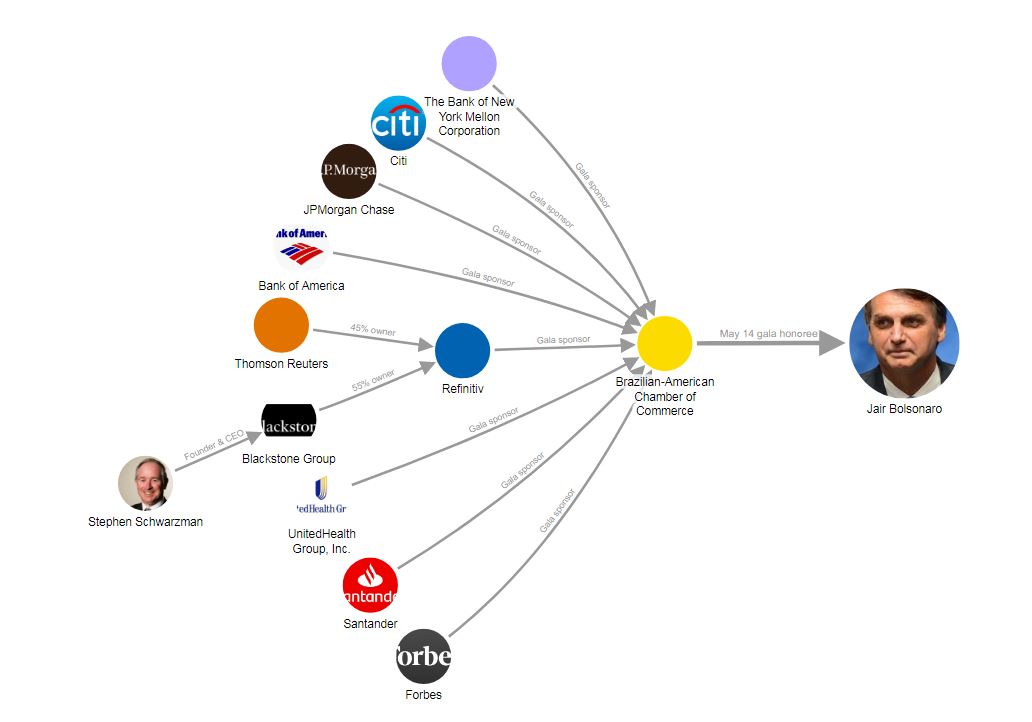
View map at LittleSis.org.
Here is a full list of the corporate sponsors, provided by the Gay & Lesbian Alliance Against Defamation, or GLAAD, which is calling on companies to pull their sponsorship from the gala (the gala’s official page that lists sponsors now appears to be down).
When pressed on why it was continuing to endorse the gala, UBS stated that “[a]ttending the dinner has never involved selecting or endorsing the honoree in any way.”
While it may be true that the gala’s corporate sponsors were not involved in selecting Bolsonaro, many would argue that their refusal to now revoke their sponsorship from the gala – in the face of growing demands to do so, and with the fact that other businesses have begun to pull back – does represent an implicit endorsement of who the gala is celebrating.
Moreover, many of the corporate sponsors have issued human rights statements that appear to fly in the face of backing an event that honors someone like Bolsonaro. For example, Bank of America states that “our company policies and practices promote and protect human rights, and we strive to conduct our business in a manner consistent with the United Nations Universal Declaration of Human Rights” and other international agreements. Many would argue that Bolsonaro’s regime is a clear threat to the human rights of LGBTQ people, among other groups.
There is precedent for the gala’s sponsors to revoke their support. Last year, dozens of companies – including some who are now sponsoring the Bolsonaro gala – pulled out of a Saudi investment conference that was scheduled in Riyadh shortly after the disappearance of journalist Jamal Khashoggi. This added to the sense of urgency around Khashoggi’s death and contributed to the global condemnation the regime of Saudi Crown Prince Mohammed bin Salman.
There are other examples, too, of corporations using their leverage to fight the kind of homophobia and transphobia that Bolsonaro’ espouses – for instance, the corporate opposition the so-called “bathroom bills” in Texas and North Carolina.
For now, Delta Air Lines, Bain & Company, and the Financial Times have all revoked their sponsorship of the gala honoring Bolsonaro. Will Bank of America, Blackstone, JP Morgan, and others follow?
==
But Europe is only part of Bannon’s plan. For someone who has vented so much spleen at “globalists” like financier and philanthropist George Soros, Bannon is quite the internationalist. In Latin America, he’s already appointed Jair Bolsonaro’s youngest son as his regional representative to help build on the right’s electoral successes in Brazil, Colombia, Guatemala, Honduras, and Paraguay. Bannon has also partnered with a Chinese billionaire to create a Rule of Law Fund that’s meant to be the point of a spear aimed at the regime in Beijing.
https://theconversation.com/brazils-long-strange-love-affair-with-the-confederacy-ignites-racial-tension-115548
the aroma of fried chicken and biscuits roused my appetite as the country sounds of Alison Krauss, Alan Jackson and Johnny Cash played over the loudspeakers.
This might have been a county fair back home in Tennessee, but it wasn’t. I was in a cemetery in rural Brazil, at the “Festa Confederada” – the “Confederate Party” – an annual celebration of southern U.S. heritage held each April in Santa Bárbara d'Oeste, in São Paulo state.
A sign explaining “What the Confederate Flag Really Means” in both English and Portuguese greeted the roughly 2,500 visitors – most of them white – at the entryway of the American Cemetery. Inside, women wearing Antebellum-style hoop skirts square danced with men clad in gray Confederate uniforms. Couples in T-shirts were doing the two-step.
Just outside cemetery grounds stood black activists protesting the April 28 party with signs and banners saying, “Down with the Confederate flag.”
How did an American debate about racism make its way to Brazil? That’s a tangled question I’m unraveling in my dissertation research on the history and meaning of Confederate symbols in Brazil.
The Confederacy comes to Brazil
Brazil has a long, strange relationship with the United States Confederacy.
After the Civil War ended in 1865, ending slavery in the United States, some 8,000 to 10,000Southern soldiers and their families left the vanquished Confederacy and went to Brazil.
There, slavery was still legal. Roughly 40% of the nearly 11 million Africans forcibly brought across the Atlantic between 1517 and 1867 went to work on sugarcane plantations in Brazil. It was the last country in the Western Hemisphere to formally abolish slavery, in 1888 – 23 years after the United States.
Legal slavery may have been a draw for the Confederate soldiers who migrated to Brazil after abolition.
Brazilian political economist Célio Antonio Alcântara Silva analyzed letters sent to Brazilian consulates and vice-consulates in the United States at the end of the Civil War and found that 74% of Southerners inquiring about emigration were slaveowners.
At the time, 25% of white Southern households owned slaves. That means the people interested in moving to Brazil in the 1860s disproportionately represented a relatively small, slaveholding slice of the free Southern population.
Because the exact number of Confederate families that migrated to Brazil is unknown, it is impossible to state with certainty how many rejoined the slave trade upon arrival. Silva’s research finds records of 54 Confederate families that purchased, in total, 536 enslaved Africans in Brazil.
The Brazilian historian Luciana da Cruz Brito has also found evidence in the 150-year-old Confederado journals she dug up that slavery attracted white Southerners to Brazil.
In one, an American named Charles Gunter wrote about his desire to purchase enslaved people in Brazil at a lower price than he could in the U.S. Another Confederado, James Gaston, expressed disappointment that he couldn’t bring recently freed African Americans to Brazil.
...
==
==
no lnx twit
https://www.ecowatch.com/brazil-bolsonaro-pesticides-2636194015.html
JAIR BOLSONARO
Brazil's Bolsonaro Green-Lights 150+ Pesticides This Year
Mongabay May 03 POLITICS
Isac Nóbrega / PR / Flickr
By Sue Branford and Thais Borges
With the ruralist lobby now in control of key sectors of the federal government, Brazil is rapidly approving new pesticides for use, some of which critics say are either unnecessary or excessively toxic. During the first 100 days of the Jair Bolsonaro administration, the Agriculture Ministry authorized the registration of 152 pesticides, putting Brazil on course to authorize more pesticides this year than in any previous year. Brazil is already the world's largest user of pesticides.
The number of pesticides authorized each year has risen rapidly, from 139 in 2015 under the Dilma Rousseff administration, to 450 in 2018 under the Michel Temer government (see graph). An even higher number is expected to enter the Brazilian market this year, as the Agriculture Ministry considers registration of roughly another 1,300 pesticides. Most of these requests are coming from foreign multinational companies, mainly based in the U.S., Germany and China, which is increasingly becoming an important supplier.
IBAMA / Mongabay]
An employee from Brazilian Institute of the Environment and Renewable Natural Resources surveys a heap of emptied pesticide containers on a farm.]
Pro-Pesticide Government vs. Environmentalists
Despite the rapid rise in authorizations, Bolsonaro's agriculture minister, Tereza Cristina, said "there is no general liberation" of new pesticide registrations.According to her ministry, the products will merely give farmers a greater choice of existing pesticides, and access to new chemicals and there is no reason to be concerned: "The use [of pesticides] is completely safe, provided they are applied as instructed, within a context of good farming practice and with the use of individual protective equipment," said the government.
Events within Brazil seem to deny the truth of Cristina's claims. Brazil has a higher per capita consumption of pesticides than any other country in the world — 7.3 liters per year per person — and it is already facing a serious problem with pesticide intoxication.
According to Guilherme Franco Netto, an Environment, Health and Sustainability Specialist at the Oswaldo Cruz Foundation, one of the world's top public health research institutions, about 100,000 cases of intoxication are recorded in Brazil each year. According to Alan Tygel, from the Permanent Campaign Against Pesticides and for Life, this figure seriously underestimates the real situation, as many rural workers fail to report pesticide intoxications.
Brazil: Pesticide Poisonings in Rural Areas
In July 2018, the human rights organization, Human Rights Watch, published a report documenting acute intoxication at seven locations in Brazil, including indigenous communities, schools and quilombolas — communities of runaway slave descendants.
"Pesticides sprayed in large plantations intoxicate children in schoolrooms in many parts of Brazil," said Richard Pearshouse, assistant director of the environmental and human rights division of Human Rights Watch. But the report found that many local inhabitants were too frightened to speak out.
In five of the seven impacted communities, people said they were afraid of suffering reprisals if they complained. In 2010 a rural farmer was shot dead after putting pressure on local government to forbid aerial spraying of pesticides — a common application practice in Brazil, even though it allows wind-carried toxic sprays to settle far from crops in surrounding communities and natural areas.
New Formulations Raise Alarms
Many of the requests given the go-ahead this year are for new formulations of already authorized pesticides."Once the initial manufacturer loses its patent, other companies start requesting registration so they can use the [same] active ingredients to produce new agricultural products," said Murilo Souza, from the State University of Goiás.
Leonardo Melgarejo, vice-president of the Brazilian Association of Agroecology, believes that this practice is harmful as it will inevitably lead to a big increase in consumption nationwide. "We are approving several variations of the same pesticide," he said. "We're heading for a situation in which farmers will be able to 'self-medicate,' with two pesticide shops on every block." Little research has been done to see how hundreds of various pesticides might interact to become more damaging.
The torrent of new approvals is also making it easier for Brazil's farmers to gain access to toxic pesticides with which the global community has serious concern. One such case is that of 2,4-D, an active ingredient in controversial defoliant Agent Orange, used by the U.S. Army during the Vietnam War and whose use is increasingly being controlled in other countries, after the World Health Organization's International Agency for Research on Cancer classified it in 2015 as "possibly carcinogenic to humans."
The latest wave of Agriculture Ministry authorizations seen on 10 April, gave the go-ahead to 31 products via an official federal decree — Act 24 — including three new formulations of 2,4-D requested by multinational pesticide makers and distributors. One request came from the Chinese company, Rainbow Defensivos Agrícolas, while the other two were initiated by Dow AgroSciences for formulations to be manufactured in South Africa and exported to Brazil.
These new Brazilian authorizations took place at a time when the Rio Grande do Sul Public Ministry, a group of independent public litigators, was carrying out an investigation into an allegation made by the Brazilian Wine Institute that last year the state lost almost a third of its grape harvest as a result of the aerial spraying of pesticides containing 2,4-D. Farmers spray this pesticide before they sow soy — also a time when grape, apple and olive trees are flowering, and when the spray can easily drift over neighboring farms.
"The data from our survey [that showed a loss of almost a third of the grape harvest] is a conservative figure, as it relied only on information spontaneously offered by farmers," said Helio Marchioro of Brazilian Wine Institute. In fact, grape farmers themselves are calling for a 2,4-D ban, even as the Bolsonaro administration approves new 2,4-D formulations.
Controversial Pesticides Approved for First Time in Brazil
Several of the pesticides authorized this year will be entirely new to Brazil. Some have already been classified by Brazil's National Health Surveillance Agency as "extremely toxic." These include: mancozeb, a broad-spectrum fungicide used in agriculture and horticulture; the fungicide fluazinam; and the insecticide chlorpyrifos. In 2018 the Pest Management Regulatory Agency banned the use of mancozeb in Canada, except for foliar use on potatoes, due to "unacceptable risks to human health." The U.S. Environmental Protection Agency (EPA) banned the use of chlorpyrifos in 2018 after its use had been associated with development disabilities in children.
One particularly controversial newly approved chemical is sulfoxaflor. This pesticide was one of several believed to have caused an outbreak in Brazil of colony collapse disorder — the catastrophic sudden disappearance of worker bees from a bee colony, leading to the death of hives. According to a survey carried out by Agência Pública and Repórter Brasil, half a billion bees were found dead in four Brazilian states in the first quarter of 2019 — a staggeringly large die off posing a threat to the pollination of fruits and vegetables and to native vegetation.
But at a press conference on April 9, Agriculture Minister Cristina seemed unaware that Brazil has already authorized sulfoxaflor. "The problem with the bees is that a product called sulfoxaflor was used. This [toxin] is not registered in Brazil," she said. "It probably entered Brazil illegally and is being used incorrectly and thus caused the death of the bees." In fact, sulfoxaflor was authorized at the end of last year by the Temer administration, though the official decree was only issued in January of this year under the Bolsonaro government.
Sulfoxaflor is classified by Brazil's National Health Surveillance Agency as "averagely toxic," but this evaluation is challenged abroad. Dow Chemical initially developed sulfoxaflor as a safer alternative to neonicotinoids, known to be harmful to bees. It was initially approved by the US EPA in 2013, a decision reversed in 2015 when studies found that sulfoxaflor was also dangerous to bees. Today sulfoxaflor can still be used in the U.S., but only in restricted circumstances.
Pesticide Deregulation in the Works
Environmental activist Alan Tygel believes that the rapid rise in the number of pesticide authorizations is directly linked to the growing power of the bancada ruralista agribusiness lobby in Congress. This lobby, he said, made its support for the impeachment of President Dilma Rousseff in 2016 dependent on government backing for pro-agribusiness measures. "From then on, the counterweight that came from progressive sectors, from family farming and from agroecology, was lost, and today the ruralist agenda faces fewer obstacles in its drive to have more pesticides approved and to push through more permissive laws," Tygel said. The Bolsonaro presidential campaign greatly benefited from ruralist support, and it greatly helped sweep the former Army captain and legislator to victory last October.
The next goal of the ruralist agenda — more permissive laws — may well get a major boost this year with congressional approval of PL 6299/2002, dubbed as the "poison package" by critics. The legislation, which would greatly deregulate pesticides, was endorsed by a Chamber of Deputies commission in June 2018 and it now awaits plenary debate. The Temer government justified the bill, presented to Congress by then Agriculture Minister and dedicated ruralist, Blairo Maggi, claiming that the country desperately needed to simplify the complicated process of getting new pesticides authorized in order to help farmers.
But Castro Moreira, president of the prestigious Brazilian Society for the Progress of Science, representing more than 100 scientific societies, disagreed strongly. He said at the time that the bill, "could have very serious consequences for the health of the Brazilian population and the environment … Its approval would be a backward step, because it follows the logic of mechanized agriculture, with high investments in fertilizers and pesticides, which is an outmoded way of thinking, dating from the end of the Second World War."
Current Agriculture Minister Cristina is a strong proponent of PL 6299/2002, but there is bound to be opposition to the bill's approval, though it will likely be difficult for critics to block the measure. The ruralists have never had a stronger grip on both the legislative and executive branches, and they seem determined to press their agribusiness agenda.
As President Bolsonaro ended his first 100 days in office, his popularity was slipping fast, with 30 percent of the population already assessing his administration as "very bad" and the markets believing the government is becoming unstable. However, that very perception of growing uncertainty seems to have only caused the ruralists to move forward with greater urgency. Meanwhile, conservationists and food experts continue to warn of the national and global environmental and health repercussions of Brazil's deregulated pesticide use — permissiveness likely to soon outstrip that seen among other major agricultural nations.
Reposted with permission from our media associate Mongabay.
RELATED ARTICLES AROUND THE WEB
Insects Could Go Extinct Within a Century, With 'Catastrophic ... ›
Brazilian government clears highly toxic pesticides ›
2019 Outlook: Brazil's Bolsonaro Pushes for Lax Pesticide Rules ›
Bolsonaro business backers accused of illegal Whatsapp fake news ... ›
https://www.alternet.org/2019/04/conservative-jonah-goldbergs-fraudulent-claim-that-fascism-is-really-a-left-wing-phenomenon-will-not-die-more-than-a-decade-later/
Jonah Goldberg just keeps inspiring people—whether he intends to or not.
Take Brazil’s far-right president, Jair Bolsonaro,for example. Earlier this week, after visiting a Holocaust memorial in Jerusalem, Bolsonaro was asked whether heagreed with comments made by his foreign minister claiming that the Nazis of Germany were “leftists.”
He did: “There is no doubt, right?” he said to reporters. He added that the appearance of theword “socialist”in the Nazis’ official party name proved it.
The museum he had just visited, however, isclear about the matter, telling visitors at its website that the German Nazi party arose out of “radical right-wing groups” in Europe.
Where would Bolsonaro get such ideas? He didn’t credit anyone, but the ultimate lineage of this idea really belongs to Goldberg. Perhaps, secondarily and more contemporarily, he’s been absorbing the derivative work of Dinesh d’Souza.
Worst of all, he is far from alone. From Charlottesville to Portland to Christchurch, we’re awash in the effects of a resurgent white-nationalist movement that considers the “liberal smear” that fascism was a right-wing movement further evidence of a “cultural Marxist” campaign against white Western civilization.
D’Souza’s book The Big Lie: Exposing the Nazi Roots of the American Left—which has been a bestseller, despite having been systematically dismantled by everyone from Ross Douthat to Mark Bray to Kevin M. Kruse and exposed as a risible fraud from start to finish—was in fact, as Douthat suggests, essentially a dumbed-down, frat-boy repackaging of Goldberg’s 2008 best-seller, Liberal Fascism: The Secret History of the American Left, From Mussolini to the Politics of Meaning.D’Souza also made a slickly produced “documentary” pursuing this thesis further, titled Death of a Nation.
Indeed, it seems that even though Goldberg has been previously supportive of d’Souza’s work—including appearing in, as well helping to promote, his previous film, Hillary’s America: The Secret History of the Democratic Party,which in fact includes his earliest iteration of the “Nazis were leftists” claim—he’s becoming uncomfortable with where the whole thing has been going.
This all came up, I should mention, in the context of a post Goldberg published at National Review’s blog The Corner last weekend, attacking me for a series of tweets in which I had tweaked him recently. But this is an argument dating back more than a decade.
“I am not a fan of Dinesh D’Souza’s effort to take my argument and twist it into the kind of indictment of liberals Neiwert levels at conservatives or that I was accused of doing,” he wrote.
It was something of a mere side-note to an otherwise long-winded defense of what he has always believed is a deep and subtle argument that partisan simpletons like myself cannot comprehend. But in many ways it encapsulates perfectly the argument we’ve been having for the past decade—the way it caricaturizes my argument en route to building a strawman, the way he shifts the goalposts, and most of all his continued evasion in confronting what his little intellectual exercise has produced in the real world, a la Jair Bolsonaro.
Distancing himself from d’Souza is probably how Goldberg eases some of the resulting cognitive dissonance, but then, unfortunately, there are annoying little ankle-biters like your humble correspondent around to remind him of this evasion. (I also like to remind him that he himself actively helped promote this supposedly bastardized version of his original thesis back when it was Glenn Beck doing it.) Thus the odd way of striking back at a Twitter critic in a forum that lets him not have to deal with the inevitable responses.
The argument dates back to 2008, when I published a harshly negative review of Liberal Fascismat American Prospect,headlined “Jonah Goldberg’s Bizarro History.” As I pointed out at the time, its chief flaw was that it conveniently omitted any consideration of the history and continued presence of actual fascist and neo-Nazi organizations in the American landscape, and their relationship to movement conservatism:
"Beyond the Klan, completely missing from the pages of Goldberg’s book is any mention of the Silver Shirts, the American Nazi Party, the Posse Comitatus, the Aryan Nations, or the National Alliance — all of them openly fascist organizations, many of them involved in some of the nation’s most horrific historical events. (The Oklahoma City bombing, for instance, was the product of a blueprint drawn up by the National Alliance’s William Pierce.) Goldberg sees fit to declare people like Wilson, FDR, LBJ, and Hillary Clinton “American fascists,” but he makes no mention of William Dudley Pelley, Gerald L.K. Smith, George Lincoln Rockwell, William Potter Gale, Richard Butler, or David Duke — all of them bona fide fascists: the real thing.
This is a telling omission, because the continuing existence of these groups makes clear what an absurd and nakedly self-serving thing Goldberg’s alternate version of reality is. Why dream up fascists on the left when the reality is that real American fascists have been lurking in the right’s closet for lo these many years? Well, maybe because it’s a handy way of getting everyone to forget that fact.
Goldberg responded, and we had a brief but spirited exchange at our blogs that ended after he decided I was unworthy of his time, which seems to be his most recent conclusion as well. Most of those exchanges can be found at my old blog *Orcinus,*though most of Goldberg’s original retorts seem to have vanished into the ether.
I remained dismayed at seeing how readily Goldberg’s fundamentally fraudulent thesis not only spread into the mainstream but became a kind of received wisdom among movement conservatives, especially because I was fully aware how dimly real historians of fascism viewed this work. So in 2010 I organized a group of them into a forum to air their grievances with Goldberg’s book at History News Network. We invited Goldberg to participate, and he did offer one relatively meek attempt at rebuttal that mostly complained about my participation and how mean everyone was to him.
[Note: Goldberg’s claim in his Corner post that I “tried valiantly to exclude me from it at the time” is just a straight-up lie. I eagerly welcomed his participation. I wrote to Rick Schenkman, the HNN.com editor at the time, to ask if he could recall me doing any such thing, and he replied he couldn’t recollect anything either way.]
Our most recent exchange on Twitter began when Goldberg rebukedRep. Alexandria Ocasio-Cortez for her recent remarks about “economic injustice” being closely connected to “environmental justice,” which Goldberg dismissed as “Embarrassing hogwash.”
AOC’s remarks might have the odor of liberal cant, but they also have a factual grounding reflected in serious academic work—unlike certain hoax theses I could name. So I tweeted back the same phrase to him, accompanied by a mock cover of his book and his own core thesis, from those pages: “Fascism, properly understood, is a not a phenomenon of the right at all. It is, and always has been, a phenomenon of the left.”
Goldberg winced: “David, I’m sorry I’m your white whale.”
I answered: “As long as your hoax thesis continues to pollute our discourse — thanks, in recent years, no small part to the @DineshDSouza permutation of it — I will remain compelled to call it out for the toxic nonsense that it is, Jonah.”
His reply: “I don’t like what Dinesh did with my book. But I still think you’re essentially a shill talking up your business model rather than dealing with my actual arguments. You’ve acted in bad faith for over a decade now. It’s kind of sad.”
The next day, obviously still irritated, he subtweeted a response that didn’t actually link to me, but which of course I saw anyway:
Me: Conservatism/classical liberalism in the Anglo-American tradition = limited government, sovereignty of the individual, moral and religious traditionalism, and free market economics. Therefore fascism is not “right wing.”
Left wing obsessive: HOW DARE YOU, YOU IDIOT!?
— Jonah Goldberg (@JonahNRO) March 31, 2019
This occasioned my response pointing to our long-ago debates that in turn drove him to reply to me at The Corner. It was classic Goldberg, really, as I’ve noted before:
"One of the more striking aspects of Goldberg’s dishonesty is how he manipulates his definitions in self-serving fashion that lets him move the goalposts at will, as though we were playing Calvinball. John Cole calls this “the Goldberg Principle”: “You can prove any thesis to be true if you make up your own definitions of words.” For instance, his operative definition of fascism is actually just the generic definition for totalitarianism, and it omits entirely the special characteristics that distinguish fascism from other forms of totalitarianism. One of these, for instance, is its overpowering, indeed dominant, antiliberalism – a fact that Goldberg conveniently omitted from throughout his entire 400 or so pages, and later dismissed by claiming that the “liberalism” it opposed was not modern liberalism, but classical liberalism (as though the two have no connection whatever).
All of the classic Jonah tactics—building strawmen, arguing from self-created/self-serving definitions that counter consensual reality, moving the goalposts, gliding over damning counter-evidence and considerations he considers irrelevant—were present in that little aside in which he again tossed d’Souza under the Jonahbus: He characterizes d’Souza’s output as “the kind of indictment of liberals Neiwert levels at conservatives.”
And what kind of indictment was that? According to Goldberg, it was that “his definition of Fascism must indict American conservatives — and only American conservatives.”
This is complete and utter rubbish, of course, because this is never what I’ve argued. I have insisted all along that fascism must be understood as a phenomenon of the right and not the left NOT because I have a project of smearing all conservatives by association, as Goldberg has assumed and insisted for a decade without an iota of evidence, but because it is the very real frame that helps the public understand how fascism can infect our politics.
You know, like most people, I recognize that there’s a spectrum of behavior, and that mainstream conservatives are distinct from right-wing extremists. Or at least were at one time.
Indeed, I’ve argued for many years—as a onetime Republican from Idaho myself—that it’s essential for mainstream conservatives to publicly oppose the radical right because their denunciations carry more weight with the intended audience. Unfortunately, I can’t say I’ve been able to persuade any mainstream conservatives to join that cause, but that may be a product of my pleasing personality.
I do know that when I first began reporting on the Aryan Nations and The Order in the 1980s, followed by Ruby Ridge and the militia movement in the ‘90s, it wasn’t considered a partisan thing at all to do this reportage. It was simple common sense that we needed to shine a spotlight on hate groups and the poisons they bring to communities, not just among people on the left but among communities of faith and chambers of commerce too, all of whom understood that hate is bad for communities.
At one time, Goldberg composed a theory about what kind of person I must be:
Here’s my grand theory about this guy. He’s made his career hyping the terrible threat from the Posse Comitatus, Aryan Nations and American Nazi Party and so like the bureaucrats in Office Space who think TPS reports are the most important thing in the world, he can’t seem to grasp that they’re pretty trivial.
In other words, he came to his understanding of fascism by following bands of racist white losers in the Idaho woods while using some Marxist tract or other as a field guide to identify the various species he encountered. In other words, he’s internalized every cliché and propagandistic talking point I set out to demolish in my book. Moreover, his career depends on maintaining his version of the fascist peril. So, he’s banging his spoon on his highchair a lot because my book undercuts his whole reason for being.
This is what Goldberg means when he dismissively references my “business model”. But as I noted at the time, I wasn’t reading any Marxist tracts to frame my work: I was listening to what these guys were preaching to their crowds and pitching to their recruits. If the neo-Nazis of the Aryan Nations were not definably fascist because of what they preached and not because they were “bad guys,” then the term no longer has any meaning. Which I suspect is Goldberg’s intent all along.
More to the point, they were right-wing—but extremists, as opposed to mainstream. They not only opposed abortion, they believed providers should be executed. They not only resisted civil rights for minorities, they sought to exclude nonwhites from their rights. They not only opposed gay rights, they believed gays should be put to death. Sometimes their views could be indistinguishable from a mainstream conservative, but the body of beliefs put them on the far right. I learned this from talking with and listening to people.
Fascism in reality—as I know it in its on-the-ground American variant, not a theoretical version cooked up as an intellectual exercise—is a kind of right-wing populism turned metastatic, unleashing an authoritarian tide, fueled by a belief in a phoenix-like national rebirth, that uses violence in defense of business interests, established authorities and leaders, and against perceived liberal enemies. I know this from reporting on what they say and do for 30 years, not because I’ve been influenced by some unknown Marxist texts.
But I have researched them deeply over the years in hopes of understanding them. And their orientation has never been in question. Fascism is fundamentally right-wing in large part because it is fundamentally anti-left. As George Orwell wrote, “the idea underlying Fascism is irreconcilably different from that which underlies Socialism. Socialism aims, ultimately, at a world-state of free and equal human beings. It takes the equality of human rights for granted. Nazism assumes just the opposite. The driving force behind the Nazi movement is the belief in human inequality, the superiority of Germans to all other races, the right of Germany to rule the world.”
Of course, Jonah’s assumptions notwithstanding, not only am I utterly unflummoxed by Goldberg’s ready recitation of various facts about how many contemporaneous liberals and progressives flirted with fascist ideas, and how many left-wing ideas were woven into the early fascist appeals (thus the National Socialist Party business), but I’ve always acknowledged their existence, dating back to that first review in the Prospect.
Goldberg, however, accords them more weight than most historians, who have good reason for taking a broader view of these strands as part of the natural complexity of human ideas and their history. As Robert Paxton explained, placing undue weight on fascists’ (frequently misleading) words and propaganda is a categorical mistake, since the reality of their political base and orientation is revealed by their real-world deeds:
"Goldberg simply omits those parts of fascist history that fit badly with his demonstration. His method is to examine fascist rhetoric, but to ignore how fascist movements functioned in practice. Since the Nazis recruited their first mass following among the economic and social losers of Weimar Germany, they could sound anti-capitalist at the beginning. Goldberg makes a big thing of the early programs of the Nazi and Italian Fascist Parties, and publishes the Nazi Twenty-five Points as an appendix. A closer look would show that the Nazis’ anti-capitalism was a selective affair, opposed to international capital and finance capital, department stores and Jewish businesses, but nowhere opposed to private property per se or favorable to a transfer of all the means of production to public ownership.
A still closer look at how the fascist parties obtained power and then exercised power would show how little these early programs corresponded to fascist practice. Mussolini acquired powerful backing by hiring his black-shirted squadristi out to property owners for the destruction of socialist and Communist unions and parties. They destroyed the farm workers’ organizations in the Po Valley in 1921-1922 by violent nightly raids that made them the de facto government of northeastern Italy. Hitler’s brownshirts fought Communists for control of the streets of Berlin, and claimed to be Germany’s best bulwark against the revolutionary threat that still appeared to be growing in 1932. Goldberg prefers the abstractions of rhetoric to all this history, noting only that fascism and Communism were “rivals.” So his readers will not learn anything about how the Nazis and Italian Fascists got into power or exercised it.
The bottom line: Does toying with the concept of “liberal fascism” as an intellectual exercise enhance the public’s understanding of fascism—or does it confuse it, in effect destroying it with Newspeak-like negation? After all, given that its antiliberalism is universally understood as an essential component of the complex phenomenon fascism can be, it’s an obvious kind of oxymoron, as useful an idea as “hateful love.”
I’d argue that not only has the latter happened, but the muddied waters have obscured the incoming white nationalist tide—which Goldberg now says he despises, but whose growing presence he really doesn’t really want to acknowledge. So, naturally, he accuses me of being pleased that the alt-right has arisen and spread, when my eternal and ongoing dismay is already well established.
But Goldberg’s idea—that fascism is really a left-wingphenomenon—has been part of that incoming tide. Some of that, of course, is attributable to d’Souza. But the combined effect of Goldberg’s foundation-laying and d’Souza’s sheer demagoguery has meant that the idea of a “fascist left” is everywhere now, particularly among the “Patriot” militias, the Proud Boys, and the alt-lite media mavens who defend them avidly as victims of an insidious antifascist movement.
And now even South American right-wing strongmen are parroting it.
==
https://www.democracynow.org/2019/3/20/trump_bolsonaro_join_forces_to_back
visit w/ trump
AMY GOODMAN: To talk more about U.S.-Brazil relations, we’re joined by Maria Luísa Mendonça, the director of the Network for Social Justice and Human Rights in Brazil, visiting scholar at City University of New York Graduate Center.
Welcome back to Democracy Now! It’s great to have you with us. The significance of the meeting yesterday, Bolsonaro’s first as president, the former Army captain coming to meet with Trump, and what came out of it?
MARIA LUÍSA MENDONÇA: I think that, basically, Brazil gave out many things and didn’t receive anything back. For example, Bolsonaro promised that now U.S. citizens will not need a visa to travel to Brazil anymore, and that won’t be the case for Brazilians coming to the U.S., which is a big change in foreign policy. Brazil has a history of reciprocity in its foreign policy, and independent of the government. It’s part of the Brazilian diplomacy.
Also, Brazilian diplomacy has a history of resolving conflicts through a peaceful process of negotiation. And the discourse about Venezuela is very different than how Brazil has dealt with conflicts in the region historically. Venezuela is being used as an external enemy in Latin American countries as a way to help elect far-right political leaders. That was the case of Bolsonaro in Brazil and also in Colombia. And that’s very dangerous, because a war in Venezuela will have catastrophic consequences in the region.
Another issue that they both talked about is looking at Venezuela as a country that needs humanitarian aid. But that doesn’t make any sense. For example, President Maduro offered to buy agricultural products from Brazil, so they don’t need aid from Brazil. Also, Venezuela is a very strategic partner for Brazil, because Brazil exports industrial products to Venezuela. So, even from a pragmatic perspective, it doesn’t make any sense not to have good relationships with Venezuela and other Latin American countries. Historically, Brazil always had good relationships with Latin American countries.
JUAN GONZÁLEZ: I wanted to ask you about President Bolsonaro’s family connections to militia groups in Brazil and the fact that you have a sitting president who some of his family members have been connected to groups—for instance, thekilling of Marielle Franco was linked to one of those militia groups. Could you talk about that?
MARIA LUÍSA MENDONÇA: Yes. Bolsonaro’s son, Flávio Bolsonaro, who was a state legislator in Rio de Janeiro, employed the mother and the daughter of one of the heads of this militia group that is being accused of killing Marielle Franco. Also, the two suspects who were arrested in connection to the case, one of them is a neighbor of Bolsonaro. They live in a very luxurious condo in Rio. They are both neighbors, although he’s a former police officer, so how he was able to live in such an expensive condo, that’s something to be investigated. Also, one of the suspects, his daughter dated one of Bolsonaro’s sons, as well. And Bolsonaro himself appeared in a photo with one of the suspects. And he himself and his sons also have praised members of these militia groups in the past. So there are several connections that need to be investigated.
AMY GOODMAN: And why would they want her dead? I mean Marielle Franco, a member of the Rio de Janeiro City Council, human rights activist, LGBTQ activist, who challenged police brutality in one of the world’s most notorious police forces.
MARIA LUÍSA MENDONÇA: Well, she was one of the city councilmembers that was investigating the militia groups. They had a very long investigation, a detailed report, accusing the militia group—this militia group and other groups—of several crimes. So, I think this investigation was probably part of the problem, you know, that—the reason why people wanted her to be killed....
GOODMAN: I wanted to talk about Bolsonaro’s son Eduardo. I believe he was in the audience when he was meeting with President Trump. Yeah, let’s go to that moment.
PRESIDENT DONALD TRUMP: By the way, I see in the audience the son of the president, who has been fantastic. Would you please stand up? The job you’ve done, during a very tough period of time, is just fantastic. And I know your father appreciates it, that I can tell you. OK? Thank you very much. Fantastic job.
AMY GOODMAN: Who is Eduardo Bolsonaro?
MARIA LUÍSA MENDONÇA: Well, he’s been the one that built relationships with Steve Bannon,at least as far as we know from the reports that we have seen. And there was actually a dinner prior to this meeting, a few days ago, in which Steve Bannon was present. And they talk about the possibility of expanding a far-right coalition, global coalition, to promote the views that they have.
It’s important to know now that the situation in Brazil is so extreme that this group that took power because of the coup, the political vacuum that was created after the parliamentary coup against President Dilma in 2016, and then the fact that former President Lula was put in jail although there is no evidence against him—so you create this political vacuum that opened the space for a far-right candidate that is connected to the most extreme paramilitary sectors of the military. So, now what we have, the situation that we have, is the military officers in government are the more moderate forces in power in Brazil. So we have a very extreme situation.
JUAN GONZÁLEZ: I wanted to ask you about President Bolsonaro’s stance on climate change. Brazil was supposed to host a U.N. climate summit and pulled out of that. The impact of that, given the importance of Brazil in terms of the future of our planet when it comes to climate change?
MARIA LUÍSA MENDONÇA: Exactly. That was also a surprise, because Brazil negotiated being the host of the conference, and then he decided to cancel it. And the situation is very dramatic, because he said that he’s going to allow, for example, mining exploitation in indigenous land. He’s going to cancel all land rights of indigenous people. He has threatened peasant communities.
And also he defends expansion of monocropping of soy in the Amazon. The minister of agriculture is related to the pesticide lobby. And we already are the country that consumes the most amount of pesticides in the world, and they are allowing pesticides that have been prohibited in other countries for many years.
And now the latest is that he is also negotiating with Trump to allow the U.S. to have a spaceship base in Alcântara, which is the Northeast region, that is also close to the Amazon. It’s a very strategic region of the country. And in 2002, that agreement was not approved by Congress, because it would allow military presence of U.S. officers in Brazil, and the Brazilians won’t have access to this space anymore, or to have—you know, even to enter the base. So, it would be the U.S. taking over part of Brazilian territory, in a region where we have hundreds of Afro-Brazilian rural communities, the quilombola communities, that have the same rights to land as indigenous people. And it’s already a struggle for them to have access to land in that region.
AMY GOODMAN: Well, as we wrap up, we have 20 seconds. But do you think Bolsonaro would engage in a military invasion against Venezuela to topple Maduro?
MARIA LUÍSA MENDONÇA: I think that some sectors of the military in Brazil oppose that, and that there would be a catastrophic consequence if they move into that. So I think it’s important to have resistance here in this country, to understand that the discourse about Venezuela is very similar to the discourse about Iraq. At the end, it’s about, you know, lying, misinformation, to promote a war that, at the end, is about oil.
AMY GOODMAN: Well, Maria Luísa Mendonça, we want to thank you for being with us, director of the Network for Social Justice and Human Rights in Brazil.
When we come back, The Torture Machine: Racism and Police Violence in Chicago.
==
dailybeast
NEW LITTLE COLD WAR
Trump Helps Take Central and South America Back to the Strongman Future
Bolton and the Trump gang understand the human suffering caused by the “stooges of socialism”—but seem blind or indifferent to the dangers posed by the new strongmen of the right.
Ronald Radosh
01.10.19 5:01 AM ET
OPINION
Photo Illustration by Lyne Lucien/The Daily Beast
It appears that the further we get into the 21st century, the closer we are coming to a repeat of the Central American wars of the 1980s.
Back then, the Soviet Union and Cuba were sending arms and money to the Communist guerrilla movements that threatened pro-U.S. regimes in Guatemala and El Salvador, and had taken power in Nicaragua when the Sandinistas took over that country in 1979 and forced the dictator Anastasio Somoza to flee.
Speaking for the Trump administration, John Bolton said in an interview with The Miami Herald this week that “This Troika of Tyranny”—referring to the regimes of Nicaragua, Cuba and Venezuela—“is the cause of immense human suffering, the impetus of enormous regional instability, and the genesis of a sordid cradle of communism in the Western Hemisphere.” That’s why the United States, he continued “is taking direct action against all three regimes.” As in the 1980s, he called for free elections in Nicaragua that could end the reign of Daniel Ortega, who had once held power as “Comandante” until the electoral defeat of the Sandinistas in 1989, only to return to power in 2007, when he again was elected president.
Bolton also said that the tyrants ruling these nations “fancy themselves strongmen and revolutionaries, icons and luminaries. In reality they are clownish, pitiful figures…‘Three Stooges’ of socialism;…true believers [who] worship a false God.”
Bolton is not incorrect in that characterization of the governments of Cuba, Nicaragua and Venezuela. In Nicaragua, the Washington Post reported recently, Ortega’s army “launched a wave of repression against civil society groups and journalism outlets that is choking off what little remains of democracy in this Central American country.” The government is closing down civil society groups, seizing their asserts, and has charged some editors with conspiring to commit terrorist acts. Jamie Chamorro, who now runs the opposition paper La Prensa, said the attacks on the media are worse than those in the Sandinista heyday, when an actual war was being waged against the government by the “contras,” who were supported by the Reagan administration. There is also little doubt that Ortega is supported by both Iran and Russia and is trying to make deals with the Chinese government.
But while Bolton blasts the proto-totalitarian nature of these “leftist” governments and condemns the repression of its people, there is a danger that by allying with right-wing authoritarian regimes in order to defeat the evil “troika,” the administration will give them a green light and look the other way on civil rights and human rights abuses, much like it is doing with MBS and the Saudis.
This is likely to be the case with Brazil, where the country’s new president, Jair Bolsonaro, was sworn in on New Year’s Day. The president enthusiastically supported him and sent Secretary of State Mike Pompeo to attend the inauguration. Afterward, Pompeo said that Bolsonaro seeks “to reinforce our shared commitment to democracy, education, prosperity, security and human rights.”
This is highly questionable, to put it politely. Bolsonaro is a hard-right figure with strong authoritarian tendencies. He easily won the national election due to the loss of support for the previous era of left-leaning administrations, whose once popular leader, Lula da Silva, is now in prison for 12 years after being convicted of corruption and money-laundering. Bolsonaro resembles strong men like Juan Peron in 1940s and '50s Argentina, a “populist” who had the support of the people and reigned in opponents of his regime, and today with the government of Rodrigo Duterte in the Philippines, who uses extra-legal means, including the killing of drug dealers by the police. Bolsonaro, as Eli Lake has pointed out, sees Duterte as a role model, and looks fondly at Brazil’s military dictatorship that existed from 1964 to 1985.
Bolsonaro’s new foreign minister, Ernesto Araujo, also gives lip service to respecting human rights. He also considers “climate change” a Marxist conspiracy and has praised “illiberal” governments such as Poland and Hungary as models for Brazil. Bolsonaro’s vice president and other government ministers are all former military officers. Bolsonaro himself has said that he regretted the military governments during the dictatorship did not torture still more leftists than it did. When he cast a vote in 2016 to impeach the leftist President Dilma Rousseff, the Washington Post reported, “he did so in the name of the military commander who had presided over her torture in 1970. He and his allies have cheered the junta’s grisly program that saw countless leftist activists disappeared, brutalized, raped and murdered.” Bolsonaro has promised to give the police “carte blanche to kill,” as Duterte has in the Philippines.
Pursuing strategic cooperation with Brazil in its attempt to curb China’s economic incursions is a valid goal, but that does not mean that the United States should remain silent if Bolsonaro takes the thuggish actions he has all but promised against real and imagined opponents. An American left-wing academic, Benjamin Fogel, writes in Britain’s Independent that “fascism has arrived in Brazil,” and that Bolsonaro’s government will be “worse than you think.” Perhaps Fogel, a Ph.D. candidate in Latin American history at New York University is somewhat wide of the mark in declaring Brazil fascist before Bolsonaro has had a chance to do very much. But he is correct to write that Bolsonaro “is openly hostile to democracy and will probably be the most extremist elected leader in the world.”
Today there is no Soviet Union threatening to take over nations in our hemisphere, but the threat of authoritarianism is a very real danger to the people of Brazil and Nicaragua. There is no need for U.S. officials and the Trump administration to unequivocally welcome Jair Bolsonaro as if he was the kind of true democratic leader the U.S. has an affinity with. In 1981, when Elliott Abrams was assistant secretary of state for inter-American affairs, he noted that the U.S. cut off military aid to the Lucas Garcia government in Guatemala, which he says really deserved to be called a “fascist murderous regime.” And when the military overthrew the government of Salvador Allende in Chile, replacing it with the brutal military rule led by General Augusto Pinochet, Abrams told Secretary of State George Shultz that “we have to protest this publicly, we have to condemn it.” He understood that for a human rights policy to have credibility, it had to also protest those of U.S.-backed governments, not just those of the Castro communist government. Abrams said that Shultz’s policy, and his, was not “to support any authoritarian dictator who is pro-American. It [was] rather to try to figure how to support moderates, pro-American centrists as the alternative.”
President Trump has already nominated Robert Destro, a law professor at Catholic University, for the post of Assistant Secretary of State for Democracy, Human Rights, and Labor. Should the Senate confirm Destro and he takes his post, he should start his tenure by requesting a thorough briefing from Elliott Abrams.
==
Bolsonaro’s anger won over :{working-class:(style="margin:0px;padding:0px;border:0px;outline:0px;vertical-align:baseline;background:transparent;white-space:nowrap"):}:Brazilians, but his presidency may betray them
Benjamin H. Bradlow, Brown University
Brazil's new president – often called the 'Trump of the tropics' for his inflammatory, right-wing rhetoric – won over poorer voters by stoking fear and resentment. Can he make them happy?
https://www.alternet.org/news-amp-politics/rise-populist-nationalist-leaders-turning-point-global-climate-talks
The election of Jair Bolsonaro in Brazil not only marks the rise of another populist nationalist leader on the world stage. It’s also a turning point for the global politics of climate change.
When the new president takes office in January 2019, by my estimate at least 30 percent of global emissions will be generated from democracies governed by populist nationalist leaders.
As climate policymakers meet at this week’s UN climate conference in Poland (a country itself governed by a populist nationalist party) people who care about achieving the Paris Agreement goal should push for and develop new strategies for advancing policies to reduce emissions within countries headed by these leaders.
Populism and cutting national emissions
What is populist nationalism? Although both populism and nationalism are contested terms, political scientist Francis Fukuyama, offers this tidy synthesis of the characteristics associated with populist nationalists leaders in democracies.
Firstly, these leaders define “the people” narrowly to refer to a single national identity which is oftentimes anti-elitist. Secondly, they promote policies which are popular among their selected people, or base of support, in the short term but may not be in the long-term economic, social or environmental interests of the country. Thirdly, populist nationalists are expert at capitalizing on their supporters’ cultural fears about a loss of status in society.
Over the past five years there have been several populist electoral victories in countries that are among the highest emitters of greenhouse gases. This includes the U.S., India, Indonesia, Mexico, Poland and the Philippines. While these regimes each represent a different brand of populist nationalism, they exhibit the basic characteristics I’ve just described.
From my perspective as a scholar focused on global energy and climate policies, it’s clear that the political structure of populist nationalism makes introducing policies to reduce, or mitigate, emissions in democracies difficult.
Mitigation policies require leaders to expend short-term political capital for long-term economic and environmental gains. However, populists have shown a particularly strong disinterest for doing so, particularly if those short-term costs would affect their prioritized group of the people.
Perhaps the clearest example of this is President Donald Trump’s unwinding of the Clean Power Plan. It may bring short-term benefits to his base, which includes coal miners and related interests, but it is not aligned with long-term energy market trends in the U.S. toward natural gas, wind and solar for generating electricity and away from coal.
Resistant to global pressure
Secondly, as several country-level case studies have shown, developing policies to reduce national emissions is often a top-down and elite-driven activity. This is particularly true in high-emitting middle-income democracies like Mexico or Indonesia. In these countries, mitigation policies, like carbon taxes, have not emerged by way of large scale social movements but by top-down policy processes supported by international donors and nongovernment actors. In these countries, climate mitigation is at risk of being overridden by policies with more popular appeal.
In a forthcoming paper on Mexico, a colleague and I investigate incoming President Andrés Manuel López Obrador’s (AMLO’s) mitigation policy. The AMLO administration has publicly committed to reduce emissions through a little-known set of carbon pricing policies, while at the same time responding to a popular demand to reduce fuel prices by increasing domestic oil refining. In the contest between the top-down mitigation policy and the widespread popular demands for low gasoline prices, it is likely that the latter will take priority.
A third issue relates to the international governance of climate mitigation. Under the Paris Agreement, governments are asked to progressively ratchet up their emission reduction goals. This mechanism assumes political leaders will respond to international pressure to increase their ambition. However, populist nationalists have shown that they are not motivated by international reactions to their climate policies.
Take Indonesian President Joko Widodo, for instance, who was elected into office in 2014. As I have described elsewhere, one of his first moves in office was to shut down a US$1 billion mitigation policy program funded by the Norwegian government. This decision to close the agency breached the bilateral agreement between Indonesia and Norway, and points to the disregard shown by some of these leaders to international political pressure.
As these short anecdotes suggest, the mechanism by which populist nationalists hold and retain political power makes it difficult to introduce climate mitigation policies. Their interest is to prioritize short-term programs which favor their select group of the people, rather than longer-term mitigating policies which have widespread economic and environmental benefits. Also, because they don’t comply with traditional norms of international relations, it will not be possible to coerce this group into meeting the Paris Agreement goals.
However, there are some ways countries that want to make reach consensus on global climate policies can better engage these leaders.
Ways to engage
As a starting point, it is important to emphasize the short-term benefits of climate mitigation policy to populists.
I believe policymakers and advocates would be well-served in drawing attention to how clean energy may bring multiple short-term benefits to the people on whose support these leaders rely, including lowering domestic air pollution, low cost energy, improved health outcomes and less reliance on foreign fuel imports. Indeed on some of these points, Bolsonaro, has recently said that he will increase the country’s hydropower and nuclear capacity.
Further, recent research suggests the cultural dimension of populist nationalism is of central importance. Rather than reducing emissions and tackling global climate change, it may be better to frame mitigation as part of a large-scale effort towards modernization; that is, modernizing energy systems, transportation systems and infrastructure. A narrative built around modernization, highlighting the economic and societal benefits for all, may resonate more with the disaffected middle classes who have led the rise of populist nationalism.
At the international level too there may be some approaches to ensuring the international governance regime continues in the face of this current wave of populist nationalism. As scholars David Victor and Bruce Joneshave recently argued, it may be useful to form small groups – or clubs – of countries which share similar interests to focus on clean technology and policy innovation. Focusing on shared interests within small clubs may work better than trying to push populist nationalists to comply with broad international agreements.
Populist nationalist leaders, like Bolsonaro, are the consequence of deeply entrenched economic, political and cultural shifts that have occurred in democracies over decades. These leaders, in other words, are likely to be a feature of democratic politics for some time into the future.
To continue to make progress on global climate agreements, I think it’s crucial that negotiating countries meet national populist leaders on their own terms for ongoing attempts to save the climate.
==
207
Environmental and land activists killed in 2017
60%
Of those killed were in Latin America
115
Killings linked to government security forces
25%
Of those killed were from indigenous groups
46
Killings linked to agribusiness
57
Activists killed in Brazil, the worst year on record for any country
92%
Of killings went unpunished
Source: Global Witness
Bolton will declare the election of right-wing firebrand Jair Bolsonaro in Brazil as a "positive sign" for Latin America while denouncing Cuba, Venezuela and Nicaragua as a "Troika of Tyranny," according to excerpts seen by Axios of a speech he will give at 1 p.m. ET in Miami.
Why it matters: Bolton’s speech is among the clearest statements of the administration’s views on Latin America that we’ve seen so far, and Bolton depicts it almost as a struggle of good versus evil. That he considers Bolsonaro, who has made numerous homophobic and sexist remarks and spoken fondly of military rule, an ally in the fight to "advance the rule of law and increase security and prosperity" is likely to garner attention. So too will his inclusion of Nicaragua, where President Daniel Ortega has brutally suppressed protests calling for his ouster, alongside Venezuela and Cuba in the "troika."
Show less
Jason Marczak of the Atlantic Council notes that "there is a high degree of alignment between the Trump administration's key priorities and those of the incoming Bolsonaro administration," most notably when it comes to Venezuela. Like Trump, Bolsonaro also campaigned in direct opposition to the establishment.
Bolton appears to be evoking communism with his use of the word "troika," and there are parallels between his "Troika of Tyranny" and George W. Bush’s "Axis of Evil."
Worth noting: Bolton's remarks come in the lead-up to two crucial elections in Florida — for governor and senator —where the Cuban vote could play a significant role.
What he'll say:
"The United States is thrilled to be partnering with nations such as Mexico, Colombia, Brazil, Argentina and many others to advance the rule of law and increase security and prosperity for our people. The recent elections of likeminded leaders in key countries, including Ivan Duque in Colombia, and last weekend Jair Bolsonaro in Brazil, are positive signs for the future of the region, and demonstrate a growing regional commitment to free-market principles, and open, transparent, and accountable governance."
"Under this administration, we will no longer appease dictators and despots near our shores in this Hemisphere. We will not reward firing squads, torturers, and murderers. We will champion the independence and liberty of our neighbors. And this President, and his entire administration, will stand with the freedom fighters. The Troika of Tyranny in this Hemisphere — Cuba, Venezuela, and Nicaragua — has finally met its match."
"In Cuba, we continue to stand firmly with the Cuban people, and we share their aspirations for real, democratic changes. … Our concern is with sanctions, not selfies."
"The crisis in Venezuela has led to a massive humanitarian disaster and the largest mass migration in the Hemisphere. More than 2 million desperate Venezuelans have fled Maduro’s oppressive rule since 2015. Sadly, this human tragedy was entirely preventable. Maduro and his cronies are the singular cause of all of this suffering."
Go deeper:
Disgusted by their government, Brazilians look to far right
The White House roadmap for intervening in Venezuela
Why Trump skipping a Latin American summit earlier this year mattered
https://www.alternet.org/world/bolsonaro-brazil-slayer-amazon
==
judge who jailed lula promoted
==
https://www.economist.com/leaders/2018/09/20/jair-bolsonaro-latin-americas-latest-menace
,..
Bolsonaro is the latest in a parade of populists—from Donald Trump in America, to Rodrigo Duterte in the Philippines and a left-right coalition featuring Matteo Salvini in Italy. In Latin America, Andrés Manuel López Obrador, a left-wing firebrand, will take office in Mexico in December. Mr Bolsonaro would be a particularly nasty addition to the club (see Briefing). Were he to win, it might put the very survival of democracy in Latin America’s largest country at risk.
Brazilian bitterness
Populists draw on similar grievances. A failing economy is one—and in Brazil the failure has been catastrophic. In the worst recession in its history, GDP per person shrank by 10% in 2014-16 and has yet to recover. The unemployment rate is 12%. The whiff of elite self-dealing and corruption is another grievance—and in Brazil it is a stench. The interlocking investigations known as Lava Jato (Car Wash) have discredited the entire political class. Scores of politicians are under investigation. Michel Temer, who became Brazil’s president in 2016 after his predecessor, Dilma Rousseff, was impeached on unrelated charges, has avoided trial by the supreme court only because congress voted to spare him. Luiz Inácio Lula da Silva, another former president, was jailed for corruption and disqualified from running in the election. Brazilians tell pollsters that the words which best sum up their country are “corruption”, “shame” and “disappointment”.
Mr Bolsonaro has exploited their fury brilliantly. Until the Lava Jato scandals, he was an undistinguished seven-term congressman from the state of Rio de Janeiro. He has a long history of being grossly offensive. He said he would not rape a congresswoman because she was “very ugly”; he said he would prefer a dead son to a gay one; and he suggested that people who live in settlements founded by escaped slaves are fat and lazy. Suddenly that willingness to break taboos is being taken as evidence that he is different from the political hacks in the capital city, Brasília.
To Brazilians desperate to rid themselves of corrupt politicians and murderous drug dealers, Mr Bolsonaro presents himself as a no-nonsense sheriff. An evangelical Christian, he mixes social conservatism with economic liberalism, to which he has recently converted. His main economic adviser is Paulo Guedes, who was educated at the University of Chicago, a bastion of free-market ideas. He favours the privatisation of all Brazil’s state-owned companies and “brutal” simplification of taxes. Mr Bolsonaro proposes to slash the number of ministries from 29 to 15, and to put generals in charge of some of them.
His formula is winning support. Polls give him 28% of the vote and he is the clear front-runner in a crowded field for the first round of the elections on October 7th. This month he was stabbed in the stomach at a rally, which put him in hospital. That only made him more popular—and shielded him from closer scrutiny by the media and his opponents. If he faces Fernando Haddad, the nominee of Lula’s left-wing Workers’ Party (PT) in the second round at the end of the month, many middle- and upper-class voters, who blame Lula and the PT above all for Brazil’s troubles, could be driven into his arms.
The Pinochet temptation
They should not be fooled. In addition to his illiberal social views, Mr Bolsonaro has a worrying admiration for dictatorship. He dedicated his vote to impeach Ms Rousseff to the commander of a unit responsible for 500 cases of torture and 40 murders under the military regime, which governed Brazil from 1964 to 1985. Mr Bolsonaro’s running-mate is Hamilton Mourão, a retired general, who last year, while in uniform, mused that the army might intervene to solve Brazil’s problems. Mr Bolsonaro’s answer to crime is, in effect, to kill more criminals—though, in 2016, police killed over 4,000 people.
Latin America has experimented before with mixing authoritarian politics and liberal economics. Augusto Pinochet, a brutal ruler of Chile between 1973 and 1990, was advised by the free-marketeer “Chicago boys”. They helped lay the ground for today’s relative prosperity in Chile, but at terrible human and social cost. Brazilians have a fatalism about corruption, summed up in the phrase “rouba, mas faz” (“he steals, but he acts”). They should not fall for Mr Bolsonaro—whose dictum might be “they tortured, but they acted”. Latin America has known all sorts of strongmen, most of them awful. For recent proof, look only to the disasters in Venezuela and Nicaragua.
Mr Bolsonaro might not be able to convert his populism into Pinochet-style dictatorship even if he wanted to. But Brazil’s democracy is still young. Even a flirtation with authoritarianism is worrying. All Brazilian presidents need a coalition in congress to pass legislation. Mr Bolsonaro has few political friends. To govern, he could be driven to degrade politics still further, potentially paving the way for someone still worse.
Instead of falling for the vain promises of a dangerous politician in the hope that he can solve all their problems, Brazilians should realise that the task of healing their democracy and reforming their economy will be neither easy nor quick. Some progress has been made—such as a ban on corporate donations to parties and a freeze on federal spending. A lot more reform is needed. Mr Bolsonaro is not the man to provide it.
https://www.alternet.org/world/theres-growing-international-alliance-right-wing-demagogues
no lnx few
There’s a Growing International Alliance of Right-Wing Demagogues
From Brazil’s Bolsonaro to the Philippines’ Duterte to the leader of them all, Trump.
By Vijay Prashad / Independent Media Institute October 23, 2018, 12:06 PM GMT
Lula in His Cell
Lula da Silva—Brazil’s former president—is sitting in his prison in Curitiba, a small town southwest of São Paulo. He should not be there. Evidence of corruption against him hangs on the words of a felon. Lula should have been on the ballot. But the oligarchy refused to allow this most popular man to run for the presidency. Lula is visited by Pastor Anete Roese of the Evangelical Lutheran Confessional Church of Brazil. The pastor steps outside the prison and makes a statement. She says that Lula is concerned about the escalation of violence in Brazil. People are being murdered when they express their political support for the Workers’ Party candidate for president—Fernando Haddad. “The gates of violence are opening,” said Pastor Roese. The election—on October 28—will signal an “unprecedented avalanche of violence,” warned the pastor. Lula, sitting in his cell, unjustly incarcerated, worried with her. It is the poor who will suffer. It is always the poor who suffer.
Bolsonaro’s Fraud
Jair Bolsonaro, the candidate of the far-right who is now the candidate of the oligarchy, leads in the polls. He is nostalgic for Brazil’s military dictatorship (1964-1985) and wants to use unconstitutional force against those whom he sees are a problem for Brazil. His targets are the poor and the social minorities—Afro-Brazilians, Gays, Leftists. The oligarchy flooded the Bolsonaro camp with money. Democracy needs lubrication, and money does the trick. Some corporations used their money to create WhatsApp groups that carried fraudulent messages about Haddad, who is running against Bolsonaro. This is illegal. The hashtag #Caixa2doBolsonaro zipped across the internet. The whiff of fraud should have triggered an immediate investigation. It did not happen. It is Lula in prison. Bolsonaro hides his fangs behind his smile.
Bannon’s Fascist International
Steve Bannon said as he left the White House that the shackles were off his hands. He was no longer imprisoned by propriety. He wanted to be in the trenches, building his white supremacist, fascist international. Bannon calls his group The Movement. One of Bolsonaro’s sons said that Bannon has advised his father’s campaign, that Bannon—in sum—has drawn Bolsonaro into The Movement. Bolsonaro hastily denied this claim. To be linked to Bannon is not an advantage. Nor to Bannon’s fascist international directly. Nothing Bolsonaro says is varnished. He called people from the African continent, from Haiti and from the Arab-speaking world the “scum of humanity.” Bolsonaro’s moral geography mirrors that of Donald Trump, who called many of these places “shithole countries.” Of Afro-Brazilians, Bolsonaro called them lazy and obese, saying, “I don’t think they’re even good for procreation anymore.” Another member of the fascist international—Marine Le Pen of France—said that Bolsonaro’s comments are “extremely unpleasant.” Bolsonaro distressed her. This is Bannon country. Precise and clearly articulated hatred and venom.
Gunmen
Bolsonaro has been proud to say that he is “Brazil’s Trump.” But this is not a good comparison. It is clearer to say that Bolsonaro is Brazil’s Duterte.Rodrigo Duterte is the president of the Philippines. He came to office with a gun in his hand.Duterte was the mayor of Davao, where he empowered death squads to kill anyone deemed to be a criminal. “Kill them all,” he said in 2015 in reference to criminals. “Kill a drug dealer and I’ll give you a medal,” he said. He likes to be photographed with a gun in his hand, preferably a machine gun. Duterte would like to give out 42,000 guns to deepen the civil war in his society. Violence is the antidote to social problems. No policy of economic and social reform is sufficient. Gunfire is Duterte’s solvent. It is the glue of the Bolsonaro family. Jair Bolsonaro’s son—Eduardo—won re-election to the Federal Assembly on October 7 with a massive margin. In a video from last year, Eduardo holds a 50-caliber Barrett sniper rifle and says of the school shootings in the United States, “Thanks to you who support gun-free zones and this initiative to disarm people—you are responsible for these massacres.” Duterte also likes high-caliber sniper rifles, the M-4 Armalite being a favorite. These are men with guns, men who believe that guns make good policy.
Money and Monsters
In August, Steve Bannon told New York magazine that the rise of Trump—and the other neo-fascists (or monsters)—can be directly linked to the financial crisis of 2008. “The legacy of the financial crisis is Donald J. Trump,” Bannon said. “You know why the deplorables are angry? They’re rational human beings. We took away the risk for the wealthy.” Wall Street dislikes this analysis. They would like to maintain a firewall between their shenanigans and the rise of what they like to call “populists.” Bannon is both right and wrong. He is right that the neoliberal “moderates” drove a policy from the 1980s onward that allowed the rich to avoid paying taxes and to avoid investment, while the working people failed to earn their share from the gains of productivity and technology. High inequality rates around the world drained the legitimacy of the neoliberal “moderates.”
The neo-fascists that emerged with acid on their lips did speak clearly about the fraud of the system, the theft from ordinary people by the oligarchy. But they did not point their fingers at the oligarchy or at high finance. Instead, true to form, the neo-fascists pointed their guns at migrants and refugees, at the urban poor and the rural distressed. For them, social marginality is the crime. Under cover of the monsters’ corrosive rhetoric, the oligarchy and the bankers have continued their plunder. None of these neo-fascists wants to implement Basel-III, a framework to regulate banking by increasing capital holdings. Nor do they want to make sure that corporations bear the downside of risks, rather than take the profits and burden taxpayers with losses. None of these elementary reforms are on the lips of the neo-fascists. They are too busy oiling their guns.
Hunger and Illiteracy
Hunger hangs heavily over the Brazilian poor. In 1960, the Afro-Brazilian writer Carolina Maria de Jesus wrote in her diary, “What a surprising effect food has on our organisms. Before I ate, I saw the sky, the trees, the birds—all as yellow. But after I ate, everything became normal to my eyes.” Hunger is blistering. It is what Lula’s government focused upon with its Fome Zero (Zero Hunger) program. According to the UN, hunger was almost eradicated by Lula’s government. Haddad was Lula’s education minister. They used public funds to expand Brazil’s public university system. Food and reading were at the heart of the Workers’ Party agenda. Poverty was reduced by 55 percent, while extreme poverty was reduced by 65 percent. No guns were needed. Lula’s agenda was to expand democracy. Bolsonaro’s agenda is to deepen neo-fascism.
No Neutrality
Five hundred people of good sense—from Bernie Sanders to Angela Davis, from Noam Chomsky to Pablo Iglesias—signed a short document, an international declaration against fascism in Brazil. The document calls upon the Brazilian population to reject Bolsonaro, whose presidency would be a “threat to any free, tolerant and just society.” Brazilians will have to choose between “liberty and pluralism” on one side and “retrograde authoritarianism” on the other. “There can be no neutrality,” the signatories write, “in the choice between democracy and fascism.” This is a document. It might have a small impact. But it will not be able to compete with fake news and with hatred. Hatred is a more powerful emotion than love. It is what so easily undermines democracy. If Bolsonaro wins, asks the Portuguese political theorist Boaventura de Sousa Santos, will Brazil still be a democracy?
This article was produced by Globetrotter, a project of the Independent Media Institute.
==
==
Roger Waters Is Using His Tour to Urge Voters to Oppose Far-Right Brazilian Presidential Candidate Jair Bolsonaro
==
lost mod rt, went hard right
soft coup, hollow out norms and institutions?
https://www.democracynow.org/2018/4/20/dilma_rousseff_lulas_imprisonment_is_part
lgbt assasination?