Dominari
ggl 7 26
AI Overview
Donald Trump Jr. joined venture capital firm 1789 Capital as a partner and serves on the advisory board of financial services firm Dominari Holdings. Through these roles, he focuses on strategic investments, particularly in artificial intelligence, technology, and private defense, often aligning with the "America First" agenda. [1, 2, 3]
Dominari Holdings and 1789 Capital
- Dominari Holdings: Donald Trump Jr. and Eric Trump joined the advisory board of Dominari Holdings in early 2025. He provides strategic planning and investment guidance, notably targeting the AI and data center industries. [1, 2]
- 1789 Capital: A Palm Beach-based venture capital firm focused on "patriotic capitalism" and investments in companies aligned with conservative audiences. Trump Jr. joined as a partner, where he focuses on capital raising, new investment origination, and global network strategy. [1, 2, 3, 4]
In the Media
Donald Trump Jr.'s transformation into Washington power broker on CBS News [1]
Donald Trump Jr.'s defenders view his corporate maneuvers and board seats as a testament to his "shrewd business decisions" and ability to cultivate lucrative connections among tech and finance leaders, far removed from the government's direct apparatus. [1]
"I joined a Venture Capital Firm that invests in private American companies — Nothing to do with the government.
-=-=
-=-=
AN 11 26
The Trump administration awarded a small biosecurity company nearly $40 million to screen for Ebola and other infectious diseases just months after a firm linked to President Donald Trump’s elder sons invested in its parent company, according to records and interviews.
The contracts, one to screen for Ebola in several U.S. airports and the other to respond to disease outbreaks in the Democratic Republic of Congo, are seven times the total value of government contracts the company had directly received before.
The company, XpresTest, has years of experience monitoring for COVID-19 and other diseases for the government at U.S. airports. That makes its parent, XWELL, an unusual hybrid, selling both spa treatments and biosecurity services. Last year, it made most of its money from waxing salons and airport spas that offer manicures, massages and “chakra beds.”
The contracts are the latest example of the president’s family benefiting financially from his administration’s actions. And the stakes for these deals are particularly high. In the Democratic Republic of Congo, an Ebola outbreak has killed more than 5,000 people this year, and the federal government is trying to stop the pathogen from coming to the U.S.
XpresTest has never worked with Ebola or provided biosecurity services abroad, let alone in the kind of volatile locales it’s now expected to work in. The CEO of its parent company, Ezra Ernst, said XpresTest won both contracts in a competitive bidding process and pointed to its years of experience doing screening for COVID-19 and other pathogens at American airports. But even he acknowledged that working internationally is “a new thing for us” and expressed uncertainty about being able to complete the work in the Democratic Republic of Congo.
“This is a risky contract. I’m not sure we can do it,” Ernst said in an interview.
Jeremy Konyndyk, who helped oversee the U.S. government’s response to a 2014 Ebola outbreak in West Africa, said there are some parallels between monitoring for COVID-19 and Ebola at airports, but he said it’s concerning that the government would award such a lucrative contract to a company that has no experience in Africa.
“There are countless organizations in the world that have decades of experience doing this work,” Konyndyk said. “I have to wonder why the hell they’re not going with someone who has actually done this before.”
Under previous administrations, the U.S. government addressed international disease outbreaks in partnership with the World Health Organization. But Trump withdrew from the group last year, dismantled the U.S. Agency for International Development, which handled much of this work, and dramatically scaled back the global presence of the Centers for Disease Control and Prevention.
At the same time, the State Department launched the America First Global Health Strategy, which calls for the U.S. to use aid to foreign countries to “promote American companies and American innovations abroad.” This March, the State Department announced it would be giving up to $4.5 billion in funding for various purposes, including responding to infectious disease outbreaks.
Under that program, XPresTest was awarded $20 million. Other funding went to better-known global aid nonprofits, including International Medical Corps, Save the Children and the International Federation of Red Cross and Red Crescent Societies, whose awards ranged from $25 million to $35 million.
The CDC also awarded XPresTest a contract, for $18.8 million.
In response to questions from ProPublica about XPresTest and its parent company, XWELL, the State Department noted the firm’s previous work screening for diseases at airports under a contract with the CDC and said its own award was made “through a competitive process that builds on this successful model.”
The CDC did not respond to a request for comment.
A spokesperson for the president’s sons Donald Jr. and Eric Trump said that they are “merely passive, minority investors in a fund that invested in this company,” and that they had no “involvement in or knowledge regarding the negotiation or procurement of any of its contracts, including any government contracts.”
“Both are private citizens who hold no government positions, broken no laws and who have every right to pursue lawful business and investment opportunities,” the spokesperson said.
The Trump sons’ connection to XWELL was established in February, when a fund called American Ventures invested in the company. The fund was launched by Dominari Holdings, a small financial firm with offices inside Trump Tower in New York. The leaders of Dominari hired the Trump sons as advisers after their father was elected to a second term and granted them a stake of more than 10% in Dominari.
Anthony Hayes, the CEO of Dominari Holdings, told ProPublica, “We have never seen or even heard of Don or Eric using their family name to influence the granting of a government contract.”
American Ventures has taken stakes in other companies that have benefited from Trump administration actions. The Florida-based drone company Powerus got a contract worth up to $90 million from the U.S. Air Force five months after the Trumps’ involvement was announced. Through American Ventures, Donald Jr. and Eric Trump also are acquiring a stake in a critical minerals group that has received U.S. government support to mine for tungsten in Kazakhstan. The Trumps have described themselves as passive investors who do not advocate for the companies they have stakes in before their father’s government.
XWELL was founded in 2006 as a line of airport-based spas that provided massages and facials. During the pandemic, the company, then known as XpresSpa Group, got $5.5 million from the CDC to offer travelers COVID-19 testing. It also collected waste from airplane toilets to check for new viral strains. It has done similar work for at least one other company that has received government contracts.
In January, XWELL announced that it was hiring a former senior adviser at the CDC who created and led the agency’s traveler surveillance program. The firm said the move was part of a plan to expand “its traveler-based pathogen surveillance capabilities to support international travel hubs and large-scale mass gathering events worldwide.”
The following month, American Ventures invested about $30 million in XWELL. The company had lost money the previous year. “We were so cash-strapped, close to bankrupt,” its CEO said.
Its valuation before the cash infusion was just $3 million. In exchange, American Ventures got a roughly 10% stake in the company to start, with an option to essentially print and sell millions of shares in the future.
Why American Ventures would invest so much in XWELL is unclear. In other cases, when the fund has invested in similar tiny publicly traded companies, some of those firms have moved into hot new sectors and drawn publicity for their connection to the Trumps, then Dominari has offloaded shares. In this case, there is no indication it has sold any of its stake yet.
In June, XpresTest was awarded the CDC contract for what a public notice about the grant said was “Ebola entry screening services.”
XpresTest then received the State Department grant for “rapid, effective, and coordinated outbreak response” to infectious disease threats in the Democratic Republic of Congo, which began in September, according to a government database. The company is also planning to work in Kenya and Morocco. XWELL’s website shows it is now hiring specialists in Ebola response training and biosecurity in the U.S.
In July, after XpresTest was awarded the CDC contract, XWELL announced plans to sell the subsidiary along with its line of spas to a private facial spa company. Ernst, the CEO, said the government contracts played a role in the $13 million sale price and will follow XpresTest to the new company.
That means XWELL, the company that the Trump-linked investment fund took a stake in, will benefit financially from the Trump administration contracts if the sale closes, even though it won’t be involved in doing the work for the government.
XWELL said in a public filing that the sale was part of an effort “to pursue a new direction in the national security sector.” Ernst said he didn’t know the exact plans but thought the parent company might be looking to work with the Department of Defense.
XWELL did not announce either of XpresTest’s biosecurity contracts, which recently became public in federal contracting disclosures. Public companies like XWELL are required to report so-called material events, developments that could affect their share price, such as a large government contract. XWELL has publicized previous work for the federal government, including a $2 million, eight-week pilot program for testing COVID-19 in 2021.
When asked why his firm didn’t announce the awards, Ernst gave various reasons, including the possibility that XPresTest might wind up not being able to do the work — either because of its own inexperience working internationally or because the Trump administration might suddenly shift priorities and only pay for a fraction of the contract.
“None of these contracts are guaranteed,” he said.
The biosecurity awards add to the questions about the Trump family’s enrichment during his second term. The Trump family’s business activities extend far beyond Dominari and American Ventures. The president himself has made more than $1 billion from cryptocurrency ventures whose value has ballooned as his administration has taken a friendly stance to the industry. And other companies backed by his sons Donald Jr. and Eric have received billions of dollars in federal deals. Earlier this year, ProPublica reported that the Pentagon granted a small North Carolina startup linked to Trump Jr. a $620 million loan after a top aide to the president intervened on the company’s behalf. The Pentagon denied preferential treatment, and a spokesperson for Trump Jr. said he played no role.
The Trumps’ financial ties to government deals and actions are expected to be a primary focus of Congress in the coming months after Democrats won control of both the Senate and the House in last week’s midterm elections.
“When the government is corrupted for personal gain over the public interest, Americans lose trust and taxpayer dollars are wasted,” Robert Garcia, the top Democrat on the House Oversight Committee, wrote in a letter to colleagues last week.
-=-=
---
MPU Producer/Host - Alex Kennell
2:56
2 minutes, 56 seconds
And what happened to each of them after 1789? Capital invested. And I'll add it all up right here as we go.
3:02
3 minutes, 2 seconds
In July 2025, 1789, invested in a company called Hadrian Automation.
3:09
3 minutes, 9 seconds
Hadrian was founded in 2020 and had no significant government contracts.
3:13
3 minutes, 13 seconds
Eight months later, it won a $900 million Navy contract to build automated submarine factories and an $80 million Army contract.
3:22
3 minutes, 22 seconds
That's $980 million total, all to a company that had never won a major government contract before.
3:28
3 minutes, 28 seconds
Don Jr's fond invested in Here's another one. Firehawk aerospace, whose entire government contract history fits in a single line.
3:37
3 minutes, 37 seconds
It had just one contract in 2022, and then 1789 invests and suddenly there winning Air Force and Space Force deals worth $8.9 million, plus a land gift in Oklahoma.
3:49
3 minutes, 49 seconds
And sometimes the perk goes beyond the money.
3:52
3 minutes, 52 seconds
1789 invested in reflection AI in 2025, and by May 2026, it became one of only eight AI companies in the country allowed to deploy inside Pentagon classified networks.
4:05
4 minutes, 5 seconds
Here's a company called Andrew that makes the autonomous weapons systems that define modern warfare, like drones and AI powered surveillance towers, and after 1789, invested.
4:15
4 minutes, 15 seconds
In June of 2025, the company won a $367 million border surveillance contract and a $23.9 million Army deal.
4:24
4 minutes, 24 seconds
It also has a potential 20 billion. Yes. Billion with AB.
4:28
4 minutes, 28 seconds
Army consolidation deal in the works so big a number that it totally dwarfs everything else on this list, but we can't even count it.
4:36
4 minutes, 36 seconds
So I'll just do 367 million plus 23.9 million.
4:56
4 minutes, 56 seconds
of all of these, there's one example that stands apart because this is one where we have proof the white House directly intervened.
5:03
5 minutes, 3 seconds
Falcon elements, a three year old startup with 30 employees that makes rare earth magnets.
5:08
5 minutes, 8 seconds
In August 2025, 1789, invested in Vulcan as a part of a $65 million funding round.
5:15
5 minutes, 15 seconds
Three months later, the Pentagon gave them a $620 million loan.
5:21
5 minutes, 21 seconds
Rare earth magnets are vital to military technology, and as the name suggests, they are rare. China has complete dominance over the industry.
5:30
5 minutes, 30 seconds
Both Democrats and Republicans have tried to change that. So Trump isn't the first to consider a loan of this sort.
5:39
5 minutes, 39 seconds
it went out without competitive bids without the technical disclosures that are used to verify whether a project is even viable before public money goes in.
5:50
5 minutes, 50 seconds
That was waived.
5:51
5 minutes, 51 seconds
the push for this loan came directly from Peter Navarro, Trump's senior trade adviser and a close personal friend of Don Jr.
5:57
5 minutes, 57 seconds
So close that Don Jr visited Navarro in prison and was one of the few people Navarro's latest book was dedicated He's a friend legitimately can't believe that this is happening to him,
6:08
6 minutes, 8 seconds
One Pentagon employee told ProPublica that the call came, quote, from the white House.
6:12
6 minutes, 12 seconds
We have to get this done, Staff worked late nights for weeks to push the loan through when deals like this normally take months.
6:20
6 minutes, 20 seconds
the time of 1789, investment Vulcan was valued at around 200 million. After the Pentagon loan, the valuation jumped to nearly $2 billion.
6:29
6 minutes, 29 seconds
technically, this one's alone.
6:30
6 minutes, 30 seconds
Not a contract, but it's still $620 million of our tax money going to a three year old startup with fewer employees than your local target, with no competitive process in a phone call from the white House to push it through.
...
5:03
5 minutes, 3 seconds
Falcon elements, a three year old startup with 30 employees that makes rare earth magnets.
5:08
5 minutes, 8 seconds
In August 2025, 1789, invested in Vulcan as a part of a $65 million funding round.
5:15
5 minutes, 15 seconds
Three months later, the Pentagon gave them a $620 million loan.
5:21
5 minutes, 21 seconds
Rare earth magnets are vital to military technology, and as the name suggests, they are rare. China has complete dominance over the industry.
5:30
5 minutes, 30 seconds
Both Democrats and Republicans have tried to change that. So Trump isn't the first to consider a loan of this sort.
5:39
5 minutes, 39 seconds
it went out without competitive bids without the technical disclosures that are used to verify whether a project is even viable before public money goes in.
5:50
5 minutes, 50 seconds
That was waived.
5:51
5 minutes, 51 seconds
the push for this loan came directly from Peter Navarro, Trump's senior trade adviser and a close personal friend of Don Jr.
5:57
5 minutes, 57 seconds
So close that Don Jr visited Navarro in prison and was one of the few people Navarro's latest book was dedicated He's a friend legitimately can't believe that this is happening to him,
6:08
6 minutes, 8 seconds
One Pentagon employee told ProPublica that the call came, quote, from the white House.
6:12
6 minutes, 12 seconds
We have to get this done, Staff worked late nights for weeks to push the loan through when deals like this normally take months.
6:20
6 minutes, 20 seconds
the time of 1789, investment Vulcan was valued at around 200 million. After the Pentagon loan, the valuation jumped to nearly $2 billion.
6:29
6 minutes, 29 seconds
technically, this one's alone.
6:30
6 minutes, 30 seconds
Not a contract, but it's still $620 million of our tax money going to a three year old startup with fewer employees than your local target, with no competitive process in a phone call from the white House to push it through.
6:42
6 minutes, 42 seconds
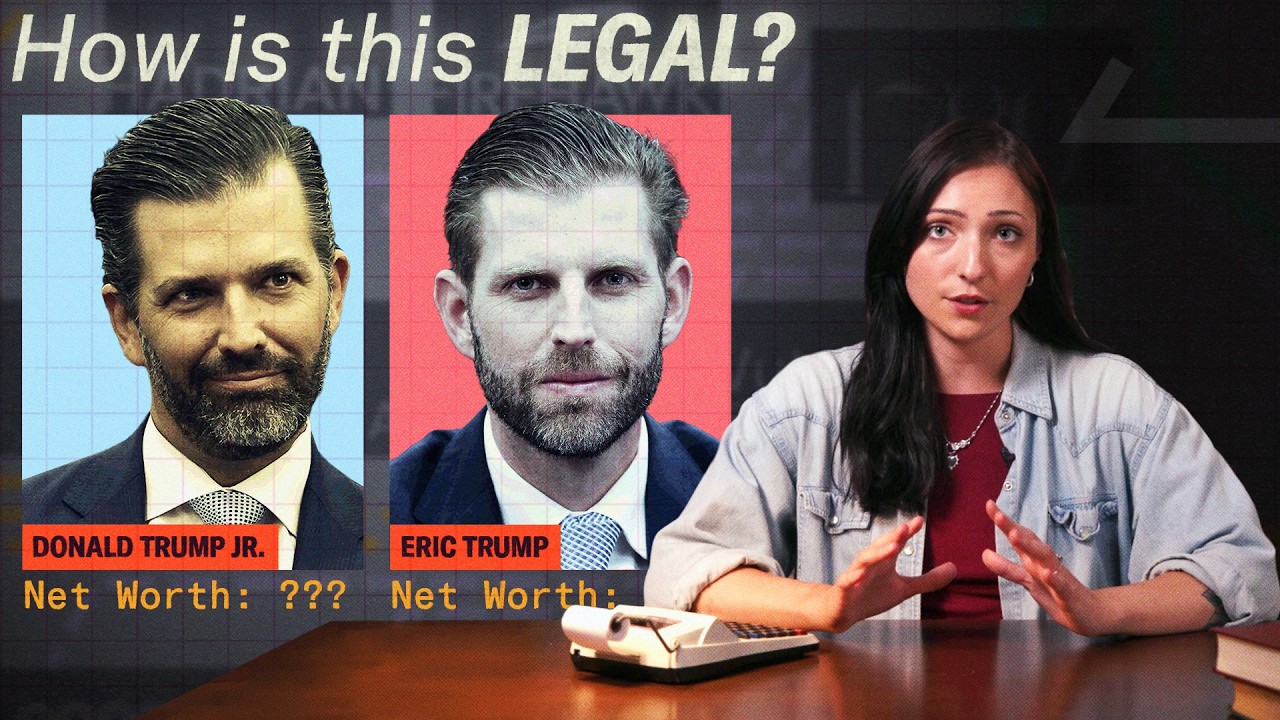
So I'm going to count it So it turns out the fastest way to win a government contract is to put the president's son on your board.
6:51
6 minutes, 51 seconds
I want to bring us back to Eric, because this is where things get really egregious.
6:57
6 minutes, 57 seconds
Power us is a drone company that both brothers invested in, in April 2026, it won an Air Force contract to sell interceptor drones.
7:04
7 minutes, 4 seconds
How much was never disclosed. Then there's another drone company, Unusual Machines. Don Jr is an advisor with a financial stake in the company.
7:13
7 minutes, 13 seconds
An October 2025 at one what its own CEO called, quote, the largest government contract in the company's history.
7:21
7 minutes, 21 seconds
The amount was also never disclosed.
7:23
7 minutes, 23 seconds
Unusual machines signed a $5 million supply deal with powers, so government money flows to power.
7:29
7 minutes, 29 seconds
US powers, pays unusual machines, Eric gets paid and Don Jr gets paid twice. It's a loop.
7:38
7 minutes, 38 seconds
This is the type of mechanism that helps Don Jr go from 50 million to 300 million, and helps Eric go from 40 million to 400 million.
7:47
7 minutes, 47 seconds
The contracts don't go to them directly, but they do go to the companies and they own pieces of these companies. So every government contract makes those pieces worth much more.
8:22
8 minutes, 22 seconds
the fund is still growing.
8:24
8 minutes, 24 seconds
Currently managing $3.5 billion in assets with a stated goal of $10 billion.
8:55
8 minutes, 55 seconds
So how is any of this legal?
8:59
8 minutes, 59 seconds
If a mid-level contract worker at a Navy base owns stock in a company bidding for one of her contracts, she would lose her job. She would likely face criminal charges, too.
9:08
9 minutes, 8 seconds
for Don Jr and Eric, there's nothing. No law covers the president's children.
9:14
9 minutes, 14 seconds
There's no requirement to recuse themselves from decisions that benefit their investments.
---