DON JR 3 exec br club
estb 11 25
see 1798 BUSKIRK ROCKBRIDGE
SPORT DOPING // THIEL
SEE CORRUPT 3 1789 CAPITAL AI
-=-=
-=-=
TFG 11 26
-=-=
10 26 YT? NEW INFO/ PIX W/ PUTIN?
DON JR SAID GAVE WEDDING $ BACK; MONGOLIAN ES SHEEP 3X 140 2--K$ BID?
SAFARI CLUB?
PSAKI 5X EG SCANDAL CORRUPT 10/27/26
-=-=
-=-=
AN 11 26
The Trump administration awarded a small biosecurity company nearly $40 million to screen for Ebola and other infectious diseases just months after a firm linked to President Donald Trump’s elder sons invested in its parent company, according to records and interviews.
The contracts, one to screen for Ebola in several U.S. airports and the other to respond to disease outbreaks in the Democratic Republic of Congo, are seven times the total value of government contracts the company had directly received before.
The company, XpresTest, has years of experience monitoring for COVID-19 and other diseases for the government at U.S. airports. That makes its parent, XWELL, an unusual hybrid, selling both spa treatments and biosecurity services. Last year, it made most of its money from waxing salons and airport spas that offer manicures, massages and “chakra beds.”
The contracts are the latest example of the president’s family benefiting financially from his administration’s actions. And the stakes for these deals are particularly high. In the Democratic Republic of Congo, an Ebola outbreak has killed more than 5,000 people this year, and the federal government is trying to stop the pathogen from coming to the U.S.
XpresTest has never worked with Ebola or provided biosecurity services abroad, let alone in the kind of volatile locales it’s now expected to work in. The CEO of its parent company, Ezra Ernst, said XpresTest won both contracts in a competitive bidding process and pointed to its years of experience doing screening for COVID-19 and other pathogens at American airports. But even he acknowledged that working internationally is “a new thing for us” and expressed uncertainty about being able to complete the work in the Democratic Republic of Congo.
“This is a risky contract. I’m not sure we can do it,” Ernst said in an interview.
Jeremy Konyndyk, who helped oversee the U.S. government’s response to a 2014 Ebola outbreak in West Africa, said there are some parallels between monitoring for COVID-19 and Ebola at airports, but he said it’s concerning that the government would award such a lucrative contract to a company that has no experience in Africa.
“There are countless organizations in the world that have decades of experience doing this work,” Konyndyk said. “I have to wonder why the hell they’re not going with someone who has actually done this before.”
Under previous administrations, the U.S. government addressed international disease outbreaks in partnership with the World Health Organization. But Trump withdrew from the group last year, dismantled the U.S. Agency for International Development, which handled much of this work, and dramatically scaled back the global presence of the Centers for Disease Control and Prevention.
At the same time, the State Department launched the America First Global Health Strategy, which calls for the U.S. to use aid to foreign countries to “promote American companies and American innovations abroad.” This March, the State Department announced it would be giving up to $4.5 billion in funding for various purposes, including responding to infectious disease outbreaks.
Under that program, XPresTest was awarded $20 million. Other funding went to better-known global aid nonprofits, including International Medical Corps, Save the Children and the International Federation of Red Cross and Red Crescent Societies, whose awards ranged from $25 million to $35 million.
The CDC also awarded XPresTest a contract, for $18.8 million.
In response to questions from ProPublica about XPresTest and its parent company, XWELL, the State Department noted the firm’s previous work screening for diseases at airports under a contract with the CDC and said its own award was made “through a competitive process that builds on this successful model.”
The CDC did not respond to a request for comment.
A spokesperson for the president’s sons Donald Jr. and Eric Trump said that they are “merely passive, minority investors in a fund that invested in this company,” and that they had no “involvement in or knowledge regarding the negotiation or procurement of any of its contracts, including any government contracts.”
“Both are private citizens who hold no government positions, broken no laws and who have every right to pursue lawful business and investment opportunities,” the spokesperson said.
The Trump sons’ connection to XWELL was established in February, when a fund called American Ventures invested in the company. The fund was launched by Dominari Holdings, a small financial firm with offices inside Trump Tower in New York. The leaders of Dominari hired the Trump sons as advisers after their father was elected to a second term and granted them a stake of more than 10% in Dominari.
Anthony Hayes, the CEO of Dominari Holdings, told ProPublica, “We have never seen or even heard of Don or Eric using their family name to influence the granting of a government contract.”
American Ventures has taken stakes in other companies that have benefited from Trump administration actions. The Florida-based drone company Powerus got a contract worth up to $90 million from the U.S. Air Force five months after the Trumps’ involvement was announced. Through American Ventures, Donald Jr. and Eric Trump also are acquiring a stake in a critical minerals group that has received U.S. government support to mine for tungsten in Kazakhstan. The Trumps have described themselves as passive investors who do not advocate for the companies they have stakes in before their father’s government.
XWELL was founded in 2006 as a line of airport-based spas that provided massages and facials. During the pandemic, the company, then known as XpresSpa Group, got $5.5 million from the CDC to offer travelers COVID-19 testing. It also collected waste from airplane toilets to check for new viral strains. It has done similar work for at least one other company that has received government contracts.
In January, XWELL announced that it was hiring a former senior adviser at the CDC who created and led the agency’s traveler surveillance program. The firm said the move was part of a plan to expand “its traveler-based pathogen surveillance capabilities to support international travel hubs and large-scale mass gathering events worldwide.”
The following month, American Ventures invested about $30 million in XWELL. The company had lost money the previous year. “We were so cash-strapped, close to bankrupt,” its CEO said.
Its valuation before the cash infusion was just $3 million. In exchange, American Ventures got a roughly 10% stake in the company to start, with an option to essentially print and sell millions of shares in the future.
Why American Ventures would invest so much in XWELL is unclear. In other cases, when the fund has invested in similar tiny publicly traded companies, some of those firms have moved into hot new sectors and drawn publicity for their connection to the Trumps, then Dominari has offloaded shares. In this case, there is no indication it has sold any of its stake yet.
In June, XpresTest was awarded the CDC contract for what a public notice about the grant said was “Ebola entry screening services.”
XpresTest then received the State Department grant for “rapid, effective, and coordinated outbreak response” to infectious disease threats in the Democratic Republic of Congo, which began in September, according to a government database. The company is also planning to work in Kenya and Morocco. XWELL’s website shows it is now hiring specialists in Ebola response training and biosecurity in the U.S.
In July, after XpresTest was awarded the CDC contract, XWELL announced plans to sell the subsidiary along with its line of spas to a private facial spa company. Ernst, the CEO, said the government contracts played a role in the $13 million sale price and will follow XpresTest to the new company.
That means XWELL, the company that the Trump-linked investment fund took a stake in, will benefit financially from the Trump administration contracts if the sale closes, even though it won’t be involved in doing the work for the government.
XWELL said in a public filing that the sale was part of an effort “to pursue a new direction in the national security sector.” Ernst said he didn’t know the exact plans but thought the parent company might be looking to work with the Department of Defense.
XWELL did not announce either of XpresTest’s biosecurity contracts, which recently became public in federal contracting disclosures. Public companies like XWELL are required to report so-called material events, developments that could affect their share price, such as a large government contract. XWELL has publicized previous work for the federal government, including a $2 million, eight-week pilot program for testing COVID-19 in 2021.
When asked why his firm didn’t announce the awards, Ernst gave various reasons, including the possibility that XPresTest might wind up not being able to do the work — either because of its own inexperience working internationally or because the Trump administration might suddenly shift priorities and only pay for a fraction of the contract.
“None of these contracts are guaranteed,” he said.
The biosecurity awards add to the questions about the Trump family’s enrichment during his second term. The Trump family’s business activities extend far beyond Dominari and American Ventures. The president himself has made more than $1 billion from cryptocurrency ventures whose value has ballooned as his administration has taken a friendly stance to the industry. And other companies backed by his sons Donald Jr. and Eric have received billions of dollars in federal deals. Earlier this year, ProPublica reported that the Pentagon granted a small North Carolina startup linked to Trump Jr. a $620 million loan after a top aide to the president intervened on the company’s behalf. The Pentagon denied preferential treatment, and a spokesperson for Trump Jr. said he played no role.
The Trumps’ financial ties to government deals and actions are expected to be a primary focus of Congress in the coming months after Democrats won control of both the Senate and the House in last week’s midterm elections.
“When the government is corrupted for personal gain over the public interest, Americans lose trust and taxpayer dollars are wasted,” Robert Garcia, the top Democrat on the House Oversight Committee, wrote in a letter to colleagues last week.
-=-=
AN 11 26
Utah GOP Sen. John Curtis doubled down on his call for President Donald Trump’s son to be looked at, as Democrats prepare a “Trump Crime Family” probe.
“My position hasn’t changed,” Curtis said in a statement to The Salt Lake Tribune. “Congress has a responsibility to examine whether presidential family members are using their access for personal financial gain, regardless of party.”
The incoming Democratic chair of the powerful House Oversight Committee has set four investigative priorities: corporate corruption, DHS and ICE abuse allegations, the Epstein files cover-up, and Trump’s family dealings.
Curtis put in a call in late September for an inquiry into the president’s son. He urged his fellow members of Congress to examine whether Donald Trump Jr. had made any financial profit from being close to the presidency, but his appeal was unheeded.
With Democrats promising to get to the bottom of the Trump family’s business, Curtis’s efforts may have some legs to them now.
In a statement, Curtis said he is also in favor of pressing on with the probes of Hunter Biden, former President Joe Biden’s son. Congress has examined the younger Biden to see whether he has leveraged his father’s office for his own ends. Lawmakers “nearly wore out the subpoena machine investigating Hunter Biden’s foreign relationships,” Curtis remarked in September, and “they shouldn’t unplug it now.”
Trump Jr. has not been subjected to that kind of scrutiny, Curtis said, and he partly put the Republicans’ heavy midterm losses down to that fact.
“Any investigation should follow the facts and focus on restoring public trust,” he said Friday. “That’s one of the many reasons Americans voted the way they did on Tuesday.”
His September call followed a ProPublica piece showing that Umar Kremlev, a Kremlin-linked Russian oligarch, quietly put up hundreds of thousands of dollars for Trump Jr.’s wedding celebrations, even renting a private island in the Bahamas for multiple nights. About 50 people were on the guest list, including Jared Kushner and other Trump family members. Kremlev, who met Trump Jr. a couple of years ago, according to his press office, was there with a good number of other Russians for the affair.
This is not the first time Trump Jr.’s Russian connections have been put under a microscope. In the wake of the 2016 election, he was at the heart of the Robert Mueller probe after word came out he had been at a Trump Tower meeting with a Russian lawyer billed as offering damaging information on Hillary Clinton.
As for the Oversight Committee, Claire Leavitt, a professor at Smith College who deals in government oversight, told The Salt Lake Tribune in an interview Friday that they have wide latitude. “They can really investigate anything they want,” she said. Most committees are confined by their jurisdiction despite having the power to subpoena, but “what makes House Oversight and Reform different is that they have a jurisdiction that’s completely wide open.” So Democratic lawmakers can make an issue of just about anything, whether in the public or private sphere.
-=-=
-=-=
MMA
November 5, 2026, edition of Fox News' The Five
JESSE WATTERS (CO-HOST): Yeah, let them run around like hamsters. Who cares? It’s fair game, I mean, both sides do it. Eric and Don, they had lawyers on retainer when they were in diapers. They’re used to it okay, both sides do it. But there’s a difference between the Trump boys and the Biden boy.
The Trump boys were established, well-respected, married, sober businessmen. The Biden boy was like an intoxicated mascot surrounded by hookers. Ok? I know people who did deals with them, they said he was embarrassing when they brought him to meetings, like he was all over the place. And so what value did Hunter Biden create for anybody? I mean at least the Trump boys are doing things with minerals and drones and real estate. I mean, they actually create value. Hunter Biden is in debt and broke and out of business. Dana he never even had a business, he just had a series of shell companies to sell access to his dad. And I’m with you. Collaboration with corporate America: They had law firms basically trying to put Trump in prison. Corporate America in bed with the Democrats, trying to impeach him. And half of that stuff was just a hoax. So screw those guys. Yeah, right, Trump sanctioned him — good. They should never do that again.
-=-=
MEDUZA
Donald Trump Jr. went hunting in Mongolia with a Kremlin-linked Russian businessman who helped bankroll his wedding
October 27, 2026,
Source: Financial Times
Donald Trump Jr., 48, the son of U.S. President Donald Trump, traveled to Mongolia in August 2026 to hunt, spending two days there with Umar Kremlev, head of the International Boxing Association and a businessman close to the Kremlin, the Financial Times found.
A charity auction raffled off the trip to Mongolia in the company of the U.S. president’s son. One of the winners did join Trump Jr. to hunt mountain sheep. Kremlev, who did not take part in the auction, also joined the trip, along with longtime Republican Party donor Kevin Small.
Trump Jr. flew into the Mongolian capital, Ulaanbaatar, in late August, after his wedding on a private island in the Caribbean Sea — a wedding Kremlev partly funded. He then traveled several hundred kilometers to a camp in western Mongolia, where he stayed with a small group of hunting guides, drivers, and cooks. Kremlev joined him there, accompanied by Arthur Martirosov, a businessman and partner at the venture fund Voskhod, which is under U.S. sanctions.
On August 30, Kremlev posted two videos to his Telegram channel. In one, he says he is flying to Mongolia with Martirosov, while in another he shows footage from the trip. In the caption, Kremlev asks, “How do you feel about hunting?”
https://t.me/umar_kremlev/7697?embed=1
One participant in the trip said Trump Jr. and Kremlev tried not to be photographed together while at the camp. Trump Jr. does not appear in Kremlev’s video either, though two organizers of his hunting trips do.
According to one guide, Trump Jr. killed an Altai argali — an endangered mountain sheep prized by hunters for its large horns — during the trip. After the hunt, he returned to the Mongolian capital. However, his trip did not end there — he held a series of other unofficial meetings, including a dinner with Mongolian President Ukhnaagiin Khürelsükh.
As a member of the president’s family, Trump Jr. traveled with a U.S. Secret Service detail. The U.S. Embassy in Ulaanbaatar paid $18,715 for hotel rooms linked to an unspecified “visit” by Secret Service agents from August 23–September 6.
A representative for Trump Jr. said a mutual friend from hunting circles introduced him to Umar Kremlev. “Don has made clear that he has a personal friendship, not a business relationship, with Umar. Their friendship is largely based on their shared love for hunting, fishing and the outdoors. It shouldn’t be a surprise to anyone that they went hunting together earlier this year,” the representative added.
A still from a video about hunting in Mongolia, shot during Donald Trump Jr.’s 2022 trip
Field Ethos / YouTube
However, intelligence experts polled by the FT believe these relationships create favorable conditions for manipulation.
“It really doesn’t matter if people have the most above board intentions,” said Holden Triplett, former director of counterintelligence at the U.S. National Security Council. “The moment the Russian security and intelligence services figure out someone has a relationship with anyone of high value, they will try to weaponize that.”
-=-=
RR AN 9 26
Yesterday (September 14) — just two days after Dario Amodei, the chief executive officer of leading AI firm Anthropic, called for “slowing down” the pace of AI development so guardrails could be put in place that would “greatly reduce the risk that something goes seriously wrong” — Trump threw a tantrum:
“The only control or ‘guardrails’ that AI needs is a STRONG AND SMART (High IQ!) PRESIDENT, and the U.S.A. has that, in spades!
In the same post, Trump even hinted that the government might pursue criminal or regulatory penalties against AI companies, such as Amodei’s Anthropic.
“The Trump Administration has stopped AI ‘people’ from doing bad, or potentially bad, ‘things,’ like Dario (Anthropic!), who is now pretending to be a ‘perfect little angel’ — and we will continue to do so!”
Then Trump interrupted a speech being given by Jensen Huang, Nvidia’s chief executive, at a conference in Los Angeles to say — over a speaker — that worries about AI were “a hoax …. Robots are not going to be taking over the world. That’s not going to happen.”
Trump has called AI data centers “the oil of the next 50 years” and says they are delivering wealth and investment to communities in the U.S. In July he insisted that data centers are “Cash Cows,” creating taxes and jobs that “amount to LIQUID GOLD!”
Trump’s rejection of any regulation of AI or its data centers contrasts with the views of many voters. A March Gallup poll showed that nearly half of those surveyed “strongly oppose” the construction of local AI data centers, including almost 40 percent of Republicans.
Yet Trump remains adamant that nothing should be done. “We can put up guardrails, and we can do this and that, but I think you have a lot of negative forces that are bringing it up,” Trump told reporters Sunday while traveling in Ireland. “And they’re bringing up things that won’t happen.”
Why would Trump be so opposed to regulating AI — even in the face of growing public concern, even with midterm elections just around the corner?
It can’t be that he knows very much about AI.
And it can’t be that Trump loves AI because of what it can do. Yes, he’s used it to make fake photos and videos of himself, but that doesn’t explain his adamant refusal to regulate it.
It can’t be that he’s worried about China catching up to or surpassing the U.S. in AI. China has a small fraction of the data centers America has, and China isn’t poised to leapfrog our technological advantage. Besides, even China is considering imposing guardrails on its AI.
So what explains Trump’s absolute refusal to regulate AI? Could it possibly be that he and his family have personal financial stakes in it?
Indeed, Donald Jr. and Eric Trump have invested substantially in American Data Centers, a firm created to support AI cloud computing and AI infrastructure.
They made these investments soon after their father announced a $40 billion investment pledge in U.S.-based data centers from his business partner Hussain Sajwani, unveiled another $500 billion in planned investments in private-sector AI infrastructure, and signed an executive order rolling back Biden-era policies that took a more cautious approach to AI and directed “the development of an AI Action Plan to sustain and enhance America’s AI dominance.”
The Trump sons also hold advisory roles and ownership stakes tied to Dominari Holdings’s American Ventures fund, which targets AI infrastructure, data centers, and cryptocurrency. American Ventures has reportedly raised more than $1 billion across 21 investment vehicles backing companies tied to AI, crypto, drones, nuclear energy, and data centers.
Donald Jr.’s own investment firm, 1789 Capital, is backing emerging technology companies working in AI and defense. The firm has bought shares in some of the most coveted private companies before many went public, including SpaceX, Anduril, Cerebras, and Reflection AI, often by leveraging their political and business connections to secure a stake or help boost the companies’ sales.
The growth of Donald Jr.’s investment firm has been astonishing. Two years ago it managed a few hundred million dollars. It now oversees more than $3 billion. As of June 30, its main investment fund generated returns of roughly 200 percent, according to a person familiar with the firm’s performance. While still early in its investment cycle, those returns eclipse the average returns of about 21 percent from venture capital firms started in 2023, according to PitchBook, a provider of financial data.
Donald Jr. and Eric’s father seems to be turning his attention away from being president — “I’m getting a little bit tired of politics now,” he said a few days ago — toward things that excite him more, such as his ballroom and triumphant arch, as well as making even more money for his family off his presidency.
But as he focuses on making himself and his family wealthier, he’s leaving the rest of us more vulnerable to AI.
One of the first responsibilities of a new Congress, come January, will be to establish guardrails around AI — assuming that by then Trump can no longer control what Congress does, and that January isn’t too late.
Robert Reich is a professor of public policy at Berkeley and former secretary of labor. His writings can be found at https://robertreich.substack.com/.
=-=-=
-=-=
an 9 26
President Donald Trump and his high-ranking officials are engaged in a simultaneous project of spreading far right ideologies worldwide — and raking in billions while doing so.
In an article by The Atlantic's Anne Applebaum on Monday, Americans learned the full extent of Trump's mixing of exporting paranoid politics and turning a profit from Brazil and the United Arab Emirates to threatening longtime democratic allies like Canada and Denmark. She added that the major industries helping Trump do this include oil and gas, rare earth minerals and cryptocurrency.
"American power is no longer deployed solely by trained diplomats and reliable officials, working through state channels. Informal envoys, private companies, online grifters, and hardened ideologues both inside and outside the government matter more," Applebaum wrote. "Unlike their predecessors, these people do not talk about spreading democracy, and don’t want to build long-term relationships. They don’t care about America’s reputation. They are deploying the tools of American diplomacy and government for their own purposes, to promote their own business interests or their own ideological goals, because, suddenly, they can."
She also added that "the clan of predators currently in charge of the U.S. federal government is no different. Wrongly described as 'isolationists,' many of its true believers don’t think of themselves as ordinary Republicans who won an election and will temporarily hold power until the next election. Nor are they mere appendages of Trump. They believe they represent something much greater: the vanguard of a movement that will alter not just America, but the world."
Applebaum contrasted the attitude of Trump supporters with that of Sen. John McCain (R-AZ), who famously said during the 2008 election that his opponent, Sen. Barack Obama (D-IL), was a decent man with whom he happened to disagree.
"Their enemies are existential, and they are international: super-spreaders of a 'wokeness' plague, or proponents of a fictitious 'censorship-industrial complex,' or advocates of 'regulation' that will hamper American business, or self-hating promoters of “mass migration” who want to drown Western civilization in a sea of brown-faced aliens," Applebaum explained. "To maintain their power and defeat these enemies, the predators, like their Bolshevik counterparts, cannot rely on traditional diplomacy, because they don’t trust its practitioners."
She concluded, "Nor do they trust many of the leaders of the democratic states that have long shared the same political and economic values as America. Although the U.S. military and intelligence services continue to cooperate closely with allied governments, the ideologues in and out of the administration are actively seeking to replace them with people and parties who share their disdain for liberal democracy and for what were once considered, at least aspirationally, to be American values. To do so, they need to expand their global influence, manipulate elections in former partner nations, and alter the flows of money and power, especially inside other democracies. Much of the world has always believed America’s defense of democracy to be hypocritical, and that American-led economic integration was self-serving. But now even the people who sincerely believed in the postwar American project are discovering that it no longer exists."
Trump himself has raked in billions since assuming office in his second term, while his sons have netted millions using their foreign policy connections to get involved in matters like investing in tungsten mines. Earlier this month, a Gallup poll found a historically high number of Americans are upset with government corruption, writing that "Americans’ perceptions of government corruption in the U.S. are at their highest level in 20 years, with 89 [percent] of U.S. adults saying it is widespread. That figure is up 10 percentage points from last year and well above readings in the 72 [percent] to 79 [percent] range between 2010 and 2025."
The poll added, "Democrats’ perceptions of government corruption have risen the most sharply since 2024 compared with other party groups. In former President Joe Biden’s final year in office, 57 [percent] of Democrats said corruption was widespread in government; that rose to 76 [percent] in 2025, the first year of President Donald Trump’s second term, and reached 91 [percent] this year. The figure among political independents (90 [percent]) aligns more closely with Democrats’ than with Republicans’ (83 [percent]) and is up 12 points since 2024."
-=-=
AN 9 26
On May 24, Donald Trump Jr. was celebrating in the Bahamas, as scantily clad dancers in stilettos and sailor caps performed for him and his guests. It was the last night of his wedding, a lavish, three-day party held across a pair of ultra-exclusive private islands. A five-tier funfetti cake had been airlifted in from Florida, and helicopters and seaplanes descended on the islands before guests settled into their oceanfront villas. That night on the beach, Trump Jr. lifted his bride into the air while fireworks launched from a barge over the sea.
“It was everything we dreamed of and more,” his wife later wrote on Instagram.
That dream was heavily funded by a secret benefactor: Umar Kremlev, a Russian oligarch close to President Vladimir Putin.
Kremlev footed the bill for hundreds of thousands of dollars of wedding expenses, according to records reviewed by ProPublica and interviews with three people familiar with the event. The oligarch paid to rent out one of the private islands, where a reception was held and where guests slept.
He also covered other big-ticket items, like the fireworks show, and his team helped plan the event. Kremlev is the head of the International Boxing Association, a scandal-plagued sports group that has been financed by the Russian state-owned energy giant Gazprom. The wedding payments came from an IBA-affiliated entity in Dubai that the boxing association uses for financial transactions.
The guest list numbered around 50. It included Trump Jr.’s brother-in-law Jared Kushner, Eric Trump — and Kremlev, an imposing man with a shaved head who speaks limited English. The oligarch was part of a large group whose presence puzzled other attendees. They sometimes stood off by themselves, speaking Russian.
“It was really small, like, just really close friends,” Trump Jr. later said on his podcast. “Tried to keep it really tight. And it was just awesome.”
Kremlev’s previously unreported relationship with Trump Jr. represents an extraordinary development: a member of Putin’s circle financially supporting the president’s son and gaining intimate access to the Trump family. For a decade, Putin’s government, regarded as a chief adversary of the U.S., has been accused of efforts to influence American elections. Attempts by Russia to make inroads with the Trumps before the 2016 election exploded into controversy that dogged much of the president’s first term.
National security experts expressed alarm at Trump Jr. accepting the oligarch’s largesse, saying it raised an urgent question: What motivated Kremlev to spend a fortune cultivating the connection?
“If I’m paying for your wedding, at some point, you’re going to owe me something,” said Frank Montoya Jr., a retired career FBI official who held senior counterintelligence roles. Oligarchs like Kremlev often act in coordination with the Russian government. While it’s unclear if that happened here, Trump Jr. put himself in a precarious position, Montoya said. “This should be unthinkable for the son of the president. End of story.”
Holden Triplett, who served as Trump’s counterintelligence director on the National Security Council during his first term, said Russian intelligence frequently seeks to build ties with U.S. government officials and their family members. “Money is a tried-and-true method to gain access,” said Triplett, who also worked for the FBI in Moscow.
In the days leading up to Trump Jr.’s wedding, Kremlev was in China as part of the delegation accompanying Putin, according to Chinese state media. The month before, Putin had bestowed him with a state honor, the Order of Friendship. The Ukrainian government has imposed sanctions on Kremlev personally, citing his closeness to Putin and Russian security services.
It’s not clear why Kremlev helped pay for Trump Jr.’s wedding. The men appear to have met only recently. Public reporting suggests Trump Jr. could have afforded it himself, with Forbes recently estimating his net worth at roughly $300 million.
In response to detailed questions, a spokesperson for Trump Jr. did not dispute the wedding payments from Kremlev. “Umar is a personal friend of Don,” he said. The spokesman said that Kremlev is “not someone he has a business relationship with” and that the men met through a mutual friend in the hunting world and bonded over their love of boxing and the outdoors.
A spokesperson for Trump Jr.’s brother Eric said of Kremlev: “Eric has absolutely no clue who this person is, nor has never heard his name.”
In a statement, Kremlev’s press office said, “Mr. Kremlev and Mr. Trump Jr have a friendly relationship” and they first met “a couple of years ago.”
The press office described Kremlev as a businessman and philanthropist, adding, “Mr. Kremlev has never discussed political matters with any of his American friends and acquaintances,” including Trump Jr. They said the boxing organization itself did not incur expenses for the wedding but did not comment on the payments from the Dubai entity. The press office also said that when Putin and Kremlev were in China recently, Kremlev was not part of Putin’s “official delegation.”
Kushner, who has been helping lead the U.S. government’s negotiations with Russia over Ukraine, did not respond to requests for comment. The White House and the Russian government did not respond either.
The revelations come as Trump Jr. has emerged as a political power center in his own right. Beloved by the MAGA base, he reportedly played an active role in vetting White House cabinet picks for Trump’s second term and was dubbed his father’s “most essential political adviser” by The Wall Street Journal. “I certainly don’t think I’d be sitting here as the VP nominee without Don’s help,” Vice President JD Vance told the outlet in late 2024.
This account is based on records and interviews with dozens of current and former IBA officials and contractors, wedding attendees and other people in Trump Jr.’s and Kremlev’s circles.
Trump Jr. exchanged vows with socialite Bettina Anderson on a private island that was featured in “Pirates of the Caribbean” and the 2006 James Bond movie “Casino Royale.” They had their first dance on a second private island nearby that can rent for around $100,000 a night, paid for by Kremlev. The company that put on the fireworks display charges around $70,000 for such shows. (Kremlev did not attend the ceremony itself, which was held on the first day and had just 18 guests, Trump Jr.’s spokesperson said.)
The atmosphere was Monte Carlo meets frat party — helicopters in and out, a beachside DJ set, beer pong tournaments. One day, the men went spearfishing. Artisans at the London fashion house Safiyaa spent 150 hours embroidering Anderson’s bespoke silk reception outfit. The president’s son had undergone treatment to better define his jawline for the occasion.
Some longtime friends of Trump Jr. told associates they were disappointed not to be invited, though a few of his closest business partners — executives at the Trump family crypto company, World Liberty Financial, and the venture capital firm 1789 Capital — did make the cut. President Trump himself skipped it. (“He’d like me to go, but it’s going to be just a small, little private affair,” the president told reporters beforehand. “I said, you know, this is not good timing for me.”) But many of the guests were immediate family of the bride and groom.
That made the large contingent of Russians all the more conspicuous. “What are they doing here?” one person recalled thinking. At least one of the Russian guests had been with Kremlev on his China trip: Alexander Lagutin, a businessperson who has served in senior roles at a Russian defense contractor and a state-backed energy company. Kremlev’s right hand at the IBA, Elena Sobol, attended the wedding too.
Since the wedding, the Trumps have released scores of photos and videos of the festivities. While they show many of the guests, the Russians have been absent from all of them. (The top of Kremlev’s head is visible in the back of one group photo posted on Instagram by a friend of the bride.) After the party was over, on his “Triggered” podcast, Trump Jr. emphasized the event’s privacy: “The people that were there — if you’re on that list, you weren’t talking.”
In 2009, Umar Kremlev did not yet exist.
He was in his late 20s, with a criminal record for extortion and battery, still going by his birth name, Umar Lutfulloyev, according to the Russian independent news outlet Proekt. But he was about to rapidly ascend in Russia to a position of wealth and influence, with the help of a powerful friend. (“Mr. Kremlev has a completely clean legal record,” his press office said.)
In 2010, he changed his name to Kremlev. He soon joined a Russian government-backed biker gang called the Night Wolves, eventually taking a leadership role, according to news reports. That is what first brought him close to Alexei Rubezhnoi, who now leads Putin’s presidential security service, Proekt reported. In 2017, Kremlev took over the Russian Boxing Federation, after Rubezhnoi personally intervened to put him at the helm.
In 2020, Kremlev became president of the IBA. The association was something akin to FIFA but for boxing and had long overseen the sport in the Olympics. But it had been beset by corruption allegations and was on the brink of insolvency. Kremlev brought money to the table from Gazprom, the state-owned company that operates as an arm of Putin’s government. Gazprom publicly became the IBA’s financial backer, filling its coffers with tens of millions of dollars.
Former high-level IBA officials said that Kremlev had a clear political agenda. “Umar is guided by Putin. It was using the sport for soft political power,” a former IBA board member told ProPublica. “It’s geopolitics. That it’s boxing is just happenstance.” Kremlev, 43, is also heavily involved in an organization called Healthy Fatherland, run by his 23-year-old wife’s twin sister. The group — which promotes healthy eating and youth sports — is under Ukrainian sanctions for its alleged role in a program of abducting Ukrainian children from occupied territories and relocating them under the guise of “rehabilitation.” (Healthy Fatherland did not respond to a request for comment.)
Kremlev’s cozy relationship with the government has made him rich. Putin used the levers of the state to make Kremlev a dominant player in the Russian sports betting industry, according to Proekt, and one of his companies was chosen to operate the national lottery. After Putin nationalized Russia’s largest car dealership company in 2023, Kremlev became the owner of that too.
He now flaunts that wealth through his boisterous public persona. In one video Kremlev posted on social media, he surprises a young mother by giving her a free car. In another, he criticizes his young female aide’s outfit as not feminine enough and makes her change. He shadowboxes with ostriches and brings in celebrities like Rick Ross and Naomi Campbell for IBA events; he praises Stalin and rides private jets.
Following the Russian invasion of Ukraine in 2022, the U.S. began to indict Russian oligarchs and seize yachts and other assets. Kremlev repeatedly told associates he was worried about being targeted by a U.S. government probe, according to a person close to IBA leadership. “He was very afraid of American sanctions,” the person added. (Kremlev does not appear on public U.S. sanction lists.)
With the business environment in Europe growing more hostile to Russia, Kremlev moved much of the IBA’s operations from Switzerland to the United Arab Emirates. A new Dubai entity, IB Challenger, would later pay wedding expenses for Trump Jr. The current sources of the IBA’s funds are murky, and, in recent years, top executives have given conflicting accounts of the status of its relationship with Gazprom. (Kremlev’s press office told ProPublica the IBA’s sponsorship contract with Gazprom “expired long ago.”) People close to the organization said they understood that its money still comes from Russia.
In 2023, the International Olympic Committee stripped Kremlev’s IBA of its role organizing Olympic boxing. It has cited a host of governance issues and the group’s refusal to “transparently explain the sources of its financing or to explain its full financial dependency, at the time, on a single state-owned company.”
It was a major setback that deprived the IBA of a key source of its international influence. Kremlev has raged against the Olympic committee ever since and has said that his IBA predecessor, who he blames for the problems, “must be shot.”
Kremlev saw a potential ally in President Trump. After Trump’s second inauguration, in January 2025, Kremlev sent an open letter to the president asking him to look into the Olympic committee’s actions in advance of the 2028 Los Angeles Games. “We look forward with great optimism to the possibility of working together to make the Olympic movement great again,” he wrote.
In September 2025, the IBA brought in Trump Jr. for a panel discussion in Istanbul about boxing. With his then-girlfriend, Anderson, sitting offstage, he criticized transgender women competing in women’s sports and reminisced about watching Saturday night fights as a child. Trump Jr. shared the stage with Kremlev, the boxer Manny Pacquiao and Muhammad Ali’s daughter Rasheda. (Trump Jr.’s spokesperson said he was not paid for the appearance and was already in Turkey for an unrelated event.)
The president’s son had reason to be attuned to the sensitivity of cozying up with a Putin associate, especially while his father navigates the Russia-Ukraine war. Trump Jr.’s June 2016 meeting with a Russian attorney in Trump Tower became a major focus of the Robert Mueller investigation.
The Trump Tower meeting was arranged after an email offering Trump Jr. damaging information about Hillary Clinton as “part of Russia and its government’s support for Mr. Trump.” Trump Jr. famously responded, “If it’s what you say I love it especially later in the summer.” Trump Jr. later dismissed the matter as a “witch hunt,” and the Mueller report concluded that there was not enough evidence to convict him of a crime.
Recently, Kremlev has been working to expand into the U.S. market. In July, his group hosted a bare-knuckle boxing event in Miami, a chance to showcase a particularly bloody form of the sport in which contenders fight without gloves. But the debut was overshadowed when manosphere influencer Andrew Tate, who the IBA had brought in to host, was arrested by U.S. Marshals outside the arena. (Tate is facing rape and sex trafficking charges in the United Kingdom, which he has denied.)
Much about Kremlev’s relationship with Trump Jr., and where it is headed, remains unknown. In a press release after the Istanbul panel, the IBA hinted there was more to come.
“President Kremlev and Donald Trump Jr made it clear – this alliance will not remain symbolic,” the press release read. “More joint initiatives will follow.”
-=-=
Trump son torn to shreds for demanding states back off market he’s paid by
AN 8 26
-=-=
an 8 26
event strats
It’s a bad day for a marketplace backed by the Trump family, according to the Wall Street Journal.
Online marketplace PublicSquare, created as a MAGA-aligned alternative with Donald Trump Jr.’s backing, is now facing severe financial difficulties and a 99 percent collapse in its share price, according to BGNES.
“Despite initial expectations, the conservative marketplace failed to gain traction, resulting in cumulative losses of nearly $160 million from the start of its stock trading in 2023 through the end of July this year,” reports BGNES.
Trump Jr. lauded the company's debut on the New York Stock Exchange in 2023 as an “anti-woke marketplace” aimed at conservative, “patriotic and religious consumers.” But apparently the market and investors didn’t think much of politics. The business model soon unraveled, leaving the company at risk of being delisted.
This year, PublicSquare announced that it was abandoning e-commerce in favor of financial technology, including cutting 41 percent of its workforce and cancelling a streaming program.
And, typically, of many star-driven business, BGNES reports company's financial difficulties are linked to princely consultancy costs.
“Since 2024, shortly after Donald Trump won the presidential election, the West Palm Beach, Florida-based company had been paying Trump Jr. $42,000 a month in consultancy fees. Last year, the president’s son earned more than the company's then-chief executive, while in 2025 he received more than $500,000,” reports BGNES.
“Former Trump administration official Nick Ayers and a firm run by Trump Jr. ally Omeed Malik also received hundreds of thousands of dollars in consultancy fees.”
According to financial filings, the company’s net losses have “significantly exceeded revenue” — $57.6 million in 2024 and $36.6 million in 2025.
---
Peter Thiel's Master Plan to Destroy the World (And Escape It)
..
21:31
21 minutes, 31 seconds
with it. Peter Teal is interested in these games not because he loves sports at all, but because he wants to see how the human body can be technically
21:39
21 minutes, 39 seconds
upgraded like software. What I do find incredibly interesting though, and stay with me, is how transphobic a lot of
21:47
21 minutes, 47 seconds
these guys are. Like take Donald Trump Jr. for example. He's compared trans people to terrorists.
The radical transgender movement is per capita the most violent uh you know domestic terror threat if not in in America, probably the entire world.
---
AN 7 26
Calling him out for an unprecedented level of "shameless corruption and sheer moral repugnance" as he attempts to cash in on his father's office, a new breakdown from MS NOW argued that Donald Trump Jr. just might be the "worst presidential relative ever."
In a piece published Sunday morning, author and commentator Paul Waldman noted that "problematic presidential family members are an American tradition as old as the republic," noting examples like Theodore Roosevelt's hot-headed daughter, Alice, and Jimmy Carter's "colorful buffoon" brother, Billy. Under the second administration of President Donald Trump, however, he argued that his oldest son, Donald Trump Jr., has become the "new standard by which all future misbehavior among presidential offspring should be judged."
While admitting that the younger Trump has not actually committed any crimes, Waldman argued that in an age when anti-corruption rules are so lax, "all that stops Don Jr. from enriching himself at public expense is shame or a sense of morality — and he is clearly possessed of neither." He also, seemingly, has been spurred on by his father's own relentless pursuit of self-enrichment.
"When it comes to grasping for taxpayer money, shameless corruption and sheer moral repugnance, none who came before can hold a candle to Donald Trump Jr.," Waldman wrote. "He has cemented his position as perhaps the most distasteful and ethically compromised presidential relative in American history — and his father isn’t even halfway through his second term."
He continued later: "Don Jr. wasn’t just going to sit by and watch Dad have all the fun. So he has undertaken his own frenzy of dealmaking, all of it seemingly based on the fact that he’s the president’s son. Some of the enterprises are joint ventures with the whole family. There’s World Liberty Financial, a crypto company that has been the vehicle for some of the biggest players looking to give payoffs to the Trumps and get something in return. As an investigative report revealed, the United Arab Emirates’ national security adviser secretly invested half a billion dollars in the company. Not long after, the Trump administration lifted export controls on computer chips the UAE desperately wants to create its own artificial intelligence infrastructure (Commerce Department staff objected to the change, but the White House cites the UAE’s position as a U.S. ally.)"
Donald Trump Jr., alongside his younger brother, Eric Trump, have also found ways to consistently cash in on the U.S. government's increased defense spending. As Waldman described the dynamic, the siblings have made investments in smaller defense companies, "then watch as huge government contracts magically materialize." Another company they are extensively invested in, Kaz Resources, received $1.6 billion in investments from the federal government, and saw the president himself intervene to make sure the company received special access to tungsten mines in Kazakhstan as part of a new deal with the country.
"Don Jr. has always had the air of a man desperate to please his indifferent father," Waldman concluded. "This spring, the president couldn’t even be bothered to attend his son’s wedding. But if he keeps this up, he’ll be able to say, 'See Dad, I’m just as greedy and corrupt as you!' It’s an achievement no presidential relative can match."
MPU 7 26
VULCAN elements, a three year old startup with 30 employees that makes rare earth magnets.
In August 2025, 1789, invested in Vulcan as a part of a $65 million funding round.
Three months later, the Pentagon gave them a $620 million loan.
the push for this loan came directly from Peter Navarro, Trump's senior trade adviser and a close personal friend of Don Jr.
So close that Don Jr visited Navarro in prison and was one of the few people Navarro's latest book was dedicated He's a friend legitimately can't believe that this is happening to him,
One Pentagon employee told ProPublica that the call came, quote, from the white House.
---
cato
July 6, 2026 3:01PM
A Familiar Pattern: White House Self-Dealing in US Trade & Investment Policy
By Tad DeHaven and Clark Packard
President Trump’s 2025 financial disclosure landed last week showing more than $2 billion in income, roughly triple 2024’s figure. Cryptocurrency alone accounted for $1.4 billion, most from meme-coin royalties and token sales tied to the Trump family’s World Liberty Financial. Read against the deals cataloged below, the filing paints a sordid picture of self-dealing within the upper echelons of the White House—or at the very least, the appearance of such.
Tungsten and Kazakhstan
Let’s start with tungsten. Today, China controls roughly 80 percent of the world’s supply and has spent the past year and a half tightening export controls. This has caused the metal’s cost to grow from around $340 per ton to well past $3,000. The US hasn’t run a commercial tungsten mine since 2015. Given tungsten’s importance to a number of security-related products, including weapons systems, American policymakers are actively looking to break China’s chokehold.
Over the summer of 2025, the US Export–Import Bank and US International Development Finance Corporation issued letters of interest—non-binding but meaningful signals—for up to $1.6 billion in potential financing for a Kazakh tungsten venture led by Cove Kaz Capital: $900 million from EXIM and $700 million from DFC, against total development costs pegged at roughly $1.1 billion. The joint venture itself, pairing Cove Kaz with Kazakhstan’s national mining company Tau-Ken Samruk, was unveiled in November 2025 at the C5+1 summit by President Trump and Kazakh President Kassym-Jomart Tokayev. President Trump personally worked out the deal with Kazakhstan President Kassym-Jomart Tokayev; Commerce Secretary Lutnick was also heavily involved. The developer has since gone back to the well, asking the Pentagon for another $400 million.
The president’s two eldest sons found their way into the deal through a side door. According to Financial Timesreporting, Donald Trump Jr. and Eric Trump entered the picture in August 2025 through American Ventures, an investment vehicle holding a stake in Skyline Builders, a Nasdaq-listed firm, and they added to those positions on October 28, 2025. On October 31—weeks after Lutnick met Tokayev in New York with President Trump joining by phone—investors participating through a financing structure involving Dominari Securities, a Trump Tower-based firm partly owned by the brothers, acquired a 20 percent stake in the entity tied to the tungsten project. The US-Kazakhstan agreement was signed six days later. Skyline and Cove Kaz have since agreed to combine into Kaz Resources Inc., expected to trade on Nasdaq as KAZR. The Trump brothers’ precise financial interests have not been fully disclosed.
Cantor Fitzgerald, run by Secretary Lutnick’s two sons, helped raise $210 million for one of the lead investors working with Dominari on the deal—the kind of assignment that typically produces millions in fees.
The New York Times reported that it counted $18.6 billion in federal backing for 60 critical minerals projects since President Trump took office, with the Trump and Lutnick families having some ties to at least 14 of them.
The new disclosure shows this wasn’t a one-off. Trump reported capital gains of $100,000 to $1 million on shares of MP Materials, the rare-earth miner whose stock jumped roughly 50 percent the day the Pentagon announced it was taking a 15 percent equity stake. And Donald Trump Jr.‘s venture fund, 1789 Capital, bought into Vulcan Elements in August 2025—three months before the Pentagon handed Vulcan a $620 million loan that helped push its valuation from around $200 million to nearly $2 billion. Different metal, different shell company, same shape.
Semiconductors and the United Arab Emirates
The UAE side of the ledger runs on a similar mechanism, just with chips instead of ore. As the Wall Street Journal detailed earlier this year, four days before Trump’s second inauguration, an Abu Dhabi vehicle backed by Sheikh Tahnoon bin Zayed Al Nahyan—the UAE’s national security adviser, director of the country’s largest sovereign wealth fund, and brother of the UAE’s president—bought 49 percent of World Liberty Financial for $500 million. Eric Trump signed the deal, and roughly $187 million landed in Trump-controlled accounts before anyone outside the deal knew it had happened. The CEO of World Liberty Financial is Zach Witkoff, son of Steve Witkoff, President Trump’s special envoy to the Middle East and key member of the administration’s foreign policy team.
Meanwhile, White House AI czar David Sacks pushed hard to loosen Biden-era chip restrictions on the UAE despite his fund’s ties to Tahnoon’s own sovereign wealth vehicle. The one senior official resisting that push, National Security Council Senior Director David Feith, was fired within weeks. Days before it would have taken effect, the administration killed the Biden export rule; by May, Washington had agreed to sell the UAE 500,000 advanced Nvidia chips a year, with one-fifth earmarked for Tahnoon’s own AI company. That same month, another Tahnoon vehicle ran $2 billion through World Liberty’s stablecoin into Binance—the exchange whose founder Trump pardoned five months later.
These private profits for Trump administration officials and their family members sit downstream of specific US international trade and investment practices, including efforts to mitigate China’s chokehold on tungsten, other rare earths, and semiconductor export controls. None of these policy goals is necessarily illegitimate on its own terms, but the means of pursuing those goals are transforming ordinary policy into family enrichment schemes.
---
MPU Producer/Host - Alex Kennell
2:56
2 minutes, 56 seconds
And what happened to each of them after 1789? Capital invested. And I'll add it all up right here as we go.
3:02
3 minutes, 2 seconds
In July 2025, 1789, invested in a company called Hadrian Automation.
3:09
3 minutes, 9 seconds
Hadrian was founded in 2020 and had no significant government contracts.
3:13
3 minutes, 13 seconds
Eight months later, it won a $900 million Navy contract to build automated submarine factories and an $80 million Army contract.
3:22
3 minutes, 22 seconds
That's $980 million total, all to a company that had never won a major government contract before.
3:28
3 minutes, 28 seconds
Don Jr's fond invested in Here's another one. Firehawk aerospace, whose entire government contract history fits in a single line.
3:37
3 minutes, 37 seconds
It had just one contract in 2022, and then 1789 invests and suddenly there winning Air Force and Space Force deals worth $8.9 million, plus a land gift in Oklahoma.
3:49
3 minutes, 49 seconds
And sometimes the perk goes beyond the money.
3:52
3 minutes, 52 seconds
1789 invested in reflection AI in 2025, and by May 2026, it became one of only eight AI companies in the country allowed to deploy inside Pentagon classified networks.
4:05
4 minutes, 5 seconds
Here's a company called Andrew that makes the autonomous weapons systems that define modern warfare, like drones and AI powered surveillance towers, and after 1789, invested.
4:15
4 minutes, 15 seconds
In June of 2025, the company won a $367 million border surveillance contract and a $23.9 million Army deal.
4:24
4 minutes, 24 seconds
It also has a potential 20 billion. Yes. Billion with AB.
4:28
4 minutes, 28 seconds
Army consolidation deal in the works so big a number that it totally dwarfs everything else on this list, but we can't even count it.
4:36
4 minutes, 36 seconds
So I'll just do 367 million plus 23.9 million.
4:56
4 minutes, 56 seconds
of all of these, there's one example that stands apart because this is one where we have proof the white House directly intervened.
5:03
5 minutes, 3 seconds
Falcon elements, a three year old startup with 30 employees that makes rare earth magnets.
5:08
5 minutes, 8 seconds
In August 2025, 1789, invested in Vulcan as a part of a $65 million funding round.
5:15
5 minutes, 15 seconds
Three months later, the Pentagon gave them a $620 million loan.
5:21
5 minutes, 21 seconds
Rare earth magnets are vital to military technology, and as the name suggests, they are rare. China has complete dominance over the industry.
5:30
5 minutes, 30 seconds
Both Democrats and Republicans have tried to change that. So Trump isn't the first to consider a loan of this sort.
5:39
5 minutes, 39 seconds
it went out without competitive bids without the technical disclosures that are used to verify whether a project is even viable before public money goes in.
5:50
5 minutes, 50 seconds
That was waived.
5:51
5 minutes, 51 seconds
the push for this loan came directly from Peter Navarro, Trump's senior trade adviser and a close personal friend of Don Jr.
5:57
5 minutes, 57 seconds
So close that Don Jr visited Navarro in prison and was one of the few people Navarro's latest book was dedicated He's a friend legitimately can't believe that this is happening to him,
6:08
6 minutes, 8 seconds
One Pentagon employee told ProPublica that the call came, quote, from the white House.
6:12
6 minutes, 12 seconds
We have to get this done, Staff worked late nights for weeks to push the loan through when deals like this normally take months.
6:20
6 minutes, 20 seconds
the time of 1789, investment Vulcan was valued at around 200 million. After the Pentagon loan, the valuation jumped to nearly $2 billion.
6:29
6 minutes, 29 seconds
technically, this one's alone.
6:30
6 minutes, 30 seconds
Not a contract, but it's still $620 million of our tax money going to a three year old startup with fewer employees than your local target, with no competitive process in a phone call from the white House to push it through.
...
5:03
5 minutes, 3 seconds
Falcon elements, a three year old startup with 30 employees that makes rare earth magnets.
5:08
5 minutes, 8 seconds
In August 2025, 1789, invested in Vulcan as a part of a $65 million funding round.
5:15
5 minutes, 15 seconds
Three months later, the Pentagon gave them a $620 million loan.
5:21
5 minutes, 21 seconds
Rare earth magnets are vital to military technology, and as the name suggests, they are rare. China has complete dominance over the industry.
5:30
5 minutes, 30 seconds
Both Democrats and Republicans have tried to change that. So Trump isn't the first to consider a loan of this sort.
5:39
5 minutes, 39 seconds
it went out without competitive bids without the technical disclosures that are used to verify whether a project is even viable before public money goes in.
5:50
5 minutes, 50 seconds
That was waived.
5:51
5 minutes, 51 seconds
the push for this loan came directly from Peter Navarro, Trump's senior trade adviser and a close personal friend of Don Jr.
5:57
5 minutes, 57 seconds
So close that Don Jr visited Navarro in prison and was one of the few people Navarro's latest book was dedicated He's a friend legitimately can't believe that this is happening to him,
6:08
6 minutes, 8 seconds
One Pentagon employee told ProPublica that the call came, quote, from the white House.
6:12
6 minutes, 12 seconds
We have to get this done, Staff worked late nights for weeks to push the loan through when deals like this normally take months.
6:20
6 minutes, 20 seconds
the time of 1789, investment Vulcan was valued at around 200 million. After the Pentagon loan, the valuation jumped to nearly $2 billion.
6:29
6 minutes, 29 seconds
technically, this one's alone.
6:30
6 minutes, 30 seconds
Not a contract, but it's still $620 million of our tax money going to a three year old startup with fewer employees than your local target, with no competitive process in a phone call from the white House to push it through.
6:42
6 minutes, 42 seconds
So I'm going to count it So it turns out the fastest way to win a government contract is to put the president's son on your board.
6:51
6 minutes, 51 seconds
I want to bring us back to Eric, because this is where things get really egregious.
6:57
6 minutes, 57 seconds
Power us is a drone company that both brothers invested in, in April 2026, it won an Air Force contract to sell interceptor drones.
7:04
7 minutes, 4 seconds
How much was never disclosed. Then there's another drone company, Unusual Machines. Don Jr is an advisor with a financial stake in the company.
7:13
7 minutes, 13 seconds
An October 2025 at one what its own CEO called, quote, the largest government contract in the company's history.
7:21
7 minutes, 21 seconds
The amount was also never disclosed.
7:23
7 minutes, 23 seconds
Unusual machines signed a $5 million supply deal with powers, so government money flows to power.
7:29
7 minutes, 29 seconds
US powers, pays unusual machines, Eric gets paid and Don Jr gets paid twice. It's a loop.
7:38
7 minutes, 38 seconds
This is the type of mechanism that helps Don Jr go from 50 million to 300 million, and helps Eric go from 40 million to 400 million.
7:47
7 minutes, 47 seconds
The contracts don't go to them directly, but they do go to the companies and they own pieces of these companies. So every government contract makes those pieces worth much more.
8:22
8 minutes, 22 seconds
the fund is still growing.
8:24
8 minutes, 24 seconds
Currently managing $3.5 billion in assets with a stated goal of $10 billion.
8:55
8 minutes, 55 seconds
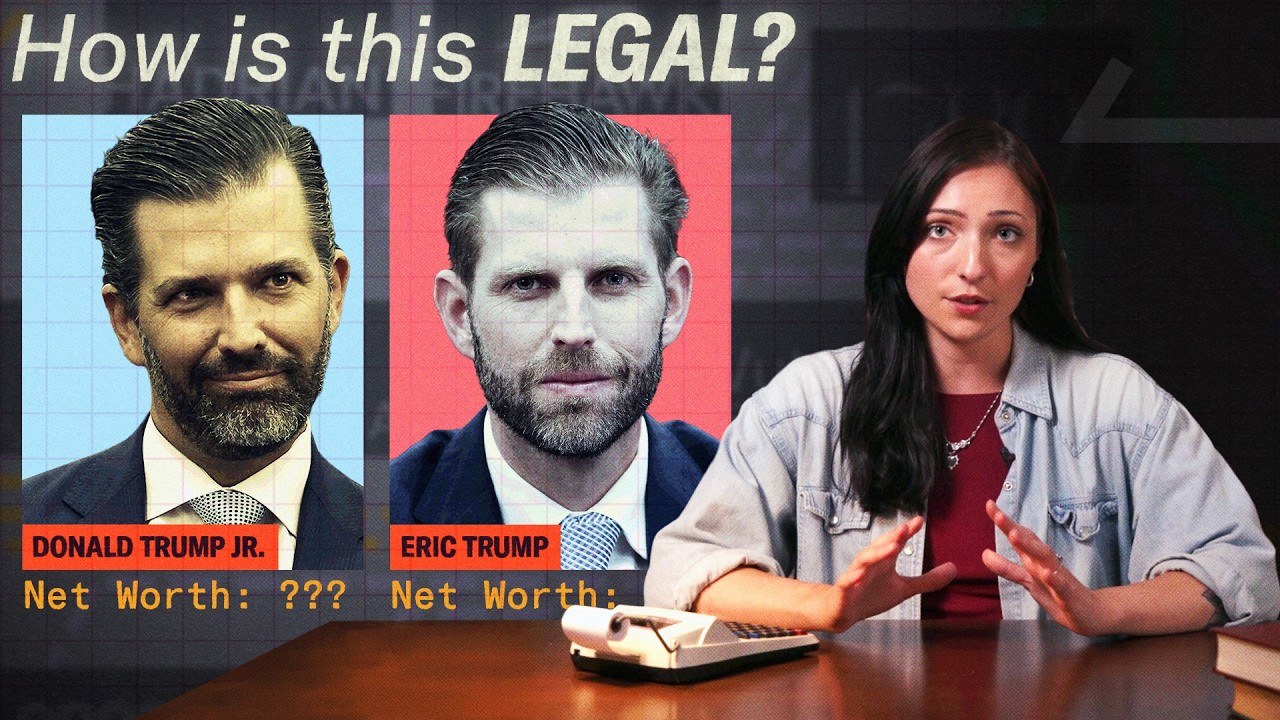
So how is any of this legal?
8:59
8 minutes, 59 seconds
If a mid-level contract worker at a Navy base owns stock in a company bidding for one of her contracts, she would lose her job. She would likely face criminal charges, too.
9:08
9 minutes, 8 seconds
for Don Jr and Eric, there's nothing. No law covers the president's children.
9:14
9 minutes, 14 seconds
There's no requirement to recuse themselves from decisions that benefit their investments.
---
---
AN 6 26
Before President Donald Trump's administration dropped charges against Indian billionaire Gautam Adani, he had a meeting with the president's son, Donald Trump Jr.
Bloomberg reported Tuesday morning that when Trump Jr. was in India last November for "a wedding and a wildlife sanctuary tour," he met with the billionaire about a year after the Justice Department "accused the 63-year-old Adani Group chairman and his nephew Sagar Adani of orchestrating an allegedbribery scheme in India." They continue to deny the charges and the DOJ moved to drop them last month.
The conversation between the two was private. Don Jr. has been occasionally helping his brother run the Trump Organization, but a spokesperson for him maintains, “Don had zero to do with DOJ’s actions in this case."
Adani's indictment came shortly after the 2024 election.
"The case, which accused Adani and others of a scheme to pay more than $250 million in bribes to Indian government officials to lock in solar energy contracts, immediately drew some criticism as an overreach. The Justice Department claimed the Adanis had lied about the alleged scheme when their renewable energy business raised capital from US-based investors and international institutions through dollar bonds and loans," reported Bloomberg.
In response to the charges, Adani hired a team of lawyers and lobbyists to help him kill the case. His two sons were also helping with the effort. His son Jeet is leading the operation, according to those familiar. He met with Don Jr. at Mar-a-Lago last year, though a person familiar with the meeting said the two didn't discuss the case against Adani's father.
Trump's immigration policies made it difficult for Adani to enter the United States for business purposes. He'd previously pledged to invest $10 billion in the United States after Trump was elected.
"Earlier this year, Adani’s lawyers shifted gears and moved aggressively to get the criminal case dropped. They also sought to resolve a parallel Securities and Exchange Commission civil fraud case and a separate probe by the Treasury Department’s Office of Foreign Assets Controlinto whether an Adani unit violated Iran sanctions," the report explained.
Adani hired the law firm Sullivan & Cromwell, whose co-chair, Robert Giuffra Jr., is working as one of Trump's personal attorneys. It delivered them a direct line to the president. The legal team argued that the suit was absurd and had no credible evidence. It also included a slide in the presentation showcasing the $10 billion investment in the U.S.
By May, the DOJ dropped the case, and the SEC agreed to an $18 million settlement with Adani. "The conglomerate’s flagship Adani Enterprises Ltd. also reached a deal to resolve OFAC’s sanctions probe for $275 million without an admission of wrongdoing," the report added.
While in court last month, prosecutors said that they simply decided “not to devote further resources to these criminal charges against individual defendants." They never said directly what prompted them to drop it.
---
flynn fara putin
- [
AInvest
The Transatlantic Shift: Trump Jr.'s Play for Eastern Europe's Economic ...
Apr 26, 2025Real Estate and Brand Licensing: The Trump Organization's ventures—such as a proposed golf resort in Serbia and a luxury hotel in Belgrade—serve as tangible investments in this strategy. These projects aim to capitalize on the region's underdeveloped tourism infrastructure while leveraging the brand's global appeal.
MSN
Trump Jr. Heads to Eastern Europe to Expand Family Business - MSN
US President Donald Trump's eldest son will make a trip to eastern Europe, where he's seeking to expand his family's business ties, according to people familiar.
The Maga push overturning US policy in the Balkans
Dec 10, 2025South-eastern Europe jolted by Trump's support for pro-Russia Serb leader
New York Times
https://www.nytimes.com › 2025 › 03 › 19 › us › politics › donald-trump-jr-serbia.html
Donald Trump Jr. Mixes Business and Politics in Serbia, as Protests ...
Mar 19, 2025Donald Trump Jr.'s visit immediately became national news in Serbia, apparently showing that the Trump administration supported the current government despite the growing protests.

BBC
https://www.bbc.com › news › articles › c1e3q6g5n00o
Serbia clears the way for controversial Trump-linked property plan - BBC
Nov 8, 2025Serbia's parliament has passed a law which paves the way for a controversial property development led by US President Donald Trump's son-in-law Jared Kushner in the capital Belgrade.

European Council on Foreign Relations
https://ecfr.eu › publication › trumps-tinderbox-us-politics-and-the-next-war-in-the-balkans
Trump's tinderbox: US politics and the next war in the Balkans
Oct 29, 2024Summary Over recent years, Serbia's government and Serb nationalists elsewhere in the Western Balkans have increased their revisionist agitation in the region. They recently adopted an "all-Serb declaration" that seeks to overturn the post-Dayton settlement in Bosnia and Herzegovina, and claims Kosovo as an inseparable part of Serbia.

cfwbs.org
https://cfwbs.org › trump-and-the-balkans-great-deals-or-great-risks-ljubomir-filipovic
Trump and the Balkans: Great Deals or Great Risks? - Ljubomir Filipović ...
Dec 20, 2024For countries like Bosnia and Kosovo, this stagnation has paralleled a standstill in their aspirations for European Union membership. Trump's transactional approach to foreign policy—focused on striking deals rather than promoting systemic change—led to opportunities and challenges in the Balkans.

AP News
Serbian lawmakers pass special law for real estate project linked to ...
Serbian lawmakers have passed a special law clearing the way for a proposed real estate development project that would be financed by a company linked to Donald Trump's son-in-law Jared Kushner but which has faced widespread public opposition and legal hurdles.


GIS Reports
https://www.gisreportsonline.com › r › u-s-diplomacy-in-the-western-balkans
U.S. diplomacy in the Western Balkans under President Trump
Sep 4, 2025Finally, President Trump's global strategy includes playing a constructive role in mitigating regional conflicts and promoting "free and open" spaces through projects such as Central and Eastern Europe's Three Seas Initiative, of which the U.S. is a key strategic partner.

La Voce di New York
Donald Trump Jr. Visit in Serbia: Mixing Business and Politics
Mar 20, 2025Trump Jr.'s brief visit included a meeting with Vučić to discuss U.S. foreign aid to Serbia. The Trump family and Jared Kushner, the husband of Trump's daughter Ivanka, are involved in building a Trump International Hotel in Belgrade, the first of its kind in Europe.

DW
https://www.dw.com › en › us-president-donald-trumps-trio-for-the-balkans › a-71649332
US President Donald Trump's trio for the Balkans - dw.com
Feb 18, 2025President Trump's new team for the Balkans includes some familiar faces with close ties to Serbia: son-in-law Jared Kushner, former special envoy Richard Grenell and ex-governor Rod Blagojevich.

Balkan Insight
Serbia Spending More on Trump-Linked Lobbyists - to What Effect?
Feb 27, 2026Experts doubt the effect of Serbia's spending on US lobbyists to burnish the country's image in the eyes of Donald Trump.
---
---
---
AN 5 26
Las Vegas has always had a reputation for doing things bigger, louder and glitzier than everyone else. On Sunday, May 24 2026 it continues that tradition when the inaugural Enhanced Games take place at a purpose-built entertainment centre at Resorts World, a giant hotel complex on the city’s famous strip.
A one-day sports competition showcasing just three disciplines, the Enhanced Games openly embrace the use of legal performance-enhancing drugs (PEDs) and technological advances that maximise human potential.
Conceived by London-based entrepreneur Aron D’Souza and backed financially by billionaires Peter Thiel, Christian Angermayer and Donald Trump junior, the one-day extravaganza will see 42 athletes competing in swimming, track athletics and weightlifting.
With substantial appearance fees and an unprecedented US$25 million (£18.6 million) in prize money – including US$1 million bonuses for breaking world records – the lucrative payouts have attracted some big names. These include Olympic medallists Cody Miller and Ben Proud for swimming; Olympic medallist Fred Kerley for track; and record-breaking weightlifter Thor Björnsson.
The Enhanced Games has drawn widespread criticism from international and Olympic sport. The World Anti-Doping Agency (Wada) has labelled them a “dangerous and irresponsible concept”, threatening to test athletes involved to “protect the integrity of legitimate sport” – despite the majority being retired from traditional sport. Wada also urged US authorities to shut down the games – which evidently didn’t happen.
The International Olympic Committee (IOC) also issued a formal statement calling the games “utterly irresponsible and immoral … a betrayal of everything we stand for”. Travis Tygart, CEO of the US Anti-Doping Agency dismissed the Enhanced Games as “a dangerous clown show”.
In response, D’Souza argues that Wada is hypocritical and points to Olympic corruption scandals, claiming the Olympics are no longer fit for purpose. Other supporters have also promoted the idea of self-determination, and the need to break free of the IOC’s rules and regulations.
As sport researchers, we might be tempted to dismiss the event as a publicity stunt. However, based on our ongoing research into Olympic swimmers and coaches’ perceptions of the Enhanced Games (we have spoken to more than 20 so far), we believe the event is symptomatic of bigger issues. It represents a critical inflection point, and a unique opportunity to reflect upon the current shortcomings of traditional sport.
Sport’s ideological war
Deeply entrenched battlelines have been drawn on both sides of this complex debate. Recent events, such as Enhanced Games swimmer Kristian Gkolomeev breaking the former 50m freestyle world record, the games’ filing of an US$800 million anti-trust lawsuit against Wada, World Aquatics and US Swimming, and the Enhanced Group’s recent floating on the New York Stock Exchange are telling. They all appear to be the first shots fired in a potentially long and protracted ideological war over the future of sport.
Proponents argue that permitting PEDs such as testosterone, anabolic steroids, growth hormones, peptide hormones and stimulants could potentially unlock unprecedented human potential, allowing athletes to transcend current biological limits. Here, the Enhanced Games and the Olympic Games share a common goal of maximising human potential; the difference lies in precisely how it should be achieved and the transparency surrounding those methods.Supporters of the Enhanced Games also argue that a regulated approach to using PEDs under strict medical supervision is safer for athletes, transforming what is currently an illicit, underground practice into a controlled medical environment, akin to legalising substances like cannabis.
Conversely, defenders of traditional sport argue that this approach contradicts the fundamental integrity of sport. They assert that Olympism is based on natural talent, dedication and rigorous training, free from artificial advantages. Concerns have also been raised about the long-term health consequences for athletes who use PEDs, and the negative role modelling for young athletes who may see drug use as a shortcut to success.
Threat or revolution for sport?
Another critical battleline relates to whether the Enhanced Games exacerbate or alleviate existing issues of integrity within traditional Olympic sport. Proponents of the Enhanced Games – including many of the Olympians that we interviewed – argue that the current system is fundamentally flawed.
These athletes cite what they see as the rampant and pervasive use of PEDs (meaning it’s an open-secret), the misuse of therapeutic use exemptions, the ineffectiveness and erosion of trust in anti-doping authorities, and the need to better compensate athletes for their contribution to sport.
Many people within traditional sport view the Enhanced Games as a profound existential threat to the moral legitimacy of Olympism. However, far from being a circus sideshow, its emergence is symptomatic of deep-rooted, longstanding issues and continued failings that need to be resolved within traditional sport.
Instead of perceiving the Enhanced Games as a rival or threat to the Olympic Games – which we do not believe it is – its emergence should be viewed as a wake-up call. Traditional sport needs to direct efforts to solve these fundamental problems and reflect upon the true value of sport and its role in society.
In this light, we see the emergence of the inaugural Enhanced Games as a window of opportunity for much-needed conversations within international and Olympic sport.
Mathew Dowling, Senior Lecturer in Sport Management, Loughborough University; Alex Thurston, Lecturer in Sport Management, Loughborough University, and Jinsu Byun, Assistant Professor of Sport Management, Yonsei University
This article is republished from The Conversation under a Creative Commons license. Read the original article.
---
PSW 4 26 CORRUPT
ARAB JUSTIN SUN SUE LIBERTY, DRONE PLUS GOLF MERGER
Apr 22, 2026 Pod Save the World
Tommy and Ben break down another chaotic and consequential week in global affairs. Trump blinks and extends the ceasefire with Iran, but the Strait of Hormuz remains closed as US-Iran negotiations stall. Meanwhile, an internal power struggle between Iran's elected leaders and military is complicating talks, and the human cost for ordinary Iranians continues to mount. In Lebanon, Trump stunned Israeli Prime Minister Bibi Netanyahu by publicly ordering Israel to stop bombing, but the IDF continues to occupy southern Lebanon, and an explosive image of an IDF soldier desecrating a statue of Jesus Christ threatens to erode evangelical support for Israel.
The guys also dig into the sprawling conflicts of interest and corruption plaguing Trump's foreign policy team: Jared Kushner's billion-dollar Gulf slush fund, Don Jr. and Eric Trump’s drone grift, and the Trump family’s foray into the crypto and fusion energy business. Finally, they talk about the historic election results in Hungary and Bulgaria,
Trump’s slow-rolling regime change efforts in Cuba, and reports that FBI Director Kash Patel is such a sloppy drunk that he’s become a threat to national security. Then Tommy is joined by former USAID official Nicholas Enrich to talk about his new book, Into the Wood Chipper: A Whistleblower’s Account of How the Trump Administration Shredded USAID. Preorder Ben’s book All We Say: The Battle for American Identity: A History in 15 Speeches and subscribe to his Substack here.
---
---
AN 2 26
Gizmodo reported on Donald Trump Jr. and Eric Trump’s Wednesday Mar-a-Lago conference pushing their family crypto company, World Liberty Financial.
“In many ways, it’s a victory lap for the Trump family, a recognition that there is no mechanism available to stop the unprecedented corruption that’s being done out in the open, as foreign governments and U.S.-based executives jostle to please the Trump regime and profit from their proximity to political power,” reports Gizmodo.
“We were the most canceled people in the world in 2020, 2021,” Eric Trump told CNBC host Sara Eisen. “And it’s really great to almost have this retribution where all of a sudden we start pushing an agenda. Our agenda was to modernize finance, to allow that to never, ever, ever happen to anybody again.”
“The part Eric Trump is leaving out,” said Gizmodo writer Matt Novak, “is President Trump’s attempt at a self-coup on Jan. 6, 2021, sending a violent mob to storm the U.S. Capitol in a bid to remain in power after losing the 2020 election. The president was banned from the major social media platforms, and his family was cut off from some banking opportunities over his effort to overthrow the government. The president has since sued JPMorgan Chase and CEO Jamie Dimon over the moves.”
Gizmodo also reports the Trump sons “bragged” to CNBC about how opening their own crypto company has given them “credibility.” But Gizmodo counters that World Liberty Financial’s stablecoin, USD1, is “a fiat-backed cryptocurrency that the Trumps have tried to tout as a brilliant hedge against the traditional financial system, an argument that doesn’t make much sense given how dependent it is on that same system for stability.”
Donald Trump Jr. remains irritated that the family was briefly debanked, and he did not appreciate how banks could drop a customer at their own discretion.
“Crypto totally democratizes the ability for people to transact, to do finance, to get the loans that they need for businesses that make sense. That didn’t exist for everyone,” said Donald Trump Jr., which is a “frankly idiotic” suggestion said Novak.
“Just last year, World Liberty blacklisted Justin Sun’s blockchain address, which has over 595 million WLFI tokens, due to suspicious transactions,” said Gizmodo. “… Every financial institution, whether it’s focused on crypto or traditional banking, has to follow certain laws and regulations and has the discretion to lock up funds or boot anyone it doesn’t like.”
When Eisen asked the Trump sons about the $187 million paid to Trump family reps by people connected to the Emirati royal family, Donald Trump Jr. insisted that his father had “nothing to do with it” and that the UAE investment wasn’t at all related to the AI chips that President Donald Trump immediately granted the UAE access to after their generosity.
“We’ve been dealing with the conflict-of-interest stuff for years. And they tried all this nonsense the first time around. Frankly, it’s gotten old,” Donald Trump Jr. told Eisen.
Novak points out that Jr. is referring to the fact that “no other White House in modern history has seen the president and his family profit in such a galling way.”
---}:
MMA
As Trump threatens regime change in Venezuela, right-wing media embrace opposition figure María Corina Machado
Conservative pundits have given Machado a platform to agitate in favor of Trump’s aggressive military campaign, while she’s given them fuel for discredited conspiracy theories
Written by John Knefel
Research contributions from Alex Kaplan, Sophie Lawton, Monica Rodriguez & Ben Van Bloem
Published 12/03/25
Right-wing media figures have spent the last year championing Venezuela opposition figure María Corina Machado, who has supported President Donald Trump’s threats of regime change in her home country.
The relationship between Machado and conservative media is mutually reinforcing: She provides right-wing outlets with inflammatory claims about President Nicolás Maduro — including exaggerated or false accusations of tampering in U.S. elections and running narcotics enterprises — and in return these outlets provide her with a platform to agitate for his ouster. As The New York Times reported, Machado recently endorsed the debunked conspiracy theory that Venezuela interfered in the 2020 U.S. election, further ingratiating herself to MAGA by adopting one of the movement’s core tenets. She has also claimed without evidence that Maduro is the leader of two drug cartels, one of which doesn't even exist as a discrete or coherent organization, according to many experts.
Since early September, President Donald Trump has ordered airstrikes on at least 21 boats, killing at least 83 people, in the Caribbean Sea and Pacific Ocean — part of a larger pressure campaign aimed at removing Maduro from office. In October, the administration ended diplomatic outreach to the country, though Trump and Maduro reportedly spoke over the phone in late November. Secretary of State Marco Rubio, a key Machado-backer, has been pushing for Maduro’s ouster for months with what some believe is an eye toward eventually collapsing the government of Cuba as well.
Right-wing media responded to Trump’s escalation by defending the extrajudicial boat strikes and pushing for even greater incursions into Venezuela, including toppling Maduro’s government. Many in conservative media have told their audiences that regime change in Venezuela would be easy, despite all evidence to the contrary.
- ### Right-wing media celebrate Machado
Right-wing coverage of Machado often relies on a blurry distinction between supporting Machado and cheering the removal of Maduro on the one hand while misleadingly claiming to oppose U.S.-led regime change on the other — arguably a distinction without a difference. Sometimes Machado employs this sleight-of-hand rhetorical device herself, seemingly to assure her audience that attacking Maduro’s government would not result in a replay of George W. Bush’s unpopular forever wars.
Fox News’ Rachel Campos-Duffy is perhaps Machado’s most significant ally in right-wing media, having interviewed her in both English- and Spanish-language media. Campos-Duffy’s colleagues at Fox have also praised Machado, as has Donald Trump Jr. on his Triggered podcast. Other conservative figures celebrated her even prior to Trump’s election in November 2024.
- In July 2024, Sebastian Gorka discussed Machado on hisAmerica Firstshow with a guest who said Machado “has been the real leader of Venezuela for years.” Guest Joseph Humire was, at the time, executive director of a think tank focused on national security issues and now serves as deputy assistant secretary of war for Western Hemisphere affairs, according to his LinkedIn page. A later analysis of Humire’s think tank found that it spread false information about Tren de Aragua, a criminal organization in Venezuela. Gorka, now a counterterrorism adviser to Trump, and Humire were discussing the recent election in Venezuela, in which Maduro claimed victory despite international observers determining the election did not meet democratic standards. Salem Media Group, *America First with Sebastian Gorka*, [7/29/24; LinkedIn, accessed 10/7/25; C-SPAN, 8/21/25; The Carter Center, 7/30/24; The Guardian, 8/13/25]
- In January, just days before Trump’s second inauguration, Campos-Duffy said Machado is “considered Venezuela’s liberator” and floated the possibility of regime change within the year. Campos-Duffy then paraphrased Trump’s approach to the Western Hemisphere, saying, “We will control our backyard, our neighborhood. And that is what you’re seeing play out right now.” She continued: “Venezuela couldn’t be happier that Donald Trump won, but it’s going to be difficult to take this dictator out of power. It’s going to be a very interesting year for Venezuela.” Fox News, *Fox & Friends*, [1/10/25]
- In March, Donald Trump Jr. interviewed longtime U.S. mercenary and Blackwater founder Erik Prince, who said the Maduro government is “going to have to be pushed out. And it doesn’t require U.S. military — it can be covert action from the intelligence community or covert action from Venezuelan patriots helped by outsiders.” Earlier in the interview, Prince said: “María Corina Machado is a brave woman and deserving of our help and our support. And they did to her what they tried to do to your dad.” Prince added that “the Maduro regime” is “effectively a narco-state,” and accused it of “exporting leftist, communist money to all the other political parties all across the continent.” Earlier, in February, Trump Jr. gave Machado a friendly interview on his program as well. Rumble, *Triggered*, [3/17/25, 2/26/25; The Wall Street Journal, 8/16/25]
- Trump Jr. returned to the subject in April in an interview with Secretary of State Marco Rubio, during which Trump referred to Machado as “clearly the choice of the Venezuelan people.” Rubio added that Machado was “one of the bravest people in the world.” Rumble, *Triggered*, [4/8/25]
- :{:{In July, former GOP congressman and current One America News host Matt Gaetz interviewed right-wing activist Roderick Navarro, who has long supported the overthrow of Maduro and now said that “it is necessary that María Corina Machado, which is the leader of the opposition, the true opposition, can be aligned with the Secretary of State Marco Rubio, to end this situation as soon as possible.” Navarro’s statement came in response to a question from Gaetz about how change could come to Venezuela following the disputed election the previous year. One America News,:(style="background-color:#ffff00ff"):}: *The Matt Gaetz Show*, [7/20/25; The Guardian, 12/14/18]}:
- In August, Trump Jr. interviewed Deputy Secretary of State Chris Landau, who said Machado is “somebody that I admire tremendously, and clearly she won the election last year.” Landau continued: “I very much look forward to a day, very soon, when we have constitutional order restored in Venezuela.” Earlier in the interview, Landau cautioned against U.S.-led regime change. Rumble, *Triggered*, [8/11/25]
- The same month, Campos-Duffy interviewed Machado, giving her an opportunity to persuade Americans who support Trump “taking on Nicolás Maduro” but worry that “this kind of smells like regime change.” Machado responded: “This has nothing to do with regime change for two reasons. First, because the change of the regime was already mandated by the presidential election we won by a landslide. And secondly, because this is about dismantling a criminal terrorist enterprise that has taken the power of Venezuela by force.” She added: “We are ready to take power — the legitimate government, elected. Venezuela will move orderly and peacefully to the transition.” Fox News, *Jesse Watters Primetime*, [8/13/25]
- Two days after Trump’s initial boat strike on September 2, Machado said in an interview with Campos-Duffy that Maduro “is understanding, finally, that the time of impunity is over and it is in his best interest to accept the will of the people that voted against him. It’s time to go.” Campos-Duffy replied, “The pressure is mounting and he is feeling more and more like a caged animal.” Fox News, *Fox & Friends*, [9/4/25; The New York Times, 9/2/25]
- On September 6, Campos-Duffy argued that “Latin American social media” was proof of “cries from the entire hemisphere of, yes, do it, we need to get rid of these cartels, we need to have our countries back, liberate us President Trump” because “they know it can only happen with him.” During her appearance on Fox & Friends Weekend, which replayed her Machado interview, Fox’s Brian Brenberg added, “Machado is one of the most impressive leaders around the globe, and your interview with her was awesome. Following that story is like following the story of liberty, and I hope it has a very successful ending.” Fox News, *Fox & Friends Weekend*, [9/6/25]
- On September 30, Campos-Duffy again interviewed Machado, who said outright that “Maduro is not the president.” Machado added, “Maduro is illegitimate, as the secretary of state, Marco Rubio, has repeated so many times,” and said that “regime change was demanded last year with the vote of the Venezuelans.” Fox Deportes, *Fox Noticias*, [9/30/25]
- :{:{In October, Fox News host Sean Hannity said Machado “sounds like a pretty good leader to me for the people of Venezuela and the end of narco terrorism.” Fox News:(style="background-color:#ffbb16ff"):}:, *Hannity*, [10/20/25]}:
- A few days later, Campos-Duffy hinted that the Rubio-led campaign against Venezuela could expand to other Latin American countries. “A lot of people saying, we’ve heard María Corina Machado say it on our show as well, if Venezuela returns to the people who won the election last July, to the opposition party, and the Marxist, you know, socialist government of Maduro goes down, so will Cuba and so will Nicaragua. It will essentially get all of the communists out of our hemisphere,” Campos-Duffy said. Fox News, *Fox & Friends Weekend*, [10/25/25]
- OnSunday Night In America with Trey Gowdy, after Rep. Maria Salazar (R-FL) mentioned that Venezuelan opposition leader Maria Machado is planning to “open the oil rigs” to U.S. companies, host Trey Gowdy mentioned that “she may be leading that country here in the not-too-distant future.” Fox News, *Sunday Night in America with Trey Gowdy*, [10/26/25]
- On November 19, Campos-Duffy teased an upcoming interview with Machado, arguing that “unlike other countries where you’ve seen regime change and the U.S. has been in some way involved, Brian, this is a country that doesn't need to be stood up economically.” Earlier in the segment, host Brian Kilmeade asked: “Rachel, it looks like she’s preparing to take over. Does she know something that we don’t?” Fox News, *Fox & Friends*, [11/19/25]
- The interview aired a few days later on November 22, with Machado predicting that Venezuela “will see an orderly and peaceful transition … that will happen very soon.” During a separate segment of the interview, Machado argued that “regime change was already mandated by the Venezuelan people by a landslide.” She said “Maduro started this war; President Trump is ending this war,” adding that “we are solving and dismantling a criminal structure that has produced great pain and turn our country, our nation, into the best ally of the United States — a security shield for the Americas and a huge opportunity for energy security.” Fox News, *Fox & Friends Weekend*, [11/22/25, 11/22/25]
Machado’s rise has also given election deniers an opportunity to revive the long debunked conspiracy theory that Venezuela interfered in the 2020 U.S. election against Trump. Machado — who had recently been awarded the Nobel Peace Prize — repeated that false claim during an October 31 interview on a Bloomberg podcast. “I have no doubt that Nicolás Maduro, Jorge Rodríguez, and many others are, you know, the masterminds of a system that has rigged elections in many countries, including in the U.S.,” Machado said. “I have no doubt about that.”
Former Overstock CEO and "prominent election denier" Patrick Byrne mocked a post criticizing Machado’s interview on his Telegram channel, writing that people who say the 2020 U.S. was fair “doth protest too much.” In August, Byrne claimed that Smartmatic, which provides electronic voting systems, is “a spinoff of the Venezuelan government” and that the company “has been rigging elections for people around the world.” In October, Bryne said the United States had to “overthrow the governments of Venezuela and Cuba" because they “overthrew our republic.”
In November, Trump promoted a right-wing show on social media during which a guest said “there are at least a dozen people in Venezuela that have more money and power” than the CIA, adding: “This is the largest transnational criminal organization in the world that no one knew about, or no one wanted to talk about, until they stole our election in 2020."
- ### What comes next
For all of the right-wing media claims that Maduro interfered in the 2020 election, it’s worth underscoring that in 2002 the United States at least tacitly supported a failed coup against then-President of Venezuela Hugo Chavez. During Trump’s first term, his administration engineered an unsuccessful campaign to oust Maduro and install opposition figure Juan Guaidó.
:{:{Despite those failures, conservative media have embraced Machado in a way that’s reminiscent of earlier episodes in U.S. foreign policy, when media and government officials celebrated opposition figures in the early years of the invasions and occupations of Afghanistan and Iraq.}:
As The New York Times notes, Machado has been a “darling” of Washington for decades, and her people are in constant contact with Secretary Rubio, the Trump administration figure leading the charge to topple Maduro. One possible reason Washington has been enthralled with her for so long is that, according to Bloomberg, she “favors privatizing all industries in Venezuela,” including the state-owned oil company, if the United States takes out Maduro. Ian Bremmer noted that U.S. action in Venezuela “in large part about the oil.”}:
Should Trump's plan move forward, Machado is the most likely candidate for his administration to rally behind. She’s already won over right-wing outlets — but as U.S. campaigns in Iraq and Afghanistan showed, sometimes an opposition figure’s charm offensive is the easiest battle of the war.
---
---
AN 11 25
A controversial theory that states an “aristocracy” is needed to move the country forward is being pushed as the playbook for a post-President Donald Trump MAGA with tech-elites at the center of power, according to the Washington Post.
At the center of this theory is a lesser known "tech elite," Arizona insurance entrepreneur and conservative media Chris Buskirk, who according to the Post, "helms the Rockbridge Network, a secretive organization ... that has established itself as one of the most influential forces in GOP politics."
"With significant funding from tech leaders, Rockbridge aims to equip MAGA to outlive Trump," the Post explains.
The group is gearing up for the midterms and the 2028 presidential election, in which members "hope" Vice President JD Vance — a close ally of tech billionaire Peter Thiel — will be the Republican nominee.
Although Buskirk is much more low-key than Thiel and his more known billionaire buddies, his ties to the Trump world run deep, the Postexplains.
1789 Capital, the venture capital firm Buskirk co-founded with investor Omeed Malik, focuses on what the partners call “patriotic capitalism” and now counts Donald Trump Jr. as a partner, the Post says, adding "the pair — along with administration officials and friends — recently launched Executive Branch, a $500,000-a-head membership club for Trump-supporting business leaders to hobnob in D.C."
While some see a direct contradiction to the notion of MAGA elite at the helm a populist movement, Buskirk, the Post says, argues they're "not in defiance of MAGA’s populism."
"Buskirk says the MAGA movement has energized a new generation of stewards for the country," the Post writes.
"His various projects echo what some on the right call 'aristopopulism' and aim to build a bridge between wealthy capitalists and the working-class people they intend to represent, according to interviews with Buskirk and nine other people in his inner circle, profitably reindustrializing the country and tying their interests to that of their base," the Post explains.
Buskirk explains it, saying, "You either have an extractive elite — an oligarchy — or you have a productive elite — an aristocracy — in every society."
And while Buskirk says he was initially skeptical of Trump as he emerged from reality television host to the presidency, "He’s actually been saying the same thing for 40 years! And that’s when I realized, okay, he’s for real. And the people that are saying he is not serious are lying.”
In his book "America and the Art of the Possible," Buskirk argues for "a proper elite that takes care of the country and governs it well so that everyone prospers.”
Oren Cass, chief economist of the conservative think tank American Compass, says that while some still view Trump’s support as “a cult of personality,” Buskirk helms a "powerful ecosystem" that now backs the MAGA movement.
“Chris is the convener of that ecosystem,” he tells the Post.
Malik agrees, telling the Post that Buskirk was “the first mover” to recognize that there were going to be thousands of well-off people who “no longer felt at home in the Democratic Party."
Vance, who became fast friends with Buskirk after being introduced by Thiel, also gave a rousing endorsement in a statement to the Post saying, he's an "original thinker” who saw “before almost anyone” how the “right combination of ideas, organizing and funding can ensure lasting political success for the Republican Party.”
Malik hosted a small fundraiser for Vance at a Palm Beach restaurant during his "long-shot bid" for public office in 2022. Following that, they went to Mar-a-Lago, where Buskirk was having a Rockbridge conference.
"The men spent the week bonding over their rage about what they viewed as online censorship and a feeling that innovation was being stymied in favor of liberal priorities such as sustainability and diversity initiatives," the Postwrites.
Critics, however, see Buskirk's movement as "the rise of a group of unelected American oligarchs who are undermining Trump’s promises to benefit working people," the Post writes.
Michael Strain, director of economic policy studies at the right-leaning American Enterprise Institute, says "the government’s job is to advance the prosperity of the nation and not the prosperity of wealthy individuals, founders, and executives.”
However, thePost says that interest in Buskirk's group has surged and "the vibe is euphoric."
"Several of the group’s members are billionaires; prominent investors Marc Andreessenand David Sacks are already members," they explain.
Richard Painter, a corporate law professor at the University of Minnesota who served as chief ethics lawyer in the George W. Bush White House, "said this influx of interest in Rockbridge, 1789 and Executive Branch, creates the appearance of a 'pay-to-play' network, of people who are paying to get access to administration officials or the Trump family."
Buskirk insists he knows what will make America actually great, telling the Postthat American greatness will only be accomplished “by the intentional cultivation of talented, high-agency people working together in high-trust environments.”
SOUNDS LIKE THE Mafia?
---
---