Fairness Doctrine
---
ntbcq = time?
Major damage to the media's willingness to balance commercial and public interests resulted from the removal of the Fairness Doctrine, which was designed to ensure that broadcasters present opposing viewpoints about public issues. (The Fairness Doctrine should not be confused with the equal-time rule, which requires TV and radio stations to provide equal coverage to any opposing political candidate that asks for it.)
---
---
AN 5 25
Trump’s ratings continue to slide on most issues. Recent Economist/YouGov polling across the US, completed on May 9-12, shows 51% think the country is on the wrong track, while only 45% have a favourable impression of his job as president. On inflation and prices in the shops, only 35% approve of his handling of this policy.
Trump seems to be scoring particularly badly with young voters. Around 62% of young people (18 to 29s) have an unfavourable opinion of the president, compared with 53% of the over-65s.
Meanwhile, the Trump administration continues to pursue an agenda to close down, or shackle, much of the media it considers not on his side.
Funding for national public service radio NPR and television PBS, as well as the global news service Voice of America, is under threat. Some national news outlets are under investigation by the Federal Communications Commission (FCC) for their coverage.
In a speech in March, Trump said broadcasters CNN and MSNBC, and some newspapers he didn’t name “literally write 97.6% bad about me”. He added: “It has to stop. It has to be illegal.”
The Trump team clearly see the role of the media as important to establishing and retaining support, and have taken steps to shake up White House coverage – including by changing who can attend the White House press pool.
About seven in ten members of the American public say they are following the news for updates on the Trump administration. It is interesting, therefore, to consider the role of the media in influencing Trump’s popularity, and insights can be found in the massive US Cooperative Election Study, conducted during the presidential contest last year.
That survey showed 57% of Americans had watched TV news in the previous 24 hours. Around 81% had used social media during the same period, but only 20% had used it to comment on politics.
There is a lot of attention being paid to fake news on the internet, which is helping to cause polarisation in the US. But when it comes to news about politics, TV coverage is still very important for most Americans.
The survey asked respondents about the TV news channels they watched, and Fox News came out on top with 47% of the viewers. ABC came second with 37%, and CBS and CNN tied on 35%. Fox News is Trump’s favorite TV station, with its rightwing populist agenda and regular output of Trump-friendly news.
Relationship between Trump voters and Fox News’s audience in 2024 US presidential election:
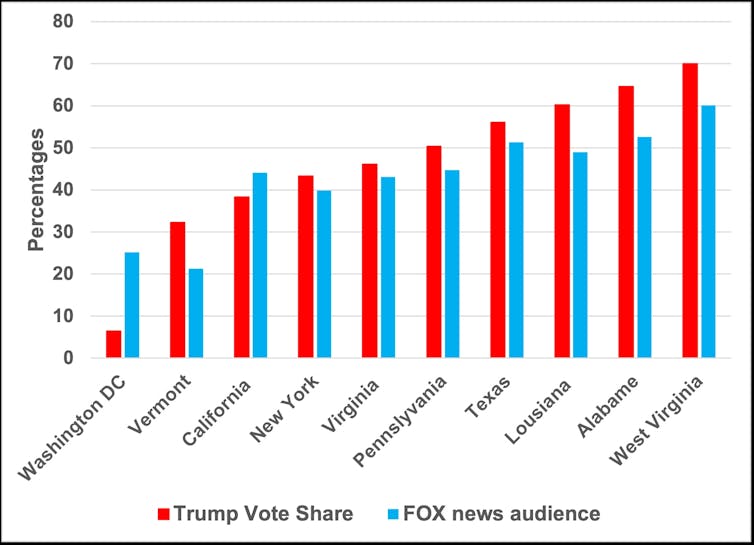
Source: Author graph based on Cooperative Election Study 2024, CC BY
The Cooperative Election Study had 60,000 respondents, which provides reasonably sized samples in each of the 50 states. The Trump vote varied quite a lot across states, with only 34% of voters in Maryland supporting him, compared with 72% in Wyoming. The electoral college formally decides the results of presidential elections, and this is based on states – so, looking at voting in this way can be quite revealing.
The connection between watching Fox News and Trump’s vote share can be seen in the chart above. It varies from 21% who watched the channel in Vermont to 60% in West Virginia.
Vermont is represented in Congress by Senator Bernie Sanders, a self-described socialist from a radical political tradition, and only 32% voted for Trump there. In contrast, West Virginia is part of the rust belt of impoverished states hit by deindustrialisation and the decline of the coal mining industry, and 71% voted for Trump there.
We can use a regression model (which looks at the relationship between variables) to predict support for Trump using key measures that drive the vote share for Trump in each state. The model uses three variables to predict the results with 95% accuracy, which means while not perfect, it gives a very accurate prediction of Trump’s vote.
Not surprisingly, partisanship – that is, the percentage of registered Republicans in each state – is one of the key metrics. In addition, ideology – the percentage of respondents who say they are conservatives – is another.
Perhaps more surprisingly, the third important predictor is viewership of Fox News. The relationship between watching the channel and voting for Trump is very strong at the state level. Also, the more time people spend watching the channel, the more likely they are to have voted for Trump.
Impact of key factors on Trump voting in 2024 US election:

Source: Author based on Cooperative Election Study , CC BY
This chart calculates the relationship between watching Fox News and other factors and the strength of a state’s support for Trump in 2024. If a variable is a perfect predictor of Trump voting, it would score 1.0 on the scale. If it is a perfect non-predictor, it would score 0.
So, the most important predictor of being a Trump voter was the presence of conservatives in a state, followed by the percentage of registered Republicans, and the third was watching Fox News. A high score on all three meant greater support for Trump.
To illustrate this, 45% of Texans considered themselves conservatives, 33% were registered Republicans, and 51% watched Fox News. Using these measures, the model predicts that 57% would vote for Trump. In fact, 56% voted for him in that state in 2024. So, while the prediction was not perfect, it was very close.
A similar predictive model can be used to forecast former Democratic presidential candidate Kamala Harris’s vote shares by state. In her case, we need four variables to predict the results with 95% accuracy – the percentage of registered Democrats, liberals and moderates in a state, and also Fox News viewership.
Not surprisingly in Harris’s case, the relationship between Fox News viewing and voting is strongly negative (correlation = -0.64). When viewership was high, the Harris vote was low.
Years ago, the “fairness doctrine” used to mandate US broadcasters to fairly reflect different viewpoints on controversial issues in their coverage. Candidates for public office were entitled to equal air time.
But this rule was removed by the FCC in 1987, and has led to an era of some broadcasters becoming far more partisan. The FCC decision followed a period of debate and challenges to the fairness doctrine. This led to its abolition under Ronald Reagan, the Republican president who inspired Project 2025 – the document that in turn appears to be inspiring the Trump government’s policy agenda.
When the Trump era is over, incumbent Democrats are going to have to repair US institutions that this administration has damaged. If they want to do something about the polarisation of US politics, they may also need to restore the fairness doctrine.
Had it not been removed in the first place, it is possible that Harris would have won the 2024 presidential election, since Fox News would not exist in its present form. Whatever happens next, the US media is likely to play an important role.
Paul Whiteley, Professor, Department of Government, *University of Essex
This article is republished from The Conversation under a Creative Commons license. Read the original article.
---
===
thom 3
an 9 24 no lnx
this week may well see a court decide the fate and future of Fox “News” and thus the Republican Party, at least in its current hard-right neofascist form. And odds are Fox viewers are blissfully ignorant about the pitched battle that just played out in a Reno courtroom over the future of their beloved propaganda outlet.
Sir Keith Murdoch was the notoriously racist and misogynist owner of a small newspaper chain in Australia. It was inherited by his son, Rupert, who — using sensationalism and bigotry — turned it into a multi-billion-dollar enterprise that spans three continents.
Former Australian Prime Minister Kevin Rudd called Rupert Murdoch “the greatest cancer on the Australian democracy” in the pages of The Sydney Morning Herald, the New York Times of Australia. Noting that Murdoch owns about “two thirds of the country’s print media,” Rudd wrote:
“In Britain, Murdoch made Brexit possible because of the position taken by his papers. In the United States, Murdoch's Fox News is the political echo chamber of the far right, which enabled the Tea Party and then the Trump party to stage a hostile takeover of the Republican Party. In Australia, as in America, Murdoch has campaigned for decades in support of tax cuts for the wealthy, killing action on climate change and destroying anything approximating multiculturalism.”
When Rupert was divorcing his second wife he put most of the family’s businesses into a trust, apparently to prevent her from grabbing a larger share of his wealth. The terms of that trust stipulate that when Rupert dies, his four children — Lachlan, James, Elisabeth, and Prudence — would share equal votes and power over the business dynasty their father had inherited from his father.
But now Rupert — who’s 93 years old — is having second thoughts, because James, Elisabeth, and Prudence are apparently not all that enthusiastic about Fox “News” and other Murdoch media outlets nakedly lying to and whipping up hatred among their viewers and readers, both here, in Australia, and in the UK. Only Lachlan, Rupert’s oldest son, is loyal to his father’s vision of peddling-hate-for-billions-in-profits.
So, Rupert went to court in Reno — the proceedings are sealed, but the case began last week and wrapped up yesterday (although we don’t yet know the result) — to try to break the trust and hand exclusive or primary control of his fiefdom to Lachlan.
Fox “News” viewers have no idea that they’re being constantly lied to, both by commission (like telling them the 2020 election was stolen by voting machines) and by omission. They think they’re seeing the world “as it is” and getting fair and balanced “truth” and “straight talk,” which is why Fox “News” is so potent.
Without Fox “News” there probably never would have been a January 6th coup attempt, and, given how thin their margins were, likely no 2000 Bush or 2016 Trump presidencies.
The stakes here are enormous. Some media observers believe that a major role in Barack Obama’s 2008 victory was Air America broadcasting my program and others to well over two-thirds of America with big stations in 62 major markets. (That ended when Mitt Romney decided to run for president and had his company buy Clear Channel, then flip all of the stations Air America was leasing from them from progressive talk to sports, killing the network in 2010.)
Similarly, the rise of Fox following Reagan fast-tracking Murdoch’s US citizenship has played a huge role in Republican victories across the nation and the solid hold the GOP has on red state America, where Fox and rightwing hate radio predominate.
Activist investors in the Fox media caliphate have tried to force a vote at the upcoming shareholders’ meeting that would require Fox “News” to label their opinion programming — which constitutes most of their programming — as “opinion.” An attorney for the activist shareholder group, Luke Morgan, told US News & World Report:
“There can hardly be a more significant issue for Fox than its misinformation problem. This is precisely the sort of issue that is appropriate for shareholder input.”
Nonetheless, to Murdoch’s great delight, no doubt, the Securities and Exchange Commission (SEC) ruled last week that Fox doesn’t have to start informing its viewers when their talent crosses the line from reporting to indoctrinating.
Weirdly, this drama within an Australian family may well determine the fate and future of the Republican Party and the conservative and MAGA movements in the US. The future of democracy in America.
It’s a real-life Succession drama and may take months to resolve.
Keep an eye on this story. While it’s probably the most under-reported major news story in America right now, the outcome will have far-reaching consequences for all of us.
https://kpfa.org/episode/the-ralph-nader-radio-hour-july-22-2019/
thom hartmann
RR got rid of fairness doctrine;
in 80's deal to let cable corps run thru public right of way was cspan and local public access shows; now 719 FCC looking to make a deal to get rid of; 1996 Telecomm act BC, operating in public interest was traditionally interpreted on radio is news at the top on the hour (even on music/entertainment?) TH says his job was to do news, and he would be fired if even seen talking to sales side, firewall;
==
719 AN cumulus
“The decision was made by local programming management based solely on concerns related to the application of the FCC’s Equal Time Rule,” a Cumulus spokesperson told HuffPost in a statement. “The effects of the FCC’s Equal Time Rule are widely understood and considered whenever these types of issues arise.”
Country music newsletter publisher Kurt Bardella, a former Republican congressional spokesperson who became a Democrat after the GOP embraced accused child molester Roy Moore, called Cumulus’ decision “an incredible act of cowardice for a company who’s slogan is ‘Where Every Voice Matters’ to censor an interview with someone who, for the first time ever, thought it was worthwhile to engage the country music audience in a conversation about the future of our country.”
==
great sum
https://www.alternet.org/media/what-news-wont-tell-you-about-news
...“Used to be,” I said, “that radio and TV stations had to deliver actual news in order to retain their over-the-air broadcast license. It was called ‘the fairness doctrine,’ and Reagan stopped enforcing it in ’87 and the Obama administration’s FCC removed it altogether. Then the media consolidated like crazy, in part because Reagan had stopped enforcing the Sherman Anti-Trust Act and no president since Jimmy Carter broke up AT&T has been willing to put it back into effect, and in part because of the media deregulation that Clinton signed in 1996.”
“So?” she asked. “Why does that mean that all we get now is nonstop hype and opinion-drivel?”
“It used to be that the metric news organizations used to determine if they were ‘doing their job’ was how well the American public was informed. That was actually a serious metric, pre-1987, because your station’s license depended on it. The public could – and did – complain that they weren’t being well-informed, and stations jumped when those FCC complaints came in. But now, the only metric the ‘news’ business uses is how many viewers they have and, thus, how profitable they are for advertisers.”
cf below NTBCW equal time
context powell memo:
media:
Lewis Powell recognized the significance of favorable public opinion as fuel for policies that benefit large corporations over people. The Powell Memo outlined how corporate ownership and influence in the media could be leveraged to craft a favorable image of big business and its ambitions.
The Powell Memo on Television:
"Moreover, much of the media − for varying motives and in varying degrees − either voluntarily accords unique publicity to these "attackers," or at least allows them to exploit the media for their purposes. This is especially true of television, which now plays such a predominant role in shaping the thinking, attitudes and emotions of our people."
(Direct link to this quote in the Powell Memo)
Powell believed that the media of his day abetted and promoted anti-business views. He recognized that if the largest companies were going to influence the trajectory of American politics, they would have to improve their standing in society by deflecting popular criticism, especially on television. Powell supported an increase in media presence of pro-corporate ideologues who could label viewpoints critical of corporations as biased. Yet rather than focus on how corporations could enhance their image on TV, Powell endorsed the notion of attacking the media's alleged liberal bias, directly or through surrogates. Since Powell’s memo, right wing groups like Accuracy in Media (AIM) have obsessed for decades over creating a "liberal media" bogeyman, accusing mainstream news broadcasters of a left-leaning bias, thereby threatening their claim of objectivity (and possibly undermine their support among corporate advertisers) and effectively shifting the news frame in a conservative direction. (See more on AIM in the "Complaints" section below).
The media landscape is significantly more conservative and partisan today than it was in Lewis Powell's day in part due to the decades-long campaigns waged by AIM and others (see Fairness and Accuray in Reporting). Top-level news programs like Fox News regularly accuse other mainstream media outlets of a "liberal bias," though studies on the subject repeatedly show no basis for the claims. A recent study by Media Matters ofSean Hannity's hour-long show about liberal bias, for instance, concluded that his claims were based onselectively edited quotesfrom media personalities to make them appear more opinionated.[james o'keefe]
The Powell Memo on Media Ownership:
"Most of the media, including the national TV systems, are owned and theoretically controlled by corporations which depend upon profits, and the enterprise system to survive."
(Direct link to this quote in the Powell Memo)
In spite of his complaints about the news media's bias, Powell pointed out the leverage that companies had (even then) over media outlets they owned or advertised through. Powell insinuated that such leverage can be used to promote or restrict certain content. Corporations have since tightened their ownership grip over the broadcast media while funding groups that succeeded in destroying the Fairness Doctrine (see below) and attacking independent media.
According to author Ben Bagdikian's 1983 edition of "The Media Monopoly," fifty companiescontrolled the majority of the U.S. news media. Now, just six major companies dominate the U.S. media--General Electric, Walt Disney, News Corporation, Time Warner, Viacom and CBS. In particular, News Corporation's Fox News channel has become infamous for its ideological bent and repeated factual distortions. Polls by the Pew Research Center, the Program on International Policy Attitudes at the University of Maryland, and NBC/Wall Street Journal have correlated greater levels of misinformation among Fox News viewers when compared to other mainstream media outlets.
Major damage to the media's willingness to balance commercial and public interests resulted from the removal of the Fairness Doctrine, which was designed to ensure that broadcasters present opposing viewpoints about public issues. (The Fairness Doctrine should not be confused with the equal-time rule, which requires TV and radio stations to provide equal coverage to any opposing political candidate that asks for it.) Although Ronald Reagan abolished the Fairness Doctrine in 1987, saying it violated the broadcasters' free speech rights, members of Congress have recently proposed to reinstitute the rules as a check on the increasingly partisan bias of cable news programs. The FCC has since declared the doctrine and some 80 rules that go along with it "outdated and obsolete."
The Powell Memo on Media Complaints:
"Complaints − to the media and to the Federal Communications Commission − should be made promptly and strongly when programs are unfair or inaccurate."
(Direct link to this quote in the Powell Memo)
Despite the increased concentration of corporate ownership over major news media, conservative activists continue to follow Powell's advice by complaining to the Federal Communications Commission (FCC) about biased coverage against the political right wing.
According to a new FCC estimate obtained by Mediaweek, nearly all indecency complaints in 2003—99.8 percent—were filed by the Parents Television Council (PTC), a conservative activist group founded in 2001 by L. Brent Bozell III. Bozell is a leading right-wing media watchdog and President of the Media Research Center (MRC), a $13 million/year operation (2010) that "educates and mobilizes the general public against runaway liberal media bias." Funding for MRC and the PTC come from dozens of conservative and family foundations, including Scaife, Koch, Bradley, Olin, Castle Rock (Coors), and others. (See page 24 of MRC's annual report, Media Matters and ExxonSecrets).
While corporate front groups and right-wing ideologues label and attack "liberal media bias," many companies directly counter specific instances of unfavorable media coverage. Koch Industries has invested considerable resources into attacking stories and reporters and promoting selected articles and blogs through a public relations website called KochFacts.com. Staff from Koch Industries directly pressure journalists and writers through publicized letters of criticism, enforcing a fabricated narrative of victimization that closely matches the rhetoric of Lewis Powell.
Other corporations have invested in different strategies to influence public perception. The public relations industry has grown to a size ($3.36 billion in 2010 according to Ad Age) and level of sophistication that might have been unimaginable to Powell. Today it is common for reporters to be outnumbered by public relations professionals in important hearings by three to one, as was the case in hearings regarding the BP oil spill.
Although heavily influenced by Lewis Powell's ideas, the development of public relations experts and organizations began before the Powell Memo. Founded in 1969 by Reed Irvine, Accuracy in Media (AIM)was built to provide "fairness, balance, and accuracy in news reporting." In his memo, Lewis Powell recommended that pro-corporate propaganda be promoted in the interests of "balance, fairness and truth." Soon after the Powell memo was written, AIM (which started as an all volunteer group) began receiving significant funding from major conservative donors like Richard Mellon Scaife's foundations, whose finances come from Scaife's industrial business fortune.
In 1972 AIM started publishing the AIM Report, a newsletter dedicated to "correcting" serious media errors. AIM began buying stock in major media corporations in 1975, which enabled its representatives to attend news companies' annual shareholder meetings and exert direct pressure on media executives. (Powell addressed this tactic specifically in a section of the memo titled "Neglected Stockholder Power.") By 1984, Accuracy In Media was powerful enough to bully PBS into showing a pro-war documentary AIM produced attacking PBS' coverage of the Vietnam War.
Recently AIM has pushed to cease funding for public broadcasting and has questioned the "validity of concerns about global warming."
An overall shift in the mainstream media's ideological tone was already apparent in the mid 1980's. As Lewis Lapham wrote in Harper Magazine's 2004 "Tentacles of Rage" article:
"By 1985 the Wall Street Journalhad become the newspaper of record most widely read by the people who made the decisions about the country's economic policy; the leading editorialists in the New York Times (A. M. Rosenthal, William Safire) as well as in the Washington Post (George Will, Richard Harwood, Meg Greenfield) ably defended the interests of the status quo; the vast bulk of the nation's radio talk shows (reaching roughly 80 percent of the audience) reflected a conservative bias, as did all but one or two of the television talk shows permitted to engage political topics on PBS."
==
http://en.wikipedia.org/wiki/Fairness_Doctrine
Fairness Doctrine was a policy of the United States Federal Communications Commission (FCC), introduced in 1949, that required the holders of broadcast licenses to both present controversial issues of public importance and to do so in a manner that was, in the Commission's view, honest, equitable and balanced. The FCC eliminated the Doctrine in 1987, and in August 2011 the FCC formally removed the language that implemented the Doctrine.[1]
The Fairness Doctrine had two basic elements: It required broadcasters to devote some of their airtime to discussing controversial matters of public interest, and to air contrasting views regarding those matters. Stations were given wide latitude as to how to provide contrasting views: It could be done through news segments, public affairs shows, or editorials. The doctrine did not require equal time for opposing views but required that contrasting viewpoints be presented.[2]
The main agenda for the doctrine was to ensure that viewers were exposed to a diversity of viewpoints. In 1969 the United States Supreme Court upheld the FCC's general rightto enforce the Fairness Doctrine where channels were limited. But the courts did not rule that the FCC was obliged to do so.[3] The courts reasoned that the scarcity of the broadcast spectrum, which limited the opportunity for access to the airwaves, created a need for the Doctrine. However, the proliferation of cable television, multiple channels within cable, public-access channels, and the Internet have eroded this argument, since there are plenty of places for ordinary individuals to make public comments on controversial issues at low or no cost at all.
The Fairness Doctrine should not be confused with the Equal Time rule. The Fairness Doctrine deals with discussion of controversial issues, while the Equal Time rule deals only with political candidates.
Contents
- 1 Origins
- 2 Application of the Doctrine by the FCC
- 3 Decisions of the United States Supreme Court
- 4 Revocation
- 5 Reinstatement considered
- 6 Formal revocation
- 7 See also
- 8 References
- 9 Further reading
- 10 External links
Origins:{:(style="margin-right:0px;margin-left:0px"):}:[edit:{]}:
The 1949 FCC Commission Report served as the foundation for the Fairness Doctrine. It established two forms of regulation on broadcasters: to provide adequate coverage of public issues, and to ensure that coverage fairly represented opposing views.[4] The second rule required broadcasters to provide reply time to issue-oriented citizens. Broadcasters could therefore trigger Fairness Doctrine complaints without editorializing. The commission required neither of the Fairness Doctrine's obligations before 1949. Until then broadcasters had to satisfy only general “public interest” standards of the Communications Act.[5][6]
The doctrine remained a matter of general policy and was applied on a case-by-case basis until 1967, when certain provisions of the doctrine were incorporated into FCC regulations.[7]
In a 1969 textbook case, the United States courts of appeals, in an opinion written by Warren Burger, directed the FCC to revoke Lamar Broadcasting's licence for television station WLBT due to the station's segregationist politics and ongoing censorship of NBC network news coverage of the US civil rights movement.[8]
Application of the Doctrine by the FCC:{:(style="margin-right:0px;margin-left:0px"):}:[edit:{]}:
In 1974, the Federal Communications Commission stated that the Congress had delegated it the power to mandate a system of "access, either free or paid, for person or groups wishing to express a viewpoint on a controversial public issue..." but that it had not yet exercised that power because licensed broadcasters had "voluntarily" complied with the "spirit" of the doctrine. It warned that:
| “ | Should future experience indicate that the doctrine [of 'voluntary compliance'] is inadequate, either in its expectations or in its results, the Commission will have the opportunity—and the responsibility—for such further reassessment and action as would be mandated.[9] | ” |
In one landmark case, the FCC argued that teletext was a new technology that created soaring demand for a limited resource, and thus could be exempt from the Fairness Doctrine. The Telecommunications Research and Action Center (TRAC) and Media Access Project (MAP) argued that teletext transmissions should be regulated like any other airwave technology, hence the Fairness Doctrine was applicable (and must be enforced by the FCC). In 1986, Judges Robert Bork and Antonin Scalia of the United States Court of Appeals for the District of Columbia Circuit concluded that the Fairness Doctrine did apply to teletext but that the FCC was not required to apply it.[10] In a 1987 case, Meredith Corp. v. FCC, two other judges on the same court declared that Congress did not mandate the doctrine and the FCC did not have to continue to enforce it.[11]
Decisions of the United States Supreme Court:{:(style="margin-right:0px;margin-left:0px"):}:[edit:{]}:
In Red Lion Broadcasting Co. v. FCC, 395 U.S. 367 (1969), the U.S. Supreme Court upheld (by a vote of 8-0) the constitutionality of the Fairness Doctrine in a case of an on-air personal attack, in response to challenges that the doctrine violated the First Amendment to the U.S. Constitution. The case began when journalist Fred J. Cook, after the publication of his Goldwater: Extremist of the Right, was the topic of discussion by Billy James Hargis on his daily Christian Crusade radio broadcast on WGCB in Red Lion, Pennsylvania. Mr. Cook sued arguing that the Fairness Doctrine entitled him to free air time to respond to the personal attacks.[12]
Although similar laws are unconstitutional when applied to the press, the Court cited a Senate report (S. Rep. No. 562, 86th Cong., 1st Sess., 8-9 [1959]) stating that radio stations could be regulated in this way because of the limited public airwaves at the time. Writing for the Court, Justice Byron White declared:
| “ | A license permits broadcasting, but the licensee has no constitutional right to be the one who holds the license or to monopolize a radio frequency to the exclusion of his fellow citizens. There is nothing in the First Amendment which prevents the Government from requiring a licensee to share his frequency with others.... It is the right of the viewers and listeners, not the right of the broadcasters, which is paramount.[3] | ” |
The Court warned that if the doctrine ever restrained speech, then its constitutionality should be reconsidered.
However, in the case of Miami Herald Publishing Co. v. Tornillo, 418 U.S. 241 (1974), Chief Justice Warren Burger wrote (for a unanimous court):
| “ | Government-enforced right of access inescapably dampens the vigor and limits the variety of public debate. | ” |
This decision differs from Red Lion v. FCC in that it applies to a newspaper, which, unlike a broadcaster, is unlicensed and can theoretically face an unlimited number of competitors.
In 1984, the Supreme Court ruled that Congress could not forbid editorials by non-profit stations that received grants from the Corporation for Public Broadcasting (FCC v. League of Women Voters of California, 468 U.S. 364 (1984)). The Court's 5-4 majority decision by William J. Brennan, Jr. stated that while many now considered that expanding sources of communication had made the Fairness Doctrine's limits unnecessary:
| “ | We are not prepared, however, to reconsider our longstanding approach without some signal from Congress or the FCC that technological developments have advanced so far that some revision of the system of broadcast regulation may be required. (footnote 11) | ” |
After noting that the FCC was considering repealing the Fairness Doctrine rules on editorials and personal attacks out of fear that those rules might be "chilling speech", the Court added:
| “ | Of course, the Commission may, in the exercise of its discretion, decide to modify or abandon these rules, and we express no view on the legality of either course. As we recognized in Red Lion, however, were it to be shown by the Commission that the fairness doctrine '[has] the net effect of reducing rather than enhancing' speech, we would then be forced to reconsider the constitutional basis of our decision in that case. (footnote 12)[13] | ” |
Revocation:{:(style="margin-right:0px;margin-left:0px"):}:[edit:{]}:
Basic doctrine:{:(style="margin-right:0px;margin-left:0px"):}:[edit:{]}:
In 1985, under FCC Chairman Mark S. Fowler, a communications attorney who had served onRonald Reagan's presidential campaign staff in 1976 and 1980, the FCC released a report stating that the doctrine hurt the public interest and violated free speech rights guaranteed by the First Amendment.
In August 1987, under FCC Chairman Dennis R. Patrick, the FCC abolished the doctrine by a 4-0 vote, in the Syracuse Peace Council decision, which was upheld by a panel of the Appeals Court for the D.C. Circuit in February 1989.[14] The FCC suggested in Syracuse Peace Council that because of the many media voices in the marketplace, the doctrine be deemed unconstitutional, stating that:
| “ | The intrusion by government into the content of programming occasioned by the enforcement of [the Fairness Doctrine] restricts the journalistic freedom of broadcasters ... [and] actually inhibits the presentation of controversial issues of public importance to the detriment of the public and the degradation of the editorial prerogative of broadcast journalists. | ” |
At the 4-0 vote, Chairman Patrick said,
| “ | We seek to extend to the electronic press the same First Amendment guarantees that the print media have enjoyed since our country's inception.[15] | ” |
The FCC vote was opposed by members of Congress who said the FCC had tried to "flout the will of Congress" and the decision was "wrongheaded, misguided and illogical.".[16]The decision drew political fire and tangling, where cooperation with Congress was at issue.[17] In June 1987, Congress attempted to preempt the FCC decision and codify the Fairness Doctrine,[18] but the legislation was vetoed by President Ronald Reagan. Another attempt to revive the doctrine in 1991 was stopped when President George H.W. Bushthreatened another veto.[19]
Fowler said in February 2009 that his work toward revoking the Fairness Doctrine under the Reagan Administration had been a matter of principle (his belief that the Doctrine impinged upon the First Amendment), not partisanship. Fowler described the White House staff raising concerns, at a time before the prominence of conservative talk radio and during the preeminence of the Big Three television networks and PBS in political discourse, that repealing the policy would be politically unwise. He described the staff's position as saying to Reagan:
| “ | The only thing that really protects you from the savageness of the three networks—every day they would savage Ronald Reagan—is the Fairness Doctrine, and Fowler is proposing to repeal it![20] | ” |
Instead, Reagan supported the effort and later vetoed the Democratic-controlled Congress's effort to make the doctrine law.
Corollary rules:{:(style="margin-right:0px;margin-left:0px"):}:[edit:{]}:
Two corollary rules of the doctrine, the personal attack rule and the "political editorial" rule, remained in practice until 2000. The "personal attack" rule applied whenever a person (or small group) was subject to a personal attack during a broadcast. Stations had to notify such persons (or groups) within a week of the attack, send them transcripts of what was said and offer the opportunity to respond on-the-air. The "political editorial" rule applied when a station broadcast editorials endorsing or opposing candidates for public office, and stipulated that the unendorsed candidates be notified and allowed a reasonable opportunity to respond.
The U.S. Court of Appeals for the D.C. Circuit ordered the FCC to justify these corollary rules in light of the decision to repeal the Fairness Doctrine. The FCC did not provide prompt justification and ultimately ordered their repeal in 2000.
Reinstatement considered:{:(style="margin-right:0px;margin-left:0px"):}:[edit:{]}:
Support:{:(style="margin-right:0px;margin-left:0px"):}:[edit:{]}:
In February 2005, U.S. Representative Louise Slaughter (D-NY) and 23 co-sponsors introduced the Fairness and Accountability in Broadcasting Act (H.R. 501)[21] in the 1st Session of the 109th Congress of 2005-7 (when Republicans held a majority of both Houses). The bill would have shortened a station's license term from eight years to four, with the requirement that a license-holder cover important issues fairly, hold local public hearings about its coverage twice a year, and document to the FCC how it was meeting its obligations.[22] The bill was referred to committee, but progressed no further.[23]
In the same Congress, Representative Maurice Hinchey (D-NY) introduced legislation "to restore the Fairness Doctrine". H.R. 3302, also known as the "Media Ownership Reform Act of 2005" or MORA, had 16 co-sponsors in Congress.[24]
In June 2007, Senator Richard Durbin (D-IL) said, "It's time to reinstitute the Fairness Doctrine,"[25] an opinion shared by his Democratic colleague, Senator John**Kerry** (D-MA).[26] However, according to Marin Cogan of The New Republic in late 2008:
| “ | Senator Durbin's press secretary says that Durbin has 'no plans, no language, no nothing. He was asked in a hallway last year, he gave his personal view'—that the American people were served well under the doctrine—'and it's all been blown out of proportion.'[27] | ” |
On June 24, 2008, U.S. Representative Nancy Pelosi (D-CA), the current Speaker of the House at the time, told reporters that her fellow Democratic Representatives did not want to forbid reintroduction of the Fairness Doctrine, adding "the interest in my caucus is the reverse." When asked by John Gizzi of Human Events, "Do you personally support revival of the 'Fairness Doctrine?'", the Speaker replied "Yes."[28] On October 22, 2008, Senator Jeff Bingaman (D-NM) told a conservative talk radio host in Albuquerque, New Mexico:
| “ | I would want this station and all stations to have to present a balanced perspective and different points of view. All I’m saying is that for many, many years we operated under a Fairness Doctrine in this country, and I think the country was well-served. I think the public discussion was at a higher level and more intelligent in those days than it has become since.[29] | ” |
On December 15, 2008, U.S. Representative Anna Eshoo (D-CA) told The Daily Post in Palo Alto, California that she thought it should also apply to cable and satellite broadcasters.
| “ | I’ll work on bringing it back. I still believe in it. It should and will affect everyone.[30] | ” |
On February 11, 2009, Senator Tom Harkin (D-Iowa) told Press, "...we gotta get the Fairness Doctrine back in law again." Later in response to Press's assertion that "...they are just shutting down progressive talk from one city after another," Senator Harkin responded, "Exactly, and that's why we need the fair—that's why we need the Fairness Doctrine back."[31] Former President Bill Clinton has also shown support for the Fairness Doctrine. During a February 13, 2009, appearance on the Mario Solis Marich radio show, Clinton said:
| “ | Well, you either ought to have the Fairness Doctrine or we ought to have more balance on the other side, because essentially there's always been a lot of big money to support the right wing talk shows. | ” |
Clinton cited the "blatant drumbeat" against the stimulus program from conservative talk radio, suggesting that it doesn't reflect economic reality.[32]
Opposition:{:(style="margin-right:0px;margin-left:0px"):}:[edit:{]}:
The Fairness Doctrine has been strongly opposed by prominent conservatives and libertarians who view it as an attack on First Amendment rights and property rights. Editorials in The Wall Street Journal and The Washington Times in 2005 and 2008 said that Democratic attempts to bring back the Fairness Doctrine have been made largely in response to conservative talk radio.[33][34]
In 2007, Senator Norm Coleman (R-MN) proposed an amendment to a defense appropriations bill that forbade the FCC from "using any funds to adopt a fairness rule."[35] It was blocked, in part on grounds that "the amendment belonged in the Commerce Committee's jurisdiction".
In the same year, the Broadcaster Freedom Act of 2007 was proposed in the Senate by Senators Coleman with 35 co-sponsors (S.1748) and John Thune (R-SD) with 8 co-sponsors (S.1742)[36] and in the House by Republican Representative Mike Pence (R-IN) with 208 co-sponsors (H.R. 2905).[37] It provided that:
| “ | The Commission shall not have the authority to prescribe any rule, regulation, policy, doctrine, standard, or other requirement that has the purpose or effect of reinstating or repromulgating (in whole or in part) the requirement that broadcasters present opposing viewpoints on controversial issues of public importance, commonly referred to as the `Fairness Doctrine', as repealed in General Fairness Doctrine Obligations of Broadcast Licensees, 50 Fed. Reg. 35418 (1985).[38] | ” |
Neither of these measures came to the floor of either house.
On August 12, 2008, FCC Commissioner Robert M. McDowell stated that the reinstitution of the Fairness Doctrine could be intertwined with the debate over network neutrality (a proposal to classify network operators as common carriers required to admit all Internet services, applications and devices on equal terms), presenting a potential danger that net neutrality and Fairness Doctrine advocates could try to expand content controls to the Internet.[39] It could also include "government dictating content policy".[40] The conservativeMedia Research Center's Culture & Media Institute argued that the three main points supporting the Fairness Doctrine — media scarcity, liberal viewpoints being censored at a corporate level, and public interest — are all myths.[41]
On February 16, 2009, Mark Fowler said:
| “ | I believe as President Reagan did, that the electronic press—and you're included in that—the press that uses air and electrons, should be and must be as free from government control as the press that uses paper and ink, Period.[20] | ” |
In the 111th Congress (January 2009 to January 2011), the Broadcaster Freedom Act of 2009 (S.34, S.62, H.R.226) was introduced to block reinstatement of the Doctrine. On February 26, 2009, by a vote of 87-11, the Senate added that act as an amendment to the District of Columbia House Voting Rights Act of 2009 (S.160),[42] [a bill which later passed the Senate 61-37, but not the House of Representatives].[43] The Associated Press reported that the vote on the Fairness Doctrine rider was:
| “ | In part a response to conservative radio talk show hosts who feared that Democrats would try to revive the policy to ensure liberal opinions got equal time. | ” |
The AP report went on to say that President Obama had no intention of reimposing the doctrine, but Republicans (led by Sen. Jim DeMint, R-SC) wanted more in the way of a guarantee that the doctrine would not be reimposed.[44]
Suggested alternatives:{:(style="margin-right:0px;margin-left:0px"):}:[edit:{]}:
Not to be confused with Unfairness doctrine.
Media reform organizations such as Free Press feel that a return to the Fairness Doctrine is not as important as setting stronger station ownership caps and stronger "public interest" standards enforcement (with funding from fines given to public broadcasting).[45]
In June 2008, Barack Obama's press secretary wrote that Obama (then a Democratic U.S. Senator from Illinois and candidate for President):
| “ | Does not support reimposing the Fairness Doctrine on broadcasters ... [and] considers this debate to be a distraction from the conversation we should be having about opening up the airwaves and modern communications to as many diverse viewpoints as possible. That is why Sen. Obama supports media-ownership caps, network neutrality, public broadcasting, as well as increasing minority ownership of broadcasting and print outlets.[46] | ” |
In February 2009, a White House spokesperson said that President Obama continues to oppose the revival of the Doctrine.[47]
Public opinion:{:(style="margin-right:0px;margin-left:0px"):}:[edit:{]}:
In an August 13, 2008 telephone poll released by Rasmussen Reports, 47% of 1,000 likely voters supported a government requirement that broadcasters offer equal amounts of liberal and conservative commentary, while 39% opposed such a requirement. In the same poll, 57% opposed and 31% favored requiring Internet websites and bloggers that offer political commentary to present opposing points of view. By a margin of 71%-20% the respondents agreed that it is "possible for just about any political view to be heard in today’s media" (including the Internet, newspapers, cable TV and satellite radio), but only half the sample said they had followed recent news stories about the Fairness Doctrine closely. (The margin of error was 3%, with a 95% confidence interval.)[48]
Formal revocation:{:(style="margin-right:0px;margin-left:0px"):}:[edit:{]}:
In June 2011, the Chairman and a subcommittee chairman of the House Energy and Commerce Committee, both Republicans, said that the FCC, in response to their requests, had set a target date of August 2011 for removing the Fairness Doctrine and other "outdated" regulations from the FCC's rulebook.[49]
On August 22, 2011, the FCC formally voted to repeal the language that implemented the Fairness Doctrine, along with removal of more than eighty other rules and regulations, from the Federal Register following a White House executive order directing a "government-wide review of regulations already on the books", to eliminate unnecessary regulations.[1]
See also:{:(style="margin-right:0px;margin-left:0px"):}:[edit:{]}:
 | conservatism portal |
- False balance
- Free speech
- Nakdi Report
- Prior restraint
- Accurate News and Information Act - Canadian equivalent
==
Mark S. Fowler served as Chairman of the Federal Communications Commission from May 18, 1981 to April 17, 1987. Appointed by Ronald Reagan,[2] he led repeal of the Fairness Doctrine and spearheaded the deregulatory trend in telecommunications policy, and was a proponent of deregulation of television stations, and radio ownership laws. [3]
Fowler was born in October 1941 in Toronto, Canada. He received both his Bachelors degree and Juris Doctorate from theUniversity of Florida.[4]
Career after the FCC:{:(style="margin-right:0px;margin-left:0px"):}:[edit:{]}:
Fowler was a communications counsel at the law firm of Latham & Watkins LLP from 1987 until 2000 FCC. He was a VP at Bell South while forming his own international phone company Power Fon, which was bought out by a large phone carrier. From 1990 to 1993 Mr. Fowler also served on the board of directors for Eon Corporation, then doing business as TV Answer. TV Answer was one of the first companies to work with the FCC to explore the use of narrow band radio-wave frequencies for interactive television—where programmers and their viewers could communicate back and forth through a small device attached to a television set.[5] He has been a director of Beasley Broadcast Group, Inc. since February 2000. From 2006-8, his compensation as director was close to $50,000 annually; in 2009 it fell to about $20,000. He served as a director of TalkAmerica, Inc., a publicly held company until the company was sold in December 2006. Mr. Fowler also served as chairman of AssureSat, Inc., a satellite services provider that he co-founded in 1997 until the company was dissolved in December 2004.[6]
ch 10 what lib media
63 gaylord nelson made xcross cttry trip w/ jfk on enviro, but pres asked about
defense and power politics; inspired Earth day. crisis predicted now happeneding:
ashtma, fish pooison, agw, end species at same rate as dinos 175
fed radio act 1927 "public interest' kids and community pgm, divrse ownership; in
60;s FCC used Fair Doctr to make cigs co incl surgeon warning in ads; car co ads
hadto be balanced by those promong fuel effec!?) Moyers; clear intent was to keep
commerical values from overwhelming demoicratic values" so fiicial view (corp or
gov) would not be the only view of rality 176-7
88 RR 86 FDoct as favor to studio donors. NY sttion that aired 9 pro nuke ads
rfused = time; 3 FCC appts who ran FCC said b/c of cable, FD obsolete. chair Mark
Fowler said tv "just another appliance--it's a toaster with pictures" 177.
Congress tried to reinstate, but vetoed.
Clear Channel SIC 1995 40 radio stations now 1200, 11%. News corp #1 in world, one
of 7 in us own or control all 2k tv, 11k radio, 1100 paprrsand mag [now?];
stations no longer run by city, news no longr by jrnlists 178. few or none
reporters at statehouse; none at B if Int.
Ailes says no eco news b/c not fast-breaking
GE owns nbc, world's #1 polluter w/ 86n superfind sites (westinghouse cbs 39
biggest maker of nuke plants and 3rd in weapns 180
fox fla jane akre and steve wilson 9 mos 83 drafts on bgh; fired, sued 425K damges
whistleblow overtined b/c rule created by judges not legis/ 182 5 networks amicus
briefs, makes it ok to lie; jeb judge will rule? on whether reports must pay 1.7m
in legal fees!? 182
cbs pulled RR docudrama . msnbc fired donohue for michael savage
Disney 86's Fahr 9/11 rek2 got grodin fired too. Bill o interv rfk, but not live;
nbc bumped for jackson
last vetige of free media is ownership, but b2 changed. clear ch and cumulus
(dixie chicks) Micael Powell gave waivers to overages. corp get up to 45% of
nation viewers and can have paper, tv and radio in same city 187
rules done in secrt w/ only 1 pub;ic mtg led to protest (2.4 mil ltrs) . sen votd
to halt, house about to but delay and lobbyists blocked vite; fed ct rejected b/c
of lack of "reasoned analysis"