reagan bak 2
reagan219
merri ok
new tag rgn
see supply side voodoo neo-lib BS
21 tags!
:{see thom hartmann
capt 10/17
---
see rick perlstein bk
---
---
AN 12 25
An alternative to the GOP is exploding among young people
:{Thom HartmannDecember 24, 2025
The media is freaking out over a new Rasmussen poll that found:
“A majority of voters under 40 want a democratic socialist to win the White House in the next presidential election.“… 51 percent of Likely U.S. Voters ages 18 to 39 would like to see a democratic socialist candidate win the 2028 presidential election. Thirty-six percent (36 percent) don’t want a democratic socialist to win in 2028, while 17 percent are not sure…
“Among the youngest cohort (ages 18-24) of voters, 57 percent want a democratic socialist to win the next presidential election…
“Among those who voted for Kamala Harris in last year’s presidential election, 78 percent would like to see a democratic socialist candidate win the 2028 presidential election…” (emphasis added).
I was on Ali Velshi’s MSNOW show discussing this, along with Michael Green who recently wrote a thought-provoking article about how the official poverty line in America is completely out-of-date and out of touch with the needs of most Americans. I shared a few statistics from my recent book The Hidden History of the American Dream: the Demise of the Middle Class and How to Rescue Our Future:
When, in 1957, my dad bought the house I grew up in, the average cost of a single-family home in America was about 2.2 times the average annual wage. Today it’s more than ten times the average wage.
When my Boomer generation was the same age as today’s Millennials, we owned a bit over 22 percent of the nation’s wealth; Millennials today control only about 4 percent of the country’s wealth (and it’s the same for Zoomers).
From the 1930s right up until the Reagan Revolution, it was possible for seniors to live comfortably on Social Security alone; Reagan undid that with his “reforms” so today that’s nearly impossible.
When I ran my first seriously successful business in the early 1970s, it cost me around $35/month for comprehensive health insurance for each of my 18 employees; at that time hospitals and health insurance companies were required by Michigan law (where I lived; most other states were identical) to be run as non-profits. Today, health insurance can be as much as one-fifth of a company’s payroll expense.
When Reagan came into office in 1981, a single wage earner could support a family with a middle-class lifestyle, and fully 65 percent of us were in the middle class (up from around 20 percent in the 1930s). Today, after 44 years of Reaganomics, it takes two full-time people to achieve the same status, which triggers huge childcare expenses, which is part of why only 43 percent of us are middle class .
FDR’s great — and successful — Democratic Socialist experiment following the Republican Great Depression was to drive the economy from the bottom up, reversing the “Horse and Sparrow” trickle-down economics and deregulation of the Harding, Coolidge, and Hoover administrations that provoked the Great Crash.
He did that by:
Expanding the notion of the commons — the stuff we all collectively own and is administered or funded and regulated by government — to include free public education nationwide (and cheap college), old-age retirement (Social Security), and public power and transportation systems (Tennessee Valley Authority, federal support for local transit, roads and highways).
Legalizing unions, an effort that was so successful that when Reagan came into office fully a third of us had good union jobs and, because they set the local wage floors, two-thirds of Americans had the equivalent of a union wage and benefit package.
Establishing a minimum wage on which a single worker could raise a family of three and still stay above the federal poverty level (today’s federal minimum wage is $7.25: adjusted with the Consumer Price Index, that $1.60 minimum wage in 1968 is equivalent to about $14.90 an hour in 2025 dollars).
In the years since, we’ve continued to expand the commons by establishing national single-payer healthcare systems for low-income people (Medicaid) and retired people (Medicare), both of which came out of LBJ’s Democratic Socialist program that he called The Great Society.
Meanwhile, Republicans and a few neoliberal Democrats have pushed back against these Democratic Socialist programs that made the American middle class the first in the history of the world to exceed more than half the population.
Reagan’s war on unions has cut our union membership down to well under 10 percent in the private sector.
His gutting federal funding for education has exploded college costs to the point where three generations are saddled with over $2 trillion in debt that can’t be discharged by bankruptcy.
Reagan’s tax cuts for the rich (from 74 percent down to 27 percent) and corporations tripled the national debt (from $800 billion to $2.4 trillion) just in his eight years; since then the four GW Bush and Trump tax cuts have, when combined with Reagan’s, produced a $38 trillion national debt so big that we now spend more on servicing their debt than we do on our defense budget or would on administering a national healthcare system.
Back in the 1940s, after the incredible success of the New Deal, President Roosevelt wanted to further expand the commons by expanding the scope of his Democratic Socialist programs. Just before he died, he proposed a “Second Bill of Rights” that included:
“The right to a useful and remunerative job in the nation’s industries, shops, farms, or mines. (Unionization and an above-poverty-level minimum wage.)
“The right to earn enough to provide adequate food, clothing, and recreation. (Ditto and government as the employer of last resort.)
“The right of every farmer to raise and sell products at a return that gives his family a decent living. (Don’t manipulate farm prices with stupid tariff wars, etc., and make the government the purchaser of last resort.)
“The right of every businessperson, large and small, to trade free from unfair competition and domination by monopolies. (Break up the giant corporations and encourage average people to start small businesses, including with loan supports.)
“The right of every family to a decent home. (Today this would mean no more corporations, hedge funds, and foreign billionaires owning single-family homes to squeeze us dry by jacking up rents.)
“The right to adequate medical care and the opportunity to enjoy good health. (FDR favored a single-payer healthcare system like Medicare for All.)
“The right to protection from the economic fears of old age, sickness, accident, and unemployment (i.e., robust Social Security, Medicare, and unemployment insurance).
“The right to a good education.” (Free or inexpensive college, quality public schools in every community.)
Much to the chagrin of my Republican-activist father, my grandfather (a 1917 Norwegian immigrant) frequently and proudly described himself as a socialist. When I asked him what he meant, he always pointed me to FDR, the New Deal, and his proposed Second Bill of Rights.
And here we are again.
My grandfather’s generation saw up-close and firsthand the tax-cutting and deregulation binge of the Roaring 20s (which were only “roaring” for the morbidly rich), and then had the lived experience of watching FDR put the country back together and create the world’s first widespread middle class.
Millennials and Zoomers today are seeing the same thing, between the Bush Housing Crash of 2008, the botched Covid Crash of 2020, and the GOP’s relentless program to drive the wealth of the nation into the money bins of the billionaires who own that party.
They see the example of most European countries, where the commons includes college (many will actually pay you a stipend to attend), healthcare, and daycare/preschool, and union density is often well above 80%. Housing is subsidized or heavily regulated, leading several to have essentially ended homelessness. Giant corporate monopolies are prohibited and local small businesses are encouraged.
Europeans call these programs Democratic Socialism or social democracy, and young Americans clearly are enthusiastic about bringing the “European Dream” to this country.
My sense is that — much like in the 1930s — a significant majority of Americans are sick of the neoliberal “let the rich run things because they know best” b------- that Republicans, “Tech Bros,” and a shrinking minority of on-the-take Democratic politicians embrace.
Meanwhile, nobody’s sure why the Democratic National Committee (DNC) is refusing to release the autopsy they did of the 2024 election, producing speculation it may have uncovered examples of Russian and Republican manipulation of both voters and the vote, but I’m guessing the real reason is that the neoliberals who largely run the DNC saw feedback that reflected the Rasmussen poll I opened this article with.
The exploding popularity of progressive politicians from Zohran Mamdani to Bernie Sanders, Jasmine Crockett, and Alexandria Ocasio-Cortez aren’t an anomaly; they’re a signpost to both electoral and governing success for the next generation of genuinely progressive Democratic politicians.
---
vid found 1025
transcript
tennessee-american@proton.me
| http://www.youtube.com/@TakenItForGranted | http://www.youtube.com/@TakenItForGranted |
|---|---|
| United States | |
| Joined Nov 7, 2021 | |
| 5.56K subscribers | |
| 18 videos | |
| 175,743 views |
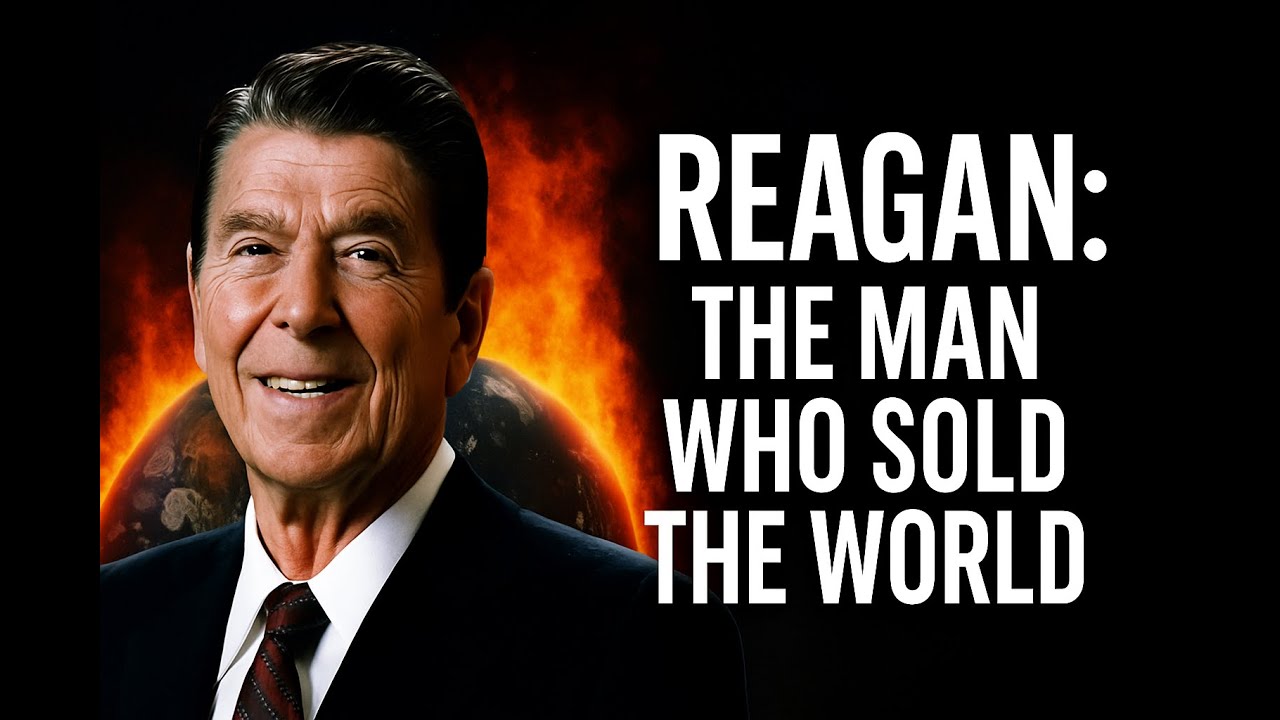
96,178 views Premiered Sep 17, 2025 #RonaldReagan #80s #HistoryDocumentary
Ronald Reagan is remembered as the "Great Communicator," the man who brought optimism back to America. But behind the smile was a ruthless counter-revolution. This episode, the (tentatively) final in the series A History of Economic Tyranny, exposes how Reagan dismantled the New Deal, busted unions, exploded the deficit, and built the foundations of mass incarceration and extreme inequality that still haunts us today. From the PATCO strike to the War on Drugs, from deregulation to the Savings & Loan crisis, Reagan's neoliberal project wasn't just policy: it was a political realignment. Both parties absorbed his philosophy, and for forty years America has lived in the house Reagan built. Today's homelessness crisis, stagnant wages, racialized mass incarceration, climate inaction, and billionaire dominance are not accidents. They are Reagan's legacy. He didn't just win two elections. He won the next forty years, and cursed us for several generations. This is the story of the man who sold the world. If you found this video informative, please like, subscribe, and share to help more people break free from the myths of neoliberalism #economicjustice #economics #Neoliberalism #Inequality #WarOnDrugs #Reaganomics #HistoryDocumentary #reaganera #reagan #1980s #80s
---
pete smothered
https://read.amazon.com/?asin=B0F92SZPQ4&ref_=dbs_t_r_khbodl
In 1967, capitalizing on rising public resentment of raucous political protests and counterculture excesses, Reagan ran for governor of California on two themes—“sending the welfare bums back to work,” and responding to antiwar and anti-establishment protests at the University of California, Berkeley, by vowing to “clean up the mess.” His slogans resonated with a sufficient number of voters to be elected as governor. On May 15, 1969, true to his campaign promises, Reagan sent heavily armed police into an abandoned lot in Berkeley that community organizers had transformed into an acclaimed public garden known as People’s Park. The land was owned by the University of California which wanted to build additional classrooms and student housing there. The school ordered it cleared and supporter’s of People’s Park occupied the space and refused to leave. Ed Meese, Reagan’s chief of staff, called on the county to send in the police. Eight hundred heavily armed men arrived, obviously prepared for violence, because they had obliterated their identifying name tags with black tape.
---
NO LNX
Behind the 60-year Republican plot to destroy American democracy
Activist Phyllis Schafly wearing a "Stop ERA" badge, demonstrating with other women against the Equal Rights Amendment in front of the White House, Washington, D.C..
Thom Hartmann April 27, 2025
In a Daily Take here on Hartmann Report, I mentioned Russell Kirk and the origins of today’s hard right GOP. A few people replied with, “Who’s that?” and similar questions; others were incredulous that Republicans actually believed the middle class created by FDR’s New Deal was a bad thing. So, here’s the backstory to what I mentioned.
I was thirteen years old in 1964 when my dad, a Republican activist, gave me a copy of John Stormer’s book “None Dare Call It Treason.” The Goldwater campaign had sent it to him, and its claim that the State Department was filled with communists intent on handing America over to the USSR had his friends buzzing.
Ironically, Stormer’s book and the movement it ignited within the GOP is largely responsible for that party today standing on the precipice of fully endorsing fascism as an alternative to democracy in the US.
And it was started by morbidly rich men (it was all men back then) who wanted to use the threat of a “communist menace” to gut the union movement to increase their own corporate profits and CEO pay.
The founding premise of the modern conservative movement tracks back a generation before Stormer’s book to a Republican thought leader named Russell Kirk. He laid it out in his 1951 book The Conservative Mind: From Burke to Eliot, as I detail in The Hidden History of American Oligarchy.
Kirk argued that the middle class was becoming a threat to America; without clearly defined classes and power structures — essentially without the morbidly rich in complete control of everything — he worried that society would devolve into chaos.
The opening chapter of his book was about Edmund Burke, the Irish conservative who wrote, in 1790, that hairdressers and candlemakers should not be allowed to run for political office or even to vote:
“The occupation of a hairdresser or of a working tallow-chandler cannot be a matter of honor to any person — to say nothing of a number of other more servile employments. Such descriptions of men ought not to suffer oppression from the state; but the state suffers oppression if such as they, either individually or collectively, are permitted to rule. In this you think you are combating prejudice, but you are at war with nature...”
Kirk and his followers essentially predicted in 1951 that if today’s “hairdressers and working tallow-chandlers” — college students, women, working-class people, and people of color — ever got even close to social and political power at the same level as wealthy white men, there would essentially be a communist revolution in the US, handing us over to Stalin and his Politburo.
(Keep in mind, this was when racial segregation was legal and brutally enforced, the voting age was 21, campuses were almost entirely all-male, both abortion and birth control were illegal in most states, and women couldn’t open checking accounts or get credit cards without a husband’s, brother’s, or father’s signature.)
Throughout the 1950s, Kirk and his warnings of the dangers of an activist middle-class developed a small following; the most prominent of his proponents were William F. Buckley Jr. and Barry Goldwater. Most Republicans, though, considered him a crackpot.
But when the birth-control pill was legalized in 1961 and the Vietnam War heated up a few years later, those marginalized groups Kirk had warned his wealthy white male followers about began to rise up in protest.
Kids were burning draft cards, women were burning bras, and Martin Luther King Jr. was leading a movement for racial justice that the white power structure blamed for American cities burning. Gay liberation was also having a moment.
Meanwhile, the Arab Oil Embargoes of the 1970s had lit the flame of inflation, and unionized workers were striking all over America for wage increases to keep up with the rising cost of living.
Wealthy white conservatives freaked out as the morbidly rich promoted the idea that America was experiencing a “moral decline” that could only be fixed by ending the union movement and other “liberal” causes that shared the union movements’ populist goals.
They became convinced that they were seeing Kirk’s prophecy play out in real time on their television screens every night: the “communists” — those uppity racial minorities, women who’d forgotten their “rightful place in society,” students who objected to Vietnam, unionized workers, and gender minorities — were on the verge of “taking over” America.
These five movements all hitting America at the same time got the attention of conservatives and Republicans who had previously ignored or even ridiculed Kirk back in the 1950s. Suddenly, America’s most powerful and well-known conservative commentators (like William F. Buckley Jr.) were telling Republicans that Russell Kirk was, indeed, a prophet.
They’d finally found a politically acceptable “hook” to destroy the wealth of working-class people and transfer trillions into their own money bins: fear of communism and a prophesied social decay caused by an activist middle class.
The Republican/Conservative “solution” to the “crisis” these five movements represented was put into place in 1981 when Ronald Reagan was sworn into office: the explicit goal of the morbidly rich white men funding the so-called Reagan Revolution was to take the middle class down a peg to end the protests of the ’60s and ’70s, restore “social stability,” and increase corporate profitability.
Their plan was to declare war on labor unions so wages could slide back down again, end free college across the nation so students would live in fear rather than be willing to protest, and increase the penalties Nixon had already put on drugs so they could use those laws against their scapegoats, particularly the hippy antiwar protesters and Black people demanding an end to police killings. They also wanted to outlaw abortion, to put women “back in their place.”
Thus, Reagan massively cut taxes on rich people and raised taxes on working-class people 11 times. For example, he put income taxes on Social Security and unemployment payments, and put in a mechanism to track and tax tips income, all of which had previously been tax-free but were exclusively needed and used by middle-class people.
He ended the tax deductibility of credit-card, car-loan, and student-debt interest, overwhelmingly claimed by working-class people. At the same time, he cut the top tax bracket for millionaires and billionaires from 74% to 25%. (There were only a handful of billionaires in America then, in large part because of previous tax policies; today’s democracy-destroying explosion of billionaires followed Reagan’s, Bush’s, and Trump’s massive tax cuts on the rich.)
Reagan declared war on labor unions, crushed PATCO in less than a week, and over the next decade the result of his war on labor was that union membership went from about a third of the American workforce when he came into office to around 10% at the end of the Reagan/Bush presidencies. It’s just now beginning to recover from its low of 6% of the private workforce.
He and Bush also husbanded the moribund 1947 General Agreement on Tariffs and Trades (GATT, which let Clinton help create the WTO) and negotiated NAFTA, which Clinton signed and thus opened a floodgate for American companies to move manufacturing overseas, leaving American workers underemployed while radically cutting corporate labor costs and union membership.
And, sure enough, Reagan’s War on Labor cut average inflation-adjusted minimum and median wages by more, over a couple of decades, than anybody had seen since the Republican Great Depression of the 1920s and ’30s.
The billionaire’s investment in taking the middle-class down a peg was paying off by orders of magnitude.
Had Reagan not destroyed the nation’s unions, the median American income today would be well over $100,000 a year, minimum-wage households would have a family income of $86,000, and a single wage-earner would still be able to buy a house, a car, send the kids to college, and have a decent retirement (as my dad did, working a union job for 35 years in a tool-and-die shop).
Instead, CEOs today keep all that money for themselves and their investors.
And Reagan’s War on Colleges jacked up the cost of education so high that an entire generation is today saddled with more than $1.5 trillion in student debt: as predicted, many aren’t willing to jeopardize it all by “acting up” on campuses.
The key to selling this campaign of impoverishment to the American people to help out the billionaire class was the idea that the US shouldn’t protect the rights of workers, subsidize education, grant women equal rights, or enforce Civil Rights laws because, conservatives said, all of those things were aspects of “socialism.” And if America embraced socialism, we may as well be ruled by the Soviet Union.
As Reagan told us in his first inaugural, government “socialist” programs were not the solution to our problems, but instead were the problem itself.
He ridiculed the formerly-noble idea of service to one’s country and joked that there were really no good people left in government because if they were smart or competent they’d be working in the private sector for a lot more money.
He even told us that the nine most frightening words in the English language were, “I’m from the government, and I’m here to help.”
Following Lewis Powell’s 1971 memo, throughout the 1970s and 1980s Republican billionaires built a massive infrastructure of think tanks and media outlets to promote and amplify Reagan’s message that government supports of any sort for poor or working-class people were simply gateway drugs to socialism and, inevitably, communism.
It so completely swept America that by the 1990s even President Bill Clinton was saying things like, “The era of big government is over,” and “This is the end of welfare as we know it.” Limbaugh, Hannity and other right-wing radio talkers were getting millions a year in subsidies from billionaire-funded groups like the Heritage Foundation. Billionaire-owned Fox “News” today carries on the tradition.
It had been a pretty good scam for the billionaires who owned the GOP and wanted, back in the 1950s, to stop the union movement that was forcing them to share their profits with their workers.
First, they terrified Americans about communism and socialism, then convinced about half of us that those things came straight out of “liberal” social and economic movements.
Unions, feminism, acceptance of the queer community, civil rights, minimum wage increases, and even regulation of corporate behavior would, they told us, all lead to Soviet-style tyranny.
So, to save America from herself, Reagan gutted the American middle class, transferring over $50 trillion in wealth from working class people into the money bins of the morbidly rich.
By 2016, Americans were starting to figure out that they’d been screwed — and that Hillary Clinton’s husband had been in on it by continuing Reagan’s policies and doubling-down on free trade — and were loudly demanding change.
Into this maelstrom walked Donald Trump, proclaiming himself the savior of the country. In the GOP primary he pointed out how corrupt his opponents were, particularly Jeb Bush and Marco Rubio, and destroyed them, one after the other.
For the general election in 2016, he changed his tune and ran on what was traditionally a Democratic platform, saying he was going to bring jobs home, end so-called “free trade” policies [TPP], raise taxes on the rich so much that “my friends won’t talk to me anymore,” and make sure every American had free or low-cost healthcare and access to an affordable college education.
They were all lies — something Trump had become adept at during his business career — but they worked and sucked in disaffected workers who knew they’d been screwed but weren’t sure who did it to them or why.
So here we are.
We have an open fascist and apparent friend of authoritarian Russia as president after being convicted by a jury of his peers on 34 felony charges, having previously been adjudicated as responsible for sexual abuse (the judge called it “rape”) and fraud.
He’s putting into place people and policies that could turn America into an authoritarian nation like Russia or Hungary, and apparently wants to re-align the United States away from NATO and the EU and toward Russia, China, Iran, and North Korea.
We are literally facing the authoritarian future that John Stormer was warning us about back in 1964. Only instead of “communists” in the State Department, it’s a billionaire president with the avowed goal of ending union rights and locking up or using the Army with live ammunition against those who protest his policies.
And it all tracks back to wealthy conservatives funding a project in the 1960s to scare Americans about socialism and communism so they could stop the union-fueled growth of wages that were cutting into their profits.
Perhaps none dare call it treason. But I do.
NOW READ: The man-babies of MAGA never grew up because they never had to
---
===
no lnx
alternet-
Americans are doubling down on the thing that hurts them the most
Thom Hartmann January 07, 2025
Yesterday, Congress certified the electoral vote count making a billionaire president again, starting after he’s sworn in on January 20th.
Yes, we chose a billionaire. Again. After other billionaires spent billions to convince us to make that choice.
As you’re reading these words, billionaires from America and around the world are making pilgrimages to his shabby golf motel to kiss our upcoming billionaire president’s ass and hand him envelopes with $1 million checks that represent a few hours (at most) of income for most of them or their companies.
Meanwhile, our billionaire president-in-waiting is packing his cabinet — the heads of all of the most important federal agencies — with even more billionaires. This is all being celebrated over on billionaire-owned Fox “News” and on billionaire-owned hate radio networks, as well as in the billionaire-owned Washington Post, LA Times, and the roughly half of American local newspapers owned by billionaire hedge funds.
Other countries enjoy benefits like free healthcare and college; modern mass transit; and affordable housing, food, and drugs.
They also have inexpensive internet and phone service without companies listening in and selling their information, schools that don’t even need to mention school shooters, and streets and parks filled with pedestrians and children instead of tents for the homeless.
Additionally, they benefit from renewable electricity that gets cheaper every year while cleaning their environment.
We, on the other hand, have the world‘s largest collection of billionaires.
Most Americans probably didn’t realize this was the choice they were making in the election of 1980 when Reagan and Bush promised “Morning In America.”
We’d been battered by that generation’s version of the Covid shock: when Arab nations got together to punish us for taking Israel’s side and cut off our oil supply in 1973, it threw us into a decade-long period of “stagflation” (high unemployment and inflation).
Nixon couldn’t handle it; odd/even days at the gas pumps merely infuriated drivers.
Jerry Ford couldn’t handle it; his “WIN” (Whip Inflation Now) buttons were a sad joke that guaranteed he’d become a one-term president.
Jimmy Carter made some good progress — particularly with his plan for a “national solar bank” that would provide 20% of the country’s energy by 2000 — but Reagan’s campaign cut a deal with Iran to hold the American hostages until after the 1980 election, ending Jimmy’s hopes for a second term.
By the time Reagan ran for office in 1980, inflation was still a problem; it was an echo of the 1973 oil embargo, amplified by a second oil shock resulting from the 1979 Iranian revolution, again exploding American gasoline prices and cutting economic growth.
By that time, as I detail in The Hidden History of the American Dream, we were desperate.
Reagan — an even more talented actor than Trump (who NBC spent millions training to act for TV cameras) — convinced us he had it all figured out. At first, his promises were vague; something about supply-side economics, “trickle down,” and Laffer Curves that nobody really understood (and George HW Bush initially called “Voodoo Economics”).
Once he took office, America watched with hope and some trepidation as Reagan turned our economy inside-out, massively cut taxes on the country’s thirteen billionaires, repeatedly raised taxes on millions of working-class people, cut and taxed Social Security, stopped enforcing our anti-monopoly laws, gutted federal funds for education, killed off two-thirds of the country’s unions, and, negotiating the GATT and NAFTA agreements, beginning the process of offshoring over 60,000 factories.
Reagan never got inflation below 4 percent and he almost tripled the national debt (from $800 billion to roughly $2.2 trillion), but throwing around those trillions in borrowed money made it seem like the economy was getting better even as wages were frozen by monopolists and a lack of union representation.
And that’s how we got the billionaires.
Back in 1980, nobody in America was rich enough to shoot himself into space on a penis-shaped rocket, and superyachts were a fantasy. The nation’s richest man was shipping magnate Daniel Ludwig, whose net worth — at just a bit below $2 billion — wouldn’t even qualify him for today’s Forbes 500 list; he lived a low-key life and, like most wealthy men of that era, didn’t much involve himself in politics (there were laws back then against rich people subsidizing federal judges or politicians).
But Reagan’s changes in the tax code and destruction of unions led to a 50,000 billion dollar ($50 trillion) transfer of wealth from the pensions, homes, incomes, and bank accounts of middle class Americans into the money bins of the morbidly rich between 1981 and today.
We had only 13 billionaires from 1980 to 1986 but — with Reagan’s final tax cut which took the rate on multimillion-dollar incomes from over 70% down to 28% — that number began to explode. By 1990, there were 99 billionaires in America; today there are over 800 of them, representing a more-than-50-fold increase in just four decades.
Not content with simply grabbing much of America’s wealth for themselves, a handful of our billionaires next reached out for control of our government.
They created media empires, think tanks, and policy centers, both writing and then pushing their own legislation that was dutifully carried into law by politicians they’d bought off. They outright purchased the entire GOP, along with a large handful of elected “problem solver” Democrats.
They set up institutions to seize control of our independent judiciary; five corrupt Republicans on the Supreme Court returned the favor by fully legalizing billionaires buying elections with their Citizens United decision in 2010.
Total spending on federal elections — for president, the House, and the Senate combined — was $92 million in 1980, $103 million in 1984, and $324 million in 1988. How quaint!
Just one billionaire — Elon Musk — spent over a quarter billion dollars putting Trump into office this past fall. Other billionaires jumped in, pushing total 2024 spending over $7 billion (and that doesn’t count dark money, which is almost certainly billions more).
Saudi billionaires jumped in to help billionaire Musk purchase Twitter for $44 billion, turning it, along with an alleged army of Russian-billionaire-funded trolls pretending to be Americans, into a massive megaphone to elect billionaire-friendly Republicans including billionaire Trump.
They’re now building “conservative” colleges and primary schools, funded with state tax money thanks to bought-off politicians, that will educate the generation coming up that billionaires are a necessary and benevolent force in the world.
And we don’t talk about our nation’s billionaire problem because billionaires own or control so many of the nation’s channels of news and discussion from social media to television networks to newspapers.
Even simple, traditional political endorsements get censored; G-d forbid somebody (who won a Pulitzer!) should draw a cartoon showing media billionaires bowing down to our new billionaire president. Or speak out on billionaire-owned social media.
Maybe one day America will join the other 37 OECD “rich” nations in offering to our average- and low-income people nearly-free college and healthcare, removing guns from our streets and schools, housing the homeless, and building modern mass transit.
Maybe our middle class will again become socially and economically mobile, we’ll rid ourselves of over $2 trillion in student debt, and we’ll never again be the only developed country in the world where people lose everything to bankruptcy because somebody in the family got sick.
For at least the next four years, however, we must content ourselves with the proud knowledge that we have more billionaires than any other country in the world. That they now run out government, with their top 1 percent owning fully 40.5 percent of our nation’s entire wealth ($43.45 trillion). As the Forbes “Capitalist Tool” headline gloats: “The 3 Richest Americans Hold More Wealth Than Bottom 50% Of The Country.”
Yep, sure enough: We’re number one! And Trump and the GOP promise to do everything they can to keep it that way.
NOW READ: The criminals will soon be in charge: How Joe Biden helps normalize evil
===
===
lnx no
alternet-There's only one way to defeat Trump's billionaires boys club
FILE PHOTO: Tesla CEO and X owner Elon Musk reacts next to Donald Trump during a campaign rally, at the site of the July assassination attempt against Trump, in Butler, Pennsylvania, U.S., October 5, 2024.
Thom Hartmann
December 04, 2024
If my hypothesis from yesterday — that Democrats best way to win elections and regain political power is to engage in class warfare against the GOP and the billionaires that fund it — the immediate question is, “How?”
The last century has seen two presidents engage in class warfare in a big and direct way that not only won them multiple elections but also altered the electoral map of America: Franklin D. Roosevelt and Ronald Reagan. There are multiple lessons to learn from both.
When FDR came into power in March of 1933, the nation was in shambles because of a decade of Republican mishandling of the economy. In the early 1920s, Republican President Warren Harding dropped the top income tax rate from 91% down to 25% and loosened oversight of Wall Street.
The short-term result was an explosion of riches at the top, referred to as “The Roaring 20s,” and violent actions against attempts to form labor unions. The longer-term result was the infamous Black Tuesday of October 29, 1929 which kicked off the Republican Great Depression.
President Roosevelt correctly identified America’s morbidly rich, who’d seized control of the GOP after the end of the Taft presidency in 1913, as the cause of the financial disaster and proclaimed that they and their captive Republicans had declared class war against average working class Americans.
ALSO READ: Trump finds a new lawman is who even more lawless than he is
“For out of this modern civilization,” Roosevelt told America, “economic royalists carved new dynasties. New kingdoms were built upon concentration of control over material things. … It was natural and perhaps human that the privileged princes of these new economic dynasties, thirsting for power, reached out for control over Government itself.”
He used the language of class warfare; as with all wars, the first step is to identify the enemy. For FDR it was the morbidly rich of his era who weren’t content to just run their businesses and make money but also lusted for the political power they’d been given during the 1920s by Republican presidents Harding, Coolidge, and Hoover.
“These economic royalists complain that we seek to overthrow the institutions of America,” Roosevelt proclaimed. “What they really complain of is that we seek to take away their power.”
He paused for a moment, then thundered, “Our allegiance to American institutions requires the overthrow of this kind of power!”
The crowd at Madison Square Garden roared when he said that. They knew that Republican politicians had worked hand-in-glove with wealthy industrialists to suppress unions, evade taxes, and accumulate fortunes beyond anything ever seen in America. That the GOP had been running an often-violent class war against them for at least the past decade.
And they were over it. Over the greed, over the theft, and over the self-righteous proclamations that the Constitution protected their avarice. Average working people knew these “economic royalists” weren’t patriots; they were looters, vandals, and political arsonists. FDR gave voice to their anger, disillusionment, and disgust.
“In vain,” Roosevelt said, “they seek to hide behind the Flag and the Constitution. In their blindness they forget what the Flag and the Constitution stand for. Now, as always, they stand for democracy, not tyranny; for freedom, not subjection; and against a dictatorship by mob rule and the over-privileged alike.”
Republicans had declared class warfare; FDR, like he would later do with the Japanese and Germans, led the charge to fight back and defeat them.
And defeat them he did (even in the face of an assassination attempt); by the end of his presidency, American oligarchs had gone back to doing business and getting rich, largely avoiding politics and keeping their noses clean.
Until, that is, President Nixon put Lewis Powell on the Supreme Court and Powell began the process — from the bench — of turning America back into a full-blown oligarchy like Hoover had done in the 1920s.
The Powell Memo and the Court’s Bellotti decision (written by Powell) set the stage and outline the battle plan for the Reagan Revolution, an all-out declaration of class war against average Americans and the Democrats who’d historically defended them.
In the 1980s, Reagan cut the top income tax rate from 74 percent down to 27 percent (while repeatedly raising taxes on working-class people’s wages, tips, and Social Security), kicking off an explosion of billionaires. He and other Republican presidents and members of the Supreme Court followed up by:
— Ending enforcement of our anti-trust laws and gutting our environmental regulations.
— Killing off our media guardrails like the Fairness Doctrine and Equal Time Rule, along with ending ownership limits on newspapers, radio stations, and TV stations and networks.
— Fighting every effort to reduce or end student debt.
— Opposing every program proposed to broaden access to healthcare coverage.
— Attacking our right to vote.
— Privatizing Medicare with the Medicare Advantage scam (Social Security is next).
— Assailing environmental regulations that protect us and our children from cancer and other diseases.
— Going to the mat to defend hundreds of billions in annual subsidies for the fossil fuel industry and its oligarchs.
— Deregulating social media (Section 230), now taken over by rightwing billionaires.
— Packing our courts with reliable toadies for giant corporations and the wealthy.
— Stripping over $50 trillion from the working class since 1981, handing that money to the morbidly rich to stash in their offshore money bins.
— Rejecting every effort to raise the national minimum wage.
— Most recently, Trump congratulated Musk on his union-busting success.
Through this entire period, Democrats have refrained from employing FDR’s class war rhetoric to fight back. Instead, they’ve worked hard to make life better for working class people when in power and tried to limit the damage from Republican proposals and policies when they’re out of power.
This is why Vice President Harris’ claims that Democrats are here for the average person while Republicans want more tax cuts and deregulation failed to catch fire during this past election; there was no rhetoric of warfare. Instead, astonishingly, Harris campaigned with Liz Cheney and kept saying that she’d give Republicans “a seat at the table.”
As billionaire Warren Buffett famously confessed:
“There’s class warfare, all right, but it’s my class, the rich class, that’s making war, and we’re winning.”
It’s far past time to take the gloves off and start punching.
Democrats have become so rusty, so wary of class warfare, that they haven’t even identified a term or metaphor to describe the rightwing billionaires for whom the GOP fronts.
From Democratic President Grover Cleveland in the 1880s saying the rich had working people under their “Iron heel” to the early 20th century when they were called Robber Barons, Democrats have had names for Republicans and the billionaires who own them.
FDR called them economic royalists. Teddy Roosevelt called them fat cats, malefactors of great wealth, parasites, and plutocrats. I’ve been calling them the morbidly rich, but there’s almost certainly a more evocative phrase out there that could be applied to greedy billionaires by this generation of progressives.
After all, elite conservatives and billionaires haven’t hesitated to use “othering” language in their war against Democrats.
Reagan and Republicans since have called us pointy-headed intellectuals, ivory tower elites, eggheads, limousine liberals, champagne socialists, latte liberals, the wine and cheese crowd, coastal elites, tax and spend liberals, bleeding hearts, do-gooders, tree huggers, environmental wackos, libtards, communists, and even feminazis.
And how do Democrats describe Republicans? “Our friends on the other side of the aisle.”
Screw that. It’s time to declare war.
And war requires a clear delineation between our side and their side, between the good guys and the enemy. Nobody is going to rush to the ramparts against somebody we’re “happy to work with on a bipartisan basis”: as Newt Gingrich taught Republicans in the 1990s and they’ve held to with a religious fervor, there can be no quarter against the other side if you want to take and hold power.
Class war sounds ugly, but it’s exactly what Republicans and their billionaire backers have been waging against working class Americans for 43 years now. It’s damn well time to fight back by declaring a class war of our own.
an 12 24
The United States is currently displaying several characteristics that have historically been seen by empires in decline, according to one social scientist.
Peter Turchin is one of the pioneers of "cliodynamics," which is the field of study concerning statistical analysis of historical dynamics of societies around the world. In a recent essay for the Guardian, Turchin wrote that he and his fellow researchers have noticed the U.S. having three key traits in common with past global hegemons just before a period of decline. Those three factors are "popular immiseration, elite overproduction and state breakdown."
Turchin explained that "popular immiseration" describes a breakdown of the social contract between workers, the private sector and the public sector, which he said began after the Republican assault in the New Deal that happened around the time former President Ronald Reagan took power. He noted that as "the power of unions was undermined," taxes on the richest Americans were "cut back," which was followed by stagnating wages and a decline in life expectancy.
READ MORE:['Not good enough anymore': Union leader explains why Dems lost economic argument to Trump
"With the incomes of workers effectively stuck, the fruits of economic growth were reaped by the elites instead. A perverse 'wealth pump' came into being, siphoning money from the poor and channelling it to the rich," he wrote. "In many ways, the last four decades call to mind what happened in the United States between 1870 and 1900 – the time of railroad fortunes and robber barons. If the postwar period was a golden age of broad-based prosperity, after 1980 we could be said to have entered a Second Gilded Age."
The second trait, which Turchin called "elite overproduction," involves a growing population of the "uber-rich," (which he defined as "those with fortunes greater than $10 million") and their influence in the public sphere. He noted that when adjusting for inflation, this population grew by tenfold over the last four decades. This has led to rich elites either running for office, like President-elect Donald Trump, or funding candidates for office, like many billionaires have done in recent cycles. He also pointed out that "counter-elites" will emerge who oppose the existing political establishment.
"The more members of this elite class there are, the more aspirants for political power a society contains," he wrote. "By the 2010s the social pyramid in the US had grown exceptionally top-heavy: there were too many wannabe leaders and moguls competing for a fixed number of positions in the upper echelons of politics and business."
"As battles between the ruling elites and counter-elites heat up, the norms governing public discourse unravel and trust in institutions declines," he continued. "The result is a loss of civic cohesiveness and sense of national cooperation – without which states quickly rot from within."
READ MORE:[Watch: JD Vance booed by room full of firefighters as he calls himself 'pro-worker'
Finally, Turchin opined that "state breakdown" will inevitably follow popular immiseration and elite overproduction. He argued that Democrats' loss in the November election "represents one battle in an ongoing revolutionary war," but that the goal of the new order is "far from assured" given that "opponents are pretty well entrenched in the bureaucracy and can effectively resist change."
"Popular discontent in the US has been building up for more than four decades. Many years of real prosperity would be needed to persuade the public that the country is back on the right track," he wrote. "So, for now, we can expect a lasting age of discord. Let’s hope that it won’t spill over into a hot civil war."
Click here to read Turchin's full essay in the Guardian.
READ MORE:['A corporate CEO's dream': Labor unions blast Trump-Vance ticket
---
very good summary
an no lnx
The real reason Republicans oppose efforts to cancel student debt
Thom Hartmann April 12, 2024
I don’t get it and I’m hoping you can help me figure it out. Why do Republicans oppose President Biden’s efforts to cancel student debt?
This Tuesday, seven states, led by Missouri’s Republican Attorney General, sued the Biden administration to stop his most recent attempt to reduce student debt. In a separate lawsuit, ten other Republican-controlled states filed a separate lawsuit to try to block the same Biden effort.
The week before, somebody slipped this little gem into Maria Cantwell’s must-pass legislation reauthorizing the Federal Aviation Administration (FAA) (my inquiry to her press office was never answered):
“The Secretary, the Secretary of the Treasury, or the Attorney General may not take any action to cancel or forgive the outstanding balances, or portion of balances, on any Federal Direct Unsubsidized Stafford Loan, or otherwise modify the terms or conditions of a Federal Direct Unsubsidized Stafford Loan, made to an eligible student, except as authorized by an Act of Congress.”
READ: White rural rage: The secret political force shaping America's future
In other words, it appears, they’re trying to use the force of law to prevent President Biden from forgiving a large category of student loans. As Forbes noted:
“A proposed bill in Congress would ban mass student loan forgiveness for borrowers who attended certain professional training programs, and advocates are sounding the alarm that this could be a concerning precedent.”
But why?
— No banks are being hurt by these loans being forgiven: they’re all federal loans funded by the government. When the loan is forgiven, the debt simply vanishes: it doesn’t cost any of us a penny and isn’t hurting the big bank donors to the GOP.
— Forgiving student debt is an economic stimulus, freeing people up to buy a new home, start a new business, or just begin the family they’d been putting off because of economic uncertainty. Everybody benefits.
The closest I can come to thinking of a motive for these Republicans is that they think that Biden is essentially “buying” the votes of people whose loans were forgiven, but they’re smart enough to know that people’s politics are influenced by far more than something that simple.
Rightwingers with student debt aren’t going to start voting Democratic; if anything, they’ll take the relief and then brag about how they’re going to vote for Trump anyway.
So, what is it?
Is it that Republicans simply think having Americans in debt somehow works to their advantage? If so, how does that work?
Or is it the old, “You made the commitment, now you must follow through or society will crumble in a mess of lawlessness” argument?
When you search on the phrase “student debt forgiveness” one of the top hits that comes up is a Fox “News” article by a woman who paid off her loans in full.
“There are millions of Americans like me,” the author writes, “for whom debt forgiveness is an infuriating slap in the face after years of hard work and sacrifice. Those used to be qualities we encouraged as an American culture, and if Biden gets his way, we’ll be sending a very different message to the next generation.”
If this is the Republican’s main argument, it is, to be charitable, bullsh*t.
Forgiving student debt is not a slap at anybody; it’s righting a moral wrong inflicted on millions of Americans by Ronald Reagan and his morbidly rich Republican buddies.
Student debt is evil.
It’s a crime against our nation, hobbling opportunity and weakening our intellectual infrastructure. It maintains and in many cases rigidifies the racial and class caste systems today’s Americans inherited from our eras of slavery and indenture.
Combine this decision with the six Republicans on the Court ending affirmative action and legalizing discrimination and it’s clear this is exactly what the rightwing billionaires who put them on the Court and support their lavish vacations and lifestyles want.
They really don’t care about improving the lives of everyday Americans; their philosophy is, “I got mine; screw you.” Educated themselves, they’re now working to “pull up the ladder” behind them and thus maintain their elite status.
As history shows, this harms countries in real and measurable ways.
Every nation’s single biggest long-term asset is a well-educated populace, and student debt diminishes that.
Every other advanced democracy on the planet understands this.
That’s why student debt at the scale we have in America literally does not exist anywhere else in the rest of the developed world.
American students, in fact, are going to college for free right now in Germany, Iceland, France, Norway, Finland, Sweden, Slovenia, and the Czech Republic, because pretty much anybody can go to college for free in those countries and dozens of others.
“Student debt?” The rest of the developed world doesn’t know what you’re talking about.
Student debt also largely didn’t exist in America before the Reagan Revolution. It was created by Republicans here in the 1980s — intentionally — and if we can overcome Republican opposition, we can intentionally end it here and join the rest of the world in once again benefiting from an educated populace.
Forty years on from the Reagan Revolution, student debt has crippled three generations of young Americans: over 44 million people carry the burden, totaling a $2+ trillion drag on our economy that benefits nobody except the banks earning interest on the debt and the politicians they pay off.
But that doesn’t begin to describe the damage student debt has done to America since Reagan, in his first year as governor of California, ended free tuition at the University of California and cut state aid to that college system by 20 percent across-the-board.
After having destroyed low income Californians’ ability to get a college education in the 1970s, Reagan then took his anti-education program national as president in 1981.
When asked why he’d taken a meat-axe to higher education and was pricing college out of the reach of most Americans, he said, much like Ted Cruz might today, that college students were “too liberal” and America “should not subsidize intellectual curiosity.”
It was the 1980s version of today’s “war on woke”: Reagan hated college students.
On May 1, 1970, Governor Reagan announced that students protesting the Vietnam war across America were “brats,” “freaks” and “cowardly fascists,” adding, as The New York Times noted at the time:
“If it takes a bloodbath, let’s get it over with. No more appeasement!”
Four days later four were dead at Kent State, having been murdered by National Guard riflemen using live ammunition against anti-war protesters.
Before Reagan became president, states paid 65 percent of the costs of colleges, and federal aid covered another 15 or so percent, leaving students to cover the remaining 20 percent with their tuition payments.
It’s why when I attended college in the late 1960s — before Reagan — I could pay my tuition working a weekend job as a DJ at a local radio station and washing dishes at Bob’s Big Boy restaurant on Trowbridge Road in East Lansing.
That’s how it works — at a minimum — in most developed nations, although in many European and Asian countries college is not only free, but the government pays students a stipend to cover books and rent.
Here in America, though, the numbers are pretty much reversed from pre-1980 as a result of Reaganomics, with students now covering about 80 percent of the costs. Thus the need for student loans here in the USA.
As soon as he became president, Reagan went after federal aid to students with a fanatic fervor. Devin Fergus documented for The Washington Post how, as a result, student debt first became a thing across the United States during the early ‘80s:
“No federal program suffered deeper cuts than student aid. Spending on higher education was slashed by some 25 percent between 1980 and 1985. ... Students eligible for grant assistance freshmen year had to take out student loans to cover their second year.”
It became a mantra for conservatives, particularly in Reagan’s cabinet. Let the kids pay for their own damn “liberal educations.”
Reagan’s college educated Director of the Office of Management and Budget, David Stockman, told a reporter in 1981:
“I don’t accept the notion that the federal government has an obligation to fund generous grants to anybody who wants to go to college. It seems to me that if people want to go to college bad enough then there is opportunity and responsibility on their part to finance their way through the best way they can. … I would suggest that we could probably cut it a lot more.”
After all, cutting taxes for the morbidly rich was Reagan’s first and main priority, a position the GOP holds to this day. Cutting education could “reduce the cost of government” and thus justify more tax cuts for billionaires.
Reagan’s first Education Secretary, Terrel Bell, wrote in his memoir:
“Stockman and all the true believers identified all the drag and drain on the economy with the ‘tax-eaters’: people on welfare, those drawing unemployment insurance, students on loans and grants, the elderly bleeding the public purse with Medicare, the poor exploiting Medicaid.”
Reagan’s next Education Secretary, William Bennett, was even more blunt about how America should deal with the “problem” of uneducated people who can’t afford college, particularly if they were African American:
“I do know that it’s true that if you wanted to reduce crime,” Bennett famously said, “you could -- if that were your sole purpose, you could abort every black baby in this country, and your crime rate would go down.”
These doctrines became an article of faith across the GOP and remain so to this day, as we saw this week with the Republicans suing to stop Biden from forgiving any more loans.
Reagan’s OMB Director David Stockman told Congress that students were “tax eaters … [and] a drain and drag on the American economy.” Student aid, he said, “isn’t a proper obligation of the taxpayer.”
This was where, when, and how today’s student debt crisis was kicked off in 1981.
Before Reagan, though, America had a different perspective.
Both my father and my wife Louise’s father served in the military during World War II and both went to college on the GI Bill. My dad dropped out after two years and went to work in a steel plant because mom got pregnant with me; Louise’s dad, who’d grown up dirt poor, went all the way for his law degree and ended up as Assistant Attorney General for the State of Michigan.
They were two among almost 8 million young men and women who not only got free tuition from the 1944 GI Bill but also received a stipend to pay for room, board, and books. And the result — the return on our government’s investment in those 8 million educations — was substantial.
The best book on that time and subject is Edward Humes’ Over Here: How the GI Bill Transformed the American Dream, summarized by Mary Paulsell for the Columbia Daily Tribune:
“[That] groundbreaking legislation gave our nation 14 Nobel Prize winners, three Supreme Court justices, three presidents, 12 senators, 24 Pulitzer Prize winners, 238,000 teachers, 91,000 scientists, 67,000 doctors, 450,000 engineers, 240,000 accountants, 17,000 journalists, 22,000 dentists and millions of lawyers, nurses, artists, actors, writers, pilots and entrepreneurs.”
Free education literally built America’s middle class.
When people have an education, they not only raise the competence and vitality of a nation; they also earn more money, which stimulates the economy. Because they earn more, they pay more in taxes, which helps pay back the government for the cost of that education.
In 1952 dollars, the GI Bill’s educational benefit cost the nation $7 billion. The increased economic output over the next 40 years that could be traced directly to that educational cost was $35.6 billion, and the extra taxes received from those higher-wage-earners was $12.8 billion, both in 1952 dollars.
In other words, the US government invested $7 billion and got a $48.4 billion return on that investment, about a $7 return for every $1 invested.
In addition, that educated workforce made it possible for America to lead the world in innovation, R&D, and new business development for three generations.
We invented the transistor, the integrated circuit, the internet, new generations of miracle drugs, sent men to the moon and reshaped science.
Presidents Thomas Jefferson and Abraham Lincoln knew this simple concept that seems so hard for Reagan and generations of Republicans since to understand: when you invest in young people, you’re investing in your nation.
Jefferson founded the University of Virginia as a 100% tuition-free school; it was one of his three proudest achievements, ranking higher on the epitaph he wrote for his own tombstone than his having been both president and vice president.
Lincoln was equally proud of the free and low-tuition colleges he started. As the state of North Dakota notes:
“Lincoln signed the Morrill Act on July 2, 1862, giving each state a minimum of 90,000 acres of land to sell, to establish colleges of engineering, agriculture, and military science. … Proceeds from the sale of these lands were to be invested in a perpetual endowment fund which would provide support for colleges of agriculture and mechanical arts in each of the states.”
Fully 76 free or very-low-tuition state colleges were started because of Lincoln’s effort and since have educated millions of Americans including my mom, who graduated from land-grant Michigan State University in the 1940s, having easily paid her minimal tuition working as a summer lifeguard in her home town of Charlevoix, Michigan.
Every other developed country in the world knows this, too: student debt is rare or even nonexistent in most western democracies. Not only is college free or close to free in almost all of the developed world; many countries even offer a stipend for monthly expenses like our GI Bill did back in the day.
As mentioned earlier, thousands of American students are currently studying in Germany at the moment for free. Hundreds of thousands of American students are also getting free college educations right now in Iceland, Denmark, Norway, Finland, Sweden, Slovenia, and the Czech Republic, among others.
Republican policies of starving education and cranking up student debt have made US banks a lot of money, but they’ve cut America’s scientific leadership in the world and, since the institution of trickle-down Reaganomics, stopped three generations of young people from starting businesses, having families, and buying homes.
The damage to working class and poor Americans, both economic and human, is devastating. Even worse for America, it’s a double challenge for minorities.
And now Republicans are telling our young people who weren’t members of the “Lucky Sperm Club” with wealthy or legacy parents that they’re simply out of luck. And, as noted, the GOP is celebrating.
Which raises the question: how gullible do these Republicans think their voters are?
Marjorie Taylor Greene wrote on Twitter that student loan forgiveness was “completely unfair.” She’s the same Republican congresswoman who had $183,504 in PPP loans forgiven, and happily banked that government money without a complaint.
Republican members of Congress, in fact, seem to be among those in the front of the debt-forgiveness line with their hands out, even as billionaires bankroll their campaigns and backstop their lifestyles.
As the Center for American Progress noted on Twitter in response to a GOP tweet whining that, “If you take out a loan, you pay it back”:
Member —— Amount in PPP Loans Forgiven
Matt Gaetz (R-FL) - $476,000
Marjorie Taylor Greene - $183,504
Greg Pence (R-IN) - $79,441
Vern Buchanan (R-FL) - $2,800,000
Kevin Hern (R-OK) - $1,070,000
Roger Williams (R-TX) - $1,430,000
Brett Guthrie (R-KY) - $4,300,000
Ralph Norman (R-SC) $306,250
Ralph Abraham (R-AL) - $38,000
Mike Kelly (R-PA) - $974,100
Vicki Hartzler (R-MO) - $451,200
Markwayne Mullin (R-OK) - $988,700
Carol Miller (R-WV) - $3,100,000
Every single one of these Republican members of Congress has echoed Greene’s criticism of student debt relief or supported efforts to block it. Every single one also eagerly welcomed forgiveness of their Covid-era debts.
So, yeah, Republicans are complete hypocrites about forgiving loan debt, in addition to pushing policies that actually hurt our nation (not to mention the generations coming up).
President Biden has already forgiven over $143 billion in student debt and this week proposed to extend that debt relief from the 4 million he has reached so far to as many as 20 million people. It’s a great start, but if we really want America to soar, we need to go way beyond that.
Just like for-profit health insurance (which was prohibited in most states before the Reagan Revolution: the companies had to be organized as nonprofits), student loans are a malignancy attached to our republic by Republicans trying to increase profits for their donors while extracting more and more cash from working-class families.
If Democrats can regain control of the House and hold the Senate and White House this fall, they must not only zero-out existing student debt across our nation but revive the post-war government support for education — from Jefferson and Lincoln to the GI Bill and college subsidies — that the Reagan, Bush, Bush, and Trump administrations have destroyed.
Then, and only then, can the true “making America great again” begin.
READ: White rural rage: The secret political force shaping America's future
FROM YOUR SITE ARTICLES
Is the Near-Trillion-Dollar Student Loan Bubble About to Pop? ›
Don’t give Trump a 2nd chance to destroy American democracy ›
Amy Coney Barrett uses bizarre analogy of babysitter and amusement park in student loan opinion ›
Sinema got $27K from student loan industry after helping GOP kill Biden’s debt forgiveness plan ›
Biden could cancel student debt for up to 10 million more Americans before Election Day
RELATED ARTICLES AROUND THE WEB
President Joe Biden Outlines New Plans to Deliver Student Debt ... ›
Student Loan Forgiveness | Federal Student Aid ›
FACT SHEET: President Biden Cancels Student Debt for more than ... ›
The Biden-Harris Administration's Student Debt Relief Plan Explained ›
---
---
alternet-3 24 NO LNX
How the GOP plans to drag America back to the 19th century
Thom Hartmann
March 22, 2024
“Moscow Mike” Johnson and his Republicans in the House are determined to continue to shorten the lifespans of Americans by forcing brutal Red State policies on the entire nation. It’s literally killing people, but they frankly don’t care so long as they can keep taxes on their billionaire owners low.
And now Republicans are officially saying they want to cut Social Security and gut Medicare.
Ronald Reagan is long gone, but a recent report shows how his policies and his party live on and are still hurting us: they’re responsible for millions of lost years of Americans’ lives. The study calls them “missing Americans.”
x
It wasn’t always this way.
In the 1930s, after FDR rolled out programs to aid the homeless and unemployed across the country, America enjoyed a longer life expectancy — and more healthy years within that life expectancy — than any other wealthy nation in the world.
While some of that was due to the public health crisis echoing across Europe in the wake of World War I, it was largely because FDR’s Democrats in charge of the country were building schools and hospitals like there was no tomorrow.
Republican President Eisenhower followed in that tradition through the 1950s, and in the 1960s LBJ rolled out Medicare and Medicaid. As a result, we continued to have the world’s best lifespans and quality-of-life.
Then came Reagan’s austerity and neoliberalism campaigns in 1981 and America began to become unraveled.
That study, published by the National Academy of Sciences in the journal PNAS Nexus, looked at “excess deaths” (they also called them “missing Americans”) in our country versus others around the world.
The researchers from Boston University School of Public Health, the University of Pennsylvania, and the Harvard Medical School and TH Chan School of Public Health found:
“The United States had lower mortality rates than peer countries in the 1930s–1950s and similar mortality in the 1960s and 1970s. Beginning in the 1980s, however, the United States began experiencing a steady increase in the number of missing Americans, reaching 622,534 in 2019 alone.”
Those excess deaths, it turns out, are almost all entirely the result of Republican policies, both at the federal and state level.
The researchers found:
“Stagnant minimum wages and losses of collective bargaining protections have contributed to widening economic inequality. A scant safety net for working-age adults and the absence of universal healthcare have privatized risk, tying health more closely to personal wealth and employment.
“Additionally, lax regulation of opioids, firearms, environmental pollutants, unhealthy foods, and workplace safety has contributed to elevated US mortality, particularly among lower-educated and lower-income people.”
And it’s worse in Red states:
“Increasingly divergent policies at the state level have resulted in widening health gaps across US states. In those geographic areas of the United States where excess mortality has increased the most, voters have turned towards policy-makers who have further undermined population health, e.g. through refusal to expand Medicaid or to implement firearm regulations.”
While not coming right out and saying that people live longer in Blue states than Red states, that’s largely what the study found. And it’s not a small effect:
“In 2021, there were 26.4 million years of life lost due to excess US mortality relative to peer nations…”
While President Eisenhower ran for re-election in 1956 by bragging about how on his watch millions more Americans had gotten good union jobs or signed up for Social Security, by 1981, when Reagan took office, the 1978 efforts of five corrupt Republicans on the Supreme Court to legalize political bribery were beginning to seriously take hold.
That’s when everything changed. Since 1981, millions of Americans have died unnecessarily because of neoliberal austerity policies: their lives were sacrificed on the altars of increased corporate profits and lower taxes for billionaires.
— Reagan told us that the “union bosses” were just out for themselves and the best thing American workers could do was to rely on their employers’ good will. He also claimed that the minimum wage actually hurt low-wage workers because, he said, it “prevented” employers from hiring more people.
Both were lies, as history has vividly shown, and both contributed to our epidemic of early and unnecessary deaths, as Red state minimum wages are still as low as $7.25/hour and Red “Right to Work for Less” states make it nearly impossible to unionize.
“Stagnant minimum wages and losses of collective bargaining protections have contributed to widening economic inequality” that leads to early deaths, reported the researchers.
— The Republican backlash to Obamacare extending Medicaid to everybody in the country wasn’t limited to their lawsuit before the Supreme Court that ended up letting Red states opt out of coverage, or to the Astroturf “Tea Party” movement funded by rightwing billionaires.
— To this day, more than a decade later, there are still about a dozen Red states that have taken the five Republican justices up on their offer and refuse to expand the program. Those Republican-controlled states have also thrown hundreds of bureaucratic roadblocks to people getting any kind of state services, from food stamps to unemployment insurance to housing assistance.
“A scant safety net for working-age adults and the absence of universal healthcare have privatized risk, tying health more closely to personal wealth and employment” that leads to early deaths, reported the researchers.
— A collaborative research project between the University of Texas and the University of Toronto published in The Journal of the American Medical Association found that the Red state preference for deregulation and a lack of oversight:
“…explained 9.2% of an enrollee’s odds of receiving prolonged opioids… The correlation between a county’s Republican presidential vote and the adjusted rate of … prolonged opioid use was 0.42 (P<.001). In the 693 counties with adjusted rates of opioid prescription significantly higher than the mean county rate, the mean Republican presidential vote was 59.96%, vs 38.67% in the 638 counties with significantly lower rates.”
— Cancer alley is alive and well in Texas and Louisiana thanks to Republican governments’ in those states refusal to enforce environmental regulations that would keep carcinogens out of the air and water.
— A child living in Mississippi is ten times more likely to die from gunshot than a child in Massachusetts because Republicans in Mississippi refuse to adopt rational, constitutional gun control regulations like Massachusetts has had for decades.
— Obesity and the diabetes, heart disease, and strokes associated with it are vastly more prevalent and thus more deadly in Red states than Blue states because so many more people are living in poverty in Red states and must eat junk food because it is cheaper than healthy food.
— Twenty-nine states, encompassing virtually all the nation’s Red states, have no state-level workplace safety agencies; those only exist in 21 mostly Blue states. As a result, Red Wyoming has 10.4 workplace deaths per 100,000 workers while Blue Rhode Island only has 1.0 deaths per 100,000 workers.
“Additionally, lax regulation of opioids, firearms, environmental pollutants, unhealthy foods, and workplace safety has contributed to elevated US mortality, particularly among lower-educated and lower-income people” wrote the researchers about unnecessary/early deaths in America.
When The Washington Post looked into the differences between Red and Blue states, what they found was shocking.
For example, noted the authors:
“Ohio sticks out — for all the wrong reasons. Roughly 1 in 5 Ohioans will die before they turn 65, according to Montez’s analysis using the state’s 2019 death rates. The state, whose legislature has been increasingly dominated by Republicans, has plummeted nationally when it comes to life expectancy rates, moving from middle of the pack to the bottom fifth of states during the last 50 years, The Post found. Ohioans have a similar life expectancy to residents of Slovakia and Ecuador, relatively poor countries.”
While it would be easy and glib to say that Republican politicians want the citizens of their states to die young, the simple truth is that they don’t care: their priority, instead, is the profitability of the companies in their states and keeping the taxes on their oligarchs low.
Author Mark Jacob noted on Xitter:
“Voting for Republicans is like eating poison.”
In fact, eating poison is a choice. Most people trapped in Red states, though, don’t have the means or ability to move to a Blue state because they’ve been denied a good education, are saddled with medical debt, and/or haven’t made enough at their work to afford the transition.
Blue states, for their part, are fighting back on behalf of their citizens. As Bernie’s poverty advisor Nikhil Goyal wrote for The New York Times a few months ago:
“Fourteen [Blue] states have adopted a state-level child tax credit, with many featuring a fully refundable provision so that families with little to no income can benefit. This year, New Mexico has expanded free preschool seats and made child care free for families earning up to four times the federal poverty rate — roughly $120,000 for a family of four.
“In the upcoming fiscal year, Minnesota will pour more than $250 million of additional funding into early childhood education to reduce the costs of child care and create thousands of new preschool slots. This includes $10 million to supplement funding of the federal Head Start program, which serves children up to the age of 5 and should be bolstered by states.
“Today, nine [Blue] states have universal free school breakfast and lunch on the books. Just last month, the governor of Illinois, J.B. Pritzker, established a $20 million initiative that will help fund grocery stores in food deserts.”
But every action draws a reaction, as Isaac Newton was quick to point out. Republicans are now trying to do to Blue states — to all of America — the same damage they’ve done to Red states over the past 40 years.
In the sixteen months since Republicans took control of the US House of Representatives, child poverty in America has doubled. This is because Republicans in the House refused to renew programs Democrats put in place providing health care, food assistance, housing support, the child tax credit, and subsidized child care: all have now expired.
In the past eleven months, since Republicans in Congress refused to act, 3.2 million children lost access to healthcare, 70,000 childcare and preschool programs have closed, and the child tax credit has expired. So have the Supplemental Nutrition Assistance Program’s emergency allotments. As of last November, 10,046,000 Americans have been kicked off Medicaid, nearly all in Red states.
And it’s all intentional.
Republicans will proudly tell you it’s necessary to keep taxes low for their morbidly rich donors, and to prevent poor people from becoming “lazy.” Speaker “Moscow Mark” Johnson will tell you that it’s the Christian way, just like trashing queer people and forcing 10-year-old rape victims to carry their pregnancies to term.
Welcome to the 2024 GOP and their plans to “deconstruct the administrative state” so they can drag America back to the 19th century.
Mark Jacob was right about the poison part. But instead of Republican voters eating it, their politicians are determined to force it down the throats of all of us, our children, and our grandchildren.
---
jake j commn dr an 1 24
two new reports published Tuesday by the Roosevelt Institute argue that robust corporate taxation is key to creating a strong economy and improving the well-being of families and children—objectives that have been undermined in the decades since the Reagan era by regressive tax cuts enacted on the false premise that benefits would "trickle down" to the rest of society.
The first report, A Mapping of the Full Potential of U.S. Corporate Taxation to Enhance Child and Family Well-Being, examines what the authors describe as the understudied notion that "increasing corporate taxation will necessarily help children and families by providing additional revenue for essential public services."
That perspective runs counter to what the Roosevelt Institute's second report calls "a 'cut-to-grow' mentality" that rose to prominence in the 1970s and was enthusiastically embraced by the administration of President Ronald Reagan.
"Under this view, the thinking went, it was necessary to reduce the corporate tax rate to grow the economy—and that this growth would allow gains to eventually 'trickle down' from the rich shareholders to the middle class," the report states. "During this time, the corporate tax rate was gradually reduced to 35% before it was dramatically cut to 21% in 2017. These cuts resulted in corporate tax revenues falling to less than 10% of total federal revenues."
"Perhaps more than any other, President Ronald Reagan leveraged mounting backlash to taxation and government spending to dramatically reduce both, regardless of the consequences to American families," the report observes.
"Corporate tax policy since Reagan has been driven by the trickle-down economics narrative that cutting the taxes on 'job creators' will benefit less wealthy U.S. taxpayers."
The decades-long decline in corporate tax rates has severely undermined the federal government's ability to finance critical public goods, from education to childcare.
"Since regressive corporate tax cuts don't significantly increase earnings for working families (through either wage or employment increases), but they do reduce the government's ability to fund family income and care supports, childcare costs—which are already rising—can become a relatively more expensive line item in working parents' household budgets," reads the Roosevelt Institute's first report, authored by Emily DiVito and Niko Lusiani.
"When they can't afford childcare," they added, "parents face the difficult choice of having to cut costs in other places—often on the basic necessities that allow children to thrive, like food, clothing, and enrichment activities—or taking on additional caregiving duties themselves."
At the state and local levels, DiVito and Lusiani noted, "corporations' successful efforts to avoid their full property tax liability devastate public school budgets."
DiVito, deputy director for the corporate power program at the Roosevelt Institute, said Tuesday that "we have a false idea in the U.S. that corporate tax policy is unrelated to equitable social reforms."
"However, strong corporate tax policy is vital to all aspects of a thriving economy," she argued. "And the failing to reimagine a more ambitious and comprehensive use of corporate tax policy prevents us from achieving a more equitable, sustainable, and democratic economy and society for all families."
The new reports come a week after a bipartisan pair of House and Senate negotiators announced a deal to expand the child tax credit (CTC) for three years in exchange for a series of corporate tax cuts. The American Prospect's David Dayen estimated that "in the time period when all the tax credits are actually in place, the business tax changes are five times more costly than the CTC changes."
"Who knows if this deal can pass in time to take effect in the upcoming 2023 tax season, if ever. Sen. Mike Crapo (R-Idaho), the ranking Republican on the Senate Finance Committee, is already asking for changes to make it even more generous to businesses. That's in part a function of the dissembling that there is 'parity' in the deal. The truth is that this is not an equal trade. And it may extend that inequity well into the future."
That warning is in line with the Roosevelt Institute's new research, which argues that a corporate tax code generous to big business fuels inequality by "benefiting capital interests (i.e., business owners, partners, and shareholders) at the expense of workers and their families."
"When corporations enjoy low taxes on their profits, they face a trade-off for how to otherwise disperse them: make investments in the workforce and productive capacity (e.g., raise wages, hire more workers, and/or upgrade buildings, equipment, or technology) or distribute them to shareholders (i.e., pay out dividends and buy back stock to inflate prices). Data shows that executives typically choose the latter."
Reuven S. Avi-Yonah, a professor of law at the University of Michigan and the lead author of the new report on "cut to grow" ideology, said in a statement that "corporate tax policy since Reagan has been driven by the trickle-down economics narrative that cutting the taxes on 'job creators' will benefit less wealthy U.S. taxpayers."
"Such an idea is often offered in tandem with the notion that this is the only way tax policy can help American families," said Avi-Yonah. "But this just isn't true. In fact, this false 'cut-to-grow' narrative has made it very difficult to argue for a more expansive, progressive vision of corporate tax reform—contributing to a decades-long stalemate in efforts toward real comprehensive corporate tax reform."
"Now is the time," he added, "to reverse this trend with a more historically grounded support of the corporate tax."
---
---
an 1 24 no lnx
The 56-year-long crisis of treasonous & illegitimate GOP presidents is happening again
Thom Hartmann
January 27, 2024
Once again, America and the world are watching with horror as a Republican candidate for president — just to win an election — manipulates world affairs in a way that will cause widespread death and destruction while damaging the interests and reputation of America.
There’s a long tradition of Republicans running for president committing what can best called treason, or at least criminal manipulation of international affairs, to advantage themselves and hurt incumbent Democratic presidents.
Yesterday, Mitch McConnell let the proverbial cat out of the bag. A bipartisan group of senators had been working on a bill to provide funding to Ukraine and Israel, with money for the southern border, and when it looked like they were going to produce something that would actually pass the House and Senate, Donald Trump inserted himself, telling the Republicans they should kill the bill.
Trump apparently wants to run on chaos at the border, and solving the problem as this legislation is intended to do would take that issue away from him. But he’s also explicitly opposed to any further US aid to Ukraine. This is a treasonous twofer, putting Trump’s election above the interests of the United States and world peace.
Trump, of course, knows that if it weren’t for Putin’s intervention in the 2016 election, he never would have been president. And he desperately needs a repeat to hold onto his fortune and stay out of jail: he’s in a far greater bind now than when he first ran for president as a hustle to get GE to pay him more for his TV show.
His 2016 Campaign Manager Paul Manafort, after all, admitted that during that election he was handing secret internal campaign polling and strategy information off to Russian intelligence, so they could successfully use it to micro-target vulnerable voters via Facebook, an effort that reached 26 million targeted Americans in 6 swing states.
Now, Trump wants Putin’s help again for 2024. He knows that Putin can do things from overseas, including using deepfakes and posing as Americans to spread explicit lies on social media, that would send people to prison for election interference if done here in the US.
Putin’s number one goal, of course, is to seize control of Ukraine while destabilizing western democracies. So, Trump, wanting Putin’s help, is now trying to deliver Ukraine to Putin by killing US aid.
This pattern of Republican presidential candidates criminally intervening in foreign policy just to win elections started in 1968 and has been a feature — not a bug — of every Republican president who succeeded in taking the White House since: it’s time to seriously discuss the five-decade-long problem we have with treasonous and illegitimate GOP presidents.
It started in 1968, when President Lyndon Johnson was desperately trying to end the Vietnam war. It had turned into both a personal and political nightmare for him, and his vice president, Hubert Humphrey, who was running for President in the election that year against a “reinvented” Richard Nixon.
Johnson spent most of late 1967 and early 1968 working back-channels to North and South Vietnam, and by the summer of 1968 had a tentative agreement from both for what promised to be a lasting peace deal they’d both sign that that fall.
But Richard Nixon knew that if he could block that peace deal, it would kill VP Hubert Humphrey’s chances of winning the 1968 election. So, Nixon sent envoys from his campaign to talk to South Vietnamese leaders to encourage them not to attend upcoming peace talks in Paris.
Nixon promised South Vietnam’s corrupt politicians that he’d give them a personally richer deal when he was President than LBJ could give them then.
The FBI had been wiretapping South Vietnam’s US agents and told LBJ about Nixon’s effort to prolong the Vietnam War. Thus, just three days before the 1968 election, President Johnson phoned the Republican Senate leader, Everett Dirksen, (you can listen to the entire conversation here):
President Johnson: Some of our folks, including some of the old China lobby, are going to the Vietnamese embassy and saying please notify the [South Vietnamese] president that if he’ll hold out ’til November 2nd they could get a better deal. Now, I’m reading their hand. I don’t want to get this in the campaign. And they oughtn’t to be doin’ this, Everett. This is treason.
Sen. Dirksen: I know.
Those tapes were only released by the LBJ library in the past decade, and that’s Richard Nixon who Lyndon Johnson was accusing of treason.
At that point, for President Johnson, it was no longer about getting Humphrey elected. By then Nixon’s plan had already worked and Humphrey was being wiped out in the polls because the war was ongoing.
Instead, Johnson was desperately trying to salvage the peace talks to stop the death and carnage as soon as possible. He literally couldn’t sleep.
In a phone call to Nixon himself just before the election, LBJ begged him to stop sabotaging the peace process, noting that he was almost certainly going to win the election and inherit the war anyway. Instead, Nixon publicly said LBJ’s efforts were “in shambles.”
But South Vietnam had taken Nixon’s deal and boycotted the peace talks, the war continued, and Nixon won the White House thanks to it.
An additional twenty-two thousand American soldiers, and an additional million-plus Vietnamese died because of Nixon’s 1968 treason, and he left it to Jerry Ford to end the war and evacuate American soldiers.
Nixon was never held to account for that treason, and when the LBJ library released the tapes and documentation long after his and LBJ’s deaths it was barely noticed by the American press.
Gerald Ford, who succeeded Nixon, was never elected to the White House (he was appointed to replace VP Spiro Agnew, after Agnew was indicted for decades of taking bribes), and thus would never have been President had it not been for Richard Nixon’s treason. He pardoned Nixon.
Next up was Ronald Reagan.
During the Carter/Reagan election battle of 1980, then-President Carter had reached a deal with newly-elected Iranian President Abdolhassan Bani-Sadr to release the fifty-two hostages held by students at the American Embassy in Tehran.
Bani-Sadr was a moderate and, as he explained in an editorial for The Christian Science Monitor, successfully ran for President of Iran that summer on the popular position of releasing the hostages:
“I openly opposed the hostage-taking throughout the election campaign…. I won the election with over 76 percent of the vote…. Other candidates also were openly against hostage-taking, and overall, 96 percent of votes in that election were given to candidates who were against it [hostage-taking].”
Carter was confident that with Bani-Sadr’s help, he could end the embarrassing hostage crisis that had been a thorn in his political side ever since it began in November of 1979.
But behind Carter’s back, the Reagan campaign worked out a deal with the leader of Iran’s radical faction — Supreme Leader Ayatollah Khomeini — to keep the hostages in captivity until after the 1980 Presidential election. Khomeini needed spare parts for American weapons systems the Shah had purchased for Iran, and Reagan was happy to promise them.
This is the story that was finally confirmed just last year with The New York Times’ reporting that we now know how the deal was conveyed to the Ayatollah and by whom, including the lieutenant governor of Texas.
This was the second modern-day act of treason by a Republican wanting to become president.
The Reagan campaign’s secret negotiations with Khomeini — the so-called “Iran/Contra October Surprise” — sabotaged President Carter’s and Iranian President Bani-Sadr’s attempts to free the hostages.
As President Bani-Sadr told The Christian Science Monitor in March of 2013:
“After arriving in France [in 1981], I told a BBC reporter that I had left Iran to expose the symbiotic relationship between Khomeinism and Reaganism.
“Ayatollah Khomeini and Ronald Reagan had organized a clandestine negotiation, later known as the ‘October Surprise,’ which prevented the attempts by myself and then-US President Jimmy Carter to free the hostages before the 1980 US presidential election took place. The fact that they were not released tipped the results of the election in favor of Reagan.”
And Reagan’s treason — just like Nixon’s treason — worked perfectly.
The Iran hostage crisis continued and torpedoed Jimmy Carter’s re-election hopes. And the same day Reagan took the oath of office — to the minute, as Reagan put his hand on the bible, by way of Iran’s acknowledging the deal — the American hostages in Iran were released.
Keeping his side of the deal, Reagan began selling the Iranians weapons and spare parts in 1981, and continued until he was busted for it in 1986, producing the so-called “Iran/Contra” scandal.
But, like Nixon, Reagan was never held to account for the criminal and treasonous actions that brought him to office. Which is one reason Bush Jr. and Trump believed they could get away with anything.
After Reagan — Bush senior was elected — but like Jerry Ford — Bush was really only President because he served as Vice President under Reagan. And, of course, the naked racism of his Willie Horton ads helped boost him into office.
The criminal investigation into Iran/Contra came to a head with independent prosecutor Lawrence Walsh subpoenaing President George HW Bush after having already obtained convictions for Weinberger, Ollie North and others.
And Walsh was now looking into actual criminal activity by Bush himself in support of the Iran/Contra October Surprise.
Bush’s attorney general, Bill Barr, suggested he pardon them all to kill the investigation and protect himself, which Bush did.
The screaming headline across the New York Times front page on December 25, 1992, said it all: “BUSH PARDONS 6 IN IRAN AFFAIR, AVERTING A WEINBERGER TRIAL; PROSECUTOR ASSAILS ‘COVER-UP’”
And if the October Surprise hadn’t hoodwinked voters in 1980, you can bet Bush senior would never have been elected in 1988. That’s four illegitimate Republican presidents.
Which brings us to George W. Bush, the man who was given the White House by five right-wing justices on the Supreme Court.
In the Bush v. Gore Supreme Court decision in 2000 that stopped the Florida recount — and thus handed George W. Bush the presidency — Justice Antonin Scalia wrote in his opinion:
“The counting of votes … does in my view threaten irreparable harm to petitioner [George W. Bush], and to the country, by casting a cloud upon what he [Bush] claims to be the legitimacy of his election.”
Apparently, denying the presidency to Al Gore, the guy who actually won the most votes in Florida and won the popular vote nationwide by over a half-million, did not constitute “irreparable harm” to Scalia or the media.
And apparently it wasn’t important that Scalia’s son worked for a law firm that was defending George W. Bush before the high court (with no Scalia recusal).
Just like it wasn’t important to mention that Justice Clarence Thomas’s wife worked on the Bush transition team — before the Supreme Court shut down the recount in Florida — and was busily accepting resumes from people who would serve in the Bush White House if her husband stopped the recount in Florida…which he did. (No Thomas recusal, either.)
More than a year after the election a consortium of newspapers including The Washington Post, The New York Times, and USA Today did their own recount of the vote in Florida — manually counting every vote in a process that took almost a year — and concluded that Al Gore did indeed win the presidency in 2000.
As the November 12th, 2001 article in The New York Times read:
“If all the ballots had been reviewed under any of seven single standards and combined with the results of an examination of overvotes, Mr. Gore would have won.”
That little bit of info was slipped into the seventeenth paragraph of the Times story so that it would attract as little attention as possible because the 9/11 attacks had happened just weeks earlier and journalists feared that burdening Americans with the plain truth that George W. Bush actually lost the election would further hurt a nation already in crisis.
To compound the crime, Bush could only have gotten as close to Gore in the election as he did because his brother, Florida Governor Jeb Bush, had ordered his Secretary of State, Kathrine Harris, to purge at least 57,000 mostly-Black voters from the state’s voter rolls just before the election. Thousands of African Americans showed up to vote and were turned away from the polls in that election in Florida that Bush “won” by fewer than 600 votes.
The simple reality is that Al Gore won Florida in 2000, won the national popular vote by a half-million, and five Republicans on the Supreme Court denied him the presidency.
Florida Governor and George W. Bush’s brother Jeb had his Secretary of State, Kathryn Harris, throw thousands of African Americans off the voting rolls just before the election but then — when the votes had come in and it was clear former Vice President Al Gore had still won — she invented a brand new category of ballots for the 2000 election: “Spoiled.”
As The New York Times reported a year after the 2000 election when the consortium of newspapers they were part of finally recounted all the ballots:
“While 35,176 voters wrote in Bush’s name after punching the hole for him, 80,775 wrote in Gore’s name while punching the hole for Gore. [Florida Secretary of State] Katherine Harris decided that these were ‘spoiled’ ballots because they were both punched and written upon and ordered that none of them should be counted.
“Many were from African American districts, where older and often broken machines were distributed, causing voters to write onto their ballots so their intent would be unambiguous.”
George W. Bush “won” the election by 537 votes in Florida, because the statewide recount — which would have revealed Harris’s crime and counted the “spoiled” ballots, handing the election to Gore (who’d won the popular vote by over a half-million nationwide) — was stopped when George HW Bush appointee Clarence Thomas became the deciding vote on the Supreme Court to block the recount order from the Florida Supreme Court.
Harris’ decision to not count the 45,599 more votes for Gore than Bush was completely arbitrary: there was no legal category and no legal precedent, outside of the old Confederate states simply refusing to count the votes of Black people, to justify it.
The intent of the voters was unambiguous. And the 5 Republicans on the Supreme Court jumped in to block the recount ordered by the Florida Supreme Court (in violation of the 10th Amendment) just in time to prevent those “spoiled” votes from being counted, cementing Bush’s illegitimate presidency.
So, for the third time in 4 decades, Republicans took the White House under illegitimate electoral circumstances. Even President Carter was shocked by the brazenness of that one. And Jeb Bush and the GOP were never held to account for that crime against democracy.
To get re-elected in 2004, Bush used an old trick: become a “wartime president.” In 1999, when George W. Bush decided he was going to run for president in the 2000 election, his parents hired Mickey Herskowitz to write the first draft of Bush’s autobiography, A Charge To Keep.
Although Bush had gone AWOL for about a year during the Vietnam war and was thus apparently no fan of combat, he’d concluded (from watching his father’s “little 3-day war” with Iraq) that being a “wartime president” was the most consistently surefire way to get reelected and have a two-term presidency.
“I'll tell you, he was thinking about invading Iraq in 1999,” Herskowitz told reporter Russ Baker in 2004.
“One of the things [Bush] said to me,” Herskowitz said, “is: ‘One of the keys to being seen as a great leader is to be seen as a commander-in-chief. My father had all this political capital built up when he drove the Iraqis out of (Kuwait) and he wasted it.
“[Bush] said, ‘If I have a chance to invade Iraq, if I had that much capital, I'm not going to waste it. I’m going to get everything passed I want to get passed and I'm going to have a successful presidency.’”
Bush lying us into that war was an act of treason against America that cost 900,000 Iraqi lives, over 7,000 American lives (on the battlefield: veterans are still committing suicide daily), and over $8 trillion added to the national debt.
But it did what it was supposed to do: it got Bush re-elected in 2004.
Which brings us to this year’s election.
In 2016, Trump ally Kris Kobach and Republican Secretaries of State across the nation used Interstate Crosscheck to purge millions of legitimate voters — most people of color — from the voting rolls just in time for the Clinton/Trump election.
Meanwhile, Russian oligarchs and the Russian state, and possibly pro-Trump groups or nations in the Middle East, are alleged to have funded a widespread program to flood social media with pro-Trump, anti-Clinton messages from accounts posing as Americans, as documented by Robert Mueller’s investigation.
It was so blatant that it provoked the U.S. Intelligence Community’s assessment of their similar actions during the 2020 election (done while Trump was still president but released in March, 2021) pretty much declaring Trump a “Russian asset.”
It was a repeat, in many ways (albeit unsuccessful this time) of the Russian efforts in 2016. Then, as mentioned, Republican campaign data on the 2016 election, including which states needed a little help via phony influencers on Facebook and other social media, was not only given to Konstantin Kilimnik by Paul Manafort, but Kilimnik transferred it to Russian intelligence.
And now Trump is trying to exacerbate a crisis on our southern border and screw Ukraine in a way that will lead to mass causalities and disrupt the international order — all to give Putin what he wants — the same way Nixon used Vietnam, Reagan used Iran, and Bush used Iraq, just to win a damn election.
While we can’t rewrite history, at least we can try to prevent it from being repeated. Call your members of Congress — your representative and both your senators — and let them know if you agree that Ukraine aid and resolving the issue at the southern border shouldn’t be held hostage to Trump’s need for Putin’s help and approval.
The number for the congressional switchboard is: 202-224-3121.
It’s way past time that America ceased to be the dog wagged by the tail of corrupt Republicans who want to be president.
---
---
According to Dan Moldea's survey Dark Victory: Ronald Reagan, MCA, and the Mob (which inspired Clara and Julia Kuperberg's 2017 TV documentary Ronald Reagan: un Président Sur Mesure), Wasserman was the link between the Mafia, the Hollywood film industry and Reagan, who obtained very lucrative deals as an actor with Wasserman as his agent. By 1947, just after Al Capone died, and still with the help of his alliance with the underworld, Wasserman was instrumental in helping Reagan to become president of the Screen Actors Guild, which kicked-off Reagan's rise to power. Reagan allowed MCA to work both as a producer as well as an agent, which enabled the Mafia to earn a huge income.
Wasserman at Universal Studios Florida
---
thom an 11 23 no lnx
How the GOP became the party of tax cheats
Thom Hartmann
November 06, 2023
Last week, House Speaker MAGA Mike Johnson gave his first press conference. The billionaires sure picked the right guy: his performance was flawless. Slick, slimy, and unctuous.
For example, even though every dollar the IRS spends auditing billionaires produces between $6 and $12 in added tax revenue to our government, Johnson insisted with a straight face that we need to cut over $14 billion from the IRS’ budget to “fully pay for” a package of military aid to Israel.
No reporter — as is so often the case when interviewing Republicans — was willing to point out what BS his pitch on behalf of his billionaire owners was. (Nobody wants to be banned from future press conferences or ignored during question time.)
Johnson repeated his “fiscal responsibility” mantra several times, saying that future legislation to keep the government open would similarly contain radical domestic spending cuts rather than asking the morbidly rich to pay their fair share of taxes.
Which raises the question: When and how did the GOP become the party of tax cheats?
A quick history is in order.
When Republican Dwight D. Eisenhower was sworn in a president in 1953, the top income tax bracket for the morbidly rich was 92%. Eisenhower was just fine with that. He knew it discouraged wealthy people from strip-mining their businesses for every penny they could find at the expense of their employees: instead, employers paid their workers well and rolled corporate profits into R&D to develop new products. It made America the world’s leader in innovation.
In 1946, at the end of WWII, our national debt was 119% of our nation’s GDP, much like today’s 123%. Truman and Eisenhower knew how to reduce that debt: high taxes on billionaires and massive expenditures on American infrastructure like schools, hospitals, highways, and airports to stimulate the economy. In just the seven short years leading to Ike’s inauguration they’d cut our debt down to 68% of GDP.
Jack Kennedy kept those high tax brackets for morbidly rich people: on every dollar over $400,000 a year ($4 million/year in today’s money), people paid 91 cents in income taxes. And, true to form, the economy was rip-roaring along, the middle class was growing faster than anywhere else in the world, and our debt was under control at 54% of GDP.
After Kennedy’s assassination, Lyndon Johnson gave a tax cut for the morbidly rich in exchange for their going along with his Great Society programs including Medicare and Medicaid: he cut the top rate to 70%, although he closed so many loopholes used by the rich that it actually increased federal revenues.
Republican President Richard Nixon was fine with the 70% top bracket on the morbidly rich, too, and kept it in place throughout his presidency. By the time he left the White House in 1974, our national debt was way down to 31% of GDP and it stayed there (32%) through the four years of Jimmy Carter’s presidency (1977-1981).
And then it happened. During Jimmy Carter’s presidency, five Republicans on the Supreme Court legalized — for the first time in the history of either America or any other developed country in the world — political bribery by billionaires and corporations alike.
It was a subset of Lewis Powell’s infamous Memo about how the very, very rich should rise up and seize control of American politics because they knew best how to run a country and, Powell suggested, all those pesky social programs from the New Deal and Great Society had put America on the road to communism.
Powell himself wrote the 1978 decision in First National Bank v Bellotti that legalized political bribery by giant corporations, as I lay out in The Hidden History of the Supreme Court and the Betrayal of America.
Reagan was sworn in on January 20, 1981 and immediately set about remaking the GOP’s top priorities away from what was best for America and toward exclusively serving the interests of obscene wealth.
That moment in 1981 was a major turning point in modern American history for two reasons.
First, Reagan’s campaign had committed treason to win the White House, cutting a deal to give the Iranian Mullahs American weapons systems and spare parts in exchange for their holding 52 US hostages long enough to screw Jimmy Carter’s re-election chances.
In doing so, Reagan set a pattern that would become a recurring theme for the GOP: abandon American values and betray our allies if it means wealth and political power.
George W. Bush, exploiting 9/11, lied us into two unnecessary and illegal wars just to save Dick Cheney’s company and insure his own 2004 re-election. Donald Trump enthusiastically accepted help from Vladimir Putin to win the White House in 2016 and his family has since taken over $3 billion from Gulf state governments.
Second, Reagan pursued Jude Wanniski’s Two Santas political strategy with gusto. Wanniski, in 1977, had argued that when Republicans held the White House they should use tax cuts and budget-busting spending to run up the national debt as fast and high as possible, thus injecting money and stimulus to let the good times roll.
This would make people think Republicans knew how to run an economy. (Back during the Reagan presidency, I used to say, “Give me a $2 trillion credit card and I’ll show you good times, too!”)
Republicans got so good at it that today the average billionaire in America pays around 3.2% in income taxes.
When Democrats came into office, Wanniski said, Republicans in Congress should begin to squeal loudly about the national debt (that Republicans had created with their tax cuts), claiming it was a threat to the nation. This, Wanniski said, would force Democrats to “shoot Santa”: vote to gut their own social programs.
Cue MAGA Mike Johnson.
The smarmy little man was so on-message yesterday that he even claimed that people in our military had told him they thought our national debt was a bigger threat to us than Russia or China. Nothing, Johnson argued, was more important than cutting back on the IRS’ ability to audit billionaires while reducing social program spending.
Medicare, Medicaid, Social Security, food stamps, housing subsidies, Obamacare, unemployment insurance, disability insurance, the Peace Corps, the GI Bill, federal home loan programs, the National School Lunch Act, Head Start, the Family and Medical Leave Act, dozens of supports for public schools: all these programs and more that benefit average Americans were passed by Democrats over the objection of the majority of Republicans.
The sad reality is that the GOP serves only two masters: giant corporate monopolies and the morbidly rich. They’ll toss a rhetorical bone to racists, misogynists, gun freaks, homophobes, and Nazis, but that’s just to get enough votes to hold political power: their real obsession, their true North Star, is great wealth.
Some Democrats were giddy when Johnson was selected Speaker because they thought his lack of experience and his extremist views on abortion, homosexuality, and religion would alienate him from the American public.
But Johnson has proven himself up to the task, if yesterday’s first press conference is any indication. He’ll go to nearly any length to keep the IRS from collecting from his tax-cheat patrons, all while working to gut the American social safety net and giving Putin whatever he wants.
And now he’s collaborating with Republicans in the Senate to create a secret commission to slash Social Security behind closed doors.
So, get ready for the next 14 months (until the next Congress is sworn in January 2025) to be a nonstop attack on America’s poor, our middle class, and the entire spectrum of racial, gender, and religious minorities who make up the fabric of our nation. After all, somebody’s gotta pay for those massive tax cuts Reagan, Bush, and Trump gave Zuckerberg, Bezos, and Musk.
---
an 8 23 $
no lnx
Dear Republicans: We tried it your way and it doesn't work
House Minority Leader Kevin McCarthy with RNC Chair Ronna Romney McDaniel and Rep. Tom Emmer in November 2022 (Wikimedia Commons)
Thom Hartmann
August 29, 2023
The 1970s were a pivotal decade, and not just because it saw the end of the Vietnam War, the resignation of Nixon, and the death of both the psychedelic hippie movement and the very political (and sometimes violent) SDS. Most consequentially, the 1970s were when the modern-day Republican Party was birthed.
Prior to that, the nation had hummed along for 40 years on a top income tax bracket of 91% and a corporate income tax that topped out around 50%. Business leaders ran their companies, which were growing faster than anytime in the history of America, and avoided participating in politics.
Democrat Franklin Roosevelt and Republican Dwight Eisenhower renewed America with modern, state-of-the-art public labs, schools, and public hospitals across the nation; nearly free college, trade school, and research support; healthy small and family businesses; unions protecting a third of America’s workers so two-thirds had a living wage and benefits; and an interstate highway system, rail system, and network of new airports that transformed the nation’s commerce.
When we handed America over to Ronald Reagan in 1981 it was a brand, gleaming new country with a prosperous and thriving middle class.
The seeds of today’s American crisis were planted just ten years earlier, in 1971, when Lewis Powell, then a lawyer for the tobacco industry, wrote his infamous “Powell Memo.” It became a blueprint for the morbidly rich and big corporations to take over the weakened remnants of Nixon’s Republican Party and then America.
They then moved on to infiltrate our universities, seize our media, pack our courts, integrate themselves into a large religious movement to add millions of votes, and turn upside down our tax, labor, and gun laws.
That effort burst onto the American scene with the 1980 election of Ronald Reagan.
By 1982 America was agog at the “new ideas” this newly-invented GOP was putting forward. They included radical tax cuts, pollution deregulation, destroying unions, and slashing the support services the New Deal and Great Society once offered people (because, Republicans said, feeding, educating, or providing healthcare to people made them dependent).
Their sales pitch was effective, and we’ve now had 42 years of the so-called Reagan Revolution.
It’s time to simply say out loud that it hasn’t worked:
Republicans told us if we just cut the top tax rate on the morbidly rich from the 74% it was at in 1980 down to 27% it would “trickle down” benefits to everybody else as, they said, the “job creators” would be unleashed on our economy.
Instead of a more general prosperity, we’ve now ended up with the greatest wealth and income inequality in the world, as over $50 trillion was transferred over 40 years from the bottom 90% to the top 1%, where it remains to this day. The middle class has gone from over 60% of us to fewer than half of us.
Republicans told us if we just deregulated guns and let anybody buy and carry as many as they wanted wherever they wanted it would clean up our crime problem and put the fear of God into our politicians.
“An armed society is a polite society” was the bumper sticker back during Reagan’s time, the NRA relentlessly promoting the lie that the Founders and Framers put the 2nd Amendment into the Constitution so “patriots” could kill politicians. Five Republicans on the Supreme Court even got into the act by twisting the law and lying about history to make guns more widely available.
Instead of a “polite” society or politicians who listened better to their constituents, we ended up with school shootings and a daily rate of gun carnage unmatched anywhere else in the developed world.
Republicans told us that if we just ended sex education in our schools and outlawed abortion, we’d return to “the good old days” when, they argued, every child was wanted and every marriage was happy.
Instead of helping young Americans, we’ve ended up with epidemics of sexually transmitted diseases, unwanted pregnancies, and — now that abortion is illegal in state after state — a return to deadly back-alley abortions.
Republicans told us that if we just killed off Civics and History classes in our schools, we’d “liberate” our young people to focus instead on science and math.
Instead, we’ve raised two generations of Americans that can’t even name the three branches of government, much less understand the meaning of the Constitution’s reference to the “General Welfare.”
Republicans told us that if we cut state and federal aid to higher education — which in 1980 paid for about 80% of a student’s tuition — so that students would have what they told us was “skin in the game,” we’d see students take their studies more seriously and produce a new generation of engineers and scientists to prepare us for the 21st century.
Instead of happy students when, we cut that 80% government support down to around 20% (with the 80% now covered by student’s tuition), our nation is groaning under a $2 trillion dollar student debt burden, preventing young people from buying homes, starting businesses, or beginning families. While students are underwater, banksters who donate to Republican politicians are making billions in profits every single week of the year from these bizarrely non-negotiable loans.
Republicans told us that if we just stopped enforcing the anti-monopoly and anti-trust laws that had protected small businesses for nearly 100 years, there would be an explosion of innovation and opportunity as companies got bigger and better.
Instead, we’ve seen every industry in America become so consolidated that competition is dead, price gouging and profiteering reign, and it’s impossible to start or find small family-owned businesses anymore in downtowns, malls, and the suburbs. It’s all giant chains, many now owed by hedge funds or private equity. Few family or local businesses can compete against such giants.
Republicans told us that if we just changed the laws to let corporations pay their senior executives with stock (in addition to cash) they’d be “more invested” in the fate and future of the company and business would generally become healthier.
Instead, nearly every time a corporation initiates a stock buyback program, millions and often billions of dollars flow directly into the pockets of the main shareholders and executives — while workers, the company, and society suffer the loss.
Republicans told us that if we just let a handful of individual companies and billionaires buy most of our media, a thousand flowers would grow and we’d have the most diverse media landscape in the world. At first, as the internet was opening in the 90s, they even giddily claimed it was happening.
Now a small group of often-rightwing companies own our major media/internet companies, radio and TV stations, as well as local newspapers across the country. In such a landscape, progressive voices, as you can imagine, are generally absent.
Republicans told us we should hand all our healthcare decisions not to our doctors but to bureaucratic insurance industry middlemen who would decide which of our doctor’s suggestions they’d approve and which they’d reject. They said this will “lower costs and increase choice.”
In all of the entire developed world — all the OECD countries on 4 continents — there are only 500,000 medical bankruptcies a year. Every single one of them is here in America.
Republicans told us if we just got rid of our unions, then our bosses and the companies that employ them would give us better pay, more benefits, and real job security.
As everybody can see, they lied. And are working as hard as they can to prevent America from returning to the levels of unionization we had before Reagan’s Great Republican Experiment.
Republicans told us if we went with the trade agreement the GHW Bush administration had negotiated — NAFTA — and then signed off on the WTO, that we’d see an explosion of jobs.
There was an explosion; lots of them, in fact, as over 60,000 American factories were torn down or left vacant because their products were moved to China or elsewhere. Over 10 million good-paying jobs went overseas along with those 60,000 factories.
Republicans told us global warming was a hoax:they’re still telling us that, in fact. And therefore, they say, we shouldn’t do anything to interfere with the profits of their friends in the American fossil fuel industry and the Middle East.
The hoax, it turns out, was the lie that there was no global warming — a lie that the industry spent hundreds of millions over decades to pull off. They succeeded in delaying action on global warming by at least three decades and maybe as many as five. That lie produced trillions in profits and brought us the climate crisis that is today killing millions and threatens all life on Earth.
And then, of course, there’s the biggest GOP lie of them all: “Money is the same thing as Free Speech.”
Five Republicans on the Supreme Court told us that if we threw out around 1000 anti-corruption and anti-bribery laws at both the state and federal level so politicians and political PACs could take unaccountable billions, even from foreign powers, it would “strengthen and diversify” the range of voices heard in America.
It’s diversified it, for sure. We’re now regularly hearing from racists and open Nazis, many of them elected Republican officials, who would have been driven out of decent society before the Reagan Revolution. American political discourse hasn’t been this filled with conflict and violence since the Civil War, and much of it can be traced straight back to the power and influence of dark money unleashed by five Republicans on the Supreme Court.
The bottom line is that we — as a nation, voluntarily or involuntarily — have now had the full Republican experience.
And now that we know what it is, we’re no longer listening to the Republican politicians who are continuing to try to sell us this bullshit.
We don’t want to hear Republicans sermonizing about deficits (that they themselves caused).
Or welfare (that they damaged and then exploited).
Or even whatever they’re calling “faith” these days, be it the death penalty, forcing raped women to give birth at the barrel of a gun, or burning books.
We’re over it, Republicans. A new America is being birthed from the ashes of the Reagan Revolution and you can’t stop it much longer.
---
---
no lnx $ ****
Worldwide fascism is being accelerated by the one thing few people want to talk about
Thom Hartmann
August 22, 2023
This article was paid for by AlterNet subscribers.
The government of the Netherlands fell this summer. The issue that tipped it over the edge was immigration driven by climate change. If Putin wanted to destroy democracy in Europe (and he does), back in 2015 he couldn’t have picked a better strategy. Odds are, though, he was just trying to protect his deepwater ports; it wasn’t until the crisis developed that he realized how he could exploit it to overthrow liberal democracies in the EU. The way it’s played out gives us a glimpse into our future — and the future of democratic republics all across the world — as the global climate emergency and the refugee crisis associated with it grows more severe over the next few years.
The current rise-of-rightwing-fascism crisis building in Europe began in 2010 and started with global climate change.
:{:{}:
}:
The fall of that year saw unusually severe rainfall across the wheat-growing parts of Canada, cutting that nation’s wheat harvest, along with drought across Russia, Kazakhstan, Ukraine, and China. A La Nina caused crop failures in Argentina and Peru. Worldwide prices of staple foods, particularly wheat, exploded.
:{:{}:
}:
On December 17 of that year a street vendor in Tunisia, Mohamed Bouazizi, set himself on fire to protest the high cost of the wheat he needed to make the foods he and his peers sold, and the harassment of police against their protests. It sparked what we referred to then as the Arab Spring, that lasted through most of 2011.
The steady warming and drought in that area, though, never let up and the desert in North Africa relentlessly continued to eat up millions of acres of food-producing land, particularly across Syria. By 2015 it had pushed over a million Syrian subsistence farmers off their land — that had desertified — and into Syria’s cities, particularly Damascus and Aleppo.
Northern Africa became the world’s number one food importer, and the prices kept rising relentlessly.
Newly homeless, hungry, and destitute, these Syrian farmers began demonstrations in the streets demanding food, shelter, and employment or “welfare” payments from the Syrian government.
Bashar Assad, being a psychopathic dictator, ordered his troops to fire live ammunition into the crowds in 2012 and 2013, and soon a full-blown revolt was on: “rebels” seized Syria’s largest city, Aleppo, in early 2013.
Syria was also the base for Russia’s Mediterranean fleet, with multiple deep-water ports that Putin believed were critical to his nation’s military defense. By 2015 he had a dozen battleships there, along with submarines and other warships.
He had to prevent the Assad government from falling or risk an “Arab Spring democracy” emerging — as happened for a short while in Tunisia and Egypt — that might align itself with the West and kick Russia out.
Making a long story short, Putin bombed the crap out of Syria on Assad’s behalf, virtually leveling the city of Aleppo, killing hundreds of civilians.
It was one of the worst war crimes of this century, almost as deadly as George W. Bush’s brutal and criminal invasions and occupations of Iraq and Afghanistan. Millions of climate and war refugees fled the country, joining Bush’s wars’ fugitives making their way into Europe by any means possible.
:{:{}:
}:
Thus began Europe’s refugee crisis, which just helped bring down Holland’s government. In two weeks, it may well cause the rightwing fascist-aligned anti-immigrant People’s Party to come to power in the Spanish elections on July 23.
As the United Nations High Commissioner for Refugees (UNHCR) noted in a 2021 report:
“By the end of 2016, nearly5.2 million refugees and migrants reached European shores,undertaking treacherous journeys from Syria, Iraq, Afghanistan and other countries torn apart by war and persecution.”
This flood of brown-skinned Muslims fleeing African and Middle Eastern climate change and wars into Europe over the past decade is why Italy and Sweden now have rightwing leaders; why Viktor Orbán was able to gain and hold power in Hungary with his promise to “build a wall” along Hungary’s southern border (a promise he kept); and why rightwing parties are today growing so rapidly in Germany, Greece, Norway, Austria, Belgium and France.
The legacy of five centuries of racist imperialism across four continents has been that wealth and safety from the ravages of climate change are concentrated in mostly White-run nations, while vulnerability to desertification and poverty are concentrated in mostly Brown- and Black-run nations.
When Russia intervened in British politics to tear apart the EU, their trolls’ main Facebook pitch for Brexit was that “those [Brown and Black] people” the EU had let in were now making their way to the UK.
While every country in the world can accept refugees in small numbers without crisis, when “other people” begin showing up in large numbers the response by every nation in history typically tends toward rightwing nationalism and xenophobia, an obsession with borders, and demands for racial, cultural, and religious “purity.”
Here in North America we’re seeing a similar dynamic. Reagan so severely destabilized Central America and Venezuela with his sanctions, illegal Iran-Contra program, and support for rightwing death squads that those nations never recovered. In the years since, climate change has bit these weakened governments deep, forcing millions of subsistence farmers — just like in Syria but here mostly from hard-hit Guatemala — off land that once grew crops but is now, just a few years later, scrub desert.
Exploiting the climate refugee crisis on America’s southern border, Republican politicians have spent the years since Obama’s election in 2008 falsely claiming that Democrats had thrown the border “open,” producing thousands of news stories that have been used by coyotes — human traffickers — to draw even more refugees toward the United States.
Compounding that, Trump launched his 2016 campaign on keeping Brown people out of the United States, and today racism and xenophobia form the foundation of most Republican political campaigns (when they aren’t hating on queer people or women).
The result of these trends has been a worldwide shift to the right. As Freedom House noted in a 2022 report, over 60 countries experienced “declines” in democracy the previous year; only about 20 percent of people worldwide now live in “free” nations:
“Global freedom faces a dire threat. … Authoritarian regimes have become more effective at co-opting or circumventing the norms and institutions meant to support basic liberties, and at providing aid to others who wish to do the same. …
“The global order is nearing a tipping point, and if democracy’s defenders do not work together to help guarantee freedom for all people, the authoritarian model will prevail.”
So far, the western world’s refugee crisis has been mostly driven by massive policy errors and outright war crimes: Russia’s response to the Syrian farmers, the US invasion and destruction of Iraq and Afghanistan, and American meddling in Central America and Venezuela.
But all have been either triggered or exacerbated by the worldwide climate emergency. And, as we can see from this summer’s weather worldwide, that emergency is building at a rate far more rapid than even alarmist climate scientists were predicting just a decade ago.
Recent projections show that within just the next two decades as many as three billion people could be fleeing areas that will soon only marginally support human life.
As equatorial regions become uninhabitable, the mostly darker-skinned people living there will be migrating north and south into areas controlled by lighter-skinned people in numbers that will make today’s Syrian, Iraq, and Afghan refugee crisis look like a statistical blip.
It will put worldwide white supremacist and Nazi movements into hyperdrive.
In addition to acting immediately to mitigate climate change and green the world’s economy, the free nations of the world must harden our democracies against reactive rightwing violence- and hate-based racist political movements.
That will also require radically reducing the Supreme Court-gifted political power of big money here in America — particularly from the fossil fuel industry and the billionaires it has created — and returning that power and wealth to the hard-hit majority. The Democratic Party in America is increasingly committed to this, but Republicans and the dozens of billionaires in their camp are prepared to spend heretofore unimaginable sums to keep climate deniers and race-baiters in office.
We also must help those nations most hard-hit by the warming — caused largely by our carbon pollution — to deal with their own refugees internally, lest they irrecoverably destabilize first their own governments and then ours.
To paraphrase JFK, we are not helpless before this task.
But it will require western and American media and political systems to take on these three crises — climate change, the refugees it produces, and politicians who demagogue the issue while blocking forward progress — now.
We are quite literally out of time.
From Your Site Articles
'Fascistic': Mary Trump warns a Republican admin will let 'everything burn to the ground' — 'literally' ›
How capitalism is leading us to instability, inequality, and fascism ›
Noam Chomsky: 'Proto-fascism' and 'white nationalism are prime ingredients of the GOP’s slow-motion coup ›
Eco-fascism: White nationalists' extreme solution to the coming environmental apocalypse ›
Related Articles Around the Web
The dangers of eco-fascism and why it's a 'veneer for racist beliefs ... ›
What's Worse Than Climate Catastrophe? Climate Catastrophe Plus ... ›
The far-right and environmentalism overlap is bigger than you think ... ›
---
---
https://www.alternet.org/america-third-world/
thom no lnx
Have you noticed America is looking like a third world nation?
SEATTLE, WA - NOVEMBER 3: A homeless encampment known as Nickelsville, located on steep, muddy hillside next to Interstate 5 and 90, is viewed on November 3, 2015, in Seattle, Washington. Seattle, located in King County, is the largest city in the Pacific Northwest, and is experiencing an economic boom as a result of its European and Asian global business connections. (Photo by George Rose/Getty Images)
Thom Hartmann and Raw Story March 15, 2023
Louise and I got home Saturday from a week with extended family in Central America. On the drive from our rented vacation condo by the Pacific Ocean back to the airport, we passed miles of slums or barrio bajos. Some homes were made from scavenged cinderblock and brick, but most were scrap wood and cardboard with tarps as roofs. Along the rudimentary streets ran ditches filled with raw sewage, and electricity was hijacked from streetlights.
Back in the 1980s, when I was doing international relief work for the German-based Salem organization, I spent months in such places in Uganda, Peru, Kenya, Colombia, Mexico, southern Sudan, Ecuador, Peru, Thailand, India, Sri Lanka, and several other “Third World” countries. At that time, four decades ago, the “slums” in America looked like high-quality housing compared to those countries, with most having electricity, running water, and reliable sewer systems.
But no longer: America has an entirely new type of slum we haven’t seen here since the 1930s, the product of 42 years of the Reagan Revolution. We call them “tent cities,” along with their more upscale neighbors: roadsides lined with old RVs and cars in which desperate or hopeless people live.
Instead of referring to their denizens as slum-dwellers, we call them the “homeless,” and their numbers have grown so large in the past decade of our neoliberal experiment that they signal an undeniable national housing crisis.
America, in other words, is more and more resembling a Third World nation.
But why?
Homelessness and slums like these aren’t an accident or act of G-d; they’re the result of intentional policy decisions made by politicians. They reflect the confluence of multiple choices we’ve made as a nation over the past four decades, choices that were sold to us by the morbidly rich with the promise that their increases in wealth would “trickle down” to the rest of us even as they cut services and raised the retirement age to 67.
Historically, the wealth or poverty of a nation has first reflected its natural resource base. Countries with lots of stuff under or growing above the ground that can be exported or used as energy end up with lots of money and, broadly, a healthy society.
A nation sitting on billions of barrels of oil will generally have a wealthier populace (Saudi Arabia, UAE) than one living on scrub brush and desert (South Sudan).
The exception to this is the application of human labor and ingenuity to whatever natural resources may be available. Japan, for example, is a relatively resource-poor nation but has maximized arable land through terraced rice farming and used manufacturing — importing raw materials and exporting finished goods — to create wealth that’s turned it into a First World nation.
America is both resource rich (from arable land to minerals and fuels) and was once the manufacturing floor of the world, producing extraordinary wealth across the land. By the 1950s we were the first large nation in the world to have a middle class made up of more than half its population, largely because of our manufacturing base, supplemented by our resource sectors.
:{:{}:
}:
But then Reagan brought America some new ideas, rejecting classical economics — from Adam Smith in 1776 to John Maynard Keynes in the 1930s — and embraced a new system called neoliberalism by its founders, as I lay out in The Hidden History of Neoliberalism: How Reaganism Gutted America.
The theory was that if we just abandoned government regulation and taxation of large companies and the morbidly rich, it would free them up to turbocharge our national prosperity. The newly created wealth, Reagan Republicans told us, would be shared by all.
Of course, that’s not how it worked out.
Instead, neoliberalism has reduced our middle class from almost two-thirds of us in 1980 to fewer than 45 percent of us today; thrown two generations into massive student and healthcare debt; produced a handful of morbidly rich individuals and families; and created a housing crises that rivals the Hoovervilles of the Republican Great Depression.
Reagan promised American workers if they’d go along with his war on organized labor that wages and benefits would go up because companies would no longer be “burdened” with having to work things out with “union bosses.” This new “right to work for less” would, he said, make us all richer.
:{:{}:
}:
Instead, cutting union membership from a third of our workers down to around 6 percent of the private workforce has caused wages to stagnate so badly that the standard of living a single full-time worker could provide his family in 1980 now requires at least two full-time workers. While “household income” (the number Republicans love to cite) has risen slightly in the past 42 years, individual income relative to living expenses has collapsed.
Reagan promised us that if we’d stop enforcing anti-trust laws (as he did in 1983) and let giant companies become ever bigger, the increased efficiencies and economies of scale would translate into a widespread prosperity.
Instead, giant monopolistic and oligopolistic corporations have used their increased efficiency to run small- and medium-sized competitors out of business, reducing our urban downtowns and rural cities to ghost towns. The pharaonic wealth produced by these giant corporations is tightly held by their largest investors and senior executives.
Reagan promised us that if we’d just cut the “tax burden” on the wealthiest Americans and our largest and most profitable corporations it would provoke morbidly rich “job creators” to use that extra cash to hire millions more Americans and give everybody a raise.
:{:{}:
}:
Instead, billionaires are buying half-billion-dollar super-yachts, private jets, and shooting themselves and their rich buddies into outer space while paying an average 3 percent income tax.
:{:{}:
}:
Reagan promised us if we’d just follow Milton Friedman’s advice (when he was secretly being paid off by the real estate lobby) and end rent controls, cut home mortgage subsidies like those through the FHA and VA, and throw our housing markets open to unrestrained speculation and both corporate and foreign ownership, every American could live the American Dream.
:{:{}:
}:
Instead, foreign investors and massive hedge funds run by Wall Street billionaires are buying up America’s housing stock and turning it into rental properties, both exploding the price of houses and rents. The clear and measurable result is an epidemic of homelessness and the tent cities I mentioned at the start of this article.
:{:{}:
}:
Reagan promised us if we’d just end the “oppressive regulations” designed to keep our food supply safe, our drugs affordable, clean up our air and water, and protect our children from death by firearms the “magic of the free market” would instead provide all those things in spades.
:{:{}:
}:
Instead, our food supply is filled with chemicals, microplastics, and heavily processed faux foods that have produced two generations of obesity and related metabolic disorders in children along with an explosion of cancer, birth defects, and other once-rare diseases.
Reagan promised us if we’d just stop funding public schools and stop teaching civics and instead direct that money to private for-profit or church-run voucher and charter schools it would grow the levels of literacy, civic engagement, and healthy political dialogue.
:{:{}:
}:
Instead, about half of all American adults cannot read a book written at an eighth-grade level, according to the U.S. Department of Education and the National Institute of Literacy. Only 39 percent of Americans can name all three branches of government, leaving our nation vulnerable to racist white nationalists and fascists wanting to transform the democratic experiment our Founders began with this American republic.
Reagan promised us, as he and George HW Bush were negotiating the GATT/WTO and NAFTA, that if we’d just abandon 191 years of protectionist tariffs and trade policy so American companies could move their manufacturing overseas, we’d see an eruption of high-paying white-collar jobs in technology without having to get grease under our fingernails.
:{:{}:
}:
Instead, over 60,000 factories left this nation, moving at least 16 million good-paying and previously unionized manufacturing jobs to mostly China. When I lived and studied in Beijing in late 1986, the country was impoverished. Today, China’s manufacturing sector — built over the past 30+ years by American “free trade” policy with American inventions and technology — is double the manufacturing capacity of the US.
Reagan promised us if we’d just deregulate our mediaand abandon local ownership requirements for newspapers, radio stations, and TV outlets that we’d end up with a flourishing, diverse, and edifying media sector. He kicked it off by ending enforcement of the Fairness Doctrine in 1987 and Bill Clinton carried it forward with the Telecommunications Act of 1996.
Instead, a small handful of billionaires and rightwing companies own virtually every consequential radio and TV station in the country; most of our local newspapers are bankrupt; more than half of the ones left are owned by a couple of New York-based hedge funds; and hate, lies, and disinformation have proven more effective at driving profits than honest information or concern for the public good so they’ve become an unscrupulous business model on the right.
Reagan promised us if we’d stop blindly trusting our government to do the right thing, a healthy skepticism would make our country’s bureaucracies more efficient. After all, he claimed, there are no truly competent people working in government because, if they were really talented, they’d be out making more money in private industry.
Instead of getting a more efficient government we ended up with an entire political party made up of fascist-tolerant hacks, sellouts, and opportunists anxious to dance to the tune of any billionaire willing to fund their way of life. They now populate the majority of the Supreme Court, the federal court system, control the House of Representatives, and run about half of our states.
Reagan promised us if we’d just drop all those silly regulations on gun ownership and throw the doors open to weapons of war in civilian hands, the result would be “an armed society is a polite society.”
:{:{}:
}:
Instead, bullets are the number one killer of our children and the GOP’s answer to “the crisis of our youth” is to ban drag shows.
Reagan promised us if we’d just kill off the “welfare” programs of the New Deal and Great Society, then Americans would no longer be infuriated when a “strapping young buck” was using food stamps to “buy a T-Bone steak,” while “you were waiting in line to buy hamburger.”
:{:{}:
}:
Instead, as the social safety net collapsed, poverty became more deeply entrenched andhunger among America’s children has increased since the 1980s.
Years ago, I was up late one night in an Asian city watching financial news on a hotel TV. A young American host was interviewing a very wealthy German businessman at a conference in Singapore.
Amidst questions about the business climate and the conference, the host asked the German businessman what tax rate he was “suffering under” in his home country. As I recall, the businessman said, “A bit over 60 percent, when everything is included.”
“How can you handle that?” asked the host, incredulous.
The German shrugged his shoulders and moved the conversation to another topic.
A few minutes later, the American reporter, still all wound up by the tax question, again asked the businessman how he could possibly live in a country with such a high tax rate on very wealthy and successful people. Again, the German deferred and changed the subject.
The reporter went for a third try. “Why don’t you lead a revolt against those high taxes?” he asked, his tone implying the businessman was badly in need of some good old American rebellion-making.
The German businessman paused for a long moment and then leaned forward, putting his elbows on his knees, his clasped hands in front of him pointing at the reporter as if in prayer.
He stared at the young man for another long moment and then, in the tone of voice an adult uses to correct a spoiled child, said simply, “I don’t want to be a rich man in a poor country.”
There are a few wealthy Americans who understand this. Like the Patriotic Millionaires group, they embrace an opportunity to help our country, often via Democratic politicians.
But the billionaires who fund the Republican Party and own right-wing media think it’s perfectly fine to rip the moral and political guts out of their own nation, condemn its future to severe weather, and turn its people against each other if it helps them fill their money bins.
:{:{}:
}:
They’ve funded and facilitated movements like the Tea Party and rightwing paramilitaries, media outlets like Fox “News” and Breitbart, and organizations like the Federalist Society, the Heritage Foundation, and ALEC.
They throw piles of money at Republican politicians, so long as they never stray far from the “deregulate, cut, denigrate” line about American government. They sponsor climate denial, anti-abortion, and pro-death penalty legislation to get enough political power toincrease their own profits through buying deregulation.
And, increasingly, Americans of all stripes are realizing this truth.
I’ve lived seven decades in this country, and have literally traveled pretty much everywhere, from hitchhiking from Michigan to San Francisco and back in 1967 to raising a family and living in five different states, to traveling for business to almost every other state.
But it wasn’t until America got seriously whacked, the endpoint of 40 years of austerity politics and Reaganomics combined with the stress of the century’s worst pandemic, that it became absolutely unavoidable.
I’ve never in all that time — and I’ll bet this is true of you, too, regardless of how old you are — seen tent cities growing across our land like the last five years.
Homelessnessthat can be directly and scientifically tracked back to one primary cause, which was one of the programs of the Reagan Revolution. That was the explosion in the cost of housing driven by parasitic speculators and Wall Street billionaires following widespread Republican deregulation of housing, particularly at state and local levels.
Reagan’s housing policies, which opened the door to slumlords like Jared Kushner, got the interest and involvement of the speculators from the beginning. They really jumped into the real estate market, though, at its bottom in 2008, and now in some parts of the country as many as half of all houses that are offered for sale get sold to speculators or foreign buyers.
As they drive up home prices and raise their rental rates, cities see eruptions of homelessness.
The Reagan Revolution, as we are confronted with daily,broke our nation.
It set the stage for a cynical George W. Bush to tell his biographer in 1999 that if he was elected president in 2000 he’d start a war in Iraq that would last long enough to get him re-elected in 2004, unlike his father, whose war with Iraq didn’t last long enough. Bush Jr. was our first president to act like a Third World politician, right down to the torture, wiretapping, and secret prisons.
America is now haunted by the daily dozens of suicides among veterans of those two unnecessary, expensive, and illegal wars Bush lied us into.
:{:{}:
}:
The Reagan Revolution also set the stage for the Trump administration.
Like Reagan, who tried to destroy the EPA by putting Anne Gorsuch in charge of it (she eventually had to resign in disgrace; her revenge is that her son now sits on the Supreme Court) Trumpgot rid of more than half its scientific staff.
:{:{}:
}:
He then tried to take over the military, the courts, and the Department of Justice including the FBI. Just like a classic Third World strongman dictator.
:{:{}:
}:
And that, of course, was just the beginning of Trump’s corruption of our government, his infiltration of fascists and white supremacists into our systems who, in far too many cases, are still in place and sabotaging things.
Trump’s holdovers appear to have dissuaded the FBI and DOJ from investigating and prosecuting Trump and the insider senior officials around him for more than two years, until shamed into a quick handoff to Jack Smith by a Congressional committee.
Even Mike Pence went along with the coup until the last minute, when he finally realized it couldn’t work and then pretended he was outraged. Sort of. Years later. Without giving testimony under oath. Like a Third World political opportunist.
The Reagan Revolution and the corruption it brought to Washington, DC and state capitols across the land — think Kari Lake, Ron DeSantis, Greg Abbott, Scott Walker, or Kristi Noem — changed the very nature of America.
The question for today is whether, how, and at what cost we can right our nation and repair Reagan’s, Bush’s and Trump’s damage.
---
https://historynewsnetwork.org/article/158887
Reagan is a revered figure in American life. Certainly, liberals are critical of his legacy on many counts. But Americans in general rank him as one of our greatest presidents, perhaps most of all because of his role in ending the Cold War.
Yet a specter hovers over Reagan’s reputation, one too little addressed by historians. This is his disturbing record on issues of race and civil rights.
There has been much fine history written in recent years about the white “backlash” against the progress of racial equality in American life, a backlash dating back to the 1940s. Yet, rather oddly, Reagan and Reaganism—the broader political tendency he represented, which generally favored limited government at home and military supremacy abroad—have not figured centrally in these counter-histories to the era of progressive strides toward freedom. Ronald Reagan was the most successful and effective white backlash politician in the post-Brown era, and the conservative appeal to white voters as white voters was a central component in the broader politics of Reaganism.
Reagan opposed the Civil Rights Act of 1964 and the Voting Rights Act of 1965. After these historic measures were firmly in place, Reagan—perfectly representing broader tactical shifts within the conservative movement—pivoted to a new stance. Now he supported individualistic civil rights protections, but he framed the new danger on the race front as that of “quotas,” by which he meant affirmative action.
I know of no instance where Reagan explicitly acknowledged his change of position on civil rights, although perhaps such evidence exists somewhere. “Certainly no one of us would challenge government’s right and responsibility to eliminate discrimination in hiring and education,” he told one audience when he ran for president in 1976. Actually, Reagan had spent years “challenging” exactly this. Reagan went on to say, “If your ancestry is Czechoslovakian, Polish, Italian, or if you are of the Jewish faith, you may find yourself the victim of discrimination” in favor of presumably less deserving African Americans, because of affirmative action policies.
Reagan’s exploitation of racial tension proved more a political tool for gaining power in the 1980s than an essential component of Reaganite governance. This, however, does not mean that Reagan’s racial backlash politics played no role in his policymaking. It was something he believed in, but, as a politician of great skill and calculation, Reagan made necessary compromises on race matters.
After Reagan became president in 1981, he pursued no onslaught against affirmative action. Some Republicans supported at least some forms of this policy, and the issue had done its necessary work for Reagan, helping him with certain segments of the electorate as he captured the White House. Instead of issuing executive orders curtailing affirmative action, Reagan chose the slower course of naming executive and judicial appointees who showed little zeal for civil rights enforcement in general. The Justice Department’s Civil Rights Division, as well as the Equal Employment Opportunity Commission, now chaired by Clarence Thomas, became far less active. Most important were Reagan’s judicial nominees, including Sandra Day O’Connor, who became the stealth conservative on the U.S. Supreme Court, her reputation as a moderate—based largely on her unwillingness to overturn Roe v. Wade—belied by her lead role in decisions that undid certain affirmative action policies and the cold treatment she generally gave plaintiffs of color who alleged discrimination.
The racial politics of Reaganism are displayed in two legislative episodes. In 1982, Reagan signed a twenty-five-year extension of the Voting Rights Act, maintaining the need for “preclearance” with the U.S. government for any change in voting laws in a list of jurisdictions with ugly histories of political apartheid. Reagan’s popularity was at a low point; the deep recession of 1981-82 had put him back on his heels politically. Non-southern Republicans in Congress did not want to go to the mat to get the largely southern jurisdictions covered by the Act out from under the preclearance burden. So Reagan signed the extension, compromising his principles. (In 2013, the U.S. Supreme Court vitiated the preclearance provision of the Act.)
In 1988, with Reagan’s presidency waning, he vetoed the Civil Rights Restoration Act, which Congress had passed after forging a bipartisan coalition designed to undo the Supreme Court’s Grove City College decision of 1984, which had opened the door to discrimination against all legally “protected classes” by private educational institutions and other organizations. By this time, Reagan had little clout on Capitol Hill and there was not much of a White House operation designed to sustain the veto. With no elections left to run, Reagan was making a point and demonstrating his convictions. His explanation for his veto—which Congress quickly overrode—was that the pending law would “unjustifiably extend the power of the federal government over the decisions and affairs of private organizations.” This was anti‒civil rights boilerplate; he could have used the same words to explain his opposition to the Civil Rights Act of 1964.
In 1984, when Reagan won an historic reelection victory, 85 percent of Americans casting votes were white. Reagan got about two thirds of their votes. This by itself spelled a huge win for him. This is not to say that white voters all voted for Reagan because they were white. But Reagan rode the white backlash—along with other major issues, to be sure—farther than anyone else ever did in American history, before or since. It is long since time that historians of Reagan, Reaganism, and the 1980s overcame their reluctance to tell this basic part of that era’s history plainly.
---
https://www.pbs.org/newshour/show/how-newly-discovered-audio-is-reviving-debate-over-reagans-legacy-on-race
audio w nixon
---
https://www.dissentmagazine.org/article/civil-rights-and-the-reagan-court-challenging-the-second-reconstruction
Civil Rights and the Reagan Court: Challenging the Second Reconstruction

It took all of Ronald Reagan’s eight years. But it now appears that he achieved one of his major goals: hastening an end to the Second Reconstruction in America. Reagan not only succeeded in reducing the protection of specific laws; he transformed the federal judiciary, once the foremost champion of individual rights, into a threat to those laws.
The key to this transformation was the Reagan appointments to the Supreme Court. Along with Nixon appointee William H. Rehnquist, whom Reagan elevated to chief justice, and conservative Kennedy appointee Byron White, the Reagan justices—Sandra Day O’Connor, Antonin Scalia, and Anthony Kennedy—have consistently voted together to strike at civil rights laws adopted for minorities, women, and the disabled.
---
It's Time We Face the Fact that Ronald Reagan Was Hostile to ...
:{:{}:
}:
History News Network
https://historynewsnetwork.org › article
:{:{}:
:{:{}:
}:
}:
Apr 20, 2015 — Reagan opposed the Civil Rights Act of 1964 and the Voting Rights Act of 1965. After these historic measures were firmly in place, ...
People also search for
:{:{}:
reagan civil rights vetowhy was ronald reagan so popularcivil rights restoration act
nixon civil rightsronald reagan political partyreagan conservatism
}:
The Reagan Administration and Civil Rights
:{:{}:
}:
Yale University
https://openyls.law.yale.edu › bitstream › handle
:{:{}:
:{:{}:
}:
}:
by D Days · 1984 · Cited by 125 — Under the Civil Rights Act of 1964, it authorized the Attorney General to sue on behalf of children subjected to racial segregation and to join suits already ...
Remembering Reagan's Record on Civil Rights and the South ...
:{:{}:
}:
The Nation
https://www.thenation.com › Article
:{:{}:
:{:{}:
}:
}:
Feb 11, 2011 — As President, Reagan supported tax breaks for schools that discriminated on the basis of race, opposed the extension of the Voting Rights Act, ...
Congress overrides Reagan civil rights veto, March 22, 1988
:{:{}:
}:
Politico
https://www.politico.com › story › 2018/03/22 › cong...
:{:{}:
:{:{}:
}:
}:
Mar 22, 2018 — On this day in 1988, the House, following the Senate's lead, overrode President Ronald Reagan's veto of the Civil Rights Restoration Act of ...
THE REAGAN ADMINISTRATION AND THE CIVIL RIGHTS ...
:{:{}:
}:
American Federation of Teachers
https://www.aft.org › resolution › reagan-administratio...
:{:{}:
:{:{}:
}:
}:
WHEREAS, the Reagan administration has demonstrated an insensitivity and hostility to the condition of minorities through its civil rights and economic ...
---
jj comm dr
https://www.alternet.org/reagan-2659475294/
In 1983, just before signing legislation that cut Social Security benefits, then-President Ronald Reagan declared that "we're entering an age when average Americans will live longer and live more productive lives."
But Reagan's assumption of ever-rising life expectancy in the U.S. turned out to be false, according to a new analysis, a fact with painful consequences for those who saw their Social Security benefits pared back thanks to the 1983 law's gradual increase of the full retirement age—the age at which one is eligible for unreduced Social Security payments.
As Conor Smyth wrote Monday for the People's Policy Project, a left-wing think tank, theSocial Security Amendments of 1983hiked the full retirement age "from 65 in 2000 to 67 at the end of 2022."
"What this actually meant was not that the age at which people could retire and start drawing Social Security benefits changed—that remained at 62," Smyth explained. "Instead, by raising what's called the full retirement age (FRA) by two years, the law effectively cut benefit levels across the board, regardless of the age that any particular individual began claiming Social Security benefits. The result is that those retiring at 62 today face a 50% greater penalty for retiring before the change than they would have before 2000."
The 1983 law was an outgrowth of a special presidential commission headed by Alan Greenspan, a right-wing economist who would go on to serve as chair of the Federal Reserve for nearly two decades.
Smyth noted that before final passage of the measure—which cleared the House and Senate with bipartisan support, including from then-Sen. Joe Biden—"a popular argument for raising the retirement age was that life expectancy had increased, so people should work for longer."
"The presumption was that the increase in life expectancy since Social Security's implementation would continue as the retirement age rose. But, in reality, something peculiar happened," Smyth wrote. "Over the same period during which the 1983 law forced the retirement age up from 65 to 67, life expectancy in the U.S. actuallydeclined. In 2000, U.S. life expectancy was 76.8 years. According to data released last December, life expectancy in 2021 was 76.4 years. This was the second consecutive year of significant life expectancy decline."
"That's a drop of 0.4 years over a time span when the FRA rose by nearly two years," Smyth observed. "So not only have Americans seen their benefits cut by an increase in the FRA, they now also face a particularly morbid version of a benefit cut in the form of shorter lives."

(Image: People's Policy Project)
The new analysis comes as some congressional Republicans are openly advocating further increases in the retirement age, with one GOP lawmaker recently declaring that people "actually want to work longer."
In a policy agenda released last year, theHouse Republican Study Committee (RSC) echoed Reagan-era arguments in favor of raising the full retirement age to 70—a change that would cut Social Security benefits across the board at a time when many retirees are struggling to afford basic necessities.
The RSC agenda states that Republican legislation known as the Social Security Reform Act would "continue the gradual increase of the normal retirement age that current law has set in motion at a rate of three months per year until it is increased by three years for those reaching age 62 in 2040, 18 years from now."
"This adjustment," the document claims, "would begin to realign the Social Security full retirement age to account for increases in life expectancy since the program's creation."
President Biden and congressional Democrats have pledged to reject any proposed cuts to Social Security, which Republicans have threatened to pursue in exchange for a deal to raise the debt ceiling.
In addition to urging Biden and Democratic lawmakers to stand firm against Social Security cuts, advocates are calling on the president to embrace a Social Security expansion plan such as the one recently proposed by Sens. Bernie Sanders of Vermont and Elizabeth Warren of Massachusetts, which would fund benefit increases by raising the payroll tax cap so that wealthier Americans contribute a more equal share to the program.
"President Biden campaigned on a promise to expand Social Security's modest benefits, while dedicating more revenue to it. Most Democratic senators and members of the House support that as well. Yet the mainstream media fails to take those proposals seriously," Nancy Altman, president of the advocacy group Social Security Works, wrote in an op-ed for Common Dreams last week.
"If the Biden administration championed an expansion plan, unveiled at a White House event with major stakeholders in attendance," Altman added, "that could not be ignored."
---
1 23
https://www.alternet.org/economy/wealthy-people/
why are America’s plutocrats funding efforts to weaken our democracy and replace it with plutocracy and oligarchy? Is it just about money? Or is there something much deeper that most Americans rarely even consider?
An extraordinary investigative report from documented.net tells how morbidly rich families, their companies, and their personal foundations are funding efforts to limit or restrict democracy across the United States.
In an article co-published with The Guardian, they noted:
:{:{“The advocacy arm of the Heritage Foundation, the powerful conservative think tank based in Washington, spent more than $5m on lobbying in 2021 as it worked to block federal voting rights legislation and advance an ambitious plan to spread its far-right agenda calling for aggressive voter suppression measures in battleground states.”}:
}:
Their efforts have had substantial success, as you can read in Documented’s article.
This effort, of course, is not unique to the one think tank they called out. From Donald Trump all the way down to the lowest Republican county official, efforts to make it harder for what John Adams called “the rabble” to vote and otherwise participate in democracy are in full swing across America.
But why? Why are some wealthy people so opposed to expanding democracy in America?
Most Americans — and lots of editorial writers — are convinced it’s simply because rich folks want to influence legislation to benefit themselves and keep their regulations and taxes down. I proposed a motive like that in yesterday’s Daily Take.
And surely, for some, that’s the largest part of it. But that’s not the entire story.
I can’t claim (nor would I) to know the exact motives driving the various wealthy individuals funding efforts to reduce the Black, Hispanic, senior, and youth vote. But history does suggest that many are trying to “stabilize” America rather than just pillage her.
They are worried that America is suffering from too much democracy.
The modern-day backstory to this starts in the early 1950s when conservative thinker Russell Kirk proposed a startling hypothesis that would fundamentally change our nation and the world.
The American middle-class at that time was growing more rapidly than any middle-class had ever grown in the history of the world, both in terms of the number of people in the middle class, the income of those people, and the overall wealth that those people were accumulating.
The middle-class was growing in wealth and income back then, in fact, fasterthan were the top 1%.
Kirk and colleagues like William F. Buckley postulated that if the middle-class and minorities became too wealthy, they’d feel the safety and freedom to throw themselves actively into our political processes, as rich people had historically done.
That expansion of democracy, they believed, would produce an absolute collapse of our nation’s social order — producing chaos, riots, and possibly even the end of the republic.
The first chapter of Kirk’s 1951 book, The Conservative Mind, is devoted to Edmund Burke, the British conservative who Thomas Paine visited for two weeks in 1793 on his way to get arrested in the French revolution. Paine was so outraged by Burke’s arguments that he wrote an entire book rebutting them titled The Rights of Man. It’s still in print (as is Burke).
Burke was defending, among other things, Britain’s restrictions on democracy, including limits on who could vote or run for office, and the British maximum wage.
That’s right,maximum**wage.
Burke and his contemporaries in the late 1700s believed that if working-class people made too much money, they’d have enough spare time to use democratic processes to challenge the social order and collapse the British kingdom.
Too much democracy, Burke believed, was a dangerous thing: deadly to nations and a violation of evolution and nature itself.
Summarizing his debate with Paine about the French Revolution, Burke wrote:
“The occupation of a hair-dresser, or of a working tallow-chandler [candle maker], cannot be a matter of honour to any person—to say nothing of a number of other more servile employments. Such descriptions of men ought not to suffer oppression from the state; but the state suffers oppression, if such as they, either individually or collectively are permitted to rule [by voting]. In this you think you are combating prejudice, but you are at war with nature.”
That was why Parliament passed a law making it illegal for employers to pay peopleover a certain amount, so as to keep wage-earners right at the edge of poverty throughout their lives.
It was explicitly to avoid too much democracy and preserve the stability of the kingdom. (For the outcome of this policy, read pretty much any Dickens novel.)
Picking up on this, Kirk’s followers argued that if the American middle-class became wealthy enough to have time for political activism, there would be similarly dire consequences.
Young people would cease to respect their elders, they warned. Women would stop respecting (and depending on) their husbands. Minorities would begin making outrageous demands and set the country on fire.
When Kirk laid this out in 1951, only a few conservative intellectuals took him seriously.
Skeptics of multiracial egalitarian democracy like William F. Buckley and Barry Goldwater were electrified by his writings and line of thinking, but Republicans like then-President Dwight Eisenhower said of people like Kirk and his wealthy supporters:
“Their numbers are negligible and they are stupid.“
And then came the 1960s.
— In 1961, the birth control pill was legalized and by 1964 was in widespread use; this helped kick off the Women’s Liberation Movement, as women, now in control of their reproductive capacity, demanded equality in the workplace. Bra burning became a thing, at least in pop culture lore.
— By 1967, young people on college campuses were also in revolt; the object of their anger was an illegal war in Vietnam. Along with national protest, draft card burning was also a thing.
— The labor movement was feeling it’s oats: strikes spread across America throughout the 1960s from farm workers in California to steel workers in Pennsylvania. In the one year of 1970 alone, over 3 million workers walked out in 5,716 strikes.
— And throughout that decade African Americans were demanding an end to police violence and an expansion of Civil and Voting Rights. In response to several brutal and well-publicized instances of police violence against Black people in the late 1960s, riots broke out and several of our cities were on fire.
These four movements all hitting America at the same time got the attention of Republicans who had previously ignored or even ridiculed Kirk’s 1950s warnings about the dangers of the middle class and minorities embracing democracy.
Suddenly, he seemed like a prophet. And the GOP turned on a dime.
The Republican/Conservative “solution” to the “national crisis” these movements represented was put into place with the election of 1980: the project of the Reagan Revolutionwas to dial back democracy while taking the middle class down a peg, and thus end the protests and social instability.
Their goal was, at its core, to save America from itself.
The plan was to declare war on labor unions so wages could slide down or at least remain frozen for a few decades; end free college across the nation so students would study in fear rather than be willing to protest; and increase the penalties Nixon had already put on drugs so they could use those laws against hippy antiwar protesters and Black people demanding participation in democracy.
As Nixon‘s right hand man, John Ehrlichman, told reporter Dan Baum:
“You want to know what this was really all about? The Nixon campaign in 1968, and the Nixon White House after that, had two enemies: the antiwar left and Black people. Do you understand what I’m saying?
:{:{“We knew we couldn’t make it illegal to be either against the war or Black, but by getting the public to associate the hippies with marijuana and Blacks with heroin and then criminalizing both heavily, we could disrupt those communities.}:
“We could arrest their leaders, raid their homes, break up their meetings, and vilify them night after night on the evening news. Did we know we were lying about the drugs? Of course we did.”}:
While it looks from the outside like the singular mission of the Reagan Revolution was simply to help rich people and giant corporations get richer and more powerful (and that’s certainly been the effect), the ideologues driving the movement also thought they were restoring stability to the United States, both socially, economically, and — most important — politically.
The middle class was out of control by the late 1960s, they believed, and something had to be done. There was too much democracy, and it was tearing America apart.
Looking back at the “solutions” England used around the time of the American Revolution (and for 1000 years before) and advocated by Edmund Burke and other conservative thinkers throughout history, Republicans saw a remedy to the crisis.As a bonus, it had the side effect of helping their biggest donors and thus boosting their political war-chests.
If working people, women, minorities, and students were a bit more desperate about their economic situations, these conservative thinkers asserted, then they’d be less likely to organize, protest, strike, or even vote. The unevenness, the instability, the turbulence of democracy in the 1960s would be calmed.
— To accomplish this, Reagan massively cut taxes on rich people and raised taxes on working-class people 11 times.
— He put a tax on Social Security income and unemployment benefits and put in a mechanism to track and tax tips income, all of which had previously been tax-free but were exclusively needed and used by working-class people.
— He ended the deductibilityof credit-card, car-loan and student-debt interest, overwhelmingly claimed by working-class people. At the same time, he cut the top tax bracket for millionaires and multimillionaires from 74% to 27%. (There were no billionaires in America then, in large part because of FDR’s previous tax policies; the modern explosion of billionaires followed Reagan’s massive tax cuts for the rich.)
— He declared war on labor unions, crushed PATCO in less than a week, and over the next decade the result of his war on labor was that union membership went from about a third of the American non-government workforce when he came into office to around 10% today.
— He brought a young lawyer named John Roberts into the White House to work out ways to overturn the 1973 Roe v Wade Supreme Court decision. His VP brought in his son, George W., to build bridges between the GOP and the most fanatical branches of evangelical Christianity, who opposed both women’s rights and the Civil Rights movement.
— He and Bush also husbanded the moribund 1947 General Agreement on Tariffs and Trades (GATT, which let Clinton help create the WTO) and NAFTA, which opened a floodgate for American companies to move manufacturing overseas, leaving American workers underemployed while cutting corporate donor’s labor costs and union membership.
And, sure enough, it worked.
— Reagan’s doubling-down on the War on Drugs shattered Black communities and our prison population became the largest in the world, both as a percentage of our population and in absolute numbers.
— His War on Labor cut average inflation-adjusted minimum and median wages by more over a couple of decades than anybody had seen since the Republican Great Depression of the 1930s.
— And his War on Students jacked up the cost of education so high that an entire generation is today so saddled with more than $1.7 trillion in student debt that many aren’t willing to jeopardize their future by “acting up” on campuses.
The key to selling all this to the American people was the idea that the US shouldn’t protect the rights of workers, subsidize education, or enforce Civil Rights laws because, Republicans said, government itself is a remote, dangerous and incompetent power that can legally use guns to enforce its will.
As Reagan told us in his first inaugural, democracy was not the solution to our problems, but democracy — government — instead was the problem itself.
He ridiculed the once-noble idea of service to one’s country and joked that there were really no good people left in government because if they were smart or competent they’d be working in the private sector for a lot more money.
He told us that the nine most frightening words in the English language were:
“I’m from the government, and I’m here to help.”
Throughout the 1970s and 1980s, wealthy people associated with Kirk’s and Reagan’s Republicans built a massive infrastructure of think tanks and media outlets to promote and amplify this message about the dangers of too much democracy.
As the reporting from documented.net indicates, they’re working at it with as much enthusiasm today as ever.
It so completely swept America that by the 1990s even President Bill Clinton was repeating things like, “The era of big government is over,” and “This is the end of welfare as we know it.” Limbaugh, Hannity and other right-wing radio talkers were getting millions a year in subsidies from groups like the Heritage Foundation, the group documented.net wrote about yesterday.
Fox News today carries on the tradition, warning almost daily about the danger of “people in the streets” or political movements like anti-fascism and BLM.
When you look at the long arc of post-Agricultural Revolution human history you discover that Burke was right when he claimed that oligarchy — rule by the rich — has been the norm, not the exception.
And it’s generally provided at least a modicum of stability: feudal Europe changed so little for over a thousand years that we simply refer to that era as the Dark Ages followed by the Middle Ages without detail. It’s all kind of black-and-white fuzzy in our mind’s eye.
Popes, kings, queens, pharaohs, emperors: none allowed democracy because all knew it was both a threat to their wealth and power but also because, they asserted, it would render their nations unstable.
These historic leaders — and their modern day “strongman” versions emerging in former democracies like Hungary, Poland, Turkey, Egypt, The Philippines, and Russia — are the model for many of today’s conservatives. And not just because they were rich.
Understanding this history gives us clues to how we can revive democracy in America. Step one is to help people realize that instability, like labor pains before birth, is not a bad thing for a democracy but most frequently is a sign of emerging and positive political and social advances.
Hopefully one day soon our vision of an all-inclusive democracy — the original promise of America, to quote historian Harvey Kaye — will be realized. But first we’re going to have to get past the millions of dollars mobilized by democracy’s skeptics.
I believe it’s possible. But it’s going to take all of us getting involved to make it happen. As both Bernie Sanders and Barack Obama were fond of saying: “Democracy is not a spectator sport.”
Tag, we’re it.
---
---
an 11 22
https://www.alternet.org/2022/11/gop/
ifdying young appeals to you, here's a simple bit of advice: move to a state or county controlled by Republicans.
At first glance, the images below appear to be political maps. And in the most real sense of the word they are: the county-by-county differences shown by the map from Jeremy Ney's brilliant American Inequality Substack newsletter and the state-by-state screen shot from the CDC's NCHS below it.
Both reflect, in large part, decades of regional policy differences.
Long-lived parts of America have generally embraced progressive policies dating back to FDR's New Deal; the early-death parts of our country most often reflect conservative opposition to everything from the working-class wealth that unionization and higher minimum wages bring, to the availability of healthcare through Medicaid expansion.
 Source: American Inequality by Jeremy Ney on Substack [grx]

2019 Life Expectancy by State — Source:National Center for Health Statistics of the Centers for Disease Control
To zoom out ever farther, since many conservative policies affect the entire country, consider what happened to the health of our nation in the 1980s with the Reagan Revolution. It's particularly visible when you compare the outcomes of our healthcare system with other developed countries.
Our World In Data lays it out starkly, as you will see below.One of the proudest accomplishments of the neoliberal Reagan Revolution was—following a bill Nixon signed in 1973 that opened the door—overturning laws in state-after-state that required both hospitals and health insurance companies to run as non-profits.
Reagan also, in 1983, ordered the DOJ, FTC, and SEC to essentially stop enforcing anti-trust laws dating back to the 1891 Sherman Act, resulting in the "Mergers & Acquisitions Mania" that characterized the 1980s and inspired the "greed is good" movie Wall Street starring Michael Douglas.
Health insurance companies, hospitals, and pharmaceutical manufacturers all morphed from regional and competitive organizations into giant, monopolistic predators.
Their profits exploded and our lifespans collapsed. Every year now, they spread hundreds of millions of dollars around Washington DC and state capitols to prevent regulation and maintain the status quo.
We are, quite literally, the only country in the world with a corrupt Supreme Court that has legalized this kind of a vicious attack on its citizens by a bought-off political party and their morbidly rich donors.
The Republicans on the Supreme Court call it "free speech" but every other nation in the world knows it's simply naked, criminal, political bribery.
[gfx]
Source: Our World in Data
As you can see above, the average American spends more than twice as much on healthcare every year as do the citizens of any other developed country in the world. And, as the Reagan Revolution really bit hard in the 1980s and 1990s, our average lifespans collapsed while corporate healthcare profits exploded.
And it's not just death by lack of healthcare that skews these statistics: if you're concerned about being murdered, it's also a good idea to avoid states run by conservatives. As the centrist Third Way think tank noted last month:
- "In 2020, per capita murder rates were 40% higher in states won by Donald Trump than those won by Joe Biden.
- "8 of the 10 states with the highest murder rates in 2020 voted for the Republican presidential nominee in every election this century."
It's true of Red cities as well. Again, from Third Way:
"For example, Jacksonville, a city with a Republican mayor, had 128 more murders in 2020 than San Francisco, a city with a Democrat [sic] mayor, despite their comparable populations.
"In fact, the homicide rate in Speaker Nancy Pelosi's San Francisco was half that of House Republican Leader Kevin McCarthy's Bakersfield, a city with a Republican mayor that overwhelmingly voted for Trump."
And don't even think about having sex in Red states: they generally lead America in sexually transmitted diseases, presumably because most have outlawed teaching sex education in their public schools.
The five states with the highest rates of Chlamydia infections are Alaska, Louisiana, Mississippi, South Carolina, and New Mexico. The highest rates of Gonorrhea are in Mississippi, Alaska, South Carolina, Alabama, and Louisiana.
Speaking of schools, the states with the lowest educational attainment in the nation are entirely Red states. Ranked from terrible to absolutely worst, they are: Idaho, Indiana, Oklahoma, Alabama, Nevada, Louisiana, Kentucky, Arkansas, Mississippi, and West Virginia.
As giddy as Republicans are about "owning the libs," the citizens they govern pay a tragic price for the sport. They are literally dying as conservative politicians revel in their ability to cut taxes for the rich and suppress wages and healthcare for everybody else.
Republicans are about to take over the House of Representatives and begin their "investigations" into, well, anything that will distract from these terrible statistics. In the meantime, Americans, particularly those in Red states and counties, will continue to die at rates considered obscene by the standards of every other developed nation in the world.
Our next chance to put America back on track will be in two years, and we damn well better get ready.
---
---
11 22
The vote counting continues. The Democrats appear poised to hold on to the Senate, 50 plus one, after John Fetterman beat Mehmet Oz. The House is a toss-up, but Democratic votes usually take longer to count. (There’s more of them.) All in all, Tuesday was a good night.
These midterms signal a return to the norm.
Didn’t they defy the norm?
READ MORE: Here’s where MAGA election deniers failed and prevailed in the midterms: report
Sure – if your definition of normal goes back to 2004. That was the start of the current pattern by which the party that controls the White House loses the Congress in the president’s first term.
But if you go back farther, all the way to 1900, you can see that Tuesday’s elections didn’t defy the norm so much as affirm it.
For the entire 20th century, how many times did the Congress flip?
Six times.
Wut.
I said what I said.
Other than those half dozen, the norm was nothing changing.
Nothing changed in 1902, 1906, 1914, 1922, 1926, 1930, 1934, 1938, 1942, 1950, 1958, 1962, 1966, 1970, 1974, 1978, 1982, 1990 and 1998.
Nothing changed 76 percent of the time in 100 years.
It’s early yet. As I said, the counting continues.
But so far, there’s a good chance that the Congress doesn’t flip. In that case, the midterms would signal a departure from the new norm of the last 18 years and a return to the old norm of the prior 100.
But why were those 18 years exceptional?
Well, as I’ve been saying, those 18 years were probably a period of transition between different and opposing political gestalts – a volatile buffer zone marked by crisis and uncertainty between the old regime in which the Republicans prevailed most of the time and a new regime in which the Democrats may prevail most of the time.
The era of William McKinley gave way to the era of Franklin Roosevelt. The era of Franklin Roosevelt gave way to the era of Ronald Reagan.And Ronald Reagan’s era seems to be giving way to something new. Whether that’s Joe Biden’s is to be determined.
While the press corps is fixated on who controls the Congress, these midterms are about much, much more. They indicate larger, more important political currents in American history. It’s been said that the midterms mark Trumpism’s end. (Many of Donald Trump’s endorsements failed.) But it’s more like the end of a global order.
This is why I’ve made such a fuss over 1982. That was the last year, more or less, of the postwar liberal consensus that formed the contours of the Cold War and that fell apart in the jungles of Vietnam. 1982 was the hard open of a new gestalt, neoliberalism, the privileging of militarism over diplomacy, markets over statecraft.
(Any time you hear a Republican candidate call for cutting taxes to stimulate economic growth, that’s neoliberalism – or, asPaul Krugman calls it, “zombie economics.” Though it doesn’t work the way it’s supposed to, and never has, Republicans always call for it.)
This theory of political time, one regime giving way to another, will hold true, I suspect, even if the GOP manages to squeak out a one-seat majority in the House. Why? Because the conventional wisdom, based on 18 years’ worth of electoral patterns, said the Republicans would wipe out the Democrats the way they did in 2010.
Yeah, nah.
It wasn’t a blue wave, mind you. But for reasons to be discerned (the fall of Roe, probably, and/or the J6 insurrection), the Democrats’ energy was equal to or (fingers crossed) greater than the GOP’s energy. That wasn’t supposed to happen. Neither was the president supposed to double down on democratic values and Democratic accomplishments. Biden was supposed to run away from it all.
That none of this was supposed to happen but did happen indicates something huge: a new regime in which a majority favors the ideas and policies of the Democrats over those of the Republicans.
Perhaps the biggest exponent of regime change is the Republican Party itself. It used to care about policy. It used to care about appearing to care about policy. But none of the candidates this cycle bothered much with keeping up appearances. They turned the Democrats into the enemy. Vote for us because we’re not them.
The Republicans also dropped their faith in democracy. Not long after Barack Obama’s election, it was clear the GOP could win by protecting the white-power syndicate that benefits most white people. (That’s what the so-called “Tea Party” revolt was about.)
But it wasn’t until the Supreme Court cut down parts of the 1965 Voting Rights Act that state legislatures enacted election laws that would in effect water down the power of Democratic (Black) voters.
Since 2013, the question hasn’t been how to bring people into the fold. The question has been how to box them out of the franchise.
All of this depended on the continued support ofrespectable white people– or swing voters reliable enough to vote Republican most of the time but fickle enough to vote for Democrats some of the time. They are for civil rights, mostly, but not Black equality and the policies that demands. Neoliberalism depended on this balance.
Then something happened.
Whatever it was (the fall of Roe, probably, and/or the J6 insurrection), it pushed 2 percent of white women, who are unaffiliated with either party, to choose Democratic candidates.
These are respectable white people. These are the Americans who determine which party establishes and maintains a political regime. The GOP has lost the support of respectable white people in a year when they would normally rely on them. If they don’t have that support now, they won’t have that support two years from now.
These midterms signal a return to the norm.
They signal a return to Democratic dominance.
READ MORE: [Here are 5 of the GOP’s biggest 2022 midterms disappointments
---
---
to be fair misspoke
Facts Are Stupid Things | NRDC
https://www.nrdc.org › experts › david-doniger › facts-...
Jan 8, 2008 — John Adams, our second president, famously said: "Facts are stubborn things." In a 1988 slip of the tongue, Ronald Reagan said: "Facts are ...
---
---
7 22 the root of the rot is 80's reagan revo hard rt turn gang of 5 manafort grifters --> BUSH FAILS --> TRUMP
neo-con is // neo-libtard [Gt Recession] Bush 43; BOTH MUY MACHO, REDUCTIONISTIC?
aha GULF WAR 2 POSTER CHILD FOR CASCADE OF FAILS:
recall WHIG got maps of iraqi oil fields for corps/ cheney secret energy task force
JRNLISM FAIL
set off refugee surge --> brexit [CAMBRIDGE anal ] , alt rt, authoritarian [eu la penn] ; wolfie neo-cons wanted it for decades , cooked the intel, hunted the whistleblowers Plame
SEE WMD BS YELLOWCAKE CHENEY
de-Bathification --? al queda, CNP fail ministry of oil
origin of xian nat'l trumpism?recall his BS about ppl dancing in streets in NJ? birther obama other foreigner secret muslim
televangelist grifters said it was god angry at our sin (loss of white xian am?]
pvtization blackwater halliburton? tigerswan
REAGAN began trucking w/ evang (billy Graham?] rove weaponized for Dubya
nancy consulted astrologer magical thinking
---
---
FORK ZERO
an 4 22 hartmann
...Within minutes they’ll be croaking about that time back in 2008 when Maxine Waters — a Black woman with power and therefore the most terrifying thing Republicans can imagine — threatened oil industry CEOs who were giving Congress deliberately deceptive and incomplete answers with “socializing… taking over and the government running all your companies.”
Immediately, Fox “News” was all over it, as were dozens of rightwing sites.
In that, they’ve completely ignored (or never knew) the long American history of taking over industries during a time of national crisis.
And, as we re-enter a cold war with Russia and face unprecedented human death and property damage from climate change, it’s hard to claim we’re not in the midst of a national crisis that has fossil fuels at its foundation.
We’re at least 40 years behind where we should be in dealing with the fossil fuel/global warming crisis because giant oil companies have run massive disinformation campaigns while funding the political careers of hacks in Congress willing to lie to the public for them.
President Jimmy Carter, for example, declared a national crisis in 1979 and proposed legislation to create “this nation's first solar bank, which will help us achieve the crucial goal of 20 percent of our energy coming from solar power by the year 2000.”
FDR had sold bonds to the public to fund a government corporation that would develop synthetic rubber for fighter jet tires back in the day, and Carter wanted to do the same to end our dependence on fossil fuels:
'Just as a similar synthetic rubber corporation helped us win World War II,' Carter said, 'so will we mobilize American determination and ability to win the energy war.'
In that same July 15, 1979 speech, he proposed the government issue bonds that would fund:
[T]he creation of an energy security corporation to lead this effort to replace 2-1/2 million barrels of imported oil per day by 1990. The corporation will issue up to $5 billion in energy bonds, andI especially want them to be in small denominations so that average Americans can invest directly in America’s energy security.
It all came crashing down 42 years ago this coming January when the fossil fuel industry’s candidate, Ronald Reagan, replaced Carter, killed the solar bank and the bond program, and even took Carter’s solar panels off the roof of the White House.
If ever there was an industry that merited nationalization, the fossil fuel industry is it. They manipulate prices to both enhance profits and swing elections, bribe their way through the halls of Congress, and pump out a steady stream of lies about climate change. All while pouring hundreds of billions into the money bins of their morbidly rich CEOs, shareholders, and senior executives.
America has a long and proud history of taking on companies that put profits over the public good during a time of crisis. And we could acquire controlling interest of the nation’s three largest fossil fuel players — ExxonMobil, Chevron, and ConocoPhillips — for, according to Robert Pollin writing atThe American Prospect, fewer than a half-trillion dollars.
For less than a quarter of the cost of Trump’s billionaire tax cuts we could rapidly move a long way toward saving our nation and the world from climate destruction. But is it even possible? Turns out that history says an emphatic, “Yes!”
---
aha me v we // rights responsibilities
10 21 an
i know you want to know if I know what US Senator Joe Manchin wants. I do not. I do know, however, that our national discourse over taxing and spending is so warped he opposes a so-called billionaire's tax while favoring a tax on billionaires not called a billionaire's tax. Such word games conceal the truth.
Taxes pay for a full and equal democracy.
This is not how the GOP would prefer we talk about taxes. They would prefer a national debate centering on individuals living an atomized existence, separate from and unequal to others, while encouraging individuals to think of themselves as "taxpayers" who are "liberated" from the moral obligations of fellowship, community and citizenship.
There was a time when this perspective was thought radical — either it was a cover-up for greed or for something more sinister. That's why Ronald Reagan, before he was president, cited a widely admired transcendentalist writer to make that view seem respectable. In 1964, while stumping for conservative Barry Goldwater, Reagan said: "Henry David Thoreau was right: that government is best which governs least."
Thoreau was right, but Reagan was wrong. That line comes from "On the Duty of Civil Disobedience" (1849), in which Thoreau famously developed the principle of moral conscience superseding the citizen's uncritical adherence to law. The occasion was Thoreau's refusal to pay taxes he believed the government was using to fund imperial expansion, on the one hand, and advancing slavery, on the other.
So the government that Thoreau said would be better if it governed least was, to his way of thinking, an anti-democratic government — a government that, before Abraham Lincoln became president, was not of, by and for the people but instead of, by and for the interests of proto-fascist slavers in the American south. That's why Thoreau accepted prison time for failing to pay his taxes. He refused to be morally complicit in his government's crimes against humanity.
By the time Reagan stumped for Goldwater, the government had become of, by and for the people more completely than any time in the country's history. By then, President Lyndon Johnson had signed into law the 1964 Civil Rights Act, followed by the 1965 Voting Rights Act, together representing American democracy in its fullest flower yet. This is the proper context for knowing what you need to know about anti-tax rhetoric, which struggled in the 1960s but has dominated our national discourse from the time of Reagan's election through today. What you need to know is this: anti-tax is anti-democracy.
With the passing of the 1964 Civil Rights Act, it began illegal for the United States government to do what it had been doing since the American founding — treating non-white people, but especially Black people, as if they were not equal citizens fully and morally entitled to the same rights and privileges as their white counterparts. Of course, an equal democratic union did not sit well with some white people.
Before 1964, anti-tax rhetoric was, to them, rich people bitching about paying their fair share. After 1964, it sounded different. It sounded, to them, like the very obscenely rich defending their "freedoms" and their "rights." With enough time and effort, the anti-tax rhetoric of the very obscenely rich was no longer thought to cover up for greed or something sinister. It was thought downright principled. By standing against the government, and standing up for "taxpayers," the GOP seemed to have a noble lineage going back to Henry David Thoreau.
Beneath the rhetoric was a belief long-standing and deeply rooted in the blood and soil of America — that nonwhite people, but especially Black people, don't count in this experiment in self-rule. "The people" doesn't include them. "The people" is us.["real am"] A government treating them as equals to us, therefore, is not a government that "sovereign citizens" can support with their tax dollars in good conscience. The whole of the "conservative movement" in the 1970s, 1980s and 1990s, was a movement to defund a government that would not, because it could not, treat Black people like second-class citizens. A democratic government governing the least became the best of all governments.
That Joe Manchin is trying to have it both ways is, in a sense, not surprising. He has one foot in two worlds. A world that Reagan built, in which billionaires are "job creators" who should not be "punished" for being successful. And a world being built right now, I think, on the ashes of Reagan's in which billionaires are increasingly seen, for all the right reasons, as abominations offensive to all lovers of democracy.
---
---
https://www.alternet.org/2021/05/gop-slammed-for-gutting-the-irs-and-using-it-for-their-own-agenda/
ME
The Republican Party is responsible for gutting the U.S. (IRS) and shaping it into a government entity that works in favor of the wealthy, according to a new op-ed.
Mother Jones senior editor Michael Mechanic highlighted the history of Republican lawmakers' subtle and persistent attacks on the IRS over the last three decades. He noted that the most blatant attacks began in 1994 when Republican lawmakers began "chipping away at its resources and enforcement abilities even as mainstream Republican lawmakers and candidates called for the agency's abolition."
Since Republicans' war against the IRS has been decades in the making, the federal agency has been stripped of many of its resources needed to conduct thorough investigations of the ultrarich. Now, Biden administration officials are moving to restore the agency with a massive $80 billion investment over the next 10 years. While the investment will be costly, it could ultimately yield more than $700 billion for the U.S. Department of the Treasury.
The IRS overhaul comes several years after the number of high-end audits increased under former President Barack Obama's administration. Around that time, Republican lawmakers were angered by the passing of the Affordable Care Act and the taxation it imposed on the ultra-rich. In fact, opposing lawmakers fired back with scathing reactions to the bill.
During a 2015 hearing, Rep. Mike Kelly (R-Pa.) sounded off on John Koskinen who served as IRS commissioner under the Obama administration. When Republican lawmakers worked to cut the IRS budget even more, Koskinen hit back in defense of his employees who would be required to "do less with less," as he described the strict budget cuts as "a tax cut for tax cheats."
Kelly insisted that his complaints would only make the situation far worse in the long run. Unfortunately, his words were ultimately true. From 2010 to 2018, the IRS faced nearly $3 billion in additional cuts even as it received a 9% increase in tax returns.
Subsequently, the publication notes: "Investigations of non-filers plummeted and the amount of outstanding tax debt the IRS formally wrote off (based on the 10-year statute of limitations for collections) more than doubled—from less than $15 billion in 2010 to more than $34 billion in 2019."
The deep financial cuts have also led to a domino effect of other issues. According to the Treasury Department's Inspector General for Tax Administration's 2020 report, "nearly 880,000 'high income' non-filers from 2014 through 2016 still owed $46 billion, and the IRS was in no condition, resource-wise, to collect. The 300 biggest delinquents owed about $33 million per head, on average."
FROM YOUR SITE ARTICLES
- Georgia Gov. Brian Kemp admits on tape: 'Voter suppression bill ... ›
- Notorious ex-Democrat launches GOP primary challenge to Georgia ... ›
- Trump holdovers accused of 'sabotaging' effort to get checks to 30 ... ›
---
---
https://www.alternet.org/2021/05/black-monday/
HNN
In the days between October 14 and October 19, 1987, major indexes of market valuation in the United States dropped 30 percent or more. On October 19, 1987, a date that subsequently became known as"Black Monday," the Dow Jones Industrial Average plummeted 508 points, losing 22.6% of its total value. The S&P 500 dropped 20.4%, falling from 282.7 to 225.06. This was the greatest loss Wall Street had ever suffered on a single day.
According to Facts on File, an authoritative source of current-events information for professional research and education, the 1987 crash"marked the end of a five-year 'bull' market that had seen the Dow rise from 776 points in August 1982 to a high of 2,722.42 points in August 1987." Unlike what hapopened in 1929, however, the market rallied immediately after the crash, posting a record one-day gain of 102.27 the very next day and 186.64 points on Thursday October 22. It took only two years for the Dow to recover completely; by September of 1989, the market had regained all of the value it had lost in the '87 crash.2
Many feared that the crash would trigger a recession. Instead, the fallout from the crash turned out to be surprisingly small. This phenomenon was due, in part, to the intervention of the Federal Reserve. According to Facts on File,"The worst economic losses occurred on Wall Street itself, where 15,000 jobs were lost in the financial industry."3
A number of explanations have been offered as to the cause of the crash, although none may be said to have been the sole determinant. Among these are computer trading and derivative securities, illiquidity, trade and budget deficits, and overvaluation. Below we have quoted representative analyses.
CAUSE #1: DERIVATIVE SECURITIES
Bruce Bartlett, senior fellow with the National Center for Policy Analysis of Dallas, Texas:
Initial blame for the 1987 crash centered on the interplay between stock markets and index options and futures markets. In the former people buy actual shares of stock; in the latter they are only purchasing rights to buy or sell stocks at particular prices. Thus options and futures are known as derivatives, because their value derives from changes in stock prices even though no actual shares are owned. The Brady Commission [also known as the Presidential Task Force on Market Mechanisms, which was appointed to investigate the causes of the crash], concluded that the failure of stock markets and derivatives markets to operate in sync was the major factor behind the crash.
CAUSE #2: COMPUTER TRADING
Website, University of Melbourne:
In searching for the cause of the crash, many analysts blame the use of computer trading (also known as program trading) by large institutional investing companies. In program trading, computers were programmed to automatically order large stock trades when certain market trends prevailed. However, studies show that during the 1987 U.S. Crash, other stock markets which did not use program trading also crashed, some with losses even more severe than the U.S. market.
CAUSE #3: ILLIQUIDITY
Website, University of Melbourne:
During the Crash, trading mechanisms in financial markets were not able to deal with such a large flow of sell orders. Many common stocks in the New York Stock Exchange were not traded until late in the morning of October 19 because the specialists could not find enough buyers to purchase the amount of stocks that sellers wanted to get rid of at certain prices. As a result, trading was terminated in many listed stocks. This insufficient liquidity may have had a significant effect on the size of the price drop, since investors had overestimated the amount of liquidity. However, negative news to investors about the liquidity of stock, option and futures markets cannot explain why so many people decided to sell stock at the same time.
While structural problems within markets may have played a role in the magnitude of the market crash, they could not have caused it. That would require some action outside the market that caused traders to dramatically lower their estimates of stock market values. The main culprit here seems to have been legislation that passed the House Ways & Means Committee on October 15 eliminating the deductibility of interest on debt used for corporate takeovers.
Two economists from the Securities and Exchange Commission, Mark Mitchell and Jeffry Netter, published a study in 1989 concluding that the anti-takeover legislation did trigger the crash. They note that as the legislation began to move through Congress, the market reacted almost instantaneously to news of its progress. Between Tuesday, October 13, when the legislation was first introduced, and Friday, October 16, when the market closed for the weekend, stock prices fell more than 10 percent -- the largest 3-day drop in almost 50 years. In addition, those stocks that led the market downward were precisely those most affected by the legislation. [Ultimately, the legislation was stripped of the provisions that concerned the stock market before being enacted into law.]4
CAUSE #4: U.S. TRADE AND BUDGET DEFICITS
Another important trigger in the market crash was the announcement of a large U.S. trade deficit on October 14, which led Treasury Secretary James Baker to suggest the need for a fall in the dollar on foreign exchange markets. Fears of a lower dollar led foreigners to pull out of dollar-denominated assets, causing a sharp rise in interest rates.
Website, University of Melbourne:
One belief is that the large trade and budget deficits during the third quarter of 1987 might have led investors into thinking that these deficits would cause a fall of the U.S. stocks compared with foreign securities (this was the largest U.S. trade deficit since 1960). However, if the large U.S. budget deficit was the cause, why did stock markets in other countries crash as well? Presumably if unexpected changes in the trade deficit were bad news for one country, it would be good news for its trading partner.
CAUSE #5: INVESTING IN BONDS AS AN ATTRACTIVE ALTERNATIVE
Long-term bond yields that had started 1987 at 7.6% climbed to approximately 10% [the summer before the crash]. This offered a lucrative alternative to stocks for investors looking for yield.
CAUSE #6: OVERVALUATION
Website, University of Melbourne:
Many analysts agree that stock prices were overvalued in September, 1987. Price/Earning ratio and Price/Dividend ratios were too high [Historically, the P/E ratio is about 15 to 1; in October 1987 the P/E for the S&P 500 had risen to about 20 to 1]. Does that imply that overvaluation caused the 1987 Crash? While these ratios were at historically high levels, similar Price/Earning and Price/Dividends values had been seen for most of the 1960-72 period. Since no crash happened during that period, we can assume that overvaluation did not trigger crashes every time.
THE LEGACY OF THE '87 CRASH
What the 1987 crash ultimately accomplished was to teach politicians that markets heed their words and actions carefully, reacting immediately when threatened. Thus the crash initiated a new era of market discipline on bad economic policy.
ENDNOTES
1"The 1987 Stock Market Crash." http://www.arts.unimelb.edu.au/amu/ucr/student/1997/Yee/1987.htm 23 July 2002.
2"Key Event: 'Black Monday'Crash of 1987 Rocks Stock Markets." Facts on File World News CD-ROM. Facts on File News Services. http://www.facts.com/cd/v00066.htm 23 July 2002.
3Ibid.
4"Triggering the 1987 Stock Market Crash: Antitakeover Provisions in the Proposed House Ways and Means Tax Bill?" Journal of Financial Economics, vol. 24, no. 1 (September 1989), pp. 37-68.
Ms. Itskevich is a student at Rutgers University and an intern at HNN.
FROM YOUR SITE ARTICLES
- Black doctor 'shocked' after white North Carolina city official is fired ... ›
- Watch: Black man pleads that he can't breathe while cop keeps a ... ›
- We need to quarantine Donald Trump: He's confused, ignorant and ... ›
- Fox News host loses it and starts shouting as his black colleague ... ›
---
https://www.alternet.org/2020/12/trump-reagan-2649530498/
no lnx pix of trump w/ RR]
Economist Paul Krugman: The GOP’s 'hatred for facts and science' started under Reagan — not Trump
Alex Henderson December 17, 2020
Never Trump conservatives as well as Blue Dog Democrats often cite the Reagan era as a more dignified time in conservative politics — a time when Republicans, policy differences and all, were willing to compromise with Democrats and weren't obsessed with "owning the liberals" the way they are now. But liberal economist Paul Krugman, in his New York Times column as well as his newsletter and a Twitter thread, argues that the modern GOP's "hatred for facts and science" can be traced back to the Reagan era.
Reagan is idolized by many of the Never Trumpers who detest President Donald Trump and were delighted to see President-elect Joe Biden win the 2020 presidential election. And Biden has often bragged about his ability to work with Republicans and play a role in bipartisan achievements during his decades in the U.S. Senate.
Krugman, in his December 14 Times column, makes some of the points that Never Trumpers have been making when he writes, "Republicans spent most of 2020 rejecting science in the face of a runaway pandemic; now, they're rejecting democracy in the face of a clear election loss. What do these rejections have in common? In each case, one of America's two major parties simply refused to accept facts it didn't like."
But Krugman parts company with Never Trumpers in a major way when he looks back on the Reagan era.
"Republicans have, of course, turned Reagan into an icon, portraying him as the savior of a desperate, declining nation," Krugman explains. "Mostly, however, this is just propaganda. You'd never know from the legend that economic growth under Reagan was only slightly faster than it had been under Jimmy Carter, and slower than it would be under Bill Clinton. And rapidly rising income inequality meant that a disproportionate share of the benefits from economic growth went to a small elite, with only a bit trickling down to most of the population. Poverty, measured properly, was higher in 1989 than it had been a decade earlier."
The GOP spent most of 2020 rejecting science in the face of a deadly pandemic; now it's rejecting democracy in the… https://t.co/ZbwGClFyrM
— Paul Krugman (@Paul Krugman)1607697677.0
Republicans have, of course, done their best to beatify Reagan — mainly on the basis of an economic recovery that h… https://t.co/sjVNzcLUUK
— Paul Krugman (@Paul Krugman)1607697765.0
Krugman, over the years, has been a major proponent of New Deal and Great Society economics — often stressing that Reaganomics and trickle-down economics were a departure from New Deal/Great Society economics and were bad for the United States' working class. And in his column, Krugman notes a connection between Reagonomics and a decrease in life expectancy in the U.S.
"In 1980, life expectancy in America was similar to that in other wealthy nations," Krugman notes. "But the Reagan years mark the beginning of the great mortality divergence of the United States from the rest of the advanced world. Today, Americans can, on average, expect to live almost four fewer years than their counterparts in comparable countries. The main point, however, is that under Reagan, irrationality and hatred for facts began to take over the GOP."
Well, for one thing it was the beginning of the great mortality divergence. America used to have about the same lif… https://t.co/tBJ80fjh1o
— Paul Krugman (@Paul Krugman)1607697854.0
One contributing factor was a huge rise in income inequality, partly attributable to Reagan's policies, including u… https://t.co/qOUqnZs0qy
— Paul Krugman (@Paul Krugman)1607697950.0
Poverty, properly measured, was higher in 1989 than a decade earlier, especially for children and working-age adult… https://t.co/ErYfkgc8gk
— Paul Krugman (@Paul Krugman)1607698043.0
Reagan, Krugman recalls, did a lot to encourage the Christian Right's prominence in the Republican Party. And he makes similar points in his newsletter, writing that "under Reagan, irrationality and hatred for facts began to take over the GOP."
"There has always been a conspiracy-theorizing, science-hating, anti-democratic faction in America," Krugman argues in his column. "Before Reagan, however, mainstream conservatives and the Republican establishment refused to make alliance with that faction, keeping it on the political fringe. Reagan, by contrast, brought the crazies inside the tent. Many people are, I think, aware that Reagan embraced a crank economic doctrine — belief in themagical power of tax cuts. I'm not sure how many remember that the Reagan Administration was also remarkably hostile to science."
People also forget how anti-science Reagan was; he denounced evolution as "just a theory" and wanted creationism ta… https://t.co/XdKNHDBPnm
— Paul Krugman (@Paul Krugman)1607698110.0
Krugman cites Christian Broadcasting Network founder Pat Robertson as an example of a far-right fundamentalist who enjoyed prominence in both the Reagan era and the Trump era.
"This rejection of science (under Reagan) partly reflected deference to special interests that didn't want science-based regulation," Krugman recalls. "Even more important, however, was the influence of the Religious Right, which first became a major political force under Reagan, has become ever more central to the Republican coalition and is now a major driver of the party's rejection of facts — and democracy. For rejecting facts comes naturally to people who insist that they're acting on behalf of God. So does refusing to accept election results that don't go their way."
FROM YOUR SITE ARTICLES
Trump's destruction of America started with Reagan - Alternet.org ›
Reagan Foundation demands Trump and RNC stop raising money ... ›
Devastating new ad uses Ronald Reagan's words against Trump to ... ›
RELATED ARTICLES AROUND THE WEB
Op-Ed: Donald Trump, a true Reagan Republican - Los Angeles Times ›
Many more criminal indictments under Trump, Reagan ... - PolitiFact ›
Opinion | Reagan Foundation to Trump, RNC: Quit raising money off ... ›
---
---
an 1020 alex h
bunch of grifters’: Ronald Reagan’s son slams modern GOP for ‘degrading’ the values it once espoused
---
---
who broke America: RR, gramms, gingrich
RR: fairness doctrine kill --> Rush, Fox anti-trust --> FANG 1 plus 2 --> Qanon
gubmint useless/wasteful if not evil --> aGENDA 21, 2 santas , militias boogaloo
student debt
libtard financialization, militarization, criminalization War on Drugs
death squads MS13
---
---
https://slate.com/technology/2019/09/jimmy-carter-climate-change-malaise-speech-1980-backlash.html
"Human identity is no longer defined by what one does, but by what one owns,”the president said. “But we’ve discovered that owning things and consuming things does not satisfy our longing for meaning. We’ve learned that piling up material goods cannot fill the emptiness of lives which have no confidence or purpose.” No, this is not Alexandria Ocasio-Cortez’s 2032 inaugural address. It’s President Jimmy Carter speaking in 1980.
Carter used the same speech to announce “an extra $10 billion over the next decade to strengthen our public transportation systems. And I’m asking you, for your good and for your nation’s security, to take no unnecessary trips, to use carpools or public transportation whenever you can … and to set your thermostats to save fuel. Every act of energy conservation like this is more than just common sense, I tell you it is an act of patriotism.”
This address, which became known as the “Malaise” speech, was cited by 1980s champions of hyperconsumption as a key reason for Carter’s political demise. But it was well-received at the time—Carter’s approval ratings went up by 12 percentage points, with 61 percent of the public saying the speech inspired confidence.
The speech reflected the president’s broader approach. Carter had been committed to alternative energy (at least, alternatives to oil and gas; he supported nuclear and coal) right from the start. At his inauguration in 1977, the reviewing stand was heated by approximately 1,000 square meters of solar thermal panels. Later, he became the first president to install solar panels on the White House (these first ones provided hot water for the cafeteria, the laundry, and the family quarters).
His administration vastly increased the budget for energy technology research and development to levels not equaled for another 30 years, until Barack Obama’s stimulus bill. He instituted the first tax credits for installing wind turbines and solar power, and set the goal of deriving 20 percent of U.S. energy needs from renewables by the millennium (so far we’ve made it to 9.4 percent).
Carter was not striking off in a bold new direction with any of these initiatives. He was reflecting the political mainstreaming of a movement that had been gathering momentum throughout the ’70s. The early part of the decade saw a raft of environmental legislation enacted during the Nixon administration: There was 1969’s National Environmental Policy Act, the Environmental Protection Agency was created in 1970, and the Clean Air, Clean Water, and Endangered Species acts all passed over the next few years. Several states introduced container deposit bills to encourage recycling. All of this was relatively uncontroversial: There was still such a thing as moderate Republicans, and conservatism encompassed conservation.
The idea that the clock was ticking on the chance to avert a climate emergency was already part of the scientific consensus. Carter’s speech was greatly influenced by a 1972 report from the Club of Rome, a transnational think tank (members have included Al Gore, Bill Gates, Ted Turner, and, er, Marianne Williamson) called “The Limits to Growth.” It warned of “exponential” population growth and the potential collapse of civilization as we know it around 2100 due to resource exhaustion.The CoR has gone on to publish more than 40 subsequent reports on environmental issues, many of them climate-focused.
Just as scorching heat waves and unprecedented wildfires have made global warming more urgent in the wider public’s mind today, so two events in the ’70s moved the needle by illustrating the effects of resource scarcity on people’s actual lives. Between 1970 and 1973, U.S. oil imports more than doubled thanks to decreasing domestic production and increasing consumer demand. Then, in 1973, the oil-producing Arab nations imposed an oil embargo on the United States in retaliation for U.S. support for Israel during the Yom Kippur War. Gas prices soared and new phenomena appeared: long lines at gas stations (and, needless to say, fights), gas tank cover locks to prevent siphoning, consumers deserting their giant American cars in favor of the recently introducedless thirsty Japanese imports. As a conservation measure, Congress instituted a 55 mph speed limit on federal highways, prompting widespread protests including a Sammy Hagar song that declared, “Take my license, all that jive/ I can’t drive 55!” Stories surfaced of drivers of Japanese models being run off the road in oil-producing states like Texas.
The other pivotal event was the California drought of 1976–77, the state’s most severe water shortage of the 20th century, which prompted the public service message to “save water, shower with a friend.” (Newly elected Gov. Jerry Brown was even more committed to renewables than Carter: His tightening up of refrigerator regulations increased energy efficiency by a factor of one nuclear power plant, and he also offered 55 percent tax credits on wind, solar, geothermal, and biomass.)
The response to these events was increased awareness of environmental limitation. Greenpeace’s long campaign of direct action had just started—the organization was founded in 1971. There was also a social movement. California was the epicenter of the “back to the land” wing of the zeitgeist, an aspect of the hippie counterculture that channeled suspicion of the System into adopting a self-sufficient lifestyle (like survivalists, without the guns and paranoia). Some adventurous souls moved to communes to pool resources and share consumer durables like washing machines and cars. Their numbers were never large, but making your own clothes, wearing vintage, or recycling Goodwill finds were in fashion. Frances Moore Lappé’s bestselling 1971 Diet for a Small Planet popularized a diet based on vegetables, grains, and legumes, so the world’s grain supply would go toward relieving food poverty over feeding cattle.
A backlash was inevitable. Americans don’t like limits, speed or otherwise.Ronald Reagan promised them they didn’t have to have any. His “morning in America” framing assured the public that nothing needed to change and was presented as an alternative to Carter’s gloomy warnings. And, sure enough, under Reagan it was back to living as though resources were infinite. The research and development budgets for renewable energy at the recently established Department of Energy was gutted by nearly 90 percent, and tax breaks for wind and solar technologies were eliminated. A study underway at Carter’s Solar Energy Research Institute, later the National Renewable Energy Laboratory, to provide a blueprint for a renewables-powered energy future was defunded, and the institute closed down.In a symbolic gesture, Reagan dismantled and junked the solar water heater Carter had installed on the roof of the White House.
Fossil fuels, steak dinners, and conspicuous consumption were once again unquestioned norms. Instead of “living lightly on the earth,” the decade’s guiding principle was, as a popular bumper sticker declared, “Whoever Dies with the Most Toys Wins.” Despite numerous attempts to veer back toward Carter’s vision, we’ve never really returned. One thing is certain: Whatever road we’re on, we’re running out of it.
---
https://time.com/5894179/jimmy-carter-climate-change/
trees cause pollution
---
https://nsarchive2.gwu.edu/NSAEBB/NSAEBB536-Reagan-Bush-Recognized-Need-for-US-Leadership-on-Climate-Change-in-1980s/
u.S. Climate Change Policy in the 1980s
GOP Presidents Recognized Need for U.S. Leadership on Ozone Depletion and Climate Change
Reagan Overruled Cabinet Members Opposed to Montreal Protocol on Ozone Layer
Bush 41's State Department Warned "We Simply Cannot Wait" to Take Action on Climate Change
Stances Are at Odds with 2015 GOP Presidential Candidates
National Security Archive Electronic Briefing Book #536
Edited by Robert A. Wampler, PhD
December 2, 2015
For more information contact: Robert A. Wampler, 202/994-7000 or wampler@gwu.edu
D.C., December 2, 2015 –Presidents Ronald Reagan and George H.W. Bush actively promoted measures to combat climate change, with Reagan in 1987 overruling objections within his own Cabinet to a major proposed treaty to protect the ozone layer, according to recently declassified records posted today by the George Washington University-based National Security Archive (www.nsarchive.org). As world leaders, including President Barack Obama, meet in Paris for the latest round of climate talks, the posting reveals a desire by the two Republican leaders from the 1980s for strong American leadership on climate issues that sometimes resembles the Obama White House view more than that of many of today’s top GOP officials – or presidential candidates.
In connection with the Montreal Protocol (negotiated in 1987 and put into effect in 1989), both Reagan and Bush 41 showed a clear desire to tackle environmental concerns and to lead the global community in that effort, according to the documents. Protests by the Domestic Policy Council, led by Attorney General Edwin Meese, and other agency heads led Reagan to step in to ensure adoption of the final set of U.S. objectives for the treaty. Bush basically shared his predecessor’s views on entering office in January 1989.
Both presidents’ secretaries of state, George P. Shultz and James A. Baker III, played key roles in blocking efforts by other Cabinet secretaries to frustrate implementation of more environmentally friendly policies. For example, memos for senior State Department officials in today’s posting note that “Global climate change is the most far reaching environmental issue of our time” and that notwithstanding the need for continued research, “We simply cannot wait – the costs of inaction will be too high.”
Today’s posting features documents obtained by the National Security Archive under the Freedom of Information Act (FOIA). A follow-up posting on the Clinton administration’s climate policies will appear later this month.
---
U.S. Climate Change Policy in the 1980s
by Robert A. Wampler
It is no surprise that Republican Party leaders and presidential candidates have voiced their vehement opposition to these moves. For some time now, it seems that the Republican Party’s skeptical stance or even denial of climate change and the need for steps to reduce greenhouse gas emissions is a core commitment, if not a badge of honor. This was seen when GOP politicians joined with coal and other energy industries to criticize President Obama’s new clean-air regulations and the Keystone decision.[[2]](https://nsarchive2.gwu.edu/NSAEBB/NSAEBB536-Reagan-Bush-Recognized-Need-for-US-Leadership-on-Climate-Change-in-1980s/#_edn2)
This criticism has even extended to Pope Francis’ recent encyclical on climate change that called the fight against global warming a moral imperative, as even Catholic Republican presidential candidates sought ways to distance themselves from the Pope’s position.[[3]](https://nsarchive2.gwu.edu/NSAEBB/NSAEBB536-Reagan-Bush-Recognized-Need-for-US-Leadership-on-Climate-Change-in-1980s/#_edn3)
Nearly 20 years after UN members met in Japan to adopt the 1997 Kyoto Protocol to reduce greenhouse emissions that drive global warming, 190 nations are now gathering in Paris to try once more to reach agreement on a new follow-on accord to head off potentially catastrophic global warming. Attending the opening session with 90 other world leaders, President Barack Obama is seeking to erase the memory of the December 2009 Copenhagen climate change conference which saw negotiations collapse after President Obama made a high profile appearance at the conference in hopes of securing a breakthrough in the talks.
In hindsight, it now appears that President Obama has been laying the basis for strong U.S. global leadership on climate change heading into the Paris talks. He has done so most notably through issuing new clean-air regulations that mandate tough reductions in greenhouse emissions, and the decision to reject the Keystone XL pipeline project (which enjoyed some bipartisan support in Congress), stating in connection with the latter that “Approving the project would have undercut our global leadership on climate.”[[1]](https://nsarchive2.gwu.edu/NSAEBB/NSAEBB536-Reagan-Bush-Recognized-Need-for-US-Leadership-on-Climate-Change-in-1980s/#_edn1)
This lock-step opposition, however, has not always been the case. Recently declassified documents provide evidence that there was a keen appreciation by the Reagan and Bush I administrations of the need to address global environmental challenges, in particular those related to human-driven degradation of the atmosphere and global warming. Despite its overall ideological adherence to small government and free market economics, the Reagan administration did demonstrate significant U.S. leadership in tackling the risks posed by the production and use of ozone-depleting chemicals.
Similarly, the George H. W. Bush administration entered office in 1989 with an eye towards building on this leadership to push for international conferences to address a wide range of environmental problems, including climate change. The Bush I administration would back off from this stance, however, in the face of growing business opposition to strong steps to reduce the emission of greenhouse gases, leaving it to the Clinton White House to revitalize U.S. leadership on these issues.
The Montreal Protocol on Substances that Deplete the Ozone Layer, which entered into force on January 1, 1989, stands as the most successful and widely ratified international environmental agreement. The U.S. lead negotiator, Richard Elliot Benedick, authored a comprehensive history of the negotiations that is critical for understanding the underlying scientific issues as well as the complex domestic politics and international diplomacy surrounding the talks.[[4]](https://nsarchive2.gwu.edu/NSAEBB/NSAEBB536-Reagan-Bush-Recognized-Need-for-US-Leadership-on-Climate-Change-in-1980s/#_edn4)
As Benedick discusses, and as the documents posted today illustrate, U.S. leadership was vital to the successful negotiation of a strong ozone treaty with a clear and firm timetable for reducing production of chlorofluorocarbons (CFCs) and halons that degrade atmospheric ozone. This leadership, however, was not unanimously supported within the Reagan administration, and the State Department, working with the Environmental Protection Agency, had to fight back attempts to weaken the agreement.[[5]](https://nsarchive2.gwu.edu/NSAEBB/NSAEBB536-Reagan-Bush-Recognized-Need-for-US-Leadership-on-Climate-Change-in-1980s/#_edn5)
The U.S. goals for the ozone treaty as it entered the final talks are laid out in Documents 1 and 4 in this compilation. These goals can be summarized as a near-term freeze on emissions of the key ozone-depleting substances, combined with subsequent reductions to near zero, with the interim targets subject to revision based on periodic review incorporating reassessments of the underlying science. The need for continued U.S. leadership to secure an ozone treaty that embodies these goals is discussed in Documents 2, 3 and 6.
These latter documents address thebattle waged by the State Department within the Domestic Policy Council (DPC), chaired by Attorney General Ed Meese, against a rear-guard effort by Secretary of the Interior Donald Hodel, the office of the Special Trade Representative and the Office of Management and Budget to scale back the commitments made under the proposed treaty, based on questions about the underlying science and the impact on U.S. industry.
As the documents show, State was concerned that if a “dysfunctional” DPC resulted in an about-face by the U.S. regarding the goals it had pressed for in the negotiation, it “would damage our international credibility, unleash major domestic criticism, and probably result in unilateral U.S.” controls on ozone-depleting chemicals. The last point was driven by the likelihood thatif an international agreement was not reached, the courts would compel EPA to impose unilateral reductions, which would hurt U.S industry. (SeeDocument 5 on this concern.)
To head off this possibility, Under Secretary of State John Negroponte successfully urged Secretary of State George P. Shultz to write to Attorney General Meese laying out the serious repercussions from such a reversal. (Document 3; a copy of Shultz’s letter, presenting the points outlined by Negroponte, can be found in Document 6.)
In the end, President Reagan had to intervene and overrule the dissenting Cabinet members to approve the U.S. goals for the treaty.[[6]](https://nsarchive2.gwu.edu/NSAEBB/NSAEBB536-Reagan-Bush-Recognized-Need-for-US-Leadership-on-Climate-Change-in-1980s/#_edn6) Following the adoption of the Montreal Protocol on September 16, 1987, which largely conformed to U.S. objectives, Reagan submitted the treaty to Congress for ratification, which occurred in April 1988. The draft memorandum from Secretary Shultz to Reagan (Document 7) describes the Montreal Protocol as “an important instrument for the protection of a critical global environmental resource.” Without the treaty, with ozone degradation unchecked, the prospect was for an increase in skin cancer, suppression of human immune responses, reduced crop yields, adverse effects on aquatic ecosystems and “potentially significant climatic changes.”
The George H. W. Bush administration entered office in 1989 with plans to build upon this success. Already in 1988, the U.S. had supported creation within the UN of the Intergovernmental Panel on Climate Change (IPCC) to carry out systematic research into the causes of global climate change and to assess potential strategies to address it.[[7]](https://nsarchive2.gwu.edu/NSAEBB/NSAEBB536-Reagan-Bush-Recognized-Need-for-US-Leadership-on-Climate-Change-in-1980s/#_edn7) As a candidate, Bush had called for an international conference on environmental issues, andnew Secretary of State James Baker had strongly supported the work of the IPCC.
Documents 8-11 provide insight into how Baker’s State Department viewed the range of global environmental issues facing the world, and the need for continued strong U.S. leadership to address them. The need for determined action on climate change is underscored in these documents. As briefing memoranda stressed, “Global climate change is the most far reaching environmental issue of our time. If the climate change within the range of current predictions actually occurs, the consequences for every nation and every aspect of human activity will be profound.” (Documents9 and 10)
While recognizing the need for continued research, this could not be used as an excuse for delay: “We simply cannot wait – the costs of inaction will be too high.” (Document 8) Furthermore, the U.S. could not hope to persuade other nations to take necessary steps to meet this challenge if it would not do so itself. (Document 9)
As the course of subsequent negotiations demonstrates, addressing climate change is a challenge much more complex than protecting the ozone layer, as proposals to curb greenhouse emissions will affect a much broader range of industries, from energy to manufacturing and transportation. The road towards the current Paris conference began during the Bush I administration when the UN moved forward in establishing the framework for addressing climate change. In December 1990, the UN General Assembly created the Intergovernmental Negotiating Committee for a Framework Agreement on Climate Change.
The committee drafted the Framework Convention on Climate Change that was signed at the [rio] 1992 UN Conference on Environment and Development. But in this same period the domestic opponents of strong curbs on greenhouse emissions had grown in number and strength, producing the coalition of Republican political leaders and industrial interests that are so prominent today.The efforts of the Clinton administration to provide renewed global leadership in this changed political environment, leading to the 1997 Kyoto Protocol, is the focus of the second EBB in this series, to be posted next week.
Documents
Document 1. U.S. Position Paper, UNEP Ozone Layer Protocol Negotiations, Third Session: April 27-30, 1987, Geneva, Switzerland, April 22, 1987.
Source: Department of State FOIA...
---
nacla
Even as word of the genocide leaked out, Ríos Montt maintained friendships with prominent U.S. evangelical Christians Jerry Falwell and Pat Robertson. Ronald Reagan had won the presidency in 1980 by flipping the evangelical vote away from the Democrats, who had helped elect Carter four years before. In 1982, Reagan traveled to Guatemala during the genocide and dismissed reports of abuses, saying that Ríos Montt was “totally dedicated to democracy in Guatemala.” Reagan said “frankly I’m inclined to believe” Ríos Montt has been “getting a bum rap.”
==
==
https://www.alternet.org/2020/09/a-cruel-experiment-how-46-million-people-were-trapped-by-student-debt
The democratic principle of tuition-free education in our country pre-dates the founding of the United States. The first public primary education was offered in the Massachusetts Bay Colony in 1635, and its legislature created Harvard College the following year to make education available to all qualified students. Even before the Constitution was ratified, the Confederation Congress enacted the Land Ordinance of 1785, which required newly established townships in territories ceded by the British to devote a section of land for a public school. It also passed the Northwest Ordinances, which set out the guidelines for how the territories could become states. Among those guidelines was a requirement to establish public universities and a stipulation that “the means of education shall forever be encouraged.” After the nation declared independence, Thomas Jefferson argued for a formal education system funded through government taxation.
Jefferson’s vision took form over the course of more than a century, as state and local governments began creating primary schools and then high schools. The federal government became involved in higher education in the 19th century with the creation of land grant colleges and other institutions, used primarily to teach agriculture and education after the Civil War. These institutions created opportunities for people who had long been locked out of the learning process, including formerly enslaved African Americans and impoverished people of all races.
State universities and colleges rapidly expanded as well. By the middle of the 20th century, low-cost or tuition-free education was available in many American states. After the Second World War, the federal government once again turned to education to promote opportunities for its citizens and economic growth for all. The G.I. Bill paid educational expenses for 8 million people, without regard to individual wealth, which helped create a robust middle class and contributed to the vibrant growth economy of the 1950s and 1960s. While those opportunities were still denied to many people as the result of racism, efforts were underway to improve educational access for people of color.
The Reagan eraushered in a belief that government programs, including education, stood in the way of people’s dreams and should be severely cut back. Public goods came to be seen as investments, ones that were purely economic in nature. For these reasons, among others, a nation that had expanded publicly funded education for centuries decided toreverse course. Instead of funding higher education on the principle that it benefits us all, the country began shifting the cost to individual students. in the 1950s, as part of the National Defense Education Act, student loans were created as an experiment in social engineering. Concerned about competition with the Soviet Union, policymakers wanted to increase students’ capabilities in math and sciences. To do that, the country needed more teachers. So, lawmakers offered loans to college students, with the opportunity to have half the loan canceled after 10 years if they became teachers.
The experiment failed. Researchers have not been able to prove that the student loan program led more people to become teachers, despite multiple attempts to do so. The experiment was also cruel. Over the years, the student loan program was expanded, with the claim that a student’s personal investment in their education was an “investment” that would pay off in higher wages. Banks and other private lenders were brought into the process and given considerable incentives and subsidies to issue student loans, without considering the burden being imposed on the student. This financial opportunity was given to banking interests that were already wealthy, with little thought of the resulting damage to an economically sustainable future.
Proponents of financializing the cost of higher education argued that it was cheaper to lend money to students than it was for federal and state governments to provide grants for their education, even after paying subsidies to the private sector for their loans. An entire industry grew up around this process. State and nonprofit guaranty agencies were created to insure the loans. These agencies got paid, no matter what: when loans were issued, when loans became delinquent, when borrowers defaulted, and when they collected on defaulted loans.
In response, most states created guaranty agencies so they could make money from people who needed to borrow to pay for ever-increasing tuitions and fees.Now, states had an extra incentive to cut funding for public higher education. Not only would they save on expenditures, but they could increase the need for students to borrow, which increased their revenue. In many cases, these guaranty agencies don’t handle the loans themselves.They pass the work on to private debt collectors who take collection fees and are aggressive in their handling of cases.
The system took on a life of its own. By the mid-1990s, student loans had surpassed grants in funding students’ higher education. But a system built on debt financing only works if borrowers pay back their loans. That led Congress to make the system even crueler with the Bankruptcy Amendments and Federal Judgeship Act of 1984, which exempted student loans from bankruptcy proceedings and subjected borrowers to draconian collection tools. These tools included wage garnishment without a court order and the seizure of Social Security checks and tax refunds. The Clinton and Obama administrations attempted to lessen the burden slightly by allowing the federal government to lend directly to students while introducing income-based repayment options, but the system’s fundamental cruelty remains unchanged today.
It is time to recognize that the cruel experiment in financing higher education through student loans has failed. It has captured 46 million people and their families in a student loan trap, including people who received vocational training, and has weakened the financial strength of higher education. Inescapable debt is a major driver of social collapse. It has made the racial wealth gap worse and weakened the entire economy, as debt holders are prevented from buying homes or consumer goods, starting families, or opening new businesses. It’s time to restore funds for higher education and cancel student debt for the victims of this failed experiment.
Learn more at Freedom to Prosper.
Mary Green Swig is a senior fellow at the Advanced Leadership Initiative at Harvard University and co-founder of Freedom to Prosper.
Steven L. Swig is a senior fellow at the Advanced Leadership Initiative at Harvard University and co-founder of Freedom to Prosper.
David A. Bergeron is a senior fellow for postsecondary education at the Center for American Progress. Bergeron previously served as the acting assistant secretary for postsecondary education at the U.S. Department of Education.
Richard “RJ” Eskow is senior adviser for health and economic justice at Social Security Works. He is also the host of The Zero Hour, a syndicated progressive radio and television program.
This article was produced by Economy for All, a project of the Independent Media Institute.
---
---
new 1019
https://www.alternet.org/2019/10/ronald-reagan-launched-an-attack-on-the-middle-class-we-must-reverse-it-to-save-our-democracy/
no lnx
Ronald Reagan launched an attack on the middle class. We must reverse it to save our democracy
Written by Thom Hartmann / Independent Media Institute October 2, 2019
The destruction of the middle class is destroying democracies and paving the way for authoritarian rule.
In 2016, Roberto Stefan Foa and Yascha Mounk published a paper in the Journal of Democracy showing how, in the era since Reagan led America out of classical economic policy and into neoliberalism (aka “trickle-down” and “supply-side” economics), many Americans have ceased to value democracy.
“In the United States,” they write, “among all age cohorts, the share of citizens who believe that it would be better to have a ‘strong leader’ who does not have to ‘bother with parliament and elections’ has also risen over time: In 1995, 24 percent of respondents held this view; by 2011, that figure had increased to 32 percent.” By the time the paper came out in 2016, fully 49 percent of Americans thought elites should make decisions, rather than “government.”
And the growing disillusionment with democracy as a way to protect the interests of average voters doesn’t just push them toward solutions hatched by the Heritage Foundation or the Cato Institute; increasingly, Americans would even consider a military junta ruling America, something that would shock the founders.
“In the past three decades,” Foa and Mounk write, “the share of U.S. citizens who think that it would be a ‘good’ or ‘very good’ thing for the ‘army to rule’—a patently undemocratic stance—has steadily risen. In 1995, just one in sixteen respondents agreed with that position; today, one in six agree.”
And it’s not just in the United States; democracies across the world are falling to the power of right-wing strongman leaders. Just in the past few decades we’ve seen this happen in Hungary, Poland, the Philippines, India, Russia, Turkey, Egypt, Indonesia and, most recently, Brazil. Arguably, it has happened here in the United States with the Electoral College’s selection of Donald Trump as president. Meanwhile, hard-right groups seeking such autocracy are rising fast across Europe, particularly in France, Italy, Germany, Sweden and the United Kingdom.
In a recent article for the Washington Post, Fareed Zakaria notes this trend, along with Foa and Mounk’s research, and tries to analyze its cause.
“Why is this?” Zakaria writes. “The best I can guess is that we are living in times of great change — economic, technological, demographic, cultural — and in this swirl, people feel insecure and anxious.”
But America and the world have been in the midst of “great change” many times before, including during and after two world wars, but this trend toward authoritarianism has been happening uniquely since the 1980s.
That decade saw the adoption of the radical economic and political ideologies of Thatcherism and Reaganism—neoliberalism—which have since swept the world’s democracies. Even the European Union (with the Maastricht Treaty in 1993) has adopted neoliberal “reforms” that benefitted wealthy elites while forcing austerity on its poorer member nations, inflicting massive pain and inciting right-wing movements in Greece, Spain and Italy, among others.
In the United Kingdom, Margaret Thatcher led the way in 1978. She rejected government ownership of parts of the commons like railways, busted unions, and later argued that, “There is no such thing as society… [only] individual men and women, and… families.”
Reagan came to power in 1980 with the help of vast amounts of money from corporations and the morbidly rich, made possible by the twin 1976 and 1978 Supreme Court decisions of Buckley v. Valeo and First National Bank of Boston v. Bellotti, which said that billionaires and corporations owning politicians was “free speech.”
With a nod to his oligarch funders, in his inaugural address, his first day on the job as president, Reagan famously said, “[G]overnment is not the solution to our problem; government is the problem.”
When Reagan flipped our economic system on its head, rejecting two generations of classical Adam Smith economics and replacing it with the Laffer Curve and “supply-side” economics, almost a third of Americans had union jobs and around 60 percent of American families lived in the economic “middle class.” But starting in 2015, as NPR noted, reporting on a Pew study, “middle-income households have become the minority.”
Since David Koch’s failed 1980 run for VP on the Libertarian ticket, American oligarchs have invested billions of dollars in the message that government is bad and can’t be trusted. The most obvious example was the faux-grassroots Tea Party “movement” funded by Koch front groups, causing thousands of Americans to protest “government-run” health care with slogans like, “Keep your goddamn government hands off my Medicare!”
Koch and his oligarch friends suggested, through their surrogates and think tanks, that instead of a functioning democracy we should have a government both owned and run by them and their billionaire buddies.
And that’s largely what we have now, with the Trump administration. As former Labor Secretary Robert Reich recently tweeted, “A corporate lawyer runs DOL, a pharma exec runs HHS, a coal lobbyist runs EPA, an oil lobbyist runs DOI, a Raytheon lobbyist runs DOD, a steel lobbyist is the US trade rep, and a banking exec runs USDT.” I’d add that a former Verizon lawyer runs the FCC, and midlevel positions across the federal government are now filled with lobbyists and lawyers from industry.
Prior to the Reagan Revolution, Americans usually got what they wanted from the government.
The successes of LBJ’s Great Society programs during the 1960s are a great example: Medicare, Medicaid, Voting Rights Act, Civil Rights Act, cutting poverty in half, Head Start, the National Teacher Corps, hundreds of billions in student college aid, PBS and NPR, Air Quality Act, Water Quality Act, Wilderness Act, National Trails System Act, creating the Cabinet-level Department of Housing and Urban Development, Community Action Agencies, Consumer Product Safety Commission, Child Safety Act, mandating warning labels on cigarettes, the Immigration Act that ended race-based immigration quotas, food stamps, and massive investments in public schools and hospitals… among other things.
In the 1970s, Jimmy Carter followed up by creating the Department of Energy and passing energy programs that would have moved 20 percent of America’s electricity generation to solar by 2000 (it was ended by Reagan), establishing the Department of Education, massively expanding Head Start, passing major laws to regulate coal mining and make it safer, forcing polluters to clean up superfund sites, and doubling our public lands in Alaska. Not to mention winning the Nobel Prize for working out a peace deal between Egypt and Israel that holds to this day.
Before the 1980s, Western Europe and other democracies saw similar expansions of people-based government programs. But nearly all of it came to a screeching halt—and much was even reversed—with the neoliberal Thatcher and Reagan Revolutions.
Today’s standard-bearers for neoliberalism are the Republicans (and a few corporate-owned Democrats), and, as Americans figure out that the probability today of legislation passing that’s supported by the majority of Americans is today equivalent to random chance, they’re revolting.
And the oligarch billionaires have been waiting for just this moment, funding massive voter suppression, right-wing media, politicians who tell us that up is down, and efforts to keep their colleague, billionaire Donald Trump, in office. While the outreach to “very fine people” in the neo-Nazi and white supremacist movements is a bit less visible, it’s there, too.
So long as the governments of America and other countries are captives of oligarchs and big corporations, and hang onto anti-worker, anti-middle-class neoliberal policies, citizens will continue to drift toward hard-right “populist” politicians.
Democracies will only begin to revive when we reverse the Reagan Revolution and return to the classical economic and political systems that existed in the Western world before the neoliberal 1980s.
And if that reversal doesn’t happen soon, the trend toward autocratic oligarchy will continue to speed up. As Foa and Mounk note in the conclusion of their research paper, “[W]hat was once unthinkable should no longer be considered outside the realm of possibility.”
Thom Hartmann is a talk-show host and the author of The Hidden History of the Supreme Court and the Betrayal of America and more than 25 other books in print. He is a writing fellow at the Independent Media Institute.
---
AN
no lnx [launched campaign in signif so venue?]
Following the newly released audio recording of former President Ronald Reagan telling Richard Nixon that African diplomats are “monkeys” who are “uncomfortable wearing shoes,” the Sacramento Bee — a paper based in California’s capital city, where Reagan once sat as governor — ran a scathing op-ed revealing an uncomfortable truth about the legendary GOP figure.
“While some political observers wish to cast Trump as an anomaly of history, the truth is that he’s a logical heir to the bigoted lineage of his predecessors,” wrote the editorial board. “In 1964, the Republican Party began using the ‘southern strategy,’ a ploy to win over white voters in the south by stoking racial anxiety. In 1969, President Nixon launched the drug war as a way to lock up black people, according to one of his top aides.”
Reagan, too, made aggressive plays to win over racist voters. “‘If an individual wants to discriminate against Negroes or others in selling or renting his house, it is his right to do so,’ said Reagan during his 1966 campaign for governor,” noted the board. “As president, he notoriously embraced South Africa’s racist apartheid government. He also promoted the myth of the ‘welfare queen’ — a stereotype used to attack impoverished African American women.” And he declared “I believe in states’ rights” while launching his campaign in Philadelphia, Mississippi — a town where three civil rights activists were murdered in 1964.
“Democrats and Republicans alike have often elevated Reagan as an example of political pragmatism and good old-fashioned American values,” wrote the board. “They hearken back to his sunny disposition and his hale, hearty image as ‘The Gipper.’ At a time of increasingly extreme political division, it’s tempting for some to look to the past as simpler and better. Yet we must dispose of these comforting myths. Men like Nixon and Reagan held the most powerful posts in America for decades. Their legacy lives on today in the form of crushing poverty, overcrowded prisons and a nation where racial divisions and inequities still run deep.”
“Going forward, there’s no honest way to remember him without acknowledging this shameful fact,” the board concluded.
==
John D. Heubusch is an Executive Director for the Ronald Reagan Presidential Foundation and Library with 21 videos in the C-SPAN Video Library; the first appearance was a 2009 Speech. The year with the most videos was 2011 with five videos. The year with the highest average number of views per program was 2019 with an average of 3,188 views per program. Most appearances with Craig Shirley (2), Mark R. Levin(2), Frederick J. Ryan (2). Most common tags: Reagan, Ronald, Conservatives, Immigration.
:{:{}:
}:
gushing into for levin (6th official appearNCE)
:{:{}:
}:
https://www.c-span.org/video/?460745-1/unfreedom-press
---
rick p invisible bridge bk rmn -->rr
stuck w/ rmn in watergate, in heart creep was right, i don't understand the tapes, boys will be boys, everyone does it
https://kpfa.org/episode/upfront-february-18-2019/
---
MAFIA?
hhmn 1999 see also doc
President Bill Clinton’s enemies love to make much of his Hollywood connections, as well as his testimony before a federal grand jury and an odd land deal in which he and his wife lost money.
Yet, they refuse to compare the Clinton record with the case history of Ronald Reagan, whom most Clinton-haters continue to worship and attempt to canonize.
Once again, the President’s harsh critics continue to demonstrate that they have two conflicting standards for public officials: one for those they like and another for those they don’t like.
For instance, consider the following:
Ronald Reagan was an invention of the Hollywood conglomerate, MCA, which was founded in 1924 by Jules Stein, a Chicago ophthalmologist who quickly became friendly with the local underworld. Every facet of Reagan’s life, from his careers in acting and politics to his financial successes, were directed by MCA, which, with the help of the Mafia, was the most powerful force in Hollywood from the mid-1940s until the Bronfman family purchased the company in 1995.
Reagan came to Los Angeles in 1937 to make motion pictures, and, in 1940, MCA bought out his talent agency. Lew Wasserman became Reagan's personal agent; he negotiated a million-dollar contract with Warner Brothers on Reagan's behalf. In 1946, Wasserman became the president of MCA, and the following year, Reagan, with his film career already in decline, became the president of the Screen Actors Guild. By his own admission, Reagan immediately aligned himself with the corrupt Teamsters and other mob-connected unions in an effort to combat Hollywood Reds.
A sweetheart relationship developed between MCA and the guild, which culminated in July 1952 during Reagan's fifth consecutive term as SAG's president. Reagan and Laurence Beilenson, an attorney for MCA who had previously served as SAG's general counsel and had represented Reagan in his 1949 divorce from Jane Wyman, negotiated an exclusive blanket waiver with SAG that permitted MCA to engage in unlimited film production. The agreement violated SAG's bylaws, which prohibited talent agencies from employing their own clients, and no other talent agency was granted a similar agreement at that time. A Justice Department memorandum indicated that the waiver became "the central fact of MCA's whole rise to power."
At the end of Reagan's fifth term, he began to have serious financial problems, particularly with the IRS. In response, MCA negotiated a deal with the Last Frontier Hotel in Las Vegas--which was then operated by Chicago mobsters--for Reagan to host a song-and-dance show for two weeks and to receive enough money to cover his back tax debt. When Reagan returned to Hollywood, MCA, through its newly formed Revue Productions, hired him to host its flagship television program, The General Electric Theater for $125,000 a year. He was paid additional fees when he produced episodes for the series.
Despite his status as a television producer, Reagan remained on SAG's board in another violation of the guild's bylaws, which prohibited producers from holding office in SAG. In 1959, when Reagan ran for an unprecedented sixth term as SAG's president, his opponents raised the bylaws issue. Publicly, Reagan denied that he had ever produced The General Electric Theater--a flat-out lie.
Wasserman had encouraged Reagan to run again. MCA was facing sensitive negotiations with SAG over residual motion picture rights for actors. The issue eventually forced SAG to strike in 1960, and Reagan became the actors' chief negotiator. Labor attorney Sidney Korshak aided Reagan and the studios in the final settlement. Years later, The New York Times characterized Korshak as the link between the legitimate business world and organized crime.
The contract that Reagan and company arranged with the studios is still known in Hollywood as "The Great Giveaway"; it provided residuals for actors only from films made after 1960. This greatly benefited MCA, which had purchased the film library of Paramount Pictures in 1959. Now, MCA could keep all the profits.
In 1962, the Justice Department filed a federal antitrust suit against MCA on the basis that it was both a talent agency and a production company; SAG was charged as a coconspirator.
Reagan was the subject of criminal and civil investigations by both the FBI and a federal grand jury in Los Angeles. A Justice Department memorandum quoted a Hollywood source as saying, "Ronald Reagan is a complete slave of MCA who would do their bidding on anything."
Reagan was subpoenaed before the grand jury, but he appeared to experience amnesia during his testimony on February 5, 1962, and failed to recall the major decisions that had been made when SAG had granted MCA the exclusive blanket waiver in 1952. Federal prosecutors were so convinced that Reagan had perjured himself repeatedly during his testimony that they subpoenaed his and his wife's income tax returns for the years 1952 to 1955. Nancy Reagan had been a member of SAG's board of directors since 1951.
The entire transcript of this testimony is contained in my 1986 book, Dark Victory: Ronald Reagan, MCA, and the Mob (Viking Press, pp. 167-201), which is now out of print. (Previously, the most influential book about Reagan--which contained only one brief cite in the index to MCA and no mention of Jules Stein--had been written by Washington Post reporter Lou Cannon, whose 1982 book,Reagan, had been published by Putnam, a subsidiary of MCA.)
However, in July 1962--in the wake of MCA's purchase of Decca Records, the parent company of Universal Pictures--MCA agreed to abolish its talent agency. As a result, all charges against and investigations of the company and its alleged coconspirators were dropped and the record of the case was sealed.
Deeply affected by the breakup of MCA, Reagan, a lifelong Democrat, became an anti-big government Republican. He had been urged to do so by his own political mentor, Taft Schreiber, a longtime MCA vice president, and by MCA's founder, Jules Stein, both of whom were active in Republican politics.
On December 13, 1966, the month after Reagan was elected governor of California, Schreiber and Stein, along with Reagan's personal attorney, William French Smith (who later became Reagan’s attorney general), sold 236 of Reagan's 290 acres in Malibu Canyon to Twentieth Century-Fox. The purchase price was $1.93 million, or $8,178 an acre—even though Fox's experts had appraised the land at only $944,000, or $4,000 an acre.
In July 1968, Reagan used the remaining 54 acres in Malibu Canyon (which were appraised at $165,000) as a down payment on a $346,950 property in Riverside, California, that he was buying from Kaiser Aluminum Company. However, there was a proviso in the contract that said that if Kaiser couldn't sell the 54 acres within a year, Reagan would have to buy them back.
By July 1969, Kaiser hadn't sold the land. To bail Governor Reagan out, Stein set up the 57th Madison Corporation, which was chartered in Delaware, and personally purchased the property for $165,000.
Stein died in 1981, soon after Reagan’s inauguration as President of the United States.
As President, Reagan watched as his Justice Department quashed major federal investigations of the Mafia’s penetration of both MCA and the entire motion picture industry, which were being conducted by the Los Angeles office of the U.S. Strike Force Against Organized Crime. Two highly respected Strike Force prosecutors, Marvin Rudnick and Richard Stavin, lost their jobs because of their refusal to succumb to pressure from the Reagan Administration.
Where were the future high-minded critics of Bill Clinton back then? And what are they doing now?
---
booktv saul bellow kid adam
1981 RR stopped enforcing anti-trust, no one has since.
---
---
https://en.wikipedia.org/wiki/Ronald_Reagan_Speaks_Out_Against_Socialized_Medicine
Ronald Reagan Speaks Out Against Socialized Medicine is a 1961 LP featuring Ronald Reagan. In this more than ten-minute recording, Reagan "criticized Social Security for supplanting private savings and warned that subsidized medicine would curtail Americans' freedom" and that "pretty soon your son won't decide when he's in school, where he will go or what he will do for a living. He will wait for the government to tell him."[1] Roger Lowenstein called the LP part of a "stealth program" conducted by the American Medical Association (see Operation Coffee Cup).[1]
Contents [hide]
1 Summary
2 Criticism
3 References
4 External links
Summary[edit]
Reagan opens by saying that in 1927 socialist Norman Thomas said that the American people would never vote for socialism, but "under the name of liberalism the American people would adopt every fragment of the socialist program." Snopes.com calls this attribution probably false, arguing that "no one has ever been able to turn up a source".[2]
Reagan says that "Government has invaded the free precincts of private citizens," stating that the U.S. government owns "1/5 of the total industrial capacity of the United States." Reagan says "One of the traditional methods of imposing statism or socialism on a people has been by way of medicine. It’s very easy to disguise a medical program as a humanitarian project, most people are a little reluctant to oppose anything that suggests medical care for people who possibly can’t afford it." Reagan cites the failure of president Harry Truman's national health insurance proposal as evidence of the American people's rejection of socialized medicine.
Reagan describes Representative Aime Forand as having introduced a bill which would institute "compulsory health insurance" for all people of social security age. Forand is quoted as having said, “If we can only break through and get our foot inside the door, then we can extend the program after that." Forand is likened to labor union leader Walter Reuther, who is quoted as having said, "It’s no secret that the United Automobile Workers is officially on record of backing a program of national health insurance." The Forand bill is described as being praised by socialists: "They say once the Forand bill is passed this nation will be provided with a mechanism for socialized medicine capable of indefinite expansion in every direction until it includes the entire population. Now we can’t say we haven’t been warned."
Reagan describes Representative Cecil R. King of California as the successor to Congressman Forand in his support for a bill that would provide senior citizens with medical care. (The 1962 King-Anderson bill is often described as a precursor to the Social Security Act of 1965, which established Medicare.) Reagan cites the expansion of private health insurance and the passage of the 1960 Kerr-Mills Act, which provided federal funds to states to cover the "medically needy," as evidence that King's legislation is unnecessary. Reagan concludes that the new bill is "simply an excuse to bring about what they wanted all the time: socialized medicine." Reagan warns against the danger of encroaching on the relationship between patients and doctors, and of an attack on doctors' freedoms.
Reagan encourages his listeners to join a letter-writing campaign to Congress with the message, "We do not want socialized medicine." Reagan quotes Representative Charles A. Halleck of Indiana as having said, "When the American people wants something from Congress, regardless of its political complexion, if they make their wants known, Congress does what the people want." Reagan warns that if his listeners do not stop the proposed medical program, "behind it will come other government programs that will invade every area of freedom as we have known it in this country until one day as Norman Thomas said we will wake to find that we have socialism." Under this scenario, Reagan says, "We are going to spend our sunset years telling our children and our children's children, what it once was like in America when men were free."
Criticism[edit]
In 1966 Governor Pat Brown, campaigning for re-election against Reagan, said of Reagan's speech about socialized medicine, that Reagan was "an enemy of social progress," who had "hired" out to the American Medical Association.[3] In response, Reagan accused him of "pure demagoguery" in suggesting that California's elderly had reason to fear a Reagan victory in the race for governor.[4]
In 1980 President Jimmy Carter, campaigning for re-election against Reagan, told crowds that: "As a traveling salesman for the American Medical Association campaign against Medicare, [Reagan] sowed the fear that Medicare would mean socialism and that it would lead to the destruction of our freedom." When the subject arose in a televised debate in late October, Reagan responded: "When I opposed Medicare, there was another piece of legislation meeting the same problem before Congress. I happened to favor the other piece of legislation and thought it would be better for the senior citizens. ... I was not opposing the principle of providing care for them..." Carter's campaign accused Reagan of "rewriting history", saying that there was no such alternative legislation.[5]
==
==
aha note nexus to dereg, pvt of sci, cult corrupt
https://www.alternet.org/drugs/drug-companies-are-funding-investigational-studies-influence-their-results
Remember how appalled we felt as a society when we discovered that, for so long, we had been mistakenly taking Big Tobacco’s word that cigarettes are harmless? Rinse and repeat with lobbyists for Big Alcohol fear-mongering about legal weed. And again and again with a panoply of consumer-level commodities and goods.
Nowadays we have all these familiar worries, but about our drugs and medications instead. It’s become so bad that there's now reason to believe Big Pharma is also colluding to poison the well of scientific inquiry.
The truth is, there are many examples of private industry paying for positive press from the scientific community. When you look closer at our spending priorities as a nation, it’s not entirely difficult to see why. As public funding for the sciences has fallen away, many scientists have had to pivot toward more consistent—and ethically fraught—sources of funding and stability as surely as politicians who, for want of public election funding, get buoyed by billionaires at $100,000-per-plate fundraising dinners.
We’ll take a look at case studies in a moment, but for right now, think about how important it is for us to be able to trust, at a minimum level, the products we invite into our bodies and our homes.
It’s become common knowledge that the pharmaceutical industry is one of the most corrupt out there. This is a serious affront to justice that has gone on for far too long. The fight for consumer protections of all kinds can and must begin with health care, medicines, prescription drugs and medical devices. Here are the stakes.
The Erosion of Trust
In 2006, GlaxoSmithKline—the esoteric name for a ubiquitous diabetes treatment brand—took a victory lap after a lengthy report in the New England Journal of Medicine declared its Avandia medication to be the most effective of the three diabetes drugs tested.
Unfortunately for readers and patients, the extent of the report’s bias was not as attention-grabbing as the headline and ensuing celebratory press releases. In fact, with the help of the FDA and renowned heart specialist Steven Nissen, the Washington Post found that GlaxoSmithKline directly funded the research itself. All 11 of the paper's authors had received consultation fees, grants or another form of monetary compensation.
There may be no clearer example of conflicts of interest in the halls of science. Given the degree to which private money may have influenced the result of this scientific endeavor, we have little choice but to assume it did.
Even worse? The drug didn’t merely fail to help patients cope with their illnesses, it actually raised their risk of heart attack. Avandia effectively doesn’t exist anymore in the U.S., in part because GlaxoSmithKline was so busy trying to force two logical dots to connect that it didn’t even pick up on all the collateral damage.
This is outrageous. Consumers shouldn’t have to second-guess the medical professionals who are supposed to help us take care of ourselves.
The Fall of Accountable Science
Between 2011 and 2012, the New England Journal of Medicine published more than 70 “original studies” of newly FDA-approved and experimental drugs. Of these 70-plus reports:
Up until about the 1980s, the federal government was the primary financier of scientific research in the world of medicine. In the '60s and '70s, the federal government had a 70 percent share of scientific research. In 2013, that number finally dropped below the 50 percent mark.Sixty received direct pharmaceutical company funding.
Fifty were written or co-written by a current employee of a pharmaceutical company.
Thirty-seven had lead writers who had, at some point, received speaking fees or other compensation from the subject of the study.
As you may have guessed, there is at least token legal oversight available for clinical investigations of new drugs in the form of FDA regulation. In addition to protecting the personal information of trial participants (patients), the FDA also maintains that no drug may reach the investigation phase until its effects—and its lack of harm—have both been documented in a lab setting. As you can likely tell, these protections no longer appear adequate.
It has become an open secret that most of the drugs the FDA concerns itself with cannot be relied upon to greatly outperform placebos, or existing treatments, in a vast majority of cases. Moreover, the wholesale regulatory capture of the FDA has resulted in a situation where this vital public office serves as a glorified rubber patent stamp for protecting medicines as privately owned, profit-generating pieces of intellectual property.
The American People Are No Longer in Control of Their Scientific Destiny
A generation or so ago, the skill with which a nation pursued and made use of scientific knowledge was one of the chief metrics of its greatness. However, starting in the 1980s, the United States took a decided turn away from public sector expansion. Reagan-era policies aimed to privatize government services in the name of balancing local and state budgets. Since then, the world has watched as Americans have continued to vote accountable government and transparent scientific study nearly out of existence by proponents of “small government” and the shifting of fiscal, bureaucratic and legislative power from the public to the private sector.
When corporatists boast of the rate of innovation in the private sector, they generally fail to mention where the money came from that makes all that innovation possible—or what America used to do with it instead. In truth, privatization does not necessarily lead to less government, as its proponents would like to believe. In many cases of privatized innovation, the government still plays a significant role along the value chain of innovation.
The difference, though, is that instead of the government being involved for the sake of oversight and accountability, profit-seeking privatized enterprises can lobby for the expansion of public funding just the same as those in the public sector would. Those private companies can then skim off only the most successful ventures. It’s simply another example of how the government continues to turn a blind eye to unethical, profit-mongering business practices in the name of “trickle down economics,” which we know have not worked in the past.
However, the winds of change seem to be shifting. For all our present social and political turmoil, we’re more aware of the problem than ever before. But before we can fix it, we must remember science is, like any other endeavor, a human institution.
Like a passionate grade-school teacher who can’t do her best work due to a lack of school funding, scientists of all stripes are, after all, human beings with their own biases, internal monologues, ideas, agendas and needs. Science is one of the most vitally important institutions we have right now. Most Americans say it’s very nearly the only thing that matters in the face of global, anthropocentric climate change, but it’s currently perishing from neglect.
Here is the silver lining: Though junk science seems to have a stubborn place in the spotlight and in our shared vocabulary, scientists are actively trying to turn the tables. Inspired in part by the fallout from the 2016 election, American scientists are seeking political office at a brisk clip—and being vocal about it, too.
Additionally, it seems that we are finally collectively beginning to wake up to the enormous disservices that Big Pharma has done our society. Throwing our support behind scientist-politicians could be one aid to the problem, but we also need to address the bigger issues at hand with how our medical knowledge is funded and who we can trust to provide us with real answers to medical questions.
Government oversight and funding are important aspects of that, and improved transparency regarding where we’re getting our “science” is something people are finally starting to advocate for, and should continue to. With this two-part awakening in both the scientific and general community, we can only hope that we are, at last, reaching the end of the road for scientific illiteracy in the States.
==
https://www.salon.com/2012/08/19/ronald_reagan_informant/
This article is excerpted from “Subversives: The FBI’s War on Student Radicals, and Reagan’s Rise to Power,”by Seth Rosenfeld, to be published on Aug. 21 by Farrar, Straus and Giroux, LLC.
Ronald Reagan would quip that [as an actor] he became the Errol Flynn of the Bs, the low-budget second features on double bills. Through 1943 [when he was in his mid-30s] he would appear in thirty-one films, mostly light romantic or action movies in which he played his preferred role of a traditional hero—cavalryman, football star, government agent. While filming “Brother Rat,” a 1938 comedy set at a military academy, Reagan met the actress Jane Wyman. They were married in 1940, the same year he played his signature role of George Gipp in “Knute Rockne, All American.” Their daughter, Maureen Elizabeth, would be born in 1941, and they would adopt a son, Michael, who was born in 1945. Featured together in several films, Reagan and Wyman became an item in the Hollywood press; one newspaper dubbed them “top candidates for the title of happiest young Hollywood marrieds.”
But America had been edging toward war, and in the midst of this Reagan was notified that he would be called for duty. According to the historian Stephen Vaughn, however, the actor received special treatment with help from a former FBI agent. In late 1941, Reagan was finishing his biggest film yet, a $1 million Warner Brothers production titled “Kings Row,” and was negotiating a studio contract that would nearly triple his salary. When he learned soon afterward that he would have to report for service, Warner Brothers requested a deferment on the ground that his absence would cause the studio a significant financial loss. The request was not approved, and Jack Warner deployed William Guthrie, the studio’s liaison to the military. Guthrie had been with the FBI only two years when he was dismissed in 1920 “because of conduct unbecoming an Agent.” An internal bureau inquiry concluded he was “entirely dishonest; was using his official position to further his own ends; [and] was not above accepting gratuities or graft.” It further noted that “he depended very much on influential friends submitting communications in his behalf.”
Guthrie suggested the studio send a retired military officer who was close to General Peak, commander of the U.S. Army base at the Presidio in San Francisco, to see Peak about a deferment. The studio did, and Reagan’s call to duty was deferred at least twice, to April 19, 1942, four months after the attack on Pearl Harbor. Finally, Reagan was ordered to report to the cavalry reserve at Fort Mason in the Presidio, where he was eligible for limited stateside service because of his poor eyesight.
Reagan was there just five weeks. Warner and Guthrie had meanwhile convinced the Army Air Corps (the predecessor of the U.S. Air Force) to create a special movie detail. The First Motion Picture Unit was established under Warner’s direction at the old Hal Roach movie studios in Culver City, twenty minutes from Reagan’s home. Guthrie helped the army select some of the unit’s 1,300 men and, according to Reagan’s military records, arranged for his expedited transfer to it. Reagan spent the rest of the war at “Fort Roach,” narrating or appearing in films that promoted the Air Corps, recruited new enlistees, or trained men for battle. He also helped produce newsreels for commercial theaters, and was promoted to captain by the end of the war. Guthrie then arranged for his prompt discharge, helping him return to civilian life and a $3,500-per-week salary (about $44,268 per week in 2012 dollars).
Not everyone in Hollywood was happy about Reagan’s tour of duty. According to previously undisclosed FBI records, a movie industry source told bureau agents that Guthrie had obtained commissions and appointments to the First Motion Picture Unit “on a large scale for his friends and those of Jack Warner.” Guthrie had brazenly displayed dozens of blank U.S. Army commissions and asked the source if he wanted one. Separately, a producer at Warner Brothers told FBI agents that, in his opinion, “Ronald Reagan’s commission and appointment could stand investigation.” The FBI opened a file on Guthrie titled “Fraud Against the Government— Bribery,” but it is unclear from available records whether the bureau pursued the matter.
World War II had jolted Reagan. Before the war, he had focused on career and family. He had inherited his father’s allegiance to the Democratic Party and had followed FDR “blindly,” as he put it. He had not yet developed his own political philosophy. But during and after the war, he began to think more about world events. Although he never saw action, at Fort Roach he saw raw footage of Nazi death camps and of men in combat, like the film of a pilot crashing and burning to death as his comrades tried to pull him from the cockpit.
Reagan also worked on top-secret training films that realistically simulated American flights over bombing targets in Japan.
Reagan had expected the Allies’ victory to fix the world. He was sure all “the blood and death and confusion of World War II would result in a regeneration of mankind.” Events disappointed him, however, and he determined to help. In the months after his discharge in fall 1945, he became involved in liberal causes, lending his name to fund-raising efforts and giving talks. It seemed like the right thing to do in the lingering spirit of the Popular Front, which had united Communists and liberals during the war. As he recalled, “my first evangelism came in the form of being hell-bent on saving the world from neo-Fascism.” But though he was taking action, Reagan still was operating on the basis of political wisdom received from his father, the FDR Democrat.
Then the Cold War set in and the national mood shifted as if from Technicolor to black and white. J. Edgar Hoover feared a Kremlin-controlled conspiracy to infiltrate Hollywood and use the world’s largest producer of motion pictures to slyly manipulate public opinion against America. He had opened an investigation even before the end of the war, at about the same time he initiated the investigation of Soviet espionage in Berkeley. Code-named COM PIC—short for Communist Infiltration of the Motion-Picture Industry—the inquiry had two main goals:to determine the extent of Communist penetration of film industry unions, and to identify Communist activities by screenwriters, actors, directors, executives, and, as one FBI report put it, “the so-called intellectuals in general.”
As Hoover intensified the COM PIC case, Reagan’s name began showing up in reports from the bureau’s Los Angeles field office alleging he had suspicious associations. An April 1946 report described him as a sponsor of the Los Angeles Committee for a Democratic Far Eastern Policy, “the latest Communist front pressure group set up for the purpose of supporting the foreign policy of Soviet Russia as it is being applied in the Orient.” The report claimed the committee’s sponsors and directors all had “records of Communist activity and sympathies.” Besides Reagan, they included two Democratic congressmen, the muckraking author Carey McWilliams, and the actors Gregory Peck and Edward G. Robinson. Reagan had lent his name to a dinner for the committee at the Roosevelt Hotel in New York City—along with Paul Robeson, the singer and actor who criticized American racism and openly admired the Soviet Union.
A May 1946 report said Reagan recently had been elected to the executive council of the Hollywood Independent Citizens Committee of the Arts, Sciences and Professions (HICCASP). The FBI’s political interest in the organization was clear. “It is a powerful political pressure group and using the motion picture industry and its prestige as a base will be the dominating factor in the coming primary elections in the State of California,” the report said. “Every endorsement for public office made by this organization coincides exactly with that made by the Communist Party of the state.” The group’s executive council included many movie stars and, according to the report, no fewer than twenty-four Communists.
As the COM PIC investigation continued, Hoover pressed his Los Angeles agents to develop more informers in Hollywood. Checking their files, the agents saw reports showing Reagan was well-placed in these suspect organizations. Checking further, they also saw he’d had some friendly contacts with the FBI.
One of Reagan’s college fraternity brothers had become an FBI agent. On September 17, 1941, the agent, Charles Browning, Jr., told FBI headquarters that through the frat he was “intimately acquainted” with several “influential individuals” who “might be of some assistance to the Bureau,” including Reagan at Warner Brothers. Hoover directed Browning to give Reagan’s contact information to the head of the Los Angeles field office for future reference.
Agents called on Reagan in 1943 while investigating a suspected Nazi sympathizer, one Baron Paul Emile de Loqueyssie, also known as Paul Avalon, a French bit actor who had graced the society pages. Reagan told the agents they had met at a Beverly Hills cocktail party hosted by Arthur Lyons, the New York talent agent who represented Jack Benny, Eugene O’Neill, and Cole Porter. Reagan said “considerable drinking had been done by all persons involved,” according to the agents’ report, and Loqueyssie made anti-Semitic remarks that so incensed Reagan that they almost came to blows. The agents also interviewed Reagan about “other matters” not specified in their report.
In 1945, Reagan passed along some political gossip of special interest to Hoover. After Reagan’s Army Air Corps basketball team played the FBI team at the Elks Club, Reagan drove home with Agent H. Rex Ellis. Reagan said he’d heard that Governor Thomas Dewey of New York, while campaigning for president several months earlier, had vowed that if elected “there would not be enough jails in the country to hold the people he was going to put into them, and that John Edgar Hoover of the FBI was going to be one of the first.” Richard B. Hood, the special agent in charge of the Los Angeles office, promptly sent Hoover a report marked “Personal and Confidential” containing this hearsay and describing Reagan favorably. “Reagan is, of course, a captain in the U.S. Army,” Hood wrote, and had said “he would certainly be inclined to side with Hoover.”
In addition to these contacts, Reagan’s brother was by now working with the FBI. Neil “Moon” Reagan had moved to Los Angeles and taken a job at the McCann Erickson advertising agency. According to a previously undisclosed FBI report, he was also serving as an informer in the bureau’s investigation of alleged Communist infiltration of the radio and television industry. He was listed as “Confidential Informant T-36.” Agents described him as “reliable.”
“Now, in those days, I was doing little things for the FBI,” he recalled during an oral history interview years later. “You know, ‘Neil, we’d like you to go out and lay in the bushes and take down the car numbers off of the cars that are going to be at this little meeting in Bel-Air. Put it in a brown envelope, no return address. And always remember, if you get caught in the bushes, you can just forget about saying, well, you’re doing this for the FBI, because we’ll just look him right in the eye and say, ‘We never saw the guy in our lives. Forget it.’ ”
Knowing all this, FBI officials concluded Ronald Reagan was a good prospect as an informer.
Late one night in 1946, FBI agents knocked on the front door of the eight- room house Reagan and Wyman had built at 9137 Cordell Drive, a twisting road overlooking Sunset Boulevard in Hollywood. The unexpected visitors presented official identification, and the suntanned actor, then thirty-five, invited them in. “We have some information which might be useful to you,” one agent said as Reagan served coffee. “We thought you might have some information helpful to us.”
“Instinctively, my old liberal reaction popped up before I could think,” Reagan recalled in “Where’s the Rest of Me?,” published in 1965, “and almost by rote I found myself saying, ‘Now look, I don’t go in for Red-baiting.’ ‘We don’t either,’ said the second one. ‘It isn’t a question of that. It’s a question of national security. You served with the Air Corps. You know what spies and saboteurs are.’ ‘We thought someone the Communists hated as much as they hate you might be willing to help us,’ added the third.”
Reagan took the bait. “That got me,” he wrote. “It’s always a jolt to discover others have been talking you over. ‘What do you mean?’ I asked. ‘Well,’ he said, ‘they held a meeting last night.’ He described the house, gave the address, told me who was there, and what they said. I broke in. ‘What did they say about me?’ I demanded. ‘The exact quotation,’ he replied, ‘was: “What are we going to do about that sonofabitching bastard Reagan?” Will that do for openers?’ ”
“We got to talking. I must confess that they opened my eyes to a good many things. I came to admire these men: they never accused anyone of being a Communist unless they had every last bit of evidence which would stand up against the most vicious court assault. They were extremely careful never to smear anyone or guess even on good but less than complete evidence. They were very thorough, very patient, and very accurate. We exchanged information for a few hours.”
In his second autobiography, “An American Life,” published in 1990, Reagan elaborated on the agents’ visit: “They confided in me that FBI investigations had shown the Party was attempting not only to gain control of the Hollywood work force but striving to influence the content of movies through the work of several prominent film writers and actors who were party members or party sympathizers. They asked if they could meet with me periodically to discuss some of the things that were going on in Hollywood. I said of course they could.”
Their mission accomplished, the agents stood and bid Reagan good night. They had made what would turn out to be one of the FBI’s best contacts ever.
Not long after his visit that evening from the FBI agents, Reagan attended a meeting of the board of directors of HICCASP, the star-studded political action group under bureau investigation. Reagan had recently joined the board, but what the FBI agents told him had made him wary.
A heated debate quickly erupted when James Roosevelt, FDR’s son, took the floor and declared that organizations like HICCASP must be “vigilant against being used by Communist sympathizers.” This was a sensitive issue. What was a “sympathizer”? And what difference did it make who supported the cause if the cause was legitimate? Other board members harshly criticized Roosevelt’s proposal. Reagan was disturbed by this and mentioned it to Dore Schary, the head of MGM, who was sitting beside him. As the meeting broke up, Schary invited Reagan to stop by the home of the actress Olivia de Havilland, a board member who had starred in “Gone With the Wind” (1939).
Reagan raced over to de Havilland’s apartment, to find a gathering of concerned HICCASP board members. “I was amazed when she and others in the room said they suspected Communists were trying to take over the organization,” Reagan wrote in “An American Life.” “As we talked over the situation, I turned to her and whispered: ‘You know, Olivia, I always thought you might be one of “them.”' She laughed and said, ‘That’s funny. I thought you were one of them.”
Reagan had planned only to listen during this meeting, given that he was a new board member. “But knowing a little about Communist tactics from my dealings with the FBI, I suggested that we propose a resolution to the executive committee with language that we knew a Communist couldn’t accept and have Olivia submit it in the next meeting the following week and see what happened,” he wrote. Reagan drafted the motion, which declared, “We reaffirm belief in free enterprise and the democratic system and repudiate Communism as desirable for the United States.”
The group agreed to Reagan’s plan and, as he recalled, it “proved strong enough to blow the whole organization sky-high.”
On July 5, 1946, the feuding members of the full HICCASP board met at James Roosevelt’s home at 623 North Bedford Drive, in Beverly Hills, this time to discuss Reagan’s resolution. FBI agents hidden outside took down the license numbers of cars parked nearby, including one registered to Jane Wyman.
Inside, another argument broke out. Dalton Trumbo, the writer, and Artie Shaw, the composer, spoke against Reagan’s motion. So did John Howard Lawson. The screenwriter had drawn the ire of the Tenney committee when he participated in the 1943 Writers’ Congress at UCLA that Robert Gordon Sproul had refused to cancel. FBI agents had long suspected Lawson was a Communist, a suspicion they confirmed when they illegally broke into a Communist Party office in Los Angeles and photographed membership records. Waving his finger under Reagan’s nose, Lawson shouted, “This organization will never adopt a statement which endorses free enterprise and repudiates communism.”
Reagan’s deliberately divisive measure was voted down. “It was all the proof we needed,” he wrote. “HICCASP had become a Communist front organization, hiding behind a few well-intentioned Hollywood celebrities to give it credibility.” Reagan, de Havilland, and their fellow plotters promptly resigned. The organization collapsed soon after.
Before quitting, though, Reagan absconded with some of HICCASP’s internal records. He confided this to his brother and fellow informer during a late-night rendezvous at a Hollywood hamburger stand. As Neil Reagan recalled in his oral history interview, “One evening he calls me— evening, hell, it was about midnight—he had stopped up at the Nutburger stand (there was a Nutburger stand at the corner of Sunset and Doheny at the time, across from the drugstore). He says, ‘I’m having a cup of coffee, come on up.’ I said, ‘Do you know what time it is?’ ‘Yeah.’ ‘Well, I’ve been in bed for three hours. Have your coffee and go on home and go to bed.’ ‘No, I want you to come up.’ And I said all right; so I put a pair of trousers on and a shirt and drove up the hill. Here he is, parked. I got in, and—he’s a member of the board—he says, ‘You wouldn’t believe it. It just came to me tonight. We have a rule that if a board member misses two meetings without being excused, you’re automatically off the board.’
“ ‘There’s a gal out at the such-and-such studio,’ and he says, ‘I’ve been a little suspicious of her. All of a sudden, we had one of these cases come up tonight, that so-and-so had missed two board meetings, and so they were off, and now we’ve got to find somebody else. It suddenly dawned on me that over the last several months, every time one of these cases came up, she had just the individual that would be excellent as a replacement.
“‘I managed to filch the minute books before I left. I can show you the page where her board members became a majority of the board, with her replacements.’ ”
The 1946 minutes subsequently made their way into the FBI’s possession, according to bureau records.
Reagan had successfully used the insights imparted by FBI agents to disrupt HICCASP. He soon employed similar tactics against the Hollywood chapter of the American Veterans Committee, of which he also was a board member. As he testified in a subsequent court case, the national organization of the American Veterans Committee revoked the charter of both its Hollywood and California state chapters, dismissed their officers, and placed them in trusteeship “because there had been some Communist infiltration.” A lawyer asked, “Did you have any part in bringing about the revocation of that charter?” Reagan replied, “Very similar to the same activities in HICCASP.” The lawyer asked, “Did you at that time, Mr. Reagan, have any special access to investigative facilities of the government, either national or state, with respect to Communist activity?” Reagan replied, “Well, unofficially someone dropped in to my living room a few times and made information available to me, but told me at the time that if I ever got in trouble from using it they would deny that they had done so.”
By the fall of 1946, Reagan found himself in the midst of another battle against what he had come to see as the international Communist conspiracy in Hollywood. At this point he was third vice president on the board of directors of the Screen Actors Guild, the powerful union representing actors. He and other SAG directors conducted an inquiry so they could recommend whether guild members should support the Conference of Studio Unions. The CSU was representing movie set builders in a strike for better wages and working conditions. Although the National Labor Relations Board had recognized the CSU, the SAG directors concluded the CSU was not pursuing legitimate labor issues and was merely involved in a “jurisdictional” dispute with another union over which of them would represent the set builders. The other union, the International Alliance of Theatrical and Stage Employees, or IATSE, was headed by Roy Brewer, one of Hollywood’s most militant anti-Communists.
When the Screen Actors Guild met at Hollywood Legion Stadium, the old boxing venue, Reagan presented the board’s recommendation against supporting the CSU strike. A bruising debate followed in which Katharine Hepburn and Edward G . Robinson urged support of the strike. The actor Alexander Knox stood and delivered a stinging parody of all Reagan had said. “No fighter ever bled in that ring as I did,” Reagan recalled. “Alex was getting laughs, and that meant they were laughing at me.” But eventually the laughter stopped and Knox was booed off the platform. In the end, the SAG voted overwhelmingly not to join the strike.
The strike wore on for months, involved violence by both employees and management, and led to what was then the largest mass arrest in California history, of some seven hundred people for violating a court order limiting the number of pickets outside film studio gates. Reagan would later say he received threats of physical harm because he opposed the CSU, and that he began to carry a gun. He saw sinister forces behind the strike. “I will say of the Communists—they were the cause of the labor strife, they used minor jurisdictional disputes as excuses for their scheme. Their aim was to gain economic control of the motion picture industry in order to finance their activities and subvert the screen for their propaganda,” he wrote. “It would have been a magnificent coup for our enemies.”
Reagan’s views had shifted starkly since that night the FBI agents first dropped by his apartment. Bureau officials had told him there was a vast Communist plot at work behind the scenes in Hollywood. Those revelations had led him to fight Communists in HICCASP, the American Veterans Committee, and the CSU. In the process, he became convinced that some members of his own union—among them those who had opposed his position on that strike—were also subversive.
When Robert Montgomery stepped down as president of the Screen Actors Guild on March 10, 1947, the guild’s board of directors elected Reagan to finish out his term. Reagan was a man with a mission.
“More than anything else,” he wrote, “it was the Communists’ attempted takeover of Hollywood and its worldwide weekly audience of more than five hundred million people that led me to accept a nomination to serve as a president of the SAG and, indirectly at least, set me on the road that would lead me into politics.”
Excerpted from Subversives: The FBI’s War on Student Radicals, and Reagan’s Rise to Power by Seth Rosenfeld
==
seth rosenfeld hugh cronin et al ratted out by RR 16 min in
https://www.c-span.org/video/?308816-1/subversives
---
==
fsm: uber1 https://webbrain.com/brainpage/brain/6950F840-FB80-FCB0-D505-8AB1FA685F08#-2018
INTERVIEWS FRESH AIR
Student 'Subversives' And The FBI's 'Dirty Tricks'
August 16, 201310:28 AM ET
subversives: bk
https://www.npr.org/templates/transcript/transcript.php?storyId=212381996
...
FBI agents in Phoenix were investigating him when they discovered that Joe Bananas' son, Joseph Jr., was hanging out with Michael Reagan, who was the adopted son of Ronald Reagan and Jane Wyman, and they reported this to headquarters.
The agents proposed that they should interview Ronald Reagan to see if he had learned anything about the Bonannos through his son. This investigation, after all, was a top priority. But Hoover interceded. He ordered them not to interview Ronald Reagan, and he instead told the agents to warn Ronald Reagan that his son was consorting with the son of Joe Bananas.
Ronald Reagan was very grateful for this.
GROSS: You write that, you know, when Ronald Reagan was rising politically, there were parts of his past that could have been considered questionable because as governor, this meant, you know, overseeing the University of California system, which included, you know, atomic research laboratories and atomic research data. And so that's an important security position.
And there were a couple of things in Reagan's past that the FBI might have been concerned about if it was somebody other than Ronald Reagan. Do you want to discuss that?
ROSENFELD: One of the interesting themes that emerged in reviewing all these FBI documents was how J. Edgar Hoover's FBI used information. In the case of Clark Kerr, at one point he was a candidate to be secretary of Health, Education and Welfare.
So the FBI did a background report, and Hoover used this as a pretext to send President Lyndon Johnson a report loaded with allegations that Kerr had associated with various subversives, even though the FBI had already investigated these allegations and knew that they were untrue. And this all comes out in the documents.
In contrast, when Ronald Reagan became governor, he had to undergo a similar background check because as governor, he would be a member of the board of regents and have oversight of the university's nuclear laboratories. During this investigation, the FBI went out of its way to help Ronald Reagan.
When Ronald Reagan filled out his personnel security questionnaire as part of this investigation, he failed to list a number of organizations that he was involved in, in Hollywood in the '40s, organizations that had been designated by the federal government as being subversive.
Normally, this would send up red flags with the FBI. It would be seen as a serious omission. But in Ronald Reagan's case, the FBI did not report that he had failed to include these organizations.
DAVIES: Seth Rosenfeld's book "Subversives" is now out in paperback. This is FRESH AIR.
...
KPFA Radio Presents Seth Rosenfeld june 28? 2014
aoki che https://www.chronicle.com/article/Author-of-Subversives/134586
~
When the dust settles, The Chronicle and its handful of critics will have no choice but to revise their accounts of Richard Aoki, who turns out to have been a far more complicated person than they knew.
---
https://www.jacobinmag.com/2017/02/trump-epa-environment-conservation-reagan-bush/
no link
e present EPA with its shredders, improper contacts with the regulated community, conflicts of interest, and the like appears to be substantially more venal [than other federal agencies].”
This effectively sums up the state of the Environmental Protection Agency (EPA) less than two weeks into the presidency of Donald Trump. But it was written thirty-four years ago.
For those who don’t have copies of the Atlanta Constitution sitting around, this quote comes from a 1982 editorial about Reagan’s EPA. Unfortunately, not much has changed today.
Since being elected, Donald Trump has launched what some call an unprecedented attack on the environment and the agency tasked with protecting it. He’s appointed hard-right conservatives and members of regulated industries to shape the EPA; continued to deny the urgency of climate change and operated in accordance with that belief; pledged to open protected lands and other sensitive ecosystems to mining and drilling; and is set to starve the EPA of funding and slash its workforce by as much as half, just to name a few of his key policies.
Trump appears to be taking right-wing anti-environmentalism to new extremes. Just yesterday, the man behind Trump’s EPA transition told the Guardian that Trump’s ultimate goal was the wholesale abolition of the EPA via incremental dismantlement, bit by bit over time.
It’s certainly terrifying.
But is it unprecedented?
The narrative surrounding Trump’s environmental policies follows the contours of the general narrative around his presidency, painting him as a singular threat to politics as usual who has veered sharply away from accepted norms — including when it comes to the environment. Indeed, a large part of Hillary Clinton’s unsuccessful campaign involved trying to “abnormalize” Trump, painting him as far outside even today’s historically extreme Republican Party.
To be sure, Trump veers away from the “mainstream” right on many topics — his promise (now fulfilled) to ban Muslims being the operative example, even if many Republicans have walked back their opposition to this policy.
But when it comes to environmental policy, Trump isn’t the exception. He’s the rule.
All Roads Lead to Reagan
As with much of twenty-first century conservatism, you can find the roots of Trump’s environmental approach in Ronald Reagan.
Reagan entered office with a never-before-seen hostility toward not just environmental regulations but the environment itself, based in equally unprecedented ignorance.
While running for governor of California, he defended opening the state’s centuries-old redwood trees for logging because “a tree is a tree, how many more do you need to look at?” Later, as president, he claimed that “trees cause more pollution than automobiles do” and, in an act of historic pettiness, removed the solar panels Jimmy Carter had installed on the White House.
Like Trump, Reagan’s platform explicitly opposed environmental regulations. He assailed the Clean Air Act and claimed without evidence that it and the EPA had raised prices, “helped force factories to shut down and cost workers their jobs.”
He even declared that “air pollution has been substantially controlled,” which he then repeatedly denied saying.
He promised to eliminate “thousands of unnecessary regulations,” complained about “environmental extremists,” and said that “if [EPA officials] had their way, you and I would have to live in rabbits’ holes and bird’s nests.”
Two things shaped Reagan’s policy. One was the conservative Heritage Foundation, whose 1,100-page Mandate for Leadership Reagan handed out to staff members at his first cabinet meeting and used as the policy blueprint for his administration. (The Trump administration is also relying on the think tank’s 2017 version as the basis for gutting the EPA and other agencies.) The Mandate warned that “regulatory procedures must be reformed to expedite decision making” and that “environmental protection must not become a cover for a ‘no-growth’ policy and a shrinking economy.”
The other influence was James G. Watt, then president of the Mountain States Legal Fund, a conservative group that fought environmental regulations. Joseph Coors, the far-right heir to the the brewing company of the same name and funder of numerous right-wing causes, and Senator Paul Laxalt recommended Watt. All three belonged to the Sagebrush Rebellion, a Western movement aimed at forcing the federal government to relinquish ownership of hundreds of millions of acres of public land.
Watt was an ideological warrior. He told Human Events in 1982 that conservatives represented the real conservationist movement and that “the liberal has prostituted the word in an effort to achieve his political objectives.” The year before, he said: “I never use the words Democrats and Republicans. It’s liberals and Americans.”
As Michael Kraft and Norman J. Vig wrote at the time, the Reagan administration’s environmental policy reversed popular assumptions about the weak presidency, and showed “how an incoming presidential administration strongly committed to reversing previous policies can achieve systemic, nonincremental policy change.”
Its playbook for doing so will sound familiar for anyone following recent events. The administration asked a Heritage Foundation employee (and later EPA official) to draw up “pro and con assessments” of existing and prospective EPA personnel, recruited officials from the industries they were meant to regulate — the EPA’s general counsel had worked for Exxon for twelve years, for instance — and made steep budget cuts to the EPA to undermine its programs. Between 1979 and 1984, the agency’s budget was slashed by 45 percent even as its responsibilities increased, hamstringing even the most committed agency hires.
The hires weren’t always committed, however. Watt became secretary of the interior, promising national park concessionaires that he would reverse “fifty years of bad government” and that “if a personality is giving you a problem . . . we’re going to get rid of the problem or the personality, whichever is fastest.” He fired other presidents’ appointees and openly stated that “we will use the budget system to be the excuse to make major policy decisions.”
As head of the EPA, Reagan appointed Anne Gorsuch, a Watt protégé (and mother of Trump’s Supreme Court pick Neil Gorsuch) who had experience in neither management, environmental policy, nor Washington. Rather than protecting the environment, she believed her task was to carry out the administration’s deregulatory goals and make the agency more efficient and business-friendly.
The triumvirate of Reagan, Gorsuch, and Watt took a hacksaw to environmental regulations. They slashed Carter’s renewable energy programs. They slowed Superfund payments, which were supposed to clean up hazardous waste. They delayed all attempts to deal with acid rain, claiming that it wasn’t clear if sulfur dioxide really caused the phenomenon. Enforcement cases filed to EPA headquarters plummeted.
The administration went about this in ways that paralleled some of the Trump administration’s current actions. Much as the Trump administration has put EPA scientists and climate change workers in its crosshairs, Gorsuch reduced the agency’s research staff and budget.
Meanwhile, similar to Trump’s surprise executive orders, Watt abruptly revealed a plan to dismantle strip-mining regulations without consulting important federal and state officials.
Under Gorsuch, the EPA went from “one of the most efficient and capable agencies” to one of the least effective, one critic charged. When one senior official resigned, he left a farewell note:
There is a critical shortage of filing cabinets; access to our unlighted, unheated building on weekends is always difficult and often impossible . . . The quality and quantity of the work product has begun to reflect the fatigue and low morale of the staff.
The Reagan administration did lasting damage to the environment. A Democrat-dominated Congress, however, tempered the executive branch, fighting off a number of its more alarming proposals with help from Republicans crossing the aisle at a time when the party was less rigid.
When Reagan vetoed the reauthorization of the Clean Water Act in 1987, Congress overrode it. Congressional Democrats also fought back industry attempts to rewrite the Clean Air Act, prevented Watt from opening up wilderness areas to fossil-fuel drilling, and blocked Reagan’s plan to lease the entirety of the 1.4-million-acre outer continental shelf — the country’s coastline, essentially — for oil drilling. Under Trump, however, environmentalists won’t have a Democrat-heavy Congress to stem the worst proposals from the Right.
What ultimately cost Watt and Gorsuch their jobs wasn’t their extreme positions, but unrelated scandals. Watt’s intransigence and outspokenness frequently got him into trouble: he was nearly held in contempt of Congress for withholding subpoenaed documents, closed a historic mansion in Arlington Cemetery to throw a private cocktail party and then charged the event to the Parks Service, and threatened that the US-Israel relationship could be undermined if “the liberals of the Jewish community join with the other liberals of this nation to oppose” energy exploration.
A joke finally triggered his departure. In 1983, he told listeners about his coal advisory commission: “I have a black, I have a woman, two Jews, and a cripple.” In the ensuing fervor, he resigned.
Gorsuch had evacuated her position earlier the same year when she became the first-ever cabinet-level appointee to be cited for contempt of Congress. A House committee investigating the Superfund’s workings voted for the charge after Gorsuch refused — at Reagan’s direction — to hand over subpoenaed documents. Fifty-five Republicans joined 204 Democrats in support of the resolution.
Again, we will likely see some parallels in the present. The Trump administration seems equally, if not more, scandal-prone than Reagan’s, as the half-baked Muslim-ban order has demonstrated. Although the administration appears to hold public opinion in contempt, this weekend’s mass protests do seem to have played a role in the administration’s decision to rein in its immigration order.
And Reagan’s anti-environmental campaign eventually fostered a massive uptick in environmentalist mobilization at the time. Such mobilization will likely intensify when it involves the much more widely disliked President Trump.
Changing Tack
Watt’s and Gorsuch’s departures didn’t occasion a sea change in the Reagan administration’s policies, however — only a change in strategy. This next stage may preview where the Trump administration will go after what is shaping up to be an initial round of highly public, controversial fights over environmental policy.
Instead of replacing Watt and Gorsuch with equally polarizing ideologues, Reagan went moderate. William Ruckelshaus, the agency’s first head, replaced Gorsuch and helped revive the agency’s credibility and morale.
Neocon William Clark, who knew little about the environment, replaced Watt. He immediately tried to toe a softer, more conciliatory line and fired three of Watt’s top underlings. Of course, as the Wilderness Society’s director observed, “after Watt it’s impossible not to look reasonable.”
At the same time, watching disapproving opinion polls, the administration began courting environmentalists and launched what the Washington Post called “an extensive public relations drive to sell its environmental policies to the electorate and convey an image of moderation.” In his 1984 State of the Union speech, Reagan promised to reauthorize the soon-to-expire Superfund law.
The administration thus kept on the same path forward while projecting a moderate image to win the public over. Clark made a few cosmetic changes to Reagan’s plan to lease the coastline to oil companies, slightly reducing its scale and adding more public transparency, but the National Resources Defense Council charged that he “essentially reaffirmed the Watt program.”
Meanwhile one prominent environmentalist charged Ruckelshaus with acting “as a front man for Ronald Reagan’s disastrous environmental policies.” Rolling Stone said that he “restored a patina of gentility to an office that had become sullied,” but that “little . . . changed” in his first year.
Apparently facing too much opposition from within the administration, Ruckelshaus further delayed action on acid rain and pollution laws. The continued budget cuts also put Ruckelshaus in a straightjacket. He reportedly personally appealed to Reagan to spare EPA funding before ultimately resigning less than two years after taking the position.
It remains to be seen if the Trump administration has the discipline or political skill to follow Reagan’s example and moderate its image in order to push through a more radical agenda. But it’s a possibility environmentalists should plan for.
Come 1984, Marion Edey — the founder and then director of the League of Conservation Voters — suggested to the Wall Street Journal that she missed James Watt because it was easier to keep voters interested in the environment when seemingly intemperate radicals were attacking it. “We can no longer expect the administration to provide ammunition for us,” she said.
Thanks to a disgruntled populace and a strong congressional opposition, eight years of Reagan did not bring about environmentalists’ worst-case scenarios. But as the president of the Wilderness Society said in 1989, it represented eight “years of lost time that cannot be made up and where a lot of damage was done that may not be reparable.” We have much less time today.
The Right Heir
George W. Bush’s presidency, which had close ideological and personnel ties to Reagan, followed closely in his predecessor’s footsteps.
Bush was similarly clueless regarding the environment. He repeatedly called nuclear power a “renewable” energy source and once claimed there were “250 million years of coal” left. His gubernatorial record on the environment was dismal, with Texas leading the nation in smog and toxic-chemical emissions.
Upon winning the presidency, Bush staffed key environmental posts with lobbyists and lawyers working for regulated industries: the EPA’s deputy administrator had been a Monsanto lobbyist, the Interior Department’s number two worked for the fossil-fuel industry, and one of the department’s envoys to Alaska had led the charge for drilling in the Arctic National Wildlife Refuge — which Trump and the GOP are now trying to allow. The administration’s interior secretary lobbied for a company that spent much of its history promoting and spreading the use of toxic lead paint.
Like Trump’s promise to exit from the Paris climate deal, Bush quickly killed the Kyoto Protocol, which aimed to curb global greenhouse gas emissions. And, similar to the Trump administration’s plans to reform “the agency’s use of science,” the Bush administration regularly edited science reports on climate change.
The rest of the Bush administration’s environmental policies, which you can read if you’re feeling sadomasochistic, will sound eerily familiar: EPA budget cuts, gutting the Clean Air and Clean Water acts, slashing the Superfund program, opening up wilderness to logging, mining, and drilling, and trying to redefine “waters of the United States” to exclude most rivers, lakes, and streams. Indeed, Trump promised on the campaign trail to eliminate the Obama administration’s 2015 rule, which expanded this definition.
In 2008, the House global warming committee wrote that “the first 100 days of the Bush administration initiated perhaps the worst period of environmental deregulation in American history.” It was all the more damaging because Bush’s appointees had more political savvy than Reagan’s, allowing them to avoid controversy while advancing more radical, far-reaching measures.
And while Trump’s goal to demolish the EPA certainly sounds (and is) extreme, it’s very much in the mainstream of the Republican Party over the last few years. One of the first things Republicans did upon their 2010 “shellacking” of the Democrats was make plans to dramatically defund the agency (as well as the Interior Department) in the hopes that it would “go the way of the dinosaurs that became fossil fuels.” A whole host of GOP candidates advocated gutting or abolishing the agency in 2011, from Newt Gingrich to the wildly popular Ron Paul.
Meanwhile, between 2011 and 2012, legislation to dismantle the Clean Air Act was voted on ninety-five times. Reagan’s obsession never left the party.
Beyond Trump
Rather than serving as a recipe for despair, this should serve as an important lesson: limiting the scope of our activism to Trump and Trump alone — loathsome as he is — will lead to failure. Far from an aberration, the Trump administration continues the Bush and Reagan administrations’ environmental policies, even as some on the Right (and the Left) pine for the supposedly more sensible policies of previous “mainstream” Republican presidents and candidates.
Whether Trump resigns, is impeached, or voted out, the next GOP administration will still rely on think tanks like Heritage, will likely hire from within regulated industries, and will continue a militant commitment to rolling back environmental regulations. Unlike Trump and Reagan, they may not always provide the necessary “ammunition” to awaken public outrage. The Left should plan accordingly.
---
http://www.exposedbycmd.org/2017/06/28/reagan-vs-cities-battle-south-african-apartheid-lessons-trump-era
With the Trump administration threatening to withhold federal funds from cities and states offering protections to undocumented immigrants, a new report details similar tactics used by the Reagan administration to pressure cities and states to abandon anti-apartheid sanctions and divestment legislation.
The report “Reagan vs. Cities: The 20th Century Battle Over South African Apartheid & Lessons For The Trump Era” provides historical examples of how cities and states can wield power in the face of threats of retaliation for local policies that defy a president’s political agenda.
Between December 2016 and June 2017, researchers from Jobs to Move America combed through thousands of pages of declassified documents from the Ronald Reagan Presidential Library — legal memos, policy guides, court briefings, and correspondence between companies and the Reagan administration.
“Reagan Vs. Cities and States: The 20th Century Battle over South African Apartheid” tells the story of how cities and states joined the fight against apartheid in South Africa and won even as the Reagan administration and special interest groups like the American Legislative Exchange Council (ALEC) sought to suppress those efforts.
ALEC was an early opponent of divestment efforts, distributing a report against divestment to federal, state, and local officials. As this new report details, ALEC was imbedded in the Reagan Administration’s push back on the sanctions movement and was considered by White House insiders to be crucial to providing the intellectual “firepower” for the push back in cities and states. ALEC opposed divestment throughout Reagan’s entire term and up until the dismantling of the apartheid regime, applauding Oregon for rolling back divestment in 1991.
ALEC has never apologized for those activities. ALEC has also long opposed socially responsible investing by states and cities, and to this day has been opposing shareholder responsibility efforts.
Now, the Trump administration is borrowing an idea from the ALEC playbook, threatening “sanctuary cities” with the removal of federal funds if they continue to aid immigrants. ALEC has long had a “model bill” condemning sanctuary cities.
From the report:
By 1991, 28 states, 1 territory, and 92 cities had imposed sanctions, divestment, or other measures on companies doing business in South Africa, costing U.S. corporations substantial sums — in order to stand up for the human rights of black South Africans repressed by a white supremacist regime. The Reagan administration continued to oppose these local efforts, as it had in the case of the New York City law, by implementing measures to undercut cities and states including the threat to withdraw federal funding for many local initiatives.
Notwithstanding the Reagan administration’s efforts, sustained opposition to the apartheid system caused its downfall in 1991. The sanctions and divestment movement is credited for playing a critical role in apartheid’s demise.
In 2017, President Donald Trump’s advisors have revisited the Reagan playbook to advance his bid to engage in mass deportations of undocumented immigrants working in the U.S. A few days after assuming office, Trump signed Executive Order 13768, “Enhancing Public Safety in the Interior of the United States.” The Order requires state and local officials to share information about individuals’ immigration status with federal immigration officials. Trump threatened to withhold federal funding from cities that provide “sanctuary” to undocumented immigrants and do not abide by the Order. Although San Francisco and several other U.S. cities brought legal challenges to the order, the Trump administration continues to look for ways to implement their policies.
In the Trump era, as cities and states around the country prepare to challenge the White House, they can look to the example of the anti-apartheid movement, when grassroots groups and activists joined together with cities and states to fight the federal government’s threats and together helped the movement of black South Africans triumph over a repressive regime.
The report was written by Jobs to Move America, a national organization uniting community, labor, faith, civil rights, philanthropic, academic and environmental groups and the Center for Media and Democracy. CMD’s Executive Director, Lisa Graves, JMA’s Madeline Janis, and Dr. Mary Frances Berry, a leader of the Anti-Apartheid movement, participated in a call to announce the findings of the report this week.
Read the full report here.
---
==
http://www.slate.com/articles/news_and_politics/politics/2016/01/ronald_reagan_s_conservative_conversion_as_spokesman_for_general_electric.html
...
The steady paycheck MCA found for him in 1954 was made possible by the waiver he’d granted to Revue. It was hosting a television program suggested by MCA to General Electric’s advertising agency, BBDO, at a starting salary of $125,000 a year. The public aspect to his role was hosting and occasionally acting in half-hour episodes of General Electric Theater, which was broadcast Sunday nights on CBS. This anthology program was devoted to adaptations of novels, plays, and short stories, often featuring top stars such as Jimmy Stewart, Jack Benny, and Judy Garland. Over eight seasons, it became the epitome of midcentury middlebrow entertainment. On any given week, General Electric Theater might feature a crime thriller, a romantic comedy, or a dramatic fable.
The program was a rapid success, becoming the third-best-rated show on television in 1956–57, lagging behind only The Ed Sullivan Show and I Love Lucy, both also on CBS. The content was controlled by GE, which wanted to avoid controversy and make sure it didn’t clash with its slogan, “Progress is our most important product.” The Reagan family was enlisted to represent the slogan “live better electrically” in their new, modernist ranch house, which was kitted out as a showcase for GE products. It had a retractable roof over the atrium, a heated swimming pool with underwater lights, intercoms in every room, and an elaborate lighting system that could produce a variety of colored effects. There was an electric barbecue, a refrigerated wine cellar, three TVs, three refrigerators, two freezers, two ovens, and a dishwasher with a built-in garbage disposal. The company had to install a three-thousand-pound switch box to handle the electric current. A series of three-minute commercials featured the Reagans telling three-year-old Patti about their “electrical servants,” such as the vacuum and waffle iron that “make Mommy’s work easier.” Dad told viewers that “when you live better electrically, you lead a richer, fuller, more satisfying life.” The endorsement came naturally to Reagan, who regarded scientists as wizards who could solve any problem, from cancer to pollution.
His broadcast presence was reinforced by his role as a goodwill ambassador for GE, spending up to 12 weeks a year touring the company’s plants around the country. After World War II, GE’s president, Ralph Cordiner, had delegated authority over its manifold business, ranging from household appliances to airplane engines, to 120 separate department heads. Having a visible spokesman who toured these decentralized operations would help sell the company’s policies in the provinces and reinforce a common culture. Ultimately, Reagan would spend what he estimated to be two full years on the road, visiting all 139 facilities and addressing most of GE’s 250,000 employees. On tour, he might deliver as many as 14 speeches a day, starting on a factory floor and finishing as the after-dinner speaker for a local chamber of commerce or Rotary Club branch.
...
Boulware was known for a strategy of collective bargaining, under which the company would listen to union demands, do extensive research, and then come back with what he called a “fair, firm offer.” According to union leaders, it meant “telling the workers what they are entitled to and then trying to shove it down their throats.” Boulware wanted management to bypass union leadership to speak directly to workers, enlisting them as “mass communicators for GE.”
Though he had no documented interaction with Boulware himself, Reagan was spending many weeks a year in conversation with midlevel executives, plant managers, and workers steeped in Boulware’s antiregulatory views. According to Dunckel, Reagan “didn’t want to be at a loss to discuss it, if they wanted to discuss it.” Over time, Reagan’s speeches came to match the message from headquarters about the inefficient, irrational, and meddlesome federal government. After a couple of years, Reagan was professing concern about the “business climate,” a term Boulware coined, and recounting tales of “government interference and snafus.” Now that he could no longer shelter his income through the “temporary corporation” loophole, high marginal tax rates were a constant preoccupation of his.
It was during his years traveling with Dunckel in 1955 and 1956 that Reagan “came to the realization that he was no longer a Democrat, that the gap had widened too far to be bridged,” as he put it. In 1957 he returned to his alma mater, Eureka College, as graduation speaker. His speech echoed his Fulton commencement address of five years earlier: Americans were a people on a mission from God. But now his vision was less about chosen-ness than about technological progress and consumerism. Having soaked up Hayek and Hazlitt and Boulware, he warned against freedom being lost from within through “carelessness and apathy.”
It’s just that there is something inherent in government which makes it, when it isn’t controlled, continue to grow. ... Remember that every government service, every offer of government financed security, is paid for in the loss of personal freedom. ...
America, he contended, was pretty far along on Hayek’s road to serfdom. It was evolving toward socialism without ever choosing it, simply by piling one federal program on top of another. But the risk wasn’t purely bureaucratic accretion; it was also placing limits on what individuals would be allowed to accomplish. People trying to construct a floor under America’s standard of living were actually building a ceiling “above which no one shall be permitted to climb.” Reagan’s “America the Beautiful” 1952 had become “Government the Ugly” by 1957.
Here, to pin it down, is Reagan’s decisive break with New Deal liberalism, and the first developed expression of his philosophical alternative. Roosevelt, coming from the American upper class, saw the unregulated power of business as the threat to the people, and government as a hero to the rescue. Reagan, coming from the American lower middle class, now saw those roles reversed: taxation and regulation were the villains, corporations and markets his heroes. Years before the Great Society and the Civil Rights Act, Reagan was framing continued expansion of federal authority not just as wasteful, but as the primary threat to individual liberty.
Reagan’s 1959 address “Business, Ballots, and Bureaus,” delivered to a meeting of GE executives at the Waldorf-Astoria hotel in New York, took this charge a step further, arguing that the perils of communism and government expansion were intertwined. This is the earliest-surviving version of what became known as “The Speech,” Reagan’s political credo, which ended up as “A Time for Choosing,” his famous televised endorsement of Barry Goldwater in 1964. Once, Reagan said, Americans’ main contact with the federal government was through the Post Office, but “today there is hardly a phase of our daily living that doesn’t feel the stultifying hand of government regulation and interference.” He called this shift in power away from individuals and toward bureaucratic institutions “the very essence of totalitarianism.” This was just what the Communists had planned. Reagan quoted Karl Marx that the best way to impose socialism is “to tax the middle class out of existence,” and Nikita Khrushchev’s remark that “your country is becoming so socialistic that in fifteen years the causes of conflict between our two countries will have disappeared.” Both quotations are undocumented.
...
Reagan’s favorite example of creeping socialism was the Tennessee Valley Authority, the New Deal planning agency that controlled power and water in much of the South. But the TVA was one of GE’s biggest customers, buying fifty million dollars’ worth of turbines a year. In Reagan’s 1965 autobiography, he writes that when he heard that his criticism was causing consternation at headquarters, he phoned Cordiner to discuss it. Cordiner told him that as a GE employee he was free to speak his mind. In return, Reagan offered to substitute some other example of overweening government in his speeches—there were so many to choose from. Cordiner said that would make his life easier.
What Reagan fails to mention is that the TVA was then suing GE as part of a price-fixing conspiracy that implicated Cordiner. During the 1950s, executives from GE, Westinghouse, and other companies met secretly to rig bids for large customers. In late 1960, after a series of highly publicized Senate hearings, the Justice Department handed down indictments, and several GE executives went to prison. The company also paid tens of millions of dollars in fines and civil settlements. Its stock price dropped 40 percent. The real story of GE and the TVA in 1960 wasn’t about a corporation being timid about criticizing the government. It was about a company that got caught trying to cheat the government. But Reagan had by that time developed a blind spot about corporate abuse, one that paralleled his inability to see government as a force for good.
==
RR as tipping pt: ~ unions, deregulation (heritage mandate)
Merger mania (media consolidation)
unleashed Rush (--. fox --> trump?!)
gov't is the problem meme
bankrupted the country but teflon sainthood --> drinking game
==
==
uprising 12/30/15 kpfa wendell potter deadly spin AMA hired RR to make LP for dr wives to play in coffee klatches on evils of medicare (enslave us?);
==
"bible" from heritage: http://en.wikipedia.org/wiki/Mandate_for_Leadership
==
srcwatch:
Ronald Reagan (died June 5, 2004) was the first professional actor to become an American president. A conservative Republican, he was elected to office in part because of dissatisfaction over a weak economy. Reagan's legacy includes unprecedented federal budget deficits fueled by tax cuts made at the same time the federal budget grew, due to massive increases in military spending (which the Soviet Union could not match). Conservatives credit him with winning the Cold War against the Soviet Union. However, critics fault his involvement in the Iran-Contra arms scandal and his support for the anti-Soviet Mujahideen in Afghanistan (part of which went on to become the basis for Osama bin Laden's Al Qaeda).
"Reagan is the one who freed presidential politics from the last vestiges of an obligation to make sense, and quickly ushered in the era where presidents are nothing but products, feel-good media creations that cheerlead for the active governmental maintenance of superstitions and traditional 'values'. He is a saint to people who were desperate to find reasons to feel good about being conservative."—Jon Tviete.
Contents [hide]
1 Tobacco issues
2 Published Works about Ronald Reagan
3 Related SourceWatch Resources
4 External links
4.1 Profiles
4.2 Websites
4.3 By Ronald Reagan
4.4 Articles & Commentary
Tobacco issues
In 1980, when campaigning to become U.S. President, Reagan wrote to a North Carolina tobacco farmer reassuring him of his strong support for the tobacco industry. "I also want to assure you that my Administration will end what has become an increasingly antagonistic relationship between the Federal government and the tobacco industry. The Carter Administration has all too often singled out the tobacco industry for selective criticism and damaging restrictions. … I can guarantee that my own Cabinet members will be far too busy with substantive matters to waste their time proselytizing against the dangers of cigarette smoking," Reagan wrote. [1]
Reagan was featured in advertisements for Chesterfield cigarettes in the 1950s.[2][3]
Published Works about Ronald Reagan
Lou Cannon, President Reagan: The Role of a Lifetime. Public Affairs, ISBN 1891620916.
Lou Cannon, Govenor Reagan: His Rise To Power, Public Affairs, ISBN 1586480308.
Lou Cannon, Ronald Reagan: The Presidential Portfolio, Public Affairs, ISBN 1891620843.
Mark Green and Gail MacColl, There He Goes Again: Ronald Reagan's Reign of Error, Pantheon Books, New York 1983.
Related SourceWatch Resources
America is a shining city upon a hill
evil empire
Inter-American Foundation during the Reagan era
Peter Hannaford
Reagan doctrine
Ronald Reagan Presidential Library
External links
Profiles
Wikipedia article on Ronald Reagan.
Official Whitehouse bio.
Ronald Reagan Biography, USA-Presidents.info.
Ronald Reagan featured in 1953 advertisement for Chesterfield cigarettes.
Websites
RonaldReagan.tk - a pro Reagan website - little in the way of authored content, mostly hot-links to other sites, but many public domain photographs.
By Ronald Reagan
"Letter to Mr Galloway," Bates No TIMN0089856, September 24, 1980.
Articles & Commentary
Michael Kranish and Murray Waas "Reporters Battle Over Final Report on Iran-Contra," Boston Globe, November 27, 1993.
Robert Parry, "Rating Reagan," Consortiumnews, June 7, 2004.
"Ronald Reagan's Legacy," The Economist, June 10, 2004. Subscription required.
Robert Parry, "Reagan & the Salvadoran Baby Skulls," Consortiumnews, January 30, 2007.
Jerome Doolittle, "Bush's Role Model," Bad Attitudes, April 7, 2007.
---
---
wikifluff:
Ronald Wilson Reagan (/'r?n?ld 'w?ls?n 're?g?n/; February 6, 1911 – June 5, 2004) was an American actor and politician. He was the 40th President of the United States (1981–89). Prior to his presidency, he served as the 33rd Governor of California (1967–75).
Born and raised in small towns in Illinois, Reagan graduated from Eureka College and then worked as a radio broadcaster. In 1937 he moved to Hollywood, where he began a career as an actor, first in films, and, later, in television. Reagan served as President of the Screen Actors Guild and later as a spokesman for General Electric(G.E.); his start in politics occurred during his work for G.E. Originally, he was a member of the Democratic Party, but due to the parties' shifting platforms during the 1950s, he switched to the Republican Party in 1962.[1]
After delivering a rousing speech in support of Barry Goldwater's presidential candidacy in 1964, he was persuaded to seek the California governorship, winning two years later and again in 1970. He was defeated in his run for the Republican presidential nomination in 1968 and in 1976, but won both the nomination and general election in1980, defeating incumbent Jimmy Carter.[1]
As president, Reagan implemented sweeping new political and economic initiatives. His supply-side economic policies, dubbed "Reaganomics", advocated reducing tax rates to spur economic growth, controlling the money supply to reduce inflation, deregulation of the economy, and reducing government spending. In his first term he also survived an assassination attempt, took a hard line against labor unions, and announced a new War on Drugs In foreign policy, he stepped up the Cold War by denouncing the Soviet Union as evil, spending heavily on new weapons, putting missiles in Europe, supporting anti-Communist movements in Latin America, Afghanistan and Poland, and invading the Caribbean island of Grenada to roll back a Communist coup
He was re-elected in a landslide in 1984, proclaiming that it was "Morning in America". His second term was primarily marked by foreign matters, such as the ending of the Cold War, the 1986 bombing of Libya, and the revelation of the Iran–Contra affair. Publicly describing the Soviet Union as an "evil empire,"[2] he supported anti-communist movements worldwide and spent his first term forgoing the strategy of détente in favor of rollback by escalating an arms race with the USSR. Reagan subsequently negotiated with Soviet General Secretary Mikhail Gorbachev, culminating in the INF Treaty and the decrease of both countries' nuclear arsenals. The fall of the Berlin Walland the dissolution of the Soviet Union occurred soon afterward.
Reagan left office in 1989. In 1994, the former president disclosed that he had been diagnosed with Alzheimer's disease earlier in the year; he died ten years later at the age of 93. A conservative icon, he ranks highly in public opinion polls of U.S. Presidents and is credited for generating an ideological renaissance on the American political right.
Contents [hide]
1 Early life
2 Entertainment career
2.1 Radio and film
2.2 Military service
2.3 SAG president
2.3.1 Secret FBI informant in Hollywood
2.4 Television
3 Marriages and children
4 Early political career
5 Governor of California, 1967–75
6 1976 presidential campaign
7 1980 presidential campaign
8 Presidency, 1981–89
8.1 First term, 1981–85
8.1.1 Assassination attempt
8.1.2 Air traffic controllers' strike
8.1.3 "Reaganomics" and the economy
8.1.4 Escalation of the Cold War
8.1.5 Lebanese Civil War, 1983
8.1.6 Operation Urgent Fury (Grenada), 1983
8.1.7 1984 presidential campaign
8.2 Second term, 1985–89
8.2.1 War on Drugs
8.2.2 Libya bombing
8.2.3 Immigration
8.2.4 Iran–Contra affair
8.2.5 End of the Cold War
8.3 Health
8.4 Judiciary
9 Post-presidential years, 1989–2004
9.1 Alzheimer's disease
9.1.1 Announcement and reaction
9.1.2 Progression
10 Death
11 Legacy
11.1 Cold War
11.2 Domestic and political legacy
11.3 Cultural and political image
11.4 Honors
12 See also
13 Citations
14 References
15 Further reading
16 External links
16.1 Official sites
16.2 Media
16.3 News coverage
16.4 Timeline
16.5 Essays and historiographies
16.6 Site directories
==
huac; REAGAN: Well, sir, my testimony must be very similar to that of Mr. (George) Murphy and Mr.
(Robert) Montgomery. There has been a small group within the Screen Actors Guild which has
consistently opposed the policy of the guild board and officers of the guild, as evidenced by the
vote on various issues. That small clique referred to has been suspected of more or less
following the tactics that we associate with the Communist Party.
...
Whether the party should be outlawed, that is a
matter for the government to decide. As a citizen, I would hesitate to see any political party
outlawed on the basis of its political ideology. However, if it is proven that an organization is an
agent of foreign power, or in any way not a legitimate political party -- and I think the
government is capable of proving that -- then that is another matter. I happen to be very proud of
the industry in which I work; I happen to be very proud of the way in which we conducted the
fight. I do not believe the communists have ever at any time been able to use the motion picture
screen as a sounding board for their philosophy or ideology.
CHAIRMAN: There is one thing that you said that interested me....
https://web.archive.org/web/20071215050331/http://www.twcnet.edu/cschutz/history-page/Consensus/Reagan-huac-testimony.html
time mag:
Ronald Reagan's acting career hit a lull in the late 1940s. Despite parts in minor films such as The Voice of the Turtle and That Hagen Girl, he became increasingly preoccupied with his more important role during Hollywood's "Red Scare" as head of the Screen Actors Guild. It was revealed last week that the future President played another role as well: as a secret FBI informant, code name T-10. According to an article published in the San Jose Mercury News, documents obtained through the Freedom of Information Act indicate that Reagan and his first wife, Actress Jane Wyman, provided federal agents with the names of actors they believed were Communist sympathizers.
The FBI papers report that despite his work as an informant, Reagan disagreed with some of the tactics of organizations like the House Un- American Activities Committee. In one FBI interview, Reagan takes issue with a group of actors and producers attempting to fire any alleged Reds. Protests Reagan: "Do they expect us to constitute ourselves as a little FBI of our own and determine just who is a Commie and who isn't?"
==
Investigative journalist Seth Rosenfeld’s new book, "Subversives: The FBI’s War on Student Radicals, and Reagan’s Rise to Power," is based on more than 300,000 pages of records Rosenfeld received over three decades through five Freedom of Information lawsuits against the FBI. The book tracks how then-FBI director J. Edgar Hoover ordered his agents to investigate and then disrupt the Free Speech Movement that began in 1964 on the Berkeley campus of the University of California. In part two of our interview, Rosenfeld discusses how Ronald Reagan collaborated with the FBI to target California’s student movement and strengthen Reagan’s own rise to power. Click here to watch part 1. [includes rush transcript]
http://www.democracynow.org/2012/8/24/book_reveals_extensive_effort_by_reagan
---
The "Kitchen Cabinet" of Ronald Reagan consists of many prominent conservative businessmen who served as unofficial advisers parallel to the United States cabinet. Many of these individuals advised Reagan throughout his political career. These various actors were so influential in Reagan's decision making that in 1981, they helped pick Reagan's original Presidential cabinet.[1] Listed below are the names and brief profiles of the members of Reagan's Kitchen Cabinet.
Contents [hide]
1 Kitchen Cabinet Members
1.1 Thomas Roe
1.2 Joseph Coors
1.3 Edwin Meese III
1.4 Justin Dart
1.5 William A. Wilson
1.6 Holmes Tuttle
1.7 William French Smith
2 Resources and Articles
2.1 Related SourceWatch Resoures
2.2 References
Kitchen Cabinet Members
Thomas Roe
Thomas A. Roe was a businessman and industrialist from Greenville, South Carolina. He was chairman of the board of Builder Marts of America, Inc., which has since become Guardian Building Products.[2] He was also the founding chairman of the State Policy Network (SPN) and founder of early SPN member state think tank the South Carolina Policy Council. He died in 2000, but his Roe Foundation "continues to provide financial support to free-market policy groups across the country."[3]
Joseph Coors
Joseph Coors, former President of the Coors brewing company, is the founder of the Council for National Policy (CNP, the far right's answer to the Council on Foreign Relations). He put up the initial $250,000 in seed money to start the Heritage Foundation in 1973. Since then, he has funded Paul Weyrich's Free Congress Foundation, the Hoover Institution, and Accuracy in Media.
Edwin Meese III
Prior to serving as Attorney General under Reagan from 1985 to 1988, Edwin Meese III, a wealthy California attorney, was a prominent adviser in the administration and worked under Governor Reagan in California. He was also on the CNP Executive Committee in 1994 and CNP President in 1996. He has been "distinguished fellow and holder of the Ronald Reagan Chair in Public Policy" for the Heritage Foundation. In early 2013, he held fellowships and chairmanships with several public policy councils and think tanks, including the Constitution Project,[4] and say on the board of directors of The Federalist Society for Law and Public Policy Studies.[5]
Justin Dart
William A. Wilson
Holmes Tuttle
William French Smith
Resources and Articles
Related SourceWatch Resoures
The Strategy To Privatize The Public Domain
Wise Use Movement
References
Jump up? Stewart, Gwendolyn, Kitchen Cabinets Then and Now, Prime Picture Politics blog, accessed January 25, 2013.
Jump up? John Gizzi, Thomas A. Roe, Jr., R.I.P., Human Events, March 10, 2000, accessed via Highbeam.com September 2012.
Jump up? About. State Policy Network. Retrieved on 2011-04-19.
Jump up? Heritage Foundation, Edwin Meese, organizational biography, accessed January 2013.
Jump up? Federalist Society, Board of Directors, organizational website, accessed January 2013.
Categories: Right wingConservatives
---
LISA GRAVES: Well, it’s interesting. It’s some of the same long-standing funders of ALEC, including the oil industry. Exxon is one of those corporations. Also some companies that have not been so widely associated with ALEC, like IBM and others, were funders of ALEC back then. ALEC also had events backed by the diamond industry, with prizes for its legislators backed by the diamond industry. And it was really pushing this corporate—this corporate agenda to stop divestment, because it was going hurt the bottom line because, quite frankly, as people know, apartheid was extremely profitable for companies because the workers had little to no rights. And ALEC was relying on really flawed polling that was put forward by a white professor at an all-white university, claiming that most South Africans didn’t want divestment. It was really an extraordinary campaign, and they were quite successful in getting leaders of the Reagan administration to adopt their policies, to credit them for pushing for the anti-anti-apartheid efforts to oppose—to oppose divestment. And they even reached out to the Reagan administration to try to get rewards for their legislators for pushing this agenda in the states.
==
rt nation: http://www.amazon.com/The-Right-Nation-Conservative-America/dp/0143035398
The Right Nation: Conservative Power in Ameri… (Paperback) by John Micklethwait, Adrian Wooldridge
RR beleived in space aliens and appted Commerce sec b/c he roped cattle for fun, opposed CR acts. 50 members of anti-detente comm on the Pres Danger appted admin. increased spending but no cuts, so upped debt by 1.5 trillion$. fired 10K atc tho one of few unions to support him. promoted rehnquist and appted scalia.
RR met w/ PR guys from P-M, ATT, H&K, GM, alcoa CoC gave list of JVC civil servants to sack 261 under b2 coc guy ~v refs head of osha (their legal arm got roberts and alito confirmed) 266
Michael Baroody fil NAM lobbyist nom b2 head consumer product safety comm but howled down) 267
---
gop thought won permanent in 1968 and 1980, but no, tho BC got slapped whenever he went Left and al lost 96
B1 17pts down, but LA went for blue collar pro Am approach (horton, tank ads) card carrying ACLU. b1 a pragmatist, to hard core right Kristol in VP office and kemp's HUD98
==
RR paid by GE $125,000 to give speeches to employees, got more pol. progressive tax idea of karl marx, slavery on installment plan 114
---
RR comb 2 strands (trad and libertar) sep from 3rd till 90's, then corp'ism added
(any conservative who wishes to conserve will not be funded" 20 strat ignor
coors in kitchen cab
Mandate for Change became blueprint (Coors in kitchen cab). rfk 22-5
--
Wikipedia, the free encyclopedia
Mandate for Leadership is a series of books published by The Heritage Foundation, an American conservative think-tankbased in Washington, D.C. They are intended to serve as guidelines for reducing the size and scope of the federal government through specific policy recommendations.The books have traditionally been released to coincide with an incoming U.S. presidential administration, starting with the Reagan administration in 1981. The latest edition was published in 2005.
Contents [hide]
1 Early development
2 Mandate I
3 Mandate II and III
4 Mandate IV
5 Mandate V
6 Mandate VI
7 References
8 External links
Early development
In 1979, at a Heritage Foundation trustees' meeting, it was suggested by Jack Eckerd, former head of the General Services Administration under Gerald Ford, that the Foundation draw up a conservative plan of action for the next presidential administration in January 1981. Robert Krieble proposed that Heritage produce a manual to help policymakers “cut the size of government and manage it more effectively.”[1]
The overall direction of the Heritage study was undertaken by Charles Heatherly, a former field director of the Intercollegiate Studies Institute. In late January 1980, Heatherly produced a five-page outline titled “Mandate for Leadership.” Heatherly explained that the purpose of the project was to present concrete proposals to “revitalize our economy, strengthen our national security and halt the centralization of power in the federal government.”[1][2]
Both the Reagan-Bush and Carter-Mondale campaigns were approached by Heritage to discuss the project. However, they only received a reply from the Reagan–Bush campaign, and in July 1980, Reagan aide Edwin Meese was a surprise guest at a dinner held by Heritage for the project’s team chairmen and co-chairmen. There, Meese gave the Heritage study “his blessing,” which was seen as a sign of the Reagan administration's receptiveness of the project.[1]
Mandate I[edit]
In January 1981, Mandate for Leadership was released as a 20 volume, 3,000 page publication. Mandate contained more than 2,000 individual suggestions to move the federal government in a conservative direction, focusing on management and administration. The report did not take a stand on social issues. Specific suggestions included raising the defense budget by $20 billion in fiscal year 1981 and increasing it by an average of $35 billion over the next five years; establishing urban “enterprise zones” to encourage businesses to move into the nation’s inner cities; reducing personal income tax rates by 10 percent across the board; calling for line-item veto power by the president; and developing a new strategic bomber by usingB-1 and advanced bomber technology.[1]
At the first meeting of his cabinet, President Reagan passed out copies of Mandate, and many of the study’s authors were recruited into the White House administration. In particular, the Reagan administration hired key Mandate contributors Bill Bennett as chairman of the National Endowment for the Humanities (and later as Secretary of Education) and James G. Watt as Secretary of the Interior.[3]
According to the authors of Mandate, around 60% of Mandate for Leadership's 2,000 proposals had been implemented or initiated at the end of Reagan’s first year in office.[1][4]
Mandate for Leadership appeared on the Washington Post's paperback bestseller list[1] and the Post called it “an action plan for turning the government toward the right as fast as possible.”[5] The New York Times in 2002 called it “the manifesto of the Reagan revolution.”[6]
==
rww: In 1980, Heritage published a 1,077-page book called Mandate for Leadership, which contained 2000 policy recommendations. It was presented to Attorney General Ed Meese a week after Reagan's election. Meese was quoted as saying that "the Reagan Administration will rely heavily on the Heritage Foundation." These recommendations included: rollback of minority programs, dramatic increase in military spending, and cutting taxes. In 1985 Heritage claimed that the Reagan administration's policy reflected 60 to 65 percent of their policy measures. Heritage publishes a new edition every four years for subsequent administrations. - See more at: http://www.rightwingwatch.org/content/heritage-foundation#sthash.IhBAqG3Z.dpuf
http://www.rightwingwatch.org/content/heritage-foundation
==
Sagebrush rebellion
RR: I am a S rebel" Heritage shadow cabinet, 2k pp
omg
http://www.booktv.org/Program/14782/Sagebrush+Rebel+Reagans+Battle+with+Environmental+Extremists+and+Why+It+Matters+Today.aspx
"Sagebrush Rebel: Reagan's Battle with Environmental Extremists and Why It Matters Today"
William Perry Pendley
About the Program
William Perry Pendley talks about Ronald Reagan's energy and environmental policies and discusses President Reagan's efforts to balance environmental protection and economic growth. This event was hosted by the Heritage Foundation in Washington, DC.
About the Authors
William Perry Pendley
William Perry Pendley served as deputy assistant secretary for energy and minerals at the Department of Interior during the Reagan administration and helped to author President Reagan's environmental policies. He is currently president and chief legal officer of Mountain States Legal Foundation. Mr. Pendley is the author of "It Takes a Hero" and "Warriors for the West."
---
RR
Stockman admits tax cuts a trojan horse to dismantle social pgms 24-5
RR dereg thrifts cost $1 billion Big Lies p 76
---
Move abroad, beyond the reach of U.S. regulators. Tobacco's future depends on increasing sales overseas; protecting the domestic market is an interim maneuver. As former tobacco lobbyist Victor Crawford put it, "Our job was to hold the front until they could flood the Third World." The industry persuaded Reagan and Dole to strong-arm other countries, especially in Asia, to allow the import of American cigarettes and to accept tobacco ads on TV—advertising prohibited here. mojo 1996
http://books.google.com/books?id=_uYDAAAAMBAJ&pg=PT53&lpg=PT53&dq=james+ellis+reynolds+tobacco+ramhurst&source=bl&ots=tKPeSllZiS&sig=_Bc7z9FVmRIw3TK3xXIAmt3dUOY&hl=en&sa=X&ei=LMQfUcK7GMaiyAHR-IHoBA&ved=0CDYQ6AEwAQ
==
heritage report given to cabinet (heist)
---
cf subversives book on FBI, said if student blood need to be shed, so be it
---
legacy/relevance:
Addressing a CNBC “Fast Money” panel last year, movie director Oliver Stone was taken aback when one CNBC talking head gushed how Stone’s “Wall Street” character Gordon Gecko [based on ? ---]had been an inspiration, known for his famous comment, “Greed is good.” A perplexed Stone responded that Gecko, who made money by breaking up companies and eliminating jobs, was meant to be a villain.
However, the smug attitude of the CNBC stock picker represented a typical tribute to Ronald Reagan’s legacy. After all, greed did not simply evolve from some vague shift in societal attitudes, as the Post suggests. Rather, it was stimulated – and rewarded – by Reagan’s tax policies.
Reagan’s continued popularity also makes it easier for today’s “no-tax-increase” crowd to demand only spending cuts as a route to reducing the federal debt, an ocean of red ink largely created by the tax cuts of Ronald Reagan and George W. Bush.
Tea Partiers, in demanding even more cuts in government help for average citizens and even more tax cuts for the rich, represent only the most deluded part of middle-class America. A recent poll of Americans rated Reagan the greatest U.S. president ever, further enshrining his anti-government message in the minds of many Americans, even those in the battered middle class.
When a majority of Americans voted for Republicans in Election 2010 – and with early polls pointing toward a likely GOP victory in the presidential race of 2012 – it’s obvious that large swaths of the population have no sense of what’s in store for them as they position their own necks under the boots of corporate masters.
The only answer to this American crisis would seem to be a reenergized and democratized federal government fighting for average citizens and against the greedy elites. But – after several decades of Reaganism, with the “free market” religion the new gospel of the political/media classes – that seems a difficult outcome to achieve.
© 2011 Robert Parry http://www.commondreams.org/view/2011/06/28-12
Robert Parry broke many of the Iran-Contra stories in the 1980s for the Associated Press and Newsweek. His latest book, Neck Deep: The Disastrous Presidency of George W. Bush, was written with two of his sons, Sam and Nat. His two previous books are Secrecy & Privilege: The Rise of the Bush Dynasty from Watergate to Iraq and Lost History: Contras, Cocaine, the Press & 'Project Truth'.
---
said heritage Fdn was central?
Iran Contra http://en.wikipedia.org/wiki/Iran%E2%80%93Contra_affair
http://www.pbs.org/wgbh/amex/reagan/peopleevents/pande08.html
October Surprise http://en.wikipedia.org/wiki/October_surprise
1980 Carter vs. Reagan
Main article: October surprise conspiracy theory
During the Iran hostage crisis, the Republican challenger Ronald Reagan feared a last-minute deal to release the hostages, which might earn incumbent Jimmy Carter enough votes to win re-election in the 1980 presidential election.[2][3] As it happened, in the days prior to the election, press coverage was consumed with the Iranian government's decision—and Carter's simultaneous announcement—that the hostages would not be released until after the election.[3]
It was first written about in a Jack Anderson article in the Washington Post in the fall of 1980, in which he alleged that the Carter administration was preparing a major military operation in Iran for rescuing U.S. hostages in order to help him get reelected. Subsequent allegations surfaced against Reagan alleging that his team had impeded the hostage release to negate the potential boost to the Carter campaign.[4]
After the release of the hostages on the same day, literally 5 minutes following Reagan's inauguration on January 20, 1981, some charged that the Reagan campaign made a secret deal with the Iranian government whereby the Iranians would hold the hostages until Reagan was inaugurated, ensuring that Carter would lose the election.[3]
Gary Sick, member of the National Security council under Presidents Ford and Carter (before being relieved of his duties mere weeks into Reagan's term) [5] made the accusation in a New York Times editorial [4] in the run-up to the 1992 election. The initial bipartisan response from Congress was skeptical: House Democrats refused to authorize an inquiry, and Senate Republicans denied a $600,000 appropriation for a probe.
Eight former hostages also sent an open letter demanding an inquiry in 1991 [5] In subsequent Congressional testimony, Sick said that the popular media had distorted and misrepresented the accusers, reducing them to "gross generalizations" and "generic conspiracy theorists." Sick penned a book on the subject and sold the movie rights to it for a reported $300,000. [6] His sources and thesis were contested by a number of commentators on both sides of the aisle. [7] [8]
Bani-Sadr, the former President of Iran, has also stated "that the Reagan campaign struck a deal with Teheran to delay the release of the hostages in 1980," asserting that "by the month before the American Presidential election in November 1980, many in Iran's ruling circles were openly discussing the fact that a deal had been made between the Reagan campaign team and some Iranian religious leaders in which the hostages' release would be delayed until after the election so as to prevent President Carter's re-election"[6] He repeated the charge in "My Turn to Speak: Iran, the Revolution & Secret Deals with the U.S."[7][8]
Two separate congressional investigations looked into the charges, both concluding that there was no plan to seek to delay the hostages' release.[3] At least three books have argued the case.[9]
---
Rambo is a film series based on the David Morrell novel First Blood and starring Sylvester Stallone as John Rambo, a troubled Vietnam War veteran and former Green Beretwho is skilled in many aspects of survival, weaponry, hand to hand combat and guerrilla warfare. The series consists of the films First Blood (1982), Rambo: First Blood Part II(1985), Rambo III (1988), and Rambo (2008).
==
RR
Stockman admits tax cuts a trojan horse to dismantle social pgms 24-5
RR dereg thrifts cost 1 billion Big Lies p 76
Bass bros and Ronald Perelman 76 Team 100
3 trillion debt 77
gop claimed BC tax hike biggest in hist, but actually RR 77 (BC's on top 1.2%)
---
Incumbent Democratic governor Pat Brown ran for a 3rd consecutive in a rough political year. The now conservative dominated CRA wholeheartedly endorsed Ronald Reagan for governor. Reagan, a former liberal New Deal Democrat, had grown more conservative and became a Republican in 1962.
Trivia: The last time Ronald Reagan actively supported a Democratic candidate was in 1950 when he helped Helen Gahagan Douglas in her unsuccessful Senate campaign against Richard Nixon. Yes that's the same Douglas who Nixon once labeled as the "pink lady" for her supposed communist leanings.
Reagan had gained much of his conservative fame from when he gave his "a time for choosing" speech in which he endorsed Goldwater's campaign for president. Running against anti war protests, and welfare, Reagan upended Brown in a landslide election. Republicans won 5/6 of the statewide partisan offices.
The 1968 elections came with mixed results for the GOP. Nixon easily carried the state and GOP won 2 house seats along with control of the state assembly. At the same though, Senator Thomas Kuchel was narrowly defeated in the primary by the conservative Max Rafferty. Many consider Kuchel's loss to his increasingly liberal views in a party that was rapidly moving rightward. Rafferty proved to be too conservative for CA and was defeated by Democratic State Controller, Alan Cranston. The senate seat has been in Democratic hands ever since.
Ronald Reagan had now become a darling of the conservatives, with his tough tactics against Berkley anti-war protesters during "Bloody Thursday" at the people's park protests. In 1970 Reagan faced a spirited challenge from former Democratic Assembly Speaker Jesse Unruh, but was easily given a 2nd term
---
30/Dec/2011
The wrecking crew:
How a gang of right-wing con men destroyed Washington and made a killing
By Thomas Frank harpers aug 2008
http://harpers.org/archive/2008/08/0082132
...Conservatism-as-revolution was not always such a ridiculous idea. In the Fifties and Sixties, conservatism was widely regarded as a deluded relic of an earlier age. The Republican Party itself was dominated at that time by its moderate faction, which conservatives defeated only after a titanic struggle spanning many years. Then, in the Seventies, right-wing insurgencies spread across the country: conservative cliques took control of the Southern Baptists and the National Rifle Association, and in 1978 the first of a wave of tax revolts shook California. In 1981 came the turn of the College Republicans, where the right-wing takeover was led by none other than the future supercorruptionist Jack Abramoff. This uprising holds special significance for the historian, since it not only introduces us to the cast of characters who went on to dominate Washington during the Gingrich and Bush eras but also provides a window into the conservative soul.
The story begins in 1980, the year of the “Reagan Revolution,” when there appeared on the national scene a phenomenon that bewildered political observers: legions of politicized, energetic college students who were conservatives rather than liberals or radicals, as had been typical in the two decades previous. And not only were their politics deeply square but the idol of this unlikely youth craze was the oldest president ever. Reagan’s entire Pennsylvania campaign, for example, was run by a lad of twenty. In 1984, the aged actor won 60 percent of the college-student vote. The historical turnabout was irresistible, and Reagan Youth became one of the great journalistic clichés of the period, powering hundreds of newspaper columns and at least one beloved TV sitcom.
These sons of Reagan had a strong sense of generational self-awareness, and they loudly told the world how they had come by it. In the midst of the interminable Iran hostage crisis, a crowd of them at one college campus were supposedly so moved by a showing of Patton that they demonstrated spontaneously in favor of a nuclear attack on that country, shaking the ivory tower with chants of “First strike now!” Another well-known story of the era was how a bunch of privileged kids at Dartmouth College, a traditional fortress of privilege, decided that embracing the traditional politics of privilege and mimicking the traditional manners of the privileged were actually acts of great daring, exposing them to persecution by tyrannical liberals. Then there was Jack Abramoff, a College Republican leader in the Boston area who gained, according to the John Birch Society’s Review of the News, a “reputation as one of the most innovative of the national Conservative youth leaders” after he mounted such a massive grassroots push for Reagan in 1980 that he almost single-handedly shifted Massachusetts into the Republican column.
Abramoff, a burly fellow from Beverly Hills, came to Washington in 1981 to assume the chairmanship of the College Republican National Committee. Back in the Vietnam days it had been leftists who fought the power, he explained to reporters. But “now we’re the campus radicals.” His newly energized College Republicans (CRs) fanned out across the nation, instructing clean-cut kids on how to use the tactics of the Sixties left for their own causes. A snapshot of Abramoff using a bullhorn to rally a conservative throng was proudly reproduced in the CRs’ Annual Report for 1983, just across the page from a photo of Ralph Reed, who was then Abramoff’s right-hand man, pumping his fist at the head of a swarm of angry, sign-waving conservatives. In both instances the young men had gone into action wearing neckties.
It was Abramoff’s friend Grover Norquist, then a recent graduate of Harvard Business School, who came up with a plan for changing the very nature of the College Republicans. Norquist made a study of the CRs, developing a scheme to transform them from “a resume-padding social club,” as one account puts it, into “an ideological, grassroots organization.” Abramoff made Nor-quist the College Republicans’ executive director, and the two put Norquist’s theory into action. They purged the “old guard.” They amended the group’s constitution, establishing a structure that made the Washington office more powerful, and rewarded proselytizing on campus.
What the rising conservative sensibility of those years treasured above all else was “confrontation” with the left. It called for a quasi-military victory over liberalism; it would have no truck with civility or fair play; and it made heroes out of outrage-courting lib-fighters like Reagan’s communications director Pat Buchanan, the organizer Howard Phillips, and the young Jack Abramoff.
The first and most noticeable characteristic of this new militancy was an air of swaggering truculence. There are, of course, bullies from every walk of life and every political persuasion, but on the right bullying holds a special, exalted position. It is no accident that two of the movement’s greatest heroes—Tom DeLay and Oliver North—had the same nickname: “the Hammer.”
Jack Abramoff filled this bill perfectly. He had reportedly been something of a bully in high school and had now grown into a “hard-charging” and “dynamic” leader, in the assessment of conservative magazines, an ass-kicking weight lifter who could quiet the commies with his fists if they got out of line. The gangster fetish of his later years is by now familiar to the whole world—his constant references to The Godfather, his black trench coat and fedora, his Meyer Lansky memorabilia, the murderer argot that will no doubt serve him and his friends well during their prison years.
Abramoff himself derided the moderates he had ousted from control of the CRs as “wishy-washy country-clubbers” and insisted that he had transformed the organization into an “ideological, well-trained, aggressive, conservative” outfit. “Fighting the Left with a goal of victory” became the official, stated purpose of his College Republican cadres, according to an essay Abramoff wrote for the group’s 1983 Annual Report. The CRs were “fighting America’s last stand,” he blustered; they would “defund the enemy wherever possible,” one of his lieutenants added. According to the journalist Nina Easton, CR officers had their underlings memorize the gory opening monologue from the movie Patton, only with the word “Demo crat” standing in for the word “Nazi.” Other young rightists of the period went a step further. J. Michael Waller, the editor of the Sequent, a student paper at George Washington University, actually took breaks from red-baiting professors in order to zip down to Central America and hang out with the Nicaraguan Contras and the death-squad faction in El Salvador.
War was the order of the day, from President Reagan’s fight with the air-traffic controllers right down to the college campus, where Abramoff became famous for his declaration: “It is not our job to seek peaceful coexistence with the Left. Our job is to remove them from power permanently.” War plus revolution, actually. Abramoff liked to describe his CRs as “the sword and shield of the Reagan Revolution,” and in 1984 the young firebrand used his moment at the rostrum of the G.O.P. convention in Dallas to lecture the assembled small-business types on revolutionary theory.
Whether the small-business types grasped it or not, a revolution was indeed under way. Conservative politicians had long served business interests, and so businesspeople had long tended to be conservatives, but now would come a new turn: conservatism as business, conservatism as a source of profit for the people Jack Abramoff once referred to as “political entrepreneurs.”
In its embryonic form, conservatism-as-industry consisted mainly in peddling right-wing grievances to the like-minded. In those days there were dealers in precious metals who used a towering contempt for liberalism as a sales pitch for gold coins. There were outfits raising money to help beleaguered conservative politicians who were in fact not beleaguered and had not asked for the help. There were anti-union charities and even fake anti-union charities, all of them capitalizing on the keen hatred for labor shared by so many businessmen. “There was so much money ready for conservative organizations in the United States,” said Spitz Channell, a freelance conservative fund-raiser later involved in the Iran-Contra scandal, that the problem was finding “ways to spend that money.”
Abramoff quickly established himself as an entrepreneur with promise. When the “campus radical” took over as the CRs’ chairman in 1981, the group’s budget came directly from the Republican National Committee. That had been sufficient for the old CRs, who liked to party and aimed to anger nobody. But Abramoff started to complain about the arrangement in his first year. And he schemed to achieve autonomy. He didn’t want “to be the youth arm of the Republican National Committee,” his onetime lieutenant David Miner remembers. He wanted
a very strong, viable organization. And instead of once a year sitting down with the budget director and the political director of the RNC and making a twenty-minute case about why they should donate $100,000 a year to the College Republicans, Jack decided he was going to run the College Republicans just like the Republican National Committee was run: he was going to have his own direct mail list, he was going to have prominent members of Congress sign letters for him, and he was going to raise his own money. That’s a pretty bold statement for someone to do at twenty-two years old.
It was so bold, in fact, that it infuriated the RNC officials charged with supervising the college auxiliary. They kicked the CRs out of their building.
No matter. Under Abramoff’s leadership, enthusiasm was high, membership soared, and revenues quintupled; what’s more, fully 70 percent of that income came from individual donors, dwarfing contributions from the RNC itself. “Jack was a very creative, smart executive,” Miner told me. He was “a hell of a CEO.”Before Abramoff’s name became so poisonous, most College Republicans regarded this era as their finest hour. In 2001, then-chairman Scott Stewart introduced the lobbyist to the CRs’ convention as “probably the best national chairman we’ve ever had.”
As entrepreneurs are supposed to do, Abramoff and Norquist opened themselves to the market, setting up incentives for growth and looking for investors outside the parent organization. And what did the College Republicans have to offer these investors, these donors? Outrage. Activism. The right-wing position rammed home with force. To see college kids in the street, chanting the slogans of the hard right—this was a spectacle for which older Republicans, angered by what they had seen in the Sixties, were willing to pay a great price. And Abramoff’s CRs delivered, with constant protests in Washington and a series of insulting posters, the most famous of which slyly implied that liberals were communist dupes.
I have managed to unearth a single specimen of direct mail from the CRs’ Abramoff period, and it is typical of the genre circa 1983: by turns chummy, frightening, confiding, and apocalyptic. As was common in those days, the letter is signed by an elected official—in this case by New York Representative Jack Kemp, then the best-known conservative in Congress. (Today Kemp advises John McCain on economic policy.) It pleads with the recipient to “dig down deep” for the College Republicans, led by “my good friend Jack Abramoff.” And why should Mr. and Mrs. America give to Jack Abramoff’s CRs, of all groups? Because, according to Kemp, they are “the most important Republican organization in America today,” prepared to do all manner of grassroots electioneering in the upcoming 1984 contest. And why should the reader care about that? Because “our nation is in grave danger of sliding into another depression” should liberals be permitted to resume their tax-and-spend ways. “That’s right,” Kemp warned. “A depression worse than the so-called Great Depression.” Thankfully, though, Jack Abramoff and his “dedicated group of young leaders . . . understand what must be done to return economic prosperity to America.”[actually RR runs up huge deficit, that BC prosperity fixes]
The larger mechanism CEO Abramoff used to break free from his stodgy, moderate Republican elders was a tax-exempt fund-raising group called the United Students of America Foundation (a.k.a. the USA Foundation, or sometimes just USAF), which was technically nonpartisan but in reality simply added its voice to whatever cause the CRs happened to be pushing. While direct mail solicited funds from individual conservatives, the USA Foundation allowed Abramoff and his crew to go after hefty contributions from the real powers of American conservatism: corporations. And with the support of corporate money came, wouldn’t you know it, support for corporate-friendly causes in the world at large.
Going freelance, as Abramoff did with the USA Foundation, soon became a popular career move among the sons of Reagan. Ralph Reed launched a group called Students for America, a Southern outfit designed to bring evangelicals into the conservative mix. Students for a Better America, which warred on liberal professors, was set up by Steve Baldwin, also a onetime Abramoff lieutenant. The Conservative Youth Federation of America was launched by Amy Moritz, yet another Abramoff associate. And let us not forget the Conservative Action Foundation, the Conservative Student Support Foundation, and the mysterious Young Conservative Foundation, “America’s premier Human Rights organization.”
It was through the USA Foundation that Abramoff seems to have discovered the profitable side of politics. The occasion for this discovery was the College Republicans’ ongoing war with Ralph Nader’s Public Interest Research Groups (PIRGs), student-activist outfits that were set up in the Seventies and funded at most colleges by “activity fees” that all students were required to pay unless they checked a box on a form. This was the point on which the CRs challenged them, insisting on campus after campus that it was “sinful and tyrannical” to compel students to fund an obviously political organization.
Like other Nader groups, the student PIRGs were something of a nuisance for business, and at some point it apparently occurred to Abramoff or Norquist that defunding and thus “killing” campus PIRG chapters was a service for which the targeted businesses ought to be paying. So the young entrepreneurs of the USA Foundation got out there and sold themselves as political hit men. According to one 1986 study, by the journalist Allan Nairn, the group managed to collect tribute from canning and bottling companies, two oil companies, an electric company (PIRGs were then working to set up utility watchdog groups), Amway, Coors, an assortment of San Francisco landlords worried about the possibility of rent control, and the Campbell Soup Company, which paid the USA Foundation to undermine a campus support group for a migrant farmworkers’ union. It was pugnacity for pay.
The USA Foundation’s motto was “Promoting a free market of ideas on the nation’s campuses,” and here we encounter yet another of the Washington right’s signature lines. Like so many conservative ideas—anticommunism, for example—it sounds fine at first. A “free market of ideas” sounds like “free inquiry” or a “free exchange of ideas,” an environment in which hypotheses are tested and bad ones are weeded out while good ones go on to earn the respect of the community of scholars. But this is not what the phrase means at all. Markets do not determine the objective merit of things, only their price, which is to say, their merit in the eyes of large corporations and the very wealthy.
The point, and the profit, was in getting the people with money to understand which ideas served their common interests, which ones didn’t, and then to act together as a class—supporting the good ideas and crushing the liberal ones. This was a plan with legs: When I spoke to Grover Norquist in 2006, he was still insisting that businesses had to be instructed on big-picture thinking, on the amazing returns to be realized through funding conservatism. By then, of course, Grover Norquist was no longer some campus activist; he was the architect of the most effective defund-the-left program Washington has ever seen. And his old friend Jack Abramoff was on his way to jail.
Side by side with the Entrepreneur in those days stood another great conservative hero: the Freedom Fighter, a ragged warrior who had, according to myth, spontaneously taken up arms against communism in Third World countries around the globe. American conservatives came to love these freedom fighters intensely, and for a simple reason. These tough anticommunists in faraway lands validated the conservatives’ most cherished fantasies of the Sixties turned right-side up. The freedom fighters proved it: Reagan’s revolution was for real.
Traditional conservatives had generally regarded anticommunist guerrilla movements as necessary evils, doing important if ugly work. The transforming fire of Reaganism, however, turned all such cutthroats and mercenaries into patriots. It was our guys who were the heroic underdogs now, disrespected and ill-supplied, going up against the high-tech, organization-men monsters of the Soviet Union—and, of course, its liberal proxies here in the United States.
The peerless darling of the freedom-fighter fan club was Jonas Savimbi, the charismatic Angolan guerrilla leader whose every utterance seemed to strike young Eighties conservatives as a timeless profundity. Angola had been one of the very last countries in Africa to be freed from colonial domination, but, unlike seemingly every other “national liberator” in the preceding decades, Savimbi was not a communist. In Angola, the communists were the ones who grabbed power in the capital as soon as the Europeans left; Savimbi, who fought them with the backing of the apartheid government in South Africa, supposedly believed in free enterprise and balanced budgets.
Conservatives were smitten with this self-titled general who struggled for free markets in his remote land. They fell for Savimbi as romantically, and as guilelessly, as Sixties radicals once did for Che, Ho, and Huey. Savimbi was “one of the few authentic heroes of our time,” roared Jeane Kirkpatrick, queen of the neocons, when she introduced him at the 1986 Conservative Political Action Conference. Grover Norquist followed the great man around his camp in Angola, preparing magazine articles for Savimbi’s signature. Jack Abramoff made a movie about Savimbi, depicting him as a tougher, African version of Gandhi. Even Savimbi’s capital—the remote camp called “Jamba”—was described in conservative literature with elevated language such as “Savimbi’s Kingdom.”
In truth, Savimbi’s main achievement was to keep going, for nearly thirty years, a civil war that made Angola one of the worst places on earth—its population impoverished, its railroads and highways and dams in ruins, its countryside strewn with land mines by the millions, even its elephant herds wiped out, their tusks hacked off to raise funds for his army.
This was the man the rebel right chose for the starring role in one of the strangest spectacles in American political history, a media event designed to cement conservatism’s identification with revolution. The organizer was Jack Abramoff; the place was Jamba; the model, I am told, was Woodstock—only a right-wing version, with guerrillas instead of rock bands. Every kind of freedom fighter was there, joining hands in territory liberated by arms from a Soviet client regime. There were Nicaraguan Contras, some Afghan mujahedeen, an American tycoon—and they all got together at Savimbi’s hideout.
This “rumble in the jungle,” as skeptics called it, came to pass in June of 1985. Of course, bringing it off required considerable assistance from Savimbi’s South African patrons. Nobody else even knew how to find Jamba.
Since these freedom fighters had no actual issues to discuss—no trade agreements or mutual-defense plans or anything—they signed the Jamba Declaration, a bit of high-flown folderol written by Grover Norquist that aimed for solemnity but sounded more like the work of a fifth-grader who has been forced to memorize the Gettysburg Address and the Declaration of Independence and has got them all jumbled up somehow.
Jamba was meant as a celebration of freedom, a word revered by Americans generally and a term of enormous significance to conservatives in particular. Yet as freedom’s embodiment Abramoff had chosen a terrorist: Jonas Savimbi, the leader of an armed cult. To fill the main supporting role in this great freedom-fest, meanwhile, the organizers turned to apartheid South Africa, a place where only a small, correctly complexioned percentage of the population possessed even the most basic democratic rights.
And here we encounter one of the right’s great lost causes. You don’t have to dig very deep into the conservative literature of the Eighties before you hit apartheid South Africa. Today the issue makes conservatives uncomfortable, naturally, and few of them will own up to the passion with which they once worked to rationalize that government or to vilify its foes. But in those days, South Africa’s agonizing racial problems, its prosperous but beleaguered business community, and its stout defiance of all things communist made it a potent symbol for American conservatives: South Africa was essentially like us, and yet the liberals, with their sanctions and divestment strategies, with their airy do-gooder moralism, were prepared to sell out this loyal friend, just as they had sold out so many others.
As it happened, Jack Abramoff had visited South Africa in 1983 to meet with student leaders, presumably including Russel Crystal, who headed an energetic right-wing outfit on that nation’s campuses. Crystal was a sort of South African doppelgänger to Abramoff, echoing not only the American’s tactical thinking but his combative style as well. In the early Eighties, Crystal’s group declared “all-out war” on its campus adversaries, who, he said, were “undermining the will of the Western world”; on one occasion his followers reportedly threatened a peaceful left-wing demonstration with baseball bats. Just like the College Republicans, Crystal’s student organization spent heavily, and Crystal boasted about its financial “support from the business community.”
One month after Jamba, Crystal’s student group hosted a second right-wing Woodstock, bringing together conservative college students from around the world. The event was called “Youth for Freedom,” and a “Dear Delegate” letter given to each participant explained its purpose: It was 1985, the U.N.’s “International Youth Year,” and high-minded youth congresses were happening all over the world—most of them “under the leadership of . . . communist front organisations . . . to propagate their own marxist/leninist agenda.” The duty of the righteous was obvious: “to gather the true defenders of liberty and freedom”; to ponder “the security and prosperity of the free world”; and to draft a statement to which “conservative students worldwide” might rally. Norquist, Abramoff...,Although Abramoff is listed as the very last speaker on the official “Youth for Freedom” program, none of the attendees I talked to remember seeing him there. and a gaggle of College Republicans made up the American contingent. Color was added by a representative of the German extreme right. (Bonus points: he had been a U-boat captain during World War II.) The delegates listened to a denunciation of divestment. They received an expensively printed booklet about the martial and philosophical achievements of Jonas Savimbi. After the conference, the kids were given a treat: some of the “youth for freedom” got to go to a military base to see a riot-control demonstration.
Coverage of the conclave in the South African press focused on the lavishness of the proceedings and the great expense involved in flying everyone to Johannesburg. The participants stayed in the finest hotel in the city, and the conference provided a squad of interpreters and a video crew to document it all. Obviously, Russel Crystal’s tiny student group couldn’t have paid for all of this by itself, and Crystal himself kept mum about the financing. But other freedom-youths confirmed that the gathering had been at least partly funded by South African corporate concerns, in the now-familiar political-entrepreneur pattern: “The business community in South Africa is very enthused about any face-lift possibility that they can gain,” one of the organizers told Allan Nairn.
Out of the Youth for Freedom conference came an organization called Liberty and Democracy International, which didn’t last long, perhaps because of the neck-snapping contradiction between its dreamy title and its South African reality. Out of that organization, in 1986, came the International Freedom Foundation—the IFF—the strangest scheme hatched to that point by the sons of Reagan for bringing the power of money to bear on politics and the world of ideas.
Not one of the many former IFFers I contacted, either in the United States or in South Africa, would consent to an interview, but we do know the most basic facts about the group. According to the official report of the South African Truth and Reconciliation Commission, the duties of the IFF included supporting Jonas Savimbi and fighting trade sanctions against South Africa. The IFF’s head office was in Washington, where Abramoff served as executive director. But the shots were called by the organization’s South African branch, headed by Russel Crystal. There was an office in London and, eventually, one in West Germany. We also know that the IFF was an expensive proposition and that the apartheid government spent millions of dollars propping it up. The group hosted speakers, conferences, and presentations; it published several magazines and a flock of newsletters; its principals constantly traveled the globe, spreading their toxic trinity of “Liberty, Security, Prosperity.”
The Washington branch of the IFF, it seems, was particularly successful at courting politicians. The group’s “advisory board” listed, among others, Senator Jesse Helms and Representatives Phil Crane, “B-1 Bob” Dornan, James Inhofe (a stout family-values supporter), and “Buz” Lukens (an egregious family-values violator). The group also tried their hand at influence-buying. In 1987, the IFF’s Washington office requested $450,000 from South Africa in order to buy a jet plane for the presidential campaign of Jack Kemp, then the idol of the conservative movement. According to internal IFF documents, this bauble would be an investment sufficient to make Abramoff’s gang “the ‘kitchen cabinet’ types of the Kemp administration.” The South Africans turned the proposal down, realizing even then what a long shot Kemp was.
The IFF made no direct attempt to justify apartheid, for the simple reason that racism as a philosophy of government was flatly irredeemable in the West. Instead the IFF aimed to tarnish apartheid’s enemies, “to paint the ANC as a project of the international department of the Soviet Communist Party.” This was merely a large-scale replay of the political entrepreneurship we saw at the USA Foundation, with Jack and the gang yet again hiring themselves out to a wealthy client to perform a hit on a troublesome left-wing group. High points in this campaign included hearings by the House Republican Study Committee in 1987 to blame “the plight of the children of South Africa” on the commie-terrorist ANC; reports playing up the ANC’s commie-derived taste for atrocities against kids; newspaper ads designed to throw cold water on Nelson Mandela during his triumphant visit to America in 1990; and an endless war on Ted Kennedy, a leading proponent of the 1986 sanctions against South Africa.[mandela on terror watch list till----?]
The real, confessed éminence grise behind the IFF was South Africa’s infamous “superspy” Craig Williamson, a man whose bloody escapades deserve an entire volume in the annals of Cold War espionage. Williamson infiltrated South Africa’s main leftist student group in the Seventies and rose to its leadership; he used the connections thus made to assist in the imprisonment and murder of the movement’s other leaders. A respected South African historian, asked for his opinion of the man, said simply, “Craig Williamson was the scum of the twentieth century. He murdered friends of mine. I spit on the ground he walks on.”
When the IFF’s true identity was exposed in 1995, the Americans questioned by the media denied any knowledge of its ugly provenance. In most cases this was plausible enough; after all, the basic principle of a clandestine operation is secrecy. But Jack Abramoff almost certainly knew. Still, he denied it—“categorically,” he exclaimed—when the truth came out. Plus, he had an explanation for all the bad press: “It’s pay-back time in South Africa.”
The single biggest scandal of the Eighties resulted from a confluence of the two great conservative themes I have been describing: the “freedom fighter” mentality and the cult of political entrepreneurship.
The outlines of the Iran-Contra story are well known. President Reagan’s CIA was waging a “secret” war against the Sandinista government of Nicaragua; the Democratic Congress understandably objected, as we were technically at peace with that nation, and, in 1983, cut off funds to the CIA-backed Contras. Over at the National Security Council, however, Marine Lieutenant-Colonel Oliver North came up with a scheme to get money to the Contras anyway, using a network of private donors, weapons sales to Iran, and private supply operations. He also organized behind-the-scenes efforts to lobby Congress to change its mind.
Quite early on in the annals of Iran-Contra our pioneering political entrepreneurs make their inevitable appearance. Jack Abramoff crops up in North’s notebook for February 14, 1985, his name misspelled but the beginnings of a great lobbyist unmistakable. On March 26, Abramoff showed up on a list of people helping North to influence the upcoming Contra-aid vote in Congress. Later that day, Abramoff phoned North and told him that a number of “votes” were available in exchange for some or other favor.
We do not ordinarily remember Iran-Contra for the business opportunities it generated, but in the long, winding history of conservatism-as-industry it remains a particularly instructive chapter. The aforementioned political entrepreneur Spitz Channell, for example, sensed the Contras’ potential early on and used them to become the most successful fund-raiser in all of Washington, circa 1985. Channell’s marks were conservative widows; he made his pitches in person, often using a scary slide show put together by Oliver North about the dangers of Nicaraguan communism. Not only did his donors reap tax write-offs by giving to one of the “nonprofit” groups Channell had set up but they sometimes got to meet President Reagan too, a favor the fund-raiser arranged simply by throwing some change to one of the president’s former aides.
None of this put much money into the pockets of the Contras, though. On the right, the fund-raiser typically prospers, even if the cause does not. And Channell was a professional; he later admitted that he became interested in Nicaragua only after he noticed how the subject ticked off rich folks. He proceeded to take the customary profiteering to dizzy entrepreneurial heights. Of the $12 million raked in by Channell’s empire of fund-raising organs in 1985 and 1986, it is estimated that only $2.7 million actually made it to the Contras. Huge sums were diverted to Channell’s friends, his lover, and his friends’ lovers. All the middlemen between here and Managua took a cut, too.
Iran-Contra was the scandal with the Midas touch, and it continued to rain money on the faithful even after the whole rotten operation had been rolled up. One day in July 1987, as the Democrats in Congress screeched hysterically about the White House and its illegal foreign policy, Ollie North put on his uniform, stood before the cameras, raised his hand, and summoned up a backlash that ultimately crushed the liberals and brought a flood of prosperity to the political entrepreneurs of the right.
Jack Abramoff’s IFF, for example, started selling copies of an Ollie North videotape made up of a slide show that was almost certainly the one Spitz Channell had used to scare his dotards, advertising it with a photo of the stern-faced Marine testifying before “the so-called Iran/Contra congressional committee.” Oliver North videotapes eventually became something of an industry unto themselves, but the one made by Abramoff, titled Telling It Like It Is, is almost certainly the only bit of filmed entertainment ever to be dedicated “to the memory of William J. Casey,” the CIA director made famous by his unabashed contempt for Congress.
The trade in Olliana boomed for years, as the persecuted patriot was indicted for his crimes and came to require a legal-defense fund (and also, apparently, a host of fake legal-defense funds). Jerry Falwell compared Ollie to Jesus Christ. There were Oliver North keychains and pocketknives and T-shirts and eventually even a TV show in which Ollie told America the secrets of war. There was the usual round of plunder, as funds raised to help Ollie stayed with the fund-raisers instead. And inevitably there was “Ollie, Inc.,” as the man himself went into the nonprofit direct-mail business. By 1994, when he ran for a Senate seat in Virginia, Oliver North had become the most successful political fund-raiser in the land, bringing in some $20 million over the course of his campaign. Remarkably, he lost anyway.
Prodigious though they may seem, these acts of retail profiteering were minuscule compared with the colossal entrepreneurial gambit that the Iran-Contra investigation revealed. The insiders called it “the Enterprise”: private money, raised through the sale of government favors and property, would go to fund private armies of “freedom fighters” operating overseas. The ultimate aim of the Enterprise, as envisioned by CIA Director Casey, was privatization on the grandest scale imaginable: the construction of a foreign-policy instrument that was free from the meddling of Congress, financed by sales of weapons and another precious commodity that government had in abundance but had hitherto been reluctant to market—access.
The Enterprise eventually fell apart under congressional scrutiny, but fifteen years later this very bad idea was back again in even more grandiose form: a vast selling-off of government favors to those willing to fund the conservative movement, a wholesale transfer of government responsibilities to private-sector contractors, and even private armies, unaccountable to Congress or to anyone else.
Today industry conservatism includes specialists in dozens of fields. There are professionals and amateurs; those who do it because they’re paid to do it and those who do it because their eyes have seen the glory of the coming of the Entrepreneur. It includes establishment firms and feisty start-ups, megacontractors taking billions to do work that the government used to do itself for far less, young men with a nice smile and a single client— who just wants to do a little clear-cutting out West somewhere. In conservative circles you encounter entrepreneurs both formally and casually, at carefully programmed events laying out the opportunities for profit opened up by Hurricane Katrina, or in conversation at a banquet celebrating some right-wing anniversary or other. At one such event in 2004, waiting for the presentation of a “Charlton Heston commemorative firearm,” I made the backslapping acquaintance of a freelance motivational speaker who, upon discovering that one of my tablemates was an officer of the Transportation Security Administration, immediately sought his confirmation that “we’re gonna privatize that, right?”
For some in winger Washington this is an idealistic business, but what gives it power and longevity is that it is a profitable business. I mean this not as polemic but as a statement of fact. Washington swarms with conservative ideologues not because conservatives particularly like the place but because there is an entire industry here that supports these people—an industry subsidized by the nation’s largest corporations and its richest families, and the government too. We are all familiar with the flagship organizations—Cato, Heritage, AEI—but the industry extends far beyond these, encompassing numerous magazines and literally hundreds of lobbying firms. There is even a daily newspaper—the Washington Times—published strictly for the movement’s benefit, a propaganda sheet whose distortions are so obvious and so alien that it puts one in mind of those official party organs one encounters when traveling in authoritarian countries.
There are political strategists, pollsters, campaign managers, trainers of youth, image consultants, makers of TV commercials, revolutionaries-for-hire, and, of course, direct-mail specialists who still launch their million-letter raids on the mailboxes of the heartland. Remember the guy who wrote all those sputtering diatribes for your college newspaper? Chances are he’s in D.C. now, thinking big thoughts from an endowed chair, or churning out more of the brilliant usual for one of the movement’s many blogs. The campus wingnut whose fulminations on the Red Menace so amused my friends and me at the University of Virginia, for example, resurfaced here as a columnist for the Washington Times before transitioning inevitably into consultancy. A friend of mine who went to Georgetown recently recalled for me the capers of his campus wingnut, whom he had completely forgotten until the guy made headlines as the lead culprit in a minor 2004 scandal called “Memogate.” Later he worked for the U.S. Embassy in Baghdad, teaching democratic civics to Iraqi politicians.
There is so much money in conservatism these days that Karl Rove rightly boasts, “We can now go to students at Harvard and say, ‘There is now a secure retirement plan for Republican operatives.’” The young people who, like Jack Abramoff before them, have answered conservatism’s call over the past three decades were obeying their conscience, perhaps, but they were also making a canny career move.
Canny career moves are just about all we can expect from conservative government these days: tax breaks for wealthy benefactors, wars started and maintained for the benefit of American industry, fat contracts granted to the clients of the right consultant. Like Bush and Reagan before him, John McCain is a self-proclaimed outsider, but should he win in November he will merely bring us more of the same: an executive branch fed by, if not actually made up of, lobbyists and other angry, righteous profiteers. Washington itself will remain what it has been—not a Babylon that corrupts our pure-hearted right-wingers but the very seat of their Industry Conservatism, constantly seething and effervescing, with tens of thousands of individuals coming and going, each avidly piling up his own tidy pile but between them engaged in an awesome common project.
Take a step back, reader, and see what they have wrought.
---
http://www.washingtonpost.com/archive/politics/1983/03/03/denver-allies-became-keepers-of-the-rules-they-had-attacked/109df6dc-81a4-4a08-b478-e1853a7cee5d/
---
Denver Allies Became Keepers of the Rules They Had
Attacked
By Dale Russakoff March 3, 1983
n the Colorado Legislature they were known as the "House Crazies," a band of militant conservatives who rose to
power in 1979 and made war on government regulation.
They voted to kill measures to control toxic waste dumps, force reductions in car pollution, require immunization of
school children against mumps and measles, regulate development of nature areas, provide bilingual education for
minorities and teach skiing to the handicapped with state funds.
"People called us 'crazies' because when we started out everybody said we were crazy to think we could change the
government," said Steven J. Durham, a former Young Americans for Freedom activist who captained the rise of the
conservative caucus in the Colorado House. "They were wrong."
Today, Colorado's "crazies" are President Reagan's top environmental officers, enforcers of the same federal
regulations they attacked under the golddomed state capitol a few years ago. Their Denver histories, well known
here, are only now receiving scrutiny in Washington as one element of the controversy over the Environmental
Protection Agency.
Colorado Rep. Anne M. Gorsuch, who in 1980 voted to kill major hazardous waste regulation bills, is today the
administrator of the EPA, Anne M. Burford.
Rep. Durham, who opposed state waste dumping laws and pushed to relax Colorado Health Department controls
over quality of drinking water, is today regional administrator of the EPA, in charge of regulating air and water
pollution and the dumping of toxic waste in Colorado, Utah, Wyoming, Montana, North Dakota and South Dakota.
Considered the master strategist of the House, Durham, 36, led Gorsuch/Burford and other conservative
compatriots in a 1979 uprising that ousted the moderate Republican leadership, installing rancher Robert F. Burford
as the new speaker of the House. He and Gorsuch were recently married, and she has changed her name to his.
Robert Burford is now director of the Interior Department's Bureau of Land Management, responsible for federal
programs to develop or protect more than 300 million acres of western public lands. (He has promised to take no
part in BLM decisions affecting his relatives, who hold permits to graze sheep and cattle on thousands of acres of
federal land.)
After winning the speaker's seat by one vote, Burford appointed Durham, Gorsuch and others to chair key House
committees. From these berths, they caught the attention of presidential advisers after Ronald Reagan's election in
the national conservative tide of 1980.
Rep. Tom Tancredo, the Burfordappointed education committee chairman who sought cuts in state poverty
programs because "too much government in the realm of social services takes away the individual's responsibility," is
now Denver regional director of the Department of Education.
Rep. Frank DeFilippo, a Burfordappointed committee vice chairman who is sponsoring a state bill to reopen a toxic
waste dump shut down by health authorities, served on Reagan's transition team.
Speaker Burford assigned several major regulatory bills to Gorsuch's State Affairs Committee, where they often
died, according to several panel members. As a result, other legislators nicknamed the committee "the killing
ground." It was through this procedure that the hazardous waste bill reached Gorsuch's panel in 1980, over the
protests of legislators who said it belonged in committees that specialize in health, the environment, water or land
use.
At the time, Gorsuch said she moved to kill the billthe product of a monthslong study to create state rules on the
location and operation of hazardous dumpsbecause federal rules were too unsettled for the state to move ahead
with its own controls.
A state health official who monitored the committee hearings said that Gorsuch and other opponents "seemed less
concerned about public health than the burden on industry." The official noted that the views of the conservative
caucus were not ususual here in the prodevelopment atmosphere of the Rockies.
"I don't think they were in anyone's pocket. They obviously had very deep personal convictions about the problems
of overregulation," the official said. "It's just that this led them to do exactly what industry wanted."
One of the chief lobbyists against the 1980 bill was Thornton Field of the Adolph Coors Co., the brewery and
manufacturing complex run by Reagan intimate Joseph Coors. Gorsuch hired Field as her special assistant on toxic
wastes at the EPA. He is now in the agency's enforcement division.
In all, the militant conservative caucus numbered about a dozen, and rarely broke ranks on budget or social policy
issues. They retained James G. Watt, then head of the Mountain States Legal Foundation here, to sue the EPA in
1979 in an attempt to block the federal agency from forcing Colorado to monitor and control air pollution from
automobiles. Watt is now secretary of the Interior Department.
Gorsuch was not among the 27 legislators who filed the suit. A reporter quoted her as saying she had intended to join
the plaintiffs but was out of town at the time. The next year, Gorsuch was the House sponsor of a proenvironment
car pollution inspection program, but a weaker one than many advocates favored.
Assisting Watt in the antiEPA suit was another conservative Denver attorney, James W. Sanderson.
Sanderson, who was chosen by Gorsuch for the No. 3 post at the EPA, worked for more than a year as her close
consultant, helping to staff and reorganize the agency. He withdrew from consideration for a permanent top EPA job
last year, after the Justice Department began investigating him for possible conflicts of interest for allegedly taking
part in agency decisions that could have affected his clients. The probe remains "active," according to the Justice
Department.
Congressional critics and environmentalists have insisted since the dawn of the Reagan administration that the
appointments of Watt, Gorsuch and others were tantamount to dismantling environmental protections. The White
House and senior officials at the EPA and the Interior Department have asserted repeatedly that they seek only a
"reasoned" approach to regulations on business.
Still, Colorado Democrats insist that the lineup at the EPA and Interior bears the imprint of Coors, one of the chief
political patrons of the Burfords, Durham and others who share their political views.
Coors was a member of the "kitchen cabinet" that advised Reagan on setting up the administration, and his
objections to many environmental regulations are welldocumented. He created the Mountain States Legal
Foundation, which filed dozens of lawsuits against EPA and Interior actions during the Carter administration, and
hired Watt to head it.
Coors declines to discuss his influence on federal environmental policy. "He considers his politics to be his personal
business," said Whit Sibley, a company spokesman.
While the furor over the Reagan administration's environmental policies has kept Gorsuch/Burford and Watt under
close national scrutiny, Durham, the architect of the conservative revolution here, has so far escaped the
Washington spotlight.
But in Denver, Durham has a profile as high as the Rockies. He recently decried the congressional probes of the
EPA's toxic waste program as "hysteria," saying that no toxic dumps pose serious dangers to human health. In a
speech, he dared critics to "give me a list of one person who has died as a result of a hazardous waste site."
Aides to Democratic Gov. Richard D. Lamm promptly pointed reporters to the deaths of two Denver Water Board
crewmen from a methane gas explosion at the site of an abandoned dump in Sand Creek.
Lamm said Durham's remarks show that he "misunderstands the whole last century of public health development.
You don't have to wait for bodies to show" before acting.
"They Democrats have no chance of gaining sympathy on the economic issues, so they're trying to make hay on EPA,"
Durham said in a recent interview. "There's no greater political issue than convincing people they're going to die."
Hazardous wastes, Durham said, are "like any other potentially dangerous substance. Take a hazardous waste known
as gasoline. We all handle it every day."
Durham has come under congressional scrutiny as part of the Sanderson investigation. The Denver EPA chief was
accused of holding up for months Colorado's strict state water quality standards, which would increase costs for
Sanderson's client, the Denver Water Board. Durham said he did not talk with Sanderson about the matter.
Durham observed, however, that Sanderson was only a consultant to the EPA at the time, not a fulltime official. "He
was a private citizen. Under the law, he can do whatever he damned well pleases. He can talk to me or anyone else."
Asked if this freed Sanderson to influence EPA decisions affecting his clients, Durham said, "That could be a
problem, I suppose."
Durham said he had little interest in environmental issues before taking the EPA job. "Why did I want the job?" he
said in response to a question. "Anne recruited me, and I was looking for an opportunity to try and change
government. This was one of them.
==
==
EXCLUSIVE: Revealed, how the MAFIA helped Ronald Reagan get to the White House. Shocking documentary reveals Mob connections that catapulted him to the presidency - and how a probe was thwarted at 'the highest levels'
President Reagan owed his acting and political career to Hollywood mogul Lew Wasserman, chief of entertainment behemoth MCA, who was in bed with the Mob
An investigation into the relationship between MCA and the Mafia was halted and Federal prosecutors believe it was one of the 'political favors' that can be traced back to Reagan's White House
'Ronald Reagan is a complete slave of MCA who would do their bidding on anything,' one secret Justice Department document revealed
According to the producer of the documentary, Wages of Spin II: Bring Down The Wall, one MCA executive had ties to Mob boss John Gotti
'Reagan's whole career in politics was subsidized by MCA,' he asserts, and helped him financially because for a long time he was living above his means
The Mob was probably working Nancy Reagan too, according to the producer. 'She was a driving force behind Reagan'
By JERRY OPPENHEIMER
PUBLISHED: 14:22 EST, 21 May 2014 | UPDATED: 04:42 EST, 22 May 2014
119
View comments
A shocking new documentary screened exclusively by MailOnline exposes the chilling conncections between the Mafia, one of Hollywood's most powerful entertainment companies and its head honcho Lew Wasserman and President Ronald Reagan and his Justice Department.
From the mid-1950’s to the early 1960’s, Sunday evenings were reserved for millions of families to sit in front of the tube and watch the General ElectricTheatre on CBS hosted by genial Ronald Reagan, whose movie career had since dried up.
Television had offered him another chance.
What viewers didn't know was that Reagan was given this new opportunity of visibility and stardom in a highly lucrative and rare deal. Along with a big paycheck, he was made part-owner of the popular program that he hosted for eight years, making him extremely wealthy.
Scroll down for exclusive video
Thick as thieves: Hollywood powerhouse Lew Wasserman was Ronald Reagan's mentor, once described as 'the Godfather of the film industry.' A new documentary seen exclusively by MailOnline explores Wasserman's connections to the Mafia and how that influenced the man who would be president and his First Lady +10
Thick as thieves: Hollywood powerhouse Lew Wasserman was Ronald Reagan's mentor, once described as 'the Godfather of the film industry.' A new documentary seen exclusively by MailOnline explores Wasserman's connections to the Mafia and how that influenced the man who would be president and his First Lady
His mentor, close friend and the power behind the deal was Lew Wasserman, the very private head of the Music Corporation of America, better known as MCA, a Hollywood entertainment behemoth.
Under Lew Wasserman's brilliant and often brutal leadership, MCA's hugely financially successful forms of mass entertainment have been popular for generations of couch potatoes and movie-goers: from Leave It to Beaver to Miami Vice on television; from American Graffiti to Jaws on the big screen.
As a talent agency in the beginning, its rich acting stable had included Errol Flynn, Greta Garbo, Fred Astaire, Joan Crawford and Henry Fonda and Bette Davis. Wasserman had personally signed and represented many of them. Charlton Heston once described Wasserman as the 'Godfather of the film industry.'
Ronald Reagan, however, was the brightest star in Wasserman's personal firmament.
But there was a dark side to Wasserman - and to Reagan - all of which is revealed in a shocking new documentary, Wages of Spin II: Bring Down The Wall, that, according to the film's producer and those interviewed, links both of them in darkly shadowed ways to the Mafia, and the killing of a U.S. Department of Justice organized crime Strike Force investigation into Mob influence and infiltration at the highest levels of MCA.
Driving force: According to the film's director, Nancy Reagan was 'the driving force behind Reagan. The mob was probably working her too. She was the one who was pushing him into everything' +10
Driving force: According to the film's director, Nancy Reagan was 'the driving force behind Reagan. The mob was probably working her too. She was the one who was pushing him into everything'
It's a case that one participant in the film declares ‘dwarfs the Watergate scandal’.
Neither Reagan nor Wasserman were ever prosecuted, let alone interrogated as a result of the events presented in the film because both were so well-insulated.
Reagan died in 2004 at 93 after suffering from Alzheimer's for a decade, and Wasserman died in 2002 at 89. He was said to be one of the largest contributors to the Ronald Reagan Presidential Library and Center for Public Affairs in Simi Valley, California.
Seven years before Wasserman’s death, President Clinton -- who like Reagan got a lot of campaign and financial support from Hollywood power brokers -- presented Wasserman with the nation's highest civilian honor in a ceremony at the White House, the Presidential Medal of Freedom.
Wages of Spin II: Bring Down The Wall, produced and directed by Philadelphia filmmaker Shawn Swords, whose previous highly acclaimed documentary revealed the shady business practices of popular TV icon Dick Clark, will soon have it's world premier.
But MailOnline has been given an exclusive screening of the complex film which includes candid interviews with, among others, two former top Justice Department prosecutors and an ex-FBI agent who were spearheading the ill-fated top-secret probe of MCA. These men lost or left their jobs when their investigation was suddenly ordered shut down at 'the highest levels in Washington,' according to Swords and those he interviewed on camera over a two to three year period.
Power player: MCA chairman Wasserman held sway over Hollywood. With his clout, he helped get Reagan elected president of the Screen Actor's Guild, Governor of California and then President. Federal investigators were pursuing his mob ties when the investigation was suddenly halted +10
Power player: MCA chairman Wasserman held sway over Hollywood. With his clout, he helped get Reagan elected president of the Screen Actor's Guild, Governor of California and then President. Federal investigators were pursuing his mob ties when the investigation was suddenly halted
Richard Stavin, a former veteran federal prosecutor who was assigned to the Justice Department's Organized Crime Strike Force in Los Angeles and was an integral member of the MCA-Mafia probe team, declared in the film for the first time:
'It's my belief that MCA and its' involvement with Mafia individuals, Mafia-dominated companies and our inability to pursue those was not happenstance. I believe it was an organized, orchestrated effort on the part of certain individuals within Washington, D.C. to keep a hands-off policy towards MCA.
'At the time, Ronald Reagan was the President of the United States and Edwin Meese was the Attorney General of the United States [Stavin's ultimate boss]. A little known fact was MCA and Lew Wasserman supported Ronald Reagan when he wanted to become president of the Screen Actors Guild, which was the launch of Mr. Reagan's political career.
'I would like to think that the people in the highest levels of this government were not protective of MCA...But I'm not so sure about that.'
Stavin left his Mafia crime-fighting career to which he was dedicated because, as he said on camera,
'I was unable to fulfill the duties for which I took my sworn oath.'
Another veteran federal Strike Force prosecutor involved in the probe of organized crime infiltration at MCA, Marvin Rudnick, known for his bulldog tenacity, was shockingly fired by the Justice Department and considered 'rogue' because he wanted to continue to pursue the suspected MCA bad guys, even if the trail led to 1600 Pennsylvania Avenue.
Disillusioned: Richard Stavin, a former federal prosecutor, left his Mafia crime-fighting career because he was unable to fulfill his duties. 'It's my belief that MCA and its involvement with Mafia individuals, Mafia-dominated companies and our inability to pursue those was not happenstance,' he says. 'I believe it was an organized, orchestrated effort on the part of certain individuals within Washington, D.C. to keep a hands-off policy towards MCA' +10
Disillusioned: Richard Stavin, a former federal prosecutor, left his Mafia crime-fighting career because he was unable to fulfill his duties. 'It's my belief that MCA and its involvement with Mafia individuals, Mafia-dominated companies and our inability to pursue those was not happenstance,' he says. 'I believe it was an organized, orchestrated effort on the part of certain individuals within Washington, D.C. to keep a hands-off policy towards MCA'
But the investigation was mysteriously ordered closed. He was later reinstated.
'For the Justice Department to kill the case was a little extraordinary,' Rudnick declared on camera.
'You wonder where it starts and where it ends. We did not get the investigation done because of intereference from high up.'
Special Agent Thomas G. Gates, who was heading up the FBI end of the investigation, declared in the film: "The powers trumped what we were trying to to do. The players within MCA tried to stay as low-key as they could. I don't know how much influence Wasserman was able to put on President
Reagan when he was in office because he [Wasserman] was always a backdoor participant, but we knew who he was associating with."
Gates stated that information about the probe 'was leaking out that shouldn't have happened' from the Justice Department in Washington.
The film's director, Shawn Swords, asserted to MailOnline that the Mob or MCA actually had a mole in the Justice Department. "It was somebody who was feeding information to the Mob and MCA. The FBI knew it was one of twelve people, but they couldn't finger the guilty one.'
Along with Rudnick's firing, and Stavin's quiting after his part of the MCA probe was shut down, all of the sealed files and wiretap documents were said to have mysteriously disappeared from a supposedly secure federal government warehouse in Maryland.
Who was pulling the strings behind all of these questionable events, the more than two-hour documentary essentially asks.
Video playing bottom right...
Click here to expand to full page
As an unnamed Hollywood source was once quoted in a Justice Department document: "Ronald Reagan is a complete slave of MCA who would do their bidding on anything.'
In an exclusive interview with MailOnline, Shawn Swords said about Reagan and MCA, 'One hand washed the other. That relationship was so incestuous, and Ed Meese, who was the attorney general [appointed by President Reagan] who headed the Justice Department was really good friends with the board of directors at MCA.
'Reagan's whole career in politics was subsidized by them and helped him financially because for a long time he was living above his means. MCA backed every political campaign he ran. That's the shocking history -- that MCA was prevalent in his career and that they did so much quid pro quo for each other.'
'Ronald Reagan was an opportunist. His whole career was guided by MCA -- by Wasserman and [MCA founder] Jules Stein who bragged that Reagan was malleable, that they could do what they wanted with him.
'That thing about Reagan being tough on [organized] crime -- that's a fallacy.'
When Reagan's movie career was fading and Wasserman had difficulty getting him starring roles, a decision was made that would launch his political career. In 1947, with the aggressive support and backing of the Godfather at MCA, Reagan was elected president of the powerful Screen Actors Guild, known as SAG, a position in which he would serve for some seven terms.
Bulldog: Strike Force prosectutor Marvin Rudnick was fired by the Justice Department and considered 'rogue' because he wanted to continue to pursue the suspected MCA bad guys, even if the trail led to 1600 Pennsylvania Avenue +10
Bulldog: Strike Force prosectutor Marvin Rudnick was fired by the Justice Department and considered 'rogue' because he wanted to continue to pursue the suspected MCA bad guys, even if the trail led to 1600 Pennsylvania Avenue
SAG's bylaws had always banned talent agencies like MCA from producing any form of entertainment, such as TV programs and movies. But during Reagan's fifth year as the guild's president a secret blanket waiver was negotiated with SAG, and it gave MCA and Wasserman the platinum opportunity to not only market talent as agents but also to move into TV and film making.
After the waiver was granted, MCA formed MCA Television Limited that handled syndication, and then Review Productions to make TV and films, and got the jump on any competitition, making it a Hollywood powerhouse.
When Reagan ran into financial difficulties it was MCA under Wasserman that got him lucrative land deals that made him even wealthier. The General Electric Theater that Reagan hosted and for which he even produced programs was an MCA-Review property.
After Reagan was elected governor of California in 1966, with support and campaign financing from MCA and associates, some with shady ties, MCA benefited from some of his executive decisions.
Fast forward to the mid-1980s when Reagan was in the Oval Office. MCA was then in negotiations to sell out to the giant Japanese company Matsushita Electric Industrial for billions of dollars. From that deal Wasserman reportedly was to benefit to the tune of $500 million.
SAG swag: Ronald Reagan held court at the Screen Actors' Guild for seven terms. At one point he was able to change to rules to greatly benefir MCA and Wasserman's bottom line by allowing the management company to produce TV and film projects +10
SAG swag: Ronald Reagan held court at the Screen Actors' Guild for seven terms. At one point he was able to change to rules to greatly benefir MCA and Wasserman's bottom line by allowing the management company to produce TV and film projects
But the big danger for him and his company, dubbed the 'Octopus,' because its tentacles were in virtually all aspects of the entertainment business, was an ongoing U.S. Justice Department probe into suspected organized crime influence at MCA and in particular Wasserman's long purported ties to Mafia figures.
If the probe became public, it would most likely have impacted Wall Street and MCA's publicly held stock, and possibly driven away the Japanese buyers and the lucrative purchase. Wasserman, according to the documentary, wasn't going to let that happen.
The Justice Department-FBI investigation into Mob ties within MCA started by chance when organized crime strike force prosecutor Marvin Rudnick came across intelligence that a man by the name of Salvatore Pisello was in the hierarchy of MCA.
A red flag instantly went up. How and why, Rudnick wondered, was a high-ranking soldier in the Gambino Mafia family of New York who was known to his associates as 'Sal The Banker', 'Sal the Swindler,' and 'Big Sal,' doing businesss in MCA's offices in Universal City.
Thwarted: FBI Special Agent Thomas G. Gates, who was heading up the FBI end of the investigation, declared in the film: 'The powers trumped what we were trying to to do' +10
Thwarted: FBI Special Agent Thomas G. Gates, who was heading up the FBI end of the investigation, declared in the film: 'The powers trumped what we were trying to to do'
Pisello had just been sentenced to four years in prison on tax evasion charges, and Rudnick at a hearing in U.S. District Court in L.A. stated that evidence had been uncovered linking him to 'criminal activity in the record industry.'
Pisello had denied any involvement in organized crime, and declared, 'I'll go to prison for 20 years if anyone can prove that. I go to church every Sunday and the only organization I ever belonged to was the Holy Name Society.' Regarding his MCA connection, he declared, 'I'm in the record business for one year and I'm supposed to have destroyed the industry.'
But his connections and dealings became the target of several federal grand jury probes. MCA denied knowing anything about his alleged organized crime links, and claimed to have no idea how he got in the door.
The investigation though led to other crime figures involved with MCA before it got shut down.
Another source interviewed on camera in the documentary, investigative reporter William K. Knoedelseder, Jr., author of Stiffed: A True Story of MCA, the Music Business and the Mafia, published in 1993, had for a dozen years been covering organized crime and other corruption in the entertainment industry for The Los Angeles Times.
He began writing revelatory stories for the paper about Rudnick and Stavin's investigation, and was the first to report that Pisello 'wound up in high-level meetings with MCA officers' negotiating lucrative record deals 'that would place him among the best-paid executives in the industry.'
But like Rudnick and Stavin, the series of stories was a newspaper career-ender for Knoedelseder. He was ordered by editors to stop writing about MCA, and he quit his job, according to a 2006 book called 'Supermob' that also dealt with Reagan, Wasserman and the Mafia, and it noted that the publisher of the LA Times at the time had gotten his job 'thanks to Lew Wasserman's kind intercession.'
Rudnick had also been ordered to drop his end of the investigation.
'I was told by my boss not to introduce evidence that was embarrassing to MCA,' he stated in the documentary. 'My office was being told by somebody higher up to stop the investigation to show how Pisello got into MCA which was the most important part of the case. MCA executives weren't cooperating because somebody high up in MCA was trying to kill the deal.
'For MCA to be doing business so closely with Pisello was a primary example of what the Strike Force should be doing, and when the Strike Force looked the other way and turned it down, then you know darn well interference took place. As a prosecutor we should be investigating the people who are interfering, not just walking away from it and this is what I tried to do.'
At one point, Rudnick realized he was being followed as he made his investigative rounds. When he told his superiors in Washington, their response was, 'We got your back.'
Dapper Don: Mafia boss John Gotti was found by investigators to have ties to an MCA executive +10
Dapper Don: Mafia boss John Gotti was found by investigators to have ties to an MCA executive
According to Rudnick, 'MCA decided to reach out and try to kill our case which they eventually did. MCA sent people out to follow me while I was driving, they stopped a wiretap that was legal. They were able to interfere with all kinds of official acts, but nobody at the highest levels of the Justice Department seemed to care or wanted to stop it. It went all the way to the top.'
During the course of the investigation before it was shut down by powers in Washington the probers found another alleged Mob connection at MCA -- Eugene Giaquinto, who was the head of MCA Home Video. Wiretaps had caught Giaquinto talking to 'La Cosa Nostra people in the East,' and the FBI agent Gates stated on camera that 'Wasserman was Giaquinto's mentor and promoted in the MCA's Home Entertainment Group which was very powerful.'
According to Stavin, Giaquinto, who was an executive at MCA for some two decades, had ties to Mob boss John Gotti, and it was learned by the investigators that when a power struggle between two division heads at MCA had erupted it was allegedly resolved by Gotti, dubbed the 'Teflon Don,' and the 'Dapper Don,' who was Boss of New York's Gambino Family at the time. He died in prison in 2002.
In one bizarre spin-off to the whole complicated case, Gotti was asked to kill a planned movie in which the actor James Caan, who starred in "The Godfather" reportedly was to play the role of Jewish mobster Meyer Lansky.
Giaquinto, a target of the MCA-Mafia probe, reportedly was involved in trying to get the film blocked. Caan dropped the project.
Deal with the devil: GE Theater saved Ronald Reagan's career and a big payday. MCA's Wasserman set up the deal and after that Reagan owed the mogul big time, says the documentary producer +10
Deal with the devil: GE Theater saved Ronald Reagan's career and a big payday. MCA's Wasserman set up the deal and after that Reagan owed the mogul big time, says the documentary producer
In the book Supermob, Giaquinto was identified as the source who went into action to get the MCA-Mafia probe brought to an end. The author quoted the source as recalling Giaquinto going ballistic and declaring, 'I'm calling [Attorney general Ed] Meese and getting this thing stopped right now.' The book also quoted an attorney for several MCA executives who had been cooperating with Strike Force prosecutor Marvin Rudnick as saying, 'There was [talk] about how Ed Meese wanted certain actions taken because Nancy Reagan had a friend in high places in the entertainment industry.'
According to Swords, 'The Mob were probably working her, too. She was on the board of governors for the Screen Actors Guild. She was a driving force behind Reagan. Apparently she was the one who was pushing him into everything.'
Mrs. Reagan turns 93 this coming July 6.
While the once liberal democrat Reagan became a popular screen star and later switched political allegiance and became a conservative Republican political hero to millions, Wasserman was little known to the general public. A tall and gaunt man of mystery who sported oversize eyeglasses and dressed like a mortician -- black suits, white shirts, black ties, Wasserman made his army of underling agents dress similarly. In the business of entertainment , they were considered 'the black-suited Mafia.'
Wasserman was seen as frighteningly ruthless with a temper that made powerful men cringe.
His mentor in the begining of his career was Jules Stein, an opthalmologist from the Windy City who in the early years of the Roaring '20s had founded the Music Corporation of America, which booked bands in the midwest, and had close ties to shady figures, reputedly members of the Chicago Mob.
A poor boy from a Russian immigrant family, Wasserman grew up in Cleveland, worked as a movie house usher at night, and after getting his high school diploma -- he never went to college -- joined up with what was known as the Mayfield Road Gang, an Italian-led Mafia organization with ties to the Jewish mob -- helping to run a casino.
Connections: President Bill Clinton -- who like Reagan got a lot of campaign and financial support from Hollywood power brokers -- presented Wasserman with the nation's highest civilian honor in a ceremony at the White House, the Presidential Medal of Freedom +10
Connections: President Bill Clinton -- who like Reagan got a lot of campaign and financial support from Hollywood power brokers -- presented Wasserman with the nation's highest civilian honor in a ceremony at the White House, the Presidential Medal of Freedom
Moving up the career ladder in Chicago, Wasserman was recruited by founder Jules Stein who saw him as a bright boy with good ideas and made him an MCA talent agent. Stein was well-connected: his MCA was booking bands for the flashy nightclubs and crooked gambling houses run by legendary crime boss Al Capone. By then, Wasserman had taken a wife -- his attorney father-in-law reportedly was a reputed Mob mouthpiece.
In the late '30s, Stein and Wasserman followed the adage of Horace Greeley and went west, setting up shop in the ritzy center of the entertainment industry -- Beverly Hills, around the same time that the Chicago Mob was putting down roots in the movie capital.
Of all the incredible acting talent in the MCA stable of clients, the first to ever receive a $1 million movie contract was Ronald Reagan-- a deal Wasserman negotiated for him with Warner Brothers Studios in 1941.
Wasserman apparently saw a future for Reagan far beyong the acting world. Wasserman was just 36 when Stein anointed him MCA's president, the youngest to ever hold such a position of power. It was in the late '40s that Wasserman saw MCA as a major player in the new technology known as television.
In Hollywood, where all movies and their characters have an arc, Wasserman's rise to power ended after the Justice Depatment's organized Crime Strike Force investigation was killed. The sale of MCA went through to the Japanese for $6.5 billion in 1990. Wasserman had a role in management for a time. But when MCA was sold again to the Seagram Company in 1995 for $5.7 billion,
Wasserman wasn't even told. By then his power was gone.