serbia dodik
trump and kids in e eur? don jr? kushner?
GRENELL LEWANDOWSKI BINNAL LACIVITA
---
// LULA, FRANCE, HUNGARY STUDENTS BOOT
Serbia's Student-Led Movement Ousts Strongman Aleksander Vučić in Shock Election Result
-=-==
an 10 26
One of the political consultants who the New York Times recently reported received hundreds of thousands of dollars to advise the Russia-aligned government of Republika Srpska was previously named a senior adviser to Idaho Gov. Brad Little’s campaign in February.
On Oct. 6, the New York Times reported LaCivita and another adviser traveled to Republika Srpska in Bosnia and Herzegovina to advise the country’s government before its recent election.
The Times and other national reports identified LaCivita as the co-manager of President Donald Trump’s 2024 election campaign and a senior adviser to the MAGA Inc. super PAC.
While LaCivita is more well-known for his work for Trump and MAGA Inc., he has also worked in Idaho.
In February, Little announced that LaCivita joined the Brad Little for Governor campaign as a senior adviser.
“Chris’ immense experience and understanding of political campaigns and strategy in races all across the country will be a huge asset to our campaign operation,” Little said in a written statement issued Feb. 26. “His insight and ability to deliver winning messages and tactics are unparalleled. I am glad to have him on the team.”
Efforts to reach LaCivita this week were unsuccessful.
Little’s campaign manager, Joan Vargas, did not respond to multiple requests from the Idaho Capital Sun asking if LaCivita still serves as a senior adviser to Little, and whether Little knew about the trip.
Back when he joined Little’s campaign in February, LaCivita issued a written statement saying he was excited to help Little get re-elected in Idaho.
“Joining the Brad Little for Governor campaign is a great honor and opportunity,” LaCivita said. “Gov. Little has been delivering results for Idahoans, and he is just getting started. I look forward to working with his team to keep Idaho one of the best states in the country.”
It was not immediately clear what work LaCivita did for Little’s campaign or if LaCivita still serves as a senior adviser on Little’s campaign.
In its story, the New York Times said it is common for political consultants to also work with foreign candidates and governments. However, the New York Times said LaCivita’s trip to Republika Srpska was notable because it occurred while LaCivita is working to help Trump-aligned candidates in the Nov. 3 midterm elections.
-=-=
-=-=
beast
Updated Oct 09, 2026 10:46AM EDT—Published Oct 09, 2026
White House Chief of Staff Susie Wiles’ daughter has been pictured at a Bosnian gun range beside an ally of Vladimir Putin.
Katie Wiles traveled to the semi-autonomous region of Republika Srpska, where she met with interior minister Željko Budimir, according to an image shared by conservative Albanian-American activist Evi Kokalari and verified by CBS News.
The image, in which Wiles holds a rifle, appears to be a screenshot of one of Wiles’ Instagram Stories. Wiles captioned it “mostly work + some serious fun!” and added the Republika Srpska handle. Kokalari claimed the picture was taken in August.
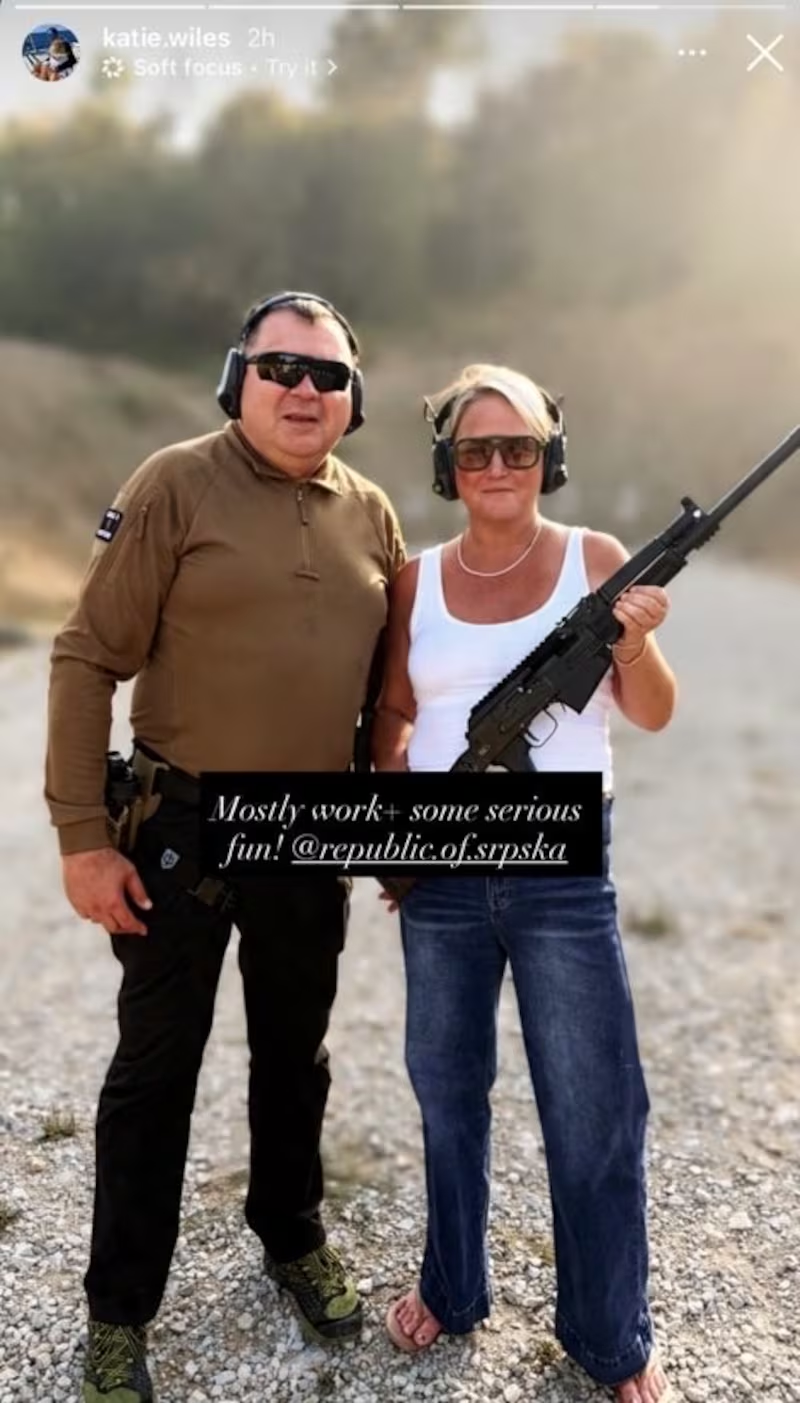 Katie Wiles holds a rifle next to Željko Budimir, the interior minister of the semi-autonomous Republika Srpska administration.
@evikokalari/X
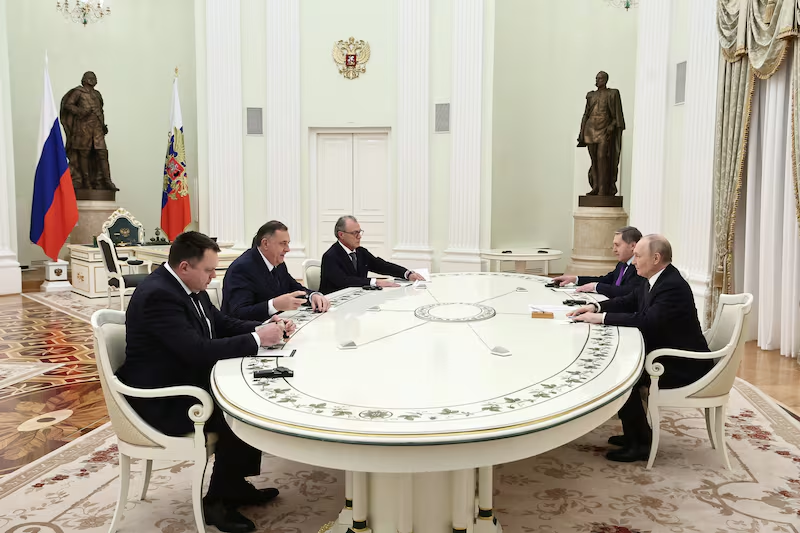 Budimir (left) and Dodik (second from left) attend a meeting with Putin at the Kremlin in April 2025.
In December 2025, Putin awarded Budimir the Pushkin Medal for strengthening ties between Serbs and Russians. The two had previously met at the Kremlin that April.
Republika Srpska is led by 67-year-old Milorad Dodik, the region’s former president. Though removed from office last year for failing to adhere to Bosnia’s 1995 peace accords, Dodik retains considerable influence. He has formed a close connection to Russian dictator Putin, and, according to foreign agent registration (FARA) filings seen by CBS, paid U.S.-based lobbying firms to rub elbows with Trump associates.
Two top outside advisers to Trump, Chris LaCivita and James Blair, visited Bosnia and Herzegovina last week to help Dodik’s party campaign, the New York Times reported
Trump Humiliates MAGA Aides Busted Helping Pro-Putin Regime
Katie Wiles is a partner at D.C.-based political lobbying firm Continental Strategy, which earlier this year registered to lobby for the region she visited. A spokesperson told CBS that Wiles spent two days in Republika Srpska in mid-August “with a U.S.-based company who was invited to do a feasibility study in the region.”
“Wiles provides strategic communications support to this U.S. company and has done so for over two years,” the spokesperson added. “Wiles has not spoken with any United States Government official regarding Srpska.”
Putin meets with Dodik at the Kremlin in April, 2025.
The company’s name is unclear. Continental Strategies did not immediately respond to CBS or the Daily Beast when asked
Katie Wiles’ bio on the firm’s site appears to have been taken down.
A White House official told the Daily Beast that Susie Wiles, 69, “does not discuss work matters with her daughters.” Wiles’ other daughter, Caroline, is also a consultant. Caroline worked on Trump’s 2016 campaign and transition team, and was aiming to land a role in the White House until she reportedly failed an FBI background check, forcing her to find another job in the Trump administration.The White House says Susie Wiles does not discuss work matters with her two daughters, who are in the consulting business.
Despite the White House’s claim that Susie and Katie Wiles don’t disclose their work to each other, they have interacted with similar types of people from the Balkans.
Last month, according to CBS, Susie Wiles met with Dodik ally Željka Cvijanović, a former president of Republika Srpska and a current member of the three-person presidency of Bosnia and Herzegovina. Katie Wiles did not set it up, a White House official told the network. Instead, it was Alejandro Garcia, who is also a partner at Continental Strategies.
The firm’s spokesperson told CBS that Garcia, a former deputy political director for Trump’s 2024 campaign, attended election day in Bosnia—Oct. 4—“but no other member of the team was present.”
“Garcia is the sole person who has interacted with the United States government regarding Srpska, and his contacts have all been meticulously tracked to be reported in accordance with FARA requirements,” the spokesperson said.
Trump Humiliates MAGA Aides Busted Helping Pro-Putin Regime
Meanwhile, the Trump administration’s decision to lift sanctions against Dodik has drawn scrutiny. House Democrats say the administration did so to help AAFS Infrastructure & Energy, a U.S.-incorporated company run by Joseph Flynn, the brother of Trump ally Michael Flynn, and Jesse Binnall, a former personal attorney to Trump. After the sanctions were removed, Dodik’s party, which had opposed the company’s proposed gas pipeline in the region, changed course and passed legislation clearing the way for the over $1.5 billion project.
A White House official told CBS that the administration lifted sanctions to prevent regional instability.
“This is yet another example of President Trump’s pragmatic, farseeing foreign policy that has prevented disasters on perennial issues that his predecessors so often stumbled into,” they said.
-=-=
-=-=
AN 10 26
Sources inside the White House say Trump and company are "panicking" as his administration masterminds jump ship for more lucrative jobs elsewhere, says the Daily Mail.
“Susie Wiles summoned her top advisers to her West Wing office just after 8.15 am Friday for a crisis meeting as a wave of stories about Trump allies cashing in on their access threatened to swamp the White House,” reports the Daily Mail, and the president's chief of staff was “panicked,” said a source familiar with the meeting. Wiles and the administration are still coming to grips with the political and media fallout from two of the president's top political lieutenants taking profitable paydays with foreign entities.
Additionally, Daily Mail said anxiety was building around reports about Wiles’ own daughters' pro-Russia foreign lobbying work, according to two sources familiar with the mood in the building.
The Daily Mail's sources relay that the White House was “blindsided last week” after reports that Chris LaCivita and James Blair, Trump's trusted political hands, had spent the October 4 weekend in the Balkans, advising a Putin-aligned government that was claiming election victory. Reports claim the men traveled to Republika Srpska, a self-governing part of Bosnia and Herzegovina. There they "consulted" on voting issues ahead of Sunday's election for the nationalist party.
Trump was infuriated at the news LaCivita and Blair — the leaders of Trump's political operation for the 2026 midterms — were out of the country “scoring handsome consulting fees” with just weeks to go before November and Republicans fighting for their lives to preserve House and Senate majorities.
According to the Daily Mail, White House sources say Wiles “first met with her policy right-hand Walker Barrett before assembling other top White House aides, including Megan Bauer, head of Cabinet Affairs, for the early-morning powwow.”
When contacted, White House spokespeople described the meeting as just the 'usual' Friday morning meeting, but an administration official said Trump was 'furious,' and the president has been desperately “working the phones, calling allies to ask how he should handle the embarrassing disclosure about LaCivita and Blair.”
The Daily Mail adds that the White House declined to describe the nature of the conversations she had with staff that Friday.
Days earlier, Trump claimed he saw no conflict with LaCivita and Blair’s off-site money-making, but sources say behind the scenes “that tenor had changed,” with the turmoil handing Democrats fresh ammunition just as early voting begins and the party’s grip on Congress appears slippery, Republican operatives told to the Daily Mail.
The Daily Mail says representatives for LaCivita, Blair was and Jared Kushner were contacted for comment, but failed to respond in time for the Wednesday article.
-=-=
-=-=
dw
no pix lnx
US President Donald Trump's trio for the Balkans
Alexander Rhotert
02/18/2025February 18, 2025
President Trump's new team for the Balkans includes some familiar faces with close ties to Serbia: son-in-law Jared Kushner, former special envoy Richard Grenell and ex-governor Rod Blagojevich.
https://p.dw.com/p/4qdGO
Two men (Richard Grenell and Donald Trump) in blue suits stand in front of a US flag. Between them and the flag is a large blue banner with the words 'Protect our food from China' and 'Protecting America Initiative,' which are only partially visible
Richard Grenell (left) and Donald Trump at an event in Philadelphia in September 2024Image: AP Photo/Alex Brandon/picture alliance
The first weeks of Donald J. Trump's second presidency have shown that The New York Times hit the nail on the head with its Inauguration Day headline: "The Deal Maker in Chief Is Back."
Trump's foreign policy also seems to show that his beloved "deals" will remain a dominant theme of his second administration.
There have already been three indications of this: The US is willing to continue sending military aid to Ukraine in return for access to its reserves of raw materials such as rare earths and lithium, the "takeover" of the Gaza Strip to create a "Riviera of the Middle East," and — a Trump classic — a "Trump Tower" in the Serbian capital, Belgrade.
The first attempt to get this last project off the ground stalled in 2012. The fact that construction is now about to begin 13 years later is largely due to Trump's close adviser, Richard "Ric" Grenell.
Grenell was special presidential envoy for Serbia and Kosovo peace negotiations during the first Trump administration, and Trump recently named him presidential envoy for special missions.
Trump Tower No. 5
Grenell has close — almost friendly — relations with Serbian President Aleksandar Vucic and Foreign Minister Marko Djuric, a former Serbian ambassador to the US.
Vucic even presented Grenell with the Order of the Serbian Flag in 2023 in recognition of his "balanced approach" to Europe's youngest state, the Republic of Kosovo, which Serbia still claims as part of its territory 26 years after the end of the Kosovo War.
The Trump Tower Belgrade deal — which, according to The New York Times, comes with a price tag of half a billion dollars — was concluded by the Serbian government, Trump's son-in-law Jared Kushner and Arab investors in March 2024.
A man in a blue suit (Richard Grenell) holds a box containing an order. Beside him is a taller man (Aleksandar Vucic). The two men are standing in front of a row of flagsA man in a blue suit (Richard Grenell) holds a box containing an order. Beside him is a taller man (Aleksandar Vucic). The two men are standing in front of a row of flags
Grenell (left) received the Order of the Serbian Flag from Serbian President Vucic (right) in Belgrade on October 25, 2023Image: Darko Vojinovic/dpa/picture alliance
The plan is to turn the former headquarters of the Armed Forces of Serbia (then the Federal Republic of Yugoslavia) into a hotel complex with luxury apartments, including a memorial to the victims of the NATO bombardment of Belgrade in 1999, during which the building was damaged.
After New York, Chicago, Manila and Istanbul, this would be the fifth Trump Tower worldwide.
'The perfect man for Belgrade'
On February 7, Politico reported that Trump was considering making Rod "Blago" Blagojevich US ambassador to Serbia. The former Democratic governor of Illinois is a colorful political figure — even by Trump's standards.
Blagojevich, the son of Serbian immigrants, was removed from office in 2009 and sentenced three years later to 14 years in prison for corruption.
When Trump commuted his sentence during his first term in office, Blagojevich was released from prison in 2020.
A man (Rod Blagojevich) wearing a black coat and a gray roll-neck sweater looks past the cameraA man (Rod Blagojevich) wearing a black coat and a gray roll-neck sweater looks past the camera
Rod 'Blago' Blagojevich is being touted as the next US ambassador to SerbiaImage: Vincent Alban/REUTERS
This makes the Democrat an ideal ally for the Republican president, says Daniel Serwer, Balkans expert at Johns Hopkins University and US Balkans negotiator under former US President Bill Clinton. "Blago is the perfect man for Belgrade: a profoundly corrupt politician who will be willing to do anything Trump wants to be rehabilitated," Serwer told DW.
Trump popular with Serbs — at home and abroad
After his removal from office, Blagojevich appeared on Donald Trump's show "The Celebrity Apprentice" in 2010.
When Trump was nominated presidential candidate at the Republican National Convention in July 2024, Blagojevich and Grenell made several electoral appearances together, especially in parts of the USA with large Serbian communities, where Trump had high approval ratings — as he did among nationalist Serbian politicians in Serbia and in neighboring Bosnia-Herzegovina and Kosovo, which also have Serbian communities.
A US coastguard boat with a gun on the front sails past a residence with peach-colored walls surrounded by palm trees. There is a large American flag in the grounds of the residenceA US coastguard boat with a gun on the front sails past a residence with peach-colored walls surrounded by palm trees. There is a large American flag in the grounds of the residence
According to a businessman who attended an event at Mar-a-Lago (pictured here), Trump called Blagojevich a 'great friend' and 'close associate'Image: Jen Golbeck/picture alliance/Sipa USA
In early 2024, five US businessmen with Serbian roots attended a reception at Trump's Mar-a-Lago residence in Florida. One of them was Ranko Ristic, founder of the company Zastava Arms USA, which has the exclusive right to import to the US firearms produced by the Serbian company Zastava Oruzje.
According to Ristic, Trump referred to Blagojevich during the event as a "great friend" and "close associate." Ristic said that he himself had told Trump that during the 1991–95 Bosnian War, Bosnian Serbs had had to defend themselves against 3,000 mujahedeen.
Criticism of Kosovo's prime minister
Blagojevich met President Vucic in Belgrade in early February. During his visit, he was highly critical in the media of Kosovo's Prime Minister Albin Kurti, saying that Serbs in Kosovo were the target of "ethnic cleansing" that was taking place there.
In 1999, the USA and other NATO countries bombarded Serbia to force it to withdraw its troops from Kosovo, which was then part of Serbia, to prevent the expulsion of the majority ethnic Albanian population from the province.
25th anniversary of the NATO bombing of Yugoslavia
05:06
Blagojevich apologized to Vucic for the USA's involvement in this intervention in the Kosovo War. "My country did a terrible thing to your country in the 1990s," Trump's potential ambassador to Serbia told Vucic, adding: "It's no different from what Russia is doing in Ukraine (...) I think President Trump will work on improving our countries' relations."
Trump's confidant Grenell has also criticized Kosovo's Prime Minister Kurti on multiple occasions. In addition, he met with an archenemy of Kurti, former Kosovo Prime Minister Ramush Haradinaj, in Washington the day before Trump's inauguration.
Show additional content?
This content is part of the text you are currently reading. The provider X / Twitter provides this content and may collect your usage data directly when you click “Show content”.
Always show content from X / Twitter.
According to a post by KosovoOnline on X, Haradinaj said that Grenell had confirmed to him that it would "not be good for Kosovo if Kurti remains in power."
Kurti has been in Grenell's bad books since 2020 when he rejected an ethnically motivated exchange of territory between Kosovo and Serbia proposed by Grenell. Kurti's Vetevendosje party won Kosovo's parliamentary election on February 9.
More radical rhetoric on Kosovo
These developments, which are extremely positive for Vucic, stand in stark contrast to the mass protests that have been rocking Serbia since early November.
In recent weeks, the Serbian president's rhetoric regarding Kosovo has taken a more radical turn, undoubtedly to divert attention from his obvious domestic problems.
In an interview with the German newspaper Berliner Zeitung, Serbian Foreign Minister Marko Djuric referred to Kosovo as "our southern province," where Serbs were exposed to "permanent discrimination and harassment."
A man (Albin Kurti) dressed in a dark green winter coat smiles broadly as he speaks into a microphoneA man (Albin Kurti) dressed in a dark green winter coat smiles broadly as he speaks into a microphone
The party of Albin Kurti (pictured here) won the parliamentary election in Kosovo on February 9Image: Florion Goga/REUTERS
Milan Mojsilovic, chief of General Staff of the Serbian Armed Forces, told the Serbian daily newspaper Vecernje novosti that Serbia's armed forces were at the ready to "protect Serbs and other non-Albanians on the territory of our southern province." There were, he said, "indicators for potential destabilization" in Kosovo.
Vucic, who has in the past referred to Kurti as "terrorist scum," described him recently on Serbia's Happy TV as a "villain" who "hates Serbs."
What does this mean for Bosnia?
Kurt Bassuener, director of the Berlin think tank Democratization Policy Council, told DW that Greater Serbian aspirations pose a threat not only to the territorial integrity of Kosovo but also to that of Bosnia-Herzegovina.
The EU could, he said, respond to Belgrade's aggression toward its neighbors by "significantly beefing up" the EUFOR Althea mission, which protects peace in Bosnia, with combat troops.
Were this to happen, a US-Balkan team comprising Grenell, Kushner and Blagojevich — including a direct line to the White House — would be a gift for Belgrade. It would also mean that an improvement in Serbia-Kosovo relations — already unlikely as it is — would slip further away.
A large crowd fills a square in Nis, Serbia. Several people are holding up Serbian flags A large crowd fills a square in Nis, Serbia. Several people are holding up Serbian flags
Protests have been taking place across Serbia at regular intervals since last NovemberImage: Jelena Djukic Pejic/DW
The EU responded in 2023 to the last Kosovo Serb attacks on NATO and Kosovo security forces and a Serb military buildup on the Serbia-Kosovo border with sanctions — paradoxically, against Kosovo.
It was only the personal intervention of the then US Secretary of State Antony Blinken, who spoke to President Vucic, and the enormous pressure exerted by NATO that were able to get Serbian tanks to turn back.
Today, both Western Balkans experts Serwer and Bassuener doubt that the US would stop Vucic's army should the worst come to the worst. Serwer also warns that even the discussion of the breakup of Kosovo or Ukraine would animate Serbian secessionists in Bosnia to take corresponding action.
"It will be up to Bosnians to react to that," Serwer told DW. "The Javelins are Kosovo's best defense at this point." Without the delivery of the highly effective US Javelin anti-tank weapon system, Ukraine's successful resistance to Russia's all-out invasion in 2022 would have been inconceivable.
In view of the current security policy situation, an escalation of potential conflicts in the Western Balkans is certainly becoming increasingly likely.
This article was originally published in German.
Head shot of a man (Alexander Rhotert) with glasses in front of a pale wallHead shot of a man (Alexander Rhotert) with glasses in front of a pale wall
Alexander Rhotert Political scientist, author and expert on the Western Balkans
---
- [
AInvest
The Transatlantic Shift: Trump Jr.'s Play for Eastern Europe's Economic ...
Apr 26, 2025Real Estate and Brand Licensing: The Trump Organization's ventures—such as a proposed golf resort in Serbia and a luxury hotel in Belgrade—serve as tangible investments in this strategy. These projects aim to capitalize on the region's underdeveloped tourism infrastructure while leveraging the brand's global appeal.
MSN
Trump Jr. Heads to Eastern Europe to Expand Family Business - MSN
US President Donald Trump's eldest son will make a trip to eastern Europe, where he's seeking to expand his family's business ties, according to people familiar.
The Maga push overturning US policy in the Balkans
Dec 10, 2025South-eastern Europe jolted by Trump's support for pro-Russia Serb leader
New York Times
https://www.nytimes.com › 2025 › 03 › 19 › us › politics › donald-trump-jr-serbia.html
Donald Trump Jr. Mixes Business and Politics in Serbia, as Protests ...
Mar 19, 2025Donald Trump Jr.'s visit immediately became national news in Serbia, apparently showing that the Trump administration supported the current government despite the growing protests.

BBC
https://www.bbc.com › news › articles › c1e3q6g5n00o
Serbia clears the way for controversial Trump-linked property plan - BBC
Nov 8, 2025Serbia's parliament has passed a law which paves the way for a controversial property development led by US President Donald Trump's son-in-law Jared Kushner in the capital Belgrade.

European Council on Foreign Relations
https://ecfr.eu › publication › trumps-tinderbox-us-politics-and-the-next-war-in-the-balkans
Trump's tinderbox: US politics and the next war in the Balkans
Oct 29, 2024Summary Over recent years, Serbia's government and Serb nationalists elsewhere in the Western Balkans have increased their revisionist agitation in the region. They recently adopted an "all-Serb declaration" that seeks to overturn the post-Dayton settlement in Bosnia and Herzegovina, and claims Kosovo as an inseparable part of Serbia.

cfwbs.org
https://cfwbs.org › trump-and-the-balkans-great-deals-or-great-risks-ljubomir-filipovic
Trump and the Balkans: Great Deals or Great Risks? - Ljubomir Filipović ...
Dec 20, 2024For countries like Bosnia and Kosovo, this stagnation has paralleled a standstill in their aspirations for European Union membership. Trump's transactional approach to foreign policy—focused on striking deals rather than promoting systemic change—led to opportunities and challenges in the Balkans.

AP News
Serbian lawmakers pass special law for real estate project linked to ...
Serbian lawmakers have passed a special law clearing the way for a proposed real estate development project that would be financed by a company linked to Donald Trump's son-in-law Jared Kushner but which has faced widespread public opposition and legal hurdles.

GIS Reports
https://www.gisreportsonline.com › r › u-s-diplomacy-in-the-western-balkans
U.S. diplomacy in the Western Balkans under President Trump
Sep 4, 2025Finally, President Trump's global strategy includes playing a constructive role in mitigating regional conflicts and promoting "free and open" spaces through projects such as Central and Eastern Europe's Three Seas Initiative, of which the U.S. is a key strategic partner.

La Voce di New York
Donald Trump Jr. Visit in Serbia: Mixing Business and Politics
Mar 20, 2025Trump Jr.'s brief visit included a meeting with Vučić to discuss U.S. foreign aid to Serbia. The Trump family and Jared Kushner, the husband of Trump's daughter Ivanka, are involved in building a Trump International Hotel in Belgrade, the first of its kind in Europe.

DW
https://www.dw.com › en › us-president-donald-trumps-trio-for-the-balkans › a-71649332
US President Donald Trump's trio for the Balkans - dw.com
Feb 18, 2025President Trump's new team for the Balkans includes some familiar faces with close ties to Serbia: son-in-law Jared Kushner, former special envoy Richard Grenell and ex-governor Rod Blagojevich.

Balkan Insight
Serbia Spending More on Trump-Linked Lobbyists - to What Effect?
Feb 27, 2026Experts doubt the effect of Serbia's spending on US lobbyists to burnish the country's image in the eyes of Donald Trump.
---
---
an 6 26
Former National Security Adviser Michael Flynn is among the MAGA Republicans who faced federal criminal charges during Donald Trump's first presidency; in 2017, he pled guilty to lying to the FBI about his communications with Sergey Kislyak, then Russian ambassador to the United States. Now, 16 and one-half months into Trump's second presidency, Flynn is drawing vehement criticism from MAGA Republicans for registering as a foreign agent.
The New Republic's Edith Olmsted reports, "Far-right blogger Scott McMahan posted a Foreign Agents Registration Act form Monday that was dated October 2025, and stated that Donald Trump's former national security adviser was now making $100,000 per month from the Republic of Srpska. The confederated entity of Bosnia and Herzegovina is run by Milorad Dodik, a key ally of Russian President Vladimir Putin."
On X, formerly Twitter, McMahan, posted, "Dodik's proximity to Putin is not conjecture. Dodik personally met with Putin on Russia's May 9 Victory Day. Putin said, 'It's very important that you all think alike ... we commonly advocate for a more fair world order ... free of any external intervention.'"
McMahan isn't the only MAGA Republican who is commenting on Flynn registering as a foreign agent.
MAGA influencer Sebastian Gorka tweeted, "A reminder: When I joined the first Trump administration, I was asked to sign two documents. In one I promised to not work as a lobbyist for a decade. In the second, I promised to never work for another government. I was happy to do sign both. I presume GEN Flynn also signed similar documents."
Phillip Buchanan, who goes by Catturd on X and has 4 million followers on that platform, responded to McMahan's tweets, posting, "100,000 per month?"
Olmsted comments, "If MAGA is upset that Flynn is working on behalf of a Russian ally, just wait until they realize all the ways Trump has stuck his neck out for Putin — and he's doing it for free!"
Despite the criticism from McMahan, the far-right Flynn is known for being a longtime Trump loyalist and an aggressive defender of the U.S. president. Much of the right-wing criticism of Flynn during Trump's first presidency came not from MAGA, but from a combination of Never Trump conservatives, neocons and libertarians.
Trump was only two days into his first presidency when Flynn, on January 22, 2017, became national security adviser. But he didn't stay in that position long, stepping down on February 13, 2017 because of the Kislyak controversy.
In December 2017, Flynn reached an agreement with then-special counsel Robert Mueller, pleading guilty to one count of lying to the FBI about his communications with Kislyak and agreeing to cooperate with Mueller's investigation of Russian interference in the United States' 2016 presidential election."
---
Ratko Mladić (Serbian Cyrillic: Ратко Младић, pronounced [râtko mlǎːdit͡ɕ]; born 12 March 1943)[1][2] is a Bosnian Serb former general found guilty of committing war crimes, crimes against humanity, and genocide by the International Criminal Tribunal for the former Yugoslavia (ICTY). On 31 May 2011, Mladić was extradited to The Hague, where he was processed at the detention center that holds suspects for the ICTY.[3] His trial formally began in The Hague on 16 May 2012 and was concluded on 22 November 2017 finding him guilty and sentencing him to life in prison.[4][5]^
A long-time member of the League of Communists of Yugoslavia, Mladić began his career in the Yugoslav People's Army in 1965.[6][7] He came to prominence in the Yugoslav Wars, initially as a high-ranking officer of the Yugoslav People's Army and subsequently as the Chief of Staff of the Army of Republika Srpska in the Bosnian War of 1992–1995. He has often been referred to by media as the Butcher of Bosnia,[8][9][10][11][12] a title also sometimes applied to Radovan Karadžić, the former President of Republika Srpska.[13][14][15]^
In July 1996 the Trial Chamber of the ICTY, proceeding in the absence of Mladić under the ICTY's Rule 61, confirmed all counts of the original indictments, finding there were reasonable grounds to believe he had committed the alleged crimes, and issued an international arrest warrant.[16] The Serbian and United States governments offered €5 million for information leading to Mladić's capture and arrest.[17] In October 2010, Serbia intensified the hunt by increasing the reward for Mladić's capture from €5 million to €10 million.[18] Mladić nevertheless managed to remain at large for nearly sixteen years, initially sheltered by Serbian and Bosnian Serb security forces and later by family. On 26 May 2011, he was arrested in Lazarevo, Serbia.[19] His capture was considered to be one of the pre-conditions for Serbia being awarded candidate status for European Union membership.[20][21]^
On 22 November 2017, he was sentenced to life in prison by the ICTY for 10 charges, one of genocide, five of crimes against humanity and four of violations of the laws or customs of war. He was cleared of one count of genocide. As the top military officer with command responsibility, Mladić was deemed by the ICTY to be responsible for the Siege of Sarajevo and the Srebrenica massacre.
- 1Early life and military career
- 2Role in the Yugoslav wars
- 3Indictment by the ICTY
- 4Arrest, trial, and conviction
- 5Family
- 6References
- 7External links
Early life and military career
Mladić was born in Božanovići, Kalinovik, Herzegovina,[22] on 12 March 1943.[23]^
His father Neđa (1909–1945) was a member of the Yugoslav Partisans. His mother, Stana (née Lalović; 1919–2003), raised her three children; daughter Milica (born 1940), sons Ratko and Milivoje (1944–2001), by herself after the death of her husband in 1945 during World War II. Bosnia and Herzegovina was at the time part of the Independent State of Croatia, a fascist puppet state led by the Croatian Ustaše between 1941 and 1945, created after Nazi Germany and Fascist Italy invaded and partitioned the Kingdom of Yugoslavia in 1941. Mladić's father Neđa was killed in action (on Mladić's third birthday) while leading a Partisan attack on the home villageof Ustaše leader Ante Pavelić in 1945.[24]^
Upon finishing elementary school, Mladić worked in Sarajevo as a whitesmith for the "Tito Company". He entered the Military Industry School in Zemun in 1961. He then went on to the KOV Military Academy and the Officers Academy thereafter. Upon graduating on 27 September 1965, Mladić began his career in the Yugoslav People's Army. The same year, he joined the League of Communists of Yugoslavia, remaining a member until the party disintegrated in 1990.[6]^
Mladić began his first post as an officer in Skopje on 4 November 1965, where he was the commander of and youngest soldier in his unit. Beginning with the rank of second lieutenant in April 1968, he proved himself to be a capable officer, first commanding a platoon (May 1970), then a battalion (27 November 1974), and then a brigade. In September 1976, Mladić began his higher military education at the "Komandno-štabne akademije" in Belgrade, finishing in first place with a grade of 9.57 (out of 10).
On 25 December 1980, Mladić became a Lieutenant colonel. Then, on 18 August 1986, he became a colonel, based in Štip. He finished an additional year of military education in September 1986. On 31 January 1989, he was promoted to the head of the Education Department of the Third Military District of Skopje.[25] On 14 January 1991, he was promoted again, to Deputy Commander in Priština.
Role in the Yugoslav wars
In June 1991, Mladić was promoted to Deputy Commander of the Priština Corps in the Socialist Autonomous Province of Kosovo at a time of high tension between Kosovan Serbs and Kosovo's majority Albanianpopulation. That year, Mladić was given command of the 9th Corps, and led this formation against Croatian forces in Knin, the capital of the self-declared Republic of Serbian Krajina.[26]^
On 4 October 1991, he was promoted to Major General. The JNA forces under his command participated in the Croatian War, notably during Operation Coast-91 in an attempt to cut off Dalmatia from the rest of Croatia, which resulted in a stalemate (the Croats held the entire coastline near Zadar and Šibenik, while Serb Krajina expanded its territory in the hinterland). Among other early operations, Mladić aided Milan Martić's militia in the 1991 siege of Kijevo.

General Mladić (centre) arrives for UN-mediated talks at Sarajevo airport, June 1993.
On 24 April 1992, Mladić was promoted to the rank of lieutenant colonel general. On 2 May 1992, one month after Bosnia and Hercegovina's declaration of independence, Mladić and his generals blockaded the city of Sarajevo, shutting off all traffic in and out of the city, as well as water and electricity. This began the four-year Siege of Sarajevo, the longest siege in the history of modern warfare. The city was bombarded with shells and sniper shooting. On 9 May 1992, he assumed the post of Chief of Staff/Deputy Commander of the Second Military District Headquarters of the JNA in Sarajevo. The next day, Mladić assumed the command of the Second Military District Headquarters of the JNA. On 12 May 1992, in response to Bosnia's secession from Yugoslavia, the Bosnian Serb Parliament voted to create the Army of Republika Srpska (VRS, in short). At the same time, Mladić was appointed Commander of the Main Staff of the VRS, a position he held until December 1996. In May 1992, after the withdrawal of JNA forces from Bosnia, the JNA Second Military District became the nucleus of the Main Staff of the VRS. On 24 June 1994, he was promoted to the rank of colonel general over approximately 80,000 troops stationed in the area.[citation ^needed]
In July 1995, troops commanded by Mladić, harried by NATO air strikes intended to force compliance with a UN ultimatum to remove heavy weapons from the Sarajevo area, overran and occupied the UN "safe areas" of Srebrenica and Žepa. At Srebrenica over 40,000 Bosniaks who had sought safety there were expelled. An estimated 8,300 were murdered, allegedly on Mladić's order.[27][28] On 4 August 1995, with a huge Croatian military force poised to attack the Serb-held region in central Croatia, Radovan Karadžićannounced he was removing Mladić from his post and assuming personal command of the VRS himself. Karadžić blamed Mladić for the loss of two key Serb towns in western Bosnia that had recently fallen to the Croatian army, and he used the loss of the towns as an excuse to announce his surprising changes in the command structure.[29] Mladić was demoted to an "adviser". He refused to go quietly, claiming the support of both the Bosnian Serb military as well as the people. Karadžić countered by denouncing Mladić as a "madman" and attempting to remove his political rank, but Mladić's obvious popular support forced Karadžić to rescind his order on 11 August.[30]^
On 8 November 1996, the President of the Bosnian Serb Republic, Biljana Plavšić, dismissed Mladić from his post. He continued to receive a pension until November 2005.[31]^
Indictment by the ICTY
The International Criminal Tribunal for the Former Yugoslavia building in the Hague.
On 24 July 1995, Mladić was indicted by the International Criminal Tribunal for the Former Yugoslavia (ICTY) for genocide, crimes against humanity, and numerous war crimes (including crimes relating to the alleged sniping campaign against civilians in Sarajevo). On 16 November 1995, the charges were expanded to include charges of war crimes for the attack on the UN-declared safe area of Srebrenica in July 1995.[26]^
A fugitive from the ICTY, he was suspected to be hiding either in Serbia or in Republika Srpska. Mladić was reportedly seen attending a football match between China and Yugoslavia in Belgrade in March 2000. He entered through a VIP entrance and sat in a private box surrounded by eight armed bodyguards. There were claims that he had been seen in a suburb of Moscow, and that he "regularly" visited Thessaloniki and Athens, which raised suspicions that numerous fake reports were sent to cover his trail. Some reports said that he took refuge in his wartime bunker in Han Pijesak, not far from Sarajevo, or in Montenegro.[26]^
In early February 2006, portions of a Serbian military intelligence report were leaked to Serbian newspaper Politika which stated that Mladić had been hidden in Army of Republika Srpska and Yugoslav People's Army facilities up until 1 June 2002, when the National Assembly of Serbia passed a law mandating cooperation with the ICTY in The Hague.[32]The then-Chief General of the Yugoslav Army Nebojša Pavković requested that Mladić vacate the facility where he was staying on mountain Povlen, near Valjevo, after which the Serb military agencies claim to have lost all trace of him.
Initially, Mladić lived freely in Belgrade[33] After the arrest of Slobodan Milošević in 2001, Mladić went into hiding, but he was still protected by Serb security services and the army. Serbia's failure to bring Mladic to justice seriously harmed its relationship with the European Union.[34]^
In 2004, Paddy Ashdown, then-United Nations High Representative in Bosnia and Herzegovina, removed[citation ^needed] 58 officials from their posts due to suspicions that they helped war crimes suspects including Mladić and Karadžić to evade capture. Some officials were subjected to travel bans and had their bank accounts frozen. The ban was later lifted after the capture of Mladić.[35]^
In November 2004, British defence officials conceded that military action was unlikely to be successful in bringing Mladić and other suspects to trial. One winter's day British UN troops carrying sidearms were confronted by the general skiing down the piste at Sarajevo's former Olympic skiing resort but made no move for their guns; skiing behind Mladić were four bodyguards. Despite his Hague warrant, the British soldiers decided to carry on skiing. NATO later sent commandos to arrest various war crimes suspects, but Mladić simply went underground. No amount of NATO action or UN demands, or even a $5 million bounty announced by Washington, could bring him in.[36]^
It was revealed in December 2004 that the Army of Republika Srpska had been harboring and protecting Mladić until the summer of 2004, despite repeated and public pleas to collaborate with the ICTY and apprehend war criminals. On 6 December, NATO said that Mladić visited his wartime bunker during the summer in order to celebrate the Army of Republika Srpska-day.[32]^
In June 2005 The Times newspaper alleged that Mladić had demanded a $5 million (£2.75 million) "compensation" to be given to his family and bodyguards if he gave himself up to the ICTY in the Hague. In January 2006, a Belgrade court indicted 10 people for aiding Mladić in hiding from 2002 to January 2006. An investigation showed Mladić spent his time in New Belgrade, a suburb of the capital.[32]^
It was erroneously reported on 21 February 2006 that Mladić had been arrested in Belgrade and was being transferred via Tuzla to the ICTY war tribunal.[37] The arrest was denied by the Serbian government. The government did not deny rumors of a planned negotiated surrender between Mladić and Serbian Special Forces. Romanian government and Serbian sources claimed on 22 February 2006 that Mladić was arrested in Romania, near Drobeta-Turnu Severin, close to the Serbian border by a joint Romanian-British special operation carried out by troops of those respective countries.[38] However, ICTY Prosecutor Carla Del Ponte denied the rumors that Mladić had been arrested, saying that they had "absolutely no basis whatsoever". Del Ponte urged the Serbian government to locate him without further delay, saying Mladić was in reach of the Serbian authorities and had been in Serbia since 1998. She said a failure to capture him would harm Serbia's bid to join the European Union (EU). 1 May 2006 deadline established by Del Ponte for Serbia to hand over Mladić passed, resulting in talks between Serbia and the EU being suspended. The EU considered Mladić's arrest, along with full cooperation with the ICTY, pre-conditions that had to be met before Serbia could join the organization.[39]^
In July 2008, Serbian officials voiced concern that Mladić would order or had ordered his bodyguards to kill him to prevent him from being captured to face trial.[40]^
On 16 June 2010, Mladić's family filed a request to declare him dead, claiming he had been in poor health and absent for seven years.[41] If the declaration had been approved Mladić's wife would have been able to collect a state pension and sell his property.[20] At this time, Mladić was hiding in a house owned by his family.[42]^
Based on a March 2009 poll of the NGO Strategic Marketing for the television station B92, which involved 1050 respondents, 14% of Serbia's citizens would reveal information that would lead to his arrest in exchange for €1 million, 21% did not have a determined attitude, and 65% would not divulge information for €1 million (the poll was conducted when the United States embassy issued a reward of €1.3 million for any information on Mladić).[43] However, it was noted that the formulation of the question might have been a problem, as the polling samples which opted "No" included also those who would immediately report Mladić without payment, believing that payment in this case is immoral. Although preceding reports indicated that 47% supported the extradition, it was apparent that most of the population was against it.[44] According to a poll conducted by the National Committee for Cooperation with the ICTY, 78% of those polled would not report Mladić to the authorities, 34% said they would approve of Mladić's arrest, while 40% believe that he is a hero.[45]^
On 11 June 2009, a Bosnian television station broadcast videos of Mladić, filmed over the previous decade.[46] The last video that was featured in the show 60 Minuta showed Mladić with two women, allegedly filmed in the winter of 2008. However, no evidence for this was given by television presenters. Serbia stated that it was "impossible" for the videos to have been filmed in 2008. Rasim Ljajić, Serbia's minister in charge of co-operation with the UN tribunal, confirmed that the footage was old and had already been handed over to the ICTY in March 2009. Ljajić claimed "the last known footage was taken eight years ago. The last time Mladić was in military premises was at the Krcmari army barracks near [the western Serbian town of] Valjevo on 1 June 2002." The previously unseen images show Mladić in various restaurants and apartments and at what appears to be military barracks in Serbia, almost always accompanied by his wife Bosa and son Darko.[47]^
Arrest, trial, and conviction
Main article: Trial of Ratko Mladić
Mladić in court, June 2011
Ratko Mladić was arrested on 26 May 2011 in Lazarevo, northern Serbia. His arrest had been carried out by two dozen Serbian special police officers wearing black uniforms and masks, and not wearing any insignia. The police were accompanied by Security Information Agency and War Crimes Prosecutor's Office agents. The officers entered the village in four SUVs in the early morning hours, while most residents were still asleep. They pulled up to four houses simultaneously, each owned by Mladić's relatives. Mladić was about to venture into the yard for a walk after being awakened by pain, when four officers jumped over the fence and had broken into the house just as he moved toward the door, grabbing Mladić, forcing him to the floor, and demanding he identify himself. Mladić identified himself correctly, and surrendered two pistols he had been carrying. He was then taken to Belgrade.[48][49] Mladić was arrested in the house of his cousin Branislav Mladić, at the Ul. Vuka Karadžića 2.[50]^
Branislav had been identified as a possible suspect at least two months before, and had been under surveillance right up to his arrest. After some initial doubt as to the identity of the arrestee, Serbian President Boris Tadić confirmed it was Mladić at a press conference and announced that the process of extraditing him to the ICTY was underway. Mladić had been using the pseudonym "Milorad Komadić" while in hiding.[51] Mladić was not wearing a beard or any disguise. His appearance reportedly showed he had "aged considerably", and one of his arms was paralyzed due to a series of strokes.[52]^
Following his arrest, Mladić appeared before the Belgrade Higher Court for a hearing on whether he was fit to be extradited to The Hague. Judge Milan Dilparić suspended interrogation due to his poor health. Mladić's lawyer Miloš Šaljić said that his poor health prevented him from properly communicating. He was allegedly unable to confirm his personal data, but attempted to talk to the prosecutors on several occasions, especially to Deputy War Crimes Prosecutor Bruno Vekarić.[53]^
However, the court ruled that he was fit to be extradited on 27 May. According to the Serbian Health Ministry, a team of prison doctors described his health as stable following checkups. Mladić was also visited in prison by Health Minister Zoran Stanković, a former friend.[54] Mladić was extradited to The Hague on 31 May 2011, and his trial formally opened in The Hague on 16 May 2012.[55]^
Mladić was arrested on the same day that the EU's representative, Catherine Ashton, visited Belgrade.[56] His arrest improved relations with the EU, which had been concerned that Serbia was sheltering Mladić.[57] In July 2015 media said that he is "trying to find one Norwegian officer to have him come to The Hague to witness" in the trial.[58]^
In 2017, the International Criminal Tribunal for the former Yugoslavia (ICTY) convicted Mladić on 10 charges: one of genocide, five of crimes against humanity and four of violations of the laws or customs of war. He was cleared of one count of genocide. As top military officer with command responsibility, Mladić was deemed by the ICTY of being responsible for the Siege of Sarajevo and the Srebrenica massacre. The ICTY sentenced Mladić to life imprisonment.[59][5]^
---
milosevec
20 August 1941 – 11 March 2006) was a Yugoslav and Serbian politician and the President of Serbia (originally the Socialist Republic of Serbia, a constituent republic within the Socialist Federal Republic of Yugoslavia) from 1989 to 1997 and President of the Federal Republic of Yugoslavia from 1997 to 2000. He also led the Socialist Party of Serbia from its foundation in 1990. He rose to power as Serbian President after he and his supporters claimed the need to reform the 1974 Constitution of Yugoslaviadue to both the marginalization of Serbia and its political incapacity to deter Albanian separatist unrest in the province of Kosovo.
Milošević's presidency of Serbia and the Federal Republic of Yugoslavia was marked by several major reforms to Serbia's constitution in the 1980s to the 1990s that reduced the powers of the autonomous provinces in Serbia and in 1990 transitioned Serbia from a Titoist one-party system to a multi-party system, attempted reforms to the 1974 Constitution of Yugoslavia, the breakup of Yugoslavia and the outbreak of the subsequent wars, the founding of the Federal Republic of Yugoslavia by the former SFRY republics of Serbia and Montenegro, negotiating the Dayton Agreement on behalf of the Bosnian Serbs that ended the Bosnian War in 1995, and his overthrow in 2000.
In the midst of the NATO bombing of Yugoslavia in 1999, Milošević was charged by the International Criminal Tribunal for the former Yugoslavia (ICTY) with war crimes in connection to the wars in Bosnia, Croatia, and Kosovo.[1] Milošević resigned the Yugoslav presidency amid demonstrations, following the disputed presidential election of 24 September 2000. He was arrested by Yugoslav federal authorities on 31 March 2001 on suspicion of corruption, abuse of power, and embezzlement.[2][3] The initial investigation into Milošević faltered for lack of evidence, prompting the Serbian Prime Minister Zoran Đinđić to extradite him to the International Criminal Tribunal for the former Yugoslavia (ICTY) to stand trial for charges of war crimes instead.[4] At the outset of the trial, Milošević denounced the Tribunal as illegal because it had not been established with the consent of the United Nations General Assembly; therefore he refused to appoint counsel for his defence.[5] Milošević conducted his own defence in the five-year-long trial, which ended without a verdict when he died in his prison cell in The Hague in 11 March 2006.[6] Milošević, who suffered from heart ailments and hypertension, died of a heart attack.[7][8] The Tribunal denied any responsibility for Milošević's death, and stated that he had refused to take prescribed medicines and medicated himself instead.[9]^
After Milošević's death, the International Court of Justice (ICJ) concluded separately in the Bosnian Genocide Case that there was no evidence linking him to genocide committed by Bosnian Serb forces during the Bosnian War. However, the Court did find that Milošević and others in Serbia had committed a breach of the Genocide Convention by failing to prevent the genocide from occurring and for not cooperating with the ICTY in punishing the perpetrators of the genocide, in particular General Ratko Mladić, and for violating its obligation to comply with the provisional measures ordered by the Court.[10][11]^
---