trump real estate
not sure of orig intention of this node, prolly COI emoluments, but Russia now?
includes all aspects of trump biz
latin am hotel money laundering
soho tower?
see trump kids
stormy daniel cohen election fuckery
===
-=-=
AN 10 26
FBI hands Trump towers contractor no-bid surveillance deal
-=-=
-=-=
see corrupt IRS head
---
new see wod4
flynn fara putin 6 26 duck
- [
AInvest
The Transatlantic Shift: Trump Jr.'s Play for Eastern Europe's Economic ...
Apr 26, 2025Real Estate and Brand Licensing: The Trump Organization's ventures—such as a proposed golf resort in Serbia and a luxury hotel in Belgrade—serve as tangible investments in this strategy. These projects aim to capitalize on the region's underdeveloped tourism infrastructure while leveraging the brand's global appeal.
MSN
Trump Jr. Heads to Eastern Europe to Expand Family Business - MSN
US President Donald Trump's eldest son will make a trip to eastern Europe, where he's seeking to expand his family's business ties, according to people familiar.
...
Financial Times
https://www.ft.com › content › 49ecf8e3-ed55-4907-9d2c-7fe8d3fd7979
The Maga push overturning US policy in the Balkans
Dec 10, 2025South-eastern Europe jolted by Trump's support for pro-Russia Serb leader
New York Times
https://www.nytimes.com › 2025 › 03 › 19 › us › politics › donald-trump-jr-serbia.html
Donald Trump Jr. Mixes Business and Politics in Serbia, as Protests ...
Mar 19, 2025Donald Trump Jr.'s visit immediately became national news in Serbia, apparently showing that the Trump administration supported the current government despite the growing protests.


BBC
https://www.bbc.com › news › articles › c1e3q6g5n00o
Serbia clears the way for controversial Trump-linked property plan - BBC
Nov 8, 2025Serbia's parliament has passed a law which paves the way for a controversial property development led by US President Donald Trump's son-in-law Jared Kushner in the capital Belgrade.

European Council on Foreign Relations
https://ecfr.eu › publication › trumps-tinderbox-us-politics-and-the-next-war-in-the-balkans
Trump's tinderbox: US politics and the next war in the Balkans
Oct 29, 2024Summary Over recent years, Serbia's government and Serb nationalists elsewhere in the Western Balkans have increased their revisionist agitation in the region. They recently adopted an "all-Serb declaration" that seeks to overturn the post-Dayton settlement in Bosnia and Herzegovina, and claims Kosovo as an inseparable part of Serbia.

cfwbs.org
https://cfwbs.org › trump-and-the-balkans-great-deals-or-great-risks-ljubomir-filipovic
Trump and the Balkans: Great Deals or Great Risks? - Ljubomir Filipović ...
Dec 20, 2024For countries like Bosnia and Kosovo, this stagnation has paralleled a standstill in their aspirations for European Union membership. Trump's transactional approach to foreign policy—focused on striking deals rather than promoting systemic change—led to opportunities and challenges in the Balkans.

AP News
Serbian lawmakers pass special law for real estate project linked to ...
Serbian lawmakers have passed a special law clearing the way for a proposed real estate development project that would be financed by a company linked to Donald Trump's son-in-law Jared Kushner but which has faced widespread public opposition and legal hurdles.

GIS Reports
https://www.gisreportsonline.com › r › u-s-diplomacy-in-the-western-balkans
U.S. diplomacy in the Western Balkans under President Trump
Sep 4, 2025Finally, President Trump's global strategy includes playing a constructive role in mitigating regional conflicts and promoting "free and open" spaces through projects such as Central and Eastern Europe's Three Seas Initiative, of which the U.S. is a key strategic partner.

La Voce di New York
Donald Trump Jr. Visit in Serbia: Mixing Business and Politics
Mar 20, 2025Trump Jr.'s brief visit included a meeting with Vučić to discuss U.S. foreign aid to Serbia. The Trump family and Jared Kushner, the husband of Trump's daughter Ivanka, are involved in building a Trump International Hotel in Belgrade, the first of its kind in Europe.

DW
https://www.dw.com › en › us-president-donald-trumps-trio-for-the-balkans › a-71649332
US President Donald Trump's trio for the Balkans - dw.com
Feb 18, 2025President Trump's new team for the Balkans includes some familiar faces with close ties to Serbia: son-in-law Jared Kushner, former special envoy Richard Grenell and ex-governor Rod Blagojevich.

Balkan Insight
Serbia Spending More on Trump-Linked Lobbyists - to What Effect?
Feb 27, 2026Experts doubt the effect of Serbia's spending on US lobbyists to burnish the country's image in the eyes of Donald Trump.
---
'Just a matter of time' before Trump family business seals Saudi deal
an 12 25
an 10 23 no lnx
Here’s the 'problem' with ex-Trump Org CFO’s $2 million severance agreement: analyst
Maya Boddie
October 12, 2023
Following former Trump Organization Chief Financial Officer Allen Weisselberg's testimony during ex-President Donald Trump's New York civil fraud trial Tuesday, MSNBC legal analyst Lisa Rubin took to X (formerly Twitter) to share her knowledge of Weisselberg's severance agreement.
PBS reports New York Attorney General Letitia "James' lawsuit alleges that Weisselberg engineered Trump's financial statements to meet his demands that they show increases in his net worth and signed off on lofty valuations for assets despite appraisals to the contrary."
On Wednesday, Rubin wrote, "We learned yesterday that Allen Weisselberg's severance agreement will ultimately pay him $2 million by 12/31/24 if he fully complies. What I didn't appreciate is what he promised in return. To some extent, it's not atypical to require an employee to promise not to assist with others' claims. The problem here is context—and timing."
She continued, "Let's start with the fact that while Weisselberg left the company at the end of 2022 and the agreement contemplated his completing his work in good faith before that date, it wasn't executed by him until the literal eve of his Jan. 10, 2023 sentencing. And it wasn't signed by Alan Garten, the Trump Organization's chief legal officer, until Jan. 12, two days after Weisselberg entered Rikers."
Rubin added, "What's more, according to the payment schedule appended to the agreement, the Trump Org. did not start paying him until Mar. 31, 2023, well into his prison sentence and certainly after reports that the Manhattan DA was still investigating Weisselberg for insurance fraud. Now let's go back to his severance obligations. They include cooperating in an investigation or litigation against the company or Trumps by meeting with them in connection with 'discovery or pretrial issues' and providing "truthful testimony on behalf of Releasees. That means he was likely obligated to meet with them before his trial testimony."
:{She continued, "The severance agreement also entitles Weisselberg to be indemnified for any reasonable attorney's fees in any legal matter against him or the company--but there's some big catches. He can't hire a lawyer without the company's prior approval, and "to the extent there is no direct conflict of interest and at the election of the Company, [Weisselberg] shall be jointly represented by counsel for the Company. Put another way, if he wants his own fees paid, they get to decide who represents him and even force their own lawyers on him. But, of course, all of this pales in comparison to Weisselberg's commitment that except where forced by subpoena or other court-ordered process, he won't give information to anyone else with claims against the company and/or anyone he individually released (e.g., Trump)... or 'take any action to induce, encourage, instigate, aid, abet or otherwise cause" any person or entity "to bring or file a complaint, charge, lawsuit or other proceeding of any kind against the Company or any person or entity released by this Agreement."
Rubin concludes, "Read broadly, the agreement precludes Weisselberg from voluntarily cooperating with any law enforcement or prosecutorial agency in exchange for lenience as to other crimes for which he could be under investigation and/or ultimately charged. And yes, that might be the definition of unenforceable as a matter of public policy. But if you're Weisselberg, what incentive do you have to test that proposition when you have $2 million in severance, payable even if you die, riding on it? None. FIN."
READ MORE: Trump Organization gets 'corporate death penalty' after 'persistent fraud': legal experts
PBS' full report is available at this link.
---
AN 7 25 PROSECUTED HUMAN TRAFFIC AND EPSTEIN PAL gISANE
Firing of 'high-profile' prosecutor shows Trump 'is not thinking clearly': analysis
---
https://gregolear.substack.com/p/deconstructing-the-epstein-myth-what
...SK
Well, was looking at all of the criminals around Donald, and I had a head start with a piece of information that I had gotten in 2005—before there was even an imagination that this man would run for president. I think to the layman’s understanding, if you knew who Trump was, which people did, that he was political in any way, just maybe he had been and we learned that he had been.
In 2005, Trump had this new reality show with Mark Burnett. And so I had a circle of people that I knew. I’m a writer, screenwriter. So I knew folks in that circle with that man.
GO
Okay. Meaning Burnett.
SK
Yes, Burnett. And I had learned that Donald was in a tremendous amount of debt to some Russians. And it was threatening this new thing—this idea of him as this self-made, you know, billionaire, whatever, whatever the thing was, a successful businessman, because it was all about to crumble. And there’s been a tremendous amount of reporting since I learned that. Verifying all of that. So I had that information at the time, back in the day.
And so when he came down that escalator, I knew, I was like, “Oh no, that’s the guy that’s in debt to a bunch of Russian gangsters!” And so I started trying to figure out who those Russians may be. And then in doing that, I came across Jeffrey Epstein.
GO
Okay, interesting. So Trump to the Russians to Epstein.
## Tinker, Tailor, Mobster, Trump
March 31, 2020
SK
Yeah, well, organized crime—specifically Russian organized crime. And then trying to understand Donald and Fred, Fred’s empire, his father’s empire, which was built with the Genovese crime family. And then the building of Trump Tower in Manhattan that moved in—they had different territory as Fred would call it, as Donald has said on the record—that Manhattan wasn’t. According to his father, “That’s not our territory,” because it wasn’t, it was Gambino territory. For Donald Trump specifically to be able to build in Manhattan, develop in Manhattan, Fred arranged for, and Roy Cohn arranged for, the two crime families, the Gambinos and the Genovese to form what became known as a concrete cartel—all the five families were in there. And this was the bid-rigging over concrete contacts to develop in Manhattan. And it was called “the Donald Trump deal.” And so that was in the middle of it, for those U.S. crime families and the racket they were running, which is this very racket that Giuliani used to prosecute the five families. So…
GO
Four of the five families.
SK
Four of the five families. Castellanos was a holdout and then was killed, shot dead in the street. So that’s the history.
There’s way more than that. During that time, before the Russian mafia had really taken over New York—which it did; it rolled in in the late 80s, some of it even back to the 70s, but very specifically in the 80s and the 90s and just sort of rolled up a lot of the territories as their own. And they did it by laundering money through Donald’s casinos. There was a lot of ways that they did all of that. There was a very prominent Russian gangster named Ivankov, who had actually an office in Trump Tower in Manhattan, but he was ultimately caught, tipped off and caught by Andy McCabe’s team.
Like when you start learning about these characters, of what they were doing back in the day, both on the law enforcement side pursuing Russian organized crime and from the Russian organized crime side—the bosses and the key figures there were all in business in some fashion with Donald Trump.
Then in the mid early 2000s to like 2005, 2006, right around when I was hearing this stuff about him, what was happening was the Russians were wanting to keep using Trump to go internationally. So the properties: Trump Panama developing and Trump Toronto developing and Trump Georgia developing and all of these foreign developments, which we were watching. If you watch “The Apprentice,” it unfolds on “The Apprentice” as well. This sort of expansion of the Trump thing where he was just licensing his name to be put on these things, because he was really over-leveraged.
Like the one in Georgia, the country Georgia—the Trump Tower there, all they did was just stick a shovel in the ground, and a whole bunch of money was laundered. There’s Trump Baku, which, you know, there was quite a bit of reporting how that was probably a front for the Iranian Revolutionary Guard. Again, Iran and their corruption very closely tied in with Russian organized crime as well.
GO
Right. Adam Davidson in the New Yorker.
SK
So that’s the background. That’s why the Trump/Russia thing is not a hoax. Donald is the hoax. You know, he did. And there’s so much reporting and Trump, the company, Allen Weisselberg, all those people, they affirm this, they said, “Yeah, yeah, we took that money.” The problem with it is some of it was illegal, but a lot of it’s not illegal, right?
He couldn’t get a casino license in Australia, infamously. They would not give him a casino license because of his ties to organized crime, both U.S. organized crime and Russian organized crime.
GO
So a major Five Eyes power decided that Trump couldn’t have a casino license because of his ties to organized crime—and specifically Russian organized crime. Let’s just underline that because it seems important. Australia is, as they say, a real country, you know—that is one of our strongest allies.
SK
Right. Right.
So how you get to Jeffrey is, there was a time in the 80s where Donald was really having issues, and he was sort of over-leveraging himself. He was building in Atlantic City. He was doing these things and couldn’t get them funded. He always had a problem getting the money because legitimate banks would stop lending to him, which was the crisis he was facing in the early 2000s, mid-2000s. There was Deutsche Bank, but even Deutsche Bank was turning him down, so he had to go for this Russian money. You could get Russian money, you could get Chinese money, and the Chinese money hadn’t quite showed up yet. But the gangsters will invest in you. So the banks were difficult.
Now part of the stuff that made it hard to get finding from U.S. banks is because of what happened with him in the 80s with Bear Stearns. So there’s a guy that ran Bear Stearns.
(This is all the reporting done by Wayne Barrett. And I recommend everybody go read Wayne Barrett’s work on Donald and Fred Trump and that sort of “Trump Inc.” He did extraordinary work on that. He also did great work on Giuliani and showing what sort of a criminal and a fraud Giuliani was. And it still is, I guess.)
So Ace Greenberg ran Bear Stearns. Bear Stearns is the company that infamously went down in 2008 with all the credit-default swaps, all that kind of stuff that just crashed—you know, the Big Shorttype of thing.
But before that, they were a real player—Bear and Lehman and these other entities. Goldman Sachs. And so Donald had a very close relationship with Ace Greenberg. Ace Greenberg is the man whose daughter was Jeffrey Epstein’s student when Jeffrey Epstein was at the Dalton School. And Epstein did whatever he did at the Dalton School to leverage his just being a math teacher and tutor at this private school into working directly for Ace Greenberg.
So he went into the financial industry at Bear Stearns. And he didn’t come in as a low-level person and work his way up. He came in at a very senior level, and it caused a great sort of upset at Bear Stearns. Who is this guy? Where is he coming from? And why is Ace giving him this plum spot?
And he was handling private wealth management. And his big client that he had, that Ace gave him, was Edgar Bronfman, who’s Sam Bronfman’s son. Sam Bronfman, he established Seagrams, and he was Meyer Lansky and Lucky Luciano’s business partner during the bootlegging days. And Edgar Bronfman has a lot of ties to Russia as well, quite frankly. And it’s his daughters that were part of that NXIVM thing. That’s how people recognize that name, Bronfman.
GO
He’s Canadian though, right? Sam Bronfman?
SK
Yes, he was Canadian. So that was part of the bootlegging thing. Yeah.
But that was Jeffrey’s client, and he got into difficulties and troubles there at Bear Stearns with that particular client managing, you know, and he basically had to be fired. And Ace really resisted firing Jeffrey. And what I uncovered and discovered was that he didn’t fire him. He just moved him into Offshores. Jeffrey went into establishing offshore accounts and offshore money, sort of tax havens for Bear Stearns clients.
If you go into the Offshore Leaks database—which is where I found Jeffrey’s offshore accounts, some of them—you can see there are old Bear Stearns officers. In fact, Ace Greenberg’s partner at Bear Stearns is still connected and linked into those offshore accounts. So Epstein was very much doing that business, and he was doing that business for Bear Stearns right at the time that Bear Stearns was doing these wild, risky, money-backing things for Donald, for Donald developing his casino.
:{:{So thatis where I found him. And I’m like, “Who’s this Jeffrey Epstein, and what is this?” And then I started looking into Jeffrey Epstein, and I’m like, “My God, everybody’s some kind of sex-trafficking criminal.” He’s not the only one that was tied in with Donald’s business or his financial backing in some way that also was convicted for sex trafficking.}:
There’s another guy named Tevfik Arif, who was a big partner with Donald, who had that yacht with all the underage prostitutes and the trafficking that went on there. There’s a yacht, I think off of Turkey where they were finally caught, he was finally caught. So there’s the folks in Panama: his business partners in Panama were nailed for sex trafficking, international sex trafficking. And the people in Canada: there’s ties in there for his business partners in Trump Toronto and Canada, who were also Russian. The main partner there was the son-in-law of Semion Mogilevich’s business partner and consigliere—Semion Mogilevich being a great big Russian gangster.}:
And then there’s all the Craig Unger reporting on Mogilevich, that Donald was in fact laundering Mogilevich’s money himself. And that’s the man who originally compromised him. So that’s the money. It’s full of sex traffickers and it’s full of Russian gangsters.
GO
So let’s underline again Semion Mogilevich. That’s an important connection because Semion Mogilevich, if I remember correctly, was at one point directly working with Robert Maxwell. That was in one of those books, right?
SK
Correct. In Maxwell’s biography, Mogilevich is named several times. I believe the source for that was Ari Ben-Manashe, a former Israeli intelligence officer who also worked for the Kremlin. But that Robert Maxwell biography—this is Ghislaine Maxwell’s father—outlines Robert Maxwell as a Mossad and a KGB spy. That means that he was an intelligence officer. It looks like he also did—there’s quite an FBI file on him. He probably worked with U.S. intelligence at times, and it looks like he definitely worked for the Queen. He was very close with, very close with the Queen. He touched the Queen. There’s video of him, footage of him touching her, like walking alongside her and touching her like.
GO
He was friends with the Queen. Yeah.
SK
That’s very rare and weird and very strange.
GO
It’s very strange. Robert Maxwell also, when he died in 1991, in November of 1991, by falling off a yacht off the coast of the Canary Islands—as happens, I guess, all the time, so no foul play at all, none suspected; it’s weird how that thread keeps going up—but remember, he had defrauded the pensions of the company, the publishing company that he bought. So he was about to collapse before he died, like his entire...
SK
That’s right.
GO
…financial empire was a house of cards, and it was all bullshit. So that’s an important thing to keep in mind.
SK
That’s right. And he knew Donald. Donald knew him directly. There’s a lot of images and photographs. They were on the yacht, the Lady Ghislaine, that he named after his daughter. So yeah.
GO
They were on the yacht, in Page Six. With Ivana, which is interesting because Robert Maxwell is born Jan Hoch and is from Czechia. And Ivana Trump is also Czech. So I envision a scenario where the two of them are on the yacht talking in Czech, and Trump is just standing there like an idiot.
SK
I’m sure, yeah. Junior, I believe, is fluent in Czech. People underestimate Don Jr.
GO
Yeah, and Baron is fluent in Slovenian, yes.
SK
But you know, another character that was in that world with them, with Robert Maxwell—and it’s important because his money shows up in Jeffrey Epstein’s next big financial scam after the Bear Stearns moving him—is a man named Adnan Khashoggi, who is Jamal Khashoggi’s uncle. And there’s not a lot of Khashoggis, actually, by the way.
Donald knew the Khashoggis very, very, very well. Ivana called Adnan her best friend quite often. When Donald bought the one and only yacht he’s ever bought, he bought Khashoggi’s yacht. So he bought Khashoggi’s, yeah.
And Khashoggi was a known intelligence officer for Saudi Arabia, but he was at one point the wealthiest man in the world.
GO
He was an arms dealer, right? Wasn’t he an arms dealer?
SK
He was a big arms dealer. Yeah.
GO
I remember that, even in the moment, people knew who he was. Like, he wasn’t some hidden figure. I remember reading about him in the 80s. I didn’t know what these people were at the time. But I knew their names.
SK
Paul Manafort was also in this mix, Tom Barrack was in this mix. There were a lot of folks that we saw show up in Trump 1.0 as President, helping with his campaign, that were swirling around in this—what I call the underworld. But it’s where crime syndicates and intelligence services are just, you know, intertwined.
And that’s what MAGA is aware of when it comes to Jeffrey Epstein. They can kind of feel that there’s something odd there. There are intelligence services there.
Now, it’s important to point out that before Robert Maxwell died—there are several people who are credible witnesses and know what they’re talking about that have identified that Robert Maxwell was taking Jeffrey Epstein around and sort of introducing him as his protégé. So this myth—this lie—that Ghislaine and Jeffrey told that he showed up after Ghislaine’s dad died, that she moved to New York and that’s where she met Jeffrey? No, no, no, no, no, no, no. They knew each other before her father died or was killed or whatever happened off the side of that yacht. So that’s kind of key.
And then Jeffrey went from there to creating one of the biggest Ponzi schemes, the biggest Ponzi scheme ever before Bernie Madoff. He almost kind of invented it. That was called Towers Financial. And I talked a lot with Steve Hoffenberg; you talked with him as well. He was a tricky character. He’s passed away now, but he went to prison for quite a long time, and he got out of prison right at the beginning of Trump’s first term. The first person to call him when he was out of prison actually was Roger Stone, he told me.
But Hoffenberg was mortified with what Jeffrey had done with the victims. That reporting had kind of just come out when he was just out of prison. And he did contact the victims, and he did want to kind of make good. Because the money from Towers Financial was never fully recovered, Hoffenberg didn’t understand why he went to prison and Jeffrey got off.
I talked to Hoffenberg a bit. I’m like, “Well, what are some of the ways that someone gets out of being prosecuted for a big crime financial crime like this?” And it looks like Jeffrey very much cooperated with prosecutors. Now, there were a lot of criminals that were part of Towers; that was a big money laundering vehicle. Quite a lot of the money from Iran-Contra, Steve Hoffenberg suspected, was pushed—that Jeffrey got his hands on—it was pushed through Towers.
That is money that Robert Maxwell was in charge of that also disappeared around the time of his pension scandal. And so there was a lot of pressure on Robert Maxwell right before his death. It wasn’t just that his empire was crumbling. There was a lot about to be exposed of the kind of places he’d had his hands in, money that disappeared that he should never have been anywhere near it. And it exposed nation-states, intelligence services, doing what maybe they shouldn’t have been doing.
So that’s the world. It’s like a private intelligence rogue operatives. Private arms dealers like Adnan Khashoggi or the guy that Nicolas Cage played in that movie, Lord of War—like those guys, that world.
There’s also: you don’t have to just deal in arms or traffic in arms. You can traffic in kompromat, right? You can traffic in other things that would have value to intelligence services of both our nation and other nations. And it does very much look like that Robert Maxwell was in that business. It looks like Ghislaine took the mantle, and Jeffrey took the mantle from him and developed their own little operation. So all of the pieces are there for Epstein to have that connection.
And Towers Financial, I think, is also a great big piece that doesn’t get talked about enough, in terms of, What kind of deal did this guy cut with those prosecutors, that he got out of facing prison? And his business partner went in for 20 years, 18 years or whatever.
And knowing the kind of money, the kind of players that Epstein ran with, just with that one fraud and scheme alone—those are very valuable names, and a lot of money that he could have turned over to prosecutors to cut himself a deal. That could very well be the key to Alex Acosta’s phrase about Jeffrey, when he says he was told Epstein “belonged to Intelligence.” Because he would have some really big names in Towers, and really powerful players that maybe were on a sanction list, quite frankly.
GO
So just to review quickly, Towers Financial ran from 1988-1993. He’s now worked, Jeffrey has, as a math teacher at Dalton (where he got fired), at Bear Stearns in some weird capacity (where he got sort of fired). And then he went to work, if I remember correctly, Hoffenberg said Epstein went to work for Douglas Leese, who was another person in that world.
SK
Leese, yes—who was an arms dealer for the Queen. Right.
GO
And he, Leese, according to Hoffenberg, recommended Epstein to Hoffenberg by saying, “He’s smart and he has no moral compass.” So Hoffenberg knew he was going to do this Ponzi scheme, and he needed like a guy to help him with it. And that’s why he hired him. Like, specifically.
SK
And that would have been while Robert Maxwell was still alive or just sort of on his way out to the next world. Yeah. Right. All right around that time.
GO
Right. Again; so now, we’re all the way into the early 90s, and so far it’s money and offshores and arms deals and Russian mobsters and shady characters, but we haven’t even—we haven’t gotten to the sex trafficking part yet, right?
SK
Yeah, as far as we know, it wasn’t happening then. And that’s just—we only know what’s in those court documents, with what the prosecutors brought to light. And a lot of it’s still redacted. But yeah, then he’s setting up, and he’s got Les Wexner, you know, somehow come folding him in.
GO
Les Wexner being the guy that owns Victoria’s Secret and these other big retail chains. And that was the time when Jeffrey was walking around saying he was a model scout for Victoria’s Secret, you know, as a pickup line that he was using.
SK
That’s correct. There is a journalist in the Ohio area, Bob Fitrakis, who’s really good, a great muckraker, and he did a lot of work on Wexner and Wexner’s ties to organized crime. And Wexner as a potential…what’s called a non-official cover, a NOC, for our own intelligence services. Wexner has an airfield there in Ohio, a private airstrip, and there were planes coming in and out of there that Fitrakis believed and tracked to our own intelligence services.
GO
Right, and Wexner’s the guy that owns the lovely, huge mansion on the Upper East Side of New York, on East 73rd, where he’s like, “Why don’t you just live in my mansion? You know? Why don’t you Kato Kaelin this? And you just move in. I don’t need it, it’s fine, it’s good.”
SK
Right. Yeah. To Epstein, yeah, Wexner handed over the most valuable piece of property, the most valuable private residence in Manhattan to Jeffrey—just gave it to him.
GO
Which is, I think, I would say odd, unusual, strange, whatever word you want to use. Weird.
SK
It’s odd.
The other odd thing, and we talked about this this past week a lot, but we kept talking about it at the time, too. We do know that that all of these homes, New York, down in Palm Beach, out in New Mexico, the island and the plane, that these properties that either Jeffrey owned or had access to or were his in some way or form, all had surveillance technology wired throughout them. That’s in the underlying evidence in the court cases against him. So we’re not just speculating about this. It’s in the evidence. And you have to understand that we’re talking about properties that he was using for the—you know, for the abuse, while he abusing these minors and raping the minors.
---
---
loan money launder? jr
https://www.alternet.org/trump-jr-2659601326/
---
12 22
1 min on ---? 17 counts?
https://www.mediamatters.org/fox-news/fox-news-neglected-cover-trump-organizations-multiple-convictions-tax-fraud-0
---
---
12 22
https://www.alternet.org/allen-weisselberg-2658839374/
---
evral investigations AG, NY? DC? cfo sorta rolled?
---
https://www.alternet.org/2022/12/donald-trump-**north-korea-debt/
---
---
favorable?
https://www.alternet.org/2022/08/allen-weisselberg-negotiating-plea-deal/
---
---
https://www.alternet.org/2022/07/real-estate-firm-connected-to-trump-organization-held-in-contempt-for-failing-to-submit-business-documents/
---
an 4 22
Former President Donald Trump has faced a crisis in bank lending for his business operations. The Trump Organization was the company behind "The Apprentice" and business leaders clamored to "win" a competition that would legitimize their careers. Now it's Trump who needs help appearing trustworthy to anyone who can lend him money and he's going to a few odd places searching for capital.
According to NBC News, Trump Tower was refinanced with a $100 million loan from Axos Financial, an obscure internet-only bank in San Diego and Las Vegas, financial documents from New York City's municipality revealed. According to those documents, the loan was made just days after an auditor from the Trump Organization quit, claiming that none of the financial statements for the past 10 years could be trusted.
Trump has filed for bankruptcy six times for five different companies. Despite being a former president of the United States, banks don't want to lend to Trump anymore. Axos, however, stepped up, and they aren't a stranger to different kinds of loans.
Ivanka Trump is accused of turning over false information to Deutsche Bank for loans prior to Jan. 2017,the New York Attorney General alleged.
"Axos has teamed up with nonbank lenders on loans to small businesses that carried cripplingly high double- and triple-digit effective annual interest rates," reported NBC, citing loan documents. "The bank has also specialized in loans to foreign nationals, internal documents and its website state, and has offered a type of loan that allows borrowers who paid cash for a property to turn around and instantly take money out. Such loans may pose money laundering risks, banking analysts say."
They're also involved in a lawsuit with two former employees who had questions about the way Axos was conducting its lending operations. One of those, Jennifer Brear Brinker, worked in the company's Risk Management and Compliance Department. She alleges that Axos intentionally understaffs the compliance team “in an effort to conceal its failure to comply with federal banking regulations” and contends she was terminated in January 2021 while completing a report highlighting deficiencies at Axos including “significant issues in the bank’s anti-money laundering practices.”
Axos denies it.
They're also facing a former auditor in court later this month. Charles Erhart alleges he was fired after he had concerns about the lending practices.
New York Times financial investigative reporter Dean Enrich told MSNBC last year that Trump was under the gun to find some cash to pay off some massive loans coming due after his presidency.
"There are both civil and criminal and congressional investigations that are still seeking after years of trying to get Trump's financial records from Deutsche Bank and, you know, it's anyone's guess what that is going to show," said Enrich, who wrote Dark Towers: Deutsche Bank, Donald Trump, and an Epic Trail of Destruction. "We know at Deutsche Bank, though, there were employees who raised money laundering concerns in both the Trump and [Jared] Kushner accounts. We still don't have the full story about what happened there."
==
cfo can't explain price inflations
---
---
accts bail mazers
https://www.alternet.org/2022/02/george-conway-donald-trump/
---
---
legal noose tightens; roy cohn roger stone: always attack (also rubber glue inversion, we have real power/ right on our side?
incredibly dumb': Former federal prosecutor mocks Eric Trump for telling NY AG 'we are prosecuting you'
David Badash The New Civil Rights Movement
January 19, 2022
Last week Eric Trump declared it was “unconstitutional” for the Attorney General of New York to sue Donald Trump. Overnight New York Attorney General Letitia James released a 115-page report – a legal filing...
---
---
Trump’s DC Hotels lost $70 million during his presidency 'despite reaping millions in payments from foreign governments'
October 08, 2021
During the 2016 presidential election, it wasn't uncommon to hear Republicans say they were voting for Donald Trump because "he's a smart businessman." But the Trump Organization has had its ups and dowNS...
---
---
an 921
Trump melts down on Fox News because he's getting 'subpoena after subpoena after subpoena'
Eric Trump complained on Sunday that the Trump Organization and the Trump family is facing an onslaught of investigations and that they are forced to respond to...
---
---
421 tax$ grift
https://www.alternet.org/2021/04/donald-trump-2652797429/
---
https://www.alternet.org/2020/10/real-tax-reform-never-had-a-chance-under-trump-and-this-gop/
In the wake of the New York Times' revelation that Donald Trump paid no federal income taxes in 10 of the previous 15 years, some of his staunch supporters are saying, "Well, wasn't he just doing what our tax laws allow?"
We may never entirely know whether he followed or broke the law because Republicans in Congress have so thoroughly gutted the IRS that the agency seems incapable of catching up with wealthy investors like Trump.
Congress is certainly to blame both for providing a ridiculously lenient tax code for the super-wealthy and for preventing the IRS from enforcing even the existing weak limits in the law on tax avoidance.
One person is primarily responsible for the farce that is Donald Trump's tax dodging, and that is Donald Trump.
But make no mistake, one person is primarily responsible for the farce that is Donald Trump's tax dodging, and that is Donald Trump. For years, he has actively and loudly supported special tax breaks and tax shelters, making him anything but a passive bystander to their creation.
Many tax experts look to the Tax Reform Act of 1986 as a model of loophole-closing, simplifying tax reform (even if it failed to raise needed revenue). But in 1991, Donald Trump testified before a congressional committee that "this tax act was just an absolute catastrophe for the country and for the real estate industry." He called it "the 1986 catastrophe of the Tax Reform Act."
Trump criticized the very notion of simplifying the tax code by eliminating special breaks. "They thought the word tax shelter was a bad thing," he complained of congressional tax writers, "as opposed to saying it's an investment in real estate."
In 1993, Trump and the real estate industry convinced Congress to revive some of those breaks.
So, it is no surprise that when Trump became president and led the first major rewrite of the tax code in decades, the result was the opposite of a simplified tax system free of special breaks and loopholes.
(With one exception—see a related blog post on the one thing in the 2017 tax law that could have limited Trump's tax dodging and how Congress has already reversed it.)
Here are some types of special breaks available to real estate investors, which we explained in an ITEP report that the 2017 tax law did not touch.
First, real estate investors can use losses more easily than other taxpayers to reduce their tax bills.
Trump regularly reports losses that likely exceed any investment of his own money into business ventures. Investors in other types of business are subject to stricter rules barring them from claiming losses that exceed what they really invested—what they have "at risk." But real estate is subject to looser rules to determine what constitutes "at risk" or a "passive loss."
Second, real estate investors can defer reporting capital gains and other income more easily than other taxpayers can.
Usually whenever an investor sells an asset at a profit, it is a capital gain subject to income tax. But real estate investors who can afford sophisticated tax planning can arrange to trade an appreciated property for another property and avoid reporting income to the IRS because, technically, no sale occurred. The Times reported two years ago that Jared Kushner's family uses this tactic and the Trump Organization likely does as well.
These "like-kind" exchanges are just one of the methods that are available to major real estate investors to defer reporting profits. The 2017 tax law eliminated like-kind exchanges—except for real estate.
Third, real estate investors can more easily avoid reporting debt forgiveness as income.
In general, forgiveness of debt is considered income that is subject to income tax. Without such a rule, the income tax would be very easy to avoid. For example, workers could ask their employers to change their compensation to loans that are later forgiven, so that their compensation would not be subject to income tax.
But major real estate investors can achieve this result because the rules for debt forgiveness are less strict for them. The new Times revelations about Trump touch upon this, explaining that the "I.R.S. considers forgiven debt to be income, but Mr. Trump was able to avoid taxes on much of that money by reducing his ability to declare future business losses."
Fourth, real estate investors benefit from depreciation deductions when the value of their property is climbing.
Owners of assets can claim deductions for depreciation, which is supposed to reflect the fact that assets wear out and lose their value over time. Investors in real estate can depreciate buildings they own even though they sometimes then sell them at a profit, reflecting the fact that their value increased rather than fell.
The benefit of this would be limited to a degree if the rules ensured that profits reflecting amounts already depreciated were taxed at "ordinary" income tax rates rather than a special, low capital gains tax rate, as is the case today.
The Times report does point out that many of Trump's properties would be running at a loss even aside from depreciation deductions. On top of all the tax breaks for wealthy real estate investors, Trump is also just a terrible businessperson who does generate real losses on most ventures he is involved in.
But he also benefits from a tax code that has allowed him to live like a billionaire without paying any taxes in most years and he actively worked, both before and during his presidency, to ensure that the tax code continues to allow this. In hindsight, it obvious the real tax reform never had a chance under this president.
The Institute of Taxation and Economic Policy is a non-profit, non-partisan tax policy organization that conducts rigorous analyses of tax and economic proposals and provides data-driven recommendations on how to shape equitable and sustainable tax systems. Steve Wamhoff is ITEP's director of federal tax policy.
---
an 920
Igor Derysh / Salon September 23, 2020
A former prosecutor on Robert Mueller’s team said in a new book that the special counsel decided not to pursue President Donald Trump’s finances or interviews with his children over…
---
---
https://www.alternet.org/2020/09/new-report-shows-how-trump-businesses-took-money-from-the-government-even-while-they-closed-down/
when Donald Trump was running for president in 2016, he insisted that if he won the election, there would be a strict separation between the federal government and his business interests — that he would be “completely isolating” himself from his businesses. But according to Washington Post reporters David A. Fahrenthold and Josh Dawsey, the president’s high-end properties have “charged the U.S. government more than $1.1 million in private transactions since Trump took office” in January 2017.
Documents showing $1.1 million in charges, Fahrenthold and Dawsey report in the Post, were released by the U.S. Secret Service after the Post filed a public-records lawsuit. Those documents included receipts and invoices from Trump’s businesses, and the Post reporters note that “$188,000 in previously unknown charges” increases the Post’s “running total of payments to Trump’s properties related to the presence of Secret Service agents.”
One of those businesses is the Trump National Golf Club in Bedminster, New Jersey, which “charged the Secret Service more than $21,800 to rent a cottage and other rooms” while it was closed to the public because of the coronavirus pandemic. President Trump, according to Fahrenthold and Dawsey, did not visit his Bedminster property while it was “closed and otherwise off limits to guests,” but his daughter, White House Senior Adviser Ivanka Trump, reportedly did.
Fahrenthold and Dawsey explain, “The family visited the club in April to celebrate Passover, a period that overlaps with several of the largest Secret Service charges. At the time, both the District of Columbia — where Ivanka Trump lives — and New Jersey had imposed ‘stay-at-home’ orders, telling residents to avoid travel except under limited circumstances." the Post reporters, however, note that the Secret Service does not appear to have violated New Jersey Gov. Phil Murphy’s stay-at-home order, which employees of the federal government were exempt from.
Lisa Gilbert, executive vice president of the government watchdog group Public Citizen, finds it “appalling” that Trump’s businesses are profiting at the expense of taxpayers — especially in light of the toll that the coronavirus pandemic has taken on state budgets.
Gilbert told the Post, “The waste inherent in this is appalling…. They’re nickel-and-diming the American people at a moment when every penny counts.”
The Fahrenthold/Dawsey article published on Thursday isn’t the first time the Post has reported on the Bedminster business making money from taxpayers, but the Post reporters point out that “the new documents show that the rentals lasted much longer than previously known. Instead of lasting only for the summer months, when Trump usually visited, the rentals stretched from May to the end of October, the new documents show.”
According to a former Trump official, the Secret Service chose to rent out rooms for six months at a time because the president did not announce his travel schedule far in advance. That source, presumably interviewed on condition of anonymity, told the Post, “We always had space reserved at Bedminster weeks before the president arrived, just in case. If he came in the Oval on, let’s say, on a Wednesday, and said, ‘I want to go this weekend,’ you have to be ready.”
---
==
hmmn, if he really had goods, he would risk jail? cohem says trump did not want to win, just cultivate russian $ = putin
https://www.alternet.org/2020/09/fbi-is-sitting-on-classified-intelligence-that-could-destroy-trump-ex-agent-peter-strzok/
Former FBI agent Peter Strzok says he could have destroyed President Donald Trump during the 2016 campaign, but he was not willing to violate his oath by revealing classified intelligence.
Strzok — who has become a favorite target of the president and his Republican allies — told MSNBC’s “Morning Joe” that he could have destroyed Trump’s campaign with classified information the administration was still hiding from the public.
“Absolutely there are things that are not known that would still be damaging,” Strzok said. “The decision to release that is up to the administration. You’ve seen them declassify material, which unsurprisingly tends to all be helpful to President Trump. There’s a lot of material that simply is classified and that I can’t talk about, but it’s there.”
“The American public has a right to know it, but that is a decision for the administration to do. I can’t go declassifying information,” he added. “I’m going to honor my oath to both the office that I held, as well as the security clearance that I held. That information, the American public deserves it, and the administration, frankly, deserves to have that known, as well."
strzok said the FBI knew Trump was lying in 2016 when he denied having financial interests in Russia, but he said the president’s entanglement went much deeper than negotiating a high-rise tower in Moscow.
“If you look at the scope of his businesses relationship to Russia, going back decades,” Strzok said. “If you look at the statement by one of his sons about the disproportionate amount of Russian holdings that represented the Trump financial assets, all of these things speak to an ability of Russian interests, of illicit interests, to hold him under their sway and get him to do things that, frankly, we can’t explain.”
“Why isn’t he speaking out against Russia placing the bounties on the heads of American soldiers in Afghanistan?” he added. “Why isn’t he pushing back against, as you mentioned, the attempted assassination of [Alexei] Navalny? Why is he talking about withdrawing from NATO, from withdrawing 11,000 troops from Germany? The list goes on and on and on. None of these things are in America’s interest, most, if not all, are in Russia’s. It begs the question, why is he doing this? My answer, what I believe is, because there is leverage Russia holds over him that is causing him to act in his rather than America’s national security interest.”
==
---
https://www.alternet.org/2020/08/rosenstein-blocked-fbi-from-probing-trumps-russian-ties-then-ordered-mueller-to-ignore-them-as-well
One of the many oddities of the now-terminated Robert Mueller probe into Russian election interference and its links to various members of the Trump campaign and family, and in fact of all known federal probes into Russia’s Trump-related actions, has been the seeming lack of any counterintelligence probe on Donald Trump’s myriad, longstanding financial connections to Russia—and what role those financial ties have played both in the Russian government’s actions on behalf of Trump and their possible leverage over the now-president.
:{:{}:
}:
A new story from *The New York Times*‘ Michael Schmidt reports that that’s because in the first months of the new Trump administration, former deputy attorney general Rod Rosenstein shuttered that investigation—then ordered special counsel Robert Mueller to steer clear of it himself. It’s not that the counterintelligence investigation into Trump’s known ties to Russian crime figures, to money laundering, and his family’s stated reliance on Russian cash has been kept closely-held: It never existed. And it still doesn’t.
The accusation being leveled by acting Federal Bureau of Investigation director Andrew McCabe against Rosenstein goes further, suggesting that Rosenstein intentionally misled him. Schmidt reports that McCabe launched a counterintelligence probe into Trump’s Russian ties immediately after Trump’s firing of former FBI director James Comey, a move that was widely publicly speculated to be a Trump move to quash investigations into Russian election actions and into numerous of Trump’s top advisers and allies. The fear within the intelligence community was that Trump’s behaviors could be impacted by unknown Russian pressures, representing an immediate national security threat.
Rosenstein, however, ordered the probe shut down. Rosenstein did not tell McCabe that directly, says Schmidt, but instead left McCabe “with the impression that the special counsel would take on [that] investigation” as part of Mueller’s overall Russian interference inquiry.
but separately, Rosenstein told Mueller that he wasn’t to pursue the counterintelligence concerns either.
That means no federal investigation into Trump’s Russian cash have been undertaken during his presidency, despite numerous papers and journalists themselves identifying significant ties between Donald Trump’s finances and individuals close to the Russian government. Not by intelligence officials, not by the special counsel’s team, and not the Senate’s own Russia probes. Through the entirety of Trump’s term, all probes of financial ties to Russian interests—which he has retained, even in the presidency—have each been blocked.
Schmidt’s claims here seem impossible to fully believe. It would require that federal law enforcement officials turn a blind eye to a potentially massive national security threat—the very real chance that Trump was and is being intimidated into, or merely bribed into, pursuing Putin-preferred policies damaging to the United States. Trump’s moves to weaken NATO, his pressure on allies to weaken Russian sanctions and re-elevate Russia as economic leader, and his mostly-successful sabotage of the Ukrainian government’s ability to push back Russian forces during a key Russian military push have each been contrary to longstanding U.S. interests. None have been competently explained, not even by Trump’s own national security officials.
As expert Marcy Wheeler suggests, that both Rosenstein and Sen. Richard Burr specifically chose, in their probes, “not to look into the most obvious source of compromise suggests that someone knows what they would find.” After Trump’s continued pattern of gleeful lawbreaking, it’s now more plausible to believe Trump is acting for personal financial gain in his dealings with Russia than it is to believe his actions rest on any supposed ideological foundation. The Senate and Justice Department both continue to make rigorously sure, however, to leave those questions intentionally unanswered.
==
==
an 82o
house Intelligence panel narrows subpoena focus to Trump and his immediate family
Kerry Eleveld / Daily Kos August 27, 2020
Following a Supreme Court ruling on the matter, the House Intelligence Committee has narrowed a subpoena request to focus more specifically on Donald Trump and the immediate members of his family: Eric Trump,…
==
==
an 820
...Here is the last question: what does the location of the FBI headquarters have to do with the $1 trillion coronavirus relief bill. The answer to that is not obvious so I will spare my readers’ puzzlement by telling them: everything and nothing.
The J. Edgar Hoover Building FBI headquarters is in a decrepit state. Long before Trump moved to Washington, it was accepted that a new headquarters was required, and considerable effort had gone into selecting possible new locations for the headquarters. By June 2017, federal officials had lit upon three “finalist” locations: one in Virginia and two in Maryland. Not only had the three finalists been selected, but Congress had appropriated $913 million for the project that, when completed, was expected to cost more than $3 billion.
The proposed new building was to accommodate the FBI personnel presently working in the capitol, would offer greatly increased security, and would get the agency out a building that was outdated and dilapidated. Enter Trump. He was reportedly “dead opposed” to moving the FBI headquarters out of downtown D.C. As a result, plans to relocate the FBI to the suburbs were abandoned. Trump decided the J. Edgar Hoover building should be torn down and a much smaller one erected in its place. The new building would be 2.6 million square feet, would cost $3.3 billion and would not be able to accommodate all the employees in the present structure. As a result, 2,300 employees would be given the opportunity to relocate to Alabama, Idaho and West Virginia if they wanted to continue working for the FBI. In addition, by keeping the headquarters in its present location, expenses would be double. The FBI would have to bear the expense of moving into a temporary location while the new building was being built, and when completed, bear the expense of moving back into the new quarters.
When the decision to keep the FBI in its present location was announced in mid-2017, many observers, including some members of Congress were puzzled. Upon sober analysis, however, the reasons became clear even though masked in the obfuscatory language favored by Trump.
In a press briefing on July 23, 2020, Trump was asked whether the issue of the FBI building was holding up the approval of the economic aid package that the senate Republicans appeared to be close to finalizing. In response he said there is not a better location for the FBI than its present site. He said it would be an incredible building with a running track on the roof because “FBI people like to work out a lot.” Others came up with another explanation for why Trump wants to keep the FBI in its present location.
The present location is one block away from Trump International Hotel, a continuing source of income for Trump. If an FBI building remains in that location, Trump is assured that no competing hotel will be built there. From the Trump point of view including a provision in the aid package to protect his income was as important as providing aid to the millions of people whose livelihoods have been demolished by the coronavirus.
When the proposed Republican coronavirus package was unveiled on July 27, 2020, it was observed by some that it included $1.75 billion for “the design and construction of a Washington, DC headquarters facility for the Federal Bureau of Investigation.” Since it was such a small sum it is no surprise that in response to a question, Mitch McConnell appeared to be unaware that funding for the FBI building was in the bill. When an aide assured him it was, Mr. McConnell responded to another questioner who asked why funding for the FBI building was part of the bill, saying the Trump administration would have to “answer the question of why they insisted on that provision” since he, as Majority Leader, is apparently not required to know why provisions in legislation being sponsored by his party are included. He has learned.
In an interview with Judy Woodruff on the PBS News Hour two days later, Mr. McConnell said that funding for the FBI headquarters of which he had been unaware two days earlier, was in fact one of three provisions he would like to see deleted from the final bill because, as he astutely observed, it has nothing to do with the purpose of the proposed relief package. Perhaps he’ll suggest to Trump that it be removed. Don’t count on it; and don’t expect its removal.
==
kos
https://www.alternet.org/2020/07/trumps-for-profit-company-invents-new-grift-to-more-directly-suck-in-trump-campaign-cash/
Everything Donald Trump does is a scam. Everything Donald Trump’s family does is a scam. It is all just one big grift, from top to bottom, sucking in money from the gullible and the supplicants and “mostly” from Russia, if you believe his weird but omnipresent failsons, only to spend it on lavish pet project golf clubs and Gatsby-esque role play.
The latest scam is a play to give Trump’s private company, temporarily “managed” by his failsons so that it cannot be directly tied to Trump’s presidency or campaign, a more direct role in Trump’s presidency and campaign. *The Washington Post* reports that the Trump Organization has now trademarked the term “telerally,” referring to “organizing events in the field of politics and political campaigning.” You know what that means, right?
Yup. Now that Trump has so thoroughly endangered the American public that even he is beginning to suspect he will not be able to put on in-person rallies, he is planning to funnel the for-profit work of organizing virtual rallies to his own company.
Before, Trump could take a cut of his own appearances and rallies (and more importantly, those of any willing supplicants) by hosting them at his for-profit hotels and clubs. Now that the COVID-19 pandemic has rendered that particular scam less profitable, the Trump clan is scurrying to shift business to charging the Trump campaign and supplicant campaigns for hosting the internet versions they are now forced to use after Trump’s colossal, history-altering pandemic failure....
---
an720
President Donald Trump’s fundraising operation paid about $400,000 to the Trump International Hotel in Washington in the second quarter, an analysis by a researcher at the Center for Responsive Politics revealed.
The Trump Victory Committee, a joint fundraising operation between Trump’s campaign and the Republican National Committee, spent about $400,000 at Trump’s hotel between April and June, according to CPR researcher Anna Massoglia.
Trump’s fundraising operation has steered “over $3 million in donations from presidential campaign donors to Trump family, properties & businesses with his 2020 re-election campaign & Trump MAGA joint fundraising [committee],” Massoglia wrote on Twitter. “$17.4M+ counting 2016."
[twt doc]
the Trump Victory Committee previously spent more than $250,000 at the Washington hotel in the second quarter of 2019, according to an analysis by 1100 Pennsylvania. The hotel has received more than $1.1 million in total from Trump Victory, the RNC, Vice President Mike Pence’s Great American Committee and Minority Leader Kevin McCarthy’s Protect the House committee.
Trump campaign spending has been a boon for his private company, from which he has refused to divest. By last fall, political spending by Trump’s campaign committees and his allies at Trump properties topped $20 million, according to CPR data.
Trump’s presidency, which he kicked off by dropping $1 million to book a ballroom at his own hotel ahead of his inauguration, has also resulted in new cash flow for the company.
The Washington Post’s David Fahrenthold has tracked about $970,000 in taxpayer spending at Trump’s properties since he took office, though that number only scratches the surface. Both the administration and the Trump Organization have gone to great lengths to conceal how much taxpayer money is spent at the properties.
Eric Trump, the executive vice president of the Trump Organization, claimed last year that the administration relied on the president’s properties to save taxpayers money.
Secret Service agents “stay at our properties for free — meaning, like, cost for housekeeping,” he insisted. “We charge them, like, 50 bucks.”
But receipts obtained by The Post show that the Trump Organization jacked up the prices when Secret Service agents stayed at the property on the taxpayers’ dime. The Trump Organization charges Secret Service an average of $396 per night, or abouteight times more than Eric Trump’s claim.
Fahrenthold wrote on Twitter that he has found “exactly zero cases where Trump Org did what they promised.”
“They always charged more,” the reporter added.
Newly-released Federal Election Commission filings cast more light on the donors that powered Trump to a $262 million haul between his campaign committees and the party committees in the second quarter.
Top donors to the Trump Victory Committee included Marvel CEO Isaac Perlmutter and his wife Laura, as well as Jet Support Services CEO Robert Book and his wife Amy. Both couples gave more than $1.1 million combined.
Other top donors include oil tycoon Douglas Scharbauer ($580,000), prominent Scientologist Trish Duggan ($580,000) and Ross Perot Jr. ($575,000).
“Trump Supporters, that money he told he desperately needed to help him get re-elected went right in his pocket,” actor and activist Jon Cryer tweeted in response to the spending at the Washington hotel.
“Who knew,” tweeted radio host David Pakman, “running for president could be so profitable.”
---
==
https://www.alternet.org/2020/05/giant-real-estate-companies-are-receiving-covid-19-relief-funds-that-werent-meant-for-them-thanks-to-loophole-in-governments-emergency-spending-program/
==
---
https://www.alternet.org/2020/05/investigative-reporter-explains-how-trump-makes-the-secret-service-captive-customers-at-his-businesses-basically-the-buyer-and-the-seller-in-almost-1-million-of-gov-transactions/
==
---
an 420
https://www.alternet.org/2020/04/trump-is-massively-indebted-to-a-major-state-owned-bank-in-china-report/
---
==
https://www.alternet.org/2020/04/we-now-know-the-horrible-truth-about-trumps-so-called-stimulus/
no lnx
We now know the horrible truth about Trump’s so-called ‘stimulus’
Written by David Cay Johnston / DC Report, Raw Story April 15, 2020
A gold-plated tax giveaway infected the coronavirus relief bill that Donald Trump signed into law on March 27, Congressional Democrats complained loudly last month.
The Democrats got it wrong. The plating turns out to be pure platinum.
Almost 82% of the tax savings will go to the Trump-Kushner family and 43,000 of their fellow millionaire landlords. This rich and officially favored slice of American society consists of fewer than one in 3,550 taxpayers.
These millionaires will be excused from paying $70.3 billion in taxes out of the $86 billion the law forgives.
The savings go to real estate investors like the extended Trump-Kushner family. The provision removes limits on how much in tax benefits they can enjoy each year.
The figures were issued Tuesday by Congressional Joint Committee on Taxation. Two Democrats, Senator Sheldon Whitehouse of Rhode Island and Representative Lloyd Doggett of Texas, requested the analysis of who benefits based on income, known as a distribution table.
Using the official data, I calculate that on average each benefitting millionaire will be excused from paying $1.6 million of income taxes.
Think about how many years it takes you to earn enough to owe $1.6 million in taxes. Depending on your tax situation, you’d need an annual income of $4.3 million to $8 million. This is the level of income in need of the most pandemic relief, the actions of that Trump & Co. prove....
==
https://www.alternet.org/2020/04/kushner-companies-may-be-a-prime-beneficiary-of-mortgage-freeze-in-coronavirus-stimulus-report/
https://www.alternet.org/2020/04/trump-organization-goes-to-deutsche-bank-for-loan-deferments-as-pandemic-throttles-its-business
==
ref timeline:
- December 8–13: Outspoken Trump supporter Milwaukee Sheriff David Clarke, former NRA President David Keene, future NRA President Pete Brownell, NRA Golden Ring of Freedom Chair Joe Gregory, major NRA donors Hilary[185] and Arnold Goldschlager, Outdoor Channel CEO Jim Liberatore,[186] and NRA member Paul Erickson travel to Moscow for the "Right to Bear Arms" convention. They meet Russian government officials, including Deputy Prime Minister of Russia Dmitry Rogozin[187] and Foreign Minister Sergey Lavrov. Rogozin is under U.S. sanctions. Butina accompanies the delegation on a tour of the gun manufacturer ORSIS, where they meet with the company's executives, including Svetlana Nikolaev, president of ORSIS's parent company and wife of billionaire Konstantin Nikolaev. They also meet with Torshin and Sergei Rudov, the head of the Saint Basil the Great Charitable Foundation. They attend a party at a Moscow hunting club hosted by Torshin and Pavel Gusev, the Chairman of the Public Council of the Russian Ministry of Defense. Clarke later files an ethics report showing that Butina's organization, "Right to Bear Arms", covered $6,000 of his expenses.[48][133][188][189][190][191][192] Butina covers some of the cost of Liberatore's attendance, and is subsequently reimbursed $6,000 by the NRA from its president's budget.[193][194] After the Lavrov meeting, Butina emails Torshin, writing, "We should let them express their gratitude now, and put pressure on them quietly later."[195] In May 2018, NRA spokeswoman Dana Loesch denies there was an NRA trip to Moscow, then clarifies in July 2018 that it wasn't an official trip.[119][196][197] A 2019 report by the Democratic Minority of the Senate Finance Committee concludes that despite the public denials, internal NRA documents show the trip was an officially sanctioned event that may have imperiled the NRA's tax-free status.[198][194]^
- December 10:
- Flynn gives a paid speech on world affairs in Moscow, at a gala dinner organized by RT News.[199] Flynn had appeared on RT as an analyst after retiring from the U.S. Army. Putin is the dinner's guest of honor.[200] Flynn is seated next to Putin; also seated at the head table are Green Party presidential candidate Jill Stein and members of Putin's inner circle, including Sergei Ivanov, Dmitry Peskov, Vekselberg, and Alexey Gromov.[201][202] For his speech, Flynn nets $33,500 of the $45,000 paid to his speakers bureau.[203] For all of 2015, Flynn receives more than $65,000 from companies linked to Russia.[204]^
- ABC News reports that Trump denied knowing Sater under oath in a 2013 video deposition even though Sater was involved in several of his high-profile projects. Trump testified, "If he were sitting in the room right now, I really wouldn't know what he looked like." On December 30, Sater tells Cohen that he helped bury the story.[165][205][206]^
- December 16: Smith declines to help Ledeen's endeavor to find Clinton's emails because he feels the search isn't viable at the time.[27]:63^
- December 19: In an email to Cohen, Sater talks about securing financing from VTB, a Russian bank under American sanctions.[144][27]:76 Sater also asks for Cohen's and Trump's passport information so that VTB can facilitate obtaining visas.[27]:76 VTB would be issuing the invitation, he writes, because "[p]olitically neither Putins office nor Ministry of Foreign Affairs cannot issue invite, so they are inviting commercially/ business."[27]:76 He writes that they will be invited to the Russian consulate that week to receive an invitation and visas for traveling to Russia.[27]:76 Cohen sends images of his own passport but not Trump's.[165][207][27]:76^
- December 21:
- Clinton campaign chairman John Podesta receives an email, which is later leaked by WikiLeaks, advising the campaign on how to handle Trump, recommending that the "best approach is to slaughter Donald for his bromance with Putin".[208]^
- Sater texts Cohen asking again for a copy of Trump's passport.[27]:77 Cohen replies, "After I return from Moscow with you with a date for him."[27]:77 In September 2018 Cohen tells Mueller's team that Rhona Graff provided Trump's passport to Cohen's office, but the Mueller Report says the team could not find any evidence of a copy being sent to Sater.[27]:76-77^
- On Russian Deputy Prime Minister Sergei Prikhodko's behalf, Mira Duma emails Ivanka Trump an invitation for Donald Trump to attend the St. Petersburg International Economic Forum. Duma is acquainted with Ivanka from the fashion industry.[27]:78^
- December 30: Cohen emails Sater complaining about the lack of progress on the Trump Tower Moscow project. Sater responds that he helped bury an ABC News story in which Trump denied knowing him.[165][205] Cohen tells Sater in a text message that he will set up a meeting with Russian government officials himself."[27]:74^
- December 31: Sater tells Cohen that Genbank (Генбанк [ru]), recently put under U.S. sanctions, will be the new funder for the Trump Tower Moscow project.[165]^
- Late 2015 – early 2016: Trump Jr. and Ivanka Trump are included on emails about the Trump Tower Moscow project. Ivanka Trump recommends an architect.[165][209]^
January–March 2016
- January:
- Flynn applies to renew his security clearance for five years. In an interview with security investigators he claims U.S. companies paid for his trip to the RT dinner in Moscow. Documents subsequently obtained by the House Oversight Committee show that RT paid for the trip.[210]^
- FBI initiates tax evasion and money laundering investigation regarding payments from the Ukrainian government to Paul Manafort.[211]^
- January 7: Ivanka Trump forwards to Rhona Graff the December 21 invitation for her father she received from Duma on Prikhodko's behalf.[27]:78^
- January 11: Cohen tries to send an email to Dmitry Peskov asking to be connected to Putin's chief of staff, Sergei Ivanov, but it bounces because of a typo in the email address.[27]:74^
- January 14:
- Cohen emails Peskov at
info@prpress.gov.ruseeking help to jump-start the Trump Tower Moscow project because "the communication between our two sides has stalled", but does not receive a response.[144][165][212][213][27]:74 In August 2017 Peskov tells CNN that Cohen's email "went unanswered [because it] was solely regarding a real estate deal and nothing more."[212]^ - Graff responds to Duma's December 21 email that Trump is "honored to be asked to participate in the highly prestigious" St. Petersburg Forum, but must decline the invitation because of his "very grueling and full travel schedule." Graff asks Duma if she should "send a formal note to the Deputy Prime Minister," and Duma replies that that would be "great."[27]:78–79^
- Cohen emails Peskov at
- January 16: Cohen emails at Peskov at
Pr_peskov@prpress.gov.ru, the correct address he mistyped on January 11, and repeats his request to speak with Ivanov.[165][27]:74 Later Cohen tells Congress and Mueller's team that he received no response to this email and abandoned the Trump Moscow Project. He later admits to federal prosecutors that he did receive a response and continued working on the project and keeping Trump updated on progress into June 2016.[214][27]:74–75^ - January 19: Konstantin Sidorkov, executive at VKontakte (commonly called VK, Russia's equivalent of ), emails Trump Jr. and social media director Dan Scavino offering to help promote Trump's campaign to its nearly 100 million users. Goldstone brokered the overture.[144] Sidorkov emails again on November 5, 2016.[215]^
- January 20:
- A Russian social media company emails Trump Jr., Trump's personal assistant, and Scavino about setting up a page for Trump's campaign.[144]^
- Peskov's personal assistant Elena Polikova sends an email to Cohen from her personal account asking him to call her on her personal phone number, which she provides.[27]:75 Cohen calls her and explains the nature and status of the project, and asks for assistance with securing land and financing.[27]:75[165][216] The conversation includes a discussion of giving Putin a $50 million penthouse in the tower as a gift.[165][216] Later Cohen tells prosecutors that Polikova took notes, asked detailed questions, and said she needed to follow up with people in Russia.[27]:75^
- January 21: Sater texts Cohen asking for a call. He writes, "It's about Putin they called today."[27]:75[54]:136[165] Sater emails Cohen a draft invitation from Genbankfor Cohen to visit Russia, which Sater says is being offered at the behest of VTB, and asks Cohen if any changes need to be made.[27]:75 Sater and Cohen work on edits for the next few days.[27]:75^
- January 25: Sater sends Cohen a signed invitation from Andrey Ryabinskiy of the company MHJ to travel to "Moscow for a working visit" about the "prospects of development and the construction business in Russia," "the various land plots available suited for construction of this enormous Tower," and "the opportunity to co-ordinate a follow up visit to Moscow by Mr. Donald Trump."[27]:75[54]:136[165] In September 2018 Cohen tells Mueller's team that he didn't use the invitation to travel to Moscow because he didn't receive any concrete proposals for suitable land plots.[27]:75-76^
==
---
https://www.nytimes.com/2019/05/19/business/deutsche-bank-trump-kushner.html
Deutsche Bank Staff Saw Suspicious Activity in Trump and Kushner Accounts
Tammy McFadden, a former Deutsche Bank employee, saw potentially suspicious transactions involving the company of Jared Kushner, President Trump’s son-in-law and adviser, she said.
Tammy McFadden, a former Deutsche Bank employee, saw potentially suspicious transactions involving the company of Jared Kushner, President Trump’s son-in-law and adviser, she said.Credit...Willie J. Allen Jr. for The New York Times
By David Enrich
May 19, 2019
JACKSONVILLE, Fla. — Anti-money-laundering specialists at Deutsche Bank recommended in 2016 and 2017 that multiple transactions involving legal entities controlled by Donald J. Trump and his son-in-law, Jared Kushner, be reported to a federal financial-crimes watchdog.
The transactions, some of which involved Mr. Trump’s now-defunct foundation, set off alerts in a computer system designed to detect illicit activity, according to five current and former bank employees. Compliance staff members who then reviewed the transactions prepared so-called suspicious activity reports that they believed should be sent to a unit of the Treasury Department that polices financial crimes.
But executives at Deutsche Bank, which has lent billions of dollars to the Trump and Kushner companies, rejected their employees’ advice. The reports were never filed with the government.
The nature of the transactions was not clear. At least some of them involved money flowing back and forth with overseas entities or individuals, which bank employees considered suspicious.
Real estate developers like Mr. Trump and Mr. Kushner sometimes do large, all-cash deals, including with people outside the United States, any of which can prompt anti-money laundering reviews. The red flags raised by employees do not necessarily mean the transactions were improper. Banks sometimes opt not to file suspicious activity reports if they conclude their employees’ concerns are unwarranted.
But former Deutsche Bank employees said the decision not to report the Trump and Kushner transactions reflected the bank’s generally lax approach to money laundering laws. The employees — most of whom spoke on the condition of anonymity to preserve their ability to work in the industry — said it was part of a pattern of the bank’s executives rejecting valid reports to protect relationships with lucrative clients.
“You present them with everything, and you give them a recommendation, and nothing happens,” said Tammy McFadden, a former Deutsche Bank anti-money laundering specialist who reviewed some of the transactions. “It’s the D.B. way. They are prone to discounting everything.”
Ms. McFadden said she was terminated last yearafter she raised concerns about the bank’s practices. Since then, she has filed complaints with the Securities and Exchange Commission and other regulators about the bank’s anti-money-laundering enforcement.
Kerrie McHugh, a Deutsche Bank spokeswoman, said the company had intensified its efforts to combat financial crime. An effective anti-money laundering program, she said, “requires sophisticated transaction screening technology as well as a trained group of individuals who can analyze the alerts generated by that technology both thoroughly and efficiently.”
“At no time was an investigator prevented from escalating activity identified as potentially suspicious,” she added. “Furthermore, the suggestion that anyone was reassigned or fired in an effort to quash concerns relating to any client is categorically false.”
Amanda Miller, a spokeswoman for the Trump Organization, the umbrella company for the Trump family’s many business interests, said: “We have no knowledge of any ‘flagged’ transactions with Deutsche Bank.” She said the Trump Organization currently has “no operating accounts with Deutsche Bank.” She did not respond when asked if other Trump entities had accounts.
Karen Zabarsky, a spokeswoman for Kushner Companies, said: “Any allegations regarding Deutsche Bank’s relationship with Kushner Companies which involved money laundering is completely made up and totally false. The New York Times continues to create dots that just don’t connect.”
Deutsche Bank’s decision not to report the transactions is the latest twist in Mr. Trump’s long, complicated relationship with the German bank — the only mainstream financial institution consistently willing to do business with the real estate developer.
Congressional and state authorities are investigating that relationship and have demanded the bank’s records related to the president, his family and their companies. Subpoenas from two House committees seek, among other things, documents related to any suspicious activities detected in Mr. Trump’s personal and business bank accounts since 2010, according to a copy of a subpoena included in a federal court filing.
Mr. Trump and his family sued Deutsche Bank in April, seeking to block it from complying with the congressional subpoenas. The president’s lawyers described the subpoenas as politically motivated.
Suspicious activity reports are at the heart of the federal government’s efforts to identify criminal activity like money laundering and sanctions violations. But government regulations give banks leeway in selecting which transactions to report to the Treasury Department’s Financial Crimes Enforcement Network.
Lenders typically use a layered approach to detect improper activity. The first step is filtering thousands of transactions using computer programs, which send the ones considered potentially suspicious to midlevel employees for a detailed review. Those employees can decide whether to draft a suspicious activity report, but a final ruling on whether to submit it to the Treasury Department is often made by more senior managers.
In the summer of 2016, Deutsche Bank’s software flagged a series of transactions involving the real estate company of Mr. Kushner, now a senior White House adviser.
Ms. McFadden, a longtime anti-money laundering specialist in Deutsche Bank’s Jacksonville office, said she had reviewed the transactions and found that money had moved from Kushner Companies to Russian individuals.She concluded that the transactions should be reported to the government — in part because federal regulators had ordered Deutsche Bank, which had been caught laundering billions of dollars for Russians, to toughen its scrutiny of potentially illegal transactions.
Ms. McFadden drafted a suspicious activity report and compiled a small bundle of documents to back up her decision.
Tracking 30 Investigations Related to Trump
Federal, state and congressional authorities are investigating Donald J. Trump’s businesses, campaign, inauguration and presidency.
Typically, such a report would be reviewed by a team of anti-money laundering experts who are independent of the business line in which the transactions originated — in this case, the private-banking division — according to Ms. McFadden and two former Deutsche Bank managers.
That did not happen with this report. It went to managers in New York who were part of the private bank, which caters to the ultrawealthy. They felt Ms. McFadden’s concerns were unfounded and opted not to submit the report to the government, the employees said.
Ms. McFadden and some of her colleagues said they believed the report had been killed to maintain the private-banking division’s strong relationship with Mr. Kushner.
After Mr. Trump became president, transactions involving him and his companies were reviewed by an anti-financial crime team at the bank called the Special Investigations Unit. That team, based in Jacksonville, produced multiple suspicious activity reports involving different entities that Mr. Trump owned or controlled, according to three former Deutsche Bank employees who saw the reports in an internal computer system.
Some of those reports involved Mr. Trump’s limited liability companies. At least one was related to transactions involving the Donald J. Trump Foundation, two employees said.
Deutsche Bank ultimately chose not to file those suspicious activity reports with the Treasury Department, either, according to three former employees. They said it was unusual for the bank to reject a series of reports involving the same high-profile client.
Mr. Trump’s relationship with Deutsche Bank spans two decades. During a period when most Wall Street banks had stopped doing business with him after his repeated defaults, Deutsche Bank lent Mr. Trump and his companies a total of more than $2.5 billion.Projects financed through the private-banking division include Mr. Trump’s Doral golf resort near Miami and his transformation of Washington’s Old Post Office Building into a luxury hotel.
When he became president, he owed Deutsche Bank well over $300 million. That made the German institution Mr. Trump’s biggest creditor — and put the bank in a bind.
Senior executives worried that if they took a tough stance with Mr. Trump’s accounts — for example, by demanding payment of a delinquent loan — they could provoke the president’s wrath. On the other hand, if they didn’t do anything, the bank could be perceived as cutting a lucrative break for Mr. Trump, whose administration wields regulatory and law enforcement power over the bank.
In the past few years, United States and European authorities have punished Deutsche Bank for helping clients, including wealthy Russians, launder funds and for moving money into countries like Iran in violation of American sanctions. The bank has paid hundreds of millions of dollars in penalties and is operating under a Federal Reserve order that requires it to do more to stop illicit activities.
On two palm-tree-lined campuses in Jacksonville, Deutsche Bank has thousands of employees who vet customers and transactions. Six current and former bank employees there said the operations were deeply troubled.
Anti-money laundering workers were pressured to quickly sift through transactions to assess whether they were suspicious, the employees said. As a result, they often erred on the side of not flagging transactions.
Two former employees said that they had raised concerns about transactions involving companies linked to prominent Russians, but that managers had told them not to file suspicious activity reports. The employees were under the impression that the bank did not want to upset important clients.
Several employees said they had complained about the bank’s anti-money laundering processesto Joshua Blazer, the head of Deutsche Bank’s financial crimes investigations division in Jacksonville, and had then been criticized for having a negative attitude. One employee said she resigned last summer over concerns about the bank’s ethics.
Mr. Blazer, hired by Deutsche Bank in 2017 to strengthen the bank’s financial crime-fighting apparatus, declined to comment.
Ms. McFadden’s job at Deutsche Bank was to inspect clients and transactions in the company’s private-banking division — the unit that lent money to Mr. Trump. She joined the bank in 2008, after working for Bank of America, also in Jacksonville.
Ms. McFadden had left Bank of America in 2005, and later sued for racial discrimination and wrongful termination. According to court records, her lawsuit was settled on confidential terms the same year she joined Deutsche Bank, where she went on to win multiple performance awards.
Around the time she flagged the Kushner Companies’ transactions, Ms. McFadden said, she also complained about how the bank was scrutinizing the accounts of high-profile customers, such as those in public office. Those customers — known as politically exposed persons — are regarded as at heightened risk of being involved in corruption. As a result, their accounts are subject to extra vetting.
Ms. McFadden said she had told her superiors that dozens of politically exposed clients of the private-banking division, including Mr. Trump and members of his family, were not receiving that added attention. Her superiors told her to stop raising questions, according to Ms. McFadden and the two former managers.
After taking her complaint to the human resources department, Ms. McFadden was transferred to another division. She was terminated in April 2018. The bank told her that she was not processing enough transactions.
Ms. McFadden disputed that. She said her superiors had reduced the number of transactions she was assigned to review after she voiced her concerns. She and the two former managers said they perceived her termination as an act of retaliation.
“They attempted to try to silence me,” she said. “I’m at peace because I know that I did the right thing.”
==
==
no lnx
https://www.alternet.org/2019/11/new-evidence-of-trumps-financial-crimes-emerge-during-an-otherwise-quiet-holiday-weekend/
New evidence of Trump’s financial crimes emerge during an otherwise quiet holiday weekend
Written by Joshua Holland November 30, 2019
Welcome to another edition of What Fresh Hell?, Raw Story’s roundup of news items that might have become controversies under another regime, but got buried – or were at least under-appreciated – due to the daily firehose of political pratfalls, unhinged tweet storms and other sundry embarrassments coming out of the current White House.
This was a pleasantly slow holiday week in America, but rarely do seven whole days go by without some new allegations of crimes by the Trump Crime Family.
On Wednesday, ProPublica reported that an analysis of Trump Organization tax and loan documents revealed a gap between the financial information Trump’s company reported to lenders when seeking massive loans on Trump’s signature Manhattan property and the numbers they handed over to the government when tax-time came around. “The findings,” wrote Heather Vogell, “add a third major Trump property to two for which ProPublica revealed similar discrepancies last month.”
In the latest case, the occupancy rate of the Trump Tower’s commercial space was listed, over three consecutive years, as 11, 16 and 16 percentage points higher in filings to a lender than in reports to city tax officials, records show.
For example, as of December 2011 and June 2012, respectively, Trump’s business told the lender that 99% and 98.7% of the tower’s commercial space was occupied, according to a prospectus for the loan. The figures were taken from “borrower financials,” the prospectus stated.
In tax filings, however, Trump’s business said the building’s occupancy was 83% in January 2012 and the same a year later. The 16 percentage point gap between the loan and tax filings is a “very significant difference,” said Susan Mancuso, an attorney who specializes in New York property tax…
Trump had much to gain by showing a high occupancy rate to lenders in 2012: He refinanced his share of Trump Tower that year and obtained a $100 million loan on favorable terms.
The vast majority of the gap between occupancy figures could be explained by diverging reports on how much space the Trump Organization used in Trump Tower. In loan documents, the company said it and its affiliates occupied 74,900 square feet in mid-2012, or 31% of the building. But tax reports from the January before and after listed the company and related parties as occupying 41,600 square feet — or about 18% of the tower…
More than a dozen tax and finance experts, presented with ProPublica’s earlier findings, also said they could not decipher a reason for the differences. As with Trump Tower, the discrepancies made the two properties — a skyscraper located at 40 Wall Street and the Trump International Hotel and Tower near Columbus Circle — appear more profitable to the lender and less so to property tax officials.
Those discrepancies were “versions of fraud,” according to Nancy Wallace, a professor of finance and real estate at the Haas School of Business at the University of California-Berkeley. The penalties for false filings can include fines or criminal charges.
If the story is accurate, it would appear to be either a case of tax or accounting fraud. And keep in mind that cooking the books like this has been a key feature of the Trump family accumulating its fortune for generations, according to an investigation conducted last year by The New York Times. “By age 3, Mr. Trump was earning $200,000 a year in today’s dollars from his father’s empire. He was a millionaire by age 8,” reported The Times, with much of that wealth coming from tax fraud.
A vast trove of confidential tax returns and financial records [] reveals that Mr. Trump received the equivalent today of at least $413 million from his father’s real estate empire, starting when he was a toddler and continuing to this day.
Much of this money came to Mr. Trump because he helped his parents dodge taxes. He and his siblings set up a sham corporation to disguise millions of dollars in gifts from their parents, records and interviews show. Records indicate that Mr. Trump helped his father take improper tax deductions worth millions more. He also helped formulate a strategy to undervalue his parents’ real estate holdings by hundreds of millions of dollars on tax returns, sharply reducing the tax bill when those properties were transferred to him and his siblings….
That New York Times report made headlines for a few days and was then largely forgotten. The same is true of a judge ordering Trump “to pay $2 million to settle claims that he used his personal foundation as a piggybank to advance his personal and political interests” earlier this month, according to Mother Jones.
The settlement stems from a lawsuit filed last year by New York’s attorney general, which accused the president of a pattern of “persistently illegal conduct” involving the Donald J. Trump Foundation. Donald Jr., Eric, and Ivanka were also named in the case.
Propublica’s investigations, which suggest that the president’s* family business continues to use fraudulent accounting practices for least three of its properties to rip off the government he’s currently running, will no doubt have a similar impact.
It’s hard to avoid comparing the fallout from these reports, which may cumulatively amount to billions in tax and accounting fraud, with the Whitewater “scandal” that dogged most of Bill Clinton’s presidency.
For those who were too young at the time or don’t recall the details, back when Clinton was the governor of Arkansas, he and Hillary bought 230 acres of land with a couple of friends, hoping to subdivide it into plots for hunting and fishing cabins. The land was poor, interest rates were spiking which drove up the cost of second homes, and they ended up losing $40,000 on the deal.
Whitewater only became of interest to investigators when Clinton’s partner, Jim McDougal, got into some deep trouble for an entirely different real estate deal, and the Clintons were eventually cleared of any wrongdoing. Nonetheless, it cast a shadow on Clinton’s entire presidency and, after $60 million worth of investigations, it eventually led to his impeachment for lying under oath about a consensual affair.
One moral of the story is that if you’re going to be a lawless president, your best bet is to commit so many crimes that they eventually become routine and get lost in the news cycle.
And with that, here’s this week’s roundup…
*****
Speaking of Trump and other people’s taxes, CREW reports that he “hit an important milestone as he returned to Florida over the Thanksgiving holiday: 100 visits to Mar-a-Lago.”
In 1,040 days as president, he has prioritized visiting his properties over the course of his presidency, making time for nearly 400 visits to the businesses that he still owns and profits from. Of all of his properties, it appears that Mar-a-Lago is his favorite to funnel untold sums of taxpayer money to, even rebranding Mar-a-Lago the “Winter White House.”
*****
It is always a safe bet that the regime is actually engaging in whatever crimes they falsely accuse their opponents of committing. Case in point, via The Wall Street Journal…
Two associates of Rudy Giuliani tried to recruit a top Ukrainian energy official in March in a proposed takeover of the state oil-and-gas company, describing the company’s chief executive and the then-U.S. Ambassador Marie Yovanovitch as part of “this Soros cartel” working against President Trump.
“You’re a Republican, right?” Andrew Favorov, the head of natural gas for state-run Naftogaz, recalled the men, Lev Parnas and Igor Fruman, asking him, after their reference to investor and Democratic donor George Soros. “We want you to be our guy.”
*****
Speaking of grifters shaping US foreign policy, Vanity Fair reported that WeWork’s disgraced former CEO, Adam Neumann, “was working on Jared Kushner’s Mideast peace effort.”
Neumann assigned WeWork’s director of development, Roni Bahar, to hire an advertising firm to produce a slick video for Kushner that would showcase what an economically transformed West Bank and Gaza would look like… Kushner showed a version of the video during his speech at the White House’s peace conference in Bahrain last summer…
Neumann told colleagues that he was saving the women of Saudi Arabia by working with Crown Prince Mohammed bin Salman to offer women coding classes, according to a source. In another meeting, Neumann said three people were going to save the world: bin Salman, Jared Kushner, and Neumann. Shortly after the news broke in October 2018 that Saudi agents tortured dissident and Washington Post columnist Jamal Khashoggi and carved his body with a bone saw, likely on order from the crown prince himself, Neumann told George W. Bush’s former national security adviser Stephen Hadley that everything could be worked out if bin Salman had the right mentor. Confused, Hadley asked who that person might be, according to a source familiar with the meeting. Neumann paused for a moment and said: “Me.”
*****
Donald Trump took a surprise visit to Afghanistan for some photo-ops with the troops on Thanksgiving. During his stopover, Trump declared that “the U.S.-Taliban talks he abruptly canceled in September are back in motion,” according to WaPo.
Trump said the Taliban “wants to make a deal. And we’re meeting with them, and we’re saying it has to be a cease-fire. They didn’t want to do a cease-fire, but now they do want to do a cease-fire…It will probably work out that way… We’ve made tremendous progress.”
You should know by now how the rest of this song goes: “But on Friday neither the Taliban nor the government of Afghan President Ashraf Ghani indicated that a cease-fire was near, or even being discussed in resumed U.S. negotiations.”
*****
We’ve noted the regime’s past hostility toward investigating white supremacist terrorism. This week, CREW sued the Department of Homeland Security for refusing to turn over documents “that would explain former-DHS Advisor for Policy Katharine Gorka’s involvement in revoking grants combating white supremacy and white nationalism.” Gorka is the wife of Sebastian Gorka, the fascist former deputy assistant to Trump.
Before joining the government, [Katharine] Gorka was a contributing author of Breitbart, a website favored by white nationalists and white supremacists. While Gorka was a DHS official, DHS focused almost exclusively on combating Islamic extremism while reducing or eliminating funding of programs to combat white supremacy. DHS even reportedly considered renaming the DHS Countering Violent Task Force to “Countering Islamic Extremism” or “Countering Radical Islamic Extremism.”
This comes in the wake of leaked emails revealing that senior White House advisor Stephen Miller, the regime’s point-person on immigration and refugee policy–sent a bunch of white supremacist claptrap to his sources at Breitbart.
*****
In related news, The Huffington Post reported this week that while Trump has yet to build a single foot of new border wall, Miller and a small group of anti-immigrant hardliners have effectively built a gigantic new wall through a series of subtle bureaucratic maneuvers.
In the two years and 308 days that Donald Trump has been president, his administration has constructed far more effective barriers to immigration. No new laws have actually been passed. This transformation has mostly come about through subtle administrative shifts—a phrase that vanishes from an internal manual, a form that gets longer, an unannounced revision to a website, a memo, a footnote in a memo. Among immigration lawyers, the cumulative effect of these procedural changes is known as the invisible wall…
“What became clear to me early on was that these guys wanted to shut down every avenue to get into the U.S.,” [a] former senior DHS official said. “They wanted to reduce the number of people who could get in under any category: illegals, legals, refugees, asylum seekers—everything. And they wanted to reduce the number of foreigners already here through any means possible.” No government in modern memory has been this dedicated to limiting every form of immigration to the United States. To find one that was, you have to go a long way back, to 1924.
*****
The State Department’s top human rights post has been unoccupied for the past three years. In January, Trump nominated Marshall Billingslea to the position, but according to The WaPo, Billingslea is tainted by a record that doesn’t appear to reflect a lot of concern for human rights.
[His nomination] raised immediate alarms among the activists and former government officials who believe his confirmation would send a dismal message about the United States’ commitment to human rights abroad. A September confirmation hearing has intensified those concerns, with several officials accusing Billingslea of improperly minimizing his role in the interrogation debate inside of the George W. Bush administration.
From 2002 to 2003, Billingslea served as the Pentagon’s point man on military detainees housed at Guantánamo Bay under Defense Secretary Donald H. Rumsfeld. In that position, according to a 2008 Senate report, he played a role in promoting interrogation techniques that Congress later banned as torture — including the use of hoods or blindfolds, sleep deprivation, prolonged standing, the shaving of beards, the removal of clothing and the use of military dogs to intimidate detainees.
*****
The story that we think probably should have dominate the front pages this week comes via The New York Times…
With world leaders gathering in Madrid next week for their annual bargaining session over how to avert a climate catastrophe, the latest assessment issued by the United Nations said Tuesday that greenhouse gas emissions are still rising dangerously.
“The summary findings are bleak,” said the annual assessment, which is produced by the United Nations Environment Program and is formally known as the Emissions Gap Report. Countries have failed to halt the rise of greenhouse gas emissions despite repeated warnings from scientists, with China and the United States, the two biggest polluters, further increasing their emissions last year.
The result, the authors added, is that “deeper and faster cuts are now required.”
[…]
Global greenhouse gas emissions have grown by 1.5 percent every year over the last decade, according to the annual assessment. The opposite must happen if the world is to avoid the worst effects of climate change, including more intense droughts, stronger storms and widespread hunger by midcentury. To stay within relatively safe limits, emissions must decline sharply, by 7.6 percent every year, between 2020 and 2030, the report warned.
Separately, the World Meteorological Organization reported on Monday that emissions of three major greenhouse gases — carbon dioxide, methane and nitrous oxide — have all swelled in the atmosphere since the mid-18th century.
*****
We don’t have much good news to share with you this week, but on our podcast, We’ve Got Issues, political scientist Lee Drutman argues that Trump has energized an entire generation in ways that have historically led to periods of reform and renewal when our democracy seemed imperiled in the past. Check it out.
---
919 cult corrupt different in kind not just degree/freq? related to post-truth?
trump inc pod
...we’ve done dozens of episodes over the past 18 months, detailing how predatory lenders are paying the president, how Trump has profited from his own inauguration and how Trump’s friends have sought to use their accessin pursuit of profit.
We’ve noticed something along the way. It’s not just that the president has mixed his business and governing. It’s that the way Trump does business is spreading across the government.
Trump’s company isn’t like most big businesses. It is accountable to only one man, it has broken the rules, and those promoting it have long engaged in what Trump has dubbed, ahem, “truthfulhyperbole.”...
https://www.alternet.org/2019/09/how-tumps-old-business-patterns-are-spreading-across-the-federal-government/
---
---
https://www.alternet.org/2019/09/report-reveals-that-like-everything-else-about-gop-tax-scam-program-purported-to-help-the-poor-really-just-another-handout-to-the-rich/
no lnx
Report reveals that ‘like everything else’ about GOP tax scam, program purported to help the poor really ‘just another handout to the rich’
Written by Jessica Corbett / Common Dreams September 2, 2019
Urban policy experts along with progressive groups and politicians responded with outrage to a New York Times report published Saturday that detailed how the Trump administration’s “signature plan” to help low-income communities across the United States with a multibillion-dollar tax break has “fueled a wave of developments financed by and built for the wealthiest Americans.”
The tax break was part of the legislation critics dubbed the GOP tax scam, which Republicans forced through Congress and President Donald Trump signed into law in December of 2017. Linking to the new report, the progressive advocacy organizationMoveOn tweeted, “Like everything else about the GOP’s 2017 tax scam, a program supposedly meant to benefit poor communities is just another handout to the rich.”
According to the Times:
Among the early beneficiaries of the tax incentive are billionaire financiers like Leon Cooperman and business magnates like Sidney Kohl—andMr. Trump’s family members and advisers.
Former Gov. Chris Christie of New Jersey; Richard LeFrak, a New York real estate titan who is close to the president; Anthony Scaramucci, a former White House aide who recently had a falling out with Mr. Trump; and the family of Jared Kushner, Mr. Trump’s son-in-law and senior adviser, all are looking to profit from what is shaping up to be a once-in-a-generation bonanza for elite investors.
The purpose of the program, as the Times explained, “was to coax investors to pump cash into poor neighborhoods” by allowing them “to sell stocks or other investments and delay capital gains taxes for years—as long as they plow the proceeds into projects in federally certified opportunity zones.”
However, instead of low-income communities reaping the benefits of such investments, “billions of untaxed investment profits are beginning to pour into high-end apartment buildings and hotels, storage facilities that employ only a handful of workers, and student housing in bustling college towns, among other projects,” the Times reported.
Though the report sparked immediate criticism of the program, Yonah Freemark, a doctoral candidate in MIT’s Department of Urban Studies and Planning, noted on Twitter that “we always knew that this was going to happen—it’s how the bill was written.”
==
pro pub 619
ProPublica is a nonprofit newsroom based in New York. Sign up for ProPublica’s Big Story newsletter to receive stories like this one in your inbox as soon as they are published.
The owners of a 70-story Panama City hotel tower formerly managed by President Donald Trump’s companies are accusing them of stiffing the Panamanian government.
In a legal filing Monday in an ongoing lawsuit in Manhattan federal court, private equity manager Orestes Fintiklis and the company he leads, Ithaca Capital Partners, claimed that two Trump companies failed to pay Panamanian taxes equal to 12.5% of the management fees they drew from the hotel.
The Trump entities were allegedly supposed to withhold those fees in advance and pay them to the government regardless of whether the property was profitable or not. Instead, the Trump companies simply kept the money, the suit claims, “thus intentionally evading taxes.” That and other financial irregularities exposed Fintiklis and the companies he represents “to millions of dollars in liability,” according to the suit, which also claims Trump companies sought to cover up their actions. The filing does not say whether a tax penalty has been levied by Panamanian authorities.
Fintiklis declined to comment...
==
baja
https://www.alternet.org/2019/05/cnn-blows-the-lid-off-a-trump-scam-that-got-family-to-pay-400000-for-a-literal-hole-in-the-ground/
---
https://www.alternet.org/2019/04/a-matter-of-public-record-yale-history-professor-lists-50-reasons-trump-is-indebted-to-putin-dating-back-to-1984/
Timothy Snyder is the author of “The Road To Unfreedom”, of which The Guardian says — “Timothy Snyder is professor of history at Yale. His book Bloodlands, about the fallout of second world war atrocities on the eastern front, won the prestigious Hannah Arendt prize and was described by the late, great Tony Judt as “the most important book to appear on this subject in decades”. And yet as he unfolds this contemporary sequel, you might well hear, as I did from time to time, those sneery voices now lodged in your head that whisper of “liberal elitism” and “fake news” and “MSM” and “tempting conspiracies”, and which refuse ever, quite, to be quieted. How did we get here? Snyder has a good idea.”
Mr. Snyder on Twitter:
- “Why we do think that Mr. Trump owes a debt to Mr. Putin? Here are fifty reasons. All of the facts are a matter of public record, and all of the sources can be found in my book The Road to Unfreedom. #RoadToUnfreedom
- 1/50 In 1984, Russian gangsters began to launder money by buying and selling apartment units in Trump Tower (#RoadToUnfreedom, p. 220).
- 2/50 In 1986, Mr. Trump was courted by Soviet diplomats, who suggested that a bright future awaited him in Moscow (#RoadToUnfreedom, p. 220).
- 3/50 In 1987, the Soviet state paid for Mr. Trump to visit Moscow, putting him up in a suite that was certainly bugged (#RoadToUnfreedom, p. 220).
- 4/50 In 2006, Russians and other citizens of the former Soviet Union financed Trump SoHo, granting Mr. Trump 18% of the profits — although he put up no money himself (#RoadToUnfreedom, p. 221).
- 5/50 In 2008, the Russian oligarch Dmitry Rybolovlev in effect gave Mr. Trump $55 million in an unusual real estate deal. In 2016, Mr. Rybolovlev appeared in places where Mr. Trump campaigned (#RoadToUnfreedom, p. 221).
- 6/50 In 2008, Donald Trump Jr. explained that the Trump Organization was dependent upon Russia. (#RoadToUnfreedom, p. 221).
- 7/50 In 2010, the Russian propaganda server RT helped American white supremacists to spread the lie that Barack Obama was not born in the United States. In 2011, Mr. Trump became the most prominent backer of this lie. (#RoadToUnfreedom, p. 223).
- 8/50 Mr. Trump was endorsed by the Russian political technologist Konstantin Rykov in 2012 (#RoadToUnfreedom, p. 102).
- 9/50 In April 2013, the FBI busted two gambling rings inside Trump Tower, which according to authorities were run by a Russian citizen. The US attorney who ordered the raid was later fired by Mr. Trump (#RoadToUnfreedom, p. 103).
- 10/50 Mr. Trump expressed the wish, on 18 June 2013, to be Mr. Putin’s “best friend.” (#RoadToUnfreedom, p. 102).
- 11/50 Mr. Trump was paid $20 million by Russians to spectate at a beauty pageant in summer 2013. The man who did the work, Aras Agalarov, would later help to arrange a meeting between the Trump campaign and Russians. (#RoadToUnfreedom, p. 102).
- 12/50 In summer 2014, a Russian advance team was sent to the United States to plan the cyber war of 2016 (#RoadToUnfreedom, p. 194).
- 13/50 In 2014 Mr. Putin’s advisor Sergey Glazyev anticipated the “termination” of the American elite (#RoadToUnfreedom, p. 226).
- 14/50 In 2014 a Russian think tank, the Izborsk Club, outlined the principles of a new information war to be fought against the United States (#RoadToUnfreedom, p. 226).
- 15/50 Steve Bannon met with Russian energy executives in 2014 and 2015, and tested messages about Putin on American voters. He would later run Mr. Trump’s campaign (#RoadToUnfreedom, p. 194).
- 16/50 In late 2014 Russia penetrated the email networks of the White House, the Department of State, and the Joint Chiefs of Staff (#RoadToUnfreedom, p. 194).
- 17/50 When Mr. Trump announced his candidacy in June 2015, Russia’s Internet Research Agency created and staffed a new American Department. (#RoadToUnfreedom, p. 227).
- 18/50 In October 2015, while running for president, Mr. Trump signed a letter of intent to have Russians build a tower in Moscow and put his name on it. The Trump Organization planned to give its penthouse to Mr. Putin as a present (#RoadToUnfreedom, p. 222).
- 19/50 In October 2015, Mr. Trump tweeted that “Putin loves Donald Trump” (#RoadToUnfreedom, p. 222).
- 20/50 Felix Sater, who had brokered deals between the Trump Organization and Russian investors, wrote in November 2015 that “Our boy can become president of the United States and we can engineer it” (#RoadToUnfreedom, p. 222).
- 21/50 Mr. Trump was endorsed in late 2015 by the think tank of the pro-Kremlin oligarch Konstantin Malofeev (#RoadToUnfreedom, p. 150).
- 22/50 In early 2016, the chair of the foreign relations committee of the Russian parliament said that Mr. Trump could “drive the Western locomotive right off the rails” (#RoadToUnfreedom, p. 218).
- 23/50 In February 2016, Mr. Putin’s cyber advisor boasted: “We are on the verge of having something in the information arena that will allow us to talk to the Americans as equals” (#RoadToUnfreedom, p. 227).
- ...
- 40/50 In the months between Mr. Trump’s nomination as the Republican candidate and the election, anonymous limited liability (“offshore”) companies furiously purchased his properties (#RoadToUnfreedom, p. 222).
- ..much more
--
IRS punish blue, also will send migrant prisoners to sanct city/state, we say yes pls
https://www.alternet.org/2019/04/trump-and-republicans-weaponized-the-tax-code-to-punish-blue-states-cnn-analyst/
On Monday’s edition of CNN’s “New Day,” political analyst John Avlon laid bare the way that President Donald Trump and the GOP have politicized the federal tax code.
“Whether you see your taxes go up or down will depend on whether you live in a red state or blue state, and that’s by design,” said Avlon. “First, a little history. December 22nd, 2017, that’s when President Trump’s tax plan was signed into law. Kind of a Christmas gift to corporations and red state residents. Passed entirely along party lines … it slashed the amount of state and local taxes you could deduct to $10,000, it limited the mortgage interest deduction and that’s where the representation of the tax code became evident.”
“According to data from H&R block, among states where refunds went up this year the top ten are all red states,” said Avlon. “Among states where tax refunds went down, you guessed it, the top ten are all blue states. Notice a pattern?”
“It’s no surprise in areas where most Americans live, it costs more to buy a house, and guess who is more likely to need a mortgage, again, red states deduct while new states are stuck,” Avlon continued. “This has become known as the blue state triple whammie because Trump’s tax code has made it more expensive to buy a home, more expensive to own a home and harder to sell your home.”
“But guess who does even better under Trump’s tax code, Trump’s own commercial real estate industry, the same industry which Jared Kushner’s company bought a white elephant of a building at a record price right before the market crashed and is still worth around $3 million and paid little or no federal income taxes or at least seven years,” Avlon added.
“President Nixon said never make taxation popular, but we can make it fair,” said Avlon. “With the politically weaponized tax code that punishes blue states, President Trump seems to have failed at both and that’s your reality check.”
Watch below:
---
==
AN
This week on “Trump, Inc.,” we’re exploring President Donald Trump’s efforts to do business in Moscow. Our team — Heather Vogell, Andrea Bernstein, Meg Cramer and Katie Zavadski — dug into just who Trump was working with and just what Trump needed from Russia to get a deal done. (Listen to the podcast episode here.)
First, the big picture. We already knew that Trump had business interests involving Russia during the 2016 presidential campaign — which he denied — that could have been influencing his policy positions. As the world has discovered, Trump was negotiating to develop a tower in Moscow while running for president. Former Trump lawyer Michael Cohen has admitted to lying to Congress about being in contact with the Kremlin about the project during the campaign.
All of that explains why congressional investigators are scrutinizing Trump’s Moscow efforts. And we’ve found more:
- Trump’s partner on the project didn’t appear to be in a position to get the project approved and built. On Oct. 28, 2015 — the same day as a Republican primary debate — Trump signed a letter of intent with the partner, a developer named Andrey Rozov, to build a 400-unit condominium and hotel tower in Moscow.
In a letter Rozov wrote to Cohen pitching his role, he cited his work on a suburban development outside of Moscow, a 12-story office building in Manhattan’s Garment District (which he bought rather than constructed) and two projects in Williston, North Dakota, a town of around 30,000.
We looked into each of them.
Rozov’s Moscow project has faced lawsuits from homeowners, some of which have settled and some of which are ongoing, and the company developing it filed for bankruptcy. It remains unfinished.
Property records show that Rozov owned his New York building for just over a year. He bought it for about $35 million in cash, took out an almost $13 million loan several months later, made no significant improvements and then sold it for a 23 percent profit. Trump’s former business associate, Felix Sater, who once pleaded guilty to financial fraud and reportedly later became an asset for U.S. intelligence agencies, is listed on the sale as an “authorized signatory.”
We did find a company with two projects in Williston that match Rozov’s descriptions, including approved plans for a mall/hotel/water-park. Rozov’s name doesn’t appear on company filings, but a person familiar with the projects confirmed they are what Rozov was bragging about in his letter. Oil prices cratered and the mall/hotel/water-park was never built.
Here is a rendering of the aborted plan:
Rozov did not respond to an email seeking comment.
- An owner of a sanctioned Russian bank that vouched for the Trump Organization in Moscow had a criminal history that included involvement in a Russian mafia gas-bootlegging scheme in the U.S.
Making a business trip to Russia requires an official invitation. According to correspondence published by BuzzFeed, Sater arranged for an invitation from Genbank, a small Russian bank that expanded significantly in Crimea after Russia invaded in 2014.
One of Genbank’s owners is Yevgeny Dvoskin, a Russian-born financier who grew up in Brighton Beach at the same time as Sater. Dvoskin pleaded guilty to tax evasion in federal court in Ohio for the bootlegging scheme and spent time in prison. He was later deported to Russia, according to press accounts. In Russia, he remained tied to criminal networks, according to the Organized Crime and Corruption Reporting Project. (We were unable to reach Dvoskin for comment.)
- We also found a possible hint about why Trump may have needed the Kremlin to get his deal done. Some of the sites under consideration for a potential Trump Tower Moscow were in historic areas with strict height restrictions. Just a few years before the 2015 letter of intent that Trump signed, Moscow Mayor Sergey Sobyanin pledged to do all he could to prevent the city from filling with skyscrapers.
“We can build Moscow upwards, but then we’ll all flee from here,” Sobyanin said.“I’ll do everything in my power to stop Moscow from being built up with skyscrapers.”
If Trump’s deal was to move forward in some place like the Red October Chocolate Factory, one of the spots that was considered, getting around zoning restrictions would need help from the very top.
Sater and Cohen were also kicking around a plan to offer Putin the building’s $50 million penthouse, according to BuzzFeed. That need for special help, combined with the potential offer of a valuable asset, raises questions about whether the plan ran afoul of the Foreign Corrupt Practices Act, according to Alexandra Wrage, the president and founder of Trace International, an organization that helps companies comply with anti-bribery laws. “What you describe is certainly worrying,” she said.
The Trump Organization, the White House, and Michael Cohen did not respond to requests for comment.
Sater, meanwhile, is scheduled to testify before the House Intelligence Committee on March 27. The committee members will have plenty of questions.
You can contact us via Signal, WhatsApp or voicemail at 347-244-2134. Here’s moreabout how you can contact us securely.
You can always email us at tips@trumpincpodcast.org.
And finally, you can use the Postal Service:
Trump, Inc. at ProPublica
155 Ave of the Americas, 13th Floor
New York, NY 10013
Filed under:
ProPublica is a Pulitzer Prize-winning investigative newsroom
---
https://www.alternet.org/2019/03/mysterious-qatar-linked-cash-infusion-that-bailed-out-jared-kushner-will-be-investigated-by-house-dems/
---
==
Maxine Waters explains why Deutsche Bank is now cooperating: ‘Democrats are in charge’ of investigationFirst Amendment / Daily Kos===
==
Trump himself, who has long-standing real estate deals
with the Saudi royal family, has been resistant to condemning the prince over Khashoggi’s murder. Despite the fact that the CIA determined the prince was responsible, Trump has said he stands with him, claiming there is “nothing definitive” to prove his involvement and “we may never know” the whole story. Even Senate Republicans have passed a resolution defying Trump to rebuke Saudi Arabia over Khashoggi.
==
---
https://www.propublica.org/article/trump-inc-podcast-trumps-inauguration-paid-trumps-company-with-ivanka-in-the-middle
==
==
AN 1/19
When the FBI raided the offices of a lawyer who formerly worked for the Trump Organization, observers were immediately curious to learn more details about what drove investigators to pursue this lead.
Now we know: Federal prosecutors unsealed a criminal complaint Thursday against the lawyer, Ed Burke, who has been a long-serving alderman in Chicago City Hall. He is being charged with attempted extortion. The unsealed criminal complaint says he tried to use his position in city government to push business toward his law firm.
His law firm, Klafter & Burke, used to perform legal tax services for the Trump Organization.
“The case outlined by federal prosecutors in the charges against Alderman Ed Burke is strong,” noted former federal prosecutor Renato Mariotti. “The calls between Burke and the alleged victims, and other calls intercepted by the FBI via wiretap, really make the case.”
You can read the whole criminal complaint here.
Because of Burke’s connection to Trump, the case his drawn outsized attention. However, while the case builds upon the mountain of evidence that Trump has long consorted with shady figures who don’t mind skirting the law, it’s far from clear the case will have any direct tie-in to the president or his myriad legal troubles.
“The charges are unrelated to Trump and the only way this could impact him legally is if Burke flipped and offered information on Trump’s businesses,” said Mariotti. “That would be complicated by privilege issues given that Burke was the Trump Organization’s attorney.”
==
https://www.alternet.org/2018/12/the-purchase-of-donald-trump-new-report-details-how-russian-money-poured-in-to-save-trumps-businesses/
President Donald Trump’s celebrity was cemented in the American mind with the show “The Apprentice,” which sold him as a real estate mogul and business genius imparting his wisdom to…
###
President Donald Trump’s celebrity was cemented in the American mind with the show “The Apprentice,” which sold him as a real estate mogul and business genius imparting his wisdom to a new generation of entrepreneurial hopefuls. But the show’s fundamental premise is a lie.
Far from a business genius, Trump was largely a flop in business. As a recent investigative piece in Foreign Policy explained, Trump’s repeated failures in the ’90s made him virtually radioactive to any American banks looking to fund new ventures. Lenders were wary of trusting the most prominent son of actual real estate titan Fred Trump, because Donald Trump’s businesses were consistently going belly up — most famously, the Trump Taj Mahal Casino in Atlantic City.
So how was Trump able to recover his image from its ’90s battering? Trump’s sons have repeatedly offered not-so-subtle clues.
In 2008, for instance, Donald Trump Jr. said at a New York conference: “In terms of high-end product influx into the US, Russians make up a pretty disproportionate cross-section of a lot of our assets.”
And in 2014, Eric Trump reportedly told golf writer James Dodson of the family business: “Well, we don’t rely on American banks. We have all the funding we need out of Russia.” (Eric Trump has since denied saying this.)
Reporters Jonathan O’Connell, David Fahrenthold and Jack Gillum at the Washington Post reported back in May on the Trump Organization‘s curious shift from funding projects almost entirely with debt in the ’90s to employing large bushels of cash by the mid-2000s.
Michael Hirsch, writing for Foreign Policy, found significant corroboration for Trump’s reliance on foreign funds. Multiple anonymous sources, former associates of the president, told Hirsch that Trump especially used Russian funds when American sources ran dry.
Some of this, it seems, came in the form of direct real estate purchases. Despite repeatedly denying any ties to the Kremlin, Trump has even admitted to one major deal with a Russian, Dmitry Rybolovlev, who is believed to be close to Putin. Rybolovlev bought a Palm Beach house from Trump for $100 million — $60 million more than what the president had initially paid for it, according to an ABC interview with Trump. This is a remarkably high profit for any such deal — but it is even more startling because it happened in 2008, when the American real estate market was cratering.
“That deal delivered so much cash to Trump, it almost has to be seen as a campaign contribution, or the purchase of Donald Trump,” Trump biographer Michael D’Antonio told Hirsch.
A former business associate told Hirsch that this was not the only property Trump sold to a Russian national.
“I think part of it was he was toxic to the banks. I think he also probably learned that personal guarantees [on loans] weren’t a brilliant idea either,” the anonymous associate told Hirsch. “So he was saying to himself, ‘What else could I do in the world? I’ll just convince people to buy my brand.’ And the only people who were willing to buy it were tasteless Russians, people who like the absurd, ostentatious gold-leaf lifestyle he has. You’re not going to sell that brand to blue bloods in Greenwich, Connecticut.”
But the Russian connection is also hiding in plain sight. In the early 2000s, Trump started his comeback by partnering with the Bayrock Group, a financial firm run, in part, by Felix Sater. Sater had pleaded to guilty to participating in a fraudulent scheme with the Russian mafia in the ’90s, became an informant to the FBI, and was a key player along with Michael Cohen is brokering a deal to build Trump Tower Moscow in 2016 before the negotiations mysteriously went quiet after Trump secured the GOP presidential nomination.
Hirsch explained:
Bayrock’s money sometimes came from sources outside Russia and the former Soviet republics, according to one of the firm’s former employees, including an obscure Icelandic investment bank called the FL Group. But those roads too sometimes appeared to lead back to Russia. In 2017, real-estate developer Jody Kriss, whom Sater hired to help him run Bayrock,told Timothy O’Brien of Bloomberg what happened after an Icelandic competitor of the FL Group contacted him to invest in Bayrock. When Kriss brought that offer to Sater and Arif, they told him that the money behind Icelandic banks “was mostly Russian”—and they had to take FL’s funds for deals with Trump because FL was “closer to [Vladimir] Putin,” according to O’Brien. (Kriss confirmed this account to FP.) In 2007, the FL Groupinvested $50 million in several Bayrock projects linked to Trump, including a development in Whitestone, Queens, and Trump SoHo in Manhattan. FL Group dissolved in 2014.
Kriss told Bloomberg’s O’Brien that he eventually left Bayrock because he became convinced that the firm was a front for money laundering.
All of these connections are almost certainly being scrutinized by Special Counsel Robert Mueller, federal prosecutors at the Southern District of New York, and any of the other agencies investigating the president’s past.
==
==
https://www.alternet.org/news-amp-politics/heres-why-trumps-proposed-moscow-project-even-dirtier-it-looks
Weirdly, it kind of makes sense that Donald Trump's supporters on Fox News and elsewhere are brushing off last week’s revelations about the Trump Tower Moscow deal as a “nothingburger.”
This knee-jerk reaction makes sense because Trump loyalists clearly haven’t been following the ongoing reporting on this story, even though Rupert Murdoch’s own paper, the Wall Street Journal, has been one of many top-shelf publications covering the Trump-Russia saga in granular detail. Simply put: The Red Hats are just now catching up to speed with a story that’s been years in the making. So perhaps their nothingburger meme is just a reflection of being slow on the uptake.
OK, that’s admittedly a generous analysis of what we’re hearing from Trump’s loyalists, especially after it became clear that Trump and his company were engaged in a colossal real estate deal to build what literally would’ve been the tallest building in Russia, with Vladimir Putin as a principal, and that this was negotiated during the same period of time when Putin was engaged in a pervasive military intelligence cyberattack against the United States, with the explicit intention of helping Trump become president.
The most realistic analysis is that Trumpers are being deliberately ignorant about a vast series of crimes with our current president at the center of a nefarious confederacy that could easily be defined as the Trump crime family. This is absolutely a somethingburger, stacked high with all the fixin’s -- and we haven’t really seen the lion's share of the details yet.
Trump supporters have been belittling the news as just another real estate deal by a real estate mogul: Nothing to see here, they say. This would be not unlike calling the U.S. Civil War just another case of “regional tensions.” They fail to grasp that the president repeatedly lied about his ties to Russia, and that he was doing so because he was obviously trying to keep this deal from being revealed to his Republican voters during the Republican primary season in 2015 and 2016.
Even a cursory glance at the record of denials shows that Trump and his surrogates vehemently rebuffed any and all suggestions about business with Russia, as well as earlier reports about Trump Tower Moscow -- now known as the “Moscow Project” -- before it was finally tossed to the back burner in June of 2016 (as far as we know). Anyone existing in the real world can see how the deal and its secrecy, then and now, exposed Trump to potential blackmail by the Russian government, which itself faced a series of economically crippling sanctions by the U.S. and our allies. Consequently, Trump was and is beholden to Putin, with the Moscow Project as at least one of the Russian anvils dangling over the president’s head. And we still don’t know whether the Moscow Project is set to be reanimated after Trump finally leaves office. It could be that Trump is carrying a torch for the project until all this blows over.
But it wasn’t just the overall hush-hush nature of the Moscow Project that poses such a threat to American national security. The true smoking gun at the center of the Trump Tower Moscow prong of the Russia story happens to be a Russian bank known as VTB. Those who haven’t been following the day-to-day developments (hello, Red Hats) might not know that 60 percent of VTB is controlled by the Kremlin.
It turns out that one of Trump’s many shady operatives and hangers-on, Felix Sater, a Russian-born New Yorker with an office in Trump Tower, arranged financing for the Moscow Project. The money was to be put up by VTB, and Trump himself signed a letter of intent to build the skyscraper, complete with a spa facility for Ivanka Trump’s brand and a $50 million penthouse for Putin (priorities, priorities).
VTB’s financing appears to have been locked in around October 2015, while Russia’s military intelligence agency, the GRU, was busily deploying its attack against the Democrats and the forthcoming American elections.
What the nothingburger crowd won’t say out loud is that VTB has been subject to American sanctions since July 2014, after Putin invaded Ukraine and seized Crimea in the wake of the Sochi Olympics. Simply put, it’s illegal for any Americans or American corporations, including the Trump Organization, to do business with VTB and other entities under sanction. Trump, Cohen and Sater did it anyway.
No wonder Trump and his people wanted to keep the deal secret. Sanctions were potentially violated, and Putin appears to have been bribed with a $50 million apartment. If that’s a nothingburger, I’d hate to see what an actual burger looks like.
This whole arrangement is amplified by the fact that Trump inexplicably admitted last week that the Moscow Project was a real thing, while also not denying any of the related details. To repeat: Trump confessed to the existence of the deal. The Moscow Project, therefore, isn’t “fake news.” The president has confirmed it.
By way of context, couple Trump’s remarkable confession with the rest of Trump’s links to Russia including financing for various Trump projects; campaign personnel links to Putin and other Russia oligarchs -- specifically, convicted hired goons like Paul Manafort and Michael Flynn; alleged links between Russian cash and the Trump Soho property; Trump’s direct link to oligarch Dmitry Rybolovlev, who purchased a moldy Trump property in Palm Beach at a significant markup; and so on -- all of which render Trump’s repeated denials intensely laughable. We can expect to hear many more details from Robert Mueller once all this reaches a public conclusion.
Trump is publicly altering American foreign policy toward Russia in order to suit his own financial best interests. But it could be far worse than that. Trump could also be ensnared by Russian kompromat, forcing him to enact policies favorable to Putin and Putin alone (the lifting of sanctions and the penalties in the Magnitsky Act, primarily). Anyone beating the nothingburger meme to death right now isn’t seeing the harrowing big picture -- the criminal and national security ramifications of Trump’s ill-advised alliance with a nation whose government is run by thugs, assassins and thieves. If you’re still unconvinced, go ahead and replace every instance of “Trump” in this article with “Obama” and then tell us again how it’s all a big nothingburger.
==
==
https://www.propublica.org/article/trump-inc-podcast-elliott-broidy-all-access-pass
series
==
https://www.alternet.org/news-amp-politics/trump-organization-executives-are-now-sights-manhattan-prosecutors-report
Top executives at the Trump Organization, the umbrella entity of all the bodies that comprise President Donald Trump's business empire, are being scrutinized by federal prosecutors in Manhattan for potential involvement in campaign finance violations, according to a new report in Bloomberg.
The inquiry arose, according to the report, out of the charges Trump's former lawyer Michael Cohen pleaded guilty to last month. Cohen acknowledged that he help make two hush money payments regarding women who say they had affairs with Trump in the days before the election, amounting to an illegal campaign contribution. He also said he was paid back by the Trump Organization, which raises additional legal questions.
The report notes that the prosecutors are working on a "parallel track" from special counsel Robert Mueller's Russia investigation, which initially drudged up the case against Cohen. That case also involved bank and tax fraud.
Bloomberg reports:
The Trump Organization is a stable of private companies heavily invested in real estate that’s been run by the president’s sons, Donald Trump Jr. and Eric Trump, since he took office.
Central to the inquiry will be longtime Chief Financial Officer Allen Weisselberg, who has already provided narrow cooperation with authorities over Cohen’s activities and hush agreements, according to the person. It’s not clear whether Weisselberg is a focus of the continuing inquiry.
Weisselberg didn’t respond to emails and phones calls seeking comment.
Last month, prosecutors said in indicting Cohen that two Trump company executives -- one of whom is believed to be Weisselberg -- approved the improper payments to Cohen in violation of campaign-finance laws. Investigators are looking at those people and others who may have been aware of the activities, according to the person.
This investigation is only one of many surrounding the president, his aides and his family. The New York attorney general has brought a civil case against the family's charity, the Trump Foundation, which may lead to criminal charges. Trump's former campaign manager, Paul Manafort, has already been charged on eight counts of bank and tax fraud, and he is set to go to trial for additional charges this month.
==
unger
key argument requires many qualifiers in the final summation (possibly after the intervention of libel lawyers): “Mogilevich and the Russian mafia’s compromising of Trump had begun by possibly using Trump real estate to launder their money,” he writes. “They had ensnared him with some form of kompromat, most likely, though exactly what form is unclear.”
---
AN
,,.obody who has followed Donald Trump's career, dating back many years before he entered politics, should be surprised by these events. Nor should anyone be surprised that Trump would express "regret" over the fall of Manafort for his many crimes against the United States. As Craig Unger explains in his new book, House of Trump, House of Putin: The Untold Story of Donald Trump and the Russian Mafia, the developer/casino magnate/reality TV star has cultivated connections with the underworld for decades. He built Trump Tower with illegal immigrant labor and concrete supplied by the Mafia — and gave an apartment there to the girlfriend of a mobbed-up Teamster boss. Millions of dollars have been poured into Trump properties from gangsters around the world in massive money-laundering operations.
He has always felt most comfortable with unsavory figures like Manafort, who should have been indicted and sent to prison for blatant influence peddling during the Housing and Urban Development scandal back in the Ronald Reagan era, and Cohen, who has long done business with crooks in the taxi and real estate sectors in New York City. His infamous attorney Roy Cohn was a mob lawyer indicted three times, who was lucky to escape imprisonment for tax evasion and many other alleged crimes.
The Trump outfit is going down in the time-honored style that marked the decline of La Cosa Nostra. A tough guy like Michael Cohen folds up and squeals exactly the same as Sammy the Bull. And a smart guy like Manafort, who has gotten away with everything and thought he always would, is put away exactly the same as Al Capone, convicted of tax evasion on the testimony of an accountant.
No doubt Trump and his choir will remind us that none of these charges touch on campaign collusion with the Russians, but that is a feeble rejoinder. Special counsel Robert Mueller has already filed preliminary indictments on that aspect of his investigation, of which there will be more to come. Meanwhile, the special counsel will present evidence concerning Trump's Nixonian attempts to obstruct his investigation.
But regardless of what Mueller eventually reveals about the president, the Cohen deal has placed Trump in grave jeopardy. In pleading guilty to felony violations of federal campaign finance statutes, Cohen has said that he paid off Stormy Daniels and another woman in a criminal conspiracy with Trump.
Remember, that plea deal was reached not with Mueller but with the U.S. Attorney's Office for the Southern District of New York, headed by Trump appointee Geoffrey Berman, and the Department of Justice, headed by Trump appointee Jefferson Beauregard Sessions. While his aides whisper to Fox News that "the president cannot be indicted," Americans will soon realize that the man in the Oval Office is an unindicted co-conspirator — just like Nixon.
The question that faces every member of Congress, and for that matter, every voter, is what to do about it.
To find out more about Joe Conason and read features by other Creators Syndicate writers and cartoonists, visit the Creators Syndicate website at www.creators.com.
---
==
https://www.alternet.org/election-2016/how-donald-trump-was-bailed-out-bankruptcy-russia-crime-bosses
sumner d kos
In 2008, Donald Trump Jr. attended a real estate conference, where he stated that
Russians make up a pretty disproportionate cross-section of a lot of our assets. We see a lot of money pouring in from Russia.
As it turns out, that may have been an understatement. Human rights lawyer Scott Horton, whose work in the region goes back to defending Andrei Sakharov and other Soviet dissidents, has gone through a series of studies by the Financial Timesto show how funds from Russian crime lords bailed Trump out after yet another bankruptcy. The conclusions are stark.
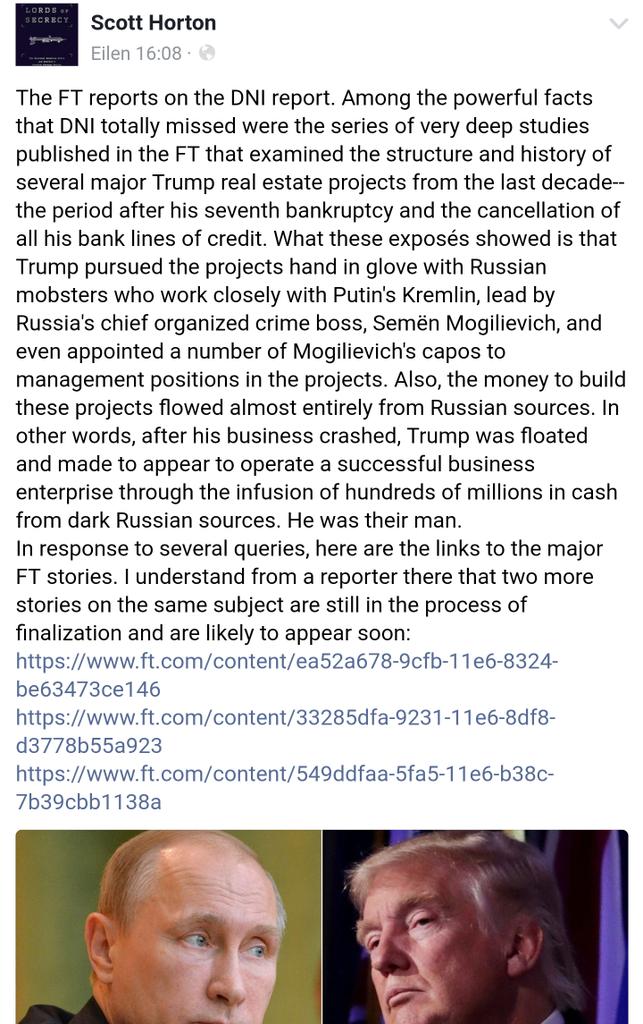
Among the powerful facts that DNI missed were a series of very deep studies published in the [Financial Times] that examined the structure and history of several major Trump real estate projects from the last decade—the period after his seventh bankruptcy and the cancellation of all his bank lines of credit. ...
The money to build these projects flowed almost entirely from Russian sources. In other words, after his business crashed, Trump was floated and made to appear to operate a successful business enterprise through the infusion of hundreds in millions of cash from dark Russian sources.
He was their man.
Yes, even that much seems fantastic, and the details include business agencies acting as a front for the GRU, billionaire mobsters, a vast network of propaganda sources, and an American candidate completely under the thumb of the Kremlin.
It reads like the a B-grade spy novel, a plot both too convoluted—and too bluntly obvious—for John le Carré. The problem is it may not be a conspiracy theory. It may be a conspiracy.
Horton’s analysis comes from piecing together information in three Financial Times “deep reports.” One of these focused on Sergei Millian, the head of the Russian American Chamber of Commerce in the US at the time of Trump Jr.’s “money pouring in from Russia” claim.
Mr Millian insists his Russian American Chamber of Commerce (RACC) has nothing to do with the Russian government. He says it is funded by payments from its commercial members alone.
Most of the board members are obscure entities and nearly half of their telephone numbers went unanswered when called by the Financial Times. An FT reporter found no trace of the Chamber of Commerce at the Wall Street address listed on its website.
Why was RACC’s background filled with so many holes? The Financial Times quotes former Russian MP Konstantin Borovoi in tagging the chamber as a front for intelligence operations that dates back to Soviet times.
“The chamber of commerce institutions are the visible part of the agent network . . . Russia has spent huge amounts of money on this.”
Millian helped arrange for Trump to visit Moscow in 2007, and had other outings with Trump in the states, including a visit to horse races in Miami. Millian claims that he had the right to market Trump properties in Russia.
“You could say I was their exclusive broker,” he told Ria. “Then, in 2007-2008, dozens of Russians bought apartments in Trump properties in the US.” He later told ABC television that the Trump Organisation had received “hundreds of millions of dollars” through deals with Russian businessmen.
Despite documents and photos showing Trump with Millian, Trump denied their association during the campaign.
Hope Hicks, Mr Trump’s campaign spokeswoman, said Mr Trump had “met and spoke” with Mr Millian only “on one occasion almost a decade ago at a hotel opening”.
The second *Financial Times* article puts Trump at the middle of a money laundering scheme, in which his real estate deals were used to hide not just an infusion of capital from Russia and former Soviet states, but to launder hundreds of millions looted by oligarchs. All Trump had to do was close his eyes to the source of the money, and suddenly empty apartments were going for top dollar.
Among the dozens of companies the Almaty lawyers say the Khrapunov laundering network used were three called Soho 3310, Soho 3311 and Soho 3203. Each was a limited liability company, meaning their ownership could easily be concealed.
The companies were created in April 2013 in New York. A week later, property records show, they paid a total of $3.1m to buy the apartments that corresponded with their names in the Trump Soho, a 46-storey luxury hotel-condominium completed in 2010 in a chic corner of Manhattan.
Why would Trump’s organization make such a good means of laundering funds? Because real estate has an arbitrary value. Is that apartment worth $1 million? Two million? Why not $3 million for a buyer who really wants it? When the whole transaction is just one LLC with undisclosed ownership paying another LLC with undisclosed ownership, it’s even neater than hiding the money in an offshore account. And while some businesses require due diligence in looking at the source of funds, real estate is a bit more … flexible.
The laws regulating US real estate deals are scant, experts say. Provisions against terrorism financing in the Patriot Act, passed in the aftermath of the September 11 2001 attacks, obliged mortgage lenders to conduct “know your customer” research. But money launderers pay in cash. Sales such as those of the Trump Soho apartments have passed through this loophole, which was partially closed only this year.
Converting funds stolen overseas into property in the US and cash in the account of an LLC represented a win for both the oligarchs and Trump. Best of all, Trump’s sole requirement was that he pay scant attention to the deal—something at which he was already a proven master. For example, the actual owners of the Trump Soho were anotherlimited liability company, Bayrock.Trump was a partner in the LLC and Bayrock cut the checks Trump received when those apartments were sold. And yet ...
In a 2011 deposition, given in a dispute over the Fort Lauderdale project, Mr Trump said he had “never really understood who owned Bayrock”.Jody Kriss, a former Bayrock finance director, has claimed in racketeering lawsuits against his former employer that Bayrock’s backers included “hidden interests in Russia and Kazakhstan”. Bayrock has denied Mr Kriss’s allegations but declined to answer questions about the source of its funds and its relationship with the Khrapunovs.
The third articledigs more deeply into the origins of Bayrock and its connection with Trump. That connection … was very close.
The Republican presidential nominee and Bayrock were both based in Trump Tower and they joined forces to pursue deals around the world — from New York, Florida, Arizona and Colorado in the US to Turkey, Poland, Russia and Ukraine. Their best-known collaboration — Trump SoHo, a 46-storey hotel-condominium completed in 2010 — was featured in Mr Trump’s NBC television show The Apprentice.
This is the same group about which Trump said he “never really understood” the ownership.
“I don’t know who owns Bayrock,” Mr Trump said. “I never really understood who owned Bayrock. I know they’re a developer that’s done quite a bit of work. But I don’t know how they have their ownership broken down.”
At the very least, Trump confessed to partnering with, taking money from, and acting as a representative for a corporation whose ownership he didn’t know, in deals that totaled hundreds of millions in countries around the world.However, it seems far more likely that Trump knowingly worked with oligarchs, groups associated with the Russian government, and plain old mobsters. Why? Because he was desperate.
By the 2000s, the property developer and casino owner with ready access to the capital markets and the biggest New York banks was no more. A series of corporate bankruptcies had limited his financing options. Mr Trump had become an entertainer who portrayed a tycoon on television and licensed his name to businesses looking for a brand, leading to fee-making opportunities as disparate as Trump University and Trump Vodka.
The Trump Organization was a hollow shell and Trump was bankrupt, but Donald Trump the public figure was a “successful businessman,” a screen behind which criminal activity could be carried out on a massive scale. Throwing his name at every scheme in existence wasn’t a strategy, it was a fire sale on Trump’s respectability. Steaks? Water? Vodka? Fake real estate school? You pony up the cash, and Trump will slap his name on it. Because by the early 2000s, Trump wasn’t just broke, he had nothing left to pawn. He wasn’t a successful businessman, but he still played one on TV. His image had more value than his real estate portfolio.
But the apartments and buildings where Trump held some degree of ownership could be turned into value again. All it took was partnering with foreign crime bosses looking for a place to stash their cash. To inflate the value of his portfolio, Trump had to do nothing other than look away as the dirty money poured in from one LLC to the next.Citizens in Russia, Kazakhstan, and other former Soviet states lost hundreds of millions, but Trump got a cut as looted funds flowed through offices and apartments in buildings that carried those critical gold letters.
Horton’s evaluation of this material in coordination with the declassified DNI report is that Trump actively worked with and for Russian interests.
What these exposes showed, is that Trump pursued the projects hand in glove with Russian mobsters who worked closely with Putin’s Kremlin ...
But based on the information in the Financial Times report, it appears that there are actually two possible answers. Trump may have been actively involved with and working for Russian sources. He might also have simply played the role of useful idiot, displaying his readiness to feign ignorance about any deal … so long as it generated some funds to float his sinking boat.
In the end, there’s not a lot of difference in the outcome. Trump got money. Oligarchs cleaned their cash. Russia got their man.
==
https://www.alternet.org/greatest-intelligence-operation-our-time-investigative-journalist-details-how-trump-has-been
no lnx
An investigative journalist explained on MSNBC’s “Morning Joe” that President Donald Trump’s real estate business was essentially a money laundering front.
Craig Unger alleges in his new book, “House of Putin, House of Trump,” that the president had been compromised by Russian intelligence for years through his ties to mobsters who pumped money into his family’s real estate empire.
“I go back nearly 40 years, and I see essentially the greatest intelligence operation of our times,” Unger said. “It started off in 1984 with a man who has ties to the Russian mafia, and he meets with Donald Trump in the Trump Tower, the supreme moment of Donald Trump becoming a master of real estate in the United States — and what we end up seeing is Trump Tower become sort of a cathedral of money laundering.”
That mob associate paid $6 million in cash for five condominiums, and Unger tracked hundreds of similar transactions over the following three decades.
“That sets off a pattern that goes on for the next 30 years or so, in which over 1,300 condos are sold in what appears to be money laundering,” Unger said. “They have two characteristics. One, they are all cash purchases. Two, they are shell purchases, they’re anonymous purchases. The records don’t show who the true owners are.”
Unger said the illegal transactions had made Trump an asset of the Russian government and its president, Vladimir Putin — a former KGB operative — because he said there was no meaningful difference between the country’s organized crime network and its intelligence agencies.
“I can’t get inside Donald Trump’s mind, but he’s meeting with this guy,” Unger said. “We know there are about 1,300 other operations in which he’s profiting heavily from that. If he can go through that and doesn’t figure that out, he’s either inexplicably stupid or there is a legal concept of willful blindness, and perhaps that’s what’s going on.”
---
putin real estate
https://www.alternet.org/news-amp-politics/heres-why-trump-tries-so-hard-be-putins-good-side
Trump's insistence on a summit with Vladimir Putin, disregarding the advice of aides and worries of allies, is consistent with his obsession with the Russian leader. But it’s inconsistent with his pattern of choosing policies that resonate with his supporters -- there’s no indication that Trump's followers condone this bromance.
So why does Trump pander to Putin?He won’t criticize him and incessantly flatters and coddles him. He has winked at the annexation of Crimea, threatened NATO, suggested that the G7 should readmit Russia, and done nothing to prevent Russian meddling in U.S. elections.
Many fear Trump will hand Putin unwarranted concessions, like unraveling U.S. sanctions against Russia. Trump was always soft on them anyway. After Russia requested a secretary of state who favored lifting them, Trump obliged, appointing Rex Tillerson instead of Mitt Romney. When Congress enacted sanctions on 15 Russian entities and individuals in 2017, Trump delayed implementing them for seven months and reversed a decision to impose more. What could be motivating Trump's largesse toward Russia? It's hard to argue that it's what’s best for America. A pattern of reported facts suggest it could be personal financial gain.
Throughout the 2000s, Russians bought many apartments in Trump Tower and $100 million worth of Trump properties in Florida. But these sales dropped precipitously in 2014 after the U.S. imposed sanctions on Russian oligarchs for the Crimean incursion. Lifting sanctions would likely restore these sales, and the profits would flow through a trust run by Trump's sons, with the president as sole beneficiary. Indeed, Trump admitted that he’d “be looking at” lifting them.
Trump has many business aspirations in Russia that Putin can make or break. In 1986, Trump met with the Soviet ambassador about building a luxury hotel in Moscow, and announced a potential Trump International complex there. At the 2008 Russian Real Estate Summit, Trump touted plans for condos and hotels in Moscow, St. Petersburg and Sochi. In 2011, he licensed his name to an aborted Azerbaijan hotel for $1 million and promoted a Trump Tower in Kazakhstan. Even as he campaigned for the Republican nomination, Trump signed a letter of intent to build Trump Tower in Moscow.
Trump’s business depends heavily on Russian money. Donald Trump Jr. said in 2008 that “Russians make up a … disproportionate cross-section of … our assets,” and later added, “We see a lot of money pouring in from Russia.” Eric Trump told a journalist, “We don’t rely on American banks; we have all the funding we need out of Russia.” (He later denied saying that.)
In 2008, Deutsche Bank’s real estate group stopped lending to Trump after he defaulted on a $330 million loan. Inexplicably, he subsequently borrowed $75 million from another DB group. European and American regulators punished DB for laundering billions from Moscow.It’s not a huge leap to suspect that Trump’s DB money came from Russia.
The blackmail potential in all these financial shenanigans is abundant. Implicating Trump in almost any of these schemes could expose him to charges of money laundering and bank fraud.Since Trump’s nomination, 70 percent of Trump sales were tolimited liability companies frequently used by Russians to hide their identity, stow cash and, most likely, violate U.S. sanctions.Hundreds of millions of dollars from unidentified sources funded Trump’s unprofitable golf courses in Ireland and Scotland. Testimony before Congress suggests they were used to launder money for the Russian mafia. Steve Bannon told Michael Wolff, in speaking of White House corruption: “This is about money laundering … the path to …Trump goes right through Paul Manafort, Don Junior and Jared Kushner.”
“America first” ideology has actually put Russia first. Leaving the Trans-Pacific Partnership, Iran nuclear deal and Paris Climate Agreement lost America international forums where it communicated, led and influenced. Cutting the State Department’s budget and foreign aid weakened America’s global clout and allowed Putin to expand Russia's sphere of influence.
Trump’s threat to cut aid to Central America damaged trust in the U.S. Now Putin is providing aid there, reopening military bases and building a satellite-tracking station that could spy on the U.S. Trump’s rejection of Obama’s soft Cuba policy may result in a repeat of Cuba’s pivot to Russia after Dwight Eisenhower rejected Cuban efforts for diplomatic and trade ties. Trump’s trade tariffs and insults of EU and Canadian leaders threatens relationships with our closest allies. His escalating criticism of NATO make some worry the United States might actually leave the alliance – the ultimate gift to Putin.
Congressional Republicans are muting their nervousness about Trump giving away the store, settling for bromides about how there's nothing wrong with just talking to Russia. It's hard to imagine how talking under these conditions will serve America's interest, but on the other hand, we may finally see Trump Tower built in Moscow. In keeping his stakes in 500 foreign businesses -- no other president had any – Trump has unprecedented cause to tailor foreign policy for personal gain. He promised to “drain the swamp,” but there are more reptiles in it than ever, and many speak Russian
==
==
pro pub series on biz
https://www.propublica.org/article/trump-inc-podcast-meet-the-government-employees-spending-taxpayer-dollars-at-trump-hotels
---
==
an
Mueller has some new material to work with as he continues his investigation of the Trump administration's ties to Russia. A new report shows that for 10 years, a Trump property in Panama City collected millions of dollars from the Russian mafia and Colombian drug cartels.An investigation from Global Witness, an international NGO that probes corruption and money laundering, reveals how the Trump Ocean Club International Hotel and Tower turned a blind eye to crime lords looking for a safe haven to stash their blood money.
The property, which the lead broker Alexandre Ventura Nogueira describes as “Ivanka Trump’s baby,” listed units for three times the going rate in Panama City, thanks to the Trump name. Nogueira worked closely with the Trump family; he claims he attended at least 10 meetings with Ivanka Trump, who challenged him to sell 100 units in the building. “The agreement was, I had a week to sell 100 units,” Nogueira told Reuters. “I said, ‘I’m going to do better, I’m going to sell without telling (the buyers) the price.'”
Nogueira later fled Panama after he was arrested for unrelated charges of real estate fraud. From his European asylum, he told NBC that at least half of his Trump Ocean Club customers were Russians, including some with “questionable backgrounds." Only later did he learn of their ties to Russian organized crime circles.
NBC reports that Mauricio Ceballos, a former prosecutor in Panama who investigated Trump’s business associates for financial crimes, called the Trump Ocean Club “a vehicle for money laundering.”
Among the shady buyers are:
- David Murcia Guzmán, founder of a large Colombian marketing company, who purchased 10 units in the Trump Ocean Club. Guzmán is now in U.S. custody, convicted of laundering money on behalf of drug cartels, and will be extradited to Colombia. Guzmán also has financial ties to the terrorist organization FARC.
- Louis Pargiolas, who pleaded guilty in 2009 in Miami to conspiracy to import cocaine.
- Stanislav Kavalenka, a Russian national charged in Canada for compelling women into prostitution.
- Arkady Vodovozov, convicted in Israel of kidnapping, according to Reuters.
By 2010, Donald Trump had made approximately $74.2 million through his association with the hotel. From 2014-2017, he was paid as much as $13.9 million.
As Global Witness explains:
“The warning signs were there from the outset. The Trump Ocean Club, one of Trump’s most lucrative licensing deals to date, was announced in 2006 and launched in 2011, a period when Panama was known as one of the best places in the world to launder money. Whole neighborhoods in Panama City were taken over by organized crime groups, and luxury developments were built with the purpose of serving as money laundering vehicles.
“Moreover, investing in luxury properties is a tried and trusted way for criminals to move tainted cash into the legitimate financial system, where they can spend it freely. Once scrubbed clean in this way, vast profits from criminal activities like trafficking people and drugs, organized crime, and terrorism can find their way into the U.S. and elsewhere.”
The Trump Organization has shrugged off responsibility in a statement following the news, but legal experts say it should have done its due diligence into the backgrounds of buyers.Arthur Middlemiss, aformerManhattan assistant district attorney and a former head of the global anti-corruption program at JPMorgan, blames the Trumps directly:
“Those who do business there should perform due diligence on others involved in their ventures. If they fail to do so, they risk being liable under U.S. law of turning a blind eye to wrongdoing.”
Watch Ivanka Trump promote the Trump Ocean Club below:
---
https://www.alternet.org/video/watch-americas-mobster-president-new-evidence-dutch-documentary-trumps-international-money
==
no lnx guard uk
Trump's Panama tower used for money laundering by condo owners, reports say
Trump Ocean Club drew people accused of corruption and future president benefited from laundered funds, reports say
Rory Carroll
The Trump Ocean Club International Hotel and Tower ‘aligned’ Trump’s financial interests with those of crooks, according to Global Witness.
The Trump Ocean Club International Hotel and Tower ‘aligned’ Trump’s financial interests with those of crooks, according to Global Witness. Photograph: Rodrigo Arangua/AFP/Getty Images
The Trump Ocean Club International Hotel and Tower soars over Panama City bay, a 70-storey skyscraper shaped like a sail. Donald Trump’s first international hotel venture, it opened in 2011, a mix of condominiums, hotel rooms and a casino.
As one of the tallest structures in Latin America, it was a bold and lucrative expression of the Trump brand, earning him as much as $13.9m in management fees and royalties in the last three years.
By day it glints in the tropical sunshine, an apparently shining testament to the US president’s business savvy.
But a curious thing happens at night. Many of the lights stay off. The restaurants are near deserted; the corridors silent. The skyscraper appears to be largely empty – a dark tower.
The biggest Trump resignations and firings so far
Read more
Many of those who bought the condos, it turns out, did so not to live there but allegedly to launder illicit money – Russian gangster money, drug cartel money, people-smuggling money.
A joint Reuters-NBC News investigation published on Friday alongside a report by the non-profit Global Witness said the skyscraper with Trump’s name had ties to international organised crime.
The reports detailed how the future president gave the project to his daughter Ivanka as a “baby” effort to gain real estate experience, and said it ended up drawing a cast of characters accused of fraud, corruption and kidnapping.
Trump may not have intended to facilitate criminal activity but the Panama tower “aligned” his financial interests with crooks, said Global Witness. “Trump seems to have done little to nothing to prevent this. What is clear is that proceeds from Colombian cartels’ narcotics trafficking were laundered through the Trump Ocean Club and that Donald Trump was one of the beneficiaries.”
There is no evidence that the Trump Organization or members of the Trump family broke the law or knew of the criminal backgrounds of some of the tower’s brokers, buyers and investors.
The White House and Ivanka Trump referred requests for comment to the Trump Organization, which issued a statement distancing itself from the tower.
“The Trump Organization was not the owner, developer or seller of the Trump Ocean Club Panama project. Because of its limited role, the company was not responsible for the financing of the project and had no involvement in the sale of units or the retention of any real estate brokers.”
The story may endure. The president won last year’s election on the promise of draining corruption in Washington and building a wall to keep out drugs and undesirable immigrants. Robert Mueller, the special counsel who is investigating Russian influence in the election, is looking at Trump’s business dealings.
Trump lent his name but did not exert management control over the tower’s construction and was under no direct legal obligation to conduct due diligence on other people involved.
But Arthur Middlemiss, a former assistant district attorney in Manhattan and a former head of JP Morgan’s global anti-corruption program, told Reuters that since Panama was “perceived to be highly corrupt”, anyone engaged in business there should conduct due diligence on business collaborators. If they did not, he said, there was a potential risk in US law of being liable for turning a blind eye to wrongdoing.
Trump wanted to use the Panama project as a “baby” for Ivanka, Roger Khafif, a Panamian developer who pitched the deal to Trump in 2005, told Reuters.
She helped kickstart the project a year later by selecting a Brazilian former car salesman, Alexandre Ventura Nogueira, as a lead broker to sell units. He promised quick sales at high prices. Ventura’s firm, Homes Real Estate Investment & Services, delivered, selling 350 to 400 units, about $100m worth of property, he told Reuters and NBC.
He met Ivanka numerous times, met her brothers Eric and Donald Jr, and met the future president once, at a celebratory event in 2008 at Mar-a-Lago, the family’s Florida estate.
A year later, however, Ventura was arrested in Panama for real estate fraud, unrelated to the Trump project, and fled on bail.
Now a fugitive, the 43-year-old spoke from an undisclosed European city wearing a disguise.
Ventura said some of his brokers and clients who traded units in the Trump Ocean Club were connected to the Russian mafia and other organised crime groups.
He said he sold seven to 10 units to David Murcia Guzmán, a disgraced entrepreneur who is currently in US custody awaiting extradition to Colombia after being convicted by a US federal court of laundering money for drug cartels, including through real estate.
Ventura said he sold about half the units to Russian-speaking brokers, including Arkady Vodovozov, who, according to court files cited by Reuters, was convicted of kidnapping in Israel, and Igor Anapolskiy, who, according to Ukrainian court documents cited by Global Witness, was convicted in 2014 of forging travel documents.
Another was Stanislav Kavalenka, who, according to Ontario court documents, was charged in Canada with “compelling” and “procuring” women to engage in prostitution. The case was later withdrawn.
Many buyers remained unidentified because many units were bought and sold through anonymous shell companies. Ventura said he set up hundreds of such corporations, charging roughly $1,000 each.
“I had some customers with questionable backgrounds,” he said. “Nobody ever asked me. Banks never asked. Developer didn’t ask and (the) Trump Organization didn’t ask. Nobody ask: ‘Who are the customers, where did the money come from?’ No, nobody ask.”
Mauricio Ceballos, a former financial crimes prosecutor in Panama who investigated Ventura, told NBC the skyscraper was a “vehicle for money laundering”.
Alan Garten, the Trump Organization’s chief legal officer, played down Ventura’s connections with the Trumps, telling Reuters they did not remember meeting him,and that such contacts would have been “meaningless” and just one of hundreds of public appearances they make each year.
==
Trump's Panama tower used for money laundering by condo owners ...
https://www.theguardian.com/.../trump-ocean-club-panama-money-laundering-reports
1.
Nov 18, 2017 - Many of those who bought the condos, it turns out, did so not to live there but allegedly tolaunder illicit money – Russian gangster money, drug ...
A Panama tower carries Trump's name and ties to organized crime
https://www.nbcnews.com/.../panama-tower-carries-trump-s-name-ties-organized-crim...
1.
Trump Made Millions of Dollars From Drug Money Laundering in ...
www.newsweek.com/trump-drugs-corruption-panama-hotel-money-laundering-714891
1.
Report: Trump Panama Tower 'Riddled' With Drug, Mob Money - The ...
https://www.thedailybeast.com/report-trump-panama-tower-riddled-with-drug-mob-m...
1.
Lawmakers question Trump ties to Panama project linked - Reuters
https://www.reuters.com/...trump.../lawmakers-question-trump-ties-to-panama-project-...
1.
Ivanka Trump and the fugitive from Panama - Reuters
https://www.reuters.com/investigates/special-report/usa-trump-panama/
1.
Trump building in Panama tied to Russian mafia, international crime ...
thehill.com/.../360852-trump-building-in-panama-tied-to-russian-mafia-international-...
1.
Russian criminals' links to Trump could compromise him - SFChronicle ...
https://www.sfchronicle.com/.../Russian-criminals-links-to-Trump-could-12742583.ph...
1.
https://www.alternet.org/news-amp-politics/here-are-5-biggest-bombshells-senate-transcripts-trump-tower-meeting
---
...ven before the appointment of Mueller as special counsel in May 2017, FBI agents investigating Russia’s interference in the election learned that Cohen was in frequent contact with foreign individuals about Trump Moscow— and that some of these individuals had knowledge of or played a role in 2016 election meddling, according to two FBI agents.
"That is new," Maddow said Thursday night. "That is new information that adds a whole new dimension to the Trump Tower Moscow story that had been kept secret for a very long time, and then diminished, and we were all told it was nothing. And now it turns out that it was more than nothing, the FBI was interested in it. and it involved people who were part of the 2016 election meddling by the Russian government."
The direct ties between a key member of the Trump's orbit and the efforts to disrupt American democracy would seem to suggest a plausible path for some sort of "collusion" to have occurred and also completely contradicts any number of denials from the president and his allies of any connections to Russia.
...
---
==
mojo
Donald Trump Jr.
“I have nothing to do with Russia,” President Trump has declared. “No deals. No loans.” That’s not quite true. Just ask his oldest son, who serves as the executive vice president of the Trump Organization. “Russians make up a pretty disproportionate cross section of a lot of our assets,” Don Jr. told investors in 2008. “We see a lot of money pouring in from Russia.” Weeks before the election, Trump’s son was reportedly paid $50,000 to address a pro-Russian group in Paris whose leader nominated Putin for the Nobel Peace Prize in December.
Eric Trump
In a May interview with Boston radio station WBUR, golf journalist James Dodson recalled asking Trump’s second-oldest son a few years ago about who was funding his father’s courses. “We don’t rely on American banks,” he replied, according to Dodson. “We have all the funding we need out of Russia.” Eric, who manages the Trump Organization with his older brother, called Dodson’s account “completely fabricated.”
Jared Kushner
The president’s son-in-law reportedly failed to disclose “dozens of contacts with foreign leaders or officials in recent months” on his application for security clearance, including meetings with Russian Ambassador Sergey Kislyak and Sergey Gorkov, the head of Vnesheconombank, a Russian state-owned bank. According to the Washington Post, Kislyak reported back to Moscow following their sit-down that Kushner had proposed “setting up a secret and secure communications channel between Trump’s transition team and the Kremlin, using Russian diplomatic facilities.” Kushner reportedly strongly advocated Trump’s firing of FBI Director James Comey in May—further raising questions about his role. In late May, the Post and other news outlets reported that Kushner had become a focus of the FBI’s Russia probe, with investigators digging into his contacts with Kislyak, Gorkov, and other Russians. The 36-year-old real estate scion has volunteered to be interviewed by the Senate Intelligence Committee and his lawyer has said Kushner “will do the same if he is contacted in connection with any other inquiry.”
==