oira bak
12/15 bad margins also OMB
not current, see main
SEE RAO
capt 419
===}:
SLUDGE
Former law professor Neomi Rao is facing headwinds in her judicial nomination, so Charles Koch’s Americans for Prosperity is stepping in.
:{:{Billionaire manufacturing magnate Charles Koch has for decades used his enormous wealth and political power to install elected officials (https://readsludge.com/2018/10/19/koch-and-adelson-come-to-the-rescue-of-trump-devotee-ron-desantis-in-florida/),}:
government administrators (https://www.salon.com/2016/06/19/big_men_on_campus_the_koch_brothers_university_donations_are_a_veiled_political_weapon/), and regulators (https://readsludge.com/2018/10/04/koch-backed-sec-commissioner-claims-corporate-law-is-in-the-public-interest/) who will keep the business interests of Koch Industries and other giant, heavily polluting companies in mind.}:
But Koch is also dipping into the judicial arena. One of his protegés has been nominated by President Trump and is poised to join the second-most powerful court in the United States, and Koch’s premier political spending group wants to make sure it happens.
In 2016, the Charles Koch Foundation (CKF) and a mystery donor combined to give $30 million to the George Mason University (GMU) law school, renaming it after the late, conservative Supreme Court Justice Antonin Scalia. Koch’s foundation put in $10 million, and the remaining $20 million, it was later discovered, was administered by Federalist Society officials through a 501(c)(4) nonprofit, BH Fund.
:{:{The grant established 12 new law professorships—nearly all the hires had ties to the conservative Federalist Society (https://legacy.tyt.com/2018/05/18/after-donation-administered-by-federalist-society-leaders-gmu-hired-professors-tied-to-the-federalist-society/)—}:
and founded two ideological law school centers (https://ia601201.us.archive.org/24/items/GMUASSLawMOU2016/GMU%20ASSLaw%20MOU%202016.pdf#page=6),
the Center for Liberty and Law and the Center for the Study of the Administrative State. The founder and director of the latter center was Neomi Rao (https://www.law.gmu.edu/assets/files/faculty/cv/rao.pdf), who had been a law professor at GMU since 2012. She previously clerked for the most conservative Supreme Court justice, Clarence Thomas, and was associate counsel and special advisor to President George W. Bush. She has never been a judge.}:
Rao took a leave of absence from George Mason in 2017 when President Donald Trump appointed her as director of the White House Office of Information and Regulatory Affairs (OIRA), Trump’s “regulation czar.”
:{:{The dean of the GMU law school told another donor to her center, corporate lobbyist and longtime Koch ally C. Boyden Gray (https://www.desmogblog.com/c-boyden-gray), that he hoped to lure her back to GMU with a $1.5-million professorship, funded by Gray, according to an email unearthed by GMU alumna Allison Pienta (}:
:{:{http://www.unkochmycampus.org/dec-20-2018-donor-control-at-gmu-update?rq=boyden%20gray).}:
“This chair would help me to entice Neomi to return home to Scalia Law after she dismantles the administrative state (https://www.documentcloud.org/documents/5750669-Antonin-Scalia-Law-School-Grant-Agreement.html#document/p2/a484188)
while serving at OIRA,” he wrote in a May 2017 letter to Gray. Gray gave another $3 million to the center, and it was renamed in his honor.}:}:
Dismantling the administrative state (p. 2) (https://www.documentcloud.org/documents/5750669-Antonin-Scalia-Law-School-Grant-Agreement.html#document/p2/a484234)
IFrame Content (https://www.documentcloud.org/documents/5750669-Antonin-Scalia-Law-School-Grant-Agreement/annotations/484234.html?embed=true&maxheight=750&maxwidth=500)
View entire document on DocumentCloud (https://www.documentcloud.org/documents/5750669-Antonin-Scalia-Law-School-Grant-Agreement.html#document/p2/a484234)
But instead of returning to the law school, Rao may be headed to the powerful D.C. Circuit Court of Appeals to fill the seat vacated by the newest Trump-appointed Supreme Court justice, Brett Kavanaugh. Rao’s GMU center hosted a conference (https://administrativestate.gmu.edu/rethinking-judicial-deference/) in 2016 that featured Kavanaugh, a fellow Federalist Society member, as keynote speaker.
Rao’s judgeship nomination is perhaps the crowning achievement of the Antonin Scalia Law School’s initiative to reshape the federal judiciary. In 2017, the law school’s Law and Economics Center, which CKF had been funding for years, drew up a funding proposal (https://www.documentcloud.org/documents/5751080-GMU-Law-and-Economics-Center-Federal-Judges-and.html) for the center’s “Federal Judges and Attorneys General Initiatives.”
‘Reshaping’ the Federal Bench
“The election of Donald Trump presents a historic opportunity for a new president to reshape the federal judiciary, reform the regulatory state, promote economic growth, and restore constitutional federalism,” reads the proposal.
The program educates newly appointed judges on economics and other issues so they will “be more likely to make sound decisions that support the rule of law and the free enterprise system.” The new Federal Judges Initiative will “cover topics expected to be highly relevant to the current presidential administration’s policy agenda, such as the economics of health care and health financing, financial services regulation, environmental and energy regulation, health and safety regulation, privacy, labor and employment law, and telecommunications regulation.”
As of 2017, over 5,000 judges and 700 state attorneys general had participated in at least one Law and Economics Center program. In the 2018 fiscal year, the Law and Economic Center requested over $1.7 million for its Judicial Education Budget.
“Rao’s transition from the Koch-funded Antonin Scalia School of Law to her nomination to the second-highest court in the country is exemplary of Koch’s successful strategy of leveraging George Mason University to exert influence on the judicial branch for decades to come,” Samantha Parsons, a GMU graduate and director of campaigns at the activist group UnKoch My Campus, told Sludge. “Her nomination should serve as a warning of the anti-democratic agenda we can expect throughout our nation’s judicial system should George Mason University succeed in its goals to facilitate the education and placement of hundreds of new federal judges under Trump’s presidency.”
:{:{In December, when Trump nominated Rao, Koch’s most prominent political advocacy organization, Americans for Prosperity, endorsed (https://americansforprosperity.org/afp-endorses-slate-of-highly-qualified-judicial-nominees/) her for the judgeship.}:
But Rao has since encountered some bumps in the road. Republican Missouri Sen. Josh Hawley said he has “deep concerns (https://www.axios.com/neomi-rao-dc-circuit-nominee-josh-hawley-concerns-228fe428-7944-430a-bc5c-71a50278ec38.html?utm_source=twitter&utm_medium=twsocialshare&utm_campaign=organic),” telling Axios that she may not be sufficiently anti-abortion.}:
At a recent Senate committee hearing, Iowa Republican Sen. Joni Ernst expressed concerns over Rao’s 1994 essay on date rape (https://www.washingtonpost.com/local/legal-issues/neomi-rao-pressed-on-past-writings-on-date-rape-at-hearing-on-her-judicial-nomination/2019/02/05/156b4784-28b4-11e9-b2fc-721718903bfc_story.html?utm_term=.e68dab1a1db9), which alleged that women who are raped while drunk are partially to blame for being raped. Rao’s OIRA has stalled issuing an employer guidance on sexual harassment for 15 months (https://theintercept.com/2019/02/04/neomi-rao-hearing-oira-brett-kavanaugh/), a process that normally takes no longer than 90 days, as David Dayen reported for The Intercept.
:{:{Americans for Prosperity will fund digital advertising and grassroots efforts (https://www.axios.com/neomi-rao-dc-circuit-nominee-josh-hawley-concerns-228fe428-7944-430a-bc5c-71a50278ec38.html?utm_source=twitter&utm_medium=twsocialshare&utm_campaign=organic)}:
in an attempt to sway public opinion in favor of Rao this week, according to Axios. On Tuesday morning, the Facebook ad archive (https://www.facebook.com/ads/archive/?active_status=all&ad_type=political_and_issue_ads&country=US&q=americans%20for%20prosperity) listed six AFP ads in favor of Rao, which began running on Monday. Each ad targets one Republican senator, including Ernst and Hawley, urgin Facebook users to tell their senator to vote for Rao’s D.C. Circuit Court nomination. Additional targeted senators are Ted Cruz (Texas), Marsha Blackburn (Tenn.), James Lankford (Okla.), and Ben Sasse (Neb.). The Google ad archive did not list any recent AFP purchases.}:
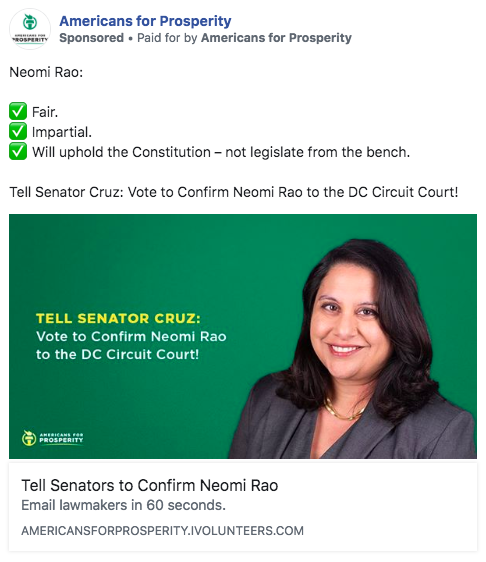 One of Americans for Prosperity’s Facebook ads supporting Neomi RaoFacebook Ad Archive
Americans for Prosperity did not reply to Sludge’s request for comment.
‘Regulatory Obstruction’
The American Constitution Society says OIRA, which is part of the Office of Management and Budget, “has embraced politicized regulatory obstruction (https://www.acslaw.org/acsblog/a-lesson-in-failure-oira-neomi-rao-and-deregulation-at-any-cost/) as its raison dêtre” under Rao. In OIRA’s 2018 report (https://www.whitehouse.gov/wp-content/uploads/2018/10/2018-Unified-Agenda-Cutting-the-Red-Tape.pdf), entitled “Cutting the Red Tape,” Rao writes, “we are working to push back the expansion of the administrative state, which has placed undue burdens on the public and impeded economic growth.”
Under Rao’s leadership, OIRA, has approved sweeping environmental deregulation by the EPA. Koch Industries, which Charles Koch runs, is a giant manufacturing conglomerate with subsidiaries that refine and transport oil, create paper products, and produce chemicals. The company is among the country’s biggest air and water polluters and has paid hundreds of millions of dollars for environmental violations. Koch and his brother David are lifelong libertarians who have fought taxes and regulations for decades.
“Rao has never seen a regulation she didn’t hate, and as a judge would dismantle 40 years of environmental and social progress,” Brett Hartl, government affairs director at the Center for Biological Diversity, said (https://www.buzzfeednews.com/article/zoetillman/trump-nominates-neomi-rao-brett-kavanaugh-seat) in a statement to Buzzfeed News. “Her confirmation would be the most damaging and regressive yet by Trump after Kavanaugh and Gorsuch.”
GMU is by far the biggest recipient of grants from the Charles Koch Foundation (CKF), which gives tens of millions of dollars each year to free-market higher education programs. Since 2005, CKF and the Charles Koch Institute have donated nearly $129 million to GMU, including over $34 million for the free-market Mercatus Center, according to Sludge’s analysis. Another free-market-focused GMU center, the Institute for Human Studies, has received $8.7 million.
The university has come under fire for allowing the CKF to impact hiring decisions (https://www.insidehighered.com/news/2018/05/01/koch-agreements-george-mason-gave-foundation-role-faculty-hiring-and-oversight). In the case of Florida State University, CKF was even allowed to control economics curricula (https://publicintegrity.org/federal-politics/koch-foundation-proposal-to-college-teach-our-curriculum-get-millions/).
AFP isn’t the only Koch-linked group to spend money to influence the judiciary. The Center for Media and Democracy reports that Donors Trust, a donor-advised fund that wealthy conservatives including Koch use to score tax deductions and potentially anonymize their donations to nonprofits, has bankrolled right-wing groups (https://www.prwatch.org/news/2019/02/13449/donorstrust-bankrolled-right-wing-judicial-appointments-trumps-acting-ag-and) such as the Judicial Crisis Network and its sister organization, the Judicial Education Project, which spent millions of dollars on ads supporting the Supreme Court confirmation of Neil Gorsuch. Donors Trust also funds the Federalist Society and, as Sludge recently reported, several Southern Poverty Law Center-designated hate groups (https://readsludge.com/2019/02/19/americas-biggest-charities-are-funneling-millions-to-hate-groups-from-anonymous-donors/).
Related:
Charles Koch Is Funding Rightwing, Pro-Trump Media, New Disclosure Reveals (https://readsludge.com/2018/11/21/charles-koch-is-funding-rightwing-pro-trump-media-new-disclosure-reveals/)
Koch Brothers Continue to Influence Tax Policy After Huge Cuts Last Year (https://readsludge.com/2018/06/18/koch-brothers-continue-to-influence-tax-policy-after-huge-cuts-last-year/)
Koch-Backed SEC Commissioner Claims Corporate Law is in the Public Interest (https://readsludge.com/2018/10/04/koch-backed-sec-commissioner-claims-corporate-law-is-in-the-public-interest/)
Author profile](https://readsludge.com/author/alex/)
Alex Kotch (https://readsludge.com/author/alex/)
Alex is a reporter at Sludge and a contributor to The Young Turks. He was previously part of the award-winning investigative team at International Business Times, and his other work has appeared in T
---
CONTEXT
OMFG PUBLIC HEALTH
an 11 25
When President Donald Trump posted a satirical music video on social media in early October depicting his budget director, Russell Vought, as the Grim Reaper lording over Democrats in Congress, public health workers recognized a kernel of truth.
Vought has exerted extraordinary control over government spending this year, usurping congressional decisions on how the nation’s money is used. His push for more layoffs during the government shutdown is only the latest blow, following months of firings, canceled grants, and withheld funds.
By cutting and freezing public health funds, in particular, the Trump administration has already begun to undercut efforts to provide medical care, outbreak response, housing assistance, and research across the U.S., according to health officials, nonprofit directors, and federal agency staffers interviewed by KFF Health News.
Since most federal funds for public health flow to states, Vought is rivaling the Department of Health and Human Services secretary, Robert F. Kennedy Jr., in his ability to upend government-led efforts to keep Americans healthy. In Texas, Centers for Disease Control and Prevention funds to stem a measles outbreak weren’t available until after the crisis had subsided and two children had died. A project to protect Alabamans from raw sewage and hookworm was abandoned. People with HIV have had to delay medical care as clinics scale back hours. Time-dependent surveys on HIV and maternal mortality were halted. Food banks have canceled events. Tobacco prevention programs lapsed. Initiatives to protect older adults at risk of falling have been harried.
No matter what budget Congress ultimately passes for next year, the Trump administration may continue to thwart financial support for such programs in ways that will harm people’s health. “The White House has shown that they are willing to unilaterally exert control over funding,” said Gillian Metzger, a constitutional law professor at Columbia University.
“This is a huge deal,” she added, “because the power of the purse is central to Congress’ ability to shape and direct policy.”
Before he was appointed to lead the White House’s Office of Management and Budget this year, Vought outlined budgetary strategies the executive branch could deploy to wrest power from Congress and federal agencies in Project 2025, the Heritage Foundation’s conservative blueprint.
Vought’s tactics unfolded this year, often below the radar. They include abrupt grant cancellations, extraordinary constraints on how funds can be spent, and excessive layers of review, agency officials say, at every step in the grantmaking process. Getting money out the door has been further complicated by layoffs that have gutted offices overseeing grants on chronic disease prevention, HIV, maternal mortality, and more.
Government employees have described these tactics to members of Congress, said Abigail Tighe, executive director of the National Public Health Coalition, a group that includes current and former staffers at the CDC and HHS. “We want Congress to act, because this is preventing states and communities from doing critical public health work to keep our country safe,” she said. “If they don’t have capacity, we all collectively suffer.”
Democrats on the House and Senate appropriations committees have pushed for transparency, but the extent to which money Congress appropriated for public health in 2024 and 2025 has gone unspent because of the administration’s disruptions is not yet known. “This is a sophisticated strategy to cause money to lapse and then say, ‘If they can’t spend it, they don’t need it,’” said Robert Gordon, a public policy specialist at Georgetown University and a former assistant finance secretary at HHS.
“No one thought this was possible or legal, but that is what’s happening,” he said.
Details on how the administration has subverted health spending have received little attention because many changes have been made quietly — and people who rely on federal funds fear retribution. The Trump administration has defunded and threatened federal offices that hold the government accountable and fired whistleblowers. It has abruptly revoked funds for local governments and organizations.
Vought and spokespeople at the White House and the OMB did not respond to queries from KFF Health News. However, Vought described his intentions in VID] a. He said that federal agencies and Congress had gained more power over spending since the 1970s and that their control became “woke and weaponized” under Presidents Barack Obama and Joe Biden.
“Thankfully, President Trump won,” he said. “And we have now been embarked on deconstructing this administrative state.”
Many Parts, Many Malfunctions
Like a car, the federal budget process has many components that can break down. Through the OMB and its partner, Trump’s Department of Government Efficiency, or DOGE, the administration has intervened at various junctures. “There are so many ways in which money is not operating in the way it is supposed to operate,” said Bobby Kogan, the senior director of federal budget policy at the Center for American Progress, a left-leaning think tank, and a former OMB adviser.
Typically, Congress passes a budget that appropriates money for the next fiscal year to federal agencies. For many public health programs, ranging from housing assistance to cancer screening, agencies then post open calls online for states, local governments, and organizations to apply for funding. Agency experts select winners and send notices of awards — or notices of ongoing funding to groups that previously won multiyear awards.
Next, the OMB, which administers the federal budget, activates money for agencies, like a bank activates a credit card, so that grantees can spend and get reimbursed rapidly. Auditors keep an eye on spending, but the government has in the past limited interruptions so that programs run smoothly.
Early on, the Trump administration canceled billions of dollars in awards granted in 2024 and early 2025 for research and global health. In March, it clawed back $11.4 billion in covid-era funds that Congress had earmarked for health departments that were using the money for disease surveillance, vaccinations, and more.
Although some funds have been restored because of lawsuits, the Supreme Court has allowed other cuts by the administration to stand while the cases move through the courts.
Beyond these “shotgun” cancellations, the administration has taken a quieter, “in-the-weeds, slowing, cutting, conditioning” approach that’s frozen funds for public health, said Matthew Lawrence, a law professor specializing in health policy at Emory University.
By August, the CDC’s center for HIV and tuberculosis prevention had doled out $167 million less than the historical average, according to an analysis by the Center on Budget and Policy Priorities, a think tank focused on reducing inequality. The CDC’s funding for chronic disease prevention lagged by $259 million, the Ryan White HIV/AIDS Program had underspent by $105 million, and funds for mental health at the Substance Abuse and Mental Health Services Administration were more than $860 million behind what was expected.
An unknown amount of Congress’ 2025 funding for research and public health has yet to be awarded and will probably lapse this year, said Joe Carlile, an author of the center’s analysis and an associate OMB director during the Biden administration. The obstructions appear to be concentrated in areas where the White House proposed cutting the federal budget next year. “The administration may be executing their 2026 budget request through administrative controls,” Carlile said.
“This is boring but crazy-high stakes,” he added. “A one-branch veto of spending neuters the power of the purse in the Constitution that Madison said was the fundamental check on the executive branch.”
Incremental Chaos
A key tactic Vought described in Project 2025 occurs when the OMB activates funds for agencies in installments, called apportionments. Vought wrote that “apportioned funding” could “ensure consistency with the President’s agenda.”
Under Vought, the OMB shrank the size of apportionments, HHS and CDC staffers said. It’s illegal for agencies to let grantees withdraw money before the total amount is in the metaphorical bank, so that delayed agencies’ ability to greenlight spending.
The OMB and DOGE also placed conditions on apportionments through memos, footnotes, and spoken directives telling agencies to ensure that spending “aligns with Administration priorities,” according to reports and HHS employees who said that notices of funding opportunities and awards required excessive layers of sign-off. The CDC and other agencies circulated lists of priorities that reflect White House stances, including those targeting diversity, equity, and inclusion efforts; immigration; and transgender rights. Public health efforts have been especially caught up in red tape, since many focus on populations bearing an unequal burden of death, disease, and injury.
Groups that rely on federal funds have largely been unaware of the reasons grants were held up, but they’ve fielded what they viewed as unsettling queries. For example, Kathy Garner, the head of a Mississippi nonprofit, said officials asked her to defend the exclusion of men from a program to shelter women who experienced domestic violence.
Delays were made worse by uncertainty. Grantees said they’ve been unable to reach program officers because tens of thousands of federal workers have been laid off. Agency officials said firings slow funding further.
“Everyone’s inbox is full of letters from grant recipients asking, ‘How do we proceed?’” one high-ranking CDC official told KFF Health News, which granted agency officials anonymity because of their fears of retaliation. “We just say, ‘Please wait.’”
Time was critical as a measles outbreak surged in West Texas early this year. The state asked for federal funding for the response in March, but it didn’t arrive until May, after the outbreak had largely faded in Texas, according to an investigation by KFF Health News. Apportionment control was a key reason, CDC staffers said.
In July, 81 HIV organizations sent a letter to Kennedy. “With every day of delayed FY2025 funding release, the delivery of essential HIV services is compromised,” said the letter, which was reviewed by KFF Health News. Because of delays and uncertainty, it said, HIV clinics had laid off case managers and reduced clinician hours, closed sites, and pared down hotlines that patients call with urgent questions. The funds arrived about a month later, but HIV providers remain shaken.
Lauren Richey, medical director at University Medical Center’s HIV clinic in New Orleans, backed out of hiring a sorely needed dentist she had recruited. “I was afraid to tell someone to move across the country for a job when I wasn’t sure if or when we’d get the funding for their salary,” she said. “The wait is now three to four months for dental services, when it was usually a couple of weeks at most.”
Tamachia Davenport, program director at the St. John AIDS outreach ministry in New Orleans, said that “a lot of us are having to rob Peter to pay Paul.”
When the group didn’t get CDC funds it expected this summer, Davenport had to decide between cutting staff or supplies. Concerned her top employees would take jobs elsewhere, she stopped buying the condoms they distribute throughout the city to prevent the spread of sexually transmitted infections.
Louisiana already has one of the highest rates of HIV, chlamydia, and gonorrhea in the country. Condoms cost far less than treating these diseases. For a person infected by HIV at age 35, such costs exceed $326,000.
Groups focused on cancer, diabetes, and heart disease also report lasting repercussions from delays, as well as ongoing fears that they will happen again. Louisiana State University’s Healthy Aging Research Center canceled some of its workshops to train health workers on caring for people with dementia. “There may be fewer people who have this very specific expertise next year in Louisiana and Mississippi,” said Scott Wilks, the director of the center. “That’s on top of the big shortage we have already.”
Nationwide surveys tallying maternal and infant mortality froze for about five months because of funding delays, causing an irrecoverable gap in data that had been collected continuously since 1987, CDC officials say.
“We are seeing the administration get their way with or without an approved budget,” one said. “It’s such a terrible shame to play with people’s health this way.”
DOGE also inserted itself into grant reimbursements this year, stalling the rapid turnaround that public health groups typically expect to cover salaries, rent, and other monthly costs outlined in budgets that have already been approved. In what’s now labeled Departmental Efficiency Review, itemized expenses must be regularly justified by multiple government officials, according to documents reviewed by KFF Health News.
DOGE posted on its website expense reports covering about a month’s span from April to May. Nearly 230 of the individual expenses filed to federal agencies during that period are for $1 or less. Other entries break down monthly salaries for individual employees and petty costs for postage or monthly subscriptions.
“Public funds deserve scrutiny, but this is different from audit practices I’ve been a part of,” Carlile said.
DOGE also stalled calls for applications for 2025 funding — and some calls never appeared as the fiscal year came to a close on Sept. 30. Among them are programs for groups that provide housing assistance. People will be evicted when these organizations run out of money left over from 2024, said Steve Berg, chief policy officer at the National Alliance to End Homelessness.
Other solicitations came out months behind schedule, leaving groups with a few weeks to put together complicated applications for multimillion-dollar awards, including for Alzheimer’s care, addiction recovery, senior support, and chronic disease management.
“They’ve set projects up to fail,” one HHS official said.
*KFF Health News is a national newsroom that produces in-depth journalism about health issues and is one of the core operating programs at KFF—an independent source of health policy research, polling, and journalism. Learn more about KFF.
---
BEEF UP OMB OIRA?
AN 2 25
Trump signed an executive order Tuesday that vastly expands his influence over the federal government. At the heart of the order is the unitary executive theory, a controversial idea that says the president has the sole authority over the Executive Branch. The order makes it so that Trump controls several independent agencies.
“The action is likely to face court challenges and test a once-fringe legal theory,” according to Politico. They later add: “many mainstream legal scholars still believe it is illegal.”
The theory has also come into question in the case of Trump's firings throughout the federal government, including watchdogs and the head of the Consumer Financial Protection Bureau.
The agencies affected by Tuesday’s executive order include the Federal Communications Commission, the Federal Trade Commission and the Securities and Exchange Commission, all of which were set up by Congress to act at least semi-independently.
Project 2025 architect Russell Vought, Trump’s budget chief, is a champion of the unitary executive theory. The executive order places him as supervisor to these agencies, saying he will “establish performance standards and management objectives.”
“The unitary executive theory has always been a dangerous idea given the risk of presidential overreach and abuse of power,” Christopher Wright Durocher, vice president of policy and program at the American Constitution Society, wrote earlier this month. “And Trump is practicing a unitary executive on steroids, brazenly stepping on Congress’s constitutional power and daring a House and Senate controlled by his party to stop him. Congress can and should reclaim its role, and as litigants file suits, the federal judiciary can also weigh in. Without pushback from the other two branches of government, however, there’s no telling how hulking Trump’s unitary executive may become.”
“The most controversial aspect of the UET is the president’s removal power,” according to the Legal Information Institute at Cornell Law School. The theory says that the president can remove subordinate appointees — multiple presidents have used this theory to remove executive officials who the previous president appointed.
READ MORE:'Congress can‘t do anything': Top GOP senator says he has no power to stop Musk and DOGE
The 2021 Supreme Court case Collins v. Yellen established that the president is able to remove agency officials who were appointed by Congress at will. This decision allowed President Joe Biden to remove Federal Housing Finance Agency Director Mark Calabria, a Trump appointee. He later fired Trump appointee Andrew Saul, who was Social Security commissioner.
“Democrats may have rejoiced at President Biden’s decision to remove Trump holdover Andrew Saul as the Commissioner of the Social Security Administration. But they should think twice about the long-term effects of claiming a constitutional power to fire a commissioner appointed to a six-year term without invoking the statutory provision allowing for-cause removal,” Syracuse University College of Law professor David M. Driesen wrote at the time.
“The unitary executive theory, which embraces presidential removal of agency heads for political reasons, provides a pathway to autocracy,” he wrote. He added: “A President with autocratic tendencies can use just about any government power to reward his friends and punish his enemies. President Trump showed this on numerous occasions.”
"This is where the debate is: at what point does the kind of power that Trump wants and the way he exercises his power cross over from a constitutional vision about presidential power to an a-constitutional vision," Bob Bauer, a law professor at New York University and former White House counsel under President Barack Obama told ABC News.
READ MORE:GOP senator slammed after urging Trump work around law to 'make president's job easier'
"He's going to do an enormous amount of damage that the courts can't in all cases readily remediate," he added. "By the time he's finished emptying out some of these agencies and in some cases closing them, putting all that back together again is going to be very challenging."
---
6/18 evil spawn?
note OMB trump election fuckery
...
Everywhere you turn in Trumpland, you’ll find a slew of Thomas’ former clerks in high places. They are serving in the White House counsel’s office (Greg Katsas, John Eisenberg, David Morrell); awaiting appointment to the federal judiciary (Allison H. Eid, David Stras); leading the departments of the Treasury (Heath P. Tarbert, Sigal Mandelker) and Transportation (Steven G. Bradbury); defending the travel ban in court (Jeffrey Wall); and heading the White House Office of Information and Regulatory Affairs (Neomi Rao). Thomas clerks are also working with dark money groups to execute Trump’s agenda (Carrie Severino) and boosting him in the far-right media (Laura Ingraham).
[Jeffrey Wall
Former Thomas clerk Jeffrey Wall is now Trump’s acting solicitor general. Department of Justice
In an era in which former clerks seem, on balance, to be drifting away from Washington jobs, a whole lot of members of the old Thomas crew are moving back home. It’s near impossible to count every former Supreme Court clerk who is now playing a role in the sprawling executive branch, but it’s easy to see that an enormous number of Thomas protégés are stepping into positions of immense power. Every expert we spoke to, among them the New Yorker’s Jeffrey Toobin, agreed the Trump administration has brought on a striking number of Thomas clerks.
To be sure, a number of clerks who trained under Antonin Scalia, Anthony Kennedy, and other conservative justices have taken jobs with the government. But Stephen Vladeck, who teaches law at the University of Texas and serves as a Supreme Court analyst for CNN, says it’s instructive to compare the career paths of clerks who worked for Thomas and those who served under Scalia. The latter, Vladeck says, have gravitated more toward the conservative establishment—institutions like law schools and legal foundations. The Thomas clerks, who have “a bit more of a libertarian or populist streak,” are a more logical fit for the key legal jobs serving the Trump White House. It is the Thomas alums that have risen to prominence in the past six months, and they are working zealously to put their mentor’s ideas into action.
Consider Wall, Trump’s acting solicitor general, who left his law firm, Sullivan & Cromwell, to join the administration. Wall is the attorney who, back in May, so adroitly argued the travel ban case before the lower federal appeals courts and aggressively litigated the case in pleadings this summer at the Supreme Court. It was Wall who insisted on the “presumption of regularity” in the litigation, cautioning the judges to focus on the long tradition of deference to executive authority—especially in the realm of national security—and to ignore Trump’s incendiary tweets and campaign statements.
Wall has said that the judges for whom he has clerked are still his “close friends.” Perhaps most significantly, at an event last year celebrating Thomas’ 25th anniversary on the court, Wall defended the justice’s singular relevance and influence, rejecting any criticism that Thomas hasn’t had a profound impact on the court as “pernicious and wrongheaded.” (He’s quite right about that; liberals consistently underestimate Thomas’ influence.) Describing his former boss as an “intellectual catalyst,” Wall said that Thomas “is content to sow ideas that result later in changes in the law.”
That’s precisely the influence we are now seeing at work across the federal government. In arguing the travel ban cases, Wall insisted that limiting Muslim immigrants’ access to the United States does not amount to unlawful animus, that the president must have near-total authority to control the nation’s borders, and that his decisions must not be second-guessed by the courts. These are classic Thomas principles, and the justice himself embraced them in a partial dissent when the court allowed only part of the ban to take effect.
Thomas’ influence can also be seen in the work of Neomi Rao,whom the Senate recently confirmed to lead the Office of Information and Regulatory Affairs. Until her appointment as Trump’s regulatory czar, Rao served as a professor at George Mason University’s law school—an institution that, at Rao’s urging, was recently renamed in honor of Antonin Scalia. Rao has devoted her academic career to criticizing the administrative state—the web of agencies and committees that promulgate federal regulations. Her attacks on the government sit at the intersection of two quintessential Thomas principles: an aversion to regulations (especially labor and environmental rules) and a hostility toward limits on executive authority.
[Neomi Rao
Former Thomas clerk Neomi Rao is set to lead the White House Office of Information and Regulatory Affairs. Screenshot via YouTube
Rao believes, for instance, that independent agencies are unconstitutional. These commissions—which include the Securities and Exchange Commission, the Consumer Financial Protection Bureau, the Federal Communications Commission, the Equal Employment Opportunity Commission, and the Federal Reserve—flourish in part because they are removed from political pressures. Rao would like to change that. She believes that since these agencies are part of the executive branch, the president must be empowered to fire and replace their leaders.
Thomas sees his clerks as trainees in a very specific ideological program.
It seems extremely likely that Rao has been placed in her perch at OIRA not only to bust traditional agency regulations but also to bring independent agency rules under her purview. While her office does not currently review rules by independent agencies, she has argued that it should. Thomas has strongly suggested that all agencies within the executive branch, independent or not, must ultimately be accountable to the president. If Rao gives herself veto power over these agencies’ rules, she will bring Thomas’ vision a step closer to the reality. In the process, she could nullify whatever vestiges of liberalism are still lingering from the Obama era. For example, the EEOC recently took the position that federal law protects gay employees, directly contradicting Trump’s Justice Department. If Rao’s view wins out, Trump could fire as many EEOC commissioners as he needs to in order to reverse the agency’s position. Thomas, who takes a dim view of nondiscrimination law and gay rights, would be doubly proud.
The justice must already be delighted at the work of his former clerk Allison Eid, whom Trump has nominated to the 10th U.S. Circuit Court of Appeals. Eid currently serves on the Colorado Supreme Court, where she established her conservative bona fides by dissenting from a ruling that prohibited the state from sending public funds to private religious schools. The court’s decision was compelled by the Colorado Constitution, which bars the government from spending “any public fund or moneys … to help support or sustain any school … controlled by any church or sectarian denomination.”But according to Eid, this constitutional bar on public funding of parochial schools was likely motivated by unconstitutional animus toward religion—even though its plain text indicates nothing more than a desire to observe the separation of church and state.
Eid’s dissent, which she wrote in 2015, maps neatly onto Thomas’ own concurrence in 2017’s Trinity Lutheran v. Comer. In Trinity, the court ruled that Missouri could not deny a grant to a Christian school solely on account of its “religious character.” (A day after the court decided Trinity, it vacated the Colorado Supreme Court’s decision on parochial schools, effectively vindicating Eid’s dissent.) Thomas asserted that the court had not gone far enough in Trinity: He wrote that the government may never “discriminate against religion” by refusing to subsidize houses of worship and sectarian programs. Thomas, like Eid, appears to believe that when a state declines to fund religious activity—even out of respect for the Establishment Clause—it engages in unconstitutional discrimination. When Eid is confirmed, he will gain a critical ally in his fight for ever-more entanglement between church and state. And she will be the first of many Trump picks who are as immutable in their views as their former bosses. This is a movement and a cause, not just constitutional theory.
[Allison H. Eid
Trump has nominated former Thomas clerk Allison H. Eid to the 10th Circuit. Joe Amon/The Denver Post via Getty Images]
Thomas, who has described his clerks as his “little family,” sees them as trainees in a very specific ideological program.He famously invites them to watch The Fountainhead at his home each yearand has taken them on annual trips to Gettysburg to reflect on what he views as the conservative lessons of the Civil War. He also tutors his clerks on his judicial philosophy, instilling in them a profound reverence for his own vision of the rule of law.
It’s no surprise that so many of Thomas’ clerks share a belief system with their former boss, and with each other. Thomas is known to be ideologically rigid when it comes to hiring (and in everything else). Prior to 2013, every clerk he’d brought on during his Supreme Court tenure had first served under an appellate-level judge who’d been appointed by a Republican president.* Even Scalia occasionally hired “counter-clerks,” liberal-leaning men and women who had clerked for Democratic appointees on lower courts. Thomas has expressed no interest in this kind of ideological diversity. (To his credit, he does value educational diversity, intentionally hiring clerks from lower-ranked schools. Compare that with Scalia, who was openly biased against schools outside the T14.)
[Trump’s reactionary view of conservatism is causing a schism at the Supreme Court.
Like all justices, Thomas tends to get his clerks from a handful of feeder judges. Thomas’ chief feeders are J. Michael Luttig and J. Harvie Wilkinson of the U.S. Court of Appeals for the 4th Circuit, Laurence Silberman and David Sentelle of the D.C. Circuit, Edith Jones of the 5th Circuit, and William Pryor of the 11th Circuit—all rock-ribbed conservatives except for Wilkinson, who has recently drifted to the center. By drawing from this pool, Thomas ensures he won’t hear many progressive counterpoints to his conservative instincts. And that’s OK with him. Thomas has said that picking clerks is like “selecting mates in a foxhole,”explaining: “I won’t hire clerks who have profound disagreements with me. It’s like trying to train a pig. It wastes your time, and it aggravates the pig.”
exxon bomb train 2016?
https://www.documentcloud.org/documents/20985294-exxon-oira#document/p1/a2044177
task force head Joe Kelliher ask lobby Dana Contratto wish list il duce 17 API fill in the bl exec order becomes 13211 verbatimfed rel dir James Ford, dereg , no jud review p 17 !! [ = Halib Loophole?] 3/1 IF Engelhardt and fred palmer eo and VP peabody met lundquist, sec of eng S Abraham, b2 eco advisor Larry Lindsey; stock offer IPO coming; 3/16 task rept hype coal 3/21 321 IPO got 420$mil, 60 over predicted
https://www.opensecrets.org/revolving/indus.php?id=10910
[[dANA CHARLES CONTRATTO Dana Charles Contratto passed away of natural causes at his home on Long Beach Island, NJ on July 7, 2014. His three sons, Justin, Jordan and Travis, his grandson, Elias and Daune, his beloved wife of 41 years were all with him. Dana was born on June 21, 1947 in Peoria, Illinois to Jay and Dye Contratto. Dana grew up in Aurora, IL., with his kid sister, Lisa. As a youth he was a member of the Pike Street Pirates. A feared street-gang known for smoking cigarettes in tree houses and careening around the neighborhood cul-de-sacs on their bikes. Dana graduated from Aurora High School and went on to receive a B.S. from the University of Southern Illinois. In 1973 he received his J.D. from Washington University in St. Louis. While in law school he was editor-in-chief of the Urban Law Annual. Following law school, Dana moved to Washington D.C. with his wife, Daune. He clerked for Judge Edward Tamm the chief judge of the United States Court of Appeals District of Columbia Circuit. In 1976 Dana entered private practice with Morgan, Lewis andBockius, then later withJones Day before leaving to become a founding partner withCrowell and Moring, LLPwhere he headed the firm's Energy Group and International Dispute Resolution.
During his 40-year legal career Dana had a diverse and expansive practice.He worked extensively as a lobbyist, lawyer and legal counsel around the globe and was widely respected by all in his field. More importantly, he was a dedicated father who never missed a game and an avid - and successful - fisherman. He is survived by his loving wife, Daune McDevitt, his three children Justin (Polixene) , Jordan and Travis (listed in order of height) his father, W.R. "Dye" Contratto, his sister, Lisa Dickinson, and his grandson, Elias Contratto. Notorious outlaw and straight-talker Dana Contratto has left us in peace. We will never quite be able to fill the void....]]
:{
}:
executive Order (E.O.) 13211 - Actions Concerning Regulations That Significantly Affect Energy Supply, Distribution, or Use - was issued by President George W. Bush in 2001. It applies to any significant energy action as defined by the E.O. A significant energy action is one that promulgates, or is expected to lead to the promulgation of, a final rule that is:
- a significant regulatory action under E.O. 12866 and
- likely to have a significant adverse effect on the supply, distribution or use of energy or is designated by the Administrator of OMB/OIRA as a significant energy action.
For significant energy actions, the federal agency must prepare a Statement of Energy Effects and submit the Statement to the Office of Information and Regulatory Affairs (OIRA) in the Office of Management and Budget (OMB). The Statement, or a summary, must be included in the proposed and final rulemaking notices published by the agency. A Statement of Energy Effects includes information on any adverse effects on energy supply, distribution, or use, and reasonable alternatives to the action along with the expected effects of such alternatives on energy supply, distribution, or use.
vs biden:https://www.bbc.com/news/world-us-canada-55829189
no lnx
E.P.A. Weakens Controls on Mercury
The agency is changing the way it calculates the benefits of mercury controls, a move that would effectively loosen the rules on other toxic pollutants.
By Lisa Friedman and Coral Davenport
April 16, 2020
WASHINGTON — The Trump administration on Thursday weakened regulations on the release of mercury and other toxic metals from oil and coal-fired power plants, another step toward rolling back health protections in the middle of a pandemic.
The new Environmental Protection Agencyrule does not eliminate restrictions on the release of mercury, a heavy metal linked to brain damage. Instead, it creates a new method of calculating the costs and benefits of curbing mercury pollution that environmental lawyers said would fundamentally undermine the legal underpinnings of controls on mercury and many other pollutants.
By reducing the positive health effects of regulations on paper and raising their economic costs, the new method could be used to justify loosening restrictions on any pollutant that the fossil fuel industry has deemed too costly to control.
“That is the big unstated goal,” said David Konisky, a professor of public and environmental affairs at Indiana University. “This is less about mercury than about potentially constraining or handcuffing future efforts by the E.P.A. to regulate air pollution.”
The proposed change is the latest in the Trump administration’s long-running effort to roll back environmental regulations and reduce regulatory burdens, particularly on the coal, oil and gas industries. Over the past three years the administration has weakened rules to cut planet-warming carbon dioxide emissions from coal-fired power plants, restrict coal companies from dumping debris in streams and claimed falsely that that President Trump has revived the dying coal industry.
Over the past few weeks as the nation struggled with the coronavirus, the administration has also rushed to loosen curbs on automobile tailpipe emissions, opted not to strengthen a regulation on industrial soot emissions and moved to drop the threat of punishment to companies that kill birds “incidentally.”
The deregulatory push appears designed to secure less restrictive rules quickly, in case Republicans lose control of Congress and the White House in November. A new government could move quickly under the Congressional Review Act to overturn any regulation or federal rule within 60 days of it being finalized — making any rule completed after late May or early June vulnerable.
The mercury rollback is a particular victory for Robert E. Murray,the former chief executive of Murray Energy Corporation and a top fund-raiser for Mr. Trump. Mr. Murray personally requested the rollback in a written “wish list” to top officials shortly after the president took office. The company has since declared bankruptcy and is undergoing a reorganization.
“Under this action, no more mercury will be emitted into the air than before,” Andrew R. Wheeler, the E.P.A. administrator said in announcing the rule.
Climate and Environment ›
[Keep Up on the Latest Climate News
Once nonexistent, campaign cash earmarked as "climate donations" is flowing to Joe Biden as a small but growing counterweight to the monied muscle of fossil fuels.
Environmental lawyers and public health leaders called the timing of the final mercury rule, as well as its substance, an attack on air quality.]
“What is most disconcerting to me is this administration’s lack of interest in science and, frankly, their lack of concern for our nation’s children,” said Aaron Bernstein, interim director of the Center for Climate, Health and the Global Environment at the Harvard T.H. Chan School of Public Health. “Mercury pollution in the United States damages our children’s brains before they even come into the world, and estimates are that that cost is in the billions of dollars.”
Patrick Parenteau, a professor at the Vermont Law School, noted that in virtually every environmental rollback, Mr. Trump’s E.P.A. has acknowledged in the fine print that enormous increases in health problems and deaths will occur because of increased pollution.
A plan to weaken carbon dioxide emissions at power plants, for example, predicted as many as 1,400 additional premature deaths a year. A draft analysis of the soot policy put forward this week showed that tightening the existing standard by 25 percent could save as many as 12,150 lives a year.
Two people close to the administration said the White House was concerned enough about the public perception of loosening environmental rules during the outbreak that it held the mercury plan for several weeks after it passed a review from the White House Office of Information and Regulatory Affairs. E.P.A. officials assured the White House that the agency was merely responding as required to a 2015 Supreme Court ruling that found it must justify the economic impact of the mercury standards.
The weakening of the mercury rule would be one of the most significant regulatory rollbacks engineered by the Trump administration. The existing federal regulation on mercury pollution, completed in 2012, is the most expensive clean air regulation ever written by the E.P.A.
When it published its draft cost-benefit changes last year, the Trump administration’s E.P.A. said the cost of cutting mercury from power plant emissions “dwarfs” the economic benefits and argued that the Obama rule could not be justified as “appropriate and necessary.”
The E.P.A.’s 2012 regulation was the first federal standard to require power plants to install pricey pollution controls to limit mercury emissions — at a cost to industry of $9.6 billion a year. The Obama administration justified that cost with some mathematical legerdemain of its own. The Obama E.P.A. tallied not just the benefits of reducing mercury but also “co-benefits” like reducing sulfur dioxide, fine particulate matter and other pollutants that were also curbed by the equipment.
In his announcement on Thursday, Mr. Wheeler called the Obama administration’s accounting of health benefits “dishonest.”
Driving down mercury emissions alone, the studies at the time found, would yield a $6 million annual benefit, a fraction of the cost of the controls. But by adding in co-benefits like projected gains in avoided heart disease, asthma attacks and other health problems, the total benefits reached $80 billion over five years. Overall, the Obama administration estimated that the rule would prevent 4,700 heart attacks, 130,000 asthma attacks and 11,000 premature deaths each year.
Under the Trump administration’s new rule, such co-benefits will no longer be calculated with cost, only direct benefits.
While coal producers urged Mr. Trump to roll back the rule, the vast majority of electric utility companies have agreed the cost-benefit changes may be of little help to them, because they have already spent the billions of dollars needed to come into compliance. Many of those companies urged the Trump administration to leave the mercury measure in place.
Coal plants subject to the rule “have already spent millions of dollars to install mercury equipment to reduce mercury emissions,” wrote Scott A. Weaver, the director of air quality services for American Electric Power, an Ohio-based electric utility company that operates power plants in 11 states, in a public comment on a draft of the rule.
“Rescinding the standards at this point will create new problems” Mr. Weaver wrote, noting that companies that have sought to recoup the cost of installing mercury control equipment through bills to customers may no longer legally be able to do so. That means the new rule could actually cost companies more money.
Yet in comments to the E.P.A, major coal companies and the United States Chamber of Commerce also supported changing the underlying cost-benefit analysis to prevent future rules that they might consider onerous.
Matthew Davis, a former E.P.A. scientist who worked with the agency’s office of children’s health protection to develop the original rule, said weakening the rule still represented a threat to children’s health.
“The reason we did this rule is because children and developing fetuses are harmed by mercury,” said Mr. Davis, who now works at the League of Conservation Voters.
Jeffrey R. Holmstead, an attorney for the electric utility industry who served in the E.P.A. under the second President George Bush, rejected the idea that the decision was a cynical calculation to set the stage for other regulatory rollbacks.
“It’s not as if the administration has been shy about rolling back other things,” Mr. Holmstead said, dismissing environmental concerns. “I don’t think there’s any impact whatsoever from this.”
In Congress, the Obama-era mercury rule has bipartisan support. Senator Thomas R. Carper of Delaware, the top Democrat on the Environment and Public Works committee, and Senator Lamar Alexander of Tennessee, the chairman of an energy and water appropriations subcommittee, wrote an opinion piece in USA Today in November urging the Trump administration to leave the regulation unchanged.
“Changing the rule after billions of dollars have already been spent means that utilities will have less certainty about federal regulations,” they wrote. “The gains we have made over the past decade to protect children and families from dangerous mercury pollution should not be lost.”
==
==
819 extension?
https://www.nytimes.com/2019/08/12/climate/endangered-species-act-changes.html
aug 12, 2019
WASHINGTON — The Trump administration on Monday announced that it would change the way the Endangered Species Act is applied, significantly weakening the nation’s bedrock conservation law credited with rescuing the bald eagle, the grizzly bear and the American alligator from extinction.
:{
}:
The changes will make it harder to consider the effects of climate change on wildlife when deciding whether a given species warrants protection. They would most likely shrink critical habitats and, for the first time, would allow economic assessments to be conducted when making determinations.
:{
}:
The rules also make it easier to remove a species from the endangered species list and weaken protections for threatened species, a designation that means they are at risk of becoming endangered.
:{
}:
Overall, the new rules would very likely clear the way for new mining, oil and gas drilling, and development in areas where protected species live.
:{
}:
Interior Secretary David Bernhardt said the new rules would modernize the Endangered Species Act and increase transparency in its application. “The act’s effectiveness rests on clear, consistent and efficient implementation,” he said in a statement Monday.
Commerce Secretary Wilbur Ross said in a statement the revisions “fit squarely within the president’s mandate of easing the regulatory burden on the American public, without sacrificing our species’ protection and recovery goals.”
The new rules are expected to appear in the Federal Register this week and will go into effect 30 days after that.
Environmental groups denounced the changes as a disaster for imperiled wildlife. A recent United Nations assessment, they noted, has warned that human pressures are poised to drive one million species into extinction and that protecting land and biodiversity is critical to keep greenhouse gas emissions in check.
Climate change, a lack of environmental stewardship and mass industrialization have all contributed to the enormous expected global nature loss, the United Nations report said.
...Ever since President Richard M. Nixon signed the Endangered Species Act into law 1973, it has been the main United States legislation for protecting fish, plants and wildlife, and acted as a safety net for species on the brink of extinction. The peregrine falcon, the humpback whale, the Tennessee purple coneflower and the Florida manatee all would very likely have disappeared without it, scientists say.
Republicans have long sought to narrow the scope of the law, saying that it burdens landowners, hampers industry and hinders economic growth. Mr. Bernhardt wrote in an op-ed last summer that the act places an “unnecessary regulatory burden” on companies.
They also make the case that the law is not reasonable because species are rarely removed from the list. Since the law was passed, more than 1,650 have been listed as threatened or endangered, while just 47 have been delisted because their populations rebounded.
Over the past two years Republicans made a major legislative push to overhaul the law. Despite holding a majority in both houses of Congress, though, the proposals were never taken up in the Senate. With Democrats now in control of the House, there is little chance of those bills passing.
The Trump administration’s revisions to the regulations that guide the implementation of the law, however, mean opponents of the Endangered Species Act are still poised to claim their biggest victory in decades.
One of the most controversial changes removes longstanding language that prohibits the consideration of economic factors when deciding whether a species should be protected.
Under the current law, such determinations must be made solely based on science, “without reference to possible economic or other impacts of determination.”
Gary Frazer, the assistant director for endangered species with the United States Fish and Wildlife Service, said that phrase had been removed for reasons of “transparency.” He said the change leaves open the possibility of conducting economic analyses for informational purposes, but that decisions about listing species would still be based exclusively on science.
Environmental groups saw a danger in that. “There can be economic costs to protecting endangered species,” said Drew Caputo, vice president of litigation for lands, wildlife and oceans at Earthjustice, an environmental law organization. But, he said, “If we make decisions based on short-term economic costs, we’re going to have a whole lot more extinct species.”
The new rules also give the government significant discretion in deciding what is meant by the term “foreseeable future.” That’s a semantic change with far-reaching implications, because it enables regulators to disregard the effects of extreme heat, drought, rising sea levels and other consequences of climate change that may occur several decades from now.
When questioned about that change and its implications in the era of climate change, Mr. Frazer said the agency wanted to avoid making “speculative” decisions far into the future.
Among the animals at risk from this change, Mr. Caputo listed a few: Polar bears and seals that are losing crucial sea ice; whooping cranes whose migration patterns are shifting because of temperature changes; and beluga whales that will have to dive deeper and longer to find food in a warmer Arctic.
Jonathan Wood, a lawyer at the Pacific Legal Foundation, a conservative group that has represented landowners in opposing endangered species designations, said he believed the changes would improve the law by simplifying the regulatory process and making the law less punitive.
:{
}:
“It’s a shift away from conflict in favor of more collaboration and cooperation,” he said.
related
https://www.nytimes.com/2019/05/06/climate/biodiversity-extinction-united-nations.html
==
omfg
Trump Admin ‘Waging a War on Children’ Through EPA Rollbacks
The White House removed references to climate change and its impacts on children from a U.S. Environmental Protection Agency (EPA) proposal rolling back Obama-era regulations on hydrofluorocarbons (HFCs), E&E reported Wednesday.
An earlier draft of the proposal from the EPA showed language that described how "children, the elderly and the poor ... are most vulnerable to climate-related health effects" and detailed specific impacts of climate change on children that wasdeleted during a White House Office of Information and Regulatory Affairs review.
"Every day we see more evidence that this administration is actively working against the health and safety of the most vulnerable Americans — our children," Ken Cook, president of the Environmental Working Group, said Wednesday in a statement. "Tragically, it's not an exaggeration to say that the Trump administration is waging a war on children."
The original proposal to roll back limits on household appliance use of HFCs, which are thousands of times more potent than carbon dioxide when released into the atmosphere, was introduced last month. The deleted language follows the agency's decision to put the director of its childrens' health office on a mysterious "administrative leave" that many speculate is an attempt to sideline the office's work entirely.
For a deeper dive:
E&E, The Hill, Pacific Standard, ThinkProgress
RELATED ARTICLES AROUND THE WEB
- EPA Shakeup Risks Sidelining Science, Environmentalists Say ›
- EPA Wants Coal Plants to Emit More Toxic Mercury ›
==
Children's health language deleted from climate rule
Maxine Joselow, E&E News reporter
Published: Tuesday, October 2, 2018
The White House scrubbed language about how climate change affects children's health from a draft EPA proposal on heat-trapping chemicals, new documents show.
==
==
https://www.alternet.org/scott-pruitt-burying-his-radical-pro-polluter-agenda-under-oceans-boring-legalese
Despite being weighed down by increasingly ridiculous corruption scandals, EPA head Scott Pruitt has never slowed down in his efforts to cripple the actual work of the agency Donald Trump handed over to him to destroy. Last week, as most of the media focused on admittedly hilarious scandals regarding Pruitt using government resources to get nice mattresses, fancy lotions and gourmet meals, Pruitt quietly moved to start redefining how the EPA handles the cost-benefit calculations the agency uses to determine what kinds of regulations it imposes on polluting industries.
"Many have complained that the previous administration inflated the benefits and underestimated the costs of its regulations through questionable cost-benefit analysis," Pruitt said in a press release. This failed to note that Pruitt himself was one of the main complainers, during his repeated efforts to sue the EPA while serving as Oklahoma's attorney general.
The agency announced an advance notice of proposed rule-making on Thursday, which is the first step towards rewriting standards the agency has used to determine the value of new regulations for years. The advance notice is written in dry legalese, the sort of thing that doesn't play as well as a story about moisturizer-hunting. But hidden inside all that dense language is the prospect of seriously gutting the EPA's ability to do the work necessary to protect public health
"It’s clearly a precursor to scaling back the way EPA quantifies and monetizes the benefits of its rules and safeguards," John Walke, director of federal clean air, climate, and energy programs at the Natural Resources Defense Council, told Salon.
"How EPA weighs and calculates the costs and benefits of any particular action has significant regulatory implications," explained Melanie Benesh, the legislative attorney for Environmental Working Group. “To the extent that you’re changing that the way the agency has to do that, and if you’re increasing the burden on the agency to justify actions they’re taking to protect the environment and public health, that’s potentially very significant.”
While the concept of "cost-benefit" can be complex in its details, the general concept is simple enough: EPA weighs the costs of a regulation to the industry versus the health and environmental protective benefits to the public. The latter is generally measured in lives saved and reductions in negative effects from pollution, including emergency-room visits, missed work days and other such costs.
As such, the calculus really should be understood more as a question of industry costs vs. public costs,and Pruitt's evident interest in moving as much cost as possible from industry to the shoulders of the taxpayers.
"Those costs are going to occur one way or another," Walke said. "Either industry is going to get away with not cleaning up its own pollution and forcing those costs upon the public in the most hazardous and dangerous ways possible to human health, or the costs are going to be internalized by the company.”
As Oklahoma attorney general, Pruitt sued to block the**mercury**rule, arguing, in part, that these kinds of ancillary benefits should not count towards the benefit bottom line. He lost that challenge, as he typically did with these actions against the Obama-era EPA. Now he's trying to get his bogus legal challenge turned into an EPA regulation of its own.Currently, the EPA's definition of "benefits" includes not just the most direct benefits of a regulation, but also what are considered indirect or ancillary benefits. For instance, one recent regulation, which the advance notice directly cites, directly addressed measures to reduce mercury emissions from power plants. Since the devices that plants must install to reduce mercury emissions also reduce other forms of pollution that cause health problems and deaths, the EPA included those reductions in the benefits column as well when calculating the worth of the regulation.
Walke suspects Pruitt might have even grander plans for reducing what the EPA is allowed to consider a public health benefit, by making it difficult for EPA officials to include. what's called the "social cost of carbon" — i.e., the damage done by global warming to human health and wellbeing.
“Carbon pollution is a different sort of beast," Walke explained. "It’s not like particulate matter is causing direct lung harm when CO2 is emitted.”
Instead, EPA officials currently measure the benefits of carbon reduction through indirect methods. For instance, reducing carbon emissions by a certain amount is assumed to slow global warming, leading to fewer floods, droughts and other catastrophic weather events related to climate change. But industry apologists and conservative pundits have insisted that this sort of broad assessment of the damage of pollution is cheating and want the EPA to be stingier in what it considers a benefit, even if the so-called secondary effects of pollution and environmental degradation cause real damage to real people.
As Vivek Wadhwa and Mark Muro argued in the Washington Post in December 2016, "Far from being a prohibitive drag on economic growth, decarbonization, or making the way that we get energy less dependent on burning fossil fuels that release carbon emissions, has gone hand-in-hand with output growth in most of the United States, according to research by the Brookings Institution."What makes this entire situation even more distressing is that many experts believe the current cost-benefit analysis of the EPA, even under Obama, was already exaggerating the economic costs of regulation.
Other expert analyses show similar results. While there are certainly industry costs to environmental regulation, they are not merely offset by public health benefits. Its even true that regulation often leads to job creation and economic innovation that helps stimulate the economy.
By putting even more emphasis on direct industry costs and minimizing the agency's ability to look at the big picture, Benesh said, Pruitt is "taking an existing problem and making it worse."
"We hear a lot about the everyday things, like there’s a new scandal, but those will go away," she added. But these kinds of "fundamental shifts" in how the EPA does its work "could take years to undo, if they’re undone at all
==
==
http://www.ucsusa.org/sites/default/files/legacy/assets/documents/scientific_integrity/OIRA-Transition-Memo.pdf
Scientific Integrity Program
·
www.ucsusa.org/rsi
1825 K St NW
·
Ste 800
·
Washington, DC 20006
Phone 202.223.6133
·
Fax 202.223.6162
When asked how to improve scientific integrity
EPA and NOAA scientists responded:
“The unprecedented and unwarranted influence
of the EPA’s scientific work and findings by the
White House and OMB must end.”
“OMB should stay out of NOAA decision-
making on scientific and policy issues – they
should stick to budget.”
“[OMB] is a true source of frustration. ...
They
have hired their own scientists and play the ‘my
scientist is better than yours’ game.”
“Get the OMB out of the business of reviewing
science—they do not have adequate staff or
adequately skilled staff to provide a scientific
review of everything EPA does.”
“All communications between EPA and OMB
during the development of agency technical
products and actions should be preserved for the
public record.”
“OMB is increasingly interfering in earlier
stages of projects... sometimes insisting on
methodologies that are less credible than those
selected by EPA scientists.”
For more information,
see www.ucsusa.org/surveys
Problem:
The two most recent administrators of the White
House Office of Information and Regulatory Affairs
(OIRA, a part of the Office of Management and
Budget) have greatly expanded OIRA’s power to
delay or halt regulations essential to the protection
of the health and safety of the American people.
President Bush’s first OIRA head, John Graham,
invited corporate special interests to create a list of
76 regulatory protections they wanted weakened or
eliminated. Even more insidious were the policies
he crafted to change the way that all federal
agencies conduct scientific peer review and risk
assessments. Graham's methodology for conducting
cost-benefit analyses was widely criticized for
weighting the scales against protective regulations
.
Graham’s successor, Susan Dudley, oversaw the
expansion of OIRA’s role after President Bush
issued Executive Order 13422.This executive order
reduced transparency by placing politically
appointed regulatory policy officers in all
regulatory agencies and giving them more power to
sign off on agency regulations, expanded OIRA’s
review of guidance documents and elevated the
identification of market failures as a justification for
any new regulations. In addition, OIRA under
Dudley’s tenure directly meddled in the science
behind regulations for smog, greenhouse gases, and
the North Atlantic right whale.
solutions:
:{ Graham hired a handful of scientists to create
in-house scientific expertise at OIRA. The
agency then began to review and criticize the scien
tific basis for decisions such as EPA’s standards
for ozone, fine particulate matter and formaldehyde
pollution. This small number of in-house
scientists does not provide adequate scientific
expertise to credibly review scientific findings across
multiple agencies.}: It is inappropriate for the Whit
e House to second-guess the consensus of agency
specialists with decades of experience, and of advi-
sory committees composed of internationally
respected experts.
==
note rev door omb, dod, nasa TOZZI Graham
==
http://www.sciencecorruption.com/ATN167/00244.html
The creation of the EOP Group lobby firm:
[In White House-speak EOP = Executive Office of the President]
Michael O'Bannon and Ernest Robson initially joined Tozzi's lobby shop (MBS), but they left in 1992. Later they joined with Joseph Hezir, David Gibbons and Assistant Secretary of Energy, Jan Mares, to open the EOP Group — the only lobby firm besides Tozzi's to specialize in lobbying the OMB.
Michael O'Bannon - from Dept of Interior and OIRA (joined Tozzi in MBS, then left to manage the EOP Group)
Ernest Robins - OIRA (joined Tozzi's MBS and then the EOP Group)
Joseph Hezir - OMB/OIRA (joined EOP Group)
David Gibbons - OIRA (joined EOP Group)
Jan Mares - Assistant Secretary of Energy, - (brought in later to front the EOP Group)
Jonathon Gledhill - OMB & OIRA (later joined EOP Group)
==
http://en.wikipedia.org/wiki/Office_of_Information_and_Regulatory_Affairs
The Office of Information and Regulatory Affairs (OIRA0 is a United States Government office established in 1980 within the Office of Management and Budget (OMB), an agency in the Executive Office of the President.The OIRA oversees the implementation of government-wide policies and reviews draft regulations.
Contents [hide]
1 Tasks
2 History
3 Criticism
4 References
5 External links
Tasks
OIRA reviews requests it receives from federal agencies to collect information from the public. It develops and oversees the implementation of government-wide policies in the areas of information technology, information policy, privacy, and statistical policy. OIRA reviews draft regulations under Executive Order 12866 and Executive Order 13563. Executive Order 12866 describes OIRA's role in the rulemaking process. In it, the President directs agencies, to follow certain principles in rulemaking, such as consideration of alternatives and analysis of impacts, both benefits and costs. As the Executive Order directs, OIRA reviews agency draft regulations before publication to ensure agency compliance with this Executive Order.
History
The Congress passed the Paperwork Reduction Act of 1980 (PL 96-511) and its successor, the Paperwork Reduction Act of 1995 [clinton; gore on committee?] that established OIRA in the Office of Management and Budget, an agency within the Executive Office of the President.
The executive order under which the group operates—EO 12,866—says OIRA should focus on "economically significant" rules. And yet for years, only about 100 of the 500 to 700 rules reviewed by OIRA annually have classified as "economically significant" Issuing Presidential regulatory principles and the centralized review of draft regulations, have been part of regulatory development for 30 years in one form or another.
It began with President Richard Nixon's "Quality of Life" program, and continued in the 1970s with President Gerald Ford's requirement in Executive Order 11821[1] and 11949[2] for agencies to prepare inflation/economic impact statements. It continued with President Jimmy Carter's Executive Order 12044 on "Improving Government Regulations."
The OMB review process became more formalized in 1981 with President Ronald Reagan's Executive Order 12291, which was in effect from 1981 to September 1993, the Reagan and George H. W. Bush Administrations and the first nine months of the Clinton administration.
During the Reagan administration, the White House had reviewed 2,000 to 3,000 regulations per year.
In September 1993, President Bill Clinton issued Executive Order 12866 and the total dropped to between 500 and 700 annually.[3]
In January 2011, President Barack Obama issued Executive Order 13565 to improve regulation and regulatory review.[4] As amended by President George W. Bush's Executive Order 13422, signed in January 2007 was due to take effect on July 24, 2007[5][6] the Executive Order covers federal agencies' "guidance documents", in addition to regulations.
The Order's stated purpose was to ensure that agencies comply with the regulatory principles stated in Executive Order 12866 and that the President's policies are reflected in agency rules. It also specified procedures for the resolution of conflicts between or among agencies. In July 2007, controversy arose in the U.S. Congress over this order giving the OIRA additional powers.[5] The House of Representatives voted to prohibit OIRA from spending federal money on Executive Order 13422.[5][7]
From 2001 to March 2006, OIRA was headed by John D. Graham, who departed to accept the deanship of the Pardee RAND Graduate School. The OIRA Administrator from September 2009 to August 21, 2012 was Cass Sunstein, who was succeeded by ActingDirector Boris Bershteyn. On April 25, 2013, U.S. President Barack Obama nominated Howard A. Shelanski of Pennsylvania to the U.S. Senate for confirmation as the next permanent Director.[8]
Criticism
A 2011 report from the Center on Progressive Reform stated that in 10 years, OIRA altered 84 percent of EPA rule submissions. The EPA's new rules on ozone pollution developed since September 2009, rolled out as tougher draft standards in January 2010, were repeatedly delayed.[9]
In early 2011, after years of study, the Occupational Safety and Health Administration moved to reduce the permissible levels of silica dust wafted into the air by industrial processes like fracking, mining or cement manufacturing. The move came after years of public comment and hearings, and reflected emerging science about the dangers posed by even low levels of dust. OSHA predicted the rule would save 700 lives annually and prevent 1,600 new cases of silicosis, an incurable, life-threatening disease.
The proposal stirred fierce opposition from an array of industries, which argued that the costs of reducing silica levels far outweighed the potential benefits. When OSHA pushed ahead, the lobbyists took their arguments to the Office of Information and Regulatory Affairs, a division of the Office of Management and Budget. Few people have ever heard of OIRA even though it is part of the White House and has broad authority to delay or suggest changes in any draft regulation.
OIRA's deliberations on the silica rule began in February 2011, and lasted two and a half years. During that time, records show, its officials held nine meetings with lobbyists and lawyers for the affected industries, but sat down only once with unions and once with health advocates.
Last August, the office sent a revised version of the rule back to OSHA; the worker protection agency has yet to act.
Labor advocates noted that the lengthy delay appeased House Republicans and pushed a decision opposed by the U.S. Chamber of Commerce out of the 2012 presidential campaign. "During that delay thousands of workers were further exposed to silica,'' said Peg Seminario, director of safety and health at the AFL-CIO. "People have gotten sicker and some will die because of the exposures that have continued to take place."
What happened to the silica rule is no isolated example. A series of executive orders over the past three decades have given OIRA significant authority to reassess rules on every imaginable subject, from health care to the environment to transportation. The office shares early drafts of rules with the president's top advisers as well as other Cabinet-level agencies that might object.
Although some on OIRA's team have degrees in science and engineering, former officials say its leadership and staff are largely drawn from the realms of economics, law and public policy. Regardless, the office does not hesitate to rework agency rules that were years in the making and backed by peer-reviewed science. Often, OIRA officials make a proposed rule appear too costly by revising the calculation of benefits downward. As it did with the silica limits, the office can also prolong the process, holding regulations in limbo for months and sometimes years.
In an influential 2001 Harvard Law Review article, Elena Kagan, now a Supreme Court Justice, argued OIRA provides a crucial check on the actions of government bureaucrats. "From the beginning of the twentieth century onward," she wrote, "many statutes authorizing agency action included open-ended grants of power, leaving to the relevant agency's discretion major questions of public policy." Since agency heads are appointed, this could lead to administrative inefficiencies and, potentially, abuses of power. OIRA's review requires agencies to answer to the president — an elected official who, unlike agency administrators, is accountable to the people.
But in practice, OIRA operates largely in secret, exempt from most requests under the Freedom of Information Act. It routinely declines to release the changes it has proposed, the evidence it has relied upon to make them, or the identities and affiliations of White House advisers and other agencies' staff it has consulted. OIRA doesn't even disclose the names and credentials of its employees other than its two most senior officials. (Repeated requests to the office for the backgrounds of its employees drew no response.)
According to a study by the Center for Progressive Reform, a nonprofit research and educational organization critical of the office, 84 percent of the EPA's proposed rules from 2001 to 2011 featured changes suggested by OIRA as did 65 percent of other agencies' regulations. Officially, OIRA's "edits" are suggestions but they carry the weight of the White House and are typically accepted by the agency proposing the rule.
Among the rules OIRA has recently reshaped is a Federal Aviation Administration requirement on pilot rest. During its review, representatives of FedEx, UPS and other air-freight companies told OIRA that the dollar value of the pilots and aircraft that would be lost in fatigue-linked crashes would be far outweighed by the higher labor costs to the industry. The office successfully persuaded the FAA to exempt cargo pilots from the rule. (The regulation, protecting only passenger pilots, took effect this year.)
But the sphere in which OIRA's involvement has been most pronounced is environmental rules. At OIRA's prodding, the EPA removed manganese from a list of hazardous wastes and exempted certain types of engines, including motorcycles and snowmobiles, from a rule limiting emissions.
In 2008, an OIRA review by the Bush administration deleted a provision intended to protect plant life from the effects of ozone, a key component of smog. The EPA had proposed a sharp reduction in the permissible levels of ozone to protect forests and vegetation, which naturally remove carbon from the atmosphere. According to an investigation by the House Committee on Oversight and Government Reform, the White House summarily overturned the unanimous recommendation of the EPA's Clean Air Scientific Advisory Committee and an array of expert testimony.
"I don't think OIRA has been shy about meddling in any aspect of the EPA's work," said Lisa Heinzerling, senior climate-policy counsel at the EPA in 2009 and the associate administrator of the office of policy in 2009 and 2010. "They really do a line-by-line edit — sometimes that involves changing what the regulations mean,'' she said.
In 2013 the Administrative Conference, an independent federal agency that reviews government administrative processes, released a study of OIRA's effect on the application and interpretation of science the agencies gather and analyze to write rules. In examining a group of air-quality regulations, the study found that most of OIRA's suggestions involved substantive changes. The report concluded that in some instances, the office has proposed changes to the basic science underlying the rules. These included revising numbers in tables created by the EPA, altering technical discussions and recommending different standards altogether.
"OIRA review makes the science done by the agency a façade," said Wendy Wagner, author of the study and the Joe A. Worsham Centennial Professor at the University of Texas Law School. "It gives the impression that rules are much more based on science than they end up being."
The Rise of a Federal Power
Congress created OIRA in 1980 to prevent federal agencies from demanding excessive amounts of data from public and private parties. President Reagan greatly expanded its powers, signing an executive order that gave the office the authority to review all federal rules. This was an important change, since most laws say the rules are to be written by the relevant Cabinet agency, not the president and his aides. At the time, Reagan's move kicked up controversy — still alive today — about whether it was appropriate for the White House to have such a direct say in government rulemaking.
Since then, both Republican and Democratic presidents have signed executive orders enshrining OIRA's pivotal role.
OIRA gets three passes at each rule it audits. First is the informal review, which takes place before a proposed rule is officially submitted. Informal review could include memos, phone calls, in-person conversations and the swapping of early drafts. This process unfolds in secret. Documents generated as part of the executive branch's policy deliberations are exempt from the Freedom of Information Act.
The office then reviews a draft of the proposed rule and the final version.
Proponents of this process depict OIRA as a counselor, providing a neutral, fresh look at long, complex regulatory documents; double-checking cost-benefit analyses; and ensuring regulations are "consistent" with "the President's priorities," as a guiding executive order states. Proponents also point out that while OIRA's chief and deputy are presidential appointees, its staff is career civil servants, which precludes the pushing of a political agenda.
Cass R. Sunstein, a prominent legal scholar who led OIRA from 2009 to 2012, rejects many criticisms of the office, namely that it lacks transparency and that its suggested changes and delays are politically motivated. Sunstein, now a law professor at Harvard, responded neither to ProPublica's requests for an interview nor to written questions.
In a 2010 talk, Sunstein addressed criticism of the office's transparency, pointing to its "dashboard" web page, which features basic information on rules currently under review. In other venues, he has cited OIRA's posting of meeting logs as evidence of its openness. Neither the dashboard nor the logs disclose who has proposed changes in rules or what evidence they are relying upon.In a 2013 article, Sunstein said OIRA largely functions as an "aggregator" of information from the executive branch and the public on any given regulation. Sunstein acknowledged that OIRA plays a substantive role in a rule's economic aspects, but said it does not rethink scientific conclusions. "When scientific issues are engaged, there is no 'political interference with science' (in my experience),'' he wrote. "Scientific issues are explored as such by people who are competent to explore them."
Without question, OIRA review opens the door for a long line of people to influence federal regulations: from the President's chief of staff, to a Cabinet secretary, to a presidential adviser in an executive office such as the Domestic Policy Council, to a member of Congress, to lobbyists for regulated industries.
:{
}:
Coal Ash Controversy
One controversial rule currently under OIRA review would create controls on the handling of coal ash, the dross from coal-fired power plants. Coal ash contains a host of hazardous substances, including arsenic, lead and mercury, and is the country's most polluting waste — more than all oil refineries, petrochemical plants, paper mills and incinerators combined — as well as being one of the country's largest sources of waste overall. Questions about its handling burst into the news earlier this year after the toxic sludge spilled into the Dan River in North Carolina.
The rules for handling this waste, known as Effluent Limitations Guidelines, have not been changed since 1982, and many experts say they are weak. The EPA leaves most standards to the discretion of the states, many of which have done little to enforce and add protections. Essentially, most coal-fired power plants have been able to dump their ash indefinitely into unmonitored, open-air pits. Not surprisingly, the utility industry is resisting stronger controls to stave off costs of adopting new waste-handling methods and more technologically advanced water-treatment equipment.The ash is most often stored near power plants in artificial ponds from which nearby rivers, lakes and drinking water supplies can be contaminated — even if there is no catastrophic spill.
The EPA sent OIRA its proposed new rules in January 2013. The agency submitted five options from which it would choose the final rule. In its draft, the EPA indicated it would likely pick one of two options, which it listed as "preferred." Both set relatively tough standards on power companies.
In the weeks leading to OIRA's completed review of the coal ash limits, a number of utility industry lobbyists and lawyers met with the office. While OIRA makes public a list of attendees and documents given to the office's representatives at meetings, it does not disclose the substance of their discussions. Such conversations are not unusual; any member of the public can meet with OIRA to discuss a rule. But the office has become a standard stop on the lobbying circuit for industries facing tighter regulations.
A 2003 Government Accountability Office study found that "regulated parties," typically corporations or their lobbyists, frequently get what they want after meetings with OIRA. Sometimes, the language of the edited rule is similar to that proposed by the regulated parties themselves.
When the rule on coal ash effluent emerged from OIRA, three more options had been added, a diluting of the two options the EPA favored. OIRA's draft dropped the tougher of EPA's preferred rules and identified those new, less demanding options as favored.
The office also recast the EPA's scientific findings. The agency initially stated that using ponds for storing the most toxic form of coal ash, the emissions captured in the smoke stack's final filter, did "not represent the best available technology for controlling pollutants in almost all circumstances." Revisions made during OIRA review recommended eliminating this conclusion, giving no explanation why. Other changes included softening data, such as reducing coal-fired power plants' share of toxic pollutants discharged to surface water from "at least 60 percent" to "50-60 percent." The post-OIRA version also recommended reducing the projected benefits of the EPA's higher standards, which the agency did.
The EPA reached its findings for handling coal ash after almost 10 years of extensive data collection, modeling and analysis. This work required the knowledge of biologists, chemists, engineers and toxicologists working on a team that varied in size from about eight to around 30 people at various phases. The EPA lists the staff in its Office of Water responsible for the rule in the document itself, on the agency's website and in press releases.
It is difficult to know the qualifications of the people at OIRA who rewrote the EPA's draft rule. The only credentials disclosed by its website are those of the current administrator, Howard Shelanksi, who has a Ph.D. in economics, and his deputy, Andrei Greenawalt, a lawyer who was a policy adviser to the chief of staff from 2011 to 2013. ProPublica's request to the OMB for a list of OIRA staff went unanswered, as did repeated requests for an interview with Shelanski. OIRA also failed to respond to written questions about its lack of transparency.
Formaldehyde: A Case Study
Prompted by evidence that formaldehyde fumes were sickening Hurricane Katrina survivors living in FEMA trailers, Congress passed a law in 2010 calling for tighter limits on the chemical. Specifically, the legislation required controls on the use of the known carcinogen in compressed wood products commonly used in building materials. The EPA, the body designated to administer the law, submitted its proposed regulation to OIRA in May 2012.
Included in the rule was a set of public health outcomes that the EPA, using peer-reviewed work by the National Academy of Sciences, judged would improve with the regulation. The agency projected benefits ranging from $91 million to $278 million, mostly from reduced medical care and hospitalizations of children with asthma.
While the rule was at OIRA, industry representatives met five times with officials from the office. The United States is a major market for formaldehyde: In 2011 the American Chemistry Council estimated that U.S. companies sold more than $27.7 billion worth of formaldehyde-based building products. Some of the world's most powerful companies manufacture, sell and use formaldehyde, including Koch Industries, Exxon Mobil and Dow Chemical.
During OIRA's review, the scientific findings were challenged — it's not clear by whom or on what grounds — and were ultimately changed. In the post-OIRA version, asthma was eliminated as a quantifiable health impact of the chemical. That single change erased over 80 percent of the financial benefits from regulating formaldehyde. Meanwhile, the costs of industry compliance remained just as high, dramatically tipping the scales against stronger limits.
The explanation offered in OIRA's edited version is cryptic. It says only that the EPA "later concluded" it had insufficient information on the relationship between formaldehyde exposure and asthma to assign a dollar sum for improved health. The office presents no supporting science justifying this failure to endorse the National Academy of Sciences' findings.
Other Levers of Power
OIRA has multiple tools for slowing and even blocking rulemaking. These include ignoring an agency's submitted regulation, asking an agency to withdraw a submitted rule, and leaving a rule to languish, sometimes for years, until the agency withdraws it.
According to OIRA's governing executive order, the office is supposed to complete its review within 90 days of receiving a regulation, with the option of one 30-day extension. But rules often gather dust for far longer. As documented in an Administrative Conference analysis, delays reached an all-time peak under President Obama between 2011 and 2013.
High-level EPA staff interviewed for the analysis thought OIRA reviews took so long because of political concerns over contentious rules in the lead-up to the 2012 general election. According to the report, "The employees said their agencies were instructed that such rules were not to be issued unless deemed absolutely necessary (e.g., judicial deadline) or if it could be shown they were not controversial (e.g., clear net benefits)." Such instructions weren't issued in writing, but conveyed verbally by agency administrators who had been to meetings with key White House officials, the employees said.
The Administrative Conference report noted that in June 2013, 141 rules were under review at OIRA, of which over half had been there for more than 90 days. About half of those had been under review for more than a year, and 26 more for over two years. The rules were from a variety of agencies, including the EPA and the Departments of Energy and Labor.
One set of efficiency standards proposed by the Department of Energy has been stranded at OIRA since 2011. An EPA rule establishing a list of "chemicals of concern," those the agency flags as potentially dangerous and possibly warranting further regulatory action, sat at OIRA for over three years until the agency withdrew it in 2013. A Department of Transportation rule requiring rear-view cameras for passenger cars was marooned at OIRA for a year and a half, beginning in November 2011, before being withdrawn. During that time the DOT had data showing that, on average, "backover" car accidents injured 15,000 people annually and killed some 200 people a year, mostly children and the elderly.
When OIRA buries a rule, the agency has two choices — let it disappear or pull it and try again later. Sometimes OIRA recommends to agencies that they withdraw a rule, which would leave no fingerprints since none of these types of delays are publicly documented or explained. Curtis Copeland, former specialist in American national government at the Congressional Research Service and author of the 2013 study for the Administrative Conference said, "What I heard when talking to the agencies was that OIRA often recommends agencies withdraw rules. Then it can all be done in the dark."
All of this can have a chilling effect on agency staffers who come up with ideas for regulations and then explore, research, model and analyze them. As Copeland wrote in a 2009 Congressional Research Service survey of OIRA, "some agencies have indicated that they do not even propose certain regulatory provisions because they believe that OIRA would find them objectionable."
OIRA's motivations
While most changes made by OIRA do not recast the scope and impact of rules, many do. The GAO's 2003 report, and a follow-up in 2009, found that, of the rules examined, more than one-quarter of the regulations changed at OIRA's suggestion were substantively altered. In the earlier of the two reports, the GAO concluded that, in general, OIRA's suggested changes reduced the burden on regulated parties and, in some cases, sliced the rules' expected benefits.
John Morrall, deputy administrator of OIRA for almost 30 years until 2008, said that in high-stakes regulations, political and economic factors consistently play a role and may help account for the softening of many regulations. "Maybe on a one-by-one basis the science and cost-benefit analysis say you should regulate certain things," he said. But if OIRA approved all the scientifically valid rules agencies write, "it could destroy that sector and that could generate too much political opposition. … In particular states and congressional districts , that could be bad in an election."
Thomas Cmar, a staff attorney at Earthjustice, which sued the EPA over its delay in updating coal ash effluent limits, has, along with his organization, tracked OIRA's influence on the rule. "The regulatory process takes years, and an agency is supposed to develop reams of evidence that the actions they take are scientifically well grounded, that the rules are designed to protect people from harm," he said. Cmar believes OIRA's process is marked by favoritism for regulated industries and that it "turns our government into a completely arbitrary actor."
A Lack of Transparency?
To alleviate what some saw as OIRA's stonewalling and obfuscation, in 1993 President Bill Clinton issued Executive Order 12866. It said all federal rules must undergo a cost-benefit analysis, and it set deadlines as well as disclosure requirements on changes made during review. Clinton required that all documents exchanged between OIRA and the agency proposing a rule must be made public.
President Obama affirmed the directive, and OIRA's website now prominently quotes 12866's aim "to restore the integrity and legitimacy of regulatory review and oversight; and to make the process more accessible and open to the public."
Yet, as was true under George W. Bush and Clinton himself, the Obama administration has not fully honored 12866's disclosure guarantee, several agency officials said.
"This is being contradicted in almost every possible way," said Lisa Heinzerling, the former EPA associate administrator.
Not long after joining the office, Heinzerling, pursuant to 12866, drafted a public notice of a disagreement over a proposed rule between the EPA and OIRA. (She declined to reveal which rule.) Having reached an impasse, the parties were taking the problem up the chain of command for negotiation. However, according to Heinzerling, OIRA told her "in no uncertain terms" that she was not to make the memo public. She was surprised. "I hadn't seen it up close and hadn't known how completely it diverged from the executive order," she said. "It was unsettling even if you're a fan of having the White House in charge of regulatory matters."
Morrall, the former deputy administrator of OIRA, acknowledged the lack of transparency and defended it on the grounds that it might be politically damaging if the public learned more about the office's inner workings. "To do our job we don't need what went into our decisions out in the public domain because opponents could use that against the president."
In its 2003 report, the GAO recommended that all agencies disclose changes made at OIRA's request whenever they occur — in both informal and formal reviews. "That has never been done, under any agency," said Copeland, the expert on OIRA who is currently a special counsel at the Administrative Conference. "OIRA as an institution doesn't like that disclosure."
The GAO's 2009 follow-up report found that OIRA and the agencies had failed to adhere to seven of eight transparency recommendations made in its 2003 assessment. The one measure OIRA had taken was to disclose logs of meetings with people outside government, which it continues to do, although they are nearly impossible to search, contain minimal, sometimes-unclear information about the attendees, and have scant information about what was discussed.
While no entity has followed the transparency requirements set by the executive order, according to several former senior executives at the EPA, if the agency didn't follow OIRA's suggestions, the response would be swift. Consequences would likely be cuts to the agency's budget, a curtailing of its influence within the White House, and potentially the firing of the agency head.
Many administrative law experts, including Copeland, don't see anything inherently wrong with OIRA review, but most agree — along with the GAO and the Administrative Conference — that more transparency is needed. Still others think OIRA should be wholly revamped. Rena Steinzor, a law professor at the University of Maryland and current president of the Center for Progressive Reform, the group critical of OIRA, has called for the office to be stripped of its rulemaking powers, terminating centralized White House regulatory review. In a 2012 law review article, Steinzor wrote that the Executive would still have rulemaking power: "The President can exert sufficient control over rulemaking through the political appointees he has selected to lead the agencies."
About 21 months ago, a proposed list of widely used chemicals that may pose health risks landed at the White House’s Office of Management and Budget for review.
It’s still there.
An attempt by the Environmental Protection Agency to create a“chemicals of concern” list — part of the agency’s larger plans to improve what administrator Lisa Jackson has called an outdated and dysfunctional system for regulating toxic substances — remains stuck in the OMB’s Office of Information and Regulatory Affairs (OIRA).
The proposal has sparked heavy resistance among industry groups, some of which have met with White House officials and argued that releasing the list could harm the economy. By executive order, OIRA should finish such reviews within 90 days — or, in some cases, 120. Instead, it’s had the EPA list for 638 days — and counting.
“The reason is political pandering,” said Rena Steinzor, a law professor at the University of Maryland and president of the Center for Progressive Reform. “OIRA is a politicized place where rules go to die.”
OMB spokeswoman Meg Reilly said in an emailed statement that the office doesn’t comment on regulations under review, but “it’s not uncommon for review periods to be extended for regulatory actions that require additional time for consideration of public comment and analysis by OMB and all the affected agencies.”
Since OIRA received the proposal on May 12, 2010, it has hosted eight meetings about the list — six of them with companies and industry groups. By comparison, OIRA officials have met once with public health and environmental groups and once with staffers for Democratic Sens. Frank Lautenberg and Sheldon Whitehouse, sponsors of legislation to reform regulation of toxic chemicals.
Big chemical companies seem most worried.ExxonMobil, for instance, argued that two of its chemicals used to make plastics flexible[BPA? pthalates?] and durable shouldn’t be on the list. Other chemical industry powerhouses — from Dow Chemical Company to BASF Corp. and SABIC — have weighed in.
In a statement, the American Chemistry Council, the chemical industry's main trade group, said: “We are concerned that EPA is creating a list of 'chemicals of concern' for potential regulatory action, without establishing consistent, transparent criteria by which these chemicals are selected. ... It is OMB’s job to closely review the proposed action and consider any negative economic impact; we appreciate that officials are taking the time they need to fully study the matter. Failure to fully review such agency proposals undermines public and private sector confidence in the regulatory process and can seriously harm American innovation and jobs.”
Though OIRA hasn’t released the EPA list, the office has indicated that it includes Bisphenol A, found in many plastic products and believed to interfere with the hormone system; a group of eight phthalates, found in many plastics and cosmetics and believed to alter development of the male reproductive system; and certain polybrominated diphenyl ethers, used as flame retardants in many products and believed to cause thyroid problems and hamper brain development.
An EPA spokesman did not respond to requests for comment.
The rule itself would do little more than alert the public that the EPA believes certain chemicals may pose health risks and is trying to gather more information. But the U.S. Chamber of Commercecomplained in a letter to OIRA that the regulation would amount to “blacklisting” of these substances, which could lead to “market disruptions and litigation.”
:{
}:
The Chamber also argued that even creating a list was “a tectonic shift in EPA policy” and should be suspended until EPA lays out specific grounds for evaluating whether a chemical “may present an unreasonable risk” — the standard for inclusion on the list.
Steinzor noted, however, that the 1976 Toxic Substances Control Act specifically grants the EPA the authority to create a list of troubling compounds. Companies are “screaming bloody murder,” she said, because they fear a backlash from concerned consumers and worry further regulation of named chemicals could follow.
In the more than 35 years since Congress passed the law, known as TSCA, the EPA hasn’t used its power to flag chemicals of concern. The current proposal is part of the agency’s attempt to make the most of its authority under TSCA, which has faced fierce criticism from environmental groups and some in Congress as out of date and ill equipped to address risks from the vast array of industrial chemicals now in use. Perennial attempts in Congress to overhaul the law have failed.
Soon after taking over as EPA administrator, Jackson signaled that the agency would focus on improving regulation of toxic substances. “Assuring chemical safety in a rapidly changing world, and restoring public confidence that EPA is protecting the American people is a top priority for me, my leadership team, and this Administration,” she said in a 2009 speech.
But many of the agency’s efforts, such as the “chemicals of concern” list, have encountered resistance — including from within the administration. “A very disturbing pattern has developed with OIRA’s review of EPA proposals to better ensure chemical safety: Long delays — far in excess of the mandated 90 days — have become routine,” Richard Denison, a senior scientist at the Environmental Defense Fund, said in a statement.
When OIRA does release the list, it still won’t be official. The public will get to weigh in, and the EPA can fine-tune the rule. Then it goes back to OIRA for another review.
More stories about
Environment, Chemistry, United States Environmental Protection Agency, United States, Bisphenol A, Toxic Substances Control Act, Pollution in the United States, Polybrominated diphenyl ethers, Office of Information and Regulatory Affairs,Susan Dudley, Jim Tozzi
http://www.publicintegrity.org/2012/02/09/8109/chemicals-concern-list-stuck-omb
==
jim tozzi OIRA pervert, refined by graham wrecking crew
susan dudley 168
data quality act allows disrupt at any pt, even at end after years of res and crafting 170
strat ignor?
OIRA J Graham~ Joe Lieb; OIRA could ask agency to repeal laws; rejects 58 RR; 16 BC; 316 B2 2001 (CTT and trade gp input) 64 dioxin no safe level, but ok to spread on crops and parks 64 nrdc found 34-56 mill ppl had arsenic; BC browner went for 10 ppb (CTT said pvt well shd do something if 5 ppb) but ~ 1 ppb at epa; Rvoe and Karen Hughes ~ arsenic b/c NMex close election, backed by CEI arsenic "an essential ingredient" and good for us 67 CEI angela logomasini NAS backed Browner and B2 caved, also on other BC rules allowed, based by CEI Jon Adler.
JG worked w/ ex OIRA Barb Kahlow now staff fordelay hitlist of 57 regs (redux RR and NG) pesticides, coal mine dust, bloodborne pathogens 69 JG sent 13 env regs back to agencies (12 opposed by ind) sent "prompt letter" new and secret way to overturn regs? 69
ppl used to be worth 6m$, then 3.7 and 2.3 for old ppl 71 so cleaning up the air no longer cost effective? (better to look at how much rich ppl REALLY spend to protect themselves from harm) new fig based on what UK ppl wd pay for safer bus 70
http://www.citizen.org/congress/article_redirect.cfm?ID=5255
"It is clear that the president’s choice for OIRA Administrator represents more of the same.John Graham has garnered strong support from regulated industries because he has repeatedly sided with industry in opposing many health, safety and environmental standards over the past decade. As director of the Harvard Center for Risk Analysis, Graham plays a central role in undermining support for many of the country’s vital protections through his research, work with the media and testimony before Congress. Oil, chemical, auto, drug and food companies, mining and other industrial interests have heavily funded his work.
A diverse array of national organizations and prestigious academics are raising serious concerns about Graham's nomination.
Why OIRA Is So Critical
The development of new regulatory safeguards by federal agencies requires skilled professionals to conduct extensive studies, scientific research and economic analyses. Agencies also must conduct a formal notice and comment process wherein the stakeholders submit written testimony and testify at public hearings. As a result, federal agencies often take years to develop new rules (for example, the recently reversed ergonomics standard was 10 years in the making).
A series of presidential executive orders has provided that all significant pending rules are reviewed by OIRA, which means that its administrator can serve as a last-minute regulatory chokepoint on agency action. Federal safeguards on industrial chemicals, fuel economy standards, air and water pollution levels, tobacco regulation, implementation of a Patients’ Bill of Rights, and virtually every other issue that is critical to human and environmental health fall under the office’s purview.
The review power given to OIRA has, in the past, enabled conservative political appointees and government economists, many of whom are prejudiced against new regulations, to intervene in the regulatory process. OIRA has sought to control the agencies’ economic analyses so that the costs of a regulation appear greater and the benefits less; ordered agencies to base decisions on cost-benefit calculations even when prohibited by Congress, which prioritized safety first; and required agencies to reconsider data that it had already disregarded as scientifically unhelpful or flawed.
For example, under the Reagan and Bush I administrations, OIRA was viewed as a "black hole," and many needed regulations were stalled for long periods, altered to be less protective of the public, or blocked altogether. The office was the home of last resort for regulated industries: Whenever an industry did not prevail in the public rulemaking process conducted by agency experts, it came through the back door to quash a rule. President Bush I created the Council on Competitiveness, the so-called "Quayle Council," headed by Vice President Dan Quayle, to work with OIRA in facilitating industries’ anti-regulation objectives." i think: Background on the John Graham Nomination (Updated July 13, 2001):
SRCWTCH
The U.S. Office of Management and Budget (OMB) is headed by Director Robert J. Portman, who replaced Robert B. Zoellick, who resigned.
Contents
[hide]
1 Mission
2 On Global Warming
3 Lobbied by the Nuclear Industry for Loan Guarantees
4 Personnel
5 Contact Information
6 SourceWatch Resources
7 External links
8 Articles and resources
8.1 Related SourceWatch articles
8.2 References
8.3 External resources
8.4 External articles
Mission
According to the Office's web site, the OMB's "predominant mission is to assist the President in overseeing the preparation of the federal budget and to supervise its administration in Executive Branch agencies. In helping to formulate the President's spending plans, OMB evaluates the effectiveness of agency programs, policies, and procedures, assesses competing funding demands among agencies, and sets funding priorities. OMB ensures that agency reports, rules, testimony, and proposed legislation are consistent with the President's Budget and with Administration policies.
"In addition, OMB oversees and coordinates the Administration's procurement, financial management, information, and regulatory policies. In each of these areas, OMB's role is to help improve administrative management, to develop better performance measures and coordinating mechanisms, and to reduce any unnecessary burdens on the public." [1]
On Global Warming
U.S. Vice President Dick Cheney's office was behind a push to censor congressional testimony that global warming poses a danger to the public, according to Jason Burnett, a former associate deputy administrator at the U.S. Environmental Protection Agency.The vice president and the White House Office of Management and Budget heavily edited testimony last year by the director of the Centers for Disease Control (CDC). "I read the testimony, checked with EPA scientists, and came to the conclusion that the draft testimony was fundamentally accurate as written," Burnett stated in a letter to Barbara Boxer, who chairs the Senate Committee on Environment and Public Works. [1]
Lobbied by the Nuclear Industry for Loan Guarantees
In May 2007, The Hill reported that the Nuclear Energy Institute (NEI), along with "top banking institutions" are lobbying the Office of Management and Budget (OMB) and the U.S. Department of Energy (DoE) for "more comprehensive" federal loan guarantees for new nuclear power plants. "Since the April meeting" with OMB, the DoE "has proposed that the federal government cover 90 percent of loan guarantees, higher than its original guidelines of 80 percent." [2]
NEI's "New Plant Finance Task Force" is telling federal agencies that without total or near-total federal loan guarantees, which "act as default protection for private lenders," nuclear power companies will "have difficulty in financing new plants, which can cost as much as $4 billion." NEI's Richard Myers said that even increasing the loan guarantees to 90% of plant costs "will probably not be workable." A DoE spokesperson said the agency was not supporting a greater than 90% guarantee because the agency must protect "the taxpayer dollar from the potential financial risks of these projects." [3]
Personnel
Susan E. Dudley, Director, Office of Information and Regulatory Affairs
Contact Information
Website: http://www.whitehouse.gov/omb/
SourceWatch Resources
Cass Sunstein
Bush administration
Congressional Budget Office
Congressional Research Service
David Safavian
How a bill becomes a law
Joshua B. Bolten, former Director
Paul A. Denett
Nuclear Energy Institute
Robert A. Burton
U.S. budget deficit
U.S. Department of Defense
U.S. Department of Energy
U.S. Department of Justice
U.S. Department of State
U.S. economy
U.S. National Debt
U.S. tax cuts
External links
Kevin Bogardus, "Nuclear power, banks link up in bid to get better financing," The Hill, May 24, 2007.
Ben Lando, "Analysis: Nuclear Loan Backing Cloudy," UPI, May 25, 2007.
Articles and resources
Related SourceWatch articles
SourceWatch:Help
References
? "Cheney Sought to Alter Climate Discussion" Stephen Power, The Wall Street Journal, July 8, 2008.
External resources
Wikipedia help
External articles
Knowledge Enhanced Searching on the Web
Category: Nuclear PR
http://www.sourcewatch.org/index.php?title=John_D._Graham
John D. Graham is the 4th dean of the Indiana University School of Public and Environmental Affairs, one of the leading public affairs and environmental schools in the country. He is the former Administrator of the Office of Information and Regulatory Affairs (OIRA), Office of Management and Budget in the George W. Bush administration. According to a biographical note on the White House website, Graham's "responsibilities include coordination of regulatory review, paperwork reduction, statistical policy and information policy in the Federal government."
Prior to joining the Bush administration he was a Professor of Policy and Decision Sciences in the Faculty of Public Health at Harvard University. He founded and was director of the Harvard Center for Risk Analysis from 1990 to 2001.[1]
According to his biographical note Graham earned "his BA from Wake Forest University, his MA from Duke University and his Ph.D. from Carnegie-Mellon University. He served as a pre-doctoral fellow at the Brookings Institution and as a post-doctoral fellow at the Harvard School of Public Health. Dr. Graham has written seven books and more than 100 scientific articles and is best known for his scholarship on automotive safety and environmental policy."
Opposition to Graham's nomination
John Graham's appointment to the OIRA was hotly contested by scientists, doctors, public health professionals and environmental, consumer and labor organizations, as well as many of his own academic peers, who questioned his science and his ethical practices. His application of cost-benefit analyses to industrial pollution is controversial and tends to favor polluters by systematically overstating the costs of regulation to industry and underestimating the cost to those affected. As founding director of the Harvard Center for Risk Analysis, his acceptance of funding from America's largest corporate polluters, including Dow Chemical, DuPont, Monsanto, Alcoa, Exxon, General Electric and General Motors, was considered a conflict of interest. No environmental or consumer group is represented on the center's advisory board.
Graham has argued that smog protects people from too much sunlight, dioxin might reduce cancer in some cases, safe housing codes can kill people and pesticides on foods are a trivial problem that does not constitute a health hazard. In addition, "he claims that our choice of environmental regulations contributes to the death of 60,000 people under a theory he calls 'statistical murder'." [2]
A letter signed by 53 academics from across the countryopposed Graham's nomination and questioned his credibility and scientific integrity. They stated: "Professor Graham's controversial risk management methodology discounts the real risks of well-documented pollutants such as dioxin and benzene, and makes use of extreme and highly-disputed economic assumptions. Professor Graham has shown his willingness to over-ride health, safety, environmental, civil rights, and other social goals in applying crude cost-benefit tools far past the point at which they can be justified by existing scientific and economic data... Moreover, Professor Graham has publicly rendered many opinions on complex and imperfectly understood scientific phenomena, such as the etiology of cancer and other diseases, despite his lack of a degree in the hard sciences. " It concluded: "Graham's work has, overall, demonstrated a remarkable congruency with the interests of regulated industries. In contrast, the position at OIRA requires a much more even-handed approach." [3]
Graham's role as regulatory gatekeeper
As administrator of the OIRA, John Graham has much more discretion than it would appear at first glance. He serves as the nation's regulatory gatekeeper, passing judgment on all major national health, safety, and environmental standards. Acting as "a sort of 'regulatory czar' who can block any new regulation, whether arsenic standards for drinking water, worker-protection rules or the public's right to know about toxic chemicals," Graham's position is a crucial one for overseeing essential consumer protections.[4] He has further extended his influence by appropriating the authority to carry out laws entrusted by Congress to heads of agencies such as the EPA.
Given his history of favoring industry and weakened government regulations, Graham's record since he took the post of administrator is not surprising. In ways that are always beneficial to industry, he has strong-armed agencies to weaken programs and promoted changes in scientific and economic assumptions that pervert the regulatory process. The list of Graham's pro-industry regulatory changes is extensive. A sampling includes: the purging of a backlog of violations against the Clean Air Act, adoption of a developer-financed study that claims wetlands emit more pollutants than they absorb, and elimination of OSHA ergonomics regulations that protected Americans from repetitive stress injuries.
According to Robert F. Kennedy, Jr. chief prosecuting attorney for the Hudson Riverkeeper and the senior attorney for Natural Resources Defense Council, under Graham's supervision "[the] Environmental Protection Agency has halted work on 62 environmental standards, the federal Department of Agriculture has stopped work on 57 standards, and the Occupational Safety and Health Administration has halted 21 new standards. The EPA completed just two major rules--both under court order and both watered down at industry request--compared to 23 completed by the Clinton administration and 14 by the Bush Sr. administration in their first two years." [5]
As predicted by many of his colleagues at Harvard, Graham's "persistent pattern of conflict of interest, of obscuring and minimizing dangers to human health with questionable cost-benefit analyses, and of hostility to governmental regulation in general," has proven highly detrimental to the health and safety of the very citizens his office was designated to protect. [6]
"The easy, kind of sophomoric criticism you'll hear from some of the activists is, `These guys just look at the money and they don't care about anything else.' That's not an accurate characterization," Graham told the Seattle Times.[7]
External links
http://www.hcra.harvard.edu/nomination/
Harvard College, "John D. Graham Professor of Policy and Decision Sciences in the Faculty of Public Health, accessed January 12, 2004.
Sen. Dick Durbin, "Graham Flunks The Cost-Benefit Test," Washington Post, July 16, 2001.
Robert F. Kennedy, Jr., "Crimes Against Nature," TomPaine.com.
Letter from 53 academics to the Senate Governmental Affairs Committee opposing the nomination of John Graham as director of the Office of Information and Regulatory Affairs (OIRA), May 9, 2001.
Robert Perks and Gregory Wetstone, "Rewriting the Rules, Year-End Report 2002: The Bush Administration's Assault on the Environment," Natural Resources Defense Council, January 2003.
"EPA Scientist Resigns in Protest Over Agency's Acceptance of Developer-Financed Wetlands Study, Democracy Now! October 31, 2003.
Resignation statement of Bruce Boler, former EPA biologist.
Amanda Griscom, "They Blinded Me with Pseudo Science: The Bush administration is jettisoning real scientists in favor of yes-men," Grist Magazine, Nov 12, 2003.
Cindy Skrzycki, "Overseer of the Rules for OMB: John D. Graham, the Bush administration's choice to head the regulatory branch of the Office of Management and Budget, isn't much for appearances," Washington Post, July 31, 2001.
Cindy Skrzycki, "Nominee's Business Ties Criticized," Washington Post, May 15, 2001.
Gene Karpinski, U.S. PIRG Urges The Senate To Oppose Dr. John Graham As Head Of The Office of Information and Regulatory Affairs, Letter from the Executive Director, U.S. Public Interest Research Group, to the Senate, June 13, 2001.
Douglas Jehl, "Regulations Czar Prefers New Path," New York Times, March 25, 2001.
Alex Fryer, "Bush's gatekeeper weighs costs, benefits of new regulations," Seattle Times, October 4, 2004.
mojo
MJ.com: One lesser-known example of that pattern is John Graham at the Office of Information and Regulatory Affairs. What role does he play?
RFK: He’s been an anti-environmental activist for many, many years. He founded an anti-environmental think tank at Harvard, which is funded by polluting industries that pay Graham to produce reports [essentially] defending their corporate profits. He’s developed these phony algorithms that always end in the same result, which is that industry wins and the public loses.
He runs the most powerful agency in the government today, which is the OIRA, part of the Office of Management and Budget. It’s a secretive agency inside the White House that is not subject to many of the laws that require open government. The other agencies that are charged with protecting the American environment from time to time develop new regulations in keeping with that mission. Usually it takes about eight years for a regulation to go through the regulatory process, which involves a lot of public debate, public notice and comment, hearings and review by attorneys and scientists. At the end of this painstaking and extremely democratic process, those regulations now disappear into a black hole at OIRA, which is supposed to review the regulations prior to passage. And at OIRA, the industry meets privately with John Graham and rewrites the regulations in private. When the regulations come out of his office, generally they are no longer designed to protect the public, but rather to protect industry prerogatives and profits.
MJ.com: What's the worst example of how that collaboration between industry and government has played out?
RFK: One of the worst examples is the rewriting of New Source Review. I have three sons with asthma; one out of every four black kids in New York City now has asthma. Asthma attacks are triggered primarily by ozone and particulates, and the major sources of those materials in our atmosphere are 1,100 coal-burning power plants that are burning coal illegally. The Clinton administration had initiated investigations and prosecutions against 70 of the worst of those. But this is an industry that donated $48 million to President Bush and the Republican Party in the 2000 cycle and has given $58 million since. One of the first things that Bush did when he came into office was to order the Justice Department to drop those lawsuits. The Justice Department lawyer said that this had never happened before in American history, where a president accepts money from industries targeted for investigation and prosecution, and then orders the Justice Department to drop those investigations once he gets into office. There were 70 utilities involved here and, according to EPA, just the criminal exceedences fromthose 70 plants killed 5,500 Americans every year. Then the administration went and rewrote the Clean Air Act, gutting the New Source rule, which means those plants will be able to dischargeozone and particulates forever.
Death by Delay: Obama Team Stalls on Chemical Regulation
by Rebekah Wilce — March 26, 2012 - 8:29am
Topics: Environment, Health, U.S. Government
Projects: Food Rights Network
The U.S. Environmental Protection Agency (EPA) has drafted a "chemicals of concern" list to restrict the use of certain chemicals and alert the public to their possible dangers. But the list remains secret and dormant because it's stuck at the Obama administration's Office of Information and Regulatory Affairs (OIRA) for review.
OIRA is a division of the U.S. Office of Management and Budget (OMB). According to Katie Greenhaw, Regulatory Policy Analyst at the government watch-dog group OMB Watch, OIRA has 90 - 120 days to review rules from a regulatory agency, before releasing the rule back to the agency to open it up for public comment. Rules then go back to OIRA for additional review before being published as final rules. This rule has been stuck at OIRA for almost two years. That means the public hasn't even laid eyes on it.
Secret List
The EPA has hinted that its list of chemicals that may cause "unreasonable risk of injury to human health or the environment" may include "a category of eight phthalates, a category of polybrominated diphenyl ethers (PBDEs), and bisphenol A (BPA)."
public citizen:
Industry Ally, Hostile to Health and Environmental Safeguards, Poor Choice for Key Regulatory Post in Bush Administration
Harvard Center Director Tapped for White House Office of Management and Budget
This week the Senate will vote on whether to confirm Bush nominee John Graham for an obscure but extremely influential government position -- Administrator of the Office of Information and Regulatory Affairs (OIRA), within the Office of Management and Budget (OMB). In this role, Graham would serve as the nation's regulatory gatekeeper, passing judgment over all major national health, safety, and environmental standards. Over the past decade, Graham has been an ally of the business community and played a leading role opposing strong government safeguards. If confirmed Graham would have the power to accomplish much of his agenda to roll back vital public health, workplace and environmental protections.
We have already seen a major attack on new public protections by the Bush administration. The president reversed his pledge to control carbon dioxide emissions and supported a congressional override of the ergonomics standard designed to prevent repetitive stress injuries. Bush also has overturned or pared down many Clinton administration rules, including those that reduce arsenic in drinking water, end new road construction in national forest wilderness areas, limit hard rock mining to reduce water pollution and improve energy efficiency standards for air conditioners.
It is clear that the president’s choice for OIRA Administrator represents more of the same. John Graham has garnered strong support from regulated industries because he has repeatedly sided with industry in opposing many health, safety and environmental standards over the past decade. As director of the Harvard Center for Risk Analysis, Graham plays a central role in undermining support for many of the country’s vital protections through his research, work with the media and testimony before Congress. Oil, chemical, auto, drug and food companies, mining and other industrial interests have heavily funded his work.
A diverse array of national organizations and prestigious academics are raising serious concerns about Graham's nomination.
Why OIRA Is So Critical
The development of new regulatory safeguards by federal agencies requires skilled professionals to conduct extensive studies, scientific research and economic analyses. Agencies also must conduct a formal notice and comment process wherein the stakeholders submit written testimony and testify at public hearings. As a result, federal agencies often take years to develop new rules (for example, the recently reversed ergonomics standard was 10 years in the making).
A series of presidential executive orders has provided that all significant pending rules are reviewed by OIRA, which means that its administrator can serve as a last-minute regulatory chokepoint on agency action. Federal safeguards on industrial chemicals, fuel economy standards, air and water pollution levels, tobacco regulation, implementation of a Patients’ Bill of Rights, and virtually every other issue that is critical to human and environmental health fall under the office’s purview.
The review power given to OIRA has, in the past, enabled conservative political appointees and government economists, many of whom are prejudiced against new regulations, to intervene in the regulatory process. OIRA has sought to control the agencies’ economic analyses so that the costs of a regulation appear greater and the benefits less; ordered agencies to base decisions on cost-benefit calculations even when prohibited by Congress, which prioritized safety first; and required agencies to reconsider data that it had already disregarded as scientifically unhelpful or flawed.
For example, under the Reagan and Bush I administrations, OIRA was viewed as a "black hole," and many needed regulations were stalled for long periods, altered to be less protective of the public, or blocked altogether. The office was the home of last resort for regulated industries: Whenever an industry did not prevail in the public rulemaking process conducted by agency experts, it came through the back door to quash a rule. President Bush I created the Council on Competitiveness, the so-called "Quayle Council," headed by Vice President Dan Quayle, to work with OIRA in facilitating industries’ anti-regulation objectives.
The Case Against John Graham
A wide range of organizations and prestigious academics recently wrote to the Senate Governmental Affairs Committee opposing Graham’s nomination and raising serious concerns about Graham’s fitness for the job. Their criticism covers three crucial areas:
1) Graham Has Deep Ties to Regulated Industries: Graham's Harvard Center for Risk Analysis has had more than 100 corporate and trade association funders since it was founded 12 years ago. Corporations contribute 60 percent of the Center’s annual budget. As the government's regulatory czar, Graham will sit in judgment over a wide range of regulatory proposals that will affect companies and industries with whom he has had a long-standing financial relationship, and for whom he has conducted research and public relations activities in opposition to government regulation. Rather than being a fair-minded assessor, opponents of Graham believe he would continue to collaborate with his industry supporters to weaken or stop the issuance of safety protections.
On April 12, 2001, 13 national organizations (including the Sierra Club, Natural Resources Defense Council, Defenders of Wildlife, AFL-CIO and Center for Science in the Public Interest) wrote to the Governmental Affairs Committee outlining their concerns about Graham’s conflict of interest. Their 16-page correspondence details numerous instances in which Graham presented questionable analytical findings that served industry’s goal, which was to avoid or delay potentially costly regulations. During these presentations, Graham identified himself as from Harvard yet typically failed to reveal his connections to interested corporate sponsors or the extent of his collaboration with industry. Graham’s habits are in marked contrast to the standard practice within academia of maintaining an arms-length -- and often even contractual -- relationship with those corporate funders that have a direct stake in the outcome of research.
The letter from the 13 organizations cites instances of Graham’s efforts on behalf of industry in relation to the regulation of tobacco, food, pesticides, cell phones, air bags anddioxin. Documents submitted with the letter reveal that Graham solicited $25,000 in the early 1990s from tobacco giant Philip Morris and later received funds through its subsidiary, Kraft Foods. Graham also wrote letters to Kraft in which he suggested the possibility of raising $25 million from the food industry for work on the "food safety debate."
In March, Public Citizen released an investigative report, "Safeguards at Risk," which details many examples of Graham's collaboration with industry and raises questions about the soundness of his research and methods. That study was endorsed by the Center for Science in the Public Interest, Health Care Without Harm, the Science and Environmental Health Network and the Center for Health, Environment and Justice.
2) Graham Has Conducted Questionable Research: Recently, two separate letters from 74 academics – including 11 colleagues of Graham’s from Harvard Medical School and the Harvard School of Public Health, which houses Graham’s Center – wrote to the Governmental Affairs Committee in opposition to the Graham nomination. Both letters raised concerns that Graham’s research has downplayed hazards faced by the public, one suggesting that his work shows "a remarkable congruency with the interests of regulated industries."
Serious questions have been raised about the positions advocated by Graham, the research underlying those positions and the possible corporate sponsorship of that research. For example, in March 1997, when questions were being raised about the safety of passenger-side air bags, Graham argued in news appearances and before the National Transportation Safety Board that a new, unpublished Center report had convinced him that passenger-side air bags were not cost effective enough to justify being mandated. His research, Graham suggested, showed that passenger-side air bags cost $399,000 for each year-of-life saved. After harsh criticism from auto safety advocates, Graham’s study was peer-reviewed.
This resulted in a dramatic turnaround by Graham, published in the Journal of the American Medical Association, showing that the cost of the same passenger-side air bags had been reduced to $61,000 for each year-of-life saved. Thus Graham’s new conclusion was that those air bags were a worthwhile investment by economic standards. Graham’s Center has received unrestricted funding from the auto industry, but it is not known in what amount, and unrestricted funding is not covered by Graham’s Center’s conflict of interest policy.
3) Graham Has Made Extensive Use of Faulty Methodologies: For years, there has been a major debate about the appropriate use of cost-benefit analysis in regulation. While some federal statutes instruct the agencies to protect public health regardless of cost considerations, other laws permit cost considerations to play a limited role.
If confirmed, Graham is expected to rely heavily on highly disputed cost-benefit calculations to determine when particular regulations are warranted. But there are numerous problems with the methods in the regulatory context. For example, OIRA sometimes uses the industries' own cost estimates, yet studies have repeatedly shown that these numbers are badly inflated, and some rules even stimulate productivity by encouraging sustainable technologies. The value of cost-benefit analysis is also limited by the lack of scientific data. Because we don't have good numbers for diseases other than cancer, calculations omit the benefits of reducing other illnesses. Nor do they take into account the value of a healthy ecosystem, which can't accurately be put into monetary terms. In short, the tools that Graham would apply at OIRA systematically short-change public health and environmental goals and can easily be manipulated on behalf of industry.
Graham has a history of misapplying cost-benefit methodology. His resume claims that "as a scholar," he is best known for a database of 500 risk interventions, which analyzes their cost-effectiveness. But in testimony submitted to the Senate Governmental Affairs Committee, Professor Lisa Heinzerling of Georgetown University Law Center has debunked Graham's work. Focusing on Graham’s research on cost-effectiveness in another study, which purported to show that 60,000 more lives could be saved if the government re-allocated its resources more efficiently, Heinzerling demonstrates that this most famous of Graham’s claims is resoundingly false. In fact, most of the egregiously cost-inefficient proposals that Graham cites as examples of regulation-run-amuck were never implemented by any agency. Heinzerling also criticizes Graham’s use of discounting, which grossly understates the value of a life.
Heinzerling also demonstrates that Graham perpetuated and encouraged a misinterpretation of his own research, claiming that his data showed that federal regulations result in, in his own words, the "statistical murder" of 60,000 Americans every year. This bit of misinformation has, courtesy of Graham’s promotion, become a shibboleth routinely used by opponents of regulation, and has been repeated dozens of times by the media, anti-regulation analysts and even by several members of Congress.
Conclusion
President Bush has nominated an OIRA Administrator who is not merely an academic. For a decade, Graham has been at the nexus of a corporate public relations effort intended to make it very difficult for federal agencies to enact new public and environmental safeguards. As Public Citizen's "Safeguards at Risk" report documents, Graham has devoted years to discrediting government regulators and shooting down safety standards through the use of economic pseudo-science.
Given Graham's past academic work and close collaboration with regulated industries, his appointment to OIRA would give industry a back door to the White House, enabling the Bush administration to block or neuter new regulatory initiatives under the misleading pretense that they fail on cost-benefit or "sound science" grounds. In ways the public and Congress may never know, the appointment of John Graham to this powerful office within the OMB could dramatically affect the quality of the air we breathe, the wholesomeness of the food we eat and the safety of the cars we drive.
Back to Graham Page
Back to Public Citizen's John Graham Report
Back to Federal Regulations: Health, Safety & Environmental Protections
Back to Congress Watch Homepage
Back to Public Citizen Homepage
OMB bak
used to block legis in B2 admin
note rev door omb, dod, nasa
see OIRA graham tozzi
==
http://www.sciencecorruption.com/ATN167/00244.html
The creation of the EOP Group lobbyfirm:
[In White House-speak EOP = Executive Office of the President]
Michael O'Bannon and Ernest Robson initially joined Tozzi's lobby shop (MBS), but they left in 1992. Later they joined with Joseph Hezir, David Gibbons and Assistant Secretary of Energy, Jan Mares, to open the EOP Group — the only lobby firm besides Tozzi's to specialize in lobbying the OMB.
- Michael O'Bannon - from Dept of Interior and OIRA (joined Tozzi in MBS, then left to manage the EOP Group)
- Ernest Robins - OIRA (joined Tozzi's MBS and then the EOP Group)
- Joseph Hezir - OMB/OIRA (joined EOP Group)
- David Gibbons - OIRA (joined EOP Group)
- Jan Mares - Assistant Secretary of Energy, - (brought in later to front the EOP Group)
- Jonathon Gledhill - OMB & OIRA (later joined EOP Group)
Leading environmental organizations are pressing the White House not to bow to industry pressure to abandon the government's main method for measuring the future costs of global warming pollution and the benefits of new pollution controls.
At issue is an economic calculation known as the"social cost of carbon," or SCC, which estimates the cost in dollars that society will ultimately pay for the harm caused by each ton of carbon dioxide added to the atmosphere.
That price tag helps policymakers decide how much economic sense it makes to impose costly emissions controls.
Oil, gas and other industry groups recently petitioned the White House Office of Management and Budget to prohibit the use of the cost-benefit tool, arguing that it was imprecise and needed additional peer review.
In a filing on Wednesday, the method's defenders countered that while the estimates could be improved over time, they are "an important, if conservative estimate of the costs of climate change and the benefits of reducing carbon pollution."
The SCC estimate has been used in more than 40 regulatory actions, ranging from efficiency standards for appliances to proposed emissions standards for coal-fired power plants.
Similar approaches are used by other governments and international institutions. The cost calculations are based on widely used peer-reviewed climate and economic models.
"Without an SCC estimate, regulators would by default be using a value of zero for the benefits of reducing carbon pollution, implying that carbon pollution has no costs," a joint submission by experts from four organizations said. "That, sadly, is not the case, as evidenced by the large body of research outlining the sobering health, environmental, and economic impacts of rising temperatures, extreme weather, intensifying smog, and other climate impacts."
The document was sent to OMB by the Environmental Defense Fund, the Natural Resources Defense Council, the Union of Concerned Scientists and the Institute for Policy Integrity at the New York University School of Law.
A central estimate used by the Obama administration is that a ton of carbon dioxide carries a price tag to society of about $37. That means it would be worthwhile to spend $37 a ton today to control carbon pollution in order to prevent the damages the emissions would cause in the future....
http://**insideclimatenews**.org/content/obama-urged-not-abandon-social-cost-carbon-tool
http://www.amazon.com/Who-Will-Tell-The-People/dp/0671867407#reader_0671867407
Who Will Tell The People? : The Betrayal Of A…
ch 6 on gray and RR OMB
Death by Delay: Obama Team Stalls on Chemical Regulation
by Rebekah Wilce — March 26, 2012 - 8:29am
- Topics: Environment, Health, U.S. Government
- Projects: Food Rights Network
The U.S. Environmental Protection Agency (EPA) has drafted a "chemicals of concern" list to restrict the use of certain chemicals and alert the public to their possible dangers. But the list remains secret and dormant because it's stuck at the Obama administration's Office of Information and Regulatory Affairs (OIRA) for review.
OIRA is a division of the U.S. Office of Management and Budget (OMB). According to Katie Greenhaw, Regulatory Policy Analyst at the government watch-dog group OMB Watch, OIRA has 90 - 120 days to review rules from a regulatory agency, before releasing the rule back to the agency to open it up for public comment. Rules then go back to OIRA for additional review before being published as final rules. This rule has been stuck at OIRA for almost two years. That means the public hasn't even laid eyes on it.
Secret List
The EPA has hinted that its list of chemicals that may cause "unreasonable risk of injury to human health or the environment" may include "a category of eight phthalates, a category of polybrominated diphenyl ethers (PBDEs), and bisphenol A (BPA)."
OMB's Regulatory 'Hit List'
by CPR Member Scholar Amy Sinden Center for Progressive Reform
The Issue
OMB's annual report to Congress on the costs and benefits of regulation create the false impression that cost-benefit analysis can meaningfully sort those regulations that are good for society from those that are bad. OMB has capitalized on this misimpression by using the annual report process to create a "hit list" of purportedly "bad" regulations targeted for elimination or reform - a hit list that is little more than a backdoor channel for industry lobbyists to create a wish-list of regulations for the chopping block.
Background http://www.progressivereform.org/perspOMB.cfm
Each year, the White House's Office of Management and Budget (OMB) issues a Report to Congress on the Costs and Benefits of Federal Regulation. This report purports to provide an overall accounting of the aggregate costs and benefits of federal regulations issued during the previous ten-year period. While OMB always finds that, in the aggregate, the benefits of federal regulations far outweigh their costs, behind this seemingly sunny assessment is a biased and ideologically driven attempt to discredit and dismantle important environmental health and safety protections. In attaching precise numbers to the costs and benefits of regulations, the OMB reports create a false impression that such values can be meaningfully measured in monetary terms and that cost-benefit analysis can be used to scientifically assess the efficacy and desirability of particular regulations. This sets the stage for the creation of OMB's regulatory "hit list" - an industry wish-list of federal regulations targeted for elimination or reform in the guise of promoting neutral-sounding principles like "economic efficiency."
OMB's 2005 report, for example, pegs the aggregate costs of federal regulations issued during the previous ten years at $34.8 to $39.4 billion and the aggregate benefits at $68.1 to $259.6 billion. Lest we too hastily conclude that federal regulation offers a good bargain, however, the report immediately cautions that "[a] substantial portion of both benefits and costs is attributable to a handful of Environmental Protection Agency clean air rules that reduce public exposure tofine particulate matter." Thus, when it comes to individual rules outside the EPA's regulation of fine particulate matter, OMB's accounting shows many of these provisions delivering far fewer dollars in benefits than they impose in costs. Often these disparate numbers simply reflect the fact that the benefits of regulation - things like health, safety, clean air and water, or functioning ecosystems - are far more difficult to measure in monetary terms than are the costs. The OMB reports, however, suggest that such regulations are "economically inefficient" and therefore undesirable.
Indeed, in several of its most recent reports, OMB has compiled a "hit list" of purportedly inefficient regulations that, in OMB's view, should be considered for elimination or modification. While OMB has never explained why particular rules were targeted for this list, contemporaneous press accounts indicated that the "hit list" process was initiated through a series of meetings with industry lobbyists convened at the behest of OMB.The purpose of these meetings was to identify and rank regulations that business groups found "overly burdensome."
:{
In 2001, for example - the first year that OMB compiled the "hit list" - it received nominations covering 71 federal regulations. Forty-four of these nominations were submitted by the MercatusCenter at George Mason University,}: a conservative think tank funded by many of the same industries that are directly regulated by the targeted rules. Of the 71 submissions, OMB ranked 23 as "high priority" on the basis of brief, skeletal statements (often no more than a page) submitted by Mercatus and other industry groups. Thirteen of the 23 rules on the "hit list" were environmental regulations, including such important promulgations as the Forest Service's roadless area conservation rule and EPA's rule strengthening the standard for arsenic in drinking water. EPA's rule regulating water pollution from Concentrated Animal Feeding Operations (CAFOs) also made it onto the list, just one month after representatives of the agriculture industry met with top-level OMB officials. Despite repeated requests from the Center for Progressive Reform and OMB Watch, however, OMB has never disclosed the criteria by which it selects rules for inclusion on the "hit list."
What People Are Fighting About
Those who favor the use of cost-benefit analysis in evaluating regulatory programs argue that it is a neutral standard that will enhance economic efficiency and cut government waste. In fact, however, cost-benefit analysis has a long pedigree as a tool for the promotion of an extremist, anti-regulatory agenda. President Reagan, who first came into office in 1981 with the avowed mission of dismantling the regulatory state, charged the OMB with the task of subjecting federal regulations to cost-benefit scrutiny. OMB soon became the institutional home of the most ardent anti-regulators in the administration. By demanding that agencies prepare detailed and comprehensive cost-benefit analyses for major regulations and frequently sending rules back for more and more detailed analyses, the Reagan OMB held up regulations with which it had substantive objections for months and in some cases forever. While OMB softened its approach somewhat under the Clinton administration, the Bush II OMB has again adopted an aggressive anti-regulatory posture, frequently using its cost-benefit mandate to push agencies to roll back or weaken regulatory protections for health, safety and the environment.
The problem is that, while cost-benefit analysis purports to be neutral, its methodologies systematically under-value health, safety and environmental protection. See CPR Perspective on Cost-benefit Analysis, "[Pricing the Priceless: Cost-Benefit Analysis of Health, Safety, and Environmental Protection."] The benefits that we derive from regulation - particularly environmental regulation - are usually intangible and not amenable to measurement in monetary terms. Things like human life, clean air and water, pristine wilderness, or the survival of an endangered species simply cannot be measured in dollars. In its annual report, OMB sometimes responds to this dilemma by simply declining to include all the benefits of a regulation in its monetary estimate. In many instances, this creates the impression that a particular regulation imposes costs far in excess of the benefits it delivers. One needs to read the fine print in order to learn that the quantified estimate "does not fully capture" all of the environmental benefits conferred by the rule. And ultimately, of course, it is only these incomplete monetary estimates of benefits - purged of all narrative caveats - that are incorporated into the ten-year accounting of the overall costs and benefits of all federal regulations in the aggregate.
In other instances, OMB employs highly controversial and contestable methods to derive monetary estimates of environmental values. For example, economists actually purport to put a price on life itself by studying things like how much more pay workers demand to take jobs that increase their risk of death. But aside from the practical difficulties of deriving such numbers, there are theoretical conundrums that decades of scholarly attention have failed to resolve. Consider, for example, the likelihood that rich people will demand more to take on risk than poor people. Which value is correct? Or are the lives of the poor worth less than those of the rich?
This is just one of many difficulties that make estimates of environmental benefits endlessly contestable. The result is that for virtually any determination that the benefits of a particular regulation exceed the costs, anyone with the money to hire an economist can massage the numbers to make the opposite case. EPA's arsenic rule - one of the members of the original "hit list" - provides a telling example. EPA's cost-benefit analysis pegged the costs of the rule at $206 million per year and the benefits at $140 to $198 million per year. A scholarly analysis of EPA's underlying data, however, concluded that reasonable people employing reasonable assumptions could estimate the benefits as low as $13 million or as high as $3.4 billion. In cases like this, cost-benefit analysis is ultimately indeterminate and simply creates an invitation to the rich and powerful to manipulate the numbers to legitimize their desired result. This may explain why industry groups largely support the increased use of cost-benefit analysis in environmental rulemaking, while environmental groups oppose it.
CPR's PerspectiveCenter for Progressive Reform
OMB's annual reports on the aggregate costs and benefits of federal regulations are highly misleading. By attaching precise numbers to costs and benefits, they create the false impression that these values can be meaningfully and objectively measured, and that the efficacy and desirability of a regulatory scheme can be determined with scientific precision. In fact, underneath the veneer of mathematical precision lie a host of uncertainties, ambiguities and value judgments.
Moreover, OMB's annual reports are grossly incomplete. While they purport to provide an estimate of the costs and benefits of all federal regulations, they in fact leave out major categories of regulation. Homeland security regulations, for example, are categorically excluded from OMB's accounting of overall costs and benefits because "the benefits of improved security are very difficult to quantify and monetize." The exclusion of this major category of regulation obviously raises questions about the capacity for OMB's aggregate figures to generate meaningful generalizations about the success or "efficiency" of the federal regulatory program as a whole. It also highlights the way in which OMB provides selective treatment to regulations depending on their goals or content. Homeland security regulations apparently get a free ride from OMB. That is, OMB does not require the Department of Homeland Security to justify its regulations with cost-benefit analysis because OMB accepts that the benefits of such regulations are simply too difficult to monetize.
This treatment contrasts sharply with the treatment OMB accords regulations that produce environmental, health, and safety benefits, even though those benefits are also, by OMB's own admission, extremely difficult and often impossible to monetize. Nonetheless, OMB continues to subject environmental regulations to quantified cost-benefit analysis and - even where only a grossly incomplete quantification can be derived - to include them in its aggregate estimate of overall regulatory costs and benefits. This is particularly insidious because cost-benefit analysis often creates the misimpression that the costs of such regulations outweigh their benefits.
By purporting to measure the social costs and benefits of regulations with mathematical precision - sometimes calculating out to the second decimal place - OMB's annual reports create the false impression that cost-benefit analysis can meaningfully sort those regulations that are good for society from those that are bad. OMB has capitalized on this misimpression by using the annual report process to create a "hit list" of purportedly "bad" regulations targeted for elimination or reform. But there are two problems with the "hit list." First, it is not at all clear that cost-benefit analysis provides a meaningful measure of the social desirability of regulations. Second, there is no evidence that OMB has actually even bothered to make compliance with a cost-benefit standard a criterion for inclusion on the list. Indeed, it is not clear that there are any criteria for the list other than lobbying power. In the end, OMB's "hit list" appears to be little more than a backdoor channel for industry lobbyists to create a wish-list of regulations for the chopping block.
==